• Genre
  • About
  • Submissions
  • Donate
  • Search
Menu

Speakola

All Speeches Great and Small
  • Genre
  • About
  • Submissions
  • Donate
  • Search
Share a political speech

Richard Nixon: 'America's public enemy number one is drug abuse', War on Drugs speech

July 21, 2023

17 June 1971, Washington DC, USA


Ladies and gentlemen, I would like to summarise for you the meeting that I have just had with the bipartisan leaders, which began at eight o'clock and was completed two hours later. I began the meeting by making this statement, which I think needs to be made to the nation. America's public enemy number one in the United States is drug abuse. In order to fight and defeat this enemy, it is necessary to wage a new all out offensive. I've asked the Congress to provide the legislative authority and the funds to fuel this kind of an offensive.

This will be a worldwide offensive dealing with the problems of sources of supply, as well as Americans who may be stationed abroad wherever they are in the world.

It will be government-wide, pulling together the nine different fragmented areas where within the government in which this problem is now being handled.

And it will be nationwide in terms of a new educational programme that we trust will result as from the discussions that we have had.

With regard to this offensive, it is necessary first to have a new organisation, and the new organisation will be within the White House. Dr. Jaffe, who will be one of the briefers here today, will be the man directly responsible. He will report directly to me, and he will have the responsibility to take all of the government agencies, nine, that deal with the problems of rehabilitation, in which his primary responsibilities will be research and education, and see that they work not at cross purposes, but work together in dealing with the problem.

If we're going to have a successful offensive, we need more money. Consequently, I'm asking the Congress for 155 million in new funds, which will bring the total amount this year in the budget for drug abuse, both in enforcement and treatment to over $350 million. As far as the new money is concerned. Incidentally, I have made it clear to the leaders that if this is not enough, if more can be used.

If Dr. Jaffe, after studying this problem finds that we can use more, more will be provided. In order to defeat this enemy, which is causing such great concern and correctly so to so many American families, money will be provided to the extent that it is necessary and to the extent that it will be useful.

And finally, in order for this program to be effective, it is necessary that it be conducted on a basis in which the American people all join in it. That's why the meeting was bipartisan -- bipartisan because we needed the support of the Congress, but bipartisan because we needed the leadership of members of the Congress in this field.

Fundamentally, it is essential for the American people to be alerted to this danger, to recognise that it is a danger that will not pass with the passing of the war in Vietnam, which has brought to our attention the fact that a number of young Americans have become addicts as they serve abroad, whether in Vietnam or Europe or other places.

Because the problem existed before we became involved in Vietnam. It will continue to exist afterwards, and that is why this offensive deals with the problem there, in Europe, but will then go on to deal with the problem throughout America.

One final word with regard to presidential responsibility in this respect. I very much hesitate always to bring some new responsibility into the White House because there are so many here, and I believe in delegating those responsibilities to the departments. But I consider this problem so urgent, I also found that it was scattered so much throughout the government with so much conflict, without coordination that it had to be brought into the White House. And consequently, I have brought Dr. Jaffe into the White House directly reporting to me, so that we have not only the responsibility, but the authority to see that we wage this offensive effectively and in a coordinated way.

The briefing team will now be ready to answer any questions on the technical details of the program. Thank you.


Enjoyed this speech? Speakola is a labour of love and I’d be very grateful if you would share, tweet or like it. Thank you.

Facebook Twitter Facebook
In 1960-79 C Tags RICHARD NIXON, PRESIDENT NIXON, DRUG ABUSE, WAR ON DRUGS, DRUG POLICY, NARCOTICS, TRANSCRIPT, VIETNAM WAR, PUBLIC HEALTH, HEALTH, CRIME, 1970s, 1971
1 Comment

Spiro Agnew: 'An effete core of impudent snobs', Des Moines speech about the mainstream media - 1969

February 8, 2022

13 November 1969, Des Moines, Iowa

Thank you very much, Governor Ray, Governor Ogilvie, Governor Tiemann, Mr. Boyd, Miss Peterson, the many distinguished officials of the Republican Party gathered for this Midwest regional meeting. It's indeed a pleasure for me to be here tonight. I had intended to make all three of the regional meetings that have been scheduled thus far, but unfortunately I had to scrub the Western one -- Hawaii was a little far at the moment, that time. But I'm glad to be here tonight and I look forward to attending the others.

I think it's obvious from the cameras here that I didn't come to discuss the ban on cyclamates or DDT. I have a subject I think is of great interest to the American people. Tonight I want to discuss the importance of the television medium to the American people. No nation depends more on the intelligent judgment of its citizens. And no medium has a more profound influence over public opinion. Nowhere in our system are there fewer checks on such vast power. So nowhere should there be more conscientious responsibility exercised than by the news media. The question is, "Are we demanding enough of our television news presentations?" "And are the men of this medium demanding enough of themselves?"

Monday night, a week ago, President Nixon delivered the most important address of his Administration, one of the most important of our decade. His subject was Vietnam. My hope, as his at that time, was to rally the American people to see the conflict through to a lasting and just peace in the Pacific. For 32 minutes, he reasoned with a nation that has suffered almost a third of a million casualties in the longest war in its history.

When the President completed his address -- an address, incidentally, that he spent weeks in the preparation of -- his words and policies were subjected to instant analysis and querulous criticism. The audience of 70 million Americans gathered to hear the President of the United States was inherited by a small band of network commentators and self-appointed analysts, the majority of whom expressed in one way or another their hostility to what he had to say.

It was obvious that their minds were made up in advance. Those who recall the fumbling and groping that followed President Johnson's dramatic disclosure of his intention not to seek another term have seen these men in a genuine state of non-preparedness. This was not it.

One commentator -- One commentator twice contradicted the President's statement about the exchange of correspondence with Ho Chi Minh. Another challenged the President's abilities as a politician. A third asserted that the President was following a Pentagon line. Others, by the expressions on their faces, the tone of their questions, and the sarcasm of their responses, made clear their sharp disapproval.

To guarantee in advance that the President's plea for national unity would be challenged, one network [A.B.C.] trotted out Averell Harriman for the occasion. Throughout the President's address, he waited in the wings. When the President concluded, Mr. Harriman recited perfectly. He attacked the Thieu Government as unrepresentative. He criticized the President's speech for various deficiencies. He twice issued a call to the Senate Foreign Relations Committee to debate Vietnam once again. He stated his belief that the Vietcong or North Vietnamese did not really want a military takeover of South Vietnam. And he told a little anecdote about a "very, very responsible" fellow he had met in the North Vietnamese delegation.

All in all, Mr. Harriman offered a broad range of gratuitous advice challenging and contradicting the policies outlined by the President of the United States. Where the President had issued a call for unity, Mr. Harriman was encouraging the country not to listen to him.

A word about Mr. Harriman. For 10 months he was America's chief negotiator at the Paris peace talks -- a period in which the United States swapped some of the greatest military concessions in the history of warfare for an enemy agreement on the shape of the bargaining table. Like Coleridge's Ancient Mariner, Mr. Harriman seems to be under some heavy compulsion to justify his failures to anyone who will listen. And the networks have shown themselves willing to give him all the air time he desires.

Now every American has a right to disagree with the President of the United States and to express publicly that disagreement. But the President of the United States has a right to communicate directly with the people who elected him, and the -- and the people of this country have the right to make up their own minds and form their own opinions about a Presidential address without having the President's words and thoughts characterized through the prejudices of hostile critics before they can even be digested.

When Winston Churchill rallied public opinion to stay the course against Hitler's Germany, he didn't have to contend with a gaggle of commentators raising doubts about whether he was reading public opinion right, or whether Britain had the stamina to see the world -- the war through. When President Kennedy rallied a nation in the Cuban missile crisis, his address to the people was not chewed over by a roundtable of critics who disparaged the course of action he'd asked America to follow.

The purpose of my remarks tonight is to focus your attention on this little group of men who not only enjoy a right of instant rebuttal to every Presidential address, but, more importantly, wield a free hand in selecting, presenting, and interpreting the great issues in our nation.

First, let's define that power.

At least 40 million Americans every night, it's estimated, watch the network news. Seven million of them view A.B.C., the remainder being divided between N.B.C. and C.B.S. According to Harris polls and other studies, for millions of Americans the networks are the sole source of national and world news. In Will Rogers' observation, what you knew was what you read in the newspaper. Today for growing millions of Americans, it's what they see and hear on their television sets.

Now how is this network news determined? A small group of men, numbering perhaps no more than a dozen anchormen, commentators, and executive producers, settle upon the 20 minutes or so of film and commentary that's to reach the public.

This selection is made from the 90 to 180 minutes that may be available. Their powers of choice are broad. They decide what 40 to 50 million Americans will learn of the day's events in the nation and in the world. We cannot measure this power and influence by the traditional democratic standards, for these men can create national issues overnight. They can make or break by their coverage and commentary a moratorium on the war. They can elevate men from obscurity to national prominence within a week. They can reward some politicians with national exposure and ignore others.

For millions of Americans the network reporter who covers a continuing issue -- like the ABM or civil rights -- becomes, in effect, the presiding judge in a national trial by jury.

It must be recognized that the networks have made important contributions to the national knowledge -- through news, documentaries, and specials. They have often used their power constructively and creatively to awaken the public conscience to critical problems. The networks made hunger and black lung disease national issues overnight. The TV networks have done what no other medium could have done in terms of dramatizing the horrors of war. The networks have tackled our most difficult social problems with a directness and an immediacy that's the gift of their medium. They focus the nation's attention on its environmental abuses -- on pollution in the Great Lakes and the threatened ecology of the Everglades. But it was also the networks that elevated Stokely Carmichael and George Lincoln Rockwell from obscurity to national prominence.

Nor is their power confined to the substantive. A raised eyebrow, an inflection of the voice, a caustic remark dropped in the middle of a broadcast can raise doubts in a million minds about the veracity of a public official or the wisdom of a Government policy. One Federal Communications Commissioner considers the powers of the networks equal to that of local, state, and Federal Governments all combined. Certainly it represents a concentration of -- of power over American public opinion unknown in history.

Now what do Americans know of the men who wield this power? Of the men who produce and direct the network news, the nation knows practically nothing. Of the commentators, most Americans know little other than that they reflect an urbane and assured presence, seemingly well-informed on every important matter. We do know that to a man these commentators and producers live and work in the geographical and intellectual confines of Washington, D.C., or New York City, the latter of which James Reston terms "the most unrepresentative community in the entire United States."

Both communities bask in their own provincialism, their own parochialism. We can deduce that these men read the same newspapers. They draw their political and social views from the same sources. Worse, they talk constantly to one another, thereby providing artificial reinforcement to their shared viewpoints. Do they allow their biases to influence the selection and presentation of the news? David Brinkley states, "objectivity is impossible" to normal human behavior. Rather, he says, we should strive for "fairness"

Another anchorman on a network news show contends, and I quote:

You can't expunge all your private convictions just because you sit in a seat like this and a camera starts to stare at you. I think your program has to reflect what your basic feelings are. I'll plead guilty to that.

Less than a week before the 1968 election, this same commentator charged that President Nixon's campaign commitments were no more durable than campaign balloons. He claimed that, were it not for the fear of the hostile reaction, Richard Nixon would be giving into, and I quote him exactly, "his natural instinct to smash the enemy with a club or go after him with a meat axe."

Had this slander been made by one political candidate about another, it would have been dismissed by most commentators as a partisan attack. But this attack emanated from the privileged sanctuary of a network studio and therefore had the apparent dignity of an objective statement.

The American people would rightly not tolerate this concentration of power in Government. Is it not fair and relevant to question its concentration in the hands of a tiny, enclosed fraternity of privileged men elected by no one and enjoying a monopoly sanctioned and licensed by Government? The views of a -- the majority of this fraternity do not -- and I repeat, not -- represent the views of America. And that is why such a great gulf existed between how the nation received the President's address and how the networks reviewed it.

Not only did the country receive the President's address warmer -- more warmly than the networks, but so also did the Congress of the United States. Yesterday, the President was notified that 300 individual Congressmen and 50 Senators of both parties had endorsed his efforts for peace. As with other American institutions, perhaps it is time that the networks were made more responsive to the views of the nation and more responsible to the people they serve.

Now I want to make myself perfectly clear: I'm not asking for Government censorship or any other kind of censorship. I am asking whether a form of censorship already exists when the news that 40 million Americans -- when the news that 40 million Americans receive each night is determined by a handful of men responsible only to their corporate employers and is filtered through a handful of commentators who admit to their own set of biases.

The questions I'm raising here tonight should have been raised by others long ago. They should have been raised by those Americans who have traditionally considered the preservation of freedom of speech and freedom of the press their special provinces of responsibility. They -- They should have been raised by those Americans who share the view of the late Justice Learned Hand that "right conclusions are more likely to be gathered out of a multitude of tongues than through any kind of authoritative selection."

Advocates for the networks have claimed a First Amendment right to the same unlimited freedoms held by the great newspapers of America. But the situations are not identical. Where The New York Times reaches 800,000 people, N.B.C. reaches 20 times that number on its evening news. Nor can the tremendous impact of seeing television film and hearing commentary be compared with reading the printed page.

A decade ago, before the network news acquired such dominance over public opinion, Walter Lippman spoke to the issue. He said,

There [is] is an essential and radical difference between television and printing...The three or four competing television stations control virtually all that can be received over the air by ordinary television sets. But besides the mass circulation dailies, there are [the] weeklies, [the] monthlies, [the] out-of-town newspapers and books. If a man does [not] like his newspaper, he can read another from out of town, or wait for a weekly news magazine. It [is] not ideal, but it [is] infinitely better than the situation in television. There, if a man does [not] like what the networks [offer him], all he can do is [to] turn them off, and listen to a phonograph (p.414).

"Networks," he stated,

which are few in number, have a virtual monopoly of a whole medium of communication. The newspapers of mass circulation have no monopoly [of] the medium of print (p.414).

Now a virtual monopoly of a whole medium of communication is not something that democratic people should blithely ignore. And we are not going to cut off our television sets and listen to the phonograph just because the airways belong to the networks. They don't. They belong to the people. As Justice Byron...White wrote in his landmark opinion six months ago, "It [is] the right of the viewers and listeners, not the right of the broadcasters, which is paramount."

Now it's argued that this power presents no danger in the hands of those who have used it responsibly. But as to whether or not the networks have abused the power they enjoy, let us call as our first witness, former Vice President Humphrey and the city of Chicago. According to Theodore White, television's intercutting of the film from the streets of Chicago with the "current proceedings on the floor of the convention created the most striking and false political picture of 1968 -- the nomination of a man for the American Presidency by the brutality and violence of merciless police."

If we are to believe a recent report of the House of Representatives Commerce Committee, then television's presentation of the violence in the streets worked an injustice on the reputation of the Chicago police. According to the committee findings, one network in particular presented, and I quote, "a one-sided picture which in large measure exonerates the demonstrators and protestors." Film of provocations of police that was available never saw the light of day, while the film of a police response which the protestors provoked was shown to millions.

Another network showed virtually the same scene of violence from three separate angles without making clear it was the same scene. And while the full report is reticent in drawing conclusions, it is not a document to inspire confidence in the fairness of the network news. Our knowledge of the impact of network news on the national mind is far from incomplete [sic] but some early returns are available. Again, we have enough information to raise serious questions about its effect on a democratic society.

Several years ago Fred Friendly, one of the pioneers of network news, wrote that its "missing ingredients" were "conviction, controversy, and a point of view" The networks have compensated with a vengeance.

And in the networks' endless pursuit of controversy, we should ask: "What is the end value -- to enlighten or to profit?" "What is the end result -- to inform or to confuse?" "How does the ongoing exploration for more action, more excitement, more drama serve our national search for internal peace and stability?"

Gresham's Law seems to be operating in the network news. Bad news drives out good news. The irrational is more controversial than the rational. Concurrence can no longer compete with dissent. One minute of Eldridge Cleaver is worth 10 minutes of Roy Wilkins. The labor crisis settled at the negotiating table is nothing compared to the confrontation that results in a strike -- or better yet, violence along the picket lines. Normality has become the nemesis of the network news.

Now the upshot of all this controversy is that a narrow and distorted picture of America often emerges from the televised news. A single, dramatic piece of the mosaic becomes in the minds of millions the entire picture. The -- The American who relies upon television for his news might conclude that the majority of American students are embittered radicals; that the majority of black Americans feel no regard for their country; that violence and lawlessness are the rule rather than the exception on the American campus. We know that none of these conclusions is true.

Perhaps the place to start looking for a credibility gap is not in the offices of the Government in Washington but in the studios of the networks in New York. Television may have destroyed the old stereotypes, but has it not created new ones in their places? What has this "passionate" pursuit of controversy done to the politics of progress through local compromise essential to the functioning of a democratic society?

The members of Congress or the Senate who follow their principles and philosophy quietly in a spirit of compromise are unknown to many Americans, while the loudest and most extreme dissenters on every issue are known to every man in the street. How many marches and demonstrations would we have if the marchers did not know that the ever-faithful TV cameras would be there to record their antics for the next news show?

We've heard demands that Senators and Congressmen and judges make known all their financial connections so that the public will know who and what influences their decisions and their votes. Strong arguments can be made for that view. But when a single commentator or producer, night after night, determines for millions of people how much of each side of a great issue they are going to see and hear, should he not first disclose his personal views on the issue as well? In this search for excitement and controversy, has more than equal time gone to the minority of Americans who specialize in attacking the United States -- its institutions and its citizens?

Tonight I've raised questions. I've made no attempt to suggest the answers. The answers must come from the media men. They are challenged to turn their critical powers on themselves, to direct their energy, their talent, and their conviction toward improving the quality and objectivity of news presentation. They are challenged to structure their own civic ethics -- to relate their great feeling with the great responsibilities they hold.

And the people of America are challenged, too -- challenged to press for responsible news presentations. The people can let the networks know that they want their news straight and objective. The people can register their complaints on bias through mail to the networks and phone calls to local stations. This is one case where the people must defend themselves, where the citizen, not the Government, must be the reformer; where the consumer can be the most effective crusader.

By way of conclusion, let me say that every elected leader in the United States depends on these men of the media. Whether what I've said to you tonight will be heard and seen at all by the nation is not my decision; it's not your decision -- it's their decision.

In tomorrow's edition of the Des Moines Register, you'll be able to read a news story detailing what I said tonight. Editorial comment will be reserved for the editorial page, where it belongs. Should not the same wall of separation exist between news and comment on the nation's networks?

Now my friends, we'd never trust such power, as I've described, over public opinion in the hands of an elected Government. It's time we questioned it in the hands of a small and unelected elite. The great networks have dominated America's airwaves for decades. The people are entitled to a full accounting of their stewardship.

Source: https://www.americanrhetoric.com/speeches/...

Enjoyed this speech? Speakola is a labour of love and I’d be very grateful if you would share, tweet or like it. Thank you.

Facebook Twitter Facebook
In 1960-79 C Tags SPIRO AGNEW, DES MOINES, MEDIA, MAINSTREAM MEDIA, MID WEST, TRANSCRIPT, NIXON, RICHARD NIXON, NIXON ADMINISTRATION, POPULARIMS, POPULARISM, PAT BUCHANAN, REPUBLICAN PARTY, CONSERVATIVE, VIETNAM WAR, PROTEST
Comment

Richard Nixon: 'What America needs is leaders to match the greatness of her people!', RNC acceptance speech - 1968

May 20, 2020

8 August 1968, Florida Beach, Florida, USA

Mr. Chairman, delegates to this convention, my fellow Americans.

Sixteen years ago I stood before this Convention to accept your nomination as the running mate of one of the greatest Americans of our time -- or of any time -- Dwight D. Eisenhower

Eight years ago, I had the highest honor of accepting your nomination for President of the United States. Tonight, I again proudly accept that nomination for President of the United States.

But I have news for you. This time there is a difference.

This time we are going to win.

We're going to win for a number of reasons: first a personal one. General Eisenhower, as you know, lies critically ill in the Walter Reed Hospital tonight. I have talked, however, with Mrs. Eisenhower on the telephone. She tells me that his heart is with us. And she says that there is nothing that he lives more for and there is nothing that would lift him more than for us to win in November and I say let's win this one for Ike!

We are going to win because this great Convention has demonstrated to the nation that the Republican Party has the leadership, the platform and the purpose that America needs. We are going to win because you have nominated as my running mate a statesman of the first rank who will be a great campaigner and one who is fully qualified to undertake the new responsibilities that I shall give to the next Vice President of the United States.

And he is a man who fully shares my conviction and yours, that after a period of forty years when power has gone from the cities and the states to the government in Washington, D.C., it's time to have power go back from Washington to the states and to the cities of this country allover America.

We are going to win because at a time that America cries out for the unity that this Administration has destroyed, the Republican Party -- after a spirited contest for its nomination -- for President and for Vice President stands united before the nation tonight.

I congratulate Governor Reagan. I congratulate Governor Rockefeller. I congratulate Governor Romney. I congratulate all those who have made the hard fight that they have for this nomination. And I know that you will all fight even harder for the great victory our party is going to win in November because we're going to be together in that election campaign.

And a party that can unite itself will unite America.

My fellow Americans, most important -- we are going to win because our cause is right.

We make history tonight -- not for ourselves but for the ages.

The choice we make in 1968 will determine not only the future of America but the future of peace and freedom in the world for the last third of the Twentieth Century.

And the question that we answer tonight: can America meet this great challenge?

For a few moments, let us look at America, let us listen to America to find the answer to that question.

As we look at America, we see cities enveloped in smoke and flame.

We hear sirens in the night.

We see Americans dying on distant battlefields abroad.

We see Americans hating each other; fighting each other; killing each other at home.

And as we see and hear these things, millions of Americans cry out in anguish.

Did we come all this way for this?

Did American boys die in Normandy, and Korea, and in Valley Forge for this?

Listen to the answer to those questions.

It is another voice. It is the quiet voice in the tumult and the shouting.

It is the voice of the great majority of Americans, the forgotten Americans -- the non-shouters; the non-demonstrators.

They are not racists or sick; they are not guilty of the crime that plagues the land.

They are black and they are white -- they're native born and foreign born -- they're young and they're old.

They work in America's factories.

They run America's businesses.

They serve in government.

They provide most of the soldiers who died to keep us free.

They give drive to the spirit of America.

They give lift to the American Dream.

They give steel to the backbone of America. They are good people, they are decent people; they work, and they save, and they pay their taxes, and they care.

Like Theodore Roosevelt, they know that this country will not be a good place for any of us to live in unless it is a good place for all of us to live in.

This I say to you tonight is the real voice of America. In this year 1968, this is the message it will broadcast to America and to the world.

Let's never forget that despite her faults, America is a great nation.

And America is great because her people are great.

With Winston Churchill, we say: "We have not journeyed all this way across the centuries, across the oceans, across the mountains, across the prairies because we are made of sugar candy."

America is in trouble today not because her people have failed but because her leaders have failed.

And what America needs are leaders to match the greatness of her people.

And this great group of Americans, the forgotten Americans, and others know that the great question Americans must answer by their votes in November is this: Whether we shall continue for four more years the policies of the last five years.

And this is their answer and this is my answer to that question.

When the strongest nation in the world can be tied down for four years in a war in Vietnam with no end in sight;

When the richest nation in the world can't manage its own economy;

When the nation with the greatest tradition of the rule of law is plagued by unprecedented lawlessness;

When a nation that has been known for a century for equality of opportunity is torn by unprecedented racial violence;

And when the President of the United States cannot travel abroad or to any major city at home without fear of a hostile demonstration -- then it's time for new leadership for the United States of America.

My fellow Americans, tonight I accept the challenge and the commitment to provide that new leadership for America.

And I ask you to accept it with me.

And let us accept this challenge not as a grim duty but as an exciting adventure in which we are privileged to help a great nation realize its destiny.

And let us begin by committing ourselves to the truth -- to see it like it is, and tell it like it is -- to find the truth, to speak the truth, and to live the truth -- that's what we will do.

We've had enough of big promises and little action.

The time has come for honest government in the United States of America.

And so tonight I do not promise the millennium in the morning.

I don't promise that we can eradicate poverty, and end discrimination, eliminate all danger of war in the space of four, or even eight years. But, I do promise action -- a new policy for peace abroad; a new policy for peace and progress and justice at home.

Look at our problems abroad. Do you realize that we face the stark truth that we are worse off in every area of the world tonight than we were when President Eisenhower left office eight years ago. That's the record. And there is only one answer to such a record of failure and that is a complete housecleaning of those responsible for the failures of that record. The answer is a complete re-appraisal of America's policies in every section of the world.

We shall begin with Vietnam.

We all hope in this room that there is a chance that current negotiations may bring an honorable end to that war. And we will say nothing during this campaign that might destroy that chance.

But if the war is not ended when the people choose in November, the choice will be clear. Here it is.

For four years this Administration has had at its disposal the greatest military and economic advantage that one nation has ever had over another in any war in history.

For four years, America's fighting men have set a record for courage and sacrifice unsurpassed in our history.

For four years, this Administration has had the support of the Loyal Opposition for the objective of seeking an honorable end to the struggle.

Never has so much military and economic and diplomatic power been used so ineffectively.

And if after all of this time and all of this sacrifice and all of this support there is still no end in sight, then I say the time has come for the American people to turn to new leadership -- not tied to the mistakes and the policies of the past. That is what we offer to America.

And I pledge to you tonight that the first priority foreign policy objective of our next Administration will be to bring an honorable end to the war in Vietnam. We shall not stop there -- we need a policy to prevent more Vietnams.

All of America's peace-keeping institutions and all of America's foreign commitments must be re-appraised. Over the past twenty-five years, America has provided more than one-hundred and fifty billion dollars in foreign aid to nations abroad.

In Korea and now again in Vietnam, the United States furnished most of the money, most of the arms; most of the men to help the people of those countries defend themselves against aggression.

Now we are a rich country. We are a strong nation. We are a populous nation. But there are two hundred million Americans and they're two billion people that live in the Free World.

And I say the time has come for other nations in the Free World to bear their fair share of the burden of defending peace and freedom around this world.

What I call for is not a new isolationism. It is a new internationalism in which America enlists its allies and its friends around the world in those struggles in which their interest is as great as ours.

And now to the leaders of the Communist world, we say: After an era of confrontation, the time has come for an era of negotiation.

Where the world's super powers are concerned, there is no acceptable alternative to peaceful negotiation.

Because this will be a period of negotiation, we shall restore the strength of America so that we shall always negotiate from strength and never from weakness.

And as we seek peace through negotiation, let our goals be made clear:

We do not seek domination over any other country.

We believe deeply in our ideas, but we believe they should travel on their own power and not on the power of our arms.

We shall never be belligerent but we shall be as firm in defending our system as they are in expanding theirs.

We believe this should be an era of peaceful competition, not only in the productivity of our factories but in the quality of our ideas.

We extend the hand of friendship to all people, to the Russian people, to the Chinese people, to all people in the world.

And we shall work toward the goal of an open world -- open skies, open cities, open hearts, open minds.

The next eight years, my friends, this period in which we are entering, I think we will have the greatest opportunity for world peace but also face the greatest danger of world war of any time in our history.

I believe we must have peace. I believe that we can have peace, but I do not underestimate the difficulty of this task. Because you see the art of preserving peace is greater than that of waging war and much more demanding. But I am proud to have served in an Administration which ended one war and kept the nation out of other wars for eight years. And it is that kind of experience and it is that kind of leadership that America needs today, and that we will give to America with your help.

And as we commit to new policies for America tonight, let us make one further pledge:

For five years hardly a day has gone by when we haven't read or heard a report of the American flag being spit on; an embassy being stoned; a library being burned; or an ambassador being insulted some place in the world. And each incident reduced respect for the United States until the ultimate insult inevitably occurred.

And I say to you tonight that when respect for the United States of America falls so low that a fourth-rate military power, like North Korea, will seize an American naval vessel on the high seas, it is time for new leadership to restore respect for the United States of America.

My friends, America is a great nation.

And it is time we started to act like a great nation around the world. It is ironic to note when we were a small nation -- weak militarily and poor economically -- America was respected. And the reason was that America stood for something more powerful than military strength or economic wealth.

The American Revolution was a shining example of freedom in action which caught the imagination of the world.

Today, too often, America is an example to be avoided and not followed.

A nation that can't keep the peace at home won't be trusted to keep the peace abroad.

A President who isn't treated with respect at home will not be treated with respect abroad.

A nation which can't manage its own economy can't tell others how to manage theirs.

If we are to restore prestige and respect for America abroad, the place to begin is at home in the United States of America.

My friends, we live in an age of revolution in America and in the world. And to find the answers to our problems, let us turn to a revolution, a revolution that will never grow old. The world's greatest continuing revolution, the American Revolution.

The American Revolution was and is dedicated to progress, but our founders recognized that the first requisite of progress is order.

Now, there is no quarrel between progress and order -- because neither can exist without the other.

So let us have order in America -- not the order that suppresses dissent and discourages change but the order which guarantees the right to dissent and provides the basis for peaceful change.

And tonight, it is time for some honest talk about the problem of order in the United States.

Let us always respect, as I do, our courts and those who serve on them. But let us also recognize that some of our courts in their decisions have gone too far in weakening the peace forces as against the criminal forces in this country and we must act to restore that balance.

Let those who have the responsibility to enforce our laws and our judges who have the responsibility to interpret them be dedicated to the great principles of civil rights.

But let them also recognize that the first civil right of every American is to be free from domestic violence, and that right must be guaranteed in this country.

And if we are to restore order and respect for law in this country there is one place we are going to begin. We are going to have a new Attorney General of the United States of America.

I pledge to you that our new Attorney General will be directed by the President of the United States to launch a war against organized crime in this country.

I pledge to you that the new Attorney General of the United States will be an active belligerent against the loan sharks and the numbers racketeers that rob the urban poor in our cities.

I pledge to you that the new Attorney General will open a new front against the filth peddlers and the narcotics peddlers who are corrupting the lives of the children of this country.

Because, my friends, let this message come through clear from what I say tonight. Time is running out for the merchants of crime and corruption in American society.

The wave of crime is not going to be the wave of the future in the United States of America.

We shall re-establish freedom from fear in America so that America can take the lead in re-establishing freedom from fear in the world.

And to those who say that law and order is the code word for racism, there and here is a reply:

Our goal is justice for every American. If we are to have respect for law in America, we must have laws that deserve respect.

Just as we cannot have progress without order, we cannot have order without progress, and so, as we commit to order tonight, let us commit to progress.

And this brings me to the clearest choice among the great issues of this campaign.

For the past five years we have been deluged by government programs for the unemployed; programs for the cities; programs for the poor. And we have reaped from these programs an ugly harvest of frustration, violence and failure across the land.

And now our opponents will be offering more of the same -- more billions for government jobs, government housing, government welfare.

I say it is time to quit pouring billions of dollars into programs that have failed in the United States of America.

To put it bluntly, we are on the wrong road -- and it's time to take a new road, to progress.

Again, we turn to the American Revolution for our answer.

The war on poverty didn't begin five years ago in this country. It began when this country began. It's been the most successful war on poverty in the history of nations. There is more wealth in America today, more broadly shared, than in any nation in the world.

We are a great nation. And we must never forget how we became great.

America is a great nation today not because of what government did for people -- but because of what people did for themselves over a hundred-ninety years in this country.

So it is time to apply the lessons of the American Revolution to our present problem.

Let us increase the wealth of America so that we can provide more generously for the aged; and for the needy; and for all those who cannot help themselves.

But for those who are able to help themselves -- what we need are not more millions on welfare rolls -- but more millions on payrolls in the United States of America.

Instead of government jobs, and government housing, and government welfare, let government use its tax and credit policies to enlist in this battle the greatest engine of progress ever developed in the history of man -- American private enterprise.

Let us enlist in this great cause the millions of Americans in volunteer organizations who will bring a dedication to this task that no amount of money could ever buy.

And let us build bridges, my friends, build bridges to human dignity across that gulf that separates black America from white America.

Black Americans, no more than white Americans, they do not want more government programs which perpetuate dependency.

They don't want to be a colony in a nation.

They want the pride, and the self-respect, and the dignity that can only come if they have an equal chance to own their own homes, to own their own businesses, to be managers and executives as well as workers, to have apiece of the action in the exciting ventures of private enterprise.

I pledge to you tonight that we shall have new programs which will provide that equal chance.

We make great history tonight.

We do not fire a shot heard 'round the world but we shall light the lamp of hope in millions of homes across this land in which there is no hope today.

And that great light shining out from America will again become a beacon of hope for all those in the world who seek freedom and opportunity.

My fellow Americans, I believe that historians will recall that 1968 marked the beginning of the American generation in world history.

Just to be alive in America, just to be alive at this time is an experience unparalleled in history. Here is where the action is. Think.

Thirty-two years from now most Americans living today will celebrate a new year that comes once in a thousand years.

Eight years from now, in the second term of the next President, we will celebrate the 200th anniversary of the American Revolution.

And by our decision in this election, we, all of us here, all of you listening on television and radio, we will determine what kind of nation America will be on its 200th birthday; we will determine what kind of a world America will live in the year 2000.

This is the kind of a day I see for America on that glorious Fourth -- eight years from now.

I see a day when Americans are once again proud of their flag. When once again at home and abroad, it is honored as the world's greatest symbol of liberty and justice.

I see a day when the President of the United States is respected and his office is honored because it is worthy of respect and worthy of honor.

I see a day when every child in this land, regardless of his background, has a chance for the best education our wisdom and schools can provide, and an equal chance to go just as high as his talents will take him.

I see a day when life in rural America attracts people to the country, rather than driving them away.

I see a day when we can look back on massive breakthroughs in solving the problems of slums and pollution and traffic which are choking our cities to death.

I see a day when our senior citizens and millions of others can plan for the future with the assurance that their government is not going to rob them of their savings by destroying the value of their dollars.

I see a day when we will again have freedom from fear in America and freedom from fear in the world.

I see a day when our nation is at peace and the world is at peace and everyone on earth -- those who hope, those who aspire, those who crave liberty -- will look to America as the shining example of hopes realized and dreams achieved.

My fellow Americans, this is the cause I ask you to vote for. This is the cause I ask you to work for. This is the cause I ask you to commit to -- not just for victory in November but beyond that to a new Administration.

Because the time when one man or a few leaders could save America is gone. We need tonight nothing less than the total commitment and the total mobilization of the American people if we are to succeed.

Government can pass laws. But respect for law can come only from people who take the law into their hearts and their minds -- and not into their hands.

Government can provide opportunity. But opportunity means nothing unless people are prepared to seize it.

A President can ask for reconciliation in the racial conflict that divides Americans. But reconciliation comes only from the hearts of people.

And tonight, therefore, as we make this commitment, let us look into our hearts and let us look down into the faces of our children.

Is there anything in the world that should stand in their way?

None of the old hatreds mean anything when we look down into the faces of our children.


In their faces is our hope, our love, and our courage.

Tonight, I see the face of a child.

He lives in a great city. He is black. Or he is white. He is Mexican, Italian, Polish. None of that matters. What matters, he's an American child.

That child in that great city is more important than any politician's promise. He is America. He is a poet. He is a scientist, he is a great teacher, he is a proud craftsman. He is everything we ever hoped to be and everything we dare to dream to be.

He sleeps the sleep of childhood and he dreams the dreams of a child.

And yet when he awakens, he awakens to a living nightmare of poverty, neglect and despair.

He fails in school.

He ends up on welfare.

For him the American system is one that feeds his stomach and starves his soul. It breaks his heart. And in the end it may take his life on some distant battlefield.

To millions of children in this rich land, this is their prospect of the future.

But this is only part of what I see in America.

I see another child tonight.

He hears the train go by at night and he dreams of far away places where he'd like to go.

It seems like an impossible dream.

But he is helped on his journey through life.

A father who had to go to work before he finished the sixth grade, sacrificed everything he had so that his sons could go to college.

A gentle, Quaker mother, with a passionate concern for peace, quietly wept when he went to war but she understood why he had to go.

A great teacher, a remarkable football coach, an inspirational minister encouraged him on his way.

A courageous wife and loyal children stood by him in victory and also defeat.

And in his chosen profession of politics, first there were scores, then hundreds, then thousands, and finally millions worked for his success.

And tonight he stands before you -- nominated for President of the United States of America.

You can see why I believe so deeply in the American Dream.

For most of us the American Revolution has been won; the American Dream has come true.

And what I ask you to do tonight is to help me make that dream come true for millions to whom it's an impossible dream today.

One hundred and eight years ago, the newly elected President of the United States, Abraham Lincoln, left Springfield, Illinois, never to return again. He spoke to his friends gathered at the railroad station. Listen to his words:

"Today I leave you. I go to assume a greater task than devolved on General Washington. The great God which helped him must help me. Without that great assistance, I will surely fail. With it, I cannot fail."

Abraham Lincoln lost his life but he did not fail.

The next President of the United States will face challenges which in some ways will be greater than those of Washington or Lincoln. Because for the first time in our nation's history, an American President will face not only the problem of restoring peace abroad but of restoring peace at home.

Without God's help and your help, we will surely fail; but with God's help and your help, we shall surely succeed.

My fellow Americans, the long dark night for America is about to end.

The time has come for us to leave the valley of despair and climb the mountain so that we may see the glory of the dawn --a new day for America, and a new dawn for peace and freedom in the world.

Source: http://www.4president.org/speeches/nixon19...

Enjoyed this speech? Speakola is a labour of love and I’d be very grateful if you would share, tweet or like it. Thank you.

Facebook Twitter Facebook
In 1960-79 C Tags RICHARD NIXON, TRANSCRIPT, RNC, REPUBLICAN NATIONAL CONVENTION, DWIGHT EISENHOWER, WE'RE GOING TO WIN
Comment

Robert F Kennedy: Candidacy for Presidency - 1968

May 20, 2020

16 March 1968, Washington D.C. USA

Source: http://www.4president.org/Speeches/rfk1968...

Enjoyed this speech? Speakola is a labour of love and I’d be very grateful if you would share, tweet or like it. Thank you.

Facebook Twitter Facebook
In 1960-79 C Tags ROBERT F KENNEDY, CAMPAIGN ANNOUNCEMENT, TRANSCRIPT, RUN FOR PRESIDENT, ANNOUNCEMENT, RFK, BOBBY KENNEDY, PRESIDENT, 1968 ELECTION, VIETNA, VIETNAM, PRESIDENT JOHNSON, EUGENE MCCARTHY, RICHARD NIXON, DEMORATIC PARTY
Comment

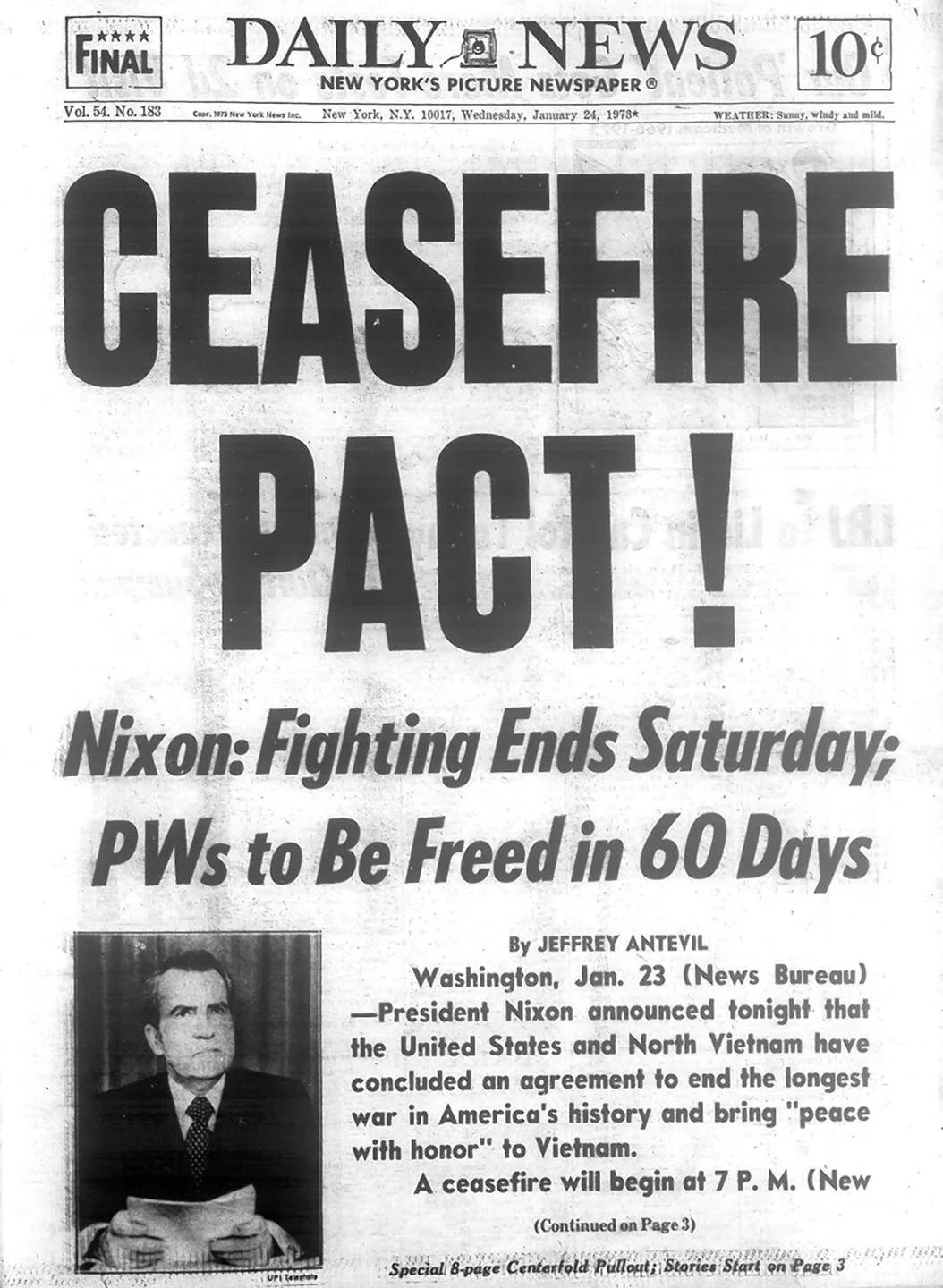
Richard Nixon: 'We have today concluded an agreement to end the war', End of Vietnam War -1973

October 11, 2019

23 January 1973, White House, Washington DC, USA

Good evening:

I have asked for this radio and television time tonight for the purpose of announcing that we today have concluded an agreement to end the war and bring peace with honor in Vietnam and in Southeast Asia.

The following statement is being issued at this moment in Washington and Hanoi:

At 12:30 Paris time today, January 23, 1973, the Agreement on Ending the War and Restoring Peace in Vietnam was initialed by Dr. Henry Kissinger on behalf of the United States, and Special Adviser Le Duc Tho on behalf of the Democratic Republic of Vietnam.

The agreement will be formally signed by the parties participating in the Paris Conference on Vietnam on January 27, 1973, at the International Conference Center in Paris.

The cease-fire will take effect at 2400 Greenwich Mean Time, January 27, 1973. The United States and the Democratic Republic of Vietnam express the hope that this agreement will insure stable peace in Vietnam and contribute to the preservation of lasting peace in Indochina and Southeast Asia.

That concludes the formal statement. Throughout the years of negotiations, we have insisted on peace with honor. In my addresses to the Nation from this room of January 25 and May 8 [1972], I set forth the goals that we considered essential for peace with honor.

In the settlement that has now been agreed to, all the conditions that I laid down then have been met:

A cease-fire, internationally supervised, will begin at 7 p.m., this Saturday, January 27, Washington time.

Within 60 days from this Saturday, all Americans held prisoners of war throughout Indochina will be released. There will be the fullest possible accounting for all of those who are missing in action.

During the same 60-day period, all American forces will be withdrawn from South Vietnam.

The people of South Vietnam have been guaranteed the right to determine their own future, without outside interference.

By joint agreement, the full text of the agreement and the protocol to carry it out will be issued tomorrow.

Throughout these negotiations we have been in the closest consultation with President Thieu and other representatives of the Republic of Vietnam. This settlement meets the goals and has the full support of President Thieu and the Government of the Republic of Vietnam, as well as that of our other allies who are affected.

The United States will continue to recognize the Government of the Republic of Vietnam as the sole legitimate government of South Vietnam.

We shall continue to aid South Vietnam within the terms of the agreement, and we shall support efforts by the people of South Vietnam to settle their problems peacefully among themselves.

We must recognize that ending the war is only the first step toward building the peace. All parties must now see to it that this is a peace that lasts, and also a peace that heals–and a peace that not only ends the war in Southeast Asia but contributes to the prospects of peace in the whole world.

This will mean that the terms of the agreement must be scrupulously adhered to. We shall do everything the agreement requires of us, and we shall expect the other parties to do everything it requires of them. We shall also expect other interested nations to help insure that the agreement is carried out and peace is maintained.

As this long and very difficult war ends, I would like to address a few special words to each of those who have been parties in the conflict.

First, to the people and Government of South Vietnam: By your courage, by your sacrifice, you have won the precious right to determine your own future, and you have developed the strength to defend that right. We look forward to working with you in the future–friends in peace as we have been allies in war.

To the leaders of North Vietnam: As we have ended the war through negotiations, let us now build a peace of reconciliation. For our part, we are prepared to make a major effort to help achieve that goal. But just as reciprocity was needed to end the war, so too will it be needed to build and strengthen the peace.

To the other major powers that have been involved even indirectly: Now is the time for mutual restraint so that the peace we have achieved can last.

And finally, to all of you who are listening, the American people: Your steadfastness in supporting our insistence on peace with honor has made peace with honor possible. I know that you would not have wanted that peace jeopardized. With our secret negotiations at the sensitive stage they were in during this recent period, for me to have discussed publicly our efforts to secure peace would not only have violated our understanding with North Vietnam, it would have seriously harmed and possibly destroyed the chances for peace. Therefore, I know that you now can understand why, during these past several weeks, I have not made any public statements about those efforts.

The important thing was not to talk about peace, but to get peace–and to get the right kind of peace. This we have done.

Now that we have achieved an honorable agreement, let us be proud that America did not settle for a peace that would have betrayed our allies, that would have abandoned our prisoners of war, or that would have ended the war for us but would have continued the war for the 50 million people of Indochina. Let us be proud of the 2 1/2 million young Americans who served in Vietnam, who served with honor and distinction in one of the most selfless enterprises in the history of nations. And let us be proud of those who sacrificed, who gave their lives so that the people of South Vietnam might live in freedom and so that the world might live in peace.

In particular, I would like to say a word to some of the bravest people I have ever met–the wives, the children, the families of our prisoners of war and the missing in action. When others called on us to settle on any terms, you had the courage to stand for the right kind of peace so that those who died and those who suffered would not have died and suffered in vain, and so that where this generation knew war, the next generation would know peace. Nothing means more to me at this moment than the fact that your long vigil is coming to an end.

Just yesterday, a great American, who once occupied this office, died. In his life, President Johnson endured the vilification of those who sought to portray him as a man of war. But there was nothing he cared about more deeply than achieving a lasting peace in the world.

I remember the last time I talked with him. It was just the day after New Year’s. He spoke then of his concern with bringing peace, with making it the right kind of peace, and I was grateful that he once again expressed his support for my efforts to gain such a peace. No one would have welcomed this peace more than he.

And I know .he would join me in asking-for those who died and for those who live–let us consecrate this moment by resolving together to make the peace we have achieved a peace that will last. Thank you and good evening.

CEASEFIRE PACT NIXON.jpg
Source: https://www.nixonfoundation.org/2017/08/ad...

Enjoyed this speech? Speakola is a labour of love and I’d be very grateful if you would share, tweet or like it. Thank you.

Facebook Twitter Facebook
In 1960-79 B Tags RICHARD NIXON, PEACE WITH HONOUR SPEECH, TRANSCRIPT, END OF VIETNAM WAR, CEASEFIRE AGREEMENT, PEACE WITH HONOR
Comment

Sprio Agnew: 'I believe that America has always thrived on adversity", Resignation speech - 1973

October 11, 2019

15 October 1973, Washington DC, USA

Good evening, ladies and gentlemen.

Nearly five years ago and again last year you gave me the greatest honor of my life by electing me Vice President of the United States.

I do not want to spend these last moments with you in a paroxysm of bitterness, but I do think there are matters related to my resignation that are misunderstood. It is important to me and believe to the country that these misconceptions be corrected.

Late this summer my fitness to continue in office came under attack when accusations against me made in the course of a grand jury investigation were improperly and unconscionably leaked in detail to the news media.

I might add that the attacks were increased by daily publication of the wildest rumor and speculation, much of it bearing no resemblance to the information being given the prosecutors.

All this was done with full knowledge that it was prejudicial to my civil rights.

The news media editorially deplored these violations of the traditional secrecy of such investigations but at the same time many of the most prestigious of them were ignoring their own counsel by publishing every leak they could get their hands on.

From time to time I made public denials of those scurrilous and inaccurate reports and challenged the credibility of their sources.

I have consistently renewed those denials, last doing so at the hearing in the United States District Court. There, in a response to a statement of the prosecutor's case, I stated that, with the exception of my decision not to contest the 1967 tax charge, I flatly and categorically denied the assertions of illegal acts on my part made by the Government witnesses.

I repeat and I emphasize that denial of wrongdoing tonight.

Notwithstanding that the Government's case for extortion, bribery and conspiracy rested entirely on the testimony of individuals who had already confessed to criminal acts and who had been granted total or partial immunity in exchange for their testimony against me, their accusations which are not independently corroborated or tested by cross‐examination have been published and broadcast as indispuatble fact.

This has been done even though such accusations are not a provable part of the single count of tax evasion which I saw fit not to contest and which was the only issue on which I went to court.

Up until a few days ago I was determined to fight for my integrity and my office whatever the cost. The confidence that millions of you expressed encouraged me and no words can convey the appreciation that my family and I will always feel for your outpouring of support.

However, after hard deliberation and much prayer, I concluded several days ago that the public interest and the interests of those who mean the most to me would best be served by my stepping down.

The constitutional formalities of that decision were fulfilled last Wednesday when I tendered my resignation as Vice President to the Secretary of State.

The legal sanctions necessary to resolve the contest, sanctions to which I am subject like any other citizen under our American system were fulfilled that same day when I pleaded nolo contendere and accepted the judgment of a Federal court for a violation of the tax laws in 1967 when I was governor of Maryland.

While I am fully aware that the plea of nolo contendere was the equivalent of a plea of guilty for the purpose of that negotiated proceeding in Baltimore, it does not represent a confession of any guilt whatever for any other purpose. I made the plea because it was the only way to quickly resolve the situation.

In this technological age image becomes dominant, appearance supersedes reality. An appearance of wrongdoing whether true or false in fact is damaging to any man. But more important it is fatal to a man who must be ready at any moment to step into the Presidency.

The American people deserve to have a Vice President who commands their unimpaired confidence and implicit trust. For more than two months now you have not had such a Vice President. Had I remained in office and fought to vindicate myself through the courts and the Congress, it would have meant subjecting the country to a further agonizing period of months without an unclouded successor for the Presidency.

This I could not do despite my tormented verbal assertion in Los Angeles. To put his country through the ordeal of division and uncertainty that that entailed would be a selfish and unpatriotic action for any man in the best of times. But at this especially critical time, with a dangerous war raging in the Mideast and with the nation still torn by the wrenching experiences of the past year, it would have been intolerable.

So I chose instead not to contest formally the accusations against me. My plea last week in court was exactly that—not an admission of guilt but a plea of no contest, done to still the raging storm, delivering myself for conviction in one court on one count, the filing of a false income tax return for 1967.

But in addition to my constitutional and legal responsibilities, I am also accountable to another authority, that of the people themselves. Tonight I'd like to try briefly to give you the explanation that you should rightly have.

First, a few words about Government contractors and fund‐raising appear to be in order.

At every level of government in this country, local, state and national, public officials in high executive positions must make choices in the course of carrying out engineering and architectural projects undertaken for the public good.

Because they involve professional people these are negotiated and non ‐ bid awards. Competition is fierce and the pressures for favoritism are formidable.

And I'm sure you realize that public officials who do not possess large personal fortunes face the unpleasant but unavoidable necessity of raising substantial sums of money to pay their campaign and election expenses.

In the forefront of those eager to contribute always have been the contractors seeking non‐bid state awards.

Beyond the insinuation that I pocketed large sums of money, which has never been proven, and which I emphatically deny, the intricate tangle of criminal charges leveled at me which you've been reading and hearing about during these past months boils down to the accusation that I permitted my fundraising activities and my contract‐dispensing activities to overlap in an unethical and unlawful manner. Perhaps, judged by the new postWatergate political morality, I did.

But the prosecution's assertion that I was the initiator and the gray eminence in an unprecedented and complex scheme of extortion is just not realistic.

For trained prosecution's witnesses who have long been experienced and aggressive in Maryland politics to masquerade as innocent victims of illegal enticements from me is enough to provoke incredulous laughter from any experienced political observer.

All knowledgeable politicians and contractors know better than that.

They know where the questionable propositions originate.

They know how many shoddy schemes a political man must reject in the course of carrying out his office.

What is it that makes my accusers self‐confessed bribebrokers, extortionists and conspirators believable? And I point out that their stories have been treated as gospel by most of the media. Particularly how can they be believable when they've been encouraged to lessen their punishment by accusing someone else?

Let me reiterate here that I have never as County Executive of Baltimore County, as Governor of Maryland or as Vice President of the United States, enriched myself in betrayal of my public trust.

My current net worth, less than $200,000, is modest for a person of my age and position. Every penny of it can be accounted for from lawful sources.

Moreover my standard of living throughout my political career has been demonstrably modest and has been open to public scrutiny during my public life.

In the Government's recitals against me there are no claims of unexplained personal enrichment.

But if all of this is true you might well ask why did not resign and defend myself in court as a private citizen. I did consider that very seriously. But it was the unanimous judgment of my advisers that resignation would carry a presumption of guilt sufficient to prevent a defense on the merits.

And I'm afraid that what I've been hearing and seeing and reading persuades me that they were right.

By taking the course of the nolo plea I've spared my family great anguish. At the same time I've given the President and the Congress the opportunity to select on your behalf a new Vice President who can fill that office unencumbered by controversy.

I hope to have contributed to focusing America's attention and energies back to where they belong, away from the personal troubles of Ted Agnew and back to the great tasks that confront us as a nation.

As the country turns back to those tasks it is fortunate indeed to do so under the leadership of a President like Richard Nixon. Since events began to break in August the President has borne a heavy burden in his attempt to be both fair to me and faithful to his oath of office. He has done his best to accommodate human decency without sacrificing legal rectitude. He said to me in private exactly what he has stated in public—that the decision was mine alone to make and having now made that decision I want to pay tribute to the President for the restraint and the compassion which he has demonstrated in our conversations about this difficult matter.

The reports from unidentified sources that our meetings were unfriendly, even vitriolic, are completely false.

I also want to express to the President and to all of you my deep regret for any interference which the controversy surrounding me may have caused in the country's pursuit of the great goals of peace, prosperity and progress which the Nixon Administration last year was overwhelmingly reelected to pursue.

Yet our great need at this time is not for regret which looks at the past but for resolve which faces the future.

The first challenge we face as a nation is to summon up the political maturity that will be required to confirm and support the new Vice President.

Under the newly applicable 25th Amendment to the Constitution, for the first time in our history in the event of the President's death or disability, his successor will be someone chosen by the President and confirmed by the Congress rather than someone elected by the people.

In choosing Gerald Ford, the President has made a wise nomination. The Republican House leader has earned the respect of the entire Congress as well as those in the executive branch who have come in contact with him during his long and distinguished career.

Jerry Ford is an eminently fair and capable individual, one who stands on principle, one who works effectively and nonabrasively for the achievable result.

He'll make an excellent Vice President and he is clearly qualified to undertake the highest office should the occasion require it.

After the Vice‐Presidency is filled the next question for Americans will be whether we're able to profit from this series of painful experiences by undertaking the reforms that recent tragedies cry for.

Will the recent events form the crucible out of which a new system of campaign financing is forged, a system in which public funding for every political candidate removes an opportunity for evil or the appearance of evil? sincerely hope so.

Will the furor about campaign contributions dramatize the need for state and Iocal governments across the country to close the loopholes in their laws which invite abuse or suspicion, of abuse in letting lucrative contracts to private business?

Again, I hope so.

I remember closing one such loophole regarding the awarding of insurance contracts when I was County Executive of Baltimore County. Will my nightmare‐cometrue bring about a healthy self‐examination throughout our criminal justice system aimed at stopping prejudicial leaks?

Will the prosecutors be restricted and controlled in their ability to grant immunity and partial immunity to coax from frightened defendants accusations against higher targets? Certainly these procedures need closer supervision by the courts and defense counsel and the bar.

As things now stand immunity is an open invitation to perjury. In the hands of an ambitious prosecutor it can amount to legalized extortion and bribery.

Again, I would hope that such reforms might result. If these beneficial changes do flow from our current national trauma then the suffering and sacrifice that I've had to undergo in the course of all this will be worthwhile.

But regardless of what the future may bring nothing can take away my satisfaction at having served for some 57 months as the second highest constitutional officer of the greatest nation on earth —a satisfaction deriving not from what I did but from what was done for me by millions of fine men and wömen whose beliefs and concerns I tried to articulate and from what was done around me by a great President and his administration in advancing the cause of peace and well being for this country and for all mankind.

I believe that America has always thrived on adversity and so I can foresee only good ahead for this country despite my personal sorrow at leaving public service and leaving many objectives incomplete.

Under this Administration which you have chosen and in which I have been priviledged to serve, the longest war in America's history has been brought to an honorable end and we are within the best chance for lasting peace that the world has had in a century and a half. Both the abundance and the quality of American life are pushing to new highs.

Our democracy, with its balanced Federal system, its separation of powers, and its fundamental principles of individual liberty, is working better than ever before.

Our bicentennial in 1976 will be marked by a chance for the electorate to choose among an unusually fine group of potential leaders.

These are America's strengths and her glories which no amount of preoccupation with her weaknesses can obscure.

Every age in American history has had its crises and upheavals. They all must have seemed like massive earthquakes to those who stood at the epicenter of the movement, but they all left the foundations of the Republic secure and unshaken when history moved on.

The resignation of a Vice President, for example, is insignificant compared with the death of a President, particularly one so great as Lincoln.

But I can't help thinking tonight of James Garfield's words to an audience in New York just following the announcement that Lincoln had died. Garfield, who was later President himself, was only a young Army officer at the time of that great tragedy in 1865, but he saw clearly where his country's strength lay, and he expressed it all in these few words to a frightened crowd. He said:

“Fellow citizens, God reigns, and the Government in Washington still lives.”

I take leave of you tonight, my friends, in that same sober but trusting spirit. God does reign. I thank Him for the opportunity of serving you in high office, and I know that He will continue to care for this country in the future as He has done so well in the past.

The Government at Washington does live. It lives in the pages of our Constitution and in the hearts of our citizens and there it will. always be safe.

Thank you. Goodnight and farewell.

Source: https://www.nytimes.com/1973/10/16/archive...

Enjoyed this speech? Speakola is a labour of love and I’d be very grateful if you would share, tweet or like it. Thank you.

Facebook Twitter Facebook
In 1960-79 B Tags SPIRO AGNEW, VICE PRESIDENT, RESIGNATION, GOD REIGNS, TAX EVASION, TRANSCRIPT, RICHARD NIXON, RUNNING MATE, FAREWELL, POLITICAL SCANDAL
Comment

Richard Nixon: 'I ask you to join in a high adventure', Inaugural Address - 1969

October 11, 2019

20 January 1969, Washington DC, USA

Senator Dirksen, Mr. Chief Justice, Mr. Vice President, President Johnson, Vice President Humphrey, my fellow Americans—and my fellow citizens of the world community:

I ask you to share with me today the majesty of this moment. In the orderly transfer of power, we celebrate the unity that keeps us free.
Each moment in history is a fleeting time, precious and unique. But some stand out as moments of beginning, in which courses are set that shape decades or centuries.
This can be such a moment.
Forces now are converging that make possible, for the first time, the hope that many of man's deepest aspirations can at last be realized. The spiraling pace of change allows us to contemplate, within our own lifetime, advances that once would have taken centuries.
In throwing wide the horizons of space, we have discovered new horizons on earth.
For the first time, because the people of the world want peace, and the leaders of the world are afraid of war, the times are on the side of peace.
Eight years from now America will celebrate its 200th anniversary as a nation. Within the lifetime of most people now living, mankind will celebrate that great new year which comes only once in a thousand years—the beginning of the third millennium.
What kind of nation we will be, what kind of world we will live in, whether we shape the future in the image of our hopes, is ours to determine by our actions and our choices.
The greatest honor history can bestow is the title of peacemaker. This honor now beckons America—the chance to help lead the world at last out of the valley of turmoil, and onto that high ground of peace that man has dreamed of since the dawn of civilization.
If we succeed, generations to come will say of us now living that we mastered our moment, that we helped make the world safe for mankind.
This is our summons to greatness.
I believe the American people are ready to answer this call.
The second third of this century has been a time of proud achievement. We have made enormous strides in science and industry and agriculture. We have shared our wealth more broadly than ever. We have learned at last to manage a modern economy to assure its continued growth.
We have given freedom new reach, and we have begun to make its promise real for black as well as for white.
We see the hope of tomorrow in the youth of today. I know America's youth. I believe in them. We can be proud that they are better educated, more committed, more passionately driven by conscience than any generation in our history.
No people has ever been so close to the achievement of a just and abundant society, or so possessed of the will to achieve it. Because our strengths are so great, we can afford to appraise our weaknesses with candor and to approach them with hope.
Standing in this same place a third of a century ago, Franklin Delano Roosevelt addressed a Nation ravaged by depression and gripped in fear. He could say in surveying the Nation's troubles: "They concern, thank God, only material things."
Our crisis today is the reverse.
We have found ourselves rich in goods, but ragged in spirit; reaching with magnificent precision for the moon, but falling into raucous discord on earth.
We are caught in war, wanting peace. We are torn by division, wanting unity. We see around us empty lives, wanting fulfillment. We see tasks that need doing, waiting for hands to do them. 20
To a crisis of the spirit, we need an answer of the spirit.
To find that answer, we need only look within ourselves.
When we listen to "the better angels of our nature," we find that they celebrate the simple things, the basic things—such as goodness, decency, love, kindness.
Greatness comes in simple trappings.
The simple things are the ones most needed today if we are to surmount what divides us, and cement what unites us.
To lower our voices would be a simple thing.
In these difficult years, America has suffered from a fever of words; from inflated rhetoric that promises more than it can deliver; from angry rhetoric that fans discontents into hatreds; from bombastic rhetoric that postures instead of persuading.
We cannot learn from one another until we stop shouting at one another—until we speak quietly enough so that our words can be heard as well as our voices.
For its part, government will listen. We will strive to listen in new ways—to the voices of quiet anguish, the voices that speak without words, the voices of the heart—to the injured voices, the anxious voices, the voices that have despaired of being heard.
Those who have been left out, we will try to bring in.
Those left behind, we will help to catch up.
For all of our people, we will set as our goal the decent order that makes progress possible and our lives secure.
As we reach toward our hopes, our task is to build on what has gone before—not turning away from the old, but turning toward the new.
In this past third of a century, government has passed more laws, spent more money, initiated more programs, than in all our previous history.
In pursuing our goals of full employment, better housing, excellence in education; in rebuilding our cities and improving our rural areas; in protecting our environment and enhancing the quality of life—in all these and more, we will and must press urgently forward.
We shall plan now for the day when our wealth can be transferred from the destruction of war abroad to the urgent needs of our people at home.
The American dream does not come to those who fall asleep.
But we are approaching the limits of what government alone can do.
Our greatest need now is to reach beyond government, and to enlist the legions of the concerned and the committed.
What has to be done, has to be done by government and people together or it will not be done at all. The lesson of past agony is that without the people we can do nothing; with the people we can do everything.
To match the magnitude of our tasks, we need the energies of our people—enlisted not only in grand enterprises, but more importantly in those small, splendid efforts that make headlines in the neighborhood newspaper instead of the national journal.
With these, we can build a great cathedral of the spirit—each of us raising it one stone at a time, as he reaches out to his neighbor, helping, caring, doing.
I do not offer a life of uninspiring ease. I do not call for a life of grim sacrifice. I ask you to join in a high adventure—one as rich as humanity itself, and as exciting as the times we live in.
The essence of freedom is that each of us shares in the shaping of his own destiny.
Until he has been part of a cause larger than himself, no man is truly whole.
The way to fulfillment is in the use of our talents; we achieve nobility in the spirit that inspires that use.
As we measure what can be done, we shall promise only what we know we can produce, but as we chart our goals we shall be lifted by our dreams.

No man can be fully free while his neighbor is not. To go forward at all is to go forward together.

This means black and white together, as one nation, not two. The laws have caught up with our conscience. What remains is to give life to what is in the law: to ensure at last that as all are born equal in dignity before God, all are born equal in dignity before man.
As we learn to go forward together at home, let us also seek to go forward together with all mankind.
Let us take as our goal: where peace is unknown, make it welcome; where peace is fragile, make it strong; where peace is temporary, make it permanent.
After a period of confrontation, we are entering an era of negotiation.
Let all nations know that during this administration our lines of communication will be open.
We seek an open world—open to ideas, open to the exchange of goods and people—a world in which no people, great or small, will live in angry isolation.
We cannot expect to make everyone our friend, but we can try to make no one our enemy.
Those who would be our adversaries, we invite to a peaceful competition—not in conquering territory or extending dominion, but in enriching the life of man.
As we explore the reaches of space, let us go to the new worlds together—not as new worlds to be conquered, but as a new adventure to be shared.
With those who are willing to join, let us cooperate to reduce the burden of arms, to strengthen the structure of peace, to lift up the poor and the hungry.
But to all those who would be tempted by weakness, let us leave no doubt that we will be as strong as we need to be for as long as we need to be.
Over the past twenty years, since I first came to this Capital as a freshman Congressman, I have visited most of the nations of the world.
I have come to know the leaders of the world, and the great forces, the hatreds, the fears that divide the world.
I know that peace does not come through wishing for it—that there is no substitute for days and even years of patient and prolonged diplomacy.
I also know the people of the world.
I have seen the hunger of a homeless child, the pain of a man wounded in battle, the grief of a mother who has lost her son. I know these have no ideology, no race.
I know America. I know the heart of America is good.
I speak from my own heart, and the heart of my country, the deep concern we have for those who suffer, and those who sorrow.

I have taken an oath today in the presence of God and my countrymen to uphold and defend the Constitution of the United States. To that oath I now add this sacred commitment: I shall consecrate my office, my energies, and all the wisdom I can summon, to the cause of peace among nations.

Let this message be heard by strong and weak alike:
The peace we seek to win is not victory over any other people, but the peace that comes "with healing in its wings"; with compassion for those who have suffered; with understanding for those who have opposed us; with the opportunity for all the peoples of this earth to choose their own destiny.
Only a few short weeks ago, we shared the glory of man's first sight of the world as God sees it, as a single sphere reflecting light in the darkness.
As the Apollo astronauts flew over the moon's gray surface on Christmas Eve, they spoke to us of the beauty of earth—and in that voice so clear across the lunar distance, we heard them invoke God's blessing on its goodness.
In that moment, their view from the moon moved poet Archibald MacLeish to write:
"To see the earth as it truly is, small and blue and beautiful in that eternal silence where it floats, is to see ourselves as riders on the earth together, brothers on that bright loveliness in the eternal cold—brothers who know now they are truly brothers."
In that moment of surpassing technological triumph, men turned their thoughts toward home and humanity—seeing in that far perspective that man's destiny on earth is not divisible; telling us that however far we reach into the cosmos, our destiny lies not in the stars but on Earth itself, in our own hands, in our own hearts.
We have endured a long night of the American spirit. But as our eyes catch the dimness of the first rays of dawn, let us not curse the remaining dark. Let us gather the light.
Our destiny offers, not the cup of despair, but the chalice of opportunity. So let us seize it, not in fear, but in gladness—and, "riders on the earth together," let us go forward, firm in our faith, steadfast in our purpose, cautious of the dangers; but sustained by our confidence in the will of God and the promise of man.

Source: https://www.bartleby.com/124/pres58.html

Enjoyed this speech? Speakola is a labour of love and I’d be very grateful if you would share, tweet or like it. Thank you.

Facebook Twitter Facebook
In 1960-79 B Tags RICHARD NIXON, INAUGURAL SPEECH, FIRST INAUGURAL, TRANSCRIPT, FDR, MOON
Comment

John F Kennedy & Richard Nixon: Fourth Presidential Debate - 1960

October 10, 2019

MR. HOWE: I am Quincy Howe of CB--of ABC News saying good evening from New York where the two major candidates for President of the United States are about to engage in their fourth radio-television discussion of the present campaign.

Tonight these men will confine that discussion to foreign policy. Good evening, Vice President Nixon.

MR. NIXON: Good evening, Mr. Howe.

MR. HOWE: And good evening, Senator Kennedy.

MR. KENNEDY: Good evening, Mr. Howe.

MR. HOWE: Now let me read the rules and conditions under which the candidates themselves have agreed to proceed. As they did in their first meeting, both men will make opening statements of about 8 minutes each, and closing statements of equal time, running 3 to 5 minutes each. During the half hour between the opening and closing statements the candidates will answer and comment upon questions from a panel of four correspondents chosen by the nationwide networks that carry the program.

Each candidate will be questioned in turn with opportunity for comment by the other. Each answer will be limited to 2 1/2 minutes. Each comment to 1 1/2 minutes.

The correspondents are free to ask any questions they choose in the field of foreign affairs. Neither candidate knows what questions will be asked.

Time alone will determine the final question.

Reversing the order in their first meeting, Senator Kennedy will make the second opening statement and the first closing statement.

For the first opening statement, here is Vice President Nixon.

MR. NIXON: Mr. Howe, Senator Kennedy, my fellow Americans. Since this campaign began I have had a very rare privilege. I have traveled to 48 of the 50 states and in my travels I have learned what the people of the United States are thinking about.

There is one issue that stands out above all the rest; one in which every American is concerned, regardless of what group he may be a member and regardless of where he may live. And that issue, very simply stated, is this: How can we keep the peace; keep it without surrender? How can we extend freedom; extend it without war?

Now, in determining how we deal with this issue, we must find the answer to a very important but simple question: Who threatens the peace? Who threatens freedom in the world?

There is only one threat to peace and one threat to freedom: that that is presented by the international Communist movement; and therefore, if we are to have peace, if we are to keep our own freedom and extend it to others without war, we must know how to deal with the Communists and their leaders.

I know Mr. Khrushchev. I also have had the opportunity of knowing and meeting other Communist leaders in the world. I believe there are certain principles we must find in dealing with him and his colleagues, principles if followed, that will keep the peace and that also can extend freedom.

First, we have to learn from the past, because we cannot afford to make the mistakes of the past. In the 7 years before this administration came into power in Washington, we found that 600 million people went behind the Iron Curtain, and at the end of that 7 years we were engaged in a war in Korea which cost of over 30,000 American lives.

In the past 7 years, in President Eisenhower's administration, this situation has been reversed. We ended the Korean War by strong, firm leadership. We have kept out of other wars and we have avoided surrender of principle or territory at the conference table.

Now, why were we successful as our predecessors were not successful? I think there're several reasons. In the first place, they made a fatal error in misjudging the Communists in trying to apply to them the same rules of conduct that you would apply to the leaders of the free world.

One of the major errors they made was the one that led to the Korean War. In ruling out the defense of Korea, they invited aggression in that area. They thought they were going to have peace. It brought war. We learned from their mistakes. And so, in our 7 years, we find that we have been firm in our diplomacy.

We have never made concessions without getting concessions in return. We have always been willing to go the extra mile to negotiate for disarmament or in any other area, but we have never been willing to do anything that, in effect, surrendered freedom any place in the world. That is why President Eisenhower was correct in not apologizing or expressing regrets to Mr. Khrushchev at the Paris Conference, as Senator Kennedy suggested he could have done. That is why Senator--President Eisenhower was also correct in his policy in the Formosa Straits where he declined and refused to follow the recommendations, recommendations which Senator Kennedy voted for in 1955, again made in 1959, again repeated in his debates, that you have heard, recommendations with regard to again slicing off a piece of free territory, and abandoning it effect, to the Communists.

Why did the President feel this was wrong and why was the President right and his critics wrong? Because again, this showed a lack of understanding of dictators, a lack of understanding particularly of Communists because every time you make such a concession it does not lead to peace. It only encourages them to blackmail you. It encourages them to begin a war.

And so I say that the record shows that we know how to keep the peace, to keep it without surrender. Let us move now to the future.

It is not enough to stand on this record because we are dealing with the most ruthless, fanatical leaders that the world has ever seen. That is why I say that in this period of the sixties America must move forward in every area. First of all, although we are today, as Senator Kennedy has admitted, the strongest nation in the world militarily, we must increase our strength, increase it so that we will always have enough strength that regardless of what our potential opponents have, if they should launch a surprise attack we will be able to destroy their war-making capabilities.

They must know, in other words, that it is national suicide if they begin anything. We need this kind of strength because we're the guardians of the peace.

In addition to military strength we need to see that the economy of this country continues to grow. It has grown in the past 7 years. It can and will grow even more in the next 4. And the reason that it must grow even more is because we have things to do at home, and also because we're in a race for survival; a race in which it isn't enough to be ahead; it isn't enough simply to be complacent. We have to move ahead in order to stay ahead. And that is why, in this field I have made recommendations which I am confident will move the American economy ahead, move it firmly and soundly so that there will never be a time when the Soviet Union will be able to challenge our superiority in this field.

And so we need military strength. We need economic strength. We also need the right diplomatic policies. What are they? Again we turn to the past. Firmness but no belligerence, and by "no belligerence" I mean that we do not answer insult by insult.

When you are proud and confident of your strength, you do not get down to the level of Mr. Khrushchev and his colleagues.

And that example that President Eisenhower has set we will continue to follow.

But all this by itself, is not enough. It is not enough for us simply to be the strongest nation militarily, the strongest economically and also to have firm diplomacy.

We must have a great goal, and that is: Not just to keep freedom for ourselves but to extend it to all the world. To extend it to all the world because that is America's destiny. To extend it to all the world because the Communist aim is not to hold their own but to extend communism. And you cannot fight a victory for communism or a strategy of victory for communism with a strategy simply of holding the line.

And so I say that we believe that our policies of military strength, of economic strength, of diplomatic firmness first will keep the peace and keep it without surrender.

We also believe that in the great field of ideals that we can lead America to the victory for freedom, victory in the newly developing countries, victory also in the captive countries, provided we have faith in ourselves and faith in our principles.

MR. HOWE: Now the opening statement of Senator Kennedy.

MR. KENNEDY: Mr. Howe, Mr. Vice President, first let me again try to correct the record on the matter of Quemoy and Matsu. I voted for the Formosa resolution in 1955. I have sustained it since then. I have said that I agree with the administration policy. Mr. Nixon earlier indicated that he would defend Quemoy and Matsu even if the attack on these islands, 2 miles off the coast of China, were not part of a general attack an Formosa and the Pescadores. I indicated that I would defend those islands if the attack were directed against Pescadores and Formosa, which is part of the Eisenhower policy. I have supported that policy.

In the last week, as a member of the Senate Foreign Relations Committee, I reread the testimony of General Twining representing the administration in 1959, and the Assistant Secretary of State before the Foreign Relations Committee in 1958, and I have accurately described the administration policy, and I support it wholeheartedly. So that really isn't an issue in this campaign. It isn't an issue with Mr. Nixon, who now says that he also supports the Eisenhower policy.

Nor is the question that all Americans want peace and security an issue in this campaign. The question is: Are we moving in the direction of peace and security? Is our relative strength growing? Is--as Mr. Nixon says--our prestige at an alltime high, as he said a week ago, and that of the Communists at an alltime low? I don't believe it is. I don't believe that our relative strength is increasing, and I say that not as a Democratic standard bearer, but as a citizen of the United States who is concerned about the United States.

I look at Cuba, 90 miles off the coast of the United States. In 1957 I was in Havana. I talked to the American Ambassador there. He said that he was the second most powerful man in Cuba, and yet even though Ambassador Smith and Ambassador Gardner, both Republican Ambassadors, both warned of Castro, the Marxist influences around Castro, the Communist influences around Castro, both of them have testified in the last 6 weeks, that in spite of their warnings to the American Government, nothing was done.

Our security depends upon Latin America. Can any American, looking at the situation in Latin America, feel contented with what's happening today, when a candidate for the Presidency of Brazil feels it necessary to call, not on Washington during the campaign, but on Castro in Havana, in order to pick up the support of the Castro supporters in Brazil?

At the American Conference--Inter-American Conference this summer, when we wanted them to join together in the denunciation of Castro and the Cuban Communists, we couldn't even get the Inter-American group to join together in denouncing Castro. It was rather a vague statement that they finally made.

Do you know today that the Comm--the Russians broadcast 10 times as many programs in Spanish to Latin America as we do?

Do you know we don't have a single program sponsored by our Government to Cuba, to tell them our story, to tell them that we are their friends, that we want them to be free again?

Africa is now the emerging area of the world. It contains 25 percent of all the members of the General Assembly. We didn't even have a Bureau of African Affairs until 1957. In the Africa, south of the Sahara, which is the major new section, we have less students from all of Africa in that area studying under Government auspices today than from the country of Thailand. If there's one thing Africa needs, it's technical assistance, and yet last year we gave them less than 5 percent of all the technical assistance funds that we distributed around the world. We relied in the Middle East on the Baghdad Pact, and yet when the Iraqi Government was changed, the Baghdad Pact broke down.

We relied on the Eisenhower Doctrine for the Middle East which passed the Senate. There isn't one country in the Middle East that now endorses the Eisenhower Doctrine.

We look to Euro--to Asia, because the struggle is in the underdeveloped world. Which system, communism or freedom, will triumph in the next 5 or 10 years? That's what should concern us, not the history of 10 or 15 or 20 years ago. But are we doing enough in these areas? What are freedom's chances in those areas?

By 1965 or 1970 will there be other Cubas in Latin America? Will Guinea and Ghana, which have now voted with the Communists frequently as newly independent countries of Africa, will there be others? Will the Congo go Communist? Will other countries? Are we doing enough in that area?

And what about Asia? Is India going to win the economic struggle or is China going to win it? Who will dominate Asia in the next 5 or 10 years? Communism? The Chinese? Or will freedom?

The question which we have to decide as Americans: Are we doing enough today? Is our strength and prestige rising? Do people want to be identified with us? Do they want to follow the United States leadership? I don't think they do enough. And that's what concerns me.

In Africa these countries that have newly joined the United Nations, on the question of admission of Red China, only two countries in all of Africa voted with us: Liberia and the Union of South Africa. The rest either abstained or voted against us. More countries in Asia voted against us on that question than voted with us.

I believe that this struggle is going to go on and it may be well decided in the next decade.

I have seen Cuba go to the Communists. I have seen Communist influence and Castro influence rise in Latin America. I have seen us ignore Africa. There are six countries in Africa that are members of the United Nations. There isn't a single American diplomatic representative in any of those six.

When Guinea became independent, the Soviet Ambassador showed up that very day. We didn't recognize them for 2 months; the American Ambassador didn't show up for nearly 8 months. I believe that the world is changing fast, and I don't think this administration has shown the foresight, has shown the knowledge, has been identified with the great fight which these people are waging to be free, to get a better standard of living, to live better.

The average income in some of those countries is $25 a year. The Communists say, "Come with us; look what we've done." And we've been, on the whole, uninterested.

I think we're going to have to do better. Mr. Nixon talks about our being the strongest country in the world. I think we are today, but we were far stronger relative to the Communists 5 years ago, and what is of great concern is that the balance of power is in danger of moving with them.

They made a breakthrough in missiles, and by 1961, '2, and '3, they will be outnumbering us in missiles.

I'm not as confident as he is that we will be the strongest military power by 1963.

He talks about economic growth as a great indicator of freedom. I agree with him. What we do in this country, the kind of society that we build: That will tell whether freedom will be sustained around the world and yet in the last 9 months of this year we've had a drop in our economic growth rather than a gain.

We've had the lowest rate of increase of economic growth in the last 9 months of any major industrialized society in the world.

I look up and see the Soviet flag on the moon. The fact is that the State Department polls on our prestige and influence around the world have shown such a sharp drop that up till now the State Department has been unwilling to release them and yet they were polled by the USIA.

The point of all this is: This is a struggle in which we're engaged. We want peace. We want freedom. We want security. We want to be stronger. We want freedom to gain. But I don't believe, in these changing and revolutionary times, this administration has known that the world is changing, has identified itself with that change.

I think the Communists have been moving with vigor. Laos, Africa, Cuba--all around the world they're on the move. I think we have to revita1ize our society. I think we have to demonstrate to the people of the world that we're determined in this free country of ours to be first--not first "if" and not first "but" and not first "when" but first.

And when we are strong and when we are first, then freedom gains. Then the prospects for peace increase. Then the prospects for our society gain.

MR. HOWE: That completes the opening statements. Now the candidates will answer and comment upon questions put by these four correspondents: Frank Singiser of Mutual News, John Edwards of ABC News, Walter Cronkite of CBS News, John Chancellor of NBC News.

Frank Singiser has the first question for Vice President Nixon.

MR. SINGISER: Mr. Vice President, I'd like to pin down the difference between the way you would handle Castro's regime and prevent the establishment of Communist governments in the Western Hemisphere and the way that t Senator Kennedy would proceed. Vice President Nixon, in what important respects do you feel there are differences between you, and why do you believe your policy is better for the peace and security of the United States and the Western Hemisphere?

MR. NIXON: Our policies are very different. I think that Senator Kennedy's policies and recommendations for the handling of the Castro regime are probably the most dangerously irresponsible recommendations that he's made during the course of this campaign. In effect, what Senator Kennedy recommends is that the United States Government should give help to the exiles and to those within Cuba who oppose the Castro regime, provided they are anti-Batista.

Now let's just see what this means. We have five treaties with Latin America, including the one setting up the Organization of American States in Bogota in 1948, in which we have agreed not to intervene in the internal affairs of any other American country, and they as well have agreed to do likewise.

The charter of the United Nations, its preamble, Article I and Article II also provide that there shall be no intervention by one nation in the internal affairs of another. Now I don't know what Senator Kennedy suggests when he says that we should help those who oppose the Castro regime both in Cuba and without. But I do know this, that if we were to follow that recommendation that we would lose all of our friends in Latin America, we would probably be condemned in the United Nations, and we would not accomplish our objective. I know something else. It would be an open invitation for Mr. Khrushchev to come in, to come into Latin America and to engage us in what would be a civil war, and possibly even worse than that.

This is the major recommendation that he's made. Now, what can we do? We can do what we did with Guatemala. There was a Communist dictator that we inherited from the previous administration. We quarantined Mr. Arbenz. The result was that the Guatemalan people themselves eventually rose up and they threw him out. We are quarantining Mr. Castro today. We are quarantining him diplomatically by bringing back our Ambassador; economically by cutting off trade--and Senator Kennedy's suggestion that the trade that we cut off is not significant is just 100 percent wrong. We are cutting off the significant items that the Cuban regime needs in order to survive. By cutting off trade, by cutting off our diplomatic relations as we have, we will quarantine this regime so that the people of Cuba themselves will take care of Mr. Castro. But for us to do what Senator Kennedy has suggested, would bring results which I know he would not want and certainly which the American people would not want.

MR. KENNEDY: Mr. Nixon shows himself misinformed. He surely must be aware that most of the equipment and arms and resources for Castro came from the United States, flowed out of Florida and other parts of the United States to Castro in the mountains. There isn't any doubt about that, No. 1.

No. 2, I believe that if any economic sanctions against Latin America are going to be successful, they have to be multilateral, they have to include the other countries of Latin America. The very minute effect of the action which has been taken this week on Cuba's economy, I believe Castro can replace those markets very easily through Latin America, through Europe, and through Eastern Europe. If the United States had stronger prestige and influence in Latin America it could persuade, as Franklin Roosevelt did in 1940, the countries of Latin America to join in an economic quarantine of Castro. That's the only way you can bring real economic pressure on the Castro regime and also the countries of Western Europe, Canada, Japan, and the others.

No. 3, Castro is only the beginning of our difficulties throughout Latin America. The big struggle will be to prevent the influence of Castro spreading to other countries--Mexico, Panama, Bolivia, Colombia. We're going to have to try to provide closer ties to associate ourselves with the great desire of these people for a better life if we're going to prevent Castro's influence from spreading throughout all of Latin America. His influence is strong enough today to prevent us from getting the other countries of Latin America to join with us in economic quarantine. His influence is growing, mostly because this administration has ignored Latin America. You yourself said, Mr. Vice President, a month ago, that if we had provided the kind of economic aid 5 years ago that we are now providing, we might never have had Castro. Why didn't we?

MR. HOWE: John Edwards has his first question for Senator Kennedy.

MR. EDWARDS: Senator Kennedy, one test of a new President's leadership will be the caliber of his appointments. It's a matter of interest here and overseas as to who will be the new Secretary of State. Now under our rules I must ask this question of you but I would hope that the Vice President also would answer it.

Will you give us the names of three or four Americans, each of whom, if appointed, would serve with distinction in your judgment as Secretary of State?

MR. KENNEDY: Mr. Edwards, I don't think it's a wise idea for Presidential candidates to appoint the members of his cabinet prospectively or suggest four people and indicate that one of them surely will be appointed. This is a decision that the President of the United States must make. The last candidate who indicated that--who his Cabinet was going to be, was Mr. Dewey in 1948. This is a race between the Vice President and myself for the Presidency of the United States. There are a good many able men who could be Secretary of State. I have made no judgment about who should be the Secretary of State. I think that judgment could be made after election if I am successful. The people have to make a choice between Mr. Nixon and myself, between the Republican Party and the Democratic Party, between our approach to the problems which now disturb us as a nation and disturb us as a world power. The President bears the constitutional responsibility, not the Secretary of State, for the conduct of foreign affairs.

Some Presidents have been strong in foreign policy. Others have relied heavily on the Secretary of State. I have been a member of the Senate Foreign Relations Committee, I have run for the Presidency with full knowledge that his great responsibility really given to him by the Constitution and by the force of events is in the field of foreign affairs. I'm asking the people's support as President; we will select the best man we can get, but I have not made a judgment and I have not narrowed down a list of three or four people among whom would be the candidate.

MR. HOWE: Mr. Vice President, do you have a comment?

MR. NIXON: Well Mr. Edwards, as you probably know, I have consistently answered all questions with regard to who will be in the next Cabinet by saying that that is the responsibility of the next President and it would be inappropriate to make any decisions on that or to announce any prior to the time that I had the right to do so. So that is my answer to this question.

If you don't mind, I would like to use the balance of the time to respond to one of the comments that Senator Kennedy made on the previous question. He was talking about the Castro regime and what we had been doing in Latin America. I would like to point out that when we look at our programs in Latin America, we find that we have appropriated five times as much for Latin America as was appropriated by the previous administration. We find that we have $2 billion more for the Export-Import Bank. We have a new bank for Latin America alone of a billion dollars. We have the new program which was submitted at the Bogota Conference, this new program that President Eisenhower submitted, approved by the last Congress for $500 million. We have moved in Latin America very effectively, and I'd also like to point this out. Senator Kennedy complains very appropriately about our inadequate radio broadcasts for Latin America. Let me point out again that his Congress, the Democratic Congress, has cut $80 million off of the Voice of America appropriations. Now, he has to get a better job out of his Congress if he's going to get us the money that we need to conduct the foreign affairs of this country in Latin America or any place else.

MR. HOWE: Walter Cronkite, you have your first question for Vice President Nixon.

MR. CRONKITE: Thank you Quincy. Mr. Vice President, Senator Fulbright and now tonight Senator Kennedy maintain that the administration is suppressing a report by the United States Information Agency that shows a decline in United States prestige overseas. Are you aware of such a report, and if you are aware of the existence of such a report, should not that report because of the great importance this issue has been given in this campaign, be released to the public?

MR. NIXON: Mr. Cronkite, I naturally am aware of it because I, of course, pay attention to everything Senator Kennedy says, as well as Senator Fulbright.

Now, in this connection I want to point out that the facts simply aren't as stated. First of all, the report to which Senator Kennedy refers is one that was made many, many months ago and related particularly to the period immediately after Sputnik.

Second, as far as this report is concerned, I would have no objection to having it made public.

Third, I would say this with regard to this report, with regard to Gallup Polls of prestige abroad and everything else that we've been hearing about "what about American prestige abroad?"

America's prestige abroad will be just as high as the spokesmen for America allow it to be.

Now, when we have a Presidential candidate--for example, Senator Kennedy--stating over and over again that the United States is second in space, and the fact of the matter is that the space score today is 28 to 8; we've had 28 successful shots; they've had 8. When he states that we are second in education, and I have seen Soviet education and I've seen ours, and we're not. That we're second in science because they may be ahead in one area or another, when overall we're way ahead of the Soviet Union and all other countries in science. When he says, as he did in January of this year, that we have the worst slums, that we have the most crowded schools, when he says that 17 million people go to bed hungry every night--when he makes statements like this, what does this do to American prestige? Well, it can only have the effect, certainly, of reducing it.

Now, let me make one thing clear. Senator Kennedy has a responsibility to criticize those things that are wrong but he has also a responsibility to be right in his criticisms.

Every one of these items that I have mentioned he's been wrong--dead wrong. And for that reason he has contributed to any lack of prestige.

Finally, let me say this: As far as prestige is concerned, the first place it would show up would be in the United Nations. Now Senator Kennedy has referred to the vote on Communist China. Let's look at the vote on Hungary. There we got more votes for condemning Hungary and looking into that situation than we got the last year.

Let's look at the reaction to Khrushchev and Eisenhower at the last U.N. session. Did Khrushchev gain because he took his shoe off and pounded the table and shouted and insulted? Not at all. The President gained.

America gained by continuing the dignity, the decency that has characterized us and it's that that keeps the prestige of America up--not running down America the way Senator Kennedy has been running her down.

MR. HOWE: Comment, Senator Kennedy?

MR. KENNEDY: I really don't need Mr. Nixon to tell me about what my responsibilities are as a citizen. I've served this country for 14 years in the Congress and before that in the service. I have just as high a devotion, and just as high an opinion. What I downgrade, Mr. Nixon, is the leadership the country is getting, not the country. Now, I didn't make most of the statements that you said I made. I believe the Soviet Union is first in outer space. We may have made more shots, but the size of their rocket thrust and all the rest--you, yourself, said to Khrushchev, "You may be ahead of us in rocket thrust but we're ahead of you in color television" in your famous discussion in the kitchen.

I think that color television is not as important as rocket thrust.

Secondly, I didn't say we had the worst slums in the world. I said we had too many slums, that they are bad and we ought to do something about them and we ought to support housing legislation which this administration has opposed. I didn't say we had the worst education in the world. What I said was that 10 years ago, we were producing twice as many scientists and engineers as the Soviet Union, and today they're producing twice as many as we are and that this affects our security around the world.

And fourth, I believe that the polls and other studies and votes in the United Nations and anyone reading the paper and any citizen of the United States must come to the conclusion that the United States no longer carries the same image of a vital society, on the move, with its brightest days ahead as it carried a decade or two decades ago.

Part of that is because we've stood still here at home. Because we haven't met our problems in the United States. Because we haven't had a moving economy. Part of that, as the Gallup Poll showed, is because the Soviet Union made a breakthrough in outer space. Mr. George Allen, head of your Information Services, said that that made the people of the world begin to wonder whether we were first in science. We are first in other areas of science but in space, which is the new science, we're not first.

MR. HOWE: John Chancellor, your first question for Senator Kennedy.

MR. CHANCELLOR: Senator, another question in connection with our relations with the Russians. There have been stories from Washington from the Atomic Energy Commission hinting that the Russians may have resumed the testing of nuclear devices. Now sir, if this is true, should the United States resume nuclear testing? And if the Russians do not start testing, can you foresee any circumstances in 1961 in which the United States might resume its own series of tests?

MR. KENNEDY: Yes, I think the next President of the United States should make one last effort to secure an agreement on the cessation of tests--No. 1. I think we should go back to Geneva--whoever's elected President, Mr. Nixon or myself, and try once again. If we fail then, if we're unable to come to an agreement, and I hope we can come to an agreement because it does not merely involve now the United States, Britain, France, and the Soviet Union as atomic powers. Because new breakthroughs in atomic energy technology, there's some indications that by the time the next President's term of office has come to an end, there may be 10, 15, or 20 countries with an atomic capacity, perhaps that many testing bombs with all the effect that it could have on the atmosphere and with all the chances that more and more countries will have an atomic capacity, with more and more chance of war.

So, one more effort should be made. I don't think that even if that effort fails that it will be necessary to carry on tests in the atmosphere which pollute the atmosphere.

They can be carried out underground, they could be carried on in outer space. But I believe the effort should be made once more by whoever's elected President of the United States. If we fail, it's been a great serious failure for everyone, for the human race. I hope we can succeed. But then if we fail responsibility will be clearly on the Russians and then we'll have to meet our responsibilities to the security of the United States, and there may have to be testing underground, if the Atomic Energy Committee is prepared for it. There may be testing in outer space. I hope it will not be necessary for any power to resume testing in the atmosphere. It's possible to detect those kind of tests. The kind of tests which you can't detect are underground or in--perhaps in outer space.

So that I'm hopeful we can try once more. If we fail, then we must meet our responsibilities to ourselves.

But I'm most concerned about the whole problem of the spread of atomic weapons. China may have it by 1963--Egypt--war has been the constant companion of mankind. So, to have these weapons disseminated around the world, I believe, means that we're going to move through a period of hazard in the next few years. We ought to make one last effort.

MR. HOWE: Any comment, Mr. Vice President?

MR. NIXON: Yes. I would say, first of all, that we must have in mind the fact that we have been negotiating to get tests inspected and to get an agreement for many, many months. As a matter of fact, there's been a moratorium on testing as a result of the fact that we have been negotiating. I've reached the conclusion that the Soviet Union is actually filibustering. I've reached the conclusion, too, based on the reports that have been made that they may be cheating. I don't think we can wait until the next President is inaugurated and then selects a new team and then all the months of negotiating that will take place before we reach a decision. I think that immediately after this election we should set a timetable--the next President, working with the present President, President Eisenhower--a timetable to break the Soviet filibuster.

There should be no tests in the atmosphere. That rules out any fallout. But as far as underground tests for developing peaceful uses of atomic energy, we should not allow this Soviet filibuster to continue. I think it's time for them to fish or cut bait.

I think that the next President, immediately after his election should sit down with the President, work out a timetable, and get a decision on this before January of next year.

MR. HOWE: Our second round of questions begins with one from Mr. Edwards for the Vice President.

MR. EDWARDS: Mr. Nixon, carrying forward this business about a timetable, as you know, the pressures are increasing for a summit conference. Now, both you and Senator Kennedy have said that there are certain conditions which must be met before you would meet with Khrushchev. Will you be more specific about these conditions?

MR. NIXON: Well, the conditions I laid out in one of our previous television debates, and it's rather difficult to be much more specific than that.

First of all, we have to have adequate preparation for a summit conference. This means at the Secretary of State level and at the ambassadorial level. By adequate preparation I mean that at that level we must prepare an agenda, an agenda agreed upon with the approval of the heads of state involved. Now, this agenda should delineate those issues on which there is a possibility of some agreement or negotiation. I don't believe we should go to a summit conference unless we have such an agenda, unless we have some reasonable assurance from Mr. Khrushchev that he intends seriously to negotiate on those points.

Now this may seem like a rigid, inflexible position. But let's look at the other side of the coin. If we build up the hopes of the world by having a summit conference that is not adequately prepared, and then, if Mr. Khrushchev finds some excuse for breaking it up, as he did this one, because he isn't going to get his way, we set back the cause of peace. We do not help it.

We can, in other words, negotiate many of these items of difference between us without going to the summit. I think we have to make a greater effort than we have been making at the Secretary of State level, at the ambassadorial level, to work out the differences that we have.

And so far as the summit conference is concerned, it should only be entered in upon, it should only be agreed upon, if the negotiations have reached a point that we have some reasonable assurance that something is going to come out of it, other than some "phony spirit," a spirit of Geneva, or Camp David, or whatever it is. When I say "phony spirit," I mean phony, not because the spirit is not good on our side, but because the Soviet Union simply doesn't intend to carry out what they say.

Now, these are the conditions that I can lay out. I could not be more precise than that, because until we see what Mr. Khrushchev does and what he says, we cannot indicate what our plans will be.

MR. HOWE: Any comments, Senator Kennedy?

MR. KENNEDY: Well, I think the President of the United States last winter indicated that before he'd go to the summit in May, as he did last fall, he indicated that there should be some agenda, that there should be some prior agreement. He hoped that there would be uh - b- be an agreement in part in disarmament. He also expressed the hope that there should be some understanding of the general situation in Berlin. The Soviet Union refused to agree to that, and we went to the summit and it was disastrous.

I believe we should not go to the summit until there is some reason to believe that a meeting of minds can be obtained on either Berlin, outer space, or general disarmament, including nuclear testing. In addition, I believe the next President in January and February should go to work in building the strength of the United States. The Soviet Union does understand strength. "We arm to parley," Winston Churchill said 10 years ago. If we are strong, particularly as we face a crisis over Berlin, which we may in the spring or in the winter, it's important that we maintain our determination here, that we indicate that we're building our strength, that we are determined to protect our position, that we're determined to protect our commitments, and then I believe we should indicate our desire to live at peace with the world.

But until we're strong here, until we're moving here, I believe a summit could not be successful. I hope that before we do meet, there will be preliminary agreements on those four questions, or at least two of them, or even one of them, which would warrant such a meeting.

I think if we had stuck by that position last winter, we would have been in a better position in May.

MR. HOWE: We have time for only one or two more questions before the closing statements. Now Walter Cronkite's question for Senator Kennedy.

MR. CRONKITE: Senator, the charge has been made frequently that the United States for many years has been on the defensive around the world, that our policy has been one of reaction to the Soviet Union rather than positive action on our own. What areas do you see where the United States might take the offensive in a challenge to Communism over the next 4 to 8 years?

MR. KENNEDY: One of the areas, and, of course, the most vulnerable area, I have felt, has been Eastern Europe. I've been critical of the administration's failure to suggest policies which would make it possible for us to establish, for example, closer relations with Poland, particularly after the '55-'56 period and the Hungarian revolution. We indicated at that time that we were not going to intervene militarily, but there was a period there when Poland demonstrated a national independence, and even the Polish Government moved some diff--distance away from the Soviet Union. I suggested that we amend our legislation so that we could enjoy closer economic ties. We received the support first of the administration, and then not, and were defeated by one vote in the Senate. We passed a bill in the Senate this year, but it didn't pass the House. I would say Eastern Europe is the area of vulnerability of the Soviet Union.

Secondly, the relations between Russia and China. They are now engaged in a debate over whether war is the means of Communizing the world or whether they should use subversion, infiltration, economic struggles and all the rest. No one can say what that course of action will be, but I think the next President of the United States should watch it carefully. If those two powers should split, it could have great effects throughout the entire world.

Thirdly, I believe that India represents a great area for affirmative action by the free world. India started from about the same place that China did. Chinese Communists have been moving ahead the last 10 years. India, under a free society, has been making some progress, but if India does not succeed with her 450 million people she can't make freedom work, then people around the world are going to determine, particularly in the underdeveloped world, that the only way that they can develop their resources is through the Communist system.

Fourth, let me say that in Africa, Asia, Latin America, Eastern Europe, the great force on our side is the desire of people to be free. This has expressed itself in the revolts in Eastern Europe; it's expressed itself in the desire of the people of Africa to be independent of Western Europe. They want to be free.

And my judgment is that they don't want to give their freedom up to become Communists. They want to stay free, independent perhaps of us, but certainly independent of the Communists. And I believe if we identify ourselves with that force, if we identify ourselves with it as Lincoln--as Wilson did, as Franklin Roosevelt did, if we become known as the friend of freedom, sustaining freedom, helping freedom, helping these people in the fight against poverty and ignorance and disease, helping them build their lives. I believe in Latin America, Africa, and Asia, eventually in Eastern Europe and the Middle East, certainly in Western Europe, we can strengthen freedom, we can make it move, we can put the Communists on the defensive.

MR. HOWE: Your comment, Mr. Vice President?

MR. NIXON: First, with regard to Poland, when I talked to Mr. Gomulka, the present leader of Poland, for 6 hours in Warsaw last year, I learned something about their problems and particularly his. Right under the Soviet gun, with Soviet troops there, he is in a very difficult position in taking anything independent--a position which would be independent of the Soviet Union. And yet, let's just see what we've done for Poland. A half a billion dollars worth of aid has gone to Poland, primarily economic, primarily to go to the people of Poland.

This should continue, and it can be stepped up, to give them hope and to keep alive the hope for freedom that I can testify they have so deeply within them.

In addition we can have more exchange with Poland or with any other of the Iron Curtain countries, which show some desire to take a different path than the path that has been taken by the ones that are complete satellites of the Soviet Union.

Now, as far as the balance of the world is concerned, I, of course don't have as much time as Senator Kennedy had, I would just like to add this one point. If we are going to have the initiative in the world, we must remember that the people of Africa and Asia and Latin America don't want to be pawns simply in a struggle between two great powers, the Soviet Union and the United States. We have to let them know that we want to help them, not because we're simply trying to save our own skins, not because we're simply trying to fight communism, but because we care for them, because we stand for freedom, because if there were no communism in the world we would still fight poverty, and misery, and disease, and tyranny. If we can get that across to the people of these countries in this decade of the sixties the struggle for freedom will be won.

MR. HOWE: John Chancellor's question for Vice President Nixon.

MR. CHANCELLOR: Sir, I'd like to ask you another question about Quemoy and Matsu. Both you and Senator Kennedy say you agree with the President on this subject and with our treaty obligations, but the subject remains in the campaign as an issue. Now, sir, is this because each of you feels obliged to respond to the other when he talks about Quemoy and Matsu? And if that's true, do you think an end should be called to this discussion, or will it stay with us as a campaign issue?

MR. NIXON: I would say that the issue will stay with us as a campaign issue just as long as Senator Kennedy persists in what I think is a fundamental error. He says he supports the President's position. He says that he voted for the resolution. Well, just let me point this out; he voted for the resolution in 1955 which gave the President the power to use the forces of the United States to defend Formosa and the offshore islands. But he also voted then for an amendment, which was lost, fortunately, an amendment which would have drawn a line and left out those islands and denied right to the President to defend those islands if he thought that it was an attack on Formosa.

He repeated that error in 1959 in the speech that he made. He repeated it again in a television debate that we had.

Now, my point is this: Senator Kennedy has got to be consistent here. Either he's for the President and he's against the position that those who opposed the President in '55 and '59-- and the Senator's position itself stated the other day in our debate-- either he is for the President and against that position, or we simply have a disagreement here that must continue to be debated.

Now, if the Senator in his answer to this question will say "I now will depart, or retract my previous views; I think I was wrong in 1955; I think I was wrong in 1959; and I think I was wrong in our television debate, to say that we should draw a line, leaving out Quemoy and Matsu, draw a line in effect abandoning these islands to the Communists," then this will be right out of the campaign, because there will be no issue between us.

I support the President's position. I have always opposed drawing a line. I have opposed drawing a line because I know that the moment you draw a line, that is an encouragement for the Communists to attack, to step up their blackmail and to force you into the war that none of us want.

And so I would hope that Senator Kennedy in his answer today would clear it up. It isn't enough for him to say "I support the President's position, that I voted for the resolution." Of course he voted for the resolution. It was virtually unanimous. But the point is, what about his error in voting for the amendment, which was not adopted? And then persisting in it in '59, persisting in it in the debate?

It's very simple for him to clear it up. He can say now that he no longer believes that a line should be drawn leaving these islands out of the perimeter of defense. If he says that, this issue will not be discussed in the campaign.

MR. HOWE: Senator Kennedy, your comment?

MR. KENNEDY: Well, Mr. Nixon, to go back to 1955, the resolution commits the President and the United States, which I supported, to defend Formosa, the Pescadores, and if it was his military judgment, these islands. Then the President sent a mission composed of Admiral Radford and Mr. Robertson to persuade Chiang Kai-shek in the spring of '55 to withdraw from the two islands because they were exposed. The President was unsuccessful; Chiang Kai-shek would not withdraw.

I referred to the fact that in 1958, as a member of the Senate Foreign Relations Committee, I am very familiar with the position that the United States took in negotiating with the Chinese Communists on these two islands. General Twining in January '59 described the position of the United States. The position of the United States has been that this buildup, in the words of the President has been foolish. Mr. Herter has said these islands are indefensible. Chiang Kai-shek will not withdraw. Because he will not withdraw, because he's committed to these islands, because we've been unable to persuade him to withdraw, we are in a very difficult position, and therefore the President's judgment has been that we should defend the islands if in his military judgment and the judgment of the commander in the field, the attack on these islands should be part of an overall attack on Formosa.

I support that, in view of the difficulties we've had with the islands, in view of the difficulties and disputes we've had with Chiang Kai-shek. That's the only position we can take. That's not the position you took, however. The first position you took, when this matter first came up was that we should draw the line and commit ourselves as a matter of principle to defend these islands, not as part of the defense of Formosa and the Pescadores. You showed no recognition of the administration program to try to persuade Chiang Kai-shek for the last 5 years to withdraw from the islands. And I challenge you tonight to deny that the administration has sent at least several missions to persuade Chiang Kai-shek's withdrawal from these islands.

MR. HOWE: Under the agreed--

MR. KENNEDY: (continuing). . . and that's the testimony of General Twining and the Assistant Secretary of State in '58t.

MR. HOWE: Under the agreed rules, gentlemen, we've exhausted the time for questions. Each candidate will now have 4 minutes and 30 seconds for his closing statement. Senator Kennedy will make the first final closing statement.

MR. KENNEDY: I said that I've served this country for 14 years. I served it in the war. I am devoted to it. If I lose this election, I will continue in the Senate to try to build a stronger country. But I run because I believe this year the United States has a great opportunity to make a move forward, to make a determination here at home and around the world, that it's going to reestablish itself as a vigorous society.

My judgment is that the Republican party has stood still here in the United States, and it's also stood still around the world. We're using about 50 percent of our steel capacity today. We had a recession in '58. We had a recession in '54. We're not moving ahead in education the way we should. We didn't make a judgment in '57, in '56, in '55, in '54 that outer space would be important. If we stand still here, if we appoint people to ambassadorships and positions in Washington who have a status quo outlook, who don't recognize that this is a revolutionary time, then the United States does not maintain its influence. And if we fail, the cause of freedom fails.

I believe it incumbent upon the next President of the United States to get this country moving again, to get our economy moving ahead, to set before the American people its goals, its unfinished business, and then throughout the world appoint the best people we can get, ambassadors who can speak the language, not merely people who made a political contribution, but who can speak the language, bring students here; let them see what kind of a country we have. Mr. Nixon said that we should not regard them as pawns in the cold war, we should identify ourselves with them. If that were true why didn't we identify ourselves with the people of Africa? Why didn't we bring students over here? Why did we suddenly offer Congo 300 students last June when they had the tremendous revolt? That was more than we had offered to all of Africa before from the Federal Government.

I believe that this party, Republican party, has stood still really for 25 years; its leadership has. It opposed all of the programs of President Roosevelt and other, for minimum wage, and for housing, and economic growth, and development of our natural resources, the Tennessee Valley and all the rest. And, I believe that if we can get a party which believes in movement, which believes in going ahead, then we can reestablish our position in the world, strong in defense, strong in economic growth, justice for our people, guarantee of constitutional rights, so that people will believe that we practice what we preach. And then around the world, particularly to try to reestablish the atmosphere which existed in Latin America at the time of Franklin Roosevelt. He was a good neighbor in Latin America because he was a good neighbor in the United States, because they saw us as a society that was compassionate, that cared about people, that was moving this country ahead.

I believe it my responsibility as the leader of the Democratic party in 1960 to try to warn the American people that in this crucial time we can no longer afford to stand still. We can no longer afford to be second best.

I want people all over the world to look to the United States again, to feel that we're on the move, to feel that our high noon is in the future. I want Mr. Khrushchev to know that a new generation of Americans who fought in Europe and Italy and the Pacific for freedom in World War II have now taken over in the United States, and that they're going to put this country back to work again. I don't believe that there is anything this country cannot do. I don't believe there's any burden, or any responsibility, that any American would not assume to protect his country, to protect our security, to advance the cause of freedom. And I believe it incumbent upon us now to do that.

Franklin Roosevelt said in 1936 that that generation of Americans had a "rendezvous with destiny." I believe in 1960 and '61e and '2 and '3 we have a "rendezvous with destiny." And I believe it incumbent upon us to be the defenders of the United States and the defenders of freedom; and to do that, we must give this country leadership and we must get America moving again.

MR. HOWE: Now, Vice President Nixon, your closing statement.

MR. NIXON: Well, Senator Kennedy has said tonight again what he has said several times in the course of these debates and in the campaign: that America is standing still. America is not standing still; it has not been standing still. And let's set the record straight right now by looking at the record, as Al Smith used to say. He talks about housing. We built more houses in the last 7 years than in any administration, and 30 percent more than in the previous administration. We talk about schools. Three times as many classrooms built in the past administration in Eisenhower than under the Truman administration.

Let's talk about civil rights; more progress in the past 8 years than in the whole 80 years before.

He talks about the progress in the field of slum clearance and the like. We find four times as many projects undertaken and completed in this administration than in the previous one.

Anybody that says America has been standing still for the last 7 1/2 years hasn't been traveling in America. He's been in some other country. Let's get that straight right away.

Now, the second point we have to understand is this, however, America has not been standing still. But America cannot stand pat. We can't stand pat for the reason that we're in a race, as I have indicated.

We can't stand pat because it is essential with the conflict that we have around the world, that we not just hold our own; that we not keep just freedom for ourselves. It is essential that we extend freedom--extend it to all the world. And this means more than what we've been doing. It means keeping America even stronger militarily than she is. It means seeing that our economy moves forward even faster than it has. It means making more progress in civil rights than we have so that we can be a splendid example for all the world to see of democracy in action at its best.

Now, looking at the other parts of the world: South America, talking about our record and the previous one; we had a good neighbor policy, yes. It sounded fine. But let's look at it. There were 11 dictators when we came into power in 1953 in Latin America. There are only three left.

Let's look at Africa. Twenty new countries in Africa during the course of this administration. Not one of them selected a Communist government. All of them voted for freedom--a free type of government.

Does this show that communism has the bigger pull, or freedom has the bigger pull? Am I trying to indicate that we have no problems in Africa or Latin America or Asia? Of course not.

What I am trying to indicate is that the tide of history is on our side and that we can keep it on our side because we're on the right side. We're on the side of freedom. We're on the side of justice, against the forces of slavery, against the forces of injustice.

But we aren't going to move America forward and we aren't going to be able to lead the world to win this struggle for freedom if we have a permanent inferiority complex about American achievements. Because we are first in the world in space, as I have indicated. We are first in science. We are first in education and we're going to move even further ahead with the kind of leadership that we can provide in these years ahead.

One other point I would make. What could you do? Senator Kennedy and I are candidates for the Presidency of the United States. And in the years to come it will be written that one or the other of us was elected and that he was or was not a great President. What will determine whether Senator Kennedy or I, if I am elected, was a great President? It will not be our ambition that will determine it, because greatness is not something that is written on a campaign poster. It will be determined to the extent that we represent the deepest ideals, the highest feelings and faith of the American people. In other words, the next President, as he leads America in the free world, can be only as great as the American people are great.

And so I say, in conclusion, keep America's faith strong. See that the young people of America particularly have faith in the ideals of freedom and faith in God which distinguishes us from the atheistic materialists who oppose us.

MR. HOWE: Thank you gentlemen. Both candidates have asked me to express their thanks to the networks for this opportunity to appear on this discussion.

May I repeat that all those concerned in tonight's discussion have sometimes reluctantly followed the rules and conditions read at the outset and agreed to in advance by the candidates and the networks.

The opening statements ran 8 minutes each. The closing statements ran 4 minutes 30 seconds. The order of speaking was reversed from their first joint appearance, when they followed the same procedure. The panel of newsmen questioned each candidate alternately. Each had 2 1/2 minutes to reply. The other had a minute and a half to comment. But the first discussion dealt only with domestic policy. This one dealt only with foreign policy.

One last word, as members of a new political generation, Vice President Nixon and Senator Kennedy have used new means of communication to pioneer a new type of political debate.

The character and courage with which these two men have spoken sets a high standard for generations to come. Surely, they have set a new precedent. Perhaps they have established a new tradition.

This is Quincy Howe. Good night from New York.

Source: https://www.jfklibrary.org/archives/other-...

Enjoyed this speech? Speakola is a labour of love and I’d be very grateful if you would share, tweet or like it. Thank you.

Facebook Twitter Facebook
In 1960-79 B Tags JFK, JOHN F KENNEDY, PRESIDENTIAL DEBATE, RICHARD NIXON, TELEVISED DEBATE, PRESIDENTIAL RACE, ELECTION 1960, QUINCY HOWE, TRANSCRIPT, FOREIGN POLICY, RED MENACE, THREAT OF COMMUNISM, COLD WAR
Comment

Richard Nixon: 'The great silent majority', Vietnam War speech - 1969

November 16, 2017

3 November 1969, Washington DC, USA

Good evening, my fellow Americans.

Tonight I want to talk to you on a subject of deep concern to all Americans and to many people in all parts of the world, the war in Vietnam.

I believe that one of the reasons for the deep division about Vietnam is that many Americans have lost confidence in what their Government has told them about our policy. The American people cannot and should not be asked to support a policy which involves the overriding issues of war and peace unless they know the truth about that policy.

Tonight, therefore, I would like to answer some of the questions that I know are on the minds of many of you listening to me.

How and why did America get involved in Vietnam in the first place?

How has this administration changed the policy of the previous Administration?

What has really happened in the negotiations in Paris and on the battlefront in Vietnam?

What choices do we have if we are to end the war?

What are the prospects for peace?

Now let me begin by describing the situation I found when I was inaugurated on January 20: The war had been going on for four years. Thirty-one thousand Americans had been killed in action. The training program for the South Vietnamese was beyond [behind] schedule. Five hundred and forty-thousand Americans were in Vietnam with no plans to reduce the number. No progress had been made at the negotiations in Paris and the United States had not put forth a comprehensive peace proposal.

The war was causing deep division at home and criticism from many of our friends, as well as our enemies, abroad.

In view of these circumstances, there were some who urged that I end the war at once by ordering the immediate withdrawal of all American forces. From a political standpoint, this would have been a popular and easy course to follow. After all, we became involved in the war while my predecessor was in office. I could blame the defeat, which would be the result of my action, on him -- and come out as the peacemaker. Some put it to me quite bluntly: This was the only way to avoid allowing Johnson’s war to become Nixon’s war.

But I had a greater obligation than to think only of the years of my Administration, and of the next election. I had to think of the effect of my decision on the next generation, and on the future of peace and freedom in America, and in the world.

Let us all understand that the question before us is not whether some Americans are for peace and some Americans are against peace. The question at issue is not whether Johnson’s war becomes Nixon’s war. The great question is: How can we win America’s peace?

Well, let us turn now to the fundamental issue: Why and how did the United States become involved in Vietnam in the first place? Fifteen years ago North Vietnam, with the logistical support of Communist China and the Soviet Union, launched a campaign to impose a Communist government on South Vietnam by instigating and supporting a revolution.

In response to the request of the Government of South Vietnam, President Eisenhower sent economic aid and military equipment to assist the people of South Vietnam in their efforts to prevent a Communist takeover. Seven years ago, President Kennedy sent 16,000 military personnel to Vietnam as combat advisers. Four years ago, President Johnson sent American combat forces to South Vietnam.

Now many believe that President Johnson’s decision to send American combat forces to South Vietnam was wrong. And many others, I among them, have been strongly critical of the way the war has been conducted.

But the question facing us today is: Now that we are in the war, what is the best way to end it?

In January I could only conclude that the precipitate withdrawal of all American forces from Vietnam would be a disaster not only for South Vietnam but for the United States and for the cause of peace.

For the South Vietnamese, our precipitate withdrawal would inevitably allow the Communists to repeat the massacres which followed their takeover in the North 15 years before. They then murdered more than 50,000 people and hundreds of thousands more died in slave labor camps.

We saw a prelude of what would happen in South Vietnam when the Communists entered the city of Hue last year. During their brief rule there, there was a bloody reign of terror in which 3,000 civilians were clubbed, shot to death, and buried in mass graves.

With the sudden collapse of our support, these atrocities at Hue would become the nightmare of the entire nation and particularly for the million-and-a half Catholic refugees who fled to South Vietnam when the Communists took over in the North.

For the United States this first defeat in our nation’s history would result in a collapse of confidence in American leadership not only in Asia but throughout the world.

Three American Presidents have recognized the great stakes involved in Vietnam and understood what had to be done.

In 1963 President Kennedy with his characteristic eloquence and clarity said,

"We want to see a stable Government there," carrying on the [a] struggle to maintain its national independence." We believe strongly in that. We are not going to withdraw from that effort. In my opinion, for us to withdraw from that effort would mean a collapse not only of South Vietnam but Southeast Asia. So we’re going to stay there."

President Eisenhower and President Johnson expressed the same conclusion during their terms of office.

For the future of peace, precipitate withdrawal would be a disaster of immense magnitude. A nation cannot remain great if it betrays its allies and lets down its friends. Our defeat and humiliation in South Vietnam without question would promote recklessness in the councils of those great powers who have not yet abandoned their goals of worlds conquest. This would spark violence wherever our commitments help maintain the peace -- in the Middle East, in Berlin, eventually even in the Western Hemisphere. Ultimately, this would cost more lives. It would not bring peace. It would bring more war.

For these reasons I rejected the recommendation that I should end the war by immediately withdrawing all of our forces. I chose instead to change American policy on both the negotiating front and the battle front in order to end the war fought on many fronts. I initiated a pursuit for peace on many fronts. In a television speech on May 14, in a speech before the United Nations, on a number of other occasions, I set forth our peace proposals in great detail. 

We have offered the complete withdrawal of all outside forces within one year. We have proposed a cease fire under international supervision. We have offered free elections under international supervision with the Communists participating in the organization and conduct of the elections as an organized political force. And the Saigon government has pledged to accept the result of the election.

We have not put forth our proposals on a take-it-or-leave-it basis. We have indicated that we’re willing to discuss the proposals that have been put forth by the other side. We have declared that anything is negotiable, except the right of the people of South Vietnam to determine their own future.

At the Paris peace conference Ambassador Lodge has demonstrated our flexibility and good faith in 40 public meetings. Hanoi has refused even to discuss our proposals. They demand our unconditional acceptance of their terms which are that we withdraw all American forces immediately and unconditionally and that we overthrow the government of South Vietnam as we leave.

We have not limited our peace initiatives to public forums and public statements. I recognized in January that a long and bitter war like this usually cannot be settled in a public forum. That is why in addition to the public statements and negotiations, I have explored every possible private avenue that might lead to a settlement.

Tonight, I am taking the unprecedented step of disclosing to you some of our other initiatives for peace, initiatives we undertook privately and secretly because we thought we thereby might open a door which publicly would be closed.

I did not wait for my inauguration to begin my quest for peace. Soon after my election, through an individual who was directly in contact on a personal basis with the leaders of North Vietnam, I made two private offers for a rapid, comprehensive settlement. Hanoi’s replies called in effect for our surrender before negotiations. Since the Soviet Union furnishes most of the military equipment for North Vietnam, Secretary of State Rogers, my assistant for national security affairs, Dr. Kissinger, Ambassador Lodge and I personally have met on a number of occasions with representatives of the Soviet Government to enlist their assistance in getting meaningful negotiations started. In addition, we have had extended discussions directed toward that same end with representatives of other governments which have diplomatic relations with North Vietnam.

None of these initiatives have to date produced results. In mid-July I became convinced that it was necessary to make a major move to break the deadlock in the Paris talks. I spoke directly in this office, where I’m now sitting, with an individual who had known Ho Chi Minh on a personal basis for 25 years. Through him I sent a letter to Ho Chi Minh. I did this outside of the usual diplomatic channels with the hope that with the necessity of making statements for propaganda removed, there might be constructive progress toward bringing the war to an end.

Let me read from that letter to you now:

Dear Mr. President:
I realize that it is difficult to communicate meaningfully across the gulf of four years of war. But precisely because of this gulf I wanted to take this opportunity to reaffirm in all solemnity my desire to work for a just peace. I deeply believe that the war in Vietnam has gone on too long and delay in bringing it to an end can benefit no one, least of all the people of Vietnam. The time has come to move forward at the conference table toward an early resolution of this tragic war. You will find us forthcoming and open-minded in a common effort to bring the blessings of peace to the brave people of Vietnam. Let history record that at this critical juncture both sides turned their face toward peace rather than toward conflict and war.

I received Ho Chi Minh’s reply on August 30, three days before his death. It simply reiterated the public position North Vietnam had taken at Paris and flatly rejected my initiative. The full text of both letters is being released to the press.

In addition to the public meetings that I have referred to, Ambassador Lodge has met with Vietnam’s chief negotiator in Paris in 11 private sessions. And we have taken other significant initiatives which must remain secret to keep open some channels of communications which may still prove to be productive.

But the effect of all the public, private, and secret negotiations which have been undertaken since the bombing halt a year ago, and since this Administration came into office on January 20th, can be summed up in one sentence: No progress whatever has been made except agreement on the shape of the bargaining table.

Well, now, who’s at fault?  It’s become clear that the obstacle in negotiating an end to the war is not the President of the United States. It is not the South Vietnamese Government. The obstacle is the other side’s absolute refusal to show the least willingness to join us in seeking a just peace. And it will not do so while it is convinced that all it has to do is to wait for our next concession, and our next concession after that one, until it gets everything it wants.

There can now be no longer any question that progress in negotiation depends only on Hanoi ’s deciding to negotiate -- to negotiate seriously. I realize that this report on our efforts on the diplomatic front is discouraging to the American people, but the American people are entitled to know the truth -- the bad news as well as the good news -- where the lives of our young men are involved.

Now let me turn, however, to a more encouraging report on another front. At the time we launched our search for peace, I recognized we might not succeed in bringing an end to the war through negotiations. I therefore put into effect another plan to bring peace -- a plan which will bring the war to an end regardless of what happens on the negotiating front. It is in line with the major shift in U. S. foreign policy which I described in my press conference at Guam on July 25. Let me briefly explain what has been described as the "Nixon Doctrine" -- a policy which not only will help end the war in Vietnam but which is an essential element of our program to prevent future Vietnams.

We Americans are a do-it-yourself people -- we’re an impatient people. Instead of teaching someone else to do a job, we like to do it ourselves. And this trait has been carried over into our foreign policy. In Korea, and again in Vietnam, the United States furnished most of the money, most of the arms, and most of the men to help the people of those countries defend their freedom against Communist aggression.

Before any American troops were committed to Vietnam, a leader of another Asian country expressed this opinion to me when I was traveling in Asia as a private citizen. He said: “When you are trying to assist another nation defend its freedom, U.S. policy should be to help them fight the war, but not to fight the war for them.”

Well in accordance with this wise counsel, I laid down in Guam three principles as guidelines for future American policy toward Asia. First, the United States will keep all of its treaty commitments. Second, we shall provide a shield if a nuclear power threatens the freedom of a nation allied with us, or of a nation whose survival we consider vital to our security. Third, in cases involving other types of aggression we shall furnish military and economic assistance when requested in accordance with our treaty commitments. But we shall look to the nation directly threatened to assume the primary responsibility of providing the manpower for its defense.

After I announced this policy, I found that the leaders of the Philippines, Thailand, Vietnam, South Korea, other nations which might be threatened by Communist aggression, welcomed this new direction in American foreign policy.

The defense of freedom is everybody’s business -- not just America’s business.  And it is particularly the responsibility of the people whose freedom is threatened. In the previous Administration, we Americanized the war in Vietnam. In this Administration, we are Vietnamizing the search for peace.

The policy of the previous Administration not only resulted in our assuming the primary responsibility for fighting the war, but even more significant did not adequately stress the goal of strengthening the South Vietnamese so that they could defend themselves when we left.

The Vietnamization plan was launched following Secretary Laird’s visit to Vietnam in March. Under the plan, I ordered first a substantial increase in the training and equipment of South Vietnamese forces. In July, on my visit to Vietnam, I changed General Abrams’s orders, so that they were consistent with the objectives of our new policies. Under the new orders, the primary mission of our troops is to enable the South Vietnamese forces to assume the full responsibility for the security of South Vietnam. Our air operations have been reduced by over 20 per cent.

And now we have begun to see the results of this long-overdue change in American policy in Vietnam. After five years of Americans going into Vietnam we are finally bringing American men home. By December 15 over 60,000 men will have been withdrawn from South Vietnam, including 20 percent of all of our combat forces. The South Vietnamese have continued to gain in strength. As a result, they've been able to take over combat responsibilities from our American troops.

Two other significant developments have occurred since this Administration took office. Enemy infiltration, infiltration which is essential if they are to launch a major attack over the last three months, is less than 20 percent of what it was over the same period last year. And most important, United States casualties have declined during the last two months to the lowest point in three years.

Let me now turn to our program for the future. We have adopted a plan which we have worked out in cooperation with the South Vietnamese for the complete withdrawal of all U.S. combat ground forces and their replacement by South Vietnamese forces on an orderly scheduled timetable. This withdrawal will be made from strength and not from weakness. As South Vietnamese forces become stronger, the rate of American withdrawal can become greater.

I have not, and do not, intend to announce the timetable for our program, and there are obvious reasons for this decision which I’m sure you will understand. As I’ve indicated on several occasions, the rate of withdrawal will depend on developments on three fronts.  One of these is the progress which can be, or might be, made in the Paris talks. An announcement of a fixed timetable for our withdrawal would completely remove any incentive for the enemy to negotiate an agreement. They would simply wait until our forces had withdrawn and then move in.

The other two factors on which we will base our withdrawal decisions are the level of enemy activity and the progress of the training programs of the South Vietnamese forces. And I am glad to be able to report tonight progress on both of these fronts has been greater than we anticipated when we started the program in June for withdrawal. As a result, our timetable for withdrawal is more optimistic now than when we made our first estimates in June.

Now this clearly demonstrates why it is not wise to be frozen in on a fixed timetable. We must retain the flexibility to base each withdrawal decision on the situation as it is at that time, rather than on estimates that are no longer valid. Along with this optimistic estimate, I must in all candor leave one note of caution. If the level of enemy activity significantly increases, we might have to adjust our timetable accordingly. 

However, I want the record to be completely clear on one point. At the time of the bombing halt just a year ago there was some confusion as to whether there was an understanding on the part of the enemy that if we stopped the bombing of North Vietnam, they would stop the shelling of cities in South Vietnam.

I want to be sure that there is no misunderstanding on the part of the enemy with regard to our withdrawal program. We have noted the reduced level of infiltration, the reduction of our casualties and are basing our withdrawal decisions partially on those factors. If the level of infiltration or our casualties increase while we are trying to scale down the fighting, it will be the result of a conscious decision by the enemy. Hanoi could make no greater mistake than to assume that an increase in violence will be to its advantage.

If I conclude that increased enemy action jeopardizes our remaining forces in Vietnam, I shall not hesitate to take strong and effective measures to deal with that situation. This is not a threat. This is a statement of policy which as Commander-in-Chief of our armed forces I am making and meeting my responsibility for the protection of American fighting men wherever they may be.

My fellow Americans, I am sure you can recognize from what I have said that we really only have two choices open to us if we want to end this war. I can order an immediate precipitate withdrawal of all Americans from Vietnam without regard to the effects of that action. Or we can persist in our search for a just peace through a negotiated settlement, if possible, or through continued implementation of our plan for Vietnamization, if necessary -- a plan in which we will withdraw all of our forces from Vietnam on a schedule in accordance with our program as the South Vietnamese become strong enough to defend their own freedom.

I have chosen this second course. It is not the easy way. It is the right way. It is a plan which will end the war and serve the cause of peace, not just in Vietnam but in the Pacific and in the world.

In speaking of the consequences of a precipitous withdrawal, I mentioned that our allies would lose confidence in America. Far more dangerous, we would lose confidence in ourselves. Oh, the immediate reaction would be a sense of relief that our men were coming home. But as we saw the consequences of what we had done, inevitable remorse and divisive recrimination would scar our spirit as a people.

We have faced other crises in our history and we have become stronger by rejecting the easy way out and taking the right way in meeting our challenges. Our greatness as a nation has been our capacity to do what has to be done when we knew our course was right. I recognize that some of my fellow citizens disagree with the plan for peace I have chosen. Honest and patriotic Americans have reached different conclusions as to how peace should be achieved. In San Francisco a few weeks ago, I saw demonstrators carrying signs reading, “Lose in Vietnam, bring the boys home.” Well, one of the strengths of our free society is that any American has a right to reach that conclusion and to advocate that point of view.

But as President of the United States, I would be untrue to my oath of office if I allowed the policy of this nation to be dictated by the minority who hold that point of view and who try to impose it on the nation by mounting demonstrations in the street. For almost 200 years, the policy of this nation has been made under our Constitution by those leaders in the Congress and the White House elected by all the people. If a vocal minority, however fervent its cause, prevails over reason and the will of the majority, this nation has no future as a free society.

And now, I would like to address a word, if I may, to the young people of this nation who are particularly concerned, and I understand why they are concerned, about this war. I respect your idealism. I share your concern for peace. I want peace as much as you do. There are powerful personal reasons I want to end this war. This week I will have to sign 83 letters to mothers, fathers, wives, and loved ones of men who have given their lives for America in Vietnam. It's very little satisfaction to me that this is only one-third as many letters as I signed the first week in office. There is nothing I want more than to see the day come when I do not have to write any of those letters.

I want to end the war to save the lives of those brave young men in Vietnam. But I want to end it in a way which will increase the chance that their younger brothers and their sons will not have to fight in some future Vietnam some place in the world.

And I want to end the war for another reason. I want to end it so that the energy and dedication of you, our young people, now too often directed into bitter hatred against those responsible for the war, can be turned to the great challenges of peace, a better life for all Americans, a better life for all people on this earth.

I have chosen a plan for peace. I believe it will succeed. If it does not succeed, what the critics say now won’t matter. Or if it does succeed, what the critics say now won’t matter. If it does not succeed, anything I say then won’t matter.

I know it may not be fashionable to speak of patriotism or national destiny these days, but I feel it is appropriate to do so on this occasion. Two hundred years ago this nation was weak and poor. But even then, America was the hope of millions in the world. Today we have become the strongest and richest nation in the world, and the wheel of destiny has turned so that any hope the world has for the survival of peace and freedom will be determined by whether the American people have the moral stamina and the courage to meet the challenge of free-world leadership.

Let historians not record that, when America was the most powerful nation in the world, we passed on the other side of the road and allowed the last hopes for peace and freedom of millions of people to be suffocated by the forces of totalitarianism.

So tonight, to you, the great silent majority of my fellow Americans, I ask for your support. I pledged in my campaign for the Presidency to end the war in a way that we could win the peace. I have initiated a plan of action which will enable me to keep that pledge. The more support I can have from the American people, the sooner that pledge can be redeemed. For the more divided we are at home, the less likely the enemy is to negotiate at Paris.

Let us be united for peace. Let us also be united against defeat. Because let us understand -- North Vietnam cannot defeat or humiliate the United States. Only Americans can do that.

Fifty years ago, in this room, and at this very desk, President Woodrow Wilson spoke words which caught the imagination of a war-weary world. He said: “This is the war to end wars.”  His dream for peace after World War I was shattered on the hard reality of great power politics. And Woodrow Wilson died a broken man.

Tonight, I do not tell you that the war in Vietnam is the war to end wars, but I do say this: I have initiated a plan which will end this war in a way that will bring us closer to that great goal to which -- to which Woodrow Wilson and every American President in our history has been dedicated -- the goal of a just and lasting peace.

As President I hold the responsibility for choosing the best path for that goal and then leading the nation along it.

I pledge to you tonight that I shall meet this responsibility with all of the strength and wisdom I can command, in accordance with your hopes, mindful of your concerns, sustained by your prayers.

Thank you and good night.

Source: http://www.americanrhetoric.com/speeches/r...

Enjoyed this speech? Speakola is a labour of love and I’d be very grateful if you would share, tweet or like it. Thank you.

Facebook Twitter Facebook
In 1960-79 B Tags RICHARD NIXON, VIETNAM WAR, GREAT SILENT MAJORITY, TRANSCRIPT
Comment

Richard Nixon: 'There can be no whitewash at the White House', First Watergate speech - 1973

June 28, 2017

30 April 1973, White House, Washington DC, USA

Good evening:

I want to talk to you tonight from my heart on a subject of deep concern to every American.

In recent months, members of my Administration and officials of the Committee for the Re-Election of the President, including some of my closest friends and most trusted aides, have been charged with involvement in what has come to be known as the Watergate affair. These include charges of illegal activity during and preceding the 1972 Presidential election and charges that responsible officials participated in efforts to cover up that illegal activity.

The inevitable result of these charges has been to raise serious questions about the integrity of the White House itself. Tonight I wish to address those questions.

Last June 17, while I was in Florida trying to get a few days rest after my visit to Moscow, I first learned from news reports of the Watergate break-in. I was appalled at this senseless, illegal action. And I was shocked to learn that employees of the Re-Election Committee were apparently among those guilty. I immediately ordered an investigation by appropriate Government authorities. On September 15, as you will recall, indictments were brought against seven defendants in the case.

As the investigations went forward, I repeatedly asked those conducting the investigation whether there was any reason to believe that members of my Administration were in any way involved. I received repeated assurances that there were not. Because of these continuing reassurances, because I believed the reports I was getting, because I had faith in the persons from whom I was getting them, I discounted the stories in the press that appeared to implicate members of my Administration or other officials of the campaign committee.

Until March of this year, I remained convinced that the denials were true and that the charges of involvement by members of the White House Staff were false. The comments I made during this period, and the comments made by my Press Secretary in my behalf, were based on the information provided to us at the time we made those comments. However, new information then came to me which persuaded me that there was a real possibility that some of these charges were true, and suggesting further that there had been an effort to conceal the facts both from the public, from you, and from me.

As a result, on March 21, I personally assumed the responsibility for coordinating intensive new inquiries into the matter, and I personally ordered those conducting the investigations to get all the facts and to report them directly to me, right here in this office.

I again ordered that all persons in the Government or at the Re-Election Committee should cooperate fully with the FBI, the prosecutors, and the grand jury. I also ordered that anyone who refused to cooperate in telling the truth would be asked to resign from Government service. And, with ground rules adopted that would preserve the basic constitutional separation of powers between the Congress and the Presidency, I directed that members of the White House Staff should appear and testify voluntarily under oath before the Senate committee which was investigating Watergate.

I was determined that we should get to the bottom of the matter, and that the truth should be fully brought out, no matter who was involved. At the same time, I was determined not to take precipitate action and to avoid, if at all possible, any action that would appear to reflect on innocent people. I wanted to be fair. But I knew that in the final analysis, the integrity of this office, public faith in the integrity of this office, would have to take priority over all personal considerations.

Today, in one of the most difficult decisions of my Presidency, I accepted the resignations of two of my closest associates in the White House, Bob Haldeman and John Ehrlichman, two of the finest public servants it has been my privilege to know. I want to stress that in accepting these resignations, I mean to leave no implication whatever of personal wrongdoing on their part, and I leave no implication tonight of implication on the part of others who have been charged in this matter. But in matters as sensitive as guarding the integrity of our democratic process, it is essential not only that rigorous legal and ethical standards be observed but also that the public, you, have total confidence that they are both being observed and enforced by those in authority and particularly by the President of the United States. They agreed with me that this move was necessary in order to restore that confidence.

Because Attorney General Kleindienst, though a distinguished public servant, my personal friend for 20 years, with no personal involvement whatever in this matter, has been a close personal and professional associate of some of those who are involved in this case, he and I both felt that it was also necessary to name a new Attorney General.

The Counsel to the President, John Dean, has also resigned.

As the new Attorney General, I have today named Elliot Richardson, a man of unimpeachable integrity and rigorously high principle. I have directed him to do everything necessary to ensure that the Department of Justice has the confidence and the trust of every law-abiding person in this country.

I have given him absolute authority to make all decisions bearing upon the prosecution of the Watergate case and related matters. I have instructed him that if he should consider it appropriate, he has the authority to name a special supervising prosecutor for matters arising out of the case.

Whatever may appear to have been the case before, whatever improper activities may yet be discovered in connection with this whole sordid affair, I want the American people, I want you to know beyond the shadow of a doubt that during my term as President, justice will be pursued fairly, fully, and impartially, no matter who is involved. This office is a sacred trust and I am determined to be worthy of that trust.

Looking back at the history of this case, two questions arise: How could it have happened? Who is to blame?

Political commentators have correctly observed that during my 27 years in politics I have always previously insisted on running my own campaigns for office.

But 1972 presented a very different situation. In both domestic and foreign policy, 1972 was a year of crucially important decisions, of intense negotiations, of vital new directions, particularly in working toward the goal which has been my overriding concern throughout my political career, the goal of bringing peace to America, peace to the world.

That is why I decided, as the 1972 campaign approached, that the Presidency should come first and politics second. To the maximum extent possible, therefore, I sought to delegate campaign operations, to remove the day-to-day campaign decisions from the President's office and from the White House. I also, as you recall, severely limited the number of my own campaign appearances.

Who, then, is to blame for what happened in this case? For specific criminal actions by specific individuals, those who committed those actions must, of course, bear the liability and pay the penalty.

For the fact that alleged improper actions took place within the White House or within my campaign organization, the easiest course would be for me to blame those to whom I delegated the responsibility to run the campaign. But that would be a cowardly thing to do.

I will not place the blame on subordinates, on people whose zeal exceeded their judgment and who may have done wrong in a cause they deeply believed to be right.

In any organization, the man at the top must bear the responsibility. That responsibility, therefore, belongs here, in this office. I accept it. And I pledge to you tonight, from this office, that I will do everything in my power to ensure that the guilty are brought to justice and that such abuses are purged from our political processes in the years to come, long after I have left this office.

Some people, quite properly appalled at the abuses that occurred, will say that Watergate demonstrates the bankruptcy of the American political system. I believe precisely the opposite is true. Watergate represented a series of illegal acts and bad judgments by a number of individuals. It was the system that has brought the facts to light and that will bring those guilty to justice, a system that in this case has included a determined grand jury, honest prosecutors, a courageous judge, John Sirica, and a vigorous free press.

It is essential now that we place our faith in that system and especially in the judicial system. It is essential that we let the judicial process go forward, respecting those safeguards that are established to protect the innocent as well as to convict the guilty. It is essential that in reacting to the excesses of others, we not fall into excesses ourselves.

It is also essential that we not be so distracted by events such as this that we neglect the vital work before us, before this Nation, before America, at a time of critical importance to America and the world.

Since March, when I first learned that the Watergate affair might in fact be far more serious than I had been led to believe, it has claimed far too much of my time and my attention.

Whatever may now transpire in the case, whatever the actions of the grand jury, whatever the outcome of any eventual trials, I must now turn my full attention, and I shall do so, once again to the larger duties of this office. I owe it to this great office that I hold, and I owe it to you, to my country.

I know that as Attorney General, Elliot Richardson will be both fair and he will be fearless in pursuing this case wherever it leads. I am confident that with him in charge, justice will be done.

There is vital work to be done toward our goal of a lasting structure of peace in the world, work that cannot wait, work that I must do.

Tomorrow, for example, Chancellor Brandt of West Germany will visit the White House for talks that are a vital element of The Year of Europe, as 1973 has been called. We are already preparing for the next Soviet-American summit meeting later this year.

This is also a year in which we are seeking to negotiate a mutual and balanced reduction of armed forces in Europe, which will reduce our defense budget and allow us to have funds for other purposes at home so desperately needed. It is the year when the United States and Soviet negotiators will seek to work out the second and even more important round of our talks on limiting nuclear arms and of reducing the danger of a nuclear war that would destroy civilization as we know it. It is a year in which we confront the difficult tasks of maintaining peace in Southeast Asia and in the potentially explosive Middle East.

There is also vital work to be done right here in America: to ensure prosperity, and that means a good job for everyone who wants to work; to control inflation, that I know worries every housewife, everyone who tries to balance a family budget in America; to set in motion new and better ways of ensuring progress toward a better life for all Americans.

When I think of this office of what it means, I think of all the things that I want to accomplish for this Nation, of all the things I want to accomplish for you.

On Christmas Eve, during my terrible personal ordeal of the renewed bombing of North Vietnam, which after twelve years of war finally helped to bring America peace with honor, I sat down just before midnight. I wrote out some of my goals for my second term as President. Let me read them to you.

To make it possible for our children, and for our children's children, to live in a world of peace.

To make this country be more than ever a land of opportunity, of equal opportunity, full opportunity for every American.

To provide jobs for all who can work, and generous help for those who cannot work.

To establish a climate of decency and civility, in which each person respects the feelings and the dignity and the God-given rights of his neighbor.

To make this a land in which each person can dare to dream, can live his dreams, not in fear but in hope, proud of his community, proud of his country, proud of what America has meant to himself and to the world.

These are great goals. I believe we can, we must work for them. We can achieve them. But we cannot achieve these goals unless we dedicate ourselves to another goal. We must maintain the integrity of the White House, and that integrity must be real, not transparent.

There can be no whitewash at the White House.

We must reform our political process, ridding it not only of the violations of the law but also of the ugly mob violence and other inexcusable campaign tactics that have been too often practiced and too readily accepted in the past, including those that may have been a response by one side to the excesses or expected excesses of the other side. Two wrongs do not make a right.

I have been in public life for more than a quarter of a century. Like any other calling, politics has good people and bad people. And let me tell you, the great majority in politics in the Congress, in the Federal Government, in the State government, are good people. I know that it can be very easy, under the intensive pressures of a campaign, for even well-intentioned people to fall into shady tactics, to rationalize this on the grounds that what is at stake is of such importance to the Nation that the end justifies the means. And both of our great parties have been guilty of such tactics in the past.

In recent years, however, the campaign excesses that have occurred on all sides have provided a sobering demonstration of how far this false doctrine can take us. The lesson is clear. America, in its political campaigns, must not again fall into the trap of letting the end, however great that end is, justify the means.

I urge the leaders of both political parties, I urge citizens, all of you, everywhere, to join in working toward a new set of standards, new rules and procedures to ensure that future elections will be as nearly free of such abuses as they possibly can be made. This is my goal. I ask you to join in making it America's goal.

When I was inaugurated for a second time this past January 20, I gave each member of my Cabinet and each member of my senior White House Staff a special 4-year calendar, with each day marked to show the number of days remaining to the Administration. In the inscription on each calendar, I wrote these words:

The Presidential term which begins today consists of 1,461 days. No more, no less. Each can be a day of strengthening and renewal for America; each can add depth and dimension to the American experience.
If we strive together, if we make the most of the challenge and the opportunity that these days offer us, they can stand out as great days for America, and great moments in the history of the world.


I looked at my own calendar this morning up at Camp David as I was working on this speech. It showed exactly 1,361 days remaining in my term. I want these to be the best days in America's history, because I love America. I deeply believe that America is the hope of the world. And I know that in the quality and wisdom of the leadership America gives lies the only hope for millions of people all over the world that they can live their lives in peace and freedom. We must be worthy of that hope, in every sense of the word.

Tonight, I ask for your prayers to help me in everything that I do throughout the days of my Presidency to be worthy of their hopes and of yours.

God bless America and God bless each and every one of you.

Source: http://www.emersonkent.com/speeches/no_whi...

Enjoyed this speech? Speakola is a labour of love and I’d be very grateful if you would share, tweet or like it. Thank you.

Facebook Twitter Facebook
In 1960-79 B Tags WATERGATE, WHITEWASH, TRANSCRIPT, FIRST WATERGATE SPEECH, TRANSPARENCY, PRESIDENT, RICHARD NIXON
Comment

Barbara Jordan: 'Today I am an inquisitor', on impeachment - 1974

April 28, 2017

25 July 1975, Judiciary Committee, Congress, Washington DC, USA

Thank you, Mr. Chairman.

Mr. Chairman, I join my colleague Mr. Rangel in thanking you for giving the junior members of this committee the glorious opportunity of sharing the pain of this inquiry. Mr. Chairman, you are a strong man, and it has not been easy but we have tried as best we can to give you as much assistance as possible.

Earlier today, we heard the beginning of the Preamble to the Constitution of the United States: "We, the people." It's a very eloquent beginning. But when that document was completed on the seventeenth of September in 1787, I was not included in that "We, the people." I felt somehow for many years that George Washington and Alexander Hamilton just left me out by mistake. But through the process of amendment, interpretation, and court decision, I have finally been included in "We, the people."

Today I am an inquisitor. An hyperbole would not be fictional and would not overstate the solemnness that I feel right now. My faith in the Constitution is whole; it is complete; it is total. And I am not going to sit here and be an idle spectator to the diminution, the subversion, the destruction, of the Constitution.

"Who can so properly be the inquisitors for the nation as the representatives of the nation themselves?" "The subjects of its jurisdiction are those offenses which proceed from the misconduct of public men."1 And that's what we're talking about. In other words, [the jurisdiction comes] from the abuse or violation of some public trust.

It is wrong, I suggest, it is a misreading of the Constitution for any member here to assert that for a member to vote for an article of impeachment means that that member must be convinced that the President should be removed from office. The Constitution doesn't say that. The powers relating to impeachment are an essential check in the hands of the body of the Legislature against and upon the encroachments of the Executive. The division between the two branches of the Legislature, the House and the Senate, assigning to the one the right to accuse and to the other the right to judge, the Framers of this Constitution were very astute. They did not make the accusers and the judgers -- and the judges the same person.

We know the nature of impeachment. We've been talking about it awhile now. It is chiefly designed for the President and his high ministers to somehow be called into account. It is designed to "bridle" the Executive if he engages in excesses. "It is designed as a method of national inquest into the conduct of public men."² The Framers confided in the Congress the power if need be, to remove the President in order to strike a delicate balance between a President swollen with power and grown tyrannical, and preservation of the independence of the Executive.

The nature of impeachment: a narrowly channeled exception to the separation-of-powers maxim.  The Federal Convention of 1787 said that. It limited impeachment to high crimes and misdemeanors and discounted and opposed the term "maladministration." "It is to be used only for great misdemeanors," so it was said in the North Carolina ratification convention. And in the Virginia ratification convention: "We do not trust our liberty to a particular branch. We need one branch to check the other."

"No one need be afraid" -- the North Carolina ratification convention -- "No one need be afraid that officers who commit oppression will pass with immunity." "Prosecutions of impeachments will seldom fail to agitate the passions of the whole community," said Hamilton in the Federalist Papers, number 65. "We divide into parties more or less friendly or inimical to the accused."³ I do not mean political parties in that sense.

The drawing of political lines goes to the motivation behind impeachment; but impeachment must proceed within the confines of the constitutional term "high crime[s] and misdemeanors." Of the impeachment process, it was Woodrow Wilson who said that "Nothing short of the grossest offenses against the plain law of the land will suffice to give them speed and effectiveness. Indignation so great as to overgrow party interest may secure a conviction; but nothing else can."

Common sense would be revolted if we engaged upon this process for petty reasons. Congress has a lot to do: Appropriations, Tax Reform, Health Insurance, Campaign Finance Reform, Housing, Environmental Protection, Energy Sufficiency, Mass Transportation. Pettiness cannot be allowed to stand in the face of such overwhelming problems. So today we are not being petty. We are trying to be big, because the task we have before us is a big one.

This morning, in a discussion of the evidence, we were told that the evidence which purports to support the allegations of misuse of the CIA by the President is thin. We're told that that evidence is insufficient. What that recital of the evidence this morning did not include is what the President did know on June the 23rd, 1972.

The President did know that it was Republican money, that it was money from the Committee for the Re-Election of the President, which was found in the possession of one of the burglars arrested on June the 17th. What the President did know on the 23rd of June was the prior activities of E. Howard Hunt, which included his participation in the break-in of Daniel Ellsberg's psychiatrist, which included Howard Hunt's participation in the Dita Beard ITT affair, which included Howard Hunt's fabrication of cables designed to discredit the Kennedy Administration.

We were further cautioned today that perhaps these proceedings ought to be delayed because certainly there would be new evidence forthcoming from the President of the United States. There has not even been an obfuscated indication that this committee would receive any additional materials from the President. The committee subpoena is outstanding, and if the President wants to supply that material, the committee sits here. The fact is that on yesterday, the American people waited with great anxiety for eight hours, not knowing whether their President would obey an order of the Supreme Court of the United States.

At this point, I would like to juxtapose a few of the impeachment criteria with some of the actions the President has engaged in. Impeachment criteria: James Madison, from the Virginia ratification convention. "If the President be connected in any suspicious manner with any person and there be grounds to believe that he will shelter him, he may be impeached."

We have heard time and time again that the evidence reflects the payment to defendants money. The President had knowledge that these funds were being paid and these were funds collected for the 1972 presidential campaign. We know that the President met with Mr. Henry Petersen 27 times to discuss matters related to Watergate, and immediately thereafter met with the very persons who were implicated in the information Mr. Petersen was receiving. The words are: "If the President is connected in any suspicious manner with any person and there be grounds to believe that he will shelter that person, he may be impeached."

Justice Story: "Impeachment" is attended -- "is intended for occasional and extraordinary cases where a superior power acting for the whole people is put into operation to protect their rights and rescue their liberties from violations." We know about the Huston plan. We know about the break-in of the psychiatrist's office. We know that there was absolute complete direction on September 3rd when the President indicated that a surreptitious entry had been made in Dr. Fielding's office, after having met with Mr. Ehrlichman and Mr. Young. "Protect their rights." "Rescue their liberties from violation."

The Carolina ratification convention impeachment criteria: those are impeachable "who behave amiss or betray their public trust."4 Beginning shortly after the Watergate break-in and continuing to the present time, the President has engaged in a series of public statements and actions designed to thwart the lawful investigation by government prosecutors. Moreover, the President has made public announcements and assertions bearing on the Watergate case, which the evidence will show he knew to be false. These assertions, false assertions, impeachable, those who misbehave. Those who "behave amiss or betray the public trust."

James Madison again at the Constitutional Convention: "A President is impeachable if he attempts to subvert the Constitution." The Constitution charges the President with the task of taking care that the laws be faithfully executed, and yet the President has counseled his aides to commit perjury, willfully disregard the secrecy of grand jury proceedings, conceal surreptitious entry, attempt to compromise a federal judge, while publicly displaying his cooperation with the processes of criminal justice. "A President is impeachable if he attempts to subvert the Constitution."

If the impeachment provision in the Constitution of the United States will not reach the offenses charged here, then perhaps that 18th-century Constitution should be abandoned to a 20th-century paper shredder!

Has the President committed offenses, and planned, and directed, and acquiesced in a course of conduct which the Constitution will not tolerate? That's the question. We know that. We know the question. We should now forthwith proceed to answer the question. It is reason, and not passion, which must guide our deliberations, guide our debate, and guide our decision.

I yield back the balance of my time, Mr. Chairman.

Source: http://www.americanrhetoric.com/speeches/b...

Enjoyed this speech? Speakola is a labour of love and I’d be very grateful if you would share, tweet or like it. Thank you.

Facebook Twitter Facebook
In 1960-79 B Tags BARBARA JORDAN, TRANSCRIPT, CONSTITUTION, USA, RICHARD NIXON, ARTICLES OF IMPEACHMENT, IMPEACHMENT
Comment

Richard Nixon: 'You don't have Nixon to kick around any more', gubernatorial concession speech - 1962

March 17, 2016

7 November 1962, California, USA

Good morning, gentlemen. Now that Mr. Klein has made his statement, and now that all the members of the press are so delighted that I have lost, I'd like to make a statement of my own.

I appreciate the press coverage in this campaign. I think each of you covered it the way you saw it. You had to write it in the way according to your belief on how it would go. I don't believe publishers should tell reporters to write one way or another. I want them all to be free. I don't believe the F.C.C. [Federal Communications Commission] or anybody else should silence [word lost in transmission].

I have no complaints about the press coverage. I think each of you was writing it as you believed it.

I congratulate Governor Brown, as Herb Klein has already indicated, for his victory. He has, I think, the greatest honor and the greatest responsibility of uh any Governor in the United States.

And if he has this honor and this responsibility, I think that he will now have certainly a position of tremendous interest for America and as well as for the people of California.

I wish him well. I wish him well not only from the personal standpoint, because there were never on my part any personal considerations.

I believe Governor Brown has a heart, even though he believes I do not.

I believe he is a good American, even though he feels I am not.

And therefore, I wish him well because he is the Governor of the first state. He won and I want this state to be led with courage, I want it to be led decisively and I want it to be led, certainly, with the assurance that the man who lost the campaign never during the course of the campaign raised a personal consideration against his opponent -- never allowed any words indicating that his opponent was motivated by lack of heart or lack of patriotism to pass his lips.

I am proud of the fact that I defended my opponent's patriotism.

You gentlemen didn't report it, but I am proud that I did that. I am proud also that I defended the fact that he was a man of good motives, a man that I disagreed with very strongly, but a man of good motives.

I want that -- for once, gentlemen, I would appreciate if you would write what I say, in that respect. I think it's very important what you write it -- in the lead -- in the lead.

Now, I don't mean by that, incidentally, all of you. There's one reporter here who has religiously, when he was covering me -- and incidentally, this is no reflection on the others, because some of you, you know, weren't bothered. One reporter, Carl Greenberg -- he's the only reporter on The Times that fits this thing, who wrote every word that I said. He wrote it fairly, he wrote it objectively, I don't mean that others didn't have a right to do it differently, but Carl, despite whatever feelings he had, felt that he had an obligation to report the facts as he saw them.

I am saying these things about the press because i understood that that was one of the things you were particularly interested in. There'll be no questions at this point on that score. I'll be gladd to answer other questions.

Now, above everything else I want to express my appreciation to our volunteer workers.

It was a magnificent group. Five hundred thousand dollars was spend, according to Newsweek Magazine, to get out the vote on election day. They had a right to do that if they could get the money. We didn't have that kind of money. But believe me, we had wonderful spirit.

And our 100,000 volunteer workers I was proud of. I think they did a magnificent job. I only wish they could have gotten out a few more votes in the key precincts, but because they didn't Mr. Brown ahs won and I have lost the election.

I'd like to say a word nationally. I knwo that some of you are interested in that. I have not been able to appraise the results for the Congress because not enough of them are in.

I only understand that we approximately broke even. Is that correct -- in the Congress?

Well, at least that's what I ahve. Do you have a report on the Congress -- and you? It's about even?

# The Democrats picked up some.

They picked up some?

# Some in the Senate and -

Oh, I knwow in the Senate they did. Yeah, Bob, I understood that, but in the House, I understand we picked up five in the House. We can't tell, because california isn't in on that yet.

Well, the most significant result of this election was what happened in four major states: Rockefeller's victory in New York, Scranton's victory in Pennsylvania, Rhodes' victory in Ohio, Romney's victory in Michigan -- means that in 1964 the Republican part will be revitalized.

Now, it will be revitalized, of course, provided the Republicans in California also can under new leadership -- not mine -- because I have fought the fight and now it's up to others to take this responsibility of leadership, and I don't say this with any bitterness, because i just feel that that's the way it should be.

But the Republican party under new leadership in California needs a new birth of spririt, a new birth of unity, because we must carry California in sixty four, if we are to carry the nation.

But when you look at New York and Pennsylvania, Ohio and Michigan and the solid Republican Midwest, 1964 is a horse race.

I say this with no indication that I don't think that President kennedy has immense popularity at the moment -- popularity which came out as a result of his handling of the Cuban situation.

But, on the other hand, now the problems arise: What will happen in Cuba? Can we allow this cancer of communism to stay there? Is there a deal with regard to NATO? Is there going to be with regard to NATO and the Warsaw pact? Are we going to continue any kind of an agreement in Cuba, which means that Khrushchev got what we said we would never agree to before he made his threat with regard to his missiles and that is, in effect, ringing down an Iron Curtain around Cuba?

These are the things that Mr. Kennedy, of course, will have to face up to, and I just hope -- and I'm confident that if he has his own way he will face up to them, if he can only get those who opposed atomic tests, who want him to admit Red China to the U.N., all of the woolly heads around him -- if he can just keep them away from him and stand strong and firm with the good Irish fith of his, America will be in good shape in foreign policy.

Domestically - I'm answering these questions because I know that some of you will ask them -- domestically, the economy needs to get going again. The Cuban thing, of course, has had a tendency to obscure that. A lot of defense contract have come into California and other areas. I'm not complaining about it. That's the way the political game is played.

But I do feel that it is important that the economy get going again and I trust that through tax reform or some other device, relying on individual enterprise and individual opportunity, that the economy will get going again.

To me, more important than anything else, America has got to move now. It's got to move forward economically, with productivity. It's got to move forward -- I'll say it in the presence of my good friend from Britain here, Ed Tetlow, it's got to move forward relying on individual enterprise and individual opportunity.

One last thing: What are my plans? Well, my plans are to go home. I'm going to get acquainted with my family again. And my plans, incidentally, are, from a political standpoint, of course, to take a holiday. It will be a long holiday. I don't say this with any sadness. I couldn't feel, frankly, more -- well, frankly, more proud of my staff for the campaign. We campaigned against great odds. We fought a good fight. And I take the responsibility for any mistakes. As far as they're concerned, they're magnificent people, and I hope whoever next runs in California will look at my staff and take some of these people -- use them -- because they are- they're gret political properties, shall we say, putting it in the- in a very materialistic way.

One last thing: People say, What about the past? What about losing in '60 and losing in '64? I remember soembody on my last television program said, "Mr. Nixon, isn't it a comedown, having run for President, and almost made it, to run for Governor?" And the answer is I'm proud to have run for Governor. Now, I would have like to have won. But, not having won, the main thing was that I battled- battled for the things I believed in.

I did not win. I have no hard feelings against anybody, against my opponent, and least of all the people of California. We got our message through as well as we could. the Cuban thing did not enable us to get it through in the two critical weeks that we wanted to, but nevertheless we got it through and it is the people's choice.

They have chosen Mr. Brown. They have chosen his leadership, and I can only hope that that leadership will now become more decisive, that it will move California ahead and, so that America can move ahead -- economically, morally and spiritually -- so that we can have character and self-reliance in this country . This is what we need. This is what we need to move forward.

One last thing. At the outset, I said a couple of things with regard to the press that I noticed some of you looked a little irritated about. And my philosophy with respect to the press has really never gotten through. And I want to get it through.

This cannot be said for any other American political figure today, I guess. Never in my 16 years of campaigning have I complained to a publisher, to an editor, about the coverage of a reporter. I believe a reporter has got a right to write it as he feels it. I believe if a reporter believes that one man ought to win rather than the other, rather it's on television or radio or the like, he ought to say so. I will say to the reporter sometimes that I think well, look, I wish you'd give my opponent the same going over that you give me.

And as I leave the press, all I can say is this: For 16 years, ever since the Hiss case, you've had a lot of- a lot of fun- that you've had an opportunity to attack me and I think I've given as good as I've taken. It was carried right up to the last day.

I made a talk on television, a talk in which I made a flub -- one of the few that I make, not because I'm so good on television but because I've done it a long time. I made a flub in which I said I was running for governor of the United States. The Los Angeles Times dutifully reported that.

Mr. Brown the last day made a flub -- a flub, incidentally, to the great credit of television that was reported -- I don't say this bitterly -- in which he said "I hope everybody wins. You vot the straight Democratic ticket, including Senator Kuchel." I was glad to hear him say it, because I was for Kuchel all the way. The Los Angeles TImes did not report it.

I think that it's time that our great newspaper have at least the same objectivity, the same fullness of coverage, that television has. And I can only say thank God for television and radio for keeping the newspapers a little more honest.

Now, some newspapers don't fall in the category to which I have spoken, but I can only say that the great, metropolitan newspaper in this field, they have a right to take every position they want on the editorial page, but on the news page they also have a right to have reporters cover men who have strong feelings whether they're for or against a candidate. But the responsibility also is to put a few Greenbergs on, on the candidate they happen to be against, whether they're against him on the editorial page or just philosophically deep down, a fellow on who at least will report what the man says.

That's all anybody can ask. But apart from that I just want to say this: Among the great papers in this country that the people say that I should be concerned about -- The Louisville Courier Journal, The New York Post, The Milwaukee Journal, The Fresno and the The Sacramento Bee -- I couldn't be -- disagree with that more. I want newspapers- if they're against a candidate I want them to say it.

I believe they should say it. I don't mind reporters saying it. I would hope that in the future, as a result fo this campaign, that perhaps they would try at least simply to see that what both candidates say is reported, that if they have questions to ask of one candidate they ask the same questions of the other candidate.

The last play. I leave you gentlemen now and you now write it. You will interpret it. That's your right. But as I leave you I want you to know- just think how much you're goign to be missing.

You won't have Nixon to kick around any more, because, gentlemen, this is my last press conference and it will be one in which I have welcomed the opportunity to test wits with you. I have always respected you. I have sometimes disagreed with you.

But, unlike some people, I've never canceled a subscription to a paper and also I never will.

I believe in reading what my opponents say and I hope that what I have said today will at least make television, radio, the press, first recognize the great responsibility they have to report all the news and, second, recognize that they have a right and a responsibility, if they're against a candidate, give him the shaft, but also recognize if they give him the shaft, put one lonely reporter on the campaign who will report what the candidate says now and then.

Thank you, gentlemen, and good day.

Source: http://languagelog.ldc.upenn.edu/myl/Richa...

Enjoyed this speech? Speakola is a labour of love and I’d be very grateful if you would share, tweet or like it. Thank you.

Facebook Twitter Facebook
In 1960-79 C Tags RICHARD NIXON, CONCESSION, GUBERNATORIAL RACE, CALIFORNIA, GOVERNOR, PRESS, BIAS
Comment

Richard Nixon: 'I have never been a quitter', Resignation speech - 1974

February 9, 2016

8 August 1974, Oval Office, Washington DC, USA

Good evening.

This is the 37th time I have spoken to you from this office, where so many decisions have been made that shaped the history of this Nation. Each time I have done so to discuss with you some matter that I believe affected the national interest.

In all the decisions I have made in my public life, I have always tried to do what was best for the Nation. Throughout the long and difficult period of Watergate, I have felt it was my duty to persevere, to make every possible effort to complete the term of office to which you elected me.

In the past few days, however, it has become evident to me that I no longer have a strong enough political base in the Congress to justify continuing that effort. As long as there was such a base, I felt strongly that it was necessary to see the constitutional process through to its conclusion, that to do otherwise would be unfaithful to the spirit of that deliberately difficult process and a dangerously destabilizing precedent for the future.

But with the disappearance of that base, I now believe that the constitutional purpose has been served, and there is no longer a need for the process to be prolonged.

I would have preferred to carry through to the finish whatever the personal agony it would have involved, and my family unanimously urged me to do so. But the interest of the Nation must always come before any personal considerations.

From the discussions I have had with Congressional and other leaders, I have concluded that because of the Watergate matter I might not have the support of the Congress that I would consider necessary to back the very difficult decisions and carry out the duties of this office in the way the interests of the Nation would require.

I have never been a quitter. To leave office before my term is completed is abhorrent to every instinct in my body. But as President, I must put the interest of America first. America needs a full-time President and a full-time Congress, particularly at this time with problems we face at home and abroad.

To continue to fight through the months ahead for my personal vindication would almost totally absorb the time and attention of both the President and the Congress in a period when our entire focus should be on the great issues of peace abroad and prosperity without inflation at home.

Therefore, I shall resign the Presidency effective at noon tomorrow. Vice President Ford will be sworn in as President at that hour in this office.

As I recall the high hopes for America with which we began this second term, I feel a great sadness that I will not be here in this office working on your behalf to achieve those hopes in the next 21/2 years. But in turning over direction of the Government to Vice President Ford, I know, as I told the Nation when I nominated him for that office 10 months ago, that the leadership of America will be in good hands.

In passing this office to the Vice President, I also do so with the profound sense of the weight of responsibility that will fall on his shoulders tomorrow and, therefore, of the understanding, the patience, the cooperation he will need from all Americans.

As he assumes that responsibility, he will deserve the help and the support of all of us. As we look to the future, the first essential is to begin healing the wounds of this Nation, to put the bitterness and divisions of the recent past behind us, and to rediscover those shared ideals that lie at the heart of our strength and unity as a great and as a free people.

By taking this action, I hope that I will have hastened the start of that process of healing which is so desperately needed in America.

I regret deeply any injuries that may have been done in the course of the events that led to this decision. I would say only that if some of my Judgments were wrong, and some were wrong, they were made in what I believed at the time to be the best interest of the Nation.

To those who have stood with me during these past difficult months, to my family, my friends, to many others who joined in supporting my cause because they believed it was right, I will be eternally grateful for your support.

And to those who have not felt able to give me your support, let me say I leave with no bitterness toward those who have opposed me, because all of us, in the final analysis, have been concerned with the good of the country, however our judgments might differ.

So, let us all now join together in affirming that common commitment and in helping our new President succeed for the benefit of all Americans.

I shall leave this office with regret at not completing my term, but with gratitude for the privilege of serving as your President for the past 51/2 years. These years have been a momentous time in the history of our Nation and the world. They have been a time of achievement in which we can all be proud, achievements that represent the shared efforts of the Administration, the Congress, and the people.

But the challenges ahead are equally great, and they, too, will require the support and the efforts of the Congress and the people working in cooperation with the new Administration.

We have ended America's longest war, but in the work of securing a lasting peace in the world, the goals ahead are even more far-reaching and more difficult. We must complete a structure of peace so that it will be said of this generation, our generation of Americans, by the people of all nations, not only that we ended one war but that we prevented future wars.

We have unlocked the doors that for a quarter of a century stood between the United States and the People's Republic of China.

We must now ensure that the one quarter of the world's people who live in the People's Republic of China will be and remain not our enemies but our friends.

In the Middle East, 100 million people in the Arab countries, many of whom have considered us their enemy for nearly 20 years, now look on us as their friends. We must continue to build on that friendship so that peace can settle at last over the Middle East and so that the cradle of civilization will not become its grave.

Together with the Soviet Union we have made the crucial breakthroughs that have begun the process of limiting nuclear arms. But we must set as our goal not just limiting but reducing and finally destroying these terrible weapons so that they cannot destroy civilization and so that the threat of nuclear war will no longer hang over the world and the people.

We have opened the new relation with the Soviet Union. We must continue to develop and expand that new relationship so that the two strongest nations of the world will live together in cooperation rather than confrontation.

Around the world, in Asia, in Africa, in Latin America, in the Middle East, there are millions of people who live in terrible poverty, even starvation. We must keep as our goal turning away from production for war and expanding production for peace so that people everywhere on this earth can at last look forward in their children's time, if not in our own time, to having the necessities for a decent life.

Here in America, we are fortunate that most of our people have not only the blessings of liberty but also the means to live full and good and, by the world's standards, even abundant lives. We must press on, however, toward a goal of not only more and better jobs but of full opportunity for every American and of what we are striving so hard right now to achieve, prosperity without inflation.

For more than a quarter of a century in public life I have shared in the turbulent history of this era. I have fought for what I believed in. I have tried to the best of my ability to discharge those duties and meet those responsibilities that were entrusted to me.

Sometimes I have succeeded and sometimes I have failed, but always I have taken heart from what Theodore Roosevelt once said about the man in the arena, "whose face is marred by dust and sweat and blood, who strives valiantly, who errs and comes short again and again because there is not effort without error and shortcoming, but who does actually strive to do the deed, who knows the great enthusiasms, the great devotions, who spends himself in a worthy cause, who at the best knows in the end the triumphs of high achievements and who at the worst, if he fails, at least fails while daring greatly."

I pledge to you tonight that as long as I have a breath of life in my body, I shall continue in that spirit. I shall continue to work for the great causes to which I have been dedicated throughout my years as a Congressman, a Senator, a Vice President, and President, the cause of peace not just for America but among all nations, prosperity, justice, and opportunity for all of our people.

There is one cause above all to which I have been devoted and to which I shall always be devoted for as long as I live.

When I first took the oath of office as President 51/2 years ago, I made this sacred commitment, to "consecrate my office, my energies, and all the wisdom I can summon to the cause of peace among nations."

I have done my very best in all the days since to be true to that pledge. As a result of these efforts, I am confident that the world is a safer place today, not only for the people of America but for the people of all nations, and that all of our children have a better chance than before of living in peace rather than dying in war.

This, more than anything, is what I hoped to achieve when I sought the Presidency. This, more than anything, is what I hope will be my legacy to you, to our country, as I leave the Presidency.

To have served in this office is to have felt a very personal sense of kinship with each and every American. In leaving it, I do so with this prayer: May God's grace be with you in all the days ahead.

NOTE: The President spoke at 9: 01 p.m. in the Oval Office at the White House. The address was broadcast live on radio and television.

Source: http://www.pbs.org/newshour/spc/character/...

Enjoyed this speech? Speakola is a labour of love and I’d be very grateful if you would share, tweet or like it. Thank you.

Facebook Twitter Facebook
In 1960-79 Tags RICHARD NIXON, RESIGNATION, WATERGATE, USA, PRESIDENTS
Comment

Richard Nixon: 'Our little girl Tricia, the six year old, named it "Checkers"', televised address - 1952

August 6, 2015

23 September, 1952, televised address to the nation

My Fellow Americans,

I come before you tonight as a candidate for the Vice Presidency and as a man whose honesty and -- and integrity has been questioned.

Now, the usual political thing to do when charges are made against you is to either ignore them or to deny them without giving details. I believe we've had enough of that in the United States, particularly with the present Administration in Washington, D.C. To me the office of the Vice Presidency of the United States is a great office, and I feel that the people have got to have confidence in the integrity of the men who run for that office and who might obtain it.

I have a theory, too, that the best and only answer to a smear or to an honest misunderstanding of the facts is to tell the truth. And that's why I'm here tonight. I want to tell you my side of the case. I'm sure that you have read the charge, and you've heard it, that I, Senator Nixon, took 18,000 dollars from a group of my supporters.

Now, was that wrong? And let me say that it was wrong. I'm saying, incidentally, that it was wrong, not just illegal, because it isn't a question of whether it was legal or illegal, that isn't enough. The question is, was it morally wrong? I say that it was morally wrong -- if any of that 18,000 dollars went to Senator Nixon, for my personal use. I say that it was morally wrong if it was secretly given and secretly handled. And I say that it was morally wrong if any of the contributors got special favors for the contributions that they made.

And now to answer those questions let me say this: Not one cent of the 18,000 dollars or any other money of that type ever went to me for my personal use. Every penny of it was used to pay for political expenses that I did not think should be charged to the taxpayers of the United States.  It was not a secret fund. As a matter of  fact, when I was on "Meet the Press" -- some of you may have seen it last Sunday -- Peter Edson came up to me after the program, and he said, "Dick, what about this "fund" we hear about?" And I said, "Well, there's no secret about it. Go out and see Dana Smith who was the administrator of the fund." And I gave him [Edson] his [Smith's] address. And I said you will find that the purpose of the fund simply was to defray political expenses that I did not feel should be charged to the Government.

And third, let me point out -- and I want to make this particularly clear -- that no contributor to this fund, no contributor to any of my campaigns, has ever received any consideration that he would not have received as an ordinary constituent. I just don't believe in that, and I can say that never, while I have been in the Senate of the United States, as far as the people that contributed to this fund are concerned, have I made a telephone call for them to an agency, or have I gone down to an agency in their behalf. And the records will show that, the records which are in the hands of the administration.

Well, then, some of you will say, and rightly, "Well, what did you use the fund for, Senator?" "Why did you have to have it?" Let me tell you in just a word how a Senate office operates. First of all, a Senator gets 15,000 dollars a year in salary. He gets enough money to pay for one trip a year -- a round trip, that is -- for himself and his family between his home and Washington, D.C. And then he gets an allowance to handle the people that work in his office to handle his mail. And the allowance for my State of California is enough to hire 13 people. And let me say, incidentally, that that allowance is not paid to the Senator. It's paid directly to the individuals that the Senator puts on his pay roll. But all of these people and all of these allowances are for strictly official business; business, for example, when a constituent writes in and wants you to go down to the Veteran's Administration and get some information about his GI policy -- items of that type, for example. But there are other expenses which are not covered by the Government. And I think I can best discuss those expenses by asking you some questions.

Do you think that when I or any other Senator makes a political speech, has it printed, should charge the printing of that speech and the mailing of that speech to the taxpayers? Do you think, for example, when I or any other Senator makes a trip to his home State to make a purely political speech that the cost of that trip should be charged to the taxpayers? Do you think when a Senator makes political broadcasts or political television broadcasts, radio or television, that the expense of those broadcasts should be charged to the taxpayers? Well I know what your answer is. It's the same answer that audiences give me whenever I discuss this particular problem: The answer is no. The taxpayers shouldn't be required to finance items which are not official business but which are primarily political business.

Well, then the question arises, you say, "Well, how do you pay for these and how can you do it legally?" And there are several ways that it can be done, incidentally, and that it is done legally in the United States Senate and in the Congress. The first way is to be a rich man. I don't happen to be a rich man, so I couldn't use that one. Another way that is used is to put your wife on the pay roll. Let me say, incidentally, that my opponent, my opposite number for the Vice Presidency on the Democratic ticket, does have his wife on the pay roll and has had it -- her on his pay roll for the ten years -- for the past ten years. Now just let me say this: That's his business, and I'm not critical of him for doing that. You will have to pass judgment on that particular point.

But I have never done that for this reason: I have found that there are so many deserving stenographers and secretaries in Washington that needed the work that I just didn't feel it was right to put my wife on the pay roll.

My wife's sitting over here. She's a wonderful stenographer. She used to teach stenography and she used to teach shorthand in high school. That was when I met her. And I can tell you folks that she's worked many hours at night and many hours on Saturdays and Sundays in my office, and she's done a fine job, and I am proud to say tonight that in the six years I've been in the House and the Senate of the United States, Pat Nixon has never been on the Government pay roll.

What are other ways that these finances can be taken care of? Some who are lawyers, and I happen to be a lawyer, continue to practice law, but I haven't been able to do that. I'm so far away from California that I've been so busy with my senatorial work that I have not engaged in any legal practice. And, also, as far as law practice is concerned, it seemed to me that the relationship between an attorney and the client was so personal that you couldn't possibly represent a man as an attorney and then have an unbiased view when he presented his case to you in the event that he had one before Government.

And so I felt that the best way to handle these necessary political expenses of getting my message to the American people and the speeches I made -- the speeches that I had printed for the most part concerned this one message of exposing this Administration, the Communism in it, the corruption in it -- the only way that I could do that was to accept the aid which people in my home State of California, who contributed to my campaign and who continued to make these contributions after I was elected, were glad to make.

And let me say I'm proud of the fact that not one of them has ever asked me for a special favor. I'm proud of the fact that not one of them has ever asked me to vote on a bill other than of my own conscience would dictate. And I am proud of the fact that the taxpayers, by subterfuge or otherwise, have never paid one dime for expenses which I thought were political and shouldn't be charged to the taxpayers.

Let me say, incidentally, that some of you may say, "Well, that's all right, Senator, that's your explanation, but have you got any proof?" And I'd like to tell you this evening that just an hour ago we received an independent audit of this entire fund. I suggested to Governor Sherman Adams, who is the Chief of Staff of the Dwight Eisenhower campaign, that an independent audit and legal report be obtained, and I have that audit here in my hands. It's an audit made by the Price Waterhouse & Company firm, and the legal opinion by Gibson, Dunn, & Crutcher, lawyers in Los Angeles, the biggest law firm, and incidentally, one of the best ones in Los Angeles.

I am proud to be able to report to you tonight that this audit and this legal opinion is being forwarded to General Eisenhower. And I'd like to read to you the opinion that was prepared by Gibson, Dunn, & Crutcher, and based on all the pertinent laws and statutes, together with the audit report prepared by the certified public accountants. Quote:

It is our conclusion that Senator Nixon did not obtain any financial gain from the collection and disbursement of the fund by Dana Smith; that Senator Nixon did not violate any federal or state law by reason of the operation of the fund; and that neither the portion of the fund paid by Dana Smith directly to third persons, nor the portion paid to Senator Nixon, to reimburse him for designated office expenses, constituted income to the Senator which was either reportable or taxable as income under applicable tax laws.

          (signed)

          Gibson, Dunn, & Crutcher,

          by Elmo H. Conley

Now that, my friends, is not Nixon speaking, but that's an independent audit which was requested, because I want the American people to know all the facts, and I am not afraid of having independent people go in and check the facts, and that is exactly what they did. But then I realized that there are still some who may say, and rightfully so -- and let me say that I recognize that some will continue to smear regardless of what the truth may be -- but that there has been, understandably, some honest misunderstanding on this matter, and there are some that will say, "Well, maybe you were able, Senator, to fake this thing. How can we believe what you say? After all, is there a possibility that maybe you got some sums in cash? Is there a possibility that you may have feathered your own nest?" And so now, what I am going to do -- and incidentally this is unprecedented in the history of American politics -- I am going at this time to give to this television and radio audio -- audience, a complete financial history, everything I've earned, everything I've spent, everything I own. And I want you to know the facts.

I'll have to start early. I was born in 1913. Our family was one of modest circumstances, and most of my early life was spent in a store out in East Whittier. It was a grocery store, one of those family enterprises. The only reason we were able to make it go was because my mother and dad had five boys, and we all worked in the store. I worked my way through college, and, to a great extent, through law school. And then in 1940, probably the best thing that ever happened to me happened. I married Pat who's sitting over here. We had a rather difficult time after we were married, like so many of the young couples who may be listening to us. I practiced law. She continued to teach school.

Then, in 1942, I went into the service. Let me say that my service record was not a particularly unusual one. I went to the South Pacific. I guess I'm entitled to a couple of battle stars. I got a couple of letters of commendation. But I was just there when the bombs were falling. And then I returned -- returned to the United States, and in 1946, I ran for the Congress. When we came out of the war -- Pat and I -- Pat during the war had worked as a stenographer, and in a bank, and as an economist for a Government agency -- and when we came out, the total of our savings, from both my law practice, her teaching and all the time that I was in the war, the total for that entire period was just a little less than 10,000 dollars. Every cent of that, incidentally, was in Government bonds. Well that's where we start, when I go into politics.

Now, what have I earned since I went into politics? Well, here it is. I've jotted it down. Let me read the notes. First of all, I've had my salary as a Congressman and as a Senator. Second, I have received a total in this past six years of 1600 dollars from estates which were in my law firm at the time that I severed my connection with it. And, incidentally, as I said before, I have not engaged in any legal practice and have not accepted any fees from business that came into the firm after I went into politics. I have made an average of approximately 1500 dollars a year from nonpolitical speaking engagements and lectures.

And then, fortunately, we've inherited a little money. Pat sold her interest in her father's estate for 3,000 dollars, and I inherited 1500 dollars from my grandfather. We lived rather modestly. For four years we lived in an apartment in Parkfairfax, in Alexandria, Virginia. The rent was 80 dollars a month. And we saved for the time that we could buy a house. Now, that was what we took in. What did we do with this money? What do we have today to show for it? This will surprise you because it is so little, I suppose, as standards generally go of people in public life.

First of all, we've got a house in Washington, which cost 41,000 dollars and on which we owe 20,000 dollars. We have a house in Whittier, California which cost 13,000 dollars and on which we owe 3000 dollars. My folks are living there at the present time. I have just 4000 dollars in life insurance, plus my GI policy which I've never been able to convert, and which will run out in two years. I have no life insurance whatever on Pat. I have no life insurance on our two youngsters, Tricia and Julie. I own a 1950 Oldsmobile car. We have our furniture. We have no stocks and bonds of any type. We have no interest of any kind, direct or indirect, in any business. Now, that's what we have. What do we owe?

Well in addition to the mortgage, the 20,000 dollar mortgage on the house in Washington, the 10,000 dollar one on the house in Whittier, I owe 4500 dollars to the Riggs Bank in Washington, D.C., with interest 4 and 1/2 percent. I owe 3500 dollars to my parents, and the interest on that loan, which I pay regularly, because it's the part of the savings they made through the years they were working so hard -- I pay regularly 4 percent interest. And then I have a 500 dollar loan, which I have on my life insurance.

Well, that's about it. That's what we have. And that's what we owe. It isn't very much. But Pat and I have the satisfaction that every dime that we've got is honestly ours. I should say this, that Pat doesn't have a mink coat. But she does have a respectable Republican cloth coat, and I always tell her she'd look good in anything.

One other thing I probably should tell you, because if I don't they'll probably be saying this about me, too. We did get something, a gift, after the election. A man down in Texas heard Pat on the radio mention the fact that our two youngsters would like to have a dog. And believe it or not, the day before we left on this campaign trip we got a message from Union Station in Baltimore, saying they had a package for us. We went down to get it. You know what it was? It was a little cocker spaniel dog in a crate that he'd sent all the way from Texas, black and white, spotted. And our little girl Tricia, the six year old, named it "Checkers." And you know, the kids, like all kids, love the dog, and I just want to say this, right now, that regardless of what they say about it, we're gonna keep it.

It isn't easy to come before a nationwide audience and bare your life, as I've done. But I want to say some things before I conclude that I think most of you will agree on. Mr. Mitchell, the Chairman of the Democratic National Committee, made this statement -- that if a man couldn't afford to be in the United States Senate, he shouldn't run for the Senate. And I just want to make my position clear. I don't agree with Mr. Mitchell when he says that only a rich man should serve his Government in the United States Senate or in the Congress. I don't believe that represents the thinking of the Democratic Party, and I know that it doesn't represent the thinking of the Republican Party.

I believe that it's fine that a man like Governor Stevenson, who inherited a fortune from his father, can run for President. But I also feel that it's essential in this country of ours that a man of modest means can also run for President, because, you know, remember Abraham Lincoln, you remember what he said: "God must have loved the common people -- he made so many of them."

And now I'm going to suggest some courses of conduct. First of all, you have read in the papers about other funds, now. Mr. Stevenson apparently had a couple -- one of them in which a group of business people paid and helped to supplement the salaries of State employees. Here is where the money went directly into their pockets, and I think that what Mr. Stevenson should do should be to come before the American people, as I have, give the names of the people that contributed to that fund, give the names of the people who put this money into their pockets at the same time that they were receiving money from their State government and see what favors, if any, they gave out for that.

I don't condemn Mr. Stevenson for what he did, but until the facts are in there is a doubt that will be raised. And as far as Mr. Sparkman is concerned, I would suggest the same thing. He's had his wife on the payroll. I don't condemn him for that, but I think that he should come before the American people and indicate what outside sources of income he has had. I would suggest that under the circumstances both Mr. Sparkman and Mr. Stevenson should come before the American people, as I have, and make a complete financial statement as to their financial history, and if they don't it will be an admission that they have something to hide. And I think you will agree with me -- because, folks, remember, a man that's to be President of the United States, a man that's to be Vice President of the United States, must have the confidence of all the people. And that's why I'm doing what I'm doing. And that's why I suggest that Mr. Stevenson and Mr. Sparkman, since they are under attack, should do what they're doing.

Now let me say this: I know that this is not the last of the smears. In spite of my explanation tonight, other smears will be made. Others have been made in the past. And the purpose of the smears, I know, is this: to silence me; to make me let up. Well, they just don't know who they're dealing with. I'm going to tell you this: I remember in the dark days of the Hiss case some of the same columnists, some of the same radio commentators who are attacking me now and misrepresenting my position, were violently opposing me at the time I was after Alger Hiss. But I continued to fight because I knew I was right, and I can say to this great television and radio audience that I have no apologies to the American people for my part in putting Alger Hiss where he is today. And as far as this is concerned, I intend to continue to fight.

Why do I feel so deeply? Why do I feel that in spite of the smears, the misunderstanding, the necessity for a man to come up here and bare his soul as I have -- why is it necessary for me to continue this fight? And I want to tell you why. Because, you see, I love my country. And I think my country is in danger. And I think the only man that can save America at this time is the man that's running for President, on my ticket -- Dwight Eisenhower. You say, "Why do I think it is in danger?" And I say, look at the record. Seven years of the Truman-Acheson Administration, and what's happened? Six hundred million people lost to the Communists. And a war in Korea in which we have lost 117,000 American casualties, and I say to all of you that a policy that results in the loss of 600 million people to the Communists, and a war which cost us 117,000 American casualties isn't good enough for America. And I say that those in the State Department that made the mistakes which caused that war and which resulted in those losses should be kicked out of the State Department just as fast as we get them out of there.

And let me say that I know Mr. Stevenson won't do that because he defends the Truman policy, and I know that Dwight Eisenhower will do that, and that he will give America the leadership that it needs. Take the problem of corruption. You've read about the mess in Washington. Mr. Stevenson can't clean it up because he was picked by the man, Truman, under whose Administration the mess was made. You wouldn't trust the man who made the mess to clean it up. That's Truman. And by the same token you can't trust the man who was picked by the man that made the mess to clean it up -- and that's Stevenson.

And so I say, Eisenhower, who owed nothing to Truman, nothing to the big city bosses -- he is the man that can clean up the mess in Washington. Take Communism. I say that as far as that subject is concerned the danger is great to America. In the Hiss case they got the secrets which enabled them to break the American secret State Department code. They got secrets in the atomic bomb case which enabled them to get the secret of the atomic bomb five years before they would have gotten it by their own devices. And I say that any man who called the Alger Hiss case a red herring isn't fit to be President of the United States. I say that a man who, like Mr. Stevenson, has pooh-poohed and ridiculed the Communist threat in the United States -- he said that they are phantoms among ourselves. He has accused us that have attempted to expose the Communists, of looking for Communists in the Bureau of Fisheries and Wildlife. I say that a man who says that isn't qualified to be President of the United States. And I say that the only man who can lead us in this fight to rid the Government of both those who are Communists and those who have corrupted this Government is Eisenhower, because Eisenhower, you can be sure, recognizes the problem, and he knows how to deal with it.

Now let me that finally, this evening, I want to read to you, just briefly, excerpts from a letter which I received, a letter which after all this is over no one can take away from us. It reads as follows:

Dear Senator Nixon,

Since I am only 19 years of age, I can't vote in this presidential election, but believe me if I could you and General Eisenhower would certainly get my vote. My husband is in the Fleet Marines in Korea. He' a corpsman on the front lines and we have a two month old son he's never seen. And I feel confident that with great Americans like you and General Eisenhower in the White House, lonely Americans like myself will be united with their loved ones now in Korea. I only pray to God that you won't be too late. Enclosed is a small check to help you in your campaign. Living on $85 a month, it is all I can afford at present, but let me know what else I can do.

Folks, it's a check for 10 dollars, and it's one that I will never cash. And just let me say this: We hear a lot about prosperity these days, but I say why can't we have prosperity built on peace, rather than prosperity built on war? Why can't we have prosperity and an honest Government in Washington, D.C., at the same time? Believe me, we can. And Eisenhower is the man that can lead this crusade to bring us that kind of prosperity.

And now, finally, I know that you wonder whether or not I am going to stay on the Republican ticket or resign. Let me say this: I don't believe that I ought to quit, because I am not a quitter. And, incidentally, Pat's not a quitter. After all, her name was Patricia Ryan and she was born on St. Patrick's day, and you know the Irish never quit.

But the decision, my friends, is not mine. I would do nothing that would harm the possibilities of Dwight Eisenhower to become President of the United States. And for that reason I am submitting to the Republican National Committee tonight through this television broadcast the decision which it is theirs to make. Let them decide whether my position on the ticket will help or hurt. And I am going to ask you to help them decide. Wire and write the Republican National Committee whether you think I should stay on or whether I should get off. And whatever their decision is, I will abide by it.

But just let me say this last word: Regardless of what happens, I'm going to continue this fight. I'm going to campaign up and down in America until we drive the crooks and the Communists and those that defend them out of Washington. And remember folks, Eisenhower is a great man, believe me. He's a great man. And a vote for Eisenhower is a vote for what's good for America. And what's good for America....

Enjoyed this speech? Speakola is a labour of love and I’d be very grateful if you would share, tweet or like it. Thank you.

Facebook Twitter Facebook
In 1940-59 Tags RICHARD NIXON, PRESIDENTS, USA, SCANDAL, TELEVISED ADDRESS, 1950S, TRANSCRIPT
Comment

See my film!

Limited Australian Season

March 2025

Details and ticket bookings at

angeandtheboss.com

Support Speakola

Hi speech lovers,
With costs of hosting website and podcast, this labour of love has become a difficult financial proposition in recent times. If you can afford a donation, it will help Speakola survive and prosper.

Best wishes,
Tony Wilson.

Become a Patron!

Learn more about supporting Speakola.

Featured political

Featured
Jon Stewart: "They responded in five seconds", 9-11 first responders, Address to Congress - 2019
Jacinda Ardern: 'They were New Zealanders. They are us', Address to Parliament following Christchurch massacre - 2019
Dolores Ibárruri: "¡No Pasarán!, They shall not pass!', Defense of 2nd Spanish Republic - 1936
Jimmy Reid: 'A rat race is for rats. We're not rats', Rectorial address, Glasgow University - 1972

Featured eulogies

Featured
For Geoffrey Tozer: 'I have to say we all let him down', by Paul Keating - 2009
for James Baldwin: 'Jimmy. You crowned us', by Toni Morrison - 1988
for Michael Gordon: '13 days ago my Dad’s big, beautiful, generous heart suddenly stopped beating', by Scott and Sarah Gordon - 2018

Featured commencement

Featured
Tara Westover: 'Your avatar isn't real, it isn't terribly far from a lie', The Un-Instagrammable Self, Northeastern University - 2019
Tim Minchin: 'Being an artist requires massive reserves of self-belief', WAAPA - 2019
Atul Gawande: 'Curiosity and What Equality Really Means', UCLA Medical School - 2018
Abby Wambach: 'We are the wolves', Barnard College - 2018
Eric Idle: 'America is 300 million people all walking in the same direction, singing 'I Did It My Way'', Whitman College - 2013
Shirley Chisholm: ;America has gone to sleep', Greenfield High School - 1983

Featured sport

Featured
Joe Marler: 'Get back on the horse', Harlequins v Bath pre game interview - 2019
Ray Lewis : 'The greatest pain of my life is the reason I'm standing here today', 52 Cards -
Mel Jones: 'If she was Bradman on the field, she was definitely Keith Miller off the field', Betty Wilson's induction into Australian Cricket Hall of Fame - 2017
Jeff Thomson: 'It’s all those people that help you as kids', Hall of Fame - 2016

Fresh Tweets


Featured weddings

Featured
Dan Angelucci: 'The Best (Best Man) Speech of all time', for Don and Katherine - 2019
Hallerman Sisters: 'Oh sister now we have to let you gooooo!' for Caitlin & Johnny - 2015
Korey Soderman (via Kyle): 'All our lives I have used my voice to help Korey express his thoughts, so today, like always, I will be my brother’s voice' for Kyle and Jess - 2014

Featured Arts

Featured
Bruce Springsteen: 'They're keepers of some of the most beautiful sonic architecture in rock and roll', Induction U2 into Rock Hall of Fame - 2005
Olivia Colman: 'Done that bit. I think I have done that bit', BAFTA acceptance, Leading Actress - 2019
Axel Scheffler: 'The book wasn't called 'No Room on the Broom!', Illustrator of the Year, British Book Awards - 2018
Tina Fey: 'Only in comedy is an obedient white girl from the suburbs a diversity candidate', Kennedy Center Mark Twain Award -  2010
Tina Fey: 'Only in comedy is an obedient white girl from the suburbs a diversity candidate', Kennedy Center Mark Twain Award - 2010

Featured Debates

Featured
Sacha Baron Cohen: 'Just think what Goebbels might have done with Facebook', Anti Defamation League Leadership Award - 2019
Greta Thunberg: 'How dare you', UN Climate Action Summit - 2019
Charlie Munger: 'The Psychology of Human Misjudgment', Harvard University - 1995
Lawrence O'Donnell: 'The original sin of this country is that we invaders shot and murdered our way across the land killing every Native American that we could', The Last Word, 'Dakota' - 2016