• Genre
  • About
  • Submissions
  • Donate
  • Search
Menu

Speakola

All Speeches Great and Small
  • Genre
  • About
  • Submissions
  • Donate
  • Search
Share a political speech

Franklin D. Roosevelt: 'The war is approaching', Radio broadcast announcing unlimited national emergency - 1941

December 30, 2022

27 May 1941, Washington DC, USA

I am speaking tonight from the White House in the presence of the Governing Board of the Pan American Union, the Canadian Minister, and their families. The members of this Board are the Ambassadors and Ministers of the American Republics in Washington. It is appropriate that I do this for now, as never before, the unity of the American Republics is of supreme importance to each and every one of us and to the cause of freedom throughout the world. Our future independence is bound up with the future independence of all of our sister Republics.

The pressing problems that confront us are military and naval problems. We cannot afford to approach them from the point of view of wishful thinkers or sentimentalists. What we face is cold, hard fact.

The first and fundamental fact is that what started as a European war has developed, as the Nazis always intended it should develop, into a world war for world domination.

Adolf Hitler never considered the domination of Europe as an end in itself. European conquest was but a step toward ultimate goals in all the other continents. It is unmistakably apparent to all of us that, unless the advance of Hitlerism is forcibly checked now, the Western Hemisphere will be within range of the Nazi weapons of destruction.

For our own defense we have accordingly undertaken certain obviously necessary measures:

First, we have joined in concluding a series of agreements with all the other American Republics. This further solidified our hemisphere against the common danger.

And then, a year ago, we launched, and are successfully carrying out, the largest armament production program we have ever undertaken.

We have added substantially to our splendid Navy, and we have mustered our manpower to build up a new Army which is already worthy of the highest traditions of our military service.

We instituted a policy of aid for the democracies—the Nations which have fought for the continuation of human liberties.

This policy had its origin in the first month of the war, when I urged upon the Congress repeal of the arms embargo provisions in the old Neutrality Law, and in that message of September 3,1939, I said, "I should like to be able to offer the hope that the shadow over the world might swiftly pass. I cannot. The facts compel my stating, with candor, that darker periods may lie ahead.

In the subsequent months, the shadows deepened and lengthened. And the night spread over Poland, Denmark, Norway, Holland, Belgium, Luxembourg, and France.

In June, 1940, Britain stood alone, faced by the same machine of terror which had overwhelmed her allies. Our Government rushed arms to meet her desperate needs.

In September, 1940, an agreement was completed with Great Britain for the trade of fifty destroyers for eight important offshore bases.

And in March, 1941, the Congress passed the Lend-Lease Bill and an appropriation of seven billion dollars to implement it. This law realistically provided for material aid "for the government of any country whose defense the President deems vital to the defense of the United States."

Our whole program of aid for the democracies has been based on hard-headed concern for our own security and for the kind of safe and civilized world in which we wish to live. Every dollar of material that we send helps to keep the dictators away from our own hemisphere, and every day that they are held off gives us time to build more guns and tanks and planes and ships.

We have made no pretense about our own self-interest in this aid. Great Britain understands it—and so does Nazi Germany.

And now—after a year—Britain still fights gallantly, on a "far-flung battle line." We have doubled and redoubled our vast production, increasing, month by month, our material supply of the tools of war for ourselves and for Britain and for China- and eventually for all the democracies.

The supply of these tools will not fail—it will increase.
With greatly augmented strength, the United States and the other American Republics now chart their course in the situation of today.

Your Government knows what terms Hitler, if victorious, would impose. They are, indeed, the only terms on which he would accept a so-called "negotiated" peace.

And, under those terms, Germany would literally parcel out the world- hoisting the swastika itself over vast territories and populations, and setting up puppet governments of its own choosing, wholly subject to the will and the policy of a conqueror.

To the people of the Americas, a triumphant Hitler would say, as he said after the seizure of Austria, and as he said after Munich, and as he said after the seizure of Czechoslovakia: "I am now completely satisfied. This is the last territorial readjustment I will seek." And he would of course add: "All we want is peace, friendship, and profitable trade relations with you in the New World."

Were any of us in the Americas so incredibly simple and forgetful as to accept those honeyed words, what would then happen?

Those in the New World who were seeking profits would be urging that all that the dictatorships desired was "peace." They would oppose toil and taxes for more American armament. And meanwhile, the dictatorships would be forcing the enslaved peoples of their Old World conquests into a system they are even now organizing to build a naval and air force intended to gain and hold and be master of the Atlantic and the Pacific as well.

They would fasten an economic stranglehold upon our several Nations. Quislings would be found to subvert the governments in our Republics; and the Nazis would back their fifth columns with invasion, if necessary.

No, I am not speculating about all this. I merely repeat what is already in the Nazi book of world conquest. They plan to treat the Latin American Nations as they are now treating the Balkans. They plan then to strangle the United States of America and the Dominion of Canada.

The American laborer would have to compete with slave labor in the rest of the world. Minimum wages, maximum hours? Nonsense! Wages and hours would be fixed by Hitler. The dignity and power and standard of living of the American worker and farmer would be gone. Trade unions would become historical relics, and collective bargaining a joke.

Farm income? What happens to all farm surpluses without any foreign trade? The American farmer would get for his products exactly what Hitler wanted to give. The farmer would face obvious disaster and complete regimentation.

Tariff walls- Chinese walls of isolation—would be futile. Freedom to trade is essential to our economic life. We do not eat all the food we can produce; and we do not burn all the oil we can pump; we do not use all the goods we can manufacture. It would not be an American wall to keep Nazi goods out; it would be a Nazi wall to keep us in.

The whole fabric of working life as we know it—business and manufacturing, mining and agriculture—all would be mangled and crippled under such a system. Yet to maintain even that crippled independence would require permanent conscription of our manpower; it would curtail the funds we could spend on education, on housing, on public works, on flood control, on health and, instead, we should be permanently pouring our resources into armaments; and, year in and year out, standing day and night watch against the destruction of our cities.

Yes, even our right of worship would be threatened. The Nazi world does not recognize any God except Hitler; for the Nazis are as ruthless as the Communists in the denial of God. What place has religion which preaches the dignity of the human being, the majesty of the human soul, in a world where moral standards are measured by treachery and bribery and fifth columnists? Will our children, too, wander off, goose-stepping in search of new gods?

We do not accept, we will not permit, this Nazi "shape of things to come." It will never be forced upon us, if we act in this present crisis with the wisdom and the courage which have distinguished our country in all the crises of the past.

Today, the Nazis have taken military possession of the greater part of Europe. In Africa they have occupied Tripoli and Libya, and they are threatening Egypt, the Suez Canal, and the Near East. But their plans do not stop there, for the Indian Ocean is the gateway to the farther East.

They also have the armed power at any moment to occupy Spain and Portugal; and that threat extends not only to French North Africa and the western end of the Mediterranean but it extends also to the Atlantic fortress of Dakar, and to the island outposts of the New World—the Azores and Cape Verde Islands.

The Cape Verde Islands are only seven hours' distance from Brazil by bomber or troop-carrying planes. They dominate shipping routes to and from the South Atlantic.

The war is approaching the brink of the Western Hemisphere itself. It is coming very close to home.

Control or occupation by Nazi forces of any of the islands of the Atlantic would jeopardize the immediate safety of portions of North and South America, and of the island possessions of the United States, and, therefore, the ultimate safety of the continental United States itself.

Hitler's plan of world domination would be near its accomplishment today, were it not for two factors: One is the epic resistance of Britain, her colonies, and the great Dominions, fighting not only to maintain the existence of the Island of Britain, but also to hold the Near East and Africa. The other is the magnificent defense of China, which will, I have reason to believe, increase in strength. All of these, together, are preventing the Axis from winning control of the seas by ships and aircraft.

The Axis Powers can never achieve their objective of world domination unless they first obtain control of the seas. That is their supreme purpose today; and to achieve it, they must capture Great Britain.

They could then have the power to dictate to the Western Hemisphere. No spurious argument, no appeal to sentiment, no false pledges like those given by Hitler at Munich, can deceive the American people into believing that he and his Axis partners would not, with Britain defeated, close in relentlessly on this hemisphere of ours.

But if the Axis Powers fail to gain control of the seas, then they are certainly defeated. Their dreams of world domination will then go by the board; and the criminal leaders who started this war will suffer inevitable disaster.

Both they and their people know this- and they and their people are afraid. That is why they are risking everything they have, conducting desperate attempts to break through to the command of the ocean. Once they are limited to a continuing land war, their cruel forces of occupation will be unable to keep their heel on the necks of the millions of innocent, oppressed peoples on the continent of Europe; and in the end, their whole structure will break into little pieces. And let us remember, the wider the Nazi land effort, the greater is their ultimate danger.

We do not forget the silenced peoples. The masters of Germany have marked these silenced peoples and their children's children for slavery- those, at least, who have not been assassinated or escaped to free soil. But those people—spiritually unconquered: Austrians, Czechs, Poles, Norwegians, Dutch, Belgians, Frenchmen, Greeks, Southern Slavs- yes, even those Italians and Germans who themselves have been enslaved- will prove to be a powerful force in the final disruption of the Nazi system.

All freedom- meaning freedom to live, and not freedom to conquer and subjugate other peoples-depends on freedom of the seas. All of American history—North, Central, and South American history—has been inevitably tied up with those words, "freedom of the seas."

Since 1799, 142 years ago, when our infant Navy made the West Indies and the Caribbean and the Gulf of Mexico safe for American ships; since 1804 and 1805 when we made all peaceful commerce safe from the depredations of the Barbary pirates; since the War of 1812, which was fought for the preservation of sailors' rights; since 1867, when our sea power made it possible for the Mexicans to expel the French Army of Louis Napoleon, we have striven and fought in defense of freedom of the seas for our own shipping, for the commerce of our sister Republics, for the right of all Nations to use the highways of world trade—and for our own safety.

During the first World War we were able to escort merchant ships by the use of small cruisers, gunboats, and destroyers; and that type, called a convoy, was effective against submarines. In this second World War, however, the problem is greater. It is different because the attack on the freedom of the seas is now fourfold: first—the improved submarine; second—the much greater use of the heavily armed raiding cruiser or the hit-and-run battleship; third—the bombing airplane, which is capable of destroying merchant ships seven or eight hundred miles from its nearest base; and fourth—the destruction of merchant ships in those ports of the world that are accessible to bombing attack.

The Battle of the Atlantic now extends from the icy waters of the North Pole to the frozen continent of the Antarctic. Throughout this huge area, there have been sinkings of merchant ships in alarming and increasing numbers by Nazi raiders or submarines. There have been sinkings even of ships carrying neutral flags. There have been sinkings in the South Atlantic, off West Africa and the Cape Verde Islands; between the Azores and the islands off the American coast; and between Greenland and Iceland. Great numbers of these sinkings have been actually within the waters of the Western Hemisphere itself.

The blunt truth is this—and I reveal this with the full knowledge of the British Government: the present rate of Nazi sinkings of merchant ships is more than three times as high as the capacity of British shipyards to replace them; it is more than twice the combined British and American output of merchant ships today.

We can answer this peril by two simultaneous measures: first, by speeding up and increasing our own great shipbuilding program; and second, by helping to cut down the losses on the high seas.

Attacks on shipping off the very shores of land which we are determined to protect, present an actual military danger to the Americas. And that danger has recently been heavily underlined by the presence in Western Hemisphere waters of a Nazi battleship of great striking power.

You remember that most of the supplies for Britain go by a northerly route, which comes close to Greenland and the nearby island of Iceland. Germany's heaviest attack is on that route. Nazi occupation of Iceland or bases in Greenland would bring the war close to our own continental shores, because those places are stepping-stones to Labrador and Newfoundland, to Nova Scotia, yes, to the northern United States itself, including the great industrial centers of the North, the East, and the Middle West.

Equally, the Azores and the Cape Verde Islands, if occupied or controlled by Germany, would directly endanger the freedom of the Atlantic and our own American physical safety. Under German domination those islands would become bases for submarines, warships, and airplanes raiding the waters that lie immediately off our own coasts and attacking the shipping in the South Atlantic. They would provide a springboard for actual attack against the integrity and the independence of Brazil and her neighboring Republics.

I have said on many occasions that the United States is mustering its men and its resources only for purposes of defense- only to repel attack. I repeat that statement now. But we must be realistic when we use the word "attack"; we have to relate it to the lightning speed of modern warfare.

Some people seem to think that we are not attacked until bombs actually drop in the streets of New York or San Francisco or New Orleans or Chicago. But they are simply shutting their eyes to the lesson that we must learn from the fate of every Nation that the Nazis have conquered.

The attack on Czechoslovakia began with the conquest of Austria. The attack on Norway began with the occupation of Denmark. The attack on Greece began with occupation of Albania and Bulgaria. The attack on the Suez Canal began with the invasion of the Balkans and North Africa, and the attack on the United States can begin with the domination of any base which menaces our security—north or south.

Nobody can foretell tonight just when the acts of the dictators will ripen into attack on this hemisphere and us. But we know enough by now to realize that it would be suicide to wait until they are in our front yard.

When your enemy comes at you in a tank or a bombing plane, if you hold your fire until you see the whites of his eyes, you will never know what hit you. Our Bunker Hill of tomorrow may be several thousand miles from Boston.

Anyone with an atlas, anyone with a reasonable knowledge of the sudden striking force of modern war, knows that it is stupid to wait until a probable enemy has gained a foothold from which to attack. Old-fashioned common sense calls for the use of a strategy that will prevent such an enemy from gaining a foothold in the first place.

We have, accordingly, extended our patrol in North and South Atlantic waters. We are steadily adding more and more ships and planes to that patrol. It is well known that the strength of the Atlantic Fleet has been greatly increased during the past year, and that it is constantly being built up.

These ships and planes warn of the presence of attacking raiders, on the sea, under the sea, and above the sea. The danger from these raiders is, of course, greatly lessened if their location is definitely known. We are thus being forewarned. We shall be on our guard against efforts to establish Nazi bases closer to our hemisphere.

The deadly facts of war compel Nations, for simple self-preservation, to make stern choices. It does not make sense, for instance, to say, "I believe in the defense of all the Western Hemisphere," and in the next breath to say, "I will not fight for that defense until the enemy has landed on our shores." If we believe in the independence and the integrity of the Americas, we must be willing to fight, to fight to defend them just as much as we would to fight for the safety of our own homes.

It is time for us to realize that the safety of American homes even in the center of this our own country has a very definite relationship to the continued safety of homes in Nova Scotia or Trinidad or Brazil.
Our national policy today, therefore, is this:

First, we shall actively resist wherever necessary, and with all our resources, every attempt by Hitler to extend his Nazi domination to the Western Hemisphere, or to threaten it. We shall actively resist his every attempt to gain control of the seas. We insist upon the vital importance of keeping Hitlerism away from any point in the world which could be used or would be used as a base of attack against the Americas.

Second, from the point of view of strict naval and military necessity, we shall give every possible assistance to Britain and to all who, with Britain, are resisting Hitlerism or its equivalent with force of arms. Our patrols are helping now to insure delivery of the needed supplies to Britain. All additional measures necessary to deliver the goods will be taken. Any and all further methods or combination of methods, which can or should be utilized, are being devised by our military and naval technicians, who, with me, will work out and put into effect such new and additional safeguards as may be needed.

I say that the delivery of needed supplies to Britain is imperative. I say that this can be done; it must be done; and it will be done.

To the other American Nations- twenty Republics and the Dominion of Canada—I say this: the United States does not merely propose these purposes, but is actively engaged today in carrying them out.

I say to them further: you may disregard those few citizens of the United States who contend that we are disunited and cannot act.

There are some timid ones among us who say that we must preserve peace at any price- lest we lose our liberties forever.

To them I say this: never in the history of the world has a Nation lost its democracy by a successful struggle to defend its democracy. We must not be defeated by the fear of the very danger which we are preparing to resist. Our freedom has shown its ability to survive war, but our freedom would never survive surrender. "The only thing we have to fear is fear itself."

There is, of course, a small group of sincere, patriotic men and women whose real passion for peace has shut their eyes to the ugly realities of international banditry and to the need to resist it at all costs. I am sure they are embarrassed by the sinister support they are receiving from the enemies of democracy in our midst the Bundists, the Fascists, and Communists, and every group devoted to bigotry and racial and religious intolerance. It is no mere coincidence that all the arguments put forward by these enemies of democracy—all their attempts to confuse and divide our people and to destroy public confidence in our Government- all their defeatist forebodings that Britain and democracy are already beaten—all their selfish promises that we can "do business" with Hitler—all of these are but echoes of the words that have been poured out from the Axis bureaus of propaganda. Those same words have been used before in other countries—to scare them, to divide them, to soften them up. Invariably, those same words have formed the advance guard of physical attack.

Your Government has the right to expect of all citizens that they take part in the common work of our common defense take loyal part from this moment forward.

I have recently set up the machinery for civilian defense. It will rapidly organize, locality by locality. It will depend on the organized effort of men and women everywhere. All will have opportunities and responsibilities to fulfill.

Defense today means more than merely fighting. It means morale, civilian as well as military; it means using every available resource; it means enlarging every useful plant. It means the use of a greater American common sense in discarding rumor and distorted statement. It means recognizing, for what they are, racketeers and fifth columnists, who are the incendiary bombs in this country of the moment.

All of us know that we have made very great social progress in recent years. We propose to maintain that progress and strengthen it. When the Nation is threatened from without, however, as it is today, the actual production and transportation of the machinery of defense must not be interrupted by disputes between capital and capital, labor and labor, or capital and labor. The future of all free enterprise—of capital and labor alike—is at stake.

This is no time for capital to make, or be allowed to retain, excess profits. Articles of defense must have undisputed right of way in every industrial plant in the country.

A Nation-wide machinery for conciliation and mediation of industrial disputes has been set up. That machinery must be used promptly—and without stoppage of work. Collective bargaining will be retained, but the American people expect that impartial recommendations of our Government conciliation and mediation services will be followed both by capital and by labor.

The overwhelming majority of our citizens expect their Government to see that the tools of defense are built; and for the very purpose of preserving the democratic safeguards of both labor and management, this Government is determined to use all of its power to express the will of its people, and to prevent interference with the production of materials essential to our Nation's security.

Today the whole world is divided between human slavery and human freedom—between pagan brutality and the Christian ideal.
We choose human freedom—which is the Christian ideal.
No one of us can waver for a moment in his courage or his faith.
We will not accept a Hitler-dominated world. And we will not accept a world, like the postwar world of the 1920's, in which the seeds of Hitlerism can again be planted and allowed to grow.

We will accept only a world consecrated to freedom of speech and expression—freedom of every person to worship God in his own way—freedom from want—and freedom from terror.
Is such a world impossible of attainment?

Magna Charta, the Declaration of Independence, the Constitution of the United States, the Emancipation Proclamation, and every other milestone in human progress—all were ideals which seemed impossible of attainment—and yet they were attained.

As a military force, we were weak when we established our independence, but we successfully stood off tyrants, powerful in their day, tyrants who are now lost in the dust of history.

Odds meant nothing to us then. Shall we now, with all our potential strength, hesitate to take every single measure necessary to maintain our American liberties?

Our people and our Government will not hesitate to meet that challenge.

As the President of a united and determined people, I say solemnly:

We reassert the ancient American doctrine of freedom of the seas.

We reassert the solidarity of the twenty-one American Republics and the Dominion of Canada in the preservation of the independence of the hemisphere.

We have pledged material support to the other democracies of the world—and we will fulfill that pledge.

We in the Americas will decide for ourselves whether, and when, and where, our American interests are attacked or our security is threatened.

We are placing our armed forces in strategic military position.

We will not hesitate to use our armed forces to repel attack.

We reassert our abiding faith in the vitality of our constitutional Republic as a perpetual home of freedom, of tolerance, and of devotion to the word of God.

Therefore, with profound consciousness of my responsibilities to my countrymen and to my country's cause, I have tonight issued a proclamation that an unlimited national emergency exists and requires the strengthening of our defense to the extreme limit of our national power and authority.

The Nation will expect all individuals and all groups to play their full parts, without stint, and without selfishness, and without doubt that our democracy will triumphantly survive.

I repeat the words of the signers of the Declaration of Independence—that little band of patriots, fighting long ago against overwhelming odds, but certain, as we are now, of ultimate victory: "With a firm reliance on the protection of Divine Providence, we mutually pledge to each other our lives, our fortunes, and our sacred honor.

Source: https://www.presidency.ucsb.edu/documents/...

Enjoyed this speech? Speakola is a labour of love and I’d be very grateful if you would share, tweet or like it. Thank you.

Facebook Twitter Facebook
In 1940-59 C Tags FRANKLIN DELANO ROOSEVELT, FDR, FRANKLIN D. ROOSEVELT, TRANSCRIPT, RADIO BROADCAST, WW2, UNLIMITED NATIONAL EMERGENCY, DICTATORS
Comment

W.E.B Du Bois: 'In Africa is beginning that war of race', The Revolt in Africa - 1953

November 4, 2022

1 February 1953, Community Church of Boston, Massachusetts , USA

There is a transcript for the Revolt in Africa speech at university of Massachusetts online collection.

Source: https://credo.library.umass.edu/view/paget...

Enjoyed this speech? Speakola is a labour of love and I’d be very grateful if you would share, tweet or like it. Thank you.

Facebook Twitter Facebook
In 1940-59 C Tags W.E.B. DU BOIS, THE REVOLT IN AFRICA, AFRICAN AMERICAN, RACE RELATIONS, IMPERIALISM, INDEPENDENCE, FREEDOM
Comment

John F Kennedy: 'America's stake in Vietnam', Conference on Vietnam luncheon - 1956

June 22, 2022

1 June 1956, Washington DC, USA

There is no video or audio of this speech.

It is a genuine pleasure to be here today at this vital Conference on the future of Vietnam, and America's stake in that new nation, sponsored by the American Friends of Vietnam, an organization of which I am proud to be a member. Your meeting today at a time when political events concerning Vietnam are approaching a climax, both in that country and in our own Congress, is most timely. Your topic and deliberations, which emphasize the promise of the future more than the failures of the past, are most constructive. I can assure you that the Congress of the United States will give considerable weight to your findings and recommendations; and I extend to all of you who have made the effort to participate in this Conference my congratulations and best wishes.

It is an ironic and tragic fact that this Conference is being held at a time when the news about Vietnam has virtually disappeared from the front pages of the American press, and the American people have all but forgotten the tiny nation for which we are in large measure responsible. This decline in public attention is due, I believe, to three factors:

First, it is due in part to the amazing success of President Diem in meeting firmly and with determination the major political and economic crises which had heretofore continually plagued Vietnam. (I shall say more about this point later, for it deserves more consideration from all Americans interested in the future of Asia).
Secondly, it is due in part to the traditional role of American journalism, including readers as well as writers, to be more interested in crises than in accomplishments, to give more space to the threat of wars than the need for works, and to write larger headlines on the sensational omissions of the past than the creative missions of the future.
Third and finally, our neglect of Vietnam is the result of one of the most serious weaknesses that has hampered the long-range effectiveness of American foreign policy over the past several years - and that is the overemphasis upon our role as "volunteer fire department" for the world. Whenever and wherever fire breaks out -- in Indochina, in the Middle East, in Guatemala, in Cyprus, in the Formosan Straits -- our firemen rush in, wheeling up all their heavy equipment, and resorting to every known method of containing and extinguishing the blaze. The crowd gathers -- the usually successful efforts of our able volunteers are heartily applauded -- and then the firemen rush off to the next conflagration, leaving the grateful but still stunned inhabitants to clean up the rubble, pick up the pieces, and rebuild their homes with whatever resources are available.

The role, to be sure, is a necessary one; but it is not the only role to be played, and the others cannot be ignored. A volunteer fire department halts, but rarely prevents, fires. It repels but rarely rebuilds; it meets the problems of the present but not of the future. And while we are devoting our attention to the Communist arson in Korea, there is smoldering in Indochina; we turn our efforts to Indochina until the alarm sounds in Algeria -- and so it goes.

Of course Vietnam is not completely forgotten by our policy-makers today -- I could not in honesty make such a charge and the facts would easily refute it -- but the unfortunate truth of the matter is that, in my opinion, Vietnam would in all likelihood be receiving more attention from our Congress and Administration, and greater assistance under our aid programs, if it were in imminent danger of Communist invasion or revolution. Like those peoples of Latin America and Africa whom we have very nearly overlooked in the past decade, the Vietnamese may find that their devotion to the cause of democracy, and their success in reducing the strength of local Communist groups, have had the ironic effect of reducing American support. Yet the need for that support has in no way been reduced. (I hope it will not be necessary for the Diem Government -- or this organization -- to subsidize the growth of the South Vietnam Communist Party in order to focus American attention on that nation's critical needs!)

No one contends that we should now rush all our firefighting equipment to Vietnam, ignoring the Middle East or any other part of the world. But neither should we conclude that the cessation of hostilities in Indochina removed that area from the list of important areas of United States foreign policy. Let us briefly consider exactly what is "America's Stake in Vietnam":

First, Vietnam represents the cornerstone of the Free World in Southeast Asia, the keystone to the arch, the finger in the dike. Burma, Thailand, India, Japan, the Philippines, and obviously Laos and Cambodia are among those whose security would be threatened if the Red Tide of Communism overflowed into Vietnam. In the past, our policy-makers have sometimes issued contradictory statements on this point -- but the long history of Chinese invasions of Southeast Asia being stopped by Vietnamese warriors should have removed all doubt on this subject.
Moreover, the independence of a Free Vietnam is crucial to the free world in fields other than the military. Her economy is essential to the economy of Southeast Asia; and her political liberty is an inspiration to those seeking to obtain or maintain their liberty in all parts of Asia - and indeed the world. The fundamental tenets of this nation's foreign policy, in short, depend in considerable measure upon a strong and free Vietnamese nation.
Secondly, Vietnam represents a proving ground of democracy in Asia. However we may choose to ignore it or deprecate it, the rising prestige and influence of Communist China in Asia are unchallengeable facts. Vietnam represents the alternative to Communist dictatorship. If this democratic experiment fails, if some one million refugees have fled the totalitarianism of the North only to find neither freedom nor security in the South, then weakness, not strength, will characterize the meaning of democracy in the minds of still more Asians. The United States is directly responsible for this experiment -- it is playing an important role in the laboratory where it is being conducted. We cannot afford to permit that experiment to fail.
Third and in somewhat similar fashion, Vietnam represents a test of American responsibility and determination in Asia. If we are not the parents of little Vietnam, then surely we are the godparents. We presided at its birth, we gave assistance to its life, we have helped to shape its future. As French influence in the political, economic, and military spheres has declined in Vietnam, American influence has steadily grown. This is our offspring -- we cannot abandon it, we cannot ignore its needs. And if it falls victim to any of the perils that threaten its existence -- Communism, political anarchy, poverty, and the rest -- then the United States, with some justification, will be held responsible; and our prestige in Asia will sink to a new low.
Fourth and finally, America's stake in Vietnam, in her strength and in her security, is a very selfish one -- for it can be measured, in the last analysis, in terms of American lives and American dollars. It is now well known that we were at one time on the brink of war in Indochina -- a war which could well have been more costly, more exhausting, and less conclusive than any war we have ever known. The threat to such war is not now altogether removed from the horizon. Military weakness, political instability, or economic failure in the new state of Vietnam could change almost overnight the apparent security which has increasingly characterized that area under the leadership of Premier Diem. And the key position of Vietnam in Southeast Asia, as already discussed, makes inevitable the involvement of this nation's security in any new outbreak of trouble.

It is these four points, in my opinion, that represent America's stake in Vietnamese security. And before we look to the future, let us stop to review what the Diem Government has already accomplished by way of increasing that security. Most striking of all, perhaps, has been the rehabilitation of more than ¾ of a million refugees from the North. For these courageous people dedicated to the free way of life, approximately 45,000 houses have been constructed, 2,500 wells dug, 100 schools established, and dozens of medical centers and maternity homes provided.

Equally impressive has been the increased solidarity and stability of the Government, the elimination of rebellious sects and the taking of the first vital steps toward true democracy. Where once colonialism and Communism struggled for supremacy, a free and independent republic has been proclaimed, recognized by over 40 countries of the free world. Where once a playboy emperor ruled from a distant shore, a constituent assembly has been elected.

Social and economic reforms have likewise been remarkable. The living conditions of the peasants have been vastly improved, the wastelands have been cultivated, and a wider ownership of the land is gradually being encouraged. Farm cooperatives and farmer loans have modernized an outmoded agricultural economy; and a tremendous dam in the center of the country has made possible the irrigation of a vast area previously uncultivated. Legislation for better labor relations, health protection, working conditions, and wages has been completed under the leadership of President Diem.

Finally, the Vietnamese army -- now fighting for its own homeland and not its colonial masters -- has increased tremendously in both quality and quantity. General O'Daniel can tell you more about these accomplishments.

But the responsibility of the United States for Vietnam does not conclude, obviously, with a review of what has been accomplished thus far with our help. Much more needs to be done; much more, in fact, than we have been doing up to now. Military alliances in Southeast Asia are necessary but not enough. Atomic superiority and the development of new ultimate weapons are not enough. Informational and propaganda activities, warning of the evils of Communism and the blessings of the American way of life, are not enough in a country where concepts of free enterprise and capitalism are meaningless, where poverty and hunger are not enemies across the 17th parallel but enemies within their midst. As Ambassador Chuong has recently said: "People cannot be expected to fight for the Free World unless they have their own freedom to defend, their freedom from foreign domination as well as freedom from misery, oppression, corruption."

I shall not attempt to set forth the details of the type of aid program this nation should offer the Vietnamese -- for it is not the details of that program that are as important as the spirit with which it is offered and the objectives it seeks to accomplish. We should not attempt to buy the friendship of the Vietnamese. Nor can we win their hearts by making them dependent upon our handouts. What we must offer them is a revolution -- a political, economic, and social revolution far superior to anything the Communists can offer -- far more peaceful, far more democratic, and far more locally controlled. Such a Revolution will require much from the United States and much from Vietnam. We must supply capital to replace that drained by the centuries of colonial exploitation; technicians to train those handicapped by deliberate policies of illiteracy; guidance to assist a nation taking those first feeble steps toward the complexities of a republican form of government. We must assist the inspiring growth of Vietnamese democracy and economy, including the complete integration of those refugees who gave up their homes and their belongings to seek freedom. We must provide military assistance to rebuild the new Vietnamese Army, which every day faces the growing peril of Vietminh Armies across the border.

And finally, in the councils of the world, we must never permit any diplomatic action adverse to this, one of the youngest members of the family of nations -- and I include in that injunction a plea that the United States never give its approval to the early nationwide elections called for by the Geneva Agreement of 1954. Neither the United States nor Free Vietnam was a party to that agreement -- and neither the United States nor Free Vietnam is ever going to be a party to an election obviously stacked and subverted in advance, urged upon us by those who have already broken their own pledges under the Agreement they now seek to enforce.

All this and more we can offer Free Vietnam, as it passes through the present period of transition on its way to a new era -- an era of pride and independence, and era of democratic and economic growth -- an era which, when contrasted with the long years of colonial oppression, will truly represent a political, social and economic revolution.

This is the revolution we can, we should, we must offer to the people of Vietnam -- not as charity, not as a business proposition, not as a political maneuver, nor simply to enlist them as soldiers against Communism or as chattels of American foreign policy -- but a revolution of their own making, for their own welfare, and for the security of freedom everywhere. The Communists offer them another kind of revolution, glittering and seductive in its superficial appeal. The choice between the two can be made only by the Vietnamese people themselves. But in these times of trial and burden, true friendships stand out. As Premier Diem recently wrote a great friend of Vietnam, Senator Mansfield, "It is only in winter that you can tell which trees are evergreen." And I am confident that if this nation demonstrates that it has not forgotten the people of Vietnam, the people of Vietnam will demonstrate that they have not forgotten us.


Source: https://www.jfklibrary.org/Research/Resear...

Enjoyed this speech? Speakola is a labour of love and I’d be very grateful if you would share, tweet or like it. Thank you.

Facebook Twitter Facebook
In 1940-59 C Tags JFK, JOHN F KENNEDY, SENATOR JOHN F KENNEDY, SENATOR, FUTURE PRESIDENT, TRANSCRIPT, VIETNAM, VIETNAM WAR
Comment

George VI - 'Today we give thanks to Almighty God for a great deliverance', VE Day broadcast - 1945

May 6, 2022

8 May 1945, London, United Kingdom

Today we give thanks to Almighty God for a great deliverance. Speaking from our Empire's oldest capital city, war-battered but never for one moment daunted or dismayed - speaking from London, I ask you to join with me in that act of thanksgiving.

Germany, the enemy who drove all Europe into war, has been finally overcome. In the Far East we have yet to deal with the Japanese, a determined and cruel foe. To this we shall turn with the utmost resolve and with all our resources. But at this hour, when the dreadful shadow of war has passed far from our hearths and homes in these islands, we may at last make one pause for thanksgiving and then turn our thoughts to the tasks all over the world which peace in Europe brings with it.

Let us remember those who will not come back: their constancy and courage in battle, their sacrifice and endurance in the face of a merciless enemy; let us remember the men in all the services, and the women in all the services, who have laid down their lives. We have come to the end of our tribulation and they are not with us at the moment of our rejoicing.

Then let us salute in proud gratitude the great host of the living who have brought us to victory. I cannot praise them to the measure of each one's service, for in a total war, the efforts of all rise to the same noble height, and all are devoted to the common purpose.

Armed or unarmed, men and women, you have fought and striven and endured to your utmost. No-one knows that better than I do, and as your King, I thank with a full heart those who bore arms so valiantly on land and sea, or in the air, and all civilians who, shouldering their many burdens, have carried them unflinchingly without complaint

With those memories in our minds, let us think what it was that has upheld us through nearly six years of suffering and peril. The knowledge that everything was at stake: our freedom, our independence, our very existence as a people; but the knowledge also that in defending ourselves we were defending the liberties of the whole world; that our cause was the cause not of this nation only, not of this Empire and Commonwealth only, but of every land where freedom is cherished and law and liberty go hand in hand.

In the darkest hours, we knew that the enslaved and isolated peoples of Europe looked to us, their hopes were our hopes, their confidence confirmed our faith. We knew that, if we failed, the last remaining barrier against a world-wide tyranny would have fallen in ruins.

But we did not fail. We kept faith with ourselves and with one another, we kept faith and unity with our great allies. That faith, that unity have carried us to victory through dangers which at times seemed overwhelming.

So let us resolve to bring to the tasks which lie ahead the same high confidence in our mission. Much hard work awaits us both in the restoration of our own country after the ravages of war, and in helping to restore peace and sanity to a shattered world.

This comes upon us at a time when we have all given of our best. For five long years and more, heart and brain, nerve and muscle, have been directed upon the overthrow of Nazi tyranny. Now we turn, fortified by success, to deal with our last remaining foe. The Queen and I know the ordeals which you have endured throughout the Commonwealth and Empire. We are proud to have shared some of these ordeals with you and we know also that we together shall all face the future with stern resolve and prove that our reserves of will-power and vitality are inexhaustible.

There is great comfort in the thought that the years of darkness and danger in which the children of our country have grown up are over and, please God, forever. We shall have failed and the blood of our dearest will have flowed in vain if the victory which they died to win does not lead to a lasting peace, founded on justice and good will.

To that, then, let us turn our thoughts to this day of just triumph and proud sorrow, and then take up our work again, resolved as a people to do nothing unworthy of those who died for us, and to make the world such a world as they would have desired for their children and for ours.

This is the task to which now honour binds us. In the hour of danger we humbly committed our cause into the hand of God and he has been our strength and shield. Let us thank him for his mercies and in this hour of victory commit ourselves and our new task to the guidance that same strong hand.

Source: https://britishheritage.com/history/king-g...

Enjoyed this speech? Speakola is a labour of love and I’d be very grateful if you would share, tweet or like it. Thank you.

Facebook Twitter Facebook
In 1940-59 C Tags KING GEORGE VI, MONARCH, KING'S SPEECH, TRANSCRIPT, WW2, VE DAY, VICTORY IN EUROPE, NAZI, ENGLAND, WINDSOR
Comment

John Curtin: 'it is my solemn duty tonight to sound a tocsin!', announcement of war with Japan - 1941

March 9, 2022

8 December 1941, Canberra, Australia

Men and women of Australia, we are at war with Japan. That has happened because, in the first instance, Japanese naval and air forces launched an unprovoked attack on British and United States territory; because our vital interests are imperilled and because the rights of free people in the whole Pacific are assailed. As a result, the Australian Government this afternoon took the necessary steps which will mean that a state of war exists between Australia and Japan. Tomorrow, in common with the United Kingdom, the United States of America and the Netherlands East Indies Governments, the Australian Government will formally and solemnly declare the state of war it has striven so sincerely and strenuously to avoid.

Throughout the whole affair, and despite discouragement, the Australian Government and its representatives abroad struggled hard to prevent a breakdown of discussions. Australia encouraged the United States to retain the diplomatic initiative on behalf of the democratic powers. We did not want war in the Pacific. The Australian Government has repeatedly made it clear — as have the Governments of the United Kingdom, the United States and the Netherlands East Indies — that if war came to the Pacific it would be of Japan’s making. Japan has now made war.

I point out that the hands of the democracies are clean. The discussions and negotiations which have taken place between Japan and the democracies were not merely empty bandying of words on the democracies’ part. Since last February it has been the constant aim and endeavour of the democracies to keep peace in the Pacific. It has been a problem fraught with grave difficulties but, in the view of the democracies, it was a problem that was capable of being overcome. Accordingly, the best brains of the democracies were brought to bear on the problem. It will stand on record that the President of the United States himself, the American Secretary of State, Mr Cordell Hull, the British and the Dominion Governments, worked untiringly and unceasingly. Yet, when the President of the United States had decided to communicate direct to the Japanese Emperor a personal appeal for Imperial intervention on the side of peace, the War Government of Japan struck. That War Government, set on aggression and lusting for power in the same fashion as its Axis partners, anticipated the undoubted weight of the President’s plea and shattered the century-old friendship between the two countries.

For the first time in the history of the Pacific, armed conflict stalks abroad. No other country but Japan desired war in the Pacific. The guilt for plunging this hemisphere into actual warfare is therefore upon Japan. The recapitulation of events I have given you is necessary so that we in Australia may correctly assess the issues involved. The stern truth is that war has been forced upon us, not because of stubborn resistance on the part of the democracies to every demand that Japan made, but because Japan chose the method of armed might to settle differences which every other country involved was ready and willing to settle by negotiation and arbitration. By so doing, Japan chose the Hitler method. While its diplomatic representatives were actually at the White House, while all the democratic powers regarded the conversations as continuing, Japan ignored the convention of a formal declaration of war and struck like an assassin in the night.

For, as the dawn broke this morning, at places as far apart as Honolulu, Nauru, Ocean Island, Guam, Singapore and British Malaya, guns from Japanese warships, bombs from Japanese aircraft, shots from Japanese military forces, struck death to United States citizens and members of its defence forces; to the peaceful subjects of Great Britain and to her men on ships and on the land. The Pacific Ocean was reddened with the blood of Japanese victims. These wanton killings will be followed by attacks on the Netherlands East Indies, on the Commonwealth of Australia, on the Dominion of New Zealand, if Japan can get its brutal way.

Australia, therefore, being a nation that believes in a way of life which has freedom and liberty as its cornerstones, goes to the battle stations in defence of the free way of living. Our course is clear, our cause is just – as has been the case ever since September 1939, when we stood in the path of Hitlerism and declared that we would stand out to the end against ruthless and wanton aggression. I say, then, to the people of Australia: Give of your best in the service of this nation. There is a place and part for all of us. Each must take his or her place in the service of the nation, for the nation itself is in peril. This is our darkest hour. Let that be fully realised. Our efforts in the past two years must be as nothing compared with the efforts we must now put forward.

I can give you the assurance that the Australian Government is fully prepared. It has been in readiness for whatever eventuality that might arise, and last Friday the initial steps were taken and fully carried out. From early this morning the Service Ministers of the Cabinet and the chiefs of the fighting services have done everything that has to be done by them. The War Cabinet met and put into effect the plan devised for our protection. This afternoon the full Cabinet met, and I am able to announce to you prompt decisions on a wide variety of matters – all of them vital to the new war organisation that confronts us.

All leave for members of the fighting forces has been cancelled. An extension of the present partial mobilisation of navy, army and air forces is being prepared. The Minister for Home Security will tomorrow confer with army authorities on air raid precautions. Regulations will be issued to prohibit the consumption of petrol for purposes of pleasure. A conference will be held by the Minister for Supply with oil companies on the storage of fuel and the security of that storage. Arrangements will be made for all work on services that are essential nationally to be continued on public holidays in future, while, in this connection, all transport services will be concentrated upon necessary purposes. The Minister for Labour will leave for Darwin immediately to organise the labour supply there. An examination will be made to ascertain what retail establishments should continue to trade after 6 pm so that we may conserve light, coal, transport services.

These are some of the things decided upon quickly, but in no atmosphere of panic. There are other things that the government has done. These, by their nature, are secret. But, in total, what has been done today adds up to complete provision for the safety of the nation.

Tomorrow, the War Cabinet will meet again, as will the Australian Advisory War Council, when the Leader of the Opposition and his colleagues will be fully appraised of every phase of the position. The Parliament of the Commonwealth will assemble on Tuesday of next week.

One thing remains, and on it depends our very lives. That thing is the cooperation, the strength, and the willpower of you, the people of the Commonwealth. Without it, we are indeed lost. Men and women of Australia: The call is to you, for your courage; your physical and mental ability; your inflexible determination that we, as a nation of free people, shall survive. My appeal to you is in the name of Australia, for Australia is the stake in this conflict. The thread of peace has snapped – only the valour of our fighting forces, backed by the very uttermost of which we are capable in factory and workshop, can knit that thread again into security. Let there be no idle hand. The road of service is ahead. Let us all tread it firmly, victoriously.

We here, in this spacious land, where, for more than 150 years, peace and security have prevailed, are now called upon to meet the external aggressor. The enemy presses from without. I have said that our forces are at their battle stations. They are not alone. It is true also that Japan is not alone. But, as I speak to you tonight, the United States, Great Britain and her colonies and dominions, which include the Commonwealth of Australia and the Dominion of New Zealand, the great federation of Russian republics, the Netherlands East Indies and China are associated in the common cause of preserving for free men and free women not only their inheritance, but every hope they have of decency and dignity and liberty.

We Australians have imperishable traditions. We shall maintain them. We shall vindicate them. We shall hold this country and keep it as a citadel for the British-speaking race and as a place where civilisation will persist.

Men and women of the Commonwealth of Australia, it is my solemn duty tonight to sound a tocsin! I proclaim a call unto you. I do it in the words of Swinburne:

Come forth, be born and live,
Thou that hast help to give
And light to make man’s day of manhood fair:
With flight outflying the sphered sun,
Hasten thine hour and halt not, till thy work be done.

God bless you all.

Source: https://aso.gov.au/titles/radio/curtin-jap...

Enjoyed this speech? Speakola is a labour of love and I’d be very grateful if you would share, tweet or like it. Thank you.

Facebook Twitter Facebook
In 1940-59 C Tags JOHN CURTIN, PRIME MINISTERS, LABOR PARTY, DELCARATION OF WAR, JAPAN, WW2, PEARL HARBOUR, PEARL HARBOR, TRANSCRIPT
Comment

Winston Chuchill: 'I speak to you all under the shadow of a heavy and far-reaching military defeat.', radio broadcast, Fall of Singapore - 1942

February 18, 2022

No audio of this one

15 February 1942, London, United Kingdom

Nearly six months have passed since, at the end of August, I made a broadcast directly to my fellow countrymen. It is therefore worthwhile looking back over this half year of struggle for life-for that is what it has been and what it is-to see what has happened to our fortunes and to our prospects.

At that time in August, I had the pleasure of meeting the President of the United States and drawing up with him the declaration of British and American policy which has become known to the world as the Atlantic Charter. We also settled a number of other things about the war, some of which have had an important influence upon its course.

In those days, we met on the terms of a hard-pressed combatant seeking assistance from a great friend who was, however, only a benevolent neutral. In those days, the Germans seemed to be tearing the Russian armies to pieces and striding on with growing momentum to Leningrad, to Moscow, to Rostov and even farther into the heart of Russia.

It was thought a very daring assertion when the President declared that the Russian armies would hold out until the winter. You may say that the military men of all countries-friend, foe and neutral alike-were very doubtful whether this would come true.

As for us, our British resources were stretched to the utmost. We had already been for more than a whole year absolutely alone in the struggle with Hitler and Mussolini. We had to be ready to meet a German invasion of our own island. We had to defend Egypt, the Nile Valley and the Suez Canal. Above all, we had to bring in the food, raw materials and finished munitions across the Atlantic in the teeth of the German and Italian U-boats and aircraft, without which we could not live, without which we could not wage war. We have to do all this still.

It seemed our duty in those August days to do everything in our power to help the Russian people to meet the prodigious onslaught which had been launched against them.

It is little enough we have done for Russia, considering all she has done to beat Hitler and for the common cause. In these circumstances, we British had no means whatever of providing effectively against the new war with Japan. Such was the outlook when I talked with President Roosevelt in the middle of August on board the good ship Prince of Wales, now, alas, sunk beneath the waves.

It is true that our position in August, 1941, seemed vastly better than it had been a year earlier, in 1940, when France had just been beaten into the awful prostration in which she now lies-when we were almost entirely unarmed in our own island and when it looked as if Egypt and all the Middle East would be conquered by the Italians, who still held Abyssinia and had newly driven us out of British Somaliland.

Compared with those days of 1940, when all the world except ourselves thought we were down and out forever, the situation the President and I surveyed in August, 1941, was an enormous improvement. Still, when you looked at it bluntly and squarely, with the United States neutral and fiercely divided, with the Russian armies falling back with grievous losses, with the German military power triumphant and unscathed, with the Japanese menace assuming an uglier shape each day, it certainly seemed a very bleak and anxious scene.

How do matters stand now? Taking it all in all, are our chances of survival better or worse than in August, 1941? How is it with the British Empire, or Commonwealth of Nations-are we up or down? What has happened to the principles of freedom and decent civilization for which we are fighting? Are they making headway or are they in greater peril?

Let us take the rough with the smooth, let us put the good and bad side by side and let us try to see exactly where we are.

The first and greatest of events is that the United States is now unitedly and wholeheartedly in the war with us. The other day, I crossed the Atlantic again to see President Roosevelt. This time we met not only as friends, but as comrades standing side by side and shoulder to shoulder in a battle for dear life and dearer honor in the common cause and against the common foe.

When I survey and compute the power of the United States, and its vast resources, and feel that they are now in it with us, with the British Commonwealth of Nations, all together, however long it lasts, till death or victory, I cannot believe there is any other fact in the whole world which can compare with that. That is what I have dreamed of, aimed at, and worked for, and now it has come to pass.

But there is another fact, in some ways more immediately effective. The Russian armies have not been defeated. They have not been torn to pieces. The Russian peoples have not been conquered or destroyed. Leningrad and Moscow have not been taken. The Russian armies are in the field-they are not holding the line of the Urals or the line of the Volga-they are advancing victoriously, driving the foul invader from the native soil they have guarded so bravely and loved so well.

More than that, for the first time they have broken the Hitler legend. Instead of the easy victories and abundant booty which he and his hordes had gathered in the west, he has found in Russia, so far, only disaster, failure, the shame of unspeakable crimes, the slaughter or loss of vast numbers of German soldiers and the icy wind that blows across the Russian snow.

Here, then, are two tremendous fundamental facts which will in the end dominate the world situation and make victory possible in a form never possible before.

But there is another heavy and terrible side to the account, and this must be set in the balance against these inestimable gains.

Japan has plunged into the war and is ravishing the beautiful, fertile, prosperous and densely populated lands of the Far East. It would never have been in the power of Great Britain, while fighting Germany and Italy, two nations long-hardened and prepared for war, while fighting in the North Sea, in the Mediterranean and the Atlantic-it would never have been in our power to defend the Pacific and the Far East single-handed against the onslaught of Japan.

We have only just been able to keep our heads above water at home. Only by a narrow margin have we brought in the food and the supplies; only by so little have we held our own in the Nile Valley and the Middle East.

The Mediterranean is closed and all our transports have to go round the Cape of Good Hope-each ship making only three voyages in the year. Not a ship, not an airplane, not a tank, not an anti-tank gun or an anti-aircraft gun has stood idle. Everything we have has been deployed either against the enemy or awaiting his attack.

We are struggling hard in the Libyan desert, where perhaps another serious battle will soon be fought. We have to provide for the safety and order of liberated Abyssinia, of conquered Eritrea, of Palestine, of liberated Syria and redeemed Iraq, and of our new ally, Persia.

A ceaseless stream of ships, men and materials has flowed from this country for a year and a half in order to build up and sustain our armies in the Middle East, which guard these vast regions on either side of the Nile Valley. We had to do our best to give substantial aid to Russia. We gave it to her in her darkest hour and we must not fail in our undertaking now.

How then in this posture, gripped and held and battered as we were, could we have provided for the safety of the Far East against such an avalanche of fire and steel as has been hurled upon us by Japan? Always, my friends, this thought overhung our minds.

There was, however, one hope and one hope only-namely, that if Japan entered the war with her allies, Germany and Italy, the United States would come in on our side-thus, far more than repairing the balance. For this reason, I have been most careful all these many months not to give any provocation to Japan and to put up with Japanese encroachments, dangerous though they were, so that, if possible, whatever happened, we should not find ourselves forced to face this new enemy alone.

I could not be sure that we should succeed in this policy, but it has come to pass. Japan has struck her felon blow, and a new, far greater, champion has drawn the sword of implacable vengeance against her and on our side.

I shall frankly say to you that I did not believe it was in the interests of Japan to burst into war both upon the British Empire and the United States. I thought it would be a very irrational act. Indeed, when you remember that they did not attack us after Dunkirk, when we were so much weaker, when our hopes of United States help were of the most slender character, and when we were all alone, I could hardly believe that they would commit what seemed to be a mad act.

Tonight, the Japanese are triumphant-they shout their exultation around the world. We suffer-we are taken aback-we are hard-pressed; but I am sure, even in this dark hour that criminal madness will be the verdict which history will pronounce upon the authors of Japanese aggression after the events of 1942 and 1943 have been inscribed upon its somber pages.

The immediate deterrent which the United States exercised upon Japan-apart, of course, from the measureless resources of the American union-is the dominant American battle fleet in the Pacific, which, with the naval forces we could spare, confronted Japanese aggression with the shield of superior seapower.

But, my friends, by an act of sudden violent surprise, long calculated, balanced and prepared, and delivered under the crafty cloak of negotiation, the shield of sea-power which protected the fair lands and islands of the Pacific Ocean was, for the time being, and only for the time being, dashed to the ground.

Into the gap thus opened rushed the invading armies of Japan. We were exposed to the assault of a warrior race of nearly eighty millions with a large outfit of modern weapons, whose war-lords had been planning and scheming for this day, and looking forward to it perhaps for twenty years-while all the time our good people on both sides of the Atlantic were prating about perpetual peace and cutting down each other's navies in order to set a good example.

The overthrow, for a while, of British and United States seapower in the Pacific was like the breaking of some mighty dam. The long-gathered pent-up waters rushed down the peaceful valley, carrying ruin and devastation forward on their foam and spreading their inundations far and wide.

No one must underrate any more the gravity and efficiency of the Japanese war machine-whether in the air or upon the sea, or man to man on land. They have already proved themselves to be formidable, deadly and, I am sorry to say, barbarous antagonists.

This proves a hundred times over that there never was the slightest chance, even though we had been much better prepared in many ways than we were, of our standing up to them alone while we had Nazi Germany at our throats and Fascist Italy at our belly.

This proves something else-and this should be a comfort and reassurance. We can now measure the wonderful strength of the Chinese people, who under Generalissimo Chiang Kai-shek have, single-handed, fought the insidious Japanese aggressor for four and a half years and left him baffled and dismayed. This they have done, although they were a people whose whole philosophy for many ages was opposed to war and warlike arts, and who in their agony were caught, ill-armed, ill-supplied with munitions and hopelessly outmatched in the air.

We must not underrate the power and malice of our latest foe, but neither must we undervalue the gigantic, overwhelming forces which now stand in the line with us in this world struggle for freedom, and which, once they have developed their full natural, inherent power, whatever has happened in the meanwhile, will be found fully capable of squaring all accounts and setting all things right for a good long time to come.

You know I have never prophesied to you or promised smooth and easy things; and now all I have to offer is hard adverse war for many months ahead. I must warn you, as I warned the House of Commons before they gave me their generous vote of confidence a fortnight ago, that many misfortunes, severe, torturing losses, remorseless and gnawing anxieties lie before us.

To our British folk these may seem even harder to bear when they are at a great distance than when the savage Hun was shattering our cities and we all felt in the midst of the battle ourselves. But the same qualities which brought us through the awful jeopardy of the summer of 1940 and its long autumn and winter bombardments from the air will bring us through this other new ordeal, though it may be more costly and will certainly be longer.

One fault, one crime, and one crime only, can rob the United Nations and the British people, upon whose constancy this Grand Alliance came into being, of the victory upon which their lives and honor depend: a weakening in our purpose, and therefore in our unity. That is the mortal crime. Whoever is guilty of that crime, or of bringing it about in others, of him let it be said that it were better for him that a millstone were hanged about his neck and he were cast into the sea.

Last autumn when Russia was in her most dire peril, when vast numbers of her soldiers had been killed or taken prisoner, when one third of her whole munitions capacity lay, as it still lies, in Nazi German hands, when Kiev fell and the foreign ambassadors were ordered out of Moscow, the Russian people did not fall to bickering among themselves. They just stood together and worked and fought all the harder. They did not lose trust in their leaders. They did not try to break up their government. Hitler had hoped to find Quislings and fifth columnists in the wide regions he overran and among the unhappy masses who fell into his power. He searched for them but he found none.

The system upon which the Soviet government is founded is very different from ours or from that of the United States. However that may be, the fact remains that Russia received blows which her friends feared, and her foes believed, were mortal; and through preserving national unity and persevering undaunted, Russia has had the marvelous come-back for which we thank God now.

In the English-speaking world we rejoice in free institutions. We have free parliaments and a free press. This is the way of life we have been used to. This is the way of life we are fighting to defend.

But it is the duty of all who take part in those free institutions to make sure, as the House of Commons and the House of Lords have done, and will, I doubt not, do, that the national executive government in time of war have a solid foundation on which to stand and on which to act; that the misfortunes and mistakes of war are not exploited against them; that while they are kept up to the mark by helpful and judicious criticism or advice, they are not deprived of the persisting power to run through a period of bad times and many cruel vexations and to come out on the other side and get to the top of the hill.

Tonight I speak to you at home. I speak to you in Australia and New Zealand, for whose safety we will strain every nerve, to our loyal friends in India and Burma, to our gallant allies, the Dutch and Chinese, and to our kith and kin in the United States. I speak to you all under the shadow of a heavy and far-reaching military defeat.

It is a British and Imperial defeat. Singapore has fallen. All the Malay Peninsula has been overrun. Other dangers gather about us afar and none of the dangers which we have hitherto successfully withstood at home and in the East are in any way diminished.

This, therefore, is one of those moments when the British race and nation can show their quality and their genius. This is one of those moments when they can draw from the heart of misfortune the vital impulses of victory.

Here is the moment to display that calm and poise, combined with grim determination, which not so long ago brought us out of the very jaws of death. Here is another occasion to show, as so often in our long history, that we can meet reverses with dignity and with renewed accession of strength.

We must remember that we are no longer alone. We are in the midst of a great company. Three quarters of the human race are now moving with us. The whole future of mankind may depend upon our actions and upon our conduct. So far we have not failed.

We shall not fail now. Let us move forward steadfastly together into the storm and through the storm.

Source: http://www.ibiblio.org/pha/policy/1942/194...

Enjoyed this speech? Speakola is a labour of love and I’d be very grateful if you would share, tweet or like it. Thank you.

Facebook Twitter Facebook
In 1940-59 C Tags WINSTON CHURCHILL, SINGAPORE, JAPAN, WORLD WAR 2, TRANSCRIPT, RADIO BROADCAST, GENERAL PERCEVAL, BRITISH EMPIRE
Comment

Kwame Nkrumah: 'At long last, the battle has ended!' Independence Day - 1957

March 21, 2021

6 March 1957, Acra, Ghana

At long last, the battle has ended! And thus, Ghana, your beloved country is free forever!

And yet again, I want to take the opportunity to thank the people of this country; the youth, the farmers, the women who have so nobly fought and won the battle.

Also, I want to thank the valiant ex-servicemen who have so cooperated with me in this mighty task of freeing our country from foreign rule and imperialism.

And, as I pointed out… from now on, today, we must change our attitudes and our minds. We must realize that from now on we are no longer a colonial but free and independent people.

But also, as I pointed out, that also entails hard work. That new Africa is ready to fight his own battles and show that after all the black man is capable of managing his own affairs.

We are going to demonstrate to the world, to the other nations, that we are prepared to lay our foundation – our own African personality.

As I said to the Assembly a few minutes ago, I made a point that we are going to create our own Africa personality and identity. It is the only way we can show the world that we are ready for our own battles.

But today, may I call upon you all, that on this great day that let us all remember that nothing can be done unless it has the support of God.

We have won the battle and again rededicate ourselves … OUR INDEPENDENCE IS MEANINGLESS UNLESS IT IS LINKED UP WITH THE TOTAL LIBERATION OF AFRICA.

Let us now, fellow Ghanaians, let us now ask for God’s blessing for only two seconds, and in your thousands and millions.

I want to ask you to pause for only one minute and give thanks to Almighty God for having led us through our difficulties, imprisonments, hardships and sufferings, to have brought us to our end of troubles today. One minute silence.

Ghana is free forever! And here I will ask the band to play the Ghana National Anthem.

Reshaping Ghana’s destiny, I am depending on the millions of the country, and the chiefs and the people, to help me to reshape the destiny of this country. We are prepared to pick it up and make it a nation that will be respected by every nation in the world.

We know we’re going to have difficult beginnings, but again, I am relying on your support…. I am relying upon your hard work.

Seeing you in this… It doesn’t matter how far my eyes go, I can see that you are here in your millions. And my last warning to you is that you are to stand firm behind us so that we can prove to the world that when the African is given a chance, he can show the world that he is somebody!

We have awakened. We will not sleep anymore. Today, from now one, there is a new African in the world!”

Source: https://face2faceafrica.com/article/at-lon...

Enjoyed this speech? Speakola is a labour of love and I’d be very grateful if you would share, tweet or like it. Thank you.

Facebook Twitter Facebook
In 1940-59 C Tags INDEPENDENCE DAY, INDEPENDENCE, GHANA, GHANAIAN INDEPENDENCE, KWAME NKRUMAH, PRIME MINISTER, PRESIDENTS, GREAT SPEECHES OF 20TH CENTURY, GREAT SPEECHES OF 1950S, PAN AFRICA, NEO COLONIALISM, TRANSCRIPT
Comment
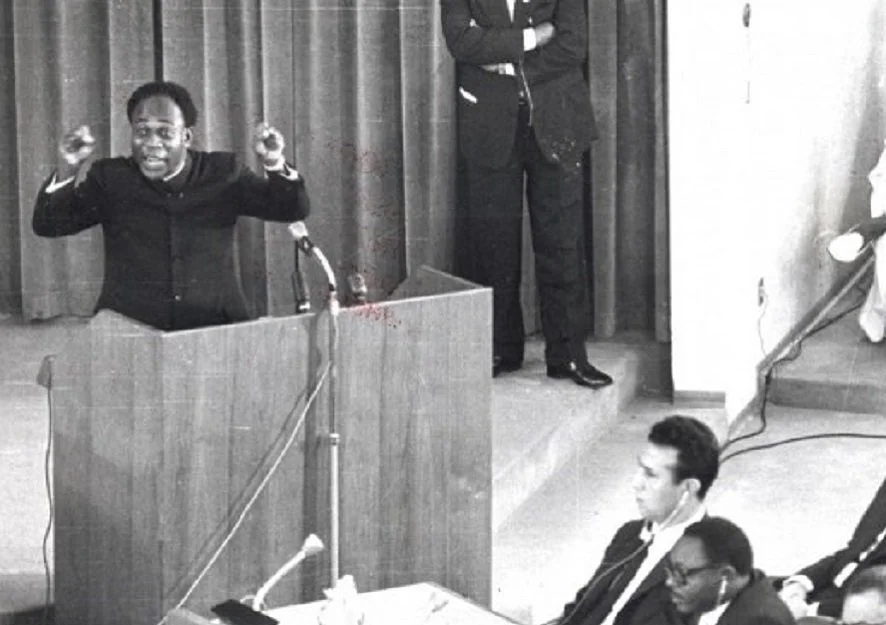
Kwame Nkrumah speaking on 24th May, 1963 in Addis Ababa

Kwame Nkrumah speaking on 24th May, 1963 in Addis Ababa

Kwame Nkrumah: 'Our capital flows out in streams to irrigate the whole system of Western economy', inaugural ceremony of the OAU Conference - 1953

March 21, 2021

24 May 1953, Addis Ababa, Ethiopia

At the first gathering of African Heads of State, to which I had the honour of playing host, there were representatives of eight independent States only. Today, five years later, we meet as the representatives of no less than thirty-two States, the guests of His Imperial Majesty, Haile Selassie, the First, and the Government and people of Ethiopia. To His Imperial Majesty, I wish to express, on behalf of the Government and people of Ghana my deep appreciation for a most cordial welcome and generous hospitality.

The increase in our number in this short space of time is open testimony to the indomitable and irresistible surge of our peoples for independence. It is also a token of the revolutionary speed of world events in the latter half of this century. In the task which is before us of unifying our continent we must fall in with that pace or be left behind. The task cannot be attached in the tempo of any other age than our own. To fall behind the unprecedented momentum of actions and events in our time will be to court failure and our own undoing.

A whole continent has imposed a mandate upon us to lay the foundation of our Union at this Conference. It is our responsibility to execute this mandate by creating here and now the formula upon which the requisite superstructure may be erected.

On this continent it has not taken us long to discover that the struggle against colonialism does not end with the attainment of national independence. Independence is only the prelude to a new and more involved struggle for the right to conduct our own economic and social affairs; to construct our society according to our aspirations, unhampered by crushing and humiliating neo-colonialist controls and interference.

From the start we have been threatened with frustration where rapid change is imperative and with instability where sustained effort and ordered rule are indispensable.

No sporadic act nor pious resolution can resolve our present problems. Nothing will be of avail, except the united act of a united Africa. We have already reached, the stage where we must unite or sink into that condition which has made Latin America the unwilling and distressed prey of imperialism after one and a half centuries of political independence.

As a continent we have emerged into independence in a different age, with imperialism grown stronger, more ruthless and experienced, and more dangerous in its international associations. Our economic advancement demands the end of colonialist and neo-colonialist domination in Africa.

But just as we understood that the shaping of our national destinies required of each of us our political independence and bent all our strength to this attainment, so we must recognise that our economic independence resides in our African union and requires the same concentration upon the political achievement.

The unity of our continent, no less than our separate independence, will be delayed if, indeed, we do not lose it, by hobnobbing with colonialism. African Unity is, above all, a political kingdom which can only be gained by political means. The social and economic development of Africa will come only within the political kingdom, not the other way around. The United States of America, the Union of Soviet Socialist Republics, were the political decisions of revolutionary peoples before they became mighty realities of social power and material wealth.

How, except by our united efforts, will the richest and still enslaved parts of our continent be freed from colonial occupation and become available to us for the total development of our continent? Every step in the decolonisation of our continent has brought greater resistance in those areas where colonial garrisons are available to colonialism.

This is the great design of the imperialist interests that buttress colonialism and neo-colonialism, and we would be deceiving ourselves in the most cruel way were we to regard their individual actions as separate and unrelated. When Portugal violates Senegal’s border, when Verwoed allocated one-seventh of South Africa’s budget to military and police, when France builds as part of her defence policy an interventionist force that can intervene, more especially in French-speaking Africa, when Welensky talks of Southern Rhodesia joining South Africa, it is all part of a carefully calculated pattern working towards a single end: the continued enslavement of our still dependent brothers and an onslaught upon the independence of our sovereign African States.

Do we have any other weapon against this design but our unity? Is not our unity essential to guard our own freedom as well as to win freedom for our oppressed brothers, the Freedom Fighters?

Is it not unity alone that can weld us into an effective force, capable of creating our own progress and making our valuable contribution to world peace? Which independent African State will claim that its financial structure and banking institutions are fully harnessed to its national development? Which will claim that its material resources and human energies are available for its own national aspirations? Which will disclaim a substantial measure of disappointment and disillusionment in its agricultural and urban
development?

In independent Africa we are already re-experiencing the instability and frustration which existed under colonial rule. We are fast learning that political independence is not enough to rid us of the consequences of colonial rule.

The movement of the masses of the people of Africa for freedom from that kind of rule was not only a revolt against the conditions which it imposed.

Our people supported us in our fight for independence because they believed that African Governments could cure the ills of the past in a way which could never be accomplished under colonial rule. If, therefore, now that we are independent we allow the same conditions to exist that existed in colonial days, all the resentment which overthrew colonialism will be mobilised against us.

The resources are there. It is for us to marshal them in the active service of our people. Unless we do this by our concerted efforts, within the framework of our combined planning, we shall not progress at the tempo demanded by today’s events and the mood of our people. The symptoms of our troubles will grow, and the troubles themselves become chronic. It will then be too late even for Pan-African Unity to secure for us stability and tranquillity in our labours for a continent of social justice and material well-being. Unless we establish African Unity now, we who are sitting here today shall tomorrow be the victims and martyrs of neo-colonialism.

There is evidence on every side that the imperialists have not withdrawn from our affairs. There are times, as in the Congo, when their interference is manifest. But generally it is covered up under the clothing of many agencies, which meddle in our domestic affairs, to foment dissension within our borders and to create an atmosphere of tension and political instability. As long as we do not do away with the root causes of discontent, we lend aid to these neo-colonialist forces, and shall become our own executioners. We cannot ignore the teachings of history.

Our continent is probably the richest in the world for minerals and industrial and agricultural primary materials. From the Congo alone, Western firms exported copper, rubber, cotton, and other goods to the value of 2, 773 billion dollars in the ten years between 1945 and 1955, and from South Africa, Western gold mining companies have drawn a profit, in the four years, between 1947 to 1951, of 814 billion dollars.

Our continent certainly exceeds all the others in potential hydroelectric power, which some experts assess as 42 percent of the world’s total. What need is there for us to remain hewers for the industrialised areas of the world?

It is said, of course, that we have no capital, no industrial skill, no communications and no internal markets, and that we cannot even agree among ourselves how best to utilise our resources.

Yet all the stock exchanges in the world are preoccupied with Africa’s gold, diamonds, uranium, platinum, copper and iron ores. Our capital flows out in streams to irrigate the whole system of Western economy. Fifty-two percent of the gold in Fort Knox at this moment, where the U. S. A. stores its bullion, is believed to have originated from our shores. Africa provides more than 60 percent of the world’s gold. A great deal of the uranium for nuclear power, of copper for electronics, of titanium for supersonic projectiles, of iron and steel for heavy industries, of other minerals and raw materials for lighter industries – the basic economic might of the foreign Powers – come from our continent. Experts have estimated that the Congo basin alone can produce enough food crops to satisfy the requirements of nearly half the population of the whole world.

For centuries Africa has been the milk cow of the Western world. It was our continent that helped the Western world to build up its accumulated wealth.

It is true that we are now throwing off the yoke of colonialism as
fast as we can, but our success in this direction is equally matched
by an intense effort on the part of imperialism to continue the
exploitation of our resources by creating divisions among us.

When the colonies of the American Continent sought to free themselves
from imperialism in the 18th century there was no threat of
neo-colonialism in the sense in which we know it today. The American
States were therefore free to form and fashion the unity which was
best suited to their needs and to frame a constitution to hold their
unity together without any form of interference from external sources.
We, however, are having to grapple with outside interventions. How
much more, then do we need to come together in the African unity that
alone can save us from the clutches of neo-colonialism.

We have the resources. It was colonialism in the first place that
prevented us from accumulating the effective capital; but we ourselves
have failed to make full use of our power in independence to mobilise
our resources for the most effective take-off into thorough going
economic and social development. We have been too busy nursing our
separate States to understand fully the basic need of our union,
rooted in common purpose, common planning and common endeavour. A
union that ignores these fundamental necessities will be but a shame.
It is only by uniting our productive capacity and the resultant
production that we can amass capital. And once we start, the momentum
will increase. With capital controlled by our own banks, harnessed to
our own true industrial and agricultural development, we shall make
our advance. We shall accumulate machinery and establish steel works,
iron foundries and factories; we shall link the various States of our
continent with communications; we shall astound the world with our
hydroelectric power; we shall drain marshes and swamps, clear infested
areas, feed the under-nourished, and rid our people of parasites and
disease. It is within the possibility of science and technology to
make even the Sahara bloom into a vast field with verdant vegetation
for agricultural and industrial developments. We shall harness the
radio, television, giant printing presses to lift our people from the
dark recesses of illiteracy.

A decade ago, these would have been visionary words, the fantasies of
an idle dreamer. But this is the age in which science has transcended
the limits of the material world, and technology has invaded the
silences of nature. Time and space have been reduced to unimportant
abstractions. Giant machines make roads, clear forests, dig dams,
layout aerodromes; monster trucks and planes distribute goods; huge
laboratories manufacture drugs; complicated geological surveys are
made; mighty power stations are built; colossal factories erected –
all at an incredible speed. The world is no longer moving through bush
paths or on camels and donkeys.

We cannot afford to pace our needs, our development, our security to
the gait of camels and donkeys. We cannot afford not to cut down the
overgrown bush of outmoded attitudes that obstruct our path to the
modern open road of the widest and earliest achievement of economic
independence and the raising up of the lives of our people to the
highest level.

Even for other continents lacking tile resources of Africa, this is
the age that sees the end of human want. For us it is a simple matter
of grasping with certainty our heritage by using the political might
of unity. All we need to do is to develop with our united strength the
enormous resources of our continent. A United Africa will provide a
stable field of foreign investment, which will encourage as long as it
does not behave inimically to our African interests. For such
investment would add by its enterprises to the development of the
national economy, employment and training of our people, and will be
welcome to Africa. In dealing with a united Africa, investors will no
longer have to weigh with concern the risks of negotiating with
governments in one period which may not exist in the very next period.
Instead of dealing or negotiating with so many separate States at a
time they will be dealing with one united government pursuing a
harmonized continental policy.

What is the alternative to this? If we falter at this stage, and let
time pass for neo-colonialism to consolidate its position on this
continent, what will be the fate of our people who have put their
trust in us? What will be the fate of our freedom fighters? What will
be the fate of other African Territories that are not yet free?

Unless we can establish great industrial complexes in Africa – which
we can only do in united Africa – we must have our peasantry to the
mercy of foreign cash crop markets, and face the same unrest which
overthrew the colonialists? What use to the farmer is education and
mechanisation, what use is even capital for development; unless we can
ensure for him and a fair price and ready market? What has the
peasant, worker and farmer gained from political independence, unless
we can ensure for him a fair return for his labour and a higher
standard of living?

Unless we can establish great industrial complexes in Africa, what
have the urban worker, and all those peasants on overcrowded land
gained from political independence? If they are to remain unemployed
or in unskilled occupation, what will avail them the better facilities
for education, technical training, energy and ambition which
independence enables us to provide?

There is hardly any African State without frontier problem with its
adjacent neighbours. It would be futile for me to enumerate them
because they are already familiar to us all. But let me suggest to
Your Excellences, that this fatal relic of colonialism will drive us
to war against one another as our unplanned and uncoordinated
industrial development expands, just as happened in Europe. Unless we
succeed in arresting the danger through mutual understanding on
fundamental issues and through African Unity, which will render
existing boundaries obsolete and superfluous, we shall have fought in
vain for independence. Only African Unity can heal this festering sore
of boundary disputes between our various States. Your Excellencies, the
remedy for these ills is ready to our hand. It stares us in the face
at every customs barrier, it shouts to us from every African heart. By
creating a true political union of all the independent States of
Africa, we can tackle hopefully every emergency, every enemy and every
complexity. This is not because we are a race of superman, but because
we have emerged in the age of science and technology in which poverty,
ignorance and disease are no longer the masters, but the retreating
foes of mankind. We have emerged in the age of socialized planning,
when production and distribution are not governed by chaos, greed and
self-interest, but by social needs. Together with the rest of mankind,
we have awakened from Utopian dreams to pursue practical blueprints
for progress and social justice.

Above all, we have emerged at a time when a continental land mass like
Africa with its population approaching three hundred million are
necessary to the economic capitalization and profitability of modern
productive methods and techniques. Not one of us working singly and
individually can successfully attain the fullest development.
Certainly, in the circumstances, it will not be possible to give
adequate assistance to sister States trying, against the most
difficult conditions, to improve their economic and social structures.
Only a united Africa functioning under a Union Government can
forcefully mobilize the material and moral resources of our separate
countries and apply them efficiently and energetically to bring a
rapid change in the conditions of our people.

If we do not approach the problems in Africa with a common front and a
common purpose, we shall be haggling and wrangling among ourselves
until we are colonized again and become the tolls of a far greater
colonialism than we suffered hitherto.

Unite we must. Without necessarily sacrificing our sovereignties, big
or small, we can, here and now, forge a political union based on
Defence, Foreign Affairs and Diplomacy, and a common Citizenship, an
African currency, an African Monetary Zone and an African Central
Bank. We must unite in order to achieve the full liberation of our
continent. We need a common Defence system with an African High
Command to ensure the stability and security of Africa.

We have been charged with this sacred task by our own people, and we
cannot betray their trust by failing them. We will be mocking the
hopes of our people if we show the slightest hesitation or delay by
tackling realistically this question of African Unity.

The supply of arms or other military aid to the colonial oppressors in
Africa must be regarded not only as aid in the vanquishment of the
freedom fighters battling for their African independence, but as an
act of aggression against the whole of Africa. How can we meet this
aggression except by the full weight of our united strength?

Many of us have made non-alignment an article of faith on this
continent. We have no wish, and no intention of being drawn into the
Cold War. But with the present weakness and insecurity of our States
in the context of world politics, the search for bases and spheres of
influence brings the Cold War into Africa with its danger of nuclear
warfare. Africa should be declared a nuclear-free zone and freed from
cold war exigencies. But we cannot make this demand mandatory unless
we support it from a position of strength to be found only in our
unity.

Instead, many Independent African States are involved by military
pacts with the former colonial powers. The stability and security
which such devices seek to establish are illusory, for the
metropolitan Powers seize the opportunity to support their
neo-colonialist controls by direct military involvement. We have seen
how the neo-colonialists use their bases to entrench themselves and
attack neighbouring independent States. Such bases are centers of
tension and potential danger spots of military conflict. They threaten
the security not only of the country in which they are situated but of
neighbouring countries as well. How can we hope to make Africa a
nuclear-free zone and independent of cold war pressure with such
military involvement on our continent? Only by counter-balancing a
common defence force with a common defence policy based upon our
desire for an Africa untrammelled by foreign dictation or military and
nuclear presence. This will require an all-embracing African High
Command, especially if the military pacts with the imperialists are to
be renounced. It is the only way we can break these direct links
between the colonialism of the past and the neo-colonialism which
disrupts us today.

We do not want nor do we visualize an African High Command in the
terms of the power politics that now rule a great part of the world,
but as an essential and indispensable instrument for ensuring
stability and security in Africa.

We need a unified economic planning for Africa. Until the economic
power of Africa is in our hands, the masses can have no real concern
and no real interest for safeguarding our security, for ensuring the
stability of our regimes, and for bending their strength to the
fulfilment of our ends. With our united resources, energies and
talents we have the means, as soon as we show the will, to transform
the economic structures of our individual States from poverty to that
of wealth, from, inequality to the satisfaction of popular needs. Only
on a continental basis shall we be able to plan the proper utilisation
of all our resources for the full development of our continent.

How else will we retain our own capital for our development? How else
will we establish an internal market for our own industries? By
belonging to different economic zones, how will we break down the
currency and trading barriers between African States, and how will the
economically stronger amongst us be able to assist the weaker and less
developed States?

It is important to remember that independent financing and independent
development cannot take place without an independent currency. A
currency system that is backed by the resources of a foreign State is
ipso facto subject to the trade and financial arrangements of that
foreign country.

Because we have so many customs and currency barriers as a result of
being subject to the different currency systems of foreign powers,
this has served to widen the gap between us in Africa. How, for
example, can related communities and families trade with, and support
one another successfully, if they find themselves divided by national
boundaries and currency restrictions? The only alternative open to
them in these circumstances, is to use smuggled currency and enrich
national and international racketeers and crooks who prey upon our
financial and economic difficulties.

No independent African State today by itself has a chance to follow an
independent course of economic development, and many of us who have
tried to do this have been almost ruined or have had to return to the
fold of the former colonial rulers. This position will not change
unless we have unified policy working at the continental level. The
first step towards our cohesive economy would be a unified monetary
zone, with, initially, an agreed common parity for our currencies. To
facilitate this arrangement, Ghana would change to a decimal system.
When we find that the arrangement of a fixed common parity is working
successfully, there would seem to be no reason for not instituting one
common currency and a single bank of issue. With a common currency
from one common bank of issue we should be able to stand erect on our
own feet because such an arrangement would be fully backed by the
combined national products of the States composing the union. After
all, the purchasing power of money depends on productivity and the
productive exploitation of the natural, human and physical resources
of the nation.

While we are assuring our stability by a common defence system, and
our economy is being orientated beyond foreign control by a Common
currency, Monetary Zone and Central Bank of Issue, we can investigate
the resources of our continent. We can begin to ascertain whether in
reality we are the richest, and not, as we have been taught to
believe, the poorest among the continents. We can determine whether we
possess the largest potential in hydroelectric power, and whether we
can harness it and other sources of energy to our own industries. We
can proceed to plan our industrialization on a continental scale, and
to build up a common market for nearly three hundred million people.

Common Continental Planning for the Industrial and Agricultural
development of Africa is a vital necessity.

So many blessings must flow from our unity; so many disasters must
follow on our continued disunity, that our failure to unite today will
not be attributed by posterity only to faulty reasoning and lack of
courage, but to our capitulation before the forces of imperialism.

The hour of history which has brought us to this assembly is a
revolutionary hour. It is the hour of decision. For the first time,
the economic imperialism which menaces us is itself challenged by the
irresistible will of our people.

The masses of the people of Africa are crying for unity. The people of
Africa call for a breaking down of boundaries that keep them apart.
They demand an end to the border disputes between sister African
States – disputes that arise out of the artificial barriers that
divided us. It was colonialism’s purpose that left us with our border
irredentism that rejected our ethnic and cultural fusion.

Our people call for unity so that they may not lose their patrimony in
the perpetual service of neo-colonialism. In their fervent push for
unity, they understand that only its realization will give full
meaning to their freedom and our African independence.

It is this popular determination that must move us on to a Union of
Independent African States. In delay lies danger to our well-being, to
tour very existence as free States. It has been suggested that our
approach of unity should be gradual, that it should go piece-meal.
This point of view conceives of Africa as a static entity with
“frozen” problems which can be eliminated one by one and when all have
been cleared then we can come together and say: “Now all is well. Let
us unite”. This view takes no account of the impact of external
pressures. Nor does it take cognizance of the danger that delay can
deepen our isolations and exclusiveness; that it can enlarge our
differences and set us drifting further and further apart into the net
of neo-colonialism, so that our union will become nothing but a fading
hope, and the great design of Africa’s full redemption will be lost,
perhaps, forever.

The view is also expressed that our difficulties could be resolved
simply by a greater collaboration through cooperative association in
our inter-territorial relationships. This way of looking at our
problems denies a proper conception of their inter-relationship and
mutuality. It denies faith in a future for African advancement, in
African independence. It betrays a sense of solution only in continued
reliance upon external sources through bilateral agreements for
economic and other forms of aid.

The fact is that although we have been cooperating and associating
with one another in various fields of common endeavour even before
colonial times, this has not given us the continental identity and the
political and economic force which would help us to deal effectively
with the complicated problems confronting us in Africa today. As far
as foreign aid is concerned, a United Africa would be in a more
favourable position to attract assistance from foreign sources. There
is the far more compelling advantage which this arrangement offers, in
that aid will come from anywhere to Africa because our bargaining
power would become infinitely greater. We shall no longer be dependent
upon aid from restricted sources. We shall have the world to choose
from.

What are we looking for in Africa? Are we looking for Charters,
conceived in the light of the United Nations example? A type of United
Nations organisation whose decisions are framed on the basis of
resolutions that in our experience have sometimes been ignored by
member States? Where groupings are formed and pressures develop in
accordance with the interest of the group concerned? Or is it intended
that Africa should be turned into a lose organization of States on the
model of the organization of the American States, in which the weaker
States within it can be at the mercy of the stronger or more powerful
ones politically or economically or at the mercy of some powerful
outside nations or group of nations? Is this the kind of association
we want for ourselves in the United Africa we all speak of with such
feeling and emotion?

Your Excellences, permit me to ask: is this the kind of framework we
desire for our United Africa? And arrangement which in future could
permit Ghana or Nigeria or the Sudan, or Liberia, or Egypt or Ethiopia
for example, to use pressure, which either superior economic or
political influence gives, to dictate the flow and the direction of
trade from, say, Burundi or Togo or Nyasaland to Mozambique?

We all want a United Africa, united not only in our concept of what
unity can connote, but united in our common desire to move forward
together and dealing with all the problems that can best be solved
only on a continental basis.

When the first Congress of the United States met many years ago at
Philadelphia, one of the delegates sounded the first chore of unity by
declaring that they had met in a “state of nature” in other words,
they were not at Philadelphia as Virginians, or Pennsylvanians, but
simply as Americans. This reference to themselves as Americans was in
those days a new and strange experience. May I dare to assert equally
on this occasion, Your Excellences that we meet here today not as
Ghanaians, Guineans, Egyptians, Algerians, Moroccans, Malians,
Liberians, Congolese or Nigerians but as Africans. Africans united in
our resolve to remain here until we have agreed on the basic
principles of a new compact of unity among ourselves which guarantees
for us and future a new arrangement of continental government.

If we succeed in establishing a new set of principles as the basis of
a new Charter or Statute for the establishment of a Continental Unity
of Africa and the creation of social and political progress for our
people then, in my view, this Conference should mark the end of our
various groupings and regional blocs. But if we fail and let this
grand and historic opportunity slip by then we should give way to
greater dissension and division among us for which the people of
Africa will never forgive us. And the popular and progressive forces
and movements within Africa will condemn us. I am sure therefore that
we should not fail them.

I have spoken at some length, Your Excellences, because it is
necessary for us all to explain not only to one another present here
but also to our people who have entrusted to us the fate and destiny
of Africa. We must therefore not leave this place until we have set up
effective machinery for achieving African Unity. To this end, I now
propose for your consideration the following:

As a first step, Your Excellences, a Declaration of Principles uniting
and binding us together and to which we must all faithful and loyally
adhere, and laying the foundations of unity should be set down. And
there should also be a formal declaration that all the Independent
African States here and now agree to the establishment of a Union of
African States.

As a second and urgent step for the realization of the unification of
Africa, an All-Africa Committee of Foreign Ministers be set up now,
and that before we rise from this Conference a day should be fixed for
them to meet.

This Committee should establish on behalf of the Heads of our
Governments, a permanent body of officials and experts to work out a
machinery for the Union Government of Africa. This body of officials
and experts should be made up of two of the brains from each
Independent African State. The various Charters of the existing
groupings and other relevant document could also be submitted to the
officials and experts. A praesidium consisting of the Head of the
Governments of the Independent African States should be called upon to
meet and adopt a Constitution and others recommendations that will
launch the Union Government of Africa.

We must also decide on allocation where this body of officials and
experts will work as the new Headquarters or Capital of our Union
Government. Some central place in Africa might be the fairest
suggestion either at Bangui in the Central African Republic or
Leopoldville in Congo. My colleagues may have other proposals. The
Committee of Foreign Ministers, officials and experts should be
empowered to establish:

1. A Commission to frame a Constitution for a Union Government of
African States;
2. A Commission to work out a continent-wide plan for a unified or
common economic and industrial programme for Africa; this plan should
include proposals for setting up:
• A Common Market for Africa
• An African currency
• African Monetary Zone
• African Central Bank, and
• Continental Communications System;
3. A Commission to draw up details for a Common Foreign Policy and Diplomacy;
4. A Commission to produce plans for a Common System of Defence;
5. A Commission to make proposals for Common African Citizenship.
These Commissions will report to the Committee of Foreign Ministers
who should, in turn, submit within six months of this Conference their
recommendations to the Praesidium. The Praesidium meeting in
Conference at the Union Headquarters will consider and approve the
recommendations of the Committee of Foreign Ministers.

In order to provide funds immediately for the work of the permanent
officials and experts of the Headquarters of the Union, I suggest that
a special Committed be set up now to work a budget for this.

Your Excellences, with these steps, I submit, we shall be irrevocably
committed to the road which will bring us to a Union Government of
Africa. Only a united Africa with central political direction can
successfully give effective material and moral support to our Freedom
Fighters in Southern Rhodesia, Angola, Mozambique, South-West Africa,
Bechuanaland, Swaziland, Basutoland, Portuguese Guinea, etc., and of
course South Africa.”

Source: https://face2faceafrica.com/article/read-k...

Enjoyed this speech? Speakola is a labour of love and I’d be very grateful if you would share, tweet or like it. Thank you.

Facebook Twitter Facebook
In 1940-59 C Tags KWAME NKRUMAH, GHANA, GHANAIAN INDEPENDENCE, AFRICAN HEADS OF STATE, OAU CONFERENCE, GREAT AFRICAN SPEECHES, PRESIDENT, AFRICA DAY, 1950S, PAN AFRICA, NEO COLONIALISM, COLONIALISM
Comment

Franklin D. Roosevelt & Winston Churchill: 'How can we light our trees', joint Christmas address - 1941

February 9, 2021

24 December 1941, Washington DC. USA

Franklin D. Roosevelt, President of the U.S. Christmas Speech 1941

But how would our spirits be lifted to do this without the mourning we still feel from Pearl Harbor? We need help. How can we light our trees? How can we give our gifts? How can we meet and worship with love and with uplifted spirit and heart in a world at war, a world of fighting and suffering and death? How can we pause, even for a day, even for Christmas Day, in our urgent labor of arming a decent humanity against the enemies which beset it? How can we put the world aside, as men and women put the world aside in peaceful years, to rejoice in the birth of Christ These are natural—inevitable—questions in every part of the world which is resisting the evil thing. And even as we ask these questions, we know the answer.

There is another preparation demanded of this Nation beyond and beside the preparation of weapons and materials of war. There is demanded also of us the preparation of our hearts; the arming of our hearts. And when we make ready our hearts for the labor and the suffering and the ultimate victory which lie ahead, then we observe Christmas Day—with all of its memories and all of its meanings—as we should. Looking into the days to come, I have set aside a day of prayer, and in that Proclamation I have said.

The year 1941 has brought upon our Nation a war of aggression by powers dominated by arrogant rulers whose selfish purpose is to destroy free institutions. They would thereby take from the freedom-loving peoples of the earth the hard-won liberties gained over many centuries.

The new year of 1942 calls for the courage and the resolution of old and young to help to win a world struggle in order that we may preserve all we hold dear.
We are confident in our devotion to country, in our love of freedom, in our inheritance of courage. But our strength, as the strength of all men everywhere, is of greater avail as God upholds us.

Therefore, I… do hereby appoint the first day of the year 1942 as a day of prayer, of asking forgiveness for our shortcomings of the past, of consecration to the tasks of the present, of asking God’s help in days to come. We need His guidance that this people may be humble in spirit but strong in the conviction of the right; steadfast to endure sacrifice, and brave to achieve a victory of liberty and peace. Our strongest weapon in this war is that conviction of the dignity and brotherhood of man which Christmas Day signifies more than any other day or any other symbol.

Speech of Winston Churchill, Prime Minister of UK

I spend this anniversary and festival far from my country, far from my family, yet I cannot truthfully say that I feel far from home. Whether it be the ties of blood on my mother’s side, or the friendships I have developed here over many years of active life, or the commanding sentiment of comradeship in the common cause of great peoples who speak the same language, who kneel at the same altars and, to a very large extent, pursue the same ideals, I cannot feel myself a stranger here in the centre and at the summit of the United States. I feel a sense of unity and fraternal association which, added to the kindliness of your welcome, convinces me that I have a right to sit at your fireside and share your Christmas joys.

This is a strange Christmas Eve. Almost the whole world is locked in deadly struggle, armed with the most terrible weapons which science can devise, the nations advance upon each other. Ill would it be for us this Christmastide if we were not sure that no greed for the land or wealth of any other people, no vulgar ambition, no morbid lust for material gain at the expense of others, had led us to the field. Here, in the midst of war, raging and roaring over all the lands and seas, creeping nearer to our hearts and homes, here, amid all the tumult, we have tonight the peace of the spirit in each cottage home and in every generous heart. Therefore we may cast aside for this night at least the cares and dangers which beset us, and make for the children an evening of happiness in a world of storm. Here, then, for one night only, each home throughout the English-speaking world should be a brightly-lighted island of happiness and peace.

Let the children have their night of fun and laughter. Let the gifts of Father Christmas delight their play. Let us grown-ups share to the full in their unstinted pleasures before we turn again to the stern task and the formidable years that lie before us, resolved that, by our sacrifice and daring, these same children shall not be robbed of their inheritance or denied their right to live in a free and decent world.

And so, in God’s mercy, a happy Christmas to you all.

Source: https://prorhetoric.com/how-can-we-put-the...

Enjoyed this speech? Speakola is a labour of love and I’d be very grateful if you would share, tweet or like it. Thank you.

Facebook Twitter Facebook
In 1940-59 C Tags FRANKLIN ROOSEVELT, FRANKLIN DELANO ROOSEVELT, FDR, WINSTON CHURCHILL, CHURCHILL, CHRISTMAS ADDRESS, TRANSCRPT, WW2
Comment

Learned Hand: 'Liberty lies in the hearts of men and women' The Spirit of Liberty - 1944

January 21, 2021

21 May 1944, Central Park, New York City, USA

We have gathered here to affirm a faith, a faith in a common purpose, a common conviction, a common devotion. Some of us have chosen America as the land of our adoption; the rest have come from those who did the same. For this reason we have some right to consider ourselves a picked group, a group of those who had the courage to break from the past and brave the dangers and the loneliness of a strange land. What was the object that nerved us, or those who went before us, to this choice? We sought liberty; freedoms from oppression, freedom from want, freedom to be ourselves. This we then sought; this we now believe that we are by way of winning. What do we mean when we say that first of all we seek liberty? I often wonder whether we do not rest our hopes too much upon constitutions, upon laws and upon courts. These are false hopes; believe me, these are false hopes. Liberty lies in the hearts of men and women; when it dies there, no constitution, no law, no court can even do much to help it. While it lies there it needs no constitution, no law, no court to save it. And what is this liberty which must lie in the hearts of men and women? It is not the ruthless, the unbridled will; it is not freedom to do as one likes. That is the denial of liberty, and leads straight to its overthrow. A society in which men recognize no check upon their freedom soon becomes a society where freedom is the possession of only a savage few; as we have learned to our sorrow.

What then is the spirit of liberty? I cannot define it; I can only tell you my own faith. The spirit of liberty is the spirit which is not too sure that it is right; the spirit of liberty is the spirit which seeks to understand the mind of other men and women; the spirit of liberty is the spirit which weighs their interests alongside its own without bias; the spirit of liberty remembers that not even a sparrow falls to earth unheeded; the spirit of liberty is the spirit of Him who, near two thousand years ago, taught mankind that lesson it has never learned but never quite forgotten; that there may be a kingdom where the least shall be heard and considered side by side with the greatest. And now in that spirit, that spirit of an America which has never been, and which may never be; nay, which never will be except as the conscience and courage of Americans create it; yet in the spirit of that America which lies hidden in some form in the aspirations of us all; in the spirit of that America for which our young men are at this moment fighting and dying; in that spirit of liberty and of America I ask you to rise and with me pledge our faith in the glorious destiny of our beloved country.

Source: https://www.thefire.org/first-amendment-li...

Enjoyed this speech? Speakola is a labour of love and I’d be very grateful if you would share, tweet or like it. Thank you.

Facebook Twitter Facebook
In 1940-59 C Tags LEARNED HAND, SPIRIT OF LIBERTY, TRANSCRIPT, I AM AMERICAN DAY, JUDGE, WW2, WWII, LIBERTY
Comment

Robert H. Jackson: 'The privilege of opening the first trial in history for crimes against the peace of the world imposes a grave responsibility', Opening statement Nuremeberg Trial - 1945

July 11, 2020


21 November 1945, Palace of Justice at Nuremberg, Germany

May it please Your Honors:

The privilege of opening the first trial in history for crimes against the peace of the world imposes a grave responsibility. The wrongs which we seek to condemn and punish have been so calculated, so malignant, and so devastating, that civilization cannot tolerate their being ignored, because it cannot survive their being repeated. That four great nations, flushed with victory and stung with injury stay the hand of vengeance and voluntarily submit their captive enemies to the judgment of the law is one of the most significant tributes that Power has ever paid to Reason.

This Tribunal, while it is novel and experimental, is not the product of abstract speculations nor is it created to vindicate legalistic theories. This inquest represents the practical effort of four of the most mighty of nations, with the support of 17 more, to utilize international law to meet the greatest menace of our times-aggressive war. The common sense of mankind demands that law shall not stop with the punishment of petty crimes by little people. It must also reach men who possess themselves of great power and make deliberate and concerted use of it to set in motion evils which. leave no home in the world untouched. It is a cause of that magnitude that the United Nations will lay before Your Honors.

In the prisoners’ dock sit twenty-odd broken men. Reproached by the humiliation of those they have led almost as bitterly as by the desolation of those they have attacked, their personal capacity for evil is forever past. It is hard now to perceive in these men as captives the power by which as Nazi leaders they once dominated much of the world and terrified most of it. Merely as individuals their fate is of little consequence to the world.

What makes this inquest significant is that these prisoners represent sinister influences that will lurk in the world long after their bodies have returned to dust. We will show them to be living symbols of racial hatreds, of terrorism and violence, and of the arrogance and cruelty of power. They are symbols of fierce nationalisms and of militarism, of intrigue and war-making which have embroiled Europe generation after generation, crushing its manhood, destroying its homes, and impoverishing its life. They have so identified themselves with the philosophies they conceived and with the forces they directed that any tenderness to them is a victory and an encouragement to all the evils which are attached to their names. Civilization can afford no compromise with the social forces which would gain renewed strength if we deal ambiguously or indecisively with the men in whom those forces now precariously survive.

What these men stand for we will patiently and temperately disclose. We will give you undeniable proofs of incredible events. The catalog of crimes will omit nothing that could be conceived by a pathological pride, cruelty, and lust for power. These men created in Germany, under the “Führerprinzip”, a National Socialist despotism equalled only by the dynasties of the ancient East. They took from the German people all those dignities and freedoms that we hold natural and inalienable rights in every human being. The people were compensated by inflaming and gratifying hatreds towards those who were marked as “scapegoats”. Against their opponents, including Jews, Catholics, and free labor, the Nazis directed such a campaign of arrogance, brutality, and annihilation as the world has not witnessed since the pre-Christian ages. They excited the German ambition to be a “master race”, which of course implies serfdom for others. They led their people on a mad gamble for domination. They diverted social energies and resources to the creation of what they thought to be an invincible war machine. They overran their neighbors. To sustain the “master race” in its war-making, they enslaved millions of human beings and brought them into Germany, where these hapless creatures now wander as “displaced persons”. At length bestiality and bad faith reached such excess that they aroused the sleeping strength of imperiled Civilization. Its united efforts have ground the German war machine to fragments. But the struggle has left Europe a liberated yet prostrate land where a demoralized society struggles to survive. These are the fruits of the sinister forces that sit with these defendants in the prisoners’ dock.

In justice to the nations and the men associated in this prosecution, I must remind you of certain difficulties which may leave their mark on this case. Never before in legal history has an effort been made to bring within the scope of a single litigation the developments of a decade, covering a whole continent, and involving a score of nations, countless individuals, and innumerable events. Despite the magnitude of the task, the world has demanded immediate action. This demand has had to be met, though perhaps at the cost of finished craftsmanship. To my country, established courts, following familiar procedures, applying well-thumbed precedents, and dealing with the legal consequences of local and limited events seldom commence a trial within a year of the event in litigation. Yet less than 8 months ago today the courtroom in which you sit was an enemy fortress in the hands of German SS troops. Less than 8 months ago nearly all our witnesses and documents were in enemy hands. The law had not been codified, no procedures had been established, no tribunal was in existence, no usable courthouse stood here, none of the hundreds of tons of official German documents had been examined, no prosecuting staff had been assembled, nearly all of the present defendants were at large, and the four prosecuting powers had not yet joined in common cause to try them. I should be the last to deny that the case may well suffer from incomplete researches and quite likely will not be the example of professional work which any of the prosecuting nations would normally wish to sponsor. It is, however, a completely adequate case to the judgment we shall ask you to render, and its full development we shall be obliged to leave to historians.

Before I discuss particulars of evidence, some general considerations which may affect the credit of this trial in the eyes of the world should be candidly faced. There is a dramatic disparity between the circumstances of the accusers and of the accused that might discredit our work if we should falter, in even minor matters, in being fair and temperate.

Unfortunately, the nature of these crimes is such that both prosecution and judgment must be by victor nations over vanquished foes. The worldwide scope of the aggressions carried out by these men has left but few real neutrals. Either the victors must judge the vanquished or we must leave the defeated to judge themselves. After the first World War, we learned the futility of the latter course. The former high station of these defendants, the notoriety of their acts, and the adaptability of their conduct to provoke retaliation make it hard to distinguish between the demand for a just and measured retribution, and the unthinking cry for vengeance which arises from the anguish of war. It is our task, so far as humanly possible, to, draw the line between the two. We must never forget that the record on which we judge these defendants today is the record on which history will judge us tomorrow. To pass these defendants a poisoned chalice is to put it to our own lips as well. We must summon such detachment and intellectual integrity to our task that this Trial will commend itself to posterity as fulfilling humanity’s aspirations to do justice.

At the very outset, let us dispose of the contention that to put these men to trial is to do them an injustice entitling them to some special consideration. These defendants may be hard pressed but they are not ill used. Let us see what alternative they would have to being tried.

More than a majority of these prisoners surrendered to or were tracked down by the forces of the United States. Could they expect us to make American custody a shelter for our enemies against the just wrath of our Allies? Did we spend American lives to capture them only to save them from punishment? Under the principles of the Moscow Declaration, those suspected war criminals who are not to be tried internationally must be turned over to individual governments for trial at the scene of their outrages. Many less responsible and less culpable American-held prisoners have been and will continue to be turned over to other United Nations for local trial. If these defendants should succeed, for any reason, in escaping the condemnation of this Tribunal, or if they obstruct or abort this trial, those who are American-held prisoners will be delivered up to our continental Allies. For these defendants, however, we have set up an International Tribunal and have undertaken the burden of participating in a complicated effort to give them fair and dispassionate hearings. That is the best-known protection to any man with a defense worthy of being heard.

If these men are the first war leaders of a defeated nation to be prosecuted in the name of the law, they are also the first to be given a chance to plead for their lives in the name of the law. Realistically, the Charter of this Tribunal, which gives them a hearing, is also the source of their only hope. It may be that these men of troubled conscience, whose only wish is that the world forget them, do not regard a trial as a favor. But they do have a fair opportunity to defend themselves-a favor which these men, when in power, rarely extended to their fellow countrymen. Despite the fact that public opinion already condemns their acts, we agree that here they must be given a presumption of innocence, and we accept the burden of proving criminal acts and the responsibility of these defendants for their commission.

When I say that we do not ask for convictions unless we prove crime, I do not mean mere technical or incidental transgression of international conventions. We charge guilt on planned and intended conduct that involves moral as well as legal wrong. And we do not mean conduct that is a natural and human, even if illegal, cutting of corners, such as many of us might well have committed had we been in the defendants’ positions. It is not because they yielded to the normal frailties of human beings that we accuse them. It is their abnormal and inhuman conduct which brings them to this bar.

We will not ask you to convict these men on the testimony of their foes. There is no count in the Indictment that cannot be proved by books and records. The Germans were always meticulous record keepers, and these defendants had their share of the Teutonic passion for thoroughness in putting things on paper. Nor were they without vanity. They arranged frequently to be photographed in action. We will show you their own films. You will see their own conduct and hear their own voices as these defendants re-enact for you, from the screen, some of the events in the course of the conspiracy.

We would also make clear that we have no purpose to incriminate the whole German people. We know that the Nazi Party was not put in power by a majority of the German vote. We know it came to power by an evil alliance between the most extreme of the Nazi revolutionists, the most unrestrained of the German reactionaries, and the most aggressive of the German militarists. If the German populace had willingly accepted the Nazi program, no Storm-troopers would have been needed in the early days of the Party and there would have been no need for concentration camps or the Gestapo, both of which institutions were inaugurated as soon as the Nazis gained control of the German State. Only after these lawless innovations proved successful at home were they taken abroad.

The German people should know by now that the people of the United States hold them in no fear, and in no hate. It is true that the Germans have taught us the horrors of modern warfare, but the ruin that lies from the Rhine to the Danube shows that we, like our Allies, have not been dull pupils. If we are not awed by German fortitude and proficiency in war, and if we are not persuaded of their political maturity, we do respect their skill in the arts of peace, their technical competence, and the sober, industrious, and self-disciplined character of the masses of the German people. In 1933 we saw the German people recovering prestige in the commercial, industrial, and artistic world after the set-back of the last war. We beheld their progress neither with envy nor malice. The Nazi regime interrupted this advance. The recoil of the Nazi aggression has left Germany in ruins. The Nazi readiness to pledge the German word without hesitation and to break it without shame has fastened upon German diplomacy a reputation for duplicity that will handicap it for years. Nazi arrogance has made the boast of the “master race” a taunt that will be thrown at Germans the world over for generations. The Nazi nightmare has given the German name a new and sinister significance throughout the world which will retard Germany a century. The German, no less than the non-German world, has accounts to settle with these defendants.

The fact of the war and the course of the war, which is the central theme of our case, is history. From September 1st, 1939, when the German armies crossed the Polish frontier, until September 1942, when they met epic resistance at Stalingrad, German arms seemed invincible. Denmark and Norway, the Netherlands and France, Belgium and Luxembourg, the Balkans and Africa, Poland and the Baltic States, and parts of Russia, all had been overrun and conquered by swift, powerful, well-aimed blows. That attack on the peace of the world is the crime against international society which brings into international cognizance crimes in its aid and preparation which otherwise might be only internal concerns. It was aggressive war, which the nations of the world had renounced. It was war in violation of treaties, by which the peace of the world was sought to be safe-guarded.

This war did not just happen-it was planned and prepared for over a long period of time and with no small skill and cunning. The world has perhaps never seen such a concentration and stimulation of the energies of any people as that which enabled Germany 20 years after it was defeated, disarmed, and dismembered to come so near carrying out its plan to dominate Europe. Whatever else we may say of those who were the authors of this war, they did achieve a stupendous work in organization, and our first task is to examine the means by which these defendants and their fellow conspirators prepared and incited Germany to go to war.

In general, our case will disclose these defendants all uniting at some time with the Nazi Party in a plan which they well knew could be accomplished only by an outbreak of war in Europe. Their seizure of the German State, their subjugation of the German people, their terrorism and extermination of dissident elements, their planning and waging of war, their calculated and planned ruthlessness in the conduct of warfare, their deliberate and planned criminality toward conquered peoples,-all these are ends for which they acted in concert; and all these are phases of the conspiracy, a conspiracy which reached one goal only to set out for another and more ambitious one. We shall also trace for you the intricate web of organizations which these men formed and utilized to accomplish these ends. We will show how the entire structure of offices and officials was dedicated to the criminal purposes and committed to the use of the criminal methods planned by these defendants and their co-conspirators, many of whom war and suicide have put beyond reach.

It is my purpose to open the case, particularly under Count One of the Indictment, and to deal with the Common Plan or Conspiracy to achieve ends possible only by resort to Crimes against Peace, War Crimes, and Crimes against Humanity. My emphasis will not be on individual barbarities and perversions which may have occurred independently of any central plan. One of the dangers ever present is that this Trial may be protracted by details of particular wrongs and that we will become lost in a “wilderness of single instances”. Nor will I now dwell on the activity of individual defendants except as it may contribute to exposition of the common plan.

The case as presented by the United States will be concerned with the brains and authority back of all the crimes. These defendants were men of a station and rank which does not soil its own hands with blood. They were men who knew how to use lesser folk as tools. We want to reach the planners and designers, the inciters and leaders without whose evil architecture the world would not have been for so long scourged with the violence and lawlessness, and wracked with the agonies and convulsions, of this terrible war.


The Lawless Road to Power:

The chief instrumentality of cohesion in plan and action was the National Socialist German Workers Party, known as the Nazi Party. Some of the defendants were with it from the beginning. Others joined only after success seemed to have validated its lawlessness or power had invested it with immunity from the processes of the law. Adolf Hitler became its supreme leader or “Führer” in 1921.

On the 24th of February 1920, at Munich, it publicly had proclaimed its program (1708-PS). Some of its purposes would commend themselves to many good citizens, such as the demands for “profit-sharing in the great industries,” “generous development of provision for old age,” “creation and maintenance of a healthy middle class,” “a land reform suitable to our national requirements,” and “raising the standard of health.” It also made a strong appeal to that sort of nationalism which in ourselves we call patriotism and in our rivals chauvinism. It demanded “equality of rights for the German people in its dealing with other nations, and the abolition of the peace treaties of Versailles and St. Germain.” It demanded the “union of all Germans on the basis of the right of self-determination of peoples to form a Great Germany.” It demanded ‘land and territory (colonies) for the enrichment of our people and the settlement of our surplus population.” All of these, of course, were legitimate objectives if they were to be attained without resort to aggressive warfare.

The Nazi Party from its inception, however, contemplated war. It demanded the “abolition of mercenary troops and the formation of a national army.” It proclaimed that:

“In view of the enormous sacrifice of life and property demanded of a nation by every war, personal enrichment through war must be regarded as a crime against the nation. We demand, therefore, ruthless confiscation of all war profits.”

I do not criticize this policy. Indeed, I wish it were universal. I merely wish to point out that in a time of peace, war was a preoccupation of the Party, and it started the work of making war less offensive to the masses of the people. With this it combined a program of physical training and sports for youth that became, as we shall see, the cloak for a secret program of military training.

The Nazi Party declaration also committed its members to an anti-Semitic program. It declared that no Jew or any person of non-German blood could be a member of the nation. Such persons to be disfranchised, disqualified for office, subject to the alien laws, and entitled to nourishment only after the German population had first been provided for. All who had entered Germany after August 2, 1914 were to be required forthwith to depart, and all non-German immigration was to be prohibited.

The Party also avowed, even in those early days, an authoritarian and totalitarian program for Germany. It demanded creation of a strong central power with unconditional authority, nationalization of all businesses which had been “amalgamated,” and a “reconstruction” of the national system of education white “must aim at teaching the pupil to understand the idea of the State (state sociology).” Its hostility to civil liberties and freedom of the press was distinctly announced in these words:

“It must be forbidden to publish newspapers which do not conduce to the national welfare. We demand the legal prosecution of all tendencies in art or literature of a kind likely to disintegrate our life as a nation and the suppression of institutions which might militate against the above requirements.”

The forecast of religious persecution was clothed in the language of religious liberty, for the Nazi program stated, “We demand liberty for all religious denominations in the State.” But, it continues with the limitation, “so far as they are not a danger to it and do not militate against the morality and moral sense of the German race.”

The Party program foreshadowed the campaign of terrorism. It announced, “We demand ruthless war upon those whose activities are injurious to the common interests”, and it demanded that such offenses be punished with death.

It is significant that the leaders of this Party interpreted this program as a belligerent one, certain to precipitate convict. The Party platform concluded, “The leaders of the Party swear to proceed regardless of consequences-if necessary, at the sacrifice of their lives-toward the fulfillment of the foregoing points.” It is this Leadership Corps of the Party, not its entire membership, that stands accused before you as a criminal organization.

Let us now see how the leaders of the Party fulfilled their pledge to proceed regardless of consequences. Obviously, their foreign objectives, which were nothing less than to undo international treaties and to wrest territory from foreign control, as well as most of their internal program, could be accomplished only by possession of the machinery of the German State. The first effort, accordingly, was to subvert the Weimar Republic by violent revolution. An abortive putsch at Munich in 1923 landed many of them in jail. A period of meditation which followed produced Mein Kampf, henceforth the source of law for the Party workers and a source of considerable revenue to its supreme leader. The Nazi plans for the violent overthrow of the feeble Republic then turned to plans for its capture.

No greater mistake could be made than to think of the Nazi Party in terms of the loose organizations which we of the western world call “political parties”. In discipline, structure, and method the Nazi Party was not adapted to the democratic process of persuasion. It was an instrument of conspiracy and of coercion. The Party was not organized to take over power in the German State by winning support of a majority of the German people; it was organized to seize power in defiance of the will of the people.

The Nazi Party, under the “Führerprinzip,” was bound by an iron discipline into a pyramid, with the Führer, Adolf Hitler, at the top and broadening into a numerous Leadership Corps, composed of overlords of a very extensive Party membership at the base. By no means all of those who may have supported the movement in one way or another were actual Party members. The membership took the Party oath which in effect amounted to an abdication of personal intelligence and moral responsibility. This was the oath: “I vow inviolable fidelity to Adolf Hitler; I vow absolute obedience to him and to the leaders he designates for me.” The membership in daily practice followed its leaders with an idolatry and self-surrender more Oriental than Western.

We will not be obliged to guess as to the motives or goal of the Nazi Party. The immediate aim was to undermine the Weimar Republic. The order to all Party members to work to that end was given in a letter from Hitler of August 24, 1931 to Rosenberg, of which we will produce the original Hitler wrote:

“I am just reading in the Volkischer Beobachter, edition 235/236, page 1, an article entitled “Does Wirth Intend To Come over?” The tendency of the article is to prevent on our part a crumbling away from the present form of government. I myself am travailing all over Germany to achieve exactly the opposite. May I therefore ask that my own paper will not stab me in the back with tactically unwise articles….” (047-PS)

Captured film enables us to present the Defendant Alfred Rosenberg, who from the screen will himself tell you the story. The SA practiced violent interference with elections. We have the reports of the SD describing in detail how its members later violated the secrecy of elections in order to identify those who opposed them. One of the reports makes this explanation:

“….The control was effected in the following way: some members of the election committee marked all the ballot papers with numbers. During the ballot itself, a voters’ list was made up. The ballot-papers were handed out in numerical order, therefore it was possible afterwards with the aid of this list to find out the persons who cast ‘No’-votes or invalid votes. One sample of these marked ballot-papers is enclosed. The marking was done on the back of the ballot-papers with skimmed milk….” (R-142)

The Party activity, in addition to all the familiar forms of political contest, took on the aspect of a rehearsal for warfare. It utilized a Party formation, “Die Sturmabteilungen”, commonly known as the SA. This was a voluntary organization of youthful and fanatical Nazis trained for the use of violence under semi-military discipline. Its members began by acting as bodyguards for the Nazi leaders and rapidly expanded from defensive to offensive tactics. They became disciplined ruffians for the breaking up of opposition meetings and the terrorization of adversaries. They boasted that their task was to make the Nazi Party “master of the streets”. The SA was the parent organization of a number of others. Its offspring include “Die Schutzstaffeln”, commonly known as the SS, formed in 1925 and distinguished for the fanaticism and cruelty of its members; “Der Sicherheitsdienst”, known as the SD; and “Die Geheime Staatspolizei”, the Secret State Police, the infamous Gestapo formed in 1934 after Nazi accession to power.

A glance at a chart of the Party organization is enough to show how completely it differed from the political parties we know. It had its own source of law in the Führer and sub-Führer. It had its own courts and its own police. The conspirators set up a government within the Party to exercise outside the law every sanction that any legitimate state could exercise and many that it could not. Its chain of command was military, and its formations were martial in name as well as in function. They were composed of battalions set up to bear arms under military discipline, motorized corps, flying corps, and the infamous “Death Head Corps”, which was not misnamed. The Party had its own secret police, its security units, its intelligence and espionage division, its raiding forces, and its youth forces. It established elaborate administrative mechanisms to identify and liquidate spies and informers, to manage concentration camps, to operate death vans, and to finance the whole movement. Through concentric circles of authority, the Nazi Party, as its leadership later boasted, eventually organized and dominated every phase of German life-but not until they had waged a bitter internal struggle characterized by brutal criminality we charge here. In preparation for this phase of their struggle, they created a Party police system. This became the pattern and the instrument of the police state, which was the first goal in their plan.

The Party formations, including the Leadership Corps of the Party, the SD, the SS, the SA, and the infamous Secret State Police, or Gestapo,-all these stand accused before you as criminal organizations; organizations which, as we will prove from their own documents, were recruited only from recklessly devoted Nazis, ready in conviction and temperament to do the most violent of deeds to advance the common program. They terrorized and silenced democratic opposition and were able at length to combine with political opportunists, militarists, industrialists, monarchists, and political reactionaries.

On January 30, 1933 Adolf Hitler became Chancellor of the German Republic. An evil combination, represented in the prisoners’ dock by its most eminent survivors, had succeeded in possessing itself of the machinery of the German Government, a facade behind which they thenceforth would operate to make a reality of the war of conquest they so long had plotted. The conspiracy had passed into its second phase.


The Consolidation of Nazi Power:

We shall now consider the steps, which embraced the most hideous of Crimes against Humanity, to which the conspirators resorted in perfecting control of the German State and in preparing Germany for the aggressive war indispensable to their ends. The Germans of the 1920’s were a frustrated and baffled people as a result of defeat and the disintegration of their traditional government. The democratic elements, which were trying to govern Germany through the new and feeble machinery of the Weimar Republic, got inadequate support from the democratic forces of the rest of the world, including my country. It is not to be denied that Germany, when worldwide depression was added to her other problems, was faced with urgent and intricate pressures in her economic and political life which necessitated bold measures.

The internal measures by which a nation attempts to solve its problems are ordinarily of no concern to other nations. But the Nazi program from the first was recognized as a desperate program for a people still suffering the effects of an unsuccessful war. The Nazi policy embraced ends recognized as attainable only by a renewal and a more successful outcome of war, in Europe. The conspirators’ answer to Germany’s problems was nothing less than to plot the regaining of territories lost in the First World War and the acquisition of other fertile lands of Central Europe by dispossessing or exterminating those who inhabited them. They also contemplated destroying or permanently weakening all other neighboring peoples so as to win virtual domination over Europe and probably of the world. The precise limits of their ambition we need not define for it was and is as illegal to wage aggressive war for small stakes as for large ones.

We find at this period two governments in Germany-the real and the ostensible. The forms of the German Republic were maintained for a time, and it was the outward and visible government. But the real authority in the State was outside and above the law and rested in the Leadership Corps of the Nazi Party.

On February 27, 1933, less than a month after Hitler became Chancellor, the Reichstag building was set on fire. The burning of this symbol of free parliamentary government was so providential for the Nazis that it was believed they staged the fire themselves. Certainly when we contemplate their known crimes, we cannot believe they would shrink from mere arson. It is not necessary, however, to resolve the controversy as to who set the fire. The significant point is in the use that was made of the fire and of the state of public mind it produced. The Nazis immediately accused the Communist Party of instigating and committing the crime, and turned every effort to portray this single act of arson as the beginning of a communist revolution. Then, taking advantage of the hysteria, the Nazis met this phantom revolution with a real one. In the following December the German Supreme Court with commendable courage and independence acquitted the accused Communists, but it was too late to influence the tragic course of events which the Nazi conspirators had set rushing forward.

Hitler, on the morning after the fire, obtained from the aged and ailing President Von Hindenburg a presidential decree suspending the extensive guarantees of individual liberty contained in the constitution of the Weimar Republic. The decree provided that:

“Sections 114, 115, 117, 118, 123, 124, and 153 of the Constitution of the German Reich are suspended until further notice. Thus, restrictions on personal liberty, on the right of free expression of opinion, including freedom of the press, on the right of assembly and the right of association, and violations of the privacy of postal, telegraphic, and telephonic communications, and warrants for house-searches, orders for, confiscations as well as restrictions on property, are also permissible beyond the legal limits otherwise prescribed.” (1390-PS)

The extent of the restriction on personal liberty under the decree of February 28,1933 may be understood by reference to the rights under the Weimar constitution which were suspended:

“Article 114. The freedom of the person is inviolable. Curtailment or deprivation of personal freedom by a public authority is only permissible on a legal basis.

“Persons who have been deprived of their freedom must be informed at the latest on the following day by whose authority and for what reasons the deprivation of freedom was ordered; opportunity shall be afforded them without delay of submitting objections to their deprivation of freedom.

“Article 115. Every German’s home is his sanctuary and is inviolable. Exceptions may only be made as provided by law.

“Article 117. The secrecy of letters and all postal, telegraphic, and telephone communications is inviolable. Exceptions are inadmissible except by Reich law.

“Article 118. Every German has the right, within the limits of the general laws, to express his opinions freely in speech, in writing, in print, in picture form, or in any other way. No conditions of work or employment may detract from this right and no disadvantage may accrue to him from any person for making use of this right….

“Article 123. All Germans have the right to assemble peacefully and unarmed without giving notice and without special permission.

“A Reich law may make previous notification obligatory for assemblies in the open air, and may prohibit them in case of immediate danger to the public safety.

“Article 124. All the Germans have the right to form associations or societies for purposes not contrary to criminal law. This right may not be curtailed by preventive measures. The same provisions apply to religious associations and societies.

“Every association may become incorporated (Erwerb der Rechtsfähigkeit) according to the provisions of the civil law. The right may not be refused to any association on the grounds that its aims are political, social-political, or religious.

“Article 153. Property is guaranteed by the Constitution. Its content and limits are defined by the laws.

“Expropriation can only take place for the public benefit and on a legal basis. Adequate compensation shall be granted, unless a Reich law orders otherwise. In the case of dispute concerning the amount of compensation, it shall be possible to submit the matter to the ordinary civil courts, unless Reich laws determine otherwise. Compensation must be paid if the Reich expropriates property belonging to the Lands, Communes, or public utility associations.

“Property carries obligations. Its use shall also serve the common good.” (2050-PS)

It must be said in fairness to Von Hindenburg that the constitution itself authorized him temporarily to suspend these fundamental rights “if the public safety and order in the German Reich are considerably disturbed or endangered.” It must also be acknowledged that President Ebert previously had invoked this power.

But the National Socialist coup was made possible because the terms of the Hitler-Hindenburg decree departed from all previous ones in which the power of suspension had been invoked. Whenever Ebert had suspended constitutional guarantees of individual rights, his decree had expressly revived the Protective Custody Act adopted by the Reichstag in 1916 during the previous war. This act guaranteed a judicial hearing within 24 hours of arrest, gave a right to have counsel and to inspect all relevant records, provided for appeal, and authorized compensation from Treasury funds for erroneous arrests.

The Hitler-Hindenburg decree of February 28, 1933 contained no such safeguards. The omission may not have been noted by Von Hindenburg. Certainly he did not appreciate its effect. It left the Nazi police and party formations, already existing and functioning under Hitler, completely unrestrained and irresponsible. Secret arrest and indefinite detention, without charges, without evidence, without hearing, without counsel, became the method of inflicting inhuman punishment on any whom the Nazi police suspected or disliked. No court could issue an injunction, or writ of habeas corpus, or certiorari. The German people were in the hands of the police, the police were in the hands of the Nazi Party, and the Party was in the hands of a ring of evil men, of whom the defendants here before you are surviving and representative leaders.

The Nazi conspiracy, as we shall show, always contemplated not merely overcoming current opposition but exterminating elements which could not be reconciled with its philosophy of the state. It not only sought to establish the Nazi “new order” but to secure its sway, as Hitler predicted, “for a thousand years.” Nazis were never in doubt or disagreement as to what these dissident elements were. They were concisely described by one of them, Colonel General Von Fritsch, on December 11, 1938 in these words:

“Shortly after the first war I came to the conclusion that we should have to be victorious in three battles if Germany were to become powerful again: 1. The battle against the working class – Hitler has won this. 2. Against the Catholic Church, perhaps better expressed against Ultramontanism. 3. Against the Jews.” (1947-PS)

The warfare against these elements was continuous. The battle in Germany was but a practice skirmish for the worldwide drive against them. We have in point of geography and of time two groups of Crimes against Humanity – one within Germany before and during the war, the other in occupied territory during the war. But the two are not separated in Nazi planning. They are a continuous unfolding of the Nazi plan to exterminate peoples and institutions which might serve as a focus or instrument for overturning their “new world order” at any time. We consider these crimes against humanity in this address as manifestations of the one Nazi plan and discuss them according to General Von Fritsch’s classification.
1. The Battle against the Working Class:

When Hitler came to power, there were in Germany three groups of trade unions. The General German Trade Union Confederation (ADGB) with 28 affiliated unions, and the General Independent Employees Confederation (AFA) with 13 federated unions together numbered more than 4,500,000 members. The Christian Trade Union had over 1,250,000 members.

The working people of Germany, like the working people of other nations, had little to gain personally by war. While labor is usually brought around to the support of the nation at war, labor by and large is a pacific, though by no means a pacifist force in the world. The working people of Germany had not forgotten in 1933 how heavy the yoke of the war lord can be. It was the workingmen who had joined the sailors and soldiers in the revolt of 1918 to end the first World War. The Nazis had neither forgiven nor forgotten. The Nazi program required that this part of the German population not only be stripped of power to resist diversion of its scanty comforts to armament, but also be wheedled or whipped into new and unheard of sacrifices as a part of the Nazi war preparation. Labor must be cowed, and that meant its organizations and means of cohesion and defense must be destroyed. The purpose to regiment labor for the Nazi Party was avowed by Ley in a speech to workers on May 2, 1933 as follows:

“You may say what else do you want, you have the absolute power. True we have the power, but we do not have the whole people, we do not have you workers 100 per cent, and it is you whom we want; we will not let you be until you stand with us in complete, genuine acknowledgment.” (614-PS)

The first Nazi attack was upon the two larger unions. On April 21, 1933 an order not even in the name of the Government, but of the Nazi Party was issued by the conspirator Robert Ley as “Chief of Staff of the political organization of the NSDAP,” applicable to the Trade Union Confederation and the Independent Employees Confederation. It directed seizure of their properties and arrest of their principal leaders. The Party order directed Party organs which we here denounce as criminal associations, the SA and SS “to be employed for the occupation of the trade union properties, and for the taking into custody of personalities who come into question.” And it directed the taking into “protective custody” of all chairmen and district secretaries of such unions and branch directors of the labor bank. (392-PS)

These orders were carried out on May 2, 1933. All funds of the labor unions, including pension and benefit funds, were seized. Union leaders were sent to concentration camps. A few days later, on May 10, 1933, Hitler appointed Ley leader of the German Labor Front (Deutsche Arbeitsfront) which succeeded to the confiscated union funds. The German Labor Front, a Nazi controlled labor. bureau, was set up under Ley to teach the Nazi philosophy to German workers and to weed out from industrial employment all who were backward in their lessons. (1940-PS) “Factory troops” were organized as an “ideological shock squad within the factory” (1817-PS). The Party order provided that “outside of the German Labor front, no other Organization (whether of workers or of employees) is to exist.” On June 24, 1933 the remaining Christian Trade Unions were seized, pursuant to an order of the Nazi Party signed by Ley.

On May 19, 1933, this time by a government decree, it was provided that “trustees” of labor appointed by Hitler, should regulate the conditions of all labor contracts, replacing the former process of collective bargaining (405-PS). On November 30, 1934 a decree “regulating national labor” introduced the Führer Principle into industrial relations. It provided that the owners of enterprises should be the “Führer” and the workers should be the followers. The “enterprise-Führer” should “make decisions for employees and laborers in all matters concerning the enterprise” (1861-PS). It was by such bait that the great German industrialists were induced to support the Nazi cause, to their own ultimate ruin.

Not only did the Nazis dominate and regiment German labor, but they forced the youth into the ranks of the laboring people they had thus led into chains. Under a compulsory labor service decree on 26 June 1935 young men and women between the ages of 18 and 25 were conscripted for labor (1654-PS). Thus was the purpose to subjugate German labor accomplished. In the words of Ley, this accomplishment consisted “in eliminating the association character of the trade union and employees’ associations, and in its place we have substituted the conception ‘soldiers of work’.” The productive manpower of the German nation was in Nazi control. By these steps the defendants won the battle to liquidate labor unions as potential opposition and were enabled to impose upon the working class the burdens of preparing for aggressive warfare.

Robert Ley, the field marshal of the battle against labor, answered our Indictment with suicide. Apparently he knew no better answer.
2. The Battle against the Churches:

The Nazi Party always was predominantly anti-Christian in its ideology. But we who believe in freedom of conscience and of religion base no charge of criminality on anybody’s ideology. It is not because the Nazi themselves were irreligious or pagan, but because they persecuted others of the Christian faith that they become guilty of crime, and it is because the persecution was a step in the preparation for aggressive warfare that the offense becomes one of international consequence. To remove every moderating influence among the German people and to put its population on a total war footing, the conspirators devised and carried out a systematic and relentless repression of all Christian sects and churches.

We will ask you to convict the Nazis on their own evidence. Martin Bormann, in June 1941, issued a secret decree on the relation of Christianity and National Socialism. The decree provided:

“For the first time in German history the Führer consciously and completely has the leadership of the people in his own hand. With the Party, its components, and attached units the Führer has created for himself and thereby the German Reich leadership an instrument which makes him independent of the church. All influences which might impair or damage the leadership of the people exercised by the Führer with help of the NSDAP, must “be eliminated. More and more the people must be separated from the churches and their organs, the pastors. Of course, the churches must and will, seen from their viewpoint, defend themselves against this loss of power. But never again must an influence on leadership of the people be yielded to the churches. This (influence) must be broken completely and finally.

“Only the Reich Government and by its direction the Party, its components, and attached units have a right to leadership of the people. Just as the deleterious Sequences of astrologers, seers, and other fakers are estimated and suppressed by the Estate, so must the possibility of church influence also be totally removed. Not until this has happened; does the State leadership have influence on the individual citizens. Not until then are people and Reich secure in their existence for all the future.” (D-75)

And how the Party had been securing the Reich from Christian influence, will be proved by such items as this teletype from the Gestapo, Berlin, to the Gestapo, Nuremberg, on July 24, 1938. Let us hear their own account of events in Rottenburg.

“The Party on 23 July 1939 from 2100 on carried out the third demonstration against Bishop Sproll. Participants about 2500-3000 were brought in from outside by bus, etc. The Rottenburg populace again did not participate in the demonstration. This town took rather a hostile attitude to the demonstrations. The action got completely out of hand of the Party member responsible for it. The demonstrators stormed the palace, beat in the gates and doors. About 150 to 200 people forced their way into the palace, searched the rooms, threw files out of the windows and rummaged through the beds in the rooms of the palace. One bed was ignited. Before the fire got to the other objects of equipment in the rooms and the palace, the flaming bed could be thrown from the window and the fire extinguished. The Bishop was with Archbishop Groeber of Freiburg and the ladies and gentlemen of his menage in the chapel at prayer. About 25 to 30 people pressed into this chapel and molested those present. Bishop Groeber was taken for Bishop Sproll. He was grabbed by the robe and dragged back and forth. Finally the intruders realized that Bishop Groeber is not the one they are seeking. They could then be persuaded to leave the building. After the evacuation of the palace by the demonstrators I had an interview with Archbishop Groeber who left Rottenburg in the night. Groeber wants to turn to the Führer and Reich Minister of the Interior, Dr. Frick, anew. On the course of the action, the damage done as well as the homage of the Rottenburg populace beginning today for the Bishop I shall immediately hand in a full report, after I am in the act of suppressing counter mass meetings….

“In case the Führer has instructions to give in this matter, I request that these be transmitted most quickly….” (848-PS)

Later, Defendant Rosenberg wrote to Bormann reviewing the proposal of Kerrl as Church Minister to place the Protestant Church under State tutelage and proclaim Hitler its supreme head. Rosenberg was opposed, hinting that nazism was to suppress the Christian Church completely after the war (See also 098-PS).

The persecution of all pacifist and dissenting sects, such as Jehovah’s Witnesses and the Pentecostal Association, was peculiarly relentless and cruel The policy toward the Evangelical Churches, however, was to use their influence for the Nazis’ own purposes. In September 1933 Mueller was appointed the Führer’s representative with power to deal with the “affairs of the Evangelical Church” in its relations to the State. Eventually, steps were taken to create a Reich Bishop vested with power to control this Church. A long conflict followed, Pastor Niemöller was sent to concentration camp, and extended interference with the internal discipline and administration of the churches occurred.

A most intense drive was directed against the Roman Catholic Church. After a strategic concordat with the Holy See, signed in July 1933 in Rome, which never was observed by the Nazi Party, a long and persistent persecution of the Catholic Church, its priesthood, and its members, was carried out. Church schools and educational institutions were suppressed or subjected to requirements of Nazi teaching inconsistent with the Christian faith. The property of the Church was confiscated and inspired vandalism directed against Church property was left unpunished. Religious instruction was impeded and the exercise of religion made difficult. Priests and bishops were laid upon, riots were stimulated to harass them, and many were sent to concentration camps.

After occupation of foreign soil, these persecutions went on with greater vigor than ever. We will present to you from the files of the Vatican the earnest protests made by the Vatican to Ribbentrop summarizing the persecutions to which the priesthood and the Church had been subjected in this twentieth century under the Nazi regime. Ribbentrop never answered them. He could not deny. He dared not justify .

I now come to “Crimes against the Jews.”

TO PRESIDENT: We shall now take our noon recess.

[A recess was taken until 1400 hours.]
Afternoon Session

THE PRESIDENT: The Tribunal will adjourn for 15 minutes at half past 3 and will then continue until half past 4.

MR. JUSTICE JACKSON: I was about to take up the “Crimes Committed against the Jews.”
3. Crimes against the Jews:

The most savage and numerous crimes planned and committed by the Nazis were those against the Jews. Those in Germany in l933 numbered about 500,000. In the aggregate, they had made for themselves positions which excited envy, and had accumulated properties which excited the avarice of the Nazis. They were few enough to be helpless and numerous enough to be held up as a menace.

Let there be no misunderstanding about the charge of persecuting Jews. What we charge against these defendants is not those arrogances and pretensions which frequently accompany the intermingling of different peoples and which are likely, despite the honest efforts of government, to produce regrettable crimes and convulsions. It is my purpose to show a plan and design, to which all Nazis were fanatically committed, to annihilate all Jewish people. These crimes were organized and promoted by the Party leadership, executed and protected by the Nazi officials, as we shall convince you by written orders of the Secret State Police itself.

The persecution of the Jews was a continuous and deliberate policy. It was a policy directed against other nations as well as against the Jews themselves. Anti-Semitism was promoted to divide and embitter the democratic peoples and to soften their resistance to the Nazi aggression. As Robert Ley declared in Der Angriff on 14 May 1944: “The second German secret weapon is Anti-Semitism because if it is constantly pursued by Germany, it will become a universal problem which all nations will be forced to consider.”

Anti-Semitism also has been aptly credited with being a “spearhead of terror.” The ghetto was the laboratory for testing repressive measures. Jewish property was the first to be expropriated, but the custom grew and included similar measures against anti-Nazi Germans, Poles, Czechs, Frenchmen, and Belgians. Extermination of the Jews enabled the Nazis to bring a practiced hand to similar measures against Poles, Serbs, and Greeks. The plight of the Jew was a constant threat to opposition. or discontent among other elements of Europe’s population-pacifists, conservatives, Communists, Catholics, Protestants, Socialists. It was in fact, a threat to every dissenting opinion and to every non-Nazi’s life.

The persecution policy against the Jews commenced with nonviolent measures, such as disfranchisement and discriminations against their religion, and the placing of impediments in the way of success in economic life. It moved rapidly to organized mass violence against them, physical isolation in ghettos, deportation, forced labor, mass starvation, and extermination. The Government, the Party formations indicted before you as criminal organizations, the Secret State Police, the Army, private and semi-public associations, and “spontaneous” mobs that were carefully inspired from official sources, were all agencies that were concerned in this persecution. Nor was it directed against individual Jews for personal bad citizenship or unpopularity. The avowed purpose was the destruction of the Jewish people as a whole, as an end in itself, as a measure of preparation for war, and as a discipline of conquered peoples.

The conspiracy or common plan to exterminate the Jew was so methodically and thoroughly pursued, that despite the German defeat and Nazi prostration this Nazi aim largely has succeeded. Only remnants of the European Jewish population remain in Germany, in the countries which Germany occupied, and in those which were her satellites or collaborators. Of the 9,600,000 Jews who lived in Nazi-dominated Europe, 60 percent are authoritatively estimated to have perished. Five million seven hundred thousand Jews are missing from the countries in which they formerly lived, and over 4,500,000 cannot be accounted for by the normal death rate nor by immigration; nor are they included among displaced persons. History does not record a crime ever perpetrated against so many victims or one ever carried out with such calculated cruelty.

You will have difficulty, as I have, to look into the faces of these defendants and believe that in this twentieth century human beings could indict such sufferings as will be proved here on their own countrymen as well as upon their so-called “inferior” enemies. Particular crimes, and the responsibility of defendants for them, are to be dealt with by the Soviet Government’s counsel, when committed in the East, and by counsel for the Republic of France when committed in the West. I advert to them only to show their magnitude as evidence of a purpose and a knowledge common to an defendants, of an official plan rather than of a capricious policy of some individual commander, and to show such a continuity of Jewish persecution from the rise of the Nazi conspiracy to its collapse as forbids us to believe that any person could be identified with any part of Nazi action without approving this most conspicuous item in their program.

The Indictment itself recites many evidences of the anti-Semitic persecutions. The Defendant Streicher led the Nazis in anti-Semitic bitterness and extremism. In an article appearing in Der Stürmer on 19 March 1942 he complained that Christian teachings have stood in the way of “racial solution of the Jewish question in Europe”, and quoted enthusiastically as the twentieth century solution the Führer’s proclamation of February 24, 1942 that “the Jew will be exterminated.” And on November 4, 1943 Streicher declared in Der Stürmer that the Jews “have disappeared from Europe and that the Jewish ‘Reservoir of the East’ from which the Jewish plague has for centuries beset the people of Europe, has ceased to exist.” Streicher now has the effrontery to tell us he is “only a Zionist”-he says he wants only to return the Jews to Palestine. But on May 7, 1942 his newspaper, Der Stürmer, had this to say:

“It is also not only a European problem! The Jewish question is a world question! Not only is Germany not safe in the face of the Jews as long as one Jew lives in Europe, but a so the Jewish question is hardly solved in Europe so long as Jews live in the rest of the world.”

And the Defendant Hans Frank, a lawyer by profession, I say with shame, summarized in his diary in 1944 the Nazi policy thus: “The Jews are a race which has to be eliminated; whenever we catch one, it is his end” (2233-PS, 4 March 1944, P. 26). And earlier, speaking of his function as Governor General of Poland, he confided to his diary this sentiment: “Of course I cannot eliminate all lice and Jews in only a year’s time” (2233 PS, Vol. IV, 1940, P. 1158). 1 could multiply endlessly this kind of Nazi ranting but I wil1 leave it to the evidence and turn to the fruit of this perverted thinking.

The most serious of the actions against Jews were outside of any law, but the law itself was employed to some extent. There were the infamous Nuremberg decrees of September 15, 1935 (Reichsgesetzblatt 1935, Part. I, P. 1146). The Jews were segregated into ghettos and put into forced labor; they were expelled from their professions; their property was expropriated; all cultural life, the press, the theater, and schools were prohibited them; and the SD was made responsible for them (212-PS, 069-PS). This was an ominous guardianship, as the following order for “The Handling of the Jewish Question” shows:

“The competency of the Chief of the Security Police and Security Service, who is charged with the mission of solving the European Jewish question, extends even to the Occupied Eastern Provinces ….

“An eventual act by the civilian population against the Jews is not to be prevented as long as this is compatible with the maintenance of order and security in the rear of the fighting troops ….

“The first main goal of the German measures must be strict segregation of Jewry from the rest of the population. In the execution of this, first of all is the seizing of the Jewish populace by the introduction of a registration order and similar appropriate measures ….

“Then immediately, the wearing of the recognition sign consisting of a yellow Jewish star is to be brought about and all rights of freedom for Jews are to be withdrawn. They are to be placed in ghettos and at the same time are to be separated according to sexes. The presence of many more or less closed Jewish settlements in White Ruthenia and in the Ukraine makes this mission easier. Moreover, places are to be chosen which make possible the full use of the Jewish manpower in case labor needs are present ….

“The entire Jewish property is to be seized and confiscated with exception of that which is necessary for a bare existence. As far as the economical situation permits, the power of disposal of their property is to be taken from the Jews as soon as possible through orders and other measures given by the commissariat, so that the moving of property will quickly cease.

“Any cultural activity will be completely forbidden, to the Jew. This includes the outlawing of the Jewish press, the Jewish theaters, and schools.

“The slaughtering of animals according to Jewish rites is also to be prohibited …. ” (212-PS)

The anti-Jewish campaign became furious in Germany following the assassination in Paris of the German Legation Councillor Von Rath. Heydrich, Gestapo head, sent a teletype to all Gestapo and SD offices with directions for handling “spontaneous” uprising anticipated for the nights of November 9 and 10, 1938 so as to aid in destruction of Jewish-owned property and protect only that of Germans. No more cynical document ever came into evidence. Then there is a report by an SS brigade leader, Dr. Stahleckker, to Himmler, which recites that:

“. . . Similarly, native anti-Semitic forces were induced to start pogroms against Jews during the first hours after capture, though this inducement proved to be very difficult. Following out orders, the Security Police was determined to solve the dervish question with an possible means and most decisively. But it was desirable that the Security Police should not put in an immediate appearance, at least in the beginning, since the extraordinarily harsh measures were apt to stir even German circles. It had to be shown to the world that the native population itself took the first action by way of natural reaction against the suppression by Jews during several decades and against the terror exercised by the Communists during the preceding period ….”

“. . . In view of the extension of the area of operations and the great number of duties which had to be performed by the Security Police, it was intended from the very beginning to obtain the co-operation of the reliable population for the fight against vermin-that is mainly the Jews and Communists. Beyond our directing of the first spontaneous actions of self-cleansing, which will be reported elsewhere, care had to be taken that reliable people should be put to the cleansing job and that they were appointed auxiliary members of the Security Police ….”

“. . . Kovno. To our surprise it was not easy at first to set in motion an extensive pogrom against Jews. Klimatis, the leader of the partisan unit, mentioned above, who was used for this purpose primarily, succeeded in starting a pogrom on the basis of advice given to him by a small advanced detachment acting in Kovno, and in such a way that no German order or German instigation was noticed from the outside. During the first pogrom in the night from 25 to 26 June the Lithuanian partisans did away with more than 1,500 Jews, set fire to several synagogues or destroyed them by other means and burned down a Jewish dwelling district consisting of about 60 houses. During the following nights about 2,300 Jews were made harmless in a similar way. In other parts of Lithuania similar actions followed the example of Kovno, though smaller and extending to the Communists vow had been left behind.

“These self-cleansing actions went smoothly because the army authorities who had been informed showed understanding for this procedure. From the beginning it was obvious that only the first days after the occupation would offer the opportunity for carrying out pogroms: After the disarmament of the partisans the self-cleansing actions ceased necessarily.

“It proved much more difficult to set in motion similar cleansing actions in Latvia….” (L-180)

Of course, it is self-evident that these “uprisings” were managed by the Government and the Nazi Party. If we were in doubt, we could resort to Streicher’s memorandum of April 14, 1939 which says:

“The anti-Jewish action of November 1938 did not arise spontaneously from the people…. Part of the Party formation have been charged with the execution of the anti-Jewish action.” (406-PS)

Jews as a whole were fined a billion Reichsmarks. They were excluded from all businesses and claims against insurance companies for their burned properties were confiscated, all by decree of the Defendant Goering. (Reichsgesetzblatt, 1938, Part I, Pp. 1579-82)

Synagogues were the objects of a special vengeance. On November 10, 1938 the following order was given:

“By order of the Group Commander:
bq. All Jewish synagogues in the area of Brigade 50 have to be blown up or set afire…. The operation will be carried out in civilian clothing …. Execution of the order will be reported….” (1721-PS)

Some 40 teletype messages from various police headquarters will tell the fury with which all Jews were pursued in Germany on those awful November nights. The SS troops were turned loose and the Gestapo supervised. Jewish-owned property was authorized to be destroyed. The Gestapo ordered twenty to thirty thousand “well-to-do-Jews” to be arrested. Concentration camps were to receive them. Healthy Jews, fit for labor, were to be taken. (3051-PS)

As the German frontiers were expanded by war, so the campaign against the Jews expanded. The Nazi plan never was limited to extermination in Germany; always it contemplated extinguishing the Jew in Europe and often in the world. In the West, the Jews were killed and their property taken over. But the campaign achieved its zenith of savagery in the East. The eastern Jew has suffered as no people ever suffered. Their sufferings were carefully reported to the Nazi authorities to show faithful adherence to the Nazi design. I shall refer only to enough of the evidence of these to show the extent of the Nazi design for killing Jews.

If I should recite these horrors in words of my own, you would think me intemperate and unreliable. Fortunately, we need not take the word of any witness but the Germans themselves. I invite you now to look at a few of the vast number of captured German orders and reports that will be offered in evidence, to see what a Nazi invasion meant. We will present such evidence as the report of “Einsatzgruppe (Action Group) A” of October 15, 1941 which boasts that in overrunning the Baltic States, “Native anti-Semitic forces revere induced to start pogroms against the Jews during the first hours after occupation ” The report continues:

“From the beginning it was to be expected that the Jewish problem in the East could not be solved by pogroms alone. In accordance with the basic orders received, however, the cleansing activities of the Security Police had to aim at a complete annihilation of the Jews. Special detachments reinforced by selected units-in Lithuania partisan detachments, in Latvia units of the Latvian auxiliary police-therefore performed extensive executions both in the towns and in rural areas. The actions of the execution detachments were performed smoothly.”

“The sum total of the Jews liquidated in Lithuania amounts to 71,105. During the pogroms in Kovno 3,800 Jews were eliminated, in the smaller towns about 1,200 Jews.”

“In Latvia, up to now a total of 30,000 Jews were executed. Five hundred were eliminated by pogroms in Riga.” (L-180)

This is a captured report from the Commissioner of Sluzk on October 30, 1941 which describes the scene in more detail. It says:

” … The first lieutenant explained that the police battalion had received the assignment to effect the liquidation of all Jews here in the town of Sluzk, within two days …. Then I requested him to postpone the action one day. However, he rejected this with the remark that he had to carry out this action everywhere and in all towns and that only two days were allotted for Sluzk. Within these two days, the town of Sluzk had to be cleared of Jews by all means…. All Jews without exception were taken out of the factories and shops and deported in spite of our agreement. It is true that part of the Jews was moved by way of the ghetto where many of them were processed and still segregated by me, but a large part was loaded directly on trucks and liquidated without further delay outside of the town …. For the rest, as regards the execution of the action, I must point out to my deepest regret that the latter bordered already on sadism. The town itself offered a picture of horror during the action. With indescribable brutality on the part of both the German police officers and particularly the Lithuanian partisans, the Jewish people, but also among them White Ruthenians, were taken out of their dwellings and herded together. Everywhere in the town shots were to be heard and in different streets the corpses of shot Jews accumulated. The White Ruthenians were in greatest distress to free themselves from the encirclement. Regardless of the fact that the Jewish people, among whom were also tradesmen, were mistreated in a terribly barbarous way in the face of the White Ruthenian people, the White Ruthenians themselves were also worked over with rubber clubs and rifle butts. There was no question of an action against the Jews more. It rather looked like a revolution ….”

There are reports which merely tabulate the numbers slaughtered. An example is an account of the work of Einsatzgruppen of SIPO and SD in the East, which relates that:

In Estonia, all Jews were arrested immediately upon the arrival of the Wehrmacht. Jewish men and women above the age of 16 and capable of work were drafted for forced labor. Jews were subjected to all sorts of restrictions and all Jewish property was confiscated. All Jewish males above the age of 16 were executed, with the exception of doctors and elders. Only 500 of an original 4,500 Jews remained. Thirty-seven thousand, one hundred eighty persons have been liquidated by the SIPO and SD in White Ruthenia during October. In one town, 337 Jewish women were executed for demonstrating a ‘provocative attitude.’ In another, 380 Jews were shot for spreading vicious propaganda.

And so the report continues, listing town after town, where hundreds of Jews were murdered:

In Vitebsk 3,000 Jews were liquidated because of the danger of epidemics. In Kiev 33,771 Jews were executed on September 29 and 30 in retaliation for some fires which were set off there. In Shitomir 3,145 Jews ‘had to be shot’ because, judging from experience they had to be considered as the carriers of Bolshevik propaganda. In Cherson 410 Jews were executed in reprisal against acts of sabotage. In the territory east of the Dnieper, the Jewish problem was ‘solved’ by the liquidation of 4,891 Jews and by putting the remainder into labor battalions of up to 1,000 persons. (R-102)

Other accounts tell not of the slaughter so much as of the depths of degradation to which the tormentors stooped. For example, we win show the report made to Defendant Rosenberg about the army and the SS in the area under Rosenberg jurisdiction, which recited the Wowing:

“Details: In presence of SS man, a Jewish dentist has to break all gold teeth and fillings out of mouth of German and Russian Jews before they are executed.”

Men, women and children are locked into barns and burned alive.

Peasants, women and children are shot on the pretext that they are suspected of belonging to bands. (R-135)

We of the Western World heard of gas wagons in which Jews and political opponents were asphyxiated. We could not believe it. But here we have the report of May 16, 1942 from the German SS Officer Becker to his supervisor in Berlin which tells this story:

Gas vans in C group can be driven to spot, which is generally stationed 10 to 15 kms. from main road, only in dry weather. Since those to be executed become frantic if conducted to this place, such vans become immobilized in wet weather.

Gas vans in D group were camouflaged as cabin trailers, but vehicles well-known to authorities and civilian population which calls them ‘death vans’.

Writer of letter (Becker) ordered all men to keep as far away as possible during gassing. Unloading van has ‘atrocious spiritual and physical effect’ on men and they should be ordered not to participate in such work. (501-PS)

I shall not dwell on this subject longer than to quote one more sickening document which evidences the planned and systematic character of the Jewish persecutions. I hold a report written with Teutonic devotion to detail, illustrated with photographs to authenticate its almost incredible text, and beautifully bound in leather with the loving care bestowed on a proud work. It is the original report of the SS Brigadier General Stroop in charge of the destruction of the Warsaw Ghetto, and its title page carries the inscription, “The Jewish ghetto in Warsaw no longer exists.” It is characteristic that one of the captions explains that the photograph concerned shows the driving out of Jewish “bandits”; those whom the photograph shows being driven out are almost entirely women and little children. It contains a day-by-day account of the killings mainly carried out by the SS organization, too long to relate, but let me quote General Stroop’s summary:

“The resistance put up by the Jews and bandits could only be suppressed by energetic actions of our troops day and night. The Reichsführer SS ordered, therefore, on 23 April 1948, the clearing out of the ghetto with utter ruthlessness and merciless tenacity. I, therefore, decided to destroy and burn down the entire ghetto without regard to the armament factories. These factories were systematically dismantled and then burned. Jews usually left their hideouts, but frequently remained in the burning buildings and jumped out of the windows only when the heat became unbearable. They then tried to crawl with broken bones across the street into buildings which were not afire. Sometimes they changed their hideouts during the night into the ruins of burned buildings. Life in the sewers was not pleasant after the first week. Many times we could hear loud voices in the sewers. SS men or policemen climbed bravely through the manholes to capture these Jews. Sometimes they stumbled over Jewish corpses; sometimes they were shot at. Tear gas bombs were thrown into the manholes and the Jews driven out of the sewers and captured. Countless numbers of Jews were liquidated in sewers and bunkers through blasting. The longer the resistance continued the tougher became the members of the Waffen SS, Police and Wehrmacht who always discharged their duties in an exemplary manner. Frequently Jews who tried to replenish their food supplies during the night or to communicate with neighboring groups were exterminated.

“This action eliminated,” says the SS commander, “a proved total of 56,065. To that, we haste to add the number killed through blasting, fire, etc., which cannot be counted.” (1061-PS)

We charge that all atrocities against Jews were the manifestation and culmination of the Nazi plan to which every defendant here was a party. I know very well that some of these men did take steps to spare some particular Jew for some personal reason from the horrors that awaited the unrescued Jew. Some protested that particular atrocities were excessive, and discredited the general policy. While a few defendants may show efforts to make specific exceptions to the policy of Jewish extermination, I have found no instance in which any defendant opposed the policy itself or sought to revoke or even modify it.

Determination to destroy the Jews was a binding force which at all times cemented the elements of this conspiracy. On many internal policies there were differences among the defendants. But there is not one of them who has not echoed the rallying cry of nazism: “Deutschland erwache, Juda verrecke!” (Germany awake, Jewry perish!).


Terrorism and Preparation for War:

How a government treats its own inhabitants generally is thought to be no concern of other governments or of international society. Certainly few oppressions or cruelties would warrant the intervention of foreign powers. But the German mistreatment of Germans is now known to pass in magnitude and savagery any limits of what is tolerable by modern civilization. Other nations, by silence, would take a consenting part in such crimes. These Nazi persecutions, moreover, take character as international crimes because of the purpose for which they were undertaken.

The purpose, as we have seen, of getting rid of the influence of free labor, the churches, and the Jews was to clear their obstruction to the precipitation of aggressive war. If aggressive warfare in violation of treaty obligation is a matter of international cognizance the preparations for it must also be of concern to the international community. Terrorism was the chief instrument for securing the cohesion of the German people in war purposes. Moreover, these cruelties in Germany served as atrocity practice to discipline the membership of the criminal organization to follow the pattern later in occupied countries.

Through the police formations that are before you accused as criminal organizations, the Nazi Party leaders, aided at some point in their basic and notorious purpose by each of the individual defendants, instituted a reign of terror. These espionage and police organizations were utilized to hunt down every form of opposition and to penalize every nonconformity. These organizations early founded and administered concentration camps-Buchenwald in 1933, Dachau in 1934. But these notorious names were not alone. Concentration camps came to dot the German map and to number scores. At first they met with resistance from some Germans. We have a captured letter from Minister of Justice Gürtner to Hitler which is revealing. A Gestapo official had been prosecuted for crimes committed in the camp at Hohnstein, and the Nazi Governor of Saxony had promptly asked that the proceeding be quashed. The Minister of Justice in June of 1935 protested because, as he said:

“In this camp unusually grave mistreatments of prisoners have occurred at least since summer 1933. The prisoners not only were beaten with whips without cause, similarly as in the Concentration Camp Bredow near Stettin till they lost consciousness, but they were also tortured in other manners, e.g. with the help of a dripping apparatus constructed exclusively for this purpose, under which prisoners had to stand until they were suffering from serious purulent wounds of the scalp ….” (787-PS)

I shall not take time to detail the ghastly proceedings in these concentration camps. Beatings, starvings, tortures, and killings were routine-so routine that the tormenters became blasé and careless. We have a report of discovery that in Plötzensee one night, 186 persons were executed while there were orders for only 180. Another report describes how the family of one victim received two urns of ashes by mistake.

Inmates were compelled to execute each other. In 1942 they were paid five Reichsmarks per execution, but on June 27, 1942 SS General Glücks ordered commandants of all concentration camps to reduce this honorarium to three cigarettes. In 1943 the Reich leader of the SS and Chief of German Police ordered the corporal punishments on Russian women to be applied by Polish women and vice versa, but the price was not frozen. He said that as reward, a few cigarettes was authorized. Under the Nazis, human life had been progressively devalued, until it finally became worth less than a handful of tobacco-ersatz tobacco. There were, however, some traces of the milk of human kindness. On August 11, 1942 an order went from Himmler to the commanders of 14 concentration camps that only German prisoners are allowed to beat other German prisoners (2189-PS).

Mystery and suspense was added to cruelty in order to spread torture from the inmate to his family and friends. Men and women disappeared from their homes or business or from the streets, and no word came of them. The omission of notice was not due to overworked staff; it was due to policy. The Chief of the SD and SIPO reported that in accordance with orders from the Führer anxiety should be created in the minds of the family of the arrested person. (668-PS) Deportations and secret arrests were labeled, with a Nazi wit which seems a little ghoulish, “Nacht und Nebel” (Night and Fog) (L-90, 833-PS). One of the many orders for these actions gave this explanation:

“The decree carries a basic innovation. The Führer and Commander-in-Chief of the Armed Forces commands that crimes of the specified sort committed by civilians of the occupied territories are to be punished by the pertinent courts-martial in the occupied territories only when (a) the sentence calls for the death penalty, and (b) the sentence is pronounced within eight days after the arrest.

“Only when both conditions are met does the Führer and Commanders Chief of the Armed Forces hope for the desired deterrent effect from the conduct of punitive proceedings in the occupied territories.

“In other cases, in the future, the accused are to be secretly brought to Germany, and the further conduct of the trial carried on here. The deterrent effect of these measures lies (a) In allowing the disappearance of the accused without a trace, (b) therein that no information whatsoever may be given about their whereabouts and their fate.” (833-PS)

To clumsy cruelty, scientific skill was added. “undesirables” were exterminated by infection of drugs into the bloodstream, by asphyxiation in gas chambers. They were shot with poison bullets, to study the effects. (L-103)

Then, to cruel experiments the Nazi added obscene ones. These were not the work of underling-degenerates but of master-minds high in the Nazi conspiracy. On May 20, 1942 General Field Marshal Milch authorized SS General Wolff to go ahead at Dachau Camp with so-called “cold experiments”; and four female gypsies were supplied for the purpose. Himmler gave permission to carry or these “experiments” also in other camps. (1617-PS) At Dachau, the reports of the “doctor” in charge show that victims were immersed in cold water until their body temperature was reduced to 28 degrees centigrade (82.4 degrees Farenheit), when they all died immediately (1618-PS). This was in August 1942. But the “doctor’s” technique improved. By February 1943 he was able to report that 30 persons were chilled to 21 to 29 degrees, their hands and feet frozen white, and their bodies “rewarmed” by a hot bath. But the Nazi scientific triumph was “rewarming with animal heat.” The victim, all but frozen to death, was surrounded with bodies of living women until he revived and responded to his environment by having sexual intercourse. (1616-PS) Here Nazi degeneracy reached its nadir.

I dislike to encumber the record with such morbid tales, but we are in the grim business of trying men as criminals, and these are the things that their own agents say happened. We will show you these concentration camps in motion pictures, just as the Allied armies found them when they arrived, and the measures General Eisenhower had to take to clean them up. Our proof will be disgusting and you will say I have robbed you of your sleep. But these are the things which have turned the stomach of the world and set every civilized hand against Nazi Germany.

Germany became one vast torture chamber. Cries of its victims were heard round the world and brought shudders to civilized people everywhere. I am one who received during this war most atrocity tales with suspicion and scepticism. But the proof here will be so overwhelming that I venture to predict not one word I have spoken will be denied. These defendants will only deny personal responsibility or knowledge.

Under the clutch of the most intricate web of espionage and intrigue that any modern state has endured, and persecution and torture of a kind that has not been visited upon the world in many centuries, the elements of the German population which were both decent and courageous were annihilated. Those which were decent but weak were intimidated. Open resistance, which had never been more than feeble and irresolute, disappeared. But resistance, I am happy to say, always remained, although it was manifest in only some events as the abortive effort to assassinate Hitler on July 20, 1944. With resistance driven underground, the Nazi had the German State in his own hands.

But the Nazis not only silenced discordant voices. They created positive controls as effective as their negative ones. Propaganda organs, on a scale never before known, stimulated the Party and Party formation with a permanent enthusiasm and abandon such as we, democratic people, can work up only for a few days before a general election. They inculcated and practiced the Führerprinzip which centralized control of the Party and of the Party controlled State over the lives and thought of the German people, who are accustomed to look upon the German State, by whomever controlled, with a mysticism that is incomprehensible to my people.

All these controls from their inception were exerted with unparalleled energy and single-mindedness to put Germany on a war footing. We will show from the Nazis’ own documents their secret training of military personnel, their secret creation of a military air force. Finally, a conscript army was brought into being. Financiers, economists, industrialists joined in the plan and promoted elaborate alterations in industry and finance to support an unprecedented concentration of resources and energies upon preparations for war. Germany rearmament so outstripped the strength of her neighbors that in about a year she was able to crush the whole military force of continental Europe, exclusive of that of Soviet Russia, and then to push the Russian armies back to the Volga. These preparations were of a magnitude which surpassed all need of defense, and every defendant, and every intelligent German, well understood them to be for aggressive purposes.
Experiments in Aggression:

Before resorting to open aggressive warfare, the Nazis undertook some rather cautious experiments to test the spirit of resistance of those who lay across their path. They advanced, but only as others yielded, and kept in a position to draw back if they found a temperament that made persistence dangerous.

On 7 March 1936 the Nazis reoccupied the Rhineland and then proceeded to fortify it in violation of the Treaty of Versailles and the Pact of Locarno. Their encountered no substantial resistance and were emboldened to take the next step, which was the acquisition of Austria. Despite repeated assurances that Germany had no designs on Austria, invasion was perfected. Threat of attack forced Schuschnigg to resign as Chancellor of Austria and put the Nazi Defendant Seyss-Inquart in his place. The latter immediately opened the frontier and invited Hitler to invade Austria “to preserve order”. On March 12th invasion began. The next day, Hitler proclaimed himself Chief of the Austrian State, took command of its armed forces and a law was enacted annexing Austria to Germany.

Threats of aggression had succeeded without arousing resistance. Fears nevertheless had been stirred. They were lulled by an assurance to the Czechoslovak Government that there would be no attack on that country. We will show that the Nazi Government already had detailed plans for the attack. We will lay before you the documents in which these conspirators planned to create an incident to justify their attack. They even gave consideration to assassinating their own Ambassador at Prague in order to create a sufficiently dramatic incident. They did precipitate a diplomatic crisis which endured throughout the summer. Hitler set September 30th as the day when troops should be ready for action. Under the threat of immediate war, the United Kingdom and France concluded a pact with Germany and Italy at Munich on September 29, 1938, which required Czechoslovakia to acquiesce in the cession of the Sudetenland to Germany. It was consummated by German occupation on October 1, 1938.

The Munich Pact pledged no further aggression against Czechoslovakia, but the Nazi pledge was lightly given and quickly broken. On the 15th of March 1939, in defiance of the treaty of Munich itself, the Nazis seized and occupied Bohemia and Moravia, which constituted the major part of Czechoslovakia not already ceded to Germany. Once again the West stood aghast, but it dreaded war, it saw no remedy except war, and it hoped against hope that the Nazi fever for expansion had run its course. But the Nazi world was intoxicated by these unresisted successes in open alliance with Mussolini and in covert alliance with Franco. Then, having made a deceitful, delaying peace with Russia, the conspirators entered upon the final phase of the plan to renew war.
War of Aggression:

I will not prolong this address by detailing the steps leading to the war of aggression which began with the invasion of Poland on September 1, 1939. The further story will be unfolded to you from documents including those of the German High Command itself. The plans had been laid long in advance. As early as 1935 Hitler appointed the Defendant Schacht to the position of General Deputy for the War Economy (2261-PS). We have the diary of General Jodl (1780-PS); the “Plan Otto,” Hitler’s own order for attack on Austria in case trickery failed (C-102); the “Plan Green” which was the blueprint for attack on Czechoslovakia (388-PS); plans for the war in the West (375-PS, 376-PS); Funk’s letter to Hitler dated August 25, 1939 detailing the long course of economic preparation (699-PS); Keitel’s top-secret mobilization order for 1939-40 prescribing secret steps to be taken during a “period of tension” during which no ” ‘state of war’ will be publicly declared even if open war measures against the foreign enemy will be taken.” This letter order (1639A-PS) is in our possession despite a secret order issued on May 16, 1945, when Allied troops were advancing into the heart of Germany, to burn these plans. We have also Hitler’s directive, dated December 18, 1940, for the “Barbarossa Contingency” outlining the strategy of the attack upon Russia (446-PS). That plan in the original bears the initials of the Defendants Keitel and Jodl. They were planning the attack and planning it long in advance of the declaration of war. We have detailed information concerning “Case White,” the plan for attack on Poland (C-120). That attack began the war. The plan was issued by Keitel on April 3rd, 1939. The attack did not come until September. Steps in preparation for the attack were taken by subordinate commanders, one of whom issued an order on June 14, providing that:

“The Commander-in-Chief of the Army has ordered the working out of a plan of deployment against Poland which takes in account the demands of the political leadership for the opening of war by surprise and for quick success….

“I declare it the duty of the commanding generals, the divisional commanders, and the commandants to limit as much as possible the number of persons who will be informed, and to limit the extent of the information, and ask that all suitable measures be taken to prevent persons not concerned from getting information….

“The operation, in order to forestall an orderly Polish mobilization and concentration, is to be opened by surprise with forces which are for the most part armored and motorized, placed on alert in the neighborhood of the border. The initial superiority over the Polish frontier guards and surprise that; can be expected with certainty are to be maintained by quickly bringing up other parts of the Army as well to counteract the marching up of the Polish Army….

“If the development of the political situation should show that a surprise at the beginning of the war is out of question, because of well-advanced defense preparations on the part of the Polish Army, the Commander-in-Chief of the Army will order the opening of the hostilities only after the assembling of sufficient additional forces. The basis of all preparations will be to surprise the enemy….” (2327-PS)

We have also the order for the invasion of England, signed by Hitler and initialed by Keitel and Jodl. It is interesting that it commences with a recognition that although the British military position is “hopeless,” they show not the slightest sign of giving in. (442-PS)

Not the least incriminating are the minutes of Hitler’s meeting with his high advisers. As early as November 5, 1937 Hitler told Defendants Goering, Raeder, and Neurath, among others, that German rearmament was practically accomplished and that he had decided to secure by force, starting with a lightning attack on Czechoslovakia and Austria, greater living space for Germans in Europe no later than 1943-45 and perhaps as early as 1938 (386-PS). On the 23rd of May, 1939 the Führer advised his staff that:

“It is a question of expanding our living space in the East and of securing our food supplies…. Over and above the natural fertility, thorough-going German exploitation will enormously increase the surplus.

“There is therefore no question of sparing Poland, and we are left. with the decision: To attack Poland at the first suitable opportunity. We cannot expect a repetition of the Czech affair. There will be war.” (L-79)

On August 22nd, 1939 Hitler again addressed members of the High Command, telling them when the start of military operations would be ordered. He disclosed that for propaganda purposes, he would provocate a good reason. “It will make no difference,” he announced, “whether this reason will sound convincing or not. After all, the victor will not be asked whether he talked the truth or not. We have to proceed brutally. The stronger is always right.” (1014-PS) On 23 November 1939, after the Germans had invaded Poland, Hitler made this explanation:

“. . . For the first time in history we have to fight on only one front, the other front is at present free. But no one can know how long that will remain so. I have doubted for a long time whether I should strike in the East and then in the West. Basically I did not organize the armed forces in order not to strike. The decision to strike was always in me. Earlier or later I wanted to solve the problem. Under pressure it was decided that the East was to be attacked first ….” (789-PS)

We know the bloody sequel. Frontier incidents were staged. Demands were made for cession of territory. When Poland refused, the German forces invaded on September 1st, 1939. Warsaw was destroyed; Poland fell. The Nazis, in accordance with plan, moved swiftly to extend their aggression throughout Europe and to gain the advantage of surprise over their unprepared neighbors. Despite repeated and solemn assurances of peaceful intentions, they invaded Denmark and Norway on 9th April 1940; Belgium, The Netherlands, and Luxembourg on 10th May 1940; Yugoslavia and Greece on 6th April 1941.

As part of the Nazi preparation for aggression against Poland and her allies, Germany, on 23rd August 1939, had entered into a non-aggression pact with Soviet Russia. It was only a delaying treaty intended to be kept no longer than necessary to prepare for its violation. On June 22, 1941, pursuant to long-matured plans, the Nazis hurled troops into Soviet territory without any declaration of war. The entire European world was aflame.
Conspiracy with Japan:

The Nazi plans of aggression called for use of Asiatic allies and they found among the Japanese men of kindred mind and purpose. They were brothers, under the skin.

Himmler records a conversation he had on January 31, 1939 with General Oshima, Japanese Ambassador at Berlin. He wrote:

“Furthermore, he (Oshima) had succeeded up to now to send 10 Russians with bombs across the Caucasian frontier. These Russians had the mission to kill Stalin. A number of additional Russians, whom he had also sent across, had been shot at the frontier.” (2195-PS)

On September 27th, 1940 the Nazis concluded a German-Italian-Japanese 10-year military and economic alliance by which those powers agreed “to stand by and cooperate with one another in regard to their efforts in Greater East Asia and regions of Europe respectively wherein it is their prime purpose to establish and maintain a new order of things.”

On March 5, 1941 a top-secret directive was issued by Defendant Keitel. It stated that the Führer had ordered instigation of Japan’s active participation in the war and directed that Japan’s military power has to be strengthened by the disclosure of German war experiences and support of a military, economic, and technical nature has to be given. The aim was stated to be to crush England quickly thereby keeping the United States out of the war. (C-75)

On March 29, 1941 Ribbentrop told Matsuoka, the Japanese Foreign Minister, that the German Army was ready to strike against Russia. Matsuoka reassured Ribbentrop about the Far East. Japan, he reported, was acting at the moment as though she had no interest whatever in Singapore, but intends to strike when the right moment comes. (1877-PS)

On April 5, 1941 Ribbentrop urged Matsuoka that entry of Japan into the war would “hasten the victory” and would be more in the interest of Japan than of Germany since it would give Japan a unique chance to fulfill her national aims and to play a leading part in Eastern Asia (1882-PS).

The proofs in this case will also show that the leaders of Germany were planning war against the United States from its Atlantic as well as instigating it from its Pacific approaches. A captured memorandum from the Führer’s headquarters, dated October 29, 1940, asks certain information as to air bases and supply and reports further that:

“The Führer is at present occupied with the question of the occupation of the Atlantic islands with a view to the prosecution of war against America at a later date. Deliberations on this subject are being embarked upon here.” (376-PS)

On December 7th, 1941, a day which the late President Roosevelt declared “will live in infamy,” victory for German aggression seemed certain. The Wehrmacht was at the gates of Moscow. Taking advantage of the situation, and while her plenipotentiaries were creating a diplomatic diversion in Washington, Japan without declaration of war treacherously attacked the United States at Pearl Harbor and the Philippines. Attacks followed swiftly on the British Commonwealth, and The Netherlands in the Southwest Pacific. These aggressions were met in the only way that they could be met, with instant declarations of war and with armed resistance which mounted slowly through many long months of reverses until finally the Axis was crushed to earth and deliverance for its victims was won.

Your Honor, I am about to take up “Crimes in the Conduct of War”, which is quite a separate subject. We are within 5 minutes of the recessing time. It will be very convenient for me if it will be agreeable to you.

THE PRESIDENT: We will sit again in 15 minutes’ time.

[The tribunal recessed until 1550 hours.]

THE PRESIDENT: The Tribunal must request that if it adjourns for 15 minutes members of the bar and others are back in their seats after an interval of 15 minutes. Mr. Justice Jackson, I understand that you wish to continue to 5:15, when you may be able to conclude your speech?

MR. JUSTICE JACKSON: I think that would be the most orderly way.

THE PRESIDENT: Yes, the Tribunal will be glad to do so.

MR. JUSTICE JACKSON: May it please your Honor, I will now take up the subject of “Crimes in the Conduct of War”.

Even the most warlike of peoples have recognized in the name of humanity some limitations on the savagery of warfare. Rules to that end have been embodied in international conventions to which Germany became a party. This code had prescribed certain restraints as to the treatment of belligerents. The enemy was entitled to surrender and to receive quarter and good treatment as a prisoner of war. We will show by German documents that these rights were denied, that prisoners of war were given brutal treatment and often murdered. This was particularly true in the case of captured airmen, often my countrymen.

It was ordered that captured English and American airmen should no longer be granted the status of prisoners of war. They were to be treated as criminals and the Army was ordered to refrain from protecting them against lynching by the populace. (R-118) The Nazi Government, through its police and propaganda agencies, took pains to incite the civilian population to attack and kill airmen who crashlanded. The order, given by the Reichsführer SS Himmler on 10 August 1943, directed that: “It is not the task of the police to interfere in clashes between German and English and American flyers who have bailed out”. This order was transmitted on the same day by SS Obersturmbannfiihrer Brand of Mmmler’s personal staff to all senior executive SS and Police officers, with these directions:

“I am sending you the inclosed order with the request that the Chief of the Regular Police and of the Security Police be informed. They are to make this instruction known to their subordinate officers verbally.” (R-110)

Similarly, we will show Hitler’s top secret order, dated 18 October 1942, that Commandos, regardless of condition, were “to be slaughtered to the last man” after capture (498-PS). We will show the circulation of secret orders, one of which was signed by Hess, to be passed orally to civilians, that enemy fliers or parachutists were to be arrested or liquidated (062-PS). By such means were murders incited and directed.

This Nazi campaign of ruthless treatment of enemy forces assumed its greatest proportions in the fight against Russia. Eventually all prisoners of war were taken out of control of the Army and put in the hands of Himmler and the SS (058-PS). In the East, the German fury spent itself. Russian prisoners were ordered to be branded. They were starved. I shall quote passages from a letter written February 28, 1942 by Defendant Rosenberg to Defendant Keitel:

“The fate of the Soviet prisoners of war in Germany is on the contrary a tragedy of the greatest extent. Of 3,600,000 prisoners of war, only several hundred thousand are still able to work fully. A large part of them has starved, or died, because of the hazards of the weather. Thousands also died from spotted fever ….

“The camp commanders have forbidden the civilian population to put food at the disposal of the prisoners, and they have rather let them starve to death ….

“In many cases, when prisoners of war could no longer keep up on the march because of hunger and exhaustion, they were shot before the eyes of the horrified population, and the corpses were left.

“In numerous camps, no shelter for the prisoners of war was provided at all. They lay under the open sky during rain or snow. Even tools were not made available to dig holes or caves …. “

Finally, the shooting of prisoners of war must be mentioned; for instance, in various camps, all the ‘Asiatics’ were shot”. (081-PS)

Civilized usage and conventions to which Germany was a party had prescribed certain immunities for civilian populations unfortunate enough to dwell in lands overrun by hostile armies. The German occupation forces, controlled or commanded by men on trial before you, committed a long series of outrages against the inhabitants of occupied territory that would be incredible except for captured orders and captured reports which show the fidelity with which those orders were executed.

We deal here with a phase of common criminality designed by the conspirators as part of the common plan. We can appreciate why these crimes against their European enemies were not of a casual character but were planned and disciplined crimes when we get at the reason for them. Hitler told his officers on August 22, 1939 that: “The main objective in Poland is the destruction of the enemy and not the reaching of a certain geographical line” (1014-PS). The project of deporting promising youth from occupied territories was approved by Rosenberg on the theory that “a desired weakening of the biological force” of the conquered people is being achieved (031-PS). To Germanize or to destroy was the program. Himmler announced, “Either we win over any good blood that we can use for ourselves and give it a place in our people or, gentlemen-you may call this cruel, but nature is cruel, -we destroy this blood.” As to “racially good types” Himmler further advised, “Therefore, I think that it is our duty to take their children with us, to remove them from their environment, if necessary by robbing or stealing them” (L-70). He urged deportation of Slavic children to deprive potential enemies of future soldiers.

The Nazi purpose was to leave Germany’s neighbors so weakened that even if she should eventually lose the war, she would still be the most powerful nation in Europe. Against this background, we must view the plan for ruthless warfare, which means a plan for the commission of War Crimes and Crimes against Humanity.

Hostages in large numbers were demanded and killed. Mass punishments were inflicted, so savage that whole communities were extinguished. Rosenberg was advised of the annihilation of three unidentified villages in Slovakia. (970-PS) In May of 1943 another village of about 40 farms and 220 inhabitants was ordered wiped out. The entire population was ordered shot, the cattle and property impounded, and the order required that “the village will be destroyed totally by fire.” (163 PS) A secret report from Rosenberg’s Reich Ministry of Eastern Territory reveals that:

“Food rations allowed the Russian population are so low that they fail to secure their existence and provide only for minimum subsistence of limited duration. The population does not know if they will still live tomorrow. They are faced with death by starvation….

“The roads are clogged by hundreds of thousands of people, sometimes as many as one million according to the estimate of experts, who wander around in search of nourishment ….

“Sauckel’s action has caused unrest among the civilians …. Russian girls were deloused by men, nude photos in forced positions were taken, women doctors were locked into freight cars for the pleasure of the transport commanders, women in night shirts were fettered and forced through the Russian towns to the railroad station, etc. All this material has been sent to the OKH.” (1381-PS)

Perhaps the deportation to slave labor was the most horrible and extensive slaving operation in history. On few other subjects is our evidence so abundant or so damaging. In a speech made on January 25, 1944 the Defendant Frank, Governor General of Poland, boasted, “I have sent 1,300,000 Polish workers into the Reich” (05.9-PS, P. 2). The Defendant Sauckel reported that “out of the 5 million foreign workers who arrived in Germany not even 200,000 came voluntarily.” This fact was reported to the Fuhrer and Defendants Speer, Goring, and Keitel. (R-24) Children of 10 to 14 years were impressed into service by telegraphic order of Rosenberg’s Ministry for the Occupied Eastern Territories:

“The Command is further charged with the transferring of worthwhile Russian youth between 10-14 years of age, to the Reich. The authority is not affected by the changes connected with the evacuation and transportation to the reception camps of Bialystok, Krajewo, and, Olitei The Fuhrer wishes that this activity be increased even more.” (200-PS)

When enough labor was not forthcoming, prisoners of war were forced into war work in flagrant violation of international conventions (016-PS). Slave labor came from France, Belgium, Holland, Italy, and the East. Methods of recruitment were violent (R-324, 018 PS, 204-PS). The treatment of these slave laborers was stated in general terms, not difficult to translate into concrete deprivations, in a letter to the Defendant Rosenberg from the Defendant Sauckel, which stated:

“All prisoners of war, from the territories of the West as well as of the East, actually in Germany, must be completely incorporated into the German armament and munition industries. Their production must be brought to the highest possible level ….

“The complete employment of all prisoners óf war as well as the use of a gigantic number of new foreign civilian workers, men and women, has become an indisputable necessity for the solution of the mobilization of labor program in this war.

“All the men must be fed, sheltered, and treated in such a way as to exploit them to the highest possible extent at the lowest conceivable degrees of expenditure ….” (016-PS)

In pursuance of the Nazi plan permanently to reduce the living standards of their neighbors and to weaken them physically and economically, a long series of crimes were committed. There was extensive destruction, serving no military purpose, of the property of civilians. Dikes were thrown open in Holland almost at the close of the war not to achieve military ends but to destroy the resources and retard the economy of the thrifty Netherlanders.

There was carefully planned economic syphoning off of the assets of occupied countries. An example of the planning is shown by a report on France dated December 7, 1942 made by the Economic Research Department of the Reichsbank. The question arose whether French occupation costs should be increased from 15 miliion Reichsmarks per day to 25 million Reichsmarks per day. The Reichsbank analyzed French economy to determine whether it could bear the burden. It pointed out that the armistice had burdened France to that date to the extent of 18 1/2 billion Reichsmarks, equalling 370 billion francs. It pointed out that the burden of-these payments within 2 1/2 years equalled the aggregate French national income in the year 1940, and that the amount of payments handed over to Germany in the first 6 months of 1942 corresponded to the estimate for the total French revenue for that whole year. The report concluded:

“In any case, the conclusion is inescapable that relatively heavier tributes have been imposed on France since the armistice in June 1940 than upon Germany after the World War. In this connection, it must be noted that the economic powers of France never equalled those of the German Reich and that the vanquished France could not draw on foreign economic and financial resources in the same degree as Germany after the last World War.”

The Defendant Funk was the Reich Minister of Economics and President of the Reichsbank; the Defendant Ribbentrop was Foreign Minister; the Defendant Goering was Plenipotentiary of the Four Year Plan; and all of them participated in the exchange of views of which this captured document is a part. (2149 PS) Notwithstanding this analysis by the Reichsbank, they proceeded to increase the imposition on France from 15 million Reichsmarks daily to 25 million per day.

It is small wonder that the bottom has been knocked out of French economy. The plan and purpose of the thing appears in a letter from General Stulpnagel, head of the German Armistice Commission, to the Defendant Jodl as early as 14 September 1940 when he wrote, “The slogan ‘Systematic weakening of France’ has already been surpassed by far in reality” (1756-PS).

Not only was there a purpose to debilitate and demoralize the economy of Germany’s neighbors for the purpose of destroying their competitive position, but there was looting and pilfering on an unprecedented scale. We need not be hypocritical about this business of looting. I recognize that no army moves through occupied territory without some pilfering as it goes. Usually the amount of pilfering increases as discipline wanes. If the evidence in this case showed no looting except of that sort, I certainly would ask no conviction of these defendants for it.

But we will show you that looting was not due to the lack of discipline or to the ordinary weaknesses of human nature. The German organized plundering, planned it, disciplined it, and made it official just as he organized everything else, and then he compiled the most meticulous records to show that he had done the best job of looting that was possible under the circumstances. And we have those records.

The Defendant Rosenberg was put in charge of a systematic plundering of the art objects of Europe by direct order of Hitler dated 29 January 1940 (136-PS). On the 16th of April 1943 Rosenberg reported that up to the 7th of April, 92 railway cars with 2,775 cases containing art objects had been sent to Germany; and that 53 pieces of art had been shipped to Hitler direct, and 594 to the Defendant Goering. The report mentioned something like 20,000 pieces of seized art and the main locations where they were stored. (015-PS)

Moreover this looting was glorified by Rosenberg. Here we have 39 leather-bound tabulated volumes of his inventory, which in due time we will offer in evidence. One cannot but admire the artistry of this Rosenberg report. The Nazi taste was cosmopolitan. Of the 9,455 articles inventoried, there were included 5,255 paintings, 297 sculptures, 1,372 pieces of antique furniture, 307 textiles, and 2,224 small objects of art. Rosenberg observed that there were approximately 10,000 more objects still to be inventoried. (015-PS) Rosenberg himself estimated that the values involved would come close to a billion dollars (090-PS).

I shall not go into further details of the War Crimes and Crimes against Humanity committed by the gangster ring whose leaders are before you. It is not the purpose in my part of this case to deal with the individual crimes. I am dealing with the Common Plan or design for crime and will not dwell upon individual offenses. My task is to show the scale on which these crimes occurred, and to show that these are the men who were in the responsible positions and who conceived the plan and design which renders them answerable, regardless of the fact that the plan was actually executed by others.

At length, this reckless and lawless course outraged the world. It recovered from the demoralization of surprise attack, assembled its forces and stopped these men in their tracks. Once success deserted their banners, one by one the Nazi satellites fell away. Sawdust Caesar collapsed. Resistance forces in every occupied country arose to harry the invader. Even at home, Germans saw that Germany was being led to ruin by these mad men, and the attempt on July 20, 1944 to assassinate Hitler, an attempt fostered by men of highest station, was a desperate effort by internal forces in Germany to stop short of ruin. Quarrels broke out among the failing conspirators, and the decline of the Nazi power was more swift than its ascendancy. German Armed Forces surrendered, its Government disintegrated, its leaders committed suicide by the dozen, and by the fortunes of war these defendants fell into our hands. Although they are not, by any means, all the guilty ones, they are survivors among the most responsible. Their names appear over and over in the documents and their faces grace the photographic evidence. We have here the surviving top politicians, militarists, financiers, diplomats, administrators, and propagandists, of the Nazi movement. Who was responsible for these crimes if they were not?


The Law of the Case:

The end of the war and capture of these prisoners presented the victorious Allies with the question whether there is any legal responsibility on high-ranking men for acts which I have described. Must such wrongs either be ignored or redressed in hot blood? Is there no standard in the law for a deliberate and reasoned judgment on such conduct?

The Charter of this Tribunal evidences a faith that the law is not only to govern the conduct of little men, but that even rulers are, as Lord Chief Justice Coke put it to King James, “under God and the law.” The United States believed that the law long has afforded standards by which a juridical hearing could be conducted to make sure that we punish only the right men and for the right reasons. Following the instructions of the late President Roosevelt and the decision of the Yalta conference President Truman directed representatives of the United States to formulate a proposed International Agreement, which was submitted during the San Francisco Conference to Foreign Ministers of the United Kingdom, the Soviet Union, and the Provisional Government of France. With many modifications, that proposal has become the Charter of this Tribunal.

But the Agreement which sets up the standards by which these prisoners are to be judged does not express the views of the signatory nations alone. Other nations with diverse but highly respected systems of jurisprudence also have signified adherence to it. These are Belgium, The Netherlands, Denmark, Norway, Czechoslovakia, Luxembourg, Poland, Greece, Yugoslavia, Ethiopia, Australia, Haiti, Honduras, Panama, New Zealand, Venezuela, and India. You judge, therefore, under an organic act which represents the wisdom, the sense of justice, and the will of 21 governments, representing an overwhelming majority of all civilized people.

The Charter by which this Tribunal has its being, embodies certain legal concepts which are inseparable from its jurisdiction and which must govern its decision. These, as I have said, also are conditions attached to the grant of any hearing to defendants. The validity of the provisions of the Charter is conclusive upon us all, whether the have accepted the duty of judging or of prosecuting under it, as well as upon the defendants, who can point to no other law which gives them a right to be heard at all. My able and experienced colleagues believe, as do I, that it will contribute to the expedition and clarity of this Trial if I expound briefly the application of the legal philosophy of the Charter to the facts I have recited.

While this declaration of the law by the Charter is final, it may be contended that the prisoners on trial are entitled to have it applied to their conduct only most charitably if at all. It may be said that this is new law, not authoritatively declared at the time they did the acts it condemns, and that this declaration of the law has taken them by surprise.

I cannot, of course, deny that these men are surprised that this is the law; they really are surprised that there is any such thing as law. These defendants did not rely on any law at all. Their program ignored and defied all law. That this is so will appear from many acts and statements, of which I cite but a few.

In the Führer’s speech to all military commanders on November 23, 1939 he reminded them that at the moment Germany had a pact with Russia, but declared: “Agreements are to be kept only as long as they serve a certain purpose.” Later in the same speech he announced: “A violation of the neutrality of Holland and Belgium will be of no importance” (789 PS). A top secret document, entitled “Warfare as a Problem of Organization,” dispatched by the Chief of the High Command to all commanders on April 19, 1938 declared that “the normal rules of war towards neutrals may be considered to apply on the basis whether operation of rules will create greater advantages or disadvantages for the belligerents” (L-2U). And from the files of the German Navy Staff, we have a “Memorandum on Intensified Naval War,” dated October 15, 1939, which begins by stating a desire to comply with International Law. “However,” it continues, “if decisive successes are expected from any measure considered as a war necessity, it must be carried through even if it is not in agreement with international law.” (L-184) International law, natural law, German law, any law at all was to these men simply a propaganda device to be invoked when it helped and to be ignored when it would condemn what they wanted to do. That men may be protected in relying upon the law at the time they act is the reason we find laws of retrospective operations unjust. But these men cannot bring themselves within the reason of the rule which in some systems of jurisprudence prohibits ex post facto laws. They cannot show that they ever relied upon international law in any state or paid it the slightest regard.

The third Count of the Indictment is based on the definition of War Crimes contained in the Charter. I have outlined to you the systematic course of conduct toward civilian populations and combat forces which violates international conventions to which Germany was a party. Of the criminal nature of these acts at least, the defendants had, as we shall show, clear knowledge. Accordingly, they took pains to conceal their violations. It will appear that the Defendants Keitel and Jodl were informed by official legal advisors that the orders to brand Russian prisoners of war, to shackle British prisoners of war, and to execute commando prisoners were clear violations of international law. Nevertheless, these orders were put into effect. The same is true of orders issued for the assassination of General Giraud and General Weygand, which failed to be executed only because of a ruse on the part of Admiral Canaris, who was himself later executed for his part in the plot to take Hitler’s life on July 24, 1944.

The fourth Count of the indictment is based on Crimes against Humanity. Chief among these are mass killings of countless human beings in cold blood. Does it take these men by surprise that murder is treated as a crime?

The first and second Counts of the Indictment add to these crimes the crime of plotting and waging wars of aggression and wars in violation of nine treaties to which Germany was a party. There was a time, in fact, I think the time of the first World War, when it could not have been said that war-inciting or war making was a crime in law, however reprehensible in morals.

Of course, it was, under the law of all civilized peoples, a crime for one man with his bare knuckles to assault another. How did it come that multiplying this crime by a million, and adding fire arms to bare knuckles, made it a legally innocent act? The doctrine was that one could not be regarded as criminal for committing the usual violent acts in. the conduct of legitimate warfare. The age of imperialistic expansion during the eighteenth and nineteenth centuries added the foul doctrine, contrary to the teachings of early Christian and international law scholars such as Grotius, that all wars are to be regarded as legitimate wars. The sum of these two doctrines was to give war-making a complete immunity from accountability to law.

This was intolerable for an age that called itself civilized. Plain people with their earthy common sense, revolted at such fictions and legalisms so contrary to ethical principles and demanded checks on war immunities. Statesmen and international lawyers at first cautiously responded by adopting rules of warfare designed to make the conduct of war more civilized. The effort was to set legal limits to the violence that could be done to civilian populations and to combatants as well.

The common sense of men after the first World War demanded, however, that the law’s condemnation of war reach deeper, and that the law condemn not merely uncivilized ways of waging war, but also the waging in any way of uncivilized wars-wars of aggression. The world’s statesmen again went only as far as they were forced to go. Their efforts were timid and cautious and often less explicit than we might have hoped. But the 1920’s did outlaw aggressive war.

The re-establishment of the principle that there are unjust wars and that unjust wars are illegal is traceable in many steps. One of the most significant is the Briand-Kellogg Pact of 1928, by which Germany, Italy, and Japan, in common with practically all nations of the world, renounced war as an instrument of national policy, bound themselves to seek the settlement of disputes only by pacific means, and condemned recourse to war for the solution of international controversies. This pact altered the legal status of a war of aggression. As Mr. Stimson, the United States Secretary of State put it in 1932, such a war:

“. . . is no longer to be the source and subject of rights. It is no longer to be the principle around which the duties, the conduct, and the rights of nations revolve. It is an illegal thing …. By that very act, we have made obsolete many legal precedents and have given the legal profession the task of re-examining many of its codes and treaties.”

The Geneva Protocol of 1924 for the Pacific Settlement of International Disputes, signed by the representatives of 48 governments, declared that “a war of aggression constitutes . . . an international crime.” The Eighth Assembly of the League of Nations in 1927, on unanimous resolution of the representatives of 48 member nations, including Germany, declared that a war of aggression constitutes an international crime. At the Sixth Pan-American Conference of 1928, the 21 American Republics unanimously adopted a resolution stating that “war of aggression constitutes an international crime against the human species.”

A failure of these Nazis to heed, or to understand the force and meaning of this evolution in the legal thought of the world, is not a defense or a mitigation. If anything, it aggravates their offense and makes it the more mandatory that the law they have flouted be vindicated by juridical application to their lawless conduct. Indeed, by their own law-had they heeded any law-these principles were binding on these defendants. Article 4 of the Weimar constitution provided that: “The generally accepted rules of international law are to be considered as binding integral parts of the law of the German Reich” (2050-PS). Can there be any doubt that the outlawry of aggressive war was one of the “generally accepted rules -of international law” in 1939?

Any resort to war-to any kind of a war-is a resort to means that are inherently criminal. War inevitably is a course of killings, assaults, deprivations of liberty, and destruction of property. An honestly defensive war is, of course, legal and saves those lawfully conducting it from criminality. But inherently criminal acts cannot be defended by showing that those who committed them were engaged in a war, when war itself is illegal. The very minimum legal consequence of the treaties making aggressive wars illegal is to strip those who incite or wage them of every defense the law ever gave, and to leave war-makers subject to judgment by the usually accepted principles of the law of crimes.

But if it be thought that the Charter, whose declarations concededly bind us all, does contain. new law I still do not shrink from demanding its strict application by this Tribunal. The rule of law in the world, flouted by the lawlessness incited by these defendants, had to be restored at the cost to my country of over a million casualties, not to mention those of other nations. I cannot subscribe to the perverted reasoning that society may advance and strengthen the rule of law by the expenditure of morally innocent lives but that progress in the law may never be made at the price of morally guilty lives.

It is true of course, that we have no judicial precedent for the Charter. But international law is more than a scholarly collection of abstract and immutable principles. Ii is an outgrowth of treaties and agreements between nations and of accepted customs. Yet every custom has its origin in some single act, and every agreement has to be initiated by the action of some state. Unless we are prepared to abandon every principle of growth for international law, we cannot deny that our own day has the right to institute customs and to conclude agreements that will themselves become sources of a newer and strengthened international law. International law is not capable of development by the normal processes of legislation, for there is no continuing international legislative authority. Innovations and revisions in international law are brought about by the action of governments such as those I have cited, designed to meet a change in circumstances. It grows, as did the common law, through decisions reached from time to time in adapting settled principles to new situations. The fact is that when the law evolves by the case method, as did the common law and as international law must do if it is to advance at all, it advances at the expense of those who wrongly guessed the law and learned too late their error. The law, so far as international law can be decreed, had been clearly pronounced when these acts took place. Hence, I am not disturbed by the lack of judicial precedent for the inquiry it is proposed to conduct.

The events I have earlier recited clearly fall within the standards of crimes, set out in the Charter, whose perpetrators this Tribunal is convened to judge and punish fittingly. The standards for War Crimes and Crimes against Humanity are too familiar to need comment. There are, however, certain novel problems in applying other precepts of the Charter which I should call to your attention.


The Crime against Peace:

A basic provision of the Charter is that to plan, prepare, initiate, or wage a war of aggression, or a war in violation of international treaties, agreements, and assurances, or to conspire or participate in a common plan to do so, is a crime.

It is perhaps a weakness in this Charter that it fails itself to define a war of aggression. Abstractly, the subject is full of difficulty and all kinds of troublesome hypothetical cases can be conjured up. It is a subject which, if the defense should be permitted to go afield beyond the very narrow charge in the Indictment, would prolong the Trial and involve the Tribunal in insoluble political issues. But so far as the question can properly be involved in this case, the issue is one of no novelty and is one on which legal opinion has well crystalized.

One of the most authoritative sources of international law on this subject is the Convention for the Definition of Aggression signed at London on July 3, 1933 by Romania, Estonia, Latvia, Poland, Turkey, the Soviet Union, Persia, and Afghanistan. The subject has also been considered by international committees and by commentators whose views are entitled to the greatest respect. It had been little discussed prior to the first World War but has received much attention as international law has evolved its outlawry of aggressive war. In the light of these materials of international law, and so far as relevant to the evidence in this case, I suggest that an “aggressor” is generally held to be that state which is the first to commit any of the following actions:

(1) Declaration of war upon another state;

(2) Invasion by its armed forces, with or without a declaration of war, of the territory of another state;

(3) Attack by its land, naval, or air forces, with or without a declaration of war, on the territory, vessels or aircraft of another state; and

(4) Provision of support to armed bands formed in the territory of another state, or refusal, notwithstanding the request of the invaded state, to take in its own territory, all the measures in its power to deprive those bands of all assistance or protection.

And I further suggest that it is the general view that no political, military, economic, or other considerations shall serve as an excuse or justification for such actions; but exercise of the right of legitimate self-defense, that is to say, resistance to an act of aggression, or action to assist a state which has been subjected to aggression, shall not constitute a war of aggression.

It is upon such an understanding of the law that our evidence of a conspiracy to provoke and wage an aggressive war is prepared and presented. By this test each of the series of wars begun by these Nazi leaders was unambiguously aggressive.

It is important to the duration and scope of this Trial that we bear in mind the difference between our charge that this war was one of aggression and a position that Germany had no grievances. We are not inquiring into the conditions which contributed to causing this war. They are for history to unravel. It is no part of our task to vindicate the European status quo as of 1933, or as of any other date. The United States does not desire to enter into discussion of the complicated pre-war currents of European politics, and it hopes this trial will not be protracted by their consideration. The remote causations avowed are too insincere and inconsistent, too complicated and doctrinaire to be the subject of profitable inquiry in this trial. A familiar example is to be found in the “Lebensraum” slogan, which summarized the contention that Germany needed more living space as a justification for expansion. At the same time that the Nazis were demanding more space for the German people, they were demanding more German people to occupy space. Every known means to increase the birth rate, legitimate and illegitimate, was utilized. “Lebensraum” represented a vicious circle of demand from neighbors more space, and from Germans more progeny. We do not need to investigate the verity of doctrines which led to constantly expanding circles of aggression. It is the plot and the act of aggression which we charge to be crimes.

Our position is that whatever grievances a nation may have, however objectionable it finds the status quo, aggressive warfare is an illegal means for settling those grievances or for altering those conditions. It may be that the Germany of the 1920’s and 1930’s faced desperate problems, problems that would have warranted the boldest measures short of war. All other methods-persuasion, propaganda, economic competition, diplomacy-were open to an aggrieved country, but aggressive warfare was outlawed. These defendants did make aggressive war, a war in violation of treaties. They did attack and invade their neighbors in order to effectuate a foreign policy which they knew could not be accomplished by measures short of war. And that is as far as we accuse or propose to inquire.


The Law of Individual Responsibility:

The Charter also recognizes individual responsibility on the part of those who commit acts defined as crimes, or who incite others to do so, or who join a common. plan with other persons, groups or organizations to bring about their commission. The principle of individual responsibility for piracy and brigandage, which have long been recognized as crimes punishable under international law, is old and well established. That is what illegal warfare is. This principle of personal liability is a necessary as well as logical one if international law is to render real help to the maintenance of peace. An international law which operates only on states can be enforced only by war because the most practicable method of coercing a state is warfare. Those familiar with American history know that one of the compelling reasons for adoption of our constitution was that the laws of the Confederation, which operated only on constituent states, were found ineffective to maintain order among them. The only answer to recalcitrance was impotence or war. Only sanctions which reach individuals can peacefully and effectively be enforced. Hence, the principle of the criminality of aggressive war is implemented by the Charter with the principle of personal responsibility.

Of course, the idea that a state, any more than a corporation, commits crimes, is a fiction. Crimes always are committed only by persons. While it is quite proper to employ the fiction of responsibility of a state or corporation for the purpose of imposing a collective liability, it is quite intolerable to let such a legalism become the basis of personal immunity.

The Charter recognizes that one who has committed criminal acts may not take refuge in superior orders nor in the doctrine that his crimes were acts of states. These twin principles working together have heretofore resulted in immunity for practically everyone concerned in the really great crimes against peace and mankind. Those in lower ranks were protected against liability by the orders of their superiors. The superiors were protected because their orders were called acts of state. Under the Charter, no defense based on either of these doctrines can be entertained. Modern civilization puts unlimited weapons of destruction in the hands of men. It cannot tolerate so vast an area of legal irresponsibility.


Even the German Military Code provides that:

“If the execution of a military order in the course of duty violates the criminal law, then the superior officer giving the order will bear the sole responsibility therefor. However, the obeying subordinate will share the punishment of the participant: (1) if he has exceeded the order given to him, or (2) if it was within his knowledge that the order of his superior officer concerned an act by which it was intended to commit a civil or military crime or transgression” (Reichs-esetzblatt, 1926 No. 37, P. 278, Art. 47)

Of course, we do not argue that the circumstances under which one commits an act should be disregarded in judging its legal effect. A conscripted private on a firing squad cannot expect to hold an inquest on the validity of the execution. The Charter implies common sense limits to liability just as it places common sense limits upon immunity. But none of these men before you acted in minor parts. Each of them was entrusted with broad discretion and exercised great power. Their responsibility is correspondingly great and may not be shifted to that fictional being, “the State”, which cannot be produced for trial, cannot testify, and cannot be sentenced.

The Charter also recognizes a vicarious liability, which responsibility is recognized by most modern systems of law, for acts committed by others in carrying out a common plan or conspiracy to which a defendant has become a party. I need not discuss the familiar principles of such liability. Every day in the courts of countries associated in this prosecution, men are convicted for acts that they did not personally commit, but for which they were held responsible because of membership in illegal combinations or plans or conspiracies.


The Political, Police, and Military Organizations:

Accused before this Tribunal as criminal organizations are certain political and police organizations which the evidence will show to have been instruments of cohesion in planning and executing the crimes I have detailed. Perhaps the worst of the movement were the Leadership Corps of the NSDAP, the Schutzstaffeln or “SS”, and the Sturmabteilungen or “SA”, and the subsidiary formations which these include. These were the Nazi Party leadership, espionage, and policing groups. They were the real government, above and outside of any law. Also accused as organizations are the Reich Cabinet and the Secret Police, or Gestapo, which were fixtures of the Government but animated solely by the Party.

Except for a late period when some compulsory recruiting was done in the SS, membership in all these militarized organizations was voluntary. The police organizations were recruited from ardent partisans who enlisted blindly to do the dirty work the leaders planned. The Reich Cabinet was the governmental facade for Nazi Party Government and in its members legal, as well as actual responsibility was vested for the entire program. Collectively they were responsible for the program in general, individually they were especially responsible for segments of it. The finding which we ask you to make, that these are criminal organizations, will subject members to punishment to be hereafter determined by appropriate tribunals, unless some personal defense-such as becoming a member under threat to person, to family, or inducement by false representation, or the like-be established. Every member will have a chance to be heard in the subsequent forum on his personal relation to the organization, but your finding in this trial will conclusively establish the criminal character of the organization as a whole.

We have also accused as criminal organizations the High Command and the General Staff of the German Armed Forces. We recognize that to plan warfare is the business of professional soldiers in all countries. But it is one thing to plan strategic moves in the event war comes, and it is another thing to plot and intrigue to bring on that war. We will prove the leaders of the German General Staff and of the High Command to have been guilty of just that. Military men are not before you because they served their country. They are here because they mastered it, long with these others, and drove it to war. They are not here because they lost the war, but because they started it. Politicians may have thought of them as soldiers, but soldiers know they were politicians. We ask that the General Staff and the High Command, as defined in the Indictment, be condemned as a criminal group whose existence and tradition constitute a standing menace to the peace of the world.

These individual defendants did not stand alone in crime and will not stand alone in punishment. Your verdict of “guilty” against these organizations will render prima facie guilty, as nearly as we can learn, thousands upon thousands of members now in custody of United States forces and of other armies.


The responsibility of this Tribunal:

To apply the sanctions of the law to those whose conduct is found criminal by the standards I have outlined, is the responsibility committed to this Tribunal. It is the first court ever to undertake the difficult task of overcoming the confusion of many tongues and the conflicting concepts of just procedure among divers systems of law, so as to reach a common judgment. The tasks of all of us are such as to make heavy demands on patience and good will. Although the need for prompt action has admittedly resulted in imperfect work on the part of the Prosecution, four great nations bring you their hurriedly assembled contributions of evidence. What remains undiscovered we can only guess. We could, with witnesses’ testimony, prolong the recitals of crime for years-but to what avail. We shall rest the case when we have offered what seems convincing and adequate proof of the crimes charged without unnecessary cumulation of evidence. We doubt very much whether it will be seriously denied that the crimes I have outlined took place. The effort will undoubtedly be to mitigate or escape personal responsibility.

Among the nations which unite in accusing these defendants the United States is perhaps in a position to be the most dispassionate, for, having sustained the least injury, it is perhaps the least animated by vengeance. Our American cities have not been bombed by day and by night, by humans, and by robots. It is not our temples that had been laid in ruins. Our countrymen have not had their homes destroyed over their heads. The menace of Nazi aggression, except to those in actual service, has seemed less personal and immediate to us than to European peoples. But while the United States is not first in rancor, it is not second in determination that the forces of law and order be made equal to the task of dealing with such international lawlessness as I have recited here.

Twice in my lifetime, the United States has sent its young manhood across the Atlantic, drained its resources, and burdened itself with debt to help defeat Germany. But the real hope and faith that has sustained the American people in these great efforts was that victory for ourselves and our Allies would lay the basis for an ordered international relationship in Europe and would end the centuries of strife on this embattled continent.

Twice we have held back in the early stages of European conflict in the belief that it might be confined to a purely European affair. In the United States, we have tried to build an economy without armament, a system of government without militarism, and a society where men are not regimented for war. This purpose, we know now, can never be realized if the world periodically is to be embroiled in war. The United States cannot, generation after generation, throw its youth or its resources on to the battlefields of Europe to redress the lack of balance between Germany’s strength and that of her enemies, and to keep the battles from our shores.

The American dream of a peace-and-plenty economy, as well as the hopes of other nations, can never be fulfilled if those nations are involved in a war every generation so vast and devastating as to crush the generation that fights and burden the generation that follows. But experience has shown that wars are no longer local. All modern wars become world wars eventually. And none of the big nations at least can stay out. If we cannot stay out of wars, our only hope is to prevent wars.

I am too well aware of the weaknesses of juridical action alone to contend that in itself your decision under this Charter can prevent future wars. Judicial action always comes after the event. Wars are started only on the theory and in the confidence that they can be won. Personal punishment, to be suffered only in the event the war is lost, will probably not be a sufficient deterrent to prevent a war where the warmakers feel the chances of defeat to be negligible.

But the ultimate step in avoiding periodic wars, which are inevitable in a system of international lawlessness, is to make statesmen responsible to law. And let me make clear that while this law is first applied against German aggressors, the law includes, and if it is to serve a useful purpose it must condemn aggression by any other nations, including those which sit here now in judgment. We are able to do away with domestic tyranny and violence and aggression by those in power against the rights of their own people only when we make all men answerable to the law. This trial represents mankind’s desperate effort to apply the discipline of the law to statesmen who have used their powers of state to attack the foundations of the world’s peace and to commit aggressions against the rights of their neighbors.

The usefulness of this effort to do justice is not to be measured by considering the law or your judgment in isolation. This trial is part of the great effort to make the peace more ecure. One step in this direction is the United Nations organization, which may take joint political action to prevent war if possible, and joint military action to insure that any nation which starts a war will lose it. This Charter and this Trial, implementing the Kellogg-Briand Pact, constitute another step in the same direction and juridical action of a kind to ensure that those who start a war will pay for it personally.

While the defendants and the prosecutors stand before you as individuals, it is not the triumph of either group alone that is committed to your judgment Above all personalities there are anonymous and impersonal forces whose conflict makes up much of human history. It is yours to throw the strength of the law back of either the one or the other of these forces for at least another generation. What are the real forces that are contending before you?

No charity can disguise the fact that the forces which these defendants represent, the forces that would advantage and delight in their acquittal, are the darkest and most sinister forces in society-dictatorship and oppression, malevolence and passion, militarism and lawlessness. By their fruits we best know them. Their acts have bathed the world in blood and set civilization back a century. They have subjected their European neighbors to every outrage and torture, every spoliation and deprivation that insolence, cruelty, and greed could inflict. They have brought the German people to the lowest pitch of wretchedness, from which they can entertain no hope of early deliverance. They have stirred hatreds and incited domestic violence on every continent. These are the things that stand in the dock shoulder to shoulder with these prisoners.

The real complaining party at your bar is Civilization. In all our countries it is still a struggling and imperfect thing. It does not plead that the United States, or any other country, has been blameless of the conditions which made the German people easy victims to the blandishments and intimidations of the Nazi conspirators.

But it points to the dreadful sequence of aggressions and crimes I have recited, it points to the weariness of flesh, the exhaustion of resources, and the destruction of all that was beautiful or useful in so much of the world, and to greater potentialities for destruction in the days to come. It is not necessary among the ruins of this ancient and beautiful city with untold members of its civilian inhabitants still buried in its rubble, to argue the proposition that to start or wage an aggressive war has the moral qualities of the worst of crimes. The refuge of the defendants can be only their hope that international law will lag so far behind the moral sense of mankind that conduct which is crime in the moral sense must be regarded as innocent in law.

Civilization asks whether law is so laggard as to be utterly helpless to deal with crimes of this magnitude by criminals of this order of importance. It does not expect that you can make war impossible. It does expect that your juridical action will put the forces of international law, its precepts, its prohibitions and, most of all, its sanctions, on the side of peace, so that men and women of good will, in all countries, may have “leave to live by no man’s leave, underneath the law.”

THE PRESIDENT: The Tribunal will now adjourn until 10 o’clock tomorrow morning.

[The Tribunal adjourned until 22 November 1945 at 1000 hours.]
Publication Date

Source: https://www.roberthjackson.org/speech-and-...

Enjoyed this speech? Speakola is a labour of love and I’d be very grateful if you would share, tweet or like it. Thank you.

Facebook Twitter Facebook
In 1940-59 C Tags NUREMBERG TRIAL, NAZI, INTERNATIONAL MILITARY TRIBUNAL, WAR CRIMES, AMERICAN JUSTICE
Comment

Princess Elizabeth: 'My sister is by my side and we are both going to say goodnight to you', Children's Hour Broadcast - 1940

April 19, 2020

13 October 1940, Windsor, United Kingdom

In wishing you all good evening, I feel that I am speaking to friends and companions who have shared with my sister and myself many a happy children’s hour.

Thousands of you in this country have had to leave your homes and be separated from your fathers and mothers. My sister Margaret Rose and I feel so much for you, as we know from experience what it means to be away from those you love most of all. To you living in new surroundings, we send a message of true sympathy and at the same time we would like to thank the kind people who have welcomed you to their homes in the country.

All of us children who are still at home think continually of our friends and relations who have gone overseas, who have travelled thousands of miles to find a wartime home and a kindly welcome in Canada, Australia, New Zealand, South Africa and the United States of America. My sister and I feel we know quite a lot about these countries: our father and mother have so often talked to us of their visits to different parts of the world. So it is not difficult for us to picture the sort of life you are all leading and to think of all the new sights you must be seeing and the adventures you must be having. But I am sure that you to are often thinking of the old country. I know you won’t forget us. It just because we are not forgetting you that I want, on behalf of all the children at home, to send you our love and best wishes to you and to your kind hosts as well.

Before I finish, I can truthfully say to you all that we children at home are full of cheerfulness and courage. We are trying to do all we can to help our gallant sailors, soldiers and airmen and we are trying too to bear our own share of the danger and sadness of war. We know, every one of us, that in the end all will be well, for God will care for us and give us victory and peace. And when peace comes, remember, it will be for us, the children of today, to make the world of tomorrow a better and happier place.

My sister is by my side and we are both going to say goodnight to you. Come on, Margaret. (Margaret: “Goodnight children”). Goodnight, and good luck to you all.

Video Block
Double-click here to add a video by URL or embed code. Learn more
Source: http://www.bl.uk/onlinegallery/onlineex/vo...

Enjoyed this speech? Speakola is a labour of love and I’d be very grateful if you would share, tweet or like it. Thank you.

Facebook Twitter Facebook
In 1940-59 C Tags QUEEN ELIZABETH II, PRINCESS MARGARET, PRINCESS ELIZABETH, TRANSCRIPT, WW2, WWII, RADIO BROADCAST
Comment
Bundesarchiv_Bild_183-48550-0036,_Besuch_Ho_Chi_Minhs_bei_Pionieren,_bei_Berlin.jpg

Ho Chi Minh: 'The red flag with a yellow star flew in the wind', New Year poem - 1947

February 11, 2020

21 January 1947, VOV station, Tram pagoda, Chuong My, Vietnam

Ho Chi Minh delivered a new year poem for Tet each year that was broadcast on national radio station VOV. This is the first of those poems, delivered during the war against French colonials.

Cờ đỏ sao vàng tung bay trước gió
The red flag with a yellow star flew in the wind

Tiếng kèn kháng chiến vang dậy non song
The fanfare for resistance resounded nationwide

Toàn dân kháng chiến, toàn diện kháng chiến
The entire nation has joined the fight, and the fight has been comprehensive

Chí ta đã quyết, lòng ta đã đồng
Our spirit is ready, our minds unanimous

Tiến lên chiến sĩ! Tiến lên đồng bào
Forward, soldiers! Forward, people!

Sức ta đã mạnh người ta đã đông
Our strength is ample, our forces many

Trường kỳ kháng chiến nhất định thắng lợi

The long-term fight is sure to achieve victory

Thống nhất độc lập nhất định thành công

Unity and independence are sure to be achieved.”

(Poem translated by Viet Trung/ saigon-gpdaily.com.vn)

Source: https://vovworld.vn/en-US/news/president-h...

Enjoyed this speech? Speakola is a labour of love and I’d be very grateful if you would share, tweet or like it. Thank you.

Facebook Twitter Facebook
In 1940-59 C Tags HI CHI MINH, UNCLE HO, NEW YEAR POEM, TRANSCRIPT, VIETNAMESE AND ENGLISH, TRANSLATION
Comment

Babasaheb Ambedkar: 'The Grammar of Anarachy', Speech to Constituent Assembly - 1949

November 22, 2019

25 November 1949, Delhi, India

As much defence as could be offered to the Constitution has been offered by my friends Sir Alladi Krishnaswami Ayyar and Mr T T Krishnamachari, I shall not therefore enter into the merits of the Constitution. Because I feel, however good a Constitution may be, it is sure to turn out bad because those who are called to work it, happen to be a bad lot. However bad a Constitution may be, it may turn out to be good if those who are called to work it, happen to be a good lot. The working of a Constitution does not depend wholly upon the nature of the Constitution. The Constitution can provide only the organs of State such as the Legislature, the Executive and the Judiciary. The factors on which the working of those organs of the State depend are the people and the political parties they will set up as their instruments to carry out their wishes and their politics. Who can say how the people of India and their parties will behave? Will they uphold constitutional methods of achieving their purposes or will they prefer revolutionary methods of achieving them? If they adopt the revolutionary methods, however good the Constitution may be, it requires no prophet to say that it will fail. It is, therefore, futile to pass any judgement upon the Constitution without reference to the part which the people and their parties are likely to play.

The condemnation of the Constitution largely comes from two quarters, the Communist Party and the Socialist Party. Why do they condemn the Constitution? Is it because it is really a bad Constitution? I venture to say ‘no’. The Communist Party want a Constitution based upon the principle of the Dictatorship of the Proletariat. They condemn the Constitution because it is based upon parliamentary democracy. The Socialists want two things. The first thing they want is that if they come in power, the Constitution must give them the freedom to nationalise or socialise all private property without payment of compensation. The second thing that the Socialists want is that the Fundamental Rights mentioned in the Constitution must be absolute and without any limitations so that if their Party fails to come into power, they would have the unfettered freedom not merely to criticise, but also to overthrow the State.

No right to bind succeeding generations
These are the main grounds on which the Constitution is being condemned. I do not say that the principle of parliamentary democracy is the only ideal form of political democracy. I do not say that the principle of no acquisition of private property without compensation is so sacrosanct that there can be no departure from it. I do not say that Fundamental Rights can never be absolute and the limitations set upon them can never be lifted. What I do say is that the principles embodied in the Constitution are the views of the present generation or if you think this to be an over-statement, I say they are the views of the members of the Constituent Assembly. Why blame the Drafting Committee for embodying them in the Constitution? I say why blame even the Members of the Constituent Assembly? Jefferson, the great American statesman who played so great a part in the making of the American constitution, has expressed some very weighty views which makers of Constitution, can never afford to ignore. In one place he has said:

“We may consider each generation as a distinct nation, with a right, by the will of the majority, to bind themselves, but none to bind the succeeding generation, more than the inhabitants of another country.”

In another place, he has said:

“The idea that institutions established for the use of the nation cannot be touched or modified, even to make them answer their end, because of rights gratuitously supposed in those employed to manage them in the trust for the public, may perhaps be a salutary provision against the abuses of a monarch, but is most absurd against the nation itself. Yet our lawyers and priests generally inculcate this doctrine, and suppose that preceding generations held the earth more freely than we do; had a right to impose laws on us, unalterable by ourselves, and that we, in the like manner, can make laws and impose burdens on future generations, which they will have no right to alter; in fine, that the earth belongs to the dead and not the living;”


I admit that what Jefferson has said is not merely true, but is absolutely true. There can be no question about it. Had the Constituent Assembly departed from this principle laid down by Jefferson it would certainly be liable to blame, even to condemnation. But I ask, has it? Quite the contrary. One has only to examine the provision relating to the amendment of the Constitution…I challenge any of the critics of the Constitution to prove that any Constituent Assembly anywhere in the world has, in the circumstances in which this country finds itself, provided such a facile procedure for the amendment of the Constitution. If those who are dissatisfied with the Constitution have only to obtain a 2/3 majority and if they cannot obtain even a two-thirds majority in the parliament elected on adult franchise in their favour, their dissatisfaction with the Constitution cannot be deemed to be shared by the general public.

The danger of divisive politics
[But] my mind is so full of the future of our country that I feel I ought to take this occasion to give expression to some of my reflections thereon. On 26th January 1950, India will be an independent country. What would happen to her independence? Will she maintain her independence or will she lose it again? This is the first thought that comes to my mind. It is not that India was never an independent country. The point is that she once lost the independence she had. Will she lose it a second time? It is this thought which makes me most anxious for the future. What perturbs me greatly is the fact that not only India has once before lost her independence, but she lost it by the infidelity and treachery of some of her own people. In the invasion of Sind by Mahommed-Bin-Kasim, the military commanders of King Dahar accepted bribes from the agents of Mahommed-Bin-Kasim and refused to fight on the side of their king. It was Jaichand who invited Mahommed Ghori to invade India and fight against Prithvi Raj and promised him the help of himself and the Solanki kings. When Shivaji was fighting for the liberation of Hindus, the other Maratha noblemen and the Rajput kings were fighting the battle on the side of Mughul Emperors. When the British were trying to destroy the Sikh Rulers, Gulab Singh, their principal commander sat silent and did not help to save the Sikh Kingdom. In 1857, when a large part of India had declared a war of independence against the British, the Sikhs stood and watched the event as silent spectators.

Will history repeat itself? It is this thought which fills me with anxiety. This anxiety is deepened by the realisation of the fact that in addition to our old enemies in the form of castes and creeds we are going to have many political parties with diverse and opposing political creeds. Will Indians place the country above their creed or will they place creed above country? I do not know. But this much is certain that if the parties place creed above country, our independence will be put in jeopardy a second time and probably be lost for ever. This eventuality we must all resolutely guard against. We must be determined to defend our independence with the last drop of our blood.

The importance of constitutional methods
On the 26th of January 1950, India would be a democratic country in the sense that India from that day would have a government of the people, by the people and for the people. The same thought comes to my mind. What would happen to her democratic Constitution? Will she be able to maintain it or will she lose it again. This is the second thought that comes to my mind and makes me as anxious as the first.

It is not that India did not know what is democracy. There was a time when India was studded with republics, and even where there were monarchies, they were either elected or limited. They were never absolute. It is not that India did not know Parliaments or parliamentary procedure. A study of the Buddhist Bhikshu Sanghas discloses that not only there were Parliaments—for the Sanghas were nothing but Parliaments—but the Sanghas knew and observed all the rules of parliamentary procedure known to modern times…Although these rules of parliamentary procedure were applied by the Buddha to the meetings of the Sanghas, he must have borrowed them from the rules of the political assemblies functioning in the country in his time.

This democratic system India lost. Will she lose it a second time? I do not know. But it is quite possible in a country like India—where democracy from its long disuse must be regarded as something quite new—there is danger of democracy giving place to dictatorship. It is quite possible for this new born democracy to retain its form but give place to dictatorship in fact. If there is a landslide, the danger of the second possibility becoming actuality is much greater.

If we wish to maintain democracy not merely in form, but also in fact, what must we do? The first thing in my judgement we must do is to hold fast to constitutional methods of achieving our social and economic objectives. It means we must abandon the bloody methods of revolution. It means that we must abandon the method of civil disobedience, non-cooperation and satyagraha. When there was no way left for constitutional methods for achieving economic and social objectives, there was a great deal of justification for unconstitutional methods. But where constitutional methods are open, there can be no justification for these unconstitutional methods. These methods are nothing but the Grammar of Anarchy and the sooner they are abandoned, the better for us.

The politics of pedestals
The second thing we must do is to observe the caution which John Stuart Mill has given to all who are interested in the maintenance of democracy, namely, not “to lay their liberties at the feet of even a great man, or to trust him with power which enable him to subvert their institutions.” There is nothing wrong in being grateful to great men who have rendered life-long services to the country. But there are limits to gratefulness. As has been well said by the Irish Patriot Daniel O’Connel, no man can be grateful at the cost of his honour, no woman can be grateful at the cost of her chastity and no nation can be grateful at the cost of its liberty. This caution is far more necessary in the case of India than in the case of any other country. For in India, Bhakti or what may be called the path of devotion or hero-worship, plays a part in its politics unequalled in magnitude by the part it plays in the politics of any other country in the world. Bhakti in religion may be a road to the salvation of the soul. But in politics, Bhakti or hero-worship is a sure road to degradation and to eventual dictatorship.

Social democracy
The third thing we must do is not to be content with mere political democracy. We must make our political democracy a social democracy as well. Political democracy cannot last unless there lies at the base of it social democracy. What does social democracy mean? It means a way of life which recognises liberty, equality and fraternity as the principles of life. These principles of liberty, equality and fraternity are not to be treated as separate items in a trinity. They form a union of trinity in the sense that to divorce one from the other is to defeat the very purpose of democracy. Liberty cannot be divorced from equality, equality cannot be divorced from liberty. Nor can liberty and equality be divorced from fraternity. Without equality, liberty would produce the supremacy of the few over the many. Equality without liberty would kill individual initiative. Without fraternity, liberty would produce the supremacy of the few over the many. Equality without liberty would kill individual initiative. Without fraternity, liberty and equality could not become a natural course of things. It would require a constable to enforce them.

We must begin by acknowledging the fact that there is complete absence of two things in Indian society. One of these is equality. On the social plane, we have in India a society based on the principle of graded inequality which we have a society in which there are some who have immense wealth as against many who live in abject poverty. On the 26th of January 1950, we are going to enter into a life of contradictions. In politics we will have equality and in social and economic life we will have inequality. In politics we will be recognising the principle of one man one vote and one vote one value. In our social and economic life, we shall, by reason of our social and economic structure, continue to deny the principle of one man one value. How long shall we continue to live this life of contradictions? How long shall we continue to deny equality in our social and economic life? If we continue to deny it for long, we will do so only by putting our political democracy in peril. We must remove this contradiction at the earliest possible moment or else those who suffer from inequality will blow up the structure of political democracy which this Assembly has to laboriously built up.

The second thing we are wanting in is recognition of the principle of fraternity. What does fraternity mean? Fraternity means a sense of common brotherhood of all Indians-if Indians being one people. It is the principle which gives unity and solidarity to social life. It is a difficult thing to achieve…

To build a nation
I remember the days when politically-minded Indians, resented the expression “the people of India”. They preferred the expression “the Indian nation.” I am of opinion that in believing that we are a nation, we are cherishing a great delusion. How can people divided into several thousands of castes be a nation? The sooner we realise that we are not as yet a nation in the social and psychological sense of the world, the better for us. For then only we shall realise the necessity of becoming a nation and seriously think of ways and means of realising the goal. The realisation of this goal is going to be very difficult…The castes are anti-national. In the first place because they bring about separation in social life. They are anti-national also because they generate jealousy and antipathy between caste and caste. But we must overcome all these difficulties if we wish to become a nation in reality. For fraternity can be a fact only when there is a nation. Without fraternity, equality and liberty will be no deeper than coats of paint.

These are my reflections about the tasks that lie ahead of us. They may not be very pleasant to some. But there can be no gainsaying that political power in this country has too long been the monopoly of a few and the many are only beasts of burden, but also beasts of prey. This monopoly has not merely deprived them of their chance of betterment, it has sapped them of what may be called the significance of life. These down-trodden classes are tired of being governed. They are impatient to govern themselves. This urge for self-realisation in the down-trodden classes must not be allowed to devolve into a class struggle or class war. It would lead to a division of the House. That would indeed be a day of disaster. For, as has been well said by Abraham Lincoln, a House divided against itself cannot stand very long. Therefore the sooner room is made for the realisation of their aspiration, the better for the few, the better for the country, the better for the maintenance for its independence and the better for the continuance of its democratic structure. This can only be done by the establishment of equality and fraternity in all spheres of life. That is why I have laid so much stresses on them.

I do not wish to weary the House any further. Independence is no doubt a matter of joy. But let us not forget that this independence has thrown on us great responsibilities. By independence, we have lost the excuse of blaming the British for anything going wrong. If hereafter things go wrong, we will have nobody to blame except ourselves. There is great danger of things going wrong. Times are fast changing. People including our own are being moved by new ideologies. They are getting tired of Government by the people. They are prepared to have Governments for the people and are indifferent whether it is Government of the people and by the people. If we wish to preserve the Constitution in which we have sought to enshrine the principle of Government of the people, for the people and by the people, let us resolve not to be tardy in the recognition of the evils that lie across our path and which induce people to prefer Government for the people to Government by the people, nor to be weak in our initiative to remove them. That is the only way to serve the country. I know of no better.?

Source: http://pragati.nationalinterest.in/2010/08...

Enjoyed this speech? Speakola is a labour of love and I’d be very grateful if you would share, tweet or like it. Thank you.

Facebook Twitter Facebook
In 1940-59 C Tags BABASAHEB AMBEDKAR, DR AMBEDKAR, TRANSCRIPT, THE GRAMMAR OF ANARCHY, INDIA, INDEPENDENCE, CONSTITUTION
2 Comments

Babasaheb Ambedkar: 'Why is the idea of Union completely affected from this Resolution?', Anti-Partition Speech to parliament on Constitution - 1949

November 21, 2019

17 December 1946, Constituent Assembly, Delhi, India

Mr. Chairman, I am indeed very grateful to you for having called me to speak on the Resolution. I must however, confess that your invitation has come to me as a surprise. I thought that as there were some 20 or 22 people ahead of me, my turn, if it did come at all, would come tomorrow. I would have preferred, that as today I have come without any preparation whatsoever. I would have liked to prepare myself, as I had intended to make a full statement on an occasion of this sort. Besides you have fixed a time limit of 10 minutes. Placed lunder these limitation, I do not know how I could do justice to the Resolution before us. I shall however do my best to condense in as few words as possible what I think about the matter.

…….Now I come to the first part of the Resolution, which includes the first four paragraphs. As I said from the debate that has gone on in the House, this has become a matter of controversy. The controversy seems to be centred on the use of the word ‘Republic’, it is centred on the sentence occurring in paragraph 4 “the sovereignty is derived from the people “. Thereby it arises from the point made by my friend Dr. Jayakar yesterday that in the absence of the Muslim League it would not be proper for this Assembly to proceed to deal with this Resolution. Now, Sir, I have got not the slightest doubt in my mind as to the future evolution and the ultimate shape of the social, political and economic structure of this great country. I know today we are divided politically, socially, and economically. We are a group of warring camps and I may go even to the extent of confessing that I am probably one of the leaders of such a camp. But, Sir, with all this, I am quite convinced that given time and circumstance nothing in the world will prevent this country from becoming one. (Applause): With all our castes and creeds I have hot the slightest hesitation that we shall in some form be a united people (cheers). I have no hesitation in saying that not withstanding the agitation of the Muslim League for partition of India some day enough light would dawn upon the Muslims themselves and they too will begin to thin that a United India is better even for them(Loud cheers and applause).

So far as the ultimate goal is concerned, I think none of us need have any apprehensions. None of us need have any doubt. Our difficulty is not about the ultimate future. Our difficulty is how to make the heterogeneous mass that we have today take a decision in common and march on the co-operative way which leads us to unity. Our difficulty is not with regard to the ultimate, our difficulty is with regard to the beginning. Mr. Chairman, therefore, I should have thought that in order to make a thought, in order to induce every party, every section in this country to take on to road it would be an act of greatest statesmanship for the majority party even to make a concession to the prejudices of people who are not prepared to march together and it is for that, that I propose to make this appeal. Let us leave aside slogans, let us even make a concession to the prejudices of our opponents, bring them in, so that they may willingly join with us on marching upon that road, which as I said, if we walk long enough, must necessarily lead us to unity. If I, therefore, from this place support Dr. Jayakar’s amendment, it is because I want all of us to realise that whether we are right or wrong, whether the position that we take in consonance with out legal rights, whether that agrees with the Statement of May 16th or December 6th, leave all that aside. This is too big a question to be treated as a matter of legal rights. It is not a legal question at all. We should leave aside all legal considerations and make some attempt, whereby those who ate not prepared to come, will come. Let us make it possible for them to come, that is my appeal.

In the course of the debate that took place, there were two questions which were raised, which struck me so well that I took the trouble of taking them down on a note paper . The one question was, I think, by my friend, the Prime Minister of Bihar who spoke yesterday in this Assembly. He said, how can this Resolution prevent the league from coming into the Constituent Assembly ? Today my friend, Dr. Syama Prasad Mookherjee, asked another question. Is this Resolution in consistent with the Cabinet Mission proposed. Sir, I think they are very important questions and they ought to be answered and answered category . I do maintain that this Resolution whether it is intended to bring about the result or not, whether it is a result of cold calculation or whether it is a mere matter of accident is bound to have the result of keeping the Muslim League out. In this connection, I should like to invite your attention to paragraph 3 of the Resolution, which I think is very significant and very important. Paragraph 3 envisages the future Constitution of India. I do not know what is the intention of the mover of the Resolution. But I take it that after this Resolution is passed, it will act as a sort of a directive to the Constituent assembly to frame a Constitution in terms of para 3 of the Resolution. What does paragraph 3 speak of ? Paragraph 3 says that in this country there shall be two different sets of polity, one at the bottom, autonomous Provinces or the States or such other areas as care to join a United India. These autonomous units will have full power. They will have also residuary powers. At the top, over the Provincial Units, there will be a Union Government, having certain subjects for legislation, for execution and for administration. As I read this part of the Resolution, I do not find any reference to the idea of grouping, and intermediary structure between the Union on the one hand and the provinces on the other. Reading this para, in the light of the Cabinet mission’s Statement or reading it even in the light of the Resolution passed by the Congress at its Wardha session, I must confess that I am a great deal surprised at the absence of any reference to the idea of grouping (hear, hear). I like strong united centre, (hear, hear ) much stronger than the Centre we had created under the Government of India Act, 1935. But, Sir, these opinions, these wishes have no bearing on the situation at all. We have travelled a long road. The Congress Party, for reasons best known of itself consented, if I may use that expression, to the dismantling of a strong Centre which had been created in this country as a result of 150 years of administration which I must say , was to me a matter of great admiration and respect. But having given up that position, having said that we do not want a strong centre, and having accepted that there must be or should be an intermediate polity, a sub-federation between the Union Government and the Provinces I would like to know why there is no reference in para 3 to the idea of grouping. I quite understand that the Congress Party, the Muslim League and His Majesty’s Government are not ‘ad idem’ on the interpretation of the clause relating to grouping. But I always thought that, I am prepared to stand correct if it is shown that I am wrong, at least it was agreed by the Congress Party that if the Provinces which are place within different groups consent to form a Union or Sub-federation, the Congress would have no objection to that proposal. I believe I am correct in interpreting the mind of the Congress Party. The question I ask is this. Why did not the Mover of this Resolution make reference to the idea of a Union of Provinces or grouping of Provinces on the terms on which he and his party was prepared to accept it ? Why is the idea of Union completely affected from this Resolution ?. I find no answer. None whatever.

I therefore say in answer to the two questions which have been posed here in this Assembly by the Prime Minister of Bihar and Dr. Syama Prasad Mookherjee as to how this Resolution is inconsistent with the statement of May 16th or how this Resolutions going to prevent the Muslim League from entering this Constituent Assembly, that here is para 3 which the Muslim League is bound to take advantage of and justify its continued abstention. Sir, my friend Dr. Jayakar, yesterday, in arguing his case for postponing a decision on this issue put his case, if I may say so, without offence to him, somewhat in a legalistic manner. The basis of his argument was, have you the right to do so ? He read out certain portions from the Statement of the Cabinet Mission which related to the procedural part of the Constituent Assembly and his contention was that the procedure that this Constituent Assembly was adopting in deciding upon this Resolution straightaway was inconsistent with the procedure that was laid down in that paper. Sir, I like to put the matter in a somewhat different way. The way, I like to put it is this, I am not asking you to consider whether you have the right to pass this Resolution straightaway or not. It may be that you have the right to do so. The question I am asking is this. Is it prudent for you to do so ? Is it wise for you to do so ? Power is one thing; wisdom is quite a different thing and I want this House to consider this matter from the point of view, namely, whether it would be wise, whether it would be statesmanlike, whether it would be prudent to do so at this stage. The answer that I give is that it would not be prudent, it would not be wise. I suggest that another attempt may be made to bring about a solution of the dispute between the Congress and the Muslim League. This subject is so vital, so important that I am sure it could never be decided on the mere basis of dignity of one party or the dignity of another party. When deciding the destinies of nations, dignities of people, dignities of leaders and dignities of parties ought to count for nothing. The destiny of the country ought to count for nothing. The destiny of the country ought to count for everything. It is because I feel that it would in the interest not only of this Constituent Assembly so that it may function as one whole, so that it may have the reaction of the Muslim League before it proceeds to decision that I support Dr. Jayakar’s amendment-we must also consider what is going to happen with regard to the future, if we act precipitately. I do not know what plans Congress Party, which holds this House in its possession, has in its mind ? I have no power of divination to know what they are thinking about. What are their tactics, what is their strategy, I do not know. But applying my mind as an outsider to the issue that has arisen, it seems to me there are only three ways by which the future will be decided. Either there shall have to be surrender by the one party to the wishes of the other-that is one way. The other way would be what I call a negotiated peace and the third way would be open war. Sir, I have been hearing from certain members of the Constituent Assembly that they are prepared to go to war. I must confess that I am appalled at the ideal that anybody in this country should think of solving the political problems of this country by the method of war. I do not know how many people in this country support that idea. A good many perhaps do and the reason why I think they do, is because most of them at any rate a great many of them, believe that the war that they are thinking of, would be a war on the British. Well, Sir, if the war that is contemplated, that is in the minds of people, can be localised, circumscribed , so that it will not be more than a war on the British, I probably may not have much objection to that sort of strategy. But will it be a war on the British only? I have no hesitation and I do want to place before this House in the clearest terms possible that if was comes in this country and if that was has any relation to the issue with which we are confronted today, it will not be a war on the British. It will be a war on the Muslims. It will be a war on the Muslims of which is probably worse, it will be a war on a combination of the British and Muslims. I cannot see how this contemplated war be of the sort different from what I fear it will be. Sir, I like to read to the House a passage from Burke’s great speech on Conciliation with America. I believe this may have some effect upon the temper of this House. The British people as you know were trying to conquer the rebellious colonies of the United States, and bring them under their subjection contrary to their wishes. In repelling this idea of conquering the colonies this is what Burke said :


First, Sir permit me to observe, that the use of force alone is but temporary. It may subdue for a moment; but it does not remove the necessity of subduing again; and a nation is not governed which is perpetually to be conquered. “My next objection is its uncertainty. Terror is not always the effect of force and an armament is not a victory. If you do not succeed, you are without resource for, conciliation failing, force remains; but, force failing, no further hope of reconciliation is left. Power and authority are sometimes brought by kindness; but they can never be begged as alms by an impoverished and defeated violence…


A further objection to force is that you impair the object by your very endeavours to preserve it. The thing you fought for is not the thing which you recover; but depreciated, sunk, wasted and consumed in the contest.


These are weighty words which it would be perilous to ignore. If there is anybody who has in his mind the project of solving the Hindu-Muslim problem by force, which is another name of solving it by war, in order that the Muslims may be subjugated and made to surrender to the Constitution that might be prepared without their consent, this country would be involved perpetually conquering them. The conquest would not be one and for ever. I do not wish to take more time than I have taken and I will conclude by again referring to Burke. Burke has said somewhere that it is easy to give power, it is difficult to give wisdom. Let us prove by our conduct that if this Assembly has arrogated to itself governing powers it is prepared to exercise them with wisdom. That is the only way by which we can carry with us all sections of the country. There is no other way that can lead us to unity. Let us have no doubt on that point.(Speech concludes)


Source: https://milestone02.wordpress.com/2009/06/...

Enjoyed this speech? Speakola is a labour of love and I’d be very grateful if you would share, tweet or like it. Thank you.

Facebook Twitter Facebook
In 1940-59 C Tags MUSLIM LEAGUE, CONSITUTION, GROUPING, TRANSCRIPT, CONSTIUTION, CONGRESS, CONSTITUENT ASSEMBLY, BABASAHEB AMBEDKAR, DR AMBEDKAR, PARTITION, OPPOSITION TO PARTITION
Comment

Joseph Goebbels: 'Nation, Rise up and let the storm break loose!!' Total War Speech - 1943

November 12, 2019

18 February 1943, Berlin, Germany

Only three weeks ago I stood in this place to read the Führer’s proclamation on the 10th anniversary of the seizure of power, and to speak to you and to the German people. The crisis we now face on the Eastern Front was at its height. In the midst of the hard misfortunes the nation faced in the battle on the Volga, we gathered together in a mass meeting on the 30th of January to display our unity, our unanimity and our strong will to overcome the difficulties we faced in the fourth year of the war.

It was a moving experience for me, and probably also for all of you, to be bound by radio with the last heroic fighters in Stalingrad during our powerful meeting here in the Sport Palace. They radioed to us that they had heard the Führer’s proclamation, and perhaps for the last time in their lives joined us in raising their hands to sing the national anthems. What an example German soldiers have set in this great age! And what an obligation it puts on us all, particularly the entire German homeland! Stalingrad was and is fate’s great alarm call to the German nation! A nation that has the strength to survive and overcome such a disaster, even to draw from it additional strength, is unbeatable. In my speech to you and the German people, I shall remember the heroes of Stalingrad, who put me and all of us under a deep obligation.

I do not know how many millions of people are listening to me over the radio tonight, at home and at the front. I want to speak to all of you from the depths of my heart to the depths of yours. I believe that the entire German people has a passionate interest in what I have to say tonight. I will therefore speak with holy seriousness and openness, as the hour demands. The German people, raised, educated and disciplined by National Socialism, can bear the whole truth. It knows the gravity of the situation, and its leadership can therefore demand the necessary hard measures, yes even the hardest measures. We Germans are armed against weakness and uncertainty. The blows and misfortunes of the war only give us additional strength, firm resolve, and a spiritual and fighting will to overcome all difficulties and obstacles with revolutionary élan.

Now is not the time to ask how it all happened. That can wait until later, when the German people and the whole world will learn the full truth about the misfortune of the past weeks, and its deep and fateful significance. The heroic sacrifices of heroism of our soldiers in Stalingrad has had vast historical significance for the whole Eastern Front. It was not in vain. The future will make clear why.

When I jump over the past to look ahead, I do it intentionally. The time is short! There is no time for fruitless debates. We must act, immediately, thoroughly, and decisively, as has always been the National Socialist way.

The movement has from its beginning acted in that way to master the many crises it faced and overcame. The National Socialist state also acted decisively when faced by a threat. We are not like the ostrich that sticks its head in the sand so as not to see danger. We are brave enough to look danger in the face, to coolly and ruthlessly take its measure, then act decisively with our heads held high. Both as a movement and as a nation, we have always been at our best when we needed fanatic, determined wills to overcome and eliminate danger, or a strength of character sufficient to overcome every obstacle, or bitter determination to reach our goal, or an iron heart capable of withstanding every internal and external battle. So it will be today. My task is to give you an unvarnished picture of the situation, and to draw the hard conclusions that will guide the actions of the German government, but also of the German people.

We face a serious military challenge in the East. The crisis is at the moment a broad one, similar but not identical in many ways to that of the previous winter. Later we will discuss the causes. Now, we must accept things as they are and discover and apply the ways and means to turn things again in our favor. There is no point in disputing the seriousness of the situation. I do not want to give you a false impression of the situation that could lead to false conclusions, perhaps giving the German people a false sense of security that is altogether inappropriate in the present situation.

The storm raging against our venerable continent from the steppes this winter overshadows all previous human and historical experience. The German army and its allies are the only possible defense. In his proclamation on 30 January, the Führer asked in a grave and compelling way what would have become of Germany and Europe if, on 30 January 1933, a bourgeois or democratic government had taken power instead of the National Socialists! What dangers would have followed, faster than we could then have suspected, and what powers of defense would we have had to meet them? Ten years of National Socialism have been enough to make plain to the German people the seriousness of the danger posed by Bolshevism from the East. Now one can understand why we spoke so often of the fight against Bolshevism at our Nuremberg party rallies. We raised our voices in warning to our German people and the world, hoping to awaken Western humanity from the paralysis of will and spirit into which it had fallen. We tried to open their eyes to the horrible danger from Eastern Bolshevism, which had subjected a nation of nearly 200 million people to the terror of the Jews and was preparing an aggressive war against Europe.

When the Führer ordered the army to attack the East on 22 June 1941, we all knew that this would be the decisive battle of this great struggle. We knew the dangers and difficulties. But we also knew that dangers and difficulties always grow over time, they never diminish. It was two minutes before midnight. Waiting any longer could easily have led to the destruction of the Reich and a total Bolshevization of the European continent.

It is understandable that, as a result of broad concealment and misleading actions by the Bolshevist government, we did not properly evaluate the Soviet Union’s war potential. Only now do we see its true scale. That is why the battle our soldiers face in the East exceeds in its hardness, dangers and difficulties all human imagining. It demands our full national strength. This is a threat to the Reich and to the European continent that casts all previous dangers into the shadows. If we fail, we will have failed our historic mission. Everything we have built and done in the past pales in the face of this gigantic task that the German army directly and the German people less directly face.

I speak first to the world, and proclaim three theses regarding our fight against the Bolshevist danger in the East.

This first thesis: Were the German army not in a position to break the danger from the East, the Reich would fall to Bolshevism, and all Europe shortly afterwards.

Second: The German army, the German people and their allies alone have the strength to save Europe from this threat.

Third: Danger faces us. We must act quickly and decisively, or it will be too late.

I turn to the first thesis. Bolshevism has always proclaimed its goal openly: to bring revolution not only to Europe, but to the entire world, and plunge it into Bolshevist chaos. This goal has been evident from the beginning of the Bolshevist Soviet Union, and has been the ideological and practical goal of the Kremlin’s policies. Clearly, the nearer Stalin and the other Soviet leaders believe they are to realizing their world-destroying objectives, the more they attempt to hide and conceal them. We cannot be fooled. We are not like those timid souls who wait like the hypnotized rabbit until the serpent devours them. We prefer to recognize the danger in good time and take effective action. We see through not only the ideology of Bolshevism, but also its practice, for we had great success with that in our domestic struggles. The Kremlin cannot deceive us. We had fourteen years of our struggle for power, and ten years thereafter, to unmask its intentions and its infamous deceptions.

The goal of Bolshevism is Jewish world revolution. They want to bring chaos to the Reich and Europe, using the resulting hopelessness and desperation to establish their international, Bolshevist-concealed capitalist tyranny.

I do not need to say what that would mean for the German people. A Bolshevization of the Reich would mean the liquidation of our entire intelligentsia and leadership, and the descent of our workers into Bolshevist-Jewish slavery. In Moscow, they find workers for forced labor battalions in the Siberian tundra, as the Führer said in his proclamation on 30 January. The revolt of the steppes is readying itself at the front, and the storm from the East that breaks against our lines daily in increasing strength is nothing other than a repetition of the historical devastation that has so often in the past endangered our part of the world.

That is a direct threat to the existence of every European power. No one should believe that Bolshevism would stop at the borders of the Reich, were it to be victorious. The goal of its aggressive policies and wars is the Bolshevization of every land and people in the world. In the face of such undeniable intentions, we are not impressed by paper declarations from the Kremlin or guarantees from London or Washington. We know that we are dealing in the East with an infernal political devilishness that does not recognize the norms governing relations between people and nations. When for example the English Lord Beaverbrook says that Europe must be given over to the Soviets or when the leading American Jewish journalist Brown cynically adds that a Bolshevization of Europe might solve all of the continent’s problems, we know what they have in mind. The European powers are facing the most critical question. The West is in danger. It makes no difference whether or not their governments and intellectuals realize it or not.

The German people, in any event, is unwilling to bow to this danger. Behind the oncoming Soviet divisions we see the Jewish liquidation commandos, and behind them terror, the specter of mass starvation and complete anarchy. International Jewry is the devilish ferment of decomposition that finds cynical satisfaction in plunging the world into the deepest chaos and destroying ancient cultures that it played no role in building.

We also know our historic responsibility. Two thousand years of Western civilization are in danger. One cannot overestimate the danger. It is indicative that when one names it as it is, International Jewry throughout the world protests loudly. Things have gone so far in Europe that one cannot call a danger a danger when it is caused by the Jews.

That does not stop us from drawing the necessary conclusions. That is what we did in our earlier domestic battles. The democratic Jewry of the “Berliner Tageblatt” and the “Vossischen Zeitung” served communist Jewry by minimizing and downplaying a growing danger, and by lulling our threatened people to sleep and reducing their ability to resist. We could see, if the danger were not overcome, the specter of hunger, misery, and forced labor by millions of Germans. We could see our venerable part of the world collapse, and bury in its ruins the ancient inheritance of the West. That is the danger we face today.

My second thesis: Only the German Reich and its allies are in the position to resist this danger. The European nations, including England, believe that they are strong enough to resist effectively the Bolshevization of Europe, should it come to that. This belief is childish and not even worth refuting. If the strongest military force in the world is not able to break the threat of Bolshevism, who else could do it? (The crowd in the Sportpalast shouts “No one!”). The neutral European nations have neither the potential nor the military means nor the spiritual strength to provide even the least resistance to Bolshevism. Bolshevism’s robotic divisions would roll over them within a few days. In the capitals of the mid-sized and smaller European states, they console themselves with the idea that one must be spiritually armed against Bolshevism (laughter). That reminds us of the statements by bourgeois parties in 1932, who thought they could fight and win the battle against communism with spiritual weapons. That was too stupid even then to be worth refuting. Eastern Bolshevism is not only a doctrine of terrorism, it is also the practice of terrorism. It strives for its goals with an infernal thoroughness, using every resource at its disposal, regardless of the welfare, prosperity or peace of the peoples it ruthlessly oppresses. What would England and America do if, in the worst case, Europe fell into Bolshevism’s arms? Will London perhaps persuade Bolshevism to stop at the English Channel? I have already said that Bolshevism has its foreign legions in the form of communist parties in every democratic nation. None of these states can think it is immune to domestic Bolshevism. In a recent by-election for the House of Commons, the independent, that is communist, candidate got 10,741 of the 22,371 votes cast. This was in a district that had formerly been a conservative stronghold. Within a short time, 10,000 voters, nearly half, had been lost to the communists.

That is proof that the Bolshevist danger exists in England too, and that it will not go away simply because it is ignored. We place no faith in any territorial promises that the Soviet Union may make. Bolshevism set ideological as well as military boundaries, which poses a danger to every nation. The world no longer has the choice between falling back into its old fragmentation or accepting a new order for Europe under Axis leadership. The only choice now is between living under Axis protection or in a Bolshevist Europe.

I am firmly convinced that the lamenting lords and archbishops in London have not the slightest intention of resisting the Bolshevist danger that would result were the Soviet army to enter Europe. Jewry has so deeply infected the Anglo-Saxon states both spiritually and politically that they are no longer have the ability to see the danger. It conceals itself as Bolshevism in the Soviet Union, and plutocratic-capitalism in the Anglo-Saxon states. The Jewish race is an expert at mimicry. They put their host peoples to sleep, paralyzing their defensive abilities. (Shouts from the crowd: “We have experienced it!”). Our insight into the matter led us to the early realization that cooperation between international plutocracy and international Bolshevism was not a contradiction, but rather a sign of deep commonalities. The hand of the pseudo-civilized Jewry of Western Europe shakes the hand of the Jewry of the Eastern ghettos over Germany. Europe is in deadly danger.

I do not flatter myself into believing that my remarks will influence public opinion in the neutral, much less the enemy, states. That is also not my goal or intention. I know that, given our problems on the Eastern Front, the English press tomorrow will furiously attack me with the accusation that I have made the first peace feelers (loud laughter). That is certainly not so. No one in Germany thinks any longer of a cowardly compromise. The entire people thinks only of a hard war. As a spokesman for the leading nation of the continent, however, I claim the right to call a danger a danger if it threatens not threatens not only our own land, but our entire continent. We National Socialists have the duty to sound the alarm against International Jewry’s attempt to plunge the European continent into chaos, and to warn that Jewry has in Bolshevism a terroristic military power whose danger cannot be overestimated.

My third thesis is that the danger is immediate. The paralysis of the Western European democracies before their deadliest threat is frightening. International Jewry is doing all it can to encourage such paralysis. During our struggle for power in Germany, Jewish newspapers tried to conceal the danger, until National Socialism awakened the people. It is just the same today in other nations. Jewry once again reveals itself as the incarnation of evil, as the plastic demon of decay and the bearer of an international culture-destroying chaos.

This explains, by the way, our consistent Jewish policies. We see Jewry as a direct threat to every nation. We do not care what other peoples do about the danger. What we do to defend ourselves is our own business, however, and we will not tolerate objections from others. Jewry is a contagious infection. Enemy nations may raise hypocritical protests against our measures against Jewry and cry crocodile tears, but that will not stop us from doing that which is necessary. Germany, in any event, has no intention of bowing before this threat, but rather intends to take the most radical measures, if necessary, in good time (After this sentence, the chants of the audience prevent the minister from going on for several minutes).

The military challenges of the Reich in the East are at the center of everything. The war of mechanized robots against Germany and Europe has reached its high point. In resisting the grave and direct threat with its weapons, the German people and its Axis allies are fulfilling in the truest sense of the word a European mission. Our courageous and just battle against this world-wide plague will not be hindered by the worldwide outcry of International Jewry. It can and must end only with victory (Here there are loud shouts: “German men, to arms! German women, to work!”).

The tragic battle of Stalingrad is a symbol of heroic, manly resistance to the revolt of the steppes. It has not only a military, but also an intellectual and spiritual significance for the German people. Here for the first time our eyes have been opened to the true nature of the war. We want no more false hopes and illusions. We want bravely to look the facts in the face, however hard and dreadful they may be. The history of our party and our state has proven that a danger recognized is a danger defeated. Our coming hard battles in the East will be under the sign of this heroic resistance. It will require previously undreamed of efforts by our soldiers and our weapons. A merciless war is raging in the East. The Führer was right when he said that in the end there will not be winners and losers, but the living and the dead.

The German nation knows that. Its healthy instincts have led it through the daily confusion of intellectual and spiritual difficulties. We know today that the Blitzkrieg in Poland and the campaign in the West have only limited significance to the battle in the East. The German nation is fighting for everything it has. We know that the German people are defending their holiest possessions: their families, women and children, the beautiful and untouched countryside, their cities and villages, their two thousand year old culture, everything indeed that makes life worth living.

Bolshevism of course has not the slightest appreciation for our nation’s treasures, and would take no heed of them whatsoever if it came to that. It did not do so even for its own people. The Soviet Union over the last 25 years built up Bolshevism’s military potential to an unimaginable degree, and one we falsely evaluated. Terrorist Jewry had 200 million people to serve it in Russia. It cynically used its methods on to create out of the stolid toughness of the Russian people a grave danger for the civilized nations of Europe. A whole nation in the East was driven to battle. Men, women, and even children are employed not only in armaments factories, but in the war itself. 200 million live under the terror of the GPU, partially captives of a devilish viewpoint, partially of absolute stupidity. The masses of tanks we have faced on the Eastern Front are the result of 25 years of social misfortune and misery of the Bolshevist people. We have to respond with similar measures if we do not want to give up the game as lost.

My firm conviction is that we cannot overcome the Bolshevist danger unless we use equivalent, though not identical, methods. The German people face the gravest demand of the war, namely of finding the determination to use all our resources to protect everything we have and everything we will need in the future.

Total war is the demand of the hour. We must put an end to the bourgeois attitude that we have also seen in this war: Wash my back, but don’t get me wet! (Every sentence is met with growing applause and agreement.) The danger facing us is enormous. The efforts we take to meet it must be just as enormous. The time has come to remove the kid gloves and use our fists. (A cry of elemental agreement rises. Chants from the galleries and seats testify to the full approval of the crowd.) We can no longer make only partial and careless use of the war potential at home and in the significant parts of Europe that we control. We must use our full resources, as quickly and thoroughly as it is organizationally and practically possible. Unnecessary concern is wholly out of place. The future of Europe hangs on our success in the East. We are ready to defend it. The German people are shedding their most valuable national blood in this battle. The rest of Europe should at least work to support us. There are many serious voices in Europe that have already realized this. Others still resist. That cannot influence us. If danger faced them alone, we could view their reluctance as literary nonsense of no significance. But the danger faces us all, and we must all do our share. Those who today do not understand that will thank us tomorrow on bended knees that we courageously and firmly took on the task.

It bothers us not in the least that our enemies abroad claim that our total war measures resemble those of Bolshevism. They claim hypocritically that that means there is no need to fight Bolshevism. The question here is not one of method, but of the goal, namely eliminating the danger. (Applause for several minutes) The question is not whether the methods are good or bad, but whether they are successful. The National Socialist government is ready to use every means. We do not care if anyone objects. We are not willing to weaken Germany’s war potential by measures that maintain a high, almost peace-time standard of living for a certain class, thereby endangering our war effort. We are voluntarily giving up a significant part of our living standard to increase our war effort as quickly and completely as possible. This is not an end in itself, but rather a means to an end. Our social standard of living will be even higher after the war. We do not need to imitate Bolshevist methods, because we have better people and leaders, which gives us a great advantage. But things have shown that we must do much more than we have done so far to turn the war in the East decisively in our favor.

As countless letters from the homeland and the front have shown, by the way, the entire German people agrees. Everyone knows that if we lose, all will be destroyed. The people and leadership are determined to take the most radical measures. The broad working masses of our people are not unhappy because the government is too ruthless. If anything, they are unhappy because it is too considerate. Ask anyone in Germany, and he will say: The most radical is just radical enough, and the most total is just total enough to gain victory.

The total war effort has become a matter of the entire German people. No one has any excuse for ignoring its demands. A storm of applause greeted my call on 30 January for total war. I can therefore assure you that the leadership’s measures are in full agreement with the desires of the German people at home and at the front. The people are willing to bear any burden, even the heaviest, to make any sacrifice, if it leads to the great goal of victory. (Lively applause)

This naturally assumes that the burdens are shared equally. (Loud approval) We cannot tolerate a situation in which most people carry the burden of the war, while a small, passive portion attempts to escape its burdens and responsibilities. The measures we have taken, and the ones we will yet take, will be characterized by the spirit of National Socialist justice. We pay no heed to class or standing. Rich and poor, high and low must share the burdens equally. Everyone must do his duty in this grave hour, whether by choice or otherwise. We know this has the full support of the people. We would rather do too much rather than too little to achieve victory. No war in history has ever been lost because of too many soldiers or weapons. Many, however, have been lost because the opposite was true.

It is time to get the slackers moving. (Stormy agreement) They must be shaken out of their comfortable ease. We cannot wait until they come to their senses. That might be too late. The alarm must sound throughout the nation. Millions of hands must get to work throughout the country. The measures we have taken, and the ones we will now take, and which I shall discuss later in this speech, are critical for our whole public and private life. The individual may have to make great sacrifices, but they are tiny when compared to the sacrifices he would have to make if his refusal brought down on us the greatest national disaster. It is better to operate at the right time than to wait until the disease has taken root. One may not complain to the doctor or sue him for bodily injury. He cuts not to kill, but to save the patient’s life.

Again let me say that the heavier the sacrifices the German people must make, the more urgent it is that they be fairly shared. The people want it that way. No one resists even the heaviest burdens of war. But it angers people when a few always try to escape the burdens. The National Socialist government has both the moral and political duty to oppose such attempts, if necessary with draconian penalties. (Agreement) Leniency here would be completely out of place, leading in time to a confusion in the people’s emotions and attitudes that would be a grave danger to our public morale.

We are therefore compelled to adopt a series of measures that are not essential for the war effort in themselves, but seem necessary to maintain moral at home and at the front. The optics of the war, that is, how things outwardly appear, is of decisive importance in this fourth year of war. In view of the superhuman sacrifices that the front makes each day, it has a basic right to expect that no one at home claims the right to ignore the war and its demands. And not only the front demands this, but the overwhelming part of the homeland. The industrious have a right to expect that if they work ten or twelve or fourteen hours a day, a lazy person does not stand next to them who thinks them foolish. The homeland must stay pure and intact in its entirety. Nothing may disturb the picture.

There are therefore a series of measures that take account of the war’s optics. We have ordered, for example, the closing of bars and night clubs. I cannot imagine that people who are doing their duty for the war effort still have the energy to stay out late into the night in such places. I can only conclude that they are not taking their responsibilities seriously. We have closed these establishments because they began to offend us, and because they disturb the image of the war. We have nothing against amusements as such. After the war we will happily go by the rule “Live and let live.” But during a war, the slogan must be “Fight and let fight!”

We have also closed luxury restaurants that demand far more resources than is reasonable. It may be that an occasional person thinks that, even during war, his stomach is the most important thing. We cannot pay him any heed. At the front everyone from the simple soldier to the general field marshal eats from the field kitchen. I do not believe that it is asking too much to insist that we in the homeland pay heed to at least the basic laws of community thinking. We can become gourmets once again when the war is over. Right now, we have more important things to do than worry about our stomachs.

Countless luxury stores have also been closed. They often offended the buying public. There was generally nothing to buy, unless perhaps one paid here and there with butter or eggs instead of money. What good do shops do that no longer have anything to sell, but only use electricity, heating, and human labor that is lacking everywhere else, particularly in the armaments industry.

It is no excuse to say that keeping some of these shops open gives a lovely impression to foreigners. Foreigners will be impressed only by a German victory! (Stormy applause). Everyone will want to be our friend if we win the war. But if we lose, we will be able to count our friends on the fingers of one hand. We have put an end to such illusions. We want to put these people standing in empty shops to useful work in the war economy. This process is already in motion, and will be completed by 15 March. It is of course a major transformation in our entire economic life. We are following a plan. We do not want to accuse anyone unjustly or open them to complaints and accusations from every side. We are only doing what is necessary. But we are doing it quickly and thoroughly.

We would rather wear worn clothing for a few years than have our people wear rags for a few centuries. What good are fashion salons today? They only use light, heat and workers. They will reappear when the war is over. What good are beauty shops that encourage a cult of beauty and take enormous time and energy? In peace they are wonderful, but a waste of time during war. Our women and girls will be able to greet our victorious returning soldiers without their peacetime finery. (Applause)

Government offices will work faster and less bureaucratically. It does not leave a good impression when the office closes on the dot after eight hours. The people are not there for the offices, the offices are there for the people. One has to work until the work is done. That is a requirement of the war. If the Führer can do that, so can his paid employees. If there is not enough work to fill the extended hours, 10 or 20 or 30 percent of the workers can be transferred to war production and replace other men for service at the front. That applies to all offices in the homeland. That by itself may make the work in some offices go more quickly and easily. We must learn from the war to operate quickly, not only thoroughly. The soldier at the front does not have weeks to think things over, to pass his thoughts up the line or let them sit in dusty files. He must act immediately or lose his life. In the homeland we do not lose our lives if we work slowly, but we do endanger the life of our people.

Everyone must learn to pay heed to war morale, and pay attention to the just demands of working and fighting people. We are not spoilsports, but neither will we tolerate those who hinder our efforts.

It is, for example, intolerable that certain men and women stay for weeks in spas and trade rumors, taking places away from soldiers on leave or from workers who are entitled to a vacation after a year of hard work. That is intolerable, and we have put an end to it. The war is not a time for amusement. Until it is over, we take our deepest satisfaction in work and battle. Those who do not understand that by themselves must be taught to understand it, and forced if need be. The harshest measures may be needed.

It does not look good, for example, when we devote enormous propaganda to the theme: “Wheels must roll for victory!,” with the result that people avoid unnecessary travel only to see unemployed pleasure-seekers find more room for themselves in the trains. The railroad serves to transport war goods and travelers on war business. Only those who need a rest from hard work deserve a vacation. The Führer has not had a day of vacation since the war began. Since the first man of the country takes his duty so seriously and responsibly, it must be expected that every citizen will follow his example.

On the other hand, the government is doing all it can to give working people the relaxation they need in these trying times. Theaters, movie houses, and music halls remain in full operation. The radio is working to expand and improve its programming. We have no intention of inflicting a gray winter mood on our people. That which serves the people and keeps up its fighting and working strength is good and essential to the war effort. We want to eliminate the opposite. To balance the measures I have already discussed, I have therefore ordered that cultural and spiritual establishments that serve the people not be decreased, but increased. As long as they aid rather than harm the war effort, they must be supported by the government. That applies to sports as well. Sports are not only for particular circles today, but a matter for the entire people. Military exemptions for athletes are out of place. The purpose of sports is to steel the body, certainly with the goal of using it appropriately in time of the people’s greatest need.

The front shares our desires. The entire German people agrees passionately. It is no longer willing to put up with efforts that only waste time and resources. It will not put up with complicated questionnaires on every possible issue. It does not want to worry about a thousand minor matters that may have been important in peace, but are entirely unimportant during war. It also does not need to be constantly reminded of its duty by references to the great sacrifices of our soldiers at Stalingrad. It knows what it has to do. It wants everyone, high and low, rich and poor, to share a spartan life style. The Führer gives us all an example, one that must be followed by everyone. He knows only work and care. We do not want to leave it all to him, but rather we want to take that part of it from him which we are able to bear.

The present day has a remarkable resemblance for every genuine National Socialist to the period of struggle. We have always acted in the same way. We were with the people through thick and thin, and that is why the people followed us. We have always carried our burdens together with the people, and therefore they did not seem heavy to us, but rather light. The people want to be led. Never in history has the people failed a brave and determined leadership a critical hour.

Let me say a few words in this regard about practical measures in our total war effort that we have already taken.

The problem is freeing soldiers for the front, and freeing workers for the armaments industry. These are the primary goals, even at the cost of our standard of social life. This does not mean a permanent decline in our standard of living. It is only a means to reaching an end, that of total war.

As part of this campaign, hundreds of thousands of military exemptions have been canceled. These exemptions were given because we did not have enough skilled labor to fill the positions that would have been left open by revoking them. The reason for our current measures is to mobilize the necessary workers. That is why we have appealed to men not working in the war economy, and to women who were not working at all. They will not and cannot ignore our call. The duty for women to work is broad. That does not however mean that only those included in the law have to work. Anyone is welcome. The more who join the war effort, the more soldiers we can free for the front.

Our enemies maintain that German women are not able to replace men in the war economy. That may be true for certain fields of heavy labor. But I am convinced that the German woman is determined to fill the spot left by the man leaving for the front, and to do so as soon as possible. We do not need to point out Bolshevism’s example. For years, millions of the best German women have been working successfully in war production, and they wait impatiently to be joined and assisted by others. All those who join in the work are only giving the proper thanks to those at the front. Hundreds of thousands have already joined, and hundreds of thousands more will join. We hope soon to free up armies of workers who will in turn free up armies of fighting front soldiers.

I would think little of German women if I believed that they do not want to listen to my appeal. They will not seek to follow the letter of the law, or to slip through its loopholes. They few who may try will not succeed. We will not accept a doctor’s excuse. Nor will we accept the alibi that one must help one’s husband or relative or good friend as a way of avoiding work. We will respond appropriately. The few who may attempt it will only lose the respect of those around them. The people will despise them. No one expects a woman lacking the requisite physical strength to go to work in a tank factory. There are however numerous jobs in war production that do not demand great physical strength, and which a woman can do even if she comes from the better circles. No one is too good to work, and we all have the choice to give up what we have, or to lose everything.

It is also time to ask women with household help if they really need it. One can take care of the house and children oneself, freeing the servant for other tasks, or leave the house and children in care of the servant or the NSV [the party welfare organization], and go to work oneself. Life may not be as pleasant as it is during peace. But we are not at peace, we are at war. We can be comfortable after we have won the war. Now we must sacrifice our comforts to gain victory.

Soldiers’ wives surely understand this. They know it is their duty to their husbands to support them by doing work that is important to the war effort. That is true above all in agriculture. The wives of farmers must set a good example. Both men and women must be sure that no one does less during war than they did in peace; more work must instead be done in every area.

One may not, by the way, make the mistake of leaving everything to the government. The government can only set the broad guidelines. To give life to those guidelines is the job of working people, under the inspiring leadership of the party. Fast action is essential.

One must go beyond the legal requirements. “Volunteer!” is the slogan. As Gauleiter of Berlin, I appeal here above all to my fellow Berliners. They have given enough good examples of noble behavior and bravery during the war such that they will not fail here. Their practical behavior and good cheer even during war have earned them a good name throughout the world. This good name must be maintained and strengthened! If I appeal to my fellow Berliners to do some important work quickly, thoroughly, and without complaint, I know they will all obey. We do not want to complain about the difficulties of the day or grump to one another. Rather we want to behave not only like Berliners, but like Germans, by getting to work, acting, seizing the initiative and doing something, not leaving it to someone else.

What German woman would want to ignore my appeal on behalf of those fighting at the front? Who would want to put personal comfort above national duty? Who in view of the serious threat we face would want to consider his private needs instead of the requirements of the war?

I reject with contempt the enemy’s claim that we are imitating Bolshevism. We do not want to imitate Bolshevism, we want to defeat it, with whatever means are necessary. The German woman will best understand what I mean, for she has long known that the war our men are fighting today above all is a war to protect her children. Her holiest possession is guarded by our people’s most valuable blood. The German woman must spontaneously proclaim her solidarity with her fighting men. She had better join the ranks of millions of workers in the homeland’s army, and do it tomorrow rather than the day after tomorrow. A river of readiness must flow through the German people. I expect that countless women and above all men who are not doing essential war work will report to the authorities. He who gives quickly gives twice as much.

Our general economy is consolidating. That particularly affects the insurance and banking systems, the tax system, newspapers and magazines that are not essential for the war effort, and nonessential party and government activities, and also requires a further simplification of our life style.

I know that many of our people are making great sacrifices. I understand their sacrifices, and the government is trying to keep them to the necessary minimum. But some must remain, and must be borne. When the war is over, we will build up that which we now are eliminating, more generously and more beautifully, and the state will lend its hand.

I energetically reject the charge that our measures will eliminate the middle class or result in a monopoly economy. The middle class will regain its economic and social position after the war. The current measures are necessary for the war effort. They aim not at a structural transformation of the economy, but merely at winning the war as quickly as possible.

I do not dispute the fact that these measures will cause worry in the coming weeks. They will give us breathing room. We are laying the groundwork for the coming summer, without paying heed to the threats and boasting of the enemy. I am happy to reveal this plan for victory (Stormy applause) to the German people. They not only accept these measures, they have demanded them, demanded them more strongly than ever before during the war. The people want action! It is time for it! We must use our time to prepare for coming surprises.

I turn now to the entire German people, and particularly to the party, as the leader of the totalization of our domestic war effort. This is not the first major task you have faced. You will bring the usual revolutionary élan to bear on it. You will deal with the laziness and indolence that may occasionally show up. The government has issued general regulations, and will issue further ones in coming weeks. The minor issues not dealt with in these regulations must be taken care of by the people, under the party’s leadership. One moral law stands above everything for each of us: to do nothing that harms the war effort, and to do everything that brings victory nearer.

In past years, we have often recalled the example of Frederick the Great in newspapers and on the radio. We did not have the right to do so. For a while during the Third Silesian War, Frederick II had five million Prussians, according to Schlieffen, standing against 90 million enemies. In the second of seven hellish years he suffered a defeat that shook Prussia’s foundations. He never had enough soldiers and weapons to fight without risking everything. His strategy was always one of improvisation. But his principle was to attack the enemy whenever it was possible. He suffered defeats, but that was not decisive. What was decisive is that the Great King remained unbroken, that he was unshaken by the changing fortunes of war, that his strong heart overcame every danger. At the end of seven years of war, he was 51 years old, he had no teeth, he suffered from gout, and was tortured by a thousand pains, but he stood above the devastated battlefield as the victor. How does our situation compare with his?! Let us show the same will and decisiveness as he, and when the time comes do as he did, remaining unshakable through all the twists of fate, and like him win the battle even under the most unfavorable circumstances. Let us never doubt our great cause.

I am firmly convinced that the German people have been deeply moved by the blow of fate at Stalingrad. It has looked into the face of hard and pitiless war. It knows now the awful truth, and is resolved to follow the Führer through thick and thin. (The crowd rises and like the roaring ocean chants: Führer command, we follow! Heil our Führer!” The minister is unable to continue for several minutes.)

The English and American press in recent days has been writing at length about the attitude of the German people during this crisis. The English seem to think that they know the German people much better than we do, its own leadership. They give hypocritical advice on what we should do and not do. They believe that the German people today is the same as the German people of November 1918 that fell victim to their persuasive wiles. I do not need to disprove their assertions. That will come from the fighting and working German people.

To make the truth plain, however, my German comrades, I want to ask you a series of questions. I want you to answer them to the best of your knowledge, according to your conscience. When my audience cheered on 30 January, the English press reported the next day that it was all a propaganda show that did not represent the true opinion of the German people. (Spontaneous shouts of Pfui!” “Lies!” “Let them come here! They will learn differently!”) I have invited to today’s meeting a cross-section of the German people in the best sense of the word. (The minister’s words were accompanied by stormy applause that increased in intensity as he came to the representatives of the army present at the meeting.) In front of me are rows of wounded German soldiers from the Eastern Front, missing legs and arms, with wounded bodies, those who have lost their sight, those who have come with nurses, men in the blush of youth who stand with crutches. Among them are 50 who bear the Knight’s Cross with Oak Leaves, shining examples of our fighting front. Behind them are armaments workers from Berlin tank factories. Behind them are party officials, soldiers from the fighting army, doctors, scientists, artists, engineers and architects, teachers, officials and employees from offices, proud representatives of every area of our intellectual life that even in the midst of war produce miracles of human genius. Throughout the Sportpalast I see thousands of German women. The youth is here, as are the aged. No class, no occupation, no age remained uninvited. I can rightly say that before me is gathered a representative sample of the German population, both from the homeland and the front. Is that true? Yes or no? (The Sportpalast experiences something seen only rarely even in this old fighting locale of National Socialism. The masses spring to their feet. A hurricane of thousands of voices shouts yes. The participants experience a spontaneous popular referendum and expression of will.) You, my hearers, at this moment represent the whole nation. I wish to ask you ten questions that you will answer for the German people throughout the world, but especially for our enemies, who are listening to us on the radio. (Only with difficulty can the minister be heard. The crowd is at the peak of excitement. The individual questions are razor sharp. Each individual feels as if he is being spoken to personally. With full participation and enthusiasm, the crowd answers each question. The Sportpalast rings with a single shout of agreement.)

The English maintain that the German people has lost faith in victory.

I ask you: Do you believe with the Führer and us in the final total victory of the German people?

I ask you: Are you resolved to follow the Führer through thick and thin to victory, and are you willing to accept the heaviest personal burdens?

Second, The English say that the German people are tired of fighting.

I ask you: Are you ready to follow the Führer as the phalanx of the homeland, standing behind the fighting army and to wage war with wild determination through all the turns of fate until victory is ours?

Third: The English maintain that the German people have no desire any longer to accept the government’s growing demands for war work.

I ask you: Are you and the German people willing to work, if the Führer orders, 10, 12 and if necessary 14 hours a day and to give everything for victory?

Fourth: The English maintain that the German people is resisting the government’s total war measures. It does not want total war, but capitulation! (Shouts: Never! Never! Never!)

I ask you: Do you want total war? If necessary, do you want a war more total and radical than anything that we can even imagine today?

Fifth: The English maintain that the German people have lost faith in the Führer.

I ask you: Is your confidence in the Führer greater, more faithful and more unshakable than ever before? Are you absolutely and completely ready to follow him wherever he goes and do all that is necessary to bring the war to a victorious end? (The crowd rises as one man. It displays unprecedented enthusiasm. Thousands of voices join in shouting: “Führer command, we follow!” A wave of shouts of Heil flows through the hall. As if by command, the flags and standards are raised as the highest expression of the sacred moment in which the crowd honors the Führer.)

Sixth, I ask you: Are you ready from now on to give your full strength to provide the Eastern Front with the men and munitions it needs to give Bolshevism the death blow?

Seventh, I ask you: Do you take a holy oath to the front that the homeland stands firm behind them, and that you will give them everything they need to win the victory?

Eighth, I ask you: Do you, especially you women, want the government to do all it can to encourage German women to put their full strength at work to support the war effort, and to release men for the front whenever possible, thereby helping the men at the front?

Ninth, I ask you: Do you approve, if necessary, the most radical measures against a small group of shirkers and black marketers who pretend there is peace in the middle of war and use the need of the nation for their own selfish purposes? Do you agree that those who harm the war effort should lose their heads?

Tenth and lastly, I ask you: Do you agree that above all in war, according to the National Socialist Party platform, the same rights and duties should apply to all, that the homeland should bear the heavy burdens of the war together, and that the burdens should be shared equally between high and low and rich and poor?

I have asked; you have given me your answers. You are part of the people, and your answers are those of the German people. You have told our enemies what they needed to hear so that they will have no illusions or false ideas.

Now, just as in the first hours of our rule and through the ten years that followed, we are bound firmly in brotherhood with the German people. The most powerful ally on earth, the people itself, stands behind us and is determined to follow the Führer, come what may. They will accept the heaviest burdens to gain victory. What power on earth can hinder us from reaching our goal. Now we must and will succeed! I stand before you not only as the spokesman of the government, but as the spokesman of the people. My old party friends are here around me, clothed with the high offices of the people and the government. Party comrade Speer sits next to me. The Führer has given him the great task of mobilizing the German armaments industry and supplying the front with all the weapons it needs. Party comrade Dr. Ley sits next to me. The Führer has charged him with the leadership of the German work force, with schooling and training them in untiring work for the war effort. We feel deeply indebted to our party comrade Sauckel, who has been charged by the Führer to bring hundreds of thousands of workers to the Reich to support our national economy, something the enemy cannot do. All the leaders of the party, the army, and government join with us as well.

We are all children of our people, forged together by this most critical hour of our national history. We promise you, we promise the front, we promise the Führer, that we will mold together the homeland into a force on which the Führer and his fighting soldiers can rely on absolutely and blindly. We pledge to do all in our life and work that is necessary for victory. We will fill our hearts with the political passion, with the ever-burning fire that blazed during the great struggles of the party and the state. Never during this war will we fall prey to the false and hypocritical objectivism that has brought the German nation so much misfortune over its history.

When the war began, we turned our eyes to the nation alone. That which serves its struggle for life is good and must be encouraged. What harms its struggle for life is bad and must be eliminated and cut out. With burning hearts and cool heads we will overcome the major problems of this phase of the war. We are on the way to final victory. That victory rests on our faith in the Führer.

This evening I once again remind the whole nation of its duty. The Führer expects us to do that which will throw all we have done in the past into the shadows. We do not want to fail him. As we are proud of him, he should be proud of us.

The great crises and upsets of national life show who the true men and women are. We have no right any longer to speak of the weaker sex, for both sexes are displaying the same determination and spiritual strength. The nation is ready for anything. The Führer has commanded, and we will follow him. In this hour of national reflection and contemplation, we believe firmly and unshakably in victory. We see it before us, we need only reach for it. We must resolve to subordinate everything to it. That is the duty of the hour. Let the slogan be:

Now, people rise up and let the storm break loose!

(The minister’s final words were lost in unending stormy applause)

Source: https://research.calvin.edu/german-propaga...

Enjoyed this speech? Speakola is a labour of love and I’d be very grateful if you would share, tweet or like it. Thank you.

Facebook Twitter Facebook
In 1940-59 C Tags JOSEPH GOEBBELS, PROPAGANDA, TOTAL WAR, UP WAR EFFORT, TRANSCRIPT, WW2, GERMANY, MILITARISATION, MILITARY ECONOMY, HMEINDUSTRS, HOLOCAUST
Comment

Harry S Truman: 'Only yesterday, we laid to rest the mortal remains of our beloved President', First Speech to Congress - 1945

November 12, 2019

16 April 1945, Washington DC, USA

Mr. Speaker, Mr. President, Members of the Congress:
It is with a heavy heart that I stand before you, my friends and colleagues, in the Congress of the United States.
Only yesterday, we laid to rest the mortal remains of our beloved President, Franklin Delano Roosevelt. At a time like this, words are inadequate. The most eloquent tribute would be a reverent silence.
Yet, in this decisive hour, when world events are moving so rapidly, our silence might be misunderstood and might give comfort to our enemies.
In His infinite wisdom, Almighty God has seen fit to take from us a great man who loved, and was beloved by, all humanity.
No man could possibly fill the tremendous void left by the passing of that noble soul. No words can ease the aching hearts of untold millions of every race, creed and color. The world knows it has lost a heroic champion of justice and freedom.
Tragic fate has thrust upon us grave responsibilities. We must carry on. Our departed leader never looked backward. He looked forward and moved forward. That is what he would want us to do. That is what America will do.
So much blood has already been shed for the ideals which we cherish, and for which Franklin Delano Roosevelt lived and died, that we dare not permit even a momentary pause in the hard fight for victory.
Today, the entire world is looking to America for enlightened leadership to peace and progress. Such a leadership requires vision, courage and tolerance. It can be provided only by a united nation deeply devoted to the highest ideals.
With great humility I call upon all Americans to help me keep our nation united in defense of those ideals which have been so eloquently proclaimed by Franklin Roosevelt.
I want in turn to assure my fellow Americans and all of those who love peace and liberty throughout the world that I will support and defend those ideals with all my strength and all my heart. That is my duty and I shall not shirk it.
So that there can be no possible misunderstanding, both Germany and Japan can be certain, beyond any shadow of a doubt, that America will continue the fight for freedom until no vestige of resistance remains!
We are deeply conscious of the fact that much hard fighting is still ahead of us.
Having to pay such a heavy price to make complete victory certain, America will never become a party to any plan for partial victory!
To settle for merely another temporary respite would surely jeopardize the future security of all the world.
Our demand has been, and it remains—Unconditional Surrender!
We will not traffic with the breakers of the peace on the terms of the peace.
The responsibility for making of the peace--and it is a very grave responsibility—must rest with the defenders of the peace. We are not unconscious of the dictates of humanity. We do not wish to see unnecessary or unjustified suffering. But the laws of God and of man have been violated and the guilty must not go unpunished. Nothing shall shake our determination to punish the war criminals even though we must pursue them to the ends of the earth.
Lasting peace can never be secured if we permit our dangerous opponents to plot future wars with impunity at any mountain retreat—however distant.
In this shrinking world, it is futile to seek safety behind geographical barriers. Real security will be found only in law and in justice.
Here in America, we have labored long and hard to achieve a social order worthy of our great heritage. In our time, tremendous progress has been made toward a really democratic way of life. Let me assure the forward-looking people of America that there will be no relaxation in our efforts to improve the lot of the common people.
In the difficult days ahead, unquestionably we shall face problems of staggering proportions. However, with the faith of our fathers in our hearts, we do not fear the future.
On the battlefields, we have frequently faced overwhelming odds—and won! At home, Americans will not be less resolute!
We shall never cease our struggle to preserve and maintain our American way of life.
At this moment, America, along with her brave Allies, is paying again a heavy price for the defense of our freedom. With characteristic energy, we are assisting in the liberation of entire nations. Gradually, the shackles of slavery are being broken by the forces of freedom.
All of us are praying for a speedy victory. Every day peace is delayed costs a terrible toll.
The armies of liberation today are bringing to an end Hitler's ghastly threat to dominate the world. Tokyo rocks under the weight of our bombs.
The grand strategy of the United Nations' war has been determined—due in no small measure to the vision of our departed Commander in Chief. We are now carrying out our part of that strategy under the able direction of Admiral Leahy, General Marshall, Admiral King, General Arnold, General Eisenhower, Admiral Nimitz and General MacArthur.
I want the entire world to know that this direction must and will remain—unchanged and unhampered!
Our debt to the heroic men and valiant women in the service of our country can never be repaid. They have earned our undying gratitude. America will never forget their sacrifices. Because of these sacrifices, the dawn of justice and freedom throughout the world slowly casts its gleam across the horizon.
Our forefathers came to our rugged shores in search of religious tolerance, political freedom and economic opportunity. For those fundamental rights, they risked their lives. We well know today that such rights can be preserved only by constant vigilance, the eternal price of liberty!
Within an hour after I took the oath of office, I announced that the San Francisco Conference would proceed. We will face the problems of peace with the same courage that we have faced and mastered the problems of war.
In the memory of those who have made the supreme sacrifice—in the memory of our fallen President—we shall not fail!
It is not enough to yearn for peace. We must work, and if necessary, fight for it. The task of creating a sound international organization is complicated and difficult. Yet, without such organization, the rights of man on earth cannot be protected. Machinery for the just settlement of international differences must be found. Without such machinery, the entire world will have to remain an armed camp. The world will be doomed to deadly conflict, devoid of hope for real peace.
Fortunately, people have retained hope for a durable peace. Thoughtful people have always had faith that ultimately justice must triumph. Past experience surely indicates that, without justice, an enduring peace becomes impossible.
In bitter despair, some people have come to believe that wars are inevitable. With tragic fatalism, they insist that wars have always been, of necessity, and of necessity wars always will be. To such defeatism, men and women of good will must not and can not yield. The outlook for humanity is not so hopeless.
During the dark hours of this horrible war, entire nations were kept going by something intangible—hope! When warned that abject submission offered the only salvation against overwhelming power, hope showed the way to victory.
Hope has become the secret weapon of the forces of liberation!
Aggressors could not dominate the human mind. As long as hope remains, the spirit of man will never be crushed.
But hope alone was not and is not sufficient to avert war. We must not only have hope but we must have faith enough to work with other peace-loving nations to maintain the peace. Hope was not enough to beat back the aggressors as long as the peace-loving nations were unwilling to come to each other's defense. The aggressors were beaten back only when the peace-loving nations united to defend themselves.
If wars in the future are to be prevented the nations must be united in their determination to keep the peace under law.
Nothing is more essential to the future peace of the world than continued cooperation of the nations which had to muster the force necessary to defeat the conspiracy of the Axis powers to dominate the world.
While these great states have a special responsibility to enforce the peace, their responsibility is based upon the obligations resting upon all states, large and small, not to use force in international relations except in the defense of law. The responsibility of the great states is to serve and not to dominate the world.
To build a foundation of enduring peace we must not only work in harmony with our friends abroad, but we must have the united support of our own people.
Even the most experienced pilot cannot bring a ship safely into harbor, unless he has the full cooperation of the crew. For the benefit of all, every individual must do his duty.
I appeal to every American, regardless of party, race, creed, or color, to support our efforts to build a strong and lasting United Nations Organization.
You, the Members of the Congress, surely know how I feel. Only with your help can I hope to complete one of the greatest tasks ever assigned to a public servant. With Divine guidance, and your help, we will find the new passage to a far better world, a kindly and friendly world, with just and lasting peace.
With confidence, I am depending upon all of you.
To destroy greedy tyrants with dreams of world domination, we cannot continue in successive generations to sacrifice our finest youth.
In the name of human decency and civilization, a more rational method of deciding national differences must and will be found!
America must assist suffering humanity back along the path of peaceful progress. This will require time and tolerance. We shall need also an abiding faith in the people, the kind of faith and courage which Franklin Delano Roosevelt always had!
Today, America has become one of the most powerful forces for good on earth. We must keep it so. We have achieved a world leadership which does not depend solely upon our military and naval might.
We have learned to fight with other nations in common defense of our freedom. We must now learn to live with other nations for our mutual good. We must learn to trade more with other nations so that there may be for our mutual advantage—increased production, increased employment and better standards of living throughout the world.
May we Americans all live up to our glorious heritage.
In that way, America may well lead the world to peace and prosperity.
At this moment, I have in my heart a prayer. As I have assumed my heavy duties, I humbly pray Almighty God, in the words of King Solomon:
"Give therefore thy servant an understanding heart to judge thy people, that I may discern between good and bad; for who is able to judge this thy so great a people?"
I ask only to be a good and faithful servant of my Lord and my people.

Source: https://millercenter.org/the-presidency/pr...

Enjoyed this speech? Speakola is a labour of love and I’d be very grateful if you would share, tweet or like it. Thank you.

Facebook Twitter Facebook
In 1940-59 C Tags HARRY S TRUMAN, DEATH OF FDR, FRANKLIN DELANO ROOSEVELT, ROOSEVELT, TRANSCRIPT, EULOGY, ADDRESS TO CONGRESS
Comment

Charles Lindbergh: 'Instead of agitating for war, the Jewish groups in this country should be opposing it in every possible way', Des Moines speech - 1941

November 29, 2016

11 September 1941, Des Moines, Iowa, USA

It is now two years since this latest European war began. From that day in September, 1939, until the present moment, there has been an over-increasing effort to force the United States into the conflict.

That effort has been carried on by foreign interests, and by a small minority of our own people; but it has been so successful that, today, our country stands on the verge of war.

At this time, as the war is about to enter its third winter, it seems appropriate to review the circumstances that have led us to our present position. Why are we on the verge of war? Was it necessary for us to become so deeply involved? Who is responsible for changing our national policy from one of neutrality and independence to one of entanglement in European affairs?

Personally, I believe there is no better argument against our intervention than a study of the causes and developments of the present war. I have often said that if the true facts and issues were placed before the American people, there would be no danger of our involvement.

Here, I would like to point out to you a fundamental difference between the groups who advocate foreign war, and those who believe in an independent destiny for America.

If you will look back over the record, you will find that those of us who oppose intervention have constantly tried to clarify facts and issues; while the interventionists have tried to hide facts and confuse issues.

We ask you to read what we said last month, last year, and even before the war began. Our record is open and clear, and we are proud of it.

We have not led you on by subterfuge and propaganda. We have not resorted to steps short of anything, in order to take the American people where they did not want to go.

What we said before the elections, we say [illegible] and again, and again today. And we will not tell you tomorrow that it was just campaign oratory. Have you ever heard an interventionist, or a British agent, or a member of the administration in Washington ask you to go back and study a record of what they have said since the war started? Are their self-styled defenders of democracy willing to put the issue of war to a vote of our people? Do you find these crusaders for foreign freedom of speech, or the removal of censorship here in our own country?

The subterfuge and propaganda that exists in our country is obvious on every side. Tonight, I shall try to pierce through a portion of it, to the naked facts which lie beneath.

When this war started in Europe, it was clear that the American people were solidly opposed to entering it. Why shouldn't we be? We had the best defensive position in the world; we had a tradition of independence from Europe; and the one time we did take part in a European war left European problems unsolved, and debts to America unpaid.

National polls showed that when England and France declared war on Germany, in 1939, less than 10 percent of our population favored a similar course for America. But there were various groups of people, here and abroad, whose interests and beliefs necessitated the involvement of the United States in the war. I shall point out some of these groups tonight, and outline their methods of procedure. In doing this, I must speak with the utmost frankness, for in order to counteract their efforts, we must know exactly who they are.

The three most important groups who have been pressing this country toward war are the British, the Jewish and the Roosevelt administration.

Behind these groups, but of lesser importance, are a number of capitalists, Anglophiles, and intellectuals who believe that the future of mankind depends upon the domination of the British empire. Add to these the Communistic groups who were opposed to intervention until a few weeks ago, and I believe I have named the major war agitators in this country.

I am speaking here only of war agitators, not of those sincere but misguided men and women who, confused by misinformation and frightened by propaganda, follow the lead of the war agitators.

As I have said, these war agitators comprise only a small minority of our people; but they control a tremendous influence. Against the determination of the American people to stay out of war, they have marshaled the power of their propaganda, their money, their patronage.

Let us consider these groups, one at a time.

First, the British: It is obvious and perfectly understandable that Great Britain wants the United States in the war on her side. England is now in a desperate position. Her population is not large enough and her armies are not strong enough to invade the continent of Europe and win the war she declared against Germany.

Her geographical position is such that she cannot win the war by the use of aviation alone, regardless of how many planes we send her. Even if America entered the war, it is improbable that the Allied armies could invade Europe and overwhelm the Axis powers. But one thing is certain. If England can draw this country into the war, she can shift to our shoulders a large portion of the responsibility for waging it and for paying its cost.

As you all know, we were left with the debts of the last European war; and unless we are more cautious in the future than we have been in the past, we will be left with the debts of the present case. If it were not for her hope that she can make us responsible for the war financially, as well as militarily, I believe England would have negotiated a peace in Europe many months ago, and be better off for doing so.

England has devoted, and will continue to devote every effort to get us into the war. We know that she spent huge sums of money in this country during the last war in order to involve us. Englishmen have written books about the cleverness of its use.

We know that England is spending great sums of money for propaganda in America during the present war. If we were Englishmen, we would do the same. But our interest is first in America; and as Americans, it is essential for us to realize the effort that British interests are making to draw us into their war.

The second major group I mentioned is the Jewish.

It is not difficult to understand why Jewish people desire the overthrow of Nazi Germany. The persecution they suffered in Germany would be sufficient to make bitter enemies of any race.

No person with a sense of the dignity of mankind can condone the persecution of the Jewish race in Germany. But no person of honesty and vision can look on their pro-war policy here today without seeing the dangers involved in such a policy both for us and for them. Instead of agitating for war, the Jewish groups in this country should be opposing it in every possible way for they will be among the first to feel its consequences.

Tolerance is a virtue that depends upon peace and strength. History shows that it cannot survive war and devastations. A few far-sighted Jewish people realize this and stand opposed to intervention. But the majority still do not.

Their greatest danger to this country lies in their large ownership and influence in our motion pictures, our press, our radio and our government.

I am not attacking either the Jewish or the British people. Both races, I admire. But I am saying that the leaders of both the British and the Jewish races, for reasons which are as understandable from their viewpoint as they are inadvisable from ours, for reasons which are not American, wish to involve us in the war.

We cannot blame them for looking out for what they believe to be their own interests, but we also must look out for ours. We cannot allow the natural passions and prejudices of other peoples to lead our country to destruction.

The Roosevelt administration is the third powerful group which has been carrying this country toward war. Its members have used the war emergency to obtain a third presidential term for the first time in American history. They have used the war to add unlimited billions to a debt which was already the highest we have ever known. And they have just used the war to justify the restriction of congressional power, and the assumption of dictatorial procedures on the part of the president and his appointees.

The power of the Roosevelt administration depends upon the maintenance of a wartime emergency. The prestige of the Roosevelt administration depends upon the success of Great Britain to whom the president attached his political future at a time when most people thought that England and France would easily win the war. The danger of the Roosevelt administration lies in its subterfuge. While its members have promised us peace, they have led us to war heedless of the platform upon which they were elected.

In selecting these three groups as the major agitators for war, I have included only those whose support is essential to the war party. If any one of these groups--the British, the Jewish, or the administration--stops agitating for war, I believe there will be little danger of our involvement.

I do not believe that any two of them are powerful enough to carry this country to war without the support of the third. And to these three, as I have said, all other war groups are of secondary importance.

When hostilities commenced in Europe, in 1939, it was realized by these groups that the American people had no intention of entering the war. They knew it would be worse than useless to ask us for a declaration of war at that time. But they believed that this country could be entered into the war in very much the same way we were entered into the last one.

They planned: first, to prepare the United States for foreign war under the guise of American defense; second, to involve us in the war, step by step, without our realization; third, to create a series of incidents which would force us into the actual conflict. These plans were of course, to be covered and assisted by the full power of their propaganda.

Our theaters soon became filled with plays portraying the glory of war. Newsreels lost all semblance of objectivity. Newspapers and magazines began to lose advertising if they carried anti-war articles. A smear campaign was instituted against individuals who opposed intervention. The terms "fifth columnist," "traitor," "Nazi," "anti-Semitic" were thrown ceaselessly at any one who dared to suggest that it was not to the best interests of the United States to enter the war. Men lost their jobs if they were frankly anti-war. Many others dared no longer speak.

Before long, lecture halls that were open to the advocates of war were closed to speakers who opposed it. A fear campaign was inaugurated. We were told that aviation, which has held the British fleet off the continent of Europe, made America more vulnerable than ever before to invasion. Propaganda was in full swing.

There was no difficulty in obtaining billions of dollars for arms under the guise of defending America. Our people stood united on a program of defense. Congress passed appropriation after appropriation for guns and planes and battleships, with the approval of the overwhelming majority of our citizens. That a large portion of these appropriations was to be used to build arms for Europe, we did not learn until later. That was another step.

To use a specific example; in 1939, we were told that we should increase our air corps to a total of 5,000 planes. Congress passed the necessary legislation. A few months later, the administration told us that the United States should have at least 50,000 planes for our national safety. But almost as fast as fighting planes were turned out from our factories, they were sent abroad, although our own air corps was in the utmost need of new equipment; so that today, two years after the start of war, the American army has a few hundred thoroughly modern bombers and fighters--less in fact, than Germany is able to produce in a single month.

Ever since its inception, our arms program has been laid out for the purpose of carrying on the war in Europe, far more than for the purpose of building an adequate defense for America.

Now at the same time we were being prepared for a foreign war, it was necessary, as I have said, to involve us in the war. This was accomplished under that now famous phrase "steps short of war."

England and France would win if the United States would only repeal its arms embargo and sell munitions for cash, we were told. And then [illegible] began, a refrain that marked every step we took toward war for many months--"the best way to defend America and keep out of war." we were told, was "by aiding the Allies."

First, we agreed to sell arms to Europe; next, we agreed to loan arms to Europe; then we agreed to patrol the ocean for Europe; then we occupied a European island in the war zone. Now, we have reached the verge of war.

The war groups have succeeded in the first two of their three major steps into war. The greatest armament program in our history is under way.

We have become involved in the war from practically every standpoint except actual shooting. Only the creation of sufficient "incidents" yet remains; and you see the first of these already taking place, according to plan [ill.]-- a plan that was never laid before the American people for their approval.

Men and women of Iowa; only one thing holds this country from war today. That is the rising opposition of the American people. Our system of democracy and representative government is on test today as it has never been before. We are on the verge of a war in which the only victor would be chaos and prostration.

We are on the verge of a war for which we are still unprepared, and for which no one has offered a feasible plan for victory--a war which cannot be won without sending our soldiers across the ocean to force a landing on a hostile coast against armies stronger than our own.

We are on the verge of war, but it is not yet too late to stay out. It is not too late to show that no amount of money, or propaganda, or patronage can force a free and independent people into war against its will. It is not yet too late to retrieve and to maintain the independent American destiny that our forefathers established in this new world.

The entire future rests upon our shoulders. It depends upon our action, our courage, and our intelligence. If you oppose our intervention in the war, now is the time to make your voice heard.

Help us to organize these meetings; and write to your representatives in Washington. I tell you that the last stronghold of democracy and representative government in this country is in our house of representatives and our senate.

There, we can still make our will known. And if we, the American people, do that, independence and freedom will continue to live among us, and there will be no foreign war.


Lindbergh visiting Germany during the 1930s. During his outspoken anti war isolationism with 'America First', Lindbergh was accused of being a fascist sympathiser.

Lindbergh visiting Germany during the 1930s. During his outspoken anti war isolationism with 'America First', Lindbergh was accused of being a fascist sympathiser.

Source: http://www.charleslindbergh.com/americanfi...

Enjoyed this speech? Speakola is a labour of love and I’d be very grateful if you would share, tweet or like it. Thank you.

Facebook Twitter Facebook
In 1940-59 C Tags CHARLES LINDBERGH, ANTI-WAR, INFAMOUS, WW2, TRANSCRIPT, ROOSEVELT ADMINISTRATION, FREEDOM OF SPEECH, AVIATION
Comment

John Gorton: 'We bought your freedom with our lives', Welcome Home post WW2, Kerang RSL- 1946

July 3, 2016

3 April 1946, Kerang, Victoria, Australia

The Australian dubbed this 'Australia's best unknown political speech'. Gorton was an RAAF pilot who twice crash landed his plane. He later served as the country's 19th Prime Minister, from 1968-71. Photo above is from this era.

There has been a good deal of confusion of thought  as to why we went to war, and as to what we can reasonably expect as the result of our military victory.

We did not go to war to make a new and better world. We cannot expect to make a new and better world as the result of the exercise of brute military force. We can only expect to achieve the kind of world we want by the use of brains and effort during peace.

We fought only to preserve for ourselves and our children, that concept of political freedom and justice which was attacked by a tyrannous power. We succeed in that defence. Yet, I have heard not only civilians but returned soldiers say that because the world is not better, but worse, therefore the war was fought in vain. That it was a futile thing  without reason or result, and that all the suffering which it entailed was wasted.

It was not wasted. We got what we went after. We retained a system of government in which we, the people, choose our governors, dismiss them when we wish, and have a voice in our own destiny. We retained a conception of justice in which the humblest one amongst us has equal rights before the law with the head of the State. We believed those principles were worth defending, not because in themselves they provided all that could be desired for human happiness, but because we believed that we could only advance to a full and satisfying life for all if we retained the freedom on which to build.

A foundation is not a house, but without a foundation you cannot build an enduring structure. That we have retained the foundation is the answer to those who claim that the war was futile.

It is now, in the peace, that we must make our advances. I believe that the returned serviceman wishes us to secure for all men that economic freedom which we have never had, and to which all who are willing to work are surely entitled. We must remove from the minds of men the fear of poverty as the result of illness, or accident, or old age. We must turn our schools into institutions which will produce young men and women avid for further education and increased knowledge.

We must raise the material standard of living so that all children can grow up with sufficient space and light and proper nourishment; so that women may be freed from domestic drudgery; and so that those scientific inventions which are conducive to a more gracious life may be brought within the means of all. We must raise the spiritual standard of living so that we may get a spirit of service to the community and so that we may live together without hate, even though we differ on the best road to reach our objectives. And we must do all this without losing that political freedom which has cost us so dearly, and without which these tasks cannot be accomplished.

Outside Australia peace has set us tasks as hard. All around us we see a world living in the gloom of half peace, in the immediate agony of starvation and disease, and in the shadow of a future atomic world, whether we like it or not.

And what affects the world, will affect us. We must do our most to alleviate the immediate suffering, and we must take our place in the world, not as a self-sufficient, sealed-off unit, but as a member of a family, the members of which are dependent the one upon the other.

We must do this. For no person of susceptibility , no soldier who has seen his comrades killed, no Christian,  above all no mother with grown children can stand idly by and see the chance which we have once more won, once more wasted.

This is why I demand of you, in the name of the dead and the returned, that you do not consider this war a tasked finished, that you do not regard this celebration as the last chapter in the book. Look at it rather as half time.  A joyful occasion, certainly, but only a break in the continuous task. For tomorrow we must carry on again, and the tasks that lie in front of us are immense and urgent as never before.

What can we do? Individually it may not be much. But we can at least think on the problems which are in front of us, and be ready to act on our thoughts if the opportunity arises. We can try to best reason out how we may best take our place in the family of nations, and how we may best provide a full and satisfactory life for all our citizens.

We can practise tolerance and understanding. And we can be ready always to defend against attacks, either from within or without, the political freedom, the measure of freedom which we already have.

It will be hard. Without the spur and urgency of a war, it will mean a constant effort from all of us. But I am going to call on your imaginations.

I want you to forget it is I who am standing here. And I want you to see instead Bob Davey. And behind him I want you to see an army; regiment on regiment of young men, dead. They say to you, burning in tanks and aeroplanes, drowning in submarines, shattered and broken by high explosive shells, we gave t he last full measure of devotion.We bought your freedom with our lives. So take this freedom. Guard it as we have guarded it, use it as we can no longer use it, and with it as a foundation, build. Build a world in which meanness and poverty, tyranny and hate, have no existence. If you see and hear these men behind me - do not fail them.

Source: http://www.theaustralian.com.au/opinion/wh...

Enjoyed this speech? Speakola is a labour of love and I’d be very grateful if you would share, tweet or like it. Thank you.

Facebook Twitter Facebook
In 1940-59 C Tags JOHN GORTON, RETURNED SERVICEMENT SPEECH, KERANG, PART TRANSCRIPT
Comment

Margaret Chase Smith: 'It is with these thoughts that I have drafted what I call a "Declaration of Conscience", speech against McCarthyism - 1950

March 28, 2016

1 June 1950, US Senate, Washington DC, USA

Mr. President:

I would like to speak briefly and simply about a serious national condition. It is a national feeling of fear and frustration that could result in national suicide and the end of everything that we Americans hold dear. It is a condition that comes from the lack of effective leadership in either the Legislative Branch or the Executive Branch of our Government.

That leadership is so lacking that serious and responsible proposals are being made that national advisory commissions be appointed to provide such critically needed leadership.

I speak as briefly as possible because too much harm has already been done with irresponsible words of bitterness and selfish political opportunism. I speak as briefly as possible because the issue is too great to be obscured by eloquence. I speak simply and briefly in the hope that my words will be taken to heart.

I speak as a Republican. I speak as a woman. I speak as a United States Senator. I speak as an American.

The United States Senate has long enjoyed worldwide respect as the greatest deliberative body in the world. But recently that deliberative character has too often been debased to the level of a forum of hate and character assassination sheltered by the shield of congressional immunity.

It is ironical that we Senators can in debate in the Senate directly or indirectly, by any form of words, impute to any American who is not a Senator any conduct or motive unworthy or unbecoming an American -- and without that non-Senator American having any legal redress against us -- yet if we say the same thing in the Senate about our colleagues we can be stopped on the grounds of being out of order.

It is strange that we can verbally attack anyone else without restraint and with full protection and yet we hold ourselves above the same type of criticism here on the Senate Floor. Surely the United States Senate is big enough to take self-criticism and self-appraisal. Surely we should be able to take the same kind of character attacks that we "dish out" to outsiders.

I think that it is high time for the United States Senate and its members to do some soul-searching -- for us to weigh our consciences -- on the manner in which we are performing our duty to the people of America -- on the manner in which we are using or abusing our individual powers and privileges.

I think that it is high time that we remembered that we have sworn to uphold and defend the Constitution. I think that it is high time that we remembered that the Constitution, as amended, speaks not only of the freedom of speech but also of trial by jury instead of trial by accusation.

Whether it be a criminal prosecution in court or a character prosecution in the Senate, there is little practical distinction when the life of a person has been ruined.

Those of us who shout the loudest about Americanism in making character assassinations are all too frequently those who, by our own words and acts, ignore some of the basic principles of Americanism:

The right to criticize;
The right to hold unpopular beliefs;
The right to protest;
The right of independent thought.

The exercise of these rights should not cost one single American citizen his reputation or his right to a livelihood nor should he be in danger of losing his reputation or livelihood merely because he happens to know someone who holds unpopular beliefs. Who of us doesn’t? Otherwise none of us could call our souls our own. Otherwise thought control would have set in.

The American people are sick and tired of being afraid to speak their minds lest they be politically smeared as "Communists" or "Fascists" by their opponents. Freedom of speech is not what it used to be in America. It has been so abused by some that it is not exercised by others.

The American people are sick and tired of seeing innocent people smeared and guilty people whitewashed. But there have been enough proved cases, such as the Amerasia case, the Hiss case, the Coplon case, the Gold case, to cause the nationwide distrust and strong suspicion that there may be something to the unproved, sensational accusations.

As a Republican, I say to my colleagues on this side of the aisle that the Republican Party faces a challenge today that is not unlike the challenge that it faced back in Lincoln’s day. The Republican Party so successfully met that challenge that it emerged from the Civil War as the champion of a united nation -- in addition to being a Party that unrelentingly fought loose spending and loose programs.

Today our country is being psychologically divided by the confusion and the suspicions that are bred in the United States Senate to spread like cancerous tentacles of "know nothing, suspect everything" attitudes. Today we have a Democratic Administration that has developed a mania for loose spending and loose programs. History is repeating itself -- and the Republican Party again has the opportunity to emerge as the champion of unity and prudence.

The record of the present Democratic Administration has provided us with sufficient campaign issues without the necessity of resorting to political smears. America is rapidly losing its position as leader of the world simply because the Democratic Administration has pitifully failed to provide effective leadership.

The Democratic Administration has completely confused the American people by its daily contradictory grave warnings and optimistic assurances -- that show the people that our Democratic Administration has no idea of where it is going.

The Democratic Administration has greatly lost the confidence of the American people by its complacency to the threat of communism here at home and the leak of vital secrets to Russia though key officials of the Democratic Administration. There are enough proved cases to make this point without diluting our criticism with unproved charges.

Surely these are sufficient reasons to make it clear to the American people that it is time for a change and that a Republican victory is necessary to the security of this country. Surely it is clear that this nation will continue to suffer as long as it is governed by the present ineffective Democratic Administration.

Yet to displace it with a Republican regime embracing a philosophy that lacks political integrity or intellectual honesty would prove equally disastrous to this nation. The nation sorely needs a Republican victory. But I don’t want to see the Republican Party ride to political victory on the Four Horsemen of Calumny -- Fear, Ignorance, Bigotry, and Smear.

I doubt if the Republican Party could -- simply because I don’t believe the American people will uphold any political party that puts political exploitation above national interest. Surely we Republicans aren’t that desperate for victory.

I don’t want to see the Republican Party win that way. While it might be a fleeting victory for the Republican Party, it would be a more lasting defeat for the American people. Surely it would ultimately be suicide for the Republican Party and the two-party system that has protected our American liberties from the dictatorship of a one party system.

As members of the Minority Party, we do not have the primary authority to formulate the policy of our Government. But we do have the responsibility of rendering constructive criticism, of clarifying issues, of allaying fears by acting as responsible citizens.

As a woman, I wonder how the mothers, wives, sisters, and daughters feel about the way in which members of their families have been politically mangled in the Senate debate -- and I use the word "debate" advisedly.

As a United States Senator, I am not proud of the way in which the Senate has been made a publicity platform for irresponsible sensationalism. I am not proud of the reckless abandon in which unproved charges have been hurled from this side of the aisle. I am not proud of the obviously staged, undignified countercharges that have been attempted in retaliation from the other side of the aisle.

I don’t like the way the Senate has been made a rendezvous for vilification, for selfish political gain at the sacrifice of individual reputations and national unity. I am not proud of the way we smear outsiders from the Floor of the Senate and hide behind the cloak of congressional immunity and still place ourselves beyond criticism on the Floor of the Senate.

As an American, I am shocked at the way Republicans and Democrats alike are playing directly into the Communist design of "confuse, divide, and conquer." As an American, I don’t want a Democratic Administration “whitewash” or "cover-up" any more than I want a Republican smear or witch hunt.

As an American, I condemn a Republican "Fascist" just as much I condemn a Democratic "Communist." I condemn a Democrat "Fascist" just as much as I condemn a Republican "Communist." They are equally dangerous to you and me and to our country. As an American, I want to see our nation recapture the strength and unity it once had when we fought the enemy instead of ourselves.

It is with these thoughts that I have drafted what I call a "Declaration of Conscience." I am gratified that Senator Tobey, Senator Aiken, Senator Morse, Senator Ives, Senator Thye, and Senator Hendrickson have concurred in that declaration and have authorized me to announce their concurrence.

Source: http://www.iagreetosee.com/portfolio/marga...

Enjoyed this speech? Speakola is a labour of love and I’d be very grateful if you would share, tweet or like it. Thank you.

Facebook Twitter Facebook
In 1940-59 C Tags MARGARET CHASE SMITH, SENATE, MCCARTHYISM, JOSEPH MCCARTHY, COMMUNISM, ANTI COMMUNISM, UNAMERICAN ACTIVITES, FREEDOM
Comment
Older Posts →

See my film!

Limited Australian Season

March 2025

Details and ticket bookings at

angeandtheboss.com

Support Speakola

Hi speech lovers,
With costs of hosting website and podcast, this labour of love has become a difficult financial proposition in recent times. If you can afford a donation, it will help Speakola survive and prosper.

Best wishes,
Tony Wilson.

Become a Patron!

Learn more about supporting Speakola.

Featured political

Featured
Jon Stewart: "They responded in five seconds", 9-11 first responders, Address to Congress - 2019
Jacinda Ardern: 'They were New Zealanders. They are us', Address to Parliament following Christchurch massacre - 2019
Dolores Ibárruri: "¡No Pasarán!, They shall not pass!', Defense of 2nd Spanish Republic - 1936
Jimmy Reid: 'A rat race is for rats. We're not rats', Rectorial address, Glasgow University - 1972

Featured eulogies

Featured
For Geoffrey Tozer: 'I have to say we all let him down', by Paul Keating - 2009
for James Baldwin: 'Jimmy. You crowned us', by Toni Morrison - 1988
for Michael Gordon: '13 days ago my Dad’s big, beautiful, generous heart suddenly stopped beating', by Scott and Sarah Gordon - 2018

Featured commencement

Featured
Tara Westover: 'Your avatar isn't real, it isn't terribly far from a lie', The Un-Instagrammable Self, Northeastern University - 2019
Tim Minchin: 'Being an artist requires massive reserves of self-belief', WAAPA - 2019
Atul Gawande: 'Curiosity and What Equality Really Means', UCLA Medical School - 2018
Abby Wambach: 'We are the wolves', Barnard College - 2018
Eric Idle: 'America is 300 million people all walking in the same direction, singing 'I Did It My Way'', Whitman College - 2013
Shirley Chisholm: ;America has gone to sleep', Greenfield High School - 1983

Featured sport

Featured
Joe Marler: 'Get back on the horse', Harlequins v Bath pre game interview - 2019
Ray Lewis : 'The greatest pain of my life is the reason I'm standing here today', 52 Cards -
Mel Jones: 'If she was Bradman on the field, she was definitely Keith Miller off the field', Betty Wilson's induction into Australian Cricket Hall of Fame - 2017
Jeff Thomson: 'It’s all those people that help you as kids', Hall of Fame - 2016

Fresh Tweets


Featured weddings

Featured
Dan Angelucci: 'The Best (Best Man) Speech of all time', for Don and Katherine - 2019
Hallerman Sisters: 'Oh sister now we have to let you gooooo!' for Caitlin & Johnny - 2015
Korey Soderman (via Kyle): 'All our lives I have used my voice to help Korey express his thoughts, so today, like always, I will be my brother’s voice' for Kyle and Jess - 2014

Featured Arts

Featured
Bruce Springsteen: 'They're keepers of some of the most beautiful sonic architecture in rock and roll', Induction U2 into Rock Hall of Fame - 2005
Olivia Colman: 'Done that bit. I think I have done that bit', BAFTA acceptance, Leading Actress - 2019
Axel Scheffler: 'The book wasn't called 'No Room on the Broom!', Illustrator of the Year, British Book Awards - 2018
Tina Fey: 'Only in comedy is an obedient white girl from the suburbs a diversity candidate', Kennedy Center Mark Twain Award -  2010
Tina Fey: 'Only in comedy is an obedient white girl from the suburbs a diversity candidate', Kennedy Center Mark Twain Award - 2010

Featured Debates

Featured
Sacha Baron Cohen: 'Just think what Goebbels might have done with Facebook', Anti Defamation League Leadership Award - 2019
Greta Thunberg: 'How dare you', UN Climate Action Summit - 2019
Charlie Munger: 'The Psychology of Human Misjudgment', Harvard University - 1995
Lawrence O'Donnell: 'The original sin of this country is that we invaders shot and murdered our way across the land killing every Native American that we could', The Last Word, 'Dakota' - 2016