
• Genre
  • About
  • Submissions
  • Donate
  • Search
Menu

Speakola

All Speeches Great and Small
  • Genre
  • About
  • Submissions
  • Donate
  • Search
Share a political speech

Adlai Stevenson: 'There are no gains without pains', Accepting Democratic Party nomination for President - 1952

October 14, 2019

26 July 1952, Illinois, USA

Mr. President, ladies and gentlemen of the convention, my fellow citizens:

I accept your nomination and your program. I should have preferred to hear those words uttered by a stronger, a wiser, a better man than myself. But after listening to the President's speech, I even feel better about myself. None of you, my friends, can wholly appreciate what is in my heart. I can only hope that you understand my words. They will be few.

I have not sought the honor you have done me. I could not seek it, because I aspired to another office, which was the full measure of my ambition, and one does not treat the highest office within the gift of the people of Illinois as an alternative or as a consolation prize.

I would not seek your nomination for the Presidency, because the burdens of that office stagger the imagination. Its potential for good or evil, now and in the years of our lives, smothers exultation and converts vanity to prayer.

I have asked the Merciful Father -- the Father of us all -- to let this cup pass from me, but from such dread[ed] responsibility one does not shrink in fear, in self-interest, or in false humility. So, "If this cup may not pass from me," I -- "except I drink it, Thy will be done."

That my heart has been troubled, that I have not sought this nomination, that I could not seek it in good conscience, that I would not seek it in honest self-appraisal, is not to say that I value it the less. Rather, it is that I revere the office of the Presidency of the United States. And now, my friends, that you have made your decision, I will fight to win that office with all -- with all my heart and my soul. And, with your help, I have no doubt that we will win.

You have summoned me to the highest mission within the gift of any people. I could not be more proud. Better men than I were at hand for this mighty task, and I owe to you and to them every resource of mind and of strength that I possess to make your deed today a good one for our country and for our Party. I am confident too, that your selection for -- of a candidate for Vice President will strengthen me and our Party immeasurably in the hard, the implacable work that lies ahead of all of us.

I know you join me in gratitude and in respect for the great Democrats and the leaders of our generation whose names you have considered here in this convention, whose vigor, whose character, whose devotion to the Republic we love so well have won the respect of countless Americans and have enriched our Party. I shall need them; we shall need them, because I have not changed in any respect since yesterday.

Your nomination, awesome as I find it, has not enlarged my capacities, so I am profoundly grateful and emboldened by their comradeship and their fealty, and I have been deeply moved by their expressions of good will and of support. And I cannot, my friends, resist the urge to take the one opportunity that has been afforded me to pay my humble respects to a very great and good American, whom I am proud to call my kinsman, Alben Barkley of Kentucky.

Let me say, too, that I have been heartened by the conduct of this convention. You have argued and disagreed, because as Democrats you care and you care deeply. But you have disagreed and argued without calling each other "liars" and "thieves," without despoiling our best traditions -- you have not spoiled our best traditions in any naked struggles for power.

And you have written a platform that neither equivocates, contradicts, nor evades. You have restated our Party's record, its principles and its purposes, in language that none can mistake, and with a firm confidence in justice, freedom, and peace on earth that will raise the hearts and the hopes of mankind for that distant day when no -- no one rattles a saber and no one drags a chain.

For all these things I am grateful to you. But I feel no exultation, no sense of triumph. Our troubles are all ahead of us. Some will call us appeasers; others will say that we are the war Party. Some will say we are reactionary; others will say that we stand for socialism. There will be inevitable -- the inevitable cries of "throw the rascals out," "it's time for a change," and so on and so on.

We'll hear all those things and many more besides. But we will hear nothing that we have not heard before. I am not too much concerned with partisan denunciation, with epithets and abuse, because the workingman, the farmer, the thoughtful businessman, all know that they are better off than ever before, and they all know that the greatest danger to free enterprise in this country died with the Great Depression under the hammer blows of the Democratic Party.

And nor am I afraid that the precious two-party system is in danger. Certainly the Republican Party looked brutally alive a couple of weeks ago -- and I mean both Republican parties. Nor am I afraid that the Democratic Party is old and fat and indolent. After a hundred and fifty years, it has been old for a long time, and it will never be indolent, as long as it looks forward and not back, as long as it commands the allegiance of the young and the hopeful who dream the dreams and see the visions of a better America and a better world.

You will hear many sincere and thoughtful people express concern about the continuation of one Party in power for twenty years. I don't belittle this attitude. But change for the sake of change has no absolute merit in itself. If our greatest hazard -- If our greatest hazard is preservation of the values of Western civilization, in our self-interest alone, if you please, it is the part -- is it the part of wisdom to change for the sake of change to a Party with a split personality, to a leader, whom we all respect, but who has been called upon to minister to a hopeless case of political schizophrenia?

If the fear is corruption in official position, do you believe with Charles Evans Hughes that guild is personal and knows no Party? Do you doubt the power of any political leader, if he has the will too do so, to set his own house in order without his neighbors having to burn it down?

What does concern me, in common with thinking partisans of both parties, is not just winning this election but how it is won, how well we can take advantage of this great quadrennial opportunity to debate issues sensibly and soberly. I hope and pray that we Democrats, win or lose, can campaign not as a crusade to exterminate the opposing Party, as our opponents seem to prefer, but as a great opportunity to educate and elevate a people whose destiny is leadership, not alone of a rich and prosperous, contented country, as in the past, but of a world in ferment.

And, my friends even more important than winning the election is governing the nation. That is the test of a political party, the acid, final test. When the tumult and the shouting die, when the bands are gone and the lights are dimmed, there is the stark reality of responsibility in an hour of history haunted with those gaunt, grim specters of strife, dissension, and materialism at home and ruthless, inscrutable, and hostile power abroad.

The ordeal of the twentieth century, the bloodiest, most turbulent era of the whole Christian age, is far from over. Sacrifice, patience, understanding, and implacable purpose may be our lot for years to come. Let's face it. Let's talk sense to the American people. Let's tell them the truth, that there are no gains without pains, that there -- that we are now on the eve of great decisions, not easy decisions, like resistance when you're attacked, but a long, patient, costly struggle which alone can assure triumph over the great enemies of man -- war, poverty, and tyranny -- and the assaults upon human dignity which are the most grievous consequences of each.

Let's tell them that the victory to be won in the twentieth century, this portal to the Golden Age, mocks the pretensions of individual acumen and ingenuity, for it is a citadel guarded by thick walls of ignorance and of mistrust which do not fall before the trumpets' blast or the politicians' imprecations or even a general's baton. They are -- They are, my friends, walls that must be directly stormed by the hosts of courage, of morality, and of vision, standing shoulder to shoulder, unafraid of ugly truth, contemptuous of lies, half truths, circuses, and demagoguery.

The people are wise, wiser than the Republicans think. And the Democratic Party is the people's Party -- not the labor Party, not the farmers' Party, not the employers' Party -- it is the Party of no one because it is the Party of everyone.

That, that, I -- I think, is our ancient mission. Where we have deserted it, we have failed. With your help, there will be no desertion now. Better we lose the election than mislead the people, and better we lose than misgovern the people. Help me to do the job in this autumn of conflict and of campaign. Help me to do the job in these years of darkness, of doubt, and of crisis which stretch beyond the horizon of tonight's happy vision, and we will justify our glorious past and the loyalty of silent millions who look to us for compassion, for understanding, and for honest purpose. Thus, we will serve our great tradition greatly.

I ask of you all you have. I will give you all I have, even as he who came here tonight and honored me, as he has honored you, the Democratic Party, by a lifetime of service and bravery that will find him an imperishable page in the history of the Republic and of the Democratic Party -- President Harry S. Truman.

And finally, my friends, in this staggering task that you have assigned me, I shall always try "to do justly, to love mercy, and to walk humbly with my God."
Source: https://americanrhetoric.com/speeches/adla...

Enjoyed this speech? Speakola is a labour of love and I’d be very grateful if you would share, tweet or like it. Thank you.

Facebook Twitter Facebook
In 1940-59 B Tags ADLAI STEVENSON, LAUNCH, CAMPAIGN LAUNCH, TRANSCRIPT, ACCEPTING NOMINATION, ILLINOIS
Comment

Adlai Stevenson: 'Do you Ambassador Zorin deny that the USSR has placed ... missiles at sites in Cuba?' United Nations Security Council, Cuban Missile Crisis - 1962

October 11, 2019

25 October 1962, United Nations, New York, USA

I want to say to you, Mr. Zorin, that I do not have your talent for obfuscation, for distortion, for confusing language, and for doubletalk. And I must confess to you that I am glad that I do not!

But if I understood what you said, you said that my position had changed, that today I was defensive because we did not have the evidence to prove our assertions, that your Government had installed long-range missiles in Cuba.

Well, let me say something to you, Mr. Ambassador—we do have the evidence. We have it, and it is clear and it is incontrovertible. And let me say something else—those weapons must be taken out of Cuba.

Next, let me say to you that, if I understood you, with a trespass on credibility that excels your best, you said that our position had changed since I spoke here the other day because of the pressures of world opinion and the majority of the United Nations. Well, let me say to you, sir, you are wrong again. We have had no pressure from anyone whatsoever. We came in here today to indicate our willingness to discuss Mr. U Thant's proposals, and that is the only change that has taken place.

But let me also say to you, sir, that there has been a change. You—the Soviet Union has sent these weapons to Cuba. You—the Soviet Union has upset the balance of power in the world. You—the Soviet Union has created this new danger, not the United States.

And you ask with a fine show of indignation why the President did not tell Mr. Gromyko on last Thursday about our evidence, at the very time that Mr. Gromyko was blandly denying to the President that the U.S.S.R. was placing such weapons on sites in the new world.

Well, I will tell you why—because we were assembling the evidence, and perhaps it would be instructive to the world to see how a Soviet official—how far he would go in perfidy. Perhaps we wanted to know if this country faced another example of nuclear deceit like that one a year ago, when in stealth, the Soviet Union broke the nuclear test moratorium.

And while we are asking questions, let me ask you why your Government—your Foreign Minister—deliberately, cynically deceived us about the nuclear build-up in Cuba.

And, finally, the other day, Mr. Zorin, I remind you that you did not deny the existence of these weapons. Instead, we heard that they had suddenly become defensive weapons. But today again if I heard you correctly, you now say that they do not exist, or that we haven't proved they exist, with another fine flood of rhetorical scorn.

All right, sir, let me ask you one simple question: Do you, Ambassador Zorin, deny that the U.S.S.R. has placed and is placing medium- and intermediate-range missiles and sites in Cuba? Yes or no—don't wait for the translation—yes or no?

(The Soviet representative waited for translation, then responded.)

"This is not a court of law, I do not need to provide a yes or no answer..." (was cut off by Mr. Stevenson at this point) *Source United Nations Assembly video archives.

You can answer yes or no. You have denied they exist. I want to know if I understood you correctly. I am prepared to wait for my answer until hell freezes over, if that's your decision. And I am also prepared to present the evidence in this room.

(The President called on the representative of Chile to speak, who instead let Ambassador Stevenson continue as follows.)

I have not finished my statement. I asked you a question. I have had no reply to the question, and I will now proceed, if I may, to finish my statement.

I doubt if anyone in this room, except possibly the representative of the Soviet Union, has any doubt about the facts. But in view of his statements and the statements of the Soviet Government up until last Thursday, when Mr. Gromyko denied the existence or any intention of installing such weapons in Cuba, I am going to make a portion of the evidence available right now. If you will indulge me for a moment, we will set up an easel here in the back of the room where I hope it will be visible to everyone.

The first of these exhibits shows an area north of the village of Candelaria, near San Cristóbal, southwest of Habana. A map, together with a small photograph, shows precisely where the area is in Cuba.

The first photograph shows the area in late August 1962; it was then, if you can see from where you are sitting, only a peaceful countryside.

The second photograph shows the same area one day last week. A few tents and vehicles had come into the area, new spur roads had appeared, and the main road had been improved.

The third photograph, taken only twenty-four hours later, shows facilities for a medium-range missile battalion installed. There are tents for 400 or 500 men. At the end of the new spur road there are seven 1,000-mile missile trailers. There are four launcher-erector mechanisms for placing these missiles in erect firing position. This missile is a mobile weapon, which can be moved rapidly from one place to another. It is identical with the 1,000-mile missiles which have been displayed in Moscow parades. All of this, I remind you, took place in twenty-four hours.

The second exhibit, which you can all examine at your leisure, shows three successive photographic enlargements of another missile base of the same type in the area of San Cristóbal. These enlarged photographs clearly show six of these missiles on trailers and three erectors.

And that is only one example of the first type of ballistic missile installation in Cuba.

A second type of installation is designed for a missile of intermediate range—a range of about 2,200 miles. Each site of this type has four launching pads.

The exhibit on this type of missile shows a launching area being constructed near Guanajay, southwest of the city of Habana. As in the first exhibit, a map and small photograph show this area as it appeared in late August 1962, when no military activities were apparent.

A second large photograph shows the same area about six weeks later. Here you will see a very heavy construction effort to push the launching area to rapid completion. The pictures show two large concrete bunkers or control centers in process of construction, one between each pair of launching pads. They show heavy concrete retaining walls being erected to shelter vehicles and equipment from rocket blast-off. They show cable scars leading from the launch pads to the bunkers. They show a large reinforced concrete building under construction. A building with a heavy arch may well be intended as the storage area for the nuclear warheads. The installation is not yet complete, and no warheads are yet visible.

The next photograph shows a closer view of the same intermediate-range launch site. You can clearly see one of the pairs of large concrete launch pads, with a concrete building from which launching operations for three pads are controlled. Other details are visible, such as fuel tanks.

And that is only one example, one illustration, of the work being furnished in Cuba on intermediate-range missile bases.

Now, in addition to missiles, the Soviet Union is installing other offensive weapons in Cuba. The next photograph is of an airfield at San Julián in western Cuba. On this field you will see twenty-two crates designed to transport the fuselages of Soviet llyushin-28 bombers. Four of the aircraft are uncrated, and one is partially assembled. These bombers, sometimes known as Beagles, have an operating radius of about 750 miles and are capable of carrying nuclear weapons. At the same field you can see one of the surface-to-air antiaircraft guided missile bases, with six missiles per base, which now ring the entire coastline of Cuba.

Another set of two photographs covers still another area of deployment of medium-range missiles in Cuba. These photographs are on a larger scale than the others and reveal many details of an improved field-type launch site. One photograph provides an overall view of most of the site; you can see clearly three of the four launching pads. The second photograph displays details of two of these pads. Even an eye untrained in photographic interpretation can clearly see the buildings in which the missiles are checked out and maintained ready to fire, a missile trailer, trucks to move missiles out to the launching pad, erectors to raise the missiles to launching position, tank trucks to provide fuel, vans from which the missile firing is controlled, in short, all of the requirements to maintain, load, and fire these terrible weapons.

These weapons, gentlemen, these launching pads, these planes—of which we have illustrated only a fragment—are a part of a much larger weapons complex, what is called a weapons system.

To support this build-up, to operate these advanced weapons systems, the Soviet Union has sent a large number of military personnel to Cuba—a force now amounting to several thousand men.

These photographs, as I say, are available to members for detailed examination in the Trusteeship Council room following this meeting. There I will have one of my aides who will gladly explain them to you in such detail as you may require.

I have nothing further to say at this time.

(After another statement by the Soviet representative, Ambassador Stevenson replied as follows:)

Mr. President and gentlemen, I won't detain you but one minute.

I have not had a direct answer to my question. The representative of the Soviet Union says that the official answer of the U.S.S.R. was the Tass statement that they don't need to locate missiles in Cuba. Well, I agree—they don't need to. But the question is, have they missiles in Cuba—and that question remains unanswered. I knew it would be.

As to the authenticity of the photographs, which Mr. Zorin has spoken about with such scorn, I wonder if the Soviet Union would ask its Cuban colleague to permit a U.N. team to go to these sites. If so, I can assure you that we can direct them to the proper places very quickly.

And now I hope that we can get down to business, that we can stop this sparring. We know the facts, and so do you, sir, and we are ready to talk about them. Our job here is not to score debating points. Our job, Mr. Zorin, is to save the peace. And if you are ready to try, we are.

Source: https://en.wikisource.org/wiki/Cuban_Missi...

Enjoyed this speech? Speakola is a labour of love and I’d be very grateful if you would share, tweet or like it. Thank you.

Facebook Twitter Facebook
In 1960-79 B Tags ADLAI STEVENSON, US AMBASSADOR TO THE UNITED NATIONS, UN SECURITY COUNCIL, CUBA, CUBAN MISSILE CRISIS, AMBASSADOR ZORIN, USSR, COLD WAR, PHOTOGRAPHS, TRANSCRIPT
Comment

Adlai Stevenosn: 'Who shall say that the American dream is ended?' Presidential campaign speech - 1952

October 10, 2019

October 1952, Chicago, Illinois, USA

(Approximately a week before election he would lose to Dwight Eisenhower)

I have tried to educate, if I have not succeeded altogether, I have certainly educated myself about these questions and about these wonderful human beings that are Americans.

Just remember who you are, you are Americans. Your forebearers’ found a wilderness and they began to convert it into a fair land with only three weapons: with a Bible, an axe, and the plow.

Nothing stayed them, neither the perils of death, nor wounds nor savage mountains, nor wide rivers, nor the unknown in which they plunged.

They were of every racial stock and every religious belief and they brought something of the old country to the new country.

And different thought they were, they became one.

This is our heritage and this is our true glory. We are a people, I tell you, that is just beginning this high adventure on this continent. It is an adventure in which young, though we are, we have done this: our people have had more happiness and prosperity over a wider area and a longer time than men have ever had since they began to live in ordered society’s four thousand years ago.

Since we have come so far, who shall be rash enough to set limits on our future progress, who shall say that since we have gone so far, we can go no farther? Who shall say that the American dream has ended? For myself, I believe that all we have done on this continent so far is but a prelude to a future in which we will become, not only a bigger people, but also a wiser people, a better people, an even greater people.

I believe that we not only achieve a higher standard of living, but also a higher standard of life.

Never forget this, there is little that we Americans cannot do if only we can imagine ourselves wanting to do it.

Power alone is not enough, either is faith alone equal to the task.

The future is to those who take it.

We shall strike off the shackles that still bind the United States.

It is the duty of the leaders to lead, the creative to create, of the daring to do.

The free world expects leadership from us, its fate and our fate depends upon our leadership.

The life or death issue of war or peace hangs upon it.

We are 155 million strong. We are industrious, inventive, restless with the fires that burn within us. We are a free-striding people with a confident free-swinging stride that marks the American everywhere he goes upon this earth. We are conquerors of time and of distance, we have explored the awful jungles of matter and emerged with the powers of the exploding sun.

Our cause is just, our heart is high, and let us then, I say, press forward, toward the new world that we can create in the name of America and of suffering humanity still in chains.

Now you say words, beautiful words, but how do we do all of this, with a staggering budget of heavy taxes, surrounded by the communist menace, an enfeebled Europe, Asia in ferment, our boys in war, training for war?

Well, I say nothing is easy, and the best things are the hardest. But consider what it was done at valley ford, what was done in the dark days of dissension and disaster, in the civil war, in the two world wars, when the very survival of western civilization trembled; and in the depression; there is nothing new only different, and all our troubles, all our immense difficulties, now and in the future, can I say, be solved if we have the will, the courage, the boldness to face them squarely.

To use Seneca’s’ phrase, “Man is more than a rational animal.” And invoking the guidance of providence, rational men, animated by the destiny of greatness can think and can act and can do greatly. Thank you.

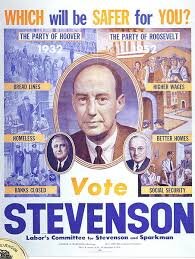
Adlai Stevenson poster.jpg
Source: http://lscook13.blogspot.com/2010/04/adlai...

Enjoyed this speech? Speakola is a labour of love and I’d be very grateful if you would share, tweet or like it. Thank you.

Facebook Twitter Facebook
In 1940-59 B Tags ADLAI STEVENSON, CAMPAIGN SPEECH, PRESIDENTIAL CAMPAIGN, DEMOCRATIC PARTY, TRANSCRIPT, EISENHOWER, AMERICAN DREAM
1 Comment

See my film!

Limited Australian Season

March 2025

Details and ticket bookings at

angeandtheboss.com

Support Speakola

Hi speech lovers,
With costs of hosting website and podcast, this labour of love has become a difficult financial proposition in recent times. If you can afford a donation, it will help Speakola survive and prosper.

Best wishes,
Tony Wilson.

Become a Patron!

Learn more about supporting Speakola.

Featured political

Featured
Jon Stewart: "They responded in five seconds", 9-11 first responders, Address to Congress - 2019
Jacinda Ardern: 'They were New Zealanders. They are us', Address to Parliament following Christchurch massacre - 2019
Dolores Ibárruri: "¡No Pasarán!, They shall not pass!', Defense of 2nd Spanish Republic - 1936
Jimmy Reid: 'A rat race is for rats. We're not rats', Rectorial address, Glasgow University - 1972

Featured eulogies

Featured
For Geoffrey Tozer: 'I have to say we all let him down', by Paul Keating - 2009
for James Baldwin: 'Jimmy. You crowned us', by Toni Morrison - 1988
for Michael Gordon: '13 days ago my Dad’s big, beautiful, generous heart suddenly stopped beating', by Scott and Sarah Gordon - 2018

Featured commencement

Featured
Tara Westover: 'Your avatar isn't real, it isn't terribly far from a lie', The Un-Instagrammable Self, Northeastern University - 2019
Tim Minchin: 'Being an artist requires massive reserves of self-belief', WAAPA - 2019
Atul Gawande: 'Curiosity and What Equality Really Means', UCLA Medical School - 2018
Abby Wambach: 'We are the wolves', Barnard College - 2018
Eric Idle: 'America is 300 million people all walking in the same direction, singing 'I Did It My Way'', Whitman College - 2013
Shirley Chisholm: ;America has gone to sleep', Greenfield High School - 1983

Featured sport

Featured
Joe Marler: 'Get back on the horse', Harlequins v Bath pre game interview - 2019
Ray Lewis : 'The greatest pain of my life is the reason I'm standing here today', 52 Cards -
Mel Jones: 'If she was Bradman on the field, she was definitely Keith Miller off the field', Betty Wilson's induction into Australian Cricket Hall of Fame - 2017
Jeff Thomson: 'It’s all those people that help you as kids', Hall of Fame - 2016

Fresh Tweets


Featured weddings

Featured
Dan Angelucci: 'The Best (Best Man) Speech of all time', for Don and Katherine - 2019
Hallerman Sisters: 'Oh sister now we have to let you gooooo!' for Caitlin & Johnny - 2015
Korey Soderman (via Kyle): 'All our lives I have used my voice to help Korey express his thoughts, so today, like always, I will be my brother’s voice' for Kyle and Jess - 2014

Featured Arts

Featured
Bruce Springsteen: 'They're keepers of some of the most beautiful sonic architecture in rock and roll', Induction U2 into Rock Hall of Fame - 2005
Olivia Colman: 'Done that bit. I think I have done that bit', BAFTA acceptance, Leading Actress - 2019
Axel Scheffler: 'The book wasn't called 'No Room on the Broom!', Illustrator of the Year, British Book Awards - 2018
Tina Fey: 'Only in comedy is an obedient white girl from the suburbs a diversity candidate', Kennedy Center Mark Twain Award -  2010
Tina Fey: 'Only in comedy is an obedient white girl from the suburbs a diversity candidate', Kennedy Center Mark Twain Award - 2010

Featured Debates

Featured
Sacha Baron Cohen: 'Just think what Goebbels might have done with Facebook', Anti Defamation League Leadership Award - 2019
Greta Thunberg: 'How dare you', UN Climate Action Summit - 2019
Charlie Munger: 'The Psychology of Human Misjudgment', Harvard University - 1995
Lawrence O'Donnell: 'The original sin of this country is that we invaders shot and murdered our way across the land killing every Native American that we could', The Last Word, 'Dakota' - 2016