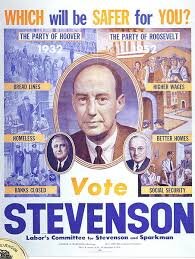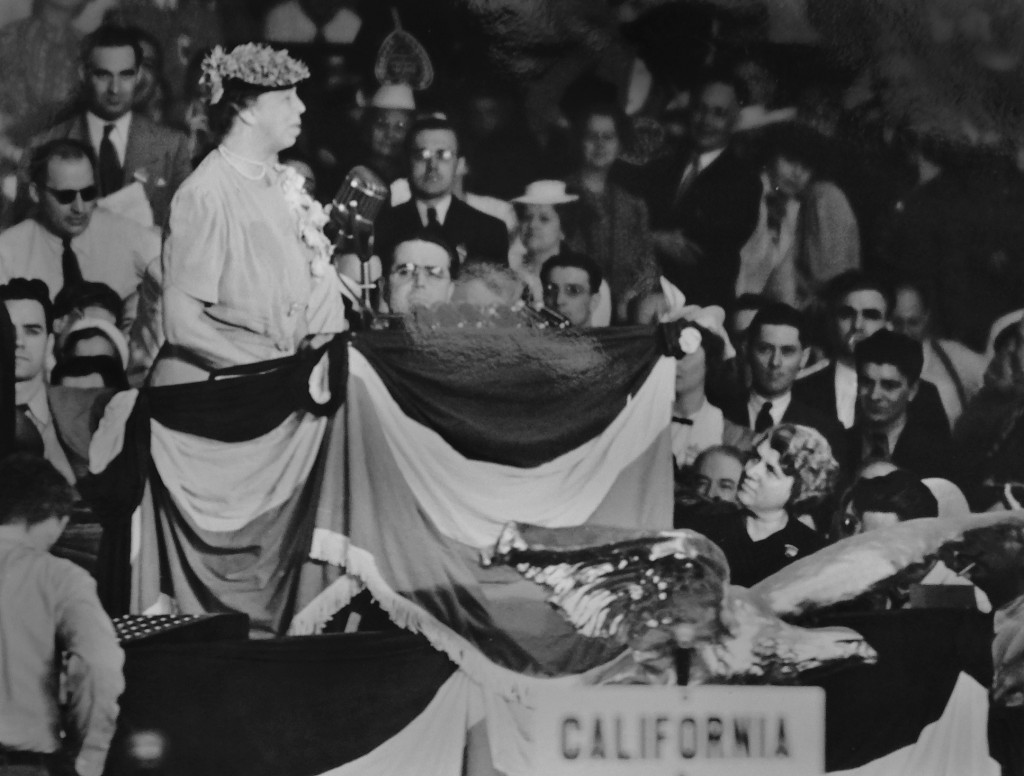
Franklin Roosevelt: 'Tonight I call the roll', Madison Square Garden campaign speech - 1936

31 October 1936, Madison Square Garden, New York City, New York, USA

Senator Wagner, Governor Lehman, ladies and gentlemen:

On the eve of a national election, it is well for us to stop for a moment and analyze calmly and without prejudice the effect on our Nation of a victory by either of the major political parties.

The problem of the electorate is far deeper, far more vital than the continuance in the Presidency of any individual. For the greater issue goes beyond units of humanity—it goes to humanity itself.

In 1932 the issue was the restoration of American democracy; and the American people were in a mood to win. They did win. In 1936 the issue is the preservation of their victory. Again they are in a mood to win. Again they will win.

More than four years ago in accepting the Democratic nomination in Chicago, I said: "Give me your help not to win votes alone, but to win in this crusade to restore America to its own people."

The banners of that crusade still fly in the van of a Nation that is on the march.

It is needless to repeat the details of the program which this Administration has been hammering out on the anvils of experience. No amount of misrepresentation or statistical contortion can conceal or blur or smear that record. Neither the attacks of unscrupulous enemies nor the exaggerations of over-zealous friends will serve to mislead the American people.

What was our hope in 1932? Above all other things the American people wanted peace. They wanted peace of mind instead of gnawing fear.

First, they sought escape from the personal terror which had stalked them for three years. They wanted the peace that comes from security in their homes: safety for their savings, permanence in their jobs, a fair profit from their enterprise.

Next, they wanted peace in the community, the peace that springs from the ability to meet the needs of community life: schools, playgrounds, parks, sanitation, highways—those things which are expected of solvent local government. They sought escape from disintegration and bankruptcy in local and state affairs.

They also sought peace within the Nation: protection of their currency, fairer wages, the ending of long hours of toil, the abolition of child labor, the elimination of wild-cat speculation, the safety of their children from kidnappers.

And, finally, they sought peace with other Nations—peace in a world of unrest. The Nation knows that I hate war, and I know that the Nation hates war.

I submit to you a record of peace; and on that record a well-founded expectation for future peace—peace for the individual, peace for the community, peace for the Nation, and peace with the world.

Tonight I call the roll—the roll of honor of those who stood with us in 1932 and still stand with us today.

Written on it are the names of millions who never had a chance—men at starvation wages, women in sweatshops, children at looms.

Written on it are the names of those who despaired, young men and young women for whom opportunity had become a will-o'-the-wisp.

Written on it are the names of farmers whose acres yielded only bitterness, business men whose books were portents of disaster, home owners who were faced with eviction, frugal citizens whose savings were insecure.

Written there in large letters are the names of countless other Americans of all parties and all faiths, Americans who had eyes to see and hearts to understand, whose consciences were burdened because too many of their fellows were burdened, who looked on these things four years ago and said, "This can be changed. We will change it."

We still lead that army in 1936. They stood with us then because in 1932 they believed. They stand with us today because in 1936 they know. And with them stand millions of new recruits who have come to know.

Their hopes have become our record.

We have not come this far without a struggle and I assure you we cannot go further without a struggle.

For twelve years this Nation was afflicted with hear-nothing, see-nothing, do-nothing Government. The Nation looked to Government but the Government looked away. Nine mocking years with the golden calf and three long years of the scourge! Nine crazy years at the ticker and three long years in the breadlines! Nine mad years of mirage and three long years of despair! Powerful influences strive today to restore that kind of government with its doctrine that that Government is best which is most indifferent.

For nearly four years you have had an Administration which instead of twirling its thumbs has rolled up its sleeves. We will keep our sleeves rolled up.

We had to struggle with the old enemies of peace—business and financial monopoly, speculation, reckless banking, class antagonism, sectionalism, war profiteering.

They had begun to consider the Government of the United States as a mere appendage to their own affairs. We know now that Government by organized money is just as dangerous as Government by organized mob.

Never before in all our history have these forces been so united against one candidate as they stand today. They are unanimous in their hate for me—and I welcome their hatred.

I should like to have it said of my first Administration that in it the forces of selfishness and of lust for power met their match. I should like to have it said of my second Administration that in it these forces met their master.

The American people know from a four-year record that today there is only one entrance to the White House—by the front door. Since March 4, 1933, there has been only one pass-key to the White House. I have carried that key in my pocket. It is there tonight. So long as I am President, it will remain in my pocket.

Those who used to have pass-keys are not happy. Some of them are desperate. Only desperate men with their backs to the wall would descend so far below the level of decent citizenship as to foster the current pay-envelope campaign against America's working people. Only reckless men, heedless of consequences, would risk the disruption of the hope for a new peace between worker and employer by returning to the tactics of the labor spy.

Here is an amazing paradox! The very employers and politicians and publishers who talk most loudly of class antagonism and the destruction of the American system now undermine that system by this attempt to coerce the votes of the wage earners of this country. It is the 1936 version of the old threat to close down the factory or the office if a particular candidate does not win. It is an old strategy of tyrants to delude their victims into fighting their battles for them.

Every message in a pay envelope, even if it is the truth, is a command to vote according to the will of the employer. But this propaganda is worse—it is deceit.

They tell the worker his wage will be reduced by a contribution to some vague form of old-age insurance. They carefully conceal from him the fact that for every dollar of premium he pays for that insurance, the employer pays another dollar. That omission is deceit.

They carefully conceal from him the fact that under the federal law, he receives another insurance policy to help him if he loses his job, and that the premium of that policy is paid 100 percent by the employer and not one cent by the worker. They do not tell him that the insurance policy that is bought for him is far more favorable to him than any policy that any private insurance company could afford to issue. That omission is deceit.

They imply to him that he pays all the cost of both forms of insurance. They carefully conceal from him the fact that for every dollar put up by him his employer puts up three dollars three for one. And that omission is deceit.

But they are guilty of more than deceit. When they imply that the reserves thus created against both these policies will be stolen by some future Congress, diverted to some wholly foreign purpose, they attack the integrity and honor of American Government itself. Those who suggest that, are already aliens to the spirit of American democracy. Let them emigrate and try their lot under some foreign flag in which they have more confidence.

The fraudulent nature of this attempt is well shown by the record of votes on the passage of the Social Security Act. In addition to an overwhelming majority of Democrats in both Houses, seventy-seven Republican Representatives voted for it and only eighteen against it and fifteen Republican Senators voted for it and only five against it. Where does this last-minute drive of the Republican leadership leave these Republican Representatives and Senators who helped enact this law?

I am sure the vast majority of law-abiding businessmen who are not parties to this propaganda fully appreciate the extent of the threat to honest business contained in this coercion.

I have expressed indignation at this form of campaigning and' I am confident that the overwhelming majority of employers, workers and the general public share that indignation and will show it at the polls on Tuesday next.

Aside from this phase of it, I prefer to remember this campaign not as bitter but only as hard-fought. There should be no bitterness or hate where the sole thought is the welfare of the United States of America. No man can occupy the office of President without realizing that he is President of all the people.

It is because I have sought to think in terms of the whole Nation that I am confident that today, just as four years ago, the people want more than promises.

Our vision for the future contains more than promises.

This is our answer to those who, silent about their own plans, ask us to state our objectives.

Of course we will continue to seek to improve working conditions for the workers of America—to reduce hours over-long, to increase wages that spell starvation, to end the labor of children, to wipe out sweatshops. Of course we will continue every effort to end monopoly in business, to support collective bargaining, to stop unfair competition, to abolish dishonorable trade practices. For all these we have only just begun to fight.

Of course we will continue to work for cheaper electricity in the homes and on the farms of America, for better and cheaper transportation, for low interest rates, for sounder home financing, for better banking, for the regulation of security issues, for reciprocal trade among nations, for the wiping out of slums. For all these we have only just begun to fight.

Of course we will continue our efforts in behalf of the farmers of America. With their continued cooperation we will do all in our power to end the piling up of huge surpluses which spelled ruinous prices for their crops. We will persist in successful action for better land use, for reforestation, for the conservation of water all the way from its source to the sea, for drought and flood control, for better marketing facilities for farm commodities, for a definite reduction of farm tenancy, for encouragement of farmer cooperatives, for crop insurance and a stable food supply. For all these we have only just begun to fight.

Of course we will provide useful work for the needy unemployed; we prefer useful work to the pauperism of a dole.

Here and now I want to make myself clear about those who disparage their fellow citizens on the relief rolls. They say that those on relief are not merely jobless—that they are worthless. Their solution for the relief problem is to end relief—to purge the rolls by starvation. To use the language of the stock broker, our needy unemployed would be cared for when, as, and if some fairy godmother should happen on the scene.

You and I will continue to refuse to accept that estimate of our unemployed fellow Americans. Your Government is still on the same side of the street with the Good Samaritan and not with those who pass by on the other side.

Again—what of our objectives?

Of course we will continue our efforts for young men and women so that they may obtain an education and an opportunity to put it to use. Of course we will continue our help for the crippled, for the blind, for the mothers, our insurance for the unemployed, our security for the aged. Of course we will continue to protect the consumer against unnecessary price spreads, against the costs that are added by monopoly and speculation. We will continue our successful efforts to increase his purchasing power and to keep it constant.

For these things, too, and for a multitude of others like them, we have only just begun to fight.

All this—all these objectives—spell peace at home. All our actions, all our ideals, spell also peace with other nations.

Today there is war and rumor of war. We want none of it. But while we guard our shores against threats of war, we will continue to remove the causes of unrest and antagonism at home which might make our people easier victims to those for whom foreign war is profitable. You know well that those who stand to profit by war are not on our side in this campaign.

"Peace on earth, good will toward men"—democracy must cling to that message. For it is my deep conviction that democracy cannot live without that true religion which gives a nation a sense of justice and of moral purpose. Above our political forums, above our market places stand the altars of our faith-altars on which burn the fires of devotion that maintain all that is best in us and all that is best in our Nation.

We have need of that devotion today. It is that which makes it possible for government to persuade those who are mentally prepared to fight each other to go on instead, to work for and to sacrifice for each other. That is why we need to say with the Prophet: "What doth the Lord require of thee—but to do justly, to love mercy and to walk humbly with thy God." That is why the recovery we seek, the recovery we are winning, is more than economic. In it are included justice and love and humility, not for ourselves as individuals alone, but for our Nation.
That is the road to peace.

Source: http://www.presidency.ucsb.edu/ws/?pid=152...

Franklin D Roosevelt: 'Let me warn you, and let me warn the nation', Democratic State Convention - 1936

29 September 1936, Syracuse, New York, USA

Ladies and gentlemen:

From force of long habit I almost said, "My fellow delegates."

Tonight you and I join forces for the 1936 campaign.

We enter it with confidence. Never was there greater need for fidelity to the underlying conception of Americanism than there is today. And once again it is given to our party to carry the message of that Americanism to the people.

The task on our part is twofold: First, as simple patriotism requires, to separate the false from the real issues; and, secondly, with facts and without rancor, to clarify the real problems for the American public.

There will be—there are—many false issues. In that respect, this will be no different from other campaigns. Partisans, not willing to face realities, will drag out red herrings as they have always done—to divert attention from the trail of their own weaknesses.

This practice is as old as our democracy. Avoiding the facts—fearful of the truth—a malicious opposition charged that George Washington planned to make himself king under a British form of government; that Thomas Jefferson planned to set up a guillotine under a French Revolutionary form of government; that Andrew Jackson soaked the rich of the Eastern seaboard and planned to surrender American democracy to the dictatorship of a frontier mob. They called Abraham Lincoln a Roman Emperor; Theodore Roosevelt a Destroyer; Woodrow Wilson a self-constituted Messiah.

In this campaign another herring turns up. In former years it has been British and French- and a variety of other things. This year it is Russian. Desperate in mood, angry at failure, cunning in purpose, individuals and groups are seeking to make Communism an issue in an election where Communism is not a controversy between the two major parties.

Here and now, once and for all, let us bury that red herring, and destroy that false issue. You are familiar with my background; you know my heritage; and you are familiar, especially in the State of New York, with my public service extending back over a quarter of a century. For nearly four years I have been President of the United States. A long record has been written. In that record, both in this State and in the national capital, you will find a simple, clear and consistent adherence not only to the letter, but to the spirit of the American form of government.

To that record, my future and the future of my Administration will conform. I have not sought, I do not seek, I repudiate the support of any advocate of Communism or of any other alien "ism" which would by fair means or foul change our American democracy.

That is my position. It always has been my position. It always will be my position.

There is no difference between the major parties as to what they think about Communism. But there is a very great difference between the two parties in what they do about Communism.

I must tell you why. Communism is a manifestation of the social unrest which always comes with widespread economic maladjustment. We in the Democratic party have not been content merely to denounce this menace. We have been realistic enough to face it. We have been intelligent enough to do something about it. And the world has seen the results of what we have done.

In the spring of 1933 we faced a crisis which was the ugly fruit of twelve years of neglect of the causes of economic and social unrest. It was a crisis made to order for all those who would overthrow our form of government. Do I need to recall to you the fear of those days—the reports of those who piled supplies in their basements, who laid plans to get their fortunes across the border, who got themselves hideaways in the country against the impending upheaval? Do I need to recall the law-abiding heads of peaceful families, who began to wonder, as they saw their children starve, how they would get the bread they saw in the bakery window? Do I need to recall the homeless boys who were traveling in bands through the countryside seeking work, seeking food —desperate because they could find neither? Do I need to recall the farmers who banded together with pitchforks to keep the sheriff from selling the farm home under foreclosure? Do I need to recall the powerful leaders of industry and banking who came to me in Washington in those early days of 1933 pleading to be saved?

Most people in the United States remember today the fact that starvation was averted, that homes and farms were saved, that banks were reopened, that crop prices rose, that industry revived, and that the dangerous forces subversive of our form of government were turned aside.

A few people- a few only—unwilling to remember, seem to have forgotten those days.

In the summer of 1933, a nice old gentleman wearing a silk hat fell off the end of a pier. He was unable to swim. A friend ran down the pier, dived overboard and pulled him out; but the silk hat floated off with the tide. After the old gentleman had been revived, he was effusive in his thanks. He praised his friend for saving his life. Today, three years later, the old gentleman is berating his friend because the silk hat was lost.

Why did that crisis of 1929 to 1933 pass without disaster?

The answer is found in the record of what we did. Early in the campaign of 1932 I said: "To meet by reaction that danger of radicalism is to invite disaster. Reaction is no barrier to the radical, it is a challenge, a provocation. The way to meet that danger is to offer a workable program of reconstruction, and the party to offer it is the party with clean hands." We met the emergency with emergency action. But far more important than that, we went to the roots of the problem, and attacked the cause of the crisis. We were against revolution. Therefore, we waged war against those conditions which make revolutions—against the inequalities and resentments which breed them. In America in 1933 the people did not attempt to remedy wrongs by overthrowing their institutions. Americans were made to realize that wrongs could and would be set right within their institutions. We proved that democracy can work.

I have said to you that there is a very great difference between the two parties in what they do about Communism. Conditions congenial to Communism were being bred and fostered throughout this Nation up to the very day of March 4, 1933. Hunger was breeding it, loss of homes and farms was breeding it, closing banks were breeding it, a ruinous price level was breeding it. Discontent and fear were spreading through the land. The previous national Administration, bewildered, did nothing.

In their speeches they deplored it, but by their actions they encouraged it. The injustices, the inequalities, the downright suffering out of which revolutions come—what did they do about these things? Lacking courage, they evaded. Being selfish, they neglected. Being short-sighted, they ignored. When the crisis came—as these wrongs made it sure to come—America was unprepared.

Our lack of preparation for it was best proved by the cringing and the fear of the very people whose indifference helped to make the crisis. They came to us pleading that we should do, overnight, what they should have been doing through the years.

And the simple causes of our unpreparedness were two: First, a weak leadership, and, secondly, an inability to see causes, to understand the reasons for social unrest—the tragic plight of 90 percent of the men, women and children who made up the population of the United States.

It has been well said that "The most dreadful failure of which any form of government can be guilty is simply to lose touch with reality, because out of this failure all imaginable forms of evil grow. Every empire that has crashed has come down primarily because its rulers did not know what was going on in the world and were incapable of learning."

It is for that reason that our American form of government will continue to be safest in. Democratic hands. The real, actual, undercover Republican leadership is the same as it was four years ago. That leadership will never comprehend the need for a program of social justice and of regard for the well-being of the masses of our people.

I have been comparing leadership in Washington. This contrast between Democratic and Republican leadership holds true throughout the length and breadth of the State of New York. As far back as the year 1910, the old Black Horse Cavalry in Albany, which we old people will remember, was failing to meet changing social conditions by appropriate social legislation. Here was a State noted for its industry and noted for its agriculture—a State with the greatest mixture of population- where the poorest and the richest lived, literally, within a stone's throw of each other—in short a situation made to order for potential unrest. And yet in this situation the best that the Republican leaders of those days could say was: "Let them eat cake." What would have happened if that reactionary domination had continued through all these hard years?

Starting in 1911, a Democratic leadership came into power, and with it a new philosophy of government. I had the good fortune to come into public office at that time. I found other young men in the Legislature—men who held the same philosophy; one of them was Bob Wagner; another was Al Smith. We were all joined in a common cause. We did not look on government as something apart from the people. We thought of it as something to be used by the people for their own good.

New factory legislation setting up decent standards of safety and sanitation; limitation of the working hours of women in industry; a workmen's compensation law; a one-day-rest-in-seven law; a full train-crew law; a direct-primary law—these laws and many more were passed which were then called radical and alien to our form of government. Would you or any other Americans call them radical or alien today?

In later years, first under Governor Smith, then during my Governorship, this program of practical intelligence was carried forward over the typical and unswerving opposition of Republican leaders throughout our State.

And today the great tradition of a liberal, progressive Democratic Party has been carried still further by your present Governor, Herbert H. Lehman. He has begun a program of insurance to remove 'the spectre of unemployment from the working people of the State. He has broadened our labor legislation. He has extended the supervision of public utility companies. He has proved himself an untiring seeker for the public good; a doer of social justice; a wise, conscientious, clear-headed and businesslike administrator of the executive branch of our Government. And be it noted that his opponents are led and backed by the same forces and, in many cases, by the same individuals who, for a quarter of a century, have tried to hamstring progress within our State. The overwhelming majority of our citizens, up-state and down-state, regardless of party, propose to return him and his Administration to Albany for another two years.

His task in Albany, like my task in Washington, has been to maintain contact between statecraft and reality. In New York and in Washington, Government which has rendered more than lip service to our Constitutional Democracy has done a work for the protection and preservation of our institutions that could not have been accomplished by repression and force.

Let me warn you and let me warn the Nation against the smooth evasion which says, "Of course we believe all these things; we believe in social security; we believe in work for the unemployed; we believe in saving homes. Cross our hearts and hope to die, we believe in all these things; but we do not like the way the present Administration is doing them. Just turn them over to us. We will do all of them- we will do more of them we will do them better; and, most important of all, the doing of them will not cost anybody anything."

But, my friends, these evaders are banking too heavily on the shortness of our memories. No one will forget that they had their golden opportunity—twelve long years of it.

Remember, too, that the first essential of doing a job well is to want to see the job done. Make no mistake about this: the Republican leadership today is not against the way we have done the job. The Republican leadership is against the job's being done.

Look to the source of the promises of the past. Governor Lehman knows and I know how little legislation in the interests of the average citizen would be on the statute books of the State of New York, and of the Federal Government, if we had waited for Republican leaders to pass it.

The same lack of purpose of fulfillment lies behind the promises of today. You cannot be an Old Guard Republican in the East, and a New Deal Republican in the West. You cannot promise to repeal taxes before one audience and promise to spend more of the taxpayers' money before another audience. You cannot promise tax relief for those who can afford to pay, and, at the same time, promise more of the taxpayers' money for those who are in need. You simply cannot make good on both promises at the same time.

Who is there in America who believes that we can run the risk of turning back our Government to the old leadership which brought it to the brink of 1933? Out of the strains and stresses of these years we have come to see that the true conservative is the man who has a real concern for injustices and takes thought against the day of reckoning. The true conservative seeks to protect the system of private property and free enterprise by correcting such injustices and inequalities as arise from it. The most serious threat to our institutions comes from those who refuse to face the need for change. Liberalism becomes the protection for the far-sighted conservative.

Never has a Nation made greater strides in the safeguarding of democracy than we have made during the past three years. Wise and prudent men- intelligent conservatives—have long known that in a changing world worthy institutions can be conserved only by adjusting them to the changing time. In the words of the great essayist, "The voice of great events is proclaiming to us. Reform if you would preserve." I am that kind of conservative because I am that kind of liberal.

Source: http://www.presidency.ucsb.edu/ws/?pid=151...

John Glenn: 'I have had a job, Howard!' Gold Star Mothers speech - 1974

4 May 1974, Cleveland City Club, Cleveland, Ohio, USA

This exchange occurred in the Demicratic Senate primary for state of Ohio. Howard Metzenbaum, who had strong business credentials, attempted to highlight astronaut and military man John Glenn's inexperience in this area.

Metzenbaum: "How can you run for Senate when you've never worked a payroll?"

Glenn: "I served 23 years in the United States Marine Corps. I was through two wars. I flew 149 missions. My plane was hit by anti-aircraft fire on 12 differentoccasions.

I was in the space program. It wasn't my checkbook, it was my life that was on the line. This was not a 9-to-5 job where I took time off to take the daily cash receipts to the bank.

I ask you to go with me, as I went the other day to a Veterans Hospital, and look those men with their mangled bodies in the eye and tell them they didn't hold a job.

You go with me to any Gold Star mother, and you look her in the eye and tell her that her son did not hold a job.

You go with me to the space program, and you go as I have gone to the widows and the orphans of Ed White and Gus Grissom and Roger Chaffee, and you look those kids in the eye and tell them that their dad didn't hold a job.

You go with me on Memorial Day coming up, and you stand on Arlington National Cemetery — where I have more friends than I like to remember — and you watch those waving flags, and you stand there, and you think about this nation, and you tell me that those people didn't have a job.

I tell you, Howard Metzenbaum, you should be on your knees every day of your life thanking God that there were some men — SOME MEN — who held a job. And they required a dedication to purpose and a love of country and a dedication to duty that was more important than life itself.

And their self-sacrifice is what has made this country possible.

I HAVE HELD A JOB, HOWARD!"


Source: http://www.snopes.com/politics/quotes/glen...