
• Genre
  • About
  • Submissions
  • Donate
  • Search
Menu

Speakola

All Speeches Great and Small
  • Genre
  • About
  • Submissions
  • Donate
  • Search
Share a political speech

Jesse Jackson: 'Whatever the original ships, we're in the same boat tonight', DNC Convention - 1988

June 15, 2020

21 July 1988, The Omni, Atlanta, Georgia, USA

Tonight, we pause and give praise and honor to God for being good enough to allow us to be at this place at this time. When I look out at this convention, I see the face of America: Red, Yellow, Brown, Black and White. We're all precious in God's sight -- the real rainbow coalition.

All of us -- All of us who are here think that we are seated. But we're really standing on someone's shoulders. Ladies and gentlemen, Mrs. Rosa Parks -- the mother of the civil rights movement.
[Mrs. Rosa Parks is brought to the podium.]

I want to express my deep love and appreciation for the support my family has given me over these past months. They have endured pain, anxiety, threat, and fear. But they have been strengthened and made secure by our faith in God, in America, and in you. Your love has protected us and made us strong. To my wife Jackie, the foundation of our family; to our five children whom you met tonight; to my mother, Mrs. Helen Jackson, who is present tonight; and to our grandmother, Mrs. Matilda Burns; to my brother Chuck and his family; to my mother-in-law, Mrs. Gertrude Brown, who just last month at age 61 graduated from Hampton Institute -- a marvelous achievement.

I offer my appreciation to Mayor Andrew Young who has provided such gracious hospitality to all of us this week.

And a special salute to President Jimmy Carter. President Carter restored honor to the White House after Watergate. He gave many of us a special opportunity to grow. For his kind words, for his unwavering commitment to peace in the world, and for the voters that came from his family, every member of his family, led by Billy and Amy, I offer my special thanks to the Carter family.

My right and my privilege to stand here before you has been won, won in my lifetime, by the blood and the sweat of the innocent.

Twenty-four years ago, the late Fanny Lou Hamer and Aaron Henry -- who sits here tonight from Mississippi -- were locked out onto the streets in Atlantic City; the head of the Mississippi Freedom Democratic Party.

But tonight, a Black and White delegation from Mississippi is headed by Ed Cole, a Black man from Mississippi; twenty-four years later.

Many were lost in the struggle for the right to vote: Jimmy Lee Jackson, a young student, gave his life; Viola Liuzzo, a White mother from Detroit, called "nigger lover," and brains blown out at point blank range; [Michael] Schwerner, [Andrew] Goodman and [James] Chaney -- two Jews and a Black -- found in a common grave, bodies riddled with bullets in Mississippi; the four darling little girls in a church in Birmingham, Alabama. They died that we might have a right to live.

Dr. Martin Luther King Jr. lies only a few miles from us tonight. Tonight he must feel good as he looks down upon us. We sit here together, a rainbow, a coalition -- the sons and daughters of slavemasters and the sons and daughters of slaves, sitting together around a common table, to decide the direction of our party and our country. His heart would be full tonight.

As a testament to the struggles of those who have gone before; as a legacy for those who will come after; as a tribute to the endurance, the patience, the courage of our forefathers and mothers; as an assurance that their prayers are being answered, that their work has not been in vain, and, that hope is eternal, tomorrow night my name will go into nomination for the Presidency of the United States of America.
We meet tonight at the crossroads, a point of decision. Shall we expand, be inclusive, find unity and power; or suffer division and impotence?

We've come to Atlanta, the cradle of the Old South, the crucible of the New South. Tonight, there is a sense of celebration, because we are moved, fundamentally moved from racial battlegrounds by law, to economic common ground. Tomorrow we'll challenge to move to higher ground.

Common ground. Think of Jerusalem, the intersection where many trails met. A small village that became the birthplace for three great religions -- Judaism, Christianity, and Islam. Why was this village so blessed? Because it provided a crossroads where different people met, different cultures, different civilizations could meet and find common ground. When people come together, flowers always flourish -- the air is rich with the aroma of a new spring.

Take New York, the dynamic metropolis. What makes New York so special? It's the invitation at the Statue of Liberty, "Give me your tired, your poor, your huddled masses who yearn to breathe free." Not restricted to English only. Many people, many cultures, many languages with one thing in common: They yearn to breathe free. Common ground.

Tonight in Atlanta, for the first time in this century, we convene in the South; a state where Governors once stood in school house doors; where Julian Bond was denied a seat in the State Legislature because of his conscientious objection to the Vietnam War; a city that, through its five Black Universities, has graduated more black students than any city in the world. Atlanta, now a modern intersection of the New South.
Common ground. That's the challenge of our party tonight -- left wing, right wing.

Progress will not come through boundless liberalism nor static conservatism, but at the critical mass of mutual survival -- not at boundless liberalism nor static conservatism, but at the critical mass of mutual survival. It takes two wings to fly. Whether you're a hawk or a dove, you're just a bird living in the same environment, in the same world.

The Bible teaches that when lions and lambs lie down together, none will be afraid, and there will be peace in the valley. It sounds impossible. Lions eat lambs. Lambs sensibly flee from lions. Yet even lions and lambs find common ground. Why? Because neither lions nor lambs want the forest to catch on fire. Neither lions nor lambs want acid rain to fall. Neither lions nor lambs can survive nuclear war. If lions and lambs can find common ground, surely we can as well -- as civilized people.


The only time that we win is when we come together. In 1960, John Kennedy, the late John Kennedy, beat Richard Nixon by only 112,000 votes -- less than one vote per precinct. He won by the margin of our hope. He brought us together. He reached out. He had the courage to defy his advisors and inquire about Dr. King's jailing in Albany, Georgia. We won by the margin of our hope, inspired by courageous leadership. In 1964, Lyndon Johnson brought both wings together -- the thesis, the antithesis, and the creative synthesis -- and together we won. In 1976, Jimmy Carter unified us again, and we won. When we do not come together, we never win. In 1968, the division and despair in July led to our defeat in November. In 1980, rancor in the spring and the summer led to Reagan in the fall. When we divide, we cannot win. We must find common ground as the basis for survival and development and change and growth.

Today when we debated, differed, deliberated, agreed to agree, agreed to disagree, when we had the good judgment to argue a case and then not self-destruct, George Bush was just a little further away from the White House and a little closer to private life.

Tonight, I salute Governor Michael Dukakis. He has run -- He has run a well-managed and a dignified campaign. No matter how tired or how tried, he always resisted the temptation to stoop to demagoguery.
I've watched a good mind fast at work, with steel nerves, guiding his campaign out of the crowded field without appeal to the worst in us. I've watched his perspective grow as his environment has expanded. I've seen his toughness and tenacity close up. I know his commitment to public service. Mike Dukakis' parents were a doctor and a teacher; my parents a maid, a beautician, and a janitor. There's a great gap between Brookline, Massachusetts and Haney Street in the Fieldcrest Village housing projects in Greenville, South Carolina.

He studied law; I studied theology. There are differences of religion, region, and race; differences in experiences and perspectives. But the genius of America is that out of the many we become one.
Providence has enabled our paths to intersect. His foreparents came to America on immigrant ships; my foreparents came to America on slave ships. But whatever the original ships, we're in the same boat tonight.

Our ships could pass in the night -- if we have a false sense of independence -- or they could collide and crash. We would lose our passengers. We can seek a high reality and a greater good. Apart, we can drift on the broken pieces of Reagonomics, satisfy our baser instincts, and exploit the fears of our people. At our highest, we can call upon noble instincts and navigate this vessel to safety. The greater good is the common good.

As Jesus said, "Not My will, but Thine be done." It was his way of saying there's a higher good beyond personal comfort or position.

The good of our Nation is at stake. It's commitment to working men and women, to the poor and the vulnerable, to the many in the world.

With so many guided missiles, and so much misguided leadership, the stakes are exceedingly high. Our choice? Full participation in a democratic government, or more abandonment and neglect. And so this night, we choose not a false sense of independence, not our capacity to survive and endure. Tonight we choose interdependency, and our capacity to act and unite for the greater good.

Common good is finding commitment to new priorities to expansion and inclusion. A commitment to expanded participation in the Democratic Party at every level. A commitment to a shared national campaign strategy and involvement at every level.

A commitment to new priorities that insure that hope will be kept alive. A common ground commitment to a legislative agenda for empowerment, for the John Conyers bill -- universal, on-site, same-day registration everywhere. A commitment to D.C. statehood and empowerment -- D.C. deserves statehood.

A commitment to economic set-asides, commitment to the Dellums bill for comprehensive sanctions against South Africa. A shared commitment to a common direction.

Common ground.

Easier said than done. Where do you find common ground? At the point of challenge. This campaign has shown that politics need not be marketed by politicians, packaged by pollsters and pundits. Politics can be a moral arena where people come together to find common ground.

We find common ground at the plant gate that closes on workers without notice. We find common ground at the farm auction, where a good farmer loses his or her land to bad loans or diminishing markets. Common ground at the school yard where teachers cannot get adequate pay, and students cannot get a scholarship, and can't make a loan. Common ground at the hospital admitting room, where somebody tonight is dying because they cannot afford to go upstairs to a bed that's empty waiting for someone with insurance to get sick. We are a better nation than that. We must do better.

Common ground.

What is leadership if not present help in a time of crisis? And so I met you at the point of challenge. In Jay, Maine, where paper workers were striking for fair wages; in Greenville, Iowa, where family farmers struggle for a fair price; in Cleveland, Ohio, where working women seek comparable worth; in McFarland, California, where the children of Hispanic farm workers may be dying from poisoned land, dying in clusters with cancer; in an AIDS hospice in Houston, Texas, where the sick support one another, too often rejected by their own parents and friends.

Common ground.


America is not a blanket woven from one thread, one color, one cloth. When I was a child growing up in Greenville, South Carolina and grandmamma could not afford a blanket, she didn't complain and we did not freeze. Instead she took pieces of old cloth -- patches, wool, silk, gabardine, crockersack -- only patches, barely good enough to wipe off your shoes with. But they didn't stay that way very long. With sturdy hands and a strong cord, she sewed them together into a quilt, a thing of beauty and power and culture. Now, Democrats, we must build such a quilt.

Farmers, you seek fair prices and you are right -- but you cannot stand alone. Your patch is not big enough.
Workers, you fight for fair wages, you are right -- but your patch labor is not big enough.

Women, you seek comparable worth and pay equity, you are right -- but your patch is not big enough.
Women, mothers, who seek Head Start, and day care and prenatal care on the front side of life, relevant jail care and welfare on the back side of life, you are right -- but your patch is not big enough.

Students, you seek scholarships, you are right -- but your patch is not big enough.

Blacks and Hispanics, when we fight for civil rights, we are right -- but our patch is not big enough.

Gays and lesbians, when you fight against discrimination and a cure for AIDS, you are right -- but your patch is not big enough.

Conservatives and progressives, when you fight for what you believe, right wing, left wing, hawk, dove, you are right from your point of view, but your point of view is not enough.

But don't despair. Be as wise as my grandmamma. Pull the patches and the pieces together, bound by a common thread. When we form a great quilt of unity and common ground, we'll have the power to bring about health care and housing and jobs and education and hope to our Nation.

We, the people, can win.

We stand at the end of a long dark night of reaction. We stand tonight united in the commitment to a new direction. For almost eight years we've been led by those who view social good coming from private interest, who view public life as a means to increase private wealth. They have been prepared to sacrifice the common good of the many to satisfy the private interests and the wealth of a few.


We believe in a government that's a tool of our democracy in service to the public, not an instrument of the aristocracy in search of private wealth. We believe in government with the consent of the governed, "of, for and by the people." We must now emerge into a new day with a new direction.

Reaganomics: Based on the belief that the rich had too much money [sic] -- too little money and the poor had too much. That's classic Reaganomics. They believe that the poor had too much money and the rich had too little money - so they engaged in reverse Robin Hood - took from the poor, gave to the rich, paid for by the middle class. We cannot stand four more years of Reaganomics in any version, in any disguise.
How do I document that case? Seven years later, the richest 1 percent of our society pays 20 percent less in taxes. The poorest 10 percent pay 20 percent more: Reaganomics.

Reagan gave the rich and the powerful a multibillion-dollar party. Now the party is over. He expects the people to pay for the damage. I take this principal position, convention, let us not raise taxes on the poor and the middle-class, but those who had the party, the rich and the powerful, must pay for the party.
I just want to take common sense to high places. We're spending one hundred and fifty billion dollars a year defending Europe and Japan 43 years after the war is over. We have more troops in Europe tonight than we had seven years ago. Yet the threat of war is ever more remote.

Germany and Japan are now creditor nations; that means they've got a surplus. We are a debtor nation -- means we are in debt. Let them share more of the burden of their own defense. Use some of that money to build decent housing. Use some of that money to educate our children. Use some of that money for long-term health care. Use some of that money to wipe out these slums and put America back to work!
I just want to take common sense to high places. If we can bail out Europe and Japan; if we can bail out Continental Bank and Chrysler -- and Mr. Iacocca, make [sic] 8,000 dollars an hour -- we can bail out the family farmer.

I just want to make common sense. It does not make sense to close down six hundred and fifty thousand family farms in this country while importing food from abroad subsidized by the U.S. Government. Let's make sense.

It does not make sense to be escorting all our tankers up and down the Persian Gulf paying $2.50 for every one dollar worth of oil we bring out, while oil wells are capped in Texas, Oklahoma, and Louisiana. I just want to make sense.

Leadership must meet the moral challenge of its day. What's the moral challenge of our day? We have public accommodations. We have the right to vote. We have open housing. What's the fundamental challenge of our day? It is to end economic violence. Plant closings without notice -- economic violence. Even the greedy do not profit long from greed -- economic violence.

Most poor people are not lazy. They are not Black. They are not Brown. They are mostly White and female and young. But whether White, Black or Brown, a hungry baby's belly turned inside out is the same color -- color it pain; color it hurt; color it agony.

Most poor people are not on welfare. Some of them are illiterate and can't read the want-ad sections. And when they can, they can't find a job that matches the address. They work hard everyday.
I know. I live amongst them. I'm one of them. I know they work. I'm a witness. They catch the early bus. They work every day.

They raise other people's children. They work everyday.

They clean the streets. They work everyday. They drive dangerous cabs. They work everyday. They change the beds you slept in in these hotels last night and can't get a union contract. They work everyday.
No, no, they are not lazy! Someone must defend them because it's right, and they cannot speak for themselves. They work in hospitals. I know they do. They wipe the bodies of those who are sick with fever and pain. They empty their bedpans. They clean out their commodes. No job is beneath them, and yet when they get sick they cannot lie in the bed they made up every day. America, that is not right. We are a better Nation than that. We are a better Nation than that.

We need a real war on drugs. You can't "just say no." It's deeper than that. You can't just get a palm reader or an astrologer. It's more profound than that.

We are spending a hundred and fifty billion dollars on drugs a year. We've gone from ignoring it to focusing on the children. Children cannot buy a hundred and fifty billion dollars worth of drugs a year; a few high-profile athletes -- athletes are not laundering a hundred and fifty billion dollars a year -- bankers are.

I met the children in Watts, who, unfortunately, in their despair, their grapes of hope have become raisins of despair, and they're turning on each other and they're self-destructing. But I stayed with them all night long. I wanted to hear their case.

They said, "Jesse Jackson, as you challenge us to say no to drugs, you're right; and to not sell them, you're right; and not use these guns, you're right." (And by the way, the promise of CETA [Comprehensive Employment and Training Act]; they displaced CETA -- they did not replace CETA.)

"We have neither jobs nor houses nor services nor training -- no way out. Some of us take drugs as anesthesia for our pain. Some take drugs as a way of pleasure, good short-term pleasure and long-term pain. Some sell drugs to make money. It's wrong, we know, but you need to know that we know. We can go and buy the drugs by the boxes at the port. If we can buy the drugs at the port, don't you believe the Federal government can stop it if they want to?"

They say, "We don't have Saturday night specials anymore." They say, "We buy AK47's and Uzi's, the latest make of weapons. We buy them across the counter along these boulevards."

You cannot fight a war on drugs unless and until you're going to challenge the bankers and the gun sellers and those who grow them. Don't just focus on the children; let's stop drugs at the level of supply and demand. We must end the scourge on the American culture.

Leadership. What difference will we make? Leadership. Cannot just go along to get along. We must do more than change Presidents. We must change direction.

Leadership must face the moral challenge of our day. The nuclear war build-up is irrational. Strong leadership cannot desire to look tough and let that stand in the way of the pursuit of peace. Leadership must reverse the arms race. At least we should pledge no first use. Why? Because first use begets first retaliation. And that's mutual annihilation. That's not a rational way out.

No use at all. Let's think it out and not fight it out because it's an unwinnable fight. Why hold a card that you can never drop? Let's give peace a chance.

Leadership. We now have this marvelous opportunity to have a breakthrough with the Soviets. Last year 200,000 Americans visited the Soviet Union. There's a chance for joint ventures into space -- not Star Wars and war arms escalation but a space defense initiative. Let's build in the space together and demilitarize the heavens. There's a way out.

America, let us expand. When Mr. Reagan and Mr. Gorbachev met there was a big meeting. They represented together one-eighth of the human race. Seven-eighths of the human race was locked out of that room. Most people in the world tonight -- half are Asian, one-half of them are Chinese. There are 22 nations in the Middle East. There's Europe; 40 million Latin Americans next door to us; the Caribbean; Africa -- a half-billion people.

Most people in the world today are Yellow or Brown or Black, non-Christian, poor, female, young and don't speak English in the real world.

This generation must offer leadership to the real world. We're losing ground in Latin America, Middle East, South Africa because we're not focusing on the real world. That's the real world. We must use basic principles -- support international law. We stand the most to gain from it. Support human rights -- we believe in that. Support self-determination -- we're built on that. Support economic development -- you know it's right. Be consistent and gain our moral authority in the world. I challenge you tonight, my friends, let's be bigger and better as a Nation and as a Party.

We have basic challenges -- freedom in South Africa. We've already agreed as Democrats to declare South Africa to be a terrorist state. But don't just stop there. Get South Africa out of Angola; free Namibia; support the front line states. We must have a new humane human rights consistent policy in Africa.
I'm often asked, "Jesse, why do you take on these tough issues? They're not very political. We can't win that way."

If an issue is morally right, it will eventually be political. It may be political and never be right. Fannie Lou Hamer didn't have the most votes in Atlantic City, but her principles have outlasted every delegate who voted to lock her out. Rosa Parks did not have the most votes, but she was morally right. Dr. King didn't have the most votes about the Vietnam War, but he was morally right. If we are principled first, our politics will fall in place.

"Jesse, why do you take these big bold initiatives?" A poem by an unknown author went something like this: "We mastered the air, we conquered the sea, annihilated distance and prolonged life, but we're not wise enough to live on this earth without war and without hate."

As for Jesse Jackson: "I'm tired of sailing my little boat, far inside the harbor bar. I want to go out where the big ships float, out on the deep where the great ones are. And should my frail craft prove too slight for waves that sweep those billows o'er, I'd rather go down in the stirring fight than drowse to death at the sheltered shore."

We've got to go out, my friends, where the big boats are.


And then for our children. Young America, hold your head high now. We can win. We must not lose you to drugs and violence, premature pregnancy, suicide, cynicism, pessimism and despair. We can win. Wherever you are tonight, I challenge you to hope and to dream. Don't submerge your dreams. Exercise above all else, even on drugs, dream of the day you are drug free. Even in the gutter, dream of the day that you will be up on your feet again.

You must never stop dreaming. Face reality, yes, but don't stop with the way things are. Dream of things as they ought to be. Dream. Face pain, but love, hope, faith and dreams will help you rise above the pain. Use hope and imagination as weapons of survival and progress, but you keep on dreaming, young America.

Dream of peace. Peace is rational and reasonable. War is irrationable [sic] in this age, and unwinnable.
Dream of teachers who teach for life and not for a living. Dream of doctors who are concerned more about public health than private wealth. Dream of lawyers more concerned about justice than a judgeship. Dream of preachers who are concerned more about prophecy than profiteering. Dream on the high road with sound values.

And then America, as we go forth to September, October, November and then beyond, America must never surrender to a high moral challenge.

Do not surrender to drugs. The best drug policy is a "no first use." Don't surrender with needles and cynicism. Let's have "no first use" on the one hand, or clinics on the other. Never surrender, young America. Go forward.

America must never surrender to malnutrition. We can feed the hungry and clothe the naked. We must never surrender. We must go forward.

We must never surrender to illiteracy. Invest in our children. Never surrender; and go forward. We must never surrender to inequality. Women cannot compromise ERA or comparable worth. Women are making 60 cents on the dollar to what a man makes. Women cannot buy meat cheaper. Women cannot buy bread cheaper. Women cannot buy milk cheaper. Women deserve to get paid for the work that you do. It's right! And it's fair.

Don't surrender, my friends. Those who have AIDS tonight, you deserve our compassion. Even with AIDS you must not surrender.

In your wheelchairs. I see you sitting here tonight in those wheelchairs. I've stayed with you. I've reached out to you across our Nation. And don't you give up. I know it's tough sometimes. People look down on you. It took you a little more effort to get here tonight. And no one should look down on you, but sometimes mean people do. The only justification we have for looking down on someone is that we're going to stop and pick them up.

But even in your wheelchairs, don't you give up. We cannot forget 50 years ago when our backs were against the wall, Roosevelt was in a wheelchair. I would rather have Roosevelt in a wheelchair than Reagan and Bush on a horse. Don't you surrender and don't you give up. Don't surrender and don't give up!
Why I cannot challenge you this way? "Jesse Jackson, you don't understand my situation. You be on television. You don't understand. I see you with the big people. You don't understand my situation."
I understand. You see me on TV, but you don't know the me that makes me, me. They wonder, "Why does Jesse run?" because they see me running for the White House. They don't see the house I'm running from.
I have a story. I wasn't always on television. Writers were not always outside my door. When I was born late one afternoon, October 8th, in Greenville, South Carolina, no writers asked my mother her name. Nobody chose to write down our address. My mama was not supposed to make it, and I was not supposed to make it. You see, I was born of a teen-age mother, who was born of a teen-age mother.

I understand. I know abandonment, and people being mean to you, and saying you're nothing and nobody and can never be anything.

I understand. Jesse Jackson is my third name. I'm adopted. When I had no name, my grandmother gave me her name. My name was Jesse Burns 'til I was 12. So I wouldn't have a blank space, she gave me a name to hold me over. I understand when nobody knows your name. I understand when you have no name.

I understand. I wasn't born in the hospital. Mama didn't have insurance. I was born in the bed at [the] house. I really do understand. Born in a three-room house, bathroom in the backyard, slop jar by the bed, no hot and cold running water. I understand. Wallpaper used for decoration? No. For a windbreaker. I understand. I'm a working person's person. That's why I understand you whether you're black or white. I understand work. I was not born with a silver spoon in my mouth. I had a shovel programmed for my hand.
My mother, a working woman. So many of the days she went to work early, with runs in her stockings. She knew better, but she wore runs in her stockings so that my brother and I could have matching socks and not be laughed at, at school. I understand.

At 3 o'clock on Thanksgiving Day, we couldn't eat turkey because momma was preparing somebody else's turkey at 3 o'clock. We had to play football to entertain ourselves. And then around 6 o'clock she would get off the Alta Vista bus and we would bring up the leftovers and eat our turkey -- leftovers, the carcass, the cranberries -- around 8 o'clock at night. I really do understand.

Every one of these funny labels they put on you, those of you who are watching this broadcast tonight in the projects, on the corners, I understand. Call you outcast, low down, you can't make it, you're nothing, you're from nobody, subclass, underclass; when you see Jesse Jackson, when my name goes in nomination, your name goes in nomination.

I was born in the slum, but the slum was not born in me. And it wasn't born in you, and you can make it.
Wherever you are tonight, you can make it. Hold your head high; stick your chest out. You can make it. It gets dark sometimes, but the morning comes. Don't you surrender!

Suffering breeds character, character breeds faith. In the end faith will not disappoint.

You must not surrender! You may or may not get there but just know that you're qualified! And you hold on, and hold out! We must never surrender!! America will get better and better.

Keep hope alive. Keep hope alive! Keep hope alive! On tomorrow night and beyond, keep hope alive!
I love you very much. I love you very much.
…


Source: http://americanradioworks.publicradio.org/...

Enjoyed this speech? Speakola is a labour of love and I’d be very grateful if you would share, tweet or like it. Thank you.

Facebook Twitter Facebook
In 1980-99 B Tags JESSE JACKSON, TRANSCRIPT, KEEP HOPE ALIVE, DNC CONVENTION 1988, 1988 ELECTION, GEORGE HW BUSH, REAGANOMICS, COMMON GOOD, PRESIDENTIAL CAMPAIGN, CONCESSION SPEECH, ENDORSEMENT, MICHAEL DUKAKIS, DEMOCRATIC PARTY
Comment

Barack Obama: 'Something happened back here in Selma, Alabama', Voting Rights March Commemoration - 2007

February 5, 2020

5 March 2007, Brown A.M.E. Church, Selma, Alabama, USA

Here today, I must begin because at the Unity breakfast this morning I was saving for last and the list was so long I left him out after that introduction. So I’m going to start by saying how much I appreciate the friendship and the support and the outstanding work that he does each and every day, not just in Capitol Hill but also back here in the district. Please give a warm round of applause for your Congressman Artur Davis.

It is a great honor to be here. Reverend Jackson, thank you so much. To the family of Brown A.M.E, to the good Bishop Kirkland, thank you for your wonderful message and your leadership.

I want to acknowledge one of the great heroes of American history and American life, somebody who captures the essence of decency and courage, somebody who I have admired all my life and were it not for him, I’m not sure I’d be here today, Congressman John Lewis.

I’m thankful to him. To all the distinguished guests and clergy, I’m not sure I’m going to thank Reverend Lowery because he stole the show. I was mentioning earlier, I know we’ve got C.T. Vivian in the audience, and when you have to speak in front of somebody who Martin Luther King said was the greatest preacher he ever heard, then you’ve got some problems.

And I’m a little nervous about following so many great preachers. But I’m hoping that the spirit moves me and to all my colleagues who have given me such a warm welcome, thank you very much for allowing me to speak to you here today.


You know, several weeks ago, after I had announced that I was running for the Presidency of the United States, I stood in front of the Old State Capitol in Springfield, Illinois; where Abraham Lincoln delivered his speech declaring, drawing in scripture, that a house divided against itself could not stand.

And I stood and I announced that I was running for the presidency. And there were a lot of commentators, as they are prone to do, who questioned the audacity of a young man like myself, haven’t been in Washington too long.

And I acknowledge that there is a certain presumptuousness about this.

But I got a letter from a friend of some of yours named Reverend Otis Moss Jr. in Cleveland, and his son, Otis Moss III is the Pastor at my church and I must send greetings from Dr. Jeremiah A. Wright Jr. but I got a letter giving me encouragement and saying how proud he was that I had announced and encouraging me to stay true to my ideals and my values and not to be fearful.

And he said, if there’s some folks out there who are questioning whether or not you should run, just tell them to look at the story of Joshua because you’re part of the Joshua generation.

So I just want to talk a little about Moses and Aaron and Joshua, because we are in the presence today of a lot of Moseses. We’re in the presence today of giants whose shoulders we stand on, people who battled, not just on behalf of African Americans but on behalf of all of America; that battled for America’s soul, that shed blood , that endured taunts and formant and in some cases gave — torment and in some cases gave the full measure of their devotion.

Like Moses, they challenged Pharaoh, the princes, powers who said that some are atop and others are at the bottom, and that’s how it’s always going to be.

There were people like Anna Cooper and Marie Foster and Jimmy Lee Jackson and Maurice Olette, C.T. Vivian, Reverend Lowery, John Lewis, who said we can imagine something different and we know there is something out there for us, too.

Thank God, He’s made us in His image and we reject the notion that we will for the rest of our lives be confined to a station of inferiority, that we can’t aspire to the highest of heights, that our talents can’t be expressed to their fullest. And so because of what they endured, because of what they marched; they led a people out of bondage.

They took them across the sea that folks thought could not be parted. They wandered through a desert but always knowing that God was with them and that, if they maintained that trust in God, that they would be all right. And it’s because they marched that the next generation hasn’t been bloodied so much.

It’s because they marched that we elected councilmen, congressmen. It is because they marched that we have Artur Davis and Keith Ellison. It is because they marched that I got the kind of education I got, a law degree, a seat in the Illinois senate and ultimately in the United States senate.

It is because they marched that i stand before you here today. I was mentioning at the Unity Breakfast this morning, my — at the Unity Breakfast this morning that my debt is even greater than that because not only is my career the result of the work of the men and women who we honor here today. My very existence might not have been possible had it not been for some of the folks here today. I mentioned at the Unity Breakfast that a lot of people been asking, well, you know, your father was from Africa, your mother, she’s a white woman from Kansas. I’m not sure that you have the same experience.

And I tried to explain, you don’t understand. You see, my Grandfather was a cook to the British in Kenya. Grew up in a small village and all his life, that’s all he was — a cook and a house boy. And that’s what they called him, even when he was 60 years old. They called him a house boy. They wouldn’t call him by his last name. Call him by his first name.

Sound familiar?

He had to carry a passbook around because Africans in their own land, in their own country, at that time, because it was a British colony, could not move about freely. They could only go where they were told to go. They could only work where they were told to work.

Yet something happened back here in Selma, Alabama. Something happened in Birmingham that sent out what Bobby Kennedy called, “Ripples of hope all around the world.” Something happened when a bunch of women decided they were going to walk instead of ride the bus after a long day of doing somebody else’s laundry, looking after somebody else’s children. When men who had PhD’s decided that’s enough and we’re going to stand up for our dignity. That sent a shout across oceans so that my grandfather began to imagine something different for his son. His son, who grew up herding goats in a small village in Africa could suddenly set his sights a little higher and believe that maybe a black man in this world had a chance.

What happened in Selma, Alabama and Birmingham also stirred the conscience of the nation. It worried folks in the White House who said, “You know, we’re battling Communism. How are we going to win hearts and minds all across the world? If right here in our own country, John, we’re not observing the ideals set fort in our Constitution, we might be accused of being hypocrites.” So the Kennedy’s decided we’re going to do an air lift. We’re going to go to Africa and start bringing young Africans over to this country and give them scholarships to study so they can learn what a wonderful country America is.

This young man named Barack Obama got one of those tickets and came over to this country. He met this woman whose great great-great-great-grandfather had owned slaves; but she had a good idea there was some craziness going on because they looked at each other and they decided that we know that the world as it has been it might not be possible for us to get together and have a child. There was something stirring across the country because of what happened in Selma, Alabama, because some folks are willing to march across a bridge. So they got together and Barack Obama Jr. was born. So don’t tell me I don’t have a claim on Selma, Alabama. Don’t tell me I’m not coming home to Selma, Alabama.

I’m here because somebody marched. I’m here because you all sacrificed for me. I stand on the shoulders of giants. I thank the Moses generation; but we’ve got to remember, now, that Joshua still had a job to do. As great as Moses was, despite all that he did, leading a people out of bondage, he didn’t cross over the river to see the Promised Land. God told him your job is done. You’ll see it. You’ll be at the mountain top and you can see what I’ve promised. What I’ve promised to Abraham and Isaac and Jacob. You will see that I’ve fulfilled that promise but you won’t go there.

We’re going to leave it to the Joshua generation to make sure it happens. There are still battles that need to be fought; some rivers that need to be crossed. Like Moses, the task was passed on to those who might not have been as deserving, might not have been as courageous, find themselves in front of the risks that their parents and grandparents and great grandparents had taken. That doesn’t mean that they don’t still have a burden to shoulder, that they don’t have some responsibilities. The previous generation, the Moses generation, pointed the way.

They took us 90% of the way there. We still got that 10% in order to cross over to the other side. So the question, I guess, that I have today is what’s called of us in this Joshua generation? What do we do in order to fulfill that legacy; to fulfill the obligations and the debt that we owe to those who allowed us to be here today?
Now, I don’t think we could ever fully repay that debt. I think that we’re always going to be looking back; but, there are at least a few suggestions that I would have in terms of how we might fulfill that enormous legacy. The first is to recognize our history. John Lewis talked about why we’re here today. But I worry sometimes — we’ve got black history month, we come down and march every year, once a year, we occasionally celebrate the various events of the civil rights movement, we celebrate Dr. Kings birthday but it strikes me that understanding our history and knowing what it means is an everyday activity.

Now, I don’t think we could ever fully repay that debt. I think that we’re always going to be looking back, but there are at least a few suggestions that I would have in terms of how we might fulfill that enormous legacy. The first is to recognize our history. John Lewis talked about why we’re here today. But I worry sometimes — we’ve got black history month, we come down and march every year, once a year. We occasionally celebrate the various events of the Civil Rights Movement, we celebrate Dr. King’s birthday, but it strikes me that understanding our history and knowing what it means, is an everyday activity.

Moses told the Joshua generation; don’t forget where you came from. I worry sometimes, that the Joshua generation in its success forgets where it came from. Thinks it doesn’t have to make as many sacrifices. Thinks that the very height of ambition is to make as much money as you can, to drive the biggest car and have the biggest house and wear a Rolex watch and get your own private jet, get some of that Oprah money. And I think that’s a good thing. There’s nothing wrong with making money, but if you know your history, then you know that there is a certain poverty of ambition involved in simply striving just for money. Materialism alone will not fulfill the possibilities of your existence. You have to fill that with something else. You have to fill it with the golden rule. You’ve got to fill it with thinking about others. And if we know our history, then we will understand that that is the highest mark of service.

Second thing that the Joshua generation needs to understand is that the principles of equality that were set fort and were battled for have to be fought each and every day. It is not a one-time thing. I was remarking at the unity breakfast on the fact that the single most significant concern that this justice department under this administration has had with respect to discrimination has to do with affirmative action. That they have basically spent all their time worrying about colleges and universities around the country that are given a little break to young African Americans and Hispanics to make sure that they can go to college, too.

I had a school in southern Illinois that set up a program for PhD’s in math and science for African Americans. And the reason they had set it up is because we only had less than 1% of the PhD’s in science and math go to African Americans. At a time when we are competing in a global economy, when we’re not competing just against folks in North Carolina or Florida or California, we’re competing against folks in China and India and we need math and science majors, this university thought this might be a nice thing to do. And the justice department wrote them a letter saying we are going to threaten to sue you for reverse discrimination unless you cease this program.

And it reminds us that we still got a lot of work to do, and that the basic enforcement of anti-discrimination laws, the injustice that still exists within our criminal justice system, the disparity in terms of how people are treated in this country continues. It has gotten better. And we should never deny that it’s gotten better. But we shouldn’t forget that better is not good enough. That until we have absolute equality in this country in terms of people being treated on the basis of their color or their gender, that that is something that we’ve got to continue to work on and the Joshua generation has a significant task in making that happen.
Third thing — we’ve got to recognize that we fought for civil rights, but we’ve still got a lot of economic rights that have to be dealt with. We’ve got 46 million people uninsured in this country despite spending more money on health care than any nation on earth. It makes no sense. As a consequence, we’ve got what’s known as a health care disparity in this nation because many of the uninsured are African American or Latino. Life expectancy is lower. Almost every disease is higher within minority communities. The health care gap.

Blacks are less likely in their schools to have adequate funding. We have less-qualified teachers in those schools. We have fewer textbooks in those schools. We got in some schools rats outnumbering computers. That’s called the achievement gap. You’ve got a health care gap and you’ve got an achievement gap. You’ve got Katrina still undone. I went down to New Orleans three weeks ago. It still looks bombed out. Still not rebuilt. When 9/11 happened, the federal government had a special program of grants to help rebuild. They waived any requirement that Manhattan would have to pay 10% of the cost of rebuilding. When Hurricane Andrew happened in Florida, 10% requirement, they waived it because they understood that some disasters are so devastating that we can’t expect a community to rebuild. New Orleans — the largest national catastrophe in our history, the federal government says where’s your 10%?

There is an empathy gap. There is a gap in terms of sympathizing for the folks in New Orleans. It’s not a gap that the American people felt because we saw how they responded. But somehow our government didn’t respond with that same sense of compassion, with that same sense of kindness. And here is the worst part, the tragedy in New Orleans happened well before the hurricane struck because many of those communities, there were so many young men in prison, so many kids dropping out, so little hope.

A hope gap. A hope gap that still pervades too many communities all across the country and right here in Alabama. So the question is, then, what are we, the Joshua generation, doing to close those gaps? Are we doing every single thing that we can do in Congress in order to make sure that early education is adequately funded and making sure that we are raising the minimum wage so people can have dignity and respect?

Are we ensuring that, if somebody loses a job, that they’re getting retrained? And that, if they’ve lost their health care and pension, somebody is there to help them get back on their feet? Are we making sure we’re giving a second chance to those who have strayed and gone to prison but want to start a new life? Government alone can’t solve all those problems, but government can help. It’s the responsibility of the Joshua generation to make sure that we have a government that is as responsive as the need that exists all across America. That brings me to one other point, about the Joshua generation, and that is this — that it’s not enough just to ask what the government can do for us– it’s important for us to ask what we can do for ourselves.

One of the signature aspects of the civil rights movement was the degree of discipline and fortitude that was instilled in all the people who participated. Imagine young people, 16, 17, 20, 21, backs straight, eyes clear, suit and tie, sitting down at a lunch counter knowing somebody is going to spill milk on you but you have the discipline to understand that you are not going to retaliate because in showing the world how disciplined we were as a people, we were able to win over the conscience of the nation. I can’t say for certain that we have instilled that same sense of moral clarity and purpose in this generation. Bishop, sometimes I feel like we’ve lost it a little bit.

I’m fighting to make sure that our schools are adequately funded all across the country. With the inequities of relying on property taxes and people who are born in wealthy districts getting better schools than folks born in poor districts and that’s now how it’s supposed to be. That’s not the American way. but I’ll tell you what — even as I fight on behalf of more education funding, more equity, I have to also say that , if parents don’t turn off the television set when the child comes home from school and make sure they sit down and do their homework and go talk to the teachers and find out how they’re doing, and if we don’t start instilling a sense in our young children that there is nothing to be ashamed about in educational achievement, I don’t know who taught them that reading and writing and conjugating your verbs was something white.

We’ve got to get over that mentality. That is part of what the Moses generation teaches us, not saying to ourselves we can’t do something, but telling ourselves that we can achieve. We can do that. We got power in our hands. Folks are complaining about the quality of our government, I understand there’s something to be complaining about. I’m in Washington. I see what’s going on. I see those powers and principalities have snuck back in there, that they’re writing the energy bills and the drug laws.

We understand that, but I’ll tell you what. I also know that, if cousin Pookie would vote, get off the couch and register some folks and go to the polls, we might have a different kind of politics. That’s what the Moses generation teaches us. Take off your bedroom slippers. Put on your marching shoes. Go do some politics. Change this country! That’s what we need. We have too many children in poverty in this country and everybody should be ashamed, but don’t tell me it doesn’t have a little to do with the fact that we got too many daddies not acting like daddies. Don’t think that fatherhood ends at conception. I know something about that because my father wasn’t around when I was young and I struggled.

Those of you who read my book know. I went through some difficult times. I know what it means when you don’t have a strong male figure in the house, which is why the hardest thing about me being in politics sometimes is not being home as much as I’d like and I’m just blessed that I’ve got such a wonderful wife at home to hold things together. Don’t tell me that we can’t do better by our children, that we can’t take more responsibility for making sure we’re instilling in them the values and the ideals that the Moses generation taught us about sacrifice and dignity and honesty and hard work and discipline and self-sacrifice. That comes from us. We’ve got to transmit that to the next generation and I guess the point that I’m making is that the civil rights movement wasn’t just a fight against the oppressor; it was also a fight against the oppressor in each of us.

Sometimes it’s easy to just point at somebody else and say it’s their fault, but oppression has a way of creeping into it. Reverend, it has a way of stunting yourself. You start telling yourself, Bishop, I can’t do something. I can’t read. I can’t go to college. I can’t start a business. I can’t run for Congress. I can’t run for the presidency. People start telling you– you can’t do something, after a while, you start believing it and part of what the civil rights movement was about was recognizing that we have to transform ourselves in order to transform the world. Mahatma Gandhi, great hero of Dr. King and the person who helped create the nonviolent movement around the world; he once said that you can’t change the world if you haven’t changed.

If you want to change the world, the change has to happen with you first and that is something that the greatest and most honorable of generations has taught us, but the final thing that I think the Moses generation teaches us is to remind ourselves that we do what we do because God is with us. You know, when Moses was first called to lead people out of the Promised Land, he said I don’t think I can do it, Lord. I don’t speak like Reverend Lowery. I don’t feel brave and courageous and the Lord said I will be with you. Throw down that rod. Pick it back up. I’ll show you what to do. The same thing happened with the Joshua generation.

Joshua said, you know, I’m scared. I’m not sure that I am up to the challenge, the Lord said to him, every place that the sole of your foot will tread upon, I have given you. Be strong and have courage, for I am with you wherever you go. Be strong and have courage. It’s a prayer for a journey. A prayer that kept a woman in her seat when the bus driver told her to get up, a prayer that led nine children through the doors of the little rock school, a prayer that carried our brothers and sisters over a bridge right here in Selma, Alabama. Be strong and have courage.

When you see row and row of state trooper facing you, the horses and the tear gas, how else can you walk? Towards them, unarmed, unafraid. When they come start beating your friends and neighbors, how else can you simply kneel down, bow your head and ask the Lord for salvation? When you see heads gashed open and eyes burning and children lying hurt on the side of the road, when you are John Lewis and you’ve been beaten within an inch of your life on Sunday, how do you wake up Monday and keep on marching?

Be strong and have courage, for I am with you wherever you go. We’ve come a long way in this journey, but we still have a long way to travel. We traveled because God was with us. It’s not how far we’ve come. That bridge outside was crossed by blacks and whites, northerners and southerners, teenagers and children, the beloved community of God’s children, they wanted to take those steps together, but it was left to the Joshua’s to finish the journey Moses had begun and today we’re called to be the Joshua’s of our time, to be the generation that finds our way across this river.

There will be days when the water seems wide and the journey too far, but in those moments, we must remember that throughout our history, there has been a running thread of ideals that have guided our travels and pushed us forward, even when they’re just beyond our reach, liberty in the face of tyranny, opportunity where there was none and hope over the most crushing despair. Those ideals and values beckon us still and when we have our doubts and our fears, just like Joshua did, when the road looks too long and it seems like we may lose our way, remember what these people did on that bridge.

Keep in your heart the prayer of that journey, the prayer that God gave to Joshua. Be strong and have courage in the face of injustice. Be strong and have courage in the face of prejudice and hatred, in the face of joblessness and helplessness and hopelessness. Be strong and have courage, brothers and sisters, those who are gathered here today, in the face of our doubts and fears, in the face of skepticism, in the face of cynicism, in the face of a mighty river.

Be strong and have courage and let us cross over that Promised Land together. Thank you so much everybody.

God bless.

Source: https://www.blackpast.org/african-american...

Enjoyed this speech? Speakola is a labour of love and I’d be very grateful if you would share, tweet or like it. Thank you.

Facebook Twitter Facebook
In 2000s MORE Tags BARACK OBAMA, TRANSCRIPT, SELMA COMMEMORATION, PRESIDENTIAL CAMPAIGN, GRANDFATHER, VOTING RIGHTS ACT, KENYA, RACIAL EQUALITY, CIVIL RIGHTS MOVEMENT
Comment

Adlai Stevenosn: 'Who shall say that the American dream is ended?' Presidential campaign speech - 1952

October 10, 2019

October 1952, Chicago, Illinois, USA

(Approximately a week before election he would lose to Dwight Eisenhower)

I have tried to educate, if I have not succeeded altogether, I have certainly educated myself about these questions and about these wonderful human beings that are Americans.

Just remember who you are, you are Americans. Your forebearers’ found a wilderness and they began to convert it into a fair land with only three weapons: with a Bible, an axe, and the plow.

Nothing stayed them, neither the perils of death, nor wounds nor savage mountains, nor wide rivers, nor the unknown in which they plunged.

They were of every racial stock and every religious belief and they brought something of the old country to the new country.

And different thought they were, they became one.

This is our heritage and this is our true glory. We are a people, I tell you, that is just beginning this high adventure on this continent. It is an adventure in which young, though we are, we have done this: our people have had more happiness and prosperity over a wider area and a longer time than men have ever had since they began to live in ordered society’s four thousand years ago.

Since we have come so far, who shall be rash enough to set limits on our future progress, who shall say that since we have gone so far, we can go no farther? Who shall say that the American dream has ended? For myself, I believe that all we have done on this continent so far is but a prelude to a future in which we will become, not only a bigger people, but also a wiser people, a better people, an even greater people.

I believe that we not only achieve a higher standard of living, but also a higher standard of life.

Never forget this, there is little that we Americans cannot do if only we can imagine ourselves wanting to do it.

Power alone is not enough, either is faith alone equal to the task.

The future is to those who take it.

We shall strike off the shackles that still bind the United States.

It is the duty of the leaders to lead, the creative to create, of the daring to do.

The free world expects leadership from us, its fate and our fate depends upon our leadership.

The life or death issue of war or peace hangs upon it.

We are 155 million strong. We are industrious, inventive, restless with the fires that burn within us. We are a free-striding people with a confident free-swinging stride that marks the American everywhere he goes upon this earth. We are conquerors of time and of distance, we have explored the awful jungles of matter and emerged with the powers of the exploding sun.

Our cause is just, our heart is high, and let us then, I say, press forward, toward the new world that we can create in the name of America and of suffering humanity still in chains.

Now you say words, beautiful words, but how do we do all of this, with a staggering budget of heavy taxes, surrounded by the communist menace, an enfeebled Europe, Asia in ferment, our boys in war, training for war?

Well, I say nothing is easy, and the best things are the hardest. But consider what it was done at valley ford, what was done in the dark days of dissension and disaster, in the civil war, in the two world wars, when the very survival of western civilization trembled; and in the depression; there is nothing new only different, and all our troubles, all our immense difficulties, now and in the future, can I say, be solved if we have the will, the courage, the boldness to face them squarely.

To use Seneca’s’ phrase, “Man is more than a rational animal.” And invoking the guidance of providence, rational men, animated by the destiny of greatness can think and can act and can do greatly. Thank you.

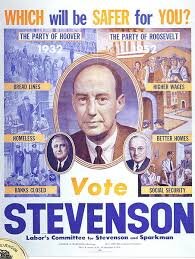
Adlai Stevenson poster.jpg
Source: http://lscook13.blogspot.com/2010/04/adlai...

Enjoyed this speech? Speakola is a labour of love and I’d be very grateful if you would share, tweet or like it. Thank you.

Facebook Twitter Facebook
In 1940-59 B Tags ADLAI STEVENSON, CAMPAIGN SPEECH, PRESIDENTIAL CAMPAIGN, DEMOCRATIC PARTY, TRANSCRIPT, EISENHOWER, AMERICAN DREAM
1 Comment

See my film!

Limited Australian Season

March 2025

Details and ticket bookings at

angeandtheboss.com

Support Speakola

Hi speech lovers,
With costs of hosting website and podcast, this labour of love has become a difficult financial proposition in recent times. If you can afford a donation, it will help Speakola survive and prosper.

Best wishes,
Tony Wilson.

Become a Patron!

Learn more about supporting Speakola.

Featured political

Featured
Jon Stewart: "They responded in five seconds", 9-11 first responders, Address to Congress - 2019
Jacinda Ardern: 'They were New Zealanders. They are us', Address to Parliament following Christchurch massacre - 2019
Dolores Ibárruri: "¡No Pasarán!, They shall not pass!', Defense of 2nd Spanish Republic - 1936
Jimmy Reid: 'A rat race is for rats. We're not rats', Rectorial address, Glasgow University - 1972

Featured eulogies

Featured
For Geoffrey Tozer: 'I have to say we all let him down', by Paul Keating - 2009
for James Baldwin: 'Jimmy. You crowned us', by Toni Morrison - 1988
for Michael Gordon: '13 days ago my Dad’s big, beautiful, generous heart suddenly stopped beating', by Scott and Sarah Gordon - 2018

Featured commencement

Featured
Tara Westover: 'Your avatar isn't real, it isn't terribly far from a lie', The Un-Instagrammable Self, Northeastern University - 2019
Tim Minchin: 'Being an artist requires massive reserves of self-belief', WAAPA - 2019
Atul Gawande: 'Curiosity and What Equality Really Means', UCLA Medical School - 2018
Abby Wambach: 'We are the wolves', Barnard College - 2018
Eric Idle: 'America is 300 million people all walking in the same direction, singing 'I Did It My Way'', Whitman College - 2013
Shirley Chisholm: ;America has gone to sleep', Greenfield High School - 1983

Featured sport

Featured
Joe Marler: 'Get back on the horse', Harlequins v Bath pre game interview - 2019
Ray Lewis : 'The greatest pain of my life is the reason I'm standing here today', 52 Cards -
Mel Jones: 'If she was Bradman on the field, she was definitely Keith Miller off the field', Betty Wilson's induction into Australian Cricket Hall of Fame - 2017
Jeff Thomson: 'It’s all those people that help you as kids', Hall of Fame - 2016

Fresh Tweets


Featured weddings

Featured
Dan Angelucci: 'The Best (Best Man) Speech of all time', for Don and Katherine - 2019
Hallerman Sisters: 'Oh sister now we have to let you gooooo!' for Caitlin & Johnny - 2015
Korey Soderman (via Kyle): 'All our lives I have used my voice to help Korey express his thoughts, so today, like always, I will be my brother’s voice' for Kyle and Jess - 2014

Featured Arts

Featured
Bruce Springsteen: 'They're keepers of some of the most beautiful sonic architecture in rock and roll', Induction U2 into Rock Hall of Fame - 2005
Olivia Colman: 'Done that bit. I think I have done that bit', BAFTA acceptance, Leading Actress - 2019
Axel Scheffler: 'The book wasn't called 'No Room on the Broom!', Illustrator of the Year, British Book Awards - 2018
Tina Fey: 'Only in comedy is an obedient white girl from the suburbs a diversity candidate', Kennedy Center Mark Twain Award -  2010
Tina Fey: 'Only in comedy is an obedient white girl from the suburbs a diversity candidate', Kennedy Center Mark Twain Award - 2010

Featured Debates

Featured
Sacha Baron Cohen: 'Just think what Goebbels might have done with Facebook', Anti Defamation League Leadership Award - 2019
Greta Thunberg: 'How dare you', UN Climate Action Summit - 2019
Charlie Munger: 'The Psychology of Human Misjudgment', Harvard University - 1995
Lawrence O'Donnell: 'The original sin of this country is that we invaders shot and murdered our way across the land killing every Native American that we could', The Last Word, 'Dakota' - 2016