
• Genre
  • About
  • Submissions
  • Donate
  • Search
Menu

Speakola

All Speeches Great and Small
  • Genre
  • About
  • Submissions
  • Donate
  • Search
Share a political speech
frederick douglass.png

Frederick Douglass: 'If there is no struggle, there is no progress', West India Emancipation speech - 1857

March 22, 2021

3 August, 1857, Canandaigua, New York, USA

The general sentiment of mankind is that a man who will not fight for himself, when he has the means of doing so, is not worth being fought for by others, and this sentiment is just. For a man who does not value freedom for himself will never value it for others, or put himself to any inconvenience to gain it for others. Such a man, the world says, may lie down until he has sense enough to stand up. It is useless and cruel to put a man on his legs, if the next moment his head is to be brought against a curbstone.

A man of that type will never lay the world under any obligation to him, but will be a moral pauper, a drag on the wheels of society, and if he too be identified with a peculiar variety of the race he will entail disgrace upon his race as well as upon himself. The world in which we live is very accommodating to all sorts of people. It will cooperate with them in any measure which they propose; it will help those who earnestly help themselves, and will hinder those who hinder themselves. It is very polite, and never offers its services unasked. Its favors to individuals are measured by an unerring principle in this—viz., respect those who respect themselves, and despise those who despise themselves. It is not within the power of unaided human nature to persevere in pitying a people who are insensible to their own wrongs and indifferent to the attainment of their own rights. The poet was as true to common sense as to poetry when he said,

Who would be free, themselves must strike the blow.

When O’Connell, with all Ireland at his back, was supposed to be contending for the just rights and liberties of Ireland, the sympathies of mankind were with him, and even his enemies were compelled to respect his patriotism. Kossuth, fighting for Hungary with his pen long after she had fallen by the sword, commanded the sympathy and support of the liberal world till his own hopes died out. The Turks, while they fought bravely for themselves and scourged and drove back the invading legions of Russia, shared the admiration of mankind. They were standing up for their own rights against an arrogant and powerful enemy; but as soon as they let out their fighting to the Allies, admiration gave way to contempt. These are not the maxims and teachings of a coldhearted world. Christianity itself teaches that man shall provide for his own house. This covers the whole ground of nations as well as individuals. Nations no more than individuals can innocently be improvident. They should provide for all wants—mental, moral and religious—and against all evils to which they are liable as nations. In the great struggle now progressing for the freedom and elevation of our people, we should be found at work with all our might, resolved that no man or set of men shall be more abundant in labors, according to the measure of our ability, than ourselves.

I know, my friends, that in some quarters the efforts of colored people meet with very little encouragement. We may fight, but we must fight like the Sepoys of India, under white officers. This class of Abolitionists don’t like colored celebrations, they don’t like colored conventions, they don’t like colored antislavery fairs for the support of colored newspapers. They don’t like any demonstrations whatever in which colored men take a leading part. They talk of the proud Anglo-Saxon blood as flippantly as those who profess to believe in the natural inferiority of races. Your humble speaker has been branded as an ingrate, because he has ventured to stand up on his own and to plead our common cause as a colored man, rather than as a Garrisonian. I hold it to be no part of gratitude to allow our white friends to do all the work, while we merely hold their coats. Opposition of the sort now referred to is partisan position, and we need not mind it. The white people at large will not largely be influenced by it. They will see and appreciate all honest efforts on our part to improve our condition as a people.

Let me give you a word of the philosophy of reform. The whole history of the progress of human liberty shows that all concessions yet made to her august claims have been born of earnest struggle. The conflict has been exciting, agitating, all-absorbing, and for the time being, putting all other tumults to silence. It must do this or it does nothing. If there is no struggle there is no progress. Those who profess to favor freedom and yet deprecate agitation are men who want crops without plowing up the ground; they want rain without thunder and lightning. They want the ocean without the awful roar of its many waters.

This struggle may be a moral one, or it may be a physical one, and it may be both moral and physical, but it must be a struggle. Power concedes nothing without a demand. It never did and it never will. Find out just what any people will quietly submit to and you have found out the exact measure of injustice and wrong which will be imposed upon them, and these will continue till they are resisted with either words or blows, or with both. The limits of tyrants are prescribed by the endurance of those whom they oppress. In the light of these ideas, Negroes will be hunted at the North and held and flogged at the South so long as they submit to those devilish outrages and make no resistance, either moral or physical. Men may not get all they pay for in this world, but they must certainly pay for all they get. If we ever get free from the oppressions and wrongs heaped upon us, we must pay for their removal. We must do this by labor, by suffering, by sacrifice, and if needs be, by our lives and the lives of others.

Hence, my friends, every mother who, like Margaret Garner, plunges a knife into the bosom of her infant to save it from the hell of our Christian slavery, should be held and honored as a benefactress. Every fugitive from slavery who, like the noble William Thomas at Wilkes Barre, prefers to perish in a river made red by his own blood to submission to the hell hounds who were hunting and shooting him should be esteemed as a glorious martyr, worthy to be held in grateful memory by our people. The fugitive Horace, at Mechanicsburgh, Ohio, the other day, who taught the slave catchers from Kentucky that it was safer to arrest white men than to arrest him, did a most excellent service to our cause. Parker and his noble band of fifteen at Christiana, who defended themselves from the kidnappers with prayers and pistols, are entitled to the honor of making the first successful resistance to the Fugitive Slave Bill. But for that resistance, and the rescue of Jerry and Shadrack, the man hunters would have hunted our hills and valleys here with the same freedom with which they now hunt their own dismal swamps.

There was an important lesson in the conduct of that noble Krooman in New York the other day, who, supposing that the American Christians were about to enslave him, betook himself to the masthead and with knife in hand said he would cut his throat before he would be made a slave. Joseph Cinque, on the deck of the Amistad, did that which should make his name dear to us. He bore nature’s burning protest against slavery. Madison Washington who struck down his oppressor on the deck of the Creole, is more worthy to be remembered than the colored man who shot Pitcairn at Bunker Hill.

My friends, you will observe that I have taken a wide range, and you think it is about time that I should answer the special objection to this celebration. I think so too. This, then, is the truth concerning the inauguration of freedom in the British West Indies. Abolition was the act of the British government. The motive which led the government to act no doubt was mainly a philanthropic one, entitled to our highest admiration and gratitude. The national religion, the justice and humanity cried out in thunderous indignation against the foul abomination, and the government yielded to the storm. Nevertheless a share of the credit of the result falls justly to the slaves themselves. “Though slaves, they were rebellious slaves.” They bore themselves well. They did not hug their chains, but according to their opportunities, swelled the general protest against oppression. What Wilberforce was endeavoring to win from the British senate by his magic eloquence the slaves themselves were endeavoring to gain by outbreaks and violence. The combined action of one and the other wrought out the final result. While one showed that slavery was wrong, the other showed that it was dangerous as well as wrong. Mr. Wilberforce, peace man though he was, and a model of piety, availed himself of this element to strengthen his case before the British Parliament, and warned the British government of the danger of continuing slavery in the West Indies. There is no doubt that the fear of the consequences, acting with a sense of the moral evil of slavery, led to its abolition. The spirit of freedom was abroad in the Islands. Insurrection for freedom kept the planters in a constant state of alarm and trepidation. A standing army was necessary to keep the slaves in their chains. This state of facts could not be without weight in deciding the question of freedom in these countries.

I am aware that the rebellious disposition of the slaves was said to arise out of the discussion which the Abolitionists were carrying on at home, and it is not necessary to refute this alleged explanation. All that I contend for is this: that the slaves of the West Indies did fight for their freedom, and that the fact of their discontent was known in England, and that it assisted in bringing about that state of public opinion which finally resulted in their emancipation. And if this be true, the objection is answered.

Again, I am aware that the insurrectionary movements of the slaves were held by many to be prejudicial to their cause. This is said now of such movements at the South. The answer is that abolition followed close on the heels of insurrection in the West Indies, and Virginia was never nearer emancipation than when General Turner kindled the fires of insurrection at Southampton.

Sir, I have now more than filled up the measure of my time. I thank you for the patient attention given to what I have had to say. I have aimed, as I said at the beginning, to express a few thoughts having some relation to the great interest of freedom both in this country and in the British West Indies, and I have said all that I mean to say, and the time will not permit me to say more.
Source: https://face2faceafrica.com/article/if-the...

Enjoyed this speech? Speakola is a labour of love and I’d be very grateful if you would share, tweet or like it. Thank you.

Facebook Twitter Facebook
In Pre 1900 Tags FREDERICK DOUGLASS, WEST INDIA EMANCIPATION SPEECH, SLAVERY, ABOLITIONIST, BLACK FREEDOM, GREAT SPEECES OF THE 19TH CENUTRY, 1857, ACTIVIST, AFRICAN AMERICAN, USA, TRANSCRIPT
Comment

Harvey Milk: 'Without hope the us's give up', Hope Speech - 1977

August 6, 2015

1977, various locations, California, USA

The 'Hope Speech' was the stump speech Milk gave during his campaign in 1977 and 1978. The most famous excerpt is:

'Somewhere in Des Moines or San Antonio there is a young gay person who all of a sudden realizes that he or she is gay; knows that if their parents find out they will be tossed out of the house, their classmates will taunt the child, and the Anita Bryant's and John Briggs' are doing their part on TV.

And that child has several options: staying in the closet, and suicide. And then one day that child might open the paper that says "Homosexual elected in San Francisco" and there are two new options: the option is to go to California, or stay in San Antonio and fight. Two days after I was elected I got a phone call and the voice was quite young. It was from Altoona, Pennsylvania. And the person said "Thanks".

And you've got to elect gay people; so that thousands upon thousands like that child know that there is hope for a better world; there is hope for a better tomorrow. Without hope, not only gays, but those who are blacks, the Asians, the disabled, the seniors, the us's; without hope the us's give up.

I know that you can't live on hope alone, but without it, life is not worth living. And you, and you, and you, and you have got to give them hope.'

Thank you very much


Here is another longer version:

My name is Harvey Milk and I'm here to recruit you.

I've been saying this one for years. It's a political joke. I can't help it--I've got to tell it. I've never been able to talk to this many political people before, so if I tell you nothing else you may be able to go home laughing a bit.

This ocean liner was going across the ocean and it sank. And there was one little piece of wood floating and three people swam to it and they realized only one person could hold on to it. So they had a little debate about which was the person. It so happened that the three people were the Pope, the President, and Mayor Daley. The Pope said he was titular head of one of the greatest religions of the world and he was spiritual adviser to many, many millions and he went on and pontificated and they thought it was a good argument. Then the President said he was leader of the largest and most powerful nation of the world. What takes place in this country affects the whole world and they thought that was a good argument. And Mayor Daley said he was mayor of the backbone of the Untied States and what took place in Chicago affected the world, and what took place in the archdiocese of Chicago affected Catholicism. And they thought that was a good argument. So they did it the democratic way and voted. And Daley won, seven to two.

About six months ago, Anita Bryant in her speaking to God said that the drought in California was because of the gay people. On November 9, the day after I got elected, it started to rain. On the day I got sworn in, we walked to City Hall and it was kinda nice, and as soon as I said the word "I do," it started to rain again. It's been raining since then and the people of San Francisco figure the only way to stop it is to do a recall petition. That's the local joke.

So much for that. Why are we here? Why are gay people here? And what's happening? What's happening to me is the antithesis of what you read about in the papers and what you hear about on the radio. You hear about and read about this movement to the right. That we must band together and fight back this movement to the right. And I'm here to go ahead and say that what you hear and read is what they want you to think because it's not happening. The major media in this country has talked about the movement to the right so the legislators think that there is indeed a movement to the right and that the Congress and the legislators and the city councils will start to move to the right the way the major media want them. So they keep on talking about this move to the right.

So let's look at 1977 and see if there was indeed a move to the right. In 1977, gay people had their rights taken away from them in Miami. But you must remember that in the week before Miami and the week after that, the word homosexual or gay appeared in every single newspaper in this nation in articles both pro and con. In every radio station, in every TV station and every household. For the first time in the history of the world, everybody was talking about it, good or bad. Unless you have dialogue, unless you open the walls of dialogue, you can never reach to change people's opinion. In those two weeks, more good and bad, but more about the word homosexual and gay was written than probably in the history of mankind. Once you have dialogue starting, you know you can break down prejudice. In 1977 we saw a dialogue start. In 1977, we saw a gay person elected in San Francisco. In 1977 we saw the state of Mississippi decriminalize marijuana. In 1977, we saw the convention of conventions in Houston. And I want to know where the movement to the right is happening.

What that is is a record of what happened last year. What we must do is make sure that 1978 continues the movement that is really happening that the media don't want you to know about. That is the movement to the left. It's up to CDC to put the pressures on Sacramento--but to break down the walls and the barriers so the movement to the left continues and progress continues in the nation. We have before us coming up several issues we must speak out on. Probably the most important issue outside the Briggs--which we will come to--but we do know what will take place this June. We know there's an issue on the ballot called Jarvis-Gann. We hear the taxpayers talk about it on both sides. But what you don't hear is that it's probably the most racist issue on the ballot in a long time. In the city and county of San Francisco, if it passes and we indeed have to lay off people, who will they be? The last in, and the first in, and who are the last in but the minorities? Jarvis-Gann is a racist issue. We must address that issue. We must not talk away from it. We must not allow them to talk about the money it's going to save, because look at who's going to save the money and who's going to get hurt.

We also have another issue that we've started in some of the north counties and I hope in some of the south counties it continues. In San Francisco elections we're asking--at least we hope to ask-- that the U.S. government put pressure on the closing of the South African consulate. That must happen. There is a major difference between an embassy in Washington which is a diplomatic bureau. and a consulate in major cities. A consulate is there for one reason only -- to promote business, economic gains, tourism, investment. And every time you have business going to South Africa, you're promoting a regime that's offensive.

In the city of San Francisco, if everyone of 51 percent of that city were to go to South Africa, they would be treated as second-class citizens. That is an offense to the people of San Francisco and I hope all my colleagues up there will take every step we can to close down that consulate and hope that people in other parts of the state follow us in that lead. The battles must be started some place and CDC is the greatest place to start the battles. I know we are pressed for time so I'm going to cover just one more little point. That is to understand why it is important that gay people run for office and that gay people get elected. I know there are many people in this room who are running for central committee who are gay. I encourage you. There's a major reason why. If my non-gay friends and supporters in this room understand it, they'll probably understand why I've run so often before I finally made it. Y'see right now, there's a controversy going on in this convention about the gay governor. Is he speaking out enough? Is he strong enough for gay rights? And there is controversy and for us to say it is not would be foolish. Some people are satisfied and some people are not.

You see there is am major difference--and it remains a vital difference--between a friend and a gay person, a friend in office and a gay person in office. Gay people have been slandered nationwide. We've been tarred and we've been brushed with the picture of pornography. In Dade County, we were accused of child molestation. It's not enough anymore just to have friends represent us. No matter how good that friend may be.

The black community made up its mind to that a long time ago. That the myths against blacks can only be dispelled by electing black leaders, so the black community could be judged by the leaders and not by the myths or black criminals. The Spanish community must not be judged by Latin criminals or myths. The Asian community must not be judged by Asian criminals or myths. The Italian community must not be judged by the mafia, myths. And the time has come when the gay community must not be judged by our criminals and myths.

Like every other group, we must be judged by our leaders and by those who are themselves gay, those who are visible. For invisible, we remain in limbo--a myth, a person with no parents, no brothers, no sisters, no friends who are straight, no important positions in employment. A tenth of the nation supposedly composed of stereotypes and would-be seducers of children--and no offense meant to the stereotypes. But today, the black community is not judged by its friends, but by its black legislators and leaders. And we must give people the chance to judge us by our leaders and legislators. A gay person in office can set a tone, con command respect not only from the larger community, but from the young people in our own community who need both examples and hope.

The first gay people we elect must be strong. They must not be content to sit in the back of the bus. They must not be content to accept pablum. They must be above wheeling and dealing. They must be--for the good of all of us--independent, unbought. The anger and the frustrations that some of us feel is because we are misunderstood, and friends can't feel the anger and frustration. They can sense it in us, but they can't feel it. Because a friend has never gone through what is known as coming out. I will never forget what it was like coming out and having nobody to look up toward. I remember the lack of hope--and our friends can't fulfill it.

I can't forget the looks on faces of people who've lost hope. Be they gay, be they seniors, be they blacks looking for an almost-impossible job, be they Latins trying to explain their problems and aspirations in a tongue that's foreign to them. I personally will never forget that people are more important than buildings. I use the word "I" because I'm proud. I stand here tonight in front of my gay sisters, brothers and friends because I'm proud of you. I think it's time that we have many legislators who are gay and proud of that fact and do not have to remain in the closet. I think that a gay person, up-front, will not walk away from a responsibility and be afraid of being tossed out of office. After Dade County, I walked among the angry and the frustrated night after night and I looked at their faces. And in San Francisco, three days before Gay Pride Day, a person was killed just because he was gay. And that night, I walked among the sad and the frustrated at City Hall in San Francisco and later that night as they lit candles on Castro Street and stood in silence, reaching out for some symbolic thing that would give them hope. These were strong people, whose faces I knew from the shop, the streets, meetings and people who I never saw before but I knew. They were strong, but even they needed hope.

And the young gay people in the Altoona, Pennsylvanias and the Richmond, Minnesotas who are coming out and hear Anita Bryant on television and her story. The only thing they have to look forward to is hope. And you have to give them hope. Hope for a better world, hope for a better tomorrow, hope for a better place to come to if the pressures at home are too great. Hope that all will be all right. Without hope, not only gays, but the blacks, the seniors, the handicapped, the us'es, the us'es will give up. And if you help elect to the central committee and other offices, more gay people, that gives a green light to all who feel disenfranchised, a green light to move forward. It means hope to a nation that has given up, because if a gay person makes it, the doors are open to everyone.

So if there is a message I have to give, it is that I've found one overriding thing about my personal election, it's the fact that if a gay person can be elected, it's a green light. And you and you and you, you have to give people hope. Thank you very much.

Source: http://www.sweetspeeches.com/s/568-harvey-...

Enjoyed this speech? Speakola is a labour of love and I’d be very grateful if you would share, tweet or like it. Thank you.

Facebook Twitter Facebook
In 1960-79 Tags ACTIVIST, LGBT, GAY AND LESBIAN RIGHTS, HARVEY MILK, ASSASSINATION, TRANSCRIPT
Comment

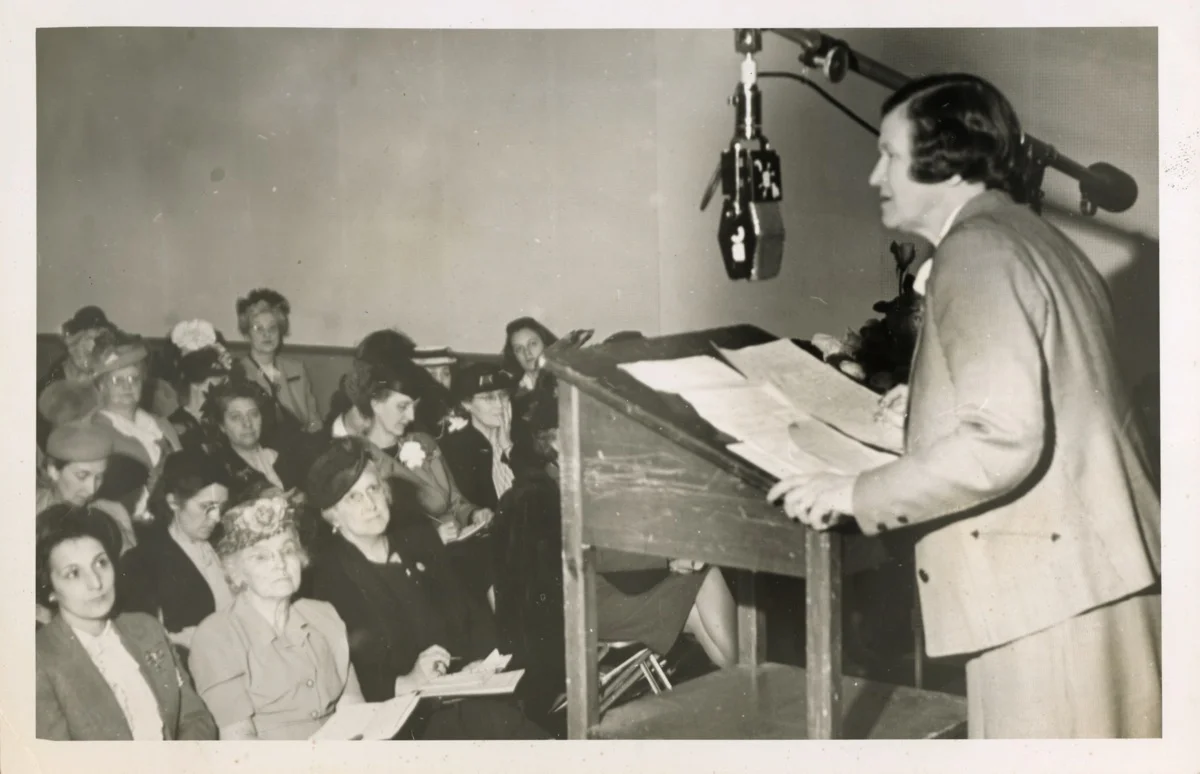
Jessie Street: 'Is it to be back to the kitchen?', ABC Broadcast - 1944

August 6, 2015

17 April 1944, ABC Radio National, Australia

Episode 21 of the podcast featured Lenore Coltheart talking about this famous speech, and actor Blazey Best recreating it.

There is a good deal of talk just now about what they are going to do after the war with
the women: Must they be made to return to the home? Are they going to take them out
of the factory, the office, off the land?

To me, this sort of discussion is very disquieting. It makes me think we’ve already
forgotten the reasons why we’re fighting this war. Aren’t we fighting for liberty, for
democracy and to eradicate fascism and Nazism in every form?

Surely we don’t mean liberty and democracy for men only? Indeed, I hope women will enjoy the liberty which they have helped to win and be permitted to choose what they want to do.

Do you remember that one of the first things the Nazis did when they came to power was to put women out of the professions, out of the factories? They barred the doors of the
universities to all but a few women and they severely limited women’s opportunities for
any kind of higher education; by these methods the Nazis forced women back to the
home – back to the kitchen.

I can’t help thinking that if any attempt is made here after the war to force women back to the home, it will be proof that facism still has strong roots in Australia.

Women should not be forced to return to the home, but they should be free to return there if they wish to. I don’t like what’s implied in the suggestion that women will have
to he forced back into the home – that’s a slight not only on home life, but also on the
work of bearing and rearing children, don’t you agree?

The greatest happiness for many women is to care for a home and to raise a family. The trouble in the past has been that society has failed to make it possible for all the women who wanted to have homes and raise families to do so.

And while we’re on the subject of women in the home, I think that this life could be
made attractive to many more women by developing amenities and customs that render
home less of a prison than it is to many women with young families.

Just think of the prospects of family life, as lived under present conditions, to a clever, energetic, bright young girl. Soon after marriage there will be a baby, and from then on she cannot move unencumbered. The more babies, the harder she has to work and the greater her
restrictions.

If we want more women to choose home life, we must make home life less hard. But how can we do this? Well, we can have crèches and kindergartens and supervised playgrounds where children can be left in safe surroundings. Then we must change many of our conventions. Why should a woman do all the work in the home?

Why can’t we, for example, have community kitchens and laundries? If a woman wants
to work outside the home, why shouldn’t she? Let her be free to choose. There’s just as
much and more reason to believe that the best interests of her family and of society will
be served by giving a woman a free choice than by expecting her to adhere to a lot of
worn-out conventions.

Anyway, the contribution that women can make to public life through the professions or
in industry is important. Women in the past have been very much hampered by their
inexperience in these spheres. They haven’t had the opportunity to qualify for representative positions or positions of control and direction. In other words, because of the lack of opportunity to gain experience they’re denied the opportunity of exerting any
influence in framing policies or directing public affairs.

I am pretty sure that many women will remain in industry after the war, for we shall be
in need of more skilled hands rather than less. Remember, we couldn’t exert a full war
effort until women were absorbed into industry; therefore, how can we exert a full peace
program without making use of their services?

Everyone knows how short we are of houses and hospitals and offices, of furniture, of bathroom and kitchen fittings, of curtains, wallpaper, clothing, foodstuffs, in fact, hundreds of commodities. Can you imagine the tremendous amount of work that will be required? Not only have we to make up the deficiency of the war years, but we must provide all these amenities on a much larger scale after the war.

There were large numbers of people before the war who had no homes, not even enough to eat; hospital accommodation was inadequate, and so on. Although all these could have been provided for a few million pounds, we believed we could not afford to better these conditions.

It took a total war to show us what we could do with our own resources. If we can raise money for war we can raise it for peace, surely. It would be inexcusable in the future to condemn people to live under the conditions so many endured before the war.

Why is there so much opposition to women remaining in industry?

The secret isn’t far to seek. It’s simply that they got paid less – they are cheap labour, certainly not, as so many have alleged, because they’re weaker or less efficient. Unfortunately, because
their labour is cheaper, women not only threaten the wage standards of men workers, but they also threaten the standard of living of all workers. The obvious and just way to avoid this is to give equal pay to men and women.

To put this in a nutshell, I believe that in a democratic, free society women should be at
liberty to choose whether they will take up home life or work outside the home; that
men and women should receive equal pay and equal opportunity; that home life should
be made less of a tie and the burden of raising a family be lightened. If we can face
these peacetime problems with the spirit of determination and conciliation with which
we’re facing our war problems, we may hope to solve them.

Source: http://famousspeeches.wikifoundry.com/page...

Enjoyed this speech? Speakola is a labour of love and I’d be very grateful if you would share, tweet or like it. Thank you.

Facebook Twitter Facebook
In 1940-59 Tags WOMEN'S RIGHTS, FEMINISM, ACTIVIST, TRANSCRIPT
Comment

Emmeline Pankhurst: 'I am here as a soldier who has temporarily left the field of battle', Freedom or Death - 1913

August 6, 2015

13 November 1913, Hartford, Connecticut, USA

I do not come here as an advocate, because whatever position the suffrage movement may occupy in the United States of America, in England it has passed beyond the realm of advocacy and it has entered into the sphere of practical politics. It has become the subject of revolution and civil war, and so tonight I am not here to advocate woman suffrage. American suffragists can do that very well for themselves.

I am here as a soldier who has temporarily left the field of battle in order to explain - it seems strange it should have to be explained - what civil war is like when civil war is waged by women. I am not only here as a soldier temporarily absent from the field at battle; I am here - and that, I think, is the strangest part of my coming - I am here as a person who, according to the law courts of my country, it has been decided, is of no value to the community at all; and I am adjudged because of my life to be a dangerous person, under sentence of penal servitude in a convict prison.

It is not at all difficult if revolutionaries come to you from Russia, if they come to you from China, or from any other part of the world, if they are men. But since I am a woman it is necessary to explain why women have adopted revolutionary methods in order to win the rights of citizenship. We women, in trying to make our case clear, always have to make as part of our argument, and urge upon men in our audience the fact - a very simple fact - that women are human beings.

Suppose the men of Hartford had a grievance, and they laid that grievance before their legislature, and the legislature obstinately refused to listen to them, or to remove their grievance, what would be the proper and the constitutional and the practical way of getting their grievance removed? Well, it is perfectly obvious at the next general election the men of Hartford would turn out that legislature and elect a new one.

But let the men of Hartford imagine that they were not in the position of being voters at all, that they were governed without their consent being obtained, that the legislature turned an absolutely deaf ear to their demands, what would the men of Hartford do then? They couldn't vote the legislature out. They would have to choose; they would have to make a choice of two evils: they would either have to submit indefinitely to an unjust state of affairs, or they would have to rise up and adopt some of the antiquated means by which men in the past got their grievances remedied.

Your forefathers decided that they must have representation for taxation, many, many years ago. When they felt they couldn't wait any longer, when they laid all the arguments before an obstinate British government that they could think of, and when their arguments were absolutely disregarded, when every other means had failed, they began by the tea party at Boston, and they went on until they had won the independence of the United States of America.

It is about eight years since the word militant was first used to describe what we were doing. It was not militant at all, except that it provoked militancy on the part of those who were opposed to it. When women asked questions in political meetings and failed to get answers, they were not doing anything militant. In Great Britain it is a custom, a time-honoured one, to ask questions of candidates for parliament and ask questions of members of the government. No man was ever put out of a public meeting for asking a question. The first people who were put out of a political meeting for asking questions, were women; they were brutally ill-used; they found themselves in jail before 24 hours had expired.

We were called militant, and we were quite willing to accept the name. We were determined to press this question of the enfranchisement of women to the point where we were no longer to be ignored by the politicians.

You have two babies very hungry and wanting to be fed. One baby is a patient baby, and waits indefinitely until its mother is ready to feed it. The other baby is an impatient baby and cries lustily, screams and kicks and makes everybody unpleasant until it is fed. Well, we know perfectly well which baby is attended to first. That is the whole history of politics. You have to make more noise than anybody else, you have to make yourself more obtrusive than anybody else, you have to fill all the papers more than anybody else, in fact you have to be there all the time and see that they do not snow you under.

When you have warfare things happen; people suffer; the noncombatants suffer as well as the combatants. And so it happens in civil war. When your forefathers threw the tea into Boston Harbour, a good many women had to go without their tea. It has always seemed to me an extraordinary thing that you did not follow it up by throwing the whiskey overboard; you sacrificed the women; and there is a good deal of warfare for which men take a great deal of glorification which has involved more practical sacrifice on women than it has on any man. It always has been so. The grievances of those who have got power, the influence of those who have got power commands a great deal of attention; but the wrongs and the grievances of those people who have no power at all are apt to be absolutely ignored. That is the history of humanity right from the beginning.

Well, in our civil war people have suffered, but you cannot make omelettes without breaking eggs; you cannot have civil war without damage to something. The great thing is to see that no more damage is done than is absolutely necessary, that you do just as much as will arouse enough feeling to bring about peace, to bring about an honourable peace for the combatants; and that is what we have been doing.

We entirely prevented stockbrokers in London from telegraphing to stockbrokers in Glasgow and vice versa: for one whole day telegraphic communication was entirely stopped. I am not going to tell you how it was done. I am not going to tell you how the women got to the mains and cut the wires; but it was done. It was done, and it was proved to the authorities that weak women, suffrage women, as we are supposed to be, had enough ingenuity to create a situation of that kind. Now, I ask you, if women can do that, is there any limit to what we can do except the limit we put upon ourselves?

If you are dealing with an industrial revolution, if you get the men and women of one class rising up against the men and women of another class, you can locate the difficulty; if there is a great industrial strike, you know exactly where the violence is and how the warfare is going to be waged; but in our war against the government you can't locate it. We wear no mark; we belong to every class; we permeate every class of the community from the highest to the lowest; and so you see in the woman's civil war the dear men of my country are discovering it is absolutely impossible to deal with it: you cannot locate it, and you cannot stop it.

"Put them in prison," they said, "that will stop it." But it didn't stop it at all: instead of the women giving it up, more women did it, and more and more and more women did it until there were 300 women at a time, who had not broken a single law, only "made a nuisance of themselves" as the politicians say.

Then they began to legislate. The British government has passed more stringent laws to deal with this agitation than it ever found necessary during all the history of political agitation in my country. They were able to deal with the revolutionaries of the Chartists' time; they were able to deal with the trades union agitation; they were able to deal with the revolutionaries later on when the Reform Acts were passed: but the ordinary law has not sufficed to curb insurgent women. They had to dip back into the middle ages to find a means of repressing the women in revolt.

They have said to us, government rests upon force, the women haven't force, so they must submit. Well, we are showing them that government does not rest upon force at all: it rests upon consent. As long as women consent to be unjustly governed, they can be, but directly women say: "We withhold our consent, we will not be governed any longer so long as that government is unjust." Not by the forces of civil war can you govern the very weakest woman. You can kill that woman, but she escapes you then; you cannot govern her. No power on earth can govern a human being, however feeble, who withholds his or her consent.

When they put us in prison at first, simply for taking petitions, we submitted; we allowed them to dress us in prison clothes; we allowed them to put us in solitary confinement; we allowed them to put us amongst the most degraded of criminals; we learned of some of the appalling evils of our so-called civilisation that we could not have learned in any other way. It was valuable experience, and we were glad to get it.

I have seen men smile when they heard the words "hunger strike", and yet I think there are very few men today who would be prepared to adopt a "hunger strike" for any cause. It is only people who feel an intolerable sense of oppression who would adopt a means of that kind. It means you refuse food until you are at death's door, and then the authorities have to choose between letting you die, and letting you go; and then they let the women go.

Now, that went on so long that the government felt that they were unable to cope. It was [then] that, to the shame of the British government, they set the example to authorities all over the world of feeding sane, resisting human beings by force. There may be doctors in this meeting: if so, they know it is one thing to feed by force an insane person; but it is quite another thing to feed a sane, resisting human being who resists with every nerve and with every fibre of her body the indignity and the outrage of forcible feeding. Now, that was done in England, and the government thought they had crushed us. But they found that it did not quell the agitation, that more and more women came in and even passed that terrible ordeal, and they were obliged to let them go.

Then came the legislation - the "Cat and Mouse Act". The home secretary said: "Give me the power to let these women go when they are at death's door, and leave them at liberty under license until they have recovered their health again and then bring them back." It was passed to repress the agitation, to make the women yield - because that is what it has really come to, ladies and gentlemen. It has come to a battle between the women and the government as to who shall yield first, whether they will yield and give us the vote, or whether we will give up our agitation.

Well, they little know what women are. Women are very slow to rouse, but once they are aroused, once they are determined, nothing on earth and nothing in heaven will make women give way; it is impossible. And so this "Cat and Mouse Act" which is being used against women today has failed. There are women lying at death's door, recovering enough strength to undergo operations who have not given in and won't give in, and who will be prepared, as soon as they get up from their sick beds, to go on as before. There are women who are being carried from their sick beds on stretchers into meetings. They are too weak to speak, but they go amongst their fellow workers just to show that their spirits are unquenched, and that their spirit is alive, and they mean to go on as long as life lasts.

Now, I want to say to you who think women cannot succeed, we have brought the government of England to this position, that it has to face this alternative: either women are to be killed or women are to have the vote. I ask American men in this meeting, what would you say if in your state you were faced with that alternative, that you must either kill them or give them their citizenship? Well, there is only one answer to that alternative, there is only one way out - you must give those women the vote.

You won your freedom in America when you had the revolution, by bloodshed, by sacrificing human life. You won the civil war by the sacrifice of human life when you decided to emancipate the negro. You have left it to women in your land, the men of all civilised countries have left it to women, to work out their own salvation. That is the way in which we women of England are doing. Human life for us is sacred, but we say if any life is to be sacrificed it shall be ours; we won't do it ourselves, but we will put the enemy in the position where they will have to choose between giving us freedom or giving us death.

So here am I. I come in the intervals of prison appearance. I come after having been four times imprisoned under the "Cat and Mouse Act", probably going back to be rearrested as soon as I set my foot on British soil. I come to ask you to help to win this fight. If we win it, this hardest of all fights, then, to be sure, in the future it is going to be made easier for women all over the world to win their fight when their time comes.

Source: http://www.theguardian.com/theguardian/200...

Enjoyed this speech? Speakola is a labour of love and I’d be very grateful if you would share, tweet or like it. Thank you.

Facebook Twitter Facebook
In 1900-19 Tags SUFFRAGETTE, WOMEN'S RIGHTS, PANKHURST, UNITED KINGDOM, USA, ACTIVIST, TRANSCRIPT
Comment

See my film!

Limited Australian Season

March 2025

Details and ticket bookings at

angeandtheboss.com

Support Speakola

Hi speech lovers,
With costs of hosting website and podcast, this labour of love has become a difficult financial proposition in recent times. If you can afford a donation, it will help Speakola survive and prosper.

Best wishes,
Tony Wilson.

Become a Patron!

Learn more about supporting Speakola.

Featured political

Featured
Jon Stewart: "They responded in five seconds", 9-11 first responders, Address to Congress - 2019
Jacinda Ardern: 'They were New Zealanders. They are us', Address to Parliament following Christchurch massacre - 2019
Dolores Ibárruri: "¡No Pasarán!, They shall not pass!', Defense of 2nd Spanish Republic - 1936
Jimmy Reid: 'A rat race is for rats. We're not rats', Rectorial address, Glasgow University - 1972

Featured eulogies

Featured
For Geoffrey Tozer: 'I have to say we all let him down', by Paul Keating - 2009
for James Baldwin: 'Jimmy. You crowned us', by Toni Morrison - 1988
for Michael Gordon: '13 days ago my Dad’s big, beautiful, generous heart suddenly stopped beating', by Scott and Sarah Gordon - 2018

Featured commencement

Featured
Tara Westover: 'Your avatar isn't real, it isn't terribly far from a lie', The Un-Instagrammable Self, Northeastern University - 2019
Tim Minchin: 'Being an artist requires massive reserves of self-belief', WAAPA - 2019
Atul Gawande: 'Curiosity and What Equality Really Means', UCLA Medical School - 2018
Abby Wambach: 'We are the wolves', Barnard College - 2018
Eric Idle: 'America is 300 million people all walking in the same direction, singing 'I Did It My Way'', Whitman College - 2013
Shirley Chisholm: ;America has gone to sleep', Greenfield High School - 1983

Featured sport

Featured
Joe Marler: 'Get back on the horse', Harlequins v Bath pre game interview - 2019
Ray Lewis : 'The greatest pain of my life is the reason I'm standing here today', 52 Cards -
Mel Jones: 'If she was Bradman on the field, she was definitely Keith Miller off the field', Betty Wilson's induction into Australian Cricket Hall of Fame - 2017
Jeff Thomson: 'It’s all those people that help you as kids', Hall of Fame - 2016

Fresh Tweets


Featured weddings

Featured
Dan Angelucci: 'The Best (Best Man) Speech of all time', for Don and Katherine - 2019
Hallerman Sisters: 'Oh sister now we have to let you gooooo!' for Caitlin & Johnny - 2015
Korey Soderman (via Kyle): 'All our lives I have used my voice to help Korey express his thoughts, so today, like always, I will be my brother’s voice' for Kyle and Jess - 2014

Featured Arts

Featured
Bruce Springsteen: 'They're keepers of some of the most beautiful sonic architecture in rock and roll', Induction U2 into Rock Hall of Fame - 2005
Olivia Colman: 'Done that bit. I think I have done that bit', BAFTA acceptance, Leading Actress - 2019
Axel Scheffler: 'The book wasn't called 'No Room on the Broom!', Illustrator of the Year, British Book Awards - 2018
Tina Fey: 'Only in comedy is an obedient white girl from the suburbs a diversity candidate', Kennedy Center Mark Twain Award -  2010
Tina Fey: 'Only in comedy is an obedient white girl from the suburbs a diversity candidate', Kennedy Center Mark Twain Award - 2010

Featured Debates

Featured
Sacha Baron Cohen: 'Just think what Goebbels might have done with Facebook', Anti Defamation League Leadership Award - 2019
Greta Thunberg: 'How dare you', UN Climate Action Summit - 2019
Charlie Munger: 'The Psychology of Human Misjudgment', Harvard University - 1995
Lawrence O'Donnell: 'The original sin of this country is that we invaders shot and murdered our way across the land killing every Native American that we could', The Last Word, 'Dakota' - 2016