• Genre
  • About
  • Submissions
  • Donate
  • Search
Menu

Speakola

All Speeches Great and Small
  • Genre
  • About
  • Submissions
  • Donate
  • Search
Share a political speech

Sardar Vallabhbhai Patel: 'You have called a simple farmer to the highest office' Presidential Address to Indian National Congress - 1931

October 16, 2019

Indian National Congress, Karachi, India

You have called a simple farmer to the highest office, to which any Indian can aspire. I am conscious that your choice of me as first servant is not so much for what little I might have done, but it is the recognition of the amazing sacrifice made by Gujarat for the honour. But in truth every Province did its utmost during the year of the greatest national awakening that we have known in modern times.

NON-VIOLENCE- NO IDLE DREAM

world that mass non-violence is no longer the idle dream of a visionary or a mere human longing, It is a solid fact capable of infinite possibilities for humanity, which is groaning for want of faith, beneath the weight of violence of which it has almost made a fetish. The greatest proof that our movement was 7 non-violent lies in the fact that the peasants falsified the fears of our worst skeptics. They were described as very difficult to organise' for non-violent action and it is they who stood the test with a bravery and an endurance that was beyond all expectation. Women and children too contributed their great share in the fight. They responded to the call by instinct and played a part which we are too near the even adequately to measure. Looked at in the light of non-violence our struggle is a world struggle and it is a matter of great satisfaction that the nations of the earth, especially the United States of America, have heartened us by their sympathy.

The recent settlement however renders it unnecessary to dwell at greater length upon this heroic period in the national life. Your Working Committee has entered into the Settlement in anticipation of your approval. You are now invited formally to endorse it. The Committee having accepted it as your accredited representatives, it is not, I take it, open to you to repudiate it; but it is open to you to pass a vote of no-confidence in the present executive and appoint better agents. But whilst it is but meet that I should draw your attention to the constitutional position, I have no doubt what so ever that you will endorse the settlement which I hold to be perfectly honourable for both the parties. Had we not accepted the settlement we should have put ourselves in the wrong and thereby undone the effect of the sufferings of the past year. Indeed we had always claimed, as Satyagrahis must claim, to be ready and eager for peace. When therefore, the way seemed to be open for peace, we took it. In view of the clear demand on the part of the British Indian Delegation at the Round Table Conference for full responsibility, and in view of the British parties having accepted the position and in view of the appeal made to the Congress by the Premier, the Viceroy and many of our distinguished countrymen, the Working Committee thought that if an honourable truce could be arranged and if it was open to the Congress to press without any reservation for what is considered to be the best for the country, the Congress should, if invited, take part in the Conference and attempt to reach an agreed solution of the constitutional issue. If we failed in the attempt and there was no way open but that of suffering, then it was a privilege of which no power on earth could deprive us.

Under the constitution clause of the settlement it is open to us to press for Purna Swaraj, to ask for complete control over our defence forces, foreign affairs, finance, fiscal policy and the like. There would be safe-guards or reservations, or as the late Pandit Motilalji called them, adjustments, conceived in our own interest. When power passes from one to the other by agreement there are always safeguards in the interest of the party in need of reparation or help: The continued exploitation of India for close on two centuries renders it necessary for us to seek assistance in several respects from external sources. Thus we would need military skill and there is no reason why we may not receive English assistance in this direction. I have taken only one telling illustration out of others that may be suggested.

The defence safeguard may therefore be the retention of British Officers, or, as some would say, even privates, but we could never let our defence be controlled by the British. We must have full power to make mistakes. We may gratefully receive British advice, never dictation.

BRITISH ARMY OF OCCUPATION

The fact is that the British army in India is an army of occupation. Defence is a misnomer. Frankly, the army is for defending British interests and British men and women against any internal uprising. I cannot recall a single instance in which the Indian army was required for the protection of India to fight a foreign power. True, there have been expeditions on the Frontier, wars with Afghanistan; British historians have taught us that they were wars more of agression rather than of defence. We must not. Therefore be frightened by the bogey of foreign designs upon India. In my opinion if we need an army, we certainly do not need the octopus we are daily bleeding to support. If the Congress has its way, the army will suffer immediate reduction to its reasonable proportion.

PURNA SWARAJ-OUR GOAL

Again we have been taught to think that our civil administration will be inefficient and corrupt if we give up the able assistance of highly paid British civilians. The administrative powers that the Congress has exhibited during recent years and the fact of its having on an ever- increasing scale drawn to its assistance some of the best young men and women either without pay or on a mere pittance should sufficiently dispose of the fear of corruption or inefficiency. It would be too great a strain upon our poor purse to have to pay, by way of insurance against corruption, a premium out of all proportion to the. highest possible estimate of corruption that may ever take place. It will therefore be necessary if India is to come to her own, to demand a heavy reduction in the Civil Service expenditure and thus a consequent reduction in the emoluments of the Civil Service.

We have claimed that many of the charges laid upon India are wholly unjust. We have never suggested repudiation of a single obligation, but we have asked and must continue to ask for an impartial investigation into the debits against us wherever we cannot agree.

There is no receding from the Lahore resolution of complete Independence. This independence does not mean, was not intended to mean, a churlish refusal to associate with British or any other power. Independence therefore does not exclude the possibility of equal partnership for mutual benefit and dissolvable at the will of either party. If India is to reach her independence through consultation and agreement, it is reasonable to suppose that there is a strong body of opinion in the country to the effect that before partnership could possibly be conceived there must be a period of complete dissociation. I do not belong to that school. It is, as I think, a sign of weakness and of disbelief in human nature.

FEDRATION OF INDIA

Federation is a fascinating idea. But it introduces new- embarrassments. Princes will not listen to severence? Is it severence of British connection. But if they will come in the true spirit it will be a great gain. Their association must not be to impede the progress of democracy. I hope therefore that they will not take up an
uncompromising attitude that may be wholly inconsistent with the spirit of freedom. I wish they would, without any pressure, give us an earnest of their desire to march abreast of the time-spirit. Surely the fundamental rights of their subjects should be guaranteed as of the rest of the inhabitants of India. All the inhabitants of Federated India should enjoy some common elementary rights. And if there are rights, there must be a common court to give relief from any encroachment upon them. Nor can it be too much to expect that the subjects of the states should be to an extent directly represented on the federal legislature.

COMMUNAL UNITY ESSENTIAL

But before all else comes the question of Hindu Muslim or rather communal unity. The position of the Congress was defined at Lahore. Let me recite the resolution here:

In view of the lapse of the Nehru Report it. is unnecessary to declare the policy of the Congress regarding communal questions, the Congress believing that in an independent India, communal questions can only be solved on strictly national lines. But as the Sikhs, in particular and Muslims and other minorities in general had expressed dissatisfaction over the solution of the communal question proposed in the Nehru Report, the Congress assures the Sikhs, Muslims and other minorities that no solution thereof in any future constitution, can be acceptable to the Congress that does not give full satisfaction to the parties concerned.

Therefore, the Congress can be no party to any constitution which does not contain a solution of the Communal question that is not designed to satisfy the respective parties. As a Hindu, I adopt my predecessor’s formula and present the minorities, with a Swadeshi fountain-pen and paper and let them write out their demands. And, I should endorse them. I know, that it is the quickest method. But it requires courage on the part of the Hindus. What we want is a heart unity not parched-up paper-unity that will break under the slightest strain. That unity can only come when the majority takes courage in both the hands and is prepared to change places with the minority. This would be the highest wisdom. Whether the unity is reached that or any other, it is becoming plainer day after day that it is useless to attend any conference, unless that unity is achieved. The Conference, ran give us an agreement between the British and us, it. can perhaps help us to come nearer to the Princes; but it ran never enable, us to achieve unity. That must be hammered into shape by ourselves. The Congress must leave no stone unturned to realise this much-desired end.

CALL TO PEOPLE

It must be clear to all of us that the Congress can be useful for attaining Pura Swaraj only to the extent that it has gained power. The past twelve months have undoubtedly given it a power which he who runs may see. But it is not enough and can be easily frittered away by hasty action, or by pride. He is a spendthrift who lives on his capital. We must therefore add to our power. One way to do so is on our part to fulfill to the letter the conditions of the settlement. The other is to consolidate our gains. I therefore propose to devote a few lines to this part of our activity.

We have made much headway in the matter of the boycott of foreign cloth. It is a right as well as a duty. Without it, the impoverished millions of India must continue to starve. For if cheap foreign cloth continues to be dumped down in the villages of India, the Charka cannot flourish. Foreign cloth must therefore be banished from the land. It is therefore want of easy employment in their own villages that leads to starvation. Incessant propaganda is necessary to rid the country of chronic unemployment, which has become second nature with our peasantry. The best propaganda is to do sacrificial spinning ourselves and wear khaddar (Khadi). The All-India Spinners' Association has done much valuable work. But it is for the Congress to create this spinning and the khaddar atmosphere. This to my mind is the best and the most effective propaganda of Boycott.

It has been suggested that the argument against foreign cloth applies to indigenous mill cloth. But our mills do not produce all the cloth we need. For years to come they may continue to supply the balance that may be required over and above hand-spun cloth. But even our mills may prove a hindrance, if they compete with khaddar or resort to questionable devices to push their wares. Fortunately many mills are patriotically working in co-operation with the Congress and are beginning to appreciate the virtue of khaddar in the interest of the toiling millions. But I can certainly say that if our mills unpatriotically hurt khaddar instead of complimenting it, they must face an opposition somewhat similar to that against foreign cloth.

The foreign cloth merchants will do well to bear the Congress attitude in mind in this regard. Foreign cloth boycott is apermanent thing, not conceived as a political but as an economic and social measure of permanent value for the welfare of the masses. These merchants, will do well to give up their foreign cloth trade. Everything possible is being done to help them but some very big sacrifice on their part is essential.

English, Japanese and other foreign merchants will, I hope, not misunderstand the Congress attitude. If they will help India, they will deny themselves the India trade in foreign cloth. They have other markets and other enterprises.

CALL TO PEOPLE

It must be clear to all of us that the Congress can be useful for attaining Pura Swaraj only to the extent that it has gained power. The past twelve months have undoubtedly given it a power which he who runs may see. But it is not enough and can be easily frittered away by hasty action, or by pride. He is a spendthrift who lives on his capital. We must therefore add to our power. One way to do so is on our part to fulfill to the letter the conditions of the settlement. The other is to consolidate our gains. I therefore propose to devote a few lines to this part of our activity.

We have made much headway in the matter of the boycott of foreign cloth. It is a right as well as a duty. Without it, the impoverished millions of India must continue to starve. For if cheap foreign cloth continues to be dumped down in the villages of India, the Charka cannot flourish. Foreign cloth must therefore be banished from the land. It is therefore want of easy employment in their own villages that leads to starvation. Incessant propaganda is necessary to rid the country of chronic unemployment, which has become second nature with our peasantry. The best propaganda is to do sacrificial spinning ourselves and wear khaddar (Khadi). The All-India Spinners' Association has done much valuable work. But it is for the Congress to create this spinning and the khaddar atmosphere. This to my mind is the best and the most effective propaganda of Boycott.

It has been suggested that the argument against foreign cloth applies to indigenous mill cloth. But our mills do not produce all the cloth we need. For years to come they may continue to supply the balance that may be required over and above hand-spun cloth. But even our mills may prove a hindrance, if they compete with khaddar or resort to questionable devices to push their wares. Fortunately many mills are patriotically working in co-operation with the Congress and are beginning to appreciate the virtue of khaddar in the interest of the toiling millions. But I can certainly say that if our mills unpatriotically hurt khaddar instead of complimenting it, they must face an opposition somewhat similar to that against foreign cloth.

The foreign cloth merchants will do well to bear the Congress attitude in mind in this regard. Foreign cloth boycott is apermanent thing, not conceived as a political but as an economic and social measure of permanent value for the welfare of the masses. These merchants, will do well to give up their foreign cloth trade. Everything possible is being done to help them but some very big sacrifice on their part is essential.

English, Japanese and other foreign merchants will, I hope, not misunderstand the Congress attitude. If they will help India, they will deny themselves the India trade in foreign cloth. They have other markets and other enterprises.

PICKETING NOT COERCION

This brings me to picketing. This has not been and cannot be given up. I give below the relevant clause of the Settlement.

Picketing shall be unaggressive, and it shall not involve coercion, intimidation, restraint, hostile demonstration, obstruction to the public, or any offence under the ordinary law, and if and when any of these methods is employed in any place, the practice of picketing in that place will be suspended.

Picketing is a common law of right. Its function is gentle persuasion, never coercion or violent restraint on liberty. I use the adjective ‘violent’ advisedly. The restraining force of public opinion there always, will be. It is healthy, elevating, and conducive to the growth of liberty as distinguished from license. Non-violent picketing is designed to create public opinion, an atmosphere which should become irresistible.

This can best be carried on by women. I hope therefore that they will continue the marvelous work begun by them and earn the eternal gratitude of the nation and, what is more, the blessings of the starving millions.

ENCOURAGE SWADESHI

The idea of boycott of British goods is almost as old as the Congress. We know that after the advent of Gandhiji on the political platform, boycott of British goods was replaced by that of foreign—not only British—cloth. He interpreted it in terms of economic and social uplift, whereas the boycott of the British goods as such is a 'political and punitive measure. We must withdraw the political weapon. We cannot be sitting at the friendly conference table and outside making designs to hurt British interests. Whilst therefore we must for the time being.‘withdraw British goods’ boycott, we must intensify Swadeshi, which is the birthright of every nation. Whatever we produce in our country We must encourage to the exclusion of foreign whether British or other. This is the condition of national growth. Thus we must encourage and carry on banking, shipping and the like. We may not belittle or neglect them on the ground of their inferiority or dearness. Only by wide use and helpful criticism may we make them cheaper and better. Equality of treatment in the case of hopless unequals ought to mean raising the less favoured upto the level of the most favoured. Thus equality of treatment for suppressed classes on the part of the so-called superior classes means raising the former to the latter's level; the latter sacrificing their substance and stooping to conquer. In relation to the British we have hitherto occupied a position in some respects lower even than the suppressed classes.

Protection of Indian industries and enterprise to the exclusion of British or foreign, is a condition of our national existence even under a state of partnership. Protection within even the British Commonwealth’ is no newfangled notion. It is in vogue in the Dominions to the extent necessary for their growth.

Just as boycott of foreign cloth is an economic necessity for the sake of the starving millions, boycott of intoxicating drink and drugs is a necessity for the moral welfare of the nation. The idea of total prohibition was born before its political effect was thought of. The Congress conceived it as a measure of self purification. Even if the Government ear-marked the revenue from this traffic for purely prohibition purposes, our picketing of these shops would continue, no doubt subject to the same severe restrictions as in the case of foreign cloth. We cannot rest still, so long as there is a yard of foreign cloth entering the country or a single liquor shop corrupting our misguided countrymen.

The salt raids must stop. Defiance of salt laws for the sake of disobedience must stop.' But the poor, living in the neighbourhood of salt areas, are free to make and sell salt within that neighbourhood. The Salt Tax is not gone, it is true. In view of the likelihood of the Congress participating in the Conference, we may not press for the immediate repeal of the tax which is bound to come very soon. But the poorest on whose behalf the campaign was undertaken are now virtually free from the tax. I hope that no traders will seek to take an undue advantage of the relaxation.

CONSTRUCTIVE WORK

The foregoing perhaps shows you how uninterested I am in many things that interest the intelligentsia. I am not interested in loaves and fishes, or legislative honours. The peasantry does not understand these, they are little affected by them. I believe that Gandhiji's eleven points mean the substance of Swaraj. That which does not satisfy them is no Swaraj. (Whilst I would respect the rights of landlords, Rajas, Maharajas and others to the extent that they do not hurt the sweating millions, my interest lies in helping the downtrodden to rise from their state and be on a level with the tallest in the land). Thank God, the •gospel of Truth and Non-Violence has given these an inkling of their dignity and the power they possess. Much still remains to be done. But let us make up our minds that we exist for them, not they for us. Let us shed our petty rivalries and jealousies, religious feuds and let everyone realise that the Congress represents and exists for the toiling millions and it will become an irresistible power working not for greed or power but for the sake of common humanity.

There is one part of the constructive programme which I have not dealt with already; that is the all important work of removing untouchability. The recent heroic struggle on the part of the nation would have been more glorious if Hindus had purged Hinduism of this evil. But heroism or glory apart, no Swaraj would be worth having without this supreme act of self-purification, and even if Swaraj is won whilst this stain continues to blacken Hinduism, it would be as insecure as a Swaraj without a complete boycott of foreign cloth.

In conclusion, I may not forget our brethren overseas. Their lot in South Africa, in East Africa and in the other parts of the world is still hanging in the balance. Deenabandhu Andrews is happily in South Africa helping our countrymen. Pandit Hirdaya Nath Kunzru has specialised in the Indian question in East Africa. The only consolation the Congress can give is to assure them of its sympathy. They know that their lot must automatically improve to the extent that we approach our goal. In your name I would appeal to the Governments concerned to treat with consideration the members of a nation which is bound at a very early date to enter upon her heritage and which means ill to no nation on earth. We ask them to extend to our nationals the same treatment they would have us, when we are free, to extend to theirs. This is surely not asking too much.

I invite you to conduct your proceedings, over which you have asked me to preside, in a manner befitting the grave occasion at which we have met. Differences of opinion are bound to exist; but I trust that everyone here will co-operate to make our deliberations dignified and conducive to the attainment of our goal.
Source: https://www.inc.in/en/media/speech/preside...

Enjoyed this speech? Speakola is a labour of love and I’d be very grateful if you would share, tweet or like it. Thank you.

Facebook Twitter Facebook
In 1920-39 MORE Tags SARDAR VALLABHBHAI PATEL, SARDAR PATEL, PRESIDENTIAL ADDRESS, INDIAN NATIONAL CONGRESS, KARACHI 1931, TRANSCRIPT, NON VIOLENCE, MAHATMA GANDHI, INDIA
Comment

Mahatma Gandhi: "Non violence is the first article of my faith", Statement in The Great Trial - 1922

February 1, 2018

23 March 1922, Ahmadabad, India

The trial is famous for many reasons, including the British judge rising to greet the accused.

I plead guilty to all the charges. I observe that the King’s name has been omitted from the charge, and it has been properly omitted.”]

Court : Mr. Gandhi, do you wish to make any statement on the question of sentence?

Gandhiji : I would like to make a statement.
Court : Could you give me in writing to put it on record?

Gandhiji : I shall give it as soon as I finish it.

[Gandhiji then made the following oral statement followed by a written statement that he read.]

Before I read this statement I would like to state that I entirely endorse the learned Advocate-General’s remarks in connection with my humble self. I think that he has made, because it is very true and I have no desire whatsoever to conceal from this court the fact that to preach disaffection towards the existing system of Government has become almost a passion with me, and the Advocate-General is entirely in the right when he says that my preaching of disaffection did not commence with my connection with Young India but that it commenced much earlier, and in the statement that I am about to read, it will be my painful duty to admit before this court that it commenced much earlier than the period stated by the Advocate-General. It is a painful duty with me but I have to discharge that duty knowing the responsibility that rests upon my shoulders, and I wish to endorse all the blame that the learned Advocate-General has thrown on my shoulders in connection with the Bombay occurrences, Madras occurrences and the Chauri Chuara occurrences. Thinking over these things deeply and sleeping over them night after night, it is impossible for me to dissociate myself from the diabolical crimes of Chauri Chaura or the mad outrages of Bombay. He is quite right when he says, that as a man of responsibility, a man having received a fair share of education, having had a fair share of experience of this world, I should have known the consequences of every one of my acts. I know them. I knew that I was playing with fire. I ran the risk and if I was set free I would still do the same. I have felt it this morning that I would have failed in my duty, if I did not say what I said here just now.
I wanted to avoid violence. Non-violence is the first article of my faith. It is also the last article of my creed. But I had to make my choice. I had either to submit to a system which I considered had done an irreparable harm to my country, or incur the risk of the mad fury of my people bursting forth when they understood the truth from my lips. I know that my people have sometimes gone mad. I am deeply sorry for it and I am, therefore, here to submit not to a light penalty but to the highest penalty. I do not ask for mercy. I do not plead any extenating act. I am here, therefore, to invite and cheerfully submit to the highest penalty that can be inflicted upon me for what in law is a deliberate crime, and what appears to me to be the highest duty of a citizen. The only course open to you, the Judge, is, as I am going to say in my statement, either to resign your post, or inflict on me the severest penalty if you believe that the system and law you are assisting to administer are good for the people. I do not except that kind of conversion. But by the time I have finished with my statement you will have a glimpse of what is raging within my breast to run this maddest risk which a sane man can run.

[He then read out the written statement : ] I owe it perhaps to the Indian public and to the public in England, to placate which this prosecution is mainly taken up, that I should explain why from a staunch loyalist and co-operator, I have become an uncompromising disaffectionist and non-co-operator. To the court too I should say why I plead guilty to the charge of promoting disaffection towards the Government established by law in India.

My public life began in 1893 in South Africa in troubled weather. My first contact with British authority in that country was not of a happy character. I discovered that as a man and an Indian, I had no rights. More correctly I discovered that I had no rights as a man because I was an Indian.

But I was not baffled. I thought that this treatment of Indians was an excrescence upon a system that was intrinsically and mainly good. I gave the Government my voluntary and hearty co-operation, criticizing it freely where I felt it was faulty but never wishing its destruction.

Consequently when the existence of the Empire was threatened in 1899 by the Boer challenge, I offered my services to it, raised a volunteer ambulance corps and served at several actions that took place for the relief of Ladysmith. Similarly in 1906, at the time of the Zulu ‘revolt’, I raised a stretcher bearer party and served till the end of the ‘rebellion’. On both the occasions I received medals and was even mentioned in dispatches. For my work in South Africa I was given by Lord Hardinge a Kaisar-i-Hind gold medal. When the war broke out in 1914 between England and Germany, I raised a volunteer ambulance cars in London, consisting of the then resident Indians in London, chiefly students. Its work was acknowledge by the authorities to be valuable. Lastly, in India when a special appeal was made at the war Conference in Delhi in 1918 by Lord Chelmsford for recruits, I struggled at the cost of my health to raise a corps in Kheda, and the response was being made when the hostilities ceased and orders were received that no more recruits were wanted. In all these efforts at service, I was actuated by the belief that it was possible by such services to gain a status of full equality in the Empire for my countrymen.

The first shock came in the shape of the Rowlatt Act-a law designed to rob the people of all real freedom. I felt called upon to lead an intensive agitation against it. Then followed the Punjab horrors beginning with the massacre at Jallianwala Bagh and culminating in crawling orders, public flogging and other indescribable humiliations. I discovered too that the plighted word of the Prime Minister to the Mussalmans of India regarding the integrity of Turkey and the holy places of Islam was not likely to be fulfilled. But in spite of the forebodings and the grave warnings of friends, at the Amritsar Congress in 1919, I fought for co-operation and working of the Montagu-Chemlmsford reforms, hoping that the Prime Minister would redeem his promise to the Indian Mussalmans, that the Punjab wound would be healed, and that the reforms, inadequate and unsatisfactory though they were, marked a new era of hope in the life of India.
But all that hope was shattered. The Khilafat promise was not to be redeemed. The Punjab crime was whitewashed and most culprits went not only unpunished but remained in service, and some continued to draw pensions from the Indian revenue and in some cases were even rewarded. I saw too that not only did the reforms not mark a change of heart, but they were only a method of further raining India of her wealth and of prolonging her servitude.

I came reluctantly to the conclusion that the British connection had made India more helpless than she ever was before, politically and economically. A disarmed India has no power of resistance against any aggressor if she wanted to engage, in an armed conflict with him. So much is this the case that some of our best men consider that India must take generations, before she can achieve Dominion Status. She has become so poor that she has little power of resisting famines. Before the British advent India spun and wove in her millions of cottages, just the supplement she needed for adding to her meagre agricultural resources. This cottage industry, so vital for India’s existence, has been ruined by incredibly heartless and inhuman processes as described by English witness.

Little do town dwellers how the semi-starved masses of India are slowly sinking to lifelessness. Little do they know that their miserable comfort represents the brokerage they get for their work they do for the foreign exploiter, that the profits and the brokerage are sucked from the masses. Little do realize that the Government established by law in British India is carried on for this exploitation of the masses. No sophistry, no jugglery in figures, can explain away the evidence that the skeletons in many villages present to the naked eye. I have no doubt whatsoever that both England and the town dweller of India will have to answer, if there is a God above, for this crime against humanity, which is perhaps unequalled in history. The law itself in this country has been used to serve the foreign exploiter. My unbiased examination of the Punjab Marital Law cases has led me to believe that at least ninety-five per cent of convictions were wholly bad. My experience of political cases in India leads me to the conclusion, in nine out of every ten, the condemned men were totally innocent. Their crime consisted in the love of their country. In ninety-nine cases out of hundred, justice has been denied to Indians as against Europeans in the courts of India. This is not an exaggerated picture. It is the experience of almost every Indian who has had anything to do with such cases. In my opinion, the administration of the law is thus prostituted, consciously or unconsciously, for the benefit of the exploiter.

The greater misfortune is that the Englishmen and their Indian associates in the administration of the country do not know that they are engaged in the crime I have attempted to describe. I am satisfied that many Englishmen and Indian officials honestly systems devised in the world, and that India is making steady, though, slow progress. They do not know, a subtle but effective system of terrorism and an organized display of force on the one hand, and the deprivation of all powers of retaliation or self-defense on the other, as emasculated the people and induced in them the habit of simulation. This awful habit has added to the ignorance and the self-deception of the administrators. Section 124 A, under which I am happily charged, is perhaps the prince among the political sections of the Indian Penal Code designed to suppress the liberty of the citizen. Affection cannot be manufactured or regulated by law. If one has no affection for a person or system, one should be free to give the fullest expression to his disaffection, so long as he does not contemplate, promote, or incite to violence. But the section under which mere promotion of disaffection is a crime. I have studied some of the cases tried under it; I know that some of the most loved of India’s patriots have been convicted under it. I consider it a privilege, therefore, to be charged under that section. I have endeavored to give in their briefest outline the reasons for my disaffection. I have no personal ill-will against any single administrator, much less can I have any disaffection towards the King’s person. But I hold it to be a virtue to be disaffected towards a Government which in its totality has done more harm to India than any previous system. India is less manly under the British rule than she ever was before. Holding such a belief, I consider it to be a sin to have affection for the system. And it has been a precious privilege for me to be able to write what I have in the various articles tendered in evidence against me.

In fact, I believe that I have rendered a service to India and England by showing in non-co-operation the way out of the unnatural state in which both are living. In my opinion, non-co-operation with evil is as much a duty as is co-operation with good. But in the past, non-co-operation has been deliberately expressed in violence to the evil-doer. I am endeavoring to show to my countrymen that violent non-co-operation only multiples evil, and that as evil can only be sustained by violence, withdrawal of support of evil requires complete abstention from violence. Non-violence implies voluntary submission to the penalty for non-co-operation with evil. I am here, therefore, to invite and submit cheerfully to the highest penalty that can be inflicted upon me for what in law is deliberate crime, and what appears to me to be the highest duty of a citizen. The only course open to you, the Judge and the assessors, is either to resign your posts and thus dissociate yourselves from evil, if you feel that the law you are called upon to administer is an evil, and that in reality I am innocent, or to inflict on me the severest penalty, if you believe that the system and the law you are assisting to administer are good for the people of this country, and that my activity is, therefore, injurious to the common weal.


Source: http://www.mkgandhi.org/speeches/gto1922.h...

Enjoyed this speech? Speakola is a labour of love and I’d be very grateful if you would share, tweet or like it. Thank you.

Facebook Twitter Facebook
In 1920-39 Tags MAHATMA GANDHI, GANDHI, NON VIOLENCE, THE GREAT TRIAL, TRANSCRIPT, COURTROOM, JUDGE, INDIA, HOME RULE, INDEPENDENCE
Comment
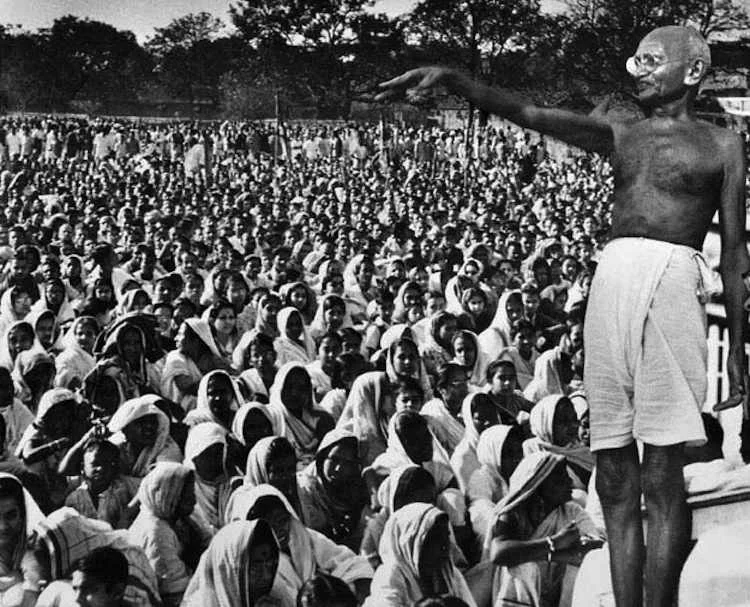
Mahatma Gandhi salt march.jpg

Mahatma Gandhi: 'Let no one commit a wrong in anger', Eve of Salt March - 1930

June 23, 2017

11 March 1930, Ahmedabad, India

In all probability this will be my last speech to you. Even if the Government allow me to march tomorrow morning, this will be my last speech on the sacred banks of the Sabarmati. Possibly these may be the last words of my life here.

I have already told you yesterday what I had to say. Today I shall confine myself to what you should do after my companions and I are arrested. The programme of the march to Jalalpur must be fulfilled as originally settled. The enlistment of the volunteers for this purpose should be confined to Gujarat only. From what I have seen and heard during the last fortnight, I am inclined to believe that the stream of civil resisters will flow unbroken.

But let there be not a semblance of breach of peace even after all of us have been arrested. We have resolved to utilize all our resources in the pursuit of an exclusively nonviolent struggle. Let no one commit a wrong in anger. This is my hope and prayer. I wish these words of mine reached every nook and corner of the land. My task shall be done if I perish and so do my comrades. It will then be for the Working Committee of the Congress to show you the way and it will be up to you to follow its lead. So long as I have reached Jalalpur, let nothing be done in contravention to the authority vested in me by the Congress. But once I am arrested, the whole responsibility shifts to the Congress. No one who believes in nonviolence as a creed need therefore sit still. My contract with the Congress ends as soon as I am arrested. In that case volunteers, wherever possible, civil disobedience of salt as should be started. These laws can be violated in three ways. It is an offence to manufacture salt wherever there are facilities for doing so. The possession and sale of contraband salt, which includes natural salt or salt earth, is also an offence. The purchasers of such salt will be equally guilty. To carry away the natural salt deposits on the seashore is likewise violation of law. So is the hawking of such salt. In short, you may choose any one or all of these devices to break the salt monopoly.

We are, however, not to be content with this alone. There is no ban by the Congress and wherever the local workers have self confidence other suitable measures may be adopted. I stress only one condition, namely, let our pledge of truth and nonviolence as the only means for the attainment of Swaraj be faithfully kept. For the rest, every one has a free hand. But, than does not give a license to all and sundry to carry on their own responsibility. Wherever there are local leaders, their orders should be obeyed by the people. Where there are no leaders and only a handful of men have faith in the programme, they may do what they can, if they have enough self confidence. They have a right, nay it is their duty, to do so. The history of the world is full of instances of men who rose to leadership, by sheer force of self confidence, bravery and tenacity. We too, if we sincerely aspire to Swaraj and are impatient to attain it, should have similar self confidence. Our ranks will swell and our hearts strengthen, as the number of our arrests by the Government increases.

Much can be done in many other ways besides these. The liquor and foreign cloth shops can be picketed. We can refuse to pay taxes if we have the requisite strength. The lawyers can give up practice. The public can boycott the law courts by refraining from litigation. Government servants can resign their posts. In the midst of the despair reigning all round people quake with fear of losing employment. Such men are unfit for Swaraj. But why this despair? The number of Government servants in the country does not exceed a few hundred thousand. What about the rest? Where are they to go? Even free India will not be able to accommodate a greater number of public servants. A Collector then will not need the number of servants he has got today. He will be his own servant. Our starving millions can by no means afford this enormous expenditure. If, therefore, we are sensible enough, let us bid goodbye to Government employment, no matter if it is the post of a judge or a peon. Let all who are cooperating with the Government in one way or another, be it by paying taxes, keeping titles, or sending children to official schools, etc withdraw their co-operation in all or as many ways as possible. Then there are women who can stand shoulder to shoulder with men in this struggle.

You may take it as my will. It was the message that I desired to impart to you before starting on the march or for the jail. I wish that there should be no suspension or abandonment of the war that commences tomorrow morning or earlier, if I am arrested before that time. I shall eagerly await the news that ten batches are ready as soon as my batch is arrested. I believe there are men in India to complete the work our begun by me. I have faith in the righteousness of our cause and the purity of our weapons. And where the means are clean, there God is undoubtedly present with His blessings. And where these three combine, there defeat is an impossibility. A Satyagrahi, whether free or incarcerated, is ever victorious. He is vanquished only when he forsakes truth and nonviolence and turns a deaf ear to the inner voice. If, therefore, there is such a thing as defeat for even a Satyagrahi, he alone is the cause of it. God bless you all and keep off all obstacles from the path in the struggle that begins tomorrow.

Source: https://www.artgallery.nsw.gov.au/exhibiti...

Enjoyed this speech? Speakola is a labour of love and I’d be very grateful if you would share, tweet or like it. Thank you.

Facebook Twitter Facebook
In 1920-39 Tags MAHATMA GANDHI, SALT MARCH, RESISTENCE, INDEPENDENCE, PROTEST, BRITISH RULE, TRANSCRIPT, INDIA
2 Comments

Mahatma Gandhi: 'It is to join a struggle for such democracy that I invite you today', 'Quit India' - 1942

January 7, 2016

No vision or audio of the speech but this is movietone footage of the protest.

8 August 1942, A.I.C.C. at Bombay, Mumbai, India

Before you discuss the resolution, let me place before you one or two things, I want you to understand two things very clearly and to consider them from the same point of view from which I am placing them before you. I ask you to consider it from my point of view, because if you approve of it, you will be enjoined to carry out all I say. It will be a great responsibility. There are people who ask me whether I am the same man that I was in 1920, or whether there has been any change in me. You are right in asking that question.

Let me, however, hasten to assure that I am the same Gandhi as I was in 1920. I have not changed in any fundamental respect. I attach the same importance to non-violence that I did then. If at all, my emphasis on it has grown stronger. There is no real contradiction between the present resolution and my previous writings and utterances.

Occasions like the present do not occur in everybody’s and but rarely in anybody’s life. I want you to know and feel that there is nothing but purest Ahimsa1 in all that I am saying and doing today. The draft resolution of the Working Committee is based on Ahimsa, the contemplated struggle similarly has its roots in Ahimsa. If, therefore, there is any among you who has lost faith in Ahimsa or is wearied of it, let him not vote for this resolution.

Let me explain my position clearly. God has vouchsafed to me a priceless gift in the weapon of Ahimsa. I and my Ahimsa are on our trail today. If in the present crisis, when the earth is being scorched by the flames of Himsa2 and crying for deliverance, I failed to make use of the God given talent, God will not forgive me and I shall be judged un-wrongly of the great gift. I must act now. I may not hesitate and merely look on, when Russia and China are threatened.

Ours is not a drive for power, but purely a non-violent fight for India’s independence. In a violent struggle, a successful general has been often known to effect a military coup and to set up a dictatorship. But under the Congress scheme of things, essentially non-violent as it is, there can be no room for dictatorship. A non-violent soldier of freedom will covet nothing for himself, he fights only for the freedom of his country. The Congress is unconcerned as to who will rule, when freedom is attained. The power, when it comes, will belong to the people of India, and it will be for them to decide to whom it placed in the entrusted. May be that the reins will be placed in the hands of the Parsis, for instance-as I would love to see happen-or they may be handed to some others whose names are not heard in the Congress today. It will not be for you then to object saying, “This community is microscopic. That party did not play its due part in the freedom’s struggle; why should it have all the power?” Ever since its inception the Congress has kept itself meticulously free of the communal taint. It has thought always in terms of the whole nation and has acted accordingly. . .

I know how imperfect our Ahimsa is and how far away we are still from the ideal, but in Ahimsa there is no final failure or defeat. I have faith, therefore, that if, in spite of our shortcomings, the big thing does happen, it will be because God wanted to help us by crowning with success our silent, unremitting Sadhana1 for the last twenty-two years.

I believe that in the history of the world, there has not been a more genuinely democratic struggle for freedom than ours. I read Carlyle’s French Resolution while I was in prison, and Pandit Jawaharlal has told me something about the Russian revolution. But it is my conviction that inasmuch as these struggles were fought with the weapon of violence they failed to realize the democratic ideal. In the democracy which I have envisaged, a democracy established by non-violence, there will be equal freedom for all. Everybody will be his own master. It is to join a struggle for such democracy that I invite you today. Once you realize this you will forget the differences between the Hindus and Muslims, and think of yourselves as Indians only, engaged in the common struggle for independence.

Then, there is the question of your attitude towards the British. I have noticed that there is hatred towards the British among the people. The people say they are disgusted with their behaviour. The people make no distinction between British imperialism and the British people. To them, the two are one This hatred would even make them welcome the Japanese. It is most dangerous. It means that they will exchange one slavery for another. We must get rid of this feeling. Our quarrel is not with the British people, we fight their imperialism. The proposal for the withdrawal of British power did not come out of anger. It came to enable India to play its due part at the present critical juncture It is not a happy position for a big country like India to be merely helping with money and material obtained willy-nilly from her while the United Nations are conducting the war. We cannot evoke the true spirit of sacrifice and velour, so long as we are not free. I know the British Government will not be able to withhold freedom from us, when we have made enough self-sacrifice. We must, therefore, purge ourselves of hatred. Speaking for myself, I can say that I have never felt any hatred. As a matter of fact, I feel myself to be a greater friend of the British now than ever before. One reason is that they are today in distress. My very friendship, therefore, demands that I should try to save them from their mistakes. As I view the situation, they are on the brink of an abyss. It, therefore, becomes my duty to warn them of their danger even though it may, for the time being, anger them to the point of cutting off the friendly hand that is stretched out to help them. People may laugh, nevertheless that is my claim. At a time when I may have to launch the biggest struggle of my life, I may not harbour hatred against anybody.

Historian and author Ramachandra Guha was a guest on the Speakola podcast, and read a section of this speech to close the episode.


Source: http://www.mkgandhi.org/speeches/qui.htm

Enjoyed this speech? Speakola is a labour of love and I’d be very grateful if you would share, tweet or like it. Thank you.

Facebook Twitter Facebook
In 1940-59 Tags MAHATMA GANDHI, QUIT INDIA, GANDHI, MUMBAI, BRITISH RULE, INDEPENDENCE, TRANSCRIPT
Comment

See my film!

Limited Australian Season

March 2025

Details and ticket bookings at

angeandtheboss.com

Support Speakola

Hi speech lovers,
With costs of hosting website and podcast, this labour of love has become a difficult financial proposition in recent times. If you can afford a donation, it will help Speakola survive and prosper.

Best wishes,
Tony Wilson.

Become a Patron!

Learn more about supporting Speakola.

Featured political

Featured
Jon Stewart: "They responded in five seconds", 9-11 first responders, Address to Congress - 2019
Jacinda Ardern: 'They were New Zealanders. They are us', Address to Parliament following Christchurch massacre - 2019
Dolores Ibárruri: "¡No Pasarán!, They shall not pass!', Defense of 2nd Spanish Republic - 1936
Jimmy Reid: 'A rat race is for rats. We're not rats', Rectorial address, Glasgow University - 1972

Featured eulogies

Featured
For Geoffrey Tozer: 'I have to say we all let him down', by Paul Keating - 2009
for James Baldwin: 'Jimmy. You crowned us', by Toni Morrison - 1988
for Michael Gordon: '13 days ago my Dad’s big, beautiful, generous heart suddenly stopped beating', by Scott and Sarah Gordon - 2018

Featured commencement

Featured
Tara Westover: 'Your avatar isn't real, it isn't terribly far from a lie', The Un-Instagrammable Self, Northeastern University - 2019
Tim Minchin: 'Being an artist requires massive reserves of self-belief', WAAPA - 2019
Atul Gawande: 'Curiosity and What Equality Really Means', UCLA Medical School - 2018
Abby Wambach: 'We are the wolves', Barnard College - 2018
Eric Idle: 'America is 300 million people all walking in the same direction, singing 'I Did It My Way'', Whitman College - 2013
Shirley Chisholm: ;America has gone to sleep', Greenfield High School - 1983

Featured sport

Featured
Joe Marler: 'Get back on the horse', Harlequins v Bath pre game interview - 2019
Ray Lewis : 'The greatest pain of my life is the reason I'm standing here today', 52 Cards -
Mel Jones: 'If she was Bradman on the field, she was definitely Keith Miller off the field', Betty Wilson's induction into Australian Cricket Hall of Fame - 2017
Jeff Thomson: 'It’s all those people that help you as kids', Hall of Fame - 2016

Fresh Tweets


Featured weddings

Featured
Dan Angelucci: 'The Best (Best Man) Speech of all time', for Don and Katherine - 2019
Hallerman Sisters: 'Oh sister now we have to let you gooooo!' for Caitlin & Johnny - 2015
Korey Soderman (via Kyle): 'All our lives I have used my voice to help Korey express his thoughts, so today, like always, I will be my brother’s voice' for Kyle and Jess - 2014

Featured Arts

Featured
Bruce Springsteen: 'They're keepers of some of the most beautiful sonic architecture in rock and roll', Induction U2 into Rock Hall of Fame - 2005
Olivia Colman: 'Done that bit. I think I have done that bit', BAFTA acceptance, Leading Actress - 2019
Axel Scheffler: 'The book wasn't called 'No Room on the Broom!', Illustrator of the Year, British Book Awards - 2018
Tina Fey: 'Only in comedy is an obedient white girl from the suburbs a diversity candidate', Kennedy Center Mark Twain Award -  2010
Tina Fey: 'Only in comedy is an obedient white girl from the suburbs a diversity candidate', Kennedy Center Mark Twain Award - 2010

Featured Debates

Featured
Sacha Baron Cohen: 'Just think what Goebbels might have done with Facebook', Anti Defamation League Leadership Award - 2019
Greta Thunberg: 'How dare you', UN Climate Action Summit - 2019
Charlie Munger: 'The Psychology of Human Misjudgment', Harvard University - 1995
Lawrence O'Donnell: 'The original sin of this country is that we invaders shot and murdered our way across the land killing every Native American that we could', The Last Word, 'Dakota' - 2016