• Genre
  • About
  • Submissions
  • Donate
  • Search
Menu

Speakola

All Speeches Great and Small
  • Genre
  • About
  • Submissions
  • Donate
  • Search
Share a political speech

Atal Behari Vajpayee: '“Here comes my resignation, Mr. Speaker", Speech during No Confidence motion - 1996

November 22, 2019

i June 1996, Delhi, India

We are being held in the dock without reason... yes we failed to use the opportunity the President gave us [by inviting us to form government], but that is a different matter …

We are ready to sit in the seats reserved for the Opposition, I promise you that we will offer our fullest cooperation in helping you run the House. …

You want to run the country, that's a good thing. You have my best wishes. We will continue working in the service of the nation. We bow down before the stronger alliance and assure you that we won't rest until we finish the work we have begun in the nation's interest …

"Adhyaksh mahoday, mein apna tyag patra rashtrapati ko dene jaa raha hun … Respected Speaker, I am now leaving to tender my resignation to the President

We’d love a full transcript of this speech, either in Hindi, English translation or both. Please direct us to one in the comments if you can locate one.

Source: https://www.indiatoday.in/india/story/atal...

Enjoyed this speech? Speakola is a labour of love and I’d be very grateful if you would share, tweet or like it. Thank you.

Facebook Twitter Facebook
Tags ATAL BIHARI VAJPAYEE, PRIME MINISTER, RESIGNATION, TRANSCRIPT, INDIA, PARLIAMENT
Comment

Babasaheb Ambedkar: 'The Grammar of Anarachy', Speech to Constituent Assembly - 1949

November 22, 2019

25 November 1949, Delhi, India

As much defence as could be offered to the Constitution has been offered by my friends Sir Alladi Krishnaswami Ayyar and Mr T T Krishnamachari, I shall not therefore enter into the merits of the Constitution. Because I feel, however good a Constitution may be, it is sure to turn out bad because those who are called to work it, happen to be a bad lot. However bad a Constitution may be, it may turn out to be good if those who are called to work it, happen to be a good lot. The working of a Constitution does not depend wholly upon the nature of the Constitution. The Constitution can provide only the organs of State such as the Legislature, the Executive and the Judiciary. The factors on which the working of those organs of the State depend are the people and the political parties they will set up as their instruments to carry out their wishes and their politics. Who can say how the people of India and their parties will behave? Will they uphold constitutional methods of achieving their purposes or will they prefer revolutionary methods of achieving them? If they adopt the revolutionary methods, however good the Constitution may be, it requires no prophet to say that it will fail. It is, therefore, futile to pass any judgement upon the Constitution without reference to the part which the people and their parties are likely to play.

The condemnation of the Constitution largely comes from two quarters, the Communist Party and the Socialist Party. Why do they condemn the Constitution? Is it because it is really a bad Constitution? I venture to say ‘no’. The Communist Party want a Constitution based upon the principle of the Dictatorship of the Proletariat. They condemn the Constitution because it is based upon parliamentary democracy. The Socialists want two things. The first thing they want is that if they come in power, the Constitution must give them the freedom to nationalise or socialise all private property without payment of compensation. The second thing that the Socialists want is that the Fundamental Rights mentioned in the Constitution must be absolute and without any limitations so that if their Party fails to come into power, they would have the unfettered freedom not merely to criticise, but also to overthrow the State.

No right to bind succeeding generations
These are the main grounds on which the Constitution is being condemned. I do not say that the principle of parliamentary democracy is the only ideal form of political democracy. I do not say that the principle of no acquisition of private property without compensation is so sacrosanct that there can be no departure from it. I do not say that Fundamental Rights can never be absolute and the limitations set upon them can never be lifted. What I do say is that the principles embodied in the Constitution are the views of the present generation or if you think this to be an over-statement, I say they are the views of the members of the Constituent Assembly. Why blame the Drafting Committee for embodying them in the Constitution? I say why blame even the Members of the Constituent Assembly? Jefferson, the great American statesman who played so great a part in the making of the American constitution, has expressed some very weighty views which makers of Constitution, can never afford to ignore. In one place he has said:

“We may consider each generation as a distinct nation, with a right, by the will of the majority, to bind themselves, but none to bind the succeeding generation, more than the inhabitants of another country.”

In another place, he has said:

“The idea that institutions established for the use of the nation cannot be touched or modified, even to make them answer their end, because of rights gratuitously supposed in those employed to manage them in the trust for the public, may perhaps be a salutary provision against the abuses of a monarch, but is most absurd against the nation itself. Yet our lawyers and priests generally inculcate this doctrine, and suppose that preceding generations held the earth more freely than we do; had a right to impose laws on us, unalterable by ourselves, and that we, in the like manner, can make laws and impose burdens on future generations, which they will have no right to alter; in fine, that the earth belongs to the dead and not the living;”


I admit that what Jefferson has said is not merely true, but is absolutely true. There can be no question about it. Had the Constituent Assembly departed from this principle laid down by Jefferson it would certainly be liable to blame, even to condemnation. But I ask, has it? Quite the contrary. One has only to examine the provision relating to the amendment of the Constitution…I challenge any of the critics of the Constitution to prove that any Constituent Assembly anywhere in the world has, in the circumstances in which this country finds itself, provided such a facile procedure for the amendment of the Constitution. If those who are dissatisfied with the Constitution have only to obtain a 2/3 majority and if they cannot obtain even a two-thirds majority in the parliament elected on adult franchise in their favour, their dissatisfaction with the Constitution cannot be deemed to be shared by the general public.

The danger of divisive politics
[But] my mind is so full of the future of our country that I feel I ought to take this occasion to give expression to some of my reflections thereon. On 26th January 1950, India will be an independent country. What would happen to her independence? Will she maintain her independence or will she lose it again? This is the first thought that comes to my mind. It is not that India was never an independent country. The point is that she once lost the independence she had. Will she lose it a second time? It is this thought which makes me most anxious for the future. What perturbs me greatly is the fact that not only India has once before lost her independence, but she lost it by the infidelity and treachery of some of her own people. In the invasion of Sind by Mahommed-Bin-Kasim, the military commanders of King Dahar accepted bribes from the agents of Mahommed-Bin-Kasim and refused to fight on the side of their king. It was Jaichand who invited Mahommed Ghori to invade India and fight against Prithvi Raj and promised him the help of himself and the Solanki kings. When Shivaji was fighting for the liberation of Hindus, the other Maratha noblemen and the Rajput kings were fighting the battle on the side of Mughul Emperors. When the British were trying to destroy the Sikh Rulers, Gulab Singh, their principal commander sat silent and did not help to save the Sikh Kingdom. In 1857, when a large part of India had declared a war of independence against the British, the Sikhs stood and watched the event as silent spectators.

Will history repeat itself? It is this thought which fills me with anxiety. This anxiety is deepened by the realisation of the fact that in addition to our old enemies in the form of castes and creeds we are going to have many political parties with diverse and opposing political creeds. Will Indians place the country above their creed or will they place creed above country? I do not know. But this much is certain that if the parties place creed above country, our independence will be put in jeopardy a second time and probably be lost for ever. This eventuality we must all resolutely guard against. We must be determined to defend our independence with the last drop of our blood.

The importance of constitutional methods
On the 26th of January 1950, India would be a democratic country in the sense that India from that day would have a government of the people, by the people and for the people. The same thought comes to my mind. What would happen to her democratic Constitution? Will she be able to maintain it or will she lose it again. This is the second thought that comes to my mind and makes me as anxious as the first.

It is not that India did not know what is democracy. There was a time when India was studded with republics, and even where there were monarchies, they were either elected or limited. They were never absolute. It is not that India did not know Parliaments or parliamentary procedure. A study of the Buddhist Bhikshu Sanghas discloses that not only there were Parliaments—for the Sanghas were nothing but Parliaments—but the Sanghas knew and observed all the rules of parliamentary procedure known to modern times…Although these rules of parliamentary procedure were applied by the Buddha to the meetings of the Sanghas, he must have borrowed them from the rules of the political assemblies functioning in the country in his time.

This democratic system India lost. Will she lose it a second time? I do not know. But it is quite possible in a country like India—where democracy from its long disuse must be regarded as something quite new—there is danger of democracy giving place to dictatorship. It is quite possible for this new born democracy to retain its form but give place to dictatorship in fact. If there is a landslide, the danger of the second possibility becoming actuality is much greater.

If we wish to maintain democracy not merely in form, but also in fact, what must we do? The first thing in my judgement we must do is to hold fast to constitutional methods of achieving our social and economic objectives. It means we must abandon the bloody methods of revolution. It means that we must abandon the method of civil disobedience, non-cooperation and satyagraha. When there was no way left for constitutional methods for achieving economic and social objectives, there was a great deal of justification for unconstitutional methods. But where constitutional methods are open, there can be no justification for these unconstitutional methods. These methods are nothing but the Grammar of Anarchy and the sooner they are abandoned, the better for us.

The politics of pedestals
The second thing we must do is to observe the caution which John Stuart Mill has given to all who are interested in the maintenance of democracy, namely, not “to lay their liberties at the feet of even a great man, or to trust him with power which enable him to subvert their institutions.” There is nothing wrong in being grateful to great men who have rendered life-long services to the country. But there are limits to gratefulness. As has been well said by the Irish Patriot Daniel O’Connel, no man can be grateful at the cost of his honour, no woman can be grateful at the cost of her chastity and no nation can be grateful at the cost of its liberty. This caution is far more necessary in the case of India than in the case of any other country. For in India, Bhakti or what may be called the path of devotion or hero-worship, plays a part in its politics unequalled in magnitude by the part it plays in the politics of any other country in the world. Bhakti in religion may be a road to the salvation of the soul. But in politics, Bhakti or hero-worship is a sure road to degradation and to eventual dictatorship.

Social democracy
The third thing we must do is not to be content with mere political democracy. We must make our political democracy a social democracy as well. Political democracy cannot last unless there lies at the base of it social democracy. What does social democracy mean? It means a way of life which recognises liberty, equality and fraternity as the principles of life. These principles of liberty, equality and fraternity are not to be treated as separate items in a trinity. They form a union of trinity in the sense that to divorce one from the other is to defeat the very purpose of democracy. Liberty cannot be divorced from equality, equality cannot be divorced from liberty. Nor can liberty and equality be divorced from fraternity. Without equality, liberty would produce the supremacy of the few over the many. Equality without liberty would kill individual initiative. Without fraternity, liberty would produce the supremacy of the few over the many. Equality without liberty would kill individual initiative. Without fraternity, liberty and equality could not become a natural course of things. It would require a constable to enforce them.

We must begin by acknowledging the fact that there is complete absence of two things in Indian society. One of these is equality. On the social plane, we have in India a society based on the principle of graded inequality which we have a society in which there are some who have immense wealth as against many who live in abject poverty. On the 26th of January 1950, we are going to enter into a life of contradictions. In politics we will have equality and in social and economic life we will have inequality. In politics we will be recognising the principle of one man one vote and one vote one value. In our social and economic life, we shall, by reason of our social and economic structure, continue to deny the principle of one man one value. How long shall we continue to live this life of contradictions? How long shall we continue to deny equality in our social and economic life? If we continue to deny it for long, we will do so only by putting our political democracy in peril. We must remove this contradiction at the earliest possible moment or else those who suffer from inequality will blow up the structure of political democracy which this Assembly has to laboriously built up.

The second thing we are wanting in is recognition of the principle of fraternity. What does fraternity mean? Fraternity means a sense of common brotherhood of all Indians-if Indians being one people. It is the principle which gives unity and solidarity to social life. It is a difficult thing to achieve…

To build a nation
I remember the days when politically-minded Indians, resented the expression “the people of India”. They preferred the expression “the Indian nation.” I am of opinion that in believing that we are a nation, we are cherishing a great delusion. How can people divided into several thousands of castes be a nation? The sooner we realise that we are not as yet a nation in the social and psychological sense of the world, the better for us. For then only we shall realise the necessity of becoming a nation and seriously think of ways and means of realising the goal. The realisation of this goal is going to be very difficult…The castes are anti-national. In the first place because they bring about separation in social life. They are anti-national also because they generate jealousy and antipathy between caste and caste. But we must overcome all these difficulties if we wish to become a nation in reality. For fraternity can be a fact only when there is a nation. Without fraternity, equality and liberty will be no deeper than coats of paint.

These are my reflections about the tasks that lie ahead of us. They may not be very pleasant to some. But there can be no gainsaying that political power in this country has too long been the monopoly of a few and the many are only beasts of burden, but also beasts of prey. This monopoly has not merely deprived them of their chance of betterment, it has sapped them of what may be called the significance of life. These down-trodden classes are tired of being governed. They are impatient to govern themselves. This urge for self-realisation in the down-trodden classes must not be allowed to devolve into a class struggle or class war. It would lead to a division of the House. That would indeed be a day of disaster. For, as has been well said by Abraham Lincoln, a House divided against itself cannot stand very long. Therefore the sooner room is made for the realisation of their aspiration, the better for the few, the better for the country, the better for the maintenance for its independence and the better for the continuance of its democratic structure. This can only be done by the establishment of equality and fraternity in all spheres of life. That is why I have laid so much stresses on them.

I do not wish to weary the House any further. Independence is no doubt a matter of joy. But let us not forget that this independence has thrown on us great responsibilities. By independence, we have lost the excuse of blaming the British for anything going wrong. If hereafter things go wrong, we will have nobody to blame except ourselves. There is great danger of things going wrong. Times are fast changing. People including our own are being moved by new ideologies. They are getting tired of Government by the people. They are prepared to have Governments for the people and are indifferent whether it is Government of the people and by the people. If we wish to preserve the Constitution in which we have sought to enshrine the principle of Government of the people, for the people and by the people, let us resolve not to be tardy in the recognition of the evils that lie across our path and which induce people to prefer Government for the people to Government by the people, nor to be weak in our initiative to remove them. That is the only way to serve the country. I know of no better.?

Source: http://pragati.nationalinterest.in/2010/08...

Enjoyed this speech? Speakola is a labour of love and I’d be very grateful if you would share, tweet or like it. Thank you.

Facebook Twitter Facebook
In 1940-59 C Tags BABASAHEB AMBEDKAR, DR AMBEDKAR, TRANSCRIPT, THE GRAMMAR OF ANARCHY, INDIA, INDEPENDENCE, CONSTITUTION
2 Comments

Sardar Vallabhbhai Patel: 'You have called a simple farmer to the highest office' Presidential Address to Indian National Congress - 1931

October 16, 2019

Indian National Congress, Karachi, India

You have called a simple farmer to the highest office, to which any Indian can aspire. I am conscious that your choice of me as first servant is not so much for what little I might have done, but it is the recognition of the amazing sacrifice made by Gujarat for the honour. But in truth every Province did its utmost during the year of the greatest national awakening that we have known in modern times.

NON-VIOLENCE- NO IDLE DREAM

world that mass non-violence is no longer the idle dream of a visionary or a mere human longing, It is a solid fact capable of infinite possibilities for humanity, which is groaning for want of faith, beneath the weight of violence of which it has almost made a fetish. The greatest proof that our movement was 7 non-violent lies in the fact that the peasants falsified the fears of our worst skeptics. They were described as very difficult to organise' for non-violent action and it is they who stood the test with a bravery and an endurance that was beyond all expectation. Women and children too contributed their great share in the fight. They responded to the call by instinct and played a part which we are too near the even adequately to measure. Looked at in the light of non-violence our struggle is a world struggle and it is a matter of great satisfaction that the nations of the earth, especially the United States of America, have heartened us by their sympathy.

The recent settlement however renders it unnecessary to dwell at greater length upon this heroic period in the national life. Your Working Committee has entered into the Settlement in anticipation of your approval. You are now invited formally to endorse it. The Committee having accepted it as your accredited representatives, it is not, I take it, open to you to repudiate it; but it is open to you to pass a vote of no-confidence in the present executive and appoint better agents. But whilst it is but meet that I should draw your attention to the constitutional position, I have no doubt what so ever that you will endorse the settlement which I hold to be perfectly honourable for both the parties. Had we not accepted the settlement we should have put ourselves in the wrong and thereby undone the effect of the sufferings of the past year. Indeed we had always claimed, as Satyagrahis must claim, to be ready and eager for peace. When therefore, the way seemed to be open for peace, we took it. In view of the clear demand on the part of the British Indian Delegation at the Round Table Conference for full responsibility, and in view of the British parties having accepted the position and in view of the appeal made to the Congress by the Premier, the Viceroy and many of our distinguished countrymen, the Working Committee thought that if an honourable truce could be arranged and if it was open to the Congress to press without any reservation for what is considered to be the best for the country, the Congress should, if invited, take part in the Conference and attempt to reach an agreed solution of the constitutional issue. If we failed in the attempt and there was no way open but that of suffering, then it was a privilege of which no power on earth could deprive us.

Under the constitution clause of the settlement it is open to us to press for Purna Swaraj, to ask for complete control over our defence forces, foreign affairs, finance, fiscal policy and the like. There would be safe-guards or reservations, or as the late Pandit Motilalji called them, adjustments, conceived in our own interest. When power passes from one to the other by agreement there are always safeguards in the interest of the party in need of reparation or help: The continued exploitation of India for close on two centuries renders it necessary for us to seek assistance in several respects from external sources. Thus we would need military skill and there is no reason why we may not receive English assistance in this direction. I have taken only one telling illustration out of others that may be suggested.

The defence safeguard may therefore be the retention of British Officers, or, as some would say, even privates, but we could never let our defence be controlled by the British. We must have full power to make mistakes. We may gratefully receive British advice, never dictation.

BRITISH ARMY OF OCCUPATION

The fact is that the British army in India is an army of occupation. Defence is a misnomer. Frankly, the army is for defending British interests and British men and women against any internal uprising. I cannot recall a single instance in which the Indian army was required for the protection of India to fight a foreign power. True, there have been expeditions on the Frontier, wars with Afghanistan; British historians have taught us that they were wars more of agression rather than of defence. We must not. Therefore be frightened by the bogey of foreign designs upon India. In my opinion if we need an army, we certainly do not need the octopus we are daily bleeding to support. If the Congress has its way, the army will suffer immediate reduction to its reasonable proportion.

PURNA SWARAJ-OUR GOAL

Again we have been taught to think that our civil administration will be inefficient and corrupt if we give up the able assistance of highly paid British civilians. The administrative powers that the Congress has exhibited during recent years and the fact of its having on an ever- increasing scale drawn to its assistance some of the best young men and women either without pay or on a mere pittance should sufficiently dispose of the fear of corruption or inefficiency. It would be too great a strain upon our poor purse to have to pay, by way of insurance against corruption, a premium out of all proportion to the. highest possible estimate of corruption that may ever take place. It will therefore be necessary if India is to come to her own, to demand a heavy reduction in the Civil Service expenditure and thus a consequent reduction in the emoluments of the Civil Service.

We have claimed that many of the charges laid upon India are wholly unjust. We have never suggested repudiation of a single obligation, but we have asked and must continue to ask for an impartial investigation into the debits against us wherever we cannot agree.

There is no receding from the Lahore resolution of complete Independence. This independence does not mean, was not intended to mean, a churlish refusal to associate with British or any other power. Independence therefore does not exclude the possibility of equal partnership for mutual benefit and dissolvable at the will of either party. If India is to reach her independence through consultation and agreement, it is reasonable to suppose that there is a strong body of opinion in the country to the effect that before partnership could possibly be conceived there must be a period of complete dissociation. I do not belong to that school. It is, as I think, a sign of weakness and of disbelief in human nature.

FEDRATION OF INDIA

Federation is a fascinating idea. But it introduces new- embarrassments. Princes will not listen to severence? Is it severence of British connection. But if they will come in the true spirit it will be a great gain. Their association must not be to impede the progress of democracy. I hope therefore that they will not take up an
uncompromising attitude that may be wholly inconsistent with the spirit of freedom. I wish they would, without any pressure, give us an earnest of their desire to march abreast of the time-spirit. Surely the fundamental rights of their subjects should be guaranteed as of the rest of the inhabitants of India. All the inhabitants of Federated India should enjoy some common elementary rights. And if there are rights, there must be a common court to give relief from any encroachment upon them. Nor can it be too much to expect that the subjects of the states should be to an extent directly represented on the federal legislature.

COMMUNAL UNITY ESSENTIAL

But before all else comes the question of Hindu Muslim or rather communal unity. The position of the Congress was defined at Lahore. Let me recite the resolution here:

In view of the lapse of the Nehru Report it. is unnecessary to declare the policy of the Congress regarding communal questions, the Congress believing that in an independent India, communal questions can only be solved on strictly national lines. But as the Sikhs, in particular and Muslims and other minorities in general had expressed dissatisfaction over the solution of the communal question proposed in the Nehru Report, the Congress assures the Sikhs, Muslims and other minorities that no solution thereof in any future constitution, can be acceptable to the Congress that does not give full satisfaction to the parties concerned.

Therefore, the Congress can be no party to any constitution which does not contain a solution of the Communal question that is not designed to satisfy the respective parties. As a Hindu, I adopt my predecessor’s formula and present the minorities, with a Swadeshi fountain-pen and paper and let them write out their demands. And, I should endorse them. I know, that it is the quickest method. But it requires courage on the part of the Hindus. What we want is a heart unity not parched-up paper-unity that will break under the slightest strain. That unity can only come when the majority takes courage in both the hands and is prepared to change places with the minority. This would be the highest wisdom. Whether the unity is reached that or any other, it is becoming plainer day after day that it is useless to attend any conference, unless that unity is achieved. The Conference, ran give us an agreement between the British and us, it. can perhaps help us to come nearer to the Princes; but it ran never enable, us to achieve unity. That must be hammered into shape by ourselves. The Congress must leave no stone unturned to realise this much-desired end.

CALL TO PEOPLE

It must be clear to all of us that the Congress can be useful for attaining Pura Swaraj only to the extent that it has gained power. The past twelve months have undoubtedly given it a power which he who runs may see. But it is not enough and can be easily frittered away by hasty action, or by pride. He is a spendthrift who lives on his capital. We must therefore add to our power. One way to do so is on our part to fulfill to the letter the conditions of the settlement. The other is to consolidate our gains. I therefore propose to devote a few lines to this part of our activity.

We have made much headway in the matter of the boycott of foreign cloth. It is a right as well as a duty. Without it, the impoverished millions of India must continue to starve. For if cheap foreign cloth continues to be dumped down in the villages of India, the Charka cannot flourish. Foreign cloth must therefore be banished from the land. It is therefore want of easy employment in their own villages that leads to starvation. Incessant propaganda is necessary to rid the country of chronic unemployment, which has become second nature with our peasantry. The best propaganda is to do sacrificial spinning ourselves and wear khaddar (Khadi). The All-India Spinners' Association has done much valuable work. But it is for the Congress to create this spinning and the khaddar atmosphere. This to my mind is the best and the most effective propaganda of Boycott.

It has been suggested that the argument against foreign cloth applies to indigenous mill cloth. But our mills do not produce all the cloth we need. For years to come they may continue to supply the balance that may be required over and above hand-spun cloth. But even our mills may prove a hindrance, if they compete with khaddar or resort to questionable devices to push their wares. Fortunately many mills are patriotically working in co-operation with the Congress and are beginning to appreciate the virtue of khaddar in the interest of the toiling millions. But I can certainly say that if our mills unpatriotically hurt khaddar instead of complimenting it, they must face an opposition somewhat similar to that against foreign cloth.

The foreign cloth merchants will do well to bear the Congress attitude in mind in this regard. Foreign cloth boycott is apermanent thing, not conceived as a political but as an economic and social measure of permanent value for the welfare of the masses. These merchants, will do well to give up their foreign cloth trade. Everything possible is being done to help them but some very big sacrifice on their part is essential.

English, Japanese and other foreign merchants will, I hope, not misunderstand the Congress attitude. If they will help India, they will deny themselves the India trade in foreign cloth. They have other markets and other enterprises.

CALL TO PEOPLE

It must be clear to all of us that the Congress can be useful for attaining Pura Swaraj only to the extent that it has gained power. The past twelve months have undoubtedly given it a power which he who runs may see. But it is not enough and can be easily frittered away by hasty action, or by pride. He is a spendthrift who lives on his capital. We must therefore add to our power. One way to do so is on our part to fulfill to the letter the conditions of the settlement. The other is to consolidate our gains. I therefore propose to devote a few lines to this part of our activity.

We have made much headway in the matter of the boycott of foreign cloth. It is a right as well as a duty. Without it, the impoverished millions of India must continue to starve. For if cheap foreign cloth continues to be dumped down in the villages of India, the Charka cannot flourish. Foreign cloth must therefore be banished from the land. It is therefore want of easy employment in their own villages that leads to starvation. Incessant propaganda is necessary to rid the country of chronic unemployment, which has become second nature with our peasantry. The best propaganda is to do sacrificial spinning ourselves and wear khaddar (Khadi). The All-India Spinners' Association has done much valuable work. But it is for the Congress to create this spinning and the khaddar atmosphere. This to my mind is the best and the most effective propaganda of Boycott.

It has been suggested that the argument against foreign cloth applies to indigenous mill cloth. But our mills do not produce all the cloth we need. For years to come they may continue to supply the balance that may be required over and above hand-spun cloth. But even our mills may prove a hindrance, if they compete with khaddar or resort to questionable devices to push their wares. Fortunately many mills are patriotically working in co-operation with the Congress and are beginning to appreciate the virtue of khaddar in the interest of the toiling millions. But I can certainly say that if our mills unpatriotically hurt khaddar instead of complimenting it, they must face an opposition somewhat similar to that against foreign cloth.

The foreign cloth merchants will do well to bear the Congress attitude in mind in this regard. Foreign cloth boycott is apermanent thing, not conceived as a political but as an economic and social measure of permanent value for the welfare of the masses. These merchants, will do well to give up their foreign cloth trade. Everything possible is being done to help them but some very big sacrifice on their part is essential.

English, Japanese and other foreign merchants will, I hope, not misunderstand the Congress attitude. If they will help India, they will deny themselves the India trade in foreign cloth. They have other markets and other enterprises.

PICKETING NOT COERCION

This brings me to picketing. This has not been and cannot be given up. I give below the relevant clause of the Settlement.

Picketing shall be unaggressive, and it shall not involve coercion, intimidation, restraint, hostile demonstration, obstruction to the public, or any offence under the ordinary law, and if and when any of these methods is employed in any place, the practice of picketing in that place will be suspended.

Picketing is a common law of right. Its function is gentle persuasion, never coercion or violent restraint on liberty. I use the adjective ‘violent’ advisedly. The restraining force of public opinion there always, will be. It is healthy, elevating, and conducive to the growth of liberty as distinguished from license. Non-violent picketing is designed to create public opinion, an atmosphere which should become irresistible.

This can best be carried on by women. I hope therefore that they will continue the marvelous work begun by them and earn the eternal gratitude of the nation and, what is more, the blessings of the starving millions.

ENCOURAGE SWADESHI

The idea of boycott of British goods is almost as old as the Congress. We know that after the advent of Gandhiji on the political platform, boycott of British goods was replaced by that of foreign—not only British—cloth. He interpreted it in terms of economic and social uplift, whereas the boycott of the British goods as such is a 'political and punitive measure. We must withdraw the political weapon. We cannot be sitting at the friendly conference table and outside making designs to hurt British interests. Whilst therefore we must for the time being.‘withdraw British goods’ boycott, we must intensify Swadeshi, which is the birthright of every nation. Whatever we produce in our country We must encourage to the exclusion of foreign whether British or other. This is the condition of national growth. Thus we must encourage and carry on banking, shipping and the like. We may not belittle or neglect them on the ground of their inferiority or dearness. Only by wide use and helpful criticism may we make them cheaper and better. Equality of treatment in the case of hopless unequals ought to mean raising the less favoured upto the level of the most favoured. Thus equality of treatment for suppressed classes on the part of the so-called superior classes means raising the former to the latter's level; the latter sacrificing their substance and stooping to conquer. In relation to the British we have hitherto occupied a position in some respects lower even than the suppressed classes.

Protection of Indian industries and enterprise to the exclusion of British or foreign, is a condition of our national existence even under a state of partnership. Protection within even the British Commonwealth’ is no newfangled notion. It is in vogue in the Dominions to the extent necessary for their growth.

Just as boycott of foreign cloth is an economic necessity for the sake of the starving millions, boycott of intoxicating drink and drugs is a necessity for the moral welfare of the nation. The idea of total prohibition was born before its political effect was thought of. The Congress conceived it as a measure of self purification. Even if the Government ear-marked the revenue from this traffic for purely prohibition purposes, our picketing of these shops would continue, no doubt subject to the same severe restrictions as in the case of foreign cloth. We cannot rest still, so long as there is a yard of foreign cloth entering the country or a single liquor shop corrupting our misguided countrymen.

The salt raids must stop. Defiance of salt laws for the sake of disobedience must stop.' But the poor, living in the neighbourhood of salt areas, are free to make and sell salt within that neighbourhood. The Salt Tax is not gone, it is true. In view of the likelihood of the Congress participating in the Conference, we may not press for the immediate repeal of the tax which is bound to come very soon. But the poorest on whose behalf the campaign was undertaken are now virtually free from the tax. I hope that no traders will seek to take an undue advantage of the relaxation.

CONSTRUCTIVE WORK

The foregoing perhaps shows you how uninterested I am in many things that interest the intelligentsia. I am not interested in loaves and fishes, or legislative honours. The peasantry does not understand these, they are little affected by them. I believe that Gandhiji's eleven points mean the substance of Swaraj. That which does not satisfy them is no Swaraj. (Whilst I would respect the rights of landlords, Rajas, Maharajas and others to the extent that they do not hurt the sweating millions, my interest lies in helping the downtrodden to rise from their state and be on a level with the tallest in the land). Thank God, the •gospel of Truth and Non-Violence has given these an inkling of their dignity and the power they possess. Much still remains to be done. But let us make up our minds that we exist for them, not they for us. Let us shed our petty rivalries and jealousies, religious feuds and let everyone realise that the Congress represents and exists for the toiling millions and it will become an irresistible power working not for greed or power but for the sake of common humanity.

There is one part of the constructive programme which I have not dealt with already; that is the all important work of removing untouchability. The recent heroic struggle on the part of the nation would have been more glorious if Hindus had purged Hinduism of this evil. But heroism or glory apart, no Swaraj would be worth having without this supreme act of self-purification, and even if Swaraj is won whilst this stain continues to blacken Hinduism, it would be as insecure as a Swaraj without a complete boycott of foreign cloth.

In conclusion, I may not forget our brethren overseas. Their lot in South Africa, in East Africa and in the other parts of the world is still hanging in the balance. Deenabandhu Andrews is happily in South Africa helping our countrymen. Pandit Hirdaya Nath Kunzru has specialised in the Indian question in East Africa. The only consolation the Congress can give is to assure them of its sympathy. They know that their lot must automatically improve to the extent that we approach our goal. In your name I would appeal to the Governments concerned to treat with consideration the members of a nation which is bound at a very early date to enter upon her heritage and which means ill to no nation on earth. We ask them to extend to our nationals the same treatment they would have us, when we are free, to extend to theirs. This is surely not asking too much.

I invite you to conduct your proceedings, over which you have asked me to preside, in a manner befitting the grave occasion at which we have met. Differences of opinion are bound to exist; but I trust that everyone here will co-operate to make our deliberations dignified and conducive to the attainment of our goal.

Source: https://www.inc.in/en/media/speech/preside...

Enjoyed this speech? Speakola is a labour of love and I’d be very grateful if you would share, tweet or like it. Thank you.

Facebook Twitter Facebook
In 1920-39 MORE Tags SARDAR VALLABHBHAI PATEL, SARDAR PATEL, PRESIDENTIAL ADDRESS, INDIAN NATIONAL CONGRESS, KARACHI 1931, TRANSCRIPT, NON VIOLENCE, MAHATMA GANDHI, INDIA
Comment

Sardar Vallabhbhai Patel: 'it is not freedom of the kind that we wanted', Build a Strong India - 1949

October 15, 2019

12 February 1949, Island Grounds, Madras (Chennai), India

You want me to talk to you in English. I shall obey your command; but take it from me that it will not be long before you yourselves will have to speak in our national language. If you do not do that, you will drag the country backward. We have to exert our maximum effort to go forward. Unless you do that, I am afraid, you will suffer.

After a prolonged struggle the country has secured freedom, but it is not freedom of the kind that we wanted. It is not freedom of the kind that the deliverer of the country expected, and to our shame we have to confess that by our folly we have lost him. Now after his going we must do penance and try our best to deserve the freedom that he obtained for us.

Free India is only a child of a year and a half. It has yet to learn to walk; it has to grow, to be strong, and its future depends upon how we build today. Therefore, we have to nurse it carefully; we have to feed, clothe and strengthen it properly. It is our great good fortune that we have here a rare opportunity to build our own country in our own fashion. History will record what we are doing today.

The first requisite for building a strong, free India is unity and peace. If there is no unity in the country, it is bound to go down. Therefore, we must first of all adjust our differences and behave in such a manner that there is complete harmony and peace in the country. You cannot expect the Government continuously to maintain peace by force. It would be an evil day when in this country the Government has to use repressive measures permanently. Today we are passing through a period of crisis and our young men have, in their impatience, not realised that the freedom which has been obtained with great difficulty is likely to be lost or likely to give no benefit, no advantage, if we do not appreciate that our present duty is to unite and consolidate our freedom.

We lost our leader because we forgot the very first lesson. If we do not realise even after his going that in unity lies our strength, then greater misfortune will befall us.

For unity, we must forget differences of caste and creed and remember that we are all Indians, and all equal. There can be no distinction between man and man in a free country. All must have equal opportunities, equal rights and equal responsibilities. This is difficult for achievement in practice, but we must continuously strive towards that end.

There is one other thing that we have to do to maintain peace and order in this country. For a few years at least, till we are able to stand on our own legs, we must forget that we can every now and then threaten the Government. We cannot function if the Government is to be challenged day after day by groups of people who want to have their own way. What they want may be, according to their own honest thinking, very good; but Gandhiji has put before us the ideal of obtaining what we want by peaceful methods and through truth and non-violence. If people begin to threaten and challenge Government’s authority and try to overthrow it to gain their objectives by force, the latter would not be able to do anything constructive. Forces are existing in this country which would create chaos and disorder, which would weaken the country instead of strengthening it.

We in the Government have been dealing with the R.S.S. movement. They want that Hindu Rajya or Hindu culture should be imposed by force. No Government can tolerate this. There are almost as many Muslims in this country as in the part that has been partitioned away. We are not going to drive them away. It would be an evil day if we started that game, in spite of partition and whatever happens. We must understand that they are going to stay here and it is our obligation and our responsibility to make them feel that this is their country. It is, of course, their responsibility, on the other hand, to discharge their duties as citizens of this country.

We must all understand that partition is behind us. It has to come to stay. I honestly believe that it is good for both the new nations to be rid of a perpetual source of trouble and quarrels. In two hundred years of slavery, the administration created a situation in which we began to drift away from each other. It is good that we have agreed to partition in spite of all its evils; I have never repented my agreeing to partition. From the experience of one year of joint administration when we have not agreed to partition, I know we would have erred grievously and repented if we had not agreed. It would have resulted in a partition not into two countries but into several bits. Therefore, whatever some people may say, I am convinced and I remain convinced that our having agreed to partition has been for the good of the country.

Source: https://penguin.co.in/thepenguindigest/sel...

Enjoyed this speech? Speakola is a labour of love and I’d be very grateful if you would share, tweet or like it. Thank you.

Facebook Twitter Facebook
In 1940-59 B Tags SARDAR PATEL, BUILD A STRONG INDIA, FREEDOM, INDEPENDENCE, INDIA, IRON MAN OF INDIA, VALLABHBHAI PATEL, TRANSCRIPT
Comment

Atal Bihari Vajpayee: 'American people have shown that democracy and individual liberty provide the conditions in which knowledge progresses', Joint Meeting of US Congress - 2000

October 15, 2019

14 September 2000, Washington DC, USA


It is with a deep sense of honour that I speak to you today. I would like to thank you, Mr Speaker, and the members of the Congress for giving me this opportunity.

In November 1999 a remarkable event took place in the House of Representatives. By a vote of 396 to 4, the House adopted a resolution congratulating India and my government on the successful elections completed in October 1999. This display of broad-based bipartisan support for strengthening relations with India is heartening.

It is a source of encouragement to both President Clinton and to me, as we work together to infuse a new quality in our ties. I thank you for the near-unique approach that you have adopted towards my country.

Those of you who saw the warm response to President Clinton's speech to our Parliament in March this year will recognise that similar cross-party support exists in India as well for deeper engagement with the USA.

I am also deeply touched by the resolution adopted in the House two days ago welcoming my visit and the prospect of closer Indo-US understanding.

Mr Speaker,

American people have shown that democracy and individual liberty provide the conditions in which knowledge progresses, science discovers, innovation occurs, enterprise thrives and, ultimately, people advance.

To more than a million and half from my country, America is now home. In turn, their industry, enterprise and skills are contributing to the advancement of American society.

I see in the outstanding success of the Indian community in America, a metaphor of the vast potential that exists in Indo-US relations, and what we can achieve together.

Just as American experience has been a lesson in what people can achieve in a democratic framework, India has been the laboratory of a democratic process rising to meet the strongest challenges that can be flung at it.

In the half century of our independent existence, we have woven an exquisite tapestry. Out of diversity we have brought unity. The several languages of India speak with one voice under the roof of our Parliament.

In your remarkable experiment as a nation state, you have proven the same truth. Out of the huddled masses that you welcomed to your shores you have created a great nation.

For me the most gratifying of the many achievements of Indian democracy has been the change it has brought to the lives of the weak and the vulnerable.

To give just one figure, in recent years it has enabled more than a million women in small towns and distant villages to enter local elected councils and to decide on issues that touch upon their lives.

Two years ago, while much of Asia was convulsed by economic crisis, India held its course.

In the last ten years, we have grown at 6.5 per cent per year: that puts India among the ten fastest growing economies of the world.

Economic activity gets more and more diversified by the year: President Clinton and many among the friends gathered here have had occasion to glimpse our advances in information technology.

We are determined to sustain the momentum of our economy: our aim is to double our per capita income in ten years -- and that means we must grow at 9 per cent a year.

To achieve this order of growth we have ushered in comprehensive reforms. We are committed to releasing the creative genius of our people, the entrepreneurial skills of the men and women of the country, of its scientists and craftsmen. At the same time, we in India, remain committed to the primacy of the State in fulfilling its social obligations to the deprived, the weak and the poor.

Important sectors of the country's infrastructure -- power, insurance, banking, telecom -- are being opened to private initiative, domestic and foreign.

Trade barriers are being lowered.

Mr Speaker, ladies and gentlemen,

There are forces outside our country that believe that they can use terror to unravel the territorial integrity of India. They wish to show that a multi-religious society cannot exit.

They pursue a task in which they are doomed to fail.

No country has faced as ferocious an attack of terrorist violence as India has over the past two decades: 21,000 were killed by foreign sponsored terrorists in Punjab alone, 16,000 have been killed in Jammu and Kashmir.

As many of you here in the Congress have in recent hearings recognised a stark fact: no region is a greater source of terrorism than our neighbourhood.

Indeed, in our neighbourhood -- in this, the 21st century -- religious war has not just been fashioned into, it has been proclaimed to be, an instrument of State policy.

Distance offers no insulation. It should not cause complacence.

You know, and I know: such evil cannot succeed.

But even in foiling it could inflict untold suffering.

That is why the United States and India have begun to deepen their cooperation for combating terrorism. We must redouble these efforts.

Mr Speaker, ladies and gentlemen,

There was a time when we were on the other side of each other's globes. Today, on the digital map, India and the United States are neighbours and partners.

India and the United States have taken the lead in shaping the information age. Over the last decade, this new technology has sustained American prosperity in a way that has challenged conventional wisdom on economic growth.

We are two nations blessed with extraordinary resources and talent. Measured in terms of the industries of tomorrow, we are together defining the partnerships of the future.

But our two countries have the potential to do more to shape the character of the global economy in this century.

We should turn the example of our own cooperation into a partnership that uses the possibilities of the new technologies for defining new ways of fighting poverty, illiteracy, hunger, disease and pollution.

Mr Speaker, ladies and gentlemen,

We believe that India and America can -- and should -- march hand in hand towards a world in which economic conditions improve for all.

A situation that provides comfortable living standards to one-third of the world's population, but condemns the remaining two-thirds to poverty and want, is unsustainable.

The foremost responsibility that the 21st century has cast on all of us is to change this unacceptable legacy of the past.

It should be our common endeavour to overcome this legacy. I, therefore, propose a comprehensive global dialogue on development.

We would be happy to offer New Delhi as the venue for this dialogue.

In this Congress, you have often expressed concern about the future contours of Asia. Will it be an Asia that will be at peace with itself? Or will it be a continent, where countries seek to redraw boundaries and settle claims -- historical of imaginary -- through force?

We seek an Asia where power does not threaten stability and security. We do not want the domination of some to crowd out the space for others. We must create an Asia where cooperative rather than aggressive assertion of national self-interests defines behaviour among nations.

If we want an Asia fashioned on such ideals -- a democratic, prosperous, tolerant, pluralistic, stable Asia -- if we want an Asia where our vital interests are secure, then it is necessary for us to re-examine old assumptions.

It is imperative for India and the United States to work together more closely in pursuit of those goals. In the years ahead, a strong, democratic and economically prosperous India, standing at the crossroads of all the major cultural and economic zones of Asia, will be an indispensable factor of stability in the region.

Our cooperation for peace and stability requires us to also define the principles of our own engagement. We must be prepared to accommodate our respective concerns.

We must have the mutual confidence to acknowledge our respective roles and complementary responsibilities in areas of vital importance to each of us.

Security issues have cost a shadow on our relationship. I believe this is unnecessary. We have much in common and no clash of interests.

We both share a commitment to ultimately eliminating nuclear weapons. We have both declared voluntary moratoriums on testing.

India understands your concerns. We do not wish to unravel your non-proliferation efforts. We wish you to understand our security concerns.

We are at a historic moment in our ties. As we embark on our common endeavour to build a new relationship, we must give practical shape to our shared belief that democracies can be friends, partners and allies.

In recent years, through all the good and difficult times, we have spoken to each other more often than we have even done in the past. I thank President Clinton for this leadership and vision in steering this dialogue. I sincerely thank members of this Congress for supporting and encouraging this process.

As we talk with candor, we open the doors to new possibilities and new areas of cooperation -- in advancing democracy, in combating terrorism, in energy and environment, science and technology and in international peacekeeping. And, we are discovering that our shared values and common interests are leading us to seek a natural partnership of shared endeavours.

India and the United States have taken a decisive step away from the past. The dawn of the new century has marked a new beginning in our relations.

Let us work to fulfill the promise and the hope of today.

Let us remove the shadow of hesitation that lies between us and our joint vision.

Let us use the strength of all that we have in common to build together a future that we wish for ourselves and for the world that we live in.

Thank you.

Source: https://www.rediff.com/news/2000/sep/14pm....

Enjoyed this speech? Speakola is a labour of love and I’d be very grateful if you would share, tweet or like it. Thank you.

Facebook Twitter Facebook
In 2000s MORE Tags ATAL BIHARI VAJPAYEE, PRIME MINISTER, INDIA, US VISIT, VAJPAYEE VISIT, TRANSCRIPT
Comment

Lal Bahadur Shastri: End of Second Indo-Pakistan War - 1965

October 15, 2019

22 September 1965, Delhi, India

Transcript to follow. If you have a translated transcript (or one in Hindi), please post to us at submissions@speakola.com

Some excerpts:

The emphasis on religion as a basis of defining majorities and minorities in a secular state is quite misplaced and contradiction in terms. You all understand, I am sure, that religion does not aim at dividing. On the other hand, all true religions have a basic unity. …

In this vast country of ours, people profess different religions, speak different languages, dress differently and observe different customs; but we are one nation; the history of our struggle for independence and our faith in our future development are our common bonds….

…

Source: https://www.youtube.com/watch?v=ojvT1bDdHl...

Enjoyed this speech? Speakola is a labour of love and I’d be very grateful if you would share, tweet or like it. Thank you.

Facebook Twitter Facebook
In 1960-79 B Tags BAL BAHADUR SHASTRI, END OF INDO-PAKISTAN WAR, VICTORY SPEECH, ADDRESS TO NATION, INDIA, PAKISTAN
Comment

Mahatma Gandhi: "Non violence is the first article of my faith", Statement in The Great Trial - 1922

February 1, 2018

23 March 1922, Ahmadabad, India

The trial is famous for many reasons, including the British judge rising to greet the accused.

I plead guilty to all the charges. I observe that the King’s name has been omitted from the charge, and it has been properly omitted.”]

Court : Mr. Gandhi, do you wish to make any statement on the question of sentence?

Gandhiji : I would like to make a statement.
Court : Could you give me in writing to put it on record?

Gandhiji : I shall give it as soon as I finish it.

[Gandhiji then made the following oral statement followed by a written statement that he read.]

Before I read this statement I would like to state that I entirely endorse the learned Advocate-General’s remarks in connection with my humble self. I think that he has made, because it is very true and I have no desire whatsoever to conceal from this court the fact that to preach disaffection towards the existing system of Government has become almost a passion with me, and the Advocate-General is entirely in the right when he says that my preaching of disaffection did not commence with my connection with Young India but that it commenced much earlier, and in the statement that I am about to read, it will be my painful duty to admit before this court that it commenced much earlier than the period stated by the Advocate-General. It is a painful duty with me but I have to discharge that duty knowing the responsibility that rests upon my shoulders, and I wish to endorse all the blame that the learned Advocate-General has thrown on my shoulders in connection with the Bombay occurrences, Madras occurrences and the Chauri Chuara occurrences. Thinking over these things deeply and sleeping over them night after night, it is impossible for me to dissociate myself from the diabolical crimes of Chauri Chaura or the mad outrages of Bombay. He is quite right when he says, that as a man of responsibility, a man having received a fair share of education, having had a fair share of experience of this world, I should have known the consequences of every one of my acts. I know them. I knew that I was playing with fire. I ran the risk and if I was set free I would still do the same. I have felt it this morning that I would have failed in my duty, if I did not say what I said here just now.
I wanted to avoid violence. Non-violence is the first article of my faith. It is also the last article of my creed. But I had to make my choice. I had either to submit to a system which I considered had done an irreparable harm to my country, or incur the risk of the mad fury of my people bursting forth when they understood the truth from my lips. I know that my people have sometimes gone mad. I am deeply sorry for it and I am, therefore, here to submit not to a light penalty but to the highest penalty. I do not ask for mercy. I do not plead any extenating act. I am here, therefore, to invite and cheerfully submit to the highest penalty that can be inflicted upon me for what in law is a deliberate crime, and what appears to me to be the highest duty of a citizen. The only course open to you, the Judge, is, as I am going to say in my statement, either to resign your post, or inflict on me the severest penalty if you believe that the system and law you are assisting to administer are good for the people. I do not except that kind of conversion. But by the time I have finished with my statement you will have a glimpse of what is raging within my breast to run this maddest risk which a sane man can run.

[He then read out the written statement : ] I owe it perhaps to the Indian public and to the public in England, to placate which this prosecution is mainly taken up, that I should explain why from a staunch loyalist and co-operator, I have become an uncompromising disaffectionist and non-co-operator. To the court too I should say why I plead guilty to the charge of promoting disaffection towards the Government established by law in India.

My public life began in 1893 in South Africa in troubled weather. My first contact with British authority in that country was not of a happy character. I discovered that as a man and an Indian, I had no rights. More correctly I discovered that I had no rights as a man because I was an Indian.

But I was not baffled. I thought that this treatment of Indians was an excrescence upon a system that was intrinsically and mainly good. I gave the Government my voluntary and hearty co-operation, criticizing it freely where I felt it was faulty but never wishing its destruction.

Consequently when the existence of the Empire was threatened in 1899 by the Boer challenge, I offered my services to it, raised a volunteer ambulance corps and served at several actions that took place for the relief of Ladysmith. Similarly in 1906, at the time of the Zulu ‘revolt’, I raised a stretcher bearer party and served till the end of the ‘rebellion’. On both the occasions I received medals and was even mentioned in dispatches. For my work in South Africa I was given by Lord Hardinge a Kaisar-i-Hind gold medal. When the war broke out in 1914 between England and Germany, I raised a volunteer ambulance cars in London, consisting of the then resident Indians in London, chiefly students. Its work was acknowledge by the authorities to be valuable. Lastly, in India when a special appeal was made at the war Conference in Delhi in 1918 by Lord Chelmsford for recruits, I struggled at the cost of my health to raise a corps in Kheda, and the response was being made when the hostilities ceased and orders were received that no more recruits were wanted. In all these efforts at service, I was actuated by the belief that it was possible by such services to gain a status of full equality in the Empire for my countrymen.

The first shock came in the shape of the Rowlatt Act-a law designed to rob the people of all real freedom. I felt called upon to lead an intensive agitation against it. Then followed the Punjab horrors beginning with the massacre at Jallianwala Bagh and culminating in crawling orders, public flogging and other indescribable humiliations. I discovered too that the plighted word of the Prime Minister to the Mussalmans of India regarding the integrity of Turkey and the holy places of Islam was not likely to be fulfilled. But in spite of the forebodings and the grave warnings of friends, at the Amritsar Congress in 1919, I fought for co-operation and working of the Montagu-Chemlmsford reforms, hoping that the Prime Minister would redeem his promise to the Indian Mussalmans, that the Punjab wound would be healed, and that the reforms, inadequate and unsatisfactory though they were, marked a new era of hope in the life of India.
But all that hope was shattered. The Khilafat promise was not to be redeemed. The Punjab crime was whitewashed and most culprits went not only unpunished but remained in service, and some continued to draw pensions from the Indian revenue and in some cases were even rewarded. I saw too that not only did the reforms not mark a change of heart, but they were only a method of further raining India of her wealth and of prolonging her servitude.

I came reluctantly to the conclusion that the British connection had made India more helpless than she ever was before, politically and economically. A disarmed India has no power of resistance against any aggressor if she wanted to engage, in an armed conflict with him. So much is this the case that some of our best men consider that India must take generations, before she can achieve Dominion Status. She has become so poor that she has little power of resisting famines. Before the British advent India spun and wove in her millions of cottages, just the supplement she needed for adding to her meagre agricultural resources. This cottage industry, so vital for India’s existence, has been ruined by incredibly heartless and inhuman processes as described by English witness.

Little do town dwellers how the semi-starved masses of India are slowly sinking to lifelessness. Little do they know that their miserable comfort represents the brokerage they get for their work they do for the foreign exploiter, that the profits and the brokerage are sucked from the masses. Little do realize that the Government established by law in British India is carried on for this exploitation of the masses. No sophistry, no jugglery in figures, can explain away the evidence that the skeletons in many villages present to the naked eye. I have no doubt whatsoever that both England and the town dweller of India will have to answer, if there is a God above, for this crime against humanity, which is perhaps unequalled in history. The law itself in this country has been used to serve the foreign exploiter. My unbiased examination of the Punjab Marital Law cases has led me to believe that at least ninety-five per cent of convictions were wholly bad. My experience of political cases in India leads me to the conclusion, in nine out of every ten, the condemned men were totally innocent. Their crime consisted in the love of their country. In ninety-nine cases out of hundred, justice has been denied to Indians as against Europeans in the courts of India. This is not an exaggerated picture. It is the experience of almost every Indian who has had anything to do with such cases. In my opinion, the administration of the law is thus prostituted, consciously or unconsciously, for the benefit of the exploiter.

The greater misfortune is that the Englishmen and their Indian associates in the administration of the country do not know that they are engaged in the crime I have attempted to describe. I am satisfied that many Englishmen and Indian officials honestly systems devised in the world, and that India is making steady, though, slow progress. They do not know, a subtle but effective system of terrorism and an organized display of force on the one hand, and the deprivation of all powers of retaliation or self-defense on the other, as emasculated the people and induced in them the habit of simulation. This awful habit has added to the ignorance and the self-deception of the administrators. Section 124 A, under which I am happily charged, is perhaps the prince among the political sections of the Indian Penal Code designed to suppress the liberty of the citizen. Affection cannot be manufactured or regulated by law. If one has no affection for a person or system, one should be free to give the fullest expression to his disaffection, so long as he does not contemplate, promote, or incite to violence. But the section under which mere promotion of disaffection is a crime. I have studied some of the cases tried under it; I know that some of the most loved of India’s patriots have been convicted under it. I consider it a privilege, therefore, to be charged under that section. I have endeavored to give in their briefest outline the reasons for my disaffection. I have no personal ill-will against any single administrator, much less can I have any disaffection towards the King’s person. But I hold it to be a virtue to be disaffected towards a Government which in its totality has done more harm to India than any previous system. India is less manly under the British rule than she ever was before. Holding such a belief, I consider it to be a sin to have affection for the system. And it has been a precious privilege for me to be able to write what I have in the various articles tendered in evidence against me.

In fact, I believe that I have rendered a service to India and England by showing in non-co-operation the way out of the unnatural state in which both are living. In my opinion, non-co-operation with evil is as much a duty as is co-operation with good. But in the past, non-co-operation has been deliberately expressed in violence to the evil-doer. I am endeavoring to show to my countrymen that violent non-co-operation only multiples evil, and that as evil can only be sustained by violence, withdrawal of support of evil requires complete abstention from violence. Non-violence implies voluntary submission to the penalty for non-co-operation with evil. I am here, therefore, to invite and submit cheerfully to the highest penalty that can be inflicted upon me for what in law is deliberate crime, and what appears to me to be the highest duty of a citizen. The only course open to you, the Judge and the assessors, is either to resign your posts and thus dissociate yourselves from evil, if you feel that the law you are called upon to administer is an evil, and that in reality I am innocent, or to inflict on me the severest penalty, if you believe that the system and the law you are assisting to administer are good for the people of this country, and that my activity is, therefore, injurious to the common weal.


Source: http://www.mkgandhi.org/speeches/gto1922.h...

Enjoyed this speech? Speakola is a labour of love and I’d be very grateful if you would share, tweet or like it. Thank you.

Facebook Twitter Facebook
In 1920-39 Tags MAHATMA GANDHI, GANDHI, NON VIOLENCE, THE GREAT TRIAL, TRANSCRIPT, COURTROOM, JUDGE, INDIA, HOME RULE, INDEPENDENCE
Comment
Mahatma Gandhi salt march.jpg

Mahatma Gandhi: 'Let no one commit a wrong in anger', Eve of Salt March - 1930

June 23, 2017

11 March 1930, Ahmedabad, India

In all probability this will be my last speech to you. Even if the Government allow me to march tomorrow morning, this will be my last speech on the sacred banks of the Sabarmati. Possibly these may be the last words of my life here.

I have already told you yesterday what I had to say. Today I shall confine myself to what you should do after my companions and I are arrested. The programme of the march to Jalalpur must be fulfilled as originally settled. The enlistment of the volunteers for this purpose should be confined to Gujarat only. From what I have seen and heard during the last fortnight, I am inclined to believe that the stream of civil resisters will flow unbroken.

But let there be not a semblance of breach of peace even after all of us have been arrested. We have resolved to utilize all our resources in the pursuit of an exclusively nonviolent struggle. Let no one commit a wrong in anger. This is my hope and prayer. I wish these words of mine reached every nook and corner of the land. My task shall be done if I perish and so do my comrades. It will then be for the Working Committee of the Congress to show you the way and it will be up to you to follow its lead. So long as I have reached Jalalpur, let nothing be done in contravention to the authority vested in me by the Congress. But once I am arrested, the whole responsibility shifts to the Congress. No one who believes in nonviolence as a creed need therefore sit still. My contract with the Congress ends as soon as I am arrested. In that case volunteers, wherever possible, civil disobedience of salt as should be started. These laws can be violated in three ways. It is an offence to manufacture salt wherever there are facilities for doing so. The possession and sale of contraband salt, which includes natural salt or salt earth, is also an offence. The purchasers of such salt will be equally guilty. To carry away the natural salt deposits on the seashore is likewise violation of law. So is the hawking of such salt. In short, you may choose any one or all of these devices to break the salt monopoly.

We are, however, not to be content with this alone. There is no ban by the Congress and wherever the local workers have self confidence other suitable measures may be adopted. I stress only one condition, namely, let our pledge of truth and nonviolence as the only means for the attainment of Swaraj be faithfully kept. For the rest, every one has a free hand. But, than does not give a license to all and sundry to carry on their own responsibility. Wherever there are local leaders, their orders should be obeyed by the people. Where there are no leaders and only a handful of men have faith in the programme, they may do what they can, if they have enough self confidence. They have a right, nay it is their duty, to do so. The history of the world is full of instances of men who rose to leadership, by sheer force of self confidence, bravery and tenacity. We too, if we sincerely aspire to Swaraj and are impatient to attain it, should have similar self confidence. Our ranks will swell and our hearts strengthen, as the number of our arrests by the Government increases.

Much can be done in many other ways besides these. The liquor and foreign cloth shops can be picketed. We can refuse to pay taxes if we have the requisite strength. The lawyers can give up practice. The public can boycott the law courts by refraining from litigation. Government servants can resign their posts. In the midst of the despair reigning all round people quake with fear of losing employment. Such men are unfit for Swaraj. But why this despair? The number of Government servants in the country does not exceed a few hundred thousand. What about the rest? Where are they to go? Even free India will not be able to accommodate a greater number of public servants. A Collector then will not need the number of servants he has got today. He will be his own servant. Our starving millions can by no means afford this enormous expenditure. If, therefore, we are sensible enough, let us bid goodbye to Government employment, no matter if it is the post of a judge or a peon. Let all who are cooperating with the Government in one way or another, be it by paying taxes, keeping titles, or sending children to official schools, etc withdraw their co-operation in all or as many ways as possible. Then there are women who can stand shoulder to shoulder with men in this struggle.

You may take it as my will. It was the message that I desired to impart to you before starting on the march or for the jail. I wish that there should be no suspension or abandonment of the war that commences tomorrow morning or earlier, if I am arrested before that time. I shall eagerly await the news that ten batches are ready as soon as my batch is arrested. I believe there are men in India to complete the work our begun by me. I have faith in the righteousness of our cause and the purity of our weapons. And where the means are clean, there God is undoubtedly present with His blessings. And where these three combine, there defeat is an impossibility. A Satyagrahi, whether free or incarcerated, is ever victorious. He is vanquished only when he forsakes truth and nonviolence and turns a deaf ear to the inner voice. If, therefore, there is such a thing as defeat for even a Satyagrahi, he alone is the cause of it. God bless you all and keep off all obstacles from the path in the struggle that begins tomorrow.

Source: https://www.artgallery.nsw.gov.au/exhibiti...

Enjoyed this speech? Speakola is a labour of love and I’d be very grateful if you would share, tweet or like it. Thank you.

Facebook Twitter Facebook
In 1920-39 Tags MAHATMA GANDHI, SALT MARCH, RESISTENCE, INDEPENDENCE, PROTEST, BRITISH RULE, TRANSCRIPT, INDIA
2 Comments

Indira Gandhi: 'You and your husband both had foreseen that death might come to him violently', Presentation of Nehru Award to Coretta Scott King - 1969

December 29, 2016

24 January 1969, New Dehli, India

This is a poignant moment for all of us. We remember vividly your last visit to our country. We had hoped that on this occasion, Dr. King and you would be standing side by side on this platform. That was not to be. He is not with us but we feel his spirit. We admired Dr. King. We felt his loss as our own. The tragedy rekindled memories of the great martyrs of all time who gave their lives so that men might live and grow. We thought of the great men in your own country who fell to the assassin's bullet and of Mahatma Gandhi's martyrdom here in this city, this very month, twenty-one years ago. Such events remain as wounds in the human consciousness, reminding us of battles, yet to be fought and tasks still to be accomplished. We should not mourn for men of high ideals. Rather we should rejoice that we had the privilege of having had them with us, to inspire us by their radiant personalities. So today we are gathered not to offer you grief, but to salute a man who achieved so much in so short a time. It is befitting, Madam, that you whom he called the "courage by my side", you who gave him strength and encouragement in his historic mission, should be with us to receive this award.

You and your husband both had foreseen that death might come to him violently. It was perhaps inherent in the situation. Dr. King chose death for the theme of a sermon, remarking that he would like to be remembered as a drum major for justice, for peace and for righteousness. When you were once asked what you would do if your husband were assassinated, you were courage personified, replying that you might weep but the work would go on. Your face of sorrow, so beautiful in its dignity coupled with infinite compassion, will forever be engraved in our hearts.

Mahatma Gandhi also had foreseen his end and had prepared himself for it. Just as training for violence included learning to kill, the training for non-violence, he said, included learning how to die. The true badge of the satyagrahi is to be unafraid.

As if he too had envisaged the martyrdoms of Mahatma Gandhi and Martin Luther King, Rabindranath Tagore once sang:

In anger we slew him,

With love let us embrace him now,

For in death he lives again amongst us,

The mighty conqueror of death.

This award, Madam, is the highest tribute our nation can bestow on work for understanding and brotherhood among men. It is named after a man who himself was a peace-maker and who all his life laboured passionately for freedom, justice and peace in India and throughout the world. Dr. Martin Luther King's struggle was for these same values. He paid for his ideals with his blood, forging a new bond among the brave and the conscientious of all races and all nations.

Dr. King's dream embraced the poor and the oppressed of all lands. His work ennobled us. He spoke of the right of man to survive and recognized three threats to the survival of man--racial injustice, poverty and war. He realised that even under the lamp of affluence which was held aloft by science, lay the shadow of poverty, compelling two-thirds of the peoples of the world to exist in hunger and want. He proclaimed that mankind could be saved from war only if we cared enough for peace to sacrifice for it.

Dr. Martin Luther King drew his inspiration from Christ, and his method of action from Mahatma Gandhi. Only through truth can untruth be vanquished. Only through love can hatred be quenched. This is the path of the Buddha and of Christ, and in our own times, that of Mahatma Gandhi and of Martin Luther King.

They believed in the equality of all men. No more false doctrine has been spread than that of the superiority of one race over another. It is ironical that there should still be people in this world who judge men not by their moral worth and intellectual merit but by the pigment of their skin or other physical characteristics.

Some governments still rest on the theory of racist superiority--such as the governments of South Africa and the lawless regime in Rhodesia. Unregenerate groups in other countries consider one colour superior to another. Our own battle is not yet over. Caste and other prejudices still survive, but most of us are ashamed of them and recognise them as evils to be combated. We are trying hard to eradicate them.

While there is bondage anywhere, we ourselves cannot be fully free. While there is oppression anywhere, we ourselves cannot soar high. Martin Luther King was convinced that one day the misguided people who believed in racial superiority would realise the error of their ways. His dream was that white and black, brown and yellow would live and grow together as flowers in a garden with their faces turned towards the sun. As you yourself said, "All of us who believe in what Martin Luther King stood for, must see to it that his spirit never dies". That spirit can never die. There may be setbacks in our fight for the equality of all men. There may be moments of gloom. But victory must and will be ours. Let us not rest until the equality of all races and religions becomes a living fact. That is the most effective and lasting tribute that we can pay to Dr. King.

Source: http://gos.sbc.edu/g/gandhi2.html

Enjoyed this speech? Speakola is a labour of love and I’d be very grateful if you would share, tweet or like it. Thank you.

Facebook Twitter Facebook
In 1960-79 Tags INDIRA GANDHI, CORETTA SCOTT KING, MARTIN LUTHER KING, ASSASSINATION, NEHRU, NEHRU AWARD, MARTYR, TRANSCRIPT, INDIA
Comment

Dr A P J Abdul Kalam: 'Dynamics of Unity of Nations', address to European Parliament - 2007

December 18, 2016

24 April 2007, European Parliament Strasbourg, Germany

Friends, my greetings to all of you. I would particularly like to greet Mr Hans-Gert Pöttering, Mr Harald Rømer, Mr Klaus Welle and Mr Ciril Stokelj.

Good afternoon, Ladies and Gentlemen.

I am indeed delighted to be with the honourable Members of the European Parliament on the occasion of the Golden Jubilee year of the European Union. I was wondering what thoughts I could share with you. As you are aware, as a democratic nation India has experience in providing leadership to over one billion people with multi-language, multicultural and multi-religious systems. I wish to share this experience with you, friends.

European civilisation has a unique place in human history. Its people were valiantly engaged in the adventure of exploring the Planet Earth, resulting in the discovery of many ideas and systems. Europe has seen the birth of pioneers in science, leading to the development of technologies. Europe was the theatre of conflicts among the nations lasting hundreds of years, including the two World Wars. Now, with this backdrop and these dynamics, you have established the European Union with a vision of peace and prosperity for the entire region. The European Union has become an example for connectivity among nations, probably with no possibility of war, leading to lasting regional peace.

Before I started out on my journey to Europe, I was thinking: why are Europe and India unique and natural partners? Do we share a common history and heritage and, possibly in the future, a common destiny? This was the question. I was astonished by what I found: the depth and vitality of our inter-connectedness, through language, culture, ancient beliefs, ideologies and the movement of people, have stood the test of time. This has matured into a very strong bond through sustained trade and intellectually satisfying collaboration in many areas of science and technology. For example, on 23 April 2007, the Italian scientific satellite Agile was launched by the Indian Polar Satellite Launch Vehicle rocket system into a very precise orbit. Scientists from India and Europe are very excited. Let us congratulate them.

India is a country that has learnt over the years to evolve and maintain a unique unity amid diversity. Similarly, the European Union’s greatest contribution has been to demonstrate to the world that it is possible to build a strong union of nations without compromising national identities. It has become an inspirational model and an example to emulate for every region in the world. The European Union and India support a social form of economic development and we encourage a model of growth with equity. Both are conscious of the need for growth to respect the environment and to make it sustainable for future generations. With India’s and the European Union’s centuries of valuable experience, we can develop a doctrine of global cooperation based on the foundation of regional collaboration and core competencies of our nations.

The European Union and India radiate a message to the world that regional cooperation and interregional collaboration will lead to a win-win situation for all, so that we can have a politically and socio-economically emergent civilisation. Our contribution will be successful if, before the 21st century is over, we are able to make all regions transform into happy unions leading to the emergence of a world of unions. In this context, I am reminded of the dream of an Indian poet who said 3000 years ago in the Tamil classic: ,which means, ‘I am a world citizen. Every citizen is my own kith and kin’. He said that 3000 years ago.

Against this backdrop, I have brought from India a message to launch three important Indo-European tasks that could contribute to global peace and prosperity. I propose these missions on the basis of India’s experience and the European Union’s dynamics.

The first task is the evolution of an enlightened society, in which citizens have a system of values, leading to a prosperous and peaceful world.

The second idea is creating energy independence. Normally people talk about energy security. I am talking about energy independence: a three-dimensional approach to energy choice that aims to achieve a clean world.

The third aim is a World Knowledge Platform to bring together the core skills of the European Union and India in certain areas in order to provide solutions to critical issues like water, healthcare and capacity-building.

When nations join together to build a cohesive society, it is necessary to ensure that the benefits of development encompass all sections of society. Worldwide poverty, illiteracy, unemployment and deprivation are driving forward the forces of anger and violence. These forces are linked to some earlier real or perceived historical enmities, tyrannies, injustice, inequalities, ethnic issues and religious fundamentalism that are flowing into an outburst of extremism worldwide. Both India and the European Union have witnessed and are witnessing the unsavoury acts of certain misguided sections of society. Together we must address the root causes of such phenomena in order to find lasting ways to promote peace. How do we do that?

We need a carrier of eternal goodness and wholesomeness in human conduct, which is called ‘righteousness’. As we say in India:

‘Where there is righteousness in the heart

There is beauty in the character.

When there is beauty in the character,

There is harmony in the home.

When there is harmony in the home,

There is order in the nation.

When there is order in the nation,

There is peace in the world.’

(Applause)

Honourable Members, this is true for the whole world. When we need peace in the world, we need order in the nation. We need harmony in the home. Whether in Europe, India or in any part of the world the origin is righteousness in the heart. How do we instill righteousness in the heart of every citizen of the world? This is my area of specialisation and I would like to talk to you about it.

First, I wish to discuss the evolution of an enlightened society. With this spirit of righteousness in the heart, I would like to present to this important gathering a methodology for developing a happy, prosperous and peaceful society in our world, which I call ‘Evolution of Enlightened society’. I have shared these thoughts with many intellectuals in national and international circles. We need to create an enlightened society with three components: 1) education with a value system; 2) religion transforming into spirituality; and 3) economic development for societal transformation.

Beginning with the first component, we have seen that the seeds of peace in the world have their origin in the righteousness in the heart of every individual. Such righteous citizens lead to the emergence of an enlightened society. Education with a value system has to be designed so that the righteousness in the heart is developed in young minds. That should be the mission of education. The prime learning environment is five to seventeen years of age. That reminds me of what an ancient Greek teacher said a few thousand years ago: ‘Give me a child for seven years; afterwards, let God or the devil take the child. They cannot change my child’.

This shows the power of great teachers and what they can inculcate in young minds. Parents and teachers must instill moral leadership in children. It requires the ability to have insight into the uniqueness and universality of human consciousness. True education is the acquisition of enlightened feelings and enlightened powers to understand daily events and to understand the permanent truth linking man to his environment, human and planetary.

I remember the lectures given when I was a student a long time ago — nearly 57 years ago — at the Jesuit institution of St Joseph’s College in Tiruchirappalli in southern India by the college’s highest authority, the Reverend Father Rector Kalathil. Every Monday, the Reverend Father would take an hour-long class. He used to talk about good human beings present and past and about what makes a good human being. In this class, he used to give lectures on people such as Buddha, Confucius, St Augustine, Caliph Omar, Mahatma Gandhi, Einstein, and Abraham Lincoln and to tell moral stories related to our civilisational heritage. In the moral science class, Father Kalathil used to highlight the best aspect of how these great people had evolved as good human beings through parental care, teaching and the companionship of great books. Even though these lessons were given to me in 1950 during my college days, they inspire me even today.

It is essential that in schools and colleges in every nation, important teachers at the institution give hour-long weekly lectures on civilisational heritage and the derived value system. This may be called a Moral Science class and will teach young minds to love their country and other human beings and to elevate them to higher planes. I have suggested this methodology to education experts in my country. The European Union may like to consider developing a system that would enable a student to learn these fundamental lessons for the benefit of all.

Let me turn to the issue of transforming religion into spiritual force. Many in the world believe it is a difficult task, but I disagree. I would like to share an experience that convinced me that it is possible for religion to be transformed into a spiritual force.

How do we do that? As you all know, religion has two components: theology and spirituality. Even though theology is unique to every religion, the spiritual component spreads the value to be absorbed by human beings in order to promote a good life and the welfare of society in the pursuit of material life. I witnessed the coming together of religion and science in a major task.

In the early 1960s, the founder of the Indian Space Research Programme, Professor Vikram Sarabhai, and his team had located the most technically suitable place for space research after considering many alternatives. The town of Thumba in Kerala in southern India was selected for space research as it was near the magnetic equator. This made it ideally suited to ionospheric and electrojet research in the upper atmosphere. I was fortunate to work with Professor Vikram Sarabhai for about eight years.

The major challenge for Vikram Sarabhai was to locate the site in a specific area. As was usual, Professor Sarabhai approached the Kerala Government administrators first. After seeing the land and the sea coast, he was told that thousands of fishermen lived there and that the place had an ancient church, the St Mary Magdalene Church, a Bishop’s House and a school. It would be very difficult, therefore, to allocate this land and the administration was willing to provide land in an alternative area. Similarly, the political authorities also believed that it would be a difficult situation owing to the existence of important institutions and concern for people who were to be relocated. However, the Professor was very determined.

It was suggested that he should approach the only person who could advise and help. That was the Bishop, Father Peter Bernard Pereira. Professor Sarabhai, approached the Bishop one Saturday evening. I still remember their meeting, which proved to be historic. Many of us witnessed the event. Father Pereira exclaimed, ‘Oh Vikram, you are asking for my children’s home, the fishermen’s home, my home, the Bishop’s House, and God’s home, the church. How is it possible?’. Both had a special quality: they could smile even in difficult situations. Father Pereira asked Professor Sarabhai to come to church on Sunday morning at 9 a.m. and he turned up on Sunday with his team. Prayers were taking place with a reading from the Bible by Father Pereira. After the prayer was over, the Bishop invited Professor Sarabhai to come to the dais. The Reverend Father introduced him to the congregation. ‘Dear children’, said the Bishop, ‘here is a scientist, Professor Vikram Sarabhai. What does science do? All of us, including this church, experience the light from electricity. I am able to talk to you through the microphone because of technology. Doctors treat patience thanks to medical science. Science through technology enhances the comfort and quality of human life. What do I do as a preacher? I pray for you people, for your wellbeing and for your peace. In short, Vikram and I are doing the same: both science and spirituality seek the Almighty’s blessings for human prosperity in body and mind. Professor Sarabhai says that he will build within a year alternative facilities near the coast. Now, dear children, can we give our homes, my home and God’s home for a great scientific mission?’

He asked the question. There total silence, as there is now. Then the entire congregation got up and said ‘Amen’, which made the whole church reverberate.

That was the church where we had our design centre and where we started rocket assembly, and the Bishop’s house was where the scientists worked. Later, the Thumba Equatorial Rocket Launching Station led to the establishment of the Vikram Sarabhai Space Centre and the space activities led to the emergence of multiple space centres throughout the country. This church has become an important centre of learning, where thousands of people learn about the dynamic history of India’s space programme and the great minds of a scientist and a spiritual leader. Of course, the people of Thumba received well-equipped facilities, a place of worship and an educational centre elsewhere as promised.

When I think of this event, I can see how enlightened spiritual and scientific leaders can come together to give reverence to human life. Of course, the birth of TERLS and the VSSC gave the country the ability to launch vehicles, spacecraft and space applications that have accelerated social and economic development in India to unprecedented levels.

Professor Vikram Sarabhai and Father Peter Bernard Pereira are no longer with us, but those who are responsible for creation and making flowers blossom will themselves be a different kind of flower, as described in the Bhagwat Gita. It says, ‘See the flower, how generously it distributes perfume, honey. It gives to all, gives freely of its love. When its work is done, it falls away quietly. Try to be like the flower, unassuming despite all its qualities’. What a beautiful message to humanity on the purpose of life, reflecting the spiritual component. Can we bridge the spiritual component of the religions to bring peace to nations and to the world?

I was asked to talk about cultural dialogue and would like to recall an incident that commonly occurs in many parts of my country. I witnessed this event as a young boy of 10. In our house, periodically, I used to see three unique people meet: Pakshi Lakshmana Shastrigal, who was the head priest of the famous Rameshwaram temple, a Vedic scholar, Reverend Father Bodal, who built the first church on Rameshwaram Island, and my father who was an imam in the mosque. All three used to sit and discuss the island’s problems and find solutions. In addition, they built several religious connectivities with compassion. These connectivities quietly spread to others on the island like the fragrance from the flowers. This sight always comes to my mind whenever I discuss with people the dialogue of religions. India has had this advantage of integration of minds for thousands of years. Throughout the world, the need to have a frank dialogue among cultures, religions and civilisations has been felt now more than ever.

These two instances give me confidence that religions can be bridged through spiritual components. Whenever I meet the young and experienced in my country, I narrate these two experiences. Many in my country and the world over may have such experiences. We have to spread such ‘glad tidings’ to every part of the world.

Now let us discuss the third important component of enlightened society, which is to achieve economic development for societal transformation. Let me take India as an example; it may be true to many parts of the world, including the European Union.

The Indian Economy is in an ascent phase. There is considerable growth in the manufacturing and service sectors. We have a mission of spreading this economic growth throughout the country, including the rural sector. Nearly 220 million people out of a billion people must have their quality of life raised in both rural and urban areas. Even though GDP growth indicates our economic growth, people’s participation is essential to achieving the required targets. It is essential to ensure that citizens are empowered with good quality of life encompassing nutritious food, good habitat, clean environment, affordable healthcare, quality education and productive employment, integrated with our value system drawn from civilisational heritage leading to the comprehensive development of the nation that will bring smiles to one billion people. These are indicators for the growth of the National Prosperity Index. To achieve that growth rate, we have identified five areas where India has a core competence for integrated action: 1) agriculture and food processing; 2) education and healthcare; 3) information and communication technology; 4) infrastructure development, including PURA (Providing Urban Amenities in Rural Areas); and 5) self-reliance in critical technologies. We propose to realise the vision of transforming India into a developed nation before 2020 by energising and igniting the minds of the 540 million youth of the nation below 25 years of age.

So far we have discussed the three-dimensional approach of providing value-based education, religion transforming India’s spiritual force and economic development for societal transformation leading to the evolution of an enlightened society. This integrated three-dimensional methodology for the evolution of enlightened society will pave the way for peaceful, prosperous, happy nations and, thereby, for a world free from extremisms and further seeds of extremism. On my website www.presidentofindia.nic.in, I have stated how an empowered world body is essential to evolve the nations of enlightened citizens. I will be very happy to exchange thoughts, ideas and action related to this mission with the honourable Members after they have seen my website.

Let me now discuss the second mission, ‘Leading to Energy Independence’. When we analyse the critical problems facing the planet today, two important issues come to our minds. Firstly, the continuous depletion of fossil-material-derived oil, gas and coal reserves, as predicted by the World Energy Forum, of which you are all aware. The second is the continuous degradation of the environment, primarily due to extensive use of fossil materials to generate energy. The solution to these problems can be found through energy independence, which I have presented to my country. It may be applicable to many nations. What form of energy independence do I propose in India?

India has 17% of the world’s population, but only about 0.8% of the world’s known oil and natural gas resources. Based on the progress visualised for the nation during the next two decades, its power-generating capacity has to increase to 400 000 MW by the year 2030 from the present capacity of 130 000 MW. This takes into consideration the energy economies planned and the design and production of energy-efficient equipment and systems.

I have proposed various systems. Solar cell efficiency, common to the European Union and India, has to increase from the present level of 20% to 55% through intensified research on carbon-nanotube-based solar cells. Regarding thorium reactors, thorium is a non-fissile material. It has to be converted into a fissile material using fast breeder technology. In the biofuels area, the challenge is biofuel plantation for higher yield, esterification technologies for higher output and changes to automobile power plants. These three research areas need intensive cooperation between the European Union and India. I would suggest setting up an India-EU renewable energy development programme for advanced R[amp]D in all forms of renewable energy, leading to the availability of commercial-class large-scale power plants within the next decade.

(Applause)

I should like to conclude with the ‘World Knowledge Platform’. With India’s experience of two successful international cooperative ventures from concept to realisation and marketing, I would suggest developing the ‘World Knowledge Platform’ to bring together the core competences of the nations of the EU and India in science and technology, leading to the development of unique systems for global applications. The ‘World Knowledge Platform’ will enable joint design, development, cost-effective production and marketing of the knowledge products, systems and services in various domains based on the core competence of partner nations in the international market. The ‘World Knowledge Platform’ is a meeting place for science, technology, industry, management and marketing.

You may ask about the missions of the ‘World Knowledge Platform’. The convergence of biotechnology, nanotechnology and IT is expected to touch every area of concern to humanity. The ‘World Knowledge Platform’ will take up missions in some of the areas discussed further, which are of the utmost importance to all of us and to making our world a safe, sustainable, peaceful and prosperous place to live.

The first is water: desalination of sea water using solar energy, channelisation, networking of rivers and cost-effective safe drinking water.

The second is healthcare: diagnosis, drug delivery system, development and production of vaccines for HIV, TB, malaria and cardiac diseases.

The third is agriculture and food processing: increased production of food grain in an environment of reduced land, reduced water and reduced manpower; preservation of food; food processing; cost effective storage and distribution.

The fourth is knowledge products: hardware, software and networking and storage products, including handheld micro and nano electronic devices.

The fifth is transportation systems: fossil-fuel-free transportation systems using renewable energies, safety systems, hardware and embedded software integration.

The sixth is habitat: an energy-efficient, water-efficient, pollution-free habitat.

The seventh is disaster prediction and management: earthquake forecasting, assessing in advance the quantum of rain for particular cloud conditions.

Finally, capacity-building: quality human resource development for all the above areas, including the development of personnel with world-class skills.

The European Union represents a wealth of scientific potential with a rich culture for research. India has emerged as a leading country, with its demonstrated scientific and technological potential in many societal missions, and is now on the ascent. The combined strength of the nations can be utilised for the advantage of both India and the EU by joining together as partners in creating the ‘World Knowledge Platform’.

In conclusion, as we have seen, there is a visible common thread to our dreams and problems. When I am with you, I have a feeling that there are beautiful solutions from beautiful minds. Beautiful minds generate creativity. This is the common heritage of both India and the European Union.

I have presented three missions: ‘the evolution of an enlightened society’, ‘leading to energy independence’ and ‘creating the ‘World Knowledge Platform’. These Indo-EU missions will reinforce further our strategic partnership and become the foundation for making changes to the life of 1.5 billion people, ultimately leading to the confluence of civilisations.

To meet the challenges of these missions, we can draw inspiration from the saying of Maharishi Patanjali from about 2 500 years ago. He said: ‘When you are inspired by some great purpose, some extraordinary project, all your thoughts break their bounds. Your mind transcends limitations, your consciousness expands in every direction, and you find yourself in a new, great and wonderful world. Dormant forces, faculties and talents come alive, and you discover yourself to be a greater person by far than you ever dreamt yourself to be.’

I have great admiration for the European Union. In this context I have composed a poem which I should like to share with you.

(Applause)

The title of the poem is ‘The message from Mother India to the European Union’.

‘Beautiful environment leads to beautiful minds.

Beautiful environment leads to beautiful minds.

Beautiful minds generate freshness and creativity,

Created the explorers of land and sea,

Created the European Union,

Created the explorers of land and sea,

Create minds that innovate,

Create great scientific minds everywhere. Why?

Go back to the many discoveries.

Discover the continent.

Do you realise you have discovered a continent?

Discover the continent and unknown lands.

Venture into unexplored parts.

Create new highways.

In the minds of the best,

In the minds of the best was to us also born,

Generated seeds of the battle and hatred,

Hundreds of years of war and blood.

Millions of my wonderful children lost in the land and sea.

Tears flooded many nations,

Many engulfed in an ocean of sadness.

Then came the vision of the European Union.

Took the vote never to turn human knowledge against ourselves or others.

United in their thinking, action emanated to make Europe prosperous,

And peace bound the European Union.

Those glad tidings captivated the people of the planet of my galaxy.

Those glad tidings captivated the people of the planet of my galaxy.

Oh, European Union let your mission spread everywhere like the air we breathe.

That is my poem.

(Applause)

Finally, friends, let me convey the greetings of the one billion people of my country to all the honourable Members of the European Parliament and, through you, to all the citizens of European Union countries.

May God bless you all.

(The House rose and accorded the speaker a standing ovation)


Source: http://www.pib.nic.in/newsite/erelease.asp...

Enjoyed this speech? Speakola is a labour of love and I’d be very grateful if you would share, tweet or like it. Thank you.

Facebook Twitter Facebook
In 2000s MORE Tags DR A P J ABDUL KALAM, INDIA, INTERNATIONAL AFFAIRS, EUROPEAN PARLIAMENT, TRANSCRIPT
1 Comment

Dr A P J Abdul Kalam: 'My vision for India', IIT Hyderabad - 2011

December 18, 2016

25 May 2011, IIT Hyderabad, Sangareddy district, Telangana, India

I have three visions for India. In 3000 years of our history people from all over the world have come and invaded us, captured our lands, conquered our minds. From Alexander onwards the Greeks, the Turks, the Moguls, the Portuguese, the British, the French, the Dutch, all of them came and looted us, took over what was ours. Yet we have not done this to any other nation. We have not conquered anyone. We have not grabbed their land, their culture and their history and tried to enforce our way of life on them. Why? Because we respect the freedom of others. That is why my FIRST VISION is that of FREEDOM. I believe that India got its first vision of this in 1857, when we started the war of Independence. It is this freedom that we must protect and nurture and build on. If we are not free, no one will respect us.

We have 10 percent growth rate in most areas. Our poverty levels are falling. Our achievements are being globally recognised today. Yet we lack the self-confidence to see ourselves as a developed nation, self-reliant and self-assured. Isn’t this incorrect? MY SECOND VISION for India is DEVELOPMENT. For fifty years we have been a developing nation. It is time we see ourselves as a developed nation. We are among top five nations in the world in terms of GDP.

I have a THIRD VISION. India must stand up to the world. Because I believe that unless India stands up to the world, no one will respect us. Only strength respects strength. We must be strong not only as a military power but also as an economic power. Both must go hand-in-hand. My good fortune was to have worked with three great minds. Dr.Vikram Sarabhai, of the Dept. of Space, Professor Satish Dhawan, who succeeded him and Dr. Brahm Prakash, father of nuclear material. I was lucky to have worked with all three of them closely and consider this the great opportunity of my life.

I was in Hyderabad giving this lecture, when a 14 year-old girl asked me for my autograph. I asked her what her goal in life is. She replied: I want to live in a developed India. For her, you and I will have to build this developed India. You must proclaim India is not an underdeveloped nation; it is a highly developed nation.

You say that our government is inefficient. You say that our laws are too old. You say that the municipality does not pick up the garbage. You say that the phones don’t work, the railways are a joke, the airline is the worst in the world, and mails never reach their destination. You say that our country has been fed to the dogs and is the absolute pits. You say, say and say. What do you do about it?

Dear Indians, I am echoing J.F.Kennedy’s words to his fellow Americans to relate to Indians ……. “ASK WHAT WE CAN DO FOR INDIA AND DO WHAT HAS TO BE DONE TO MAKE INDIA WHAT AMERICA AND OTHER WESTERN COUNTRIES ARE TODAY.”


Related content: Narendra Modi, 'We will be 100% successful", speech at Madison Square Garden.

"To my dear brothers and sisters settled in America. To all the distinguished and strong members of the American democracy present here, to all the brothers and sisters in India watching today’s event via Internet and TV, and those who couldn’t make it inside the event and are outside; I welcome and acknowledge them."

Read transcript and listen to speech

Source: https://rufusonline.blogspot.com.au/2011/1...

Enjoyed this speech? Speakola is a labour of love and I’d be very grateful if you would share, tweet or like it. Thank you.

Facebook Twitter Facebook
In 2010s MORE Tags DR A P J ABDUL KALAM, INDIA, PRESIDENT, MY VISION FOR INDIA, TRANSCRIPT
10 Comments

Bal Gangadhar Tilak: 'Freedom is my birthright', 1st anniversary Home Rule League - 1917

December 18, 2016

April 1917, Nashik, India

I am young in spirit though old in body. I do not wish to lose this privilege of youth. To deny the growing capacity to my thinking power is to admit that I have no right to speak on this resolution. Whatever I am going to speak today is eternally young. The body might grow old, decrepit and it might perish, but the soul is immortal. Similarly, if there might be an apparent lull in our Home Rule activities, the freedom of the spirit behind it is eternal and indestructible, and it will secure liberty for us.

The Soul means Parameshwar and the mind will not get peace till it gets identified with Him. If one body is worn out the soul will take another: so assures the Gita. This philosophy is quite old. Freedom is my birthright. So long as it is awake within me, I am not old. No weapon can cut this spirit, no fire can burn it, no water can wet it, no wind can dry it. I say further that no CID can burn it. I declare the same principle to the Superintendent of Police who is sitting before me, to the Collector who had been invited to attend this meeting and to the Government shorthand writer who is busy taking down notes of our speeches.

This principle will not disappear even if it seems to be killed. We ask for Home Rule and we must get it. The Science which ends in Home Rule is the Science of Politics and not the one which ends in slavery. The Science of Politics is the "Vedas" of the country. You have a soul and I only want to wake it up. I want to tear off the blind that has been let down by ignorant, designing and selfish people. The Science of Politics consists of two parts. The first is Divine and the second is Demonic. The slavery of a Nation comes into the latter part. There cannot be a moral justification for the Demonic part of the Science of Politics. A Nation which might justify this is guilty of sin in the sight of God. Some people have the courage to declare what is harmful to them and some have not that courage. The political and religious teaching consists in giving the knowledge of this principle. Religious and political teachings are not separate, though they appear to be so on account of foreign rule. All philosophies are included in the Science of Politics.

Who does not know the meaning of Home Rule? Who does not want it? Would you like it, if I enter your house and take possession of your cooking department? I must have the right to manage the affairs in my own house. It is only lunatics and children who do not know how to manage their own affairs.

The cardinal creed of the conferences is that a member must be above 21 years of age; do you not, therefore, think that you want your own rights? Not being lunatics or children you uuderstand your own business, your own rights and, therefore, you know Home Rule. We are told we are not fit for Home Rule. A century has passed away and the British Rule has not made us fit for Home Rule; now we will make our own efforts and fit ourselves for it.

To offer irrelevant excuses, to hold out any temptation and to make other offers will be putting a stigma on the English policy. England is trying to protect the small state of Belgium with the help of India; how can it then say that we should not have Home Rule? Those who find fault with us are avaricious people. But there are people who find fault even with the All-Merciful God. We must work hard to save the soul of our Nation without caring for anything. The good of our country consists in guarding this - our birthright. The Congress has passed this Home Rule resolution. The Provincial Conference is only a child of the Congress, which submits to mandates of its father. We will follow Shri Ramachandra in obeying the order of our father the Congress. We are determined to make efforts to get this resolution enforced even if the effort leads us to the desert, compels us to live incognito, makes us suffer any hardship and even if it finally brings us to death. Shri Ramachandra did it. Do not pass this resolution by merely clapping your hands but by taking a solemn vow that you will work for it. We will work for it by every possible constitutional and law-abiding method to get Home Rule.

Through the grace of God, England has changed its mind towards us. We feel our efforts will not be without success. England proudly thought that a tiny nation might be able to protect the Empire by itself. This pride has gone down. England has now begun to feel that it must make changes in the constitution of the Empire. Lloyd George has openly confessed that England cannot go on without the help of India. All notions about a Nation of a thousand years old have to be changed. The English people have discovered that the wisdom of all their parties is not sufficient. The Indian soldiers have saved the lives of the British soldiers on the French battlefield and have showed their bravery. Those who once considered us as slaves have begun now to call us brothers. God has brought about all these changes. We must push our demands while the notion of this brotherhood is existing in the minds of the English. We must inform them that we, thirty crores of the Indian people, are ready to lay down our lives for the Empire; and that while we are with them none shall dare cast an evil glance at the Empire.

Related content: Mahatma Gandhi "There is no room for anarchism in India', Banaras University 1916.

" I wish to tender my humble apology for the long delay that took place before I was able to reach this place. And you will readily accept the apology when I tell you that I am not responsible for the delay nor is any human agency responsible for it. "

Full speech

Source: http://www.youthaffairz.in/historyjuly2012...

Enjoyed this speech? Speakola is a labour of love and I’d be very grateful if you would share, tweet or like it. Thank you.

Facebook Twitter Facebook
In 1900-19 Tags BAL GANGADHAR TILAK, TRANSCRIPT, HOME RULE LEAGUE, FREEDOM IS MY BIRTHRIGHT, INDEPENDENCE, INDIA, BRITISH RULE
Comment

Muhammad Iqbal: 'Muslim India within India', Allalahad Address - 1930

September 11, 2015

29 December 1930, 25th Session of the All-India Muslim League, Allahabad, India

Gentlemen, I am deeply grateful to you for the honour you have conferred upon me in inviting me to preside over the deliberations of the All-India Muslim League at one of the most critical moments in the history of Muslim political thought and activity in India. I have no doubt that in this great assembly there are men whose political experience is far more extensive than mine, and for whose knowledge of affairs I have the highest respect. It will, therefore, be presumptuous on my part to claim to guide an assembly of such men in the political decisions which they are called upon to make today. I lead no party; I follow no leader. I have given the best part of my life to a careful study of Islam, its law and polity, its culture, its history and its literature. This constant contact with the spirit of Islam, as it unfolds itself in time, has, I think, given me a kind of insight into its significance as a world fact. It is in the light of this insight, whatever its value, that, while assuming that the Muslims of India are determined to remain true to the spirit of Islam, I propose not to guide you in your decisions, but to attempt the humbler task of bringing clearly to your consciousness the main principle which, in my opinion, should determine the general character of these decisions.

Islam and Nationalism

It cannot be denied that Islam, regarded as an ethical ideal plus a certain kind of polity – by which expression I mean a social structure regulated by a legal system and animated by a specific ethical ideal – has been the chief formative factor in the life-history of the Muslims of India. It has furnished those basic emotions and loyalties which gradually unify scattered individuals and groups, and finally transform them into a well-defined people, possessing a moral consciousness of their own. Indeed it is not an exaggeration to say that India is perhaps the only country in the world where Islam, as a people-building force, has worked at its best. In India, as elsewhere, the structure of Islam as a society is almost entirely due to the working of Islam as a culture inspired by a specific ethical ideal. What I mean to say is that Muslim society, with its remarkable homogeneity and inner unity, has grown to be what it is, under the pressure of the laws and institutions associated with the culture of Islam.

The ideas set free by European political thinking, however, are now rapidly changing the outlook of the present generation of Muslims both in India and outside India. Our younger men, inspired by these ideas, are anxious to see them as living forces in their own countries, without any critical appreciation of the facts which have determined their evolution in Europe. In Europe Christianity was understood to be a purely monastic order which gradually developed into a vast church organisation. The protest of Luther was directed against this church organisation, not against any system of polity of a secular nature, for the obvious reason that there was no such polity associated with Christianity. And Luther was perfectly justified in rising in revolt against this organisation; though, I think, he did not realise that in the peculiar conditions which obtained in Europe, his revolt would eventually mean the complete displacement of [the] universal ethics of Jesus by the growth of a plurality of national and hence narrower systems of ethics.

Thus the upshot of the intellectual movement initiated by such men as Rousseau and Luther was the break-up of the one into [the] mutually ill-adjusted many, the transformation of a human into a national outlook, requiring a more realistic foundation, such as the notion of country, and finding expression through varying systems of polity evolved on national lines, i.e. on lines which recognise territory as the only principle of political solidarity. If you begin with the conception of religion as complete other-worldliness, then what has happened to Christianity in Europe is perfectly natural. The universal ethics of Jesus is displaced by national systems of ethics and polity. The conclusion to which Europe is consequently driven is that religion is a private affair of the individual and has nothing to do with what is called man's temporal life.

Islam does not bifurcate the unity of man into an irreconcilable duality of spirit and matter. In Islam God and the universe, spirit and matter, Church and State, are organic to each other. Man is not the citizen of a profane world to be renounced in the interest of a world of spirit situated elsewhere. To Islam, matter is spirit realising itself in space and time. Europe uncritically accepted the duality of spirit and matter, probably from Manichaean thought. Her best thinkers are realising this initial mistake today, but her statesmen are indirectly forcing the world to accept it as an unquestionable dogma. It is, then, this mistaken separation of spiritual and temporal which has largely influenced European religious and political thought and has resulted practically in the total exclusion of Christianity from the life of European States. The result is a set of mutually ill-adjusted States dominated by interests not human but national. And these mutually ill-adjusted States, after trampling over the moral and religious convictions of Christianity, are today feeling the need of a federated Europe, i.e. the need of a unity which the Christian church organisation originally gave them, but which, instead of reconstructing it in the light of Christ's vision of human brotherhood, they considered fit to destroy under the inspiration of Luther.

A Luther in the world of Islam, however, is an impossible phenomenon; for here there is no church organisation similar to that of Christianity in the Middle Ages, inviting a destroyer. In the world of Islam we have a universal polity whose fundamentals are believed to have been revealed but whose structure, owing to our legists' [=legal theorists'] want of contact with the modern world, today stands in need of renewed power by fresh adjustments. I do not know what will be the final fate of the national idea in the world of Islam. Whether Islam will assimilate and transform it, as it has before assimilated and transformed many ideas expressive of a different spirit, or allow a radical transformation of its own structure by the force of this idea, is hard to predict. Professor Wensinck of Leiden (Holland) wrote to me the other day: "It seems to me that Islam is entering upon a crisis through which Christianity has been passing for more than a century. The great difficulty is how to save the foundations of religion when many antiquated notions have to be given up. It seems to me scarcely possible to state what the outcome will be for Christianity, still less what it will be for Islam." At the present moment the national idea is racialising the outlook of Muslims, and thus materially counteracting the humanizing work of Islam. And the growth of racial consciousness may mean the growth of standards different [from] and even opposed to the standards of Islam.

I hope you will pardon me for this apparently academic discussion. To address this session of the All-India Muslim League you have selected a man who is [=has] not despaired of Islam as a living force for freeing the outlook of man from its geographical limitations, who believes that religion is a power of the utmost importance in the life of individuals as well as States, and finally who believes that Islam is itself Destiny and will not suffer a destiny. Such a man cannot but look at matters from his own point of view. Do not think that the problem I am indicating is a purely theoretical one. It is a very living and practical problem calculated to affect the very fabric of Islam as a system of life and conduct. On a proper solution of it alone depends your future as a distinct cultural unit in India. Never in our history has Islam had to stand a greater trial than the one which confronts it today. It is open to a people to modify, reinterpret or reject the foundational principles of their social structure; but it is absolutely necessary for them to see clearly what they are doing before they undertake to try a fresh experiment. Nor should the way in which I am approaching this important problem lead anybody to think that I intend to quarrel with those who happen to think differently. You are a Muslim assembly and, I suppose, anxious to remain true to the spirit and ideals of Islam. My sole desire, therefore, is to tell you frankly what I honestly believe to be the truth about the present situation. In this way alone it is possible for me to illuminate, according to my light, the avenues of your political action.

The Unity of an Indian Nation

What, then, is the problem and its implications? Is religion a private affair? Would you like to see Islam as a moral and political ideal, meeting the same fate in the world of Islam as Christianity has already met in Europe? Is it possible to retain Islam as an ethical ideal and to reject it as a polity, in favor of national polities in which [the] religious attitude is not permitted to play any part? This question becomes of special importance in India, where the Muslims happen to be a minority. The proposition that religion is a private individual experience is not surprising on the lips of a European. In Europe the conception of Christianity as a monastic order, renouncing the world of matter and fixing its gaze entirely on the world of spirit, led, by a logical process of thought, to the view embodied in this proposition. The nature of the Prophet's religious experience, as disclosed in the Quran, however, is wholly different. It is not mere experience in the sense of a purely biological event, happening inside the experient and necessitating no reactions on its social environment. It is individual experience creative of a social order. Its immediate outcome is the fundamentals of a polity with implicit legal concepts whose civic significance cannot be belittled merely because their origin is revelational.

The religious ideal of Islam, therefore, is organically related to the social order which it has created. The rejection of the one will eventually involve the rejection of the other. Therefore the construction of a polity on national lines, if it means a displacement of the Islamic principle of solidarity, is simply unthinkable to a Muslim. This is a matter which at the present moment directly concerns the Muslims of India. "Man," says Renan, "is enslaved neither by his race, nor by his religion, nor by the course of rivers, nor by the direction of mountain ranges. A great aggregation of men, sane of mind and warm of heart, creates a moral consciousness which is called a nation." Such a formation is quite possible, though it involves the long and arduous process of practically remaking men and furnishing them with a fresh emotional equipment. It might have been a fact in India if the teaching of Kabir and the Divine Faith of Akbar had seized the imagination of the masses of this country. Experience, however, shows that the various caste units and religious units in India have shown no inclination to sink their respective individualities in a larger whole. Each group is intensely jealous of its collective existence. The formation of the kind of moral consciousness which constitutes the essence of a nation in Renan’s sense demands a price which the peoples of India are not prepared to pay.

The unity of an Indian nation, therefore, must be sought not in the negation, but in the mutual harmony and cooperation, of the many. True statesmanship cannot ignore facts, however unpleasant they may be. The only practical course is not to assume the existence of a state of things which does not exist, but to recognise facts as they are, and to exploit them to our greatest advantage. And it is on the discovery of Indian unity in this direction that the fate of India as well as of Asia really depends. India is Asia in miniature. Part of her people have cultural affinities with nations of the east, and part with nations in the middle and west of Asia. If an effective principle of cooperation is discovered in India, it will bring peace and mutual goodwill to this ancient land which has suffered so long, more because of her situation in historic space than because of any inherent incapacity of her people. And it will at the same time solve the entire political problem of Asia.

It is, however, painful to observe that our attempts to discover such a principle of internal harmony have so far failed. Why have they failed? Perhaps we suspect each other’s intentions and inwardly aim at dominating each other. Perhaps, in the higher interests of mutual cooperation, we cannot afford to part with the monopolies which circumstances have placed in our hands, and [thus we] conceal our egoism under the cloak of nationalism, outwardly simulating a large-hearted patriotism, but inwardly as narrow-minded as a caste or tribe. Perhaps we are unwilling to recognise that each group has a right to free development according to its own cultural traditions. But whatever may be the causes of our failure, I still feel hopeful. Events seem to be tending in the direction of some sort of internal harmony. And as far as I have been able to read the Muslim mind, I have no hesitation in declaring that if the principle that the Indian Muslim is entitled to full and free development on the lines of his own culture and tradition in his own Indian home-lands is recognized as the basis of a permanent communal settlement, he will be ready to stake his all for the freedom of India.

The principle that each group is entitled to its free development on its own lines is not inspired by any feeling of narrow communalism. There are communalisms and communalisms. A community which is inspired by feelings of ill-will towards other communities is low and ignoble. I entertain the highest respect for the customs, laws, religious and social institutions of other communities. Nay, it is my duty, according to the teaching of the Quran, even to defend their places of worship, if need be. Yet I love the communal group which is the source of my life and behaviour; and which has formed me what I am by giving me its religion, its literature, its thought, its culture, and thereby recreating its whole past as a living operative factor, in my present consciousness. Even the authors of the Nehru Report recognise the value of this higher aspect of communalism. While discussing the separation of Sind they say, "To say from the larger viewpoint of nationalism that no communal provinces should be created, is, in a way, equivalent to saying from the still wider international viewpoint that there should be no separate nations. Both these statements have a measure of truth in them. But the staunchest internationalist recognises that without the fullest national autonomy it is extraordinarily difficult to create the international State. So also without the fullest cultural autonomy – and communalism in its better aspect is culture – it will be difficult to create a harmonious nation."

Muslim India Within India

Communalism in its higher aspect, then, is indispensable to the formation of a harmonious whole in a country like India. The units of Indian society are not territorial as in European countries. India is a continent of human groups belonging to different races, speaking different languages, and professing different religions. Their behaviour is not at all determined by a common race-consciousness. Even the Hindus do not form a homogeneous group. The principle of European democracy cannot be applied to India without recognising the fact of communal groups. The Muslim demand for the creation of a Muslim India within India is, therefore, perfectly justified. The resolution of the All-Parties Muslim Conference at Delhi is, to my mind, wholly inspired by this noble ideal of a harmonious whole which, instead of stifling the respective individualities of its component wholes, affords them chances of fully working out the possibilities that may be latent in them. And I have no doubt that this House will emphatically endorse the Muslim demands embodied in this resolution.

Personally, I would go farther than the demands embodied in it. I would like to see the Punjab, North-West Frontier Province, Sind and Baluchistan amalgamated into a single State. Self-government within the British Empire, or without the British Empire, the formation of a consolidated North-West Indian Muslim State appears to me to be the final destiny of the Muslims, at least of North-West India. The proposal was put forward before the Nehru Committee. They rejected it on the ground that, if carried into effect, it would give a very unwieldy State. This is true in so far as the area is concerned; in point of population, the State contemplated by the proposal would be much less than some of the present Indian provinces. The exclusion of Ambala Division, and perhaps of some districts where non-Muslims predominate, will make it less extensive and more Muslim in population – so that the exclusion suggested will enable this consolidated State to give a more effective protection to non-Muslim minorities within its area. The idea need not alarm the Hindus or the British. India is the greatest Muslim country in the world. The life of Islam as a cultural force in the country very largely depends on its centralisation in a specified territory. This centralisation of the most living portion of the Muslims of India, whose military and police service has, notwithstanding unfair treatment from the British, made the British rule possible in this country, will eventually solve the problem of India as well as of Asia. It will intensify their sense of responsibility and deepen their patriotic feeling.

Thus, possessing full opportunity of development within the body politic of India, the North-West Indian Muslims will prove the best defenders of India against a foreign invasion, be that invasion one of ideas or of bayonets. The Punjab with 56 percent Muslim population supplies 54 percent of the total combatant troops in the Indian Army, and if the 19,000 Gurkhas recruited from the independent State of Nepal are excluded, the Punjab contingent amounts to 62 percent of the whole Indian Army. This percentage does not take into account nearly 6,000 combatants supplied to the Indian Army by the North-West Frontier Province and Baluchistan. From this you can easily calculate the possibilities of North-West Indian Muslims in regard to the defence of India against foreign aggression. The Right Hon'ble Mr. Srinivasa Sastri thinks that the Muslim demand for the creation of autonomous Muslim states along the north-west border is actuated by a desire "to acquire means of exerting pressure in emergencies on the Government of India." I may frankly tell him that the Muslim demand is not actuated by the kind of motive he imputes to us; it is actuated by a genuine desire for free development which is practically impossible under the type of unitary government contemplated by the nationalist Hindu politicians with a view to secure permanent communal dominance in the whole of India.

Nor should the Hindus fear that the creation of autonomous Muslim states will mean the introduction of a kind of religious rule in such states. I have already indicated to you the meaning of the word religion, as applied to Islam. The truth is that Islam is not a Church. It is a State conceived as a contractual organism long before Rousseau ever thought of such a thing, and animated by an ethical ideal which regards man not as an earth-rooted creature, defined by this or that portion of the earth, but as a spiritual being understood in terms of a social mechanism, and possessing rights and duties as a living factor in that mechanism. The character of a Muslim State can be judged from what the Times of India pointed out some time ago in a leader [=front-page article] on the Indian Banking Inquiry Committee. "In ancient India," the paper points out, "the State framed laws regulating the rates of interest; but in Muslim times, although Islam clearly forbids the realisation of interest on money loaned, Indian Muslim States imposed no restrictions on such rates." I therefore demand the formation of a consolidated Muslim State in the best interests of India and Islam. For India, it means security and peace resulting from an internal balance of power; for Islam, an opportunity to rid itself of the stamp that Arabian Imperialism was forced to give it, to mobilise its law, its education, its culture, and to bring them into closer contact with its own original spirit and with the spirit of modern times.

Federal States

Thus it is clear that in view of India's infinite variety in climates, races, languages, creeds and social systems, the creation of autonomous States, based on the unity of language, race, history, religion and identity of economic interests, is the only possible way to secure a stable constitutional structure in India. The conception of federation underlying the Simon Report necessitates the abolition of the Central Legislative Assembly as a popular assembly, and makes it an assembly of the representatives of federal States. It further demands a redistribution of territory on the lines which I have indicated. And the Report does recommend both. I give my wholehearted support to this view of the matter, and venture to suggest that the redistribution recommended in the Simon Report must fulfill two conditions. It must precede the introduction of the new constitution, and must be so devised as to finally solve the communal problem. Proper redistribution will make the question of joint and separate electorates automatically disappear from the constitutional controversy of India. It is the present structure of the provinces that is largely responsible for this controversy.

[The Hindu thinks that separate electorates are contrary to the spirit of true nationalism, because he understands the word nation to mean a kind of universal amalgamation in which no communal entity ought to retain its private individuality. Such a state of things, however, does not exist. Nor is it desirable that it should exist. India is a land of racial and religious variety. Add to this the general economic inferiority of the Muslims, their enormous debt, especially in the Punjab, and their insufficient majorities in some of the provinces as at present constituted, and you will begin to see clearly the meaning of our anxiety to retain separate electorates. In such a country and in such circumstances territorial electorates cannot secure adequate representation of all interests, and must inevitably lead to the creation of an oligarchy. The Muslims of India can have no objection to purely territorial electorates if provinces are demarcated so as to secure comparatively homogeneous communities possessing linguistic, racial, cultural and religious unity.

Federation As Understood in the Simon Report

But in so far as the question of the powers of the Central Federal State is concerned, there is a subtle difference of motive in the constitutions proposed by the pundits of India and the pundits of England. The pundits of India do not disturb the Central authority as it stands at present. All that they desire is that this authority should become fully responsible to the Central Legislature which they maintain intact and where their majority will become further reinforced on the nominated element ceasing to exist. The pundits of England, on the other hand, realising that democracy in the Centre tends to work contrary to their interests and is likely to absorb the whole power now in their hands, in case a further advance is made towards responsible government, have shifted the experience of democracy from the Centre to the provinces. No doubt, they introduce the principle of Federation and appear to have made a beginning by making certain proposals; yet their evaluation of this principle is determined by considerations wholly different to those which determine its value in the eyes of Muslim India. The Muslims demand federation because it is pre-eminently a solution of India’s most difficult problem, i.e. the communal problem. The Royal Commissioners' view of federation, though sound in principle, does not seem to aim at responsible government for federal States. Indeed it does not go beyond providing means of escape from the situation which the introduction of democracy in India has created for the British, and wholly disregards the communal problem by leaving it where it was.

Thus it is clear that, in so far as real federation is concerned, the Simon Report virtually negatives the principle of federation in its true significance. The Nehru Report, realising [a] Hindu majority in the Central Assembly, reaches a unitary form of government because such an institution secures Hindu dominance throughout India; the Simon Report retains the present British dominance behind the thin veneer of an unreal federation, partly because the British are naturally unwilling to part with the power they have so long wielded and partly because it is possible for them, in the absence of an inter-communal understanding in India, to make out a plausible case for the retention of that power in their own hands. To my mind a unitary form of government is simply unthinkable in a self-governing India. What is called "residuary powers" must be left entirely to self-governing States, the Central Federal State exercising only those powers which are expressly vested in it by the free consent of federal States. I would never advise the Muslims of India to agree to a system, whether of British or of Indian origin, which virtually negatives the principle of true federation, or fails to recognise them as a distinct political entity.

Federal Scheme As Discussed in the Round Table Conference

The necessity for a structural change in the Central Government was seen probably long before the British discovered the most effective means for introducing this change. That is why at rather a late stage it was announced that the participation of the Indian Princes in the Round Table Conference was essential. It was a kind of surprise to the people of India, particularly the minorities, to see the Indian Princes dramatically expressing their willingness at the Round Table Conference to join an all-India federation and, as a result of their declaration, Hindu delegates – uncompromising advocates of a unitary form of government – quietly agreeing to the evolution of a federal scheme. Even Mr. Sastri who only a few days before had severely criticised Sir John Simon for recommending a federal scheme for India, suddenly became a convert and admitted his conversion in the plenary session of the Conference – thus offering the Prime Minister of England an occasion for one of his wittiest observations in his concluding speech. All this has a meaning both for the British who have sought the participation of the Indian Princes, and for the Hindus who have unhesitatingly accepted the evolution of an all-India federation. The truth is that the participation of the Indian Princes, among whom only a few are Muslims, in a federation scheme serves a double purpose. On the one hand, it serves as an all-important factor in maintaining the British power in India practically as it is; on the other hand, it gives [an] overwhelming majority to the Hindus in an All-India Federal Assembly.

It appears to me that the Hindu-Muslim differences regarding the ultimate form of the Central Government are being cleverly exploited by British politicians through the agency of the Princes who see in the scheme prospects of better security for their despotic rule. If the Muslims silently agree to any such scheme, it will simply hasten their end as a political entity in India. The policy of the Indian federation thus created, will be practically controlled by [the] Hindu Princes forming the largest group in the Central Federal Assembly. They will always lend their support to the Crown in matters of Imperial concern; and in so far as internal administration of the country is concerned, they will help in maintaining and strengthening the supremacy of the Hindus. In other words, the scheme appears to be aiming at a kind of understanding between Hindu India and British Imperialism – you perpetuate me in India, and I in return give you a Hindu oligarchy to keep all other Indian communities in perpetual subjection. If, therefore, the British Indian provinces are not transformed into really autonomous States, the Princes' participation in a scheme of Indian federation will be interpreted only as a dexterous move on the part of British politicians to satisfy, without parting with any real power, all parties concerned – Muslims with the word federation; Hindus with a majority in the Centre; the British Imperialists – with the substance of real power.

The number of Hindu States in India is far greater than Muslim States; and it remains to be seen how the Muslim demand for 33 percent [of the] seats in the Central Federal Assembly is to be met within a House or Houses constituted of representatives taken from British India as well as Indian States. I hope the Muslim delegates are fully aware of the implications of the federal scheme as discussed in the Round Table Conference. The question of Muslim representation in the proposed all-India federation has not yet been discussed. "The interim report," says Reuters' summary, "contemplates two chambers in the Federal Legislature, each containing representatives both of British India and States, the proportion of which will be a matter of subsequent consideration under the heads which have not yet been referred to the Sub-Committee." In my opinion the question of proportion is of the utmost importance and ought to have been considered simultaneously with the main question of the structure of the Assembly.

The best course, I think, would have been to start with a British Indian Federation only. A federal scheme born of an unholy union between democracy and despotism cannot but keep British India in the same vicious circle of a unitary Central Government. Such a unitary form may be of the greatest advantage to the British, to the majority community in British India, and to the Indian Princes; it can be of no advantage to the Muslims, unless they get majority rights in five out of eleven Indian provinces with full residuary powers, and one-third share of seats in the total House of the Federal Assembly. In so far as the attainment of sovereign powers by the British Indian provinces is concerned, the position of His Highness the Ruler of Bhopal, Sir Akbar Hydari, and Mr. Jinnah is unassailable. In view, however, of the participation of the Princes in the Indian Federation, we must now see our demand for representation in the British Indian Assembly in a new light. The questions is not one of [the] Muslim share in a British Indian Assembly, but one which relates to representation of British Indian Muslims in an All-India Federal Assembly. Our demand for 33 per cent must now be taken as a demand for the same proportion in the All-India Federal Assembly, exclusive of the share allotted to the Muslim states entering the Federation.

The Problem of Defence

The other difficult problem which confronts the successful working of a federal system in India is the problem of India's defence. In their discussion of this problem the Royal Commissioners have marshalled all the deficiencies of India in order to make out a case for Imperial administration of the Army. "India and Britain," say the Commissioners, "are so related that India's defence cannot, now or in any future which is within sight, be regarded as a matter of purely Indian concern. The control and direction of such an army must rest in the hands of agents of Imperial Government." Now, does it [not] necessarily follow from this that further progress towards the realisation of responsible government in British India is barred until the work of defence can be adequately discharged without the help of British officers and British troops? As things are, there is a block on the line of constitutional advance. All hopes of evolution in the Central Government towards the ultimate goal prescribed in the declaration of 20th August 1917, are in danger of being indefinitely frustrated, if the attitude illustrated by the Nehru Report is maintained, that any future change involves the putting of the administration of the army under the authority of an elected Indian Legislature. Further to fortify their argument they emphasize the fact of competing religions and rival races of widely different capacity, and try to make the problem look insoluble by remarking that "the obvious fact that India is not, in the ordinary and natural sense, a single nation is nowhere made more plain than in considering the difference between the martial races of India and the rest." These features of the question have been emphasised in order to demonstrate that the British are not only keeping India secure from foreign menace but are also the "neutral guardians" of internal security.

However, in federated India, as I understand federation, the problem will have only one aspect, i.e. external defence. Apart from provincial armies necessary for maintaining internal peace, the Indian Federal Congress can maintain, on the north-west frontier, a strong Indian Frontier Army, composed of units recruited from all provinces and officered by efficient and experienced military men taken from all communities. I know that India is not in possession of efficient military officers, and this fact is exploited by the Royal Commissioners in the interest of an argument for Imperial administration. On this point I cannot but quote another passage from the Report which, to my mind, furnishes the best argument against the position taken up by the Commissioners. "At the present moment," says the Report, "no Indian holding the King's Commission is of higher army rank than a captain. There are, we believe, 39 captains of whom 25 are in ordinary regimental employ. Some of them are of an age which would prevent their attaining much higher rank, even if they passed the necessary examination before retirement. Most of these have not been through Sandhurst, but got their Commissions during the Great War." Now, however genuine may be the desire, and however earnest the endeavour to work for this transformation, overriding conditions have been so forcibly expressed by the Skeen Committee (whose members, apart from the Chairman and the Army Secretary, were Indian gentlemen) in these words: Progress...must be contingent upon success being secured at each stage and upon military efficiency being maintained, though it must in any case render such development measured and slow. A higher command cannot be evolved at short notice out of existing cadres of Indian officers, all of junior rank and limited experience. Not until the slender trickle of suitable Indian recruits for the officer class – and we earnestly desire an increase in their numbers – flows in much greater volume, not until sufficient Indians have attained the experience and training requisite to provide all the officers for, at any rate, some Indian regiments, not until such units have stood the only test which can possibly determine their efficiency, and not until Indian officers have qualified by a successful army career for the high command, will it be possible to develop the policy of Indianisation to a point which will bring a completely Indianised army within sight. Even then years must elapse before the process could be completed."

Now I venture to ask: who is responsible for the present state of things? Is it due to some inherent incapacity of our martial races, or to the slowness of the process of military training? The military capacity of our martial races is undeniable. The process of military training may be slow as compared to other processes of human training. I am no military expert to judge this matter. But as a layman I feel that the argument, as stated, assumes the process to be practically endless. This means perpetual bondage for India, and makes it all the more necessary that the Frontier Army, as suggested by the Nehru Report, be entrusted to the charge of a committee of defence, the personnel of which may be settled by mutual understanding.

Again, it is significant that the Simon Report has given extraordinary importance to the question of India's land frontier, but has made only passing references to its naval position. India has doubtless had to face invasions from her land frontier; but it is obvious that her present masters took possession of her on account of her defenceless sea coast. A self-governing and free India will, in these days, have to take greater care of her sea coast than [of her] land frontiers.

I have no doubt that if a Federal Government is established, Muslim federal States will willingly agree, for purposes of India's defence, to the creation of neutral Indian military and naval forces. Such a neutral military force for the defence of India was a reality in the days of Mughal rule. Indeed in the time of Akbar the Indian frontier was, on the whole, defended by armies officered by Hindu generals. I am perfectly sure that the scheme for a neutral Indian army, based on a federated India, will intensify Muslim patriotic feeling, and finally set at rest the suspicion, if any, of Indian Muslims joining Muslims from beyond the frontier in the event of an invasion.

The Alternative

I have thus tried briefly to indicate the way in which the Muslims of India ought, in my opinion, to look at the two most important constitutional problems of India. A redistribution of British India, calculated to secure a permanent solution of the communal problem, is the main demand of the Muslims of India. If, however, the Muslim demand of a territorial solution of the communal problem is ignored, then I support, as emphatically as possible, the Muslim demands repeatedly urged by the All-India Muslim League and the All-India Muslim Conference. The Muslims of India cannot agree to any constitutional changes which affect their majority rights, to be secured by separate electorates in the Punjab and Bengal, or [which] fail to guarantee them 33 percent representation in any Central Legislature. There were two pitfalls into which Muslim political leaders fell. The first was the repudiated Lucknow Pact, which originated in a false view of Indian nationalism and deprived the Muslims of India of chances of acquiring any political power in India. The second is the narrow-visioned sacrifice of Islamic solidarity, in the interests of what may be called Punjab ruralism, resulting in a proposal which virtually reduces the Punjab Muslims to a position of minority. It is the duty of the League to condemn both the Pact and the proposal.

The Simon Report does great injustice to the Muslims in not recommending a statutory majority for the Punjab and Bengal. It would make the Muslims either stick to the Lucknow Pact or agree to a scheme of joint electorates. The despatch of the Government of India on the Simon Report admits that since the publication of that document the Muslim community has not expressed its willingness to accept any of the alternatives proposed by the Report. The despatch recognises that it may be a legitimate grievance to deprive the Muslims in the Punjab and Bengal of representation in the councils in proportion to their population merely because of weightage allowed to Muslim minorities elsewhere. But the despatch of the Government of India fails to correct the injustice of the Simon Report. In so far as the Punjab is concerned – and this is the most crucial point – it endorses the so-called "carefully balanced scheme" worked out by the official members of the Punjab Government which gives the Punjab Muslims a majority of two over Hindus and Sikhs combined, and a proportion of 49 percent of the House as a whole. It is obvious that the Punjab Muslims cannot be satisfied with less than a clear majority in the total House. However, Lord Irwin and his Government do recognise that the justification for communal electorates for majority communities would not cease unless and until by the extension of franchise their voting strength more correctly reflects their population; and further unless a two-thirds majority of the Muslim members in a provincial Council unanimously agree to surrender the right of separate representation. I cannot, however, understand why the Government of India, having recognised the legitimacy of the Muslim grievances, have not had the courage to recommend a statutory majority for the Muslims in the Punjab and Bengal.

Nor can the Muslims of India agree to any such changes which fail to create at least Sind as a separate province and treat the North-West Frontier Province as a province of inferior political status. I see no reason why Sind should not be united with Baluchistan and turned into a separate province. It has nothing in common with Bombay Presidency. In point of life and civilization the Royal Commissioners find it more akin to Mesopotamia and Arabia than India. The Muslim geographer Mas'udi noticed this kinship long ago when he said: "Sind is a country nearer to the dominions of Islam." The first Omayyad ruler is reported to have said of Egypt: "Egypt has her back towards Africa and face towards Arabia." With necessary alterations the same remark describes the exact situation of Sind. She has her back towards India and face towards Central Asia. Considering further the nature of her agricultural problems which can invoke no sympathy from the Bombay Government, and her infinite commercial possibilities, dependent on the inevitable growth of Karachi into a second metropolis of India, it is unwise to keep her attached to a Presidency which, though friendly today, is likely to become a rival at no distant period. Financial difficulties, we are told, stand in the way of separation. I do not know of any definite authoritative pronouncement on the matter. But assuming there are any such difficulties, I see no reason why the Government of India should not give temporary financial help to a promising province in her struggle for independent progress.

As to the North-West Frontier Province, it is painful to note that the Royal Commissioners have practically denied that the people of this province have any right to reform. They fall far short of the Bray Committee, and the Council recommended by them is merely a screen to hide the autocracy of the Chief Commissioner. The inherent right of the Afghan to light a cigarette is curtailed merely because he happens to be living in a powder house. The Royal Commissioners' epigrammatic argument is pleasant enough, but far from convincing. Political reform is light, not fire; and to light every human being is entitled, whether he happens to live in a powder house or a coal mine. Brave, shrewd, and determined to suffer for his legitimate aspirations, the Afghan is sure to resent any attempt to deprive him of opportunities of full self-development. To keep such a people contented is in the best interest of both England and India. What has recently happened in that unfortunate province is the result of a step-motherly treatment shown to the people since the introduction of the principle of self-government in the rest of India. I only hope that British statesmanship will not obscure its view of the situation by hoodwinking itself into the belief that the present unrest in the province is due to any extraneous causes.

The recommendation for the introduction of a measure of reform in the North-West Frontier Province made in the Government of India's despatch is also unsatisfactory. No doubt, the despatch goes farther than the Simon Report in recommending a sort of representative Council and a semi-representative cabinet, but it fails to treat this important Muslim province on [an] equal footing with other Indian provinces. Indeed the Afghan is, by instinct, more fitted for democratic institutions than any other people in India.

The Round Table Conference

I think I am now called upon to make a few observations on the Round Table Conference. Personally I do not feel optimistic as to the results of this Conference. It was hoped that away from the actual scene of communal strife and in a changed atmosphere, better counsels would prevail and a genuine settlement of the differences between the two major communities of India would bring India's freedom within sight. Actual events, however, tell a different tale. Indeed, the discussion of the communal question in London has demonstrated more clearly than ever the essential disparity between the two great cultural units of India. Yet the Prime Minister of England apparently refuses to see that the problem of India is international and not national. He is reported to have said that "his government would find it difficult to submit to Parliament proposals for the maintenance of separate electorates, since joint electorates were much more in accordance with British democratic sentiments." Obviously he does not see that the model of British democracy cannot be of any use in a land of many nations; and that a system of separate electorates is only a poor substitute for a territorial solution of the problem. Nor is the Minorities Sub-Committee likely to reach a satisfactory settlement. The whole question will have to go before the British Parliament; and we can only hope that the keen-sighted representatives of [the] British nation, unlike most of our Indian politicians, will be able to pierce through the surface of things and see clearly the true fundamentals of peace and security in a country like India. To base a constitution on the concept of a homogeneous India, or to apply to India principles dictated by British democratic sentiments, is unwittingly to prepare her for a civil war. As far as I can see, there will be no peace in the country until the various peoples that constitute India are given opportunities of free self-development on modern lines without abruptly breaking with their past.

I am glad to be able to say that our Muslim delegates fully realise the importance of a proper solution of what I call [the] Indian international problem. They are perfectly justified in pressing for a solution of the communal question before the question of responsibility in the Central Government is finally settled. No Muslim politician should be sensitive to the taunt embodied in that propaganda word– communalism – expressly devised to exploit what the Prime Minister calls British democratic sentiments, and to mislead England into assuming a state of things which does not really exist in India. Great interests are at stake. We are 70 millions, and far more homogeneous than any other people in India. Indeed the Muslims of India are the only Indian people who can fitly be described as a nation in the modern sense of the word. The Hindus, though ahead of us in almost all respects, have not yet been able to achieve the kind of homogeneity which is necessary for a nation, and which Islam has given you as a free gift. No doubt they are anxious to become a nation, but the process of becoming a nation is kind of travail, and in the case of Hindu India involves a complete overhauling of her social structure.

Nor should the Muslim leaders and politicians allow themselves to be carried away by the subtle but fallacious argument that Turkey and Persia and other Muslim countries are progressing on national, i.e. territorial, lines. The Muslims of India are differently situated. The countries of Islam outside India are practically wholly Muslim in population. The minorities there belong, in the language of the Quran, to the 'people of the Book'. There are no social barriers between Muslims and the 'people of the Book'. A Jew or a Christian or a Zoroastrian does not pollute the food of a Muslim by touching it, and the law of Islam allows intermarriage with the 'people of the Book'. Indeed the first practical step that Islam took towards the realisation of a final combination of humanity was to call upon peoples possessing practically the same ethical ideal to come forward and combind. The Quran declares: "O people of the Book! Come, let us join together on the 'word' (Unity of God), that is common to us all." The wars of Islam and Christianity, and later, European aggression in its various forms, could not allow the infinite meaning of this verse to work itself out in the world of Islam. Today it is being gradually realised in the countries of Islam in the shape of what is called Muslim Nationalism.

It is hardly necessary for me to add that the sole test of the success of our delegates is the extent to which they are able to get the non-Muslim delegates of the Conference to agree to our demands as embodied in the Delhi Resolution. If these demands are not agreed to, then a question of a very great and far-reaching importance will arise for the community. Then will arrive the moment for independent and concerted political action by the Muslims of India. If you are at all serious about your ideals and aspirations, you must be ready for such an action. Our leading men have done a good deal of political thinking, and their thought has certainly made us, more or less, sensitive to the forces which are now shaping the destinies of peoples in India and outside India. But, I ask, has this thinking prepared us for the kind of action demanded by the situation which may arise in the near future?

Let me tell you frankly that, at the present moment, the Muslims of India are suffering from two evils. The first is the want of personalities. Sir Malcolm Hailey and Lord Irwin were perfectly correct in their diagnosis when they told the Aligarh University that the community had failed to produce leaders. By leaders I mean men who, by Divine gift or experience, possess a keen perception of the spirit and destiny of Islam, along with an equally keen perception of the trend of modern history. Such men are really the driving forces of a people, but they are God’s gift and cannot be made to order.

The second evil from which the Muslims of India are suffering is that the community is fast losing what is called the herd instinct. This [loss] makes it possible for individuals and groups to start independent careers without contributing to the general thought and activity of the community. We are doing today in the domain of politics what we have been doing for centuries in the domain of religion. But sectional bickerings in religion do not do much harm to our solidarity. They at least indicate an interest in what makes the sole principle of our structure as a people. Moreover, the principle is so broadly conceived that it is almost impossible for a group to become rebellious to the extent of wholly detaching itself from the general body of Islam. But diversity in political action, at a moment when concerted action is needed in the best interests of the very life of our people, may prove fatal.

How shall we, then, remedy these two evils? The remedy of the first evil is not in our hands. As to the second evil, I think it is possible to discover a remedy. I have got definite views on the subject; but I think it is proper to postpone their expression till the apprehended situation actually arises. In case it does arise, leading Muslims of all shades of opinion will have to meet together, not to pass resolutions, but finally to determine the Muslim attitude and to show the path to tangible achievement. In this address I mention this alternative only because I wish that you may keep it in mind and give some serious thought to it in the meantime.

The Conclusion

[[10a]] Gentlemen, I have finished. In conclusion I cannot but impress upon you that the present crisis in the history of India demands complete organisation and unity of will and purpose in the Muslim community, both in your own interest as a community, and in the interest of India as a whole. The political bondage of India has been and is a source of infinite misery to the whole of Asia. It has suppressed the spirit of the East and wholly deprived her of that joy of self-expression which once made her the creator of a great and glorious culture. We have a duty towards India where we are destined to live and die. We have a duty towards Asia, especially Muslim Asia. And since 70 millions of Muslims in a single country constitute a far more valuable asset to Islam than all the countries of Muslim Asia put together, we must look at the Indian problem not only from the Muslim point of view, but also from the standpoint of the Indian Muslim as such. Our duty towards Asia and India cannot be loyally performed without an organised will fixed on a definite purpose. In your own interest, as a political entity among other political entities of India, such an equipment is an absolute necessity.

Our disorganised condition has already confused political issues vital to the life of the community. I am not hopeless of an intercommunal understanding, but I cannot conceal from you the feeling that in the near future our community may be called upon to adopt an independent line of action to cope with the present crisis. And an independent line of political action, in such a crisis, is possible only to a determined people, possessing a will focalised by a single purpose. Is it possible for you to achieve the organic wholeness of a unified will? Yes, it is. Rise above sectional interests and private ambitions, and learn to determine the value of your individual and collective action, however directed on material ends, in the light of the ideal which you are supposed to represent. Pass from matter to spirit. Matter is diversity; spirit is light, life and unity.

One lesson I have learnt from the history of Muslims. At critical moments in their history it is Islam that has saved Muslims and not vice versa. If today you focus your vision on Islam and seek inspiration from the ever-vitalising idea embodied in it, you will be only reassembling your scattered forces, regaining your lost integrity, and thereby saving yourself from total destruction. One of the profoundest verses in the Holy Quran teaches us that the birth and rebirth of the whole of humanity is like the birth and rebirth of a single individual. Why cannot you who, as a people, can well claim to be the first practical exponents of this superb conception of humanity, live and move and have your being as a single individual? I do not wish to mystify anybody when I say that things in India are not what they appear to be. The meaning of this, however, will dawn upon you only when you have achieved a real collective ego to look at them. In the words of the Quran, "Hold fast to yourself; no one who erreth can hurt you, provided you are well guided"

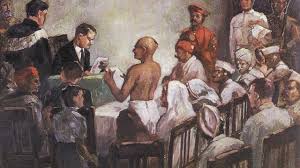
Source: http://www.columbia.edu/itc/mealac/pritche...

Enjoyed this speech? Speakola is a labour of love and I’d be very grateful if you would share, tweet or like it. Thank you.

Facebook Twitter Facebook
In 1920-39 Tags INDIA, PAKISTAN, MUSLIM INDIA, IQBAL, TRANSCRIPT
Comment

Mahatma Gandhi: 'There is no room for anarchism in India', Banaras University - 1916

August 6, 2015

4 February, 1916, Banaras University, Varanasi, India

Pandit Malaviya had invited Gandhi to speak on the occasion of the opening of the Banaras Hindu University. There were threats against his life, and the dais was surrounded by security forces.

I wish to tender my humble apology for the long delay that took place before I was able to reach this place. And you will readily accept the apology when I tell you that I am not responsible for the delay nor is any human agency responsible for it. The fact is that I am like animal on show, and my keepers in their overkindness always manage to neglect a necessary chapter in this life, and, that is, pure accident. In this case, they did not provide for the series of accidents that happened to us-to me, keepers, and my carriers. Hence this delay.

Friends, under the influence of the matchless eloquence of Mrs. Besant who has just sat down, pray, do not believe that our University has become a finished product, and that all the young men who are to come to the University, that has yet to rise and come into existence, have also come and returned from it finished citizens of a great empire. Do not go away with any such impression, and if you, the student world to which my remarks are supposed to be addressed this evening, consider for one moment that the spiritual life, for which this country is noted and for which this country has no rival, can be transmitted through the lip, pray, believe me, you are wrong. You will never be able merely through the lip, to give the message that India, I hope, will one day deliver to the world. I myself have been fed up with speeches and lectures. I except the lectures that have been delivered here during the last two days from this category, because they are necessary. But I do venture to suggest to you that we have now reached almost the end of our resources in speech-making; it is not enough that our ears are feasted, that our eyes are feasted, but it is necessary that our hearts have got to be touched and that out hands and feet have got to be moved.

We have been told during the last two days how necessary it is, if we are to retain our hold upon the simplicity of Indian character, that our hands and feet should move in unison with our hearts. But this is only by way of preface. I wanted to say it is a matter of deep humiliation and shame for us that I am compelled this evening under the shadow of this great college, in this sacred city, to address my countrymen in a language that is foreign to me. I know that if I was appointed an examiner, to examine all those who have been attending during these two days this series of lectures, most of those who might be examined upon these lectures would fail. And why? Because they have not been touched.

I was present at the sessions of the great Congress in the month of December. There was a much vaster audience, and will you believe me when I tell you that the only speeches that touched the huge audience in Bombay were the speeches that were delivered in Hindustani? In Bombay, mind you, not in Banaras where everybody speaks Hindi. But between the vernaculars of the Bombay Presidency on the one hand and Hindi on the other, no such great dividing line exists as there does between English and the sister language of India; and the Congress audience was better able to follow the speakers in Hindi. I am hoping that this University will see to it that the youths who come to it will receive their instruction through the medium of their vernaculars. Our languages are the reflection of ourselves, and if you tell me that our languages are too poor to express the best thought, then say that the sooner we are wiped out of existence the better for us. Is there a man who dreams that English can ever become the national language of India? Why this handicap on the nation? Just consider for one moment what an equal race our lads have to run with every English lad.

I had the privilege of a close conversation with some Poona professors. They assured me that every Indian youth, because he reached his knowledge through the English language, lost at least six precious years of life. Multiply that by the numbers of students turned out by our schools and colleges, and find out for yourselves how many thousand years have been lost to the nation. The charge against us is that we have no initiative. How can we have any, if we are to devote the precious years of our life to the mastery of a foreign tongue? We fail in this attempt also. Was it possible for any speaker yesterday and today to impress his audience as was possible for Mr. Higginbotham? It was not the fault of the previous speakers that they could not engage the audience. They had more than substance enough for us in their addresses. But their addresses could not go home to us. I have heard it said that after all it is English educated India which is leading and and which is doing all the things for the nation. It would be monstrous if it were otherwise. The only education we receive is English education. Surely we must show something for it. But suppose that we had been receiving during the past fifty years education through our vernaculars, what should we have today? We should have today a free India, we should have our educated men, not as if they were foreigners in their own land but speaking to the heart of the nation; they would be working amongst the poorest of the poor, and whatever they would have gained during these fifty years would be a heritage for the nation. Today even our wives are not the sharers in our best thought. Look at Professor Bose and Professor Ray and their brilliant researches. Is it not a shame that their researches are not the common property of the masses?

Let us now turn to another subject.

The Congress has passed a resolution about self-government, and I have no doubt that the All-India Congress Committee and the Muslim League will do their duty and come forward with some tangible suggestions. But I, for one, must frankly confess that I am not so much interested in what they will be able to produce as I am interested in anything that the student world is going to produce or the masses are going to produce. No paper contribution will ever give us self-government. No amount of speeches will ever make us fit for self-government. It is only our conduct that will fit for us it. And how are we trying to govern ourselves?

I want to think audibly this evening. I do not want to make a speech and if you find me this evening speaking without reserve, pray, consider that you are only sharing the thoughts of a man who allows himself to think audibly, and if you think that I seem to transgress the limits that courtesy imposes upon me, pardon me for the liberty I may be taking. I visited the Vishwanath temple last evening, and ad I was walking through those lanes, these were the thoughts that touched me. If a stranger dropped from above on to this great temple, and he had to consider what we as Hindus were, would he not be justified in condemning us? Is not this great temple a reflection of our own character? I speak feelingly, as a Hindu. Is it right that the lanes of our sacred temple should be as dirty as they are? The houses round about are built anyhow. The lanes are tortuous and narrow. If even our temples are not models of roominess and cleanliness, what can our self-government be? Shall our temples be abodes of holiness, cleanliness and peace as soon as the English have retired from India, either of their own pleasure or by compulsion, bag and baggage?

I entirely agree with the President of the Congress that before we think of self-government, we shall have to do the necessary plodding. In every city there are two divisions, the cantonment and the city proper. The city mostly is a stinking den. But we are a people unused to city life. But if we want city life, we cannot reproduce the easy-going hamlet life. It is not comforting to think that people walk about the streets of Indian Bombay under the perpetual fear of dwellers in the storeyed building spitting upon them. I do a great deal of railway travelling. I observe the difficulty of third-class passengers. But the railway administration is by no means to blame for all their hard lot. We do not know the elementary laws of cleanliness. We spit anywhere on the carriage floor, irrespective of the thoughts that it is often used as sleeping space. We do not trouble ourselves as to how we use it; the result is indescribable filth in the compartment. The so-called better class passengers over we their less fortunate brethern. Among them I have seen the student world also; sometimes they behave no better. They can speak English and they have worn Norfolk jackets and, therefore, claim the right to force their way in and command seating accommodation.

I have turned the searchlight all over, and as you have given me the privilege of speaking to you, I am laying my heart bare. Surely we must set these things right in our progress towards self-government. I now introduce you to another scene. His Highness the Maharaja who presided yesterday over our deliberations spoke about the poverty of India. Other speakers laid great stress upon it. But what did we witness in the great pandal in which the foundation ceremony was performed by the Viceroy? Certain it a most gorgeous show, an exhibition of jewellery, which made a splendid feast for the eyes of the greatest jeweller who chose to come from Paris. I compare with the richly bedecked noble men the millions of the poor. And I feel like saying to these noble men, “There is no salvation for India unless you strip yourselves of this jewellery and hold it in trust for your countrymen in India.” I am sure it is not the desire of the King-Emperor or Lord Hardinge that in order to show the truest loyalty to our King-Emperor, it is necessary for us to ransack our jewellery boxes and to appear bedecked from top to toe. I would undertake, at the peril of my life, to bring to you a message from King George himself that he excepts nothing of the kind.

Sir, whenever I hear of a great palace rising in any great city of India, be it in British India or be it in India which is ruled by our great chiefs, I become jealous at once, and say, “Oh, it is the money that has come from the agriculturists.” Over seventy-five per cent of the population are agriculturists and Mr. Higginbotham told us last night in his own felicitous language, that they are the men who grow two blades of grass in the place of one. But there cannot be much spirit of self-government about us, if we take away or allow others to take away from them almost the whole of the results of their labour. Our salvation can only come through the farmer. Neither the lawyers, nor the doctors, nor the rich landlords are going to secure it.

Now, last but not the least, it is my bounden duty to refer to what agitated our minds during these two or three days. All of us have had many anxious moments while the Viceroy was going through the streets of Banaras. There were detectives stationed in many places. We were horrified. We asked ourselves, “Why this distrust?” Is it not better that even Lord Hardinge should die than live a living death? But a representative of a mighty sovereign may not. He might find it necessary to impose these detectives on us? We may foam, we may fret, we may resent, but let us not forget that India of today in her impatience has produced an army of anarchists. I myself am an anarchist, but of another type. But there is a class of anarchists amongst us, and if I was able to reach this class, I would say to them that their anarchism has no room in India, if India is to conqueror. It is a sign of fear. If we trust and fear God, we shall have to fear no one, not the Maharajas, not the Viceroys, not the detectives, not even King George.

I honour the anarchist for his love of the country. I honour him for his bravery in being willing to die for his country; but I ask him-is killing honourable? Is the dagger of an assassin a fit precursor of an honourable death? I deny it. There is no warrant for such methods in any scriptures. If I found it necessary for the salvation of India that the English should retire, that they should be driven out, I would not hesitate to declare that they would have to go, and I hope I would be prepared to die in defence of that belief. That would, in my opinion, be an honourable death. The bomb-thrower creates secret plots, is afraid to come out into the open, and when caught pays the penalty of misdirected zeal.

I have been told, “Had we not done this, had some people not thrown bombs, we should never have gained what we have got with reference to the partition movement.” (Mrs. Besant : ‘Please stop it.’) This was what I said in Bengal when Mr. Lyon presided at the meeting. I think what I am saying is necessary. If I am told to stop I shall obey. (Turning to the Chairman) I await your orders. If you consider that by my speaking as I am, I am not serving the country and the empire I shall certainly stop. (Cries of ‘Go on.’) (The Chairman : ‘Please, explain your object.’) I am simply. . . (another interruption). My friends, please do not resent this interruption. If Mrs. Besant this evening suggests that I should stop, she does so because she loves India so well, and she considers that I am erring in thinking audibly before you young men. But even so, I simply say this, that I want to purge India of this atmosphere of suspicion on either side, if we are to reach our goal; we should have an empire which is to be based upon mutual love and mutual trust. Is it not better that we talk under the shadow of this college than that we should be talking irresponsibly in our homes? I consider that it is much better that we talk these things openly. I have done so with excellent results before now. I know that there is nothing that the students do not know. I am, therefore, turning the searchlight towards ourselves. I hold the name of my country so dear to me that I exchange these thoughts with you, and submit to you that there is no room for anarchism in India. Let us frankly and openly say whatever we want to say our rulers, and face the consequences if what we have to say does not please them. But let us not abuse.

I was talking the other day to a member of the much-abused Civil Service. I have not very much in common with the members of that Service, but I could not help admiring the manner in which he was speaking to me. He said : “Mr. Gandhi, do you for one moment suppose that all we, Civil Servants, are a bad lot, that we want to oppress the people whom we have come to govern?” “No,,” I said. “Then if you get an opportunity put in a word for the much-abused Civil Service.” And I am here to put in that word. Yes, many members of the Indian Civil Service are most decidedly overbearing; they are tyrannical, at times thoughtless. Many other adjectives may be used. I grant all these things and I grant also that after having lived in India for a certain number of years some of them become somewhat degraded. But what does that signify? They were gentlemen before they came here, and if they have lost some of the moral fibre, it is a reflection upon ourselves.

Just think out for yourselves, if a man who was good yesterday has become bad after having come in contact with me, is he responsible that he has deteriorated or am I? The atmosphere of sycophancy and falsity that surrounds them on their coming to India demoralizes them, as it would many of us. It is well to take the blame sometimes. If we are to receive self-government, we shall have to take it. We shall never be granted self-government. Look at the history of the British Empire and the British nation; freedom loving as it is, it will not be a party to give freedom to a people who will not take it themselves. Learn your lesson if you wish to from the Boer War. Those who were enemies of that empire only a few years ago have now become friends. . . .

(At this point there was an interruption and a movement on the platform to leave. The speech, therefore, ended here abruptly.)

Source: http://www.gandhi-manibhavan.org/gandhicom...

Enjoyed this speech? Speakola is a labour of love and I’d be very grateful if you would share, tweet or like it. Thank you.

Facebook Twitter Facebook
In 1900-19 Tags INDIA, INDEPENDENCE, GANDHI, TRANSCRIPT
Comment

Jawaharlal Nehru: 'Tryst with Destiny', Independence for India - 1947

June 30, 2015

14 August 1947, Dehli, India

Long years ago we made a tryst with destiny, and now the time comes when we shall redeem our pledge, not wholly or in full measure, but very substantially. At the stroke of the midnight hour, when the world sleeps, India will awake to life and freedom. A moment comes, which comes but rarely in history, when we step out from the old to the new, when an age ends, and when the soul of a nation, long supressed, finds utterance. It is fitting that at this solemn moment we take the pledge of dedication to the service of Inida and her people and to the still larger cause of humanity.

At the dawn of history India started on her unending quest, and trackless centuries are filled with her striving and the grandeur of her success and her failures. Through good and ill fortune alike she has never lost sight of that quest or forgotten the ideals which gave her strength. We end today a period of ill fortune and India discovers herself again. The achievement we celebrate today is but a step, an opening of opportunity, to the greater triumphs and achievements that await us. Are we brave enough and wise enough to grasp this opportunity and accept the challenge of the future?

Freedom and power bring responsibility. The responsibility rests upon this Assembly, a sovereign body representing the sovereign people of India. Before the birth of freedom we have endured all the pains of labour and our hearts are heavy with the memory of this sorrow. Some of those pains continue even now. Nevertheless, the past is over and it is the future that beckons to us now.

That future is not one of ease or resting but of incessant striving so that we may fulfil the pledges we have so often taken and the one we shall take today. The service of India means the service of the millions who suffer. It means the ending of poverty and ignorance and disease and inequality of opportunity. The ambition of the greatest man of our generation has been to wipe every tear from every eye. That may be beyond us, but as long as there are tears and suffering, so long our work will not be over.

And so we have to labour and to work, and work hard, to give reality to our dreams. Those dreams are for India, but they are also for the world, for all the nations and peoples are too closely knit together today for any one of them to imagine that it can live apart Peace has been said to be indivisible; so is freedom, so is prosperity now, and so also is disaster in this One World that can no longer be split into isolated fragments.

To the people of India, whose representatives we are, we make an appeal to join us with faith and confidence in this great adventure. This is no time for petty and destructive criticism, no time for ill-will or blaming others. We have to build the noble mansion of free India where all her children may dwell.

The appointed day has come-the day appointed by destiny-and India stands forth again, after long slumber and struggle, awake, vital, free and independent. The past clings on to us still in some measure and we have to do much before we redeem the pledges we have so often taken. Yet the turning-point is past, and history begins anew for us, the history which we shall live and act and others will write about.

It is a fateful moment for us in India, for all Asia and for the world. A new star rises, the star of freedom in the East, a new hope comes into being, a vision long cherished materializes. May the star never set and that hope never be betrayed!

We rejoice in that freedom, even though clouds surround us, and many of our people are sorrowstricken and difficult problems encompass us. But freedom brings responsibilities and burdens and we have to face them in the spirit of a free and disciplined people.

On this day our first thoughts go to the architect of this freedom, the Father of our Nation [Gandhi], who, embodying the old spirit of India, held aloft the torch of freedom and lighted up the darkness that surrounded us. We have often been unworthy followers of his and have strayed from his message, but not only we but succeeding generations will remember this message and bear the imprint in their hearts of this great son of India, magnificent in his faith and strength and courage and humility. We shall never allow that torch of freedom to be blown out, however high the wind or stormy the tempest.

Our next thoughts must be of the unknown volunteers and soldiers of freedom who, without praise or reward, have served India even unto death.

We think also of our brothers and sisters who have been cut off from us by political boundaries and who unhappily cannot share at present in the freedom

that has come. They are of us and will remain of us whatever may happen, and we shall be sharers in their good [or] ill fortune alike.

The future beckons to us. Whither do we go and what shall be our endeavour? To bring freedom and opportunity to the common man, to the peasants and workers of India; to fight and end poverty and ignorance and disease; to build up a prosperous, democratic and progressive nation, and to create social, economic and political institutions which will ensure justice and fullness of life to every man and woman.

We have hard work ahead. There is no resting for any one of us till we redeem our pledge in full, till we make all the people of India what destiny intended them to be. We are citizens of a great country on the verge of bold advance, and we have to live up to that high standard. All of us, to whatever religion we may belong, are equally the children of India with equal rights, privileges and obligations. We cannot encourage communalism or narrow-mindedness, for no nation can be great whose people are narrow in thought or in action.

To the nations and peoples of the world we send greetings and pledge ourselves to cooperate with them in furthering peace, freedom and democracy.

And to India, our much-loved motherland, the ancient, the eternal and the ever-new, we pay our reverent homage and we bind ourselves afresh to her service.

Source: http://legacy.fordham.edu/halsall/mod/1947...

Enjoyed this speech? Speakola is a labour of love and I’d be very grateful if you would share, tweet or like it. Thank you.

Facebook Twitter Facebook
In 1940-59 Tags INDIA, NEHRU, INDEPENDENCE, TRANSCRIPT
Comment

See my film!

Limited Australian Season

March 2025

Details and ticket bookings at

angeandtheboss.com

Support Speakola

Hi speech lovers,
With costs of hosting website and podcast, this labour of love has become a difficult financial proposition in recent times. If you can afford a donation, it will help Speakola survive and prosper.

Best wishes,
Tony Wilson.

Become a Patron!

Learn more about supporting Speakola.

Featured political

Featured
Jon Stewart: "They responded in five seconds", 9-11 first responders, Address to Congress - 2019
Jacinda Ardern: 'They were New Zealanders. They are us', Address to Parliament following Christchurch massacre - 2019
Dolores Ibárruri: "¡No Pasarán!, They shall not pass!', Defense of 2nd Spanish Republic - 1936
Jimmy Reid: 'A rat race is for rats. We're not rats', Rectorial address, Glasgow University - 1972

Featured eulogies

Featured
For Geoffrey Tozer: 'I have to say we all let him down', by Paul Keating - 2009
for James Baldwin: 'Jimmy. You crowned us', by Toni Morrison - 1988
for Michael Gordon: '13 days ago my Dad’s big, beautiful, generous heart suddenly stopped beating', by Scott and Sarah Gordon - 2018

Featured commencement

Featured
Tara Westover: 'Your avatar isn't real, it isn't terribly far from a lie', The Un-Instagrammable Self, Northeastern University - 2019
Tim Minchin: 'Being an artist requires massive reserves of self-belief', WAAPA - 2019
Atul Gawande: 'Curiosity and What Equality Really Means', UCLA Medical School - 2018
Abby Wambach: 'We are the wolves', Barnard College - 2018
Eric Idle: 'America is 300 million people all walking in the same direction, singing 'I Did It My Way'', Whitman College - 2013
Shirley Chisholm: ;America has gone to sleep', Greenfield High School - 1983

Featured sport

Featured
Joe Marler: 'Get back on the horse', Harlequins v Bath pre game interview - 2019
Ray Lewis : 'The greatest pain of my life is the reason I'm standing here today', 52 Cards -
Mel Jones: 'If she was Bradman on the field, she was definitely Keith Miller off the field', Betty Wilson's induction into Australian Cricket Hall of Fame - 2017
Jeff Thomson: 'It’s all those people that help you as kids', Hall of Fame - 2016

Fresh Tweets


Featured weddings

Featured
Dan Angelucci: 'The Best (Best Man) Speech of all time', for Don and Katherine - 2019
Hallerman Sisters: 'Oh sister now we have to let you gooooo!' for Caitlin & Johnny - 2015
Korey Soderman (via Kyle): 'All our lives I have used my voice to help Korey express his thoughts, so today, like always, I will be my brother’s voice' for Kyle and Jess - 2014

Featured Arts

Featured
Bruce Springsteen: 'They're keepers of some of the most beautiful sonic architecture in rock and roll', Induction U2 into Rock Hall of Fame - 2005
Olivia Colman: 'Done that bit. I think I have done that bit', BAFTA acceptance, Leading Actress - 2019
Axel Scheffler: 'The book wasn't called 'No Room on the Broom!', Illustrator of the Year, British Book Awards - 2018
Tina Fey: 'Only in comedy is an obedient white girl from the suburbs a diversity candidate', Kennedy Center Mark Twain Award -  2010
Tina Fey: 'Only in comedy is an obedient white girl from the suburbs a diversity candidate', Kennedy Center Mark Twain Award - 2010

Featured Debates

Featured
Sacha Baron Cohen: 'Just think what Goebbels might have done with Facebook', Anti Defamation League Leadership Award - 2019
Greta Thunberg: 'How dare you', UN Climate Action Summit - 2019
Charlie Munger: 'The Psychology of Human Misjudgment', Harvard University - 1995
Lawrence O'Donnell: 'The original sin of this country is that we invaders shot and murdered our way across the land killing every Native American that we could', The Last Word, 'Dakota' - 2016