• Genre
  • About
  • Submissions
  • Donate
  • Search
Menu

Speakola

All Speeches Great and Small
  • Genre
  • About
  • Submissions
  • Donate
  • Search
Share a political speech

Winston Churchill: 'The lights are going out on Europe', Public address - 1938

April 9, 2025

16 October 1938, London, United Kingdom

I avail myself with relief of the opportunity of speaking to the people of the United States. I do not know how long such liberties will be allowed. The stations of uncensored expression are closing down; the lights are going out; but there is still time for those to whom freedom and parliamentary government mean something, to consult together. Let me, then, speak in truth and earnestness while time remains.

The American people have, it seems to me, formed a true judgment upon the disaster which has befallen Europe. They realise, perhaps more clearly than the French and British publics have yet done, the far-reaching consequences of the abandonment and ruin of the Czechoslovak Republic. I hold to the conviction I expressed some months ago, that if in April, May or June, Great Britain, France, and Russia had jointly declared that they would act together upon Nazi Germany if Herr Hitler committed an act of unprovoked aggression against this small State, and if they had told Poland, Yugoslavia, and Rumania what they meant to do in good time, and invited them to join the combination of peace-defending Powers, I hold that the German Dictator would have been confronted with such a formidable array that he would have been deterred from his purpose. This would also have been an opportunity for all the peace-loving and moderate forces in Germany, together with the chiefs of the German Army, to make a great effort to re-establish something like sane and civilised conditions in their own country. If the risks of war which were run by France and Britain at the last moment had been boldly faced in good time, and plain declarations made, and meant, how different would our prospects be today!

But all these backward speculations belong to history. It is no good using hard words among friends about the past, and reproaching one another for what cannot be recalled. It is the future, not the past, that demands our earnest and anxious thought. We must recognize that the Parliamentary democracies and liberal, peaceful forces have everywhere sustained a defeat which leaves them weaker, morally and physically, to cope with dangers which have vastly grown. But the cause of freedom has in it a recuperative power and virtue which can draw from misfortune new hope and new strength. If ever there was a time when men and women who cherish the ideals of the founders of the British and American Constitutions should take earnest counsel with one another, that time is now.

All the world wishes for peace and security. Have we gained it by the sacrifice of the Czechoslovak Republic? Here was the model democratic State of Central Europe, a country where minorities were treated better than anywhere else. It has been deserted, destroyed and devoured. It is now being digested. The question which is of interest to a lot of ordinary people, common people, is whether this destruction of the Czechoslovak Republic will bring upon the world a blessing or a curse.

We must all hope it will bring a blessing; that after we have averted our gaze for a while from the process of subjugation and liquidation, everyone will breathe more freely; that a load will be taken off our chests; we shall be able to say to ourselves: "Well, that's out of the way, anyhow. Now let's get on with our regular daily life." But are these hopes well founded or are we merely making the best of what we had not the force and virtue to stop? That is the question that the English-speaking peoples in all their lands must ask themselves to-day. Is this the end, or is there more to come?

There is another question which arises out of this. Can peace, goodwill, and confidence be built upon submission to wrong-doing backed by force? One may put this question in the largest form. Has any benefit or progress ever been achieved by the human race by submission to organized and calculated violence? As we look back over the long story of the nations we must see that, on the contrary, their glory has been founded upon the spirit of resistance to tyranny and injustice, especially when these evils seemed to be backed by heavier force. Since the dawn of the Christian era a certain way of life has slowly been shaping itself among the Western peoples, and certain standards of conduct and government have come to be esteemed. After many miseries and prolonged confusion, there arose into the broad light of day the conception of the right of the individual; his right to be consulted in the government of his country; his right to invoke the law even against the State itself. Independent Courts of Justice were created to affirm and inforce this hard-won custom. Thus was assured throughout the English-speaking world, and in France by the stern lessons of the Revolution, what Kipling called, "Leave to live by no man's leave underneath the law." Now in this resides all that makes existence precious to man, and all that confers honour and health upon the State.

We are confronted with another theme. It is not a new theme; it leaps out upon us from the Dark Ages' racial persecution, religious intolerance, deprivation of free speech, the conception of the citizen as a mere soulless fraction of the State. To this has been added the cult of war. Children are to be taught in their earliest schooling the delights and profits of conquest and aggression. A whole mighty community has been drawn painfully, by severe privations, into a warlike frame. They are held in this condition, which they relish no more than we do, by a party organisation, several millions strong, who derive all kinds of profits, good and bad, from the upkeep of the regime. Like the Communists, the Nazis tolerate no opinion but their own. Like the Communists, they feed on hatred. Like the Communists, they must seek, from time to time, and always at shorter intervals, a new target, a new prize, a new victim. The Dictator, in all his pride, is held in the grip of his Party machine. He can go forward; he cannot go back. He must blood his hounds and show them sport, or else, like Actaeon of old, be devoured by them. All-strong without, he is all-weak within. As Byron wrote a hundred years ago: "These Pagod things of Sabre sway, with fronts of brass and feet of clay."

No one must, however, underrate the power and efficiency of a totalitarian state. Where the whole population of a great country, amiable, good-hearted, peace-loving people are gripped by the neck and by the hair by a Communist or a Nazi tyranny—for they are the same things spelt in different ways—the rulers for the time being can exercise a power for the purposes of war and external domination before which the ordinary free parliamentary societies are at a grievous practical disadvantage. We have to recognise this.

And then, on top of all, comes this wonderful mastery of the air which our century has discovered, but of which, alas, mankind has so far shown itself unworthy. Here is this air power with its claim to torture and terrorise the women and children, the civil population of neighbouring countries. This combination of medieval passion, a party caucus, the weapons of modern science, and the blackmailing power of air-bombing, is the most monstrous menace to peace, order and fertile progress that has appeared in the world since the Mongol invasions of the thirteenth century.

The culminating question to which I have been leading is whether the world as we have known it—the great and hopeful world of before the war, the world of increasing hope and enjoyment for the common man, the world of honoured tradition and expanding science—should meet this menace by submission or by resistance. Let us see, then, whether the means of resistance remain to us today. We have sustained an immense disaster; the renown of France is dimmed. In spite of her brave, efficient army, her influence is profoundly diminished. No one has a right to say that Britain, for all her blundering, has broken her word — indeed, when it was too late, she was better than her word. Nevertheless, Europe lies at this moment abashed and distracted before the triumphant assertions of dictatorial power. In the Spanish Peninsula, a purely Spanish quarrel has been carried by the intervention, or shall I say the "non-intervention" (to quote the current Jargon) of Dictators into the region of a world cause. But it is not only in Europe that these oppressions prevail. China is being torn to pieces by a military clique in Japan; the poor, tormented Chinese people there are making a brave and stubborn defence. The ancient empire of Ethiopia has been overrun. The Ethiopians were taught to look to the sanctity of public law, to the tribunal of many nations gathered in majestic union.

But all failed; they were deceived, and now they are winning back their right to live by beginning again from the bottom a struggle on primordial lines. Even in South America the Nazi regime begins to undermine the fabric of Brazilian society.

Far away, happily protected by the Atlantic and Pacific Oceans, you, the people of the United States, to whom I now have the chance to speak, are the spectators, and I may add the increasingly involved spectators of these tragedies and crimes. We are left in no doubt where American conviction and sympathies lie; but will you wait until British freedom and independence have succumbed, and then take up the cause when it is three-quarters ruined, yourselves alone? I hear that they are saying in the United States that because England and France have failed to do their duty therefore the American people can wash their hands of the whole business. This may be the passing mood of many people, but there is no sense in it. If things have got much worse, all the more must we try to cope with them.

For, after all, survey the remaining forces of civilisation; they are overwhelming. If only they were united in a common conception of right and duty, there would be no war. On the contrary, the German people, industrious, faithful, valiant, but alas! lacking in the proper spirit of civic independence, liberated from their present nightmare, would take their honoured place in the vanguard of human society. Alexander the Great remarked that the people of Asia were slaves because they had not learned to pronounce the word "No." Let that not be the epitaph of the English-speaking peoples or of Parliamentary democracy, or of France, or of the many surviving liberal States of Europe.

There, in one single word, is the resolve which the forces of freedom and progress, of tolerance and good will, should take. It is not in the power of one nation, however formidably armed, still less is it in the power of a small group of men, violent, ruthless men, who have always to cast their eyes back over their shoulders, to cramp and fetter the forward march of human destiny. The preponderant world forces are upon our side; they have but to be combined to be obeyed.

We must arm. Britain must arm. America must arm. If, through an earnest desire for peace, we have placed ourselves at a disadvantage, we must make up for it by redoubled exertions, and, if necessary, by fortitude in suffering. We shall, no doubt, arm. Britain, casting away the habits of centuries, will decree national service upon her citizens. The British people will stand erect, and will face whatever may be coming.

But arms—instrumentalities, as President Wilson called them—are not sufficient by themselves. We must add to them the power of ideas. People say we ought not to allow ourselves to be drawn into a theoretical antagonism between Nazidom and democracy; but the antagonism is here now. It is this very conflict of spiritual and moral ideas which gives the free countries a great part of their strength. You see these dictators on their pedestals, surrounded by the bayonets of their soldiers and the truncheons of their police. On all sides they are guarded by masses of armed men, cannons, aeroplanes, fortifications, and the like—they boast and vaunt themselves before the world, yet in their hearts there is unspoken fear. They are afraid of words and thoughts; words spoken abroad, thoughts stirring at home—all the more powerful because forbidden—terrify them. A little mouse of thought appears in the room, and even the mightiest potentates are thrown into panic. They make frantic efforts to bar our thoughts and words; they are afraid of the workings of the human mind. Cannons, airplanes, they can manufacture in large quantities; but how are they to quell the natural promptings of human nature, which after all these centuries of trial and progress has inherited a whole armoury of potent and indestructible knowledge?

Dictatorship—the fetish worship of one man—is a passing phase. A state of society where men may not speak their minds, where children denounce their parents to the police, where a business man or small shopkeeper ruins his competitor by telling tales about his private opinions; such a state of society cannot long endure if brought into contact with the healthy outside world. The light of civilised progress with its tolerances and co-operation, with its dignities and joys, has often in the past been blotted out. But I hold the belief that we have now at last got far enough ahead of barbarism to control it, and to avert it, if only we realise what is afoot and make up our minds in time. We shall do it in the end. But how much harder our toil for every day's delay!

Is this a call to war? Does anyone pretend that preparation for resistance to aggression is unleashing war? I declare it to be the sole guarantee of peace. We need the swift gathering of forces to confront not only military but moral aggression; the resolute and sober acceptance of their duty by the English-speaking peoples and by all the nations, great and small, who wish to walk with them. Their faithful and zealous comradeship would almost between night and morning clear the path of progress and banish from all our lives the fear which already darkens the sunlight to hundreds of millions of men.

Source: https://www.nationalchurchillmuseum.org/th...

Enjoyed this speech? Speakola is a labour of love and I’d be very grateful if you would share, tweet or like it. Thank you.

Facebook Twitter Facebook
In 1920-39 MORE Tags WINSTON CHURCHILL, PARLIAMENT, UNITED KINGDOM, 1930s, FASCISM, ANTI FASCISM, ARM, WARMONGERING, DEMOCRACY
Comment

Adolf Hitler: 'We must overcome the demoralization of Germany by the Communists', first radio address as Chancellor - 1933

March 17, 2023

1 February 1933, Berlin, Germany

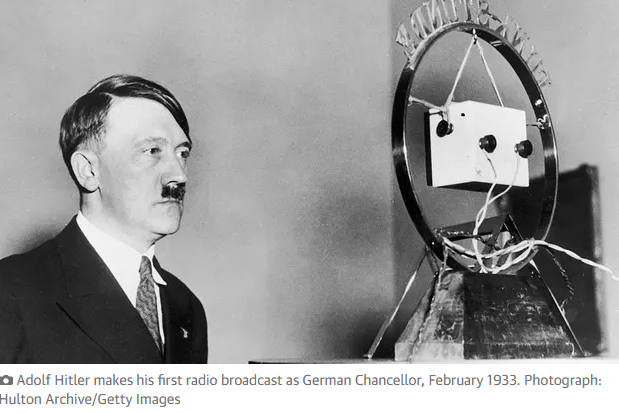
On February 1, 1933, two days after he was appointed chancellor, Hitler spoke over the radio to the German people about his vision for the future of the country:

Over fourteen years have passed since that unhappy day when the German people, blinded by promises made by those at home and abroad, forgot the highest values of our past, of the Reich, of its honor and its freedom, and thereby lost everything. Since those days of treason, the Almighty has withdrawn his blessing from our nation. Discord and hatred have moved in. Filled with the deepest distress, millions of the best German men and women from all walks of life see the unity of the nation disintegrating in a welter of egotistical political opinions, economic interests, and ideological conflicts.

As so often in our history, Germany, since the day the revolution broke out, presents a picture of heartbreaking disunity. We did not receive the equality and fraternity which was promised us; instead we lost our freedom. The breakdown of the unity of mind and will of our nation at home was followed by the collapse of its political position abroad.

We have a burning conviction that the German people in 1914 went into the great battle without any thought of personal guilt [for the start of the war] and weighed down only by the burden of having to defend the Reich from attack, to defend the freedom and material existence of the German people. In the appalling fate that has dogged us since November 1918 we see only the consequence of our inward collapse. But the rest of the world is no less shaken by great crises. The historical balance of power, which at one time contributed not a little to the understanding of the necessity for solidarity among the nations, with all the economic advantages resulting therefrom, has been destroyed.

The delusion that some are the conquerors and others the conquered destroys the trust between nations and thereby also destroys the world economy. But the misery of our people is terrible! The starving industrial proletariat [working class] have become unemployed in their millions, while the whole middle and artisan class have been made paupers. If the German farmer also is involved in this collapse we shall be faced with a catastrophe of vast proportions. For in that case, there will collapse not only a Reich, but also a 2000-year-old inheritance of the highest works of human culture and civilization.

All around us are symptoms portending this breakdown. With an unparalleled effort of will and of brute force the Communist method of madness is trying as a last resort to poison and undermine an inwardly shaken and uprooted nation. They seek to drive it towards an epoch which would correspond even less to the promises of the Communist speakers of today than did the epoch now drawing to a close to the promises of the same emissaries in November 1918.

Starting with the family, and including all notions of honor and loyalty, nation and fatherland, culture and economy, even the eternal foundations of our morals and our faith—nothing is spared by this negative, totally destructive ideology. . . . One year of Bolshevism would destroy Germany. The richest and most beautiful areas of world civilization would be transformed into chaos and a heap of ruins. Even the misery of the past decade and a half could not be compared with the affliction of a Europe in whose heart the red flag of destruction had been planted. The thousands of injured, the countless dead which this battle has already cost Germany may stand as a presage of the disaster.

In these hours of overwhelming concern for the existence and the future of the German nation, the venerable World War leader [President Paul von Hindenburg] appealed to us men of the nationalist parties and associations to fight under him again as once we did at the front, but now loyally united for the salvation of the Reich at home. The revered President of the Reich having with such generosity joined hands with us in a common pledge, we nationalist leaders would vow before God, our conscience and our people that we shall doggedly and with determination fulfill the mission entrusted to us as the National Government.

It is an appalling inheritance which we are taking over.

The task before us is the most difficult which has faced German statesmen in living memory. But we all have unbounded confidence, for we believe in our nation and in its eternal values. Farmers, workers, and the middle class must unite to contribute the bricks wherewith to build the new Reich.

The National Government will therefore regard it as its first and supreme task to restore to the German people unity of mind and will. It will preserve and defend the foundations on which the strength of our nation rests. It will take under its firm protection Christianity as the basis of our morality, and the family as the nucleus of our nation and our state. Standing above estates [groups that make up society’s social hierarchy] and classes, it will bring back to our people the consciousness of its racial and political unity and the obligations arising therefrom. It wishes to base the education of German youth on respect for our great past and pride in our old traditions. . . . Germany must not and will not sink into Communist anarchy.

In place of our turbulent instincts, it will make national discipline govern our life. In the process it will take into account all the institutions which are the true safeguards of the strength and power of our nation.

The National Government will carry out the great task of reorganizing our national economy with two big Four-Year Plans:

Saving the German farmer so that the nation’s food supply and thus the life of the nation shall be secured.
       

Saving the German worker by a massive and comprehensive attack on unemployment.

In fourteen years the November parties have ruined the German farmer. In fourteen years they created an army of millions of unemployed. The National Government will carry out the following plan with iron resolution and dogged perseverance. Within four years the German farmer must be saved from pauperism. Within four years unemployment must be completely overcome . . .

Our concern to provide daily bread will be equally a concern for the fulfillment of the responsibilities of society to those who are old and sick. The best safeguard against any experiment which might endanger the currency lies in economical administration, the promotion of work, and the preservation of agriculture, as well as in the use of individual initiative.

In foreign policy, the National Government will see its highest mission in the preservation of our people’s right to an independent life and in the regaining thereby of their freedom. The determination of this Government to put an end to the chaotic conditions in Germany is a step towards the integration into the community of nations of a state having equal status and therefore equal rights with the rest. In so doing, the Government is aware of its great obligation to support, as the Government of a free and equal nation, that maintenance and consolidation of peace which the world needs today more than ever before. May all others understand our position and so help to ensure that this sincere desire for the welfare of Europe and of the whole world shall find fulfillment.

Despite our love for our Army as the bearer of our arms and the symbol of our great past, we should be happy if the world, by restricting its armaments, made unnecessary any increase in our own weapons.

But if Germany is to experience this political and economic revival and conscientiously to fulfill its duties towards other nations, a decisive act is required: We must overcome the demoralization of Germany by the Communists.

We, men of this Government, feel responsible to German history for the reconstitution of a proper national body so that we may finally overcome the insanity of class and class warfare. We do not recognize classes, but only the German people, its millions of farmers, citizens and workers who together will either overcome this time of distress or succumb to it.

With resolution and fidelity to our oath, seeing the powerlessness of the present Reichstag to shoulder the task we advocate, we wish to commit it to the whole German people.

We therefore appeal now to the German people to sign this act of mutual reconciliation. The Government of the National Uprising [the Nazi-led government] wishes to set to work, and it will work. It has not for fourteen years brought ruin to the German nation; it wants to lead it to the summit. It is determined to make amends in four years for the liabilities of fourteen years. But it cannot subject the work of reconstruction to the will of those who were responsible for the breakdown.

The Marxist parties [political parties including the Social Democrats] and their followers had fourteen years to prove their abilities. The result is a heap of ruins. Now, German people, give us four years and then judge us.

Let us begin, loyal to the command of the Field-Marshal. May Almighty God favor our work, shape our will in the right way, bless our vision and bless us with the trust of our people. We have no desire to fight for ourselves; only for Germany.

Source: https://www.facinghistory.org/resource-lib...

Enjoyed this speech? Speakola is a labour of love and I’d be very grateful if you would share, tweet or like it. Thank you.

Facebook Twitter Facebook
In 1920-39 MORE Tags ADOLF HITLER, RADIO ADDRESS, CHANCELLOR, VICTORY SPEECH, GERMANY, NAZI, NAZISM, AUTHORITARIANISM, 1930s, 1933
Comment

Adolf Hitler: 'Now the German Volk has awakened!', closing speech at Nazi congress - 1938

March 9, 2022

12 September 1938, Nuremberg, Germany

Today we feel doubly close to those times because first of all, in our midst we see the fighters of the eldest German Ostmark who until recently were subject to a like persecution because of their National Socialist conviction. They stand amongst us today as Volksgenossen and citizens of the German Reich. What have they not had to go through, suffer through?! How many of their comrades were slain, how many injured in body and spirit, how many lost their livelihoods for many years, and how many ten thousands were imprisoned in jails, penitentiaries and Anhaltelagers?! The second reason for which we reflect upon these times with particular emotion is the fact that the events we experienced and suffered in our own nation at the time are precisely those we are witnessing on the world stage today.

And above all: our enemies today remain weltanschaulich the very same ones.

Almost every year, we could step before the nation with quiet confidence and await its judgment. The greatest approval ever granted the leadership of a Volk became ours on April 10 of this year. The Volk acknowledged and confirmed that it regards the new form of state and its leadership as institutions that strive to the best of their abilities to serve the Volk and to lead it once more to freedom and greatness and to ensure its economic well-being.

And still, what we are witnessing today on a larger scale is precisely the same we experienced in the decades of internal struggle. Ever since the day we assumed power, we have been surrounded by a hostile environment. The connivance between the gilded, capitalist democratic movement in our parliament on the one hand and with Marxism on the other in their war on National Socialism is today mirrored in a like conspiracy, albeit on a larger scale, involving the democracies and the Bolshevists as they make war on the state constituted by the National Socialist Volksgemeinschaft.

Perhaps the most persuasive evidence of the insincerity of their fight against the National Socialist Party as it struggled for power at the time is the fact that no matter whether they were bourgeois nationalists, capitalist democrats, or Marxist internationalists, they formed a unitary front against us in all decisive battles. At the time, many of our Volksgenossen were forced to realize just how dishonest the political battle was and of how little import morals were in this fight as they saw those parties fighting us on nationalist grounds, yet were not reluctant to conspire with Marxist internationalists to that end.

And vice versa, our Volksgenossen had to realize just how dishonest and fraudulent those parties were who claimed to persecute us for socialist reasons and then went to ally themselves with the worst proponents of capitalism prior to entering into the unitary front against us. The Center Party claimed to be fighting us because we were hostile to the Church, and yet to this end it entered into a holy alliance with atheist Social Democrats and did not shrink from uniting with the Communists. And on the other hand, Communists fought us because, as they claimed, we represented the Reaktion in their eyes. Yet they cast their ballot together with the true reactionaries against the vote of the National Socialist Party in the Reichstag.

It was indeed a display of such duplicity that one could only turn from it in disgust. Today we feel equally repelled as we watch the so-called international world democracies who supposedly advocate liberty, fraternity, justice, the right to self-determination of the peoples, etc., as we see these states ally themselves with Bolshevist Moscow.349 One day, perhaps someone will ask why we concern ourselves so much with the democracies and why we treat them in so negative a manner. This is the case because: First, as those attacked we are forced to counter.

Second, the conduct of these phenomena is so revolting.

Dishonesty sets in the minute these democracies claim to represent government by the people and decry authoritarian states as dictatorships. I believe that I can confidently state that today there are only two world powers who can honestly claim to have 99 percent of their people backing the government. What in other countries goes by the name of democracy is in most cases little other than the apt manipulation of public opinion by means of money and the press, and the equally apt manipulation of the results hereby achieved. How easily, however, are these supposed democracies stripped bare of their pretenses when one takes a close look at their stance in matters of foreign policy which constantly change to suit the purpose of the moment. There we witness how truly repressive regimes in small countries are actually being glorified by these democracies if it suits their needs. Yes, they even go so far as to fight for them, while on the other hand, they themselves actively repress inconvenient rallies in those states where such protest does not suit them. They fail to acknowledge this activism, attempt to subvert it or simply misinterpret its significance. And this is not all: these democracies even glorify Bolshevist regimes if it happens to suit their purpose, and this in spite of the fact that the latter style themselves as the dictatorship of the proletariat.

In other words, these supposed democracies decry regimes that are backed by 99 percent of their constituents as dictatorships, while at the same time they praise other countries as highly respectable democratic institutions even though these call themselves dictatorships and even though these can only subsist on the basis of mass executions, torture, etc. Is it not one of the greatest ironies in history that in the midst of upright prototype democrats in Geneva, the blooddrenched proponent of one of the cruelest tyrannies of all time moves about freely as a highly respected member of the Council?350 We in Germany have already witnessed the alliance of Jewish capitalism with an abstract version of communist anti-capitalism, and we have seen the Rote Fahne, the Vorwarts and the Frankfurter Allgemeine Zeitung march hand in hand here. It is the same all over the world. Bolshevist Moscow has become the highly revered ally of capitalist democracies! [-] For fifteen years, they have acted in gruesome defiance of the most natural interests of their peoples, yes, acting contrary to any standards of human dignity. Indeed, they drew up Diktats with a pistol in hand only to, at a later date, lament the “unilateral” transgression of holy rights and the breach of all the more holy contracts. Without so much as a thought for the opinion of the natives, they have led a drive for the bloody subjugation of entire continents.

However, the minute that Germany mentions the return of its colonies, they declared that-out of concern for the indigenous people there-one could not possibly abandon the natives to so horrid a fate. At the same time, they did not distance themselves from dropping bombs out of planes onto their own colonies. And all this to use the force of reason to persuade the dear colored compatriots to submit to the foreign rule a hit longer. Of course, the bombs thus employed were bombs with civilizing warheads which one must absolutely not confuse with those brutal ones Italy used in Abyssinia.

Throughout the democratic countries, one laments the unimaginable cruelty with which first Germany, and now Italy as well, are striving to rid themselves of the Jewish element. However, all these great democratic empires have altogether little more than a few persons per square kilometer. In Italy and in Germany this number exceeds 140 persons. For decades, Germany nevertheless took in hundreds of thousands upon hundreds of thousands of Jews without batting an eyelid.

Now that the burden has become overbearing and the nation is no longer willing to have its life blood sucked out of it by these parasites, it is now that there is great lament abroad. However, not a word is heard in these democratic countries about replacing this hypocritical lamentation with a good deed and assistance. No, to the contrary, all one hears is cold reasoning claiming that in these states there is regretfully no space either! Evidently, they expect us to bear up under this burden of Jewry despite our 140 persons per square kilometer, while the democratic world empires with their few people per square kilometer could not possibly shoulder this burden. Alas, no help. But morals! And thus we find the National Socialist Reich faced with the same phenomenon and forces that we had fifteen years to get to know as a party.

Insofar as this is indicative of the hostile attitude of the democratic states toward Germany, this matters little to us. Besides, why should we fare any better than the Reich before us? On a side note, I will admit quite openly that I find it easier to bear insults from someone who can no longer rob me than to be robbed by someone who praises me for letting it happen. Today we are insulted. Yet we are in a position-praise the Lord-to prevent Germany from being ravaged and raped. The state before us was blackmailed for fifteen years.

For this, admittedly, it received compensation-the somewhat sparse recompense, at least in my eyes-of praise for having been a good little democratic state.

This comportment becomes unbearable for us the minute a major part of our Volk is placed at the mercy of impertinent abusers, ostensibly without any means of defending itself, while the brunt of democratic rhetoric pours forth as a threat to our Volksgenossen. I am speaking of Czecho-Slovakia.

This state is a democracy, that is to say it was founded on democratic principles. The majority of its people was simply forced to submit to the structure construed at Versailles without any one asking for its opinion. As a true democracy, this state immediately began to suppress the majority of its people, to abuse there and to rob them of their inalienable rights. Gradually, one attempted to impress upon the world that this state had a special military and political mission to fulfill.

The former French Minister of Aviation, Pierre Cot,352 has explained this to us recently. According to him, Czechoslovakia exists for the purpose of providing a base, in the event of war, for launching aerial attacks and dropping bombs upon German cities and industrial plants. Needless to say, we may assume that these will once again be equipped with those warheads of the famed civilizing variety.

However, this mission stands in opposition to the desires of the majority of the inhabitants of this state, and is alien to their philosophy of life and contrary to their vital interests. That is why the majority of its citizens were silenced. Any protest against this fate would have been an assault upon the aims incarnate in this state and hence would have been in violation of its constitution. Drawn up by the democrats, this constitution was less suited to realizing the rights of the people affected and was instead more tailored toward accommodating the political expediencies of the people’s oppressors. Political expediency necessitated as well that a structure be construed that accorded the Czech people a position of preeminence in this state. Whoever protested against this usurpation became an “enemy of the state” and hence, in accordance with democratic norms, he was outlawed. Providence has thus called upon the socalled people of the Czech state-admittedly voicing its intent through the good offices of the architects at Versailles-to stand guard lest someone rise in opposition to this ultimate purpose of the state.

Should someone nevertheless venture to step forth from amongst the majority of the oppressed peoples in this state and voice opposition to this end, then it is naturally permissible that he be beaten hack with the full force at the state’s disposal and, if so desire or need be, he could also simply be murdered.

If this now did not concern us, if this were some foreign affair, we, like so many others, might take note of it simply as a most interesting display of the democrats’ understanding of the rights of peoples to self-determination.

However, the nature of the affair involves an obligation of us Germans.

Amongst the suppressed minorities in this state, there are also three and a half million Germans, roughly as many people of our race as Denmark has in inhabitants.353 These Germans are God’s creatures as well. The Almighty has not created them so that the construction arrived at in Versailles might place them at the mercy of an alien power they hate. And He has not created seven million Czechs either so that they may reign over these three and a half million, keep them in tutelage, and even far less did He create them to ravage and torture.

The situation in this state has become unbearable, as is well known. In a political context, three and a half million people there are robbed of their right to self-determination in the name of the right to self-determination as construed by a certain Mister Wilson. In an economic context, these people are being ruined methodically and hence are subject to a slow but steady extermination.

The misery of the Sudeten Germans defies description. One desires to destroy them. In a humanitarian context, they are being oppressed and humiliated in an unprecedented fashion.

When three and a half million members of a Volk of eighty million may not sing a song they like because the Czechs dislike it, when they are beaten until they bleed simply because they wear stockings which the Czechs care not to see, when they are terrorized and abused because they greet one another in a fashion the Czechs cannot bear even though they were merely greeting one another and no Czech, when they are persecuted because of every little detail connected to the expression of their nationality, and when they are hunted down as though animals, yes, then this may leave those renowned representatives of democracy cold, who knows, they might actually enjoy it since those affected are a mere three and a half million Germans. All I can say to these representatives of democracy is that this does not leave us cold, no, if these tortured creatures can find neither justice nor help by themselves, then they will receive both from us. There must be an end to the injustice inflicted upon these people! I have already stated this quite openly in my speech of February 20. It was a short-sighted enterprise which the architects of Versailles conceived when they gave birth to the abnormal structure of the Czechoslovakian state. It could pursue its mission to ravage and rape a mass of millions of other nationalities only as long as the brother nations themselves suffered from the abuse inflicted upon the world at Versailles.

However, to believe that such a regime could continue to sin eternally and endlessly means to succumb to an inconceivable delusion. In my speech before the German Reichstag on February 20, I had pointed out that the Reich will no longer stand for any further oppression and persecution of these three and a half million Germans. And I implore all foreign statesmen not to think this mere rhetoric.

For the sake of peace in Europe, the National Socialist State has made enormous sacrifices, enormous sacrifices for the entire nation. It did not harbor any thoughts of so-called revenge; rather, it has banished all such thoughts from all private and public spheres of life. In the course of the seventeenth century, France slowly penetrated Alsace-Lorraine and took it from the Old German Reich in the midst of peacetime.

Following a dreadful war in 1870–71 which had been forced upon Germany, the Reich reclaimed these territories, and they were returned to it. They were lost once more after the World War. To us Germans, the cathedral in Strasbourg means a lot. And when we did not pursue the matter any further, we refrained only in the service of a lasting peace for Europe. No one could have forced us to cede these claims voluntarily had we not wished to give them up in the first place! We gave them up because we willed an end to this constant argument with France once and for all. The Reich has espoused a similar stance and has taken similarly determined steps along its other borders as well. Here National Socialism acted highly responsibly and set an example. We made the greatest of sacrifices and distanced ourselves voluntarily from any further demands so that Europe might enjoy a peaceful future and so that a passage might be cleared, at least on our part, for reconciliation of all peoples worldwide. We acted in an exceedingly loyal fashion.

Neither press, silver screen, nor stage were allowed to propagate a diverging opinion. Not even in literature did we allow for an exception. In a related spirit, I offered solutions for a reduction of tensions in Europe, an offer that was refused for reasons we still fail to comprehend. We voluntarily restricted our power in this important realm in the hope that we should never again be forced to use arms against this one other state in question.354 This did not happen because we would not have been able to produce 55 percent more ships; it occurred because we wished to contribute to a final reduction of tensions and to a pacification of the situation in Europe. Since we found a great patriot and statesman in Poland willing to enter into an agreement with Germany, we immediately seized the opportunity, and arrived at a treaty that no doubt is of far greater import to peace in Europe than all the talk in the halls of the League of Nations’ temple in Geneva.

Germany today possesses many a completely pacified border and Germany is determined, and has stated as much, to accept these borders as inviolable and unchangeable in order to give Europe a feeling of security and peace.

Apparently, however, this self-denial and self-discipline on the part of Germany has been misinterpreted as a sign of weakness. Hence today I would like to set things right: I do not believe that we would be rendering peace in Europe a great service if we pronounced our disinterest in all European affairs. In particular, Germany would not be doing anyone a great service if it remained unmoved by the suffering and plight of three and a half million Volksgenossen and if it did not take an interest in their fate. We understand when England and France pursue their interests in the world.

I wish to point out to the statesmen in Paris and London that there are German interests as well and that we are determined to pursue these under all circumstances. At this point I would like to remind them of my speech before the Reichstag in 1933, in which I openly avowed before all the world that there were questions of national concern in which our path was clearly predetermined. I would rather submit myself to any ordeal, danger, or torment than to fail in the fulfillment of such prerogatives.

No European state has done as much as Germany in the service of peace! No one has made greater sacrifices! One must bear in mind, however, that there is a limit as to how much one can sacrifice, and one should not confuse National Socialist Germany with the Germany of Bethmann-Hollweg and Herding.

When I make this declaration, I do so because of an event that occurred in the course of this year, an event that forces all of us to reconsider our stance to date. As you well know, my Party Comrades, Czechoslovakia has finally announced local elections to be held this year after infinitely postponing any form of plebiscite. Even Prague has finally admitted to the untenable nature of its present position. It fears the unity of the Germans and of the other nationalities. It is convinced that it has to resort to extraordinary measures in order to exert pressure in the election process and thus to manipulate the outcome of the election. Evidently, the Czechoslovakian Government has concluded that this can be achieved only through a brutal policy of intimidation.

Apparently, the Czech state felt that a display of its military might was particularly well suited to this end.

This was especially geared toward the Sudeten Germans to serve as a warning not to speak up for their national interests and to vote accordingly. In order to somehow justify this attempt at intimidation before the eyes of the world public, the Czech Government, i.e. Herr Beneš, fabricated the lie that German troops had been mobilized for an invasion of Czechoslovakia.

In this context, let me today state the following: the creation of such lies is nothing new. About a year ago, the press in a certain country invented a story according to which 20,000 German soldiers had landed in Morocco.356 The Jewish proponent of this lie in the press hoped to thereby cause a war.

At the time, it had sufficed to address a short statement to the French Ambassador to resolve the situation. And in this instance as well, we immediately assured the ambassador of another great power of the falsehood of the Czech allegations. The statement was issued once more, and the Prague Government was immediately informed of its content. Nevertheless, the Government in Prague exploited this deception as a pretext for its terrorist blackmail and manipulation of the election.357 All that I can do in retrospect is to assert that, for one, not one German soldier had been called up other than those serving anyway at this point in time.

Secondly, not one regiment, not one additional unit, had marched to the border.

Indeed, not one soldier served in a garrison other than the one assigned to him for peacetime during this period.

To the contrary, orders were issued to avoid taking any steps that might be construed as a means for exerting pressure on Czechoslovakia on our part.

Nonetheless, a base and vile campaign against us was launched in which all of Europe was organized in the service of a government in pursuit of criminal goals. This government’s sole ambition lay in the manipulation of the election by the exertion of military pressure in an effort to intimidate its citizens and thus rob them of their right to vote. And all this was merely a means of obtaining moral legitimacy which this government felt it needed. Indeed, it had no scruples to cast suspicion on one great state, to alarm all of Europe and to, if need be, plunge Europe into a bloody war.

The Reich Government undertook no such steps, and, in fact, Germany had no such intentions; quite to the contrary, it was convinced that the local elections would do justice to the Sudeten German cause. This lack of activity was then construed as a sign that the German Government stepped down because of the determined stance of the Czechs and of the early intervention by England and France.

You will understand, my Party Comrades, that a great power cannot tolerate such a base incursion [the partial mobilization of Czechoslovakian troops on May 20/21] a second time. As a consequence, I have taken the necessary precautions. I am a National Socialist and as such I am accustomed to strike back at any attacker. Moreover, I know only too well that leniency will not succeed in appeasing, but will merely encourage the arrogance of so irreconcilable an adversary as the Czechs.

Let the fate of the Old German Reich be a warning to us. Its love for peace drove it to the brink of self-destruction. Nonetheless, the Old Reich could not prevent the war in the end. In due consideration thereof, I took steps on May 28 which were very difficult: First, I ordered a far-reaching intensification and the immediate implementation and execution of the reinforcements announced for Army and Luftwaffe. Second, I ordered the immediate expansion of our fortifications to the West. I can assure you that ever since May 28, the construction of one of the most gigantic fortresses of all time has been underway there.

To this end, I entrusted Dr. Todt, the Generalinspekteur for road construction in Germany, with a new commission. Within the framework of the projects undertaken by the fortress construction inspectorate, he has achieved one of the greatest accomplishments of all time, thanks to his extraordinary organizational talents.

Let me point out a few figures to you. At present at work on the fortification of our Western frontier, a project actually begun over two years ago, are: 278,000 laborers in the Todt organization in addition to 84,000 [other] laborers, in addition to 100,000 men of the Reich Labor Service and numerous pioneer battalions and infantry divisions. Besides the materials that are brought to the construction sites via different transportation routes, the German Reichsbahn alone transports 8,000 freight cars a day.

The daily consumption of gravel amounts to over 100,000 tons. The fortification of Germany’s western border will be completed prior to the onset of winter. Its defensive capacity is already assured as of this day. Once completed, it will consist of over 17,000 armored plates and concrete structures. The German Volk in arms stands behind this front of steel and concrete made up of three fortified lines and in some locations actually consists of four fortified lines up to fifty kilometers deep. I have made this greatest effort of all time in the service of peace. Under no circumstances, however, am I willing to quietly stand by and observe from afar the continued oppression of German Volksgenossen in Czechoslovakia.

It’s all tactics. Herr Beneš talks, wants to organize negotiations. He wishes to resolve the question of procedure in accordance with the Geneva Conventions and hands out little favors to placate the people. Things cannot go on this way! This is not a question of empty diplomatic phrases. This is a question of right, the question of a right not granted. What we Germans demand is the right to self-determination, a right every Volk possesses, and not an empty phrase. Herr Beneš is not supposed to grant the Sudeten Germans any favors. They have a right to their own way of life, just as any other people do.

The consequences will be grave ones should, perchance, the democracies persist in their conviction that they must continue to, by any and all means, accord their protection to the oppression of German men and women! I believe it to be in the service of peace, if I leave no doubts as to this fact.

I am asking neither that Germany be allowed to oppress three and a half million Frenchmen, nor am I asking that three and a half million Englishmen be placed at our mercy. Rather I am simply demanding that the oppression of three and a half million Germans in Czechoslovakia cease and that the inalienable right to self-determination take its place.

We would truly regret if this were to cloud or damage our relations to the other European states. Yet the fault would not be ours. It is the business of the Czechoslovakian Government to come to terms with the true representatives of the Sudeten Germans and, in one way or another, to reach some form of understanding with them. Nevertheless, it is my business and, my Volksgenossen, it is the business of all of us to take care that justice not be perverted into injustice. After all, this matter involves our German Volksgenossen. I am not in the least willing to allow foreign statesmen to create a second Palestine right here in the heart of Germany. The poor Arabs are defenseless and have been abandoned by all. The Germans in Czechoslovakia are neither defenseless nor have they been abandoned. Please note this fact.

I feel compelled to broach this topic at that Party Congress in which the representatives of our German-Austrian Gaus participate for the first time.

Better than anyone else they know how painful it is to be separated from the mother country. Easier than anyone else they will grasp the full import of my exposition on this day. With greater enthusiasm than any, they will agree with me when I state before the entire Volk that we would not deserve to be Germans if we were not willing to take such a stance, and to bear up under the consequences one way or another.

When we bear in mind the intolerable impertinence with which even a small state dared to approach Germany in the last months, then we realize that the only explanation possible is revealed in the unwillingness to recognize that the German Reich is more than just a peace-loving, upstart state.

Standing in Rome in the springtime, I felt deep inside that we assess historic developments in far too restricted a manner, investigating time periods far too short to be revealing. One thousand or fifteen hundred years are no more than a few dynastic successions.

What exhausts itself in a certain period, can rise again in the same time period. Today’s Italy and today’s Germany are living proof of this. Both are nations that have regenerated, indeed, that might be regarded as new nations in this context. However, their roots spring not from the grounds of more recent ages but rather they reach back into ancient history. The Roman Empire breathes once more. The phenomenon of Germany as a state is not new either, although it has made its appearance more recently.

I had the insignias of the Old German Reich brought to Nuremberg for a reason. I wish to call to mind, and this not only for the benefit of the German people but also for that of all peoples, that more than half a millennium prior to the discovery of the new world, a gigantic Germanic-German Reich358 stood on these grounds. Dynasties came into being and dissipated. Outward forms changed. Yet while the Volk has been rejuvenated, its essence has remained the same it has always been. The German Reich has long been dormant.

Now the German Volk has awakened and once more bears its crown of 1,000 years high on its head. All of us who bear witness to this historic resurrection feel great pride and happiness. We stand before the Almighty in humble gratitude.

For the rest of the world this should be an inspiration as well as a lesson learned, an inspiration to reflect upon history from a more elevated point of view, and a lesson not to succumb to the same mistakes as in the past.

In truth the new Roman-Italian empire and the Germanic-German Reich are ancient structures. You need not love them and yet no power on earth shall ever again remove them.

Party Comrades! National Socialists! The first Reich Party Congress of Greater Germany ends at this hour. All of you are still under the spell of the great historic events of these past days. This demonstration of our Volk’s power and determination has reinforced the nation’s pride and your confidence in it.

Return to your homes now and carry in your hearts that same faith which you have cherished throughout almost two decades as Germans and as National Socialists.

You now have the right to proudly carry your heads high again as Germans.

It is the duty of all of us to never again bow our heads to any alien will. To this let us pledge ourselves, so help us God!

This depends exclusively on the power of our own weapons and, therefore, depends upon the carriers of those weapons themselves.

No negotiations, no conferences and no other agreement has accorded us Germans the natural right to unity. We had to take justice into our own hands, and we were able to do so thanks to your existence, my soldiers! And it is thus that the two greatest institutions of our Volk must fulfill two identical missions. National Socialism has to educate our Volk within to form this Vol ksgemeinschaft. The Wehrmacht has to instruct this same Volk to defend this Volksgemeinschaft outwardly. So it is you, my soldiers, who were immediately charged with the fulfillment of a mission in this new Reich. And this fulfillment has earned you the love of the German Volk. It relied upon you and it has realized that it can rely upon its sons in uniform. For you carry the best weapons available today, you receive the best training, and I know that you also possess the best of character.

You fit in well with the eternal, everlasting front constituted by Germany’s soldiers. In the past months, I repeatedly had the opportunity to convince myself of this. I saw it at the maneuver sites, shooting stands, and training camps, and it was with great contentment that I realized that the German nation can once more look to its soldiers with great pride. And it is that for which I thank you! Yet, we do not serve for the sake of gratitude, praise, or recompense unless this gratitude, praise and recompense is at the service of what we value the most in this world: our Volk and our German Reich!

Deutschland-Sieg Heil!

Source: https://der-fuehrer.org/reden/english/38-0...

Enjoyed this speech? Speakola is a labour of love and I’d be very grateful if you would share, tweet or like it. Thank you.

Facebook Twitter Facebook
In 1920-39 MORE Tags ADOLF HITLER, WW2, THREAT OF WAR, WORLD WAR 2, SUDETENLAND, SUDETEN, GERMANY, CZECH, CZECHOSLOVAKIA, NAZISM, NAZI, WESTERN FRONT, FORTIFICATIONS
Comment

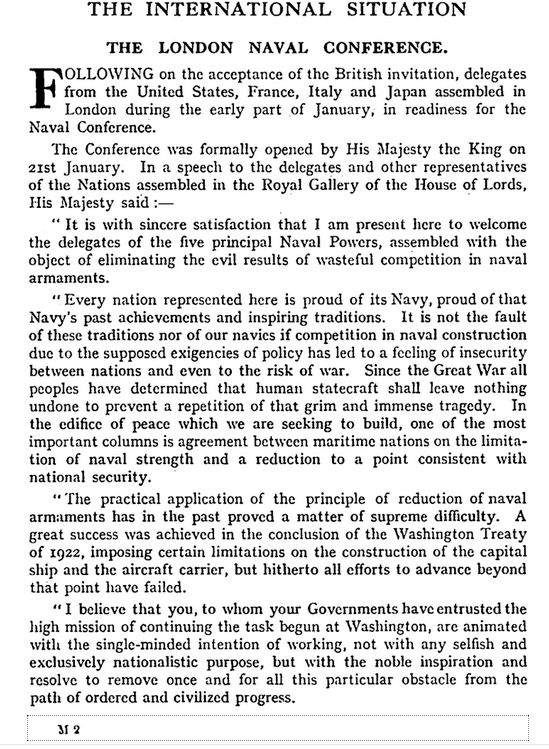
George V: 'Eliminating the evil results of wasteful competition', Five Power Naval Conference - 1930

January 28, 2022

21 January 1930, London, United Kingdom

Source: https://history.state.gov/milestones/1921-...

Enjoyed this speech? Speakola is a labour of love and I’d be very grateful if you would share, tweet or like it. Thank you.

Facebook Twitter Facebook
In 1920-39 MORE Tags KING GEORGE V, ROYALTY, OPENING, TRANSCRIPT, FIVE POWER NAVAL COFERENCE, DISARMAMENT, CONTAINMENT, DEMILITARISATION, UK, UNITED KINGDOM, USA, JAPAN, ITALY, FRANCE, EARLY RECORDING, RADIO, PARLIAMENT, RADIO BROADCAST, WINDSOR
Comment

Sardar Vallabhbhai Patel: 'You have called a simple farmer to the highest office' Presidential Address to Indian National Congress - 1931

October 16, 2019

Indian National Congress, Karachi, India

You have called a simple farmer to the highest office, to which any Indian can aspire. I am conscious that your choice of me as first servant is not so much for what little I might have done, but it is the recognition of the amazing sacrifice made by Gujarat for the honour. But in truth every Province did its utmost during the year of the greatest national awakening that we have known in modern times.

NON-VIOLENCE- NO IDLE DREAM

world that mass non-violence is no longer the idle dream of a visionary or a mere human longing, It is a solid fact capable of infinite possibilities for humanity, which is groaning for want of faith, beneath the weight of violence of which it has almost made a fetish. The greatest proof that our movement was 7 non-violent lies in the fact that the peasants falsified the fears of our worst skeptics. They were described as very difficult to organise' for non-violent action and it is they who stood the test with a bravery and an endurance that was beyond all expectation. Women and children too contributed their great share in the fight. They responded to the call by instinct and played a part which we are too near the even adequately to measure. Looked at in the light of non-violence our struggle is a world struggle and it is a matter of great satisfaction that the nations of the earth, especially the United States of America, have heartened us by their sympathy.

The recent settlement however renders it unnecessary to dwell at greater length upon this heroic period in the national life. Your Working Committee has entered into the Settlement in anticipation of your approval. You are now invited formally to endorse it. The Committee having accepted it as your accredited representatives, it is not, I take it, open to you to repudiate it; but it is open to you to pass a vote of no-confidence in the present executive and appoint better agents. But whilst it is but meet that I should draw your attention to the constitutional position, I have no doubt what so ever that you will endorse the settlement which I hold to be perfectly honourable for both the parties. Had we not accepted the settlement we should have put ourselves in the wrong and thereby undone the effect of the sufferings of the past year. Indeed we had always claimed, as Satyagrahis must claim, to be ready and eager for peace. When therefore, the way seemed to be open for peace, we took it. In view of the clear demand on the part of the British Indian Delegation at the Round Table Conference for full responsibility, and in view of the British parties having accepted the position and in view of the appeal made to the Congress by the Premier, the Viceroy and many of our distinguished countrymen, the Working Committee thought that if an honourable truce could be arranged and if it was open to the Congress to press without any reservation for what is considered to be the best for the country, the Congress should, if invited, take part in the Conference and attempt to reach an agreed solution of the constitutional issue. If we failed in the attempt and there was no way open but that of suffering, then it was a privilege of which no power on earth could deprive us.

Under the constitution clause of the settlement it is open to us to press for Purna Swaraj, to ask for complete control over our defence forces, foreign affairs, finance, fiscal policy and the like. There would be safe-guards or reservations, or as the late Pandit Motilalji called them, adjustments, conceived in our own interest. When power passes from one to the other by agreement there are always safeguards in the interest of the party in need of reparation or help: The continued exploitation of India for close on two centuries renders it necessary for us to seek assistance in several respects from external sources. Thus we would need military skill and there is no reason why we may not receive English assistance in this direction. I have taken only one telling illustration out of others that may be suggested.

The defence safeguard may therefore be the retention of British Officers, or, as some would say, even privates, but we could never let our defence be controlled by the British. We must have full power to make mistakes. We may gratefully receive British advice, never dictation.

BRITISH ARMY OF OCCUPATION

The fact is that the British army in India is an army of occupation. Defence is a misnomer. Frankly, the army is for defending British interests and British men and women against any internal uprising. I cannot recall a single instance in which the Indian army was required for the protection of India to fight a foreign power. True, there have been expeditions on the Frontier, wars with Afghanistan; British historians have taught us that they were wars more of agression rather than of defence. We must not. Therefore be frightened by the bogey of foreign designs upon India. In my opinion if we need an army, we certainly do not need the octopus we are daily bleeding to support. If the Congress has its way, the army will suffer immediate reduction to its reasonable proportion.

PURNA SWARAJ-OUR GOAL

Again we have been taught to think that our civil administration will be inefficient and corrupt if we give up the able assistance of highly paid British civilians. The administrative powers that the Congress has exhibited during recent years and the fact of its having on an ever- increasing scale drawn to its assistance some of the best young men and women either without pay or on a mere pittance should sufficiently dispose of the fear of corruption or inefficiency. It would be too great a strain upon our poor purse to have to pay, by way of insurance against corruption, a premium out of all proportion to the. highest possible estimate of corruption that may ever take place. It will therefore be necessary if India is to come to her own, to demand a heavy reduction in the Civil Service expenditure and thus a consequent reduction in the emoluments of the Civil Service.

We have claimed that many of the charges laid upon India are wholly unjust. We have never suggested repudiation of a single obligation, but we have asked and must continue to ask for an impartial investigation into the debits against us wherever we cannot agree.

There is no receding from the Lahore resolution of complete Independence. This independence does not mean, was not intended to mean, a churlish refusal to associate with British or any other power. Independence therefore does not exclude the possibility of equal partnership for mutual benefit and dissolvable at the will of either party. If India is to reach her independence through consultation and agreement, it is reasonable to suppose that there is a strong body of opinion in the country to the effect that before partnership could possibly be conceived there must be a period of complete dissociation. I do not belong to that school. It is, as I think, a sign of weakness and of disbelief in human nature.

FEDRATION OF INDIA

Federation is a fascinating idea. But it introduces new- embarrassments. Princes will not listen to severence? Is it severence of British connection. But if they will come in the true spirit it will be a great gain. Their association must not be to impede the progress of democracy. I hope therefore that they will not take up an
uncompromising attitude that may be wholly inconsistent with the spirit of freedom. I wish they would, without any pressure, give us an earnest of their desire to march abreast of the time-spirit. Surely the fundamental rights of their subjects should be guaranteed as of the rest of the inhabitants of India. All the inhabitants of Federated India should enjoy some common elementary rights. And if there are rights, there must be a common court to give relief from any encroachment upon them. Nor can it be too much to expect that the subjects of the states should be to an extent directly represented on the federal legislature.

COMMUNAL UNITY ESSENTIAL

But before all else comes the question of Hindu Muslim or rather communal unity. The position of the Congress was defined at Lahore. Let me recite the resolution here:

In view of the lapse of the Nehru Report it. is unnecessary to declare the policy of the Congress regarding communal questions, the Congress believing that in an independent India, communal questions can only be solved on strictly national lines. But as the Sikhs, in particular and Muslims and other minorities in general had expressed dissatisfaction over the solution of the communal question proposed in the Nehru Report, the Congress assures the Sikhs, Muslims and other minorities that no solution thereof in any future constitution, can be acceptable to the Congress that does not give full satisfaction to the parties concerned.

Therefore, the Congress can be no party to any constitution which does not contain a solution of the Communal question that is not designed to satisfy the respective parties. As a Hindu, I adopt my predecessor’s formula and present the minorities, with a Swadeshi fountain-pen and paper and let them write out their demands. And, I should endorse them. I know, that it is the quickest method. But it requires courage on the part of the Hindus. What we want is a heart unity not parched-up paper-unity that will break under the slightest strain. That unity can only come when the majority takes courage in both the hands and is prepared to change places with the minority. This would be the highest wisdom. Whether the unity is reached that or any other, it is becoming plainer day after day that it is useless to attend any conference, unless that unity is achieved. The Conference, ran give us an agreement between the British and us, it. can perhaps help us to come nearer to the Princes; but it ran never enable, us to achieve unity. That must be hammered into shape by ourselves. The Congress must leave no stone unturned to realise this much-desired end.

CALL TO PEOPLE

It must be clear to all of us that the Congress can be useful for attaining Pura Swaraj only to the extent that it has gained power. The past twelve months have undoubtedly given it a power which he who runs may see. But it is not enough and can be easily frittered away by hasty action, or by pride. He is a spendthrift who lives on his capital. We must therefore add to our power. One way to do so is on our part to fulfill to the letter the conditions of the settlement. The other is to consolidate our gains. I therefore propose to devote a few lines to this part of our activity.

We have made much headway in the matter of the boycott of foreign cloth. It is a right as well as a duty. Without it, the impoverished millions of India must continue to starve. For if cheap foreign cloth continues to be dumped down in the villages of India, the Charka cannot flourish. Foreign cloth must therefore be banished from the land. It is therefore want of easy employment in their own villages that leads to starvation. Incessant propaganda is necessary to rid the country of chronic unemployment, which has become second nature with our peasantry. The best propaganda is to do sacrificial spinning ourselves and wear khaddar (Khadi). The All-India Spinners' Association has done much valuable work. But it is for the Congress to create this spinning and the khaddar atmosphere. This to my mind is the best and the most effective propaganda of Boycott.

It has been suggested that the argument against foreign cloth applies to indigenous mill cloth. But our mills do not produce all the cloth we need. For years to come they may continue to supply the balance that may be required over and above hand-spun cloth. But even our mills may prove a hindrance, if they compete with khaddar or resort to questionable devices to push their wares. Fortunately many mills are patriotically working in co-operation with the Congress and are beginning to appreciate the virtue of khaddar in the interest of the toiling millions. But I can certainly say that if our mills unpatriotically hurt khaddar instead of complimenting it, they must face an opposition somewhat similar to that against foreign cloth.

The foreign cloth merchants will do well to bear the Congress attitude in mind in this regard. Foreign cloth boycott is apermanent thing, not conceived as a political but as an economic and social measure of permanent value for the welfare of the masses. These merchants, will do well to give up their foreign cloth trade. Everything possible is being done to help them but some very big sacrifice on their part is essential.

English, Japanese and other foreign merchants will, I hope, not misunderstand the Congress attitude. If they will help India, they will deny themselves the India trade in foreign cloth. They have other markets and other enterprises.

CALL TO PEOPLE

It must be clear to all of us that the Congress can be useful for attaining Pura Swaraj only to the extent that it has gained power. The past twelve months have undoubtedly given it a power which he who runs may see. But it is not enough and can be easily frittered away by hasty action, or by pride. He is a spendthrift who lives on his capital. We must therefore add to our power. One way to do so is on our part to fulfill to the letter the conditions of the settlement. The other is to consolidate our gains. I therefore propose to devote a few lines to this part of our activity.

We have made much headway in the matter of the boycott of foreign cloth. It is a right as well as a duty. Without it, the impoverished millions of India must continue to starve. For if cheap foreign cloth continues to be dumped down in the villages of India, the Charka cannot flourish. Foreign cloth must therefore be banished from the land. It is therefore want of easy employment in their own villages that leads to starvation. Incessant propaganda is necessary to rid the country of chronic unemployment, which has become second nature with our peasantry. The best propaganda is to do sacrificial spinning ourselves and wear khaddar (Khadi). The All-India Spinners' Association has done much valuable work. But it is for the Congress to create this spinning and the khaddar atmosphere. This to my mind is the best and the most effective propaganda of Boycott.

It has been suggested that the argument against foreign cloth applies to indigenous mill cloth. But our mills do not produce all the cloth we need. For years to come they may continue to supply the balance that may be required over and above hand-spun cloth. But even our mills may prove a hindrance, if they compete with khaddar or resort to questionable devices to push their wares. Fortunately many mills are patriotically working in co-operation with the Congress and are beginning to appreciate the virtue of khaddar in the interest of the toiling millions. But I can certainly say that if our mills unpatriotically hurt khaddar instead of complimenting it, they must face an opposition somewhat similar to that against foreign cloth.

The foreign cloth merchants will do well to bear the Congress attitude in mind in this regard. Foreign cloth boycott is apermanent thing, not conceived as a political but as an economic and social measure of permanent value for the welfare of the masses. These merchants, will do well to give up their foreign cloth trade. Everything possible is being done to help them but some very big sacrifice on their part is essential.

English, Japanese and other foreign merchants will, I hope, not misunderstand the Congress attitude. If they will help India, they will deny themselves the India trade in foreign cloth. They have other markets and other enterprises.

PICKETING NOT COERCION

This brings me to picketing. This has not been and cannot be given up. I give below the relevant clause of the Settlement.

Picketing shall be unaggressive, and it shall not involve coercion, intimidation, restraint, hostile demonstration, obstruction to the public, or any offence under the ordinary law, and if and when any of these methods is employed in any place, the practice of picketing in that place will be suspended.

Picketing is a common law of right. Its function is gentle persuasion, never coercion or violent restraint on liberty. I use the adjective ‘violent’ advisedly. The restraining force of public opinion there always, will be. It is healthy, elevating, and conducive to the growth of liberty as distinguished from license. Non-violent picketing is designed to create public opinion, an atmosphere which should become irresistible.

This can best be carried on by women. I hope therefore that they will continue the marvelous work begun by them and earn the eternal gratitude of the nation and, what is more, the blessings of the starving millions.

ENCOURAGE SWADESHI

The idea of boycott of British goods is almost as old as the Congress. We know that after the advent of Gandhiji on the political platform, boycott of British goods was replaced by that of foreign—not only British—cloth. He interpreted it in terms of economic and social uplift, whereas the boycott of the British goods as such is a 'political and punitive measure. We must withdraw the political weapon. We cannot be sitting at the friendly conference table and outside making designs to hurt British interests. Whilst therefore we must for the time being.‘withdraw British goods’ boycott, we must intensify Swadeshi, which is the birthright of every nation. Whatever we produce in our country We must encourage to the exclusion of foreign whether British or other. This is the condition of national growth. Thus we must encourage and carry on banking, shipping and the like. We may not belittle or neglect them on the ground of their inferiority or dearness. Only by wide use and helpful criticism may we make them cheaper and better. Equality of treatment in the case of hopless unequals ought to mean raising the less favoured upto the level of the most favoured. Thus equality of treatment for suppressed classes on the part of the so-called superior classes means raising the former to the latter's level; the latter sacrificing their substance and stooping to conquer. In relation to the British we have hitherto occupied a position in some respects lower even than the suppressed classes.

Protection of Indian industries and enterprise to the exclusion of British or foreign, is a condition of our national existence even under a state of partnership. Protection within even the British Commonwealth’ is no newfangled notion. It is in vogue in the Dominions to the extent necessary for their growth.

Just as boycott of foreign cloth is an economic necessity for the sake of the starving millions, boycott of intoxicating drink and drugs is a necessity for the moral welfare of the nation. The idea of total prohibition was born before its political effect was thought of. The Congress conceived it as a measure of self purification. Even if the Government ear-marked the revenue from this traffic for purely prohibition purposes, our picketing of these shops would continue, no doubt subject to the same severe restrictions as in the case of foreign cloth. We cannot rest still, so long as there is a yard of foreign cloth entering the country or a single liquor shop corrupting our misguided countrymen.

The salt raids must stop. Defiance of salt laws for the sake of disobedience must stop.' But the poor, living in the neighbourhood of salt areas, are free to make and sell salt within that neighbourhood. The Salt Tax is not gone, it is true. In view of the likelihood of the Congress participating in the Conference, we may not press for the immediate repeal of the tax which is bound to come very soon. But the poorest on whose behalf the campaign was undertaken are now virtually free from the tax. I hope that no traders will seek to take an undue advantage of the relaxation.

CONSTRUCTIVE WORK

The foregoing perhaps shows you how uninterested I am in many things that interest the intelligentsia. I am not interested in loaves and fishes, or legislative honours. The peasantry does not understand these, they are little affected by them. I believe that Gandhiji's eleven points mean the substance of Swaraj. That which does not satisfy them is no Swaraj. (Whilst I would respect the rights of landlords, Rajas, Maharajas and others to the extent that they do not hurt the sweating millions, my interest lies in helping the downtrodden to rise from their state and be on a level with the tallest in the land). Thank God, the •gospel of Truth and Non-Violence has given these an inkling of their dignity and the power they possess. Much still remains to be done. But let us make up our minds that we exist for them, not they for us. Let us shed our petty rivalries and jealousies, religious feuds and let everyone realise that the Congress represents and exists for the toiling millions and it will become an irresistible power working not for greed or power but for the sake of common humanity.

There is one part of the constructive programme which I have not dealt with already; that is the all important work of removing untouchability. The recent heroic struggle on the part of the nation would have been more glorious if Hindus had purged Hinduism of this evil. But heroism or glory apart, no Swaraj would be worth having without this supreme act of self-purification, and even if Swaraj is won whilst this stain continues to blacken Hinduism, it would be as insecure as a Swaraj without a complete boycott of foreign cloth.

In conclusion, I may not forget our brethren overseas. Their lot in South Africa, in East Africa and in the other parts of the world is still hanging in the balance. Deenabandhu Andrews is happily in South Africa helping our countrymen. Pandit Hirdaya Nath Kunzru has specialised in the Indian question in East Africa. The only consolation the Congress can give is to assure them of its sympathy. They know that their lot must automatically improve to the extent that we approach our goal. In your name I would appeal to the Governments concerned to treat with consideration the members of a nation which is bound at a very early date to enter upon her heritage and which means ill to no nation on earth. We ask them to extend to our nationals the same treatment they would have us, when we are free, to extend to theirs. This is surely not asking too much.

I invite you to conduct your proceedings, over which you have asked me to preside, in a manner befitting the grave occasion at which we have met. Differences of opinion are bound to exist; but I trust that everyone here will co-operate to make our deliberations dignified and conducive to the attainment of our goal.

Source: https://www.inc.in/en/media/speech/preside...

Enjoyed this speech? Speakola is a labour of love and I’d be very grateful if you would share, tweet or like it. Thank you.

Facebook Twitter Facebook
In 1920-39 MORE Tags SARDAR VALLABHBHAI PATEL, SARDAR PATEL, PRESIDENTIAL ADDRESS, INDIAN NATIONAL CONGRESS, KARACHI 1931, TRANSCRIPT, NON VIOLENCE, MAHATMA GANDHI, INDIA
Comment

Eamon de Valera: 'The Ireland that we dreamed of', St Patrick's Day broadcast - 1943

October 14, 2019

17 March 1943, RTE studios, Dublin, Ireland

The ideal Ireland that we would have, the Ireland that we dreamed of, would be the home of a people who valued material wealth only as a basis for right living, of a people who, satisfied with frugal comfort, devoted their leisure to the things of the spirit – a land whose countryside would be bright with cosy homesteads, whose fields and villages would be joyous with the sounds of industry, with the romping of sturdy children, the contest of athletic youths and the laughter of happy maidens, whose firesides would be forums for the wisdom of serene old age.

The home, in short, of a people living the life that God desires that men should live.

With the tidings that make such an Ireland possible, St. Patrick came to our ancestors fifteen hundred years ago promising happiness here no less than happiness hereafter. It was the pursuit of such an Ireland that later made our country worthy to be called the island of saints and scholars. It was the idea of such an Ireland – happy, vigorous, spiritual – that fired the imagination of our poets; that made successive generations of patriotic men give their lives to win religious and political liberty; and that will urge men in our own and future generations to die, if need be, so that these liberties may be preserved.

One hundred years ago, the Young Irelanders, by holding up the vision of such an Ireland before the people, inspired and moved them spiritually as our people had hardly been moved since the Golden Age of Irish civilisation.

Fifty years later, the founders of the Gaelic League similarly inspired and moved the people of their day.

So, later, did the leaders of the Irish Volunteers.

We of this time, if we have the will and active enthusiasm, have the opportunity to inspire and move our generation in like manner. We can do so by keeping this thought of a noble future for our country constantly before our eyes, ever seeking in action to bring that future into being, and ever remembering that it is for our nation as a whole that future must be sought.

Source: https://medium.com/@fitzfromdublin/the-ire...

Enjoyed this speech? Speakola is a labour of love and I’d be very grateful if you would share, tweet or like it. Thank you.

Facebook Twitter Facebook
In 1920-39 MORE Tags EAMON DE VALERA, TRANSCRIPT, ST PATRICK'S DAY, IDEALISED, NATIONALISM, SPIRITUALITY, CATHOLICISM, IRELAND, IRISHNESS, IRISH CHARACTER
Comment

Franklin Roosevelt: 'I see on third of a nation ill housed, ill-clad, ill-nourished', Second Inaugural Address - 1937

October 10, 2019

20 January 1937, Washington DC, USA

My fellow countrymen. When four years ago we met to inaugurate a President, the Republic, single-minded in anxiety, stood in spirit here. We dedicated ourselves to the fulfillment of a vision—to speed the time when there would be for all the people that security and peace essential to the pursuit of happiness. We of the Republic pledged ourselves to drive from the temple of our ancient faith those who had profaned it; to end by action, tireless and unafraid, the stagnation and despair of that day. We did those first things first.

Our covenant with ourselves did not stop there. Instinctively we recognized a deeper need—the need to find through government the instrument of our united purpose to solve for the individual the ever-rising problems of a complex civilization. Repeated attempts at their solution without the aid of government had left us baffled and bewildered. For, without that aid, we had been unable to create those moral controls over the services of science which are necessary to make science a useful servant instead of a ruthless master of mankind. To do this we knew that we must find practical controls over blind economic forces and blindly selfish men.

We of the Republic sensed the truth that democratic government has innate capacity to protect its people against disasters once considered inevitable, to solve problems once considered unsolvable. We would not admit that we could not find a way to master economic epidemics just as, after centuries of fatalistic suffering, we had found a way to master epidemics of disease. We refused to leave the problems of our common welfare to be solved by the winds of chance and the hurricanes of disaster.

In this we Americans were discovering no wholly new truth; we were writing a new chapter in our book of self-government.

This year marks the one hundred and fiftieth anniversary of the Constitutional Convention which made us a nation. At that Convention our forefathers found the way out of the chaos which followed the Revolutionary War; they created a strong government with powers of united action sufficient then and now to solve problems utterly beyond individual or local solution. A century and a half ago they established the Federal Government in order to promote the general welfare and secure the blessings of liberty to the American people.

Today we invoke those same powers of government to achieve the same objectives.

Four years of new experience have not belied our historic instinct. They hold out the clear hope that government within communities, government within the separate States, and government of the United States can do the things the times require, without yielding its democracy. Our tasks in the last four years did not force democracy to take a holiday.

Nearly all of us recognize that as intricacies of human relationships increase, so power to govern them also must increase—power to stop evil; power to do good. The essential democracy of our nation and the safety of our people depend not upon the absence of power, but upon lodging it with those whom the people can change or continue at stated intervals through an honest and free system of elections. The Constitution of 1787 did not make our democracy impotent.

In fact, in these last four years, we have made the exercise of all power more democratic; for we have begun to bring private autocratic powers into their proper subordination to the public’s government. The legend that they were invincible—above and beyond the processes of a democracy—has been shattered. They have been challenged and beaten.

Our progress out of the depression is obvious. But that is not all that you and I mean by the new order of things. Our pledge was not merely to do a patchwork job with secondhand materials. By using the new materials of social justice we have undertaken to erect on the old foundations a more enduring structure for the better use of future generations.

In that purpose we have been helped by achievements of mind and spirit. Old truths have been relearned; untruths have been unlearned. We have always known that heedless self-interest was bad morals; we know now that it is bad economics. Out of the collapse of a prosperity whose builders boasted their practicality has come the conviction that in the long run economic morality pays. We are beginning to wipe out the line that divides the practical from the ideal; and in so doing we are fashioning an instrument of unimagined power for the establishment of a morally better world.

This new understanding undermines the old admiration of worldly success as such. We are beginning to abandon our tolerance of the abuse of power by those who betray for profit the elementary decencies of life.

In this process evil things formerly accepted will not be so easily condoned. Hard-headedness will not so easily excuse hardheartedness. We are moving toward an era of good feeling. But we realize that there can be no era of good feeling save among men of good will.

For these reasons I am justified in believing that the greatest change we have witnessed has been the change in the moral climate of America.

Among men of good will, science and democracy together offer an ever-richer life and ever-larger satisfaction to the individual. With this change in our moral climate and our rediscovered ability to improve our economic order, we have set our feet upon the road of enduring progress.

Shall we pause now and turn our back upon the road that lies ahead? Shall we call this the promised land? Or, shall we continue on our way? For “each age is a dream that is dying, or one that is coming to birth.”

Many voices are heard as we face a great decision. Comfort says, “Tarry a while.” Opportunism says, “This is a good spot.” Timidity asks, “How difficult is the road ahead?”

True, we have come far from the days of stagnation and despair. Vitality has been preserved. Courage and confidence have been restored. Mental and moral horizons have been extended.

But our present gains were won under the pressure of more than ordinary circumstances. Advance became imperative under the goad of fear and suffering. The times were on the side of progress.

To hold to progress today, however, is more difficult. Dulled conscience, irresponsibility, and ruthless self-interest already reappear. Such symptoms of prosperity may become portents of disaster! Prosperity already tests the persistence of our progressive purpose.

Let us ask again: Have we reached the goal of our vision of that fourth day of March 1933? Have we found our happy valley?

I see a great nation, upon a great continent, blessed with a great wealth of natural resources. Its hundred and thirty million people are at peace among themselves; they are making their country a good neighbor among the nations. I see a United States which can demonstrate that, under democratic methods of government, national wealth can be translated into a spreading volume of human comforts hitherto unknown, and the lowest standard of living can be raised far above the level of mere subsistence.

But here is the challenge to our democracy: In this nation I see tens of millions of its citizens—a substantial part of its whole population—who at this very moment are denied the greater part of what the very lowest standards of today call the necessities of life.

I see millions of families trying to live on incomes so meager that the pall of family disaster hangs over them day by day.

I see millions whose daily lives in city and on farm continue under conditions labeled indecent by a so-called polite society half a century ago.

I see millions denied education, recreation, and the opportunity to better their lot and the lot of their children.

I see millions lacking the means to buy the products of farm and factory and by their poverty denying work and productiveness to many other millions.

I see one-third of a nation ill-housed, ill-clad, ill-nourished.

But it is not in despair that I paint you that picture. I paint it for you in hope—because the nation, seeing and understanding the injustice in it, proposes to paint it out. We are determined to make every American citizen the subject of his country’s interest and concern; and we will never regard any faithful law-abiding group within our borders as superfluous. The test of our progress is not whether we add more to the abundance of those who have much; it is whether we provide enough for those who have too little.

If I know aught of the spirit and purpose of our Nation, we will not listen to comfort, opportunism, and timidity. We will carry on.

Overwhelmingly, we of the Republic are men and women of good will; men and women who have more than warm hearts of dedication; men and women who have cool heads and willing hands of practical purpose as well. They will insist that every agency of popular government use effective instruments to carry out their will.

Government is competent when all who compose it work as trustees for the whole people. It can make constant progress when it keeps abreast of all the facts. It can obtain justified support and legitimate criticism when the people receive true information of all that government does.

If I know aught of the will of our people, they will demand that these conditions of effective government shall be created and maintained. They will demand a nation uncorrupted by cancers of injustice and, therefore, strong among the nations in its example of the will to peace.

Today we reconsecrate our country to long-cherished ideals in a suddenly changed civilization. In every land there are always at work forces that drive men apart and forces that draw men together. In our personal ambitions we are individualists. But in our seeking for economic and political progress as a nation, we all go up, or else we all go down, as one people.

To maintain a democracy of effort requires a vast amount of patience in dealing with differing methods, a vast amount of humility. But out of the confusion of many voices rises an understanding of dominant public need. Then political leadership can voice common ideals, and aid in their realization.

In taking again the oath of office as President of the United States, I assume the solemn obligation of leading the American people forward along the road over which they have chosen to advance.

While this duty rests upon me I shall do my utmost to speak their purpose and to do their will, seeking Divine guidance to help us each and every one to give light to them that sit in darkness and to guide our feet into the way of peace.

Source: http://historymatters.gmu.edu/d/5105/

Enjoyed this speech? Speakola is a labour of love and I’d be very grateful if you would share, tweet or like it. Thank you.

Facebook Twitter Facebook
In 1920-39 MORE Tags FRANKLIN ROOSEVELT, INAUGURAL SPEECH, INAUGURATION, TRANSCRIPT, 1937, SECOND INAUGURATION
Comment
Duff Cooper.jpg

Duff Cooper: 'A moment may come when, owing to the invasion of Czechoslovakia, a European war will begin', Speech opposing Appeasement - 1938

February 20, 2019

3 October 1938, Westminster, United Kingdom

The House will, I am sure, appreciate the peculiarly difficult circumstances in which I am speaking this afternoon. It is always a painful and delicate task for a Minister who has resigned to explain his reasons to the House of Commons, and my difficulties are increased this afternoon by the fact, of which I am well aware, that the majority of the House are most anxious to hear the Prime Minister and that I am standing between them and him. But I shall have, I am afraid, to ask for the patience of the House, because I have taken a very important, for me, and difficult decision, and I feel that I shall have to demand a certain amount of time in which to make plain to the House the reasons for which I have taken it.

At the last Cabinet meeting that I attended, last Friday evening, before I succeeded in finding my way to No. 10, Downing Street, I was caught up in the large crowd that were demonstrating their enthusiasm and were cheering, laughing, and singing; and there is no greater feeling of loneliness than to be in a crowd of happy, cheerful people and to feel that there is no occasion for oneself for gaiety or for cheering. That there was every cause for relief I was deeply aware, as much as anybody in this country, but that there was great cause for self-congratulation I was uncertain. Later, when I stood in the hall at Downing Street, again among enthusiastic throngs of friends and colleagues who were all as cheerful, happy, glad, and enthusiastic as the crowd in the street, and when I heard the Prime Minister from the window above saying that he had returned, like Lord Beaconsfield, with "peace with honour," claiming that it was peace for our time, once again I felt lonely and isolated; and when later, in the Cabinet room, all his other colleagues were able to present him with 30 bouquets, it was an extremely painful and bitter moment for me that all that I could offer him was my resignation.

Before taking such a step as I have taken, on a question of international policy, a Minister must ask himself many questions, not the least important of which is this: Can my resignation at the present time do any material harm to His Majesty's Government; can it weaken our position; can it suggest to our critics that there is not a united front in Great Britain? Now I would not have flattered myself that my resignation was of great importance, and I did feel confident that so small a blow could easily be borne at the present time, when I think that the Prime Minister is more popular than he has ever been at any period; but had I had any doubts with regard to that facet of the problem, they would have been set at rest, I must say, by the way in which my resignation was accepted, not, I think, with reluctance, but really with relief.

I have always been a student of foreign politics. I have served 10 years in the Foreign Office, and I have studied the history of this and of other countries, and I have always believed that one of the most important principles in foreign policy and the conduct of foreign policy should be to make your policy plain to other countries, to let them know where you stand and what in certain circumstances you are prepared to do. I remember so well in 1914 meeting a friend, just after the declaration of war, who had come back from the British Embassy in Berlin, and asking him whether it was the case, as I had seen it reported in the papers, that the Berlin crowd had behaved very badly and had smashed all the windows of the Embassy, and that the military had had to be called out in order to protect them. I remember my friend telling me that, in his opinion and in that of the majority of the staff, the Berlin crowd were not to blame, that the members of the British Embassy staff had great sympathy with the feelings of the populace, because, they said, "These people have never thought that there was a chance of our coming into the war." They were assured by their Government—and the Government themselves perhaps believed it—that Britain would remain neutral, and therefore it came to, them as a shock when, having already, 31 been engaged with other enemies, as they were, they found that Great Britain had turned against them.

I thought then, and I have always felt, that in any other international crisis that should occur our first duty was to make it plain exactly where we stood and what we would do. I believe that the great defect in our foreign policy during recent months and recent weeks has been that we have failed to do so. During the last four weeks we have been drifting, day by day, nearer into war with Germany, and we have never said, until the last moment, and then in most uncertain terms, that we were prepared to fight. We knew that information to the opposite effect was being poured into the ears of the head of the German State. He had been assured, reassured, and fortified in the opinion that in no case would Great Britain fight.

When Ministers met at the end of August on their return from a holiday there was an enormous accumulation of information from all parts of the world, the ordinary information from our diplomatic representatives, also secret, and less reliable information from other sources, information from Members of Parliament who had been travelling on the Continent and who had felt it their duty to write to their friends in the Cabinet and give them first-hand information which they had received from good sources. I myself had been travelling in Scandinavia and in the Baltic States, and with regard to all this information—Europe was very full of rumours at that time—it was quite extraordinary the unanimity with which it pointed to one conclusion and with which all sources suggested that there was one remedy. All information pointed to the fact that Germany was preparing for war at the end of September, and all recommendations agreed that the one way in which it could be prevented was by Great Britain making a firm stand and stating that she would be in that war, and would be upon the other side.

I had urged even earlier, after the rape of Austria, that Great Britain should make a firm declaration of what her foreign policy was, and then and later I was met with this, that the people of this country are not prepared to fight for Czechoslovakia. That is perfectly true, 32 but I tried to represent another aspect of the situation, that it was not for Czechoslovakia that we should have to fight, that it was not for Czechoslovakia that we should have been fighting if we had gone to war last week. God knows how thankful we all are to have avoided it, but we also know that the people of this country were prepared for it—resolute, prepared, and grimly determined. It was not for Serbia that we fought in 1914. It was not even for Belgium, although it occasionally suited some people to say so. We were fighting then, as we should have been fighting last week, in order that one great Power should not be allowed, in disregard of treaty obligations, of the laws of nations and the decrees of morality to dominate by brutal force the Continent of Europe. For that principle we fought against Napoleon Buonaparte, and against Louis XIV of France and Philip II of Spain. For that principle we must ever be prepared to fight, for on the day when we are not prepared to fight for it we forfeit our Empire, our liberties and our independence.

I besought my colleagues not to see this problem always in terms of Czechoslovakia, not to review it always from the difficult strategic position of that small country, but rather to say to themselves, "A moment may come when, owing to the invasion of Czechoslovakia, a European war will begin, and when that moment comes we must take part in that war, we cannot keep out of it, and there is no doubt upon which side we shall fight. Let the world know that and it will give those who are prepared to disturb the peace reason to hold their hand." It is perfectly true that after the assault on Austria the Prime Minister made a speech in this House—an excellent speech with every word of which I was in complete agreement—and what he said then was repeated and supported by the Chancellor of the Exchequer at Lanark. It was, however, a guarded statement. It was a statement to the effect that if there were such a war it would be unwise for anybody to count upon the possibility of our staying out.

That is not the language which the dictators understand. Together with new methods and a new morality they have introduced also a new vocabulary into Europe. They have discarded the old 33 diplomatic methods of correspondence. Is it not significant that during the whole of this crisis there has not been a German Ambassador in London and, so far as I am aware, the German ChargÉ d'Affaires has hardly visited the Foreign Office? They talk a new language, the language of the headlines of the tabloid Press, and such guarded diplomatic and reserved utterances as were made by the Prime Minister and the Chancellor of the Exchequer mean nothing to the mentality of Herr Hitler or Signor Mussolini. I had hoped that it might be possible to make a statement to Herr Hitler before he made his speech at Nuremberg. On all sides we were being urged to do so by people in this country, by Members in this House, by Leaders of the Opposition, by the Press, by the heads of foreign States, even by Germans who were supporters of the regime and did not wish to see it plunged into a war which might destroy it. But we were always told that on no account must we irritate Herr Hitler; it was particularly dangerous to irritate him before he made a public speech, because if he were so irritated he might say some terrible things from which afterwards there would be no retreat. It seems to me that Herr Hitler never makes a speech save under the influence of considerable irritation, and the addition of one more irritant would not, I should have thought, have made a great difference, whereas the communication of a solemn fact would have produced a sobering effect.

After the chance of Nuremberg was missed I had hoped that the Prime Minister at his first interview with Herr Hitler at Berchtesgaden would make the position plain, but he did not do so. Again, at Godesberg I had hoped that that statement would be made in unequivocal language. Again I was disappointed. Hitler had another speech to make in Berlin. Again an opportunity occurred of telling him exactly where we stood before he made that speech, but again the opportunity was missed, and it was only after the speech that he was informed. He was informed through the mouth of a distinguished English civil servant that in certain conditions we were prepared to fight. We know what the mentality or something of the mentality of that great dictator is. We know that a message delivered strictly according to instructions with at least three qualifying clauses was not likely to produce upon 34 him on the morning after his great oration the effect that was desired. Honestly, I did not believe that he thought there was anything of importance in that message. It certainly produced no effect whatever upon him and we can hardly blame him.

Then came the last appeal from the Prime Minister on Wednesday morning. For the first time from the beginning to the end of the four weeks of negotiations Herr Hitler was prepared to yield an inch, an ell perhaps, but to yield some measure to the representations of Great Britain. But I would remind the House that the message from the Prime Minister was not the first news that he had received that morning. At dawn he had learned of the mobilisation of the British Fleet. It is impossible to know what are the motives of man and we shall probably never be satisfied as to which of these two sources of inspiration moved him most when he agreed to go to Munich, but wo do know that never before had he given in and that then he did. I had been urging the mobilisation of the Fleet for many days. I had thought that this was the kind of language which would be easier for Herr Hitler to understand than the guarded language of diplomacy or the conditional clauses of the Civil Service. I had urged that something in that direction might be done at the end of August and before the Prime Minister went to Berchtesgaden. I had suggested that it should accompany the mission of Sir Horace Wilson. I remember the Prime Minister stating it was the one thing that would ruin that mission, and I said it was the one thing that would lead it to success.

That is the deep difference between the Prime Minister and myself throughout these days. The Prime Minister has believed in addressing Herr Hitler through the language of sweet reasonableness. I have believed that he was more open to the language of the mailed fist. I am glad so many people think that sweet reasonableness has prevailed, but what actually did it accomplish? The Prime Minister went to Berchtesgaden with many excellent and reasonable proposals and alternatives to put before the Fuhrer, prepared to argue and negotiate, as anybody would have gone to such a meeting. He was met by an ultimatum. So far as I am aware no 35 suggestion of an alternative was ever put forward. Once the Prime Minister found himself in the atmosphere of Berchtesgaden and face to face with the personality of Hitler he knew perfectly well, being a good judge of men, that it would be a waste of time to put forward any alternative suggestion. So he returned to us with those proposals, wrapped up in a cloak called "Self-determination," and laid them before the Cabinet. They meant the partition of a country, the cession of territory, they meant what, when it was suggested by a newspaper some weeks or days before, had been indignantly repudiated throughout the country.

After long deliberation the Cabinet decided to accept that ultimatum, and I was one of those who agreed in that decision. I felt all the difficulty of it; but I foresaw also the danger of refusal. I saw that if we were obliged to go to war it would be hard to have it said against us that we were fighting against the principle of self-determination, and I hoped that if a postponement could be reached by this compromise there was a possibility that the final disaster might be permanently avoided. It was not a pleasant task to impose upon the Government of Czechoslovakia so grievous a hurt to their country, no pleasant or easy task for those upon whose support the Government of Czechoslovakia had relied to have to come to her and say "You have got to give up all for which you were prepared to fight"; but, still, she accepted those terms. The Government of Czechoslovakia, filled with deep misgiving, and with great regret, accepted the harsh terms that were proposed to her.

That was all that we had got by sweet reasonableness at Berchtesgaden. Well, I did think that when a country had agreed to be partitioned, when the Government of a country had agreed to split up the ancient Kingdom of Bohemia, which has existed behind its original frontier for more than 1,000 years, that was the ultimate demand that would be made upon it, and that after everything which Herr Hitler had asked for in the first instance had been conceded he would be willing, and we should insist, that the method of transfer of those territories should be conducted in a normal, in a civilised, manner, as such transfers have always been conducted in the past.

36 The Prime Minister made a second visit to Germany, and at Godesberg he was received with flags, bands, trumpets and all the panoply of Nazi parade; but he returned again with nothing but an ultimatum. Sweet reasonableness had won nothing except terms which a cruel and revengeful enemy would have dictated to a beaten foe after a long war. Crueller terms could hardly be devised than those of the Godesberg ultimatum. The moment I saw them I said to myself, "If these are accepted it will be the end of all decency in the conduct of public affairs in the world." We had a long and anxious discussion in the Cabinet with regard to the acceptance or rejection of those terms. It was decided to reject them, and that information, also, was conveyed to the German Government. Then we were face to face with an impossible position, and at the last moment—not quite the last moment, but what seemed the last moment—another effort was made, by the dispatch of an emissary to Herr Hitler with suggestions for a last appeal. That emissary's effort was in vain, and it was only, as the House knows, on that fateful Wednesday morning that the final change of policy was adopted. I believe that change of policy, as I have said, was due not to any argument that had been addressed to Herr Hitler—it has never been suggested that it was—but due to the fact that for the first moment he realised, when the Fleet was mobilised, that what his advisers had been assuring him of for weeks and months was untrue and that the British people were prepared to fight in a great cause.

So, last of all, he came to Munich and terms, of which the House is now aware, were devised at Munich, and those were the terms upon which this transfer of territory is to be carried out. The Prime Minister will shortly be explaining to the House the particulars in which the Munich terms differ from the Godesberg ultimatum. There are great and important differences, and it is a great triumph for the Prime Minister that he was able to acquire them. I spent the greater part of Friday trying to persuade myself that those terms were good enough for me. I tried to swallow them—I did not want to do what I have done—but they stuck in my throat, because it seemed to me that although the modifications which the Prime Minister obtained were important 37 and of great value—the House will realise how great the value is when the Prime Minister has developed them—that still there remained the fact that that country was to be invaded, and I had thought that after accepting the humiliation of partition she should have been spared the ignominy and the horror of invasion. If anybody doubts that she is now suffering from the full horror of invasion they have only to read an article published in the "Daily Telegraph" this morning, which will convince them. After all, when Naboth had agreed to give up his vineyard he should have been allowed to pack up his goods in peace and depart, but the German Government, having got their man down, were not to be deprived of the pleasure of kicking him. Invasion remained; even the date of invasion remained unaltered. The date laid down by Herr Hitler was not to be changed. There are five stages, but those stages are almost as rapid as an army can move. Invasion and the date remained the same. Therefore, the works, fortifications, and guns on emplacements upon which that poor country bad spent an enormous amount of its wealth were to be handed over intact. Just as the German was not to be deprived of the pleasure of kicking a man when he was down, so the army was not to be robbed of its loot. That was another term in the ultimatum which I found it impossible to accept. That was why I failed to bring myself to swallow the terms that were proposed—although I recognised the great service that the Prime Minister had performed in obtaining very material changes in them which would result in great benefit and a great lessening of the sufferings of the people of Czechoslovakia.

Then he brought home also from Munich something more than the terms to which we had agreed. At the last moment, at the farewell meeting, he signed with the Fuhrer, a joint declaration. [An HON. MEMBER: "Secret."] I do not think there was anything secret about the declaration. The joint declaration has been published to the world. I saw no harm, no great harm and no very obvious harm, in the terms of that declaration, but I would suggest that for the Prime Minister of England to sign, without consulting with his colleagues and without, so far as I am aware, any reference to his Allies, obviously without any communication with the Dominions and 38 without the assistance of any expert diplomatic advisers, such a declaration with the dictator of a great State, is not the way in which the foreign affairs of the British Empire should be conducted.

There is another aspect of this joint declaration. After all, what does it say? That Great Britain and Germany will not go to war in future and that everything will be settled by negotiation. Was it ever our intention to go to war? Was it ever our intention not to settle things by communication and counsel? There is a danger. We must remember that this is not all that we are left with as the result of what has happened during the last few weeks. We are left, and we must all acknowledge it, with a loss of esteem on the part of countries that trusted us. We are left also with a tremendous commitment. For the first time in our history we have committed ourselves to defend a frontier in Central Europe.

§ Brigadier-General Sir Henry Croft

It is what you have been asking for.

§ Mr. Cooper

We are left with the additional serious commitment that we are guaranteeing a frontier that we have at the same time destroyed. We have taken away the defences of Czechoslovakia in the same breath as we have guaranteed them, as though you were to deal a man a mortal blow and at the same time insure his life. I was in favour of giving this commitment. I felt that as we had taken so much away we must, in honour, give something in return, but I realised what the commitment meant. It meant giving a commitment to defend a frontier in Central Europe, a difficult frontier to defend because it is surrounded on all sides by enemies. I realised that giving this commitment must mean for ourselves a tremendous quickening-up of our rearmament schemes on an entirely new basis, a far broader basis upon which they must be carried out in future.

I had always been in favour of maintaining an army that could take a serious part in Continental war. I am afraid I differed from the Prime Minister, when I was at the War Office and he was at the Treasury two years ago or more, on this point, but if we are now committed to defend a frontier in Central Europe, it is, in my opinion, absolutely imperative that we should maintain an Army upon 39 something like a Continental basis. It is no secret that the attitude maintained by this Government during recent weeks would have been far stiffer had our defences been far stronger. It has been said that we shall necessarily now increase both the speed at which they are reconditioned and the scale upon which they are reconditioned, but how are we to justify the extra burden laid upon the people of Great Britain if we are told at the same time that there is no fear of war with Germany and that, in the opinion of the Prime Minister, this settlement means peace in our time? That is one of the most profoundly disquieting aspects of the situation.

The Prime Minister has confidence in the good will and in the word of Herr Hitler, although when Herr Hitler broke the Treaty of Versailles he undertook to keep the Treaty of Locarno, and when he broke the Treaty of Locarno he undertook not to interfere further, or to have further territorial aims, in Europe. When he entered Austria by force he authorised his henchmen to give an authoritative assurance that he would not interfere with Czechoslovakia. That was less than six months ago. Still, the Prime Minister believes that he can rely upon the good faith of Hitler; he believes that Hitler is interested only in Germany, as the Prime Minister was assured. Well, there are Germans in other countries. There are Germans in Switzerland, in Denmark and in Alsace; I think that one of the only countries in Europe in which there are no Germans is Spain and yet there are rumours that Germany has taken an interest in that country. But the Prime Minister believed—and he has the advantage over us, or over most of us, that he has met the man—that he can come to a reasonable settlement of all outstanding questions between us. Herr Hitler said that he has got to have some settlement about colonies, but he said that this will never he a question of war. The Prime Minister attaches considerable importance to those words, but what do they mean? Do they mean that Herr Hitler will take "No" for an answer? He has never taken it yet. Or do they mean that he believes that he will get away with this, as he has got away with everything else, without fighting, by well-timed bluff, bluster and blackmail? Otherwise it means very little.

40 The Prime Minister may be right. I can assure you, Mr. Speaker, with the deepest sincerity, that I hope and pray that he is right, but I cannot believe what he believes. I wish I could. Therefore, I can be of no assistance to him in his Government. I should be only a hindrance, and it is much better that I should go. I remember when we were discussing the Godesberg ultimatum that I said that if I were a party to persuading, or even to suggesting to, the Czechoslovak Government that they should accept that ultimatum, I should never be able to hold up my head again. I have forfeited a great deal. I have given up an office that I loved, work in which I was deeply interested and a staff of which any man might be proud. I have given up associations in that work with my colleagues with whom I have maintained for many years the most harmonious relations, not only as colleagues but as friends. I have given up the privilege of serving as lieutenant to a leader whom I still regard with the deepest admiration and affection. I have ruined, perhaps, my political career. But that is a little matter; I have retained something which is to me of great value—I can still walk about the world with my head erect.

Source: https://api.parliament.uk/historic-hansard...

Enjoyed this speech? Speakola is a labour of love and I’d be very grateful if you would share, tweet or like it. Thank you.

Facebook Twitter Facebook
In 1920-39 MORE Tags DUFF COOPER, CONSERVATIVE PARTY, NEVILLE CHAMBERLAIN, ADOLF HITLER, APPEASEMENT, FOREIGN POLICY
Comment

Marcus Garvey: 'Look for me in the whirlwind', Freedom speech - (circa) 1924

August 9, 2018

1924 (speculation), Harlem, New York, USA

..and protect the integrity of the Black millions and suffer! I decided to do the latter.

There is no future for a people who deny their past. My foreparents, my grandparents, my mother, my father, did not suffer and die to give me an education to slight, oppress or discourage my people.

Because whatsoever education I acquired out of their sacrifice of over 300 years, I shall use for the salvation of the 400 million Black people of the world. And the DAY when I forsake my people, may God almighty say there shall be no more life for you!

I unequivocally rejected the racist assumption of much white American Christianity. Namely, that God had created the Black man inferior, and that he'd intended Negroes to be a servant class, heavers of wood and drawers of water. Well, I predicated my view of man on the Doctrine of Imago Dei, "All men, regardless of color, are created in the image of God".

Now, from this premise comes the equality of all men and brotherhood of all men. The Biblical injunction of Acts 17:26 reminds us that he created, of one blood, all nations of men to dwell on the face of the earth, and is most interested in brotherhood within his own race. Because if Negroes are created in God's image, and Negroes are Black, then God must, in some sense, be Black!

If the white man has the idea of a white God, let him worship his God as he desires. We have found a new ideal. Because once our God has no color, and yet it is human to see everything through ones own spectacles, and since the white people have seen their God through their white spectacles, we have only now started to see our God through our own spectacles.

But we believe in the God of Ethiopia, the everlasting God, God the father, God the son, God the holy ghost, the one God of all ages. That is the God in whom we believe, but we shall worship him through the spectacles of Ethiopia.

For two hundred and fifty years we have struggled under the burden and rigors of slavery. We were maimed, we were brutalized, we were ravaged in every way. We are men. We have hopes, we have passions, we have feelings, we have desires, just like any other race.

The cry is raised all over the world of Canada for the Canadians, of America for the Americans, of England for the English, of France for the French, of Germany for the Germans. Do you think it unreasonable that we, the Blacks of the world, should raise a cry of Africa for the Africans?

The Negro is a MAN. We represent the New Negro. His back is not yet against the wall. We do not want his back against the wall, because that would be a peculiar and desperate position. We do not want him there. It is because of this that we are asking for fair compromise.

Well, the Belgians have control over the Belgian Congo which they cannot use. They have not the resources to develop, nor the intelligence. The French have more territory than they can develop. There's certain parts of Africa in which you cannot live at all, so it is for YOU to come together and give us a United States of Africa.

We are not going to be a race without a country. God never intended it, and we are not going to abuse God's confidence in us as men. We are men, human beings, capable of the same acts as any other race, possessing under fair circumstances, the same INTELLIGENCE as any other race.

Now, Africa's been sleeping, not dead, only sleeping. Today, Africa's walking around not only on her feet, but on her brains.

You can enslave, as was done for 300 years, the bodies of men. You can shackle the hands of men. You can shackle the feet of men. You can imprison the bodies of men. BUT YOU CANNOT SHACKLE OR IMPRISON THE MINDS OF MEN!

Dive down Black men and dig. Reach up Black men and women, and pull all nature's knowledge to you. Turn ye around and make a conquest of everything North and South, East and West. And then when you have wrought well, you will have merited God's blessing, you will have become God's chosen people, and naturally you will become leaders of the world.

And as you bow down to white man today, so will other races bow down to you and call you a race of masters, because of the superiority of your mind and your achievements.

Because, no race has the last word on culture and on civilization. They do not know what we are capable of. They do not know what we are thinking. They are thinking in terms of dreadnoughts, battleships, airplanes, submarines. You know what we're thinking about?... That is our own private business.

So give us credit for being able to use our minds. And with people becoming conscious of themselves, determined to use their minds, you do not know to what extent they can go. Liberate the minds of men and ultimately you will liberate the bodies of men.

We love the white race, not for social fellowship, but for the common brotherhood that God intended we should live. What satisfaction can anyone get in being happy and see his brother wallowing in filth, dirt and disease? How can you be happy living in luxury and your brother's living in disease, and then when you try to help the one out of the disease, the subtle culprit talks about disloyalty?

Black men at Carthage, Black men of Ethiopia, of Timbuktu, of Alexandria, gave the likes of civilization to this world. Ethiopia shall stretch forth her hands unto God, and Princes shall come out of Egypt.

Those classes, nations, races, have been quite quiet for over four centuries... who have merely born abuse, insult, humiliation,... whose forbearance can only be compared to the Prophet Job as likewise lifted his bowed head and raised it up to God's skies, and likewise cried out, "I am a man and demand a man's chance, and a man's treatment in this world!"

As I shall teach the Black man... I shall teach the Black man to see beauty in his own kind and stop bleaching his skin and otherwise looking like what he's not!

Back in the days of slavery, race mixture and race miscegenation had occurred BECAUSE THE AFRICAN WOMAN HAD NO PROTECTION FROM THE SLAVEMASTER. Therefore there is no need today for Black people to themselves freely continue a PRACTICE that SMACKS so much of slavery.

Our critics say that the race problem will be solved through higher education, through better education, then Black and white will come together. That day will never happen until Africa is redeemed. Because if those who, like W.E.B. du Bois, believe that the race problem will be solved in America through higher education, they will walk between now and eternity and never see the problem solved.

God made man lord of his creation, gave him possession and ownership of the world. And you have been so darned lazy, that you've allowed the other fellow to run away with the whole world, and now he's bluffing you and telling you that the world belongs to him and that you have no part in it!

I don't have to apologize to anybody for being Black, because God Almighty knew exactly what he was doing when he made me Black!

If Black people knew their glorious past, then they would be MORE inclined to respect themselves.

Yes. You heard of Johnnie Walker Red, and Black? Well, he had his adversities, but he's "still going strong".

Well, I intend with your help and God's grace to continue, because my work has only just begun. And future generations shall have in their hands the guide by which they shall know the sins of the 20th century. I know, and I know you too believe in time, where we shall wait patiently for 200 years if need be, to face our enemies through our posterity. When my enemies are satisfied... In life I shall come back, or in death even to serve you as I served before. In life I shall be the same, in death I shall be a TERROR to foes of African liberty.

If death has power, then count on me to be the real Marcus Garvey I would like to be!

If I may come in an earthquake or a plague or a pestilence, or if God would help me, then be assured that I shall NEVER desert you and make your enemies triumph over you!

Will I not go to hell a million times for you?

If I should die in Atlanta, my work will only just then begin. For I shall live in the physical or the spiritual to see the day of Africa's Glory.

When I am dead, wrap the mantle of the red, the black and the green around me, for in the new life I shall RISE UP with God's grace and blessings to lead the millions of the heights in the triumph, that you well know!

Look for me in a whirlwind or a storm! Look for me all around you! For with God's grace, I shall come back with countless millions of Black men and women who have died in America, those who have died in the West Indies, and those who have died in Africa, to aid you in the fight for liberty, freedom and life!

Any leadership that teaches you to depend upon another race is a leadership that will enslave you.

Any leadership that teaches you to depend upon another race is a leadership that will enslave you.

They gave leadership to our foreparents and that leadership made them slaves.

But we have decided to find a leadership of our own... to make ourselves free men. Our great scholars have advanced through the colleges and universities, have thrown away the blackened record.

Babylon did it.
Assyria did.
France under Napoleon did it.
Germany under Prince Von Bismarck did it.
England under...
America under George Washington did it.

AFRICA WITH 400 MILLION BLACK PEOPLE CAN DO IT.

If you cannot do it, if you are not prepared to do it, then you will DIE!
You race of cowards!
You race of imbeciles!
You race of good for nothings!

If you cannot do what other men have done, what other nations have done, what other races have done, THEN YOU HAD BETTER DIE!

Can we do it?
We can do it?
We shall do it.

We'll pray to God for vision and for leadership. And he has given us a universal vision... a vision that will not limit our possibilities to America,... a vision that will not limit our possibilities to the West Indies,.. but a vision that says there must be a free and redeemed Africa.

Christ the crucified.
Christ the despised.

We appeal to you to help, for succor, for leadership.

When you endeavored to carry your burden up the heights of Calvary...

When white men spurned you,...
when white men scorned you,...
when white men spat upon you,...
when white men pierced your side...

out of which blood and water gushed forth, it was a BLACK MAN, in the name of Simon the Cyrenian, who took your cross and bore it up the heights of Calvary.

And now that we are bearing our burden as being so heavy, we just ask that you just help us on up the heights.

Oh yes, the cause is grand, the cause is glory. Surely will shall not turn back. Oh sail on! Sail on! Sail on! Oh Mighty Ship of State, "Sail on!". Sail on until the flag of the red, the black and the green is perched upon the hilltops of Africa.

Because the time has come for the Black man to forget his hero worship of other races, and to create and emulate heroes of his own. We must canonize our own Saints, create our own Martyrs, and elevate to positions of fame and honor Black men and women who have made their distinct contributions to our racial history.

Sojourner Truth is worthy of a place of sainthood alongside of Joan of Arc. Crispus Attucks and George William Gordon are entitled to the halo of martyrdom with no less glory than the Martyrs of any other race. Toussaint L'Ouverture's brilliancy as a soldier or a statesman outshine that of any other people, hence, he's entitled to the highest place as a hero among men.

Because Africa's created millions and countless millions of Black men and women, in war and peace, whose luster and bravery outshine that of any other people. So why not see good and perfection in ourselves?

We must inspire a literature and promulgate a doctrine of our own without ANY APOLOGIES to the powers that be. That right is ours from God. Let sentiments and cross opinions go to the winds. We are entitled to our own opinion, and are not obligated to or bound by the opinions of others.

If others laugh at you, return the laughter to them. If they mimic you, return the compliment with equal force. Because they have no more right to dishonor, discredit you in manhood than you have in dealing with them. Honor them when they honor you. Disrespect and disregard them when they vilely treat you.

Their arrogance is but skin deep... an assumption that has no foundation in morals or in law.

They have sprung from the same family tree of obscurity as we have.
Their history is as rude in its primitiveness as ours.
Their ancestors were running wild and living in trees of branches like monkeys, as ours.
They made human sacrifices, ate the flesh of their own dead and wild meat from beasts for centuries, even as they have accused us of doing.
Their cannibalism is more prolonged than ours.

When we were embracing the banks of the Nile, they were still drinking blood out of the skulls of their conquered dead.
After our civilization had reached a new day of progress, they were still living in holes with bats, rats and other insects and animals.
After we had already unfathomed the mystery of the stars and reduced the heavenly constellations to minute and regular calculus, they were still backwoodsmen, living in ignorance and in blatant darkness.

The world is indebted to us for the benefits of civilization. They stole our arts and sciences from Africa. Then why should we be ashamed of ourselves?

Their modern improvements (are but duplicates of a grander civilization that we reflected thousands of years ago, without the advantage of what is buried and still hidden), to be reflected and resurrected by our generation and our posterity.

Why should we be discouraged if somebody laughs at us today? Who is to tell what tomorrow will bring forth? Did they not laugh at Christ, Moses, Muhammad? Was there not a Carthage, Greece and Rome? So we see and have changes every day, so pray, work, be steadfast and be not dismayed.

Because as the Jew is held together by his religion, the white race is, by the assumption and the unwritten law of superiority, the Mongolian by the precious tie of blood, likewise the Black man must unite in one grand racial hierarchy. Our union must know no clime, no nationality. But let us all hold together in every country, in every clime, making a racial empire upon which the sun shall never set.

Let no voice but your own speak to you from the depths. Let no influence but your own rouse you in time of peace and time of war. Hear all, but attend only to that which concerns you. Your allegiance shall be to your God, your race, your country.

Remember that the Jew in his political and economic urge is always first a Jew. The white man is first a white man under ALL CIRCUMSTANCES. So you can do no less, BE BLACK, BUY BLACK, THINK BLACK, AND ALL ELSE WILL TAKE CARE OF ITSELF!

Let no one inoculate you with evil doctrines to suit his own conveniences. Charity begins at home. So first to thyself be true, and thou canst not then be false to no man.

Because God and Nature first made us what we are, and out of our own creative genius, we make ourselves what we want to be. Follow always that great law. Let God and the sky be our limit, and eternity our measurement.

There is no height to which you cannot climb without the active intelligence of your own mind. Mind creates, and as much as we desire in nature, we can have through the creation of our own minds. And today being scientifically the weaker race, you shall treat others only as they treat you.

But in your homes and everywhere possible you must teach the higher development of science to your children, and make sure... and make sure that we have a race of scientists par excellence. For in religion and science lies our only hope to withstand the evil designs of modern materialism.

Never forget your God. Remember that we live, work, and pray for a binding racial hierarchy, whose only natural, spiritual and political limits shall be God and Africa, at home and abroad.

With one... With God's dearest blessings, I leave you for a while. ONE LOVE.

Source: http://marcusgarvey.com/?p=697

Enjoyed this speech? Speakola is a labour of love and I’d be very grateful if you would share, tweet or like it. Thank you.

Facebook Twitter Facebook
In 1920-39 MORE Tags MARCUS GARVEY, LOOK FOR ME IN THE WHIRLWIND, TRANSCRIPT, BLACK POWER, RACIAL EQUALITY, AFRICA, JAMAICA
1 Comment
Neville chamberlain 2.jpg

Neville Chamberlain: 'What has become of the assurance "We don't want Czechs in the Reich"?' speech following Hitler's annexation of Czechoslovakia - 1939

February 26, 2018

17 March 1939, Birmingham, United Kingdom

I had intended to-night to talk to you upon a variety of subjects, upon trade and employment, upon social service, and upon finance. But the tremendous events which have been taking place this week in Europe have thrown everything else into the background, and I feel that what you, and those who are not in this hall but are listening to me, will want to hear is some indication of the views of His Majesty's Government as to the nature and the implications of those events.

One thing is certain. Public opinion in the world has received a sharper shock than has ever yet been administered to it, even by the present regime in Germany. What may be the ultimate effects of this profound disturbance on men's minds cannot yet be foretold, but I am sure that it must be far-reaching in its results upon the future. Last Wednesday we had a debate upon it in the House of Commons. That was the day on which the German troops entered Czecho-Slovakia, and all of us, but particularly the Government, were at a disadvantage because the information that we had was only partial; much of it was unofficial. We had no time to digest it, much less to form a considered opinion upon it. And so it necessarily followed that I, speaking on behalf of the Government, with all the responsibility that attaches to that position, was obliged to confine myself to a very restrained and cautious exposition, on what at the time I felt I could make but little commentary. And, perhaps naturally, that somewhat cool and objective statement gave rise to a misapprehension, and some people thought that because I spoke quietly, because I gave little expression to feeling, therefore my colleagues and I did not feel strongly on the subject. I hope to correct that mistake to-night.

But I want to say something first about an argument which has developed out of these events and which was used in that debate, and has appeared since in various organs of the press. It has been suggested that this occupation of Czecho-Slovakia was the direct consequence of the visit which I paid to Germany last autumn, and that, since the result of these events has been to tear up the settlement that was arrived at at Munich, that proves that the whole circumstances of those visits were wrong. It is said that, as this was the personal policy of the Prime Minister, the blame for the fate of Czecho-Slovakia must rest upon his shoulders. That is an entirely unwarrantable conclusion The facts as they are to-day cannot change the facts as they were last September. If I was right then, I am still right now. Then there are some people who say: "We considered you were wrong in September, and now we have been proved to be right." Let me examine that. When I decided to go to Germany I never expected that I was going to escape criticism. Indeed,; I did not go there to get popularity. I went there first and foremost because, in what appeared to be an almost desperate situation, that seemed to me to offer the only chance of averting a European war. And I might remind you that, when it was first announced that I was going, not a voice was raised in criticism. Everyone applauded that effort. It was only later, when it appeared that the results of the final settlement fell short of the expectations of some who did not fully appreciate the facts-it was only then that the attack began, and even then it was not the visit, it was the terms of settlement that were disapproved.

Well, I have never denied that the terms which I was able to secure at Munich were not those that I myself would have desired. But, as I explained then, I had to deal with no new problem. This was something that had existed ever since the Treaty of Versailles-a problem that ought to have been solved long ago if only the statesmen of the last twenty years had taken broader and more enlightened views of their duty. It had become like a disease which had been long neglected, and a surgical operation was necessary to save the life of the patient.

After all, the first and the most immediate object of my visit was achieved. The peace of Europe was saved; and, if it had not been for those visits, hundreds of thousands of families would to-day have been in mourning for the flower of Europe's best manhood. I would like once again to express my grateful thanks to all those correspondents who have written me from all over the world to express their gratitude and their appreciation of what I did then and of what I have been trying to do since.

Really I have no need to defend my visits to Germany last autumn, for what was the alternative? Nothing that we could have done, nothing that France could have done, or Russia could have done could possibly have saved Czecho-Slovakia from invasion and destruction. Even if we had subsequently gone to war to punish Germany for her actions, and if after the frightful losses which would have been inflicted upon all partakers in the war we had been victorious in the end, never could we have reconstructed Czecho-Slovakia as she was framed by the Treaty of Versailles.

But I had another purpose, too, in going to Munich. That was to further the policy which I have been pursuing ever since I have been in my present position-a policy which is sometimes called European appeasement, although I do not think myself that that is a very happy term or one which accurately describes its purpose. If that policy were to succeed, it was essential that no Power should seek to obtain a general domination of Europe; but that each one should be contented to obtain reasonable facilities for developing its own resources, securing its own share of international trade, and improving the conditions of its own people. I felt that, although that might well mean a clash of interests between different States, nevertheless, by the exercise of mutual goodwill and understanding of what were the limits of the desires of others, it should be possible to resolve all differences by discussion and without armed conflict. I hoped in going to Munich to find out by personal contact what was in Herr Hitler's mind, and whether it was likely that he would be willing to co-operate in a programme of that kind. Well, the atmosphere in which our discussions were conducted was not a very favourable one, because we were in the middle of an acute crisis; but, nevertheless, in the intervals between more official conversations I had some opportunities of talking with him and of hearing his views, and I thought that results were not altogether unsatisfactory. When I came back after my second visit I told the House of Commons of a conversation I had had with Herr Hitler, of which I said that, speaking with great earnestness, he repeated what he had already said at Berchtesgaden-namely, that this was the last of his territorial ambitions in Europe, and that he had no wish to include in the Reich people of other races than German. Herr Hitler himself confirmed this account of the conversation in the speech which he made at the Sportpalast in Berlin, when he said: "This is the last territorial claim which I have to make in Europe." And a little later in the same speech he said: "I have assured Mr. Chamberlain, and I emphasise it now, that when this problem is solved Germany has no more territorial problems in Europe." And he added: "I shall not be interested in the Czech State any more, and I can guarantee it. We don't want any Czechs any more."

And then in the Munich Agreement itself, which bears Herr Hitler's signature, there is this clause: "The final determination of the frontiers will be carried out by the international commission"-the final determination. And, lastly, in that declaration which he and I signed together at Munich, we declared that any other question which might concern our two countries should be dealt with by the method of consultation.

Well, in view of those repeated assurances, given voluntarily to me, I considered myself justified in founding a hope upon them that once this Czecho-Slovakian question was settled, as it seemed at Munich it would be, it would be possible to carry farther that policy of appeasement which I have described. But, notwithstanding, at the same time I was not prepared to relax precautions until I was satisfied that the policy had been established and had been accepted by others, and therefore, after Munich, our defence programme was actually accelerated, and it was expanded so as to remedy certain weaknesses which had become apparent during the crisis. I am convinced that after Munich the great majority of British people shared my hope, and ardently desired that that policy should be carried further. But to-day I share their disappointment, their indignation, that those hopes have been so wantonly shattered.

How can these events this week be reconciled with those assurances which I have read out to you? Surely, as a joint signatory of the Munich Agreement, I was entitled, if Herr Hitler thought it ought to be undone, to that consultation which is provided for in the Munich declaration. Instead of that he has taken the law into his own hands. Before even the Czech President was received, and confronted with demands which he had no power to resist, the German troops were on the move, and within a few hours they were in the Czech capital.

According to the proclamation which was read out in Prague yesterday, Bohemia and Moravia have been annexed to the German Reich. Non-German inhabitants, who, of course, include the Czechs, are placed under the German Protector in the German Protectorate. They are to be subject to the political, military and economic needs of the Reich. They are called self-governing States, but the Reich is to take charge of their foreign policy, their customs and their excise, their bank reserves, and the equipment of the disarmed Czech forces. Perhaps most sinister of all, we hear again of the appearance of the Gestapo, the secret police, followed by the usual tale of wholesale arrests of prominent individuals, with consequences with which we are all familiar.

Every man and woman in this country who remembers the fate of the Jews and the political prisoners in Austria must be filled to-day with distress and foreboding. Who can fail to feel his heart go out in sympathy to the proud and brave people who have so suddenly been subjected to this invasion, whose liberties are curtailed, whose national independence has gone? What has become of this declaration of "No further territorial ambition"? What has become of the assurance "We don't want Czechs in the Reich"? What regard had been paid here to that principle of self-determination on which Herr Hitler argued so vehemently with me at Berchtesgaden when he was asking for the severance of Sudetenland from Czecho-Slovakia and its inclusion in the German Reich?

Now we are told that this seizure of territory has been necessitated by disturbances in Czecho-Slovakia. We are told that the proclamation of this new German Protectorate against the will of its inhabitants has been rendered inevitable by disorders which threatened the peace and security of her mighty neighbour. If there were disorders, were they not fomented from without? And can anybody outside Germany take seriously the idea that they could be a danger to that great country, that they could provide any justification for what has happened?

Does not the question inevitably arise in our minds, if it is so easy to discover good reasons for ignoring assurances so solemnly and so repeatedly given, what reliance can be placed upon any other assurances that come from the same source?

There is another set of questions which almost inevitably must occur in our minds and to the minds of others, perhaps even in Germany herself. Germany, under her present regime, has sprung a series of unpleasant surprises upon the world. The Rhineland, the Austrian Anschluss, the severance of Sudetenland-all these things shocked and affronted public opinion throughout the world. Yet, however much we might take exception to the methods which were adopted in each of those cases, there was something to be said, whether on account of racial affinity or of just claims too long resisted-there was something to be said for the necessity of a change in the existing situation.

But the events which have taken place this week in complete disregard of the principles laid down by the German Government itself seem to fall into a different category, and they must cause us all to be asking ourselves: "Is this the end of an old adventure, or is it the beginning of a new?"

"Is this the last attack upon a small State, or is it to be followed by others? Is this, in fact, a step in the direction of an attempt to dominate the world by force?"

Those are grave and serious questions. I am not going to answer them to-night. But I am sure they will require the grave and serious consideration not only of Germany's neighbours, but of others, perhaps even beyond the confines of Europe. Already there are indications that the process has begun, and it is obvious that it is likely now to be speeded up.

We ourselves will naturally turn first to our partners in the British Commonwealth of Nations and to France, to whom we are so closely bound, and I have no doubt that others, too, knowing that we are not disinterested in what goes on in South-Eastern Europe, will wish to have our counsel and advice.

In our own country we must all review the position with that sense of responsibility which its gravity demands. Nothing must be excluded from that review which bears upon the national safety. Every aspect of our national life must be looked at again from that angle. The Government, as always, must bear the main responsibility, but I know that all individuals will wish to review their own position, too, and to consider again if they have done all they can to offer their service to the State.

I do not believe there is anyone who will question my sincerity when I say there is hardly anything I would not sacrifice for peace. But there is one thing that I must except, and that is the liberty that we have enjoyed for hundreds of years, and which we will never surrender. That I, of all men, should feel called upon to make such a declaration-that is the measure of the extent to which these events have shattered the confidence which was just beginning to show its head and which, if it had been allowed to grow, might have made this year memorable for the return of all Europe to sanity and stability.

It is only six weeks ago that I was speaking in this city, and that I alluded to rumours and suspicions which I said ought to be swept away. I pointed out that any demand to dominate the world by force was one which the democracies must resist, and I added that I could not believe that such a challenge was intended, because no Government with the interests of its own people at heart could expose them for such a claim to the horrors of world war.

And, indeed, with the lessons of history for all to read, it seems incredible that we should see such a challenge. I feel bound to repeat that, while I am not prepared to engage this country by new unspecified commitments operating under conditions which cannot now be foreseen, yet no greater mistake could be made than to suppose that, because it believes war to be a senseless and cruel thing, this nation has so lost its fibre that it will not take part to the utmost of its power in resisting such a challenge if it ever were made. For that declaration I am convinced that I have not merely the support, the sympathy, the confidence of my fellow-countrymen and countrywomen, but I shall have also the approval of the whole British Empire and of all other nations who value peace, indeed, but who value freedom even more.

Source: http://avalon.law.yale.edu/wwii/blbk09.asp

Enjoyed this speech? Speakola is a labour of love and I’d be very grateful if you would share, tweet or like it. Thank you.

Facebook Twitter Facebook
In 1920-39 MORE Tags NEVILLE CHAMBERLAIN, SUDETENLAND, CZECHOSLOVAKIA, HITLER, DECLARATION OF WAR, WW2, TRANSCRIPT, BIRMINGHAM SPEECH
Comment

Stanley Baldwin: 'The House must remember - that His Majesty is not a boy', response to abdication - 1936

February 8, 2018

10 December 1936, House of Commons, United Kingdom

The Kings abdication was read first

I beg to move, That His Majesty's most Gracious Message be now considered. No more grave message has ever been received by Parliament and no more difficult, I may almost say repugnant, task has ever been imposed upon a Prime Minister. I would ask the House, which I know will not be without sympathy for me in my position to-day, to remember that in this last week I have had but little time in which to compose a speech for delivery to-day, so I must tell what I have to tell truthfully, sincerely and plainly, with no attempt to dress up or to adorn. I shall have little or nothing to say in the way of comment or criticism, or of praise or of blame. I think my best course to-day, and the one that the House would desire, is to tell them, so far as I can, what has passed between His Majesty and myself and what led up to the present situation.

I should like to say at the start that His Majesty as Prince of Wales has honoured me for many years with a friendship which I value, and I know that he would agree with me in saying to you that it was not only a friendship, but, between man and man, a friendship of affection. I would like to tell the House that when we said "Good-bye" on Tuesday night at Fort Belvedere we both knew and felt and said to each other that that friendship, so far from being impaired by the discussions of this last week, bound us more closely together than ever and would last for life.

Now, Sir, the House will want to know how it was that I had my first interview with His Majesty. I may say that His Majesty has been most generous in allowing me to tell the House the pertinent parts of the discussions which took place between us. As the House is aware, I had been ordered in August and September a complete rest which, owing to the kindness of my staff and the consideration of all my colleagues, I was able to enjoy to the full, and when October came, although I had been ordered to take a rest in that month, I felt that I could not in fairness to my work take a further holiday, and I came, as it were, on halftime before the middle of October, and, for the first time since the beginning of August, was in a position to look into things.

There were two things that disquieted me at that moment. There was coming to my office a vast volume of correspondence, mainly at that time from British subjects and American citizens of British origin in the United States of America, from some of the Dominions and from this country, all expressing perturbation and uneasiness at what was then appearing in the American Press. I was aware also that there was in the near future a divorce case coming on, as a result of which, I realised that possibly a difficult situation might arise later, and I felt that it was essential that someone should see His Majesty and warn him of the difficult situation that might arise later if occasion was given for a continuation of this kind of gossip and of criticism, and the danger that might come if that gossip and that criticism spread from the other side of the Atlantic to this country. I felt that in the circumstances there was only one man who could speak to him and talk the matter over with him, and that man was the Prime Minister. I felt doubly bound to do it by my duty, as I conceived it, to the country and my duty to him not only as a counsellor, but as a friend. I consulted, I am ashamed to say—and they have forgiven me—none of my colleagues.

I happened to be staying in the neighbourhood of Fort Belvedere about the middle of October, and I ascertained that His Majesty was leaving his house on Sunday, 18th October, to entertain a small shooting party at Sandringham, and that he was leaving on the Sunday afternoon. I telephoned from my friend's house on the Sunday morning and found that he had left earlier than was expected. In those circumstances, I communicated with him through his Secretary and stated that I desired to see him—this is the first and only occasion on which I was the one who asked for an interview—that I desired to see him, that the matter was urgent. I told him what it was. I expressed my willingness to come to Sandringham on Tuesday, the 20th, but I said that I thought it wiser, if His Majesty thought fit, to see me at Fort Belvedere, for I was anxious that no one at that time should know of my visit, and that at any rate our first talk should be in complete privacy. The reply came from His Majesty that he would motor back on the Monday, 19th October, to Fort Belvedere, and he would see me on the Tuesday morning. And on the Tuesday morning I saw him.

Sir, I may say, before I proceed to the details of the conversation, that an adviser to the Crown can be of no possible service to his master unless he tells him at all times the truth as he sees it, whether that truth be welcome or not. And let me say here, as I may say several times before I finish, that during those talks, when I look back, there is nothing I have not told His Majesty of which I felt he ought to be aware—nothing. His Majesty's attitude all through has been—let me put it in this way: Never has he shown any sign of offence, of being hurt at anything I have said to him. The whole of our discussions have been carried out, as I have said, with an increase, if possible, of that mutual respect and regard in which we stood. I told His Majesty that I had two great anxieties—one the effect of a continuance of the kind of criticism that at that time was proceeding in the American Press, the effect it would have in the Dominions and particularly in Canada, where it was widespread, the effect it, would have in this country.

That was the first anxiety. And then I reminded him of what I had often told him and his brothers in years past. The British Monarchy is a unique institution. The Crown in this country through the centuries has been deprived of many of its prerogatives, but to-day, while that is true, it stands for far more than it ever has done in its history. The importance of its integrity is, beyond all question, far greater than it has ever been, being as it is not only the last link of Empire that is left, but the guarantee in this country so long as it exists in that integrity, against many evils that have affected and afflicted other countries. There is no man in this country, to whatever party he may belong, who would not subscribe to that. But while this feeling largely depends on the respect that has grown up in the last three generations for the Monarchy, it might not take so long, in face of the kind of criticisms to which it was being exposed, to lose that power far more rapidly than it was built up, and once lost I doubt if anything could restore it.

That was the basis of my talk on that aspect, and I expressed my anxiety and desire, that such criticism should not have cause to go on. I said that in my view no popularity in the long run would weigh against the effect of such criticism. I told His Majesty that I for one had looked forward to his reign being a, great reign in a new age—he has so many of the qualities necessary—and that I hoped we should be able to see our hopes realised. I told him I had come—naturally, I was his Prime Minister—but I wanted to talk it over with him as a friend to see if I could help him in this matter. Perhaps I am saying what I should not say here; I have not asked him whether I might say this, but I will say it because I do not think he would mind, and I think it illustrates the basis on which our talks proceeded. He said to me, not once, but many times during those many, many hours we have had together and especially towards the end, "You and I must settle this matter together; I will not have anyone interfering." I then pointed out the danger of the divorce proceedings, that if a verdict was given in that case that left the matter in suspense for some time, that period of suspense might be dangerous, because then everyone would be talking, and when once the Press began, as it must begin some time in this country, a most difficult situation would arise for me, for him, and there might well be a danger which both he and I had seen all through this—I shall come to that later—and it was one of the reasons why he wanted to take this action quickly—that is, that there might be sides taken and factions grow up in this country in a matter where no faction ought ever to exist.

It was on that aspect of the question that we talked for an hour, and I went away glad that the ice had been broken, because I knew that it had to be broken. For some little time we had no further meetings. I begged His Majesty to consider all that I had said. I said that I pressed him for no kind of answer, but would he consider everything I had said? The next time I saw him was on Monday, 16th November. That was at Bucking-barn Palace. By that date the decree nisi had been pronounced in the divorce case. His Majesty had sent for me on that occasion. I had meant to see him later in the week, but he had sent for me first. I felt it my duty to begin the conversation, and I spoke to him for a quarter of an hour or 20 minutes on the question of marriage.

Again, we must remember that the Cabinet had not been in this at all—I had reported to about four of my senior colleagues the conversation at Fort Belvedere. I saw the King on Monday, 16th November, and I began by giving him my view of a possible marriage. I told him that I did not think that a particular marriage was one that would receive the approbation of the country. That marriage would have involved the lady becoming Queen. I did tell His Majesty once that I might be a remnant of the old Victorians, but that my worst enemy would not say of me that I did not know what the reaction of the English people 2181 would be to any particular course of action, and I told him that so far as they went I was certain that that would be impracticable. I cannot go further into the details, but that was the substance. I pointed out to him that the position of the King's wife was different from the position of the wife of any other citizen in the country; it was part of the price which the King has to pay. His wife becomes Queen the Queen becomes the Queen of the country; and, therefore, in the choice of a Queen the voice of the people must be heard. It is the truth expressed in those lines that may come to your minds: His will is not his own; For he himself is subject to his birth, He may not, as unvalued persons do, Carve for himself; for on his choice depends The safety and the health of the whole State. Then His Majesty said to me—I have his permission to state this—that he wanted to tell me something that he had long wanted to tell me. He said, "I am going to marry Mrs. Simpson, and I am prepared to go. I said, "Sir, that is most grievous news and it is impossible for me to make any comment on it to-day." He told the Queen that night; he told the Duke of York and the Duke of Gloucester the next day, and the Duke of Kent, who was out of London, either on the Wednesday or the Thursday; and for the rest of the week, so far as I know, he was considering that point.

He sent for me again on Wednesday, 25th November. In the meantime a, suggestion had been made to me that a possible compromise might be arranged to avoid those two possibilities that had been seen, first in the distance and then approaching nearer and nearer. The compromise was that the King should marry, that Parliament should pass an Act enabling the lady to be the King's wife without the position of Queen; and when I saw His Majesty on 25th November he asked me whether that proposition had been put to me, and I said yes. He asked me what I thought of it. I told him that I had not considered it. I said, "I can give you no considered opinion." If he asked me my first reaction informally, my first reaction was that Parliament would never pass such a Bill. But I said that if he desired it I would examine it formally. He said he did so desire. Then I said, "It will mean my putting that formally before the whole Cabinet and communicating with the Prime Ministers of all the Dominions, and was that his wish?" He told me that it was. I said that I would do it.

On 2nd December the King asked me to go and see him. Again I had intended asking for an audience later that week, because such inquiries as I thought proper to make I had not completed. The inquiries had gone far enough to show that neither in the Dominions nor here would there be any prospect of such legislation being accepted. His Majesty asked me if I could answer his question. I gave him the reply that I was afraid it was impracticable for those reasons. I do want the House to realise this: His Majesty said he was not surprised at that answer. He took my answer with no question and he never recurred to it again. I want the House to realise—because if you can put yourself in His Majesty's place and you know what His Majesty's feelings are, and you know how glad you would have been had this been possible—that he behaved there as a great gentleman; he said no more about it. The matter was closed. I never heard another word about it from him. That decision was, of course, a formal decision, and that was the only formal decision of any kind taken by the Cabinet until I come to the history of yesterday. When we had finished that conversation, I pointed out that the possible alternatives had been narrowed, and that it really had brought him into the position that he would be placed in a grievous situation between two conflicting loyalties in his own heart—either complete abandonment of the project on which his heart was set, and remaining as King, or doing as he intimated to me that he was prepared to do, in the talk which I have reported, going, and later on contracting that marriage, if it were possible. During the last days, from that day until now, that has been the struggle in which His Majesty has been engaged. We had many talks, and always on the various aspects of this limited problem. The House must remember—it is difficult to realise—that His Majesty is not a boy, although he looks so young. We have all thought of him as our Prince, but he is a mature man, with wide and great experience of life and the world, and he always had before him three, nay, four, things, which in these conversations at all hours, he repeated again and again—That if he went he would go with dignity. He would not allow a situation to arise in which he could not do that. He wanted to go with as little disturbance of his Ministers and his people as possible. He wished to go in circumstances that would make the succession of his brother as little difficult for his brother as possible; and I may say that any idea to him of what might be called a King's party, was abhorrent. He stayed down at Fort Belvedere because he said that he was not coming to London while these things were in dispute, because of the cheering crowds. I honour and respect him for the way in which he behaved at that time.

I have something here which, I think, will touch the House. It is a pencilled note, sent to me by His Majesty this morning, and I have his authority for reading it. It is just scribbled in pencil: Duke of York. He and the King have always been on the best of terms as brothers, and the King is confident that the Duke deserves and will receive the support of the whole Empire. I would say a word or two on the King's position. The King cannot speak for himself. The King has told us that he cannot carry, and does not see his way to carry, these almost intolerable burdens of Kingship without a woman at his side, and we know that. This crisis, if I may use the word, has arisen now rather than later from that very frankness of His Majesty's character which is one of his many attractions. It would have been perfectly possible for His Majesty not to have told me of this at the date when he did, and not to have told me for some months to come. But he realised the damage that might be done in the interval by gossip, rumours and talk, and he made that declaration to me when he did, on purpose to avoid what he felt might be dangerous, not only here but throughout the Empire, to the moral force of the Crown which we are all determined to sustain.

He told me his intentions, and he has never wavered from them. I want the House to understand that. He felt it his duty to take into his anxious consideration all the representations that his advisers might give him and not until he had fully considered them did he make public his decision. There has been no kind of conflict in this matter. My efforts during these last days have been directed, as have the efforts of those most closely round him, in trying to help him to make the choice which he has not made; and we have failed. The King has made his decision to take this moment to send this Gracious Message because of his confident hope that by that he will preserve the unity of this country and of the whole Empire, and avoid those factious differences which might so easily have arisen.

It is impossible, unfortunately, to avoid talking to some extent to-day about one's-self. These last days have been days of great strain, but it was a great comfort to me, and I hope it will be to the House, when I was assured before I left him on Tuesday night, by that intimate circle that was with him at the Fort that evening, that I had left nothing undone that I could have done to move him from the decision at which he had arrived, and which he has communicated to us. While there is not a soul among us who will not regret this from the bottom of his heart, there is not a soul here to-day that wants to judge. We are not judges. He has announced his decision. He has told us what he wants us to do, and I think we must close our ranks, and do it.

At a later stage this evening I shall ask leave to bring in the necessary Bill so that it may be read the First time, printed, and made available to Members. It will be available in the Vote Office as soon as the House has ordered the Bill to be printed. The House will meet tomorrow at the usual time, 11 o'clock, when we shall take the Second Reading and the remaining stages of the Bill. It is very important that it should be passed into law to-morrow, and I shall put on the Order Paper to-morrow a Motion to take Private Members' time and to suspend the Four o'Clock Rule.

I have only two other things to say. The House will forgive me for saying now something which I should have said a. few minutes ago. I have told them of the circumstances under which I am speaking, and they have been very generous and sympathetic. Yesterday morning when the Cabinet received the King's final and definite answer officially they passed a Minute, and in accordance with it I sent a message to His Majesty, which he has been good enough to permit me to read to the House, with his reply.

"Mr. Baldwin, with his humble duty to the King. This morning Mr. Baldwin reported to the Cabinet his interview with Your Majesty yesterday and informed his colleagues that Your Majesty then communicated to him informally Your firm and definite intention to renounce the Throne. The Cabinet received this statement of Your Majesty's intention with profound regret, and wished Mr. Baldwin to convey to Your Majesty immediately the unanimous feeling of Your Majesty's servants. Ministers are reluctant to believe that your Majesty's resolve is irrevocable, and still venture to hope that before Your Majesty pronounces any formal decision Your Majesty may be pleased to reconsider an intention which must so deeply distress and so vitally affect all your Majesty's subjects. Mr. Baldwin is at once communicating with the Dominion Prime Ministers for the purpose of letting them know that Your Majesty has now made to him the informal intimation of Your Majesty's intention. His Majesty's reply was received last night. The King has received the Prime Minister's letter of the 9th December, 1936, informing him of the views of the Cabinet. His Majesty has given the matter his further consideration, but regrets that he is unable to alter his decision. My last words on that subject are that I am convinced that where I have failed no one could have succeeded. His mind was made up, and those who know His Majesty best will know what that means.

This House to-day is a theatre which is being watched by the whole world. Let us conduct ourselves with that dignity which His Majesty is showing in this hour of his trial. Whatever our regret at the contents of the Message, let us fulfil his wish, do what he asks, and do it with speed. Let no word be spoken to-day that the utterer of That word may regret in days to come, let no word be spoken that causes pain to anti soul, and let us not forget to-day the revered and beloved figure of Queen Mary, what all this time has meant to her, and think of her, when we have to speak, if speak we must, during this Debate. We have, after all, as welcome the guardians of democracy in this little island to see that we do our work to maintain the integrity of that democracy and of the monarchy, which, as I said at the beginning of my speech is now the sole link of our whole Empire and the guardian of our freedom. Let us look forward and remember our country and the trust reposed by our country in this, the House of Commons, and let us rally behind the new King—[HON. MEMBERS: "Hear, hear"]—stand behind him, and help him; and let us hope that, whatever the country may have suffered by what we are passing through, it may soon be repaired and that we may take what steps we can in trying to make this country a better country for all the people in it.

Source: http://hansard.millbanksystems.com/commons...

Enjoyed this speech? Speakola is a labour of love and I’d be very grateful if you would share, tweet or like it. Thank you.

Facebook Twitter Facebook
In 1920-39 MORE Tags STANDLEY BALDWIN, KING EDWARD VIII, ABDICATION, PRIME MINISTER, PARLIAMENT
Comment

Winston Churchill: 'The locust years', on UK appeasement and inaction - 1936

February 8, 2018

12 November 1936, House of Commons, London, United Kingdom

I have, with some friends, put an Amendment on the Paper. It is the same as the Amendment which I submitted two years ago, and I have put it in exactly the same terms because I thought it would be a good thing to remind the House of what has happened in these two years. Our Amendment in November 1934 was the culmination of a long series of efforts by private Members and by the Conservative party in the country to warn His Majesty's Government of the dangers to Europe and to this country which were coming upon us through the vast process of German rearmament then already in full swing. The speech which I made on that occasion was much censured as being alarmist by leading Conservative newspapers, and I remember that Mr Lloyd George congratulated the Prime Minister, who was then Lord President, on having so satisfactorily demolished my extravagant fears.

What would have been said, I wonder, if I could two years ago have forecast to the House the actual course of events? Suppose we had then been told that Germany would spend for two years £800,000,000 a year upon warlike preparations; that her industries would be organised for war, as the industries of no country have ever been; that by breaking all Treaty engagements she would create a gigantic air force and an army based on universal compulsory service, which by the present time, in 1936, amounts to upwards of thirty-nine divisions of highly equipped troops, including mechanised divisions of almost unmeasured strength and that behind all this there lay millions of armed and trained men, for whom the formations and equipment are rapidly being prepared to form another eighty divisions in addition to those already perfected. Suppose we had then known that by now two years of compulsory military service would be the rule, with a preliminary year of training in labour camps; that the Rhineland would be occupied by powerful forces and fortified with great skill, and that Germany would be building with our approval, signified by treaty, a large submarine fleet.

Suppose we had also been able to foresee the degeneration of the foreign situation, our quarrel with Italy, the Italo-German association, the Belgian declaration about neutrality - which, if the worst interpretation of it proves to be true, so greatly affects the security of this country - and the disarray of the smaller Powers of Central Europe. Suppose all that had been forecast - why, no one would have believed in the truth of such a nightmare tale. Yet just two years have gone by and we see it all in broad daylight. Where shall we be this time two years? I hesitate now to predict.

Let me say, however, that I will not accept the mood of panic or of despair. There is another side - a side which deserves our study, and can be studied without derogating in any way from the urgency which ought to animate our military preparations. The British Navy is, and will continue to be, incomparably the strongest in Europe. The French Army will certainly be, for a good many months to come, at least equal in numbers and superior in maturity to the German Army. The British and French Air Forces together are a very different proposition from either of those forces considered separately. While no one can prophesy, it seems to me that the Western democracies, provided they are knit closely together, would be tolerably safe for a considerable number of months ahead. No one can say to a month or two, or even a quarter or two, how long this period of comparative equipoise will last. But it seems certain that during the year 1937 the German Army will become more numerous than the French Army, and very much more efficient than it is now. It seems certain that the German Air Force will continue to improve upon the long lead which it already has over us, particularly in respect of long-distance bombing machines. The year 1937 will certainly be marked by a great increase in the adverse factors which only intense efforts on our part can, to effective extent, countervail.

The efforts at rearmament which France and Britain are making will not by themselves be sufficient. It will be necessary for the We~tern democracies, even at some extension of their risks, to gather round them all the elements of collective security or of combined defensive strength against aggression - if you prefer, as I do myself, to call it so - which can be assembled on the basis of the Covenant of the League of Nations. Thus I hope we may succeed in again achieving a position of superior force, and then will be the time, not to repeat the folly which we committed when we were all-powerful and supreme, but to invite Germany to make common cause with us in assuaging the griefs of Europe and opening a new door to peace and disarmament.

I now turn more directly to the issues of this Debate. Let us examine our own position. No one can refuse his sympathy to the Minister for the Co-ordination of Defence. From time to time my right hon. Friend lets fall phrases or facts which show that he realises, more than anyone else on that bench it seems to me, the danger in which we stand. One such phrase came from his lips the other night. He spoke of "the years that the locust hath eaten". Let us see which are these "years that the locust hath eaten" even if we do not pry too closely in search of the locusts who have eaten these precious years. For this purpose we must look into the past. From the year 1932, certainly from the beginning of 1933, when Herr Hitler came into power, it was general public knowledge in this country that serious rearmament had begun in Germany. There was a change in the situation. Three years ago, at the Conservative Conference at Birmingham, that vigorous and faithful servant of this country, Lord Lloyd, moved the following resolution:

That this Conference desires to record its grave anxiety in regard to the inadequacy of the provisions made for Imperial Defence.

That was three years ago, and I see, from The Times report of that occasion, that l said:

"During the last four or five years the world had grown gravely darker..... We have steadily disarmed, partly with a sincere desire to give a lead to other countries, and partly through the severe financial pressure of the time. But a change must now be made. We must not continue longer on a course in which we alone are growing weaker while every other nation is growing stronger"

The resolution was passed unanimously, with only a rider informing the Chancellor of the Exchequer that all necessary burdens of taxation would be cheerfully borne. There were no locusts there, at any rate.

I am very glad to see the Prime Minister [Mr Baldwin] restored to his vigour, and to learn that he has been recuperated by his rest and also, as we hear, rejuvenated. It has been my fortune to have ups and downs in my political relations with him, the downs on the whole predominating perhaps, but at any rate we have always preserved agreeable personal relations, which, so far as I am concerned, are greatly valued. I am sure he would not wish in his conduct of public affairs that there should be any shrinking from putting the real issues of criticism which arise, and would certainly proceed in that sense. My right hon. Friend has had all the power for a good many years, and therefore there rests upon him inevitably the main responsibility for everything that has been done, or not done, and also the responsibility for what is to be done or not done now. So far as the air is concerned, this responsibility was assumed by him in a very direct personal manner even before he became Prime Minister. I must recall the words which he used in the Debate on 8 March 1934, nearly three years ago. In answer to an appeal which I made to him, both publicly and privately, he said:

Any Government of this country - a National Government more than any, and this Government - will see to it that in air strength and air power this country shall no longer be in a position inferior to any country within striking distance of our shores.

Well, Sir, I accepted that solemn promise, but some of my friends, like Sir Edward Grigg and Captain Guest, wanted what the Minister for the Co-ordination of Defence, in another state of being, would have called 'further and better particulars', and they raised a debate after dinner, when the Prime Minister, then Lord President, came down to the House and really showed less than his usual urbanity in chiding those Members for even venturing to doubt the intention of the Government to make good in every respect the pledge which he had so solemnly given in the afternoon. I do not think that responsibility was ever more directly assumed in a more personal manner. The Prime Minister was not successful in discharging that task, and he admitted with manly candour a year later that he had been led into error upon the important question of the relative strength of the British and German air power.

No doubt as a whole His Majesty's Government were very slow in accepting the unwelcome fact of German rearmament. They still clung to the policy of one-sided disarmament. It was one of those experiments, we are told, which had to be, to use a vulgarism, 'tried out', just as the experiments of non-military sanctions against Italy had to be tried out. Both experiments have now been tried out, and Ministers are accustomed to plume themselves upon the very clear results of those experiments. They are held to prove conclusively that the policies subjected to the experiments were all wrong, utterly foolish, and should never be used again, and the very same men who were foremost in urging those experiments are now foremost in proclaiming and denouncing the fallacies upon which they were based. They have bought their knowledge, they have bought it dear, they have bought it at our expense, but at any rate let us be duly thankful that they now at last possess it.

In July 1935, before the General Election, there was a very strong movement in this House in favour of the appointment of a Minister to concert the action of the three fighting Services. Moreover, at that time the Departments of State were all engaged in drawing up the large schemes of rearmament in all branches which have been laid before us in the White Paper and upon which we are now engaged. One would have thought that that was the time when this new Minister or Co-ordinator was most necessary. He was not, however, in fact appointed until nearly nine months later, in March 1936. No explanation has yet been given to us why these nine months were wasted before the taking of what is now an admittedly necessary measure. The Prime Minister dilated the other night, no doubt very properly, the great advantages which had flowed from the appointment of the Minister for the Co-ordination of Defence. Every argument used to show how useful has been the work which he has done accuses the failure to appoint him nine months earlier, when inestimable benefits would have accrued to us by the saving of this long period.

When at last, in March, after all the delays, the Prime Minister eventually made the appointment, the arrangement of duties was so ill-conceived that no man could possibly discharge them with efficiency or even make a speech about them without embarrassment. I have repeatedly pointed out the obvious mistake in organisation of jumbling together - and practically everyone in the House is agreed upon this - the functions of defence with those of a Minister of Supply. The proper organisation, let me repeat, is four Departments - the Navy, the Army, the Air and the Ministry of Supply, with the Minister for the co-ordination of Defence over the four, exercising a general supervision, concerting their actions, and assigning the high priorities of manufacture in relation to some comprehensive strategic conception. The House is familiar with the many requests and arguments which have been made to the Government to create a Ministry of Supply. These arguments have received powerful reinforcement from another angle in the report the Royal Commission on Arms Manufacture. The first work of this new Parliament, and the first work of the Minister for the Co-ordination of Defence if he had known as much about the subject when he was appointed as he does now, would have been to set up a Ministry of Supply which should, step by step, have taken over the whole business of the design and manufacture of all the supplies needed by the Air Force and the Army, and everything needed for the Navy, except warships, heavy ordnance, torpedoes and one or two ancillaries. All the best of the industries of Britain should have been surveyed from a general integral standpoint, and all existing resources utilised so far as was necessary to execute the programme.

The Minister for the Co-ordination of Defence has argued as usual against a Ministry of Supply. The arguments which he used were weighty, and even ponderous - it would disturb and delay existing programmes; it would do more harm than good; it would upset the life and industry of the country; it would destroy the export trade and demoralise finance at the moment when it was most needed; it would turn this country into one vast munitions camp. Certainly these are massive arguments, if they are true. One would have thought that they would carry conviction to any man who accepted them. But then my right hon. Friend went on somewhat surprisingly to say, 'The decision is not final'. It would be reviewed again in a few weeks. What will you know in a few weeks about this matter that you do not know now, that you ought not to have known a year ago, and have not been told any time in the last six months? What is going to happen in the next few weeks which will invalidate all these magnificent arguments by which you have been overwhelmed, and suddenly make it worth your while to paralyse the export trade, to destroy the finances, and to turn the country into a great munitions camp?

The First Lord of the Admiralty in his speech the other night went even farther. He said, 'We are always reviewing the position. Everything, he assured us is entirely fluid. I am sure that that is true. Anyone can see what the position is. The Government simply cannot make up their minds, or they cannot get the Prime Minister to make up his mind. So they go on in strange paradox, decided only to be undecided, resolved to be irresolute, adamant for drift, solid for fluidity, all-powerful to be impotent. So we go on preparing more months and years - precious, perhaps vital to the greatness of Britain - for the locusts to eat. They will say to me, 'A Minister of Supply is not necessary, for all is going well.' I deny it. 'The position is satisfactory.' It is not true. 'All is proceeding according to plan.' We know what that means.

Let me come to the Territorial Army. In March of this year I stigmatised a sentence in the War Office Memorandum about the Territorial Army, in which it was said the equipment of the Territorials could not be undertaken until that of the Regular Army had been completed. What has been done about all that?

It is certain the evils are not yet removed. I agree wholeheartedly with all that was said by Lord Winterton the other day about the Army and the Territorial Force. When I think how these young men who join the Territorials come forward, almost alone in the population, and take on a liability to serve anywhere in any part of the world, not even with a guarantee to serve in their own units; come forward in spite of every conceivable deterrent; come forward - 140,000 of them, although they are still not up to strength - and then find that the Government does not take their effort seriously enough even to equip and arm them properly, I marvel at their patriotism. It is a marvel; it is also a glory, but a glory we have no right to profit by unless we can secure proper and efficient equipment for them.

A friend of mine the other day saw a number of persons engaged in peculiar evolutions, genuflections and gestures in the neighbourhood of London. His curiosity was excited. He wondered whether it was some novel form of gymnastics, or a new religion - there are new religions which are very popular in some countries nowadays - or whether they were a party of lunatics out for an airing. On approaching closer he learned that they were a Searchlight Company of London Territorials who were doing their exercises as well as they could without having the searchlights. Yet we are told there is no need for a Ministry of Supply.

In the manoeuvres of the Regular Army many of the most important new weapons have to be represented by flags and discs. When we remember how small our land forces are altogether only a few hundred thousand men - it seems incredible that the very flexible industry of Britain, if properly handled, could not supply them with their modest requirements. In Italy, whose industry is so much smaller, whose wealth and credit are a small fraction of this country's, a Dictator is able to boast that he has bayonets and equipment for 8,000,000 men. Halve the figure, if you like, and the moral remains equally cogent. The Army lacks almost every weapon which is required for the latest form of modern war. Where are the anti-tank guns, where are the short-distance wireless sets, where the field anti-aircraft guns against low-flying armoured aeroplanes? We want to know how it is that this country, with its enormous motoring and motor-bicycling public, is not able to have strong mechanised divisions, both Regular and Territorial. Surely, when so much of the interest and the taste of our youth is moving in those mechanical channels, and when the horse is receding with the days of chivalry into the past, it ought to be possible to create an army of the size we want fully up to strength and mechanised to the highest degree.

Look at the Tank Corps. The tank was a British invention. This idea, which has revolutionised the conditions of modern war, was a British idea forced on the War Office by outsiders. Let me say they would have just as hard work today to force a new idea on it. I speak from what I know. During the War we had almost a monopoly, let alone the leadership, in tank warfare, and for several years afterwards we held the foremost place. To England all eyes were turned. All that has gone now. Nothing has been done in 'the years that the locust hath eaten' to equip the Tank Corps with new machines. The medium tank which they possess, which in its day was the best in the world, is now looking obsolete. Not only in numbers for there we have never tried to compete with other countries - but in quality these British weapons are now surpassed by those of Germany, Russia, Italy and the United States. All the shell plants and gun plants in the Army, apart from the very small peace-time services, are in an elementary stage. A very long period must intervene before any effectual flow of munitions can be expected, even for the small forces of which we dispose. Still we are told there is no necessity for a Ministry of Supply, no emergency which should induce us to impinge on the normal course of trade. If we go on like this, and I do not see what power can prevent us from going on like this, some day there may be a terrible reckoning, and those who take the responsibility so entirely upon themselves are either of a hardy disposition or they are incapable of foreseeing the possibilities which may arise.

Now I come to the greatest matter of all, the air. We received on Tuesday night, from the First Lord of the Admiralty, the assurance that there is no foundation whatever for the statement that we are 'vastly behind hand' with our Air Force programme. It is clear from his words that we are behind hand. The only question is, what meaning does the First Lord attach to the word 'vastly'? He also used the expression, about the progress of air expansion, that it was 'not unsatisfactory'. One does not know what his standard is. His standards change from time to time. In that speech of the 11th of September about the League of Nations there was one standard, and in the Hoare-Laval Pact there was clearly another.

In August last some of us went in a deputation to the Prime Minister in order to express the anxieties which we felt about national defence, and to make a number of statements which we preferred not to be forced to make in public. I personally made a statement on the state of the Air Force to the preparation of which I had devoted several weeks and which, I am sorry to say took an hour to read. My right hon. Friend the Prime Minister listened with his customary exemplary patience. I think I told him beforehand that he is a good listener, and perhaps he will retort that he learned to be when I was his colleague. At any rate, he listened with patience, and that is always something. During the three months that have passed since then I have checked those facts again in the light of current events and later acknowledge, and were it not that foreign ears listen to all that is said here, or if we were in secret Session, I would repeat my statement here. And even if only one half were true I am sure the House would consider that a very grave state of emergency existed, and also, I regret to say, a state of things from which a certain suspicion of mismanagement cannot be excluded. I am not going into any of those details. I make it a rule, as far as I possibly can, to say nothing in this House upon matters which am not sure are already known to the General Staffs of foreign countries; but there is one statement of very great importance which the Minister for the Co-ordination of Defence made in his speech on Tuesday. He said:

"The process of building up squadrons and forming new training units and skeleton squadrons is familiar to everybody connected with the Air Force. The number of squadrons in present circumstances at home today is eighty, and that figure includes sixteen auxiliary squadrons, but excludes the Fleet Air Arm, and, of course, does not include the squadrons abroad".

From that figure, and the reservations by which it was prefaced, it is possible for the House, and also for foreign countries, to deduce pretty accurately the progress of our Air Force expansion. I feel, therefore, at liberty to comment on it.

Parliament was promised a total of seventy one new squadrons, making a total of 124 squadrons in the home defence force, by 31 March 1937. This was thought to be the minimum compatible with our safety. At the end of the last financial year our strength was fifty three squadrons, including auxiliary squadrons. Therefore, in the thirty two weeks which have passed since the financial year began we have added twenty eight squadrons - that is to say, less than one new squadron each week. In order to make the progress which Parliament was promised, in order to maintain the programme which was put forward as the minimum, we shall have to add forty three squadrons in the remaining twenty weeks, or over two squadrons a week. The rate at which new squadrons will have to be formed from now till the end of March will have to be nearly three times as fast as hitherto. I do not propose to analyse the composition of the eighty squadrons we now have, but the Minister, in his speech, used a suggestive expression, 'skeleton squadrons' applying at least to a portion of them but even if every one of the eighty squadrons had an average strength of twelve aeroplanes, each fitted with war equipment, and the reserves upon which my right hon. Friend dwelt, we should only have a total of 960 first-line home-defence aircraft.

What is the comparable German strength? I am not going to give an estimate and say that the Germans have not got more than a certain number, but I will take it upon myself to say that they most certainly at this moment have not got less than a certain number. Most certainly they have not got less than 1,500 first-line aeroplanes, comprised in not less than 130 or 140 squadrons, including auxiliary squadrons. It must also be remembered that Germany has not got in its squadrons any machine the design and construction of which is more than three years old. It must also be remembered that Germany has specialised in long-distance bombing aeroplanes and that her preponderance in that respect is far greater than any of these figures would suggest.

We were promised most solemnly by the Government that air parity with Germany would be maintained by the home defence forces. At the present time, putting everything at the very best, we are, upon the figures given by the Minister for the Co-ordination of Defence, only about two-thirds as strong as the German Air Force, assuming that I am not very much under stating their present strength. How then does the First Lord of the Admiralty [Sir Samuel Hoare] think it right to say:

On the whole, our forecast of the strength of other Air Forces proves to be accurate; on the other hand, our own estimates have also proved to be accurate. I am authorised to say that the position is satisfactory'. I simply cannot understand it. Perhaps the Prime Minister will explain the position. I should like to remind the House that I have made no revelation affecting this country and that I have introduced no new fact in our air defence which does not arise from the figures given by the Minister and from the official estimates that have been published.

What ought we to do? I know of only one way in which this matter can be carried further. The House ought to demand a Parliamentary inquiry. It ought to appoint six, seven or eight independent Members, responsible, experienced, discreet Members, who have some acquaintance with these matters and are representative of all parties, to interview Ministers and to find out what are, in fact, the answers to a series of questions; then to make a brief report to the House, whether of reassurance or of suggestion for remedying the shortcomings. That, I think, is what any Parliament worthy of the name would do in these circumstances. Parliaments of the past days in which the greatness of our country was abuilding would never have hesitated. They would have felt they could not discharge their duty to their constituents if they did not satisfy themselves that the safety of the country was being effectively maintained.

The French Parliament, through its committees, has a very wide, deep knowledge of the state of national defence, and I am not aware that their secrets leak out in any exceptional way. There is no reason why our secrets should leak out in any exceptional way. It is because so many members of the French Parliament are associated in one way or another with the progress of the national defence that the French Government were induced to supply, six years ago, upward of £60,000,000 sterling to construct the Maginot Line of fortifications, when our Government was assuring them that wars were over and that France must not lag behind Britain in her disarmament. Even now I hope that Members of the House of Commons will rise above considerations of party discipline, and will insist upon knowing where we stand in a matter which affects our liberties and our lives. I should have thought that the Government, and above all the Prime Minister, whose load is so heavy, would have welcomed such a suggestion.

Owing to past neglect, in the face of the plainest warnings, we have now entered upon a period of danger greater than has befallen Britain since the U-boat campaign was crushed; perhaps, indeed, it is a more grievous period than that, because at that time at least we were possessed of the means of securing ourselves and of defeating that campaign. Now we have no such assurance. The era of procrastination, of half-measures, of soothing and baffling expedients, of delays, is coming to its close. In its place we are entering a period of consequences. We have entered a period in which for more than a year, or a year and a half, the considerable preparations which are now on foot in Britain will not, as the Minister clearly showed, yield results which can be effective in actual fighting strength; while during this very period Germany may well reach the culminating point of her gigantic military preparations, and be forced by financial and economic stringency to contemplate a sharp decline, or perhaps some other exit from her difficulties. It is this lamentable conjunction of events which seems to present the danger of Europe in its most disquieting form. We cannot avoid this period; we are in it now. Surely, if we can abridge it by even a few months, if we can shorten this period when the German Army will begin to be so much larger than the French Army, and before the British Air Force has come to play its complementary part, we may be the architects who build the peace of the world on sure foundations.

Two things, I confess, have staggered me, after a long Parliamentary experience, in these Debates. The first has been the dangers that have so swiftly come upon us in a few years, and have been transforming our position and the whole outlook of the world. Secondly, I have been staggered by the failure of the House of Commons to react effectively against those dangers. That, I am bound to say, I never expected. I never would have believed that we should have been allowed to go on getting into this plight, month by month and year by year, and that even the Government's own confessions of error would have produced no concentration of Parliamentary opinion and force capable of lifting our efforts to the level of emergency. I say that unless the House resolves to find out the truth for itself it will have committed an act of abdication of duty without parallel in its long history.

Source: http://www.churchill-society-london.org.uk...

Enjoyed this speech? Speakola is a labour of love and I’d be very grateful if you would share, tweet or like it. Thank you.

Facebook Twitter Facebook
In 1920-39 MORE Tags WINSTON CHURCHILL, GERMANY, THE LOCUST YEARS, MILITARISATION, APPEASEMENT, UNITED KINGDOM, HITLER
Comment

Franklin Roosevelt: 'Tonight I call the roll', Madison Square Garden campaign speech - 1936

February 2, 2018

31 October 1936, Madison Square Garden, New York City, New York, USA

Senator Wagner, Governor Lehman, ladies and gentlemen:

On the eve of a national election, it is well for us to stop for a moment and analyze calmly and without prejudice the effect on our Nation of a victory by either of the major political parties.

The problem of the electorate is far deeper, far more vital than the continuance in the Presidency of any individual. For the greater issue goes beyond units of humanity—it goes to humanity itself.

In 1932 the issue was the restoration of American democracy; and the American people were in a mood to win. They did win. In 1936 the issue is the preservation of their victory. Again they are in a mood to win. Again they will win.

More than four years ago in accepting the Democratic nomination in Chicago, I said: "Give me your help not to win votes alone, but to win in this crusade to restore America to its own people."

The banners of that crusade still fly in the van of a Nation that is on the march.

It is needless to repeat the details of the program which this Administration has been hammering out on the anvils of experience. No amount of misrepresentation or statistical contortion can conceal or blur or smear that record. Neither the attacks of unscrupulous enemies nor the exaggerations of over-zealous friends will serve to mislead the American people.

What was our hope in 1932? Above all other things the American people wanted peace. They wanted peace of mind instead of gnawing fear.

First, they sought escape from the personal terror which had stalked them for three years. They wanted the peace that comes from security in their homes: safety for their savings, permanence in their jobs, a fair profit from their enterprise.

Next, they wanted peace in the community, the peace that springs from the ability to meet the needs of community life: schools, playgrounds, parks, sanitation, highways—those things which are expected of solvent local government. They sought escape from disintegration and bankruptcy in local and state affairs.

They also sought peace within the Nation: protection of their currency, fairer wages, the ending of long hours of toil, the abolition of child labor, the elimination of wild-cat speculation, the safety of their children from kidnappers.

And, finally, they sought peace with other Nations—peace in a world of unrest. The Nation knows that I hate war, and I know that the Nation hates war.

I submit to you a record of peace; and on that record a well-founded expectation for future peace—peace for the individual, peace for the community, peace for the Nation, and peace with the world.

Tonight I call the roll—the roll of honor of those who stood with us in 1932 and still stand with us today.

Written on it are the names of millions who never had a chance—men at starvation wages, women in sweatshops, children at looms.

Written on it are the names of those who despaired, young men and young women for whom opportunity had become a will-o'-the-wisp.

Written on it are the names of farmers whose acres yielded only bitterness, business men whose books were portents of disaster, home owners who were faced with eviction, frugal citizens whose savings were insecure.

Written there in large letters are the names of countless other Americans of all parties and all faiths, Americans who had eyes to see and hearts to understand, whose consciences were burdened because too many of their fellows were burdened, who looked on these things four years ago and said, "This can be changed. We will change it."

We still lead that army in 1936. They stood with us then because in 1932 they believed. They stand with us today because in 1936 they know. And with them stand millions of new recruits who have come to know.

Their hopes have become our record.

We have not come this far without a struggle and I assure you we cannot go further without a struggle.

For twelve years this Nation was afflicted with hear-nothing, see-nothing, do-nothing Government. The Nation looked to Government but the Government looked away. Nine mocking years with the golden calf and three long years of the scourge! Nine crazy years at the ticker and three long years in the breadlines! Nine mad years of mirage and three long years of despair! Powerful influences strive today to restore that kind of government with its doctrine that that Government is best which is most indifferent.

For nearly four years you have had an Administration which instead of twirling its thumbs has rolled up its sleeves. We will keep our sleeves rolled up.

We had to struggle with the old enemies of peace—business and financial monopoly, speculation, reckless banking, class antagonism, sectionalism, war profiteering.

They had begun to consider the Government of the United States as a mere appendage to their own affairs. We know now that Government by organized money is just as dangerous as Government by organized mob.

Never before in all our history have these forces been so united against one candidate as they stand today. They are unanimous in their hate for me—and I welcome their hatred.

I should like to have it said of my first Administration that in it the forces of selfishness and of lust for power met their match. I should like to have it said of my second Administration that in it these forces met their master.

The American people know from a four-year record that today there is only one entrance to the White House—by the front door. Since March 4, 1933, there has been only one pass-key to the White House. I have carried that key in my pocket. It is there tonight. So long as I am President, it will remain in my pocket.

Those who used to have pass-keys are not happy. Some of them are desperate. Only desperate men with their backs to the wall would descend so far below the level of decent citizenship as to foster the current pay-envelope campaign against America's working people. Only reckless men, heedless of consequences, would risk the disruption of the hope for a new peace between worker and employer by returning to the tactics of the labor spy.

Here is an amazing paradox! The very employers and politicians and publishers who talk most loudly of class antagonism and the destruction of the American system now undermine that system by this attempt to coerce the votes of the wage earners of this country. It is the 1936 version of the old threat to close down the factory or the office if a particular candidate does not win. It is an old strategy of tyrants to delude their victims into fighting their battles for them.

Every message in a pay envelope, even if it is the truth, is a command to vote according to the will of the employer. But this propaganda is worse—it is deceit.

They tell the worker his wage will be reduced by a contribution to some vague form of old-age insurance. They carefully conceal from him the fact that for every dollar of premium he pays for that insurance, the employer pays another dollar. That omission is deceit.

They carefully conceal from him the fact that under the federal law, he receives another insurance policy to help him if he loses his job, and that the premium of that policy is paid 100 percent by the employer and not one cent by the worker. They do not tell him that the insurance policy that is bought for him is far more favorable to him than any policy that any private insurance company could afford to issue. That omission is deceit.

They imply to him that he pays all the cost of both forms of insurance. They carefully conceal from him the fact that for every dollar put up by him his employer puts up three dollars three for one. And that omission is deceit.

But they are guilty of more than deceit. When they imply that the reserves thus created against both these policies will be stolen by some future Congress, diverted to some wholly foreign purpose, they attack the integrity and honor of American Government itself. Those who suggest that, are already aliens to the spirit of American democracy. Let them emigrate and try their lot under some foreign flag in which they have more confidence.

The fraudulent nature of this attempt is well shown by the record of votes on the passage of the Social Security Act. In addition to an overwhelming majority of Democrats in both Houses, seventy-seven Republican Representatives voted for it and only eighteen against it and fifteen Republican Senators voted for it and only five against it. Where does this last-minute drive of the Republican leadership leave these Republican Representatives and Senators who helped enact this law?

I am sure the vast majority of law-abiding businessmen who are not parties to this propaganda fully appreciate the extent of the threat to honest business contained in this coercion.

I have expressed indignation at this form of campaigning and' I am confident that the overwhelming majority of employers, workers and the general public share that indignation and will show it at the polls on Tuesday next.

Aside from this phase of it, I prefer to remember this campaign not as bitter but only as hard-fought. There should be no bitterness or hate where the sole thought is the welfare of the United States of America. No man can occupy the office of President without realizing that he is President of all the people.

It is because I have sought to think in terms of the whole Nation that I am confident that today, just as four years ago, the people want more than promises.

Our vision for the future contains more than promises.

This is our answer to those who, silent about their own plans, ask us to state our objectives.

Of course we will continue to seek to improve working conditions for the workers of America—to reduce hours over-long, to increase wages that spell starvation, to end the labor of children, to wipe out sweatshops. Of course we will continue every effort to end monopoly in business, to support collective bargaining, to stop unfair competition, to abolish dishonorable trade practices. For all these we have only just begun to fight.

Of course we will continue to work for cheaper electricity in the homes and on the farms of America, for better and cheaper transportation, for low interest rates, for sounder home financing, for better banking, for the regulation of security issues, for reciprocal trade among nations, for the wiping out of slums. For all these we have only just begun to fight.

Of course we will continue our efforts in behalf of the farmers of America. With their continued cooperation we will do all in our power to end the piling up of huge surpluses which spelled ruinous prices for their crops. We will persist in successful action for better land use, for reforestation, for the conservation of water all the way from its source to the sea, for drought and flood control, for better marketing facilities for farm commodities, for a definite reduction of farm tenancy, for encouragement of farmer cooperatives, for crop insurance and a stable food supply. For all these we have only just begun to fight.

Of course we will provide useful work for the needy unemployed; we prefer useful work to the pauperism of a dole.

Here and now I want to make myself clear about those who disparage their fellow citizens on the relief rolls. They say that those on relief are not merely jobless—that they are worthless. Their solution for the relief problem is to end relief—to purge the rolls by starvation. To use the language of the stock broker, our needy unemployed would be cared for when, as, and if some fairy godmother should happen on the scene.

You and I will continue to refuse to accept that estimate of our unemployed fellow Americans. Your Government is still on the same side of the street with the Good Samaritan and not with those who pass by on the other side.

Again—what of our objectives?

Of course we will continue our efforts for young men and women so that they may obtain an education and an opportunity to put it to use. Of course we will continue our help for the crippled, for the blind, for the mothers, our insurance for the unemployed, our security for the aged. Of course we will continue to protect the consumer against unnecessary price spreads, against the costs that are added by monopoly and speculation. We will continue our successful efforts to increase his purchasing power and to keep it constant.

For these things, too, and for a multitude of others like them, we have only just begun to fight.

All this—all these objectives—spell peace at home. All our actions, all our ideals, spell also peace with other nations.

Today there is war and rumor of war. We want none of it. But while we guard our shores against threats of war, we will continue to remove the causes of unrest and antagonism at home which might make our people easier victims to those for whom foreign war is profitable. You know well that those who stand to profit by war are not on our side in this campaign.

"Peace on earth, good will toward men"—democracy must cling to that message. For it is my deep conviction that democracy cannot live without that true religion which gives a nation a sense of justice and of moral purpose. Above our political forums, above our market places stand the altars of our faith-altars on which burn the fires of devotion that maintain all that is best in us and all that is best in our Nation.

We have need of that devotion today. It is that which makes it possible for government to persuade those who are mentally prepared to fight each other to go on instead, to work for and to sacrifice for each other. That is why we need to say with the Prophet: "What doth the Lord require of thee—but to do justly, to love mercy and to walk humbly with thy God." That is why the recovery we seek, the recovery we are winning, is more than economic. In it are included justice and love and humility, not for ourselves as individuals alone, but for our Nation.
That is the road to peace.

Source: http://www.presidency.ucsb.edu/ws/?pid=152...

Enjoyed this speech? Speakola is a labour of love and I’d be very grateful if you would share, tweet or like it. Thank you.

Facebook Twitter Facebook
In 1920-39 MORE Tags FRANKLIN ROOSEVELT, FDR, MADISON SQUARE GARDEN, CAMPAIGN SPEECH, TRANSCRIPT, 1936 ELECTION, DEMOCRATIC PARTY
Comment
Mosley fascists 1935.jpg

Oswald Mosley: 'The soul of Empire is alive, and England again dares to be great', Blackshirts meeting, Albert Hall - 1935

February 2, 2018

24 March 1935, Albert Hall, London, UK

We count it a privilege to live in an age when England demands that great things shall be done, a privilege to be of this generation which learns to say, 'What can we give?', rather than, 'What can we take?' For thus our generation learns there are greater things than slothful ease, greater things than safety, and more terrible things than death.

This shall be the epic generation which scales again the the heights of time and history to see once more the immortal lights -- the lights of sacrifice and high endeavour summoning through ordeal the soul of humanity to the sublime and the eternal. The alternatives of our age are heroism or oblivion. There are no lesser paths in the history of great nations. Can we, therefore, doubt which path to choose?

Let us tonight at this great meeting  give the answer. Hold high the head of England; lift strong the voice of Empire. Let us to Europe and to the world proclaim that the heart of this great people is undaunted and invincible. This flag still challenges the winds of destiny. This flame still burns. This glory shall not die. The soul of Empire is alive, and England again dares to be great.


Enjoyed this speech? Speakola is a labour of love and I’d be very grateful if you would share, tweet or like it. Thank you.

Facebook Twitter Facebook
In 1920-39 MORE Tags OSWALD MOSLEY, FASCIST, BLACKSHIRTS, GREAT BRITAIN, SOUL OF EMPIRE, TRANSCRIPT, HITLER, HITLERITE
Comment

Adolf Hitler: 'We have a number of nations which have created for themselves an outlook on life based upon their inborn superior value',Dusseldorf Industry Club - 1932

February 2, 2018

27January 1932, Dusseldorf, Germany

If today the National Socialist Movement is regarded in many circles in Germany as being opposed to the business world, I believe the reason for this lies in the fact that we formerly adopted a position in respect to the events which determined the development of today’s situation differing from that of the other organizations which play a significant role in public life. Today our views still differ in many points from those of our opponents.

It is our conviction that the misery is due not only and not primarily to general world events, for this would more or less exclude, from the very onset, the possibility that an individual people might better its situation. Were it true that the German misery is necessarily due solely to a so-called world crisis-a world crisis on the course of which we as Volk naturally can exercise no influence or only an insignificant amount of influence-then Germany’s future could only be described as hopeless. How should a state of affairs change for which no one bears the blame? In my opinion, the view that the world crisis alone is to blame leads, in the long run, to a dangerous pessimism. It is only natural that the more the factors gaiving rise to a certain state of affairs are removed from an individual’s sphere of influence, the more that individual will despair of ever being able to change this state of affairs. The gradual result will perforce be a certain lethargy, an indifference, and ultimately, perhaps despair.

For I believe it is of primary importance to break with the view that our fate is determined by the world. It is not true that the final cause of our misery lies in a world crisis, in a world catastrophe; what is true is that we have slipped into a general crisis because certain mistakes were made here from the very beginning. I cannot say: “The general view is that the Peace Treaty of Versailles is the cause of our misfortune.” What is the Peace Treaty of Versailles other than the work of man? It is not something which has been burdened or imposed upon us by Providence. It is the work of man for which, quite naturally, once again men will have to be held responsible, with their merits and with their faults. If this were not so, how would man ever be able to do away with this work at all? It is my opinion that there is nothing which has been caused by the will of man which cannot in turn be changed by another man’s will.

Both the Peace Treaty of Versailles as well as all of the consequences of this Treaty are the result of a policy which was perhaps regarded as being correct, at least in the enemy nations, some fifteen, fourteen or thirteen years ago; seen from our vantage point, it can only be seen as fatal, even though it was still supported by millions of Germans a mere ten years or less ago and only today stands revealed in its utter impossibility. Hence, I must conclude that there is some implicit blame for these events in Germany as well if I want to believe at all that the German Volk can still exercise some influence toward changing these conditions.

It is, in my opinion, also false to claim that today’s life in Germany is determined solely by considerations of foreign policy; that the primacy of foreign policy today controls the whole of our domestic life. It is naturally possible for a people to reach a point where factors of foreign policy exclusively influence and determine its domestic life. But let no one say that this circumstance is either natural or was intended from the onset. Rather, the important thing is for a people to lay the necessary groundwork to alter this state of affairs.

If anyone tells me that foreign politics are the foremost determining factor in the life of a people, then I must first ask: What do you mean by “politics”? There are a number of definitions: Frederick the Great said: “Politics is the art of serving one’s State with every means.” Bismarck stated: “Politics is the art of the possible”-based upon the concept that everything within the realm of possibility should be done to serve the State and, in the subsequent transition to the concept of nationalities, the nation. Yet another considers that this service to the people can be effected by peaceful as well as military means, for Clausewitz said: “War is the continuation of politics, albeit with different means.” Conversely, Clemenceau believed that peace today is nothing other than the continuation of the battle and the pursuit of the battle aim, although, once again, with different means. In short: politics is and can be nothing other than the realization of the vital interests of a people and the practical waging of its life-battle with all means available. Thus it is quite clear that this life-battle has its initial starting point in the people itself, and that at the same time the people is the object, the value in and of itself, which is to be preserved. All of the functions of this body politic should ultimately fulfill only one purpose: securing the preservation of this body in the future. Therefore I can neither say that foreign policy is of primary significance, nor that economic policy has priority. Naturally a people will require an economy in order to live. But this economy is also only one of the functions the body politic requires for its existence. Primarily, however, the most essential thing is the starting point itself, namely the people in and of itself.

One should not say that foreign politics are of prime importance in determining the path of a people; rather, one must say that, first of all, it is the people, with its own intrinsic value, with its organization and training in this value, which marks out its own path within the world around it. I should not say that foreign policy is capable of changing the value of the people to any significant extent; rather, I must say: each people must wage the battle to safeguard its own interests and can only wage a battle which corresponds to its innermost nature, its value, its capabilities, the quality of its organization, etc. Naturally, foreign policies will in turn exercise their retrospective influence. We ourselves have experienced it: what a difference there is in the reactions of the individual peoples to foreign policies! The reaction is determined by the inner state of mind, by the inner value, by the inner disposition, by the capabilities of each individual people. Thus I can ascertain that, even if the basic value of a nation is constant, shifts in the inner organization of the life of this nation can suffice to give rise to a change in its attitude to the external world.

Therefore it would be wrong to claim that foreign policy shapes a people; rather, the peoples control their relations to the rest of the world respective to the forces inherent in them and respective to their education in the utilization of these forces. We can be quite certain that, had a different Germany stood in the place of today’s Germany, the attitude to the rest of the world would also have been appreciably different. However, presumably the influences of the rest of the world would also have manifested themselves in other ways. Denial of this would mean that Germany’s destiny could no longer be changed, no matter which regime is governing in Germany. The roots underlying such a belief and the explanation for it are obvious: assertions that the destiny of a people is determined solely by foreign countries have always been the excuses of bad governments. Weak and bad governments throughout the ages have made use of this argument in order to excuse their own failures or those of their predecessors; the failures of their entire tradition-bound, predetermined course; and in order to claim from the very beginning: no one else in my position could have done otherwise. For what could anyone do with his people against conditions which are firmly established and rooted in the rest of the world, with a people which is then naturally regarded as a fixed value as well?

My view in this respect is another: I believe that three factors essentially influence the political life of a people.

First of all, the inner value of a people, which is passed down from one generation to the next as inheritance and genotype-a value which only suffers any change when the carrier of this inheritance, the people itself, changes in terms of its genetic composition. It is a certain fact that individual character traits, individual virtues and individual vices always recur in peoples as long as their inner nature, their genetic composition, does not undergo any essential change. I can see the virtues and vices of our German Volk in the Roman authors just as clearly as I perceive them today. This inner value, which determines the life of the people, can be destroyed by nothing save a genetic change in its very substance. An illogical organization of life or an unreasonable education may interfere with this value temporarily. But in this case, merely its outward effects are obstructed, while the basic value in and of itself continues to exist as it has before. This is the great source of all hope for the recovery of a people. Here lies the justification for believing that a people which, in the course of thousands of years, has exhibited countless examples of the highest inner value cannot suddenly have lost this inborn, genetically transmitted value from one day to the next; rather, that this people will one day again bring this value into play. Were this not the case, the belief of millions of people in a better future-the mystic hope for a new Germany-would be incomprehensible. It would be incomprehensible how this German Volk, depleted from eighteen to thirteen and a half million people at the end of the Thirty Years’ War, could regain the hope of rising again by means of industriousness and efficiency, how hundreds of thousands and finally millions belonging to this utterly crushed Volk could once again be seized by the yearning for a new form of government. It would be inconceivable, were there not a certain unconscious conviction in all of these individuals, that a value was present in and of itself which manifested itself time and time again throughout the millenniums, perhaps repressed and hindered in its effectiveness at times by bad leadership, bad education, bad organization within the State-but which in the end always struggled its way through-presenting to the world over and over again the wonderful spectacle of our Volk rising anew.

I said that this value can be corrupted. In particular, however, there are still two other inwardly related phenomena which we can observe again and again in periods of national decline.

One of these is the substitution, in democracy, of a levelling, numerical concept for the value of the individual. The other is the negation of the value of the people, the denial that there is diversity in the natural abilities, achievements, etc. of the individual peoples. In fact, each of these two phenomena is mutually dependent upon the other or at least exerts an influence on the other’s development. Internationalism and democracy are inseparable concepts. It is only logical that democracy, which negates the special value of the individual within the people and puts in its place a general value, a numerical value, must proceed in this same way in respect to the life of the peoples, and there it degenerates to internationalism. It is maintained, in a general sense, that peoples have no innate values; rather, at most, there may be manifestations of temporary differences as a result of education; but there is no essential difference in value between Negroes, Arians, Mongolians, and Redskins. This view, which constitutes the basis of our entire international body of thought today, is so far-reaching in its consequences that ultimately a Negro will be able to preside at the sessions of the League of Nations; it leads perforce in turn to the further consequence that, within a single people, in the same way, any differences between the value of individual members of this people will be particularly disputed. In this way, of course, any existing special ability, any existing basic value of a people can, for all practical purposes, be made ineffective. For, with this view, the greatness of a people is not the sum of all its achievements, but rather ultimately a sum of its outstanding achievements. Let no one say that the image which is conveyed as the first impression of the culture of mankind is the impression of its overall achievement. This entire structure of culture, down to its foundations and in each of its building blocks, is nothing other than the result of creative talent, the achievement of intelligence, and the industriousness of individuals. The greatest results are the great crowning achievement of individual geniuses endowed by God; the average results are the achievement of men of average ability; and the total result is undoubtedly a product of the application of human working power towards the exploitation of the creations of geniuses and talented men. But this naturally means that, when the capable minds of a nation-who are always in the minority-are given a value equal with all the others, this must result in subjugating the genius to the majority, in subjecting the ability and the value of the individual to the majority, a process which is mistakenly called the rule of the people. This is not the rule of the people, but in fact the rule of stupidity, of mediocrity, of half-measures, of cowardice, of weakness, and of inadequacy. The rule of the people is rather when a people allows itself to be governed and led in all areas of life by its most capable individuals who are born for the task, than to allow all areas of life to be administered by a majority which, by its very nature, is alien to these areas.


In this way, however, democracy will, in practice, result in cancelling out the real values of a people. This is one of the reasons why peoples with a great past slowly forfeit their former status from the very point onwards when they submit to unlimited democratic rule by the masses; for the existing and potentially outstanding achievements of the individual in all areas of life are then practically ruled ineffective, thanks to being subjected to rape by numbers. But this means that such a people will gradually lose not only its cultural and not only its economical significance, but also its significance as a whole. In a relatively short time, it will no longer represent to the rest of the world the value it once did. And this will necessarily be accompanied by a shift in its ability to safeguard its interests in respect to the rest of the world. It is not inconsequential whether a people embarks on a period such as, for instance, 1807 to 1813 under the leadership of the most capable individuals who are granted extraordinary authority, or whether, in a similar period, such as 1918 to 1921, it marches under the leadership of parliamentary mass madness. In the one case, one observes that the inner rebuilding of the life of the nation has led to the highest achievements which, though certainly founded in the value of the people, are only then capable of being manifested; while in the other case even the value which already exists no longer manifests itself. Yes, things can proceed to the point when an unquestionably industrious people, in whose lifetime apparently very few changes have taken place-particularly in respect to the efforts of individu- als-loses so much in terms of its overall achievement that this achievement is no longer of any significance to the rest of the world.


But there is yet another factor involved: namely, the view that, having already denied the value of the individual and the particular value of a people, life on this planet must not necessarily be maintained through conflict-an opinion which, perhaps, might be of no import had it only become implanted in individual minds, but which has appalling consequences because it is slowly poisoning an entire people. It is not as though these types of general changes in the Weltanschauung are confined to the surface or involve purely intellectual processes. No, in the long run they affect the very roots, influencing all of the expressions of a people’s life.


I may cite an example: you, Gentlemen, are of the opinion that the construction of the German economy must be based upon the concept of private property. Then again, you can only maintain the idea of private property if it appears to be somehow founded in logic. This concept must draw its ethical justification from the insight that it is a necessity dictated by nature. It cannot, for instance, be motivated solely by the claim: “It has been this way until now, and therefore it must continue this way.” For-in periods of great upheavals in the State, of movements of peoples, and of transitions in thought-institutions, systems, etc. cannot only remain unaffected because they have existed previously in the same form. It is characteristic of all truly great revolutionary epochs in the history of mankind that they pass over, with unparalleled ease, forms which have become sacred only with time or which only apparently become sacred with time. Thus it is necessary to justify these types of traditional forms which are to be preserved in such a manner that they can be regarded as absolutely necessary, and as logical and right. In that case, I must say one thing: private property is only morally and ethically justifiable if I assume that men’s achievements are different. Only then can I say that, because men’s achievements are different, the results of those achievements are also different. But if the results of men’s achievements are different, then it is expedient to leave the administration of these achievements to men to an appropriate degree. It would be illogical to assign the administration of the fruits of an achievement connected to one individual to the next best, less capable individual or the whole, for these latter individuals have already proven, by the simple fact that they themselves have not performed the achievement, that they cannot be capable of administering the resulting product. Therefore one must admit that, from an economic point of view, men are not equally valuable, not equally significant in every area from the onset. Having admitted this, it would be madness to claim that, while there are doubtless differences in value in the economic sector, there are none in the political sector! It is nonsense to base economic life on the concept of achievement, of personal value and thus practically on the authority of the individual, while denying this authority of the individual in the political sphere and substituting in its place the law of the greater number-democracy. This will inevitably slowly cause a gulf between the economic view and the political view which one will attempt to bridge by assimilating the former to the latter-an attempt which has indeed been made, for this gulf has not remained pure, empty theory. The concept of the equality of values has meanwhile been raised to a system not only in the political but also in the economic sector. And not only as an abstract theory: no, this economic system thrives in gigantic organizations-yes, today it has already seized the huge territory of an entire State.


I am, however, incapable of regarding two basic ideas as being the possible foundation for the life of a people for any length of time. If it is correct to assume that human achievements are different, then it must also be correct that the value of man in respect to the creation of certain achievements is different. But then it is absurd to attempt to apply this only in respect to a certain sphere, in the sphere of economy and its leadership, but not in the sphere of leadership in the life-struggle as a whole, namely in the sphere of politics. Rather it is only logical that, if I acknowledge the unequivocal recognition of particular achievements in the sphere of economy as the prerequisite for any higher culture, then politically I must similarly grant priority to the particular achievement and thus to the authority of the individual. If, on the other hand, it is asserted-by none other than the economic sphere-that no particular abilities are required in the political sector, but that absolute uniformity reigns here in respect to achievement, then one day this same theory will be transferred from politics to the economy. Political democracy, however, is analogous to Communism in the economic sector. Today we find ourselves in an age in which these two basic principles are in conflict with each other on every border and have already penetrated the economy.


One example: the practical activity of life is rooted in the significance of the individual. This is gradually becoming threatened by the rule of numbers in the economic sector. There is, however, one organization in the State-the Army- which cannot be democratized in any way whatsoever without surrendering its very essence. One proof that a Weltanschauung is weak is when it is inapplicable to all areas of life as a whole. In other words: the Army can only exist if the absolutely anti-democratic principle of unconditional authority from above and absolute responsibility from below are maintained, while in contrast, democracy means, for all practical purposes, complete dependency from above and authority from below. However, the result is that in a State in which the whole of political life-beginning with the community and ending with the Reichstag- is built upon the concept of democracy, the Army must gradually become an alien body, and an alien body which is bound to be perceived as an alien body, To democracy, it is an alien idea, an alien Weltanschauung which inspires this body. An internal struggle between the advocates of democracy and the advocates of authority is the inevitable consequence, a struggle we are now experiencing in Germany.


One cannot expect that this struggle will suddenly come to a standstill. No, the opposite is the case: this struggle will continue until the nation ultimately becomes immersed in either internationalism or democracy and thus falls prey to a complete dissolution; or else creates a new and logical form for its inner life. It follows that education in pacifism must of necessity affect even the most insignificant of individual lives. The concept of pacifism is logical if I proceed on the basis of a general equality between peoples and human beings. For what other sense could there be in struggling? The concept of pacifism, translated into practical reality and in all sectors, must slowly lead to the destruction of the drive for competition, of the ambition to bring forth particular achievements of all types. I cannot say: in politics we will become pacifists, will rid ourselves of the notion that it is necessary to protect life by means of conflict-but in economics we wish to remain keen competitors. If I eliminate the idea of struggle as such, it is of no significance that it still exists in isolated areas. In the end, political decisions will determine individual achievements. You can build up the best economy for fifty years on the basis of the principle of authority, on the basis of the principle of achievement; you can construct factories for fifty years; you can amass wealth for fifty years-and in three years of inadequate political decisions you can destroy all the results of these fifty years. (Chorus of assent). This is only natural, because political decisions spring from a different root than constructive economic decisions.


In summary, I see two principles starkly opposed: the principle of democracy which, wherever its practical results are evident, is the principle of destruction. And the principle of the authority of the individual, which I would like to call the principle of achievement, because everything which mankind has achieved until now and all human cultures are only conceivable given the rule of this principle.


The value of a people in and of itself, the type of inner organization through which this value is to be made effective, and the type of education are the starting points for the political action of a people and thus the foundations for the results of this action.


Do not go so far as to believe that a people which has deprived itself of its values to the extent the German Volk has would have fared better in former centuries, whether there was a world crisis or not. When a people chooses the path which we have chosen-practically for the past thirty or thirty-five years, but officially for the past thirteen-then it can end nowhere else but where Germany is today. The fact that evidence of the crisis has spread throughout almost the entire world is understandable when one considers that the development of the world has today progressed to an extent, and mutual relations have been reinforced in a manner, which seemed scarcely possible fifty, eighty or one hundred years ago. But it would nevertheless be wrong to believe that this process is only conceivable now, in the year 1932. No, the history of the world has witnessed similar things more than once before. Whenever particular relations between peoples have led to situations being created accordingly, the disease of these peoples has necessarily spread and influenced the overall situation.

It is, of course, easy to say: we prefer to wait until the general situation has changed. That is impossible. The situation which you see before you today is surely not the consequence of some revelation of God’s will, but the result of human weaknesses, human errors, human fallacies. It is only natural that, first of all, these causes must be transformed and thus mankind committed to an internal transformation, before one can count on a change in the situation.

This follows from a single look at the situation of the world today: we have a number of nations which have created for themselves an outlook on life based upon their inborn superior value, which bears no relation to the Lebensraum they inhabit in densely populated areas. We have the so-called white race, which has, in the course of some thousand years since the collapse of ancient civilization, established for itself a privileged position in the world. But I am incapable of comprehending the economically privileged supremacy (Herrenstellung) of the white race over the rest of the world if I do not view it in the closest of connections to a political concept of supremacy which has been peculiar to the white race as a natural phenomenon for many centuries and which it has upheld as such to the outer world. You can choose any single area, take for example India: England did not acquire India in a lawful and legitimate manner, but rather without regard to the natives’ wishes, views, or declarations of rights; and she maintained this rule, if necessary, with the most brutal ruthlessness. Just as Cortés or Pizarro demanded for themselves Central America and the northern states of South America not on the basis of any legal claim, but from the absolute, inborn feeling of superiority (Herrengefühl) of the white race. The settlement of the North American continent was similarly a consequence not of any higher claim in a democratic or international sense, but rather of a consciousness of what is right which had its sole roots in the conviction of the superiority and thus the right of the white race. If I imagine things without this frame of mind which, in the course of the last three or four centuries of the white race, has conquered the world, then the fate of this race would in fact be no other than that, for instance, of the Chinese: an immensely congested mass of people in an extraordinarily restricted territory- overpopulation with all its inevitable consequences. If Fate allowed the white race to take a different path, it was because this white race was of the conviction that it had a right to organize the rest of the world. Regardless of what external disguise this right assumed in a given case-in reality, it was the exercise of an extraordinarily brutal right to dominate (Herrenrecht). From this political view there evolved the basis for the economic takeover of the rest of the world.

A famous Englishman once wrote that the characteristic feature of English policy was this miraculous marriage of economic acquisitions with political consolidation of power, and conversely the political expansion of power with immediate economic appropriation: an interaction which becomes inconceivable the moment one of the two factors is lacking. I know, however, that the view is held that one can also conquer the world economically. But this is one of the greatest and most terrible fallacies there are. Let the English confine their struggle for India to economic means; let England relinquish in full the attitude with which it once acquired India, an attitude which helped to preserve India for England throughout the many rebellions and the long and bloody battles in the middle of the last century-and you will see what happens: the English factories will not hold India, they will come to a standstill because the spirit of old England, the spirit which once laid the necessary groundwork for these factories, has been lost!

Today we are confronted with a world situation which is only comprehensible to the white race if one recognizes as indispensable the marriage between the concept of domination in political will and the concept of domination (Herrensinn) in economic activity, a miraculous consensus which left its mark on the whole of the past century and in the consequences of which the white peoples have, in part, undergone a remarkable development: instead of expanding in a territorial sense, instead of exporting human beings, they have exported goods, have built up a worldwide economic system which manifests itself most characteristically in the fact that-given that there are different standards of living on this earth-Europe, and most recently, America as well, have gigantic central world factories in Europe, and the rest of the world has huge markets and sources of raw materials.

The white race, however, is capable of maintaining its position, practically speaking, only as long as discrepancies between the standards of living throughout the world remain. If today you were to give our so-called export markets the same standard of living we have, you would witness that the privileged position of the white race, which is manifested not only in the political power of the nation, but also in the economic situation of the individual, can no longer be maintained.

The various nations have now-in accordance with their innate natural abilities-safeguarded this privileged position in various ways, perhaps England most ingeniously, for she has consistently tapped new markets and immediately anchored them in a political sense, so that it is quite conceivable that Great Britain-assuming its mental outlook remains unchanged-might develop an economic life more or less independent of the rest of the world. Other peoples have not attained this goal because they have exhausted their mental powers in internal weltanschaulich-formerly religious-battles. During the great period when the world was partitioned they were developing their capacities internally, and later they attempted to participate in this world economy; but they have never created their own markets and gained complete control of these markets.

When Germany, for example, began to establish colonies, the inner conception, this entirely cool, sober, English concept of colonization, had already been replaced in part by more or less romantic ideas: the transmission of German culture to the world, the spread of German civilization-things which the English viewed as far-removed during the colonial period. Thus our practical results failed to meet our expectations, aside from the fact that the objects of our endeavors were, in part, no longer capable of fulfilling our lofty and romantic hopes, particularly since the white race has slowly increased to such numerical proportions that the preservation of these gigantic population figures appears guaranteed only if the economic world market potential is secured. Thus, in reality, one part of the world is absolutely dependent upon maintaining a situation which we Germans as democrats and members of the international League of Nations have long since rejected in an intellectual sense. The result is obvious: competition forced the European peoples to an ever-increasing improvement in production, and the increasing improvement in production led to a steady economizing in the labor force. As long as the tapping of new international markets kept pace, the men who had been dispensed with in agriculture and later in the trades could be transferred to the new lines of production without further ado, so that we now perceive the characteristic features of the last century in that primarily men were being eliminated in agriculture and entering the trades; later, in the trades themselves, more and more people fell victim to rationalization in the methods of production and then, in turn, found new opportunities to earn a livelihood in an expansion of the branches of production. But this process was conceivable only as long as there was a constant increase in available sales potential, a potential which had to be as large as the increase in production.

The situation in the world today can be summed up as follows: Germany, England, France, and also-for non-imperative reasons-the American Union and a whole series of smaller States are industrial nations dependent upon the export business. After the end of the War, all of these peoples were confronted with a world market practically empty of commodities. Then the industrial and manufacturing methods, having become particularly ingenious during the War in a scientific and theoretical sense, pounced on this great void and began to restructure the factories, invest their capital and, as the inevitable consequence of the invested capital, to increase production to the utmost. This process was able to work for two, three, four, five years. It could have continued to function if new markets had been created which corresponded to the rapid increase and improvement in production and its methods-a matter of primary importance, for the rationalization of the economy leads, from the beginning of the rationalization of basic economy, to a reduction in the human work force, a reduction which is only useful if the workers who have been dispensed with can easily be transferred in turn to other branches of industry. But we see that since the World War there has been no substantial increase in the number of markets; quite the opposite, they have shrunken in number because the number of exporting nations has slowly been increasing; for a host of former sales markets have themselves become industrialized. We see, however, a new major exporter-the American Union, which today has perhaps not manifested itself all-powerfully in all sectors, but certainly in individual areas-can count on advantages in production which we in Europe do not and cannot possibly possess.

The last and most serious phenomenon we observe is the fact that, parallel to the gradual growth of confusion in white European thinking, a Weltanschauung has seized hold of a part of Europe and a large part of Asia which threatens to actually tear this continent out of the framework of international economic relations-a phenomenon which German statesmen even today pass over with an astonishing lack of regard. For instance when I hear a speech which stresses: “It is necessary that the German Volk stand together!”, then I am forced to ask: does one really believe that this standing together today is nothing but a question of good political will? Do they fail to see that a gulf has already grown in our midst, a gulf which is not the mere figment of some people’s imaginations, but rather whose spiritual exponent today forms the basis for one of the largest world powers? That Bolshevism is not only a mob ranting about in a few streets in Germany, but a world view which is on the point of subjecting to its rule the entire continent of Asia and which today, in the form of a State, stretches almost from our eastern border to Vladivostok?

Here the matter is presented as though these were only the purely intellectual problems of isolated visionaries or ill-disposed individuals. No, a Weltanschauung has conquered a State and, starting from there, will slowly shatter the whole world and bring about its collapse. Bolshevism will, if its advance is not halted, expose the world to a transformation as complete as the one Christianity once effected. In 300 years people will no longer say: this is a new idea in production. In 300 years people might already know that it is almost a new religion, though based upon other principles! In 300 years, if this movement continues to develop, people will see in Lenin not only a revolutionary of the year 1917, but the founder of a new world doctrine, worshipped perhaps like Buddha. It is not true that this gigantic phenomenon could simply, let us say, be thought away in today’s world. It is reality, and must of necessity destroy and overthrow one of the basic requirements for our continued existence as the white race. We observe the stages of this process: first of all, a decline in the level of culture and, with it, of receptivity; a decline in the level of humanity as a whole and thus the breaking off of all relations to other nations; then the construction of an independent system of production with the aid of the crutches of capitalist economy. As the final stage, an independent system of production to the complete exclusion of the other countries, which, as a matter of course, will one day be faced along their borders with the most serious economic competitor.

I know very well that gentlemen in the Reich Ministry of Defense and gentlemen in German industry will counter: we do not believe that the Soviets will ever be able to build up an industry genuinely capable of competition. Gentlemen, they would never be able to build it solely from Russian, from Bolshevist natural resources. But this industry will be built from the resources of the white peoples themselves. It is absurd to say: it is not possible to build an industry in Russia using the forces of other peoples-it was once possible to equip an industry in Bohemia with the help of Germans. And one more thing: the Russia of old was already in possession of a certain amount of industry.

If people go on to argue that the methods of production will never by any means be able to keep pace with us, then do not forget that the standard of living will more than compensate for any advantages we have due to our methods of production.

We shall, in any event, witness the following development: Bolshevism will-if today’s way of thinking in Europe and America remains as it is-slowly spread throughout Asia. Whether it takes thirty or fifty years is of no consequence at all, considering it is a question of Weltanschauungen. Christianity did not begin to assert itself throughout the whole of southern Europe until 300 years after Christ, and 700 years later it had taken hold of northern Europe as well. Weltanschauungen of this fundamental nature can manifest their unrestricted capacity for conquest even five hundred years later if they are not broken in the beginning by the natural instinct of self-preservation of other peoples. But even if this process continues for only thirty, forty or fifty years and our frame of mind remains unchanged, then, Gentlemen, one will not be able to say: what does that have to do with our economy?!

Gentlemen, the development is obvious. The crisis is very serious. It forces us to economize in every sector. The most natural reduction is always made in human labor. The industries will of necessity rationalize more and more; that means increasing their productivity and reducing the numbers of their work forces. But when these people can no longer be given places in newly tapped professional fields, in newly tapped industries, this means that, in time, three people’s accounts must be opened: the first is agriculture. Once people were economized from this basic account for the second account. This second account was the trades, and later industrial production. Now, in turn, one is eliminating men from this second account and pushing them into the third account: unemployment. In doing so, one is putting on a disgraceful show of glossing over reality. It can be best put by saying that those without a means of existence are simply regarded as “non-existent,” and thus superfluous. The characteristic feature of our European nations is that gradually a certain percentage of the population is proven superfluous in terms of statistics. Now, it is quite clear that the requisite maintenance of this third account is a burden thrust upon the other two. This increases the tax pressure, which in turn requires a further rationalization of the methods of production, further economization, a further increase in the third account.

In addition, there is the battle for world markets being waged today by all European nations with the consequence that this battle naturally affects prices, which again leads to a new wave of economizing. The final result, which can hardly be foreseen today will, in any case, be decisive for the future or the downfall of the white race and, above all, of the peoples who are greatly hampered in establishing inner economic autarky due to their territorial limitations. The further consequence will be that, for instance, England will reorganize her domestic market and erect customs barriers for its protection, high ones today and even higher ones tomorrow, and all other peoples who are in any way capable of doing so will take the same steps.

In this sense, all those who claim that Germany’s hopeless position is particularly indicative of our distress today are right. At the same time, however, they are wrong in seeking the distress only in external causes, for this position is of course not only the result of external developments, but of our inner, I would almost say, aberration, our inner disintegration, our inner decay.

Let no one say that we National Socialists do not understand the necessity of dealing with momentary damage. But one thing is certain: every type of distress has some root or another. Thus it does not suffice-regardless, Gentlemen, of what emergency decrees the Government issues today-when I doctor around on the periphery of this distress and attempt from time to time to cut away the cancerous tumor; rather, I must penetrate to the agent, the origins. In this connection it is of relatively little significance whether this generative cause is discovered or eliminated today or tomorrow; the essential thing is that, without its elimination, no cure is possible. It is wrong to reject a program covering twenty or thirty years today on the grounds that we cannot wait that long-a tuberculosis patient does not care if the treatment his physician has recommended to cure his illness lasts three or more years. The essential thing is that no purely external remedy, even if it is quickly applied and momentarily alleviates his pain, is capable of eliminating the disease as such. We can observe this in an absolutely classical form in the consequences of our emergency decrees. Again and again the-admittedly honest-attempt is made to somehow improve and combat an impossible situation. You see that every attempt, in its final consequence, leads exactly to the opposite: to an increase in the very phenomena one is trying to eliminate. In this connection I am willing to leave out what is, in my opinion, the greatest problem at this moment, a problem which I would like to describe not only as a purely economic one, but also a völkisch problem in the truest sense of the word: that of unemployment.

What one sees are only six or seven million people who are not engaged in the process of production; and one regrets, from a purely economic standpoint, the loss in production which this causes.

But, Gentlemen, one fails to see the mental, moral, and spiritual effects of this fact. Do they really believe that such a percentage of the national work force can lie idle for even ten, twenty, or thirty years without this idleness exercising any mental effect, without it leading inevitably to a spiritual change? And do they believe that this will have no significance for the future?

Gentlemen, we know from our own experience that Germany lost the War due to a mental aberration whose consequences are today evident practically everywhere. Do you believe that, once seven or eight million people are barred from taking part in the national process of production for ten or twenty years, these masses can perceive of Bolshevism as anything but the logical weltanschaulich complement to their actual, practical economic situation? Do you really think that one can choose to disregard the purely mental side of this catastrophe without it one day becoming reality, an evil curse following the evil deed?

If the German distress could be alleviated by means of emergency decrees, then all of the major legislators in the past centuries would have been bunglers; for they attempted, under similar circumstances, to regenerate the body politic in order that, with the aid of this newly created source of strength, they might implement new and healing resolutions. What the current German Government wants is of no significance at all, just as it is of no significance what the German economy wants or desires. The important thing is to realize that we are presently once more in a situation which has already previously arisen in the world a number of times: a number of times in the past, the volume of certain types of production grew to exceed the parameters of demand. Today we are experiencing the same thing to the greatest possible degree: if all automobile factories existing in the world now were employed one hundred percent and working one hundred percent, then one could replace the entire stock of motor vehicles within four and a half or five years. If all locomotive factories were employed one hundred percent, one could easily renew all of the locomotive parts in the world within eight years. If all of the rail factories and rolling mills of the world were employed one hundred percent, one could, perhaps in ten or fifteen years, lay the entire network of tracks in the world today once more. This applies to almost all industries. One has achieved such an increase in productive capacity that the present market potential no longer bears any relation to capacity. But when Bolshevism as an ideology tears the continent of Asia out of the human economic community, the prerequisites for the employment of these gigantically developed industries will no longer exist to nearly the same extent. Then we will find ourselves industrially in approximately the same stage in which the world has found itself several times before in other areas. It has happened several times before, for instance, that the tonnage of sea-going vessels was much larger than the amount of goods requiring carriage. Several times before certain economic groups have thus been subjected to severe crises. When you read history and study the ways which have been chosen to rectify this situation, then you will in short always find one thing: the amount of goods was not adjusted to fit the tonnage, the tonnage was adjusted to fit the amount of goods-in fact not by voluntary economic resolutions on the parts of the shipowners, but rather by decisions of power politics. When a politician or an economist objects and says to me: that may have once been the case between Rome and Carthage, or between England and Holland or between England and France, but today it is business that decides; all I can answer is: that is not the spirit which once opened up the world to the white race, which also opened to us Germans the way into world economy. It was not the German economy which conquered the world, followed by the evolution of Germany’s power; but in our case, too, it was the power-state which created the basic conditions for ensuing prosperity in the economy. In my view, it is putting the cart before the horse to believe today that Germany’s position of power can be recovered using business methods alone instead of realizing that a position of power constitutes the prerequisite for an improvement in the economic situation as well. That does not mean that the attempt should not be made today or tomorrow to combat the disease which has seized our economy, notwithstanding the fact that it is not possible to hit the focus of the disease with the first blow. But it does mean that each such external solution ignores the root of the problem, the fact that there is only one basic solution.

It rests upon the realization that the collapse of an economy always has as its forerunner the collapse of the State and not vice versa; that a prosperous economy cannot subsist if it is not backed by the protection of a prosperous, powerful State; that there would have been no Carthaginian economy without a Carthaginian fleet and no Carthaginian trade without the Carthaginian army; and that, in our modern age-when things get rough and the interests of peoples clash-it is natural that an economy cannot exist unless the all-powerful, determined political will of the nation is standing behind it.

Here I would like to enter a protest against those who simply dismiss these facts by claiming: the Peace Treaty of Versailles is, “in what is almost the general opinion,” the cause of our misfortune. No, this is certainly not “almost the general opinion,” but solely the opinion of those who share the blame for its having been concluded. (Applause)

The Peace Treaty of Versailles is itself nothing but the logical consequence of our slowly increasing inner, mental confusion and aberration. We happen to find ourselves in an age in which the world is approaching extraordinarily difficult mental conflicts which will thoroughly shake it up. I cannot avoid these conflicts by simply shrugging my shoulders in regret and-without clearly realizing their causes-saying: “What we need is unity!” These conflicts are not phenomena born merely of the ill will of a few individuals; rather, they are phenomena ultimately having their deepest roots in the facts of race.

If Bolshevism is spreading in Russia today, then ultimately this Bolshevism is just as logical for Russia as Czarism was before it. It is a brutal regime ruling over a people which, were it not led by a brutal government, could in no way be maintained as a State. But if this world outlook should spread to us as well, we must not forget that our Volk, too, is composed racially of the most diverse elements, that we thus of necessity must perceive in the slogan “Proletarians of all countries, unite!” much more than a mere political battle cry. In reality, it is the expression of the will of men who, in their natures, indeed do possess a certain kinship with respective peoples of a low level of culture. Our Volk and our State were also once built up only through the exercise of the absolute Herrenrecht and Herrensinn accruing to the so-called Nordic people, the Arian race elements which we still possess in our Volk today. Therefore whether or not we can find our way back to new political strength is only a question of regenerating the German body politic in accordance with the laws of an iron logic.

The claim that inner weltanschaulich unity is of no significance can only be made by a man who is a specialist in one area or another and therefore no longer has an eye for the real living forces which shape the nation-a statesman who never gets out of his office and busies himself in his bureaucratic ivory tower, in thousands of hours of negotiations and meetings, with the latest effects of the crisis, without discovering the major causes and with them the major decisions required for their removal. It is quite clear that, by issuing a decree, I can easily take a position today on any of the various aspects of public life. But take a look at what effect this position can have on the practical side of life! There is no organization existing in the world today which does not have as its foundation a certain unanimity of purpose. One cannot conceive of an organization which does not view certain basic questions which arise repeatedly as requiring an absolutely unanimous recognition, affirmation or solution. This applies even to the smallest organization there is-the family. No matter how competent a man or a woman may be, if certain, necessary, basic questions are not affirmed equally by both in their common union, then their competence will not be able to prevent their union from becoming a source of perpetual strife and their external life from ultimately failing due to this inner discord. Man can only fully develop the force of his activities in one direction, and the main question for the people as a whole is the direction in which this force is to be guided. Should it direct itself outwards, or should it turn inwards? It must turn inward at that point when the attitude toward a certain problem is not completely unanimous; otherwise the individual will already have become the enemy of his neighbor, who effectively constitutes his environment. It is not a matter of indifference whether or not an association has and recognizes a set of basic principles. No, the decisive factor in judging any human organization is the strength of the inner relation, a strength which is based upon the recognition of certain guiding general principles.

In the life of peoples, external strength is determined by the strength of the internal organization, but the strength of the internal organization in turn depends upon the stability of common views on certain basic matters. What good is it if a government issues a decree to save the economy when that nation, as a living thing, itself has two completely different attitudes towards the economy? One part says: “The prerequisite of the economy is private property,” while the other claims: “Private property is theft.” Fifty percent believe in one principle, fifty percent in the other. You may object by saying that these views are pure theory-no, this theory is of necessity the basis for practice. Was this view mere theory when, in November 1918, the Revolution broke out as a consequence and shattered Germany? Was that a completely insignificant theory which, above all, was of no interest to the economy? No, Gentlemen! I believe that such views must, if they are not clarified, inevitably tear apart the body politic, for they are not simply confined to theory. The Government talks about the “vaterländisch way of thinking,” but what does “vaterländsch way of thinking” mean? Ask the German nation! One part supports it, while the other declares: “Vaterland is an inane bourgeois tradition and nothing more.” The Government says: “The State must be saved.” The State? Fifty percent regard the State as a necessity, but the sole desire of the other fifty percent is to crush the State. They are conscious of their role as a vanguard not only of an alien national attitude and an alien national concept, but also of an alien national will. I cannot say that this is only based on theory. It is not mere theory when fifty percent of a people at the most are willing to fight, if necessary, for the symbolic colors, while fifty percent have hoisted a different flag representing a State which is not their own but lies outside the borders of their own State.

“The Government will seek to improve the morals of the German Volk.” Which morals, Gentlemen? Even morals must have some basis. What appears to you to be moral appears immoral to others, and what seems immoral to you is for others a new morality. The State says, for instance: “Thieves must be punished.” But countless members of the nation counter: “One must punish the owners, for ownership itself comprises theft.” The thief is glorified more than anything else. One half of the nation says: “Traitors must be punished,” but the other half holds: “Treason is a duty.” One half says: “The nation must be defended with courage,” and the other half regards courage as idiotic. One half says: “The basis of our morality is religious life,” and the other half sneers: “The concept of a God does not exist in reality. Religions are merely the opium of the people.”

Do not ever think that once a people has been seized by these conflicts of Weltanschauung one can simply circumvent them by means of emergency decrees, that one can delude oneself into believing that there is no need to take a stand on them because they involve things which concern neither the economy, nor administrative life, nor cultural life! Gentlemen, these conflicts affect the power and the strength of the nation as a whole! How can a people actually constitute a factor of any significance abroad when, in the final analysis, fifty percent are Bolshevist-oriented and fifty percent nationalistic or anti- Bolshevist-oriented? It is conceivable that Germany can be turned into a Bolshevist State-it will be a catastrophe-but it is conceivable. It is also conceivable that Germany can be turned into a national State. But it is inconceivable that a strong and healthy Germany can be created if fifty percent of its members are Bolshevist-oriented and fifty percent are nationalist-oriented! We cannot get around solving this problem!

If today’s Government declares: “But we are industrious, we are working, this last emergency decree cost us so and so many hundreds of hours of sessions” (amusement), then I do not doubt what they say. That does not, however, mean that the nation will become even the slightest bit stronger or more stable; the process of inner decay will continue unceasingly on its inevitable course. But the consequence to which this path will finally lead is something you then again can see only if you take a very large mental leap: once, as the first prerequisite for the organization of our Volk on a large scale, Germany had a weltanschaulich foundation in our religion, Christianity. When this weltanschaulich foundation was shaken, we see how the strength of the nation turned away from external things and toward the internal conflicts, for the nature of man forces him, as a matter of inner necessity, to seek a new common foundation at that point at which the common weltanschaulich foundation is lost or attacked. These are then the great ages of civil wars, religious wars, etc.- conflicts and confusions in which either a new weltanschaulich platform can be found and thereupon a nation erected anew, a nation which can turn its strength outwards, or in which a people becomes split and falls into ruin. In Germany, this process ran its course in an absolutely classical form. The religious conflicts meant a withdrawal of the entire German strength inwards, an internal absorbing and exhausting of strength and thus automatically a gradual increase in an attitude of no-longer-reacting to major world events in foreign countries, while these meet with a completely passive people, because at the same time this people has inner tensions which urgently require a solution.

It is incorrect to say: world politics and the world situation alone determined Germany’s fate in the sixteenth century. No, our internal situation at that time played a helping role in shaping the image of the world which later caused us so much suffering: the partitioning of the world without Germany.

In a second, really magnificant example from history, this process is repeated: in order to replace the lacking religious unity-for both religions are finally frozen fast, neither is now capable of overcoming the other-a new platform is found: the new concept of the State, first of legitimist character and later slowly passing to an age of the national principle and colored by it. It is on this new platform that Germany once more unites; and, piece by piece, with this unification process, a Reich which had fallen into decline as a result of the old confusions automatically and once more lastingly increases its strength in the external world. This increase in strength led to those days in August 1914 which we had the proud good fortune of experiencing firsthand. A nation which apparently had no internal differences and thus was able to channel its entire strength outwards! And in scarcely four and a half years, we see the process reverting. The inner differences become visible, they slowly begin to grow, and gradually the external strength is crippled. The inner conflict once more takes on urgency; in the end comes the collapse of November 1918. In reality, this means nothing other than that the German nation was once more investing its entire strength in inner conflicts-externally, it was relapsing into complete lethargy and powerlessness.


But it would be quite mistaken to believe that this process was confined only to those days in November 1918. The weltanschaulich disintegration set in at the very time when Bismarck was powerfully uniting Germany. Citizens and proletarians began to take the place of men from Prussia, Bavaria, Württemberg, Saxony, Baden, etc. In place of a many-facetted disintegration, which is overcome politically, the classes begin to split, leading ultimately to the same result. For the remarkable feature of the former disintegration of the State was that Bavarians would, under certain circumstances, tend to cooperate more readily with non-Germans than with Prussians. That means that relations with the outside were regarded as more feasible than relations with one’s own German Volksgenossen. Exactly the same result is coming about now by means of the class division. Once again a mass of millions has ceremoniously declared that it is more willing to take up relations to men and organizations who think similarly and have a similar outlook but are members of a foreign people, than to enter into relations with men of its own Volk who are of the same blood but think differently. This is the only explanation for the fact that today you can see the red flag with the sickle and hammer-the flag of an alien sovereign power- waving over Germany; the fact that there are millions of people to whom one cannot say: “You, too, are Germans-you, too, must defend Germany!” If these men were willing to do this as in 1914, they would be compelled to renounce their Weltanschauung; for it is thoroughly absurd to believe that Marxism would have been converted to the national cause in 1914. No! The German worker, with an intuitive realization, turned away from Marxism in 1914 and, contrary to his leaders, found his way to the nation. (Lively applause) Marxism itself, as concept and idea, knows no German nation, knows no national State, but knows only the Internationale!


I can thus state one fact today: no matter what the legislature does- particularly by means of decrees and most of all by means of emergency decrees- if Germany is unable to master this inner division of outlook and Weltanschauung, then no amount of legislative measures will be able to prevent the ruin of the German nation.  Indeed, do not believe, Gentlemen, that in ages in which peoples have fallen into ruin as demonstrated by history, the governments were not governing! At the same time Rome was slowly disintegrating, the governments were certainly active. Yes, I would almost like to say that the rapidity with which a legislative machine functions seems to me to be almost proof of the disintegration of a Volkskörper (body politic). One merely attempts to veil the existing inner division and the degree of disintegration from the outside world by means of the legislative rotary machine. Today the situation is no different. And do not believe that any government would ever have admitted that its work was not conducive toward saving the nation. Fach of them naturally protested against the view that its activities were not absolutely necessary; each was convinced that no one else could have done it better than itself. You will never, in the history of the world, find a general who, no matter how high the number of battles on his debit account, was not convinced that no one could have done better than he.  But the essential fact will always remain that, in the end, it is not immaterial in the least whether the Herzog von Braunschweig or Gneisenau is commanding the army; whether a system confines its attempts to save the nation to emergency decrees or whether a new mental outlook inspires a Volk inwardly and leads it back to life, back to being a vital, living factor, and away from being the dead object of legislative machinery. It is not immaterial whether, in the future, you simply attempt to bring the most obvious manifestations of the crisis under control in Germany by means of a legislation more or less trimmed with a border of constitutionality, or whether you lead the nation itself back to internal strength.

And when this system objects and says to me that there is no time left for that now-it is true, meine Herren, that far too much time has been wasted on unproductive work, far too much time has already been lost. One could have initiated the regeneration process in 1919, and in the past eleven years Germany would have undergone a different external development. For it was only possible to impose the Peace Treaty upon us in the form chosen because at the time it was being drawn up, Germany had totally ceased being a factor of any weight whatsoever. And the results of this Peace Treaty took on those forms we know and have experienced only because, in all these years, no Germany with any kind of definite and perceptible will of its own existed. Thus we are not the victims of the treaties, but rather the treaties are the consequences of our own mistakes; and I must, if I wish to improve the situation at all, first change the value of the nation again. Above all, I must recognize one thing: it is not the primacy of foreign politics which can determine our actions at home, but rather the character of our actions at home that determines the character of our successes in foreign policy, yes, and even our very objectives.

I may cite two examples of this from history: firstly, Bismarck’s idea of a conflict between Prussia and the House of Habsburg, the construction of a new Empire by ousting Austria, an idea which never would have become reality had not-before the attempt was made to put it into action-the instrument been created with which the political objectives could have practically been turned into reality. It was not the political situation which forced Prussia to decide to reorganize its Army; rather, the reorganization of the Prussian Army which Bismarck far-sightedly carried through against the resistance of parliamentary madness first made the political situation possible which came to an end in Königgrätz and established in Versailles the Empire which, because it gradually came to be founded on other principles, was later once more destroyed and partitioned in the very same chamber at Versailles.

And vice versa: if today a German government attempts, along the lines of Bismarck’s ideas, to take the path of that age and, perhaps as forerunner of a German policy of unification, attempts to establish a new Zollverein, a customs union, then formulating this aim is not the important thing, but rather the important thing is what preparations one undertakes in order to make the implementation of this aim possible. I cannot formulate an aim which, supported by the press campaign of one’s own papers, is understood throughout the world to be a political aim of utmost importance unless I secure for myself the political means which are absolutely essential for the implementation of this type of plan.

And the political means-today I can no longer view them as limited-can lie only in the reorganization of an army. Ultimately, it is completely irrelevant whether Germany has an army 100 000 or 200 000 or 300 000 strong; the main thing is whether Germany has eight million reservists whom it can transfer to the army without heading toward the same weltanschaulich catastrophe as that of 1918.

The essential thing is the formation of a political will of the entire nation; this is the starting point for political action. If this formation of will is guaranteed in the sense of a willingness to commit oneself to some national objective or other, then a government that is supported by this formation of will can also choose those paths which one day may lead to success. However, if this formation of will does not take place, every power in the world will test the chances of such an undertaking on the strength of the means at its disposal to back it. And one will surely be aware of the fact that a government which rouses itself to exhibit such a great national show externally but is, internally, dependent upon the shifting forces of Marxist-Democratic-Centrist party views, will never be capable of really fighting to carry through this plan to the very last. Let no one say: this is simply a case in which all are standing together as one man. This standing together of all as one man can only then be attained when all share one single opinion. The phrase “March divided, fight united” exists only in terms of the army because in an army with a single supreme command, the order to march divided is followed in exactly the same way as the order to fight united, because both stem from one and the same root of command. But I cannot simply allow armies to run around side by side as complete strangers and then expect, upon some signal which a high-and-mighty government deigns to give them, that they will suddenly harmonize wonderfully and initiate a joint maneuver.

That is impossible! And it is simply impossible for the further reason that, ultimately, the catastrophe lies not so much in the existence of different points of view, but rather foremost in the fact of the State’s licensing these differences.

If today they wish to hurl the worst accusation at me as a National Socialist, then they say: “You want to bring about a decision in Germany by violence, and we must oppose that. You want to one day destroy your political opponents in Germany! We, on the other hand, stand for the precepts of the Constitution and must thus guarantee all parties their right to exist.” To that I have only one reply: translated into reality, this means: “You have a company. You must lead this company against the enemy. Within the company there is complete liberty to form a coalition.”  Fifty percent of the company have formed a coalition based upon love and defense of the Vaterland, the other fifty percent based upon a pacifist Weltanschauung: they reject war as a matter of principle, demand the inviolability of freedom of conscience, declare it to be the highest and only virtue we have today.  But if it does come to a fight, they want to stand together.   But should one man-insisting on freedom of conscience-desert to the enemy, then the absurd situation would arise where you would have to place him under arrest and punish him as a deserter, while completely forgetting that you actually have no right to punish him. A State which allows the view to circulate-with license from the State-that treason to the Vaterland is a duty; which tolerates that large organizations calmly state: it will be our task to put a simple stop to any military action in the event of war-what right does that State have to punish a traitor to the Vaterland? Of course it is only incidental that such a State itself carries the madness of this view ad absurdum, for the man who would otherwise have been branded a criminal now will become a martyr for one half of the nation. Why? Because this same State, which, on the one hand, declares the theory of treason to one’s country an ethical and moral theory and protects it, has the audacity, on the other, to imprison a person who attempts to transpose this view from the sphere of theory into practice.

Gentlemen! All this is impossible, completely impossible, if one at all believes that a people, in order to survive, must direct its strength outwards. But take a look at the situation today: seven or eight million employed in agriculture; seven or eight million employed in industry; six or seven million unemployed! Consider that, in all human probability, nothing at all will change in this respect, and you will be forced to admit that Germany as a whole cannot survive in the long run-unless, that is, we find our way back to a truly extraordinary, newly-shaped political strength working from within but having the capacity of making us effective once more vis-á-vis the outside world.

For it does not matter at all which of the problems of our völkisch life we wish to attempt to solve: if we wish to maintain our export trade, then here as well the political will of the nation as a whole will one day have to take a serious stand to prevent us from being thrust aside by the interests of other peoples. If we wish to build up a new domestic market or if we wish to solve the problem of our Lebensraum: whatever the case, we will always need the collective political strength of the nation. Yes, even if we want to be valued merely as allies- beforehand we must make Germany a political power factor. But that will never be achieved by bringing a proposal before the Reichstag that negotiations be initiated for procuring a few heavy batteries, eight or ten tanks, twelve aircraft, or, as far as I’m concerned, even a few squadrons-that is entirely irrelevant! Throughout the history of peoples, technical weapons have undergone continual changes. But what had to remain unchanging was the formation of will. It is the constant factor and the prerequisite for everything else. Should it fail, no number of weapons can help. On the contrary: if you were to summon the German Volk to a levée en masse and place weapons at its disposal for this purpose-tomorrow the result would be civil war, not a fight against the external world. Practical foreign politics can no longer be implemented with today’s body politic. Or do you believe that Bismarck would have been able to fulfill his historic mission with today’s Germany, that the German Empire would have emerged from this state of mind?

In stating this, I am still a long way from confronting today’s system with the claim that one should, for instance, remain silent and inactive in the face of individual incidents; rather, my claim is that an ultimate solution is only possible when the internal disintegration in terms of classes is overcome once more in the future. When I say this, I am not being a pure theoretician. When I returned to the homeland in 1918, 1 was faced with a situation which I, just as all the others, could have accepted as a given fact. It is my firm conviction that a large part of the German nation was of the unequivocal opinion in those November and December days of 1918, and even in 1919, that were Germany to continue on its path in terms of domestic policy, it would be heading rapidly towards its downfall in terms of foreign policy. In other words, the same opinion I held. There was only one difference. At that time I said to myself: it is not enough to merely recognize that we are ruined; rather, it is also necessary to comprehend why! And even that is not enough; rather, it is necessary to declare war on this destructive development and to create the instrument necessary to do so. (Bravo!)

One thing was clear to me: the world of the parties up to that time had shattered Germany, and Germany was broken by this. It is absurd to believe that the factors whose existence is inseparably bound up in history with Germany’s disintegration can now suddenly be factors in its recovery. Each organization becomes not only the personification of a certain spirit; in the end, it even symbolizes a certain tradition. If then, for example, associations or parties have almost made it a tradition of retreating in the face of Marxism for sixty years, I do not believe that, after the most horrible defeat, they will suddenly break with a tradition which has become second nature to them and transform their retreat into an attack; what I do believe is that the retreat will continue. Yes, one day these associations will go the way of all organizations which suffer repeated defeats: they will enter pacts with the opponent and attempt to attain by peaceful methods what could not be won by fighting.

Granted, given a cool and considered view, I did have to say to myself in 1918: certainly it is a terribly difficult course to present myself to the nation and form a new organization for myself. Actually, it would naturally be much easier to enter one of the existing formations and attempt to overcome the inner gulf dividing the nation from there. But is this at all possible in the existing organizations? Does not each organization ultimately have in it the spirit and the people who find satisfaction in its program and its struggle? If an organization has, in the course of sixty years, continually retreated before Marxism and finally one day simply capitulated like a coward, is it not then necessarily filled with a spirit and with people who neither understand nor are prepared to take the other path? Is it not so that the opposite is true, that in such an age of confusion the future will simply consist of once again sieving through the body politic which has fallen into disorder; that a new political leadership will crystallize from within the Volk which knows how to take the mass of the nation in its fist and thereby avoids the mistakes which led to downfall in the past? Of course I had to say to myself that the struggle would be a terrible one! For I was not so fortunate as to possess a prominent name; instead, I was nothing but a German soldier, nameless, with a very small zinc number on my breast. But I came to one realization: if, beginning with the smallest cell, a new body politic did not form in the nation which could overcome the existing “ferments of decomposition,” then the nation as a whole would never itself be able to experience an uprising. We have practically already experienced it once. It took more than 150 years until Prussia, the germ cell of a new Empire, arose out of the old disintegrated Empire to fulfill its historic mission. And believe me: the question of the inner regeneration of a Volk is no different in the least. Each idea must recruit its own people. Each idea must step out before the nation, must win over the fighters it needs from its midst and must tread alone the difficult path with all its necessary consequences, in order to one day achieve the strength to change the course of destiny.

Developments have proven that this reasoning was right in the end. For even if there are many in Germany today who believe that we National Socialists are incapable of constructive work-they are deceiving themselves! If we did not exist, Germany today would no longer have a bourgeoisie. The question, “Bolshevism or no Bolshevism” would long have been decided! Take the weight of our gigantic organization-this greatest organization by far in the new Germany-off the scales of national events and you will see that, without us, Bolshevism would already tip the scales now-a fact best evidenced by the attitude which Bolshevism has toward us. It is a great honor to me when Herr Trotsky calls upon German Communism today to cooperate with the Social Democratics at any price because National Socialism is to be regarded as the only real danger to Bolshevism. And it is an even greater honor for me because in twelve years, starting with nothing at all and in opposition to the overall public opinion at the time, in opposition to the press, in opposition to capital, in opposition to the economy, in opposition to the administration, in opposition to the State: in short, in opposition to everything, we built up our Movement, a Movement which can no longer be eliminated today, which exists, on which one must have an opinion whether one wants to or not. (Cheers of approval) And I believe that this opinion actually must be quite clear to anyone who still believes in a German future. You see before you an organization which does not only preach the theory of the realizations I characterized as being essential at the beginning of my speech, but which puts them into practice; an organization filled with the utmost national sentiment, based on the idea of the absolute authority of leadership in every field, on all levels-the only party which has, in itself, totally overcome not only the international idea but the democratic idea as well; which, through its organization, acknowledges only responsibility, command and obedience and which thus for the first time integrates into the political life of Germany a phenomenon of millions united in upholding the principle of achievement. An organization which fills its followers with an unrestrained aggressive spirit (Kampfsinn); for the first time, an organization which, when a political opponent declares: “We take your behavior to be a provocation,” is not satisfied to suddenly withdraw, but brutally enforces its own will and hurls back at him: “We are fighting today! We will fight tomorrow! And if you regard our meeting today as a provocation, then we’ll hold another one next week-and will continue until you have learned that it is not a provocation when the German Germany professes its will! And if you say, “You may not go out on the streets”-we will go out on the streets in spite of it! And if you say, “Then we will beat you”-no matter how many sacrifices you force us to make, this young Germany will always march again, it will one day completely win back the German streets, the German individual. And when people reproach us for our intolerance, we are proud of it-yes, we have even made the inexorable decision to exterminate Marxism in Germany down to its very last root. We made this decision not because we are pugnacious-I, for one, could imagine a life made up of nicer things than being chased through Germany, being persecuted by countless decrees, standing constantly with one foot in prison, and having no right I can call my own in the State. I could imagine a better fate than that of fighting a battle which, at least in the beginning, was regarded by everyone as a mad chimera. And lastly, I believe that I also have the capability of taking on some sort of post in the Social Democratic Party, and one thing is certain: had I placed my capabilities at its service, today I would presumably even be fit to govern. But for me it was a greater decision to choose a path along which nothing guided me but my own faith and an indestructible confidence in the natural powers of our Volk-which are certainly still present-and its significance, which will one day of necessity once more manifest itself, given the right leadership.

Now a twelve-year struggle lies behind us. We did not wage this battle in purely theoretical terms or put it into practice only in our own party; rather, we are also willing to wage it on a large scale at any time. If I reflect back to the time when I founded this association together with six other unknown men, when I spoke before 11, 20, 30, or 50 people, when, in the space of one year, I had won 64 people over to the Movement, when our small circle expanded steadily-then I must confess that that which has come about today, when a stream of millions of German Volksgenossen flows into our Movement, represents something unique, standing alone in German history. For seventy years the bourgeois parties have had time to work. Where is the organization which could compare itself to ours? Where is the organization which could point out, as ours can, that if necessary, it can bring 400 000 men out on the streets, men who carry within them a sense of blind obedience, who follow every order-as long as it is not against the law? Where is the organization which has achieved in seventy years what we have achieved in barely twelve-with means which were so improvised that one would almost have to be ashamed to confess to the opponents how pitiful the birth and growth of this great Movement once was.

Today we are at the turning-point in German destiny. If the present development continues, Germany will one day of necessity result in Bolshevist chaos; however, if this development is brought to an end, our Volk must be sent to a school of iron discipline and gradually cured from the preconceptions of both camps. A hard lesson, but one which we cannot avoid!

If one believes that the concepts of “bourgeois” and “proletarian” can be conserved, then one is either conserving German impotence and thus our downfall, or one is ushering in the victory of Bolshevism. If one is not willing to abandon these concepts, then it is my conviction that a recovery of the German nation is no longer possible. The chalk line which the Weltanschauungen have drawn for peoples throughout the history of the world has more than once been the death line. Either the attempt to reshape a body politic hard as iron from this conglomerate of parties, associations, organizations, world outlooks, arrogance of rank, and class madness is successful, or else Germany will perish once and for all for lack of this inner consolidation. Even if another twenty emergency decrees were sent to hail down on our Volk, they would be unable to alter the main course leading to our ruin! If one day the way which leads upwards is to be found again, then first of all the German Volk must be bent back into shape. That is a process no one can escape! It does no good to say: “The proletarians are the only ones to blame for that!” No, believe me, our entire German Volk, every single class, has more than its share of the blame for our collapse; some because they willed it and intentionally tried to bring it about; the others because they looked on and were too weak to prevent it! In history, failure weighs just as heavily as the intention or the deed itself. Today no one can escape the obligation to bring about the regeneration of the German Volkskörper by means of his own personal contribution and integration.

When I speak to you today, then it is not with the aim of moving you to cast your ballots or inducing you to do this or that for the party on my account. No, I am presenting an outlook to you here, and I am convinced that the victory of this outlook constitutes the only possible starting point for a German recovery; at the same time it is also the very last asset which the German Volk possesses. I have heard it often said by our opponents: “You, too, will be unable to master today’s crisis.” Assuming, Gentlemen, that that were the case. Then what would that mean? It would mean that we were approaching an appalling age and would have nothing with which to counter it but a purely materialistic attitude on all sides. The crisis, however, would be experienced a thousand times more strongly as a purely materialistic matter, without some ideal having been restored to the Volk.

People so often say to me: “You are only the drummer of national Germany!” And what if I were only the drummer?! Today it would be a greater statesmanlike deed to drum a new faith into this German Volk than to slowly squander away the one they have now. (Cheers of approval) You take a fortress and subject it to the harshest of privations: as long as its garrison can envision salvation, believes in it, hopes for it-it can bear reduced rations. Completely remove from the hearts of these people their last faith in the possibility of salvation, in a better future, and you will witness how these people suddenly come to view reduced rations as the most important thing in their lives. The more they are made conscious of the fact that they are mere objects of trade, mere prisoners of world politics, the more they will turn exclusively to material interests, like any prisoner. Conversely, the more you lead a people back to the sphere of ideal faith, the more it will come to regard material distress as a less exclusively determinant factor. The most tremendous proof of this has been our own German Volk. Surely we never want to forget that it waged religious wars for 150 years with an enormous sense of devotion, that hundreds of thousands of people once left their own plot of land and all their worldly goods for the sake of an ideal and a conviction! We never want to forget that for 150 years there arose not a single ounce of material interest! And then you will comprehend how tremendous the power of an idea, of an ideal, can be! And only in this light can one understand that today hundreds of thousands of young people in our Movement are willing to risk their lives to combat the opponent. I know very well, Gentlemen, that when National Socialists march through the streets, and the evening is suddenly pierced by commotion and racket, then citizens draw open their curtains, look out and say: “My night’s rest has been disturbed again and I can’t sleep. Why do the Nazis always have to agitate and run around at night?” Gentlemen, if everyone would think that way, then one would have one’s peace at night, but citizens would no longer be able to go out on the streets today. If everyone would think that way, if these young people had no ideal to motivate them and propel them forwards, then of course they would gladly manage without these nocturnal battles. But let us not forget that it is a sacrifice when today many hundreds of thousands of SA and SS men of the National Socialist Movement climb onto trucks every day, protect meetings, put on marches, sacrifice night after night and return only at daybreak-and then either back to the workshop and factory or out to collect their pittance as unemployed; when they buy their uniforms, their shirts, their badges, and even pay their own transportation from what little they have-believe me, that is already a sign of the power of an ideal, a great ideal! And if today the entire German nation had the same faith in its calling which these hundreds of thousands have, if the entire nation possessed this idealism-Germany would stand differently in the eyes of the world today! For our situation in the world results, in its devastating effects for us, only from the fact that we ourselves underrate German strength. Only when we have revised this disastrous assessment can Germany make use of the political possibilities of once more-if we look far into the future-placing German life on a natural and sound foundation: either new Lebensraum and the expansion of a large domestic market or the protection of German economy against the outside by deploying accumulated German strength. The labor resources of our Volk, the capabilities are there, no one can deny our industriousness. But first the political foundations must be laid anew: without them, industriousness, capability, diligence, and thrift would ultimately be of no avail. For an oppressed nation is not capable of allocating the profits accruing from its thrift to its own welfare; rather, it is forced to sacrifice them on the altar of blackmail and tribute.

Thus, in contrast to our official Government, I regard the vehicle for German recovery not as being the primacy of German foreign policy, but rather as being the primacy of the restoration of a healthy, national and powerful German body politic. It was in order to accomplish this task that I founded the National Socialist Movement thirteen years ago and have led it for the past twelve years; and I hope that it will also accomplish this task in days to come, that it will leave behind it the best reward for its struggle: a German body politic completely regenerated from within, intolerant against anyone who sins against the nation and its interests, intolerant against anyone who will not acknowledge its vital interests or opposes them, intolerant and relentless against anyone who endeavors to destroy and subvert this Volkskörper-and otherwise open to friendship and peace with anyone who wants friendship and peace! (Long applause)

Source: http://www.hitler.org/speeches/01-27-32.ht...

Enjoyed this speech? Speakola is a labour of love and I’d be very grateful if you would share, tweet or like it. Thank you.

Facebook Twitter Facebook
In 1920-39 MORE Tags ADOLF HITLER, INDUSTRY CLUB, DUSSELDORF, NAZI PARTY, WEIMAR, GERMANY, TRANSCRIPT
Comment

See my film!

Limited Australian Season

March 2025

Details and ticket bookings at

angeandtheboss.com

Support Speakola

Hi speech lovers,
With costs of hosting website and podcast, this labour of love has become a difficult financial proposition in recent times. If you can afford a donation, it will help Speakola survive and prosper.

Best wishes,
Tony Wilson.

Become a Patron!

Learn more about supporting Speakola.

Featured political

Featured
Jon Stewart: "They responded in five seconds", 9-11 first responders, Address to Congress - 2019
Jacinda Ardern: 'They were New Zealanders. They are us', Address to Parliament following Christchurch massacre - 2019
Dolores Ibárruri: "¡No Pasarán!, They shall not pass!', Defense of 2nd Spanish Republic - 1936
Jimmy Reid: 'A rat race is for rats. We're not rats', Rectorial address, Glasgow University - 1972

Featured eulogies

Featured
For Geoffrey Tozer: 'I have to say we all let him down', by Paul Keating - 2009
for James Baldwin: 'Jimmy. You crowned us', by Toni Morrison - 1988
for Michael Gordon: '13 days ago my Dad’s big, beautiful, generous heart suddenly stopped beating', by Scott and Sarah Gordon - 2018

Featured commencement

Featured
Tara Westover: 'Your avatar isn't real, it isn't terribly far from a lie', The Un-Instagrammable Self, Northeastern University - 2019
Tim Minchin: 'Being an artist requires massive reserves of self-belief', WAAPA - 2019
Atul Gawande: 'Curiosity and What Equality Really Means', UCLA Medical School - 2018
Abby Wambach: 'We are the wolves', Barnard College - 2018
Eric Idle: 'America is 300 million people all walking in the same direction, singing 'I Did It My Way'', Whitman College - 2013
Shirley Chisholm: ;America has gone to sleep', Greenfield High School - 1983

Featured sport

Featured
Joe Marler: 'Get back on the horse', Harlequins v Bath pre game interview - 2019
Ray Lewis : 'The greatest pain of my life is the reason I'm standing here today', 52 Cards -
Mel Jones: 'If she was Bradman on the field, she was definitely Keith Miller off the field', Betty Wilson's induction into Australian Cricket Hall of Fame - 2017
Jeff Thomson: 'It’s all those people that help you as kids', Hall of Fame - 2016

Fresh Tweets


Featured weddings

Featured
Dan Angelucci: 'The Best (Best Man) Speech of all time', for Don and Katherine - 2019
Hallerman Sisters: 'Oh sister now we have to let you gooooo!' for Caitlin & Johnny - 2015
Korey Soderman (via Kyle): 'All our lives I have used my voice to help Korey express his thoughts, so today, like always, I will be my brother’s voice' for Kyle and Jess - 2014

Featured Arts

Featured
Bruce Springsteen: 'They're keepers of some of the most beautiful sonic architecture in rock and roll', Induction U2 into Rock Hall of Fame - 2005
Olivia Colman: 'Done that bit. I think I have done that bit', BAFTA acceptance, Leading Actress - 2019
Axel Scheffler: 'The book wasn't called 'No Room on the Broom!', Illustrator of the Year, British Book Awards - 2018
Tina Fey: 'Only in comedy is an obedient white girl from the suburbs a diversity candidate', Kennedy Center Mark Twain Award -  2010
Tina Fey: 'Only in comedy is an obedient white girl from the suburbs a diversity candidate', Kennedy Center Mark Twain Award - 2010

Featured Debates

Featured
Sacha Baron Cohen: 'Just think what Goebbels might have done with Facebook', Anti Defamation League Leadership Award - 2019
Greta Thunberg: 'How dare you', UN Climate Action Summit - 2019
Charlie Munger: 'The Psychology of Human Misjudgment', Harvard University - 1995
Lawrence O'Donnell: 'The original sin of this country is that we invaders shot and murdered our way across the land killing every Native American that we could', The Last Word, 'Dakota' - 2016