
• Genre
  • About
  • Submissions
  • Donate
  • Search
Menu

Speakola

All Speeches Great and Small
  • Genre
  • About
  • Submissions
  • Donate
  • Search
Share a political speech

Sally Sitou: ''Good governments change lives. I know because they changed mine", First speech - 2022

August 3, 2022

1 August 2022, Canberra, Australia

This month is a special month for my family. My parents are celebrating 40 years of being Australian citizens. There is a beautiful serendipity about today—that I am now standing in this chamber as a member of parliament on the 40th anniversary of my parents' Australian citizenship. This moment here is surreal, in the best way possible—that one could dare to dream this big. For this was an improbable candidacy. Being elected into our federal parliament is a big deal, but it's an even bigger deal for my parents. They fled their homeland, fearful of what might happen to them because of who they were and the values they held. Even after arriving here they continued to carry that fear, not wanting to talk about politics, not wanting to share their views. And here they are, in the public gallery, watching their daughter speak in our federal parliament.

So you can imagine what this means for them: how much they've come to embrace the best of this country—our freedoms to speak out, to hold a faith and to build the life we want, and our responsibilities to those around us so that we may all prosper together. I marvel at how much has changed for my family in just one generation. That is the power of the Australian story, because stories like mine are possible only in countries like Australia. I am the daughter of migrants, a proud Chinese-Lao Australian. I grew up in Cabramatta in south-west Sydney. I'm the product of good public education. And now I'm the federal member for Reid.

I stand here on the land of the Ngunnawal and Ngambri people, and I represent an area that is the land of the Wangal people. Australia is home to the oldest continuing culture in the world, the significance of which should never be diminished. The culture of Aboriginal and Torres Strait Islanders has endured for more than 65,000 years, in all its richness and diversity. They were our first scientists, philosophers, teachers and bakers. They nurtured this land. We ought to celebrate the culture of Australia's First Nations people, acknowledge their rightful place as the traditional and first custodians of this land. We ought to enshrine their voice in our Constitution, and I want to be part of a parliament that does that.

For the sake of future generations, we must do more than pay our respects to their elders past, present and future. We ought to learn from them, continue their care of country and ensure that their culture remains the oldest living culture in the world. First Nations people have gifted us a tradition of custodianship: the idea that we are all here in service of others and must leave this country better than when we found it. When I acknowledge country I'm reminded that I am but a small addition to a long and continuing history. I am a custodian for the present so that future generations may also care for this country.

I stand here as the member for Reid, and I want to acknowledge the members who came before: my predecessor, Dr Fiona Martin, an advocate for improving mental health support; and thank you to former members John Murphy and Mary Eeasson for generously sharing their wisdom with me. To the people of Reid, thank you for trusting me to be your representative. This is a community I love. It's a wonderful microcosm of multicultural Sydney, imbued with the customs of migrants from around the world. They, too, enriched us with cultures and traditions that make our community stronger. I stand in this institution, as their representative, aware of the weight of responsibility, because it is in this institution that decisions are made that have a profound impact on people's lives. I know this not as an intellectual exercise; I know this because decisions made here have recharted the course of my family's story and the stories of so many Australians.

In 1977, then Prime Minister Malcolm Fraser developed Australia's first comprehensive refugee policy. He may have been in a different political party to me, but on this I believe he was on the right side of history. He welcomed refugees fleeing Indochina following the Vietnam War, and one year later, in 1978, he welcomed my parents. My family is of Chinese heritage, but my parents were born and raised in Laos. They fled their homeland and were incredibly lucky Australia gave them refuge. When my parents came here, they had limited formal education and spoke very little English. They worked hard in factories, where they were able to find secure work with good conditions. They gave my brother and me the work and education opportunities they never had, and my family was able to thrive here. I went on to have the most incredible career, working in international development in the Asia-Pacific and then in international education.

As I reflect on my family's story—a story shared by so many Australians—I also need to reflect on the journey we as a country have travelled to get to this point, because it wasn't an easy journey. Charting through the decisions that have shaped our country, it's important to remember that for much of our history the path on which we walked was not towards multiculturalism but towards a White Australia policy. It was a path that said there was no place in this country for people like me. It was a path that denied our First Nations people their identity, land and kin. Those decisions were made based on fear and a failure of imagination. But we were able to fulfil the potential and promise of Australia when leaders in this place were driven not by fear but by hope and compassion. They looked around and saw what was and imagined what could be. They imagined a country not weakened by diversity but strengthened by it.

In more recent history, when it looked like fear might again overtake imagination, Prime Minister Bob Hawke said in this place:

One of the great and rare distinctions of Australian political leadership in the last generation has been its bipartisan rejection of race as a factor in immigration policy. This has been a triumph of compassion over prejudice, of reason over fear, and of statesmanship over politics.

It was an appeal to turn to the better angels of our nature, and turn we did. In just over half a century, we have moved from an embrace of a White Australia policy to a country that is now a majority-migrant nation. But what is more remarkable is how this news was received—not with backlash but with a genuine embrace of modern Australia. And there is no better display of that than in our federal parliament.

As I look around the House today, it feels like finally it is starting to live up to its name—a House made up of people who truly reflect and represent the communities in which they live. I believe it was important I put my hand up to stand for Reid, a thriving multicultural and multifaith community, because, as audacious as this dream was—to run for our federal parliament—it has never been more important for someone like me to dream it. I grew up watching Home and Away and Neighbours, but I also grew up with a slight unease, not sure of who I was, not sure if I'd gone to the right schools and acutely aware of the postcode I grew up in—not sure of my place in this country. That's why I think it's important to have someone like me in our federal parliament, not for diversity's sake but because representatives that embody all of the Australian story make our parliament better and our democracy stronger.

I speak about my family's story because it is core to who I am. It's what shaped me and the values I want to bring to our parliament. It also connects me to my community. The men on the factory floor in Silverwater remind me of my dad, who worked in an automotive factory for 35 years. Religious leaders who fled their homelands because of persecution—their stories remind me of my own family fleeing their homeland. Parents talk to me about wanting to give their kids good-quality education. It's the same desire I have for my son and the same desire my parents had for me. When I encounter racism and prejudice, I know firsthand how it corrodes our community and holds Australia back from being the best country we can be. And this is a message I'm going to share with all young Australians: you are not defined by your postcode, the school you went to or where your parents came from; in this country, you are defined by the content of your character and what you want to do for others, where the potential and promise of this nation is only limited by our imagination.

On 21 May this year we faced another key turning point in our nation's history: do we continue on with another decade of inaction on climate change or do we imagine a better future for our kids? It was, again, an appeal to turn to the better angels of our nature, and turn we did. We chose care for country and future generations over fear. In the six short years my son has been alive, he has experienced the consequences of climate change, events described as 'once in a generation' experienced in just a few short years. He has now lived through the 2019-2020 New South Wales bushfire season, a once-in-a-generation event. This year he lived through a once-in-a-generation rain and flooding event and now heatwaves breaking records across Europe, all once-in-a-generation events. Surely we can no longer look at the situation before us and believe this is okay. Surely we cannot say to my son and his generation that what we are doing to address climate is enough. Surely it is time to be audacious dreamers and imagine a better way. It is time for us all to learn from our continent's First Nations people and take on roles as custodians of country. The policies and decisions and values of governments matter. The decisions made today matter for our generation, my son's generation and generations to come.

Good governments change lives. I know because they changed mine. Former Prime Minister Paul Keating said education provided the keys to the kingdom because it unlocks opportunities for all. I was fortunate enough to have teachers who not only guided me through my academic life but also taught me about life outside the classroom—teachers like Craig Cantor, who volunteered to take six year 8 kids camping. It was the first time I'd pitched a tent and slept under the stars, and I loved it. My history teacher, Frank Federico, taught me that progress, while not always linear or guaranteed, was possible if there were enough brave people willing to stand up for what's right. I didn't just get an academic education; I got an education in life. And that is the power of education.

But we have lost sight of that in our current education system. We have failed to value our teachers. After 2½ years of COVID, our teachers are exhausted, and yet we've never asked more of them. We need to radically overhaul the administrative burden we place on our teachers. They should have more time doing what they love: teaching. We need to value them and finally pay them what they are worth. Sometimes we have even failed to provide our students with the most basic infrastructure. There is a school in my electorate where the toilets are so terrible students elect to drink less water to avoid going. There is a community in my electorate who have waited so long for a promised high school the kids are now at university. Our concept of education, too, needs an update. It doesn't start in kindergarten. We should instead think about education as starting from birth. Our early childhood educators are as vital to educating our kids as our primary and high school teachers and university lecturers are.

We have allowed our university and TAFE sectors to languish, and, worse still, the previous government actively undermined tertiary education. They oversaw the most job losses the sector has ever seen—estimates of around 12,000 jobs lost in the higher education sector because of the pandemic. And the sad irony is that it was our university researchers we relied on to help us manage the pandemic: epidemiologists, virologists, public health experts. But it's not just applied research that matters. We also need research in our arts, mathematics and basic science to be valued, because they provide the essential foundations for all future applications. If we can get this right, there is a kingdom that awaits us all, one made up of highly skilled and fulfilling jobs, an economy that is productive and makes the most of our talents and where imagination is valued.

My parents were laser focused on ensuring my brother and I had a good education. They had to be, because their life in Australia was precarious—they did not have the comfort of being able to fail. We were lucky, though, because we had two communities supporting us. The Chinese-Lao-Australian community were like my big extended family, because I always had a collection of aunts and uncles watching over me. It's a resilient community, too. We've had to be, because we've spent two generations searching for a place to call home, and now we've finally found it.

The second community who supported us was the mighty trade union movement. When my dad was injured at work, it was his union that stepped in to help negotiate a new role that would accommodate his injury. When the company my mum worked for went insolvent, it was her union that stepped in to make sure she got her entitlements. I want to thank the union movement. You stood by my parents when they came to this country, just as you stand with all working people who want a better life. I acknowledge and thank all the union representatives present in the gallery here tonight.

During the campaign I had the great privilege of meeting dedicated people who work to make our local area a community. I met Vicki Liubinskas, who started Let's Get Going because she wanted to ensure that adults with disabilities were able to exercise in a fun and safe way. I met Paula Nicolas from St Merkorious Charity. She gives people who are homeless dignity and respect by inviting them in for a hot meal and fellowship. I met the Wentworth Point Residents Action Group—a group of determined locals who got together to make their voices heard and advocate for local infrastructure in their community. These are people in Reid who looked around at what was and imagined what could be. They imagined a community where we were supporting each other, and I am inspired by their example and am determined to continue their good work.

Throughout my campaign I had the support of volunteers who were committed to creating a better future for this country. They stood beside me and made me believe it was possible. They were my campaign community. It's thanks to them that I am the federal member for Reid.

I want to pay tribute to the Australian Labor Party, a movement I joined when I was young and idealistic. I am older now but no less idealistic. To Kevin Rudd, Maxine McKew, Jason Li and Linda Voltz, thanks for the frequent special guest appearances on the campaign trail. There are many in this House I have admired for so long. That I now get to call you colleagues and friends brings me sheer delight. I want to thank the members for Watson, McMahon, Greenway, Chifley, Sydney, Kingsford Smith and Cowan for your support throughout the campaign. Thank you to Senators O'Neill and Sheldon for your generous help. To Senator Wong, thank you—not just for your guidance but for the leading example you have provided to me and so many others. And to my old boss, the member for Blaxland, you bring a level of decency, respect and empathy that I hope to emulate. To the Prime Minister, thank you for bringing compassion back into fashion.

The audacity of this dream was only possible because of three people. They believed in me long before I believed in myself: Jodi McKay, Kirsten Andrews and Dom Ofner. To the campaign team—Mitch Wright, Emma Ross, Ed Saloman, Louise Tran, Jacqueline Price, Phillip Kim, John McManus and LJ Margeit—you were the engine room of this campaign, making it all possible. To Greg and Felicity Davis, Karen Pensabene, Kym Ralley, Jacqui Thorburn, Tom Hore and Susan Yates, thank you for looking out for me and for your continuing support. To all the wonderful women associated with Asian Women at Work, particularly their drumming group and the Sydney Chinese Drum Art Troupe, thank you for helping me connect with my community. To all my Labor family in local government, our mayors and councillors, and to all the branch secretaries, presidents, local branch members and volunteers, you kept the light on the hill shining brightly. I will carry that passion for a better tomorrow with me every day.

I'm lucky to have an incredible family. My brother, Law; sister-in-law, Sharon; and niece, Haegan: it has been such a comfort knowing you are always there for us. To my parents-in-law, Shounan and Jian: thank you for your continuing support and love. To my parents, Phet and Syphan: for the sacrifices you have made, the love you give and the inspiration you have provided, thank you. To the two people who have been my biggest cheerleaders in life, my husband, Rui; and my son, Max: you are my reason for being, and I love you both.

I want to dedicate my first speech to my ama, my maternal grandmother. She was the most remarkable woman. Ama was a widower and a single mother of eight. She had to uproot her life twice, first from China to Laos and then from Laos to Australia. I think about her often because so much of her life happened to her. She had very few choices. She didn't get to choose a career or even where to live. The last photo I have with her is on the dance floor at my wedding in Laos. Ama stayed on in Laos after the wedding, choosing to spend her final years there. It was one of the few choices she had an opportunity to make. It's because of her and the sacrifices she has made that my life was possible, where a world of opportunities has been unlocked for me. I have been able to make choices about what I want to study and what career I want to pursue, and the choice to stand for parliament. While we still have some ways to go before we achieve gender equality, when I think about how different my life is compared to Ama's, I know we're on the right path. If my ama were with us today, I think she would have been astounded but very proud too.
Source: https://www.aph.gov.au/Parliamentary_Busin...

Enjoyed this speech? Speakola is a labour of love and I’d be very grateful if you would share, tweet or like it. Thank you.

Facebook Twitter Facebook
In 2020-29 B Tags SALLY SITOU, AUSTRALIAN LABOR PARTY, TRANSCRIPT, REFUGEES, VOICE, LAOS
Comment

Kevin Rudd: 'If you come by boat you will never permanently live in Australia.', Address to nation about offshore detention - 2013

July 19, 2022

19 July 2013, Canberra, Australia

My fellow Australians.

Tonight I want to speak to you about a matter of great importance to all of us.

Earlier today I met the Prime Minister of Papua New Guinea and struck a new regional arrangement on asylum seekers.

From this point forward, asylum seekers who arrive in Australia by boat will be sent to Papua New Guinea for processing and resettlement.

Australia will continue to have cooperative arrangements in asylum seekers with Nauru.

People who come by boat now have no prospect of being resettled in Australia.

The rules have changed. If you come by boat you will never permanently live in Australia.

This has not been an easy decision for me or my colleagues.

The sight of asylum seekers being exploited by people smugglers is appalling.

And the problem is likely to get worse in the future as it is for so many countries around the world.

We also have to do everything possible to protect our orderly migration system and the integrity of our borders.

The bottom line is that we have to protect lives by dealing robustly with people smugglers.

Australians have had enough of seeing asylum seekers dying in the waters to our north and our northwest.

They’ve had enough of people smugglers profiting from death.

Like me, they worry about the safety of our brave servicemen and women involved in rescue operations when boats get into distress.

As Prime Minister, I must address changing circumstances, balancing our humanitarian obligations under international law with the reality on the ground.

Australian Governments have never had a policy on asylum seekers that is set in stone.

We must always adjust to changing circumstances while remaining true to our values and vigilant concerning our legal obligations.

Asylum seeker policy is complex. It is very complex indeed.

It is hard. It involves detailed cooperation with other countries.

With this announcement there will inevitably be many hurdles along the road.

It won’t be smooth and nobody should expect the boats to stop tomorrow.

In fact, people smugglers will now try and test our resolve.

Our job is to deal with each new hurdle as it appears.

Under our new policy, Australia will continue to take genuine refugees from around the world under the normal processes of the United Nations High Commissioner for Refugees.

Refugees who have often been languishing in camps for a decade.

But my message to asylum seekers around the world is simple.

Under the arrangement with Papua New Guinea, if you come here by boat, you will be sent to Papua New Guinea.

I also have a message for the people smugglers of our region and the world.

Your business model is over.

The decision we have announced today is one part of the Government’s multilayered approach in responding to the scourge of people smuggling.

The Government will continue to adjust our policy and approach in the future as necessary.

I thank you for your attention.

Source: https://pmtranscripts.pmc.gov.au/release/t...

Enjoyed this speech? Speakola is a labour of love and I’d be very grateful if you would share, tweet or like it. Thank you.

Facebook Twitter Facebook
In 2010s MORE 5 Tags KEVIN RUDD, PRIME MINISTER, ADDRESS TO NATION, TELEVISED ADDRESS, LABOR, ASYLUM SEEKERS, REFUGEES, OFFSHORE DETENTION, NAURU, PAPUA NEW GUINEA, PACIFIC SOLUTION, BOAT ARRIVALS, 2013, 2010s, IMMIGRATION
Comment
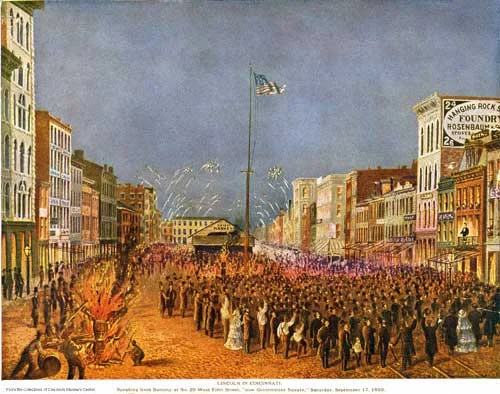
lINCOLN cINCINATTI.jpg

Abraham Lincoln: 'I esteem foreigners no better than other people, nor any worse', speech to Germans, Cinncinnati Ohio - 1861

February 19, 2018

12 February 1861, Cincinnatti, Ohio, USA


Mr. Chairman: I thank you and those you represent, for the compliment paid me by the tender of this address. In so far as there is an allusion to our present national difficulties, and the suggestion of the views of the gentlemen who present this address, I beg you will excuse me from entering particularly upon it. I deem it due to myself and the whole country, in the present extraordinary condition of the country and of public opinion, that I should wait and see the last development of public opinion before I give my views or express myself at the time of the inauguration. [Cheers.] I hope at that time to be false to nothing you have been taught to expect of me. [Cheers.]

I agree with you, Mr. Chairman, and with the address of your constituents, in the declaration that working men are the basis of all governments. That remark is due to them more than to any other class, for the reason that there are more of them than of any other class. And as your address is presented to me not only on behalf of workingmen, but especially of Germans, I may say a word as to classes. I hold the value of life is to improve one's condition. Whatever is calculated to advance the condition of the honest, struggling laboring man, so far as my judgment will enable me to judge of a correct thing. I am for that thing.

An allusion has been made to the Homestead Law. I think it worthy of consideration, and that the wild lands of the country should be distributed so that every man should have the means and opportunity of benefitting his condition. [Cheers.] I have said I do not desire to enter into details, nor will I.

In regard to Germans and foreigners, I esteem foreigners no better than other people, nor any worse. [Laughter and cheers.] They are all of the great family of men, and if there is one shackle upon any of them, it would be far better to lift the load from them than to pile additional loads upon them. [Cheers.] And inasmuch as the continent of America is comparatively a new country, and the other countries of the world are old countries, there is more room here, comparatively speaking, than there is there; and if they can better their condition by leaving their old homes, there is nothing in my heart to forbid them coming; and I bid them all God speed. [Cheers.]

Again, gentlemen, thanking you for your address, I bid you good night.

Source: https://quod.lib.umich.edu/l/lincoln/linco...

Enjoyed this speech? Speakola is a labour of love and I’d be very grateful if you would share, tweet or like it. Thank you.

Facebook Twitter Facebook
In Pre 1900 Tags ABRAHAM LINCOLN, PRESIDENT ELECT, FOREIGNERS, RACISM, REFUGEES, TRANSCRIPT, PRESIDENT
Comment

Peter Khalil: 'To those religious and ethnic groups being used as political footballs: ‘I will stand by you, with you and for you'', maiden speech - 2016

September 15, 2016

12 September 2016, Parliament House, Canberra, Australia

Mr Speaker, I congratulate you on your election to the chair and I begin my first speech by acknowledging the traditional owners of the land we meet on, the Ngunnawal people, and their elders past and present. I do so because it is a profound mark of respect for the peoples and cultures that have been present on this land from the beginning of time.

I stand in this place because I was elected by the people of Wills to serve them and to make a difference to their lives. I am conscious of being charged with an enormous responsibility bestowed with great honour. Even though it is somewhat improbable that I stand here, I am living proof that in this country politics matters, that it can make a profound difference to people’s lives.

My parents, Fayek and Georgette Khalil, are here with us in the gallery today. They came to Australia from Egypt 47 years ago. Just like those who come today, they were escaping a region where conflict was the norm and opportunities limited. Their sacrifice and that of millions of other migrants helped build Australia—not just its physical environment but the diversity of its culture, the generosity of its peoples and the depth of its humanity. I say these things too because nowhere is this diversity, this generosity of spirit, this decency better reflected than in the people of Wills.

My parents sacrificed so much of their own lives, their dreams and ambitions, to give my sister, Ellen, and I a better life. We started out in an inner-city Melbourne housing commission. Dad had to give up a career in Egypt as a lawyer and he worked for Australia Post. He became a union man, a shop steward, and later was on the state executive of the Victorian postal workers union. Mum gave up her uni degree in Egypt and worked at the Reserve Bank printing labs and as a preschool carer and an interpreter. They worked hard to give us a chance to make something of a new life in Australia.

It was not always easy. There were times of great hardship and ugly prejudice. I grew up in Australia in the seventies and eighties, a world very different from the one we live in today. Racism was more overt and considered acceptable by some. I experienced much of it directly. I will always remember my Grade 6 teacher, Mrs Hendrix, a coloured South African woman, who told me that in apartheid South Africa my parents would not be able to travel on the same bus, because of the difference in their skin complexion. That troubled me deeply as a 12-year-old, but it also awakened in me a yearning for social justice and a nascent political activism.

Although I was a serious kid who went to concerts in support of the ANC with my dad and who read Gandhi and Mandela, Malcolm X and Martin Luther King, I was also like every other Aussie kid: I really loved my footy—Aussie rules, of course. My grandparents lived in a housing commission in Preston, and my Auntie Gigi—Giselle—who is here today too, went to Preston East High School with Peter Daicos, the great Collingwood champion. She introduced me to Daics at the Preston fish and chip shop in 1978, when I was five years old, and I was Collingwood for life. I remember dragging Dad down to Victoria Park to watch the Magpies every second Saturday. I would sit on his shoulders as he stood in the outer.

While footy gave me great excitement, agony—1979, 80, 81, 2002 and 2003; I was too young for 77—and some great joy in 1990 and 2010, it taught me deeper life lessons. Daics was an ethnic, more usually called a wog in those days—and other terrible things—much the same as I was being called in the schoolyard. Despite the abuse, Daics was a champion. His exploits inspired me, and I started to believe in myself too. I learned to ignore all of the hatred and prejudice and to let my actions do the talking and that lots of hard work and a little talent will always make you a winner.

My parents also instilled in us the critical importance of education to our futures—education and the lasting impact of dedicated teachers like Mrs Hendrix and my year 9 politics teacher, Mr Sestito, who ignited my passion for Australian politics. I met recently with one of my predecessors in Wills, Bob Hawke, better known, of course, as one of Australia’s greatest Prime Ministers, and I asked Bob whether with all the achievements of his administration there was a policy that went unheralded. He told me that, when he became PM in 1983, only a third of students in Australia finished year 12. Only a third. Through policies his government put in place, by 1991 it had almost tripled to 90 per cent. Bob was particularly proud of that achievement. It was the visionary policy achievements of Labor governments—the one he led and those before and after—that gave me access to a quality education. I am and will be forever grateful.

Mine is not a unique story. Millions of Australians, whatever their ethnic background or their socioeconomic status, were given opportunities through Labor Party policies based on fairness. For my migrant family, affordable housing, Medicare and access to education were life-changing. The Labor Party’s commitment to equality of opportunity is not just a three-word slogan. It meant something to me and my family as it means something to millions of Australians, allowing them to make positive contributions in their lives and to those around them based on their merit and hard work, not on their postcode or their pay cheque, their gender or ethnicity, their religion or culture.

My parents also instilled in me the importance of giving back to the country that has given us so much. They often told me that Australia is not the lucky country, but, rather, we are lucky to be Australian. Migrants like my parents got much from the lucky country, but they also gave much to making it better, more prosperous and as open as its beautiful broad skies. I will do my utmost to advocate for and represent the people of Wills with all my wit and judgement, skill and experience, passion and smarts. I thank them for entrusting me with this great privilege.

When I reflect on what is important in our lives I think immediately of my family, as we all do. We love our families, and if we have children we would do anything for them. We also cherish the bonds we share with our friends and the importance of making an effort for them. Whatever god we worship or not, whatever cultural beliefs we have and whatever ideologies we adhere to, it is a central part of the human condition that we are fulfilled by our connection and service to others.

Yet the public are cynical of politics and politicians. We become lightning rods for people’s frustrations, disappointments and anger. The raw quest for power can threaten to overshadow our more noble instincts. More often than not, the public’s expectations are low, and when they are high they are seldom met. However, at unique and rare times in history politicians become the vessels for inspiring leadership, visionary change or simply doing good. That can only be when we keep our eyes affixed on our very own compass star—the shining light that guided us each to serve in this place, even amidst the voracious storms that rage around us and all too often consume our national politics. We can yet, with a steady gaze on that guiding star, serve to protect and defend the values that make our democracy great while passing new laws that reform our nation, advancing an even greater and fairer Australia. The responsibility and burden for this we happily bear. It signifies something great and important within all of us—a deep desire to make the lives of those around us better.

While a public servant for the Australian Department of Defence, I was sent on a posting to Iraq in 2003 and 2004, tasked with helping to rebuild Iraq following the removal of Saddam’s regime. Although I believed at the time the Iraq War was a strategic and humanitarian disaster, I made a choice to serve my country. I worked in Iraq on rebuilding and training of the Iraqi army that is now taking on Daesh, building the ministry of defence and public service, and negotiating for the Kurdish Peshmerga and the Sunni tribal leaders to jointly fight al-Qaeda in Iraq. While I faced danger, I was ably protected. I thanked the diggers of the 2nd Cavalry Regiment as we moved through the Baghdad streets in the very agile Australian light armoured vehicles.

No matter our ideological beliefs and how we choose to serve, we must recognise the importance of open and honest debate, differing opinions and different beliefs. Australia is a successful migrant country because of our wonderful multicultural model. I am proud to be Australian whilst also embracing my cultural heritage. I do not have to choose between identities. Our multicultural model works because we embrace and do not just tolerate cultural diversity. This diverse and fair society that generations of Australians have created and nurtured is worth protecting. We must educate that difference is not to be feared but embraced. We must all stand up to racism and prejudice. To those who would peddle it in this parliament by playing on fear and ignorance: ‘I will stand steadfast against you.’

I am particularly honoured to be one of the first of two Egyptian Australians elected to the 45th Parliament. The other of course is Dr Anne Aly, the member for Cowan. We are also the first African Australians in this place. I look forward to representing our brothers and sisters who have migrated from Africa and the Middle East. I am also the first Copt to be elected to this place. The Copts are adherents of one of the oldest sects of Christianity that emerged almost 2,000 years ago. Our history stretches back thousands of years connecting us to ancient Egypt. The Coptic language is the last form of the ancient Egyptian language. The Copts have faced the violence of sectarian persecution, as have many other ancient peoples of the Middle East. The Assyrian and Chaldean Christians, the Yazidis and the Kurds have all been on the front line, taking the brunt of violent extremism of Daesh. They deserve our support.

In Australia and in many Western democracies this is a moment in history where we face a fractious body politic exacerbated by or perhaps driven by the ugly rise of demagogues. These charlatans pull from their sleeves the same three-card trick played throughout history: first, identify an angry segment of the population and tell them they are just as angry; second, find a minority to scapegoat, like Asians, Muslims or Mexicans, and blame them for taking all the jobs; and, third, throw in a dose of fear, accuse the scapegoat minority of harming our way of life, stir the angry mob until it reaches boiling point and then claim only the demagogue can fix it. Of course we all know there is no substance to any of it, let alone real policies that can effect genuine change. To those religious and ethnic groups being used as political footballs: ‘I will stand by you, with you and for you. Know this: Labor will defend the multicultural society that we have built and we will never let the hateful dividers rip apart the egalitarian fabric of Australia.'

We must not, however, fall into the trap of blaming the people who are disaffected and angry. They are being exploited, they are genuinely fearful of the threats we all face and they are uncertain of their place in our society. While there are many winners in our globalised world, there are also many people who have lost out. Thousands of workers have lost or are about to lose their manufacturing jobs. Many live in Wills. Not all of these workers, after 20 years or more in a Holden or Ford plant, can become baristas or start-up tech gurus in our so-called exciting innovation society. I say to these people: ‘We the Labor Party and the labour movement are doing the hard yards to develop—and upon winning government will implement—policies that retrain and retool workers, provide vocational education, establish job creation programs and provide support to families that are struggling.’ I say to all of those people who feel disconnected, lost and angry: ‘Do not give yourselves to the haters. Keep faith in us. There will be better days ahead.’

I look forward to being the representative for the people of Wills, which is a diverse and socially progressive microcosm of modern Australia. In suburbs like Coburg, Pascoe Vale, Glenroy and Fawkner, to name a few, 60 per cent of residents were born or have at least one parent born overseas and 40 per cent of households are bilingual. Multiple faiths and over 60 ethnicities are living in harmony.

Wills has a magnificent arts community. The suburb of Brunswick has the highest concentration of artists in Australia. The arts matter. A thriving arts sector is the heart and soul of any society. It cannot be measured in traditional economic terms—its metrics are intangible—but its social benefits are invaluable. I will continue to support Labor’s great policies for the independence and return of substantive funding to the Australia Council and in addition be a voice and a pen on issues, such as parallel importation, that are of great import to authors, of which there are many great ones in Wills.

Wills has a commitment to the environment. Residents have led the way on climate change action, with one of the fastest rates of home and business adoption of solar panels. In the suburbs of Fawkner and Glenroy pensioners have roofs covered in solar panels because it makes environmental and economic sense.

Wills has a social heart that beats strong, exemplified by the work of 11 neighbourhood houses that do so much for the local community. There are many vibrant Italian and Greek pensioner and social clubs—and I enjoyed playing bocce in Fawkner with some of them during the campaign.

I have chosen to serve to change people’s lives, to channel their hopes and dreams, because I believe that Labor values make a difference. I believe in equality of opportunity, access to education, affordable health care and social justice. I believe in equality before the law, regardless of gender, sexual preference, ethnicity or religion. I believe in fighting for job creation, because a job gives a person dignity. I believe in tackling climate change for our and future generations, in sustainable living and in funding for infrastructure and public transport. I believe in a successful multicultural society that celebrates and embraces diversity.

Equality, not privilege; diversity, not divisiveness; hope, not fear. I will fight for these values for the people of Wills and for the nation, as have great Labor governments done for the best part of a century—delivering the reforms that have made all of those so lucky to be Australians.

Prime Minister Curtin, who led Australia through the darkest days of World War II put it much more eloquently than I when he said that the Labor Party and the labour movement stand for:

… humanity as against material gain and has more resilience, more decency and dignity, and the best of human qualities than any other political movement.

The Labor Party has always stood for improving the lives of Australians—for putting people first. It also has a tradition that seeks to extend these values beyond our shores. Prime Minister Chifley spoke of reaching for that light on the hill—to bring something better to the people: better standards of living, greater happiness to the mass of the people. Our objective to reach for that light on the hill was and still is to aim for the betterment of all humanity.

That is why I am committed to Australia’s role in the world as a good international citizen, making a difference to people’s lives across the globe. In 2005 I had the opportunity to testify before the US Senate foreign relations committee on security policy in the Middle East. I spoke before then Senator Joe Biden and then Senator Barack Obama. I was struck by Senator Obama’s compassion and search for real solutions. Over a decade later, President Obama is hosting a summit on refugees next week. I call on everyone in this place and those government ministers attending the summit to put aside partisan politics and work to find sustainable and compassionate solutions to the international refugee crisis. As a son of migrants who came from Egypt, escaping a region engulfed by war, I can appreciate the yearning for a life of peace, security and opportunity. For the best part of a decade, and in the recent federal campaign when discussing asylum seeker policy, I argued strongly for an increase in our intake and an end to indefinite detention on Manus and Nauru.

I supported our leader, Bill Shorten, when he made clear that if we won the election one of his first acts would be to negotiate with the UNHCR the resettlement of the refugees to safe and secure countries. We should not be fixated on countries like Cambodia or PNG which have woefully inadequate infrastructure but look to other countries, including New Zealand and Malaysia. But I recognise that even this falls far too short in our moral, legal and international obligations as a good international citizen.

I believe Australia has a moral obligation, at the minimum, to take responsibility for the care of those refugees that have been physically or emotionally damaged by the long-term detention that we have submitted them to. I also think we should re-examine the assumed nexus between detention centres and discouraging people smugglers to ascertain how much this argument holds in the context of robust turn back policies.

Whilst I support the ALP policy I also look forward to playing my part in the ongoing debate and change on this issue. I will advocate that Australia take a leadership role in developing an international agreement in which multiple countries increase their quota intake of refugees so we can begin to find solutions for 25 million asylum seekers and refugees in UNHCR camps around the world. An international agreement between 10, 15 or 20 countries agreeing to take an additional 30, 40 or 50,000 refugees a year each would start to be a real solution, resulting in a million or more refugees being resettled to safe haven each year. If we can as an international community come together to tackle climate change that threatens our planet we can and must come together to find a way to deliver safety and security for millions of refugees. We can and must do away with the lowest-common-denominator policies that have poisoned our political culture. We can and must do better as a nation.

So I speak on this not because it is popular, nor will I resile from the issue because it is unpopular, but because it is simply the right thing to do—because I believe that true leadership is not about appealing to the fear that lurks in our darker angels but appealing to our better angels.

No-one gets to this place without the support of literally hundreds of people. I want to thank the over 1,000 ALP members in Wills, the volunteers—the true believers—who worked tirelessly during the campaign. I salute you, for it is your commitment to the Labor cause that wins elections.

I would like to pay a special tribute to my predecessor, Kelvin Thomson, acknowledging his many, many years of service and advocacy. Thank you, Kelvin, for all your support and wise counsel. Ben Davis, the Victorian Secretary of the AWU, a great union leader of a great union: his wise counsel to me was summed up in four words, ‘Talk to the voters.’

Thanks to Theo Theophanous and his wife, Rita, who are in the gallery, for their strategic guidance, support and friendship, and to Steve Michaelson, also known as Mocca, and Shannon Threlfall Clark, who headed up my campaign team with great professionalism and efficiency.

Thanks to the rest of the campaign team: Carole Fabian, Councillor Lambros Tapinos, Hasan Erdogan, Chris Anderson, Mel Sherrin and Iva Bujanovic, our campaign field organiser, and to my many state colleagues—Minister Philip Dalidakis and Debra are here today. And special thanks to Speaker Telmo Languiller—thank you for your support. To Bill Shorten and Tanya Plibersek: you have run a tremendous campaign—but more than that you are Labor leaders we can believe in. I thank you and all my federal colleagues—too many of you to thank; you are all my friends as well—for your support over many years

To His Excellency Mohamed Khairat, the Egyptian ambassador: I bet he never dreamed that there would be not one but two Egyptian Australians elected to the federal parliament! Your Grace Bishop Suriel, Abouna Michael: thank you and the Coptic community for your support. And to Robert Ray for his political wisdom.

Thanks to my family, friends and supporters who have made the trip to Canberra for today: to my life-long mate John Jardim, Rose and my goddaughter, Emma, and Erin; to David Noakes, Tiff, Ollie, my godson, Coco and Zoe; and to Priya Saratchandran, Joseph Hanna, Robert Ishak, Simon Banks and Justin Di Lollo. Thanks to my Aunt Gigi, her partner Barry, Aunt Julie, my uncles John and Jerry—who cannot be here—and to my maternal grandmother, Nana Ellen, who is 92 and is here today; to my sister Ellen and my nephews Oscar and Ethan; and to my parents Fayek and Georgette—once again, I love you and I thank you all.

To my wife, Lydia: your sacrifices—the small ones you make every day as well as the big ones you have made and I know will also make—are the very reasons I am standing here today. Thank you for your patience, your wise counsel, your remarkable intelligence and, most importantly, for your love.

To my children, Cassius—the shadow minister for dinosaur welfare!—and to Aya—the parliamentary secretary for loud screaming!—I hope that I can do some good in this place that will make you proud of your dad, and make Australia a better place for your generation. I love you and your mum very much. I hope I can do you all proud and make something of my service.

Herein lies the magic of this place. It resides within and through that call to service, because I can serve and make a difference in the lives of not just my family and my friends but on a grand scale to tens of thousands of people across Wills. The tempest that rages in this place most often at 2 pm belies the quieter work MPs do for their constituents. I know it is not only sound and fury as we strut upon this stage. We have an awesome responsibility and a rare privilege to work even in the eye of the political storm and make our shared political values into realities. The magic of this place is that I—as a most improbable candidate—was elected to truly serve the people of Wills and the nation that has given me so much by making what I believe true for the many, not just the few.


Source: http://australianpolitics.com/2016/09/12/p...

Enjoyed this speech? Speakola is a labour of love and I’d be very grateful if you would share, tweet or like it. Thank you.

Facebook Twitter Facebook
In 2010s MORE 3 Tags PETER KHALIL, MAIDEN SPEECH, ALP, AUSTRALIAN LABOR PARTY, BEN CHIFLEY, JOHN CURTIN, IRAQ WAR, REFUGEES, MANUS, DETENTION
Comment

See my film!

Limited Australian Season

March 2025

Details and ticket bookings at

angeandtheboss.com

Support Speakola

Hi speech lovers,
With costs of hosting website and podcast, this labour of love has become a difficult financial proposition in recent times. If you can afford a donation, it will help Speakola survive and prosper.

Best wishes,
Tony Wilson.

Become a Patron!

Learn more about supporting Speakola.

Featured political

Featured
Jon Stewart: "They responded in five seconds", 9-11 first responders, Address to Congress - 2019
Jacinda Ardern: 'They were New Zealanders. They are us', Address to Parliament following Christchurch massacre - 2019
Dolores Ibárruri: "¡No Pasarán!, They shall not pass!', Defense of 2nd Spanish Republic - 1936
Jimmy Reid: 'A rat race is for rats. We're not rats', Rectorial address, Glasgow University - 1972

Featured eulogies

Featured
For Geoffrey Tozer: 'I have to say we all let him down', by Paul Keating - 2009
for James Baldwin: 'Jimmy. You crowned us', by Toni Morrison - 1988
for Michael Gordon: '13 days ago my Dad’s big, beautiful, generous heart suddenly stopped beating', by Scott and Sarah Gordon - 2018

Featured commencement

Featured
Tara Westover: 'Your avatar isn't real, it isn't terribly far from a lie', The Un-Instagrammable Self, Northeastern University - 2019
Tim Minchin: 'Being an artist requires massive reserves of self-belief', WAAPA - 2019
Atul Gawande: 'Curiosity and What Equality Really Means', UCLA Medical School - 2018
Abby Wambach: 'We are the wolves', Barnard College - 2018
Eric Idle: 'America is 300 million people all walking in the same direction, singing 'I Did It My Way'', Whitman College - 2013
Shirley Chisholm: ;America has gone to sleep', Greenfield High School - 1983

Featured sport

Featured
Joe Marler: 'Get back on the horse', Harlequins v Bath pre game interview - 2019
Ray Lewis : 'The greatest pain of my life is the reason I'm standing here today', 52 Cards -
Mel Jones: 'If she was Bradman on the field, she was definitely Keith Miller off the field', Betty Wilson's induction into Australian Cricket Hall of Fame - 2017
Jeff Thomson: 'It’s all those people that help you as kids', Hall of Fame - 2016

Fresh Tweets


Featured weddings

Featured
Dan Angelucci: 'The Best (Best Man) Speech of all time', for Don and Katherine - 2019
Hallerman Sisters: 'Oh sister now we have to let you gooooo!' for Caitlin & Johnny - 2015
Korey Soderman (via Kyle): 'All our lives I have used my voice to help Korey express his thoughts, so today, like always, I will be my brother’s voice' for Kyle and Jess - 2014

Featured Arts

Featured
Bruce Springsteen: 'They're keepers of some of the most beautiful sonic architecture in rock and roll', Induction U2 into Rock Hall of Fame - 2005
Olivia Colman: 'Done that bit. I think I have done that bit', BAFTA acceptance, Leading Actress - 2019
Axel Scheffler: 'The book wasn't called 'No Room on the Broom!', Illustrator of the Year, British Book Awards - 2018
Tina Fey: 'Only in comedy is an obedient white girl from the suburbs a diversity candidate', Kennedy Center Mark Twain Award -  2010
Tina Fey: 'Only in comedy is an obedient white girl from the suburbs a diversity candidate', Kennedy Center Mark Twain Award - 2010

Featured Debates

Featured
Sacha Baron Cohen: 'Just think what Goebbels might have done with Facebook', Anti Defamation League Leadership Award - 2019
Greta Thunberg: 'How dare you', UN Climate Action Summit - 2019
Charlie Munger: 'The Psychology of Human Misjudgment', Harvard University - 1995
Lawrence O'Donnell: 'The original sin of this country is that we invaders shot and murdered our way across the land killing every Native American that we could', The Last Word, 'Dakota' - 2016