• Genre
  • About
  • Submissions
  • Donate
  • Search
Menu

Speakola

All Speeches Great and Small
  • Genre
  • About
  • Submissions
  • Donate
  • Search
Share a political speech

Colin Powell: - 'This council placed the burden on Iraq to comply', Evidence of WMD to UN - 2003

February 23, 2021

5 February 2003, United Nations HQ, New York City, New York, USA

Thank you, Mr. President.

Mr President, Mr Secretary General, distinguished colleagues, I would like to begin by expressing my thanks for the special effort that each of you made to be here today.

This is important day for us all as we review the situation with respect to Iraq and its disarmament obligations under UN security council resolution 1441.

Last November 8, this council passed resolution 1441 by a unanimous vote. The purpose of that resolution was to disarm Iraq of its weapons of mass destruction. Iraq had already been found guilty of material breach of its obligations, stretching back over 16 previous resolutions and 12 years.

Resolution 1441 was not dealing with an innocent party, but a regime this council has repeatedly convicted over the years. Resolution 1441 gave Iraq one last chance, one last chance to come into compliance or to face serious consequences. No council member present in voting on that day had any illusions about the nature and intent of the resolution or what serious consequences meant if Iraq did not comply.

And to assist in its disarmament, we called on Iraq to cooperate with returning inspectors from Unmovic and IAEA.

We laid down tough standards for Iraq to meet to allow the inspectors to do their job.

This council placed the burden on Iraq to comply and disarm and not on the inspectors to find that which Iraq has gone out of its way to conceal for so long. Inspectors are inspectors; they are not detectives.

I asked for this session today for two purposes: First, to support the core assessments made by Dr Blix and Dr El-Baradei. As Dr Blix reported to this council on January 27: "Iraq appears not to have come to a genuine acceptance, not even today, of the disarmament which was demanded of it."

And as Dr El-Baradei reported, Iraq's declaration of December 7: "Did not provide any new information relevant to certain questions that have been outstanding since 1998."

My second purpose today is to provide you with additional information, to share with you what the United States knows about Iraq's weapons of mass destruction as well as Iraq's involvement in terrorism, which is also the subject of resolution 1441 and other earlier resolutions.

I might add at this point that we are providing all relevant information we can to the inspection teams for them to do their work.

The material I will present to you comes from a variety of sources. Some are U.S. sources. And some are those of other countries.

Some of the sources are technical, such as intercepted telephone conversations and photos taken by satellites. Other sources are people who have risked their lives to let the world know what Saddam Hussein is really up to.

I cannot tell you everything that we know. But what I can share with you, when combined with what all of us have learned over the years, is deeply troubling.

What you will see is an accumulation of facts and disturbing patterns of behavior. The facts on Iraqis' behavior - Iraq's behavior demonstrate that Saddam Hussein and his regime have made no effort - no effort - to disarm as required by the international community. Indeed, the facts and Iraq's behavior show that Saddam Hussein and his regime are concealing their efforts to produce more weapons of mass destruction.

Let me begin by playing a tape for you. What you're about to hear is a conversation that my government monitored. It takes place on November 26 of last year, on the day before United Nations teams resumed inspections in Iraq.

The conversation involves two senior officers, a colonel and a brigadier general, from Iraq's elite military unit, the Republican Guard.

(BEGIN AUDIO TAPE) Speaking in Arabic.

(END AUDIO TAPE) POWELL: Let me pause and review some of the key elements of this conversation that you just heard between these two officers.

First, they acknowledge that our colleague, Mohamed ElBaradei, is coming, and they know what he's coming for, and they know he's coming the next day. He's coming to look for things that are prohibited. He is expecting these gentlemen to cooperate with him and not hide things.

But they're worried. "We have this modified vehicle. What do we say if one of them sees it?" What is their concern? Their concern is that it's something they should not have, something that should not be seen.

The general is incredulous: "You didn't get a modified. You don't have one of those, do you?" "I have one." "Which, from where?" "From the workshop, from the al-Kindi company?" "What?" "From al-Kindi." "I'll come to see you in the morning. I'm worried. You all have something left." "We evacuated everything. We don't have anything left." Note what he says: "We evacuated everything." We didn't destroy it. We didn't line it up for inspection. We didn't turn it into the inspectors. We evacuated it to make sure it was not around when the inspectors showed up.

"I will come to you tomorrow." The al-Kindi company: This is a company that is well known to have been involved in prohibited weapons systems activity.

Let me play another tape for you. As you will recall, the inspectors found 12 empty chemical warheads on January 16. On January 20, four days later, Iraq promised the inspectors it would search for more. You will now hear an officer from Republican Guard headquarters issuing an instruction to an officer in the field. Their conversation took place just last week on January 30.
Advertisement

(BEGIN AUDIO TAPE) Speaking in Arabic.

(END AUDIO TAPE) POWELL: Let me pause again and review the elements of this message.

"They're inspecting the ammunition you have, yes." "Yes." "For the possibility there are forbidden ammo." "For the possibility there is by chance forbidden ammo?" "Yes." "And we sent you a message yesterday to clean out all of the areas, the scrap areas, the abandoned areas. Make sure there is nothing there." Remember the first message, evacuated.

This is all part of a system of hiding things and moving things out of the way and making sure they have left nothing behind.

If you go a little further into this message, and you see the specific instructions from headquarters: "After you have carried out what is contained in this message, destroy the message because I don't want anyone to see this message." "OK, OK." Why? Why?

This message would have verified to the inspectors that they have been trying to turn over things. They were looking for things. But they don't want that message seen, because they were trying to clean up the area to leave no evidence behind of the presence of weapons of mass destruction. And they can claim that nothing was there. And the inspectors can look all they want, and they will find nothing.

This effort to hide things from the inspectors is not one or two isolated events, quite the contrary. This is part and parcel of a policy of evasion and deception that goes back 12 years, a policy set at the highest levels of the Iraqi regime.

We know that Saddam Hussein has what is called quote, "a higher committee for monitoring the inspections teams," unquote. Think about that. Iraq has a high-level committee to monitor the inspectors who were sent in to monitor Iraq's disarmament.

Not to cooperate with them, not to assist them, but to spy on them and keep them from doing their jobs.

The committee reports directly to Saddam Hussein. It is headed by Iraq's vice president, Taha Yassin Ramadan. Its members include Saddam Hussein's son Qusay.

This committee also includes Lieutenant General Amir al-Saadi, an adviser to Saddam. In case that name isn't immediately familiar to you, General Saadi has been the Iraqi regime's primary point of contact for Dr. Blix and Dr. ElBaradei. It was General Saadi who last fall publicly pledged that Iraq was prepared to cooperate unconditionally with inspectors. Quite the contrary, Saadi's job is not to cooperate, it is to deceive; not to disarm, but to undermine the inspectors; not to support them, but to frustrate them and to make sure they learn nothing.

We have learned a lot about the work of this special committee. We learned that just prior to the return of inspectors last November the regime had decided to resume what we heard called, quote, "the old game of cat and mouse," unquote.

For example, let me focus on the now famous declaration that Iraq submitted to this council on December 7. Iraq never had any intention of complying with this council's mandate.

Instead, Iraq planned to use the declaration, overwhelm us and to overwhelm the inspectors with useless information about Iraq's permitted weapons so that we would not have time to pursue Iraq's prohibited weapons. Iraq's goal was to give us, in this room, to give those us on this council the false impression that the inspection process was working.

You saw the result. Dr. Blix pronounced the 12,200-page declaration, rich in volume, but poor in information and practically devoid of new evidence.

Could any member of this council honestly rise in defense of this false declaration? Everything we have seen and heard indicates that, instead of cooperating actively with the inspectors to ensure the success of their mission, Saddam Hussein and his regime are busy doing all they possibly can to ensure that inspectors succeed in finding absolutely nothing.

My colleagues, every statement I make today is backed up by sources, solid sources. These are not assertions. What we're giving you are facts and conclusions based on solid intelligence. I will cite some examples, and these are from human sources.

Orders were issued to Iraq's security organizations, as well as to Saddam Hussein's own office, to hide all correspondence with the Organization of Military Industrialization.

This is the organization that oversees Iraq's weapons of mass destruction activities. Make sure there are no documents left which could connect you to the OMI.

We know that Saddam's son, Qusay, ordered the removal of all prohibited weapons from Saddam's numerous palace complexes. We know that Iraqi government officials, members of the ruling Baath Party and scientists have hidden prohibited items in their homes. Other key files from military and scientific establishments have been placed in cars that are being driven around the countryside by Iraqi intelligence agents to avoid detection.

Thanks to intelligence they were provided, the inspectors recently found dramatic confirmation of these reports. When they searched the home of an Iraqi nuclear scientist, they uncovered roughly 2,000 pages of documents. You see them here being brought out of the home and placed in U.N. hands. Some of the material is classified and related to Iraq's nuclear program.

Tell me, answer me, are the inspectors to search the house of every government official, every Baath Party member and every scientist in the country to find the truth, to get the information they need, to satisfy the demands of our council? Our sources tell us that, in some cases, the hard drives of computers at Iraqi weapons facilities were replaced. Who took the hard drives? Where did they go? What's being hidden? Why? There's only one answer to the why: to deceive, to hide, to keep from the inspectors.

Numerous human sources tell us that the Iraqis are moving, not just documents and hard drives, but weapons of mass destruction to keep them from being found by inspectors.

While we were here in this council chamber debating Resolution 1441 last fall, we know, we know from sources that a missile brigade outside Baghdad was disbursing rocket launchers and warheads containing biological warfare agents to various locations, distributing them to various locations in western Iraq. Most of the launchers and warheads have been hidden in large groves of palm trees and were to be moved every one to four weeks to escape detection.

We also have satellite photos that indicate that banned materials have recently been moved from a number of Iraqi weapons of mass destruction facilities.

Let me say a word about satellite images before I show a couple. The photos that I am about to show you are sometimes hard for the average person to interpret, hard for me. The painstaking work of photo analysis takes experts with years and years of experience, poring for hours and hours over light tables. But as I show you these images, I will try to capture and explain what they mean, what they indicate to our imagery specialists.

Let's look at one. This one is about a weapons munition facility, a facility that holds ammunition at a place called Taji (ph). This is one of about 65 such facilities in Iraq. We know that this one has housed chemical munitions. In fact, this is where the Iraqis recently came up with the additional four chemical weapon shells.

Here, you see 15 munitions bunkers in yellow and red outlines. The four that are in red squares represent active chemical munitions bunkers.

How do I know that? How can I say that? Let me give you a closer look. Look at the image on the left. On the left is a close-up of one of the four chemical bunkers. The two arrows indicate the presence of sure signs that the bunkers are storing chemical munitions. The arrow at the top that says security points to a facility that is the signature item for this kind of bunker. Inside that facility are special guards and special equipment to monitor any leakage that might come out of the bunker.

The truck you also see is a signature item. It's a decontamination vehicle in case something goes wrong.

This is characteristic of those four bunkers. The special security facility and the decontamination vehicle will be in the area, if not at any one of them or one of the other, it is moving around those four, and it moves as it needed to move, as people are working in the different bunkers.

Now look at the picture on the right. You are now looking at two of those sanitized bunkers. The signature vehicles are gone, the tents are gone, it's been cleaned up, and it was done on the 22nd of December, as the U.N. inspection team is arriving, and you can see the inspection vehicles arriving in the lower portion of the picture on the right.

The bunkers are clean when the inspectors get there. They found nothing.

This sequence of events raises the worrisome suspicion that Iraq had been tipped off to the forthcoming inspections at Taji (ph). As it did throughout the 1990s, we know that Iraq today is actively using its considerable intelligence capabilities to hide its illicit activities. From our sources, we know that inspectors are under constant surveillance by an army of Iraqi intelligence operatives. Iraq is relentlessly attempting to tap all of their communications, both voice and electronics.

I would call my colleagues' attention to the fine paper that United Kingdom distributed yesterday, which describes in exquisite detail Iraqi deception activities.

In this next example, you will see the type of concealment activity Iraq has undertaken in response to the resumption of inspections. Indeed, in November 2002, just when the inspections were about to resume this type of activity spiked. Here are three examples.

At this ballistic missile site, on November 10, we saw a cargo truck preparing to move ballistic missile components. At this biological weapons related facility, on November 25, just two days before inspections resumed, this truck caravan appeared, something we almost never see at this facility, and we monitor it carefully and regularly.

At this ballistic missile facility, again, two days before inspections began, five large cargo trucks appeared along with the truck-mounted crane to move missiles. We saw this kind of house cleaning at close to 30 sites.

Days after this activity, the vehicles and the equipment that I've just highlighted disappear and the site returns to patterns of normalcy. We don't know precisely what Iraq was moving, but the inspectors already knew about these sites, so Iraq knew that they would be coming.

We must ask ourselves: Why would Iraq suddenly move equipment of this nature before inspections if they were anxious to demonstrate what they had or did not have? Remember the first intercept in which two Iraqis talked about the need to hide a modified vehicle from the inspectors. Where did Iraq take all of this equipment? Why wasn't it presented to the inspectors? Iraq also has refused to permit any U-2 reconnaissance flights that would give the inspectors a better sense of what's being moved before, during and after inspectors.

This refusal to allow this kind of reconnaissance is in direct, specific violation of operative paragraph seven of our Resolution 1441.

Saddam Hussein and his regime are not just trying to conceal weapons, they're also trying to hide people. You know the basic facts. Iraq has not complied with its obligation to allow immediate, unimpeded, unrestricted and private access to all officials and other persons as required by Resolution 1441.

The regime only allows interviews with inspectors in the presence of an Iraqi official, a minder. The official Iraqi organization charged with facilitating inspections announced, announced publicly and announced ominously that, quote, "Nobody is ready to leave Iraq to be interviewed." Iraqi Vice President Ramadan accused the inspectors of conducting espionage, a veiled threat that anyone cooperating with U.N. inspectors was committing treason.

Iraq did not meet its obligations under 1441 to provide a comprehensive list of scientists associated with its weapons of mass destruction programs. Iraq's list was out of date and contained only about 500 names, despite the fact that UNSCOM had earlier put together a list of about 3,500 names.

Let me just tell you what a number of human sources have told us.

Saddam Hussein has directly participated in the effort to prevent interviews. In early December, Saddam Hussein had all Iraqi scientists warned of the serious consequences that they and their families would face if they revealed any sensitive information to the inspectors. They were forced to sign documents acknowledging that divulging information is punishable by death.

Saddam Hussein also said that scientists should be told not to agree to leave Iraq; anyone who agreed to be interviewed outside Iraq would be treated as a spy. This violates 1441.

In mid-November, just before the inspectors returned, Iraqi experts were ordered to report to the headquarters of the special security organization to receive counterintelligence training. The training focused on evasion methods, interrogation resistance techniques, and how to mislead inspectors.

Ladies and gentlemen, these are not assertions. These are facts, corroborated by many sources, some of them sources of the intelligence services of other countries.

For example, in mid-December weapons experts at one facility were replaced by Iraqi intelligence agents who were to deceive inspectors about the work that was being done there.

On orders from Saddam Hussein, Iraqi officials issued a false death certificate for one scientist, and he was sent into hiding.

In the middle of January, experts at one facility that was related to weapons of mass destruction, those experts had been ordered to stay home from work to avoid the inspectors. Workers from other Iraqi military facilities not engaged in elicit weapons projects were to replace the workers who'd been sent home. A dozen experts have been placed under house arrest, not in their own houses, but as a group at one of Saddam Hussein's guest houses. It goes on and on and on.

As the examples I have just presented show, the information and intelligence we have gathered point to an active and systematic effort on the part of the Iraqi regime to keep key materials and people from the inspectors in direct violation of Resolution 1441. The pattern is not just one of reluctant cooperation, nor is it merely a lack of cooperation. What we see is a deliberate campaign to prevent any meaningful inspection work.

My colleagues, operative paragraph four of U.N. Resolution 1441, which we lingered over so long last fall, clearly states that false statements and omissions in the declaration and a failure by Iraq at any time to comply with and cooperate fully in the implementation of this resolution shall constitute - the facts speak for themselves - shall constitute a further material breach of its obligation.

We wrote it this way to give Iraq an early test - to give Iraq an early test. Would they give an honest declaration and would they early on indicate a willingness to cooperate with the inspectors? It was designed to be an early test.

They failed that test. By this standard, the standard of this operative paragraph, I believe that Iraq is now in further material breach of its obligations. I believe this conclusion is irrefutable and undeniable.

Iraq has now placed itself in danger of the serious consequences called for in U.N. Resolution 1441. And this body places itself in danger of irrelevance if it allows Iraq to continue to defy its will without responding effectively and immediately.

The issue before us is not how much time we are willing to give the inspectors to be frustrated by Iraqi obstruction. But how much longer are we willing to put up with Iraq's noncompliance before we, as a council, we, as the United Nations, say: "Enough. Enough." The gravity of this moment is matched by the gravity of the threat that Iraq's weapons of mass destruction pose to the world. Let me now turn to those deadly weapons programs and describe why they are real and present dangers to the region and to the world.

First, biological weapons. We have talked frequently here about biological weapons. By way of introduction and history, I think there are just three quick points I need to make.

First, you will recall that it took UNSCOM four long and frustrating years to pry - to pry - an admission out of Iraq that it had biological weapons.

Second, when Iraq finally admitted having these weapons in 1995, the quantities were vast. Less than a teaspoon of dry anthrax, a little bit about this amount - this is just about the amount of a teaspoon - less than a teaspoon full of dry anthrax in an envelope shut down the United States Senate in the fall of 2001. This forced several hundred people to undergo emergency medical treatment and killed two postal workers just from an amount just about this quantity that was inside of an envelope.

Iraq declared 8,500 liters of anthrax, but UNSCOM estimates that Saddam Hussein could have produced 25,000 liters. If concentrated into this dry form, this amount would be enough to fill tens upon tens upon tens of thousands of teaspoons. And Saddam Hussein has not verifiably accounted for even one teaspoon-full of this deadly material.

And that is my third point. And it is key. The Iraqis have never accounted for all of the biological weapons they admitted they had and we know they had. They have never accounted for all the organic material used to make them. And they have not accounted for many of the weapons filled with these agents such as there are 400 bombs. This is evidence, not conjecture. This is true. This is all well-documented.

Dr. Blix told this council that Iraq has provided little evidence to verify anthrax production and no convincing evidence of its destruction. It should come as no shock then, that since Saddam Hussein forced out the last inspectors in 1998, we have amassed much intelligence indicating that Iraq is continuing to make these weapons.

One of the most worrisome things that emerges from the thick intelligence file we have on Iraq's biological weapons is the existence of mobile production facilities used to make biological agents.

Let me take you inside that intelligence file and share with you what we know from eyewitness accounts. We have firsthand descriptions of biological weapons factories on wheels and on rails.

The trucks and train cars are easily moved and are designed to evade detection by inspectors. In a matter of months, they can produce a quantity of biological poison equal to the entire amount that Iraq claimed to have produced in the years prior to the Gulf War.

Although Iraq's mobile production program began in the mid-1990s, U.N. inspectors at the time only had vague hints of such programs. Confirmation came later, in the year 2000.

The source was an eyewitness, an Iraqi chemical engineer who supervised one of these facilities. He actually was present during biological agent production runs. He was also at the site when an accident occurred in 1998. Twelve technicians died from exposure to biological agents.

He reported that when UNSCOM was in country and inspecting, the biological weapons agent production always began on Thursdays at midnight because Iraq thought UNSCOM would not inspect on the Muslim Holy Day, Thursday night through Friday. He added that this was important because the units could not be broken down in the middle of a production run, which had to be completed by Friday evening before the inspectors might arrive again.

This defector is currently hiding in another country with the certain knowledge that Saddam Hussein will kill him if he finds him. His eyewitness account of these mobile production facilities has been corroborated by other sources.

A second source, an Iraqi civil engineer in a position to know the details of the program, confirmed the existence of transportable facilities moving on trailers.

A third source, also in a position to know, reported in summer 2002 that Iraq had manufactured mobile production systems mounted on road trailer units and on rail cars.

Finally, a fourth source, an Iraqi major, who defected, confirmed that Iraq has mobile biological research laboratories, in addition to the production facilities I mentioned earlier.

We have diagrammed what our sources reported about these mobile facilities. Here you see both truck and rail car-mounted mobile factories. The description our sources gave us of the technical features required by such facilities are highly detailed and extremely accurate. As these drawings based on their description show, we know what the fermenters look like, we know what the tanks, pumps, compressors and other parts look like. We know how they fit together. We know how they work. And we know a great deal about the platforms on which they are mounted.

As shown in this diagram, these factories can be concealed easily, either by moving ordinary-looking trucks and rail cars along Iraq's thousands of miles of highway or track, or by parking them in a garage or warehouse or somewhere in Iraq's extensive system of underground tunnels and bunkers.

We know that Iraq has at lest seven of these mobile biological agent factories. The truck-mounted ones have at least two or three trucks each. That means that the mobile production facilities are very few, perhaps 18 trucks that we know of-there may be more-but perhaps 18 that we know of. Just imagine trying to find 18 trucks among the thousands and thousands of trucks that travel the roads of Iraq every single day.

It took the inspectors four years to find out that Iraq was making biological agents. How long do you think it will take the inspectors to find even one of these 18 trucks without Iraq coming forward, as they are supposed to, with the information about these kinds of capabilities? Ladies and gentlemen, these are sophisticated facilities. For example, they can produce anthrax and botulinum toxin. In fact, they can produce enough dry biological agent in a single month to kill thousands upon thousands of people. And dry agent of this type is the most lethal form for human beings.

By 1998, UN experts agreed that the Iraqis had perfected drying techniques for their biological weapons programmes. Now, Iraq has incorporated this drying expertise into these mobile production facilities.

We know from Iraq's past admissions that it has successfully weaponised not only anthrax, but also other biological agents, including botulinum toxin, aflatoxin and ricin.

But Iraq's research efforts did not stop there. Saddam Hussein has investigated dozens of biological agents causing diseases such as gas gangrene, plague, typhus, tetanus, cholera, camelpox and hemorrhagic fever, and he also has the wherewithal to develop smallpox.

The Iraqi regime has also developed ways to disburse lethal biological agents, widely and discriminately into the water supply, into the air. For example, Iraq had a programme to modify aerial fuel tanks for Mirage jets. This video of an Iraqi test flight obtained by Unscom some years ago shows an Iraqi F-1 Mirage jet aircraft. Note the spray coming from beneath the Mirage; that is 2,000 litres of simulated anthrax that a jet is spraying.

In 1995, an Iraqi military officer, Mujahid Sali Abdul Latif (ph), told inspectors that Iraq intended the spray tanks to be mounted onto a MiG-21 that had been converted into an unmanned aerial vehicle, or a UAV. UAVs outfitted with spray tanks constitute an ideal method for launching a terrorist attack using biological weapons.

Iraq admitted to producing four spray tanks. But to this day, it has provided no credible evidence that they were destroyed, evidence that was required by the international community.

There can be no doubt that Saddam Hussein has biological weapons and the capability to rapidly produce more, many more. And he has the ability to dispense these lethal poisons and diseases in ways that can cause massive death and destruction. If biological weapons seem too terrible to contemplate, chemical weapons are equally chilling.

Unmovic already laid out much of this, and it is documented for all of us to read in Unscom's 1999 report on the subject.

Let me set the stage with three key points that all of us need to keep in mind: First, Saddam Hussein has used these horrific weapons on another country and on his own people. In fact, in the history of chemical warfare, no country has had more battlefield experience with chemical weapons since World War I than Saddam Hussein's Iraq.

Second, as with biological weapons, Saddam Hussein has never accounted for vast amounts of chemical weaponry: 550 artillery shells with mustard, 30,000 empty munitions and enough precursors to increase his stockpile to as much as 500 tons of chemical agents. If we consider just one category of missing weaponry - 6,500 bombs from the Iran-Iraq war - Unmovic says the amount of chemical agent in them would be in the order of 1,000 tons. These quantities of chemical weapons are now unaccounted for.

Dr. Blix has quipped that, quote, "Mustard gas is not (inaudible). You are supposed to know what you did with it."

We believe Saddam Hussein knows what he did with it, and he has not come clean with the international community. We have evidence these weapons existed. What we don't have is evidence from Iraq that they have been destroyed or where they are. That is what we are still waiting for.

Third point, Iraq's record on chemical weapons is replete with lies. It took years for Iraq to finally admit that it had produced four tons of the deadly nerve agent, VX. A single drop of VX on the skin will kill in minutes. Four tons.

The admission only came out after inspectors collected documentation as a result of the defection of Hussein Kamal, Saddam Hussein's late son-in-law. Unscom also gained forensic evidence that Iraq had produced VX and put it into weapons for delivery.

Yet, to this day, Iraq denies it had ever weaponised VX. And on January 27, Unmovic told this council that it has information that conflicts with the Iraqi account of its VX programme.

We know that Iraq has embedded key portions of its illicit chemical weapons infrastructure within its legitimate civilian industry. To all outward appearances, even to experts, the infrastructure looks like an ordinary civilian operation. Illicit and legitimate production can go on simultaneously; or, on a dime, this dual-use infrastructure can turn from clandestine to commercial and then back again.

These inspections would be unlikely, any inspections of such facilities would be unlikely to turn up anything prohibited, especially if there is any warning that the inspections are coming. Call it ingenuous or evil genius, but the Iraqis deliberately designed their chemical weapons programmes to be inspected. It is infrastructure with a built-in ally.

Under the guise of dual-use infrastructure, Iraq has undertaken an effort to reconstitute facilities that were closely associated with its past programme to develop and produce chemical weapons.

For example, Iraq has rebuilt key portions of the Tariq (ph) state establishment. Tariq includes facilities designed specifically for Iraq's chemical weapons programme and employs key figures from past programmes.

That's the production end of Saddam's chemical weapons business. What about the delivery end? I'm going to show you a small part of a chemical complex called al-Moussaid (ph), a site that Iraq has used for at least three years to transship chemical weapons from production facilities out to the field.

In May 2002, our satellites photographed the unusual activity in this picture. Here we see cargo vehicles are again at this transshipment point, and we can see that they are accompanied by a decontamination vehicle associated with biological or chemical weapons activity.

What makes this picture significant is that we have a human source who has corroborated that movement of chemical weapons occurred at this site at that time. So it's not just the photo, and it's not an individual seeing the photo. It's the photo and then the knowledge of an individual being brought together to make the case.

This photograph of the site taken two months later in July shows not only the previous site, which is the figure in the middle at the top with the bulldozer sign near it, it shows that this previous site, as well as all of the other sites around the site, have been fully bulldozed and graded. The topsoil has been removed. The Iraqis literally removed the crust of the earth from large portions of this site in order to conceal chemical weapons evidence that would be there from years of chemical weapons activity.

To support its deadly biological and chemical weapons programmes, Iraq procures needed items from around the world using an extensive clandestine network. What we know comes largely from intercepted communications and human sources who are in a position to know the facts.

Iraq's procurement efforts include equipment that can filter and separate micro-organisms and toxins involved in biological weapons, equipment that can be used to concentrate the agent, growth media that can be used to continue producing anthrax and botulinum toxin, sterilization equipment for laboratories, glass-lined reactors and specialty pumps that can handle corrosive chemical weapons agents and precursors, large amounts of vinyl chloride, a precursor for nerve and blister agents, and other chemicals such as sodium sulfide, an important mustard agent precursor.

Now, of course, Iraq will argue that these items can also be used for legitimate purposes. But if that is true, why do we have to learn about them by intercepting communications and risking the lives of human agents? With Iraq's well documented history on biological and chemical weapons, why should any of us give Iraq the benefit of the doubt? I don't, and I don't think you will either after you hear this next intercept.

Just a few weeks ago, we intercepted communications between two commanders in Iraq's Second Republican Guard Corps. One commander is going to be giving an instruction to the other. You will hear as this unfolds that what he wants to communicate to the other guy, he wants to make sure the other guy hears clearly, to the point of repeating it so that it gets written down and completely understood. Listen.
Advertisement

(BEGIN AUDIO TAPE) Speaking in foreign language.

(END AUDIO TAPE) POWELL: Let's review a few selected items of this conversation. Two officers talking to each other on the radio want to make sure that nothing is misunderstood:

"Remove. Remove."

The expression, the expression, "I got it."

"Nerve agents. Nerve agents. Wherever it comes up."

"Got it."

"Wherever it comes up."

"In the wireless instructions, in the instructions."

"Correction. No. In the wireless instructions."

"Wireless. I got it."

Why does he repeat it that way? Why is he so forceful in making sure this is understood? And why did he focus on wireless instructions? Because the senior officer is concerned that somebody might be listening.

Well, somebody was.

"Nerve agents. Stop talking about it. They are listening to us. Don't give any evidence that we have these horrible agents." Well, we know that they do. And this kind of conversation confirms it.

Our conservative estimate is that Iraq today has a stockpile of between 100 and 500 tons of chemical weapons agent. That is enough agent to fill 16,000 battlefield rockets.

Even the low end of 100 tons of agent would enable Saddam Hussein to cause mass casualties across more than 100 square miles of territory, an area nearly five times the size of Manhattan.

Let me remind you that, of the 122 millimetre chemical warheads, that the UN inspectors found recently, this discovery could very well be, as has been noted, the tip of the submerged iceberg. The question before us, all my friends, is when will we see the rest of the submerged iceberg?

Saddam Hussein has chemical weapons. Saddam Hussein has used such weapons. And Saddam Hussein has no compunction about using them again, against his neighbours and against his own people.

And we have sources who tell us that he recently has authorised his field commanders to use them. He wouldn't be passing out the orders if he didn't have the weapons or the intent to use them.

We also have sources who tell us that, since the 1980s, Saddam's regime has been experimenting on human beings to perfect its biological or chemical weapons.

A source said that 1,600 death row prisoners were transferred in 1995 to a special unit for such experiments. An eyewitness saw prisoners tied down to beds, experiments conducted on them, blood oozing around the victim's mouths and autopsies performed to confirm the effects on the prisoners. Saddam Hussein's humanity - inhumanity has no limits.

Let me turn now to nuclear weapons. We have no indication that Saddam Hussein has ever abandoned his nuclear weapons programme.

On the contrary, we have more than a decade of proof that he remains determined to acquire nuclear weapons.

To fully appreciate the challenge that we face today, remember that, in 1991, the inspectors searched Iraq's primary nuclear weapons facilities for the first time. And they found nothing to conclude that Iraq had a nuclear weapons programme.

But based on defector information in May of 1991, Saddam Hussein's lie was exposed. In truth, Saddam Hussein had a massive clandestine nuclear weapons programme that covered several different techniques to enrich uranium, including electromagnetic isotope separation, gas centrifuge, and gas diffusion. We estimate that this illicit programme cost the Iraqis several billion dollars.

Nonetheless, Iraq continued to tell the IAEA that it had no nuclear weapons programme. If Saddam had not been stopped, Iraq could have produced a nuclear bomb by 1993, years earlier than most worse-case assessments that had been made before the war.

In 1995, as a result of another defector, we find out that, after his invasion of Kuwait, Saddam Hussein had initiated a crash programme to build a crude nuclear weapon in violation of Iraq's UN obligations.

Saddam Hussein already possesses two out of the three key components needed to build a nuclear bomb. He has a cadre of nuclear scientists with the expertise, and he has a bomb design.

Since 1998, his efforts to reconstitute his nuclear programme have been focused on acquiring the third and last component, sufficient fissile material to produce a nuclear explosion. To make the fissile material, he needs to develop an ability to enrich uranium.

Saddam Hussein is determined to get his hands on a nuclear bomb. He is so determined that he has made repeated covert attempts to acquire high-specification aluminum tubes from 11 different countries, even after inspections resumed.

These tubes are controlled by the Nuclear Suppliers Group precisely because they can be used as centrifuges for enriching uranium. By now, just about everyone has heard of these tubes, and we all know that there are differences of opinion. There is controversy about what these tubes are for.

Most US experts think they are intended to serve as rotors in centrifuges used to enrich uranium. Other experts, and the Iraqis themselves, argue that they are really to produce the rocket bodies for a conventional weapon, a multiple rocket launcher.

Let me tell you what is not controversial about these tubes. First, all the experts who have analyzed the tubes in our possession agree that they can be adapted for centrifuge use. Second, Iraq had no business buying them for any purpose. They are banned for Iraq.

I am no expert on centrifuge tubes, but just as an old Army trooper, I can tell you a couple of things: First, it strikes me as quite odd that these tubes are manufactured to a tolerance that far exceeds US requirements for comparable rockets.

Maybe Iraqis just manufacture their conventional weapons to a higher standard than we do, but I don't think so.

Second, we actually have examined tubes from several different batches that were seized clandestinely before they reached Baghdad. What we notice in these different batches is a progression to higher and higher levels of specification, including, in the latest batch, an anodised coating on extremely smooth inner and outer surfaces. Why would they continue refining the specifications, go to all that trouble for something that, if it was a rocket, would soon be blown into shrapnel when it went off? The high tolerance aluminum tubes are only part of the story. We also have intelligence from multiple sources that Iraq is attempting to acquire magnets and high-speed balancing machines; both items can be used in a gas centrifuge programme to enrich uranium.

In 1999 and 2000, Iraqi officials negotiated with firms in Romania, India, Russia and Slovenia for the purchase of a magnet production plant. Iraq wanted the plant to produce magnets weighing 20 to 30 grams. That's the same weight as the magnets used in Iraq's gas centrifuge programme before the Gulf War. This incident linked with the tubes is another indicator of Iraq's attempt to reconstitute its nuclear weapons programme.

Intercepted communications from mid-2000 through last summer show that Iraq front companies sought to buy machines that can be used to balance gas centrifuge rotors. One of these companies also had been involved in a failed effort in 2001 to smuggle aluminum tubes into Iraq.

People will continue to debate this issue, but there is no doubt in my mind, these elicit procurement efforts show that Saddam Hussein is very much focused on putting in place the key missing piece from his nuclear weapons programme, the ability to produce fissile material. He also has been busy trying to maintain the other key parts of his nuclear programme, particularly his cadre of key nuclear scientists.

It is noteworthy that, over the last 18 months, Saddam Hussein has paid increasing personal attention to Iraqi's top nuclear scientists, a group that the governmental-controlled press calls openly, his nuclear mujahedeen. He regularly exhorts them and praises their progress. Progress toward what end? Long ago, the Security Council, this council, required Iraq to halt all nuclear activities of any kind.

Let me talk now about the systems Iraq is developing to deliver weapons of mass destruction, in particular Iraq's ballistic missiles and unmanned aerial vehicles, UAVs.

First, missiles. We all remember that before the Gulf War Saddam Hussein's goal was missiles that flew not just hundreds, but thousands of kilometers. He wanted to strike not only his neighbours, but also nations far beyond his borders.

While inspectors destroyed most of the prohibited ballistic missiles, numerous intelligence reports over the past decade, from sources inside Iraq, indicate that Saddam Hussein retains a covert force of up to a few dozen Scud variant ballistic missiles. These are missiles with a range of 650 to 900 kilometres.

We know from intelligence and Iraq's own admissions that Iraq's alleged permitted ballistic missiles, the al-Samud II (ph) and the al-Fatah (ph), violate the 150-kilometer limit established by this council in Resolution 687. These are prohibited systems.

Unmovic has also reported that Iraq has illegally important 380 SA-2 (ph) rocket engines. These are likely for use in the al-Samud II (ph). Their import was illegal on three counts. Resolution 687 prohibited all military shipments into Iraq. Unscom specifically prohibited use of these engines in surface-to-surface missiles. And finally, as we have just noted, they are for a system that exceeds the 150-kilometer range limit.

Worst of all, some of these engines were acquired as late as December - after this council passed Resolution 1441.

What I want you to know today is that Iraq has programmes that are intended to produce ballistic missiles that fly 1,000 kilometers. One programme is pursuing a liquid fuel missile that would be able to fly more than 1,200 kilometers. And you can see from this map, as well as I can, who will be in danger of these missiles.

As part of this effort, another little piece of evidence, Iraq has built an engine test stand that is larger than anything it has ever had. Notice the dramatic difference in size between the test stand on the left, the old one, and the new one on the right. Note the large exhaust vent. This is where the flame from the engine comes out. The exhaust on the right test stand is five times longer than the one on the left. The one on the left was used for short-range missile. The one on the right is clearly intended for long-range missiles that can fly 1,200 kilometers.

This photograph was taken in April of 2002. Since then, the test stand has been finished and a roof has been put over it so it will be harder for satellites to see what's going on underneath the test stand.

Saddam Hussein's intentions have never changed. He is not developing the missiles for self-defense. These are missiles that Iraq wants in order to project power, to threaten, and to deliver chemical, biological and, if we let him, nuclear warheads.

Now, unmanned aerial vehicles, UAVs.

Iraq has been working on a variety of UAVs for more than a decade. This is just illustrative of what a UAV would look like. This effort has included attempts to modify for unmanned flight the MiG-21 and with greater success an aircraft called the L-29. However, Iraq is now concentrating not on these airplanes, but on developing and testing smaller UAVs, such as this.

UAVs are well suited for dispensing chemical and biological weapons.

There is ample evidence that Iraq has dedicated much effort to developing and testing spray devices that could be adapted for UAVs. And of the little that Saddam Hussein told us about UAVs, he has not told the truth. One of these lies is graphically and indisputably demonstrated by intelligence we collected on June 27, last year.

According to Iraq's December 7 declaration, its UAVs have a range of only 80 kilometers. But we detected one of Iraq's newest UAVs in a test flight that went 500 kilometers nonstop on autopilot in the race track pattern depicted here.

Not only is this test well in excess of the 150 kilometers that the United Nations permits, the test was left out of Iraq's December 7th declaration. The UAV was flown around and around and around in a circle. And so, that its 80 kilometer limit really was 500 kilometers unrefueled and on autopilot, violative of all of its obligations under 1441.

The linkages over the past 10 years between Iraq's UAV programme and biological and chemical warfare agents are of deep concern to us. Iraq could use these small UAVs which have a wingspan of only a few meters to deliver biological agents to its neighbours or if transported, to other countries, including the United States.

My friends, the information I have presented to you about these terrible weapons and about Iraq's continued flaunting of its obligations under Security Council Resolution 1441 links to a subject I now want to spend a little bit of time on. And that has to do with terrorism.

Our concern is not just about these elicit weapons. It's the way that these elicit weapons can be connected to terrorists and terrorist organizations that have no compunction about using such devices against innocent people around the world.

Iraq and terrorism go back decades. Baghdad trains Palestine Liberation Front members in small arms and explosives. Saddam uses the Arab Liberation Front to funnel money to the families of Palestinian suicide bombers in order to prolong the intifada. And it's no secret that Saddam's own intelligence service was involved in dozens of attacks or attempted assassinations in the 1990s.

But what I want to bring to your attention today is the potentially much more sinister nexus between Iraq and the al-Qaida terrorist network, a nexus that combines classic terrorist organisations and modern methods of murder. Iraq today harbours a deadly terrorist network headed by Abu Musab Al-Zarqawi, an associated collaborator of Osama bin Laden and his al-Qaida lieutenants.

Zarqawi, a Palestinian born in Jordan, fought in the Afghan war more than a decade ago. Returning to Afghanistan in 2000, he oversaw a terrorist training camp. One of his specialities and one of the specialities of this camp is poisons. When our coalition ousted the Taliban, the Zarqawi network helped establish another poison and explosive training centre camp. And this camp is located in north-eastern Iraq.

You see a picture of this camp.

The network is teaching its operatives how to produce ricin and other poisons. Let me remind you how ricin works. Less than a pinch - image a pinch of salt - less than a pinch of ricin, eating just this amount in your food, would cause shock followed by circulatory failure. Death comes within 72 hours and there is no antidote, there is no cure. It is fatal.

Those helping to run this camp are Zarqawi lieutenants operating in northern Kurdish areas outside Saddam Hussein's controlled Iraq. But Baghdad has an agent in the most senior levels of the radical organisation, Ansar al-Islam, that controls this corner of Iraq. In 2000 this agent offered al-Qaida safe haven in the region. After we swept al-Qaida from Afghanistan, some of its members accepted this safe haven. They remain there today.

Zarqawi's activities are not confined to this small corner of north-east Iraq. He travelled to Baghdad in May 2002 for medical treatment, staying in the capital of Iraq for two months while he recuperated to fight another day.

During this stay, nearly two dozen extremists converged on Baghdad and established a base of operations there. These al-Qaida affiliates, based in Baghdad, now coordinate the movement of people, money and supplies into and throughout Iraq for his network, and they've now been operating freely in the capital for more than eight months.

Iraqi officials deny accusations of ties with al-Qaida. These denials are simply not credible. Last year an al-Qaida associate bragged that the situation in Iraq was, quote, "good," that Baghdad could be transited quickly.

We know these affiliates are connected to Zarqawi because they remain even today in regular contact with his direct subordinates, including the poison cell plotters, and they are involved in moving more than money and material.

Last year, two suspected al-Qaida operatives were arrested crossing from Iraq into Saudi Arabia. They were linked to associates of the Baghdad cell, and one of them received training in Afghanistan on how to use cyanide. From his terrorist network in Iraq, Zarqawi can direct his network in the Middle East and beyond.

We, in the United States, all of us at the State Department, and the Agency for International Development - we all lost a dear friend with the cold-blooded murder of Mr. Lawrence Foley in Amman, Jordan last October, a despicable act was committed that day. The assassination of an individual whose sole mission was to assist the people of Jordan. The captured assassin says his cell received money and weapons from Zarqawi for that murder.

After the attack, an associate of the assassin left Jordan to go to Iraq to obtain weapons and explosives for further operations. Iraqi officials protest that they are not aware of the whereabouts of Zarqawi or of any of his associates. Again, these protests are not credible. We know of Zarqawi's activities in Baghdad. I described them earlier.

And now let me add one other fact. We asked a friendly security service to approach Baghdad about extraditing Zarqawi and providing information about him and his close associates. This service contacted Iraqi officials twice, and we passed details that should have made it easy to find Zarqawi. The network remains in Baghdad. Zarqawi still remains at large to come and go.

As my colleagues around this table and as the citizens they represent in Europe know, Zarqawi's terrorism is not confined to the Middle East. Zarqawi and his network have plotted terrorist actions against countries, including France, Britain, Spain, Italy, Germany and Russia.

According to detainee Abuwatia (ph), who graduated from Zarqawi's terrorist camp in Afghanistan, tasks at least nine North African extremists from 2001 to travel to Europe to conduct poison and explosive attacks.
Advertisement

Since last year, members of this network have been apprehended in France, Britain, Spain and Italy. By our last count, 116 operatives connected to this global web have been arrested.

The chart you are seeing shows the network in Europe. We know about this European network, and we know about its links to Zarqawi, because the detainee who provided the information about the targets also provided the names of members of the network.

Three of those he identified by name were arrested in France last December. In the apartments of the terrorists, authorities found circuits for explosive devices and a list of ingredients to make toxins.

The detainee who helped piece this together says the plot also targeted Britain. Later evidence, again, proved him right. When the British unearthed a cell there just last month, one British police officer was murdered during the disruption of the cell.

We also know that Zarqawi's colleagues have been active in the Pankisi Gorge, Georgia and in Chechnya, Russia. The plotting to which they are linked is not mere chatter. Members of Zarqawi's network say their goal was to kill Russians with toxins.

We are not surprised that Iraq is harbouring Zarqawi and his subordinates. This understanding builds on decades long experience with respect to ties between Iraq and al-Qaida.

Going back to the early and mid-1990s, when bin Laden was based in Sudan, an al-Qaida source tells us that Saddam and bin Laden reached an understanding that al-Qaida would no longer support activities against Baghdad. Early al-Qaida ties were forged by secret, high-level intelligence service contacts with al-Qaida, secret Iraqi intelligence high-level contacts with al-Qaida.

We know members of both organisations met repeatedly and have met at least eight times at very senior levels since the early 1990s. In 1996, a foreign security service tells us, that bin Laden met with a senior Iraqi intelligence official in Khartoum, and later met the director of the Iraqi intelligence service.

Saddam became more interested as he saw al-Qaida's appalling attacks. A detained al-Qaida member tells us that Saddam was more willing to assist al-Qaida after the 1998 bombings of our embassies in Kenya and Tanzania. Saddam was also impressed by al-Qaida's attacks on the USS Cole in Yemen in October 2000.

Iraqis continued to visit bin Laden in his new home in Afghanistan. A senior defector, one of Saddam's former intelligence chiefs in Europe, says Saddam sent his agents to Afghanistan sometime in the mid-1990s to provide training to al-Qaida members on document forgery.

From the late 1990s until 2001, the Iraqi Embassy in Pakistan played the role of liaison to the al-Qaida organisation.

Some believe, some claim these contacts do not amount to much. They say Saddam Hussein's secular tyranny and al-Qaida's religious tyranny do not mix. I am not comforted by this thought. Ambition and hatred are enough to bring Iraq and al-Qaida together, enough so al-Qaida could learn how to build more sophisticated bombs and learn how to forge documents, and enough so that al-Qaida could turn to Iraq for help in acquiring expertise on weapons of mass destruction.

And the record of Saddam Hussein's cooperation with other Islamist terrorist organisations is clear. Hamas, for example, opened an office in Baghdad in 1999, and Iraq has hosted conferences attended by Palestine Islamic Jihad. These groups are at the forefront of sponsoring suicide attacks against Israel.

Al-Qaida continues to have a deep interest in acquiring weapons of mass destruction. As with the story of Zarqawi and his network, I can trace the story of a senior terrorist operative telling how Iraq provided training in these weapons to al-Qaida.

Fortunately, this operative is now detained, and he has told his story. I will relate it to you now as he, himself, described it.

This senior al-Qaida terrorist was responsible for one of al-Qaida's training camps in Afghanistan.

His information comes first-hand from his personal involvement at senior levels of al-Qaida. He says bin Laden and his top deputy in Afghanistan, deceased al-Qaida leader Muhammad Atif (ph), did not believe that al-Qaida labs in Afghanistan were capable enough to manufacture these chemical or biological agents. They needed to go somewhere else. They had to look outside of Afghanistan for help. Where did they go? Where did they look? They went to Iraq.

The support that (inaudible) describes included Iraq offering chemical or biological weapons training for two al-Qaida associates beginning in December 2000. He says that a militant known as Abu Abdula Al-Iraqi (ph) had been sent to Iraq several times between 1997 and 2000 for help in acquiring poisons and gases. Abdula Al-Iraqi (ph) characterised the relationship he forged with Iraqi officials as successful.

As I said at the outset, none of this should come as a surprise to any of us. Terrorism has been a tool used by Saddam for decades. Saddam was a supporter of terrorism long before these terrorist networks had a name. And this support continues. The nexus of poisons and terror is new. The nexus of Iraq and terror is old. The combination is lethal.

With this track record, Iraqi denials of supporting terrorism take the place alongside the other Iraqi denials of weapons of mass destruction. It is all a web of lies.

When we confront a regime that harbours ambitions for regional domination, hides weapons of mass destruction and provides haven and active support for terrorists, we are not confronting the past, we are confronting the present. And unless we act, we are confronting an even more frightening future.

My friends, this has been a long and a detailed presentation. And I thank you for your patience. But there is one more subject that I would like to touch on briefly. And it should be a subject of deep and continuing concern to this council, Saddam Hussein's violations of human rights.

Underlying all that I have said, underlying all the facts and the patterns of behaviour that I have identified as Saddam Hussein's contempt for the will of this council, his contempt for the truth and most damning of all, his utter contempt for human life. Saddam Hussein's use of mustard and nerve gas against the Kurds in 1988 was one of the 20th century's most horrible atrocities; 5,000 men, women and children died.

His campaign against the Kurds from 1987 to '89 included mass summary executions, disappearances, arbitrary jailing, ethnic cleansing and the destruction of some 2,000 villages. He has also conducted ethnic cleansing against the shia Iraqis and the Marsh Arabs whose culture has flourished for more than a millennium. Saddam Hussein's police state ruthlessly eliminates anyone who dares to dissent. Iraq has more forced disappearance cases than any other country, tens of thousands of people reported missing in the past decade.

Nothing points more clearly to Saddam Hussein's dangerous intentions and the threat he poses to all of us than his calculated cruelty to his own citizens and to his neighbours. Clearly, Saddam Hussein and his regime will stop at nothing until something stops him.

For more than 20 years, by word and by deed Saddam Hussein has pursued his ambition to dominate Iraq and the broader Middle East using the only means he knows, intimidation, coercion and annihilation of all those who might stand in his way. For Saddam Hussein, possession of the world's most deadly weapons is the ultimate trump card, the one he must hold to fulfil his ambition.

We know that Saddam Hussein is determined to keep his weapons of mass destruction; he's determined to make more. Given Saddam Hussein's history of aggression, given what we know of his grandiose plans, given what we know of his terrorist associations and given his determination to exact revenge on those who oppose him, should we take the risk that he will not some day use these weapons at a time and the place and in the manner of his choosing at a time when the world is in a much weaker position to respond?

The United States will not and cannot run that risk to the American people. Leaving Saddam Hussein in possession of weapons of mass destruction for a few more months or years is not an option, not in a post-September 11th world.

My colleagues, over three months ago this council recognised that Iraq continued to pose a threat to international peace and security, and that Iraq had been and remained in material breach of its disarmament obligations. Today Iraq still poses a threat and Iraq still remains in material breach.

Indeed, by its failure to seize on its one last opportunity to come clean and disarm, Iraq has put itself in deeper material breach and closer to the day when it will face serious consequences for its continued defiance of this council.

My colleagues, we have an obligation to our citizens, we have an obligation to this body to see that our resolutions are complied with. We wrote 1441 not in order to go to war, we wrote 1441 to try to preserve the peace. We wrote 1441 to give Iraq one last chance. Iraq is not so far taking that one last chance.

We must not shrink from whatever is ahead of us. We must not fail in our duty and our responsibility to the citizens of the countries that are represented by this body.

Thank you, Mr President.
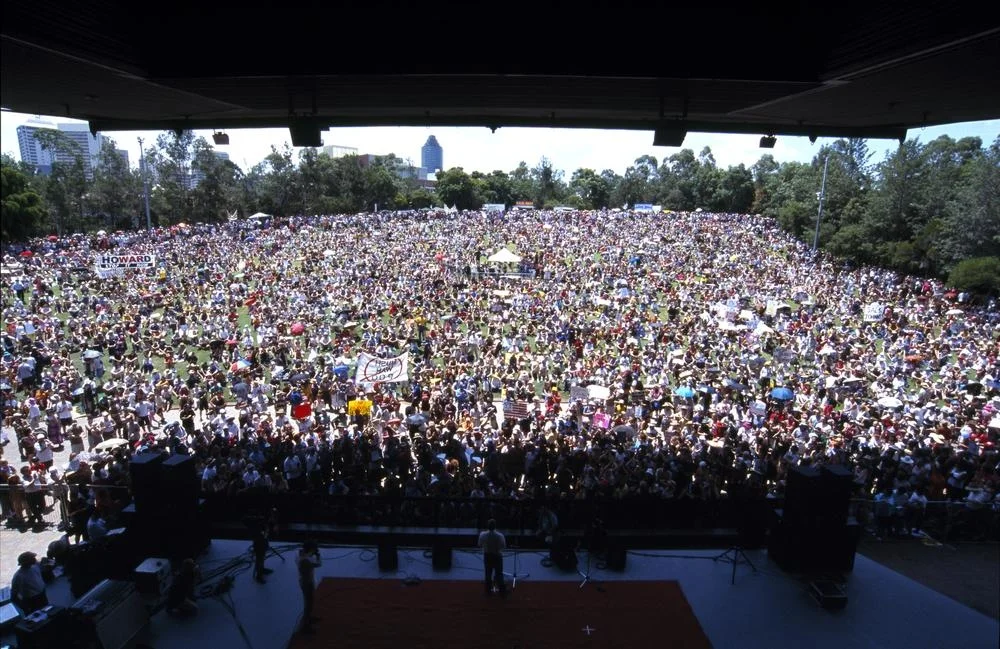
Source: https://www.theguardian.com/world/2003/feb...

Enjoyed this speech? Speakola is a labour of love and I’d be very grateful if you would share, tweet or like it. Thank you.

Facebook Twitter Facebook
In 2000s MORE Tags COLIN POWELL, UNITED NATIONS, GENERAL ASSEMBLY, IRAQ WAR, WEAPONS OF MASS DESTRUCTION, WMD, GEORGE W BUSH, WEAPONS INPSECTIONS, SADDAM HUSSEIN
Comment

George Galloway: 'You are trying to divert attention from the crimes that you supported', defence to US Senate - 2005

February 22, 2021

17 May 2005, Washington DC, USA

Senator, I am not now, nor have I ever been, an oil trader. and neither has anyone on my behalf. I have never seen a barrel of oil, owned one, bought one, sold one - and neither has anyone on my behalf.

Now I know that standards have slipped in the last few years in Washington, but for a lawyer you are remarkably cavalier with any idea of justice. I am here today but last week you already found me guilty. You traduced my name around the world without ever having asked me a single question, without ever having contacted me, without ever written to me or telephoned me, without any attempt to contact me whatsoever. And you call that justice.

Now I want to deal with the pages that relate to me in this dossier and I want to point out areas where there are - let's be charitable and say errors. Then I want to put this in the context where I believe it ought to be. On the very first page of your document about me you assert that I have had 'many meetings' with Saddam Hussein. This is false.

I have had two meetings with Saddam Hussein, once in 1994 and once in August of 2002. By no stretch of the English language can that be described as "many meetings" with Saddam Hussein.

As a matter of fact, I have met Saddam Hussein exactly the same number of times as Donald Rumsfeld met him. The difference is Donald Rumsfeld met him to sell him guns and to give him maps the better to target those guns. I met him to try and bring about an end to sanctions, suffering and war, and on the second of the two occasions, I met him to try and persuade him to let Dr Hans Blix and the United Nations weapons inspectors back into the country - a rather better use of two meetings with Saddam Hussein than your own Secretary of State for Defence made of his.

I was an opponent of Saddam Hussein when British and Americans governments and businessmen were selling him guns and gas. I used to demonstrate outside the Iraqi embassy when British and American officials were going in and doing commerce.

You will see from the official parliamentary record, Hansard, from the 15th March 1990 onwards, voluminous evidence that I have a rather better record of opposition to Saddam Hussein than you do and than any other member of the British or American governments do.

Now you say in this document, you quote a source, you have the gall to quote a source, without ever having asked me whether the allegation from the source is true, that I am 'the owner of a company which has made substantial profits from trading in Iraqi oil'.

Senator, I do not own any companies, beyond a small company whose entire purpose, whose sole purpose, is to receive the income from my journalistic earnings from my employer, Associated Newspapers, in London. I do not own a company that's been trading in Iraqi oil. And you have no business to carry a quotation, utterly unsubstantiated and false, implying otherwise.

Now you have nothing on me, Senator, except my name on lists of names from Iraq, many of which have been drawn up after the installation of your puppet government in Baghdad. If you had any of the letters against me that you had against Zhirinovsky, and even Pasqua, they would have been up there in your slideshow for the members of your committee today.

You have my name on lists provided to you by the Duelfer inquiry, provided to him by the convicted bank robber, and fraudster and conman Ahmed Chalabi who many people to their credit in your country now realise played a decisive role in leading your country into the disaster in Iraq.

There were 270 names on that list originally. That's somehow been filleted down to the names you chose to deal with in this committee. Some of the names on that committee included the former secretary to his Holiness Pope John Paul II, the former head of the African National Congress Presidential office and many others who had one defining characteristic in common: they all stood against the policy of sanctions and war which you vociferously prosecuted and which has led us to this disaster.

You quote Mr Dahar Yassein Ramadan. Well, you have something on me, I've never met Mr Dahar Yassein Ramadan. Your sub-committee apparently has. But I do know that he's your prisoner, I believe he's in Abu Ghraib prison. I believe he is facing war crimes charges, punishable by death. In these circumstances, knowing what the world knows about how you treat prisoners in Abu Ghraib prison, in Bagram Airbase, in Guantanamo Bay, including I may say, British citizens being held in those places.

I'm not sure how much credibility anyone would put on anything you manage to get from a prisoner in those circumstances. But you quote 13 words from Dahar Yassein Ramadan whom I have never met. If he said what he said, then he is wrong.

And if you had any evidence that I had ever engaged in any actual oil transaction, if you had any evidence that anybody ever gave me any money, it would be before the public and before this committee today because I agreed with your Mr Greenblatt [Mark Greenblatt, legal counsel on the committee].

Your Mr Greenblatt was absolutely correct. What counts is not the names on the paper, what counts is where's the money. Senator? Who paid me hundreds of thousands of dollars of money? The answer to that is nobody. And if you had anybody who ever paid me a penny, you would have produced them today.

Now you refer at length to a company named in these documents as Aredio Petroleum. I say to you under oath here today: I have never heard of this company, I have never met anyone from this company. This company has never paid a penny to me and I'll tell you something else: I can assure you that Aredio Petroleum has never paid a single penny to the Mariam Appeal Campaign. Not a thin dime. I don't know who Aredio Petroleum are, but I daresay if you were to ask them they would confirm that they have never met me or ever paid me a penny.

Whilst I'm on that subject, who is this senior former regime official that you spoke to yesterday? Don't you think I have a right to know? Don't you think the Committee and the public have a right to know who this senior former regime official you were quoting against me interviewed yesterday actually is?

Now, one of the most serious of the mistakes you have made in this set of documents is, to be frank, such a schoolboy howler as to make a fool of the efforts that you have made. You assert on page 19, not once but twice, that the documents that you are referring to cover a different period in time from the documents covered by The Daily Telegraph which were a subject of a libel action won by me in the High Court in England late last year.

You state that The Daily Telegraph article cited documents from 1992 and 1993 whilst you are dealing with documents dating from 2001. Senator, The Daily Telegraph's documents date identically to the documents that you were dealing with in your report here. None of The Daily Telegraph's documents dealt with a period of 1992, 1993. I had never set foot in Iraq until late in 1993 - never in my life. There could not possibly be documents relating to Oil-for-Food matters in 1992, 1993, for the Oil-for-Food scheme did not exist at that time.

And yet you've allocated a full section of this document to claiming that your documents are from a different era to the Daily Telegraph documents when the opposite is true. Your documents and the Daily Telegraph documents deal with exactly the same period.

But perhaps you were confusing the Daily Telegraph action with the Christian Science Monitor. The Christian Science Monitor did indeed publish on its front pages a set of allegations against me very similar to the ones that your committee have made. They did indeed rely on documents which started in 1992, 1993. These documents were unmasked by the Christian Science Monitor themselves as forgeries.

Now, the neo-con websites and newspapers in which you're such a hero, senator, were all absolutely cock-a-hoop at the publication of the Christian Science Monitor documents, they were all absolutely convinced of their authenticity. They were all absolutely convinced that these documents showed me receiving $10 million from the Saddam regime. And they were all lies.

In the same week as the Daily Telegraph published their documents against me, the Christian Science Monitor published theirs which turned out to be forgeries and the British newspaper, Mail on Sunday, purchased a third set of documents which also upon forensic examination turned out to be forgeries. So there's nothing fanciful about this. Nothing at all fanciful about it.

The existence of forged documents implicating me in commercial activities with the Iraqi regime is a proven fact. It's a proven fact that these forged documents existed and were being circulated amongst right-wing newspapers in Baghdad and around the world in the immediate aftermath of the fall of the Iraqi regime.

Now, Senator, I gave my heart and soul to oppose the policy that you promoted. I gave my political life's blood to try to stop the mass killing of Iraqis by the sanctions on Iraq which killed one million Iraqis, most of them children, most of them died before they even knew that they were Iraqis, but they died for no other reason other than that they were Iraqis with the misfortune to born at that time. I gave my heart and soul to stop you committing the disaster that you did commit in invading Iraq. And I told the world that your case for the war was a pack of lies.

I told the world that Iraq, contrary to your claims did not have weapons of mass destruction. I told the world, contrary to your claims, that Iraq had no connection to al-Qaeda. I told the world, contrary to your claims, that Iraq had no connection to the atrocity on 9/11 2001. I told the world, contrary to your claims, that the Iraqi people would resist a British and American invasion of their country and that the fall of Baghdad would not be the beginning of the end, but merely the end of the beginning.

Senator, in everything I said about Iraq, I turned out to be right and you turned out to be wrong and 100,000 people paid with their lives; 1600 of them American soldiers sent to their deaths on a pack of lies; 15,000 of them wounded, many of them disabled forever on a pack of lies.

If the world had listened to Kofi Annan, whose dismissal you demanded, if the world had listened to President Chirac who you want to paint as some kind of corrupt traitor, if the world had listened to me and the anti-war movement in Britain, we would not be in the disaster that we are in today. Senator, this is the mother of all smokescreens. You are trying to divert attention from the crimes that you supported, from the theft of billions of dollars of Iraq's wealth.

Have a look at the real Oil-for-Food scandal. Have a look at the 14 months you were in charge of Baghdad, the first 14 months when $8.8 billion of Iraq's wealth went missing on your watch. Have a look at Haliburton and other American corporations that stole not only Iraq's money, but the money of the American taxpayer.

Have a look at the oil that you didn't even meter, that you were shipping out of the country and selling, the proceeds of which went who knows where? Have a look at the $800 million you gave to American military commanders to hand out around the country without even counting it or weighing it.

Have a look at the real scandal breaking in the newspapers today, revealed in the earlier testimony in this committee. That the biggest sanctions busters were not me or Russian politicians or French politicians. The real sanctions busters were your own companies with the connivance of your own Government."

Source: https://www.wussu.com/current/galloway.htm

Enjoyed this speech? Speakola is a labour of love and I’d be very grateful if you would share, tweet or like it. Thank you.

Facebook Twitter Facebook
In 2000s MORE Tags GEORGE GALLOWAY, BRITISH MP, IRAQ WAR, US SENATE, IRAQ OIL, TRANSCRIPT, INQUIRY, SENATE INQUIRY, SELF DEFENCE, SADDAM HUSSEIN, INVASION OF IRAQ, BOMBING IRAQ
Comment

Tony Benn: 'Don't Arab and Iraqi women weep when their children die?', vote on Iraq bombing - 1998

February 20, 2019

17 February 1998, Westminster, United Kingdom

I finish just by saying this: war is an easy thing to talk about; there are not many people - a - of the generation that remember it. The right hon. Member for Old Bexley and Sidcup served with distinction in the last war. I never killed anyone but I wore uniform. But I was in London in the blitz in 1940, living in the Millbank tower, where I was born. Some different ideas have come in since. And every night, I went down to the shelter in Thames house. Every morning, I saw dockland burning. Five hundred people were killed in Westminster one night by a land mine. It was terrifying. Aren't Arabs terrified? Aren't Iraqis terrified? Don't Arab and Iraqi women weep when their children die? Does bombing strengthen their determination? What fools we are to live in a generation for which war is a computer game for our children and just an interesting little channel for news item.

Every Member of Parliament tonight who votes for the Government motion will be consciously and deliberately accepting responsibility for the deaths of innocent people if the war begins, as I fear it will. Now that's for their decision to take. But this is a quite unique debate. In my parliamentary experience, where we are asked to share responsibility for a decision we won't really be taking, with consequences for people who have no part to play in the brutality of the regime which we are dealing with.

And I finish with this: on 24 October 1945—the right hon. Member for Old Bexley and Sidcup will remember—the United Nations charter was passed. And the words of that charter are etched into my mind and move me even as I think of them. "We the peoples of the United Nations determined to save succeeding generations from the scourge of war, which twice in our life-time has caused untold suffering to mankind". That was the pledge of that generation to this generation, and it would be the greatest betrayal of all if we voted to abandon the charter, and take unilateral action and pretend that we were doing it in the name of the international community. And I shall vote against the motion for the reasons that I have given the house.

The above is the passage that matches the video. The full speech is below:

I have very little time. I want to develop my argument. There are many others who want to speak. 926 I hope that the House will listen to me. I know that my view is not the majority view in the House, although it may be outside this place.

I regret that I shall vote against the Government motion. The first victims of the bombing that I believe will be launched within a fortnight will be innocent people, many, if not most, of whom would like Saddam to be removed. The former Prime Minister, the right hon. Member for Huntingdon, talked about collateral damage. The military men are clever. They talk not about hydrogen bombs but about deterrence. They talk not about people but about collateral damage. They talk not about power stations and sewerage plants but about assets. The reality is that innocent people will be killed if the House votes tonight—as it manifestly will—to give the Government the authority for military action.

The bombing would also breach the United Nations charter. I do not want to argue on legal terms. If the hon. and learned Member for North-East Fife (Mr. Campbell) has read articles 41 and 42, he will know that the charter says that military action can only be decided on by the Security Council and conducted under the military staffs committee. That procedure has not been followed and cannot be followed because the five permanent members have to agree. Even for the Korean war, the United States had to go to the General Assembly to get authority because Russia was absent. That was held to be a breach, but at least an overwhelming majority was obtained.

Has there been any negotiation or diplomatic effort? Why has the Foreign Secretary not been in Baghdad, like the French Foreign Minister, the Turkish Foreign Minister and the Russian Foreign Minister? The time that the Government said that they wanted for negotiation has been used to prepare public opinion for war and to build up their military position in the Gulf.

Saddam will be strengthened again. Or he may be killed. I read today that the security forces—who are described as terrorists in other countries—have tried to kill Saddam. I should not be surprised if they succeeded.

This second action does not enjoy support from elsewhere. There is no support from Iraq's neighbours. If what the Foreign Secretary says about the threat to the neighbours is true, why is Iran against, why is Jordan against, why is Saudi Arabia against, why is Turkey against? Where is that great support? There is no support from the opposition groups inside Iraq. The Kurds, the Shi'ites and the communists hate Saddam, but they do not want the bombing. The Pope is against it, along with 10 bishops, two cardinals, Boutros Boutros-Ghali and Perez de Cuellar. The Foreign Secretary clothes himself with the garment of the world community, but he does not have that support. We are talking about an Anglo-American preventive war. It has been planned and we are asked to authorise it in advance.

The House is clear about its view of history, but it does not say much about the history of the areas with which we are dealing. The borders of Kuwait and Iraq, which then became sacrosanct, were drawn by the British after the end of the Ottoman empire. We used chemical weapons against the Iraqis in the 1930s. Air Chief Marshal Harris, who later flattened Dresden, was instructed to drop chemical weapons.

When Saddam came to power, he was a hero of the west. The Americans used him against Iran because they hated Khomeini, who was then the figure to be removed. 927 They armed Saddam, used him and sent him anthrax. I am not anxious to make a party political point, because there is not much difference between the two sides on this, but, as the Scott report revealed, the previous Government allowed him to be armed. I had three hours with Saddam in 1990. I got the hostages out, which made it worth going. He felt betrayed by the United States, because the American ambassador in Baghdad had said to him, "If you go into Kuwait, we will treat it as an Arab matter." That is part of the history that they know, even if we do not know it here.

In 1958, 40 years ago, Selwyn Lloyd, the Foreign Secretary and later the Speaker, told Foster Dulles that Britain would make Kuwait a Crown colony. Foster Dulles said, "What a very good idea." We may not know that history, but in the middle east it is known.

The Conservatives have tabled an amendment asking about the objectives. That is an important issue. There is no UN resolution saying that Saddam must be toppled. It is not clear that the Government know what their objectives are. They will probably be told from Washington. Do they imagine that if we bomb Saddam for two weeks, he will say, "Oh, by the way, do come in and inspect"? The plan is misconceived.

Some hon. Members—even Opposition Members—have pointed out the double standard. I am not trying to equate Israel with Iraq, but on 8 June 1981, Israel bombed a nuclear reactor near Baghdad. What action did either party take on that? Israel is in breach of UN resolutions and has instruments of mass destruction. Mordecai Vanunu would not boast about Israeli freedom. Turkey breached UN resolutions by going into northern Cyprus. It has also recently invaded northern Iraq and has instruments of mass destruction. Lawyers should know better than anyone else that it does not matter whether we are dealing with a criminal thug or an ordinary lawbreaker—if the law is to apply, it must apply to all. Governments of both major parties have failed in that.

Prediction is difficult and dangerous, but I fear that the situation could end in a tragedy for the American and British Governments. Suez and Vietnam are not far from the minds of anyone with a sense of history. I recall what happened to Sir Anthony Eden. I heard him announce the ceasefire and saw him go on holiday to Goldeneye in Jamaica. He came back to be replaced. I am not saying that that will happen in this case, but does anyone think that the House is in a position to piggy-back on American power in the middle east? What happens if Iraq breaks up? If the Kurds are free, they will demand Kurdistan and destabilise Turkey. Anything could happen. We are sitting here as if we still had an empire—only, fortunately, we have a bigger brother with more weapons than us.

The British Government have everything at their disposal. They are permanent members of the Security Council and have the European Union presidency for six months. Where is that leadership in Europe which we were promised? It just disappeared. We are also, of course, members of the Commonwealth, in which there are great anxieties. We have thrown away our influence, which could have been used for moderation.

The amendment that I and others have tabled argues that the United Nations Security Council should decide the nature of what Kofi Annan brings back from Baghdad and whether force is to be used. Inspections and sanctions go side by side. As I said, sanctions are brutal for innocent 928 people. Then there is the real question: when will the world come to terms with the fact that chemical weapons are available to anybody? If there is an answer to that, it must involve the most meticulous observation of international law, which I feel we are abandoning.

War is easy to talk about; there are not many people left of the generation which remembers it. The right hon. Member for Old Bexley and Sidcup served with distinction in the last war. I never killed anyone but I wore uniform. I was in London during the blitz in 1940, living where the Millbank tower now stands, where I was born. Some different ideas have come in there since. Every night, I went to the shelter in Thames house. Every morning, I saw docklands burning. Five hundred people were killed in Westminster one night by a land mine. It was terrifying. Are not Arabs and Iraqis terrified? Do not Arab and Iraqi women weep when their children die? Does not bombing strengthen their determination? What fools we are to live as if war is a computer game for our children or just an interesting little Channel 4 news item.

Every Member of Parliament who votes for the Government motion will be consciously and deliberately accepting responsibility for the deaths of innocent people if the war begins, as I fear it will. That decision is for every hon. Member to take. In my parliamentary experience, this a unique debate. We are being asked to share responsibility for a decision that we will not really be taking but which will have consequences for people who have no part to play in the brutality of the regime with which we are dealing.

On 24 October 1945—the right hon. Member for Old Bexley and Sidcup will remember—the United Nations charter was passed. The words of that charter are etched on my mind and move me even as I think of them. It says: We the peoples of the United Nations determined to save succeeding generations from the scourge of war, which twice in our life-time has brought untold sorrow to mankind". That was that generation's pledge to this generation, and it would be the greatest betrayal of all if we voted to abandon the charter, take unilateral action and pretend that we were doing so in the name of the international community. I shall vote against the motion for the reasons that I have given.

Source: https://api.parliament.uk/historic-hansard...

Enjoyed this speech? Speakola is a labour of love and I’d be very grateful if you would share, tweet or like it. Thank you.

Facebook Twitter Facebook
In 1980-99 B Tags TONY BENN, TRANSCRIPT, BOMBING IRAQ, 1998 IRAQ BOMBING, WAR, BLITZ, IRAQ WAR
Comment

Jeremy Corbyn: 'It will set off a spiral of conflict, of hate, of misery that will fuel the wars of the future', anti Iraq War rally - 2003

March 31, 2017

15 Feburary 2003, Hyde Park, London, United Kingdom

Thanks Carol, and thank you to every single person that's here today in the biggest ever political demonstration in the history of this country.

And today, there are 600 and more demonstrations in cities all around the world. Every country, every continent, everybody in the world has a chance today to say no, absolutely no, to war on Iraq.

We are a force that's not alone, not isolated, and very, very relevant to today's world. Those, George Bush, Tony Blair, [As-na 00:00:59] [Bal-es-co-di 00:01:00], who want war, they are the ones who are isolated and alone and desperately searching for friends.

Because there is no justice whatsoever in the planned war against Iraq, and I say that because there is much talk of the possibility of a second United Nations resolution. I say this. Even if the United Nations is bribed and cajoled and cobbles together some form of words that give some kind of pretext for an attack on Iraq, it would be wrong, and I would be against it. We would be against it, because we're against the war.

As a member of the British Parliament, I am very angry that we have so far been denied a vote on the possibility of going to war. I find it deeply distasteful that the British Prime Minister can use the medieval powers of the royal prerogative to send young men and women to die, to kill civilians, and for Iraqis to die.

I want a vote in the British Parliament, not to legitimise war, but to give me the opportunity on behalf of the multicultural community I represent, to vote against any war with Iraq.

Around the world, the image of this country has been reduced to that, of our Prime Minister and our Foreign Secretary, in all the conference halls of the world, whenever George Bush, Colin Powell, Donald Rumsfeld, Dick Cheney speak, all they can do is get up and say, "Me too."

Well, surely the message today in London, in Glasgow, and ordinary people on the streets of this country, is this. Why are we spending three and a half billion pounds on a war that nobody wants, when there is an AIDS pandemic sweeping Africa? When a quarter of the world's children die in poverty and starvation? And we say there isn't money sufficient for our own public services!

Well, the answer is an obvious one. No to war, yes to peace. Yes to rehabilitation and rebuilding.

For those who say that this is a necessary and just conflict because it will bring about peace and security: September the 11th was a dreadful event. 8000 deaths in Afghanistan brought back none of those who died in the World Trade Centre. Thousands more deaths in Iraq will not make things right. It will set off a spiral of conflict, of hate, of misery, of desperation, that will fuel the wars, the conflict, the terrorism, the depression, and the misery of future generations.

You cannot humiliate the Palestinian people in the way that they've been humiliated and not expect some problem in the future. You cannot arm regimes like Iraq, Iran, and many others, without expecting further problems in the future.

Our message, our message today here in London, a million and more strong, is this. We want to live in a world free from war. The way to free us from the scourge of war is to free ourselves from the scourge of injustice, of poverty, and the misery that's associated with that. This movement, this movement is giving that message to the British government. Stop now, or pay a political price.

Thank you very much.

Source: https://www.youtube.com/watch?v=Bs9NfhnfQL...

Enjoyed this speech? Speakola is a labour of love and I’d be very grateful if you would share, tweet or like it. Thank you.

Facebook Twitter Facebook
In 2000s Tags JEREMY CORBYN, HYDE PARK, LONDON, DAY OF ACTION, ANTI IRAQ WAR, LABOUR PARTY, GEORGE W BUSH, TONY BLAIR, IRAQ WAR, TRANSCRIPT
Comment

Gordon Smith: 'We have to learn the lessons of history', remarks on war in Iraq - 2006

January 18, 2017

Smith was a Republican Senator for Oregan who voted in favour of the war in Iraq in 2003

Mr. President, I know it is probably appropriate to speak of our colleagues, and I will do that on the record. I rise tonight, however, to speak about a subject heavy on my mind. It is the subject of the war in Iraq.

I have never worn the uniform of my country. I am not a soldier or a veteran. It is one of the regrets of my life. But I am a student of history, particularly military history, and it is that perspective which I brought to the Senate 10 years ago as a newly elected Member of this Chamber.

When we came to the vote on Iraq, it was an issue of great moment for me. No issue is more difficult to vote on than war and peace, because it involves the lives of our soldiers, our young men and women. It involves the expenditure of our treasure, putting on the line the prestige of our country. It is not a vote taken lightly. I have tried to be a good soldier in this Chamber. I have tried to support our President, believing at the time of the vote on the war in Iraq that we had been given good intelligence and knowing that Saddam Hussein was a menace to the world, a brutal dictator, a tyrant by any standard, and one who threatened our country in many different ways, through the financing and fomenting of terrorism. For those reasons and believing that we would find weapons of mass destruction, I voted aye.

I have been rather silent on this question ever since. I have been rather quiet because, when I was visiting Oregon troops in Kirkuk in the Kurdish area, the soldiers said to me: Senator, don't tell me you support the troops and not our mission. That gave me pause. But since that time, there have been 2,899 American casualties. There have been over 22,000 American men and women wounded. There has been an expenditure of $290 billion a figure that approaches the expenditure we have every year on an issue as important as Medicare. We have paid a price in blood and treasure that is beyond calculation by my estimation.

Now, as I witness the slow undoing of our efforts there, I rise to speak from my heart. I was greatly disturbed recently to read a comment by a man I admire in history, one Winston Churchill, who after the British mandate extended to the peoples of Iraq for 5 years, wrote to David Lloyd George, Prime Minister of England:

At present we are paying 8 millions a year for the privilege of living on an ungrateful volcano.

When I read that, I thought, not much has changed. We have to learn the lessons of history and sometimes they are painful because we have made mistakes.

Even though I have not worn the uniform of my country, I, with other colleagues here, love this Nation. I came into politics because I believed in some things. I am unusually proud of the fact of our recent history, the history of our Nation since my own birth. At the end of the Second World War, there were 15 nations on earth that could be counted as democracies that you and I would recognize. Today there are 150 nations on earth that are democratic and free. That would not have happened had the United States been insular and returned to our isolationist roots, had we laid down the mantle of world leadership, had we not seen the importance of propounding and encouraging the spread of democracy, the rule of law, human rights, and the values of our Bill of Rights. It is a better world because of the United States of America, and the price we have paid is one of blood and treasure.

Now we come to a great crossroads. A commission has just done some, I suppose, good work. I am still evaluating it. I welcome any ideas now because where we are leaves me feeling much like Churchill, that we are paying the price to sit on a mountain that is little more than a volcano of ingratitude.

Yet as I feel that, I remember the pride I felt when the statue of Saddam Hussein came down. I remember the thrill I felt when three times Iraqis risked their own lives to vote democratically in a way that was internationally verifiable as well as legitimate and important. Now all of those memories seem much like ashes to me.

The Iraq Study Group has given us some ideas. I don't know if they are good or not. It does seem to me that it is a recipe for retreat. It is not cut and run, but it is cut and walk. I don't know that that is any more honorable than cutting and running, because cutting and walking involves greater expenditure of our treasure, greater loss of American lives.

Many things have been attributed to George Bush. I have heard him on this floor blamed for every ill, even the weather. But I do not believe him to be a liar. I do not believe him to be a traitor, nor do I believe all the bravado and the statements and the accusations made against him. I believe him to be a very idealistic man. I believe him to have a stubborn backbone. He is not guilty of perfidy, but I do believe he is guilty of believing bad intelligence and giving us the same.

I can't tell you how devastated I was to learn that in fact we were not going to find weapons of mass destruction. But remembering the words of the soldier—don't tell me you support the troops but you don't support my mission—I felt the duty to continue my support. Yet I believe the President is guilty of trying to win a short war and not understanding fully the nature of the ancient hatreds of the Middle East. Iraq is a European creation. At the Treaty of Versailles, the victorious powers put together Kurdish, Sunni, and Shia tribes that had been killing each other for time immemorial. I would like to think there is an Iraqi identity. I would like to remember the purple fingers raised high. But we cannot want democracy for Iraq more than they want it for themselves. And what I find now is that our tactics there have failed.

Again, I am not a soldier, but I do know something about military history. And what that tells me is when you are engaged in a war of insurgency, you can't clear and leave. With few exceptions, throughout Iraq that is what we have done. To fight an insurgency often takes a decade or more. It takes more troops than we have committed. It takes clearing, holding, and building so that the people there see the value of what we are doing. They become the source of intelligence, and they weed out the insurgents. But we have not cleared and held and built. We have cleared and left, and the insurgents have come back.

I, for one, am at the end of my rope when it comes to supporting a policy that has our soldiers patrolling the same streets in the same way, being blown up by the same bombs day after day. That is absurd. It may even be criminal. I cannot support that anymore. I believe we need to figure out how to fight the war on terror and to do it right. So either we clear and hold and build, or let's go home.

There are no good options, as the Iraq Study Group has mentioned in their report. I am not sure cutting and walking is any better. I have little confidence that the Syrians and the Iranians are going to be serious about helping us to build a stable and democratic Iraq. I am at a crossroads as well. I want my constituents to know what is in my heart, what has guided my votes.

What will continue to guide the way I vote is simply this: I do not believe we can retreat from the greater war on terror. Iraq is a battlefield in that larger war. But I do believe we need a presence there on the near horizon at least that allows us to provide intelligence, interdiction, logistics, but mostly a presence to say to the murderers that come across the border: We are here, and we will deal with you. But we have no business being a policeman in someone else's civil war.

I welcome the Iraq Study Group's report, but if we are ultimately going to retreat, I would rather do it sooner than later. I am looking for answers, but the current course is unacceptable to this Senator. I suppose if the President is guilty of one other thing, I find it also in the words of Winston Churchill. He said:

After the First World War, let us learn our lessons. Never, never believe that any war will be smooth and easy or that anyone who embarks on this strange voyage can measure the tides and the hurricanes. The statesman who yields to war fever must realize that once the signal is given, he is no longer the master of policy but the slave of unforeseeable and uncontrollable events.

That is a lesson we are learning again. I am afraid, rather than leveling with the American people and saying this was going to be a decade-long conflict because of the angst and hatred that exists in that part of the world, that we tried to win it with too few troops in too fast a time. Lest anyone thinks I believe we have failed militarily, please understand I believe when President Bush stood in front of "Mission Accomplished" on an aircraft carrier that, in purely military terms, the mission was accomplished in the wars in Afghanistan and Iraq. But winning a battle, winning a war, is different than winning a peace.

We were not prepared to win the peace by clearing, holding, and building. You don't do that fast and you don't do it with too few troops. I believe now that we must either determine to do that, or we must redeploy in a way that allows us to continue to prosecute the larger war on terror. It will not be pretty. We will pay a price in world opinion. But I, for one, am tired of paying the price of 10 or more of our troops dying a day. So let's cut and run, or cut and walk, or let us fight the war on terror more intelligently than we have, because we have fought this war in a very lamentable way.

Those are my feelings. I regret them. I would have never voted for this conflict had I reason to believe that the intelligence we had was not accurate. It was not accurate, but that is history. Now we must find a way to make the best of a terrible situation, at a minimum loss of life for our brave fighting men and women. So I will be looking for every opportunity to clear, build, hold, and win or how to bring our troops home.

I yield the floor.

Source: https://en.wikisource.org/wiki/Floor_State...

Enjoyed this speech? Speakola is a labour of love and I’d be very grateful if you would share, tweet or like it. Thank you.

Facebook Twitter Facebook
In 2000s MORE Tags GORDON SMITH, SENATE, SENATOR, OREGAN, TRANSCRIPT, IRAQ WAR, IRAQ, GEORGE W BUSH
Comment

Tony Blair: 'It's the chain reaction that terror brings with it', The case against terrorism - 2006

December 8, 2016

28 July 2006, Joint News conference, White House, Washington DC, USA


I don't think, actually, it's anything to do with a loss of American influence at all. I think -- we've got to go back and ask what changed policy, because policy has changed in the past few years. And what changed policy was September the 11th.

That changed policy, but actually, before September the 11th this global movement with a global ideology was already in being. September the 11th was the culmination of what they wanted to do. But, actually -- and this is probably where the policymakers, such as myself, were truly in error -- is that even before September the 11th, this was happening in all sorts of different ways in different countries.

I mean, in Algeria, for example, tens and tens of thousands of people lost their lives. This movement has grown, it is there, it will latch on to any cause that it possibly can and give it a dimension of terrorism and hatred.

You can see this. You can see it in Kashmir, for example. You can see it in Chechnya. You can see it in Palestine. Now, what is its purpose?

Its purpose is to promote its ideology based upon the perversion of Islam, and to use any methods at all, but particularly terrorism, to do that, because they know that the value of terrorism to them is -- as I was saying a moment or two ago, it's not simply the act of terror, it's the chain reaction that terror brings with it.

Terrorism brings the reprisal; the reprisal brings the additional hatred; the additional hatred breeds the additional terrorism, and so on. But in a small way, we lived through that in Northern Ireland over many, many decades.

Now, what happened after September the 11th -- and this explains, I think, the President's policy, but also the reason why I have taken the view, and still take the view that Britain and America should remain strong allies, shoulder-to-shoulder in fighting this battle, is that we are never going to succeed unless we understand they are going to fight hard. The reason why they are doing what they're doing in Iraq at the moment -- and, yes, it's really tough as a result of it -- is because they know that if, right in the center of the Middle East, in an Arab, Muslim country, you've got a non- sectarian democracy, in other words people weren't governed either by religious fanatics or secular dictators, you've got a genuine democracy of the people, how does their ideology flourish in such circumstances?

So they have imported the terrorism into that country, preyed on whatever reactionary elements there are to boost it. And that's why we have the issue there; that's why the Taliban are trying to come back in Afghanistan.

That is why, the moment it looked as if you could get progress in Israel and Palestine, it had to be stopped. That's the moment when, as they saw there was a problem in Gaza, so they realized, well, there's a possibility now we can set Lebanon against Israel.

Now, it's a global movement, it's a global ideology. And if there's any mistake that's ever made in these circumstances, it's if people are surprised that it's tough to fight, because you're up against an ideology that's prepared to use any means at all, including killing any number of wholly innocent people.

And I don't dispute part of the implication of your question at all, in the sense that you look at what is happening in the Middle East and what is happening in Iraq and Lebanon and Palestine, and, of course, there's a sense of shock and frustration and anger at what is happening, and grief at the loss of innocent lives.

But it is not a reason for walking away. It's a reason for staying the course, and staying it no matter how tough it is, because the alternative is actually letting this ideology grip a larger and larger number of people.

And it is going to be difficult. Look, we've got a problem even in our own Muslim communities in Europe, who will half-buy into some of the propaganda that's pushed at it -- the purpose of America is to suppress Islam, Britain has joined with America in the suppression of Islam. And one of the things we've got to stop doing is stop apologizing for our own positions.

Muslims in America, as far as I'm aware of, are free to worship; Muslims in Britain are free to worship. We are plural societies. It's nonsense, the propaganda is nonsense. And we're not going to defeat this ideology until we in the West go out with sufficient confidence in our own position and say, this is wrong.

It's not just wrong in its methods, it's wrong in its ideas, it's wrong in its ideology, it's wrong in every single wretched reactionary thing about it. And it will be a long struggle, I'm afraid. But there's no alternative but to stay the course with it. And we will.


Source: http://www.prnewswire.com/news-releases/re...

Enjoyed this speech? Speakola is a labour of love and I’d be very grateful if you would share, tweet or like it. Thank you.

Facebook Twitter Facebook
In 2010s MORE Tags TONY BLAIR, TERRORISM, SEPTEMBER 11, 9-11, IRAQ WAR, GEORGE W BUSH
Comment

Peter Khalil: 'To those religious and ethnic groups being used as political footballs: ‘I will stand by you, with you and for you'', maiden speech - 2016

September 15, 2016

12 September 2016, Parliament House, Canberra, Australia

Mr Speaker, I congratulate you on your election to the chair and I begin my first speech by acknowledging the traditional owners of the land we meet on, the Ngunnawal people, and their elders past and present. I do so because it is a profound mark of respect for the peoples and cultures that have been present on this land from the beginning of time.

I stand in this place because I was elected by the people of Wills to serve them and to make a difference to their lives. I am conscious of being charged with an enormous responsibility bestowed with great honour. Even though it is somewhat improbable that I stand here, I am living proof that in this country politics matters, that it can make a profound difference to people’s lives.

My parents, Fayek and Georgette Khalil, are here with us in the gallery today. They came to Australia from Egypt 47 years ago. Just like those who come today, they were escaping a region where conflict was the norm and opportunities limited. Their sacrifice and that of millions of other migrants helped build Australia—not just its physical environment but the diversity of its culture, the generosity of its peoples and the depth of its humanity. I say these things too because nowhere is this diversity, this generosity of spirit, this decency better reflected than in the people of Wills.

My parents sacrificed so much of their own lives, their dreams and ambitions, to give my sister, Ellen, and I a better life. We started out in an inner-city Melbourne housing commission. Dad had to give up a career in Egypt as a lawyer and he worked for Australia Post. He became a union man, a shop steward, and later was on the state executive of the Victorian postal workers union. Mum gave up her uni degree in Egypt and worked at the Reserve Bank printing labs and as a preschool carer and an interpreter. They worked hard to give us a chance to make something of a new life in Australia.

It was not always easy. There were times of great hardship and ugly prejudice. I grew up in Australia in the seventies and eighties, a world very different from the one we live in today. Racism was more overt and considered acceptable by some. I experienced much of it directly. I will always remember my Grade 6 teacher, Mrs Hendrix, a coloured South African woman, who told me that in apartheid South Africa my parents would not be able to travel on the same bus, because of the difference in their skin complexion. That troubled me deeply as a 12-year-old, but it also awakened in me a yearning for social justice and a nascent political activism.

Although I was a serious kid who went to concerts in support of the ANC with my dad and who read Gandhi and Mandela, Malcolm X and Martin Luther King, I was also like every other Aussie kid: I really loved my footy—Aussie rules, of course. My grandparents lived in a housing commission in Preston, and my Auntie Gigi—Giselle—who is here today too, went to Preston East High School with Peter Daicos, the great Collingwood champion. She introduced me to Daics at the Preston fish and chip shop in 1978, when I was five years old, and I was Collingwood for life. I remember dragging Dad down to Victoria Park to watch the Magpies every second Saturday. I would sit on his shoulders as he stood in the outer.

While footy gave me great excitement, agony—1979, 80, 81, 2002 and 2003; I was too young for 77—and some great joy in 1990 and 2010, it taught me deeper life lessons. Daics was an ethnic, more usually called a wog in those days—and other terrible things—much the same as I was being called in the schoolyard. Despite the abuse, Daics was a champion. His exploits inspired me, and I started to believe in myself too. I learned to ignore all of the hatred and prejudice and to let my actions do the talking and that lots of hard work and a little talent will always make you a winner.

My parents also instilled in us the critical importance of education to our futures—education and the lasting impact of dedicated teachers like Mrs Hendrix and my year 9 politics teacher, Mr Sestito, who ignited my passion for Australian politics. I met recently with one of my predecessors in Wills, Bob Hawke, better known, of course, as one of Australia’s greatest Prime Ministers, and I asked Bob whether with all the achievements of his administration there was a policy that went unheralded. He told me that, when he became PM in 1983, only a third of students in Australia finished year 12. Only a third. Through policies his government put in place, by 1991 it had almost tripled to 90 per cent. Bob was particularly proud of that achievement. It was the visionary policy achievements of Labor governments—the one he led and those before and after—that gave me access to a quality education. I am and will be forever grateful.

Mine is not a unique story. Millions of Australians, whatever their ethnic background or their socioeconomic status, were given opportunities through Labor Party policies based on fairness. For my migrant family, affordable housing, Medicare and access to education were life-changing. The Labor Party’s commitment to equality of opportunity is not just a three-word slogan. It meant something to me and my family as it means something to millions of Australians, allowing them to make positive contributions in their lives and to those around them based on their merit and hard work, not on their postcode or their pay cheque, their gender or ethnicity, their religion or culture.

My parents also instilled in me the importance of giving back to the country that has given us so much. They often told me that Australia is not the lucky country, but, rather, we are lucky to be Australian. Migrants like my parents got much from the lucky country, but they also gave much to making it better, more prosperous and as open as its beautiful broad skies. I will do my utmost to advocate for and represent the people of Wills with all my wit and judgement, skill and experience, passion and smarts. I thank them for entrusting me with this great privilege.

When I reflect on what is important in our lives I think immediately of my family, as we all do. We love our families, and if we have children we would do anything for them. We also cherish the bonds we share with our friends and the importance of making an effort for them. Whatever god we worship or not, whatever cultural beliefs we have and whatever ideologies we adhere to, it is a central part of the human condition that we are fulfilled by our connection and service to others.

Yet the public are cynical of politics and politicians. We become lightning rods for people’s frustrations, disappointments and anger. The raw quest for power can threaten to overshadow our more noble instincts. More often than not, the public’s expectations are low, and when they are high they are seldom met. However, at unique and rare times in history politicians become the vessels for inspiring leadership, visionary change or simply doing good. That can only be when we keep our eyes affixed on our very own compass star—the shining light that guided us each to serve in this place, even amidst the voracious storms that rage around us and all too often consume our national politics. We can yet, with a steady gaze on that guiding star, serve to protect and defend the values that make our democracy great while passing new laws that reform our nation, advancing an even greater and fairer Australia. The responsibility and burden for this we happily bear. It signifies something great and important within all of us—a deep desire to make the lives of those around us better.

While a public servant for the Australian Department of Defence, I was sent on a posting to Iraq in 2003 and 2004, tasked with helping to rebuild Iraq following the removal of Saddam’s regime. Although I believed at the time the Iraq War was a strategic and humanitarian disaster, I made a choice to serve my country. I worked in Iraq on rebuilding and training of the Iraqi army that is now taking on Daesh, building the ministry of defence and public service, and negotiating for the Kurdish Peshmerga and the Sunni tribal leaders to jointly fight al-Qaeda in Iraq. While I faced danger, I was ably protected. I thanked the diggers of the 2nd Cavalry Regiment as we moved through the Baghdad streets in the very agile Australian light armoured vehicles.

No matter our ideological beliefs and how we choose to serve, we must recognise the importance of open and honest debate, differing opinions and different beliefs. Australia is a successful migrant country because of our wonderful multicultural model. I am proud to be Australian whilst also embracing my cultural heritage. I do not have to choose between identities. Our multicultural model works because we embrace and do not just tolerate cultural diversity. This diverse and fair society that generations of Australians have created and nurtured is worth protecting. We must educate that difference is not to be feared but embraced. We must all stand up to racism and prejudice. To those who would peddle it in this parliament by playing on fear and ignorance: ‘I will stand steadfast against you.’

I am particularly honoured to be one of the first of two Egyptian Australians elected to the 45th Parliament. The other of course is Dr Anne Aly, the member for Cowan. We are also the first African Australians in this place. I look forward to representing our brothers and sisters who have migrated from Africa and the Middle East. I am also the first Copt to be elected to this place. The Copts are adherents of one of the oldest sects of Christianity that emerged almost 2,000 years ago. Our history stretches back thousands of years connecting us to ancient Egypt. The Coptic language is the last form of the ancient Egyptian language. The Copts have faced the violence of sectarian persecution, as have many other ancient peoples of the Middle East. The Assyrian and Chaldean Christians, the Yazidis and the Kurds have all been on the front line, taking the brunt of violent extremism of Daesh. They deserve our support.

In Australia and in many Western democracies this is a moment in history where we face a fractious body politic exacerbated by or perhaps driven by the ugly rise of demagogues. These charlatans pull from their sleeves the same three-card trick played throughout history: first, identify an angry segment of the population and tell them they are just as angry; second, find a minority to scapegoat, like Asians, Muslims or Mexicans, and blame them for taking all the jobs; and, third, throw in a dose of fear, accuse the scapegoat minority of harming our way of life, stir the angry mob until it reaches boiling point and then claim only the demagogue can fix it. Of course we all know there is no substance to any of it, let alone real policies that can effect genuine change. To those religious and ethnic groups being used as political footballs: ‘I will stand by you, with you and for you. Know this: Labor will defend the multicultural society that we have built and we will never let the hateful dividers rip apart the egalitarian fabric of Australia.'

We must not, however, fall into the trap of blaming the people who are disaffected and angry. They are being exploited, they are genuinely fearful of the threats we all face and they are uncertain of their place in our society. While there are many winners in our globalised world, there are also many people who have lost out. Thousands of workers have lost or are about to lose their manufacturing jobs. Many live in Wills. Not all of these workers, after 20 years or more in a Holden or Ford plant, can become baristas or start-up tech gurus in our so-called exciting innovation society. I say to these people: ‘We the Labor Party and the labour movement are doing the hard yards to develop—and upon winning government will implement—policies that retrain and retool workers, provide vocational education, establish job creation programs and provide support to families that are struggling.’ I say to all of those people who feel disconnected, lost and angry: ‘Do not give yourselves to the haters. Keep faith in us. There will be better days ahead.’

I look forward to being the representative for the people of Wills, which is a diverse and socially progressive microcosm of modern Australia. In suburbs like Coburg, Pascoe Vale, Glenroy and Fawkner, to name a few, 60 per cent of residents were born or have at least one parent born overseas and 40 per cent of households are bilingual. Multiple faiths and over 60 ethnicities are living in harmony.

Wills has a magnificent arts community. The suburb of Brunswick has the highest concentration of artists in Australia. The arts matter. A thriving arts sector is the heart and soul of any society. It cannot be measured in traditional economic terms—its metrics are intangible—but its social benefits are invaluable. I will continue to support Labor’s great policies for the independence and return of substantive funding to the Australia Council and in addition be a voice and a pen on issues, such as parallel importation, that are of great import to authors, of which there are many great ones in Wills.

Wills has a commitment to the environment. Residents have led the way on climate change action, with one of the fastest rates of home and business adoption of solar panels. In the suburbs of Fawkner and Glenroy pensioners have roofs covered in solar panels because it makes environmental and economic sense.

Wills has a social heart that beats strong, exemplified by the work of 11 neighbourhood houses that do so much for the local community. There are many vibrant Italian and Greek pensioner and social clubs—and I enjoyed playing bocce in Fawkner with some of them during the campaign.

I have chosen to serve to change people’s lives, to channel their hopes and dreams, because I believe that Labor values make a difference. I believe in equality of opportunity, access to education, affordable health care and social justice. I believe in equality before the law, regardless of gender, sexual preference, ethnicity or religion. I believe in fighting for job creation, because a job gives a person dignity. I believe in tackling climate change for our and future generations, in sustainable living and in funding for infrastructure and public transport. I believe in a successful multicultural society that celebrates and embraces diversity.

Equality, not privilege; diversity, not divisiveness; hope, not fear. I will fight for these values for the people of Wills and for the nation, as have great Labor governments done for the best part of a century—delivering the reforms that have made all of those so lucky to be Australians.

Prime Minister Curtin, who led Australia through the darkest days of World War II put it much more eloquently than I when he said that the Labor Party and the labour movement stand for:

… humanity as against material gain and has more resilience, more decency and dignity, and the best of human qualities than any other political movement.

The Labor Party has always stood for improving the lives of Australians—for putting people first. It also has a tradition that seeks to extend these values beyond our shores. Prime Minister Chifley spoke of reaching for that light on the hill—to bring something better to the people: better standards of living, greater happiness to the mass of the people. Our objective to reach for that light on the hill was and still is to aim for the betterment of all humanity.

That is why I am committed to Australia’s role in the world as a good international citizen, making a difference to people’s lives across the globe. In 2005 I had the opportunity to testify before the US Senate foreign relations committee on security policy in the Middle East. I spoke before then Senator Joe Biden and then Senator Barack Obama. I was struck by Senator Obama’s compassion and search for real solutions. Over a decade later, President Obama is hosting a summit on refugees next week. I call on everyone in this place and those government ministers attending the summit to put aside partisan politics and work to find sustainable and compassionate solutions to the international refugee crisis. As a son of migrants who came from Egypt, escaping a region engulfed by war, I can appreciate the yearning for a life of peace, security and opportunity. For the best part of a decade, and in the recent federal campaign when discussing asylum seeker policy, I argued strongly for an increase in our intake and an end to indefinite detention on Manus and Nauru.

I supported our leader, Bill Shorten, when he made clear that if we won the election one of his first acts would be to negotiate with the UNHCR the resettlement of the refugees to safe and secure countries. We should not be fixated on countries like Cambodia or PNG which have woefully inadequate infrastructure but look to other countries, including New Zealand and Malaysia. But I recognise that even this falls far too short in our moral, legal and international obligations as a good international citizen.

I believe Australia has a moral obligation, at the minimum, to take responsibility for the care of those refugees that have been physically or emotionally damaged by the long-term detention that we have submitted them to. I also think we should re-examine the assumed nexus between detention centres and discouraging people smugglers to ascertain how much this argument holds in the context of robust turn back policies.

Whilst I support the ALP policy I also look forward to playing my part in the ongoing debate and change on this issue. I will advocate that Australia take a leadership role in developing an international agreement in which multiple countries increase their quota intake of refugees so we can begin to find solutions for 25 million asylum seekers and refugees in UNHCR camps around the world. An international agreement between 10, 15 or 20 countries agreeing to take an additional 30, 40 or 50,000 refugees a year each would start to be a real solution, resulting in a million or more refugees being resettled to safe haven each year. If we can as an international community come together to tackle climate change that threatens our planet we can and must come together to find a way to deliver safety and security for millions of refugees. We can and must do away with the lowest-common-denominator policies that have poisoned our political culture. We can and must do better as a nation.

So I speak on this not because it is popular, nor will I resile from the issue because it is unpopular, but because it is simply the right thing to do—because I believe that true leadership is not about appealing to the fear that lurks in our darker angels but appealing to our better angels.

No-one gets to this place without the support of literally hundreds of people. I want to thank the over 1,000 ALP members in Wills, the volunteers—the true believers—who worked tirelessly during the campaign. I salute you, for it is your commitment to the Labor cause that wins elections.

I would like to pay a special tribute to my predecessor, Kelvin Thomson, acknowledging his many, many years of service and advocacy. Thank you, Kelvin, for all your support and wise counsel. Ben Davis, the Victorian Secretary of the AWU, a great union leader of a great union: his wise counsel to me was summed up in four words, ‘Talk to the voters.’

Thanks to Theo Theophanous and his wife, Rita, who are in the gallery, for their strategic guidance, support and friendship, and to Steve Michaelson, also known as Mocca, and Shannon Threlfall Clark, who headed up my campaign team with great professionalism and efficiency.

Thanks to the rest of the campaign team: Carole Fabian, Councillor Lambros Tapinos, Hasan Erdogan, Chris Anderson, Mel Sherrin and Iva Bujanovic, our campaign field organiser, and to my many state colleagues—Minister Philip Dalidakis and Debra are here today. And special thanks to Speaker Telmo Languiller—thank you for your support. To Bill Shorten and Tanya Plibersek: you have run a tremendous campaign—but more than that you are Labor leaders we can believe in. I thank you and all my federal colleagues—too many of you to thank; you are all my friends as well—for your support over many years

To His Excellency Mohamed Khairat, the Egyptian ambassador: I bet he never dreamed that there would be not one but two Egyptian Australians elected to the federal parliament! Your Grace Bishop Suriel, Abouna Michael: thank you and the Coptic community for your support. And to Robert Ray for his political wisdom.

Thanks to my family, friends and supporters who have made the trip to Canberra for today: to my life-long mate John Jardim, Rose and my goddaughter, Emma, and Erin; to David Noakes, Tiff, Ollie, my godson, Coco and Zoe; and to Priya Saratchandran, Joseph Hanna, Robert Ishak, Simon Banks and Justin Di Lollo. Thanks to my Aunt Gigi, her partner Barry, Aunt Julie, my uncles John and Jerry—who cannot be here—and to my maternal grandmother, Nana Ellen, who is 92 and is here today; to my sister Ellen and my nephews Oscar and Ethan; and to my parents Fayek and Georgette—once again, I love you and I thank you all.

To my wife, Lydia: your sacrifices—the small ones you make every day as well as the big ones you have made and I know will also make—are the very reasons I am standing here today. Thank you for your patience, your wise counsel, your remarkable intelligence and, most importantly, for your love.

To my children, Cassius—the shadow minister for dinosaur welfare!—and to Aya—the parliamentary secretary for loud screaming!—I hope that I can do some good in this place that will make you proud of your dad, and make Australia a better place for your generation. I love you and your mum very much. I hope I can do you all proud and make something of my service.

Herein lies the magic of this place. It resides within and through that call to service, because I can serve and make a difference in the lives of not just my family and my friends but on a grand scale to tens of thousands of people across Wills. The tempest that rages in this place most often at 2 pm belies the quieter work MPs do for their constituents. I know it is not only sound and fury as we strut upon this stage. We have an awesome responsibility and a rare privilege to work even in the eye of the political storm and make our shared political values into realities. The magic of this place is that I—as a most improbable candidate—was elected to truly serve the people of Wills and the nation that has given me so much by making what I believe true for the many, not just the few.


Source: http://australianpolitics.com/2016/09/12/p...

Enjoyed this speech? Speakola is a labour of love and I’d be very grateful if you would share, tweet or like it. Thank you.

Facebook Twitter Facebook
In 2010s MORE 3 Tags PETER KHALIL, MAIDEN SPEECH, ALP, AUSTRALIAN LABOR PARTY, BEN CHIFLEY, JOHN CURTIN, IRAQ WAR, REFUGEES, MANUS, DETENTION
Comment

John Howard: "All of the doomsday predictions, were not realised", In defence of Iraq invasion - 2003

July 27, 2016

14 May 2003, House of Representatives, Canberra, Australia

I again take the opportunity of reaffirming the correctness of the government’s assessment in predeploying our forces, and I record the bitter opposition of the Australian Labor Party when that decision was taken. Not only was the military operation completed quickly and successfully but it is also worth recording that all of the doomsday predictions, particularly the many that came from those who sit opposite, were not realised.

The oilwells were not set on fire; there were not millions of refugees; the dams on the Tigris and Euphrates rivers were not breached to bring on catastrophic flooding; and there was no long, drawn out, bloody, Stalingrad style street-to-street fighting in Baghdad. For all of this we must be immensely grateful, but it is a reminder of the hysteria and the doomsday predictions that often accompany operations of this kind. And, just as many of the predictions about a Western Front style holocaust that were made in 1991 when the land war commenced were proved wrong, so the predictions on this occasion have been proved wrong.

The decisive victory of the American led coalition reflects enormous credit on the strength and the determination of the leadership of President Bush. Again I remind the House of the way in which his role was vilified and traduced by many of those who sit opposite and of the way in which speaker after speaker from the Australian Labor Party impugned his integrity, assaulted his judgment and called into question his ability to lead the United States in this very difficult conflict. History has proved them wrong.

The performance of the President has illustrated how infantile their protests were, and the leadership that he has given on this occasion, I believe, will bring about a permanent change in attitudes in the Middle East.

Source: https://www.crikey.com.au/2007/07/16/crike...

Enjoyed this speech? Speakola is a labour of love and I’d be very grateful if you would share, tweet or like it. Thank you.

Facebook Twitter Facebook
In 2000s Tags JOHN HOWARD, HANSARD, IRAQ WAR, JUSTIFICATION, TRANSCRIPT, GEORGE W BUSH, TONY BLAIR
Comment
Brisbane, March 2003

Brisbane, March 2003

Simon Crean: 'As I speak, we are a nation on the brink of war', National Press Club - 2003

July 7, 2016

20 March 2003, National Press Club, Canberra,. Australia

As I speak, we are a nation on the brink of war.

A war we should not be in.

A war to which 2000 of our fighting men and women were committed many months ago but were told about last Tuesday.

A war to which we are one of only four countries prepared to join the U.S. in putting troops on the ground, despite claims of a coalition of up to thirty.

A war which, for the first time in our history, Australia has joined as an aggressor.

Not because we are directly threatened.

Not because the UN has determined it.

But because the U.S. asked us to.

A war our troops will engage in when Commander Tommy Franks of the United States gives the order.

A war which exposes them to great risk.

A war which will cause great humanitarian damage to innocent men, women and children in Iraq.

A war unnecessary to achieve the disarmament of Iraq because there remained an alternate way.

Saddam Hussein must be disarmed, but this is not the way.

Letter from parents of serviceman in the Gulf

I speak to you today, not only as Labor leader and Leader of the Opposition, but on behalf of millions of Australians who share opposition to this war.

People such as these Australians who wrote me this very moving and powerful letter just a few weeks ago:

Just a short note from us to thank you for at least trying to stop Australian troops from going to war until the United Nations resolution is decided, if at all. Mr Howard is still committing our troops with or without UN approval. He seems to have his mind made up regardless of what the Australian people want or hope…
…sadly ….. he has now been sent away. We just never thought that this might happen so soon. So far as Mr Howard saying no Australians have been committed to the Middle East, we know that is not true. We feel very scared for our son and for all the sons and husbands who have also been deployed.
Thank you again for helping to support the views of most Australians.

The only thing different about this letter from the thousands of other letters, e-mails and phone calls that I have received since the threat of this war became real is that it is from the parents of one of our servicemen in the Gulf.

They, like me, support our troops but not the war.

They don’t just express opposition, they express fear for their son in action and they are dismayed that they have not been told the truth.

The troops should be returned to Australia

I believe the troops should not have been sent and should now be brought home.

I’m not the first Labor leader to say that.

John Curtin did it in 1942 when he fought with Churchill to have Australian troops returned from the Middle East to defend Australia from possible invasion by the Japanese.

And Gough Whitlam did it when he called, from Opposition, for Australian troops to be pulled out of Vietnam.

On both occasions, Labor leaders had the courage to stand up for Australia’s interests.

Australian troops can be brought home, even at this late stage.

It has been done before.

The decision to go to war is wrong. It is reckless and unnecessary.

I will always support our troops

There’s one important thing I want to stress: I oppose the deployment of the troops but my argument is with the Government, not the troops themselves.

I will always support our troops.

And I will speak out against anyone who seeks to blame them for this Government’s decisions.

That’s another of the lessons of the Vietnam War.

I learnt those lessons through personal experience. I have many friends who came back. They came back as pariahs because the demonstrators targeted them. They had no say in it. They did their duty. Then, as now, the demonstrators should have targeted just the Government of the day. Never the troops.

If we’re going to learn anything from these experiences, we can’t repeat the mistakes. That’s why I made the speech on the Kanimbla; that’s why I’ve repeated it on every occasion; and that’s why I’m prepared to put my signature to a letter that restates it so they know and their families know. It’s important.

A strong UN is crucial to Australian Security

If the 21st Century is to be a world where what is right and what is wrong and who is to have weapons of mass destruction and who is to keep them is determined by the great and powerful, a medium-sized power like Australia must ultimately be the loser.

Whether it be disarmament or trade or the environment or combating drug trafficking, Australia’s national interest can only ever be served by us acting through international bodies like the United Nations to ensure a just outcome for all.

If might becomes right, Australia loses.

That’s why we must make our stand for peace on the Charter of the United Nations and never simply follow the great and powerful.

Labor’s commitment to the US Alliance remains strong

I am a strong supporter of our alliance with America.

The alliance is deeply valued by all Australians but nothing in our alliance relationship with the US requires that we join them in this war.

Article 1 of the ANZUS Alliance commits both Australia and America to resolving international conflict through the UN.

I don’t care what commitments John Howard has made to President Bush - his overriding commitment must only ever be to the Australian people.

And if he won’t make that commitment, he should not be our Prime Minister.

The war is wrong because resolution 1441 does not allow a unilateral attack

One of John Howard’s excuses for this war is the claim that Resolution 1441 authorises a unilateral attack on Iraq.

It does no such thing.

Resolution 1441 was passed on the specific promise that the matter would be returned to the Security Council for decision about any military action to enforce it.

It unanimously set out a process for disarming Iraq through the UN. It said that:

Any breach reported by Hans Blix of Mohamed El Baradei would be reported back to the Security Council.
The Security Council would then decide what action would be taken.

The resolution would never have received unanimous approval if it gave authorised military action without a further resolution.

US Ambassador to the UN, John Negroponte, said the following:

This resolution (1441) contains no hidden triggers and no automaticity with respect to the use of force… If there is a further Iraqi breach, reported to the [Security] Council by UMNOVIC, the IAEA, or a member state, the matter will return to the [Security] Council for discussions as required in paragraph 12.

I asked our Prime Minister on November 12 last year whether Resolution 1441 rules out the US taking unilateral action against Iraq before this matter is referred back to the UN Security Council.

He replied that: It certainly requires a reporting back to the Security Council - there is no argument about that.

Our commitment is wrong because it compromises our national independence…

Our commitment to the war in Iraq is also wrong because it compromises our national independence.

The decision to go to war was taken in the Azores by three of the fifteen Security Council members - the UK, the US, and Spain.

Of those countries, Spain has committed no ground troops. Yet their decision committed ours.

The Prime Minister was not consulted. He was told by a phone call from George Bush flying home on Airforce One.

John Howard had signed up months ago, he was always just waiting for the phone call. That’s a disgraceful way to run our foreign policy.

Australia wants a Prime Minister who acts in Australia’s national interests, not just one who responds to whatever the United States wants.

Instead of asking `what about the US?’, he should be asking `what about us?’

Three assurances to the Australian people

I give these three assurances to the Australian people:

  1. As Prime Minister I will never allow our foreign policy to be determined by another country.
  2. I will never commit to an unnecessary war while peace is possible.
  3. And I will never send Australia’s young men and women to war without telling them the truth.

The war is illegal, but our troops have nothing to fear….

Today I am releasing the Legal advice Labor has received on the Government’s decision to commit us to a war in Iraq.

This advice is consistent with the overwhelming weight of legal opinion from international law experts from around the world and here in Australia.

Based on that advice, John Howard’s decision to go to war is not in accordance with international law - but John Howard’s decision does not expose Australian troops to legal action, either at home or abroad.

Labor’s legal advice is important for two reasons.

First, it is clear from recent days that the Prime Minister is trying to use his Government’s legal advice to imply that the decision to go to war has been authorised by the United Nations.

This is simply not true.

And second, because the Government has raised this issue to set up a false argument that those who question the legality of its actions are also questioning the legality of the actions of our troops.

Labor’s legal advice makes it clear that this is an absurd proposition.

The Government is acting illegally, our troops are not.

The decision to go to war is reckless because it exposes us to a heightened threat of terrorism…

The decision to go to war is reckless because it exposes us to a heightened threat of terrorism.

On Tuesday, the Homeland Security Secretary in the United States, Tom Ridge, told his country that the US intelligence agencies had credible information that Al Qaeda will attempt multiple attacks against US and Coalition targets worldwide in the event of a US-led military campaign against Saddam Hussein.

In response, the US Homeland Affairs Department has raised the warning to the American people to the second highest level possible.

And it has initiated a comprehensive set of domestic protection measures - ranging from increased Coast Guard patrols, tighter border security, upgraded airport security and increased public health preparedness.

Today the UK reduced a global terror alert warning the ‘the risk of indiscriminate terrorist attacks… will be especially high during military action in Iraq.’

Bob Carr has responded as a leader should - by telling his citizens about the threat they face and acting to protect them.

John Howard says he doesn’t need to do anything.

Two days ago Tony Abbott gave the game away when he admitted that: there is the increased risk of terrorist attack here in Australia…

Tony Abbott has now confirmed what John Howard has always been too frightened to say to the Australian people - that Australia will become a greater terrorist threat than we would otherwise be - as a result of Howard’s policy on Iraq.

The Prime Minister is still in denial. He’s turning his back on the Australian people.

We all have to be alarmed because the Prime Minister is not alert.

The perversity of the situation is obvious. In the name of fighting terrorism, he has made us more of a target.

He has done nothing to address the heightened risk of terrorism to Australia.

The Prime Minister must come out of denial and be honest with the Australian people. What is the risk?

He’s increased security for himself and other Government offices but what has he done for the Australian people?

No briefing for the Leader of the Opposition…

I still have not been able to get a security briefing. He’s hiding it from me, just as he’s hiding it from the Australian people.

Despite Howard’s declaration two days ago that Australia has been committed to war and repeated attempts by my office, the Prime Minister continues to refuse to provide me with immediate security and intelligence briefings.

When Bush declared his moment of truth, Howard went into his bunker of deceit.

ASIO Bill

On the very day Australia may go to war the Government is planning to throw its ASIO Bill back on the table.

We have seen this tactic before.

The Prime Minister would rather play on the fears of Australians than protect them.

If this Government wants tough new powers on terrorism, it should pass Labor’s ASIO Bill today.

Labor will protect Australians and the Australian way of life.

I believe that the best defence against the threats to the Australian way of life lie in the Australian way of life itself - questioning authority, refusing to live in fear, and refusing to sacrifice our rights or our democratic freedoms, which we’re currently being asked to do.

Labor’s plan for improved national security

Because of this heightened fear of terrorism Labor has put together a comprehensive plan to improve the security of our nation and its people.

We have announced new measures to find and track terrorists through better intelligence gathering and assessment.

Labor will establish a Department of Home Affairs, and an Office of National Security, with a new National Security Adviser to plan and direct the national intelligence effort against terrorism.

Labor will make a major new commitment to establishing a Coast Guard - with dedicated new ships - to protect our borders from terrorism, people smuggling and the full range of transnational crimes that threaten our borders.

We believe that more should be done on domestic preparedness, including better training and resources for frontline workers such as police, firefighters and health professionals.

A Regional Summit of Leaders on terrorism

But making Australia more secure at home is only the first step.

We must again make Australia secure in the region, and the world.

Australia faces two key challenges: the war on terrorism and eliminating the threat of nuclear, chemical and biological weapons.

Howard has tried to conflate the two threats, with his erroneous argument that Saddam Hussein could give weapons of mass destruction to terrorists.

He fails to provide any evidence of such a link. He thinks his assertion is enough.

No one believes him. He has no credibility on this issue.

But the regional terrorism threat is real - as the horrific events in Bali last year showed.

Groups like Jemaah Islamiyah, Laskar Jihad and others are determined to use terrorism as a weapon against both Western interests and moderate, secular Islam.

But only 12 months after building a major coalition of countries against Al Qaeda in Afghanistan through the United Nations, the US-led coalition has been reduced to just four.

They failed to get a moral majority then settled for an immoral minority.

We must re-commit to fighting global terrorism.

Labor has been pushing the Government to organise a Regional Summit of Leaders, to come together to discuss and decide on a region-wide response to the terrorism threat.

Howard has done nothing to advance this idea.

Reactivating the Canberra Commission on Non-Proliferation

Eliminating weapons of mass destruction begins with strengthening the existing arms control regimes, under the authority of the United Nations.

We must work ever harder to ensure that countries like North Korea and Iran abide by their international obligations to the Nuclear Non-Proliferation Treaty.

Howard has never made non-proliferation a strategic objective of his government.

He has offered not a single new initiative or idea to progress disarmament.

He said nothing last year when the Bush Administration decided to walk away from negotiations on the Biological Weapons Convention.

He never talks about the Canberra Commission - Labor’s 1995 initiative to build international consensus to eliminate all nuclear weapons.

Howard’s one answer to the threat from Weapons of Mass Destruction is go to war in Iraq.

He completely ignores the growing proliferation threats in our region, including the nuclear crisis in South Asia.

Instead of returning to a position of leadership on these issues, as was the case under Labor, Howard has turned Australia into a follower.

Labor has said we will re-convene the Canberra Commission, with a new mandate to look at the full range of proliferation threats from nuclear, chemical, biological weapons and their ballistic missile delivery systems.

Conclusion

The Australian people do not believe the PM’s claim that he did not commit our troops until Tuesday.

They do not believe he was sincere about getting UN approval for action to disarm Iraq.

And they don’t believe that this war can now be justified or that Australia should be part of it.

I agree with the Australian people.

For the first time our servicemen and women have been committed to a war without the support of the majority of the Australian people.

John Howard has turned his back on them in the same way that he turned it on me in the Parliament on Tuesday.

In doing so I believe he has made a grave mistake.

The Australian people are right, the war is wrong.

Source: http://australianpolitics.com/2003/03/20/w...

Enjoyed this speech? Speakola is a labour of love and I’d be very grateful if you would share, tweet or like it. Thank you.

Facebook Twitter Facebook
In 2000s Tags SIMON CREAN, LEADER OF THE OPPOSITION, AUSTRALIAN LABOR PARTY, ALP, TRANSCRIPT, IRAQ WAR, INVASION, JOHN HOWARD, GEORGE W BUSH, UNITED NATIONS, RESOLUTION, WMDs, SADDAM HUSSEIN, WAR
Comment

Robin Cook: "if the hanging chads in Florida had gone the other way, we would not now be about to commit British troops' , Resignation speech - 2003

July 7, 2016

17 March 2003, House of Commons, United Kingdom

This is the first time for 20 years that I have addressed the House from the back benches.

I must confess that I had forgotten how much better the view is from here.

None of those 20 years were more enjoyable or more rewarding than the past two, in which I have had the immense privilege of serving this House as Leader of the House, which were made all the more enjoyable, Mr Speaker, by the opportunity of working closely with you.

It was frequently the necessity for me as Leader of the House to talk my way out of accusations that a statement had been preceded by a press interview.

On this occasion I can say with complete confidence that no press interview has been given before this statement.

I have chosen to address the House first on why I cannot support a war without international agreement or domestic support.

Backing Blair

The present Prime Minister is the most successful leader of the Labour party in my lifetime.

I hope that he will continue to be the leader of our party, and I hope that he will continue to be successful. I have no sympathy with, and I will give no comfort to, those who want to use this crisis to displace him.

I applaud the heroic efforts that the prime minister has made in trying to secure a second resolution.

I do not think that anybody could have done better than the foreign secretary in working to get support for a second resolution within the Security Council.

But the very intensity of those attempts underlines how important it was to succeed.

Now that those attempts have failed, we cannot pretend that getting a second resolution was of no importance.

French intransigence?

France has been at the receiving end of bucket loads of commentary in recent days.

It is not France alone that wants more time for inspections. Germany wants more time for inspections; Russia wants more time for inspections; indeed, at no time have we signed up even the minimum necessary to carry a second resolution.

We delude ourselves if we think that the degree of international hostility is all the result of President Chirac.

The reality is that Britain is being asked to embark on a war without agreement in any of the international bodies of which we are a leading partner - not NATO, not the European Union and, now, not the Security Council.

To end up in such diplomatic weakness is a serious reverse.

Only a year ago, we and the United States were part of a coalition against terrorism that was wider and more diverse than I would ever have imagined possible.

'Heavy price'

History will be astonished at the diplomatic miscalculations that led so quickly to the disintegration of that powerful coalition.

The US can afford to go it alone, but Britain is not a superpower.

Our interests are best protected not by unilateral action but by multilateral agreement and a world order governed by rules.

Yet tonight the international partnerships most important to us are weakened: the European Union is divided; the Security Council is in stalemate.

Those are heavy casualties of a war in which a shot has yet to be fired.

I have heard some parallels between military action in these circumstances and the military action that we took in Kosovo. There was no doubt about the multilateral support that we had for the action that we took in Kosovo.

It was supported by NATO; it was supported by the European Union; it was supported by every single one of the seven neighbours in the region. France and Germany were our active allies.

It is precisely because we have none of that support in this case that it was all the more important to get agreement in the Security Council as the last hope of demonstrating international agreement.

Public doubts

The legal basis for our action in Kosovo was the need to respond to an urgent and compelling humanitarian crisis.

Our difficulty in getting support this time is that neither the international community nor the British public is persuaded that there is an urgent and compelling reason for this military action in Iraq.

The threshold for war should always be high.

None of us can predict the death toll of civilians from the forthcoming bombardment of Iraq, but the US warning of a bombing campaign that will "shock and awe" makes it likely that casualties will be numbered at least in the thousands.

I am confident that British servicemen and women will acquit themselves with professionalism and with courage. I hope that they all come back.

I hope that Saddam, even now, will quit Baghdad and avert war, but it is false to argue that only those who support war support our troops.

It is entirely legitimate to support our troops while seeking an alternative to the conflict that will put those troops at risk.

Nor is it fair to accuse those of us who want longer for inspections of not having an alternative strategy.

For four years as foreign secretary I was partly responsible for the western strategy of containment.

Over the past decade that strategy destroyed more weapons than in the Gulf war, dismantled Iraq's nuclear weapons programme and halted Saddam's medium and long-range missiles programmes.

Iraq's military strength is now less than half its size than at the time of the last Gulf war.

Threat questioned

Ironically, it is only because Iraq's military forces are so weak that we can even contemplate its invasion. Some advocates of conflict claim that Saddam's forces are so weak, so demoralised and so badly equipped that the war will be over in a few days.

We cannot base our military strategy on the assumption that Saddam is weak and at the same time justify pre-emptive action on the claim that he is a threat.

Iraq probably has no weapons of mass destruction in the commonly understood sense of the term - namely a credible device capable of being delivered against a strategic city target.

It probably still has biological toxins and battlefield chemical munitions, but it has had them since the 1980s when US companies sold Saddam anthrax agents and the then British Government approved chemical and munitions factories.

Why is it now so urgent that we should take military action to disarm a military capacity that has been there for 20 years, and which we helped to create?

Why is it necessary to resort to war this week, while Saddam's ambition to complete his weapons programme is blocked by the presence of UN inspectors?

Israeli breaches

Only a couple of weeks ago, Hans Blix told the Security Council that the key remaining disarmament tasks could be completed within months.

I have heard it said that Iraq has had not months but 12 years in which to complete disarmament, and that our patience is exhausted.

Yet it is more than 30 years since resolution 242 called on Israel to withdraw from the occupied territories.

We do not express the same impatience with the persistent refusal of Israel to comply.

I welcome the strong personal commitment that the prime minister has given to middle east peace, but Britain's positive role in the middle east does not redress the strong sense of injustice throughout the Muslim world at what it sees as one rule for the allies of the US and another rule for the rest.

Nor is our credibility helped by the appearance that our partners in Washington are less interested in disarmament than they are in regime change in Iraq.

That explains why any evidence that inspections may be showing progress is greeted in Washington not with satisfaction but with consternation: it reduces the case for war.

Presidential differences

What has come to trouble me most over past weeks is the suspicion that if the hanging chads in Florida had gone the other way and Al Gore had been elected, we would not now be about to commit British troops.

The longer that I have served in this place, the greater the respect I have for the good sense and collective wisdom of the British people.

On Iraq, I believe that the prevailing mood of the British people is sound. They do not doubt that Saddam is a brutal dictator, but they are not persuaded that he is a clear and present danger to Britain.

They want inspections to be given a chance, and they suspect that they are being pushed too quickly into conflict by a US Administration with an agenda of its own.

Above all, they are uneasy at Britain going out on a limb on a military adventure without a broader international coalition and against the hostility of many of our traditional allies.

From the start of the present crisis, I have insisted, as Leader of the House, on the right of this place to vote on whether Britain should go to war.

It has been a favourite theme of commentators that this House no longer occupies a central role in British politics.

Nothing could better demonstrate that they are wrong than for this House to stop the commitment of troops in a war that has neither international agreement nor domestic support.

I intend to join those tomorrow night who will vote against military action now. It is for that reason, and for that reason alone, and with a heavy heart, that I resign from the government.

Source: http://news.bbc.co.uk/2/hi/uk_politics/285...

Enjoyed this speech? Speakola is a labour of love and I’d be very grateful if you would share, tweet or like it. Thank you.

Facebook Twitter Facebook
In 2000s Tags ROBIN COOK, IRAQ WAR, GEORGE W BUSH, UN, UNITED KINGDOM, RESIGNATION, MULTILATERALISM, WMDs, SADDAM HUSSEIN, TRANSCRIPT, CHILCOT REPORT
Comment

George H.W. Bush: 'Appeasement does not work', Response to Iraq's invasion of Kuwait - 1990

April 13, 2016

8 August 1990, Oval Office, Washington DC, USA

In the life of a nation, we're called upon to define who we are and what we believe. Sometimes these choices are not easy. But today as President, I ask for your support in a decision I've made to stand up for what's right and condemn what's wrong, all in the cause of peace.

At my direction, elements of the 82d Airborne Division as well as key units of the United States Air Force are arriving today to take up defensive positions in Saudi Arabia. I took this action to assist the Saudi Arabian Government in the defense of its homeland. No one commits America's Armed Forces to a dangerous mission lightly, but after perhaps unparalleled international consultation and exhausting every alternative, it became necessary to take this action. Let me tell you why.

Less than a week ago, in the early morning hours of August 2d, Iraqi Armed Forces, without provocation or warning, invaded a peaceful Kuwait. Facing negligible resistance from its much smaller neighbor, Iraq's tanks stormed in blitzkrieg fashion through Kuwait in a few short hours. With more than 100,000 troops, along with tanks, artillery, and surface-to-surface missiles, Iraq now occupies Kuwait. This aggression came just hours after Saddam Hussein specifically assured numerous countries in the area that there would be no invasion. There is no justification whatsoever for this outrageous and brutal act of aggression.

A puppet regime imposed from the outside is unacceptable. The acquisition of territory by force is unacceptable. No one, friend or foe, should doubt our desire for peace; and no one should underestimate our determination to confront aggression.

Four simple principles guide our policy. First, we seek the immediate, unconditional, and complete withdrawal of all Iraqi forces from Kuwait. Second, Kuwait's legitimate government must be restored to replace the puppet regime. And third, my administration, as has been the case with every President from President Roosevelt to President Reagan, is committed to the security and stability of the Persian Gulf. And fourth, I am determined to protect the lives of American citizens abroad.

Immediately after the Iraqi invasion, I ordered an embargo of all trade with Iraq and, together with many other nations, announced sanctions that both freeze all Iraqi assets in this country and protected Kuwait's assets. The stakes are high. Iraq is already a rich and powerful country that possesses the world's second largest reserves of oil and over a million men under arms. It's the fourth largest military in the world. Our country now imports nearly half the oil it consumes and could face a major threat to its economic independence. Much of the world is even more dependent upon imported oil and is even more vulnerable to Iraqi threats.

We succeeded in the struggle for freedom in Europe because we and our allies remain stalwart. Keeping the peace in the Middle East will require no less. We're beginning a new era. This new era can be full of promise, an age of freedom, a time of peace for all peoples. But if history teaches us anything, it is that we must resist aggression or it will destroy our freedoms. Appeasement does not work. As was the case in the 1930's, we see in Saddam Hussein an aggressive dictator threatening his neighbors. Only 14 days ago, Saddam Hussein promised his friends he would not invade Kuwait. And 4 days ago, he promised the world he would withdraw. And twice we have seen what his promises mean: His promises mean nothing.

In the last few days, I've spoken with political leaders from the Middle East, Europe, Asia, and the Americas; and I've met with Prime Minister Thatcher, Prime Minister Mulroney, and NATO Secretary General Woerner. And all agree that Iraq cannot be allowed to benefit from its invasion of Kuwait.

We agree that this is not an American problem or a European problem or a Middle East problem: It is the world's problem. And that's why, soon after the Iraqi invasion, the United Nations Security Council, without dissent, condemned Iraq, calling for the immediate and unconditional withdrawal of its troops from Kuwait. The Arab world, through both the Arab League and the Gulf Cooperation Council, courageously announced its opposition to Iraqi aggression. Japan, the United Kingdom, and France, and other governments around the world have imposed severe sanctions. The Soviet Union and China ended all arms sales to Iraq.

And this past Monday, the United Nations Security Council approved for the first time in 23 years mandatory sanctions under chapter VII of the United Nations Charter. These sanctions, now enshrined in international law, have the potential to deny Iraq the fruits of aggression while sharply limiting its ability to either import or export anything of value, especially oil.

I pledge here today that the United States will do its part to see that these sanctions are effective and to induce Iraq to withdraw without delay from Kuwait.

But we must recognize that Iraq may not stop using force to advance its ambitions. Iraq has massed an enormous war machine on the Saudi border capable of initiating hostilities with little or no additional preparation. Given the Iraqi government's history of aggression against its own citizens as well as its neighbors, to assume Iraq will not attack again would be unwise and unrealistic.

And therefore, after consulting with King Fahd, I sent Secretary of Defense Dick Cheney to discuss cooperative measures we could take. Following those meetings, the Saudi Government requested our help, and I responded to that request by ordering U.S. air and ground forces to deploy to the Kingdom of Saudi Arabia.

Let me be clear: The sovereign independence of Saudi Arabia is of vital interest to the United States. This decision, which I shared with the congressional leadership, grows out of the longstanding friendship and security relationship between the United States and Saudi Arabia. U.S. forces will work together with those of Saudi Arabia and other nations to preserve the integrity of Saudi Arabia and to deter further Iraqi aggression. Through their presence, as well as through training and exercises, these multinational forces will enhance the overall capability of Saudi Armed Forces to defend the Kingdom.

I want to be clear about what we are doing and why. America does not seek conflict, nor do we seek to chart the destiny of other nations. But America will stand by her friends. The mission of our troops is wholly defensive. Hopefully, they will not be needed long. They will not initiate hostilities, but they will defend themselves, the Kingdom of Saudi Arabia, and other friends in the Persian Gulf.

We are working around the clock to deter Iraqi aggression and to enforce U.N. sanctions. I'm continuing my conversations with world leaders. Secretary of Defense Cheney has just returned from valuable consultations with President Mubarak of Egypt and King Hassan of Morocco. Secretary of State Baker has consulted with his counterparts in many nations, including the Soviet Union, and today he heads for Europe to consult with President Ozal of Turkey, a staunch friend of the United States. And he'll then consult with the NATO Foreign Ministers.

I will ask oil-producing nations to do what they can to increase production in order to minimize any impact that oil flow reductions will have on the world economy. And I will explore whether we and our allies should draw down our strategic petroleum reserves. Conservation measures can also help; Americans everywhere must do their part. And one more thing: I'm asking the oil companies to do their fair share. They should show restraint and not abuse today's uncertainties to raise prices.

Standing up for our principles will not come easy. It may take time and possibly cost a great deal. But we are asking no more of anyone than of the brave young men and women of our Armed Forces and their families. And I ask that in the churches around the country prayers be said for those who are committed to protect and defend America's interests.

Standing up for our principle is an American tradition. As it has so many times before, it may take time and tremendous effort, but most of all, it will take unity of purpose. As I've witnessed throughout my life in both war and peace, America has never wavered when her purpose is driven by principle. And in this August day, at home and abroad, I know she will do no less.

Thank you, and God bless the United States of America.

Source: http://www.cfr.org/iraq/president-george-h...

Enjoyed this speech? Speakola is a labour of love and I’d be very grateful if you would share, tweet or like it. Thank you.

Facebook Twitter Facebook
In 1980-99 B Tags GEORGE H.W. BUSH, PRESIDENTS, IRAQ WAR, KUWAIT, GULF WAR
Comment

Robert Byrd: 'I weep for my country', Speech against Iraq invasion - 2003

April 4, 2016

19 March 2003, US Senate, Washington DC, USA

I believe in this beautiful country. I have studied its roots and gloried in the wisdom of its magnificent Constitution. I have marveled at the wisdom of its founders and framers. Generation after generation of Americans has understood the lofty ideals that underlie our great Republic. I have been inspired by the story of their sacrifice and their strength.

But, today I weep for my country. I have watched the events of recent months with a heavy, heavy heart. No more is the image of America one of strong, yet benevolent peacekeeper. The image of America has changed. Around the globe, our friends mistrust us, our word is disputed, our intentions are questioned.

Instead of reasoning with those with whom we disagree, we demand obedience or threaten recrimination. Instead of isolating Saddam Hussein, we seem to have isolated ourselves. We proclaim a new doctrine of preemption which is understood by few and feared by many. We say that the United States has the right to turn its firepower on any corner of the globe which might be suspect in the war on terrorism. We assert that right without the sanction of any international body. As a result, the world has become a much more dangerous place.

We flaunt our superpower status with arrogance. We treat U.N. Security Council members like ingrates who offend our princely dignity by lifting their heads from the carpet. Valuable alliances are split. After war has ended, the United States will have to rebuild much more than the country of Iraq. We will have to rebuild America’s image around the globe.

The case this Administration tries to make to justify its fixation with war is tainted by charges of falsified documents and circumstantial evidence. We cannot convince the world of the necessity of this war for one simple reason. This is a war of choice.

There is no credible information to connect Saddam Hussein to 9/11. The twin towers fell because a world-wide terrorist group, al-Qaida, with cells in over 60 nations, struck at our wealth and our influence by turning our own planes into missiles, one of which would likely have slammed into the dome of this beautiful Capitol except for the brave sacrifice of the passengers on board.

The brutality seen on September 11th and in other terrorist attacks we have witnessed around the globe are the violent and desperate efforts by extremists to stop the daily encroachment of western values upon their cultures. That is what we fight. It is a force not confined to borders. It is a shadowy entity with many faces, many names, and many addresses.

But, this Administration has directed all of the anger, fear, and grief which emerged from the ashes of the twin towers and the twisted metal of the Pentagon towards a tangible villain, one we can see and hate and attack. And villain he is. But, he is the wrong villain. And this is the wrong war. If we attack Saddam Hussein, we will probably drive him from power. But, the zeal of our friends to assist our global war on terrorism may have already taken flight.

The general unease surrounding this war is not just due to “orange alert.” There is a pervasive sense of rush and risk and too many questions unanswered. How long will we be in Iraq? What will be the cost? What is the ultimate mission? How great is the danger at home? A pall has fallen over the Senate Chamber. We avoid our solemn duty to debate the one topic on the minds of all Americans, even while scores of thousands of our sons and daughters faithfully do their duty in Iraq.

What is happening to this country? When did we become a nation which ignores and berates our friends? When did we decide to risk undermining international order by adopting a radical and doctrinaire approach to using our awesome military might? How can we abandon diplomatic efforts when the turmoil in the world cries out for diplomacy?

Why can this President not seem to see that America’s true power lies not in its will to intimidate, but in its ability to inspire?

War appears inevitable. But, I continue to hope that the cloud will lift. Perhaps Saddam will yet turn tail and run. Perhaps reason will somehow still prevail. I along with millions of Americans will pray for the safety of our troops, for the innocent civilians in Iraq, and for the security of our homeland. May God continue to bless the United States of America in the troubled days ahead, and may we somehow recapture the vision which for the present eludes us.

Source: http://www.salon.com/2008/03/19/byrd/

Enjoyed this speech? Speakola is a labour of love and I’d be very grateful if you would share, tweet or like it. Thank you.

Facebook Twitter Facebook
In 2000s Tags ROBERT BYRD, SENATOR, US SENATE, IRAQ WAR, INVASION
Comment

Simon Crean: 'I believe that you've already made the commitment to war' - 2003

September 3, 2015

5 February 2003, Parliament House, Canberra, Australia

The statement by the prime minister is his argument for war, not a plan for peace.

It only took the prime minister until only the second page of his statement to conclude that the only possible outcome is war.

There are several things on which we agree.

Our total support for the brave men women of the Australian Defence Forces and their families.

Non proliferation is a critical security issue.

Saddam Hussein must disarm.

The issue of Iraq cannot be seen in isolation from the broader security issues that confront the Middle East, particularly the need for peace in Israel and Palestine.

The Authority of the UN must be upheld.

But this statement is a justification for war, not a plan to secure the peace, and it is on this point that the prime minister and I fundamentally disagree.

And this explains the prime minister's actions to date.

Two weeks ago, prime minister, you committed Australia's young men and women to a war not yet declared, knowing all along that you couldn't pull them out.

You committed them without the mandate of the Australian people, the Australian parliament or the United Nations.

You committed them solely on the say so of George W Bush.

You committed them to a command structure you can't withdraw from if George Bush decides to go it alone and pursue a military solution regardless of the UN.

You have done all of this but you haven't told the Australian people.

You haven't had the courage or conviction to tell them what you have done.

Here we are finally with the chance to debate the troop commitment in parliament, and you still haven't told them.

You go to media conferences and tell them you want peace but you have committed the troops to war.

Not with any UN mandate but through a US request.

And now you are going to the US.

The pity is, prime minister, that you won't be here to answer questions in this parliament.

My question for you - and the question the Australian people want answered is this: when you go to Washington will you tell George Bush that no Australian troops will be involved in the war in Iraq without a UN mandate?

You must insist in your discussions with George Bush that no troops should be sent to war without a UN mandate.

I will keep asking my question because it's the question the Australian people want answered.

It's your obligation as the prime minister to do the right thing by the troops you've committed to war.

You say that the US alliance requires you to respond to all requests from the US.

It does not.

The very first clause of the ANZUS treaty makes it clear that all alliance decisions must be in conformity with the United Nations.

This clause commits all presidents and prime ministers, but you haven't fulfilled it.

This alliance has stood the test of time and it should be honoured fully.

There is no graver decision that a prime minister can take than sending men and women to a war.

And there is no greater breach of trust than committing them to war without telling them the full extent of your commitment.

You have breached the trust that exists between a nation and its leader.

You claim that you have committed our troops to bring the maximum pressure to bear on Iraq to dispose of its weapons of mass destruction.

You claim that if there is no UN mandate for military action, you can bring the troops back, even if the US decides to go it alone.

You've said that you would withdraw Australian forces if there was a possibility that nuclear weapons could be used.

But where's the guarantee? How do you propose to achieve this? What assurances have you personally sought from the Bush administration?

You had the chance today, perhaps your last chance, to tell the Australian people the truth.

But you chose not to.

I believe - and the Australian people believe - that you've already made the commitment to war.

You have no credibility with the Australian people on this issue.

Members of your own party know it. Members of your backbench know it.

We believe that Australian troops should not have been sent in advance of a UN mandate.

We believe the weapons inspectors are still doing their job and should be given the chance to finish it.

We believe in the authority of the United Nations Security Council to deal with issue of disarming Iraq.

And we have repeated this since April last year.

You haven't consulted the Australian people.

You haven't consulted your party.

But you have consulted President Bush.

You said you were sending these troops because it was in the national interest.

I want to know, prime minister, which nation?

Let's not understate the size of the con that's being played on the Australian people.

We are sending more than 2,000 troops.

For a nation with a military the size of ours it's an awesome commitment.

It's twice what we committed to Afghanistan.

And three times what we committed to the Gulf in 1991.

This is the largest single commitment of combat troops since Vietnam.

Such a decision should only be established once a just cause has been established.

That has not yet happened.

No link has yet been made between Iraq and al-Qaeda, although we are waiting for Secretary of State Colin Powell's report to the Security Council later this week.

The weapons inspectors have not been given the chance to complete their job.

It has not been authorised by the United Nations.

You said yesterday that you are going to Washington to inform George Bush of the views of the Australian people.

Well let me tell you what those views are.

The Australian people don't want peace at any cost, but they don't your war at any price.

The majority want to see Iraq disarmed, but they want it done under the mandate of the United Nations and with the authority of international law.

That's the position that Labor has been consistently arguing since last April.

You're not going to the US to tell President Bush what the views of the Australian people are. You're going to get your riding instructions. Everybody knows it.

Let's look at the government's flip-flopping on war on Iraq.

Last year, when Labor released its detailed policy statement on Iraq, the foreign minister and the treasurer said we were "appeasers" and we were "talking like Saddam Hussein" because we wanted the issue to go back to the UN Security Council.

The prime minister spent half the year constantly saying that if he received a request from the US to participate in a war against Iraq, he would consider it.

No mention was ever made of the United Nations.

No attempt was made to convince the Americans to take the issue back to the Security Council.

But in September when George Bush decided to address the General Assembly the prime minister changed his tune.

Suddenly the prime minister was saying the UN should be the vehicle to disarm Iraq - six months after Labor first articulated that exact position.

Even then, the prime minister refused to be honest with the Australian people because he continued to say that he had not yet made a commitment to war because it was hypothetical.

But behind the scenes he was actively planning to deploy Australian troops.

The government's rhetoric has now finally come around to what Labor has been saying since April. But not it's real intentions.

The people know that you don't mean what you say.

They can sense it in the mealy mouthed way you claim that our military commitment is really a peace mission.

They can sense it in the way you avoid answering the question: if the UN doesn't back the war, will you bring the troops home?

You are treating the Australian people like mugs. And they don't like it.

The prime minister is playing on the fear of Australians - the fear of the threat of terrorism.

By threatening war alongside George Bush he isn't addressing the fear, he's adding to it. He is heightening the risk.

He is increasing our vulnerability.

He is adding to the instability in our region - an area his intelligence shows us is increasingly vulnerable to that threat.

This premature action taken by Australia comes at the expense of our more immediate and critical concerns about terrorism in the region.

Only three weeks ago the Singaporean government released a paper showing the extent of terrorist networks across the region - they are much greater than previously thought.

But we hear nothing from this government about dealing with these more immediate threats.

Our strongest defence against regional terrorism has always been the joint commitment we hold with countries in the region to pursuing common goals and cooperative outcomes.

The best way to combat terrorism is to work closely with the police and security agencies of neighbouring countries. But the prime minister hasn't done that.

The prime minister should do more than offer his thanks to President Megawati, he should discussing with her how to strengthen the fight against terrorism in our region.

Several months ago I called for a regional summit of leaders to tackle terrorism. I urge the prime minister to convene such a summit.

But the prime minister undermines this with his talk of pre-emptive strikes and his support for action outside the authority of the UN.

The path to security is not unlilateralism but multilateralism.

It's a complex issue that no one country can solve alone.

The issue of Iraq, perhaps unlike any issue of recent times, defines the differences between the two major political parties in this country.

This difference comes from a fundamental divergence of principle.

Labor has always supported the role of the United Nations and the rule of international law.

We helped create the UN out of the rubble of the Second World War. That attempt to settle international disputes through peaceful means was the great tribute our nation paid to the men and women who died in World War Two.

It's one of the proudest pieces of our history that a Labor foreign minister, Dr Evatt, was the founding president of the General Assembly.

But while we always support the role of the UN, the Liberals always support their "great and powerful friends".

The parallels between Howard and Menzies are there to see: cow-towing to London and Washington, the constant sojourns at the Savoy, the nod and wink in support of military action - even if it doesn't have legitimacy.

That is the Liberal's political tradition.

The Liberal Party has never had the courage to state an independent foreign policy that is in Australia's interests.

It's only ever asked: what's in the interests of the US?

Labor supports the US alliance, but we want a mature one, not a toadying one.

The US alliance has endured for over 50 years.

It has always had bipartisan support.

But it does not mean that we have to agree with every policy position of every US administration.

We have had our differences in the past but the alliance will endure, because Australians and Americans believe in the same things - democracy, freedom and respect for the rule of law.

Why is the UN so important?

If the US flaunts the decisions of the UN, it sends a signal to other nations not to be bound by its decisions.

It is in the interests of nations the size of Australia for the rule of international law to be strong.

A strong UN can ensure that nations disarm and can stop the spread of weapons of mass destruction to our region.

The prime minister says that his main reason for deploying Australian troops to Iraq was to stop the proliferation of nuclear, chemical and biological weapons.

But what has his government done in seven years to strengthen UN arms control?

Nothing.

He has remained silent on the Canberra Commission Report.

The Canberra Commission said it clearly - "The possession of nuclear weapons by any state is a constant stimulus to other states to acquire them".

Where is John Howard's brave new initiative to push forward on nuclear arms control?

Labor has called for the Canberra Commission to be re-convened, with a new mandate to decide what steps are needed to prevent the further proliferation of nuclear, chemical and biological weapons and ballistic missiles.

The prime minister has been unable to convince the US government to ratify the Comprehensive Nuclear Test Ban Treaty - which Foreign Minister Downer has called "a major milestone" and said "will bring the nuclear arms race to a definite end".

The prime minister said nothing when last year the US government walked away from negotiations towards a verification protocol to the Biological Weapons Convention which would have provided transparency and confidence that all countries were working towards eliminating these terrible weapons.

The prime minister says he's been told that nothing in US preparations for war with Iraq include the possible use of nuclear weapons.

But the White House spokesman admitted that 'all options were on the table'.

And the Bush administration has made it clear that it reserves the right to respond with overwhelming force - including through the use of nuclear weapons.

The prime minister has made a great mistake in committing our troops ahead of the UN.

Labor does not support that decision.

We do not support the deployment of Australian troops in advance of any UN authority.

I took my case directly to the troops themselves on the HMAS Kanimbla.

I had a difficult decision to make about what to say to them. But I knew what the right thing was to do.

I was truthful with them in a way the prime minister was not.

I believe that political leaders should always tell the truth. This is especially so when committing troops to war.

The prime minister failed that test.

He treated the Australian people like mugs and he continues to do so.

And what of our security now?

The prime minister has taken his eye off the ball in the fight against terrorism in our region.

He has failed to adequately prepare our defences against terrorism and neglected regional security measures. He is instead sending our forces overseas.

He has divided our people, alienated our friends, sent our best anti-terrorism troops ten thousand miles away.

He expects those of us left behind to defend ourselves with a fridge magnet.

The prime minister must stop treating the Australian people like mugs.

Only Labor governments have been prepared to tell our allies no when it's been in our national interests.

Source: http://www.smh.com.au/articles/2003/02/04/...

Enjoyed this speech? Speakola is a labour of love and I’d be very grateful if you would share, tweet or like it. Thank you.

Facebook Twitter Facebook
In 2000s Tags IRAQ WAR, AUSTRALIA, MILITARY, OPPOSITION LEADER, LABOR, ALP, AUSTRALIAN POLITICS, TRANSCRIPT
1 Comment

Colonel Tim Collins: 'We go to liberate, not to conquer', Eve of Battle - 2003

August 19, 2015

19 March 2003, Iraq

This is the eve-of-battle speech made by Colonel Tim Collins to the 1st Battalion of the Royal Irish Regiment in Iraq in 2003.

We go to liberate, not to conquer.

We will not fly our flags in their country. We are entering Iraq to free a people and the only flag which will be flown in that ancient land is their own.

Show respect for them.

There are some who are alive at this moment who will not be alive shortly.

Those who do not wish to go on that journey, we will not send.

As for the others, I expect you to rock their world.

Wipe them out if that is what they choose.

But if you are ferocious in battle remember to be magnanimous in victory.

Iraq is steeped in history.

It is the site of the Garden of Eden, of the Great Flood and the birthplace of Abraham.

Tread lightly there.

You will see things that no man could pay to see

- and you will have to go a long way to find a more decent, generous and upright people than the Iraqis.

You will be embarrassed by their hospitality even though they have nothing.

Don't treat them as refugees for they are in their own country.

Their children will be poor, in years to come they will know that the light of liberation in their lives was brought by you.

If there are casualties of war then remember that when they woke up and got dressed in the morning they did not plan to die this day.

Allow them dignity in death.

Bury them properly and mark their graves.

It is my foremost intention to bring every single one of you out alive.

But there may be people among us who will not see the end of this campaign.

We will put them in their sleeping bags and send them back.

There will be no time for sorrow.

The enemy should be in no doubt that we are his nemesis and that we are bringing about his rightful destruction.

There are many regional commanders who have stains on their souls and they are stoking the fires of hell for Saddam.

He and his forces will be destroyed by this coalition for what they have done.

As they die they will know their deeds have brought them to this place. Show them no pity.

It is a big step to take another human life.

It is not to be done lightly.

I know of men who have taken life needlessly in other conflicts.

I can assure you they live with the mark of Cain upon them.

If someone surrenders to you then remember they have that right in international law and ensure that one day they go home to their family.

The ones who wish to fight, well, we aim to please.

If you harm the regiment or its history by over-enthusiasm in killing or in cowardice, know it is your family who will suffer.

You will be shunned unless your conduct is of the highest - for your deeds will follow you down through history.

We will bring shame on neither our uniform or our nation.

It is not a question of if, it's a question of when.

We know he has already devolved the decision to lower commanders, and that means he has already taken the decision himself.

If we survive the first strike we will survive the attack.

As for ourselves, let's bring everyone home and leave Iraq a better place for us having been there.

Our business now is North.

Source: http://www.telegraph.co.uk/comment/3562917...

Enjoyed this speech? Speakola is a labour of love and I’d be very grateful if you would share, tweet or like it. Thank you.

Facebook Twitter Facebook
In 2000s Tags WAR, WAR ON TERROR, IRAQ WAR, MILITARY, IRELAND, TRANSCRIPT
2 Comments

See my film!

Limited Australian Season

March 2025

Details and ticket bookings at

angeandtheboss.com

Support Speakola

Hi speech lovers,
With costs of hosting website and podcast, this labour of love has become a difficult financial proposition in recent times. If you can afford a donation, it will help Speakola survive and prosper.

Best wishes,
Tony Wilson.

Become a Patron!

Learn more about supporting Speakola.

Featured political

Featured
Jon Stewart: "They responded in five seconds", 9-11 first responders, Address to Congress - 2019
Jacinda Ardern: 'They were New Zealanders. They are us', Address to Parliament following Christchurch massacre - 2019
Dolores Ibárruri: "¡No Pasarán!, They shall not pass!', Defense of 2nd Spanish Republic - 1936
Jimmy Reid: 'A rat race is for rats. We're not rats', Rectorial address, Glasgow University - 1972

Featured eulogies

Featured
For Geoffrey Tozer: 'I have to say we all let him down', by Paul Keating - 2009
for James Baldwin: 'Jimmy. You crowned us', by Toni Morrison - 1988
for Michael Gordon: '13 days ago my Dad’s big, beautiful, generous heart suddenly stopped beating', by Scott and Sarah Gordon - 2018

Featured commencement

Featured
Tara Westover: 'Your avatar isn't real, it isn't terribly far from a lie', The Un-Instagrammable Self, Northeastern University - 2019
Tim Minchin: 'Being an artist requires massive reserves of self-belief', WAAPA - 2019
Atul Gawande: 'Curiosity and What Equality Really Means', UCLA Medical School - 2018
Abby Wambach: 'We are the wolves', Barnard College - 2018
Eric Idle: 'America is 300 million people all walking in the same direction, singing 'I Did It My Way'', Whitman College - 2013
Shirley Chisholm: ;America has gone to sleep', Greenfield High School - 1983

Featured sport

Featured
Joe Marler: 'Get back on the horse', Harlequins v Bath pre game interview - 2019
Ray Lewis : 'The greatest pain of my life is the reason I'm standing here today', 52 Cards -
Mel Jones: 'If she was Bradman on the field, she was definitely Keith Miller off the field', Betty Wilson's induction into Australian Cricket Hall of Fame - 2017
Jeff Thomson: 'It’s all those people that help you as kids', Hall of Fame - 2016

Fresh Tweets


Featured weddings

Featured
Dan Angelucci: 'The Best (Best Man) Speech of all time', for Don and Katherine - 2019
Hallerman Sisters: 'Oh sister now we have to let you gooooo!' for Caitlin & Johnny - 2015
Korey Soderman (via Kyle): 'All our lives I have used my voice to help Korey express his thoughts, so today, like always, I will be my brother’s voice' for Kyle and Jess - 2014

Featured Arts

Featured
Bruce Springsteen: 'They're keepers of some of the most beautiful sonic architecture in rock and roll', Induction U2 into Rock Hall of Fame - 2005
Olivia Colman: 'Done that bit. I think I have done that bit', BAFTA acceptance, Leading Actress - 2019
Axel Scheffler: 'The book wasn't called 'No Room on the Broom!', Illustrator of the Year, British Book Awards - 2018
Tina Fey: 'Only in comedy is an obedient white girl from the suburbs a diversity candidate', Kennedy Center Mark Twain Award -  2010
Tina Fey: 'Only in comedy is an obedient white girl from the suburbs a diversity candidate', Kennedy Center Mark Twain Award - 2010

Featured Debates

Featured
Sacha Baron Cohen: 'Just think what Goebbels might have done with Facebook', Anti Defamation League Leadership Award - 2019
Greta Thunberg: 'How dare you', UN Climate Action Summit - 2019
Charlie Munger: 'The Psychology of Human Misjudgment', Harvard University - 1995
Lawrence O'Donnell: 'The original sin of this country is that we invaders shot and murdered our way across the land killing every Native American that we could', The Last Word, 'Dakota' - 2016