• Genre
  • About
  • Submissions
  • Donate
  • Search
Menu

Speakola

All Speeches Great and Small
  • Genre
  • About
  • Submissions
  • Donate
  • Search
Share a political speech

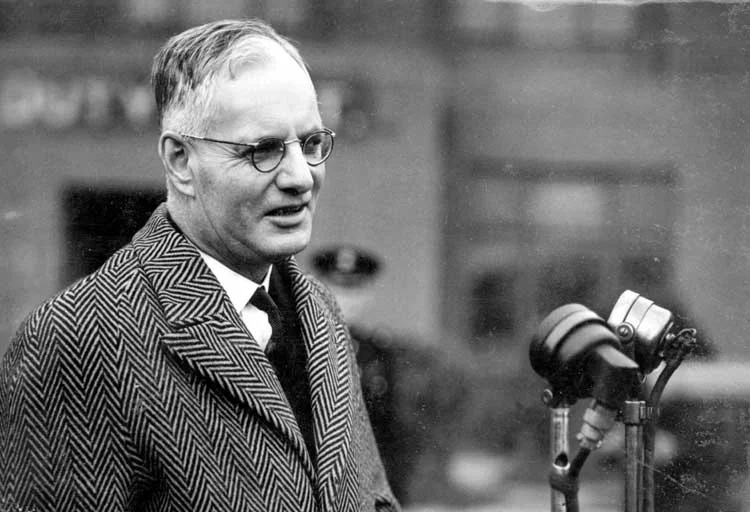
John Curtin: 'it is my solemn duty tonight to sound a tocsin!', announcement of war with Japan - 1941

March 9, 2022

8 December 1941, Canberra, Australia

Men and women of Australia, we are at war with Japan. That has happened because, in the first instance, Japanese naval and air forces launched an unprovoked attack on British and United States territory; because our vital interests are imperilled and because the rights of free people in the whole Pacific are assailed. As a result, the Australian Government this afternoon took the necessary steps which will mean that a state of war exists between Australia and Japan. Tomorrow, in common with the United Kingdom, the United States of America and the Netherlands East Indies Governments, the Australian Government will formally and solemnly declare the state of war it has striven so sincerely and strenuously to avoid.

Throughout the whole affair, and despite discouragement, the Australian Government and its representatives abroad struggled hard to prevent a breakdown of discussions. Australia encouraged the United States to retain the diplomatic initiative on behalf of the democratic powers. We did not want war in the Pacific. The Australian Government has repeatedly made it clear — as have the Governments of the United Kingdom, the United States and the Netherlands East Indies — that if war came to the Pacific it would be of Japan’s making. Japan has now made war.

I point out that the hands of the democracies are clean. The discussions and negotiations which have taken place between Japan and the democracies were not merely empty bandying of words on the democracies’ part. Since last February it has been the constant aim and endeavour of the democracies to keep peace in the Pacific. It has been a problem fraught with grave difficulties but, in the view of the democracies, it was a problem that was capable of being overcome. Accordingly, the best brains of the democracies were brought to bear on the problem. It will stand on record that the President of the United States himself, the American Secretary of State, Mr Cordell Hull, the British and the Dominion Governments, worked untiringly and unceasingly. Yet, when the President of the United States had decided to communicate direct to the Japanese Emperor a personal appeal for Imperial intervention on the side of peace, the War Government of Japan struck. That War Government, set on aggression and lusting for power in the same fashion as its Axis partners, anticipated the undoubted weight of the President’s plea and shattered the century-old friendship between the two countries.

For the first time in the history of the Pacific, armed conflict stalks abroad. No other country but Japan desired war in the Pacific. The guilt for plunging this hemisphere into actual warfare is therefore upon Japan. The recapitulation of events I have given you is necessary so that we in Australia may correctly assess the issues involved. The stern truth is that war has been forced upon us, not because of stubborn resistance on the part of the democracies to every demand that Japan made, but because Japan chose the method of armed might to settle differences which every other country involved was ready and willing to settle by negotiation and arbitration. By so doing, Japan chose the Hitler method. While its diplomatic representatives were actually at the White House, while all the democratic powers regarded the conversations as continuing, Japan ignored the convention of a formal declaration of war and struck like an assassin in the night.

For, as the dawn broke this morning, at places as far apart as Honolulu, Nauru, Ocean Island, Guam, Singapore and British Malaya, guns from Japanese warships, bombs from Japanese aircraft, shots from Japanese military forces, struck death to United States citizens and members of its defence forces; to the peaceful subjects of Great Britain and to her men on ships and on the land. The Pacific Ocean was reddened with the blood of Japanese victims. These wanton killings will be followed by attacks on the Netherlands East Indies, on the Commonwealth of Australia, on the Dominion of New Zealand, if Japan can get its brutal way.

Australia, therefore, being a nation that believes in a way of life which has freedom and liberty as its cornerstones, goes to the battle stations in defence of the free way of living. Our course is clear, our cause is just – as has been the case ever since September 1939, when we stood in the path of Hitlerism and declared that we would stand out to the end against ruthless and wanton aggression. I say, then, to the people of Australia: Give of your best in the service of this nation. There is a place and part for all of us. Each must take his or her place in the service of the nation, for the nation itself is in peril. This is our darkest hour. Let that be fully realised. Our efforts in the past two years must be as nothing compared with the efforts we must now put forward.

I can give you the assurance that the Australian Government is fully prepared. It has been in readiness for whatever eventuality that might arise, and last Friday the initial steps were taken and fully carried out. From early this morning the Service Ministers of the Cabinet and the chiefs of the fighting services have done everything that has to be done by them. The War Cabinet met and put into effect the plan devised for our protection. This afternoon the full Cabinet met, and I am able to announce to you prompt decisions on a wide variety of matters – all of them vital to the new war organisation that confronts us.

All leave for members of the fighting forces has been cancelled. An extension of the present partial mobilisation of navy, army and air forces is being prepared. The Minister for Home Security will tomorrow confer with army authorities on air raid precautions. Regulations will be issued to prohibit the consumption of petrol for purposes of pleasure. A conference will be held by the Minister for Supply with oil companies on the storage of fuel and the security of that storage. Arrangements will be made for all work on services that are essential nationally to be continued on public holidays in future, while, in this connection, all transport services will be concentrated upon necessary purposes. The Minister for Labour will leave for Darwin immediately to organise the labour supply there. An examination will be made to ascertain what retail establishments should continue to trade after 6 pm so that we may conserve light, coal, transport services.

These are some of the things decided upon quickly, but in no atmosphere of panic. There are other things that the government has done. These, by their nature, are secret. But, in total, what has been done today adds up to complete provision for the safety of the nation.

Tomorrow, the War Cabinet will meet again, as will the Australian Advisory War Council, when the Leader of the Opposition and his colleagues will be fully appraised of every phase of the position. The Parliament of the Commonwealth will assemble on Tuesday of next week.

One thing remains, and on it depends our very lives. That thing is the cooperation, the strength, and the willpower of you, the people of the Commonwealth. Without it, we are indeed lost. Men and women of Australia: The call is to you, for your courage; your physical and mental ability; your inflexible determination that we, as a nation of free people, shall survive. My appeal to you is in the name of Australia, for Australia is the stake in this conflict. The thread of peace has snapped – only the valour of our fighting forces, backed by the very uttermost of which we are capable in factory and workshop, can knit that thread again into security. Let there be no idle hand. The road of service is ahead. Let us all tread it firmly, victoriously.

We here, in this spacious land, where, for more than 150 years, peace and security have prevailed, are now called upon to meet the external aggressor. The enemy presses from without. I have said that our forces are at their battle stations. They are not alone. It is true also that Japan is not alone. But, as I speak to you tonight, the United States, Great Britain and her colonies and dominions, which include the Commonwealth of Australia and the Dominion of New Zealand, the great federation of Russian republics, the Netherlands East Indies and China are associated in the common cause of preserving for free men and free women not only their inheritance, but every hope they have of decency and dignity and liberty.

We Australians have imperishable traditions. We shall maintain them. We shall vindicate them. We shall hold this country and keep it as a citadel for the British-speaking race and as a place where civilisation will persist.

Men and women of the Commonwealth of Australia, it is my solemn duty tonight to sound a tocsin! I proclaim a call unto you. I do it in the words of Swinburne:

Come forth, be born and live,
Thou that hast help to give
And light to make man’s day of manhood fair:
With flight outflying the sphered sun,
Hasten thine hour and halt not, till thy work be done.

God bless you all.

Source: https://aso.gov.au/titles/radio/curtin-jap...

Enjoyed this speech? Speakola is a labour of love and I’d be very grateful if you would share, tweet or like it. Thank you.

Facebook Twitter Facebook
In 1940-59 C Tags JOHN CURTIN, PRIME MINISTERS, LABOR PARTY, DELCARATION OF WAR, JAPAN, WW2, PEARL HARBOUR, PEARL HARBOR, TRANSCRIPT
Comment

Peter Khalil: 'To those religious and ethnic groups being used as political footballs: ‘I will stand by you, with you and for you'', maiden speech - 2016

September 15, 2016

12 September 2016, Parliament House, Canberra, Australia

Mr Speaker, I congratulate you on your election to the chair and I begin my first speech by acknowledging the traditional owners of the land we meet on, the Ngunnawal people, and their elders past and present. I do so because it is a profound mark of respect for the peoples and cultures that have been present on this land from the beginning of time.

I stand in this place because I was elected by the people of Wills to serve them and to make a difference to their lives. I am conscious of being charged with an enormous responsibility bestowed with great honour. Even though it is somewhat improbable that I stand here, I am living proof that in this country politics matters, that it can make a profound difference to people’s lives.

My parents, Fayek and Georgette Khalil, are here with us in the gallery today. They came to Australia from Egypt 47 years ago. Just like those who come today, they were escaping a region where conflict was the norm and opportunities limited. Their sacrifice and that of millions of other migrants helped build Australia—not just its physical environment but the diversity of its culture, the generosity of its peoples and the depth of its humanity. I say these things too because nowhere is this diversity, this generosity of spirit, this decency better reflected than in the people of Wills.

My parents sacrificed so much of their own lives, their dreams and ambitions, to give my sister, Ellen, and I a better life. We started out in an inner-city Melbourne housing commission. Dad had to give up a career in Egypt as a lawyer and he worked for Australia Post. He became a union man, a shop steward, and later was on the state executive of the Victorian postal workers union. Mum gave up her uni degree in Egypt and worked at the Reserve Bank printing labs and as a preschool carer and an interpreter. They worked hard to give us a chance to make something of a new life in Australia.

It was not always easy. There were times of great hardship and ugly prejudice. I grew up in Australia in the seventies and eighties, a world very different from the one we live in today. Racism was more overt and considered acceptable by some. I experienced much of it directly. I will always remember my Grade 6 teacher, Mrs Hendrix, a coloured South African woman, who told me that in apartheid South Africa my parents would not be able to travel on the same bus, because of the difference in their skin complexion. That troubled me deeply as a 12-year-old, but it also awakened in me a yearning for social justice and a nascent political activism.

Although I was a serious kid who went to concerts in support of the ANC with my dad and who read Gandhi and Mandela, Malcolm X and Martin Luther King, I was also like every other Aussie kid: I really loved my footy—Aussie rules, of course. My grandparents lived in a housing commission in Preston, and my Auntie Gigi—Giselle—who is here today too, went to Preston East High School with Peter Daicos, the great Collingwood champion. She introduced me to Daics at the Preston fish and chip shop in 1978, when I was five years old, and I was Collingwood for life. I remember dragging Dad down to Victoria Park to watch the Magpies every second Saturday. I would sit on his shoulders as he stood in the outer.

While footy gave me great excitement, agony—1979, 80, 81, 2002 and 2003; I was too young for 77—and some great joy in 1990 and 2010, it taught me deeper life lessons. Daics was an ethnic, more usually called a wog in those days—and other terrible things—much the same as I was being called in the schoolyard. Despite the abuse, Daics was a champion. His exploits inspired me, and I started to believe in myself too. I learned to ignore all of the hatred and prejudice and to let my actions do the talking and that lots of hard work and a little talent will always make you a winner.

My parents also instilled in us the critical importance of education to our futures—education and the lasting impact of dedicated teachers like Mrs Hendrix and my year 9 politics teacher, Mr Sestito, who ignited my passion for Australian politics. I met recently with one of my predecessors in Wills, Bob Hawke, better known, of course, as one of Australia’s greatest Prime Ministers, and I asked Bob whether with all the achievements of his administration there was a policy that went unheralded. He told me that, when he became PM in 1983, only a third of students in Australia finished year 12. Only a third. Through policies his government put in place, by 1991 it had almost tripled to 90 per cent. Bob was particularly proud of that achievement. It was the visionary policy achievements of Labor governments—the one he led and those before and after—that gave me access to a quality education. I am and will be forever grateful.

Mine is not a unique story. Millions of Australians, whatever their ethnic background or their socioeconomic status, were given opportunities through Labor Party policies based on fairness. For my migrant family, affordable housing, Medicare and access to education were life-changing. The Labor Party’s commitment to equality of opportunity is not just a three-word slogan. It meant something to me and my family as it means something to millions of Australians, allowing them to make positive contributions in their lives and to those around them based on their merit and hard work, not on their postcode or their pay cheque, their gender or ethnicity, their religion or culture.

My parents also instilled in me the importance of giving back to the country that has given us so much. They often told me that Australia is not the lucky country, but, rather, we are lucky to be Australian. Migrants like my parents got much from the lucky country, but they also gave much to making it better, more prosperous and as open as its beautiful broad skies. I will do my utmost to advocate for and represent the people of Wills with all my wit and judgement, skill and experience, passion and smarts. I thank them for entrusting me with this great privilege.

When I reflect on what is important in our lives I think immediately of my family, as we all do. We love our families, and if we have children we would do anything for them. We also cherish the bonds we share with our friends and the importance of making an effort for them. Whatever god we worship or not, whatever cultural beliefs we have and whatever ideologies we adhere to, it is a central part of the human condition that we are fulfilled by our connection and service to others.

Yet the public are cynical of politics and politicians. We become lightning rods for people’s frustrations, disappointments and anger. The raw quest for power can threaten to overshadow our more noble instincts. More often than not, the public’s expectations are low, and when they are high they are seldom met. However, at unique and rare times in history politicians become the vessels for inspiring leadership, visionary change or simply doing good. That can only be when we keep our eyes affixed on our very own compass star—the shining light that guided us each to serve in this place, even amidst the voracious storms that rage around us and all too often consume our national politics. We can yet, with a steady gaze on that guiding star, serve to protect and defend the values that make our democracy great while passing new laws that reform our nation, advancing an even greater and fairer Australia. The responsibility and burden for this we happily bear. It signifies something great and important within all of us—a deep desire to make the lives of those around us better.

While a public servant for the Australian Department of Defence, I was sent on a posting to Iraq in 2003 and 2004, tasked with helping to rebuild Iraq following the removal of Saddam’s regime. Although I believed at the time the Iraq War was a strategic and humanitarian disaster, I made a choice to serve my country. I worked in Iraq on rebuilding and training of the Iraqi army that is now taking on Daesh, building the ministry of defence and public service, and negotiating for the Kurdish Peshmerga and the Sunni tribal leaders to jointly fight al-Qaeda in Iraq. While I faced danger, I was ably protected. I thanked the diggers of the 2nd Cavalry Regiment as we moved through the Baghdad streets in the very agile Australian light armoured vehicles.

No matter our ideological beliefs and how we choose to serve, we must recognise the importance of open and honest debate, differing opinions and different beliefs. Australia is a successful migrant country because of our wonderful multicultural model. I am proud to be Australian whilst also embracing my cultural heritage. I do not have to choose between identities. Our multicultural model works because we embrace and do not just tolerate cultural diversity. This diverse and fair society that generations of Australians have created and nurtured is worth protecting. We must educate that difference is not to be feared but embraced. We must all stand up to racism and prejudice. To those who would peddle it in this parliament by playing on fear and ignorance: ‘I will stand steadfast against you.’

I am particularly honoured to be one of the first of two Egyptian Australians elected to the 45th Parliament. The other of course is Dr Anne Aly, the member for Cowan. We are also the first African Australians in this place. I look forward to representing our brothers and sisters who have migrated from Africa and the Middle East. I am also the first Copt to be elected to this place. The Copts are adherents of one of the oldest sects of Christianity that emerged almost 2,000 years ago. Our history stretches back thousands of years connecting us to ancient Egypt. The Coptic language is the last form of the ancient Egyptian language. The Copts have faced the violence of sectarian persecution, as have many other ancient peoples of the Middle East. The Assyrian and Chaldean Christians, the Yazidis and the Kurds have all been on the front line, taking the brunt of violent extremism of Daesh. They deserve our support.

In Australia and in many Western democracies this is a moment in history where we face a fractious body politic exacerbated by or perhaps driven by the ugly rise of demagogues. These charlatans pull from their sleeves the same three-card trick played throughout history: first, identify an angry segment of the population and tell them they are just as angry; second, find a minority to scapegoat, like Asians, Muslims or Mexicans, and blame them for taking all the jobs; and, third, throw in a dose of fear, accuse the scapegoat minority of harming our way of life, stir the angry mob until it reaches boiling point and then claim only the demagogue can fix it. Of course we all know there is no substance to any of it, let alone real policies that can effect genuine change. To those religious and ethnic groups being used as political footballs: ‘I will stand by you, with you and for you. Know this: Labor will defend the multicultural society that we have built and we will never let the hateful dividers rip apart the egalitarian fabric of Australia.'

We must not, however, fall into the trap of blaming the people who are disaffected and angry. They are being exploited, they are genuinely fearful of the threats we all face and they are uncertain of their place in our society. While there are many winners in our globalised world, there are also many people who have lost out. Thousands of workers have lost or are about to lose their manufacturing jobs. Many live in Wills. Not all of these workers, after 20 years or more in a Holden or Ford plant, can become baristas or start-up tech gurus in our so-called exciting innovation society. I say to these people: ‘We the Labor Party and the labour movement are doing the hard yards to develop—and upon winning government will implement—policies that retrain and retool workers, provide vocational education, establish job creation programs and provide support to families that are struggling.’ I say to all of those people who feel disconnected, lost and angry: ‘Do not give yourselves to the haters. Keep faith in us. There will be better days ahead.’

I look forward to being the representative for the people of Wills, which is a diverse and socially progressive microcosm of modern Australia. In suburbs like Coburg, Pascoe Vale, Glenroy and Fawkner, to name a few, 60 per cent of residents were born or have at least one parent born overseas and 40 per cent of households are bilingual. Multiple faiths and over 60 ethnicities are living in harmony.

Wills has a magnificent arts community. The suburb of Brunswick has the highest concentration of artists in Australia. The arts matter. A thriving arts sector is the heart and soul of any society. It cannot be measured in traditional economic terms—its metrics are intangible—but its social benefits are invaluable. I will continue to support Labor’s great policies for the independence and return of substantive funding to the Australia Council and in addition be a voice and a pen on issues, such as parallel importation, that are of great import to authors, of which there are many great ones in Wills.

Wills has a commitment to the environment. Residents have led the way on climate change action, with one of the fastest rates of home and business adoption of solar panels. In the suburbs of Fawkner and Glenroy pensioners have roofs covered in solar panels because it makes environmental and economic sense.

Wills has a social heart that beats strong, exemplified by the work of 11 neighbourhood houses that do so much for the local community. There are many vibrant Italian and Greek pensioner and social clubs—and I enjoyed playing bocce in Fawkner with some of them during the campaign.

I have chosen to serve to change people’s lives, to channel their hopes and dreams, because I believe that Labor values make a difference. I believe in equality of opportunity, access to education, affordable health care and social justice. I believe in equality before the law, regardless of gender, sexual preference, ethnicity or religion. I believe in fighting for job creation, because a job gives a person dignity. I believe in tackling climate change for our and future generations, in sustainable living and in funding for infrastructure and public transport. I believe in a successful multicultural society that celebrates and embraces diversity.

Equality, not privilege; diversity, not divisiveness; hope, not fear. I will fight for these values for the people of Wills and for the nation, as have great Labor governments done for the best part of a century—delivering the reforms that have made all of those so lucky to be Australians.

Prime Minister Curtin, who led Australia through the darkest days of World War II put it much more eloquently than I when he said that the Labor Party and the labour movement stand for:

… humanity as against material gain and has more resilience, more decency and dignity, and the best of human qualities than any other political movement.

The Labor Party has always stood for improving the lives of Australians—for putting people first. It also has a tradition that seeks to extend these values beyond our shores. Prime Minister Chifley spoke of reaching for that light on the hill—to bring something better to the people: better standards of living, greater happiness to the mass of the people. Our objective to reach for that light on the hill was and still is to aim for the betterment of all humanity.

That is why I am committed to Australia’s role in the world as a good international citizen, making a difference to people’s lives across the globe. In 2005 I had the opportunity to testify before the US Senate foreign relations committee on security policy in the Middle East. I spoke before then Senator Joe Biden and then Senator Barack Obama. I was struck by Senator Obama’s compassion and search for real solutions. Over a decade later, President Obama is hosting a summit on refugees next week. I call on everyone in this place and those government ministers attending the summit to put aside partisan politics and work to find sustainable and compassionate solutions to the international refugee crisis. As a son of migrants who came from Egypt, escaping a region engulfed by war, I can appreciate the yearning for a life of peace, security and opportunity. For the best part of a decade, and in the recent federal campaign when discussing asylum seeker policy, I argued strongly for an increase in our intake and an end to indefinite detention on Manus and Nauru.

I supported our leader, Bill Shorten, when he made clear that if we won the election one of his first acts would be to negotiate with the UNHCR the resettlement of the refugees to safe and secure countries. We should not be fixated on countries like Cambodia or PNG which have woefully inadequate infrastructure but look to other countries, including New Zealand and Malaysia. But I recognise that even this falls far too short in our moral, legal and international obligations as a good international citizen.

I believe Australia has a moral obligation, at the minimum, to take responsibility for the care of those refugees that have been physically or emotionally damaged by the long-term detention that we have submitted them to. I also think we should re-examine the assumed nexus between detention centres and discouraging people smugglers to ascertain how much this argument holds in the context of robust turn back policies.

Whilst I support the ALP policy I also look forward to playing my part in the ongoing debate and change on this issue. I will advocate that Australia take a leadership role in developing an international agreement in which multiple countries increase their quota intake of refugees so we can begin to find solutions for 25 million asylum seekers and refugees in UNHCR camps around the world. An international agreement between 10, 15 or 20 countries agreeing to take an additional 30, 40 or 50,000 refugees a year each would start to be a real solution, resulting in a million or more refugees being resettled to safe haven each year. If we can as an international community come together to tackle climate change that threatens our planet we can and must come together to find a way to deliver safety and security for millions of refugees. We can and must do away with the lowest-common-denominator policies that have poisoned our political culture. We can and must do better as a nation.

So I speak on this not because it is popular, nor will I resile from the issue because it is unpopular, but because it is simply the right thing to do—because I believe that true leadership is not about appealing to the fear that lurks in our darker angels but appealing to our better angels.

No-one gets to this place without the support of literally hundreds of people. I want to thank the over 1,000 ALP members in Wills, the volunteers—the true believers—who worked tirelessly during the campaign. I salute you, for it is your commitment to the Labor cause that wins elections.

I would like to pay a special tribute to my predecessor, Kelvin Thomson, acknowledging his many, many years of service and advocacy. Thank you, Kelvin, for all your support and wise counsel. Ben Davis, the Victorian Secretary of the AWU, a great union leader of a great union: his wise counsel to me was summed up in four words, ‘Talk to the voters.’

Thanks to Theo Theophanous and his wife, Rita, who are in the gallery, for their strategic guidance, support and friendship, and to Steve Michaelson, also known as Mocca, and Shannon Threlfall Clark, who headed up my campaign team with great professionalism and efficiency.

Thanks to the rest of the campaign team: Carole Fabian, Councillor Lambros Tapinos, Hasan Erdogan, Chris Anderson, Mel Sherrin and Iva Bujanovic, our campaign field organiser, and to my many state colleagues—Minister Philip Dalidakis and Debra are here today. And special thanks to Speaker Telmo Languiller—thank you for your support. To Bill Shorten and Tanya Plibersek: you have run a tremendous campaign—but more than that you are Labor leaders we can believe in. I thank you and all my federal colleagues—too many of you to thank; you are all my friends as well—for your support over many years

To His Excellency Mohamed Khairat, the Egyptian ambassador: I bet he never dreamed that there would be not one but two Egyptian Australians elected to the federal parliament! Your Grace Bishop Suriel, Abouna Michael: thank you and the Coptic community for your support. And to Robert Ray for his political wisdom.

Thanks to my family, friends and supporters who have made the trip to Canberra for today: to my life-long mate John Jardim, Rose and my goddaughter, Emma, and Erin; to David Noakes, Tiff, Ollie, my godson, Coco and Zoe; and to Priya Saratchandran, Joseph Hanna, Robert Ishak, Simon Banks and Justin Di Lollo. Thanks to my Aunt Gigi, her partner Barry, Aunt Julie, my uncles John and Jerry—who cannot be here—and to my maternal grandmother, Nana Ellen, who is 92 and is here today; to my sister Ellen and my nephews Oscar and Ethan; and to my parents Fayek and Georgette—once again, I love you and I thank you all.

To my wife, Lydia: your sacrifices—the small ones you make every day as well as the big ones you have made and I know will also make—are the very reasons I am standing here today. Thank you for your patience, your wise counsel, your remarkable intelligence and, most importantly, for your love.

To my children, Cassius—the shadow minister for dinosaur welfare!—and to Aya—the parliamentary secretary for loud screaming!—I hope that I can do some good in this place that will make you proud of your dad, and make Australia a better place for your generation. I love you and your mum very much. I hope I can do you all proud and make something of my service.

Herein lies the magic of this place. It resides within and through that call to service, because I can serve and make a difference in the lives of not just my family and my friends but on a grand scale to tens of thousands of people across Wills. The tempest that rages in this place most often at 2 pm belies the quieter work MPs do for their constituents. I know it is not only sound and fury as we strut upon this stage. We have an awesome responsibility and a rare privilege to work even in the eye of the political storm and make our shared political values into realities. The magic of this place is that I—as a most improbable candidate—was elected to truly serve the people of Wills and the nation that has given me so much by making what I believe true for the many, not just the few.

 

Source: http://australianpolitics.com/2016/09/12/p...

Enjoyed this speech? Speakola is a labour of love and I’d be very grateful if you would share, tweet or like it. Thank you.

Facebook Twitter Facebook
In 2010s MORE 3 Tags PETER KHALIL, MAIDEN SPEECH, ALP, AUSTRALIAN LABOR PARTY, BEN CHIFLEY, JOHN CURTIN, IRAQ WAR, REFUGEES, MANUS, DETENTION
Comment

John Curtin: 'We are fighting mad', WW2 radio broadcast - 1942

August 6, 2015

20 March 1942, radio broadcast, Australia

This was a speech to the people of America, re-broadcast on Radio Australia. John Curtin was the 14th Prime Minister of Australia, and held the position for most of WW2.

Men and women of the United States:

I speak to you from Australia. I speak from a united people to a united people, and my speech is aimed to serve all the people of the nations united in the struggle to save mankind.

On the great waters of the Pacific Ocean war now breathes its bloody steam. From the skies of the Pacific pours down a deathly hail. In the countless islands of the Pacific the tide of war flows madly. For you in America; for us in Australia, it is flowing badly. Let me then address you as comrades in this war and tell you a little of Australia and Australians. I am not speaking to your Government. We have long been admirers of Mr Roosevelt and have the greatest confidence that he understands fully the critical situation in the Pacific and that America will go right out to meet it. For all that America has done, both before and after entering the war, we have the greatest admiration and gratitude.

It is to the people of America I am now speaking; to you who are, or will be, fighting; to you who are sweating in factories and workshops to turn out the vital munitions of war; to all of you who are making sacrifices in one way or another to provide the enormous resources required for our great task. I speak to you at a time when the loss of Java and the splendid resistance of the gallant Dutch together give us a feeling of both sadness and pride. Japan has moved one step further in her speedy march south; but the fight of the Dutch and Indonese in Java has shown that a brave, freedom-loving people are more than a match for the yellow aggressor given even a shadow below equality in striking and fighting weapons.

But facts are stern things. We, the allied nations, were unready. Japan, behind her wall of secrecy, had prepared for war on a scale of which neither we nor you had knowledge. We have all made mistakes, we have all been too slow; we have all shown weakness - all the allied nations. This is not the time to wrangle about who has been most to blame. Now our eyes are open.

The Australian Government has fought for its people. We never regarded the Pacific as a segment of the great struggle. We did not insist that it was the primary theatre of war, but we did say, and events have so far, unhappily, proved us right, that the loss of the Pacific can be disastrous. Who among us, contemplating the future on that day in December last when Japan struck like an assassin at Pearl Harbour at Manila, at Wake and Guam, would have hazarded a guess that by March the enemy would be astride all the south-west Pacific except General MacArthur's gallant men, and Australia and New Zealand. But that is the case. And, realising very swiftly that it would be the case, the Australian Government sought a full and proper recognition of the part the Pacific was playing in the general strategic disposition of the world's warring forces. It was, therefore, but natural that, within twenty days after Japan's first treacherous blow, I said on behalf of the Australian Government that we looked to America as the paramount factor on the democracies' side of the Pacific.

There is no belittling of the Old Country in this outlook. Britain has fought and won in the air the tremendous battle of Britain. Britain has fought, and with your strong help, has won, the equally vital battle of the Atlantic. She has a paramount obligation to supply all possible help to Russia. She cannot, at the same time, go all out in the Pacific. We Australians, with New Zealand, represent Great Britain here in the Pacific - we are her sons - and on us the responsibility falls. I pledge to you my word we will not fail. You, as I have said, must be our leader. We will pull knee to knee with you for every ounce of our weight.

We looked to America, among other things, for counsel and advice, and therefore it was our wish that the Pacific War Council should be located at Washington. It is a matter of some regret to us that, even now, after 95 days of Japan's staggering advance south, ever south, we have not obtained first-hand contact with America. Therefore, we propose sending to you our Minister for External Affairs (Dr H.V. Evatt), who is no stranger to your country, so that we may benefit from his discussions with your authorities. Dr Evatt's wife, who will accompany him, was born in the United States. Dr Evatt will not go to you as a mendicant. He will go to you as the representative of a people as firmly determined to hold and hit back at the enemy as courageously as those people from whose loins we spring... those people who withstood the disaster of Dunkirk, the fury of Goering's blitz, the shattering blows of the Battle of the Atlantic. He will go to tell you that we are fighting mad; that our people have a government that is governing with orders and not with weak-kneed suggestions; that we Australians are a people who, while somewhat inexperienced and uncertain as to what war on their own soil may mean, are nevertheless ready for anything, and will trade punches, giving odds if needs be, until we rock the enemy back on his heels.

We are, then, committed, heart and soul, to total warfare. How far, you may ask me, have we progressed along that road? I may answer you this way. Out of every ten men in Australia four are wholly engaged in war as members of the fighting forces or making the munition and equipment to fight with. The other six, besides feeding and clothing the whole ten and their families, have to produce the food and wool and metals which Britain needs for her very existence. We are not, of course, stopping at four out of ten. We had over three when Japan challenged our life and liberty. The proportion is now growing every day. On the one hand we are ruthlessly cutting out unessential expenditure so as to free men and women for war work; and on the other, mobilizing woman-power to the utmost to supplement the men. From four out of ten devoted to war, we shall pass to five and six out of ten. We have no limit.

We have no qualms here. There is no fifth column in this country. We are all the one race - the English speaking race. We will not yield easily a yard of our soil. We have great space here and tree by tree, village by village, and town by town we will fall back if we must. That will occur only if we lack the means of meeting the enemy with parity in materials and machines. For, remember, we are the Anzac breed. Our men stormed Gallipoli; they swept through the Libyan desert; they were the 'rats' of Tobruk; they were the men who fought under 'bitter, sarcastic, pugnacious Gordon Bennett' down Malaya and were still fighting when the surrender of Singapore came. These men gave of their best in Greece and Crete; they will give more than their best on their own soil, when their hearths and homes lie under enemy threat.

Our air force are in the Kingsford-Smith tradition. You have, no doubt, met quite a lot of them in Canada; the Nazis have come to know them over Hamburg and Berlin and in paratroop landings in France. Our naval forces silently do their share on the seven seas.

I am not boasting to you. But were I to say less I would not be paying proper due to a band of men who have been tested in the crucible of world wars and hallmarked as pure metal. Our fighting forces and born attackers; we will hit the enemy wherever we can, as often as we can, and the extent of it will be measured only by the weapons in our hands.

Dr Evatt will tell you that Australia is a nation stripped for war. Our minds are set of attack rather than defense. We believe in fact that attack is the best defense; here in the Pacific it is the only defense. We know it means risks, but 'safety first' is the devil's catchword today. Business interests in Australia and submitting with good grace to iron control to drastic elimination of profits. Our great labour unions are accepting the suspension of rights and privileges which have been sacred for two generations, and are submitting to an equally iron control of the activities of their members. It is now 'work or fight' for every one in Australia. The Australian Government has so shaped its policy that there will be a place for every citizen in the country. There are three means of service - in the fighting forces; in the labour forces; in the essential industries. For the first time in the history of this country a complete call-up, or draft, as you refer to it in America, has been made. I say to you, as a comfort to our friends and a stiff warning to our enemies, that only the infirm remain outside the compass of our war plans.

We fight with what we have and what we have is our all. We fight for the same free institutions that you enjoy. We fight so that, in the words of Lincoln, 'government of the people, for the people, by the people, shall not perish from the earth'. Our legislature is elected the same as is yours; and we will fight for it, and for the right to have it, just as you will fight to keep the Capitol at Washington the meeting place of freely-elected men and women representative of a free people.

But I give you this warning: Australia is the last bastion between the West Coast of America and the Japanese. If Australia goes, the Americas are wide open. It is said that the Japanese will by-pass Australia and that they can be met and routed in India. I say to you that the saving of Australia is the saving of America's west coast. If you believe anything to the contrary then you delude yourselves.

Be assured of the calibre of our national character. This war may see the end of much that we have painfully and slowly built in our 150 years of existence. But even though all of it go, there will still be Australians fighting on Australian soil until the turning point be reached, and we will advance over blackened ruins, through blasted and fire-swepted cities, across scorched plains, until we drive the enemy into the sea. I give you the pledge of my country. There will always be an Australian Government and there will always be an Australian people. We are too strong in our hearts; our spirit is too high; the justice of our cause throbs too deeply in our being for that high purpose to be overcome.

I may be looking down a vista of weary months; of soul-shaking reverses; of grim struggle; of back-breaking work. But as surely as I sit here talking to you across the war-tossed Pacific Ocean I see our flag; I see Old Glory; I see the proud banner of the heroic Chinese; I see the standard of the valiant Dutch.

And I see them flying high in the wind of liberty over a Pacific from which aggression has been wiped out; over peoples restored to freedom; and flying triumphant as the glorified symbols of united nations strong in will and in power to achieve decency and dignity, unyielding to evil in any form.

Source: http://john.curtin.edu.au/audio/00434.html

Enjoyed this speech? Speakola is a labour of love and I’d be very grateful if you would share, tweet or like it. Thank you.

Facebook Twitter Facebook
In 1940-59 Tags PRIME MINISTERS, AUSTRALIA, WW2, AMERICAN ALLIANCE, JOHN CURTIN, WAR, TRANSCRIPT
Comment

See my film!

Limited Australian Season

March 2025

Details and ticket bookings at

angeandtheboss.com

Support Speakola

Hi speech lovers,
With costs of hosting website and podcast, this labour of love has become a difficult financial proposition in recent times. If you can afford a donation, it will help Speakola survive and prosper.

Best wishes,
Tony Wilson.

Become a Patron!

Learn more about supporting Speakola.

Featured political

Featured
Jon Stewart: "They responded in five seconds", 9-11 first responders, Address to Congress - 2019
Jacinda Ardern: 'They were New Zealanders. They are us', Address to Parliament following Christchurch massacre - 2019
Dolores Ibárruri: "¡No Pasarán!, They shall not pass!', Defense of 2nd Spanish Republic - 1936
Jimmy Reid: 'A rat race is for rats. We're not rats', Rectorial address, Glasgow University - 1972

Featured eulogies

Featured
For Geoffrey Tozer: 'I have to say we all let him down', by Paul Keating - 2009
for James Baldwin: 'Jimmy. You crowned us', by Toni Morrison - 1988
for Michael Gordon: '13 days ago my Dad’s big, beautiful, generous heart suddenly stopped beating', by Scott and Sarah Gordon - 2018

Featured commencement

Featured
Tara Westover: 'Your avatar isn't real, it isn't terribly far from a lie', The Un-Instagrammable Self, Northeastern University - 2019
Tim Minchin: 'Being an artist requires massive reserves of self-belief', WAAPA - 2019
Atul Gawande: 'Curiosity and What Equality Really Means', UCLA Medical School - 2018
Abby Wambach: 'We are the wolves', Barnard College - 2018
Eric Idle: 'America is 300 million people all walking in the same direction, singing 'I Did It My Way'', Whitman College - 2013
Shirley Chisholm: ;America has gone to sleep', Greenfield High School - 1983

Featured sport

Featured
Joe Marler: 'Get back on the horse', Harlequins v Bath pre game interview - 2019
Ray Lewis : 'The greatest pain of my life is the reason I'm standing here today', 52 Cards -
Mel Jones: 'If she was Bradman on the field, she was definitely Keith Miller off the field', Betty Wilson's induction into Australian Cricket Hall of Fame - 2017
Jeff Thomson: 'It’s all those people that help you as kids', Hall of Fame - 2016

Fresh Tweets


Featured weddings

Featured
Dan Angelucci: 'The Best (Best Man) Speech of all time', for Don and Katherine - 2019
Hallerman Sisters: 'Oh sister now we have to let you gooooo!' for Caitlin & Johnny - 2015
Korey Soderman (via Kyle): 'All our lives I have used my voice to help Korey express his thoughts, so today, like always, I will be my brother’s voice' for Kyle and Jess - 2014

Featured Arts

Featured
Bruce Springsteen: 'They're keepers of some of the most beautiful sonic architecture in rock and roll', Induction U2 into Rock Hall of Fame - 2005
Olivia Colman: 'Done that bit. I think I have done that bit', BAFTA acceptance, Leading Actress - 2019
Axel Scheffler: 'The book wasn't called 'No Room on the Broom!', Illustrator of the Year, British Book Awards - 2018
Tina Fey: 'Only in comedy is an obedient white girl from the suburbs a diversity candidate', Kennedy Center Mark Twain Award -  2010
Tina Fey: 'Only in comedy is an obedient white girl from the suburbs a diversity candidate', Kennedy Center Mark Twain Award - 2010

Featured Debates

Featured
Sacha Baron Cohen: 'Just think what Goebbels might have done with Facebook', Anti Defamation League Leadership Award - 2019
Greta Thunberg: 'How dare you', UN Climate Action Summit - 2019
Charlie Munger: 'The Psychology of Human Misjudgment', Harvard University - 1995
Lawrence O'Donnell: 'The original sin of this country is that we invaders shot and murdered our way across the land killing every Native American that we could', The Last Word, 'Dakota' - 2016