
• Genre
  • About
  • Submissions
  • Donate
  • Search
Menu

Speakola

All Speeches Great and Small
  • Genre
  • About
  • Submissions
  • Donate
  • Search
Share a political speech
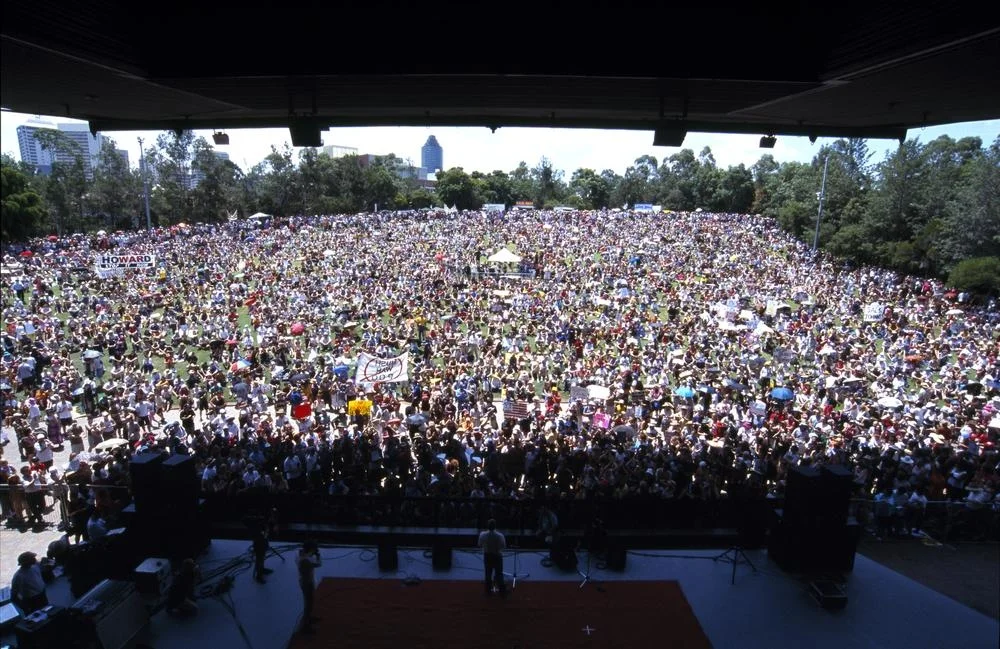
Brisbane, March 2003

Brisbane, March 2003

Simon Crean: 'As I speak, we are a nation on the brink of war', National Press Club - 2003

July 7, 2016

20 March 2003, National Press Club, Canberra,. Australia

As I speak, we are a nation on the brink of war.

A war we should not be in.

A war to which 2000 of our fighting men and women were committed many months ago but were told about last Tuesday.

A war to which we are one of only four countries prepared to join the U.S. in putting troops on the ground, despite claims of a coalition of up to thirty.

A war which, for the first time in our history, Australia has joined as an aggressor.

Not because we are directly threatened.

Not because the UN has determined it.

But because the U.S. asked us to.

A war our troops will engage in when Commander Tommy Franks of the United States gives the order.

A war which exposes them to great risk.

A war which will cause great humanitarian damage to innocent men, women and children in Iraq.

A war unnecessary to achieve the disarmament of Iraq because there remained an alternate way.

Saddam Hussein must be disarmed, but this is not the way.

Letter from parents of serviceman in the Gulf

I speak to you today, not only as Labor leader and Leader of the Opposition, but on behalf of millions of Australians who share opposition to this war.

People such as these Australians who wrote me this very moving and powerful letter just a few weeks ago:

Just a short note from us to thank you for at least trying to stop Australian troops from going to war until the United Nations resolution is decided, if at all. Mr Howard is still committing our troops with or without UN approval. He seems to have his mind made up regardless of what the Australian people want or hope…
…sadly ….. he has now been sent away. We just never thought that this might happen so soon. So far as Mr Howard saying no Australians have been committed to the Middle East, we know that is not true. We feel very scared for our son and for all the sons and husbands who have also been deployed.
Thank you again for helping to support the views of most Australians.

The only thing different about this letter from the thousands of other letters, e-mails and phone calls that I have received since the threat of this war became real is that it is from the parents of one of our servicemen in the Gulf.

They, like me, support our troops but not the war.

They don’t just express opposition, they express fear for their son in action and they are dismayed that they have not been told the truth.

The troops should be returned to Australia

I believe the troops should not have been sent and should now be brought home.

I’m not the first Labor leader to say that.

John Curtin did it in 1942 when he fought with Churchill to have Australian troops returned from the Middle East to defend Australia from possible invasion by the Japanese.

And Gough Whitlam did it when he called, from Opposition, for Australian troops to be pulled out of Vietnam.

On both occasions, Labor leaders had the courage to stand up for Australia’s interests.

Australian troops can be brought home, even at this late stage.

It has been done before.

The decision to go to war is wrong. It is reckless and unnecessary.

I will always support our troops

There’s one important thing I want to stress: I oppose the deployment of the troops but my argument is with the Government, not the troops themselves.

I will always support our troops.

And I will speak out against anyone who seeks to blame them for this Government’s decisions.

That’s another of the lessons of the Vietnam War.

I learnt those lessons through personal experience. I have many friends who came back. They came back as pariahs because the demonstrators targeted them. They had no say in it. They did their duty. Then, as now, the demonstrators should have targeted just the Government of the day. Never the troops.

If we’re going to learn anything from these experiences, we can’t repeat the mistakes. That’s why I made the speech on the Kanimbla; that’s why I’ve repeated it on every occasion; and that’s why I’m prepared to put my signature to a letter that restates it so they know and their families know. It’s important.

A strong UN is crucial to Australian Security

If the 21st Century is to be a world where what is right and what is wrong and who is to have weapons of mass destruction and who is to keep them is determined by the great and powerful, a medium-sized power like Australia must ultimately be the loser.

Whether it be disarmament or trade or the environment or combating drug trafficking, Australia’s national interest can only ever be served by us acting through international bodies like the United Nations to ensure a just outcome for all.

If might becomes right, Australia loses.

That’s why we must make our stand for peace on the Charter of the United Nations and never simply follow the great and powerful.

Labor’s commitment to the US Alliance remains strong

I am a strong supporter of our alliance with America.

The alliance is deeply valued by all Australians but nothing in our alliance relationship with the US requires that we join them in this war.

Article 1 of the ANZUS Alliance commits both Australia and America to resolving international conflict through the UN.

I don’t care what commitments John Howard has made to President Bush - his overriding commitment must only ever be to the Australian people.

And if he won’t make that commitment, he should not be our Prime Minister.

The war is wrong because resolution 1441 does not allow a unilateral attack

One of John Howard’s excuses for this war is the claim that Resolution 1441 authorises a unilateral attack on Iraq.

It does no such thing.

Resolution 1441 was passed on the specific promise that the matter would be returned to the Security Council for decision about any military action to enforce it.

It unanimously set out a process for disarming Iraq through the UN. It said that:

Any breach reported by Hans Blix of Mohamed El Baradei would be reported back to the Security Council.
The Security Council would then decide what action would be taken.

The resolution would never have received unanimous approval if it gave authorised military action without a further resolution.

US Ambassador to the UN, John Negroponte, said the following:

This resolution (1441) contains no hidden triggers and no automaticity with respect to the use of force… If there is a further Iraqi breach, reported to the [Security] Council by UMNOVIC, the IAEA, or a member state, the matter will return to the [Security] Council for discussions as required in paragraph 12.

I asked our Prime Minister on November 12 last year whether Resolution 1441 rules out the US taking unilateral action against Iraq before this matter is referred back to the UN Security Council.

He replied that: It certainly requires a reporting back to the Security Council - there is no argument about that.

Our commitment is wrong because it compromises our national independence…

Our commitment to the war in Iraq is also wrong because it compromises our national independence.

The decision to go to war was taken in the Azores by three of the fifteen Security Council members - the UK, the US, and Spain.

Of those countries, Spain has committed no ground troops. Yet their decision committed ours.

The Prime Minister was not consulted. He was told by a phone call from George Bush flying home on Airforce One.

John Howard had signed up months ago, he was always just waiting for the phone call. That’s a disgraceful way to run our foreign policy.

Australia wants a Prime Minister who acts in Australia’s national interests, not just one who responds to whatever the United States wants.

Instead of asking `what about the US?’, he should be asking `what about us?’

Three assurances to the Australian people

I give these three assurances to the Australian people:

  1. As Prime Minister I will never allow our foreign policy to be determined by another country.
  2. I will never commit to an unnecessary war while peace is possible.
  3. And I will never send Australia’s young men and women to war without telling them the truth.

The war is illegal, but our troops have nothing to fear….

Today I am releasing the Legal advice Labor has received on the Government’s decision to commit us to a war in Iraq.

This advice is consistent with the overwhelming weight of legal opinion from international law experts from around the world and here in Australia.

Based on that advice, John Howard’s decision to go to war is not in accordance with international law - but John Howard’s decision does not expose Australian troops to legal action, either at home or abroad.

Labor’s legal advice is important for two reasons.

First, it is clear from recent days that the Prime Minister is trying to use his Government’s legal advice to imply that the decision to go to war has been authorised by the United Nations.

This is simply not true.

And second, because the Government has raised this issue to set up a false argument that those who question the legality of its actions are also questioning the legality of the actions of our troops.

Labor’s legal advice makes it clear that this is an absurd proposition.

The Government is acting illegally, our troops are not.

The decision to go to war is reckless because it exposes us to a heightened threat of terrorism…

The decision to go to war is reckless because it exposes us to a heightened threat of terrorism.

On Tuesday, the Homeland Security Secretary in the United States, Tom Ridge, told his country that the US intelligence agencies had credible information that Al Qaeda will attempt multiple attacks against US and Coalition targets worldwide in the event of a US-led military campaign against Saddam Hussein.

In response, the US Homeland Affairs Department has raised the warning to the American people to the second highest level possible.

And it has initiated a comprehensive set of domestic protection measures - ranging from increased Coast Guard patrols, tighter border security, upgraded airport security and increased public health preparedness.

Today the UK reduced a global terror alert warning the ‘the risk of indiscriminate terrorist attacks… will be especially high during military action in Iraq.’

Bob Carr has responded as a leader should - by telling his citizens about the threat they face and acting to protect them.

John Howard says he doesn’t need to do anything.

Two days ago Tony Abbott gave the game away when he admitted that: there is the increased risk of terrorist attack here in Australia…

Tony Abbott has now confirmed what John Howard has always been too frightened to say to the Australian people - that Australia will become a greater terrorist threat than we would otherwise be - as a result of Howard’s policy on Iraq.

The Prime Minister is still in denial. He’s turning his back on the Australian people.

We all have to be alarmed because the Prime Minister is not alert.

The perversity of the situation is obvious. In the name of fighting terrorism, he has made us more of a target.

He has done nothing to address the heightened risk of terrorism to Australia.

The Prime Minister must come out of denial and be honest with the Australian people. What is the risk?

He’s increased security for himself and other Government offices but what has he done for the Australian people?

No briefing for the Leader of the Opposition…

I still have not been able to get a security briefing. He’s hiding it from me, just as he’s hiding it from the Australian people.

Despite Howard’s declaration two days ago that Australia has been committed to war and repeated attempts by my office, the Prime Minister continues to refuse to provide me with immediate security and intelligence briefings.

When Bush declared his moment of truth, Howard went into his bunker of deceit.

ASIO Bill

On the very day Australia may go to war the Government is planning to throw its ASIO Bill back on the table.

We have seen this tactic before.

The Prime Minister would rather play on the fears of Australians than protect them.

If this Government wants tough new powers on terrorism, it should pass Labor’s ASIO Bill today.

Labor will protect Australians and the Australian way of life.

I believe that the best defence against the threats to the Australian way of life lie in the Australian way of life itself - questioning authority, refusing to live in fear, and refusing to sacrifice our rights or our democratic freedoms, which we’re currently being asked to do.

Labor’s plan for improved national security

Because of this heightened fear of terrorism Labor has put together a comprehensive plan to improve the security of our nation and its people.

We have announced new measures to find and track terrorists through better intelligence gathering and assessment.

Labor will establish a Department of Home Affairs, and an Office of National Security, with a new National Security Adviser to plan and direct the national intelligence effort against terrorism.

Labor will make a major new commitment to establishing a Coast Guard - with dedicated new ships - to protect our borders from terrorism, people smuggling and the full range of transnational crimes that threaten our borders.

We believe that more should be done on domestic preparedness, including better training and resources for frontline workers such as police, firefighters and health professionals.

A Regional Summit of Leaders on terrorism

But making Australia more secure at home is only the first step.

We must again make Australia secure in the region, and the world.

Australia faces two key challenges: the war on terrorism and eliminating the threat of nuclear, chemical and biological weapons.

Howard has tried to conflate the two threats, with his erroneous argument that Saddam Hussein could give weapons of mass destruction to terrorists.

He fails to provide any evidence of such a link. He thinks his assertion is enough.

No one believes him. He has no credibility on this issue.

But the regional terrorism threat is real - as the horrific events in Bali last year showed.

Groups like Jemaah Islamiyah, Laskar Jihad and others are determined to use terrorism as a weapon against both Western interests and moderate, secular Islam.

But only 12 months after building a major coalition of countries against Al Qaeda in Afghanistan through the United Nations, the US-led coalition has been reduced to just four.

They failed to get a moral majority then settled for an immoral minority.

We must re-commit to fighting global terrorism.

Labor has been pushing the Government to organise a Regional Summit of Leaders, to come together to discuss and decide on a region-wide response to the terrorism threat.

Howard has done nothing to advance this idea.

Reactivating the Canberra Commission on Non-Proliferation

Eliminating weapons of mass destruction begins with strengthening the existing arms control regimes, under the authority of the United Nations.

We must work ever harder to ensure that countries like North Korea and Iran abide by their international obligations to the Nuclear Non-Proliferation Treaty.

Howard has never made non-proliferation a strategic objective of his government.

He has offered not a single new initiative or idea to progress disarmament.

He said nothing last year when the Bush Administration decided to walk away from negotiations on the Biological Weapons Convention.

He never talks about the Canberra Commission - Labor’s 1995 initiative to build international consensus to eliminate all nuclear weapons.

Howard’s one answer to the threat from Weapons of Mass Destruction is go to war in Iraq.

He completely ignores the growing proliferation threats in our region, including the nuclear crisis in South Asia.

Instead of returning to a position of leadership on these issues, as was the case under Labor, Howard has turned Australia into a follower.

Labor has said we will re-convene the Canberra Commission, with a new mandate to look at the full range of proliferation threats from nuclear, chemical, biological weapons and their ballistic missile delivery systems.

Conclusion

The Australian people do not believe the PM’s claim that he did not commit our troops until Tuesday.

They do not believe he was sincere about getting UN approval for action to disarm Iraq.

And they don’t believe that this war can now be justified or that Australia should be part of it.

I agree with the Australian people.

For the first time our servicemen and women have been committed to a war without the support of the majority of the Australian people.

John Howard has turned his back on them in the same way that he turned it on me in the Parliament on Tuesday.

In doing so I believe he has made a grave mistake.

The Australian people are right, the war is wrong.

Source: http://australianpolitics.com/2003/03/20/w...

Enjoyed this speech? Speakola is a labour of love and I’d be very grateful if you would share, tweet or like it. Thank you.

Facebook Twitter Facebook
In 2000s Tags SIMON CREAN, LEADER OF THE OPPOSITION, AUSTRALIAN LABOR PARTY, ALP, TRANSCRIPT, IRAQ WAR, INVASION, JOHN HOWARD, GEORGE W BUSH, UNITED NATIONS, RESOLUTION, WMDs, SADDAM HUSSEIN, WAR
Comment

Robin Cook: "if the hanging chads in Florida had gone the other way, we would not now be about to commit British troops' , Resignation speech - 2003

July 7, 2016

17 March 2003, House of Commons, United Kingdom

This is the first time for 20 years that I have addressed the House from the back benches.

I must confess that I had forgotten how much better the view is from here.

None of those 20 years were more enjoyable or more rewarding than the past two, in which I have had the immense privilege of serving this House as Leader of the House, which were made all the more enjoyable, Mr Speaker, by the opportunity of working closely with you.

It was frequently the necessity for me as Leader of the House to talk my way out of accusations that a statement had been preceded by a press interview.

On this occasion I can say with complete confidence that no press interview has been given before this statement.

I have chosen to address the House first on why I cannot support a war without international agreement or domestic support.

Backing Blair

The present Prime Minister is the most successful leader of the Labour party in my lifetime.

I hope that he will continue to be the leader of our party, and I hope that he will continue to be successful. I have no sympathy with, and I will give no comfort to, those who want to use this crisis to displace him.

I applaud the heroic efforts that the prime minister has made in trying to secure a second resolution.

I do not think that anybody could have done better than the foreign secretary in working to get support for a second resolution within the Security Council.

But the very intensity of those attempts underlines how important it was to succeed.

Now that those attempts have failed, we cannot pretend that getting a second resolution was of no importance.

French intransigence?

France has been at the receiving end of bucket loads of commentary in recent days.

It is not France alone that wants more time for inspections. Germany wants more time for inspections; Russia wants more time for inspections; indeed, at no time have we signed up even the minimum necessary to carry a second resolution.

We delude ourselves if we think that the degree of international hostility is all the result of President Chirac.

The reality is that Britain is being asked to embark on a war without agreement in any of the international bodies of which we are a leading partner - not NATO, not the European Union and, now, not the Security Council.

To end up in such diplomatic weakness is a serious reverse.

Only a year ago, we and the United States were part of a coalition against terrorism that was wider and more diverse than I would ever have imagined possible.

'Heavy price'

History will be astonished at the diplomatic miscalculations that led so quickly to the disintegration of that powerful coalition.

The US can afford to go it alone, but Britain is not a superpower.

Our interests are best protected not by unilateral action but by multilateral agreement and a world order governed by rules.

Yet tonight the international partnerships most important to us are weakened: the European Union is divided; the Security Council is in stalemate.

Those are heavy casualties of a war in which a shot has yet to be fired.

I have heard some parallels between military action in these circumstances and the military action that we took in Kosovo. There was no doubt about the multilateral support that we had for the action that we took in Kosovo.

It was supported by NATO; it was supported by the European Union; it was supported by every single one of the seven neighbours in the region. France and Germany were our active allies.

It is precisely because we have none of that support in this case that it was all the more important to get agreement in the Security Council as the last hope of demonstrating international agreement.

Public doubts

The legal basis for our action in Kosovo was the need to respond to an urgent and compelling humanitarian crisis.

Our difficulty in getting support this time is that neither the international community nor the British public is persuaded that there is an urgent and compelling reason for this military action in Iraq.

The threshold for war should always be high.

None of us can predict the death toll of civilians from the forthcoming bombardment of Iraq, but the US warning of a bombing campaign that will "shock and awe" makes it likely that casualties will be numbered at least in the thousands.

I am confident that British servicemen and women will acquit themselves with professionalism and with courage. I hope that they all come back.

I hope that Saddam, even now, will quit Baghdad and avert war, but it is false to argue that only those who support war support our troops.

It is entirely legitimate to support our troops while seeking an alternative to the conflict that will put those troops at risk.

Nor is it fair to accuse those of us who want longer for inspections of not having an alternative strategy.

For four years as foreign secretary I was partly responsible for the western strategy of containment.

Over the past decade that strategy destroyed more weapons than in the Gulf war, dismantled Iraq's nuclear weapons programme and halted Saddam's medium and long-range missiles programmes.

Iraq's military strength is now less than half its size than at the time of the last Gulf war.

Threat questioned

Ironically, it is only because Iraq's military forces are so weak that we can even contemplate its invasion. Some advocates of conflict claim that Saddam's forces are so weak, so demoralised and so badly equipped that the war will be over in a few days.

We cannot base our military strategy on the assumption that Saddam is weak and at the same time justify pre-emptive action on the claim that he is a threat.

Iraq probably has no weapons of mass destruction in the commonly understood sense of the term - namely a credible device capable of being delivered against a strategic city target.

It probably still has biological toxins and battlefield chemical munitions, but it has had them since the 1980s when US companies sold Saddam anthrax agents and the then British Government approved chemical and munitions factories.

Why is it now so urgent that we should take military action to disarm a military capacity that has been there for 20 years, and which we helped to create?

Why is it necessary to resort to war this week, while Saddam's ambition to complete his weapons programme is blocked by the presence of UN inspectors?

Israeli breaches

Only a couple of weeks ago, Hans Blix told the Security Council that the key remaining disarmament tasks could be completed within months.

I have heard it said that Iraq has had not months but 12 years in which to complete disarmament, and that our patience is exhausted.

Yet it is more than 30 years since resolution 242 called on Israel to withdraw from the occupied territories.

We do not express the same impatience with the persistent refusal of Israel to comply.

I welcome the strong personal commitment that the prime minister has given to middle east peace, but Britain's positive role in the middle east does not redress the strong sense of injustice throughout the Muslim world at what it sees as one rule for the allies of the US and another rule for the rest.

Nor is our credibility helped by the appearance that our partners in Washington are less interested in disarmament than they are in regime change in Iraq.

That explains why any evidence that inspections may be showing progress is greeted in Washington not with satisfaction but with consternation: it reduces the case for war.

Presidential differences

What has come to trouble me most over past weeks is the suspicion that if the hanging chads in Florida had gone the other way and Al Gore had been elected, we would not now be about to commit British troops.

The longer that I have served in this place, the greater the respect I have for the good sense and collective wisdom of the British people.

On Iraq, I believe that the prevailing mood of the British people is sound. They do not doubt that Saddam is a brutal dictator, but they are not persuaded that he is a clear and present danger to Britain.

They want inspections to be given a chance, and they suspect that they are being pushed too quickly into conflict by a US Administration with an agenda of its own.

Above all, they are uneasy at Britain going out on a limb on a military adventure without a broader international coalition and against the hostility of many of our traditional allies.

From the start of the present crisis, I have insisted, as Leader of the House, on the right of this place to vote on whether Britain should go to war.

It has been a favourite theme of commentators that this House no longer occupies a central role in British politics.

Nothing could better demonstrate that they are wrong than for this House to stop the commitment of troops in a war that has neither international agreement nor domestic support.

I intend to join those tomorrow night who will vote against military action now. It is for that reason, and for that reason alone, and with a heavy heart, that I resign from the government.

Source: http://news.bbc.co.uk/2/hi/uk_politics/285...

Enjoyed this speech? Speakola is a labour of love and I’d be very grateful if you would share, tweet or like it. Thank you.

Facebook Twitter Facebook
In 2000s Tags ROBIN COOK, IRAQ WAR, GEORGE W BUSH, UN, UNITED KINGDOM, RESIGNATION, MULTILATERALISM, WMDs, SADDAM HUSSEIN, TRANSCRIPT, CHILCOT REPORT
Comment

See my film!

Limited Australian Season

March 2025

Details and ticket bookings at

angeandtheboss.com

Support Speakola

Hi speech lovers,
With costs of hosting website and podcast, this labour of love has become a difficult financial proposition in recent times. If you can afford a donation, it will help Speakola survive and prosper.

Best wishes,
Tony Wilson.

Become a Patron!

Learn more about supporting Speakola.

Featured political

Featured
Jon Stewart: "They responded in five seconds", 9-11 first responders, Address to Congress - 2019
Jacinda Ardern: 'They were New Zealanders. They are us', Address to Parliament following Christchurch massacre - 2019
Dolores Ibárruri: "¡No Pasarán!, They shall not pass!', Defense of 2nd Spanish Republic - 1936
Jimmy Reid: 'A rat race is for rats. We're not rats', Rectorial address, Glasgow University - 1972

Featured eulogies

Featured
For Geoffrey Tozer: 'I have to say we all let him down', by Paul Keating - 2009
for James Baldwin: 'Jimmy. You crowned us', by Toni Morrison - 1988
for Michael Gordon: '13 days ago my Dad’s big, beautiful, generous heart suddenly stopped beating', by Scott and Sarah Gordon - 2018

Featured commencement

Featured
Tara Westover: 'Your avatar isn't real, it isn't terribly far from a lie', The Un-Instagrammable Self, Northeastern University - 2019
Tim Minchin: 'Being an artist requires massive reserves of self-belief', WAAPA - 2019
Atul Gawande: 'Curiosity and What Equality Really Means', UCLA Medical School - 2018
Abby Wambach: 'We are the wolves', Barnard College - 2018
Eric Idle: 'America is 300 million people all walking in the same direction, singing 'I Did It My Way'', Whitman College - 2013
Shirley Chisholm: ;America has gone to sleep', Greenfield High School - 1983

Featured sport

Featured
Joe Marler: 'Get back on the horse', Harlequins v Bath pre game interview - 2019
Ray Lewis : 'The greatest pain of my life is the reason I'm standing here today', 52 Cards -
Mel Jones: 'If she was Bradman on the field, she was definitely Keith Miller off the field', Betty Wilson's induction into Australian Cricket Hall of Fame - 2017
Jeff Thomson: 'It’s all those people that help you as kids', Hall of Fame - 2016

Fresh Tweets


Featured weddings

Featured
Dan Angelucci: 'The Best (Best Man) Speech of all time', for Don and Katherine - 2019
Hallerman Sisters: 'Oh sister now we have to let you gooooo!' for Caitlin & Johnny - 2015
Korey Soderman (via Kyle): 'All our lives I have used my voice to help Korey express his thoughts, so today, like always, I will be my brother’s voice' for Kyle and Jess - 2014

Featured Arts

Featured
Bruce Springsteen: 'They're keepers of some of the most beautiful sonic architecture in rock and roll', Induction U2 into Rock Hall of Fame - 2005
Olivia Colman: 'Done that bit. I think I have done that bit', BAFTA acceptance, Leading Actress - 2019
Axel Scheffler: 'The book wasn't called 'No Room on the Broom!', Illustrator of the Year, British Book Awards - 2018
Tina Fey: 'Only in comedy is an obedient white girl from the suburbs a diversity candidate', Kennedy Center Mark Twain Award -  2010
Tina Fey: 'Only in comedy is an obedient white girl from the suburbs a diversity candidate', Kennedy Center Mark Twain Award - 2010

Featured Debates

Featured
Sacha Baron Cohen: 'Just think what Goebbels might have done with Facebook', Anti Defamation League Leadership Award - 2019
Greta Thunberg: 'How dare you', UN Climate Action Summit - 2019
Charlie Munger: 'The Psychology of Human Misjudgment', Harvard University - 1995
Lawrence O'Donnell: 'The original sin of this country is that we invaders shot and murdered our way across the land killing every Native American that we could', The Last Word, 'Dakota' - 2016