• Genre
  • About
  • Submissions
  • Donate
  • Search
Menu

Speakola

All Speeches Great and Small
  • Genre
  • About
  • Submissions
  • Donate
  • Search
Share a political speech

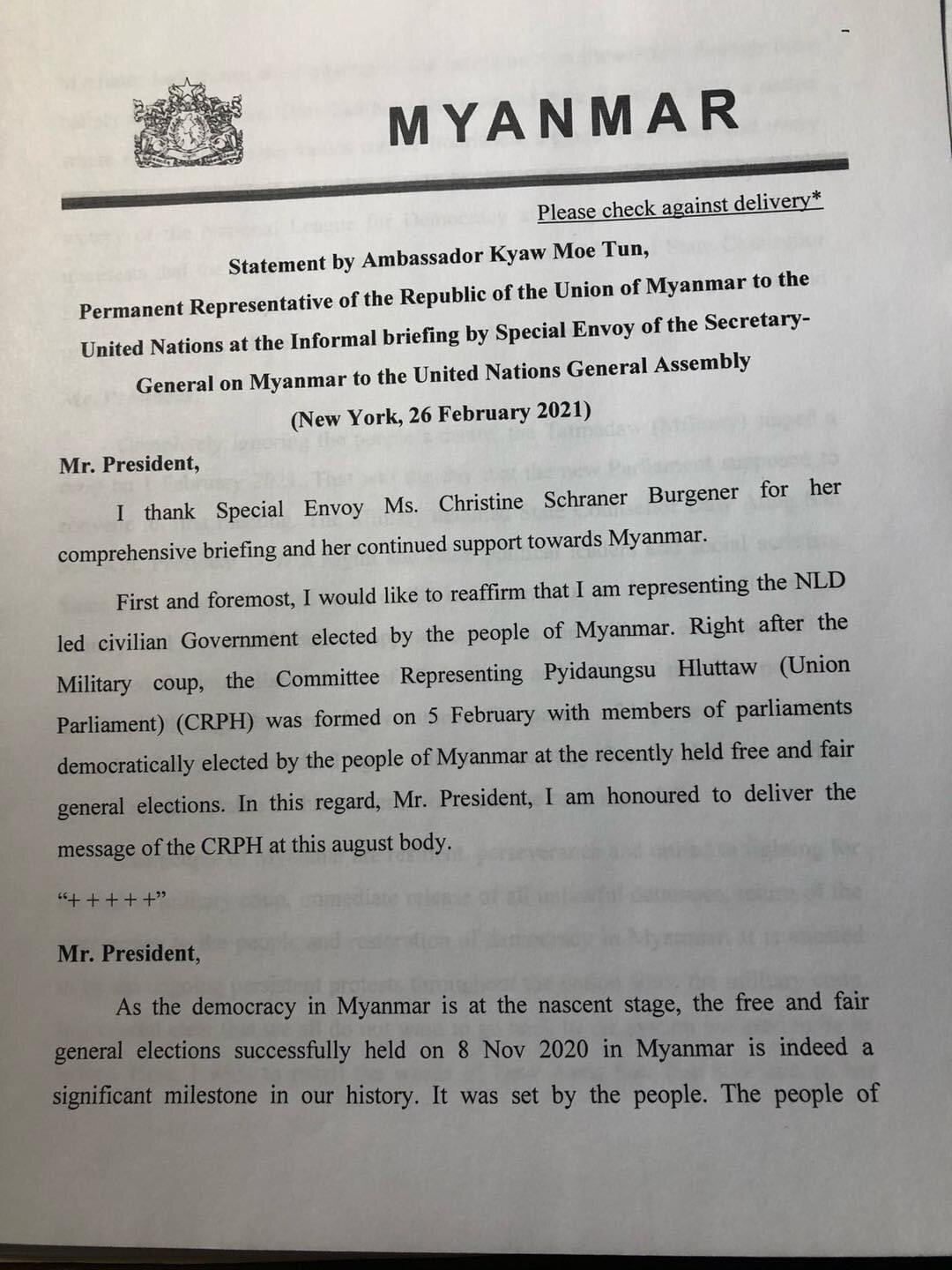
Sergiy Kyslytsya: 'Now we can save Ukraine', Emergency meeting of the UN General Assembly - 2022

July 18, 2023

1 March 2022, United Nations General Assembly, New York City, USA


Mr. President, Secretary General. For the first time since the United Nations was born, there is a full fledged war in the centre of Europe. Everyone in this hall and everyone in the world knows that Russia and Russia alone started this invasion now facilitated by Belarus. This war was not provoked. It was chosen by someone who is right now sitting in the bunker. We know what happened with the person who sat in the bunker in Berlin in May, 1945.

Before I continue with my formal statement, I would like to switch to Russian and invite you to put on the headphones because I would like to read from the screenshot of the smartphone of a killed Russian soldier. That's an actual screenshot from someone who is dead already. [inaudible]

[Reading screen]
Why has it been so long since you responded? Are you really enduring training exercises, asks the mother of the killed soldier.

[Moments before he was killed.]

Mum, I'm no longer in Crimea. I'm not in training sessions.

Where are you then? Papa's asking whether I can send you a parcel.

What kind of a parcel mama can you send me?

What are you talking about? What happened?

Mama. I'm in Ukraine. There is a real war raging here. I'm afraid We are bombing all of the cities together, even targeting civilians. We were told that they would welcome us and they are falling under our armoured vehicles, throwing themselves under the wheels and not allowing us to pass. They call us fascists. Mama, this is so hard.


[This was Several moments he was killed]

Imagine - if you want to just visualise the magnitude of the tragedy, you have to imagine next to you, next to every nameplate of every single country in this General Assembly, more than 30 souls of killed Russian soldiers already next to every name of the every single country in this assembly, 30 plus killed Russian soldiers, hundreds of killed Ukrainians, dozens of killed children, and it goes on and on and on. So just imagine those killed people next to you when you will listen to my formal statement.

Big militarised power seeking for geopolitical greatness has launched a full-fledged military offensive against a smaller neighbour, aimed at invading the country. Deadly airstrikes dropped on civilians' heads across the entire country and the Russian troops crossed Ukraine's borders from the territory of Russia-Belarus, and the occupied parts of Ukraine's Donbass and Crimea. Does it remind you of something, doesn't it? Indeed, very clear parallels could be drawn with the beginning of the Second World War and Russia's course of action is very similar to what their spiritual mentors from the Third Reich employed on the Ukrainian land 80 years ago.

Just one, the most recent example, example of human sufferings, example of war crime as all of us were on our way to the General Assembly today, the Russian army shelled with multiple rocket launcher systems, the residential areas of the city of Kharkiv, the second big biggest in Ukraine. Innocent civilians have been killed and wounded. The exact number is very difficult to estimate because of the warfare. While the negotiations are still underway at the border with Belarus. We therefore express our gratitude for the  overwhelming support that made this decision on the emergency session possible. We are grateful to the president of the General Assembly for his taking care of this idea well in advance. We appreciate the engagement of the UN Secretary General who has taken a very strong stance in support of peace, in support of the UN Charter. We have been prompted to call for an emergency special session as the level of the threat to the global security has been equated to that of the Second World War, or even higher, following Putin's order to put on alert Russian nuclear forces. What a madness! If he wants to kill himself, he doesn't need to use nuclear arsenal. He has to do what the guy in Berlin did in a bunker. In May, 1945.

The security council addressed the issue of the Russian war against Ukraine and the decision was not adopted, due to the obvious reason. The country attempting to occupy Ukraine since 2014 has occupied the seat of the council permanent member since 1991. Therefore we do not accept the Russian logic that the Security Council was enabled to act due to one-sided and unbalanced approach. The only guilty party is the Russian Federation.

Distinguished delegates. Russia uses all its military potential to attack Ukraine and has begun redeploying reserve units on the border with Ukraine. It fires cruise and ballistic missiles at cities, attacks with aviation tanks and artillery, sends subversion and reconnaissance groups which mark residential buildings in preparation for the air attacks. Russia's missiles are now aimed at destroying the infrastructure objects. They targeted the radioactive waste disposal site near Kyiv, the fuel base in the town of Assuitiv that is effectively Kyiv's suburb. The objects of logistic infrastructure including bridges, airports, and water reservoirs remain among the targets. Such towns as # and # ar now nearly destroyed as well as residential buildings in and around Kiev and #. The Russian forces ceased the Chernobyl Nuclear Power Station at the part of # region including the North Crimerian canal. Due to the active moving of Russian heavy militaries through the Chernobyl exclusion zone, the radiation level has increased rapidly

In the Black Sea. Russian warships deliberately attacked two civil vessels under the flags of Panama and Moldova approaching Ukraine. This constitutes a flagrant violation of the international law of the sea. Incredibly one of the vessels had a Russian crew! Still it was attacked by the Russians.

Russians keep attacking kindergartens and orphanages, thus committing war crimes and violating the Rome Statute. Hospitals and mobile medical aid brigades are also targeted by the Russian shelling, and the sabotage groups working in Ukraine's cities and towns. The Russian military fired on ambulance crews in the areas of # and Kiev. In the district of Sumi region. Russian tanks shot down a bus with civilians. Later, the Russian military did not allow ambulances on the spot. As of today, 352 people, including 16 children were killed on the Ukrainian side and 2040 Ukrainians, including 45 children wounded, during the first five days of the Russian invasion. And this number is growing nonstop. I have already told about the morning shellings in Kharkiv and we cannot really estimate at this moment how many were killed.

In response. Ukraine has activated its right for self defence, according to the Article 51 of the UN charter. The Russian troops are suffering losses, aircrafts, helicopters, tanks, trucks, personnel, the aggressive forces have already lost more than 5,000 in manpower during the first days of aggression.

Excellencies, this general assembly should be vocal in demanding from the Russian Federation to stop its offensive against Ukraine. In recognising Russian actions as an act of aggression against a sovereign and independent state. In demanding from Russia to immediately, completely and unconditionally withdraw its forces from the territory of Ukraine within its internationally recognised borders. In demanding from the Russian Federation to reverse the decision related to the status of certain areas of Daniesk and #,  regions of Ukraine. In demanding full compliance with the provisions of international humanitarian law. The General Assembly should also be clear with regard to the treacherous role of Belarus and is involvement in aggression of the Russian Federation against Ukraine.

Distinguished members of the General Assembly. What is happening now in Ukraine has already had the security and humanitarian implications for all of you. Immediately for Europe, a bit later for the rest, including in terms of food security, energy security, financial markets, collapse of the economies. Last September, my president said, while delivering his statement at the high level segment of the 76th session of the General Assembly, and I quote, 'I understand that criticism of the UN is often heard, but we criticise ourselves.'  End quote,

If we fail to respond now, we will face much more than criticism. We will face oblivion. It must not happen. Now it is time to act, time to help Ukraine that is paying now the ultimate price for freedom and security of itself and of the world. If Ukraine does not survive, international peace will not survive. If Ukraine does not survive, the United Nations will not survive, have no illusions. If Ukraine does not survive, we cannot be surprised if democracy fails next .

Now we can save Ukraine, save the United Nations, save democracy, and defend the values we believe in, and that Ukrainians are fighting for, and paying with their lives. The Russian delegate will speak shortly. Putin has done everything to delegitimize the Russian presence in the United Nations, but I wonder if the Russian presence in the United Nations has ever been legitimate. I wonder if ever this whole, this assembly voted in accordance with paragraph 2 of Article 4 on admission of the Russian Federation to the United Nations, either in December 1991 or in January, 1992, or whenever thereafter. I want to ask the delegates whose countries voted for admission of the Russian delegation to the United Nations to raise their hand.

To confirm that Russia was admitted to the United Nations according to the charter, please gentlemen, ladies and gentlemen, please raise your hand if your country voted in the formal session of the General Assembly, in reply to the letter by President Yeltsin dated December 24th, 1991, when he told the United Nations that Russia would like to be a continuative state of the demised Soviet Union. Anyone? Shall I put my glasses if my vision fails me and I don't see any hand raised. Any country? Anyone voted for a Russian membership? I leave you with that, and think about it when you listen to the Russian delegate.


Enjoyed this speech? Speakola is a labour of love and I’d be very grateful if you would share, tweet or like it. Thank you.

Facebook Twitter Facebook
In 2020-29 B Tags AMBASSADOR TO UKRAINE, UKRAINE, UKRAINE WAR, UKRAINE INVASION, VLADIMIR PUTIN, RUSSIA, GENERAL ASSEMBLY, UNITED NATIONS, 2020s, 2022, SERGIY KYSLYTSYA
Comment

Abba Essan: 'The noose around Israel’s neck is tightening gradually', speech to Special Assembly of the UN - 1967

January 30, 2023

19 June 1967, UN Headquarters, New York, USA

In recent weeks the Middle East has passed through a crisis whose shadows darken the world. This crisis has many consequences but only one cause. Israel’s rights to peace, security, sovereignty, economic development and maritime freedom – indeed its very right to exist – has been forcibly denied and aggressively attacked. This is the true origin of the tension which torments the Middle East. All the other elements of the conflict are the consequences of this single cause. There has been danger, there is still peril in the Middle East because Israel’s existence, sovereignty and vital interests have been and are violently assailed.

The threat to Israel’s existence, its peace, security, sovereignty and development has been directed against her in the first instance by the neighbouring Arab States. But all the conditions of tension, all the impulses of aggression in the Middle East have been aggravated by the policy of one of the Great Powers which, under our Charter, bear primary responsibilities for the maintenance of international peace and security. I shall show how the Soviet Union has been unfaithful to that trust. The burden of responsibility lies heavy upon her.

I come to this rostrum to speak for a united people which, having faced danger to the national survival, is unshakably resolved to resist any course which would renew the perils from which it has emerged.

The General Assembly is chiefly preoccupied by the situation against which Israel defended itself on the morning of 5 June. I shall invite every peace-loving State represented here to ask itself how it would have acted on that day if it faced similar dangers. But if our discussion is to have any weight or depth, we must understand that great events are not born in a single instant of time. It is beyond all honest doubt that, between 14 May and 5 June, Arab Governments, led and directed by President Nasser, methodically prepared and mounted an aggressive assault designed to bring about Israel’s immediate and total destruction. My authority for that conviction rests on the statements and actions of Arab Governments themselves. There is every reason to believe what they say and to observe what they do.

During Israel’s first decade, the intention to work for her destruction by physical violence has always been part of the official doctrine and policy of Arab States. But many members of the United Nations hoped and believed that relative stability would ensue from the arrangements discussed in the General Assembly in March 1957. An attempt has been made to inaugurate a period of non-belligerency and co-existence in the relations between the UAR and Israel. A United Nations Emergency Force was to separate the armies in Sinai and Gaza. The Maritime Powers were to exercise free and innocent passage in the Gulf of Aqaba and the Straits of Tiran, Terrorist attacks against Israel were to cease. The Suez Canal was to be opened to Israeli shipping, as the Security Council had decided six years before.

In March 1957 these hopes and expectations were endorsed in the General Assembly by the United States, France, the United Kingdom, Canada, other States in Europe, the Americas, Africa, Asia and Australia. These assurances, expressed with special solemnity by the four Governments which I have mentioned, induced Israel to give up positions which she then held at Gaza and at the entrance to the Straits of Tiran and in Sinai. Non-belligerency, maritime freedom and immunity from terrorist attack were henceforth to be secured, not by Israel’s own pressure but by the concerted will of the international community. Egypt expressed no opposition to these arrangements. Bright hopes for the future illuminated this hall ten years ago.

There were times during the past decade when it really seemed that a certain stability had been achieved. As we look back it becomes plain that the Arab Government regarded the 1957 arrangements merely as a breathing space enabling them to gather strength for a later assault. At the end of 1962 President Nasser said:

We feel that the soil of Palestine is the soil of Egypt and of the whole Arab world. Why do we all mobilize? Because we feel that the land of Palestine is part of our land, and we are ready to sacrifice ourselves for it.

The present Foreign Minister of Egypt, Mahmoud Riad, echoed his master’s voice:

The sacred Arab struggle will not come to an end until Palestine is restored to its owners.

In March 1963 the official Cairo radio continued the campaign of menace:

Arab unity is taking shape towards the great goal i.e., the triumphant return to Palestine with the banner of unity flying high in front of the holy Arab march.

The newspaper Al Gumhuriya published an official announcement on the same day:

The noose around Israel’s neck is tightening gradually … Israel is not mightier than the empires which were vanquished in the Arab East and West… The Arab people will take possession of their full rights in their united homeland.

Egypt is not a country in which the press utters views and opinions independently of the official will. There is thus significance in the statement of Al Akhbar on 4 April 1963:

The liquidation of Israel will not be realized through a declaration of war against Israel by Arab States, but Arab unity and inter-Arab understanding will serve as a hangman’s rope for Israel.

The Assembly will note that the imagery of a hangman’s rope or of a tightening noose occurs frequently in the macabre vocabulary of Nasserism. He sees himself perpetually presiding over a scaffold. In June 1967 the metaphor of encirclement and of strangulation was to come vividly to life, in Israel’s hour of solitude and danger.

In February 1964 Nasser enunciated in simple terms what was to become his country’s policy during the period of preparation:

The possibilities of the future will be war with Israel. It is we who will dictate the place.

A similar chorus of threats arose during this period from other Arab capitals. President Arif of Iraq and President Ben Bella of Algeria were especially emphatic and repetitive in their threat to liquidate Israel. The Syrian attitude was more ominous because it affected a neighbouring frontier. Syrian war propaganda has been intense in the past few years. In 1964 the Syrian Defence Minister, General Abdulla Ziada, announced:

The Syrian army stands as a mountain to crush Israel and to demolish her. This army knows how to crush its enemies.

Early last year Syria began to proclaim and carry out what it called a ‘popular war’ against Israel. The Syrian concept of ‘popular war’ expressed itself in the dispatch of trained terrorist groups into Israel territory to blow up installations and communication centres, to kill, maim, cripple and terrorize civilians in peaceful homes and farms. Sometimes the terrorists, trained in Syria, were dispatched through Jordan or Lebanon. The terrorist war was formally declared by President AI-Atassi on 22 May 1966, when he addressed soldiers on the Israel-Syrian front:

We raise the slogan of the people’s liberation war. We want total war with no limits, a war that will destroy the Zionist base.

The Syrian Defence Minister, Hafiz Asad, said two days later:

We say: We shall never call for, nor accept, peace. We shall only accept war and the restoration of the usurped land. We have resolved to drench this land with our blood, to oust you, aggressors, and throw you into the sea for good. We must meet as soon as possible and fight a single liberation war on the level of the whole area against Israel, Imperialism and all enemies of the people.

Mr. President, from that day to this, not a week passed without Syrian officials adding to this turgid stream of invective and hate. From that day to this, there has not been a single month without terrorist acts, offensive to every impulse of human compassion and international civility, being directed from Syria against Israel citizens and territory. I would have no difficulty in filling the General Assembly’s records with a thousand official statements by Arab leaders in the past two years announcing their intention to destroy Israel by diverse forms of organized physical violence. The Arab populations have been conditioned by their leaders to the anticipation of a total war, preceded by the constant harassment of the prospective victim.

From 1948 to this very day there has not been one statement by any Arab representative of a neighbouring Arab State indicating readiness to respect existing agreements or the permanent renunciation of force, to recognize Israel’s sovereign right of existence or to apply to Israel any of the central provisions of the United Nations Charter.

For some time Israel showed a stoic patience in her reaction to these words of menace. This was because the threats were not accompanied by a capacity to carry them into effect. But the inevitable result of this campaign of menace was the burden of a heavy race of arms. We strove to maintain an adequate deterrent strength and the decade beginning in March 1957 was not monopolized by security considerations alone. Behind the wall of a strong defence, with eyes vigilantly fixed on dangerous borders, we embarked on a constructive era in the national

enterprise. These were years of swift expansion in our agriculture and industry, of intensive progress in the sciences and arts, of a widening international vocation, symbolized in the growth of strong links with the developing world. At the end of this first decade, Israel had established relations of commerce and culture with all the Americas, and with most of the countries of Western, Central and Eastern Europe. In her second decade she built constructive links with the emerging countries of the developing world with which we are tied by a common aspiration to translate national freedom into creative economic growth and progress.

Fortified by friendships in all five continents, inspired by its role in the great drama of developments, intensely preoccupied by tasks of spiritual cooperation with kindred communities in various parts of the world, and in the efforts to assure the Jewish survival after the disastrous blows of Nazi oppressions, tenaciously involved in the development of original social ideas, Israel went on with its work. We could not concern ourselves exclusively with the torrent of hatred pouring in upon us from Arab Governments. In the era of modern communication a nation is not entirely dependent on its regional context. The wide world is open to the voice of friendship. Arab hostility towards Israel became increasingly isolated, while our position in the international family became more deeply entrenched. Many in the world drew confidence from the fact that a very small nation could, by its exertion and example, rise to respected levels in social progress, scientific progress and the human arts, and so our policy was to deter the aggression of our neighbours so long as it was endurable, to resist it only when failure to resist would have invited its intensified renewal, to withstand Arab violence without being obsessed by it, and even to search patiently here and there for any glimmer of moderation and realism in the Arab mind. We also pursued the hope of bringing all the Great Powers to a harmonious policy in support of the security and sovereignty of Middle Eastern States. It was not easy to take this course. The sacrifice imposed upon our population by Arab violence was cumulative in its effects, but as it piled up month by month the toll of death and bereavement was heavy and in the last few years it was evident that this organized murder was directed by a central hand.

We were able to limit our response to this aggression so long as its own scope appeared to be limited. President Nasser seemed for some years to be accumulating inflammable material without an immediate desire to set it alight. He was heavily engaged in domination and conquest elsewhere. His speeches were strong against Israel, but his bullets, guns and poison gases were for the time being used to intimidate other Arab States and to maintain a colonial war against the villagers of the Yemen and the peoples of the Arabian Peninsula.

But Israel’s danger was great. The military build-up in Egypt proceeded at an intensive rate. It was designed to enable Egypt to press its war plans against Israel while maintaining its violent adventures elsewhere. In the face of these developments, Israel was forced to devote an increasing part of its resources to self-defence. With the declaration by Syria of the doctrine of ‘a day by day military confrontation’, the situation in the Middle East grew darker. The Palestine Liberation Organization, the Palestine Liberation Army, the Unified Arab Command, the intensified expansion of military forces and equipment in Egypt, Syria, Lebanon, Jordan and more remote parts of the Arab continent – these were the signals of a growing danger to which we sought to alert the mind and conscience of the world.

In three tense weeks between 14 May and 5 June, Egypt, Syria and Jordan, assisted and incited by more distant Arab States, embarked on a policy of immediate and total aggression.

June 1967 was to be the month of decision. The ‘final solution’ was at hand.

There was no convincing motive for the aggressive design which was now unfolded. Egyptian and Soviet sources had claimed that a concentrated Israeli invasion of Syria was expected during the second or third week in May. No claim could be more frivolous or far-fetched. It is true that Syria was sending terrorists into Israel to lay mines on public roads and, on one occasion, to bombard the Israeli settlement at Manara from the Lebanese border. The accumulation of such actions had sometimes evoked Israeli responses always limited in scope and time. All that Syria had to do to ensure perfect tranquillity on her frontier with Israel was to discourage the terrorist war. Not only did she not discourage these actions – she encouraged them; she gave them every moral and practical support. But the picture of Israeli troop concentrations in strength for an invasion of Syria was a monstrous fiction. Twice Syria refused to cooperate with suggestions by the UN authorities, and accepted by Israel, for a simultaneous and reciprocal inspection of the Israel-Syrian frontier. On one occasion the Soviet Ambassador complained to my Prime Minister of heavy troop concentrations in the north of Israel. When invited to join the Prime Minister that very moment in a visit to any part of Israel which he would like to see, the distinguished envoy brusquely refused. The prospect of finding out the truth at first hand seemed to fill him with a profound disquiet. But by 9 May, the Secretary-General of the United Nations from his own sources on the ground had ascertained that no Israeli troop concentration existed. This fact had been directly communicated to the Syrian and Egyptian Governments. The excuse had been shattered, but the allegations still remained. The steps which I now describe could not possibly have any motive or justification if an Israeli troop concentration, as both Egypt and Syria knew, did not exist. Indeed the Egyptian build-up ceased to be described by its authors as the result of any threat to Syria.

On 14 May Egyptian forces began to move into Sinai.

On 16 May the Egyptian Command ordered the United Nations Emergency Force to leave the border. The following morning the reason became clear. For on 17 May 1967, at 6 in the morning, Radio Cairo broadcast that Field-Marshal Amer had issued alert orders to the Egyptian armed forces. Nor did he mention Syria as the excuse. This announcement reads:

1. The state of preparedness of the Egyptian armed forces will increase to the full level of preparedness for war, beginning 14,30 hours last Sunday.

2. Formations and units allocated in accordance with the operational plans will advance from their present locations to the designated positions.

3. The armed forces are to be in full preparedness to carry out ally combat tasks on the Israel front in accordance with developments.

On 18 May Egypt called for the total removal of the United Nations Emergency Force. The Secretary-General of the United Nations acceded to this request and moved to carry it out, without reference to the Security Council or the General Assembly, without carrying out the

procedures indicated by Secretary-General Hammarskjöld in the event of a request for a withdrawal being made, without heeding the protesting voices of some of the permanent members of the Security Council and of the Government at whose initiative the force had been established, without consulting Israel on the consequent prejudice to her military security and her vital maritime freedom, and without seeking such delay as would enable alternative measures to be concerted for preventing belligerency by sea and a dangerous confrontation of forces by land.

It is often said that United Nations procedures are painfully slow. This decision was disastrously swift. Its effect was to make Sinai safe for belligerency from north to south, to create a sudden disruption of the local security balance, and to leave an international maritime interest exposed to almost certain threat. I have already said that Israel’s attitude to the peace-keeping functions of the United Nations has been traumatically affected by its experience. What is the use of a fire brigade which vanishes from the scene as soon as the first smoke and flames appear? Is it surprising that we are firmly resolved never again to allow a vital Israel interest and our very security to rest on such a fragile foundation?

The clouds now gathered thick and fast. Between 14 May and 23 May Egyptian concentrations in Sinai increased day by day. Israel took corresponding measures. In the absence of an agreement to the contrary it is, of course, legal for any State to place its armies wherever it chooses in its territory. It is equally true that nothing could be more uncongenial to the prospect of peace than to have large armies facing each other across a narrow space, with one of them clearly bent on an early assault. For the purpose of the concentration was not in doubt. On 18 May at 24.00 hours, the Cairo Radio, Saut el-Arab, published the following Order of the Day by Abdul Mushin Murtagi, the General then commanding Sinai:

The Egyptian forces have taken up positions in accordance with a definite plan. Our forces are definitely ready to carry the battle beyond the borders of Egypt. Morale is very high among the members of our armed forces because this is the day for which they have been waiting – to make a holy war in order to return the plundered land to its owners.

In many meetings with army personnel they asked when the holy war would begin; the time has come to give them their wish.

On 21 May, General Amer gave the order to mobilize reserves. Now came the decisive step. All doubt that Egypt had decided upon immediate or early war was now dispelled. Appearing at an Air Force base at 6 o’clock in the morning, President Nasser announced that he would blockade the Gulf of Aqaba to Israeli ships, adding: ‘The Jews threaten war and we say by all means, we are ready for war.’

But the Jews were not threatening war. Prime Minister Eshkol was calling for a de-escalation of forces. Nasser treated this as a sign of weakness.

On 25 May, Cairo Radio announced:

The Arab people is firmly resolved to wipe Israel off the map and to restore the honour of the Arabs of Palestine.

On the following day, 26 May, Nasser spoke again:

The Arab people wants to fight. We have been waiting for the right time when we will be completely ready. Recently we have felt that our strength has been sufficient and that if we make battle with Israel we shall be able, with the help of God, to conquer Sharm el-Sheikh implies a confrontation with Israel. Taking this step makes it imperative that we be ready to undertake a total war with Israel.

Writing in Al Ahram on 26 May, Nasser’s mouthpiece, Hassanain Haykal, wrote, with engaging realism:

I consider that there is no alternative to armed conflict between the United Arab Republic and the Israeli enemy. This is the first time that the Arab challenge to Israel attempts to change an existing fact in order to impose a different fact in its place.

On 28 May, Nasser had a press conference. He was having them every day. He said:

We will not accept any possibility of co-existence with Israel.

And on the following day:

If we have succeeded to restore the situation to what it was before 1956, there is no doubt that God will help us and will inspire us to restore the situation to what it was prior to 1948.

There are various ways of threatening Israel’s liquidation. Few ways could be clearer than this.

The troop concentrations and blockade were now to be accompanied by encirclement. The noose was to be fitted around the victim’s neck. Other Arab States were closing the ring. On 30 May, Nasser signed the Defence Agreement and described its purpose in these terms:

The armies of Egypt, Jordan, Syria and Lebanon are stationed on the borders of Israel in order to face the challenge. Behind them stand the armies of Iraq, Algeria, Kuwait, Sudan and the whole of the Arab nation.

This deed will astound the world. Today they will know that the Arabs are ready for the fray. The hour of decision has arrived.

On 4 June, Nasser made a statement on Cairo Radio after signing the protocol associating Iraq with the Egyptian-Jordanian Defence Pact. Here are his words:

… We are facing you in the battle and are burning with desire for it to start, in order to obtain revenge. This will make the whole world realize what the Arabs are and what Israel is …

Mr. President, nothing has been more startling in recent weeks than to read discussions about who planned, who organized, who initiated, who wanted and who launched this war. Here we have a series of statements, mounting in crescendo from vague warning through open threat, to precise intention.

Here we have the vast mass of the Egyptian armies in Sinai with seven infantry and two armoured divisions, the greatest force ever assembled in that peninsula in all its history. Here we

have 40,000 regular Syrian troops poised to strike at the Jordan Valley, from advantageous positions in the hills. Here we have the mobilized forces of Jordan, with their artillery and mortars trained on Israel’s population centres in Jerusalem and along the vulnerable narrow coastal plain. Troops from Iraq, Kuwait and Algeria converge towards the battlefront at Egypt’s behest. 900 tanks face Israel on the Sinai border, while 200 more are poised to strike the isolated town of Eilat at Israel’s southern tip. The military dispositions tell their own story. The northern Negev was to be invaded by armour and bombarded from the Gaza Strip. From 27 May onward, Egyptian air squadrons in Sinai were equipped with operation orders instructing them in detail on the manner in which Israeli airfields, pathetically few in number, were to be bombarded, thus exposing Israel’s crowded cities to easy and merciless assault. Egyptian air sorties came in and out of Israel’s southern desert to reconnoitre, inspect and prepare for the assault. An illicit blockade had cut Israel off from all her commerce with the eastern half of the world.

Those who write this story in years to come will give a special place in their narrative to Nasser’s blatant decision to close the Straits of Tiran in Israel’s face. It is not difficult to understand why this outrage had a drastic impact. In 1957 the maritime nations, within the framework of the United Nations General Assembly, correctly enunciated the doctrine of free and innocent passage to the Straits. When that doctrine was proclaimed – and incidentally, not challenged by the Egyptian representative at that time – it was little more than an abstract principle for the maritime world. For Israel it was a great but still unfulfilled prospect; it was not yet a reality. But during the ten years in which we and the other States of the maritime community have relied upon that doctrine and upon established usage, the principle had become a reality consecrated by hundreds of sailings under dozens of flags and the establishment of a whole complex of commerce and industry and communication. A new dimension has been added to the map of the world’s communication. And on that dimension we have constructed Israel’s bridge towards the friendly States of Asia and Africa, a network of relationships which is the chief pride of Israel in the second decade of its independence and on which its economic future depends.

All this, then, had grown up as an effective usage under the United Nations’ flag. Does Mr. Nasser really think that he can come upon the scene in ten minutes and cancel the established legal usage and interests of ten years?

There was in his wanton act a quality of malice. For surely the closing of the Straits of Tiran gave no benefit whatever to Egypt except the perverse joy of inflicting injury on others. It was an anarchic act, because it showed a total disregard for the law of nations, the application of which in this specific case had not been challenged for ten years. And it was, in the literal sense, an act of arrogance, because there are other nations in Asia and East Africa that trade with the port of Eilat, as they have every right to do, through the Straits of Tiran and across the Gulf of Aqaba. Other sovereign States from Japan to Ethiopia, from Thailand to Uganda, from Cambodia to Madagascar, have a sovereign right to decide for themselves whether they wish or do not wish to trade with Israel. These countries are not colonies of Cairo. They can trade with Israel or not trade with Israel as they wish, and President Nasser is not the policeman of other African and Asian States.

Here then was a wanton intervention in the sovereign rights of other States in the eastern half of the world to decide for themselves whether or not they wish to establish trade relations with either or both of the two ports at the head of the Gulf of Aqaba.

When we examine, then, the implications of this act, we have no cause to wonder that the international shock was great. There was another reason too for that shock. Blockades have traditionally been regarded, in the pre-Charter parlance, as acts of war. To blockade, after all, is to attempt strangulation – and sovereign States are entitled not to have their States strangled.

The blockade is by definition an act of war, imposed and enforced through violence.

Never in history have blockade and peace existed side by side. From 24 May onward the question of who started the war or who fired the first shot became momentously irrelevant. There is no difference in civil law between murdering a man by slow strangulation or killing him by a shot in the head. From the moment at which the blockade was imposed, active hostilities had commenced and Israel owed Egypt nothing of her Charter rights. If a foreign Power sought to close Odessa or Copenhagen or Marseilles or New York harbour by the use of force, what would happen? Would there be any discussion about who had fired the first shot? Would anyone ask whether aggression had begun? Less than a decade ago the Soviet Union proposed a draft resolution in the General Assembly on the question of defining aggression. The resolution reads:

In an international conflict, that State shall be declared an attacker which first commits one of the following acts:

a. Naval blockade of the coastal ports of another State.

This act constituted in the Soviet view aggression as distinguished from other specific acts designated in the Soviet draft as indirect aggression. In this particular case the consequences of Nasser’s action had been fully announced in advance. On 1 March 1967 my predecessor announced that:

Interference, by armed force, with ships of the Israel flag exercising free and innocent passage in the Gulf of Aqaba and through the Straits of Tiran will be regarded by Israel as an attack entitling her to exercise her inherent right of selfdefence under Article 51 of the United Nations Charter and to take all such measures as are necessary to ensure the free and innocent passage of its ships in the Gulf and in the Straits.

The Representative of France declared that any obstruction of free passage in the Straits or Gulf was contrary to international law ‘entailing a possible resort to the measures authorized by Article 51 of the Charter’.

The United States, inside and outside of the United Nations, gave specific endorsement to Israel’s right to invoke her inherent right of self-defence against any attempt to blockade the Gulf. Nasser was speaking with acute precision when he stated that Israel now faced the choice either between being choked to death in her southern maritime approaches or to await the death blow from northern, Sinai.

Nobody who lived through those days in Israel, between 23 May and 5 June, will ever forget the air of doom that hovered over our country. Hemmed in by hostile armies ready to strike, affronted and beset by a flagrant act of war, bombarded day and night by predictions of her approaching extinction, forced into a total mobilization of all her manpower, her economy and commerce beating with feeble pulse, her main supplies of vital fuel choked by a belligerent act, Israel faced the greatest peril of her existence that she had known since her resistance against aggression nineteen years before, at the hour of her birth. There was peril wherever she looked and she faced it in deepening solitude. On 24 May and on succeeding days, the Security Council conducted a desultory debate which sometimes reached a point of levity. The Soviet Representative asserted that he saw no reason for discussing the Middle East situation at all. The Bulgarian delegate uttered these unbelievable words:

At the present moment there is really no need for an urgent meeting of the Security Council.

A crushing siege bore down upon us. Multitudes throughout the world trembled for Israel’s fate. The single consolation lay in the surge of public opinion which rose up in Israel’s defence. From Paris to Montevideo, from New York to Amsterdam, tens of thousands of persons of all ages, peoples and affiliations marched in horrified protest at the approaching stage of genocide. Writers and scientists, religious leaders, trade union movements and even the Communist parties in France, Holland, Switzerland, Norway, Austria and Finland asserted their view that Israel was a peace-loving State whose peace was being wantonly denied. In the history of our generation it is difficult to think of any other hour in which progressive world opinion rallied in such tension and agony of spirit.

To understand the full depth of pain and shock, it is necessary to grasp the full significance of what Israel’s danger meant. A small sovereign State had its existence threatened by lawless violence. The threat to Israel was a menace to the very foundations of the international order. The State thus threatened bore a name which stirred the deepest memories of civilized mankind and the people of Israel, the remnant of millions, who, in living memory, had been wiped out by a dictatorship more powerful, though scarcely more malicious, than Nasser’s Egypt. What Nasser had predicted, what he had worked for with undeflecting purpose, had come to pass – the noose was tightly drawn.

On the fateful morning of 5 June, when Egyptian forces moved by air and land against Israel’s western coast and southern territory, our country’s choice was plain. The choice was to live or perish, to defend the national existence or to forfeit it for all time.

From these dire moments Israel emerged in five heroic days from awful peril to successful and glorious resistance. Alone, unaided, neither seeking nor receiving help, our nation rose in self- defence. So long as men cherish freedom, so long as small States strive for the dignity of existence, the exploits of Israel’s armies will be told from one generation to another with the deepest pride. The Soviet Union has described our resistance as aggression and sought to have it condemned. We reject this accusation with all our might. Here was armed force employed in a just and righteous cause, as righteous as the defenders at Valley Forge, as just as the expulsion of Hitler’s bombers from the British skies, as noble as the protection of Stalingrad against the Nazi

hordes, so was the defence of Israel’s security and existence against those who sought our nation’s destruction.

What should be condemned is not Israel’s action, but the attempt to condemn it. Never have freedom, honour, justice, national interest and international morality been so righteously protected. While fighting raged on the Egyptian-Israel frontier and on the Syrian front, we still hoped to contain the conflict. Jordan was given every chance to remain outside the struggle. Even after Jordan had bombarded and bombed Israel territory at several points, we still proposed to the Jordanian monarch that he abstain from general hostilities. A message to this effect reached him several hours after the outbreak of hostilities on the southern front on 5 June.

Jordan answered not with words but with shells. Artillery opened fire fiercely along the whole front with special emphasis on the Jerusalem area. Thus Jordan’s responsibility for the second phase of the concerted aggression is established beyond doubt. This responsibility cannot fail to have its consequences in the peace settlement. As death and injury rained on the city, Jordan had become the source and origin of Jerusalem’s fierce ordeal. The inhabitants of the city can never forget this fact or fail to draw its conclusions.

Mr. President, I have spoken of Israel’s defence against the assaults of neighbouring States. This is not the entire story. Whatever happens in the Middle East for good or ill, for peace or conflict, is powerfully affected by what the Great Powers do or omit to do. When the Soviet Union initiates a discussion here, our gaze is inexorably drawn to the story of its role in recent Middle Eastern history. It is a sad and shocking story, it must be frankly told.

Since 1955 the Soviet Union has supplied the Arab States with 2,000 tanks, of which more than 1,000 have gone to Egypt. The Soviet Union has supplied the Arab States with 700 modem fighter aircraft and bombers, more recently with ground missiles, and Egypt alone has received from the USSR 540 field guns, 130 medium guns, 200 120-mm. mortars, anti-aircraft guns, 175 rocket launchers, 650 anti-tank guns, seven destroyers, a number of Luna M and SPKA 2 ground-to-ground missiles, 14 submarines and 46 torpedo boats of various types including missile-carrying boats. The Egyptian army has been trained by Soviet experts. This has been attested to by Egyptian officers captured by Israel. Most of this equipment was supplied to the Arab States after the Cairo Summit Conference of Arab leaders in January 1964 had agreed on a specific programme for the destruction of Israel, after they had announced and hastened to fulfil this plan by accelerating their arms purchases from the Soviet Union. The proportions of Soviet assistance are attested to by the startling fact that in Sinai alone the Egyptians abandoned equipment and offensive weapons of Soviet manufacture whose value is estimated at two billion dollars.

Together with the supply of offensive weapons, the Soviet Union has encouraged the military preparations of the Arab States.

Since 1961 the Soviet Union has assisted Egypt in its desire to conquer Israel. The great amount of offensive equipment supplied to the Arab States strengthens this assessment.

A Great Power which professes its devotion to peaceful settlement and the rights of States has for fourteen years afflicted the Middle East with a headlong armaments race, with the paralysis of the United Nations as an instrument of security and against those who defend it.

The constant increase and escalation of Soviet armaments in Arab countries has driven Israel to a corresponding, though far smaller, procurement programme. Israel’s arms purchases were precisely geared to the successive phases of Arab, and especially Egyptian, rearmament. On many occasions in recent months we and others have vainly sought to secure Soviet agreement for a reciprocal reduction of arms supplies in our region. These efforts have borne no fruit. The expenditure on social and economic progress of one half of what has been put into the purchase of Soviet arms would have been sufficient to redeem Egypt from its social and economic ills. A corresponding diversion of resources from military to social expenditure would have taken place in Israel. A viable balance of forces could have been achieved at a lower level of armaments, while our region could have moved forward to higher standards of human and social welfare. For Israel’s attitude is clear. We should like to see the arms race slowed down. But if the race is joined, we are determined not to lose it. A fearful waste of economic energy in the Middle East is the direct result of the Soviet role in the constant stimulation of the race in arms.

It is clear from Arab sources that the Soviet Union has played a provocative role in spreading alarmist and incendiary reports of Israeli intentions against Arab Governments.

On 9 June President Nasser said:

Our friends in the USSR warned the visiting parliamentary delegation in Moscow, at the beginning of last month, that there exists a plan of attack against Syria.

Similarly an announcement by Tass on 23 May states:

The Defence and Foreign Affairs Committee of the Knesset has accorded the Cabinet special powers to carry out war operations against Syria. Israeli forces concentrating on the Syrian border have been put in a state of alert for war. General mobilization has also been proclaimed in the country …

There was not one word of truth in this story. But its diffusion in the Arab countries could only have an incendiary result.

Cairo Radio broadcast on 28 May (0500 hours) an address by Marshal Grechko at a farewell party in honour of the former Egyptian Minister of Defence, Shams el-Din Badran:

The USSR, her armed forces, her people and Government will stand by the Arabs and will continue to encourage and support them. We are your faithful friends and we shall continue aiding you because this is the policy of the Soviet nation, its Party and Government. On behalf of the Ministry of Defence and in the name of the Soviet nation we wish you success and victory.

This promise of military support came less than a week after the illicit closing of the Tiran Straits, an act which the USSR has done nothing to condemn.

The USSR has exercised her veto right in the Security Council five times. Each time a just and constructive judgement has been frustrated. On 22 January 1964 France, the United Kingdom and the United States presented a draft resolution to facilitate work on the west bank of the River Jordan in the B’not Ya’akov Canal Project. The Soviet veto held up regional water development for several years. On 29 March 1964, a New Zealand resolution simply reiterating UN policy on blockade along the Suez Canal was frustrated by Soviet dissent. On 19 August 1964, a United Kingdom and United States resolution on the murder of two Israelis at Almagor was denied adoption by Soviet opposition. On 21 December 1964, the USSR vetoed a United Kingdom and United States resolution on incidents at Tel Dan, including the shelling of Dan, Dafna and Sha’ar Yashuv. On 2 November 1966, Argentina, Japan, the Netherlands, New Zealand and Nigeria joined to express regret at ‘infiltration from Syria and loss of human life caused by the incidents in October and November 1966’. This was one of the few resolutions sponsored by member states from five continents.

The Soviet use of the veto has had a dual effect. First, it prevented any resolution which an Arab State has opposed from being adopted by the Council. Secondly, it has inhibited the Security Council from taking constructive action in disputes between an Arab State and Israel because of the certain knowledge that the veto would be applied in what was deemed to be the Arab interest. The consequences of the Soviet veto policy have been to deny Israel any possibility of just and equitable treatment in the Security Council and to nullify the Council as a constructive factor in the affairs of the Middle East.

Does all this really add up to a constructive intervention by the USSR in the Arab-Israel tension? The position becomes graver when we recall the unbridled invective against the Permanent Representative of Israel in the Security Council. In its words and in the letter to the Israel Government, the USSR has formulated an obscene comparison between the Israel Defence Forces and the Hitlerite hordes-which overran Europe in the Second World War. There is a flagrant breach of international morality and human decency in this comparison. Our nation never compromised with Hitler Germany. It never signed a pact with it as did the USSR in 1939.

To associate the name of Israel with the accursed tyrant who engulfed the Jewish people in a tidal wave of slaughter is to violate every canon of elementary taste and fundamental truth.

In the light of this history, the General Assembly will easily understand Israel’s reaction to the Soviet initiative in convening this special session for the purpose of condemning our country and recommending a withdrawal to the position that existed before 5 June.

Your (the Soviet) Government’s record in the stimulation of the arms race, in the paralysis of the Security Council, in the encouragement throughout the Arab world of unfounded suspicion concerning Israel’s intentions, your constant refusal to say a single word of criticism at any time of declarations threatening the violent overthrow of Israel’s sovereignty and existence – all this gravely undermines your claims to objectivity. You come here in our eyes not as a judge or prosecutor, but rather as a legitimate object of international criticism for the part that you have played in the sombre events which have brought our region to a point of explosive tension.

If the Soviet Union had made an equal distribution of its friendship amongst the peoples of the Middle East, if it had refrained from exploiting regional rancours and tensions for the purpose of its own global policy, if it had stood in even-handed devotion to the legitimate interests of all States, the crisis which now commands our attention and anxiety would never have occurred. To the charge of aggression I answer that Israel’s resistance at the lowest ebb of its fortunes will resound across history, together with the uprising of our battered remnants in the Warsaw Ghetto, as a triumphant assertion of human freedom. From the dawn of its history the people now rebuilding a State in Israel has struggled often in desperate conditions against tyranny and aggression. Our action on 5 June falls nobly within that tradition. We have tried to show that even a small State and a small people have the right to live. I believe that we shall not be found alone in the assertion of that right, which is the very essence of the Charter of the United Nations. Similarly, the suggestion that everything goes back to where it was before 5 June is totally unacceptable. The General Assembly cannot ignore the fact that the Security Council, where the primary responsibility lay, has emphatically rejected such a course. It was not Israel, but Syria, Egypt and Jordan, which violently shattered the previous situation to smithereens. It cannot be recaptured. It is a fact of technology that it is easier to fly to the moon than to reconstruct a broken egg. The Security Council acted wisely in rejecting a backward step, advocated by the Soviet Union. To go back to the situation out of which the conflict arose would mean that all the conditions for renewed hostilities would be brought together again. I repeat what I said to the Security Council. Our watchword is not ‘backward to belligerency’ but ‘forward to peace’.

What the Assembly should prescribe is not a formula for renewed hostilities, but a series of principles for the construction of a new future in the Middle East. With the cease-fire established, our progress must be not backward to an armistice regime which has collapsed under the weight of years and the brunt of hostility. History summons us forward to permanent peace and the peace that we envisage can only be elaborated in frank and lucid dialogue between Israel and each of the States which have participated in the attempt to overthrow its sovereignty and undermine its existence. We dare not be satisfied with intermediate arrangements which are neither war nor peace. Such patchwork ideas carry within themselves the seeds of future tragedy. Free from external pressures and interventions, imbued with a common love for a region which they are destined to share, the Arab and Jewish nations must now transcend their conflicts in dedication to a new Mediterranean future in concert with a renascent Europe and an Africa and Asia which have emerged at last to their independent role on the stage of history.

In free negotiation with each of our neighbours we shall offer durable and just solutions redounding to our mutual advantage and honour. The Arab States can no longer be permitted to recognize Israel’s existence only for the purpose of plotting its elimination. They have come face to face with us in conflict. Let them now come face to face with us in peace.

In peaceful conditions we could imagine communications running from Haifa to Beirut and Damascus in the north, to Amman and beyond in the east, and to Cairo in the south. The opening of these blocked arteries would stimulate the life, thought and commerce in the region beyond any level otherwise conceivable. Across the southern Negev, communication between the Nile

Valley and the Fertile Crescent could be resumed without any change in political jurisdiction. What is now often described as a wedge between Arab lands would become a bridge. The kingdom of Jordan, now cut off from its maritime outlet, could freely import and export its goods on the Israeli coast. On the Red Sea, cooperative action could expedite the port developments at Eilat and Aqaba, which give Israel and Jordan their contact with a resurgent East Africa and a developing Asia.

The Middle East, lying athwart three continents, could become a busy centre of air communications, which are now impeded by boycotts and the necessity to take circuitous routes. Radio, telephone and postal communications, which now end abruptly in mid-air, would unite a divided region. The Middle East, with its historic monuments and scenic beauty, could attract a vast movement of travellers and pilgrims if existing impediments were removed. Resources which lie across national frontiers – the minerals of the Dead Sea and the phosphates of the Negev and the Arava – could be developed in mutual interchange of technical knowledge. Economic cooperation in agricultural and industrial development could lead to supra-national arrangements like those which mark the European community. The United Nations could establish an economic commission for the Middle East similar to the commissions now at work in Europe, Latin America and the Far East. The specialized agencies could intensify their support of health and educational development with greater efficiency if a regional harmony were attained. The development of and zones, the desalination of water and the conquest of tropical disease are common interests of the entire region, congenial to a sharing of knowledge and experience.

In the institutions of scientific research and higher education of both sides of the frontiers, young Israelis and Arabs could join in a mutual discourse of learning. The old prejudices could be replaced by a new comprehension and respect born of a reciprocal dialogue in the intellectual domain. In such a Middle East, military budgets would spontaneously find a less exacting point of equilibrium. Excessive sums devoted to security could be diverted to development projects.

Thus, in full respect of the region’s diversity, an entirely new story, never known or told before, would unfold across the Eastern Mediterranean. For the first time in history, no Mediterranean nation is in subjection. All are endowed with sovereign freedom. The challenge now is to use this freedom for creative growth. There is only one road to that end. It is the road of recognition, of direct contact, of true cooperation. It is the road of peaceful co-existence. This road, as the ancient prophets of Israel foretold, leads to Jerusalem.

Jerusalem, now united after her tragic division, is no longer an arena for gun emplacements and barbed wire. In our nation’s long history there have been few hours more intensely moving than the hour of our reunion with the Western Wall. A people had come back to the cradle of its birth. It has renewed its links with the memories which that reunion evokes. For twenty years there has not been free access by men of all faiths to the shrines which they hold in unique reverence. This access now exists. Israel is resolved to give effective expression, in cooperation with the world’s great religions, to the immunity and sanctity of all the Holy Places. The prospect of a negotiated peace is less remote than it may seem. Israel waged her defensive struggle in pursuit of two objectives – security and peace. Peace and security, with their territorial, economic and demographic implications, can only be built by the free negotiation which is the true essence of sovereign responsibility. A call to the recent combatants to negotiate the conditions of their future co-existence is the only constructive course which this Assembly could take.

We ask the Great Powers to remove our tormented region from the scope of global rivalries, to summon its Governments to build their common future themselves, to assist it, if they will, to develop social and cultural levels worthy of its past.

We ask the developing countries to support a dynamic and forward-looking policy and not to drag the new future back into the outworn past.

To the small nations, which form the bulk of the international family, we offer the experience which teaches us that small communities can best secure their interests by maximal self-reliance. Nobody will help those who will not help themselves; we ask the small nations, in the solidarity of our smallness, to help us to stand firm against intimidation and threat, such as those by which we are now assailed. We ask world opinion, which rallied to us in our plight, to accompany us faithfully in our new opportunity. We ask the United Nations, which was prevented from offering us security in our recent peril, to respect our independent quest for peace and security which are the Charter’s higher ends. We shall do what the Security Council decided should be done – and reject the course which the Security Council emphatically and wisely rejected. It may seem that Israel stands alone against numerous and powerful adversaries. But we have faith in the undying forces in our nation’s history which have so often given the final victory to spirit over matter, to inner truth over mere quantity. We believe in the vigilance of history which has guarded our steps. The Guardian of Israel neither slumbers nor sleeps.

The Middle East, tired of wars, is ripe for a new emergence of human vitality. Let the opportunity not fall again from our hands.

Source: https://israeled.org/resources/documents/a...

Enjoyed this speech? Speakola is a labour of love and I’d be very grateful if you would share, tweet or like it. Thank you.

Facebook Twitter Facebook
In 1960-79 C Tags ABBA ESSAN, UN, UNITED NATIONS, 6 DAY WAR, ISRAEL, PALESTINE, EGYPT, TRANSCRIPT
Comment

Jose 'Pepe' Mujica: 'We have destroyed the real jungles and sown anonymous cement jungles', address to United Nations - 2013

March 7, 2022

24 September 2013, United Nations, New York City, USA

There is no vision or audio available for this speech.

I come from the South. At the conjunction of the Atlantic and the River Plate, my country is a gentle, temperate plain where livestock graze. Its history is one of ports, leather, salted beef, wool and meat. There were dark decades of lances and horses until finally, with the outset of the twentieth century, we were at the forefront of social, education and governmental affairs. I would say that social democracy was invented in Uruguay.

For nearly 50 years, the world saw us as a kind of Switzerland, but in reality in economic matters we were the bastard children of the British Empire. When the empire ended, we experienced the bitter and terrible terms of trade and we yearned for the past for almost 50 years, remembering Maracaná. Today, we have re-emerged in a globalized world, having learned from our pain.

My personal story is that of a boy — because I once was a boy — who like others wanted to change his times and his world and dreamed of a free and classless society. My mistakes were in part the results of my era. Obviously I take responsibility for them, but sometimes I cry: “If only I had the strength that I had when we enjoyed such utopia!”

However, I do not look towards the past because what we have today was created from the fertile ashes of yesterday. On the contrary, I am not on this planet to settle scores or to reminisce. I am greatly anguished by the future that I will not see, and to which I have committed myself. Yes, it is possible to have a world with more humanity, but perhaps today the main task is to save life.

I am from the South and I have come from the South to this Assembly. I share with the thousands of poor compatriots in cities, in the jungles, in the plains, in the pampas and the canyons of Latin America the common fatherland that we are creating. I bear upon my shoulders the indigenous cultures, the remains of colonialism in the Malvinas, and the futile and regrettable blockades of Cuba under the Caribbean sun. I also bear the consequences of the electronic surveillance, which does nothing but create the distrust that poisons us needlessly. I also come with a huge social debt and with the need to defend the Amazon, the seas, and our great rivers of America. I also have the duty to fight for all on behalf of my fatherland and so that Colombia can finally regain peace. I have the duty to fight for tolerance for those who are different and with whom we have differences and disagreements. We do not need tolerance for those with whom we agree. Tolerance is the foundation of peaceful coexistence, understanding that we are all different in this world.

It is true that today, in order to spend and to bury our garbage in what science calls the carbon footprint, if in this world we aspired to consume like the average American, we would need three planets in order to be able to live. In other words, our civilization has mounted a deceitful challenge, and as we go on it is not possible for everyone to achieve that goal. Indeed, our culture is increasingly driven by accumulation and market forces. We are promised a life of spending and squandering; in fact, it is a countdown against nature and against future humankind. It is a civilization against simplicity, against sobriety, against all natural cycles; worse yet, it is a civilization against freedom, which requires time to experience human relationships and the most important things: love, friendship, adventure, solidarity and famil. It is a civilization against free time that does not pay, that cannot be bought and that allows us to contemplate the beauty of nature.

We have destroyed the real jungles and sown anonymous cement jungles. We have tackled a sedentary lifestyle with walking, insomnia with pills, solitude with electronics. Can we be happy when we are so far from the human essence? We have to ask ourselves this question. Stupefied, we have rejected our own biological imperative, which defends life for life’s sake as a superior cause, and we have replaced it by functional consumerism and accumulation.

Politics, the eternal mother of all human endeavors, has remained shackled to the economy and to the marketplace. Going from one adventure to another, politics achieves little more than perpetuating itself, and as such it delegates its power and spends its time bewildered, fighting for the Government. Out of control, human history marches forward, buying and selling everything and innovating in order to negotiate what is, in a way, non-negotiable. Marketing exists for everything: cemeteries and funeral services, maternity wards, fathers, mothers, grandparents, uncles, secretaries, cars and vacations.

Everything is business. Marketing campaigns deliberately target children and psychologically influence older children to reserve safe territory for the future. Abundant evidence exists of such abominable uses of technology that sometimes induce mass frustration. The average city dweller wanders between financial institutions and tedious office routines, sometimes
moderated by air conditioning. He often dreams about vacations and freedom. He dreams about having the ability to pay his bills until one day his heart stops and he is gone. Other such soldiers will fall prey to the jaws of the marketplace, sharing in material accumulation.

The crisis really rests in the powerlessness of politics, which is incapable of understanding that humankind cannot and will not escape nationalism, which is practically etched into our DNA. Today, it is time to fight to prepare a world without borders. The globalized economy has no other driving force except that of the private interests of the very few, and each nation State seeks only to maintain its own stability. Today, the great task for our peoples and our humble way of seeing things becomes the be-all and end-all. As if that were not enough, truly productive capitalism is a prisoner of the banks, which are at the summit of global power. More clearly, the world is clamoring for global regulations that respect scientific achievements, which abound, but it is not science that governs the world.

Today, we need a lengthy agenda of definitions. We must define working hours throughout the world. We need to have convergence among currencies. We need to finance the global struggle for water and against desertification. We have to figure out how to recycle more and how to counter global warming. What are the limits of each human task? We must achieve a broad planetary consensus to unleash solidarity among the most oppressed and to punish and tax waste and speculation by mobilizing the large economies not to produce disposable goods, but rather useful goods without planned obsolescence or excess, which would help the world’s poorest peoples. Useful goods could stand against world poverty. Turning to a useful neo-Keynesianism on a global scale in order to abolish the world’s most flagrant embarrassments would be a thousand times more profitable than making war.

Perhaps our world needs fewer global organizations, organized forums and conferences, which serve only to aid hotel chains and airlines; perhaps no one really benefits from their decisions anyway. We must return to what is old and eternal in human life, along with science that strives to serve humankind, and not only the rich. With scientists, the counsellors of humankind, we can create agreements for the entire world. Neither the large nation States nor transnational companies, not to mention the financial system, ought to govern the world of humanity. Yes, lofty politics combined with scientific wisdom — it must come from science, which is not attracted by material gain but looks towards the future and tells us about things we may not foresee. How many years ago did they tell us in Kyoto about certain facts linked to climate change?

We have finally learned that intelligence must be at the helm, guiding the ship to port. Actions of this nature and others that we cannot name, yet which we believe to be crucial, require life and not acquired wealth. Obviously, we are not so naïve; these and other things like that will not come to pass Many pointless sacrifices still lie ahead of us. We still must deal with the consequences and not tackle the causes. Today, the world is incapable of establishing global regulations for the planet, due to the failure of lofty global politics, which meddles with everything.

For a time, we were protected by more or less regional agreements, established to create a deceitful so- called free trade that in the end constructed protectionist, supranational barriers in some regions of the globe. In turn, important branches of industry and services dedicated to saving and improving the environment will arise. We will be comforted by that for a while. We will be distracted.

But of course, the accumulation will continue unabated, to the delight of the financial system. Wars and fanaticism will continue until nature calls us to account and makes our civilization non-viable. Perhaps our vision is too crude, not compassionate enough, and we view man as a unique creature, the only one on Earth capable of acting against his own species.

I reiterate that what some call our planet’s ecological crisis is the result of the overwhelming triumph of human ambition. This is our triumph and our defeat, given our political impotence to fit into the new era that we have helped to build without realizing it.

Why do I say this? The numbers tell the story. The truth is that the global population quadrupled and gross domestic product grew by a factor of at least 20 over the past century. World trade has doubled approximately every six years since 1990. We could continue to list numbers that clearly establish the march of globalization. What is happening to us? We are entering a new era, and rapidly, but with our political bodies, cultural accessories, parties and young people all reduced to old age before the horrific and accelerating changes that we cannot even grasp. We cannot manage globalization because we do not think globally. We do not know if this is a cultural limitation or we are reaching biological limits. The portents of revolution are present in our age as in no other in the history of humankind, yet our age does not have a conscious direction or even a basic instinctive direction, and still less organized political direction, because we do not have even the beginnings of a philosophy with which to face the speed of oncoming changes.

The greed that has been such a negative force and such a driver of history has also pushed forward the material, scientific and technical progress that has made our era and our time what it is and has enabled a phenomenal leap forward on many different fronts. At the same time, this very tool — the greed that pushed us to domesticate science and transform technology — is paradoxically pushing us over the edge into a shadowy abyss, towards an unknown fate, an era without history, and we are left without eyes to see or the collective intelligence to continue to colonize and transform ourselves.

If there is one thing that defines this tiny little human creature, it is that it is an anthropocentric conqueror. It seems that things come alive and submit to men. Glimpses of these things abound everywhere, glimmers that should allow us to discern these things, or at least make out the direction in which things are headed, but it is clearly impossible to make collective, global decisions about the big picture. Individual greed easily triumphs over our species’ greed. Let us be clear. What is the big picture of which we speak? It is the system of global life on Earth, including human life, with all the fragile balances that make it impossible for us to continue as we are.

On the other hand — and this is less contentious and more obvious — in the West in particular, because we are indeed from the West, though we are also from the South, the republics arose to make the claim that men are equal, that no one is better than anyone else, and that Governments should represent the common good, justice and equity. Often, these republics become warped and fall into the habit of ignoring ordinary people, the man on the street, the common people. Republics were not created to outgrow their constituents, but instead are historical phenomena designed to function for their own people. They must therefore answer to majority and must fight for its interests.

As for the traces of feudalism that persist in our societies, or the domineering classicism, or the consumer culture that surrounds us all, in the course of their existence republics often adopt a way of daily life that excludes and holds at arm’s length the common man. In fact, that common man should be the central cause of the republic’s political struggle. Republican Governments should increasingly look like their respective peoples in the way they live and the way they deal with life.

The fact is that we tend to cultivate feudal anachronisms, spoiled affectations and hierarchical distinctions that undermine the best feature of republics — the fact that no one is better than anyone else. The interaction of those factors and others keeps us living in prehistory, and today it is impossible to renounce war when politics fails. Thus, economies are strangled and resources wasted. Every minute in the life of our planet, we spend $2 million on military budgets around the world — $2 million a minute. Medical research on all manner of diseases, which has made huge advances and is a blessing that promises longer life, receives barely a fifth of what is budgeted for the military. That process, from which we cannot escape, perpetuates hatred, fanaticism and distrust, fuels new wars and wastes fortunes.

I know that it is very easy politically to criticize ourselves at the national level, and I think it naive in this world to propose that resources that could be saved and spent on other, useful things. Again, that would be possible if we were capable of making global agreements and working on global prevention and world policies aimed at ensuring peace and offering the weakest among us guarantees that do not exist.

Enormous resources would have to be cut to address the most shameful things on Earth, but one question suffices. Where can humankind as it is today go without those guarantees? Thus, each wields arms commensurate with his size.

And that is where we are today, because we can barely reason as individuals, let alone as a species.Global institutions, especially today, languish in the shadow of the dissenting great nations. Clearly, such nations wish to hold on to power. They block action by the United Nations, which was created in the hope and with a dream of peace for humankind. But what is even worse is that they have cut it off from global democracy. We are not all equal. We cannot be equal in a world where some are strong and others weak.As a result, our world democracy is wounded, and we face the historical impossibility of reaching a global peace agreement. We patch up diseases when an outbreak occurs as one or other of the great Powers wishes, while we look on from afar.

It would be difficult to invent a force that is worse than the chauvinistic nationalism of the great Powers. Nationalism, a force that liberates the weak through the process of decolonization, has become a tool of oppression in the hands of the strong. The past two centuries are full of examples. The United Nations is languishing and becoming increasingly bureaucratic from lack of power and autonomy, above all of recognition of democracy for the weak of the world, who are the majority.

By way of a very small example, our little country is in absolute terms the largest Latin American
contributor of soldiers to peace building missions, and we go wherever we are asked to go. But we are small and weak, and in the places where resources are distributed and decisions made, we cannot go even to serve coffee. In our heart of hearts we long to help humankind emerge from prehistory — and people who live with war are still living in prehistory, despite the many artifacts they can build — but as long as we do not emerge from prehistory and retire war as a resort when politics fails, that is the long march and challenge we have ahead of us. We say that in full awareness; we are familiar with the loneliness of war.
Such dreams, however, require us to fight for an agenda of world agreements that can begin to steer our history and overcome life’s threats, step by step. Our species should have a Government for all
humankind that supersedes individualism and creates political leaders who follow the path of science and not merely the immediate interests of those governing and suffocating us. At the same time, we must understand that the world’s poor are not from Africa or Latin America; they are all part of humankind, and that means that we must help them to develop so they can lead decent lives. The necessary resources exist. They can be found in the waste of our predatory civilization.

A few days ago a tribute was delivered in a fire station in California. An electric bulb had been turned on for 100 years. It had been on for 100 years! How many millions of dollars have they taken from our pockets deliberately creating junk so that people will buy and buy and buy? But globalization means a brutal cultural change for our planet and for our life. That is what history demands from us. The entire material basis has changed and it has changed man. In our culture, we act as if nothing had happened.Instead of us controlling globalization, it controls us.

Almost 20 years ago, we discussed the humble Tobin tax, which could not be applied at a global level. All of the banks with financial power rose up against it. Their private property and who knows how many other things would be harmed. However, that is the paradox. With talent and collective work, with science, step by step humankind can make deserts green; humankind can bring agriculture to the seas; humankind can develop agriculture that lives with salt water.

If the power of humankind is focused on what is essential, it is infinite. Here we see the greatest sources of energy. What do we know about photosynthesis? Almost nothing. There is a great deal of energy in the world, if we work together to use it properly. It is possible to eliminate poverty from the planet. It is possible to create stability. It will be possible for future generations, if they begin to reason as a species and not just as individuals, to bring life to the galaxies and pursue this dream of conquest that we, human beings, have in our genes.

But if those dreams are to come true, we will have to control ourselves or we will die. We will die because we are not capable of being at the level of the civilization that we have been developing with our efforts. That is our dilemma. We should not spend our time merely correcting the consequences. Let us consider the deep- rooted causes, the civilization of waste, the present civilization that is stealing time from human life and wasting it on pointless matters.

Let us remember that human life is a miracle. Consider that human life is a miracle, that we are alive as a result of a miracle, and that nothing is more important than life. Our biological duty is, above all, to respect life, promote it, take care of it, reproduce it and understand that the species is our being.


Source: https://s3-eu-west-1.amazonaws.com/s3-euw1...

Enjoyed this speech? Speakola is a labour of love and I’d be very grateful if you would share, tweet or like it. Thank you.

Facebook Twitter Facebook
In 2010s MORE 5 Tags JOSE 'PEPI' MUJICA, PRESIDENT, URUGUAY, UNITED NATIONS, TRANSCRIPT, STATE OF THE WORLD, ENVIRONMENT, CLIMATE CHANGE
3 Comments

Martin Kimani: 'Instead, we agreed that we would settle for the borders that we inherited', UN speech on Ukraine war - 2022

February 28, 2022

22 February 2022, United Nations, New York, USA

This situation echoes our history. Kenya and almost every African country was birthed by the ending of empire. Our borders were not of our own drawing. They were drawn in the distant colonial metropoles of London, Paris and Lisbon, with no regard for the ancient nations that they cleaved apart.

Today, across the border of every single African country, live our countrymen with whom we share deep historical, cultural and linguistic bonds.

At independence, had we chosen to pursue states on the basis of ethnic, racial or religious homogeneity, we would still be waging bloody wars these many decades later.

Instead, we agreed that we would settle for the borders that we inherited, but we would still pursue continental political, economic and legal integration. Rather than form nations that looked ever backward into history with a dangerous nostalgia, we chose to look forward to a greatness none of our many nations and peoples had ever known.

We chose to follow the rules of the Organisation of African Unity and the United Nations charter, not because our borders satisfied us, but because we wanted something greater, forged in peace.

We believe that all states formed from empires that have collapsed or retreated have many peoples in them yearning for integration with peoples in neighboring states. This is normal and understandable. After all, who does not want to be joined to their brethren and to make common purpose with them?

However, Kenya rejects such a yearning from being pursued by force. We must complete our recovery from the embers of dead empires in a way that does not plunge us back into new forms of domination and oppression.

We rejected irredentism and expansionism on any basis, including racial, ethnic, religious or cultural factors. We reject it again today.

Kenya registers its strong concern and opposition to the recognition of Donetsk and Luhansk as independent states. We further strongly condemn the trend in the last few decades of powerful states, including members of this Security Council, breaching international law with little regard.

Multilateralism lies on its deathbed tonight. It has been assaulted today as it as it has been by other powerful states in the recent past.

We call on all members to rally behind the Secretary-General in asking him to rally us all to the standard that defends multilateralism. We also call on him to bring his good offices to bear to help the concerned parties resolve this situation by peaceful means.

Let me conclude, Mr. President, by reaffirming Kenya's respect for the territorial integrity of Ukraine within its internationally recognized borders."

Source: https://www.npr.org/2022/02/22/1082334172/...

Enjoyed this speech? Speakola is a labour of love and I’d be very grateful if you would share, tweet or like it. Thank you.

Facebook Twitter Facebook
In 2020-29 A Tags MARTIN KIMANI, UN AMBASSADOR, KENYAN AMBASSADOR, KENYA, UN, UNITED NATIONS, EMPIRE, COLLAPSE OF EMPIRES, RUSSIA, SOVIET UNION, UKRAINE, VLADIMIR PUTIN, TRANSCRIPT
Comment

Kyaw Moe Tun: 'We will continue to fight', speech UN against Myanmar coup - 2021

June 6, 2021

26 February 2021, United Nations, New York City, USA

Myanmar speech 1.jpg
Mynamar speech 2.jpg
Myanmar speech 3.jpg
Myanmar speech 4.jpg
Source: https://twitter.com/cape_diamond/status/13...

Enjoyed this speech? Speakola is a labour of love and I’d be very grateful if you would share, tweet or like it. Thank you.

Facebook Twitter Facebook
In 2020-29 A Tags KYAW MOE TUN, UNITED NATIONS, MYANMAR, TRANSCRIPT, PERMANENT ENVOY, BURMA, DEMOCRACRY, MILITARY COUP, DENOUNCE, THE HUNGER GAMES, AUNG SAN SUU KYI, COUP
Comment

Colin Powell: - 'This council placed the burden on Iraq to comply', Evidence of WMD to UN - 2003

February 23, 2021

5 February 2003, United Nations HQ, New York City, New York, USA

Thank you, Mr. President.

Mr President, Mr Secretary General, distinguished colleagues, I would like to begin by expressing my thanks for the special effort that each of you made to be here today.

This is important day for us all as we review the situation with respect to Iraq and its disarmament obligations under UN security council resolution 1441.

Last November 8, this council passed resolution 1441 by a unanimous vote. The purpose of that resolution was to disarm Iraq of its weapons of mass destruction. Iraq had already been found guilty of material breach of its obligations, stretching back over 16 previous resolutions and 12 years.

Resolution 1441 was not dealing with an innocent party, but a regime this council has repeatedly convicted over the years. Resolution 1441 gave Iraq one last chance, one last chance to come into compliance or to face serious consequences. No council member present in voting on that day had any illusions about the nature and intent of the resolution or what serious consequences meant if Iraq did not comply.

And to assist in its disarmament, we called on Iraq to cooperate with returning inspectors from Unmovic and IAEA.

We laid down tough standards for Iraq to meet to allow the inspectors to do their job.

This council placed the burden on Iraq to comply and disarm and not on the inspectors to find that which Iraq has gone out of its way to conceal for so long. Inspectors are inspectors; they are not detectives.

I asked for this session today for two purposes: First, to support the core assessments made by Dr Blix and Dr El-Baradei. As Dr Blix reported to this council on January 27: "Iraq appears not to have come to a genuine acceptance, not even today, of the disarmament which was demanded of it."

And as Dr El-Baradei reported, Iraq's declaration of December 7: "Did not provide any new information relevant to certain questions that have been outstanding since 1998."

My second purpose today is to provide you with additional information, to share with you what the United States knows about Iraq's weapons of mass destruction as well as Iraq's involvement in terrorism, which is also the subject of resolution 1441 and other earlier resolutions.

I might add at this point that we are providing all relevant information we can to the inspection teams for them to do their work.

The material I will present to you comes from a variety of sources. Some are U.S. sources. And some are those of other countries.

Some of the sources are technical, such as intercepted telephone conversations and photos taken by satellites. Other sources are people who have risked their lives to let the world know what Saddam Hussein is really up to.

I cannot tell you everything that we know. But what I can share with you, when combined with what all of us have learned over the years, is deeply troubling.

What you will see is an accumulation of facts and disturbing patterns of behavior. The facts on Iraqis' behavior - Iraq's behavior demonstrate that Saddam Hussein and his regime have made no effort - no effort - to disarm as required by the international community. Indeed, the facts and Iraq's behavior show that Saddam Hussein and his regime are concealing their efforts to produce more weapons of mass destruction.

Let me begin by playing a tape for you. What you're about to hear is a conversation that my government monitored. It takes place on November 26 of last year, on the day before United Nations teams resumed inspections in Iraq.

The conversation involves two senior officers, a colonel and a brigadier general, from Iraq's elite military unit, the Republican Guard.

(BEGIN AUDIO TAPE) Speaking in Arabic.

(END AUDIO TAPE) POWELL: Let me pause and review some of the key elements of this conversation that you just heard between these two officers.

First, they acknowledge that our colleague, Mohamed ElBaradei, is coming, and they know what he's coming for, and they know he's coming the next day. He's coming to look for things that are prohibited. He is expecting these gentlemen to cooperate with him and not hide things.

But they're worried. "We have this modified vehicle. What do we say if one of them sees it?" What is their concern? Their concern is that it's something they should not have, something that should not be seen.

The general is incredulous: "You didn't get a modified. You don't have one of those, do you?" "I have one." "Which, from where?" "From the workshop, from the al-Kindi company?" "What?" "From al-Kindi." "I'll come to see you in the morning. I'm worried. You all have something left." "We evacuated everything. We don't have anything left." Note what he says: "We evacuated everything." We didn't destroy it. We didn't line it up for inspection. We didn't turn it into the inspectors. We evacuated it to make sure it was not around when the inspectors showed up.

"I will come to you tomorrow." The al-Kindi company: This is a company that is well known to have been involved in prohibited weapons systems activity.

Let me play another tape for you. As you will recall, the inspectors found 12 empty chemical warheads on January 16. On January 20, four days later, Iraq promised the inspectors it would search for more. You will now hear an officer from Republican Guard headquarters issuing an instruction to an officer in the field. Their conversation took place just last week on January 30.
Advertisement

(BEGIN AUDIO TAPE) Speaking in Arabic.

(END AUDIO TAPE) POWELL: Let me pause again and review the elements of this message.

"They're inspecting the ammunition you have, yes." "Yes." "For the possibility there are forbidden ammo." "For the possibility there is by chance forbidden ammo?" "Yes." "And we sent you a message yesterday to clean out all of the areas, the scrap areas, the abandoned areas. Make sure there is nothing there." Remember the first message, evacuated.

This is all part of a system of hiding things and moving things out of the way and making sure they have left nothing behind.

If you go a little further into this message, and you see the specific instructions from headquarters: "After you have carried out what is contained in this message, destroy the message because I don't want anyone to see this message." "OK, OK." Why? Why?

This message would have verified to the inspectors that they have been trying to turn over things. They were looking for things. But they don't want that message seen, because they were trying to clean up the area to leave no evidence behind of the presence of weapons of mass destruction. And they can claim that nothing was there. And the inspectors can look all they want, and they will find nothing.

This effort to hide things from the inspectors is not one or two isolated events, quite the contrary. This is part and parcel of a policy of evasion and deception that goes back 12 years, a policy set at the highest levels of the Iraqi regime.

We know that Saddam Hussein has what is called quote, "a higher committee for monitoring the inspections teams," unquote. Think about that. Iraq has a high-level committee to monitor the inspectors who were sent in to monitor Iraq's disarmament.

Not to cooperate with them, not to assist them, but to spy on them and keep them from doing their jobs.

The committee reports directly to Saddam Hussein. It is headed by Iraq's vice president, Taha Yassin Ramadan. Its members include Saddam Hussein's son Qusay.

This committee also includes Lieutenant General Amir al-Saadi, an adviser to Saddam. In case that name isn't immediately familiar to you, General Saadi has been the Iraqi regime's primary point of contact for Dr. Blix and Dr. ElBaradei. It was General Saadi who last fall publicly pledged that Iraq was prepared to cooperate unconditionally with inspectors. Quite the contrary, Saadi's job is not to cooperate, it is to deceive; not to disarm, but to undermine the inspectors; not to support them, but to frustrate them and to make sure they learn nothing.

We have learned a lot about the work of this special committee. We learned that just prior to the return of inspectors last November the regime had decided to resume what we heard called, quote, "the old game of cat and mouse," unquote.

For example, let me focus on the now famous declaration that Iraq submitted to this council on December 7. Iraq never had any intention of complying with this council's mandate.

Instead, Iraq planned to use the declaration, overwhelm us and to overwhelm the inspectors with useless information about Iraq's permitted weapons so that we would not have time to pursue Iraq's prohibited weapons. Iraq's goal was to give us, in this room, to give those us on this council the false impression that the inspection process was working.

You saw the result. Dr. Blix pronounced the 12,200-page declaration, rich in volume, but poor in information and practically devoid of new evidence.

Could any member of this council honestly rise in defense of this false declaration? Everything we have seen and heard indicates that, instead of cooperating actively with the inspectors to ensure the success of their mission, Saddam Hussein and his regime are busy doing all they possibly can to ensure that inspectors succeed in finding absolutely nothing.

My colleagues, every statement I make today is backed up by sources, solid sources. These are not assertions. What we're giving you are facts and conclusions based on solid intelligence. I will cite some examples, and these are from human sources.

Orders were issued to Iraq's security organizations, as well as to Saddam Hussein's own office, to hide all correspondence with the Organization of Military Industrialization.

This is the organization that oversees Iraq's weapons of mass destruction activities. Make sure there are no documents left which could connect you to the OMI.

We know that Saddam's son, Qusay, ordered the removal of all prohibited weapons from Saddam's numerous palace complexes. We know that Iraqi government officials, members of the ruling Baath Party and scientists have hidden prohibited items in their homes. Other key files from military and scientific establishments have been placed in cars that are being driven around the countryside by Iraqi intelligence agents to avoid detection.

Thanks to intelligence they were provided, the inspectors recently found dramatic confirmation of these reports. When they searched the home of an Iraqi nuclear scientist, they uncovered roughly 2,000 pages of documents. You see them here being brought out of the home and placed in U.N. hands. Some of the material is classified and related to Iraq's nuclear program.

Tell me, answer me, are the inspectors to search the house of every government official, every Baath Party member and every scientist in the country to find the truth, to get the information they need, to satisfy the demands of our council? Our sources tell us that, in some cases, the hard drives of computers at Iraqi weapons facilities were replaced. Who took the hard drives? Where did they go? What's being hidden? Why? There's only one answer to the why: to deceive, to hide, to keep from the inspectors.

Numerous human sources tell us that the Iraqis are moving, not just documents and hard drives, but weapons of mass destruction to keep them from being found by inspectors.

While we were here in this council chamber debating Resolution 1441 last fall, we know, we know from sources that a missile brigade outside Baghdad was disbursing rocket launchers and warheads containing biological warfare agents to various locations, distributing them to various locations in western Iraq. Most of the launchers and warheads have been hidden in large groves of palm trees and were to be moved every one to four weeks to escape detection.

We also have satellite photos that indicate that banned materials have recently been moved from a number of Iraqi weapons of mass destruction facilities.

Let me say a word about satellite images before I show a couple. The photos that I am about to show you are sometimes hard for the average person to interpret, hard for me. The painstaking work of photo analysis takes experts with years and years of experience, poring for hours and hours over light tables. But as I show you these images, I will try to capture and explain what they mean, what they indicate to our imagery specialists.

Let's look at one. This one is about a weapons munition facility, a facility that holds ammunition at a place called Taji (ph). This is one of about 65 such facilities in Iraq. We know that this one has housed chemical munitions. In fact, this is where the Iraqis recently came up with the additional four chemical weapon shells.

Here, you see 15 munitions bunkers in yellow and red outlines. The four that are in red squares represent active chemical munitions bunkers.

How do I know that? How can I say that? Let me give you a closer look. Look at the image on the left. On the left is a close-up of one of the four chemical bunkers. The two arrows indicate the presence of sure signs that the bunkers are storing chemical munitions. The arrow at the top that says security points to a facility that is the signature item for this kind of bunker. Inside that facility are special guards and special equipment to monitor any leakage that might come out of the bunker.

The truck you also see is a signature item. It's a decontamination vehicle in case something goes wrong.

This is characteristic of those four bunkers. The special security facility and the decontamination vehicle will be in the area, if not at any one of them or one of the other, it is moving around those four, and it moves as it needed to move, as people are working in the different bunkers.

Now look at the picture on the right. You are now looking at two of those sanitized bunkers. The signature vehicles are gone, the tents are gone, it's been cleaned up, and it was done on the 22nd of December, as the U.N. inspection team is arriving, and you can see the inspection vehicles arriving in the lower portion of the picture on the right.

The bunkers are clean when the inspectors get there. They found nothing.

This sequence of events raises the worrisome suspicion that Iraq had been tipped off to the forthcoming inspections at Taji (ph). As it did throughout the 1990s, we know that Iraq today is actively using its considerable intelligence capabilities to hide its illicit activities. From our sources, we know that inspectors are under constant surveillance by an army of Iraqi intelligence operatives. Iraq is relentlessly attempting to tap all of their communications, both voice and electronics.

I would call my colleagues' attention to the fine paper that United Kingdom distributed yesterday, which describes in exquisite detail Iraqi deception activities.

In this next example, you will see the type of concealment activity Iraq has undertaken in response to the resumption of inspections. Indeed, in November 2002, just when the inspections were about to resume this type of activity spiked. Here are three examples.

At this ballistic missile site, on November 10, we saw a cargo truck preparing to move ballistic missile components. At this biological weapons related facility, on November 25, just two days before inspections resumed, this truck caravan appeared, something we almost never see at this facility, and we monitor it carefully and regularly.

At this ballistic missile facility, again, two days before inspections began, five large cargo trucks appeared along with the truck-mounted crane to move missiles. We saw this kind of house cleaning at close to 30 sites.

Days after this activity, the vehicles and the equipment that I've just highlighted disappear and the site returns to patterns of normalcy. We don't know precisely what Iraq was moving, but the inspectors already knew about these sites, so Iraq knew that they would be coming.

We must ask ourselves: Why would Iraq suddenly move equipment of this nature before inspections if they were anxious to demonstrate what they had or did not have? Remember the first intercept in which two Iraqis talked about the need to hide a modified vehicle from the inspectors. Where did Iraq take all of this equipment? Why wasn't it presented to the inspectors? Iraq also has refused to permit any U-2 reconnaissance flights that would give the inspectors a better sense of what's being moved before, during and after inspectors.

This refusal to allow this kind of reconnaissance is in direct, specific violation of operative paragraph seven of our Resolution 1441.

Saddam Hussein and his regime are not just trying to conceal weapons, they're also trying to hide people. You know the basic facts. Iraq has not complied with its obligation to allow immediate, unimpeded, unrestricted and private access to all officials and other persons as required by Resolution 1441.

The regime only allows interviews with inspectors in the presence of an Iraqi official, a minder. The official Iraqi organization charged with facilitating inspections announced, announced publicly and announced ominously that, quote, "Nobody is ready to leave Iraq to be interviewed." Iraqi Vice President Ramadan accused the inspectors of conducting espionage, a veiled threat that anyone cooperating with U.N. inspectors was committing treason.

Iraq did not meet its obligations under 1441 to provide a comprehensive list of scientists associated with its weapons of mass destruction programs. Iraq's list was out of date and contained only about 500 names, despite the fact that UNSCOM had earlier put together a list of about 3,500 names.

Let me just tell you what a number of human sources have told us.

Saddam Hussein has directly participated in the effort to prevent interviews. In early December, Saddam Hussein had all Iraqi scientists warned of the serious consequences that they and their families would face if they revealed any sensitive information to the inspectors. They were forced to sign documents acknowledging that divulging information is punishable by death.

Saddam Hussein also said that scientists should be told not to agree to leave Iraq; anyone who agreed to be interviewed outside Iraq would be treated as a spy. This violates 1441.

In mid-November, just before the inspectors returned, Iraqi experts were ordered to report to the headquarters of the special security organization to receive counterintelligence training. The training focused on evasion methods, interrogation resistance techniques, and how to mislead inspectors.

Ladies and gentlemen, these are not assertions. These are facts, corroborated by many sources, some of them sources of the intelligence services of other countries.

For example, in mid-December weapons experts at one facility were replaced by Iraqi intelligence agents who were to deceive inspectors about the work that was being done there.

On orders from Saddam Hussein, Iraqi officials issued a false death certificate for one scientist, and he was sent into hiding.

In the middle of January, experts at one facility that was related to weapons of mass destruction, those experts had been ordered to stay home from work to avoid the inspectors. Workers from other Iraqi military facilities not engaged in elicit weapons projects were to replace the workers who'd been sent home. A dozen experts have been placed under house arrest, not in their own houses, but as a group at one of Saddam Hussein's guest houses. It goes on and on and on.

As the examples I have just presented show, the information and intelligence we have gathered point to an active and systematic effort on the part of the Iraqi regime to keep key materials and people from the inspectors in direct violation of Resolution 1441. The pattern is not just one of reluctant cooperation, nor is it merely a lack of cooperation. What we see is a deliberate campaign to prevent any meaningful inspection work.

My colleagues, operative paragraph four of U.N. Resolution 1441, which we lingered over so long last fall, clearly states that false statements and omissions in the declaration and a failure by Iraq at any time to comply with and cooperate fully in the implementation of this resolution shall constitute - the facts speak for themselves - shall constitute a further material breach of its obligation.

We wrote it this way to give Iraq an early test - to give Iraq an early test. Would they give an honest declaration and would they early on indicate a willingness to cooperate with the inspectors? It was designed to be an early test.

They failed that test. By this standard, the standard of this operative paragraph, I believe that Iraq is now in further material breach of its obligations. I believe this conclusion is irrefutable and undeniable.

Iraq has now placed itself in danger of the serious consequences called for in U.N. Resolution 1441. And this body places itself in danger of irrelevance if it allows Iraq to continue to defy its will without responding effectively and immediately.

The issue before us is not how much time we are willing to give the inspectors to be frustrated by Iraqi obstruction. But how much longer are we willing to put up with Iraq's noncompliance before we, as a council, we, as the United Nations, say: "Enough. Enough." The gravity of this moment is matched by the gravity of the threat that Iraq's weapons of mass destruction pose to the world. Let me now turn to those deadly weapons programs and describe why they are real and present dangers to the region and to the world.

First, biological weapons. We have talked frequently here about biological weapons. By way of introduction and history, I think there are just three quick points I need to make.

First, you will recall that it took UNSCOM four long and frustrating years to pry - to pry - an admission out of Iraq that it had biological weapons.

Second, when Iraq finally admitted having these weapons in 1995, the quantities were vast. Less than a teaspoon of dry anthrax, a little bit about this amount - this is just about the amount of a teaspoon - less than a teaspoon full of dry anthrax in an envelope shut down the United States Senate in the fall of 2001. This forced several hundred people to undergo emergency medical treatment and killed two postal workers just from an amount just about this quantity that was inside of an envelope.

Iraq declared 8,500 liters of anthrax, but UNSCOM estimates that Saddam Hussein could have produced 25,000 liters. If concentrated into this dry form, this amount would be enough to fill tens upon tens upon tens of thousands of teaspoons. And Saddam Hussein has not verifiably accounted for even one teaspoon-full of this deadly material.

And that is my third point. And it is key. The Iraqis have never accounted for all of the biological weapons they admitted they had and we know they had. They have never accounted for all the organic material used to make them. And they have not accounted for many of the weapons filled with these agents such as there are 400 bombs. This is evidence, not conjecture. This is true. This is all well-documented.

Dr. Blix told this council that Iraq has provided little evidence to verify anthrax production and no convincing evidence of its destruction. It should come as no shock then, that since Saddam Hussein forced out the last inspectors in 1998, we have amassed much intelligence indicating that Iraq is continuing to make these weapons.

One of the most worrisome things that emerges from the thick intelligence file we have on Iraq's biological weapons is the existence of mobile production facilities used to make biological agents.

Let me take you inside that intelligence file and share with you what we know from eyewitness accounts. We have firsthand descriptions of biological weapons factories on wheels and on rails.

The trucks and train cars are easily moved and are designed to evade detection by inspectors. In a matter of months, they can produce a quantity of biological poison equal to the entire amount that Iraq claimed to have produced in the years prior to the Gulf War.

Although Iraq's mobile production program began in the mid-1990s, U.N. inspectors at the time only had vague hints of such programs. Confirmation came later, in the year 2000.

The source was an eyewitness, an Iraqi chemical engineer who supervised one of these facilities. He actually was present during biological agent production runs. He was also at the site when an accident occurred in 1998. Twelve technicians died from exposure to biological agents.

He reported that when UNSCOM was in country and inspecting, the biological weapons agent production always began on Thursdays at midnight because Iraq thought UNSCOM would not inspect on the Muslim Holy Day, Thursday night through Friday. He added that this was important because the units could not be broken down in the middle of a production run, which had to be completed by Friday evening before the inspectors might arrive again.

This defector is currently hiding in another country with the certain knowledge that Saddam Hussein will kill him if he finds him. His eyewitness account of these mobile production facilities has been corroborated by other sources.

A second source, an Iraqi civil engineer in a position to know the details of the program, confirmed the existence of transportable facilities moving on trailers.

A third source, also in a position to know, reported in summer 2002 that Iraq had manufactured mobile production systems mounted on road trailer units and on rail cars.

Finally, a fourth source, an Iraqi major, who defected, confirmed that Iraq has mobile biological research laboratories, in addition to the production facilities I mentioned earlier.

We have diagrammed what our sources reported about these mobile facilities. Here you see both truck and rail car-mounted mobile factories. The description our sources gave us of the technical features required by such facilities are highly detailed and extremely accurate. As these drawings based on their description show, we know what the fermenters look like, we know what the tanks, pumps, compressors and other parts look like. We know how they fit together. We know how they work. And we know a great deal about the platforms on which they are mounted.

As shown in this diagram, these factories can be concealed easily, either by moving ordinary-looking trucks and rail cars along Iraq's thousands of miles of highway or track, or by parking them in a garage or warehouse or somewhere in Iraq's extensive system of underground tunnels and bunkers.

We know that Iraq has at lest seven of these mobile biological agent factories. The truck-mounted ones have at least two or three trucks each. That means that the mobile production facilities are very few, perhaps 18 trucks that we know of-there may be more-but perhaps 18 that we know of. Just imagine trying to find 18 trucks among the thousands and thousands of trucks that travel the roads of Iraq every single day.

It took the inspectors four years to find out that Iraq was making biological agents. How long do you think it will take the inspectors to find even one of these 18 trucks without Iraq coming forward, as they are supposed to, with the information about these kinds of capabilities? Ladies and gentlemen, these are sophisticated facilities. For example, they can produce anthrax and botulinum toxin. In fact, they can produce enough dry biological agent in a single month to kill thousands upon thousands of people. And dry agent of this type is the most lethal form for human beings.

By 1998, UN experts agreed that the Iraqis had perfected drying techniques for their biological weapons programmes. Now, Iraq has incorporated this drying expertise into these mobile production facilities.

We know from Iraq's past admissions that it has successfully weaponised not only anthrax, but also other biological agents, including botulinum toxin, aflatoxin and ricin.

But Iraq's research efforts did not stop there. Saddam Hussein has investigated dozens of biological agents causing diseases such as gas gangrene, plague, typhus, tetanus, cholera, camelpox and hemorrhagic fever, and he also has the wherewithal to develop smallpox.

The Iraqi regime has also developed ways to disburse lethal biological agents, widely and discriminately into the water supply, into the air. For example, Iraq had a programme to modify aerial fuel tanks for Mirage jets. This video of an Iraqi test flight obtained by Unscom some years ago shows an Iraqi F-1 Mirage jet aircraft. Note the spray coming from beneath the Mirage; that is 2,000 litres of simulated anthrax that a jet is spraying.

In 1995, an Iraqi military officer, Mujahid Sali Abdul Latif (ph), told inspectors that Iraq intended the spray tanks to be mounted onto a MiG-21 that had been converted into an unmanned aerial vehicle, or a UAV. UAVs outfitted with spray tanks constitute an ideal method for launching a terrorist attack using biological weapons.

Iraq admitted to producing four spray tanks. But to this day, it has provided no credible evidence that they were destroyed, evidence that was required by the international community.

There can be no doubt that Saddam Hussein has biological weapons and the capability to rapidly produce more, many more. And he has the ability to dispense these lethal poisons and diseases in ways that can cause massive death and destruction. If biological weapons seem too terrible to contemplate, chemical weapons are equally chilling.

Unmovic already laid out much of this, and it is documented for all of us to read in Unscom's 1999 report on the subject.

Let me set the stage with three key points that all of us need to keep in mind: First, Saddam Hussein has used these horrific weapons on another country and on his own people. In fact, in the history of chemical warfare, no country has had more battlefield experience with chemical weapons since World War I than Saddam Hussein's Iraq.

Second, as with biological weapons, Saddam Hussein has never accounted for vast amounts of chemical weaponry: 550 artillery shells with mustard, 30,000 empty munitions and enough precursors to increase his stockpile to as much as 500 tons of chemical agents. If we consider just one category of missing weaponry - 6,500 bombs from the Iran-Iraq war - Unmovic says the amount of chemical agent in them would be in the order of 1,000 tons. These quantities of chemical weapons are now unaccounted for.

Dr. Blix has quipped that, quote, "Mustard gas is not (inaudible). You are supposed to know what you did with it."

We believe Saddam Hussein knows what he did with it, and he has not come clean with the international community. We have evidence these weapons existed. What we don't have is evidence from Iraq that they have been destroyed or where they are. That is what we are still waiting for.

Third point, Iraq's record on chemical weapons is replete with lies. It took years for Iraq to finally admit that it had produced four tons of the deadly nerve agent, VX. A single drop of VX on the skin will kill in minutes. Four tons.

The admission only came out after inspectors collected documentation as a result of the defection of Hussein Kamal, Saddam Hussein's late son-in-law. Unscom also gained forensic evidence that Iraq had produced VX and put it into weapons for delivery.

Yet, to this day, Iraq denies it had ever weaponised VX. And on January 27, Unmovic told this council that it has information that conflicts with the Iraqi account of its VX programme.

We know that Iraq has embedded key portions of its illicit chemical weapons infrastructure within its legitimate civilian industry. To all outward appearances, even to experts, the infrastructure looks like an ordinary civilian operation. Illicit and legitimate production can go on simultaneously; or, on a dime, this dual-use infrastructure can turn from clandestine to commercial and then back again.

These inspections would be unlikely, any inspections of such facilities would be unlikely to turn up anything prohibited, especially if there is any warning that the inspections are coming. Call it ingenuous or evil genius, but the Iraqis deliberately designed their chemical weapons programmes to be inspected. It is infrastructure with a built-in ally.

Under the guise of dual-use infrastructure, Iraq has undertaken an effort to reconstitute facilities that were closely associated with its past programme to develop and produce chemical weapons.

For example, Iraq has rebuilt key portions of the Tariq (ph) state establishment. Tariq includes facilities designed specifically for Iraq's chemical weapons programme and employs key figures from past programmes.

That's the production end of Saddam's chemical weapons business. What about the delivery end? I'm going to show you a small part of a chemical complex called al-Moussaid (ph), a site that Iraq has used for at least three years to transship chemical weapons from production facilities out to the field.

In May 2002, our satellites photographed the unusual activity in this picture. Here we see cargo vehicles are again at this transshipment point, and we can see that they are accompanied by a decontamination vehicle associated with biological or chemical weapons activity.

What makes this picture significant is that we have a human source who has corroborated that movement of chemical weapons occurred at this site at that time. So it's not just the photo, and it's not an individual seeing the photo. It's the photo and then the knowledge of an individual being brought together to make the case.

This photograph of the site taken two months later in July shows not only the previous site, which is the figure in the middle at the top with the bulldozer sign near it, it shows that this previous site, as well as all of the other sites around the site, have been fully bulldozed and graded. The topsoil has been removed. The Iraqis literally removed the crust of the earth from large portions of this site in order to conceal chemical weapons evidence that would be there from years of chemical weapons activity.

To support its deadly biological and chemical weapons programmes, Iraq procures needed items from around the world using an extensive clandestine network. What we know comes largely from intercepted communications and human sources who are in a position to know the facts.

Iraq's procurement efforts include equipment that can filter and separate micro-organisms and toxins involved in biological weapons, equipment that can be used to concentrate the agent, growth media that can be used to continue producing anthrax and botulinum toxin, sterilization equipment for laboratories, glass-lined reactors and specialty pumps that can handle corrosive chemical weapons agents and precursors, large amounts of vinyl chloride, a precursor for nerve and blister agents, and other chemicals such as sodium sulfide, an important mustard agent precursor.

Now, of course, Iraq will argue that these items can also be used for legitimate purposes. But if that is true, why do we have to learn about them by intercepting communications and risking the lives of human agents? With Iraq's well documented history on biological and chemical weapons, why should any of us give Iraq the benefit of the doubt? I don't, and I don't think you will either after you hear this next intercept.

Just a few weeks ago, we intercepted communications between two commanders in Iraq's Second Republican Guard Corps. One commander is going to be giving an instruction to the other. You will hear as this unfolds that what he wants to communicate to the other guy, he wants to make sure the other guy hears clearly, to the point of repeating it so that it gets written down and completely understood. Listen.
Advertisement

(BEGIN AUDIO TAPE) Speaking in foreign language.

(END AUDIO TAPE) POWELL: Let's review a few selected items of this conversation. Two officers talking to each other on the radio want to make sure that nothing is misunderstood:

"Remove. Remove."

The expression, the expression, "I got it."

"Nerve agents. Nerve agents. Wherever it comes up."

"Got it."

"Wherever it comes up."

"In the wireless instructions, in the instructions."

"Correction. No. In the wireless instructions."

"Wireless. I got it."

Why does he repeat it that way? Why is he so forceful in making sure this is understood? And why did he focus on wireless instructions? Because the senior officer is concerned that somebody might be listening.

Well, somebody was.

"Nerve agents. Stop talking about it. They are listening to us. Don't give any evidence that we have these horrible agents." Well, we know that they do. And this kind of conversation confirms it.

Our conservative estimate is that Iraq today has a stockpile of between 100 and 500 tons of chemical weapons agent. That is enough agent to fill 16,000 battlefield rockets.

Even the low end of 100 tons of agent would enable Saddam Hussein to cause mass casualties across more than 100 square miles of territory, an area nearly five times the size of Manhattan.

Let me remind you that, of the 122 millimetre chemical warheads, that the UN inspectors found recently, this discovery could very well be, as has been noted, the tip of the submerged iceberg. The question before us, all my friends, is when will we see the rest of the submerged iceberg?

Saddam Hussein has chemical weapons. Saddam Hussein has used such weapons. And Saddam Hussein has no compunction about using them again, against his neighbours and against his own people.

And we have sources who tell us that he recently has authorised his field commanders to use them. He wouldn't be passing out the orders if he didn't have the weapons or the intent to use them.

We also have sources who tell us that, since the 1980s, Saddam's regime has been experimenting on human beings to perfect its biological or chemical weapons.

A source said that 1,600 death row prisoners were transferred in 1995 to a special unit for such experiments. An eyewitness saw prisoners tied down to beds, experiments conducted on them, blood oozing around the victim's mouths and autopsies performed to confirm the effects on the prisoners. Saddam Hussein's humanity - inhumanity has no limits.

Let me turn now to nuclear weapons. We have no indication that Saddam Hussein has ever abandoned his nuclear weapons programme.

On the contrary, we have more than a decade of proof that he remains determined to acquire nuclear weapons.

To fully appreciate the challenge that we face today, remember that, in 1991, the inspectors searched Iraq's primary nuclear weapons facilities for the first time. And they found nothing to conclude that Iraq had a nuclear weapons programme.

But based on defector information in May of 1991, Saddam Hussein's lie was exposed. In truth, Saddam Hussein had a massive clandestine nuclear weapons programme that covered several different techniques to enrich uranium, including electromagnetic isotope separation, gas centrifuge, and gas diffusion. We estimate that this illicit programme cost the Iraqis several billion dollars.

Nonetheless, Iraq continued to tell the IAEA that it had no nuclear weapons programme. If Saddam had not been stopped, Iraq could have produced a nuclear bomb by 1993, years earlier than most worse-case assessments that had been made before the war.

In 1995, as a result of another defector, we find out that, after his invasion of Kuwait, Saddam Hussein had initiated a crash programme to build a crude nuclear weapon in violation of Iraq's UN obligations.

Saddam Hussein already possesses two out of the three key components needed to build a nuclear bomb. He has a cadre of nuclear scientists with the expertise, and he has a bomb design.

Since 1998, his efforts to reconstitute his nuclear programme have been focused on acquiring the third and last component, sufficient fissile material to produce a nuclear explosion. To make the fissile material, he needs to develop an ability to enrich uranium.

Saddam Hussein is determined to get his hands on a nuclear bomb. He is so determined that he has made repeated covert attempts to acquire high-specification aluminum tubes from 11 different countries, even after inspections resumed.

These tubes are controlled by the Nuclear Suppliers Group precisely because they can be used as centrifuges for enriching uranium. By now, just about everyone has heard of these tubes, and we all know that there are differences of opinion. There is controversy about what these tubes are for.

Most US experts think they are intended to serve as rotors in centrifuges used to enrich uranium. Other experts, and the Iraqis themselves, argue that they are really to produce the rocket bodies for a conventional weapon, a multiple rocket launcher.

Let me tell you what is not controversial about these tubes. First, all the experts who have analyzed the tubes in our possession agree that they can be adapted for centrifuge use. Second, Iraq had no business buying them for any purpose. They are banned for Iraq.

I am no expert on centrifuge tubes, but just as an old Army trooper, I can tell you a couple of things: First, it strikes me as quite odd that these tubes are manufactured to a tolerance that far exceeds US requirements for comparable rockets.

Maybe Iraqis just manufacture their conventional weapons to a higher standard than we do, but I don't think so.

Second, we actually have examined tubes from several different batches that were seized clandestinely before they reached Baghdad. What we notice in these different batches is a progression to higher and higher levels of specification, including, in the latest batch, an anodised coating on extremely smooth inner and outer surfaces. Why would they continue refining the specifications, go to all that trouble for something that, if it was a rocket, would soon be blown into shrapnel when it went off? The high tolerance aluminum tubes are only part of the story. We also have intelligence from multiple sources that Iraq is attempting to acquire magnets and high-speed balancing machines; both items can be used in a gas centrifuge programme to enrich uranium.

In 1999 and 2000, Iraqi officials negotiated with firms in Romania, India, Russia and Slovenia for the purchase of a magnet production plant. Iraq wanted the plant to produce magnets weighing 20 to 30 grams. That's the same weight as the magnets used in Iraq's gas centrifuge programme before the Gulf War. This incident linked with the tubes is another indicator of Iraq's attempt to reconstitute its nuclear weapons programme.

Intercepted communications from mid-2000 through last summer show that Iraq front companies sought to buy machines that can be used to balance gas centrifuge rotors. One of these companies also had been involved in a failed effort in 2001 to smuggle aluminum tubes into Iraq.

People will continue to debate this issue, but there is no doubt in my mind, these elicit procurement efforts show that Saddam Hussein is very much focused on putting in place the key missing piece from his nuclear weapons programme, the ability to produce fissile material. He also has been busy trying to maintain the other key parts of his nuclear programme, particularly his cadre of key nuclear scientists.

It is noteworthy that, over the last 18 months, Saddam Hussein has paid increasing personal attention to Iraqi's top nuclear scientists, a group that the governmental-controlled press calls openly, his nuclear mujahedeen. He regularly exhorts them and praises their progress. Progress toward what end? Long ago, the Security Council, this council, required Iraq to halt all nuclear activities of any kind.

Let me talk now about the systems Iraq is developing to deliver weapons of mass destruction, in particular Iraq's ballistic missiles and unmanned aerial vehicles, UAVs.

First, missiles. We all remember that before the Gulf War Saddam Hussein's goal was missiles that flew not just hundreds, but thousands of kilometers. He wanted to strike not only his neighbours, but also nations far beyond his borders.

While inspectors destroyed most of the prohibited ballistic missiles, numerous intelligence reports over the past decade, from sources inside Iraq, indicate that Saddam Hussein retains a covert force of up to a few dozen Scud variant ballistic missiles. These are missiles with a range of 650 to 900 kilometres.

We know from intelligence and Iraq's own admissions that Iraq's alleged permitted ballistic missiles, the al-Samud II (ph) and the al-Fatah (ph), violate the 150-kilometer limit established by this council in Resolution 687. These are prohibited systems.

Unmovic has also reported that Iraq has illegally important 380 SA-2 (ph) rocket engines. These are likely for use in the al-Samud II (ph). Their import was illegal on three counts. Resolution 687 prohibited all military shipments into Iraq. Unscom specifically prohibited use of these engines in surface-to-surface missiles. And finally, as we have just noted, they are for a system that exceeds the 150-kilometer range limit.

Worst of all, some of these engines were acquired as late as December - after this council passed Resolution 1441.

What I want you to know today is that Iraq has programmes that are intended to produce ballistic missiles that fly 1,000 kilometers. One programme is pursuing a liquid fuel missile that would be able to fly more than 1,200 kilometers. And you can see from this map, as well as I can, who will be in danger of these missiles.

As part of this effort, another little piece of evidence, Iraq has built an engine test stand that is larger than anything it has ever had. Notice the dramatic difference in size between the test stand on the left, the old one, and the new one on the right. Note the large exhaust vent. This is where the flame from the engine comes out. The exhaust on the right test stand is five times longer than the one on the left. The one on the left was used for short-range missile. The one on the right is clearly intended for long-range missiles that can fly 1,200 kilometers.

This photograph was taken in April of 2002. Since then, the test stand has been finished and a roof has been put over it so it will be harder for satellites to see what's going on underneath the test stand.

Saddam Hussein's intentions have never changed. He is not developing the missiles for self-defense. These are missiles that Iraq wants in order to project power, to threaten, and to deliver chemical, biological and, if we let him, nuclear warheads.

Now, unmanned aerial vehicles, UAVs.

Iraq has been working on a variety of UAVs for more than a decade. This is just illustrative of what a UAV would look like. This effort has included attempts to modify for unmanned flight the MiG-21 and with greater success an aircraft called the L-29. However, Iraq is now concentrating not on these airplanes, but on developing and testing smaller UAVs, such as this.

UAVs are well suited for dispensing chemical and biological weapons.

There is ample evidence that Iraq has dedicated much effort to developing and testing spray devices that could be adapted for UAVs. And of the little that Saddam Hussein told us about UAVs, he has not told the truth. One of these lies is graphically and indisputably demonstrated by intelligence we collected on June 27, last year.

According to Iraq's December 7 declaration, its UAVs have a range of only 80 kilometers. But we detected one of Iraq's newest UAVs in a test flight that went 500 kilometers nonstop on autopilot in the race track pattern depicted here.

Not only is this test well in excess of the 150 kilometers that the United Nations permits, the test was left out of Iraq's December 7th declaration. The UAV was flown around and around and around in a circle. And so, that its 80 kilometer limit really was 500 kilometers unrefueled and on autopilot, violative of all of its obligations under 1441.

The linkages over the past 10 years between Iraq's UAV programme and biological and chemical warfare agents are of deep concern to us. Iraq could use these small UAVs which have a wingspan of only a few meters to deliver biological agents to its neighbours or if transported, to other countries, including the United States.

My friends, the information I have presented to you about these terrible weapons and about Iraq's continued flaunting of its obligations under Security Council Resolution 1441 links to a subject I now want to spend a little bit of time on. And that has to do with terrorism.

Our concern is not just about these elicit weapons. It's the way that these elicit weapons can be connected to terrorists and terrorist organizations that have no compunction about using such devices against innocent people around the world.

Iraq and terrorism go back decades. Baghdad trains Palestine Liberation Front members in small arms and explosives. Saddam uses the Arab Liberation Front to funnel money to the families of Palestinian suicide bombers in order to prolong the intifada. And it's no secret that Saddam's own intelligence service was involved in dozens of attacks or attempted assassinations in the 1990s.

But what I want to bring to your attention today is the potentially much more sinister nexus between Iraq and the al-Qaida terrorist network, a nexus that combines classic terrorist organisations and modern methods of murder. Iraq today harbours a deadly terrorist network headed by Abu Musab Al-Zarqawi, an associated collaborator of Osama bin Laden and his al-Qaida lieutenants.

Zarqawi, a Palestinian born in Jordan, fought in the Afghan war more than a decade ago. Returning to Afghanistan in 2000, he oversaw a terrorist training camp. One of his specialities and one of the specialities of this camp is poisons. When our coalition ousted the Taliban, the Zarqawi network helped establish another poison and explosive training centre camp. And this camp is located in north-eastern Iraq.

You see a picture of this camp.

The network is teaching its operatives how to produce ricin and other poisons. Let me remind you how ricin works. Less than a pinch - image a pinch of salt - less than a pinch of ricin, eating just this amount in your food, would cause shock followed by circulatory failure. Death comes within 72 hours and there is no antidote, there is no cure. It is fatal.

Those helping to run this camp are Zarqawi lieutenants operating in northern Kurdish areas outside Saddam Hussein's controlled Iraq. But Baghdad has an agent in the most senior levels of the radical organisation, Ansar al-Islam, that controls this corner of Iraq. In 2000 this agent offered al-Qaida safe haven in the region. After we swept al-Qaida from Afghanistan, some of its members accepted this safe haven. They remain there today.

Zarqawi's activities are not confined to this small corner of north-east Iraq. He travelled to Baghdad in May 2002 for medical treatment, staying in the capital of Iraq for two months while he recuperated to fight another day.

During this stay, nearly two dozen extremists converged on Baghdad and established a base of operations there. These al-Qaida affiliates, based in Baghdad, now coordinate the movement of people, money and supplies into and throughout Iraq for his network, and they've now been operating freely in the capital for more than eight months.

Iraqi officials deny accusations of ties with al-Qaida. These denials are simply not credible. Last year an al-Qaida associate bragged that the situation in Iraq was, quote, "good," that Baghdad could be transited quickly.

We know these affiliates are connected to Zarqawi because they remain even today in regular contact with his direct subordinates, including the poison cell plotters, and they are involved in moving more than money and material.

Last year, two suspected al-Qaida operatives were arrested crossing from Iraq into Saudi Arabia. They were linked to associates of the Baghdad cell, and one of them received training in Afghanistan on how to use cyanide. From his terrorist network in Iraq, Zarqawi can direct his network in the Middle East and beyond.

We, in the United States, all of us at the State Department, and the Agency for International Development - we all lost a dear friend with the cold-blooded murder of Mr. Lawrence Foley in Amman, Jordan last October, a despicable act was committed that day. The assassination of an individual whose sole mission was to assist the people of Jordan. The captured assassin says his cell received money and weapons from Zarqawi for that murder.

After the attack, an associate of the assassin left Jordan to go to Iraq to obtain weapons and explosives for further operations. Iraqi officials protest that they are not aware of the whereabouts of Zarqawi or of any of his associates. Again, these protests are not credible. We know of Zarqawi's activities in Baghdad. I described them earlier.

And now let me add one other fact. We asked a friendly security service to approach Baghdad about extraditing Zarqawi and providing information about him and his close associates. This service contacted Iraqi officials twice, and we passed details that should have made it easy to find Zarqawi. The network remains in Baghdad. Zarqawi still remains at large to come and go.

As my colleagues around this table and as the citizens they represent in Europe know, Zarqawi's terrorism is not confined to the Middle East. Zarqawi and his network have plotted terrorist actions against countries, including France, Britain, Spain, Italy, Germany and Russia.

According to detainee Abuwatia (ph), who graduated from Zarqawi's terrorist camp in Afghanistan, tasks at least nine North African extremists from 2001 to travel to Europe to conduct poison and explosive attacks.
Advertisement

Since last year, members of this network have been apprehended in France, Britain, Spain and Italy. By our last count, 116 operatives connected to this global web have been arrested.

The chart you are seeing shows the network in Europe. We know about this European network, and we know about its links to Zarqawi, because the detainee who provided the information about the targets also provided the names of members of the network.

Three of those he identified by name were arrested in France last December. In the apartments of the terrorists, authorities found circuits for explosive devices and a list of ingredients to make toxins.

The detainee who helped piece this together says the plot also targeted Britain. Later evidence, again, proved him right. When the British unearthed a cell there just last month, one British police officer was murdered during the disruption of the cell.

We also know that Zarqawi's colleagues have been active in the Pankisi Gorge, Georgia and in Chechnya, Russia. The plotting to which they are linked is not mere chatter. Members of Zarqawi's network say their goal was to kill Russians with toxins.

We are not surprised that Iraq is harbouring Zarqawi and his subordinates. This understanding builds on decades long experience with respect to ties between Iraq and al-Qaida.

Going back to the early and mid-1990s, when bin Laden was based in Sudan, an al-Qaida source tells us that Saddam and bin Laden reached an understanding that al-Qaida would no longer support activities against Baghdad. Early al-Qaida ties were forged by secret, high-level intelligence service contacts with al-Qaida, secret Iraqi intelligence high-level contacts with al-Qaida.

We know members of both organisations met repeatedly and have met at least eight times at very senior levels since the early 1990s. In 1996, a foreign security service tells us, that bin Laden met with a senior Iraqi intelligence official in Khartoum, and later met the director of the Iraqi intelligence service.

Saddam became more interested as he saw al-Qaida's appalling attacks. A detained al-Qaida member tells us that Saddam was more willing to assist al-Qaida after the 1998 bombings of our embassies in Kenya and Tanzania. Saddam was also impressed by al-Qaida's attacks on the USS Cole in Yemen in October 2000.

Iraqis continued to visit bin Laden in his new home in Afghanistan. A senior defector, one of Saddam's former intelligence chiefs in Europe, says Saddam sent his agents to Afghanistan sometime in the mid-1990s to provide training to al-Qaida members on document forgery.

From the late 1990s until 2001, the Iraqi Embassy in Pakistan played the role of liaison to the al-Qaida organisation.

Some believe, some claim these contacts do not amount to much. They say Saddam Hussein's secular tyranny and al-Qaida's religious tyranny do not mix. I am not comforted by this thought. Ambition and hatred are enough to bring Iraq and al-Qaida together, enough so al-Qaida could learn how to build more sophisticated bombs and learn how to forge documents, and enough so that al-Qaida could turn to Iraq for help in acquiring expertise on weapons of mass destruction.

And the record of Saddam Hussein's cooperation with other Islamist terrorist organisations is clear. Hamas, for example, opened an office in Baghdad in 1999, and Iraq has hosted conferences attended by Palestine Islamic Jihad. These groups are at the forefront of sponsoring suicide attacks against Israel.

Al-Qaida continues to have a deep interest in acquiring weapons of mass destruction. As with the story of Zarqawi and his network, I can trace the story of a senior terrorist operative telling how Iraq provided training in these weapons to al-Qaida.

Fortunately, this operative is now detained, and he has told his story. I will relate it to you now as he, himself, described it.

This senior al-Qaida terrorist was responsible for one of al-Qaida's training camps in Afghanistan.

His information comes first-hand from his personal involvement at senior levels of al-Qaida. He says bin Laden and his top deputy in Afghanistan, deceased al-Qaida leader Muhammad Atif (ph), did not believe that al-Qaida labs in Afghanistan were capable enough to manufacture these chemical or biological agents. They needed to go somewhere else. They had to look outside of Afghanistan for help. Where did they go? Where did they look? They went to Iraq.

The support that (inaudible) describes included Iraq offering chemical or biological weapons training for two al-Qaida associates beginning in December 2000. He says that a militant known as Abu Abdula Al-Iraqi (ph) had been sent to Iraq several times between 1997 and 2000 for help in acquiring poisons and gases. Abdula Al-Iraqi (ph) characterised the relationship he forged with Iraqi officials as successful.

As I said at the outset, none of this should come as a surprise to any of us. Terrorism has been a tool used by Saddam for decades. Saddam was a supporter of terrorism long before these terrorist networks had a name. And this support continues. The nexus of poisons and terror is new. The nexus of Iraq and terror is old. The combination is lethal.

With this track record, Iraqi denials of supporting terrorism take the place alongside the other Iraqi denials of weapons of mass destruction. It is all a web of lies.

When we confront a regime that harbours ambitions for regional domination, hides weapons of mass destruction and provides haven and active support for terrorists, we are not confronting the past, we are confronting the present. And unless we act, we are confronting an even more frightening future.

My friends, this has been a long and a detailed presentation. And I thank you for your patience. But there is one more subject that I would like to touch on briefly. And it should be a subject of deep and continuing concern to this council, Saddam Hussein's violations of human rights.

Underlying all that I have said, underlying all the facts and the patterns of behaviour that I have identified as Saddam Hussein's contempt for the will of this council, his contempt for the truth and most damning of all, his utter contempt for human life. Saddam Hussein's use of mustard and nerve gas against the Kurds in 1988 was one of the 20th century's most horrible atrocities; 5,000 men, women and children died.

His campaign against the Kurds from 1987 to '89 included mass summary executions, disappearances, arbitrary jailing, ethnic cleansing and the destruction of some 2,000 villages. He has also conducted ethnic cleansing against the shia Iraqis and the Marsh Arabs whose culture has flourished for more than a millennium. Saddam Hussein's police state ruthlessly eliminates anyone who dares to dissent. Iraq has more forced disappearance cases than any other country, tens of thousands of people reported missing in the past decade.

Nothing points more clearly to Saddam Hussein's dangerous intentions and the threat he poses to all of us than his calculated cruelty to his own citizens and to his neighbours. Clearly, Saddam Hussein and his regime will stop at nothing until something stops him.

For more than 20 years, by word and by deed Saddam Hussein has pursued his ambition to dominate Iraq and the broader Middle East using the only means he knows, intimidation, coercion and annihilation of all those who might stand in his way. For Saddam Hussein, possession of the world's most deadly weapons is the ultimate trump card, the one he must hold to fulfil his ambition.

We know that Saddam Hussein is determined to keep his weapons of mass destruction; he's determined to make more. Given Saddam Hussein's history of aggression, given what we know of his grandiose plans, given what we know of his terrorist associations and given his determination to exact revenge on those who oppose him, should we take the risk that he will not some day use these weapons at a time and the place and in the manner of his choosing at a time when the world is in a much weaker position to respond?

The United States will not and cannot run that risk to the American people. Leaving Saddam Hussein in possession of weapons of mass destruction for a few more months or years is not an option, not in a post-September 11th world.

My colleagues, over three months ago this council recognised that Iraq continued to pose a threat to international peace and security, and that Iraq had been and remained in material breach of its disarmament obligations. Today Iraq still poses a threat and Iraq still remains in material breach.

Indeed, by its failure to seize on its one last opportunity to come clean and disarm, Iraq has put itself in deeper material breach and closer to the day when it will face serious consequences for its continued defiance of this council.

My colleagues, we have an obligation to our citizens, we have an obligation to this body to see that our resolutions are complied with. We wrote 1441 not in order to go to war, we wrote 1441 to try to preserve the peace. We wrote 1441 to give Iraq one last chance. Iraq is not so far taking that one last chance.

We must not shrink from whatever is ahead of us. We must not fail in our duty and our responsibility to the citizens of the countries that are represented by this body.

Thank you, Mr President.

Source: https://www.theguardian.com/world/2003/feb...

Enjoyed this speech? Speakola is a labour of love and I’d be very grateful if you would share, tweet or like it. Thank you.

Facebook Twitter Facebook
In 2000s MORE Tags COLIN POWELL, UNITED NATIONS, GENERAL ASSEMBLY, IRAQ WAR, WEAPONS OF MASS DESTRUCTION, WMD, GEORGE W BUSH, WEAPONS INPSECTIONS, SADDAM HUSSEIN
Comment

Donald Trump: 'My administration has has accomplished more than almost any administration in the history of our country' United Nations address - 2018

December 7, 2019

25 September, New York City, New York, USA

Madam President, Mr. Secretary-General, world leaders, ambassadors, and distinguished delegates:

One year ago, I stood before you for the first time in this grand hall. I addressed the threats facing our world, and I presented a vision to achieve a brighter future for all of humanity.

Today, I stand before the United Nations General Assembly to share the extraordinary progress we’ve made.

In less than two years, my administration has accomplished more than almost any administration in the history of our country.

America’s — so true. (Laughter.) Didn’t expect that reaction, but that’s okay. (Laughter and applause.)

America’s economy is booming like never before. Since my election, we’ve added $10 trillion in wealth. The stock market is at an all-time high in history, and jobless claims are at a 50-year low. African American, Hispanic American, and Asian American unemployment have all achieved their lowest levels ever recorded. We’ve added more than 4 million new jobs, including half a million manufacturing jobs.

We have passed the biggest tax cuts and reforms in American history. We’ve started the construction of a major border wall, and we have greatly strengthened border security.

We have secured record funding for our military — $700 billion this year, and $716 billion next year. Our military will soon be more powerful than it has ever been before.

In other words, the United States is stronger, safer, and a richer country than it was when I assumed office less than two years ago.

We are standing up for America and for the American people. And we are also standing up for the world.

This is great news for our citizens and for peace-loving people everywhere. We believe that when nations respect the rights of their neighbors, and defend the interests of their people, they can better work together to secure the blessings of safety, prosperity, and peace.

Each of us here today is the emissary of a distinct culture, a rich history, and a people bound together by ties of memory, tradition, and the values that make our homelands like nowhere else on Earth.

That is why America will always choose independence and cooperation over global governance, control, and domination.

I honor the right of every nation in this room to pursue its own customs, beliefs, and traditions. The United States will not tell you how to live or work or worship.

We only ask that you honor our sovereignty in return.

From Warsaw to Brussels, to Tokyo to Singapore, it has been my highest honor to represent the United States abroad. I have forged close relationships and friendships and strong partnerships with the leaders of many nations in this room, and our approach has already yielded incredible change.

With support from many countries here today, we have engaged with North Korea to replace the specter of conflict with a bold and new push for peace.

In June, I traveled to Singapore to meet face to face with North Korea’s leader, Chairman Kim Jong Un.

We had highly productive conversations and meetings, and we agreed that it was in both countries’ interest to pursue the denuclearization of the Korean Peninsula. Since that meeting, we have already seen a number of encouraging measures that few could have imagined only a short time ago.

The missiles and rockets are no longer flying in every direction. Nuclear testing has stopped. Some military facilities are already being dismantled. Our hostages have been released. And as promised, the remains of our fallen heroes are being returned home to lay at rest in American soil.

I would like to thank Chairman Kim for his courage and for the steps he has taken, though much work remains to be done. The sanctions will stay in place until denuclearization occurs.

I also want to thank the many member states who helped us reach this moment — a moment that is actually far greater than people would understand; far greater — but for also their support and the critical support that we will all need going forward.

A special thanks to President Moon of South Korea, Prime Minister Abe of Japan, and President Xi of China.

In the Middle East, our new approach is also yielding great strides and very historic change.

Following my trip to Saudi Arabia last year, the Gulf countries opened a new center to target terrorist financing. They are enforcing new sanctions, working with us to identify and track terrorist networks, and taking more responsibility for fighting terrorism and extremism in their own region.

The UAE, Saudi Arabia, and Qatar have pledged billions of dollars to aid the people of Syria and Yemen. And they are pursuing multiple avenues to ending Yemen’s horrible, horrific civil war.

Ultimately, it is up to the nations of the region to decide what kind of future they want for themselves and their children.

For that reason, the United States is working with the Gulf Cooperation Council, Jordan, and Egypt to establish a regional strategic alliance so that Middle Eastern nations can advance prosperity, stability, and security across their home region.

Thanks to the United States military and our partnership with many of your nations, I am pleased to report that the bloodthirsty killers known as ISIS have been driven out from the territory they once held in Iraq and Syria. We will continue to work with friends and allies to deny radical Islamic terrorists any funding, territory or support, or any means of infiltrating our borders.

The ongoing tragedy in Syria is heartbreaking. Our shared goals must be the de-escalation of military conflict, along with a political solution that honors the will of the Syrian people. In this vein, we urge the United Nations-led peace process be reinvigorated. But, rest assured, the United States will respond if chemical weapons are deployed by the Assad regime.

I commend the people of Jordan and other neighboring countries for hosting refugees from this very brutal civil war.

As we see in Jordan, the most compassionate policy is to place refugees as close to their homes as possible to ease their eventual return to be part of the rebuilding process. This approach also stretches finite resources to help far more people, increasing the impact of every dollar spent.

Every solution to the humanitarian crisis in Syria must also include a strategy to address the brutal regime that has fueled and financed it: the corrupt dictatorship in Iran.

Iran’s leaders sow chaos, death, and destruction. They do not respect their neighbors or borders, or the sovereign rights of nations. Instead, Iran’s leaders plunder the nation’s resources to enrich themselves and to spread mayhem across the Middle East and far beyond.

The Iranian people are rightly outraged that their leaders have embezzled billions of dollars from Iran’s treasury, seized valuable portions of the economy, and looted the people’s religious endowments, all to line their own pockets and send their proxies to wage war. Not good.

Iran’s neighbors have paid a heavy toll for the region’s [regime’s] agenda of aggression and expansion. That is why so many countries in the Middle East strongly supported my decision to withdraw the United States from the horrible 2015 Iran Nuclear Deal and re-impose nuclear sanctions.

The Iran deal was a windfall for Iran’s leaders. In the years since the deal was reached, Iran’s military budget grew nearly 40 percent. The dictatorship used the funds to build nuclear-capable missiles, increase internal repression, finance terrorism, and fund havoc and slaughter in Syria and Yemen.

The United States has launched a campaign of economic pressure to deny the regime the funds it needs to advance its bloody agenda. Last month, we began re-imposing hard-hitting nuclear sanctions that had been lifted under the Iran deal. Additional sanctions will resume November 5th, and more will follow. And we’re working with countries that import Iranian crude oil to cut their purchases substantially.

We cannot allow the world’s leading sponsor of terrorism to possess the planet’s most dangerous weapons. We cannot allow a regime that chants “Death to America,” and that threatens Israel with annihilation, to possess the means to deliver a nuclear warhead to any city on Earth. Just can’t do it.

We ask all nations to isolate Iran’s regime as long as its aggression continues. And we ask all nations to support Iran’s people as they struggle to reclaim their religious and righteous destiny.

This year, we also took another significant step forward in the Middle East. In recognition of every sovereign state to determine its own capital, I moved the U.S. Embassy in Israel to Jerusalem.

The United States is committed to a future of peace and stability in the region, including peace between the Israelis and the Palestinians. That aim is advanced, not harmed, by acknowledging the obvious facts.

America’s policy of principled realism means we will not be held hostage to old dogmas, discredited ideologies, and so-called experts who have been proven wrong over the years, time and time again. This is true not only in matters of peace, but in matters of prosperity.

We believe that trade must be fair and reciprocal. The United States will not be taken advantage of any longer.

For decades, the United States opened its economy — the largest, by far, on Earth — with few conditions. We allowed foreign goods from all over the world to flow freely across our borders.

Yet, other countries did not grant us fair and reciprocal access to their markets in return. Even worse, some countries abused their openness to dump their products, subsidize their goods, target our industries, and manipulate their currencies to gain unfair advantage over our country. As a result, our trade deficit ballooned to nearly $800 billion a year.

For this reason, we are systematically renegotiating broken and bad trade deals.

Last month, we announced a groundbreaking U.S.-Mexico trade agreement. And just yesterday, I stood with President Moon to announce the successful completion of the brand new U.S.-Korea trade deal. And this is just the beginning.

Many nations in this hall will agree that the world trading system is in dire need of change. For example, countries were admitted to the World Trade Organization that violate every single principle on which the organization is based. While the United States and many other nations play by the rules, these countries use government-run industrial planning and state-owned enterprises to rig the system in their favor. They engage in relentless product dumping, forced technology transfer, and the theft of intellectual property.

The United States lost over 3 million manufacturing jobs, nearly a quarter of all steel jobs, and 60,000 factories after China joined the WTO. And we have racked up $13 trillion in trade deficits over the last two decades.

But those days are over. We will no longer tolerate such abuse. We will not allow our workers to be victimized, our companies to be cheated, and our wealth to be plundered and transferred. America will never apologize for protecting its citizens.

The United States has just announced tariffs on another $200 billion in Chinese-made goods for a total, so far, of $250 billion. I have great respect and affection for my friend, President Xi, but I have made clear our trade imbalance is just not acceptable. China’s market distortions and the way they deal cannot be tolerated.

As my administration has demonstrated, America will always act in our national interest.

I spoke before this body last year and warned that the U.N. Human Rights Council had become a grave embarrassment to this institution, shielding egregious human rights abusers while bashing America and its many friends.

Our Ambassador to the United Nations, Nikki Haley, laid out a clear agenda for reform, but despite reported and repeated warnings, no action at all was taken.

So the United States took the only responsible course: We withdrew from the Human Rights Council, and we will not return until real reform is enacted.

For similar reasons, the United States will provide no support in recognition to the International Criminal Court. As far as America is concerned, the ICC has no jurisdiction, no legitimacy, and no authority. The ICC claims near-universal jurisdiction over the citizens of every country, violating all principles of justice, fairness, and due process. We will never surrender America’s sovereignty to an unelected, unaccountable, global bureaucracy.

America is governed by Americans. We reject the ideology of globalism, and we embrace the doctrine of patriotism.

Around the world, responsible nations must defend against threats to sovereignty not just from global governance, but also from other, new forms of coercion and domination.

In America, we believe strongly in energy security for ourselves and for our allies. We have become the largest energy producer anywhere on the face of the Earth.

The United States stands ready to export our abundant, affordable supply of oil, clean coal, and natural gas.

OPEC and OPEC nations, are, as usual, ripping off the rest of the world, and I don’t like it. Nobody should like it. We defend many of these nations for nothing, and then they take advantage of us by giving us high oil prices. Not good.

We want them to stop raising prices, we want them to start lowering prices, and they must contribute substantially to military protection from now on. We are not going to put up with it — these horrible prices — much longer.

Reliance on a single foreign supplier can leave a nation vulnerable to extortion and intimidation. That is why we congratulate European states, such as Poland, for leading the construction of a Baltic pipeline so that nations are not dependent on Russia to meet their energy needs. Germany will become totally dependent on Russian energy if it does not immediately change course.

Here in the Western Hemisphere, we are committed to maintaining our independence from the encroachment of expansionist foreign powers.

It has been the formal policy of our country since President Monroe that we reject the interference of foreign nations in this hemisphere and in our own affairs. The United States has recently strengthened our laws to better screen foreign investments in our country for national security threats, and we welcome cooperation with countries in this region and around the world that wish to do the same. You need to do it for your own protection.

The United States is also working with partners in Latin America to confront threats to sovereignty from uncontrolled migration. Tolerance for human struggling and human smuggling and trafficking is not humane. It’s a horrible thing that’s going on, at levels that nobody has ever seen before. It’s very, very cruel.

Illegal immigration funds criminal networks, ruthless gangs, and the flow of deadly drugs. Illegal immigration exploits vulnerable populations, hurts hardworking citizens, and has produced a vicious cycle of crime, violence, and poverty. Only by upholding national borders, destroying criminal gangs, can we break this cycle and establish a real foundation for prosperity.

We recognize the right of every nation in this room to set its own immigration policy in accordance with its national interests, just as we ask other countries to respect our own right to do the same — which we are doing. That is one reason the United States will not participate in the new Global Compact on Migration. Migration should not be governed by an international body unaccountable to our own citizens.

Ultimately, the only long-term solution to the migration crisis is to help people build more hopeful futures in their home countries. Make their countries great again.

Currently, we are witnessing a human tragedy, as an example, in Venezuela. More than 2 million people have fled the anguish inflicted by the socialist Maduro regime and its Cuban sponsors.

Not long ago, Venezuela was one of the richest countries on Earth. Today, socialism has bankrupted the oil-rich nation and driven its people into abject poverty.

Virtually everywhere socialism or communism has been tried, it has produced suffering, corruption, and decay. Socialism’s thirst for power leads to expansion, incursion, and oppression. All nations of the world should resist socialism and the misery that it brings to everyone.

In that spirit, we ask the nations gathered here to join us in calling for the restoration of democracy in Venezuela. Today, we are announcing additional sanctions against the repressive regime, targeting Maduro’s inner circle and close advisors.

We are grateful for all the work the United Nations does around the world to help people build better lives for themselves and their families.

The United States is the world’s largest giver in the world, by far, of foreign aid. But few give anything to us. That is why we are taking a hard look at U.S. foreign assistance. That will be headed up by Secretary of State Mike Pompeo. We will examine what is working, what is not working, and whether the countries who receive our dollars and our protection also have our interests at heart.

Moving forward, we are only going to give foreign aid to those who respect us and, frankly, are our friends. And we expect other countries to pay their fair share for the cost of their defense.

The United States is committed to making the United Nations more effective and accountable. I have said many times that the United Nations has unlimited potential. As part of our reform effort, I have told our negotiators that the United States will not pay more than 25 percent of the U.N. peacekeeping budget. This will encourage other countries to step up, get involved, and also share in this very large burden.

And we are working to shift more of our funding from assessed contributions to voluntary so that we can target American resources to the programs with the best record of success.

Only when each of us does our part and contributes our share can we realize the U.N.’s highest aspirations. We must pursue peace without fear, hope without despair, and security without apology.

Looking around this hall where so much history has transpired, we think of the many before us who have come here to address the challenges of their nations and of their times. And our thoughts turn to the same question that ran through all their speeches and resolutions, through every word and every hope. It is the question of what kind of world will we leave for our children and what kind of nations they will inherit.

The dreams that fill this hall today are as diverse as the people who have stood at this podium, and as varied as the countries represented right here in this body are. It really is something. It really is great, great history.

There is India, a free society over a billion people, successfully lifting countless millions out of poverty and into the middle class.

There is Saudi Arabia, where King Salman and the Crown Prince are pursuing bold new reforms.

There is Israel, proudly celebrating its 70th anniversary as a thriving democracy in the Holy Land.

In Poland, a great people are standing up for their independence, their security, and their sovereignty.

Many countries are pursuing their own unique visions, building their own hopeful futures, and chasing their own wonderful dreams of destiny, of legacy, and of a home.

The whole world is richer, humanity is better, because of this beautiful constellation of nations, each very special, each very unique, and each shining brightly in its part of the world.

In each one, we see awesome promise of a people bound together by a shared past and working toward a common future.

As for Americans, we know what kind of future we want for ourselves. We know what kind of a nation America must always be.

In America, we believe in the majesty of freedom and the dignity of the individual. We believe in self-government and the rule of law. And we prize the culture that sustains our liberty -– a culture built on strong families, deep faith, and fierce independence. We celebrate our heroes, we treasure our traditions, and above all, we love our country.

Inside everyone in this great chamber today, and everyone listening all around the globe, there is the heart of a patriot that feels the same powerful love for your nation, the same intense loyalty to your homeland.

The passion that burns in the hearts of patriots and the souls of nations has inspired reform and revolution, sacrifice and selflessness, scientific breakthroughs, and magnificent works of art.

Our task is not to erase it, but to embrace it. To build with it. To draw on its ancient wisdom. And to find within it the will to make our nations greater, our regions safer, and the world better.

To unleash this incredible potential in our people, we must defend the foundations that make it all possible. Sovereign and independent nations are the only vehicle where freedom has ever survived, democracy has ever endured, or peace has ever prospered. And so we must protect our sovereignty and our cherished independence above all.

When we do, we will find new avenues for cooperation unfolding before us. We will find new passion for peacemaking rising within us. We will find new purpose, new resolve, and new spirit flourishing all around us, and making this a more beautiful world in which to live.

So together, let us choose a future of patriotism, prosperity, and pride. Let us choose peace and freedom over domination and defeat. And let us come here to this place to stand for our people and their nations, forever strong, forever sovereign, forever just, and forever thankful for the grace and the goodness and the glory of God.

Thank you. God bless you. And God bless the nations of the world.

Thank you very much. Thank you. (Applause.)

Enjoyed this speech? Speakola is a labour of love and I’d be very grateful if you would share, tweet or like it. Thank you.

Facebook Twitter Facebook
In 2010s MORE 4 Tags PRESIDENT TRUMP, UNITED NATIONS, DONALD TRUMP, TRANSCRIPT
Comment

Margaret Thatcher: 'Each country has to contribute, and those countries who are industrialised must contribute more to help those who are not', UN Speech on Environment and Cliamte Change - 1989

November 11, 2019

8 November 1989 , United Nations, New York City, USA


Mr President, it gives me great pleasure to return to the Podium of this assembly. When I last spoke here four years ago, on the 40th anniversary of the United Nations, the message that I and others like me gave was one of encouragement to the organisation to play the great role allotted to it.

Of all the challenges faced by the world community in those four years, one has grown clearer than any other in both urgency and importance—I refer to the threat to our global environment. I shall take the opportunity of addressing the general assembly to speak on that subject alone.
INTRODUCTION

During his historic voyage through the south seas on the Beagle, Charles Darwin landed one November morning in 1835 on the shore of Western Tahiti.

After breakfast he climbed a nearby hill to find advantage point to survey the surrounding Pacific. The sight seemed to him like “a framed engraving” , with blue sky, blue lagoon, and white breakers crashing against the encircling Coral Reef.

As he looked out from that hillside, he began to form his theory of the evolution of coral; 154 years after Darwin 's visit to Tahiti we have added little to what he discovered then.

What if Charles Darwin had been able, not just to climb a foothill, but to soar through the heavens in one of the orbiting space shuttles?

What would he have learned as he surveyed our planet from that altitude? From a moon's eye view of that strange and beautiful anomaly in our solar system that is the earth?

Of course, we have learned much detail about our environment as we have looked back at it from space, but nothing has made a more profound impact on us than these two facts.

First, as the British scientist Fred Hoyle wrote long before space travel was a reality, he said “once a photograph of the earth, taken from the outside is available … a new idea as powerful as any other in history will be let loose” .

That powerful idea is the recognition of our shared inheritance on this planet. We know more clearly than ever [end p1] before that we carry common burdens, face common problems, and must respond with common action.

And second, as we travel through space, as we pass one dead planet after another, we look back on our earth, a speck of life in an infinite void. It is life itself, incomparably precious, that distinguishes us from the other planets.

It is life itself—human life, the innumerable species of our planet—that we wantonly destroy. It is life itself that we must battle to preserve.

For over forty years, that has been the main task of this United Nations.

To bring peace where there was war.

Comfort where there was misery.

Life where there was death.

The struggle has not always been successful. There have been years of failure.

But recent events have brought the promise of a new dawn, of new hope. Relations between the Western nations and the Soviet Union and her allies, long frozen in suspicion and hostility, have begun to thaw.

In Europe, this year, freedom has been on the march.

In Southern Africa—Namibia and Angola—the United Nations has succeeded in holding out better prospects for an end to war and for the beginning of prosperity.

And in South East Asia, too, we can dare to hope for the restoration of peace after decades of fighting.

While the conventional, political dangers—the threat of global annihilation, the fact of regional war—appear to be receding, we have all recently become aware of another insidious danger.

It is as menacing in its way as those more accustomed perils with which international diplomacy has concerned itself for centuries.

It is the prospect of irretrievable damage to the atmosphere, to the oceans, to earth itself.

Of course major changes in the earth's climate and the [end p2] environment have taken place in earlier centuries when the world's population was a fraction of its present size.

The causes are to be found in nature itself—changes in the earth's orbit: changes in the amount of radiation given off by the sun: the consequential effects on the plankton in the ocean: and in volcanic processes.

All these we can observe and some we may be able to predict. But we do not have the power to prevent or control them.

What we are now doing to the world, by degrading the land surfaces, by polluting the waters and by adding greenhouse gases to the air at an unprecedented rate—all this is new in the experience of the earth. It is mankind and his activities which are changing the environment of our planet in damaging and dangerous ways.

We can find examples in the past. Indeed we may well conclude that it was the silting up of the River Euphrates which drove man out of the Garden of Eden.

We also have the example of the tragedy of Easter Island, where people arrived by boat to find a primeval forest. In time the population increased to over 9,000 souls and the demand placed upon the environment resulted in its eventual destruction as people cut down the trees. This in turn led to warfare over the scarce remaining resources and the population crashed to a few hundred people without even enough wood to make boats to escape.

The difference now is in the scale of the damage we are doing.
VAST INCREASE IN CARBON DIOXIDE

We are seeing a vast increase in the amount of carbon dioxide reaching the atmosphere. The annual increase is three billion tonnes: and half the carbon emitted since the Industrial Revolution still remains in the atmosphere.

At the same time as this is happening, we are seeing the destruction on a vast scale of tropical forests which are uniquely able to remove carbon dioxide from the air.

Every year an area of forest equal to the whole surface of the United Kingdom is destroyed. At present rates of clearance we shall, by the year 2000, have removed 65 per cent of forests in the humid tropical zones. [end p3]

The consequences of this become clearer when one remembers that tropical forests fix more than ten times as much carbon as do forests in the temperate zones.

We now know, too, that great damage is being done to the Ozone Layer by the production of halons and chlorofluorocarbons. But at least we have recognised that reducing and eventually stopping the emission of CFCs is one positive thing we can do about the menacing accumulation of greenhouse gases.

It is of course true that none of us would be here but for the greenhouse effect. It gives us the moist atmosphere which sustains life on earth. We need the greenhouse effect—but only in the right proportions.

More than anything, our environment is threatened by the sheer numbers of people and the plants and animals which go with them. When I was born the world's population was some 2 billion people. My Michael Thatchergrandson will grow up in a world of more than 6 billion people.

Put in its bluntest form: the main threat to our environment is more and more people, and their activities: • The land they cultivate ever more intensively; • The forests they cut down and burn; • The mountain sides they lay bare; • The fossil fuels they burn; • The rivers and the seas they pollute.

The result is that change in future is likely to be more fundamental and more widespread than anything we have known hitherto. Change to the sea around us, change to the atmosphere above, leading in turn to change in the world's climate, which could alter the way we live in the most fundamental way of all.

That prospect is a new factor in human affairs. It is comparable in its implications to the discovery of how to split the atom. Indeed, its results could be even more far-reaching.
THE LATEST SCIENTIFIC EVIDENCE

We are constantly learning more about these changes affecting our environment, and scientists from the Polar Institute in Cambridge and The British Antarctic Survey have been at the leading edge of research in both the Arctic and the Antarctic, warning us of the greater dangers that lie ahead. [end p4]

Let me quote from a letter I received only two weeks ago, from a British scientist on board a ship in the Antarctic Ocean: he wrote, “In the Polar Regions today, we are seeing what may be early signs of man-induced climatic change. Data coming in from Halley Bay and from instruments aboard the ship on which I am sailing show that we are entering a Spring Ozone depletion which is as deep as, if not deeper, than the depletion in the worst year to date. It completely reverses the recovery observed in 1988. The lowest recording aboard this ship is only 150 Dobson units for Ozone total content during September, compared with 300 for the same season in a normal year.” That of course is a very severe depletion.

He also reports on a significant thinning of the sea ice, and he writes that, in the Antarctic, “Our data confirm that the first-year ice, which forms the bulk of sea ice cover, is remarkably thin and so is probably unable to sustain significant atmospheric warming without melting. Sea ice, separates the ocean from the atmosphere over an area of more than 30 million square kilometres. It reflects most of the solar radiation falling on it, helping to cool the earth's surface. If this area were reduced, the warming of earth would be accelerated due to the extra absorption of radiation by the ocean.”

“The lesson of these Polar processes,” he goes on, “is that an environmental or climatic change produced by man may take on a self-sustaining or ‘runaway’ quality … and may be irreversible.” That is from the scientists who are doing work on the ship that is presently considering these matters.

These are sobering indications of what may happen and they led my correspondent to put forward the interesting idea of a World Polar Watch, amongst other initiatives, which will observe the world's climate system and allow us to understand how it works.

We also have new scientific evidence from an entirely different area, the Tropical Forests. Through their capacity to evaporate vast volumes of water vapour, and of gases and particles which assist the formation of clouds, the forests serve to keep their regions cool and moist by weaving a sunshade of white reflecting clouds and by bringing the rain that sustains them.

A recent study by our British Meteorological Office on the Amazon rainforest shows that large-scale deforestation may reduce rainfall and thus affect the climate directly. Past experience shows us that without trees there is no rain, and without rain there are no trees. [end p5]
THE SCOPE FOR INTERNATIONAL ACTION

Mr President, the evidence is there. The damage is being done. What do we, the International Community, do about it?

In some areas, the action required is primarily for individual nations or groups of nations to take.

I am thinking for example of action to deal with pollution of rivers—and many of us now see the fish back in rivers from which they had disappeared.

I am thinking of action to improve agricultural methods—good husbandry which ploughs back nourishment into the soil rather than the cut-and-burn which has damaged and degraded so much land in some parts of the world.

And I am thinking of the use of nuclear power which—despite the attitude of so-called greens—is the most environmentally safe form of energy.

But the problem of global climate change is one that affects us all and action will only be effective if it is taken at the international level.

It is no good squabbling over who is responsible or who should pay. Whole areas of our planet could be subject to drought and starvation if the pattern of rains and monsoons were to change as a result of the destruction of forests and the accumulation of greenhouse gases.

We have to look forward not backward and we shall only succeed in dealing with the problems through a vast international, co-operative effort.

Before we act, we need the best possible scientific assessment: otherwise we risk making matters worse. We must use science to cast a light ahead, so that we can move step by step in the right direction.

The United Kingdom has agreed to take on the task of co-ordinating such an assessment within the Inter-governmental Panel on Climate Change, an assessment which will be available to everyone by the time of the Second World Climate Conference next year.

But that will take us only so far. The report will not be able to tell us where the hurricanes will be striking; who will be flooded; or how often and how severe the droughts will be. Yet we will need to know these things if we are to adapt to future climate change, and that [end p6] means we must expand our capacity to model and predict climate change. We can test our skills and methods by seeing whether they would have successfully predicted past climate change for which historical records exist.

Britain has some of the leading experts in this field and I am pleased to be able to tell you that the United Kingdom will be establishing a new centre for the prediction of climate change, which will lead the effort to improve our prophetic capacity.

It will also provide the advanced computing facilities that scientists need. And it will be open to experts from all over the world, especially from the developing countries, who can come to the United Kingdom and contribute to this vital work.

But as well as the science, we need to get the economics right. That means first we must have continued economic growth in order to generate the wealth required to pay for the protection of the environment. But it must be growth which does not plunder the planet today and leave our children to deal with the consequences tomorrow.

And second, we must resist the simplistic tendency to blame modern multinational industry for the damage which is being done to the environment. Far from being the villains, it is on them that we rely to do the research and find the solutions.

It is industry which will develop safe alternative chemicals for refrigerators and air-conditioning. It is industry which will devise bio-degradable plastics. It is industry which will find the means to treat pollutants and make nuclear waste safe—and many companies as you know already have massive research programmes.

The multinationals have to take the long view. There will be no profit or satisfaction for anyone if pollution continues to destroy our planet.

As people's consciousness of environmental needs rises, they are turning increasingly to ozone-friendly and other environmentally safe products. The market itself acts as a corrective the new products sell and those which caused environmental damage are disappearing from the shelves.

And by making these new products widely available, industry will make it possible for developing countries to [end p7] avoid many of the mistakes which we older industrialised countries have made.

We should always remember that free markets are a means to an end. They would defeat their object if by their output they did more damage to the quality of life through pollution than the well-being they achieve by the production of goods and services.

On the basis then of sound science and sound economics, we need to build a strong framework for international action.

It is not new institutions that we need. Rather we need to strengthen and improve those which already exist: in particular the World Meteorological Organisation and the United Nations Environment Programme.

The United Kingdom has recently more than doubled its contribution to UNEP and we urge others, who have not done so and who can afford it, to do the same.

And the central organs of the United Nations, like this General Assembly, must also be seized of a problem which reaches into virtually all aspects of their work and will do so still more in the future.
CONVENTION ON GLOBAL CLIMATE

The most pressing task which faces us at the international level is to negotiate a framework convention on climate change—a sort of good conduct guide for all nations.

Fortunately we have a model in the action already taken to protect the ozone layer. The Vienna Convention in 1985 and the Montreal Protocol in 1987 established landmarks in international law. They aim to prevent rather than just cure a global environmental problem.

I believe we should aim to have a convention on global climate change ready by the time the World Conference on Environment and Development meets in 1992. That will be among the most important conferences the United Nations has ever held. I hope that we shall all accept a responsibility to meet this timetable.

The 1992 Conference is indeed already being discussed among many countries in many places. And I draw particular attention to the very valuable discussion which members of the Commonwealth had under the Mahathir bin MohamadPrime Minister of Malaysia's chairmanship at our recent Commonwealth Heads of Government Meeting in Kuala Lumpur. [end p8]

But a framework is not enough. It will need to be filled out with specific undertakings, or protocols in diplomatic language, on the different aspects of climate change.

These protocols must be binding and there must be effective regimes to supervise and monitor their application. Otherwise those nations which accept and abide by environmental agreements, thus adding to their industrial costs, will lose out competitively to those who do not.

The negotiation of some of these protocols will undoubtedly be difficult. And no issue will be more contentious than the need to control emissions of carbon dioxide, the major contributor—apart from water vapour—to the greenhouse effect.

We can't just do nothing. But the measures we take must be based on sound scientific analysis of the effect of the different gases and the ways in which these can be reduced. In the past there has been a tendency to solve one problem at the expense of making others worse.

The United Kingdom therefore proposes that we prolong the role of the Inter-governmental Panel on Climate Change after it submits its report next year, so that it can provide an authoritative scientific base for the negotiation of this and other protocols.

We can then agree to targets to reduce the greenhouse gases, and how much individual countries should contribute to their achievement. We think it important that this should be done in a way which enables all our economies to continue to grow and develop.

The challenge for our negotiators on matters like this is as great as for any disarmament treaty. The Inter-governmental Panel's work must remain on target, and we must not allow ourselves to be diverted into fruitless and divisive argument. Time is too short for that.

Before leaving the area where international action is needed, I would make a plea for a further global convention, one to conserve the infinite variety of species—of plant and animal life—which inhabit our planet.

The tropical forests contain a half of the species in the world, so their disappearance is doubly damaging, and it is astonishing but true that our civilisation, whose imagination has reached the boundaries of the universe, does not know, to within a factor of ten, how many species the earth [end p9] supports.

What we do know is that we are losing them at a reckless rate—between three and fifty each day on some estimates—species which could perhaps be helping us to advance the frontiers of medical science. We should act together to conserve this precious heritage.
BRITAIN'S CONTRIBUTION

Every nation will need to make its contribution to the world effort, so I want to tell you how Britain intends to contribute, either by improving our own national performance in protecting the environment, or through the help that we give to others, and I shall tell you under four headings.

First, we shall be introducing over the coming months a comprehensive system of pollution control to deal with all kinds of industrial pollution whether to air, water or land.

We are encouraging British industry to develop new technologies to clean up the environment and minimise the amount of waste it produces—and we aim to recycle 50 per cent of our household waste by the end of the century.

Secondly, we will be drawing up over the coming year our own environmental agenda for the decade ahead. That will cover energy, transport, agriculture, industry—everything which affects the environment.

With regard to energy, we already have a £2 billion programme of improvements to reduce acid rain emissions from our power stations. We shall be looking more closely at the role of non-fossil fuel sources, including nuclear, in generating energy. And our latest legislation requires companies which supply electricity positively to promote energy efficiency.

On transport, we shall look for ways to strengthen controls over vehicle emissions and to develop the lean-burn engine, which offers a far better long-term solution than the three-way catalyst, in terms of carbon dioxide and the greenhouse effect.

We have already reduced the tax on lead-free petrol to encourage its use. That is an example of using market-based incentives to promote good environmental practice and we shall see whether there are other areas where this same principle can be applied.

With regard to agriculture, we recognise that farmers not [end p10] only produce food—which they do with great efficiency—they need to conserve the beauty of the priceless heritage of our countryside. So we are therefore encouraging them to reduce the intensity of their methods and to conserve wild-life habitats.

We are planting new woods and forests—indeed there has been a 50 per cent increase in tree planting in Britain in the last ten years.

We also aim to reduce chemical inputs to the soil and we are bringing forward measures to deal with the complex problem of nitrates in water. All that is part of our own ten-year programme coming up to the end of the century.

Third, we are increasing our investment in research into global environmental problems. I have already mentioned the climate change centre that we are establishing.

In addition we are supporting our own scientists', and in particular the British Antarctic Survey's crucial contribution to the World Ocean Circulation Experiment, as well as the voyages of our aptly-named research ship, the ‘Charles Darwin’.

We have also provided more money for the Climate and Environment Satellite Monitoring Programmes of the European Space Agency.

Fourth, we help poorer countries to cope with their environmental problems through our Aid Programme.

We shall give special help to manage and preserve the tropical forests. We are already assisting in twenty countries and have recently signed agreements with India and Brazil.

And as a new pledge, I can announce today that we aim to commit a further £100 million bilaterally to tropical forestry activities over the next three years, mostly within the framework of the Tropical Forestry Action Plan. That is what we are doing in Britain under those four headings. All of those things.
CONCLUSION

Mr President, the environmental challenge which confronts the whole world demands an equivalent response from the whole world. Every country will be affected and no one can opt out. [end p11]

We should work through this great organisation and its agencies to secure world-wide agreements on ways to cope with the effects of climate change, the thinning of the Ozone Layer, and the loss of precious species.

We need a realistic programme of action and an equally realistic timetable.

Each country has to contribute, and those countries who are industrialised must contribute more to help those who are not.

The work ahead will be long and exacting. We should embark on it hopeful of success, not fearful of failure.

I began with Charles Darwin and his work on the theory of evolution and the origin of species. Darwin 's voyages were among the high-points of scientific discovery. They were undertaken at a time when men and women felt growing confidence that we could not only understand the natural world but we could master it, too.

Today, we have learned rather more humility and respect for the balance of nature. But another of the beliefs of Darwin 's era should help to see us through—the belief in reason and the scientific method.

Reason is humanity's special gift. It allows us to understand the structure of the nucleus. It enables us to explore the heavens. It helps us to conquer disease. Now we must use our reason to find a way in which we can live with nature, and not dominate nature.

At the end of a book which has helped many young people to shape their own sense of stewardship for our planet, its American author quotes one of our greatest English poems, Milton 's “Paradise Lost” .

When Adam in that poem asks about the movements of the heavens, Raphael the Archangel refuses to answer. “Let it speak” , he says,

”The Maker's high magnificence, who built
So spacious, and his line stretcht out so far,
That Man may know he dwells not in his own; An edifice too large for him to fill,
Lodg'd in a small partition, and the rest
Ordain'd for uses to his Lord best known.”

We need our reason to teach us today that we are not, that [end p12] we must not try to be, the lords of all we survey.

We are not the lords, we are the Lord's creatures, the trustees of this planet, charged today with preserving life itself—preserving life with all its mystery and all its wonder.

May we all be equal to that task.

Thank you Mr President.

Source: https://www.margaretthatcher.org/document/...

Enjoyed this speech? Speakola is a labour of love and I’d be very grateful if you would share, tweet or like it. Thank you.

Facebook Twitter Facebook
In 1980-99 B Tags MARGARET THATCHER, CLIMATE CHANGE, ENVIRONMENT, TRANSCRIPT, GREENHOUSE GASES, UNITED NATIONS
Comment

Woodrow Wilson: 'You will say, “Is the league an absolute guaranty against war?”', the Pueblo speech, lobbying for Treaty of Versailles and League of Nations - 1919

August 30, 2017

25 September 1919, Pueblo, Colorado, USA

President Wilson attended Versailles and was desperate to have the USA ratify treaty and be part of League of Nations. It didn't happen. This was his stump speech on a tour of nation lobbying for League of Nations.

Mr. Chairman and fellow countrymen, it is with a great deal of genuine pleasure that I find myself in Pueblo, and I feel it a compliment that I should be permitted to be the first speaker in this beautiful hall. One of the advantages of this hall, as I look about, is that you are not too far away from me, because there is nothing so reassuring to men who are trying to express the public sentiment as getting into real personal contact with their fellow citizens. I have gained a renewed impression as I have crossed the continent this time of the homogeneity of this great people to whom we belong. They come from many stocks, but they are all of one kind. They come from many origins, but they are all shot through with the same principles and desire the same righteous and honest things. I have received a more inspiring impression this time of the public opinion of the United States than it was ever my privilege to receive before.

The chief pleasure of my trip has been that it has nothing to do with my personal fortunes, that it has nothing to do with my personal reputation, that it has nothing to do with anything except the great principles uttered by Americans of all sorts and of all parties which we are now trying to realize at this crisis of the affairs of the world. But there have been unpleasant impressions as well as pleasant impressions, my fellow citizens, as I have crossed the continent. I have perceived more and more that men have been busy creating an absolutely false impression of what the treaty of peace and the covenant of the league of nations contain and mean. I find, more-over, that there is an organized propaganda against the league of nations and against the treaty proceeding from exactly the same sources that the organized propaganda proceeded from which threatened this country here and there with disloyalty. And I want to say–I cannot say it too often–any man who carries a hyphen about with him carries a dagger that he is ready to plunge into the vitals of this Republic whenever he gets ready. If I can catch any man with a hyphen in this great contest, I will know that I have caught an enemy of the Republic. My fellow citizens, it is only certain bodies of foreign sympathies, certain bodies of sympathy with foreign nations that are organized against this great document which the American representatives have brought back from Paris. Therefore, in order to clear away the mists, in order to remove the impressions, in order to check the falsehoods that have clustered around this great subject, I want to tell you a few very simple things about the treaty and the covenant.

Do not think of this treaty of peace as merely a settlement with Germany. It is that. It is a very severe settlement with Germany, but there is not anything in it that she did not earn. Indeed, she earned more than she can ever be able to pay for, and the punishment exacted of her is not a punishment greater than she can bear, and it is absolutely necessary in order that no other nation may ever plot such a thing against humanity and civilization. But the treaty is so much more than that. It is not merely a settlement with Germany; it is a readjustment of those great injustices which underlie the whole structure of European and Asiatic society. This is only the first of several treaties. They are all constructed upon the same plan. The Austrian treaty follows the same lines. The treaty with Hungary follows the same lines. The treaty with Bulgaria follows the same lines. The treaty with Turkey, when it is formulated, will follow the same lines. What are those lines? They are based upon the purpose to see that every government dealt with in this great settlement is put in the hands of the people and taken out of the hands of coteries and of sovereigns who had no right to rule over the people. It is a people’s treaty, that accomplishes by a great sweep of practical justice the liberation of men who never could have liberated themselves, and the power of the most powerful nations has been devoted not to their aggrandizement but to the liberation of people whom they could have put under their control if they had chosen to do so. Not one foot of territory is demanded by the conquerors, not one single item of submission to their authority is demanded by them. The men who sat around that table in Paris knew that the time had come when the people were no longer going to consent to live under masters, but were going to live the lives that they chose themselves, to live under such governments as they chose to erect. That is the fundamental principle of this great settlement.

And we did not stop with that. We added a great international charter for the rights of labor. Reject this treaty, impair it, and this is the consequence to the laboring men of the world, that there is no international tribunal which can bring the moral judgments of the world to bear upon the great labor questions of the day. What we need to do with regard to the labor questions of the day, my fellow countrymen, is to lift them into the light, is to lift them out of the haze and distraction of passion, of hostility, into the calm spaces where men look at things without passion. The more men you get into a great discussion the more you exclude passion. Just so soon as the calm judgment of the world is directed upon the question of justice to labor, labor is going to have a forum such as it never was supplied with before, and men everywhere are going to see that the problem of labor is nothing more nor less than the problem of the elevation of humanity. We must see that all the questions which have disturbed the world, all the questions which have eaten into the confidence of men toward their governments, all the questions which have disturbed the processes of industry, shall be brought out where men of all points of view, men of all attitudes of mind, men of all kinds of experience, may contribute their part to the settlement of the great questions which we must settle and cannot ignore.

At the front of this great treaty is put the covenant of the league of nations. It will also be at the front of the Austrian treaty and the Hungarian treaty and the Bulgarian treaty and the treaty with Turkey. Every one of them will contain the covenant of the league of nations, because you cannot work any of them without the covenant of the league of nations. Unless you get the united, concerted purpose and power of the great Governments of the world behind this settlement, it will fall down like a house of cards. There is only one power to put behind the liberation of mankind, and that is the power of mankind. It is the power of the united moral forces of the world, and in the covenant of the league of nations, the moral forces of the world are mobilized. For what purpose? Reflect, my fellow citizens, that the membership of this great league is going to include all the great fighting nations of the world, as well as the weak ones. It is not for the present going to include Germany, but for the time being Germany is not a great fighting country. All the nations that have power that can be mobilized are going to be members of this League, including the United States. And what do they unite for? They enter into a solemn promise to one another that they will never use their power against one another for aggression; that they never will impair the territorial integrity of a neighbor; that they never will interfere with the political independence of a neighbor; that they will abide by the principle that great populations are entitled to determine their own destiny and that they will not interfere with that destiny; and that no matter what differences arise amongst them they will never resort to war without first having done one or other of two things–either submitted the matter of controversy to arbitration, in which case they agree to abide by the result without question, or submitted it to the consideration of the council of the league of nations, laying before that council all the documents, all the facts, agreeing that the council can publish the documents and the facts to the whole world, agreeing that there shall be six months allowed for the mature consideration of those facts by the council, and agreeing that at the expiration of these six months, even if they are not then ready to accept the advice of the council with regard to the settlement of the dispute, they will still not go to war for another three months. In other words, they consent, no matter what happens, to submit every matter of difference between them to the judgment of mankind, and just so certainly as they do that, my fellow citizens, war will be in the far background, war will be pushed out of that foreground of terror in which it has kept the world for generation after generation, and men will know that there will be a calm time of deliberate counsel. The most dangerous thing for a bad cause is to expose it to the opinion of the world. The most certain way that you can prove that a man is mistaken is by letting all his neighbors know what he thinks, by letting all his neighbors discuss what he thinks, and if he is in the wrong, you will notice that he will stay at home, he will not walk on the street. He will be afraid of the eyes of his neighbors. He will be afraid of their judgment of his character. He will know that his cause is lost unless he can sustain it by the arguments of right and of justice. The same law that applies to individuals applies to nations.

But you say, “We have heard that we might be at a disadvantage in the league of nations.” Well, whoever told you that either was deliberately falsifying or he had not read the covenant of the league of nations. I leave him the choice. I want to give you a very simple account of the organization of the league of nations and let you judge for yourselves. It is a very simple organization. The power of the league, or rather the activities of the league, lie in two bodies. There is the council, which consists of one representative from each of the principal allied and associated powers–that is to say, the United States, Great Britain, France, Italy, and Japan, along with four other representatives of the smaller powers chosen out of the general body of the membership of the league. The council is the source of every active policy of the league, and no active policy of the league can be adopted without a unanimous vote of the council. That is explicitly stated in the covenant itself. Does it not evidently follow that the league of nations can adopt no policy whatever without the consent of the United States? The affirmative vote of the representative of the United States is necessary in every case. Now, you have heard of six votes belonging to the British Empire. Those six votes are not in the council. They are in the assembly, and the interesting thing is that the assembly does not vote. I must qualify that statement a little, but essentially it is absolutely true. In every matter in which the assembly is given a voice, and there are only four or five, its vote does not count unless concurred in by the representatives of all the nations represented on the council, so that there is no validity to any vote of the assembly unless in that vote also the representative of the United States concurs. That one vote of the United States is as big as the six votes of the British Empire. I am not jealous for advantage, my fellow citizens, but I think that is a perfectly safe situation. There is no validity in a vote, either by the council or the assembly, in which we do not concur. So much for the statements about the six votes of the British Empire.

Look at it in another aspect. The assembly is the talking body. The assembly was created in order that anybody that purposed anything wrong would be subjected to the awkward circumstance that everybody could talk about it. This is the great assembly in which all the things that are likely to disturb the peace of the world or the good understanding between nations are to be exposed to the general view, and I want to ask you if you think it was unjust, unjust to the United States, that speaking parts should be assigned to the several portions of the British Empire? Do you think it unjust that there should be some spokesman in debate for that fine little stout Republic down in the Pacific, New Zealand? Do you think it unjust that Australia should be allowed to stand up and take part in the debate–Australia, from which we have learned some of the most useful progressive policies of modern time, a little nation only five million in a great continent, but counting for several times five in its activities and in its interest in liberal reform? Do you think it unjust that that little Republic down in South Africa, whose gallant resistance to being subjected to any outside authority at all we admired for so many months and whose fortunes we followed with such interest, should have a speaking part? Great Britain obliged South Africa to submit to her sovereignty, but she immediately after that felt that it was convenient and right to hand the whole self-government of that colony over to the very men whom she had beaten. The representatives of South Africa in Paris were two of the most distinguished generals of the Boer Army, two of the realest men I ever met, two men that could talk sober counsel and wise advice, along with the best statesmen in Europe. To exclude Gen. Botha and Gen. Smuts from the right to stand up in the parliament of the world and say something concerning the affairs of mankind would be absurd. And what about Canada? Is not Canada a good neighbor? I ask you. Is not Canada more likely to agree with the United States than with Great Britain? Canada has a speaking part. And then, for the first time in the history of the world, that great voiceless multitude, that throng hundreds of millions strong in India, has a voice, and I want to testily that some of the wisest and most dignified figures in the peace conference at Paris came from India, men who seemed to carry in their minds an older wisdom than the rest of us had, whose traditions ran back into so many of the unhappy fortunes of mankind that they seemed very useful counselors as to how some ray of hope and some prospect of happiness could be opened to its people. I for my part have no jealousy whatever of those five speaking parts in the assembly. Those speaking parts cannot translate themselves into five votes that can in any matter override the voice and purpose of the United States.

Let us sweep aside all this language of jealousy. Let us be big enough to know the facts and to welcome the facts, because the facts are based upon the principle that America has always fought for, namely, the equality of self-governing peoples, whether they were big or little–not counting men, but counting rights, not counting representation, but counting the purpose of that representation. When you hear an opinion quoted you do not count the number of persons who hold it; you ask, “Who said that?” You weigh opinions, you do not count them, and the beauty of all democracies is that every voice can be heard, every voice can have its effect, every voice can contribute to the general judgment that is finally arrived at. That is the object of democracy. Let us accept what America has always fought for, and accept it with pride that America showed the way and made the proposal. I do not mean that America made the proposal in this particular instance; I mean that the principle was an American principle, proposed by America.

When you come to the heart of the covenant, my fellow citizens, you will find it in article 10, and I am very much interested to know that the other things have been blown away like bubbles. There is nothing in the other contentions with regard to the league of nations, but there is something in article 10 that you ought to realize and ought to accept or reject. Article 10 is the heart of the whole matter. What is article 10? I never am certain that I can from memory give a literal repetition of its language, but I am sure that I can give an exact interpretation of its meaning. Article 10 provides that every member of the league covenants to respect and preserve the territorial integrity and existing political independence of every other member of the league as against external aggression. Not against internal disturbance. There was not a man at that table who did not admit the sacredness of the right of self-determination, the sacredness of the right of any body of people to say that they would not continue to live under the Government they were then living under, and under article 11 of the covenant, they are given a place to say whether they will live under it or not. For following article 10 is article 11, which makes it the right of any member of the league at any time to call attention to anything, anywhere, that is likely to disturb the peace of the world or the good understanding between nations upon which the peace of the world depends. I want to give you an illustration of what that would mean.

You have heard a great deal–something that was true and a great deal that was false–about that provision of the treaty which hands over to Japan the rights which Germany enjoyed in the Province of Shantung in China. In the first place, Germany did not enjoy any rights there that other nations had not already claimed. For my part, my judgment, my moral judgment, is against the whole set of concessions. They were all of them unjust to China, they ought never to have been exacted, they were all exacted by duress from a great body of thoughtful and ancient and helpless people. There never was any right in any of them. Thank God, America never asked for any, never dreamed of asking for any. But when Germany got this concession in 1898, the Government of the United States made no protest whatsoever. That was not because the Government of the United States was not in the hands of high-minded and conscientious men. It was. William McKinley was President and John Hay was Secretary of State–as safe hands to leave the honor of the United States in as any that you can cite. They made no protest because the state of international law at that time was that it was none of their business unless they could show that the interests of the United States were affected, and the only thing that they could show with regard to the interests of the United States was that Germany might close the doors of Shantung Province against the trade of the United States. They, therefore, demanded and obtained promises that we could continue to sell merchandise in Shantung. Immediately following that concession to Germany there was a concession to Russia of the same sort, of Port Arthur, and Port Arthur was handed over subsequently to Japan on the very territory of the United States. Don’t you remember that, when Russia and Japan got into war with one another the war was brought to a conclusion by a treaty written at Portsmouth, N.H., and in that treaty, without the slightest intimation from any authoritative sources in America that the Government of the United States had any objection, Port Arthur, Chinese territory, was turned over to Japan? I want you distinctly to understand that there is no thought of criticism in my mind. I am expounding to you a state of international law. Now, read articles 10 and 11. You will see that international law is revolutionized by putting morals into it. Article 10 says that no member of the league, and that includes all these nations that have done these things unjustly to China, shall impair the territorial integrity or the political independence of any other member of the league. China is going to be a member of the league. Article 11 says that any member of the League can call attention to anything that is likely to disturb the peace of the world or the good understanding between nations, and China is for the first time in the history of mankind afforded a standing before the jury of the world. I, for my part, have a profound sympathy for China, and I am proud to have taken part in an arrangement which promises the protection of the world to the rights of China. The whole atmosphere of the world is changed by a thing like that, my fellow citizens. The whole international practice of the world is revolutionized.

But, you will say, “What is the second sentence of article 10? That is what gives very disturbing thoughts.” The second sentence is that the council of the league shall advise what steps, if any, are necessary to carry out the guaranty of the first sentence, namely, that the members will respect and preserve the territorial integrity and political independence of the other members. I do not know any other meaning for the word “advise” except “advise.” The council advises, and it cannot advise without the vote of the United States. Why gentlemen should fear that the Congress of the United States would be advised to do something that it did not want to do I frankly cannot imagine, because they cannot even be advised to do anything unless their own representative has participated in the advice. It may be that that will impair somewhat the vigor of the league, but, nevertheless, the fact is so, that we are not obliged to take any advice except our own, which to any man who wants to go his own course is a very satisfactory state of affairs. Every man regards his own advice as best, and I dare say every man mixes his own advice with some thought of his own interest. Whether we use it wisely or unwisely, we can use the vote of the United States to make impossible drawing the United States into any enterprise that she does not care to be drawn into.

Yet article 10 strikes at the taproot of war. Article 10 is a statement that the very things that have always been sought in imperialistic wars are henceforth forgone by every ambitious nation in the world. I would have felt very lonely, my fellow countrymen, and I would have felt very much disturbed if, sitting at the peace table in Paris, I had supposed that I was expounding my own ideas. Whether you believe it or not, I know the relative size of my own ideas; I know how they stand related in bulk and proportion to the moral judgments of my fellow countrymen, and I proposed nothing whatever at the peace table at Paris that I had not sufficiently certain knowledge embodied the moral judgment of the citizens of the United States. I had gone over there with, so to say, explicit instructions. Don’t you remember that we laid down 14 points which should contain the principles of the settlement? They were not my points. In every one of them I was conscientiously trying to read the thought of the people of the United States, and after I uttered those points, I had every assurance given me that could be given me that they did speak the moral judgment of the United States and not my single judgment. Then, when it came to that critical period just a little less than a year ago, when it was evident that the war was coming to its critical end, all the nations engaged in the war accepted those 14 principles explicitly as the basis of the armistice and the basis of the peace. In those circumstances I crossed the ocean under bond to my own people and to the other governments with which I was dealing. The whole specification of the method of settlement was written down and accepted beforehand, and we were architects building on those specifications. It reassures me and fortifies my position to find how, before I went over men whose judgment the United States has often trusted were of exactly the same opinion that I went abroad to express. Here is something I want to read from Theodore Roosevelt:

“The one effective move for obtaining peace is by an agreement among all the great powers in which each should pledge itself not only to abide by the decisions of a common tribunal but to back its decisions by force. The great civilized nations should combine by solemn agreement in a great world league for the peace of righteousness; a court should be established. A changed and amplified Hague court would meet the requirements, composed of representatives from each nation, whose representatives are sworn to act as judges in each case and not in a representative capacity.” Now, there is article 10. He goes on and says this: “The nations should agree on certain rights that should not be questioned, such as territorial integrity, their right to deal with their domestic affairs, and with such matters as whom they should admit to citizenship. All such guarantee each of their number in possession of these rights.”

Now, the other specification is in the covenant. The covenant in another portion guarantees to the members the independent control of their domestic question. There is not a leg for these gentlemen to stand on when they say that the interests of the United States are not safeguarded in the very points where we are most sensitive. You do not need to be told again that the covenant expressly says that nothing in this covenant shall be construed as affecting the validity of the Monroe doctrine, for example. You could not be more explicit than that. And every point of interest is covered, partly for one very interesting reason. This is not the first time that the Foreign Relations Committee of the Senate of the United States has read and considered this covenant. I brought it to this country in March last in a tentative, provisional form, in practically the form that it now has, with the exception of certain additions which I shall mention immediately. I asked the foreign relations committees of both houses to come to the White House, and we spent a long evening in the frankest discussion of every portion that they wished to discuss. They made certain specific suggestions as to what should be contained in this document when it was to be revised. I carried those suggestions to Paris, and every one of them was adopted. What more could I have done? What more could have been obtained? The very matters upon which these gentlemen were most concerned were the right of withdrawal, which is now expressly stated; the safeguarding of the Monroe doctrine, which is now accomplished; the exclusion from action by the league of domestic questions, which is now accomplished. All along the line, every suggestion of the United States was adopted after the covenant had been drawn up in its first form and had been published for the criticism of the world. There is a very true sense in which I can say this is a tested American document.

I am dwelling upon these points, my fellow citizens, in spite of the fact that I dare say to most of you they are perfectly well known, because in order to meet the present situation we have got to know what we are dealing with. We are not dealing with the kind of document which this is represented by some gentlemen to be; and inasmuch as we are dealing with a document simon-pure in respect of the very principles we have professed and lived up to, we have got to do one or other of two things–we have got to adopt it or reject it. There is no middle course. You can not go in on a special-privilege basis of your own. I take it that you are too proud to ask to be exempted from responsibilities which the other members of the league will carry. We go in upon equal terms or we do not go in at all; and if we do not go in, my fellow citizens, think of the tragedy of that result–the only sufficient guaranty of the peace of the world withheld! Ourselves drawn apart with that dangerous pride which means that we shall be ready to take care of ourselves, and that means that we shall maintain great standing armies and an irresistible navy; that means we shall have the organization of a military nation; that means we shall have a general staff, with the kind of power that the general staff of Germany had; to mobilize this great manhood of the Nation when it pleases, all the energy of our young men drawn into the thought and preparation for war. What of our pledges to the men that lie dead in France? We said that they went over there, not to prove the prowess of America or her readiness for another war, but to see to it that there never was such a war again. It always seems to make it difficult for me to say anything, my fellow citizens, when I think of my clients in this case. My clients are the children; my clients are the next generation. They do not know what promises and bonds I undertook when I ordered the armies of the United States to the soil of France, but I know, and I intend to redeem my pledges to the children; they shall not be sent upon a similar errand.

Again and again, my fellow citizens, mothers who lost their sons in France have come to me and, taking my hand, have shed tears upon it not only, but they have added, “God bless you, Mr. President!” Why, my fellow citizens, should they pray God to bless me? I advised the Congress of the United States to create the situation that led to the death of their sons. I ordered their sons oversea. I consented to their sons being put in the most difficult parts of the battle line, where death was certain, as in the impenetrable difficulties of the forest of Argonne. Why should they weep upon my hand and call down the blessings of God upon me? Because they believe that their boys died for something that vastly transcends any of the immediate and palpable objects of the war. They believe, and they rightly believe, that their sons saved the liberty of the world. They believe that wrapped up with the liberty of the world is the continuous protection of that liberty by the concerted powers of all civilized people. They believe that this sacrifice was made in order that other sons should not be called upon for a similar gift–the gift of life, the gift of all that died–and if we did not see this thing through, if we fulfilled the dearest present wish of Germany and now dissociated ourselves from those alongside whom we fought in the war, would not something of the halo go away from the gun over the mantelpiece, or the sword? Would not the old uniform lose something of its significance? These men were crusaders. They were not going forth to prove the might of the United States. They were going forth to prove the might of justice and right, and all the world accepted them as crusaders, and their transcendent achievement has made all the world believe in America as it believes in no other nation organized in the modern world. There seems to me to stand between us and the rejection or qualification of this treaty the serried ranks of those boys in khaki, not only those boys who came home, but those dear ghosts that still deploy upon the fields of France.

My friends, on last Decoration Day, I went to a beautiful hillside near Paris, where was located the cemetery of Suresnes, a cemetery given over to the burial of the American dead. Behind me on the slopes was rank upon rank of living American soldiers, and lying before me upon the levels of the plain was rank upon rank of departed American soldiers. Right by the side of the stand where I spoke there was a little group of French women who had adopted those graves, had made themselves mothers of those dear ghosts by putting flowers every day upon those graves, taking them as their own sons, their own beloved, because they had died in the same cause–France was free and the world was free because America had come! I wish that some men in public life who are now opposing the settlement for which these men died could visit such a spot as that. I wish that the thought that comes out of those graves could penetrate their consciousness. I wish that they could feel the moral obligation that rests upon us not to go back on those boys, but to see the thing through, to see it through to the end and make good their redemption of the world. For nothing less depends upon this decision, nothing less than the liberation and salvation of the world.

You will say, “Is the league an absolute guaranty against war?” No; I do not know any absolute guaranty against the errors of human judgment or the violence of human passion, but I tell you this: With a cooling space of nine months for human passion, not much of it will keep hot. I had a couple of friends who were in the habit of losing their tempers, and when they lost their tempers they were in the habit of using very unparliamentary language. Some of their friends induced them to make a promise that they never swear inside the town limits. When the impulse next came upon them, they took a streetcar to go out of town to swear, and by the time they got out of town they did not want to swear. They came back convinced that they were just what they were, a couple of unspeakable fools, and the habit of getting angry and of swearing suffered great inroads upon it by that experience. Now, illustrating the great by the small, that is true of the passions of nations. It is true of the passions of men however you combine them. Give them space to cool off. I ask you this: If this is not an absolute insurance against war, do you want no insurance at all? Do you want nothing? Do you want not only no probability that war will not recur, but the probability that it will recur? The arrangements of justice do not stand of themselves, my fellow citizens. The arrangements of this treaty are just, but they need the support of the combined power of the great nations of the world. And they will have that support. Now that the mists of this great question have cleared away, I believe that men will see the truth, eye to eye and face to face. There is one thing that the American people always rise to and extend their hand to, and that is the truth of justice and of liberty and of peace. We have accepted that truth and we are going to be led by it, and it is going to lead us, and, through us the world, out into pastures of quietness and peace such as the world never dreamed of before.

Source: http://voicesofdemocracy.umd.edu/wilson-th...

Enjoyed this speech? Speakola is a labour of love and I’d be very grateful if you would share, tweet or like it. Thank you.

Facebook Twitter Facebook
In 1900-19 Tags THE PUEBLO SPEECH, WOODROW WILSON, LEAGUE OF NATIONS, VERSAILLES, UNITED STATES, UNITED NATIONS, WW1, PEACE, TRANSCRIPT
Comment

Zeid Ra'ad Al-Hussein: 'Do not, my friends, be led by the deceiver', Peace, Justice and Security Foundation gala - 2016

September 30, 2016

5 September 2016, The Hague, The Netherlands

Zeid is the UN High Commissioner for Human Rights. This is his speech warning against populists and demagogues.

Dear Friends,

I wish to address this short statement to Mr. Geert Wilders, his acolytes, indeed to all those like him – the populists, demagogues and political fantasists. 

To them, I must be a sort of nightmare.  I am the global voice on human rights, universal rights; elected by all governments, and now critic of almost all governments.  I defend and promote the human rights of each individual, everywhere: the rights of migrants, asylum seekers and immigrants; the rights of the LGBTi community; the rights of women and children in all countries; minorities; indigenous persons; people with disabilities, and any and all who are discriminated against, disadvantaged, persecuted or tortured – whether by governments, political movements or by terrorists.

I am a Muslim, who is, confusingly to racists, also white-skinned; whose mother is European and father, Arab.  And I am angry, too.  Because of Mr. Wilder’s lies and half-truths, manipulations and peddling of fear.  You see, twenty years ago I served in the UN peacekeeping force during the Balkan wars – wars so cruel, so devastating, which flowed from this same factory of deceit, bigotry and ethnic nationalism.

Geert Wilders released his grotesque eleven-point manifesto only days ago, and a month ago he spoke along similar lines in Cleveland, in the United States.  I will not repeat what he has said, but there are many who will, and his party is expected to do well in the elections in March.

And yet what Mr. Wilders shares in common with Mr. Trump, Mr. Orban, Mr. Zeman, Mr. Hofer, Mr. Fico, Madame Le Pen, Mr. Farage, he also shares with Da’esh.

All seek in varying degrees to recover a past, halcyon and so pure in form, where sunlit fields are settled by peoples united by ethnicity or religion – living peacefully in isolation, pilots of their fate, free of crime, foreign influence and war.  A past that most certainly, in reality, did not exist anywhere, ever.  Europe’s past, as we all know, was for centuries anything but that. 

The proposition of recovering a supposedly perfect past is fiction; its merchants are cheats.  Clever cheats.

Populists use half-truths and oversimplification -- the two scalpels of the arch propagandist, and here the internet and social media are a perfect rail for them, by reducing thought into the smallest packages: sound-bites; tweets.  Paint half a picture in the mind of an anxious individual, exposed as they may be to economic hardship and through the media to the horrors of terrorism.  Prop this picture up by some half-truth here and there and allow the natural prejudice of people to fill in the rest.  Add drama, emphasizing it’s all the fault of a clear-cut group, so the speakers lobbing this verbal artillery, and their followers, can feel somehow blameless.

The formula is therefore simple: make people, already nervous, feel terrible, and then emphasize it’s all because of a group, lying within, foreign and menacing.  Then make your target audience feel good by offering up what is a fantasy to them, but a horrendous injustice to others.  Inflame and quench, repeat many times over, until anxiety has been hardened into hatred.

Make no mistake, I certainly do not equate the actions of nationalist demagogues with those of Da'esh, which are monstrous, sickening; Da’esh must be brought to justice.  But in its mode of communication, its use of half-truths and oversimplification, the propaganda of Da’esh uses tactics similar to those of the populists.  And both sides of this equation benefit from each other – indeed would not expand in influence without each others' actions.

The humiliating racial and religious prejudice fanned by the likes of Mr. Wilders has become in some countries municipal or even national policy. We hear of accelerating discrimination in workplaces. Children are being shamed and shunned for their ethnic and religious origins – whatever their passports, they are told they are not "really" European, not "really" French, or British, or Hungarian.  Entire communities are being smeared with suspicion of collusion with terrorists.

History has perhaps taught Mr. Wilders and his ilk how effectively xenophobia and bigotry can be weaponized.  Communities will barricade themselves into fearful, hostile camps, with populists like them, and the extremists, as the commandants.  The atmosphere will become thick with hate; at this point it can descend rapidly into colossal violence.

We must pull back from this trajectory.  My friends, are we doing enough to counter this cross-border bonding of demagogues?  A decade ago, Geert Wilder’s manifesto and Cleveland speech would have created a world-wide furore.  Now?  Now, they are met with little more than a shrug, and, outside the Netherlands, his words and pernicious plans were barely noticed.  Are we going to continue to stand by and watch this banalization of bigotry, until it reaches its logical conclusion?

Ultimately, it is the law that will safeguard our societies – human rights law, binding law which is the distillation of human experience, of generations of human suffering, the screams of the victims of past crimes and hate.  We must guard this law passionately, and be guided by it.

Do not, my friends, be led by the deceiver.  It is only by pursuing the entire truth, and acting wisely, that humanity can ever survive.  So draw the line and speak.  Speak out and up, speak the truth and do so compassionately, speak for your children, for those you care about, for the rights of all, and be sure to say clearly: stop!  We will not be bullied by you the bully, nor fooled by you the deceiver, not again, no more; because we, not you, will steer our collective fate.  And we, not you, will write and sculpt this coming century.  Draw the line!

Source: https://www.youtube.com/watch?v=2FgipIiN4n...

Enjoyed this speech? Speakola is a labour of love and I’d be very grateful if you would share, tweet or like it. Thank you.

Facebook Twitter Facebook
In 2010s MORE 4 Tags ZEID RA-AD AL HUSSEIN, TRANSCRIPT, DEMAGOGUES, UNITED NATIONS, HIGH COMMISSIONER FOR HUMAN RIGHTS
Comment

Ban KI-moon: 'I also stand before you with deep concern', farewell address as UN Secretary-General - 2016

September 30, 2016

20 September 2016, United Nations, New York City, USA

I stand before you with gratitude for your support across the decade I have had the privilege to serve this great organization, the United Nations.

In taking the oath of office in December 2006, I pledged to work with you for “we the peoples”.

With the Charter as our guide, and the dedication of the staff, we have achieved much together.

I also stand before you with deep concern.

Gulfs of mistrust divide citizens from their leaders.  Extremists push people into camps of “us” and “them”.  The Earth assails us with rising seas, record heat and extreme storms.  And danger defines the days of many.

One hundred and thirty million people need life-saving assistance.  Tens of millions of them are children and young people — our next generation already at risk.

Yet after ten years in office, I am more convinced than ever that we have the power to end war, poverty and persecution.  We have the means to prevent conflict.  We have the potential to close the gap between rich and poor, and to make rights real in people’s lives.

With the Sustainable Development Goals, we have a manifesto for a better future.

With the Paris Agreement on climate change, we are tackling the defining challenge of our time.

We have no time to lose.  I urge you, leaders, to bring the Paris Agreement into force before the end of this year.  We need just 26 countries more, representing just 15 per cent of greenhouse gas emissions.

I ask you to help lead us to a world of low-carbon growth, increased resilience and greater opportunity and well-being for our children.

These great gains are threatened by grave security threats.

Armed conflicts have grown more protracted and complex.  Governance failures have pushed societies past the brink.  Radicalization has threatened social cohesion – precisely the response that violent extremists seek and welcome.

The tragic consequences are on brutal display from Yemen to Libya and Iraq, from Afghanistan to the Sahel and the Lake Chad Basin.

In today’s world, the conflict in Syria is taking the greatest number of lives and sowing the widest instability.  There is no military solution.  Many groups have killed many innocents –but none more so than the Government of Syria, which continues to barrel bomb neighbourhoods and systematically torture thousands of detainees.  Powerful patrons that keep feeding the war machine also have blood on their hands.  Present in this Hall today are representatives of governments that have ignored, facilitated, funded, participated in or even planned and carried out atrocities inflicted by all sides of the Syria conflict against Syrian civilians.

Just when we think it cannot get any worse, the bar of depravity sinks lower. Yesterday’s sickening, savage, and apparently deliberate attack on a UN-Syrian Arab Red Crescent aid convoy is the latest example.

The United Nations has been forced to suspend aid convoys as a result of this outrage.

The humanitarians delivering life-saving aid were heroes. Those who bombed them were cowards.

Accountability for crimes such as these is essential.

I appeal to all those with influence to end the fighting and get talks started. A political transition is long overdue.  After so much violence and misrule, the future of Syria should not rest on the fate of a single man.

One year ago, Palestine proudly raised its flag at UN Headquarters.  Yet the prospects for a two-state solution are being lowered by the day.  All the while, the occupation grinds into its 50th year.

As a friend of both the Israeli and Palestinian peoples, it pains me that this past decade has been ten years lost to peace.  Ten years lost to illegal settlement expansion.  Ten years lost to intra-Palestinian divide, growing polarization and hopelessness.

This is madness.  Replacing a two-state solution with a one-state construct would spell doom: denying Palestinians their freedom and rightful future, and pushing Israel further from its vision of a Jewish democracy towards greater global isolation.

On the Korean Peninsula, the fifth nuclear test by the Democratic People’s Republic of Korea has again threatened regional and international security.  Meanwhile, the people’s suffering and plight are worsening. I urge the leaders of the DPRK to change course and fulfil their obligations – to their own people and to the family of nations.

In Ukraine, the violence has caused an internal upheaval, renewed tensions across Europe and rekindled geopolitical rivalries.

In South Sudan, leaders have also betrayed their people.

Indeed, in too many places, we see leaders rewriting constitutions, manipulating elections and taking other desperate steps to cling to power.

Leaders must understand that holding office is a trust, granted by the people, not personal property.

My message to all is clear: serve your people.  Do not subvert democracy; do not pilfer your country’s resources; do not imprison and torture your critics.

Yesterday we made great progress in helping people find a haven from conflict and tyranny.

The New York Declaration on Refugees and Migrants points the way toward saving lives and protecting the rights of millions of people.  We all must meet those promises.

All too often, refugees and migrants face hatred.  Muslims in particular are being targeted by stereotyping and suspicion that have haunting echoes of the dark past.  I say to political leaders and candidates:  do not engage in the cynical and dangerous political math that says you add votes by dividing people and multiplying fear.  The world must stand up against lies and distortions of truth, and reject all forms of discrimination.

We must also address the factors that compel people to move.  That means investing in conflict prevention and engaging in patient diplomacy.  And as the demand for peacekeeping rises, we must continue strengthening peace operations to help countries secure and sustain peace.  I am encouraged that the General Assembly has endorsed the Plan of Action to Prevent Violent Extremism, which can help us tackle the drivers of conflict.

In Myanmar, the transition has entered a promising new phase. In Sri Lanka, post-war healing efforts have deepened.  In both countries, true reconciliation rests on ensuring that all communities, minorities and majorities alike, are included in building a new union.

Next Monday, I will travel to Colombia for the signing of a peace agreement to end one of the world’s longest-running armed conflicts.  The United Nations will support the Colombian people every step of the way.

There is also encouraging movements towards an agreement on Cyprus.

Let us all support the progress and solutions that may now be at hand.

Allow me to briefly touch on a few other areas that I hope will long remain priorities of the United Nations.

I am proud that UN Women came to life during my tenure.  It is now our established champion of gender equality and empowerment, aiming for a “50-50 planet”.  I have appointed more women to senior positions at the United Nations than ever before — and I am proud to call myself a feminist.

Women hold up half the sky and are essential to meeting all our goals.

I have been saying that the least utilized resource in our world is the potential for women.

So we must do far more to end deep-seated discrimination and chronic violence against women, to advance their participation in decision-making, and to ensure that every girl gets the start in life she deserves.

I have been a proud defender of the rights of all people, regardless of ethnicity, religion or sexual orientation.

Our human rights machinery – along with the Human Rights up Front initiative — is placing human rights at the centre.  Human rights are the pillars of society — and the antidotes to violent extremism and civic despair.

We have deepened support for the Responsibility to Protect.  We have made inroads against the death penalty.  Landmark convictions by the International Criminal Court and other bodies have advanced accountability — but we still must do far more to prevent genocide and other atrocity crimes.

Civil society is essential for all of these efforts.

I ask all of you to join me today in saying “yes” to greater space for civil society and independent media, and “no” to cracking down on the freedoms of assembly and expression.

Continued progress will require new heights of solidarity.

Sometimes we are our own worst enemies.  Member States have still not agreed on a formula for reform of the Security Council — a continuing risk to its effectiveness and legitimacy.

In the same spirit, I want to put on the table today a major and much needed reform for fairnessand effectiveness in the United Nations.

Far too often, I have seen widely-supported proposals blocked, in the name of consensus, by a few or sometimes even just one country.

We see this being done by large and small countries alike.

Time and again, I have seen essential action and good ideas blocked in the Security Council. Blocked in the General Assembly.  Blocked in the budget process, blocked in the Conference on Disarmament and other bodies.

Is it fair in this complicated 21st century for any one country or few countries to yield such disproportionate power, and hold the world hostage on so many important issues?

Consensus should not be confused with unanimity.  The global public is right to ask whether this is how an organization in which we have invested so much hope and aspirations should function.

I propose, Mr. President, that you explore, with my successor, the establishment of a high-level panel to find practical solutions that will improve decision-making at the United Nations.

States must also respect the independence of the Secretariat, in accordance with the Charter.

When our reports say what needs to be said, Member States should not try and rewrite history.

When our human rights personnel act on behalf of the most vulnerable, Member States should not block their path.

When our humanitarian workers need to reach populations under siege, Member States should remove all obstacles.

And when our envoys and personnel raise difficult issues, Member States should not ostracize them or threaten to banish them from the country.

We must all be open and accountable to the people we serve.

There is one last measure of the change that has defined the past decade.

It is hard to believe, but when I took office, a smart phone like this had not even been introduced to the world.

Today it is a lifeline and, perhaps at times, the bane of our existence!

It is an indispensable part of our lives.

Our phones and social media have connected the world in ways that were unimaginable when I took office.  Yes, they have been abused by extremists and hate groups.  But they have also created a world of new communities and opportunities.

For me, it is all a reminder of the power of individuals to change the world.

After all, people power helped make the 2030 Agenda for Sustainable Development the most inclusive development process of our time.  People power mobilized millions to push leaders to take climate action.

People power is what I have seen in every corner of the world this past decade.

People like Rebecca Johnson, a nurse I met in Sierra Leone who contracted Ebola, recovered and then rushed and risked her life again to save her community.

People like Yusra Mardini, the Syrian teen swimmer who pushed her damaged refugee boat to safety and then went on to compete in the Rio Olympic Games.

And, of course, people like young Malala Yousafzai, who came to the United Nations and showed us all how one book, one pen and one person can make a difference.

A perfect world may be on the far horizon.

But a route to a better world, a safer world, a more just world, is in each and every one of us.

Ten years on, I know that working together, working united, we can get there. I count on your leadership and commitment.

Thank you very much.

Source: http://gnnliberia.com/2016/09/20/un-secret...

Enjoyed this speech? Speakola is a labour of love and I’d be very grateful if you would share, tweet or like it. Thank you.

Facebook Twitter Facebook
In 2010s MORE Tags BAN KI-MOON, TRANSCRIPT, UN, UNITED NATIONS, SECRETARY-GENERAL, WORLD PEACE, CLIMATE CHANGE, GLOBAL WARM, GLOBAL WARMING
Comment
Brisbane, March 2003

Brisbane, March 2003

Simon Crean: 'As I speak, we are a nation on the brink of war', National Press Club - 2003

July 7, 2016

20 March 2003, National Press Club, Canberra,. Australia

As I speak, we are a nation on the brink of war.

A war we should not be in.

A war to which 2000 of our fighting men and women were committed many months ago but were told about last Tuesday.

A war to which we are one of only four countries prepared to join the U.S. in putting troops on the ground, despite claims of a coalition of up to thirty.

A war which, for the first time in our history, Australia has joined as an aggressor.

Not because we are directly threatened.

Not because the UN has determined it.

But because the U.S. asked us to.

A war our troops will engage in when Commander Tommy Franks of the United States gives the order.

A war which exposes them to great risk.

A war which will cause great humanitarian damage to innocent men, women and children in Iraq.

A war unnecessary to achieve the disarmament of Iraq because there remained an alternate way.

Saddam Hussein must be disarmed, but this is not the way.

Letter from parents of serviceman in the Gulf

I speak to you today, not only as Labor leader and Leader of the Opposition, but on behalf of millions of Australians who share opposition to this war.

People such as these Australians who wrote me this very moving and powerful letter just a few weeks ago:

Just a short note from us to thank you for at least trying to stop Australian troops from going to war until the United Nations resolution is decided, if at all. Mr Howard is still committing our troops with or without UN approval. He seems to have his mind made up regardless of what the Australian people want or hope…
…sadly ….. he has now been sent away. We just never thought that this might happen so soon. So far as Mr Howard saying no Australians have been committed to the Middle East, we know that is not true. We feel very scared for our son and for all the sons and husbands who have also been deployed.
Thank you again for helping to support the views of most Australians.

The only thing different about this letter from the thousands of other letters, e-mails and phone calls that I have received since the threat of this war became real is that it is from the parents of one of our servicemen in the Gulf.

They, like me, support our troops but not the war.

They don’t just express opposition, they express fear for their son in action and they are dismayed that they have not been told the truth.

The troops should be returned to Australia

I believe the troops should not have been sent and should now be brought home.

I’m not the first Labor leader to say that.

John Curtin did it in 1942 when he fought with Churchill to have Australian troops returned from the Middle East to defend Australia from possible invasion by the Japanese.

And Gough Whitlam did it when he called, from Opposition, for Australian troops to be pulled out of Vietnam.

On both occasions, Labor leaders had the courage to stand up for Australia’s interests.

Australian troops can be brought home, even at this late stage.

It has been done before.

The decision to go to war is wrong. It is reckless and unnecessary.

I will always support our troops

There’s one important thing I want to stress: I oppose the deployment of the troops but my argument is with the Government, not the troops themselves.

I will always support our troops.

And I will speak out against anyone who seeks to blame them for this Government’s decisions.

That’s another of the lessons of the Vietnam War.

I learnt those lessons through personal experience. I have many friends who came back. They came back as pariahs because the demonstrators targeted them. They had no say in it. They did their duty. Then, as now, the demonstrators should have targeted just the Government of the day. Never the troops.

If we’re going to learn anything from these experiences, we can’t repeat the mistakes. That’s why I made the speech on the Kanimbla; that’s why I’ve repeated it on every occasion; and that’s why I’m prepared to put my signature to a letter that restates it so they know and their families know. It’s important.

A strong UN is crucial to Australian Security

If the 21st Century is to be a world where what is right and what is wrong and who is to have weapons of mass destruction and who is to keep them is determined by the great and powerful, a medium-sized power like Australia must ultimately be the loser.

Whether it be disarmament or trade or the environment or combating drug trafficking, Australia’s national interest can only ever be served by us acting through international bodies like the United Nations to ensure a just outcome for all.

If might becomes right, Australia loses.

That’s why we must make our stand for peace on the Charter of the United Nations and never simply follow the great and powerful.

Labor’s commitment to the US Alliance remains strong

I am a strong supporter of our alliance with America.

The alliance is deeply valued by all Australians but nothing in our alliance relationship with the US requires that we join them in this war.

Article 1 of the ANZUS Alliance commits both Australia and America to resolving international conflict through the UN.

I don’t care what commitments John Howard has made to President Bush - his overriding commitment must only ever be to the Australian people.

And if he won’t make that commitment, he should not be our Prime Minister.

The war is wrong because resolution 1441 does not allow a unilateral attack

One of John Howard’s excuses for this war is the claim that Resolution 1441 authorises a unilateral attack on Iraq.

It does no such thing.

Resolution 1441 was passed on the specific promise that the matter would be returned to the Security Council for decision about any military action to enforce it.

It unanimously set out a process for disarming Iraq through the UN. It said that:

Any breach reported by Hans Blix of Mohamed El Baradei would be reported back to the Security Council.
The Security Council would then decide what action would be taken.

The resolution would never have received unanimous approval if it gave authorised military action without a further resolution.

US Ambassador to the UN, John Negroponte, said the following:

This resolution (1441) contains no hidden triggers and no automaticity with respect to the use of force… If there is a further Iraqi breach, reported to the [Security] Council by UMNOVIC, the IAEA, or a member state, the matter will return to the [Security] Council for discussions as required in paragraph 12.

I asked our Prime Minister on November 12 last year whether Resolution 1441 rules out the US taking unilateral action against Iraq before this matter is referred back to the UN Security Council.

He replied that: It certainly requires a reporting back to the Security Council - there is no argument about that.

Our commitment is wrong because it compromises our national independence…

Our commitment to the war in Iraq is also wrong because it compromises our national independence.

The decision to go to war was taken in the Azores by three of the fifteen Security Council members - the UK, the US, and Spain.

Of those countries, Spain has committed no ground troops. Yet their decision committed ours.

The Prime Minister was not consulted. He was told by a phone call from George Bush flying home on Airforce One.

John Howard had signed up months ago, he was always just waiting for the phone call. That’s a disgraceful way to run our foreign policy.

Australia wants a Prime Minister who acts in Australia’s national interests, not just one who responds to whatever the United States wants.

Instead of asking `what about the US?’, he should be asking `what about us?’

Three assurances to the Australian people

I give these three assurances to the Australian people:

  1. As Prime Minister I will never allow our foreign policy to be determined by another country.
  2. I will never commit to an unnecessary war while peace is possible.
  3. And I will never send Australia’s young men and women to war without telling them the truth.

The war is illegal, but our troops have nothing to fear….

Today I am releasing the Legal advice Labor has received on the Government’s decision to commit us to a war in Iraq.

This advice is consistent with the overwhelming weight of legal opinion from international law experts from around the world and here in Australia.

Based on that advice, John Howard’s decision to go to war is not in accordance with international law - but John Howard’s decision does not expose Australian troops to legal action, either at home or abroad.

Labor’s legal advice is important for two reasons.

First, it is clear from recent days that the Prime Minister is trying to use his Government’s legal advice to imply that the decision to go to war has been authorised by the United Nations.

This is simply not true.

And second, because the Government has raised this issue to set up a false argument that those who question the legality of its actions are also questioning the legality of the actions of our troops.

Labor’s legal advice makes it clear that this is an absurd proposition.

The Government is acting illegally, our troops are not.

The decision to go to war is reckless because it exposes us to a heightened threat of terrorism…

The decision to go to war is reckless because it exposes us to a heightened threat of terrorism.

On Tuesday, the Homeland Security Secretary in the United States, Tom Ridge, told his country that the US intelligence agencies had credible information that Al Qaeda will attempt multiple attacks against US and Coalition targets worldwide in the event of a US-led military campaign against Saddam Hussein.

In response, the US Homeland Affairs Department has raised the warning to the American people to the second highest level possible.

And it has initiated a comprehensive set of domestic protection measures - ranging from increased Coast Guard patrols, tighter border security, upgraded airport security and increased public health preparedness.

Today the UK reduced a global terror alert warning the ‘the risk of indiscriminate terrorist attacks… will be especially high during military action in Iraq.’

Bob Carr has responded as a leader should - by telling his citizens about the threat they face and acting to protect them.

John Howard says he doesn’t need to do anything.

Two days ago Tony Abbott gave the game away when he admitted that: there is the increased risk of terrorist attack here in Australia…

Tony Abbott has now confirmed what John Howard has always been too frightened to say to the Australian people - that Australia will become a greater terrorist threat than we would otherwise be - as a result of Howard’s policy on Iraq.

The Prime Minister is still in denial. He’s turning his back on the Australian people.

We all have to be alarmed because the Prime Minister is not alert.

The perversity of the situation is obvious. In the name of fighting terrorism, he has made us more of a target.

He has done nothing to address the heightened risk of terrorism to Australia.

The Prime Minister must come out of denial and be honest with the Australian people. What is the risk?

He’s increased security for himself and other Government offices but what has he done for the Australian people?

No briefing for the Leader of the Opposition…

I still have not been able to get a security briefing. He’s hiding it from me, just as he’s hiding it from the Australian people.

Despite Howard’s declaration two days ago that Australia has been committed to war and repeated attempts by my office, the Prime Minister continues to refuse to provide me with immediate security and intelligence briefings.

When Bush declared his moment of truth, Howard went into his bunker of deceit.

ASIO Bill

On the very day Australia may go to war the Government is planning to throw its ASIO Bill back on the table.

We have seen this tactic before.

The Prime Minister would rather play on the fears of Australians than protect them.

If this Government wants tough new powers on terrorism, it should pass Labor’s ASIO Bill today.

Labor will protect Australians and the Australian way of life.

I believe that the best defence against the threats to the Australian way of life lie in the Australian way of life itself - questioning authority, refusing to live in fear, and refusing to sacrifice our rights or our democratic freedoms, which we’re currently being asked to do.

Labor’s plan for improved national security

Because of this heightened fear of terrorism Labor has put together a comprehensive plan to improve the security of our nation and its people.

We have announced new measures to find and track terrorists through better intelligence gathering and assessment.

Labor will establish a Department of Home Affairs, and an Office of National Security, with a new National Security Adviser to plan and direct the national intelligence effort against terrorism.

Labor will make a major new commitment to establishing a Coast Guard - with dedicated new ships - to protect our borders from terrorism, people smuggling and the full range of transnational crimes that threaten our borders.

We believe that more should be done on domestic preparedness, including better training and resources for frontline workers such as police, firefighters and health professionals.

A Regional Summit of Leaders on terrorism

But making Australia more secure at home is only the first step.

We must again make Australia secure in the region, and the world.

Australia faces two key challenges: the war on terrorism and eliminating the threat of nuclear, chemical and biological weapons.

Howard has tried to conflate the two threats, with his erroneous argument that Saddam Hussein could give weapons of mass destruction to terrorists.

He fails to provide any evidence of such a link. He thinks his assertion is enough.

No one believes him. He has no credibility on this issue.

But the regional terrorism threat is real - as the horrific events in Bali last year showed.

Groups like Jemaah Islamiyah, Laskar Jihad and others are determined to use terrorism as a weapon against both Western interests and moderate, secular Islam.

But only 12 months after building a major coalition of countries against Al Qaeda in Afghanistan through the United Nations, the US-led coalition has been reduced to just four.

They failed to get a moral majority then settled for an immoral minority.

We must re-commit to fighting global terrorism.

Labor has been pushing the Government to organise a Regional Summit of Leaders, to come together to discuss and decide on a region-wide response to the terrorism threat.

Howard has done nothing to advance this idea.

Reactivating the Canberra Commission on Non-Proliferation

Eliminating weapons of mass destruction begins with strengthening the existing arms control regimes, under the authority of the United Nations.

We must work ever harder to ensure that countries like North Korea and Iran abide by their international obligations to the Nuclear Non-Proliferation Treaty.

Howard has never made non-proliferation a strategic objective of his government.

He has offered not a single new initiative or idea to progress disarmament.

He said nothing last year when the Bush Administration decided to walk away from negotiations on the Biological Weapons Convention.

He never talks about the Canberra Commission - Labor’s 1995 initiative to build international consensus to eliminate all nuclear weapons.

Howard’s one answer to the threat from Weapons of Mass Destruction is go to war in Iraq.

He completely ignores the growing proliferation threats in our region, including the nuclear crisis in South Asia.

Instead of returning to a position of leadership on these issues, as was the case under Labor, Howard has turned Australia into a follower.

Labor has said we will re-convene the Canberra Commission, with a new mandate to look at the full range of proliferation threats from nuclear, chemical, biological weapons and their ballistic missile delivery systems.

Conclusion

The Australian people do not believe the PM’s claim that he did not commit our troops until Tuesday.

They do not believe he was sincere about getting UN approval for action to disarm Iraq.

And they don’t believe that this war can now be justified or that Australia should be part of it.

I agree with the Australian people.

For the first time our servicemen and women have been committed to a war without the support of the majority of the Australian people.

John Howard has turned his back on them in the same way that he turned it on me in the Parliament on Tuesday.

In doing so I believe he has made a grave mistake.

The Australian people are right, the war is wrong.

Source: http://australianpolitics.com/2003/03/20/w...

Enjoyed this speech? Speakola is a labour of love and I’d be very grateful if you would share, tweet or like it. Thank you.

Facebook Twitter Facebook
In 2000s Tags SIMON CREAN, LEADER OF THE OPPOSITION, AUSTRALIAN LABOR PARTY, ALP, TRANSCRIPT, IRAQ WAR, INVASION, JOHN HOWARD, GEORGE W BUSH, UNITED NATIONS, RESOLUTION, WMDs, SADDAM HUSSEIN, WAR
Comment

Dwight Eisenhower: 'Atoms for Peace', address to United Nations - 1953

March 17, 2016

8 December 1953, General Assembly United Nations, New York, USA

Madam President and Members of the General Assembly,

When Secretary General Hammarskjold's invitation to address the General Assembly reached me in Bermuda, I was just beginning a series of conferences with the prime Ministers and Foreign Ministers of the United Kingdom and France. Our subject was some of the problems that beset our world. During the remainder of the Bermuda Conference, I had constantly in mind that ahead of me lay a great honour. That honour is mine today as I stand here, privileged to address the General Assembly of the United Nations.

At the same time that I appreciate the distinction of addressing you, I have a sense of exhilaration as I look upon this Assembly. Never before in history has so much hope for so many people been gathered together in a single organization. Your deliberations and decisions during these sombre years have already realized part of those hopes.

But the great tests and the great accomplishments still lie ahead. And in the confident expectation of those accomplishments, I would use the office which, for the time being, I hold, to assure you that the Government of the United States will remain steadfast in its support of this body. This we shall do in the conviction that you will provide a great share of the wisdom, of the courage and of the faith which can bring to this world lasting peace for all nations, and happiness and well-being for all men.

Clearly, it would not be fitting for me to take this occasion to present to you a unilateral American report on Bermuda. Nevertheless, I assure you that in our deliberations on that lovely island we sought to invoke those same great concepts of universal peace and human dignity which are so clearly etched in your Charter. Neither would it be a measure of this great opportunity to recite, however hopefully, pious platitudes. I therefore decided that this occasion warranted my saying to you some of the things that have been on the minds and hearts of my legislative and executive associates, and on mine, for a great many months: thoughts I had originally planned to say primarily to the American people.

I know that the American people share my deep belief that if a danger exists in the world, it is a danger shared by all; and equally, that if hope exists in the mind of one nation, that hope should be shared by all. Finally, if there is to be advanced any proposal designed to ease even by the smallest measure the tensions of today's world, what more appropriate audience could there be than the members of the General Assembly of the United Nations.

I feel impelled to speak today in a language that in a sense is new, one which I, who have spent so much of my life in the military profession, would have preferred never to use. That new language is the language of atomic warfare.

The atomic age has moved forward at such a pace that every citizen of the world should have some comprehension, at least in comparative terms, of the extent of this development, of the utmost significance to every one of us.Clearly, if the peoples of the world are to conduct an intelligent search for peace, they must be armed with the significant facts of today's existence.

My recital of atomic danger and power is necessarily stated in United States terms, for these are the only incontrovertible facts that I know, I need hardly point out to this Assembly, however, that this subject is global, not merely national in character.

On 16 July 1945, the United States set off the world's biggest atomic explosion. Since that date in 1945, the United States of America has conducted forty-two test explosions. Atomic bombs are more than twenty-five times as powerful as the weapons with which the atomic age dawned, while hydrogen weapons are in the ranges of millions of tons of TNT equivalent.

Today, the United States stockpile of atomic weapons, which, of course,increases daily, exceeds by many times the total equivalent of the total of all bombs and all shells that came from every plane and every gun in every theatre of war in all the years of the Second World War. A single air group whether afloat or land based, can now deliver to any reachable target a destructive cargo exceeding in power all the bombs that fell on Britain in all the Second World War.

In size and variety, the development of atomic weapons has been no less remarkable. The development has been such that atomic weapons have virtually achieved conventional status within our armed services. In the United States,the Army, the Navy, the Air Force and the Marine Corps are all capable of putting this weapon to military use.

But the dread secret and the fearful engines of atomic might are not ours alone.

In the first place, the secret is possessed by our friends and allies, the United Kingdom and Canada, whose scientific genius made a tremendous contribution to our original discoveries and the designs of atomic bombs.

The secret is also known by the Soviet Union. The Soviet Union has informed us that, over recent years, it has devoted extensive resources to atomic weapons. During this period the Soviet Union has exploded a series of atomic devices, including at least one involving thermo-nuclear reactions.

If at one time the United States possessed what might have been called a monopoly of atomic power, that monopoly ceased to exist several years ago.Therefore, although our earlier start has permitted us to accumulate what is today a great quantitative advantage, the atomic realities of today comprehend two facts of even greater significance. First, the knowledge now possessed by several nations will eventually be shared by others, possibly all others.

Second, even a vast superiority in numbers of weapons, and a consequent capability of devastating retaliation, is no preventive, of itself, against the fearful material damage and toll of human lives that would be inflicted by surprise aggression.

The free world, at least dimly aware of these facts, has naturally embarked on a large programme of warning and defence systems. That programme will be accelerated and extended. But let no one think that the expenditure of vast sums for weapons and systems of defence can guarantee absolute safety for the cities and citizens of any nation. The awful arithmetic of the atomic bomb doesn't permit of any such easy solution. Even against the most powerful defence,an aggressor in possession of the effective minimum number of atomic bombs fora surprise attack could probably place a sufficient number of his bombs on the chosen targets to cause hideous damage.

Should such an atomic attack be launched against the United States, our reactions would be swift and resolute. But for me to say that the defence capabilities of the United States are such that they could inflict terrible losses upon an aggressor, for me to say that the retaliation capabilities of the United States are so great that such an aggressor's land would be laid waste, all this, while fact, is not the true expression of the purpose and the hopes of the United States.

To pause there would be to confirm the hopeless finality of a belief that two atomic colossi are doomed malevolently to eye each other indefinitely across a trembling world. To stop there would be to accept helplessly the probability of civilization destroyed, the annihilation of the irreplaceable heritage of mankind handed down to us from generation to generation, and the condemnation of mankind to begin all over again the age-old struggle upward from savagery towards decency, and right, and justice. Surely no sane member of the human race could discover victory in such desolation. Could anyone wish his name to be coupled by history with such human degradation and destruction?Occasional pages of history do record the faces of the "great destroyers", but the whole book of history reveals mankind's never-ending quest for peace and mankind's God-given capacity to build.

It is with the book of history, and not with isolated pages, that the United States will ever wish to be identified. My country wants to be constructive,not destructive. It wants agreements, not wars, among nations. It wants itself to live in freedom and in the confidence that the peoples of every other nation enjoy equally the right of choosing their own way of life.

So my country's purpose is to help us to move out of the dark chamber of horrors into the light, to find a way by which the minds of men, the hopes of men, the souls of men everywhere, can move forward towards peace and happiness and well-being.

In this quest, I know that we must not lack patience. I know that in a world divided, such as ours today, salvation cannot be attained by one dramatic act.I know that many steps will have to be taken over many months before the world can look at itself one day and truly realize that a new climate of mutually peaceful confidence is abroad in the world. But I know, above all else, that we must start to take these steps - now.

The United States and its allies, the United Kingdom and France, have over the past months tried to take some of these steps. Let no one say that we shun the conference table. On the record has long stood the request of the United States, the United Kingdom and France to negotiate with the Soviet Union the problems of a divided Germany. On that record has long stood the request of the same three nations to negotiate an Austrian peace treaty. On the same record still stands the request of the United Nations to negotiate the problems of Korea.

Most recently we have received from the Soviet Union what is in effect an expression of willingness to hold a four-Power meeting. Along with our allies,the United Kingdom and France, we were pleased to see that this note did not contain the unacceptable pre-conditions previously put forward. As you already know from our joint Bermuda communique, the United States, the United Kingdom and France have agreed promptly to meet with the Soviet Union.

The Government of the United States approaches this conference with hopeful sincerity. We will bend every effort of our minds to the single purpose of emerging from that conference with tangible results towards peace, the only true way of lessening international tension.

We never have, and never will, propose or suggest that the Soviet Union surrender what rightly belongs to it. We will never say that the peoples of the USSR are an enemy with whom we have no desire ever to deal or mingle in friendly and fruitful relationship.

On the contrary, we hope that this coming conference may initiate a relationship with the Soviet Union which will eventually bring about a freer mingling of the peoples of the East and of the West - the one sure, human way of developing the understanding required for confident and peaceful relations.

Instead of the discontent which is now settling upon Eastern Germany,occupied Austria and the countries of Eastern Europe, we seek a harmonious family of free European nations, with none a threat to the other, and least of all a threat to the peoples of the USSR. Beyond the turmoil and strife and misery of Asis, we seek peaceful opportunity for these peoples to develop their natural resources and to elevate their lot.

These are not idle words or shallow visions. Behind them lies a story of nations lately come to independence, not as a result of war, but through free grant or peaceful negotiation. There is a record already written of assistance gladly given by nations of the West to needy peoples and to those suffering the temporary effects of famine, drought and natural disaster. These are deeds of peace. They speak more loudly than promises or protestations of peaceful intent.

But I do not wish to rest either upon the reiteration of past proposals or the restatement of past deeds. The gravity of the time is such that every new avenue of peace, no matter how dimly discernible, should be explored.

There is at least one new avenue of peace which has not been well explored -an avenue now laid out by the General Assembly of the United Nations.

In its resolution of 28 November 1953 (resolution 715 (VIII)) this General Assembly suggested: "that the Disarmament Commission study the desirability of establishing a sub-committee consisting of representatives of the Powers principally involved, which should seek in private an acceptable solution and report...on such a solution to the General Assembly and to the Security Council not later than 1 September 1954.

The United States, heeding the suggestion of the General Assembly of the United Nations, is instantly prepared to meet privately with such other countries as may be "principally involved", to seek "an acceptable solution" to the atomic armaments race which overshadows not only the peace, but the very life, of the world.

We shall carry into these private or diplomatic talks a new conception. The United States would seek more than the mere reduction or elimination of atomic materials for military purposes. It is not enough to take this weapon out of the hands of the soldiers. It must be put into the hands of those who will know how to strip its military casing and adapt it to the arts of peace.

The United States knows that if the fearful trend of atomic military build-up can be reversed, this greatest of destructive forces can be developed into a great boon, for the benefit of all mankind. The United States knows that peaceful power from atomic energy is no dream of the future. The capability,already proved, is here today. Who can doubt that, if the entire body of the world's scientists and engineers had adequate amounts of fissionable material with which to test and develop their ideas, this capability would rapidly be transformed into universal, efficient and economic usage?

To hasten the day when fear of the atom will begin to disappear from the minds the people and the governments of the East and West, there are certain steps that can be taken now.

I therefore make the following proposal.

The governments principally involved, to the extent permitted by elementary prudence, should begin now and continue to make joint contributions from their stockpiles of normal uranium and fissionable materials to an international atomic energy agency. We would expect that such an agency would be set up under the aegis of the United Nations. The ratios of contributions, the procedures and other details would properly be within the scope of the "private conversations" I referred to earlier.

The United States is prepared to undertake these explorations in good faith.Any partner of the United States acting in the same good faith will find the United States a not unreasonable or ungenerous associate.

Undoubtedly, initial and early contributions to this plan would be small in quantity. However, the proposal has the great virtue that it can be undertaken without the irritations and mutual suspicions incident to any attempt to set up a completely acceptable system of world-wide inspection and control.

The atomic energy agency could be made responsible for the impounding,storage and protection of the contributed fissionable and other materials. The ingenuity of our scientists will provide special safe conditions under which such a bank of fissionable material can be made essentially immune to surprise seizure.

The more important responsibility of this atomic energy agency would be to devise methods whereby this fissionable material would be allocated to serve the peaceful pursuits of mankind. Experts would be mobilized to apply atomic energy to the needs of agriculture, medicine and other peaceful activities. A special purpose would be to provide abundant electrical energy in the power-starved areas of the world.

Thus the contributing Powers would be dedicating some of their strength to serve the needs rather than the fears of mankind.

The United States would be more than willing - it would be proud to take up with others "principally involved" the development of plans whereby such peaceful use of atomic energy would be expedited.

Of those "principally involved" the Soviet Union must, of course, be one.

I would be prepared to submit to the Congress of the United States, and with every expectation of approval, any such plan that would, first, encourage world-wide investigation into the most effective peacetime uses of fissionable material, and with the certainty that the investigators had all the material needed for the conducting of all experiments that were appropriate; second,begin to diminish the potential destructive power of the world's atomic stockpiles; third, allow all peoples of all nations to see that, in this enlightened age, the great Powers of the earth, both of the East and of the West, are interested in human aspirations first rather than in building up the armaments of war; fourth, open up a new channel for peaceful discussion and initiative at least a new approach to the many difficult problems that must be solved in both private and public conversations if the world is to shake off the inertia imposed by fear and is to make positive progress towards peace.

Against the dark background of the atomic bomb, the United States does not wish merely to present strength, but also the desire and the hope for peace.The coming months will be fraught with fateful decisions. In this Assembly, in the capitals and military headquarters of the world, in the hearts of men everywhere, be they governed or governors, may they be the decisions which will lead this world out of fear and into peace.

To the making of these fateful decisions, the United States pledges before you, and therefore before the world, its determination to help solve the fearful atomic dilemma - to devote its entire heart and mind to finding the way by which the miraculous inventiveness of man shall not be dedicated to his death, but consecrated to his life.

I again thank representatives for the great honour they have done me in inviting me to appear before them and in listening to me so graciously.


Source: https://www.iaea.org/about/history/atoms-f...

Enjoyed this speech? Speakola is a labour of love and I’d be very grateful if you would share, tweet or like it. Thank you.

Facebook Twitter Facebook
In 1940-59 Tags IAEA, ATOMIC BOMB, COLD WAR, GENERAL ASSEMBLY, ATOMS FOR PEACE, TRANSCRIPT, GENERALS, PRESIDENTS, UNITED NATIONS
Comment

Ernesto 'Che' Guevara: 'That cry is: Patria o muerte!', Speech to the United Nations - 1964

March 17, 2016

11 December 1964, General Assembly of the United Nations, New York, USA

Mr. President;
Distinguished delegates:

The delegation of Cuba to this Assembly, first of all, is pleased to fulfill the agreeable duty of welcoming the addition of three new nations to the important number of those that discuss the problems of the world here. We therefore greet, in the persons of their presidents and prime ministers, the peoples of Zambia, Malawi and Malta, and express the hope that from the outset these countries will be added to the group of Nonaligned countries that struggle against imperialism, colonialism and neocolonialism.

We also wish to convey our congratulations to the president of this Assembly [Alex Quaison-Sackey of Ghana], whose elevation to so high a post is of special significance since it reflects this new historic stage of resounding triumphs for the peoples of Africa, who up until recently were subject to the colonial system of imperialism. Today, in their immense majority these peoples have become sovereign states through the legitimate exercise of their self-determination. The final hour of colonialism has struck, and millions of inhabitants of Africa, Asia and Latin America rise to meet a new life and demand their unrestricted right to self-determination and to the independent development of their nations.

We wish you, Mr. President, the greatest success in the tasks entrusted to you by the member states.

Cuba comes here to state its position on the most important points of controversy and will do so with the full sense of responsibility that the use of this rostrum implies, while at the same time fulfilling the unavoidable duty of speaking clearly and frankly.

We would like to see this Assembly shake itself out of complacency and move forward. We would like to see the committees begin their work and not stop at the first confrontation. Imperialism wants to turn this meeting into a pointless oratorical tournament, instead of solving the serious problems of the world. We must prevent it from doing so. This session of the Assembly should not be remembered in the future solely by the number 19 that identifies it. Our efforts are directed to that end.

We feel that we have the right and the obligation to do so, because our country is one of the most constant points of friction. It is one of the places where the principles upholding the right of small countries to sovereignty are put to the test day by day, minute by minute. At the same time our country is one of the trenches of freedom in the world, situated a few steps away from U.S. imperialism, showing by its actions, its daily example, that in the present conditions of humanity the peoples can liberate themselves and can keep themselves free.

Of course, there now exists a socialist camp that becomes stronger day by day and has more powerful weapons of struggle. But additional conditions are required for survival: the maintenance of internal unity, faith in one's own destiny, and the irrevocable decision to fight to the death for the defense of one's country and revolution. These conditions, distinguished delegates, exist in Cuba.

Of all the burning problems to be dealt with by this Assembly, one of special significance for us, and one whose solution we feel must be found first — so as to leave no doubt in the minds of anyone — is that of peaceful coexistence among states with different economic and social systems. Much progress has been made in the world in this field. But imperialism, particularly U.S. imperialism, has attempted to make the world believe that peaceful coexistence is the exclusive right of the earth's great powers. We say here what our president said in Cairo, and what later was expressed in the declaration of the Second Conference of Heads of State or Government of Nonaligned Countries: that peaceful coexistence cannot be limited to the powerful countries if we want to ensure world peace. Peaceful coexistence must be exercised among all states, regardless of size, regardless of the previous historical relations that linked them, and regardless of the problems that may arise among some of them at a given moment.

At present, the type of peaceful coexistence to which we aspire is often violated. Merely because the Kingdom of Cambodia maintained a neutral attitude and did not bow to the machinations of U.S. imperialism, it has been subjected to all kinds of treacherous and brutal attacks from the Yankee bases in South Vietnam.

Laos, a divided country, has also been the object of imperialist aggression of every kind. Its people have been massacred from the air. The conventions concluded at Geneva have been violated, and part of its territory is in constant danger of cowardly attacks by imperialist forces.

The Democratic Republic of Vietnam knows all these histories of aggression as do few nations on earth. It has once again seen its frontier violated, has seen enemy bombers and fighter planes attack its installations and U.S. warships, violating territorial waters, attack its naval posts. At this time, the threat hangs over the Democratic Republic of Vietnam that the U.S. war makers may openly extend into its territory the war that for many years they have been waging against the people of South Vietnam. The Soviet Union and the People's Republic of China have given serious warnings to the United States. We are faced with a case in which world peace is in danger and, moreover, the lives of millions of human beings in this part of Asia are constantly threatened and subjected to the whim of the U.S. invader.

Peaceful coexistence has also been brutally put to the test in Cyprus, due to pressures from the Turkish Government and NATO, compelling the people and the government of Cyprus to make a heroic and firm stand in defense of their sovereignty.

In all these parts of the world, imperialism attempts to impose its version of what coexistence should be. It is the oppressed peoples in alliance with the socialist camp that must show them what true coexistence is, and it is the obligation of the United Nations to support them.

We must also state that it is not only in relations among sovereign states that the concept of peaceful coexistence needs to be precisely defined. As Marxists we have maintained that peaceful coexistence among nations does not encompass coexistence between the exploiters and the exploited, between the oppressors and the oppressed. Furthermore, the right to full independence from all forms of colonial oppression is a fundamental principle of this organization. That is why we express our solidarity with the colonial peoples of so-called Portuguese Guinea, Angola and Mozambique, who have been massacred for the crime of demanding their freedom. And we are prepared to help them to the extent of our ability in accordance with the Cairo declaration.

We express our solidarity with the people of Puerto Rico and their great leader, Pedro Albizu Campos, who, in another act of hypocrisy, has been set free at the age of 72, almost unable to speak, paralyzed, after spending a lifetime in jail. Albizu Campos is a symbol of the as yet unfree but indomitable Latin America. Years and years of prison, almost unbearable pressures in jail, mental torture, solitude, total isolation from his people and his family, the insolence of the conqueror and its lackeys in the land of his birth — nothing broke his will. The delegation of Cuba, on behalf of its people, pays a tribute of admiration and gratitude to a patriot who confers honor upon our America.

The United States for many years has tried to convert Puerto Rico into a model of hybrid culture: the Spanish language with English inflections, the Spanish language with hinges on its backbone — the better to bow down before the Yankee soldier. Puerto Rican soldiers have been used as cannon fodder in imperialist wars, as in Korea, and have even been made to fire at their own brothers, as in the massacre perpetrated by the U.S. Army a few months ago against the unarmed people of Panama — one of the most recent crimes carried out by Yankee imperialism. And yet, despite this assault on their will and their historical destiny, the people of Puerto Rico have preserved their culture, their Latin character, their national feelings, which in themselves give proof of the implacable desire for independence lying within the masses on that Latin American island. We must also warn that the principle of peaceful coexistence does not encompass the right to mock the will of the peoples, as is happening in the case of so-called British Guiana. There the government of Prime Minister Cheddi Jagan has been the victim of every kind of pressure and maneuver, and independence has been delayed to gain time to find ways to flout the people's will and guarantee the docility of a new government, placed in power by covert means, in order to grant a castrated freedom to this country of the Americas. Whatever roads Guiana may be compelled to follow to obtain independence, the moral and militant support of Cuba goes to its people.[15]

Furthermore, we must point out that the islands of Guadaloupe and Martinique have been fighting for a long time for self-government without obtaining it. This state of affairs must not continue. Once again we speak out to put the world on guard against what is happening in South Africa. The brutal policy of apartheid is applied before the eyes of the nations of the world. The peoples of Africa are compelled to endure the fact that on the African continent the superiority of one race over another remains official policy, and that in the name of this racial superiority murder is committed with impunity. Can the United Nations do nothing to stop this?

I would like to refer specifically to the painful case of the Congo, unique in the history of the modern world, which shows how, with absolute impunity, with the most insolent cynicism, the rights of peoples can be flouted. The direct reason for all this is the enormous wealth of the Congo, which the imperialist countries want to keep under their control. In the speech he made during his first visit to the United Nations, compañero Fidel Castro observed that the whole problem of coexistence among peoples boils down to the wrongful appropriation of other peoples' wealth. He made the following statement: “End the philosophy of plunder and the philosophy of war will be ended as well.”

But the philosophy of plunder has not only not been ended, it is stronger than ever. And that is why those who used the name of the United Nations to commit the murder of Lumumba are today, in the name of the defense of the white race, murdering thousands of Congolese. How can we forget the betrayal of the hope that Patrice Lumumba placed in the United Nations? How can we forget the machinations and maneuvers that followed in the wake of the occupation of that country by UN troops, under whose auspices the assassins of this great African patriot acted with impunity? How can we forget, distinguished delegates, that the one who flouted the authority of the UN in the Congo — and not exactly for patriotic reasons, but rather by virtue of conflicts between imperialists — was Moise Tshombe, who initiated the secession of Katanga with Belgian support? And how can one justify, how can one explain, that at the end of all the United Nations' activities there, Tshombe, dislodged from Katanga, should return as lord and master of the Congo? Who can deny the sad role that the imperialists compelled the United Nations to play?[16]

To sum up: dramatic mobilizations were carried out to avoid the secession of Katanga, but today Tshombe is in power, the wealth of the Congo is in imperialist hands — and the expenses have to be paid by the honorable nations. The merchants of war certainly do good business! That is why the government of Cuba supports the just stance of the Soviet Union in refusing to pay the expenses for this crime.

And as if this were not enough, we now have flung in our faces these latest acts that have filled the world with indignation. Who are the perpetrators? Belgian paratroopers, carried by U.S. planes, who took off from British bases. We remember as if it were yesterday that we saw a small country in Europe, a civilized and industrious country, the Kingdom of Belgium, invaded by Hitler's hordes. We were embittered by the knowledge that this small nation was massacred by German imperialism, and we felt affection for its people. But this other side of the imperialist coin was the one that many of us did not see. Perhaps the sons of Belgian patriots who died defending their country's liberty are now murdering in cold blood thousands of Congolese in the name of the white race, just as they suffered under the German heel because their blood was not sufficiently Aryan. Our free eyes open now on new horizons and can see what yesterday, in our condition as colonial slaves, we could not observe: that “Western Civilization” disguises behind its showy facade a picture of hyenas and jackals. That is the only name that can be applied to those who have gone to fulfill such “humanitarian” tasks in the Congo. A carnivorous animal that feeds on unarmed peoples. That is what imperialism does to men. That is what distinguishes the imperial “white man.”

All free men of the world must be prepared to avenge the crime of the Congo. Perhaps many of those soldiers, who were turned into sub-humans by imperialist machinery, believe in good faith that they are defending the rights of a superior race. In this Assembly, however, those peoples whose skins are darkened by a different sun, colored by different pigments, constitute the majority. And they fully and clearly understand that the difference between men does not lie in the color of their skin, but in the forms of ownership of the means of production, in the relations of production. The Cuban delegation extends greetings to the peoples of Southern Rhodesia and South-West Africa, oppressed by white colonialist minorities; to the peoples of Basutoland, Bechuanaland, Swaziland, French Somaliland, the Arabs of Palestine, Aden and the Protectorates, Oman; and to all peoples in conflict with imperialism and colonialism. We reaffirm our support to them.

I express also the hope that there will be a just solution to the conflict facing our sister republic of Indonesia in its relations with Malaysia. Mr. President: One of the fundamental themes of this conference is general and complete disarmament. We express our support for general and complete disarmament. Furthermore, we advocate the complete destruction of all thermonuclear devices and we support the holding of a conference of all the nations of the world to make this aspiration of all people a reality. In his statement before this assembly, our prime minister warned that arms races have always led to war. There are new nuclear powers in the world, and the possibilities of a confrontation are growing. We believe that such a conference is necessary to obtain the total destruction of thermonuclear weapons and, as a first step, the total prohibition of tests. At the same time, we have to establish clearly the duty of all countries to respect the present borders of other states and to refrain from engaging in any aggression, even with conventional weapons.

In adding our voice to that of all the peoples of the world who ask for general and complete disarmament, the destruction of all nuclear arsenals, the complete halt to the building of new thermonuclear devices and of nuclear tests of any kind, we believe it necessary to also stress that the territorial integrity of nations must be respected and the armed hand of imperialism held back, for it is no less dangerous when it uses only conventional weapons. Those who murdered thousands of defenseless citizens of the Congo did not use the atomic bomb. They used conventional weapons. Conventional weapons have also been used by imperialism, causing so many deaths.

Even if the measures advocated here were to become effective and make it unnecessary to mention it, we must point out that we cannot adhere to any regional pact for denuclearization so long as the United States maintains aggressive bases on our own territory, in Puerto Rico, Panama and in other Latin American states where it feels it has the right to place both conventional and nuclear weapons without any restrictions. We feel that we must be able to provide for our own defense in the light of the recent resolution of the Organization of American States against Cuba, on the basis of which an attack may be carried out invoking the Rio Treaty.[17] If the conference to which we have just referred were to achieve all these objectives — which, unfortunately, would be difficult — we believe it would be the most important one in the history of humanity. To ensure this it would be necessary for the People's Republic of China to be represented, and that is why a conference of this type must be held. But it would be much simpler for the peoples of the world to recognize the undeniable truth of the existence of the People's Republic of China, whose government is the sole representative of its people, and to give it the seat it deserves, which is, at present, usurped by the gang that controls the province of Taiwan, with U.S. support.

The problem of the representation of China in the United Nations cannot in any way be considered as a case of a new admission to the organization, but rather as the restoration of the legitimate rights of the People's Republic of China.

We must repudiate energetically the “two Chinas” plot. The Chiang Kai-shek gang of Taiwan cannot remain in the United Nations. What we are dealing with, we repeat, is the expulsion of the usurper and the installation of the legitimate representative of the Chinese people.

We also warn against the U.S. Government's insistence on presenting the problem of the legitimate representation of China in the UN as an “important question,” in order to impose a requirement of a two-thirds majority of members present and voting. The admission of the People's Republic of China to the United Nations is, in fact, an important question for the entire world, but not for the machinery of the United Nations, where it must constitute a mere question of procedure. In this way justice will be done. Almost as important as attaining justice, however, would be the demonstration, once and for all, that this august Assembly has eyes to see, ears to hear, tongues to speak with and sound criteria for making its decisions. The proliferation of nuclear weapons among the member states of NATO, and especially the possession of these devices of mass destruction by the Federal Republic of Germany, would make the possibility of an agreement on disarmament even more remote, and linked to such an agreement is the problem of the peaceful reunification of Germany. So long as there is no clear understanding, the existence of two Germanys must be recognized: that of the German Democratic Republic and the Federal Republic. The German problem can be solved only with the direct participation in negotiations of the German Democratic Republic with full rights. We shall only touch on the questions of economic development and international trade that are broadly represented in the agenda. In this very year of 1964 the Geneva conference was held at which a multitude of matters related to these aspects of international relations were dealt with. The warnings and forecasts of our delegation were fully confirmed, to the misfortune of the economically dependent countries.

We wish only to point out that insofar as Cuba is concerned, the United States of America has not implemented the explicit recommendations of that conference, and recently the U.S. Government also prohibited the sale of medicines to Cuba. By doing so it divested itself, once and for all, of the mask of humanitarianism with which it attempted to disguise the aggressive nature of its blockade against the people of Cuba.

Furthermore, we state once more that the scars left by colonialism that impede the development of the peoples are expressed not only in political relations. The so-called deterioration of the terms of trade is nothing but the result of the unequal exchange between countries producing raw materials and industrial countries, which dominate markets and impose the illusory justice of equal exchange of values.

So long as the economically dependent peoples do not free themselves from the capitalist markets and, in a firm bloc with the socialist countries, impose new relations between the exploited and the exploiters, there will be no solid economic development. In certain cases there will be retrogression, in which the weak countries will fall under the political domination of the imperialists and colonialists.

Finally, distinguished delegates, it must be made clear that in the area of the Caribbean, maneuvers and preparations for aggression against Cuba are taking place, on the coasts of Nicaragua above all, in Costa Rica aswell, in the Panama Canal Zone, on Vieques Island in Puerto Rico, in Florida and possibly in other parts of U.S. territory and perhaps also in Honduras. In these places Cuban mercenaries are training, as well as mercenaries of other nationalities, with a purpose that cannot be the most peaceful one. After a big scandal, the government of Costa Rica — it is said — has ordered the elimination of all training camps of Cuban exiles in that country.

No-one knows whether this position is sincere, or whether it is a simple alibi because the mercenaries training there were about to commit some misdeed. We hope that full cognizance will be taken of the real existence of bases for aggression, which we denounced long ago, and that the world will ponder the international responsibility of the government of a country that authorizes and facilitates the training of mercenaries to attack Cuba. We should note that news of the training of mercenaries in different parts in the Caribbean and the participation of the U.S. Government in such acts is presented as completely natural in the newspapers in the United States. We know of no Latin American voice that has officially protested this. This shows the cynicism with which the U.S. Government moves its pawns.

The sharp foreign ministers of the OAS had eyes to see Cuban emblems and to find “irrefutable” proof in the weapons that the Yankees exhibited in Venezuela, but they do not see the preparations for aggression in the United States, just as they did not hear the voice of President Kennedy, who explicitly declared himself the aggressor against Cuba at Playa Girón [Bay of Pigs invasion of April 1961]. In some cases, it is a blindness provoked by the hatred against our revolution by the ruling classes of the Latin American countries. In others — and these are sadder and more deplorable — it is the product of the dazzling glitter of mammon.

As is well known, after the tremendous commotion of the so-called Caribbean crisis, the United States undertook certain commitments with the Soviet Union. These culminated in the withdrawal of certain types of weapons that the continued acts of aggression of the United States — such as the mercenary attack at Playa Girón and threats of invasion against our homeland — had compelled us to install in Cuba as an act of legitimate and essential defense.

The United States, furthermore, tried to get the UN to inspect our territory. But we emphatically refuse, since Cuba does not recognize the right of the United States, or of anyone else in the world, to determine the type of weapons Cuba may have within its borders.

In this connection, we would abide only by multilateral agreements, with equal obligations for all the parties concerned. As Fidel Castro has said: “So long as the concept of sovereignty exists as the prerogative of nations and of independent peoples, as a right of all peoples, we will not accept the exclusion of our people from that right. So long as the world is governed by these principles, so long as the world is governed by those concepts that have universal validity because they are universally accepted and recognized by the peoples, we will not accept the attempt to deprive us of any of those rights, and we will renounce none of those rights.” The Secretary-General of the United Nations, U Thant, understood our reasons. Nevertheless, the United States attempted to establish a new prerogative, an arbitrary and illegal one: that of violating the airspace of a small country. Thus, we see flying over our country U-2 aircraft and other types of spy planes that, with complete impunity, fly over our airspace. We have made all the necessary warnings for the violations of our airspace to cease, as well as for a halt to the provocations of the U.S. Navy against our sentry posts in the zone of Guantánamo, the buzzing by aircraft of our ships or the ships of other nationalities in international waters, the pirate attacks against ships sailing under different flags, and the infiltration of spies, saboteurs and weapons onto our island.

We want to build socialism. We have declared that we are supporters of those who strive for peace. We have declared ourselves to be within the group of Nonaligned countries, although we are Marxist-Leninists, because the Nonaligned countries, like ourselves, fight imperialism. We want peace. We want to build a better life for our people. That is why we avoid, insofar as possible, falling into the provocations manufactured by the Yankees. But we know the mentality of those who govern them. They want to make us pay a very high price for that peace. We reply that the price cannot go beyond the bounds of dignity.

And Cuba reaffirms once again the right to maintain on its territory the weapons it deems appropriate, and its refusal to recognize the right of any power on earth — no matter how powerful — to violate our soil, our territorial waters, or our airspace.

If in any assembly Cuba assumes obligations of a collective nature, it will fulfill them to the letter. So long as this does not happen, Cuba maintains all its rights, just as any other nation. In the face of the demands of imperialism, our prime minister laid out the five points necessary for the existence of a secure peace in the Caribbean. They are:

1. A halt to the economic blockade and all economic and trade pressures by the United States, in all parts of the world, against our country.

2. A halt to all subversive activities, launching and landing of weap- ons and explosives by air and sea, organization of mercenary invasions, infiltration of spies and saboteurs, acts all carried out from the territory of the United States and some accomplice countries.

3. A halt to pirate attacks carried out from existing bases in the United States and Puerto Rico.

4. A halt to all the violations of our airspace and our territorial waters by U.S. aircraft and warships.

5. Withdrawal from the Guantánamo naval base and return of the Cuban territory occupied by the United States.”

None of these elementary demands has been met, and our forces are still being provoked from the naval base at Guantánamo. That base has become a nest of thieves and a launching pad for them into our territory. We would tire this Assembly were we to give a detailed account of the large number of provocations of all kinds. Suffice it to say that including the first days of December, the number amounts to 1,323 in 1964 alone. The list covers minor provocations such as violation of the boundary line, launching of objects from the territory controlled by the United States, the commission of acts of sexual exhibitionism by U.S. personnel of both sexes, and verbal insults. It includes others that are more serious, such as shooting off small caliber weapons, aiming weapons at our territory, and offenses against our national flag. Extremely serious provocations include those of crossing the boundary line and starting fires in installations on the Cuban side, as well as rifle fire. There have been 78 rifle shots this year, with the sorrowful toll of one death: that of Ramón López Peña, a soldier, killed by two shots fired from the U.S. post three and a half kilometers from the coast on the northern boundary. This extremely grave provocation took place at 7:07 p.m. on July 19, 1964, and the prime minister of our government publicly stated on July 26 that if the event were to recur he would give orders for our troops to repel the aggression. At the same time orders were given for the withdrawal of the forward line of Cuban forces to positions farther away from the boundary line and construction of the necessary fortified positions. One thousand three hundred and twenty-three provocations in 340 days amount to approximately four per day. Only a perfectly disciplined army with a morale such as ours could resist so many hostile acts without losing its self-control.

Forty-seven countries meeting at the Second Conference of Heads of State or Government of Nonaligned Countries in Cairo unanimously agreed:

Noting with concern that foreign military bases are in practice a means of bringing pressure on nations and retarding their emancipation and development, based on their own ideological, political, economic and cultural ideas, the conference declares its unreserved support to the countries that are seeking to secure the elimination of foreign bases from their territory and calls upon all states maintaining troops and bases in other countries to remove them immediately. The conference considers that the maintenance at Guantánamo (Cuba) of a military base of the United States of America, in defiance of the will of the government and people of Cuba and in defiance of the provisions embodied in the declaration of the Belgrade conference, constitutes a violation of Cuba's sovereignty and territorial integrity.

Noting that the Cuban Government expresses its readiness to settle its dispute over the base at Guantánamo with the United States of America on an equal footing, the conference urges the U.S. Government to open negotiations with the Cuban Government to evacuate their base.

The government of the United States has not responded to this request of the Cairo conference and is attempting to maintain indefinitely by force its occupation of a piece of our territory, from which it carries out acts of aggression such as those detailed earlier.

The Organization of American States — which the people also call the U.S. Ministry of Colonies — condemned us “energetically,” even though it had just excluded us from its midst, ordering its members to break off diplomatic and trade relations with Cuba. The OAS authorized aggression against our country at any time and under any pretext, violating the most fundamental international laws, completely disregarding the United Nations. Uruguay, Bolivia, Chile and Mexico opposed that measure, and the government of the United States of Mexico refused to comply with the sanctions that had been approved. Since then we have had no relations with any Latin American countries except Mexico, and this fulfills one of the necessary conditions for direct aggression by imperialism.

We want to make clear once again that our concern for Latin America is based on the ties that unite us: the language we speak, the culture we maintain, and the common master we had. We have no other reason for desiring the liberation of Latin America from the U.S. colonial yoke. If any of the Latin American countries here decide to reestablish relations with Cuba, we would be willing to do so on the basis of equality, and without viewing that recognition of Cuba as a free country in the world to be a gift to our government. We won that recognition with our blood in the days of the liberation struggle. We acquired it with our blood in the defense of our shores against the Yankee invasion.

Although we reject any accusations against us of interference in the internal affairs of other countries, we cannot deny that we sympathize with those people who strive for their freedom. We must fulfill the obligation of our government and people to state clearly and categorically to the world that we morally support and stand in solidarity with peoples who struggle anywhere in the world to make a reality of the rights of full sovereignty proclaimed in the UN Charter.

It is the United States that intervenes. It has done so historically in Latin America. Since the end of the last century Cuba has experienced this truth; but it has been experienced, too, by Venezuela, Nicaragua, Central America in general, Mexico, Haiti and the Dominican Republic. In recent years, apart from our people, Panama has experienced direct aggression, where the marines in the Canal Zone opened fire in cold blood against the defenseless people; the Dominican Republic, whose coast was violated by the Yankee fleet to avoid an outbreak of the just fury of the people after the death of Trujillo; and Colombia, whose capital was taken by assault as a result of a rebellion provoked by the assassination of Gaitán.[18] Covert interventions are carried out through military missions that participate in internal repression, organizing forces designed for that purpose in many countries, and also in coups d'état, which have been repeated so frequently on the Latin American continent during recent years. Concretely, U.S. forces intervened in the repression of the peoples of Venezuela, Colombia and Guatemala, who fought with weapons for their freedom. In Venezuela, not only do U.S. forces advise the army and the police, but they also direct acts of genocide carried out from the air against the peasant population in vast insurgent areas. And the Yankee companies operating there exert pressures of every kind to increase direct interference. The imperialists are preparing to repress the peoples of the Americas and are establishing an International of Crime.

The United States intervenes in Latin America invoking the defense of free institutions. The time will come when this Assembly will acquire greater maturity and demand of the U.S. Government guarantees for the life of the blacks and Latin Americans who live in that country, most of them U.S. citizens by origin or adoption.

Those who kill their own children and discriminate daily against them because of the color of their skin; those who let the murderers of blacks remain free, protecting them, and furthermore punishing the black population because they demand their legitimate rights as free men — how can those who do this consider themselves guardians of freedom? We understand that today the Assembly is not in a position to ask for explanations of these acts. It must be clearly established, however, that the government of the United States is not the champion of freedom, but rather the perpetrator of exploitation and oppression against the peoples of the world and against a large part of its own population.

To the ambiguous language with which some delegates have described the case of Cuba and the OAS, we reply with clear-cut words and we proclaim that the peoples of Latin America will make those servile, sell-out governments pay for their treason.

Cuba, distinguished delegates, a free and sovereign state with no chains binding it to anyone, with no foreign investments on its territory, with no proconsuls directing its policy, can speak with its head held high in this Assembly and can demonstrate the justice of the phrase by which it has been baptized: “Free Territory of the Americas.” Our example will bear fruit in the continent, as it is already doing to a certain extent in Guatemala, Colombia and Venezuela.

There is no small enemy nor insignificant force, because no longer are there isolated peoples. As the Second Declaration of Havana states:

No nation in Latin America is weak — because each forms part of a family of 200 million brothers, who suffer the same miseries, who harbor the same sentiments, who have the same enemy, who dream about the same better future, and who count upon the solidarity of all honest men and women throughout the world...

This epic before us is going to be written by the hungry Indian masses, the peasants without land, the exploited workers. It is going to be written by the progressive masses, the honest and brilliant intellectuals, who so greatly abound in our suffering Latin American lands. Struggles of masses and ideas. An epic that will be carried forward by our peoples, mistreated and scorned by imperialism; our people, unreckoned with until today, who are now beginning to shake off their slumber. Imperialism considered us a weak and submissive flock; and now it begins to be terrified of that flock; a gigantic flock of 200 million Latin Americans in whom Yankee monopoly capitalism now sees its gravediggers...

But now from one end of the continent to the other they are signaling with clarity that the hour has come — the hour of their vindication. Now this anonymous mass, this America of color, somber, taciturn America, which all over the continent sings with the same sadness and disillusionment, now this mass is beginning to enter definitively into its own history, is beginning to write it with its own blood, is beginning to suffer and die for it.

Because now in the mountains and fields of America, on its flatlands and in its jungles, in the wilderness or in the traffic of cities, on the banks of its great oceans or rivers, this world is beginning to tremble. Anxious hands are stretched forth, ready to die for what is theirs, to win those rights that were laughed at by one and all for 500 years. Yes, now history will have to take the poor of America into account, the exploited and spurned of America, who have decided to begin writing their history for themselves for all time. Already they can be seen on the roads, on foot, day after day, in endless march of hundreds of kilometers to the governmental “eminences,” there to obtain their rights.

Already they can be seen armed with stones, sticks, machetes, in one direction and another, each day, occupying lands, sinking hooks into the land that belongs to them and defending it with their lives. They can be seen carrying signs, slogans, flags; letting them flap in the mountain or prairie winds. And the wave of anger, of demands for justice, of claims for rights trampled underfoot, which is beginning to sweep the lands of Latin America, will not stop. That wave will swell with every passing day. For that wave is composed of the greatest number, the majorities in every respect, those whose labor amasses the wealth and turns the wheels of history. Now they are awakening from the long, brutalizing sleep to which they had been subjected.

For this great mass of humanity has said, “Enough!” and has begun to march. And their march of giants will not be halted until they conquer true independence — for which they have vainly died more than once. Today, however, those who die will die like the Cubans at Playa Girón. They will die for their own true and never-to-be-surrendered independence.

All this, distinguished delegates, this new will of a whole continent, of Latin America, is made manifest in the cry proclaimed daily by our masses as the irrefutable expression of their decision to fight and to paralyze the armed hand of the invader. It is a cry that has the understanding and support of all the peoples of the world and especially of the socialist camp, headed by the Soviet Union.

That cry is: Patria o muerte! [Homeland or death]

Source: https://www.marxists.org/archive/guevara/1...

Enjoyed this speech? Speakola is a labour of love and I’d be very grateful if you would share, tweet or like it. Thank you.

Facebook Twitter Facebook
In 1960-79 Tags CHE GUEVARA, CUBA, REVOLUTIONARY LEADERS, UNITED NATIONS
Comment

Bill Clinton: 'Many believe there is an inevitable clash between Western civilization and Western values, and Islamic civilizations and values', UN General Assembly - 1998

February 3, 2016

21 September 1998, United Nations HQ, New York, USA

This was President Clinton's first major speech after his admissions in relation to the Lewinsky affair on 17 August 1998. He chose the topic of terrorism.

Thank you very much. Mr. President, Mr. Secretary-General, the delegates of this 53d session of the General Assembly, let me begin by thanking you for your very kind and generous welcome and by noting that at the opening of this General Assembly the world has much to celebrate.

Peace has come to Northern Ireland after 29 long years. Bosnia has just held its freest elections ever. The United Nations is actively mediating crises before they explode into war all around the world. And today, more people determine their own destiny than at any previous moment in history.

We celebrate the 50th anniversary of the Universal Declaration of Human Rights with those rights more widely embraced than ever before. On every continent, people are leading lives of integrity and self-respect, and a great deal of credit for that belongs to the United Nations.

Still, as every person in this room knows, the promise of our time is attended by perils. Global economic turmoil today threatens to undermine confidence in free markets and democracy. Those of us who benefit particularly from this economy have a special responsibility to do more to minimize the turmoil and extend the benefits of global markets to all citizens. And the United States is determined to do that.

We still are bedeviled by ethnic, racial, religious, and tribal hatreds; by the spread of weapons of mass destruction; by the almost frantic effort of too many states to acquire such weapons. And despite all efforts to contain it, terrorism is not fading away with the end of the 20th century. It is a continuing defiance of Article 3 of the Universal Declaration of Human Rights, which says, and I quote, "Everyone has the right to life, liberty, and security of person."

Here at the U.N., at international summits around the world, and on many occasions in the United States, I have had the opportunity to address this subject in detail, to describe what we have done, what we are doing, and what we must yet do to combat terror. Today I would like to talk to you about why all nations must put the fight against terrorism at the top of our agenda.

Obviously, this is a matter of profound concern to us. In the last 15 years, our citizens have been targeted over and over again: in Beirut; over Lockerbie; in Saudi Arabia; at home in Oklahoma City, by one of our own citizens, and even here in New York, in one of our most public buildings; and most recently on August 7th in Nairobi and Dar es Salaam, where Americans who devoted their lives to building bridges between nations, people very much like all of you, died in a campaign of hatred against the United States.

Because we are blessed to be a wealthy nation with a powerful military and worldwide presence active in promoting peace and security, we are often a target. We love our country for its dedication to political and religious freedom, to economic opportunity, to respect for the rights of the individual. But we know many people see us as a symbol of a system and values they reject, and often they find it expedient to blame us for problems with deep roots elsewhere.

But we are no threat to any peaceful nation, and we believe the best way to disprove these claims is to continue our work for peace and prosperity around the world. For us to pull back from the world's trouble spots, to turn our backs on those taking risks for peace, to weaken our own opposition to terrorism, would hand the enemies of peace a victory they must never have.

Still, it is a grave misconception to see terrorism as only, or even mostly, an American problem. Indeed, it is a clear and present danger to tolerant and open societies and innocent people everywhere. No one in this room, nor the people you represent, are immune.

Certainly not the people of Nairobi and Dar es Salaam; for every American killed there, roughly 20 Africans were murdered and 500 more injured, innocent people going about their business on a busy morning. Not the people of Omagh, in Northern Ireland, where the wounded and killed were Catholics and Protestants alike, mostly children and women—and two of them pregnant—people out shopping together, when their future was snuffed out by a fringe group clinging to the past. Not the people of Japan who were poisoned by sarin gas in the Tokyo subway. Not the people of Argentina who died when a car bomb decimated a Jewish community center in Buenos Aires. Not the people of Kashmir and Sri Lanka killed by ancient animosities that cry out for resolution. Not the Palestinians and Israelis who still die year after year, for all the progress toward peace. Not the people of Algeria, enduring the nightmare of unfathomable terror with still no end in sight. Not the people of Egypt, who nearly lost a second President to assassination. Not the people of Turkey, Colombia, Albania, Russia, Iran, Indonesia, and countless other nations where innocent people have been victimized by terror.

Now, none of these victims are American, but every one was a son or a daughter, a husband or wife, a father or mother, a human life extinguished by someone else's hatred, leaving a circle of people whose lives will never be the same. Terror has become the world's problem. Some argue, of course, that the problem is overblown, saying that the number of deaths from terrorism is comparatively small, sometimes less than the number of people killed by lightning in a single year. I believe that misses the point in several ways.

First, terrorism has a new face in the 1990's. Today, terrorists take advantage of greater openness and the explosion of information and weapons technology. The new technologies of terror and their increasing availability, along with the increasing mobility of terrorists, raise chilling prospects of vulnerability to chemical, biological, and other kinds of attacks, bringing each of us into the category of possible victim. This is a threat to all humankind.

Beyond the physical damage of each attack, there is an even greater residue of psychological damage, hard to measure but slow to heal. Every bomb, every bomb threat has an insidious effect on free and open institutions, the kinds of institutions all of you in this body are working so hard to build.

Each time an innocent man or woman or child is killed, it makes the future more hazardous for the rest of us, for each violent act saps the confidence that is so crucial to peace and prosperity. In every corner of the world, with the active support of U.N. agencies, people are struggling to build better futures, based on bonds of trust connecting them to their fellow citizens and with partners and investors from around the world.

The glimpse of growing prosperity in Northern Ireland was a crucial factor in the Good Friday Agreement. But that took confidence— confidence that cannot be bought in times of violence. We can measure each attack and the grisly statistics of dead and wounded, but what are the wounds we cannot measure?

In the Middle East, in Asia, in South America, how many agreements have been thwarted after bombs blew up? How many businesses will never be created in places crying out for investments of time and money? How many talented young people in countries represented here have turned their backs on public service? The question is not only how many lives have been lost in each attack but how many futures were lost in their aftermath.

There is no justification for killing innocents. Ideology, religion, and politics, even deprivation and righteous grievance, do not justify it. We must seek to understand the roiled waters in which terror occurs; of course, we must.

Often, in my own experience, I have seen where peace is making progress, terror is a desperate act to turn back the tide of history. The Omagh bombing came as peace was succeeding in Northern Ireland. In the Middle East, whenever we get close to another step toward peace, its enemies respond with terror. We must not let this stall our momentum. The bridging of ancient hatreds is, after all, a leap of faith, a break with the past, and thus a frightening threat to those who cannot let go of their own hatred. Because they fear the future, in these cases, terrorists seek to blow the peacemakers back into the past.

We must also acknowledge that there are economic sources of this rage as well. Poverty, inequality, masses of disenfranchised young people are fertile fields for the siren call of the terrorists and their claims of advancing social justice. But deprivation cannot justify destruction, nor can inequity ever atone for murder. The killing of innocents is not a social program.

Nevertheless, our resolute opposition to terrorism does not mean we can ever be indifferent to the conditions that foster it. The most recent U.N. human development report suggests the gulf is widening between the world's haves and have-nots. We must work harder to treat the sources of despair before they turn into the poison of hatred. Dr. Martin Luther King once wrote that the only revolutionary is a man who has nothing to lose. We must show people they have everything to gain by embracing cooperation and renouncing violence. This is not simply an American or a Western responsibility; it is the world's responsibility.

Developing nations have an obligation to spread new wealth fairly, to create new opportunities, to build new open economies. Developed nations have an obligation to help developing nations stay on the path of prosperity and— and—to spur global economic growth. A week ago I outlined ways we can build a stronger international economy to benefit not only all nations but all citizens within them.

Some people believe that terrorism's principal fault line centers on what they see as an inevitable clash of civilizations. It is an issue that deserves a lot of debate in this great hall. Specifically, many believe there is an inevitable clash between Western civilization and Western values, and Islamic civilizations and values. I believe this view is terribly wrong. False prophets may use and abuse any religion to justify whatever political objectives they have, even cold-blooded murder. Some may have the world believe that Almighty God himself, the Merciful, grants a license to kill. But that is not our understanding of Islam.

A quarter of the world's population is Muslim, from Africa to Middle East to Asia and to the United States, where Islam is one of our fastest growing faiths. There are over 1,200 mosques and Islamic centers in the United States, and the number is rapidly increasing. The 6 million Americans who worship there will tell you there is no inherent clash between Islam and America. Americans respect and honor Islam.

As I talk to Muslim leaders in my country and around the world, I see again that we share the same hopes and aspirations: to live in peace and security, to provide for our children, to follow the faith of our choosing, to build a better life than our parents knew, and pass on brighter possibilities to our own children. Of course, we are not identical. There are important differences that cross race and culture and religion which demand understanding and deserve respect.

But every river has a crossing place. Even as we struggle here in America, like the United Nations, to reconcile all Americans to each other and to find greater unity in our increasing diversity, we will remain on a course of friendship and respect for the Muslim world. We will continue to look for common values, common interests, and common endeavors. I agree very much with the spirit expressed by these words of Mohammed: "Rewards for prayers by people assembled together are twice those said at home."

When it comes to terrorism, there should be no dividing line between Muslims and Jews, Protestants and Catholics, Serbs and Albanians, developed societies and emerging countries. The only dividing line is between those who practice, support, or tolerate terror, and those who understand that it is murder, plain and simple.

If terrorism is at the top of the American agenda—and should be at the top of the world's agenda—what, then, are the concrete steps we can take together to protect our common destiny? What are our common obligations? At least, I believe, they are these: to give terrorists no support, no sanctuary, no financial assistance; to bring pressure on states that do; to act together to step up extradition and prosecution; to sign the global anti-terror conventions; to strengthen the biological weapons and chemical conventions; to enforce the Chemical Weapons Convention; to promote stronger domestic laws and control the manufacture and export of explosives; to raise international standards for airport security; to combat the conditions that spread violence and despair.

We are working to do our part. Our intelligence and law enforcement communities are tracking terrorist networks in cooperation with other governments. Some of those we believe responsible for the recent bombing of our Embassies have been brought to justice. Early this week I will ask our Congress to provide emergency funding to repair our Embassies, to improve security, to expand the worldwide fight against terrorism, to help our friends in Kenya and Tanzania with the wounds they have suffered.

But no matter how much each of us does alone, our progress will be limited without our common efforts. We also will do our part to address the sources of despair and alienation through the Agency for International Development in Africa, in Asia, in Latin America, in Eastern Europe, in Haiti, and elsewhere. We will continue our strong support for the U.N. Development Program, the U.N. High Commissioners for Human Rights and Refugees, UNICEF, the World Bank, the World Food Program. We also recognize the critical role these agencies play and the importance of all countries, including the United States, in paying their fair share.

In closing, let me urge all of us to think in new terms on terrorism, to see it not as a clash of cultures or political action by other means or a divine calling but a clash between the forces of the past and the forces of the future, between those who tear down and those who build up, between hope and fear, chaos and community.

The fight will not be easy. But every nation will be strengthened in joining it, in working to give real meaning to the words of the Universal Declaration on Human Rights we signed 50 years ago. It is very, very important that we do this together.

Eleanor Roosevelt was one of the authors of the Universal Declaration. She said in one of her many speeches in support of the United Nations, when it was just beginning, "All agreements and all peace are built on confidence. You cannot have peace and you cannot get on with other people in the world unless you have confidence in them."

It is not necessary that we solve all the world's problems to have confidence in one another. It is not necessary that we agree on all the world's issues to have confidence in one another. It is not even necessary that we understand every single difference among us to have confidence in one another. But it is necessary that we affirm our belief in the primacy of the Universal Declaration on Human Rights, and therefore, that together we say terror is not a way to tomorrow; it is only a throwback to yesterday. And together—together—we can meet it and overcome its threats, its injuries, and its fears with confidence. Thank you very much.


Source: http://www.state.gov/p/io/potusunga/207552...

Enjoyed this speech? Speakola is a labour of love and I’d be very grateful if you would share, tweet or like it. Thank you.

Facebook Twitter Facebook
In 1980-99 Tags UNITED NATIONS, TERRORISM, WEAPON'S OF MASS DESTRUCTION, BILL CLINTON, TRANSCRIPT
Comment

Golda Meir: 'We Have No Alternative' - United Nations 1948

June 30, 2015

2 January, 1948, United Nations, NYC, USA

I have had the privilege of representing Palestine Jewry in this country and in other countries when the problems that we faced were those of building more kibbutzim, of bringing in more Jews in spite of political obstacles and Arab riots.

We always had faith that in the end we would win, that everything we were doing in the country led to the independence of the Jewish people and to a Jewish state.

Long before we had dared pronounce that word, we knew what was in store for us.

Today we have reached a point when the nations of the world have given us their decision - the establishment of a Jewish state in a part of Palestine. Now in Palestine we are fighting to make this resolution of the United Nations a reality, not because we wanted to fight. If we had the choice, we would have chosen peace to build in peace.

We have no alternative

Friends, we have no alternative in Palestine. The Mufti and his men have declared war upon us. We have to fight for our lives, for our safety, and for what we have accomplished in Palestine, and perhaps above all, we must fight for Jewish honour and Jewish independence. Without exaggeration, I can tell you that the Jewish community in Palestine is doing this well. Many of you have visited Palestine; all of you have read about our young people and have a notion as to what our youth is like. I have known this generation for the last twenty-seven years. I thought I knew them. I realize now that even I did not.

These young boys and girls, many in their teens, are bearing the burden of what is happening in the country with a spirit that no words can describe. You see these youngsters in open cars—not armoured cars—in convoys going from Tel Aviv to Jerusalem, knowing that every time they start out from Tel Aviv or from Jerusalem there are probably Arabs behind the orange groves or the hills, waiting to ambush the convoy.

These boys and girls have accepted the task of bringing Jews over these roads in safety as naturally as though they were going out to their daily work or to their classes in the university.

We must ask the Jews the world over to see us as the front line .

All we ask of Jews the world over, and mainly of the Jews in the United States, is to give us the possibility of going on with the struggle.

When trouble started, we asked young people from the age of seventeen to twenty-five who were not members of Haganah, to volunteer. Up to the day that I left home on Thursday morning, when the registration of this age group was still going on, over 20,000 young men and women had signed up. As of now we have about 9,000 people mobilized in the various parts of the country. We must triple this number within the next few days.

We have to maintain these men. No government sends its soldiers to the front and expects them to take along from their homes the most elementary requirements—blankets, bedding, clothing.

A people that is fighting for its very life knows how to supply the men they send to the front lines. We too must do the same.

Thirty-five of our boys, unable to go by car on the road to besieged Kfar Etzion to bring help, set out by foot through the hills; they knew the road, the Arab villages on that road, and the danger they would have to face. Some of the finest youngsters we have in the country were in that group, and they were all killed, every one of them. We have a description from an Arab of how they fought to the end for over seven hours against hundreds of Arabs According to this Arab, the last boy killed, with no more ammunition left, died with a stone in his hand.

We will fight to the end

I want to say to you, friends, that the Jewish community in Palestine is going to fight to the very end. If we have arms to fight with, we will fight with those, and if not, we will fight with stones in our hands.

I want you to believe me when I say that I came on this special mission to the United States today not to save 700,000 Jews. During the last few years the Jewish people lost 6,000,000 Jews, and it would be audacity on our part to worry the Jewish people throughout the world because a few hundred thousand more Jews were in danger. That is not the issue.

The issue is that if these 700,000 Jews in Palestine can remain alive, then the Jewish people as such is alive and Jewish independence is assured. If these 700,000 people are killed off, then for many centuries, we are through with this dream of a Jewish people and a Jewish homeland.

My friends, we are at war. There is no Jew in Palestine who does not believe that finally we will be victorious. That is the spirit of the country. We have known Arab riots since 1921 and ’29 and ’36. We know what happened to the Jews of Europe during this last war. And every Jew in the country also knows that within a few months a Jewish state in Palestine will be established.

We knew that the price we would have to pay would be the best of our people. There are over 300 killed by now. There will be more. There is no doubt that there will be more. But there is also no doubt that the spirit of our young people is such that no matter how many Arabs invade the country, their spirit will not falter. However, this valiant spirit alone cannot face rifles and machine guns. Rifles and machine guns without spirit are not worth very much, but spirit without arms can in time be broken with the body.

Much must be prepared now so that we can hold out. There are unlimited opportunities, but are we going to get the necessary means? Considering myself not as a guest, but as one of you, I say that the question before each one is simply whether the Yishuv, and the youngsters that are in the front line, will have to fail because money that should have reached Palestine today will reach it in a month or two months from now?

Is it possible that time should decide the issue not because Palestinian Jews are cowards, not because they are incapable, but merely because they lack the material means to carry on?

I have come to the United States, and I hope you will understand me if I say that it is not an easy matter for any of us to leave home at present—to my sorrow I am not in the front line. I am not with my daughter in the Negev or with other sons and daughters in the trenches. But I have a job to do.

I have come here to try to impress Jews in the United States with the fact that within a very short period, a couple of weeks, we must have in cash between twenty-five and thirty million dollars. In the next two or three weeks we can establish ourselves. Of that we are convinced, and you must have faith; we are sure that we can carry on.

I said before that the Yishuv will give, is giving of its means. But please remember that even while shooting is going on, we must carry on so that our economy remains intact. Our factories must go on. Our settlements must not be broken up.

We know that this battle is being waged for those not yet in the country.

There are 30,000 Jews detained right next door to Palestine in Cyprus. I believe that within a very short period, within the next two or three months at most, these 30,000 will be with us, among them thousands of infants and young children. We must now think of preparing means of absorbing them. We know that within the very near future, hundreds of thousands more will be coming in. We must see that our economy is intact.

I want you to understand that there is no despair in the Yishuv. This is true not only of the young people. I have travelled the road from Tel Aviv to Jerusalem and other roads quite a bit. I have seen these dangerous buses filled not only with young Haganah men and girls, but with old people travelling the roads as a matter of course.

When you go to Tel Aviv now, you will find the city full of life; only the shooting that you hear on the outskirts of Tel Aviv and Jaffa reminds one that the situation in the country is not normal. But it would be a crime on my part not to describe the situation to you exactly as it is.

Merely with our ten fingers and merely with spirit and sacrifice, we cannot carry on this battle, and the only hinterland that we have is you. The Mufti has the Arab states—not all so enthusiastic about helping him but states with government budgets. The Egyptian government can vote a budget to aid our antagonists. The Syrian government can do the same

We have no Government but we have millions of Jews in the Diaspora

We have no government. But we have millions of Jews in the Diaspora, and exactly as we have faith in our youngsters in Palestine I have faith in Jews in the United States; I believe that they will realize the peril of our situation and will do what they have to do.

I know that we are not asking for something easy. I myself have sometimes been active in various campaigns and fund collections, and I know that collecting at once a sum such as I ask is not simple.

But I have seen our people at home. I have seen them come from the offices to the clinics when we called the community to give their blood for a blood bank to treat the wounded. I have seen them lined up for hours, waiting so that some of their blood can be added to this bank.

It is blood plus money that is being given in Palestine.

I know that many of you would be as anxious as our people to be on the very front line. I do not doubt that there are many young people among the Jewish community in the United States who would do exactly what our young people are doing in Palestine.

We are not a better breed; we are not the best Jews of the Jewish people. It so happened that we are there and you are here. I am certain that if you were in Palestine and we were in the United States, you would be doing what we are doing there, and you would ask us here to do what you will have to do.

I want to close with paraphrasing one of the greatest speeches that was made during the Second World War—the words of Churchill.

I am not exaggerating when I say that the Yishuv in Palestine will fight in the Negev and will fight in Galilee and will fight on the outskirts of Jerusalem until the very end. You cannot decide whether we should fight or not. We will. The Jewish community in Palestine will raise no white flag for the Mufti. That decision is taken. Nobody can change it. You can only decide one thing: whether we shall be victorious in this fight or whether the Mufti will be victorious. That decision American Jews can make. It has to be made quickly within hours, within days.

And I beg of you—don’t be too late. Don’t be bitterly sorry three months from now for what you failed to do today. The time is now.

I have spoken to you without a grain of exaggeration. I have not tried to paint the picture in false colours. It consists of spirit and certainty of our victory on the one hand, and dire necessity for carrying on the battle on the other.

I want to thank you again for having given me the opportunity at a conference that I am certain has a full agenda to say these few words to you. I leave the platform without any doubt in my mind or my heart that the decision that will be taken by American Jewry will be the same as that which was taken by the Jewish community in Palestine, so that within a few months from now we will all be able to participate not only in the joy of resolving to establish a Jewish state, but in the joy of laying the cornerstone of the Jewish state.

Source: http://tamilnation.co/ideology/golda.htm

Enjoyed this speech? Speakola is a labour of love and I’d be very grateful if you would share, tweet or like it. Thank you.

Facebook Twitter Facebook
In 1940-59 C Tags ISRAEL, UNITED NATIONS, NATIONALISM, WW2, PALESTINE, TRANSCRIPT
Comment

See my film!

Limited Australian Season

March 2025

Details and ticket bookings at

angeandtheboss.com

Support Speakola

Hi speech lovers,
With costs of hosting website and podcast, this labour of love has become a difficult financial proposition in recent times. If you can afford a donation, it will help Speakola survive and prosper.

Best wishes,
Tony Wilson.

Become a Patron!

Learn more about supporting Speakola.

Featured political

Featured
Jon Stewart: "They responded in five seconds", 9-11 first responders, Address to Congress - 2019
Jacinda Ardern: 'They were New Zealanders. They are us', Address to Parliament following Christchurch massacre - 2019
Dolores Ibárruri: "¡No Pasarán!, They shall not pass!', Defense of 2nd Spanish Republic - 1936
Jimmy Reid: 'A rat race is for rats. We're not rats', Rectorial address, Glasgow University - 1972

Featured eulogies

Featured
For Geoffrey Tozer: 'I have to say we all let him down', by Paul Keating - 2009
for James Baldwin: 'Jimmy. You crowned us', by Toni Morrison - 1988
for Michael Gordon: '13 days ago my Dad’s big, beautiful, generous heart suddenly stopped beating', by Scott and Sarah Gordon - 2018

Featured commencement

Featured
Tara Westover: 'Your avatar isn't real, it isn't terribly far from a lie', The Un-Instagrammable Self, Northeastern University - 2019
Tim Minchin: 'Being an artist requires massive reserves of self-belief', WAAPA - 2019
Atul Gawande: 'Curiosity and What Equality Really Means', UCLA Medical School - 2018
Abby Wambach: 'We are the wolves', Barnard College - 2018
Eric Idle: 'America is 300 million people all walking in the same direction, singing 'I Did It My Way'', Whitman College - 2013
Shirley Chisholm: ;America has gone to sleep', Greenfield High School - 1983

Featured sport

Featured
Joe Marler: 'Get back on the horse', Harlequins v Bath pre game interview - 2019
Ray Lewis : 'The greatest pain of my life is the reason I'm standing here today', 52 Cards -
Mel Jones: 'If she was Bradman on the field, she was definitely Keith Miller off the field', Betty Wilson's induction into Australian Cricket Hall of Fame - 2017
Jeff Thomson: 'It’s all those people that help you as kids', Hall of Fame - 2016

Fresh Tweets


Featured weddings

Featured
Dan Angelucci: 'The Best (Best Man) Speech of all time', for Don and Katherine - 2019
Hallerman Sisters: 'Oh sister now we have to let you gooooo!' for Caitlin & Johnny - 2015
Korey Soderman (via Kyle): 'All our lives I have used my voice to help Korey express his thoughts, so today, like always, I will be my brother’s voice' for Kyle and Jess - 2014

Featured Arts

Featured
Bruce Springsteen: 'They're keepers of some of the most beautiful sonic architecture in rock and roll', Induction U2 into Rock Hall of Fame - 2005
Olivia Colman: 'Done that bit. I think I have done that bit', BAFTA acceptance, Leading Actress - 2019
Axel Scheffler: 'The book wasn't called 'No Room on the Broom!', Illustrator of the Year, British Book Awards - 2018
Tina Fey: 'Only in comedy is an obedient white girl from the suburbs a diversity candidate', Kennedy Center Mark Twain Award -  2010
Tina Fey: 'Only in comedy is an obedient white girl from the suburbs a diversity candidate', Kennedy Center Mark Twain Award - 2010

Featured Debates

Featured
Sacha Baron Cohen: 'Just think what Goebbels might have done with Facebook', Anti Defamation League Leadership Award - 2019
Greta Thunberg: 'How dare you', UN Climate Action Summit - 2019
Charlie Munger: 'The Psychology of Human Misjudgment', Harvard University - 1995
Lawrence O'Donnell: 'The original sin of this country is that we invaders shot and murdered our way across the land killing every Native American that we could', The Last Word, 'Dakota' - 2016