
• Genre
  • About
  • Submissions
  • Donate
  • Search
Menu

Speakola

All Speeches Great and Small
  • Genre
  • About
  • Submissions
  • Donate
  • Search
Share a political speech

Joe Biden: 'I revere this office, but I love my country more', Address to the nation - 2024

August 25, 2024

25 July 2024, Washington DC, USA

My fellow Americans, I'm speaking to you tonight from behind the Resolute Desk in the Oval Office.

In this sacred space, I'm surrounded by portraits of extraordinary American presidents. Thomas Jefferson, who wrote the immortal words that guide this nation. George Washington, who showed us presidents are not kings. Abraham Lincoln, who implored us to reject malice. Franklin Roosevelt, who inspired us to reject fear.

I revere this office, but I love my country more.

It's been the honor of my life to serve as your president. But in the defense of democracy, which is at stake, I think it's more important than any title.

I draw strength and I find joy in working for the American people. But this sacred task of perfecting our Union -- it's not about me. It's about you, your families, your futures. It's about "We the People." We can never forget that, and I never have.

I've made it clear that I believe America is at an inflection point, one of those rare moments in history when the decisions we make now will determine our fate of our nation and the world for decades to come. America is going to have to choose between moving forward or backward, between hope and hate, between unity and division.

We have to decide: Do we still believe in honesty, decency, and respect; freedom, justice, and democracy?

In this moment, we can see those we disagree with not as enemies or -- but as frien- -- as fellow Americans. Can we do that? Does character in public life still matter?

I believe I know the answer to these questions, because I know you, the American people.

And I know this: We are a great nation because we are a good people.

When you elected me to this office, I promised to always level with you, to tell you the truth. And the truth, the sacred cause of this country is larger than any one of us.

And those of us who cheri[sh] that cause -- cherish it so much -- the cause of American democracy itself -- must unite to protect it.

You know, in recent weeks, it's become clear to me that I needed to unite my party in this critical endeavor. I believe my record as president, my leadership in the world, my vision for America's future all merited a second term, but nothing -- nothing -- can come in the way of saving our democracy. That includes personal ambition.

So, I've decided the best way forward is to pass the torch to a new generation. That's the best way to unite our nation.

I know there is a time and a place for long years of experience in public life. But there is also a time and place for new voices, fresh voices -- yes, younger voices. And that time and place is now.

Over the next six months, I'll be focused on doing my job as president. That means I will continue to lower costs for hardworking families, grow our economy. I'll keep defending our personal freedoms and our civil rights, from the right to vote to the right to choose. And I'll keep calling out hate and extremism and make it clear there is no place -- no place in America for political violence or any violence ever, period.

I'm going to keep -- keep speaking out to protect our kids from gun violence, our planet from the climate crisis. It is the existential threat.

And I will keep fighting my -- for my Cancer Moonshot so we can end cancer as we know it, because we can do it.

And I'm going to call for Supreme Court reform because this is critical to our democracy -- Supreme Court reform.

You know, I will keep working to ensure America remains strong and secure and the leader of the free world.

I'm the first president in this century to report to the American people that the United States is not at war anywhere in the world.

I will keep rallying a coalition of proud nations to stop Putin from taking over Ukraine and doing more damage.

I will keep NATO stronger, and I'll make it more powerful and more united than any time in all of our history. And I'll keep doing the same for our allies in the Pacific.

You know, when I came to office, the conventional wisdom was that China would inevitably -- would inevitably pass the United -- surpass the United States. That's not the case anymore.

And I'm going to keep working to end the war in Gaza, bring home all the hostages, and bring peace and security to the Middle East and end this war.

We're also working around the clock to bring home Americans being unjustly detained all around the world.

You know, we have come so far since my inauguration. On that day, I told you as I stood in that winter -- we stood in a winter of peril and a winter of possibilities -- peril and possibilities.

We're in the grip of the wor- -- we were in the grip of the worst pandemic in a century, the worst economic crisis since the Great Depression, the worst attack on our democracy since the Civil War. But we came together as Americans and we got through it.

We emerged stronger, more prosperous, and more secure.

And today, we have the strongest economy in the world, creating nearly 16 million new jobs -- a record. Wages are up. Inflation continues to come down. The racial wealth gap is the lowest it's been in 20 years.

We're literally rebuilding our entire nation -- urban, suburban, rural, and Tribal communities.

Manufacturing has come back to America. We're leading the world again in chips and science and innovation.

And we finally beat Big Pharma after all these years to lower the cost of prescription drugs for seniors. And I'm going to keep fighting to make sure we lower the costs for everyone, not just seniors.

More people have health care today in America than ever before. And I signed one of the most significant laws helping millions of veterans and their families who were exposed to toxic materials.

You know, the most significant climate law ever -- ever in the history of the world. The first major gun safety law in 30 years. And today, violent -- the violent crime rate is at a 50-year low.

We're also securing our border. Border crossings are lower today than when the previous administration left office.

And I kept my commitment to appoint the first Black woman to the Supreme Court of the United States of America. I also kept my commitment to have an administration that looks like America and to be a president for all Americans. That's what I've done.

I ran for president four years ago because I believed and still do that the soul of America was at stake. The very nature of who we are was at stake. And that's still the case.

America is an idea -- an idea stronger than any army, bigger than any ocean, more powerful than any dictator or tyrant. It's the most powerful idea in the history of the world.

That idea is that we hold these truths to be self-evident. We're all created equal, endowed by our Creator with certain unalienable rights: life, liberty, the pursuit of happiness.

We've never fully lived up to it -- to this sacred idea, but we've never walked away from it either. And I do not believe the American people will walk away from it now.

In just a few months, the American people will choose the course of America's future.

I made my choice. I have made my views known.

I would like to thank our great vice president, Kamala Harris. She's experienced. She's tough. She's capable. She has been an incredible partner to me and a leader for our country.

Now the choice is up to you, the American people.

When you make that choice, remember the words of Benjamin Franklin, who's hanging on my wall here in the Oval Office alongside the busts of Dr. King and Rosa Parks and Cesar Chavez.

When Ben Franklin was asked as he emerged from the -- the con- -- the -- the convention going on whether the Founders had given America a monarchy or a republic, Franklin's response was, "A republic, if you can keep it." "A republic, if you can keep it." Whether we keep our republic is now in your hands.

My fellow Americans, it's been the privilege of my life to serve this nation for over 50 years. Nowhere else on Earth could a kid with a stutter from modest beginnings in Scranton, Pennsylvania, and Claymont, Delaware, one day sit behind the Resolute Desk in the Oval Office as president of the United States. But here I am.

That's what's so special about America. We are a nation of promise and possibilities, of dreamers and doers, of ordinary Americans doing extraordinary things.

I have given my heart and my soul to our nation, like so many others. And I have been blessed a million times in return with the love and support of the American people.

I hope you have some idea how grateful I am to all of you. The great thing about America is here kings and dictators do not rule. The people do.

History is in your hands. The power is in your hands. The idea of America lies in your hands.

We just have to keep faith -- keep the faith and remember who we are. We are the United States of America, and there is simply nothing -- nothing beyond our capacity when we do it together. So, let's act together, preserve our democracy.

God bless you all. And may God protect our troops.

Thank you.
Enjoyed this speech? Speakola is a labour of love and I’d be very grateful if you would share, tweet or like it. Thank you.

Facebook Twitter Facebook
In 2020-29 B Tags JOE BIDEN, PRESIDENT BIDEN, PRESIDENT, TELEVISED ADDRESS, ADDRESS TO THE NATION, TRANSCRIPT, RESIGNATION, ELECTION 2024, 2024, 2020s
Comment

Barnaby Joyce: 'Can I say right from the start, this is never about me', Resignation speech following scandal - 2018

June 17, 2020

13 February 2018, Armidale, New South Wales, Australia

Can I say right from the start, this is never about me.

It's about the person in the weatherboard and iron, something that manifestly expressed what the National Party is about.

It's about the person in Limbri or Woolbrook or Niangala or Dirranbandi, their right to transcend through the economic and social stratification of life.

Their right that even though they might not have had inherited wealth or might not have been born to the best family, or might not have had the best education — their right to advance, limited only by their innate abilities, to get as far ahead in life as they possibly can by the sweat of their own brow.

That is what this has always been about, the incredible privilege that I'm so humbled by, to have been the Deputy Prime Minister of Australia, someone who went to Woolbrook Public School.

But it's only fair on those people in the weatherboard and iron, it's only fair on that purpose of trying to make sure we continue that advancement of the person so that if they are on the periphery of society, they can have the best opportunities, that there be some clear air.

Over the last half a month, there's been a litany, a litany of allegations. I don't believe any of them have been sustained. A litany of allegations.

Might I say right here that any person in any political party always says the leaking, the backgrounding, all that, it will destroy not our government, it will destroy any government.

And we work on the premise that what the National Party has done is so important.

It is the reason that you have a Coalition Government, because at the last election we didn't lose a seat, in fact we gained one.

We did not lose a seat, we gained one and by so doing, there was a Coalition Government.

But to give these people in the weatherboard and iron, in those regional and small towns, the best opportunity than this current cacophony of issues has to be put aside.

And I think it's my responsibility to do my bit to make sure that it happens.

Now, might I say, with the last allegation that was in the paper today, I have asked that that be referred to the police.

I've asked for the right of the person who's made the allegation and I've asked for my right of defence that that be referred to the police.

But it's quite evident that you can't go to the Despatch Box while issues like that are surrounding you.

So, I can't enter into any discussions about that. As you all understand if it is going to be before the courts, it is going to be before the courts.

But what I will say is that on Monday morning at the party room, I will step down as the leader of the National Party and Deputy Prime Minister of Australia.

I have informed the acting Prime Minister, Mathias Cormann, of this.

I informed my colleagues of this and there are a couple of other things I would like to clearly say.

I want to thank the people of New England.

I am so humbled that today — today, whilst walking around Armidale, there were people — I don't want to be so bold, but I got a sneaking suspicion some of them didn't vote for me, but they were so good at offering their support.

The people of Tamworth, the same, the people in the small towns. I'm so humbled and I thank you for the overwhelming support.

People literally running up, and some of them crying, and offering their support to me.

I just say, I don't deserve the support that you've given me.

I'd like to say that it's absolutely important, it's incredibly important that there be a circuit-breaker, not just for the Parliament, but more importantly, that it be circuit-breaker for (Mr Joyce's partner) Vikki (Campion).

It be a circuit-breaker for my unborn child, it be a circuit-breaker for my daughters and it be a circuit-breaker for (Mr Joyce's estranged wife) Nat.

It's got to stop, this has got to stop. And it's not fair on them.

It's just completely and utterly unwarranted, the sort of observation that's happened.

If on a humorous side, I think it's got to stop for the poor buggers who are parked outside my house every day. I think it's got to stop the for them as well. They need to go home.

But in all, on Monday morning the whip, Michelle Landry, will have a meeting at 8:00am for the National Party and I will be stepping aside at that point.

Source: https://www.abc.net.au/news/2018-02-23/ful...

Enjoyed this speech? Speakola is a labour of love and I’d be very grateful if you would share, tweet or like it. Thank you.

Facebook Twitter Facebook
In 2010s MORE 4 Tags BARNABY JOYCE, NATIONAL PARTY, RESIGNATION, LEADER, SCANDAL, INFIDELITY, TRANSCRIPT, MEA CULPA, PRIVATE LIFE
Comment

Atal Behari Vajpayee: '“Here comes my resignation, Mr. Speaker", Speech during No Confidence motion - 1996

November 22, 2019

i June 1996, Delhi, India

We are being held in the dock without reason... yes we failed to use the opportunity the President gave us [by inviting us to form government], but that is a different matter …

We are ready to sit in the seats reserved for the Opposition, I promise you that we will offer our fullest cooperation in helping you run the House. …

You want to run the country, that's a good thing. You have my best wishes. We will continue working in the service of the nation. We bow down before the stronger alliance and assure you that we won't rest until we finish the work we have begun in the nation's interest …

"Adhyaksh mahoday, mein apna tyag patra rashtrapati ko dene jaa raha hun … Respected Speaker, I am now leaving to tender my resignation to the President

We’d love a full transcript of this speech, either in Hindi, English translation or both. Please direct us to one in the comments if you can locate one.

Source: https://www.indiatoday.in/india/story/atal...

Enjoyed this speech? Speakola is a labour of love and I’d be very grateful if you would share, tweet or like it. Thank you.

Facebook Twitter Facebook
Tags ATAL BIHARI VAJPAYEE, PRIME MINISTER, RESIGNATION, TRANSCRIPT, INDIA, PARLIAMENT
Comment
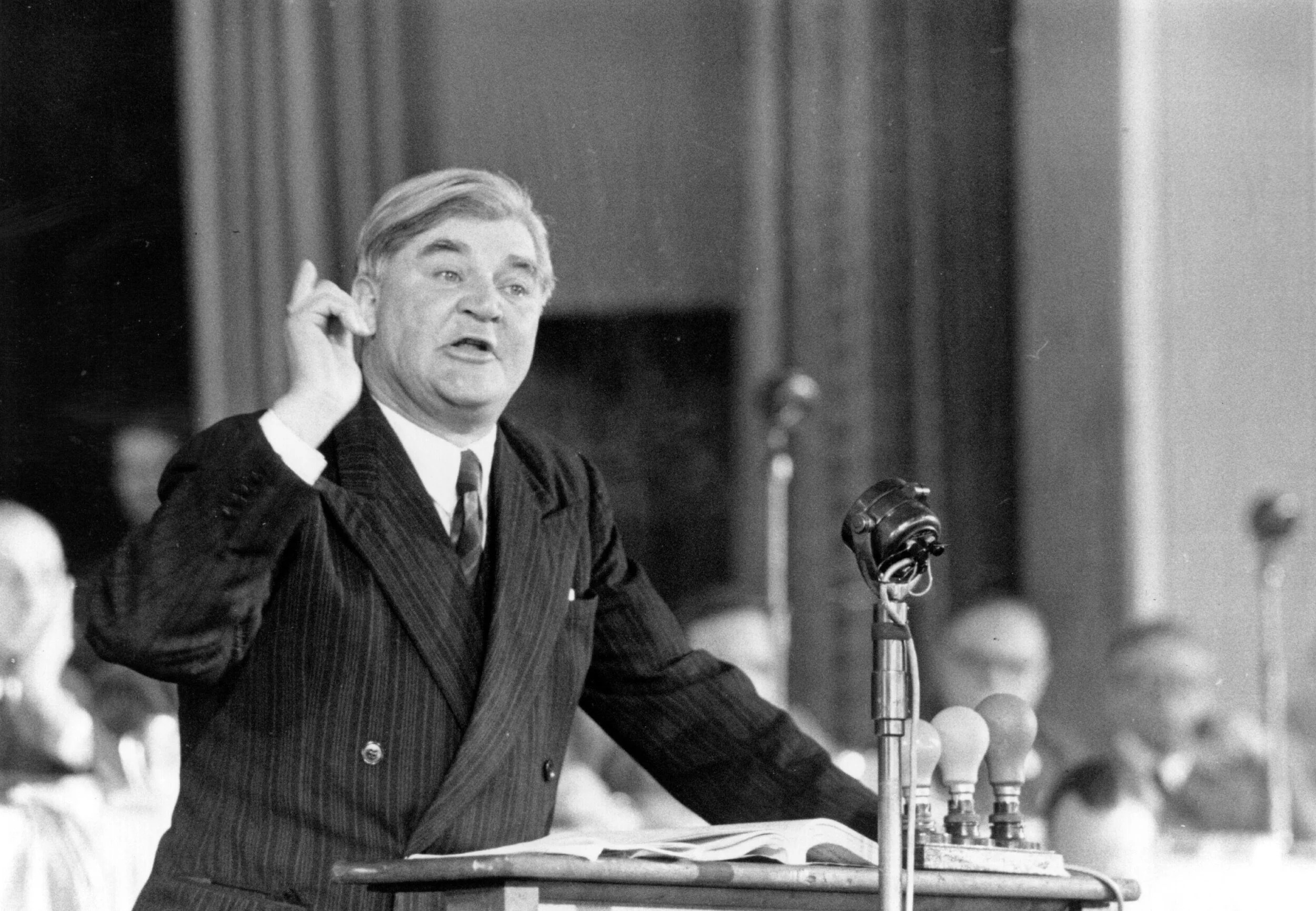
Nye Bevan resignation.jpg

Aneurin (Nye) Bevan: 'There is only one hope for mankind - and that is Democratic Socialism', Resignation speech - 1951

October 14, 2019

23 April 1951, House of Commons, Westminster, London, UK

Mr. Speaker, it is one of the immemorial courtesies of the House of Commons that when a Minister has felt it necessary to resign his office, he is provided with an opportunity of stating his reasons to the House. These occasions are always exceedingly painful, especially to the individual concerned, because no Member ought to accept office in a Government without a full consciousness that he ought not to resign it for frivolous reasons. He must keep in mind that his association is based upon the assumption that everybody in Government accepts the full measure of responsibility for what it does.

The courtesy of being allowed to make a statement in the House of Commons is peculiarly agreeable to me this afternoon, because, up to now, I am the only person who has not been able to give any reasons why I proposed to take this step, although I notice that almost every single newspaper in Great Britain, including a large number of well-informed columnists, already know my reasons.

The House will recall that in the Defence debate I made one or two statements concerning the introduction of a Defence programme into our economy, and, with the permission of the House, I should like to quote from that speech which, I assumed at the time, received the general approval of the House. I said: “The fact of the matter is, as everybody knows, that the extent to which stockpiling has already taken place, the extent to which the 35 civil economy is being turned over to defence purposes in other parts of the world, is dragging prices up everywhere. Furthermore, may I remind the right hon. Gentleman that if we turn over the complicated machinery of modern industry to war preparation too quickly, or try to do it too quickly, we shall do so in a campaign of hate, in a campaign of hysteria, which may make it very difficult to control that machine when it has been created.” “It is all very well to speak about these things in airy terms, but we want to do two things. We want to organise our defence programme in this country in such a fashion as will keep the love of peace as vital as ever it was before. But we have seen in other places that a campaign for increased arms production is accompanied by a campaign of intolerance and hatred and witch-hunting. Therefore, we in this country are not at all anxious to imitate what has been done in other places. I would also like to direct the attention of the House to a statement made by the Prime Minister in placing before the House the accelerated armaments programme. He said: “The completion of the programme in full and in time is dependent upon an adequate supply of materials, components and machine tools. In particular, our plans for expanding capacity depend entirely upon the early provivision of machine tools, many of which can only be obtained from abroad. Those cautionary words were inserted deliberately in the statements on defence production because it was obvious to myself and to my colleagues in the Government that the accelerated programme was conditional upon a number of factors not immediately within our own control.

It has for some time been obvious to the Members of the Government and especially to the Ministers concerned in the production Departments that raw materials, machine tools and components are not forthcoming in sufficient quantity even for the earlier programme and that, therefore, the figures in the Budget for arms expenditure are based upon assumptions already invalidated. I want to make that quite clear to the House of Commons; the figures of expenditure on arms were already known to the Chancellor of the Exchequer to be unrealisable. The supply Departments have made it quite clear on several occasions that this is the case and, therefore, I begged over and over again that we should not put figures in the Budget on account of defence expenditure which would not be 36 realised, and if they tried to be realised would have the result of inflating prices in this country and all over the world.

It is now perfectly clear to any one who examines the matter objectively that the lurchings of the American economy, the extravagant and unpredictable behaviour of the production machine, the failure on the part of the American Government to inject the arms programme into the economy slowly enough, have already caused a vast inflation of prices all over the world, have disturbed the economy of the western world to such an extent that if it goes on more damage will be done by this unrestrained behaviour than by the behaviour of the nation the arms are intended to restrain.

This is a very important matter for Great Britain. We are entirely dependent upon other parts of the world for most of our raw materials. The President of the Board of Trade and the Minister of Supply in two recent statements to the House of Commons have called the attention of the House to the shortage of absolutely essential raw materials. It was only last Friday that the Minister of Supply pointed out in the gravest terms that we would not be able to carry out our programme unless we had molybdenum, zinc, sulphur, copper and a large number of other raw materials and non-ferrous metals which we can only obtain with the consent of the Americans and from other parts of the world.

I say therefore with the full solemnity of the seriousness of what I am saying, that the £4,700 million arms programme is already dead. It cannot be achieved without irreparable damage to the economy of Great Britain and the world, and that therefore the arms programme contained in the Chancellor of the Exchequer’s Budget is already invalidated and the figures based on the arms programme ought to be revised.

It is even more serious than that. The administration responsible for the American defence programme have already announced to the world that America proposes to provide her share of the arms programme not out of reductions in civil consumption, not out of economies in the American economy but out of increased production; and already plans are envisaged that before very long the American economy will be expanded for arms production by a percentage 37 equal to the total British consumption, civil and arms.

And when that happens the demands made upon the world’s precious raw materials will be such that the civilian economy of the Western world outside America will be undermined. We shall have mass unemployment. We have already got in Great Britain underemployment. Already there is short-time working in many important parts of industry and before the middle of the year, unless something serious can be done, we shall have unemployment in many of our important industrial centres. That cannot be cured by the Opposition. In fact the Opposition would make it worse—far worse.

The fact is that the western world has embarked upon a campaign of arms production upon a scale, so quickly, and of such an extent that the foundations of political liberty and Parliamentary democracy will not be able to sustain the shock. This is a very grave matter indeed. I have always said both in the House of Commons and in speeches in the country—and I think my ex-colleagues in the Government will at least give me credit for this—that the defence programme must always be consistent with the maintenance of the standard of life of the British people and the maintenance of the social services, and that as soon as it became clear we had engaged upon an arms programme inconsistent with those considerations, I could no longer remain a Member of the Government.

I therefore do beg the House and the country, and the world, to think before it is too late. It may be that on such an occasion as this the dramatic nature of a resignation might cause even some of our American friends to think before it is too late. It has always been clear that the weapons of the totalitarian States are, first, social and economic, and only next military; and if in attempting to meet the military effect of those totalitarian machines, the economies of the western world are disrupted and the standard of living is lowered or industrial disturbances are created, then Soviet Communism establishes a whole series of Trojan horses in every nation of the western economy.

It is, therefore, absolutely essential if we are to march forward properly, if 38 we are to mobilise our resources intelligently, that the military, social and political weapons must be taken together. It is clear from the Budget that the Chancellor of the Exchequer has abandoned any hope of restraining inflation. It is quite clear that for the rest of the year and for the beginning of next year, so far as we can see, the cost of living is going to rise precipitously. As the cost of living rises, the industrial workers of Great Britain will try to adjust themselves to the rising spiral of prices, and because they will do so by a series of individual trade union demands a hundred and one battles will be fought on the industrial field, and our political enemies will take advantage of each one. It is, therefore, impossible for us to proceed with this programme in this way.

I therefore beg my colleagues, as I have begged them before, to consider before they commit themselves to these great programmes. It is obvious from what the Chancellor of the Exchequer said in his Budget speech that we have no longer any hope of restraining inflation. The cost of living has already gone up by several points since the middle of last year, and it is going up again. Therefore, it is no use pretending that the Budget is just, merely because it gives a few shillings to old age pensioners, when rising prices immediately begin to take the few shillings away from them.

[HON. MEMBERS: “Hear, hear.”]

It is no use saying “Hear, hear” on the opposite side of the House. The Opposition have no remedy for this at all. But there is a remedy here on this side of the House if it is courageously applied, and the Budget does not courageously apply it. The Budget has run away from it. The Budget was hailed with pleasure in the City. It was a remarkable Budget. It united the City, satisfied the Opposition and disunited the Labour Party—all this because we have allowed ourselves to be dragged too far behind the wheels of American diplomacy.

This great nation has a message for the world which is distinct from that of America or that of the Soviet Union. Ever since 1945 we have been engaged in this country in the most remarkable piece of social reconstruction the world has ever seen. By the end of 1950 we had, as I said in my letter to the Prime Minister, assumed the moral leadership 39 of the world. [Interruption.] It is no use hon. Members opposite sneering, because when they come to the end of the road it will not be a sneer which will be upon their faces. There is only one hope for mankind, and that hope still remains in this little island. It is from here that we tell the world where to go and how to go there, but we must not follow behind the anarchy of American competitive capitalism which is unable to restrain itself at all, as is seen in the stockpiling that is now going on, and which denies to the economy of Great Britain even the means of carrying on our civil production. That is the first part of what I wanted to say.

It has never been in my mind that my quarrel with my colleagues was based only upon what they have done to the National Health Service. As they know, over and over again I have said that these figures of arms production are fantastically wrong, and that if we try to spend them we shall get less arms for more money. I have not had experience in the Ministry of Health for five years for nothing. I know what it is to put too large a programme upon too narrow a a base. We have to adjust our paper figures to physical realities, and that is what the Exchequer has not done.

May I be permitted, in passing, now that I enjoy comparative freedom, to give a word of advice to my colleagues in the Government? Take economic planning away from the Treasury. They know nothing about it. The great difficulty with the Treasury is that they think they move men about when they move pieces of paper about. It is what I have described over and over again as “whistle-blowing” planning. It has been perfectly obvious on several occasions that there are too many economists advising the Treasury, and now we have the added misfortune of having an economist in the Chancellor of the Exchequer himself.

I therefore seriously suggest to the Government that they should set up a production department and put the Chancellor of the Exchequer in the position where he ought to be now under modern planning, that is, with the function of making an annual statement of accounts. Then we should have some realism in the Budget. We should not be pushing out figures when the facts are going in the opposite direction.

40 I want to come for a short while, because I do not wish to try the patience of the House, to the narrower issue. The Chancellor of the Exchequer astonished me when he said that his Budget was coming to the rescue of the fixed income groups. Well, it has come to the rescue of the fixed income groups over 70 years of age, but not below. The fixed income groups in our modern social services are the victims of this kind of finance. Everybody possessing property gets richer. Property is appreciating all the time, and it is well known that there are large numbers of British citizens living normally out of the appreciated values of their own property. The fiscal measures of the Chancellor of the Exchequer do not touch them at all.

I listened to the Chancellor of the Exchequer with very great admiration. It was one of the cleverest Budget speeches I had ever heard in my life. There was a passage towards the end in which he said that he was now coming to a complicated and technical matter and that if Members wished to they could go to sleep. They did. Whilst they were sleeping he stole £100 million a year from the National Insurance Fund. Of course I know that in the same Budget speech the Chancellor of the Exchequer said that he had already taken account of it as savings. Of course he had, so that the re-armament of Great Britain is financed out of the contributions that the workers have paid into the Fund in order to protect themselves. [HON. MEMBERS: “Oh!”] Certainly, that is the meaning of it. It is no good my hon. Friends refusing to face these matters. If we look at the Chancellor’s speech we see that the Chancellor himself said that he had already taken account of the contributions into the Insurance Fund as savings. He said so, and he is right. [Interruption.] Do not deny that he is right. I am saying he is right. Do not quarrel with me when I agree with him.

The conclusion is as follows. At a time when there are still large untapped sources of wealth in Great Britain, a Socialist Chancellor of the Exchequer uses the Insurance Fund, contributed for the purpose of maintaining the social services, as his source of revenue, and I say that is not Socialist finance. Go to that source for revenue when no other source remains, but no one can say that 41 there are no other sources of revenue in Great Britain except the Insurance Fund.

I now come to the National Health Service side of the matter. Let me say to my hon. Friends on these benches: you have been saying in the last fortnight or three weeks that I have been quarrelling about a triviality—spectacles and dentures. You may call it a triviality. I remember the triviality that started an avalanche in 1931. I remember it very well, and perhaps my hon. Friends would not mind me recounting it. There was a trade union group meeting upstairs. I was a member of it and went along. My good friend, “Geordie” Buchanan, did not come along with me because he thought it was hopeless, and he proved to be a better prophet than I was. But I had more credulity in those days than I have got now. So I went along, and the first subject was an attack on the seasonal workers. That was the first order. I opposed it bitterly, and when I came out of the room my good old friend George Lansbury attacked me for attacking the order. I said, “George, you do not realise, this is the beginning of the end. Once you start this there is no logical stopping point.”

The Chancellor of the Exchequer in this year’s Budget proposes to reduce the Health expenditure by £13 million—only £13 million out of £4,000 million.[HON. MEMBERS: “£400 million.”] No, £4,000 million. He has taken £13 million out of the Budget total of £4,000 million. If he finds it necessary to mutilate, or begin to mutilate, the Health Services for £13 million out of £4,000 million, what will he do next year? Or are you next year going to take your stand on the upper denture? The lower half apparently does not matter, but the top half is sacrosanct. Is that right? If my hon. Friends are asked questions at meetings about what they will do next year, what will they say?

The Chancellor of the Exchequer is putting a financial ceiling on the Health Service. With rising prices the Health Service is squeezed between that artificial figure and rising prices. What is to be squeezed out next year? Is it the upper half? When that has been squeezed out and the same principle holds good, what do you squeeze out the year after? Prescriptions? Hospital charges? Where do you stop? I have been accused of 42 having agreed to a charge on prescriptions. That shows the danger of compromise. Because if it is pleaded against me that I agreed to the modification of the Health Service, then what will be pleaded against my right hon. Friends next year, and indeed what answer will they have if the vandals opposite come in? What answer? The Health Service will be like Lavinia—all the limbs cut off and eventually her tongue cut out, too.

I should like to ask my right hon. and hon. Friends, where are they going?[HON. MEMBERS: “Where are you going?”] Where am I going? I am where I always was. Those who live their lives in mountainous and rugged countries are always afraid of avalanches, and they know that avalanches start with the movement of a very small stone. First, the stone starts on a ridge between two valleys—one valley desolate and the other valley populous. The pebble starts, but nobody bothers about the pebble until it gains way, and soon the whole valley is overwhelmed. That is how the avalanche starts, that is the logic of the present situation, and that is the logic my right hon. and hon. Friends cannot escape. Why, therefore, has it been done in this way?

After all, the National Health Service was something of which we were all very proud, and even the Opposition were beginning to be proud of it. It only had to last a few more years to become a part of our traditions, and then the traditionalists would have claimed the credit for all of it. Why should we throw it away? In the Chancellor’s Speech there was not one word of commendation for the Health Service—not one word. What is responsible for that?

Why has the cut been made? He cannot say, with an overall surplus of over £220 million and a conventional surplus of £39 million, that he had to have the £13 million. That is the arithmetic of Bedlam. He cannot say that his arithmetic is so precise that he must have the £13 million, when last year the Treasury were £247 million out. Why? Has the A.M.A. succeeded in doing what the B.M.A. failed to do? What is the cause of it? Why has it been done?

I have also been accused—and I think I am entitled to answer it—that I had already agreed to a certain charge. I 43 speak to my right hon. Friends very frankly here. It seems to me sometimes that it is so difficult to make them see what lies ahead that you have to take them along by the hand and show them. The prescription charge I knew would never be made, because it was impracticable. [HON. MEMBERS: “Oh!”] Well, it was never made.

I will tell my hon. Friends something else, too. There was another policy—there was a proposed reduction of 25,000 on the housing programme, was there not? It was never made. It was necessary for me at that time to use what everybody always said were bad tactics upon my part—I had to manœuvre, and I did manœuvre and saved the 25,000 houses and the prescription charge. I say, therefore, to my right hon. and hon. Friends, there is no justification for taking this line at all. There is no justification in the arithmetic, there is less justification in the economics, and I beg my right hon. and hon. Friends to change their minds about it.

I say this, in conclusion. There is only one hope for mankind—and that is democratic Socialism. There is only one party in Great Britain which can do it—and that is the Labour Party. But I ask them carefully to consider how far they are polluting the stream. We have gone a long way—a very long way—against great difficulties. Do not let us change direction now. Let us make it clear, quite clear, to the rest of the world that we stand where we stood, that we are not going to allow ourselves to be diverted from our path by the exigencies of the immediate situation. We shall do what is necessary to defend ourselves—defend ourselves by arms, and not only with arms but with the spiritual resources of our people.

Source: http://www.nyebevan.org.uk/speeches/resign...

Enjoyed this speech? Speakola is a labour of love and I’d be very grateful if you would share, tweet or like it. Thank you.

Facebook Twitter Facebook
In 1940-59 B Tags ANEURIN BEVAN, NYE, NYE BEVAN, DEMOCRATIC SOCIALISM, RESIGNATION, RESIGN, ARMS RACE, DEFENSE SPENDING
Comment

Sprio Agnew: 'I believe that America has always thrived on adversity", Resignation speech - 1973

October 11, 2019

15 October 1973, Washington DC, USA

Good evening, ladies and gentlemen.

Nearly five years ago and again last year you gave me the greatest honor of my life by electing me Vice President of the United States.

I do not want to spend these last moments with you in a paroxysm of bitterness, but I do think there are matters related to my resignation that are misunderstood. It is important to me and believe to the country that these misconceptions be corrected.

Late this summer my fitness to continue in office came under attack when accusations against me made in the course of a grand jury investigation were improperly and unconscionably leaked in detail to the news media.

I might add that the attacks were increased by daily publication of the wildest rumor and speculation, much of it bearing no resemblance to the information being given the prosecutors.

All this was done with full knowledge that it was prejudicial to my civil rights.

The news media editorially deplored these violations of the traditional secrecy of such investigations but at the same time many of the most prestigious of them were ignoring their own counsel by publishing every leak they could get their hands on.

From time to time I made public denials of those scurrilous and inaccurate reports and challenged the credibility of their sources.

I have consistently renewed those denials, last doing so at the hearing in the United States District Court. There, in a response to a statement of the prosecutor's case, I stated that, with the exception of my decision not to contest the 1967 tax charge, I flatly and categorically denied the assertions of illegal acts on my part made by the Government witnesses.

I repeat and I emphasize that denial of wrongdoing tonight.

Notwithstanding that the Government's case for extortion, bribery and conspiracy rested entirely on the testimony of individuals who had already confessed to criminal acts and who had been granted total or partial immunity in exchange for their testimony against me, their accusations which are not independently corroborated or tested by cross‐examination have been published and broadcast as indispuatble fact.

This has been done even though such accusations are not a provable part of the single count of tax evasion which I saw fit not to contest and which was the only issue on which I went to court.

Up until a few days ago I was determined to fight for my integrity and my office whatever the cost. The confidence that millions of you expressed encouraged me and no words can convey the appreciation that my family and I will always feel for your outpouring of support.

However, after hard deliberation and much prayer, I concluded several days ago that the public interest and the interests of those who mean the most to me would best be served by my stepping down.

The constitutional formalities of that decision were fulfilled last Wednesday when I tendered my resignation as Vice President to the Secretary of State.

The legal sanctions necessary to resolve the contest, sanctions to which I am subject like any other citizen under our American system were fulfilled that same day when I pleaded nolo contendere and accepted the judgment of a Federal court for a violation of the tax laws in 1967 when I was governor of Maryland.

While I am fully aware that the plea of nolo contendere was the equivalent of a plea of guilty for the purpose of that negotiated proceeding in Baltimore, it does not represent a confession of any guilt whatever for any other purpose. I made the plea because it was the only way to quickly resolve the situation.

In this technological age image becomes dominant, appearance supersedes reality. An appearance of wrongdoing whether true or false in fact is damaging to any man. But more important it is fatal to a man who must be ready at any moment to step into the Presidency.

The American people deserve to have a Vice President who commands their unimpaired confidence and implicit trust. For more than two months now you have not had such a Vice President. Had I remained in office and fought to vindicate myself through the courts and the Congress, it would have meant subjecting the country to a further agonizing period of months without an unclouded successor for the Presidency.

This I could not do despite my tormented verbal assertion in Los Angeles. To put his country through the ordeal of division and uncertainty that that entailed would be a selfish and unpatriotic action for any man in the best of times. But at this especially critical time, with a dangerous war raging in the Mideast and with the nation still torn by the wrenching experiences of the past year, it would have been intolerable.

So I chose instead not to contest formally the accusations against me. My plea last week in court was exactly that—not an admission of guilt but a plea of no contest, done to still the raging storm, delivering myself for conviction in one court on one count, the filing of a false income tax return for 1967.

But in addition to my constitutional and legal responsibilities, I am also accountable to another authority, that of the people themselves. Tonight I'd like to try briefly to give you the explanation that you should rightly have.

First, a few words about Government contractors and fund‐raising appear to be in order.

At every level of government in this country, local, state and national, public officials in high executive positions must make choices in the course of carrying out engineering and architectural projects undertaken for the public good.

Because they involve professional people these are negotiated and non ‐ bid awards. Competition is fierce and the pressures for favoritism are formidable.

And I'm sure you realize that public officials who do not possess large personal fortunes face the unpleasant but unavoidable necessity of raising substantial sums of money to pay their campaign and election expenses.

In the forefront of those eager to contribute always have been the contractors seeking non‐bid state awards.

Beyond the insinuation that I pocketed large sums of money, which has never been proven, and which I emphatically deny, the intricate tangle of criminal charges leveled at me which you've been reading and hearing about during these past months boils down to the accusation that I permitted my fundraising activities and my contract‐dispensing activities to overlap in an unethical and unlawful manner. Perhaps, judged by the new postWatergate political morality, I did.

But the prosecution's assertion that I was the initiator and the gray eminence in an unprecedented and complex scheme of extortion is just not realistic.

For trained prosecution's witnesses who have long been experienced and aggressive in Maryland politics to masquerade as innocent victims of illegal enticements from me is enough to provoke incredulous laughter from any experienced political observer.

All knowledgeable politicians and contractors know better than that.

They know where the questionable propositions originate.

They know how many shoddy schemes a political man must reject in the course of carrying out his office.

What is it that makes my accusers self‐confessed bribebrokers, extortionists and conspirators believable? And I point out that their stories have been treated as gospel by most of the media. Particularly how can they be believable when they've been encouraged to lessen their punishment by accusing someone else?

Let me reiterate here that I have never as County Executive of Baltimore County, as Governor of Maryland or as Vice President of the United States, enriched myself in betrayal of my public trust.

My current net worth, less than $200,000, is modest for a person of my age and position. Every penny of it can be accounted for from lawful sources.

Moreover my standard of living throughout my political career has been demonstrably modest and has been open to public scrutiny during my public life.

In the Government's recitals against me there are no claims of unexplained personal enrichment.

But if all of this is true you might well ask why did not resign and defend myself in court as a private citizen. I did consider that very seriously. But it was the unanimous judgment of my advisers that resignation would carry a presumption of guilt sufficient to prevent a defense on the merits.

And I'm afraid that what I've been hearing and seeing and reading persuades me that they were right.

By taking the course of the nolo plea I've spared my family great anguish. At the same time I've given the President and the Congress the opportunity to select on your behalf a new Vice President who can fill that office unencumbered by controversy.

I hope to have contributed to focusing America's attention and energies back to where they belong, away from the personal troubles of Ted Agnew and back to the great tasks that confront us as a nation.

As the country turns back to those tasks it is fortunate indeed to do so under the leadership of a President like Richard Nixon. Since events began to break in August the President has borne a heavy burden in his attempt to be both fair to me and faithful to his oath of office. He has done his best to accommodate human decency without sacrificing legal rectitude. He said to me in private exactly what he has stated in public—that the decision was mine alone to make and having now made that decision I want to pay tribute to the President for the restraint and the compassion which he has demonstrated in our conversations about this difficult matter.

The reports from unidentified sources that our meetings were unfriendly, even vitriolic, are completely false.

I also want to express to the President and to all of you my deep regret for any interference which the controversy surrounding me may have caused in the country's pursuit of the great goals of peace, prosperity and progress which the Nixon Administration last year was overwhelmingly reelected to pursue.

Yet our great need at this time is not for regret which looks at the past but for resolve which faces the future.

The first challenge we face as a nation is to summon up the political maturity that will be required to confirm and support the new Vice President.

Under the newly applicable 25th Amendment to the Constitution, for the first time in our history in the event of the President's death or disability, his successor will be someone chosen by the President and confirmed by the Congress rather than someone elected by the people.

In choosing Gerald Ford, the President has made a wise nomination. The Republican House leader has earned the respect of the entire Congress as well as those in the executive branch who have come in contact with him during his long and distinguished career.

Jerry Ford is an eminently fair and capable individual, one who stands on principle, one who works effectively and nonabrasively for the achievable result.

He'll make an excellent Vice President and he is clearly qualified to undertake the highest office should the occasion require it.

After the Vice‐Presidency is filled the next question for Americans will be whether we're able to profit from this series of painful experiences by undertaking the reforms that recent tragedies cry for.

Will the recent events form the crucible out of which a new system of campaign financing is forged, a system in which public funding for every political candidate removes an opportunity for evil or the appearance of evil? sincerely hope so.

Will the furor about campaign contributions dramatize the need for state and Iocal governments across the country to close the loopholes in their laws which invite abuse or suspicion, of abuse in letting lucrative contracts to private business?

Again, I hope so.

I remember closing one such loophole regarding the awarding of insurance contracts when I was County Executive of Baltimore County. Will my nightmare‐cometrue bring about a healthy self‐examination throughout our criminal justice system aimed at stopping prejudicial leaks?

Will the prosecutors be restricted and controlled in their ability to grant immunity and partial immunity to coax from frightened defendants accusations against higher targets? Certainly these procedures need closer supervision by the courts and defense counsel and the bar.

As things now stand immunity is an open invitation to perjury. In the hands of an ambitious prosecutor it can amount to legalized extortion and bribery.

Again, I would hope that such reforms might result. If these beneficial changes do flow from our current national trauma then the suffering and sacrifice that I've had to undergo in the course of all this will be worthwhile.

But regardless of what the future may bring nothing can take away my satisfaction at having served for some 57 months as the second highest constitutional officer of the greatest nation on earth —a satisfaction deriving not from what I did but from what was done for me by millions of fine men and wömen whose beliefs and concerns I tried to articulate and from what was done around me by a great President and his administration in advancing the cause of peace and well being for this country and for all mankind.

I believe that America has always thrived on adversity and so I can foresee only good ahead for this country despite my personal sorrow at leaving public service and leaving many objectives incomplete.

Under this Administration which you have chosen and in which I have been priviledged to serve, the longest war in America's history has been brought to an honorable end and we are within the best chance for lasting peace that the world has had in a century and a half. Both the abundance and the quality of American life are pushing to new highs.

Our democracy, with its balanced Federal system, its separation of powers, and its fundamental principles of individual liberty, is working better than ever before.

Our bicentennial in 1976 will be marked by a chance for the electorate to choose among an unusually fine group of potential leaders.

These are America's strengths and her glories which no amount of preoccupation with her weaknesses can obscure.

Every age in American history has had its crises and upheavals. They all must have seemed like massive earthquakes to those who stood at the epicenter of the movement, but they all left the foundations of the Republic secure and unshaken when history moved on.

The resignation of a Vice President, for example, is insignificant compared with the death of a President, particularly one so great as Lincoln.

But I can't help thinking tonight of James Garfield's words to an audience in New York just following the announcement that Lincoln had died. Garfield, who was later President himself, was only a young Army officer at the time of that great tragedy in 1865, but he saw clearly where his country's strength lay, and he expressed it all in these few words to a frightened crowd. He said:

“Fellow citizens, God reigns, and the Government in Washington still lives.”

I take leave of you tonight, my friends, in that same sober but trusting spirit. God does reign. I thank Him for the opportunity of serving you in high office, and I know that He will continue to care for this country in the future as He has done so well in the past.

The Government at Washington does live. It lives in the pages of our Constitution and in the hearts of our citizens and there it will. always be safe.

Thank you. Goodnight and farewell.

Source: https://www.nytimes.com/1973/10/16/archive...

Enjoyed this speech? Speakola is a labour of love and I’d be very grateful if you would share, tweet or like it. Thank you.

Facebook Twitter Facebook
In 1960-79 B Tags SPIRO AGNEW, VICE PRESIDENT, RESIGNATION, GOD REIGNS, TAX EVASION, TRANSCRIPT, RICHARD NIXON, RUNNING MATE, FAREWELL, POLITICAL SCANDAL
Comment

Tommy Douglas: 'All my life, I've wished that it were possible that I could attend my own funeral', Resignation as NDP Leader - 1971

February 27, 2018

24 April 1971, Ottawa, Canada

All my life, I've wished that it were possible that I could attend my own funeral and listen to the eulogies that would be made on my behalf, but I knew that this would be extremely difficult as I'd have to be dead.

Laurier LaPierre and his committee have made it possible maybe for me to listen to the eulogies without the disadvantage of having passed on to another world, but never in my wildest dreams did I expect to have eulogies delivered by such talented and eloquent spokesmen, and I would like to thank Pierre Berton, this noted author and outstanding radio personality, and to say that I know of no one in Canada from whom I would appreciate this tribute more than from this man.

I want to assure you that my wife, Irma, and myself are deeply touched by these tributes that we are profoundly grateful for this occasion. I am glad that you included Irma because, as someone has said, "Behind every successful man, there's a surprised mother-in-law," and I have been fortunate that in all my political career I've had someone who has helped me and encouraged me, and tonight I'm glad that you are paying tribute to her.

I want to say to Grant Notley that I am not saying goodbye either. I propose to stay in the House of Commons until the next election. Our supporters in the Nanaimo-Cowichan Islands have done me the great honour of nominating me to contest the next federal election and, if God gives me strength and the electorate give votes, I'll be here fighting at the same old stand for the things in which you and I believe.

But, tonight, my wife, Irma, and I did not come here so much to receive your thanks, although we are deeply grateful for it. We have come tonight to thank you, to thank the hundreds of thousands of people you represent who have made anything we have done possible.

I think of the men and women who 35 years ago and more dreamed the impossible dream, men and women who lived beyond the lean horizon of their years, who believed devoutly that it was possible to have a more humane and a more just society, and who gave up their time and their money and their energy to begin building it.

Tthe men and women who travelled in all kinds of weather and in all kinds of vehicles, who went from schoolhouse to schoolhouse organising, raising money, who canvassed from door to door, who passed out literature, who manned the polls, who drove cars on election day, you who are here and thousands whom you represent. These are the men and women to whom we should be profoundly grateful.

I feel tonight a great flow of gratitude to them, and I'm filled with wonder that I, raised in a working class home on the wrong side of tracks in the city of Winnipeg should have been given the opportunity by the working people of this country to make a contribution to the public life of Canada, which I hope will long endure.

If I were asked to sum up for the people of Canada and for the New Democratic Party what I have learned from more than a third of a century in public life, I would sum it up by saying to them that it is possible in this country of ours to build a society in which there will be full employment, in which there will be a higher standard of living, in which there will be an improved quality of life while at the same time maintaining a reasonable stability in the cost of living.

We don't have to have three quarters of a million unemployed. We don't have to choose between unemployment and inflation.

My message to you is that we don't have to do this. My message to you is that we have in Canada the resources, the technical know-how and the industrious people who could make this a great land if we were prepared to bring these various factors together in building a planned economy dedicated to meeting human needs and responding to human wants.

Mr. Coldwell and I have seen it happen. In 1937, when the CCF proposed in the House of Commons a $500-million program to put single unemployed to work, the minister of finance said, "Where will we get the money?"

Mr. [inaudible 00:08:21] asked the same question today. My reply at that time was that if we were to go to war, the minister would find the money, and it turned out to be true.

In 1939, when we declared war against Nazi Germany, for the first time, we used the Bank of Canada to make financially possible what was physically possible. We took a million men and women and put them in uniform. We fed and clothed and armed them. The rest of the people of Canada went to work. The government organised over a hundred ground corporations. We manufactured things that had never been manufactured before. We gave our farmers and fishermen guaranteed prices, and they produced more food than we'd ever produced in peacetime. We built the third largest merchant navy in the world and we manned it. In order to prevent profiteering and inflation, we fixed prices, and we did it all without borrowing a single dollar from outside of Canada.

My message to the people of Canada is this, that if we could mobilise the financial and the material and the human resources of this country to fight a successful war against Nazi tyranny, we can if we want to mobilise the same resources to fight a continual war against poverty, unemployment and social injustice.

Fifty years ago, the founder of our movement, J.S. Woodsworth, wrote a pledge. That pledge has been the beacon star of my life, and I pass it on to those of you who must continue the building of this movement, and I hope you'll make it your pledge.

J.S. Woodsworth wrote, "We pledge ourselves to united efforts in establishing on the earth an era of justice, truth and love. May our faces be to the future. May we be the children of that brighter and better day which even now is beginning to dawn. May we not impede, but rather cooperate with those spiritual forces which we believe are impelling the world upward and onward, for our supreme task is to make our dreams come true, to transform our city into the holy city and to make this land in reality God's own country."

Thank you.

Enjoyed this speech? Speakola is a labour of love and I’d be very grateful if you would share, tweet or like it. Thank you.

Facebook Twitter Facebook
In 1960-79 B Tags TOMMY DOUGLAS, NDP, RESIGNATION, CANADA, TRANSCRIPT, J.S. WOODSWORTH, VALUES, LIBERAL, PRIME MINISTER, WARTIME
Comment

Jeff Flake: 'Anger and resentment are not a governing philosophy', Senate leaving speech - 2017

October 26, 2017

24 October 2017, Washington DC, USA

At a moment when it seems that our democracy is more defined by our discord and our dysfunction than by our own values and principles, let me begin by noting the somewhat obvious point that these offices that we hold are not ours indefinitely. We are not here simply to mark time. Sustained incumbency is certainly not the point of seeking office and there are times when we must risk our careers in favor of our principles. Now is such a time.

It must also be said that I rise today with no small measure of regret. Regret because of the state of our disunion. Regret because of the disrepair and destructiveness of our politics. Regret because of the indecency of our discourse. Regret because of the coarseness of our leadership.

Regret for the compromise of our moral authority, and by our, I mean all of our complicity in this alarming and dangerous state of affairs. It is time for our complicity and our accommodation of the unacceptable to end. In this century, a new phrase has entered the language to describe the accommodation of a new and undesirable order, that phrase being the “new normal”.

That we must never adjust to the present coarseness of our national dialogue with the tone set up at the top. We must never regard as normal the regular and casual undermining of our democratic norms and ideals. We must never meekly accept the daily sundering of our country. The personal attacks, the threats against principles, freedoms and institution, the flagrant disregard for truth and decency.

The reckless provocations, most often for the pettiest and most personal reasons, reasons having nothing whatsoever to do with the fortunes of the people that we have been elected to serve. None of these appalling features of our current politics should ever be regarded as normal. We must never allow ourselves to lapse into thinking that that is just the way things are now.


1:24

If we simply become inured to this condition, thinking that it is just politics as usual, then heaven help us. Without fear of the consequences and without consideration of the rules of what is politically safe or palatable, we must stop pretending that the degradation of our politics and the conduct of some in our executive branch are normal. They are not normal. Reckless, outrageous and undignified behavior has become excused and countenanced as telling it like it is when it is actually just reckless, outrageous and undignified.


And when such behavior emanates from the top of our government, it is something else. It is dangerous to a democracy. Such behavior does not project strength because our strength comes from our values. It instead projects a corruption of the spirit and weakness. It is often said that children are watching. Well, they are. And what are we going to do about that? When the next generation asks us, why didn’t you do something? Why didn’t you speak up? What are we going to say?

Mr President, I rise today to say: enough. We must dedicate ourselves to making sure that the anomalous never becomes the normal. With respect and humility, I must say that we have fooled ourselves for long enough that a pivot to governing is right around the corner, a return to civility and stability right behind it.

We know better than that. By now, we all know better than that. Here today I stand to say that we would be better served – we would better serve the country – by better fulfilling our obligations under the constitution by adhering to our Article 1 – “old normal”, Mr Madison’s doctrine of separation of powers. This genius innovation which affirms Madison’s status as a true visionary – and for which Madison argued in Federalist 51 – held that the equal branches of our government would balance and counteract with each other, if necessary.

“Ambition counteracts ambition,” he wrote. But what happens if ambition fails to counteract ambition? What happens if stability fails to assert itself in the face of chaos and instability? If decency fails to call out indecency? Were the shoe on the other foot, we Republicans – would we Republicans meekly accept such behavior on display from dominant Democrats?

Of course, we wouldn’t, and we would be wrong if we did. When we remain silent and fail to act, when we know that silence and inaction is the wrong thing to do because of political considerations, because we might make enemies, because we might alienate the base, because we might provoke a primary challenge, because ad infinitum, ad nauseam, when we succumb to those considerations in spite of what should be greater considerations and imperatives in defense of our institutions and our liberty, we dishonor our principles and forsake our obligations. Those things are far more important than politics.

Now, I’m aware that more politically savvy people than I will caution against such talk. I’m aware that there’s a segment of my party that believes that anything short of complete and unquestioning loyalty to a president who belongs to my party is unacceptable and suspect. If I have been critical, it is not because I relish criticizing the behavior of the president of the United States.

If I have been critical, it is because I believe it is my obligation to do so. And as a matter and duty of conscience, the notion that one should stay silent – and as the norms and values that keep America strong are undermined and as the alliances and agreements that ensure the stability of the entire world are routinely threatened by the level of thought that goes into 140 characters – the notion that we should say or do nothing in the face of such mercurial behavior is ahistoric and, I believe, profoundly misguided.

A president, a Republican president named Roosevelt, had this to say about the president and a citizen’s relationship to the office: “The president is merely the most important among a large number of public servants. He should be supported or opposed exactly to the degree which is warranted by his good conduct or bad conduct, his efficiency or inefficiency in rendering loyal, able and disinterested service to the nation as a whole.”

He continued: “Therefore, it is absolutely necessary that there should be – that there should be a full liberty to tell the truth about his acts and this means that it is exactly as necessary to blame him when he does wrong as to praise him when he does right. Any other attitude in an American citizen is both base and servile.” President Roosevelt continued, “To announce that there must be no criticism of the president or that we are to stand by a president, right or wrong, is not only unpatriotic and servile, but is morally treasonable to the American public.”

Acting on conscience and principle is a manner – is the manner – in which we express our moral selves and as such, loyalty to conscience and principle should supersede loyalty to any man or party. We can all be forgiven for failing in that measure from time to time. I certainly put myself at the top of the list of those who fall short in this regard. I am holier than none.

But too often we rush to salvage principle – not to salvage principle, but to forgive and excuse our failures so that we might accommodate them and go right on failing until the accommodation itself becomes our principle. In that way and over time, we can justify almost any behavior and sacrifice any principle. I am afraid that this is where we now find ourselves.

When a leader correctly identifies real hurt and insecurity in our country, and instead of addressing it, goes to look for someone to blame, there is perhaps nothing more devastating to a pluralistic society. Leadership knows that most often a good place to start in assigning blame is to look somewhat closer to home. Leadership knows where the buck stops.

Humility helps, character counts. Leadership does not knowingly encourage or feed ugly or debased appetites in us. Leadership lives by the American creed, “E pluribus unum”. From many one. American leadership looks to the world and just as Lincoln did, sees the family of man. Humanity is not a zero sum game. When we have been at our most prosperous, we have been at our most principled, and when we do well, the rest of the world does well.

These articles of civic faith have been critical to the American identity for as long as we have been alive. They are our birthright and our obligation. We must guard them jealously and pass them on for as long as the calendar has days. To betray them or to be unserious in their defense is a betrayal of the fundamental obligations of American leadership and to behave as if they don’t matter is simply not who we are.

Now the efficacy of American leadership around the globe has come into question. When the United States emerged from World War II, we contributed about half of the world’s economic activity. It would have been easy to secure our dominance keeping those countries who had been defeated or greatly weakened during the war in their place. We didn’t do that. It would have been easy to focus inward.

We resisted those impulses. Instead, we financed reconstruction of shattered countries and created international organizations and institutions that have helped provide security and foster prosperity around the world for more than 70 years.

Now it seems that we, the architects of this visionary rules-based world order that has brought so much freedom and prosperity, are the ones most eager to abandon it. The implications of this abandonment are profound and the beneficiaries of this rather radical departure in the American approach to the world are the ideological enemies of our values. Despotism loves a vacuum and our allies are now looking elsewhere for leadership. Why are they doing this? None of this is normal.

And what do we, as United States senators, have to say about it? The principles that underlie our politics, the values of our founding, are too vital to our identity and to our survival to allow them to be compromised by the requirements of politics because politics can make us silent when we should speak and silence can equal complicity. I have children and grandchildren to answer to.

And so, Mr President, I will not be complicit or silent. I’ve decided that I would be better able to represent the people of Arizona and to better serve my country and my conscience by freeing myself of the political consideration that consumed far too much bandwidth and would cause me to compromise far too many principles.

To that end, I’m announcing today that my service in the Senate will conclude at the end of my term in early January 2019. It is clear at this moment that a traditional conservative, who believes in limited government and free markets, who is devoted to free trade, who is pro-immigration, has a narrower and narrower path to nomination in the Republican party, the party that has so long defined itself by its belief in those things.

It is also clear to me for the moment that we have given in or given up on the core principles in favor of a more viscerally satisfying anger and resentment. To be clear, the anger and resentment that the people feel at the royal mess that we’ve created are justified. But anger and resentment are not a governing philosophy.

There is an undeniable potency to a populist appeal by mischaracterizing or misunderstanding our problems and giving in to the impulse to scapegoat and belittle – the impulse to scapegoat and belittle threatens to turn us into a fearful, backward-looking people. In the case of the Republican party, those things also threaten to turn us into a fearful, backward-looking minority party.

We were not made great as a country by indulging in or even exalting our worst impulses, turning against ourselves, glorifying in the things that divide us, and calling fake things true and true things fake. And we did not become the beacon of freedom in the darkest corners of the world by flouting our institutions and failing to understand just how hard-won and vulnerable they are.

This spell will eventually break. That is my belief. We will return to ourselves once more, and I say the sooner the better. Because we have a healthy government, we must also have healthy and functioning parties. We must respect each other again in an atmosphere of shared facts and shared values, comity and good faith. We must argue our positions fervently and never be afraid to compromise. We must assume the best of our fellow man, and always look for the good.

Until that day comes, we must be unafraid to stand up and speak out as if our country depends on it, because it does. I plan to spend the remaining 14 months of my Senate term doing just that.

Mr President, the graveyard is full of indispensable men and women. None of us here is indispensable nor were even the great figures of history who toiled at these very desks, in this very chamber, to shape the country that we have inherited. What is indispensable are the values that they consecrated in Philadelphia and in this place, values which have endured and will endure for so long as men and women wish to remain free.

What is indispensable is what we do here in defense of those values. A political career does not mean much if we are complicit in undermining these values. I thank my colleagues for indulging me here today.

I will close by borrowing the words of President Lincoln, who knew more about healthy enmity and preserving our founding values than any other American who has ever lived. His words from his first inaugural were a prayer in his time and are now no less in ours.

“We are not enemies, but friends. We must not be enemies. Though passion may have strained, it must not break the bonds of our affection. The mystic chords of memory will swell when again touched, as surely as they will be, by the better angels of our nature.”

Thank you, Mr President. I yield the floor.

Source: https://www.theguardian.com/commentisfree/...

Enjoyed this speech? Speakola is a labour of love and I’d be very grateful if you would share, tweet or like it. Thank you.

Facebook Twitter Facebook
In 2010s Tags JEFF FLAKE, ARIZONA, SENATE, RESIGNATION, TRANSCRIPT, DONALD TRUMP, GOP, REPUBLICAN PARTY
Comment

Robin Cook: "if the hanging chads in Florida had gone the other way, we would not now be about to commit British troops' , Resignation speech - 2003

July 7, 2016

17 March 2003, House of Commons, United Kingdom

This is the first time for 20 years that I have addressed the House from the back benches.

I must confess that I had forgotten how much better the view is from here.

None of those 20 years were more enjoyable or more rewarding than the past two, in which I have had the immense privilege of serving this House as Leader of the House, which were made all the more enjoyable, Mr Speaker, by the opportunity of working closely with you.

It was frequently the necessity for me as Leader of the House to talk my way out of accusations that a statement had been preceded by a press interview.

On this occasion I can say with complete confidence that no press interview has been given before this statement.

I have chosen to address the House first on why I cannot support a war without international agreement or domestic support.

Backing Blair

The present Prime Minister is the most successful leader of the Labour party in my lifetime.

I hope that he will continue to be the leader of our party, and I hope that he will continue to be successful. I have no sympathy with, and I will give no comfort to, those who want to use this crisis to displace him.

I applaud the heroic efforts that the prime minister has made in trying to secure a second resolution.

I do not think that anybody could have done better than the foreign secretary in working to get support for a second resolution within the Security Council.

But the very intensity of those attempts underlines how important it was to succeed.

Now that those attempts have failed, we cannot pretend that getting a second resolution was of no importance.

French intransigence?

France has been at the receiving end of bucket loads of commentary in recent days.

It is not France alone that wants more time for inspections. Germany wants more time for inspections; Russia wants more time for inspections; indeed, at no time have we signed up even the minimum necessary to carry a second resolution.

We delude ourselves if we think that the degree of international hostility is all the result of President Chirac.

The reality is that Britain is being asked to embark on a war without agreement in any of the international bodies of which we are a leading partner - not NATO, not the European Union and, now, not the Security Council.

To end up in such diplomatic weakness is a serious reverse.

Only a year ago, we and the United States were part of a coalition against terrorism that was wider and more diverse than I would ever have imagined possible.

'Heavy price'

History will be astonished at the diplomatic miscalculations that led so quickly to the disintegration of that powerful coalition.

The US can afford to go it alone, but Britain is not a superpower.

Our interests are best protected not by unilateral action but by multilateral agreement and a world order governed by rules.

Yet tonight the international partnerships most important to us are weakened: the European Union is divided; the Security Council is in stalemate.

Those are heavy casualties of a war in which a shot has yet to be fired.

I have heard some parallels between military action in these circumstances and the military action that we took in Kosovo. There was no doubt about the multilateral support that we had for the action that we took in Kosovo.

It was supported by NATO; it was supported by the European Union; it was supported by every single one of the seven neighbours in the region. France and Germany were our active allies.

It is precisely because we have none of that support in this case that it was all the more important to get agreement in the Security Council as the last hope of demonstrating international agreement.

Public doubts

The legal basis for our action in Kosovo was the need to respond to an urgent and compelling humanitarian crisis.

Our difficulty in getting support this time is that neither the international community nor the British public is persuaded that there is an urgent and compelling reason for this military action in Iraq.

The threshold for war should always be high.

None of us can predict the death toll of civilians from the forthcoming bombardment of Iraq, but the US warning of a bombing campaign that will "shock and awe" makes it likely that casualties will be numbered at least in the thousands.

I am confident that British servicemen and women will acquit themselves with professionalism and with courage. I hope that they all come back.

I hope that Saddam, even now, will quit Baghdad and avert war, but it is false to argue that only those who support war support our troops.

It is entirely legitimate to support our troops while seeking an alternative to the conflict that will put those troops at risk.

Nor is it fair to accuse those of us who want longer for inspections of not having an alternative strategy.

For four years as foreign secretary I was partly responsible for the western strategy of containment.

Over the past decade that strategy destroyed more weapons than in the Gulf war, dismantled Iraq's nuclear weapons programme and halted Saddam's medium and long-range missiles programmes.

Iraq's military strength is now less than half its size than at the time of the last Gulf war.

Threat questioned

Ironically, it is only because Iraq's military forces are so weak that we can even contemplate its invasion. Some advocates of conflict claim that Saddam's forces are so weak, so demoralised and so badly equipped that the war will be over in a few days.

We cannot base our military strategy on the assumption that Saddam is weak and at the same time justify pre-emptive action on the claim that he is a threat.

Iraq probably has no weapons of mass destruction in the commonly understood sense of the term - namely a credible device capable of being delivered against a strategic city target.

It probably still has biological toxins and battlefield chemical munitions, but it has had them since the 1980s when US companies sold Saddam anthrax agents and the then British Government approved chemical and munitions factories.

Why is it now so urgent that we should take military action to disarm a military capacity that has been there for 20 years, and which we helped to create?

Why is it necessary to resort to war this week, while Saddam's ambition to complete his weapons programme is blocked by the presence of UN inspectors?

Israeli breaches

Only a couple of weeks ago, Hans Blix told the Security Council that the key remaining disarmament tasks could be completed within months.

I have heard it said that Iraq has had not months but 12 years in which to complete disarmament, and that our patience is exhausted.

Yet it is more than 30 years since resolution 242 called on Israel to withdraw from the occupied territories.

We do not express the same impatience with the persistent refusal of Israel to comply.

I welcome the strong personal commitment that the prime minister has given to middle east peace, but Britain's positive role in the middle east does not redress the strong sense of injustice throughout the Muslim world at what it sees as one rule for the allies of the US and another rule for the rest.

Nor is our credibility helped by the appearance that our partners in Washington are less interested in disarmament than they are in regime change in Iraq.

That explains why any evidence that inspections may be showing progress is greeted in Washington not with satisfaction but with consternation: it reduces the case for war.

Presidential differences

What has come to trouble me most over past weeks is the suspicion that if the hanging chads in Florida had gone the other way and Al Gore had been elected, we would not now be about to commit British troops.

The longer that I have served in this place, the greater the respect I have for the good sense and collective wisdom of the British people.

On Iraq, I believe that the prevailing mood of the British people is sound. They do not doubt that Saddam is a brutal dictator, but they are not persuaded that he is a clear and present danger to Britain.

They want inspections to be given a chance, and they suspect that they are being pushed too quickly into conflict by a US Administration with an agenda of its own.

Above all, they are uneasy at Britain going out on a limb on a military adventure without a broader international coalition and against the hostility of many of our traditional allies.

From the start of the present crisis, I have insisted, as Leader of the House, on the right of this place to vote on whether Britain should go to war.

It has been a favourite theme of commentators that this House no longer occupies a central role in British politics.

Nothing could better demonstrate that they are wrong than for this House to stop the commitment of troops in a war that has neither international agreement nor domestic support.

I intend to join those tomorrow night who will vote against military action now. It is for that reason, and for that reason alone, and with a heavy heart, that I resign from the government.

Source: http://news.bbc.co.uk/2/hi/uk_politics/285...

Enjoyed this speech? Speakola is a labour of love and I’d be very grateful if you would share, tweet or like it. Thank you.

Facebook Twitter Facebook
In 2000s Tags ROBIN COOK, IRAQ WAR, GEORGE W BUSH, UN, UNITED KINGDOM, RESIGNATION, MULTILATERALISM, WMDs, SADDAM HUSSEIN, TRANSCRIPT, CHILCOT REPORT
Comment

Richard Nixon: 'I have never been a quitter', Resignation speech - 1974

February 9, 2016

8 August 1974, Oval Office, Washington DC, USA

Good evening.

This is the 37th time I have spoken to you from this office, where so many decisions have been made that shaped the history of this Nation. Each time I have done so to discuss with you some matter that I believe affected the national interest.

In all the decisions I have made in my public life, I have always tried to do what was best for the Nation. Throughout the long and difficult period of Watergate, I have felt it was my duty to persevere, to make every possible effort to complete the term of office to which you elected me.

In the past few days, however, it has become evident to me that I no longer have a strong enough political base in the Congress to justify continuing that effort. As long as there was such a base, I felt strongly that it was necessary to see the constitutional process through to its conclusion, that to do otherwise would be unfaithful to the spirit of that deliberately difficult process and a dangerously destabilizing precedent for the future.

But with the disappearance of that base, I now believe that the constitutional purpose has been served, and there is no longer a need for the process to be prolonged.

I would have preferred to carry through to the finish whatever the personal agony it would have involved, and my family unanimously urged me to do so. But the interest of the Nation must always come before any personal considerations.

From the discussions I have had with Congressional and other leaders, I have concluded that because of the Watergate matter I might not have the support of the Congress that I would consider necessary to back the very difficult decisions and carry out the duties of this office in the way the interests of the Nation would require.

I have never been a quitter. To leave office before my term is completed is abhorrent to every instinct in my body. But as President, I must put the interest of America first. America needs a full-time President and a full-time Congress, particularly at this time with problems we face at home and abroad.

To continue to fight through the months ahead for my personal vindication would almost totally absorb the time and attention of both the President and the Congress in a period when our entire focus should be on the great issues of peace abroad and prosperity without inflation at home.

Therefore, I shall resign the Presidency effective at noon tomorrow. Vice President Ford will be sworn in as President at that hour in this office.

As I recall the high hopes for America with which we began this second term, I feel a great sadness that I will not be here in this office working on your behalf to achieve those hopes in the next 21/2 years. But in turning over direction of the Government to Vice President Ford, I know, as I told the Nation when I nominated him for that office 10 months ago, that the leadership of America will be in good hands.

In passing this office to the Vice President, I also do so with the profound sense of the weight of responsibility that will fall on his shoulders tomorrow and, therefore, of the understanding, the patience, the cooperation he will need from all Americans.

As he assumes that responsibility, he will deserve the help and the support of all of us. As we look to the future, the first essential is to begin healing the wounds of this Nation, to put the bitterness and divisions of the recent past behind us, and to rediscover those shared ideals that lie at the heart of our strength and unity as a great and as a free people.

By taking this action, I hope that I will have hastened the start of that process of healing which is so desperately needed in America.

I regret deeply any injuries that may have been done in the course of the events that led to this decision. I would say only that if some of my Judgments were wrong, and some were wrong, they were made in what I believed at the time to be the best interest of the Nation.

To those who have stood with me during these past difficult months, to my family, my friends, to many others who joined in supporting my cause because they believed it was right, I will be eternally grateful for your support.

And to those who have not felt able to give me your support, let me say I leave with no bitterness toward those who have opposed me, because all of us, in the final analysis, have been concerned with the good of the country, however our judgments might differ.

So, let us all now join together in affirming that common commitment and in helping our new President succeed for the benefit of all Americans.

I shall leave this office with regret at not completing my term, but with gratitude for the privilege of serving as your President for the past 51/2 years. These years have been a momentous time in the history of our Nation and the world. They have been a time of achievement in which we can all be proud, achievements that represent the shared efforts of the Administration, the Congress, and the people.

But the challenges ahead are equally great, and they, too, will require the support and the efforts of the Congress and the people working in cooperation with the new Administration.

We have ended America's longest war, but in the work of securing a lasting peace in the world, the goals ahead are even more far-reaching and more difficult. We must complete a structure of peace so that it will be said of this generation, our generation of Americans, by the people of all nations, not only that we ended one war but that we prevented future wars.

We have unlocked the doors that for a quarter of a century stood between the United States and the People's Republic of China.

We must now ensure that the one quarter of the world's people who live in the People's Republic of China will be and remain not our enemies but our friends.

In the Middle East, 100 million people in the Arab countries, many of whom have considered us their enemy for nearly 20 years, now look on us as their friends. We must continue to build on that friendship so that peace can settle at last over the Middle East and so that the cradle of civilization will not become its grave.

Together with the Soviet Union we have made the crucial breakthroughs that have begun the process of limiting nuclear arms. But we must set as our goal not just limiting but reducing and finally destroying these terrible weapons so that they cannot destroy civilization and so that the threat of nuclear war will no longer hang over the world and the people.

We have opened the new relation with the Soviet Union. We must continue to develop and expand that new relationship so that the two strongest nations of the world will live together in cooperation rather than confrontation.

Around the world, in Asia, in Africa, in Latin America, in the Middle East, there are millions of people who live in terrible poverty, even starvation. We must keep as our goal turning away from production for war and expanding production for peace so that people everywhere on this earth can at last look forward in their children's time, if not in our own time, to having the necessities for a decent life.

Here in America, we are fortunate that most of our people have not only the blessings of liberty but also the means to live full and good and, by the world's standards, even abundant lives. We must press on, however, toward a goal of not only more and better jobs but of full opportunity for every American and of what we are striving so hard right now to achieve, prosperity without inflation.

For more than a quarter of a century in public life I have shared in the turbulent history of this era. I have fought for what I believed in. I have tried to the best of my ability to discharge those duties and meet those responsibilities that were entrusted to me.

Sometimes I have succeeded and sometimes I have failed, but always I have taken heart from what Theodore Roosevelt once said about the man in the arena, "whose face is marred by dust and sweat and blood, who strives valiantly, who errs and comes short again and again because there is not effort without error and shortcoming, but who does actually strive to do the deed, who knows the great enthusiasms, the great devotions, who spends himself in a worthy cause, who at the best knows in the end the triumphs of high achievements and who at the worst, if he fails, at least fails while daring greatly."

I pledge to you tonight that as long as I have a breath of life in my body, I shall continue in that spirit. I shall continue to work for the great causes to which I have been dedicated throughout my years as a Congressman, a Senator, a Vice President, and President, the cause of peace not just for America but among all nations, prosperity, justice, and opportunity for all of our people.

There is one cause above all to which I have been devoted and to which I shall always be devoted for as long as I live.

When I first took the oath of office as President 51/2 years ago, I made this sacred commitment, to "consecrate my office, my energies, and all the wisdom I can summon to the cause of peace among nations."

I have done my very best in all the days since to be true to that pledge. As a result of these efforts, I am confident that the world is a safer place today, not only for the people of America but for the people of all nations, and that all of our children have a better chance than before of living in peace rather than dying in war.

This, more than anything, is what I hoped to achieve when I sought the Presidency. This, more than anything, is what I hope will be my legacy to you, to our country, as I leave the Presidency.

To have served in this office is to have felt a very personal sense of kinship with each and every American. In leaving it, I do so with this prayer: May God's grace be with you in all the days ahead.

NOTE: The President spoke at 9: 01 p.m. in the Oval Office at the White House. The address was broadcast live on radio and television.

Source: http://www.pbs.org/newshour/spc/character/...

Enjoyed this speech? Speakola is a labour of love and I’d be very grateful if you would share, tweet or like it. Thank you.

Facebook Twitter Facebook
In 1960-79 Tags RICHARD NIXON, RESIGNATION, WATERGATE, USA, PRESIDENTS
Comment

Geoffrey Howe: 'Their bats have been broken', Resignation speech - 1990

August 6, 2015

.1 November 1990, House of Commons, Westminster, United Kingdom

This speech was seen by many as a catalyst for Thatcher's own resignation, three weeks later.

I find to my astonishment that a quarter of a century has passed since I last spoke from one of the Back Benches. Fortunately, however, it has been my privilege to serve for the past 12 months of that time as Leader of the House of Commons, so I have been reminded quite recently of the traditional generosity and tolerance of this place. I hope that I may count on that today as I offer to the House a statement about my resignation from the Government.

It has been suggested - even, indeed, by some of my Right Honourable and Honourable Friends - that I decided to resign solely because of questions of style and not on matters of substance at all. Indeed, if some of my former colleagues are to be believed, I must be the first Minister in history who has resigned because he was in full agreement with Government policy. The truth is that, in many aspects of politics, style and substance complement each other. Very often, they are two sides of the same coin.

The Prime Minister and I have shared something like 700 meetings of Cabinet or Shadow Cabinet during the past 18 years, and some 400 hours alongside each other, at more than 30 international summit meetings. For both of us, I suspect, it is a pretty daunting record. The House might well feel that something more than simple matters of style would be necessary to rupture such a well-tried relationship. It was a privilege to serve as my Right Honourable Friend's first Chancellor of the Exchequer; to share in the transformation of our industrial relations scene; to help launch our free market programme, commencing with the abolition of exchange control; and, above all, to achieve such substantial success against inflation, getting it down within four years from 22 per cent. to 4 per cent. upon the basis of the strict monetary discipline involved in the medium-term financial strategy. Not one of our economic achievements would have been possible without the courage and leadership of my Right Honourable Friend - and, if I may say so, they possibly derived some little benefit from the presence of a Chancellor who was not exactly a wet himself.

It was a great honour to serve for six years as Foreign and Commonwealth Secretary and to share with my Right Honourable Friend in some notable achievements in the European Community - from Fontainebleau to the Single European Act. But it was as we moved on to consider the crucial monetary issues in the European context that I came to feel increasing concern. Some of the reasons for that anxiety were made very clear by my Right Honourable Friend the Member for Blaby in his resignation speech just over 12 months ago. Like him, I concluded at least five years ago that the conduct of our policy against inflation could no longer rest solely on attempts to measure and control the domestic money supply. We had no doubt that we should be helped in that battle, and, indeed, in other respects, by joining the Exchange Rate Mechanism of the European Monetary System. There was, or should have been, nothing novel about joining the ERM; it has been a long-standing commitment. For a quarter of a century after the Second World War, we found that the very similar Bretton Woods regime did serve as a useful discipline. Now, as my Right Honourable Friend the Prime Minister acknowledged two weeks ago, our entry into the ERM can be seen as an "extra discipline for keeping down inflation".

However, it must be said that that practical conclusion has been achieved only at the cost of substantial damage to her Administration and, more serious still, to its inflation achievements.

As my Right Honourable Friend the Member for Blaby explained:
"The real tragedy is that we did not join the Exchange Rate Mechanism at least five years ago".

As he also made clear,
"That was not for want of trying".

Indeed, the so-called Madrid Conditions came into existence only after the then Chancellor and I, as Foreign Secretary, made it clear that we could not continue in office unless a specific commitment to join the ERM was made.

As the House will no doubt have observed, neither member of that particular partnership now remains in office. Our successor as Chancellor of the Exchequer has, during the past year, had to devote a great deal of his considerable talents to demonstrating exactly how those Madrid Conditions have been attained, so as to make it possible to fulfill a commitment whose achievement has long been in the national interest.

It is now, alas, impossible to resist the conclusion that today's higher rates of inflation could well have been avoided had the question of ERM membership been properly considered and resolved at a much earlier stage. There are, I fear, developing grounds for similar anxiety over the handling - not just at and after the Rome summit - of the wider, much more open question of economic and monetary union. Let me first make clear certain important points on which I have no disagreement with my Right Honourable Friend, the Prime Minister. I do not regard the Delors Report as some kind of sacred text that has to be accepted, or even rejected, on the nod. But it is an important working document. As I have often made plain, it is seriously deficient in significant respects.

I do not regard the Italian presidency's management of the Rome Summit as a model of its kind - far from it. It was much the same, as my Right Honourable Friend the Prime Minister will recall, in Milan some five years ago.

I do not regard it as in any sense wrong for Britain to make criticisms of that kind plainly and courteously, nor in any sense wrong for us to do so, if necessary, alone. As I have already made clear, I have, like the Prime Minister and other Right Honourable Friends, fought too many European battles in a minority of one to have any illusions on that score.

But it is crucially important that we should conduct those arguments upon the basis of a clear understanding of the true relationship between this country, the Community and our Community partners. And it is here, I fear, that my Right Honourable Friend the Prime Minister increasingly risks leading herself and others astray in matters of substance as well as of style.

It was the late Lord Stockton, formerly Harold Macmillan, who first put the central point clearly. As long ago as 1962, he argued that we had to place and keep ourselves within the EC. He saw it as essential then, as it is today, not to cut ourselves off from the realities of power; not to retreat into a ghetto of sentimentality about our past and so diminish our own control over our own destiny in the future.

The pity is that the Macmillan view had not been perceived more clearly a decade before in the 1950s. It would have spared us so many of the struggles of the last 20 years had we been in the Community from the outset; had we been ready, in the much too simple phrase, to "surrender some sovereignty" at a much earlier stage. If we had been in from the start, as almost everybody now acknowledges, we should have had more, not less, influence over the Europe in which we live today. We should never forget the lesson of that isolation, of being on the outside looking in, for the conduct of today's affairs.

We have done best when we have seen the Community not as a static entity to be resisted and contained, but as an active process which we can shape, often decisively, provided that we allow ourselves to be fully engaged in it, with confidence, with enthusiasm and in good faith.

We must at all costs avoid presenting ourselves yet again with an over-simplified choice, a false antithesis, a bogus dilemma, between one alternative, starkly labelled "co-operation between independent sovereign states" and a second, equally crudely labelled alternative, "centralised, federal super-state", as if there were no middle way in between.

We commit a serious error if we think always in terms of "surrendering" sovereignty and seek to stand pat for all time on a given deal - by proclaiming, as my Right Honourable Friend the Prime Minister did two weeks ago, that we have "surrendered enough".

The European enterprise is not and should not be seen like that - as some kind of zero sum game. Sir Winston Churchill put it much more positively 40 years ago, when he said :
"It is also possible and not less agreeable to regard this sacrifice or merger of national sovereignty as the gradual assumption by all the nations concerned of that larger sovereignty which can alone protect their diverse and distinctive customs and characteristics and their national traditions".

I have to say that I find Winston Churchill's perception a good deal more convincing, and more encouraging for the interests of our nation, than the nightmare image sometimes conjured up by my Right Honourable Friend, who seems sometimes to look out upon a continent that is positively teeming with ill- intentioned people, scheming, in her words, to "extinguish democracy", to "dissolve our national identities", and to lead us "through the back-door into a federal Europe".

What kind of vision is that for our business people, who trade there each day, for our financiers, who seek to make London the money capital of Europe or for all the young people of today?

These concerns are especially important as we approach the crucial topic of Economic and Monetary Union. We must be positively and centrally involved in this debate and not fearfully and negatively detached. The costs of disengagement here could be very serious indeed.

There is talk, of course, of a single currency for Europe. I agree that there are many difficulties about the concept - both economic and political. Of course, as I said in my letter of resignation, none of us wants the imposition of a single currency. But that is not the real risk. The 11 others cannot impose their solution on the 12th country against its will, but they can go ahead without us. The risk is not imposition but isolation. The real threat is that of leaving ourselves with no say in the monetary arrangements that the rest of Europe chooses for itself, with Britain once again scrambling to join the club later, after the rules have been set and after the power has been distributed by others to our disadvantage. That would be the worst possible outcome.

It is to avoid just that outcome and to find a compromise both acceptable in the Government and sellable in Europe that my Right Honourable Friend the Chancellor has put forward his Hard ECU proposal. This lays careful emphasis on the possibility that the Hard ECU as a common currency could, given time, evolve into a single currency. I have of course supported the Hard ECU plan. But after Rome, and after the comments of my Right Honourable Friend the Prime Minister two weeks ago, there is grave danger that the Hard ECU proposal is becoming untenable, because two things have happened.

The first is that my Right Honourable Friend the Prime Minister has appeared to rule out from the start any compromise at any stage on any of the basic components that all the 11 other countries believe to be a part of EMU - a single currency or a permanently fixed exchange rate, a Central Bank or Common Monetary Policy. Asked whether we would veto any arrangement that jeopardised the Pound Sterling, my Right Honourable Friend replied simply, "Yes". That statement means not that we can block EMU but that they can go ahead without us. Is that a position that is likely to ensure, as I put it in my resignation letter, that "we hold, and retain, a position of influence in this vital debate"?

I fear not. Rather, to do so, we must, as I said, take care not to rule in or rule out any one solution absolutely. We must be seen to be part of the same negotiation.

The second thing that happened was, I fear, even more disturbing. Reporting to this House, my Right Honourable Friend almost casually remarked that she did not think that many people would want to use the Hard ECU anyway - even as a Common Currency, let alone as a single one. It was remarkable - indeed, it was tragic - to hear my Right Honourable Friend dismissing, with such personalised incredulity, the very idea that the Hard ECU proposal might find growing favour among the peoples of Europe, just as it was extraordinary to hear her assert that the whole idea of EMU might be open for consideration only by future generations. Those future generations are with us today. How on earth are the Chancellor and the Governor of the Bank of England, commending the Hard ECU as they strive to, to be taken as serious participants in the debate against that kind of background noise? I believe that both the Chancellor and the Governor are cricketing enthusiasts, so I hope that there is no monopoly of cricketing metaphors. It is rather like sending your opening batsmen to the crease only for them to find, the moment the first balls are bowled, that their bats have been broken before the game by the team captain.

The point was perhaps more sharply put by a British businessman, trading in Brussels and elsewhere, who wrote to me last week, stating :
"People throughout Europe see our Prime Minister's finger-wagging and hear her passionate, "No, No, No", much more clearly than the content of the carefully worded formal texts".

He went on :
"It is too easy for them to believe that we all share her attitudes; for why else has she been our Prime Minister for so long?"

My correspondent concluded :
"This is a desperately serious situation for our country". And sadly, I have to agree.

The tragedy is - and it is for me personally, for my Party, for our whole people and for my Right Honourable Friend herself, a very real tragedy - that the Prime Minister's perceived attitude towards Europe is running increasingly serious risks for the future of our nation. It risks minimising our influence and maximising our chances of being once again shut out. We have paid heavily in the past for late starts and squandered opportunities in Europe. We dare not let that happen again. If we detach ourselves completely, as a Party or a nation, from the middle ground of Europe, the effects will be incalculable and very hard ever to correct.

In my letter of resignation, which I tendered with the utmost sadness and dismay, I said :
"Cabinet Government is all about trying to persuade one another from within".

That was my commitment to Government by persuasion - persuading colleagues and the nation. I have tried to do that as Foreign Secretary and since, but I realise now that the task has become futile: trying to stretch the meaning of words beyond what was credible, and trying to pretend that there was a common policy when every step forward risked being subverted by some casual comment or impulsive answer.

The conflict of loyalty, of loyalty to my Right Honourable Friend the Prime Minister - and, after all, in two decades together that instinct of loyalty is still very real - and of loyalty to what I perceive to be the true interests of the nation, has become all too great. I no longer believe it possible to resolve that conflict from within this Government. That is why I have resigned. In doing so, I have done what I believe to be right for my party and my country. The time has come for others to consider their own response to the tragic conflict of loyalties with which I have myself wrestled for perhaps too long.

Source: http://genius.com/Geoffrey-howe-resignatio...

Enjoyed this speech? Speakola is a labour of love and I’d be very grateful if you would share, tweet or like it. Thank you.

Facebook Twitter Facebook
In 1980-99 B Tags UNITED KINGDOM, MARGARET THATCHER, RESIGNATION, GEOFFREY HOWE
Comment

See my film!

Limited Australian Season

March 2025

Details and ticket bookings at

angeandtheboss.com

Support Speakola

Hi speech lovers,
With costs of hosting website and podcast, this labour of love has become a difficult financial proposition in recent times. If you can afford a donation, it will help Speakola survive and prosper.

Best wishes,
Tony Wilson.

Become a Patron!

Learn more about supporting Speakola.

Featured political

Featured
Jon Stewart: "They responded in five seconds", 9-11 first responders, Address to Congress - 2019
Jacinda Ardern: 'They were New Zealanders. They are us', Address to Parliament following Christchurch massacre - 2019
Dolores Ibárruri: "¡No Pasarán!, They shall not pass!', Defense of 2nd Spanish Republic - 1936
Jimmy Reid: 'A rat race is for rats. We're not rats', Rectorial address, Glasgow University - 1972

Featured eulogies

Featured
For Geoffrey Tozer: 'I have to say we all let him down', by Paul Keating - 2009
for James Baldwin: 'Jimmy. You crowned us', by Toni Morrison - 1988
for Michael Gordon: '13 days ago my Dad’s big, beautiful, generous heart suddenly stopped beating', by Scott and Sarah Gordon - 2018

Featured commencement

Featured
Tara Westover: 'Your avatar isn't real, it isn't terribly far from a lie', The Un-Instagrammable Self, Northeastern University - 2019
Tim Minchin: 'Being an artist requires massive reserves of self-belief', WAAPA - 2019
Atul Gawande: 'Curiosity and What Equality Really Means', UCLA Medical School - 2018
Abby Wambach: 'We are the wolves', Barnard College - 2018
Eric Idle: 'America is 300 million people all walking in the same direction, singing 'I Did It My Way'', Whitman College - 2013
Shirley Chisholm: ;America has gone to sleep', Greenfield High School - 1983

Featured sport

Featured
Joe Marler: 'Get back on the horse', Harlequins v Bath pre game interview - 2019
Ray Lewis : 'The greatest pain of my life is the reason I'm standing here today', 52 Cards -
Mel Jones: 'If she was Bradman on the field, she was definitely Keith Miller off the field', Betty Wilson's induction into Australian Cricket Hall of Fame - 2017
Jeff Thomson: 'It’s all those people that help you as kids', Hall of Fame - 2016

Fresh Tweets


Featured weddings

Featured
Dan Angelucci: 'The Best (Best Man) Speech of all time', for Don and Katherine - 2019
Hallerman Sisters: 'Oh sister now we have to let you gooooo!' for Caitlin & Johnny - 2015
Korey Soderman (via Kyle): 'All our lives I have used my voice to help Korey express his thoughts, so today, like always, I will be my brother’s voice' for Kyle and Jess - 2014

Featured Arts

Featured
Bruce Springsteen: 'They're keepers of some of the most beautiful sonic architecture in rock and roll', Induction U2 into Rock Hall of Fame - 2005
Olivia Colman: 'Done that bit. I think I have done that bit', BAFTA acceptance, Leading Actress - 2019
Axel Scheffler: 'The book wasn't called 'No Room on the Broom!', Illustrator of the Year, British Book Awards - 2018
Tina Fey: 'Only in comedy is an obedient white girl from the suburbs a diversity candidate', Kennedy Center Mark Twain Award -  2010
Tina Fey: 'Only in comedy is an obedient white girl from the suburbs a diversity candidate', Kennedy Center Mark Twain Award - 2010

Featured Debates

Featured
Sacha Baron Cohen: 'Just think what Goebbels might have done with Facebook', Anti Defamation League Leadership Award - 2019
Greta Thunberg: 'How dare you', UN Climate Action Summit - 2019
Charlie Munger: 'The Psychology of Human Misjudgment', Harvard University - 1995
Lawrence O'Donnell: 'The original sin of this country is that we invaders shot and murdered our way across the land killing every Native American that we could', The Last Word, 'Dakota' - 2016