
The Naming of Cats is a difficult matter,
It isn’t just one of your holiday games;
You may think at first I’m as mad as a hatter
When I tell you, a cat must have THREE DIFFERENT NAMES.
First of all, there’s the name that the family use daily,
Such as Peter, Augustus, Alonzo, or James,
Such as Victor or Jonathan, George or Bill Bailey —
All of them sensible everyday names.
There are fancier names if you think they sound sweeter,
Some for the gentlemen, some for the dames:
Such as Plato, Admetus, Electra, Demeter —
But all of them sensible everyday names.
But I tell you, a cat needs a name that’s particular,
A name that’s peculiar, and more dignified,
Else how can he keep up his tail perpendicular,
Or spread out his whiskers, or cherish his pride?
Of names of this kind, I can give you a quorum,
Such as Munkstrap, Quaxo, or Coricopat,
Such as Bombalurina, or else Jellylorum —
Names that never belong to more than one cat.
But above and beyond there’s still one name left over,
And that is the name that you never will guess;
The name that no human research can discover —
But THE CAT HIMSELF KNOWS, and will never confess.
When you notice a cat in profound meditation,
The reason, I tell you, is always the same:
His mind is engaged in a rapt contemplation
Of the thought, of the thought, of the thought of his name:
His ineffable effable
Effanineffable
Deep and inscrutable singular Name.
Norman Gunston: 'Is this an affront to the Constitution of this country?', Parliament House - 1975
at 1.02 in clip
11 November 1975, Parliament House, Canberra, Australia
Australia's elected PM, Gough Whitlam had just been dismissed by Governor General, John Kerr, and Malcolm Fraser made interim PM.
What I want to know, is this an affront to the Constitution of this country?
Yeeeees!
Or was it just a stroke of good luck for Mr Frasier?
Nooooo!
Thanks very much, just wondering.
Published 2015, Scholastic Australia, illustrated Lucia Masciullo
Tony Wilson: 'On the wild desert plains west of Old Humpty Doo', Emo the Emu, Airey's Inlet Festival of Words - 2011
20 August, 2011, Airey's Inlet, Victoria, Australia
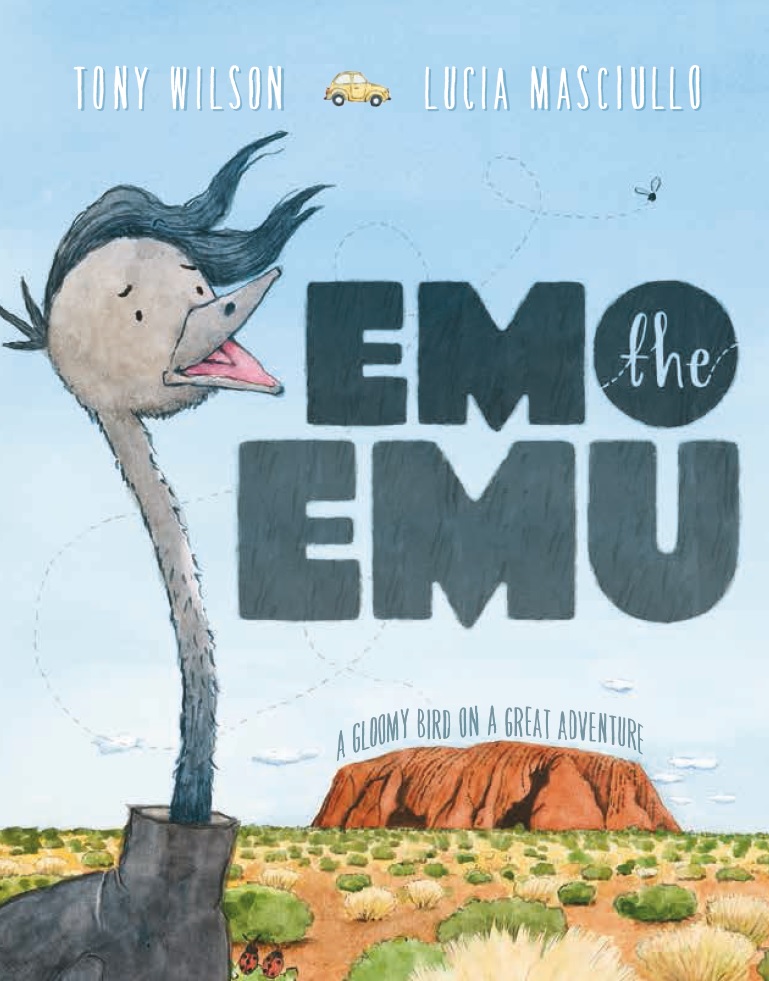
Tony Wilson's read this poem out after main at the opening night dinner. It has been cut down and edited and published as picture book by Scholastic Australia. The illustrator is Lucia Masciullo.
On the wild grassy plains west of Old Humpty Doo
Lived the moodiest, mopeyest, saddest Emu
Just why he was sad, well he didn’t quite know.
But he was, so the other birds called him, ‘Emo’.
‘I hate running fast,’ he would say to his brother
‘I hate coming last’ he would say to his mother
‘I hate living here at the top of Australia’
‘I’m Emo the Emu, the world’s biggest failure.’
Now most emus grow up to more than two metres
And most emus are not the fussiest eaters,
But Emo the Emu he slouched with a hunch
And only ate Cedar Bay Cherries for lunch.
‘I hate eating weeds,’ he would say to his father
I hate eating seeds, grasses mango and guava’
‘I hate living here at the top of Australia
I’m Emo the Emu, the world’s biggest failure. ‘
On all types of days and in all types of weathers
Emo the Emu wore dark winter feathers
He wore his crown plumage long over his eyes
And rattled off lists of new things to despise
‘I hate kangaroos,’ he would say to his teachers
‘I hate all of youse with your strange emu features
I hate the goanna, the dunnart, the snake
And what’s with koalas - the noise that they make!
‘I hate the green tree frogs, the frilly necked lizards
I hate a wild dog from its nose to its gizzards
I hate how the crocs here are all a bit snappy
I’m Emo the Emu, and I’m none too happy
On the red desert plains south of Angurugu
Emo bumped into a kangaroo who ...
was sheltering out of the heat of the day
And made the mistake of just saying ‘g’day’.
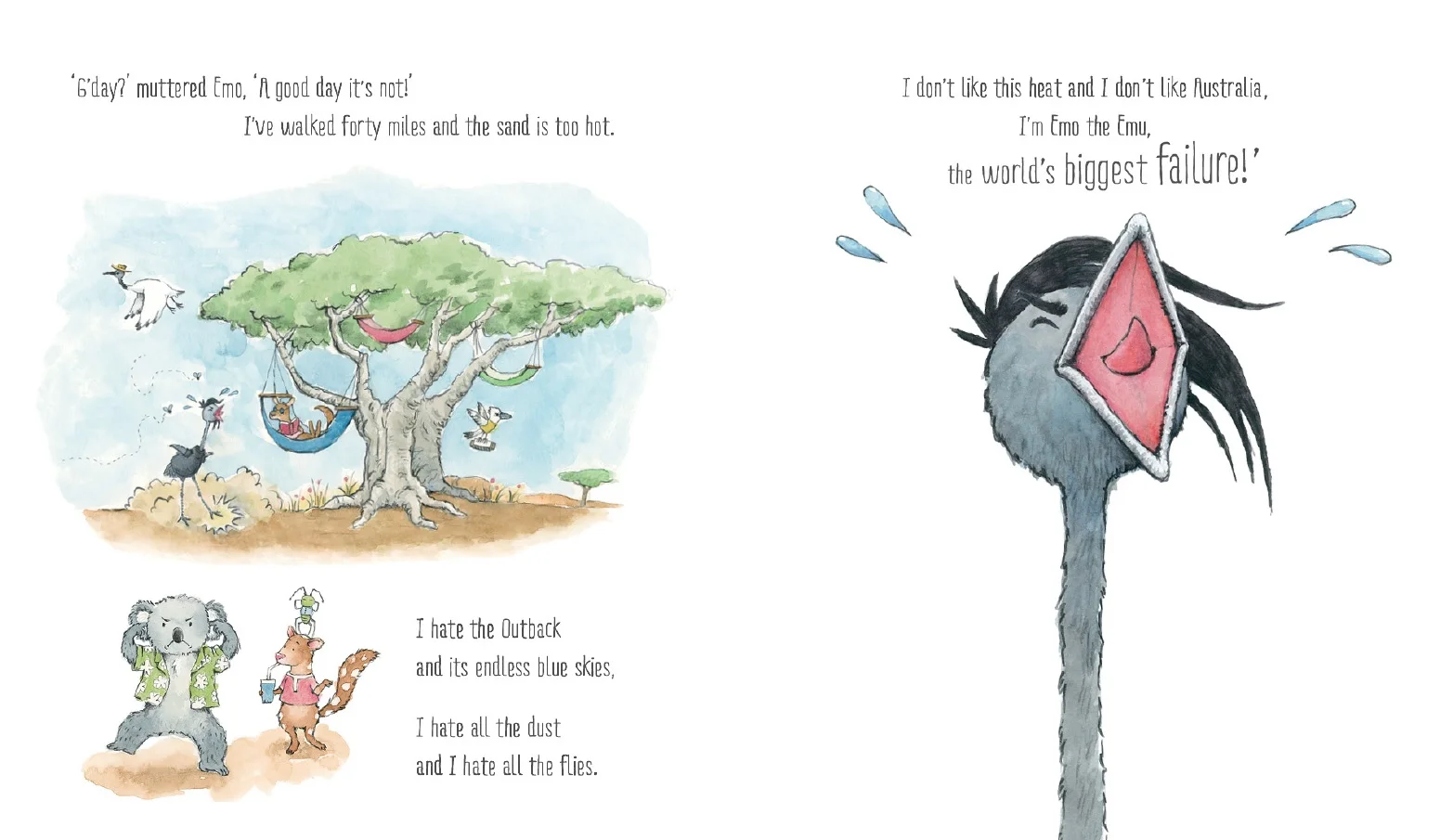
‘G’day?’ muttered Emo, ‘A good day it’s not!’
I’ve walked forty miles and the sand is too hot
I hate this warm weather,’ said Emo morosely
I should watch the evening forecast more closely
‘I hate the outback and its endless blue skies
I hate all the dust and I hate all the flies.
I don’t like this hear and I don’t like Australia
I’m Emo the Emu, the world’s biggest failure!’
illustrated Lucia Masciullo
The kangaroo snorted, ‘Hey buck up there, matey,
A pleasure to meet you, my friends call me Katie.
I doubt you’re a failure, I doubt you’re so bad
I just think that Emo the Emu is sad
I’ve noticed you use the word ‘hate’ quite a lot
Well how ‘bout we ditch it and give ‘like’ a shot?
And as for Australia, you surely can’t mean it?
You must not have travelled and properly seen it.’
Katie the Kanga, she jumped with elation
‘What’s say we travel around the whole nation!
By foot or by car or by truck or by bike
Until you admit that there’s something you like.’
Emo the Emu - he tried to say ‘no’
But Katie the Kanga convinced him to go
The first place they stopped was the rock Uluru
That grumbling bird and that red kangaroo
‘Isn’t it truly, divinely superb?’
Said Katie the Kanga to Emo the bird
Emo just shrugged and stared down at his toes
‘I guess it’s alright, yeah, it’s okay I s’pose.’
They headed off east through the rich Darling Downs
And sat on verandahs in quaint country towns
When they reached Townsville they donned swimmers masks
And swam with the coral the fish and the sharks.
‘You must surely love it, or my name’s not Kate’
Admit that the Barrier Reef is just great.’
Emo just shrugged as he picked at his nose
‘I guess it’s alright, yeah, it’s okay I s’pose.’
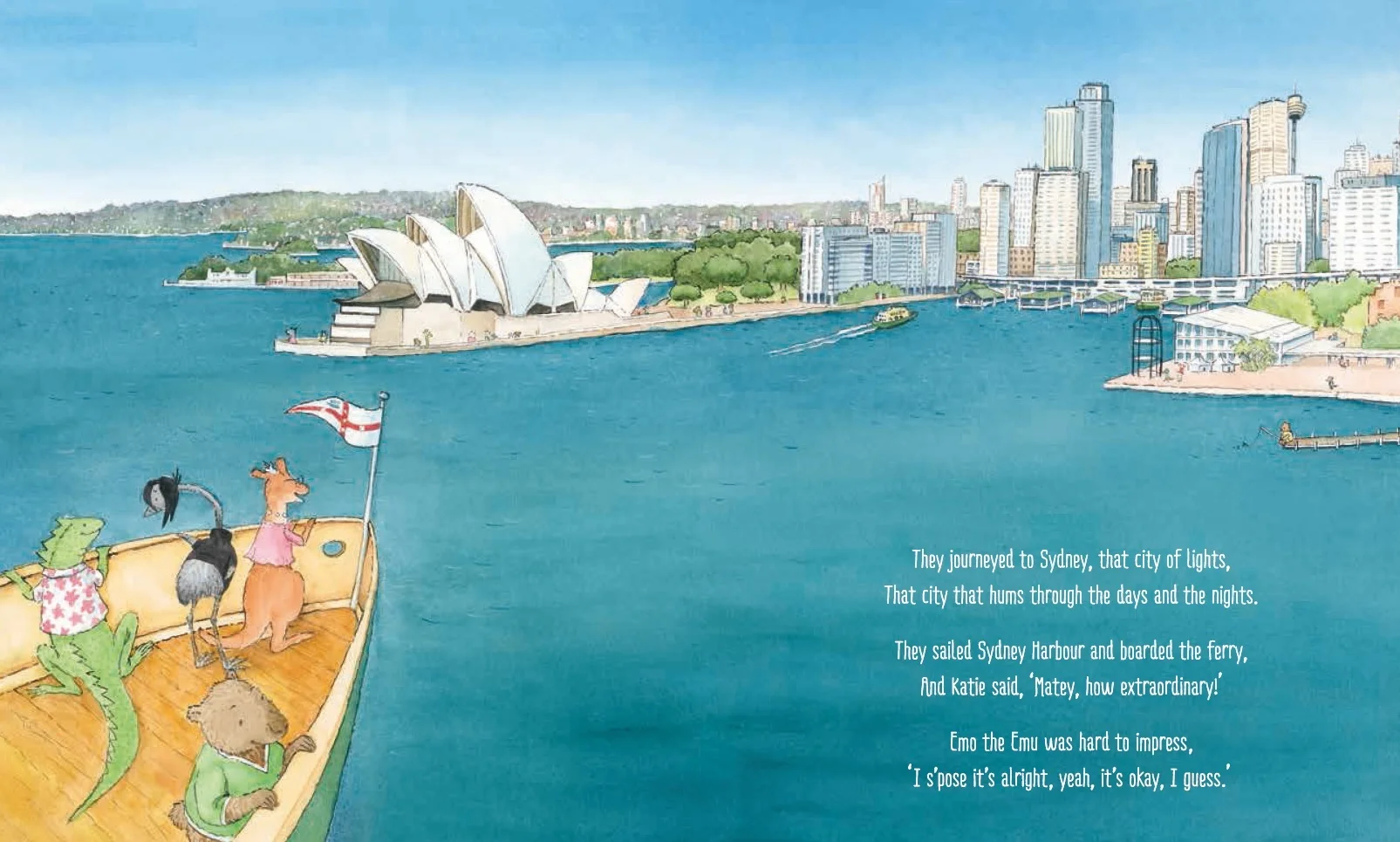
They journeyed to Sydney, that city of lights
That city that hums through the days and the nights
They sailed Sydney Harbour and boarded the ferry
And Katie said, ‘Matey how extraordinary!’
‘The beach out at Bondi, the Sails and the Bridge
Don’t you think Sydney is just ridgey didge?’
Emo the Emu was hard to impress
‘I s’pose it’s alright, yeah, it’s okay I guess.’
They trekked the high country, with brumbies and snow
Then shot down to Melbourne to take in a show
The famed Twelve Apostles,’ said Kangaroo Kate,
‘But don’t count too closely - you’ll only find eight.’
Emo the Emu looked down at his socks
‘I guess they’re alright, yeah, they’re okay for rocks.’
They paddled the river in Tassie’s South West
A wilderness up there amongst the world’s best.
From towering headlands they saw a Great White
Cruising the coast of the Great Aussie Bight
‘Look at this coastline, the view from these cliffs.
Admit that you like it, no buts and no ifs!’
Emo the Emu breathed in the salt air
‘I guess it’s all right, um, are we nearly there?’
They did the last bit in an old camper trailer
The long rugged coastline of Western Australia
From Perth and the karri trees down in the south,
To open cut mines with their open cut mouths
‘Isn’t this lovely, oh dark prince of gloom?’
The kangaroo said as they pulled up in Broome.
Emo the Emu, just furrowed his brow
‘I think that I’m ready to head for home now.’
On the wild grassy plains west of old Humpty Doo
Emo caught up with his mob of emu
Including his mother and father and brothers
And sisters and cousins and aunties and others
‘Come here!’ shouted Emo, ‘Come here and meet Katie!’
We saw the whole country, did me and my matey
‘I liked it down south and I liked it out west
Sit down and I’ll tell you the bits I liked best
I liked it up north and I liked it out east
I can’t even think of the bits I liked least’
‘He said the word “like,” whispered Emo’s stunned mother
‘He said the world ‘like’’ said the birds to each other.
He said the word ‘like’ said the Kangaroo Kate
‘He said the word ‘like’ where he once would say ‘hate’.
With stars spreading wide over Humpty Doo skies
Katie and Emo they said their goodbyes
‘I had a good trip,’ said the smiling emu
I had a good trip and I hope you did too.’
‘Kinda I guess,’ Katie joked to her friend
‘Sorta quite good, in a way, by the end.’
This poem was edited and published as a picture book. You can purchase Emo the Emu here
Lenny Henry: 'I could only have got here by standing on the shoulders of giants', MOBO Awards - 2015
4 November, 2015, MOBO Awards, First Direct Arena, Leeds, United Kingdom
Hello, whassup Leeds!
Thank you so much. Thank you MOBOs, music of black origin, an award ceremony just for black music. I feel like Ed Shearhan standing up here.
Listen, I could only have got here by standing on the shoulders of giants, and I’d like to give a shout out to some of these giants now ...
[list of names]
John Steinbeck: 'We have usurped many of the powers we once ascribed to God', Nobel prize acceptance - 1962
10 December, 1962, Stockholm, Sweden
Your majesties, your royal highnesses, ladies and gentlemen,
I thank the Swedish Academy for finding my work worthy of this highest honor.
In my heart there may be doubt that I deserve the Nobel award over other men of letters whom I hold in respect and reverence - but there is no question of my pleasure and pride in having it for myself.
It is customary for the recipient of this award to offer personal or scholarly comment on the nature and the direction of literature. At this particular time, however, I think it would be well to consider the high duties and the responsibilities of the makers of literature.
Such is the prestige of the Nobel award and of this place where I stand that I am impelled, not to squeak like a grateful and apologetic mouse, but to roar like a lion out of pride in my profession and in the great and good men who have practiced it through the ages.
Literature was not promulgated by a pale and emasculated critical priesthood singing their litanies in empty churches - nor is it a game for the cloistered elect, the tinhorn mendicants of low calorie despair.
Literature is as old as speech. It grew out of human need for it, and it has not changed except to become more needed.
The skalds, the bards, the writers are not separate and exclusive. From the beginning, their functions, their duties, their responsibilities have been decreed by our species.
Humanity has been passing through a gray and desolate time of confusion. My great predecessor, William Faulkner, speaking here, referred to it as a tragedy of universal fear so long sustained that there were no longer problems of the spirit, so that only the human heart in conflict with itself seemed worth writing about.
Faulkner, more than most men, was aware of human strength as well as of human weakness. He knew that the understanding and the resolution of fear are a large part of the writer's reason for being.
This is not new. The ancient commission of the writer has not changed. He is charged with exposing our many grievous faults and failures, with dredging up to the light our dark and dangerous dreams for the purpose of improvement.
Furthermore, the writer is delegated to declare and to celebrate man's proven capacity for greatness of heart and spirit - for gallantry in defeat - for courage, compassion and love. In the endless war against weakness and despair, these are the bright rally-flags of hope and of emulation.
I hold that a writer who does not passionately believe in the perfectibility of man, has no dedication nor any membership in literature.
The present universal fear has been the result of a forward surge in our knowledge and manipulation of certain dangerous factors in the physical world.
It is true that other phases of understanding have not yet caught up with this great step, but there is no reason to presume that they cannot or will not draw abreast. Indeed it is a part of the writer's responsibility to make sure that they do.
With humanity's long proud history of standing firm against natural enemies, sometimes in the face of almost certain defeat and extinction, we would be cowardly and stupid to leave the field on the eve of our greatest potential victory.
Understandably, I have been reading the life of Alfred Nobel - a solitary man, the books say, a thoughtful man. He perfected the release of explosive forces, capable of creative good or of destructive evil, but lacking choice, ungoverned by conscience or judgment.
Nobel saw some of the cruel and bloody misuses of his inventions. He may even have foreseen the end result of his probing - access to ultimate violence - to final destruction. Some say that he became cynical, but I do not believe this. I think he strove to invent a control, a safety valve. I think he found it finally only in the human mind and the human spirit. To me, his thinking is clearly indicated in the categories of these awards.
They are offered for increased and continuing knowledge of man and of his world - for understanding and communication, which are the functions of literature. And they are offered for demonstrations of the capacity for peace - the culmination of all the others.
Less than fifty years after his death, the door of nature was unlocked and we were offered the dreadful burden of choice.
We have usurped many of the powers we once ascribed to God.
Fearful and unprepared, we have assumed lordship over the life or death of the whole world - of all living things.
The danger and the glory and the choice rest finally in man. The test of his perfectibility is at hand.
Having taken Godlike power, we must seek in ourselves for the responsibility and the wisdom we once prayed some deity might have.
Man himself has become our greatest hazard and our only hope.
So that today, St. John the apostle may well be paraphrased: In the end is the Word, and the Word is Man - and the Word is with Men.
Spike Milligan: 'The little grovelling bastard', Briitsh Comedy Awards - 1994
I was gonna say, about bloody time. As per year, TV companies have not employed me for ten year. I will take that as a golden handshake. I’m not going to thank anybody because I did it all on my own.
Jonathan Ross: Before you go Sir. Spike, I’m sure everyone knows that you have fans from all walks of life, and of course there is one very famous, very well respected fan in particular, who wanted to be here, but couldn’t be here, but wanted to send a message.
SM: These are a series of cliches.
JR: That's my job this evening. Here you go, I have a letter to read out for you from his Royal Highness, the Prince of Wales.
SM: Do I kneel down for this?
JR: I’m in enough trouble already, I’m not going to say a word.
SM: Prince of Wales?
JR: The Prince of Wales, I’m sorry I have to do this but I know it takes a lot of the impact out of it but here we go, [Jonathan proceeds with reading out the letter] “As someone who grew up to the sounds of The Goon Show on the steam driven wireless. I must confess that I have been a life-long fan of the participants in the show, and particularly of Spike Milligan……
SM: The little grovelling bastard
With riotous applause, Jonathan tried to finish off the reading but was unable.
Norman Gunston (Garry McDonald): 'it's not just you up there on the screen, there are many other people behind the scenes that you have to carry as well', Logies - 1976
Video from 1.57
12 March 1976, Southern Cross Hotel, Melbourne, Australia
[wild applause]
All the big producers sucking up to me.
it's funny, I had a sort of inkling that this would happen ... y'knnnow, because, y'know ... the ABC sacked me and I figured 'I must be getting the Gold Logie'.
I have written a short speech on it, if you wouldn't mind listening to me for a minute, because we'll be having a comprehension test later on ...
[read] [Breaks down crying] Oh fair dinkum ... fair dinkum ... that's all I had time to write actually .... no no ... when you do do an excellent program like mine, it's not just you up there on the screen, there are many other people behind the scenes that you have to carry as well.
Um, there are so many people that I'd like to mention, but I usually forget their names, and most of them will probably sink without a trace anyway. So ... I ... I would like ... I would like to thank my mother, for not having the operation, even though dad had said that Mrs Manning had done hundreds of them, and her caravan was terribly hygienic, and also my land lady, Mrs Lewis, for not putting up my rent, even though she knew she could get thirty dollars a week from a refo family, y'know, and that was before they had on apart pension on the means test - wonderful woman. Everyone else had been real poons and wouldn't give me the seam of their cordial, yknow.
One thing, if you wouldn't mind, Bert, excuse me, Mr Newton, if you could, if you could just slip the head into the noose, [slips Logie into neck noose as visible necklace] ... this is just until I get it set into a ring ...
[cries] I'm sorry about crying like this, y'know, it's impregnated with shell tox. And it gives off fly killing vapours for the whole of the award winning year, and they're so strong, y'know [fans face] actually when I'm not wearing it I'll probably slip it around the dogs neck, y'know, and kill the fleas.
Sacha Baron Cohen: 'Kenneth, if it was not for that rancid bubble, I would not be here today', Golden Globes - 2007
January 15, 2007, Hollywood, California, USA
This movie was a life-changing experience. I saw some amazing, beautiful, invigorating parts of America, but I saw some dark parts of America, an ugly side of America, a side of America that rarely sees the light of day. I refer of course to the anus and testicles of my co-star Ken Davitian.
Ken, when I was in that scene and I stared down and saw your two wrinkled golden globes on my chin, I thought to myself, ‘I better win a bloody award for this.'
And then when my 300-pound co-star decided to sit on my face and squeeze the oxygen from my lungs, I was faced with a choice: Death or to breathe in the air that had been trapped in a small pocket between his buttocks for 30 years.
Kenneth, if it was not for that rancid bubble, I would not be here today.
Thank you to Larry Charles, thank you to Jay Roach, thank you to Isla Fisher, my fiancee. Thank you to Peter Baynham, Anthony Hines and Dan Mazer; thank you to Ari Emanuel; Matt Labov; Erran Baron Cohen, my brother who did the music; and to Jason Alper ... And thank you to every American who has not sued me so far. Thank you.

Patton Oswalt: 'This was kinda a rough year, for a lot of reasons, but I had pretty much given up doing standup', Cringe Humor Best Comedy Album - 2007
16 December 2007, Foxwoods Resort Casino, Ledyard Connecticut, USA (pre record LA)
Hi Cringe Humour. This is Patton Oswalt, and I wanted to say sorry that I couldn’t be there for the awards ceremony tonight, but I had to let you guys know , how flattering it is, truly flattering, that you chose my album, Werewolves and Lollipops, as best comedy album of the year, especially, you know you’re a New York based website, the New York comedy scene is really strong and amazing, so it’s just that much more special to me -- that you chose me, an LA based comic. It really means a lot. And it really blew me away when you guys let me know.
I don’t mind admitting to you guys that this was, this was kinda a rough year, for a lot of reasons that I won’t go into, but I had pretty much given up doing standup, for the last few months, and this award really reminded me that I think, that standup is what I should be doing, and it really gave me the confidence back.
Sp tonight you’re seeing -- just before --- I do my last ever last ever silver boy fantasy dance routine for visiting Saudi Arabian businessmen here in Los Angeles.
[off camera] Hey Flabby, start your dance now!
Right so I gotta ... um [picks up drink] You know what, I don’t need this tonight. Thanks Cringe Humour.
[Strides out]
[under breath] Alright Ahmed.
Robert Downey Jnr: 'They needed me! Avatar was going to take us to the cleaners!', Golden Globes - 2010
6 January, 2010, California, USA
No transcript available [email submissions@speakola.com]
Tina Fey: 'Only in comedy is an obedient white girl from the suburbs a diversity candidate', Kennedy Center Mark Twain Award - 2010
9 November, 2010, Kennedy Center, Washington DC, USA
Thank you very much. Thank you so much. Thank you all for dressing up. God. Listening to all of these speeches and performances for the last two hours, I cannot help but feel grateful that I put a bag of pretzels in my purse.
I want to thank everyone involved with the Kennedy Centre, or as it will soon be known, The Tea Party Bowling Ally & Rifle Range. It's gonna look good, we can get about nine lanes in here. I want to thank everyone at WETA, and PBS, not just for televising this event, but for showing The Benny Hill Show so much when I was a kid. I don't know how that qualified to be on PBS -- we may never know.
I promise to put this award in a place of honour to make sure that my daughter does not pretend that it is Barbie's older husband, who lost his body in an accident.
I never dreamed that I would receive the Mark Twain Prize for American Humour. Mostly because my style is so typically Austrian.
I never thought I would even qualify for the Mark Twain Prize for American Humour, I mean, maybe the Nathaniel Hawthorne Prize for Judgmental Nature, or the Judy Bloom Award for Awkward Puberty or the Harper Lee Prize for Small Bodies of Work. But never this. And yet, I hope that like Mark Twain, a hundred years from now, people will see my work and think, 'wow, that is actually pretty racist'.
Apparently I'm only the third woman to ever receive this award, and I'm so honoured to be numbered with Lily Tomlin and Whoopee Goldberg, but I do hope that women are achieving at a rate these days that we can stop counting what number they are at things.
Yes, I was the first female head writer at Saturday Night Live, and yes, I was only the second woman ever to be pregnant while on the show. And now tonight I am the third female recipient of this prize. I would love to be the fourth woman to do something, but I just don't see myself married to Lorne.
I'm so grateful to my friends who came here tonight to perform. Some people came all the way from Los Angeles, and I know that you are all very busy people with families and it means so much to me to know that care about show-business more than you do about them.
I want to thank Alec Baldwin for not coming tonight. I already have a reputation as a liberal elite lunatic, I don't need that guy followin' me around. Johnny-Huffington-Post. Actually I do want to thank Alec genuinely for staying in New York tonight, to continue to shoot at 30 Rock, so that I could be here, so thank you Alec, I love you.
I'm not gonna get emotional tonight, because I am a stone-cold bitch. But, I want to thank my family. They say that funny people often come from a difficult childhood, or a troubled family, so to my family, I say, 'They're giving me the Mark Twain Prize for American Humour, what did you animals do to me!' Yeah.
I know my Mother and Father are so proud of me tonight, so this is probably a good time to tell them, I'm putting you both in a home. We'll talk about it later.
I met my husband Jeff when we were both in Chicago and I had short hair with a perm on top and I would wear oversized denim shorts overalls, and that is how I know our love is real.
At some point in the future, our daughter Alice will find a DVD of this broadcast, or I don't know, download it into the sub-dermal iPhone in her eyelids, I don't know how far in the future we're talking about. But, I hope that it will make her laugh, and it will explain to her why her parents looked so tired all the time.
The one person without whom I really would not be here tonight, except of course for my Mother who is pretty sure she delivered me even though she had a lot of twilight sleep, the other one person is Lorne Michaels.
In 1997 I flew from Chicago to New York to have a job interview for a writing position at Saturday Night Live. And I was hopeful because I'd heard the show was looking to diversify, which, by the way, only in comedy, is an obedient white girl from the suburbs a diversity candidate. But, I remember, you know, I came for my job interview and the only decent clothes I had at the time, Lorne was right, was I had a pair of black pants and a sweater from Contempo Casuals. And I went to the security guard at the elevator at 30 Rockefeller Plaza, and I said 'I'm here to see Lorne Michaels' and I couldn't believe the words that were coming out of my mouth, 'I'm here to see Lorne Michaels'.
And I went up to the 17th floor and I had my meeting with Lorne, and the only thing anyone had told me about meeting with Lorne, having a job interview, they said; whatever you do, do not finish his sentences. A girl I knew in Chicago had done that and she felt like it had cost her the job, and so, whatever you do, don't finish his sentences. And I was there and really didn't want to blow it and Lorne said, 'So, you're from...', and it just was hanging there, 'So, you're from...', and I found I couldn't take anymore, and I said, 'Pennsylvania, I'm from Pennsylvania, suburb of Philadelphia', just as Lorne was finishing his thought and said, 'Chicago', and I thought, That's it. I blew it. And I don't remember anything else about the meeting, because I just kept staring at him thinking, this is the guy from the Beatles sketch! I can't believe that I'm in his office.
And you know I could never have guessed that a couple years later I would be sitting in that office until 2, 3, 4 in the morning thinking, if this meeting doesn't end I'm gonna kill this Canadian bastard.
The last time I that was in Washington was in 2004 to take this Life magazine cover photo with John McCain. And Senator McCain gave my husband and me a tour of the Senate, and we all spent a lovely, busy afternoon together. And I have it on good authority that this picture of Senator McCain and myself has been hanging in his office, by his desk since 2004. And he has been looking at it every day since 2004, getting ideas. So I guess what I'm saying is, this whole thing might be my fault.
I would be a liar and an idiot if I didn't thank Sarah Palin for helping get me here tonight, my partial resemblance and her crazy voice are the two luckiest things that ever happened to me.
Politics aside, the success of Sarah Palin and women like her is good for all women — except, of course, those who will end up paying for their own rape kit and stuff. But for everybody else, it’s a win-win. Unless you’re a gay woman who wants to marry your partner of 20 years. Whatever. But for most women, the success of conservative women is good for all of us. Unless you believe in evolution. You know — actually, I take it back. The whole thing’s a disaster.*
All kidding aside, I'm so proud to represent American humour. I'm proud to be American. I'm proud to make my home in the Not Real America. And I am most proud that even during trying times, like an orange alert, or a bad economy, or a contention election, that we as a nation retain out sense of humour. Anyway, I don't wanna go on and on, because I know we still have to talk about the other four nominees, so thank you and good night.
* it was widely reported afterwards that this paragraph was censored from the PBS broadcast.
Russell Brand: 'Best TV Performer in a non-acting role ... on Wednesdays', Broadcasting Press Guild Awards - 2007
23 March, 2007, United Kingdom
[no transcript - if you source one, email submissions@speakola.com]
Melissa McCarthy: 'Holy smokes!' Emmy awards - 2011
18 September, 2011, Nokia Theatre, LA, USA
Holy Smokes! Wow! It's my first and best pageant ever! Oh my God - there's so many pe- stop that clock! - Uh, there's so many people I want to thank. Oh my God my sweet, lovely husband Ben; I wish you were here; he's not. My lovely sister Margie is here. I'm sorry I'm a crier!
My Mom and Dad who supported me forever and shouldn't have and just said 'keep doing what you're doing.' I'm from Plainville, Illinois and I'm standing here and it's kind of amazing.
I work with the best cast and the best crew and I love them all. And Chuck Laurie fought for me. And Peter Roth you are like a handsome cheerleader in a suit. Nina Tassler, Les Moonves I'm gonna carry you both around tonight for a while.
Um, oh my God our writers - Mark Roberts - writing your beautiful little funny weird plays for us, and the cast I love you all so much. I go to work - I show up early like a dork, everyday because I kinda can't wait to see people. Vivi you can go to bed now. Georgie, I love you. And, oh God I know I'm forgetting somebody, I don't have my list. Anybody I forgot I just want to say thank you. Holy smokes!
Steve Carell: 'I didn't write anything. However, my wife did and handed me something. Um... ', Best Actor, Golden Globes - 2006
16 January, 2006, California, USA
Wow, I, uh, I really did not expect this so I didn't write anything. However, my wife did and handed me something. Um, I'd like to thank the Hollywood Foreign Press for this great honor. I would also like to thank my wife, Nancy, for her constant support and for being so beautiful tonight. That's true. Thanks also to Ricky Gervais and Steven Merchant for creating such a wonderful, ground breaking piece of television and to Greg Daniels for his talent, courage, and sheer audacity. This is good, thank you. Uh, also to my wife, for giving me two wonderful children as painful as her labor might have been. Thanks also to an excellent cast, crew, and writing staff all of whom I am indebted to. If were not for you, I would not be here right now. I don't know about that. Steve Sower, Michelle Bowen, Matt Labog, Holly Berell...Nancy, my precious wife, who put her career on hold in support of mine and who sometimes wishes that I would let her know when I am going to be home late so she can schedule her life which is no less important than mine. To my parents for not making me go to law school. And finally to the love of my life, my wife Nancy. Thank you very much. This is a very great honor.
Ernest Hemingway: 'I have spoken too long for a writer', Nobel acceptance - 1954
October 1954, Stockholm, Sweden
Having no facility for speech-making and no command of oratory nor any domination of rhetoric, I wish to thank the administrators of the generosity of Alfred Nobel for this Prize
No writer who knows the great writers who did not receive the Prize can accept it other than with humility. There is no need to list these writers. Everyone here may make his own list according to his knowledge and his conscience.
It would be impossible for me to ask the Ambassador of my country to read a speech in which a writer said all of the things which are in his heart. Things may not be immediately discernible in what a man writes, and in this sometimes he is fortunate; but eventually they are quite clear and by these and the degree of alchemy that he possesses he will endure or be forgotten.
Writing, at its best, is a lonely life. Organizations for writers palliate the writer’s loneliness but I doubt if they improve his writing. He grows in public stature as he sheds his loneliness and often his work deteriorates. For he does his work alone and if he is a good enough writer he must face eternity, or the lack of it, each day.
For a true writer each book should be a new beginning where he tries again for something that is beyond attainment. He should always try for something that has never been done or that others have tried and failed. Then sometimes, with great luck, he will succeed.
How simple the writing of literature would be if it were only necessary to write in another way what has been well written. It is because we have had such great writers in the past that a writer is driven far out past where he can go, out to where no one can help him.
I have spoken too long for a writer. A writer should write what he has to say and not speak it. Again I thank you.
Gabriel García Márquez: 'A New and Sweeping Utopia of Life', Nobel Prize acceptance - 1982
8 December, 1982, Stockholm, Sweden
Antonio Pigafetta, a Florentine navigator who went with Magellan on the first voyage around the world, wrote, upon his passage through our southern lands of America, a strictly accurate account that nonetheless resembles a venture into fantasy. In it he recorded that he had seen hogs with navels on their haunches, clawless birds whose hens laid eggs on the backs of their mates, and others still, resembling tongueless pelicans, with beaks like spoons. He wrote of having seen a misbegotten creature with the head and ears of a mule, a camel’s body, the legs of a deer and the whinny of a horse. He described how the first native encountered in Patagonia was confronted with a mirror, whereupon that impassioned giant lost his senses to the terror of his own image.
This short and fascinating book, which even then contained the seeds of our present-day novels, is by no means the most staggering account of our reality in that age. The Chronicles of the Indies left us countless others. Eldorado, our so avidly sought and illusory land, appeared on numerous maps for many a long year, shifting its place and form to suit the fantasy of cartographers. In his search for the fountain of eternal youth, the mythical Alvar Núñez Cabeza de Vaca explored the north of Mexico for eight years, in a deluded expedition whose members devoured each other and only five of whom returned, of the six hundred who had undertaken it. One of the many unfathomed mysteries of that age is that of the eleven thousand mules, each loaded with one hundred pounds of gold, that left Cuzco one day to pay the ransom of Atahualpa and never reached their destination. Subsequently, in colonial times, hens were sold in Cartagena de Indias, that had been raised on alluvial land and whose gizzards contained tiny lumps of gold. One founder’s lust for gold beset us until recently. As late as the last century, a German mission appointed to study the construction of an interoceanic railroad across the Isthmus of Panama concluded that the project was feasible on one condition: that the rails not be made of iron, which was scarce in the region, but of gold.
Our independence from Spanish domination did not put us beyond the reach of madness. General Antonio López de Santa Anna, three times dictator of Mexico, held a magnificent funeral for the right leg he had lost in the so-called Pastry War. General Gabriel García Moreno ruled Ecuador for sixteen years as an absolute monarch; at his wake, the corpse was seated on the presidential chair, decked out in full-dress uniform and a protective layer of medals. General Maximiliano Hernández Martínez, the theosophical despot of El Salvador who had thirty thousand peasants slaughtered in a savage massacre, invented a pendulum to detect poison in his food, and had streetlamps draped in red paper to defeat an epidemic of scarlet fever. The statue to General Francisco Moraz´n erected in the main square of Tegucigalpa is actually one of Marshal Ney, purchased at a Paris warehouse of second-hand sculptures.
Eleven years ago, the Chilean Pablo Neruda, one of the outstanding poets of our time, enlightened this audience with his word. Since then, the Europeans of good will — and sometimes those of bad, as well — have been struck, with ever greater force, by the unearthly tidings of Latin America, that boundless realm of haunted men and historic women, whose unending obstinacy blurs into legend. We have not had a moment’s rest. A promethean president, entrenched in his burning palace, died fighting an entire army, alone; and two suspicious airplane accidents, yet to be explained, cut short the life of another great-hearted president and that of a democratic soldier who had revived the dignity of his people. There have been five wars and seventeen military coups; there emerged a diabolic dictator who is carrying out, in God’s name, the first Latin American ethnocide of our time. In the meantime, twenty million Latin American children died before the age of one — more than have been born in Europe since 1970. Those missing because of repression number nearly one hundred and twenty thousand, which is as if no one could account for all the inhabitants of Uppsala. Numerous women arrested while pregnant have given birth in Argentine prisons, yet nobody knows the whereabouts and identity of their children who were furtively adopted or sent to an orphanage by order of the military authorities. Because they tried to change this state of things, nearly two hundred thousand men and women have died throughout the continent, and over one hundred thousand have lost their lives in three small and ill-fated countries of Central America: Nicaragua, El Salvador and Guatemala. If this had happened in the United States, the corresponding figure would be that of one million six hundred thousand violent deaths in four years.
One million people have fled Chile, a country with a tradition of hospitality — that is, ten per cent of its population. Uruguay, a tiny nation of two and a half million inhabitants which considered itself the continent’s most civilized country, has lost to exile one out of every five citizens. Since 1979, the civil war in El Salvador has produced almost one refugee every twenty minutes. The country that could be formed of all the exiles and forced emigrants of Latin America would have a population larger than that of Norway.
I dare to think that it is this outsized reality, and not just its literary expression, that has deserved the attention of the Swedish Academy of Letters. A reality not of paper, but one that lives within us and determines each instant of our countless daily deaths, and that nourishes a source of insatiable creativity, full of sorrow and beauty, of which this roving and nostalgic Colombian is but one cipher more, singled out by fortune. Poets and beggars, musicians and prophets, warriors and scoundrels, all creatures of that unbridled reality, we have had to ask but little of imagination, for our crucial problem has been a lack of conventional means to render our lives believable. This, my friends, is the crux of our solitude.
And if these difficulties, whose essence we share, hinder us, it is understandable that the rational talents on this side of the world, exalted in the contemplation of their own cultures, should have found themselves without valid means to interpret us. It is only natural that they insist on measuring us with the yardstick that they use for themselves, forgetting that the ravages of life are not the same for all, and that the quest of our own identity is just as arduous and bloody for us as it was for them. The interpretation of our reality through patterns not our own, serves only to make us ever more unknown, ever less free, ever more solitary. Venerable Europe would perhaps be more perceptive if it tried to see us in its own past. If only it recalled that London took three hundred years to build its first city wall, and three hundred years more to acquire a bishop; that Rome labored in a gloom of uncertainty for twenty centuries, until an Etruscan King anchored it in history; and that the peaceful Swiss of today, who feast us with their mild cheeses and apathetic watches, bloodied Europe as soldiers of fortune, as late as the Sixteenth Century. Even at the height of the Renaissance, twelve thousand lansquenets in the pay of the imperial armies sacked and devastated Rome and put eight thousand of its inhabitants to the sword.
I do not mean to embody the illusions of Tonio Kröger, whose dreams of uniting a chaste north to a passionate south were exalted here, fifty-three years ago, by Thomas Mann. But I do believe that those clear-sighted Europeans who struggle, here as well, for a more just and humane homeland, could help us far better if they reconsidered their way of seeing us. Solidarity with our dreams will not make us feel less alone, as long as it is not translated into concrete acts of legitimate support for all the peoples that assume the illusion of having a life of their own in the distribution of the world.
Latin America neither wants, nor has any reason, to be a pawn without a will of its own; nor is it merely wishful thinking that its quest for independence and originality should become a Western aspiration. However, the navigational advances that have narrowed such distances between our Americas and Europe seem, conversely, to have accentuated our cultural remoteness. Why is the originality so readily granted us in literature so mistrustfully denied us in our difficult attempts at social change? Why think that the social justice sought by progressive Europeans for their own countries cannot also be a goal for Latin America, with different methods for dissimilar conditions? No: the immeasurable violence and pain of our history are the result of age-old inequities and untold bitterness, and not a conspiracy plotted three thousand leagues from our home. But many European leaders and thinkers have thought so, with the childishness of old-timers who have forgotten the fruitful excess of their youth as if it were impossible to find another destiny than to live at the mercy of the two great masters of the world. This, my friends, is the very scale of our solitude.
In spite of this, to oppression, plundering and abandonment, we respond with life. Neither floods nor plagues, famines nor cataclysms, nor even the eternal wars of century upon century, have been able to subdue the persistent advantage of life over death. An advantage that grows and quickens: every year, there are seventy-four million more births than deaths, a sufficient number of new lives to multiply, each year, the population of New York sevenfold. Most of these births occur in the countries of least resources — including, of course, those of Latin America. Conversely, the most prosperous countries have succeeded in accumulating powers of destruction such as to annihilate, a hundred times over, not only all the human beings that have existed to this day, but also the totality of all living beings that have ever drawn breath on this planet of misfortune.
On a day like today, my master William Faulkner said, “I decline to accept the end of man”. I would fall unworthy of standing in this place that was his, if I were not fully aware that the colossal tragedy he refused to recognize thirty-two years ago is now, for the first time since the beginning of humanity, nothing more than a simple scientific possibility. Faced with this awesome reality that must have seemed a mere utopia through all of human time, we, the inventors of tales, who will believe anything, feel entitled to believe that it is not yet too late to engage in the creation of the opposite utopia. A new and sweeping utopia of life, where no one will be able to decide for others how they die, where love will prove true and happiness be possible, and where the races condemned to one hundred years of solitude will have, at last and forever, a second opportunity on earth.
Elvis Presley: 'These Men With Broken Hearts' - 1970
August 1970, Las Vegas
Elivs began a song with part of the Hank Williams song, 'These Men With Broken Hearts'
You've never stood in another man's shoes
Or saw things through his eyes
Or stood and watched with helpless hands
While the heart inside you dies.
So help your brother along the way
No matter where he starts.
For the same God that made you,
Made him too,
these men with broken hearts.
Tony Wilson: 'Each Peach Pear Figs', Ode to CBCA shortlist - 2015
21 August, 2015, Melbourne Town Hall, Melbourne, Australia
What a day we have in store. Across the country we have nervous short-listees, hovered over the CBCA website, pressing refresh over and over with terrified hope. There are some in that category here at the Melbourne Town Hall, eyes glazed over, willing me to get on with it so that this wash of words may end, and their fates may be determined.
Well I’ve got good news and bad news. The good news is that this wash of words will eventually end. The bad news is that in order to set the mood for all of us who aren’t on the short list, I’ve got a little CBCA awards inspired picture book manuscript I want to trial. They are plenty of publishers in the room, and I’m sure once they get an earful of this, it’s going to be mega four figure advances and whispered promises of up to 3.5% royalties! Bring on the underbidding war folks.
The title of this work is ‘Each Peach Pear Figs’ - and if I’m honest, it does have a progenitor somewhere out there in the children’s book world.
Each Peach Pear Figs
I spy Karen Briggs
Karen Briggs left and right
I spy Scary Night
Scary Night, Stephen King
Judith Rossell, Withering
By the sea, lovely Stella
I spy Trace Balla
Trace Balla’s Rivertime
I spy an easy rhyme
Easy rhyme coming atcha
I spy Robin Cowcher
Robin Cowcher, so awesome
Snip Green’s Douglas Mawson
Ambelin
Kwaymullina
Girl that’s lost
Have you seen her?
This rhyme gets longer
I spy Christine Bongers
Christine Bongers in the hood
I spy Freya Blackwood
Freya Blackwood who can best her?
I spy A Lester
Noni heading for the beach
Longer now than Each, Peach
Bruce Whatley, Jackie French
Meetzenthen, he’s a mensch
Stone Lion, Margaret Wild
Loved by every child
Bill Condon, Simple Things
He also often wins
Snail and Turtle Still Friends
Stephen Michael King again
Tony Wilson and his Cow
Self promoting, out now
Aaron Blabey’s Pug is Piggy
I spy brave Figgy.
Brave Figgy in the world
I spy Cinammin Girl
Winners will give thanks
Will it be Tristian Bancks?
Two Wolves out hunting
They spy baby bunting
Baby bunting torn apart
Each, Peach, rated R
Bleak boy in the rain
Libby Gleeson’s name again!
Books on war - not so cheery
One by Michael Camilleri
Older readers, teenage cares
I spy two Claires
Two Claires, both respected
I spy The Protected
Other Claire, and her Nona
Both deserve sticker honour
Can The Minnow win the day?
Hashtag Love - OzYA
Jesse get the eff to sleep
I spy the ... Green Sheep
Green Sheep by the door
Here since 2004
Who was huge even then?
I spy Robert Ingpen
Robert Ingpen, Enid Blyton
Enid Blyton rhymes with Crichton
Crichton Medal, illustration
Draw the face that stops the nation
Children’s books, special day
C-B-C-A
Each peach, pear, plum
Good luck, everyone.
Tracy Morgan: 'Only recently have I started to feel like myself again, which means a whole lot of y’all women gonna get pregnant at the after-party' - Emmys 2015
20 September, 2015, LA, USA
Thank you so much. I miss you guys so much. Last year Jimmy Kimmel stood on this stage and said, "We will see you back here next year, Tracy Morgan.” Well, Jimmy, thanks to my amazing doctors, and the support of my family, and my beautiful new wife, I’m here, standing on my own two feet. And god bless all of you for your love, your prayers, your positive thoughts for the past 16 months. Thank you. I’m honored to be at the Emmys. I always have been honored to be here. It’s been a long road back. I suffered a traumatic brain injury that put me in a coma for eight days. When I finally regained consciousness I was just ecstatic to learn I wasn’t the one who messed up. Only recently I’ve started to feel like myself again, which means a whole lotta women gonna get pregnant at the after party. It’s going down. So on that note, the nominees for best drama are...
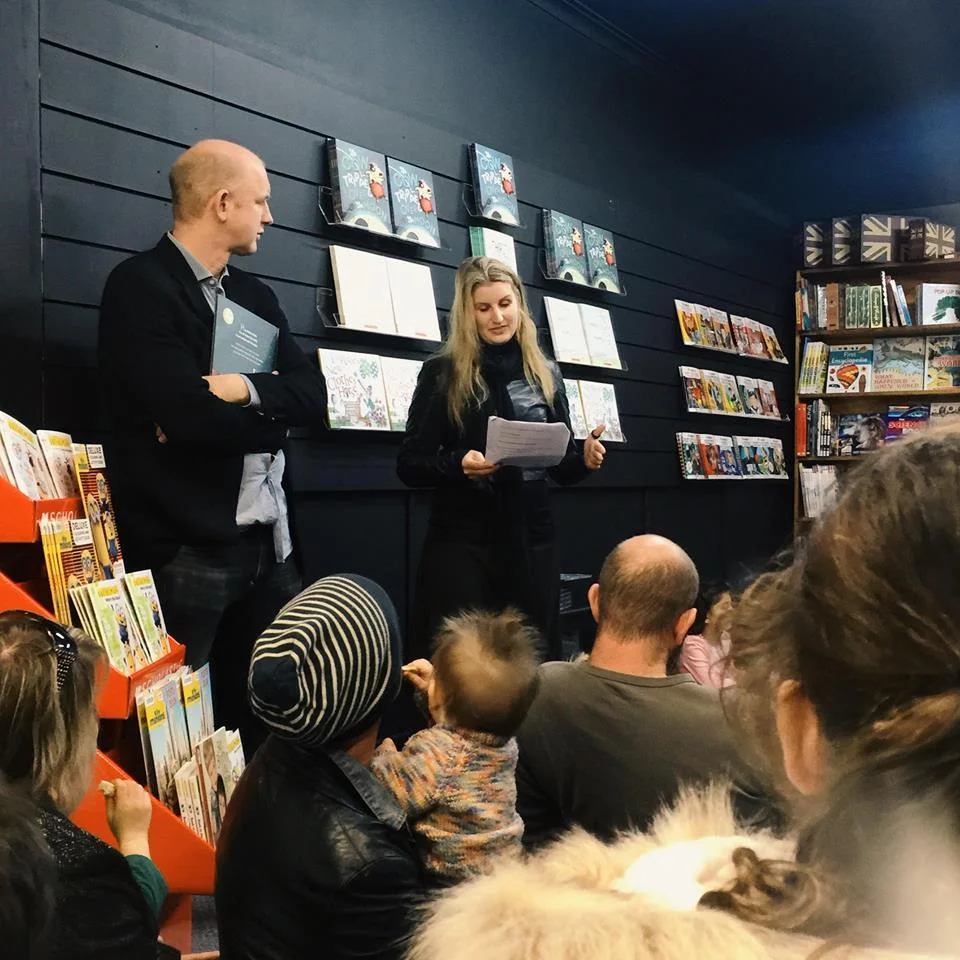
Kim Kane: Launch of 'The Cow Tripped Over the Moon' by Tony Wilson, ill Laura Wood - 2015
7 June, 2015, The Little Bookroom, North Carlton, Melbourne, Australia
Good afternoon!
Hey Diddle Diddle is 250 years old. It’s actually its anniversary this year. The rhyme was first published in Mother Goose in 1765 (although there are possibly earlier references to it).
A quick wiki search discloses that there are many theories including that it:
– describes the flight from Egypt;
– depicts the relationship between Elizabeth lady Katherine Grey and the earls of Hertford and Leicester; and
– deals with anti-clerical feelings over injunctions by Catholic priests for harder work.
Does that make any sense? What do you think kids?
[Answer] No!
Well that is perfect because most scholars think the verse is probably just nonsense – just plain silly fun.
So Tony has taken this fabulous nonsensical rhyme with its cat, a fiddle, a cow, a moon, a dog, and a saucy dish and a spoon and made it very much his own and I am here today to launch it.
Kids, stay with me because I have a few words to say which may be a little bit boring or possibly A LOT boring but I think it’s important to say them if we are to take picture books as seriously as they ought to be taken, for there is a tremendous amount of craft behind a successful picture book and this is indeed a successful book.
Picture books are an artful form. They are often done, but rarely done well. They rely on so many factors.
The language needs to be rich.
Unlike early readers, picture books give authors the opportunity to exercise their vocabularies – we writers get greater editorial freedom. This book is fun and it is funny in much the same way as Dahl’s Revolting Rhymes is funny, but like Dahl in his more reflective writing, it is also lyrical. Tony takes us back to the ‘scene of the rhyme’ and tells us that ‘the grass smelled like morning’ (isn’t that evocative?!). Because Tony is amusing, people forget the ‘great lug’ can also be poetic. It is this poeticism that makes Tony such a terrific writer.
If it’s a rhyme, the rhyme can’t be superfluous and it needs to well…rhyme!
This does. The meter is as consistent and the rhyme as effortless as that of Julia Donaldson. The rhyme is clever but it never makes the reader feel Tony is indulging an adult audience or including random facts just to incorporate two rhyming words.
The story must be well-paced
I love the way Tony has included 8 attempts at the moon jump – the double page silent-spread builds tension before the final crescendo as the cow tries for that last jump. Tony uses his rhyme to masterfully control the tempo of the story – indeed the reader slows and takes a big breath with the cow just before final takeoff.
Picture books need a perfect and satisfying end.
In this regard, picture books are much like short films and like short films, a number are let down by their endings. Tony is an elegant plotter and structurally this book is 32-page perfection. The return to the riddle at the conclusion delivers a punch-line that fully satiates the reader.
The illustrations have to be appropriate – they have to suit the tone of the story.
What a wonderful job Laura Wood has done here – her funny comic drawings are expressive and fun and she works tremendously hard with a very limited palette. Look at the gorgeous end papers – fields. But not only fields, fields by night. The other thing I love about Laura’s illustration is that they have their own narrative, supplementing the main story. Tony doesn’t tell us why the dish runs off with the spoon – it is perhaps another tale, but we certainly get hints of a blossoming relationship from Laura’s drawings.
Finally, I think picture books need to leave us with something.
By this I don’t mean bludgeon us with a lesson – I hate didactic books – but there does need to be something – no matter how tiny, that children can take from it. There is so much of my friend Tony in this book. I mean the man has taken a nursery rhyme and literally turned it into an Olympic sport. There is the Tony who never gives up. The Tony with unbridled grit who tried and tried to play league football. There is the Tony who for all his athleticism can also be a bit unco – a man who may indeed have tripped over his size 13 feet right up and over the moon. It is at its core, motivational fiction for children – the spoon hummed a tune, He called ‘Cow CAN Jump Moon’. This is a writer who went along to all his articled clerk interviews channeling Maria from the Sound of Music, literally singing:
I have confidence in confidence alone
Besides which you see I have confidence in me!
It is a tale of friendship written by someone who values his friends and knows how critical group support is — to play on a footy team, to study for a Con & Admin exam or to hack a photocopier to pieces with 20 of his fellow articled clerks. But finally, this is a story written by a father who looks at his gorgeous and gutsy son Jack who has to try so much harder to do things we all take utterly for granted. Like my friend Tony, this book is funny, but perhaps more importantly, it also has heart.
I was reading about a font that has been invented by a graphic designer with dyslexia. A font tweaked ever so slightly – with letters thickened in places so that it is easier for many people with learning disabilities to actually read. Such a simple idea but an idea that resonated because sometimes it is when we take something that is right in front of our nose and re-work it in a clever and different way, that the results can be most inspired. Like taking a riddle we all know as well as Vegemite on toast and completely re-imagining it.
It took the cow in Tony’s story 8 attempts to get over the moon. It is serendipitous that this is Tony’s 8th picture book. And like the cow, I’m quite convinced that it will be on Tony’s 8th attempt that he will reach dazzling heights. May it launch into at least 8 jurisdictions with the gusto of the cow on that final double spread, and we can all watch on as contentedly as the little dog Rover.
I am going to finish with my sons because they are among the intended target demographic for today.
‘This is a great book,’ I said this morning.
‘No, Mummy it’s not just a great book, it’s a very very funny book.’
In our household, there is no greater compliment.
‘Cow Tripped Over the Moon.’ I proclaim you duly launched. Reach for the Moon!
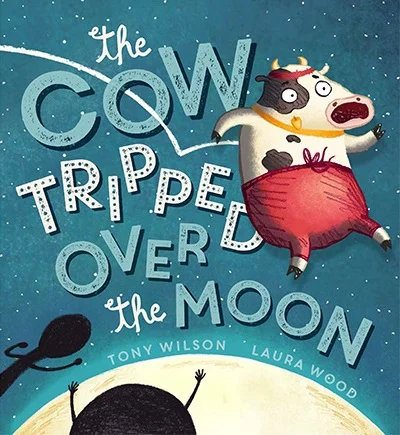
To purchase, click on cover