• Genre
  • About
  • Submissions
  • Donate
  • Search
Menu

Speakola

All Speeches Great and Small
  • Genre
  • About
  • Submissions
  • Donate
  • Search

Eulogies

Some of the most moving and brilliant speeches ever made occur at funerals. Please upload the eulogy for your loved one using the form below.

for Michael Gordon: 'Decency coursed through his veins', by Fergus Hunter & Simon Balderstone - 2018

July 20, 2021

16 February 2015, MCG, Melbourne, Australia 

Fergus Hunter is the son of Simon Balderstone, a lifelong friend of Michael Gordon's, who also spoke beautifully at the memorial. (see below)

Most of the people gathered in this room today are probably here, ultimately, because of words. Powerful words and beautiful words and words of consequence – this was the life’s work of Michael Gordon, the man we loved and admired.

And it’s words that have really vexed me leading up to this because I’m not sure I can muster them to do justice to Micky. Funnily enough, I felt a similar unworthiness when sending him pars for the stories we worked on together over the last few years – stories and years that I treasure.

It was my great luck to have Micky around my entire life. He was like a brother to my father for over 40 years and, as a result, like family to me. He was a constant.

The last time I was in this room was three years ago for Harry’s service. Now Scotty – as is his right – has snatched one of my references and themes here. But I would add that Micky on that day also spoke of Harry’s humility and his ability to mix in any company as well as what Scotty quoted.

That same day, Les Carlyon said this about Harry. He said he could scold in print without being mean, he said his was always a human voice.

And the reason I quote that, again, is the obvious one: they’re describing Micky as well.

He was born from decency, he married it, he surrounded himself with it, he passed it on. Decency coursed through his veins. It twinkled in his eyes and radiated from his easy smile. It imbued every word that came out of his mouth or that he bashed out on a keyboard with those index fingers. When he gave you a famous Gordon hug, decency enveloped you.

That trait – and many others – guided him as a journalist and as a person, two identities that were pretty well intertwined.

A special achievement of his was to spend two decades examining Australia’s two darkest and most challenging issues and still emerge with the respect and admiration of a broad spectrum of people. Debates around Indigenous affairs and refugees are highly emotive and deeply complex, they make people very uncomfortable. But at the end of it all, Micky earned tributes from people like Tony Abbott right through to detainees on Manus Island.

You only achieve that by being as intensely respectful and likeable and reasonable and fair, as decent, as undeniable as Michael Gordon.

That weight also meant a lot of his stories on these things got a run or a better run because it was him writing them. He single handedly elevated important issues. That’s how he used his power. That’s what we’ve lost.

Micky was a lot of things to me. He was boisterous yum cha on grand final weekend, he was the papers spread out over the dining table, he was live music in St Kilda, he was bizarre IT issues in the office (I was only occasionally frustrated by that). He was Melbourne, he was The Age, he was football.

While he was like a second father or uncle for much of my life, I got to have him as a professional mentor and counsellor these last four years, a role I know he played for so many people. There was special poetry for me to get those bylines with him because my dad got those byline with him decades ago (not to age you, dad).

There was a column Micky wrote in 2016 that he was obviously very pleased with – he had that chuffed, humble, satisfied feeling about a column. It seems like he may have mentioned it to a few people. It was on the first anniversary of Malcolm Turnbull’s prime ministership and the main point of pride was that he had snuck in a couple of Neil Young references. You have probably picked up the Neil Young theme in the speeches.

“It’s better to burn out than to fade away,” he quoted.

The Saturday before last, Micky’s body – inexplicably, shockingly, unfairly – decided to burn out. This special man, this giant, didn’t fade away at all. Of course he didn’t. He inspired, scrutinised, and loved right to the end.


Simon Balderstone:

I think I made a strategic error, speaking after Paul (Kelly) singing, especially that song. But seriously, it’s great to follow my troubadour hero, as it completes a Keating – Mabo – Yothu Yindi – Paul Kelly - Mickey – Indigenous circle for me.

There are a thousand stories, a thousand memories, a thousand adjectives to put forward about Mickey, but I just want to in a few minutes provide a bit of a sketch pad, a bit of a framework and outline for you all to colour in, in your own ways.

It was obvious, right from the start, when I first met Mickey when he was the junior at the Industrial Relations round, at Trades Hall, and I had just started at the Age - 1977 – that he was going to be a top journo…and a great friend. I was drawn to that amiable, natural charm…the charm he showed towards everyone – no matter what their station. 

All the qualities he had, built on one another over the decades.

He was always, to so so many, a great role model, a great mentor, adviser, helper, friend…as an example, the parliamentary press gallery is pretty often dog eat dog, but Mickey got on with everyone.

He was chirpy but not cocky.

He was a worker bee, but definitely never a drone!

He was, as we’ve heard, seriously competitive, but not aggressive about it - well, occasionally in Sun vs Age footy matches! Also during runs around the lake, …he’d insist on doing interval work, and constantly broke the group ban on surging.

He was a sentimentalist, with traditions and routines - exercise routines; Grand Final weekends; cloud swallow dumplings; special lunches - carrying on Harry traditions – incl. the Harry lunch….we talked only two weeks ago about how we’d missed last year’s GF weekend but there was no way any of us were going to miss this year’s;  well before that, music weekends in Sydney , with the Cyril B Bunter band and a fledgling group called the Oils ….and special holidays, like Christmas or New Year at Currumbin; Bells Easter weekends – all we consumed were fish and chips and beers; and the weeks at Byron, or Noosa …

…. but as well as being a sentimentalist and loyal, …. he was also, always, open-minded, fresh-minded, for trying something new … (including being a pioneer when it came to surfing journalism, whether it be through Backdoor, or his column) ….

That applied to his music too – he had traditions, favourites…such as Neil Young of course, and The Beach Boys, esp. Brian Wilson, but was always on the lookout for new stuff too, to embrace. -  and he could spot talent too…. Way before she was famous, he spotted Tracy Chapman, singing in a bar in New York, and likewise, in the 80’s, with Paul Kelly, as Jim mentioned. He rang me from New York to tell me about this singer/songwriter, and how he’d just had a kick of footy with him in Central Park!

Micky was gentle and calm but also busy, even frenetic, (especially during what I called his “Club Mickey” days and routines, with activities, routines.…all day, somewhere, an activity to fit in, join in or do….…

He was never a showman - Mickey never made himself the yarn… Yet, as Paul Keating said…not a voyeur, but a participant in the best possible way… that phrase about of yours Paul, I know resonated deeply with Mickey….

He was worldly and wise -  but sometimes so sweetly naïve in his calmness:

When he was in Port Moresby for the South Pacific Forum in 2015, down a very dark road, one night…he and some colleagues were trapped by a RASCALS roadblock, made of 44-gallon drums …blocked in, with the driver desperately going this way and that to try to escape, the RASCALS closed in…Mickey wrote an “armed mob running towards us, pelting us with rocks” …wielding guns, knives. What Mickey didn’t write was that he said: “I’ll get out and calm them down”! –  there was a cacophony of “No way!” - No way Micky:  not everyone is always going to fall for that natural charm – The car blew a tyre, had its mirrors blown away, was damaged by missiles and clubs. But they eventually escaped, when a kind local moved some drums at a dark dead-end, and were protected again later by a copper with an M16 in his boot.

--

Micky got so many good stories, did so many great interviews, by being so decent and trustworthy…gentle, considered, he came away with much more information than some foot-in-the-door, badgering, Spanish-inquisition type journo…

…and also because of his trustworthiness - he never revealed a confidentiality, and “off-the-record” was “off-the-record” …one former polly said to me last week that Mickey never did the wrong thing, never went for target journalism, and always kept his sources secret (which made me realise that the polly must have been one!)

And even when he was naughty he was endearing…after very late nights at the non-members bar at Parliament House, Mickey thought the best way to avoid cops was to drive home to our house in Barrallier Street really slowly, creeping along the side of the road, even half off it…accordingly, the nature strips had to watch out, as did the shrubbery on them - and there was hell to pay on rubbish bin nights!

And Mickey has been so kind to me recently, when I’ve been a bit crook…. that lawn at Berrima which Ferg wrote about so well…the lawn Mickey mowed for us a couple of weeks ago…not sure whether to just let it grow now as a hay paddock, or mow it every second day to keep it Mickey perfect….

To Robyn, Scotty, Sarah, Sally, Johnny…all the family…you’re a remarkable family, full of kind, sweet, strong souls – and we’re there for you.

I’m trying to, as Mickey would say, “feel good, feel strong”.

Love you, Kid!
Enjoyed this speech? Speakola is a labour of love and I’d be very grateful if you would share, tweet or like it. Thank you.

Facebook Twitter Facebook
In PUBLIC FIGURE C Tags FERGUS HUNTER, MICHAEL GORDON, THE AGE, COLLEAGUE, MENTOR, FRIEND, FAMILY FRIEND, TRANSCRIPT
Comment

For Ron Wootton: 'For me, as the lights in the auditorium fade and the overture starts, he will be there in the wings', by Ian Mason

December 10, 2019

A tribute presented at St Mark’s Church, on behalf of Camberwell Grammar School:

In the early 1960s, when the Camberwell Grammar School Council decided to engage the services of an efficiency expert, a Time and Motion guru, to determine whether full use was being made of the school day, they made one fundamental mistake: they organised it so that Ron Wootton was one of the first to be interviewed.

At this stage of the year, it was not unusual for Ron to be painting the play set at midnight or even later, having already taught a full class-room programme during the day, and then taken a 1st XV111 football practice after school. Having spent some time with Ron, our visiting expert came to the conclusion that schools were different. He was right, of course, and the thing that makes them different is people like Ron Wootton. For him, a seventy- or eighty-hour school week was not unusual; as he put it, it was part of the job; it was what one did, if one taught at a private school.

At this stage the School was growing and, for many of those new to the school, myself included, it was Ron’s tireless contribution to the all-round life of the school that was to have such a profound influence.

Ron joined the staff at CGS in 1957, as an art teacher, having already had some contact with the School through Harrie Rice, whom he had helped the previous year with sets for that year’s play, in those days a very humble affair, performed in a green Nissen hut, that doubled as an Assembly Hall. In many ways, the whole school at that time was a very humble affair: its numbers, though improving, were still low, and its sporting teams often suffered humiliating defeats at the hands of their opponents. The Headmaster, the Rev Tom Timpson, asked Ron to take on the role of Sportsmaster, a position he was to fill with distinction for 34 years, during which he coached almost every major sport.

He took the 1st XV111 for over twenty years, and, although he never achieved his dream of beating Assumption, he earned the respect of opponents like Brother Domnus and Ray Carroll, as an astute coach, who could extract the best from his players.  

While he was a dedicated Australian Rules player and supporter, he also saw the need to broaden opportunities for boys to participate in team sports and was a prime mover in the introduction of soccer to the AGS. For a number of years, he coached the 1st Soccer X1, and the perpetual trophy for the inter-school six-a-side soccer competition is fittingly named after its inaugurator.

He took the school swimming team, for many years without the luxury of a venue at school, training wherever he could find an empty pool. On one memorable occasion, he strode into the Richmond Pool during Caulfield Grammar’s House Sports. Competitors, staff, parents and pool attendants were stunned, when he walked in, stopped the programme, commandeered a lane, and trialled a new boy who had arrived at CGS that morning. The Combined Sports were only a day away. It was 1961, the boy made the team, and CGS won the title by one point.

He revolutionised the School’s approach to Athletics. Realising one coach could not look after the whole team, he allocated the staff to individual events. If you pleaded ignorance of the particular field, Ron gave you a book on the subject, and arranged expert coaching from his extraordinarily wide circle of friends. It was part of Ron’s whimiscal nature and eye for the absurd, that saw him place a diminutive John Hantken in charge of the discus, and then organise as his assistant, a vast Argentinian discus thrower, who had carried her nation’s flag at the 1956 Olympics. There was no way you could turn him down; his energy and enthusiasm were infectious.

He introduced a great variety of new sports to the school, and saw them become part of the AGS sports programme. Water Polo became popular within the school, and, although it must have seemed a far cry from his days as coach of Australia’s Olympic team, he used his profound knowledge of the game to establish Camberwell Grammar as one of the top Water Polo schools in the State.

He was a great believer in the value of camps and trips in the education process. He was the first to take a Senior School camp at Bambara, and many of you here today will remember boats on the Hawkesbury, the Murray, the Gippsland Lakes; Art camps at Somers; overseas trips to Europe and Asia. As OC of the School Cadet Unit, he dispensed with much of the formal military training and drill to focus on developing the individual through bivouacs and outdoor activities. He founded the Duke of Edinburgh Scheme within the school, raising money so that no boy would be denied the opportunity to participate.

With Roy McDonald, Ron set up the Photographic Society; he established a students’ newspaper, which, unlike its short-lived predecessors, still operates today; he ran the School Printing Club; he was never too busy to help with the lay-out of school publications; his cover designs for play programmes were outstanding. No task was too much trouble, and he was at the beck and call of everyone, and, usually at such excruciatingly short notice, that a lesser man would have been tempted to refuse - the Parents’ Association, the Ladies Auxiliary, any department of the school that wanted a notice, needed a sign or some kind of art work for a function turned to Ron, and he always seemed to find the time to meet the demands made of him.

Ron was a superb artist, and this was recognised by the School Council when they named the new Art Studios in his honour. His guidance and inspired efforts in the class-room touched the lives of many Camberwell Grammarians. At the first Old Boys’ Art Show held last year, many of the more successful exhibitors were past students of his, and his own painting of Roystead was one of the first to be sold. Ron’s artistic abilities were nowhere better demonstrated than in his creative set designs. So good where they, that, one evening in the mid ’sixties, the Headmaster received a phone call from a nearby resident, complaining that there was a naked woman posing on the grand piano in the Memorial Hall. It was one of Ron’s paintings, part of the set for an Old Boys’ play. He designed, built and painted the sets for over 100 plays, and most recently, had been talking about how he could assist in this year’s school production of My Fair Lady.

To remember Ron Wootton is to remember a man whose presence could turn the most dreary occasion into something lively and entertaining. His talent for creating fun was extraordinary. Many of us have had the ‘pleasure’, albeit dubiously, of being part of his love of practical joking. At an Art Camp at Somers, Ron had organised John Frith, the former Herald cartoonist, to visit the camp. Ron thought it would be a good idea if we pretended that John was a hypnotist, and, at the concert on the last night, the staff, Ron included, would seemingly succumb to John Frith’s hypnotic skills. All went well, until Ron, who had arranged to be last in line, declared that he was not an appropriate subject and could not be hypnotised, but would be John’s assistant. I remember Harrie Rice muttering into my ear that we were in trouble. Four staff sitting on chairs, pretending to be hypnotised in front of an audience of boys, with Ron Wootton on the loose, was enough to make the bravest of men apprehensive, and, as it proved, rightly so too.

But above all, Ron was a schoolmaster; not a school teacher, for that term seems to imply something of the nine-to-three mentality. Ron was a real schoolmaster, and remains today as much a part of Camberwell Grammar as any building, any patch of ground. The School has a fine new Performing Arts Complex, a splendid Music School, and one of the best science buildings in the State. However, a school is more than bricks and mortar: its real worth lies in its less tangible assets. Notable among these is a man whose memory will live on in the hearts and minds of the hundreds of boys who passed through his hands, their lives forever influenced by a man with a great love of his art, his sport, his school. I do not use the phrase ‘his school’ lightly, for in the Camberwell Grammar School of today there is so much that is, and will continue to be, Ron Wootton.

I am not here today to say farewell for this is not really ‘good-bye’. Ron will be there every time I walk up the Roystead steps at five o’clock into the Common Room; he will be on the boundary line whenever the 1st XV111 runs out on to the Gordon Barnard Oval; he will be at every Old Boys’ Dinner in the memories and anecdotes of the generations he taught, and, , watching the curtain rise on another School play.

To you, Jenny, Kim, Lisa, and Andrea, and to you, John and your family, the whole School community offers its deepest sympathy. We share in your sorrow, for, with Ron’s death, we have all lost part of ourselves. He was, indeed,


                   ‘A man so various that he seem’d to be

                    Not one, but all mankind’s epitome.’

Enjoyed this speech? Speakola is a labour of love and I’d be very grateful if you would share, tweet or like it. Thank you.

Facebook Twitter Facebook
In SUBMITTED 3 Tags RON WOOTTON, IAN MASON, CAMBERWELL GRAMMAR SCHOOL, PRIVATE SCHOOL, SCHOOLMASTER, WATER POLO, SPORT, FRIEND, COLLEAGUE, TEACHER
Comment

Footage courtesy of The Age and the Gordon Family.

for Michael Gordon: ' His smile came from deep down, like the sun appearing over a horizon', by Martin Flanagan - 2018

February 20, 2018

16 February 2018, MCG, Members Dining Room, Melbourne, Australia

Michael Gordon may be the most sensitive man I ever met. When you spoke to him, you could hear the words drop inside him. Like coins in a slot machine. If you said personal things about him, he would blush. His smile came from deep down, like the sun appearing over a horizon. If you asked him a question, there was always a pause, then a slight stammer preceding a rush of words. But not many words – he was a clear, precise thinker. And that was how he wrote – clearly, precisely.

I knew him in two ways. The first was as the sports editor when I arrived at The Age in 1985. He gave me a nickname – Flanners – which I still meet daily. He gave me my break as a sportswriter in sports-mad Melbourne. He made me feel that he loved what I did and I loved doing it for him. That never changed, regardless of our positions on the paper.

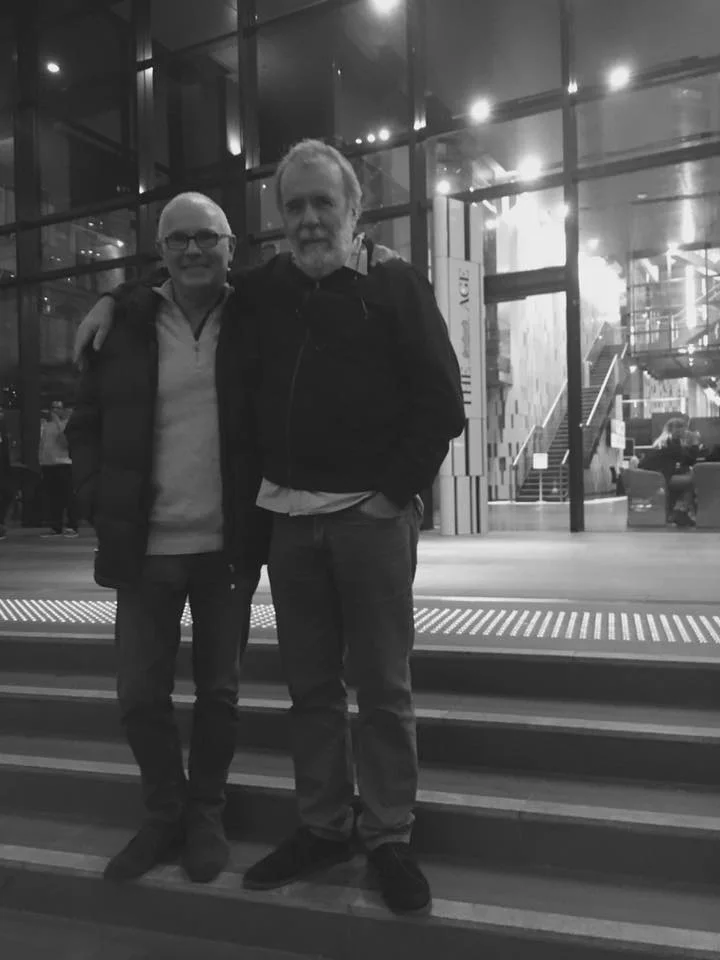
We separated from The Age at the same time, mid-way through last year. For my farewell column, I had a number of ideas. He told me which one to write – a story about my brother, Tim. I always did what he told me or asked me to do. He asked me to go to the office on his last day so I did that also. We left the building together.

He said we both got better as we got older. I certainly thought he did. He became more his own man, dared to do stories that weren’t going to get clicks on-line. At a time when - for some - clicks on-line were the measure of a journalist’s worth. He wrote stories about refugees, powerless people none of us really want to know about because the subject is threatening in so many ways.

What is remarkable about Micky’s journalism is its consistency.  He wrote about football, he wrote Aboriginal stories, he wrote about Canberra politics, he wrote about Manus Island refugees, and the subjects of all those very different stories seem to agree that he treated them fairly and well. Somehow his method successfully negotiated the difficulties peculiar to each area. That’s very rare, I reckon.

Alastair Clarkson is the dominant AFL coach of this era. No-one has come near to Michael’s portrait of Clarkson in his book, “Playing to Win”. The day after Micky died, I received a text from Patrick Dodson’s office. When will Kumunjai Gordon’s funeral be? Kumanjai. An Aboriginal term of respect for the recently departed. Both a Labor and Liberal Prime Minister have spoken of him since his death; a refugee on Manus Island said he was the one great Australian man he met.

What was the secret of Michael Gordon’s success? He was humble with a capital H, never opened his mouth before thinking, asked intelligent questions, never lost sight of those basic human truths the Americans describe as self-evident - and he reported his findings in an easy-to read way.

Last Sunday, I met a former Age employee at the supermarket. She was immediately tearful and I knew why – Michael Gordon. “I didn’t really know him,” she said. “It’s what he represented”.

We live in the era of fake news. There was not a single fake particle in Michael Gordon, and that was recognised in places as far apart as the Lodge in Canberra and the Manus Island Detention Centre. His life stands as an example of what journalism can be and do.

Micky and Martin leaving The Age.jpg
Gordon family.jpg


Related speech: Sarah and Scott Gordon also delivered amazing eulogies for their father and shared them with Speakola. " 13 days ago my Dad’s big, beautiful, generous heart suddenly stopped beating. And we didn’t see it coming. " Read and listen here.

Enjoyed this speech? Speakola is a labour of love and I’d be very grateful if you would share, tweet or like it. Thank you.

Facebook Twitter Facebook
In PUBLIC FIGURE C Tags MICHAEL GORDON, MARTIN FLANAGAN, JOURNALIST, THE AGE, TRANSCRIPT, FRIENDS, COLLEAGUE
1 Comment

For Jim Hart: 'In short, his staff just loved him', by Cameron Hart - 2016

July 3, 2016

24 June -2016, East Doncaster, Melbourne, Australia

I’m going to say a few words about Jim’s time at Hart Design as he was good enough to employ me for 20 years so I probably know as much as anyone about this time.

The first thing I’ve got to say is how does someone pushing 80 (rub shiny bald head, looking mystified) have that much hair??? Jim started out on his own in the middle of the early ‘90s recession. These were not easy circumstances in which to be an architect. Many others were struggling or going out of business as Jim was trying to start up. He had courage in his convictions, but I think it was also driven by necessity.

He started working out of the downstairs games room in the family home at Warrandyte. He soon outgrew that and moved in to Fitzroy, first sharing with another firm then later taking space above a shop in Brunswick Street. All the while he was showing faith in young graduate architects to help him build his business.

He quickly built a healthy client base, particularly with health and aged care projects. Many of these were return clients who showed the same faith in Jim that Jim was showing in his staff. Jim found out subsequently that the office in Brunswick Street was at different points in time the local Communist Party headquarters and a former brothel. He looked pretty happy with himself when he found that out.

While proud of the projects he did (inc. the Maryborough Hospital Redevelopment and Western Hospital projects) I think Jim would agree his greatest legacy is not necessarily the physical buildings but the number and quality of young architects he gave a start to. Everyone loved Jim; clients, consultants and staff. Particularly his staff.

Early on he created the infamous, long standing tradition of the weekly Friday lunch. No wonder the staff liked him. Don’t get me wrong – the office worked hard during the week, but Jim knew the importance of staff morale and made sure that we enjoyed ourselves every Friday afternoon. Because of this tradition Jim gained quite a profile on Brunswick St. I’d forgotten about this, but one particular restaurant owner ended up feeding us port after our meal every time we went there. I don’t think we ever asked for it even once. Thanks Jon for reminding me.

This is the same place that Anne and I decided would be the perfect place for our “wedding reception”. Well, more of a rowdy meal with 75 of our friends and family, and we can thank Jim for that. Over the past week I’ve been struck by how many former staff have been in contact to tell me pretty much the same thing, that is that Jim kick started their careers. As one former Hart Design employee (who is here today) said so eloquently, Jim let people “test their design skills and spread their wings”. Thanks Anna. This was rarely gained from working in larger firms where graduates are not given that level of responsibility.

In short, his staff just loved him. And the feeling was mutual. What gave him most satisfaction in work was giving young people the chance to develop their skills and confidence. On a personal note, as I’ve tried to establish myself in photography he was always supportive and encouraging.

That’s the sort of guy he was - supportive and encouraging. Thank you

Enjoyed this speech? Speakola is a labour of love and I’d be very grateful if you would share, tweet or like it. Thank you.

Facebook Twitter Facebook
In SUBMITTED 2 Tags SON, FATHER, HART DESIGN, JIM HART, WORKMATE, BRUNSWICK STREET, COLLEAGUE, ACHITECT, CAM HART
Comment

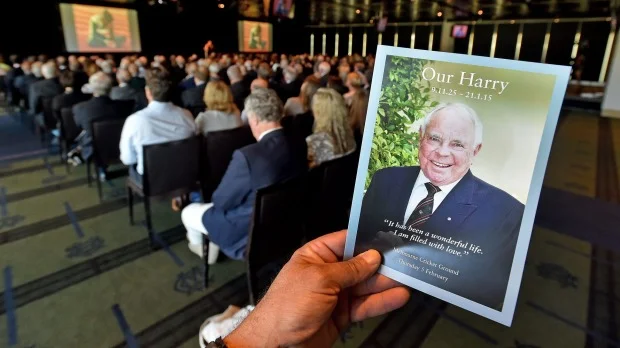
For Harry Gordon: 'His storytelling just flowed, clear and purling like a mountain creek', by Les Carlyon - 2015

July 29, 2015

5 February, 2015, Melbourne Cricket Ground

 I shouldn’t say this . . . but I can’t help thinking that Harry would see today as a missed opportunity.

Harry loved a lunch, as many of us here today know.

And at this time – around two o’clock – he’d be calling for a third bottle of wine.   And he’d be telling people -- usually John Fitzgerald -- not to interrupt him while he told a short anecdote that would only take another twenty or thirty minutes.  

And, if it happened to be a large gathering -- and Harry’s lunches usually were -- he’d eventually make a formal speech and go around the room, singling out people for praise and reminding them of something they wrote in 1953.

You tried to avoid eye contact, hoping Harry wouldn’t see you – but he always did.

And Harry not only loved a lunch.   He loved this place, this stadium that once had a red-brick cinder track.

So what an opportunity missed today.

The MCG: he could have picked out someone he knew in the Ponsford Stand and called him ‘old bloke’.

What an opportunity missed.   All these people, all of us his friends and more than that his admirers . . . people who owe him simply because of what he was and what he taught us by example.

I’m so old I first met Harry fifty-four years ago.   He was assistant editor of the Sun News-Pictorial and I was a first-year cadet, wide-eyed and clueless.  

But I felt I had known him long before then.   As a kid growing up in the bush I used to read his stuff in The Sun.

This was the era of Dave Sands and Vic Patrick in the boxing rings, and of Betty Cuthbert, John Landy and Dawn Fraser at the Melbourne Olympics.

And even as a teenager I sensed there was something special about Harry’s work.   I couldn’t identify what it was then. It was just a voice inside me saying: ‘This bloke’s different’.

His storytelling just flowed, clear and purling like a mountain creek.  

Here was someone who seemed to live in a different place to most other journalists.   There was a relaxed quality to his prose – no clichés, no showing off, no agenda.   He led you along by the hand.   He was the master of the anecdote that widened out into the bigger story.

Here was someone who obviously crafted every word, every sentence, someone who lived in this exotic halfway house between journalism and literature.

And you also felt that here was a generous spirit.   Harry could scold in print without being mean.  

And when I eventually met Harry in the flesh at The Sun he was exactly the way he seemed in his copy – friendly, with a radiant smile that came from somewhere deep inside, a great finisher of other people’s copy and an island of civility in the alcoholic haze that hung over the subs’ room in those days.

That was my first view of Harry and he never changed.   In his late eighties he was still boyish, still curious, still enthusiastic, still generous.

He’d send you an email about a new book he’d just read.   “This bloke can really write,” he’d say with all the excitement of an explorer who’s just discovered a new continent.   He was eighty-nine going on seventeen.

Harry became editor of The Sun at the same time as Graham Perkin was editor of the Age.

On the night of the Faraday kidnappings the Sun was hours -- many hours -- ahead of us at the Age.   The Sun had photos of the kidnapped school children in its first edition and we didn’t.

Graham rang Harry around midnight – I overheard the conversation -- and suggested Harry should give us the photos.   In the public interest was the quaint way Graham put it.   Harry, always the gentleman, said, yes, of course, he’d help, he’d never do anything against the public interest.

He put the phone down and after a very long delay – some say hours -- he handed the photos to a copy boy and told him to walk very slowly to the Age.

Harry, the former middleweight champ of Melbourne High, might have had gentle ways, but he was always the fiercest of competitors.   If he had to knock you out, he always sent flowers to the hospital afterwards.

Harry held lots of other high editorial positions after he moved on from the Sun.   But I’d suggest these were the lesser things.  

Harry’s legacy is the stuff he wrote in newspapers and books – his words.   His was always a human voice.   I can’t recall him ever writing anything about infrastructure reform.

It was a voice so natural that it almost seemed that Harry wasn’t trying – which of course he was.   But the effect was to give the reader the impression that the whole thing was just a happy accident – it just wrote itself.   And so often it gave us, the readers, words and images that still run around in our heads.

We’re here to mourn Harry today.

But I remind you of something Red Smith, the great American sportswriter, wrote long ago after the death of a colleague he admired.   Don’t mourn for the dead, Smith wrote, and went on to say:

This is a loss to the living, to everyone with a feeling for written English handled with respect and taste and grace.

So while we mourn for Harry today, we also need to mourn for us, the living. . . because Harry elevated us all, and made journalism look better than it really is, simply by his presence in the world.

[ends]                   

Enjoyed this speech? Speakola is a labour of love and I’d be very grateful if you would share, tweet or like it. Thank you.

Facebook Twitter Facebook
In EDITORS CHOICE Tags HARRY GORDON, EULOGY, FRIEND, COLLEAGUE, JOURNALISM, SPORTSWRITING
Comment

See my film!

Limited Australian Season

March 2025

Details and ticket bookings at

angeandtheboss.com

Support Speakola

Hi speech lovers,
With costs of hosting website and podcast, this labour of love has become a difficult financial proposition in recent times. If you can afford a donation, it will help Speakola survive and prosper.

Best wishes,
Tony Wilson.

Become a Patron!

Learn more about supporting Speakola.

Featured political

Featured
Jon Stewart: "They responded in five seconds", 9-11 first responders, Address to Congress - 2019
Jacinda Ardern: 'They were New Zealanders. They are us', Address to Parliament following Christchurch massacre - 2019
Dolores Ibárruri: "¡No Pasarán!, They shall not pass!', Defense of 2nd Spanish Republic - 1936
Jimmy Reid: 'A rat race is for rats. We're not rats', Rectorial address, Glasgow University - 1972

Featured eulogies

Featured
For Geoffrey Tozer: 'I have to say we all let him down', by Paul Keating - 2009
for James Baldwin: 'Jimmy. You crowned us', by Toni Morrison - 1988
for Michael Gordon: '13 days ago my Dad’s big, beautiful, generous heart suddenly stopped beating', by Scott and Sarah Gordon - 2018

Featured commencement

Featured
Tara Westover: 'Your avatar isn't real, it isn't terribly far from a lie', The Un-Instagrammable Self, Northeastern University - 2019
Tim Minchin: 'Being an artist requires massive reserves of self-belief', WAAPA - 2019
Atul Gawande: 'Curiosity and What Equality Really Means', UCLA Medical School - 2018
Abby Wambach: 'We are the wolves', Barnard College - 2018
Eric Idle: 'America is 300 million people all walking in the same direction, singing 'I Did It My Way'', Whitman College - 2013
Shirley Chisholm: ;America has gone to sleep', Greenfield High School - 1983

Featured sport

Featured
Joe Marler: 'Get back on the horse', Harlequins v Bath pre game interview - 2019
Ray Lewis : 'The greatest pain of my life is the reason I'm standing here today', 52 Cards -
Mel Jones: 'If she was Bradman on the field, she was definitely Keith Miller off the field', Betty Wilson's induction into Australian Cricket Hall of Fame - 2017
Jeff Thomson: 'It’s all those people that help you as kids', Hall of Fame - 2016

Fresh Tweets


Featured weddings

Featured
Dan Angelucci: 'The Best (Best Man) Speech of all time', for Don and Katherine - 2019
Hallerman Sisters: 'Oh sister now we have to let you gooooo!' for Caitlin & Johnny - 2015
Korey Soderman (via Kyle): 'All our lives I have used my voice to help Korey express his thoughts, so today, like always, I will be my brother’s voice' for Kyle and Jess - 2014

Featured Arts

Featured
Bruce Springsteen: 'They're keepers of some of the most beautiful sonic architecture in rock and roll', Induction U2 into Rock Hall of Fame - 2005
Olivia Colman: 'Done that bit. I think I have done that bit', BAFTA acceptance, Leading Actress - 2019
Axel Scheffler: 'The book wasn't called 'No Room on the Broom!', Illustrator of the Year, British Book Awards - 2018
Tina Fey: 'Only in comedy is an obedient white girl from the suburbs a diversity candidate', Kennedy Center Mark Twain Award -  2010
Tina Fey: 'Only in comedy is an obedient white girl from the suburbs a diversity candidate', Kennedy Center Mark Twain Award - 2010

Featured Debates

Featured
Sacha Baron Cohen: 'Just think what Goebbels might have done with Facebook', Anti Defamation League Leadership Award - 2019
Greta Thunberg: 'How dare you', UN Climate Action Summit - 2019
Charlie Munger: 'The Psychology of Human Misjudgment', Harvard University - 1995
Lawrence O'Donnell: 'The original sin of this country is that we invaders shot and murdered our way across the land killing every Native American that we could', The Last Word, 'Dakota' - 2016