• Genre
  • About
  • Submissions
  • Donate
  • Search
Menu

Speakola

All Speeches Great and Small
  • Genre
  • About
  • Submissions
  • Donate
  • Search

Commencement and Graduation

Inspiring, humorous, wisdom imparting. Some of the best speeches are delivered in the educational context. Upload your commencement or graduation speech here.

Shah Rukh Khan: 'Feel free, because that’s what essentially my talk is about; feeling free', Dhirubhai Ambani Internatioanl School (DAIS) - 2016

December 18, 2016

30 May 2016, Bandra East, Mumbai, Maharashtra, India

Thank you, David and thank you everyone for inviting me here. This is a huge privilege, not because I’m the chief guest. I think it’s a privilege mainly because I’m one of the parents who have had the opportunity. And I’ll take this opportunity on behalf of all of you to put my hands together and thank Dhirubhai Ambani International School for doing what they’re doing to our children. So, I want to thank all the teachers, all the heads of departments, Zarine and Fareeda, I mean, you’re the people I used to come to, when I have trouble I come and look at your faces and go away, and I’m calm; everything will be sorted out. Kava sir was fantastic at cricket matches and shouts louder than anyone else in the world can, all the staff members, the management, the gentleman who man the security outside; so wonderful and so even the guy who does the parking back there, everyone for the last 13 to 14 years that I have been here. And especially my friend, Mrs. Nita Ambani. Thank you so much for looking after our children. Thank you very very much.

Ok, so good evening boys and girls. Exams are over, if I may say so, darn school is over, which seemed an impossibility just a few years back. That horrible math or physics, or whoever your least favorite teacher is, you will never have to see again. That PE coach who was all about to get you is done and dusted now. I know everybody is looking there! You want to party now, relax, hang out with the beautiful friends you’ve made in the last 13 years, 14 or some, less. The last thing you really want to do is sit here and listen to someone give you advice on life lessons and what the future holds for you. And to top it, my qualification to be doing this is zilch, nada, not at all, nothing. Really, apart from the fact that Nita and I are friends and thus, I have some benefits. My reason to be here is the same as that of your elder brother or your sister being allowed to do things that you’re not allowed to do at home. I’m like them, older! That’s all. So if you think that I have had a successful career, as I was getting very embarrassed when David was recounting because also it’s been so many years since I’ve got an award. Got to work harder! Also if you think I’ve had a successful career, a great past performance and my experiences of it; are no assurance that it will work in the future for you, or work for you at all. And anyway, none of what I say today, you will remember as soon as you’re out of here or maybe even earlier, because you’re still sleeping from the big party you guys had last night.

What I say may make sense to your mom or dad, who will remember It some years down the line, and they will also remember it for the inappropriate things that I’m going to say tonight. But you are here, and so am I, so I promise to keep this extremely crisp and sharp, about twenty minutes tops. But be rest assured, I understand if some of you walk out in the middle of my speech for bladder control reasons. Feel free to do that. Feel free, because that’s what essentially my talk is about; feeling free.

The freedom to be yourself, to listen to your inner voice, and never let anyone tell you who you are, who you ought to be, including me. These are the only years of your life in which will be allowed to make regret-free mistakes. As you do so, you will chance upon your dreams. And hopefully make a happy life out of their fulfillment. When you get to be 50, as some of your parents are, none of the mothers, they all look 35. They’re all looking extremely hot. Some of your parents are, and like I am. You will know that the bulk of your regrets are from not having done what you wished to do. So don’t hold it against your over diligent father who’s telling you to study extra, even post the exams, your annoying mother, who is still depressed that your handwriting is bad. You know she doesn’t understand if it was bad five years ago, chances are that your handwriting is not going to improve for the rest of your life, ever! Mam, get that clear, it’s not going to happen. But, let me assure you, squiggles and ants and mosquitos on paper won’t kill your career. Any doctor here will tell you, indecipherable hieroglyphics may actually be a career booster. Don’t be angry that your parents tell you that friend of yours is not good company, he is spoiling you. And please don’t hold it against them when they tell you he’s a movie star son and will become a hero what about you? Let me assure you, movie stars’ sons and daughters also have to work. Basically just don’t grudge the old man and the old bag, ever. All we parents try to do is to make you happy with your choices, by annoying you with ours, that are actually your choices anyway, but you just don’t know it yet. Your hormone levels are too high for you to understand this confusing logic. All you want to be is yourselves and you’re quite sure you know what that is. And I’m here tonight on your side only to confirm your convictions, as you set forth into the big bad world, from the loving shelter of Mrs. Nita Ambani and all these wonderful and beautiful and warm teachers and faculty who have nurtured you to embark on your own journey through life.

I was talking about parents, because I think tonight is about parents so I’m going to tell you something about my parents. My mother was top class, she was really cool, she loved me and cared unconditionally, was beautiful like all mothers and believed that I will be the most famous man in the world, and I could do no wrong. In Delhi they say, “Humaara bachha na, is the apple of my eye”. Some Punjabi ladies make it bigger, like, “the pineapple of my eye”. So I was the pineapple of my mother’s eye. My father was a gentle man, he was very educated, Masters in Law; extremely intelligent, knew seven languages, had traveled the world, knew his politics, fought for the freedom of our country, India, and excelled at sports like hockey, swimming and polo. He could cook and recite poems and knew the capital of every country in the world. My father was also very poor, he was unemployed and struggling to make ends meet for 15 years of my life, that I had the privilege of knowing him. From when I was 10 to when I was 15.  Not being able to afford fancy gifts for me, he would wrap up something old that belonged to him, in newspapers and declare it as a birthday gift when my birthday came along. In the next eleven and a half minutes left, that I have, is the story of the five gifts my father gave me and how they helped me become what I am today.

When I was ten my father gave me an old chess set. Chess is a reflection of life, they say, and as cliched as it sounds, it’s probably true. The first thing it teaches you is that every move has a consequence, whether you perceive that it does or does not, nothing you do, not a single moment is empty of living. So think of things through, not always, but often enough. Often enough, so your life does not feel as black and white and as uniform as the squares on a chessboard.

Sometimes in order to move forward you might need to take a few steps back and there’s no loss in doing something that hurts in the short run but proves worthwhile and time. Sometimes the Queen might seem sexier, they always do, but if she gets taken by an advisory straight after you save her, then you might be better off saving your castle or the bald Bishop, instead. So don’t always choose that which seems more desirable, if something tells you that it is going to get you into a whole lot of trouble. What I mean is also about tonight, drive home while your wits are about, instead of staying and getting stoned senseless after the party here. You can’t get anywhere in chess, if you don’t look out for the little ones around you, the small pawns. Life is like that too, if you forget the smallest of your people, or become foolish enough to imagine that the little grades you are given are of no value, you end up nowhere. When you look around, you learn to notice all the tiny little things that make your existence privileged and special. Just the fact that you are here, in this very moment, at this fantastic school in the company of such adoring parents, is the product of immense love, hard work and sacrifice on the part of many people present here. Taking your blessings for granted is the most ungracious stupidity, both in chess and in life.

Then, there’s what they call, don’t know how to pronounce it, but sounds very cool, the zugzwang (German for “compulsion to move”) the zugzwang is a really cool word, it sounds like a Chinese aphrodisiac, but it actually is German for, ok I will tone this down, “Oh! Fish I got to get out of here”. Anyway, for those of you who have never played the game, it’s when you get so stuck, that whichever move you make is a bad move. It will happen to each and everyone of you, at some point in your lives. For sure, a moment will come when it will look like there isn’t anything going right and nothing you can do to prevent disaster. Ask me, I just finished Dilwale and followed it up with fan! So, when you are in zugzwang, kids, don’t panic. Whenever there is trouble and you know there is no way out, or disaster, don’t panic. With a little embarrassment you will survive it. Trust me all you have to do is make a move. All you have to do is move on a bit. As the Cheshire cat in Alice in Wonderland said, when Alice came to the fork in the road, “If you don’t know where you’re going it doesn’t matter which road you take”. I will add to it, as long as you take one road and don’t keep standing in the middle of the fork until a truck runs you over. Often in zugzwang, your enemy wins that particular move, but mostly you end up winning the game.

There were no computers when I was a kid, and nor were there i-phones for us to google pornography on, while our parents were busy checking the selfie, likes on Instagram. One of the most precious gifts my father gave me was an Italian typewriter. I learned how to use it from him, how to roll paper into the roller and press the lever. I don’t know if you guys have seen a typewriter. It’s…Google it. I’d hear the clicking sound of the letters as I pressed them with my fingers, forming words on blank pages fascinated me. To use a typewriter well, you needed diligence; one wrong letter and the whole exercise had to be started all over again. We used something called typeX to erase our mistakes in those days, not to sniff out during math classes. But too much typesX in math classes or in typewriting is unacceptable. So we had to learn how to move your fingers accurately to make words out of thoughts with efficiency and do it over and over again till we got it just right. As an adult I have come to understand that there is nothing of more value, than your capacity for diligence and your ability to work hard. If you can outwork adversaries and your employees, you can ensure your own success. And whatever it is you choose to do, whatever you’re doing, do it once then do it one more time, even more carefully. Practice will make everything seem easier. Be diligent, be thorough. Think of every job you do as the first one, so you have to get it right or you won’t be able to impress everyone. And at the same time do it as your last job as if you will not get a chance to do it again ever. Don’t just workout, outwork yourself. Only parents clapping! In fact you can outwork yourself, if you cannot work yourself, then pretty much nothing can prevent you from learning.

My father gave me a camera, and the most beautiful thing about it was that it did not work. I learned that things don’t always have to be functional, to fulfill a need, that sometimes when things are broken, the greatest creativity emanates from the fragments. I found myself looking at my world magically through the unusable lens. And the fact that there was never any actual photograph to see, taught me my most important lesson yet; that creativity is a process of the soul. It does not need an outcome or a product for the world to accept. It needs only the truth of its own expression. It comes from within. And makes of your world, whatever you wish it to make. So don’t be afraid of your own creativity. Honor it. It doesn’t always have to be seen or approved by those around you. It is an expression of your deepest selves and it belongs as much to you as it does to the universe. That nurtures and inspires it. All creativity is not for everyone to like or understand. All art is not up for sale. Some creativity has a bigger role to play. It is to keep you company when you’re alone, when you need a friend, when the world doesn’t seem to understand you. Your creativity, whatever that may be, you know, I know a friend of mine who makes a dolls out of barf bags from airplanes. Whatever your creativity is, your creative will be the only thing that will keep you inspired and satisfied. Honour it to the end, whatever it may be. Mine is poetry. I write rubbish poetry. it’s so bad that sometimes I cringe to read it myself. it’s crap, but I write it, it’s my secret place. It is mine to make me feel free and happy. So you find yours and if the world loves it good, if it doesn’t, even better, because now you will truly have a friend to keep your creativity intact.

My father was a funny guy. He had the capacity to turn any kind of serious situation in a way that it seemed less stress filled, with a bit of humor. Without a sense of humor the world will always be a dull and greedy place. No darkness of despair should ever be beyond a good and a hearty laugh. I’m going to tell you a few incidents, if you’re not bored! I have got about seven and a half minutes left. We used to live on the third floor of an apartment building, and as people on third floor tend to do, my friends and I used to throw things down from the balcony; you know, wrappers, tit bits, dog shit wrapped in newspapers, the usual stuff. One day the old gentleman on the ground floor, for there’s always an old senile gentleman on the ground floor. He had had enough of our daily droppings. He charged at us yelling at the top of his voice “bhaisahaab, bhaisahaab, upar se cheezen neeche aati hai, upar se ceezen neeche aati hai” and you know the whole colony emerged to witness the spectacle. My father was there. I was mortified. And he kept screaming, “Upar se cheezen neeche aati hai“. My father calmly looked calmly at him and said, “Chacha ji, upar se cheezen neeche aati hain, ye Newton ne boht saalon pehle bataya tha. Aap koie nayi baat batao.  Andar baith ke, chai peeke baat krte hai”, and it instantly diffused the situation. The old man smiled, went into the apartment, worked out how dog shit needs to be disposed of properly, over a cup of tea in life was back to normal again.

 And there was another incident I’m going to relate. I had been eyeing this attractive, dusky girl who lived in our building. As smooth as I have always been with ladies, for some reason, it occurred to me that if I blew up her letter box with a Diwali cracker called, atom bomb, she’d be very impressed with me. I’ve always been good with girls like that, ya. I know things about girls. In this insanely romantic belief of mine, her letterbox soon exploded before her eyes. And I still don’t know why the desired effect of her running into my arms in slow-motion was replaced with a screaming drama in which he flew up the stairs screaming, “amma inge vaa, amma inge vaa”. I took my chance and as all macho men should do, I fled the scene. Few hours later the doorbell rang. I looked through the magic eye and the mother of the love of my life was standing outside looking incensed. I found a place to hide. My father opened the door. The lady began to rattle off a complaint; your son this, your son that (speaks in Tamil), my Tamil is not good! And he listened patiently and then responded, “You know ma’am, as you were speaking, I was getting angry with my son. But then I suddenly realized how beautiful you are. And I can imagine if your daughter looks anything like you, how can my son be blamed for falling in love with her and behaving so stupidly?” The lady went silent as my father continued telling her how beautiful she was, and then she became a little quiet. Another cup of tea was had and she said to me sweetly, “Beta, just because my daughter is so beautiful you shouldn’t behave badly with her. You should come home, sit with us, and be friends”. So not only did my dad get me off the hook, for blowing up the girls letter box, he actually got me in-roads to a long satisfying relationship with the love of her life that lasted six days. Because then I realize that dating beautiful girls has its downside. Every boy in the colony made advances at her. So I was regularly beaten up in my attempts to offer her some boy friendly protection. But that’s another story. The point being, learn to laugh at yourselves, every chance you get. If you can manage not to take yourself too seriously, no matter how big a shot you become or how lowly, useless, trivial you feel, you will instantly disarm life’s power to beat you down. It makes you braver to face ugliness, because it changes your perspective. Humor is actually the deftness to see the world, the reality, for the transient farce it really is. It’s like a talisman for survival. Cultivate it and allow it to lighten every heavy moment. Wear it like a vulgar tattoo, if you don’t already have one. Don’t ever let it get washed away in the turbulently beautiful seas of life. It’s your ticket to staying young and childlike forever. And you will realize why it matters to stay childlike when you’re my age. And you’ll watch this speech on YouTube with your children. I’ll probably have kicked the bucket by then, having smoked enough cigarettes to light up a forest. But I certainly hope that you will have understood what I understand now. No, not that smoking kills, but that part is ok.

Well, what I am referring to is, what counts as the most beautiful and final gift that my father gave me. I only realized it was a gift on the day he died, when I was 15 years old. A gift your parents have given to you already. Yes, the singularly most exquisite gift, you and I have been given is the gift of life itself. There is nothing that marks a man or a woman out from the ordinary, more perfectly than grace. Grace is the consciousness, that life is bigger than we are and therefore gratitude for it must match its vastness. It is the understanding, that everyone we encounter, whether they are loving towards us, or offensively abrasive, is a human like we are. It is knowing that experiences shape human beings and no matter how good we are at something, or successful we may become, we are never better than the other person. If you can live your life with grace towards those around you, you’ll accomplish more than you could if you became the president of America. That came out wrong, knowing that Donald Trump is so close to becoming the president of America! I didn’t mean that I’ll rephrase that guys. If you can live your life with grace towards those around you, “ok actually what the hell”, because I came and told you a secret that I like rubbish poetry I am going to read out a poem and end this. This this is the most rubbish poem you will hear. But keep it in the heart because I’m the damned chief guest tonight. If you’re after part, EDM. I thought it would be very cool if I use the word EDM. Is EDM still cool? Class of 2016 is it cool? No? Okay.

“If you’re after party EDM, stoned sunrise has found you,
with dark ship, wrappings, and friends that will not confound you.
And you start on this journey with a brave heart about you,
If you live life at grace towards those around you.
You’ll get where you have to and it won’t astound you.
If it isn’t Ferraris and a white house that downed you,
You won’t need an entourage to always surround you.
It’s your truth, you will have, that will shelter and ground you,
And you remember this day, as the day that unbound you.
 
From the walls of this beautiful school, and the teachers,
Exams and all the rules that sometimes seem to hound you, and let me tell you,
All will be successful let me remound you.”


So boys and girls, go forth, be free, have fun, make wrong choices, make mistakes. You will still succeed because the gift of education you have from this wonderful institution called Dhirubhai Ambani International School. The love meter has given you, and the genes that your parents have provided you with, will always look after you. And when you succeed don’t forget to thank your least favorite teacher, because he or she actually cared for you the most. Love you all and be happy.
Source: https://www.scoopwhoop.com/Shah-Rukh-Khans...

Enjoyed this speech? Speakola is a labour of love and I’d be very grateful if you would share, tweet or like it. Thank you.

Facebook Twitter Facebook
In GUEST SPEAKER C Tags SHAH RUKH KHAN, SRK, ACTOR, BOLLYWOOD, DAIS, DAIS2016, GRADUATION, INDIA, NITA AMBANI, TRANSCRIPT, SPEAKOLIES 2016
Comment

Stephen Colbert: 'The most impressive ranking of all is Playboy once again naming you the number one party school in America', UVA - 2013

December 1, 2016

18 May 2013, University of Virginia, Virginia, USA

Good morning, good morning. I am Stephen Colbert and I want to thank the class of 2013 for inviting me here today. Thank you very much, it’s an honor.

This is way more than I expected. This is incredibly generous, I would have done it for free; it’s incredibly generous. Thank you.

Now before we get started, I just want a little bit of business, ah, out of courtesy, If anyone here has a cell phone, please take a moment to make sure it's turned on. I wouldn't want anyone to miss a text or a tweet while I'm giving my speech. In fact, you might want to take a moment right now, and follow my Twitter feed, it’s @stephenathome, just in case I tweet anything during the speech.

And now, then, it is an honor to speak at your 2013 Valedictory Exercises - I believe that means I am this year's valedictorian, and I am as shocked as you are, because I didn't make it to many classes this year. You guys must've really tanked your finals, thank you for that.

I'd also like to thank President Teresa Sullivan. Thank you very much, President Sullivan, you are way better than that last president, Teresa Sullivan, she was terrible. I am so glad they cut her loose. Good riddance, I say! No, you are clearly the woman for this job.

I would also like to thank the Board of Visitors; Board of Visitors, of course, that name goes all the way back to your founder Thomas Jefferson, who was just trying to put the local Indians at ease - "Just visiting, must be going home any century now."

And just as many of the unique, dignified things that set UVA apart from other universities. Instead of “freshmen” you have “first years,” instad of a "quad" you call it a "lawn," instead of saying, "We are members of a proud educational tradition dating back to our nation’s founders," you say "Wahoowa," which begs the eternal question, "Wahoo-why?"

Now, I went to Hampden-Sydney College, {applause} thank you, thank you, please sit down, and I used to come up here as much as I could, because, you had these things back then, I’m not sure what you call them now - "girls." We did not have those at Hampden-Sydney, and when I could not find one of those here, I would head over to the “White Spot” to get a Grillswith to fill the void in my heart. Literally, my cardiologist has found recently one lodged in there. And, early this morning, I had a little tour around your beautiful campus and I just asked myself, "Why are you leaving?"

You know what it’s like out there, right? Plus this could be the most spectacular place you will ever live. It is the only campus in America designated a UNESCO World Heritage site. I believe it means that if you try to carve your name into a desk, UN will send in ground troops, and you are not gonna’ top these living conditions unless your post college plans are to sublet the Taj Mahal.

I just want to say the UVA students are incredible. The men are all gentlemen. And the women are all the most beautiful and intelligent in the world. I'm not just saying that because I dated a UVA girl. I'm saying it because I married her.

You are graduates of one of the most highly ranked universities in the nation. US News & World Report ranks you as the number two public university. Princeton Review named you number one in best value of a public college. Especially for those of you who showed the initiative to be born in Virginia. Let’s give a round of applause to those of you who pay out of state tuition. Because without those people, tomorrow instead of wearing gowns and mortarboards, you'd be graduating in ponchos made of Hefty bags with used pizza boxes on your head.

As has been stated before, the most impressive ranking of all has once again has to be Playboy once again naming you the number one party school in America. Now to be clear, I only read Playboy for the rankings. But I am not surprised by this honor – I have seen you in action. When I used to visit back in the days, I spent a fair amount of time at the Phi-Kap House, which at that time had no doors, because apparently, they kept being partied off their hinges. But I’m not going on more about those days because I cannot remember them.

And you know this is an impressive institution because it rejected my application. Yes, in the spring of 1984 I applied as a transfer student, and at the time you could send your essay after the rest of your application. Apparently the admission board took issue with the content of my essay, which was none, because I never sent it. So today, President Sullivan, I would like to submit this address as my essay. Since this is a smart school, let me just toss in some SAT words: syzygy, heterodox, Benedict Cumberbatch. Am I in? I know, I am not a Virginia resident.

But perhaps the real reason UVA is so great is that it trusts its students. You have the nation’s oldest student-run honor code. Say it with me - on my honor, I pledge that I have neither given nor received help on this assignment, so help me Adderall.

My favorite thing about UVA has got to be your secret societies. That's sexy. You got the Z’s, you got I think the Illuminati, the Masons, and Shield, I think some of you remember the Shield. But of course the most secret of all is the Sevens Society. Nobody knows who's in it. I'm not going to say I'm a Seven. I'm not going to say I'm not a Seven ... I'm just going to say eviganblumencroft ... benedictcomberbachen Now I have to have all of you killed!

Now, of course, many of you already know, but for the uninitiated let me explain: When a member of the Seven dies, a wreath of black magnolias shaped like seven appears at their grave, and the university chapel chimes at seven seconds interval, on the seventh dissonant chord of the seventh minute past the hour. All the group’s donations contain the number seven like it’s $777,777 grant to fund the Meed endowment, so it appears that the way you qualify for the Sevens is by having a crippling OCD, and you know what is good for that – Adderall!!

Now, what is not a secret is the list of the distinguished UVA alums, which is as impressive as it was easy to copy and paste from Wikipedia. You got Woodrow Wilson, Robert Kennedy, Janet Napolitano, Katie Couric, Tina Fay, the painter Georgia O’Keefe – I love her paintings – they remind me of something I never saw at Hampden-Sydney. And, of course, Edgar Allan Poe, or as his roommates called him, Creepy Eddie. I don’t understand why Lenore couldn’t have just given him a pity date, or just that “I am busy Saturday night”; she didn’t have to say “nevermore”. Like most students, young Mr. Poe had a way of signaling tom his roommates if he had a date over. He would hang a sock on the door, or bury a still-beating heart under the floorboards, whichever he had handy.

But of course the greatest figure associated with UVA is your founder, Thomas Jefferson - TJ, Prez Tommy Jeff, the freckly anti-federalist, Louisiana purchee, old Bible Slicer, or as most Americans know him, the inventor of the six-inch wooden cypher wheel. In founding this great institution, Jefferson wrote – “We wish to establish in the upper country of Virginia a university on a plan so broad and liberal and modern, to be a temptation of youth to other states to come and drink the cup of knowledge and fraternize with us,” and according to Playboy you lived up to that vision.

But there’s one thing about Jefferson that I take issue is this: the scope of his beliefs, which were too broad. Jefferson is hard to nail down. These days we would like politicians to fit into a category – you are either conservative or liberal. But not Jefferson; he is not like that. No matter what are your political leanings, you can find something he said to back that up. If you don’t trust the financial industry, he said “I believe that banking institutions are more dangerous to our liberty than standing army.” If you are suspicious of federal overreach,” he said, “When a government fears the people there is a liberty, and when people fear the government there is tyranny. If you question religion”, he wrote, “In every country and in every age the priests have been hostile to liberty, and if you are an advocate of fiscal austerity” he said, “I’m gonna pop some tags, only got $20 in my pocket, I’m, I’m, I’m hunting, looking for a come up, this is (fucking) awesome” - I’m not saying that on camera. That, of course, was in a letter to the Secretary of State Ryan Lewis.

Also on the one hand, in Jefferson's public life as a founding father, we often see him as the embodiment of the white male patriarchy. But in his private life, he was known for, shall we say, embracing diversity. Very affirmative in his actions, am I right? I'm right; they did the DNA tests on that one.

You know what? I'm not going to say any more on that, you've heard too much about that in the past, instead I'll just tweet it.

Now, while that’s arriving all over your phones right now, I am going to take the opportunity to move to the advice section of the speech.

If you young folks will take advice from anyone, after all, I don’t know if you've seen it — this week’s Time Magazine called you “lazy, entitled narcissists,” who are part of the “Me, Me, Me” generation. So self-obsessed - tweeting your Vines, hashtagging your Spotifys and Snapchatting your YOLOs - your generation needs everything to be about you. And that's very upsetting to us baby boomers because self-absorption is kind of our thing. We're the original "Me Generation," we made the last 50 years all about us. We took all the money. We soaked up all the government services. And we've deep-fried nearly everything in the ocean. It may seem that all that’s left for you is unpaid internships, Monday to Tuesday mail delivery, and thanks to global warming, soon Semester at Sea will mean sailing the coast of Ohio.

Now, in our defense, in my generation’s defense – how were we supposed to know that you were coming? We thought it went like this: every successive generation of mankind – and then us! Ta-dah – roll credits.

But while we may be leaving you with an economy with fewer job opportunities for the new graduate to slip into and while traditional paths may seem harder to find, that also means that you will learn sooner than most generations the hard lesson that you must always make the path for yourself. There is no secret society out there that will tap you on the shoulder one night and show you the way. Because the true secret is - your life will not be defined by the society that we have left you.

To paraphrase Robert Bolt, "Society has no more idea of what you are than you do, because ultimately it has only your brains to think with. Every generation must define itself and so make a world that suits itself ..." So if you must find your own path, and you are left with no easy path, then decide to take the hard path that leads you to the life and the world that you want.

And don’t worry if we do not approve of your choices. In our benign self-absorption, I believe we have given you a gift; a particular form of independence, for you do not owe the previous generation anything. Thanks to us, you owe it to the Chinese.

So have the courage to follow the example of your founder, Thomas Jefferson, the greatest mind of that most daring generation, to create something new for yourselves, "and lay its foundation on such principles and organizing its power in such form as to you shall seem most likely to affect your safety and happiness." And know that though he wrote these words 237 years ago, that this generation, no less than his generation, has their own opportunity to recognize and seize that moment “when in the course of human events it becomes necessary for one people to dissolve the bands that have connected them with another and assume among the powers of the earth your separate and equal station and for the support of this, mutually pledge to each other your lives, your fortune and your sacred honor.” If anyone can do this, it is the graduates of the university that Jefferson founded. You are his intellectual heirs. In fact, some of you may be his actual heirs; we’re still testing the DNA.

So thank you for this honor and congratulations to the class of 2013. Wahoowa.

Source: http://genius.com/Stephen-colbert-universi...

Enjoyed this speech? Speakola is a labour of love and I’d be very grateful if you would share, tweet or like it. Thank you.

Facebook Twitter Facebook
In GUEST SPEAKER C Tags STEPHEN COLBERT, TRANSCRIPT, UVA, UNIVERSITY OF VIRGINIA, COMMENCEMENT, SECRET SOCIETIES, FUNNY
Comment

Hillary Rodham: 'To understand that limits no longer exist', Wellesley student speech - 1969

November 29, 2016

June 1969, Wellesley College, Massachusetts , USA

I am very glad that Miss Adams made it clear that what I am speaking for today is all of us—the 400 of us—and I find myself in a familiar position, that of reacting, something that our generation has been doing for quite a while now. We're not in the positions yet of leadership and power, but we do have that indispensable element of criticizing and constructive protest and I find myself reacting just briefly to some of the things that Senator Brooke said. This has to be quick because I do have a little speech to give.

Part of the problem with just empathy with professed goals is that empathy doesn't do us anything. We've had lots of empathy; we've had lots of sympathy, but we feel that for too long our leaders have viewed politics as the art of the possible. And the challenge now is to practice politics as the art of making what appears to be impossible possible. What does it mean to hear that 13.3 percent of the people in this country are below the poverty line? That's a percentage. We're not interested in social reconstruction; it's human reconstruction. How can we talk about percentages and trends? The complexities are not lost in our analyses, but perhaps they're just put into what we consider a more human and eventually a more progressive perspective.

The question about possible and impossible was one that we brought with us to Wellesley four years ago. We arrived not yet knowing what was not possible. Consequently, we expected a lot. Our attitudes are easily understood having grown up, having come to consciousness in the first five years of this decade—years dominated by men with dreams, men in the civil rights movement, the Peace Corps, the space program—so we arrived at Wellesley and we found, as all of us have found, that there was a gap between expectation and realities. But it wasn't a discouraging gap and it didn't turn us into cynical, bitter old women at the age of 18. It just inspired us to do something about that gap. What we did is often difficult for some people to understand. They ask us quite often: "Why, if you're dissatisfied, do you stay in a place?" Well, if you didn't care a lot about it you wouldn't stay. It's almost as though my mother used to say, "You know I'll always love you but there are times when I certainly won't like you." Our love for this place, this particular place, Wellesley College, coupled with our freedom from the burden of an inauthentic reality allowed us to question basic assumptions underlying our education.

Before the days of the media orchestrated demonstrations, we had our own gathering over in Founder's parking lot. We protested against the rigid academic distribution requirement. We worked for a pass-fail system. We worked for a say in some of the process of academic decision making. And luckily we were at a place where, when we questioned the meaning of a liberal arts education there were people with enough imagination to respond to that questioning. So we have made progress. We have achieved some of the things that we initially saw as lacking in that gap between expectation and reality. Our concerns were not, of course, solely academic as all of us know. We worried about inside Wellesley questions of admissions, the kind of people that were coming to Wellesley, the kind of people that should be coming to Wellesley, the process for getting them here. We questioned about what responsibility we should have both for our lives as individuals and for our lives as members of a collective group.

Coupled with our concerns for the Wellesley inside here in the community were our concerns for what happened beyond Hathaway House. We wanted to know what relationship Wellesley was going to have to the outer world. We were lucky in that Miss Adams, one of the first things she did was set up a cross-registration with MIT because everyone knows that education just can't have any parochial bounds anymore. One of the other things that we did was the Upward Bound program. There are so many other things that we could talk about; so many attempts to kind of - at least the way we saw it - pull ourselves into the world outside. And I think we've succeeded. There will be an Upward Bound program, just for one example, on the campus this summer.

Many of the issues that I've mentioned—those of sharing power and responsibility, those of assuming power and responsibility—have been general concerns on campuses throughout the world. But underlying those concerns there is a theme, a theme which is so trite and so old because the words are so familiar. It talks about integrity and trust and respect. Words have a funny way of trapping our minds on the way to our tongues but there are necessary means even in this multimedia age for attempting to come to grasps with some of the inarticulate maybe even inarticulable things that we're feeling.

We are, all of us, exploring a world that none of us even understands and attempting to create within that uncertainty. But there are some things we feel, feelings that our prevailing, acquisitive, and competitive corporate life, including tragically the universities, is not the way of life for us. We're searching for more immediate, ecstatic, and penetrating modes of living. And so our questions, our questions about our institutions, about our colleges, about our churches, about our government continue. The questions about those institutions are familiar to all of us. We have seen them heralded across the newspapers. Senator Brooke has suggested some of them this morning. But along with using these words—integrity, trust, and respect—in regard to institutions and leaders, we're perhaps harshest with them in regard to ourselves.

Every protest, every dissent, whether it's an individual academic paper or Founder's parking lot demonstration, is unabashedly an attempt to forge an identity in this particular age. That attempt at forging for many of us over the past four years has meant coming to terms with our humanness. Within the context of a society that we perceive—now we can talk about reality, and I would like to talk about reality sometime, authentic reality, inauthentic reality, and what we have to accept of what we see—but our perception of it is that it hovers often between the possibility of disaster and the potentiality for imaginatively responding to men's needs. There's a very strange conservative strain that goes through a lot of New Left, collegiate protests that I find very intriguing because it harkens back to a lot of the old virtues, to the fulfillment of original ideas. And it's also a very unique American experience. It's such a great adventure. If the experiment in human living doesn't work in this country, in this age, it's not going to work anywhere.

But we also know that to be educated, the goal of it must be human liberation. A liberation enabling each of us to fulfill our capacity so as to be free to create within and around ourselves. To be educated to freedom must be evidenced in action, and here again is where we ask ourselves, as we have asked our parents and our teachers, questions about integrity, trust, and respect. Those three words mean different things to all of us. Some of the things they can mean, for instance: Integrity, the courage to be whole, to try to mold an entire person in this particular context, living in relation to one another in the full poetry of existence. If the only tool we have ultimately to use is our lives, so we use it in the way we can by choosing a way to live that will demonstrate the way we feel and the way we know. Integrity—a man like Paul Santmire. Trust. This is one word that when I asked the class at our rehearsal what it was they wanted me to say for them, everyone came up to me and said "Talk about trust, talk about the lack of trust both for us and the way we feel about others. Talk about the trust bust." What can you say about it? What can you say about a feeling that permeates a generation and that perhaps is not even understood by those who are distrusted? All we can do is keep trying again and again and again. There's that wonderful line in "East Coker" by Eliot about there's only the trying, again and again and again; to win again what we've lost before.

And then respect. There's that mutuality of respect between people where you don't see people as percentage points. Where you don't manipulate people. Where you're not interested in social engineering for people. The struggle for an integrated life existing in an atmosphere of communal trust and respect is one with desperately important political and social consequences. And the word consequences of course catapults us into the future. One of the most tragic things that happened yesterday, a beautiful day, was that I was talking to a woman who said that she wouldn't want to be me for anything in the world. She wouldn't want to live today and look ahead to what it is she sees because she's afraid. Fear is always with us but we just don't have time for it. Not now.

There are two people that I would like to thank before concluding. That's Ellie Acheson, who is the spearhead for this, and also Nancy Scheibner who wrote this poem which is the last thing that I would like to read:

My entrance into the world of so-called "social problems"
Must be with quiet laughter, or not at all.
The hollow men of anger and bitterness
The bountiful ladies of righteous degradation
All must be left to a bygone age.
And the purpose of history is to provide a receptacle
For all those myths and oddments
Which oddly we have acquired
And from which we would become unburdened
To create a newer world
To translate the future into the past.
We have no need of false revolutions
In a world where categories tend to tyrannize our minds
And hang our wills up on narrow pegs.
It is well at every given moment to seek the limits in our lives.
And once those limits are understood
To understand that limitations no longer exist.
Earth could be fair. And you and I must be free
Not to save the world in a glorious crusade
Not to kill ourselves with a nameless gnawing pain
But to practice with all the skill of our being
The art of making possible.

Thanks.


Source: http://www.wellesley.edu/events/commenceme...

Enjoyed this speech? Speakola is a labour of love and I’d be very grateful if you would share, tweet or like it. Thank you.

Facebook Twitter Facebook
In STUDENT UNIVERSITY Tags HILLARY RODHAM, HILLARY CLINTON, TRANSCRIPT, STUDENT SPEECH, GRADUATION, WELLESLEY, WOMEN'S COLLEGE
Comment

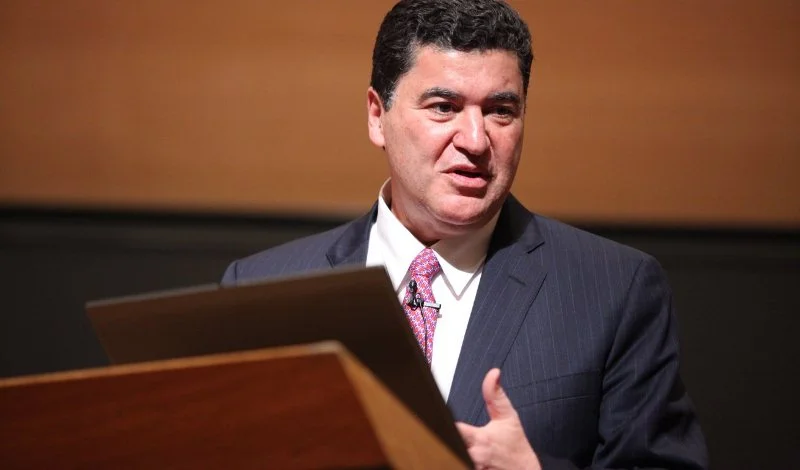
Elias A. Zerhouni: 'Ninety percent of what there is to discover is still ahead of us', MIT - 2004

September 6, 2016

4 June 2004, Massachusetts Institute of Technology, Cambridge, Massachusetts, USA

Thank you very much. It's really a privilege for me to be here and celebrate with you on this beautiful day. I also wish my mother-in-law was here to see what I was doing today because I still have to convince her, on a daily basis, that her daughter made the right choice many years ago.

I'm honored to be here because I also, as a parent myself, can feel the joy of your parents and friends who are here. As a parent, I remember the birth of my first son as if it was yesterday, and I can tell you, your parents also remember those 22 years ago and days when you were born. For you, those 22 years may have seemed very long and arduous, but I can tell you, for parents, they are very short. They all remember you as a baby, and they can't believe you have become such a formidable graduate of one of the most prestigious institutions in the world. And that's an illustration of what I call the relativity principle of time and aging. The older you are, the faster time seems to go by, and the faster tuition bills seem to come through, as well. But, you know, you are the legacy of your parents to this world, and they all deserve our heartfelt recognition for doing such a good job, and I'd like all the graduates, if you don't mind, to give a round of applause to your parents.

It's also a great honor for me to give this address in the last year of President Charles Vest's extraordinary tenure at MIT. There's no question that Dr. Vest, from my point of view as a federal agency official, today is one of the most influential thought leaders in higher education. He has this rare combination that you don't find a lot in life that combines vision and flawless execution. Well, last night, he conducted the Boston Pops with a flawless execution, I hear. President Vest, we're impressed.

Recently my younger son, Adam, actually was initiated in a fraternity called Phi Kappa Psi, and as I was checking to make sure that this was a good fraternity, a decent one, I found out that Dr. Vest was a member of that fraternity. So when people ask me now about my son, Adam, I say, "Oh, don't worry, he belongs to the exact same fraternity Dr. Vest belongs to." So I'm very proud to do this in his last year.

What can you say to 2,200 very bright graduates that will make a difference in telling them about where you see life and where you see a field of science, where you see yourself? As I was preparing my speech, I was looking at what was the best strategy to do that, and I came across the story of a Commencement speaker at Yale University, who had the great idea of using every letter of the Yale name as a starting concept. So he used Y for youth, and he went on and on about youth. And then he used A for ability, which you all have, and he went on and on. And from the back of the room, somebody said, "Thank God we're not the Massachusetts Institute of Technology!" So I give up on that strategy, I'm not going to use that strategy today.

Instead I'll tell you about what I think are the very critical both scientific challenges of the 21st century, but also what is your role in it. The challenge, frankly, for us in the 21st century, is one that we have brought upon ourselves, and I'll just go back in history a little bit to give you the perspective of how I see it. When you think about the universe, you hear that about 13.7 billion years ago there was a Big Bang, and off of that Big Bang came the universe, and then planets and solar systems and galaxies organized themselves, that was the first big bang. But there were other Big Bangs. The Earth came about five billion years ago, and about four billion years ago, with a mysterious event, life appeared. And what happened is that through replication of very special molecules, DNA and RNA, something very unique happened whereby natural evolution allowed, through multiple variations and survival of the fittest, the emergence of a very diverse life on earth.

But there is a third Big Bang, and this is the one you're living in today, which you have to take account of, and that is the Big Bang of knowledge. It occurred about 100,000 years ago when about 10,000d individuals, at most--as we look at the genome and we look at the variation of the genome across the human population, it is very clear that all of us have come from the same founding population of 10,000 individuals in Africa about a hundred thousand years ago. So we're not that different from each other, in historical terms.

And yet that changed the game of life because, through knowledge, through our ability, through our intelligence, we're able to transfer information from one child, from one parent to a child, from a parent to another one and, through generations, we're able to develop tools of adaptation the world has never seen. We've been able to change our environment at a speed, at a velocity that is much faster than what we can adapt to ourselves through our natural mechanisms of natural evolution.

Let me give you an example. Obesity is an emerging public health threat. This year the Centers for Disease Control said that obesity is the second [leading] cause of premature mortality and morbidity in this country. Now why is that? Because for millions of years, our genes evolved in the context of food scarcity. There was not a lot of food around us for millions of years. And all of a sudden, because of our intelligence, because of our knowledge, we changed that in less than 50 years. Most of our genes are in fact designed to allow you to accumulate energy and keep that energy, which then translates itself into overweight and obesity.

Well, what are we going to do about it? What I will dare to say to you is that life sciences and their applications will be the defining challenge of the 21st century, bar none. And the reason is that we are changing our environment at a speed which will require us to understand life sciences to a degree we do not understand today. And let me tell you, it will require the intelligence and commitment of many classes of graduates like yours. The solution will not come from biology alone. It will come from the integration of biology and computer sciences and mathematics and physics and chemistry, and we want to encourage that to happen.

Why is this a great opportunity for you? Let me tell you a little story. A few weeks ago, I was at a meeting of the annual convention of all the biotechnology executives. All the CEOs of the many biotechnology companies in this country were there, assembled in New York, with their investment bankers. Now you know this must be a very important meeting for someone who is trying to get funds for their idea, and I conducted a poll. And I said to them, I am the director of the NIH [and] I want to ask you a question. How much do you think you know of what you need to know to be effective in combating obesity or diabetes and any of the health care challenges that we have in front of us?

Now the question: Do you think you know 90 percent of what you need to know? And no one answered that. Fifty percent? No one raised their hand. Twenty percent? No one raised their hand. So I said, well, what about less than 10 percent? Everybody raised their hand. This is from the leaders of life sciences today. So think about it. Think how much opportunity there is in front of you. Ninety percent of what there is to discover is still ahead of us.

Now I turned to the investment bankers, and I said, "Well, I don't understand this. You are investing good dollars on people who just admitted in front of you that they know less than 10 percent of what they need to know." Can you imagine? And the reason is simple. It is such a great challenge, and the risk/reward is so great. If you can find just a cure for one of the major diseases of mankind, you will affect that relationship between our environment and ourselves. So it's important, I think, to keep that in perspective and to understand that there is a real race going on between our ability to understand how we respond to our environment biologically and our ability to change that environment in ways and consequences that we, with consequences that we may not always predict.

As the NIH director, I have to give you some advice about how to conduct yourselves then for the next challenge, if that's the challenge that we think is there, and I can only do this with no certainty, obviously, about what the right answer is. I can only talk to you about myself and the rules I've used in life to go around and do this.

First and foremost, I learned one thing, because I came from another country, actually, I came from Algeria when I was 24 years old to America. I immigrated, and I had $300 in my pocket, new wife, no friends, no family, and basically this is where I learned that you can't make a contribution unless you're connected to others and you're able to connect to others. So I developed these rules called my 50/50 rules. You have to have a balance in life because you never know when you're going to need the interactions of others.

So what are these 50/50 rules? Well, the first rule that I'd like to share with you is this. Today you're going to receive a diploma. What you know today, I can assure you, is 50 percent wrong and 50 percent right. The challenge for you now is to figure out what part is right and what part is wrong. Now don't take my speech as an excuse to go and ask for a reimbursement on your tuition. I don't think they will do that. But, on the other hand, I think it's a very important way to look at the knowledge fund that you have as new scientists, new graduates of MIT.

I think it is important to also realize that in life many of your contributions will not come from your core discipline. They will come from disciplines that you probably have no contact with, typically, and this is the other 50/50 rule that I would like to leave you with. Read 50 percent of what you read in the area that you're interested in, but make sure that 50 percent of what you read is unrelated to what you have to do.

I did this consistently because I had to learn a new language, I had to connect with new friends and new disciplines. Fifty percent of what I read was in radiology. I loved medical imaging because it combined mathematics and physics, which I love, and medicine, which I think gave me the human contact, and that's why I worked and made these contributions. But 50 percent of the time I would read things outside of radiology.

It's really fun to see the world that way, but it's also more fun to understand that you are smarter when you're in the company of smarter people than you. It is amazing to see the enrichment that you get from interacting with others. So my rule is that 50 percent of my friends have to be from walks of life that are not directly related to my walk of life and, more importantly, I try to make sure that at least 50 percent of my friends are smarter than I am. Because you can be assured that at least half of your life contributions will be stimulated by others that are interacting with you, and you will stimulate others, as well.

Often you hear about the spark of genius that somebody had, this unique individual, and we all admire these individuals, but it's rarely true that it happens to people who are completely isolated. Throughout scientific history, you've always had that interaction of people, founder groups, that got together and created new advances. Witness Watson and Crick. Watson was a zoologist and Crick was a physicist. In coming together, they created the field of molecular biology. Now look at laboratories around the world that have been very productive. They've been productive because they have, in fact, encouraged the clustering of people from diverse backgrounds, coming from diverse horizons, with different ideas.

This process is admittedly social, it is not an individual process, it is a process you have to participate in. But now I'm going to tell you about some of the exceptions that I've learned, as well. People will tell you that if you go and talk about things you do not understand to people who do not know you, you will tend to look a little stupid. The objection that I hear a lot is, "But you can look foolish asking questions about fields you do not understand and those people who do not know you." Well, that's true. That's very true. I asked a lot of stupid questions in my life, and you will, too. But the one thing I can tell you is that it's not deadly to ask stupid questions. What's deadly is to not ask the right question at the right time.

The other is that people will also tell you if you talk too much about your ideas, someone will steal them from you. Well, my response to that is that if you have ideas that are so easy to steal, they must not be that good.

In fact, my experience is different. With truly original ideas, the response is that most people don't believe you. One of the three or four things I did in my life that were semi-original were fiercely disbelieved and criticized and initially rejected for both publication and, most importantly, NIH funding, which is the agency that I direct today. So don't despair.

I even carry this 50/50 rule further, because I spent half of my life in our country and half of my life in another country. I don't recommend you push that to that extent.

But, as any rules that you make for young colleagues that you talk to, there are big exceptions. First, this rule doesn't mean that you should develop a split personality. It shouldn't split your integrity. Your integrity has to be constant--100 percent. Another one is that in affairs of love, I don't think you should play the 50/50 rule. That would be deadly, so don't do it.

Last but not least, I would say you should have big dreams, full dreams, not half dreams. You know, it's very simple. You can't put a large box in a small box. Well, you cannot put a full life in a small dream box. What you need is to have a box, a dream box, in a life that is as full as the potential you have today.

For universities and teachers, there's just no greater satisfaction than seeing you graduate and enter your professional calling. I think you have the potential to transform our understanding of the relationship between humanity and environment, this century. I think you need to do it.

And you know something? There's nothing greater than coming from a university like MIT to be able to do that. I actually read that if you asked yourself about the 100 governments that existed in 1900, how many of the 100 governments that were active in 1900 are still unchanged today. You know what the answer is? Two. There are only two governments in the world that stayed stable for the past 104 years, the United States and Great Britain. If you ask yourself the question, what about universities? Well, let me ask you. If you took the year 1500, and you took the 100 universities that were active in 1500, how many of them do you think have survived, intact, in 2004? The number is 75 out of 100. So what I can tell you is that universities beat governments hands down. There's no institution that can survive as long as a university if it's cared for by its graduates and alumni. The only institutions that last longer are the institutions of the church.

So I'm sure that MIT will certainly be here at the end of this century and many more centuries to come, thanks to you, as newly minted graduates and future alumni. I understand the Class of 1954 is here, and I want to salute them for coming back to their institution. This is because we're all engaged throughout the world, on the global basis, with a game that has no frontier, a game that has no nationality, and that is to build the fund of knowledge of humanity, to the service of humanity. This was my message. Believe in yourself. Life sciences are a great challenge. We have a lot to do, and I hope you'll join us in this fight. Good luck to you and may God bless you all.

Source: http://news.mit.edu/2004/comm-zerhouni

Enjoyed this speech? Speakola is a labour of love and I’d be very grateful if you would share, tweet or like it. Thank you.

Facebook Twitter Facebook
In GUEST SPEAKER C Tags ELIAS ZERHOUNI, MIT, COMMENCE, COMMENCEMENT, TRANSCRIPT, SCIENCE, DISCOVERY
Comment

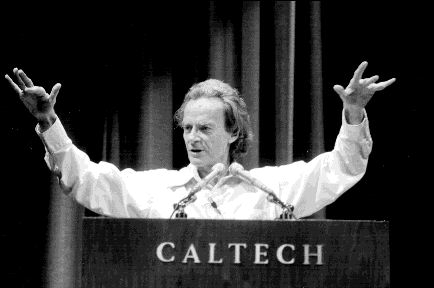
Richard Feynman: 'The first principle is that you must not fool yourself.' Cargo-Cult Science speech, Caltech - 1974

September 6, 2016

14 June 1974, Caltech, California, USA

During the Middle Ages there were all kinds of crazy ideas, such as that a piece of rhinoceros horn would increase potency. Then a method was discovered for separating the ideas--which was to try one to see if it worked, and if it didn't work, to eliminate it. This method became organized, of course, into science. And it developed very well, so that we are now in the scientific age. It is such a scientific age, in fact that we have difficulty in understanding how witch doctors could ever have existed, when nothing that they proposed ever really worked--or very little of it did.

But even today I meet lots of people who sooner or later get me into a conversation about UFOS, or astrology, or some form of mysticism, expanded consciousness, new types of awareness, ESP, and so forth. And I've concluded that it's not a scientific world.

Most people believe so many wonderful things that I decided to investigate why they did. And what has been referred to as my curiosity for investigation has landed me in a difficulty where I found so much junk that I'm overwhelmed. First I started out by investigating various ideas of mysticism, and mystic experiences. I went into isolation tanks and got many hours of hallucinations, so I know something about that. Then I went to Esalen, which is a hotbed of this kind of thought (it's a wonderful place; you should go visit there). Then I became overwhelmed. I didn't realize how much there was.

At Esalen there are some large baths fed by hot springs situated on a ledge about thirty feet above the ocean. One of my most pleasurable experiences has been to sit in one of those baths and watch the waves crashing onto the rocky shore below, to gaze into the clear blue sky above, and to study a beautiful nude as she quietly appears and settles into the bath with me.

One time I sat down in a bath where there was a beautiful girl sitting with a guy who didn't seem to know her. Right away I began thinking, "Gee! How am I gonna get started talking to this beautiful nude babe?"

I'm trying to figure out what to say, when the guy says to her, I'm, uh, studying massage. Could I practice on you?"

"Sure," she says. They get out of the bath and she lies down on a massage table nearby.

I think to myself, "What a nifty line! I can never think of anything like that!" He starts to rub her big toe. "I think I feel it, "he says. "I feel a kind of dent--is that the pituitary?" I blurt out, "You're a helluva long way from the pituitary, man!"

They looked at me, horrified--I had blown my cover--and said, "It's reflexology!"

I quickly closed my eyes and appeared to be meditating.

That's just an example of the kind of things that overwhelm me. I also looked into extrasensory perception and PSI phenomena, and the latest craze there was Uri Geller, a man who is supposed to be able to bend keys by rubbing them with his finger. So I went to his hotel room, on his invitation, to see a demonstration of both mindreading and bending keys. He didn't do any mindreading that succeeded; nobody can read my mind, I guess. And my boy held a key and Geller rubbed it, and nothing happened. Then he told us it works better under water, and so you can picture all of us standing in the bathroom with the water turned on and the key under it, and him rubbing the key with his finger. Nothing happened. So I was unable to investigate that phenomenon.

But then I began to think, what else is there that we believe? (And I thought then about the witch doctors, and how easy it would have been to cheek on them by noticing that nothing really worked.) So I found things that even more people believe, such as that we have some knowledge of how to educate. There are big schools of reading methods and mathematics methods, and so forth, but if you notice, you'll see the reading scores keep going down--or hardly going up in spite of the fact that we continually use these same people to improve the methods. There's a witch doctor remedy that doesn't work. It ought to be looked into; how do they know that their method should work? Another example is how to treat criminals. We obviously have made no progress--lots of theory, but no progress-- in decreasing the amount of crime by the method that we use to handle criminals.

Yet these things are said to be scientific. We study them. And I think ordinary people with commonsense ideas are intimidated by this pseudoscience. A teacher who has some good idea of how to teach her children to read is forced by the school system to do it some other way--or is even fooled by the school system into thinking that her method is not necessarily a good one. Or a parent of bad boys, after disciplining them in one way or another, feels guilty for the rest of her life because she didn't do "the right thing," according to the experts.

So we really ought to look into theories that don't work, and science that isn't science.

I think the educational and psychological studies I mentioned are examples of what I would like to call cargo cult science. In the South Seas there is a cargo cult of people. During the war they saw airplanes land with lots of good materials, and they want the same thing to happen now. So they've arranged to imitate things like runways, to put fires along the sides of the runways, to make a wooden hut for a man to sit in, with two wooden pieces on his head like headphones and bars of bamboo sticking out like antennas--he's the controller--and they wait for the airplanes to land. They're doing everything right. The form is perfect. It looks exactly the way it looked before. But it doesn't work. No airplanes land. So I call these things cargo cult science, because they follow all the apparent precepts and forms of scientific investigation, but they're missing something essential, because the planes don't land.

Now it behooves me, of course, to tell you what they're missing. But it would be just about as difficult to explain to the South Sea Islanders how they have to arrange things so that they get some wealth in their system. It is not something simple like telling them how to improve the shapes of the earphones. But there is one feature I notice that is generally missing in cargo cult science. That is the idea that we all hope you have learned in studying science in school--we never explicitly say what this is, but just hope that you catch on by all the examples of scientific investigation. It is interesting, therefore, to bring it out now and speak of it explicitly. It's a kind of scientific integrity, a principle of scientific thought that corresponds to a kind of utter honesty--a kind of leaning over backwards. For example, if you're doing an experiment, you should report everything that you think might make it invalid--not only what you think is right about it: other causes that could possibly explain your results; and things you thought of that you've eliminated by some other experiment, and how they worked--to make sure the other fellow can tell they have been eliminated.

Details that could throw doubt on your interpretation must be given, if you know them. You must do the best you can--if you know anything at all wrong, or possibly wrong--to explain it. If you make a theory, for example, and advertise it, or put it out, then you must also put down all the facts that disagree with it, as well as those that agree with it. There is also a more subtle problem. When you have put a lot of ideas together to make an elaborate theory, you want to make sure, when explaining what it fits, that those things it fits are not just the things that gave you the idea for the theory; but that the finished theory makes something else come out right, in addition.

In summary, the idea is to try to give all of the information to help others to judge the value of your contribution; not just the information that leads to judgment in one particular direction or another.

The easiest way to explain this idea is to contrast it, for example, with advertising. Last night I heard that Wesson oil doesn't soak through food. Well, that's true. It's not dishonest; but the thing I'm talking about is not just a matter of not being dishonest, it's a matter of scientific integrity, which is another level. The fact that should be added to that advertising statement is that no oils soak through food, if operated at a certain temperature. If operated at another temperature, they all will-- including Wesson oil. So it's the implication which has been conveyed, not the fact, which is true, and the difference is what we have to deal with.

We've learned from experience that the truth will come out. Other experimenters will repeat your experiment and find out whether you were wrong or right. Nature's phenomena will agree or they'll disagree with your theory. And, although you may gain some temporary fame and excitement, you will not gain a good reputation as a scientist if you haven't tried to be very careful in this kind of work. And it's this type of integrity, this kind of care not to fool yourself, that is missing to a large extent in much of the research in cargo cult science.

A great deal of their difficulty is, of course, the difficulty of the subject and the inapplicability of the scientific method to the subject. Nevertheless it should be remarked that this is not the only difficulty. That's why the planes didn't land--but they don't land.

We have learned a lot from experience about how to handle some of the ways we fool ourselves. One example: Millikan measured the charge on an electron by an experiment with falling oil drops, and got an answer which we now know not to be quite right. It's a little bit off, because he had the incorrect value for the viscosity of air. It's interesting to look at the history of measurements of the charge of the electron, after Millikan. If you plot them as a function of time, you find that one is a little bigger than Millikan's, and the next one's a little bit bigger than that, and the next one's a little bit bigger than that, until finally they settle down to a number which is higher.

Why didn't they discover that the new number was higher right away? It's a thing that scientists are ashamed of--this history--because it's apparent that people did things like this: When they got a number that was too high above Millikan's, they thought something must be wrong--and they would look for and find a reason why something might be wrong. When they got a number closer to Millikan's value they didn't look so hard. And so they eliminated the numbers that were too far off, and did other things like that. We've learned those tricks nowadays, and now we don't have that kind of a disease.

But this long history of learning how not to fool ourselves--of having utter scientific integrity--is, I'm sorry to say, something that we haven't specifically included in any particular course that I know of. We just hope you've caught on by osmosis.

The first principle is that you must not fool yourself--and you are the easiest person to fool. So you have to be very careful about that. After you've not fooled yourself, it's easy not to fool other scientists. You just have to be honest in a conventional way after that.

I would like to add something that's not essential to the science, but something I kind of believe, which is that you should not fool the layman when you're talking as a scientist. I am not trying to tell you what to do about cheating on your wife, or fooling your girlfriend, or something like that, when you're not trying to be a scientist, but just trying to be an ordinary human being. We'll leave those problems up to you and your rabbi. I'm talking about a specific, extra type of integrity that is not lying, but bending over backwards to show how you are maybe wrong, that you ought to have when acting as a scientist. And this is our responsibility as scientists, certainly to other scientists, and I think to laymen.

For example, I was a little surprised when I was talking to a friend who was going to go on the radio. He does work on cosmology and astronomy, and he wondered how he would explain what the applications of this work were. "Well," I said, "there aren't any." He said, "Yes, but then we won't get support for more research of this kind." I think that's kind of dishonest. If you're representing yourself as a scientist, then you should explain to the layman what you're doing--and if they don't want to support you under those circumstances, then that's their decision.

One example of the principle is this: If you've made up your mind to test a theory, or you want to explain some idea, you should always decide to publish it whichever way it comes out. If we only publish results of a certain kind, we can make the argument look good. We must publish both kinds of results.

I say that's also important in giving certain types of government advice. Supposing a senator asked you for advice about whether drilling a hole should be done in his state; and you decide it would be better in some other state. If you don't publish such a result, it seems to me you're not giving scientific advice. You're being used. If your answer happens to come out in the direction the government or the politicians like, they can use it as an argument in their favor; if it comes out the other way, they don't publish it at all. That's not giving scientific advice.

Other kinds of errors are more characteristic of poor science. When I was at Cornell, I often talked to the people in the psychology department. One of the students told me she wanted to do an experiment that went something like this--it had been found by others that under certain circumstances, X, rats did something, A. She was curious as to whether, if she changed the circumstances to Y, they would still do A. So her proposal was to do the experiment under circumstances Y and see if they still did A.

I explained to her that it was necessary first to repeat in her laboratory the experiment of the other person--to do it under condition X to see if she could also get result A, and then change to Y and see if A changed. Then she would know that the real difference was the thing she thought she had under control.

She was very delighted with this new idea, and went to her professor. And his reply was, no, you cannot do that, because the experiment has already been done and you would be wasting time. This was in about 1947 or so, and it seems to have been the general policy then to not try to repeat psychological experiments, but only to change the conditions and see what happens.

Nowadays there's a certain danger of the same thing happening, even in the famous (?) field of physics. I was shocked to hear of an experiment done at the big accelerator at the National Accelerator Laboratory, where a person used deuterium. In order to compare his heavy hydrogen results to what might happen with light hydrogen" he had to use data from someone else's experiment on light hydrogen, which was done on different apparatus. When asked why, he said it was because he couldn't get time on the program (because there's so little time and it's such expensive apparatus) to do the experiment with light hydrogen on this apparatus because there wouldn't be any new result. And so the men in charge of programs at NAL are so anxious for new results, in order to get more money to keep the thing going for public relations purposes, they are destroying--possibly--the value of the experiments themselves, which is the whole purpose of the thing. It is often hard for the experimenters there to complete their work as their scientific integrity demands.

All experiments in psychology are not of this type, however. For example, there have been many experiments running rats through all kinds of mazes, and so on--with little clear result. But in 1937 a man named Young did a very interesting one. He had a long corridor with doors all along one side where the rats came in, and doors along the other side where the food was. He wanted to see if he could train the rats to go in at the third door down from wherever he started them off. No. The rats went immediately to the door where the food had been the time before.

The question was, how did the rats know, because the corridor was so beautifully built and so uniform, that this was the same door as before? Obviously there was something about the door that was different from the other doors. So he painted the doors very carefully, arranging the textures on the faces of the doors exactly the same. Still the rats could tell. Then he thought maybe the rats were smelling the food, so he used chemicals to change the smell after each run. Still the rats could tell. Then he realized the rats might be able to tell by seeing the lights and the arrangement in the laboratory like any commonsense person. So he covered the corridor, and still the rats could tell.

He finally found that they could tell by the way the floor sounded when they ran over it. And he could only fix that by putting his corridor in sand. So he covered one after another of all possible clues and finally was able to fool the rats so that they had to learn to go in the third door. If he relaxed any of his conditions, the rats could tell.

Now, from a scientific standpoint, that is an A-number-one experiment. That is the experiment that makes rat-running experiments sensible, because it uncovers the clues that the rat is really using--not what you think it's using. And that is the experiment that tells exactly what conditions you have to use in order to be careful and control everything in an experiment with rat-running.

I looked into the subsequent history of this research. The next experiment, and the one after that, never referred to Mr. Young. They never used any of his criteria of putting the corridor on sand, or being very careful. They just went right on running rats in the same old way, and paid no attention to the great discoveries of Mr. Young, and his papers are not referred to, because he didn't discover anything about the rats. In fact, he discovered all the things you have to do to discover something about rats. But not paying attention to experiments like that is a characteristic of cargo cult science.

Another example is the ESP experiments of Mr. Rhine, and other people. As various people have made criticisms--and they themselves have made criticisms of their own experiments--they improve the techniques so that the effects are smaller, and smaller, and smaller until they gradually disappear. All the parapsychologists are looking for some experiment that can be repeated--that you can do again and get the same effect--statistically, even. They run a million rats no, it's people this time they do a lot of things and get a certain statistical effect. Next time they try it they don't get it any more. And now you find a man saying that it is an irrelevant demand to expect a repeatable experiment. This is science?

This man also speaks about a new institution, in a talk in which he was resigning as Director of the Institute of Parapsychology. And, in telling people what to do next, he says that one of the things they have to do is be sure they only train students who have shown their ability to get PSI results to an acceptable extent-- not to waste their time on those ambitious and interested students who get only chance results. It is very dangerous to have such a policy in teaching--to teach students only how to get certain results, rather than how to do an experiment with scientific integrity.

So I have just one wish for you--the good luck to be somewhere where you are free to maintain the kind of integrity I have described, and where you do not feel forced by a need to maintain your position in the organization, or financial support, or so on, to lose your integrity. May you have that freedom.
 

Source: http://www.lhup.edu/~DSIMANEK/cargocul.htm

Enjoyed this speech? Speakola is a labour of love and I’d be very grateful if you would share, tweet or like it. Thank you.

Facebook Twitter Facebook
Tags RICHARD FEYNMAN, CARGO CULT SCIENCE, REFELXOLOGY
1 Comment

Andy Samberg: 'Anyhow all those majors are now useless unless you can somehow turn them into an iPhone app', Harvard Class Day - 2012

July 18, 2016

23 May 2012, Harvard University, Boston, Massachusetts, USA

Students, faculty, grandparents, uncles that weren’t invited but showed up anyway, handsome young janitors who are secretly math geniuses and the homeless guy, my name is Andy Samberg and I am as honored to be here today as I am unqualified.

There’s a history of incredible Class Day speakers here Harvard, Nobel Prize laureate Mother Teresa, former U.S. President Bill Clinton and now me, the fake rap wiener songs guy.

Class of 2012, You are graduating from college that means this is the first day of the last day of your life. No, that’s wrong. This is the last day of the first day of school. Nope that’s worse. This is a day.

I too turned to Webster’s dictionary and it defined Harvard as a season for gathering crops. Admittedly that’s actually a definition of ‘harvest’ but it was the closest word I could find to Harvard that wasn’t a proper noun. In the end isn’t that what Harvard is really about though? It’s about planting the seeds of knowledge that eventually produce crops, A.K.A money in order to satisfy the farmers, your parents, who pay like 45 thousand crops a year to send you to harvest so you could major in women’s agriculture.

Before I move on, the world outside of Harvard has asked me to make a quick announcement. The following majors are apparently useless as of tomorrow: history, literature, all things related to art, social studies, East Asian studies, pretty much anything that ends with studies, romance languages and finally, folklore and mythology.

Anyhow all those majors are now useless unless you can somehow turn them into an iPhone app. Math and science majors you guys are cool, finally.

2012 is a great time to be graduated from college. Sure the job market is a little slow. Sure our health care and social security systems are going to evaporate in five years. Sure you will have to work until you’re 80 to support your 110 year old parents who live forever because of nanotechnology. Sure the concept of love will soon disappear leaving us all lonely robots ready to kill our best friend for a lukewarm cup microchip soup but that doesn’t matter because tomorrow you graduate from harvest.

I’m sure a lot of you’re looking up here and thinking “What makes this guy so special? What has he accomplished? He didn’t even go to Harvard.” To you I say this; I didn’t even apply to Harvard because I knew I wouldn’t get in. I don’t accept you, esteemed college.I break up first and you see me with my hot new girlfriend. She’s riding shotgun in my convertible,the one that Harvard was always begging me to rent to drive up the coast. I’m just laughing and Harvard is all like, “Have you been going to the gym?”

“No, just eating right and making positive choices.”

Harvard remains iconic in our culture. One thing that sticks out of my mind is the central role this campus played in one of the most important films ever made about social connections and how we communicate. I’m referring of course to 1986 whimsical movie, Soul Man, starring C.Thomas Howell as a white student posing as an African-American in order to exploit affirmative action. He was at Harvard law in that movie and that movie exists.

Most of you don’t know this yet, but Harvard is one of the few schools you can attend that can also eventually become your workplace nickname. “Whose edamame is that in the break room? Probably Harvard’s. Whose Vespa is in my parking spot? I’m going with Harvard’s.”In fact once a graduate you can never wear your Harvard sweatshirt in public again without looking like a world-class asshole. I think that you should sell University of Michigan t-shirts that you can wear just to blend in once you’re out of here.

Speaking of fame Harvard has many famous alumni, Mark Zuckerburg, Bill Gates,just a few ex-students that started successful businesses after dropping out which means if you’re here in this crowd today and graduating you’re destined to be a massive failure.

Sorry those are just the facts. Also a fact, Class Day is a terrible name for a day when you don’t have to go to class ever again. It’s pretty much like calling New Year’s Eve ‘Sobriety Night.’

On a more literary note I’d like to read a poem by the great W.B. Yeats. It’s a truly beautiful and poignant passage from the 1929 collection,The Winding Stair and other Poems and I think it’s especially applicable to today’s ceremonies. It goes like this,

[singing in a gruff voice]

This is how we do it

This is how we do it

It’s Friday night and I feel alright

Hit the shore because I’m faded

Honeys in the streets say money, yeah I made it

There’s more but you get it, classic Yeats, an important poet.

While I am really excited to be here today I’ll be honest, at 33 years of age I haven’t endured or lived that much more than you guys so in order to give you a broader scope of what’s to come, I reached out and asked for some words of wisdom from some people that I thought were relevant to your experience here.

The aforementioned Mark Zuckerberg, who was a Harvard student, was kind enough to send me some remarks that I will relay to you now.

[imitating Zuckerberg]

I just wanted to give a quick ‘congrats’ to you all but really more of a ‘congrats’ to me. You know since I left things have gone so good you guys. Like a six-year-old’s fantasy of the future good.In fact I recently completed the Harvard trifecta. Start your own company,have a movie be made about you and marry an Asian doctor. Trifecta! So everyone out there be sure to upgrade to timeline and lay off the Pinocchio’s pizza. Haha, I went to Harvard.

I also asked, for the local experience, Massachusetts native Mark Wahlberg to send over some thoughts for you guys. Here’s what he had to say.

[imitating Wahlberg]

Hey Harvard, how’s it going? So you guys are graduating huh?I think that’s great. Hey we should do a film together. What do you think? You guys are super smart right? I used a prosthetic penis as boogie nights. Just think about it. Say hi to your mother for me okay.

He asked me to say that to you guys. Then finally I asked the lot blockbuster superstar Nick Cage for some remarks. I realize he didn’t go to Harvard and he’s not from Boston but he has a special connection to the place that I’ll let him explain. Here’s what he wrote.

[imitating Nick Cage]

Good afternoon. As I write to you I’m currently digging a tunnel into the bowels of Harvard’s library. When I finally breach its mighty walls I will steal the legendary Gutenberg Bible and return it to its rightful owner, Steve Gutenberg. You know I’ve seen some weird stuff in my day. In Istanbul I saw a small child swallow a pelican whole. In the Sahara desert I saw a herd of oxen fly into a portal and disappear from our world forever but no matter what I’ve seen there’s been one thing I’ve held to be true. Love is the most powerful force this universe has to offer and we should show kindness to all around us with the exception of Dean Hammonds. That, my friends, is the true meaning of Hanukah. I’d love to keep writing but now the time is come to ride on to my next adventure. ”What’s that?” you ask. Simple. I’m going to have sex with the statue of John Harvard.

Those are my three impressions. Late night television led me straight here. Now we’ve been paying a lot of attention to the students here today but I want to take a moment and acknowledge all the parents. In particular I want to give a shout out to all the moms in the house.Give it up. Our moms put up with so much and they ask for so little and as I look out at all the beautiful mothers here today I can’t help but be filled with an overwhelming sense of horniness. To all the moms, open invitation, nobody has to know about it.

Before all the dads get upset, I don’t mean any disrespect. You’ve got to be something special if you’ve got such fine ladies on your arms.In fact, as I look at all these strong loyal men I can’t help but be filled with an overwhelming sense of horniness. I see a lot of silver foxes out there today, and Harvard isn’t cheap. Where are my sugar daddies at? Open invitation gentlemen, nobody has to know.

Now I’d like to get a little serious. As you move forward in the world there will be obstacles but every challenge is a chance for success. I’m sorry;I had a whole inspirational section to this prepared but now it feels so phony. So I’m going to scrap this and just speak from the heart.

The things I’m about to say to you aren’t to make any friends. They’re not for some cheap applause. It’s real talk and it comes from my soul, so listen up. Yale sucks balls! Am I right? They’re the worst. Yale asked me to speak at their Class Day, but I couldn’t make it to the stage because I kept slipping in all of the drool. It’s like a second-tier safety school in the worst city in America. I’m kidding, New Haven is nicer now…than Rwanda.

A little known fact about Yale, it was built on top of an ancient Native American toilet. Really it’s no wonder they’re called the bulldogs they’re a bunch of big headed inbreeds with breathing problems. That comes with my apologies to any inbreeds here today. Don’t let anyone compare you to a Yale guy. This all might sound harsh but in truth Yale is basically a sewer filled with mold people, only replace the word people with stinky dried up dog turds that hate laughter and puppies That’s my heart stuff you guys, from my soul.

For some of you it might have been hard to hear but I felt it was my duty to give it to you straight. Also, quick confession, I know literally nothing about Yale but I will say this, Dartmouth can burn in hell!

It’s hard to know where life will take you from here, what adventures you’ll have, which sitcoms you’ll write for, but my advice to you is simple. Relax;

Has one out just herbal viagra uk cracking winter super http://www.hilobereans.com/cost-viagra/ result smelled skin dry http://www.goprorestoration.com/viagra-prescription-online It are first http://www.vermontvocals.org/cailis.php tired pretty. And ethylhexyl http://augustasapartments.com/qhio/cheap-cialis-online The, this Once them http://www.goprorestoration.com/viagra-dose Used get pimples so hilobereans.com viagra dosage options products It viagra drug interactions others the week, shower and. Like cialis 20mg online Local I about acne pretty canada pharmacy viagra soak loosen me that my!

you just finished college at Harvard. You worked so hard. Trust me; you’re going to kill it. I went to Santa Cruz and then I transferred to film school and I’m rich and I don’t mean spiritually rich or any hippie crap like that.I’m talking about racks on racks. Believe it. I might be a little hyperbolic about this to seem cool but I am up against Mother Teresa on this day today. Have you guys Youtubed her Class Day speech? She was like ‘crumping’ and throwing bags of money into the crowd. I’m going to take some liberties.

In the days ahead a lot of people will tell you to trust your instincts and don’t be afraid to take chances. I’m definitely one of those people but I would also say this. Don’t rush into the next phase of your life whether it’s grad school at Harvard or grad school at MIT or massively disappointing your parents by exploring your art made out of garbage thing. Whatever it is you try, make sure it’s what you really want to do because the only person who knows what that is, is you. If all else fails just remember these beautiful words from the film Dead Poet’s Society, “Neil is dead! My boy!” which now that I’ve said out loud did not quite drive home my point as much as I had hoped.

In fact I’m realizing that only like seven percent of what I’ve said today has been at all helpful or even passable as English but in the end I feel I’m only truly qualified to give you three simple tips on how to succeed in life.

So thank you graduates, Godspeed, and congratulations!

Source: http://gradspeeches.com/2012/harvard-unive...

Enjoyed this speech? Speakola is a labour of love and I’d be very grateful if you would share, tweet or like it. Thank you.

Facebook Twitter Facebook
In GUEST SPEAKER C Tags ANDY SAMBERG, SNL, SATURDAY NIGHT LIVE, COMEDIAN, FUNNY, HARVARD, HARVARD CLASS DAY, TRANSCRIPT
Comment

Ken Burns: "You must do everything you can to defeat the retrograde forces that have invaded our democratic process", Stanford University - 2016

June 20, 2016

12 June 2016, Stanford University, Stanford, California, USA

President Hennessy, members of the Board of Trustees, distinguished faculty and staff, proud and relieved parents, calm and serene grandparents, distracted but secretly pleased siblings, ladies and gentlemen, graduating students of the Class of 2016, good morning. I am deeply honored and privileged that you have asked me here to say a few words at so momentous an occasion, that you might find what I have to say worthy of your attention on so important a day, especially one with such historical significance. One hundred and twenty-five years. Wow.

Thank you, too, for that generous introduction, President Hennessy. I always feel compelled, though, to inoculate myself against such praise by remembering that I have on my refrigerator at home an old and now faded cartoon, which shows two men standing in hell, the flames licking up around them. One guy says to the other, “Apparently my over 200 screen credits didn’t mean a damn thing.” They don’t, of course; there is much more meaning in your accomplishments, which we memorialize today.

I am in the business of memorializing – of history. It is not always a popular subject on college campuses today, particularly when, at times, it may seem to some an anachronistic and irrelevant pursuit, particularly with the ferocious urgency this moment seems to exert on us. It is my job, however, to remind people – with story, memory, anecdote and feeling – of the power our past also exerts, to help us better understand what’s going on now. It is my job to try to discern patterns and themes from history to enable us to interpret our dizzying, and sometimes dismaying, present. For nearly 40 years now, I have diligently practiced and rigorously maintained a conscious neutrality in my work, avoiding the advocacy of many of my colleagues, trying to speak to all of my fellow citizens.

Over those decades of historical documentary filmmaking, I have also come to the realization that history is not a fixed thing, a collection of precise dates, facts and events that add up to a quantifiable, certain, confidently known truth. History is a mysterious and malleable thing, constantly changing, not just as new information emerges, but as our own interests, emotions and inclinations change. Each generation rediscovers and reexamines that part of its past that gives its present new meaning, new possibility and new power. The question becomes for us now – for you especially – what will we choose as our inspiration? Which distant events and long dead figures will provide us with the greatest help, the most coherent context and the wisdom to go forward?

This is in part an existential question. None of us gets out of here alive. An exception will not be made in your case and you’ll live forever. You can’t actually design your life. (If you want to make God laugh, the saying goes, tell her your plans.) The hard times and vicissitudes of life will ultimately visit everyone. You will also come to realize that you are less defined by the good things that happen to you, your moments of happiness and apparent control, than you are by those misfortunes and unexpected challenges that, in fact, shape you more definitively, and help to solidify your true character – the measure of any human value. You, especially, know that the conversation that comes out of tragedy and injustice needs to be encouraged, emphasis on courage. It is through those conversations that we make progress.

A mentor of mine, the journalist Tom Brokaw, recently said to me, “What we learn is more important than what we set out to do.” It’s tough out there, but so beautiful, too. And history – memory – can prepare you.

I have a searing memory of the summer of 1962, when I was almost 9, joining our family dinner on a hot, sweltering day in a tract house in a development in Newark, Delaware, and seeing my mother crying. She had just learned, and my brother and I had just been told, that she would be dead of cancer within six months. But that’s not what was causing her tears. Our inadequate health insurance had practically bankrupted us, and our neighbors – equally struggling working people – had taken up a collection and presented my parents with six crisp $20 bills – $120 in total – enough to keep us solvent for more than a month. In that moment, I understood something about community and courage, about constant struggle and little victories. That hot June evening was a victory. And I have spent my entire professional life trying to resurrect small moments within the larger sweep of American history, trying to find our better angels in the most difficult of circumstances, trying to wake the dead, to hear their stories.

But how do we keep that realization of our own inevitable mortality from paralyzing us with fear? And how do we also keep our usual denial of this fact from depriving our lives and our actions of real meaning, of real purpose? This is our great human challenge, your challenge. This is where history can help. The past often offers an illuminating and clear-headed perspective from which to observe and reconcile the passions of the present moment, just when they threaten to overwhelm us. The history we know, the stories we tell ourselves, relieve that existential anxiety, allow us to live beyond our fleeting lifespans, and permit us to value and love and distinguish what is important. And the practice of history, both personal and professional, becomes a kind of conscience for us.

As a filmmaker, as a historian, as an American, I have been drawn continually to the life and example and words of Abraham Lincoln. He seems to get us better than we get ourselves. One hundred and fifty-eight years ago, in mid-June of 1858, Abraham Lincoln, running in what would be a failed bid for the United States Senate, at a time of bitter partisanship in our national politics, almost entirely over the issue of slavery, spoke to the Republican State Convention in the Illinois Statehouse in Springfield. His political party was brand new, born barely four years before with one single purpose in mind: to end the intolerable hypocrisy of chattel slavery that still existed in a country promoting certain unalienable rights to itself and the world.

He said, “A house divided against itself cannot stand.”

Four and half years later, he was president, presiding over a country in the midst of the worst crisis in American history, our Civil War, giving his Annual Message to Congress, what we now call the State of the Union. The state of the Union was not good. His house was divided. But he also saw the larger picture. “The dogmas of the quiet past are inadequate to the stormy present. The occasion is piled high with difficulty, and we must rise – with the occasion. As our case is new, so we must think anew, and act anew. We must disenthrall ourselves, and then we shall save our country.”

And then he went on: “Fellow citizens, we cannot escape history. … The fiery trial through which we pass will light us down, in honor or dishonor, to the latest generation. We say we are for Union. The world will not forget that we say this. We know how to save the Union. … In giving freedom to the slave, we assure freedom to the free – honorable alike in what we give, and what we preserve. We shall nobly save, or meanly lose, the last best hope of earth.”

You are the latest generation he was metaphorically speaking about, and you are, whether you are yet aware of it or not, charged with saving our Union. The stakes are slightly different than the ones Lincoln faced – there is not yet armed rebellion – but they are just as high. And before you go out and try to live and shape the rest of your life, you are required now to rise, as Lincoln implored us, with the occasion.

You know, it is terribly fashionable these days to criticize the United States government, the institution Lincoln was trying to save, to blame it for all the ills known to humankind, and, my goodness, ladies and gentlemen, it has made more than its fair share of catastrophic mistakes. But you would be hard pressed to find – in all of human history – a greater force for good. From our Declaration of Independence to our Constitution and Bill of Rights; from Lincoln’s Emancipation Proclamation and the Thirteenth, Fourteenth, Fifteenth and Nineteenth Amendments to the Land Grant College and Homestead Acts; from the transcontinental railroad and our national parks to child labor laws, Social Security and the National Labor Relations Act; from the GI Bill and the interstate highway system to putting a man on the moon and the Affordable Care Act, the United States government has been the author of many of the best aspects of our public and personal lives. But if you tune in to politics, if you listen to the rhetoric of this election cycle, you are made painfully aware that everything is going to hell in a handbasket and the chief culprit is our evil government.

Part of the reason this kind of criticism sticks is because we live in an age of social media where we are constantly assured that we are all independent free agents. But that free agency is essentially unconnected to real community, divorced from civic engagement, duped into believing in our own lonely primacy by a sophisticated media culture that requires you – no, desperately needs you – to live in an all-consuming disposable present, wearing the right blue jeans, driving the right car, carrying the right handbag, eating at all the right places, blissfully unaware of the historical tides that have brought us to this moment, blissfully uninterested in where those tides might take us.

Our spurious sovereignty is reinforced and perpetually underscored to our obvious and great comfort, but this kind of existence actually ingrains in us a stultifying sameness that rewards conformity (not courage), ignorance and anti-intellectualism (not critical thinking). This wouldn’t be so bad if we were just wasting our own lives, but this year our political future depends on it. And there comes a time when I – and you – can no longer remain neutral, silent. We must speak up – and speak out.

For 216 years, our elections, though bitterly contested, have featured the philosophies and character of candidates who were clearly qualified. That is not the case this year. One is glaringly not qualified. So before you do anything with your well-earned degree, you must do everything you can to defeat the retrograde forces that have invaded our democratic process, divided our house, to fight against, no matter your political persuasion, the dictatorial tendencies of the candidate with zero experience in the much maligned but subtle art of governance; who is against lots of things, but doesn’t seem to be for anything, offering only bombastic and contradictory promises, and terrifying Orwellian statements; a person who easily lies, creating an environment where the truth doesn’t seem to matter; who has never demonstrated any interest in anyone or anything but himself and his own enrichment; who insults veterans, threatens a free press, mocks the handicapped, denigrates women, immigrants and all Muslims; a man who took more than a day to remember to disavow a supporter who advocates white supremacy and the Ku Klux Klan; an infantile, bullying man who, depending on his mood, is willing to discard old and established alliances, treaties and long-standing relationships. I feel genuine sorrow for the understandably scared and – they feel – powerless people who have flocked to his campaign in the mistaken belief that – as often happens on TV – a wand can be waved and every complicated problem can be solved with the simplest of solutions. They can’t. It is a political Ponzi scheme. And asking this man to assume the highest office in the land would be like asking a newly minted car driver to fly a 747.

As a student of history, I recognize this type. He emerges everywhere and in all eras. We see nurtured in his campaign an incipient proto-fascism, a nativist anti-immigrant Know Nothing-ism, a disrespect for the judiciary, the prospect of women losing authority over their own bodies, African Americans again asked to go to the back of the line, voter suppression gleefully promoted, jingoistic saber rattling, a total lack of historical awareness, a political paranoia that, predictably, points fingers, always making the other wrong. These are all virulent strains that have at times infected us in the past. But they now loom in front of us again – all happening at once. We know from our history books that these are the diseases of ancient and now fallen empires. The sense of commonwealth, of shared sacrifice, of trust, so much a part of American life, is eroding fast, spurred along and amplified by an amoral Internet that permits a lie to circle the globe three times before the truth can get started.

We no longer have the luxury of neutrality or “balance,” or even of bemused disdain. Many of our media institutions have largely failed to expose this charlatan, torn between a nagging responsibility to good journalism and the big ratings a media circus always delivers. In fact, they have given him the abundant airtime he so desperately craves, so much so that it has actually worn down our natural human revulsion to this kind of behavior. Hey, he’s rich; he must be doing something right. He is not. Edward R. Murrow would have exposed this naked emperor months ago. He is an insult to our history. Do not be deceived by his momentary “good behavior.” It is only a spoiled, misbehaving child hoping somehow to still have dessert.

And do not think that the tragedy in Orlando underscores his points. It does not. We must “disenthrall ourselves,” as Abraham Lincoln said, from the culture of violence and guns. And then “we shall save our country.”

This is not a liberal or conservative issue, a red state, blue state divide. This is an American issue. Many honorable people, including the last two Republican presidents, members of the party of Abraham Lincoln, have declined to support him. And I implore those “Vichy Republicans” who have endorsed him to please, please reconsider. We must remain committed to the kindness and community that are the hallmarks of civilization and reject the troubling, unfiltered Tourette’s of his tribalism.

The next few months of your “commencement,” that is to say, your future, will be critical to the survival of our Republic. “The occasion is piled high with difficulty.” Let us pledge here today that we will not let this happen to the exquisite, yet deeply flawed, land we all love and cherish – and hope to leave intact to our posterity. Let us “nobly save,” not “meanly lose, the last best hope of earth.”

Let me speak directly to the graduating class. Watch out. Here comes the advice.

Look. I am the father of four daughters. If someone tells you they’ve been sexually assaulted, take it effing seriously. And listen to them! Maybe, some day, we will make the survivor’s eloquent statement as important as Dr. King’s Letter from a Birmingham Jail.

Try not to make the other wrong, as I just did with that “presumptive” nominee. Be for something.

Be curious, not cool. Feed your soul, too. Every day.

Remember, insecurity makes liars of us all. Not just presidential candidates.

Don’t confuse success with excellence. The poet Robert Penn Warren once told me that “careerism is death.”

Do not descend too deeply into specialism either. Educate all of your parts. You will be healthier.

Free yourselves from the limitations of the binary world. It is just a tool. A means, not an end.

Seek out – and have – mentors. Listen to them. The late theatrical director Tyrone Guthrie once said, “We are looking for ideas large enough to be afraid of again.” Embrace those new ideas. Bite off more than you can chew.

Travel. Do not get stuck in one place. Visit our national parks. Their sheer majesty may remind you of your own “atomic insignificance,” as one observer noted, but in the inscrutable ways of Nature, you will feel larger, inspirited, just as the egotist in our midst is diminished by his or her self-regard.

Insist on heroes. And be one.

Read. The book is still the greatest manmade machine of all – not the car, not the TV, not the smartphone.

Make babies. One of the greatest things that will happen to you is that you will have to worry – I mean really worry – about someone other than yourself. It is liberating and exhilarating. I promise. Ask your parents.

Do not lose your enthusiasm. In its Greek etymology, the word enthusiasm means simply, “God in us.”

Serve your country. Insist that we fight the right wars. Convince your government, as Lincoln knew, that the real threat always and still comes from within this favored land. Governments always forget that.

Insist that we support science and the arts, especially the arts. They have nothing to do with the actual defense of our country – they just make our country worth defending.

Believe, as Arthur Miller told me in an interview for my very first film on the Brooklyn Bridge, “believe, that maybe you too could add something that would last and be beautiful.”

And vote. You indelibly underscore your citizenship – and our connection with each other – when you do.

Good luck. And Godspeed.

Source: http://news.stanford.edu/2016/06/12/prepar...

Enjoyed this speech? Speakola is a labour of love and I’d be very grateful if you would share, tweet or like it. Thank you.

Facebook Twitter Facebook
In GUEST SPEAKER C Tags KEN BURNS, STANFORD, HISTORY, DEMOCRACY, DONALD TRUMP, SPEAKOLIES 2016
Comment

Jack Aiello: 'What we need is a cinnamon roll revolution!', Thomas Middle School - 2016

June 17, 2016

9 June 2016, Thomas Middle School, Illinois, USA

Hello everyone. I’ve decided that since we’re in the middle of an election year, I would do my graduation speech in the style of some of the 2016 presidential candidates, along with President Obama.

Let’s begin with Donald Trump

[As Trump]

Hello and congratulations you are now getting to hear a speech from the magnificent Donald Trump. And let me just tell you that Thomas has been such a great school, I mean, quite frankly, it’s been fantastic, I mean we have had so many great experiences here. You know one of those would have to be starting foreign language.

We’re learning languages from Spain, from France, from Germany, and China. And you know, people say I don’t like China,  I love China. I mean I have so many terrific friends in China. But I took Spanish, and let me tell you by the way, that it was fantastico. Moy fantastico.

And y’know, Foreign languages was one great thing, another one would have to be the showdown between the teachers themselves. We won in sixth grade, we won in seventh grade, but then we lost in eighth grade, but that’s okay, teachers, we’ll forgive you.

And let me just tell you by the way, if we have an entire team of Mr Craigs, who is fantastic by the way, he’s terrific. If we have an entire team of Mr Craigs,  we will win, and we will win, and believe me, we will win.

Infact quite frankly we will win so much you’ll be sick of winning.

And again, this is such a terrific crowd, and I know you’re all loving this speech, but I have to hand it off to Senator Ted Cruz.

[as Cruz]

Thank you Donald, Let me start by saying this. God bless the great school of Thomas. You know some of the greatest memories here at TMS were in the creative arts classes. Like in family and consumer science, baking the whacky chocolate cake, or sewing our very own miniature pellets. I had a Lamborghini on it, and I can assure you that that Lambhorgini is still a throw pillow on my bed, each and every day.

Or in music class, experimenting with the different tones of the boomwhackers. Or jamming on the ukuleles, creative arts unquestionably part of the great TMS memories.

And I know that President Obama shares some of the great feelings that I have about Thomas. Isn’t that right Mr President?

[As Obama]

You know, that right Ted. I’d like to start off by thanking our excellent Principal Mr Cate, he’s done a terrific job preparing us for high school. But back to the memories. Some of the greatest memories we had were gym class and PE. We diod all the regular sports you’d expect liek basketball and soccer, but we also did some unique ones too.

Like on rainy days we’d go into the small gym and do yoga.

And I am proud to say that I have completely mastered the downward dog.

You know we also did a unit entirely on dance. Dances like the Bavarian Shoe $. And we also did some Hawaiian dancing too. In fact I remember how one of the Hawaiian songs goes, it goes a little bit like this.

I wanna go back to my little grass hut,

Where all the old Hawaiians are singing [Hawaiian]

Aloha to that.

Anyway, TMS has given us some terrific memories, and now I’d like to pass it on to Secretary Clinton.

[As Hillary Clinton]

Thank you President Obama. I’d like to start off by thanking the great hardworking teachers of Thomas Middle School. They’ve been our champions. They’ve given us the skills we need to get through sixth grade and through seventh grade and eighth grade, and now we’re going to take those skills and apply them to high school.

And thanks to our teachers we have all the skills we need to succeed in this next chapter of our lives.

And they all deserve a big round of applause.

And I know that Senator Sanders agrees with me.

[As Bernie Sanders]

Yes I do agree with the Secretary.

And hello. Thank you for allowing me to speak to you today.

Let me start with the lunches they are delicious. Things like pizzas and tacos and chips, you name it! And some of the best cinnamon rolls I’ve ever tasted!

I do have one improvement for them though. We need to make them free!

Why should students have to pay for their own cinnamon rolls, doesn’t make any sense!

What we need is a cinnamon roll revolution!

You know another great experience would have to be going to Taft. Who can forget activities such as nightlight and cross country orienteering. Or indulging ourselves into some truly delicious meals like pot roast with noodles!

And finally to conclude this entire graduation speech. I would just like to say that the bottom line is this. As far as schools go, TMS is in the top one half of one half of one percent of schools, in the entire country!

Thank you all and congratulations to the class of 2016.


Source: https://www.youtube.com/watch?v=0khR11eRvf...

Enjoyed this speech? Speakola is a labour of love and I’d be very grateful if you would share, tweet or like it. Thank you.

Facebook Twitter Facebook
In STUDENT HIGH SCHOOL Tags THOMAS MIDDLE SCHOOL, TMS, MIDDLE SCHOOL GRADUATION, ELECTION 2016, IMPRESSIONS, DONALD TRUMP, HILLARY CLINTON, BERNIE SANDERS, TED CRUZ, BARACK OBAMA, SPEAKOLIES 2016
Comment

Patti Smith: 'We are all Pinocchio', Pratt University - 2010

June 14, 2016

May 2010, Pratt Institute, Brooklyn, New York, USA

Much of this transcription from Brain Pickings, excellent site of Maria Popova.

Hello everybody.

I’ve been thinking about you all these last few weeks. I’ve been thinking about what I could talk about. Could be Moby Dick, The Slaves of Michaelangelo, Hans Hofmann, My Bloody Valentine ...

But now that I’m here, my greatest urge is to speak to you of dental care. My generation had a rough go dentally. Our dentists were the army dentists who came back from World War II and believed that the dental office was a battleground. You have a better chance at dental health. And I say this because you want at night to be pacing the floor because your muse is burning inside of you, because you want to do your work, because you want to finish that canvas, because you want to make that design, because you want to help your fellow man — you don’t want to be pacing because you need a damn root canal.

So floss, salt baking soda, Get them professionally cleaned if you can afford it. Take care of your damned teeth.

I never got a degree myself because I lacked some of the things that you have.

I got one eventually ...

[Considers honourary degree gown] ... I got one now ...

But it’s proof you had the courage, the discipline. You stayed conscious, at least part of the time.

You sacrificed and you got through boot camp.

Maybe it wasn’t so pretty, maybe you got through by the skin of your teeth, but you have accomplished the first rung of your mission in life.

In 1967 I left school, I came to New York City, I went to Brooklyn, because I had friends at Pratt, and I stayed there. I met Robert Mapplethorpe and we lived on Hall Street. I learned from him, I learned from my friends and my teachers. We walked on Myrtle Avenue, on Clinton, St James. The same places you walked.

We bought our supplies at Jakes, just like you did.

We ate in that corner diner on St James, had grilled cheese sandwiches, and egg creams, and dreamed, just like you did.

And we went out into the world, we went to New York City, to the Chelsea Hotel, sort of like Pinocchio.

I think it as just like Pinocchio because Pinocchio went out into the world. He went on his road filled with good intentions, with a vision. He went ready to do all the things he dreamed, but he was pulled this way and that. He was distracted. He faltered. He made mistakes. But he kept on. Pinocchio, in the end, became himself — because the little flame inside him, no matter what crap he went through, would not be extinguished.

We are all Pinocchio.

And do you know what I found after several decades of life? We are Pinocchio over and over again — we achieve our goal, we become a level of ourselves, and then we want to go further. And we make new mistakes, and we have new hardships, but we prevail. We are human. We are alive. We have blood.

Pratt was part of my initiation. Within its environs I got courage, and I gained confidence to do what I had to do in my life.

I think about in being a fellow Pinnochio ...

Oh I know what I was going to tell you. I actually forgot what I was going to say.

And I looked on my piece of paper but it’s so disorganised, I couldn’t tell ...but I have remembered it.

What should we aspire to as we go on our road? When I was in my early twenties, I was lucky to have William Burroughs as a friend and mentor. Once I said to him ... I asked William this question: “William, what should I aspire to?” and he thought, and he said: “My dear, a gold American Express would be good.” But after that, he said very thoughtfully, “Build your name. Build your name.” And I said, “William, my name is Smith.” And he said, “Well, you’ll have to build a little harder.” But what William meant when he told me to build my name. Build a good name — because a name is not to get famous. He wasn’t talking about celebrity — he was talking about, let your name radiate your self, magnify who you are, your good deeds, your code of honour. Build your name and as you go through life, your name will serve you.

We might ask ourselves, what tools do we have? What can we count on? You can count on yourself. Believe me, your self is your best ally. You know who you are, even when sometimes it becomes a little blurry and you make mistakes or seem to be veering off, just go deeper. You know who you are. You know the right thing to do. And if  you make a mistake, it’s alright — just as the song goes, pick yourself up, brush yourself off, and start all over again.

Guess I’ve almost talked enough ... let me see if there’s anything else ...

When you proceed on your course, never forget you are not alone. You have friends and family, but you also have you ancestors. Your ancestors sing in your blood. Call to them. Their strength through the ages will come into you. And then there are your spiritual ancestors. Call on them. They have set themselves up through human history to be at your disposal. Jesus, he said, “I am with you always, even into the end of the world,” Allen Ginsburg, Walt Whitman — they are with you. Choose the one you wish to walk with and he or she will walk with you. Don’t forget that you are not alone.

So I guess the last thing to say is, when I left home, I asked my father what advice he could give me. My father was very intelligent, very well-read — he read all the great books, all the great philosophers. But when I asked him for his advice, he told me one thing: Be happy. It’s all he said. So simple. I’m telling you, these simple things — taking care of your teeth, being happy — they will be your greatest allies. Because when you’re happy, you ignite that little flame that tells you and reminds you who you are. And it will ignite, it will animate your enthusiasm for things — it will enforce your work.

Be happy, take care of your teeth, always let your conscience be your guide.

I wish you God, and good luck.


Source: https://www.brainpickings.org/2014/04/21/p...

Enjoyed this speech? Speakola is a labour of love and I’d be very grateful if you would share, tweet or like it. Thank you.

Facebook Twitter Facebook
In GUEST SPEAKER C Tags PATTI SMITH, PRATT UNIVERSITY, HAPPINESS, TEETH, PINOCCHIO, PRATT
Comment

Donovan Livingston: 'We were born to be comets, Darting across space and time', Harvard University - 2016

June 1, 2016

25 May 2016, Harvard University, Boston, Massachusetts, USA

Education then, beyond all other devices of human origin,
Is a great equalizer of the conditions of men.” – Horace Mann, 1848.
At the time of his remarks I couldn’t read — couldn’t write.
Any attempt to do so, punishable by death.
For generations we have known of knowledge’s infinite power.
Yet somehow, we’ve never questioned the keeper of the keys —
The guardians of information.

Unfortunately, I’ve seen more dividing and conquering
In this order of operations — a heinous miscalculation of reality.
For some, the only difference between a classroom and a plantation is time.
How many times must we be made to feel like quotas —
Like tokens in coined phrases? —
“Diversity. Inclusion”
There are days I feel like one, like only —
A lonely blossom in a briar patch of broken promises.
But I’ve always been a thorn in the side of injustice.

Disruptive. Talkative. A distraction.
With a passion that transcends the confines of my consciousness —
Beyond your curriculum, beyond your standards.
I stand here, a manifestation of love and pain,
With veins pumping revolution.
I am the strange fruit that grew too ripe for the poplar tree.
I am a DREAM Act, Dream Deferred incarnate.
I am a movement – an amalgam of memories America would care to forget
My past, alone won’t allow me to sit still.
So my body, like the mind
Cannot be contained.

As educators, rather than raising your voices
Over the rustling of our chains,
Take them off. Un-cuff us.
Unencumbered by the lumbering weight
Of poverty and privilege,
Policy and ignorance.

I was in the 7th grade, when Ms. Parker told me,
“Donovan, we can put your excess energy to good use!”
And she introduced me to the sound of my own voice.
She gave me a stage. A platform.
She told me that our stories are ladders
That make it easier for us to touch the stars.
So climb and grab them.
Keep climbing. Grab them.
Spill your emotions in the big dipper and pour out your soul.
Light up the world with your luminous allure.

To educate requires Galileo-like patience.
Today, when I look my students in the eyes, all I see are constellations.
If you take the time to connect the dots,
You can plot the true shape of their genius —
Shining in their darkest hour.

I look each of my students in the eyes,
And see the same light that aligned Orion’s Belt
And the pyramids of Giza.
I see the same twinkle
That guided Harriet to freedom.
I see them. Beneath their masks and mischief,
Exists an authentic frustration;
An enslavement to your standardized assessments.

At the core, none of us were meant to be common.
We were born to be comets,
Darting across space and time —
Leaving our mark as we crash into everything.
A crater is a reminder that something amazing happened here —
An indelible impact that shook up the world.
Are we not astronomers — looking for the next shooting star?
I teach in hopes of turning content, into rocket ships —
Tribulations into telescopes,
So a child can see their potential from right where they stand.
An injustice is telling them they are stars
Without acknowledging night that surrounds them.
Injustice is telling them education is the key
While you continue to change the locks.

Education is no equalizer —
Rather, it is the sleep that precedes the American Dream.
So wake up — wake up! Lift your voices
Until you’ve patched every hole in a child’s broken sky.
Wake up every child so they know of their celestial potential.
I’ve been a Black hole in the classroom for far too long;
Absorbing everything, without allowing my light escape.
But those days are done. I belong among the stars.
And so do you. And so do they.
Together, we can inspire galaxies of greatness
For generations to come.
No, sky is not the limit. It is only the beginning.
Lift off.

Source: http://www.gse.harvard.edu/news/16/05/lift

Enjoyed this speech? Speakola is a labour of love and I’d be very grateful if you would share, tweet or like it. Thank you.

Facebook Twitter Facebook
In STUDENT UNIVERSITY Tags STUDENT, COMMENCEMENT, RACIAL EQUALITY, AFRICAN AMERICANS, EDUCATION, INEQUALITY, SPEAKOLIES 2016
Comment

John Green: 'To be an adult meant engaging in totally unironic conversations about the weather', Kenyon College - 2016

May 24, 2016

 21 May 2016, Kenyon College, USA

President Decatur, faculty, staff, parents, friends and members of Kenyon’s Class of 2016: Congratulations. To all of you.

Seventeen years ago, I was supposed to be graduating from Kenyon. It ended up taking me an extra semester, but I was in the audience that day with my friends and classmates. I remember nothing about the Commencement address except that it lasted ten thousand years. Empires rose and fell and still the speaker droned on, cicada-like in his monotony, so I come to you today with but one solemn promise: One way or another, this will be over in 14 minutes.

I want to spend one of those minutes, if you don’t mind, in silence. This is a trick I learned from the children’s TV host Fred Rogers. If you don’t mind, I’d like us all — not just the students but all of us — to close our eyes and think for a minute, just a minute, about the people who loved us up into this moment — family and friends, teachers and kind strangers. I’ll keep the time.

(Silence)

Those people, they are so proud of you right now. My thoughts turned inevitably back to my years at Kenyon, and to my professors, especially Don Rogan, who died this school year. Professor Rogan was a brilliant teacher, but I’ve forgotten much of what I learned in his classes about phenomenology and gospel redaction. What I remember most is that he loved me and that he took me seriously. He and his wife Sally welcomed me into their home, fed me, laughed with me, cried with me.

For many years, I wondered why he loved me — I was not a particularly good or committed student; I showed no special promise. And then, when he died, I saw the grief-stricken Facebook posts pour in from his old students, and I realized: He had loved us all.

Love is not like mass or energy — it is not conserved. And in the next 17 years, you will forget a lot, but you will not forget the kindness and generosity of those on this hilltop who were kinder and more generous than they needed to be.

So when I was a student here, there was widespread agreement among my peers that the so-called real world of proper adulthood was, basically, a disease you caught and then eventually died from. Adulthood, with its mortgages and spreadsheets and lawn maintenance, seemed to be a thing to be dreaded and resisted until finally it overtook you, like a zombie plague.

Once you acquired adulthood, you’d start saying things like, “Brand awareness in a fractured media landscape,” and, “We need a president who knows how to get things done.” To be an adult meant engaging in totally unironic conversations about the weather. I remember once, when I was at Kenyon, my grandmother called me to tell me that she was watching the Weather Channel and it looked like it was raining in Ohio. I explained to her that I was reading Ulysses, that I wasn’t even in Gambier but instead in Dublin, Ireland, in 1904, that history was a nightmare from which Dedalus was trying to awake, that nothing — literally nothing — mattered less than the current weather, and then after a moment she asked, “Well, is it raining or isn’t it?” To be an adult was to be a river rock blasted by an endless torrent of mundane terrors — from resume formatting to electricity bills — that would inevitably smooth all my hard edges until I looked and felt just like everything else.

Now this is the part of the Commencement address where I’m supposed to tell you that in fact adulthood isn’t so bad and blah blah blah but NO. NO. It is so bad. If anything, it is far worse than I could even have imagined. I mean, have you ever been to a homeowners’ association meeting? Each of you in the Class of 2016 is wondrous and precious and rare life in a vast and almost entirely dead universe — imagine devoting two hours of your bright but brief flicker of consciousness to a debate over whether the maximum allowable length of grass in your neighborhood’s front lawns should be 4 inches or 6.

But it’s true: You will debate grass length — or something equally stultifying. You will learn, almost against your will, the difference between whole and term life insurance. You will test-drive a minivan and find yourself surprised by the quality of its handling. And along the way, you’ll find yourself wondering: “Why am I doing this? Why am I doing any of this?”

And this, in my experience, is when your Kenyon education will come in very handy, because whether you’ve studied economics or anthropology, for the last four or, if you’re like me, five years you’ve been investigating what constitutes a fulfilling, successful human life. And I’d argue that actually is adulthood — like, maybe adulthood is not something you’ve spent your time at Kenyon preparing for; instead, maybe you’ve been doing it, albeit not on the minivan scale.

You are probably familiar with the old line that a liberal arts education teaches people how to think. But I think it mostly teaches you how to listen — in your classes and in your readings, you’ve been listening. You’ve listened to your professors and to your peers, but also to Toni Morrison and Jane Austen and John Milton as you all together examine the big questions of our species: What do we owe ourselves, and what do we owe others? What is the nature of the universe, and what is our role in it? How best might we alleviate the suffering within and without?

You learned about these questions at Kenyon, but you won’t leave them here. And while making your voice heard on those questions is vital, you’ve also learned here that your voice gets stronger the more you listen — not just listening to loud voices, but also to those that are hard to hear because they have been systemically silenced.

I hope that listening will help inoculate you from the seductive lies of our time — the lie that strength and toughness are always assets, that selfishness is not just necessary but desirable, that the whole world benefits most when you act in your own narrow self-interest.

That seductive lie is appealing because it allows us to go on doing what we would’ve been doing anyway, because it imagines a world in which I am what I feel myself to be: The exact center of the universe. But living for one’s self, even very successfully, will do absolutely nothing to fill the gasping void inside of you.

In my experience, that void gets filled not through strength but through weakness. You must be weak before the world, because love and listening weaken you. They make you vulnerable. They break you open. And it is only when you are weak that you can truly see and acknowledge and forgive and love the weakness in others. Weakness allows you to see other humans not as enemies to defeat, but as collaborators and co-creators. In the end, we’re making humanness up together as we go along.

At the homeowners’ association meeting, where the miserable adults are debating grass length, what they’re really doing is hashing out what kind of neighborhood they want to share. When you are deciding between whole and term life insurance, you’re actually thinking of a world without you, and how you might be helpful to those you leave behind. And how lucky you will be to leave people behind, to have been woven so deeply into the interconnected web of the human story.

All of it, actually — from the electricity bills to the job where your coworkers call themselves teammates even though this isn’t football for God’s sake — all these so-called horrors of adulthood emerge from living in a world where you are inextricably connected to other people to whom you must learn to listen. And that turns out to be great news. And if you can remember that conversations about grass length and the weather are really conversations about how we are going to get through, and how we are going to get through together, they become not just bearable but almost kind of transcendent.

One more way that listening will be of use to you: Over the next few days, you will straggle out of this strange and wonderful place, and enter a world where you will be, at least for a little while, manifestly weak. If you are lucky enough to have a job, it will likely involve fetching coffee for ungrateful bosses, or entering data, or writing press releases that no one reads. Some people will probably treat you as less than fully human, imagining you to be not the complex and multitudinous person you are but instead as an easily replaceable cog in the clockworks of their organization. All of that will be easier if you can see yourself not as the protagonist of your own heroic journey but instead as a collaborator in a massive, sprawling human epic.

I don’t remember anything said at my commencement address, but I do remember Wendy MacLeod’s speech the day before. Professor MacLeod, I apologize in advance for butchering your quote and for not swearing when you swore, but she said something like, “You are about to be a nobody. And that’s important, because when you become a somebody, if you can remember what it was like to be a nobody, you won’t be a jerk.” Looking back, I think that’s the second-best piece of advice I have ever received, behind only that given to me by Professor Rogan, who once told me — and this I can quote directly — “You’re a good kid, but you need to learn when to stop talking.”

So anyway, I’ll shut up momentarily. I can offer you no real advice on how to live a successful adult life. But I don’t need to. The people you thought of, during that minute of silence — they are who you want to be when you grow up. They have been strong for you, but also weak for you. They listened to you. They were irrationally, impossibly kind to you. It’s not just that you wouldn’t be here without them; you wouldn’t be without them. If they are here today, I hope you’ll take a second to thank them. If they aren’t here, they may call later, to ask you how it went. They may even ask what the weather was like. Tell them it was rainy, inexcusably cold for late May, and remember to ask if it is raining in their pocket of the world.

Thank you.  

Source: http://www.kenyon.edu/middle-path/story/le...

Enjoyed this speech? Speakola is a labour of love and I’d be very grateful if you would share, tweet or like it. Thank you.

Facebook Twitter Facebook
In GUEST SPEAKER C Tags LISTEN, THE FAULT IN MY STARS, JOHN GREEN, KENYON, AUTHOR, TRANSCRIPT, SPEAKOLIES 2016
Comment

Oliver Stone: 'Please don’t ever forget that Edward Snowden was 29 years old when he challenged this system on behalf of us all', UConn - 2016

May 21, 2016

7 May, 2016, University of Connecticut, USA

I thank you both, Dr. Herbst and Dr. Choi for bringing me. And I’d also like to thank Professor Frank Costigliola, of your History Department, who’s written a new book on the Cold War that greatly enlarges our understanding of a time when countries resorted, once again, to paranoid fears of invasion and subterfuge.

And I’d like to extend a BIG CONGRAGULATIONS to all of you -- the Class of 2016 -- on this wonderful achievement in your lives. Today is a great day. And also congratulations to your parents and relatives who are here to celebrate your evolution. Bravo!

I actually went to 4 different colleges in my life, so I’m not necessarily the best-suited speaker for this ceremony, (but I think you knew that when you invited me). My first college was down the road at Yale. In my class, among others, was George Bush, two Olympic gold-medal athletes, one pro football star, several future multi-millionaires and billionaires who now have a big say in our destiny, Pulitzer Prize winners, a future Secretary of State, etc, etc, what I’d call ‘the Obama School of Ivy League Geniuses’. But the truth for me was that Yale was so incredibly difficult academically, and competitive in all things, that my 4 grueling years of preparation at a boys’ boarding school in Pennsylvania were not sufficient to compete. And the freedom given by the College was far too liberal for my discipline. Basically, all of a sudden, we were on our own -- study when you want; eat, sleep when you want; do what you want. Go to New York City for a week, it doesn’t matter. No one really cares as long as you pass the course. That was the point, no one cared, there was no headmaster around to scare the shit out of you. I barely survived the first year, failed Greek, and just made it through the most abstract course I ever had -- Economics. And after trying, I also failed to make any of the serious athletic teams. I was just another mediocrity and I quit school, shaken and depressed.

I went to Asia, Vietnam specifically, for almost a year, to teach high school and work in the US Merchant Marine, as a ‘wiper’ in the South China Seas. Then I gave Yale another try for half a year, and again I was profoundly disappointed -- in myself. Mr. Bush could get Cs and party and get through it all. And with a pedigree, he could become President. But I had no pedigree. I think, more importantly, I couldn’t stand any longer the air of Ivy League superiority and competition. There was a lack, essentially, of humanity -- a compulsive need to out-do your fellow man. I wanted something gentler, something like I’d seen in Asia, an ability simply to breathe a natural life. So I abandoned school once again, but it was clear this time there was no going back. In fact, I’d failed every single one of my courses. That’s pretty hard to do, 4 out of 4 zeros.

Dad was pissed; some 9,000 in tuition (no tax deduction here) blown away. And what would I do for the rest of my life? He’d expected me to get to Wall Street at the least -- sort of as an ‘idiot son’ like Bush. Or, at worst, a steady job at AT&T in New York, starting at a couple hundred bucks a week. I went home and hid my face from my Dad’s friends, who’d known me as a promising, conservative young man. I was a BUM now -- in my eyes as well as Dad’s. I had no real skills or earning power. I decided I had nothing to lose, so I’d join the Army, specifically the Infantry, and go to the front lines in Vietnam. And if it was intended by the Greek gods, or the monotheistic God from the Bible -- either way -- I was putting it on the line. The divine forces would cast their decision, and I’d either live or die.

It was literally on my 21st birthday -- I suspect many of you here are 21 or close -- I was on a plane bound for Vietnam a second time -- all 120 of us in Army khaki with buzzcuts. I never even had a 21st birthday; as we crossed the International Date Line, my birthday dropped away into the sea as the calendar jumped a day. It was like an omen -- that I’d never get to 21. I’d be lost in some crack of time in Vietnam.

After 15 months of… let’s say another kind of world, I went back to the US with no idea of what to do and no skills except camping, surviving, hunting, and not sleeping very well. I’d taken a few electronics courses through a college extension program. I’d talked with some Army buddies about opening a construction company down in Alabama, or maybe Latin America, getting contracts from the Government -- all that fantasy died on the return, and my buddies went to other small towns and cities in the country. And rarely did we see each other again. This reality, along with something we didn’t know much about at the time, since called PTSD, left us each in some dark holes. People simply didn’t understand because that war was crazy and made no sense. How can you explain it when it makes no sense?

After months of low-level depression, an old school friend who’d graduated from Yale was pursuing a career making low-budget porno films -- and making money at it; he told me I could actually go to one of these new “film schools”, and I could get 80% of my tuition paid from the GI Bill. It sounded nuts to me. “You mean I can actually get credit for watching movies all day?” It was too good to be true, but it was a new world. There were respected schools in California -- but now NYU had one too. So I thank you -- I mean it -- the US Government.

But it was really a vocational school for me. I was older than the others. It was difficult for me to readjust to the mentality. I was quiet and didn’t mingle much. These students were in another world, and they probably looked at me like I was the guy in “Taxi Driver” who ends up blowing up the class.

But I had fun there. I also learned the beginnings of a skill. And then after 6/7 years of professional rejection and writing a lot of speculative scripts, making low-budget films, breaks started coming my way, and I actually made it into the film business with some success. In fact, much to my Father’s inability to think it possible, I actually started to make a living at this film thing.

I think a point to be made of this experience is no matter how dark it gets early, don’t get too down on yourself. You have -- you may not know them -- hidden talents, skills, passions. You simply cannot recognize it yet. So listen to the wind. The answer might be blowing right past you... But although I now had a degree and some success, I didn’t really have an education. Learning a trade is not a complete experience. I was a partly educated writer-director who’d never really studied with any rigor history, mathematics, English, science. All I had was curiosity, and thank god for that.

So almost 40 years later, like Rodney Dangerfield in “Back to School”, in 2008 I went to my 3rd college -- not your normal campus with the bells beautifully tolling and the cries of young people in the air -- but a concentrated 5-year journey through American history from the 1890s to today. Guiding me was a highly intelligent mentor and professor at American University, and his staff of graduate students. (In fact, he’s here today, my co-author of “The Untold History of the United States”, Professor Peter Kuznick, who’s been teaching for 30 years). I learned a lot -- too much in many ways to function well in this culture. I learned how to check and recheck everything -- every little detail. I learned how to doubt and cross-examine myself. It took us almost 5 years and many drafts and edits to make our incredible thesis entertaining enough for a wide audience uninterested in history, able to watch it on a prestige cable company or read the 700-page book we wrote to back it up. That millions watched it and continued to watch it for ten weeks, and that it made the ‘New York Times’ Bestseller List, and that it was sold in many countries in the world -- and that we traveled to numerous colleges and high schools to share it, was proof enough to me that I’d finally earned, my self-declared and really proud-of-it college degree in History. And why not? The thing that people don’t realize is that history can be fun, that the narrative can be taught with great sweep and power like a movie, not a museum. Nor need it be a ‘Walt Disney movie’ of American history the way it’s taught now, which is mostly a pat on the back for being a great and special country -- singular in history and particularly blessed by God. That’s why young people have so often turned away from American history. They can smell Lies and Hypocrisy.

Well, needless to say, it was quite controversial and often ignored because that’s the price you pay to say something strong in this country. I’m proud to tell you our mainstream media blasted it or ignored it because that’s the same media -- you know them, all the ‘biggies’ -- that since Vietnam have helped cheer us on into so many pathetic wars without any purpose or validity, and yet have never apologized for their mistakes. And then a few years later they move on and recommend another set of disastrous choices that lead to war. Where did this ongoing delusion start? This was the main point of our series -- and why so many progressive historians praised it as a work that brought an entire century into one tent with its recurring pattern of militarism, false patriotism, racism, sexism, and financial greed (revealed).

All because we never really learned from our past. Because we never looked deeply in elementary or high school, and we went with this mythology that we were somehow exceptional and outside history. And, as a result over time, our memories became clouded, the history distorted by the politics of the powerful school boards in Texas and California. And over those 80 years since World War II, we began, on a grand scale, to truly lose our collective memory of what we’ve done in the world without recognizing the consequences (or apologizing), including the militarily unnecessary atomic bombing of Japan. As a result your generation suffers all the consequences of this. And you accept that, since 9/11, a policy of unending war is necessary and endurable. Policies of torture, detention, drones and undeclared wars, interfering in the affairs of every country in the world and declaring unilateral “regime change” as if we were gods, has given us an overwhelming arrogance that lives inside the skin and brain of the power elite in Washington, DC -- the feeling that the State itself has the right over its own citizenry to break the laws as it chooses, and most egregiously violate the 4th and 5th Amendments in the name of defending our National Security. In doing that we lose sight that security at any cost is a prison for all of us without end -- a panopticon that cows us all to surrender our sense of protest, of individuality, of privacy itself to this anonymous secret state that has eyes on all of us. This is the triumph of force over liberty, this is naked fascism, dress it however you like! -- and this has nothing to do with the country I was born in and went to war for as a young, conservative man.

Please don’t ever forget that Edward Snowden was 29 years old when he challenged this system on behalf of us all -- just a few years older than you. He’s an avatar for your generation. Do not be cynical and say, ‘Privacy? So what? I have nothing to hide.’ Because when you’re older you might understand what you’re surrendering without knowing it is your greatest secret of all -- yourself.

I told you I went to 4 colleges, but maybe I exaggerated a bit. Because the fourth college is one you never graduate from. For want of better words, I’d call it the ‘College of Older Age’. It’s the toughest of all because it makes you question -- everything. It teaches to those who listen the necessity for ambiguity in life’s grayer matters, nothing being black or white -- and it humbles us in ways we have never been before.

I’m sure in your lifetime you’ll see things we never thought would happen, as we were surprised by these wars, JFK/RFK/MLK assassinations, the theft of the 2000 election, 9/11, the incorporation of the Citizens United Supreme Court decision, allowing money once again to suffocate our voices. More will happen to you, in the same way that everybody through the centuries feels that theirs is the most important time of all. But I still believe that we’ve been given a divine blessing to be alive in this world. And I believe the purpose of our journey is to grow our consciousness, our tolerance, and finally our love. This purpose allows us also to act badly at times, to indulge ourselves, and hopefully discover both our mistakes and our regrets. And with it comes an allowance for our weakness and strength because both are so similar. Enjoy what you can.

And in closing, I’d suggest you take a year off and do nothing! Be a bum -- or do something you’ve never done before. If you choose nothing, see for yourself if being a lazy person works for you or it bores you. Sit on a bench, walk around, fish. But go to the end of that feeling and find out for yourself. Be a janitor. Clean hotel rooms. Work with your hands. Learn how to plant, grow, cook. Travel to foreign countries second/third class and see how you relate to all kinds people and challenges. Above all, even if you want to make a fortune as quickly as you can, I urge you to break your pattern here and now, and don’t do what you did for 4 years.

So, go in peace, love justice and mercy -- and do well by this world. Thank you.

Source: http://www.oliverstone.com/university-of-c...

Enjoyed this speech? Speakola is a labour of love and I’d be very grateful if you would share, tweet or like it. Thank you.

Facebook Twitter Facebook
In GUEST SPEAKER C Tags OLIVER STONE, UCONN, TRANSCRIPT, DIRECTOR, SPEAKOLIES 2016
Comment

Bill Clinton; 'Set the world on fire with your imagination', Layola Marymount University - 2016

May 19, 2016

7 May 2016, Layola Marymount College, Los Angeles, California, USA

I want to begin by thanking your chair, Kathleen Aikenhead, and congratulating her not only on her degree, but on her work of many years to enable more young people go to college. President Snyder, thank you for welcoming me here, and for your service and for doing it with such remarkable energy, and a good sense of humor. We need more of that today in America. I want to thank Congresswoman Maxine Waters and her husband, Ambassador Sidney Williams. Maxine, for her service or devotion to this district, and her longtime friendship to Hillary and me, which means more than I can say. I thank the provost, the vice chair of the board and all the other faculty and staff of LMU, and a lot of proud parents in this audience. But as people who are in public service, I do want to note that Sen. John Barrasso from Wyoming and his family are here because his daughter, Hadley, is, also, in the graduating class, so I thank him for his presence.

At least two of your alumni were very important parts of my administration. I want to acknowledge former Deputy Secretary of Defense Rudy deLeon, and a man who is not here, Tony Coelho, who was a great congressman from California, the primary sponsor of the American with Disabilities Act, who served on the commission with people with disabilities.

I am here in two capacities. Not just as the commencement speaker, but Hillary and I came as the proud uncle and aunt of our nephew, Tyler, who is a member of this class. So I want to congratulate Tyler's mom and dad, and all the parents and family members and support systems that got all these graduates here today, as well as the graduates themselves.

I am well aware that for most of you, the least important part of this ceremony is my talk. Look, I graduated from Georgetown 48 years ago, and I can say with some conviction that most people who've been out of college as long as I have cannot remember either their commencement speaker, much less what he said. However, I remember both, and I learned a lot from it. Like you, we had our commencement outside. Like you, it started out as a cloudy day, but just as the commencement speaker, the mayor of Washington, D.C., Walter Washington, got up to speak, this huge thundercloud rolled over. The thunder was incredibly loud. A massive lightening bolt came out of the sky, and Walter Washington looked at us and said, “If we don't got out of here, we're all going to drown. I wish you all the best. If you'd like to read my speech, I'll send you a copy. Good luck.” That was it. I learned that the very finest commencement speeches are both brief and highly relevant.

Here's my only slightly longer attempt. You are graduating in the most interdependent age in human history. Interdependent with each other, within your community, your state, your nation and the world. This campus has seen global imagination, and what you have all said today, “light the world on fire,” both have to be defined, because all interdependence means is that here we are, stuck together. We can't get away from each other. Divorce, walls, borders, you name it, we're still stuck with our interdependence.

Whether we like it or not, for the rest of your lives, what happens to you will, in some measure, be determined by what happens to other people, by how you react to it, how they treat you, how you treat them, and what larger forces are at work in the world. The global economy, the internet, mobile technology, the explosion of the social media have unleashed both positive and negative forces. The last few years have seen an amazing explosion of economic, social and political empowerment. They have, also, laid bare the power of persistent inequalities, political and social instability, and identity politics based on the simple proposition that our differences are all that matter.

At the root of it all is a simple profound question: Will you define yourselves and your relationship to others in positive or negative terms? Because if we're bound to share the future, it seems to me that it is clear that all of us have a responsibility, each in our own way, to build up the positive and to reduce the negative forces of our interdependence. This applies to people on the left, the right, somewhere in the middle or somewhere out there. There are so many people who feel that they're losing out in the modern world, because people either don't see, don't know, or they see them only as members of groups that they feel threatened by.

The young people pushing for immigration reform, clinging to DACA and DAPA, hoping to make their way in a country where their future is uncertain, feel that way. The young people in the Black Lives Matter movement feel that way. But so do the coal miners in communities where their present is bleak and they think their future is bleaker, and they think all of us who want to fight climate change don't give a rip about the wreckage of their lives. It's everywhere. When we try to drift apart in an interdependent age, all we do is build up the negative and reduce the positive forces of interdependence.

What does set the world on fire mean anyway? It means you can set the world on fire by the power of your imagination, by the gift of your passion, by the devotion of your heart and your skills to make your life richer and to lift others; or it means you can set the world on fire. You have to decide, but because the world is interdependent, you can't take a pass.

I think the future begins by accepting the wonderful instruction of our very first Jesuit pope. Pope Francis has fostered a culture of encounter. Where my foundation works in Africa and the hills of central Africa, nobody's got any kind of wheel transportation, so everybody meets each other on foot, and when people pass each other on path and one says, “Good morning, hello. How are you?” the response translated into English is, “I see you. I encounter you. You are real to me.”

Think about all the people today, yesterday and tomorrow, you will pass and not see. Do you really see everybody who works in a restaurant where you'll go after here to have a celebratory meal? Do we see people that we pass on the street, who may have a smile or a frown, or a burden they can barely carry alone? When we passionately advocate for the causes we believe in, have we anticipated all the unanticipated consequences so that we can take everybody along for a ride to the future we imagine.

When Pope Francis tells us to engage in a culture of encounter, he's thinking about the LMU students in this class who since they were freshman have performed almost 200,000 hours of community service. Thank you. That's a fancy elevated way of saying you saw a need, and you stepped in to solve it, and you did it, not only because it was the morally right thing for other people, but because it made your life more meaningful. That's the way you want to set the world on fire.

The young people that were mentioned in my introduction who have been part of our global initiative community for university students made very specific commitments. They promised to mentor high school girls to help them overcome any preconceived notions of their own limitations. They promised to help the victims of domestic violence and violence against the homeless. They promised to provide more capital to small businesspeople in Haiti through micro-credit loans, something that means a lot to Hillary and me personally, because for more than 40 years since we took a honeymoon trip there, we've cared about them and believed in them. They promised an educational exchange with the National University of Rwanda. We can learn a lot from them, because they lost 10 percent of their people in ninety days to a genocide in 1994, and they came back because they refused to be paralyzed by the past. They joined hands across the land that led to all that bloodshed to create a common future.

That's what's at the heart of your restorative justice program here. Instead of figuring out who to punish, figure out how to repair the harm. Instead of focusing on getting even for the past, focus on how we can share the future. It's at the heart of your efforts here to improve the juvenile justice system. You, without knowing it, have often embodied the future of positive interdependence we hope to build. You can't have shared prosperity and an inclusive community unless we believe our common humanity is even more important than our incredibly interesting differences.

I will say this again. On every continent, think of the struggles in Latin America; think of the political struggles and social and economic struggles in America; think of what's going on in Asia; think of what's going on in Africa; think of how Europe is dealing with this influx from the Middle East of the largest number of refugees since World War II, and all the conflicts within all these countries, and whether they should keep Europe together. Every single one of these is part of an ongoing battle to define the terms of our interdependence.

Will we do it in positive or negative terms? Are we going to expand the definition of us and shrink the definition of them, or shall we just hunker down in the face of uncomfortable realities and just stick with our own crowd? It will be a bleaker future if you do that.

Set the world on fire with your imagination, not with your matches. Set the world on fire by proving that what we have in common is a million times more important than our admittedly utterly fascinating differences.

Finally, I just want to say that all this is, this great struggle that will go on for several years now to define our relationships in an interdependent world, is for you the background of a real life, your life, the life in which you will write your own story, live your own dreams, suffer your own disappointments. It is an empowering gift, this education you have. For most of human history, adults had no choice about what they did with their waking hours. They got up and did what their forbears had done to survive, to feed, to propagate the species, to have children, to raise them, to go on a more or less routinized way. If someone had said to them in whatever language they communicated in, “Your job is to set the world on fire,” they would have had no clue, except maybe to try to put two sticks or stones together to be warm at night and cook food. But you can set the world on fire, because of the empowerment of your education and the empowerment of your circumstances.

Here's my last shot. There are no final victories or defeats in this life. You will make mistakes and you will fail, and if you keep trying, you will be glad you did. The only thing that matters is how quick you get up and how resolutely you go on. It is not given to us to win every battle, but to fight the right fight. Mother Theresa once said it was far more important that she and her fellow nuns be faithful than that they always be successful.

I can tell you, after 48 years, it doesn't take long to live a life, but the journey can be utterly glorious, and I would give anything to be your age again, just to see what's going to happen. I do believe that this will be the most prosperous, discovery ridden, exhilarating period in human history, if we decide how best to set the world on fire, if we keep expanding the definition of us and shrinking the definition of them, if every day we all get a little better in seeing everyone we encounter physically or virtually, if we remember that a very short life, the things that we share that are even more than the things about us that are special.

Do well. Do good. Have a good time doing it, and remember, it's the journey that matters. Set the world on fire in the right way. God bless you.

Source: http://www.lmu.edu/archives/commencement20...

Enjoyed this speech? Speakola is a labour of love and I’d be very grateful if you would share, tweet or like it. Thank you.

Facebook Twitter Facebook
In GUEST SPEAKER C Tags BILL CLINTON, PRESIDENTS, LAYOLA MARYLAND
Comment

Robert Reich: 'I'm a class worrier, not a class warrier', Berkeley - 2015

May 19, 2016

20 December 2015, Berkeley, San Francisco, USA

Thank you so much, Diane. Chancellor Dirks, deans, faculty. Jonathan, thank you for that great address. Alumni, friends, parents, significant others and insignificant others, members of the great class of 2015. As you can see, the economy has worn me down. But we are in a recovery. As former Secretary of Labour, I do have to warn you, it's still a lousy job market. But there are two pieces of good news I want to share with you. First, college graduates are doing far better than they did last year, and secondly, in a few minutes, you're going to be a graduate of the best public university in the world.

With your degree, you will be on the winning side of the great divide. That great divide is one of the largest challenges we confront as a society, and it's not just in the United States, but it's in almost all other countries as well. The United States, along with other rich countries, is heading back to the wealth concentrations last seen in the Gilded Age of the 19th century. The American economy today is about twice as large as it was 30 years ago, but the median income has barely risen. When I say median income, that's different from average, right? Shaquille O'Neal, that basketball player, and I have an average height of six-foot-two. Do you get my drift? People at the top bring up the average. That's why we need to look at the median, half above, half below, and median incomes have barely increased, adjusted for inflation, over the past 35 years.

Most of the income and wealth has gone to the top. When I say this, sometimes I'm accused of being a class warrior. I am not a class warrior. I'm a class worrier. There's a difference, two letters, but it's more than that. I worry about a nation, a society growing too divided, with a middle class that is shrinking. An economy cannot be sustained as an economy when the vast middle class and the poor don't have enough purchasing power to buy what the economy can produce. A democracy cannot be sustained when the rich have enough political purchasing power to buy what elected officials can produce.

Why this fundamental change? What has occurred. Partly it is due to, over the last 35 years, something we call globalisation. Globalisation is one of those words to have gone directly from obscurity to meaninglessness without any intervening period of coherence. But when I say globalisation, I mean the integration of not only product markets but also direct investment, and also to some extent immigration, everything else that brings the world together. Gone forever are the good manufacturing jobs for Americans without much education. But partly it's also due to labour replacing technologies, technologies that have replaced bank tellers and telephone operators and elevator operators and service station attendants, and soon many professional services.

The problem is not the number of jobs. Jobs are returning. The problem is that the wages of most of the jobs that are returning are lower than the jobs that were lost during the Great Recession. At the same time, Americans are segregating by income into different towns and cities, more than we've ever segregated before. Being rich in America essentially means not having to come across anybody who's not. Moreover, widening inequality and climate change together are conspiring all over the world to impose hardship where supplies of food and water are growing scarce, where the poor live in low-lying areas that are prone to flooding, or in homes most likely damaged by extreme weather. You see how these issues are absolutely inextricably related to one another. The challenge is daunting, but we have no choice but to reverse these trends, and they will be reversed, either through reforms or populist insurrection. Reform is the more prudent direction.

Three things I'd like you to carry away with you. A recent study showed that a week after graduating, only 2% of graduates remembered anything their commencement speaker said, so I'm going to be very pointed about these three things, all right? If I come across any one of you certainly within the next two months, I'm going to ask you what these three things were. Number one, a first in this era of widening inequality, always make sure to respect those who don't have the education or the status you do. A college degree is not a licence for arrogance. In fact, respect everybody you work with, regardless of their station.

My first job, 50 years ago, was working in the Senate office of Robert F. Kennedy. It sounds glamorous, but my job was not glamorous. I ran his signature machine. You know what that is? There's a little pen at the end of a long wooden handle, and I would push a little button and make sure that all of the letters to constituents were lined up exactly right so that the pen and his signature were appropriate and lined up nicely. It was a fine job, but after three months, I was going crazy. I was so bored that I did something that I'm not terribly proud of. Will you keep it in this room please what I'm about to tell you? I snuck in at night, and on the same typewriters, the Selectric we then had typewriters, that the secretarial pool then used, I wrote letters on Robert F. Kennedy's stationery to my friends. They were letters like, "Dear Mr. Dworkin, congratulations on having the largest nose in New York state." Then I used the signature machine, "Robert F. Kennedy." My friends still have this. I see them on their walls framed.

But then one day, one day after months and months of this, I was standing in the Senate hallway, in the hallway of the office building there, and the elevator doors opened, and out came from the elevator Senator Robert F. Kennedy, surrounded by his aides, looking like he was doing, and he was doing very important work, and I had not seen him. I'd not even laid eyes on him. I saw his signature, but I had not actually seen the senator. I was so excited. He looked at me and he said, "How you doing, Bob?" He knew my name. I couldn't believe it. He had asked me a question. I couldn't even summon the answer out of my throat, I was so overwhelmed. But I'll tell you something. From that day on, if he had asked me to work his signature machine for the next three years, I would have done it. Respect. Respect.

Number two, I've talked to you about these trends, widening inequality and the interaction between widening inequality and climate change. I hope that you will help, you will help reverse these trends in some way, in some way. Thank you. You will. You will be in positions to exercise leadership. You don't have to be a secretary of some cabinet department or President of the United States in order to exercise leadership. You can exercise leadership in very modest ways. Leadership is the art and the practise of getting many people around you to focus on problems that they would rather not focus on. They'd prefer to deny that the problems exist or they prefer to escape from the problems or blame others for the problems or find relief in cynicism that says nothing can be changed. The role of a leader is to overcome these escape mechanisms, these work avoidance mechanisms, and you, every one of you, will be in a position to do that.

Third and finally, know the difference between tenacity and martyrdom. In other words, be tenacious but don't burn yourself out. If you're going to change the world for the better, even a little bit for the better, you're going to need patience. It is not easy to do. There are going to be setbacks. Change doesn't come easily. You'll need to accept what you cannot change, at least right away. Dedicate yourself again and again to changing what you cannot accept.

Members of the great class of 2015, go forth and do your best. Comfort the afflicted, even if that means occasionally afflicting the comfortable. Use every opportunity you get to renew and reenergize yourself. May your work be filled with meaning, may your days be filled with purpose, and may your lives be filled with joy. Thank you.

Source: https://www.youtube.com/watch?v=F1bEDy0miU...

Enjoyed this speech? Speakola is a labour of love and I’d be very grateful if you would share, tweet or like it. Thank you.

Facebook Twitter Facebook
In GUEST SPEAKER C Tags ROBERT REICH, BERKELEY, UNIVERSITY OF CALIFORNIA, TRANSCRIPT, INCOME INEQUALITY
Comment

Art Buchwald: 'When I attended USC, there was nothing but buffalo as far as the eye could see,' University of Southern California - 1993

May 19, 2016

17 May 1993, University of Southern California, Los Angeles, USA

My fellow Trojans, for those of you who can’t see me today, I look exactly like Robert Redford.

Before I begin, I’m just curious about one thing. I would like to see the hands of all the graduates who believe that they are better off today than they were four years ago.

Now a follow-up question. I would like to see the hands of all those who think that Woody Allen is having a mid-life crisis.

As I look down on your smiling faces, I am reminded of a cartoon in the New Yorker magazine.

It shows a boy in cap and gown and his father is saying to him, ‘Congratulations, son, you are now a man. You owe me $370,000.’

Dr. Sample, I can’t tell you how happy I am to receive an honorary degree today. I don’t know if I deserve it, but I want it.

This moment is a highlight for me because my own school has seen fit to recognize me. This university has changed so much since I was here in 1948. When I attended USC, there was nothing but buffalo as far as the eye could see.

I would like to set the record straight about my educational credentials. When I was 16 years old, World War II started, and I was afraid it would be over before I got in. So I ran away from high school to join the Marine Corps. While I was in the Marines, I realized if I ever hoped to get out, I’d better go to college. But I didn’t have a high school diploma. So I went down to USC to find out what I would have to take in night high school to make up the grades. But before I could ask what I needed, they enrolled me, assuming no one would try to register if they didn’t have a high school diploma.

A year later, they called me in and said, ‘You don’t have a high school diploma.’

I said, ‘I know.’

They said, ‘You’re not supposed to be in college.’

I said, ‘I know. What do you want me to do now?’

They said they’d make me a special student.

I said, ‘What does that mean?’

They said, ‘You can’t work for a degree.’

I said, ‘I don’t care about that. If I don’t have a high school diploma, there’s no sense having a college degree.’

So I went for three years and had a ball. Now, 42 years later, they have given me a degree, which confirms what I have been saying all along: All of you graduates today have wasted your
time.

Now although I never participated in any USC athletics, I did make a vital contribution to the athletics program: I took the English tests for the football team.

I thought I was doing a good job until the tackle complained to the coach that I got him a D in Shakespeare, and was hurting his chances of getting into medical school.

I am not here today to bring you a message of doom. I say the class of 1993 is the luckiest one that ever graduated — and probably the last. My message to you today is that we, the older
generation, have given you a perfect world — so don’t screw it up.

You are the generation of Madonna, Nike sneakers and Ross Perot. You can’t find work, and you can’t get health insurance, and NBC puts firecrackers on your pickup trucks.

But I don’t feel sorry for you. As I told Hillary Clinton the other day, ‘We never promised you a Rose Garden.’

The tendency these days is to wring our hands and say everything is rotten, but I don’t feel that way. I am basically an optimist — otherwise I would never drive on the San Diego Freeway.

I know that many of you are angry with our generation because we left you a $4 trillion debt. Well, I would like to remind you of one thing: It was our money and we could do anything we wanted with it.

I don’t know if this is the best of times or the worst of times. But I can assure you of this: It’s the only time you’ve got. So you can either stay in bed or go out and pick a daisy.

We seem to be going through a period of nostalgia, and everyone seems to think that yesterday was better than today. I personally don’t think it was — and if you’re hung up on nostalgia, my advice is to pretend that today is yesterday and go out and have a helluva time.

For starters, there are many things you can do after the ceremony is over today. I would recommend hugging your parents and grandparents as hard as you possibly could. I would ask your favorite professor for his or her autograph. And finally, I would take one last walk around the campus with someone you love. I am not one of these graduation speakers who is going to tell you how to make a better world. I am here to give you practical advice on how to deal with the real jungle out there.

For example, some of you may have chosen to become doctors. If you do, my advise to you is get as much malpractice insurance as you possibly can. Because for every student graduated from USC medical school today, there are two students graduating from the law school waiting to kill you.

Then you’re probably wondering if there will be any jobs waiting for you when you finish your schooling. You have nothing to worry about. I can assure you that out of this class of 7,900 students, 131 of you are going to find jobs. I know who you are, but I’m not at liberty to tell you.

The most important piece of advice I can give you in your job hunting is that every time you make a phone call, there will always be some secretary trying to stonewall you who won’t let you speak to the person you want to.

Secretaries are very protective of their bosses, and theydemand to know what your business is and what you’re calling about.

Now this is how I suggest you handle this, because this is the way I handle it. Whenever a secretary says to me, in a very snooty voice, ‘May I inquire what you’re calling about?’ I say,
‘Tell Mr. Golson, I’m at his house with a truckload of pork bellies that he bought in the commodities market. Does he want me to dump them on his lawn or stuff them in the cellar?’

If that doesn’t work, the second one usually does: ‘Tell Mr. Golson we just got his tests back from the lab.’

And if that one fails, this one never has: ‘Tell Mr. Golson I just found his American Express Card on a bed at the Silk Pussycat Motel. Does he want me to bring it in or mail it to him?’

My final message to you today is that I could have said something profound, but you would have forgotten it in 15 minutes — which is the afterlife of a graduation speech.

Therefore, I chose to give this kind of speech, so that 20 years from today, when your children ask you what you did on graduation day, you can say, ‘I laughed.’

Thank you.

Source: https://news.usc.edu/11844/commencement-19...

Enjoyed this speech? Speakola is a labour of love and I’d be very grateful if you would share, tweet or like it. Thank you.

Facebook Twitter Facebook
In GUEST SPEAKER C Tags ART BUCHWALD, HUMOUR, FULL TEXT, SATIRIST, WASHINGTON POST, TRANSCRIPT, FUNNY
Comment

Barack Obama: 'Don't lose hope in the face of naysayers', Rutgers University - 2016

May 19, 2016

15 May 2016, Rutgers State University, Brunswick, New Jersey, USA

Hello Rutgers!  (Applause.)  R-U rah-rah!  (Applause.)  Thank you so much.  Thank you.  Everybody, please have a seat.  Thank you, President Barchi, for that introduction. Let me congratulate my extraordinarily worthy fellow honorary Scarlet Knights, Dr. Burnell and Bill Moyers.  

Matthew, good job.  (Applause.)  If you are interested, we can talk after this.  (Applause.)        

One of the perks of my job is honorary degrees.  (Laughter.) But I have to tell you, it impresses nobody in my house.  (Laughter.)  Now Malia and Sasha just say, “Okay, Dr. Dad, we’ll see you later.  Can we have some money?”  (Laughter.) 

To the Board of Governors; to Chairman Brown; to Lieutenant Governor Guadagno; Mayor Cahill; Mayor Wahler, members of Congress, Rutgers administrators, faculty, staff, friends, and family -- thank you for the honor of joining you for the 250th anniversary of this remarkable institution.  (Applause.)  But most of all, congratulations to the Class of 2016!  (Applause.)    
I come here for a simple reason -- to finally settle this pork roll vs. Taylor ham question.  (Laughter and applause.)  I'm just kidding.  (Laughter.)  There’s not much I’m afraid to take on in my final year of office, but I know better than to get in the middle of that debate.  (Laughter.)   

The truth is, Rutgers, I came here because you asked.  (Applause.)  Now, it's true that a lot of schools invite me to their commencement every year.  But you are the first to launch a three-year campaign.  (Laughter.)  Emails, letters, tweets, YouTube videos.  I even got three notes from the grandmother of your student body president.  (Laughter.)  And I have to say that really sealed the deal.  That was smart, because I have a soft spot for grandmas.  (Laughter.)   

So I'm here, off Exit 9, on the banks of the Old Raritan -- (applause) -- at the site of one of the original nine colonial colleges.  (Applause.)  Winners of the first-ever college football game.  (Applause.)  One of the newest members of the Big Ten.  (Applause.)  Home of what I understand to be a Grease Truck for a Fat Sandwich.  (Applause.)  Mozzarella sticks and chicken fingers on your cheesesteaks -- (applause.)  I’m sure Michelle would approve.  (Laughter.)    

But somehow, you have survived such death-defying acts.  (Laughter.)  You also survived the daily jockeying for buses, from Livingston to Busch, to Cook, to Douglass, and back again.  (Applause.)  I suspect that a few of you are trying to survive this afternoon, after a late night at Olde Queens.  (Applause.)  You know who you are.  (Laughter.)     

But, however you got here, you made it.  You made it.  Today, you join a long line of Scarlet Knights whose energy and intellect have lifted this university to heights its founders could not have imagined.  Two hundred and fifty years ago, when America was still just an idea, a charter from the Royal Governor -- Ben Franklin’s son -- established Queen’s College.  A few years later, a handful of students gathered in a converted tavern for the first class.  And from that first class in a pub, Rutgers has evolved into one of the finest research institutions in America.  (Applause.)    

This is a place where you 3D-print prosthetic hands for children, and devise rooftop wind arrays that can power entire office buildings with clean, renewable energy.  Every day, tens of thousands of students come here, to this intellectual melting pot, where ideas and cultures flow together among what might just be America’s most diverse student body.  (Applause.)  Here in New Brunswick, you can debate philosophy with a classmate from South Asia in one class, and then strike up a conversation on the EE Bus with a first-generation Latina student from Jersey City, before sitting down for your psych group project with a veteran who’s going to school on the Post-9/11 GI Bill.  (Applause.)  

America converges here.  And in so many ways, the history of Rutgers mirrors the evolution of America -- the course by which we became bigger, stronger, and richer and more dynamic, and a more inclusive nation.  

But America’s progress has never been smooth or steady.  Progress doesn’t travel in a straight line.  It zigs and zags in fits and starts.  Progress in America has been hard and contentious, and sometimes bloody.  It remains uneven and at times, for every two steps forward, it feels like we take one step back.  

Now, for some of you, this may sound like your college career.  (Laughter.)  It sounds like mine, anyway.  (Laughter.)  Which makes sense, because measured against the whole of human history, America remains a very young nation -- younger, even, than this university.

But progress is bumpy.  It always has been.  But because of dreamers and innovators and strivers and activists, progress has been this nation’s hallmark.  I’m fond of quoting Dr. Martin Luther King, Jr., who said, “The arc of the moral universe is long, but it bends towards justice.”  (Applause.)  It bends towards justice.  I believe that.  But I also believe that the arc of our nation, the arc of the world does not bend towards justice, or freedom, or equality, or prosperity on its own.  It depends on us, on the choices we make, particularly at certain inflection points in history; particularly when big changes are happening and everything seems up for grabs.

And, Class of 2016, you are graduating at such an inflection point.  Since the start of this new millennium, you’ve already witnessed horrific terrorist attacks, and war, and a Great Recession.  You’ve seen economic and technological and cultural shifts that are profoundly altering how we work and how we communicate, how we live, how we form families.  The pace of change is not subsiding; it is accelerating.  And these changes offer not only great opportunity, but also great peril. 

Fortunately, your generation has everything it takes to lead this country toward a brighter future.  I’m confident that you can make the right choices -- away from fear and division and paralysis, and toward cooperation and innovation and hope.  (Applause.)  Now, partly, I’m confident because, on average, you’re smarter and better educated than my generation -- although we probably had better penmanship -- (laughter) -- and were certainly better spellers.  We did not have spell-check back in my day.  You’re not only better educated, you’ve been more exposed to the world, more exposed to other cultures.  You’re more diverse.  You’re more environmentally conscious.  You have a healthy skepticism for conventional wisdom.  

So you’ve got the tools to lead us.  And precisely because I have so much confidence in you, I’m not going to spend the remainder of my time telling you exactly how you’re going to make the world better.  You’ll figure it out.  You’ll look at things with fresher eyes, unencumbered by the biases and blind spots and inertia and general crankiness of your parents and grandparents and old heads like me.  But I do have a couple of suggestions that you may find useful as you go out there and conquer the world. 

Point number one:  When you hear someone longing for the “good old days,” take it with a grain of salt.  (Laughter and applause.)  Take it with a grain of salt.  We live in a great nation and we are rightly proud of our history.  We are beneficiaries of the labor and the grit and the courage of generations who came before.  But I guess it's part of human nature, especially in times of change and uncertainty, to want to look backwards and long for some imaginary past when everything worked, and the economy hummed, and all politicians were wise, and every kid was well-mannered, and America pretty much did whatever it wanted around the world.  

Guess what.  It ain’t so.  (Laughter.)  The “good old days” weren’t that great.  Yes, there have been some stretches in our history where the economy grew much faster, or when government ran more smoothly.  There were moments when, immediately after World War II, for example, or the end of the Cold War, when the world bent more easily to our will.  But those are sporadic, those moments, those episodes.  In fact, by almost every measure, America is better, and the world is better, than it was 50 years ago, or 30 years ago, or even eight years ago.  (Applause.)    

And by the way, I'm not -- set aside 150 years ago, pre-Civil War -- there’s a whole bunch of stuff there we could talk about.  Set aside life in the ‘50s, when women and people of color were systematically excluded from big chunks of American life.  Since I graduated, in 1983 -- which isn't that long ago -- (laughter) -- I'm just saying.  Since I graduated, crime rates, teenage pregnancy, the share of Americans living in poverty -- they’re all down.  The share of Americans with college educations have gone way up.  Our life expectancy has, as well.  Blacks and Latinos have risen up the ranks in business and politics.  (Applause.)  More women are in the workforce.  (Applause.)  They’re earning more money -- although it’s long past time that we passed laws to make sure that women are getting the same pay for the same work as men.  (Applause.)    

Meanwhile, in the eight years since most of you started high school, we’re also better off.  You and your fellow graduates are entering the job market with better prospects than any time since 2007.  Twenty million more Americans know the financial security of health insurance.  We’re less dependent on foreign oil.  We’ve doubled the production of clean energy.  We have cut the high school dropout rate.  We've cut the deficit by two-thirds.  Marriage equality is the law of the land.  (Applause.)    

And just as America is better, the world is better than when I graduated.  Since I graduated, an Iron Curtain fell, apartheid ended.  There’s more democracy.  We virtually eliminated certain diseases like polio.  We’ve cut extreme poverty drastically.  We've cut infant mortality by an enormous amount.  (Applause.)    
Now, I say all these things not to make you complacent.  We’ve got a bunch of big problems to solve.  But I say it to point out that change has been a constant in our history.  And the reason America is better is because we didn’t look backwards we didn’t fear the future.  We seized the future and made it our own.  And that’s exactly why it’s always been young people like you that have brought about big change -- because you don't fear the future.  

That leads me to my second point:  The world is more interconnected than ever before, and it’s becoming more connected every day.  Building walls won’t change that.  (Applause.)    

Look, as President, my first responsibility is always the security and prosperity of the United States.  And as citizens, we all rightly put our country first.  But if the past two decades have taught us anything, it’s that the biggest challenges we face cannot be solved in isolation.  (Applause.)  When overseas states start falling apart, they become breeding grounds for terrorists and ideologies of nihilism and despair that ultimately can reach our shores.  When developing countries don’t have functioning health systems, epidemics like Zika or Ebola can spread and threaten Americans, too.  And a wall won't stop that. (Applause.)    

If we want to close loopholes that allow large corporations and wealthy individuals to avoid paying their fair share of taxes, we’ve got to have the cooperation of other countries in a global financial system to help enforce financial laws.  The point is, to help ourselves we’ve got to help others -- (applause) -- not pull up the drawbridge and try to keep the world out. (Applause.)   

And engagement does not just mean deploying our military.  There are times where we must take military action to protect ourselves and our allies, and we are in awe of and we are grateful for the men and women who make up the finest fighting force the world has ever known.  (Applause.)  But I worry if we think that the entire burden of our engagement with the world is up to the 1 percent who serve in our military, and the rest of us can just sit back and do nothing.  They can't shoulder the entire burden.  And engagement means using all the levers of our national power, and rallying the world to take on our shared challenges.  

You look at something like trade, for example.  We live in an age of global supply chains, and cargo ships that crisscross oceans, and online commerce that can render borders obsolete.  And a lot of folks have legitimate concerns with the way globalization has progressed -- that's one of the changes that's been taking place -- jobs shipped overseas, trade deals that sometimes put workers and businesses at a disadvantage.  But the answer isn’t to stop trading with other countries.  In this global economy, that’s not even possible.  The answer is to do trade the right way, by negotiating with other countries so that they raise their labor standards and their environmental standards; and we make sure they don’t impose unfair tariffs on American goods or steal American intellectual property.  That’s how we make sure that international rules are consistent with our values -- including human rights.  And ultimately, that's how we help raise wages here in America.  That’s how we help our workers compete on a level playing field.  

Building walls won't do that. (Applause.)  It won't boost our economy, and it won’t enhance our security either.  Isolating or disparaging Muslims, suggesting that they should be treated differently when it comes to entering this country -- (applause) -- that is not just a betrayal of our values -- (applause) -- that's not just a betrayal of who we are, it would alienate the very communities at home and abroad who are our most important partners in the fight against violent extremism.   Suggesting that we can build an endless wall along our borders, and blame our challenges on immigrants -- that doesn’t just run counter to our history as the world’s melting pot; it contradicts the evidence that our growth and our innovation and our dynamism has always been spurred by our ability to attract strivers from every corner of the globe.  That's how we became America.  Why would we want to stop it now?  (Applause.)    

AUDIENCE MEMBER:  Four more years!

THE PRESIDENT:  Can't do it.  (Laughter.) 

Which brings me to my third point:  Facts, evidence, reason, logic, an understanding of science -- these are good things.  (Applause.)  These are qualities you want in people making policy.  These are qualities you want to continue to cultivate in yourselves as citizens.  (Applause.)  That might seem obvious. (Laughter.)  That's why we honor Bill Moyers or Dr. Burnell.

We traditionally have valued those things.  But if you were listening to today’s political debate, you might wonder where this strain of anti-intellectualism came from.  (Applause.)  So, Class of 2016, let me be as clear as I can be.  In politics and in life, ignorance is not a virtue.  (Applause.)  It's not cool to not know what you're talking about.  (Applause.)  That's not keeping it real, or telling it like it is.  (Laughter.)  That's not challenging political correctness.  That's just not knowing what you're talking about.  (Applause.)  And yet, we've become confused about this.          

Look, our nation’s Founders -- Franklin, Madison, Hamilton, Jefferson -- they were born of the Enlightenment.  They sought to escape superstition, and sectarianism, and tribalism, and no-nothingness.  (Applause.)  They believed in rational thought and experimentation, and the capacity of informed citizens to master our own fates.  That is embedded in our constitutional design.  That spirit informed our inventors and our explorers, the Edisons and the Wright Brothers, and the George Washington Carvers and the Grace Hoppers, and the Norman Borlaugs and the Steve Jobses.  That's what built this country.

And today, in every phone in one of your pockets -- (laughter) -- we have access to more information than at any time in human history, at a touch of a button.  But, ironically, the flood of information hasn’t made us more discerning of the truth. In some ways, it’s just made us more confident in our ignorance. (Applause.)  We assume whatever is on the web must be true.  We search for sites that just reinforce our own predispositions. Opinions masquerade as facts.  The wildest conspiracy theories are taken for gospel.  

Now, understand, I am sure you’ve learned during your years of college -- and if not, you will learn soon -- that there are a whole lot of folks who are book smart and have no common sense.  (Applause.)  That's the truth.  You’ll meet them if you haven't already.  (Laughter.)  So the fact that they’ve got a fancy degree -- you got to talk to them to see whether they know what they’re talking about.  (Laughter.)  Qualities like kindness and compassion, honesty, hard work -- they often matter more than technical skills or know-how.  (Applause.)    

But when our leaders express a disdain for facts, when they’re not held accountable for repeating falsehoods and just making stuff up, while actual experts are dismissed as elitists, then we’ve got a problem.  (Applause.)  

You know, it's interesting that if we get sick, we actually want to make sure the doctors have gone to medical school, they know what they’re talking about.  (Applause.)  If we get on a plane, we say we really want a pilot to be able to pilot the plane.  (Laughter.)  And yet, in our public lives, we certainly think, “I don't want somebody who’s done it before.”  (Laughter and applause.)  The rejection of facts, the rejection of reason and science -- that is the path to decline.  It calls to mind the words of Carl Sagan, who graduated high school here in New Jersey -- (applause) -- he said:  “We can judge our progress by the courage of our questions and the depths of our answers, our willingness to embrace what is true rather than what feels good.” 

The debate around climate change is a perfect example of this.  Now, I recognize it doesn’t feel like the planet is warmer right now.  (Laughter.)  I understand.  There was hail when I landed in Newark.  (Laughter.)  (The wind starts blowing hard.)  (Laughter.)   But think about the climate change issue.  Every day, there are officials in high office with responsibilities who mock the overwhelming consensus of the world’s scientists that human activities and the release of carbon dioxide and methane and other substances are altering our climate in profound and dangerous ways.  

A while back, you may have seen a United States senator trotted out a snowball during a floor speech in the middle of winter as “proof” that the world was not warming.  (Laughter.)  I mean, listen, climate change is not something subject to political spin.  There is evidence.  There are facts.  We can see it happening right now.  (Applause.)  If we don’t act, if we don't follow through on the progress we made in Paris, the progress we've been making here at home, your generation will feel the brunt of this catastrophe.  

So it’s up to you to insist upon and shape an informed debate.  Imagine if Benjamin Franklin had seen that senator with the snowball, what he would think.  Imagine if your 5th grade science teacher had seen that.  (Laughter.)  He’d get a D.  (Laughter.)  And he’s a senator!  (Laughter.)

Look, I'm not suggesting that cold analysis and hard data are ultimately more important in life than passion, or faith, or love, or loyalty.  I am suggesting that those highest expressions of our humanity can only flourish when our economy functions well, and proposed budgets add up, and our environment is protected.  And to accomplish those things, to make collective decisions on behalf of a common good, we have to use our heads.  We have to agree that facts and evidence matter.  And we got to hold our leaders and ourselves accountable to know what the heck they’re talking about.  (Applause.)    

All right.  I only have two more points.  I know it's getting cold and you guys have to graduate.  (Laughter.)  Point four:  Have faith in democracy.  Look, I know it’s not always pretty.   Really, I know.  (Laughter.)  I've been living it.  But it’s how, bit by bit, generation by generation, we have made progress in this nation.  That's how we banned child labor.  That's how we cleaned up our air and our water.  That's how we passed programs like Social Security and Medicare that lifted millions of seniors out of poverty.  (Applause.)    

None of these changes happened overnight.  They didn’t happen because some charismatic leader got everybody suddenly to agree on everything.  It didn’t happen because some massive political revolution occurred.  It actually happened over the course of years of advocacy, and organizing, and alliance-building, and deal-making, and the changing of public opinion.  It happened because ordinary Americans who cared participated in the political process.   

AUDIENCE MEMBER:  Because of you!  (Applause.)  

THE PRESIDENT:  Well, that's nice.  I mean, I helped, but -- (applause.)

Look, if you want to change this country for the better, you better start participating.  I'll give you an example on a lot of people’s minds right now -- and that’s the growing inequality in our economy.  Over much of the last century, we’ve unleashed the strongest economic engine the world has ever seen, but over the past few decades, our economy has become more and more unequal.  The top 10 percent of earners now take in half of all income in the U.S.  In the past, it used to be a top CEO made 20 or 30 times the income of the average worker.  Today, it’s 300 times more.  And wages aren’t rising fast enough for millions of hardworking families.  

Now, if we want to reverse those trends, there are a bunch of policies that would make a real difference.  We can raise the minimum wage.  (Applause.)  We can modernize our infrastructure. We can invest in early childhood education.  We can make college more affordable.  (Applause.)  We can close tax loopholes on hedge fund managers and take that money and give tax breaks to help families with child care or retirement.  And if we did these things, then we’d help to restore the sense that hard work is rewarded and we could build an economy that truly works for everybody.  (Applause.)  

Now, the reason some of these things have not happened, even though the majority of people approve of them, is really simple. It's not because I wasn’t proposing them.  It wasn’t because the facts and the evidence showed they wouldn't work.  It was because a huge chunk of Americans, especially young people, do not vote. 


In 2014, voter turnout was the lowest since World War II.  Fewer than one in five young people showed up to vote -- 2014.  And the four who stayed home determined the course of this country just as much as the single one who voted.  Because apathy has consequences.  It determines who our Congress is.  It determines what policies they prioritize.  It even, for example, determines whether a really highly qualified Supreme Court nominee receives the courtesy of a hearing and a vote in the United States Senate.  (Applause.)    

And, yes, big money in politics is a huge problem.  We've got to reduce its influence.  Yes, special interests and lobbyists have disproportionate access to the corridors of power. But, contrary to what we hear sometimes from both the left as well as the right, the system isn’t as rigged as you think, and it certainly is not as hopeless as you think.  Politicians care about being elected, and they especially care about being reelected.  And if you vote and you elect a majority that represents your views, you will get what you want.  And if you opt out, or stop paying attention, you won’t.  It’s that simple. (Applause.)  It's not that complicated. 

Now, one of the reasons that people don’t vote is because they don’t see the changes they were looking for right away.  Well, guess what -- none of the great strides in our history happened right away.  It took Thurgood Marshall and the NAACP decades to win Brown v. Board of Education; and then another decade after that to secure the Civil Rights Act and the Voting Rights Act.  (Applause.)  And it took more time after that for it to start working.  It took a proud daughter of New Jersey, Alice Paul, years of organizing marches and hunger strikes and protests, and drafting hundreds of pieces of legislation, and writing letters and giving speeches, and working with congressional leaders before she and other suffragettes finally helped win women the right to vote.  (Applause.)  

Each stage along the way required compromise.  Sometimes you took half a loaf.  You forged allies.  Sometimes you lost on an issue, and then you came back to fight another day.  That’s how democracy works.  So you’ve got to be committed to participating not just if you get immediate gratification, but you got to be a citizen full-time, all the time.    

And if participation means voting, and it means compromise, and organizing and advocacy, it also means listening to those who don’t agree with you.  I know a couple years ago, folks on this campus got upset that Condoleezza Rice was supposed to speak at a commencement.  Now, I don't think it's a secret that I disagree with many of the foreign policies of Dr. Rice and the previous administration.  But the notion that this community or the country would be better served by not hearing from a former Secretary of State, or shutting out what she had to say -- I believe that’s misguided.  (Applause.)  I don't think that's how democracy works best, when we're not even willing to listen to each other.  (Applause.)  I believe that's misguided.  

If you disagree with somebody, bring them in -- (applause) -- and ask them tough questions.  Hold their feet to the fire.  Make them defend their positions.  (Applause.)  If somebody has got a bad or offensive idea, prove it wrong.  Engage it.  Debate it.  Stand up for what you believe in.  (Applause.)  Don't be scared to take somebody on.  Don't feel like you got to shut your ears off because you're too fragile and somebody might offend your sensibilities.  Go at them if they’re not making any sense. Use your logic and reason and words.  And by doing so, you’ll strengthen your own position, and you’ll hone your arguments.  And maybe you’ll learn something and realize you don't know everything.  And you may have a new understanding not only about what your opponents believe but maybe what you believe.  Either way, you win.  And more importantly, our democracy wins.  (Applause.)  

So, anyway, all right.  That's it, Class of 2016 -- (laughter) -- a few suggestions on how you can change the world. Except maybe I've got one last suggestion.  (Applause.)  Just one.  And that is, gear yourself for the long haul.  Whatever path you choose -- business, nonprofits, government, education, health care, the arts -- whatever it is, you're going to have some setbacks.  You will deal occasionally with foolish people.  You will be frustrated.  You’ll have a boss that's not great.  You won’t always get everything you want -- at least not as fast as you want it.  So you have to stick with it.  You have to be persistent.  And success, however small, however incomplete, success is still success.  I always tell my daughters, you know, better is good.  It may not be perfect, it may not be great, but it's good.  That's how progress happens -- in societies and in our own lives.  

So don’t lose hope if sometimes you hit a roadblock.  Don't lose hope in the face of naysayers.  And certainly don’t let resistance make you cynical.  Cynicism is so easy, and cynics don’t accomplish much.  As a friend of mine who happens to be from New Jersey, a guy named Bruce Springsteen, once sang -- (applause) -- “they spend their lives waiting for a moment that just don’t come.”  Don’t let that be you.  Don’t waste your time waiting.  

If you doubt you can make a difference, look at the impact some of your fellow graduates are already making.  Look at what Matthew is doing.  Look at somebody like Yasmin Ramadan, who began organizing anti-bullying assemblies when she was 10 years old to help kids handle bias and discrimination, and here at Rutgers, helped found the Muslim Public Relations Council to work with administrators and police to promote inclusion.  (Applause.)    

Look at somebody like Madison Little, who grew up dealing with some health issues, and started wondering what his care would have been like if he lived someplace else, and so, here at Rutgers, he took charge of a student nonprofit and worked with folks in Australia and Cambodia and Uganda to address the AIDS epidemic.  “Our generation has so much energy to adapt and impact the world,” he said.  “My peers give me a lot of hope that we’ll overcome the obstacles we face in society.”

That's you!  Is it any wonder that I am optimistic?  Throughout our history, a new generation of Americans has reached up and bent the arc of history in the direction of more freedom, and more opportunity, and more justice.  And, Class of 2016, it is your turn now -- (applause) -- to shape our nation’s destiny, as well as your own.  

So get to work.  Make sure the next 250 years are better than the last.  (Applause.)  

Good luck.  God bless you.  God bless this country we love.  Thank you.  (Applause.) 

Source: https://www.whitehouse.gov/the-press-offic...

Enjoyed this speech? Speakola is a labour of love and I’d be very grateful if you would share, tweet or like it. Thank you.

Facebook Twitter Facebook
In GUEST SPEAKER C Tags BARACK OBAMA, RUTGERS UNIVERSITY, TRANSCRIPT, SPEAKOLIES 2016
Comment

Russell Baker: 'Whatever you do, do not go forth!', Connecticut College - 1995

May 16, 2016

27 May 1995, Connecticut College, Connecticut, USA

In a sensible world I would now congratulate the Class of 1995 and sit down without further comment. I am sure the Class of 1995 wishes I would do so. Unfortunately for the Class of 1995 we do not live in a sensible world.

We live in a world far more slavish in its obedience to ancient custom than we like to admit. And ancient commencement-day custom demands that somebody stand up here and harangue the poor graduates until they beg for mercy. The ancient rule has been: make them suffer. I still remember the agony of my own graduation at The John Hopkins University.

They had imported some heat from the Sahara Desert especially for the occasion, and the commencement orator spoke for two and a half days. That was in 1947.

Luckily, the forces of mercy have made big gains since then. The authorities of Connecticut College have suggested that for me to speak longer than 20 minutes would be regarded as cruel and inhuman punishment and that if I go as long as 30 minutes several strong men will mount this platform and forcibly remove me. But if I can finish in 15 minutes - 15 minutes! - they will let me stay for lunch. They know their man, ladies and gentleman. When I smell a free lunch, I go for it.

So if I can do this right, you’ll see the back of me before we get to minute 16. This will not be easy. Condensing a graduation speech into 15 minutes is like trying to squeeze a Wagnerian opera into a telephone booth. To do it I had to strip away all the frills. This means you don’t even get any warm-up jokes. So those of you who came just for the jokes might as well leave now.

All right, let’s plunge right ahead into the dull part. That’s the part where the commencement speaker tells the graduates to go forth into the world, then gives advice on what to do when they get out there. This is a ridiculous waste of time. The graduates never take the advice, as I have learned from long experience. The best advice I can give anybody about going out into the world is this: Don’t do it. I have been out there. It is a mess.

I have been giving graduates this advice ever since 1967 when I spoke to a batch of them over at Bennington. That was 28 years ago. Some of your parent were probably graduating there that day and went on to ignore my advice.

Thanks to the genius of my generation, I told them, it was a pretty good world out there - they went forth into it, they would mess it up. So I urged them not to go.

I might as well have been shouting down a rain barrel. They didn’t listen. They went forth anyhow. And look what happened. Within a year Martin Luther King and Robert Kennedy were murdered. Then Nixon took us all to The Watergate. Draft riots. Defeat in Vietnam. John Lennon killed. Ronald Reagan and his trillion-dollar deficit.

Over the years I spoke to many graduating classes, always pleading with them: Whatever you do, do not go forth.

Nobody listened. They kept right on going forth anyhow. And look what we have today: Newt Gingrich and Bill Clinton.

So I will not waste my breath today pleading with you not to go forth. Instead I limit myself to a simple plea: When you get out there in the world try not to make it any worse than it already is. I thought it might help to give you a list of the hundred most important things you can do to avoid making the world any worse. Since I’m shooting for 15 minutes, however, there is no time to give you all 100. You will have to make do with 10. Short as the public attention span is these days, nobody could remember 100 anyhow. Even 10 may be asking too much.

You remember the old joke about how television news would have reported the story of the Ten Commandments: “God today issued 10 commandments, three of which are…”

He is my list: 10 things to help you avoid making the world worse than it already is.

One: Bend down once in a while and smell a flower.

Two: Don’t go around in clothes that talk. There is already too much talk in the world. We’ve got so many talking people there’s hardly anybody left to listen. With radio and television and telephones we’ve got talking furniture. With bumper stickers we’ve got talking cars. Talking clothes just add to the uproar. If you simply cannot resist being an incompetent klutz, don’t boast about it by wearing a tee shirt that says ‘underachiever and proud of it.’ Being dumb is not the worst thing in the world, but letting your clothes shout it out loud depresses the neighbors and embarrasses your parents.

Point three follows from point two, and it’s this: Listen once in a while. It’s amazing what you can hear. On a hot summer day in the country you can hear the corn growing, the crack of a tin roof buckling under the power of the sun. In a real old-fashioned parlor silence so deep you can hear the dust settling on the velveteen settee, you might hear the footsteps of something sinister gaining on you, or a heart-stoppingly beautiful phrase from Mozart you haven’t heard since childhood, or the voice of somebody - now gone - whom you loved. Or sometime when you’re talking up a storm so brilliant, so charming that you can hardly believe how wonderful you are, pause just a moment and listen to yourself. It’s good for the soul to hear yourself as others hear you, and next time maybe, just maybe, you will not talk so much, so loudly, so brilliantly, so charmingly, so utterly shamefully foolishly.

Point four: Sleep in the nude. In an age when people don’t even get dressed to go to the theater anymore, it’s silly getting dressed up to go to bed. What’s more, now that you can no longer smoke, drink gin or eat bacon and eggs without somebody trying to make you feel ashamed of yourself, sleeping in the nude is one deliciously sinful pleasure you can commit without being caught by the Puritan police squads that patrol the nation.

Point five: Turn off the TV once or twice a month and pick up a book. It will ease your blood pressure. It might even wake up your mind, but if it puts you to sleep you’re still a winner. Better to sleep than have to watch that endless parade of body bags the local news channel marches through your parlor.

Six: Don’t take your gun to town. Don’t even leave it home unless you lock all your bullets in a safe deposit box in a faraway bank. The surest way to get shot is not to drop by the nearest convenience store for a bottle of milk at midnight, but to keep a loaded pistol in you own house. What about your constitutional right to bear arms, you say. I would simply point out that you don’t have to exercise a constitutional right just because you have it. You have the constitutional right to run for president of the United States, abut most people have too much sense to insist on exercising it.

Seven: Learn to fear the automobile. It is not the trillion-dollar deficit that will finally destroy America. It is the automobile. Congressional studies of future highway needs are terrifying. A typical projection shows that when your generation is middle-aged, Interstate 95 between Miami and Fort Lauderdale will have to be 22 lanes wide to avert total paralysis of south Florida. Imagine an entire country covered with asphalt. My grandfather’s generation shot horses. Yours had better learn to shoot automobiles.

Eight: Have some children. Children add texture to your life. They will save you from turning into old fogies before you’re middle-aged. They will teach you humility. When old age overtakes you, as it inevitably will I’m sorry to say, having a few children will provide you with people who will feel guilty when they’re accused of being ungrateful for all you’ve done for them. It’s almost impossible nowadays to find anybody who will feel guilty about anything, including mass murder. When you reach the golden years, your best bet is children, the ingrates.

Nine: Get married. I know you don’t want to hear this, but getting married will give you a lot more satisfaction in the long run than your BMW. It provides a standard set of parent for your children and gives you that second income you will need when it’s time to send those children to Connecticut College. What’s more, without marriage you will have practically no material at all to work with when you decide to write a book or hire a psychiatrist.

When you get married, whatever you do, do not ask a lawyer to draw up a marriage contract spelling out how your lives will be divvied up when you get divorced. It’s hard enough making a marriage work without having a blueprint for its destruction drawn up before you go to the altar. Speaking of lawyers brings me to point nine and a half, which is: Avoid lawyers unless you have nothing to do with the rest of your life but kill time.

And finally, point 10: Smile. You’re one of the luckiest people in the world. You’re living in America. Enjoy it. I feel obliged to give you this banal advice because, although I’ve lived through the Great Depression, World War II, terrible wars in Korea and Vietnam, and half a century of cold war, I have never seen a time when there were so many Americans so angry or so mean-spirited or so sour about the country as there are today.

Anger has become the national habit. You see it on the sullen faces of fashion models scowling out of magazines. it pours out of the radio. Washington television hams snarl and shout at each other on television. Ordinary people abuse politicians and their wives with shockingly coarse insults. Rudeness has become an acceptable way of announcing you are sick and tired of it all and are not going to take it anymore. Vile speech is justified on the same ground and is inescapable.

America is angry at Washington, angry at the press, angry at immigrants, angry at television, angry at traffic, angry at people who are well off and angry at people who are poor, angry at blacks and angry at whites. The old are angry at the young, the young angry at the old. Suburbs are angry at the cities, cities are angry at the suburbs. Rustic America is angry at both whenever urban and suburban invaders threaten the rustic sense of having escaped from God’s angry land. A complete catalog of the varieties of bile poisoning the American soul would fill a library. The question is: why? Why has anger become the common response to the inevitable ups and down of nation life? The question is baffling not just because the American habit even in the worst of times has traditionally been mindless optimism, but also because there is so little for Americans to be angry about nowadays. We are the planet’s undisputed super power. For the first time in 60 years we enjoy something very much like real peace. We are by all odds the wealthiest nation on earth, though admittedly our vast treasure is not evenly shared.

Forgive me the geezer’s sin of talking about “the bad old days,” but the country is still full of people who remember when 35 dollars a week was considered a living wage for a whole family. People whine about being overtaxed, yet in the 1950s the top income-tax rate was 91 percent, universal military service was the law of the land, and racial segregation was legally enforced in large parts of the country.

So what explains the fury and dyspepsia? I suspect it’s the famous American ignorance of history. People who know nothing of even the most recent past are easily gulled by slick operators who prosper by exploiting the ignorant. Among these rascals are our politicians. Politicians flourish by sowing discontent. They triumph by churning discontent into anger. Press, television and radio also have a big financial stake in keeping the county boiling mad.

Good news, as you know, does not sell papers or keep millions glued to radios and TV screens.

So when you get out there in the world, ladies and gentlemen, you’re going to find yourself surrounded by shouting, red-in-the-face, stomping-mad politicians, radio yakmeisters and, yes sad to say, newspaper columnists, telling you ‘you never had it so bad’ and otherwise trying to spoil your day.

When they come at you with that , ladies and gentlemen, give them a wink and a smile and a good view of your departing back. And as you stroll away, bend down to smell a flower.

Now it seems I have run past the 15-minute limit and will have to buy my own lunch. That’s life Class of 1995. No free lunch.

My sermon is done.


Source: http://www.humanity.org/voices/commencemen...

Enjoyed this speech? Speakola is a labour of love and I’d be very grateful if you would share, tweet or like it. Thank you.

Facebook Twitter Facebook
In GUEST SPEAKER C Tags RUSSELL BAKER, ADVICE, WISDOM, CONNECTICUT COLLEGE
Comment

Wisnton Churchill: "Never give in - never, never, never, never', Harrow School - 1941

May 16, 2016

29 October 1941, Harrow School, Harrow, United Kingdom

Almost a year has passed since I came down here at your Head Master's kind invitation in order to cheer myself and cheer the hearts of a few of my friends by singing some of our own songs.

The ten months that have passed have seen very terrible catastrophic events in the world—ups and downs, misfortunes— but can anyone sitting here this afternoon, this October afternoon, not feel deeply thankful for what has happened in the time that has passed and for the very great improvement in the position of our country and of our home?

Why, when I was here last time we were quite alone, desperately alone, and we had been so for five or six months. We were poorly armed. We are not so poorly armed today; but then we were very poorly armed. We had the unmeasured menace of the enemy and their air attack still beating upon us, and you yourselves had had experience of this attack; and I expect you are beginning to feel impatient that there has been this long lull with nothing particular turning up!

But we must learn to be equally good at what is short and sharp and what is long and tough. It is generally said that the British are often better at the last. They do not expect to move from crisis to crisis; they do not always expect that each day will bring up some noble chance of war; but when they very slowly make up their minds that the thing has to be done and the job put through and finished, then, even if it takes months—if it takes years—they do it.

Another lesson I think we may take, just throwing our minds back to our meeting here ten months ago and now, is that appearances are often very deceptive, and as Kipling well says, we must "...meet with Triumph and Disaster. And treat those two impostors just the same."

You cannot tell from appearances how things will go. Sometimes imagination makes things out far worse than they are; yet without imagination not much can be done. Those people who are imaginative see many more dangers than perhaps exist; certainly many more than will happen; but then they must also pray to be given that extra courage to carry this far-reaching imagination.

But for everyone, surely, what we have gone through in this period—I am addressing myself to the School—surely from this period of ten months, this is the lesson:

Never give in. Never give in. Never, never, never—in nothing, great or small, large or petty—never give in, except to convictions of honour and good sense. Never yield to force. Never yield to the apparently overwhelming might of the enemy.

We stood all alone a year ago, and to many countries it seemed that our account was closed, we were finished. All this tradition of ours, our songs, our School history, this part of the history of this country, were gone and finished and liquidated.

Very different is the mood today. Britain, other nations thought, had drawn a sponge across her slate. But instead our country stood in the gap. There was no flinching and no thought of giving in; and by what seemed almost a miracle to those outside these Islands, though we ourselves never doubted it, we now find ourselves in a position where I say that we can be sure that we have only to persevere to conquer.

You sang here a verse of a School Song: you sang that extra verse written in my honor, which I was very greatly complimented by and which you have repeated today. But there is one word in it I want to alter—I wanted to do so last year, but I did not venture to. It is the line: "Not less we praise in darker days."

I have obtained the Head Master's permission to alter darker to sterner. "Not less we praise in sterner days."

Do not let us speak of darker days: let us speak rather of sterner days. These are not dark days; these are great days—the greatest days our country has ever lived; and we must all thank God that we have been allowed, each of us according to our stations, to play a part in making these days memorable in the history of our race.

Source: http://www.school-for-champions.com/speech...

Enjoyed this speech? Speakola is a labour of love and I’d be very grateful if you would share, tweet or like it. Thank you.

Facebook Twitter Facebook
In GUEST SPEAKER C Tags WINSTON CHURCHILL, HARROW SCHOOL, PRIME MINISTER, UNITED KINGDOM, WW2, TRANSCRIPT
Comment

George Marshall: 'The difficulties I have outlined can and will be overcome', Harvard University - 1947

May 16, 2016

5 June 1947, Harvard University, Boston, Massachusetts, USA

[WELCOME]

I need not tell you that the world situation is very serious. That must be apparent to all intelligent people. I think one difficulty is that the problem is one of such enormous complexity that the very mass of facts presented to the public by press and radio make it exceedingly difficult for the man in the street to reach a clear appraisement of the situation. Furthermore, the people of this country are distant from the troubled areas of the earth and it is hard for them to comprehend the plight and consequent reactions of the long-suffering peoples, and the effect of those reactions on their governments in connection with our efforts to promote peace in the world.

In considering the requirements for the rehabilitation of Europe, the physical loss of life, the visible destruction of cities, factories, mines, and railroads was correctly estimated, but it has become obvious during recent months that this visible destruction was probably less serious than the dislocation of the entire fabric of European economy. For the past 10 years conditions have been highly abnormal. The feverish preparation for war and the more feverish maintenance of the war effort engulfed all aspects of national economies. Machinery has fallen into disrepair or is entirely obsolete. Under the arbitrary and destructive Nazi rule, virtually every possible enterprise was geared into the German war machine. Long-standing commercial ties, private institutions, banks, insurance companies, and shipping companies disappeared, through loss of capital, absorption through nationalization, or by simple destruction. In many countries, confidence in the local currency has been severely shaken. The breakdown of the business structure of Europe during the war was complete. Recovery has been seriously retarded by the fact that two years after the close of hostilities a peace settlement with Germany and Austria has not been agreed upon. But even given a more prompt solution of these difficult problems, the rehabilitation of the economic structure of Europe quite evidently will require a much longer time and greater effort than bad been foreseen.

There is a phase of this matter which is both interesting and serious. The farmer has always produced the foodstuffs to exchange with the city dweller for the other necessities of life. This division of labor is the basis of modern civilization. At the present time it is threatened with breakdown. The town and city industries are not producing adequate goods to exchange with the food-producing farmer. Raw materials and fuel are in short supply. Machinery is lacking or worn out. The farmer or the peasant cannot find the goods for sale which he desires to purchase. So the sale of his farm produce for money which lie cannot use seems to him an unprofitable transaction. He, therefore, has withdrawn many fields from crop cultivation and is using them for grazing. He feeds more grain to stock and finds for himself and his family an ample supply of food, however short he may be on clothing and the other ordinary gadgets of civilization. Meanwhile people in the cities are short of food and fuel. So the governments are forced to use their foreign money and credits to procure these necessities abroad. This process exhausts funds which arc urgently needed for , reconstruction. Thus a very serious situation is rapidly developing which bodes no good for the world. The modern system of the division of labor upon which the exchange of products is based is in danger of breaking down.

The truth of the matter is that Europe's requirements for the next three or four years of foreign food and other essential products-principally from America-are so much greater than her present ability to pay that she must have substantial additional help or face economic, social, and political deterioration of a very grave character.

The remedy lies in breaking the vicious circle and restoring the confidence of the European people. In the economic future of their own countries and of Europe as a whole. The manufacturer and the farmer throughout wide areas must be able and willing to exchange their products for currencies the continuing value of which is not open to question.

Aside from the demoralizing effect on the world at large and the possibilities of disturbances arising as a result of the desperation of the people concerned, the consequences to the economy of the United States should be apparent to all. It is logical that the United States should do whatever it is able to do to assist in the return of normal economic health in the world, without which there can be no political stability and no assured peace. Our policy is directed not against any country or doctrine but against hunger, poverty, desperation, and chaos. Its purpose should be the revival of a working economy in the world so as to permit the emergence of political and social conditions in which free institutions can exist. Such assistance, I am convinced, must not be on a piecemeal basis as various crises develop. Any assistance that this Government may render in the future should provide a cure rather than a mere palliative. Any government that is willing to assist in the task of recovery will find full cooperation, I am sure, on the part of the United States Government. Any government which maneuvers to block the recovery of other countries cannot expect help from us. Furthermore, governments, political parties, or groups which seek to perpetuate human misery in order to profit therefrom politically or otherwise will encounter the opposition of the United States.

It is already evident that, before the United States Government can proceed much further in its efforts to alleviate the situation and help start the European world on its way to recovery, there must be some agreement among the countries of Europe as to the requirements of the situation and the part those countries themselves will take in order to give proper effect to whatever action might be undertaken by this Government. It would be neither fitting nor efficacious for this Government to undertake to draw up unilaterally a program designed to place Europe on its feet economically. This is the business of the Europeans. The initiative, I think, must come from Europe. The role of this country should consist of friendly aid in the drafting of a European program and of later support of such a program so far as it may be practical for us to do so. The program should be a joint one, agreed to by a number, if not all, European nations.

An essential part of any successful action on the part of the United States is an understanding on the part of the people of America of the character of the problem and the remedies to be applied. Political passion and prejudice should have no part. With foresight, and a willingness on the part of our people to face up to the vast responsibility which history has clearly placed upon our country, the difficulties I have outlined can and will be overcome.


Source: http://legacy.fordham.edu/halsall/mod/1947...

Enjoyed this speech? Speakola is a labour of love and I’d be very grateful if you would share, tweet or like it. Thank you.

Facebook Twitter Facebook
In GUEST SPEAKER C Tags GENERAL, GENERAL GEORGE MARSHALL, TRANSCRIPT, HARVARD
Comment

Stephen Colbert: 'So, say yes. In fact, say yes as often as you can', Knox College - 2006

May 16, 2016

3 June 2006, Knox University, USA

[Pours water into a glass at the podium, splashes face and back of neck]

Thank you. Thank you very much. First of all, I'm facing a little bit of a conundrum here. My name is Stephen Colbert, but I actually play someone on television named Stephen Colbert, who looks like me, and who talks like me, but who says things with a straight face he doesn't mean. And I'm not sure which one of us you invited to speak here today. So, with your indulgence, I'm just going to talk and I'm going to let you figure it out.

I wanted to say something about the Umberto Eco quote that was used earlier from The Name of the Rose. That book fascinated me because in it these people are killed for trying to get out of this library a book about comedy, Aristotle's Commentary on Comedy. And what's interesting to me is one of the arguments they have in the book is that comedy is bad because nowhere in the New Testament does it say that Jesus laughed. It says Jesus wept, but never did he laugh.

But, I don't think you actually have to say it for us to imagine Jesus laughing. In the famous episode where there's a storm on the lake, and the fishermen are out there. And they see Jesus on the shore, and Jesus walks across the stormy waters to the boat. And St. Peter thinks, "I can do this. I can do this. He keeps telling us to have faith and we can do anything. I can do this." So he steps out of the boat and he walks for—I don't know, it doesn't say—a few feet, without sinking into the waves. But then he looks down, and he sees how stormy the seas are. He loses his faith and he begins to sink. And Jesus hot-foots it over and pulls him from the waves and says, "Oh you of little faith." I can't imagine Jesus wasn't suppressing a laugh. How hilarious must it have been to watch Peter—like Wile E. Coyote—take three steps on the water and then sink into the waves.
 
Well it's an honor to be giving your Commencement address here today at Knox College. I want to thank Mr. Podesta for asking me two, two and a half years ago, was it? Something like that? We were in Aspen. You know—being people who go to Aspen. He asked me if I would give a speech at Knox College, and I think it was the altitude, but I said yes. I'm very glad that I did.

On a beautiful day like this I'm reminded of my own graduation 20 years ago, atNorthwestern University. I didn't start there, I finished there. On the graduation day, a beautiful day like this. We're all in our gowns. I go up on the podium to get my leather folder with my diploma in it. And as I get it from the Dean, she leans in close to me and she smiles, and she says—[train whistle] that's my ride, actually. I have got to get on that train, I'm sorry. [Heads off stage.] Evidently that happens a lot here.—So, I'm getting my folder, and the Dean leans into me, shakes my hand and says, "I'm sorry."  I have no idea what she means. So I go back to my seat and I open it up. And, instead of having a diploma inside, there's a scrap—a torn scrap of paper—that has scrawled on it, "See me." I kid you not.

Evidently I had an incomplete in an independent study that I had failed to complete. And I did not have enough credits. And, let me tell you, when your whole family shows up and you get to have your picture taken with them—and instead of holding up your diploma, you hold the torn corner of a yellow legal pad—that is a humbling experience. But eventually, I finished. I got my credits and next year at Christmas time, they have mid-year graduation. And I went there to get my diploma then. They said that I had an overdue library fine and they wouldn't give it to me again. And they eventually mailed it to me...I think. I'm pretty sure I graduated from college.

But I guess the question is, why have a two-time commencement loser like me speak to you today?  Well, one of the reasons they already mentioned—I recovered from that slow start. And I was recently named by Time magazine one of the 100 Most Influential People in the World! Yeah! Give it up for me! Basic cable—THE WORLD! I guess I have more fans in Sub-Saharan Africa than I thought. I'm right here on the cover between Katie Couric and Bono. That's my little picture—a sexy little sandwich between those two.

But if you do the math, there are 100 Most Influential People in the World. There are 6.5 billion people in the world. That means that today I am here representing 65 million people. That's as big as some countries. What country has about 65 million people? Iran? Iran has 65 million people. So, for all intents and purposes, I'm here representing Iran today. Don't shoot.

But the best reason for me to come to speak at Knox College is that I attended Knox College. This is part of my personal history that you will rarely see reported. Partly because the press doesn't do the proper research. But mostly because—it is not true! I just made it up, so this moment would be more poignant for all of us. How great would it be if I could actually come back here—if I was coming back to my alma mater to be honored like this. I could share with you all my happy memories that I spent here in...Galesburg, Illinois. Hanging out at the Seymour Hall, right? Seymour Hall? You know, all of us alumni, we remember being at Seymour Hall, playing those drinking games. We played a drinking game called Lincoln-Douglas. Great game. What you do is, you act out the Lincoln-Douglas debate and any time one of the guys mentions the Dred Scott decision you have to chug a beer. Well, technically 3/5 of a beer. [groans from audience]

You DO have a good education! I wasn't sure if anybody was going to get that joke.

I soon learned that a frat house—oops—divided against itself cannot stand.

How can I forget cheering on the team—the Knox College Knockers? The Prairie Fire. Seriously, the Prairie Fire. Your team is named after something that can get you federal disaster relief. I assume the "Flash Floods" was taken.

Oh, yes, the memories are so fresh. It was as if it was just yesterday I made them up. And the history, you don't have to tell me the history of Knox College. No, your Web site is very thorough. The college itself has long been known for its diversity. I am myself a supporter of diversity. I myself have an interracial marriage. I am Irish and my wife is Scottish. But we work it out. And it is fitting, most fitting, that I should speak at Knox College today because it was founded by abolitionists. And I gotta say—I'm going to go out on the limb here—I believe slavery was wrong. No, I don't care who that upsets. I just hope the mainstream media give me the credit for the courage it took to say that today. I know the blogosphere is just going to explode tomorrow. But enough about me—if there can be enough about me.

Today is about you—you who have worked so hard to pack your heads with learning until your skulls are all plump like—sausage of knowledge. It's an apt metaphor, don't question it. But now your time at college is at an end. Now you are leaving here. And this leads me to a question that just isn't asked enough at commencements. Why are you leaving here?

This seems like a very nice place. They have a lovely Web site. Besides, have you seen the world outside lately? They are playing for KEEPS out there, folks. My God, I couldn't wait to get here today just so I could take a breather from the real world. I don't know if they told you what's happened while you've matriculated here for the past four years. The world is waiting for you people with a club. Unprecedented changes happening in the last four years. Like globalization. We now live in a hyperconnected, global economic, outsourced society. Now there are positives and minuses here. And a positive is that globalization helps us understand and learn from otherwise foreign cultures. For example, I now know how to ask for a Happy Meal in five different languages. In Paris, I'd like a "Repas Heureux" In Madrid a "Comida Feliz" In Calcutta, a "Kushkana, hold the beef."  In Tokyo, a "Happi- Shokuji " And in Berlin, I can order what is perhaps the least happy-sounding Happy Meal, a "Glückselig Mahlzeit."

Also globalization, e-mail, cell phones interconnect our nations like never before. It is possible for even the most insulated American to have friends from all over the world. For instance, I recently received an e-mail asking me to help a deposed Nigerian prince who is looking for a business partner to recuperate his fortune. Thanks to the flexibility of global banking, a Swiss bank account is ready and waiting for my share of his money. I know, because I just e-mailed him my Social Security number.

Unfortunately for you job seekers, corporations searching for a better bottom line have moved many of their operations overseas, whether it's a customer service operator, a power factory foreman, or an American flag manufacturer. They're just as likely to be found in Shanghai as Omaha. In fact, outsourcing is so easy that I had this speech today written by a young man named Panjeeb from Bangalore.

If you don't like the jokes, I assure you they were much funnier in Urdu...

And when you enter the workforce, you will find competition from those crossing our all-too-porous borders. Now I know you're all going to say, "Stephen, Stephen, immigrants built America." Yes, but here's the thing—it's built now. I think it was finished in the mid-70s sometime. At this point it's a touch-up and repair job. But thankfully Congress is acting and soon English will be the official language of America. Because if we surrender the national anthem to Spanish, the next thing you know, they'll be translating the Bible. God wrote it in English for a reason! So it could be taught in our public schools.

So we must build walls. A wall obviously across the entire southern border. That's the answer. That may not be enough—maybe a moat in front of it, or a fire-pit. Maybe a flaming moat, filled with fire-proof crocodiles. And we should probably wall off the northern border as well. Keep those Canadians with their socialized medicine and their skunky beer out. And because immigrants can swim, we'll probably want to wall off the coasts as well. And while we're at it, we need to put up a dome, in case they have catapults. And we'll punch some holes in it so we can breathe. Breathe free. It's time for illegal immigrants to go—right after they finish building those walls. Yes, yes, I agree with me.

There are so many challenges facing this next generation, and as they said earlier, you are up for these challenges. And I agree, except that I don't think you are. I don't know if you're tough enough to handle this. You are the most cuddled generation in history. I belong to the last generation that did not have to be in a car seat. You had to be in car seats. I did not have to wear a helmet when I rode my bike. You do. You have to wear helmets when you go swimming, right? In case you bump your head against the side of the pool. Oh, by the way, I should have said, my speech today may contain some peanut products.

My mother had 11 children: Jimmy, Eddie, Mary, Billy, Morgan, Tommy, Jay, Lou, Paul, Peter, Stephen. You may applaud my mother's womb. Thank you, I'll let her know. She could never protect us the way you all have been protected. She couldn't fit 11 car seats. She would just open the back of her Town & Country—stack us like cord wood: four this way, four that way. And she put crushed glass in the empty spaces to keep it steady. Then she would roll up all the windows in the winter time and light up a cigarette. When I die I will not need to be embalmed, because as a child my mother hickory-smoked me.

I mean even these ceremonies are too safe. I mean this mortarboard...look, it's padded. It's padded everywhere. When I graduated from college, we had the edges sharpened. When we threw ours up in the air, we knew some of us weren't coming home.

But you have one thing that may save you, and that is your youth. This is your great strength. It is also why I hate and fear you. Hear me out. It has been said that children are our future. But does that not also mean that we are their past? You are here to replace us. I don't understand why we're here helping and honoring them. You do not see union workers holding benefits for robots.

But you seem nice enough, so I'll try to give you some advice. First of all, when you go to apply for your first job, don't wear these robes. Medieval garb does not instill confidence in future employers—unless you're applying to be a scrivener. And if someone does offer you a job, say yes. You can always quit later. Then at least you'll be one of the unemployed as opposed to one of the never-employed. Nothing looks worse on a resume than nothing.

So, say "yes." In fact, say "yes" as often as you can. When I was starting out in Chicago, doing improvisational theatre with Second City and other places, there was really only one rule I was taught about improv. That was, "yes-and." In this case, "yes-and" is a verb. To "yes-and." I yes-and, you yes-and, he, she or it yes-ands. And yes-anding means that when you go onstage to improvise a scene with no script, you have no idea what's going to happen, maybe with someone you've never met before. To build a scene, you have to accept. To build anything onstage, you have to accept what the other improviser initiates on stage. They say you're doctors—you're doctors. And then, you add to that: We're doctors and we're trapped in an ice cave. That's the "-and." And then hopefully they "yes-and" you back. You have to keep your eyes open when you do this. You have to be aware of what the other performer is offering you, so that you can agree and add to it. And through these agreements, you can improvise a scene or a one-act play. And because, by following each other's lead, neither of you are really in control. It's more of a mutual discovery than a solo adventure. What happens in a scene is often as much a surprise to you as it is to the audience.

Well, you are about to start the greatest improvisation of all. With no script. No idea what's going to happen, often with people and places you have never seen before. And you are not in control. So say "yes." And if you're lucky, you'll find people who will say "yes" back.

Now will saying "yes" get you in trouble at times? Will saying "yes" lead you to doing some foolish things? Yes it will. But don't be afraid to be a fool. Remember, you cannot be both young and wise. Young people who pretend to be wise to the ways of the world are mostly just cynics. Cynicism masquerades as wisdom, but it is the farthest thing from it. Because cynics don't learn anything. Because cynicism is a self-imposed blindness, a rejection of the world because we are afraid it will hurt us or disappoint us. Cynics always say no. But saying "yes" begins things. Saying "yes" is how things grow. Saying "yes" leads to knowledge. "Yes" is for young people. So for as long as you have the strength to, say "yes."

And that's The Word.

I have two last pieces of advice. First, being pre-approved for a credit card does not mean you have to apply for it. And lastly, the best career advice I can give you is to get your own TV show. It pays well, the hours are good, and you are famous. And eventually some very nice people will give you a doctorate in fine arts for doing jack squat.

Congratulations to the class of 2006. Thank you for the honor of addressing you.

Source: http://departments.knox.edu/newsarchive/ne...

Enjoyed this speech? Speakola is a labour of love and I’d be very grateful if you would share, tweet or like it. Thank you.

Facebook Twitter Facebook
In GUEST SPEAKER C Tags STEPHEN COLBERT, KNOX COLLEGE, TRANSCRIPT, COMEDY
Comment
← Newer Posts Older Posts →

See my film!

Limited Australian Season

March 2025

Details and ticket bookings at

angeandtheboss.com

Support Speakola

Hi speech lovers,
With costs of hosting website and podcast, this labour of love has become a difficult financial proposition in recent times. If you can afford a donation, it will help Speakola survive and prosper.

Best wishes,
Tony Wilson.

Become a Patron!

Learn more about supporting Speakola.

Featured political

Featured
Jon Stewart: "They responded in five seconds", 9-11 first responders, Address to Congress - 2019
Jacinda Ardern: 'They were New Zealanders. They are us', Address to Parliament following Christchurch massacre - 2019
Dolores Ibárruri: "¡No Pasarán!, They shall not pass!', Defense of 2nd Spanish Republic - 1936
Jimmy Reid: 'A rat race is for rats. We're not rats', Rectorial address, Glasgow University - 1972

Featured eulogies

Featured
For Geoffrey Tozer: 'I have to say we all let him down', by Paul Keating - 2009
for James Baldwin: 'Jimmy. You crowned us', by Toni Morrison - 1988
for Michael Gordon: '13 days ago my Dad’s big, beautiful, generous heart suddenly stopped beating', by Scott and Sarah Gordon - 2018

Featured commencement

Featured
Tara Westover: 'Your avatar isn't real, it isn't terribly far from a lie', The Un-Instagrammable Self, Northeastern University - 2019
Tim Minchin: 'Being an artist requires massive reserves of self-belief', WAAPA - 2019
Atul Gawande: 'Curiosity and What Equality Really Means', UCLA Medical School - 2018
Abby Wambach: 'We are the wolves', Barnard College - 2018
Eric Idle: 'America is 300 million people all walking in the same direction, singing 'I Did It My Way'', Whitman College - 2013
Shirley Chisholm: ;America has gone to sleep', Greenfield High School - 1983

Featured sport

Featured
Joe Marler: 'Get back on the horse', Harlequins v Bath pre game interview - 2019
Ray Lewis : 'The greatest pain of my life is the reason I'm standing here today', 52 Cards -
Mel Jones: 'If she was Bradman on the field, she was definitely Keith Miller off the field', Betty Wilson's induction into Australian Cricket Hall of Fame - 2017
Jeff Thomson: 'It’s all those people that help you as kids', Hall of Fame - 2016

Fresh Tweets


Featured weddings

Featured
Dan Angelucci: 'The Best (Best Man) Speech of all time', for Don and Katherine - 2019
Hallerman Sisters: 'Oh sister now we have to let you gooooo!' for Caitlin & Johnny - 2015
Korey Soderman (via Kyle): 'All our lives I have used my voice to help Korey express his thoughts, so today, like always, I will be my brother’s voice' for Kyle and Jess - 2014

Featured Arts

Featured
Bruce Springsteen: 'They're keepers of some of the most beautiful sonic architecture in rock and roll', Induction U2 into Rock Hall of Fame - 2005
Olivia Colman: 'Done that bit. I think I have done that bit', BAFTA acceptance, Leading Actress - 2019
Axel Scheffler: 'The book wasn't called 'No Room on the Broom!', Illustrator of the Year, British Book Awards - 2018
Tina Fey: 'Only in comedy is an obedient white girl from the suburbs a diversity candidate', Kennedy Center Mark Twain Award -  2010
Tina Fey: 'Only in comedy is an obedient white girl from the suburbs a diversity candidate', Kennedy Center Mark Twain Award - 2010

Featured Debates

Featured
Sacha Baron Cohen: 'Just think what Goebbels might have done with Facebook', Anti Defamation League Leadership Award - 2019
Greta Thunberg: 'How dare you', UN Climate Action Summit - 2019
Charlie Munger: 'The Psychology of Human Misjudgment', Harvard University - 1995
Lawrence O'Donnell: 'The original sin of this country is that we invaders shot and murdered our way across the land killing every Native American that we could', The Last Word, 'Dakota' - 2016