
• Genre
  • About
  • Submissions
  • Donate
  • Search
Menu

Speakola

All Speeches Great and Small
  • Genre
  • About
  • Submissions
  • Donate
  • Search
Share a political speech

Winston Churchill: 'The lights are going out on Europe', Public address - 1938

April 9, 2025

16 October 1938, London, United Kingdom

I avail myself with relief of the opportunity of speaking to the people of the United States. I do not know how long such liberties will be allowed. The stations of uncensored expression are closing down; the lights are going out; but there is still time for those to whom freedom and parliamentary government mean something, to consult together. Let me, then, speak in truth and earnestness while time remains.

The American people have, it seems to me, formed a true judgment upon the disaster which has befallen Europe. They realise, perhaps more clearly than the French and British publics have yet done, the far-reaching consequences of the abandonment and ruin of the Czechoslovak Republic. I hold to the conviction I expressed some months ago, that if in April, May or June, Great Britain, France, and Russia had jointly declared that they would act together upon Nazi Germany if Herr Hitler committed an act of unprovoked aggression against this small State, and if they had told Poland, Yugoslavia, and Rumania what they meant to do in good time, and invited them to join the combination of peace-defending Powers, I hold that the German Dictator would have been confronted with such a formidable array that he would have been deterred from his purpose. This would also have been an opportunity for all the peace-loving and moderate forces in Germany, together with the chiefs of the German Army, to make a great effort to re-establish something like sane and civilised conditions in their own country. If the risks of war which were run by France and Britain at the last moment had been boldly faced in good time, and plain declarations made, and meant, how different would our prospects be today!

But all these backward speculations belong to history. It is no good using hard words among friends about the past, and reproaching one another for what cannot be recalled. It is the future, not the past, that demands our earnest and anxious thought. We must recognize that the Parliamentary democracies and liberal, peaceful forces have everywhere sustained a defeat which leaves them weaker, morally and physically, to cope with dangers which have vastly grown. But the cause of freedom has in it a recuperative power and virtue which can draw from misfortune new hope and new strength. If ever there was a time when men and women who cherish the ideals of the founders of the British and American Constitutions should take earnest counsel with one another, that time is now.

All the world wishes for peace and security. Have we gained it by the sacrifice of the Czechoslovak Republic? Here was the model democratic State of Central Europe, a country where minorities were treated better than anywhere else. It has been deserted, destroyed and devoured. It is now being digested. The question which is of interest to a lot of ordinary people, common people, is whether this destruction of the Czechoslovak Republic will bring upon the world a blessing or a curse.

We must all hope it will bring a blessing; that after we have averted our gaze for a while from the process of subjugation and liquidation, everyone will breathe more freely; that a load will be taken off our chests; we shall be able to say to ourselves: "Well, that's out of the way, anyhow. Now let's get on with our regular daily life." But are these hopes well founded or are we merely making the best of what we had not the force and virtue to stop? That is the question that the English-speaking peoples in all their lands must ask themselves to-day. Is this the end, or is there more to come?

There is another question which arises out of this. Can peace, goodwill, and confidence be built upon submission to wrong-doing backed by force? One may put this question in the largest form. Has any benefit or progress ever been achieved by the human race by submission to organized and calculated violence? As we look back over the long story of the nations we must see that, on the contrary, their glory has been founded upon the spirit of resistance to tyranny and injustice, especially when these evils seemed to be backed by heavier force. Since the dawn of the Christian era a certain way of life has slowly been shaping itself among the Western peoples, and certain standards of conduct and government have come to be esteemed. After many miseries and prolonged confusion, there arose into the broad light of day the conception of the right of the individual; his right to be consulted in the government of his country; his right to invoke the law even against the State itself. Independent Courts of Justice were created to affirm and inforce this hard-won custom. Thus was assured throughout the English-speaking world, and in France by the stern lessons of the Revolution, what Kipling called, "Leave to live by no man's leave underneath the law." Now in this resides all that makes existence precious to man, and all that confers honour and health upon the State.

We are confronted with another theme. It is not a new theme; it leaps out upon us from the Dark Ages' racial persecution, religious intolerance, deprivation of free speech, the conception of the citizen as a mere soulless fraction of the State. To this has been added the cult of war. Children are to be taught in their earliest schooling the delights and profits of conquest and aggression. A whole mighty community has been drawn painfully, by severe privations, into a warlike frame. They are held in this condition, which they relish no more than we do, by a party organisation, several millions strong, who derive all kinds of profits, good and bad, from the upkeep of the regime. Like the Communists, the Nazis tolerate no opinion but their own. Like the Communists, they feed on hatred. Like the Communists, they must seek, from time to time, and always at shorter intervals, a new target, a new prize, a new victim. The Dictator, in all his pride, is held in the grip of his Party machine. He can go forward; he cannot go back. He must blood his hounds and show them sport, or else, like Actaeon of old, be devoured by them. All-strong without, he is all-weak within. As Byron wrote a hundred years ago: "These Pagod things of Sabre sway, with fronts of brass and feet of clay."

No one must, however, underrate the power and efficiency of a totalitarian state. Where the whole population of a great country, amiable, good-hearted, peace-loving people are gripped by the neck and by the hair by a Communist or a Nazi tyranny—for they are the same things spelt in different ways—the rulers for the time being can exercise a power for the purposes of war and external domination before which the ordinary free parliamentary societies are at a grievous practical disadvantage. We have to recognise this.

And then, on top of all, comes this wonderful mastery of the air which our century has discovered, but of which, alas, mankind has so far shown itself unworthy. Here is this air power with its claim to torture and terrorise the women and children, the civil population of neighbouring countries. This combination of medieval passion, a party caucus, the weapons of modern science, and the blackmailing power of air-bombing, is the most monstrous menace to peace, order and fertile progress that has appeared in the world since the Mongol invasions of the thirteenth century.

The culminating question to which I have been leading is whether the world as we have known it—the great and hopeful world of before the war, the world of increasing hope and enjoyment for the common man, the world of honoured tradition and expanding science—should meet this menace by submission or by resistance. Let us see, then, whether the means of resistance remain to us today. We have sustained an immense disaster; the renown of France is dimmed. In spite of her brave, efficient army, her influence is profoundly diminished. No one has a right to say that Britain, for all her blundering, has broken her word — indeed, when it was too late, she was better than her word. Nevertheless, Europe lies at this moment abashed and distracted before the triumphant assertions of dictatorial power. In the Spanish Peninsula, a purely Spanish quarrel has been carried by the intervention, or shall I say the "non-intervention" (to quote the current Jargon) of Dictators into the region of a world cause. But it is not only in Europe that these oppressions prevail. China is being torn to pieces by a military clique in Japan; the poor, tormented Chinese people there are making a brave and stubborn defence. The ancient empire of Ethiopia has been overrun. The Ethiopians were taught to look to the sanctity of public law, to the tribunal of many nations gathered in majestic union.

But all failed; they were deceived, and now they are winning back their right to live by beginning again from the bottom a struggle on primordial lines. Even in South America the Nazi regime begins to undermine the fabric of Brazilian society.

Far away, happily protected by the Atlantic and Pacific Oceans, you, the people of the United States, to whom I now have the chance to speak, are the spectators, and I may add the increasingly involved spectators of these tragedies and crimes. We are left in no doubt where American conviction and sympathies lie; but will you wait until British freedom and independence have succumbed, and then take up the cause when it is three-quarters ruined, yourselves alone? I hear that they are saying in the United States that because England and France have failed to do their duty therefore the American people can wash their hands of the whole business. This may be the passing mood of many people, but there is no sense in it. If things have got much worse, all the more must we try to cope with them.

For, after all, survey the remaining forces of civilisation; they are overwhelming. If only they were united in a common conception of right and duty, there would be no war. On the contrary, the German people, industrious, faithful, valiant, but alas! lacking in the proper spirit of civic independence, liberated from their present nightmare, would take their honoured place in the vanguard of human society. Alexander the Great remarked that the people of Asia were slaves because they had not learned to pronounce the word "No." Let that not be the epitaph of the English-speaking peoples or of Parliamentary democracy, or of France, or of the many surviving liberal States of Europe.

There, in one single word, is the resolve which the forces of freedom and progress, of tolerance and good will, should take. It is not in the power of one nation, however formidably armed, still less is it in the power of a small group of men, violent, ruthless men, who have always to cast their eyes back over their shoulders, to cramp and fetter the forward march of human destiny. The preponderant world forces are upon our side; they have but to be combined to be obeyed.

We must arm. Britain must arm. America must arm. If, through an earnest desire for peace, we have placed ourselves at a disadvantage, we must make up for it by redoubled exertions, and, if necessary, by fortitude in suffering. We shall, no doubt, arm. Britain, casting away the habits of centuries, will decree national service upon her citizens. The British people will stand erect, and will face whatever may be coming.

But arms—instrumentalities, as President Wilson called them—are not sufficient by themselves. We must add to them the power of ideas. People say we ought not to allow ourselves to be drawn into a theoretical antagonism between Nazidom and democracy; but the antagonism is here now. It is this very conflict of spiritual and moral ideas which gives the free countries a great part of their strength. You see these dictators on their pedestals, surrounded by the bayonets of their soldiers and the truncheons of their police. On all sides they are guarded by masses of armed men, cannons, aeroplanes, fortifications, and the like—they boast and vaunt themselves before the world, yet in their hearts there is unspoken fear. They are afraid of words and thoughts; words spoken abroad, thoughts stirring at home—all the more powerful because forbidden—terrify them. A little mouse of thought appears in the room, and even the mightiest potentates are thrown into panic. They make frantic efforts to bar our thoughts and words; they are afraid of the workings of the human mind. Cannons, airplanes, they can manufacture in large quantities; but how are they to quell the natural promptings of human nature, which after all these centuries of trial and progress has inherited a whole armoury of potent and indestructible knowledge?

Dictatorship—the fetish worship of one man—is a passing phase. A state of society where men may not speak their minds, where children denounce their parents to the police, where a business man or small shopkeeper ruins his competitor by telling tales about his private opinions; such a state of society cannot long endure if brought into contact with the healthy outside world. The light of civilised progress with its tolerances and co-operation, with its dignities and joys, has often in the past been blotted out. But I hold the belief that we have now at last got far enough ahead of barbarism to control it, and to avert it, if only we realise what is afoot and make up our minds in time. We shall do it in the end. But how much harder our toil for every day's delay!

Is this a call to war? Does anyone pretend that preparation for resistance to aggression is unleashing war? I declare it to be the sole guarantee of peace. We need the swift gathering of forces to confront not only military but moral aggression; the resolute and sober acceptance of their duty by the English-speaking peoples and by all the nations, great and small, who wish to walk with them. Their faithful and zealous comradeship would almost between night and morning clear the path of progress and banish from all our lives the fear which already darkens the sunlight to hundreds of millions of men.
Source: https://www.nationalchurchillmuseum.org/th...

Enjoyed this speech? Speakola is a labour of love and I’d be very grateful if you would share, tweet or like it. Thank you.

Facebook Twitter Facebook
In 1920-39 MORE Tags WINSTON CHURCHILL, PARLIAMENT, UNITED KINGDOM, 1930s, FASCISM, ANTI FASCISM, ARM, WARMONGERING, DEMOCRACY
Comment

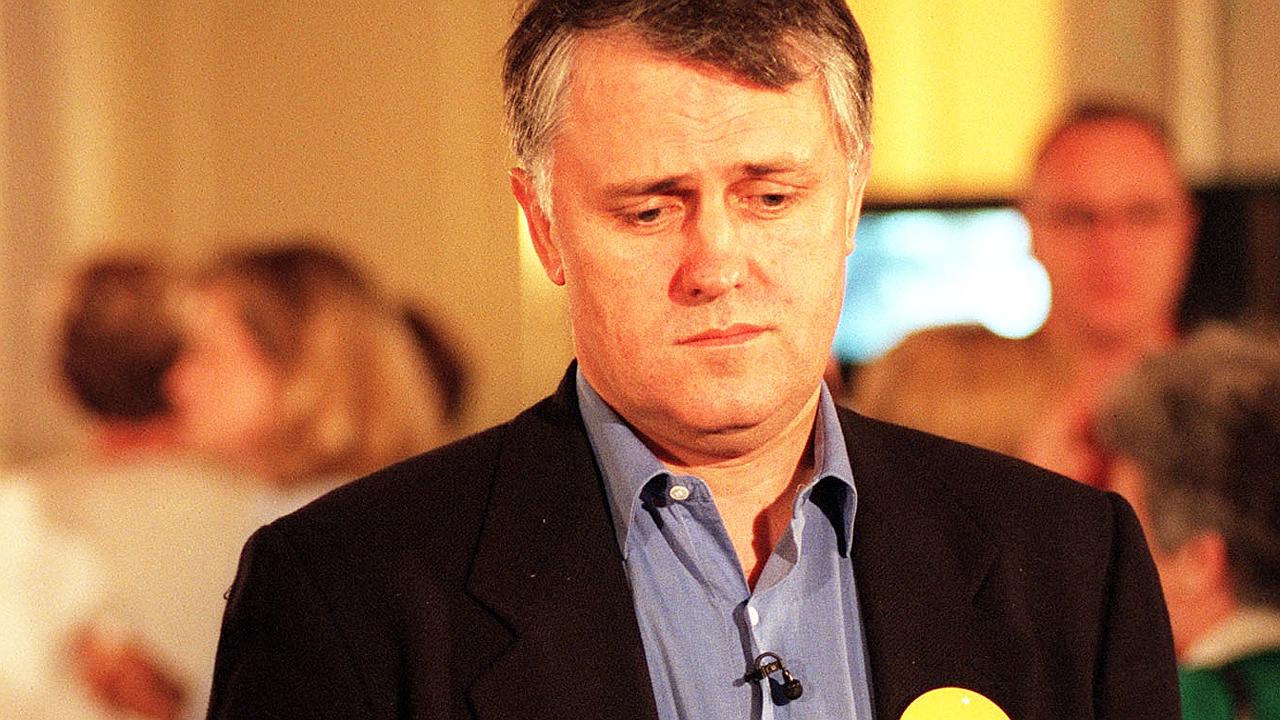
Malcolm Turnbull: "Fighting for the republic in John Howard’s Australia has been gruelling and heartbreaking", ARM concession, Referendum defeat - 1999

July 18, 2016

6 November 1999, Sydney, Australia

Malcom Turnbull is current Prime Minister of Australia. More information at Museum of Australian Democracy entry.

Future Australian Prime Minister Malcolm Turnbull was chair of the Australian Republican Movement at the time of the unsuccessful referendum for Australia to become a republic. The 'YES' movement was divided between ARM republicans who wanted a parliamentary elected President, and direct election supporters.

All of us who voted Yes can be proud tonight. We did what was right. And when in years to come, our children or our grandchildren ask us why Australia has the Queen or the King of England as our head of state, we can look them in the eye truthfully and say, ‘on November 6th 1999, I voted Yes for our Republic’.

I thank every Australian who voted Yes. I thank you for your patriotism, your optimism and your pride.

The republic will come back. Not as soon as we’d like it to come. But it will return, and I hope we all live to see it.

To those Republicans who voted No, thinking they will soon get another chance to vote, I’m afraid you have been had. Nothing would please me more than for there to be another early chance to vote for a republic, but the people who made those promises to you will do nothing to keep them.

As the years roll on without a republic, do not forget, never forget, who told you to vote No, with the promise of a referendum for a directly elected president.

A promise they never ever intended to keep.

Now today’s referendum was the culmination of a nine year campaign. The Australian Republican Movement should be proud of its achievements. We didn’t win this vote today in the republic debate, but without your tireless efforts, there would have been no republic debate.

There would have been no constitutional convention, no referendum.

Because of our struggle, the republic is indelibly on the Australian political agenda. Together we put it there.

Fighting for the republic in John Howard’s Australia has been gruelling and heartbreaking. But are we further ahead today than we were in 1996? Yes!

Our republican cause united Australians in a way we have never seen before. Who would have imagined we’d have had Peter Costello, Kim Beasley and Natasha Stott-Despoja wearing the same campaign badge. What else but such a great objective could united Fraser and Whitlam, Doug Anthony and Bob Hawke.

Source: https://www.youtube.com/watch?v=V2IKzPmRG3...

Enjoyed this speech? Speakola is a labour of love and I’d be very grateful if you would share, tweet or like it. Thank you.

Facebook Twitter Facebook
In 1980-99 B Tags MALCOLM TURNBULL, TRANSCRIPT, CONCESSION, DEFEATED, ARM, AUSTRALIAN REPUBLICAN MOVEMENT, REFERENDUM
Comment
turnbull.jpg

Malcolm Turnbull: 'We may have a queen of Australia, but we do not have an Australian queen' - Republic speech, 1992

September 17, 2015

18 March 1992, National Press Club, Canberra, Australia

Malcom Turnbull is current Prime Minister of Australia. More information at Museum of Australian Democracy entry.

Listen to the speech. The questions afterwards are particularly interesting. When asked if he is still ambitious to be prime minister, Turnbull says, 'As far as my own political ambitions I have none. If nominated I will not stand, if elected I will not serve.' Twenty three years is a long time.

I will be blunt about my prejudices. I am an Australian. This is my native land, and I have no other. I believe that Australia's future and prosperity will be greatly advanced if our nation develops a stronger sense of patriotism and national purpose. We need to be prouder of ourselves. We need to love and respect our fellow countrymen much more than we do today, we need to rejoice in those things that make us different and we need to strive to make our nation foremost in every field of endeavor and enterprise.

For me, Australia comes first. I believe that our development as a more patriotic, more independent nation is being retarded by the fact that we have a foreigner as our head of state. We may have a Queen of Australia, but we do not have an Australian Queen. National sovereignty involves many facets, but among the most important is that a nation's constitutional and political structure is entirely indigenous. The leaders of a nation are appointed by, and are responsible to, the people and the institutions of that nation and no other.

It is no good monarchists pretending that the Queen is an Australian institution or that somehow or other her presence at the top of our constitutional pyramid is consistent with Australia's sovereignty as an independent nation. The historical truth is that the Queen is our head of state because in 1901, when our Constitution came into effect, Australia was no more than a self-governing colony within the British Empire. Our Constitution decrees that our Queen shall be Queen Victoria and her successors 'in the sovereignty of the United Kingdom'. That succession can be and has been, changed by the British parliament, but not by ours. If Prince Charles embraces Roman Catholicism he will not be able to succeed to the throne of our supposedly secular Commonwealth. If Britain becomes a republic, its first president will automatically become our head of state.

The Australian constitution gave extraordinarily wide powers to the Queen, wider than she wielded in the United Kingdom' The British government thereby reserved to itself the power to intervene in Australian affairs in much the same way a state Government in Australia can intervene and dismiss if necessary a local council.

When you see the word 'Queen' in our constitution, it is easy to construe it as meaning (in today's usage) the Queen of Australia acting on the advice of her Australian ministers. But in 1901 it meant the British Crown acting on the advice of its government in Whitehall. The
founding fathers of Federation had no aspirations to independence.

In the first three decades of this century the governor-general was first and foremost the representative of the British government in Australia. He was appointed by Whitehall and he was responsible to it. Indeed it was not until 1938 that Britain felt the need to appoint a high
commissioner to Australia. Until the Second World War Australia did not have any diplomatic representatives. It was a member of the League of Nations, but then so was India and no-one suggested it was independent. Australia did not even claim the right to declare war or peace.
War was declared by the King, for the Empire, and Australia followed the Empire in 1939 as much as it had in 1914.

In those days and for many decades to come, Australians were British subjects. They saw themselves as Britons living in Australia. They were an autonomous political sub-unit of the British Empire. If nation and nationhood require a belief in a separate and independent destiny, then Australia was not a nation. This may be regarded today as another symptom of Australia's confused sense of identity. I would not agree with that characterisation and latter-day Australian nationalists should be wary of vilifying their ancestors for lack of patriotism. Australia was, until relatively recent years, almost entirely composed of settlers from the British Isles. Even today, Australia has a higher percentage of white Caucasians than many parts of the United Kingdom itself. It was only natural that Australians, or people living in Australia, saw themselves as part of the same political unit from which they had spawned.

But, as the decades passed after Federation tensions increasingly developed in the relationship between Britain and its self-governing Dominions: Australia, Canada, Newfoundland, New Zealand, South Africa and the Irish Free State. Canada, South Africa and Ireland pressed hard for more autonomy and independence. Leaving Ireland aside as special case with a unique history, it can be seen that Canada and South Africa shared two distinct characteristics which Australia lacked. First their populations were not wholly British; large and influential sections of each had grave reservations about being associated with Britain at all. Second, because of their geography they did not perceive they faced a real threat of invasion. Australia on the other hand possessed an almost entirely British population. More importantly however it saw the Empire as the only possible source of defence in the event, some would have said the inevitable event, of an invasion from Japan.


So during the 1920s in the series of Imperial Conferences leading up to the 1931 Statute of Westminster we see Canada and South Africa forcing the pace of change while Australia (and New Zealand) dragged their heels. Australian politicians of that era, as different as William
Morris Hughes and Stanley Melbourne Bruce, rather favoured increased integration of the Empire. They wanted the Empire to speak with one voice, but they wanted that voice to be determined by a consultative process between the United Kingdom and the Dominions.


Again, it is easy to pick out speeches of all of our leaders from those days, Hughes, Scullin, Bruce, Lyons and even Curtin and point to examples of what today appear to be cringing subservience to Britain. [However] there is nothing shameful about these sentiments. Political
integration with Britain and its Empire was never a dishonourable course of action. Australian leaders were seeking a say in the Empire. At the 1943 federal conference of the Labor Party, Curtin described the full expression of our responsibilities in the post-war era to be 'a good
Australian, a good British subject and a good world citizen'. Or as the conservative politician and judge, Sir John Latham, observed in 1928, 'few Australians have the illusion that Australia could maintain her existence as a completely independent state. Alone Australia is weak . . .As a member of the British Commonwealth, Australia is strong.'

However noble ideas of Imperial Federation may have been, the truth was that the tide of history was running quite against it. Britain's idea of Empire was of one dominated by London, and that meant the British government of the day. Britain was nor prepared to share its
foreign policy with the Dominions and it preferred to have independent Dominions than have them meddling in what it saw as the concerns of Great Britain itself. To use a commercial metaphor, the imperial relationship was rather like that of a family company with grown up children. Some of the children want to move off and start their own businesses. others want to sit at the board table and jointly direct the enterprise. The patriarch however says: if you will not stay and do as you are told, then you had best leave.

So far from Australia seeking independence, quite the reverse is true. Australia increasingly undertook the responsibilities of nationhood because it had been turned out by its Mother Country. our nationhood was forced on us. We did not fight for it. Myth makers, particularly on the Left, will tell a different tale and I do nor mean to denigrate the Australian nationalism of our early radicals, many of them republicans, but it is well to remember they did not speak for the majority of Australians.

Given that background it is not surprising that a sense of national identity has been slow in coming. Right through the long reign of Sir Robert Menzies Australians were encouraged to believe they were still both British and Australian. It was conventional within the memory of
most of us to fly both the Union Jack and the Australian flag on public buildings. Our national anthem was 'God Save the Queen' until relatively recently. There was little emphasis in Australia on that important aspect of separateness and distinction which is crucial to a sense of nationalism. It is only since 1986 that an ultimate court of appeal ceased to be a tribunal of English judges, the Privy Council, sitting in London.

In the nine months since the launch of the Australian Republican Movement the republican debate has progressed considerably. It is now an important and lively subject of discussion. Major newspapers have editorialised in favour of the republic, the Australian Labor party has
placed a republican Australia firm1y in its national platform. opinion polls for the first time are showing a majority of Australians in favour of the republic.

But despite this, some conservatives fail to come to terms with the debate. The most common defence of the monarchy is a shoulder shrugging 'if it ain't broke, don't fix it' caveman conservatism. Consider for a moment where human progress would be if that approach had
been taken to art, literature, technology or politics? The truth is that all human progress has been based on the desire to make something which is better. Societies which have turned their back on social or political progress have invariably atrophied and collapsed. Another disappointing conservative response is that recently employed by the Leader of the Opposition [John Hewson] who dismisses the republican movement as a 'distraction from the economic issues of the recession'. Does he really believe that we are incapable of
debating anything other than economic issues, or that Australians are so intellectually deficient they can only concentrate on one issue at a time? The republican debate is too important to become the subject of conventional party political debate where a cause supported by the Government is automatically opposed by the Opposition. But for the benefit of Mr Hewson, I would pose this question: has the success of other nations been advanced, or retarded, by a strong sense of national identity and purpose? Has the economic miracle of Japan or Germany been assisted by their keen focus on national self-interest? Was the rise to greatness of the United States assisted by that country's intense patriotism and sense of national mission? I am not saying the republic will make you rich. But history suggests patriotism is good for business.

But of all the conservative reactions I have heard, the most depressing was that which fell from John Howard when I debated him recently for a television program. Mr Howard said the monarchy had given us 'decades of stability'. I was immediately reminded of Victor Daley's poem about Queen Victoria's sexagenary procession in London in 1897:

Sixty years she's reigned a-holding up the sky
And bringing round the seasons, hot and cold and wet and dry
And in all that time she's never done a deed deserving gaol,
So 1et.joybe1ls ring out madly and delirium prevail.
Oh, the poor will blessings pour on the Queen whom they adore
When she blinks with puffy eyes at them, they'll hunger never more.

The political stability of Australia is a tribute to the political stability of Australians, not the grace and favour of their iong-distance monarch. The same monarch reigned over Fiji and did not seem to faze Colonel Rabuka, ancl the Queen of Grenada was unable to prevent the United
States Marines imposing their idea of political stability on that country. John Howard's remark, which I am sure he now regrets, is a typical example of how too many of our leaders subconsciously underrate themselves and the people that elected them.

The republican debate is one of the most important confronting us today. Economic issues will come and go, and never be resolved (at least to everyone's satisfaction). But today we are building a nation and there is no worthier enterprise for any of us than that. I imagine there will
always be some who will resist the republic, but few of our critics suggest it is not inevitable.

The Prime Minister [Paul Keating] has not been slow to recognise the increasing popularity of this cause. Mr Hewson does himself, his party and the nation no good at all in not following suit. Conservatives who fear change to our constitutional system should stop hiding behind the royal petticoats, acknowledge the inevitability of a republic and constructively participate in the debate about the constitutional changes that are needed to effect it.

It is not just conservatives we need to persuade, of course. Some Australians find it hard to see how such a change could be important. If you believe we should have a head of state at all, if you believe that office is of importance, then it follows that the head of state should reinforce the values and interests of our nation above all others. Whatever the Queen may represent to Australians, she does not represent Australia. She does not represent this nation to its own citizens and to the world at large she unequivocally represents Great Britain.

The monarchists of bygone decades genuinely believed that Australia was part of Greater Britain and their patriotism was sincerely a British one. They did not pretend that Australia was, or ought to be, independent. Today's monarchists are more disingenuous. They claim to be, Australian patriots, they claim Australia is independent but at the same time cling to the last symbol of colonialism. The Australian republic will put Australia first, and in our hearts at least, Australia should have no other place.

Source: http://nla.gov.au/nla.oh-vn278331

Enjoyed this speech? Speakola is a labour of love and I’d be very grateful if you would share, tweet or like it. Thank you.

Facebook Twitter Facebook
In 1980-99 B Tags MALCOLM TURNBULL, REPUBLICANISM, ARM, TRANSCRIPT
Comment

See my film!

Limited Australian Season

March 2025

Details and ticket bookings at

angeandtheboss.com

Support Speakola

Hi speech lovers,
With costs of hosting website and podcast, this labour of love has become a difficult financial proposition in recent times. If you can afford a donation, it will help Speakola survive and prosper.

Best wishes,
Tony Wilson.

Become a Patron!

Learn more about supporting Speakola.

Featured political

Featured
Jon Stewart: "They responded in five seconds", 9-11 first responders, Address to Congress - 2019
Jacinda Ardern: 'They were New Zealanders. They are us', Address to Parliament following Christchurch massacre - 2019
Dolores Ibárruri: "¡No Pasarán!, They shall not pass!', Defense of 2nd Spanish Republic - 1936
Jimmy Reid: 'A rat race is for rats. We're not rats', Rectorial address, Glasgow University - 1972

Featured eulogies

Featured
For Geoffrey Tozer: 'I have to say we all let him down', by Paul Keating - 2009
for James Baldwin: 'Jimmy. You crowned us', by Toni Morrison - 1988
for Michael Gordon: '13 days ago my Dad’s big, beautiful, generous heart suddenly stopped beating', by Scott and Sarah Gordon - 2018

Featured commencement

Featured
Tara Westover: 'Your avatar isn't real, it isn't terribly far from a lie', The Un-Instagrammable Self, Northeastern University - 2019
Tim Minchin: 'Being an artist requires massive reserves of self-belief', WAAPA - 2019
Atul Gawande: 'Curiosity and What Equality Really Means', UCLA Medical School - 2018
Abby Wambach: 'We are the wolves', Barnard College - 2018
Eric Idle: 'America is 300 million people all walking in the same direction, singing 'I Did It My Way'', Whitman College - 2013
Shirley Chisholm: ;America has gone to sleep', Greenfield High School - 1983

Featured sport

Featured
Joe Marler: 'Get back on the horse', Harlequins v Bath pre game interview - 2019
Ray Lewis : 'The greatest pain of my life is the reason I'm standing here today', 52 Cards -
Mel Jones: 'If she was Bradman on the field, she was definitely Keith Miller off the field', Betty Wilson's induction into Australian Cricket Hall of Fame - 2017
Jeff Thomson: 'It’s all those people that help you as kids', Hall of Fame - 2016

Fresh Tweets


Featured weddings

Featured
Dan Angelucci: 'The Best (Best Man) Speech of all time', for Don and Katherine - 2019
Hallerman Sisters: 'Oh sister now we have to let you gooooo!' for Caitlin & Johnny - 2015
Korey Soderman (via Kyle): 'All our lives I have used my voice to help Korey express his thoughts, so today, like always, I will be my brother’s voice' for Kyle and Jess - 2014

Featured Arts

Featured
Bruce Springsteen: 'They're keepers of some of the most beautiful sonic architecture in rock and roll', Induction U2 into Rock Hall of Fame - 2005
Olivia Colman: 'Done that bit. I think I have done that bit', BAFTA acceptance, Leading Actress - 2019
Axel Scheffler: 'The book wasn't called 'No Room on the Broom!', Illustrator of the Year, British Book Awards - 2018
Tina Fey: 'Only in comedy is an obedient white girl from the suburbs a diversity candidate', Kennedy Center Mark Twain Award -  2010
Tina Fey: 'Only in comedy is an obedient white girl from the suburbs a diversity candidate', Kennedy Center Mark Twain Award - 2010

Featured Debates

Featured
Sacha Baron Cohen: 'Just think what Goebbels might have done with Facebook', Anti Defamation League Leadership Award - 2019
Greta Thunberg: 'How dare you', UN Climate Action Summit - 2019
Charlie Munger: 'The Psychology of Human Misjudgment', Harvard University - 1995
Lawrence O'Donnell: 'The original sin of this country is that we invaders shot and murdered our way across the land killing every Native American that we could', The Last Word, 'Dakota' - 2016