
• Genre
  • About
  • Submissions
  • Donate
  • Search
Menu

Speakola

All Speeches Great and Small
  • Genre
  • About
  • Submissions
  • Donate
  • Search
Share a political speech

Franklin D Roosevelt: 'There was a general rush by a large portion of our population to turn bank deposits into currency or gold' First fireside chat - 1933

September 8, 2026

My friends:

I want to talk for a few minutes with the people of the United States about banking -- to talk with the comparatively few who understand the mechanics of banking, but more particularly with the overwhelming majority of you who use banks for the making of deposits and the drawing of checks.

I want to tell you what has been done in the last few days, and why it was done, and what the next steps are going to be. I recognize that the many proclamations from State capitols and from Washington, the legislation, the Treasury regulations, and so forth, couched for the most part in banking and legal terms, ought to be explained for the benefit of the average citizen. I owe this, in particular, because of the fortitude and the good temper with which everybody has accepted the inconvenience and hardships of the banking holiday. And I know that when you understand what we in Washington have been about, I shall continue to have your cooperation as fully as I have had your sympathy and your help during the past week.

First of all, let me state the simple fact that when you deposit money in a bank, the bank does not put the money into a safe deposit vault. It invests your money in many different forms of credit -- in bonds, in commercial paper, in mortgages and in many other kinds of loans. In other words, the bank puts your money to work to keep the wheels of industry and of agriculture turning around. A comparatively small part of the money that you put into the bank is kept in currency -- an amount which in normal times is wholly sufficient to cover the cash needs of the average citizen. In other words, the total amount of all the currency in the country is only a comparatively small proportion of the total deposits in all the banks of the country.

What, then, happened during the last few days of February and the first few days of March? Because of undermined confidence on the part of the public, there was a general rush by a large portion of our population to turn bank deposits into currency or gold -- a rush so great that the soundest banks couldn't get enough currency to meet the demand. The reason for this was that on the spur of the moment it was, of course, impossible to sell perfectly sound assets of a bank and convert them into cash, except at panic prices far below their real value. By the afternoon of March third, a week ago last Friday, scarcely a bank in the country was open to do business. Proclamations closing them, in whole or in part, had been issued by the Governors in almost all the states. It was then that I issued the proclamation providing for the national bank holiday, and this was the first step in the Government’s reconstruction of our financial and economic fabric.

The second step, last Thursday, was the legislation promptly and patriotically passed by the Congress confirming my proclamation and broadening my powers so that it became possible in view of the requirement of time to extend the holiday and lift the ban of that holiday gradually in the days to come. This law also gave authority to develop a program of rehabilitation of our banking facilities. And I want to tell our citizens in every part of the Nation that the national Congress -- Republicans and Democrats alike -- showed by this action a devotion to public welfare and a realization of the emergency and the necessity for speed that it is difficult to match in all our history.

The third stage has been the series of regulations permitting the banks to continue their functions to take care of the distribution of food and household necessities and the payment of payrolls.

This bank holiday, while resulting in many cases in great inconvenience, is affording us the opportunity to supply the currency necessary to meet the situation. Remember that no sound bank is a dollar worse off than it was when it closed its doors last week. Neither is any bank which may turn out not to be in a position for immediate opening. The new law allows the twelve Federal Reserve Banks to issue additional currency on good assets and thus the banks that reopen will be able to meet every legitimate call. The new currency is being sent out by the Bureau of Engraving and Printing in large volume to every part of the country. It is sound currency because it is backed by actual, good assets.

Another question you will ask is this: Why are all the banks not to be reopened at the same time? The answer is simple and I know you will understand it: Your Government does not intend that the history of the past few years shall be repeated. We do not want and will not have another epidemic of bank failures.

As a result, we start tomorrow, Monday, with the opening of banks in the twelve Federal Reserve Bank cities -- those banks, which on first examination by the Treasury, have already been found to be all right. That will be followed on Tuesday by the resumption of all other functions by banks already found to be sound in cities where there are recognized clearing houses. That means about two hundred and fifty cities of the United States. In other words, we are moving as fast as the mechanics of the situation will allow us.

On Wednesday and succeeding days, banks in smaller places all through the country will resume business, subject, of course, to the Government's physical ability to complete its survey It is necessary that the reopening of banks be extended over a period in order to permit the banks to make applications for the necessary loans, to obtain currency needed to meet their requirements, and to enable the Government to make common sense checkups.

Please let me make it clear to you that if your bank does not open the first day you are by no means justified in believing that it will not open. A bank that opens on one of the subsequent days is in exactly the same status as the bank that opens tomorrow.

I know that many people are worrying about State banks that are not members of the Federal Reserve System. There is no occasion for that worry. These banks can and will receive assistance from member banks and from the Reconstruction Finance Corporation. And, of course, they are under the immediate control of the State banking authorities. These State banks are following the same course as the National banks except that they get their licenses to resume business from the State authorities, and these authorities have been asked by the Secretary of the Treasury to permit their good banks to open up on the same schedule as the national banks. And so I am confident that the State Banking Departments will be as careful as the national Government in the policy relating to the opening of banks and will follow the same broad theory.

It is possible that when the banks resume a very few people who have not recovered from their fear may again begin withdrawals. Let me make it clear to you that the banks will take care of all needs, except, of course, the hysterical demands of hoarders, and it is my belief that hoarding during the past week has become an exceedingly unfashionable pastime in every part of our nation. It needs no prophet to tell you that when the people find that they can get their money -- that they can get it when they want it for all legitimate purposes -- the phantom of fear will soon be laid. People will again be glad to have their money where it will be safely taken care of and where they can use it conveniently at any time. I can assure you, my friends, that it is safer to keep your money in a reopened bank than it is to keep it under the mattress.

The success of our whole national program depends, of course, on the cooperation of the public -- on its intelligent support and its use of a reliable system.

Remember that the essential accomplishment of the new legislation is that it makes it possible for banks more readily to convert their assets into cash than was the case before. More liberal provision has been made for banks to borrow on these assets at the Reserve Banks and more liberal provision has also been made for issuing currency on the security of these good assets. This currency is not fiat currency. It is issued only on adequate security, and every good bank has an abundance of such security.

One more point before I close. There will be, of course, some banks unable to reopen without being reorganized. The new law allows the Government to assist in making these reorganizations quickly and effectively and even allows the Government to subscribe to at least a part of any new capital that may be required.

I hope you can see, my friends, from this essential recital of what your Government is doing that there is nothing complex, nothing radical in the process.

We have had a bad banking situation. Some of our bankers had shown themselves either incompetent or dishonest in their handling of the people’s funds. They had used the money entrusted to them in speculations and unwise loans. This was, of course, not true in the vast majority of our banks, but it was true in enough of them to shock the people of the United States, for a time, into a sense of insecurity and to put them into a frame of mind where they did not differentiate, but seemed to assume that the acts of a comparative few had tainted them all. And so it became the Government’s job to straighten out this situation and do it as quickly as possible. And that job is being performed.

I do not promise you that every bank will be reopened or that individual losses will not be suffered, but there will be no losses that possibly could be avoided; and there would have been more and greater losses had we continued to drift. I can even promise you salvation for some, at least, of the sorely presses banks. We shall be engaged not merely in reopening sound banks but in the creation of more sound banks through reorganization.

It has been wonderful to me to catch the note of confidence from all over the country. I can never be sufficiently grateful to the people for the loyal support that they have given me in their acceptance of the judgment that has dictated our course, even though all our processes may not have seemed clear to them.

After all, there is an element in the readjustment of our financial system more important than currency, more important than gold, and that is the confidence of the people themselves. Confidence and courage are the essentials of success in carrying out our plan. You people must have faith; you must not be stampeded by rumors or guesses. Let us unite in banishing fear. We have provided the machinery to restore our financial system, and it is up to you to support and make it work.

It is your problem, my friends, your problem no less than it is mine.

Together we cannot fail.
Source: https://www.americanrhetoric.com/speeches/...

Enjoyed this speech? Speakola is a labour of love and I’d be very grateful if you would share, tweet or like it. Thank you.

Facebook Twitter Facebook
In 1920-39 MORE Tags FRANKLIN D. ROOSEVELT, FRANKLIN DELANO ROOSEVELT, FDR, FIRESIDE CHAT, BANKING, GREAT DERESSION, RUN ON BANKS, ADDRESS TO NATION, ECONOMIC POLICY, THE NEW DEAL, USA, AMERICAN POLITICS, PRESIDENT, 1930s, 1933
Comment

Winston Churchill: 'The lights are going out on Europe', Public address - 1938

April 9, 2025

16 October 1938, London, United Kingdom

I avail myself with relief of the opportunity of speaking to the people of the United States. I do not know how long such liberties will be allowed. The stations of uncensored expression are closing down; the lights are going out; but there is still time for those to whom freedom and parliamentary government mean something, to consult together. Let me, then, speak in truth and earnestness while time remains.

The American people have, it seems to me, formed a true judgment upon the disaster which has befallen Europe. They realise, perhaps more clearly than the French and British publics have yet done, the far-reaching consequences of the abandonment and ruin of the Czechoslovak Republic. I hold to the conviction I expressed some months ago, that if in April, May or June, Great Britain, France, and Russia had jointly declared that they would act together upon Nazi Germany if Herr Hitler committed an act of unprovoked aggression against this small State, and if they had told Poland, Yugoslavia, and Rumania what they meant to do in good time, and invited them to join the combination of peace-defending Powers, I hold that the German Dictator would have been confronted with such a formidable array that he would have been deterred from his purpose. This would also have been an opportunity for all the peace-loving and moderate forces in Germany, together with the chiefs of the German Army, to make a great effort to re-establish something like sane and civilised conditions in their own country. If the risks of war which were run by France and Britain at the last moment had been boldly faced in good time, and plain declarations made, and meant, how different would our prospects be today!

But all these backward speculations belong to history. It is no good using hard words among friends about the past, and reproaching one another for what cannot be recalled. It is the future, not the past, that demands our earnest and anxious thought. We must recognize that the Parliamentary democracies and liberal, peaceful forces have everywhere sustained a defeat which leaves them weaker, morally and physically, to cope with dangers which have vastly grown. But the cause of freedom has in it a recuperative power and virtue which can draw from misfortune new hope and new strength. If ever there was a time when men and women who cherish the ideals of the founders of the British and American Constitutions should take earnest counsel with one another, that time is now.

All the world wishes for peace and security. Have we gained it by the sacrifice of the Czechoslovak Republic? Here was the model democratic State of Central Europe, a country where minorities were treated better than anywhere else. It has been deserted, destroyed and devoured. It is now being digested. The question which is of interest to a lot of ordinary people, common people, is whether this destruction of the Czechoslovak Republic will bring upon the world a blessing or a curse.

We must all hope it will bring a blessing; that after we have averted our gaze for a while from the process of subjugation and liquidation, everyone will breathe more freely; that a load will be taken off our chests; we shall be able to say to ourselves: "Well, that's out of the way, anyhow. Now let's get on with our regular daily life." But are these hopes well founded or are we merely making the best of what we had not the force and virtue to stop? That is the question that the English-speaking peoples in all their lands must ask themselves to-day. Is this the end, or is there more to come?

There is another question which arises out of this. Can peace, goodwill, and confidence be built upon submission to wrong-doing backed by force? One may put this question in the largest form. Has any benefit or progress ever been achieved by the human race by submission to organized and calculated violence? As we look back over the long story of the nations we must see that, on the contrary, their glory has been founded upon the spirit of resistance to tyranny and injustice, especially when these evils seemed to be backed by heavier force. Since the dawn of the Christian era a certain way of life has slowly been shaping itself among the Western peoples, and certain standards of conduct and government have come to be esteemed. After many miseries and prolonged confusion, there arose into the broad light of day the conception of the right of the individual; his right to be consulted in the government of his country; his right to invoke the law even against the State itself. Independent Courts of Justice were created to affirm and inforce this hard-won custom. Thus was assured throughout the English-speaking world, and in France by the stern lessons of the Revolution, what Kipling called, "Leave to live by no man's leave underneath the law." Now in this resides all that makes existence precious to man, and all that confers honour and health upon the State.

We are confronted with another theme. It is not a new theme; it leaps out upon us from the Dark Ages' racial persecution, religious intolerance, deprivation of free speech, the conception of the citizen as a mere soulless fraction of the State. To this has been added the cult of war. Children are to be taught in their earliest schooling the delights and profits of conquest and aggression. A whole mighty community has been drawn painfully, by severe privations, into a warlike frame. They are held in this condition, which they relish no more than we do, by a party organisation, several millions strong, who derive all kinds of profits, good and bad, from the upkeep of the regime. Like the Communists, the Nazis tolerate no opinion but their own. Like the Communists, they feed on hatred. Like the Communists, they must seek, from time to time, and always at shorter intervals, a new target, a new prize, a new victim. The Dictator, in all his pride, is held in the grip of his Party machine. He can go forward; he cannot go back. He must blood his hounds and show them sport, or else, like Actaeon of old, be devoured by them. All-strong without, he is all-weak within. As Byron wrote a hundred years ago: "These Pagod things of Sabre sway, with fronts of brass and feet of clay."

No one must, however, underrate the power and efficiency of a totalitarian state. Where the whole population of a great country, amiable, good-hearted, peace-loving people are gripped by the neck and by the hair by a Communist or a Nazi tyranny—for they are the same things spelt in different ways—the rulers for the time being can exercise a power for the purposes of war and external domination before which the ordinary free parliamentary societies are at a grievous practical disadvantage. We have to recognise this.

And then, on top of all, comes this wonderful mastery of the air which our century has discovered, but of which, alas, mankind has so far shown itself unworthy. Here is this air power with its claim to torture and terrorise the women and children, the civil population of neighbouring countries. This combination of medieval passion, a party caucus, the weapons of modern science, and the blackmailing power of air-bombing, is the most monstrous menace to peace, order and fertile progress that has appeared in the world since the Mongol invasions of the thirteenth century.

The culminating question to which I have been leading is whether the world as we have known it—the great and hopeful world of before the war, the world of increasing hope and enjoyment for the common man, the world of honoured tradition and expanding science—should meet this menace by submission or by resistance. Let us see, then, whether the means of resistance remain to us today. We have sustained an immense disaster; the renown of France is dimmed. In spite of her brave, efficient army, her influence is profoundly diminished. No one has a right to say that Britain, for all her blundering, has broken her word — indeed, when it was too late, she was better than her word. Nevertheless, Europe lies at this moment abashed and distracted before the triumphant assertions of dictatorial power. In the Spanish Peninsula, a purely Spanish quarrel has been carried by the intervention, or shall I say the "non-intervention" (to quote the current Jargon) of Dictators into the region of a world cause. But it is not only in Europe that these oppressions prevail. China is being torn to pieces by a military clique in Japan; the poor, tormented Chinese people there are making a brave and stubborn defence. The ancient empire of Ethiopia has been overrun. The Ethiopians were taught to look to the sanctity of public law, to the tribunal of many nations gathered in majestic union.

But all failed; they were deceived, and now they are winning back their right to live by beginning again from the bottom a struggle on primordial lines. Even in South America the Nazi regime begins to undermine the fabric of Brazilian society.

Far away, happily protected by the Atlantic and Pacific Oceans, you, the people of the United States, to whom I now have the chance to speak, are the spectators, and I may add the increasingly involved spectators of these tragedies and crimes. We are left in no doubt where American conviction and sympathies lie; but will you wait until British freedom and independence have succumbed, and then take up the cause when it is three-quarters ruined, yourselves alone? I hear that they are saying in the United States that because England and France have failed to do their duty therefore the American people can wash their hands of the whole business. This may be the passing mood of many people, but there is no sense in it. If things have got much worse, all the more must we try to cope with them.

For, after all, survey the remaining forces of civilisation; they are overwhelming. If only they were united in a common conception of right and duty, there would be no war. On the contrary, the German people, industrious, faithful, valiant, but alas! lacking in the proper spirit of civic independence, liberated from their present nightmare, would take their honoured place in the vanguard of human society. Alexander the Great remarked that the people of Asia were slaves because they had not learned to pronounce the word "No." Let that not be the epitaph of the English-speaking peoples or of Parliamentary democracy, or of France, or of the many surviving liberal States of Europe.

There, in one single word, is the resolve which the forces of freedom and progress, of tolerance and good will, should take. It is not in the power of one nation, however formidably armed, still less is it in the power of a small group of men, violent, ruthless men, who have always to cast their eyes back over their shoulders, to cramp and fetter the forward march of human destiny. The preponderant world forces are upon our side; they have but to be combined to be obeyed.

We must arm. Britain must arm. America must arm. If, through an earnest desire for peace, we have placed ourselves at a disadvantage, we must make up for it by redoubled exertions, and, if necessary, by fortitude in suffering. We shall, no doubt, arm. Britain, casting away the habits of centuries, will decree national service upon her citizens. The British people will stand erect, and will face whatever may be coming.

But arms—instrumentalities, as President Wilson called them—are not sufficient by themselves. We must add to them the power of ideas. People say we ought not to allow ourselves to be drawn into a theoretical antagonism between Nazidom and democracy; but the antagonism is here now. It is this very conflict of spiritual and moral ideas which gives the free countries a great part of their strength. You see these dictators on their pedestals, surrounded by the bayonets of their soldiers and the truncheons of their police. On all sides they are guarded by masses of armed men, cannons, aeroplanes, fortifications, and the like—they boast and vaunt themselves before the world, yet in their hearts there is unspoken fear. They are afraid of words and thoughts; words spoken abroad, thoughts stirring at home—all the more powerful because forbidden—terrify them. A little mouse of thought appears in the room, and even the mightiest potentates are thrown into panic. They make frantic efforts to bar our thoughts and words; they are afraid of the workings of the human mind. Cannons, airplanes, they can manufacture in large quantities; but how are they to quell the natural promptings of human nature, which after all these centuries of trial and progress has inherited a whole armoury of potent and indestructible knowledge?

Dictatorship—the fetish worship of one man—is a passing phase. A state of society where men may not speak their minds, where children denounce their parents to the police, where a business man or small shopkeeper ruins his competitor by telling tales about his private opinions; such a state of society cannot long endure if brought into contact with the healthy outside world. The light of civilised progress with its tolerances and co-operation, with its dignities and joys, has often in the past been blotted out. But I hold the belief that we have now at last got far enough ahead of barbarism to control it, and to avert it, if only we realise what is afoot and make up our minds in time. We shall do it in the end. But how much harder our toil for every day's delay!

Is this a call to war? Does anyone pretend that preparation for resistance to aggression is unleashing war? I declare it to be the sole guarantee of peace. We need the swift gathering of forces to confront not only military but moral aggression; the resolute and sober acceptance of their duty by the English-speaking peoples and by all the nations, great and small, who wish to walk with them. Their faithful and zealous comradeship would almost between night and morning clear the path of progress and banish from all our lives the fear which already darkens the sunlight to hundreds of millions of men.

Source: https://www.nationalchurchillmuseum.org/th...

Enjoyed this speech? Speakola is a labour of love and I’d be very grateful if you would share, tweet or like it. Thank you.

Facebook Twitter Facebook
In 1920-39 MORE Tags WINSTON CHURCHILL, PARLIAMENT, UNITED KINGDOM, 1930s, FASCISM, ANTI FASCISM, ARM, WARMONGERING, DEMOCRACY
Comment

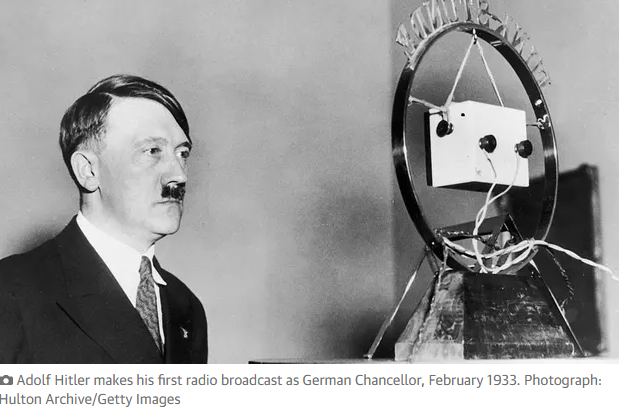
Adolf Hitler: 'We must overcome the demoralization of Germany by the Communists', first radio address as Chancellor - 1933

March 17, 2023

1 February 1933, Berlin, Germany

On February 1, 1933, two days after he was appointed chancellor, Hitler spoke over the radio to the German people about his vision for the future of the country:

Over fourteen years have passed since that unhappy day when the German people, blinded by promises made by those at home and abroad, forgot the highest values of our past, of the Reich, of its honor and its freedom, and thereby lost everything. Since those days of treason, the Almighty has withdrawn his blessing from our nation. Discord and hatred have moved in. Filled with the deepest distress, millions of the best German men and women from all walks of life see the unity of the nation disintegrating in a welter of egotistical political opinions, economic interests, and ideological conflicts.

As so often in our history, Germany, since the day the revolution broke out, presents a picture of heartbreaking disunity. We did not receive the equality and fraternity which was promised us; instead we lost our freedom. The breakdown of the unity of mind and will of our nation at home was followed by the collapse of its political position abroad.

We have a burning conviction that the German people in 1914 went into the great battle without any thought of personal guilt [for the start of the war] and weighed down only by the burden of having to defend the Reich from attack, to defend the freedom and material existence of the German people. In the appalling fate that has dogged us since November 1918 we see only the consequence of our inward collapse. But the rest of the world is no less shaken by great crises. The historical balance of power, which at one time contributed not a little to the understanding of the necessity for solidarity among the nations, with all the economic advantages resulting therefrom, has been destroyed.

The delusion that some are the conquerors and others the conquered destroys the trust between nations and thereby also destroys the world economy. But the misery of our people is terrible! The starving industrial proletariat [working class] have become unemployed in their millions, while the whole middle and artisan class have been made paupers. If the German farmer also is involved in this collapse we shall be faced with a catastrophe of vast proportions. For in that case, there will collapse not only a Reich, but also a 2000-year-old inheritance of the highest works of human culture and civilization.

All around us are symptoms portending this breakdown. With an unparalleled effort of will and of brute force the Communist method of madness is trying as a last resort to poison and undermine an inwardly shaken and uprooted nation. They seek to drive it towards an epoch which would correspond even less to the promises of the Communist speakers of today than did the epoch now drawing to a close to the promises of the same emissaries in November 1918.

Starting with the family, and including all notions of honor and loyalty, nation and fatherland, culture and economy, even the eternal foundations of our morals and our faith—nothing is spared by this negative, totally destructive ideology. . . . One year of Bolshevism would destroy Germany. The richest and most beautiful areas of world civilization would be transformed into chaos and a heap of ruins. Even the misery of the past decade and a half could not be compared with the affliction of a Europe in whose heart the red flag of destruction had been planted. The thousands of injured, the countless dead which this battle has already cost Germany may stand as a presage of the disaster.

In these hours of overwhelming concern for the existence and the future of the German nation, the venerable World War leader [President Paul von Hindenburg] appealed to us men of the nationalist parties and associations to fight under him again as once we did at the front, but now loyally united for the salvation of the Reich at home. The revered President of the Reich having with such generosity joined hands with us in a common pledge, we nationalist leaders would vow before God, our conscience and our people that we shall doggedly and with determination fulfill the mission entrusted to us as the National Government.

It is an appalling inheritance which we are taking over.

The task before us is the most difficult which has faced German statesmen in living memory. But we all have unbounded confidence, for we believe in our nation and in its eternal values. Farmers, workers, and the middle class must unite to contribute the bricks wherewith to build the new Reich.

The National Government will therefore regard it as its first and supreme task to restore to the German people unity of mind and will. It will preserve and defend the foundations on which the strength of our nation rests. It will take under its firm protection Christianity as the basis of our morality, and the family as the nucleus of our nation and our state. Standing above estates [groups that make up society’s social hierarchy] and classes, it will bring back to our people the consciousness of its racial and political unity and the obligations arising therefrom. It wishes to base the education of German youth on respect for our great past and pride in our old traditions. . . . Germany must not and will not sink into Communist anarchy.

In place of our turbulent instincts, it will make national discipline govern our life. In the process it will take into account all the institutions which are the true safeguards of the strength and power of our nation.

The National Government will carry out the great task of reorganizing our national economy with two big Four-Year Plans:

Saving the German farmer so that the nation’s food supply and thus the life of the nation shall be secured.
       

Saving the German worker by a massive and comprehensive attack on unemployment.

In fourteen years the November parties have ruined the German farmer. In fourteen years they created an army of millions of unemployed. The National Government will carry out the following plan with iron resolution and dogged perseverance. Within four years the German farmer must be saved from pauperism. Within four years unemployment must be completely overcome . . .

Our concern to provide daily bread will be equally a concern for the fulfillment of the responsibilities of society to those who are old and sick. The best safeguard against any experiment which might endanger the currency lies in economical administration, the promotion of work, and the preservation of agriculture, as well as in the use of individual initiative.

In foreign policy, the National Government will see its highest mission in the preservation of our people’s right to an independent life and in the regaining thereby of their freedom. The determination of this Government to put an end to the chaotic conditions in Germany is a step towards the integration into the community of nations of a state having equal status and therefore equal rights with the rest. In so doing, the Government is aware of its great obligation to support, as the Government of a free and equal nation, that maintenance and consolidation of peace which the world needs today more than ever before. May all others understand our position and so help to ensure that this sincere desire for the welfare of Europe and of the whole world shall find fulfillment.

Despite our love for our Army as the bearer of our arms and the symbol of our great past, we should be happy if the world, by restricting its armaments, made unnecessary any increase in our own weapons.

But if Germany is to experience this political and economic revival and conscientiously to fulfill its duties towards other nations, a decisive act is required: We must overcome the demoralization of Germany by the Communists.

We, men of this Government, feel responsible to German history for the reconstitution of a proper national body so that we may finally overcome the insanity of class and class warfare. We do not recognize classes, but only the German people, its millions of farmers, citizens and workers who together will either overcome this time of distress or succumb to it.

With resolution and fidelity to our oath, seeing the powerlessness of the present Reichstag to shoulder the task we advocate, we wish to commit it to the whole German people.

We therefore appeal now to the German people to sign this act of mutual reconciliation. The Government of the National Uprising [the Nazi-led government] wishes to set to work, and it will work. It has not for fourteen years brought ruin to the German nation; it wants to lead it to the summit. It is determined to make amends in four years for the liabilities of fourteen years. But it cannot subject the work of reconstruction to the will of those who were responsible for the breakdown.

The Marxist parties [political parties including the Social Democrats] and their followers had fourteen years to prove their abilities. The result is a heap of ruins. Now, German people, give us four years and then judge us.

Let us begin, loyal to the command of the Field-Marshal. May Almighty God favor our work, shape our will in the right way, bless our vision and bless us with the trust of our people. We have no desire to fight for ourselves; only for Germany.

Source: https://www.facinghistory.org/resource-lib...

Enjoyed this speech? Speakola is a labour of love and I’d be very grateful if you would share, tweet or like it. Thank you.

Facebook Twitter Facebook
In 1920-39 MORE Tags ADOLF HITLER, RADIO ADDRESS, CHANCELLOR, VICTORY SPEECH, GERMANY, NAZI, NAZISM, AUTHORITARIANISM, 1930s, 1933
Comment

See my film!

Limited Australian Season

March 2025

Details and ticket bookings at

angeandtheboss.com

Support Speakola

Hi speech lovers,
With costs of hosting website and podcast, this labour of love has become a difficult financial proposition in recent times. If you can afford a donation, it will help Speakola survive and prosper.

Best wishes,
Tony Wilson.

Become a Patron!

Learn more about supporting Speakola.

Featured political

Featured
Jon Stewart: "They responded in five seconds", 9-11 first responders, Address to Congress - 2019
Read more →
Jacinda Ardern: 'They were New Zealanders. They are us', Address to Parliament following Christchurch massacre - 2019
Read more →
Dolores Ibárruri: "¡No Pasarán!, They shall not pass!', Defense of 2nd Spanish Republic - 1936
Read more →
Jimmy Reid: 'A rat race is for rats. We're not rats', Rectorial address, Glasgow University - 1972
Read more →

Featured eulogies

Featured
For Geoffrey Tozer: 'I have to say we all let him down', by Paul Keating - 2009
Read more →
for James Baldwin: 'Jimmy. You crowned us', by Toni Morrison - 1988
Read more →
for Michael Gordon: '13 days ago my Dad’s big, beautiful, generous heart suddenly stopped beating', by Scott and Sarah Gordon - 2018
Read more →

Featured commencement

Featured
Tara Westover: 'Your avatar isn't real, it isn't terribly far from a lie', The Un-Instagrammable Self, Northeastern University - 2019
Read more →
Tim Minchin: 'Being an artist requires massive reserves of self-belief', WAAPA - 2019
Read more →
Atul Gawande: 'Curiosity and What Equality Really Means', UCLA Medical School - 2018
Read more →
Abby Wambach: 'We are the wolves', Barnard College - 2018
Read more →
Eric Idle: 'America is 300 million people all walking in the same direction, singing 'I Did It My Way'', Whitman College - 2013
Read more →
Shirley Chisholm: ;America has gone to sleep', Greenfield High School - 1983
Read more →

Featured sport

Featured
Joe Marler: 'Get back on the horse', Harlequins v Bath pre game interview - 2019
Read more →
Ray Lewis : 'The greatest pain of my life is the reason I'm standing here today', 52 Cards -
Read more →
Mel Jones: 'If she was Bradman on the field, she was definitely Keith Miller off the field', Betty Wilson's induction into Australian Cricket Hall of Fame - 2017
Read more →
Jeff Thomson: 'It’s all those people that help you as kids', Hall of Fame - 2016
Read more →

Fresh Tweets


Featured weddings

Featured
Dan Angelucci: 'The Best (Best Man) Speech of all time', for Don and Katherine - 2019
Read more →
Hallerman Sisters: 'Oh sister now we have to let you gooooo!' for Caitlin & Johnny - 2015
Read more →
Korey Soderman (via Kyle): 'All our lives I have used my voice to help Korey express his thoughts, so today, like always, I will be my brother’s voice' for Kyle and Jess - 2014
Read more →

Featured Arts

Featured
Bruce Springsteen: 'They're keepers of some of the most beautiful sonic architecture in rock and roll', Induction U2 into Rock Hall of Fame - 2005
Read more →
Olivia Colman: 'Done that bit. I think I have done that bit', BAFTA acceptance, Leading Actress - 2019
Read more →
Axel Scheffler: 'The book wasn't called 'No Room on the Broom!', Illustrator of the Year, British Book Awards - 2018
Read more →
Tina Fey: 'Only in comedy is an obedient white girl from the suburbs a diversity candidate', Kennedy Center Mark Twain Award -  2010
Tina Fey: 'Only in comedy is an obedient white girl from the suburbs a diversity candidate', Kennedy Center Mark Twain Award - 2010
Read more →

Featured Debates

Featured
Sacha Baron Cohen: 'Just think what Goebbels might have done with Facebook', Anti Defamation League Leadership Award - 2019
Read more →
Greta Thunberg: 'How dare you', UN Climate Action Summit - 2019
Read more →
Charlie Munger: 'The Psychology of Human Misjudgment', Harvard University - 1995
Read more →
Lawrence O'Donnell: 'The original sin of this country is that we invaders shot and murdered our way across the land killing every Native American that we could', The Last Word, 'Dakota' - 2016
Read more →