
• Genre
  • About
  • Submissions
  • Donate
  • Search
Menu

Speakola

All Speeches Great and Small
  • Genre
  • About
  • Submissions
  • Donate
  • Search
Share a political speech

Gordon Smith: 'We have to learn the lessons of history', remarks on war in Iraq - 2006

January 18, 2017

Smith was a Republican Senator for Oregan who voted in favour of the war in Iraq in 2003

Mr. President, I know it is probably appropriate to speak of our colleagues, and I will do that on the record. I rise tonight, however, to speak about a subject heavy on my mind. It is the subject of the war in Iraq.

I have never worn the uniform of my country. I am not a soldier or a veteran. It is one of the regrets of my life. But I am a student of history, particularly military history, and it is that perspective which I brought to the Senate 10 years ago as a newly elected Member of this Chamber.

When we came to the vote on Iraq, it was an issue of great moment for me. No issue is more difficult to vote on than war and peace, because it involves the lives of our soldiers, our young men and women. It involves the expenditure of our treasure, putting on the line the prestige of our country. It is not a vote taken lightly. I have tried to be a good soldier in this Chamber. I have tried to support our President, believing at the time of the vote on the war in Iraq that we had been given good intelligence and knowing that Saddam Hussein was a menace to the world, a brutal dictator, a tyrant by any standard, and one who threatened our country in many different ways, through the financing and fomenting of terrorism. For those reasons and believing that we would find weapons of mass destruction, I voted aye.

I have been rather silent on this question ever since. I have been rather quiet because, when I was visiting Oregon troops in Kirkuk in the Kurdish area, the soldiers said to me: Senator, don't tell me you support the troops and not our mission. That gave me pause. But since that time, there have been 2,899 American casualties. There have been over 22,000 American men and women wounded. There has been an expenditure of $290 billion a figure that approaches the expenditure we have every year on an issue as important as Medicare. We have paid a price in blood and treasure that is beyond calculation by my estimation.

Now, as I witness the slow undoing of our efforts there, I rise to speak from my heart. I was greatly disturbed recently to read a comment by a man I admire in history, one Winston Churchill, who after the British mandate extended to the peoples of Iraq for 5 years, wrote to David Lloyd George, Prime Minister of England:

At present we are paying 8 millions a year for the privilege of living on an ungrateful volcano.

When I read that, I thought, not much has changed. We have to learn the lessons of history and sometimes they are painful because we have made mistakes.

Even though I have not worn the uniform of my country, I, with other colleagues here, love this Nation. I came into politics because I believed in some things. I am unusually proud of the fact of our recent history, the history of our Nation since my own birth. At the end of the Second World War, there were 15 nations on earth that could be counted as democracies that you and I would recognize. Today there are 150 nations on earth that are democratic and free. That would not have happened had the United States been insular and returned to our isolationist roots, had we laid down the mantle of world leadership, had we not seen the importance of propounding and encouraging the spread of democracy, the rule of law, human rights, and the values of our Bill of Rights. It is a better world because of the United States of America, and the price we have paid is one of blood and treasure.

Now we come to a great crossroads. A commission has just done some, I suppose, good work. I am still evaluating it. I welcome any ideas now because where we are leaves me feeling much like Churchill, that we are paying the price to sit on a mountain that is little more than a volcano of ingratitude.

Yet as I feel that, I remember the pride I felt when the statue of Saddam Hussein came down. I remember the thrill I felt when three times Iraqis risked their own lives to vote democratically in a way that was internationally verifiable as well as legitimate and important. Now all of those memories seem much like ashes to me.

The Iraq Study Group has given us some ideas. I don't know if they are good or not. It does seem to me that it is a recipe for retreat. It is not cut and run, but it is cut and walk. I don't know that that is any more honorable than cutting and running, because cutting and walking involves greater expenditure of our treasure, greater loss of American lives.

Many things have been attributed to George Bush. I have heard him on this floor blamed for every ill, even the weather. But I do not believe him to be a liar. I do not believe him to be a traitor, nor do I believe all the bravado and the statements and the accusations made against him. I believe him to be a very idealistic man. I believe him to have a stubborn backbone. He is not guilty of perfidy, but I do believe he is guilty of believing bad intelligence and giving us the same.

I can't tell you how devastated I was to learn that in fact we were not going to find weapons of mass destruction. But remembering the words of the soldier—don't tell me you support the troops but you don't support my mission—I felt the duty to continue my support. Yet I believe the President is guilty of trying to win a short war and not understanding fully the nature of the ancient hatreds of the Middle East. Iraq is a European creation. At the Treaty of Versailles, the victorious powers put together Kurdish, Sunni, and Shia tribes that had been killing each other for time immemorial. I would like to think there is an Iraqi identity. I would like to remember the purple fingers raised high. But we cannot want democracy for Iraq more than they want it for themselves. And what I find now is that our tactics there have failed.

Again, I am not a soldier, but I do know something about military history. And what that tells me is when you are engaged in a war of insurgency, you can't clear and leave. With few exceptions, throughout Iraq that is what we have done. To fight an insurgency often takes a decade or more. It takes more troops than we have committed. It takes clearing, holding, and building so that the people there see the value of what we are doing. They become the source of intelligence, and they weed out the insurgents. But we have not cleared and held and built. We have cleared and left, and the insurgents have come back.

I, for one, am at the end of my rope when it comes to supporting a policy that has our soldiers patrolling the same streets in the same way, being blown up by the same bombs day after day. That is absurd. It may even be criminal. I cannot support that anymore. I believe we need to figure out how to fight the war on terror and to do it right. So either we clear and hold and build, or let's go home.

There are no good options, as the Iraq Study Group has mentioned in their report. I am not sure cutting and walking is any better. I have little confidence that the Syrians and the Iranians are going to be serious about helping us to build a stable and democratic Iraq. I am at a crossroads as well. I want my constituents to know what is in my heart, what has guided my votes.

What will continue to guide the way I vote is simply this: I do not believe we can retreat from the greater war on terror. Iraq is a battlefield in that larger war. But I do believe we need a presence there on the near horizon at least that allows us to provide intelligence, interdiction, logistics, but mostly a presence to say to the murderers that come across the border: We are here, and we will deal with you. But we have no business being a policeman in someone else's civil war.

I welcome the Iraq Study Group's report, but if we are ultimately going to retreat, I would rather do it sooner than later. I am looking for answers, but the current course is unacceptable to this Senator. I suppose if the President is guilty of one other thing, I find it also in the words of Winston Churchill. He said:

After the First World War, let us learn our lessons. Never, never believe that any war will be smooth and easy or that anyone who embarks on this strange voyage can measure the tides and the hurricanes. The statesman who yields to war fever must realize that once the signal is given, he is no longer the master of policy but the slave of unforeseeable and uncontrollable events.

That is a lesson we are learning again. I am afraid, rather than leveling with the American people and saying this was going to be a decade-long conflict because of the angst and hatred that exists in that part of the world, that we tried to win it with too few troops in too fast a time. Lest anyone thinks I believe we have failed militarily, please understand I believe when President Bush stood in front of "Mission Accomplished" on an aircraft carrier that, in purely military terms, the mission was accomplished in the wars in Afghanistan and Iraq. But winning a battle, winning a war, is different than winning a peace.

We were not prepared to win the peace by clearing, holding, and building. You don't do that fast and you don't do it with too few troops. I believe now that we must either determine to do that, or we must redeploy in a way that allows us to continue to prosecute the larger war on terror. It will not be pretty. We will pay a price in world opinion. But I, for one, am tired of paying the price of 10 or more of our troops dying a day. So let's cut and run, or cut and walk, or let us fight the war on terror more intelligently than we have, because we have fought this war in a very lamentable way.

Those are my feelings. I regret them. I would have never voted for this conflict had I reason to believe that the intelligence we had was not accurate. It was not accurate, but that is history. Now we must find a way to make the best of a terrible situation, at a minimum loss of life for our brave fighting men and women. So I will be looking for every opportunity to clear, build, hold, and win or how to bring our troops home.

I yield the floor.
Source: https://en.wikisource.org/wiki/Floor_State...

Enjoyed this speech? Speakola is a labour of love and I’d be very grateful if you would share, tweet or like it. Thank you.

Facebook Twitter Facebook
In 2000s MORE Tags GORDON SMITH, SENATE, SENATOR, OREGAN, TRANSCRIPT, IRAQ WAR, IRAQ, GEORGE W BUSH
Comment

Barack Obama: 'Let's not forget that freedom is more powerful than fear' - San Bernardino response - 2015

December 7, 2015

video begins at 28.11

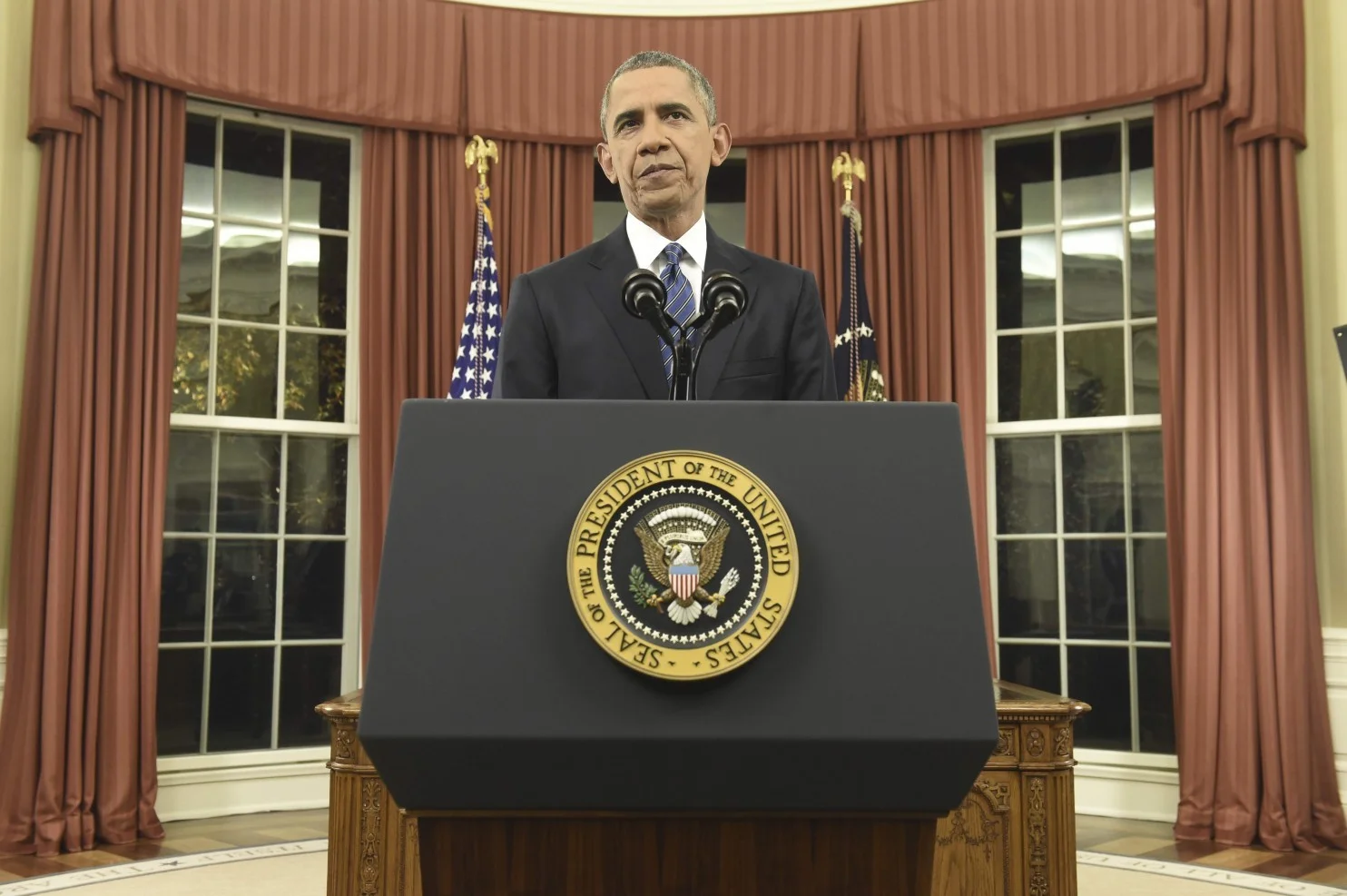
6 December 2015, Oval Office address, Washington DC, USA

Good evening. On Wednesday, 14 Americans were killed as they came together to celebrate the holidays. They were taken from family and friends who loved them deeply. They were white and black, Latino and Asian, immigrants, and American born, moms and dads, daughters and sons. Each of them served their fellow citizens. All of them were part of our American family.

Tonight I want to talk with you about this tragedy, the broader threat of terrorism and how we can keep our country safe. The FBI is still gathering the facts about what happened in San Bernardino, but here's what we know. The victims were brutally murdered and injured by one of their co-workers and his wife. So far, we have no evidence that the killers were directed by a terrorist organization overseas or that they were part of a broader conspiracy here at home. But it is clear that the two of them had gone down the dark path of radicalization, embracing a perverted interpretation of Islam that calls for war against America and the West. They had stockpiled assault weapons, ammunition, and pipe bombs.

So this was an act of terrorism designed to kill innocent people. Our nation has been at war with terrorists since Al Qaeda killed nearly 3,000 Americans on 9/11. In the process, we've hardened our defenses, from airports, to financial centers, to other critical infrastructure. Intelligence and law enforcement agencies have disrupted countless plots here and overseas and worked around the clock to keep us safe.

Our military and counterterrorism professionals have relentlessly pursued terrorist networks overseas, disrupting safe havens in several different countries, killing Osama Bin Laden, and decimating Al Qaeda's leadership.

Over the last few years, however, the terrorist threat has evolved into a new phase. As we've become better at preventing complex multifaceted attacks like 9/11, terrorists turn to less complicated acts of violence like the mass shootings that are all too common in our society. It is this type of attack that we saw at Fort Hood in 2009, in Chattanooga earlier this year, and now in San Bernardino.

And as groups like ISIL grew stronger amidst the chaos of war in Iraq and then Syria, and as the Internet erases the distance between countries, we see growing efforts by terrorists to poison the minds of people like the Boston Marathon bombers and the San Bernardino killers.

For seven years, I've confronted this evolving threat each and every morning in my intelligence briefing, and since the day I took this office, I have authorized U.S. forces to take out terrorists abroad precisely because I know how real the danger is.

As commander in chief, I have no greater responsibility than the security of the American people.

As a father to two young daughters who are the most precious part of my life, I know that we see ourselves with friends and co-workers at a holiday party like the one in San Bernardino. I know we see our kids in the faces of the young people killed in Paris.

And I know that after so much war, many Americans are asking whether we are confronted by a cancer that has no immediate cure.

Well, here's what I want you to know. The threat from terrorism is real, but we will overcome it. We will destroy ISIL and any other organization that tries to harm us. Our success won't depend on tough talk, or abandoning our values or giving into fear. That's what groups like ISIL are hoping for. Instead, we will prevail by being strong and smart, resilient and relentless. And by drawing upon every aspect of American power.

Here's how. First, our military will continue to hunt down terrorist plotters in any country where it is necessary. In Iraq and Syria, air strikes are taking out ISIL leaders, heavy weapons, oil tankers, infrastructure.

And since attacks in Paris, our closest allies, including France, Germany, and the United Kingdom, have ramped up their contributions to our military campaign which will help us accelerate our effort to destroy ISIL.

Second, we will continue to provide training and equipment to tens of thousands of Iraqi and Syrian forces fighting ISIL on the ground so that we take away their safe havens.

In both countries, we're deploying special operations forces who can accelerate that offensive. We've stepped up this effort since the attacks in Paris, and will continue to invest more in approaches that are working on the ground.

Third, we're working with friends and allies to stop ISIL's operations, to disrupt plots, cut off their financing, and prevent them from recruiting more fighters.

Since the attacks in Paris, we've surged merged intelligence sharing with our European allies. We're working with Turkey to seal its border with Syria, and we are cooperating with Muslim majority countries, and with our Muslim communities here at home, to counter the vicious ideology that ISIL promotes online.

Fourth, with American leadership, the international community has begun to establish a process and timeline to pursue cease-fires and a political resolution to the Syrian war.

Doing so will allow the Syrian people and every country, including our allies, but also countries like Russia, to focus on the common goal of destroying ISIL, a group that threatens us all.

This is our strategy to destroy ISIL. It is designed and supported by our military commanders and counterterrorism experts, together with 65 countries that have joined an American-led coalition. And we constantly examine our strategy to determine when additional steps are needed to get the job done.

That's why I've ordered the Departments of State and Homeland Security to review the visa waiver program under which the female terrorist in San Bernardino originally came to this country. And that's why I will urge high-tech and law enforcement leaders to make it harder for terrorists to use technology to escape from justice.

Now, here at home, we have to work together to address the challenge. There are several steps that Congress should take right away. To begin with, Congress should act to make sure no one on a no- fly list is able to buy a gun. What could possibly be the argument for allowing a terrorist suspect to buy a semiautomatic weapon? This is a matter of national security.

We also need to make it harder for people to buy powerful assault weapons, like the ones that were used in San Bernardino. I know there are some who reject any gun-safety measures, but the fact is that our intelligence and law-enforcement agencies, no matter how effective they are, cannot identify every would-be mass shooter, whether that individual was motivated by ISIL or some other hateful ideology.

What we can do, and must do, is make it harder for them to kill.

Next, we should put in place stronger screening for those who come to America without a visa so that we can take a hard look at whether they've traveled to war zones. And we're working with members of both parties in Congress to do exactly that.

Finally, if Congress believes, as I do, that we are at war with ISIL, it should go ahead and vote to authorize the continued use of military force against these terrorists.

For over a year, I have ordered our military to take thousands of air strikes against ISIL targets. I think it's time for Congress to vote to demonstrate that the American people are united and committed to this fight.

My fellow Americans, these are the steps that we can take together to defeat the terrorist threat.

Let me now say a word about what we should not do. We should not be drawn once more into a long and costly ground war in Iraq or Syria. That's what groups like ISIL want. They know they can't defeat us on the battlefield. ISIL fighters were part of the insurgency that we faced in Iraq. But they also know that if we occupy foreign lands, they can maintain insurgencies for years, killing thousands of our troops and draining our resources, and using our presence to draw new recruits.

The strategy that we are using now -- air strikes, special forces, and working with local forces who are fighting to regain control of their own country -- that is how we'll achieve a more sustainable victory, and it won't require us sending a new generation of Americans overseas to fight and die for another decade on foreign soil.

Here's what else we cannot do. We cannot turn against one another by letting this fight be defined as a war between America and Islam. That, too, is what groups like ISIL want.

ISIL does not speak for Islam. They are thugs and killers, part of a cult of death. And they account for a tiny fraction of a more than a billion Muslims around the world, including millions of patriotic Muslim-Americans who reject their hateful ideology.

Moreover, the vast majority of terrorist victims around the world are Muslim.

If we're to succeed in defeating terrorism, we must enlist Muslim communities as some of our strongest allies, rather than push them away through suspicion and hate.

That does not mean denying the fact that an extremist ideology has spread within some Muslim communities. It's a real problem that Muslims must confront without excuse.

Muslim leaders here and around the globe have to continue working with us to decisively and unequivocally reject the hateful ideology that groups like ISIL and Al Qaeda promote, to speak out against not just acts of violence, but also those interpretations of Islam that are incompatible with the values of religious tolerance, mutual respect, and human dignity.

But just as it is the responsibility of Muslims around the world to root out misguided ideas that lead to radicalization, it is the responsibility of all Americans, of every faith, to reject discrimination. It is our responsibility to reject religious tests on who we admit into this country. It's our responsibility to reject proposals that Muslim-Americans should somehow be treated differently. Because when we travel down that road, we lose. That kind of divisiveness, that betrayal of our values plays into the hands of groups like ISIL.

Muslim-Americans are our friends and our neighbors, our co- workers, our sports heroes. And, yes, they are our men and women in uniform who are willing to die in defense of our country. We have to remember that.

My fellow Americans, I am confident we will succeed in this mission because we are on the right side of history. We were founded upon a belief in human dignity that no matter who you are, or where you come from, or what you look like or what religion you practice, you are equal in the eyes of God and equal in the eyes of the law. Even in this political season, even as we properly debate what steps I and future presidents must take to keep our country safe. Let's make sure we never forget what makes us exceptional.  That we have always met challenges, whether war or depression, natural disasters or terrorist attacks, by coming together around our common ideals as one nation and one people.

So long as we stay true to that tradition, I have no doubt that America will prevail.

Thank you. God bless you. And may God bless the United States of America

Source: https://www.washingtonpost.com/news/the-fi...

Enjoyed this speech? Speakola is a labour of love and I’d be very grateful if you would share, tweet or like it. Thank you.

Facebook Twitter Facebook
In 2010s Tags BARACK OBBAMA, TERRORISM, SAN BERNARDINO, ISIL, ISIS, OVAL OFFICE, PRESIDENTS, IRAQ, SYRIA, TRANSCRIPT
Comment

Hilary Benn: 'What we know about fascists is that they need to be defeated', House of Commons - 2015

December 3, 2015

2 December 2015, House of Commons, United Kingdom

Described by his opposite number as "one of the truly great speeches in the house of Commons", Hilary Benn's speech drew cheers and applause from all sides.

Thank you very much Mr Speaker. Before I respond to the debate, I would like to say this directly to the Prime Minister: although my right honourable friend the Leader of the Opposition and I will walk into different division lobbies tonight, I am proud to speak from the same Despatch Box as him. My right honourable friend is not a terrorist sympathiser. He is an honest, a principled, a decent and a good man, and I think the Prime Minister must now regret what he said yesterday and his failure to do what he should have done today which is simply to say, ‘I am sorry.’

Now Mr Speaker, we have had an intense and impassioned debate – and rightly so, given the clear and present threat from Daesh, the gravity of the decision that rests upon the shoulders and the conscience of every single one of us, and the lives that we hold in our hands tonight. And whatever decision we reach, I hope we will treat one another with respect.

Now we have heard a number of outstanding speeches, and sadly time will prevent me from acknowledging them all but I would just like to single out the contributions both for and against the motion from my honourable and right honourable friends the members for Derby South [Margaret Beckett], Kingston Upon Hull West and Hessle [Alan Johnson], Normanton Pontefract and Castleford [Yvette Cooper], Barnsley Central [Dan Jarvis], Wakefield [Mary Creagh], Wolverhampton South East [Pat McFadden], Brent North [Barry Gardiner], Liverpool West Derby [Stephen Twigg], Wirral West [Margaret Greenwood], Stoke on Trent North [Ruth Smeeth], Birmingham Ladywood [Shabana Mahmood] and the honourable members for Reigate [Crispin Blunt], South West Wiltshire [Andrew Murrison], Tonbridge and Malling [John Stanley], Chichester [Andrew Tyrie] and Wells [James Heappey].

The question which confronts us in a very very complex conflict is at its heart very simple. What should we do with others to confront this threat to our citizens, our nation, other nations and the people who suffer under the yoke, the cruel yoke, of Daesh?

Carnage in Paris brought home to us the clear and present danger we face from them. It could just as easily have been London or Glasgow or Leeds or Birmingham – and it could still be. And I believe we have a moral and a practical duty to extend the action we are already taking in Iraq to Syria. And I am also clear, and I say this to my colleagues, that the conditions set out in the emergency resolution passed at the Labour party conference in September have been met. We now have a clear and unambiguous UN Security Council resolution 2249, paragraph five of which specifically calls on member states to take all necessary measures; to redouble and co-ordinate their efforts to prevent and suppress terrorist acts committed specifically by ISIL and to eradicate the safe haven they have established over significant parts of Iraq and Syria.

So the United Nations is asking us to do something. It is asking us to do something now. It is asking us to act in Syria as well as in Iraq. And it was a Labour government, if the honourable gentleman will bear with me, it was a Labour government that helped to found the United Nations at the end of the Second World War. And why did we do so? Because we wanted the nations of the world working together to deal with threats to international peace and security – and Daesh is unquestionably that.

So given that the United Nations has passed this resolution, given that such action would be lawful under Article 51 of the UN charter, because every state has the right to defend itself, why would we not uphold the settled will of the United Nations? Particularly when there is such support from within the region, including from Iraq.

We are part of a coalition of over 60 countries standing together shoulder to shoulder to oppose their ideology and their brutality. Now Mr Speaker, all of us understand the importance of bringing an end to the Syrian civil war, and there is now some progress on a peace plan because of the Vienna talks. They are the best hope we have of achieving a ceasefire. Now that would bring an end to Assad’s bombing, leading to a transitional government and elections. And why is that vital? Both because it will help in the defeat of Daesh, and because it would enable millions of Syrians who have been forced to flee to do what every refugee dreams of: they just want to be able to go home.

Now Mr Speaker, no one in this debate doubts the deadly serious threat we face from Daesh and what they do – although sometimes we find it hard to live with the reality. We know that in June four gay men were thrown off the fifth storey of a building in the Syrian city of Deir al-Zor. We know that in August the 82-year-old guardian of the antiquities of Palmyra, Professor Khaled al-Assad, was beheaded and his headless body was hung from a traffic light. And we know that in recent weeks there has been the discovery of mass graves in Sinjar, one said to contain the bodies of older Yazidi women murdered by Daesh because they were judged too old to be sold for sex. We know they have killed 30 British tourists in Tunisia, 224 Russian holidaymakers on a plane, 178 people in suicide bombings in Beirut , Ankara and Suruc, 130 people in Paris – including those young people in the Bataclan, whom Daesh, in trying to justify their bloody slaughter, called them apostates engaged in prostitution and vice. If it had happened here they could have been our children, and we know they are plotting more attacks.

So the question for each of us and for our national security is this: given that we know what they are doing, can we really stand aside and refuse to act fully in our self defence against those who are planning these attacks? Can we really leave to others the responsibility for defending our national security when it is our responsibility? And if we do not act, what message would that send about our solidarity with those countries that have suffered so much, including Iraq and our ally France. Now France wants us to stand with them , and President Hollande, the leader of our sister socialist party, has asked for our assistance and help. And as we are undertaking air strikes in Iraq, where Daesh’s hold has been reduced, and we are already doing everything but engage in air strikes in Syria, should we not play our full part?

Now Mr Speaker, it has been argued in the debate that air strikes achieve nothing. Not so. Look at how Daesh’s forward march has been halted in Iraq. The house will remember that 14 months ago people were saying, ‘They are almost at the gates of Baghdad.’ And that is why we voted to respond to the Iraqi government’s request for help to defeat them. Look at how their military capacity and their freedom of movement has been put under pressure. Ask the Kurds about Sinjar and Kobane. Now of course air strikes alone will not defeat Daesh, but they make a difference because they are giving them a hard time and it is making it more difficult for them to expand their territory.

Now I share the concerns that have been expressed this evening about potential civilian casualties. However unlike Daesh, none of us today act with the intent to harm civilians. Rather we act to protect civilians from Daesh, who target innocent people.

Now on the subject of ground troops to defeat Daesh, there has been much debate about the figure of 70,000 and the government must, I think, better explain that. But we know that most of them are currently engaged in fighting President Assad. But I tell you what else we know: it’s whatever the number - 70,000, 40,000, 80,000 - the current size of the opposition forces mean the longer we leave taking action, the longer Daesh will have to decrease that number. And so to suggest, Mr Speaker, that air strikes should not take place until the Syrian civil war has come to an end is, I think, to miss the urgency of the terrorist threat that Daesh poses to us and others and I think misunderstands the nature and objectives of the extension to air strikes that is being proposed.

And of course we should take action - it is not a contradiction between the two - to cut off Daesh’s support in the form of money and fighters and weapons, and of course we should give humanitarian aid and of course we should offer shelter to more refugees, including in this country, and of course we should commit to play our full part in helping to rebuild Syria when the war is over.

Now I accept that there are legitimate arguments, and we’ve heard them in the debate, for not taking this form of action now, and it is also clear that many members have wrestled and who knows, in the time that is left may still be wrestling, with what the right thing to do is. But I say the threat is now and there are rarely if ever perfect circumstances in which to deploy military forces. Now we heard very powerful testimony from the honourable member for Edisbury earlier when she quoted that passage, and I just want to read what Karwan Jamal Tahir, Kurdistan regional government high representative in London, said last week, and I quote: ‘Last June Daesh captured one third of Iraq overnight, and a few months later attacked the Kurdistan region. Swift air strikes by Britain, America and France, and the actions of our own Peshmerga saved us. We now have a border of 650 miles with Daesh. We have pushed them back and recently captured Sinjar. Again Western air strikes were vital. But the old border between Iraq and Syria does not exist. Daesh fighters come and go across this fictional boundary.’ And that is the argument, Mr Speaker, for treating the two countries as one if we are serious about defeating Daesh.

Now Mr Speaker, I hope the House will bear with me if I direct my closing remarks to my Labour friends and colleagues on this side of the House. As a party, we have always been defined by our internationalism. We believe we have a responsibility one to another. We never have and we never should walk by on the other side of the road. And we are here faced by fascists. Not just their calculated brutality, but their belief that they are superior to every single one of us here tonight, and all of the people that we represent. They hold us in contempt. They hold our values in contempt. They hold our belief in tolerance and decency in contempt. They hold our democracy, the means by which we will make our decision tonight, in contempt. And what we know about fascists is that they need to be defeated. And it is why, as we have heard tonight, socialists and trade unionists and others joined the International Brigade in the 1930s to fight against Franco. It’s why this entire House stood up against Hitler and Mussolini. It is why our party has always stood up against the denial of human rights and for justice. And my view, Mr Speaker, is that we must now confront this evil. It is now time for us to do our bit in Syria. And that is why I ask my colleagues to vote for this motion tonight.

Source: http://www.mirror.co.uk/news/uk-news/hilar...

Enjoyed this speech? Speakola is a labour of love and I’d be very grateful if you would share, tweet or like it. Thank you.

Facebook Twitter Facebook
In 2010s MORE Tags HILARY BENN, SYRIA, DAESH, ISIS, ISIL, AIR STRIKES, IRAQ, TERRORISM, MILITARY ACTION, TRANSCRIPT
Comment

See my film!

Limited Australian Season

March 2025

Details and ticket bookings at

angeandtheboss.com

Support Speakola

Hi speech lovers,
With costs of hosting website and podcast, this labour of love has become a difficult financial proposition in recent times. If you can afford a donation, it will help Speakola survive and prosper.

Best wishes,
Tony Wilson.

Become a Patron!

Learn more about supporting Speakola.

Featured political

Featured
Jon Stewart: "They responded in five seconds", 9-11 first responders, Address to Congress - 2019
Jacinda Ardern: 'They were New Zealanders. They are us', Address to Parliament following Christchurch massacre - 2019
Dolores Ibárruri: "¡No Pasarán!, They shall not pass!', Defense of 2nd Spanish Republic - 1936
Jimmy Reid: 'A rat race is for rats. We're not rats', Rectorial address, Glasgow University - 1972

Featured eulogies

Featured
For Geoffrey Tozer: 'I have to say we all let him down', by Paul Keating - 2009
for James Baldwin: 'Jimmy. You crowned us', by Toni Morrison - 1988
for Michael Gordon: '13 days ago my Dad’s big, beautiful, generous heart suddenly stopped beating', by Scott and Sarah Gordon - 2018

Featured commencement

Featured
Tara Westover: 'Your avatar isn't real, it isn't terribly far from a lie', The Un-Instagrammable Self, Northeastern University - 2019
Tim Minchin: 'Being an artist requires massive reserves of self-belief', WAAPA - 2019
Atul Gawande: 'Curiosity and What Equality Really Means', UCLA Medical School - 2018
Abby Wambach: 'We are the wolves', Barnard College - 2018
Eric Idle: 'America is 300 million people all walking in the same direction, singing 'I Did It My Way'', Whitman College - 2013
Shirley Chisholm: ;America has gone to sleep', Greenfield High School - 1983

Featured sport

Featured
Joe Marler: 'Get back on the horse', Harlequins v Bath pre game interview - 2019
Ray Lewis : 'The greatest pain of my life is the reason I'm standing here today', 52 Cards -
Mel Jones: 'If she was Bradman on the field, she was definitely Keith Miller off the field', Betty Wilson's induction into Australian Cricket Hall of Fame - 2017
Jeff Thomson: 'It’s all those people that help you as kids', Hall of Fame - 2016

Fresh Tweets


Featured weddings

Featured
Dan Angelucci: 'The Best (Best Man) Speech of all time', for Don and Katherine - 2019
Hallerman Sisters: 'Oh sister now we have to let you gooooo!' for Caitlin & Johnny - 2015
Korey Soderman (via Kyle): 'All our lives I have used my voice to help Korey express his thoughts, so today, like always, I will be my brother’s voice' for Kyle and Jess - 2014

Featured Arts

Featured
Bruce Springsteen: 'They're keepers of some of the most beautiful sonic architecture in rock and roll', Induction U2 into Rock Hall of Fame - 2005
Olivia Colman: 'Done that bit. I think I have done that bit', BAFTA acceptance, Leading Actress - 2019
Axel Scheffler: 'The book wasn't called 'No Room on the Broom!', Illustrator of the Year, British Book Awards - 2018
Tina Fey: 'Only in comedy is an obedient white girl from the suburbs a diversity candidate', Kennedy Center Mark Twain Award -  2010
Tina Fey: 'Only in comedy is an obedient white girl from the suburbs a diversity candidate', Kennedy Center Mark Twain Award - 2010

Featured Debates

Featured
Sacha Baron Cohen: 'Just think what Goebbels might have done with Facebook', Anti Defamation League Leadership Award - 2019
Greta Thunberg: 'How dare you', UN Climate Action Summit - 2019
Charlie Munger: 'The Psychology of Human Misjudgment', Harvard University - 1995
Lawrence O'Donnell: 'The original sin of this country is that we invaders shot and murdered our way across the land killing every Native American that we could', The Last Word, 'Dakota' - 2016