• Genre
  • About
  • Submissions
  • Donate
  • Search
Menu

Speakola

All Speeches Great and Small
  • Genre
  • About
  • Submissions
  • Donate
  • Search
Share a political speech
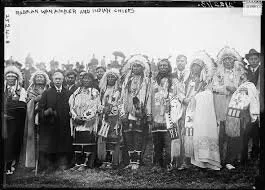
Rodman Wanamaker with Indian chiefs in 1913

Rodman Wanamaker with Indian chiefs in 1913

Woodrow Wilson: 'The great white father now calls you his brothers', Address to the American Indians - 1913

October 10, 2019

May or June 1913, Washington DC, USA

There are some dark figures in the history of the white man's dealing with the Indians, and many parts of the record are stained with the greed and avarice of those who have thought only of their own profit. But it is also true that the purposes and motives of this great government and of our nation as a whole towards the red men have been wise, just, and beneficent. The remarkable progress of our Indian brothers towards civilization is proof of it and open for all to see.

During the past half-century you have seen the schoolhouse take the place of the military post on your reservations; the administration of Indian affairs has been transferred from the military to the civil arm of the government. The education and industrial training the government has given you has enabled thousands of Indian men and women to take their places in civilization alongside their white neighbors. Thousands are living in substantial farmhouses on their own separate allotments of land. Hundreds of other have won places of prominence in the Professions, and some have worked their way into the halls of congress and into places of responsibility in our state and national governments. Thirty-thousand Indian children are enrolled in government, state, and mission schools. The great white father now calls you his brothers, not his children. Because you have shown in your education and in your settled ways of life staunch, manly, worthy qualities of sound character, the nation is about to give you distinguished recognition through the erection of a monument in honor of the Indian people, in the harbor of New York.

Source: https://en.wikisource.org/wiki/Address_to_...

Enjoyed this speech? Speakola is a labour of love and I’d be very grateful if you would share, tweet or like it. Thank you.

Facebook Twitter Facebook
In 1900-19 Tags WOODROW WILSON, NATIVE AMERICAN, ADDRESS TO THE AMERICAN INDIANS, TRANSCRIPT, PART RECORDING
Comment
Woodrow Wilson Peace without Victory.jpg

Woodrow Wilson: 'Peace without Victory', address to Senate - 1917

September 5, 2019


22 January 1917, Washington DC, USA

Gentlemen of the Senate,

On the 18th of December last, I addressed an identic note to the governments of the nations now at war requesting them to state, more definitely than they had yet been stated by either group of belligerents, the terms upon which they would deem it possible to make peace. I spoke on behalf of humanity and of the rights of all neutral nations like our own, many of whose most vital interests the war puts in constant jeopardy.

The Central Powers united in a reply which stated merely that they were ready to meet their antagonists in conference to discuss terms of peace. The Entente Powers have replied much more definitely and have stated, in general terms, indeed, but with sufficient definiteness to imply details, the arrangements, guarantees, and acts of reparation which they deem to be indispensable conditions of a satisfactory settlement. We are that much nearer a definite discussion of the peace which shall end the present war. We are that much nearer the discussion of the international concert which must thereafter hold the world at peace.

In every discussion of the peace that must end this war, it is taken for granted that that peace must be followed by some definite concert of power which will make it virtually impossible that any such catastrophe should ever overwhelm us again. Every lover of mankind, every sane and thoughtful man must take that for granted.

I have sought this opportunity to address you because I thought that I owed it to you, as the council associated with me in the final determination of our international obligations, to disclose to you without reserve the thought and purpose that have been taking form in my mind in regard to the duty of our government in the days to come, when it will be necessary to lay afresh and upon a new plan the foundations of peace among the nations.

It is inconceivable that the people of the United States should play no part in that great enterprise. To take part in such a service will be the opportunity for which they have sought to prepare themselves by the very principles and purposes of their polity and the approved practices of their government ever since the days when they set up a new nation in the high and honorable hope that it might, in all that it was and did, show mankind the way to liberty.

They cannot in honor withhold the service to which they are now about to be challenged. They do not wish to withhold it. But they owe it to themselves and to the other nations of the world to state the conditions under which they will feel free to render it.

That service is nothing less than this, to add their authority and their power to the authority and force of other nations to guarantee peace and justice throughout the world. Such a settlement cannot now be long postponed. It is right that before it comes, this government should frankly formulate the conditions upon which it would feel justified in asking our people to approve its formal and solemn adherence to a League for Peace. I am here to attempt to state those conditions.

The present war must first be ended; but we owe it to candor and to a just regard for the opinion of mankind to say that, so far as our participation in guarantees of future peace is concerned, it makes a great deal of difference in what way and upon what terms it is ended. The treaties and agreements which bring it to an end must embody terms which will create a peace that is worth guaranteeing and preserving, a peace that will win the approval of mankind, not merely a peace that will serve the several interests and immediate aims of the nations engaged . We shall have no voice in determining what those terms shall be, but we shall, I feel sure, have a voice in determining whether they shall be made lasting or not by the guarantees of a universal covenant; and our judgment upon what is fundamental and essential as a condition precedent to permanency should be spoken now, not afterwards when it may be too late.

No covenant of cooperative peace that does not include the peoples of the New World can suffice to keep the future safe against war; and yet there is only one sort of peace that the peoples of America could join in guaranteeing. The elements of that peace must be elements that engage the confidence and satisfy the principles of the American governments, elements consistent with their political faith and with the practical convictions which the peoples of America have once for all embraced and undertaken to defend.

I do not mean to say that any American government would throw any obstacle in the way of any terms of peace the governments now at war might agree upon or seek to upset them when made, whatever they might be. I only take it for granted that mere terms of peace between the belligerents will not satisfy even the belligerents themselves. Mere agreements may not make peace secure. It will be absolutely necessary that a force be created as a guarantor of the permanency of the settlement so much greater than the force of any nation now engaged, or any alliance hitherto formed or projected, that no nation, no probable combination of nations, could face or withstand it. If the peace presently to be made is to endure, it must be a peace made secure by the organized major force of mankind.

The terms of the immediate peace agreed upon will determine whether it is a peace for which such a guarantee can be secured. The question upon which the whole future peace and policy of the world depends is this: Is the present war a struggle for a just and secure peace, or only for a new balance of power? If it be only a struggle for a new balance of power, who will guarantee, who can guarantee the stable equilibrium of the new arrangement? Only a tranquil Europe can be a stable Europe. There must be, not a balance of power but a community power; not organized rivalries but a organized, common peace.

Fortunately we have received very explicit assurances on this point. The statesmen of both of the groups of nations now arrayed against one another have said, in terms that could not be misinterpreted, that it was no part of the purpose they had in mind to crush their antagonists. But the implications of these assurances may not be equally to all--may not be the same on both sides of the water. I think it will be serviceable if I attempt to set forth what we understand them to be.

They imply, first of all, that it must be a peace without victory. It is not pleasant to say this. I beg that I may be permitted to put my own interpretation upon it and that it may be understood that no other interpretation was in my thought. I am seeking only to face realities and to face them without soft concealments. Victory would mean peace forced upon the loser, a victor's terms imposed upon the vanquished. It would be accepted in humiliation, under duress, at an intolerable sacrifice, and would leave a sting, a resentment, a bitter memory upon which terms of peace would rest, not permanently but only as upon quicksand. Only a peace between equals can last. Only a peace the very principle of which is equality and a common participation in a common benefit. The right state of mind, the right feeling between nations, is as necessary for a lasting peace as is the just settlement of vexed questions of territory or of racial and national allegiance.

The equality of nations upon which peace must be founded if it is to last must be an equality of rights; the guarantees exchanged must neither recognize nor imply a difference between big nations and small, between those that are powerful and those that are weak. Right must be based upon the common strength, not upon the individual strength, of the nations upon whose concert peace will depend. Equality of territory or of resources there of course cannot be; nor any other sort of equality not gained in the ordinary peaceful and legitimate development of the peoples themselves. But no one asks or expects anything more than an equality of rights. Mankind is looking now for freedom of life, not for equipoises of power.

And there is a deeper thing involved than even equality of right among organized nations. No peace can last, or ought to last, which does not recognize and accept the principle that governments derive all their just powers from the consent of the governed, and that no right anywhere exists to hand peoples about from sovereignty to sovereignty as if they were property. I take it for granted, for instance, if I may venture upon a single example, that statesmen everywhere are agreed that there should be a united, independent, and autonomous Poland, and that, henceforth, inviolable security of life, of worship, and of industrial and social development should be guaranteed to all peoples who have lived hitherto under the power of governments devoted to a faith and purpose hostile to their own.

I speak of this, not because of any desire to exalt an abstract political principle which has always been held very dear by those who have sought to build up liberty in America but for the same reason that I have spoken of the other conditions of peace which seem to me clearly indispensable because I wish frankly to uncover realities. Any peace which does not recognize and accept this principle will inevitably be upset. It will not rest upon the affections or the convictions of mankind. The ferment of spirit of whole populations will fight subtly and constantly against it, and all the world will sympathize. The world can be at peace only if its life is stable, and there can be no stability where the will is in rebellion, where there is not tranquillity of spirit and a sense of justice, of freedom, and of right.

So far as practicable, moreover, every great people now struggling toward a full development of its resources and of its powers should be assured a direct outlet to the great highways of the sea. Where this cannot be done by the cession of territory, it can no doubt be done by the neutralization of direct rights of way under the general guarantee which will assure the peace itself. With a right comity of arrangement, no nation need be shut away from free access to the open paths of the world's commerce.

And the paths of the sea must alike in law and in fact be free. The freedom of the seas is the sine qua non of peace, equality, and cooperation. No doubt a somewhat radical reconsideration of many of the rules of international practice hitherto thought to be established may be necessary in order to make the seas indeed free and common in practically all circumstances for the use of mankind, but the motive for such changes is convincing and compelling. There can be no trust or intimacy between the peoples of the world without them. The free, constant, unthreatened intercourse of nations is an essential part of the process of peace and of development. It need not be difficult either to define or to secure the freedom of the seas if the governments of the world sincerely desire to come to an agreement concerning it.

It is a problem closely connected with the limitation of naval armaments and the cooperation of the navies of the world in keeping the seas at once free and safe. And the question of limiting naval armaments opens the wider and perhaps more difficult question of the limitation of armies and of all programs of military preparation. Difficult and delicate as these questions are, they must be faced with the utmost candor and decided in a spirit of real accommodation if peace is to come with healing in its wings, and come to stay.

Peace cannot be had without concession and sacrifice. There can be no sense of safety and equality among the nations if great preponderating armaments are henceforth to continue here and there to be built up and maintained. The statesmen of the world must plan for peace, and nations must adjust and accommodate their policy to it as they have planned for war and made ready for pitiless contest and rivalry. The question of armaments, whether on land or sea, is the most immediately and intensely practical question connected with the future fortunes of nations and of mankind.

I have spoken upon these great matters without reserve and with the utmost explicitness because it has seemed to me to be necessary if the world's yearning desire for peace was anywhere to find free voice and utterance. Perhaps I am the only person in high authority among all the peoples of the world who is at liberty to speak and hold nothing back. I am speaking as an individual, and yet I am speaking also, of course, as the responsible head of a great government, and I feel confident that I have said what the people of the United States would wish me to say.

May I not add that I hope and believe that I am in effect speaking for liberals and friends of humanity in every nation and of every program of liberty? I would fain believe that I am speaking for the silent mass of mankind everywhere who have as yet had no place or opportunity to speak their real hearts out concerning the death and ruin they see to have come already upon the persons and the homes they hold most dear.

And in holding out the expectation that the people and government of the United States will join the other civilized nations of the world in guaranteeing the permanence of peace upon such terms as I have named I speak with the greater boldness and confidence because it is clear to every man who can think that there is in this promise no breach in either our traditions or our policy as a nation, but a fulfillment, rather, of all that we have professed or striven for.

I am proposing, as it were, that the nations should with one accord adopt the doctrine of President Monroe as the doctrine of the world: that no nation should seek to extend its polity over any other nation or people, but that every people should be left free to determine its own polity, its own way of development--unhindered, unthreatened, unafraid, the little along with the great and powerful.

I am proposing that all nations henceforth avoid entangling alliances which would draw them into competitions of power, catch them in a net of intrigue and selfish rivalry, and disturb their own affairs with influences intruded from without. There is no entangling alliance in a concert of power. When all unite to act in the same sense and with the same purpose, all act in the common interest and are free to live their own lives under a common protection.

I am proposing government by the consent of the governed; that freedom of the seas which in international conference after conference representatives of the United States have urged with the eloquence of those who are the convinced disciples of liberty; and that moderation of armaments which makes of armies and navies a power for order merely, not an instrument of aggression or of selfish violence.

These are American principles, American policies. We could stand for no others. And they are also the principles and policies of forward-looking men and women everywhere, of every modern nation, of every enlightened community. They are the principles of mankind and must prevail.

President Wilson made this speech to the Senate in January 1917. Just over two months later, the U.S. joined the conflict.

Source: http://web.mit.edu/21h.102/www/Wilson%20Pe...

Enjoyed this speech? Speakola is a labour of love and I’d be very grateful if you would share, tweet or like it. Thank you.

Facebook Twitter Facebook
In 1900-19 Tags WOODROW WILSON, TRANSCRIPT, PEACE WITHOUT VICTORY, WW1, PRESIDENT, ADDRESS TO SENATE, PEACE
Comment

Henry Cabot Lodge: 'American I was born', Opposing League of Nations - 1919

February 1, 2018

12 August 1919, Washington DC, USA

Mr. President:

The independence of the United States is not only more precious to ourselves but to the world than any single possession. Look at the United States today. We have made mistakes in the past. We have had shortcomings. We shall make mistakes in the futureand fall short of our own best hopes. But none the less is there any country today on the face of the earth which can compare with this in ordered liberty, in peace, and in the largest freedom?

I feel that I can say this without being accused of undue boastfulness, for it is the simple fact, and in making this treaty and taking on these obligations all that we do is in a spirit of unselfishness and in a desire for the good of mankind. But it is well to remember that we are dealing with nations every oneof which has a direct individual interest to serve, and there is grave danger in an unshared idealism.

Contrast the United States with any country on the face of the earth today and ask yourself whether the situation of the United States is not the best to be found. I will go as far as anyone in world service, but the first step to world service is the maintenance of the United States.

I have always loved one flag and I cannot share that devotion [with] a mongrel banner created for a League.

You may call me selfish if you will, conservative or reactionary, or use any other harsh adjective you see fit to apply, but an American I was born, an American I have remained all my life. I can never be anything else but an American, and I must think of the United States first, and when I think of the United States first in an arrangement like this I am thinking of what is best for the world, for if the United States fails, the best hopes of mankind fail with it.

I have never had but one allegiance ‐I cannot divide it now. I have loved but one flag and I cannot share that devotion and give affection to the mongrel banner invented for a league. Internationalism, illustrated by the Bolshevik and by the men to whom all countries are alike provided they can make money out of them, is to me repulsive.

National I must remain, and in that way I like all other Americans can render the amplest service to the world. The United States is the world's best hope, but if you fetter her in the interests and quarrels of other nations, if you tangle her in the intrigues of Europe, you will destroy her power for good and endanger her very existence. Leave her to march freely through the centuries to come as in the years that have gone.

Strong, generous, and confident, she has nobly served mankind. Beware how you trifle with your marvellous inheritance, this great land of ordered liberty, for if we stumble and fall freedom and civilization everywhere will go down in ruin.

We are told that we shall 'break the heart of the world 'if we do not take this league just as it stands. I fear that the hearts of the vast majority of mankind would beat on strongly and steadily and without any quickening if the league were to perish altogether. If it should be effectively and beneficently changed the people who would lie awake in sorrow for a single night could be easily gathered in one not very large room but those who would draw a long breath of relief would reach to millions.

We hear much of visions and I trust we shall continue to have visions and dream dreams of a fairer future for the race. But visions are one thing and visionaries are another, and the mechanical appliances of the rhetorician designed to give a picture of a present which does not exist and of a future which no man can predict are as unreal and short‐lived as the steam or canvas clouds, the angels suspended on wires and the artificial lights of the stage.

They pass with the moment of effect and are shabby and tawdry in the daylight. Let us at least be real. Washington's entire honesty of mind and his fearless look into the face of all facts are qualities which can never go out of fashion and which we should all do well to imitate.

Ideals have been thrust upon us as an argument for the league until the healthy mind which rejects cant revolts from them. Are ideals confined to this deformed experiment upon a noble purpose, tainted, as it is, with bargains and tied to a peace treaty which might have been disposed of long ago to the great benefit of the world if it had not been compelled to carry this rider on its back? 'Post equitem sedet atra cura,' Horace tells us, but no blacker care ever sat behind any rider than we shall find in this covenant of doubtful and disputed interpretation as it now perches upon the treaty of peace.

No doubt many excellent and patriotic people see a coming fulfilment of noble ideals in the words 'league for peace.' We all respect and share these aspirations and desires, but some of us see no hope, but rather defeat, for them in this murky covenant. For we, too, have our ideals, even if we differ from those who have tried to establish a monopoly of idealism.

Our first ideal is our country, and we see her in the future, as in the past, giving service to all her people and to the world. Our ideal of the future is that she should continue to render that service of her own free will. She has great problems of her own to solve, very grim and perilous problems, and a right solution, if we can attain to it, would largely benefit mankind.

We would have our country strong to resist a peril from the West, as she has flung back the German menace from the East. We would not have our politics distracted and embittered by the dissensions of other lands. We would not have our country's vigour exhausted or her moral force abated, by everlasting meddling and muddling in every quarrel, great and small, which afflicts the world.

Our ideal is to make her ever stronger and better and finer, because in that way alone, as we believe, can she be of the greatest service to the world's peace and to the welfare of mankind

Source: https://ay12-14.moodle.wisc.edu/prod/plugi...

Enjoyed this speech? Speakola is a labour of love and I’d be very grateful if you would share, tweet or like it. Thank you.

Facebook Twitter Facebook
In 1900-19 Tags HENRY CABOT LODGE, ISOLATIONISM, WW1, TREATY OF VERSAILLES, WOODROW WILSON, TRANSCRIPT
Comment

Woodrow Wilson: 'You will say, “Is the league an absolute guaranty against war?”', the Pueblo speech, lobbying for Treaty of Versailles and League of Nations - 1919

August 30, 2017

25 September 1919, Pueblo, Colorado, USA

President Wilson attended Versailles and was desperate to have the USA ratify treaty and be part of League of Nations. It didn't happen. This was his stump speech on a tour of nation lobbying for League of Nations.

Mr. Chairman and fellow countrymen, it is with a great deal of genuine pleasure that I find myself in Pueblo, and I feel it a compliment that I should be permitted to be the first speaker in this beautiful hall. One of the advantages of this hall, as I look about, is that you are not too far away from me, because there is nothing so reassuring to men who are trying to express the public sentiment as getting into real personal contact with their fellow citizens. I have gained a renewed impression as I have crossed the continent this time of the homogeneity of this great people to whom we belong. They come from many stocks, but they are all of one kind. They come from many origins, but they are all shot through with the same principles and desire the same righteous and honest things. I have received a more inspiring impression this time of the public opinion of the United States than it was ever my privilege to receive before.

The chief pleasure of my trip has been that it has nothing to do with my personal fortunes, that it has nothing to do with my personal reputation, that it has nothing to do with anything except the great principles uttered by Americans of all sorts and of all parties which we are now trying to realize at this crisis of the affairs of the world. But there have been unpleasant impressions as well as pleasant impressions, my fellow citizens, as I have crossed the continent. I have perceived more and more that men have been busy creating an absolutely false impression of what the treaty of peace and the covenant of the league of nations contain and mean. I find, more-over, that there is an organized propaganda against the league of nations and against the treaty proceeding from exactly the same sources that the organized propaganda proceeded from which threatened this country here and there with disloyalty. And I want to say–I cannot say it too often–any man who carries a hyphen about with him carries a dagger that he is ready to plunge into the vitals of this Republic whenever he gets ready. If I can catch any man with a hyphen in this great contest, I will know that I have caught an enemy of the Republic. My fellow citizens, it is only certain bodies of foreign sympathies, certain bodies of sympathy with foreign nations that are organized against this great document which the American representatives have brought back from Paris. Therefore, in order to clear away the mists, in order to remove the impressions, in order to check the falsehoods that have clustered around this great subject, I want to tell you a few very simple things about the treaty and the covenant.

Do not think of this treaty of peace as merely a settlement with Germany. It is that. It is a very severe settlement with Germany, but there is not anything in it that she did not earn. Indeed, she earned more than she can ever be able to pay for, and the punishment exacted of her is not a punishment greater than she can bear, and it is absolutely necessary in order that no other nation may ever plot such a thing against humanity and civilization. But the treaty is so much more than that. It is not merely a settlement with Germany; it is a readjustment of those great injustices which underlie the whole structure of European and Asiatic society. This is only the first of several treaties. They are all constructed upon the same plan. The Austrian treaty follows the same lines. The treaty with Hungary follows the same lines. The treaty with Bulgaria follows the same lines. The treaty with Turkey, when it is formulated, will follow the same lines. What are those lines? They are based upon the purpose to see that every government dealt with in this great settlement is put in the hands of the people and taken out of the hands of coteries and of sovereigns who had no right to rule over the people. It is a people’s treaty, that accomplishes by a great sweep of practical justice the liberation of men who never could have liberated themselves, and the power of the most powerful nations has been devoted not to their aggrandizement but to the liberation of people whom they could have put under their control if they had chosen to do so. Not one foot of territory is demanded by the conquerors, not one single item of submission to their authority is demanded by them. The men who sat around that table in Paris knew that the time had come when the people were no longer going to consent to live under masters, but were going to live the lives that they chose themselves, to live under such governments as they chose to erect. That is the fundamental principle of this great settlement.

And we did not stop with that. We added a great international charter for the rights of labor. Reject this treaty, impair it, and this is the consequence to the laboring men of the world, that there is no international tribunal which can bring the moral judgments of the world to bear upon the great labor questions of the day. What we need to do with regard to the labor questions of the day, my fellow countrymen, is to lift them into the light, is to lift them out of the haze and distraction of passion, of hostility, into the calm spaces where men look at things without passion. The more men you get into a great discussion the more you exclude passion. Just so soon as the calm judgment of the world is directed upon the question of justice to labor, labor is going to have a forum such as it never was supplied with before, and men everywhere are going to see that the problem of labor is nothing more nor less than the problem of the elevation of humanity. We must see that all the questions which have disturbed the world, all the questions which have eaten into the confidence of men toward their governments, all the questions which have disturbed the processes of industry, shall be brought out where men of all points of view, men of all attitudes of mind, men of all kinds of experience, may contribute their part to the settlement of the great questions which we must settle and cannot ignore.

At the front of this great treaty is put the covenant of the league of nations. It will also be at the front of the Austrian treaty and the Hungarian treaty and the Bulgarian treaty and the treaty with Turkey. Every one of them will contain the covenant of the league of nations, because you cannot work any of them without the covenant of the league of nations. Unless you get the united, concerted purpose and power of the great Governments of the world behind this settlement, it will fall down like a house of cards. There is only one power to put behind the liberation of mankind, and that is the power of mankind. It is the power of the united moral forces of the world, and in the covenant of the league of nations, the moral forces of the world are mobilized. For what purpose? Reflect, my fellow citizens, that the membership of this great league is going to include all the great fighting nations of the world, as well as the weak ones. It is not for the present going to include Germany, but for the time being Germany is not a great fighting country. All the nations that have power that can be mobilized are going to be members of this League, including the United States. And what do they unite for? They enter into a solemn promise to one another that they will never use their power against one another for aggression; that they never will impair the territorial integrity of a neighbor; that they never will interfere with the political independence of a neighbor; that they will abide by the principle that great populations are entitled to determine their own destiny and that they will not interfere with that destiny; and that no matter what differences arise amongst them they will never resort to war without first having done one or other of two things–either submitted the matter of controversy to arbitration, in which case they agree to abide by the result without question, or submitted it to the consideration of the council of the league of nations, laying before that council all the documents, all the facts, agreeing that the council can publish the documents and the facts to the whole world, agreeing that there shall be six months allowed for the mature consideration of those facts by the council, and agreeing that at the expiration of these six months, even if they are not then ready to accept the advice of the council with regard to the settlement of the dispute, they will still not go to war for another three months. In other words, they consent, no matter what happens, to submit every matter of difference between them to the judgment of mankind, and just so certainly as they do that, my fellow citizens, war will be in the far background, war will be pushed out of that foreground of terror in which it has kept the world for generation after generation, and men will know that there will be a calm time of deliberate counsel. The most dangerous thing for a bad cause is to expose it to the opinion of the world. The most certain way that you can prove that a man is mistaken is by letting all his neighbors know what he thinks, by letting all his neighbors discuss what he thinks, and if he is in the wrong, you will notice that he will stay at home, he will not walk on the street. He will be afraid of the eyes of his neighbors. He will be afraid of their judgment of his character. He will know that his cause is lost unless he can sustain it by the arguments of right and of justice. The same law that applies to individuals applies to nations.

But you say, “We have heard that we might be at a disadvantage in the league of nations.” Well, whoever told you that either was deliberately falsifying or he had not read the covenant of the league of nations. I leave him the choice. I want to give you a very simple account of the organization of the league of nations and let you judge for yourselves. It is a very simple organization. The power of the league, or rather the activities of the league, lie in two bodies. There is the council, which consists of one representative from each of the principal allied and associated powers–that is to say, the United States, Great Britain, France, Italy, and Japan, along with four other representatives of the smaller powers chosen out of the general body of the membership of the league. The council is the source of every active policy of the league, and no active policy of the league can be adopted without a unanimous vote of the council. That is explicitly stated in the covenant itself. Does it not evidently follow that the league of nations can adopt no policy whatever without the consent of the United States? The affirmative vote of the representative of the United States is necessary in every case. Now, you have heard of six votes belonging to the British Empire. Those six votes are not in the council. They are in the assembly, and the interesting thing is that the assembly does not vote. I must qualify that statement a little, but essentially it is absolutely true. In every matter in which the assembly is given a voice, and there are only four or five, its vote does not count unless concurred in by the representatives of all the nations represented on the council, so that there is no validity to any vote of the assembly unless in that vote also the representative of the United States concurs. That one vote of the United States is as big as the six votes of the British Empire. I am not jealous for advantage, my fellow citizens, but I think that is a perfectly safe situation. There is no validity in a vote, either by the council or the assembly, in which we do not concur. So much for the statements about the six votes of the British Empire.

Look at it in another aspect. The assembly is the talking body. The assembly was created in order that anybody that purposed anything wrong would be subjected to the awkward circumstance that everybody could talk about it. This is the great assembly in which all the things that are likely to disturb the peace of the world or the good understanding between nations are to be exposed to the general view, and I want to ask you if you think it was unjust, unjust to the United States, that speaking parts should be assigned to the several portions of the British Empire? Do you think it unjust that there should be some spokesman in debate for that fine little stout Republic down in the Pacific, New Zealand? Do you think it unjust that Australia should be allowed to stand up and take part in the debate–Australia, from which we have learned some of the most useful progressive policies of modern time, a little nation only five million in a great continent, but counting for several times five in its activities and in its interest in liberal reform? Do you think it unjust that that little Republic down in South Africa, whose gallant resistance to being subjected to any outside authority at all we admired for so many months and whose fortunes we followed with such interest, should have a speaking part? Great Britain obliged South Africa to submit to her sovereignty, but she immediately after that felt that it was convenient and right to hand the whole self-government of that colony over to the very men whom she had beaten. The representatives of South Africa in Paris were two of the most distinguished generals of the Boer Army, two of the realest men I ever met, two men that could talk sober counsel and wise advice, along with the best statesmen in Europe. To exclude Gen. Botha and Gen. Smuts from the right to stand up in the parliament of the world and say something concerning the affairs of mankind would be absurd. And what about Canada? Is not Canada a good neighbor? I ask you. Is not Canada more likely to agree with the United States than with Great Britain? Canada has a speaking part. And then, for the first time in the history of the world, that great voiceless multitude, that throng hundreds of millions strong in India, has a voice, and I want to testily that some of the wisest and most dignified figures in the peace conference at Paris came from India, men who seemed to carry in their minds an older wisdom than the rest of us had, whose traditions ran back into so many of the unhappy fortunes of mankind that they seemed very useful counselors as to how some ray of hope and some prospect of happiness could be opened to its people. I for my part have no jealousy whatever of those five speaking parts in the assembly. Those speaking parts cannot translate themselves into five votes that can in any matter override the voice and purpose of the United States.

Let us sweep aside all this language of jealousy. Let us be big enough to know the facts and to welcome the facts, because the facts are based upon the principle that America has always fought for, namely, the equality of self-governing peoples, whether they were big or little–not counting men, but counting rights, not counting representation, but counting the purpose of that representation. When you hear an opinion quoted you do not count the number of persons who hold it; you ask, “Who said that?” You weigh opinions, you do not count them, and the beauty of all democracies is that every voice can be heard, every voice can have its effect, every voice can contribute to the general judgment that is finally arrived at. That is the object of democracy. Let us accept what America has always fought for, and accept it with pride that America showed the way and made the proposal. I do not mean that America made the proposal in this particular instance; I mean that the principle was an American principle, proposed by America.

When you come to the heart of the covenant, my fellow citizens, you will find it in article 10, and I am very much interested to know that the other things have been blown away like bubbles. There is nothing in the other contentions with regard to the league of nations, but there is something in article 10 that you ought to realize and ought to accept or reject. Article 10 is the heart of the whole matter. What is article 10? I never am certain that I can from memory give a literal repetition of its language, but I am sure that I can give an exact interpretation of its meaning. Article 10 provides that every member of the league covenants to respect and preserve the territorial integrity and existing political independence of every other member of the league as against external aggression. Not against internal disturbance. There was not a man at that table who did not admit the sacredness of the right of self-determination, the sacredness of the right of any body of people to say that they would not continue to live under the Government they were then living under, and under article 11 of the covenant, they are given a place to say whether they will live under it or not. For following article 10 is article 11, which makes it the right of any member of the league at any time to call attention to anything, anywhere, that is likely to disturb the peace of the world or the good understanding between nations upon which the peace of the world depends. I want to give you an illustration of what that would mean.

You have heard a great deal–something that was true and a great deal that was false–about that provision of the treaty which hands over to Japan the rights which Germany enjoyed in the Province of Shantung in China. In the first place, Germany did not enjoy any rights there that other nations had not already claimed. For my part, my judgment, my moral judgment, is against the whole set of concessions. They were all of them unjust to China, they ought never to have been exacted, they were all exacted by duress from a great body of thoughtful and ancient and helpless people. There never was any right in any of them. Thank God, America never asked for any, never dreamed of asking for any. But when Germany got this concession in 1898, the Government of the United States made no protest whatsoever. That was not because the Government of the United States was not in the hands of high-minded and conscientious men. It was. William McKinley was President and John Hay was Secretary of State–as safe hands to leave the honor of the United States in as any that you can cite. They made no protest because the state of international law at that time was that it was none of their business unless they could show that the interests of the United States were affected, and the only thing that they could show with regard to the interests of the United States was that Germany might close the doors of Shantung Province against the trade of the United States. They, therefore, demanded and obtained promises that we could continue to sell merchandise in Shantung. Immediately following that concession to Germany there was a concession to Russia of the same sort, of Port Arthur, and Port Arthur was handed over subsequently to Japan on the very territory of the United States. Don’t you remember that, when Russia and Japan got into war with one another the war was brought to a conclusion by a treaty written at Portsmouth, N.H., and in that treaty, without the slightest intimation from any authoritative sources in America that the Government of the United States had any objection, Port Arthur, Chinese territory, was turned over to Japan? I want you distinctly to understand that there is no thought of criticism in my mind. I am expounding to you a state of international law. Now, read articles 10 and 11. You will see that international law is revolutionized by putting morals into it. Article 10 says that no member of the league, and that includes all these nations that have done these things unjustly to China, shall impair the territorial integrity or the political independence of any other member of the league. China is going to be a member of the league. Article 11 says that any member of the League can call attention to anything that is likely to disturb the peace of the world or the good understanding between nations, and China is for the first time in the history of mankind afforded a standing before the jury of the world. I, for my part, have a profound sympathy for China, and I am proud to have taken part in an arrangement which promises the protection of the world to the rights of China. The whole atmosphere of the world is changed by a thing like that, my fellow citizens. The whole international practice of the world is revolutionized.

But, you will say, “What is the second sentence of article 10? That is what gives very disturbing thoughts.” The second sentence is that the council of the league shall advise what steps, if any, are necessary to carry out the guaranty of the first sentence, namely, that the members will respect and preserve the territorial integrity and political independence of the other members. I do not know any other meaning for the word “advise” except “advise.” The council advises, and it cannot advise without the vote of the United States. Why gentlemen should fear that the Congress of the United States would be advised to do something that it did not want to do I frankly cannot imagine, because they cannot even be advised to do anything unless their own representative has participated in the advice. It may be that that will impair somewhat the vigor of the league, but, nevertheless, the fact is so, that we are not obliged to take any advice except our own, which to any man who wants to go his own course is a very satisfactory state of affairs. Every man regards his own advice as best, and I dare say every man mixes his own advice with some thought of his own interest. Whether we use it wisely or unwisely, we can use the vote of the United States to make impossible drawing the United States into any enterprise that she does not care to be drawn into.

Yet article 10 strikes at the taproot of war. Article 10 is a statement that the very things that have always been sought in imperialistic wars are henceforth forgone by every ambitious nation in the world. I would have felt very lonely, my fellow countrymen, and I would have felt very much disturbed if, sitting at the peace table in Paris, I had supposed that I was expounding my own ideas. Whether you believe it or not, I know the relative size of my own ideas; I know how they stand related in bulk and proportion to the moral judgments of my fellow countrymen, and I proposed nothing whatever at the peace table at Paris that I had not sufficiently certain knowledge embodied the moral judgment of the citizens of the United States. I had gone over there with, so to say, explicit instructions. Don’t you remember that we laid down 14 points which should contain the principles of the settlement? They were not my points. In every one of them I was conscientiously trying to read the thought of the people of the United States, and after I uttered those points, I had every assurance given me that could be given me that they did speak the moral judgment of the United States and not my single judgment. Then, when it came to that critical period just a little less than a year ago, when it was evident that the war was coming to its critical end, all the nations engaged in the war accepted those 14 principles explicitly as the basis of the armistice and the basis of the peace. In those circumstances I crossed the ocean under bond to my own people and to the other governments with which I was dealing. The whole specification of the method of settlement was written down and accepted beforehand, and we were architects building on those specifications. It reassures me and fortifies my position to find how, before I went over men whose judgment the United States has often trusted were of exactly the same opinion that I went abroad to express. Here is something I want to read from Theodore Roosevelt:

“The one effective move for obtaining peace is by an agreement among all the great powers in which each should pledge itself not only to abide by the decisions of a common tribunal but to back its decisions by force. The great civilized nations should combine by solemn agreement in a great world league for the peace of righteousness; a court should be established. A changed and amplified Hague court would meet the requirements, composed of representatives from each nation, whose representatives are sworn to act as judges in each case and not in a representative capacity.” Now, there is article 10. He goes on and says this: “The nations should agree on certain rights that should not be questioned, such as territorial integrity, their right to deal with their domestic affairs, and with such matters as whom they should admit to citizenship. All such guarantee each of their number in possession of these rights.”

Now, the other specification is in the covenant. The covenant in another portion guarantees to the members the independent control of their domestic question. There is not a leg for these gentlemen to stand on when they say that the interests of the United States are not safeguarded in the very points where we are most sensitive. You do not need to be told again that the covenant expressly says that nothing in this covenant shall be construed as affecting the validity of the Monroe doctrine, for example. You could not be more explicit than that. And every point of interest is covered, partly for one very interesting reason. This is not the first time that the Foreign Relations Committee of the Senate of the United States has read and considered this covenant. I brought it to this country in March last in a tentative, provisional form, in practically the form that it now has, with the exception of certain additions which I shall mention immediately. I asked the foreign relations committees of both houses to come to the White House, and we spent a long evening in the frankest discussion of every portion that they wished to discuss. They made certain specific suggestions as to what should be contained in this document when it was to be revised. I carried those suggestions to Paris, and every one of them was adopted. What more could I have done? What more could have been obtained? The very matters upon which these gentlemen were most concerned were the right of withdrawal, which is now expressly stated; the safeguarding of the Monroe doctrine, which is now accomplished; the exclusion from action by the league of domestic questions, which is now accomplished. All along the line, every suggestion of the United States was adopted after the covenant had been drawn up in its first form and had been published for the criticism of the world. There is a very true sense in which I can say this is a tested American document.

I am dwelling upon these points, my fellow citizens, in spite of the fact that I dare say to most of you they are perfectly well known, because in order to meet the present situation we have got to know what we are dealing with. We are not dealing with the kind of document which this is represented by some gentlemen to be; and inasmuch as we are dealing with a document simon-pure in respect of the very principles we have professed and lived up to, we have got to do one or other of two things–we have got to adopt it or reject it. There is no middle course. You can not go in on a special-privilege basis of your own. I take it that you are too proud to ask to be exempted from responsibilities which the other members of the league will carry. We go in upon equal terms or we do not go in at all; and if we do not go in, my fellow citizens, think of the tragedy of that result–the only sufficient guaranty of the peace of the world withheld! Ourselves drawn apart with that dangerous pride which means that we shall be ready to take care of ourselves, and that means that we shall maintain great standing armies and an irresistible navy; that means we shall have the organization of a military nation; that means we shall have a general staff, with the kind of power that the general staff of Germany had; to mobilize this great manhood of the Nation when it pleases, all the energy of our young men drawn into the thought and preparation for war. What of our pledges to the men that lie dead in France? We said that they went over there, not to prove the prowess of America or her readiness for another war, but to see to it that there never was such a war again. It always seems to make it difficult for me to say anything, my fellow citizens, when I think of my clients in this case. My clients are the children; my clients are the next generation. They do not know what promises and bonds I undertook when I ordered the armies of the United States to the soil of France, but I know, and I intend to redeem my pledges to the children; they shall not be sent upon a similar errand.

Again and again, my fellow citizens, mothers who lost their sons in France have come to me and, taking my hand, have shed tears upon it not only, but they have added, “God bless you, Mr. President!” Why, my fellow citizens, should they pray God to bless me? I advised the Congress of the United States to create the situation that led to the death of their sons. I ordered their sons oversea. I consented to their sons being put in the most difficult parts of the battle line, where death was certain, as in the impenetrable difficulties of the forest of Argonne. Why should they weep upon my hand and call down the blessings of God upon me? Because they believe that their boys died for something that vastly transcends any of the immediate and palpable objects of the war. They believe, and they rightly believe, that their sons saved the liberty of the world. They believe that wrapped up with the liberty of the world is the continuous protection of that liberty by the concerted powers of all civilized people. They believe that this sacrifice was made in order that other sons should not be called upon for a similar gift–the gift of life, the gift of all that died–and if we did not see this thing through, if we fulfilled the dearest present wish of Germany and now dissociated ourselves from those alongside whom we fought in the war, would not something of the halo go away from the gun over the mantelpiece, or the sword? Would not the old uniform lose something of its significance? These men were crusaders. They were not going forth to prove the might of the United States. They were going forth to prove the might of justice and right, and all the world accepted them as crusaders, and their transcendent achievement has made all the world believe in America as it believes in no other nation organized in the modern world. There seems to me to stand between us and the rejection or qualification of this treaty the serried ranks of those boys in khaki, not only those boys who came home, but those dear ghosts that still deploy upon the fields of France.

My friends, on last Decoration Day, I went to a beautiful hillside near Paris, where was located the cemetery of Suresnes, a cemetery given over to the burial of the American dead. Behind me on the slopes was rank upon rank of living American soldiers, and lying before me upon the levels of the plain was rank upon rank of departed American soldiers. Right by the side of the stand where I spoke there was a little group of French women who had adopted those graves, had made themselves mothers of those dear ghosts by putting flowers every day upon those graves, taking them as their own sons, their own beloved, because they had died in the same cause–France was free and the world was free because America had come! I wish that some men in public life who are now opposing the settlement for which these men died could visit such a spot as that. I wish that the thought that comes out of those graves could penetrate their consciousness. I wish that they could feel the moral obligation that rests upon us not to go back on those boys, but to see the thing through, to see it through to the end and make good their redemption of the world. For nothing less depends upon this decision, nothing less than the liberation and salvation of the world.

You will say, “Is the league an absolute guaranty against war?” No; I do not know any absolute guaranty against the errors of human judgment or the violence of human passion, but I tell you this: With a cooling space of nine months for human passion, not much of it will keep hot. I had a couple of friends who were in the habit of losing their tempers, and when they lost their tempers they were in the habit of using very unparliamentary language. Some of their friends induced them to make a promise that they never swear inside the town limits. When the impulse next came upon them, they took a streetcar to go out of town to swear, and by the time they got out of town they did not want to swear. They came back convinced that they were just what they were, a couple of unspeakable fools, and the habit of getting angry and of swearing suffered great inroads upon it by that experience. Now, illustrating the great by the small, that is true of the passions of nations. It is true of the passions of men however you combine them. Give them space to cool off. I ask you this: If this is not an absolute insurance against war, do you want no insurance at all? Do you want nothing? Do you want not only no probability that war will not recur, but the probability that it will recur? The arrangements of justice do not stand of themselves, my fellow citizens. The arrangements of this treaty are just, but they need the support of the combined power of the great nations of the world. And they will have that support. Now that the mists of this great question have cleared away, I believe that men will see the truth, eye to eye and face to face. There is one thing that the American people always rise to and extend their hand to, and that is the truth of justice and of liberty and of peace. We have accepted that truth and we are going to be led by it, and it is going to lead us, and, through us the world, out into pastures of quietness and peace such as the world never dreamed of before.

Source: http://voicesofdemocracy.umd.edu/wilson-th...

Enjoyed this speech? Speakola is a labour of love and I’d be very grateful if you would share, tweet or like it. Thank you.

Facebook Twitter Facebook
In 1900-19 Tags THE PUEBLO SPEECH, WOODROW WILSON, LEAGUE OF NATIONS, VERSAILLES, UNITED STATES, UNITED NATIONS, WW1, PEACE, TRANSCRIPT
Comment

Woodrow Wilson: 'The world msust be made safe for democracy', Seeking Declaration of War - 1917

June 23, 2017

2 April 1917, Congress, Washington DC, USA

Gentlemen of the Congress:

I have called the Congress into extraordinary session because there are serious, very serious, choices of policy to be made, and made immediately, which it was neither right nor constitutionally permissible that I should assume the responsibility of making.

On the 3d of February last I officially laid before you the extraordinary announcement of the Imperial German Government that on and after the 1st day of February it was its purpose to put aside all restraints of law or of humanity and use its submarines to sink every vessel that sought to approach either the ports of Great Britain and Ireland or the western coasts of Europe or any of the ports controlled by the enemies of Germany within the Mediterranean. That had seemed to be the object of the German submarine warfare earlier in the war, but since April of last year the Imperial Government had somewhat restrained the commanders of its undersea craft in conformity with its promise then given to us that passenger boats should not be sunk and that due warning would be given to all other vessels which its submarines might seek to destroy, when no resistance was offered or escape attempted, and care taken that their crews were given at least a fair chance to save their lives in their open boats. The precautions taken were meagre and haphazard enough, as was proved in distressing instance after instance in the progress of the cruel and unmanly business, but a certain degree of restraint was observed The new policy has swept every restriction aside. Vessels of every kind, whatever their flag, their character, their cargo, their destination, their errand, have been ruthlessly sent to the bottom without warning and without thought of help or mercy for those on board, the vessels of friendly neutrals along with those of belligerents. Even hospital ships and ships carrying relief to the sorely bereaved and stricken people of Belgium, though the latter were provided with safe-conduct through the proscribed areas by the German Government itself and were distinguished by unmistakable marks of identity, have been sunk with the same reckless lack of compassion or of principle.

I was for a little while unable to believe that such things would in fact be done by any government that had hitherto subscribed to the humane practices of civilized nations. International law had its origin in the at tempt to set up some law which would be respected and observed upon the seas, where no nation had right of dominion and where lay the free highways of the world. By painful stage after stage has that law been built up, with meagre enough results, indeed, after all was accomplished that could be accomplished, but always with a clear view, at least, of what the heart and conscience of mankind demanded. This minimum of right the German Government has swept aside under the plea of retaliation and necessity and because it had no weapons which it could use at sea except these which it is impossible to employ as it is employing them without throwing to the winds all scruples of humanity or of respect for the understandings that were supposed to underlie the intercourse of the world. I am not now thinking of the loss of property involved, immense and serious as that is, but only of the wanton and wholesale destruction of the lives of noncombatants, men, women, and children, engaged in pursuits which have always, even in the darkest periods of modern history, been deemed innocent and legitimate. Property can be paid for; the lives of peaceful and innocent people can not be. The present German submarine warfare against commerce is a warfare against mankind.

It is a war against all nations. American ships have been sunk, American lives taken, in ways which it has stirred us very deeply to learn of, but the ships and people of other neutral and friendly nations have been sunk and overwhelmed in the waters in the same way. There has been no discrimination. The challenge is to all mankind. Each nation must decide for itself how it will meet it. The choice we make for ourselves must be made with a moderation of counsel and a temperateness of judgment befitting our character and our motives as a nation. We must put excited feeling away. Our motive will not be revenge or the victorious assertion of the physical might of the nation, but only the vindication of right, of human right, of which we are only a single champion.

When I addressed the Congress on the 26th of February last, I thought that it would suffice to assert our neutral rights with arms, our right to use the seas against unlawful interference, our right to keep our people safe against unlawful violence. But armed neutrality, it now appears, is impracticable. Because submarines are in effect outlaws when used as the German submarines have been used against merchant shipping, it is impossible to defend ships against their attacks as the law of nations has assumed that merchantmen would defend themselves against privateers or cruisers, visible craft giving chase upon the open sea. It is common prudence in such circumstances, grim necessity indeed, to endeavour to destroy them before they have shown their own intention. They must be dealt with upon sight, if dealt with at all. The German Government denies the right of neutrals to use arms at all within the areas of the sea which it has proscribed, even in the defense of rights which no modern publicist has ever before questioned their right to defend. The intimation is conveyed that the armed guards which we have placed on our merchant ships will be treated as beyond the pale of law and subject to be dealt with as pirates would be. Armed neutrality is ineffectual enough at best; in such circumstances and in the face of such pretensions it is worse than ineffectual; it is likely only to produce what it was meant to prevent; it is practically certain to draw us into the war without either the rights or the effectiveness of belligerents. There is one choice we can not make, we are incapable of making: we will not choose the path of submission and suffer the most sacred rights of our nation and our people to be ignored or violated. The wrongs against which we now array ourselves are no common wrongs; they cut to the very roots of human life.

With a profound sense of the solemn and even tragical character of the step I am taking and of the grave responsibilities which it involves, but in unhesitating obedience to what I deem my constitutional duty, I advise that the Congress declare the recent course of the Imperial German Government to be in fact nothing less than war against the Government and people of the United States; that it formally accept the status of belligerent which has thus been thrust upon it, and that it take immediate steps not only to put the country in a more thorough state of defense but also to exert all its power and employ all its resources to bring the Government of the German Empire to terms and end the war.

What this will involve is clear. It will involve the utmost practicable cooperation in counsel and action with the governments now at war with Germany, and, as incident to that, the extension to those governments of the most liberal financial credits, in order that our resources may so far as possible be added to theirs. It will involve the organization and mobilization of all the material resources of the country to supply the materials of war and serve the incidental needs of the nation in the most abundant and yet the most economical and efficient way possible. It will involve the immediate full equipment of the Navy in all respects but particularly in supplying it with the best means of dealing with the enemy's submarines. It will involve the immediate addition to the armed forces of the United States already provided for by law in case of war at least 500,000 men, who should, in my opinion, be chosen upon the principle of universal liability to service, and also the authorization of subsequent additional increments of equal force so soon as they may be needed and can be handled in training. It will involve also, of course, the granting of adequate credits to the Government, sustained, I hope, so far as they can equitably be sustained by the present generation, by well conceived taxation....

While we do these things, these deeply momentous things, let us be very clear, and make very clear to all the world what our motives and our objects are. My own thought has not been driven from its habitual and normal course by the unhappy events of the last two months, and I do not believe that the thought of the nation has been altered or clouded by them I have exactly the same things in mind now that I had in mind when I addressed the Senate on the 22d of January last; the same that I had in mind when I addressed the Congress on the 3d of February and on the 26th of February. Our object now, as then, is to vindicate the principles of peace and justice in the life of the world as against selfish and autocratic power and to set up amongst the really free and self-governed peoples of the world such a concert of purpose and of action as will henceforth ensure the observance of those principles. Neutrality is no longer feasible or desirable where the peace of the world is involved and the freedom of its peoples, and the menace to that peace and freedom lies in the existence of autocratic governments backed by organized force which is controlled wholly by their will, not by the will of their people. We have seen the last of neutrality in such circumstances. We are at the beginning of an age in which it will be insisted that the same standards of conduct and of responsibility for wrong done shall be observed among nations and their governments that are observed among the individual citizens of civilized states.

We have no quarrel with the German people. We have no feeling towards them but one of sympathy and friendship. It was not upon their impulse that their Government acted in entering this war. It was not with their previous knowledge or approval. It was a war determined upon as wars used to be determined upon in the old, unhappy days when peoples were nowhere consulted by their rulers and wars were provoked and waged in the interest of dynasties or of little groups of ambitious men who were accustomed to use their fellow men as pawns and tools. Self-governed nations do not fill their neighbour states with spies or set the course of intrigue to bring about some critical posture of affairs which will give them an opportunity to strike and make conquest. Such designs can be successfully worked out only under cover and where no one has the right to ask questions. Cunningly contrived plans of deception or aggression, carried, it may be, from generation to generation, can be worked out and kept from the light only within the privacy of courts or behind the carefully guarded confidences of a narrow and privileged class. They are happily impossible where public opinion commands and insists upon full information concerning all the nation's affairs.

A steadfast concert for peace can never be maintained except by a partnership of democratic nations. No autocratic government could be trusted to keep faith within it or observe its covenants. It must be a league of honour, a partnership of opinion. Intrigue would eat its vitals away; the plottings of inner circles who could plan what they would and render account to no one would be a corruption seated at its very heart. Only free peoples can hold their purpose and their honour steady to a common end and prefer the interests of mankind to any narrow interest of their own.

Does not every American feel that assurance has been added to our hope for the future peace of the world by the wonderful and heartening things that have been happening within the last few weeks in Russia? Russia was known by those who knew it best to have been always in fact democratic at heart, in all the vital habits of her thought, in all the intimate relationships of her people that spoke their natural instinct, their habitual attitude towards life. The autocracy that crowned the summit of her political structure, long as it had stood and terrible as was the reality of its power, was not in fact Russian in origin, character, or purpose; and now it has been shaken off and the great, generous Russian people have been added in all their naive majesty and might to the forces that are fighting for freedom in the world, for justice, and for peace. Here is a fit partner for a league of honour.

One of the things that has served to convince us that the Prussian autocracy was not and could never be our friend is that from the very outset of the present war it has filled our unsuspecting communities and even our offices of government with spies and set criminal intrigues everywhere afoot against our national unity of counsel, our peace within and without our industries and our commerce. Indeed it is now evident that its spies were here even before the war began; and it is unhappily not a matter of conjecture but a fact proved in our courts of justice that the intrigues which have more than once come perilously near to disturbing the peace and dislocating the industries of the country have been carried on at the instigation, with the support, and even under the personal direction of official agents of the Imperial Government accredited to the Government of the United States. Even in checking these things and trying to extirpate them we have sought to put the most generous interpretation possible upon them because we knew that their source lay, not in any hostile feeling or purpose of the German people towards us (who were, no doubt, as ignorant of them as we ourselves were), but only in the selfish designs of a Government that did what it pleased and told its people nothing. But they have played their part in serving to convince us at last that that Government entertains no real friendship for us and means to act against our peace and security at its convenience. That it means to stir up enemies against us at our very doors the intercepted Zimmermann note to the German Minister at Mexico City is eloquent evidence.

We are accepting this challenge of hostile purpose because we know that in such a government, following such methods, we can never have a friend; and that in the presence of its organized power, always lying in wait to accomplish we know not what purpose, there can be no assured security for the democratic governments of the world. We are now about to accept gage of battle with this natural foe to liberty and shall, if necessary, spend the whole force of the nation to check and nullify its pretensions and its power. We are glad, now that we see the facts with no veil of false pretence about them, to fight thus for the ultimate peace of the world and for the liberation of its peoples, the German peoples included: for the rights of nations great and small and the privilege of men everywhere to choose their way of life and of obedience. The world must be made safe for democracy. Its peace must be planted upon the tested foundations of political liberty. We have no selfish ends to serve. We desire no conquest, no dominion. We seek no indemnities for ourselves, no material compensation for the sacrifices we shall freely make. We are but one of the champions of the rights of mankind. We shall be satisfied when those rights have been made as secure as the faith and the freedom of nations can make them.

Just because we fight without rancour and without selfish object, seeking nothing for ourselves but what we shall wish to share with all free peoples, we shall, I feel confident, conduct our operations as belligerents without passion and ourselves observe with proud punctilio the principles of right and of fair play we profess to be fighting for.

I have said nothing of the governments allied with the Imperial Government of Germany because they have not made war upon us or challenged us to defend our right and our honour. The Austro-Hungarian Government has, indeed, avowed its unqualified endorsement and acceptance of the reckless and lawless submarine warfare adopted now without disguise by the Imperial German Government, and it has therefore not been possible for this Government to receive Count Tarnowski, the Ambassador recently accredited to this Government by the Imperial and Royal Government of Austria-Hungary; but that Government has not actually engaged in warfare against citizens of the United States on the seas, and I take the liberty, for the present at least, of postponing a discussion of our relations with the authorities at Vienna. We enter this war only where we are clearly forced into it because there are no other means of defending our rights.

It will be all the easier for us to conduct ourselves as belligerents in a high spirit of right and fairness because we act without animus, not in enmity towards a people or with the desire to bring any injury or disadvantage upon them, but only in armed opposition to an irresponsible government which has thrown aside all considerations of humanity and of right and is running amuck. We are, let me say again, the sincere friends of the German people, and shall desire nothing so much as the early reestablishment of intimate relations of mutual advantage between us -- however hard it may be for them, for the time being, to believe that this is spoken from our hearts. We have borne with their present government through all these bitter months because of that friendship -- exercising a patience and forbearance which would otherwise have been impossible. We shall, happily, still have an opportunity to prove that friendship in our daily attitude and actions towards the millions of men and women of German birth and native sympathy, who live amongst us and share our life, and we shall be proud to prove it towards all who are in fact loyal to their neighbours and to the Government in the hour of test. They are, most of them, as true and loyal Americans as if they had never known any other fealty or allegiance. They will be prompt to stand with us in rebuking and restraining the few who may be of a different mind and purpose. If there should be disloyalty, it will be dealt with with a firm hand of stern repression; but, if it lifts its head at all, it will lift it only here and there and without countenance except from a lawless and malignant few.

It is a distressing and oppressive duty, gentlemen of the Congress, which I have performed in thus addressing you. There are, it may be, many months of fiery trial and sacrifice ahead of us. It is a fearful thing to lead this great peaceful people into war, into the most terrible and disastrous of all wars, civilization itself seeming to be in the balance. But the right is more precious than peace, and we shall fight for the things which we have always carried nearest our hearts -- for democracy, for the right of those who submit to authority to have a voice in their own governments, for the rights and liberties of small nations, for a universal dominion of right by such a concert of free peoples as shall bring peace and safety to all nations and make the world itself at last free. To such a task we can dedicate our lives and our fortunes, everything that we are and everything that we have, with the pride of those who know that the day has come when America is privileged to spend her blood and her might for the principles that gave her birth and happiness and the peace which she has treasured. God helping her, she can do no other.

Source: https://wwi.lib.byu.edu/index.php/Wilson%2...

Enjoyed this speech? Speakola is a labour of love and I’d be very grateful if you would share, tweet or like it. Thank you.

Facebook Twitter Facebook
In 1900-19 Tags WOODROW WILSON, SPEECH TO CONGRESS, WW1, WORLD WAR 1, TRANSCRIPT
Comment

Woodrow Wilson: 'Unless justice be done to others it will not be done to us', 14 points speech - 1918

September 10, 2015

8 January, 1918, Congress, Washington DC, USA

It will be our wish and purpose that the processes of peace, when they are begun, shall be absolutely open and that they shall involve and permit henceforth no secret understandings of any kind. The day of conquest and aggrandizement is gone by; so is also the day of secret covenants entered into in the interest of particular governments and likely at some unlooked-for moment to upset the peace of the world. It is this happy fact, now clear to the view of every public man whose thoughts do not still linger in an age that is dead and gone, which makes it possible for every nation whose purposes are consistent with justice and the peace of the world to avow nor or at any other time the objects it has in view.

We entered this war because violations of right had occurred which touched us to the quick and made the life of our own people impossible unless they were corrected and the world secure once for all against their recurrence. What we demand in this war, therefore, is nothing peculiar to ourselves. It is that the world be made fit and safe to live in; and particularly that it be made safe for every peace-loving nation which, like our own, wishes to live its own life, determine its own institutions, be assured of justice and fair dealing by the other peoples of the world as against force and selfish aggression. All the peoples of the world are in effect partners in this interest, and for our own part we see very clearly that unless justice be done to others it will not be done to us. The programme of the world's peace, therefore, is our programme; and that programme, the only possible programme, as we see it, is this:

I. Open covenants of peace, openly arrived at, after which there shall be no private international understandings of any kind but diplomacy shall proceed always frankly and in the public view.

II. Absolute freedom of navigation upon the seas, outside territorial waters, alike in peace and in war, except as the seas may be closed in whole or in part by international action for the enforcement of international covenants.

III. The removal, so far as possible, of all economic barriers and the establishment of an equality of trade conditions among all the nations consenting to the peace and associating themselves for its maintenance.

IV. Adequate guarantees given and taken that national armaments will be reduced to the lowest point consistent with domestic safety.

V. A free, open-minded, and absolutely impartial adjustment of all colonial claims, based upon a strict observance of the principle that in determining all such questions of sovereignty the interests of the populations concerned must have equal weight with the equitable claims of the government whose title is to be determined.

VI. The evacuation of all Russian territory and such a settlement of all questions affecting Russia as will secure the best and freest cooperation of the other nations of the world in obtaining for her an unhampered and unembarrassed opportunity for the independent determination of her own political development and national policy and assure her of a sincere welcome into the society of free nations under institutions of her own choosing; and, more than a welcome, assistance also of every kind that she may need and may herself desire. The treatment accorded Russia by her sister nations in the months to come will be the acid test of their good will, of their comprehension of her needs as distinguished from their own interests, and of their intelligent and unselfish sympathy.

VII. Belgium, the whole world will agree, must be evacuated and restored, without any attempt to limit the sovereignty which she enjoys in common with all other free nations. No other single act will serve as this will serve to restore confidence among the nations in the laws which they have themselves set and determined for the government of their relations with one another. Without this healing act the whole structure and validity of international law is forever impaired.

VIII. All French territory should be freed and the invaded portions restored, and the wrong done to France by Prussia in 1871 in the matter of Alsace-Lorraine, which has unsettled the peace of the world for nearly fifty years, should be righted, in order that peace may once more be made secure in the interest of all.

IX. A readjustment of the frontiers of Italy should be effected along clearly recognizable lines of nationality.

X. The peoples of Austria-Hungary, whose place among the nations we wish to see safeguarded and assured, should be accorded the freest opportunity to autonomous development.

XI. Rumania, Serbia, and Montenegro should be evacuated; occupied territories restored; Serbia accorded free and secure access to the sea; and the relations of the several Balkan states to one another determined by friendly counsel along historically established lines of allegiance and nationality; and international guarantees of the political and economic independence and territorial integrity of the several Balkan states should be entered into.

XII. The turkish portion of the present Ottoman Empire should be assured a secure sovereignty, but the other nationalities which are now under Turkish rule should be assured an undoubted security of life and an absolutely unmolested opportunity of autonomous development, and the Dardanelles should be permanently opened as a free passage to the ships and commerce of all nations under international guarantees.

XIII. An independent Polish state should be erected which should include the territories inhabited by indisputably Polish populations, which should be assured a free and secure access to the sea, and whose political and economic independence and territorial integrity should be guaranteed by international covenant.

XIV. A general association of nations must be formed under specific covenants for the purpose of affording mutual guarantees of political independence and territorial integrity to great and small states alike.

In regard to these essential rectifications of wrong and assertions of right we feel ourselves to be intimate partners of all the governments and peoples associated together against the Imperialists. We cannot be separated in interest or divided in purpose. We stand together until the end.

For such arrangements and covenants we are willing to fight and to continue to fight until they are achieved; but only because we wish the right to prevail and desire a just and stable peace such as can be secured only by removing the chief provocations to war, which this programme does remove. We have no jealousy of German greatness, and there is nothing in this programme that impairs it. We grudge her no achievement or distinction of learning or of pacific enterprise such as have made her record very bright and very enviable. We do not wish to injure her or to block in any way her legitimate influence or power. We do not wish to fight her either with arms or with hostile arrangements of trade if she is willing to associate herself with us and the other peace- loving nations of the world in covenants of justice and law and fair dealing. We wish her only to accept a place of equality among the peoples of the world, -- the new world in which we now live, -- instead of a place of mastery.

Source: http://www.ourdocuments.gov/doc.php?doc=62...

Enjoyed this speech? Speakola is a labour of love and I’d be very grateful if you would share, tweet or like it. Thank you.

Facebook Twitter Facebook
In 1900-19 Tags 14 POINTS, VERSAILLES, WW1, PEACE, WOODROW WILSON, TRANSCRIPT, AUDIO, USA, PRESIDENTS, CONGRESS
Comment

See my film!

Limited Australian Season

March 2025

Details and ticket bookings at

angeandtheboss.com

Support Speakola

Hi speech lovers,
With costs of hosting website and podcast, this labour of love has become a difficult financial proposition in recent times. If you can afford a donation, it will help Speakola survive and prosper.

Best wishes,
Tony Wilson.

Become a Patron!

Learn more about supporting Speakola.

Featured political

Featured
Jon Stewart: "They responded in five seconds", 9-11 first responders, Address to Congress - 2019
Jacinda Ardern: 'They were New Zealanders. They are us', Address to Parliament following Christchurch massacre - 2019
Dolores Ibárruri: "¡No Pasarán!, They shall not pass!', Defense of 2nd Spanish Republic - 1936
Jimmy Reid: 'A rat race is for rats. We're not rats', Rectorial address, Glasgow University - 1972

Featured eulogies

Featured
For Geoffrey Tozer: 'I have to say we all let him down', by Paul Keating - 2009
for James Baldwin: 'Jimmy. You crowned us', by Toni Morrison - 1988
for Michael Gordon: '13 days ago my Dad’s big, beautiful, generous heart suddenly stopped beating', by Scott and Sarah Gordon - 2018

Featured commencement

Featured
Tara Westover: 'Your avatar isn't real, it isn't terribly far from a lie', The Un-Instagrammable Self, Northeastern University - 2019
Tim Minchin: 'Being an artist requires massive reserves of self-belief', WAAPA - 2019
Atul Gawande: 'Curiosity and What Equality Really Means', UCLA Medical School - 2018
Abby Wambach: 'We are the wolves', Barnard College - 2018
Eric Idle: 'America is 300 million people all walking in the same direction, singing 'I Did It My Way'', Whitman College - 2013
Shirley Chisholm: ;America has gone to sleep', Greenfield High School - 1983

Featured sport

Featured
Joe Marler: 'Get back on the horse', Harlequins v Bath pre game interview - 2019
Ray Lewis : 'The greatest pain of my life is the reason I'm standing here today', 52 Cards -
Mel Jones: 'If she was Bradman on the field, she was definitely Keith Miller off the field', Betty Wilson's induction into Australian Cricket Hall of Fame - 2017
Jeff Thomson: 'It’s all those people that help you as kids', Hall of Fame - 2016

Fresh Tweets


Featured weddings

Featured
Dan Angelucci: 'The Best (Best Man) Speech of all time', for Don and Katherine - 2019
Hallerman Sisters: 'Oh sister now we have to let you gooooo!' for Caitlin & Johnny - 2015
Korey Soderman (via Kyle): 'All our lives I have used my voice to help Korey express his thoughts, so today, like always, I will be my brother’s voice' for Kyle and Jess - 2014

Featured Arts

Featured
Bruce Springsteen: 'They're keepers of some of the most beautiful sonic architecture in rock and roll', Induction U2 into Rock Hall of Fame - 2005
Olivia Colman: 'Done that bit. I think I have done that bit', BAFTA acceptance, Leading Actress - 2019
Axel Scheffler: 'The book wasn't called 'No Room on the Broom!', Illustrator of the Year, British Book Awards - 2018
Tina Fey: 'Only in comedy is an obedient white girl from the suburbs a diversity candidate', Kennedy Center Mark Twain Award -  2010
Tina Fey: 'Only in comedy is an obedient white girl from the suburbs a diversity candidate', Kennedy Center Mark Twain Award - 2010

Featured Debates

Featured
Sacha Baron Cohen: 'Just think what Goebbels might have done with Facebook', Anti Defamation League Leadership Award - 2019
Greta Thunberg: 'How dare you', UN Climate Action Summit - 2019
Charlie Munger: 'The Psychology of Human Misjudgment', Harvard University - 1995
Lawrence O'Donnell: 'The original sin of this country is that we invaders shot and murdered our way across the land killing every Native American that we could', The Last Word, 'Dakota' - 2016