
24 March 2016, Frankston, Melbourne, Australia
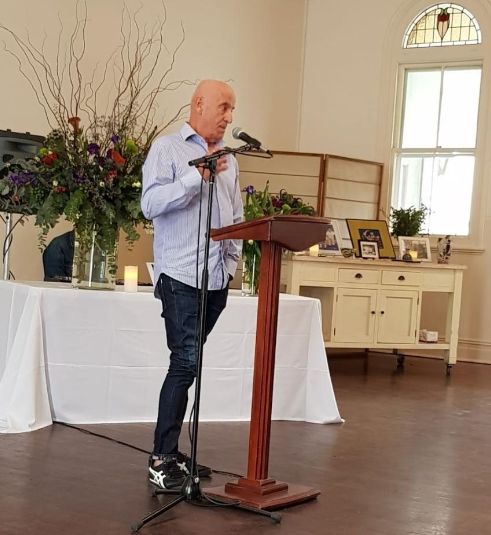
for Errol Ellis: 'Errol was his own man, and he had his own expansive, big style', by Marc Tremayne - 2018
15 February 2018, Abbotsford Convent, Melbourne, Australia
Hi everyone. Yes I’m Marc Tremayne, believe it or not. Probably most of you would rather not!
What wonderful recollections and memories Andrea and Jen. Only loving sisters could imbue a delivery with such intimacy and warmth. Beau adored you both so much. Thank you both for sharing moments together with him.
Simon, Miff, Harry, Akira, Kip and extended family, our warmest expressions go out to you all.
Beau was enigmatic, a contradiction in so many ways. I mean exactly how long is a piece of string? For a start where do you start? Evanescent and yet ever present. Full of whimsy and yet never flimsy in his approach to addressing things. Or perhaps undressing things! His wit was it!
Beau could be stubborn too and if he became entrenched with an idea, to extricate him from that viewpoint was like ripping a rusty nail from a bit of lumber – and that is very very difficult…..and the corollary to that was his warmth and capacity which were just remarkable.
We had many good times together. We studied at Swinburne very poorly and very very briefly – Appalling Students! We were chucked out. And we just continued partying – Errol was a great party animal. He loved gatherings, he loved people. He was very gregarious. He syncopated, and he resonated, and everybody loved him because Errol loved himself…..(laughter)…..
He did love himself, he was a great host…I think that with Beau, if ever you were at a party and Beau’s, and Anne’s, if the wine glass was at less than 85% capacity he’d be personally offended. Your wine glass was continually topped up and he always made sure you had the most delicious time. Experiencing his particular sense of personal abundance, because Errol was abundant. He’s irreplaceable.
He wasn’t a conveyor belt dude. I had a friend who was working in TV dinners – he was putting the carrot in compartment five. Well Errol wasn’t like that. Errol was his own man, and he had his own expansive, big style. His photo on the little brochure here, that’s Robert De Niro I reckon walking along the beach. He was debonair and charming, alluring and captivating. Whenever he was talking to you, you were the only person he was talking to, he wasn’t talking to the entire village, or talking to himself. He was talking to you personally, and you just melted into his sincerity and his authenticity and his uncomplicated love.
We had some (good) weird times together Beau…. (much laughter)….I just remembered something that popped up. After probably the ‘Thumping Tum’ or ‘Sebastians’, we were cruising down South rd in the wee hours one wintry morning, and we were in that Morris thing with a dicky seat in the back. Anyway we were rocketing down there, full steam ahead at about 50ks an hour, on tissue thin wheels, on undernourished tyres, the wheels were wobbling and the only ventilation was through bullet holes in the thing. I’m not sure how many rocks had hit it, they went straight through the tin, it was so thin. Right in front of us, a milk cart presented itself - a massive Clydesdale, a dray, tons of milk, right in front of us. We had milliseconds to think. We just closed our eyes and miraculously we translated through this ignominious situation…and ended up on the other side. Errol was navigating. And I never looked back in the rear vision mirror and wondered what happened to the bloody milkman or the cart or the consignment of milk. That’s Beau…what happened there I don’t know. I’ve got no idea.
Another time, Anne was telling me. She was saying “You know, one day Marc, Errol went out to buy a hamburger with a mate when he was hungry, and came back with a bloody Mercedes!” That’s quintessentially Errol. How about that. The dextrous efforts he went through to extricate himself from that dilemma……with the speed of a proverbial thousand gazelles. He was most relieved because he had a big obligation on the car, this Mercedes, all for a hamburger coupon. Can you believe that?
I don’t want to really stay much longer. I could talk and talk for quite a while. The memories keep trickling and trickling like the proverbial spring flower.
Errol was almost messianic. I mean that in the most sincere sense. He had an aura about him. A diaphanous quality, which seemed to draw you in. You’d always be enlarged by your exposure to this wonderfully unique, engaging and charming genius, for that’s what I think he was and I’m going to miss him so much. And I’m honoured to have the opportunity of talking about him, not in a cavalier, but a very respectful way.
I want to mention one other thing too, and this is a big one with Errol. He was one of the first conscientious objectors – geez he had guts! He went through so much trauma, so much drama, so much cruelty and unkindness and he stuck to his guns – he wouldn’t budge. That was Beau. He did that and he was eventually discharged from the army. I think there was a bloke named Peter Redlich, and he represented him and he got him discharged from the bloody army! As Groucho Marx said “There’s military justice and there’s justice, there’s military music and there’s music”.
Simon was going to take Errol to the wonderful Roger Waters show. You know Simon, he would have loved it. He probably DID love it. He would have been there, that’s for certain.
Something about Groucho Marx, and Errol loved Groucho Marx. He said in his letter of resignation to the golf club that “I couldn’t imagine being a member of any club that would accept me!” That was a bit like Beau.
I think often Errol under expressed himself, and he was always giving those around him an abundance and a feast, a cornucopia of opportunity and possibility. He was historical, he was charming, he was eccentric, he was faithful, he was naughty, he was intelligent, he was a one-off. You won’t find another Errol. God bless you Errol!
for George H.W. Bush: 'Your decency, sincerity, and kind soul will stay with us forever', by son George W. Bush - 2018
6 December 2018, National Cathedral, Washington DC, USA
Distinguished Guests, including our Presidents and First Ladies, government officials, foreign dignitaries, and friends: Jeb, Neil, Marvin, Doro, and I, and our families, thank you all for being here.
I once heard it said of man that “The idea is to die young as late as possible.” (Laughter.)
At age 85, a favorite pastime of George H. W. Bush was firing up his boat, the Fidelity, and opening up the three-300 horsepower engines to fly – joyfully fly – across the Atlantic, with Secret Service boats straining to keep up.
At 90, George H. W. Bush parachuted out of an aircraft and landed on the grounds of St. Ann’s by the Sea in Kennebunkport, Maine – the church where his mom was married and where he’d worshipped often. Mother liked to say he chose the location just in case the chute didn’t open. (Laughter.)
In his 90’s, he took great delight when his closest pal, James A. Baker, smuggled a bottle of Grey Goose vodka into his hospital room. Apparently, it paired well with the steak Baker had delivered from Morton’s. (Laughter.)
To his very last days, Dad’s life was instructive. As he aged, he taught us how to grow old with dignity, humor, and kindness – and, when the Good Lord finally called, how to meet Him with courage and with joy in the promise of what lies ahead.
Advertisement
One reason Dad knew how to die young is that he almost did it – twice. When he was a teenager, a staph infection nearly took his life. A few years later he was alone in the Pacific on a life raft, praying that his rescuers would find him before the enemy did.
God answered those prayers. It turned out He had other plans for George H.W. Bush. For Dad’s part, I think those brushes with death made him cherish the gift of life. And he vowed to live every day to the fullest.
Dad was always busy – a man in constant motion – but never too busy to share his love of life with those around him. He taught us to love the outdoors. He loved watching dogs flush a covey. He loved landing the elusive striper. And once confined to a wheelchair, he seemed happiest sitting in his favorite perch on the back porch at Walker’s Point contemplating the majesty of the Atlantic. The horizons he saw were bright and hopeful. He was a genuinely optimistic man. And that optimism guided his children and made each of us believe that anything was possible.
He continually broadened his horizons with daring decisions. He was a patriot. After high school, he put college on hold and became a Navy fighter pilot as World War II broke out. Like many of his generation, he never talked about his service until his time as a public figure forced his hand. We learned of the attack on Chichi Jima, the mission completed, the shoot-down. We learned of the death of his crewmates, whom he thought about throughout his entire life. And we learned of his rescue.
And then, another audacious decision; he moved his young family from the comforts of the East Coast to Odessa, Texas. He and mom adjusted to their arid surroundings quickly. He was a tolerant man. After all, he was kind and neighborly to the women with whom he, mom and I shared a bathroom in our small duplex – even after he learned their profession – ladies of the night. (Laughter.)
Dad could relate to people from all walks of life. He was an empathetic man. He valued character over pedigree. And he was no cynic. He looked for the good in each person – and usually found it.
Dad taught us that public service is noble and necessary; that one can serve with integrity and hold true to the important values, like faith and family. He strongly believed that it was important to give back to the community and country in which one lived. He recognized that serving others enriched the giver’s soul. To us, his was the brightest of a thousand points of light.
In victory, he shared credit. When he lost, he shouldered the blame. He accepted that failure is part of living a full life, but taught us never to be defined by failure. He showed us how setbacks can strengthen.
None of his disappointments could compare with one of life’s greatest tragedies, the loss of a young child. Jeb and I were too young to remember the pain and agony he and mom felt when our three-year-old sister died. We only learned later that Dad, a man of quiet faith, prayed for her daily. He was sustained by the love of the Almighty and the real and enduring love of our mom. Dad always believed that one day he would hug his precious Robin again.
He loved to laugh, especially at himself. He could tease and needle, but never out of malice. He placed great value on a good joke. That’s why he chose Simpson to speak. (Laughter.) On email, he had a circle of friends with whom he shared or received the latest jokes. His grading system for the quality of the joke was classic George Bush. The rare 7s and 8s were considered huge winners – most of them off-color. (Laughter.)
George Bush knew how to be a true and loyal friend. He honored and nurtured his many friendships with his generous and giving soul. There exist thousands of handwritten notes encouraging, or sympathizing, or thanking his friends and acquaintances.
He had an enormous capacity to give of himself. Many a person would tell you that dad became a mentor and a father figure in their life. He listened and he consoled. He was their friend. I think of Don Rhodes, Taylor Blanton, Jim Nantz, Arnold Schwarzenegger, and perhaps the unlikeliest of all, the man who defeated him, Bill Clinton. My siblings and I refer to the guys in this group as “brothers from other mothers.” (Laughter.)
He taught us that a day was not meant to be wasted. He played golf at a legendary pace. I always wondered why he insisted on speed golf. He was a good golfer.
Well, here’s my conclusion: he played fast so that he could move on to the next event, to enjoy the rest of the day, to expend his enormous energy, to live it all. He was born with just two settings: full throttle, then sleep. (Laughter)
He taught us what it means to be a wonderful father, grandfather, and great grand-father. He was firm in his principles and supportive as we began to seek our own ways. He encouraged and comforted, but never steered. We tested his patience – I know I did (laughter) – but he always responded with the great gift of unconditional love.
Last Friday, when I was told he had minutes to live, I called him. The guy who answered the phone said, “I think he can hear you, but hasn’t say anything most of the day. I said, “Dad, I love you, and you’ve been a wonderful father.” And the last words he would ever say on earth were, “I love you, too.”
To us, he was close to perfect. But, not totally perfect. His short game was lousy. (Laughter.) He wasn’t exactly Fred Astaire on the dance floor. (Laughter.) The man couldn’t stomach vegetables, especially broccoli. (Laughter.) And by the way, he passed these genetic defects along to us. (Laughter.)
Finally, every day of his 73 years of marriage, Dad taught us all what it means to be a great husband. He married his sweetheart. He adored her. He laughed and cried with her. He was dedicated to her totally.
In his old age, dad enjoyed watching police show reruns, volume on high (laughter), all the while holding mom’s hand. After mom died, Dad was strong, but all he really wanted to do was to hold mom’s hand, again.
Of course, Dad taught me another special lesson. He showed me what it means to be a President who serves with integrity, leads with courage, and acts with love in his heart for the citizens of our country. When the history books are written, they will say that George H.W. Bush was a great President of the United States – a diplomat of unmatched skill, a Commander in Chief of formidable accomplishment, and a gentleman who executed the duties of his office with dignity and honor.
In his Inaugural Address, the 41st President of the United States said this: “We cannot hope only to leave our children a bigger car, a bigger bank account. We must hope to give them a sense of what it means to be a loyal friend, a loving parent, a citizen who leaves his home, his neighborhood and town better than he found it. What do we want the men and women who work with us to say when we are no longer there? That we were more driven to succeed than anyone around us? Or that we stopped to ask if a sick child had gotten better, and stayed a moment there to trade a word of friendship?”
Well, Dad – we’re going remember you for exactly that and so much more.
And we’re going to miss you. Your decency, sincerity, and kind soul will stay with us forever. So, through our tears, let us see the blessings of knowing and loving you – a great and noble man, and the best father a son or daughter could have.
And in our grief, let us smile knowing that Dad is hugging Robin and holding mom’s hand again.”
For Pamela Harriman: 'Today, I am here in no small measure because she was there' by Bill Clinton - 2015
14 February 1997, Washington DC, USA
We gather in tribute to Pamela Harriman, patriot and public servant, American Ambassador and citizen of the world, mother, grandmother, great-grandmother, and sister, and for so many of us here, a cherished friend. She adopted our country with extraordinary devotion. Today her country bids her farewell with profound gratitude.
Hillary and I have often talked about what made Pamela so remarkable. It was more than her elegance, as unforgettable as that was. It was more than the lilt of her voice and her laughter, more even, than the luminous presence that could light up a room, a convention hall, or even the City of Lights itself. It was more than her vibrant sense of history and the wisdom that came to her from the great events she had lived and those she had helped to shape, from the Battle of Britain to the peace accord in Bosnia. I think it was most of all that she was truly indomitable.
One day the train she was on to London was bombed twice, during the Blitz. She simply brushed off the shards of glass, picked herself up, and went to the office to do her work at the Ministry of Supply. She was 21 years old.
More than 40 years later, all of us who knew her saw the same resolve and strength again and again, most tenderly, in the way she gave not only love but dignity and pride to Averell who, as long as he was with her, was at the summit, even to his last days.
In 1991, she put her indomitability to a new test in American politics, forming an organization with a name that made the pundits chuckle because it did seem a laughable oxymoron in those days: Democrats for the Eighties. For members of our party at that low ebb, she became organizer, inspirer, sustainer, a captain of our cause in a long march back to victory. She lifted our spirits and our vision.
I will never forget how she was there for Hillary and for me in 1992: wise counsel, friend, a leader in our ranks who never doubted the outcome, or if she did, covered it so well with her well-known bravado that no one could have suspected. Today I am here in no small measure because she was there.
She was one of the easiest choices I made for any appointment when I became President. As she left to become our Ambassador to France, she told us all with a smile, "Now my home in Paris will be your home. Please come and visit, but not all at once." [Laughter] It seemed she had been having us at her home all at once for too many years. So a lot of us took her up on her invitation to come to Paris. After Hillary and I had been there the first time, I must say I wondered which one of us got the better job. [Laughter]
In many ways her whole life was a preparation for these last 4 years of singular service and achievement. She represented America with wisdom, grace, and dignity, earning the confidence of France's leaders, the respect of its people, the devotion of her staff.
Born a European, an American by choice, as she liked to say, Pamela worked hard to build the very strongest ties between our two countries and continents. She understood that to make yourself heard you had to know how to listen. And with the special appreciation of one not native born, she felt to her bones America's special leadership role in the world.
Today, we see her legacy in the growing promise of a Europe undivided, secure, and free, a legacy that moved President Chirac last week to confer upon Pamela the Grand Cross of the Legion of Honor, France's highest award. He said then that seldom since Benjamin Franklin and Thomas Jefferson had America been so well served in France.
There is one image of Pamela Harriman I will always treasure. I can see her now, standing on the windswept beaches of Normandy on the 50th anniversary of D-Day. She had told many of us of the long, tense night in England half a century before, as they waited for news about the transports plowing toward the shore, filled with young soldiers, American, British, and Free French. Now, 50 years later, history had come full circle, and she was there as an active life force in the greatest continuing alliance for freedom the world has ever known.
I was so glad that Randolph read a few moments ago from the book of Sir Winston Churchill's essays that Pamela loved so well and gave to so many of us who were her friends. The passage he read not only describes her own life, it is her valediction to us, her final instruction about how we should live our lives. And I think she would like this service to be not only grand, as it is, but to be a final instruction from her to us about what we should now do.
Let me quote just a portion of what was said a few moments ago. "Let us reconcile ourselves to the mysterious rhythm of our destinies such as they must be in this time—in this world of time and space. Let us treasure our joys but not bewail our sorrows. The glory of light cannot exist without the shadows. Life is a whole, and the journey has been well worth making."
Throughout her glorious journey, Pamela Harriman lightened the shadows of our lives. Now she is gone. In the mysterious rhythm of her destiny, she left us at the pinnacle of her public service, with the promise of her beloved America burning brighter because of how she lived in her space and time. What a journey it was and well worth making.
May God comfort her family and countless friends, and may He keep her soul indomitable forever.

For Joan Burke: ' A constantly replenishing magic pudding of love and compassion', by son William Burke - 2009
On behalf of all of mum’s large and loving family I wish you all a warm welcome and thank you for joining us today in celebrating her life.
Joan Margaret was the eldest of four girls born to Jack Kennedy and Margaret McCarthy, both of proud Irish stock, on December 6th 1927. Even though before long with the birth of a second daughter there was a not only a Jack but a Jaqueline Kennedy in the same family, there, beyond their Irish Catholicism, any comparison with American political royalty ended. The Clovelly Kennedys were very much blue collar rather than blue blood but in the manner of the time there was a simplicity to life that seems quaint now but came undoubtedly with quite a few harsh realities at the time although living in beachside Clovelly did have it’s compensations meaning lots of time at the beach, some of it spent learning to swim under the firm tutelage of the legendary Tom Clabby who we subsequently also, in a nice little cross-generational linkage, had the dubious pleasure of being screamed at as we splashed up and down the rock pool adjacent to Clovelly beach as kids.
Mum fondly recalled some holidays spent also in the country where she became a keen and accomplished rider and as a special treat the family also sometimes holidayed at beautiful Hyam’s Beach in Jervis Bay when a shack at Hyam’s Beach meant tin walls and no electricity and plumbing rather than today’s expensively manufactured ‘distressed’ look costing $5000 a week. Family life was loving but strict and like a lot of depression children she had her share of bad memories of hiding under tables when the rent man came and when dinner meant bread and dripping night after night. I have only very vague memories of her father Jack who died when I was young but mum plainly loved him very dearly and all of my siblings will have very clear memory of Margaret who we knew as Nan and who we all recall as loving but somewhat formidable, living in her ancient house in Nolan Ave with the outside toilet and copper boiler and to whom a salad meant iceberg lettuce always with tinned pineapple and beetroot.
Mum was a clever girl but her parent’s limited means did restrict her options and while initially considering a secretarial career her naturally caring nature lead her to nursing and a good Catholic girl with aspirations to nursing would naturally gravitate to St. Vincent’s, an institution that had a dominating influence on the rest of her life. Her quite and striking dark beauty must have burst among the rowdy residents at Vinnies like a dropped bottle of DA and none was more agog than one fresh faced and chubby cheeked young man fresh out of Newcastle and Joeys, one young Billy Burke. The relationship almost came to naught when Dad turned up to take Mum out on their first date fresh from Kevin Lafferty’s buck’s party. The lifelong teetotal Margaret Kennedy was not impressed. Neither was Dad when Mum kept him on tenterhooks by dating among others the jockey George Moore who turned up in a big, flash black car. Even then mum had a liking for colourful Sydney racing identities. It was just as well though that Margaret was even less impressed by George than she was by Dad.
Dad continued his specialist training in London and Mum followed and there they were married on the 14th of July 1951, honeymooning in Paris, their early newlywed bliss marred only by an argument precipitated by dad’s disgust that Mum could not recite all the decades of the Rosary. They overcame that minor hurdle and were thereafter inseparable and one of the few consolations in our losing mum is that her long and painful fifteen year separation from her beloved husband is now over.
It sounds vaguely condescending in these PC-plagued times but mum was born to be a mother which is just as well because she didn’t have time to do much else for the next few decades. They returned to Sydney with Catherine in tow, born nine months and one week after the wedding, and mum set about her own one woman baby boom creating a well worn path between Telopea St. and the Mater Maternity, regularly crossing paths as she went with the Flemings or L’Estranges or Newtons or Quoyles or McAlary’s or Batemans. I was quite surprised when I got to school to find that there were families out there with less than seven or eight children.
The intermediary in all this fecundity was the inimicable Dr. Bob McInerney, Obstetrician to the stars. One of the strongest memories of my childhood remains a lift we all got home with him from mass one Sunday when dad had been called away. We were floating along in his trademark Roller when he opened a compartment revealing a bakealite phone, this is the early 1960’s remember, and duly rang mum at home advising of our arrival time so that breakfast would be ready.
We all like to romanticise our childhoods but I honestly don’t think I have to do that. It was really a golden period in my memory. Hot summers, loud cicadas, roaming the suburb with other feral children getting up to mischief. The joy of numerous Christmases, a never ending supply of chops, chips and peas, splurging on mixed lollies at Medlicott’s. No fears and few insecurities. It took me a long while to realise that a child’s brain needs the right conditions to lay down those abiding memories. A child needs, more than anything else, to be valued and wanted and listened to and encouraged and needed and loved. That is a challenge in a family of eight but God has cleverly gifted mothers like mine with a constantly replenishing magic pudding of love and compassion and understanding. And patience. Lots and lots of patience.
I can’t imagine what it must have been like to be parent to eight children under the age of 11 with a husband increasingly busy and in demand even though she had invaluable live in help from Jenny then Ping then Monica who all over time became like part of the family. Packing us off to school must have been a relief compared to holidays particularly when holidays often meant packing us all in the station wagon and heading off to a distant location. Imagine the scene. No airconditioning, no seat belts, eight children and often a dog richocheting around the interior like bees in a bottle, constant squabbles, always someone throwing up or needing the toilet. We thought that mum and dad must have just been constantly thirsty to pull in to so many pubs along the way where they would disappear inside leaving us with a tray of raspberry lemonades. There must have been plenty of times when they struggled to overcome the urge to sneak out the back and head in the opposite direction.
We particularly loved our early childhood Christmases but I’m not sure mum felt the same. Apart from the nightmare that the present buying and equitable distributing must have been, dad, in his well-intentioned way, insisted on showing off his brood to the nuns at Lewisham, St. Vincent’s and the Mater on Christmas Eve, which meant we all had to be scrubbed and polished and dressed in our finest. We would inevitably be made a fuss of by the nuns who plied us with biscuits and fizzy cordial while we watched Fran sing ‘Miss Polly had a Dolly’ again. We would be so hyped by the time mum got us home that she practically had to nail us into bed but without fail we were never disappointed the next morning. But then mum never did disappoint us.
Inevitably the next day after mass and breakfast and later as we grew, after midnight mass and a much later and slower Christmas morning, we would head for the Fleming’s and a couple of hours of always delightful Christmas cheer. We didn’t notice, like we didn’t notice so many of the things mum did, but she would slip away early so when a rowdy and hungry family burst in an hour or so later, all was ready. She was small and wiry but she was tough. How else could she have manhandled a turkey the size of a small horse? You might think that after a long lunch was had by all that she would have earned some down time but no. Not for this woman. Scarcely had we collapsed on the floor in a post-prandial torpor than the door bell would ring and it would be on for young and old again with the extended family. If this woman had been at Gallipoli or on the Kokoda track those Turks and Japanese would not have stood a chance. If she ran out against the All Blacks one rattle of that drawer with the wooden spoons and they would be looking for a hole big enough to hide in.
It must have seemed like forever but at last we drifted out of the nest, some of us needing a bit of a shove. Mum was a last able to enjoy the luxury of a little time to herself and with dad. They loved to travel and I still remember their tales of Breakfast at Brennan’s in New Orleans, of Las Vegas, of The Outrigger in Honolulu, of visiting the Warnes in Hong Kong or their old haunts in London and one very adult trip where they were chauffered around Germany with Ray and June Pearce who introduced them to the joys of Holy Milk, or milk and whiskey, at breakfast. When any one of us were living overseas it wasn’t long before they would be over visiting, a natural tie in of two of their great loves, travel and family.
Mum and dad loved being together. It was very much Darby and Joan, at least a party version of Darby and Joan. They were night owls, their courting days often seeing them at Princes and Romanos and later they would be, in their own egalitarian way, on first name terms with Denis Wong, flamboyant owner of the Mandarin Club and Albert, the doorman at North Sydney Leagues where they would often give the pokies a bash of a Sunday night. What they really loved was the races. They both loved the mix of glamour and the Runyonesque edge of criminality that attaches itself to the racetrack along with all the colourful characters. They took it one step further however when they invested in a brood mare and experienced the joy of standing in a stable tearing up money that is racehorse ownership. Maybe not in dollar terms but in terms of sheer enjoyment they certainly got their moneys worth and there was one selfish side benefit for me. As a uni student with a bit of time on my hands I became the chauffer whenever we had a runner at a midweek meeting. We were for a time regulars at Canterbury and Wyong and Gosford and Kembla Grange and while becoming a nodding acquaintance with a string of bookies and trainers I had the joy of lots of what is now called quality time with my mother. We talked about lots of things including her life and mine and just occasionally I got to see the naughty schoolgirl side of my quiet, lady-like mother.
The latter part of her life was perhaps the most rewarding because any joy her own children had brought her was steadily eclipsed by her large tribe of beautiful and talented grandchildren. She loved them all, Kate, Caro, Charlotte, Tom Smith, Matt, Stephanie, Nick, Isobel, Charlie, Rosie, Tom Burke, Camilla, Oliver, Max, Will, Lochie, Dylan, Sam and Ruby. All that joy and sense of achievement and contentment and she could give them back. When Kate gave birth to young Darcy it just confirmed what her grandchildren had known for a long time. Joan wasn’t just a grandmother, she was a great grandmother.
She wasn’t perfect. None of us born this side of the Garden of Eden are. She had her foibles and intolerances and life sometimes seemed to get the better of her as she struggled with her demons but she taught us the most valuable lesson of all. She would not just succumb and she fought back quietly and determinedly and it shames me that I did not always do as much as I should have to help. Life had become increasingly difficult for her of late but her natural forebearance meant that she would grit her teeth and just do it. Even if she wouldn’t just lie down God knew when she had enough and mercifully spared her any further suffering and we are, despite our sorrow, grateful for that.
Those of you in or close to my generation will probably fondly recall a television show called Happy Days. I know, the poor man is unhinged by grief you are thinking, what relevance has that possibly got to today’s proceedings? Well mum loved TV - it is a genetic affliction unfortunately - and she loved Happy Days.
One of the principal characters was an uber cool leather jacketed hood with a heart of gold known as Fonzie. One day he was visited in his apartment by the squeaky clean Richie Cunningham who proclaimed loud surprise at the presence of Fonzie’s motorcycle in the lounge room of the small apartment, exclaiming that it was just a motorcycle. Fonzie’s reaction was to throw his arms wide and fix Ritchie with a withering stare and the telling reply ‘and I suppose your mother is just a mother’.
A throw away line in an American sitcom perhaps but encapsulating on of life’s truths. Our mother’s are never just mother’s. Mother means so much more than just female parent. They are for most of us our first smell, our first sight, our first soft touch and gentle voice and first loving embrace. They teach us the meaning of love because they are the embodiment of unconditional love. And they remain, if you are fortunate as my brothers and sisters and myself have been, the dominating presence in your life well in to your middle years when their loss should be easy to rationalise because by then you know about the unrelenting cycle of birth and death but it is no exaggeration to say that even as a mature adult your mother’s death leaves you with a feeling of helpless abandonment, a sense of panicked realisation like a toddler separated from his mother in a crowd.
She has gone to a reward she has earned many times over. She has lived a full life. She has been a giver and never a taker, a peacemaker, a mender, a quiet inspiration. She has been to us a mother and grandmother beyond peer and there is no greater praise than that.
Joan Margaret Burke 6/12/27-24/9/09

For Chris Wilson: 'This man of multitudes', by Paul Kelly, Music Victoria Awards - 2020
Paul Kelly speech is at 1:47:11 of video
The past and present wilt,
I have emptied them, filled them, and proceed to fill my next fold of the future.
Do I contradict myself? Very well then, I contradict myself.
I am large. I contain multitudes.
Do these words sound familiar? They are words from the poet, Walt Whitman stolen by Bob Dylan for a song on his most recent album. And, stolen tonight by me to describe a man who contained multitudes.
I have vivid memories of Chris and our first tour of the United States over 30 years ago. We were like kids in a candy store in that country that contains multitudes, that contained so much that fed us.
Those rivers of music from San Francisco Bay to Harlem and Broadway, from the Great Lakes to the Rio Grande, from the Appalachians to the Delta. And, Chris took all these rivers into himself. This is what he did all his life. He lived and breathed music. When you went to visit him, you were always in danger of getting lost among the canyons of his record collection, and never getting out of the house.
There was music, it seemed, from every country in the world. The Africas, the Americas, the Balkans, Europe, Asia, Ireland, Iceland, Arnhem Land, and on and on. Chris absorbed all this, rolled it round in his gut, his heart, blood, bone and brain. Blended it and spat out his own music. A mongrel music, a multitudinous music, a music of contradiction and tension. My favourite kind of music.
He was curious and generous. He loved to discover and share, a mentor to many, a teacher and a preacher, ferocious and tender and all the shades in-between.
Listen to him kick off me and my band at the start of my song, Dumb Things."What sound is that?", many people have asked me. And, listen to his aching suspenseful play out at the end of our cover of Australian Crawl's, Reckless. It's hard to believe that it's one person squeezing out those sounds.
Yes, he was a man of multitudes. I am privileged to have travelled some of this earth working, and playing with his huge hearted man.
This mountain of a man who commanded attention wherever he went on the stage, and on the street. This shy man who listened deeply and talked quietly. This serious man, this funny man, this angry man, this gentle man.
And, I am proud to induct this man of multitudes into Music Victoria's Hall of Fame. So, please welcome to the stage, his family, Sarah, Fenn and George, to accept this award on his behalf.

For Fred Gruen: ' My father’s life is a story of bad luck and bad fortune turned to good', by son Nicholas Gruen -1997
2 November 1997, University House, Australian National University, Canberra, Australia
‘Tis the gift to be simple,
‘Tis the gift to be free
‘Tis the gift to come down where you ought to be
But when we find ourselves in the place just right
‘Twill be in the valley of love and delight
When true simplicity is gained,
To bow and to bend we shan’t be ashamed
To turn, turn will be our delight
Till by turning, turning we come round right.
I hope that everyone here can appreciate the relevance of these words from the well-known Shaker song to my father’s life. Their relevance in death can only be a matter of speculation.
My father’s life is a story of bad luck and bad fortune turned to good.
In early 1946, no one would have predicted the success and the happiness that was to come. As Dad put it in his autobiographical sketch, his childhood was a rather lonely and unhappy one.
Who can say when he felt loneliest? Was it when he arrived at Dover in 1936, an adolescent refugee, or was it as he suggested to me, about a year later when he was summoned to his headmaster’s office and told that his father Willi had died of cancer?
The other great horror was the fate of his mother’s Mariana. Lily, her elder sister, commented to an oral historian in 1978 "I was rebellious against the way I was treated as a child. . . . Mariana was very charming and cheerful and the other way around. My sister was a very beautiful girl. Once her example was put up before me; I was told, ‘Look how friendly she is, look how everybody likes her,’ and so on." Mariana was taken to Theresienstadt concentration camp and survived there for several years. She was moved elsewhere in the dying days of the war. We believe - though we do not know - that she perished in Auschwitz.
If one wanted to be rhetorical one might say that Dad’s luck changed one day in 1940 on his journey between the old and new worlds. He was locked in the hold of the Dunera. It was hit by a German torpedo. But it didn’t go off.
It was in Australia that, so it seems, he came down where he ought to be. Again and again he found himself in the place just right. In his eventual choice of country, in his choice of spouse and his choice of the discipline he would pursue - his life’s work.
Internment was difficult. While, looking back, he would have none of the idea that the Dunera was a scandal - or stronger still, some kind of atrocity - he did quote from George Rapp’s despairing poem which was penned in the camp.
Have you heard my story most brave
of the thousand dead men without grave
in that wonderful town
with the moon upside down
and the wires in need of a shave?
Each man is a corpse, as he sits
decaying and doubting his wits
whilst far, far away,
where the night is the day
his world is breaking to bits. . . .
In retrospect Dad always regarded himself as lucky to be gazing at the upside down sky over Hay rather than in the front line in Europe.
Dad had the great good fortune to meet my mother. He had the looks and charm to successfully court her, and she had the guts to marry him. I think it is probably hard to overestimate what strength of character it took. A Jewish refugee was not quite what my mothers parents - particularly her father - had in mind for her.
Indeed when my parents’ engagement was announced, my mother was staying with her aunt in Melbourne and was asked to leave.
But notwithstanding Dad’s exotic and lowly social status, Granny - mum’s mother - made up her own mind. After a little time with Dad she said to my mother, "I think you’ve picked a winner dear."
And so she had. And so had Dad. To borrow one of Manning Clark’s expressions, my mother worked a great miracle inside him.
Dad cultivated an interest in higher education at Hay. And he was always grateful to Miss Margaret Holmes who helped him and many others study while in the army.
Like so many others of the same generation who are feted today, my father was part of the long post war boom in higher education. He was part of a generation which was confident about its role in rebuilding and modernising society after the devastation of the greatest war in history, which, if it had not consumed their life, had certainly consumed their youth.
Dad liked the idea of economics because he was an idealist. After the depair of the depression and the horror of the war to which it contributed, Dad believed – like many of the time – that social science could help build a better world. I think it seemed to Dad that economics was the social science which could most directly and most obviously be capable of making a contribution to peoples lives. But I think he thought that it suited his talents. It had some of the rigour of science, but it dealt directly with political and social questions about how our lives together should be organised.
Dad had a great spread of talents and, as Keynes observed, it is this breadth of talent, rather than genius at any one skill which is the key to good economics.
The study of economics does not seem to require any specialised gifts of an unusually high order. Is it not, intellectually regarded, a very easy subject compared with the higher branches of philosophy and pure science? Yet good, or even competent, economists are the rarest of birds. An easy subject at which very few excel! The paradox finds its explanation, perhaps, in that the master-economists must poses a rare combination of gifts. He must reach a high standard in several different directions and must combine talents not often found together. He must be a mathematician, historian, statesman, philosopher - in some degree. He must use symbols and speak in words. He must contemplate the particular in terms of the general, and touch abstract and concrete in the same flight of thought. He must study the present in the light of the past for the purposes of the future. No part of man’s nature or his institutions must lie outside his ken. He must be purposeful and disinterested in a simultaneous mood; as aloof and incorruptible as an artist, yet sometimes as near the earth as a politician. (In Moggeridge, p. 424).
There was another quality which Dad had which was essential to many of his best contributions to economics and public policy. As so many of those who dealt with him rapidly came to appreciate, he was a very nice man.
About ten years ago when I was reading a book on the lives of the composers. I came upon this passage.
[H]e must have been a very nice man to know. A person of singularly sweet, kind disposition, he made virtually no enemies. . . . He was even-tempered, industrious, generous, had a good sense of humour . . . enjoyed good health except for some eye trouble and rheumatism . . .. He [had] good common sense. He had integrity and intellectual honesty - the kind of honesty that could allow him to say, when Mozart’s name came up "My friends often flatter me about my talent, but he was far above me". He liked to dress well.
The description was of the composer Hayden. It could equally be of Dad. People liked him easily and quickly and this meant that Dad was a good leader. People respected him for his knowledge, and his intelligence, and also for his essential modesty. Dad was not pompous. Like the composer Hayden, he didn’t have tickets on himself. But peoples instinctive liking for him, and respect for his talents and good judgement meant that he could be extremely persuasive. As I understand it, it was he who first proposed the 25 per cent tariff cut and he was instrumental in persuading a range of agonisers – or in arranging for others to persuade agonisers – of the merits of his proposal. Even more impressively, Dad was able to lead an extremely heterogeneous group of people to unanimously support the inclusion of the family home in Assets testing for welfare benefits.
Dad’s good judgement and good leadership extended also to his professional colleagues. He was fond of saying that there were a lot of people who were extremely clever but had no bloody sense. (It has to be said that he was in a profession in which it is hard not to notice this phenomenon.) And his greatest contribution to economics and public policy might well be a roll call of the people in his Department who he either hired himself, or who were hired by those he hired. I need only mention some of their names. Bob Gregory, Bruce Chapman, John Quiggin, Adrian Pagan and Steve Dowrick to name just a few.
The 25 per cent tariff cut was a good illustration of Dad’s qualities. Some such as Alf Rattigan agonised about whether or not it fitted a particular institutional model of tariff reform towards which he had striven for nearly a decade. Others who might have been expected to support the move - like senior Treasury officials - opposed the idea, again because it was unusual. It was not their idea. My father was prepared to improvise because he knew that the tariff cut offered an unusually good combination of short and long term benefits, and, at the time it was proposed, comparatively few costs. He was a man of broad talents who understood the issues, and had the courage and the imagination to seize the day - as he put it later, to whisper into the ear of the prince!
Coming down in the discipline of economics Dad came down where he ought to be. And where he ought to be became - by chance of history - a more and more important place to be.
Ironically, as the inadequacies of the discipline of economics were exposed, economics became more and more influential! As politicians, bureaucrats and the populace at large became progressively more anxious about how to restore their lost prosperity, economics became the premier social science - an increasingly indispensible gateway to policy influence.
History - and happenstance - treated my father well after the war in other ways as well. In being what Phillip Adams once called our ‘Dunera Boy extraordinaire’, my father participated in an event which was the ‘Gallipoli’ of early post-war multiculturalism - a defining and mythic event in Australia’s history.
The Dunera’s inmates could never have known as they lived through their voyage and their detention in Australia, the significance which would be made of it looking back. Yet in the days after my father’s death, all of those who contacted me to help them writing his obituary asked "he was on that boat - the Dunera - wasn’t he"? A gardener who read his obituary in The Age said to me that he didn’t know I was the son of a Dunera boy.
A collection of middle European refugees (with a disproportionate representation of egg heads) sitting behind barbed wire in the middle of the Hay plain, entertaining themselves with sports, study, music making, theatre and concerts.
Of course there were plenty of similar camps and there were plenty of migrant experiences, just as there were plenty of Australian battles in World War One other than Gallipoli. But as time passed, the Dunera internees worked their way into the popular Australian imagination.
These were some of the changes in circumstances which changed Dad’s life. But there was also some alchemy at work inside him. I don’t think anyone can really say quite what it was - not even him. Perhaps particularly not him. I think the main thing he did was really quite old fashioned - indeed unfashionable by today’s standards.
I think my father achieved the happiness and success he did because he did not try to ‘work through’ or to make sense of his worst experiences. Indeed much greater minds and spirits than my father have tried to make sense of the Holocaust. But it cannot be done.
So my father did something else. He tried to forget about the worst of the past. He never tried to deny or conceal it. But he tried to focus on more productive things. Perhaps that is where he got some of his great enthusiasm for so many of the things going on in the world, from architecture, to philosophy to politics, world history and world affairs.
He was gregarious in his interests in others also. But, for someone with his early experiences, he was blessed by not being an introspective man and his bridge to others was often through common public events.
When I visited him in his last days of consciousness in John James Hospital, he was engaging several nurses who had either returned from, or were soon to depart for, far flung locations.
One nurse was soon to go to Kenya. Dad filled her in on the state of civil unrest there as it unfolded. He continued to engage another who had recently returned from the Middle East on what life was really like in Bahrain and what sort of constitution they had. Dad took considerable care to pronounce Bahrain in a way which served to indicate its exotic location outside of Australia, although I must admit it left me wondering that Bahrain was so near Vienna.
Dad combined a civility which, one might speculate, he brought with him from Austria, with an Australian unpretentiousness and straightforwardness. I think when I was young I thought that the expression ‘g’day’ was particularly my father’s. He certainly took to it with great gusto.
A episode which illustrates these things and his great sense of humour occurred one day in 1967. We were being entertained for lunch by a rather straight laced American economist in the Mid-West of America. He introduced lunch in a way which he thought appropriate but which we found intensely embarrassing.
He said that although we might not have voted for Harold Holt, he wanted us to know that he was extending the hand of American friendship and condolence to us in our national grief. My father showed the depth of his assimilation into Australian culture by defusing the situation. "Yes Ken. It is sad. But that’s the good thing about living in Australia. Its a small country. And when something like that happens, we all just move up one!"
But Dad’s sense of humour was at its greatest as an appreciator. He had an infectious and hearty laugh. So much so that, if I intended to watch "Yes Minister" or "Faulty Towers", I would make the trek out to the farm so that I could increase my enjoyment many-fold by watching the program with one eye, and Dad with the other. There were times when I honestly thought he might do himself an injury.
My father was a great charmer. His charm came from his natural extroversion, and uncomplicated buoyancy of mood, his sense of fun, enjoyment of teasing, his modesty and appreciative sense of humour.
I remember skiing holidays with Dad. In the space of a week an entire chalet full of the most unlikely people (of a range of backgrounds, temperaments and ideological dispositions sometimes sympathetic but often odious) would all succumb to his charm. They would want to sit at his table and enjoy the high of talking with him, being teased by him, flirting with him and debating him.
He was a man who inspired admiration and indeed devotion from many. Bruce Chapman lectured me for about an our one night at a party on what a marvelous man Dad was.
I remember one surreal moment about six months later when Bruce and I met quite by chance each refueling our cars in the wee hours after Saturday night - like two strangers in an Edward Hopper painting under the anonymous glare of the fluorescent lights at the Shell garage in Manuka. As Bruce got back into his car, he yelled at me over the roofs of our respective cars - and a propos of absolutely nothing - "I still envy you your father".
Dad was affectionately famous - perhaps more within his family than anywhere else - for his vagueness at certain times. When engaged in routine social interactions Dad sometimes allowed himself the luxury of thinking of things other than what he was talking about. This could generate comic effects - with occasional lapses into complete anarchy.
One of the gravest of these occasions was in 1967 in Raleigh North Carolina when family friends Fred and June Schönbach were visiting us for lunch, having traveled down from Washington. The night before, Dad had fought one of his many fights with David and I about when we would get undressed and go to bed. This must have drifted into his consciousness during a lull in the conversation when, in the presence of Mum, David, myself and Fred Schönbach, Dad listlessly turned to June Schönbach and said "Let’s get undressed".
I presume that, like us, June imagined that she had misheard him. Indeed, not an eyelid was batted. But subsequent family post-mortem revealed that we had all heard the same thing. And the moment passed - fairly or otherwise - into family mythology.
Since then Dad has suggested to at least one other unsuspecting person that they get undressed - apparently seeking to induce them to open a gate in front of the car. Dad has also on at least one occasion left workmen wondering quite what they were being taken for when he said something about them getting into their pajamas.
I mention Dad’s occasional vagueness, not just because it formed part of a family mythology which was too much fun for his two sons not to inflict on an occasionally protesting but generally accepting father.
I mention it also because of the contrast it made with situations where his interest was aroused particularly as a professional and an academic. When he was in a seminar, he was not on automatic pilot. He was intensely engaged probing for weaknesses and searching for insights. In debate and discussion in a professional context, Dad was the model of the scholar he aspired to be. At the same time aggressive, scrupulous and gracious.
About a week before Dad lost consciousness, I managed to get him a program enabling him to play bridge against a computer. I had keeping my eye open for this for literally years. I brought it to him in the hospital. He was weak from the cancer, from malnutrition and analgesics. He was also unfamiliar with my portable computer. Accordingly I sat next to him on the bed and operated the game for him.
Dad’s demeanor took on an intensity not seen for some time. He became quite agitated and indignant if I made foolish moves which he would have avoided. "Take that trick back" he ordered me.
But I was yet to learn how to take tricks back on the new program. So he scoffed "Well if you play a trick like that you can’t call it my hand".
Like Dad, I hadn’t played bridge for at least one decade - possibly two. So when I saw a hand with at least three cards in each suit and 17 points in high cards, I suggested an opening bid of one no trump. Dad despaired. "Darling, you can’t bid one no-trump with no club-cover."
He was equally sharp, and funny as well when mum remarked about one of his impossible relatives - no longer with us - "She’s her own worst enemy". Dad responded "Not while I’m around".
It would be quite wrong, and self indulgent to paint Dad as ‘haunted’ by his past. But of course it was always there. I remember sometime, probably about a decade ago when I visited Dad in his corner office just before his retirement. Asked how he was he said something like "Oh . . . a bit depressed". Not a remarkable comment but it upset me quite a lot.
When I reflected on it, I realised that, in all the time I had known my father, I could not remember him saying he was depressed or sad. His focus on the positive was not false or forced. And no doubt he felt the demands of parental obligation. One does not want to project sadness towards one’s children. It was also because he was part of a whole generation which lacked the obsessive introspection of later generations.
But I think there is more to it than that.
I think Dad largely trained himself out of the luxury of being depressed and of being sad. There is a literature growing up in Australia - and I imagine elsewhere - of children of Holocaust survivors. Mark Raphael Baker and Romona Koval have each published books on this subject and the story is the same.
None of the holocaust survivors have ‘come to terms’ with what happened. They have found ways of living on after the experience, but they do so mostly by trying to forget, by focusing on other things. In today’s psycho-babble, Holocaust survivors have been unable to grieve adequately for their past losses. But their grief cannot really be confronted, because if acknowledged it would have no limit. It would be bottomless.
Dad was not a Holocaust survivor in the literal sense, but he was touched by the infinite malevolence of the Holocaust in the most direct way.
Certainly in my family, my mother has shed many more tears over the holocaust than my father. Her sympathy for him was perhaps a luxury he felt unable to allow himself. I don’t know how often it broke through into Dad’s consciousness: I suspect, with the possible exception of the last year or so, not all that often.
But sometimes it did. I remember just once when I was about eight or nine, watching a documentary on World War II with David, Mum and Dad in the rumpus room in Harkaway. I doubt if I said anything, but my recollection is that I was mesmerised by the audacity of Hitler and the Germans in just the same way I was attracted to the swashbuckling of Hannibal and Alexander when I learned of them. But as the credits of the program rolled up the screen, my vague musings were torn asunder by my father’s uncontrollable sobbing.
And then three nights after Dad’s huge abdominal operation, I was with him until well into the morning hours. He was hooked up to a vast array of life support systems and was clearly fretting in his drug induced slumber. When he awoke, I asked him what his nightmares were about and he shook his head lightly and said "Ghastly, ghastly". For some reason I wanted to know and I pressed him. He said "Shindler’s List".
But most of the time his focus on the positive and the outward did not fail him.
Mark Raphael Baker writes about his parents (both Holocaust survivors) quoting a Yiddish lullaby his parents sing to their numerous grandchildren as they ruminate upon what their lives might have been had the holocaust not intervened to diminish them:
Sleep now child, my pretty one,
Close your dark eyes.
A little boy who has all his teeth
Still needs his mother to sing him to sleep? . . .
A little boy who will become a great scholar
And a successful businessman as well.
A little boy who’ll grow to be a bridegroom
Has soaked his bed as if he’s in a pool.
So hush-a-bye my clever little bridegroom
Meanwhile you lie wet in your cradle
Your mother will shed many a tear
Before you grow up to be a man.
And their son sings to them:
Sleep my dear parents but do not dream.
Tomorrow your children will shed your tears
Tuck in your memories in bed and say good night.
It is so sad that Dad has gone: That we’ll never be able to speak to him again. That we’ll never be able to tell him things we know he’ll find funny and be rewarded with his laughter. I’ll never be able to enjoy an episode of "Faulty Towers" or "Yes Minister" in quite the way I did when I made the trek out to Hall.
Dad leaves a gaping and incomprehensible hole in the lives of those who loved him. Like any person who has made the journey of life successfully, there is, nor will there ever be anyone quite like him. He was singularly himself. To invoke a cliche, we will not look upon his like again. And so we are filled with grief.
One last story which sums up a lot. After Dad had gone through two harrowing months of chemotherapy, he gave up Taxol and Carboplatin and was due to start on Methotrexate in a few weeks time. Mum had briefly been in bad health herself and so her friends Margie and Juddy were staying with us on the farm. I had come up from Melbourne. The house being over full, I was sleeping in the study. Dad was enjoying a stint of good health which had stretched for a month or so, and so he was showing some of his natural buoyancy.
The atmosphere had some of the crowded, festive atmosphere of an extended family turn at a holiday beach house as we crowded around the kitchen table. And it reminded me of the skiing holidays. At lunch time Hillary Webster arrived, ebullient as usual, like a benign whirlwind. She greeted each one of us heartily and gave us all hugs before turning to Dad who was sitting looking rather frail in his chair. She gave him a very special hug, and said with great emphasis. "And how are you, you lovely man." For the next twenty minutes or so, everyone, including Dad joined in the hilarity of various people, including him, modelling the truly ridiculous wig he had reluctantly agreed to purchase as a result of losing his hair.
So let me close this service by saying thanks Dad. Thanks for everything. Thanks for your fun, your laughter, your affection. Thanks for believing in what you did and living the way you did. Thanks for keeping despair at bay, and living with the cancer that came stalking you for as long as you could bear it.
And thank you to those who have come today.
To end this service I thought the best music to celebrate his life was music which he himself loved, and which captures his ebullient civility. The Blue Danube.
Farewell to a lovely man.
Postcript: A great deal of effort was expended to ensure that the song ‘Tis the gift to be simple’ could be played over the University House public address system - so much effort in fact, that no backup means of playing the recording was brought to the service. The rendition was the title track of Yvonne Kenny’s ‘Simple Gifts’ which I had given Dad as a birthday present a few years before. Dad loved it so much that it almost displaced Strauss waltzes on his car cassette on his many trips between the office and the farm in his car.
As might have been predicted, there was a technical problem and the track could not be played. Having quoted some hundreds of dollars to do the service, the sound engineer, got word to me of the complete failure of the system some three minutes before his services were required! To my extreme chagrin, the best I could do was read the text of the song to the audience. The next morning an uncanny re-run of the scene I sketched at the end of my speech was played out before my eyes. Mum, Margie and Juddy were all there along with others around a crowded kitchen table. And then Hilary Webster arrived. Quite agitated, she exclaimed "Were you listening to ABC FM". None of us had. But that morning they had played Yvonne Kenny’s rendition of ‘Tis the gift to be simple’. NG

portrait by Erwin Fabian, 1941. Speech at unveiling of this portrait by Nicholas Gruen also on Speakola.

Nicholas Gruen
Source: http://www.gruen.com.au/FHG.htm
For John Cain: 'On gender equality, the Cain administration marked out a road for others to follow' by Mary Crooks - 2019
3 February 2019, St Paul’s Cathedral, Melbourne, Victoria, Australia
Speech starts at 29.57. Mary Crooks is the Executive Director of the Victorian Women’s Trust
I first worked with John in 1977, when he was Shadow Minister for Planning, helping with speeches and doing research. We had serious fun together sleuthing some highly dubious land deals, like Mt Ridley.
Working at close quarters gave me an early measure of the man. He had a keen, plainly-wrapped intellect; and an impressive grasp of issues. He was ethical, fair minded, collegial and hard-working. There was no bluff or bluster; no over-sized ego. He had a wry, at times, wicked sense of humour.
But above all, he was deeply respectful, toward his life partner, Nancye, his children, Joanne, John and James, toward others and to me. For a woman in her late twenties, navigating what was then very much a ‘man’s world’, the respect John accorded me was both validating and empowering.
The coverage of John’s legacy over the past weeks has rightly acknowledged high profile achievements – the National Tennis Centre, the TAC, Southbank, shop trading hours. On its own, this account doesn’t do justice to his three terms as Premier. Neither does it capture the broad sweep of his government’s reform agenda.
But especially missing from this narrative so far is John’s personal commitment and political contribution to achieving a fairer world for women.
Women have been hugely under-represented in our national and state parliament over the past century and more but this doesn’t mean they are disinterested observers. Within the same patriarchal culture which has devalued women and sought to control what they should and shouldn’t do, women have agitated and struggled long and hard, across the political spectrum, to secure basic human rights and reforms. Always from a lesser position of power, progress for women has been halting in the face of stiff rear guard action. It is no surprise that the hearts of many women skip a beat when they bear witness to a government intent on addressing gendered inequality.
A perspective on the span of time is crucial here today. So far, we have experienced 165 years of Victorian parliamentary history; and 120 years federally. There have been 48 Victorian Premiers and 30 Australian Prime Ministers. Out of these 78 leaders, only two have been women — Joan Kirner and Julia Gillard.
Wistfully, in my lifetime and that of my mother’s (who is three weeks off turning 100), we can count on just two hands the numbers of male-led Victorian and federal governments that have elevated gender equality as part of their core business; and backed it with policy and action.
Of these handfuls, two governments have a special status – because they broke through on gender equality like none before. The Whitlam Government was one. John Cain’s was the other.
Long before he became Premier, John had a deep and abiding belief in fairness, equity, access and justice. These precepts readily translated into guiding principles of his administration.
As a teenager in the 1940’s, he was discomfited by the sexism, racism and sectarianism he saw around him. Guided by his parents, John and Dorothea, he was determined in his own no-fuss way to help build a society free of this destructiveness.
He recognised the unequal treatment women had received through time. He believed women’s unpaid work in the home and the care of their children made them economically vulnerable. Discrimination on the basis of gender and race was offensive to him. He also knew that equal and full participation could not be achieved when women are unsafe.
As ALP leader, he pledged his government would work for equality of opportunity. His government would seek to enhance women’s status, further their participation in public life and ensure that they received equal benefits from government services.
On this quest, he led from the front
He held the Ministry for Women’s Affairs for the eight years he served as Premier.
This was no hollow, cynical gesture, something women have had to endure in other places at other times.
He meant business.
He challenged, and stared down, the all-male institutions of the Melbourne Cricket Club and the Victoria Racing Club, over their century-plus-more practice of excluding women from their inner sanctums.
Building on Pauline Toner’s effort as Shadow Minister for Women, John made it clear these bodies had no right to exclude half the population from public land. ‘If Nancye can’t accompany me, I’m not going,’ he told them.
A hundred and more years of male privilege, entitlement and gender segregation came crushing down, at least overtly. John later recalled that some of the powers-that-be did it with more grace and goodwill than others.
There were history-making firsts for women
John knew that no matter how many men of merit sit around the table, governments made up almost exclusively of men miss the policy mark when they consciously or sub-consciously exclude women.
Pauline Toner became the first Victorian female to enter Cabinet, joining forces with many talented men.
Caroline Hogg and Joan Kirner joined the Cabinet in the second term; Kay Setches and Maureen Lyster in the third.
This crew of Cabinet women commanded immense experience in education, local government, community service and the union movement. Along with the slowly increasing numbers of Labor women entering parliament, they brought the lived experience of so many people across communities, especially women, to government policy-making.
John wanted groups such as women and young people to be brought under the representative umbrella. Through the Women’s Advisory Council, Aboriginal women, young women, women with disabilities and country women joined others in giving voice to their issues and concerns.
The Women’s Policy Co-ordination Unit, sitting within Premier and Cabinet, carried out first-time consultations on major issues for women, such as the Women in the Home consultation and the Care of School Aged Children.
Caroline Hogg, with the collegial support of Evan Walker as Minister for Agriculture, actively facilitated the creation of the Rural Women’s Network, the first of its kind in Victoria and indeed Australia. Women around the State loved it, thrilled by its Women on Farm Gatherings and the networking support it provided for women going through the tough times that come with working the land.
LandCare also came into being, another first for Victoria and later Australia, emerging as it did from exceptional bipartisan collaboration between two women, Joan Kirner, as Minister for Conservation Forests and Lands and Heather Mitchell, from the Victorian Farmers’ Federation.
For the first time in our State’s history, women were appointed to such diverse bodies as The State Electricity Commission of Victoria; the Workers’ Compensation Board; the Metropolitan Transit Authority; the Victorian Law Foundation; MCG Trustees; the Planning Appeals Board, the Occupational Health and Safety Commission.
Permanent part-time work within the teaching profession provided female teachers with more flexible working conditions.
Affirmative Action Plans were put in place in the Teaching Service to increase the numbers of women in leadership and management. Equal Opportunity Units were established in many agencies.
Twenty-five Technical Schools became co-educational in John’s first term of government.
The Women’s Information Referral and Exchange (WIRE) was also a first-term achievement, remaining a mighty organisation to this day.
The Victorian Women’s Trust was also established in the first term, an organisation unique in Australia and one of the first such agencies globally.
Milestone legislation sought greater protections for women
Among an array of legislation, the Equal Opportunity Act 1977,established under the Hamer Government, was strengthened.
The 1984 Act proscribed sports clubs from discriminating on the basis of sex or marital status.
A definition of sexual harassment was introduced to allow complaints to be made about discrimination on that basis.
Changes were made to The Crimes Act 1987 that expanded options for victims of family violence (who are, let’s be clear, mainly women and children) to seek protection through Intervention Orders.
There were so many defining community initiatives to better support women
Thousands of long-day child care places in centres around the State, as well as family day-care places and preschool and play-centre places were provided.
The Neighbourhood House network was expanded, helping overcome women’s social isolation as well as facilitating community connection; computers arrived in these Neighbourhood Houses and Community Learning Centres to assist women’s access to information on jobs and courses.
Aboriginal Liaison positions were funded to support women at the Mercy and the Royal Childrens’ Hospitals. A Migrant Women’s Resource Centre was established.
There were more women’s refuges. There was support for Women’s publishing initiatives. Young women were actively encouraged to take up apprenticeships. Energy rebates made life a bit easier for low income women.
In breaking through on gender equality in these wide-ranging ways, the Cain administration marked out a road for others to follow
We delude ourselves if we think that equality can be achieved through gradual erosion of the burdensome, inequitable structures and institutions which hold our society back.
Rather, it requires systemic change, positive disruption and challenges to the dominant order. Governments can do only so much. The rest must come from us.
John Cain did his most. As a lawyer, he knew the importance of precedent.
His administration paved the way for further milestone advances in Victoria, including the hard-won affirmative action policy within his own party; the Royal Commission into Family Violence, the achievement of gender parity in the current Andrews Cabinet, where female Ministers hold portfolios such as transport and infrastructure; and the historic, Australian-first Gender Equality Bill now before the Victorian parliament.
Since his resignation from the leadership in 1990, John and I remained in regular contact. He was a great telephoner. Our conversations ranged wide. We laughed a lot and disagreed about some things, respectfully of course.
But there were two issues where we were in sync – one was our increasing disquiet about the decline of public trust in government and the failure to govern for the common good – as evidenced by short-termism, policy capture by vested interests, adversarial politics and corrupt behaviour. The other was our shared belief that inequality is at the core of many of our problems; that ridding our society of sexism and racism will invariably take us all to a better, more enlightened place.
John understood that respect was the bedrock of gender equality.
He acknowledged men have had to adjust to the idea of working alongside women, changes he realised were difficult, even painful but essential to achieving gender fairness and social justice.
In November 2016, at the age of 85, he registered for our own Breakthrough for Gender Equality conference at the Melbourne Town Hall, joining over 1000 women (with an average age of 35), and putting himself very much in the minority.
He sat in on a session conducted by acclaimed humourist, Judith Lucy. Mid-way through her comedy routine, she spied John and seized the opportunity for some mischief. ‘Sir, what’s your name? ‘John’. ’Hi John, what has brought you here? John: ‘I want to see what goes on in these places.’ Judith: ‘You want to see what goes on in these places? ‘There’s going to be a cauldron….aah, you could be sacrificed a little later on…No, we are very happy to have you here John.’
He chuckled.
Here he was – an older man at ease with himself; at ease in the company of women; and largely at peace with the fact that he had given his best over a lifetime to make the world a fairer place for all, and especially for women.
Three days later he wrote to us acknowledging the work that had gone into the event. He was concerned that ‘in many areas around the issue of equality this society of ours is going backwards. You made us aware of the need and urgency for revised approaches’ he wrote. He added, ‘what we learnt in government was that persistence and determination over the long-term is required to effect significant reform around important issues.’
Stay the course, never give up, was his message. He would urge us all today to do the same.

Mary Crooks

For Peter Sciotto: 'I looked up to him my whole life, and I loved him', by Santo Manna - 2020
28 June 2020, Montreal, Quebec, Canada
New York City based Santo Manna was unable to travel to his home town of Montreal to read this eulogy because of Covid-19. so it was read in his absence by his sister Nancy Manna.
There is a photo that I love.
It is July 1968.
I am all of 10 days old and about to be baptized.
It is the living room of the Sciotto family home, on Hurteau Street in Ville Emard.
I am cradled by my godmother, Biagina, who looks down at me with love. The same love that she showed me all those years until she was taken from us, far too soon, in 1986.
On her left is Peter, her middle child and eldest son – he is 17 years old, young and strong, and with piercing eyes gazing into the camera. His hand gently rests on my little shoulder.
They are impeccably dressed, and their look is solemn – they know they have been honored. Because in our Sicilian tradition, to be a godparent is an honor and a sign of utmost respect.
My parents bestowed that honor because these people, this Sciotto family, showed our family love and kindness when we needed it most. They took our family in when my father was about to take us back to Europe, as we had no home and the situation was dire.
And so the Sciotto and Manna families, counting 10 with my arrival, crammed into that apartment on Hurteau St. for the better part of that year. Think about that – perhaps 1,000 square feet of space, housing 5 adults, two teen boys, and 3 little children. What a sacrifice.
My dad never forgot it, and when he named Biagina and Peter my godparents, he gave me the greatest gift and honor too – because they gave me so much love in my early years, shaped me in so many ways, and I was blessed to be forever bonded with these fine people.
Biagina was a 2nd mother to me – she was wise beyond her years, so eloquent and modern in so many ways. She was always there, always caring and loving, always helping my parents. And the way she helped my parents raise me is the same way she raised Peter, and it showed.
He was aptly named, Pietro, because to me he was like a rock. My father was a rock too, but Peter bridged the gap between the old country and the modern world of Montreal and North America in ways my dad could not. He was a first-generation Sicilian Canadian too, but he had a 17-year head-start on me in terms of how to navigate that, and he gifted me that experience.
I looked up to him my whole life, and I loved him. He was larger than life to me, so strong, but so kind and good, and also playful and funny.
He used to do this thing where he put on a big gorilla mask and, when we least expected it, he’d burst out of a room screaming and yelling. Scared the daylights out of us!
Then there was that one time when I was misbehaving badly, and he made a big show of the police arresting me until I cried for forgiveness – he liked teaching me lessons like that, and I was a spoiled first-born Sicilian son so you can bet I needed it.
So many memories.
I remember his wedding, where I had the honor to be his little ring-bearer.
I remember riding with him in that vintage 1951 green Ford.
I remember spending time with him at the beautiful country house that he and Tony built in St. Sauveur – and that one time when we watched the Northern Lights from the deck, so beautiful.
I remember him impressing us with his feats of strength, like those one-handed pushups.
I also remember him bitterly complaining about how his dad forbade him to go to Woodstock!
He was only 17 in that photo. I was 17 when his mom Biagina fell ill. Both so young and with the world ahead of us. And life marched on for both of us.
I always felt connected with him, even as we spent many years apart. He moved out west, then I moved to New York City. We didn’t speak often. But he was always my godfather, I was always his godson, we were always 17 years apart, and that bond never broke.
I saw him last December – so frail now, with that terrible disease having ravaged him for years. But still with that playful look in his eye. Still Peter.
I love the place where the Sciotto family rests in Cote des Neiges cemetery – it is far back in the cemetery and up a tree-lined incline, and the family gravesite sits alongside the road.
I have vivid memories of going there as a child, on those sad occasions when we laid to rest members of the Sciotto and Amico family.
I have one more reason to go back there now, to that peaceful and beautiful place, because my godfather Peter Sciotto will be there.
He was a rock, and that’s how I’ll always remember him.
Rest in peace, my godfather.

For Jean Pattinson: 'Her laugh could fill a room', by Brett Pattinson, Vanessa Johnson & Georgina Pattinson - 2020
7 August 2020, Innes Gardens Memorial Park, Port Macquarie, NSW, Australia
Brett (son): At the start of 2020 I would never have thought that I would be delivering a eulogy for the second time in two months especially not Mum & Dad.
A little over 2 months ago, I stood in this very place and delivered what was one of the hardest things I have ever had to do and now here I am again delivering a second eulogy that I never thought I would have to do.
You may recall that on the way to Dad’s funeral I was pulled over by the police??? As strange as that was, this morning was even stranger. On my way here we were driving and all of a sudden I heard mums voice appear…… she said “listen Brett do you think you could pop into Aldi on your way and grab me a packet of those peanut biscuit’s I like”…… pause (pull out the biscuit’s and go and place them on the coffin).
My earliest memories of mum
When I was young and growing fast, I used to have severe problems with my legs and I used to wake up in tremendous pain mum used to sit up and rub my legs during the night, she would sit for hours and rub my legs…. She always did this with gentle precision and the professionalism of a nurse.
On the flip side Mum was a tough old broad, this might have stemmed from my ability to drive her mad…. Constantly!!! I was no angel and I would always be doing something that I wasn’t supposed to. She would chase me around the house with a stick and low be tide if she caught me, she would give it to me and give it to me good…… she could really wield That stick!!!
I remember once on a particular night when we were living in Gymea bay, she was wearing a pair of these wooden Dr Scholl’s shoes (heavy bloody things they were supposedly good for your feet) and I was doing something I shouldn’t, next thing she started to chase me, by this stage I was getting pretty good at ducking and weaving…..all of a sudden she pulled off one the shoes and chucked it at me….but I was quick to react and ducked, fortunately for me the shoe missed me by a fraction and flew past my head, but unfortunately it clocked Craig fair in the scone……. He went down like a sack of potatoes…. I think she regretted that for a long time but it still makes me chuckle to this day.
I could tell you many stories like that but I won’t as we don’t have all day.
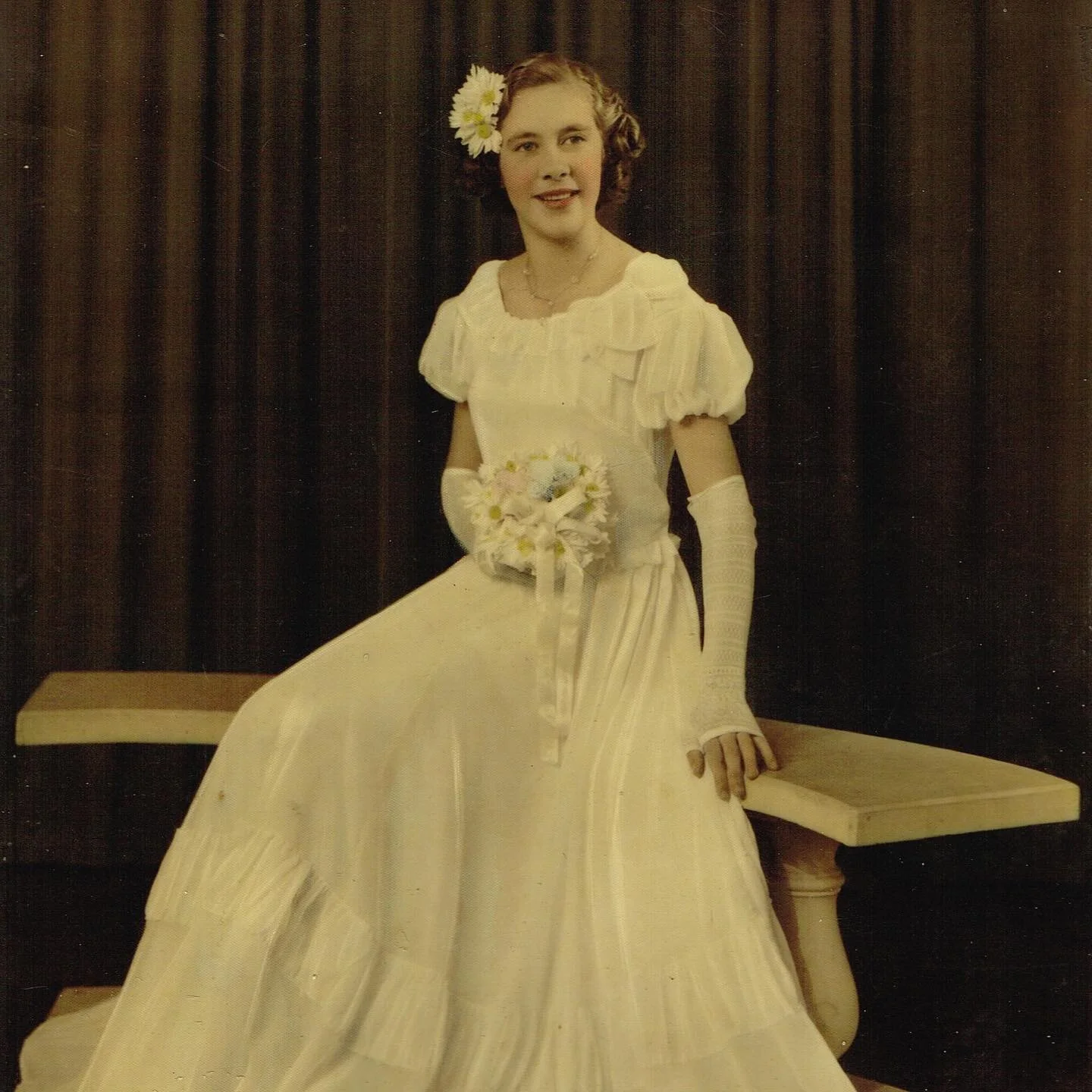
Some of the things I remember most about Mum.
Mum drove an amazing car when I was little it was a green Triumph Herald, she looked so cool in that thing with her cats eye glasses and her 50’s dresses, god I wish we still had that car.
Mum Smoked Viscount ciggies (which I may add I used to nick when I was a teenager) mum smoked for over 50 years and then one day she just decided to stop and she did….just like that, that was mum… she had a steely resolve when she put her mind to it.
She loved PK chewing gum and she really loved Eucalyptus lollies which I loved as well.
Mum had a passion for Antiques and second hand stuff, sometimes I would get thrown in her car on clean up weeks and we would drive around the neighbourhood scouring the streets for plunder….. we found some good shit over the years…… the thing I hated most about that was I would be the one that would have to get out of the car and go and get the shit!!! How embarrassing for a 10 year old boy….. but I have to say we did find some good shit!!!
Mum also loved to drag me around for what she called a “Sunday Run”. She would pile us in the car and we would drive around all the rich areas of Sydney and look at bloody houses….rich people’s houses, we would make regular visits to historic sites like Vaucluse house, Parramatta house etc and make us walk through these places, even if we had been there several times before…..for me it was excruciatingly boring, I just wanted to be with my mates playing footy etc…. I don’t think dad fancied it very much either…but we all towed the line.
I am convinced that secretly mum thought she was from Royal birth…..
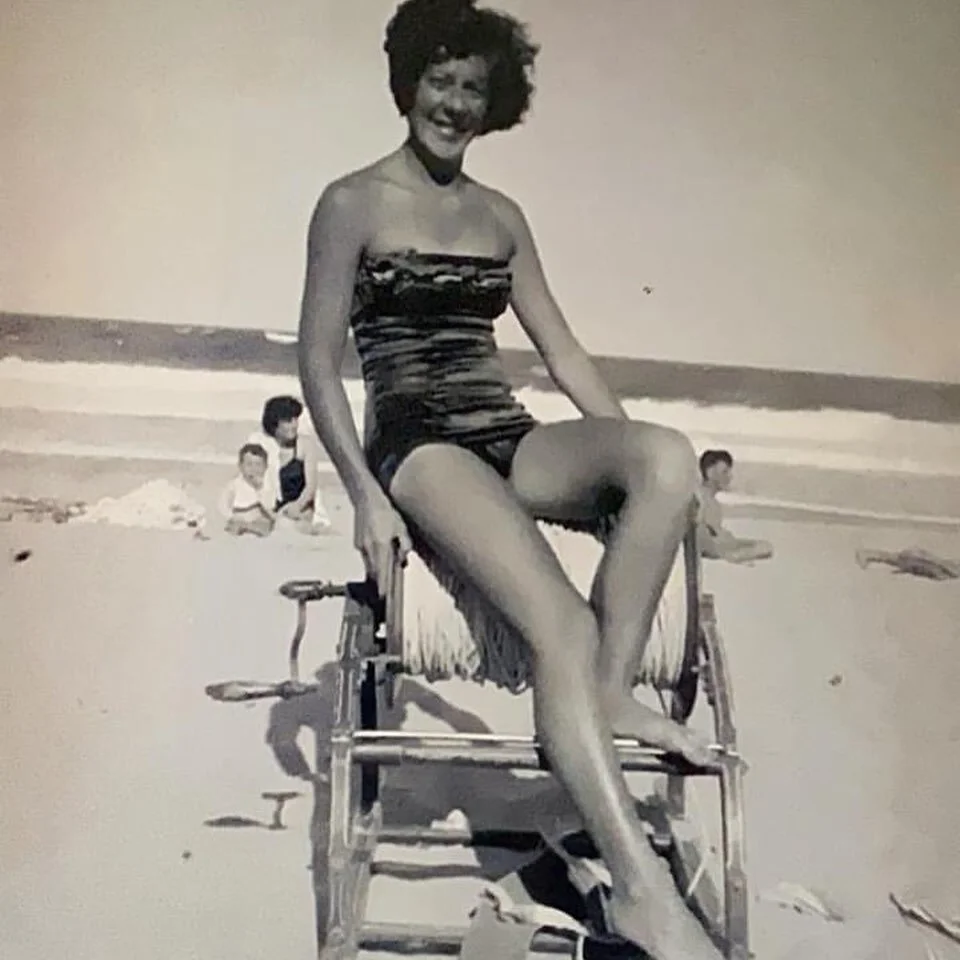
Mum taught me how to try, how to compete, how to be tough and how to be fiercely independent.
Mum gave me the gift of good sportsmanship and how to play in a team, these were valuable gifts she gave, which have held me in good stead throughout my life and by doing so these traits have now been passed on to my kids.
The thing I will probably remember and miss the most about mum was her laugh, her laugh could fill a room, it would echo through the house late at night when we used to watch British comedies like on the buses (ill get you butler) or are you being served (are you free) all the way through to The two Ronnie’s (its good night from him and good night from me) and her favourite Dad’s army (who do you think you are kidding Mr Hitler). She had a wicked, cheeky and non pc sense of humour which we have all inherited from her…..everyone knew when mum was in the house!
A couple of week ago I spent the week with mum, just me and her….. I am so glad I got this time with her…. It was a tough week because she wasn’t well, but we made the most of it.
On one of the days we went on, “A Run”…… It was a well worn path for her…. we drove to and past every land mark in bloody Port Macquarie…. Past Steph’s house where she told me how well Steph and Charles were doing, then onto bonny hills where she showed me where Steve and Liz (Charles Parents) lived and how nice they were….. then past the golf club where she said that Craig and Sue said the food was great and what a lovely club it was…. except for the doorman who she said was a Dickhead…… BTW Dickhead was Mum’s favourite term for most people…. she called me a dickhead all the time.
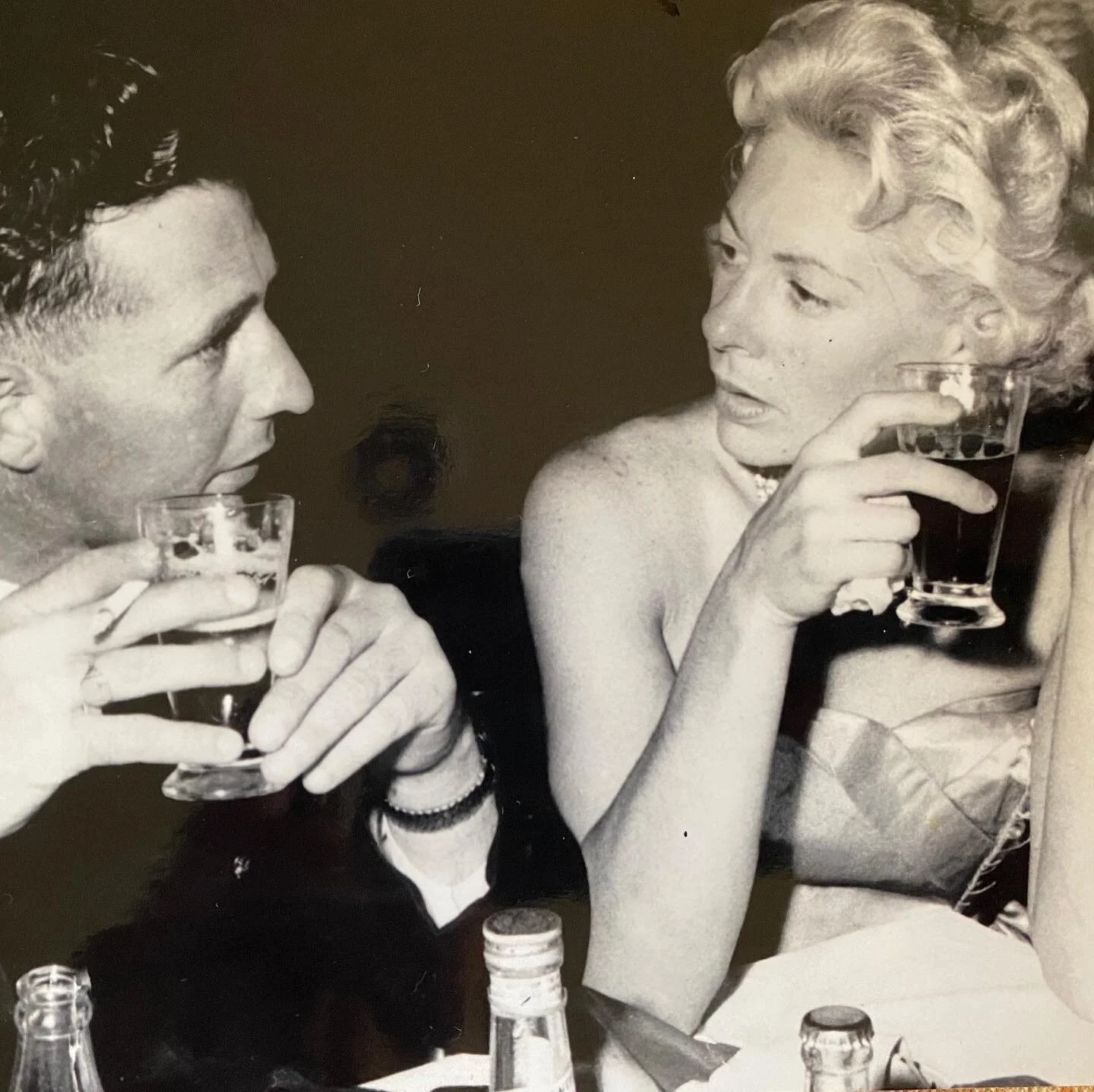
Then off past the retirement village where, as the story goes, dad liked this place because they had heard that all the oldies were having sex and doing wife swapping etc…… she said she would never go there “bloody dickheads”…. but your father would, she said!
Then we went to north haven past the pool that her and Dad used to swim at….. BTW we stopped at every bloody op shop between her place and Kew!!! I am not kidding…. We also had to drive past Ma and Pa’s (Charles Grandparents) who she loved and apparently are the best thing since sliced bread.
Then she said we had to go and have fish and chips by the river…. She made me park in a particular place and we sat and watched the river, we chatted about all her grandkids and great grandkids and how great they all were…….. then all the way back to Port and back to get her a coffee from a particular place……. By this time, I was on a very short fuse…. But I am glad we did it because it made her happy.
I realised that night, when I was laying in bed, that the reason we did THAT drive in THAT order was because THAT is what she did with Dad…… Mum was heartbroken, 68 years of marriage was just too big a hurdle to get over, she missed him so much, she just didn’t know how to show it to us, I wish it could have been different, but that was Mum…. Mum may have been tough on the outside but on the inside she was soft and caring, she loved us to pieces and was proud of all of us…..
We love you mum and you will live on in our hearts forever.
Vanessa Johnson (daughter):
Mum was always full of support and encouragement to me. When I was growing up she was always there driving me from dance lessons to weekend pantomimes. She would always be backstage helping out with dressing and hair and makeup. When we moved to Katoomba there were piano lessons and golf tournaments.
I moved to Katoomba with mum and dad at the age of 12, of course being the mountains our first winter saw a huge snow fall.
School was closed early in order to get the kids home before the roads closed. We didn't live far from the school so I walked home, mum met me half way on this day and we walked home together while throwing snow balls at each other. We arrived home freezing cold and I remember she encouraged me to 'go have a nice warm shower she said'. It was a great idea, I warmed up real quick. Unfortunately mum had other ideas. While enjoying the warm shower I heard mum enter the bathroom, not knowing what she was up to I soon found out as a huge handful of snow was thrown over the top of the shower and covered me. Mum thought it was hilarious.
It was both mum and dad that encouraged my love for golf. Both mum and dad became members of Katoomba Golf Club not long after we moved to Katoomba and I guess you could say it was 'if you can't beat them you might as well join them'.
Mum and I played many games and competitions together, winning match plays and mixed foursome championships together. She was always there with me at junior competitions walking the course with me and if not allowed she would always be at the 18th green waiting to see how I had played.
Mum and I were both members of the Katoomba Golf Club Associates committee with mum holding the positions of both Captain and Vice Captain for a number of years.

I had the opportunity of being able to travel with mum and dad. Cruises when dad was entertaining, Fiji and the last trip to America with both Aunty Jan and Kristen.
Mum always liked company, the slightest hint of a sniffle or a cough and it was 'oh you better stop home from school today' and then half an hour later she was saying, 'let's go to Penrith for the day shopping'.
Three weeks ago Andy and I came up to Port Macquarie and spent the weekend with mum. We took her out for an early birthday lunch and she then directed us on a drive around what I think were a few of her favourite places where she used to go for drives with dad. I am so glad we had that weekend mum, little did we know it would be the last time that we would spend with you.
I know that you will be happy again now as you are reunited with dad, who we know you missed terribly. I want to thank you for everything mum, rest peacefully knowing that we love you and will miss you always.
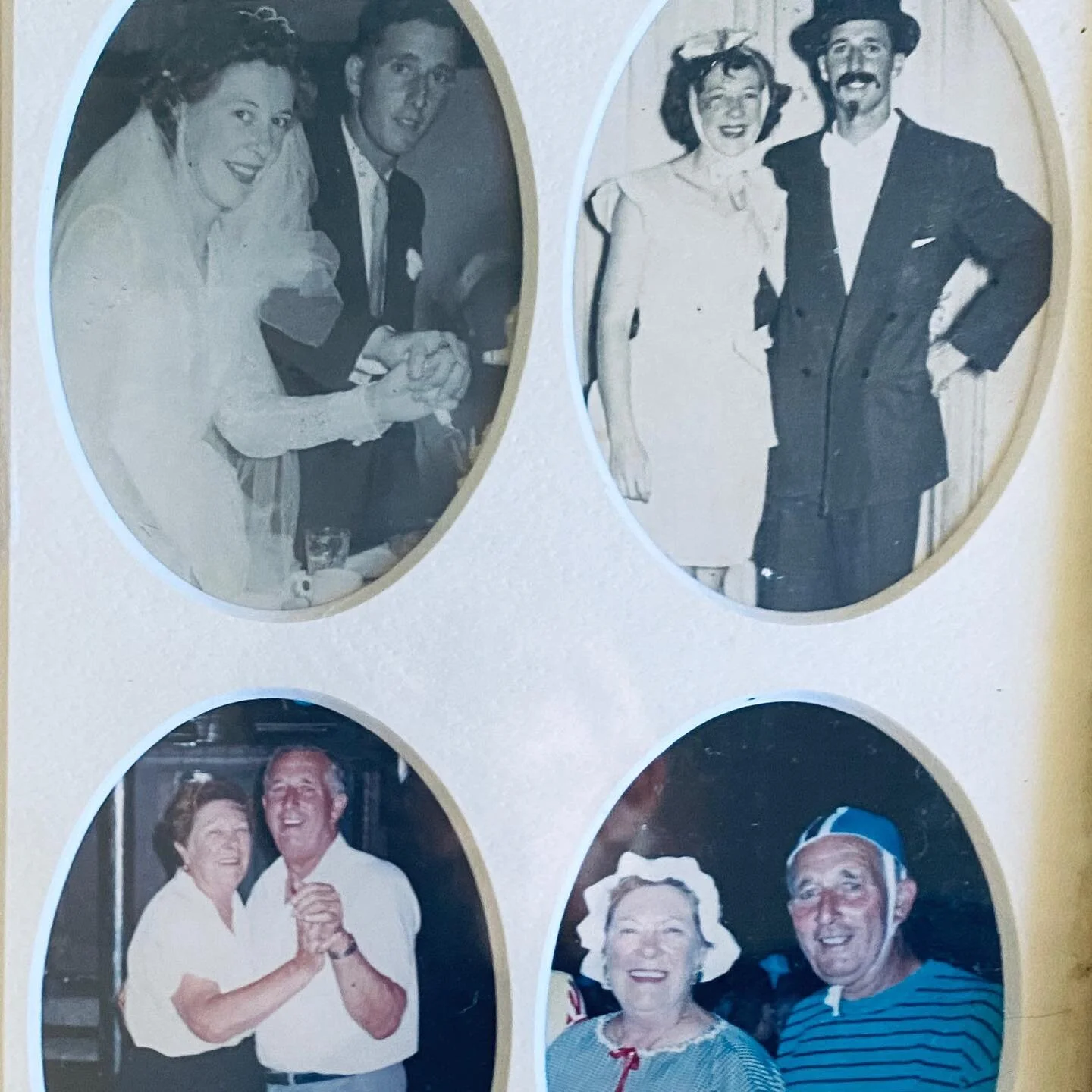
Georgina Pattinson (Granddaughter)
:10 weeks to the day that my Nan, Jean Margaret Pattinson, decided to call it a day. After 68 years of marriage it seems she couldn’t bear to be without my pop. We are all shocked and saddened by our loss but I have the most wonderful memories of how fun and funny my Nan was. So I thought it only appropriate to celebrate her humour and her unforgettable laugh in my eulogy last Friday.. I’m not quiet sure why I, of all people, who normally can’t tell a joke, decided it was a good idea to attempt a fart joke at a funeral (of all places) but thankfully it got a good response. I guess we all know and loved my Nan’s great sense of Humour. Love you Nan..
My speech -
This is a little passage that I found that I know Nan was very fond of..
Lord
Grant me the serenity to
Accept the things
I cannot change
Courage to change
Those things I can
And the wisdom
To hide the bodies of
The people I may have to kill
Because they
PISS ME OFF!
Hehehe and then I can still very clearly hear nan saying ‘oh you gotta laugh George’.. and she’d beam her big pearly white denture grin, as we wiped away the tears from our eyes.
Nan had a wicked sense of humour, I can’t think of a time I didn’t have a solid belly laugh when I was with her.. and it’s this cheeky spirit that I just wanted to celebrate for a minute.
She had a wonderful way with words and a story for everyone she met. No-one was safe!
- Alex was up and down like a fiddlers elbow
- Stephs girls were like a fart in a bottle. Always eager to escape.
- And Dad couldn’t sit long enough to warm a seat
She was also a BIG bingo lover and I thought it was pretty funny that she managed to reach the epic milestone of her 88th (two fat ladies) birthday, a week before she passed.
It was when I rang her for this birthday and we were laughing because I was telling her about this fancy new STICK deodorant I had just bought - the instructions read..
take off cap and push up bottom.
I tell you, I could barely walk, but whenever I farted the room smelt lovely..
Then nan thought it was a good idea to remind me that
An Apple a day...
Keeps anyone away, if you throw it hard enough!
Thanks for all the laughs Nan, you certainly were one of a kind. And a great reminder not to take life too seriously as you never get out of it alive...
JEAN MARGARET PATTINSON
20th July 1932 – 31st July 2020
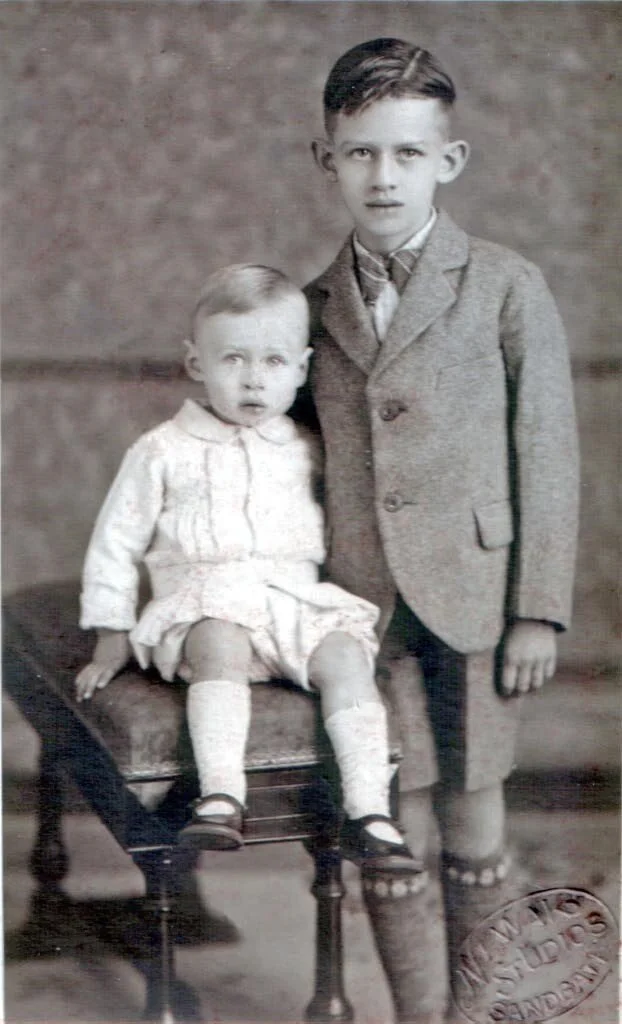
Pete Gillies (right) with younger brother Basil
For Pete Gillies: 'We give God thanks and glory for Pete’s wonderful and productive life', by Andrew Gillies - 2005
July 2005, Aspley, Queensland, Australia
Pete William Gillies 23/1/1928 - 28/5/2004
For reasons now obscure, Pete Gillies was registered as Pete (and not Peter) William Gillies when he was born on the 23rd of January 1928 in Toowoomba to Olive and William Gillies. Olive & William were graziers on the family station “Plainview”. This station was near Dalby and was a large and highly successful enterprise.
Pete did not really get to know much of his father Bill, as Bill died when Pete was only six, and Pete’s only other sibling - Basil was only an infant. Bill had only sisters and Basil & Pete were too young to take over the farm, so the property was split up and sold. Olive and the boys moved to Brisbane’s north east suburbs to be near Olive's family, living first at Sandgate and then at Northgate.
During this time the boys both grew into young men. Pete did his high schooling at BBC graduating in 1945 Eventually Olive and Basil moved to Zillmere and established a poultry farm with some market gardening. By this time however Pete had heard and followed the call to ministry in the Presbyterian church. He first served as a Home Missionary, in numerous areas during breaks in study. Placements included Holland Park, Tambourine Mountain, and Maleny.
During this time he was pursuing his Arts degree and also theological studies. He was ordained in 1953 and accepted his first call to ministry in Innisfail where he remained for 5 years until 1957 when he accepted a call to the inner city Brisbane suburb of Hawthorne.
It was not here but on a church based holiday tour to Tasmania that Pete met a young teacher, Glenda Gillingham, a Methodist from the Sandgate area. A romance flourished and the two were married on the 9th of January 1960. Before long there were two additions to the family. Ian William born in 1961 and Keith Raymond in 1962.
During this period there was a shortage of Presbyterian Ministers in Victoria, and at the General Assembly in Melbourne Pete was headhunted to help fill this shortage. In 1962 he accepted a call to Morwell in Gippsland. Here in 1967, Andrew Peter was born. Just 12 months later Pete accepted a call to Merbein near Mildura in Victoria’s west and then in 1971 to North Altona- Newport in Melbourne’s western suburbs.
Both Glenda and Pete missed their extended family in Queensland, especially after the death of Pete’s beloved mother Olive in 1971. So in 1974 Pete accepted a call back to Queensland and North Ipswich. From Morwell on, all these parishes except for the first year or so in North Ipswich were co-operative Methodist/ Presbyterian and sometimes Congregational. During his time at North Ipswich, Pete’s Brother Basil came to live with the family due to his failing eye-sight.
In 1981, now part of the Uniting Church, the family moved to Camp Hill where Pete had accepted a call to the Coorparoo parish. They were minus one member because Keith had become a cadet announcer with radio 4MB in Maryborough. In 1982 Keith married Helen Carney, which meant that Glenda was no longer the only girl in the family. In 1986 after over thirty-five years in ministry, Pete was unwillingly forced to retire on health grounds.
The family moved to the old farm house at Zillmere which Basil owned. The farm had been subdivided in the 1970s. Pete remained active in ministry in retirement. He did supply at Aspley Parish in the year of his retirement. He also did supply as Chaplain to Prince Charles Hospital in quite recent years. He was never able to become an associate minister despite his strong desire to be one, but this did not stop him. Pete got himself elected as an elder, and was a very faithful visitor.
He loved taking his turn at prayers and readings. At one stage, until the presbytery disallowed it, he got himself elected as a lay representative to Presbytery. Whenever he was asked he would take a service. For almost all of the 18 years he lived at Zillmere Pete organised the Christians in Dialogue ecumenical studies in the Aspley, Geebung, Zillmere area - and this last Sunday was probably the first time he had missed the Week of Prayer for Christian Unity service in all that time. In recent years he did not often get the chance to preach until he was invited to preach monthly for the Crossroads service at New Farm. Despite being largely incapacitated, he managed to do his last service at New Farm on April the sixth, having to catch a number busses there and back.
On Monday the 24th of May Pete was admitted to Prince Charles, for rehabilitation, to get him more mobile. Shortly after admission, Pete had a raised temperature and was placed on an antibiotic drip. On Thursday night he suffered sudden and unexpected breathlessness and heart failure and died the early hours of Friday morning in the cardiac unit of the hospital. These are the bare facts of Pete’s life.
There was however much more to his character. Pete had real determination. You’ve already heard how Pete when determined to do something, like being involved in ministry, could not be stopped. If he couldn’t do it the normal way, he’d find some way around it. In Innisfail, the bathroom was under the verandah & the verandah floor had holes in it. The Session Clerk told him there were no builders available to patch the holes. Pete himself was never a handyman, so he found a builder, got him to do the repairs, and presented the bill to the committee of management.
In these last days when he was confined to a wheel chair or a walking frame, he insisted on paying the paper bill himself. It took him half an hour to get from the car to the counter and back, but he did it. The greatest sign of his determination was the way he never let his many illnesses stop him from doing anything he really wanted to do. From teenage years he suffered from a permanent bronchitis like condition, which hospitalised him at least once. From the time he was a young man he suffered from uneven pigmentation in his skin and had skin cancers removed on a regular basis. In Innisfail he got tropical ulcers in his ears, which probably contributed to his later deafness. From the 1970s on he suffered from high blood pressure. From the 80’s on he suffered from a heart condition and in the mid 80’s he developed bi-polar disorder or manic depression. He also had major bowel cancer surgery and surgery on an enlarged prostate. In the 90s he was diagnosed as borderline diabetic and then with Parkinson’s disease. In the 2000’s it was discovered he had a blocked artery to the brain which prevented him driving, but not getting around - it’s amazing where busses and trains will take you if you’re prepared to use them. In the last twelve months of his life he developed sciatica, which made it very painful to walk.
None of this stopped him, not any of it, apart from the sciatica and only really in this last five weeks. Despite the pain, it didn’t stop him at the start of this year travelling by himself by train to Andrew’s recent induction into the Clermont and Capella congregations. His illnesses did not stop him from being a Rotarian, serving as a board member on multiple occasions, and also as President of the Chermside club, with a perfect attendance record for over 30 years until he reached exemption age. It did not stop him from being an A grade doubles pennant winning champion in church union tennis, in the glory days of the 50s, as well as being the association secretary. He was a keen cricketer, and cricket follower - being a member of the cricketers club and attending countless shield, test and one day games. He was a member of the Geographic Society, the English Association, a Friend of the Ipswich Art Gallery, and loved to attend public lectures on diverse subjects as well as musical and theatrical performances. Most recently he especially enjoyed the BMAC concerts.
On any occasion he could he would go out and also eat out. he loved to be with people. Nothing could stop him. And this list is far from complete.
Not only did he have incredible determination, Pete had a thirst and passion for knowledge. Many people who never met Pete will know his voice and face. That’s because he appeared on numerous television and radio quiz shows. In the early days he appeared on “Information Please” and “Bob Dyer’s Pick-a-box.” He was on “Money Makers,” in all three of its incarnations, the Coles Quiz, Great Temptation, won the major prize on Casino 10, and appeared on three series of Mastermind making it to the quarter finals twice and the semi-finals once. Most contestants did best on their special subjects and less well at their general knowledge - Pete excelled at general knowledge. When trivia nights came into vogue Pete attended every one he could get to and only the most severe of illnesses would stop him. A recent highlight was his appearance on Who Wants to be a Millionaire - he didn’t make it to the hot seat - his reactions were too slow but he got all three questions right.
He was also a keen debater, representing University of Queensland at the national titles, with the team winning that title at least one year. In addition to his BA Pete completed a Grad Dip in Religious Education and qualified for his MA although the thesis never quite got finished. He never tired of learning new things and not just facts and dates, he remembered names and people and all about them for years, often after only the briefest of meetings. He was determined, he had a passion for knowledge and Pete had a passion for justice.
In the mid to late 60’s when Pete was in Country Victoria he joined forces with his Methodist colleague - the Rev. Brian Howe (later to be deputy Prime Minister), to protest against the Viet Nam war. In Queensland he frequently took part in various justice related activities. For the Synod he was Chairperson of the Social responsibility committee for a number of years. For ten years (1971-1980) he was a member of the Labor party. His interest in these areas never flagged, he attended protests, wrote letters, tried to organise English classes for oppressed migrant workers, volunteered as an industrial chaplain, went to information nights and gave donations.
In most houses religion and politics are banned from the dinner table - in our house they were the main themes of most conversations. In our household while salvation was most definitely by grace through faith in Christ, that salvation was to lead to the life of good works for which we were created. Pete held his convictions strongly but he was always open to argument, and could be persuaded to a different point of view if the case was strong and just.
He was determined, committed to justice, had a passion for knowledge and Pete loved his family.
Like most Dads of his era, Pete was sometimes emotionally distant from his children, but he took a real pride in their achievements. Although not a fan of quizzes, Ian takes after his Father in his ability to store and recall knowledge. Pete was very proud of Ian’s success in It’s Academic and Who What and Where, and also in his matriculating and gaining entry to University in more recent years.
He was also proud of Keith’s success in the world of radio and in nabbing a wife. He never stopped encouraging Andrew & Ian in this regard. He was really pleased to be able to conduct Keith & Helen’s wedding. If one of the boys was on the phone he always wanted to speak to us- often at great length. He was very happy that Andrew followed in his footsteps into ministry and liked to show him off when he got the chance.
One of the proudest days of his life was when Glenda graduated with a BTh from the BCT and he went in to bat for her when she was not accepted as a candidate for the deaconate. He always made sure that the boys had all they needed, sacrificing financially to enable Keith to go to a private school and help Andrew to get through Uni.
He loved his family, he was committed to justice, he had a passion for knowledge he had real determination, and Pete also had a passion for the Gospel. In the 50s and 60s Pete was a supporter of and involved in the Billy Graham crusades. As we heard earlier he had a passion for preaching and leading worship. He never really enjoyed RE but taught it willingly. His greatest strength in ministry was visiting. He could talk to and when in pastoral mode, he could listen to anyone. He could gently proclaim the promises of God and was always willing to pray with those he visited. His brief ministry at Prince Charles was deeply appreciated by staff and patients alike. For may years he was a board member and also secretary of CTAQ - because he could see the importance of TV as a medium for presenting the Gospel.
Two incidents relate both his passion for the Gospel, and the central place it took in his life. In what was supposed to have been his final service at Camp Hill, the children’s address was not a moralising sermon, but a simple statement by Pete to the children, that he hoped that they would come to know Jesus Christ as their Lord and Saviour.
The other incident is recalled by Andrew. “I’d gone with Dad to give him some company when he preached at Bald Hills. He began by saying that today was Social Justice Sunday. The old man in front of me groaned. But then he said, but while I’ll be using the prayers for social justice Sunday I won’t be preaching on that today, because it’s St Andrew’s Day. When he said this I groaned - because Dad was always going on about our Scottish heritage, kilts, shortbread, highland dancing, Rabbie Burns, and Dad has a great collection of bagpipe records. But when it came to the sermon, instead of Scottish kitsch, he spoke about Andrew in the Gospels and how he introduced other people to Jesus- his brother Peter, the young boy with the loaves and fish and the text for that day which was the Greeks wanting to see Jesus. He encouraged the congregation to do what St Andrew had done- introduce others to Jesus. ”
Pete William Gillies had real determination, he had a thirst for knowledge, he loved his family, he had a passion for Justice and also a passion for the Gospel. In his retirement speech to Synod, he called on us to be prophetic. Through his life he practiced and so calls us to acts of compassion, and in the sermon at Bald Hills he calls on us to proclaim the Good News of Jesus. The same Jesus who by his love and grace, gives us the foundation for our good works of compassion and Justice. The same Jesus who was the foundation for Pete’s life, faith and ministry.
Like all of us Pete was far from perfect, but we loved him and love him still. We will keenly miss him until in time we will meet him in heaven, where the pain and frustration of these last few months will be healed, and where the life time burden of illness will be lifted. Minister, pastor, prophet, teacher, friend, team member, husband, and Dad, his mark on us will never fade.
And so we give God thanks and glory for Pete’s wonderful and productive life.
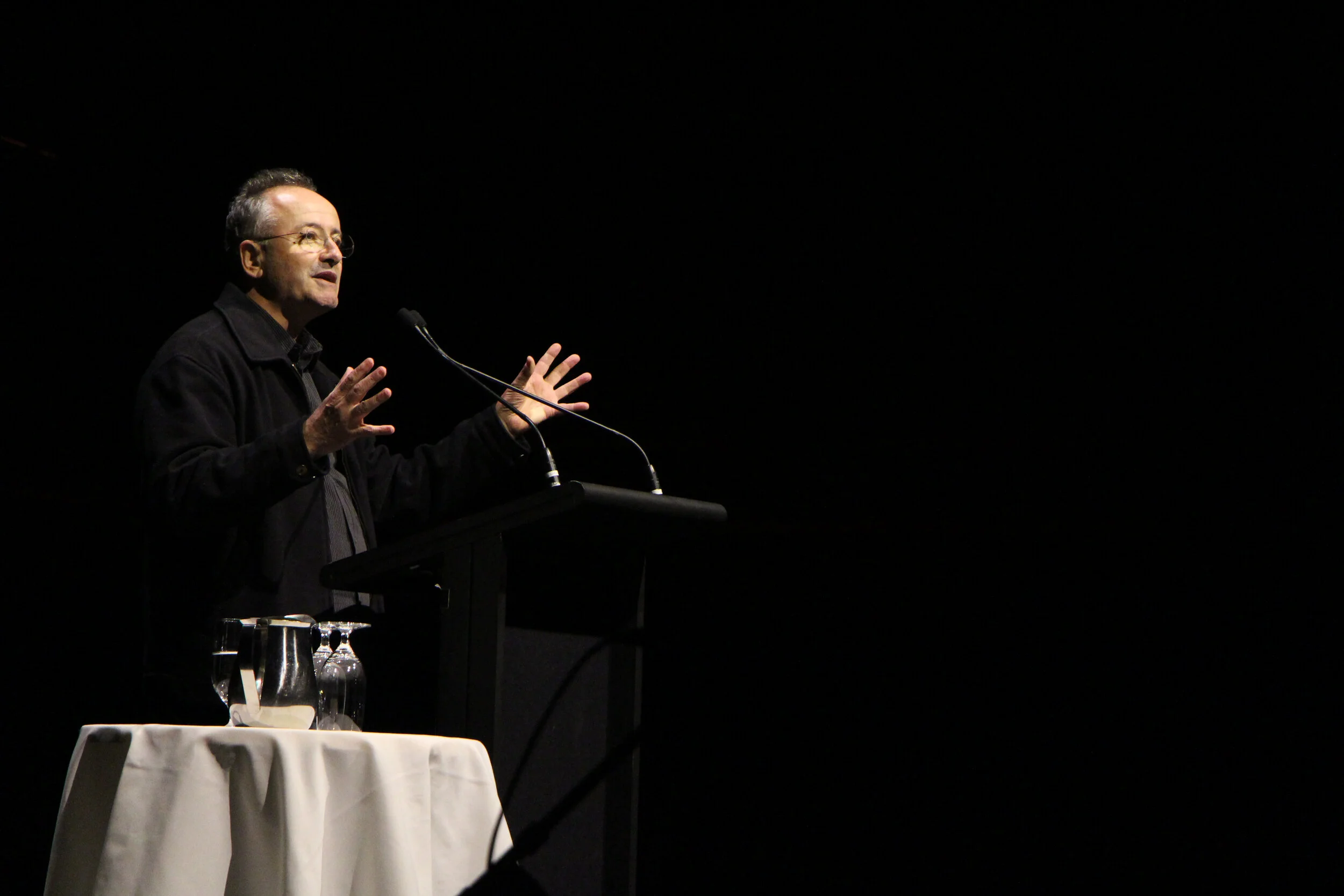
(Photo: Jon Tjhia)
For John Clarke: 'He tried to cast light, not heat', by Andrew Denton - 2017
2 July 2017, Melbourne Town Hall, Melbourne, Australia
This eulogy was part of a 3 hour public celebration of John Clarke’s life, hosted by the Wheeler Centre.
John Clarke was a master of understatement, never better expressed than his description of golf, a game that he loved, and which sometimes loved him in return. And he once said of it, "That's the problem with golf, raise your left eyebrow and the ball's in the Yarra."
John had the keenest of eyes, but also the finest of hearing, and his hearing was finely tuned, not just to the cant of the powerful, but to the nuance of the punter. My favourite story about Australian barracking came from John, who was at a Collingwood-St. Kilda match years ago at the G when Plugger was still playing for St. Kilda and all the action was at the other end. And Plugger was on his own in the goal square, and someone in front of John stood up and called out loudly enough for Plugger to hear, "Tony, I'm going for a pie. Do you want one?" That was John. John would hear the little things that make sense of the big things.
I think it's undisputed that John was the finest satirist of our age, anywhere in the world, in my view. His ability over so many years to be both an X Ray machine and a moral compass was unrivalled, but it was the thinking behind that satire that set it apart. Years ago, I read an interview with John where he talked about satire as failing, unless it had some kind of positive aspect. He said you had to work out what the problem was, and at least try and offer some kind of an answer. And if you look back on John's work, that is there. He tried to cast light, not heat. Yes, there was anger in his work, but never malice. And to me, this was the most remarkable thing, that this man could, for so long, hold so close the red hot kernel of anger that lies at the heart of satire, but not be burned or bent out of shape by it. It was extraordinary.
Plutarch said that he who governs anger governs himself, and it's this I'd like to talk about tonight, about John in tribute to him. It's, of course, appropriate that we mark his brilliance as an artist in so many fields. But to me, his great brilliance was in the art simply of leading a life. I had the enormous pleasure of working with John's writing partner, Andrew Knight, many years ago, and every now and then we'd stop. And sometimes the conversation would turn to John with great affection. And I remember Andrew told me a story about when he was very early in his career, and anxious and was just starting to write with John. Andrew was also working at an advertising agency being run by Phillip Adams and John Singleton. Yes, that is as awful as it sounds.
Anyway, there was a crisis happening and Andrew's in the boardroom. This is in the days before mobile phones. And somebody comes in and says, "Andrew there's a Mr. Clarke on the phone for you." And Andrew says, "Look, I can't, could you tell him I'll call him back?" So the person goes off and comes back in a minute later and says, "Mr. Clarke says it's very important."
So Andrew excuses himself from this crisis meeting, goes to the phone and says, "John, what is it? This is not a good time." And John says, "Look, I'm just downstairs in the car. I need to talk to you. Can you come down?" And Andrew goes, "All right, I'll come down, but I'll have to be quick."
So he goes down in the lift, John's waiting in his car and Andrew leans in and says, "John, what is it?" And John holds up a Frisbee and says, "I reckon now would be a pretty good time to throw a Frisbee, don't you?"
So they go off to the park for an hour and throw a Frisbee. When Andrew gets back to the crisis meeting, it's still in crisis. It made no difference at all whether he was there or not. Of all the brilliant, talented people I've ever known or worked with, John is the only one to whom I would give the word ‘wise’. I can't tell you what I mean when I say wise. He didn't give a list of instructions.
John lived by example, not by declaration, but there was something about John which gave me enormous comfort because he was the person that I knew who seemed to most have worked out how to go about living life. And just to know that somebody had almost got there, was incredibly reassuring. He wasn't perfect. Of course, that was a very good idea. The last perfect person, we nailed to a piece of wood, but he was wise, and I deeply treasured that.
I would have to say that I have not felt the loss of a man so deeply since the passing of my own father. And when my father died, along with the many beautiful messages I got, came one from John. John always had the words, only in this case, they weren't his words. They were someone else's. It was just this poem by one of his favourite poets, A.J. Cronin, signed at the bottom, ‘from John’.
With the exact length and pace of his father’s stride
The son walks,
Echoes and intonations of his father’s speech
Are heard when he talks.
Once when the table was tall and the chair a wood
He absorbed his father’s smile
And carefully copied the way that he stood.
He grew into exile slowly
With pride and remorse,
In some way better than his begetters,
In others worse.
And now having chosen, with strangers,
Half glad of his choice
He smiles with his father’s hesitant smile
And speaks with his voice.
John Clarke knew. John Clarke knew human beings. John Clarke knew how to live a life. We've a bloody privilege to share his and we're privileged still. Cheers, John.
Andrew Denton discusses this speech in this beautiful episode of the podcast.
Joe Biden: 'To all of you who are hurting so badly, I’’m so sorry for your loss', eulogy to 100,000 dead from COVID-19 - 2020
My fellow Americans,
There are moments in our history so grim, so heartrending, that they’re forever fixed in each of our hearts as shared grief. Today is one of those moments. 100,000 lives have now been lost to this virus here in the United States alone, each one leaving behind a family that will never again be whole.
I think I know what you’re feeling. You feel like you’re being sucked into a black hole in the middle of your chest. It’s suffocating, your heart is broken and there’s nothing but a feeling of emptiness right now ..
For most of you, you were unable to be there when you lost your beloved family member, or best friend, for most of you, you were unable to be there when they died, alone. With the pain, the anger and frustration, you’ll wonder if you’ll ever b e able to get anywhere from here.
It’s made all the worse by knowing that this is a fateful milestone that we should have never reached, it could have been avoided. According to a study being done by Columbia University, if the administration had reacted just one week earlier to implement social distancing, and do what it had to do, just one week sooner, as many as 36,000 of these deaths might have been averted.
To all of you who are hurting so badly, I’’m so sorry for your loss.
. I know there’s nothing I or anyone else can do to dull the sharpness of the pain you feel right now, but I can promise you from experience, the day will come when the memory of your loved one will bring a smile to your lips before it brings a tear to your eyes.
My prayer for all of you is that that day will come sooner rather than later, but I promise you it will come. When it does, you can know you can make it.
God bless each and every one of you, and the blessed memory of the one you lost.
This nation grieves with you. Take some solace from the fact, we all grieve with you.
For John Lewis: 'Founding Father Of That Fuller, Fairer, Better America’', by Barack Obama - 2020
31 July 2020, Ebenezer Baptist Church, Atlanta, Georgia, USA
James wrote to the believers, “Consider it pure joy, my brothers and sisters, whenever you face trials of many kinds, because you know that the testing of your faith produces perseverance. Let perseverance finish its work so that you may be mature and complete, lacking nothing.”
It is a great honor to be back in Ebenezer Baptist Church, in the pulpit of its greatest pastor, Dr. Martin Luther King, Jr., to pay my respects to perhaps his finest disciple — an American whose faith was tested again and again to produce a man of pure joy and unbreakable perseverance — John Robert Lewis.
To those who have spoken to Presidents Bush and Clinton, Madam Speaker, Reverend Warnock, Reverend King, John’s family, friends, his beloved staff, Mayor Bottoms — I’ve come here today because I, like so many Americans, owe a great debt to John Lewis and his forceful vision of freedom.
Now, this country is a constant work in progress. We were born with instructions: to form a more perfect union. Explicit in those words is the idea that we are imperfect; that what gives each new generation purpose is to take up the unfinished work of the last and carry it further than anyone might have thought possible.
John Lewis — the first of the Freedom Riders, head of the Student Nonviolent Coordinating Committee, youngest speaker at the March on Washington, leader of the march from Selma to Montgomery, Member of Congress representing the people of this state and this district for 33 years, mentor to young people, including me at the time, until his final day on this Earth — he not only embraced that responsibility, but he made it his life’s work.
Which isn’t bad for a boy from Troy. John was born into modest means — that means he was poor — in the heart of the Jim Crow South to parents who picked somebody else’s cotton. Apparently, he didn’t take to farm work — on days when he was supposed to help his brothers and sisters with their labor, he’d hide under the porch and make a break for the school bus when it showed up. His mother, Willie Mae Lewis, nurtured that curiosity in this shy, serious child. “Once you learn something,” she told her son, “once you get something inside your head, no one can take it away from you.”
As a boy, John listened through the door after bedtime as his father’s friends complained about the Klan. One Sunday as a teenager, he heard Dr. King preach on the radio. As a college student in Tennessee, he signed up for Jim Lawson’s workshops on the tactic of nonviolent civil disobedience. John Lewis was getting something inside his head, an idea he couldn’t shake that took hold of him — that nonviolent resistance and civil disobedience were the means to change laws, but also change hearts, and change minds, and change nations, and change the world.
So he helped organize the Nashville campaign in 1960. He and other young men and women sat at a segregated lunch counter, well-dressed, straight-backed, refusing to let a milkshake poured on their heads, or a cigarette extinguished on their backs, or a foot aimed at their ribs, refused to let that dent their dignity and their sense of purpose. And after a few months, the Nashville campaign achieved the first successful desegregation of public facilities in any major city in the South.
John got a taste of jail for the first, second, third … well, several times. But he also got a taste of victory. And it consumed him with righteous purpose. And he took the battle deeper into the South.
That same year, just weeks after the Supreme Court ruled that segregation of interstate bus facilities was unconstitutional, John and Bernard Lafayette bought two tickets, climbed aboard a Greyhound, sat up front, and refused to move. This was months before the first official Freedom Rides. He was doing a test. The trip was unsanctioned. Few knew what they were up to. And at every stop, through the night, apparently the angry driver stormed out of the bus and into the bus station. And John and Bernard had no idea what he might come back with or who he might come back with. Nobody was there to protect them. There were no camera crews to record events. You know, sometimes, we read about this and kind of take it for granted. Or at least we act as if it was inevitable. Imagine the courage of two people Malia’s age, younger than my oldest daughter, on their own, to challenge an entire infrastructure of oppression.
John was only twenty years old. But he pushed all twenty of those years to the center of the table, betting everything, all of it, that his example could challenge centuries of convention, and generations of brutal violence, and countless daily indignities suffered by African Americans.
Like John the Baptist preparing the way, like those Old Testament prophets speaking truth to kings, John Lewis did not hesitate — he kept on getting on board buses and sitting at lunch counters, got his mug shot taken again and again, marched again and again on a mission to change America.
Spoke to a quarter million people at the March on Washington when he was just 23.
Helped organize the Freedom Summer in Mississippi when he was just 24.
At the ripe old age of 25, John was asked to lead the march from Selma to Montgomery. He was warned that Governor Wallace had ordered troopers to use violence. But he and Hosea Williams and others led them across that bridge anyway. And we’ve all seen the film and the footage and the photographs, and President Clinton mentioned the trench coat, the knapsack, the book to read, the apple to eat, the toothbrush — apparently jails weren’t big on such creature comforts. And you look at those pictures and John looks so young and he’s small in stature. Looking every bit that shy, serious child that his mother had raised and yet, he is full of purpose. God’s put perseverance in him.
And we know what happened to the marchers that day. Their bones were cracked by billy clubs, their eyes and lungs choked with tear gas. As they knelt to pray, which made their heads even easier targets, and John was struck in the skull. And he thought he was going to die, surrounded by the sight of young Americans gagging, and bleeding, and trampled, victims in their own country of state-sponsored violence.
And the thing is, I imagine initially that day, the troopers thought that they had won the battle. You can imagine the conversations they had afterwards. You can imagine them saying, “Yeah, we showed them.” They figured they’d turned the protesters back over the bridge; that they’d kept, that they’d preserved a system that denied the basic humanity of their fellow citizens. Except this time, there were some cameras there. This time, the world saw what happened, bore witness to Black Americans who were asking for nothing more than to be treated like other Americans. Who were not asking for special treatment, just the equal treatment promised to them a century before, and almost another century before that.
When John woke up, and checked himself out of the hospital, he would make sure the world saw a movement that was, in the words of Scripture, “hard pressed on every side, but not crushed; perplexed but not in despair; persecuted, but not abandoned; struck down, but not destroyed.” They returned to Brown Chapel, a battered prophet, bandages around his head, and he said more marchers will come now. And the people came. And the troopers parted. And the marchers reached Montgomery. And their words reached the White House — and Lyndon Johnson, son of the South, said “We shall overcome,” and the Voting Rights Act was signed into law.
The life of John Lewis was, in so many ways, exceptional. It vindicated the faith in our founding, redeemed that faith; that most American of ideas; that idea that any of us ordinary people without rank or wealth or title or fame can somehow point out the imperfections of this nation, and come together, and challenge the status quo, and decide that it is in our power to remake this country that we love until it more closely aligns with our highest ideals. What a radical ideal. What a revolutionary notion. This idea that any of us, ordinary people, a young kid from Troy can stand up to the powers and principalities and say no this isn’t right, this isn’t true, this isn’t just. We can do better. On the battlefield of justice, Americans like John, Americans like the Reverends Lowery and C.T. Vivian, two other patriots that we lost this year, liberated all of us that many Americans came to take for granted.
America was built by people like them. America was built by John Lewises. He as much as anyone in our history brought this country a little bit closer to our highest ideals. And someday, when we do finish that long journey toward freedom; when we do form a more perfect union — whether it’s years from now, or decades, or even if it takes another two centuries — John Lewis will be a founding father of that fuller, fairer, better America.
And yet, as exceptional as John was, here’s the thing: John never believed that what he did was more than any citizen of this country can do. I mentioned in the statement the day John passed, the thing about John was just how gentle and humble he was. And despite this storied, remarkable career, he treated everyone with kindness and respect because it was innate to him — this idea that any of us can do what he did if we are willing to persevere.
He believed that in all of us, there exists the capacity for great courage, that in all of us there is a longing to do what’s right, that in all of us there is a willingness to love all people, and to extend to them their God-given rights to dignity and respect. So many of us lose that sense. It’s taught out of us. We start feeling as if, in fact, that we can’t afford to extend kindness or decency to other people. That we’re better off if we are above other people and looking down on them, and so often that’s encouraged in our culture. But John always saw the best in us. And he never gave up, and never stopped speaking out because he saw the best in us. He believed in us even when we didn’t believe in ourselves. As a Congressman, he didn’t rest; he kept getting himself arrested. As an old man, he didn’t sit out any fight; he sat in, all night long, on the floor of the United States Capitol. I know his staff was stressed.
But the testing of his faith produced perseverance. He knew that the march is not yet over, that the race is not yet won, that we have not yet reached that blessed destination where we are judged by the content of our character. He knew from his own life that progress is fragile; that we have to be vigilant against the darker currents of this country’s history, of our own history, with their whirlpools of violence and hatred and despair that can always rise again.
Bull Connor may be gone. But today we witness with our own eyes police officers kneeling on the necks of Black Americans. George Wallace may be gone. But we can witness our federal government sending agents to use tear gas and batons against peaceful demonstrators. We may no longer have to guess the number of jelly beans in a jar in order to cast a ballot. But even as we sit here, there are those in power are doing their darnedest to discourage people from voting — by closing polling locations, and targeting minorities and students with restrictive ID laws, and attacking our voting rights with surgical precision, even undermining the Postal Service in the run-up to an election that is going to be dependent on mailed-in ballots so people don’t get sick.
Now, I know this is a celebration of John’s life. There are some who might say we shouldn’t dwell on such things. But that’s why I’m talking about it. John Lewis devoted his time on this Earth fighting the very attacks on democracy and what’s best in America that we are seeing circulate right now.
He knew that every single one of us has a God-given power. And that the fate of this democracy depends on how we use it; that democracy isn’t automatic, it has to be nurtured, it has to be tended to, we have to work at it, it’s hard. And so he knew it depends on whether we summon a measure, just a measure, of John’s moral courage to question what’s right and what’s wrong and call things as they are. He said that as long as he had breath in his body, he would do everything he could to preserve this democracy. That as long as we have breath in our bodies, we have to continue his cause. If we want our children to grow up in a democracy — not just with elections, but a true democracy, a representative democracy, a big-hearted, tolerant, vibrant, inclusive America of perpetual self-creation — then we are going to have to be more like John. We don’t have to do all the things he had to do because he did them for us. But we have got to do something. As the Lord instructed Paul, “Do not be afraid, go on speaking; do not be silent, for I am with you, and no one will attack you to harm you, for I have many in this city who are my people.” Just everybody’s just got to come out and vote. We’ve got all those people in the city but we can’t do nothing.
Like John, we have got to keep getting into that good trouble. He knew that nonviolent protest is patriotic; a way to raise public awareness, put a spotlight on injustice, and make the powers that be uncomfortable.
Like John, we don’t have to choose between protest and politics, it is not an either-or situation, it is a both-and situation. We have to engage in protests where that is effective but we also have to translate our passion and our causes into laws and institutional practices. That’s why John ran for Congress thirty-four years ago.
Like John, we have got to fight even harder for the most powerful tool we have, which is the right to vote. The Voting Rights Act is one of the crowning achievements of our democracy. It’s why John crossed that bridge. It’s why he spilled his blood. And by the way, it was the result of Democratic and Republican efforts. President Bush, who spoke here earlier, and his father, both signed its renewal when they were in office. President Clinton didn’t have to because it was the law when he arrived so instead he made a law that made it easier for people to register to vote.
But once the Supreme Court weakened the Voting Rights Act, some state legislatures unleashed a flood of laws designed specifically to make voting harder, especially, by the way, state legislatures where there is a lot of minority turnout and population growth. That’s not necessarily a mystery or an accident. It was an attack on what John fought for. It was an attack on our democratic freedoms. And we should treat it as such.
If politicians want to honor John, and I’m so grateful for the legacy of work of all the Congressional leaders who are here, but there’s a better way than a statement calling him a hero. You want to honor John? Let’s honor him by revitalizing the law that he was willing to die for. And by the way, naming it the John Lewis Voting Rights Act, that is a fine tribute. But John wouldn’t want us to stop there, trying to get back to where we already were. Once we pass the John Lewis Voting Rights Act, we should keep marching to make it even better.
By making sure every American is automatically registered to vote, including former inmates who’ve earned their second chance.
By adding polling places, and expanding early voting, and making Election Day a national holiday, so if you are someone who is working in a factory, or you are a single mom who has got to go to her job and doesn’t get time off, you can still cast your ballot.
By guaranteeing that every American citizen has equal representation in our government, including the American citizens who live in Washington, D.C. and in Puerto Rico. They are Americans.
By ending some of the partisan gerrymandering — so that all voters have the power to choose their politicians, not the other way around.
And if all this takes eliminating the filibuster — another Jim Crow relic — in order to secure the God-given rights of every American, then that’s what we should do.
And yet, even if we do all this — even if every bogus voter suppression law was struck off the books today — we have got to be honest with ourselves that too many of us choose not to exercise the franchise; that too many of our citizens believe their vote won’t make a difference, or they buy into the cynicism that, by the way, is the central strategy of voter suppression, to make you discouraged, to stop believing in your own power.
So we are also going to have to remember what John said: “If you don’t do everything you can to change things, then they will remain the same. You only pass this way once. You have to give it all you have.” As long as young people are protesting in the streets, hoping real change takes hold, I’m hopeful but we cannot casually abandon them at the ballot box. Not when few elections have been as urgent, on so many levels, as this one. We cannot treat voting as an errand to run if we have some time. We have to treat it as the most important action we can take on behalf of democracy.
Like John, we have to give it all we have.
I was proud that John Lewis was a friend of mine. I met him when I was in law school. He came to speak and I went up and I said, “Mr. Lewis, you are one of my heroes. What inspired me more than anything as a young man was to see what you and Reverend Lawson and Bob Moses and Diane Nash and others did.” And he got that kind of — aw shucks, thank you very much.
The next time I saw him, I had been elected to the United States Senate. And I told him, “John, I am here because of you.” On Inauguration Day in 2008, 2009, he was one of the first people that I greeted and hugged on that stand. I told him, “This is your day too.”
He was a good and kind and gentle man. And he believed in us — even when we don’t believe in ourselves. It’s fitting that the last time John and I shared a public forum was on Zoom. I am pretty sure that neither he nor I set up the Zoom call because we didn’t know how to work it. It was a virtual town hall with a gathering of young activists who had been helping to lead this summer’s demonstrations in the wake of George Floyd’s death. And afterwards, I spoke to John privately, and he could not have been prouder to see this new generation of activists standing up for freedom and equality; a new generation that was intent on voting and protecting the right to vote; in some cases, a new generation running for political office.
I told him, all those young people, John — of every race and every religion, from every background and gender and sexual orientation — John, those are your children. They learned from your example, even if they didn’t always know it. They had understood, through him, what American citizenship requires, even if they had only heard about his courage through the history books.
“By the thousands, faceless, anonymous, relentless young people, Black and white … have taken our whole nation back to those great wells of democracy which were dug deep by the founding fathers in the formulation of the Constitution and the Declaration of Independence.”
Dr. King said that in the 1960s. And it came true again this summer.
We see it outside our windows, in big cities and rural towns, in men and women, young and old, straight Americans and LGBTQ Americans, Blacks who long for equal treatment and whites who can no longer accept freedom for themselves while witnessing the subjugation of their fellow Americans. We see it in everybody doing the hard work of overcoming complacency, of overcoming our own fears and our own prejudices, our own hatreds. You see it in people trying to be better, truer versions of ourselves.
And that’s what John Lewis teaches us. That’s where real courage comes from. Not from turning on each other, but by turning towards one another. Not by sowing hatred and division, but by spreading love and truth. Not by avoiding our responsibilities to create a better America and a better world, but by embracing those responsibilities with joy and perseverance and discovering that in our beloved community, we do not walk alone.
What a gift John Lewis was. We are all so lucky to have had him walk with us for a while, and show us the way.
God bless you all. God bless America. God bless this gentle soul who pulled it closer to its promise.
For John Kennedy Snr: 'For being reminded of Kennedy is being reminded also of what Hawthorn is all about', by David Parkin - 2020
2 July 2020, Our Lady of Victories, Camberwell, Melbourne, Australia
David Parkin’s was captain of Hawthorn’s 1971 premiership side under Kennedy. Speech begins at 38.20.
Whilst the past nine days has been a time of great sadness and reflection, today I hope can be remembered as a genuine celebration of a remarkable and, in many ways, unique man’s life.
My association with ‘Kanga’ goes back nearly six decades. I have known him as a coach, father, husband, colleague, critical friend and educationalist. Like hundreds of others, with their parents being the exception, he became the most significant and positive person in their lives. The many conversations I’ve had this past week, would certainly reinforce that.
Two people I know well have sought some solace in John’s passing by visiting Waverley Park to stand in front of his imposing statue, to pay homage and reflect on his legacy.
In many ways, it’s not difficult to understand why this man was held in such high esteem. No, it’s more than that – reverence! This reverence came about not because of his many achievements, numerous as they have been, but because of the respect for the qualities of the man himself. Many, including me, have spoken this week about those attributes, but they bear repeating:
1. His complete objectivity in decision making!
I’ve met no other man in life who could make decisions without fear or favour. What was best for the team or club always prevailed. Personal feelings or relationships never influenced his decision. For example, the sacking of Lance Morton in 1970 mid-season and Kevin Heath in 1975 pre-season; his non-selection of Peter Crimmins in the 1975 Grand Final; his departure to Stawell in 1964; his appointment to North Melbourne in 1985. All are actions of a decisive decision maker. We admired him enormously for that!
2. His absolute single-mindedness
Nothing superficial or extraneous ever interfered with the achievement of the objective. His ability to pass through the pain barrier was a great example for us to follow.
In a pre-season run, using the ‘Walk Against Want’ as his vehicle (25 kms from Glenferrie Oval to Eastland in Ringwood) and John, now in his forties, caught up to Des Meagher, the best endurance runner in the Club, at Antonio Park and suggested a walk. Des said yes, then took off with Kanga in hot pursuit. He was eventually beaten into second place by Des, who took a shortcut. John never forgave him!
3. His exceptional oratory
The players were given plenty in his pre, during and post-match addresses. His “at least DO something? DO, don’t think, don’t hope, DO! has become part of football folklore. But I was always in the front row! He used his knowledge of literature as an exceptional skill, to provide the connection between football and life, using the philosophy of Karl Marx, the beauty of William Shakespeare and the passion of Sir Winston Churchill.
4. His tremendous sense of humour
Whilst his leadership style would have to be termed ‘autocratic’, there are multitude examples of this over the 60-70 years, but I will mention two:
i) On the back of a 103 point turnaround versus Essendon in 1973, (Round 3 to Round 15) there was no post-match team meeting, although I could see that John was seething. The following Tuesday night we copped 30 minutes of his best condemnation for our lack of effort. His closing words I will never forget. “The trouble with this generation is that you have dollars on your backs, fast cars in the carpark, and Brut under your armpits!” He then stormed off to have a shower. No-one followed. He reappeared and then we showered too. As Ian Bremner came out of the bathroom he hesitated near Kanga’s locker and said to Kel Moore “Can you throw me over your Brut mate?” to which Kel replied “Hang on a minute Brem, it’s out in my new Monaro in the carpark”. Even the coach, himself, had to smile.
ii) To put this into context, some years back Ray Wilson rang me to ask whether as a player I had ever had John put his arm around me and say “well done”. I assured him that never happened! “That’s good” said Ray, “I thought I was the only one to miss out”.
On the basis that JK was not one for handing our bouquets to anyone, Don Scott was pleasantly surprised to receive a phone call from Kanga on Grand Final day a few years back. He was ringing to tell Scotty how well he had played in the 1971 Grand Final – some 27 years before! Apparently he couldn’t sleep on Grand Final eve, had turned on the TV to see Channel 7’s Grand Final marathon. Lo and behold, it was the replay of 1971, which apparently he had never watched.
Early the next morning Scotty received the phone call from John reinforcing how well he had played. He was dumbfounded but really excited and rang his three friends to tell them his news. I congratulated him on being the first and only player to receive that reinforcement from our coach.
Immediately I rang Kanga to make sure he understood the significance of his phone call, and asked him if he had my telephone number to give me a similar call? “Sorry Dave”, he said “but you didn’t play all that well, so I won’t be making that call”!
5. His complete and utter humility
John was always embarrassed by the accolades from others. Hawthorn or North Melbourne successes, to him, were due to the outward and visible signs, which were the players. Never was the team’s successes due to his words or deeds, and I mean NEVER!
6. Personal influence
His ability to influence the character and lives of so many young men, gave players purpose and meaning to what they were doing. There is no doubt, for this reason alone, that all who donned the Brown and Gold or Blue and White over those 18 seasons, have become better people as a result of being coached by JK.
In catching up with teammates at Club and AFL functions over the years, I have had that reinforced time and again.
Back in 1977 Hawthorn ran a testimonial dinner for John. In typical Kennedy style, he spoke at length about the people and events which had impacted his life, whilst serving that entity over the previous three decades.
I will repeat my public response then as a reminder to us all, for the years ahead.
I sincerely hope that John Kennedy is never forgotten by players, coaches, administrators and members at Hawthorn, for being reminded of Kennedy is being reminded also of what Hawthorn is all about.
Rest in peace great man!
John Kennedy 20 December 1928 – 24 June 2020
For Robin Williams: 'This guy comes in and we're like a morning dew, he comes in like a hurricane', by David Letterman - 2014
Well, thank you ladies and gentlemen. Thank you.
I guess like a lot of us, most of us, I've been thinking about Robin Williams, I believe we found out a week ago that he had died. Many things come to mind in a situation like this. And of course, more questions are raised than can possibly be answered, but I started reflecting about it.
I knew Robin Williams for 38 years. 38 years, which in and of itself is crazy. How time...
I met him at The Comedy Store. He and I were kids along... It was myself and Jay Leno and Tom Dreesen and Tim Thomason and Johnny Dark and Elayne Boosler and on and on and Jimmy Walker. We were all out there at The Comedy Store and we wanted to make people laugh. We wanted to get on The Tonight Show. We wanted something because we all felt that we're funny. In those days, we were working for free drinks. Some were working for more free drinks than others, but.
So what you would do is you would go on stage and then you do your little skits and then you would come off stage. If there was a new guy coming on, you'd want to stick around and make fun of the new guy.
Paul: Sure.
David Letterman: Because we were all worried that, "Oh, somebody else is coming in who's really funny." And then we'll have to go back, in my case, to Indiana.
Paul: Yes.
David Letterman: I can remember the night my friend, George Miller and I, who was a very funny comic and was on this show many times, we were at The Comedy Store and they introduce Robin Williams. For some reason in the beginning, he was introduced as being from Scotland. They said he was Scottish.
Paul: I see
.
David Letterman: Now we're stumped. We don't know. There's a Scottish guy, really, coming to the United States? So we were feeling pretty smug about our position right away, because it's going to be haggis and that kind of crap. So we're relaxed. We're ready to go. All of a sudden, he comes up on stage and you know what it is. It's like nothing we had ever seen before. Nothing we had ever imagined before. We go home at night and are writing our little jokes about stuff. And this guy comes in and we're like a morning dew, he comes in like a hurricane.
Now, the longer he's onstage, the worse we feel about ourselves because it's not stopping. And then he finishes and I thought, "Oh, that's it. They're going to have to put an end to show business because what can happen after this?" And then we get to see this night after night after night. We didn't approach him because we were afraid of him. Honest to God. You thought, "Holy crap, there goes my chance at show business because of this guy from Scotland."
And then like a shot out of a cannon, he goes and he's on the Happy Days show. And then from the Happy Days show, he gets to be on Mork & Mindy. Now, there's some structure to his life. He's not at The Comedy Store every night because he's got an actual job. So the rest of us can pretend that it never happened. But yet, then he goes from Mork & Mindy and then he starts to making movie after movie after movie. He's nominated four times for an Academy Award. It wasn't really until Paul and I started the NBC version of this show, which by the way, is still running in Mexico.
Paul: It is.
David Letterman: Very popular. But it wasn't until then that I sort of got to really know Robin Williams, because he would come on to promote movies or concerts or whatever he was talking about. He was always so gracious. We would talk about the old times and never did he act like, "Oh, I knew you guys were scared because I was so good." It was just a pleasure to know the guy. He was a gentleman and delightful. Even in the old days, he was kind enough to ask me to appear on his Mork & Mindy show. Now, this is a double edged sword because he did it only because he was trying to help other fledgling, starting out comics.
Paul: Make sense.
David Letterman: Right. The other side of the sword is I had no business being on that show. I have no business being on this show. But he was nice. He gave me a job. So in those days, jobs were hard to come by. And there I was, and I was on Mork & Mindy. I can remember between the dress rehearsal and the actual taping of the show, the director of the program, Howard, Howard, Howard Shore-
Paul: Howard Storm.
David Letterman: Storm. Howard Storm comes up to me and he says, "Well, you've been trying all week." He says, "This is your last chance."
So even to the detriment of the show, Robin was kind enough to invite me to come on because he thought, "Why can't I spread this around and have some of my friends sharing my success," which is exactly what he did. He then was on our show, the show, in the old show, a total of nearly 50 times.
Paul: Total of 50 times?
David Letterman: 50 times. 50 times. Two things would happen because Robin was on the program. One, I didn't have to do anything. All I had to do was sit here and watch the machine. And two, people would watch. If they knew Robin was on the show, the viewership would go up because they wanted to see Robin. Believe me, that wasn't just true of television. I believe that was true of the kind of guy he was. People were drawn to him because of this electricity. This, whatever it was that he radiated that propelled him and powered him.
And then he came on when I came back after my heart surgery, Robin was nice enough to come on that night. And it was very, very funny and very, very appropriate. Here's a picture that I will now cherish even more than I had previously. There are four people right there. Two of which wildly funny, insanely funny, two are not.
The handsome woman there is Mitzi Shore. She owned The Comedy Store. We all, the three of us, worked there. I think Robin and I, it'd be safe to say, we started there. Richard Pryor was already Richard Pryor, but he would work there. The guy in the middle, I trimmed hedges.
Paul: Yeah. Oh, well.
David Letterman: So we would like to... We put together a segment of Robin Williams appearances. Moreover, more than anything, it will make you laugh. Really, that's what we should take from this is he could make you laugh under any circumstances. Here he is on our show.
[Clips]
God bless you, my friend.
Well, what I will add here is beyond being a very talented man and a good friend and a gentlemen, I'm sorry. Like everybody else, I had no idea that the man was in pain, that the man was suffering. But what a guy. Robin Williams. We'll be right back, ladies and gentlemen.
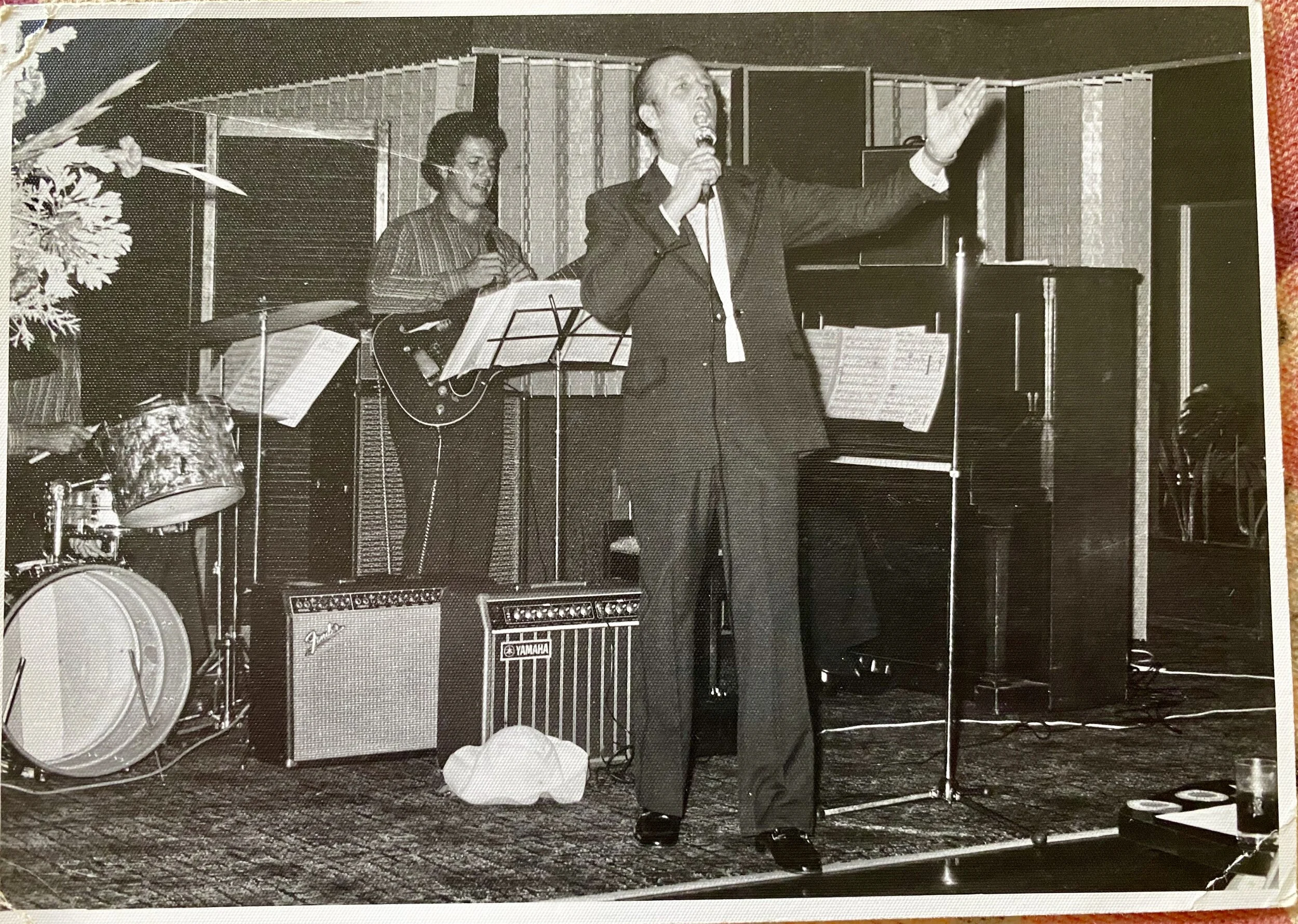
For Bill Pattinson: 'He loved us all, and we loved him back', by Brett Pattinson - 2020
May 2020, Port Macquarie, Australia
Good afternoon everyone.
On the way here today i was pulled over by the police, i wound down my window and the officer said “blow into this bag” i said “what for” he said “because me chips are too hot”.....
When i was asked to do the eulogy, I thought why me? Craig or Dad are usually the ones that do the speeches in the family ... .so i agreed under some degree of fear and loathing....
So, that being said, I asked some friends about how to go about writing a eulogy.... And it seemed to me that everyone is a bloody expert and has an opinion!!! One of my mates said ... you have start with a joke..... So here we go …
I knew I was the brightest in the family because dad always called me sun!!!!!
Ok, so i see that didn’t quite hit the mark. Then my brother Craig sent me a “how to write a eulogy” document.... Here it is (hold up document and then throw it over shoulder) .......
Another friend told me i need to get everyone’s attention and in the moment (a woo woo hippy friend of course) so......
Did anyone ever notice that dad used to pick his nose??? He was a master nose picker. He could be in a room full of people and he could pick his nose and no one ever seemed to notice. And it was even better that he had his stubby index finger (from a magic accident) he could pick his nose and it looked like half his finger was up his nose. i was in awe of this when I was a kid, I have practiced this art but without the half index finger it doesn’t have the same effect.
Sorry, I have digressed from the job at hand anyway.
The definition of eulogy is a speech or piece of writing that praises someone or something highly, especially a tribute to someone who has just died. Dad would have liked this idea, he never shyed away from a bit of attention …
William Earnest Pattinson –born 14th November 1931 in Sydney to Frank Edward Pattinson and Edith Ivy Taylor (Nan & Pop Patto)and brother to Frank, Marian, Evelyn & Elaine the youngest....thank you to Frank, Marion, Evelyn and Elaine we are all very grateful they could come all this way today under the current restrictions we are faced with, and thank you to Peter, Brad and Dean for making that happen.
Dad was known as Bill , Billy, Pop, Poppy or simply Patto to most people.
Dad grew up in ....Bellfield and Sutherland south of Sydney, and lived in Oxford St Sutherland in the family home. He attended Belomre Primary School and then Hurstville High where he left at the age of 14 or 15 (I couldn’t get a straight answer on that one). He either left or got kicked out ....we aren’t sure....
Dad had a habit of wagging school, in fact, as Aunty Elaine told me, he was so bad that each day in the morning he had to report to the headmasters office and get a stamp on his hand so his mother and father could confirm he’d been at school.....
Unfortunately,they found out much later that he had actually stolen the stamp from the headmasters office and was stamping himself and nicking off to god knows where.
Apparently he ended up suspended for 3 months....i don’t think that bothered him.
Let’s talk about dad’s early days ... So the story goes dad and Frank were both rascals and mischief wasn’t far from them at any one time..... When uncle Frank left school his first job was as an apprentice electrician. Anyway tax time came around and uncle Frank got a call from the ATO and they said uncle Frank hadn’t paid enough tax.... Frank was a bit perplexed because he was sure he had......
As it turns out Dad had also either left school or wasn’t attending anymore and he had gone and got a job as a bus conductior, but he was under aged so he lied about his age and had given them Franks name and date of birth and never paid any tax........
Can you put two and two together????? Yep that’s right Dad had failed his first test in accounting!!!!! And now i bloody well know why dad was so hung up about the tax department.
Another little bit of trivia –uncle Frank was married to Aunty Dulcie –but apparently a little birdy told me that dad dated Dulcie before Frank. However, uncle Frank took a fancy to her and wooed her away and they were married and lived happily ever after ....so all of us have to thank you uncle Frank …. otherwise we might not be here today and this story could have been very different.
After leaving school he got a job at a dry cleaners where he worked until he met mum, Jean Margaret Montgue and they fell in love....
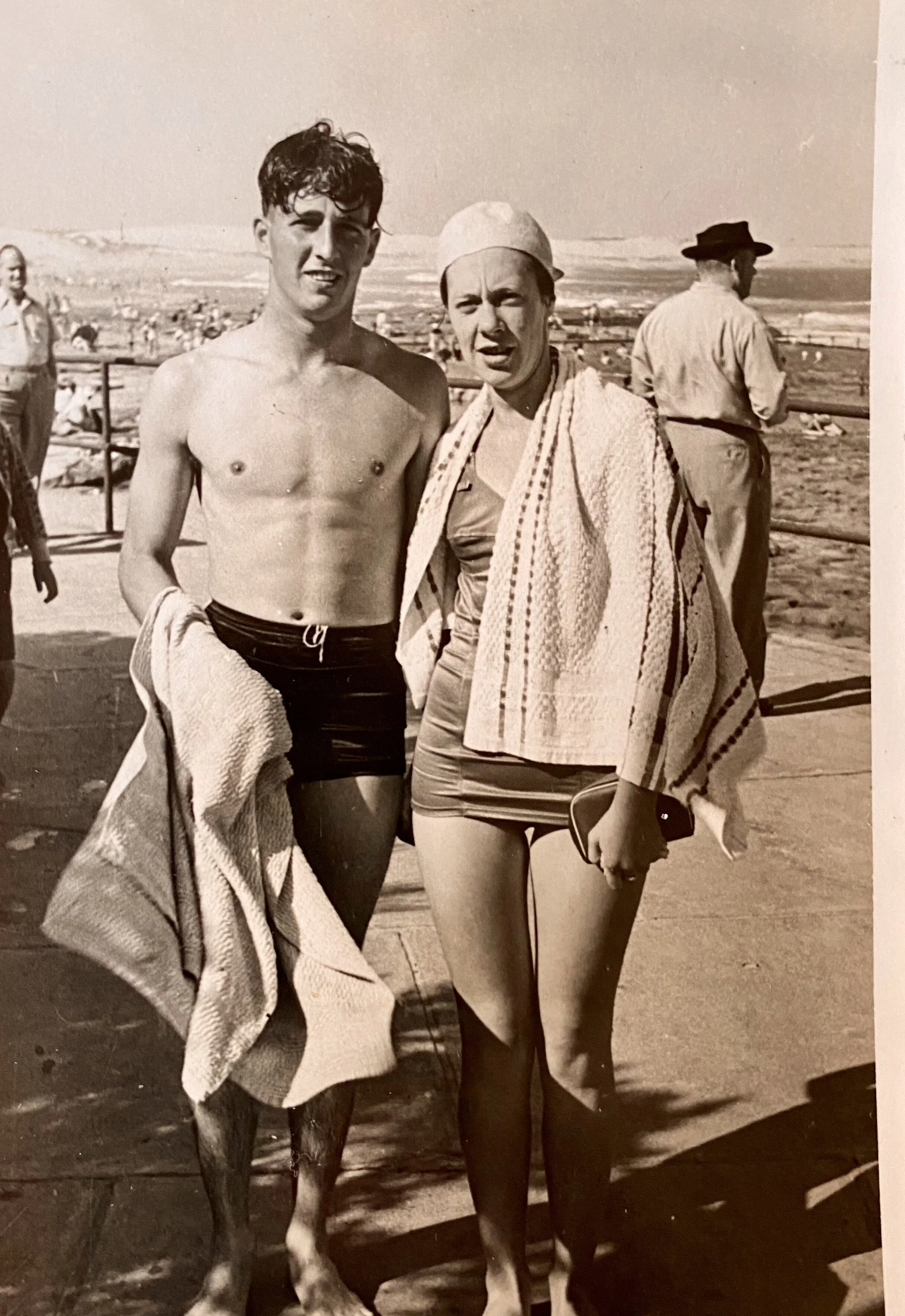
So the story goes (this is Mums version) they met at a dance in Oatly where Dad pursued mum and then stalked her to Oatly train station where he chased her up and down the aisles of the train until she agreed to go out with him..... Dad was a handsome rooster, and persistant!
It’s probably where the curse began...... (insert quick summary of the curse)
I guess the deal was sealed and “the curse” had worked and Dad and Mum were married in February 1952, two years after they were married, on February 17th 1954 my brother Craig was born....i assume that in the following years Dad was on the road a lot because it wasn’t until the 8th of March (International Womens Day) that the looker of the family... me!! …was born.
I think things turned pair shaped at that point...... For some reason they saw me as a bit of a handful (go figure) because Dad went straight back on the road......this time for a very long time, until on the 27th March 1971, Ness was born.
Things changed again around that time and dad slowed down on the touring etc... I think he actually really liked ness....she was his little princess.
Over the years we lived in quite a few places, from when Craig was born until we all left home, I think we moved 9 times. Cootamundra –olive st Heathcote –Coopernook ave Gymea Bay –Parthenia St Dolans bay –Plover St Grays Point –Carrington Ave Katoomba – Cliff drive Katoomba and then finally retiring Tojobling St port Macquarie ..... Hopefully i didn’t miss any ????
Dad was always on the go, from my earliest memory of dad he was always busy, he worked
Hard...really hard...often 2 or 3 jobs at once and every one of them he was proud of. From his days as a sales rep with various companies to national sales manager of Treet Packers then onto a senior management role at Dairy Farmers.
Dad also had many side hustles going on....the one I remember the most was the trophy engraving business he would come home from his day job and go downstairs at our house at Dolans Bay and work till all hours engraving trophies......he did this so that we all had everything we ever needed.
We never wanted for anything but his true passion was always entertainment.... Dad loved people and people loved Dad. He loved to entertain, or show off if you like. He was incredibly skilled at what he did and had many strings to his bow.
His main passion was magic..... From what I can gather dad learnt his magic skills from Mum’s dad (my grandfather) Chica’s brother and I seem to remember dad telling me he first learnt the Chinese rings...you know those big rings .....his signature tricks were amazing and any of you that were lucky enough to see him in action will agree he was pretty bloody talented.
He used to do what they call paper cutting, which for those of you that don’t know what that is, he would spend hours the night before a show preparing these intricate designs that were pre-cut with a very sharp razor.... It really was something special to see. You know how I mentioned his amazing talent for nose picking....and you may have noticed how his index finger on his left hand was only half an index finger....well he did that whilst doing the paper cutting, I can only imagine the audiences reaction that night.
Dad could sing, dad could tell a joke, he compared but most of all he was a magician ......he really loved it and I loved watching it..... For a young boy it was amazing... And I still get a thrill from seeing any good magic. Growing up dad would tell me how all the great magicians did their tricks, all the tricks except the ones he did...he wouldn’t tell me those ones!! I know my cousin Dean badgered him about learn the tricks because dean thought it would help him pull the birds. He travelled the country doing shows and he performed with some very famous people from all round the world. Did I say how good he was? He was great.
I think dad thought he could teach Craig and I how to do magic and especially how to be clowns. And in my case it worked!!!Dad loved dad jokes .... how do you know when a clown has farted?? Something smells funny !!Which brings me to one of his proudest rolls..... Ronald McDonald!!
Dad embraced being Ronald like nothing else and as you can see McDonalds is still a part of our family.... He was super proud right on through his life. I was talking to Craig the other day about this and neither of us can work out why this role was so important to dad..... Was it the money? Was it the notoriety???Or was it simply that he loved to entertain kids? He never really told me and I wished he had...I do remember being very clear with dad that I didn’t want any of my friends to know that he was a clown, which he sort of agreed to, until, one day he turned up at my high school to pick me up in the Ronald McDonald van... Blasting the horn....insert noises.... From that day forward I was known by the whole of Caringbah High as Ronnie!!!!!I could go on telling you all stories and some bloody funny ones all night but we simply can’t.
A couple of quick stories that are precious to me:
Dad and I had a pact...actually not a pact more of a code and it was just a few words... ‘don’t tell your mother” this especially applied whenever I was with dad ....after footy training, on the way home from bagpipe practice, after swimming , after golf..... We would always stop at the pub for a few quick ones.... When I was small I would sit in the car and he would bring out a schooner of pink lady and a packet of smiths chips and I would savour those in the car while listening to 2SM on the radio...... This, I think , was where my love for music came from..... I can still taste those things .... these days he probably would have been arrested for abandonment. I guess they were different times. Anyway after a few schooners dad would jump in the car, chuck down a few pieces of PK chewing gum and say “don’t tell your mother” this went on right through my life with dad.
I remember when I temporarily got expelled for pushing the lockers over and nearly killing the vice principal....dad got me off the hook and on the way home....guess what he said???? Yes that’s right “don’t tell your mother “
Dad had one really annoying habit that drove me crazy.... He was a little OCD ... Well actually a lot OCD .... He handed that down to both myself and Craig.... thank god Craig is much worse ...... Sorry bro, anyway, he used to write post it notes and put them everywhere..... E.g.: don’t forget to turn the power off, don’t drive too fast there are lots of coppers on the road, wash the car, turn the iron off, close the fridge and the list goes on ..... So, if you have a look on the coffin ......... I’ts payback time !!!!!
Dad loved many things in life.... He loved beer, he loved football, he loved fish and chips and baked dinners.... He loved sardines on toast, and he loved cups of tea, he loved salt and sugar ......he loved salt and sugar.... Dads plate always resembled the snow fall on Mt Kosciuszko .......
He loved magic, he loved dad jokes... He taught me some cracking jokes, once he secretly came to one of my shows and afterwards he gave me a dressing down because there was a heckler in the audience and I told the guy to fuck off....dad didn’t think that was professional and proceeded to give me comebacks for hecklers 101 ...... E.g. “why don’t you put an egg in your shoe and beat it” “i remember when I had my first drink too” “why don’t you go and stand next to the wall it’s plastered too” and my favourite “don’t worry mate that haircut will come back in to fashion one day”......I learnt everything I know from dad.... I learnt how to be nice to people, I learnt how to be kind to people. I learnt how to tell a joke and I learnt how to take a joke.
A few things dad hated. He hated the tax man, he hated coppers, he hated Manly Sea Eagles (don’t we all??) But you know what, he didn’t hate too much. He preferred to be a good, decent, and honest bloke. That is how I will remember dad. He was loved by most people. I have rarely ever heard anyone say a bad word about dad. And isn’t that how we would all liked to be remembered???
I think dad believed his crowning achievement was us! All of us in the room: his brother and sisters, his wife, his kids, grandkids and great grandkids....he loved us all and we loved him back.
Dad’s fabric is sewn into all of us and we will carry that forward until our time comes to hand it on in our memories. I loved this quote that someone sent me: “active memories in the lives and minds of others reflects the true greatness of a worthy soul”
Dad wasn’t just a good man ,he was a great man, a gentle-man......our hearts will ache without him and we will miss him dreadfully....
Rest in peace Dad I love you
For Daniel Solomons: 'The loss of Daniel has left a hole in my heart', Memorial Scholarship Dinner, by Sandra Solomons - 2015
30 April 2015, Sydney, Australia
I would like to begin by lighting a candle in Daniel’s honour. Our family decided to have the Memorial event tonight. It was a toss between 29th or 30th April. Somehow, the 30th April was chosen. Recently, I opened a letter from the Great Synagogue informing us that Daniel’s Yahrzeit falls on 12 Iyar, which this year commences on the evening of Thursday 30th April 2015. His Hebrew Memorial day coincides with this event. You will come to learn that I don’t believe in coincidences. Rather divine intervention. We light a candle with the intent for individuals to take time to remember, honour and celebrate the life of a loved one. It is said that the spirit of the person fills the room for 24 hours. This flickering flame is symbolic of Daniel’s eternal light. As beautifully expressed by Shaw “Life is a splendid torch which I’ve got hold of for a brief moment and I want it to burn as brightly as possible before handing it on to a future generation.”
Grief, suffering and the loss of Daniel has left a hole in my heart. The grief ebbs and flows each day, each week and throughout the year. The pauses between these feelings fluctuate but his loss to suicide is difficult to come to terms with. I will never understand why and I have come to understand that I need to let go of trying to make sense of suicide. The whys, what ifs arrest the healing process. Rather, I live in hope that one day I will to come understand the blessings of a broken heart.
The healing process has been a journey and I feel grateful to friends, family and Ashurst for giving our family an opportunity to acknowledge and celebrate the short, but colourful life of Daniel.
I will give you reflections of his life on behalf of my beautiful and loving family: David, Michele, Bruce, Rebecca and Gregor. I will also extend the appreciation, love and friendship to Daniel’s extended family and friends. You were all special to him and filled his days with joy. Life is at times colourless without the presence of Daniel. Somehow we need to look for the colour despite his absence. That is the challenge of our grief. Back to Daniel’s colour ….He was the story -teller. His imagination, command of language and timing were faultless. You knew you were in for a treat, as he told his story or you were swept along with his drama. He often started his conversations with…’actually or do you know?’ His arresting, blue eyes would sparkle even more and one had to steel themselves for the vivid, colourful and often challenging debate to follow.
I know we all miss him and that sadness and emptiness is a companion at times but aren’t we all fortunate that he was part of our lives even for such a short time. The memories and stories live on.
My story or journey begins…as I was sitting in a café reminiscing about Daniel.
Daniel loved eating out at restaurants…. The ceremony of the outing filled him with anticipation of a delicious meal and companionship. Delicious was one of his favourite words, or quirkier still ‘deliciousness’. Only Daniel could get away with this transgression. I began to pen my recollections as I sat in a trendy Eastern suburbs café. I was reading ‘A Private Life’ by Michael Kirby, a book I found so engaging and meaningful. You could say, I was surrounded by Daniel as his favourite album was playing in the background. ‘Dreams’ by The Cranberries was pulsing through my veins. Daniel’s presence was palpable. I delved into the book and the words discussed in our meetings with Michael Kirby came to life and echoed the background music. Personal courage and enlightenment came to foreground. Justus Kirby you have triumphed in your journey and enlightened many, many people on a personal and professional level, especially David and I. I feel as though Daniel has been tapping me on the shoulder, guiding me on my journey and opening me eyes as I learn to understand and come to terms with my grief. As I have said before don’t believe in coincidences. Somehow David and I were lucky enough to meet and have meaningful discussions with you, Michael in your offices. It was a privilege and Daniel is looking on smiling. I could just imagine the banter, that could have of unfolded between the two of you in your office, but sadly this did not come to be. Even though, Daniel lost his life to suicide, I feel that the words Personal Courage and Enlightenment are true for him too. Daniel was loved and admired by so many. He was a fine young man, exuding tremendous personal qualities. Daniel was a wonderful son, brother, grandson, nephew, cousin, friend and mentor. He had personal courage and the spark of enlightenment. Despite his junior position as a lawyer he stood his ground and would advise and guide senior colleagues on difficult points of law. Somehow, he could see beyond the ordinary. These powerful attributes of Personal Courage and Enlightenment must live on in Daniel’s honour. Learning, education and the love of law were Daniel’s passion. He thrived at UNSW and met a new set of friends. He loved them as people but also he loved studying and debating contentious issues of law during tutorials. So once again Daniel is tapping my shoulder, rather strongly, watching over me and guiding our decision process for his Memorial Scholarship. It took some time but here we are. We feel we are on the path now. Pay it forward shine the light, pass on the legacy of living, loving and respecting the law. So the scholarship has been created and with generous donations from tonight it will hopefully have a ‘long life’. Our dream is that it will become endowed. Jordana Wong, the Development Manager from UNSW Law has been simply amazing. I am so pleased you are here tonight assisting our guests. Finally, we can fulfill the dream to have a Memorial Scholarship that Daniel would endorse.
Reflecting back to his younger and formative years Daniel was bewitched by the character of Dorothy as she followed her adventures in the Land of Oz. Daniel followed his own enchanting road in Oz land. Life was full of colour, friends and adventures. We were mesmerized by Daniel’s passion and enthusiasm and travelled along his magical pathway. At the end of the journey, the heroine and hero discover all one seeks was inside all along. So home for Daniel is within our heart now and always. The memories, the stories are embedded within and give comfort during times of sadness.
Daniel has left many legacies. Yes he was a writer, an academic, a passionate learner a learned and sensitive man. He penned only a few reminders of his talents- shorts stories, journal articles and a Chapter in Australian Corporate Finance. But for me his overwhelming legacy is that his work was not yet completed. Our family has taken the challenge to awaken his light and shine this on others. Despite overwhelming grief and sadness we wanted to remember and honour Daniel in a fitting way. So the concept of a dinner was mooted and here we are tonight remembering a fine young man. Once again Daniel’s presence is palpable. I have come to understand his love of Ashurst. I have met and been assisted by his generous colleagues. I have walked Daniel’s steps as I take the Rose Bay ferry to Circular Quay and enter Grosvenor Place. I travel up the same lifts he did to the reception level for all my meetings. You are all sitting here tonight in the Boardrooms of Ashurt, a place Daniel knew well. It is hard to take these steps, but who doesn’t do hard for someone they love and cherish. Oscar Wilde, one of Daniel’s favourite authors wrote… “Keep love in your heart. A life without it is like a sunless garden when the flowers are dead. So back to Daniel, tapping my shoulder, guiding me forward. I met and worked closely with the professional team at Ashurst. I know they represent the other Ashurst colleagues that knew and respected Daniel. Emanuel Poulos you are the rock who believed in Daniel and this function. You were his voice and mine. You introduced me to the team: Kate Cato, Tahnya Seifman and Remonda Sukkar. I feel so connected to you and feel blessed that I had the opportunity to work with such caring and conscientious individuals. We worked together to create this event. You have helped make this the best ‘Daniel’ event. A heartfelt Thank You!
You are the ambassadors for Ashurst. On behalf of my family and friends I thank Ashurst sincerely for being the gracious host for this evening and event. Your generosity is received with gratitude.
I would like to acknowledge the unwavering love and devotion of my family, immediate and extended. We have cried together, comforted each other, reminisced and laughed together. My friends are also my family. I could not have travelled this road without you. We share a bond that has stood the test of time. Finally, Daniel’s friends are now part of our lives. Together we can live in hope and use this challenge of loss to find our inner strength. Let his story and legacy continue.
Finally, our family wish to acknowledge the generous donations for the auction and raffle tonight. Thank you from the bottom of our hearts. Thank you to family, friends, colleagues for joining us here tonight to honour and remember Daniel. Your presence tonight has made this Memorial Scholarship Dinner launch truly memorable.
Mark Lipson, my dear nephew has worked tirelessly on this beautiful snap shot DVD of Daniel. How can one sum up such a unique, amazing young man!! A challenge for all of us!! Mark you are the true professional, your focus was to do the best by Daniel and you did!! You held my hand compassionately, listened to my tears and tried to hug them away.
Daniel, we miss you deeply, you are irreplaceable. We pray that your dear soul rests eternally in peace. I will conclude with a quote from Einstein as it sums up Daniel, “The pursuit of knowledge for its own sake, an almost fanatical love of justice… these are the features of the tradition which makes me thank my lucky stars that I belonged to it.”
For George Floyd: 'Get your knee off our neck', by Rev Al Sharpton - 2020
4 June 2020, Minneapolis, Minnesota, USA
I want us to not sit here and act like we had a funeral on the schedule. George Floyd should not be among the deceased. He did not die of common health conditions. He died of a common American criminal justice malfunction. He died because of there has not been the corrective behavior that has taught this country that if you commit a crime, it does not matter whether you wear blue jeans or a blue uniform, you must pay for the crime you commit.
So it is not a normal funeral. It is not a normal circumstance but it’s too common and we need to deal with it. Let me ask those of you that in the traditions of eulogies need a scriptural reference, go to Ecclesiastes 3:1 says,
To everything there is a time and a purpose and season under the heavens.
I’m going to leave it there. I saw somebody standing in front of a church the other day that had been bought it up as a result of violence. Held the Bible in his hand. I’ve been preaching since I was a little boy. I’d never seen anyone hold a Bible like that, but I’ll leave that alone. But since he held the Bible, if he’s watching us today, I would like him to open that Bible and I’d like him to read Ecclesiastes 3, to every season there’s a time and a purpose. I think that it is our job to let the world know when we see what is going on in the streets of this country and in Europe, around the world, that you need to know what time it is.
First of all, we cannot use Bibles as a prop and for those that have agendas that are not about justice, this family will not let you use George as a prop. If you want to get your stuff off, don’t use him. Let us stand for what is right because when I got the call from Attorney Crump and usually when he calls me, it’s not to find out how I’m doing. It’s usually because something happened that he wants National Action Network and I to get involved. He explained to me what was happening with this case and I had already heard about it in the media and immediately I said, “Well, let me know what you want me to do.” He said, “Whatever you need to do.”
One of the things Martin that I’ve always had to deal with his critics would say, all Al Sharpton wants is publicity. Well, that’s exactly what I want because nobody calls me to keep a secret. People call me to blow up issues that nobody else would deal with. I’m the blow up, man and I don’t apologize for that because you get away too much with hiding things. Funny. It’s talked about, y’all putting clothes in the oven to have your clothes dried. Well, I didn’t grow in the third world, but I grew up in third ward. I grew up in Brownsville and we had roaches.
Now I know Kevin Hart and some of the rich Hollywood folk here don’t know where the roaches are but we had roaches, ludicrous and one thing I found out about roaches is that if you keep the light off, if you’re in the dark, a roach will pull up to your dinner table and have a five course meal. So I learned that one of the ways to deal with roaches is if you cut the light on, I could run them roaches and track them down and I’ve spent all my life chasing roaches all over this country.
Soon as I talked to the family and got the details and heard that among George’s last words was, “I can’t breathe,” with a knee on his neck, I immediately thought about Eric Gardner. I did the eulogy at his funeral and I called his mother. I said, “I know we’re not going out because of the Coronavirus but this is so much like Eric. If we could arrange some private way to go to Minneapolis, would you go?” And she said, “Reverend Al, I’m already packing. Let me know.” Tyler Perry said, “I’ll give the families, the plane, whatever y’all need, because this is wrong.” Robert Smith said, “Don’t worry about the funeral costs.”
People across economic and racial lines started calling and getting in and we flew out of here, her and I last Thursday, and when I stood at that spot, reason it got to me is George Floyd’s story has been the story of black folks because ever since 401 years ago, the reason we could never be who we wanted and dreamed to being is you kept your knee on our neck. We were smarter then the underfunded schools you…
…you put us in, but you had your knee on our neck. We could run corporations and not hustle in the street, but you had your knee on our neck. We had creative skills, we could do whatever anybody else could do, but we couldn’t get your knee off our neck. What happened to Floyd happens every day in this country, in education, in health services, and in every area of American life, it’s time for us to stand up in George’s name and say get your knee off our necks. That’s the problem no matter who you are. We thought maybe we had [inaudible 00:09:20], maybe it was just us, but even blacks that broke through, you kept your knee on that neck. Michael Jordan won all of these championships, and you kept digging for mess because you got to put a knee on our neck. White housewives would run home to see a black woman on TV named Oprah Winfrey and you messed with her because you just can’t take your knee off our neck. A man comes out of a single parent home, educates himself and rises up and becomes the President of the United States and you ask him for his birth certificate because you can’t take your knee off our neck. The reason why we are marching all over the world is we were like George, we couldn’t breathe, not because there was something wrong with our lungs, but that you wouldn’t take your knee off our neck. We don’t want no favors, just get up off of us and we can be and do whatever we can be. There have been protests all over the world. Some have looted and done other things and none of us in this family condones looting or violence. But the thing I want us to be real cognizant of is there’s a difference between those calling for peace and those calling for quiet. Some of y’all don’t want peace, you just want quiet. You just want us to shut up and suffer in silence. The overwhelming majority of the people marching wasn’t breaking windows, they were trying to break barriers. They weren’t trying to steal nothing, they were trying to get back the justice you stole from us. Those that broke the law should pay for whatever law they broke, but so should the four policemen that caused this funeral today. We don’t have a problem denouncing violence, Mr. Governor, we don’t have a problem, Mr. Mayor, denouncing looting, but it seems like some in the criminal justice system have a problem looking at a tape and knowing there’s probable cause and it takes a long time for you to go and do what you see that you need to do.
As Ben Crump said, they would not have been involved in a lot of these fights we started around criminal justice. I did speeches and eulogies at most of the funerals that we’ve had in this space in the last couple of decades and led the marches and did what we had to do. I look at Martin III, we went to jail together fighting these fights, like his daddy went to jail before. But I’m more hopeful today than ever. Why? Well, let me go back. Reverend Jackson always taught me, stay on your text, go back to my text, Ecclesiastes. There is a time and a season, and when I looked this time, and saw marches where in some cases young whites outnumbered the blacks marching, I know that it’s a different time and a different season. When I look and saw people in Germany marching for George Floyd, it’s a different time and a different season. When they went in front of the Parliament in London, England and said it’s a different time and a different season, I come to tell you America, this is the time of building with accountability in the criminal justice system.
Years ago, I went to march. Now I remember a young white lady looked me right in the face and said, “N*****, go home.” But when I was here last Thursday and Ms. Carr and I was headed back to the airport I stopped near the police station, and as I was talking to a reporter, a young white girl, she didn’t look no older than 11 years old. She tagged my suit jacket and I looked around and I braced myself, and she looked at me and said, “No justice, no peace.” It’s a different time. It’s a different season, and if my Bible carrying guy in front of that boarded up church, if I got him to open up the Bible, I want you to remember something. You know I was late last October to an appointment because the time changed and I was still … My watch was on the wrong time. Once a year time goes forward and if you don’t
Yeah, time goes forward. And if you don’t Congresswoman Omar, move your watch, you going to find yourself a hour late. Not because your watch was wrong, but you had your watch on the wrong time. Well, I come to tell you that their sitting in Washington talking about militarizing the country, thinking that you can sell Wolf tickets to people. Who’s had enough of abuse. I’ve come to tell you, you can get on the TV, but you on the wrong time, time is out for not holding you accountable. Time is out for you making excuses. Time is out for you trying to stall. Time is out for empty words and empty promises. Time is out for you filibustering and trying to stall the arm of justice. This is the time we won’t stop. We going to keep going until we change the whole system of justice.
Our organizations have called this a day of morning, NAACP, National Urban League, Legal Defense Fund, Black Women’s Round Table, Lloyd’s committee, all got together, said we’re going to have a day of mourning. But then we going to come out of this day mourning because as some of our experts, Cheryl and Eiffel and others that know the legal field have outlined a legal process that we must enforce everything from residency to dealing with police backgrounds are not being hidden. Talked to governor Andrew Cuomo today in New York, he says, “We got to change 58, where the backgrounds stop of policemen.” We need to know if they stop you, they find out everything you ever did. Why don’t we know when policemen have a pattern?
We got to go back to consent decrees. Under the Obama administration, they had put certain cities with patterns and practice under consent decrees. Reverend Jamal Brian, to know where he was pastoring in Baltimore, that they put it under consent decree. One of the first thing that happened in the next administration was they stopped the consent decrees. We have specific policies that need to happen. Therefore I’m glad Martin the third is here today because on August 28, the 57th anniversary of the March on Washington, we’re going back to Washington, Martin. That’s where you’re the father stood in the shadows of the Lincoln Memorial and said, “I have a dream.” Well, we’re going back this August 28th to restore and recommit that dream to stand up because just like at one era, we had to fight slavery. Another era we had to fight Jim Crow. Another era we dealt with voting rights. This is the era to deal with policing and criminal justice. We need to go back to Washington and stand up black, white, Latino, Arab in the shadows of Lincoln and tell them, “This is the time to stop this.”
Martin and I talked about this. I’ve asked Reverend Bryant to get the faith leaders together. I talk Randy White about the labor leaders. Oh no, we’re going to organize in the next couple of months in every region, not only for a March, but for a new process. And it’s going to be led by the Floyd family. It’s going to be led by the Gonda family. And it’s going to be led by those families that have suffered this and knows the pain and knows what it is to be neglected. And it’s going to be getting us ready to vote, not just for who’s going to be in the White House, but the state house and the city councils that allow these policing measures to go unquestioned.
We are going to change the time. Let me say this to the family who has shown such great grace and real level and balanced thinking. And that’s why I want them to help lead this. And I want, I think one of the greatest thinkers of our time, Dr. Michael Eric Dyson, I’ve asked, come and speak. We need to break down because you all don’t know what time it is. You all are operating like is yesterday. And the reason you’re late catching up to what these protests means is because you didn’t turn your clock forward, talking about make America great. Great for who and great when? We going to make America great for everybody for the first time.
Never was great for blacks. Never was great for Latinos. Wasn’t never great for others. Wasn’t great for women. Young women had to march to get the right to vote. But lastly is the religious side. I was reading and kept thinking about how I was a little embarrassed because when I heard that George, at this point of suffering, this brutal attack, call for his mama. I said, to attorney Crump I said, “Well, I appreciate talking to his brothers and them on the phone, but I want to talk to his mother.” He said, “His mother passed.” I said, “His mother passed? But he was calling for his mother.” And I thought about it because I was raised by a single mother. And sometimes the only thing between us and our conditions was our mothers. Sometime the only thing that we had that would take danger away was our mothers.
The only ones that would make sure the food was on the table was our mother. I know why George was calling for mama. But then as I had got that all placed in my mind and I realized why I was always calling and my mother died eight years ago, but I still try to talk to her. Sometimes just dial her cell phone to hear the voicemail on her phone that I never cut off. I still want to reach out to mama, but talking to Quincy last night, one of his five children, Quincy said, “I was thinking maybe he was calling his mother. Because at the point that he was dying, his mother was stretching her hands out saying, ‘Come on, George, I’ll welcome you where the wicked will cease from troubling. Where the weary will be at rest. There’s a place where police don’t put knees on you George. There’s a place that prosecutors don’t drag their feet.’ Maybe mama said, ‘Come on, George.-
Bragged that feat. Maybe mama said, “Come on George.”
There’s a God that still sits high, but he looks down low and he’ll make a way out of no way. This God is still on the throne. Grieving, we can fight. I don’t care who’s in the White House. There is another house that said, “If we’ll fight, he’ll fight our battles. If we stand up, he’ll hold us up.”
So as we leave here today, I say to this family, I know that years ago we told them, Reverend Jackson told us, “Keep hope alive.” Then I know that President Obama wrote a book about hope. But I want you to know in my life there’s times that I lost hope. Things can happen like this that will dash your hope, but there is something that is sister to hope called faith. Faith is the substance of things hoped for, the evidence of things unseen. Faith is when you got a pile of bills and no money, but you say he will provide all of my needs. Faith is when you got no medicine in the cabinet and you’re sick in your body, but you say he’s a doctor that never lost a patient. And he’ll dry tears from my eyes. Faith is when your friends walk out, when your loved ones turn their back. But you say, “I don’t believe he brought me this far to leave me now.”
We didn’t come this far by luck. We didn’t come this far by some fate. We come this far by faith, leaning on the Lord, trusting in his Holy word. He never, he never, he never failed me yet. From the outhouse to the White House, we come a long way. God will. God shall. God will. God always has. He’ll make a way for his children. Go on home, George. Get your rest, George. You changed the world, George. We going to keep marching, George. We going to keep fighting, George. We done turned the clock, George. We going forward, George. Time out, time out, time out.
Hezekiah Walker. We asked, gospel great, Hezekiah Walker to sing a song for the family. After which Derrick Johnson of the NAACP asked me, Attorney Crump, we’re going to stand for 8 minutes and 46 seconds. Though that was the time that George was on the ground. And we want you all over the world to stand with us for 8 minutes and 46 seconds and make that commitment for justice in the name of George. I want to thank the members of the Congressional Black Caucus for being with us. Won’t don’t you stand? I want to thank the son and heir and co-convener, Dr. Martin Luther King III for being with us. I want to thank the mayor and the governor and their brides for being with the family. Senator Amy Klobuchar of the state of Minnesota. I want to thank my mentor and one who’s fought this fight for more than a half a century. Reverend Jesse Louis Jackson is with us, and his spokesman for Rainbow PUSH, Jonathon Luther Jackson. I want to thank from the entertainment world, Kevin Hart. He told me don’t mention he’s here. Don’t clap. Stand up, Kevin. We joke each other. Brother beloved, stand up brother. Brother Ludacris. Tyrese Gibson, who’s an extraordinary activist in his own right. Master P. The one and only, the creative genius, Will Packer is with us today. And a brother we’ve marched together and done a lot of things. He does not just put his name on somebody’s petition. He puts his body on the line. Brother T.I. is in the house.
I want… This brother’s one of the greatest gospel singers alive. Is Tiffany here? Oh, wait a minute. Wait a minute. Wait a minute. I didn’t want to announce it and say I’d embarrassed her. Let me tell you something. One of the most popular, outstanding artists that is also committed. I’ve read her interview. She think I’m old and don’t read the stuff, but I do. And she’s been committed and saying the right things and she wanted to be here today. And I was so busy joking with Kevin. I didn’t even look at her. Let us welcome our sister beloved, Sister Tiffany Haddish is in the house. Well, I’m going to announce all the rest. Wait a minute. Y’all don’t start introducing folk. I got them all. Let us hear a selection from Brother Hezekiah Walker.
For Addie, Carol & Cynthia: 'They have something to say', by Martin Luther King Jr - 1963
18 September 1963. Sixteenth Street Baptist Church, Birmingham, Alabama, USA
On Sundey 15 September 1963 four Klansmen bombed the Sixteenth Street Baptist Church in Birmingham. Four young girls died, and this is the eulogy at the service for three of the victims, Addie Mae Collins, Carol Denise McNair, and Cynthia Diane Wesley. A separate service was held for the fourth victim, Carole Robertson. In the film, ‘I Am MLK Jr’, a civil rights leader said this was the only speech where he saw Dr King shed tears.
This afternoon we gather in the quiet of this sanctuary to pay our last tribute of respect to these beautiful children of God. They entered the stage of history just a few years ago, and in the brief years that they were privileged to act on this mortal stage, they played their parts exceedingly well. Now the curtain falls; they move through the exit; the drama of their earthly life comes to a close. They are now committed back to that eternity from which they came.
These children-unoffending, innocent, and beautiful-were the victims of one of the most vicious and tragic crimes ever perpetrated against humanity.
And yet they died nobly. They are the martyred heroines of a holy crusade for freedom and human dignity. And so this afternoon in a real sense they have something to say to each of us in their death. They have something to say to every minister of the gospel who has remained silent behind the safe security of stained-glass windows. They have something to say to every politician [Audience:] (Yeah) who has fed his constituents with the stale bread of hatred and the spoiled meat of racism. They have something to say to a federal government that has compromised with the undemocratic practices of southern Dixiecrats (Yeah) and the blatant hypocrisy of right-wing northern Republicans. (Speak) They have something to say to every Negro (Yeah) who has passively accepted the evil system of segregation and who has stood on the sidelines in a mighty struggle for justice. They say to each of us, black and white alike, that we must substitute courage for caution. They say to us that we must be concerned not merely about who murdered them, but about the system, the way of life, the philosophy which produced the murderers. Their death says to us that we must work passionately and unrelentingly for the realization of the American dream.
And so my friends, they did not die in vain. (Yeah) God still has a way of wringing good out of evil. (Oh yes) And history has proven over and over again that unmerited suffering is redemptive. The innocent blood of these little girls may well serve as a redemptive force (Yeah) that will bring new light to this dark city. (Yeah) The holy Scripture says, “A little child shall lead them.” (Oh yeah) The death of these little children may lead our whole Southland (Yeah) from the low road of man’s inhumanity to man to the high road of peace and brotherhood. (Yeah, Yes) These tragic deaths may lead our nation to substitute an aristocracy of character for an aristocracy of color. The spilled blood of these innocent girls may cause the whole citizenry of Birmingham (Yeah) to transform the negative extremes of a dark past into the positive extremes of a bright future. Indeed this tragic event may cause the white South to come to terms with its conscience. (Yeah)
And so I stand here to say this afternoon to all assembled here, that in spite of the darkness of this hour (Yeah Well), we must not despair. (Yeah, Well) We must not become bitter (Yeah, That’s right), nor must we harbor the desire to retaliate with violence. No, we must not lose faith in our white brothers. (Yeah, Yes) Somehow we must believe that the most misguided among them can learn to respect the dignity and the worth of all human personality.
May I now say a word to you, the members of the bereaved families? It is almost impossible to say anything that can console you at this difficult hour and remove the deep clouds of disappointment which are floating in your mental skies. But I hope you can find a little consolation from the universality of this experience. Death comes to every individual. There is an amazing democracy about death. It is not aristocracy for some of the people, but a democracy for all of the people. Kings die and beggars die; rich men and poor men die; old people die and young people die. Death comes to the innocent and it comes to the guilty. Death is the irreducible common denominator of all men.
I hope you can find some consolation from Christianity’s affirmation that death is not the end. Death is not a period that ends the great sentence of life, but a comma that punctuates it to more lofty significance. Death is not a blind alley that leads the human race into a state of nothingness, but an open door which leads man into life eternal. Let this daring faith, this great invincible surmise, be your sustaining power during these trying days.
Now I say to you in conclusion, life is hard, at times as hard as crucible steel. It has its bleak and difficult moments. Like the ever-flowing waters of the river, life has its moments of drought and its moments of flood. (Yeah, Yes) Like the ever-changing cycle of the seasons, life has the soothing warmth of its summers and the piercing chill of its winters. (Yeah) And if one will hold on, he will discover that God walks with him (Yeah, Well), and that God is able (Yeah, Yes) to lift you from the fatigue of despair to the buoyancy of hope, and transform dark and desolate valleys into sunlit paths of inner peace.
And so today, you do not walk alone. You gave to this world wonderful children. [moans] They didn’t live long lives, but they lived meaningful lives. (Well) Their lives were distressingly small in quantity, but glowingly large in quality. (Yeah) And no greater tribute can be paid to you as parents, and no greater epitaph can come to them as children, than where they died and what they were doing when they died. (Yeah) They did not die in the dives and dens of Birmingham (Yeah, Well), nor did they die discussing and listening to filthy jokes. (Yeah) They died between the sacred walls of the church of God (Yeah, Yes), and they were discussing the eternal meaning (Yes) of love. This stands out as a beautiful, beautiful thing for all generations. (Yes) Shakespeare had Horatio to say some beautiful words as he stood over the dead body of Hamlet. And today, as I stand over the remains of these beautiful, darling girls, I paraphrase the words of Shakespeare: (Yeah, Well): Good night, sweet princesses. Good night, those who symbolize a new day. (Yeah, Yes) And may the flight of angels (That’s right) take thee to thy eternal rest. God bless you.