• Genre
  • About
  • Submissions
  • Donate
  • Search
Menu

Speakola

All Speeches Great and Small
  • Genre
  • About
  • Submissions
  • Donate
  • Search

Eulogies

Some of the most moving and brilliant speeches ever made occur at funerals. Please upload the eulogy for your loved one using the form below.

For Tony Benn: 'There he sat, smoking his pipe', parliamentary tribute by Dennis Skinner - 2014

July 21, 2023


20 March 2014, House of Commons, London, United Kingdom

Yes, Mr. Speaker. I hesitate to join in this business because in many ways I thought of Benn in the early Labour Party conferences as somebody that, unlike those of us that came from the Trade Union movement, as being part of the English radical dissenting left.

And he was at that time, a member of the NEC. And I think there were some significant changes that took place in the early seventies that changed his life. I may be wrong, but in early 1970, when I came to Parliament, we had about five or six years of constant demonstrations. And I used to go on these demos and there would be a gang of people from the TUC , and they were all recognisable and I'm telling Tony Ben all about this. And then I went to Pentonville, and there were six dockers in jail. And they were in jail because the Industrial Relations Act had  been passed, passed! Got Royal Assent. And they had been on a picket line and they weren't supposed to be there.

So I went to Tower Hill with Eric Keffer and then Eric said, 'Are you coming back to Parliament, Dennis?' I said, 'no, this is the most important strike demo I've ever been on. The TUC have declared a day of action. Who knows what will happen at the end and off I went.'

I told Tony Benn all about it, and the following day he said to me, he says, 'they might have to get them out.' And I thought, well, it's asking a bit too much. But I did repeat it to Eric Effa and Stan Hall.

And I told him, I says, 'those six dockers will be in Strangers Bar by tomorrow night.' Thought I'd embellish it. And it worked. The official solicitor had to go to Pentonville jail and get them out. Is there any wonder that a dissenting English radical began to change his mind a little bit more? That's what really happened.

And then the miner's won in 72 and then they won again in 74 and we marched again and Tony said to me, as the Daily Express in Fleet Street were cheering from the windows. Yes, I said it right, the Daily Express! And Tony says, 'look at him at the Daily Express'. I said, yes, sadly it's not the owners, Tony!'

 They were heady days. And then the Upper Clyde ship building, which was already mentioned, and so on and on it went. I mean, the truth was that those of us that were in the thick of it knew that it was having a major effect.

So let's just examine what we say about Tony.

He was shaped by events all his life. And he lived through it. He had an environment that was different to mine as a kid. But then, as I say, it all changed. And then I got elected to the national executive and he would come armed with amendments every month. I didn't have to bother writing amendments. They were already displayed and distributed to the six, seven or eight that might be allowed to read them.

He was a clever man as well. That's what he was. He was clever, Industrious. He got all the abilities. And I used to say to him, da de da de da, 'put that in the diary tonight!' And he actually did on one occasion. He got fed up of hearing me. He says, 'Skinner said, I've got to put this in the diary. '

So I had some enjoyable times with him. Most of the time, almost all of the time. He was very intelligent as well. He knew all about loads of subjects. I mean, he had a pager before MP's had them. He knew all about technology. Wasn't just Concord, yknow. He knew about it. He could probably have built it. He had a mobile phone before anybody else, and he's talking a language that I still don't understand. He could have built a computer. Yeah, he was very knowledgeable except he didn't know much about competitive sport.

I finished up at a Labour Party conference, I think it was out at Brighton. He says, you're late.' I said, 'I know I'm late, Tony there a reason'. He says, 'yes, it was a Tory mayor and you didn't want be here!' I said, well, that's part of it. I said, but the most important reason is that I'm watching Cram and Elliot on the telly in the mile of the century as they said. He says, 'Cram and Elliott, are they your delegates?' I said, 'Tony, Tony.' I says, 'do you know Ayrton Senna because I watched him win the formula 1!'  'Ayrton Senna, who''s he?'


I mean, you had to like somebody like that. Somebody that kept all the lists of all the results of everything. You didn't have to go far to find out. Now we look for things on the computer and I could ask Tony Benn and he would tell me.  

I had a lot of enjoyable times with him. And he was industrious, he was clever. He was a great diarist. He had a lot of qualities that all of us in our hearts really admire, don't we? And wish we possessed them all.

And that's why I constantly wanted to see him in these last few years. I didn't see him on the last occasion. He went to Charing Cross Hospital, but I did last autumn, after the Labour Party Conference, when they told me he'd been in the hospital, out the hospital, back in again, I thought I'd better go. And the day after the conference, I went to find him. And in typical Tony Benn fashion, when I got there, room K was empty. You feared the worst and somebody quickly said, 'I saw somebody wheeling him down in a wheelchair.' And I got outside in a lovely little park in the autumn sunshine, just like his last book. And there he sat in the wheelchair with a fellow who helped him with some television business or other, smoking his pipe. And for three quarters of an hour, The Tony Benn I knew and will always admire was sat in that chair, lighting up three times, and we talked about the Labour Party conference. It's one that he'd not been able to attend. He couldn't go. He was in hospital. And so I told him the whole story about what happened.

It was a bit biased, but he didn't mind that. He expected it from me. Yes, that was the Tony Benn I knew. Wonderful man, and we should always remember that. And as for the longest suicide note in history, let me put that to bed as well. The left had lost control by 1983 on the executive, check the facts. The chair of the election committee was John Golden, you all remember him, don't you? The right had took control. There was only one member of the left on that election executive committee. Eric Effer, by virtue of being chairman. So I wanted to put that to bed.

But I also remember what my honourable friend from Chesterfield said about the election at Chesterfield. What a wonderful campaign. Literally thousands of people came, Labour party members, I've never seen so many at any by election. And it was great throughout that whole period of two or three weeks. And he said to me, when I met him in Chesterfield Market Square, 'how do you think things are going?' I said, 'Tony, we are going to win.' I said, 'we've got this army of people coming. We've nothing to worry about. it's going to be Elsie Tanner, Tony Booth, the Vicar of Aberdale Farm. They all came and I introduced them on the mini bus. And then he says, 'is there anything else I should do, Dennis?' I said, 'yes. Put a tie on.' I says, 'you're the ambassador of a market town.' And Tony Benn, the Tony Benn, turned up the following day in a tie!

How could I other than love the man


Enjoyed this speech? Speakola is a labour of love and I’d be very grateful if you would share, tweet or like it. Thank you.

Facebook Twitter Facebook
Tags TONY BENN, DENNIS SKINNER, LABOUR PARTY, TRADE UNIONS, TRADE UNION MOVEMENT, 1970s, THATCHERISM, MARGARET THATCHER
Comment

For Edward Kennedy: 'It was our final history trip together', by niece Caroline Kennedy - 2009

April 26, 2023

28 August 2009, John F Kennedy Library, Boston, Massachusetts

Thank you.

Thank you, Mr. Vice President and all the speakers tonight for the gifts of Teddy that you have given to all of us. And thank you Vicky for loving him with all your heart for so many years, bringing him so much happiness, and to Karin, Teddy, and Patrick, Kiki, Karin, and Caroline for making him so proud, bringing him so much joy. And to Jean, I know you've lost your soulmate because you and Teddy lived each other's lives for your whole entire lives, and all your nieces and nephews are here to help you as best we can

Welcome to this library that Teddy built and brought to life with his spirit and dedication to public service. As many of you know, over the last few years, or really for most of my semi adult life, one of my part-time jobs has been introducing Teddy to crowds of people who already knew him incredibly well.

Although this process was unbelievably stressful for me, it was just another one of the gifts that he gave me. When he saw that I was nervous, he would give me a pat on the back. When he knew that I was sad, he would call up and say, 'I've got a great idea. There's a convention coming up, and maybe you'd like to introduce me?' <laugh>,

And off I would go on another adventure in public speaking, but no matter how nervous I was, I always knew that when I stepped down from the podium, I would get a big kiss and hear him whisper. 'Now I'm going to get you back,' and I can't believe that's not going to happen tonight.

The other night after Vicky called Ed and I went outside. It was a beautiful summer night. The moon had set. There was no wind. The sea was calm and the stars were out. I looked up and there was this one star hanging low in the sky that was just bigger than all the rest and brighter than all the rest, with a twinkle and a sparkle louder than all the others. I know it was Jupiter, but it was acting a lot like Teddy.

His colleagues have spoken tonight about his work, his devotion to the Senate, the joy he took in helping others, his thoughtfulness and compassion, his inspirational courage, and his commitment to the ideals of peace and justice that his brothers gave their lives for, and that he fought for his entire career. In our family we were lucky to see his passion, his self-discipline, and his generosity of heart every single day. He had a special relationship with each of his 28 nieces and nephews, and with the 60 people who called him great uncle Teddy.

He was there for every baptism, every school trip to Washington, every graduation and every wedding with his big heart, his big shoulders, and a big hug. He knew when we were having a tough time or a great time, and he would just show up and say It's time to go sailing. He convinced us that we could ace the next test, make the varsity team win the next race, whether it was sailing or politics, and it was okay if we didn't. As long as we tried our best.

He did it by letting us know that he believed in us, so we should believe in ourselves. He talked by example and with love. He showed us how to keep going no matter how hard things were, to love each other, no matter how mad we got and keep working for what we believe in.

He never told us what to do. He just did it himself, and we learned from his example. Though it was sometimes overshadowed by his other gifts, Teddy was a creative spirit. He loved painting and singing in the natural world and the sea. He was always looking for new ways to bring people together, to make a better world, to get things done, and he was always doing things that other people could have done, but he was somehow the one who did it. This is true in the Senate, as we've heard tonight, as it is in our family,.

So I thought I'd tell you a little bit about one of the less known examples. His creation of the annual family history trips. Visiting historical sites is something anyone can do, but Teddy made it into something special. He realised that a family reunion was wasted if it was just a cookout, so he made it a chance to learn and share the love of history that he got from his mother and honey Fitz.

In my childhood, these trips were relatively simple affairs. An occasional visit to the Nantucket Whaling Museum where Western Massachusetts campaign swing that included the Cranes paper factory where dollar bills were printed, and the studio where Daniel Chester French created the statue of Abraham Lincoln. And no visit to gram's house was complete without Teddy's recitation of the Midnight Ride of Paul Revere. When I was young, I thought Teddy was just entertaining us, but as I grew up, I realised he was passing down his belief that each of us has a chance to change the course of history.

Teddy lived for the future. Now he loved the past, but when a new generation came along, in typical Teddy style, he decided to take it all to a new level. He wanted us all to share his love of being together, his passion for history, and to learn about the sacrifices upon which this country was built, so that we would understand our own opportunities and obligations. He took this on with enthusiasm, and his organisational magic, helped as always by the extraordinary team that are all here tonight and will be working for him forever.

Teddy illuminated the world around us and brought the past to life. The trips were open to everyone, and although there was always some pre-trip moaning and groaning among the teenagers, no one ever wanted to stay home. We visited the monuments of Washington by night and Mount Vernon by boat. We walked the Civil War battlefield of Antideum, Fredericksburg, Manassas, Harpers Ferry, and Gettysburg. In Richmond, we saw the Tredegger Iron Works and the church where Patrick Henry made his immortal speech about liberty. We went to Fort McHenry in Baltimore, Valley Forge and Constitution Hall in Philadelphia. We walked across the Brooklyn Bridge and learned about the Battle of Long Island. But the culmination of this tradition was our trip to Boston. We took a ride on the old Cape Railway and learned about the building of the Cape Cod Canal. On the way to Boston, we went to Plymouth Rock.

When we got here, we visited the USS Constitution, saved by Honey Fitz. Bunker Hill, Paul Revere's house, the old North Church, the Old South meeting house, the house where grandma was born, and the spot where the Irish immigrants came ashore. We toured the Kennedy Library and had picnic at the Boston Harbour Lighthouse.

Although the rule for history trips was that they were day trips only, we all knew that to Teddy, Boston was special. He had a surprise for us, which was that we were going to get the chance to camp out on Thompson Island. He didn't tell us that for most of the year, this facility is used for juvenile detention until after we had set up our tents in the dirt. It was about 98 degrees. The bugs were out. It smelled like low tide all night long, and the planes from Logan were taking off and landing right over our heads. We figured Teddy was trying to teach us something, but after a boiling hot 16 hour history day with 20 children under 10, we weren't quite sure what it was. In any event, that was when Teddy decided that even he had had enough of history, finally, and snuck out under Cover of Darkness on his secret getaway boat, and headed for the Ritz <laugh> Once again, he had it all figured out.

Yesterday, as we drove the same route up from the Cape, I thought about all the gifts that Teddy gave us, and the incredible journey he took. I thought about how lucky I am to have travelled some of that journey with him and with all the wonderful people that he embraced, so many of whom are here tonight. I thought about how he touched so many hearts and did so many things that only he could have done. I thought too, about all the things he did that we all could do, but we just figured Teddy would do them instead.

As we drove through the Boston that he loved and saw the thousands of people who loved him back, I realised that it was our final history trip together. Now, Teddy has become a part of history, and we have become the ones who have to do all the things he would've done for us, for each other and for our country.

Source: https://denisegraveline.org/2011/12/famous...

Enjoyed this speech? Speakola is a labour of love and I’d be very grateful if you would share, tweet or like it. Thank you.

Facebook Twitter Facebook
Tags CAROLINE KENNEDY, EDWARD KENNEDY, EULOGY, JOHN F KENNEDY LIBRARY, JFK, BOSTON, SENATOR, NIECE, UNCLE, TRANSCRIPT, HISTORY TRIPS
Comment

For Andrew 'Andy' Smith: 'Cheer, boys, cheer we’re for Melbourne', by MUFC club president Andrew Donald - 2023

February 13, 2023

25 January 2023, Le Pine Funeral chapel, Essendon, Melbourne, Australia

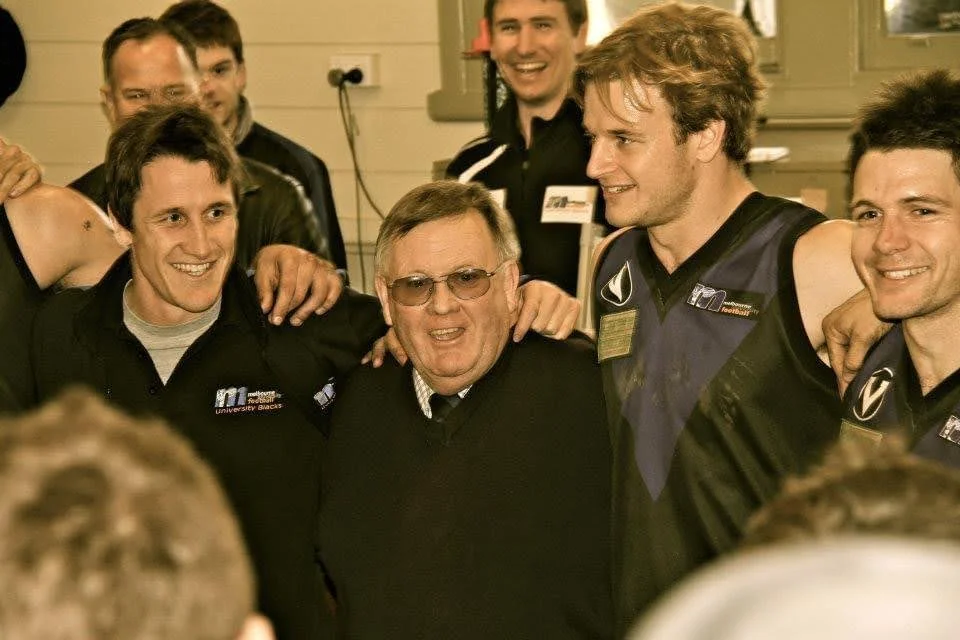
During the last Test Match, I took a friend from Sydney to the Museum at the Melbourne Cricket Ground. On display were handwritten rules for the game of Australian football and dated May 1859, being the first recorded rules of the game. On Saturday, 28th May 1859, University played St Kilda in our first match with the match reported in Bell’s Sporting Life published on 4th June. Such was his longevity that one half expected to see the words “Timekeeper A. M. Smith Esq.” recorded in the match summary. Although self-evident, such is the esteem in which Andy was and will forever be held, we have called upon our most senior official to deliver this eulogy on our behalf.

Fifty-year celebration

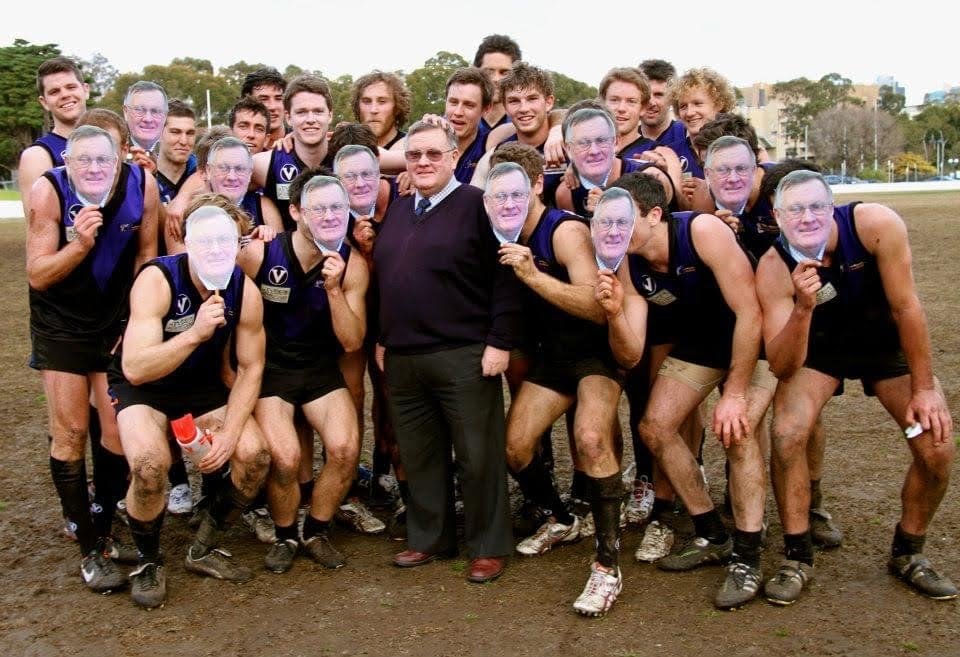
On Saturday 4th August 2012, the Blacks held a luncheon in the old pavilion to celebrate Andy’s fiftieth year of honorary service to the Blacks and to the men’s football programme at the University. That service included occupying nearly every post, including two years as president of the M.U.F.C. in 1984 and 1985, performing a myriad of tasks for Blacks and managing teams in the M.U.F.C. intervarsity programme.

 As one would expect, the luncheon was fully subscribed with attendees from five decades from the halcyon days of premierships in the Victorian Amateur Football Association’s A Section to the equally celebrated premierships in the sections below.

The renowned scribe and keen observer of life, the Black Hack (one suspects a nom de plume) observed in his article published on 9th August 2012, “in any case, my choice of attire for this Saturday gone was a very straightforward affair. It was Andy Smith Tribute Day and a V-Neck pullover was the only way to go. As I packed my tram timetable and handkerchief in order to complete the outfit, I considered all that had occurred during Andy’s 50 year tenure – from wars to droughts, from colour TV to iPhones, from woollen to lycra jumpers – and that if Andy were to have a sav blanc for every year of service he could give you an opinion on all of them.”

A marvellous luncheon was had on a memorable day for the Blacks.

 The universal theme from those speaking on behalf of generations of Blackers was a deep affection for Andy and a genuine appreciation for his tireless work. Of course, Andy’s service didn’t end there and continued for more than a decade and into the 2022 season during which after more than sixty years of service Andy called time on his life as an official and life as a spectator beckoned.

Ern Cropley

Andy was chuffed when, in 2014, the new pavilion was aptly named the “Ernie Cropley Pavilion” after his great friend and house mate of many years, “Croppo”: curator of the hallowed turf for fifty years and described on the M.U.F.C. website as “the most colourful and best-known and best-loved character in University cricket and football circles.”

Blackers’ reflections upon Andy’s passing

 I have been provided with many reflections, a selection of which is as follows:

“A wonderful selfless servant of the club.”

“Andy was there at my first game in Reserves in 2001 and last game 2015.” He loved regaling me with stories of swindles he and my old man got up to at intervarsity games in the seventies. Something along the lines of cash bets and getting the opposition drunk with free booze before the games. I loved his brutal assessments post-match which were delivered with love.”

When letting a Blacker down lightly having missed a mark at a crucial time in a match “Moff, your old man wouldn’t have dropped that.”

“A warm man who made everyone welcome. No one went through our club without being bailed up by Andy for a chat.”

“Heart and soul of the club and part of the old firm along with Jack Clancy who schooled new players on the history and what it meant to play for Uni Blacks.”

 “So loyal and such a supporter of all who represented the Blacks. I rarely got to the Pavvy without a post-mortem and a 3.2.1 of the best and, at times, a 3.2.1 of who shouldn’t be in the best.”

 “My earliest memory of the Blacks was in 2001 after playing a practice match at Williamstown. My first game of football in years, lying on my back after the game exhausted with no skin on my knees and dazed. I am jolted out of my daze when Andy’s dogs are doing a great job at licking the wounds on my knees with Andy standing beside them with a cheeky grin.”

 And I remember a conversation out at C.B.C. St Kilda’s ground in Murrumbeena around 1990 when I was Blacks’ secretary Andy “Can you look after m’dogs, while I time-keep?” Me “Do I have to?” Andy “Yes”

And one final quote which transcends the generations of Blackers and ultimately defines the mood “Part of the Blacks’ furniture who helped make the University Main Oval such a special place for us all.” Such a special place for us all.

The A.M. Smith Perpetual Trophy for the Best Clubman

 Presentation nights represent the finale to a season and provide a serious forum in which serious awards are presented, serious speeches are made, and a club reflects in an earnest manner about the season just completed.

The best club person award is more than an award for significant contribution but is an acknowledgement of the value of the selfless acts of one person for the benefit of others (and the cohort generally) and an appreciation that those acts underpin a club’s very existence.

In the early nineties, the Blacks annual award for the best clubman was changed to the A.M. Smith Perpetual Trophy as a permanent acknowledgement of Andy’s contribution to the life, times and prosperity of the Blacks. To better understand how valuable this work is, it is worth spending a moment on the concept of the best club person. Although awarded on an annual basis, the truth is that usually the recipient has years of honorary service week in week out under his or her belt: managing the teams, keeping the time, field umpiring the reserves, (back in the day) numerous trips to V.A.F.A. HQ to register players, sweeping out the rooms after an under nineteen’s match, spending hours on a Saturday morning preparing for a legendary Blackers’ afternoon tea, sitting in a car listening to a player earnestly express his feelings about his relationship failure of three months.

The list is endless but, in essence, for up to eight months a year, it is assuming operational responsibility for the logistics in deploying more than a hundred players and officials to somewhere in metropolitan Melbourne and dealing with what has now become the complex business of running a community football club especially in a grade where the competition is fierce.

But Andy was not simply an official who came on matchdays, kept the time and went home. He was far more than that. He knew all the players and officials young and old well and was a welcome and active participant in the Blacks’ social life including the famous Black Spot which for many years held top billing on Thursday nights at the Clyde.

Andy’s love of the game of lawn bowls

It would be remiss of us not to talk about Andy’s love of lawn bowls a fact well known to all at Blacks. We enjoyed the fact that it gave him so much joy. We note that the Moonee Ponds Bowling Club was established in 1891 is situated in Queens Park, a beautiful garden, a short distance from here and is noted for having among the best bowling greens in Victoria and priding itself on providing a great family environment to around 150 social and bowling members.

It is a rarity for a person to be a life member of three sporting clubs with the M.U.F.C. (since 1980), the M.P.B.C. and the Carlton Bowling Club now the Princes Park Carlton Bowls Club.

Andy’s health no bar to his support for the Blacks

Over the past few years, Andy had his health issues but that didn’t stop him from attending the footy and expressing his views about all things Black in his usual forthright manner.

Last year, I visited Andy at the Royal Melbourne Hospital. Our salutation was that of two blokes who had known each for a long time as I was allocated to Blacks in 1979. We vaguely nodded at each other. Shooting the Blackers’ and general M.U.F.C. breeze and happily discussing the Blackers’ return to the Premier Division where the Blacks belong, well over an hour passed effortlessly.

As I left, our exchange embodied the idea that the ties that bind are often in what is not said. Me: “S’pose I’d better go” Andy: “S’pose you’d better.” Me: “Good luck with the operation.” Andy: “Thanks”.


Loyalty

In an age of fatuous over-statement, the word “loyalty” gets a fair work-out but one wonders how often its meaning is considered or used carefully. Synonyms are “faithfulness”, “constancy”, “commitment”, “dependability” and “reliability”.

In the mid-nineties when the Blacks were collapsing through the grades, at a low ebb, and where resources were very thin, one A.M. Smith stayed the journey, continued and remained faithful to the cause: constant, committed and dependable. Values which by his conduct Andy imparted to generations of University footballers who have gone onto to lead the way in business, the professions, academia, the arts, science, government and public administration and in professional sport.

Vale Andy

Our condolences to Andy’s family. We thank them for giving us an opportunity to speak.

“Cheer, boys, cheer we’re for Melbourne. Now we’re on the road to victory. We will beat them all round, at our home and any ground” the first lines of the traditional song of the University Football Club and successfully reintroduced into the Blacks after Andy led a long campaign.

And so we say goodbye to a favourite son. Blackers unum et omnia, Blackers one and all.


Enjoyed this speech? Speakola is a labour of love and I’d be very grateful if you would share, tweet or like it. Thank you.

Facebook Twitter Facebook
In SUBMITTED 4 Tags ANDY SMITH, ANDREW DONALD, BARRISTER, EULOGY, MUFC, UNIVERSITY BLACKS, MELBOURNE UNIVERSITY FOOTBALL CLUB, TIMEKEEPER, AMATEUR SPORT, VAFA, CLUB LEGEND, CLUB PRESIDENT, UNI BLACKS, FOOTY, AFL
Comment

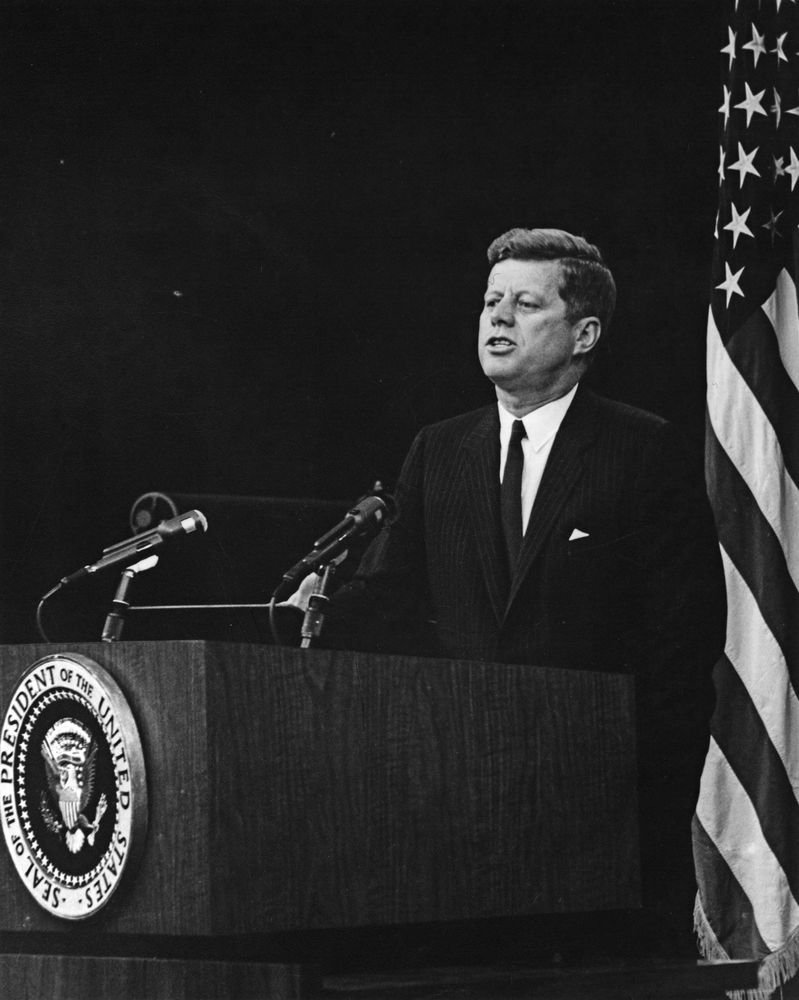
For John F Kennedy: 'He was vigorous and healthy and smiling and friendly', Senate memorial service, by Jacob Javits - 1963

January 30, 2023

November 1963, Washington DC, USA

Mr. President, hundreds of thousands of words have been published, and hundreds of thousands more have been spoken into the microphones of the world since John F. Kennedy was struck down in Dallas, but none of them were really adequate. Words never are in the face of senseless tragedy.

Words cannot describe how the American people felt when they lost their president. Not until the vacuum of disbelief was filled with the horror of comprehension did any of us realize how much we identified ourselves, even apart from personal friendship, with the president — this intellectual, vigorous young man — and he would have been that if he were eighty — expressing the very essence of the youthfulness of our nation. It seems of little consequence now that there were political differences, or objections to this or that legislative product, though as far as I am concerned there was a very large measure of agreement. What matters is that feeling of loss — that personal sense of emptiness — that all Americans feel because their president was cut off in the prime of life. As a nation, we have lost a president who understood the institution of the presidency, gloried in its overwhelming responsibilities, and discharged his duties with dash and joy, which were an inspiration to the youth of our nation.

But John F. Kennedy was more than that. He was a man filled with the joy of living. He was a husband, a father — and my friend.

For myself, I remember coming to Congress the dame day he did. We were sworn in together on the same January day in 1947. A photograph on my office wall shows that we two, returning veterans, looked a little uncomfortable at the moment in our civilian clothes. It shows us looking at the Taft-Ellender-Wagner housing bill, and it recalls the first job we did together when we called on the National Veterans Housing Conference of 1947, which we had organized, to back this bill. It was the beginning of an association which extended throughout our careers in the House and Senate. We collaborated in many bipartisan matters, as is not unusual in the Congress. Indeed, in our service together in the Senate Committee on Labor and Public Welfare, we worked closely — as did Senator Morse and others — on the minimum wage bill, the Labor-Management Disclosure Act, and other similar measures which were major aspects of Senator Kennedy’s legislative career.

I am a personal witness to the fact that he was resourceful, optimistic, and creative. He became and was my friend, and this is a deep source of gratification to me and to Mrs. Javits and our family.

Mrs. Javits, too, knew President Kennedy well and admired him greatly. She will, I know, always think of the president’s graciousness and the warmth of personal friendship which he exuded.

Only a week before his tragic passing, I saw him in the Oval Room at the White House when he accepted the report of the Advisory Committee on Medical Care for the Aged, in which Senator Anderson and I joined, and issued a statement offering encouragement and help.

He was vigorous and healthy and smiling and friendly — a complete human being, concerned about other human beings who were no longer as vigorous and not quite as healthy as they used to be.

This concern for the unfortunate by a many with all of the social graces and all the social status and as much power as America allows one man was what made him so much the symbol of the youth of our country. His wife, Jacqueline, who has given Americans so much reason to be very proud of her and of all American womanhood as she reflected in it, in these last mournful weeks, in the way she carried herself, has said the most beautiful tribute — that John F. Kennedy had the “hero idea of history,” and that she did not want people to forget John F. Kennedy — the man — and replace him with some shadowy figure in the history books.

She need not fear that. There are already thousands upon thousands of people in the world working to keep his memory alive. I have been privileged to join with many others in this body in cosponsoring a bill to rename the National Cultural Center and make it a living, vibrant memorial to this vibrant man who loved the arts. And with Senator Humphrey, I have joined in a bill establishing a commission to ensure that only the most appropriate memorials be created in his honor.

These are well-meaning, deeply sincere tokens — necessary, but still tokens. In reality it will be John F. Kennedy’s youthful freshness in his aspirations for our country that will keep his memory fresh.

In a real sense we, his former colleagues in the Congress, are the only ones with the power to write words which can transform these aspirations into memorials with meaning. We can write legislative acts, like a meaningful civil rights law, which would consecrate and perpetuate John F. Kennedy’s love for personal and national dignity. We can exorcise from our country — and the American people are doing that even now — those extremes of hatred and disbelief in public affairs which create a climate in which terrible acts become much more likely.

Acts such as these will be his final memorials. It is within our power to establish them. Perhaps his noblest memorial is that he would have wanted such memorials almost as no others.

So, in common with my colleagues in this solemn service — and that is what this is today — I bespeak for Mrs. Javits and my children — and I would place their names in the Record, so that as they read this Record when they grow up, I hope they will read their names in it and see that their father spoke with deep sympathy — Joy, Joshua, and Carla, to Mrs. Kennedy and the children, and to the president’s father and mother and his brothers and sisters and their families our deepest sympathy on this terrible bereavement, for our nation and for all mankind, and in the deep expectation that flowers will grow from his grave for the benefit of man.”

Source JFK Presidential Library


Source: https://www.funeralwise.com/plan/eulogy/JF...

Enjoyed this speech? Speakola is a labour of love and I’d be very grateful if you would share, tweet or like it. Thank you.

Facebook Twitter Facebook
In PUBLIC FIGURE D Tags JOHN F KENNEDY, PRESIDENT, ASSASSINATION, SENATE MEMORIAL, JACOB JAVITS, SENATOR JAVITS, TRANSCRIPT
Comment

For Gerard Ford: 'He played in the middle of the line', by Tom Brokaw - 2007

January 30, 2023

2 January 2007, Grand Rapids, Michigan, USA

Mrs. Ford, members of the Ford family, President and Mrs. Bush, Vice President and Mrs. Cheney, President and Mrs. Bush, President and Mrs. Carter, President and Mrs. Clinton, distinguished guests, my fellow Americans; it’s a great privilege and an honor for me to be here.

For the past week, we have been hearing the familiar lyrics of the hymns to the passing of a famous man, the hosannas to his decency, his honesty, his modesty and his steady-as-she-goes qualities. It’s what we’ve come to expect on these occasions.

But this time there was extra value, for in the case of Gerald Ford, these lyrics have the added virtue of being true.

Sometimes there are two versions to these hymns – one public and one private, separate and discordant. But in Gerald Ford, the man he was in public, he was also that man in private.

Gerald Ford brought to the political arena no demons, no hidden agenda, no hit list or acts of vengeance. He knew who he was and he didn’t require consultants or gurus to change him. Moreover, the country knew who he was and despite occasional differences, large and small, it never lost its affection for this man from Michigan, the football player, the lawyer and the veteran, the Congressman and suburban husband, the champion of Main Street values who brought all of those qualities to the White House.

Once there, he stayed true to form, never believing that he was suddenly wiser and infallible because he drank his morning coffee from a cup with a presidential seal.

He didn’t seek the office. And yet, as he told his friend, the late, great journalist Hugh Sidey, he was not frightened of the task before him.

We could identify with him – all of us – for so many reasons. Among them, we were all trapped in what passed for style in the 70’s with a wardrobe with lapels out to here, white belts, plaid jackets and trousers so patterned that they would give you a migraine. The rest of us have been able to destroy most of the evidence of our fashion meltdown, but presidents are not so lucky. Those David Kennerly photographs are reminders of his endearing qualities, but some of those jackets – I think that they’re eligible for a presidential pardon or at least a digital touch-up.

As a journalist, I was especially grateful for his appreciation of our role, even when we challenged his policies and taxed his patience with our constant presence and persistence. We could be adversaries but we were never his enemy, and that was a welcome change in status from his predecessor’s time.

To be a member of the Gerald Ford White House press corps brought other benefits as well as we documented a nation and a world in transition, in turmoil. We accompanied him to audiences with the notorious and the merely powerful. We saw Tito, Franco, Sadat, Marcos, Suharto, the shah of Iran, the emperor of Japan, China with Mao Zedong, Zhou Enlai and Deng Xiaoping all at once, what was then the Soviet Union and Vladivostock with Leonid Brezhnev, and Helsinki at one of the most remarkable gatherings of leaders in the 20th century.

There were other advantages to being a member of his press corps that we didn’t advertise quite as widely. We went to Vail at Christmas and Palm Springs at Easter time with our families. Now cynics might argue that contributed to our affection for him. That is not a premise that I wish to challenge.

One of our colleagues, Jim Naughton of The New York Times, personified the spirit that existed in the relationship. He bought from a San Diego radio station promoter a large mock chicken head that had attracted the president’s attention at a G.O.P. rally. And then, giddy from 20-hour days and an endless repetition of the same campaign speech, Naughton decided to wear that chicken head to a Ford news conference in Oregon with the enthusiastic encouragement of the president and his chief of staff, Dick Cheney.

In the next news cycle, the chicken head was a bigger story than the president. And no one was more pleased than the man that we honor here today in this august ceremony.

When the president called me last year and asked me if I would participate in these services, I think he wanted to be sure that the White House press corps was represented: the writers, correspondents and producers, the cameramen, photographers, the technicians and the chicken.

He also brought something else to the White House, of course. He brought the humanity that comes with a family that seemed to be living right next door. He was every parent when he said my children have spoken for themselves since they were old enough to speak – and not always with my approval. I expect that to continue in the future.

And was there a more supportive husband in America than when his beloved Carol began to speak out on issues that were not politically correct at the time. Together, they put on the front pages and in the leads of the evening newscasts the issues that had been underplayed in America for far too long.

My colleague Bob Schieffer called him the nicest man he ever met in politics. To that I would only add the most underestimated.

In many ways I believe football was a metaphor for his life in politics and after. He played in the middle of the line. He was a center, a position that seldom receives much praise. But he had his hands on the ball for every play and no play could start without him. And when the game was over and others received the credit, he didn’t whine or whimper.

But then he came from a generation accustomed to difficult missions, shaped by the sacrifices and the depravations of the Great Depression, a generation that gave up its innocence and youth to then win a great war and save the world. And when that generation came home from war, they were mature beyond their years and eager to make the world they had saved a better place. They re-enlisted as citizens and set out to serve their country in new ways, with political differences but always with the common goal of doing what’s best for the nation and all the people.

When he entered the Oval Office, by fate not by design, Citizen Ford knew that he was not perfect, just as he knew he was not perfect when he left. But what president ever was?

But he was prepared because he had served his country every day of his adult life and he left the Oval Office a much better place. The personal rewards of his citizenship and his presidency were far richer than he had anticipated in every sense of the phrase.

But the greatest rewards of Jerry Ford’s time were reserved for his fellow Americans and the nation he loved.

Farewell, Mr. President. Thank you, Citizen Ford.

Source: https://www.funeralwise.com/plan/eulogy/fo...

Enjoyed this speech? Speakola is a labour of love and I’d be very grateful if you would share, tweet or like it. Thank you.

Facebook Twitter Facebook
In PUBLIC FIGURE D Tags GERARD FORD, TRANSCRIPT, TOM BROKOW
Comment

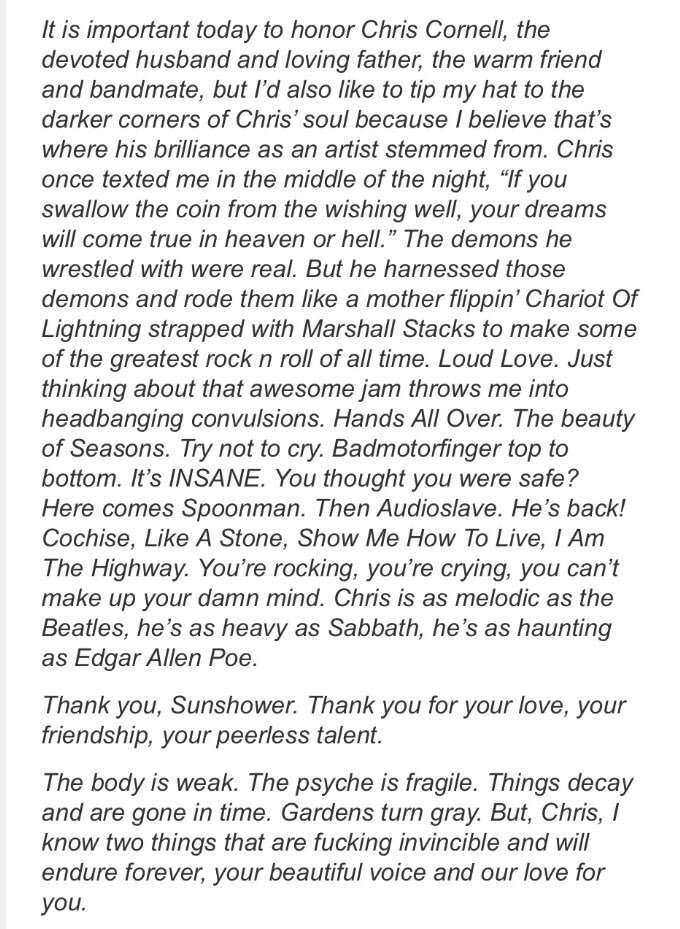
For Chris Cornell: “I’d like to tip my hat to the darker corners of Chris’s soul’, by Tom Morello - 2017

January 30, 2023

26 May 2017, Los Angeles, California, USA

IMG_3738.jpeg
Source: https://twitter.com/tmorello/status/126248...

Enjoyed this speech? Speakola is a labour of love and I’d be very grateful if you would share, tweet or like it. Thank you.

Facebook Twitter Facebook
In PUBLIC FIGURE D
Comment

For Jackie Robinson: 'Steal away home', by Jesse Jackson

December 31, 2022

27 October 1972, New York, USA

Today we must balance the tears of sorrow with the tears of joy, mix the bitter with the sweet, death and life. Jackie, as a figure in history, was a rock in the water creating concentric circles and ripples of new possibility. He was medicine. He was immunised by God from catching the diseases that he fought. The Lord's arms of protection enabled him to go through dangers seen and unseen, and he had the capacity to wear glory with grace. Jackie's body was a temple of God, an instrument of peace. We would watch him disappear into nothingness and stand back as spectators and watch the suffering from afar. The mercy of God intercepted this process Tuesday and permitted him to steal away home. Where referees are out of place, and only the supreme judge of the universe speaks.

Source: https://www.youtube.com/watch?v=fs1_X6iRb7...

Enjoyed this speech? Speakola is a labour of love and I’d be very grateful if you would share, tweet or like it. Thank you.

Facebook Twitter Facebook
In PUBLIC FIGURE D Tags JACKIE ROBINSON, BASEBALL, JESSE JACKSON, REV. JESSE JACKSON, PREACHER, MAJOR LEAGUE BASEBALL, MLB, KEN BURNS, AFRIDAN AMERICAN, CHURCH, CHRISTIANITY, CHRISTIAN, RELIGIOUS, SPORTS, ATHLETE, BASEBALLER, RACE, RACISM
Comment

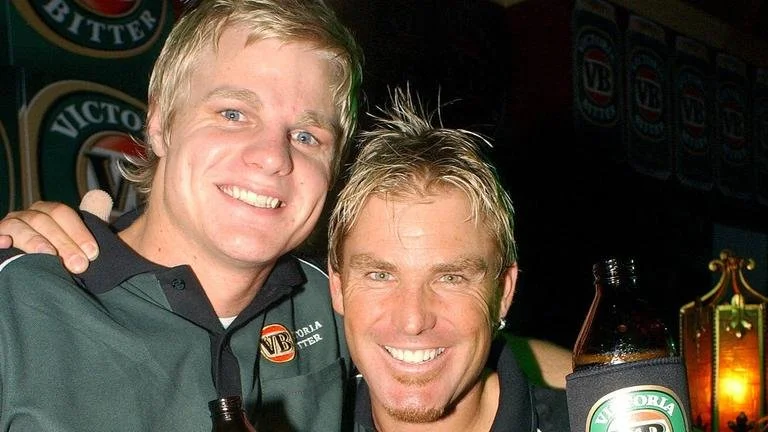
For Shane Warne: 'That's what humanised him to us', by Nick Riewoldt - 2022

December 30, 2022

8 March 2022, FoxFooty studios, Melbourne, Australia

That was one of the things, as a kid, about getting drafted to St Kilda. There’s the excitement about, you’re drafted, your AFL career is starting,

I remember it was dad when I got drafted as an 18-year-old that said ‘you know Shane Warne’s a Saints fan?’ And I kinda loosely knew but I thought ‘oh yeah, you’re right! Maybe I’ll get to meet him one day!’ And I think any kid who got drafted to the Saints, that would go through your mind at some stage.

That moment came pretty early for me. We had a BBQ at (ex-St Kilda president) Rod Butterss’ house to welcome all the new players, and there were some board membes there, and Shane Warne was there.

Rod had a tennis court, so the boys got out on the court and everyone was doing their impersonations (of Warne), just hoping that he’d come out, and he did.

As soon as he grabbed the ball there was a fight over who was going to grab the bat, and so Milney (Stephen Milne) somehow won the battle for the bat, and I thought ‘well I’m not silly, I’m gonna go stand behind the stumps!’ So I went and stood in the keeper’s position.

He rolled in, he bowled a leggie, and Milney being Milney, he tried to hit it from Middle Brighton to North Brighton, over the train line. Missed it, I’ve taken it behind the stumps, taken the bails off and from there - here I was, this 18-year-old kid, growing up loving cricket, Shane Warne posters and all of that stuff.

I took off. I ran down the tennis court to embrace him like I’m bloody Ian Healy, and we’ve just won the World Cup! And I think about it now and I actually cringe - what were you thinking?

But just the excitement that he brought to all of the guys that encountered him, knowing that he was a Saints supporter and here was this guy who had achieved everything but somewhere deep down he would love to have actually been doing what you’re doing. That’s what humanised him for all of us.


Source: https://www.foxsports.com.au/afl/teams/st-...

Enjoyed this speech? Speakola is a labour of love and I’d be very grateful if you would share, tweet or like it. Thank you.

Facebook Twitter Facebook
Tags NICK RIEWOLDT, SHANE WARNE, TRANSCRIPT, EULOGY, TRIBUTE, AFL360
Comment

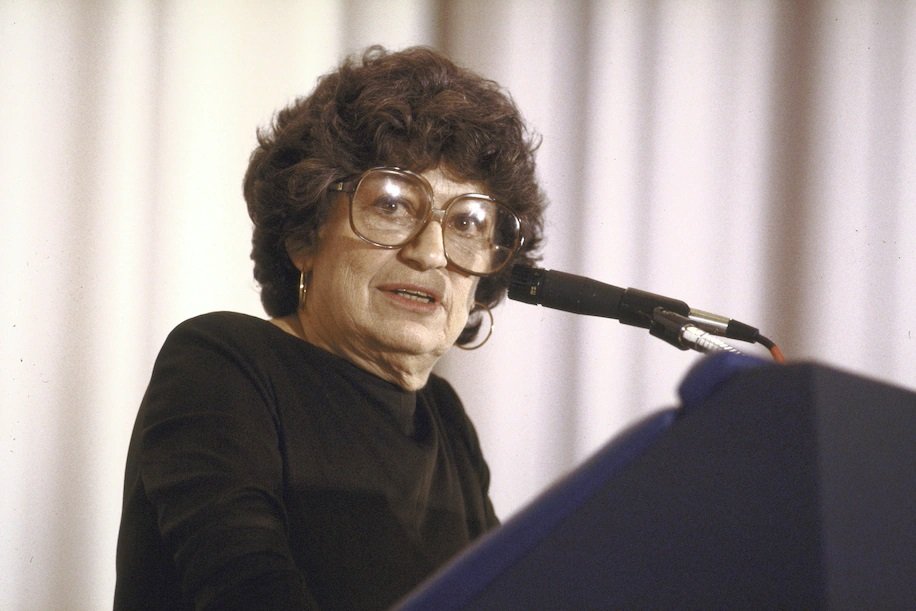
for Midge Decter Podhoretz: 'Where did she come from?' by son John Podhoretz - 2022

November 4, 2022

11 May 2022, Riverside Memorial Chapel, New York City, USA

This eulogy appeared in Commentary on May 12th 2022 which is a magazine John Podhoretz edits.

Where did she come from?

That’s what we were asking ourselves, my sister and my father and I, after she left us and this world on the morning of May 9, 2022. Of course, we know where she came from in the strictest sense. She was born in St. Paul, Minnesota, on July 25, 1927. Her mother had also been born, amazingly enough for a Jew, in the Twin Cities in the year 1894, the youngest of ten whose parents had immigrated from Lithuania quite a while earlier. And her father? His mother bore him at 14 in Poland after marrying a much older man over her own parents’s objections. He was a widower with children of his own who turned out to be a drunk. He beat her one night when she was newly pregnant.

My great-grandmother would have none of it. She went back to her parents. They got the drunk to give their daughter a get—a Jewish divorce. And then it was off to America with the baby in tow. By the time my grandfather was a teenager, there was concern he was heading into trouble on the Lower East Side and so he was sent to live with a relative in St Paul. It was there, in 1916, at a Zionist meeting, that Harry Rosenthal met Rose Calmenson. Eleven years after that, their daughter Marjorie was born. They called her Midge.

So this is where my mother, who was known to the world as Midge Decter, came from. From a Polish Jewish grandmother with an iron will and an unbreachable sense of self that remained with her until she died at 89. From a Litvak mother whose immigrant father almost made a huge fortune in scrap metal but died before the business, Paper Calmenson, took off. From an immigrant father who migrated from Poland to New York to Minnesota and began an increasingly successful career as a small businessman once he had returned from World War I. By the time Midge had grown into a teenager, the Rosenthals had become highly respectable burghers, perhaps even more starchy in their commitment to the most conventional social rules even than the Gentiles who made up 99 percent of the population of the Twin Cities. The Rosenthals kept kosher, but in all other ways they were more Catholic than the Pope.

And yet my grandparents must have had certain radical tendencies. Being a Zionist in 1916 was far from conventional. Their passion for Zionism predated the state by three decades and was pretty much the only passion they ever really had. What’s more, my grandfather fancied himself a Reconstructionist and quite pointedly spoke brachot without God’s name in them.

Harry and Rose started the first Zionist summer camp in the Midwest, called Herzl, which remains a going concern in Wisconsin to this day and was where Bob Dylan and the Coen brothers got their Jewish educations. Harry was also on the leading edge of a new business category founded at the end of the Second World War. He became an early mass wholesaler of Army-Navy surplus goods. Remember Army-Navy stores? My grandfather sold them their wares. Made a lot of money, but less than he should have, because he was stubborn and was unable to modernize as he got old.

Interesting lives, without question. Yet neither of Midge’s parents ever actually said anything remotely interesting. They were both, either by training or by inclination, dull. And they passed that dullness on to two of their daughters, my mother’s older sisters. But the dullness didn’t take with Midge.

So I ask again: Where on earth did she come from? My parents met in 1946 on a registration line at the Jewish Theological Seminary, where my show-offy 16-year-old future father was trying to make time with a girl and misquoted T.S. Eliot—whereupon the 18-year-old with a thick Midwestern accent turned around and corrected the quotation.

How had she come to T.S. Eliot? There had been barely a book in my grandparents’ house. My dad says that when he met her Midge had already read Tolstoy, Dostoyevsky, and Proust. Proust! And yet this was a woman who spent her life regretting the fact that she never graduated from college. One of the few times in her life I saw her choked with guilt was when Rachel, my oldest sister, dropped out of college. She said, quietly, and over again, “I did this, I gave her permission.” But what on earth did Midge ever need college for?

Let’s talk about that 18-year-old and college and the Jewish Theological Seminary. She had wanted to go the University of Chicago upon her graduation from St. Paul Central High School. Her parents said no. They told her the University of Minnesota was just as good as any other school—if my grandparents had a faith besides Judaism it could have been called Minnesotanism—and to forget such things.

She enrolled at the University of Minnesota. But she was not going to stay. Her older sister Connie—the pretty one, because you know there was always a pretty one—was already following the path her parents had charted for her; she was engaged to her sweet high school boyfriend, who went to work for his father-in-law and never took a free breath for the rest of his life. Her oldest sister Sheva also went to the state U but then followed her high-school boyfriend to Washington, where they both went to work in the war effort at the Department of Defense. Sheva’s husband Marver Bernstein later ended up the president of Brandeis University. One sister got out. One sister didn’t. But the one who got out got out because of a man. What was Midge going to do? She came up with a plan.

My grandparents were pious about their Judaism. So my mother used what was at hand. She told them she wanted to go to New York to study at the Jewish Theological Seminary, which at the time was an academic institution as well as a rabbinical school. She wanted to learn about our faith, and our faith traditions. And to participate in the burgeoning Zionist life in New York, as excitement built about the revolt against the British Mandate in Palestine and the hopes for a Jewish state.

What could they do, my grandparents? Minnesotanism simply had to give way to Judaism. Midge had outfoxed them. She boarded the train to New York. She met my father in her earliest days at the Seminary, but he was almost three years her junior. Instead, she paired off with Rachel and Naomi’s eventual father, whose name was Moshe Decter, who was also a student there.

I once asked her why she married him, and she said, quite succinctly and enigmatically, “because he made me feel like shit.” She stopped studying at the Seminary and started working for a new little magazine called Commentary as an assistant to its editor, Elliot Cohen. But then she had my sister Rachel and a year and five days later she had my sister Naomi, and she stayed at home in Queens raising them. At some point she could take no more, and she left her husband and took the girls and moved into Manhattan to a dump of an apartment. She went back to work at COMMENTARY, for an editor named Robert Warshow, who was then the mentor of the young writer Norman Podhoretz. Warshow wrote to my father, who was serving in the Army. He said, “I’ve hired a young woman you know named Midge Decter and if she just learns to type a little better, she’ll be a keeper.” Then Warshow died at the age of 37 and it fell to my mother to write to Norman to inform him of this loss. Norman wrote back. Midge wrote him back. A year later he returned to America, to New Jersey, to finish out his military service. He came into Manhattan on his first leave. He knocked on her door. She opened it and threw herself into his arms.

The young woman who had married a man because he had made her feel like shit—well, she was no longer that person. After several months of dating, she told my father that they were either going to get married or they were through. He said really? She said yes. He said can I walk around the block and think about it? She said yes. He walked around the block.

Imagine the sense of self she must have had then, the knowledge of herself she must have possessed, and the deep self-esteem this must have taken. She was a divorcee. She was 28 years old. She had two kids. It was 1955. This was not a power position, a place from which to make demands. To prove my point, when my father told his mother they were going to be married, she told him she was going to take my grandfather up to the roof and throw him off and then come down and take the gas pipe. My grandmother eased up, especially after meeting Rachel and Naomi. But she was terribly fearful of her own Haredi father’s disapproval, and when the wedding was rolling around, she suggested to Norman that the girls (who were 5 and 4) not be present for the nuptials. He said, “No, Ma, of course they’ll be there.”

The divorcee’s kids at her second wedding? “Who does she think she is?” my grandmother said. “Rita Hayworth?”

When Orson Welles divorced Rita Hayworth, she famously said, “Every man I knew went to bed with Gilda”—the sexpot character she played in an iconic 1946 movie—”and wakes up with me.” Ah, but waking up with my mother…that was the jackpot. My friend Joseph Epstein wrote me yesterday to say I had won the lottery in the parent sweepstakes, but the truth is, they were the winners, Norman and Midge. They were married for 66 years.

The great irony of my mother’s life is that she, a trailblazing female intellectual in a frankly misogynistic world of New York highbrow jerks whose views of women were reductionist and noxious, would end up being America’s most formidably serious anti-feminist. What she could not bear was the culture of complaint. She once said something slighting about Gloria Steinem and I asked why. She told me Gloria Steinem had once whined that she had wanted to write about politics but that they wouldn’t let her. “Who,” this woman who had written plenty about politics by this point said, “were ‘they’?” She felt the same way about Betty Friedan and the idea that Friedan and her cohort had somehow been tricked by the capitalist powers that be into moving into beautiful upper-middle-class suburbs in nice houses.

She was appalled by the misandry of the feminists—the idea that they were basically the victims of men. Her life experience had told her something different. She had allowed her first husband to make her feel like shit. But then she married a man who loved her and appreciated her and cultivated her gifts. She took jobs and she quit jobs at will, because my father was there to support her both financially and emotionally. Not that he made much money, by the way. My parents were almost comically unmaterialistic. Their dining room table was a door from the Door Store. Yes, she was fortunate in her marriage, and she knew she was fortunate, but she knew also that you had to make your own fortune, and had no patience for those who believed otherwise and who believed their complaining was the mark of a higher truth.

She felt the same way about the ‘60s and post-‘60s youth she portrayed and satirized in her uncategorizable masterpiece of a book, Liberal Parents Radical Children, from 1975. These youth were similarly full of objections and complaints and woes and wounds, and in the final analysis, what she really wanted to know was just what the hell it was they were whining about. These kids had had the inestimable good fortune of being born into the freest and most pliable society the world had ever seen­. And she thought their effort to belittle the country and belittle its gifts to us was a moral crime. And who would best know this than a member of the most beleaguered tribe in this planet’s history? Why, she could hardly believe her own luck, as a Jew with a knowledge of the horrors of Jewish history and the improbable journey her parents had made to end up together and give her life, that she had been born an American.

Most of her best writing has this quality, like someone telling you to believe the evidence of your own eyes and not be seduced by theory. Go read her essay, “Looting and Liberal Racism,” published in COMMENTARY in 1977 in the aftermath of the New York City blackout that year. The word “bracing” hardly captures its clarifying, revivifying, saddening effect—and just how prophetic it sounds today. It concludes in part:

The young men who went rampaging on that hot July night were neither innocents nor savages; they were people in the grip of the pathology that arises from moral chaos. They were doing something they knew to be wrong but had been given a license for, and had not been able to find the inner resources to overcome their temptation. A New York Times editorial written in response to a flood of mail from readers condemning the looters reiterates the proposition that poverty and race were the salient factors in the looting: “Denounce them, jail them, hate them. Still the question lingers. . . . They appeared only in the poorest sections of town and drew recruits only from the poorest population groups, albeit only a tiny fraction of them. The question is why these and only these? Why, bluntly, no white looters in white neighborhoods?” The real answer to this question, I am afraid, is not to be found in the economy, nor even in the hot, nervous streets of summertime New York. It is to be found in a decade’s worth of the spread of this very liberal and very racist idea: that being black is a condition for special moral allowance.

In the course of the radio coverage of July 14, two little black boys, sounding about twelve years old, were interviewed and announced that they had taken no part in the looting going on all around them. They seemed a bit sheepish. When asked by the interviewer, “Why not?” one of them said, “I was scared of the cops,” and the other one said, “Because my mama would have killed me.” A brave and lucky woman, that mama—no thanks to the culture intent on whispering sweet nada into her little boy’s ear.

This was my mother. She cut through the bullshit. I don’t know any other way to put it. She always did, and she always knew bullshit’s seductive quality as well. When she was an editor at Basic Books, a publishing house, in the 1970s, a manuscript came in. It was a fancy-pants work of high intellectual argle-bargle, and her boss at the time was inclined to reject it. “Don’t you dare,” she said. “It’s utter nonsense and it will sell a billion copies.” That book was called Godel Escher Bach: The Eternal Golden Braid. It won the Pulitzer. It is still in print 43 years later. It is utter nonsense. It has sold, if not a billion copies, then a million copies or more. In her seven years as a publisher, she edited books by a writer named George Gilder, one on the sexual revolution and the other on life in the underclass, neither of which made much of a mark. Then came Wealth and Poverty, which helped lay the philosophical groundwork for what came to be known as Reaganomics. Sales: a million copies.

This suggests she could have been one of the most successful book editors of her time, but she didn’t want to publish nonsense even if it sold, and she wanted to do good as she saw it. So she started a modest enterprise called the Committee for the Free World, a kind of clearing-house-way-station activist organization to promote anti-Communist ideals in the 1980s as the intellectual world reared in horror at the supposed vulgarity of the Reagan administration. I had come to adulthood by this point, and it was then that I began hearing from people the things I would hear for the rest of my life: Oh, I love your mother. I had a life-changing conversation with your mother. Your mother is my role model. Your mother had lunch with me and now I know what to do with my life. Your mother is so kind.

I would go back to her and I would say, “Mom, I just met this person and they said you changed their life.” And in response, she would roll her eyes, or make a dismissive wave. She was like this with praise too. You could not tell her you loved something she wrote. It made her actively uncomfortable. She didn’t like her own writing. She thought it mannered and overly ornate. What she liked was simplicity and clarity and she felt she came up short in those departments. In this way, and in no other way whatsoever, she was utterly bonkers.

But she was an absolute bear about this as someone who guided writers. And as someone who guided me. When I was just starting out as a writer, and I would tell her I thought something I was writing was boring, she would say this: “You are incapable of being boring. All you need to worry about is being clear and saying what you mean.” Now, whether or not it’s true that I am incapable of being boring is a subject for another time. The point here is that this was the greatest editorial advice I ever received, and it is advice I’ve passed along to others: Your job is not to be interesting. You are interesting. Your job is to be clear.

She was so very clear. And her clarity came from the quality that made so many people look up to her, emulate her, or feel she was their lodestar. It was an inner thing. You might call it serenity, but while she was very level of mood—except for when she raged under her breath about the little elves her children seemed to think were going to clean up the kitchen after them—she was too engaged with the world to be truly serene. She just had an iron sense of self, as her grandmother had had when she marched away from her widower drunk and chose a different life when nobody did such a thing. Midge had it as a teenager, reading Proust in a home without books. She had it as she planned her escape from St. Paul. She had it when she ended the marriage in which she felt like shit, and when she gave my father her ultimatum. She had it when she put pen to paper, even though writing was very difficult for her. She had it when she was asked what she would do if she were you.

Two terrible things happened to her in her life. The first, of course, was the loss of our beloved Rachel, her first-born, who died at 62 in 2013. That was nine years before her own passing, and while she was always the same, she was also never the same. A vagueness came upon her, a kind of retreat behind her eyes. I envied her this, in a way, because her inferiority gave her some kind of solace.

The other terrible thing was an act of amazing aggression on the part of her own mother. The year was 1989. Her mother had died in 1973 and had left a will, the contents of which were not disclosed because all the proceeds from her estate were to go to her husband Harry until his death.

My mother’s mother never forgave Midge for leaving St. Paul, then never forgave her for divorcing her first husband, then never forgave her for marrying my father, who had written Midge explicit love letters her mother had found one day rifling through her drawers. Her daughter, married to a sex maniac; such a thing never happened in Minnesota! So this was not a good relationship, but it was more distant and chilly than it was openly hostile.

My grandfather died 16 years later. My aunt Sheva was the executor of his will. Sheva called my mother one night, distraught beyond words. Rose had, it turns out, disinherited Midge at some point before her own death in 1973. Cut her out of the will. The problem wasn’t the money; there wasn’t, as it turned out, all that much of it. No, it was as though my grandmother had reached out from beyond the grave and slapped my mother across the face. And my grandfather had known about it, and had done nothing to stop it, and had even spent the years following Rose’s death extolling her virtues. “If there ever was such a thing as a saint in Jewish life,” my grandfather told my mother, “your mother was that saint.” So it was not just her mother who had delivered this punishment from olam ha-bah. It was her father’s repellent piety about Rose when he knew, he surely knew, his daughter would soon enough come to know different.

Of all the qualities she had, the one I most envied in my mother was her ability to sleep. She could lay her head on the pillow and wake up eight hours later. It was inner serenity at work. But she plunged into a crisis. She was 62, a year older than I am now. And for the first time in her life, she could not sleep. For four nights she paced, and sat, and lay unrested.

And then she cleared her mind.

“I have decided,” she said, “that my life is a treasure.”

And that was that. Really. It was. I’ve never seen the like of it. The only rueful echo of this monstrous parental abnegation came a few months later when we were at some conservative conference or something and she turned to me and said, “I don’t understand how it happened that I became this great champion of the family. I hated my family!”

But no. She did not. She loved her family—the family she made. She loved us four. And she loved and admired and was fascinated by and charmed by and interested in her grandchildren, the first of whom was born when she was 53 and the last of whom was born when she was 83. Midge Decter has left behind books and articles of uncommon grace and brilliance and an impact on American society at large in the form of those she inspired and the ideas she championed.

But what she has really left the world are those whom she has left behind. There are three of us children who survive her and a fourth, Rachel, who survives her in the form of Rachel’s three children and the eight great-grandchildren they have produced. Ten other grandchildren survive her as well—my three, and Naomi’s three, and Ruthie’s four. Another five great-grandchildren have come from their number, and likely there are many more yet to come.

Midge Rosenthal Decter Podhoretz decided her life was a treasure. And it was a treasure. Because she was a treasure. An unfathomable treasure.

Where, oh, where, oh where did she come from?

This eulogy was delivered at the funeral of Midge Podhoretz, which took place on May 11 at Riverside Memorial Chapel in New York City. She died on May 9, 2022, at the age of 94.

Source: https://www.commentary.org/john-podhoretz/...

Enjoyed this speech? Speakola is a labour of love and I’d be very grateful if you would share, tweet or like it. Thank you.

Facebook Twitter Facebook
In PUBLIC FIGURE D Tags JOHN PODHORETZ, TRANSCRIPT, MOTHER, SON
Comment

Patty Hearst: 'Death to the fascist insect that preys upon the life of the people', eulogy for fallen SLA members - 1974

November 4, 2022

7 July 1974, Los Angeles, California, USA

Greetings to the people. This is Tania. I want to talk about the way I knew our six murdered comrades because the fascist pig media has of course been painting a typically distorted picture of these beautiful sisters and brothers.

Cinque loved the people with tenderness and respect. He helped me see that it’s not how long we live that’s important, it’s how we live.

Gelina was beautiful. She exploded with the desire to kill the pig. She taught me how to fight the enemy within through her constant struggle with bourgeois conditioning.

Gabi practiced until her shotgun was an extension of her right and left arms. She taught me that patience and discipline necessary for survival and victory.

Zoya, female guerrilla. Perfect love and perfect hate reflected in stone cold eyes.

Fahizah was a beautiful sister who taught me to shoot first and make sure the pig is dead before splitting and I’ll always love her..

Kahjoh was the gentlest most beautiful man I've ever known. Neither Kahjoh nor I had ever loved an individual the way we loved each other. Our relationship’s foundation was our commitment to the struggle and our love for the People. It’s because of this that I still feel strong and determined to fight.

Our comrades didn’t die in vain. The pig lies about the advisability of surrender have only made me more determined. I renounced my class privilege when Cin and Kahjoh gave me the name Tania.

While I have no death wish, I’ve never been afraid of death. For this reason, the brainwash duress theory of the pig Hearsts has always amused me. Life is very precious to me. But I have no delusions that going to prison will keep me alive.

And I would never choose to live the rest of my life surrounded by pigs like the Hearsts.

Death to the fascist insect that preys upon the life of the people.

Enjoyed this speech? Speakola is a labour of love and I’d be very grateful if you would share, tweet or like it. Thank you.

Facebook Twitter Facebook
In PUBLIC FIGURE D Tags PATTY HEARST, SLA, EULOGY, KIDNAPPING, STOCKHOLM SYNDROME, TRANSCRIPT, AUDIO RECORDING, 1974, 1970s, SYMBIONESE LIBERATION ARMY
Comment
Frederick  Sidney Lines 1921-2016

For Frederick Sidney Lines: 'Your father will be late to his own funeral!' by son Graham Lines - 2016

November 4, 2022

30 September 2016, Richmond, England, UK

Memory, memories.

 It is a weekend morning in the 1960s. We are expected at our cousins, the Peberdys, in Tulse Hill.

 Mum's task is, not only to prepare herself for the day, but to also ensure that we boys at least leave home looking 'presentable'.

 We three are assembled in the hall - Dad is upstairs, somewhere.

Having applied and checked her lipstick etc, Mum turns her attention to Colin and I. Shoes are inspected, hair brushed, and ties straightened.

 We pass muster, Mum checks her watch. Then she calls up the stairs "Fred, are you ready?" It appears not. He might have been answering a 'call of nature'. On the other hand it was quite possible that he was smoking a cigarette while reading a book.

 "Fred, what are you doing up there? We'll be late!"

 Mum's frustrated and concerned face turns to us; she declares angrily, "Your father will be late for his own funeral!"

 Having reached almost 95 years of age, you could say that she was right!

 Well done Dad.

 Well done Mum.

Frederick Sidney Lines 1921-2016

Enjoyed this speech? Speakola is a labour of love and I’d be very grateful if you would share, tweet or like it. Thank you.

Facebook Twitter Facebook
In SUBMITTED 4 Tags FREDERICK LINES, FREDERICK SIDNEY LINES, TRANSCRIPT, FUNNY STORY, LONG LIFE, GRAHAM LINES, FATHER, SON, UNITED KINGDOM, 2010s, 2016
Comment

for Matthew Mather: 'Matt was our glue guy', by Santo Manna - 2022

November 4, 2022

30 September 2022, Montreal, Canada

The first day we met Matt. Anybody want to hear about that?

I say “we” meaning our tight little subgroup within the 86/87 McGill Engineering class – or another way to put it – the gang that failed Professor Knystautys’s Mech 1 class in Fall 1986, plus me and Ohayon who arrived a semester later, and then of course Rob Megeney who joined in Fall 87, instantly became one of us… and promptly failed Professor Knystautus’s Mech 1 Class. All kidding aside, I could not have been more fortunate to fall in with that crew.

When I say “tight”, most of you know exactly what I mean – that extraordinarily close bond our extended group of McGill Engineers share. It is an exceedingly rare and special connection, like family really, and it only strengthens over time. I never practiced as an engineer but still wear this iron ring Vince Canonico gave me, now 30+ years ago, as a constant reminder of that unbreakable bond.

And it means everything when you tell Matt’s story. Because Matt fit, like a glove, in our family.

So back to that first day we met Matt. As an aside, Rob told me a story I never knew – Matt had arrived at McGill a week early to register for classes. After meeting and hanging out with us, he registered a week late!

It’s September 1988. I’d just turned 20, Matt was about to turn 19. It’s Orientation Week in the McConnell Engineering Building, and after participating in the day’s events at Open Air Pub we go out on the town. All the usual suspects are there – Marc, Rob, Cyril, who at that time were all living together in The Loft on St Urbain (not as luxurious as it sounds), John Keller, David Ohayon, Curtis, Louis and others.

But there’s another guy, he’s a new arrival to McGill Engineering and no one knows him, but he gravitates to us early on in the day and is there tagging along all night. Marc said it was like a puppy dog following us around! He’s the only first year among us. And he grows on us.

And, many hours later and after many watery Peel Pub pitchers, in the wee hours, a bunch of us end up crashing at the Loft. And in the morning, I wake up, on a mattress in the middle of the floor, fully clothed with my PPO lab coat still on, I hear snoring, I open my eyes, and Matt’s face is like right here, inches away from mine.

After that night he was never not a part of us, a part of who we were - and not just any part, a core part.
In the hours and days after we received the terrible news, talking through the pain and helping each other process the loss – and in those moments and in the blur of emotions, as people do in these cases, we talk about the essence of the person we lost, what they brought to the table, and that’s what we did about Matt.

And in these exchanges a theme emerged, and certain words around that theme.
Words like “core”, and others like:
“Hub” - Vince said that
“Glue” – heard that word a few times, and Marilyene mentioned it in a Facebook post.
There’s a term “glue guy”, especially well-known in hockey circles.

The glue guy:
• is great in the room…
• keeps things light and loose and makes sure his teammates have a great time, cracking jokes, inventing crazy games, playing pranks…
• goes the extra mile to create a positive atmosphere.

Calm and easy-going, the glue guy defuses tension, leading everyone towards harmony and away from dissension.

On any NHL team the glue guy is super important, often more important than the flashy superstars - no matter how things are going on the ice, or what controversies are happening on and off the ice, glue guys hold the team together.
THEIR VALUE TO THE TEAM CANNOT BE OVERSTATED.
THAT WAS OUR MATT – MATT WAS OUR GLUE GUY.

You know what I’m talking about. No matter the setting, Matt would make one of his wisecracks, and follow it up with that classic Matt little giggle at his own joke, and no matter what was going on everyone would feel better, and we would love him even more.

We are so tight, that didn’t just happen automatically – it took work, and Matty was one of those guys who did the work, and as the glue guy he made us even tighter.


And of course his influence didn’t only extend to McGill Engineering settings.

He touched my family too – back in 2019 Matt and Julie were in New York City for a sci-fi book convention and I took Katie, then an adolescent. She’s a big reader and had read his books, and loved them. He gave her a bag of swag, and signed some stuff, including a CD of Cyberstorm, which Angela, Ross and I listened to on the drive up from Manhattan yesterday.

He was also a core part of his immediate and extended family to be sure, and so many other little groups, and sometimes he brought them all together and then he was a core part of the collective of groups, the super group! No more obvious example of that when we attended his and Julie’s amazing wedding in Mexico.

And through him we got to meet the great people he attracted, like Julie, and then Joey and Stacey, and so on. That’s the takeaway for me, that’s what we all have in common. Matt wasn’t only our glue guy, chances are he was yours too.

So now together we suffer this terrible loss. But just like it was after that first night, Matt will never not be a part of us.

And Julie, know that you, Charlotte and Jack will never not be a part of us.

And we are never not going to miss him terribly, but together we will move on.

I’ll close with words from a couple of geniuses like Matt, in art and science, that make me think of him.

Leonard Cohen
"There is a crack, a crack in everything. That's how the light gets in"
Leonardo DaVinci
“A beautiful body perishes, but a work of art dies not.”

RIP Matty

Enjoyed this speech? Speakola is a labour of love and I’d be very grateful if you would share, tweet or like it. Thank you.

Facebook Twitter Facebook
In SUBMITTED 4 Tags SANTO MANNA, FRIEND, MATTHEW MATHER, TRANSCRIPT, CANADA, LEONARD COHEN, LEONARDO DAVINCI, MCGILL UNIVERSITY, ENGINEERING, MCGILL ENGINEERING, NHL, GLUE GUY, FRIENDSHIP, EULOGY FOR A FRIEND
Comment

Frieda with husband Allan at Arthurs Seat

For Frieda Isworth: 'She certainly appreciated the simple things of life', by Helen Isworth & Susan Snooks - 2006

October 4, 2022

14 March 2006, Melbourne, Australia

Reflections on our Mum, by Helen and Susan

Mum, you often said to us that you weren’t good at much and didn’t have much of an education, having left school at a very early age. It made Helen and I sad when you talked like that. You surely didn’t realise how amazing you were in our eyes, and the achievements you accomplished in your wonderful lifetime. You could teach a thing or two to the gardeners, tilers, painters, dressmakers and the cooks of today. Our gardens have always been filled with picture perfect geraniums, petunias and hydrangeas. You found great pleasure in digging, pruning, planting and watering, almost on a daily basis. You tried to teach Helen to trim a branch using a bow saw but she couldn’t even get it started!

You always loved painting- no room was left untouched. Kitchen cupboards at Box Hill would get a regular up-dated look. As were growing up we vividly remember our beautiful mauve and lemon bedroom, a fashion statement long before its time. And, of course, for a different look you even had a go at hanging wallpaper. You also tried some tiling- the back veranda and my bathroom. No wonder you loved those trips to Bunnings.

Dressmaking of course was your speciality- wardrobes of dresses for us both. School uniforms, concert costumes, First Holy Communion, debutante, bride and brides’ maid’s dresses, your own Mother of the Bride dress and matching jacket. Only occasionally would a pattern not come together for you and it would end up in the St Vincent Paul’s donation bag. And a new room was not complete until it was furnished with new curtains and cushions.

One particularly intense memory for Helen was the beautifully made Mammy doll Mum created, down to a brass curtain earring, check skirt and woollen hair. She was proudly displayed at school on the blackboard ledge before being shipped off to some needy child in a poor country. Helen felt hers looked so much nicer than all the others, and felt so proud of you, Mum.

Knitting was another skill that never left you. We were always warm in one of Mum’s jumpers. As a seven-year-old, Ben especially loved his Bart Simpson jumper. And of course, the sweet baby jacket just completed. She was so excited about the prospect of becoming a great grandmother.

Cooking was another great pleasure she found pleasure in. Susan and her would often trade recipes, with cakes and slices her speciality. There was always a new favourite- Betty cakes, yo-yos, lattice biscuits with cream cheese filling and most recently almond shortbread biscuits. Mum always made fish and chips on a Friday night- no take-away for us! And every visitor to afternoon tea left with a parcel of Mum’s homemade goodies.

Mum could teach a thing or two to the nannies of today too. The grandchildren were always occupied when Granma was around. A special memory for me, and for her for that matter, was taking Benjamin and Daniel for walks in the proam or the pusher. Down to the shops they’d go and for a break, sit in the bus stop to count the cars travelling along the highway. And a day’s childcare usually included Mum tackling the ironing basket for us too!

So it wasn’t the extravagant life for Mum. She certainly appreciated the simple things of life- few fancy holidays or restaurant meals for her. Many a summer holiday spent at Truman’s Road, Rosebud or Flat 4, Golden Park Flats in Tootgarook. Flat 4 was a converted garage that Mum made feel like a palace.

She loved a simple outing to Forest Hill or to see the old dears at the Nursing Home even after Dad had gone. She loved meeting Molly for a coffee or a game of cards at Evergreen.

Mum, your talents were many and you asked for so little in return. Your children and grandchildren may display some of those talents but you were the master. You certainly taught us the value of doing a job yourself and doing it well. Now it is your time to rest. We all know how much you loved us. We hope you knew how much we all loved you.

Frieda Isworth died on 6 March 2006


Enjoyed this speech? Speakola is a labour of love and I’d be very grateful if you would share, tweet or like it. Thank you.

Facebook Twitter Facebook
In SUBMITTED 4 Tags FRIDA ISWORTH, MOTEHR, DAUGHTER
Comment

For Gerald Day: 'Dad had all his spring ducklings in a row', by Kristy Day & Alina Warnock - 2022

October 4, 2022


September 9, 2022, Mid North Funerals, Clare, South Australia, Australia
(In above video, Kristy’s eulogy begins at 16.22)


My beautiful father, was a truly unique man.
He was one of those inspirational souls, I am sure was sent, or chose to come into our lives for profound reasons.

I am proud to say, that I had the blessing and honour of helping to support Dad through his last breaths on this Earth, along with his Love, Julie.

And what a privilege – it’s something we don’t want to think about and may be reluctant to talk about, but what I was able to pull from the experience, has informed the theme for this eulogy.

I often reflect and honour both my mother and my father, along with my ancestors while I am grateful for the gifts passed down from these people. Gifts that make us unique and sometimes extraordinary.

These people, like Dad left their footprints for us; and they also left the love running through our spirits.

Like threads, the unseen connection continues.

The body has its purpose and then it’s honourably left behind, as something, somehow tangible that we need to let go of.

Dad’s life was so finely tuned, wound tight like a guitar string, tuned to sing him along.

As Dad’s threads “unravelled” as his love, Julie explained to me when the lingering last breaths became selfishly hard for me to bear; I became profoundly aware of the honour before me.

Gerald Mart Day
Born in Gladstone on June 10, 1939
hit the ground running on his way into this life of his.

He grew up on Barinia Farm just north of Clare

He was one of six Day kids; and nick-named for every day of the week by the local swaggy.
I reckon Dad made up for day seven for the work he had ahead of him.

He was the fourth born.
After Jean, Maureen, and Roger
Then a little before Bev and Yvonne

Memories shared at various milestone events
stick with me well; although forgive me if I still get the stories wrong.

Dad hated milking cows so he was never going to be a farmer.
Grandpa put off buying a mechanical milker just to spite Dad.

Bev was his favourite sister.
Sorry you other girls.
She reminded me of some tall stories the other day.

She laughs as she tells me what a clever fella her bother was.
He stuck by his little sister’s side.

He started building houses as a young bloke.
Cubbies of all shapes and forms.

Up trees and on the ground.
I am sure they were all strong.
Maybe one did actually collapse
Pretty sure I was told.

He was obviously a pilot right from the start.
His flying machine was built early,
even before his teens.
Yeah, he learnt from his own lessons when that plan failed!
He needed to wait for that one.

But he was starting to put his ducks in a row.
That’s my theme going forward here.
Reflecting on this epic journey I am barely touching on.

The fifties were soon upon him
which was good for him I know.

His dance moves were something I did my best as a kid to imitate.
Likely, to no justice because Dad was the one those moves belonged too.

Apparently, he built a record player, somehow from scratch.
So that he, Roger and his sisters could get that twist down pat.

He knew he had more to do than be a farmer and work the land.

He soon chose to get the mechanical fitting and turning trade on the go.
He was a teen now and well onto making his own choices.

He needed some wheels, so he thought he’d give a motorbike a try.
His apprenticeship wages came in handy for that.

Bev recalls that choice caused the first and only family argument she witnessed in her youth.
Grandma and Grandpa obviously had grave concerns.

Rightfully so, as motors on wheels later caused some crisis.

But building fast things that slid sideways with grace and grunt
Were high on Dad and Roger’s agendas.

Go Karts and midgets were built on their production lines.
Projects for racing fast.
Dad’s life was also quickly picking up speed.

Inventions of a super spreader was his last farm boy hurrah.

Speed boats were the first real craftsmanship.
They needed to be, because at best they should stay afloat.
Most of us know the story when Roger’s Jenny couldn’t swim.
When one boat went under.
Lucky there was plenty of booze on board that day
with flotation in the eskies.

So, Dad is still in his teens building boats mind you!

A house was close to follow.

Yes, the house he was to house his family
before the fact he said.
It was the right thing for a man to do.

He was still barely 18!
He bought a block across from the Golden Fleece on Main North Road.
And built it brick by brick as he learnt on the go.

Going to a back story–to imaginary places Julie and I told Dad to go the other night.
To help settle him into his groove
on his track into new adventures.
Julie said she’s convinced he must have ancient ties
to building Machu Picchu
or even the pyramids perhaps.

Anyway, the family home was good and ready.
His journey with Lynnette was right ahead of him.

Like two creative souls
fusing their energy,
those two were on their way.

There’s many days ahead on the River and Porters Lagoon.
Or any water deep enough–even far northern lakes.
Lake Ayer to name a few. He’d drag a boat behind a grader
if he needed a way through.

There’s Yvonne and Trevor; and Fury to add to the mix.
With Hootin Annie and her V8 motor as loud as it could go.

There’s Bev and Gary and many more.
Bowker’s Linbar and other egg-beaters
on Earls and McKendrick’s boats.
Likely I’ll get corrected on that later.

There’s the need for more speed and grace
so there’s water skiing to master.

He could ski on anything.
I remember fence posts,
if somehow there was no ski
Or maybe he wanted to show off.
Nah, he never did that!

Malcolm Heinrich has memories of railway sleepers
as a makeshift ski
How the hell you’d steer one of those!
On a skin full of beer, or a port or two!

All the way from a river pub back to wherever.
There’d be a fire to stoke, and wood needed to burn.
So, on that sleeper would go.

Not too much further on his way, there were little eyes to look into.
Three little ones: Robyn, Me and Timothy.

We had no choice
but to take on those ancestral lines.
We were little shits
and so practical jokes were on tap.

Go figure, when Tim pissed on Uncle Jeff’s leg.
He thought it was funny.

But, till recently, I liked to remind Dad
of what, I am told he was like as a kid.
He was the one, with some likely accomplices,
who pissed over the top of the haystack
onto the head of the swaggy,
poppa Day let sleep in the shed.

Grandma told mum at their wedding:
‘Well, I hope you can do something with him
because I never could!’

The family home project still had things to embellish it.
One day he came home with his first backhoe.
He said he’d go out and practice.

Out the back he went,
and soon there was a hole
big enough for a swimming pool.
I never knew it was one of the first in Clare.

I had no idea at that stage how much my father could do.
And that he was any different to other Dads.

It’s no wonder I build things now,
and can apparently never keep it simple.
Hey Gordon!

Growing up; I could mostly observe Dad from afar;
the pride for my father built slowly like a fire.

It was hard to get his attention.
I dealt with that quite personally.

Dad was leading by example,
of what work and dedication could achieve.

Others had a hard time getting Dad to stop
so they could get his attention
Because when he did, “boozy happenings” could follow.

He had some good mates,
Although these are my memories
so please forgive me for leaving some out.
I know you have many more memories as his friend.

There’s Percy Pearce, Peter Hall, Don Morrison, the Paines, Pigot and all the Heinrichs.
John Fidge was the quieter one! Old Betty made up for that!
Pool parties at 44 main north road were very well known.

There’s one particular “Getting Gerald’s attention” situation.
We tried to get him to come up from the shed one night.

Peter Hall called from out the front of the big house,
a few times I am sure.

‘Gerald, your Tea’s ready’,
Mum never failed to provide a hot meal
Bless her generous heart.

‘Gerald, come up for your tea,
it’s getting cold.’

Still no sign…

‘Gerald, the house is on fire!’

Well, after ole Chum Braddock heard that
from the other side of the valley
far away through the trees,
the fire truck quickly turned up;
with Dad coming up from behind.

That’ll learn him, I said.

All the while, it wasn’t just backhoes, excavators and trucks Dad worked with.
He wasn’t that keen on the cold weather
So northern safaris were the answer.

A V8 should go into a new Toyota landcruiser
That’ll make her go.

‘I am going up north’, he’d say
with Rex Elis’ punters in tow.
Mum would get to go on some earlier ones.
And a few times us kids got to go too.
We learnt all about messy races
and being shuttled reluctantly to our swags
out the back of the Birdsville hospital
or somewhere, maybe safe.

Gratefully, I got my first inspiration to do what I do to this day.
Connecting to red sand country and the first nations people too.
This was something I was blessed with,
on these incredible experiences up north.

So now I’m still drawing spinifex mice
and many other illustrations too.
Telling people how they may feel this country in their bones
Just like Dad and Mum knew how to do.

Bedfords and Oka trucks,
camel strings would be the go.
Up over many sandhills
of many relentless shapes and forms.

The Simpson and the Canning Stock Route
were only just a few.

In amongst the very full aspects of Dad’s life
he continued to pull off spectacular projects.
Just because these were the plans
he dreamed upon until the end.

He pulled down many historic homes
and old wineries in this Valley.
He would pile his loot from those demolitions
in amongst the place of many trees.
Toolangatta was that place.
This is where he and mum
chose to build the next family home.

He hardly slept between the hours up on his machines.
Let alone on that incredible place He and Mum co-created.

Stone by stone, masonry master,
Helmet Zora got him on his way.
Over 7 years it took.
Many other hands came in to help.
It was Mum’s dream to make it big enough
for a bed and breakfast.
It would have been Clare’s first.

We got to move into the bottom storey.
While the top story had its bones in place.

It was a space I never ceased to behold.
Nothing was done by halves.

Many parts of Clare’s architectural bones live there.
And doors from spaces
with many more stories to tell.
Many reused materials make up that place
A place we will treasure for ever.

As a young teenager, I was in awe of my father.

In amongst those trees,
life started to move on
to an end of a chapter.

When Dad threw his swag
in his hotted up old 4x4 ute
I knew that chapter was closing.

Dad had seen a new light
shine over a sand hill up on the Simpson.
That was a major adjustment for all of us.
Lovely Lesley came into our lives
From way over the ditch.

She quickly took the him to the city
But she was not able to take
the country out of him.

I have so far failed to fit in,
the times up on the River
50 years ago, at Roonka Station near Blanchetown,
we pulled up our houseboat
It still had paddles on the back.

Nanna and Grandpa Boyd wanted a retirement plan.
So an old River Queen they acquired
along with Mum and Dad.

Soon the paddles were off
And a jet engine was installed.
They called it Boydy’s Lazy Days.

Ironic, Dad was not really ever lazy!
Not long after Grandpa’s life was cut short.
He never got to retire on his beloved houseboat.

Life on the houseboat was our timeout;
and a time for connection.
Not only as a family but
further with nature.

Speed boats and fast Monaros
wasn’t so much Dad’s thing by then.
But he did know how to stop
to appreciate the river.

Water skiing did continue though.
Juda II and many others
dragged Dad gracefully through the water.
On marathons and relays, and many other gatherings.

Dry starts off the side of the houseboat
when the Schmidt’s or Bayliss’ turned up.
The sandbar was our favourite place
Just up from Roonka we’d go.

Easters and Christmas’s and birthday parties.
The river was our second home.

So anyway, on the horizon
there was another sparkly gem
that did catch Dad’s eye.
Julie was the one.
She was to be the most learned love of his life.

He got better at negotiating relationships
I say thanks to lovely Lesley.

So, Julie was Dad’s rock, and roll.
And roll up and down that river they did
In the loved houseboat they then called Days Off.

Julie was the perfect fix for Dad up to this day.

Dad felt such love for Julie.

We’ve all seen his tender side.
He’d cry for his gratitude
Dare he’d say
‘what he would do without his love for Julie’

It was a true love through and through.

They spent a wonderful 27 plus years together.

Julie was particularly good at “family”
With her Simon and his brood with Marissa in Holland–Lisa and Sven.

So Dad’s grandchildren were also hers.

There’s was my Adam first,
and then Robyn’s Coen next.
And then Tim was the later starter.

Tim’s Evan was next.
All the way from the US or the UK,
he was blessed to spend many days with his Pop and Julie.

Well Tim chose a less quieter life.
Maybe he should have bought another TV.
But he and Sarah brought Dad more apples
to fall not so far from his tree and carry the name.

There’s Harvey and Maddie, and now Ella too.

And while all that’s going on
Adam brings in the great grands
In Marley and Layla Lyn.

Just to remind Dad he’s an aged man
despite his consternation.

So, while all this breeding is going on,
Pop still has many projects on his agenda.

There’s continuing the home build in Blanchetown
he’s co-created with Julie
close enough to the river.

Sadly, Dad’s more recent years,
as most of you know, weren’t the best.

I could see there was an urgency
To retrace some steps.

We did the family run
back to York Peninsula.
Where the Days established pastoralism
And even the local government.

We did another important trip.
We had some stone arrangements to find.
Dad seen them on the Stony Desert
back in the 70s.
Long ago on some Coongie Lakes reconnaissance.

Young Russ flew him up to the Simpson
and over the Great Stony desert.
Dropped down in front of the Birdsville Pub
where we drove in to meet them.

We picked up a local man, Don.
The traditional Keeper of the stones.
We flew around and then drove around
Over the border, despite the covid cops.

And yes we found some stones.
They were laid down in formation,
likely thousands of years ago.

Before the return trip home
Russell came banging on the Birdsville pub room door.
He reckoned if they got in the plane really quick
they could ride the front of a storm
without getting wet.

So they flew home with their tail in the air
over sand storms below.
The must have broken the Cessna air speed record back to Clare
They didn’t even need to stop at the creek for fuel.

That trip carried the last little spring in Dad’s step.
The red sand country remembered him.

It got his attention.

So, Dad was indeed a good pilot back in his day.
He did love to fly.
Even aerobatics
I found out just recently.

Very soon after
his body was letting him down.
Despite losing all his physical functioning
and even his beautiful voice.
Unlike most, whom may have curled up and given in,
he just kept on going,
stoking the fire in his belly.

Dad continued on his way,
however, he could.
Extra innovations kept him at their home
with his beautiful mallee views and
with his Love by his side.

‘This is my last project’,
he told my Gordon, last Christmas
He started the gazebo.

He said it was always planned
for their Blanchetown home.

This was in amongst all sorts of other tasks
and written orders
for this and that.

Part way through building his gazebo,
While I cared for him, he wrote to me:

‘Kristy, get me up at 7 in the morning!’

This was in the middle of the night
in amongst his medication runs,
as I cycled the pain out of his arms and legs.

Sorry Julie
but you need to know,
how well you trained me
to look after Dad on my own.
For those few treasured days,
you and Sarah had the most well deserved break.

Thank you!

Although he looked like he was ready to die;
he had to be up at 7,
dressed, fed,
and craned into in his wheelchair!

That motorised wheelchair
sped him across to the shed.
And at top speed so he didn’t get bogged!
He had to be there for Mark and Leanne
when they yet again turned up so faithfully
to help build his gazebo.

He’d draw shakey little drawings
and write to communicate.
To make sure every part of his gazebo
was built exactly to his spec.

Partly along the building process
I showed Mark photos of Dad’s past building projects.
Mark looked at me with awe and terror in his eyes.
He reckons he would have run a mile
If I’d have shown him those photos before
when Dad asked for their assistance.

Red wine vat oak timber cladding
over steel posts form the structure.
A bluestone pizza oven
which some of us
had a part in learning to build somehow.

Tim McBride and Angie were the perfect match
for the houseboat’s next chapter.
That was one of the harder things Dad had to let go of.

All the while.
Dad is progressively incapacitated by the day.

In June for his last birthday,
The last project was just about completed.
Dad called in his siblings and other’s closest to him
His chapter was ending and coming to a close.

He completed the cosiest warm hug,
that Gazebo now called LeMark.
And AKA, Gerald’s pizza hut
by his beloved Bev.

But hsng onto your seats
wait these’s more!

Right up till the day,
just over a week ago
when Dad said, that’s enough.

He was now placing his spring ducklings in a row.

On that day, his final project hurdle
was making sure the wacker packer
he could hear start up outside
didn’t crack the edge of his Gazebo’s floor.
King William street footpath slate
he’d rescued from the Wingfield tip

He twitched and made a scene sitting on the loo.
Julie couldn’t get him off there quick enough
and into his chair so he could see.
His helpers had his best interest at heart
just like he did for others all his life.

Including for his community
he helped all the ways he could.

As I wind this one up now
or start to unravel.
I feel you may see
the common thread in this story.

This was Dad’s story
from my perspective.

But it’s plain to see.

Dad had all his ducks in a row,
Right till his ending hours.

Right down to making sure
Roger got on his way
to the Red Dirt Rally in WA,
Leaving this Sunday.

As Roger keeps those Model T wheels
turning in memory of Dad.
Along with Roger’s entourage of sisters,
they will remember him
in the red sand country, he loved.

So there is in fact a moral to this story.
I did get my father’s attention.
Even though he was robbed of his physical abilities.

Like someone said a few days back
What God would do that to a man.

What did endure,
was the goodness of his heart.
He never ever complained.

He had no choice but to find his Truth
In that spirit running through from his heart.

And that, I selfishly claim was my purpose.
Dad and I did get each other’s attention.

I can now say with conviction,

I love you so much Dad.

On his beloved Murray River, his ashes will scatter
At Roonka, hosted by Dad’s beautiful friends, Brian and Ali.

Good neighbour Gavin, you are expected to be there to sing your song for Dad;
Or take the piss till the end as you did
just for Dad’s shits and giggles.

Now at home here in Clare
The place where his spirit never left.

We give thanks to this amazing man.
For all that he leaves behind.
His footprints in the sand.

Go well our beautiful man.
On your next extraordinary adventure.

You will always be so loved
And close to our hearts.
As your spirit continues.
On its ancestral line.

Dad told me last year
when I asked him what his spirit animal will be
to let us know he’s close by.

‘A Kookaburra!’ he said.

So I wrote this short poem for when you’re next contemplating in nature.

It is called…


I am
the Kookaburra

I am the kookaburra
in the redgum beside the river

I am the reflection
laying softly upon the water

I am the kookaburra
laughing at the end of day

I am the sound of silence
as the cross-lighting makes
everything gold

I am the kookaburra
Remember me.


Another eulogist on the program was Alina who delivered the following poetic tribute ‘To Gerald’

On God’s own earth there was a man who knew how to live life to – the - brim

through every action and fibre of his being.

With a twinkle in his eye,

and steadfast determination,

No project too big (Actually the bigger the better)

No stone left unturned.

To see sunsets, magic in campfires, beauty in thunderstorms and

peace in the rain through his eyes was a heartfelt blessing like NO OTHER

Experiencing with him

The Flow. The Love. The Land. The Majesty.

Of Be-ing,

Of Being, truly alive and connected to All.

Thank you Gerald for all your immeasurable, treasured gifts.

Your example of how to live life deeply has

Lodged forever

in our …Hearts

Minds

and

Spirit

And SO TOUCHED,

US,

ALL.

Gerald Mart Day
10/06/1938 – 01/09/2022


Source: https://livestream.com/accounts/8710393/ev...

Enjoyed this speech? Speakola is a labour of love and I’d be very grateful if you would share, tweet or like it. Thank you.

Facebook Twitter Facebook
In SUBMITTED 4 Tags GERARD MART DAY, KIRSTY DAY, FATHER, DAUGHTER, EULOGY, VERSE, CLARE, SOUTH AUSTRALIA
Comment

For Diego Maradona: 'I‘ve just never seen anyone have such a beautiful affection with a football', by Gary Lineker - 2020

July 26, 2022

26 November 2020, London, United Kingdom

He‘s so revered, he’s so worshipped in Argentina. He constantly had a huge entourage around him.

I went to see a game and I’ll never forget it, to see Boca Juniors play. He had his own little box there. I went with his family. And he was standing …. the atmosphere was unbelievable at this game.

And his family, one of his daughters was literally holding him as he was screaming over the balcony, holding him so he wouldn’t actually fall off. He had such an incredible passion for the game.

I never thought in my lifetime I’d see anyone come remotely close to Diego, in terms of ability with a football. I think we’ve seen Messi, who’s very similar in many ways, Argentinian, diminutive, brilliant left foot, but Diego was incredible.

I played, I actually played with him as well for half a game, played for the Rest of the World at Wembley, against, funnily enough, an English league side because it was a centenary, I played for the Rest of the World, because I was at Barcelona at the time.

And all the player, there were people like Platini on the pitch, lots of great great players from around the world. And everyone was totally in awe of him.

The first thing he did was in the dressing room, he sat there; just a pair of shorts. And you know you roll your socks up? He did that and just juggled them on his left foot for about five minutes. And everyone was going whoooah whoooah.’

Then we went out on the pitch and he did something incredible, one of the most unbelievable things I‘ve ever seen on a football pitch. it might not sound that amazing to you at home, but I think you’ll appreciate this.

He juggled the ball all the way out to the centre circle and then he got to the centre circle, still juggling it, and then he went bang, he whacked it as hard he possibly could (up into the air) and he waited. And then it came down and he went bang and did it again. He did it 13 times, and the most he ever did was walk three paces to it.

All of us were standing there going, ‘That’s impossible’. I remember going to training the next day at Barcelona. We all tried it and the best anyone did was three, and they were all running for the third one.

I‘ve just never seen anyone have such a beautiful affection with a football.


Source: https://www.youtube.com/watch?v=MKIFPaR_ZI...

Enjoyed this speech? Speakola is a labour of love and I’d be very grateful if you would share, tweet or like it. Thank you.

Facebook Twitter Facebook
In PUBLIC FIGURE D Tags DIEGO MARADONA, GARY LINIKER, BARCELONA, TRIBUTE, FOOTBALL, FOOTBALLER, SPORT, BT SPORT, PANEL SHOW, TELEVISION, TV
Comment

For Ben Chifley: 'On this sorrowful occasion, the festivities of tonight should end', by Sir Robert Menzies - 1951

June 2, 2022

13 June 1951, Jubilee Ball, Canberra, Australia

Mr Chifley, former Prime Minister of Australia and leader of the Opposition, collapsed and died of a cardiac arrest during the course of a jubilee ball. The Prime Minister announced his passing.

It is my sorrowful duty to tell you that tonight, during this celebration, Mr. Chifley, former Prime Minister and Leader of the Opposition, has died.

I do not want to try even to talk about him, because, although we were political opponents, he was a great friend of mine and yours, and a fine Australian.

You will agree that it is appropriate on this sorrowful occasion, that the festivities of tonight should end, and, therefore, in the circumstances there will be no more music.

I do suggest that you have supper and that we then leave quietly, having in our minds very great sorrow for the passing of a fine Australian.

It does not matter about party politics in a case like this: Oddly, enough, in Parliament we get to know each other very well, and we sometimes find we have a warmest friendship among people whose politics are not our own.

Mr. Chifley served this country magnificently for many years.

Sorrow of his own people is shared equally by myself and members of the Government.

I hope this cruel blow for Mrs. Chifley will be softened by the knowledge that there is no Australian who hears this sad news tonight will not have a tear to shed for a man who has served his country.

Indeed, he has served his country and undoubtedly he has hastened his own passing by his devotion to his own land, and, indeed, to the people of the world.

Source: https://www.jenolancaves.org.au/about/hist...

Enjoyed this speech? Speakola is a labour of love and I’d be very grateful if you would share, tweet or like it. Thank you.

Facebook Twitter Facebook
In PUBLIC FIGURE D Tags BEN CHIFLEY, SIR ROBERT MENZIES, DEATH, SUDDEN DEATH, JUBILEE BALL, AUSTRALIAN POLITICS, LABOR PARTY, TRANSCRIPT, 1950s, 1951, HEART ATTACK
Comment

For Douglas MacLeod: '‘What luck, what luck for all of us to have known him!, by Colleen Burke - 2021

May 25, 2022

Facebook won’t allow embed video. Visit link here and go to 2:11;20 to watch Colleen beautiful speech

3 December 2021, Victorian Pride Centre, Melbourne, Australia

Doug and Stephen have spoiled me rotten almost my entire adult life. When I was in my twenties, I told them I wanted a sperm cocktail if I wasn’t married with kids by the time I was 35. I didn’t care who was the Dad, you couldn’t choose one over the other.

‘DougnSteve’ has been one word for a long time: Doug who made laugh and Stephen who loves to laugh. If the baby was blonde or dark we’d know who the Dad was.

I learned about the world through both these men. I always thought of them as much, much older as they were, always so good at being adults. They’d take me to beautiful restaurants, to a 5-star resort and tell me stories about exotic things like mortgages and volcanoes. I’d often find a fiddy in my bag after visiting, to pay for a vet bill or a bald tyre when I thought acting in profit share plays was the way to go. They have always been there for me when pets, parents and people I loved died. ‘You know where we are, we are here,’ is Stephen’s most common phrase. Stephen who sends a thank you note if you had them over lunch. Who says “oh poor baby, when I had a cold” or some minor ailment. Anyway we’ve heard beautiful stories about Doug’s past and I’d like to talk about the end of the story for our storyteller, when the heroes shine through. Some of you know it and some of you won’t.

Doug had an amazing career but the most important part of Doug’s life was Stephen.

I’ve followed their love story for a very long time. They had been together for a short time when I was first smitten by Doug’s charms. It’s been a 40-year marriage that became official in 2018! Stephen would like to thank Magda for her contribution to marriage equality. Stephen had been a carer for Doug after his stroke for a long time, and Doug had survived his first bout of encephalitis when they got married. When Doug was in ICU the first time with this disease, surrounded by machines, the doctors were completely mystified, it took them quite a while to diagnose. Stephen was terrified, there were a million tubes and wires to Doug’s skull and Doug was delirious and when he told the nurses scurrying around him, “This is my boyfriend and this is my girlfriend, and they both like looking at naked men.” Anyway he made it through but he knew he had come close to dying that first round with encephalitis and was determined to marry his man.

His speech at their wedding was very typical of Doug, “there is enormous pressure on me as a writer to come up with the right words so I looked to the greats: I searched through the sonnets of Shakespeare, none of them were good enough for my Stephen; I looked to Chaucer, to Blake, none of them were right. So I looked to the words of the great…. Ronnie Barker: “What luck! What luck to have met this man, this beautiful, kind and sweet man, what luck, what luck!“

I’ve put up a photo of Doug with Sascha my dog. They had something special going on —we’d go for walks and Doug said he felt really powerful walking my wolf. Walking was still a challenge after his stroke. I took him to a bar for dinner in Fitzroy Street where the barman had invited me in previously, and made of a fuss of my dogs. I thought it would be fun for Doug. Anyway, it was a busy Friday night and the owner was pissed off because the dogs were taking up room as they do, spreading themselves out on the floor. He still served us dinner but he was grumpy, and as we were leaving Doug slipped him a 20 to thank him. That’s who Doug was, gracious and polite.

My dogs were a way to reach Doug when he had no words, when he was very ill. He could commune with Sascha but not Tinker so much…. her head was too big apparently. You will see them together later and thank goodness The Alfred and the rehab allows pets on the bed, on the white sheets, no questions asked. During that very harrowing time which, fortunately, Doug had little to no memory of, there were moments of great beauty where his soul, character and talent shone through. On the few occasions I visited him when Stephen wasn’t actually there, (Stephen would have to be almost terminal himself to not be there, he showed up from breakfast to dinner every day for a year bringing Doug delicacies and comfort, never leaving his side, you couldn’t drag him away). Anyway there was a time when Doug could only communicate in verse, he complemented me on fine attire, I can’t remember how he rhymed, something brilliant… and when Stephen called on the phone “You’re company to me is sweeter than wine” and another brilliant rhyme, I won’t even try. Apparently, this rhyming thing happens to other patients too but Doug sounded like Shakespeare. No wonder the nurses loved him

Another time he was really distressed as he could only hum — words weren’t coming out. The man who could repeat the script from a movie word for word after seeing it once, couldn’t speak! So I played him the humming chorus. He calmed down, the composer, the musician that he was, began humming the notes perfectly. A moment of great beauty. No wonder the nurses loved him.

Once he was really concerned, as he was convinced that every object in the rehab room was about to fly and he wanted me to leave to be safe. Our very own Dr Who episode. Stephen and Doug shared a great love, and Doug and I shared a great love of Dr Who. This is who he was even in his confusion, he wanted to put my safety above his. Doug always wanted to write a Dr Who episode. What a fucking cracker it would have been. Great beauty.

When Doug came down with encephalitis a second time, he came close to dying many times and the doctors were convinced he would never leave hospital. And the reason he survived this long is down to one thing, and one thing only — Stephen’s love, and his mantra “you’re getting better Douglas, You’re getting better”. Stephen who moved heaven and earth and brought in a High Court judge to bring him home after a year in hospital. And he gave Doug the best life he possibly could. Stephen who would bring books to any nurse in hospital who was kind to Doug, the nurse who took Doug for wheelies in his wheelchair, the nurse who took the time to hold Doug’s hand. Pretty much every nurse who cared for Doug would fall in love with this man, who was always polite and courteous even when he was in great pain.

Stephen created a family of carers in their home. ‘Home’ that sacred word. I’m bringing you home, Doug. They brought Doug joy; Andrew, Sachie and Nathan, their good friend David and the lady who brought cake, I’m sorry I can’t remember your name, all these amazing humans were Prozac to Doug. They showed up the day he died, showed up to his cremation and showed up today. I think true love is not that heady romance at the start of a relationship, it’s showing up every day as Stephen has done for the last 10 years when things were tough. Let’s face it, things the last three years were hellish. This man who is made of integrity and warmth and empathy. Who tethered the lifeline to Doug in his astronaut pyjamas and kept him going, kept him wanting to live. Despite all the pain that Doug was in, he just wanted to keep waking up and seeing Stephen’s face. I know you all want to show Stephen how sorry you are but keep it brief today. He’s keeping it together beautifully, but there’s years to come when you can show Stephen some love.

I’d like to thank everyone who has showed up today, who’ve given their time and brought their love. I’d like to pay tribute to the people at this amazing venue, the people on the front desk who were always so welcoming, to Justine the CEO who gave us so much time, to Ingrid the venue coordinator who bought those stunning rainbow cups for us to use, and to Dannii and to Michael from Joy FM who went above and beyond to make all this happen. I hope it’s the start of many marriages, celebrations and funerals for this community. What a gorgeous space for it to be held in.

When Doug was dying, I played him the humming chorus again. The doctors told us that hearing is the last sense to go. I thought I must sing, I must sing, bring him some comfort, but I’m really not a good singer. I started playing him my Spotify playlist on my phone, it was all so sudden, just to give him some music. Mama Cass came on — ‘Dream a Little Dream of Me’. I tried to sing along. Poor Doug who we thought was unconscious raised his hand in an ‘oh god, make it stop’ motion. Stephen got more morphine for him. Doug had given his last bit of feedback which we all valued so much. I think the review of your life is who shows up to your funeral. The love of your life and a large group of beautiful friends.

What luck, what luck for all of us to have known him!

We love you Doug


Enjoyed this speech? Speakola is a labour of love and I’d be very grateful if you would share, tweet or like it. Thank you.

Facebook Twitter Facebook
In PUBLIC FIGURE D Tags DOUG MCLEOD, DOUGLAS MCLEOD, COLLEEN BURKE, FRIEND, COMEDY WRITER, ACTOR, TERMINAL ILLNESS, CARING, TRANSCRIPT, LGBTIQ, MARRIAGE EQUALITY, AUTHOR, THE COMEDY COMPANY, END OF LIFE
Comment

For Howard Freeman: 'Dad was an irresistible force in our lives', by son Jeremy Freeman - 2022

May 22, 2022

22 May 2022, Temple Beth Israel, St Kilda, Melbourne , Australia

Many of you were at the funeral and will have heard Rabbi Morgan’s eulogy. On behalf of mum and the rest of the family, I want to thank you Rabbi for your words and your compassion.

So, I’m not going to attempt to recount the life and times of Howard Freeman, OAM, or as he would have said, Oliver Sholom. And he would have said it just like that, as though it was two first names, often abbreviated simply to Oliver.

Dad was an irresistible force in our lives. He set the direction. He led by example. When the seas were choppy, he steadied the ship and got on with the job. Apart from that one time when we went sailing for the day and he spent the homeward journey throwing up overboard.

As you know, he was a Collins Street dentist with a reputation for fine crown and bridge work. He might have been a plumber if not for Headmaster Brigadier Langley at Melbourne High School, who saw that he was good at woodwork and recommended dentistry. When we were little kids and went into town to see him, we thought he owned the T&G building, which he told us stood for the tooth and gum building. I remember enjoying going to see him at work because he was so delighted to see us and show us around, and then clean our teeth, after which we were given a sticker. He had a roll of stickers that had a smiley-faced tooth on them and the words ‘my dentist loves me’. You couldn’t give those stickers out these days.
In those days he was very hard working, but we used to eat dinner together every weeknight. We listened to the 7 o’clock news on 3LO in complete silence while we ate, and then we talked, or mostly he did. And then after dinner if there wasn’t homework then there was TV which we watched together. Four Corners, Fawlty Towers, a movie with adult themes, the children trying to feign indifference during the racy scenes.
We went on pretty good holidays, sometimes to Queensland and often to Mount Buffalo for a week in the summer, where we went on bush walks and rock-climbing adventures with other families, most notably the Cohens and the Mushins. Dad loved Mount Buffalo and the Chalet, including the 3-course meals served on Victorian Railways crockery with proper silverware, and having smoked cod for breakfast. Later, mum and dad would go on many overseas trips including walking tours in Europe and Japan.

Dad and mum loved to entertain, and dad was a gregarious host. He and mum were part of a book group for over 40 years, and I remember book group dinner parties in Prospect Hill Road and later at Cleeve Court as being particularly raucous. Dad was a big fan of cheese fondue when that was a thing, and I think he was disappointed when it wasn’t any more.

Dad was keen on cars and fancied himself as a good driver. After his Rover 3500 fell apart on the way to Mount Buffalo one year, and after the battle with Rover over the cost of repairs, he only ever drove Mercedes Benz cars, and they seemed to get sportier over the years. He also had a knack of parking illegally without getting booked and would prefer to park illegally rather than somewhere legal a little farther away. If he could, he would leave one of us kids in the car with strict instructions not to let the parking inspector give him a ticket. You couldn’t do that these days either.

Dad was a huge fan of classical music and had a large record collection which he would whistle along to in perfect tune. He would play classical music and whistle in the car when driving, and always when our friends were in the car. He and mum would go to the MSO red series concerts and later, when they moved to the Melburnian, the Arts Centre and precinct was on their doorstep.

And as you know, dad was fascinated by history and Australian Jewish History in particular. He would often tell us about the latest aspect he was reading for or from the journal, about the life or achievements of a famous Jewish Australian, or some scandalous thing that had happened at a synagogue. And then there were the excursions that he led us on, around the city of Melbourne, holding a microphone and hauling a portable loudspeaker. Nowadays you can download a tour from the app store and explore by yourself, but it was more fun with dad and his boundless enthusiasm for teaching the history that he loved.

He was honoured to receive the Medal of the Order of Australia in 2007 for service to the Jewish community, particularly through the preservation of historical documents. And yet my memory is also of the effort he put into nominating his Historical Society colleagues and others in the Jewish community for an award, and the thrill he got when one of his nominees received one. He would sometimes hint that someone we knew might be up for a ‘gong’ in the week leading up to Australia day or the Queen’s Birthday.

I don’t recall him ever not being the President of the Australian Jewish Historical Society Victoria Inc., but I do recall him quipping that the 3 nicest words in the English language were ‘immediate past president.’ So, after 38 years that’s what he became.

Dad had a very strong Jewish identity and sense of belonging to an important community. He felt the weight of Jewish history and heritage. He fostered the same feeling in us kids, sending us to Jewish day schools and encouraging our involvement with Jewish youth movements, just as he was involved in Habonim and made many lifelong friends there.

Of course, I’m skirting around something that had a profound influence on his life and that of us all, the sudden unexpected death of Karen, an unspeakable tragedy that cast a long shadow over the life of a young family. And because he couldn’t bear to speak of it, it wasn’t discussed.

So, he threw himself into his work and filled his days with caring for others through dentistry, and with his interests and passion for music, history, art, theatre, literature, dining, travel, family, and friends.
And then years later, another setback, this time with mum developing a life-threatening illness, the treatment for which lasted years and had terrible side effects. And again, he soldiered on, trying not to think about the likely outcome, getting us to school and protecting us from his worst fears. He must have been scraping the bottom of the barrel when he made us a breakfast jaffle filled with baked beans and cottage cheese. Needless to say, there was a mutiny.

Thankfully, disaster was averted, and mum and dad were able to see their children get married and have children of their own.

It’s safe to say that dad’s greatest delights were his grandchildren. Firstly Ella, who arrived as a 61st birthday present, then Oscar, Zara and Yasmin, Alex and then Lucas. He was at first ridiculously silly with them, pulling faces, using rude words, and telling jokes. As they got slightly older, he and mum took them on excursions to the National Gallery of Victoria, walks through the Botanic Gardens, and sometimes to foreign films with subtitles they couldn’t read.

Later, he would tell them about various goings on in the community or in his historical work, with varied success. I’m pretty sure that Ella and Oscar could tell you all about the history of the Queen Victoria Market and the issue of unmarked Jewish graves at the Old Melbourne Cemetery which predated it.

In later years, dad appreciated the help of all those who cared for him just as he had done for others. He spoke highly of his doctors, and they were very fond of him. I don’t think he gave much thought to death or dying, he was too busy living.

Enjoyed this speech? Speakola is a labour of love and I’d be very grateful if you would share, tweet or like it. Thank you.

Facebook Twitter Facebook
In SUBMITTED 4 Tags HOWARD FREEMAN, JEREMY FREEMAN, DENTIST, DENTISTRY, FATHER, SON, TRANSCRIPT, AUSTRALIAN JEWISH HISTORICAL SOCIETY, JEWISH, JUDAISM, 2022, 2020s
Comment

For Bert Newton: 'He cut his 21st cake on television and stayed there for his entire life', by Eddie McGuire - 2021

May 16, 2022

12 November 2021, St Patrick’s Cathedral, Melbourne, Australia

Thank you to Patti, to Matthew, to Lauren for the opportunity to speak of Bert. And if I can be so bold I’d like speak on behalf of those who worked with him,. who loved watching Bert over a lifetime in showbusinesss as the consummate entertainer,

I have the impossible job of condensing our feelings for Bert and his legacy into 4.5 minutes according to the office of protocol, but as Bert would say, we’re live and I have the microphone so I might go a bit longer.

Albert Watson Newton AM MBE, to Graham Kennedy he was ‘Herby’, to Don Lane he was 'Moonface' and to all of us he was Our Bert.

Today we honour his life with a state funeral and Premier Andrews, Patti has asked and the family have asked for me to pass on their deepest gratitude to you and the state of Victoria for bestowing this honour.

Since Bert's passing there has been recognition of his incomparable compering and performances but what has been underlined from story after story is Bert's amazing generosity of spirit.
On camera, on stage, behind the microphone, Bert Newton gave of himself to make a show work, a segment pop, make his colleagues look as good as they could be, to give everything for his beloved audience.

Friend and colleague Peter Ford was one of the many with stories of Bert's generosity, of his noblesse oblige, ‘to whom much is given much is expected’, and Bert never forgot. Peter told the story sworn to secrecy until Bert said he'd carked it, of Bert hearing of a man dying of HIV/AIDS at a time when sufferers were stigmatised and isolated. Not only did Bert visit and spend hours with every person in the ward but gave the man one of his beloved gold Logies, An amazing gesture, one that lifted the morale of all in the depths of their despair with the only reward being that Bert gave those on their worst day something to remember as their best.

Patti had never heard the story until last week when Peter broke it. It did, however, go some way to solve a family mystery. Bert had won some 36 Logies over his career but the family could only find 17. Suddenly it all made sense.

It was just one of a myriad of stories shared by friends and colleagues and strangers and fans. Sam Newman reminded me of the famous Mr Anonymous speech written by Paul Keys, and delivered by Richard Burton in 1983 in paying tribute to Frank Sinatra, another giant of show business. I feel it articulates perfectly the essence of Bert Newton so to paraphrase: 'Bert was a giant, among the givers of the world he stands tallest. He has more than paid rent for the space he occupied on this planet, forged as he is from loyalty and compassion, carefully hidden, hidden because he ordered it. I appear as the heralder off grateful multitudes who have opened those unexpected envelopes, special delivering answers to prayers, those awakened by late-night phone calls which remedied their problems. Those performers, business people politicians and the sick, down on their luck, who suddenly landed the role they never expected and still don’t know who to thank. And for untold beneficiaries of the caring and kindness of this splendid man, who truly was, his brother’s keeper. And they are legion, those whose lives took a turn for the better, because of this man.’

Bert was such a legend that to be even acknowledged by him was to feel like you'd made it.

When he named his toupee ‘Eddie’, he said at the time I was on everything else I may as well be on his head, I was honoured and gratified, first that he knew who I was, second because I'd become part of his act. But thirdly because it was pure Bert - a punch line, a laugh and a nod of support to his colleagues. We've heard of people getting a segment on his shows, the note of congratulations, a phone call, a text, on your best day but more importantly on your worst, because Bert knew both.

Shakespeare wrote in Julius Caesar that “it is common proof that lowliness is young ambition's ladder, where to the climber upward turns his face, but when he attains the utmost round he then turns his back, looks in the clouds, scorning the base degrees by which he did ascend.” The first part is pure Bert. The second is the antithesis. For Bert never turned his back on his people. He joked, he sent them up, he understood them, but was always there for them and he never left them.

But lowliness was his young ambition's ladder. When Bert was a boy, having lost his father age 11, the Fitzroy of the 1940s and 50s was a far cry from the hipster headquarters that it is today. It was one of the toughest parts of the country, it was a notorious slum. So fired by his imagination of what could be, inspired by the Marist Brothers who saw something in this Year 7 boy who had a knack for radio plays, that he walked from his family home to the city, down the very streets outside as a 14-year-old to 3XY.

One year later he was on air, self-taught, self-driven, what he missed in the classroom he learned in the arena of life. Elocution, diction, general knowledge, music, panelling, timing, vaudeville, how to adapt in a fast-changing world, how to interview, how to perform.

He cut his 21st cake on television and stayed there for his entire life. At 84, he was still making headlines with posts on Instagram from his hospital bed. Bert never stopped evolving, never stopped learning, never lost his insatiable appetite for what's new. He was the least jaded old-fashioned performer you would ever meet.

Probably the first performer poached by Channel 9 from Seven, his partnerships have been the most successful and enduring in Australian television history. With Graham Kennedy, they lit up the small screen and would then do an encore performance the very next day on the radio. Bert, the perfect foil for the genius of Kennedy, never there to upstage, always to deliver. Later it would be Don Lane, live crosses to the world, Bert's Wheel, always there was this sense of adventure. As Shaun Micallef said, waiting for the Bert moment that would be the talk of the schoolyard and the workplace the next day, that sense of danger, excitement in a suburban Australia.

But also for us, that sense of pride as we watched "our Bert" match it with the best.

To watch Bert with the likes of Sammy Davis Jr and Debbie Reynolds was to watch kindred spirits riffing out live on TV, unrehearsed, unrestricted and hilarious. In a business known for its enenity and jealousies it was no fluke Graham was best man at Bert and Patti’s wedding, that Don on winning his Gold Logie said, ‘six months at your house, six months at mine pal.’ To watch Bert in his natural habitat at the Logies was a television highlight of the year. How he'd glide onto the stage moving like a dancer, his newly cut suit as he would describe, his patent leather pumps with that air of "I know you've seen all the stars and acts tonight but get ready for this." That mildly amused grin on his face as he readied himself to bring the house down again.

Alongside Bob Hope, John Wayne or an inebriated foreign star it made no difference, Bert either made a performance great or saved the day. As we saw a moment ago, his celebrated sparring with Mohammed Ali was made even more memorable in hindsight by not the so-called faux pas, but by the way Ali realised there was nothing sinister, that Bert was a good man. The Greatest knew greatness when he saw it.

But it wasn’t just the superstars that inspired Bert’s work. He never missed an opportunity. Ali was one thing, Belvedere and Moira, they became household names. Max Morrison, Peter Win, his great friends Pete Smith and Phil Brady, when you were part of Bert's crew, you were there forever.

Bert encouraged so many.

Hugh Jackman said, "By watching Bert I learned how to handle the spotlight with grace, dignity, honour and class."

Rove McManus said, "I lost a mentor and a friend. Our country lost an icon. But most importantly, a family lost their hero and soul mate."

Rhonda Burchmore spoke of Bert being there always with encouragement.

Paul Hogan said he was Mr Television, never took himself seriously but took his job seriously.

Phillip Adams wrote: "Bert is the electronic friend, he is there when you want or need him. Bert is company."

Russell Crowe: "Bert is not about fashion or trends, he's watched them all come and go. He is about intellect, he’s about wisdom born of experience. My life is richer having him as a mate."
Channel 9's Michael Healy said, "Bert was a star."
And Jane Kennedy: "Bert would always support new talent, was up for the gag, he wanted you to succeed."

New Faces' may have been his show, but behind the scenes, Bert lived its ethos.

So Vale, Our Bert, who turned a piano factory in Richmond into television city. The first Melburnian to become the king of Moomba. When the marquees dimmed it was Bert who helped relaunch theatre in this town. He was a star on the wireless and ran the first sports-based radio station. He loved his footy and his beloved Fitzroy and his horses, fittingly passing on Derby Day, the day of the champions.

He sang "It's Time", he looked forward not back. In passing, he has been recognised by the Prime Minister, afforded a state funeral by his beloved Victoria with a flag of his country draped on his coffin, which Patti said he would have loved.

The other constant in his life is the Catholic faith, his funeral here at St Patrick's Cathedral. Last night, the theatres of Melbourne dimmed their lights in Bert Newton's honour.

Seventy years ago, could that young boy have dreamt of what was in front of him? And while there was Bert and Graham, and Bert and Don there was nothing like Bert and Patti.
What a combination. Patti, you shared your husband with us all. Your highs and your lows, your family, Matthew and Lauren, your grandchildren who filled Bert's last few years with love and joy.
There would always have been a Bert, but he was enhanced so much by his Patti. Whether the Gold Logie becomes the Bert Newton award or a theatre, or similar be named in his honour, show business and this city will never be the same.

The young boy from Fitzroy who became a star, then a legend, then an institution and now our greatest memory of the golden years of television. Forever, our Bert.

Source: https://www.9news.com.au/national/bert-new...

Enjoyed this speech? Speakola is a labour of love and I’d be very grateful if you would share, tweet or like it. Thank you.

Facebook Twitter Facebook
In PUBLIC FIGURE D Tags EDDIE MCGUIRE, BERT NEWTON, TRANSCRIPT, EULOGY, STATE FUNERAL, TELEVISION, GRAHAM KENNEDY, CHANNEL 9, GOLDEN YEARS OF TELEVISION, TV LEGEND, ENTERTAINER, RADIO, COMEDY
Comment

For Rita Moclair: 'She had to ride 64 miles on the back of the postman’s bike to fetch water from the nearest well', by son John Kelly - 2022

February 28, 2022

15th February, 2022, St Mary’s Catholic Church, Dunolly., Victoria, Australia

Rita Monica Moclair was the youngest of nine. She grew up in rural Galway in the West of Ireland in the 40’s and 50’s. She and her siblings lived in the toe of an old boot on the side of a boreen. She had to ride 64 miles on the back of the postman’s bike to fetch water from the nearest well and she walked barefoot to school every day in snowdrifts neck deep.

She was doted on as the youngest and loved her siblings fiercely in return. She missed them terribly when she moved to Australia. She is survived by her brother Joe and sister Angela.

Despite obtaining her GCE in Ireland, she returned to high school in Mildura as a mother of 8 and enrolled in a number of HSC subjects, excelling in Australian History which she read avidly up until the time she died.

She worked in London in the 50’s but her work there is still so controversial and sensitive that legislation prevents me from identifying it because- even at a remove of 60 years- Empires could be undone if it were to be revealed.

The 60’s were spent raising the first 6 of her 8 children in Belfast, Athlone and Killarney before moving to Mildura in January 1973 where Joe and Romy were born.

Killarney is one of the most beautiful places in Ireland-McGillicuddy’s Reeks, Innisfallen Island, Muckross Gardens, the Gap of Dunloe, Torc Waterfall and Aghadoe Heights were our backyard. Mum loved it despite the occasionally fractious relationship we had with Mrs Murphy next door who once emptied her house of all its furniture in order to build a wall between our two houses in Upper Lewis Road, dispatching her two young sons to patrol it, yelling insults that have passed in to family folklore such as, “Your ma can’t cook a banana.”

She was homesick and heavily pregnant with Joe when we arrived in Mildura, having spent a fortnight acclimatising to our host country at Mont Park Psychiatric Hospital watching World Championship Wrestling and queueing for soup in the canteen before driving through the Wimmera and the Mallee in a two-car convoy, through drought and dust storms and locust plagues and mice infestations before being delivered to vines and orange orchards and three-cornered jacks and pop-up sprinklers and cacti and bungalows and enervating heat. To console herself she’d play Mary O’ Hara’s Spinning Wheel repeatedly, mourning the old country and the family she’d left behind.

She was a model of resilience her entire life and she soon adjusted. Things took a turn for the better when she discovered an Edward Beale salon in Moonee Ponds and managed to get a decent haircut in the Australia of the 1970’s, notwithstanding that it involved two overnight trips on the Vinelander there and back, covering a distance of 1200 kilometres. In 1981 she supported us by opening a shop that sold religious artefacts, importing crates of tea and fabrics from Sri Lanka. She also managed 17 acres of vines, producing walthams, sultanas and currants for sale.

At the end of that year we piled in to our old Holden station wagon and made for Melbourne with Joe as her co-pilot manually operating the high beam by banging a button on the floor of the driver’s side. Mum supported us by delivering groceries and cleaning at half-way houses before securing work at the ATO where she made friends for life in Ranjanee and, later, Christine. The development of Menieres disease forced an early retirement. City traffic intimidated her when we moved to Melbourne, but within a few years she returned home thrilled with herself for having sailed through a congested intersection whilst blithely eating an apple.

One of the most formidable of her many qualities was the unstinting commitment she had to securing first rate educations for her children despite her inability to fund them. She coaxed Xavier College into taking Tony by reminding it of its core Jesuit charter of caring for orphans and widows. When she was called to Whitefriars to discuss Joe’s sub-stellar academic progress she chided the school for its inability to recognize the rare jewel she had entrusted to it. She auditioned a number of equally prestigious institutions such as Siena, Preshill and Sacre Couer who vied for the privilege of educating her precocious and brilliant progeny. She wouldn’t hear of payment.

She returned to Galway in 1984 and rented a house in Renmore. The Ireland she returned to was not the one she had left and that period was tough, although she was buoyed by the release of The Smiths second single which became a staple of her limited pop repertoire and, amongst her children, her most popular cover, totally eclipsing Betty Davis’ Eyes.

She returned to Melbourne in 1986 and lived in Blackburn before moving to Burwood. The backyard was always full of friends, friends of friends and partners and she was always cooking elaborate meals and consoling Pete’s girlfriends, Pete’s estranged fiancees, Pete’s aggrieved exes and women who were on the cusp of instituting proceedings to enforce their contractual rights against him. She continues to receive letters from one of Pete’s exes who is, apparently, doing just fine and has, like, totally moved on.

She left the city and moved to Timor in 2001. She described these 20 years as the happiest of her life. She lived on her own and committed herself to recreating Monet’s Giverny, a Sisyphean task she was never going to complete. Having complained bitterly in the late 90’s of how, despite raising 8 children of her own, she had not been provided with a single grandchild, a flood of fecundity soon ensued. Rebekah was the first in 2001. We were living in Alice Springs then and mum, Hanny, Pete, Tony and Romy drove from Melbourne in a hired camper van to attend her baptism and deafen her with Territory Day fireworks, a round trip of 4,500 kilometres. Being flown above the red centre by James Nugent remained one of her fondest memories.

Once the flood gates opened, Gabriel, Charlie, Maisie, Max, Frances, Eloise, Lucien, Dan, Raphy, Pippa, Ines, Claudia, Helena, Rita, Michael and Lucinda followed like machine gun fire and she was often glad of the geographical distance she had established. She had a prodigious memory and recalled everything of significance about each of them, their friends, their educations, their hobbies, their interests, their fears and aspirations. Each of them felt seen and understood by her.

She loved travelling and managed to see some of the worlds great gardens in Kent and Normandy and Tuscany and Ubud and Kyoto and Kalgoorlie and Coolgardie and Fitzroy Crossing. All of these were fed into her life’s work in Timor. She was a fiend for gazebos and pagodas and rockeries and Japanese bridges and ornamental totems.

In recent years she had eased off travelling and had stopped driving. She remained formidably curious and physically active, but she was deaf as a post. We, as a family, are deeply appreciative of the care for her provided by her neighbours in Timor especially Maree, the Fosters and Leigh who was entrusted with realising her endless projects.

She was a champion. I can’t believe she’s gone, but she was ready. Physically she had declined, but mentally she was as acute as ever. Living on her own terms was non-negotiable. She valued her independence above everything. She lived for her garden- it was a way of repaying Paulette for her generosity in buying Timor and providing it to her so she could live there on her own terms. Ensuring Gabriel attended the Australian Open was an unflagging priority and she hounded me to secure a ticket to the men’s final for him, insisting I call John McPherson to make it happen. One of the last things she did on earth was to sit and watch Rafa snatch his 21st slam knowing that Gabriel was at the venue watching it live thanks to her intervention.

What lessons do we take from mum’s life? Money comes and goes, it’s not important and shouldn’t guide your decisions. Do what you love and success will follow. Be the first to give. Don’t watch Rafa in the final of a slam. Don’t pray that Novak’s plane crashes. Remember that feelings aren’t facts and that you can compel your limbs and muscles to act rightly in spite of your feelings. Whether you can or cannot cook a banana is unimportant, except to the Murphy’s. Pass on your plum pudding recipes. Don’t get Pete to do the dishes. And by somebody I don’t mean Lovedy.

Enjoyed this speech? Speakola is a labour of love and I’d be very grateful if you would share, tweet or like it. Thank you.

Facebook Twitter Facebook
In SUBMITTED 4 Tags JOHN KELLY, RITA MOCLAIR, MOTHER, SON, IRELAND, FAMILY, PNG, PAPUA NEW GUINEA, BELFAST, MILDURA, FUNNY, IRISH, GRANDMOTHER, RAPHAEL NADAL
Comment
← Newer Posts Older Posts →

See my film!

Limited Australian Season

March 2025

Details and ticket bookings at

angeandtheboss.com

Support Speakola

Hi speech lovers,
With costs of hosting website and podcast, this labour of love has become a difficult financial proposition in recent times. If you can afford a donation, it will help Speakola survive and prosper.

Best wishes,
Tony Wilson.

Become a Patron!

Learn more about supporting Speakola.

Featured political

Featured
Jon Stewart: "They responded in five seconds", 9-11 first responders, Address to Congress - 2019
Jacinda Ardern: 'They were New Zealanders. They are us', Address to Parliament following Christchurch massacre - 2019
Dolores Ibárruri: "¡No Pasarán!, They shall not pass!', Defense of 2nd Spanish Republic - 1936
Jimmy Reid: 'A rat race is for rats. We're not rats', Rectorial address, Glasgow University - 1972

Featured eulogies

Featured
For Geoffrey Tozer: 'I have to say we all let him down', by Paul Keating - 2009
for James Baldwin: 'Jimmy. You crowned us', by Toni Morrison - 1988
for Michael Gordon: '13 days ago my Dad’s big, beautiful, generous heart suddenly stopped beating', by Scott and Sarah Gordon - 2018

Featured commencement

Featured
Tara Westover: 'Your avatar isn't real, it isn't terribly far from a lie', The Un-Instagrammable Self, Northeastern University - 2019
Tim Minchin: 'Being an artist requires massive reserves of self-belief', WAAPA - 2019
Atul Gawande: 'Curiosity and What Equality Really Means', UCLA Medical School - 2018
Abby Wambach: 'We are the wolves', Barnard College - 2018
Eric Idle: 'America is 300 million people all walking in the same direction, singing 'I Did It My Way'', Whitman College - 2013
Shirley Chisholm: ;America has gone to sleep', Greenfield High School - 1983

Featured sport

Featured
Joe Marler: 'Get back on the horse', Harlequins v Bath pre game interview - 2019
Ray Lewis : 'The greatest pain of my life is the reason I'm standing here today', 52 Cards -
Mel Jones: 'If she was Bradman on the field, she was definitely Keith Miller off the field', Betty Wilson's induction into Australian Cricket Hall of Fame - 2017
Jeff Thomson: 'It’s all those people that help you as kids', Hall of Fame - 2016

Fresh Tweets


Featured weddings

Featured
Dan Angelucci: 'The Best (Best Man) Speech of all time', for Don and Katherine - 2019
Hallerman Sisters: 'Oh sister now we have to let you gooooo!' for Caitlin &amp; Johnny - 2015
Hallerman Sisters: 'Oh sister now we have to let you gooooo!' for Caitlin & Johnny - 2015
Korey Soderman (via Kyle): 'All our lives I have used my voice to help Korey express his thoughts, so today, like always, I will be my brother’s voice' for Kyle and Jess - 2014

Featured Arts

Featured
Bruce Springsteen: 'They're keepers of some of the most beautiful sonic architecture in rock and roll', Induction U2 into Rock Hall of Fame - 2005
Olivia Colman: 'Done that bit. I think I have done that bit', BAFTA acceptance, Leading Actress - 2019
Axel Scheffler: 'The book wasn't called 'No Room on the Broom!', Illustrator of the Year, British Book Awards - 2018
Tina Fey: 'Only in comedy is an obedient white girl from the suburbs a diversity candidate', Kennedy Center Mark Twain Award -  2010
Tina Fey: 'Only in comedy is an obedient white girl from the suburbs a diversity candidate', Kennedy Center Mark Twain Award - 2010

Featured Debates

Featured
Sacha Baron Cohen: 'Just think what Goebbels might have done with Facebook', Anti Defamation League Leadership Award - 2019
Greta Thunberg: 'How dare you', UN Climate Action Summit - 2019
Charlie Munger: 'The Psychology of Human Misjudgment', Harvard University - 1995
Lawrence O'Donnell: 'The original sin of this country is that we invaders shot and murdered our way across the land killing every Native American that we could', The Last Word, 'Dakota' - 2016