• Genre
  • About
  • Submissions
  • Donate
  • Search
Menu

Speakola

All Speeches Great and Small
  • Genre
  • About
  • Submissions
  • Donate
  • Search
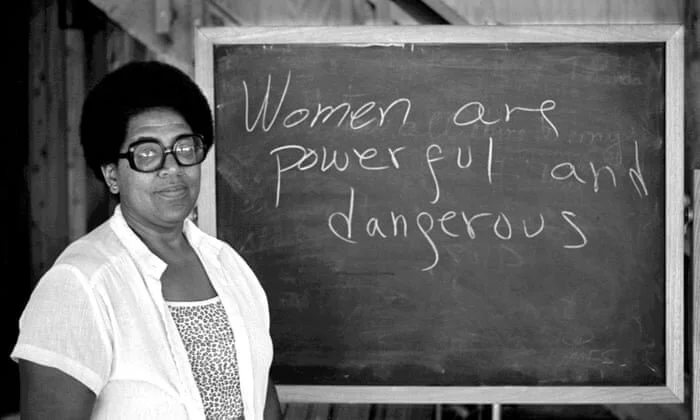
Andre Lorde 1983

Andre Lorde 1983

Audre Lorde: 'Women responding to racism means women responding to anger', National Women’s Studies Association Conference - 1981

February 5, 2020

June 1981, Storrs Connecticut, USA

Racism. The belief in the inherent superiority of one race over all others and thereby the right to dominance, manifest and implied.

Women respond to racism. My response to racism is anger. I have lived with that anger, ignoring it, feeding upon it, learning to use it before it laid my visions to waste, for most of my life. Once I did it in silence, afraid of the weight. My fear of anger taught me nothing. Your fear of that anger will teach you nothing, also.

Women responding to racism means women responding to anger; Anger of exclusion, of unquestioned privilege, of racial distortions, of silence, ill-use, stereotyping, defensiveness, misnaming, betrayal, and co-optation.

My anger is a response to racist attitudes and to the actions and presumptions that arise out of those attitudes. If your dealings with other women reflect those attitudes, then my anger and your attendant fears are spotlights that can be used for growth in the same way I have used learning to express anger for my growth. But for corrective surgery, not guilt. Guilt and defensiveness are bricks in a wall against which we all flounder; they serve none of our futures.

Because I do not want this to become a theoretical discussion, I am going to give a few examples of interchanges between women that illustrate these points. In the interest of time, I am going to cut them short. I want you to know there were many more.

For example:

• I speak out of direct and particular anger at an academic conference, and a white woman says, “Tell me how you feel but don’t say it too harshly or I cannot hear you.” But is it my manner that keeps her from hearing, or the threat of a message that her life may change?

• The Women’s Studies Program of a southern university invites a Black woman to read following a week-long forum on Black and white women. “What has this week given to you?” I ask. The most vocal white woman says, “I think I’ve gotten a lot. I feel Black women really understand me a lot better now; they have a better idea of where I’m coming from.” As if understanding her lay at the core of the racist problem.

• After fifteen years of a women’s movement which professes to address the life concerns and possible futures of all women, I still hear, on campus after campus, “How can we address the issues of racism? No women of Color attended.” Or, the other side of that statement, “We have no one in our department equipped to teach their work.” In other words, racism is a Black women’s problem, a problem of women of Color, and only we can discuss it.

• After I read from my work entitled “Poems for Women in Rage,” a white woman asks me: “Are you going to do anything with how we can deal directly with our anger? I feel it’s so important.” I ask, “How do you use your rage?” And then I have to turn away from the blank look in her eyes, before she can invite me to participate in her own annihilation. I do not exist to feel her anger for her.

• White women are beginning to examine their relationships to Black women, yet often I hear them wanting only to deal with little colored children across the roads of childhood, the beloved nursemaid, the occasional second-grade classmate – those tender memories of what was once mysterious and intriguing or neutral. You avoid the childhood assumptions formed by the raucous laughter at Rastus and Alfalfa, the acute message of your mommy’s handkerchief spread upon the park bench because I had just been sitting there, the indelible and dehumanizing portraits of Amos ‘n Andy and your daddy’s humorous bedtime stories.

• I wheel my two-year-old daughter in a shopping cart through a supermarket in Eastchester in 1967, and a little white girl riding past in her mother’s cart calls out excitedly, “Oh look, Mommy, a baby maid!” And your mother shushes you, but she does not correct you. And so fifteen years later, at a conference on racism, you can still find that story humorous. But I hear your laughter is full of terror and disease.

• A white academic welcomes the appearance of a collection by non-Black women of Color. “It allows me to deal with racism without dealing with the harshness of Black women,” she says to me.

• At an international cultural gathering of women, a well known white american woman poet interrupts the reading of the work of women of Color to read her own poem, and then ashes off to an “important panel.”

If women in the academy truly want a dialogue about racism, it will require recognizing the needs and living contexts of other women. When an academic woman says, “I can’t afford it,” she may mean she is making a choice about how to spend her available money. But when a woman on welfare says, “I can’t afford it,” she means she is surviving on an amount of money that was barely subsistence in 1972, and she often does not have enough to eat. Yet the National Women’s Studies Association here in 1981 holds a conference in which it commits itself to responding to racism, yet refuses to waive the registration fee for poor women and women of Color who wished to present and conduct workshops. This has made it impossible for many women of Color – for instance, Wilmette Brown, of Black Women for Wages for Housework – to participate in this conference. Is this to be merely another case of the academy discussing life within the closed circuits of the academy?

To the white women present who recognize these attitudes as familiar, but most of all, to all my sisters of Color who live and survive thousands of such encounters – to my sisters of Color who like me still tremble their rage under harness, or who sometimes question the expression of our rage as useless and disruptive (the two most popular accusations) – I want to speak about anger, my anger, and what I have learned from my travels through its dominions.

Everything can be used / except what is wasteful / (you will need / to remember this when you are accused of destruction’).

Every woman has a well-stocked arsenal of anger potentially useful against those oppressions, personal and institutional, which brought that anger into being. Focused with precision it can become a powerful source of energy serving progress and change. And when I speak of change, I do not mean a simple switch of positions or a temporary lessening of tensions, nor the ability to smile or feel good. I am speaking of a basic and radical alteration in those assumptions underlining our lives.

I have seen situations where white women hear a racist remark, resent what has been said, become filled with fury, and remain silent because they are afraid. That unexpressed anger lies within them like an undetonated device, usually to be hurled at the first woman of Color who talks about racism.

But anger expressed and translated into action in the service of our vision af!d our future is a liberating and strengthening act of clarification, for it is in the painful process of this translation that we identify who are our allies with whom we have grave differences, and who are our genuine enemies.

Anger is loaded with information and energy. When I speak of women of Color, I do not only mean Black women. The woman of Color who is not Black and who charges me with rendering her invisible by assuming that her struggles with racism are identical with my own has something to tell me that I had better learn from, lest we both waste ourselves fighting the truths between us. If I participate, knowingly or otherwise, in my sister’s oppression and she calls me on it, to answer her anger with my own only blankets the substance of our exchange with reaction. It wastes energy. And yes, it is very difficult to stand still and to listen to another woman’s voice delineate an agony I do not share, or one to which I myself have contributed.

In this place we speak removed from the more blatant reminders of our embattlement as women. This need not blind us to the size and complexities of the forces mounting against us and all that is most human within our environment. We are not here as women examining racism in a political and social vacuum. We operate in the teeth of a system for which racism and sexism are primary, established, and necessary props of profit. Women responding to racism is a topic so dangerous that when the local media attempt to discredit this conference they choose to focus upon the provision of lesbian housing as a diversionary device – as if the Hartford Courant dare not mention the topic chosen for discussion here, racism, lest it become apparent that women are in fact attempting to examine and to alter all the repressive conditions of our lives.

Mainstream communication does not want women, particularly white women, responding to racism. It wants racism to be accepted as an immutable given in the fabric of your existence, like evening-time or the common cold.

So we are working in a context of opposition and threat, the cause of which is certainly not the angers which lie between us, but rather that virulent hatred leveled against all women, people of Color, lesbians and gay men, poor people – against all of us who are seeking to examine the particulars of our lives as we resist our oppressions, moving toward coalition and effective action.

Any discussion among women about racism must include the recognition and the use of anger. This discussion must be direct and creative because it is crucial. We cannot allow our fear of anger to deflect us nor seduce us into settling for anything less than the hard work of excavating honesty; we must be quite serious about the choice of this topic and the angers entwined within it because, rest assured, our opponents are quite serious about their hatred of us and of what we are trying to do here.

And while we scrutinize the often painful face of each other’s anger, please remember that it is not our anger which makes me caution you to lock your doors at night and not to wander the streets of Hartford alone. It is the hatred which lurks in those streets, that urge to destroy us all if we truly work for change rather than merely indulge in academic rhetoric.

This hatred and our anger are very different. Hatred is the fury of those who do not share our goals, and its object is death and destruction. Anger is a grief of distortions between peers, and its object is change. But our time is getting shorter. We have been raised to view any difference other than sex as a reason for destruction, and for Black women and white women to face each other’s angers without denial or immobility or silence or guilt is in itself a heretical and generative idea. It implies peers meeting upon a common basis to examine difference, and to alter those distortions which history has created around our difference. For it is those distortions which separate us. And we must ask ourselves: Who profits from all this?

Women of Color in america have grown up within a symphony of anger at being silenced at being unchosen, at knowing that when we survive, it is in spite of a world that takes for granted our lack of humanness, and which hates our very existence outside of its service. And I say symphony rather than cacophony because we have had to learn to orchestrate those furies so that they do not tear us apart. We have had to learn to move through them and use them for strength and force and insight within our daily lives. Those of us who did not learn this difficult lesson did not survive. And part of my anger is always libation for my fallen sisters.

Anger is an appropriate reaction to racist attitudes, as is fury when the actions arising from those attitudes do not change. To those women here who fear the anger of women of Color more than their own unscrutinized racist attitudes, I ask: Is the anger of women of Color more threatening than the woman-hatred that tinges all aspects of our lives?

It is not the anger of other women that will destroy us but our refusals to stand still, to listen to its rhythms, to learn within it, to move beyond the manner of presentation to the substance, to tap that anger as an important source of empowerment.

I cannot hide my anger to spare you guilt, nor hurt feelings, nor answering anger; for to do so insults and trivializes all our efforts. Guilt is not a response to anger; it is a response to one’s own actions or lack of action. If it leads to change then it can be useful, since it is then no longer guilt but the beginning of knowledge. Yet all too often, guilt is just another name for impotence, for defensiveness destructive of communication; it becomes a device to protect ignorance and the continuation of things the way they are, the ultimate protection for changelessness.

Most women have not developed tools for facing anger constructively. CR groups in the past, largely white, dealt with how to express anger, usually at the world of men. And these groups were made up of white women who shared the terms of their oppressions. There was usually little attempt to articulate the genuine differences between women, such as those of race, color, age, class, and sexual identity. There was no apparent need at that time to examine the contradictions of self, woman as oppressor. There was work on expressing anger, but very little on anger directed against each other. No tools were developed to deal with other women’s anger except to avoid it, deflect it, or flee from it under a blanket of guilt.

I have no creative use for guilt, yours or my own. Guilt is only another way of avoiding informed action, of buying time out of the pressing need to make clear choices, out of the approaching storm that can feed the earth as well as bend the trees. If I speak to you in anger, at least I have spoken to you: I have not put a gun to your head and shot you down in the street; I have not looked at your bleeding sister’s body and asked, “What did she do to deserve it?” This was the reaction of two white women to Mary Church Terrell’s telling of the lynching of a pregnant Black woman whose baby was then torn from her body. That was in 1921, and Alice Paul had just refused to publicly endorse the enforcement of the Nineteenth Amendment for all women — by refusing to endorse the inclusion of women of Color, although we had worked to help bring about that amendment.

The angers between women will not kill us if we can articulate them with precision, if we listen to the content of what is said with at least as much intensity as we defend ourselves against the manner of saying. When we turn from anger we turn from insight, saying we will accept only the designs already known, deadly and safely familiar. I have tried to learn my anger’s usefulness to me, as well as its limitations.

For women raised to fear, too often anger threatens annihilation. In the male construct of brute force, we were taught that our lives depended upon the good will of patriarchal power. The anger of others was to be avoided at all costs because there was nothing to be learned from it but pain, a judgment that we had been bad girls, come up lacking, not done what we were supposed to do. And if we accept our powerlessness, then of course any anger can destroy us.

But the strength of women lies in recognizing differences between us as creative, and in standing to those distortions which we inherited without blame, but which are now ours to alter. The angers of women can transform difference through insight into power. For anger between peers births change, not destruction, and the discomfort and sense of loss it often causes is not fatal, but a sign of growth.

My response to racism is anger. That anger has eaten clefts into my living only when it remained unspoken, useless to anyone. It has also served me in classrooms without light or learning, where the work and history of Black women was less than a vapor. It has served me as fire in the ice zone of uncomprehending eyes of white women who see in my experience and the experience of my people only new reasons for fear or guilt. And my anger is no excuse for not dealing with your blindness, no reason to withdraw from the results of your own actions.

When women of Color speak out of the anger that laces so many of our contacts with white women, we are often told that we are “creating a mood of hopelessness,” “preventing white women from getting past guilt,” or “standing in the way of trusting communication and action.” All these quotes come directly from letters to me from members of this organization within the last two years. One woman wrote, “Because you are Black and Lesbian, you seem to speak with the moral authority of suffering.” Yes, I am Black and Lesbian, and what you hear in my voice is fury, not suffering. Anger, not moral authority. There is a difference.

To turn aside from the anger of Black women with excuses or the pretexts of intimidation is to award no one power – it is merely another way of preserving racial blindness, the power of unaddressed privilege, unbreached, intact. Guilt is only another form of objectification. Oppressed peoples are always being asked to stretch a little more, to bridge the gap between blindness and humanity. Black women are expected to use our anger only in the service of other people’s salvation or learning. But that time is over. My anger has meant pain to me but it has also meant survival, and before I give it up I’m going to be sure that there is something at least as powerful to replace it on the road to clarity.

What woman here is so enamoured of her own oppression that she cannot see her heelprint upon another woman’s face? What woman’s terms of oppression have become precious and necessary to her as a ticket into the fold of the righteous, away from the cold winds of self-scrutiny?

I am a lesbian woman of Color whose children eat regularly because I work in a university. If their full bellies make me fail to recognize my commonality with a woman of Color whose children do not eat because she cannot find work, or who has no children because her insides are rotted from home abortions and sterilization; if I fail to recognize the lesbian who chooses not to have children, the woman who remains closeted because her homophobic community is her only life support, the woman who chooses silence instead of another death, the woman who is terrified lest my anger trigger the explosion of hers; if I fail to recognize them as other faces of myself, then I am contributing not only to each of their oppressions but also to my own, and the anger which stands between us then must be used for clarity and mutual empowerment, not for evasion by guilt or for further separation. I am not free while any woman is unfree, even when her shackles are very different from my own. And I am not free as long as one person of Color remains chained. Nor is anyone of you.

I speak here as a woman of Color who is not bent upon destruction, but upon survival. No woman is responsible for altering the psyche of her oppressor, even when that psyche is embodied in another woman. I have suckled the wolfs lip of anger and I have used it for illumination, laughter, protection, fire in places where there was no light, no food, no sisters, no quarter. We are not goddesses or matriarchs or edifices of divine forgiveness; we are not fiery fingers of judgment or instruments of flagellation; we are women forced back always upon our woman’s power. We have learned to use anger as we have learned to use the dead flesh of animals, and bruised, battered, and changing, we have survived and grown and, in Angela Wilson’s words, we are moving on. With or without uncolored women. We use whatever strengths we have fought for, including anger, to help define and fashion a world where all our sisters can grow, where our children can love, and where the power of touching and meeting another woman’s difference and wonder will eventually transcend the need for destruction.

For it is not the anger of Black women which is dripping down over this globe like a diseased liquid. It is not my anger that launches rockets, spends over sixty thousand dollars a second on missiles and other agents of war and death, slaughters children in cities, stockpiles nerve gas and chemical bombs, sodomizes our daughters and our earth. It is not the anger of Black women which corrodes into blind, dehumanizing power, bent upon the annihilation of us all unless we meet it with what we have, our power to examine and to redefine the terms upon which we will live and work; our power to envision and to reconstruct, anger by painful anger, stone upon heavy stone, a future of pollinating difference and the earth to support our choices.

We welcome all women who can meet us, face to face, beyond objectification and beyond guilt.

Source: https://www.blackpast.org/african-american...

Enjoyed this speech? Speakola is a labour of love and I’d be very grateful if you would share, tweet or like it. Thank you.

Facebook Twitter Facebook
In EQUALITY 3 Tags AUDRE LORDE, RACISM, WOMEN, INTERSECTIONALITY, ANGER, WOMEN RESPONDING TO RACISM, NATIONAL WOMEN'S STUDIES ASSOCIATION COFERENCE, AFRICAN AMERICAN, LGBTQI
Comment
Gabrielle Jackson 2.jpg

Gabrielle Jackson: 'I was not weak, I was not a hypochondriac. I was a woman with endometriosis', Address to the Pelvic Pain Victoria Symposium - 2019

December 9, 2019

23 November 2019, Royal Melbourne Hospital, Melbourne, Australia

When I was 19, I had a skiing accident and suffered a compound fracture of my sacrum. Orthopaedic surgeons seemed fascinated by this injury, each doctor in turn from the Thredbo clinic to Canberra hospital to Sydney telling me they’d never seen a compound fracture of the sacrum like this on a young person. They did lots of tests and x-rays and crowded in my room to talk about it. No one doubted I was in pain and I received lots of attention and sympathy. Cards crowded my room in the rehab hospital.

When I was 35, I was run over by a train in India. I had a broken shoulder, some sprains and torn ligaments and lots of cuts and bruises. It was very painful and everybody around me infinite supplies of sympathy.

I had also lived with severe period pain since my early teens and had been diagnosed with endometriosis at age 23. Sure, there was sympathy after my two laparoscopies but it’s not a pain I talked about much and was not always noticeable to people around me.

Despite these serious injuries and significant pain, I didn’t really pay much attention to different kinds of pain until I was recovering from my second laparoscopy to remove endometriosis when I was 38. The surgery was successful – I’d be warned there was a risk I would have to have a bowel resection and maybe lose an ovary, none of those occurred. But I was also told I’d be better the next day – if not, the day after. I wasn’t. I was in tremendous pain, had uncontrollable nausea and I was frightened. I felt so unwell but I couldn’t account for why – my caring, understanding doctor thought I should be well and I was ashamed to admit how terrible I felt.

Only a few months earlier, I’d had a life-changing moment. It was at a conference run by EndoActive – an advocacy group formed by mother and daughter powerhouse Lesley and Sylvia Freedman, who were demanding better information for people with endometriosis. I went to the conference as a journalist and a patient - but as a patient who believed she knew everything there was to know about endometriosis. I did not.

I shed my first tear when a researcher told the audience that women with endo are 180 times more likely to have chronic fatigue. I had been diagnosed with chronic fatigue syndrome when I was 16. A man I met at uni told me chronic fatigue syndrome was a made-up illness and I felt so ashamed at my weakness I never admitted that diagnosis to anyone ever again. Maybe I had made the whole thing up, I thought? Was I really that sick, that tired? I could no longer remember. Now I recognise that bout of fatigue as just something I live with – and here I was finding out it was a typical symptom of endo.

Not longer after that revelation at the conference, there was a presentation on how endo affects the bowel. I also believed I had irritable bowel syndrome.

Doctors and researchers talked about back pain that sounded a lot like mine, which I thought was due to the skiing accident, they talked about nausea, poor sleep, headaches and dizziness – all common features of my life.

All my adult life, I had thought of myself as a weak person, someone a bit second rate, someone who couldn’t cope with life very well. I wanted to be stronger, I wanted to do more but I always seemed to pay for my periodic bouts of energy in ways I didn’t see happening to my friends - who I believed must have been simply stronger, better, more capable. Routines were good but so hard to keep – I’d make some progress, then be knocked over for a week by incredible pain, or fatigue or stomach upsets. And it took weeks to regain my strength afterwards.

But then, there I was, this May day at Sydney university, learning that all these things that were wrong with me were not at all random but each very common symptoms of this disease I had, this disease I thought amounted to quite bad period pain, but in reality was so much more – was in fact, me.

I was not weak, I was not a hypochondriac. I was a woman with endometriosis. I tried to call my mother when I left the conference to tell her this but I couldn’t get the words out. I was sobbing and I couldn’t stop. I got on the bus and still I couldn’t stop. People slyly and subtly stared at me but still I couldn’t stop sobbing. ‘Mum, I’m not a hypochrondriac, all these things wrong with me are real” I tried to say, over and over again. How do you cope with a lifetime of thinking you’re a hypochondriac only to discover you’re not?

I’ve heard doctors talk about how women love to get an endometriosis diagnosis. It’s often discussed in quite patronising tones – “see how women love to be sick”, is the implication. What is more rarely discussed is that the joy of diagnosis comes from a place of self doubt, from a realisation you aren’t crazy, or weak or a hypochondriac. That the pain you felt was real. This is especially powerful when you have been told by other doctors that the pain is in your head or that it’s normal, or you’ve waited for years for a diagnosis.

Reimagining yourself isn’t easy but legitimacy is a good first step. The knowledge that conference gave me and the research I’ve done since on understanding this disease I have gave me more strength than I could ever have imagined. I would never have dreamed I could write a book while working full time but this knowledge let me dream that dream and here I am today.

But what does this have to do with my recovery from laparoscopy?

I had worked for months on letting myself believe I was stronger than I thought only to be confronted again with these thoughts: maybe I am a hypochondriac? Why don’t I feel better when all the doctors and nurses think I should be? Why do I feel so bad? Why is this pain and nausea and fogginess so scary? I’ve lived in New York, London, Barcelona and Sydney. I’ve travelled through the Middle East alone. I’m not easy to scare, am i? Am I making it up? Do I want to be sick?

After about a week, I was still in pain. The scars had started to heal and my insides no longer felt like knives were scoring through them every time I moved but I had intense digestive troubles. I couldn’t sleep more than an hour or two without waking up from the sensations. I paced up and down to try to alleviate it but as soon as I lay down the pain would return. But I was tired and weak, I needed to lie down.

I went to see my GP. I was trying to describe the feeling to her, telling her the pain was better but this other feeling wouldn’t go away. She did a physical examination. “Why are you telling you’re not in pain when you are?” she asked. I didn’t know why I was telling her I wasn’t in pain, why couldn’t I admit to myself that this was pain I was feeling? My guts hurt like hell. Yes, that’s pain too. She talked me through what she thought was happening, prescribed a new drug and told me why she chose that drug over another. Told me what to eat and drink and sent me for an x-ray, urging me to come back if I was still IN PAIN in another few days. (I love my GP)

It was after that consultation that I went home and thought about all the pain I’d had in my life. In my book, I write: “I relived every episode [of pain], playing it all out in my mind, obsessively. Felt the injuries, over and over. All this pain suddenly accumulated, and like a flooded dam, it washed over me. I was heavy from the burden of it. And choked on it. Every vessel felt constricted, harsh, and to breathe, eat, walk, move a limb, roll over in bed, all required effort. I started to see my body as separate, something apart from me, something cruel and devious and punishing. I came to hate my body and all the pain it had caused.”
So why am I telling you this, when I’m pretty sure I’m preaching to the converted? I decided to tell this story because I believe the people in this room can make change happen.

It was through my own journey of pain that I came to the conclusion I had to use the platform I had as a journalist and editor to share the knowledge I was lucky enough to have received. Because that knowledge really did give me power.

When I was first writing about endometriosis for the Guardian I met the filmmaker Shannon Cohn who made the EndoWhat? documentary and who is working on a second film now.

She told me that her motivation to make the film was because in the 20 years since she was diagnosed with endo, nothing had changed. Many doctors are still giving bad advice, it still takes an average of eight years to be diagnosed, women are still told periods are supposed to be painful, women are still being subjected to ineffective surgeries.

Having been through misdiagnoses and multiple surgeries, Cohn wanted to do something that would put pressure on the medical establishment to change things. She started researching successful social change movements and studied HIV and Aids campaigns.

There were three important lessons she learnt from her studies, she told me. “One, patients became experts in their disease; two, they organised incredibly well; and three, they weren’t afraid to make people in power uncomfortable.”

Aids went from an incurable, highly stigmatised death sentence to a medical miracle in less than half a century. A similar tale can be told about breast cancer.

I happen to think that in Australia, we’re very lucky. The doctors, nurses, physiotherapists, researchers and other professionals who got behind the EndoActive conference showed a willingness from within the medical community for change. And importantly, a willingness to share knowledge to help patients become experts in their disease. And here in this room right now, I see the same willingness, energy and enthusiasm.

We’re up against the odds – which these days favour Instagram heavily. At the same time that a small group of experts and patient advocates were lobbying the government here in Australia to make the national action plan for endometriosis happen, “influencers” were lining up online to glamorise multiple laparoscopies and take sick selfies from their hospital beds. I don’t blame them! Who doesn’t want some sympathy in such a dreadful time? But I do worry that surgery is seen as a badge of honour and the only treatment for endo. I also worry in becoming a fashionable disease, the awareness raising becomes shallow - ends with the sick selfies and fails to push boundaries or consider the full picture of women in pain.

Only last week, one so-called influencer who has almost 53,000 followers on Instagram proclaimed that taking the pill had caused her polycystic ovary syndrome and endometriosis and that both were curable by quitting all pharmaceuticals and changing one’s diet. She became incredulous when people demanded evidence for her claims of a cure. Just yesterday, I was sent a video from a Twitter account that promised me a natural and permanent cure for fibroids in just 21 days and all I had to do to learn the secrets of the simple 3-step miracle program was to click this link and provide my credit card details and I would feel better by the morning! It implied that the terrible drugs we’ve used to manage the fibroids have actually caused the fibroids. The sad fact about this short video was that it was mildly convincing, and I found myself wondering if I was desperate, if I didn’t know what I know, would I try it? I remember, after months of one cold sore after another, signing up for a miracle cold sore cure once in my younger years. It wasn’t a miracle.

This is where we are. Trust in institutions is shrinking and pseudo science is on the up – the wellness industry is growing and people are abandoning science. Which simply means the time for science is now - and has never been more important. We need people like you to help arm people like me with facts.
Together, we need to call policymakers, medical leaders and the people who allocate research funding to account – we need to make them very uncomfortable – and unfortunately they are not made uncomfortable by the sight of a beautiful woman in a hospital gown.

Say the word ‘period’ however and watch them run for the hills.

Journalists can’t do this alone and nor can doctors. And it’s beyond the reach of many chronic pain patients to do this themselves.

But I’m afraid it if we’re to succeed, we may have to make ourselves uncomfortable too.

Part of our campaign to make change must involve examining the ways in which we communicate. Am I part of the ‘fake news media’, an establishment that believes we know better than everyone else? How can I communicate my message in way that doesn’t look down on people? This is very close to home for me. I have had people I know object to the Guardian’s coverage of people like Pete Evans and the practice of chiropractors and naturopaths. They have called our coverage “biased” and “unfair” and think it’s sniggering to people who are desperate.

I think medicine has the same problem. I’ve met countless other people who have told me they turned to natural therapies because these practitioners listen to them, believe them, have time for them. Their treatments may not work but nor did the pharmaceuticals given to them by their doctors.

In a brilliant essay published in the UK’s New Statesman magazine this week reflecting on all the recent literature about women’s pain, the author Imogen West-Knights writes: “We all like to scoff at the wellness industry, with its crystals, potions and lotions, but for those suffering from conditions the medical establishment does not yet understand, it can seem like the only option available.”

We cannot lose the people who have flocked to wellness and together, we have to find a way to win them back.

Understanding my disease and seeking out knowledgeable doctors and physiotherapists has improved my life to no end. I now have a quality of life I couldn’t have dreamed of five years ago.

I have been overwhelmed by the support of doctors, researchers and physiotherapists, both when I was writing the book and since it has been published. Health professionals have shown up to every event I’ve had around Australia. But they have all been women who are already thinking about these issues. Not a single male doctor who I didn’t already know has been in touch with me about this book. It’s not that I think they don’t care. I’ve had very caring and generous male doctors in my life and a few terrible females ones. It’s more that men are not hearing these conversations. Men have been socialised to tune out women’s voices, to believe –subconsciously or not – that women’s voices don’t matter. Certainly, that women’s periods don’t matter to them. Others believe it’s all a bit of feminist claptrap. This is not unique to medicine nor the media.

There are many good news stories to tell from the men I do know. My partner is a male GP and he told me the book has changed the way he practices medicine. He now sees gross examples of colleagues belittling or disbelieving women on a weekly basis and eagerly reports them all to me. How had he not seen this before?

I’m sure each of you has thought about the impact your words can have on your patients. How the expectations of doctors and other health professionals can make or break their patients. How information rather than expectation is so powerful. But many doctors have never considered how their words, their language and their expectations have an effect on their patients. And not because they’re bad people. Many patients have never considered how the words they use to describe their pain affects what the doctor believes about them as people. And not because they’re stupid.

A male GP I know, who is a lovely, caring man, once told me: “I’ve never had a fibromyalgia patient who wasn’t batshit crazy”. After reading my book, he said he was seriously rethinking how and why he had labelled these women and the ways he’d been trained to think in such a way. He took my book to work and when he had a patient who was struggling with the correct words for her anatomy, he took out my book and showed her a diagram labelling the vulva. The consultation totally changed. My friend was also changed by this. “She trusted me” he said, and that trust enabled the two adults to have a conversation about sex free of awkwardness and embarrassment. A similar incident happened the following week. “I think my relationship with my female patients has totally changed”, he said. This was from a man who, in the nicest possible way, felt he had nothing to learn from my book – after all, what could a doctor possibly learn about medicine from a journalist? It’s a reasonable question.

Two women have written to me after reading my book who got from it the courage to challenge what their male doctors were telling them. On both occasions, the doctor really listened and changed their approach – they weren’t offended or put out but happy to be faced with more knowledgeable patients and ready to work together with them.

But I have heard countless other horror stories from women who are treated really badly, disrespected, disbelieved and given very questionable treatments or none at all.

A nurse I know told me that she felt so bad reading my book because she used to work in gynaecology clinic where they did a lot of laparoscopies on endo patients. She said she never had really sympathy for the patients or any understanding of what they’ve been through and all the staff talked about them as though they were difficult or whingers. She tried to give the book to a friend who still works there but she wouldn’t take it. ‘I already know about women’s health’, she told my friend.

How do we get these doctors, nurses and other health professionals to listen when we know that so often the simple act of reflection and perspective can lead to huge changes?

In the New Statesman, Imogen West-Knights concludes her essay like this: One of the questions I had in mind when I began reading these books was: “Do they make a difference to women in pain?” I did not expect to arrive at such a concrete answer. At some point during my reading, the penny dropped: the symptoms of endometriosis were my symptoms, too. I’m now making appointments that could (could!) lead to my finally being diagnosed. So it is almost too clear to me that the answer to my question is: yes. Whatever happens from here, for me and for all of the millions of other woman in pain, the fact that there is now such a breadth of insightful books about the subject is comforting proof that we are not alone. There is strength in numbers.”

These books can’t be written without the careful guidance of people like you. A journalist’s job is to tell the stories of others. Stories need facts, yes, but they also need to be relatable, include real people and real life in them too – and that’s why only the media, medicine and patients working together can really bring about the change we want to see.

I know it’s hard as a doctor to challenge your colleagues. I have found it hard enough to challenge my friends. I often find it hard to convince editors these stories are worth publishing. That’s why none of us can do it alone. But – as West-Knights so simply notes: there is strength in numbers.

pain-and-prejudice.jpg

Gabrielle Jackson’s book is called ‘Pain and Prejudice - A Call to Arms for Women and Their Bodies’

Enjoyed this speech? Speakola is a labour of love and I’d be very grateful if you would share, tweet or like it. Thank you.

Facebook Twitter Facebook
In HEALTH Tags GABRIELLE JACKSON, TRANSCRIPT, PELVIC PAIN SYMPOSIUM, MEDICINE, ENDOMETRIOSIS, WOMEN, PELVIC PAIN
Comment

Naomi Wadler: 'We know life isn’t equal for everyone', March for Our Lives - 2018

March 26, 2018

24 March 2018, Washington DC, USA

I am here today to acknowledge and represent the African-American girls whose stories don’t make the front page of every national newspaper,whose stories don’t lead on the evening news. I represent the African-American women who are victims of gun violence, who are simply statistics instead of vibrant, beautiful girls full of potential.

It is my privilege to be here today, I am indeed full of privilege. My voice has been heard. I am here to acknowledge their stories, to say they matter, to say their names, because I can, and I was asked to be. For far too long, these names, these black girls and women, have been just numbers. I’m here to say, ‘Never again’ for those girls, too. I am here to say that everyone should value those girls, too.

People have said that I am too young to have these thoughts on my own. People have said that I am a tool of some nameless adult. It’s not true. My friends and I might still be eleven, and we might still be elementary school, but we know. We know life isn’t equal for everyone, and we know what is right and wrong. We also know that we stand in the shadow of the Capitol, and we know that we have seven short years until we, too, have the right to vote. So I am here today to honor the words of Toni Morrison: ‘If there is a book that you want to read but it hasn’t been written yet, you must be the one to write it.’ I urge everyone here and everyone who hears my voice to join me in telling the stories that aren’t told, to honor the girls, the women of color who are murdered at disproportionate rates in this nation. I urge each of you to help me write the narrative for this world and understand, so that these girls and women are never forgotten.

Emma Gonzalez March for Our lives.png

Related content: Emma Gonzalez's speech at the same event, beautifully written and centred around the six minutes and twenty seconds of shooting at Parkland, and the seventeen lives lost.

" For those who still can't comprehend, because they refuse to, I'll tell you where it went."


Source: https://www.themarysue.com/naomi-walder-sp...

Enjoyed this speech? Speakola is a labour of love and I’d be very grateful if you would share, tweet or like it. Thank you.

Facebook Twitter Facebook
In LAWS AND JUSTICE Tags NAOMI WADLER, MARCH FOR OUR LIVES, CHILD SPEAKER, TRANSCRIPT, 11 YEAR OLD, AFRICAN AMERICAN, WOMEN, GUN CONTROL, NEVER AGAIN
Comment

Clare Wright: 'Discord in voices, female voices, are still seen to belong to wicked witches and evil stepmothers', Breakthrough '16, VWT - 2016

August 31, 2017

25 November 2015, Melbourne Town Hall, Melbourne, Australia

Thank you so much, Anna. What a great looking stage we’ve got here, hey? And I have to say that the view from the stage looking down is extraordinary as well. Thank you all for coming out, it’s an amazing day. In keeping with the spirit of reconciliation I’d like to start by acknowledging the traditional owners of the land on which we gather today. The Wurundjeri people of the Kulin Nation, and pay my respects to their elders past, present and emerging. I recognise that this has always been a place of discussion and debate, and I recognise that Aboriginal sovereignty has never been ceded.

I’m going to start today with a confession….my confession is that I have no idea what’s going on on the screen right now. Aha, lets try that again. Thank you, I assume Marie Claire is one of the sponsors of Breakthrough?

-Laughter-

Oh hello, there we go. I want to start today with another confession; I am a surfy chick. Sure I might have cheered along with the rest of my 12 year old friends when Debbie and Sue took their board out into the water at the end of the 1981 version of Puberty Blues, but my feet remained on dry land (third confession; not very good at PowerPoints). My feet stayed firmly planted there, even when I fell in love with a surfer when I was 19. From the safety of many a rocky headland, many a windswept beach, I have watched that man. Now our teenage sons ride those waves, those glorious, exhilarating waves. Our 11 year old daughter has just started to go “out the back” with her brothers. She’s much braver than me, but I’d like to think that I know a thing or two about waves. Here are some of the things that I know.

Waves are mainly a product of wind. The greater the winds force, the bigger the wave. Secondly, the friction created by wind on water forms a travelling circular mass of energy, and this is called swell. When swell reaches the coast, waves break in sets. Then the backwash from waves hitting the land returns the water and energy to the ocean. Force, friction, energy, swell, backwash. No wonder the international feminist movements peak achievements have been described through the metaphor of waves.

First wave feminism is defined by Wikipedia as “a period of feminist activity and thought that occurred within the time period of the early 20th century, throughout the world.” This is the time extending over at least six decades, and many more in some countries, where women fought for their right to be franchised. Their legal entitlement as citizens, under the democratic principal of “no taxation without representation”. This was a political revolution.

Second wave feminism, is Wiki-defined as, “a period of feminist activity and thought that first began in the early 1960’s in The United States, and eventually spread throughout the Western World and beyond. Now this is the time when women, now largely included in the civic body, protested the right to control over their corporal bodies. The personal, was now political. This is the era of women’s lib, the sexual revolution. Personally, I tend to think of these two key historical periods as the two V’s. First wave feminism was all about the vote, and second wave feminism was all about the vagina.

Now this is a crude short hand to be sure, both waves of activism campaigned for gender equality across a range of issues. But there is more to women’s history than these twin peaks of paradigm shifting success. Of course there is. To assume otherwise would be like saying that World War One and World War Two existed in isolation, with modern history devoid of any other instances of armed combat. Clearly, movements for social change, like international conflicts exist along a continuum. But can I ask you this, how much do we know about the history of women’s political activism in Australia? I’ll put this question to you in another way; did you know that there were women behind the rickety fortification of the Eureka Stockade, on that fateful morning of the 3rd of December in 1854? An event we all learned about in school?

Or that British troops opened fire that day on a white civilian population, which unmistakably included women and children. Killing at least one woman. Or that women were central to the community rebelliousness that cumulated in the event that we have come to know as the birthplace of Australian democracy? Did you know that the Women’s Christian Temperance Union actively supported the stalwart men and women who carried out the Pilbara pastor strike of 1946 to 1949? The longest running strike in Australia’s history, sometimes known as the Blackfella’s Eureka. And did you know that one of the most active participants in the Australians civil rights movements was Faith Bandler, an Indigenous woman from Murwillumbah who served in the Australian Women’s Land Army before becoming a full time activist in the 1950’s?

Bandler lead the campaign for reform that cumulated in the successful 1967 referendum to remove racially discriminative clauses from our constitution. Well, probably not, and that’s because there are more ways to silence inconvenient truths. Like the fact that women have historically protested, organised, networked, and advocated for their sex, their families, their communities, and their country. There are more ways to silence truths than by denying women access to the vote, to education, to legal autonomy, or indeed to knowledge of our own history. It is no accident that erasing women from history is one of the mechanisms used to ensure the visibility and viability of patriarchal structures of dominance and control. If knowledge is power, it’s fundamentally disempowering for women if their stories remain secreted in the archives, or confined to academic circles or local knowledge.

How can we know what we are capable of accomplishing, enduring, resisting, overcoming, if we don’t understand how women before us have negotiated their lives? This is another great Australian silence. A silence that perpetuates the myth of exclusive male agency and male potency, and by implication, presumed historical absence from the places and events of nation building, also provides the rationale for male privilege and male entitlement today.

Just because you didn’t learn about it in schools, doesn’t mean that it didn’t happen. I now want to give you some examples of women acting in ways that were adversarial, confrontational and risk taking. That is, acting in ways that if performed by male protagonists, would be considered to show leadership and valour.

The 19th century female factories in New South Wales and Tasmania for example, where an estimated 9,000 convict women worked for no pay, to manufacture commodities like spun wool, cotton and linen. On which the new colonies relied for both domestic use and export. In 1827, the women declared that they’d had enough. A riot at the Parramatta female factory over a cut in rations and poor conditions is considered to be the first industrial action staged by women in Australia. Fun fact: when the Parramatta female factory was closed 21 years later, the building was reassigned as a lunatic asylum.

Then, there are the women of the Cascades factory in Tasmania, who in 1838 staged their own version of the Misogyny Speech. The inmates of this forced labour camp were being lectured on morality by a visiting preacher. A witness recorded what happened next: “Growing weary of his cant, the 300 women turned right around and at one impulse pulled up their clothes, showing their naked posteriors, which they simultaneously smacked with their hands, making a loud and not very musical noise.” I reckon this may have been Australia’s first example of a flash mob, or maybe twerking.

Now another rowdy woman was Fanny Balbuk, a Noongar woman born in 1840. Fanny was prominent in her day for protesting against the occupation of her traditional lands south of Perth. Daisy Bates, who met Fanny in the 1930’s, wrote that “to the end of her life, she raged and stormed at the usurping of her beloved home ground. Through fences and over them, Balbuk took the straight track to the end. When a house was built in the way, she broke its fence palings with her digging stick and charged up the steps and through the rooms.”

Now, at the height of a miners strike in Plunes in 1876, an unnamed woman was also raging and storming. This time, against scab labour employed by the mine. A contemporary later wrote, “nearby was a heap of road metal, and arming herself with a few stones, a sturdy north of Ireland woman without shoes or stockings mounted the barricade as the coaches drew up. As she did, she called to the other women saying, “come on you cousin ginnies! Bring me the stones and I will fire them!” Forth confession, I can’t do an Irish accent. When a policeman raised his gun at the woman, she lifted her shirt, bared her breasts and spat, “shoot away and be damned to ya! Better be shot than starved to death.”

Let me introduce you now, to Ellen Young. An educated English woman who had a different tactic for making herself heard. Ellen was the member of a Ballarat mining community, who witnessed first hand the grievances of the diggers in 1854. She wrote directly to governor Hotham to state the diggers case, as well as penning fiery letters to the editor of the Ballarat times to mobilise grassroots support. In one letter, she provocatively declared, “we, the people, demand cheap land, just magistrates to be represented in the legislative council; in fact, treated as the free subjects of a great nation.” These were fighting words.

In 1917, anti-war campaigner Adela Pankhurst was jailed for her role in inciting riots at the height of the general strike that had crippled wartime Melbourne. Working class women had shouldered a disproportionate amount of the economic burden of war, with food rationing and other austerity measures. The riots that happened just a few blocks away from here involved ten thousand women and their male supporters, rampaging through the CBD smashing shop windows and destroying property. This was not one night of mayhem, but the sustained series of orchestrated attacks on the political and commercial elite.

Now you could write a whole history of women chaining themselves to things.  Take Zelda Fay D’Aprano, an orthodox Jewish woman who left school at 14. Zelda spent most of her life fighting against the injustice she witnessed on the factory floor. When the meat workers union lost a test case for equal pay in 1969, Zelda chained herself across the entrance to the commonwealth building in Melbourne. She was cut free by police, only to lock herself to the arbitration court gates three days later. Then there’s Merle Thornton and Rosalie Bogner, academics of the University of Queensland, who chained themselves to the foot rail of the “male only” public bar at The Regatta Hotel in Brisbane in 1965. Their actions sparked a wave of copycat self-incarcerations in Australian pubs.

Perhaps police could blame Muriel Matters, for the sudden demand for bolt cutters. Muriel was an Adelaide born suffrage campaigner. After South Australia became only the second jurisdiction in the world where women had won the right to vote in 1894, following New Zealand in 1893, Muriel went to England to help spread the gospel of female enfranchisement. In 1908 Muriel chained herself to the grill of the ladies gallery in the House of Commons. The grill was built to obscure the view of women of parliamentary proceedings. The whole grill had to be cut away, with Muriel still attached to it, before a blacksmith could release her. Muriel was latter sentenced to one month in Holloway prison, where British suffragettes famously staged hunger strikes and were force-fed.

Another Muriel, Muriel Henney campaigned for equal pay for Australian women for over 50 years. Muriel was a convent-educated girl from Richmond, who saw wage inequality as the major obstacle to the achievement of equal opportunity status for women. She died in poverty on the 19th of May 1974 (my fifth birthday as it happens) just one week after the wage case granted equal minimum wages to men and women.

My favourite feminist, Vida Goldstein, did not die in poverty but certainly obscurity at the age of 80 in 1949. Vida was born into protestant squattocracy, but went on to spearhead the suffrage campaign that saw Australia become the first nation in the world where white women won equal political rights with men. That is the right to vote and to stand for parliament. She travelled to America to represent Australia and New Zealand at the first international suffrage convention, and there she was greeted with a rock star reception.

Zelda D’Aprano, by the way, is still alive today, she’s 98, and I happened to see that there was a tag for her outside so I hope maybe she’s here. Let’s not forget too the hundreds of women’s organisations that have not been outwardly feminists, but have been instrumental in changing the conditions of daily life of women in this country. I’m thinking here of the Australian Women’s National League, the Country Women’s Association, and the Housewives Association just to name a few. All of these nominally conservative organisations have in one way or another advocated for improvements to the status of women and girls.

So apart from making for a nice slideshow, does knowing anything about these women and their actions make any difference to the price of fish? Well I think it does, and this is the reason why. We have a lost heritage of women’s political activism in Australia, in this country. An activism that had its roots in popular mass movements that included both men and women. Men and women have both historically stood together on common ground. What did Ellen Young say? “We the people, too, loudly profess our mutual commitment to notions of fairness, justice and autonomy.” Women have consistently and courageously defended the right to free speech, to freedom of assembly, and to freedom of the press as well as to women’s rights and human rights more generally. This collective historical memory is important for present and future democratic activism and change. Creating change, real game changing change is hard work, as we’ve certainly seen, as Ann demonstrated in the American election campaign.

If we understand that Australian women, as well as men, have been historically vigilant and hardworking, might not that inspire more of todays women to honour the legacy of those actions? But more than that, to know that women acted in ways that were anti-authoritarian, rebellious, and designed to kick up a stink makes a difference because it reminds us that, as the folk singer Glen Tomasetti sang, “it rarely pays to be too polite, girls”.

The lost heritage of female activism that had its roots in popular mass movements also matters because discord in voices, female voices, are still seen to belong to wicked witches and evil stepmothers. Whiners and wowzers, what was the latest incarnation of that? Fright bats, or nasty women. Not female diggers, mates, and outlaws, our national larrikin icons. We need to understand women’s relationship to citizenship in order to affirm their sense of entitlement to participate in public discourses and occupy key cultural spaces.

I’ll give you one example of how historical consciousness, the female strategies for social change, might work on the ground. Now I can find no evidence to suggest that the women, who marshalled the now famous Monster Petition for women’s suffrage in Victoria in 1891, drew inspiration from the memory of earlier female activism to bolster their cause. In this action, women collected 30 000 names in six weeks, responding to premier James Munro’s promise that if the women of Victoria could demonstrate that they actually wanted the vote, he would introduce a franchise bill. The Monster Petition was the largest yet put before an Australian colonial parliament, although Victorian women didn’t actually win the vote until 1908.

Now the symbolism of the Monster suffrage petition was recently invoked when a group of 12 prominent Australian women organised by Judith Pratt and Mary Crooks, and led by professor Fiona Stanley, started the Monster Climate Petition. The Monster Climate petition called on the Federal Parliament to join in bipartisan action on climate change. Following in the footsteps of the 1891 suffragettes, over 70 000 pen and ink signatures were collected, mainly by women, in just over six weeks. Making the petition the fourth largest to be introduced to the Australian House of Representatives. Now the petition, as we can see here, was presented to parliament on the 3rd of December in 2014. Coincidentally, the 160th anniversary of the Eureka Stockade.

If women were included in our public narratives of mateship, sacrifice, solidarity and service, might not that breed respect and empathy across the gender-divide? And if we wrote some new narratives of reconciliation, healing, and responsibility and care, might not that bode well for our collective spirit? Our environment, and our planet alike? Don’t get me wrong, I’m not saying that women have always done great deeds for virtuous reasons in the past. Women have been colonisers, racists, and enablers of oppressive class structures that limit the lives of other women. But I do believe that gender equality is achieved when we recognise that women to have been agents in the past. That women to have been shapers of their own and others destinies. In other words, that women to have made history. The only way we will understand that we can make history today is when we fully appreciate just how much impact we have made in the past. And as I hope I have demonstrated, we have our own hero’s to guide our path and give strength to our arms. We have Ellen, we have Vida, we have the Muriels, we have Murel, Zelda, and Fanny. We have faith. We are all standing on the sturdy shoulders of those who have come before us. Some giants, some totems. And some of those shoulders don’t just happen to belong to women, there is nothing incidental or accidental about the platforms they’ve provided. Women deliberately, carefully and creatively built the edifice of their political and civic contributions of who we are today.

In 1869, when Vida Goldstein was born, it would seem absurd that any woman would ever be able to vote. By her death in 1949, women in almost 100 countries had been franchised, and Vida herself stood for parliament five times. I was born in 1969, and even a century after Vida, I can hardly dare to imagine what women will achieve for gender equality in my lifetime. I honestly quiver in excitement at the prospect.

The limitation for the wave metaphor, in framing women’s historical impact, is the implication that those two momentous movements, first and second wave feminism, surged, peaked, then pleated out and disappeared. This process would describe tsunami’s, not waves. Waves keep on coming, the inevitable, relentless result of friction and energy. Waves never stop rolling in, because there will never not be force and friction, energy, swell, and backwash that will pull us back into the deep. Waves build, they crest, and they subside. And then they build again. What’s more, you need the wind, the oppositional force to create a wave. As any surfer, or surfy chick knows, if the wind is going with the wave, the energy is dissipated and all you get is slob. In the face of opposition, women like waves will continue to rise, break, and rise again. The cause of gender equality, like the ocean, is bigger than me, or you, or all of use in this room today. It is certainly bigger and more potent than the break walls and sandbags of male privilege. No wonder the institutions, instruments and practitioners of gender discrimination, have been and still are afraid. They should be afraid. There is a wall of living energy hurdling towards them.

It seems to me that we, the people, have three options in the face of such a threat to our sense of mastery and control. We can duck under, hoping that we can dive deep enough to avoid the turbulence before the next wave breaks. We can misjudge the take off, squib at the last minute, and get wiped out by our ignorance and cowardice. Or we can get up, stand up, and enjoy this most wild ride called freedom. Thank you.

The Breakthrough 16 event was organised by the Victorian Women's Trust. This speech was reposted from VWT website with permission. Clare Wright is a documentary maker and award winning author and historian who won the Stella Prize for 'The Forgotten Heroes of Eureka'. She has other speeches on Speakola, including 'Epic Fail' about post natal depression.


Richard Denniss.jpg

Related content: This Breakthrough 16 speech by economist Richard Denniss was delivered at the same event. It's about the mistaken beliefs that hold women back.

Source: https://www.vwt.org.au/clare-wright-waves-...

Enjoyed this speech? Speakola is a labour of love and I’d be very grateful if you would share, tweet or like it. Thank you.

Facebook Twitter Facebook
In EQUALITY 2 Tags CLARE WRIGHT, MAKING WAVES MAKING HISTORY, WOMEN, BREAKTHROUGH '16, FEMINISM, GENDER EQUALITY, TRANSCRIPT
Comment

Virginia Woolf: 'But this freedom is only a beginning--the room is your own, but it is still bare', Professions for Women, National Society for Women's Service - 1931

June 22, 2017

21 January 1931, London, United Kingdom

When your secretary invited me to come here, she told me that your Society is concerned with the employment of women and she suggested that I might tell you something about my own professional experiences. It is true I am a woman; it is true I am employed; but what professional experiences have I had? It is difficult to say. My profession is literature; and in that profession there are fewer experiences for women than in any other, with the exception of the stage--fewer, I mean, that are peculiar to women. For the road was cut many years ago--by Fanny Burney, by Aphra Behn, by Harriet Martineau, by Jane Austen, by George Eliot--many famous women, and many more unknown and forgotten, have been before me, making the path smooth, and regulating my steps. Thus, when I came to write, there were very few material obstacles in my way. Writing was a reputable and harmless occupation. The family peace was not broken by the scratching of a pen. No demand was made upon the family purse. For ten and sixpence one can buy paper enough to write all the plays of Shakespeare--if one has a mind that way. Pianos and models, Paris, Vienna and Berlin, masters and mistresses, are not needed by a writer. The cheapness of writing paper is, of course, the reason why women have succeeded as writers before they have succeeded in the other professions.

But to tell you my story--it is a simple one. You have only got to figure to yourselves a girl in a bedroom with a pen in her hand. She had only to move that pen from left to right--from ten o'clock to one. Then it occurred to her to do what is simple and cheap enough after all--to slip a few of those pages into an envelope, fix a penny stamp in the corner, and drop the envelope into the red box at the corner. It was thus that I became a journalist; and my effort was rewarded on the first day of the following month--a very glorious day it was for me--by a letter from an editor containing a cheque for one pound ten shillings and sixpence. But to show you how little I deserve to be called a professional woman, how little I know of the struggles and difficulties of such lives, I have to admit that instead of spending that sum upon bread and butter, rent, shoes and stockings, or butcher's bills, I went out and bought a cat--a beautiful cat, a Persian cat, which very soon involved me in bitter disputes with my neighbours.

What could be easier than to write articles and to buy Persian cats with the profits? But wait a moment. Articles have to be about something. Mine, I seem to remember, was about a novel by a famous man. And while I was writing this review, I discovered that if I were going to review books I should need to do battle with a certain phantom. And the phantom was a woman, and when I came to know her better I called her after the heroine of a famous poem, The Angel in the House. It was she who used to come between me and my paper when I was writing reviews. It was she who bothered me and wasted my time and so tormented me that at last I killed her. You who come of a younger and happier generation may not have heard of her--you may not know what I mean by the Angel in the House. I will describe her as shortly as I can. She was intensely sympathetic. She was immensely charming. She was utterly unselfish. She excelled in the difficult arts of family life. She sacrificed herself daily. If there was chicken, she took the leg; if there was a draught she sat in it--in short she was so constituted that she never had a mind or a wish of her own, but preferred to sympathize always with the minds and wishes of others. Above all--I need not say it---she was pure. Her purity was supposed to be her chief beauty--her blushes, her great grace. In those days--the last of Queen Victoria--every house had its Angel. And when I came to write I encountered her with the very first words. The shadow of her wings fell on my page; I heard the rustling of her skirts in the room. Directly, that is to say, I took my pen in my hand to review that novel by a famous man, she slipped behind me and whispered: "My dear, you are a young woman. You are writing about a book that has been written by a man. Be sympathetic; be tender; flatter; deceive; use all the arts and wiles of our sex. Never let anybody guess that you have a mind of your own. Above all, be pure." And she made as if to guide my pen. I now record the one act for which I take some credit to myself, though the credit rightly belongs to some excellent ancestors of mine who left me a certain sum of money--shall we say five hundred pounds a year?--so that it was not necessary for me to depend solely on charm for my living. I turned upon her and caught her by the throat. I did my best to kill her. My excuse, if I were to be had up in a court of law, would be that I acted in self-defence. Had I not killed her she would have killed me. She would have plucked the heart out of my writing. For, as I found, directly I put pen to paper, you cannot review even a novel without having a mind of your own, without expressing what you think to be the truth about human relations, morality, sex. And all these questions, according to the Angel of the House, cannot be dealt with freely and openly by women; they must charm, they must conciliate, they must--to put it bluntly--tell lies if they are to succeed. Thus, whenever I felt the shadow of her wing or the radiance of her halo upon my page, I took up the inkpot and flung it at her. She died hard. Her fictitious nature was of great assistance to her. It is far harder to kill a phantom than a reality. She was always creeping back when I thought I had despatched her. Though I flatter myself that I killed her in the end, the struggle was severe; it took much time that had better have been spent upon learning Greek grammar; or in roaming the world in search of adventures. But it was a real experience; it was an experience that was bound to befall all women writers at that time. Killing the Angel in the House was part of the occupation of a woman writer.

But to continue my story. The Angel was dead; what then remained? You may say that what remained was a simple and common object--a young woman in a bedroom with an inkpot. In other words, now that she had rid herself of falsehood, that young woman had only to be herself. Ah, but what is "herself"? I mean, what is a woman? I assure you, I do not know. I do not believe that you know. I do not believe that anybody can know until she has expressed herself in all the arts and professions open to human skill. That indeed is one of the reasons why I have come here out of respect for you, who are in process of showing us by your experiments what a woman is, who are in process Of providing us, by your failures and successes, with that extremely important piece of information.

But to continue the story of my professional experiences. I made one pound ten and six by my first review; and I bought a Persian cat with the proceeds. Then I grew ambitious. A Persian cat is all very well, I said; but a Persian cat is not enough. I must have a motor car. And it was thus that I became a novelist--for it is a very strange thing that people will give you a motor car if you will tell them a story. It is a still stranger thing that there is nothing so delightful in the world as telling stories. It is far pleasanter than writing reviews of famous novels. And yet, if I am to obey your secretary and tell you my professional experiences as a novelist, I must tell you about a very strange experience that befell me as a novelist. And to understand it you must try first to imagine a novelist's state of mind. I hope I am not giving away professional secrets if I say that a novelist's chief desire is to be as unconscious as possible. He has to induce in himself a state of perpetual lethargy. He wants life to proceed with the utmost quiet and regularity. He wants to see the same faces, to read the same books, to do the same things day after day, month after month, while he is writing, so that nothing may break the illusion in which he is living--so that nothing may disturb or disquiet the mysterious nosings about, feelings round, darts, dashes and sudden discoveries of that very shy and illusive spirit, the imagination. I suspect that this state is the same both for men and women. Be that as it may, I want you to imagine me writing a novel in a state of trance. I want you to figure to yourselves a girl sitting with a pen in her hand, which for minutes, and indeed for hours, she never dips into the inkpot. The image that comes to my mind when I think of this girl is the image of a fisherman lying sunk in dreams on the verge of a deep lake with a rod held out over the water. She was letting her imagination sweep unchecked round every rock and cranny of the world that lies submerged in the depths of our unconscious being. Now came the experience, the experience that I believe to be far commoner with women writers than with men. The line raced through the girl's fingers. Her imagination had rushed away. It had sought the pools, the depths, the dark places where the largest fish slumber. And then there was a smash. There was an explosion. There was foam and confusion. The imagination had dashed itself against something hard. The girl was roused from her dream. She was indeed in a state of the most acute and difficult distress. To speak without figure she had thought of something, something about the body, about the passions which it was unfitting for her as a woman to say. Men, her reason told her, would be shocked. The consciousness of--what men will say of a woman who speaks the truth about her passions had roused her from her artist's state of unconsciousness. She could write no more. The trance was over. Her imagination could work no longer. This I believe to be a very common experience with women writers--they are impeded by the extreme conventionality of the other sex. For though men sensibly allow themselves great freedom in these respects, I doubt that they realize or can control the extreme severity with which they condemn such freedom in women.

These then were two very genuine experiences of my own. These were two of the adventures of my professional life. The first--killing the Angel in the House--I think I solved. She died. But the second, telling the truth about my own experiences as a body, I do not think I solved. I doubt that any woman has solved it yet. The obstacles against her are still immensely powerful--and yet they are very difficult to define. Outwardly, what is simpler than to write books? Outwardly, what obstacles are there for a woman rather than for a man? Inwardly, I think, the case is very different; she has still many ghosts to fight, many prejudices to overcome. Indeed it will be a long time still, I think, before a woman can sit down to write a book without finding a phantom to be slain, a rock to be dashed against. And if this is so in literature, the freest of all professions for women, how is it in the new professions which you are now for the first time entering?

Those are the questions that I should like, had I time, to ask you. And indeed, if I have laid stress upon these professional experiences of mine, it is because I believe that they are, though in different forms, yours also. Even when the path is nominally open--when there is nothing to prevent a woman from being a doctor, a lawyer, a civil servant--there are many phantoms and obstacles, as I believe, looming in her way. To discuss and define them is I think of great value and importance; for thus only can the labour be shared, the difficulties be solved. But besides this, it is necessary also to discuss the ends and the aims for which we are fighting, for which we are doing battle with these formidable obstacles. Those aims cannot be taken for granted; they must be perpetually questioned and examined. The whole position, as I see it--here in this hall surrounded by women practising for the first time in history I know not how many different professions--is one of extraordinary interest and importance. You have won rooms of your own in the house hitherto exclusively owned by men. You are able, though not without great labour and effort, to pay the rent. You are earning your five hundred pounds a year. But this freedom is only a beginning--the room is your own, but it is still bare. It has to be furnished; it has to be decorated; it has to be shared. How are you going to furnish it, how are you going to decorate it? With whom are you going to share it, and upon what terms? These, I think are questions of the utmost importance and interest. For the first time in history you are able to ask them; for the first time you are able to decide for yourselves what the answers should be. Willingly would I stay and discuss those questions and answers--but not to-night. My time is up; and I must cease.

Source: http://s.spachman.tripod.com/Woolf/profess...

Enjoyed this speech? Speakola is a labour of love and I’d be very grateful if you would share, tweet or like it. Thank you.

Facebook Twitter Facebook
In EQUALITY 3 Tags VIRGINIA WOOLF, PROFESSIONS FOR WOMEN, WOMEN, SEXISM, WRITER
Comment

Sheila E Widnall: 'Digits of Pi: Barriers and Enablers for Women in Engineering', National Academy of Engineering - 2000

June 22, 2017

Sheila Widnall was the first woman to head a branch of the American military (air force). She is a professor in aeronautics and astronautics and first woman to serve as chair of the MIT faculty. The video above is not the famous speech below.

2000, National Academy of Engineering, USA

In a recent seminar with faculty colleagues, we were discussing the information content of a string of numbers. The assertion was made that the quantity of information equaled the number of bits in the string, unless you were told that, for example, the string was the digits of Pi. Then the information quantity became essentially one. The additional assertion was made that of course all MIT freshmen knew Pi out to some outrageously large number of digits. I remarked that this seemed to me like a "guy" sort of thing, and I doubted that the women at MIT knew Pi out to some large number of digits.

This got me thinking whether there are other "guy" sort of things which are totally irrelevant to the contributions that engineers make to our society but that nevertheless operate to keep women out of engineering. These "guy" things may also be real barriers in the minds of some male faculty members who may unconsciously, or even consciously, tell women that women don't belong in engineering. I have recently visited university campuses where that is still going on.

Let me make a strong statement: If women don't belong in engineering, then engineering as a profession is irrelevant to the needs of our society. If engineering doesn't make welcome space for them and embrace them for their wonderful qualities, then engineering will become marginalized as other fields expand their turf to seek out and make a place for women.

So let me give you Sheila Widnall's top 10 reasons why women are important to the profession of engineering:

10. Women are a major force in our society. They are self-conscious about their role and determined to be heard.

9. Women are 50 percent of the consumers of products in our society and make over 50 percent of the purchasing decisions.

8. To both men and women today, a profession that does not have a significant percentage of women is not an attractive career choice.

7. Women are integrators. They are experts at parallel processing, at handling many things at once.

6. Women are comfortable in fuzzy situations.

5. Women are team builders. They inherently practice what is now understood as an effective management style.

4. Engineering should be and could be the twenty-first century foundation for all of the professions.

3. Women are a major force in the professions of law, medicine, media, politics, and business.

2. Women are active in technology. Often they have simply bypassed engineering on their way to successful careers in technology.

1. Women are committed to the important values of our times, such as protecting the environment, product safety, and education, and have the political skill to be effective in resolving these issues. They will do this with or without engineering. They are going to be a huge force in the solution of human problems.

Trends in our society indicate that we are moving to a service economy. We are moving from the production of hardware to the provisions of total customer solutions. That is, we are merging technology and information and increasing the value of both. What role will the engineering profession play in this? One future vision for engineering is to create the linkage of hardware, information, and management. It seems to me that women are an essential part of this new imperative for the engineering profession, if the profession is to be central to the solution of human problems. Another possible future for engineering is to be restricted to the design of hardware. If we do this, we will be less central to the emerging economy and the needs of our society.

The top 10 reasons why women don't go into engineering:

10. The image of that guy in high school who all of the teachers encouraged to study engineering.

9. Poorly taught freshman physics.

8. Concerns that a female with the highest math score won't get a date to the prom.

7. Lack of encouragement from parents and high school teachers.

6. Guys who worked on cars and computers, or faculty members who think they did.

5. Lack of encouragement from faculty and a survival-of-the-fittest mentality (e.g., "I treat everyone badly" attitude or constant use of masculine pronouns describing engineers).

4. Lack of women faculty or obvious mistreatment of women faculty by colleagues and departments.

3. Bias in the math SATs.

2. Lack of visible role models and other women students in engineering.

1. Lack of connection between engineering and the problems of our society. Lack of understanding what engineers do.

These issues of language, expectations, behavior, and self-esteem are still with us. Until we face them squarely, I doubt that women students will feel comfortable in engineering classrooms. No, I'm not talking about off-color stories, although I'm sure that goes on. I'm talking about jokes and innuendo that convey a message to women that they're not wanted, that they're even invisible. It may be unconscious, and it may come from the least secure of their male classmates or teachers—people whose own self-esteem is so low and who lack such self-confidence that they grasp for comments that put them at least in the top 50 percent by putting all of the women in second place. Also, many men express discomfort at having women "invade" their "space"; they literally don't know how to behave. When I was a freshman advisor I told my women students that the greatest challenge to their presence at MIT would come from their classmates who want to see themselves in at least the upper 50 percent of the class.

These attitudes are so fundamental that, unless they are questioned, people just go about the business of treating women as if they're invisible. I remember one incredible incident that happened to me when I was a young assistant professor. I was teaching the graduate course in aerodynamics with a senior colleague, and I was to give the first lecture. So I walked into class and proceeded to organize the course, outline the syllabus, and give the first introductory lecture. Two new graduate students from Princeton were in the class. One of them knew who I was. The other thought I was the senior professor's secretary and was very impressed at my ability to give the first lecture. I think you can all see the intellectual disconnect in this example. It never occurred to this student that I might be a professor, although I'm sure I put my name and phone number on the blackboard. So he thought there were two professors and one secretary. I did in fact eventually become a Secretary—but that is another story.

I once got a call from a female faculty colleague at another university. She was having trouble teaching her class in statistics. All of the football players who were taking it were sitting in the back row and generally misbehaving. If she asked me for advice on that today I don't know what I'd say. But what I did say—that worked—was that she should call them in one by one and get to know them as individuals. This evidently worked and she sailed on. Today she is an outstanding success. I doubt if many male faculty members have had such an experience. But this clearly was a challenge to her or she wouldn't have called me. I believe that all women faculty members have such challenges to their authority in ways that would never happen to a man. Students will call a female professor "Mrs." and a male professor "Professor." I told one student that if he ever addressed Sen. Feinstein as Mrs. Feinstein, he would find himself in the hall. If it is happening to women faculty members, I'm sure it is happening to women students, this constant challenge to who they are.

Attitudes That Impact Effectiveness

We all have unconscious attitudes that impact our effectiveness as educators and cause us to negatively impact our women students. I remember one incident when I was advising two students on an independent project—a guy and a gal (the gal was the better student). We were meeting to discuss what needed to be done and I found myself directing my comments to the guy whenever there was discussion about building, welding, or cutting. I caught myself short and consciously began to direct my comments evenly. I went to my departmental colleagues and said: "This is what happened to me. If I'm doing it, you surely are." Do male faculty members welcome the appearance of female students in the classroom? Do some resent having to teach women and feel that their departments are diminished somehow when women are a significant fraction of their students? You might think so when you notice the low percentages of women among the engineering graduate students, when the selection of candidates is more clearly controlled by such biased male faculty members.

And then there is the issue of evaluation and standards. I don't think that we as a profession can just sit by and evaluate women to see if they measure up to our current criteria. We have to reexamine the criteria. As an example, one of my faculty colleagues, whose daughter was applying to MIT—thank God for daughters—did a study of whether admissions performance measures, and primarily the math SAT, actually predicted the academic performance of students, not just as freshmen but throughout their undergraduate careers. He did this differentially for men and women and got some surprising and very important results. He found that women outperform their predictions. That is, women perform better as students than their math SAT scores would predict. The effective predictive gap is about 30 points.

Thus the conditions were set to change admissions criteria for women in a major way. The criteria for the math SAT for women were changed to reflect the results of the study. In one year, the proportion of women students in the entering class went from 26 to 38 percent.

And it worked! We have been doing this for close to 20 years now and the women have performed as we expected. Women are now about 50 percent of the freshman class.

"Critical-Mass" Effects

Along the way, we have identified some very important "critical-mass" effects for women. Once the percentage of women students in a department rises above about 15, the academic performance of the women improves. This suggests a link between acceptance and self-esteem and performance. These items are under our control. I am convinced that 50 percent of performance comes from motivation. An environment that truly welcomes women will see women excel as students and as professional engineers.

At this point, all of MIT's departments have reached this critical mass. Women now comprise 41 percent of the MIT undergraduate population and outnumber men in 3 of the 5 schools and 15 of the 22 undergraduate majors. The women are still outperforming the men.

At MIT, women are the majority in four of the eight engineering courses: chemical engineering, materials science and engineering, civil and environmental engineering, and nuclear engineering. With the possible exception of Smith College, which is starting an engineering program, I have not heard of another engineering department anywhere in which women are a majority of the undergraduate students. Women are 34 percent of the undergraduates in the entire MIT School of Engineering.

Anyone who has taught in this environment would report that it has improved the educational climate for everyone. We in aeronautics see it in our ability to teach complex system courses dealing with problems that have no firm boundaries.

The top 10 reasons why women are not welcome in engineering:

10. We had a woman student/faculty member/engineer once and it didn't work out.

9. Women will get married and leave.

8. If we hire a woman, the government will take over and restrict our options.

7. If you criticize a woman, she will cry.

6. Women can't take a joke.

5. Women can't go to offsite locations.

4. If we admit more women, they will suffer discrimination in the workplace and will not be able to contribute financially as alumni. (I kid you not; that is an actual quote.)

3. There are no women interested in engineering.

2. Women make me feel uncomfortable.

1. I want to mentor, support, advise, and evaluate people who look like me.

So how do we increase the number of women students and make our profession a leader in tackling tough societal problems? What do we need?

Let me give you my list of the top 10 effectors:

10. Effective TV and print material for high school and junior high girls about career choices.

9. Engineering courses designed to evoke and reward different learning styles.

8. Faculty members who realize that having women in a class improves the education for everyone.

7. Mentors who seek out women for encouragement.

6. Role models—examples of successful women in a variety of fields who are treated with dignity and respect.

5. Appreciation and rewards for diverse problem-solving skills.

4. Visibility for the accomplishments of engineering that are seen as central to important problems facing our society.

3. Internships and other industrial opportunities.

2. Reexamination of admissions and evaluation criteria.

1. Effective and committed leadership from faculty and senior administration.

Technology is becoming increasingly important to our society. There may be an opportunity to engage media opinion makers in communicating opportunities and societal needs to young girls. I don't believe that the engineering profession alone can effectively communicate these messages, but in partnership we can be effective. These issues are important for our society as a whole, not just for engineering as a profession.

However, we do have a good bit of housecleaning to do. We must recognize that women are differentially affected by a hostile climate. Treat a male student badly and he will think you're a jerk. Treat a female student badly and she will think you have finally discovered that she doesn't belong in engineering. It's not easy being a pioneer. It's not easy having to prove every day that you belong. It's not easy being invisible or having your ideas credited to someone else.

What I want to see are engineering classrooms full of bright, young, enthusiastic students, male and female in roughly equal proportions, who are excited about the challenge of applying scientific and engineering principles to the technical problems facing our society. These women want it all. They want full lives. They want important work. They want satisfying careers. And in demanding this, they will make it better for their male colleagues as well. They will connect with the important issues facing our society. Then I will know that the engineering profession has a future contribution to make to our society.

Source: https://www.infoplease.com/us/womens-histo...

Enjoyed this speech? Speakola is a labour of love and I’d be very grateful if you would share, tweet or like it. Thank you.

Facebook Twitter Facebook
In EQUALITY 2 Tags SHEILA WIDNALL, AERONAUTICS, ASTRONAUTICS, PHYSICS, ENGINEERING, WOMEN, SEXISM, GENDER EQUALITY, EDUCATION, EDUCATION OF WOMEN, TRANSCRIPT
Comment

Angela Davis: "History cannot be deleted like web pages", Women's march - 2017

January 22, 2017

21 January 2017, Washington DC, USA 

At a challenging moment in our history, let us remind ourselves that we the hundreds of thousands, the millions of women, trans-people, men and youth who are here at the Women's March, we represent the powerful forces of change that are determined to prevent the dying cultures of racism, hetero-patriarchy from rising again.

We recognize that we are collective agents of history and that history cannot be deleted like web pages. We know that we gather this afternoon on indigenous land and we follow the lead of the first peoples who despite massive genocidal violence have never relinquished the struggle for land, water, culture, their people. We especially salute today the Standing Rock Sioux.

The freedom struggles of black people that have shaped the very nature of this country's history cannot be deleted with the sweep of a hand. We cannot be made to forget that black lives do matter. This is a country anchored in slavery and colonialism, which means for better or for worse the very history of the United States is a history of immigration and enslavement. Spreading xenophobia, hurling accusations of murder and rape and building walls will not erase history.

No human being is illegal.

The struggle to save the planet, to stop climate change, to guarantee the accessibility of water from the lands of the Standing Rock Sioux, to Flint, Michigan, to the West Bank and Gaza. The struggle to save our flora and fauna, to save the air—this is ground zero of the struggle for social justice.

This is a women's march and this women's march represents the promise of feminism as against the pernicious powers of state violence. And inclusive and intersectional feminism that calls upon all of us to join the resistance to racism, to Islamophobia, to anti-Semitism, to misogyny, to capitalist exploitation.

Yes, we salute the fight for 15. We dedicate ourselves to collective resistance. Resistance to the billionaire mortgage profiteers and gentrifiers. Resistance to the health care privateers. Resistance to the attacks on Muslims and on immigrants. Resistance to attacks on disabled people. Resistance to state violence perpetrated by the police and through the prison industrial complex. Resistance to institutional and intimate gender violence, especially against trans women of color.

Women's rights are human rights all over the planet and that is why we say freedom and justice for Palestine. We celebrate the impending release of Chelsea Manning. And Oscar López Rivera. But we also say free Leonard Peltier. Free Mumia Abu-Jamal. Free Assata Shakur.

Over the next months and years we will be called upon to intensify our demands for social justice to become more militant in our defense of vulnerable populations. Those who still defend the supremacy of white male hetero-patriarchy had better watch out.

The next 1,459 days of the Trump administration will be 1,459 days of resistance: Resistance on the ground, resistance in the classrooms, resistance on the job, resistance in our art and in our music.

This is just the beginning and in the words of the inimitable Ella Baker, 'We who believe in freedom cannot rest until it comes.' Thank you."

Source: http://www.elle.com/culture/career-politic...

Enjoyed this speech? Speakola is a labour of love and I’d be very grateful if you would share, tweet or like it. Thank you.

Facebook Twitter Facebook
In EQUALITY Tags DONALD TRUMP, CIVIL RIGHTS, EQUALITY, WOMEN, WOMEN'S MARCH, TRANSCRIPT
Comment

Indira Gandhi: 'The special respnsibility of the women of India', Indraprastha College For Women - 1974

December 28, 2016

23 November 1974, Indraprastha College For Women, New Dehli, India

An ancient Sanskrit saying says, woman is the home and the home is the basis of society. It is as we build our homes that we can build our country. If the home is inadequate -- either inadequate in material goods and necessities or inadequate in the sort of friendly, loving atmosphere that every child needs to grow and develop -- then that country cannot have harm ony and no country which does not have harmony can grow in any direction at all.

That is why women's education is almost more important than the education of boys and men. We -- and by "we" I do not mean only we in India but all the world -- have neglected women education. It is fairly rece nt. Of course, not to you but when I was a child, the story of early days of women's education in England, for instance, was very current. Everybody remembered what had happened in the early days.

I remember what used to happen here. I still remember the days when living in old Delhi even as a small child of seven or eight. I had to go ou t in a doli if I left the house. We just did not walk. Girls did not walk in the streets. First, you had your sari with which you covered your head, then you had another shawl or something with which you covered your hand and all the body, then you had a white shawl, with which every thing was covered again although your face was open fortunately. Then you were i n the doli, which again was covered by another cloth. And this was in a family or community which did not observe purdah of any kind at all. In fact, all our social functions always were mixed functions but this was the atmosphere of the city and of the country.

Now, we have got education and there is a debate all over the country whether this education is adequate to the needs of society or the needs of our young people. I am one of those who always believe that education needs a thorough overhauling. But at the same time, I think that everything in our education is not bad, that even the present education has produced very fine men and women, specially scientists and experts in different fields, who are in great demand all over the world and even in the most affluent countries. Many of our young people leave us and go abroad because they get higher salaries, they get better conditions of work.

But it is not all a one-sided business because there are many who are persuaded and cajoled to go even when they are reluctant. We know of first class students, especially in medicine or nuclear energy for instance, they are approached long before they have passed out and offered all kinds of inducements to go out. Now, that shows that people do consider that they have a standard of knowledge and capability which will be useful any where in the world.

So, that is why I say that there is something worthwhile. It also shows that our own ancient philosophy has taught us that nothing in life is entirely bad or entirely good. Everything is somewhat of a mixture and it depends on us and our capability how we can extract the good, how we can make use of what is around us. There are people who through observation can learn from anything that is around them. There are others who can be surrounded by the most fascinating people, the most wonderful books, and other things and who yet remain quite closed in and they are unable to take anything from this wealth around them.

Our country is a very rich country. It is rich in culture, it is rich in many old traditions -- old and even modern tradition. Of course, it has a lot of bad things too and some of the bad things are in the society -- superstition, which has grown over the years and which sometimes clouds over the shining brightness of ancient thought and values, eternal values. Then, of course, there is the physical poverty of large numbers of our people. That is something which is ugly and that hampers the growth of millions of young boys and girls. Now, all these bad things we have to fight against and that is what we are doing since Independence.

But, we must not allow this dark side of the picture which, by the way, exists in every country in the world. Even the most rich country in the world has its dark side, but usually other people hide their dark sides and they try to project the shining side or the side of achievement. Here in India, we seem to want to project the worst side of society. Before anybody does anything, he has to have, of course, knowledge and capability, but along with it he has to have a certain amount of pride in what he or she is doing. He has to have self-confidence in his own ability. If your teacher tells, "You cannot do this," even if you are a very bright student I think every time you will find, it will be more and more difficult for you to do it. But if your teacher encourages saying, "Go along you have done very good work, now try a little harder," then you will try a little harder and you will be able to do it. And it is the same with societies and with countries.

This country, India, has had remarkable achievements to its credit, of course in ancient times, but even in modern times, I think there are a few modern stories, success stories, which are as fascinating as the success story of our country. It is true that we have not banished poverty, we have not banished many of our social ills, but if you compare us to what we were just about 27 years ago, I think that you will not find a single other country that has been able to achieve so much under the most difficult circumstances.

Today, we are passing through specially dark days. But these are not dark days for India alone. Except for the countries which call themselves socialist and about which we do not really know very much, every other country has the same sort of economic problems, which we have. Only a few countries, which have very small populations, have no unemployment. Otherwise, the rich countries also today have unemployment. They have shortages of essential articles. They have shortages even of food.

I do not know how many of you know that the countries of Western Europe and Japan import 41 per cent of their food needs, whereas India imports just under two per cent. Yet, somehow we ourselves project an image that India is out with the begging bowl. And naturally when we ourselves say it, other people will say it much louder and much stronger. It is true, of course, that our two per cent is pretty big because we are a very big country and we have a far bigger population than almost any country in the world with the exception of China. We have to see and you, the educated women, because it is great privilege for you to have higher education, you have to try and see our problems in the perspective of what has happened here in this country and what is happening all over the world.

There is today great admiration for certain things that have happened in other countries where the society is quite differently formed, where no dissent is allowed. The same people who admire that system or the achievements of that system are the ones who say there is dictatorship here even though, I think, nobody has yet been able to point out to me which country has more freedom of expression or action. So, something is said and a lot of people without thinking keep on repeating it with additions until an entirely distorted picture of the country and of our people is presented.

As I said, we do have many shortcomings, whether it is the government, whether it is the society. Some are due to our traditions because, as I said, not all tradition is good. And one of the biggest responsibilities of the educated women today is how to synthesise what has been valuable and timeless in our ancient traditions with what is good and valuable in modern thought. All that is modern is not good just as all that is old is neither all good nor all bad. We have to decide, not once and for all but almost every week, every month what is coming out that is good and useful to our country and what of the old we can keep and enshrine in our society. To be modern, most people think that it is something of a manner of dress or a manner of speaking or certain habits and customs, but that is not really being modern. It is a very superficial part of modernity.

For instance, when I cut my hair, it was because of the sort of life that I was leading. We were all in the movement. You simply could not have long hair and go in the villages and wash it every day. So, when you lead a life, a particular kind of life, your clothes, your everything has to fit into that life if you are to be efficient. If you have to go in the villages and you have to bother whether your clothes are going to be dirty, then you cannot be a good worker. You have to forget everything of that kind. That is why, gradually, clothes and so on have changed in some countries because of the changes in the life-style. Does it suit our life-style or what we want to do or not? If it does, maybe we have to adopt some of these things not merely because it is done in another country and perhaps for another purpose. But what clothes we wear is really quite unimportant. What is important is how we are thinking.

Sometimes, I am very sad that even people who do science are quite unscientific in their thinking and in their other actions -- not what they are doing in the laboratories but how they live at home or their attitudes towards other people. Now, for India to become what we want it to become with a modern, rational society and firmly based on what is good in our ancient tradition and in our soil, for this we have to have a thinking public, thinking young women who are not content to accept what comes from any part of the world but are willing to listen to it, to analyse it and to decide whether it is to be accepted or whether it is to be thrown out and this is the sort of education which we want, which enables our young people to adjust to this changing world and to be able to contribute to it.

Some people think that only by taking up very high jobs, you are doing something important or you are doing national service. But we all know that the most complex machinery will be ineffective if one small screw is not working as it should and that screw is just as important as any big part. It is the same in national life. There is no job that is too small; there is no person who is too small. Everybody has something to do. And if he or she does it well, then the country will run well.

In our superstition, we have thought that some work is dirty work. For instance, sweeping has been regarded as dirty. Only some people can do it; others should not do it. Now we find that manure is the most valuable thing that the world has today and many of the world's economies are shaking because there is not enough fertilizer -- and not just the chemical fertilizer but the ordinary manure, night-soil and all that sort of thing, things which were considered dirty.

Now it shows how beautifully balanced the world was with everything fitted in with something else. Everything, whether dirty or small, had a purpose. We, with our science and technology, have tried to -- not purposely, but somehow, we have created an imbalance and that is what is troubling, on a big scale, the economies of the world and also people and individuals. They are feeling alienated from their societies, not only in India but almost in every country in the world, except in places where the whole purpose of education and government has to be to make the people conform to just one idea. We are told that people there are very happy in whatever they are doing. If they are told to clean the streets, well, if he is a professor he has to clean the streets, if he is a scientist he has to do it, and we were told that they are happy doing it. Well, if they are happy, it is alright.

But I do not think in India we can have that kind of society where people are forced to do things because we think that they can be forced maybe for 25 years, maybe for 50 years, but sometime or the other there will be an explosion. In our society, we allow lots of smaller explosions because we think that that will guard the basic stability and progress of society and prevent it from having the kind of chaotic explosion which can retard our progress and harmony in the country.

So, I hope that all of you who have this great advantage of education will not only do whatever work you are doing keeping the national interests in view, but you will make your own contribution to creating peace and harmony, to bringing beauty in the lives of our people and our country. I think this is the special responsibility of the women of India. We want to do a great deal for our country, but we have never regarded India as isolated from the rest of the world. What we want to do is to make a better world. So, we have to see India's problems in the perspective of the larger world problems.

It has given me great pleasure to be with you here. I give my warm congratulations to those who are doing well and my very good wishes to all the others that they will also do much better. This college has had a high reputation but we must always see that we do better than those who were there before us. So, good luck and good wishes to you.


Source: http://www.edchange.org/multicultural/spee...

Enjoyed this speech? Speakola is a labour of love and I’d be very grateful if you would share, tweet or like it. Thank you.

Facebook Twitter Facebook
In EDUCATION Tags INDIRA GANDHI, GANDHI, INDIA, INDIAN POLITICS, WOMEN, EDUCATION OF WOMEN, EDUCATION, TRANSCRIPT, UNIVERSITY, INDRAPRASTHA UNIVERSITY
Comment

Leslie Cannold: 'I had an abortion ... or maybe I didn't', TEDx Canberra - 2012

March 8, 2016

2012, TEDx event, Canberra, Australia

I had an abortion. Or maybe I didn’t. Why does it matter?

Abortion shame is very zeitgeist at the moment. Or, more precisely and far more happily, anti-shame is very zeitgeist. In The New York Times, in a number of online magazines and on websites like 1 in 3, 45 Million Voices and Exhale women are speaking out. They’re resisting the shame by breaking their silence about their abortions.

But the success of this fledgling speak-out movement is far from guaranteed. Indeed if we want it to succeed we are going to have to help. But before I can tell you what it is that you can do to stand up for women, I really need to take you on a bit of a 360 around shame. I need to talk to you about what it is, how it works and what it does to its victims.

So I thought what I would ask you to do is just actually stop looking at me for a minute, and have a look around you. So look at your neighbours, smile at them, we’re at TED – “it’s cool!”(does a little dance) – and now focus in on the women. So just meet the eyes of the women and smile while I tell you that one in three of those women will have an abortion in her lifetime. Now that would be true if this were an Australian audience or a British audience or an American audience. One in three women will have an abortion in their lifetime. And if you haven’t yet, you can stop looking at each other now.

Now there are a lot of ways that I could have made that point. I could have thrown something like this up on the screen (illustration of 1 in 3 women) and I could have said “One in three Australian, British and American women will have an abortion in their lifetime”. I could have said “According to the World Health Organisation, abortion – medical or surgical – is one of the safest and most common medical procedures. But it’s not the same, is it? What if I had said “Ok, have a look around at everybody in the audience, focus in on the women while I tell you that every single one of those women in the next five years is going to blow her nose”. Not the same.

That is shame.

We actually aren’t born feeling ashamed of anything. We’re not ashamed of our nakedness, we’re not ashamed of our bodily functions, our sexual desires, our reproduction or abortion. We learn, from our communities, what is shameful. And it is the real or perceived oversight of those communities that make us feel shame.

Now shame is about fear, but what are we afraid of? This is Renee Brown (shows picture on screen). She gave a fantastic TED talk – which I really commend to you – about shame and when I went screaming off to find her academic work. And what I discovered was that according to Brown, what shame IS, is the acutely anxiety inducing experience that we are flawed and that others are going to find out. That we are flawed in comparison to other people and other people are going to find that out. And when they do, they’re going to demean us, or ridicule us, or judge us and cast us out.

So I’ve used that word cast out for a reason. And the reason is that I’m trying to underscore the fact that the consequences that people fear, the fear that shame evokes in people, the consequences they fear of being shamed are very, very real. They’re very, very significant.

So in ancient times, if a woman brought shame on her name, or her family, or her community she could literally be thrown out of that community. Cast out. She could be stoned. In some places in the world today, that is still the case.

In our world, a woman might be afraid if people find out that she’s had an abortion that her church community will evict her. Or she might be worried that her family, or her boyfriend, or her husband might throw her out of the house. Or that her friends will start a whisper campaign about her. But the thing is, that those fears all cut to something very, very essential about us; very, very primal. And indeed that is why shame is such an ancient form of social control. Because it actually goes to something that may be hardwired in us. Which is this desire to stay in connection with other human beings. Shame evokes the fear of disconnection.

I had an abortion. Or maybe I didn’t. Why do you care?

That’s the shame cycle (Diagram of shame=silence=ignorance etc.). Shame equals silence equals ignorance. But before I can tell you and will tell you about that silence and that ignorance and how it hurts women I wanna tell you one thing that shame doesn’t do.

Shame does not stop women having abortions.

Now the data on this is not great and I’m a researcher so I care about this kind of stuff, and it’s not great because it’s difficult data to get and because abortion is stigmatised so the research funding isn’t there. But from what we can tell, shame does not stop many, if any women from having abortions. But that doesn’t mean it doesn’t hurt women. It does. And it hurts them by silencing them and by causing ignorance. So let’s talk about that.

Silent women can’t ask for support. Two thirds of women fear that if others find out their abortion they will look down on them and so, nearly that number – 58 to 60% – don’t tell their friends and their family about their abortion and talk about their abortion little or not at all.

Silent women can’t share information. So if I reach out to someone and say “Oh my God, I’ve got, I’m pregnant when I don’t wanna be, I don’t know what to do” and someone says to me “Oh you know, that’s terrible, like that happened to me too and here’s how I felt and here’s how it went and I went to this clinic and it was terrific or I went to that one and it wasn’t so good but WHATEVER you do if you go to this one, be really careful because across the street, there’s a building that’s dolled up to look like the abortion clinic but it’s actually not an abortion clinic at all. It’s run by a pro-life agency and by the time you even work out where you are, they will have told you a whole bunch of false information about abortion, they may have told you you’re going to hell, and by the time you stumble out of there you’ll have missed your appointment.”

Silent women DON’T ask for the laws they need and deserve. And indeed this was actually how I came into the shame issue because I am an abortion rights activist. And in order to change the laws, to try to get things out of the law that hurt women, to try to put things into the law to protect women, I actually need to raise awareness amongst decision makers and amongst the public that there is a problem. So if you think about any news item that you’ve ever seen or a newspaper article about some broad social issue, you’ll see that it starts with a story. It starts with a story of a particular person and that’s so that it doesn’t seem so abstract and you can actually see that this broad social issue that’s being spoken about is actually hurting someone and that’s why it is, we need to make the effort to change things.

But if I can’t get women to tell their stories, I can’t get things in the media. Or if I do get them in the media, I get them buried at the back of the news bulletin or at the back of the paper where they have less influence. I couldn’t even get women to come to Canberra and talk to politicians. And that means that it’s really hard for me to make some of the changes that I wanna make.

So you’ve gotta ask yourself; if shame is so bad for women, then why is it still happening? And who is doing it?

Well the answer to who’s doing it is the Shame Stokers. And the reason is that shame is a gift that just keeps on giving. Shame equals silence equals ignorance equals shame equals silence equals more ignorance equals more shame and more silence and more ignorance. And that silence and that ignorance is the fertiliser for the ground on which repressive abortion laws and policies flourish.

So I wanna give you a bit of a feel for what Shame Stoking looks and sounds like. Because the weird thing is that women who’ve had abortions can hear it and it is around us all the time. But people who aren’t tuned into it can’t hear it. So it’s really important that you see it, you hear it and you recognise when it’s about. Ok, so here’s some examples, and I should say to you that I could have picked from thousands, so this is really just a tasting plate.

“A legacy of unutterable shame.” That was said by an Australian Health Minister, who said that Australia’s abortion rate was a national tragedy that left a legacy of unutterable shame.

“Vaginally penetrated when they got pregnant.” This was said very recently by an American legislator who was one of a number who’s trying to change laws, and indeed some of these laws have been successfully implemented, that require a woman who is seeking abortion to have an ultrasound. But you see most women who have abortions have them very early on in pregnancy, which means that kind of usual ultrasound doesn’t work. You can’t see anything; it’s all just too small. So, instead, they mandate that a probe be inserted inside that woman. This is a non-medically indicated, trans-vaginal ultrasound. The woman’s doctor is forced to give it to her, even though there’s no medical reason for it and she may have denied consent. And when it was pointed out to this legislator that in any other context you would call that rape, he essentially said “Well, we don’t have to worry about those sort of women because, after all, they were vaginally penetrated when they got pregnant.”

And our final Shame Stoking is “abortion is a worse moral scandal than priests sexually abusing young people”. This was said by a Catholic Archbishop, again not long ago, to a group of young people. And I just wanna stop for a minute on this one, and just underscore what is really being said here. So what is being said is, the moral evil that we need to concern ourselves about is NOT men in positions of authority and trust who rape children and or then cover it up. The REAL moral problem of our time is women who have abortions.

So there’s a couple of messages that the Shame Stokers are sending us there.

One message is DIRECT to women who’ve had abortions. So what they’re worried about is if they talk about their abortion, they’ll be shamed and judged and cast out. And the Shame Stokers are saying to them “you bet your LIFE you will. You put your head above the parapet Missy and we will kick you in the teeth.”

And the second message the Shame Stokers are sending is to all of us. And it’s really a lesson worth learning. And it is this. That if you don’t tell your own story, other people will tell that story for you. Silence does not stay silent for long.

So. This is an optimistic challenge, right. And I’ve just dragged ya right down into the mud. Do not worry because we are heading up! And the reason we are heading up is because there is absolutely nothing that I have just told you that you can not do something about.

(Crowd starts applauding) You bet! You bet!

Communities cause shame. And communities can stop it. So let’s talk about what you can do.

Reach out. (Photo of two hands holding, “You are not alone” written on their arms.) Women who’ve had abortions who feel supported experience less shame. And less of shame’s noxious, down stream consequences. So let the women in your world know that you are NOT a Shame Stoker. That if they talk to you about a problem pregnancy or an abortion, you will NOT judge them. You will NOT shame them. But YOU will listen with empathy and compassion, and let them know that they are not alone.

You can dance. (Photo of a woman wearing a T-shirt that says “Abortion. A fact of life. Let’s end the stigma.) At the end of this month in Melbourne, women, and men are going to get out onto the street wearing T-shirts like that and they’re going to say exactly that. “We are not Shame Stokers.” They are going to say to women “We wanna stand up for you and AGAINST abortion shame”. And we are hoping, umm, Reproductive Choice Australia is hoping – ‘cause we’re organising this event – we are desperately hoping it’s gonna catch on like wildfire; we want it to go right around the globe; we want communities everywhere to kick this sort of positive, uplifting message to send out to the women in their community that says “The time for shame is over”. And if you can’t get to one of those flashmobs and/or if you do go and you wanna do something else, you can actually take that precise pledge online. You can pledge that you will not engage in abortion shaming and you will not tolerate it when others do so. So please keep an eye out for that opportunity.

So if you do all that, what do you get? So instead of this negative, downward cycle -of shame equals silence equals ignorance which causes more shame and more silence and more ignorance – you get an upward spiral. (Diagram of empathy=connection=empowerment, etc.).

You get, empathy equals connection equals empowerment equals empathy equals connection equals empowerment for women. So, some of you may have seen this, I’ll just give you a quick chance to just run your eyes over it. I in no way mean to disrespect the person who said this. Ok, he said, he was one of the first people to speak out against the Nazi’s and he deserves heaps of respect. But I’ve put it up there because the truth is that I don’t really like it.

(Quote by Martin Niemoller. “First they came for the Socialists, and I did not speak out because I was not a Socialist. Then they came for the Trade Unionists, and I did not speak out because I was not a Trade Unionist. Then they came for the Jews, and I did not speak out because I was not a Jew. Then they came for me, and there was no one left to speak for me.”)

And I don’t really like it because, even though it’s true, even though it is true – that one of the reasons we act morally is because we’re worried that if we don’t stand up for people – women who have abortions, say – that women who have abortions won’t stand up for us. That is true. But I’m looking for something morally, much bigger than that.

I’m looking for something more Lady Diana. Who in the midst of the Aids crisis, when people were seeking to shun and stigmatise and judge and cast out anybody who was thought to have the virus and gay men; she started REACHING out her hand to touch those people and to shake their hands.

I’m looking for something more like the King of Denmark, who the apocryphal story goes – when the Nazi’s came into Denmark and said “You have to brand all your Jews with a star” he said “Well, fine. But if that’s gonna happen, I’m gonna wear a star too and so is every Dane.”

I’m looking for people who wanna say “Not by my hand, not on my watch, because I am the strong one. And standing up for women against abortion shame – it is just the right thing to do.”

And so. I had an abortion. Or maybe I didn’t. But I hope by now you know, that it doesn’t matter either way…because we won’t be silent any more.

Thank you.

Enjoyed this speech? Speakola is a labour of love and I’d be very grateful if you would share, tweet or like it. Thank you.

Facebook Twitter Facebook
In HEALTH Tags LESLIE CANNOLD, ETHICS, ABORTION, STIGMA, WOMENS RIGHTS, WOMEN
Comment

Amelia Earhart: 'Science has released women from much of the age-old drudgery connected with the process of living', A Woman's Place in Science - 1935

October 26, 2015

radio broadcast, 1935

This modern world of science and invention is of particular interest to women, for the lives of women have been more affected by its new horizons than those of any other group. Profound and stirring as have been accomplishments in the remoter fields of pure research, it is in the home that the applications of scientific achievement have perhaps been most far-reaching, and it is through changing conditions there that women have become the greatest beneficiaries in the modern scheme.

Science has released them from much of the age-old drudgery connected with the process of living. Candle dipping, weaving and crude methods of manufacturing necessities are things of the past for an increasing majority. Today, light, heat and power may be obtained by pushing buttons and cunningly manufactured and appealing products of all the world are available at the housewife's door. Indeed, beyond that door she need not go, thanks to the miracles of modern communication and transportation.

Not only has applied science decreased the toil in the home, but it has provided undreamed of economic opportunities for women. Today, millions of them are earning their living under conditions made possible only through a basically altered industrial system. Probably no scientific development is more startling than the effect of this new and growing economic independence upon women themselves. When the history of our times is written, it must record as supremely significant the physical, psychic and social changes women have undergone in these exciting decades.

The impetus of the sociological evolution of the last half century should be largely credited to those who have toiled in laboratories, and those who have translated into practical use the fruits of such labors. One hears a lament that a mechanized world would not be a pleasant one in which to live. Quite the contrary should be true. And it can be true if the fine minds who have accomplished so much in the realms of applied science will unite with the same enthusiasm to control their creations against social misuse.

Obviously, research regarding technological unemployment is as vital today as further refinement or production of labor saving and comfort giving devices. Among all the marvels of modern invention, that with which I am most concerned, is of course, air transportation. Flying is perhaps the most dramatic of recent scientific attainment. In the brief span of thirty-odd years, the world has seen an inventor's dream, first materialized by the Wright Brothers at Kitty Hawk, become an everyday actuality. Perhaps I'm prejudiced, but to me it seems that no other phase of modern progress contrives to maintain such a brimming measure of romance and beauty, coupled with utility as does aviation.

Within itself, this industry embraces many of those scientific accomplishments which yesterday seemed fantastic impossibilities. The pilot when he is way above the earth at 200 miles an hour talks by radio telephone to ground stations or to other planes in the air. In thick weather he is guided by radio beam and receives detailed reports of conditions ahead gleaned through special instruments and new methods of meteorological calculations. He sits behind engines, the reliability of which measured by yardsticks of the past is all but unbelievable.

I myself still fly a WASP motor which has carried me over the North Atlantic, part of the Pacific, to and from Mexico City and many times across this continent. Aviation, this young modern giant, exemplified the possible relationship of women and the creations of science. Although women as yet have not taken full advantage of its use and benefits, air travel is available to them as to men. As so often happens in introducing the new or changing the old, public acceptance depends peculiarly upon women's friendly attitude.

In aviation, they are arbiters of whether or not their families shall fly, and as such , are a potent influence. And lastly, there is a place within the industry itself, for women who work. While still greatly outnumbered, they are finding more and more opportunities for employment in the ranks of this latest transportation medium. May I hope this movement will spread throughout all branches of applied science and industry and that women may come to share with men the joy of doing. Those can appreciate rewards most who have helped create.

Source: http://www.wnyc.org/story/87007-today-in-h...

Enjoyed this speech? Speakola is a labour of love and I’d be very grateful if you would share, tweet or like it. Thank you.

Facebook Twitter Facebook
In SCIENCE AND TECHNOLOGY Tags TRANSCRIPT, AVIATTION, SCIENCE, TECHNOLOGY, AIRPLANES, WOMEN, AMELIA EARHEART
1 Comment

Deb Verhoeven: 'Has anyone seen a woman?', Digital Humanities Conference - 2015

September 1, 2015

2 July, 2015, Sydney, Australia

Deb Verhoeven used this slide to make the speech.

Enjoyed this speech? Speakola is a labour of love and I’d be very grateful if you would share, tweet or like it. Thank you.

Facebook Twitter Facebook
In EQUALITY Tags GENDER EQUALITY, WOMEN, DIGITAL HUMANITIES, CONFERENCE
Comment

See my film!

Limited Australian Season

March 2025

Details and ticket bookings at

angeandtheboss.com

Support Speakola

Hi speech lovers,
With costs of hosting website and podcast, this labour of love has become a difficult financial proposition in recent times. If you can afford a donation, it will help Speakola survive and prosper.

Best wishes,
Tony Wilson.

Become a Patron!

Learn more about supporting Speakola.

Featured political

Featured
Jon Stewart: "They responded in five seconds", 9-11 first responders, Address to Congress - 2019
Jacinda Ardern: 'They were New Zealanders. They are us', Address to Parliament following Christchurch massacre - 2019
Dolores Ibárruri: "¡No Pasarán!, They shall not pass!', Defense of 2nd Spanish Republic - 1936
Jimmy Reid: 'A rat race is for rats. We're not rats', Rectorial address, Glasgow University - 1972

Featured eulogies

Featured
For Geoffrey Tozer: 'I have to say we all let him down', by Paul Keating - 2009
for James Baldwin: 'Jimmy. You crowned us', by Toni Morrison - 1988
for Michael Gordon: '13 days ago my Dad’s big, beautiful, generous heart suddenly stopped beating', by Scott and Sarah Gordon - 2018

Featured commencement

Featured
Tara Westover: 'Your avatar isn't real, it isn't terribly far from a lie', The Un-Instagrammable Self, Northeastern University - 2019
Tim Minchin: 'Being an artist requires massive reserves of self-belief', WAAPA - 2019
Atul Gawande: 'Curiosity and What Equality Really Means', UCLA Medical School - 2018
Abby Wambach: 'We are the wolves', Barnard College - 2018
Eric Idle: 'America is 300 million people all walking in the same direction, singing 'I Did It My Way'', Whitman College - 2013
Shirley Chisholm: ;America has gone to sleep', Greenfield High School - 1983

Featured sport

Featured
Joe Marler: 'Get back on the horse', Harlequins v Bath pre game interview - 2019
Ray Lewis : 'The greatest pain of my life is the reason I'm standing here today', 52 Cards -
Mel Jones: 'If she was Bradman on the field, she was definitely Keith Miller off the field', Betty Wilson's induction into Australian Cricket Hall of Fame - 2017
Jeff Thomson: 'It’s all those people that help you as kids', Hall of Fame - 2016

Fresh Tweets


Featured weddings

Featured
Dan Angelucci: 'The Best (Best Man) Speech of all time', for Don and Katherine - 2019
Hallerman Sisters: 'Oh sister now we have to let you gooooo!' for Caitlin & Johnny - 2015
Korey Soderman (via Kyle): 'All our lives I have used my voice to help Korey express his thoughts, so today, like always, I will be my brother’s voice' for Kyle and Jess - 2014

Featured Arts

Featured
Bruce Springsteen: 'They're keepers of some of the most beautiful sonic architecture in rock and roll', Induction U2 into Rock Hall of Fame - 2005
Olivia Colman: 'Done that bit. I think I have done that bit', BAFTA acceptance, Leading Actress - 2019
Axel Scheffler: 'The book wasn't called 'No Room on the Broom!', Illustrator of the Year, British Book Awards - 2018
Tina Fey: 'Only in comedy is an obedient white girl from the suburbs a diversity candidate', Kennedy Center Mark Twain Award -  2010
Tina Fey: 'Only in comedy is an obedient white girl from the suburbs a diversity candidate', Kennedy Center Mark Twain Award - 2010

Featured Debates

Featured
Sacha Baron Cohen: 'Just think what Goebbels might have done with Facebook', Anti Defamation League Leadership Award - 2019
Greta Thunberg: 'How dare you', UN Climate Action Summit - 2019
Charlie Munger: 'The Psychology of Human Misjudgment', Harvard University - 1995
Lawrence O'Donnell: 'The original sin of this country is that we invaders shot and murdered our way across the land killing every Native American that we could', The Last Word, 'Dakota' - 2016