• Genre
  • About
  • Submissions
  • Donate
  • Search
Menu

Speakola

All Speeches Great and Small
  • Genre
  • About
  • Submissions
  • Donate
  • Search

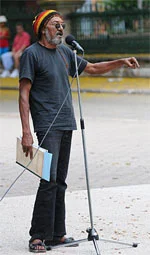
Dennis Walker: 'I know I’m arrogant, but as arrogant as I am, I could never be as arrogant as a white man in this country', Invasion Day protest - 2008

January 27, 2016

26 January 2008, Invasion Day rally, outside Parliament House, Brisbane, Australia

Transcript by Hamish Chitts, Brisbane, www.fightforaboriginalrights.blogspot.com

Thank you, I won’t bore you with the statistics of the devastation being wrecked upon us in this illegal occupation and the genocide happening as we speak. Suffice to say, and this is my pet baby, the incarceration rates are up, the deaths in custody are up. I don’t like it, I don’t know who does, except those who may profit from it I guess.

We need to begin to deal from our own sovereignty. Instead of the Union Jack being in their flag it should be our flag, we decide. This is by their law, Captain Cook was instructed by his sovereign King George III, “You are, with consent, to take advantage of convenient situations”. He did not get consent, there has never been any consent given in this country by any black fella as far as I know about anything they do. So there is no consent, the sovereign said get consent, Captain Cook did not get consent he acted as a false agent. That’s their law, not ours, their law. Any act of a false agent makes all laws that flow from it, including the First Fleet – the first boat people, all illegal. Now the way to get over that problem is to deal fairly and treaty it and work out our differences and get on with it.

However in their arrogance, and just in case you think I’m arrogant – I know I’m arrogant, but as arrogant as I am, I could never be as arrogant as a white man in this country and don’t say you as individuals aren’t responsible for it, you pay taxes so your police forces, your legislators and your courts do the dirty work for you. So don’t say you haven’t got a hand in this, you helped pay for this coming down on us. Don’t forget that it’s not just us they’re coming after, we are just the convenient scapegoats to get the uranium out so the state can keep the power. Your youth death rates are up too, they come for us today they’ll be coming for you tonight, I think James Baldwin said in the book The Fire Next Time.

I have been trying to get in touch with our Premier about this day, today. Unfortunately she’s not concerned about the fires she’s more concerned about the floods, which I can understand at the moment. So she didn’t have time to meet with me. However I did write her a letter asking for an audience and this letter said:

Dear Premier
I am writing to you as I am somewhat concerned at the ever increasing incarceration rates and deaths in custody of Indigenous people. As you are aware I have tired many ways to address these matters as did my mother before me and we both agreed the only way forward would be by treaty in order for all parties involved to be reconciled under God. I have drafted my Invasion Day message titled ‘A Time for Peace’ and I hoping to talk to you on these matters prior to that and thus this letter to obtain an appointment with you to discuss treaty and related matters.
Peace, prosperity and healing,

Dated Thursday 17 / 1 / 08

That was delivered to her parliamentary office along with enclosures, a copy of A Time for Peace, something I wrote and I’ll read out probably at Musgrave. Also included a copy of my treaty to lease. I also included a copy a letter of reference she gave to me back in 2002 when she was minister of education. She said:

Dear Mr Lynch
I write in support of the application made by Dennis Walker for financial assistance through the Brisbane City Council’s Community Development Assistance Grants to initiate a sacred treaty circles project. This project aims to contribute to the spiritual, environmental and social healing in the Brisbane region and through providing a focussed gathering point, commitment and gathering arena in order to reinforce traditional Aboriginal culture and enhance community relationships. I am very supportive of this goal and ask you that you look favourably on this application.
Thank you for your consideration, please do not hesitate to contact me if I can be of further assistance.
Yours sincerely
Anna Bligh MP
Member for South Brisbane, Minister for Education
1st March 2002

So they speak with a forked tongue. She couldn’t meet with me to discuss treaty so I could say, “Listen, we’ve got a deal going with the Queensland Government that may be a little humane and we may get a chance for some justice here, but we’ve still got to do this via a treaty process.” They’ve refused to meet, they’ve refused to talk, they continue the genocide, the death rates are up and the incarceration rates are up. What do we do? On March 11 and 12 we go to Canberra and put it to Rudd. Essentially the same thing – treaty now. If Rudd won’t deal we should go overseas and ask for the overseas community to treaty with us so we can get rid of the oppressor.

Thank you.

Source: http://www.treatyrepublic.net/content/denn...

Enjoyed this speech? Speakola is a labour of love and I’d be very grateful if you would share, tweet or like it. Thank you.

Facebook Twitter Facebook
In EQUALITY Tags DENNIS WALKER, AUSTRALIA DAY, INVASION DAY, INDIGENOUS RIGHTS, ABORIGINAL AUSTRALIA, TREATY, INVASION
1 Comment
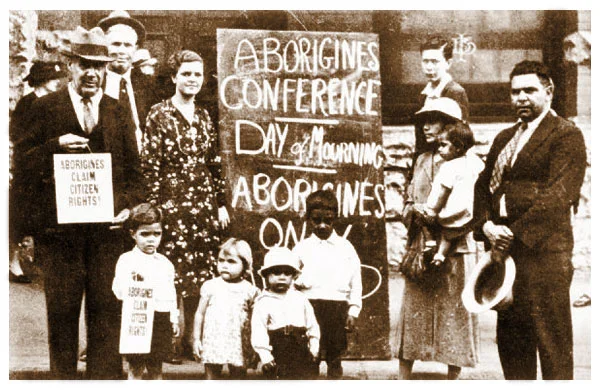
Jack Patton is at far right. Other conference organisers were William Cooper and William Ferguson.

Jack Patton is at far right. Other conference organisers were William Cooper and William Ferguson.

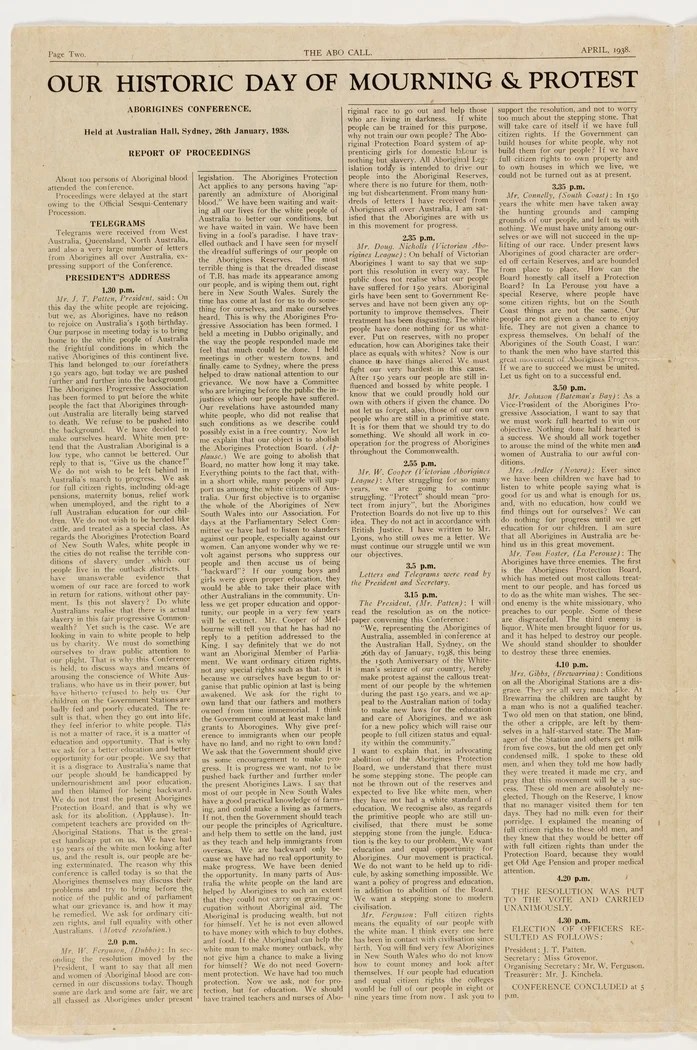
Jack Patten: 'Do white Australians realise that there is actual slavery in this fair, progressive Commonwealth?', Opening address to Day of Mourning protest - 1938

January 27, 2016

26 January 1938, Australian Hall, Sydney, Australia

Jack Patten was the President of the Aborigines Progressive Association.  For this historic protest event, he wore a dark suit and cut the figure or a huge League footballer. But he was a brilliant speaker, one of the best of his era.

On this day the white people are rejoicing, but we, as Aborigines, have no reason to rejoice on Australia’s 150th birthday. Our purpose in meeting today is to bring home to the white people of Australia the frightful conditions in which the native Aborigines of this continent live. This land belonged to our forefathers 150 years ago, but today we are pushed further and further into the background. The Aborigines Progressive Association has been formed to put before the white people the fact that Aborigines throughout Australia are literally being starved to death.

We refuse to be pushed into the background. We have decided to make ourselves heard. White men pretend that the Australian Aboriginal is a low type, who cannot be bettered. Our reply to that is, ‘Give us the chance!’ We do not wish to be left behind in Australia’s march to progress. We ask for full citizen rights including old-age pensions, maternity bonus, relief work when unemployed, and the right to a full Australian education for our children. We do not wish to be herded like cattle and treated as a special class.

As regards the Aborigines Protection Board of NSW, white people in the cities do not realise the terrible conditions of slavery under which our people live in the outback districts. I have unanswerable evidence that women of our race are forced to work in return for rations, without other payment.

Is this not slavery?

Do white Australians realise that there is actual slavery in this fair, progressive Commonwealth?

Yet such is the case. We are looking in vain for white people to help us by charity.

We must do something ourselves to draw public attention to our plight. This is why this Conference is held, to discuss ways and means of arousing the conscience of White Australians, who have us in their power, but have hitherto refused to help us.

Our children on the Government stations are badly fed and poorly educated. The result is that when they go out into life, they feel inferior to white people.

This is not a matter of race, this is a matter of education and opportunity.

This is why we ask for a better education and better opportunity for our people.

We say that it is a disgrace to Australia’s name that our people should be handicapped by undernourishment and poor education, and then blamed for being backward.

We do not trust the present Aborigines Protection Board and that why we ask for its abolition. [applause]

Incompetent teachers are provided on the Government stations. This is the greatest handicap put on us. We have had 150 years of white men looking after us, and the result is, our people are being exterminated.

The reason why this Conference is called today is that the Aborigines themselves may discuss their problems and try to bring before the notice of the public and of parliament what our grievance is, and how it may be remedied.

We ask for ordinary citizen rights, and full equality with white Australians. [moved resolution]

Source: http://www.pattenproject.com/jack/

Enjoyed this speech? Speakola is a labour of love and I’d be very grateful if you would share, tweet or like it. Thank you.

Facebook Twitter Facebook
In EQUALITY Tags JACK PATTON, DAY OF MOURNING, INDIGENOUS RIGHTS, ABORIGINAL AUSTRALIA, EQUALITY, SLAVERY, AUSTRALIA, PROTEST
Comment

Stan Grant: 'But every time we are lured into the light, we are mugged by the darkness of this country's history', Ethics Centre IQ2 debate - 2015

January 22, 2016

27 October 2015, City Recital Hall, Sydney, Australia

This speech was delivered in an IQ2 debate with the topic, 'Racism is destroying the Australian dream'. Also for the affirmative was Pallavi Sinha. For the negative was Jack Thompson and Rita Panahi. The full debate is here. 

Thank you. Thank you so much for coming along this evening, and I'd also like to extend my respects to my Gadigal brothers and sisters from my people, the Wiradjuri people.

In the winter of 2015, Australia turned to face itself. it looked into its soul and it had to ask this question. Who are we? What sort of a country do we want to be.

And this happened in a place that is most holy, most sacred to Australians. It happened on the sporting field, it happened on the football field. Suddenly the front page was on the back page, it was in the grandstand.

Thousands of voices rose to hound an indigenous man, a man who was told he wasn’t Australian, a man who was told he wasn’t Australian of the Year.

And they hounded that man into submission.

I can’t speak for the what lay in the hearts of the people who booed Adam Goodes. But I can tell you what we heard when we heard those boos.

We heard a sound that is very familiar to us.

We heard a howl.

We heard a howl that of humiliation has echoes across two centuries of dispossession, injustice, suffering and survival.

We heard the howl of the Australian dream, and it said to us again, you’re not welcome.

The Australian dream.

We sing of it, and we recite it in verse.

Australians all let us rejoice for we are young and free.

My people die young in this country, we die ten years younger than average Australians and we are far from free.

We are fewer than three percent of the Australian population and yet we are 25 percent, a quarter of those Australians locked up in our prisons, and if you are a juvenile it is worse, it’s fifty percent. An indigenous child is more likely to be locked up in prison than they are to finish high school.

I love a sunburned country

A land of sweeping plains

Of rugged mountain ranges

It reminds me that my people were killed on those plains, we were shot on those plains, disease ravaged us on those plains. I come from those plains. I come from a people west of the Blue Mountains, the Wiradjuri people, where in the 1820s the soldiers and settlers waged a war of extermination against my people. Yes, a war of extermination! That was the language used at the time, go to the Sydney Gazette, and look it up, and read about it. Martial law was declared, and my people could be shot on sight.

Those rugged mountain ranges, my people, women and children were herded over those ranges to their deaths.

The Australian dream.

The Australian dream is rooted in racism. It is the very foundation of the dream. It is there at the birth of the nation . It is there in terra nullius.  An empty land. A land for the taking.

Sixty thousand years of occupation.

A people who made the first seafaring journey in the history of mankind.

A people of law, a people of lore, a people of music and art and dance and politics, none of it mattered.

Because our rights were extinguished because we were not here according to British law. And when British people looked at us, they saw something subhuman, and if we were human at all, we occupied the lowest rung on civilisation’s ladder.

We were fly blown, stone age savages and that was the language that was used.

Charles Dickens, the great writer of the age, when referring to the noble savage of which we were counted among, said ‘it would be better that they be wiped off the face of the earth’. Captain Arthur Phillip, a man of enlightenment, a man who was instructed to make peace with the so called natives in a matter of years, was sending out raiding parties with instruction ‘bring back the severed heads of the black troublemakers’.

They were smoothing the dying pillow.  

My people were rounded up and put on missions, from where, if you escaped. You were hunted down, you were roped and tied and dragged back, and it happened here, it happened on the mission that my grandmother and great grandmother were from, the Warrengesda on the Darling Point of the Murrumbidgee River.

Read about it. It happened.

By 1901 when we became a nation, when we federated the colonies, we were nowhere. We’re not in the Constitution, save for ‘Race Provisions’ -- which allowed for laws to be made that would take our children, that would invade our privacy, that would tell us who we could marry and tell us where we could live.

The Australian dream.

By 1963, the year of my birth, the dispossession was continuing. Police came at gunpoint under cover of darkness to Mapoon an aboriginal community in Queensland, and they ordered people from their homes, and they burned those homes to the ground, and they gave the land to a bauxite mining company. And today those people remember that as ‘The Night of the Burning’.

In 1963 when I was born, I was counted amongst the flora and fauna, not among the citizens of this country.

Now you will hear things tonight, you will hear people say, ‘but you’ve done well!’

Yes I have, and I’m proud of it, and why have I done well?

I’ve done well because of who came before me.

I’ve done well because of my father, who lost the tips off three fingers working in saw mills to put food on our table, because he was denied an education.

My grandfather, who served to fight wars for this country when he was not yet a citizen and came back to a segregated land where he couldn’t even share a drink with his digger mates in the pub because he was black.

My great grandfather who was jailed for speaking his language to his grandson - my father - jailed for it!

My grandfather on my mother’s side who married a white woman who reached out to Australia, lived on the fringes of town, until the police came, put a gun to his head, bulldozed his tin humpy, and ran over over the graves of the three children he’d buried there.

That’s the Australian dream. I have succeeded in spite of the Australian dream, not because of it; and I have succeeded because of those people.

You might hear tonight, ‘but you have white blood in you.’ And if the white blood in me was here tonight, my grandmother, she would  tell you of how she was turned away from a hospital giving birth to her first child because she was giving birth to the child of a black person.

The Australian dream. We’re better than this.

I’ve have seen the worst of the world as a reporter. I’ve spent a decade in war zones, from Iraq to Afghanistan, and Pakistan. We are an extraordinary country, we are in so many respects the envy of the world. If I were sitting here, where my friends are tonight (gestures to opponents] I would be arguing passionately for this country.

But I stand here with my ancestors, and the view looks very different from where I stand.

The Australian dream.

We have our heroes.

Albert Namatjira painted the soul of this nation.

Vincent Lingiari put his hand out for Gough Whitlam to pour the sand of his country through his fingers, and say ‘this is my country’.

Cathy Freeman lit the torch for the Olympic Games.

But every time we are lured into the light, we are mugged by the darkness of this country's history.

Of course racism is killing the Australian dream! It is self evident that it is killing the Australian dream.

But we are better than that.

The people who stood up and supported Adam Goodes and said, ‘no more’, they are better than that.

The people who marched across the bridge for reconciliation, they are better than that.

The people who supported Kevin Rudd when he said sorry to the Stolen Generations, they are better than that.

My children and their non indigenous friends are better than that.

My wife who is non indigenous is better than that.

And one day I want to stand here, and be able to say as proudly and sing as loudly as anyone in this room, Australians all let us rejoice.

Thanks you.

Stan Grant was a wonderful guest on episode 8 of the podcast, talking about this speech.


Source: https://www.youtube.com/watch?v=uEOssW1rw0...

Enjoyed this speech? Speakola is a labour of love and I’d be very grateful if you would share, tweet or like it. Thank you.

Facebook Twitter Facebook
In EQUALITY Tags STAN GRANT, ABORIGINAL AUSTRALIA, RACISM, RACIAL EQUALITY, IQ2, ETHICS CENTRE, DEBATE, ADAM GOODES, STOLEN GENERATIONS, APARTHEID, DISPOSSESSION, TRANSCRIPT, VIDEO
3 Comments

James Baldwin: 'I picked the cotton and I carried it to market and I built the railroads under someone else’s whip', debate v William F Buckley - 1965

January 2, 2016

1965, Cambridge University, United Kingdom

This debate was between arch conservative William F Buckley, the editor of the National Review, and James Baldwin, an African American playright, essayist and poet. The topic was, 'That the American dream has come at the expnse of the American Negro'. Baldwin gave this famous speech.

Good evening,

I find myself, not for the first time, in the position of a kind of Jeremiah. For example, I don’t disagree with Mr. Burford that the inequality suffered by the American Negro population of the United States has hindered the American dream. Indeed, it has. I quarrell with some other things he has to say. The other, deeper, element of a certain awkwardness I feel has to do with one’s point of view. I have to put it that way – one’s sense, one’s system of reality. It would seem to me the proposition before the House, and I would put it that way, is the American Dream at the expense of the American Negro, or the American Dream *is* at the expense of the American Negro. Is the question hideously loaded, and then one’s response to that question – one’s reaction to that question – has to depend on effect and, in effect, where you find yourself in the world, what your sense of reality is, what your system of reality is. That is, it depends on assumptions which we hold so deeply so as to be scarcely aware of them.

Are white South African or Mississippi sharecropper, or Mississippi sheriff, or a Frenchman driven out of Algeria, all have, at bottom, a system of reality which compels them to, for example, in the case of the French exile from Algeria, to offend French reasons from having ruled Algeria. The Mississippi or Alabama sheriff, who really does believe, when he’s facing a Negro boy or girl, that this woman, this man, this child must be insane to attack the system to which he owes his entire identity. Of course, to such a person, the proposition which we are trying to discuss here tonight does not exist. And on the other hand, I, have to speak as one of the people who’ve been most attacked by what we now must here call the Western or European system of reality. What white people in the world, what we call white supremacy – I hate to say it here – comes from Europe. It’s how it got to America. Beneath then, whatever one’s reaction to this proposition is, has to be the question of whether or not civilizations can be considered, as such, equal, or whether one’s civilization has the right to overtake and subjugate, and, in fact, to destroy another. Now, what happens when that happens. Leaving aside all the physical facts that one can quote. Leaving aside, rape or murder. Leaving aside the bloody catalog of oppression, which we are in one way too familiar with already, what this does to the subjugated, the most private, the most serious thing this does to the subjugated, is to destroy his sense of reality. It destroys, for example, his father’s authority over him. His father can no longer tell him anything, because the past has disappeared, and his father has no power in the world. This means, in the case of an American Negro, born in that glittering republic, and the moment you are born, since you don’t know any better, every stick and stone and every face is white.

And since you have not yet seen a mirror, you suppose that you are, too. It comes as a great shock around the age of 5, or 6, or 7, to discover that the flag to which you have pledged allegiance, along with everybody else, has not pledged allegiance to you. It comes as a great shock to discover that Gary Cooper killing off the Indians, when you were rooting for Gary Cooper, that the Indians were you. It comes as a great shock to discover that the country which is your birthplace and to which you owe your life and your identity, has not, in its whole system of reality, evovled any place for you. The disaffection, the demoralization, and the gap between one person and another only on the basis of the color of their skin, begins there and accelerates – accelerates throughout a whole lifetime – to the present when you realize you’re thirty and are having a terrible time managing to trust your countrymen. By the time you are thirty, you have been through a certain kind of mill. And the most serious effect of the mill you’ve been through is, again, not the catalog of disaster, the policemen, the taxi drivers, the waiters, the landlady, the landlord, the banks, the insurance companies, the millions of details, twenty four hours of every day, which spell out to you that you are a worthless human being. It is not that. It’s by that time that you’ve begun to see it happening, in your daughter or your son, or your niece or your nephew.

You are thirty by now and nothing you have done has helped to escape the trap. But what is worse than that, is that nothing you have done, and as far as you can tell, nothing you can do, will save your son or your daughter from meeting the same disaster and not impossibly coming to the same end. Now, we’re speaking about expense. I suppose there are several ways to address oneself, to some attempt to find what that word means here. Let me put it this way, that from a very literal point of view, the harbors and the ports, and the railroads of the country–the economy, especially of the Southern states–could not conceivably be what it has become, if they had not had, and do not still have, indeed for so long, for many generations, cheap labor. I am stating very seriously, and this is not an overstatement: *I* picked the cotton, *I* carried it to the market, and *I* built the railroads under someone else’s whip for nothing. For nothing.

The Southern oligarchy, which has still today so very much power in Washington, and therefore some power in the world, was created by my labor and my sweat, and the violation of my women and the murder of my children. This, in the land of the free, and the home of the brave.And no one can challenge that statement. It is a matter of historical record.

In another way, this dream, and we’ll get to the dream in a moment, is at the expense of the American Negro. You watched this in the Deep South in great relief. But not only in the Deep South. In the Deep South, you are dealing with a sheriff or a landlord, or a landlady or a girl of the Western Union desk, and she doesn’t know quite who she’s dealing with, by which I mean, that if you’re not a part of the town, and if you are a Nothern Nigger, it shows in millions of ways. So she simply knows that it’s an unknown quantity, and she wants to have nothing to do with it because she won’t talk to you, you have to wait for a while to get your telegram. OK, we all know this. We’ve all been through it and, by the time you get to be a man, it’s very easy to deal with. But what is happening in the poor woman, the poor man’s mind is this: they’ve been raised to believe, and by now they helplessly believe, that no matter how terrible their lives may be, and their lives have been quite terrible, and no matter how far they fall, no matter what disaster overtakes them, they have one enormous knowledge in consolation, which is like a heavenly revelation: at least, they are not Black.

Now, I suggest that of all the terrible things that can happen to a human being, that is one of the worst. I suggest that what has happened to white Southerners is in some ways, after all, much worse than what has happened to Negroes there because Sheriff Clark in Selma, Alabama, cannot be considered – you know, no one can be dismissed as a total monster. I’m sure he loves his wife, his children. I’m sure, you know, he likes to get drunk. You know, after all, one’s got to assume he is visibly a man like me. But he doesn’t know what drives him to use the club, to menace with the gun and to use the cattle prod. Something awful must have happened to a human being to be able to put a cattle prod against a woman’s breasts, for example. What happens to the woman is ghastly. What happens to the man who does it is in some ways much, much worse. This is being done, after all, not a hundred years ago, but in 1965, in a country which is blessed with what we call prosperity, a word we won’t examine too closely; with a certain kind of social coherence, which calls itself a civilized nation, and which espouses the notion of the freedom of the world. And it is perfectly true from the point of view now simply of an American Negro. Any American Negro watching this, no matter where he is, from the vantage point of Harlem, which is another terrible place, has to say to himself, in spite of what the government says – the government says we can’t do anything about it – but if those were white people being murdered in Mississippi work farms, being carried off to jail, if those were white children running up and down the streets, the government would find some way of doing something about it. We have a civil rights bill now where an amendment, the fifteenth amendment, nearly a hundred years ago – I hate to sound again like an Old Testament prophet – but if the amendment was not honored then, I would have any reason to believe in the civil rights bill will be honored now. And after all one’s been there, since before, you know, a lot of other people got there. If one has got to prove one’s title to the land, isn’t four hundred years enough? Four hundred years? At least three wars? The American soil is full of the corpses of my ancestors. Why is my freedom or my citizenship, or my right to live there, how is it conceivably a question now? And I suggest further, and in the same way, the moral life of Alabama sheriffs and poor Alabama ladies – white ladies – their moral lives have been destroyed by the plague called color, that the American sense of reality has been corrupted by it.

At the risk of sounding excessive, what I always felt, when I finally left the country, and found myself abroad, in other places, and watched the Americans abroad – and these are my countrymen – and I do care about them, and even if I didn’t, there is something between us. We have the same shorthand, I know, if I look at a boy or a girl from Tennessee, where they came from in Tennessee and what that means. No Englishman knows that. No Frenchman, no one in the world knows that, except another Black man who comes from the same place. One watches these lonely people denying the only kin they have. We talk about integration in America as though it was some great new conundrum. The problem in America is that we’ve been integrated for a very long time. Put me next to any African and you will see what I mean. My grandmother was not a rapist. What we are not facing is the result of what we’ve done. What one brings the American people to do for all our sakes is simply to accept our history. I was there not only as a slave, but also as a concubine. One knows the power, after all, which can be used against another person if you’ve got absolute power over that person.

It seemed to me when I watched Americans in Europe what they didn’t know about Europeans was what they didn’t know about me. They weren’t trying, for example, to be nasty to the French girl, or rude to the French waiter. They didn’t know they hurt their feelings. They didn’t have any sense this particular woman, this particular man, though they spoke another language and had different manners and ways, was a human being. And they walked over them, the same kind of bland ignorance, condescension, charming and cheerful with which they’ve always pat me on the head and called me Shine and were upset when I was upset. What is relevant about this is that whereas forty years ago when I was born, the question of having to deal with what is unspoken by the subjugated, what is never said to the master, of ever having to deal with this reality was a very remote possibility. It was in no one’s mind. When I was growing up, I was taught in American history books, that Africa had no history, and neither did I. That I was a savage about whom the less said, the better, who had been saved by Europe and brought to America. And, of course, I believed it. I didn’t have much choice. Those were the only books there were. Everyone else seemed to agree.

If you walk out of Harlem, ride out of Harlem, downtown, the world agrees what you see is much bigger, cleaner, whiter, richer, safer than where you are. They collect the garbage. People obviously can pay their life insurance. Their children look happy, safe. You’re not. And you go back home, and it would seem that, of course, that it’s an act of God that this is true! That you belong where white people have put you.

It is only since the Second World War that there’s been a counter-image in the world. And that image did not come about through any legislation or part of any American government, but through the fact that Africa was suddenly on the stage of the world, and Africans had to be dealt with in a way they’d never been dealt with before. This gave an American Negro for the first time a sense of himself beyond the savage or a clown. It has created and will create a great many conundrums. One of the great things that the white world does not know, but I think I do know, is that Black people are just like everybody else. One has used the myth of Negro and the myth of color to pretend and to assume that you were dealing with, essentially, with something exotic, bizarre, and practically, according to human laws, unknown. Alas, it is not true. We’re also mercenaries, dictators, murderers, liars. We are human too.

What is crucial here is that unless we can manage to accept, establish some kind of dialog between those people whom I pretend have paid for the American dream and those other people who have not achieved it, we will be in terrible trouble. I want to say, at the end, the last, is that is that is what concerns me most. We are sitting in this room, and we are all, at least I’d like to think we are, relatively civilized, and we can talk to each other at least on certain levels so that we could walk out of here assuming that the measure of our enlightenment, or at least, our politeness, has some effect on the world. It may not.

I remember, for example, when the ex Attorney General, Mr. Robert Kennedy, said that it was conceivable that in forty years, in America, we might have a Negro president. That sounded like a very emancipated statement, I suppose, to white people. They were not in Harlem when this statement was first heard. And they’re not here, and possibly will never hear the laughter and the bitterness, and the scorn with which this statement was greeted. From the point of view of the man in the Harlem barber shop, Bobby Kennedy only got here yesterday, and he’s already on his way to the presidency. We’ve been here for four hundred years and now he tells us that maybe in forty years, if you’re good, we may let you become president.

What is dangerous here is the turning away from – the turning away  from – anything any white American says. The reason for the political hesitation, in spite of the Johnson landslide is that one has been betrayed by American politicians for so long. And I am a grown man and perhaps I can be reasoned with. I certainly hope I can be. But I don’t know, and neither does Martin Luther King, none of us know how to deal with those other people whom the white world has so long ignored, who don’t believe anything the white world says and don’t entirely believe anything I or Martin is saying. And one can’t blame them. You watch what has happened to them in less than twenty years.

It seems to me that the City of New York, for example – this is my last point – It’s had Negroes in it for a very long time. If the city of New York were able, as it has indeed been able, in the last fifteen years to reconstruct itself, tear down buildings and raise great new ones, downtown and for money, and has done nothing whatever except build housing projects in the ghetto for the Negroes. And of course, Negroes hate it. Presently the property does indeed deteriorate because the children cannot bear it. They want to get out of the ghetto. If the American pretensions were based on more solid, a more honest assessment of life and of themselves, it would not mean for Negroes when someone says “Urban Renewal” that Negroes can simply are going to be thrown out into the streets. This is just what it does mean now. This is not an act of God. We’re dealing with a society made and ruled by men. Had the American Negro had not been present in America, I am convinced the history of the American labor movement would be much more edifying than it is. It is a terrible thing for an entire people to surrender to the notion that one-ninth of its population is beneath them. And until that moment, until the moment comes when we, the Americans, we, the American people, are able to accept the fact, that I have to accept, for example, that my ancestors are both white and Black. That on that continent we are trying to forge a new identity for which we need each other and that I am not a ward of America. I am not an object of missionary charity. I am one of the people who built the country–until this moment there is scarcely any hope for the American dream, because the people who are denied participation in it, by their very presence, will wreck it. And if that happens it is a very grave moment for the West.

Thank you.

Here is the full debate.


There’s a snippet of James Baldwin’s speech to introduce the Stan Grant ‘racism and the Australian Dream’ episode of the podcast. Listen below.


Source: http://www.ozy.com/performance/buckley-vs-...

Enjoyed this speech? Speakola is a labour of love and I’d be very grateful if you would share, tweet or like it. Thank you.

Facebook Twitter Facebook
In EQUALITY Tags JAMES BALDWIN, WILLIAM F BUCKLEY, AFRICAN AMERICAN RIGHTS, SLAVERY, CIVIL RIGHTS MOVEMENT, DEBATE, TRANSCRIPT
1 Comment

Martin Luther King: 'Mrs. Parks is a fine Christian person, unassuming, and yet there is integrity and character there', Montgomery Bus Boycott - 1955

December 14, 2015

5 December 1955, Holt Street Baptist Church, Montgomery, Alabama, USA

My friends, we are certainly very happy to see each of you out this evening. We are here this evening for serious business. We are here in a general sense because first and foremost we are American citizens and we are determined to apply our citizenship to the fullness of its meaning. We are here also because of our love for democracy, because of our deep-seated belief that democracy transformed from thin paper to thick action is the greatest form of government on earth.

But we are here in a specific sense, because of the bus situation in Montgomery. We are here because we are determined to get the situation corrected. This situation is not at all new. The problem has existed over endless years. For many years now Negroes in Montgomery and so many other areas have been inflicted with the paralysis of crippling fears on buses in our community. On so many occasions, Negroes have been intimidated and humiliated and impressed-oppressed-because of the sheer fact that they were Negroes.  I don't have time this evening to go into the history of these numerous cases. Many of them now are lost in the thick fog of oblivion but at least one stands before us now with glaring dimensions.

Just the other day, just last Thursday to be exact, one of the finest citizens inMontgomery not one of the finest Negro citizens, but one of the finest citizens in Montgomery-was taken from a bus and carried to jail and because she refused to get up to give her seat to a white person. Now the press would have us believe that she refused to leave a reserved section for Negroes but I want you to know this evening that there is no reserved section. The law has never been clarified at that point.   Now I think I speak with, with legal authority-not that I have any legal authority, but I think I speak with legal authority behind me -that the law, the ordinance, the city ordinance has never been totally clarified.

Mrs. Rosa Parks is a fine person.  And, since it had to happen, I'm happy that it happened to a person like Mrs. Parks, for nobody can doubt the boundless outreach of her integrity. Nobody can doubt the height of her character nobody can doubt the depth of her Christian commitment and devotion to the teachings of Jesus. And I'm happy since it had to happen, it happened to a person that nobody can call a disturbing factor in the community. Mrs. Parks is a fine Christian person, unassuming, and yet there is integrity and character there. And just because she refused to get up, she was arrested.

And you know, my friends, there comes a time when people get tired of being trampled over by the iron feet of oppression. There comes a time, my friends, when people get tired of being plunged across the abyss of humiliation, where they experience the bleakness of nagging despair. There comes a time when people get tired of being pushed out of the glittering sunlight of life's July and left standing amid the piercing chill of an alpine November. There comes a time.

We are here, we are here this evening because we're tired now.  And I want to say that we are not here advocating violence. We have never done that. I want it to be known throughout Montgomery and throughout this nation that we are Christian people. We believe in the Christian religion. We believe in the teachings of Jesus.  The only weapon that we have in our hands this evening is the weapon of protest.  That's all.

And certainly, certainly, this is the glory of America, with all of its faults. This is the glory of our democracy. If we were incarcerated behind the iron curtains of a Communistic nation we couldn't do this. If we were dropped in the dungeon of a totalitarian regime we couldn't do this.  But the great glory of American democracy is the right to protest for right. My friends, don't let anybody make us feel that we are
to be compared in our actions with the Ku Klux Klan or with the White Citizens Council. There will be no crosses burned at any bus stops in Montgomery. There will be no white persons pulled out of their homes and taken out on some distant road and lynched for not cooperating. There will be nobody amid, among us who will stand up and defy the Constitution of this nation. We only assemble here because of our desire to see right exist. My friends, I want it to be known that we're going to work with grim and bold determination to gain justice on the buses in this city.

And we are not wrong, we are not wrong in what we are doing. If we are wrong, the Supreme Court of this nation is wrong.  If we are wrong, the Constitution of the United States is wrong.  If we are wrong, God Almighty is wrong. If we are wrong, Jesus of Nazareth was merely a utopian dreamer that never came down to earth. If we are wrong, justice is a lie.  Love has no meaning. And we are determined here in Montgomery to work and fight until justice runs down like water, and righteousness like a mighty stream.

I want to say that in all of our actions we must stick together.  Unity is the great need of the hour, and if we are united we can get many of the things that we not only desire but which we justly deserve. And don't let anybody frighten you. We are not afraid of what we are doing because we are doing it within the law. There is never a time in our American democracy that we must ever think we're wrong when we protest. We reserve that right. When labor all over this nation came to see that it would be trampled over by capitalistic power, it was nothing wrong with labor getting together and organizing and
protesting for its rights.  

We, the disinherited of this land, we who have been oppressed so long, are tired of going through the long night of captivity. And now we are reaching out for the daybreak of freedom and justice and equality. May I say to you my friends, as I come to a close, and just giving some idea of why we are assembled here, that we must keep-and I want to stress this, in all of our doings, in all of our deliberations here this evening and all of the week and while—whatever we do, we must keep God in the forefront. Let us be Christian in all of our actions. But I want to tell you this evening that it is not enough for us to talk about love, love is one of the pivotal points of the Christian face, faith. There is another side called justice. And justice is really love in calculation. Justice is love correcting that which revolts against love.

The Almighty God himself is not the only, not the, not the God just standing out saying through Hosea, "I love you, Israel." He's also the God that stands up before the nations and said: "Be still and know that I'm God, that if you don't obey me I will break the backbone of your power and slap you out of the orbits of your international and national relationships." Standing beside love is always justice, and we are only using the tools of justice. Not only are we using the tools of persuasion, but we've come to see that we've got to use the tools of coercion. Not only is this thing a process of education, but it is also a process of legislation.

As we stand and sit here this evening and as we prepare ourselves for what lies ahead, let us go out with a grim and bold determination that we are going to stick together. We are going to work together. Right here in Montgomery, when the history books are written in the future somebody will have to say, "There lived a race of people a black people, 'fleecy locks and black complexion’, a people who had the moral courage to stand up for their rights. And thereby they injected a new meaning into the veins of history and of civilization." And we're gonna do that. God grant that we will do it before it is too late. As we proceed with our program let us think of these things.

But just before leaving I want to say this. I want to urge you. You have voted [for this boycott], and you have done it with a great deal of enthusiasm, and I want to express my appreciation to you, on behalf of everybody here. Now let us go out to stick together and stay with this thing until the end. Now it means sacrificing, yes, it means sacrificing at points. But there are some things that we've got to learn to sacrifice for. And we've got to come to the point that we are determined not to accept a lot of things that we have been accepting in the past.

So I'm urging you now. We have the facilities for you to get to your jobs, and we are putting, we have the cabs there at your service. Automobiles will be at your service, and don't be afraid to use up any of the gas. If you have it, if you are fortunate enough to have a little money, use it for a good cause. Now my automobile is gonna be in it, it has been in it, and I'm not concerned about how much gas I'm gonna use. I want to see this thing work. And we will not be content until oppression is wiped out of Montgomery, and really out of America. We won't be content until that is done. We are merely insisting on the dignity and worth of every human personality. And I don't stand here, I'm not arguing for any selfish person. I've never been on a bus in Montgomery. But I would be less than a Christian if I stood back and said, because I don't ride the bus, I don't have to ride a bus, that it doesn't concern me. I will not be content. I can hear a voice saying, "If you do it unto the least of these, my brother, you do it unto me."

And I won't rest; I will face intimidation, and everything else, along with these other stalwart fighters for democracy and for citizenship. We don't mind it, so long as justice comes out of it. And I've come to see now that as we struggle for our rights, maybe some of them will have to die. But somebody said, if a man doesn't have something that he'll die for, he isn't fit to live.


Preeminent MLK historian Dr Clayborne Carson, the man chosen by Coretta Scott King as the founding director of the Dr Martin Luther King Centre for Education and Research, was a guest on the podcast, talking about I Have a Dream and other speeches.


Source: http://www.blackpast.org/1955-martin-luthe...

Enjoyed this speech? Speakola is a labour of love and I’d be very grateful if you would share, tweet or like it. Thank you.

Facebook Twitter Facebook
In EQUALITY Tags MARTIN LUTHER KING, BUS BOYCOTT, ROSA PARKS, RACIAL EQUALITY, SEGREGATION, CIVIL RIGHTS MOVEMENT, TRANSCRIPT
Comment
elie wiesel.png

Elie Wiesel: 'Indifference, the most insidious danger of all', Nobel Prize acceptance - 1986

December 13, 2015

Video available at Nobelprize.com

10 December 1986, Stoickholm, Sweden

According to Jewish tradition, there are moments where one must make a blessing and give a benediction, and this is such a moment. With your permission, your majesty, this is such a moment. [gives blessing - Hebrew]

Thank you oh lord for giving us this day ...

It is with a profound sense of humility that I accept the honor, the highest there is, that you have chosen to bestow upon me. I know: your choice transcends my person. Do I have the right to represent the multitudes who have perished?

Do I have the right to accept this great honor on their behalf?

I do not. That would be presumptuous. No one may speak for the dead, no one may interpret their mutilated dreams and visions. Yet at moments such as this I sense their presence, I always do. I sense my parents. I sense my little sister. How can I not sense, how can I not sense the presence of those who were part of you. Friends, teachers, companions.

But this honour belongs to those who remember them. This honour belongs to all the survivors, to their children, and through us, to the Jewish people with whose destiny I have always identified.

I remember: it happened yesterday or eternities ago, a young Jewish boy discovered the kingdom of night. I remember his bewilderment, I remember his anguish. It all happened so fast. The ghetto. The decrees. The persecution. The deportation. The sealed cattle car. The fiery altar upon which the history of my people and the future of mankind were meant to be sacrificed.

I remember that young boy asked his father: "Tell me" he said, "Can this be true?" This is the twentieth century after all. This is not the Middle Ages. Who would allow such crimes to be committed? How could the world remain silent?"

And now that very boy is turning to me: "Tell me," he says. "What have you done with my years? What have you done with your life which is mine?"

And then I tell him that I have tried. That I have tried to keep memory alive. That I have tried to fight those who would forget. Because if we forget, we are guilty, we are accomplices. We could not prevent their deaths the first time. But if we forget them they will be killed a second time and this time it will be our responsibility.

So I also explained to that boy how naive he was, how naive we all were -- the world did know and remained silent. And that is why I swore never to be silent whenever and wherever human beings endure suffering and humiliation.

We must speak. We must take sides. For neutrality helps the oppressor, never the victim.

Silence encourages the tormentor, never the tormented.

Sometimes we must interfere. When human lives are endangered, when human dignity is in jeopardy, national borders and sensitivities become irrelevant.

Wherever men or women are persecuted because of their race, religion, or political views, that place must – at that moment – become the center of the universe.

Of course, since I am a Jew profoundly rooted in my people's memory and tradition, my first response is to Jewish fears, Jewish needs, Jewish crises. For I belong to a traumatized generation, one that experienced the abandonment and solitude of my people. It would be unnatural for me not to make Jewish priorities my own. It would be unnatural for me not to love Isreael with all my heart, as I do.

Please remember what I remember. Isreal if god forbid defeated, it would be the end of Israel. The only country in the world which is so endangered totally in its existence. How can people such as myself not think in these terms.

But I am also of course committed to Soviet Jews who need freedom. And Jews in Arab lands who need solidarity. But I said that Jewish priorities are my first priorities, but they are not exclusive. Others as important to me. Other people, other ideas, other situations, other tragedies matter to me.

Apartheid is, in my view, as abhorrent as anti-Semitism. To me, Andrei Sakharov's isolation is as much of a disgrace as Josef Biegun's imprisonment, and Ivan Nudl's exile. As is the denial of Solidarity and its leader Lech Walesa's right to dissent. And Nelson Mandela's interminable imprisonment.

There is so much injustice and suffering crying out for our attention: victims of hunger, of racism, and political persecution. Certain fascist regimes, like in Chile, or Marxist regimes like in Ethiopia and other places of the world, where writers and poets are prisoners, and there are so many prisoners in so many lands -- by the Left and the extreme left and by the Right and the extreme right.

Now you know as I do that human rights are being violated on every continent. More people are oppressed than free. How can one not be sensitive to their plight? Human suffering anywhere, concerns men and women everywhere. And in spite of what some extreme critics have said about me,  that principle applies in my life also to the Palestinians, to whose plight I am sensitive but whose methods I deplore when they lead to violence.

Violence is not the answer. Terrorism is the most dangerous of answers. I know they are frustrated, and that is understandable, and something must be done about it. The refugees in the refugee camps and their misery, the children and their fear, the uprooted and their hopelessness, I know. Something must be done about their situation, I know that too.

Both the Jewish people and the Palestinian people have lost too many sons, and shed too much blood. This must stop. And all attempts to stop it must be encoruaged, peacefully.  Israel will cooperate, I am sure of that. I trust Israel, for I have faith in the Jewish people. Let Israel be given a chance, let hatred and danger be removed from her horizons, and there will be peace in and around the Holy Land.

Yes, I have faith. I have faith in the God of Abraham and Isaac and Jacob. I even have faith in His creation. Without faith no action would be possible. And action is the only remedy to indifference. Indifference, the most insidious danger of all. Isn't this the meaning of Alfred Nobel's legacy? Wasn't his fear of war a shield against war?

There is so much to be done, and there is much that can be done. I have learned it in my life, one person – a Raoul Wallenberg, an Albert Schweitzer, a Martin Luther King -- one person of integrity, of courage, can make a difference, a difference of life and death. And therefore I know that as long as one dissident is in prison, our freedom cannot be true. As long as one child is hungry, our lives will be filled with anguish and shame. For I have seen children hungry. What all these victims need above all is to know that they are not alone; that we are not forgetting them, that when their voices are stifled we shall lend them ours, that while their freedom depends on ours, the quality of our freedom depends on theirs.

This is what I say to the young Jewish boy wondering what I have done with his years. It is in his name that I speak to you and that I express to you my deepest gratitude. No one is capable of gratitude as one who has emerged from the kingdom of night. We know that every moment is a moment of grace, every hour is an offering; and not to share them would mean to betray them and mean not to be worthy of them. Our lives no longer belong to us alone; they belong to all those who need us desperately.

Thank you, Chairman Aarvik. Thank you, members of the Nobel Committee. Thank you, people of Norway, for declaring on this singular occasion that our survival has meaning for mankind.

Source: http://www.nobelprize.org/mediaplayer/inde...

Enjoyed this speech? Speakola is a labour of love and I’d be very grateful if you would share, tweet or like it. Thank you.

Facebook Twitter Facebook
In EQUALITY Tags ELIE WIESEL, NOBEL PRIZE, NOBEL PEACE PRIZE, HOLOCAUST, ANTI-SEMITISM, APARTHEID, FREEDOM OF SPEECH, TRANSCRIPT
Comment

Ken Lay: 'We make excuses for boys, and subtly encourage girls to do the same', International Day for the Elimination of Violence against Women - 2015

November 27, 2015

25 November 2015, Monash University, Melbourne, Australia

Please let me begin by acknowledging the traditional owners of the land on which we meet, the people of the Kulin Nation.  

It is upon their ancestral lands that this place is built, I pay my respects to their elders, both past and present.

And today … on this International Day for the Elimination of Violence against Women and Children … I also acknowledge the many thousands of woman and children who have been murdered, maimed or otherwise harmed by those men who professed to have loved them, it is for them that we do what we do.

I’m not going to open today with statistics. 

I’m not being dismissive.

As a former police officer, I dealt with numbers.  

Data was important to me.

Our policies needed to be guided by evidence:

not suspicion
not prejudice
not habit
not populism

But – we should remember there are painful personal stories behind these statistics – there are also attitudes and cultural complacency.

That’s what this research tells us. 

In the decades I spent at Victoria Police, I saw and heard things.

Abuse, violence and neglect. 

Things I will never forget. 

But when I was presented this research, it touched me.

In this study, children and young adults already possess some dispiriting ideas about themselves and about gender.

When presented with some scenarios on aggression by boys, I heard with sadness about 10-year-old girls already diminishing the abuse they received from boys. 

I heard girls say about boys harassing them: “It’s not that bad, it’s not like he punched her” 

I heard boys justifying the violence by simply saying that they just want to be heard – that it was harmless.

And for all the things I’ve seen in my many years at Victoria Police, this important evidence of the origins of gendered violence … and our complacency to it … brought me to tears.

I felt embarrassed.

I felt ashamed.

It got me thinking, the State with all its power and authority is simply not enough to stop the fundamental drivers of family violence.

When I was chief commissioner of Victoria Police, I led an organisation of around 17,000 people – the vast majority being sworn officers. 

An organisation of men and women of enormous powers, talents and responsibility. 
A police force is one of the most powerful and obvious manifestations of state power. 

I led forensic teams and detectives; the Special Operations Group and water police and thousands and thousands of men and women patrolling our streets and our communities 24 hours a day … seven days a week … 365 days a year. 

Men and women trained in counter-terrorism, negotiating hostage sieges and intelligently interviewing killers. 

In other words, men and women of great training and commitment each who had been empowered by the State. 

But here’s what I thought when I saw this research.

For all of the training, the equipment, the power to investigate and arrest – none of this can touch the attitudes we impress on our children. 

None of this can enter our homes, our minds, our families.

None of this can alter the way we think about ourselves, or our children. 

The State’s power – is mostly executed at the very end of the family violence continuum. 

It’s when the ideas and values adopted as children have grown destructively. 

The police operate at one end– this research speaks at the other end – where the violence is formed.

This research tells us – there are some poisonous and deeply entrenched ideas about gender.

I’ll explain some of them soon – but I want to suggest to you today that it is not the State’s role to modify or refine our shared values. 

That’s a job for all of us and we have done it before. 

Take child abuse. It offers a powerful example. 

We forget child protection legislation is a relatively new development. 

For centuries, children were considered property. Exploited for sex, for labour, for the rough depositing of our own values.

Historically, we had a casual contempt for children. 

Casual in that the contempt was buried deeply, practiced often, but rarely thought about. 

Attitudes can be very difficult to change because after a while they become invisible they're as natural as taking a breath.

The royal commission into institutionalised child abuse has exposed decades of squalid and systematic abuse of children. 


Recent decades were filled with men who winked happily about their preferences for schoolgirls. 

Their behaviour was seen as harmlessly roguish, just another example of boys being boys. 

Jimmy Savile and Rolf Harris were vile predators, but they were helped by a complacent culture.  

Why am I making the link between child abuse and domestic violence?

Because for decades our casual complacency and contempt for children allowed child abuse to prosper.

And in 2015, our culture is possessed of similarly destructive attitudes about gender that allow domestic violence to prosper.

This research says as much. 

Attitudes that are so embedded that we don't challenge them.

We can't challenge them because at times we can't see them. 

This research confirms what I’ve long suspected – that the abuse of women is supported from a very early age. 

The research confirms that adults are harmfully shaping children’s destinies because of unchallenged and unfair assumptions about gender. 
 
What this research emphasises – and its findings are repeated in countless other studies – is that we develop male privilege early.

Knowingly or not, we give boys licence to act abusively and we develop in girls deference to that behaviour. 

Boys will be boys … and it’s up to girls to adjust accordingly. 

But this confuses cultural values with biological ones, this isn’t nature, this is nurture. 

I'll explain.  

The research reveals stark patterns in our parenting and mentoring of children. 

This isn’t theory. This is the voice of our kids. 

It’s our voice. 

As a society:

We make excuses for boys, and subtly encourage girls to do the same. 

We are sympathetic to boys’ behaviour and more suspicious of girls’. 

We dismiss boys’ sexual aggression as a function of their masculinity.

We minimise the behaviour. 

We rationalise it. 

Boys will be boys. 

But it’s different for girls. 

Boys are taught to blame circumstance for their aggression – girls to contemplate how they might have provoked it. 

Boys learn by acting out – girls by simply enduring their experiences.

Boys are told it’s appropriate to defend yourself against a girl – but there isn’t a reciprocal lesson. 

This leads to boys externalising their behaviour – when things go bad, it’s because of other people or other things. 

But we encourage girls to internalise their experiences – to imagine that the fault lay somewhere deep inside them.

This research exposes mothers asking their boys: “What did the girl do?” because they hope that it isn’t their son’s fault. 

Can we see what we’re doing here? The deck is stacked against women. 

We’re encouraging girls to feel complicit in their own abuse. 

We're asking them to blame themselves. 

This internalisation, once started in childhood can become lifelong. 

During early development, children are like blotting paper – and dubious lessons can become permanent. 

But not only do we encourage girls to blame themselves – we’ll blame them too. 

Only a few weeks ago, Detective Jason Walsh from Victoria Police went on local radio to discuss a brutal and sadistic rape. 

The radio host read out a few texts messages from listeners, messages that asked what a young girl was doing in a park at 4 am. 

I thought these questions were callous and misguided and evidently Detective Walsh did too. 

This was his response: “I find it amazing, that we question girls and we question their behaviour but we don't ask: 'what are four blokes doing, allegedly raping a young girl?’”

Walsh went on: “You know, that's my take on that sort of question and I’ve been in this sexual assault field for many years…

I find it amazing that people straight away question females about their actions.

I mean, what are four males doing allegedly gang raping a young girl? 

That’s the question I’d ask.

That’s the question everyone in this room should ask. 

Let me go back to those questions being asked on local radio, I would find those questions about the victim amazing too, if I wasn’t so aware of what we teach our children. 

If I wasn't so aware of how casually we accept male bravado and entitlement, and how easily we teach our girls to simply avoid it. 

What are we doing when we hear of an alleged gang rape and would only think of why the victim was in the park?

What are we doing when that is our first question? 

Let’s pause on this – because I need your help.  

Together, we need to talk about this.

We need to talk about what unseen expectations we have for our children because of their gender. 

I think we ask women to define themselves relative to men.  

If we dismiss behavior as being boys will be boys we aren’t holding them personally accountable we aren’t addressing the pre-conditions of sexism, abuse and family violence. 

I’m grateful Victoria Police has Jason Walsh. 

And I’m grateful for his comments – they’re important, they’re compelling and they’re wise. 

Politicians … business leaders … community leaders … all of us should take note of Jason’s words.

The text messages are just the tip of the iceberg. 

Those messages are proof of an expansive system of thought we are casually giving to our children. 

If this upsets you … so be it.

If it offends you … so be it.

Your job – our job – is to move beyond that defensiveness. 

Your job – our job - is to view your discomfort as the beginning, not the end. 

If you need help, let me give you an example of our double-standards. 

It comes from another story I heard from a detective.

Years ago, a young woman came into a police station in the early morning.

She was seriously distressed.

She told officers that she had just been sexually assaulted in a laneway.

She had come straight to the station from the site of the attack.

She said she had been attacked from behind, when her assailant gripped her and placed a strip of electrical tape over her mouth. 

Horrific and frightening. But her claims were met with suspicion. 

Some officers weren’t as responsive as they should have been.

But there was one investigator – a thorough and credulous man. He took the victim into a room, consoled her and took a statement. 

And then later that day he went to the scene when others thought it was nothing more than exaggeration. 

He paced the laneway, turning clumps of leaves over with his toe.

And then he saw it: a piece of electrical tape. 

He crouched beside it and saw a print of lipstick on it. 

So here’s something I’ve noticed. 

Claims of sexual assault inspire a higher level of suspicion that isn’t by claims of theft, fraud or street assaults. 

Our doubt is much higher for women. 

Almost as if we assume women have less credibility whether it is in sexual assault or family violence.

I can tell you that false claims of sexual assault do occur.

Just as they occur for theft, fraud and street assaults. 

And I can tell you that the vast majority of sexual assault claims and family violence claims are legitimate. 

So to those men who fixate on the bogus claims, I say to you that you are being intellectually dishonest. 

You are emotionally cherry-picking data to make a case that women fundamentally lack credibility. 

The data doesn’t agree and nor do I.   

We possess double standards. 

Standards that are deeply engrained and are a damaging outcome of our attitudes.

These double standards can result in many women feeling an intense, silencing guilt about their own abuse or alienation. 

So we need leadership, but before that leadership can happen we require some self-reflection. 

Self-reflection is something that this research suggests is both vital and in short supply. 

It helps refine our collective values, but it’s in deficit because humans are naturally resistant to criticism. 

So let this speech be a wake- up call…a wake-up call to our assumptions and complacency. 

It’s not enough to consider ourselves good men because we don’t bash women.  

As men, this sets the bar so low, that somehow we congratulate each other for not being monsters. 

That’s not useful.
 
It’s not helpful.

I’m asking you to think about yourselves, about your assumptions … about what lessons you are unwittingly passing to your children. 

We need to set the bar much higher than we are.

In public life, I’ve noticed a sort of blokey pomposity – a desire to be seen as a community elder, but sometimes not matched in the desire to properly function as one. 

The result is often a thousand empty gestures, each removed from self-reflection and real influence. 

There are many leaders in the room today.

We, as leaders, must acknowledge our own role in these attitudes before we offer ourselves as role models. 

Our public status is not enough. 

We need to ask ourselves: are we flattering our ego, or engaging in humble self-reflection? 

I would argue we need self-reflection before we need insincere mutterings when the next woman or child is murdered by the very men who profess to love them.

Self-reflection is not vague, nor is it indulgent. 

It’s courageous and necessary.

Self-reflection shapes how we connect to our children – how we mentor our young adults.  

Our young people are bright and attentive and they are watchful for inconsistency. 

They have advanced radars for hypocrisy. 

One of the boys interviewed said: “The message has to be consistent... if I hear one thing, but everyone else is doing something else, it means nothing.” 
Lectures are not enough. 

Our public statements must match our private behaviour. 

If we truly believe that the future of our girls are as bright as our boys, we need to meet that desire with something other than vague commitments on one day a year. 

It needs to be matched with our lessons, both spoken and lived. 

How often do we tell our daughters what to wear – but rarely tell our sons what respectful sexual relations are? 

How often do we warn our daughters about provocation – but rarely talk to our boys about consent? 

How often do we justify the cruelty of boys? And ask our girls to avoid it.

How often do we thoughtlessly accept that boys will be boys.

The answer is … every day. 

We do this as easily as taking a breath.  

We don’t even know we're doing it. 

In family violence there are strong parallels to the long, dark decades where we tolerated – or subtly encouraged – child abuse. 

Collectively. We failed our children

The – “collectively” – may make you uncomfortable. 

“I didn’t abuse children,” you might think, and you can put a full stop on your reflection. 

But visit the thousands of pages of royal commission transcripts. 

Look at the transcript of the Rolf Harris trial. 

Read the testimony of Jimmy Savile’s colleagues. 

You’ll see that it isn’t just vile, manipulative men that can be singled out and condemned. 

“I don’t bash my wife,” you say. Another full stop.

But look into coronial inquests into women killed by their partners …friends saw it, work colleagues saw it, sporting colleagues saw it, doctors saw it, teachers saw it, family saw it, many saw it. 

These men were supported by indulgent and unaccountable cultures.

These men were supported by a society that encourages its female victims to blame themselves and stay quiet in shame.  

These men were supported by our complacency, by our lack of courage to examine our lifelong attitudes. 

So, when a girl can be allegedly gang raped and our first question is: “Why was she in a park at 4am?” 

We need to ask if our culpability is placed where it should be?  

When we ask that question, we put the victim firmly on the hook. 

But … sadly she’s already there. 

My question – our question – should be:
 
What are we doing about it?  

Thank you. 


If you or someone you know is impacted by sexual assault, domestic or family violence, call 1800RESPECT on 1800 737 732 or visit 1800RESPECT.org.au. In an emergency, call 000. For more information about a service in your state or local area download the DAISY App in the App Store or Google Play.


This speech was published by Our Watch, media contact Hannah Grant, mobile 0448 844 930, email Hannah.Grant@ourwatch.org.au
 

About Our Watch 

Our Watch’s (previously the Foundation to Prevent Violence against Women and their Children) purpose is to raise awareness and engage the community in action to prevent violence against women and their children.

Speakola has more than 300 speeches on site of all different types - from famous political speeches, to eulogies, to best man speeches, to social justice speeches. All speeches great and small. Send us yours! submissions@speakola.com

Source: http://www.ourwatch.org.au/News-media/Late...

Enjoyed this speech? Speakola is a labour of love and I’d be very grateful if you would share, tweet or like it. Thank you.

Facebook Twitter Facebook
In EQUALITY Tags KEN LAY, FAMILY VIOLENCE, WHITE RIBBON, VIOLENCE AGAINST WOMEN, POLICE COMMISSIONER, TRANSCRIPT
14 Comments

Emma Watson: 'But my recent research has shown me that feminism has become an unpopular word', United Nations - 2014

November 9, 2015

20 September, 2104, HeforShe campaign, United Nations HQ, NYC, USA

Today we are launching a campaign called for HeForShe. I am reaching out to you because we need your help. We want to end gender inequality, and to do this, we need everyone involved. This is the first campaign of its kind at the UN. We want to try to mobilize as many men and boys as possible to be advocates for change. And, we don’t just want to talk about it. We want to try and make sure that it’s tangible.

I was appointed as Goodwill Ambassador for UN Women six months ago. And, the more I spoke about feminism, the more I realized that fighting for women’s rights has too often become synonymous with man-hating. If there is one thing I know for certain, it is that this has to stop.

For the record, feminism by definition is the belief that men and women should have equal rights and opportunities. It is the theory of political, economic and social equality of the sexes.

I started questioning gender-based assumptions a long time ago. When I was 8, I was confused for being called bossy because I wanted to direct the plays that we would put on for our parents, but the boys were not. When at 14, I started to be sexualized by certain elements of the media. When at 15, my girlfriends started dropping out of sports teams because they didn’t want to appear muscly. When at 18, my male friends were unable to express their feelings.

I decided that I was a feminist, and this seemed uncomplicated to me. But my recent research has shown me that feminism has become an unpopular word. Women are choosing not to identify as feminists. Apparently, I’m among the ranks of women whose expressions are seen as too strong, too aggressive, isolating, and anti-men. Unattractive, even.

Why has the word become such an uncomfortable one? I am from Britain, and I think it is right I am paid the same as my male counterparts. I think it is right that I should be able to make decisions about my own body. I think it is right that women be involved on my behalf in the policies and decisions that will affect my life. I think it is right that socially, I am afforded the same respect as men.

But sadly, I can say that there is no one country in the world where all women can expect to see these rights. No country in the world can yet say that they achieved gender equality. These rights, I consider to be human rights, but I am one of the lucky ones.

My life is a sheer privilege because my parents didn’t love me less because I was born a daughter. My school did not limit me because I was a girl. My mentors didn't assume that I would go less far because I might give birth to a child one day. These influences were the gender equality ambassadors that made me who I am today. They may not know it, but they are the inadvertent feminists that are changing the world today. We need more of those.

And if you still hate the word, it is not the word that is important. It’s the idea and the ambition behind it, because not all women have received the same rights I have. In fact, statistically, very few have.

In 1997, Hillary Clinton made a famous speech in Beijing about women’s rights. Sadly, many of the things that she wanted to change are still true today. But what stood out for me the most was that less than thirty percent of the audience were male. How can we effect change in the world when only half of it is invited or feel welcome to participate in the conversation?

Men, I would like to take this opportunity to extend your formal invitation. Gender equality is your issue, too. Because to date, I’ve seen my father’s role as a parent being valued less by society, despite my need of his presence as a child, as much as my mother’s. I’ve seen young men suffering from mental illness, unable to ask for help for fear it would make them less of a man. In fact, in the UK, suicide is the biggest killer of men between 20 to 49, eclipsing road accidents, cancer and coronary heart disease. I’ve seen men made fragile and insecure by a distorted sense of what constitutes male success. Men don’t have the benefits of equality, either.

We don’t often talk about men being imprisoned by gender stereotypes, but I can see that they are, and that when they are free, things will change for women as a natural consequence. If men don’t have to be aggressive in order to be accepted, women won’t feel compelled to be submissive. If men don’t have to control, women won’t have to be controlled.

Both men and women should feel free to be sensitive. Both men and women should feel free to be strong. It is time that we all perceive gender on a spectrum, instead of two sets of opposing ideals. If we stop defining each other by what we are not, and start defining ourselves by who we are, we can all be freer, and this is what HeForShe is about. It’s about freedom.

I want men to take up this mantle so that their daughters, sisters, and mothers can be free from prejudice, but also so that their sons have permission to be vulnerable and human too, reclaim those parts of themselves they abandoned, and in doing so, be a more true and complete version of themselves.

You might be thinking, “Who is this Harry Potter girl, and what is she doing speaking at the UN?” And, it’s a really good question. I’ve been asking myself the same thing.

All I know is that I care about this problem, and I want to make it better. And, having seen what I’ve seen, and given the chance, I feel it is my responsibility to say something.

Statesman Edmund Burke said, “All that is needed for the forces of evil to triumph is for good men and women to do nothing.”

In my nervousness for this speech and in my moments of doubt, I told myself firmly, “If not me, who? If not now, when?” If you have similar doubts when opportunities are presented to you, I hope those words will be helpful. Because the reality is that if we do nothing, it will take seventy-five years, or for me to be nearly 100, before women can expect to be paid the same as men for the same work. 15.5 million girls will be married in the next 16 years as children. And at current rates, it won't be until 2086 before all rural African girls can have a secondary education.

If you believe in equality, you might be one of those inadvertent feminists that I spoke of earlier, and for this, I applaud you. We are struggling for a uniting word, but the good news is, we have a uniting movement. It is called HeForShe. I invite you to step forward, to be seen and to ask yourself, “If not me, who? If not now, when?”

Thank you very, very much.


Daomay Keo made this short film using the words of Emma Watson's speech

Source: http://sociology.about.com/od/Current-Even...

Enjoyed this speech? Speakola is a labour of love and I’d be very grateful if you would share, tweet or like it. Thank you.

Facebook Twitter Facebook
In EQUALITY Tags EMMA WATSON, GENDER EQUALITY, FEMINISM, UNITED NATIONS, HILLARY CLINTON, DAOMAY KEO, TRANSCRIPT
Comment

Jesse Jackson: 'I Am Somebody', Wattstax Music Festival - 1972

October 14, 2015

20 August 1972, Los Angeles Coliseum, California, USA

Wattstax was a benefit-concert put together by Stax Records to commemorate the community of Watts, Los Angeles after its 1965 Riots

This is a beautiful day… It is a new day… it is a day of black awareness, it is a day of black people taking care of black people’s business… We are together, we are unified… and all in accord… Because when we are together we got power… and we can make decisions…

Today on this program you will hear gospel, and rhythm and blues, and jazz. All those are just labels. We know that music is music… All of our people have got a soul, our experience determines the texture, the tastes and the sounds of our soul. We may say that we are may be in the slum but the slum is not in us.  We may be in the prison, but the prison is not in us. In what we have shifted from, burn baby burn to learn baby learn. We have shifted from having a seizure about what the man got, to seizing what we need. We have shifted from bed bugs and dog ticks to community control and politics.

That is why we've gathered today, to celebrate our homecoming and our own sense of somebodyness. That is why I challenge you now to stand together, raise your first together, and engage in our famous black litany. Do it with courage and determination:


I am ...[I am!]

Somebody... [somebody!]

I am ... [I am!]

Somebody ... [somebody!]

I may be poor ... [I may be poor!]

But I am ... [but I am!] 

Somebody ... [somebody!]

I may be on welfare ... [I may be on welfare!]

But I am ... [but I am!]

Somebody ... [somebody!]

I may be unskilled ... [I may be unskilled!]

But I am ... [But I am!]

Somebody ... [somebody!]

I am ... [I am!]

Black ... [black!]

Beautiful ... [beautiful!]

Proud ... [proud!]

And must be respected ... [and must be respected]!

I must be protected ... [I must be protected!]

I am God's child ... [I am God's child]

When we stand together ... what time is that? ... [Nation time!]

When we stand together ... what time is that? ... [Nation time!]

What time is that ... [nation time!]

What time is that ... [nation time!]

Mr Kim Weston ... the black national anthem.

I Am - Somebody was written in the 1950s by Reverend William Holmes Borders, Sr., senior pastor at Wheat Street Baptist Church and civil rights activist in Atlanta, Georgia.


A Sesame Street version


Source: https://www.youtube.com/watch?v=NTVwT3j_zq...

Enjoyed this speech? Speakola is a labour of love and I’d be very grateful if you would share, tweet or like it. Thank you.

Facebook Twitter Facebook
In EQUALITY Tags JESSE JACKSON, I AM SOMEBODY, MUSIC FESTIVAL, RACIAL EQUALITY, TRANSCRIPT
2 Comments

Deb Verhoeven: 'Has anyone seen a woman?', Digital Humanities Conference - 2015

September 1, 2015

2 July, 2015, Sydney, Australia

Deb Verhoeven used this slide to make the speech.

Enjoyed this speech? Speakola is a labour of love and I’d be very grateful if you would share, tweet or like it. Thank you.

Facebook Twitter Facebook
In EQUALITY Tags GENDER EQUALITY, WOMEN, DIGITAL HUMANITIES, CONFERENCE
Comment
← Newer Posts

See my film!

Limited Australian Season

March 2025

Details and ticket bookings at

angeandtheboss.com

Support Speakola

Hi speech lovers,
With costs of hosting website and podcast, this labour of love has become a difficult financial proposition in recent times. If you can afford a donation, it will help Speakola survive and prosper.

Best wishes,
Tony Wilson.

Become a Patron!

Learn more about supporting Speakola.

Featured political

Featured
Jon Stewart: "They responded in five seconds", 9-11 first responders, Address to Congress - 2019
Jacinda Ardern: 'They were New Zealanders. They are us', Address to Parliament following Christchurch massacre - 2019
Dolores Ibárruri: "¡No Pasarán!, They shall not pass!', Defense of 2nd Spanish Republic - 1936
Jimmy Reid: 'A rat race is for rats. We're not rats', Rectorial address, Glasgow University - 1972

Featured eulogies

Featured
For Geoffrey Tozer: 'I have to say we all let him down', by Paul Keating - 2009
for James Baldwin: 'Jimmy. You crowned us', by Toni Morrison - 1988
for Michael Gordon: '13 days ago my Dad’s big, beautiful, generous heart suddenly stopped beating', by Scott and Sarah Gordon - 2018

Featured commencement

Featured
Tara Westover: 'Your avatar isn't real, it isn't terribly far from a lie', The Un-Instagrammable Self, Northeastern University - 2019
Tim Minchin: 'Being an artist requires massive reserves of self-belief', WAAPA - 2019
Atul Gawande: 'Curiosity and What Equality Really Means', UCLA Medical School - 2018
Abby Wambach: 'We are the wolves', Barnard College - 2018
Eric Idle: 'America is 300 million people all walking in the same direction, singing 'I Did It My Way'', Whitman College - 2013
Shirley Chisholm: ;America has gone to sleep', Greenfield High School - 1983

Featured sport

Featured
Joe Marler: 'Get back on the horse', Harlequins v Bath pre game interview - 2019
Ray Lewis : 'The greatest pain of my life is the reason I'm standing here today', 52 Cards -
Mel Jones: 'If she was Bradman on the field, she was definitely Keith Miller off the field', Betty Wilson's induction into Australian Cricket Hall of Fame - 2017
Jeff Thomson: 'It’s all those people that help you as kids', Hall of Fame - 2016

Fresh Tweets


Featured weddings

Featured
Dan Angelucci: 'The Best (Best Man) Speech of all time', for Don and Katherine - 2019
Hallerman Sisters: 'Oh sister now we have to let you gooooo!' for Caitlin & Johnny - 2015
Korey Soderman (via Kyle): 'All our lives I have used my voice to help Korey express his thoughts, so today, like always, I will be my brother’s voice' for Kyle and Jess - 2014

Featured Arts

Featured
Bruce Springsteen: 'They're keepers of some of the most beautiful sonic architecture in rock and roll', Induction U2 into Rock Hall of Fame - 2005
Olivia Colman: 'Done that bit. I think I have done that bit', BAFTA acceptance, Leading Actress - 2019
Axel Scheffler: 'The book wasn't called 'No Room on the Broom!', Illustrator of the Year, British Book Awards - 2018
Tina Fey: 'Only in comedy is an obedient white girl from the suburbs a diversity candidate', Kennedy Center Mark Twain Award -  2010
Tina Fey: 'Only in comedy is an obedient white girl from the suburbs a diversity candidate', Kennedy Center Mark Twain Award - 2010

Featured Debates

Featured
Sacha Baron Cohen: 'Just think what Goebbels might have done with Facebook', Anti Defamation League Leadership Award - 2019
Greta Thunberg: 'How dare you', UN Climate Action Summit - 2019
Charlie Munger: 'The Psychology of Human Misjudgment', Harvard University - 1995
Lawrence O'Donnell: 'The original sin of this country is that we invaders shot and murdered our way across the land killing every Native American that we could', The Last Word, 'Dakota' - 2016