
• Genre
  • About
  • Submissions
  • Donate
  • Search
Menu

Speakola

All Speeches Great and Small
  • Genre
  • About
  • Submissions
  • Donate
  • Search
Share a political speech

Spiro Agnew: 'An effete core of impudent snobs', Des Moines speech about the mainstream media - 1969

February 8, 2022

13 November 1969, Des Moines, Iowa

Thank you very much, Governor Ray, Governor Ogilvie, Governor Tiemann, Mr. Boyd, Miss Peterson, the many distinguished officials of the Republican Party gathered for this Midwest regional meeting. It's indeed a pleasure for me to be here tonight. I had intended to make all three of the regional meetings that have been scheduled thus far, but unfortunately I had to scrub the Western one -- Hawaii was a little far at the moment, that time. But I'm glad to be here tonight and I look forward to attending the others.

I think it's obvious from the cameras here that I didn't come to discuss the ban on cyclamates or DDT. I have a subject I think is of great interest to the American people. Tonight I want to discuss the importance of the television medium to the American people. No nation depends more on the intelligent judgment of its citizens. And no medium has a more profound influence over public opinion. Nowhere in our system are there fewer checks on such vast power. So nowhere should there be more conscientious responsibility exercised than by the news media. The question is, "Are we demanding enough of our television news presentations?" "And are the men of this medium demanding enough of themselves?"

Monday night, a week ago, President Nixon delivered the most important address of his Administration, one of the most important of our decade. His subject was Vietnam. My hope, as his at that time, was to rally the American people to see the conflict through to a lasting and just peace in the Pacific. For 32 minutes, he reasoned with a nation that has suffered almost a third of a million casualties in the longest war in its history.

When the President completed his address -- an address, incidentally, that he spent weeks in the preparation of -- his words and policies were subjected to instant analysis and querulous criticism. The audience of 70 million Americans gathered to hear the President of the United States was inherited by a small band of network commentators and self-appointed analysts, the majority of whom expressed in one way or another their hostility to what he had to say.

It was obvious that their minds were made up in advance. Those who recall the fumbling and groping that followed President Johnson's dramatic disclosure of his intention not to seek another term have seen these men in a genuine state of non-preparedness. This was not it.

One commentator -- One commentator twice contradicted the President's statement about the exchange of correspondence with Ho Chi Minh. Another challenged the President's abilities as a politician. A third asserted that the President was following a Pentagon line. Others, by the expressions on their faces, the tone of their questions, and the sarcasm of their responses, made clear their sharp disapproval.

To guarantee in advance that the President's plea for national unity would be challenged, one network [A.B.C.] trotted out Averell Harriman for the occasion. Throughout the President's address, he waited in the wings. When the President concluded, Mr. Harriman recited perfectly. He attacked the Thieu Government as unrepresentative. He criticized the President's speech for various deficiencies. He twice issued a call to the Senate Foreign Relations Committee to debate Vietnam once again. He stated his belief that the Vietcong or North Vietnamese did not really want a military takeover of South Vietnam. And he told a little anecdote about a "very, very responsible" fellow he had met in the North Vietnamese delegation.

All in all, Mr. Harriman offered a broad range of gratuitous advice challenging and contradicting the policies outlined by the President of the United States. Where the President had issued a call for unity, Mr. Harriman was encouraging the country not to listen to him.

A word about Mr. Harriman. For 10 months he was America's chief negotiator at the Paris peace talks -- a period in which the United States swapped some of the greatest military concessions in the history of warfare for an enemy agreement on the shape of the bargaining table. Like Coleridge's Ancient Mariner, Mr. Harriman seems to be under some heavy compulsion to justify his failures to anyone who will listen. And the networks have shown themselves willing to give him all the air time he desires.

Now every American has a right to disagree with the President of the United States and to express publicly that disagreement. But the President of the United States has a right to communicate directly with the people who elected him, and the -- and the people of this country have the right to make up their own minds and form their own opinions about a Presidential address without having the President's words and thoughts characterized through the prejudices of hostile critics before they can even be digested.

When Winston Churchill rallied public opinion to stay the course against Hitler's Germany, he didn't have to contend with a gaggle of commentators raising doubts about whether he was reading public opinion right, or whether Britain had the stamina to see the world -- the war through. When President Kennedy rallied a nation in the Cuban missile crisis, his address to the people was not chewed over by a roundtable of critics who disparaged the course of action he'd asked America to follow.

The purpose of my remarks tonight is to focus your attention on this little group of men who not only enjoy a right of instant rebuttal to every Presidential address, but, more importantly, wield a free hand in selecting, presenting, and interpreting the great issues in our nation.

First, let's define that power.

At least 40 million Americans every night, it's estimated, watch the network news. Seven million of them view A.B.C., the remainder being divided between N.B.C. and C.B.S. According to Harris polls and other studies, for millions of Americans the networks are the sole source of national and world news. In Will Rogers' observation, what you knew was what you read in the newspaper. Today for growing millions of Americans, it's what they see and hear on their television sets.

Now how is this network news determined? A small group of men, numbering perhaps no more than a dozen anchormen, commentators, and executive producers, settle upon the 20 minutes or so of film and commentary that's to reach the public.

This selection is made from the 90 to 180 minutes that may be available. Their powers of choice are broad. They decide what 40 to 50 million Americans will learn of the day's events in the nation and in the world. We cannot measure this power and influence by the traditional democratic standards, for these men can create national issues overnight. They can make or break by their coverage and commentary a moratorium on the war. They can elevate men from obscurity to national prominence within a week. They can reward some politicians with national exposure and ignore others.

For millions of Americans the network reporter who covers a continuing issue -- like the ABM or civil rights -- becomes, in effect, the presiding judge in a national trial by jury.

It must be recognized that the networks have made important contributions to the national knowledge -- through news, documentaries, and specials. They have often used their power constructively and creatively to awaken the public conscience to critical problems. The networks made hunger and black lung disease national issues overnight. The TV networks have done what no other medium could have done in terms of dramatizing the horrors of war. The networks have tackled our most difficult social problems with a directness and an immediacy that's the gift of their medium. They focus the nation's attention on its environmental abuses -- on pollution in the Great Lakes and the threatened ecology of the Everglades. But it was also the networks that elevated Stokely Carmichael and George Lincoln Rockwell from obscurity to national prominence.

Nor is their power confined to the substantive. A raised eyebrow, an inflection of the voice, a caustic remark dropped in the middle of a broadcast can raise doubts in a million minds about the veracity of a public official or the wisdom of a Government policy. One Federal Communications Commissioner considers the powers of the networks equal to that of local, state, and Federal Governments all combined. Certainly it represents a concentration of -- of power over American public opinion unknown in history.

Now what do Americans know of the men who wield this power? Of the men who produce and direct the network news, the nation knows practically nothing. Of the commentators, most Americans know little other than that they reflect an urbane and assured presence, seemingly well-informed on every important matter. We do know that to a man these commentators and producers live and work in the geographical and intellectual confines of Washington, D.C., or New York City, the latter of which James Reston terms "the most unrepresentative community in the entire United States."

Both communities bask in their own provincialism, their own parochialism. We can deduce that these men read the same newspapers. They draw their political and social views from the same sources. Worse, they talk constantly to one another, thereby providing artificial reinforcement to their shared viewpoints. Do they allow their biases to influence the selection and presentation of the news? David Brinkley states, "objectivity is impossible" to normal human behavior. Rather, he says, we should strive for "fairness"

Another anchorman on a network news show contends, and I quote:

You can't expunge all your private convictions just because you sit in a seat like this and a camera starts to stare at you. I think your program has to reflect what your basic feelings are. I'll plead guilty to that.

Less than a week before the 1968 election, this same commentator charged that President Nixon's campaign commitments were no more durable than campaign balloons. He claimed that, were it not for the fear of the hostile reaction, Richard Nixon would be giving into, and I quote him exactly, "his natural instinct to smash the enemy with a club or go after him with a meat axe."

Had this slander been made by one political candidate about another, it would have been dismissed by most commentators as a partisan attack. But this attack emanated from the privileged sanctuary of a network studio and therefore had the apparent dignity of an objective statement.

The American people would rightly not tolerate this concentration of power in Government. Is it not fair and relevant to question its concentration in the hands of a tiny, enclosed fraternity of privileged men elected by no one and enjoying a monopoly sanctioned and licensed by Government? The views of a -- the majority of this fraternity do not -- and I repeat, not -- represent the views of America. And that is why such a great gulf existed between how the nation received the President's address and how the networks reviewed it.

Not only did the country receive the President's address warmer -- more warmly than the networks, but so also did the Congress of the United States. Yesterday, the President was notified that 300 individual Congressmen and 50 Senators of both parties had endorsed his efforts for peace. As with other American institutions, perhaps it is time that the networks were made more responsive to the views of the nation and more responsible to the people they serve.

Now I want to make myself perfectly clear: I'm not asking for Government censorship or any other kind of censorship. I am asking whether a form of censorship already exists when the news that 40 million Americans -- when the news that 40 million Americans receive each night is determined by a handful of men responsible only to their corporate employers and is filtered through a handful of commentators who admit to their own set of biases.

The questions I'm raising here tonight should have been raised by others long ago. They should have been raised by those Americans who have traditionally considered the preservation of freedom of speech and freedom of the press their special provinces of responsibility. They -- They should have been raised by those Americans who share the view of the late Justice Learned Hand that "right conclusions are more likely to be gathered out of a multitude of tongues than through any kind of authoritative selection."

Advocates for the networks have claimed a First Amendment right to the same unlimited freedoms held by the great newspapers of America. But the situations are not identical. Where The New York Times reaches 800,000 people, N.B.C. reaches 20 times that number on its evening news. Nor can the tremendous impact of seeing television film and hearing commentary be compared with reading the printed page.

A decade ago, before the network news acquired such dominance over public opinion, Walter Lippman spoke to the issue. He said,

There [is] is an essential and radical difference between television and printing...The three or four competing television stations control virtually all that can be received over the air by ordinary television sets. But besides the mass circulation dailies, there are [the] weeklies, [the] monthlies, [the] out-of-town newspapers and books. If a man does [not] like his newspaper, he can read another from out of town, or wait for a weekly news magazine. It [is] not ideal, but it [is] infinitely better than the situation in television. There, if a man does [not] like what the networks [offer him], all he can do is [to] turn them off, and listen to a phonograph (p.414).

"Networks," he stated,

which are few in number, have a virtual monopoly of a whole medium of communication. The newspapers of mass circulation have no monopoly [of] the medium of print (p.414).

Now a virtual monopoly of a whole medium of communication is not something that democratic people should blithely ignore. And we are not going to cut off our television sets and listen to the phonograph just because the airways belong to the networks. They don't. They belong to the people. As Justice Byron...White wrote in his landmark opinion six months ago, "It [is] the right of the viewers and listeners, not the right of the broadcasters, which is paramount."

Now it's argued that this power presents no danger in the hands of those who have used it responsibly. But as to whether or not the networks have abused the power they enjoy, let us call as our first witness, former Vice President Humphrey and the city of Chicago. According to Theodore White, television's intercutting of the film from the streets of Chicago with the "current proceedings on the floor of the convention created the most striking and false political picture of 1968 -- the nomination of a man for the American Presidency by the brutality and violence of merciless police."

If we are to believe a recent report of the House of Representatives Commerce Committee, then television's presentation of the violence in the streets worked an injustice on the reputation of the Chicago police. According to the committee findings, one network in particular presented, and I quote, "a one-sided picture which in large measure exonerates the demonstrators and protestors." Film of provocations of police that was available never saw the light of day, while the film of a police response which the protestors provoked was shown to millions.

Another network showed virtually the same scene of violence from three separate angles without making clear it was the same scene. And while the full report is reticent in drawing conclusions, it is not a document to inspire confidence in the fairness of the network news. Our knowledge of the impact of network news on the national mind is far from incomplete [sic] but some early returns are available. Again, we have enough information to raise serious questions about its effect on a democratic society.

Several years ago Fred Friendly, one of the pioneers of network news, wrote that its "missing ingredients" were "conviction, controversy, and a point of view" The networks have compensated with a vengeance.

And in the networks' endless pursuit of controversy, we should ask: "What is the end value -- to enlighten or to profit?" "What is the end result -- to inform or to confuse?" "How does the ongoing exploration for more action, more excitement, more drama serve our national search for internal peace and stability?"

Gresham's Law seems to be operating in the network news. Bad news drives out good news. The irrational is more controversial than the rational. Concurrence can no longer compete with dissent. One minute of Eldridge Cleaver is worth 10 minutes of Roy Wilkins. The labor crisis settled at the negotiating table is nothing compared to the confrontation that results in a strike -- or better yet, violence along the picket lines. Normality has become the nemesis of the network news.

Now the upshot of all this controversy is that a narrow and distorted picture of America often emerges from the televised news. A single, dramatic piece of the mosaic becomes in the minds of millions the entire picture. The -- The American who relies upon television for his news might conclude that the majority of American students are embittered radicals; that the majority of black Americans feel no regard for their country; that violence and lawlessness are the rule rather than the exception on the American campus. We know that none of these conclusions is true.

Perhaps the place to start looking for a credibility gap is not in the offices of the Government in Washington but in the studios of the networks in New York. Television may have destroyed the old stereotypes, but has it not created new ones in their places? What has this "passionate" pursuit of controversy done to the politics of progress through local compromise essential to the functioning of a democratic society?

The members of Congress or the Senate who follow their principles and philosophy quietly in a spirit of compromise are unknown to many Americans, while the loudest and most extreme dissenters on every issue are known to every man in the street. How many marches and demonstrations would we have if the marchers did not know that the ever-faithful TV cameras would be there to record their antics for the next news show?

We've heard demands that Senators and Congressmen and judges make known all their financial connections so that the public will know who and what influences their decisions and their votes. Strong arguments can be made for that view. But when a single commentator or producer, night after night, determines for millions of people how much of each side of a great issue they are going to see and hear, should he not first disclose his personal views on the issue as well? In this search for excitement and controversy, has more than equal time gone to the minority of Americans who specialize in attacking the United States -- its institutions and its citizens?

Tonight I've raised questions. I've made no attempt to suggest the answers. The answers must come from the media men. They are challenged to turn their critical powers on themselves, to direct their energy, their talent, and their conviction toward improving the quality and objectivity of news presentation. They are challenged to structure their own civic ethics -- to relate their great feeling with the great responsibilities they hold.

And the people of America are challenged, too -- challenged to press for responsible news presentations. The people can let the networks know that they want their news straight and objective. The people can register their complaints on bias through mail to the networks and phone calls to local stations. This is one case where the people must defend themselves, where the citizen, not the Government, must be the reformer; where the consumer can be the most effective crusader.

By way of conclusion, let me say that every elected leader in the United States depends on these men of the media. Whether what I've said to you tonight will be heard and seen at all by the nation is not my decision; it's not your decision -- it's their decision.

In tomorrow's edition of the Des Moines Register, you'll be able to read a news story detailing what I said tonight. Editorial comment will be reserved for the editorial page, where it belongs. Should not the same wall of separation exist between news and comment on the nation's networks?

Now my friends, we'd never trust such power, as I've described, over public opinion in the hands of an elected Government. It's time we questioned it in the hands of a small and unelected elite. The great networks have dominated America's airwaves for decades. The people are entitled to a full accounting of their stewardship.
Source: https://www.americanrhetoric.com/speeches/...

Enjoyed this speech? Speakola is a labour of love and I’d be very grateful if you would share, tweet or like it. Thank you.

Facebook Twitter Facebook
In 1960-79 C Tags SPIRO AGNEW, DES MOINES, MEDIA, MAINSTREAM MEDIA, MID WEST, TRANSCRIPT, NIXON, RICHARD NIXON, NIXON ADMINISTRATION, POPULARIMS, POPULARISM, PAT BUCHANAN, REPUBLICAN PARTY, CONSERVATIVE, VIETNAM WAR, PROTEST
Comment

Dwight Eisenhower: 'The three imperatives of power' Republican Party Convention speech - 1956

October 10, 2019

23 August 1956, San Francisco, California, USA

Chairman Martin, Delegates and Alternates to this great Convention, distinguished guests and my fellow Americans wherever they may be in this broad land:
I should first tell you that I have no words in which to express the gratitude that Mrs. Eisenhower and I feel for the warmth of your welcome. The cordiality you have extended to us and to the members of our family, our son and daughter, my brothers and their wives, touches our hearts deeply.
Thank you very much indeed.
I thank you additionally and personally for the high honor you have accorded me in entrusting me once more with your nomination for the Presidency. And I should like to say that it is a great satisfaction to me that the team of individuals you selected in 1952 you have selected to keep intact for this campaign.
I am not here going to attempt a eulogy of Mr. Nixon. You have heard his qualifications described in the past several days. I merely want to say this: that whatever dedication to country, loyalty and patriotism and great ability can do for America, he will do—and that I know.
Ladies and gentlemen, when Abraham Lincoln was nominated in 1860, and a committee brought the news to him at his home in Springfield, Illinois, his reply was two sentences long. Then, while his friends and neighbors waited in the street, and while bonfires lit up the May evening, he said simply, "And now I will not longer defer the pleasure of taking you, and each of you, by the hand."
I wish I could do the same—speak two sentences, and then take each one of you by the hand, all of you who are in sound of my voice. If I could do so, I would first thank you individually for your confidence and your trust. Then, as I am sure Lincoln did as he moved among his friends in the light of the bonfires, we could pause and talk a while about the questions that are uppermost in your mind.
I am sure that one topic would dominate all the rest. That topic is: the future.
This is a good time to think about the future, for this convention is celebrating its one hundredth anniversary. And a centennial is an occasion, not just for recalling the inspiring past, but even more for looking ahead to the demanding future.
Just as on New Year's Day we instinctively think, "I wonder where I will be a year from now," so it is quite natural for the Republican Party to ask today, "What will happen, not just in the coming election, but even one hundred years from now?"
My answer is this: If we and our successors are as courageous and forward-looking and as militantly determined, here under the klieg-lights of the twentieth century, as Abraham Lincoln and his associates were in the bonfire-light of the nineteenth, the Republican Party will continue to grow in the confidence and affection of the American people, not only to November next, but indeed to, and beyond, its second centennial.
Now, of course, in this convention setting, you and I are momentarily more interested in November 1956 than in 2056. But the point is this: Our policies are right today only as they are designed to stand the test of tomorrow.
The great Norwegian, Henrik Ibsen once wrote: "I hold that man is in the right who is most clearly in league with the future."
Today I want to demonstrate the truth of a single proposition: The Republican Party is the Party of the Future.
I hold that the Republican Party and platform are right in 1956, because they are "most closely in league with the future." And for this reason the Republican Party and program are and will be decisively approved by the American people in 1956!
My friends, I have just made a very fiat statement for victory for the Republican Party in November, and I believe it from the bottom of my heart.
But what I say is based upon certain assumptions, and those assumptions must become true if the prediction I make is to be valid. And that is this: that every American who believes as we do—the Republicans, the independents, the straight-thinking Democrats—must carry the message of the record and the pledges that we here make—that we have made and here make, to all the people of the land.
We must see, as we do our civic duty, that not only do we vote but that everybody is qualified to vote, that everybody registers and everybody goes to the polls in November. Here is a task not only for the Republican National Committee, for the women's organizations, for the citizens' organizations, for the so-called Youth for Eisenhower—everybody that bears this message in his heart must carry it to the country.
In that way we will win.
And which reminds me, my friends, there are only a few days left for registering in a number of our States. That is one thing you cannot defer. The records show that our registration as compared to former years at this time is way down across the land—registration across the board. Let's help the American Heritage, let's help the Boy Scouts, let's help everybody to get people out to register to vote.
Now, of special relevance, and to me particularly gratifying, is the fact that the country's young people show a consistent preference for this Administration. After all, let us not forget, these young people are America's future. Parenthetically, may I say I shall never cease to hope that the several states will give them the voting privilege at a somewhat earlier age than is now generally the case.
Now, the first reason of the five I shall give you why the Republican Party is the Party of the Future is this:
First: Because it is the Party of long-range principle, not short-term expediency.
One of my predecessors is said to have observed that in making his decisions he had to operate like a football quarterback—he could not very well call the next play until he saw how the last play turned out. Well, that may be a good way to run a football team, but in these days it is no way to run a government.
Now, why is it so important that great governmental programs be based upon principle rather than upon shifting political opportunism?
It is because what government does affects profoundly the daily lives and plans of every person in the country. If governmental action is without the solid guidelines of enduring principle, national policies flounder in confusion. And more than this, the millions of individuals, families and enterprises, whose risk-taking and planning for the future are our country's very life force, are paralyzed by uncertainty, diffidence and indecision.
Change based on principle is progress. Constant change without principle becomes chaos.
I shall give you several examples of rejecting expediency in favor of principle.
First, the farm issue.
Expediency said: "Let's do something in a hurry—anything—even multiply our price-depressing surpluses at the risk of making the
problem twice as bad next year—just so we get through this year."
People who talk like that do not care about principle, and do not know farmers. The farmer deals every day in basic principles of growth and life. His product must be planned, and cultivated, and harvested over a long period. He has to figure not just a year at a time but over cycles and spans of years, as to his soil, his water, his equipment, the strains of his stock—and the strains on his income.
And so, for this man of principle, we have designed our program of principle. In it, we recognize that we have received from our forebears a rich legacy: our continent's basic resource of soil. We are determined that, through such measures as the Soil Bank and the Great Plains program, this legacy shall be handed on to our children even richer than we received it.
We are equally determined that farm prices and income, which were needlessly pushed down under surpluses—surpluses induced first by war and then by unwise political action that was stubbornly and recklessly prolonged, shall in the coming months and years get back on a genuinely healthy basis. This improvement must continue until a rightful share of our prosperity is permanently enjoyed by agriculture on which our very life depends.
A second example: labor relations.
Expediency said: "When a major labor dispute looms, the government must do something—anything—to settle the dispute even before the parties have finished negotiating. Get an injunction. Seize the steel mills. Appoint a board. Knock their heads together."
Principle says: "Free collective bargaining without government interference is the cornerstone of the American philosophy of labor-management relations."
If the government charges impatiently into every major dispute, the negotiations between parties will become a pointless preliminary farce, while everyone waits around to see what the government will do. This Administration has faith in the rightness of the collective bargaining principle. It believes in the maturity of both labor and business leaders, and in their determination to do what is best not only for their own side but for the country as a whole.
The results: For the first time in our history a complete steel contract was negotiated and signed without direct government intervention, and the last three and a half years have witnessed one of the most remarkable periods of labor peace on record.
Another example: concentration of power in Washington. Expediency said:
"We cannot allow our fine new ideas to be at the mercy of 51 separate state and territorial legislatures. It is so much quicker and easier to plan, finance and direct all major projects from Washington."
Principle says: "Geographical balance of power is essential to our form of free society. If you take the centralization shortcut every time something is to be done, you will perhaps sometimes get quick action. But there is no perhaps about the price you will pay for your impatience: the growth of a swollen, bureaucratic, monster government in Washington, in whose shadow our state and local governments will ultimately wither and die."
And so we stemmed the heedless stampede to Washington. We made a special point of building up state activities, state finances, and state prestige.
Our Founding Fathers showed us how the Federal Government could exercise its undoubted responsibility for leadership, while still stopping short of the kind of interference that deadens local vigor, variety, initiative and imagination. So today we say to our young people: The Party of the Future will pass along to you undamaged the unique system of division of authority which has proved so successful in reconciling our oldest ideals of personal freedom with the twentieth-century need for decisiveness in action.
My second reason for saying that the Republican Party is the Party of the Future is this: It is the Party which concentrates on the facts and issues of today and tomorrow, not the facts and issues of yesterday.
More than twenty years ago, our opponents found in the problems of the depression a battleground on which they scored many political victories. Now, economic cycles have not been eliminated. Still, the world has moved on from the 1930's: good times have supplanted depression; new techniques for checking serious recession have been learned and tested and a whole new array of problems has sprung up. But their obsession with a depression still blinds many of our opponents to the insistent demands of today.
The present and the future are bringing new kinds of challenge to federal and local governments: water supply, highways, health, housing, power development, and peaceful uses of atomic energy. With two-thirds of us living in big cities, questions of urban organization and redevelopment must be given high priority. Highest of all, perhaps, will be the priority of first-class education to meet the demands of our swiftly growing school-age population.
The Party of the young and of all ages says: Let us quit fighting the battles of the past, and let us all turn our attention to these problems of the present and future, on which the longterm well-being of our people so urgently depends.
Third: The Republican Party is the Party of the Future because it is the party that draws people together, not drives them apart.
Our Party detests the technique of pitting group against group for cheap political advantage. Republicans view as a central principle of conduct—not just as a phrase on nickels and dimes—that old motto of ours: "E pluribus unum"—"Out of many—One."
Our Party as far back as 1856 began establishing a record of bringing together,. as its largest element, the working people and small farmers, as well as the small businessmen. It attracted minority groups, scholars and writers, not to mention reformers of all kinds, Free-Soilers, Independent Democrats, Conscience Whigs, Barnburners, "soft Hunkers," teetotallers, vegetarians, and transcendentalists!
Now, a hundred years later, the Republican Party is again the rallying point for Americans of all callings, ages, races and incomes. They see in its broad, forward-moving, straight-down-the road, fighting program the best promise for their own steady progress toward a bright future. Some opponents have tried to call this a "one-interest party." Indeed it is a one-interest party; and that one interest is the interest of every man, woman and child in America! And most surely, as long as the Republican Party continues to be this kind of one-interest party—a one-universal-interest party—it will continue to be the Party of the Future.
And now the fourth reason: The Republican Party is the Party of the Future because it is the party through which the many things that still need doing will soonest be done—and will be done by enlisting the fullest energies of free, creative, individual people.
Republicans have proved that it is possible for a government to have a warm, sensitive concern for the everyday needs of people, while steering clear of the paternalistic "Big-Brother-is-watching-you" kind of interference. The individual—and especially the idealistic young person—has no faith in a tight federal monopoly on problem-solving. He seeks and deserves opportunity for himself and every other person who is burning to participate in putting right the wrongs of the world.
In our time of prosperity and progress, one thing we must always be on guard against is smugness. True, things are going well; but there are thousands of things still to be done. There are still enough needless sufferings to be cured, enough injustices to be erased, to provide careers for all the crusaders we can produce or find.
We want them all! Republicans, independents, discerning Democrats—come on in and help!
One hundred years ago the Republican Party was created in a devout belief in equal justice and equal opportunity for all in a nation of free men and women.
What is more, the Republican Party's record on social justice rests, not on words and promises, but on accomplishment. The record shows that a wide range of quietly effective actions, conceived in understanding and good will for all, has brought about more genuine—and often voluntary—progress toward equal justice and opportunity in the last three years than was accomplished in all the previous twenty put together. Elimination of various kinds of discrimination in the Armed Services, the District of Columbia, and among the employees of government contractors provides specific examples of this progress.
In this work, incidentally, no one has been more effective and more energetic than our Vice President who has headed one of the great Committees in this direction.
Now, in all existing kinds of discrimination there is much to do. We must insure a fair chance to such people as mature workers who have trouble getting jobs, older citizens with problems of health, housing, security and recreation, migratory farm laborers and physically-handicapped workers. We have with us, also, problems involving American Indians, low-income farmers and laborers, women who sometimes do not get equal pay for equal work, small businessmen, and employers and workers in areas which need special assistance for redevelopment.
Specific new programs of action are being pushed for all of these, the most recent being a new 14-point program for small businessmen which was announced early in August. And the everyday well-being of people is being advanced on many other fronts. This is being done, not by paternalistic regimentation. It is done by clear cut, aggressive Federal leadership and by releasing the illimitable resources and drives of our millions of self-reliant individuals and our thousands of private organizations of every conceivable kind and size—each of these is consecrated to the task of meeting some human need, curing some human evil, or enriching some human experience.
Finally, a Party of the Future must be completely dedicated to peace, as indeed must all Americans. For without peace there is no future.
It was in the light of this truth that the United States proposed its Atoms for Peace Plan in 1953, and since then has done so much to make this new science universally available to friendly nations in order to promote human welfare. We have agreements with more than thirty nations for research reactors, and with seven for power reactors, while many others are under consideration. Twenty thousand kilograms of nuclear fuel have been set aside for the foreign programs.
In the same way, we have worked unceasingly for the promotion of effective steps in disarmament so that the labor of men could with confidence be devoted to their own improvement rather than wasted in the building of engines of destruction.
No one is more aware than I that it is the young who fight the wars, and it is the young who give up years of their lives to military training and service. It is not enough that their elders promise "Peace in our time"; it must be peace in their time too, and in their children's time; indeed, my friends, there is only one real peace now, and that is peace for all time.
Now there are three imperatives of peace—three requirements that the prudent man must face with unblinking realism.
The first imperative is the elementary necessity of maintaining our own national strength—moral, economic and military.
It is still my conviction, as I wrote in 1947: "The compelling necessities of the moment leave us no alternative to the maintenance of real and respectable strength—not only in our moral rectitude and our economic power, but in terms of adequate military preparedness."
During the past three and one-half years, our military strength has been constantly augmented, soberly and intelligently. Our country has never before in peacetime been so well prepared militarily. So long as the world situation requires, our security must be vigorously sustained.
Our economic power, as everyone knows, is displaying a capacity for growth which is both rapid and sound, even while supporting record military budgets. We must keep it growing.
But moral strength is also essential. Today we are competing for men's hearts, and minds, and trust all over the world. In such a competition, what we are at home and what we do at home is even more important than what we say abroad. Here again, my friends, we find constructive work for each of us.
What each of us does, how each of us acts, has an influence on this question.
Now, the second imperative of peace is collective security.
We live in a shrunken world, a world in which oceans are crossed in hours, a world in which a single-minded despotism menaces the scattered freedoms of scores of struggling independent nations. To ensure the combined strength of friendly nations is for all of us an elementary matter of self-preservation—as elementary as having a stout militia in the days of the
flint-lock.
Again, the strength I speak of is not military strength alone. The heart of the collective security principle is the idea of helping other nations to realize their own potentialities—political, economic and military. The strength of the free world lies not in cementing the free world into a second monolithic mass to compete with that of the communists. It lies rather in the unity that comes of the voluntary association of nations which, however diverse, are developing their own capacities and asserting their own national destinies in a world of freedom and of mutual respect.
There can be no enduring peace for any nation while other nations suffer privation, oppression, and a sense of injustice and despair. In our modern world, it is madness to suppose that there could be an island of tranquillity and prosperity in a sea of wretchedness and frustration. For America's sake, as well as the world's, we must measure up to the challenge of the second imperative; the urgent need for mutual economic and military cooperation among the free nations, sufficient to deter or repel aggression wherever it may threaten.
But even this is no longer enough.
We are in the era of the thermo-nuclear bomb that can obliterate cities and can be delivered across continents. With such weapons, war has become, not just tragic, but preposterous. With such weapons, there can be no victory for anyone. Plainly, the objective now must be to see that such a war does not occur at all.
And so the third imperative of peace is this: Without for a moment relaxing our internal and collective defenses, we must actively try to bridge the great chasm that separates us from the peoples under communist rule. In those regions are millions of individual human beings who have been our friends, and who themselves have sincerely wanted peace and freedom, throughout so much of our mutual history.
Now for years the Iron Curtain was impenetrable. Our people were unable to talk to these individuals behind the Curtain, or travel among them, or share their arts or sports, or invite them to see what life is like in a free democracy, or even get acquainted in any way. What future was there in such a course, except greater misunderstanding and an ever deepening division in the world?
Of course, good will from our side can do little to reach these peoples unless there is some new spirit of conciliation on the part of the governments controlling them. Now, at last, there appear to be signs that some small degree of friendly intercourse among peoples may be permitted. We are beginning to be able—cautiously and with our eyes open—to encourage some interchange of ideas, of books, magazines, students, tourists, artists, radio programs, technical experts, religious leaders and governmental officials. The hope is that, little by little, mistrust based on falsehoods will give way to international understanding based on truth.
Now, as this development gradually comes about, it will not seem futile for young people to dream of a brave and new and shining world, or for older people to feel that they can in fact bequeath to their children a better inheritance than that which was their own. Science and technology, labor-saving methods, management, labor organization, education, medicine—and not least, politics and government. All these have brought within our grasp a world in which backbreaking toil and longer hours will not be necessary.
Travel all over the world, to learn to know our brothers abroad, will be fast and cheap. The fear and pain of crippling disease will be greatly reduced. The material things that make life interesting and pleasant will be available to everyone. Leisure, together with educational and recreational facilities, will be abundant, so that all can develop the life of the spirit, of reflection, of religion, of the arts, of the full realization of the good things of the world. And political wisdom will ensure justice and harmony.
This picture of the future brings to mind a little story.
A government worker, when he first arrived in Washington in 1953, was passing the National Archives Building in a taxi, where he saw this motto carved on one of its pedestals: "What is Past is Prologue." He had heard that Washington cab drivers were noted for knowing all the Washington answers, so he asked the driver about the motto. "Oh that," said the driver, "That's just bureaucrat talk. What it really means is—'You ain't seen nothing yet.'"
My friends, the kind of era I have described is possible. But it will not be attained by revolution. It will not be attained by the sordid politics of pitting group against group. It will be brought about by the ambitions and judgments and inspirations and darings of 168 million free Americans working together and with friends abroad toward a common ideal in a peaceful world.
Lincoln, speaking to the Republican State Convention in 1858, began with the biblical quotation, "A house divided against itself cannot stand."
Today the world is a house divided.
But—as is sometimes forgotten—Lincoln followed this quotation with a note of hope for his troubled country: "I do not expect the house to fall," he said, "but I do expect it will cease to be divided."
A century later, we too must have the vision, the fighting spirit, and the deep religious faith in our Creator's destiny for us, to sound a similar note of promise for our divided world; that out of our time there can, with incessant work and with God's help, emerge a new era of good life, good will and good hope for all men.
One American put it this way: "Every tomorrow has two handles. We can take hold of it with the handle of anxiety or the handle of faith."
My friends, in firm faith, and in the conviction that the Republican purposes and principles are "in league" with this kind of future, the nomination that you have tendered me for the Presidency of the United States I now—humbly but confidently—accept.

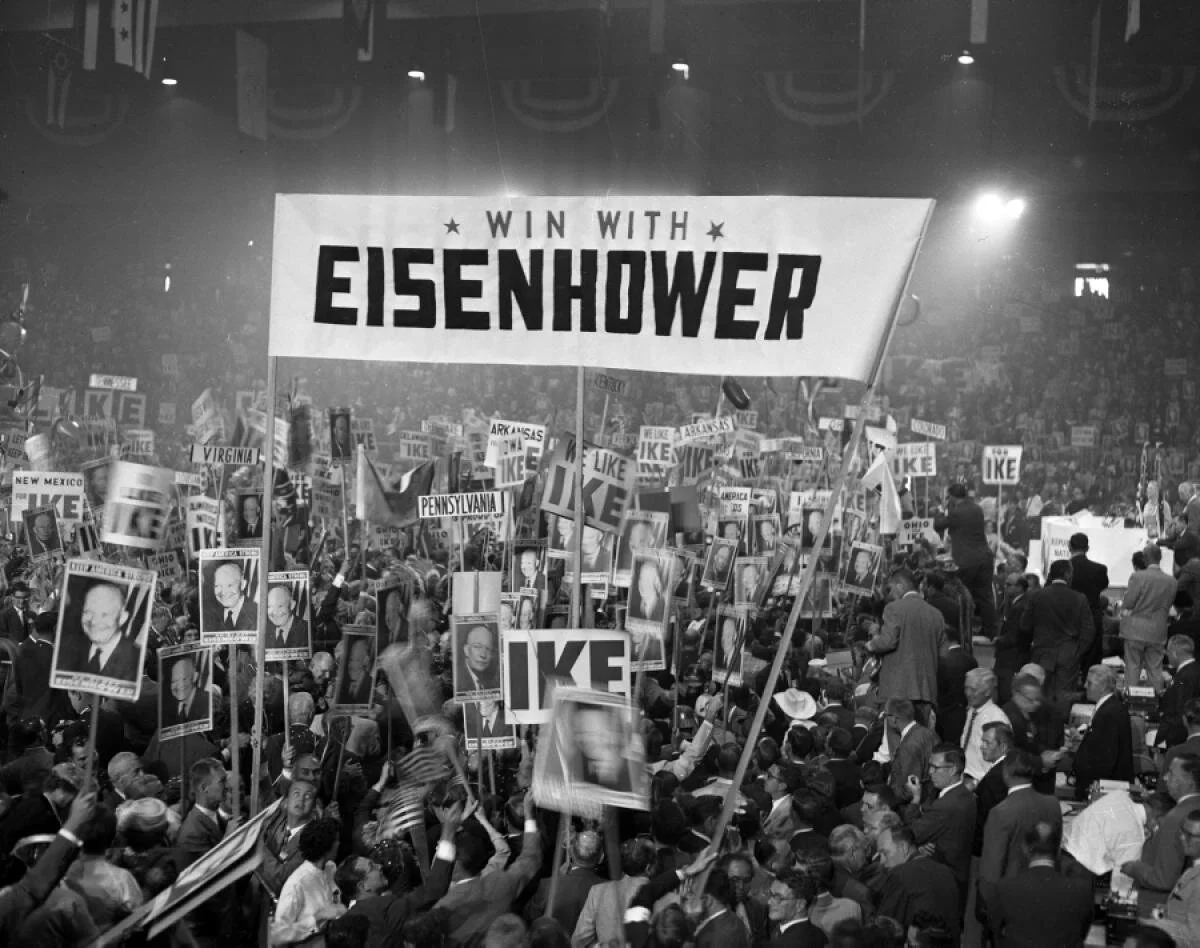
Eisenhower convention.jpg


Source: https://millercenter.org/the-presidency/pr...

Enjoyed this speech? Speakola is a labour of love and I’d be very grateful if you would share, tweet or like it. Thank you.

Facebook Twitter Facebook
In 1940-59 B Tags DWIGHT EISENHOWER, PRESIDENTIAL CANDIDATE, REPUBLICAN NATIONAL CONVENTION, 1956 ELECTION, US POLITICS, LINCOLN, ABRAHAM LINCOLN, NIXON, THE FUTURE, THE THREE IMPERATIVES OF POWER, TRANSCRIPT, CENTENNIAL
Comment

See my film!

Limited Australian Season

March 2025

Details and ticket bookings at

angeandtheboss.com

Support Speakola

Hi speech lovers,
With costs of hosting website and podcast, this labour of love has become a difficult financial proposition in recent times. If you can afford a donation, it will help Speakola survive and prosper.

Best wishes,
Tony Wilson.

Become a Patron!

Learn more about supporting Speakola.

Featured political

Featured
Jon Stewart: "They responded in five seconds", 9-11 first responders, Address to Congress - 2019
Jacinda Ardern: 'They were New Zealanders. They are us', Address to Parliament following Christchurch massacre - 2019
Dolores Ibárruri: "¡No Pasarán!, They shall not pass!', Defense of 2nd Spanish Republic - 1936
Jimmy Reid: 'A rat race is for rats. We're not rats', Rectorial address, Glasgow University - 1972

Featured eulogies

Featured
For Geoffrey Tozer: 'I have to say we all let him down', by Paul Keating - 2009
for James Baldwin: 'Jimmy. You crowned us', by Toni Morrison - 1988
for Michael Gordon: '13 days ago my Dad’s big, beautiful, generous heart suddenly stopped beating', by Scott and Sarah Gordon - 2018

Featured commencement

Featured
Tara Westover: 'Your avatar isn't real, it isn't terribly far from a lie', The Un-Instagrammable Self, Northeastern University - 2019
Tim Minchin: 'Being an artist requires massive reserves of self-belief', WAAPA - 2019
Atul Gawande: 'Curiosity and What Equality Really Means', UCLA Medical School - 2018
Abby Wambach: 'We are the wolves', Barnard College - 2018
Eric Idle: 'America is 300 million people all walking in the same direction, singing 'I Did It My Way'', Whitman College - 2013
Shirley Chisholm: ;America has gone to sleep', Greenfield High School - 1983

Featured sport

Featured
Joe Marler: 'Get back on the horse', Harlequins v Bath pre game interview - 2019
Ray Lewis : 'The greatest pain of my life is the reason I'm standing here today', 52 Cards -
Mel Jones: 'If she was Bradman on the field, she was definitely Keith Miller off the field', Betty Wilson's induction into Australian Cricket Hall of Fame - 2017
Jeff Thomson: 'It’s all those people that help you as kids', Hall of Fame - 2016

Fresh Tweets


Featured weddings

Featured
Dan Angelucci: 'The Best (Best Man) Speech of all time', for Don and Katherine - 2019
Hallerman Sisters: 'Oh sister now we have to let you gooooo!' for Caitlin & Johnny - 2015
Korey Soderman (via Kyle): 'All our lives I have used my voice to help Korey express his thoughts, so today, like always, I will be my brother’s voice' for Kyle and Jess - 2014

Featured Arts

Featured
Bruce Springsteen: 'They're keepers of some of the most beautiful sonic architecture in rock and roll', Induction U2 into Rock Hall of Fame - 2005
Olivia Colman: 'Done that bit. I think I have done that bit', BAFTA acceptance, Leading Actress - 2019
Axel Scheffler: 'The book wasn't called 'No Room on the Broom!', Illustrator of the Year, British Book Awards - 2018
Tina Fey: 'Only in comedy is an obedient white girl from the suburbs a diversity candidate', Kennedy Center Mark Twain Award -  2010
Tina Fey: 'Only in comedy is an obedient white girl from the suburbs a diversity candidate', Kennedy Center Mark Twain Award - 2010

Featured Debates

Featured
Sacha Baron Cohen: 'Just think what Goebbels might have done with Facebook', Anti Defamation League Leadership Award - 2019
Greta Thunberg: 'How dare you', UN Climate Action Summit - 2019
Charlie Munger: 'The Psychology of Human Misjudgment', Harvard University - 1995
Lawrence O'Donnell: 'The original sin of this country is that we invaders shot and murdered our way across the land killing every Native American that we could', The Last Word, 'Dakota' - 2016