• Genre
  • About
  • Submissions
  • Donate
  • Search
Menu

Speakola

All Speeches Great and Small
  • Genre
  • About
  • Submissions
  • Donate
  • Search
Share a political speech

Adolf Hitler: 'We must overcome the demoralization of Germany by the Communists', first radio address as Chancellor - 1933

March 17, 2023

1 February 1933, Berlin, Germany

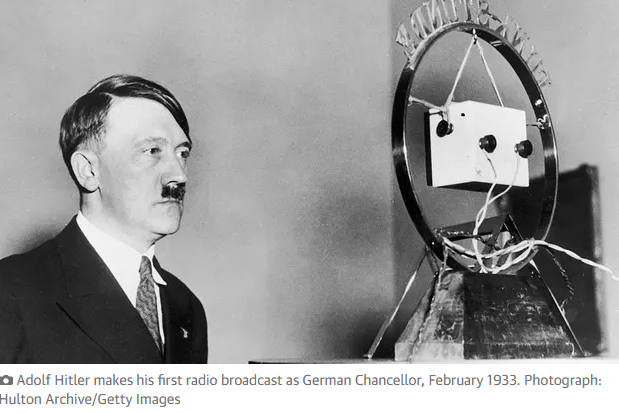
On February 1, 1933, two days after he was appointed chancellor, Hitler spoke over the radio to the German people about his vision for the future of the country:

Over fourteen years have passed since that unhappy day when the German people, blinded by promises made by those at home and abroad, forgot the highest values of our past, of the Reich, of its honor and its freedom, and thereby lost everything. Since those days of treason, the Almighty has withdrawn his blessing from our nation. Discord and hatred have moved in. Filled with the deepest distress, millions of the best German men and women from all walks of life see the unity of the nation disintegrating in a welter of egotistical political opinions, economic interests, and ideological conflicts.

As so often in our history, Germany, since the day the revolution broke out, presents a picture of heartbreaking disunity. We did not receive the equality and fraternity which was promised us; instead we lost our freedom. The breakdown of the unity of mind and will of our nation at home was followed by the collapse of its political position abroad.

We have a burning conviction that the German people in 1914 went into the great battle without any thought of personal guilt [for the start of the war] and weighed down only by the burden of having to defend the Reich from attack, to defend the freedom and material existence of the German people. In the appalling fate that has dogged us since November 1918 we see only the consequence of our inward collapse. But the rest of the world is no less shaken by great crises. The historical balance of power, which at one time contributed not a little to the understanding of the necessity for solidarity among the nations, with all the economic advantages resulting therefrom, has been destroyed.

The delusion that some are the conquerors and others the conquered destroys the trust between nations and thereby also destroys the world economy. But the misery of our people is terrible! The starving industrial proletariat [working class] have become unemployed in their millions, while the whole middle and artisan class have been made paupers. If the German farmer also is involved in this collapse we shall be faced with a catastrophe of vast proportions. For in that case, there will collapse not only a Reich, but also a 2000-year-old inheritance of the highest works of human culture and civilization.

All around us are symptoms portending this breakdown. With an unparalleled effort of will and of brute force the Communist method of madness is trying as a last resort to poison and undermine an inwardly shaken and uprooted nation. They seek to drive it towards an epoch which would correspond even less to the promises of the Communist speakers of today than did the epoch now drawing to a close to the promises of the same emissaries in November 1918.

Starting with the family, and including all notions of honor and loyalty, nation and fatherland, culture and economy, even the eternal foundations of our morals and our faith—nothing is spared by this negative, totally destructive ideology. . . . One year of Bolshevism would destroy Germany. The richest and most beautiful areas of world civilization would be transformed into chaos and a heap of ruins. Even the misery of the past decade and a half could not be compared with the affliction of a Europe in whose heart the red flag of destruction had been planted. The thousands of injured, the countless dead which this battle has already cost Germany may stand as a presage of the disaster.

In these hours of overwhelming concern for the existence and the future of the German nation, the venerable World War leader [President Paul von Hindenburg] appealed to us men of the nationalist parties and associations to fight under him again as once we did at the front, but now loyally united for the salvation of the Reich at home. The revered President of the Reich having with such generosity joined hands with us in a common pledge, we nationalist leaders would vow before God, our conscience and our people that we shall doggedly and with determination fulfill the mission entrusted to us as the National Government.

It is an appalling inheritance which we are taking over.

The task before us is the most difficult which has faced German statesmen in living memory. But we all have unbounded confidence, for we believe in our nation and in its eternal values. Farmers, workers, and the middle class must unite to contribute the bricks wherewith to build the new Reich.

The National Government will therefore regard it as its first and supreme task to restore to the German people unity of mind and will. It will preserve and defend the foundations on which the strength of our nation rests. It will take under its firm protection Christianity as the basis of our morality, and the family as the nucleus of our nation and our state. Standing above estates [groups that make up society’s social hierarchy] and classes, it will bring back to our people the consciousness of its racial and political unity and the obligations arising therefrom. It wishes to base the education of German youth on respect for our great past and pride in our old traditions. . . . Germany must not and will not sink into Communist anarchy.

In place of our turbulent instincts, it will make national discipline govern our life. In the process it will take into account all the institutions which are the true safeguards of the strength and power of our nation.

The National Government will carry out the great task of reorganizing our national economy with two big Four-Year Plans:

Saving the German farmer so that the nation’s food supply and thus the life of the nation shall be secured.
       

Saving the German worker by a massive and comprehensive attack on unemployment.

In fourteen years the November parties have ruined the German farmer. In fourteen years they created an army of millions of unemployed. The National Government will carry out the following plan with iron resolution and dogged perseverance. Within four years the German farmer must be saved from pauperism. Within four years unemployment must be completely overcome . . .

Our concern to provide daily bread will be equally a concern for the fulfillment of the responsibilities of society to those who are old and sick. The best safeguard against any experiment which might endanger the currency lies in economical administration, the promotion of work, and the preservation of agriculture, as well as in the use of individual initiative.

In foreign policy, the National Government will see its highest mission in the preservation of our people’s right to an independent life and in the regaining thereby of their freedom. The determination of this Government to put an end to the chaotic conditions in Germany is a step towards the integration into the community of nations of a state having equal status and therefore equal rights with the rest. In so doing, the Government is aware of its great obligation to support, as the Government of a free and equal nation, that maintenance and consolidation of peace which the world needs today more than ever before. May all others understand our position and so help to ensure that this sincere desire for the welfare of Europe and of the whole world shall find fulfillment.

Despite our love for our Army as the bearer of our arms and the symbol of our great past, we should be happy if the world, by restricting its armaments, made unnecessary any increase in our own weapons.

But if Germany is to experience this political and economic revival and conscientiously to fulfill its duties towards other nations, a decisive act is required: We must overcome the demoralization of Germany by the Communists.

We, men of this Government, feel responsible to German history for the reconstitution of a proper national body so that we may finally overcome the insanity of class and class warfare. We do not recognize classes, but only the German people, its millions of farmers, citizens and workers who together will either overcome this time of distress or succumb to it.

With resolution and fidelity to our oath, seeing the powerlessness of the present Reichstag to shoulder the task we advocate, we wish to commit it to the whole German people.

We therefore appeal now to the German people to sign this act of mutual reconciliation. The Government of the National Uprising [the Nazi-led government] wishes to set to work, and it will work. It has not for fourteen years brought ruin to the German nation; it wants to lead it to the summit. It is determined to make amends in four years for the liabilities of fourteen years. But it cannot subject the work of reconstruction to the will of those who were responsible for the breakdown.

The Marxist parties [political parties including the Social Democrats] and their followers had fourteen years to prove their abilities. The result is a heap of ruins. Now, German people, give us four years and then judge us.

Let us begin, loyal to the command of the Field-Marshal. May Almighty God favor our work, shape our will in the right way, bless our vision and bless us with the trust of our people. We have no desire to fight for ourselves; only for Germany.

Source: https://www.facinghistory.org/resource-lib...

Enjoyed this speech? Speakola is a labour of love and I’d be very grateful if you would share, tweet or like it. Thank you.

Facebook Twitter Facebook
In 1920-39 MORE Tags ADOLF HITLER, RADIO ADDRESS, CHANCELLOR, VICTORY SPEECH, GERMANY, NAZI, NAZISM, AUTHORITARIANISM, 1930s, 1933
Comment

Adolf Hitler: 'Now the German Volk has awakened!', closing speech at Nazi congress - 1938

March 9, 2022

12 September 1938, Nuremberg, Germany

Today we feel doubly close to those times because first of all, in our midst we see the fighters of the eldest German Ostmark who until recently were subject to a like persecution because of their National Socialist conviction. They stand amongst us today as Volksgenossen and citizens of the German Reich. What have they not had to go through, suffer through?! How many of their comrades were slain, how many injured in body and spirit, how many lost their livelihoods for many years, and how many ten thousands were imprisoned in jails, penitentiaries and Anhaltelagers?! The second reason for which we reflect upon these times with particular emotion is the fact that the events we experienced and suffered in our own nation at the time are precisely those we are witnessing on the world stage today.

And above all: our enemies today remain weltanschaulich the very same ones.

Almost every year, we could step before the nation with quiet confidence and await its judgment. The greatest approval ever granted the leadership of a Volk became ours on April 10 of this year. The Volk acknowledged and confirmed that it regards the new form of state and its leadership as institutions that strive to the best of their abilities to serve the Volk and to lead it once more to freedom and greatness and to ensure its economic well-being.

And still, what we are witnessing today on a larger scale is precisely the same we experienced in the decades of internal struggle. Ever since the day we assumed power, we have been surrounded by a hostile environment. The connivance between the gilded, capitalist democratic movement in our parliament on the one hand and with Marxism on the other in their war on National Socialism is today mirrored in a like conspiracy, albeit on a larger scale, involving the democracies and the Bolshevists as they make war on the state constituted by the National Socialist Volksgemeinschaft.

Perhaps the most persuasive evidence of the insincerity of their fight against the National Socialist Party as it struggled for power at the time is the fact that no matter whether they were bourgeois nationalists, capitalist democrats, or Marxist internationalists, they formed a unitary front against us in all decisive battles. At the time, many of our Volksgenossen were forced to realize just how dishonest the political battle was and of how little import morals were in this fight as they saw those parties fighting us on nationalist grounds, yet were not reluctant to conspire with Marxist internationalists to that end.

And vice versa, our Volksgenossen had to realize just how dishonest and fraudulent those parties were who claimed to persecute us for socialist reasons and then went to ally themselves with the worst proponents of capitalism prior to entering into the unitary front against us. The Center Party claimed to be fighting us because we were hostile to the Church, and yet to this end it entered into a holy alliance with atheist Social Democrats and did not shrink from uniting with the Communists. And on the other hand, Communists fought us because, as they claimed, we represented the Reaktion in their eyes. Yet they cast their ballot together with the true reactionaries against the vote of the National Socialist Party in the Reichstag.

It was indeed a display of such duplicity that one could only turn from it in disgust. Today we feel equally repelled as we watch the so-called international world democracies who supposedly advocate liberty, fraternity, justice, the right to self-determination of the peoples, etc., as we see these states ally themselves with Bolshevist Moscow.349 One day, perhaps someone will ask why we concern ourselves so much with the democracies and why we treat them in so negative a manner. This is the case because: First, as those attacked we are forced to counter.

Second, the conduct of these phenomena is so revolting.

Dishonesty sets in the minute these democracies claim to represent government by the people and decry authoritarian states as dictatorships. I believe that I can confidently state that today there are only two world powers who can honestly claim to have 99 percent of their people backing the government. What in other countries goes by the name of democracy is in most cases little other than the apt manipulation of public opinion by means of money and the press, and the equally apt manipulation of the results hereby achieved. How easily, however, are these supposed democracies stripped bare of their pretenses when one takes a close look at their stance in matters of foreign policy which constantly change to suit the purpose of the moment. There we witness how truly repressive regimes in small countries are actually being glorified by these democracies if it suits their needs. Yes, they even go so far as to fight for them, while on the other hand, they themselves actively repress inconvenient rallies in those states where such protest does not suit them. They fail to acknowledge this activism, attempt to subvert it or simply misinterpret its significance. And this is not all: these democracies even glorify Bolshevist regimes if it happens to suit their purpose, and this in spite of the fact that the latter style themselves as the dictatorship of the proletariat.

In other words, these supposed democracies decry regimes that are backed by 99 percent of their constituents as dictatorships, while at the same time they praise other countries as highly respectable democratic institutions even though these call themselves dictatorships and even though these can only subsist on the basis of mass executions, torture, etc. Is it not one of the greatest ironies in history that in the midst of upright prototype democrats in Geneva, the blooddrenched proponent of one of the cruelest tyrannies of all time moves about freely as a highly respected member of the Council?350 We in Germany have already witnessed the alliance of Jewish capitalism with an abstract version of communist anti-capitalism, and we have seen the Rote Fahne, the Vorwarts and the Frankfurter Allgemeine Zeitung march hand in hand here. It is the same all over the world. Bolshevist Moscow has become the highly revered ally of capitalist democracies! [-] For fifteen years, they have acted in gruesome defiance of the most natural interests of their peoples, yes, acting contrary to any standards of human dignity. Indeed, they drew up Diktats with a pistol in hand only to, at a later date, lament the “unilateral” transgression of holy rights and the breach of all the more holy contracts. Without so much as a thought for the opinion of the natives, they have led a drive for the bloody subjugation of entire continents.

However, the minute that Germany mentions the return of its colonies, they declared that-out of concern for the indigenous people there-one could not possibly abandon the natives to so horrid a fate. At the same time, they did not distance themselves from dropping bombs out of planes onto their own colonies. And all this to use the force of reason to persuade the dear colored compatriots to submit to the foreign rule a hit longer. Of course, the bombs thus employed were bombs with civilizing warheads which one must absolutely not confuse with those brutal ones Italy used in Abyssinia.

Throughout the democratic countries, one laments the unimaginable cruelty with which first Germany, and now Italy as well, are striving to rid themselves of the Jewish element. However, all these great democratic empires have altogether little more than a few persons per square kilometer. In Italy and in Germany this number exceeds 140 persons. For decades, Germany nevertheless took in hundreds of thousands upon hundreds of thousands of Jews without batting an eyelid.

Now that the burden has become overbearing and the nation is no longer willing to have its life blood sucked out of it by these parasites, it is now that there is great lament abroad. However, not a word is heard in these democratic countries about replacing this hypocritical lamentation with a good deed and assistance. No, to the contrary, all one hears is cold reasoning claiming that in these states there is regretfully no space either! Evidently, they expect us to bear up under this burden of Jewry despite our 140 persons per square kilometer, while the democratic world empires with their few people per square kilometer could not possibly shoulder this burden. Alas, no help. But morals! And thus we find the National Socialist Reich faced with the same phenomenon and forces that we had fifteen years to get to know as a party.

Insofar as this is indicative of the hostile attitude of the democratic states toward Germany, this matters little to us. Besides, why should we fare any better than the Reich before us? On a side note, I will admit quite openly that I find it easier to bear insults from someone who can no longer rob me than to be robbed by someone who praises me for letting it happen. Today we are insulted. Yet we are in a position-praise the Lord-to prevent Germany from being ravaged and raped. The state before us was blackmailed for fifteen years.

For this, admittedly, it received compensation-the somewhat sparse recompense, at least in my eyes-of praise for having been a good little democratic state.

This comportment becomes unbearable for us the minute a major part of our Volk is placed at the mercy of impertinent abusers, ostensibly without any means of defending itself, while the brunt of democratic rhetoric pours forth as a threat to our Volksgenossen. I am speaking of Czecho-Slovakia.

This state is a democracy, that is to say it was founded on democratic principles. The majority of its people was simply forced to submit to the structure construed at Versailles without any one asking for its opinion. As a true democracy, this state immediately began to suppress the majority of its people, to abuse there and to rob them of their inalienable rights. Gradually, one attempted to impress upon the world that this state had a special military and political mission to fulfill.

The former French Minister of Aviation, Pierre Cot,352 has explained this to us recently. According to him, Czechoslovakia exists for the purpose of providing a base, in the event of war, for launching aerial attacks and dropping bombs upon German cities and industrial plants. Needless to say, we may assume that these will once again be equipped with those warheads of the famed civilizing variety.

However, this mission stands in opposition to the desires of the majority of the inhabitants of this state, and is alien to their philosophy of life and contrary to their vital interests. That is why the majority of its citizens were silenced. Any protest against this fate would have been an assault upon the aims incarnate in this state and hence would have been in violation of its constitution. Drawn up by the democrats, this constitution was less suited to realizing the rights of the people affected and was instead more tailored toward accommodating the political expediencies of the people’s oppressors. Political expediency necessitated as well that a structure be construed that accorded the Czech people a position of preeminence in this state. Whoever protested against this usurpation became an “enemy of the state” and hence, in accordance with democratic norms, he was outlawed. Providence has thus called upon the socalled people of the Czech state-admittedly voicing its intent through the good offices of the architects at Versailles-to stand guard lest someone rise in opposition to this ultimate purpose of the state.

Should someone nevertheless venture to step forth from amongst the majority of the oppressed peoples in this state and voice opposition to this end, then it is naturally permissible that he be beaten hack with the full force at the state’s disposal and, if so desire or need be, he could also simply be murdered.

If this now did not concern us, if this were some foreign affair, we, like so many others, might take note of it simply as a most interesting display of the democrats’ understanding of the rights of peoples to self-determination.

However, the nature of the affair involves an obligation of us Germans.

Amongst the suppressed minorities in this state, there are also three and a half million Germans, roughly as many people of our race as Denmark has in inhabitants.353 These Germans are God’s creatures as well. The Almighty has not created them so that the construction arrived at in Versailles might place them at the mercy of an alien power they hate. And He has not created seven million Czechs either so that they may reign over these three and a half million, keep them in tutelage, and even far less did He create them to ravage and torture.

The situation in this state has become unbearable, as is well known. In a political context, three and a half million people there are robbed of their right to self-determination in the name of the right to self-determination as construed by a certain Mister Wilson. In an economic context, these people are being ruined methodically and hence are subject to a slow but steady extermination.

The misery of the Sudeten Germans defies description. One desires to destroy them. In a humanitarian context, they are being oppressed and humiliated in an unprecedented fashion.

When three and a half million members of a Volk of eighty million may not sing a song they like because the Czechs dislike it, when they are beaten until they bleed simply because they wear stockings which the Czechs care not to see, when they are terrorized and abused because they greet one another in a fashion the Czechs cannot bear even though they were merely greeting one another and no Czech, when they are persecuted because of every little detail connected to the expression of their nationality, and when they are hunted down as though animals, yes, then this may leave those renowned representatives of democracy cold, who knows, they might actually enjoy it since those affected are a mere three and a half million Germans. All I can say to these representatives of democracy is that this does not leave us cold, no, if these tortured creatures can find neither justice nor help by themselves, then they will receive both from us. There must be an end to the injustice inflicted upon these people! I have already stated this quite openly in my speech of February 20. It was a short-sighted enterprise which the architects of Versailles conceived when they gave birth to the abnormal structure of the Czechoslovakian state. It could pursue its mission to ravage and rape a mass of millions of other nationalities only as long as the brother nations themselves suffered from the abuse inflicted upon the world at Versailles.

However, to believe that such a regime could continue to sin eternally and endlessly means to succumb to an inconceivable delusion. In my speech before the German Reichstag on February 20, I had pointed out that the Reich will no longer stand for any further oppression and persecution of these three and a half million Germans. And I implore all foreign statesmen not to think this mere rhetoric.

For the sake of peace in Europe, the National Socialist State has made enormous sacrifices, enormous sacrifices for the entire nation. It did not harbor any thoughts of so-called revenge; rather, it has banished all such thoughts from all private and public spheres of life. In the course of the seventeenth century, France slowly penetrated Alsace-Lorraine and took it from the Old German Reich in the midst of peacetime.

Following a dreadful war in 1870–71 which had been forced upon Germany, the Reich reclaimed these territories, and they were returned to it. They were lost once more after the World War. To us Germans, the cathedral in Strasbourg means a lot. And when we did not pursue the matter any further, we refrained only in the service of a lasting peace for Europe. No one could have forced us to cede these claims voluntarily had we not wished to give them up in the first place! We gave them up because we willed an end to this constant argument with France once and for all. The Reich has espoused a similar stance and has taken similarly determined steps along its other borders as well. Here National Socialism acted highly responsibly and set an example. We made the greatest of sacrifices and distanced ourselves voluntarily from any further demands so that Europe might enjoy a peaceful future and so that a passage might be cleared, at least on our part, for reconciliation of all peoples worldwide. We acted in an exceedingly loyal fashion.

Neither press, silver screen, nor stage were allowed to propagate a diverging opinion. Not even in literature did we allow for an exception. In a related spirit, I offered solutions for a reduction of tensions in Europe, an offer that was refused for reasons we still fail to comprehend. We voluntarily restricted our power in this important realm in the hope that we should never again be forced to use arms against this one other state in question.354 This did not happen because we would not have been able to produce 55 percent more ships; it occurred because we wished to contribute to a final reduction of tensions and to a pacification of the situation in Europe. Since we found a great patriot and statesman in Poland willing to enter into an agreement with Germany, we immediately seized the opportunity, and arrived at a treaty that no doubt is of far greater import to peace in Europe than all the talk in the halls of the League of Nations’ temple in Geneva.

Germany today possesses many a completely pacified border and Germany is determined, and has stated as much, to accept these borders as inviolable and unchangeable in order to give Europe a feeling of security and peace.

Apparently, however, this self-denial and self-discipline on the part of Germany has been misinterpreted as a sign of weakness. Hence today I would like to set things right: I do not believe that we would be rendering peace in Europe a great service if we pronounced our disinterest in all European affairs. In particular, Germany would not be doing anyone a great service if it remained unmoved by the suffering and plight of three and a half million Volksgenossen and if it did not take an interest in their fate. We understand when England and France pursue their interests in the world.

I wish to point out to the statesmen in Paris and London that there are German interests as well and that we are determined to pursue these under all circumstances. At this point I would like to remind them of my speech before the Reichstag in 1933, in which I openly avowed before all the world that there were questions of national concern in which our path was clearly predetermined. I would rather submit myself to any ordeal, danger, or torment than to fail in the fulfillment of such prerogatives.

No European state has done as much as Germany in the service of peace! No one has made greater sacrifices! One must bear in mind, however, that there is a limit as to how much one can sacrifice, and one should not confuse National Socialist Germany with the Germany of Bethmann-Hollweg and Herding.

When I make this declaration, I do so because of an event that occurred in the course of this year, an event that forces all of us to reconsider our stance to date. As you well know, my Party Comrades, Czechoslovakia has finally announced local elections to be held this year after infinitely postponing any form of plebiscite. Even Prague has finally admitted to the untenable nature of its present position. It fears the unity of the Germans and of the other nationalities. It is convinced that it has to resort to extraordinary measures in order to exert pressure in the election process and thus to manipulate the outcome of the election. Evidently, the Czechoslovakian Government has concluded that this can be achieved only through a brutal policy of intimidation.

Apparently, the Czech state felt that a display of its military might was particularly well suited to this end.

This was especially geared toward the Sudeten Germans to serve as a warning not to speak up for their national interests and to vote accordingly. In order to somehow justify this attempt at intimidation before the eyes of the world public, the Czech Government, i.e. Herr Beneš, fabricated the lie that German troops had been mobilized for an invasion of Czechoslovakia.

In this context, let me today state the following: the creation of such lies is nothing new. About a year ago, the press in a certain country invented a story according to which 20,000 German soldiers had landed in Morocco.356 The Jewish proponent of this lie in the press hoped to thereby cause a war.

At the time, it had sufficed to address a short statement to the French Ambassador to resolve the situation. And in this instance as well, we immediately assured the ambassador of another great power of the falsehood of the Czech allegations. The statement was issued once more, and the Prague Government was immediately informed of its content. Nevertheless, the Government in Prague exploited this deception as a pretext for its terrorist blackmail and manipulation of the election.357 All that I can do in retrospect is to assert that, for one, not one German soldier had been called up other than those serving anyway at this point in time.

Secondly, not one regiment, not one additional unit, had marched to the border.

Indeed, not one soldier served in a garrison other than the one assigned to him for peacetime during this period.

To the contrary, orders were issued to avoid taking any steps that might be construed as a means for exerting pressure on Czechoslovakia on our part.

Nonetheless, a base and vile campaign against us was launched in which all of Europe was organized in the service of a government in pursuit of criminal goals. This government’s sole ambition lay in the manipulation of the election by the exertion of military pressure in an effort to intimidate its citizens and thus rob them of their right to vote. And all this was merely a means of obtaining moral legitimacy which this government felt it needed. Indeed, it had no scruples to cast suspicion on one great state, to alarm all of Europe and to, if need be, plunge Europe into a bloody war.

The Reich Government undertook no such steps, and, in fact, Germany had no such intentions; quite to the contrary, it was convinced that the local elections would do justice to the Sudeten German cause. This lack of activity was then construed as a sign that the German Government stepped down because of the determined stance of the Czechs and of the early intervention by England and France.

You will understand, my Party Comrades, that a great power cannot tolerate such a base incursion [the partial mobilization of Czechoslovakian troops on May 20/21] a second time. As a consequence, I have taken the necessary precautions. I am a National Socialist and as such I am accustomed to strike back at any attacker. Moreover, I know only too well that leniency will not succeed in appeasing, but will merely encourage the arrogance of so irreconcilable an adversary as the Czechs.

Let the fate of the Old German Reich be a warning to us. Its love for peace drove it to the brink of self-destruction. Nonetheless, the Old Reich could not prevent the war in the end. In due consideration thereof, I took steps on May 28 which were very difficult: First, I ordered a far-reaching intensification and the immediate implementation and execution of the reinforcements announced for Army and Luftwaffe. Second, I ordered the immediate expansion of our fortifications to the West. I can assure you that ever since May 28, the construction of one of the most gigantic fortresses of all time has been underway there.

To this end, I entrusted Dr. Todt, the Generalinspekteur for road construction in Germany, with a new commission. Within the framework of the projects undertaken by the fortress construction inspectorate, he has achieved one of the greatest accomplishments of all time, thanks to his extraordinary organizational talents.

Let me point out a few figures to you. At present at work on the fortification of our Western frontier, a project actually begun over two years ago, are: 278,000 laborers in the Todt organization in addition to 84,000 [other] laborers, in addition to 100,000 men of the Reich Labor Service and numerous pioneer battalions and infantry divisions. Besides the materials that are brought to the construction sites via different transportation routes, the German Reichsbahn alone transports 8,000 freight cars a day.

The daily consumption of gravel amounts to over 100,000 tons. The fortification of Germany’s western border will be completed prior to the onset of winter. Its defensive capacity is already assured as of this day. Once completed, it will consist of over 17,000 armored plates and concrete structures. The German Volk in arms stands behind this front of steel and concrete made up of three fortified lines and in some locations actually consists of four fortified lines up to fifty kilometers deep. I have made this greatest effort of all time in the service of peace. Under no circumstances, however, am I willing to quietly stand by and observe from afar the continued oppression of German Volksgenossen in Czechoslovakia.

It’s all tactics. Herr Beneš talks, wants to organize negotiations. He wishes to resolve the question of procedure in accordance with the Geneva Conventions and hands out little favors to placate the people. Things cannot go on this way! This is not a question of empty diplomatic phrases. This is a question of right, the question of a right not granted. What we Germans demand is the right to self-determination, a right every Volk possesses, and not an empty phrase. Herr Beneš is not supposed to grant the Sudeten Germans any favors. They have a right to their own way of life, just as any other people do.

The consequences will be grave ones should, perchance, the democracies persist in their conviction that they must continue to, by any and all means, accord their protection to the oppression of German men and women! I believe it to be in the service of peace, if I leave no doubts as to this fact.

I am asking neither that Germany be allowed to oppress three and a half million Frenchmen, nor am I asking that three and a half million Englishmen be placed at our mercy. Rather I am simply demanding that the oppression of three and a half million Germans in Czechoslovakia cease and that the inalienable right to self-determination take its place.

We would truly regret if this were to cloud or damage our relations to the other European states. Yet the fault would not be ours. It is the business of the Czechoslovakian Government to come to terms with the true representatives of the Sudeten Germans and, in one way or another, to reach some form of understanding with them. Nevertheless, it is my business and, my Volksgenossen, it is the business of all of us to take care that justice not be perverted into injustice. After all, this matter involves our German Volksgenossen. I am not in the least willing to allow foreign statesmen to create a second Palestine right here in the heart of Germany. The poor Arabs are defenseless and have been abandoned by all. The Germans in Czechoslovakia are neither defenseless nor have they been abandoned. Please note this fact.

I feel compelled to broach this topic at that Party Congress in which the representatives of our German-Austrian Gaus participate for the first time.

Better than anyone else they know how painful it is to be separated from the mother country. Easier than anyone else they will grasp the full import of my exposition on this day. With greater enthusiasm than any, they will agree with me when I state before the entire Volk that we would not deserve to be Germans if we were not willing to take such a stance, and to bear up under the consequences one way or another.

When we bear in mind the intolerable impertinence with which even a small state dared to approach Germany in the last months, then we realize that the only explanation possible is revealed in the unwillingness to recognize that the German Reich is more than just a peace-loving, upstart state.

Standing in Rome in the springtime, I felt deep inside that we assess historic developments in far too restricted a manner, investigating time periods far too short to be revealing. One thousand or fifteen hundred years are no more than a few dynastic successions.

What exhausts itself in a certain period, can rise again in the same time period. Today’s Italy and today’s Germany are living proof of this. Both are nations that have regenerated, indeed, that might be regarded as new nations in this context. However, their roots spring not from the grounds of more recent ages but rather they reach back into ancient history. The Roman Empire breathes once more. The phenomenon of Germany as a state is not new either, although it has made its appearance more recently.

I had the insignias of the Old German Reich brought to Nuremberg for a reason. I wish to call to mind, and this not only for the benefit of the German people but also for that of all peoples, that more than half a millennium prior to the discovery of the new world, a gigantic Germanic-German Reich358 stood on these grounds. Dynasties came into being and dissipated. Outward forms changed. Yet while the Volk has been rejuvenated, its essence has remained the same it has always been. The German Reich has long been dormant.

Now the German Volk has awakened and once more bears its crown of 1,000 years high on its head. All of us who bear witness to this historic resurrection feel great pride and happiness. We stand before the Almighty in humble gratitude.

For the rest of the world this should be an inspiration as well as a lesson learned, an inspiration to reflect upon history from a more elevated point of view, and a lesson not to succumb to the same mistakes as in the past.

In truth the new Roman-Italian empire and the Germanic-German Reich are ancient structures. You need not love them and yet no power on earth shall ever again remove them.

Party Comrades! National Socialists! The first Reich Party Congress of Greater Germany ends at this hour. All of you are still under the spell of the great historic events of these past days. This demonstration of our Volk’s power and determination has reinforced the nation’s pride and your confidence in it.

Return to your homes now and carry in your hearts that same faith which you have cherished throughout almost two decades as Germans and as National Socialists.

You now have the right to proudly carry your heads high again as Germans.

It is the duty of all of us to never again bow our heads to any alien will. To this let us pledge ourselves, so help us God!

This depends exclusively on the power of our own weapons and, therefore, depends upon the carriers of those weapons themselves.

No negotiations, no conferences and no other agreement has accorded us Germans the natural right to unity. We had to take justice into our own hands, and we were able to do so thanks to your existence, my soldiers! And it is thus that the two greatest institutions of our Volk must fulfill two identical missions. National Socialism has to educate our Volk within to form this Vol ksgemeinschaft. The Wehrmacht has to instruct this same Volk to defend this Volksgemeinschaft outwardly. So it is you, my soldiers, who were immediately charged with the fulfillment of a mission in this new Reich. And this fulfillment has earned you the love of the German Volk. It relied upon you and it has realized that it can rely upon its sons in uniform. For you carry the best weapons available today, you receive the best training, and I know that you also possess the best of character.

You fit in well with the eternal, everlasting front constituted by Germany’s soldiers. In the past months, I repeatedly had the opportunity to convince myself of this. I saw it at the maneuver sites, shooting stands, and training camps, and it was with great contentment that I realized that the German nation can once more look to its soldiers with great pride. And it is that for which I thank you! Yet, we do not serve for the sake of gratitude, praise, or recompense unless this gratitude, praise and recompense is at the service of what we value the most in this world: our Volk and our German Reich!

Deutschland-Sieg Heil!

Source: https://der-fuehrer.org/reden/english/38-0...

Enjoyed this speech? Speakola is a labour of love and I’d be very grateful if you would share, tweet or like it. Thank you.

Facebook Twitter Facebook
In 1920-39 MORE Tags ADOLF HITLER, WW2, THREAT OF WAR, WORLD WAR 2, SUDETENLAND, SUDETEN, GERMANY, CZECH, CZECHOSLOVAKIA, NAZISM, NAZI, WESTERN FRONT, FORTIFICATIONS
Comment

Joseph Goebbels: 'Nation, Rise up and let the storm break loose!!' Total War Speech - 1943

November 12, 2019

18 February 1943, Berlin, Germany

Only three weeks ago I stood in this place to read the Führer’s proclamation on the 10th anniversary of the seizure of power, and to speak to you and to the German people. The crisis we now face on the Eastern Front was at its height. In the midst of the hard misfortunes the nation faced in the battle on the Volga, we gathered together in a mass meeting on the 30th of January to display our unity, our unanimity and our strong will to overcome the difficulties we faced in the fourth year of the war.

It was a moving experience for me, and probably also for all of you, to be bound by radio with the last heroic fighters in Stalingrad during our powerful meeting here in the Sport Palace. They radioed to us that they had heard the Führer’s proclamation, and perhaps for the last time in their lives joined us in raising their hands to sing the national anthems. What an example German soldiers have set in this great age! And what an obligation it puts on us all, particularly the entire German homeland! Stalingrad was and is fate’s great alarm call to the German nation! A nation that has the strength to survive and overcome such a disaster, even to draw from it additional strength, is unbeatable. In my speech to you and the German people, I shall remember the heroes of Stalingrad, who put me and all of us under a deep obligation.

I do not know how many millions of people are listening to me over the radio tonight, at home and at the front. I want to speak to all of you from the depths of my heart to the depths of yours. I believe that the entire German people has a passionate interest in what I have to say tonight. I will therefore speak with holy seriousness and openness, as the hour demands. The German people, raised, educated and disciplined by National Socialism, can bear the whole truth. It knows the gravity of the situation, and its leadership can therefore demand the necessary hard measures, yes even the hardest measures. We Germans are armed against weakness and uncertainty. The blows and misfortunes of the war only give us additional strength, firm resolve, and a spiritual and fighting will to overcome all difficulties and obstacles with revolutionary élan.

Now is not the time to ask how it all happened. That can wait until later, when the German people and the whole world will learn the full truth about the misfortune of the past weeks, and its deep and fateful significance. The heroic sacrifices of heroism of our soldiers in Stalingrad has had vast historical significance for the whole Eastern Front. It was not in vain. The future will make clear why.

When I jump over the past to look ahead, I do it intentionally. The time is short! There is no time for fruitless debates. We must act, immediately, thoroughly, and decisively, as has always been the National Socialist way.

The movement has from its beginning acted in that way to master the many crises it faced and overcame. The National Socialist state also acted decisively when faced by a threat. We are not like the ostrich that sticks its head in the sand so as not to see danger. We are brave enough to look danger in the face, to coolly and ruthlessly take its measure, then act decisively with our heads held high. Both as a movement and as a nation, we have always been at our best when we needed fanatic, determined wills to overcome and eliminate danger, or a strength of character sufficient to overcome every obstacle, or bitter determination to reach our goal, or an iron heart capable of withstanding every internal and external battle. So it will be today. My task is to give you an unvarnished picture of the situation, and to draw the hard conclusions that will guide the actions of the German government, but also of the German people.

We face a serious military challenge in the East. The crisis is at the moment a broad one, similar but not identical in many ways to that of the previous winter. Later we will discuss the causes. Now, we must accept things as they are and discover and apply the ways and means to turn things again in our favor. There is no point in disputing the seriousness of the situation. I do not want to give you a false impression of the situation that could lead to false conclusions, perhaps giving the German people a false sense of security that is altogether inappropriate in the present situation.

The storm raging against our venerable continent from the steppes this winter overshadows all previous human and historical experience. The German army and its allies are the only possible defense. In his proclamation on 30 January, the Führer asked in a grave and compelling way what would have become of Germany and Europe if, on 30 January 1933, a bourgeois or democratic government had taken power instead of the National Socialists! What dangers would have followed, faster than we could then have suspected, and what powers of defense would we have had to meet them? Ten years of National Socialism have been enough to make plain to the German people the seriousness of the danger posed by Bolshevism from the East. Now one can understand why we spoke so often of the fight against Bolshevism at our Nuremberg party rallies. We raised our voices in warning to our German people and the world, hoping to awaken Western humanity from the paralysis of will and spirit into which it had fallen. We tried to open their eyes to the horrible danger from Eastern Bolshevism, which had subjected a nation of nearly 200 million people to the terror of the Jews and was preparing an aggressive war against Europe.

When the Führer ordered the army to attack the East on 22 June 1941, we all knew that this would be the decisive battle of this great struggle. We knew the dangers and difficulties. But we also knew that dangers and difficulties always grow over time, they never diminish. It was two minutes before midnight. Waiting any longer could easily have led to the destruction of the Reich and a total Bolshevization of the European continent.

It is understandable that, as a result of broad concealment and misleading actions by the Bolshevist government, we did not properly evaluate the Soviet Union’s war potential. Only now do we see its true scale. That is why the battle our soldiers face in the East exceeds in its hardness, dangers and difficulties all human imagining. It demands our full national strength. This is a threat to the Reich and to the European continent that casts all previous dangers into the shadows. If we fail, we will have failed our historic mission. Everything we have built and done in the past pales in the face of this gigantic task that the German army directly and the German people less directly face.

I speak first to the world, and proclaim three theses regarding our fight against the Bolshevist danger in the East.

This first thesis: Were the German army not in a position to break the danger from the East, the Reich would fall to Bolshevism, and all Europe shortly afterwards.

Second: The German army, the German people and their allies alone have the strength to save Europe from this threat.

Third: Danger faces us. We must act quickly and decisively, or it will be too late.

I turn to the first thesis. Bolshevism has always proclaimed its goal openly: to bring revolution not only to Europe, but to the entire world, and plunge it into Bolshevist chaos. This goal has been evident from the beginning of the Bolshevist Soviet Union, and has been the ideological and practical goal of the Kremlin’s policies. Clearly, the nearer Stalin and the other Soviet leaders believe they are to realizing their world-destroying objectives, the more they attempt to hide and conceal them. We cannot be fooled. We are not like those timid souls who wait like the hypnotized rabbit until the serpent devours them. We prefer to recognize the danger in good time and take effective action. We see through not only the ideology of Bolshevism, but also its practice, for we had great success with that in our domestic struggles. The Kremlin cannot deceive us. We had fourteen years of our struggle for power, and ten years thereafter, to unmask its intentions and its infamous deceptions.

The goal of Bolshevism is Jewish world revolution. They want to bring chaos to the Reich and Europe, using the resulting hopelessness and desperation to establish their international, Bolshevist-concealed capitalist tyranny.

I do not need to say what that would mean for the German people. A Bolshevization of the Reich would mean the liquidation of our entire intelligentsia and leadership, and the descent of our workers into Bolshevist-Jewish slavery. In Moscow, they find workers for forced labor battalions in the Siberian tundra, as the Führer said in his proclamation on 30 January. The revolt of the steppes is readying itself at the front, and the storm from the East that breaks against our lines daily in increasing strength is nothing other than a repetition of the historical devastation that has so often in the past endangered our part of the world.

That is a direct threat to the existence of every European power. No one should believe that Bolshevism would stop at the borders of the Reich, were it to be victorious. The goal of its aggressive policies and wars is the Bolshevization of every land and people in the world. In the face of such undeniable intentions, we are not impressed by paper declarations from the Kremlin or guarantees from London or Washington. We know that we are dealing in the East with an infernal political devilishness that does not recognize the norms governing relations between people and nations. When for example the English Lord Beaverbrook says that Europe must be given over to the Soviets or when the leading American Jewish journalist Brown cynically adds that a Bolshevization of Europe might solve all of the continent’s problems, we know what they have in mind. The European powers are facing the most critical question. The West is in danger. It makes no difference whether or not their governments and intellectuals realize it or not.

The German people, in any event, is unwilling to bow to this danger. Behind the oncoming Soviet divisions we see the Jewish liquidation commandos, and behind them terror, the specter of mass starvation and complete anarchy. International Jewry is the devilish ferment of decomposition that finds cynical satisfaction in plunging the world into the deepest chaos and destroying ancient cultures that it played no role in building.

We also know our historic responsibility. Two thousand years of Western civilization are in danger. One cannot overestimate the danger. It is indicative that when one names it as it is, International Jewry throughout the world protests loudly. Things have gone so far in Europe that one cannot call a danger a danger when it is caused by the Jews.

That does not stop us from drawing the necessary conclusions. That is what we did in our earlier domestic battles. The democratic Jewry of the “Berliner Tageblatt” and the “Vossischen Zeitung” served communist Jewry by minimizing and downplaying a growing danger, and by lulling our threatened people to sleep and reducing their ability to resist. We could see, if the danger were not overcome, the specter of hunger, misery, and forced labor by millions of Germans. We could see our venerable part of the world collapse, and bury in its ruins the ancient inheritance of the West. That is the danger we face today.

My second thesis: Only the German Reich and its allies are in the position to resist this danger. The European nations, including England, believe that they are strong enough to resist effectively the Bolshevization of Europe, should it come to that. This belief is childish and not even worth refuting. If the strongest military force in the world is not able to break the threat of Bolshevism, who else could do it? (The crowd in the Sportpalast shouts “No one!”). The neutral European nations have neither the potential nor the military means nor the spiritual strength to provide even the least resistance to Bolshevism. Bolshevism’s robotic divisions would roll over them within a few days. In the capitals of the mid-sized and smaller European states, they console themselves with the idea that one must be spiritually armed against Bolshevism (laughter). That reminds us of the statements by bourgeois parties in 1932, who thought they could fight and win the battle against communism with spiritual weapons. That was too stupid even then to be worth refuting. Eastern Bolshevism is not only a doctrine of terrorism, it is also the practice of terrorism. It strives for its goals with an infernal thoroughness, using every resource at its disposal, regardless of the welfare, prosperity or peace of the peoples it ruthlessly oppresses. What would England and America do if, in the worst case, Europe fell into Bolshevism’s arms? Will London perhaps persuade Bolshevism to stop at the English Channel? I have already said that Bolshevism has its foreign legions in the form of communist parties in every democratic nation. None of these states can think it is immune to domestic Bolshevism. In a recent by-election for the House of Commons, the independent, that is communist, candidate got 10,741 of the 22,371 votes cast. This was in a district that had formerly been a conservative stronghold. Within a short time, 10,000 voters, nearly half, had been lost to the communists.

That is proof that the Bolshevist danger exists in England too, and that it will not go away simply because it is ignored. We place no faith in any territorial promises that the Soviet Union may make. Bolshevism set ideological as well as military boundaries, which poses a danger to every nation. The world no longer has the choice between falling back into its old fragmentation or accepting a new order for Europe under Axis leadership. The only choice now is between living under Axis protection or in a Bolshevist Europe.

I am firmly convinced that the lamenting lords and archbishops in London have not the slightest intention of resisting the Bolshevist danger that would result were the Soviet army to enter Europe. Jewry has so deeply infected the Anglo-Saxon states both spiritually and politically that they are no longer have the ability to see the danger. It conceals itself as Bolshevism in the Soviet Union, and plutocratic-capitalism in the Anglo-Saxon states. The Jewish race is an expert at mimicry. They put their host peoples to sleep, paralyzing their defensive abilities. (Shouts from the crowd: “We have experienced it!”). Our insight into the matter led us to the early realization that cooperation between international plutocracy and international Bolshevism was not a contradiction, but rather a sign of deep commonalities. The hand of the pseudo-civilized Jewry of Western Europe shakes the hand of the Jewry of the Eastern ghettos over Germany. Europe is in deadly danger.

I do not flatter myself into believing that my remarks will influence public opinion in the neutral, much less the enemy, states. That is also not my goal or intention. I know that, given our problems on the Eastern Front, the English press tomorrow will furiously attack me with the accusation that I have made the first peace feelers (loud laughter). That is certainly not so. No one in Germany thinks any longer of a cowardly compromise. The entire people thinks only of a hard war. As a spokesman for the leading nation of the continent, however, I claim the right to call a danger a danger if it threatens not threatens not only our own land, but our entire continent. We National Socialists have the duty to sound the alarm against International Jewry’s attempt to plunge the European continent into chaos, and to warn that Jewry has in Bolshevism a terroristic military power whose danger cannot be overestimated.

My third thesis is that the danger is immediate. The paralysis of the Western European democracies before their deadliest threat is frightening. International Jewry is doing all it can to encourage such paralysis. During our struggle for power in Germany, Jewish newspapers tried to conceal the danger, until National Socialism awakened the people. It is just the same today in other nations. Jewry once again reveals itself as the incarnation of evil, as the plastic demon of decay and the bearer of an international culture-destroying chaos.

This explains, by the way, our consistent Jewish policies. We see Jewry as a direct threat to every nation. We do not care what other peoples do about the danger. What we do to defend ourselves is our own business, however, and we will not tolerate objections from others. Jewry is a contagious infection. Enemy nations may raise hypocritical protests against our measures against Jewry and cry crocodile tears, but that will not stop us from doing that which is necessary. Germany, in any event, has no intention of bowing before this threat, but rather intends to take the most radical measures, if necessary, in good time (After this sentence, the chants of the audience prevent the minister from going on for several minutes).

The military challenges of the Reich in the East are at the center of everything. The war of mechanized robots against Germany and Europe has reached its high point. In resisting the grave and direct threat with its weapons, the German people and its Axis allies are fulfilling in the truest sense of the word a European mission. Our courageous and just battle against this world-wide plague will not be hindered by the worldwide outcry of International Jewry. It can and must end only with victory (Here there are loud shouts: “German men, to arms! German women, to work!”).

The tragic battle of Stalingrad is a symbol of heroic, manly resistance to the revolt of the steppes. It has not only a military, but also an intellectual and spiritual significance for the German people. Here for the first time our eyes have been opened to the true nature of the war. We want no more false hopes and illusions. We want bravely to look the facts in the face, however hard and dreadful they may be. The history of our party and our state has proven that a danger recognized is a danger defeated. Our coming hard battles in the East will be under the sign of this heroic resistance. It will require previously undreamed of efforts by our soldiers and our weapons. A merciless war is raging in the East. The Führer was right when he said that in the end there will not be winners and losers, but the living and the dead.

The German nation knows that. Its healthy instincts have led it through the daily confusion of intellectual and spiritual difficulties. We know today that the Blitzkrieg in Poland and the campaign in the West have only limited significance to the battle in the East. The German nation is fighting for everything it has. We know that the German people are defending their holiest possessions: their families, women and children, the beautiful and untouched countryside, their cities and villages, their two thousand year old culture, everything indeed that makes life worth living.

Bolshevism of course has not the slightest appreciation for our nation’s treasures, and would take no heed of them whatsoever if it came to that. It did not do so even for its own people. The Soviet Union over the last 25 years built up Bolshevism’s military potential to an unimaginable degree, and one we falsely evaluated. Terrorist Jewry had 200 million people to serve it in Russia. It cynically used its methods on to create out of the stolid toughness of the Russian people a grave danger for the civilized nations of Europe. A whole nation in the East was driven to battle. Men, women, and even children are employed not only in armaments factories, but in the war itself. 200 million live under the terror of the GPU, partially captives of a devilish viewpoint, partially of absolute stupidity. The masses of tanks we have faced on the Eastern Front are the result of 25 years of social misfortune and misery of the Bolshevist people. We have to respond with similar measures if we do not want to give up the game as lost.

My firm conviction is that we cannot overcome the Bolshevist danger unless we use equivalent, though not identical, methods. The German people face the gravest demand of the war, namely of finding the determination to use all our resources to protect everything we have and everything we will need in the future.

Total war is the demand of the hour. We must put an end to the bourgeois attitude that we have also seen in this war: Wash my back, but don’t get me wet! (Every sentence is met with growing applause and agreement.) The danger facing us is enormous. The efforts we take to meet it must be just as enormous. The time has come to remove the kid gloves and use our fists. (A cry of elemental agreement rises. Chants from the galleries and seats testify to the full approval of the crowd.) We can no longer make only partial and careless use of the war potential at home and in the significant parts of Europe that we control. We must use our full resources, as quickly and thoroughly as it is organizationally and practically possible. Unnecessary concern is wholly out of place. The future of Europe hangs on our success in the East. We are ready to defend it. The German people are shedding their most valuable national blood in this battle. The rest of Europe should at least work to support us. There are many serious voices in Europe that have already realized this. Others still resist. That cannot influence us. If danger faced them alone, we could view their reluctance as literary nonsense of no significance. But the danger faces us all, and we must all do our share. Those who today do not understand that will thank us tomorrow on bended knees that we courageously and firmly took on the task.

It bothers us not in the least that our enemies abroad claim that our total war measures resemble those of Bolshevism. They claim hypocritically that that means there is no need to fight Bolshevism. The question here is not one of method, but of the goal, namely eliminating the danger. (Applause for several minutes) The question is not whether the methods are good or bad, but whether they are successful. The National Socialist government is ready to use every means. We do not care if anyone objects. We are not willing to weaken Germany’s war potential by measures that maintain a high, almost peace-time standard of living for a certain class, thereby endangering our war effort. We are voluntarily giving up a significant part of our living standard to increase our war effort as quickly and completely as possible. This is not an end in itself, but rather a means to an end. Our social standard of living will be even higher after the war. We do not need to imitate Bolshevist methods, because we have better people and leaders, which gives us a great advantage. But things have shown that we must do much more than we have done so far to turn the war in the East decisively in our favor.

As countless letters from the homeland and the front have shown, by the way, the entire German people agrees. Everyone knows that if we lose, all will be destroyed. The people and leadership are determined to take the most radical measures. The broad working masses of our people are not unhappy because the government is too ruthless. If anything, they are unhappy because it is too considerate. Ask anyone in Germany, and he will say: The most radical is just radical enough, and the most total is just total enough to gain victory.

The total war effort has become a matter of the entire German people. No one has any excuse for ignoring its demands. A storm of applause greeted my call on 30 January for total war. I can therefore assure you that the leadership’s measures are in full agreement with the desires of the German people at home and at the front. The people are willing to bear any burden, even the heaviest, to make any sacrifice, if it leads to the great goal of victory. (Lively applause)

This naturally assumes that the burdens are shared equally. (Loud approval) We cannot tolerate a situation in which most people carry the burden of the war, while a small, passive portion attempts to escape its burdens and responsibilities. The measures we have taken, and the ones we will yet take, will be characterized by the spirit of National Socialist justice. We pay no heed to class or standing. Rich and poor, high and low must share the burdens equally. Everyone must do his duty in this grave hour, whether by choice or otherwise. We know this has the full support of the people. We would rather do too much rather than too little to achieve victory. No war in history has ever been lost because of too many soldiers or weapons. Many, however, have been lost because the opposite was true.

It is time to get the slackers moving. (Stormy agreement) They must be shaken out of their comfortable ease. We cannot wait until they come to their senses. That might be too late. The alarm must sound throughout the nation. Millions of hands must get to work throughout the country. The measures we have taken, and the ones we will now take, and which I shall discuss later in this speech, are critical for our whole public and private life. The individual may have to make great sacrifices, but they are tiny when compared to the sacrifices he would have to make if his refusal brought down on us the greatest national disaster. It is better to operate at the right time than to wait until the disease has taken root. One may not complain to the doctor or sue him for bodily injury. He cuts not to kill, but to save the patient’s life.

Again let me say that the heavier the sacrifices the German people must make, the more urgent it is that they be fairly shared. The people want it that way. No one resists even the heaviest burdens of war. But it angers people when a few always try to escape the burdens. The National Socialist government has both the moral and political duty to oppose such attempts, if necessary with draconian penalties. (Agreement) Leniency here would be completely out of place, leading in time to a confusion in the people’s emotions and attitudes that would be a grave danger to our public morale.

We are therefore compelled to adopt a series of measures that are not essential for the war effort in themselves, but seem necessary to maintain moral at home and at the front. The optics of the war, that is, how things outwardly appear, is of decisive importance in this fourth year of war. In view of the superhuman sacrifices that the front makes each day, it has a basic right to expect that no one at home claims the right to ignore the war and its demands. And not only the front demands this, but the overwhelming part of the homeland. The industrious have a right to expect that if they work ten or twelve or fourteen hours a day, a lazy person does not stand next to them who thinks them foolish. The homeland must stay pure and intact in its entirety. Nothing may disturb the picture.

There are therefore a series of measures that take account of the war’s optics. We have ordered, for example, the closing of bars and night clubs. I cannot imagine that people who are doing their duty for the war effort still have the energy to stay out late into the night in such places. I can only conclude that they are not taking their responsibilities seriously. We have closed these establishments because they began to offend us, and because they disturb the image of the war. We have nothing against amusements as such. After the war we will happily go by the rule “Live and let live.” But during a war, the slogan must be “Fight and let fight!”

We have also closed luxury restaurants that demand far more resources than is reasonable. It may be that an occasional person thinks that, even during war, his stomach is the most important thing. We cannot pay him any heed. At the front everyone from the simple soldier to the general field marshal eats from the field kitchen. I do not believe that it is asking too much to insist that we in the homeland pay heed to at least the basic laws of community thinking. We can become gourmets once again when the war is over. Right now, we have more important things to do than worry about our stomachs.

Countless luxury stores have also been closed. They often offended the buying public. There was generally nothing to buy, unless perhaps one paid here and there with butter or eggs instead of money. What good do shops do that no longer have anything to sell, but only use electricity, heating, and human labor that is lacking everywhere else, particularly in the armaments industry.

It is no excuse to say that keeping some of these shops open gives a lovely impression to foreigners. Foreigners will be impressed only by a German victory! (Stormy applause). Everyone will want to be our friend if we win the war. But if we lose, we will be able to count our friends on the fingers of one hand. We have put an end to such illusions. We want to put these people standing in empty shops to useful work in the war economy. This process is already in motion, and will be completed by 15 March. It is of course a major transformation in our entire economic life. We are following a plan. We do not want to accuse anyone unjustly or open them to complaints and accusations from every side. We are only doing what is necessary. But we are doing it quickly and thoroughly.

We would rather wear worn clothing for a few years than have our people wear rags for a few centuries. What good are fashion salons today? They only use light, heat and workers. They will reappear when the war is over. What good are beauty shops that encourage a cult of beauty and take enormous time and energy? In peace they are wonderful, but a waste of time during war. Our women and girls will be able to greet our victorious returning soldiers without their peacetime finery. (Applause)

Government offices will work faster and less bureaucratically. It does not leave a good impression when the office closes on the dot after eight hours. The people are not there for the offices, the offices are there for the people. One has to work until the work is done. That is a requirement of the war. If the Führer can do that, so can his paid employees. If there is not enough work to fill the extended hours, 10 or 20 or 30 percent of the workers can be transferred to war production and replace other men for service at the front. That applies to all offices in the homeland. That by itself may make the work in some offices go more quickly and easily. We must learn from the war to operate quickly, not only thoroughly. The soldier at the front does not have weeks to think things over, to pass his thoughts up the line or let them sit in dusty files. He must act immediately or lose his life. In the homeland we do not lose our lives if we work slowly, but we do endanger the life of our people.

Everyone must learn to pay heed to war morale, and pay attention to the just demands of working and fighting people. We are not spoilsports, but neither will we tolerate those who hinder our efforts.

It is, for example, intolerable that certain men and women stay for weeks in spas and trade rumors, taking places away from soldiers on leave or from workers who are entitled to a vacation after a year of hard work. That is intolerable, and we have put an end to it. The war is not a time for amusement. Until it is over, we take our deepest satisfaction in work and battle. Those who do not understand that by themselves must be taught to understand it, and forced if need be. The harshest measures may be needed.

It does not look good, for example, when we devote enormous propaganda to the theme: “Wheels must roll for victory!,” with the result that people avoid unnecessary travel only to see unemployed pleasure-seekers find more room for themselves in the trains. The railroad serves to transport war goods and travelers on war business. Only those who need a rest from hard work deserve a vacation. The Führer has not had a day of vacation since the war began. Since the first man of the country takes his duty so seriously and responsibly, it must be expected that every citizen will follow his example.

On the other hand, the government is doing all it can to give working people the relaxation they need in these trying times. Theaters, movie houses, and music halls remain in full operation. The radio is working to expand and improve its programming. We have no intention of inflicting a gray winter mood on our people. That which serves the people and keeps up its fighting and working strength is good and essential to the war effort. We want to eliminate the opposite. To balance the measures I have already discussed, I have therefore ordered that cultural and spiritual establishments that serve the people not be decreased, but increased. As long as they aid rather than harm the war effort, they must be supported by the government. That applies to sports as well. Sports are not only for particular circles today, but a matter for the entire people. Military exemptions for athletes are out of place. The purpose of sports is to steel the body, certainly with the goal of using it appropriately in time of the people’s greatest need.

The front shares our desires. The entire German people agrees passionately. It is no longer willing to put up with efforts that only waste time and resources. It will not put up with complicated questionnaires on every possible issue. It does not want to worry about a thousand minor matters that may have been important in peace, but are entirely unimportant during war. It also does not need to be constantly reminded of its duty by references to the great sacrifices of our soldiers at Stalingrad. It knows what it has to do. It wants everyone, high and low, rich and poor, to share a spartan life style. The Führer gives us all an example, one that must be followed by everyone. He knows only work and care. We do not want to leave it all to him, but rather we want to take that part of it from him which we are able to bear.

The present day has a remarkable resemblance for every genuine National Socialist to the period of struggle. We have always acted in the same way. We were with the people through thick and thin, and that is why the people followed us. We have always carried our burdens together with the people, and therefore they did not seem heavy to us, but rather light. The people want to be led. Never in history has the people failed a brave and determined leadership a critical hour.

Let me say a few words in this regard about practical measures in our total war effort that we have already taken.

The problem is freeing soldiers for the front, and freeing workers for the armaments industry. These are the primary goals, even at the cost of our standard of social life. This does not mean a permanent decline in our standard of living. It is only a means to reaching an end, that of total war.

As part of this campaign, hundreds of thousands of military exemptions have been canceled. These exemptions were given because we did not have enough skilled labor to fill the positions that would have been left open by revoking them. The reason for our current measures is to mobilize the necessary workers. That is why we have appealed to men not working in the war economy, and to women who were not working at all. They will not and cannot ignore our call. The duty for women to work is broad. That does not however mean that only those included in the law have to work. Anyone is welcome. The more who join the war effort, the more soldiers we can free for the front.

Our enemies maintain that German women are not able to replace men in the war economy. That may be true for certain fields of heavy labor. But I am convinced that the German woman is determined to fill the spot left by the man leaving for the front, and to do so as soon as possible. We do not need to point out Bolshevism’s example. For years, millions of the best German women have been working successfully in war production, and they wait impatiently to be joined and assisted by others. All those who join in the work are only giving the proper thanks to those at the front. Hundreds of thousands have already joined, and hundreds of thousands more will join. We hope soon to free up armies of workers who will in turn free up armies of fighting front soldiers.

I would think little of German women if I believed that they do not want to listen to my appeal. They will not seek to follow the letter of the law, or to slip through its loopholes. They few who may try will not succeed. We will not accept a doctor’s excuse. Nor will we accept the alibi that one must help one’s husband or relative or good friend as a way of avoiding work. We will respond appropriately. The few who may attempt it will only lose the respect of those around them. The people will despise them. No one expects a woman lacking the requisite physical strength to go to work in a tank factory. There are however numerous jobs in war production that do not demand great physical strength, and which a woman can do even if she comes from the better circles. No one is too good to work, and we all have the choice to give up what we have, or to lose everything.

It is also time to ask women with household help if they really need it. One can take care of the house and children oneself, freeing the servant for other tasks, or leave the house and children in care of the servant or the NSV [the party welfare organization], and go to work oneself. Life may not be as pleasant as it is during peace. But we are not at peace, we are at war. We can be comfortable after we have won the war. Now we must sacrifice our comforts to gain victory.

Soldiers’ wives surely understand this. They know it is their duty to their husbands to support them by doing work that is important to the war effort. That is true above all in agriculture. The wives of farmers must set a good example. Both men and women must be sure that no one does less during war than they did in peace; more work must instead be done in every area.

One may not, by the way, make the mistake of leaving everything to the government. The government can only set the broad guidelines. To give life to those guidelines is the job of working people, under the inspiring leadership of the party. Fast action is essential.

One must go beyond the legal requirements. “Volunteer!” is the slogan. As Gauleiter of Berlin, I appeal here above all to my fellow Berliners. They have given enough good examples of noble behavior and bravery during the war such that they will not fail here. Their practical behavior and good cheer even during war have earned them a good name throughout the world. This good name must be maintained and strengthened! If I appeal to my fellow Berliners to do some important work quickly, thoroughly, and without complaint, I know they will all obey. We do not want to complain about the difficulties of the day or grump to one another. Rather we want to behave not only like Berliners, but like Germans, by getting to work, acting, seizing the initiative and doing something, not leaving it to someone else.

What German woman would want to ignore my appeal on behalf of those fighting at the front? Who would want to put personal comfort above national duty? Who in view of the serious threat we face would want to consider his private needs instead of the requirements of the war?

I reject with contempt the enemy’s claim that we are imitating Bolshevism. We do not want to imitate Bolshevism, we want to defeat it, with whatever means are necessary. The German woman will best understand what I mean, for she has long known that the war our men are fighting today above all is a war to protect her children. Her holiest possession is guarded by our people’s most valuable blood. The German woman must spontaneously proclaim her solidarity with her fighting men. She had better join the ranks of millions of workers in the homeland’s army, and do it tomorrow rather than the day after tomorrow. A river of readiness must flow through the German people. I expect that countless women and above all men who are not doing essential war work will report to the authorities. He who gives quickly gives twice as much.

Our general economy is consolidating. That particularly affects the insurance and banking systems, the tax system, newspapers and magazines that are not essential for the war effort, and nonessential party and government activities, and also requires a further simplification of our life style.

I know that many of our people are making great sacrifices. I understand their sacrifices, and the government is trying to keep them to the necessary minimum. But some must remain, and must be borne. When the war is over, we will build up that which we now are eliminating, more generously and more beautifully, and the state will lend its hand.

I energetically reject the charge that our measures will eliminate the middle class or result in a monopoly economy. The middle class will regain its economic and social position after the war. The current measures are necessary for the war effort. They aim not at a structural transformation of the economy, but merely at winning the war as quickly as possible.

I do not dispute the fact that these measures will cause worry in the coming weeks. They will give us breathing room. We are laying the groundwork for the coming summer, without paying heed to the threats and boasting of the enemy. I am happy to reveal this plan for victory (Stormy applause) to the German people. They not only accept these measures, they have demanded them, demanded them more strongly than ever before during the war. The people want action! It is time for it! We must use our time to prepare for coming surprises.

I turn now to the entire German people, and particularly to the party, as the leader of the totalization of our domestic war effort. This is not the first major task you have faced. You will bring the usual revolutionary élan to bear on it. You will deal with the laziness and indolence that may occasionally show up. The government has issued general regulations, and will issue further ones in coming weeks. The minor issues not dealt with in these regulations must be taken care of by the people, under the party’s leadership. One moral law stands above everything for each of us: to do nothing that harms the war effort, and to do everything that brings victory nearer.

In past years, we have often recalled the example of Frederick the Great in newspapers and on the radio. We did not have the right to do so. For a while during the Third Silesian War, Frederick II had five million Prussians, according to Schlieffen, standing against 90 million enemies. In the second of seven hellish years he suffered a defeat that shook Prussia’s foundations. He never had enough soldiers and weapons to fight without risking everything. His strategy was always one of improvisation. But his principle was to attack the enemy whenever it was possible. He suffered defeats, but that was not decisive. What was decisive is that the Great King remained unbroken, that he was unshaken by the changing fortunes of war, that his strong heart overcame every danger. At the end of seven years of war, he was 51 years old, he had no teeth, he suffered from gout, and was tortured by a thousand pains, but he stood above the devastated battlefield as the victor. How does our situation compare with his?! Let us show the same will and decisiveness as he, and when the time comes do as he did, remaining unshakable through all the twists of fate, and like him win the battle even under the most unfavorable circumstances. Let us never doubt our great cause.

I am firmly convinced that the German people have been deeply moved by the blow of fate at Stalingrad. It has looked into the face of hard and pitiless war. It knows now the awful truth, and is resolved to follow the Führer through thick and thin. (The crowd rises and like the roaring ocean chants: Führer command, we follow! Heil our Führer!” The minister is unable to continue for several minutes.)

The English and American press in recent days has been writing at length about the attitude of the German people during this crisis. The English seem to think that they know the German people much better than we do, its own leadership. They give hypocritical advice on what we should do and not do. They believe that the German people today is the same as the German people of November 1918 that fell victim to their persuasive wiles. I do not need to disprove their assertions. That will come from the fighting and working German people.

To make the truth plain, however, my German comrades, I want to ask you a series of questions. I want you to answer them to the best of your knowledge, according to your conscience. When my audience cheered on 30 January, the English press reported the next day that it was all a propaganda show that did not represent the true opinion of the German people. (Spontaneous shouts of Pfui!” “Lies!” “Let them come here! They will learn differently!”) I have invited to today’s meeting a cross-section of the German people in the best sense of the word. (The minister’s words were accompanied by stormy applause that increased in intensity as he came to the representatives of the army present at the meeting.) In front of me are rows of wounded German soldiers from the Eastern Front, missing legs and arms, with wounded bodies, those who have lost their sight, those who have come with nurses, men in the blush of youth who stand with crutches. Among them are 50 who bear the Knight’s Cross with Oak Leaves, shining examples of our fighting front. Behind them are armaments workers from Berlin tank factories. Behind them are party officials, soldiers from the fighting army, doctors, scientists, artists, engineers and architects, teachers, officials and employees from offices, proud representatives of every area of our intellectual life that even in the midst of war produce miracles of human genius. Throughout the Sportpalast I see thousands of German women. The youth is here, as are the aged. No class, no occupation, no age remained uninvited. I can rightly say that before me is gathered a representative sample of the German population, both from the homeland and the front. Is that true? Yes or no? (The Sportpalast experiences something seen only rarely even in this old fighting locale of National Socialism. The masses spring to their feet. A hurricane of thousands of voices shouts yes. The participants experience a spontaneous popular referendum and expression of will.) You, my hearers, at this moment represent the whole nation. I wish to ask you ten questions that you will answer for the German people throughout the world, but especially for our enemies, who are listening to us on the radio. (Only with difficulty can the minister be heard. The crowd is at the peak of excitement. The individual questions are razor sharp. Each individual feels as if he is being spoken to personally. With full participation and enthusiasm, the crowd answers each question. The Sportpalast rings with a single shout of agreement.)

The English maintain that the German people has lost faith in victory.

I ask you: Do you believe with the Führer and us in the final total victory of the German people?

I ask you: Are you resolved to follow the Führer through thick and thin to victory, and are you willing to accept the heaviest personal burdens?

Second, The English say that the German people are tired of fighting.

I ask you: Are you ready to follow the Führer as the phalanx of the homeland, standing behind the fighting army and to wage war with wild determination through all the turns of fate until victory is ours?

Third: The English maintain that the German people have no desire any longer to accept the government’s growing demands for war work.

I ask you: Are you and the German people willing to work, if the Führer orders, 10, 12 and if necessary 14 hours a day and to give everything for victory?

Fourth: The English maintain that the German people is resisting the government’s total war measures. It does not want total war, but capitulation! (Shouts: Never! Never! Never!)

I ask you: Do you want total war? If necessary, do you want a war more total and radical than anything that we can even imagine today?

Fifth: The English maintain that the German people have lost faith in the Führer.

I ask you: Is your confidence in the Führer greater, more faithful and more unshakable than ever before? Are you absolutely and completely ready to follow him wherever he goes and do all that is necessary to bring the war to a victorious end? (The crowd rises as one man. It displays unprecedented enthusiasm. Thousands of voices join in shouting: “Führer command, we follow!” A wave of shouts of Heil flows through the hall. As if by command, the flags and standards are raised as the highest expression of the sacred moment in which the crowd honors the Führer.)

Sixth, I ask you: Are you ready from now on to give your full strength to provide the Eastern Front with the men and munitions it needs to give Bolshevism the death blow?

Seventh, I ask you: Do you take a holy oath to the front that the homeland stands firm behind them, and that you will give them everything they need to win the victory?

Eighth, I ask you: Do you, especially you women, want the government to do all it can to encourage German women to put their full strength at work to support the war effort, and to release men for the front whenever possible, thereby helping the men at the front?

Ninth, I ask you: Do you approve, if necessary, the most radical measures against a small group of shirkers and black marketers who pretend there is peace in the middle of war and use the need of the nation for their own selfish purposes? Do you agree that those who harm the war effort should lose their heads?

Tenth and lastly, I ask you: Do you agree that above all in war, according to the National Socialist Party platform, the same rights and duties should apply to all, that the homeland should bear the heavy burdens of the war together, and that the burdens should be shared equally between high and low and rich and poor?

I have asked; you have given me your answers. You are part of the people, and your answers are those of the German people. You have told our enemies what they needed to hear so that they will have no illusions or false ideas.

Now, just as in the first hours of our rule and through the ten years that followed, we are bound firmly in brotherhood with the German people. The most powerful ally on earth, the people itself, stands behind us and is determined to follow the Führer, come what may. They will accept the heaviest burdens to gain victory. What power on earth can hinder us from reaching our goal. Now we must and will succeed! I stand before you not only as the spokesman of the government, but as the spokesman of the people. My old party friends are here around me, clothed with the high offices of the people and the government. Party comrade Speer sits next to me. The Führer has given him the great task of mobilizing the German armaments industry and supplying the front with all the weapons it needs. Party comrade Dr. Ley sits next to me. The Führer has charged him with the leadership of the German work force, with schooling and training them in untiring work for the war effort. We feel deeply indebted to our party comrade Sauckel, who has been charged by the Führer to bring hundreds of thousands of workers to the Reich to support our national economy, something the enemy cannot do. All the leaders of the party, the army, and government join with us as well.

We are all children of our people, forged together by this most critical hour of our national history. We promise you, we promise the front, we promise the Führer, that we will mold together the homeland into a force on which the Führer and his fighting soldiers can rely on absolutely and blindly. We pledge to do all in our life and work that is necessary for victory. We will fill our hearts with the political passion, with the ever-burning fire that blazed during the great struggles of the party and the state. Never during this war will we fall prey to the false and hypocritical objectivism that has brought the German nation so much misfortune over its history.

When the war began, we turned our eyes to the nation alone. That which serves its struggle for life is good and must be encouraged. What harms its struggle for life is bad and must be eliminated and cut out. With burning hearts and cool heads we will overcome the major problems of this phase of the war. We are on the way to final victory. That victory rests on our faith in the Führer.

This evening I once again remind the whole nation of its duty. The Führer expects us to do that which will throw all we have done in the past into the shadows. We do not want to fail him. As we are proud of him, he should be proud of us.

The great crises and upsets of national life show who the true men and women are. We have no right any longer to speak of the weaker sex, for both sexes are displaying the same determination and spiritual strength. The nation is ready for anything. The Führer has commanded, and we will follow him. In this hour of national reflection and contemplation, we believe firmly and unshakably in victory. We see it before us, we need only reach for it. We must resolve to subordinate everything to it. That is the duty of the hour. Let the slogan be:

Now, people rise up and let the storm break loose!

(The minister’s final words were lost in unending stormy applause)

Source: https://research.calvin.edu/german-propaga...

Enjoyed this speech? Speakola is a labour of love and I’d be very grateful if you would share, tweet or like it. Thank you.

Facebook Twitter Facebook
In 1940-59 C Tags JOSEPH GOEBBELS, PROPAGANDA, TOTAL WAR, UP WAR EFFORT, TRANSCRIPT, WW2, GERMANY, MILITARISATION, MILITARY ECONOMY, HMEINDUSTRS, HOLOCAUST
Comment

Reinhard Heydrich: 'The Fuhrer has declared his determination to destroy European Jewry', Nazi Wansee Conference, outlining Final Solution - 1942

March 28, 2018

20 January 1942, Wannsee, Germany

This horrendous and genocidal speech was delivered by Reinhard Heydrich to 14 other top ranking Nazis at a villa at Wannsee, just outside of Berlin. It strategises the final solution and is extremely distressing to hear and read. In the recreation above, the speech starts at 28.40.

We have the means, the methods, the organisation, experience and people. And we have the will. This is a historic moment in the struggle against Jewry. The Fuhrer has declared his determination ... to destroy European Jewry. The Fuhrer sees himself ... as exterminating fatal bacteria to save the organism. It is them or us.

What has happened so far? Step by step we have forced the Jews out of all levels of German life ...

We have forced them out of the # of the people partly by transfers to concentration camps, and partly due to Obster -bannFuhrer Eichmann’s organisation by permitting 537,000 Jews to emigrate before the war, and finally ...

We have seen since the beginning of the war the liquidation of hundreds of thousands of Polish, Baltic and Russian Jews. You gentlemen from the Party Chancellory, the Riech Chancellory, the Foreign Office, General Govenment and ministry for the East have been kept informed by Gestapo reports of the Action groups’ activities ...

The Reichsfuhrer SS has forbidden any further emigration of Jews. The Jews remaining in the Reich and all European Jews in our present and future spheres of influence will be evacuated to the East for the final solution ...

We shall work effectively but silently. Total cooperation will be required in this matter of life or death for the Reich. So that we can all envisage what the Jewish question in the Reich involves (pointing to a map of Europe) the red area shows the Reich on the eve of war. This is the Eastern front. Behind in white conquered Eastern territories under Germany’s civilian rule. In pink territories subject to the Reich - in vertical and stripes occupied territories in the rest of Europe. Horiozontal red stripes our Allies or countries under our influence. The dots on the map like fly spots represents the density of the Jewish population. That is our problem the further we advance between Riga and Odessa.

We must deal with settlements of our Jewish opponents. They’ve made themselves comfortable for centuries. In my own home town of Odessa there are more than 70,000 Jewish inhabitants. There were, used to be (laugher). To sum up gentlemen, our Action groups following hard on the heels of our troops have virtually eliminated the Jewish concentrations.  We have influenced the old anti-Semitism by certain procedural measures.

Now the rough work has been done we must begin the period of finer work. We need to work in harmony with the civil administration. We count on you gentlemen as far as the final solution is concerned. What is to be resolved will be resolved here (pointing to the East), at the world’s arse, as my men say. War and gunsmoke have made immense achievements possible. It is the Reichsfuhrer SS’s will that the Jewish question is settled there in one clean sweep. The total Jews concerned - 11,000,000.

This breaks down as follows:

In the old Reich - 130,000
In Austria - 43,000
In the Protectorate - 2,500,000
In the Balkans -  1,600,000
In Occupied France - 165,000
In Unoccupied France - 740,000 (quite a task!)
In the New Europe for which we shall be responsible, in foreign unoccupied countries like England - 350,000
In neutral countries like Switzerland - 18,000 of the Chosen People.

In the final solution we will use the Jews as labour in the East. They will be marched, both sexes segregated, in columns, building roads on the way, breaking rocks, draining marshes. We’ll give them every opportunity to find out what work means, on the extensive industrial plains now being constructed by Comrade Pohl of the SS’s Economic Office ...

Of course, most of these Jews will succumb to natural wastage: the remainder, the toughest , will have to be processed accordingly. Why? Because it is the survival of the fittest. Otherwise they’d seed a new Jewish resurrection. Look at history!

Source: https://www.youtube.com/watch?v=URSNN5mnI2...

Enjoyed this speech? Speakola is a labour of love and I’d be very grateful if you would share, tweet or like it. Thank you.

Facebook Twitter Facebook
In 1940-59 B Tags REINHARD HEYDRICH, WANNSEE CONFERENCE, THE FINAL SOLUTION, GENOCIDE, WW2, HITLER, NAZI PARTY, NAZI, GERMANY, ANTISEMITISM
Comment

Winston Churchill: 'The locust years', on UK appeasement and inaction - 1936

February 8, 2018

12 November 1936, House of Commons, London, United Kingdom

I have, with some friends, put an Amendment on the Paper. It is the same as the Amendment which I submitted two years ago, and I have put it in exactly the same terms because I thought it would be a good thing to remind the House of what has happened in these two years. Our Amendment in November 1934 was the culmination of a long series of efforts by private Members and by the Conservative party in the country to warn His Majesty's Government of the dangers to Europe and to this country which were coming upon us through the vast process of German rearmament then already in full swing. The speech which I made on that occasion was much censured as being alarmist by leading Conservative newspapers, and I remember that Mr Lloyd George congratulated the Prime Minister, who was then Lord President, on having so satisfactorily demolished my extravagant fears.

What would have been said, I wonder, if I could two years ago have forecast to the House the actual course of events? Suppose we had then been told that Germany would spend for two years £800,000,000 a year upon warlike preparations; that her industries would be organised for war, as the industries of no country have ever been; that by breaking all Treaty engagements she would create a gigantic air force and an army based on universal compulsory service, which by the present time, in 1936, amounts to upwards of thirty-nine divisions of highly equipped troops, including mechanised divisions of almost unmeasured strength and that behind all this there lay millions of armed and trained men, for whom the formations and equipment are rapidly being prepared to form another eighty divisions in addition to those already perfected. Suppose we had then known that by now two years of compulsory military service would be the rule, with a preliminary year of training in labour camps; that the Rhineland would be occupied by powerful forces and fortified with great skill, and that Germany would be building with our approval, signified by treaty, a large submarine fleet.

Suppose we had also been able to foresee the degeneration of the foreign situation, our quarrel with Italy, the Italo-German association, the Belgian declaration about neutrality - which, if the worst interpretation of it proves to be true, so greatly affects the security of this country - and the disarray of the smaller Powers of Central Europe. Suppose all that had been forecast - why, no one would have believed in the truth of such a nightmare tale. Yet just two years have gone by and we see it all in broad daylight. Where shall we be this time two years? I hesitate now to predict.

Let me say, however, that I will not accept the mood of panic or of despair. There is another side - a side which deserves our study, and can be studied without derogating in any way from the urgency which ought to animate our military preparations. The British Navy is, and will continue to be, incomparably the strongest in Europe. The French Army will certainly be, for a good many months to come, at least equal in numbers and superior in maturity to the German Army. The British and French Air Forces together are a very different proposition from either of those forces considered separately. While no one can prophesy, it seems to me that the Western democracies, provided they are knit closely together, would be tolerably safe for a considerable number of months ahead. No one can say to a month or two, or even a quarter or two, how long this period of comparative equipoise will last. But it seems certain that during the year 1937 the German Army will become more numerous than the French Army, and very much more efficient than it is now. It seems certain that the German Air Force will continue to improve upon the long lead which it already has over us, particularly in respect of long-distance bombing machines. The year 1937 will certainly be marked by a great increase in the adverse factors which only intense efforts on our part can, to effective extent, countervail.

The efforts at rearmament which France and Britain are making will not by themselves be sufficient. It will be necessary for the We~tern democracies, even at some extension of their risks, to gather round them all the elements of collective security or of combined defensive strength against aggression - if you prefer, as I do myself, to call it so - which can be assembled on the basis of the Covenant of the League of Nations. Thus I hope we may succeed in again achieving a position of superior force, and then will be the time, not to repeat the folly which we committed when we were all-powerful and supreme, but to invite Germany to make common cause with us in assuaging the griefs of Europe and opening a new door to peace and disarmament.

I now turn more directly to the issues of this Debate. Let us examine our own position. No one can refuse his sympathy to the Minister for the Co-ordination of Defence. From time to time my right hon. Friend lets fall phrases or facts which show that he realises, more than anyone else on that bench it seems to me, the danger in which we stand. One such phrase came from his lips the other night. He spoke of "the years that the locust hath eaten". Let us see which are these "years that the locust hath eaten" even if we do not pry too closely in search of the locusts who have eaten these precious years. For this purpose we must look into the past. From the year 1932, certainly from the beginning of 1933, when Herr Hitler came into power, it was general public knowledge in this country that serious rearmament had begun in Germany. There was a change in the situation. Three years ago, at the Conservative Conference at Birmingham, that vigorous and faithful servant of this country, Lord Lloyd, moved the following resolution:

That this Conference desires to record its grave anxiety in regard to the inadequacy of the provisions made for Imperial Defence.

That was three years ago, and I see, from The Times report of that occasion, that l said:

"During the last four or five years the world had grown gravely darker..... We have steadily disarmed, partly with a sincere desire to give a lead to other countries, and partly through the severe financial pressure of the time. But a change must now be made. We must not continue longer on a course in which we alone are growing weaker while every other nation is growing stronger"

The resolution was passed unanimously, with only a rider informing the Chancellor of the Exchequer that all necessary burdens of taxation would be cheerfully borne. There were no locusts there, at any rate.

I am very glad to see the Prime Minister [Mr Baldwin] restored to his vigour, and to learn that he has been recuperated by his rest and also, as we hear, rejuvenated. It has been my fortune to have ups and downs in my political relations with him, the downs on the whole predominating perhaps, but at any rate we have always preserved agreeable personal relations, which, so far as I am concerned, are greatly valued. I am sure he would not wish in his conduct of public affairs that there should be any shrinking from putting the real issues of criticism which arise, and would certainly proceed in that sense. My right hon. Friend has had all the power for a good many years, and therefore there rests upon him inevitably the main responsibility for everything that has been done, or not done, and also the responsibility for what is to be done or not done now. So far as the air is concerned, this responsibility was assumed by him in a very direct personal manner even before he became Prime Minister. I must recall the words which he used in the Debate on 8 March 1934, nearly three years ago. In answer to an appeal which I made to him, both publicly and privately, he said:

Any Government of this country - a National Government more than any, and this Government - will see to it that in air strength and air power this country shall no longer be in a position inferior to any country within striking distance of our shores.

Well, Sir, I accepted that solemn promise, but some of my friends, like Sir Edward Grigg and Captain Guest, wanted what the Minister for the Co-ordination of Defence, in another state of being, would have called 'further and better particulars', and they raised a debate after dinner, when the Prime Minister, then Lord President, came down to the House and really showed less than his usual urbanity in chiding those Members for even venturing to doubt the intention of the Government to make good in every respect the pledge which he had so solemnly given in the afternoon. I do not think that responsibility was ever more directly assumed in a more personal manner. The Prime Minister was not successful in discharging that task, and he admitted with manly candour a year later that he had been led into error upon the important question of the relative strength of the British and German air power.

No doubt as a whole His Majesty's Government were very slow in accepting the unwelcome fact of German rearmament. They still clung to the policy of one-sided disarmament. It was one of those experiments, we are told, which had to be, to use a vulgarism, 'tried out', just as the experiments of non-military sanctions against Italy had to be tried out. Both experiments have now been tried out, and Ministers are accustomed to plume themselves upon the very clear results of those experiments. They are held to prove conclusively that the policies subjected to the experiments were all wrong, utterly foolish, and should never be used again, and the very same men who were foremost in urging those experiments are now foremost in proclaiming and denouncing the fallacies upon which they were based. They have bought their knowledge, they have bought it dear, they have bought it at our expense, but at any rate let us be duly thankful that they now at last possess it.

In July 1935, before the General Election, there was a very strong movement in this House in favour of the appointment of a Minister to concert the action of the three fighting Services. Moreover, at that time the Departments of State were all engaged in drawing up the large schemes of rearmament in all branches which have been laid before us in the White Paper and upon which we are now engaged. One would have thought that that was the time when this new Minister or Co-ordinator was most necessary. He was not, however, in fact appointed until nearly nine months later, in March 1936. No explanation has yet been given to us why these nine months were wasted before the taking of what is now an admittedly necessary measure. The Prime Minister dilated the other night, no doubt very properly, the great advantages which had flowed from the appointment of the Minister for the Co-ordination of Defence. Every argument used to show how useful has been the work which he has done accuses the failure to appoint him nine months earlier, when inestimable benefits would have accrued to us by the saving of this long period.

When at last, in March, after all the delays, the Prime Minister eventually made the appointment, the arrangement of duties was so ill-conceived that no man could possibly discharge them with efficiency or even make a speech about them without embarrassment. I have repeatedly pointed out the obvious mistake in organisation of jumbling together - and practically everyone in the House is agreed upon this - the functions of defence with those of a Minister of Supply. The proper organisation, let me repeat, is four Departments - the Navy, the Army, the Air and the Ministry of Supply, with the Minister for the co-ordination of Defence over the four, exercising a general supervision, concerting their actions, and assigning the high priorities of manufacture in relation to some comprehensive strategic conception. The House is familiar with the many requests and arguments which have been made to the Government to create a Ministry of Supply. These arguments have received powerful reinforcement from another angle in the report the Royal Commission on Arms Manufacture. The first work of this new Parliament, and the first work of the Minister for the Co-ordination of Defence if he had known as much about the subject when he was appointed as he does now, would have been to set up a Ministry of Supply which should, step by step, have taken over the whole business of the design and manufacture of all the supplies needed by the Air Force and the Army, and everything needed for the Navy, except warships, heavy ordnance, torpedoes and one or two ancillaries. All the best of the industries of Britain should have been surveyed from a general integral standpoint, and all existing resources utilised so far as was necessary to execute the programme.

The Minister for the Co-ordination of Defence has argued as usual against a Ministry of Supply. The arguments which he used were weighty, and even ponderous - it would disturb and delay existing programmes; it would do more harm than good; it would upset the life and industry of the country; it would destroy the export trade and demoralise finance at the moment when it was most needed; it would turn this country into one vast munitions camp. Certainly these are massive arguments, if they are true. One would have thought that they would carry conviction to any man who accepted them. But then my right hon. Friend went on somewhat surprisingly to say, 'The decision is not final'. It would be reviewed again in a few weeks. What will you know in a few weeks about this matter that you do not know now, that you ought not to have known a year ago, and have not been told any time in the last six months? What is going to happen in the next few weeks which will invalidate all these magnificent arguments by which you have been overwhelmed, and suddenly make it worth your while to paralyse the export trade, to destroy the finances, and to turn the country into a great munitions camp?

The First Lord of the Admiralty in his speech the other night went even farther. He said, 'We are always reviewing the position. Everything, he assured us is entirely fluid. I am sure that that is true. Anyone can see what the position is. The Government simply cannot make up their minds, or they cannot get the Prime Minister to make up his mind. So they go on in strange paradox, decided only to be undecided, resolved to be irresolute, adamant for drift, solid for fluidity, all-powerful to be impotent. So we go on preparing more months and years - precious, perhaps vital to the greatness of Britain - for the locusts to eat. They will say to me, 'A Minister of Supply is not necessary, for all is going well.' I deny it. 'The position is satisfactory.' It is not true. 'All is proceeding according to plan.' We know what that means.

Let me come to the Territorial Army. In March of this year I stigmatised a sentence in the War Office Memorandum about the Territorial Army, in which it was said the equipment of the Territorials could not be undertaken until that of the Regular Army had been completed. What has been done about all that?

It is certain the evils are not yet removed. I agree wholeheartedly with all that was said by Lord Winterton the other day about the Army and the Territorial Force. When I think how these young men who join the Territorials come forward, almost alone in the population, and take on a liability to serve anywhere in any part of the world, not even with a guarantee to serve in their own units; come forward in spite of every conceivable deterrent; come forward - 140,000 of them, although they are still not up to strength - and then find that the Government does not take their effort seriously enough even to equip and arm them properly, I marvel at their patriotism. It is a marvel; it is also a glory, but a glory we have no right to profit by unless we can secure proper and efficient equipment for them.

A friend of mine the other day saw a number of persons engaged in peculiar evolutions, genuflections and gestures in the neighbourhood of London. His curiosity was excited. He wondered whether it was some novel form of gymnastics, or a new religion - there are new religions which are very popular in some countries nowadays - or whether they were a party of lunatics out for an airing. On approaching closer he learned that they were a Searchlight Company of London Territorials who were doing their exercises as well as they could without having the searchlights. Yet we are told there is no need for a Ministry of Supply.

In the manoeuvres of the Regular Army many of the most important new weapons have to be represented by flags and discs. When we remember how small our land forces are altogether only a few hundred thousand men - it seems incredible that the very flexible industry of Britain, if properly handled, could not supply them with their modest requirements. In Italy, whose industry is so much smaller, whose wealth and credit are a small fraction of this country's, a Dictator is able to boast that he has bayonets and equipment for 8,000,000 men. Halve the figure, if you like, and the moral remains equally cogent. The Army lacks almost every weapon which is required for the latest form of modern war. Where are the anti-tank guns, where are the short-distance wireless sets, where the field anti-aircraft guns against low-flying armoured aeroplanes? We want to know how it is that this country, with its enormous motoring and motor-bicycling public, is not able to have strong mechanised divisions, both Regular and Territorial. Surely, when so much of the interest and the taste of our youth is moving in those mechanical channels, and when the horse is receding with the days of chivalry into the past, it ought to be possible to create an army of the size we want fully up to strength and mechanised to the highest degree.

Look at the Tank Corps. The tank was a British invention. This idea, which has revolutionised the conditions of modern war, was a British idea forced on the War Office by outsiders. Let me say they would have just as hard work today to force a new idea on it. I speak from what I know. During the War we had almost a monopoly, let alone the leadership, in tank warfare, and for several years afterwards we held the foremost place. To England all eyes were turned. All that has gone now. Nothing has been done in 'the years that the locust hath eaten' to equip the Tank Corps with new machines. The medium tank which they possess, which in its day was the best in the world, is now looking obsolete. Not only in numbers for there we have never tried to compete with other countries - but in quality these British weapons are now surpassed by those of Germany, Russia, Italy and the United States. All the shell plants and gun plants in the Army, apart from the very small peace-time services, are in an elementary stage. A very long period must intervene before any effectual flow of munitions can be expected, even for the small forces of which we dispose. Still we are told there is no necessity for a Ministry of Supply, no emergency which should induce us to impinge on the normal course of trade. If we go on like this, and I do not see what power can prevent us from going on like this, some day there may be a terrible reckoning, and those who take the responsibility so entirely upon themselves are either of a hardy disposition or they are incapable of foreseeing the possibilities which may arise.

Now I come to the greatest matter of all, the air. We received on Tuesday night, from the First Lord of the Admiralty, the assurance that there is no foundation whatever for the statement that we are 'vastly behind hand' with our Air Force programme. It is clear from his words that we are behind hand. The only question is, what meaning does the First Lord attach to the word 'vastly'? He also used the expression, about the progress of air expansion, that it was 'not unsatisfactory'. One does not know what his standard is. His standards change from time to time. In that speech of the 11th of September about the League of Nations there was one standard, and in the Hoare-Laval Pact there was clearly another.

In August last some of us went in a deputation to the Prime Minister in order to express the anxieties which we felt about national defence, and to make a number of statements which we preferred not to be forced to make in public. I personally made a statement on the state of the Air Force to the preparation of which I had devoted several weeks and which, I am sorry to say took an hour to read. My right hon. Friend the Prime Minister listened with his customary exemplary patience. I think I told him beforehand that he is a good listener, and perhaps he will retort that he learned to be when I was his colleague. At any rate, he listened with patience, and that is always something. During the three months that have passed since then I have checked those facts again in the light of current events and later acknowledge, and were it not that foreign ears listen to all that is said here, or if we were in secret Session, I would repeat my statement here. And even if only one half were true I am sure the House would consider that a very grave state of emergency existed, and also, I regret to say, a state of things from which a certain suspicion of mismanagement cannot be excluded. I am not going into any of those details. I make it a rule, as far as I possibly can, to say nothing in this House upon matters which am not sure are already known to the General Staffs of foreign countries; but there is one statement of very great importance which the Minister for the Co-ordination of Defence made in his speech on Tuesday. He said:

"The process of building up squadrons and forming new training units and skeleton squadrons is familiar to everybody connected with the Air Force. The number of squadrons in present circumstances at home today is eighty, and that figure includes sixteen auxiliary squadrons, but excludes the Fleet Air Arm, and, of course, does not include the squadrons abroad".

From that figure, and the reservations by which it was prefaced, it is possible for the House, and also for foreign countries, to deduce pretty accurately the progress of our Air Force expansion. I feel, therefore, at liberty to comment on it.

Parliament was promised a total of seventy one new squadrons, making a total of 124 squadrons in the home defence force, by 31 March 1937. This was thought to be the minimum compatible with our safety. At the end of the last financial year our strength was fifty three squadrons, including auxiliary squadrons. Therefore, in the thirty two weeks which have passed since the financial year began we have added twenty eight squadrons - that is to say, less than one new squadron each week. In order to make the progress which Parliament was promised, in order to maintain the programme which was put forward as the minimum, we shall have to add forty three squadrons in the remaining twenty weeks, or over two squadrons a week. The rate at which new squadrons will have to be formed from now till the end of March will have to be nearly three times as fast as hitherto. I do not propose to analyse the composition of the eighty squadrons we now have, but the Minister, in his speech, used a suggestive expression, 'skeleton squadrons' applying at least to a portion of them but even if every one of the eighty squadrons had an average strength of twelve aeroplanes, each fitted with war equipment, and the reserves upon which my right hon. Friend dwelt, we should only have a total of 960 first-line home-defence aircraft.

What is the comparable German strength? I am not going to give an estimate and say that the Germans have not got more than a certain number, but I will take it upon myself to say that they most certainly at this moment have not got less than a certain number. Most certainly they have not got less than 1,500 first-line aeroplanes, comprised in not less than 130 or 140 squadrons, including auxiliary squadrons. It must also be remembered that Germany has not got in its squadrons any machine the design and construction of which is more than three years old. It must also be remembered that Germany has specialised in long-distance bombing aeroplanes and that her preponderance in that respect is far greater than any of these figures would suggest.

We were promised most solemnly by the Government that air parity with Germany would be maintained by the home defence forces. At the present time, putting everything at the very best, we are, upon the figures given by the Minister for the Co-ordination of Defence, only about two-thirds as strong as the German Air Force, assuming that I am not very much under stating their present strength. How then does the First Lord of the Admiralty [Sir Samuel Hoare] think it right to say:

On the whole, our forecast of the strength of other Air Forces proves to be accurate; on the other hand, our own estimates have also proved to be accurate. I am authorised to say that the position is satisfactory'. I simply cannot understand it. Perhaps the Prime Minister will explain the position. I should like to remind the House that I have made no revelation affecting this country and that I have introduced no new fact in our air defence which does not arise from the figures given by the Minister and from the official estimates that have been published.

What ought we to do? I know of only one way in which this matter can be carried further. The House ought to demand a Parliamentary inquiry. It ought to appoint six, seven or eight independent Members, responsible, experienced, discreet Members, who have some acquaintance with these matters and are representative of all parties, to interview Ministers and to find out what are, in fact, the answers to a series of questions; then to make a brief report to the House, whether of reassurance or of suggestion for remedying the shortcomings. That, I think, is what any Parliament worthy of the name would do in these circumstances. Parliaments of the past days in which the greatness of our country was abuilding would never have hesitated. They would have felt they could not discharge their duty to their constituents if they did not satisfy themselves that the safety of the country was being effectively maintained.

The French Parliament, through its committees, has a very wide, deep knowledge of the state of national defence, and I am not aware that their secrets leak out in any exceptional way. There is no reason why our secrets should leak out in any exceptional way. It is because so many members of the French Parliament are associated in one way or another with the progress of the national defence that the French Government were induced to supply, six years ago, upward of £60,000,000 sterling to construct the Maginot Line of fortifications, when our Government was assuring them that wars were over and that France must not lag behind Britain in her disarmament. Even now I hope that Members of the House of Commons will rise above considerations of party discipline, and will insist upon knowing where we stand in a matter which affects our liberties and our lives. I should have thought that the Government, and above all the Prime Minister, whose load is so heavy, would have welcomed such a suggestion.

Owing to past neglect, in the face of the plainest warnings, we have now entered upon a period of danger greater than has befallen Britain since the U-boat campaign was crushed; perhaps, indeed, it is a more grievous period than that, because at that time at least we were possessed of the means of securing ourselves and of defeating that campaign. Now we have no such assurance. The era of procrastination, of half-measures, of soothing and baffling expedients, of delays, is coming to its close. In its place we are entering a period of consequences. We have entered a period in which for more than a year, or a year and a half, the considerable preparations which are now on foot in Britain will not, as the Minister clearly showed, yield results which can be effective in actual fighting strength; while during this very period Germany may well reach the culminating point of her gigantic military preparations, and be forced by financial and economic stringency to contemplate a sharp decline, or perhaps some other exit from her difficulties. It is this lamentable conjunction of events which seems to present the danger of Europe in its most disquieting form. We cannot avoid this period; we are in it now. Surely, if we can abridge it by even a few months, if we can shorten this period when the German Army will begin to be so much larger than the French Army, and before the British Air Force has come to play its complementary part, we may be the architects who build the peace of the world on sure foundations.

Two things, I confess, have staggered me, after a long Parliamentary experience, in these Debates. The first has been the dangers that have so swiftly come upon us in a few years, and have been transforming our position and the whole outlook of the world. Secondly, I have been staggered by the failure of the House of Commons to react effectively against those dangers. That, I am bound to say, I never expected. I never would have believed that we should have been allowed to go on getting into this plight, month by month and year by year, and that even the Government's own confessions of error would have produced no concentration of Parliamentary opinion and force capable of lifting our efforts to the level of emergency. I say that unless the House resolves to find out the truth for itself it will have committed an act of abdication of duty without parallel in its long history.

Source: http://www.churchill-society-london.org.uk...

Enjoyed this speech? Speakola is a labour of love and I’d be very grateful if you would share, tweet or like it. Thank you.

Facebook Twitter Facebook
In 1920-39 MORE Tags WINSTON CHURCHILL, GERMANY, THE LOCUST YEARS, MILITARISATION, APPEASEMENT, UNITED KINGDOM, HITLER
Comment

Adolf Hitler: 'We have a number of nations which have created for themselves an outlook on life based upon their inborn superior value',Dusseldorf Industry Club - 1932

February 2, 2018

27January 1932, Dusseldorf, Germany

If today the National Socialist Movement is regarded in many circles in Germany as being opposed to the business world, I believe the reason for this lies in the fact that we formerly adopted a position in respect to the events which determined the development of today’s situation differing from that of the other organizations which play a significant role in public life. Today our views still differ in many points from those of our opponents.

It is our conviction that the misery is due not only and not primarily to general world events, for this would more or less exclude, from the very onset, the possibility that an individual people might better its situation. Were it true that the German misery is necessarily due solely to a so-called world crisis-a world crisis on the course of which we as Volk naturally can exercise no influence or only an insignificant amount of influence-then Germany’s future could only be described as hopeless. How should a state of affairs change for which no one bears the blame? In my opinion, the view that the world crisis alone is to blame leads, in the long run, to a dangerous pessimism. It is only natural that the more the factors gaiving rise to a certain state of affairs are removed from an individual’s sphere of influence, the more that individual will despair of ever being able to change this state of affairs. The gradual result will perforce be a certain lethargy, an indifference, and ultimately, perhaps despair.

For I believe it is of primary importance to break with the view that our fate is determined by the world. It is not true that the final cause of our misery lies in a world crisis, in a world catastrophe; what is true is that we have slipped into a general crisis because certain mistakes were made here from the very beginning. I cannot say: “The general view is that the Peace Treaty of Versailles is the cause of our misfortune.” What is the Peace Treaty of Versailles other than the work of man? It is not something which has been burdened or imposed upon us by Providence. It is the work of man for which, quite naturally, once again men will have to be held responsible, with their merits and with their faults. If this were not so, how would man ever be able to do away with this work at all? It is my opinion that there is nothing which has been caused by the will of man which cannot in turn be changed by another man’s will.

Both the Peace Treaty of Versailles as well as all of the consequences of this Treaty are the result of a policy which was perhaps regarded as being correct, at least in the enemy nations, some fifteen, fourteen or thirteen years ago; seen from our vantage point, it can only be seen as fatal, even though it was still supported by millions of Germans a mere ten years or less ago and only today stands revealed in its utter impossibility. Hence, I must conclude that there is some implicit blame for these events in Germany as well if I want to believe at all that the German Volk can still exercise some influence toward changing these conditions.

It is, in my opinion, also false to claim that today’s life in Germany is determined solely by considerations of foreign policy; that the primacy of foreign policy today controls the whole of our domestic life. It is naturally possible for a people to reach a point where factors of foreign policy exclusively influence and determine its domestic life. But let no one say that this circumstance is either natural or was intended from the onset. Rather, the important thing is for a people to lay the necessary groundwork to alter this state of affairs.

If anyone tells me that foreign politics are the foremost determining factor in the life of a people, then I must first ask: What do you mean by “politics”? There are a number of definitions: Frederick the Great said: “Politics is the art of serving one’s State with every means.” Bismarck stated: “Politics is the art of the possible”-based upon the concept that everything within the realm of possibility should be done to serve the State and, in the subsequent transition to the concept of nationalities, the nation. Yet another considers that this service to the people can be effected by peaceful as well as military means, for Clausewitz said: “War is the continuation of politics, albeit with different means.” Conversely, Clemenceau believed that peace today is nothing other than the continuation of the battle and the pursuit of the battle aim, although, once again, with different means. In short: politics is and can be nothing other than the realization of the vital interests of a people and the practical waging of its life-battle with all means available. Thus it is quite clear that this life-battle has its initial starting point in the people itself, and that at the same time the people is the object, the value in and of itself, which is to be preserved. All of the functions of this body politic should ultimately fulfill only one purpose: securing the preservation of this body in the future. Therefore I can neither say that foreign policy is of primary significance, nor that economic policy has priority. Naturally a people will require an economy in order to live. But this economy is also only one of the functions the body politic requires for its existence. Primarily, however, the most essential thing is the starting point itself, namely the people in and of itself.

One should not say that foreign politics are of prime importance in determining the path of a people; rather, one must say that, first of all, it is the people, with its own intrinsic value, with its organization and training in this value, which marks out its own path within the world around it. I should not say that foreign policy is capable of changing the value of the people to any significant extent; rather, I must say: each people must wage the battle to safeguard its own interests and can only wage a battle which corresponds to its innermost nature, its value, its capabilities, the quality of its organization, etc. Naturally, foreign policies will in turn exercise their retrospective influence. We ourselves have experienced it: what a difference there is in the reactions of the individual peoples to foreign policies! The reaction is determined by the inner state of mind, by the inner value, by the inner disposition, by the capabilities of each individual people. Thus I can ascertain that, even if the basic value of a nation is constant, shifts in the inner organization of the life of this nation can suffice to give rise to a change in its attitude to the external world.

Therefore it would be wrong to claim that foreign policy shapes a people; rather, the peoples control their relations to the rest of the world respective to the forces inherent in them and respective to their education in the utilization of these forces. We can be quite certain that, had a different Germany stood in the place of today’s Germany, the attitude to the rest of the world would also have been appreciably different. However, presumably the influences of the rest of the world would also have manifested themselves in other ways. Denial of this would mean that Germany’s destiny could no longer be changed, no matter which regime is governing in Germany. The roots underlying such a belief and the explanation for it are obvious: assertions that the destiny of a people is determined solely by foreign countries have always been the excuses of bad governments. Weak and bad governments throughout the ages have made use of this argument in order to excuse their own failures or those of their predecessors; the failures of their entire tradition-bound, predetermined course; and in order to claim from the very beginning: no one else in my position could have done otherwise. For what could anyone do with his people against conditions which are firmly established and rooted in the rest of the world, with a people which is then naturally regarded as a fixed value as well?

My view in this respect is another: I believe that three factors essentially influence the political life of a people.

First of all, the inner value of a people, which is passed down from one generation to the next as inheritance and genotype-a value which only suffers any change when the carrier of this inheritance, the people itself, changes in terms of its genetic composition. It is a certain fact that individual character traits, individual virtues and individual vices always recur in peoples as long as their inner nature, their genetic composition, does not undergo any essential change. I can see the virtues and vices of our German Volk in the Roman authors just as clearly as I perceive them today. This inner value, which determines the life of the people, can be destroyed by nothing save a genetic change in its very substance. An illogical organization of life or an unreasonable education may interfere with this value temporarily. But in this case, merely its outward effects are obstructed, while the basic value in and of itself continues to exist as it has before. This is the great source of all hope for the recovery of a people. Here lies the justification for believing that a people which, in the course of thousands of years, has exhibited countless examples of the highest inner value cannot suddenly have lost this inborn, genetically transmitted value from one day to the next; rather, that this people will one day again bring this value into play. Were this not the case, the belief of millions of people in a better future-the mystic hope for a new Germany-would be incomprehensible. It would be incomprehensible how this German Volk, depleted from eighteen to thirteen and a half million people at the end of the Thirty Years’ War, could regain the hope of rising again by means of industriousness and efficiency, how hundreds of thousands and finally millions belonging to this utterly crushed Volk could once again be seized by the yearning for a new form of government. It would be inconceivable, were there not a certain unconscious conviction in all of these individuals, that a value was present in and of itself which manifested itself time and time again throughout the millenniums, perhaps repressed and hindered in its effectiveness at times by bad leadership, bad education, bad organization within the State-but which in the end always struggled its way through-presenting to the world over and over again the wonderful spectacle of our Volk rising anew.

I said that this value can be corrupted. In particular, however, there are still two other inwardly related phenomena which we can observe again and again in periods of national decline.

One of these is the substitution, in democracy, of a levelling, numerical concept for the value of the individual. The other is the negation of the value of the people, the denial that there is diversity in the natural abilities, achievements, etc. of the individual peoples. In fact, each of these two phenomena is mutually dependent upon the other or at least exerts an influence on the other’s development. Internationalism and democracy are inseparable concepts. It is only logical that democracy, which negates the special value of the individual within the people and puts in its place a general value, a numerical value, must proceed in this same way in respect to the life of the peoples, and there it degenerates to internationalism. It is maintained, in a general sense, that peoples have no innate values; rather, at most, there may be manifestations of temporary differences as a result of education; but there is no essential difference in value between Negroes, Arians, Mongolians, and Redskins. This view, which constitutes the basis of our entire international body of thought today, is so far-reaching in its consequences that ultimately a Negro will be able to preside at the sessions of the League of Nations; it leads perforce in turn to the further consequence that, within a single people, in the same way, any differences between the value of individual members of this people will be particularly disputed. In this way, of course, any existing special ability, any existing basic value of a people can, for all practical purposes, be made ineffective. For, with this view, the greatness of a people is not the sum of all its achievements, but rather ultimately a sum of its outstanding achievements. Let no one say that the image which is conveyed as the first impression of the culture of mankind is the impression of its overall achievement. This entire structure of culture, down to its foundations and in each of its building blocks, is nothing other than the result of creative talent, the achievement of intelligence, and the industriousness of individuals. The greatest results are the great crowning achievement of individual geniuses endowed by God; the average results are the achievement of men of average ability; and the total result is undoubtedly a product of the application of human working power towards the exploitation of the creations of geniuses and talented men. But this naturally means that, when the capable minds of a nation-who are always in the minority-are given a value equal with all the others, this must result in subjugating the genius to the majority, in subjecting the ability and the value of the individual to the majority, a process which is mistakenly called the rule of the people. This is not the rule of the people, but in fact the rule of stupidity, of mediocrity, of half-measures, of cowardice, of weakness, and of inadequacy. The rule of the people is rather when a people allows itself to be governed and led in all areas of life by its most capable individuals who are born for the task, than to allow all areas of life to be administered by a majority which, by its very nature, is alien to these areas.


In this way, however, democracy will, in practice, result in cancelling out the real values of a people. This is one of the reasons why peoples with a great past slowly forfeit their former status from the very point onwards when they submit to unlimited democratic rule by the masses; for the existing and potentially outstanding achievements of the individual in all areas of life are then practically ruled ineffective, thanks to being subjected to rape by numbers. But this means that such a people will gradually lose not only its cultural and not only its economical significance, but also its significance as a whole. In a relatively short time, it will no longer represent to the rest of the world the value it once did. And this will necessarily be accompanied by a shift in its ability to safeguard its interests in respect to the rest of the world. It is not inconsequential whether a people embarks on a period such as, for instance, 1807 to 1813 under the leadership of the most capable individuals who are granted extraordinary authority, or whether, in a similar period, such as 1918 to 1921, it marches under the leadership of parliamentary mass madness. In the one case, one observes that the inner rebuilding of the life of the nation has led to the highest achievements which, though certainly founded in the value of the people, are only then capable of being manifested; while in the other case even the value which already exists no longer manifests itself. Yes, things can proceed to the point when an unquestionably industrious people, in whose lifetime apparently very few changes have taken place-particularly in respect to the efforts of individu- als-loses so much in terms of its overall achievement that this achievement is no longer of any significance to the rest of the world.


But there is yet another factor involved: namely, the view that, having already denied the value of the individual and the particular value of a people, life on this planet must not necessarily be maintained through conflict-an opinion which, perhaps, might be of no import had it only become implanted in individual minds, but which has appalling consequences because it is slowly poisoning an entire people. It is not as though these types of general changes in the Weltanschauung are confined to the surface or involve purely intellectual processes. No, in the long run they affect the very roots, influencing all of the expressions of a people’s life.


I may cite an example: you, Gentlemen, are of the opinion that the construction of the German economy must be based upon the concept of private property. Then again, you can only maintain the idea of private property if it appears to be somehow founded in logic. This concept must draw its ethical justification from the insight that it is a necessity dictated by nature. It cannot, for instance, be motivated solely by the claim: “It has been this way until now, and therefore it must continue this way.” For-in periods of great upheavals in the State, of movements of peoples, and of transitions in thought-institutions, systems, etc. cannot only remain unaffected because they have existed previously in the same form. It is characteristic of all truly great revolutionary epochs in the history of mankind that they pass over, with unparalleled ease, forms which have become sacred only with time or which only apparently become sacred with time. Thus it is necessary to justify these types of traditional forms which are to be preserved in such a manner that they can be regarded as absolutely necessary, and as logical and right. In that case, I must say one thing: private property is only morally and ethically justifiable if I assume that men’s achievements are different. Only then can I say that, because men’s achievements are different, the results of those achievements are also different. But if the results of men’s achievements are different, then it is expedient to leave the administration of these achievements to men to an appropriate degree. It would be illogical to assign the administration of the fruits of an achievement connected to one individual to the next best, less capable individual or the whole, for these latter individuals have already proven, by the simple fact that they themselves have not performed the achievement, that they cannot be capable of administering the resulting product. Therefore one must admit that, from an economic point of view, men are not equally valuable, not equally significant in every area from the onset. Having admitted this, it would be madness to claim that, while there are doubtless differences in value in the economic sector, there are none in the political sector! It is nonsense to base economic life on the concept of achievement, of personal value and thus practically on the authority of the individual, while denying this authority of the individual in the political sphere and substituting in its place the law of the greater number-democracy. This will inevitably slowly cause a gulf between the economic view and the political view which one will attempt to bridge by assimilating the former to the latter-an attempt which has indeed been made, for this gulf has not remained pure, empty theory. The concept of the equality of values has meanwhile been raised to a system not only in the political but also in the economic sector. And not only as an abstract theory: no, this economic system thrives in gigantic organizations-yes, today it has already seized the huge territory of an entire State.


I am, however, incapable of regarding two basic ideas as being the possible foundation for the life of a people for any length of time. If it is correct to assume that human achievements are different, then it must also be correct that the value of man in respect to the creation of certain achievements is different. But then it is absurd to attempt to apply this only in respect to a certain sphere, in the sphere of economy and its leadership, but not in the sphere of leadership in the life-struggle as a whole, namely in the sphere of politics. Rather it is only logical that, if I acknowledge the unequivocal recognition of particular achievements in the sphere of economy as the prerequisite for any higher culture, then politically I must similarly grant priority to the particular achievement and thus to the authority of the individual. If, on the other hand, it is asserted-by none other than the economic sphere-that no particular abilities are required in the political sector, but that absolute uniformity reigns here in respect to achievement, then one day this same theory will be transferred from politics to the economy. Political democracy, however, is analogous to Communism in the economic sector. Today we find ourselves in an age in which these two basic principles are in conflict with each other on every border and have already penetrated the economy.


One example: the practical activity of life is rooted in the significance of the individual. This is gradually becoming threatened by the rule of numbers in the economic sector. There is, however, one organization in the State-the Army- which cannot be democratized in any way whatsoever without surrendering its very essence. One proof that a Weltanschauung is weak is when it is inapplicable to all areas of life as a whole. In other words: the Army can only exist if the absolutely anti-democratic principle of unconditional authority from above and absolute responsibility from below are maintained, while in contrast, democracy means, for all practical purposes, complete dependency from above and authority from below. However, the result is that in a State in which the whole of political life-beginning with the community and ending with the Reichstag- is built upon the concept of democracy, the Army must gradually become an alien body, and an alien body which is bound to be perceived as an alien body, To democracy, it is an alien idea, an alien Weltanschauung which inspires this body. An internal struggle between the advocates of democracy and the advocates of authority is the inevitable consequence, a struggle we are now experiencing in Germany.


One cannot expect that this struggle will suddenly come to a standstill. No, the opposite is the case: this struggle will continue until the nation ultimately becomes immersed in either internationalism or democracy and thus falls prey to a complete dissolution; or else creates a new and logical form for its inner life. It follows that education in pacifism must of necessity affect even the most insignificant of individual lives. The concept of pacifism is logical if I proceed on the basis of a general equality between peoples and human beings. For what other sense could there be in struggling? The concept of pacifism, translated into practical reality and in all sectors, must slowly lead to the destruction of the drive for competition, of the ambition to bring forth particular achievements of all types. I cannot say: in politics we will become pacifists, will rid ourselves of the notion that it is necessary to protect life by means of conflict-but in economics we wish to remain keen competitors. If I eliminate the idea of struggle as such, it is of no significance that it still exists in isolated areas. In the end, political decisions will determine individual achievements. You can build up the best economy for fifty years on the basis of the principle of authority, on the basis of the principle of achievement; you can construct factories for fifty years; you can amass wealth for fifty years-and in three years of inadequate political decisions you can destroy all the results of these fifty years. (Chorus of assent). This is only natural, because political decisions spring from a different root than constructive economic decisions.


In summary, I see two principles starkly opposed: the principle of democracy which, wherever its practical results are evident, is the principle of destruction. And the principle of the authority of the individual, which I would like to call the principle of achievement, because everything which mankind has achieved until now and all human cultures are only conceivable given the rule of this principle.


The value of a people in and of itself, the type of inner organization through which this value is to be made effective, and the type of education are the starting points for the political action of a people and thus the foundations for the results of this action.


Do not go so far as to believe that a people which has deprived itself of its values to the extent the German Volk has would have fared better in former centuries, whether there was a world crisis or not. When a people chooses the path which we have chosen-practically for the past thirty or thirty-five years, but officially for the past thirteen-then it can end nowhere else but where Germany is today. The fact that evidence of the crisis has spread throughout almost the entire world is understandable when one considers that the development of the world has today progressed to an extent, and mutual relations have been reinforced in a manner, which seemed scarcely possible fifty, eighty or one hundred years ago. But it would nevertheless be wrong to believe that this process is only conceivable now, in the year 1932. No, the history of the world has witnessed similar things more than once before. Whenever particular relations between peoples have led to situations being created accordingly, the disease of these peoples has necessarily spread and influenced the overall situation.

It is, of course, easy to say: we prefer to wait until the general situation has changed. That is impossible. The situation which you see before you today is surely not the consequence of some revelation of God’s will, but the result of human weaknesses, human errors, human fallacies. It is only natural that, first of all, these causes must be transformed and thus mankind committed to an internal transformation, before one can count on a change in the situation.

This follows from a single look at the situation of the world today: we have a number of nations which have created for themselves an outlook on life based upon their inborn superior value, which bears no relation to the Lebensraum they inhabit in densely populated areas. We have the so-called white race, which has, in the course of some thousand years since the collapse of ancient civilization, established for itself a privileged position in the world. But I am incapable of comprehending the economically privileged supremacy (Herrenstellung) of the white race over the rest of the world if I do not view it in the closest of connections to a political concept of supremacy which has been peculiar to the white race as a natural phenomenon for many centuries and which it has upheld as such to the outer world. You can choose any single area, take for example India: England did not acquire India in a lawful and legitimate manner, but rather without regard to the natives’ wishes, views, or declarations of rights; and she maintained this rule, if necessary, with the most brutal ruthlessness. Just as Cortés or Pizarro demanded for themselves Central America and the northern states of South America not on the basis of any legal claim, but from the absolute, inborn feeling of superiority (Herrengefühl) of the white race. The settlement of the North American continent was similarly a consequence not of any higher claim in a democratic or international sense, but rather of a consciousness of what is right which had its sole roots in the conviction of the superiority and thus the right of the white race. If I imagine things without this frame of mind which, in the course of the last three or four centuries of the white race, has conquered the world, then the fate of this race would in fact be no other than that, for instance, of the Chinese: an immensely congested mass of people in an extraordinarily restricted territory- overpopulation with all its inevitable consequences. If Fate allowed the white race to take a different path, it was because this white race was of the conviction that it had a right to organize the rest of the world. Regardless of what external disguise this right assumed in a given case-in reality, it was the exercise of an extraordinarily brutal right to dominate (Herrenrecht). From this political view there evolved the basis for the economic takeover of the rest of the world.

A famous Englishman once wrote that the characteristic feature of English policy was this miraculous marriage of economic acquisitions with political consolidation of power, and conversely the political expansion of power with immediate economic appropriation: an interaction which becomes inconceivable the moment one of the two factors is lacking. I know, however, that the view is held that one can also conquer the world economically. But this is one of the greatest and most terrible fallacies there are. Let the English confine their struggle for India to economic means; let England relinquish in full the attitude with which it once acquired India, an attitude which helped to preserve India for England throughout the many rebellions and the long and bloody battles in the middle of the last century-and you will see what happens: the English factories will not hold India, they will come to a standstill because the spirit of old England, the spirit which once laid the necessary groundwork for these factories, has been lost!

Today we are confronted with a world situation which is only comprehensible to the white race if one recognizes as indispensable the marriage between the concept of domination in political will and the concept of domination (Herrensinn) in economic activity, a miraculous consensus which left its mark on the whole of the past century and in the consequences of which the white peoples have, in part, undergone a remarkable development: instead of expanding in a territorial sense, instead of exporting human beings, they have exported goods, have built up a worldwide economic system which manifests itself most characteristically in the fact that-given that there are different standards of living on this earth-Europe, and most recently, America as well, have gigantic central world factories in Europe, and the rest of the world has huge markets and sources of raw materials.

The white race, however, is capable of maintaining its position, practically speaking, only as long as discrepancies between the standards of living throughout the world remain. If today you were to give our so-called export markets the same standard of living we have, you would witness that the privileged position of the white race, which is manifested not only in the political power of the nation, but also in the economic situation of the individual, can no longer be maintained.

The various nations have now-in accordance with their innate natural abilities-safeguarded this privileged position in various ways, perhaps England most ingeniously, for she has consistently tapped new markets and immediately anchored them in a political sense, so that it is quite conceivable that Great Britain-assuming its mental outlook remains unchanged-might develop an economic life more or less independent of the rest of the world. Other peoples have not attained this goal because they have exhausted their mental powers in internal weltanschaulich-formerly religious-battles. During the great period when the world was partitioned they were developing their capacities internally, and later they attempted to participate in this world economy; but they have never created their own markets and gained complete control of these markets.

When Germany, for example, began to establish colonies, the inner conception, this entirely cool, sober, English concept of colonization, had already been replaced in part by more or less romantic ideas: the transmission of German culture to the world, the spread of German civilization-things which the English viewed as far-removed during the colonial period. Thus our practical results failed to meet our expectations, aside from the fact that the objects of our endeavors were, in part, no longer capable of fulfilling our lofty and romantic hopes, particularly since the white race has slowly increased to such numerical proportions that the preservation of these gigantic population figures appears guaranteed only if the economic world market potential is secured. Thus, in reality, one part of the world is absolutely dependent upon maintaining a situation which we Germans as democrats and members of the international League of Nations have long since rejected in an intellectual sense. The result is obvious: competition forced the European peoples to an ever-increasing improvement in production, and the increasing improvement in production led to a steady economizing in the labor force. As long as the tapping of new international markets kept pace, the men who had been dispensed with in agriculture and later in the trades could be transferred to the new lines of production without further ado, so that we now perceive the characteristic features of the last century in that primarily men were being eliminated in agriculture and entering the trades; later, in the trades themselves, more and more people fell victim to rationalization in the methods of production and then, in turn, found new opportunities to earn a livelihood in an expansion of the branches of production. But this process was conceivable only as long as there was a constant increase in available sales potential, a potential which had to be as large as the increase in production.

The situation in the world today can be summed up as follows: Germany, England, France, and also-for non-imperative reasons-the American Union and a whole series of smaller States are industrial nations dependent upon the export business. After the end of the War, all of these peoples were confronted with a world market practically empty of commodities. Then the industrial and manufacturing methods, having become particularly ingenious during the War in a scientific and theoretical sense, pounced on this great void and began to restructure the factories, invest their capital and, as the inevitable consequence of the invested capital, to increase production to the utmost. This process was able to work for two, three, four, five years. It could have continued to function if new markets had been created which corresponded to the rapid increase and improvement in production and its methods-a matter of primary importance, for the rationalization of the economy leads, from the beginning of the rationalization of basic economy, to a reduction in the human work force, a reduction which is only useful if the workers who have been dispensed with can easily be transferred in turn to other branches of industry. But we see that since the World War there has been no substantial increase in the number of markets; quite the opposite, they have shrunken in number because the number of exporting nations has slowly been increasing; for a host of former sales markets have themselves become industrialized. We see, however, a new major exporter-the American Union, which today has perhaps not manifested itself all-powerfully in all sectors, but certainly in individual areas-can count on advantages in production which we in Europe do not and cannot possibly possess.

The last and most serious phenomenon we observe is the fact that, parallel to the gradual growth of confusion in white European thinking, a Weltanschauung has seized hold of a part of Europe and a large part of Asia which threatens to actually tear this continent out of the framework of international economic relations-a phenomenon which German statesmen even today pass over with an astonishing lack of regard. For instance when I hear a speech which stresses: “It is necessary that the German Volk stand together!”, then I am forced to ask: does one really believe that this standing together today is nothing but a question of good political will? Do they fail to see that a gulf has already grown in our midst, a gulf which is not the mere figment of some people’s imaginations, but rather whose spiritual exponent today forms the basis for one of the largest world powers? That Bolshevism is not only a mob ranting about in a few streets in Germany, but a world view which is on the point of subjecting to its rule the entire continent of Asia and which today, in the form of a State, stretches almost from our eastern border to Vladivostok?

Here the matter is presented as though these were only the purely intellectual problems of isolated visionaries or ill-disposed individuals. No, a Weltanschauung has conquered a State and, starting from there, will slowly shatter the whole world and bring about its collapse. Bolshevism will, if its advance is not halted, expose the world to a transformation as complete as the one Christianity once effected. In 300 years people will no longer say: this is a new idea in production. In 300 years people might already know that it is almost a new religion, though based upon other principles! In 300 years, if this movement continues to develop, people will see in Lenin not only a revolutionary of the year 1917, but the founder of a new world doctrine, worshipped perhaps like Buddha. It is not true that this gigantic phenomenon could simply, let us say, be thought away in today’s world. It is reality, and must of necessity destroy and overthrow one of the basic requirements for our continued existence as the white race. We observe the stages of this process: first of all, a decline in the level of culture and, with it, of receptivity; a decline in the level of humanity as a whole and thus the breaking off of all relations to other nations; then the construction of an independent system of production with the aid of the crutches of capitalist economy. As the final stage, an independent system of production to the complete exclusion of the other countries, which, as a matter of course, will one day be faced along their borders with the most serious economic competitor.

I know very well that gentlemen in the Reich Ministry of Defense and gentlemen in German industry will counter: we do not believe that the Soviets will ever be able to build up an industry genuinely capable of competition. Gentlemen, they would never be able to build it solely from Russian, from Bolshevist natural resources. But this industry will be built from the resources of the white peoples themselves. It is absurd to say: it is not possible to build an industry in Russia using the forces of other peoples-it was once possible to equip an industry in Bohemia with the help of Germans. And one more thing: the Russia of old was already in possession of a certain amount of industry.

If people go on to argue that the methods of production will never by any means be able to keep pace with us, then do not forget that the standard of living will more than compensate for any advantages we have due to our methods of production.

We shall, in any event, witness the following development: Bolshevism will-if today’s way of thinking in Europe and America remains as it is-slowly spread throughout Asia. Whether it takes thirty or fifty years is of no consequence at all, considering it is a question of Weltanschauungen. Christianity did not begin to assert itself throughout the whole of southern Europe until 300 years after Christ, and 700 years later it had taken hold of northern Europe as well. Weltanschauungen of this fundamental nature can manifest their unrestricted capacity for conquest even five hundred years later if they are not broken in the beginning by the natural instinct of self-preservation of other peoples. But even if this process continues for only thirty, forty or fifty years and our frame of mind remains unchanged, then, Gentlemen, one will not be able to say: what does that have to do with our economy?!

Gentlemen, the development is obvious. The crisis is very serious. It forces us to economize in every sector. The most natural reduction is always made in human labor. The industries will of necessity rationalize more and more; that means increasing their productivity and reducing the numbers of their work forces. But when these people can no longer be given places in newly tapped professional fields, in newly tapped industries, this means that, in time, three people’s accounts must be opened: the first is agriculture. Once people were economized from this basic account for the second account. This second account was the trades, and later industrial production. Now, in turn, one is eliminating men from this second account and pushing them into the third account: unemployment. In doing so, one is putting on a disgraceful show of glossing over reality. It can be best put by saying that those without a means of existence are simply regarded as “non-existent,” and thus superfluous. The characteristic feature of our European nations is that gradually a certain percentage of the population is proven superfluous in terms of statistics. Now, it is quite clear that the requisite maintenance of this third account is a burden thrust upon the other two. This increases the tax pressure, which in turn requires a further rationalization of the methods of production, further economization, a further increase in the third account.

In addition, there is the battle for world markets being waged today by all European nations with the consequence that this battle naturally affects prices, which again leads to a new wave of economizing. The final result, which can hardly be foreseen today will, in any case, be decisive for the future or the downfall of the white race and, above all, of the peoples who are greatly hampered in establishing inner economic autarky due to their territorial limitations. The further consequence will be that, for instance, England will reorganize her domestic market and erect customs barriers for its protection, high ones today and even higher ones tomorrow, and all other peoples who are in any way capable of doing so will take the same steps.

In this sense, all those who claim that Germany’s hopeless position is particularly indicative of our distress today are right. At the same time, however, they are wrong in seeking the distress only in external causes, for this position is of course not only the result of external developments, but of our inner, I would almost say, aberration, our inner disintegration, our inner decay.

Let no one say that we National Socialists do not understand the necessity of dealing with momentary damage. But one thing is certain: every type of distress has some root or another. Thus it does not suffice-regardless, Gentlemen, of what emergency decrees the Government issues today-when I doctor around on the periphery of this distress and attempt from time to time to cut away the cancerous tumor; rather, I must penetrate to the agent, the origins. In this connection it is of relatively little significance whether this generative cause is discovered or eliminated today or tomorrow; the essential thing is that, without its elimination, no cure is possible. It is wrong to reject a program covering twenty or thirty years today on the grounds that we cannot wait that long-a tuberculosis patient does not care if the treatment his physician has recommended to cure his illness lasts three or more years. The essential thing is that no purely external remedy, even if it is quickly applied and momentarily alleviates his pain, is capable of eliminating the disease as such. We can observe this in an absolutely classical form in the consequences of our emergency decrees. Again and again the-admittedly honest-attempt is made to somehow improve and combat an impossible situation. You see that every attempt, in its final consequence, leads exactly to the opposite: to an increase in the very phenomena one is trying to eliminate. In this connection I am willing to leave out what is, in my opinion, the greatest problem at this moment, a problem which I would like to describe not only as a purely economic one, but also a völkisch problem in the truest sense of the word: that of unemployment.

What one sees are only six or seven million people who are not engaged in the process of production; and one regrets, from a purely economic standpoint, the loss in production which this causes.

But, Gentlemen, one fails to see the mental, moral, and spiritual effects of this fact. Do they really believe that such a percentage of the national work force can lie idle for even ten, twenty, or thirty years without this idleness exercising any mental effect, without it leading inevitably to a spiritual change? And do they believe that this will have no significance for the future?

Gentlemen, we know from our own experience that Germany lost the War due to a mental aberration whose consequences are today evident practically everywhere. Do you believe that, once seven or eight million people are barred from taking part in the national process of production for ten or twenty years, these masses can perceive of Bolshevism as anything but the logical weltanschaulich complement to their actual, practical economic situation? Do you really think that one can choose to disregard the purely mental side of this catastrophe without it one day becoming reality, an evil curse following the evil deed?

If the German distress could be alleviated by means of emergency decrees, then all of the major legislators in the past centuries would have been bunglers; for they attempted, under similar circumstances, to regenerate the body politic in order that, with the aid of this newly created source of strength, they might implement new and healing resolutions. What the current German Government wants is of no significance at all, just as it is of no significance what the German economy wants or desires. The important thing is to realize that we are presently once more in a situation which has already previously arisen in the world a number of times: a number of times in the past, the volume of certain types of production grew to exceed the parameters of demand. Today we are experiencing the same thing to the greatest possible degree: if all automobile factories existing in the world now were employed one hundred percent and working one hundred percent, then one could replace the entire stock of motor vehicles within four and a half or five years. If all locomotive factories were employed one hundred percent, one could easily renew all of the locomotive parts in the world within eight years. If all of the rail factories and rolling mills of the world were employed one hundred percent, one could, perhaps in ten or fifteen years, lay the entire network of tracks in the world today once more. This applies to almost all industries. One has achieved such an increase in productive capacity that the present market potential no longer bears any relation to capacity. But when Bolshevism as an ideology tears the continent of Asia out of the human economic community, the prerequisites for the employment of these gigantically developed industries will no longer exist to nearly the same extent. Then we will find ourselves industrially in approximately the same stage in which the world has found itself several times before in other areas. It has happened several times before, for instance, that the tonnage of sea-going vessels was much larger than the amount of goods requiring carriage. Several times before certain economic groups have thus been subjected to severe crises. When you read history and study the ways which have been chosen to rectify this situation, then you will in short always find one thing: the amount of goods was not adjusted to fit the tonnage, the tonnage was adjusted to fit the amount of goods-in fact not by voluntary economic resolutions on the parts of the shipowners, but rather by decisions of power politics. When a politician or an economist objects and says to me: that may have once been the case between Rome and Carthage, or between England and Holland or between England and France, but today it is business that decides; all I can answer is: that is not the spirit which once opened up the world to the white race, which also opened to us Germans the way into world economy. It was not the German economy which conquered the world, followed by the evolution of Germany’s power; but in our case, too, it was the power-state which created the basic conditions for ensuing prosperity in the economy. In my view, it is putting the cart before the horse to believe today that Germany’s position of power can be recovered using business methods alone instead of realizing that a position of power constitutes the prerequisite for an improvement in the economic situation as well. That does not mean that the attempt should not be made today or tomorrow to combat the disease which has seized our economy, notwithstanding the fact that it is not possible to hit the focus of the disease with the first blow. But it does mean that each such external solution ignores the root of the problem, the fact that there is only one basic solution.

It rests upon the realization that the collapse of an economy always has as its forerunner the collapse of the State and not vice versa; that a prosperous economy cannot subsist if it is not backed by the protection of a prosperous, powerful State; that there would have been no Carthaginian economy without a Carthaginian fleet and no Carthaginian trade without the Carthaginian army; and that, in our modern age-when things get rough and the interests of peoples clash-it is natural that an economy cannot exist unless the all-powerful, determined political will of the nation is standing behind it.

Here I would like to enter a protest against those who simply dismiss these facts by claiming: the Peace Treaty of Versailles is, “in what is almost the general opinion,” the cause of our misfortune. No, this is certainly not “almost the general opinion,” but solely the opinion of those who share the blame for its having been concluded. (Applause)

The Peace Treaty of Versailles is itself nothing but the logical consequence of our slowly increasing inner, mental confusion and aberration. We happen to find ourselves in an age in which the world is approaching extraordinarily difficult mental conflicts which will thoroughly shake it up. I cannot avoid these conflicts by simply shrugging my shoulders in regret and-without clearly realizing their causes-saying: “What we need is unity!” These conflicts are not phenomena born merely of the ill will of a few individuals; rather, they are phenomena ultimately having their deepest roots in the facts of race.

If Bolshevism is spreading in Russia today, then ultimately this Bolshevism is just as logical for Russia as Czarism was before it. It is a brutal regime ruling over a people which, were it not led by a brutal government, could in no way be maintained as a State. But if this world outlook should spread to us as well, we must not forget that our Volk, too, is composed racially of the most diverse elements, that we thus of necessity must perceive in the slogan “Proletarians of all countries, unite!” much more than a mere political battle cry. In reality, it is the expression of the will of men who, in their natures, indeed do possess a certain kinship with respective peoples of a low level of culture. Our Volk and our State were also once built up only through the exercise of the absolute Herrenrecht and Herrensinn accruing to the so-called Nordic people, the Arian race elements which we still possess in our Volk today. Therefore whether or not we can find our way back to new political strength is only a question of regenerating the German body politic in accordance with the laws of an iron logic.

The claim that inner weltanschaulich unity is of no significance can only be made by a man who is a specialist in one area or another and therefore no longer has an eye for the real living forces which shape the nation-a statesman who never gets out of his office and busies himself in his bureaucratic ivory tower, in thousands of hours of negotiations and meetings, with the latest effects of the crisis, without discovering the major causes and with them the major decisions required for their removal. It is quite clear that, by issuing a decree, I can easily take a position today on any of the various aspects of public life. But take a look at what effect this position can have on the practical side of life! There is no organization existing in the world today which does not have as its foundation a certain unanimity of purpose. One cannot conceive of an organization which does not view certain basic questions which arise repeatedly as requiring an absolutely unanimous recognition, affirmation or solution. This applies even to the smallest organization there is-the family. No matter how competent a man or a woman may be, if certain, necessary, basic questions are not affirmed equally by both in their common union, then their competence will not be able to prevent their union from becoming a source of perpetual strife and their external life from ultimately failing due to this inner discord. Man can only fully develop the force of his activities in one direction, and the main question for the people as a whole is the direction in which this force is to be guided. Should it direct itself outwards, or should it turn inwards? It must turn inward at that point when the attitude toward a certain problem is not completely unanimous; otherwise the individual will already have become the enemy of his neighbor, who effectively constitutes his environment. It is not a matter of indifference whether or not an association has and recognizes a set of basic principles. No, the decisive factor in judging any human organization is the strength of the inner relation, a strength which is based upon the recognition of certain guiding general principles.

In the life of peoples, external strength is determined by the strength of the internal organization, but the strength of the internal organization in turn depends upon the stability of common views on certain basic matters. What good is it if a government issues a decree to save the economy when that nation, as a living thing, itself has two completely different attitudes towards the economy? One part says: “The prerequisite of the economy is private property,” while the other claims: “Private property is theft.” Fifty percent believe in one principle, fifty percent in the other. You may object by saying that these views are pure theory-no, this theory is of necessity the basis for practice. Was this view mere theory when, in November 1918, the Revolution broke out as a consequence and shattered Germany? Was that a completely insignificant theory which, above all, was of no interest to the economy? No, Gentlemen! I believe that such views must, if they are not clarified, inevitably tear apart the body politic, for they are not simply confined to theory. The Government talks about the “vaterländisch way of thinking,” but what does “vaterländsch way of thinking” mean? Ask the German nation! One part supports it, while the other declares: “Vaterland is an inane bourgeois tradition and nothing more.” The Government says: “The State must be saved.” The State? Fifty percent regard the State as a necessity, but the sole desire of the other fifty percent is to crush the State. They are conscious of their role as a vanguard not only of an alien national attitude and an alien national concept, but also of an alien national will. I cannot say that this is only based on theory. It is not mere theory when fifty percent of a people at the most are willing to fight, if necessary, for the symbolic colors, while fifty percent have hoisted a different flag representing a State which is not their own but lies outside the borders of their own State.

“The Government will seek to improve the morals of the German Volk.” Which morals, Gentlemen? Even morals must have some basis. What appears to you to be moral appears immoral to others, and what seems immoral to you is for others a new morality. The State says, for instance: “Thieves must be punished.” But countless members of the nation counter: “One must punish the owners, for ownership itself comprises theft.” The thief is glorified more than anything else. One half of the nation says: “Traitors must be punished,” but the other half holds: “Treason is a duty.” One half says: “The nation must be defended with courage,” and the other half regards courage as idiotic. One half says: “The basis of our morality is religious life,” and the other half sneers: “The concept of a God does not exist in reality. Religions are merely the opium of the people.”

Do not ever think that once a people has been seized by these conflicts of Weltanschauung one can simply circumvent them by means of emergency decrees, that one can delude oneself into believing that there is no need to take a stand on them because they involve things which concern neither the economy, nor administrative life, nor cultural life! Gentlemen, these conflicts affect the power and the strength of the nation as a whole! How can a people actually constitute a factor of any significance abroad when, in the final analysis, fifty percent are Bolshevist-oriented and fifty percent nationalistic or anti- Bolshevist-oriented? It is conceivable that Germany can be turned into a Bolshevist State-it will be a catastrophe-but it is conceivable. It is also conceivable that Germany can be turned into a national State. But it is inconceivable that a strong and healthy Germany can be created if fifty percent of its members are Bolshevist-oriented and fifty percent are nationalist-oriented! We cannot get around solving this problem!

If today’s Government declares: “But we are industrious, we are working, this last emergency decree cost us so and so many hundreds of hours of sessions” (amusement), then I do not doubt what they say. That does not, however, mean that the nation will become even the slightest bit stronger or more stable; the process of inner decay will continue unceasingly on its inevitable course. But the consequence to which this path will finally lead is something you then again can see only if you take a very large mental leap: once, as the first prerequisite for the organization of our Volk on a large scale, Germany had a weltanschaulich foundation in our religion, Christianity. When this weltanschaulich foundation was shaken, we see how the strength of the nation turned away from external things and toward the internal conflicts, for the nature of man forces him, as a matter of inner necessity, to seek a new common foundation at that point at which the common weltanschaulich foundation is lost or attacked. These are then the great ages of civil wars, religious wars, etc.- conflicts and confusions in which either a new weltanschaulich platform can be found and thereupon a nation erected anew, a nation which can turn its strength outwards, or in which a people becomes split and falls into ruin. In Germany, this process ran its course in an absolutely classical form. The religious conflicts meant a withdrawal of the entire German strength inwards, an internal absorbing and exhausting of strength and thus automatically a gradual increase in an attitude of no-longer-reacting to major world events in foreign countries, while these meet with a completely passive people, because at the same time this people has inner tensions which urgently require a solution.

It is incorrect to say: world politics and the world situation alone determined Germany’s fate in the sixteenth century. No, our internal situation at that time played a helping role in shaping the image of the world which later caused us so much suffering: the partitioning of the world without Germany.

In a second, really magnificant example from history, this process is repeated: in order to replace the lacking religious unity-for both religions are finally frozen fast, neither is now capable of overcoming the other-a new platform is found: the new concept of the State, first of legitimist character and later slowly passing to an age of the national principle and colored by it. It is on this new platform that Germany once more unites; and, piece by piece, with this unification process, a Reich which had fallen into decline as a result of the old confusions automatically and once more lastingly increases its strength in the external world. This increase in strength led to those days in August 1914 which we had the proud good fortune of experiencing firsthand. A nation which apparently had no internal differences and thus was able to channel its entire strength outwards! And in scarcely four and a half years, we see the process reverting. The inner differences become visible, they slowly begin to grow, and gradually the external strength is crippled. The inner conflict once more takes on urgency; in the end comes the collapse of November 1918. In reality, this means nothing other than that the German nation was once more investing its entire strength in inner conflicts-externally, it was relapsing into complete lethargy and powerlessness.


But it would be quite mistaken to believe that this process was confined only to those days in November 1918. The weltanschaulich disintegration set in at the very time when Bismarck was powerfully uniting Germany. Citizens and proletarians began to take the place of men from Prussia, Bavaria, Württemberg, Saxony, Baden, etc. In place of a many-facetted disintegration, which is overcome politically, the classes begin to split, leading ultimately to the same result. For the remarkable feature of the former disintegration of the State was that Bavarians would, under certain circumstances, tend to cooperate more readily with non-Germans than with Prussians. That means that relations with the outside were regarded as more feasible than relations with one’s own German Volksgenossen. Exactly the same result is coming about now by means of the class division. Once again a mass of millions has ceremoniously declared that it is more willing to take up relations to men and organizations who think similarly and have a similar outlook but are members of a foreign people, than to enter into relations with men of its own Volk who are of the same blood but think differently. This is the only explanation for the fact that today you can see the red flag with the sickle and hammer-the flag of an alien sovereign power- waving over Germany; the fact that there are millions of people to whom one cannot say: “You, too, are Germans-you, too, must defend Germany!” If these men were willing to do this as in 1914, they would be compelled to renounce their Weltanschauung; for it is thoroughly absurd to believe that Marxism would have been converted to the national cause in 1914. No! The German worker, with an intuitive realization, turned away from Marxism in 1914 and, contrary to his leaders, found his way to the nation. (Lively applause) Marxism itself, as concept and idea, knows no German nation, knows no national State, but knows only the Internationale!


I can thus state one fact today: no matter what the legislature does- particularly by means of decrees and most of all by means of emergency decrees- if Germany is unable to master this inner division of outlook and Weltanschauung, then no amount of legislative measures will be able to prevent the ruin of the German nation.  Indeed, do not believe, Gentlemen, that in ages in which peoples have fallen into ruin as demonstrated by history, the governments were not governing! At the same time Rome was slowly disintegrating, the governments were certainly active. Yes, I would almost like to say that the rapidity with which a legislative machine functions seems to me to be almost proof of the disintegration of a Volkskörper (body politic). One merely attempts to veil the existing inner division and the degree of disintegration from the outside world by means of the legislative rotary machine. Today the situation is no different. And do not believe that any government would ever have admitted that its work was not conducive toward saving the nation. Fach of them naturally protested against the view that its activities were not absolutely necessary; each was convinced that no one else could have done it better than itself. You will never, in the history of the world, find a general who, no matter how high the number of battles on his debit account, was not convinced that no one could have done better than he.  But the essential fact will always remain that, in the end, it is not immaterial in the least whether the Herzog von Braunschweig or Gneisenau is commanding the army; whether a system confines its attempts to save the nation to emergency decrees or whether a new mental outlook inspires a Volk inwardly and leads it back to life, back to being a vital, living factor, and away from being the dead object of legislative machinery. It is not immaterial whether, in the future, you simply attempt to bring the most obvious manifestations of the crisis under control in Germany by means of a legislation more or less trimmed with a border of constitutionality, or whether you lead the nation itself back to internal strength.

And when this system objects and says to me that there is no time left for that now-it is true, meine Herren, that far too much time has been wasted on unproductive work, far too much time has already been lost. One could have initiated the regeneration process in 1919, and in the past eleven years Germany would have undergone a different external development. For it was only possible to impose the Peace Treaty upon us in the form chosen because at the time it was being drawn up, Germany had totally ceased being a factor of any weight whatsoever. And the results of this Peace Treaty took on those forms we know and have experienced only because, in all these years, no Germany with any kind of definite and perceptible will of its own existed. Thus we are not the victims of the treaties, but rather the treaties are the consequences of our own mistakes; and I must, if I wish to improve the situation at all, first change the value of the nation again. Above all, I must recognize one thing: it is not the primacy of foreign politics which can determine our actions at home, but rather the character of our actions at home that determines the character of our successes in foreign policy, yes, and even our very objectives.

I may cite two examples of this from history: firstly, Bismarck’s idea of a conflict between Prussia and the House of Habsburg, the construction of a new Empire by ousting Austria, an idea which never would have become reality had not-before the attempt was made to put it into action-the instrument been created with which the political objectives could have practically been turned into reality. It was not the political situation which forced Prussia to decide to reorganize its Army; rather, the reorganization of the Prussian Army which Bismarck far-sightedly carried through against the resistance of parliamentary madness first made the political situation possible which came to an end in Königgrätz and established in Versailles the Empire which, because it gradually came to be founded on other principles, was later once more destroyed and partitioned in the very same chamber at Versailles.

And vice versa: if today a German government attempts, along the lines of Bismarck’s ideas, to take the path of that age and, perhaps as forerunner of a German policy of unification, attempts to establish a new Zollverein, a customs union, then formulating this aim is not the important thing, but rather the important thing is what preparations one undertakes in order to make the implementation of this aim possible. I cannot formulate an aim which, supported by the press campaign of one’s own papers, is understood throughout the world to be a political aim of utmost importance unless I secure for myself the political means which are absolutely essential for the implementation of this type of plan.

And the political means-today I can no longer view them as limited-can lie only in the reorganization of an army. Ultimately, it is completely irrelevant whether Germany has an army 100 000 or 200 000 or 300 000 strong; the main thing is whether Germany has eight million reservists whom it can transfer to the army without heading toward the same weltanschaulich catastrophe as that of 1918.

The essential thing is the formation of a political will of the entire nation; this is the starting point for political action. If this formation of will is guaranteed in the sense of a willingness to commit oneself to some national objective or other, then a government that is supported by this formation of will can also choose those paths which one day may lead to success. However, if this formation of will does not take place, every power in the world will test the chances of such an undertaking on the strength of the means at its disposal to back it. And one will surely be aware of the fact that a government which rouses itself to exhibit such a great national show externally but is, internally, dependent upon the shifting forces of Marxist-Democratic-Centrist party views, will never be capable of really fighting to carry through this plan to the very last. Let no one say: this is simply a case in which all are standing together as one man. This standing together of all as one man can only then be attained when all share one single opinion. The phrase “March divided, fight united” exists only in terms of the army because in an army with a single supreme command, the order to march divided is followed in exactly the same way as the order to fight united, because both stem from one and the same root of command. But I cannot simply allow armies to run around side by side as complete strangers and then expect, upon some signal which a high-and-mighty government deigns to give them, that they will suddenly harmonize wonderfully and initiate a joint maneuver.

That is impossible! And it is simply impossible for the further reason that, ultimately, the catastrophe lies not so much in the existence of different points of view, but rather foremost in the fact of the State’s licensing these differences.

If today they wish to hurl the worst accusation at me as a National Socialist, then they say: “You want to bring about a decision in Germany by violence, and we must oppose that. You want to one day destroy your political opponents in Germany! We, on the other hand, stand for the precepts of the Constitution and must thus guarantee all parties their right to exist.” To that I have only one reply: translated into reality, this means: “You have a company. You must lead this company against the enemy. Within the company there is complete liberty to form a coalition.”  Fifty percent of the company have formed a coalition based upon love and defense of the Vaterland, the other fifty percent based upon a pacifist Weltanschauung: they reject war as a matter of principle, demand the inviolability of freedom of conscience, declare it to be the highest and only virtue we have today.  But if it does come to a fight, they want to stand together.   But should one man-insisting on freedom of conscience-desert to the enemy, then the absurd situation would arise where you would have to place him under arrest and punish him as a deserter, while completely forgetting that you actually have no right to punish him. A State which allows the view to circulate-with license from the State-that treason to the Vaterland is a duty; which tolerates that large organizations calmly state: it will be our task to put a simple stop to any military action in the event of war-what right does that State have to punish a traitor to the Vaterland? Of course it is only incidental that such a State itself carries the madness of this view ad absurdum, for the man who would otherwise have been branded a criminal now will become a martyr for one half of the nation. Why? Because this same State, which, on the one hand, declares the theory of treason to one’s country an ethical and moral theory and protects it, has the audacity, on the other, to imprison a person who attempts to transpose this view from the sphere of theory into practice.

Gentlemen! All this is impossible, completely impossible, if one at all believes that a people, in order to survive, must direct its strength outwards. But take a look at the situation today: seven or eight million employed in agriculture; seven or eight million employed in industry; six or seven million unemployed! Consider that, in all human probability, nothing at all will change in this respect, and you will be forced to admit that Germany as a whole cannot survive in the long run-unless, that is, we find our way back to a truly extraordinary, newly-shaped political strength working from within but having the capacity of making us effective once more vis-á-vis the outside world.

For it does not matter at all which of the problems of our völkisch life we wish to attempt to solve: if we wish to maintain our export trade, then here as well the political will of the nation as a whole will one day have to take a serious stand to prevent us from being thrust aside by the interests of other peoples. If we wish to build up a new domestic market or if we wish to solve the problem of our Lebensraum: whatever the case, we will always need the collective political strength of the nation. Yes, even if we want to be valued merely as allies- beforehand we must make Germany a political power factor. But that will never be achieved by bringing a proposal before the Reichstag that negotiations be initiated for procuring a few heavy batteries, eight or ten tanks, twelve aircraft, or, as far as I’m concerned, even a few squadrons-that is entirely irrelevant! Throughout the history of peoples, technical weapons have undergone continual changes. But what had to remain unchanging was the formation of will. It is the constant factor and the prerequisite for everything else. Should it fail, no number of weapons can help. On the contrary: if you were to summon the German Volk to a levée en masse and place weapons at its disposal for this purpose-tomorrow the result would be civil war, not a fight against the external world. Practical foreign politics can no longer be implemented with today’s body politic. Or do you believe that Bismarck would have been able to fulfill his historic mission with today’s Germany, that the German Empire would have emerged from this state of mind?

In stating this, I am still a long way from confronting today’s system with the claim that one should, for instance, remain silent and inactive in the face of individual incidents; rather, my claim is that an ultimate solution is only possible when the internal disintegration in terms of classes is overcome once more in the future. When I say this, I am not being a pure theoretician. When I returned to the homeland in 1918, 1 was faced with a situation which I, just as all the others, could have accepted as a given fact. It is my firm conviction that a large part of the German nation was of the unequivocal opinion in those November and December days of 1918, and even in 1919, that were Germany to continue on its path in terms of domestic policy, it would be heading rapidly towards its downfall in terms of foreign policy. In other words, the same opinion I held. There was only one difference. At that time I said to myself: it is not enough to merely recognize that we are ruined; rather, it is also necessary to comprehend why! And even that is not enough; rather, it is necessary to declare war on this destructive development and to create the instrument necessary to do so. (Bravo!)

One thing was clear to me: the world of the parties up to that time had shattered Germany, and Germany was broken by this. It is absurd to believe that the factors whose existence is inseparably bound up in history with Germany’s disintegration can now suddenly be factors in its recovery. Each organization becomes not only the personification of a certain spirit; in the end, it even symbolizes a certain tradition. If then, for example, associations or parties have almost made it a tradition of retreating in the face of Marxism for sixty years, I do not believe that, after the most horrible defeat, they will suddenly break with a tradition which has become second nature to them and transform their retreat into an attack; what I do believe is that the retreat will continue. Yes, one day these associations will go the way of all organizations which suffer repeated defeats: they will enter pacts with the opponent and attempt to attain by peaceful methods what could not be won by fighting.

Granted, given a cool and considered view, I did have to say to myself in 1918: certainly it is a terribly difficult course to present myself to the nation and form a new organization for myself. Actually, it would naturally be much easier to enter one of the existing formations and attempt to overcome the inner gulf dividing the nation from there. But is this at all possible in the existing organizations? Does not each organization ultimately have in it the spirit and the people who find satisfaction in its program and its struggle? If an organization has, in the course of sixty years, continually retreated before Marxism and finally one day simply capitulated like a coward, is it not then necessarily filled with a spirit and with people who neither understand nor are prepared to take the other path? Is it not so that the opposite is true, that in such an age of confusion the future will simply consist of once again sieving through the body politic which has fallen into disorder; that a new political leadership will crystallize from within the Volk which knows how to take the mass of the nation in its fist and thereby avoids the mistakes which led to downfall in the past? Of course I had to say to myself that the struggle would be a terrible one! For I was not so fortunate as to possess a prominent name; instead, I was nothing but a German soldier, nameless, with a very small zinc number on my breast. But I came to one realization: if, beginning with the smallest cell, a new body politic did not form in the nation which could overcome the existing “ferments of decomposition,” then the nation as a whole would never itself be able to experience an uprising. We have practically already experienced it once. It took more than 150 years until Prussia, the germ cell of a new Empire, arose out of the old disintegrated Empire to fulfill its historic mission. And believe me: the question of the inner regeneration of a Volk is no different in the least. Each idea must recruit its own people. Each idea must step out before the nation, must win over the fighters it needs from its midst and must tread alone the difficult path with all its necessary consequences, in order to one day achieve the strength to change the course of destiny.

Developments have proven that this reasoning was right in the end. For even if there are many in Germany today who believe that we National Socialists are incapable of constructive work-they are deceiving themselves! If we did not exist, Germany today would no longer have a bourgeoisie. The question, “Bolshevism or no Bolshevism” would long have been decided! Take the weight of our gigantic organization-this greatest organization by far in the new Germany-off the scales of national events and you will see that, without us, Bolshevism would already tip the scales now-a fact best evidenced by the attitude which Bolshevism has toward us. It is a great honor to me when Herr Trotsky calls upon German Communism today to cooperate with the Social Democratics at any price because National Socialism is to be regarded as the only real danger to Bolshevism. And it is an even greater honor for me because in twelve years, starting with nothing at all and in opposition to the overall public opinion at the time, in opposition to the press, in opposition to capital, in opposition to the economy, in opposition to the administration, in opposition to the State: in short, in opposition to everything, we built up our Movement, a Movement which can no longer be eliminated today, which exists, on which one must have an opinion whether one wants to or not. (Cheers of approval) And I believe that this opinion actually must be quite clear to anyone who still believes in a German future. You see before you an organization which does not only preach the theory of the realizations I characterized as being essential at the beginning of my speech, but which puts them into practice; an organization filled with the utmost national sentiment, based on the idea of the absolute authority of leadership in every field, on all levels-the only party which has, in itself, totally overcome not only the international idea but the democratic idea as well; which, through its organization, acknowledges only responsibility, command and obedience and which thus for the first time integrates into the political life of Germany a phenomenon of millions united in upholding the principle of achievement. An organization which fills its followers with an unrestrained aggressive spirit (Kampfsinn); for the first time, an organization which, when a political opponent declares: “We take your behavior to be a provocation,” is not satisfied to suddenly withdraw, but brutally enforces its own will and hurls back at him: “We are fighting today! We will fight tomorrow! And if you regard our meeting today as a provocation, then we’ll hold another one next week-and will continue until you have learned that it is not a provocation when the German Germany professes its will! And if you say, “You may not go out on the streets”-we will go out on the streets in spite of it! And if you say, “Then we will beat you”-no matter how many sacrifices you force us to make, this young Germany will always march again, it will one day completely win back the German streets, the German individual. And when people reproach us for our intolerance, we are proud of it-yes, we have even made the inexorable decision to exterminate Marxism in Germany down to its very last root. We made this decision not because we are pugnacious-I, for one, could imagine a life made up of nicer things than being chased through Germany, being persecuted by countless decrees, standing constantly with one foot in prison, and having no right I can call my own in the State. I could imagine a better fate than that of fighting a battle which, at least in the beginning, was regarded by everyone as a mad chimera. And lastly, I believe that I also have the capability of taking on some sort of post in the Social Democratic Party, and one thing is certain: had I placed my capabilities at its service, today I would presumably even be fit to govern. But for me it was a greater decision to choose a path along which nothing guided me but my own faith and an indestructible confidence in the natural powers of our Volk-which are certainly still present-and its significance, which will one day of necessity once more manifest itself, given the right leadership.

Now a twelve-year struggle lies behind us. We did not wage this battle in purely theoretical terms or put it into practice only in our own party; rather, we are also willing to wage it on a large scale at any time. If I reflect back to the time when I founded this association together with six other unknown men, when I spoke before 11, 20, 30, or 50 people, when, in the space of one year, I had won 64 people over to the Movement, when our small circle expanded steadily-then I must confess that that which has come about today, when a stream of millions of German Volksgenossen flows into our Movement, represents something unique, standing alone in German history. For seventy years the bourgeois parties have had time to work. Where is the organization which could compare itself to ours? Where is the organization which could point out, as ours can, that if necessary, it can bring 400 000 men out on the streets, men who carry within them a sense of blind obedience, who follow every order-as long as it is not against the law? Where is the organization which has achieved in seventy years what we have achieved in barely twelve-with means which were so improvised that one would almost have to be ashamed to confess to the opponents how pitiful the birth and growth of this great Movement once was.

Today we are at the turning-point in German destiny. If the present development continues, Germany will one day of necessity result in Bolshevist chaos; however, if this development is brought to an end, our Volk must be sent to a school of iron discipline and gradually cured from the preconceptions of both camps. A hard lesson, but one which we cannot avoid!

If one believes that the concepts of “bourgeois” and “proletarian” can be conserved, then one is either conserving German impotence and thus our downfall, or one is ushering in the victory of Bolshevism. If one is not willing to abandon these concepts, then it is my conviction that a recovery of the German nation is no longer possible. The chalk line which the Weltanschauungen have drawn for peoples throughout the history of the world has more than once been the death line. Either the attempt to reshape a body politic hard as iron from this conglomerate of parties, associations, organizations, world outlooks, arrogance of rank, and class madness is successful, or else Germany will perish once and for all for lack of this inner consolidation. Even if another twenty emergency decrees were sent to hail down on our Volk, they would be unable to alter the main course leading to our ruin! If one day the way which leads upwards is to be found again, then first of all the German Volk must be bent back into shape. That is a process no one can escape! It does no good to say: “The proletarians are the only ones to blame for that!” No, believe me, our entire German Volk, every single class, has more than its share of the blame for our collapse; some because they willed it and intentionally tried to bring it about; the others because they looked on and were too weak to prevent it! In history, failure weighs just as heavily as the intention or the deed itself. Today no one can escape the obligation to bring about the regeneration of the German Volkskörper by means of his own personal contribution and integration.

When I speak to you today, then it is not with the aim of moving you to cast your ballots or inducing you to do this or that for the party on my account. No, I am presenting an outlook to you here, and I am convinced that the victory of this outlook constitutes the only possible starting point for a German recovery; at the same time it is also the very last asset which the German Volk possesses. I have heard it often said by our opponents: “You, too, will be unable to master today’s crisis.” Assuming, Gentlemen, that that were the case. Then what would that mean? It would mean that we were approaching an appalling age and would have nothing with which to counter it but a purely materialistic attitude on all sides. The crisis, however, would be experienced a thousand times more strongly as a purely materialistic matter, without some ideal having been restored to the Volk.

People so often say to me: “You are only the drummer of national Germany!” And what if I were only the drummer?! Today it would be a greater statesmanlike deed to drum a new faith into this German Volk than to slowly squander away the one they have now. (Cheers of approval) You take a fortress and subject it to the harshest of privations: as long as its garrison can envision salvation, believes in it, hopes for it-it can bear reduced rations. Completely remove from the hearts of these people their last faith in the possibility of salvation, in a better future, and you will witness how these people suddenly come to view reduced rations as the most important thing in their lives. The more they are made conscious of the fact that they are mere objects of trade, mere prisoners of world politics, the more they will turn exclusively to material interests, like any prisoner. Conversely, the more you lead a people back to the sphere of ideal faith, the more it will come to regard material distress as a less exclusively determinant factor. The most tremendous proof of this has been our own German Volk. Surely we never want to forget that it waged religious wars for 150 years with an enormous sense of devotion, that hundreds of thousands of people once left their own plot of land and all their worldly goods for the sake of an ideal and a conviction! We never want to forget that for 150 years there arose not a single ounce of material interest! And then you will comprehend how tremendous the power of an idea, of an ideal, can be! And only in this light can one understand that today hundreds of thousands of young people in our Movement are willing to risk their lives to combat the opponent. I know very well, Gentlemen, that when National Socialists march through the streets, and the evening is suddenly pierced by commotion and racket, then citizens draw open their curtains, look out and say: “My night’s rest has been disturbed again and I can’t sleep. Why do the Nazis always have to agitate and run around at night?” Gentlemen, if everyone would think that way, then one would have one’s peace at night, but citizens would no longer be able to go out on the streets today. If everyone would think that way, if these young people had no ideal to motivate them and propel them forwards, then of course they would gladly manage without these nocturnal battles. But let us not forget that it is a sacrifice when today many hundreds of thousands of SA and SS men of the National Socialist Movement climb onto trucks every day, protect meetings, put on marches, sacrifice night after night and return only at daybreak-and then either back to the workshop and factory or out to collect their pittance as unemployed; when they buy their uniforms, their shirts, their badges, and even pay their own transportation from what little they have-believe me, that is already a sign of the power of an ideal, a great ideal! And if today the entire German nation had the same faith in its calling which these hundreds of thousands have, if the entire nation possessed this idealism-Germany would stand differently in the eyes of the world today! For our situation in the world results, in its devastating effects for us, only from the fact that we ourselves underrate German strength. Only when we have revised this disastrous assessment can Germany make use of the political possibilities of once more-if we look far into the future-placing German life on a natural and sound foundation: either new Lebensraum and the expansion of a large domestic market or the protection of German economy against the outside by deploying accumulated German strength. The labor resources of our Volk, the capabilities are there, no one can deny our industriousness. But first the political foundations must be laid anew: without them, industriousness, capability, diligence, and thrift would ultimately be of no avail. For an oppressed nation is not capable of allocating the profits accruing from its thrift to its own welfare; rather, it is forced to sacrifice them on the altar of blackmail and tribute.

Thus, in contrast to our official Government, I regard the vehicle for German recovery not as being the primacy of German foreign policy, but rather as being the primacy of the restoration of a healthy, national and powerful German body politic. It was in order to accomplish this task that I founded the National Socialist Movement thirteen years ago and have led it for the past twelve years; and I hope that it will also accomplish this task in days to come, that it will leave behind it the best reward for its struggle: a German body politic completely regenerated from within, intolerant against anyone who sins against the nation and its interests, intolerant against anyone who will not acknowledge its vital interests or opposes them, intolerant and relentless against anyone who endeavors to destroy and subvert this Volkskörper-and otherwise open to friendship and peace with anyone who wants friendship and peace! (Long applause)

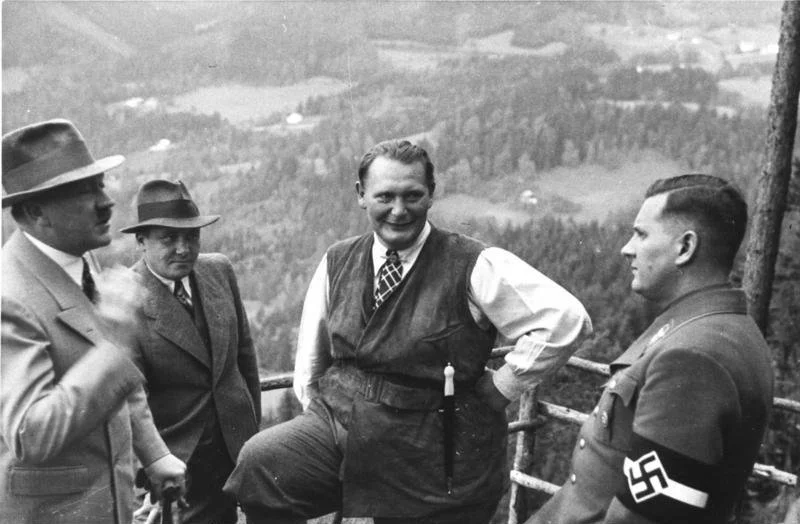
Source: http://www.hitler.org/speeches/01-27-32.ht...

Enjoyed this speech? Speakola is a labour of love and I’d be very grateful if you would share, tweet or like it. Thank you.

Facebook Twitter Facebook
In 1920-39 MORE Tags ADOLF HITLER, INDUSTRY CLUB, DUSSELDORF, NAZI PARTY, WEIMAR, GERMANY, TRANSCRIPT
Comment
Lloyd George wales.png

David Lloyd George: 'This is the story of two little nations', Great Pinnacle of Sacrifice - 1914

February 1, 2018

21 September 1914, Queens Hall, London, United Kingdom

This is the story of two little nations. The world owes much to the little nations

The greatest art in the world was the work of little nations; the most enduring literature of the world came from little nations; the greatest literature of England came when she was a nation of the size of Belgium fighting a great Empire. The heroic deeds that thrill humanity through generations were the deeds of little nations fighting for their freedom. Yes and the salvation of mankind came through a little nation. 

God has chosen little nations as the vessels by which He carriesHis choicest wines to the lips of humanity, to rejoice their hearts, to exalt their vision, to stimulate and strengthen their faith; and if we had stood by when two little nations were being crushed and broken by the brutal hands of barbarism, our shame would have rung down the everlasting ages.

But Germany insists that this is an attack by a lower civilization upon a higher one. As a matter of fact, the attack was begun by the civilization which calls itself the higher one. I am no apologist for Russia; she has perpetrated deeds of which I have no doubt her best sons are ashamed. What Empire has not? But Germany is the last Empire to point the finger of reproach at Russia. 

Russia has made sacrifices for freedom—great sacrifices. 

Do you remember the cry of Bulgaria when she was torn by the most insensate tyranny that Europe has ever seen? Who listened to that cry? The only answer of the “higher civilization” was that the liberty of the Bulgarian peasants was not worth the life of a single Pomeranian’soldiers. But the “rude barbarians” of the North sent their sons by the thousand to die for Bulgarian freedom. What about England? Go to Greece, the Netherlands, Italy, Germany, and France—in all those lands I could point out places where the sons of Britain have died for the freedom of those people. France has made sacrifices for the freedom of other lands than her own. Can you name a single country in the world for the freedom of which modern Prussia has ever sacrificed a single life? 

By the test of our faith the highest standard of civilization is the readiness to sacrifice for others. 

 Have you read the Kaiser’s speeches? They are full of the glitter and bluster of German militarism—“mailed fist” and “shining armor”. Poor old mailed fist! Its knuckles are getting a little bruised. Poor shining armor! The shine is being knocked out of it. There is the same swagger and boastfulness runing through the whole of the speeches. The extract which was given in the British weekly this week is a very remarkable product as an illustration of the spirit we have to fight. It is the Kaiser’s speech to his soldiers on the way to the front: 

Remember that the German people are the chosen of God. On me, the German Emperor, the Spirit of God has descended. I am His sword, His weapon and His Vicegerent. Woe to the disobedient, and death to cowards and unbelievers. 

Lunacy is always distressing, but sometimes it is dangerous; and when you get it manifested in the head of the State, and it has become the policy of a great Empire, it is about time that it should be ruthlessly put away. 

I do not believe he meant all these speeches; it is simply the martial straddle he had acquired. But there were men around him who meant every word of them. This was their religion. Treaties? They tangle the feet of Germany in her advance. Cut them with the sword! Little nations? They hinder the advance of Germany heel. The Russia Slav? He challenges the supremacy of Germany in Europe. 

Hurl your legions at him and massacre him! Britain? She is a constant menace to the predominance of Germany in the world. 

Wrest the trident out of her hand. 

Christianity? Sickly sentimentalism about sacrifice for others! Poor pap for German digestion! 

We will have a new diet. We will force it upon the world. It will be made in Germany—the diet of blood and iron. What remains? Treaties have gone. The honor of nations has gone. Libery has gone. What is left? Germany. Germany is left!“

Deutschland über Alles!”

That is what we are fighting —that claim to predominance of a material, hard civilization which, if it once rulers and sways the word, liberty goes, democracy vanishes. And unless Britain and her sons come to the rescue it will be a dark day for humanity. 

Have you followed the Prussian Junker ’and his doings? We are not fighting the German people are under the heel of this military caste, and it will be a day of rejoicing for the German peasant, artisan and trader when the military caste is broken. You know its pretensions. 

They give themselves the air of demigods. They walk the pavements and civilians and their wives are swept into the gutter; they have no right to stand in the way of a great Prussia soldier. Men, women, nations—they all have to go. He thinks all he has to say is, “We are in a hurry.”

 That is the answer he gave to Belgium -“Rapidity of action is Germany’s greatest asset,” which means, “I am in a hurry; clear out of my way”

 You know the type of motorist, the terror of the roads, with a sixty-horse-power car, who thinks the roads are made for him, and knock down anybody who impedes the actin of his car by a single mile an hour. The Prussian Junker is the road-hog of Europe. Small nationalities in his way are hurled to the roadside, bleeding and broken. Women and children are crushed under the wheels of his cruel car, and Britain is ordered out of his road. All I can say is this: if the old Britain spirit is alive in British hearts, that bully will be torn from his seat. Were he to win, it, would be the greatest catastrophe that has befallen democracy since the day of the Holy Alliance and its ascendancy. 

 They think we cannot beat them. It will not be easy. It will be a long job; it will be a terrible war; but in the end we shall march through terror to triumph. 

We shall need all our qualities—every quality that Britain and its people possess—prudence in counsel, daring in action, tenacity in purpose, courage in defeat, moderation in victory; in all things faith.   

It has pleased them to believe and to preach the belief that we are a decadent and degenerate people. They proclaim to the world through their professors that we are a nonheroic nation skulking behind our mahogany counters, whilst we egg on more gallant races to their destruction. This is a description given of us in Germany- “a timorous, craven nation, trusting to its Fleet”

 I think they are beginning to find their mistake out already - and there are half a million young men of Britain who have already registered a vow to their King that they will cross the seas and hurl that insult to Britain courage against its perpetrators on the battlefields of France and Germany. We want half a million more; and we shall get them. 

I envy you young people your opportunity. They have put up the age limit for the Army, but I am sorry to say I have marched a good many years even beyond that. It is a great opportunity, and opportunity that only comes once in many centuries to the children of men. 

For most generations sacrifice comes in drab and weariness of spirit. It comes to you today, and it comes today to us all, in the form of the glow and trill of a great movement for liberty, that impels millions throughout Europe to the same noble end. 

It is a great war for the emancipation of Europe from the thralldom of a military caste which has thrown its shadows upon two generations of men, and is now plunging the world into a welter of bloodshed and  death. 

Some have already given their lives. 

There are some who have given more than their own lives; they have their courage, and may God be their comfort and their strength. 

But their reward is at hand; those who have fallen have died consecrated deaths. 

They have taken their part in the making of a new Europe—a new world. I can see signs of its coming in the glare of the battle-field. 

The people will gain more by this struggle in all lands than they comprehend at the present moment. It is true they will be free of the greatest menace to their freedom. That is not all. There is something infinitely greater and more enduring which is emerging and more exalted than the old. I see among all classes, high and low, shedding them of selfishness, a new recognition that the honor of the country does not depend merely on the maintenance of its glory in the stricken field, but also in protecting its homes from distress. It is bringing a new outlook for all classes. The great flood of luxury and sloth which had submerged the land is receding, and a New Britain is appearing. 

We can see for the first time the fundamental things that matter in life and that have been obscured from our vision by the tropical growth of prosperity. 

May I tell you in a simple parable what I think this war is doing for us? I know a valley in North Wales, between the mountains and the sea. It is a beautiful valley, sung, comfortable, and sheltered by the mountains from all the bitter blasts. 

But it is very enervating, and I remember how the boys were in the habit of mountains in the distance, and to be stimulated and freshened by the breezes which came from the hilltops, and by the great spectacle of their grandeur. We have been living in the sheltered valley for generations. We have been too comfortable and too indulgent—many, perhaps, too selfish—and the tern hand of fate has scourged us to an elevation where we can see the great everlasting thngs that matter for a nation the great peaks we had forgotten, of Honor, Duty, Patriotism, and, clad in glittering white, the great pinnacle of Sacrifice pointing like arugged finger as to Heaven. 

We shall descend into the valleys again; but as long as the men and women of this generation last, they will carry in their hearts the image of those great mountain peaks whose foundations are not shaken, though Europe rock and sway in the convulsions of a great war. 

Source: https://wenku.baidu.com/view/21673020af45b...

Enjoyed this speech? Speakola is a labour of love and I’d be very grateful if you would share, tweet or like it. Thank you.

Facebook Twitter Facebook
In 1900-19 Tags DAVID LLOYD GEORGE, GREAT PINNACLE OF SACRIFICE, QUEENS HALL, WW1, WORLD WAR 1, TRANSCRIPT, BRITAIN, EUROPE, GERMANY, KAISER
Comment

Kaiser Wilhelm II: 'Just as a thousand years ago the Huns under their King Attila made a name for themselves', 'Hunnerede', speech to troops departing to Boxer Rebellion - 1900

April 13, 2016

The official version released by palace did not have specific reference to Atila and the Huns.

27 July 1900, Bremerhaven, Germany


Great overseas tasks have fallen to the new German Empire, tasks far greater than many of my countrymen expected. The German Empire has, by its very character, the obligation to assist its citizens if they are being set upon in foreign lands. The tasks that the old Roman Empire of the German nation was unable to accomplish, the new German Empire is in a position to fulfill. The means that make this possible is our army.


It has been built up during thirty years of faithful, peaceful labor, following the principles of my blessed grandfather. You, too, have received your training in accordance with these principles, and by putting them to the test before the enemy, you should see whether they have proved their worth in you. Your comrades in the navy have already passed this test; they have shown that the principles of your training are sound, and I am also proud of the praise that your comrades have earned over there from foreign leaders. It is up to you to emulate them.

A great task awaits you: you are to revenge the grievous injustice that has been done. The Chinese have overturned the law of nations; they have mocked the sacredness of the envoy, the duties of hospitality in a way unheard of in world history. It is all the more outrageous that this crime has been committed by a nation that takes pride in its ancient culture. Show the old Prussian virtue. Present yourselves as Christians in the cheerful endurance of suffering. May honor and glory follow your banners and arms. Give the whole world an example of manliness and discipline.

You know full well that you are to fight against a cunning, brave, well-armed, and cruel enemy. When you encounter him, know this: no quarter will be given. Prisoners will not be taken. Exercise your arms such that for a thousand years no Chinese will dare to look cross-eyed at a German. Maintain discipline. May God’s blessing be with you, the prayers of an entire nation and my good wishes go with you, each and every one. Open the way to civilization once and for all! Now you may depart! Farewell, comrades!”

The unofficial but correct version of the crucial passage reads as follows:

“Should you encounter the enemy, he will be defeated! No quarter will be given! Prisoners will not be taken! Whoever falls into your hands is forfeited. Just as a thousand years ago the Huns under their King Attila made a name for themselves, one that even today makes them seem mighty in history and legend, may the name German be affirmed by you in such a way in China that no Chinese will ever again dare to look cross-eyed at a German.”


Source: http://germanhistorydocs.ghi-dc.org/sub_do...

Enjoyed this speech? Speakola is a labour of love and I’d be very grateful if you would share, tweet or like it. Thank you.

Facebook Twitter Facebook
In 1900-19 Tags KAISER WILHELM II, BOXER REBELLION, GERMANY, GERMAN, HUN SPEECH, CHINA, CHINESE, MILITARISM, TRANSCRIPT, TRANSLATED, HUNNEREDE
Comment

Neville Chamberlain: 'May He defend the right. It is the evil things that we shall be fighting against', Declaration of War - 1939

October 26, 2015

3 September, 1939, national BBC broadcast, London, United Kingdom

This morning the British Ambassador in Berlin handed the German Government a
final Note stating that, unless we heard from them by 11 o'clock that they were
prepared at once to withdraw their troops from Poland, a state of war would
exist between us.

I have to tell you now that no such undertaking has been received, and that
consequently this country is at war with Germany.

You can imagine what a bitter blow it is to me that all my long struggle to win
peace has failed. Yet I cannot believe that there is anything more or anything
different that I could have done and that would have been more successful.

Up to the very last it would have been quite possible to have arranged a peaceful
and honourable settlement between Germany and Poland, but Hitler would not have it.
He had evidently made up his mind to attack Poland whatever happened, and
although He now says he put forward reasonable proposals which were rejected by
the Poles, that is not a true statement. The proposals were never shown to the
Poles, nor to us, and, although they were announced in a German broadcast on
Thursday night, Hitler did not wait to hear comments on them, but ordered his
troops to cross the Polish frontier. His action shows convincingly that there is
no chance of expecting that this man will ever give up his practice of using force
to gain his will. He can only be stopped by force.

We and France are today, in fulfilment of our obligations, going to the aid of
Poland, who is so bravely resisting this wicked and unprovoked attack on her
people. We have a clear conscience. We have done all that any country could do to
establish peace. The situation in which no word given by Germany's ruler could be
trusted and no people or country could feel themselves safe has become intolerable.
And now that we have resolved to finish it, I know that you will all play your part
with calmness and courage.

At such a moment as this the assurances of support that we have received from the
Empire are a source of profound encouragement to us.

The Government have made plans under which it will be possible to carry on the
work of the nation in the days of stress and strain that may be ahead. But these
plans need your help. You may be taking your part in the fighting services or as
a volunteer in one of the branches of Civil Defence. If so you will report for
duty in accordance with the instructions you have received. You may be engaged in
work essential to the prosecution of war for the maintenance of the life of the
people - in factories, in transport, in public utility concerns, or in the supply
of other necessaries of life. If so, it is of vital importance that you should
carry on with your jobs.

Now may God bless you all. May He defend the right. It is the evil things that we
shall be fighting against - brute force, bad faith, injustice, oppression and
persecution - and against them I am certain that the right will prevail.

Source: http://www.bbc.co.uk/archive/ww2outbreak/7...

Enjoyed this speech? Speakola is a labour of love and I’d be very grateful if you would share, tweet or like it. Thank you.

Facebook Twitter Facebook
In 1920-39 Tags PRIME MINISTERS, UNITED KINGDOM, UK, DECLARATION OF WAR, WW2, GERMANY, TRANSCRIPT, NEVILLE CHAMBERLAIN
Comment

Otto Wels: 'You cannot take our honour', speech against Hitler's Enabling Act - 1933

September 11, 2015

Above video doesn’t have English subtitles. This one, backed by Mozart, which I can’t embed, does. It’s amazing.


23 March, 1933, Kroll Opera House, Berlin, Germany

With the communists excluded, Social Democrats leader Otto Wels was the only person to speak out against Hitler's Enabling Act when it was debated at the makeshift Reichstag at Kroll Opera House on 23 March 1933. The Act legally enabled Hitler's dictatorship, by allowing the Nazis to bypass parliament for a period of four years (eventually extended of course!). Wels went into exile in June 1933, and died in France in 1939. A brave man.

Translation: Thomas Dunlap

Ladies and gentlemen! We Social Democrats agree with the foreign policy demand raised by the Reich Chancellor of equal treatment for Germany, [and do so] all the more emphatically since we have always fundamentally championed it. In this context, I may be permitted the personal remark that I was the first German who stood up to the untruth of Germany’s guilt for the outbreak of the world war before an international forum, at the Bern Conference on February 3, 1919. Never was a principle of our party able to or did in fact prevent us from representing the just demands of the German nation to the other peoples of the world. The day before yesterday, as well, the Reich Chancellor made a statement in Potsdam to which we subscribe. It says: “From the lunacy of the theory of eternal winners and losers came the madness of reparations and, in their wake, the catastrophe of the world economy.” This statement is true for foreign politics; it is no less true for domestic politics. Here, too, the theory of eternal winners and losers is, as the Reich Chancellor says, lunacy. But the words of the Reich Chancellor remind us of others that were spoken in the National Assembly on July 23, 1919. At that time it was said: “We are defenseless; defenseless but not without honor. To be sure, the enemies are after our honor, there is no doubt. However, that this attempt at defamation will one day redound back upon the instigators, that it is not our honor that is being destroyed by this global catastrophe, that is our belief to the last breath.” (Interjection from the National Socialists: Who said that?)

This appears in a declaration that a social democratic-led government issued at the time in the name of the German people before the whole world, four hours before the truce expired, in order to prevent the enemies from marching further. – That declaration is a valuable supplement to the statement by the Reich Chancellor. A dictated peace is followed by few blessings, least of all at home. A real national community cannot be based on it. Its first prerequisite is equal law. The government may protect itself against raw excesses of polemics; it may rigorously prevent incitements to acts of violence and acts of violence in and of themselves. This may happen, if it is done toward all sides evenly and impartially, and if one foregoes treating defeated opponents as though they were proscribed. Freedom and life can be taken from us, but not our honor. After the persecutions that the Social Democratic Party has suffered recently, no one will reasonably demand or expect that it vote for the Enabling Act proposed here. The elections of March 5 have given the governing parties the majority and thus the possibility of governing in strict adherence to the words and meaning of the constitution. Where such a possibility exists, there is also an obligation to take it. Criticism is salutary and necessary. Never before, since there has been a German Reichstag, has the control of public affairs by the elected representatives of the people been eliminated to such an extent as is happening now, and is supposed to happen even more through the new Enabling Act. Such omnipotence of the government must have all the more serious repercussions inasmuch as the press, too, lacks any freedom of expression. Ladies and gentlemen! The situation that prevails in Germany today is often described in glaring colors. But as always in such cases, there is no lack of exaggeration. As far as my party is concerned, I declare here: we have neither asked for intervention in Paris, nor moved millions to Prague, nor spread exaggerated news abroad. It would be easier to stand up to such exaggerations if the kind of reporting that separates truth from falsehood were possible at home. It would be even better if we could attest in good conscience that full protection in justice has been restored for all. That, gentlemen, is up to you. The gentlemen of the National Socialist party call the movement they have unleashed a national revolution, not a National Socialist one. So far, the relationship of their revolution to socialism has been limited to the attempt to destroy the social democratic movement, which for more than two generations has been the bearer of socialist ideas and will remain so. If the gentlemen of the National Socialist Party wanted to perform socialist acts, they would not need an Enabling Law. They would be assured of an overwhelming majority in this house. Every motion submitted by them in the interest of workers, farmers, white-collar employees, civil servants, or the middle class could expect to be approved, if not unanimously, then certainly with an enormous majority.

And yet, they first want to eliminate the Reichstag in order to continue their revolution. But the destruction of that which exists does not make a revolution. The people are expecting positive accomplishments. They are waiting for effective measures against the terrible economic misery that exists not only in Germany but in the whole world. We Social Democrats bore the responsibility in the most difficult of times and for that we had stones cast at us. Our accomplishments for the reconstruction of the state and the economy, for the liberation of occupied territories, will stand the test of history. We have established equal justice for all and a social labor law. We have helped to create a Germany in which the path to leadership of the state is open not only to princes and barons, but also to men from the working class. You cannot back away from that without relinquishing your own leader. The attempt to turn back the wheel of history will be futile. We Social Democrats know that one cannot undo the facts of power politics with mere legal protests. We see the power-political fact of your present rule. But the people’s sense of justice is also a political power, and we shall not cease to appeal to this sense of justice. The Weimar Constitution is not a socialist constitution. But we stand by the principles enshrined in, the principles of a state based on the rule of law, of equal rights, of social justice. In this historic hour, we German Social Democrats solemnly pledge ourselves to the principles of humanity and justice, of freedom and socialism. No Enabling Act gives you the power to destroy ideas that are eternal and indestructible. After all, you yourselves have professed your adherence to Socialism. The Socialist Law has not destroyed social democracy. German social democracy will draw new strength also from the latest persecutions. We greet the persecuted and the oppressed. We greet our friends in the Reich. Your steadfastness and loyalty deserve admiration. The courage of your convictions and your unbroken optimism guarantee a brighter future.

Source of original German text: Otto Wels’s Speech against the Passage of the Enabling Act (March 23, 1933), in Paul Meier-Benneckenstein, ed., Dokumente der deutschen Politik, Volume 1: Die Nationalsozialistische Revolution 1933, edited by Axel Friedrichs. Berlin, 1935, pp. 36-38.

Source: https://www.youtube.com/watch?v=SimPsL7LYH...

Enjoyed this speech? Speakola is a labour of love and I’d be very grateful if you would share, tweet or like it. Thank you.

Facebook Twitter Facebook
In 1920-39 Tags OTTO WELS, ADOLF HITLER, GERMANY, WEIMAR, ENABLING ACT, WW2, TRANSCRIPT, TRANSLATED
1 Comment

Otto von Bismarck: 'We are perhaps too educated to put up with a constitution', Blood and Iron speech - 1862

September 11, 2015

30 September, 1862, Landtag (legislature), Prussia

He would like to go into the budget for 1862, though without making a prejudicial statement. An abuse of constitutional rights could be undertaken by any side; this would then lead to a reaction from the other side.

The Crown for example could dissolve parliament twelve times in a row, that would certainly be permitted according to the letter of the constitution, but it would be an abuse.

It could just as easily reject cuts in the budget, immoderately. It would be hard to tell where to draw the line there. Would it be at 6 million? At 16? Or at 60?

There are members of the National Association [Nationalverein] of this association that has achieved a reputation owing to the justness of its demands, highly esteemed members who have stated that all standing armies are superfluous. Well, what if a public assembly had this view! Would not a government have to reject this?

There was talk about the sobriety of the Prussian people. Yes, the great independence of the individual makes it difficult in Prussia to govern with the constitution or to consolidate the constitution.

In France things are different, there this individual independence is lacking. A constitutional crisis would not be disgraceful, but honorable instead.

Furthermore, we are perhaps too well-educated to support a constitution. We are too critical. The ability to assess government measures and records of the public assembly is too common. In the country there are a lot of catiline [conspiratorial] characters who have a great interest in upheavals. This may sound paradoxical, but everything proves how hard constitutional life is in Prussia.

Furthermore, one is too sensitive about the government's mistakes, as if it were enough to say this and that cabinet minister made mistakes, as if one wasn't adversely affected oneself. Public opinion changes, the press is not the same as public opinion. One knows how the press is written.

Members of parliament have a higher duty, to lead opinion, to stand above it. We are too hot-blooded. We have a preference for putting on armor that is too big for our small body. And now we're actually supposed to utilize it.

Germany is not looking to Prussia's liberalism, but to its power. Bavaria, Württemberg, Baden may indulge liberalism, and yet no one will assign them Prussia's role.

Prussia has to coalesce and concentrate its power for the opportune moment, which has already been missed several times. Prussia's borders according to the Vienna Treaties of 1814-15 are not favorable for a healthy, vital state.

It is not by speeches and majority resolutions that the great questions of the time are decided – that was the big mistake of 1848 and 1849 – but by iron and blood.

Last year's appropriation has been carried out, for whatever reasons, it is a matter of indifference, he [Bismarck himself] is sincerely seeking the path of agreement whether he finds it does not depend on him alone.

It would have been better if one had not made a fait accompli on the part of the Chamber of Deputies. If no budget comes about, then there is a tabula rasa. The constitution offers no way out, for then it is one interpretation against another interpretation. Summum ius, summa iniuria [Cicero: The highest law can be the greatest injustice]; the letter killeth.

He is pleased that the speaker's remark about the possibility of another resolution of the House on account of a possible bill allows for the prospect of agreement. He, too, is looking for this bridge. When it might be found is uncertain.

Bringing about a budget this year is hardly possible given the time. We are in exceptional circumstances. The principle of promptly presenting the budget is also recognized by the government, but it is said that this was already promised and not kept. And now it's "You can certainly trust us as honest people."

He does not agree with the interpellation that it is unconstitutional to make expenditures whose authorization had been refused. For every interpretation, it is necessary to agree on the three factors.

In German

Er wolle gern auf den Etat für 1862 eingehen, ohne jedoch eine präjudizierliche Erklärung abzugeben. Ein Mißbrauch von Verfassungsrechten könne von allen Seiten getrieben werden.
Das führe dann zur Gegenwirkung von der anderen Seite. Die Krone z. B. könne zwölfmal hintereinander auflösen, das sei gewiß nach dem Buchstaben der Verfassung erlaubt, würde aber doch Mißbrauch sein.
Ebenso könne sie Streichungen des Budgets zurückweisen, ohne Maß; da sei die Grenze schwer zu ziehen; sei sie schon bei 6 Millionen? bei 16? oder bei 60?
Es gebe Mitglieder des Nationalvereins, eines wegen der Gerechtigkeit seiner Forderungen zu Ansehen gelangten Vereins – hochachtbare Mitglieder, die alle stehenden Heere für überflüssig erklärten. Ja, wenn nun eine Volksvertretung diese Ansicht hätte! Müsse nicht eine Regierung das zurückweisen?
Von der "Nüchternheit" des preußischen Volkes sei die Rede gewesen. Ja, die große Selbständigkeit des einzelnen mache es schwierig in Preußen, mit der Verfassung zu regieren (oder die Verfassung zu konsolidieren?).
In Frankreich sei das anders, da fehle diese individuelle Selbständigkeit. Eine Verfassungskrisis sei keine Schande, sondern eine Ehre.
Wir sind ferner vielleicht zu "gebildet" um eine Verfassung zu tragen; wir sind zu kritisch; die Befähigung, Regierungsmaßregeln, Akte der Volksvertretung zu beurteilen, ist zu allgemein; im Lande gibt es eine Menge katilinarischer Existenzen, die ein großes Interesse an Umwälzungen haben. Das mag paradox klingen, beweist aber doch alles, wie schwer in Preußen verfassungsmäßiges Leben ist.
Man ist ferner zu empfindlich gegen Fehler der Regierung; als wenn es genug wäre, zu sagen, der und der Minister hat Fehler gemacht, als wenn man nicht selbst mitlitte? – Die öffentliche Meinung wechsle, die Presse sei nicht die öffentliche Meinung; man wisse, wie die Presse entstände.
Die Abgeordneten hätten die höhere Aufgabe, die Stimmung zu leiten, über ihr zu stehen. Wir haben zu heißes Blut, wir haben die Vorliebe, eine zu große Rüstung für unsern schmalen Leib zu tragen; nur sollen wir sie auch utilisieren.
Nicht auf Preußens Liberalismus sieht Deutschland, sondern auf seine Macht; Bayern, Württemberg, Baden mögen dem Liberalismus indulgieren, darum wird ihnen doch keiner Preußens Rolle anweisen.
Preußen muß seine Kraft zusammenfassen und zusammenhalten auf den günstigen Augenblick, der schon einige Male verpaßt ist; Preußens Grenzen nach den Wiener Verträgen sind zu einem gesunden Staatsleben nicht günstig; nicht durch Reden und Majoritätsbeschlüsse werden die großen Fragen der Zeit entschieden – das ist der große Fehler von 1848 und 1849 gewesen – sondern durch Eisen und Blut.
Die vorjährige Bewilligung sei erfolgt; aus welchen Gründen, sei gleichgültig; er suche aufrichtig den Weg der Verständigung: ob er ihn finde, hänge nicht allein von ihm ab.
Man hätte lieber kein fait accompli machen sollen seitens des Abgeordnetenhauses. Wenn kein Budget zustande komme, dann sei tabula rasa; die Verfassung biete keinen Ausweg, denn da stehe Interpretation gegen Interpretation; summum ius, summa iniuria; der Buchstabe tötet.
Er freue sich, daß die Außerung des Referenten, wegen Möglichkeit eines anderen Beschlusses des Hauses infolge einer etwaigen Gesetzesvorlage, die Aussicht auf Verständigung lasse; er suche diese Brücke auch; wann sie gefunden werde, stehe dahin.
Das Zustandekommen eines Budgets in diesem Jahre sei der Zeit nach kaum möglich; wir seien ja in exzeptionellen Zuständen; das Prinzip der schleunigen Vorlegung des Budgets sei ja auch von der Regierung anerkannt; aber man sage, das sei schon oft versprochen und nicht gehalten; nun "Sie können doch uns als ehrlichen Leuten trauen."
Die Interpellation, es sei verfassungswidrig, verweigerte Ausgaben zu machen, teile er nicht; zu jeder Interpretation sei Übereinstimmung der drei Faktoren nötig.

Source: http://www.famous-speeches-and-speech-topi...

Enjoyed this speech? Speakola is a labour of love and I’d be very grateful if you would share, tweet or like it. Thank you.

Facebook Twitter Facebook
In Pre 1900 2 Tags OTTO VON BISMARCK, GERMANY, WAR, PRUSSIA, FRANCO-PRUSSIAN WAR, TRANSCRIPT
Comment

John F. Kennedy: 'Ich bin ein Berliner!', Berlin visit - 1963

June 30, 2015

26 June 1963, Berlin, Germany

I am proud to come to this city as the guest of your distinguished Mayor, who has symbolized throughout the world the fighting spirit of West Berlin. And I am proud to visit the Federal Republic with your distinguished Chancellor who for so many years has committed Germany to democracy and freedom and progress, and to come here in the company of my fellow American, General Clay, who has been in this city during its great moments of crisis and will come again if ever needed.

Two thousand years ago the proudest boast was "civis Romanus sum". Today, in the world of freedom, the proudest boast is "Ich bin ein Berliner".

I appreciate my interpreter translating my German!

There are many people in the world who really don't understand, or say they don't, what is the great issue between the free world and the Communist world. Let them come to Berlin. There are some who say that communism is the wave of the future. Let them come to Berlin. And there are some who say in Europe and elsewhere we can work with the Communists. Let them come to Berlin. And there are even a few who say that it is true that communism is an evil system, but it permits us to make economic progress. Lass' sie nach Berlin kommen. Let them come to Berlin.

Freedom has many difficulties and democracy is not perfect, but we have never had to put a wall up to keep our people in, to prevent them from leaving us. I want to say, on behalf of my countrymen, who live many miles away on the other side of the Atlantic, who are far distant from you, that they take the greatest pride that they have been able to share with you, even from a distance, the story of the last 18 years. I know of no town, no city, that has been besieged for 18 years that still lives with the vitality and the force, and the hope and the determination of the city of West Berlin. While the wall is the most obvious and vivid demonstration of the failures of the Communist system, for all the world to see, we take no satisfaction in it, for it is, as your Mayor has said, an offense not only against history but an offense against humanity, separating families, dividing husbands and wives and brothers and sisters, and dividing a people who wish to be joined together.

What is true of this city is true of Germany - real, lasting peace in Europe can never be assured as long as one German out of four is denied the elementary right of free men, and that is to make a free choice. In 18 years of peace and good faith, this generation of Germans has earned the right to be free, including the right to unite their families and their nation in lasting peace, with good will to all people. You live in a defended island of freedom, but your life is part of the main. So let me ask you as I close, to lift your eyes beyond the dangers of today, to the hopes of tomorrow, beyond the freedom merely of this city of Berlin, or your country of Germany, to the advance of freedom everywhere, beyond the wall to the day of peace with justice, beyond yourselves and ourselves to all mankind.

Freedom is indivisible, and when one man is enslaved, all are not free. When all are free, then we can look forward to that day when this city will be joined as one and this country and this great Continent of Europe in a peaceful and hopeful globe. When that day finally comes, as it will, the people of West Berlin can take sober satisfaction in the fact that they were in the front lines for almost two decades.

All free men, wherever they may live, are citizens of Berlin, and, therefore, as a free man, I take pride in the words "Ich bin ein Berliner".

Source: http://www.let.rug.nl/usa/presidents/john-...

Enjoyed this speech? Speakola is a labour of love and I’d be very grateful if you would share, tweet or like it. Thank you.

Facebook Twitter Facebook
In 1960-79 Tags JFK, USA, PRESIDENTS, COLD WAR, GERMANY, TRANSCRIPT
Comment

Ronald Reagan: 'Mr. Gorbachev, tear down this wall!', Berlin Wall address - 1987

June 30, 2015

12 June 1987, Brandenburg Gate, Berlin, Germany

Chancellor Kohl, Governing Mayor Diepgen, ladies and gentlemen: Twenty-four years ago, President John F. Kennedy visited Berlin, speaking to the people of this city and the world at the City Hall. Well, since then two other presidents have come, each in his turn, to Berlin. And today I, myself, make my second visit to your city.

We come to Berlin, we American presidents, because it's our duty to speak, in this place, of freedom. But I must confess, we're drawn here by other things as well: by the feeling of history in this city, more than 500 years older than our own nation; by the beauty of the Grunewald and the Tiergarten; most of all, by your courage and determination. Perhaps the composer Paul Lincke understood something about American presidents. You see, like so many presidents before me, I come here today because wherever I go, whatever I do: Ich hab noch einen Koffer in Berlin. [I still have a suitcase in Berlin.]

Our gathering today is being broadcast throughout Western Europe and North America. I understand that it is being seen and heard as well in the East. To those listening throughout Eastern Europe, a special word: Although I cannot be with you, I address my remarks to you just as surely as to those standing here before me. For I join you, as I join your fellow countrymen in the West, in this firm, this unalterable belief: Es gibt nur ein Berlin. [There is only one Berlin.]

Behind me stands a wall that encircles the free sectors of this city, part of a vast system of barriers that divides the entire continent of Europe. From the Baltic, south, those barriers cut across Germany in a gash of barbed wire, concrete, dog runs, and guard towers. Farther south, there may be no visible, no obvious wall. But there remain armed guards and checkpoints all the same--still a restriction on the right to travel, still an instrument to impose upon ordinary men and women the will of a totalitarian state. Yet it is here in Berlin where the wall emerges most clearly; here, cutting across your city, where the news photo and the television screen have imprinted this brutal division of a continent upon the mind of the world. Standing before the Brandenburg Gate, every man is a German, separated from his fellow men. Every man is a Berliner, forced to look upon a scar.

President von Weizsacker has said, "The German question is open as long as the Brandenburg Gate is closed." Today I say: As long as the gate is closed, as long as this scar of a wall is permitted to stand, it is not the German question alone that remains open, but the question of freedom for all mankind. Yet I do not come here to lament. For I find in Berlin a message of hope, even in the shadow of this wall, a message of triumph.

In this season of spring in 1945, the people of Berlin emerged from their air-raid shelters to find devastation. Thousands of miles away, the people of the United States reached out to help. And in 1947 Secretary of State--as you've been told--George Marshall announced the creation of what would become known as the Marshall Plan. Speaking precisely 40 years ago this month, he said: "Our policy is directed not against any country or doctrine, but against hunger, poverty, desperation, and chaos."

In the Reichstag a few moments ago, I saw a display commemorating this 40th anniversary of the Marshall Plan. I was struck by the sign on a burnt-out, gutted structure that was being rebuilt. I understand that Berliners of my own generation can remember seeing signs like it dotted throughout the western sectors of the city. The sign read simply: "The Marshall Plan is helping here to strengthen the free world." A strong, free world in the West, that dream became real. Japan rose from ruin to become an economic giant. Italy, France, Belgium--virtually every nation in Western Europe saw political and economic rebirth; the European Community was founded.

In West Germany and here in Berlin, there took place an economic miracle, the Wirtschaftswunder. Adenauer, Erhard, Reuter, and other leaders understood the practical importance of liberty--that just as truth can flourish only when the journalist is given freedom of speech, so prosperity can come about only when the farmer and businessman enjoy economic freedom. The German leaders reduced tariffs, expanded free trade, lowered taxes. From 1950 to 1960 alone, the standard of living in West Germany and Berlin doubled.

Where four decades ago there was rubble, today in West Berlin there is the greatest industrial output of any city in Germany--busy office blocks, fine homes and apartments, proud avenues, and the spreading lawns of parkland. Where a city's culture seemed to have been destroyed, today there are two great universities, orchestras and an opera, countless theaters, and museums. Where there was want, today there's abundance--food, clothing, automobiles--the wonderful goods of the Ku'damm. From devastation, from utter ruin, you Berliners have, in freedom, rebuilt a city that once again ranks as one of the greatest on earth. The Soviets may have had other plans. But my friends, there were a few things the Soviets didn't count on--Berliner Herz, Berliner Humor, ja, und Berliner Schnauze. [Berliner heart, Berliner humor, yes, and a Berliner Schnauze.]

In the 1950s, Khrushchev predicted: "We will bury you." But in the West today, we see a free world that has achieved a level of prosperity and well-being unprecedented in all human history. In the Communist world, we see failure, technological backwardness, declining standards of health, even want of the most basic kind--too little food. Even today, the Soviet Union still cannot feed itself. After these four decades, then, there stands before the entire world one great and inescapable conclusion: Freedom leads to prosperity. Freedom replaces the ancient hatreds among the nations with comity and peace. Freedom is the victor.

And now the Soviets themselves may, in a limited way, be coming to understand the importance of freedom. We hear much from Moscow about a new policy of reform and openness. Some political prisoners have been released. Certain foreign news broadcasts are no longer being jammed. Some economic enterprises have been permitted to operate with greater freedom from state control.

Are these the beginnings of profound changes in the Soviet state? Or are they token gestures, intended to raise false hopes in the West, or to strengthen the Soviet system without changing it? We welcome change and openness; for we believe that freedom and security go together, that the advance of human liberty can only strengthen the cause of world peace. There is one sign the Soviets can make that would be unmistakable, that would advance dramatically the cause of freedom and peace.

General Secretary Gorbachev, if you seek peace, if you seek prosperity for the Soviet Union and Eastern Europe, if you seek liberalization: Come here to this gate! Mr. Gorbachev, open this gate! Mr. Gorbachev, tear down this wall!

I understand the fear of war and the pain of division that afflict this continent-- and I pledge to you my country's efforts to help overcome these burdens. To be sure, we in the West must resist Soviet expansion. So we must maintain defenses of unassailable strength. Yet we seek peace; so we must strive to reduce arms on both sides.

Beginning 10 years ago, the Soviets challenged the Western alliance with a grave new threat, hundreds of new and more deadly SS-20 nuclear missiles, capable of striking every capital in Europe. The Western alliance responded by committing itself to a counter-deployment unless the Soviets agreed to negotiate a better solution; namely, the elimination of such weapons on both sides. For many months, the Soviets refused to bargain in earnestness. As the alliance, in turn, prepared to go forward with its counter-deployment, there were difficult days--days of protests like those during my 1982 visit to this city--and the Soviets later walked away from the table.

But through it all, the alliance held firm. And I invite those who protested then-- I invite those who protest today--to mark this fact: Because we remained strong, the Soviets came back to the table. And because we remained strong, today we have within reach the possibility, not merely of limiting the growth of arms, but of eliminating, for the first time, an entire class of nuclear weapons from the face of the earth.

As I speak, NATO ministers are meeting in Iceland to review the progress of our proposals for eliminating these weapons. At the talks in Geneva, we have also proposed deep cuts in strategic offensive weapons. And the Western allies have likewise made far-reaching proposals to reduce the danger of conventional war and to place a total ban on chemical weapons.

While we pursue these arms reductions, I pledge to you that we will maintain the capacity to deter Soviet aggression at any level at which it might occur. And in cooperation with many of our allies, the United States is pursuing the Strategic Defense Initiative--research to base deterrence not on the threat of offensive retaliation, but on defenses that truly defend; on systems, in short, that will not target populations, but shield them. By these means we seek to increase the safety of Europe and all the world. But we must remember a crucial fact: East and West do not mistrust each other because we are armed; we are armed because we mistrust each other. And our differences are not about weapons but about liberty. When President Kennedy spoke at the City Hall those 24 years ago, freedom was encircled, Berlin was under siege. And today, despite all the pressures upon this city, Berlin stands secure in its liberty. And freedom itself is transforming the globe.

In the Philippines, in South and Central America, democracy has been given a rebirth. Throughout the Pacific, free markets are working miracle after miracle of economic growth. In the industrialized nations, a technological revolution is taking place--a revolution marked by rapid, dramatic advances in computers and telecommunications.

In Europe, only one nation and those it controls refuse to join the community of freedom. Yet in this age of redoubled economic growth, of information and innovation, the Soviet Union faces a choice: It must make fundamental changes, or it will become obsolete.

Today thus represents a moment of hope. We in the West stand ready to cooperate with the East to promote true openness, to break down barriers that separate people, to create a safe, freer world. And surely there is no better place than Berlin, the meeting place of East and West, to make a start. Free people of Berlin: Today, as in the past, the United States stands for the strict observance and full implementation of all parts of the Four Power Agreement of 1971. Let us use this occasion, the 750th anniversary of this city, to usher in a new era, to seek a still fuller, richer life for the Berlin of the future. Together, let us maintain and develop the ties between the Federal Republic and the Western sectors of Berlin, which is permitted by the 1971 agreement.

And I invite Mr. Gorbachev: Let us work to bring the Eastern and Western parts of the city closer together, so that all the inhabitants of all Berlin can enjoy the benefits that come with life in one of the great cities of the world.

To open Berlin still further to all Europe, East and West, let us expand the vital air access to this city, finding ways of making commercial air service to Berlin more convenient, more comfortable, and more economical. We look to the day when West Berlin can become one of the chief aviation hubs in all central Europe.

With our French and British partners, the United States is prepared to help bring international meetings to Berlin. It would be only fitting for Berlin to serve as the site of United Nations meetings, or world conferences on human rights and arms control or other issues that call for international cooperation.

There is no better way to establish hope for the future than to enlighten young minds, and we would be honored to sponsor summer youth exchanges, cultural events, and other programs for young Berliners from the East. Our French and British friends, I'm certain, will do the same. And it's my hope that an authority can be found in East Berlin to sponsor visits from young people of the Western sectors.

One final proposal, one close to my heart: Sport represents a source of enjoyment and ennoblement, and you may have noted that the Republic of Korea--South Korea--has offered to permit certain events of the 1988 Olympics to take place in the North. International sports competitions of all kinds could take place in both parts of this city. And what better way to demonstrate to the world the openness of this city than to offer in some future year to hold the Olympic games here in Berlin, East and West? In these four decades, as I have said, you Berliners have built a great city. You've done so in spite of threats--the Soviet attempts to impose the East-mark, the blockade. Today the city thrives in spite of the challenges implicit in the very presence of this wall. What keeps you here? Certainly there's a great deal to be said for your fortitude, for your defiant courage. But I believe there's something deeper, something that involves Berlin's whole look and feel and way of life--not mere sentiment. No one could live long in Berlin without being completely disabused of illusions. Something instead, that has seen the difficulties of life in Berlin but chose to accept them, that continues to build this good and proud city in contrast to a surrounding totalitarian presence that refuses to release human energies or aspirations. Something that speaks with a powerful voice of affirmation, that says yes to this city, yes to the future, yes to freedom. In a word, I would submit that what keeps you in Berlin is love--love both profound and abiding.

Perhaps this gets to the root of the matter, to the most fundamental distinction of all between East and West. The totalitarian world produces backwardness because it does such violence to the spirit, thwarting the human impulse to create, to enjoy, to worship. The totalitarian world finds even symbols of love and of worship an affront. Years ago, before the East Germans began rebuilding their churches, they erected a secular structure: the television tower at Alexander Platz. Virtually ever since, the authorities have been working to correct what they view as the tower's one major flaw, treating the glass sphere at the top with paints and chemicals of every kind. Yet even today when the sun strikes that sphere--that sphere that towers over all Berlin--the light makes the sign of the cross. There in Berlin, like the city itself, symbols of love, symbols of worship, cannot be suppressed.

As I looked out a moment ago from the Reichstag, that embodiment of German unity, I noticed words crudely spray-painted upon the wall, perhaps by a young Berliner: "This wall will fall. Beliefs become reality." Yes, across Europe, this wall will fall. For it cannot withstand faith; it cannot withstand truth. The wall cannot withstand freedom.

And I would like, before I close, to say one word. I have read, and I have been questioned since I've been here about certain demonstrations against my coming. And I would like to say just one thing, and to those who demonstrate so. I wonder if they have ever asked themselves that if they should have the kind of government they apparently seek, no one would ever be able to do what they're doing again.

Thank you and God bless you all.

Source: http://www.historyplace.com/speeches/reaga...

Enjoyed this speech? Speakola is a labour of love and I’d be very grateful if you would share, tweet or like it. Thank you.

Facebook Twitter Facebook
In 1980-99 Tags PRESIDENTS, REAGAN, USA, COLD WAR, TRANSCRIPT, BERLIN, GERMANY, MIKHAEL GORBACHEV, RONALD REAGAN, GREATEST SPEECHES OF ALL TIME, GREATEST SPEECHES OF THE 1980S, 1980S, PETER ROBINSON, GREATEST SPEECHES BY AMERICAN PRESIDENTS, PRESIDENT, REPUBLICAN PARTY, GOP
Comment

See my film!

Limited Australian Season

March 2025

Details and ticket bookings at

angeandtheboss.com

Support Speakola

Hi speech lovers,
With costs of hosting website and podcast, this labour of love has become a difficult financial proposition in recent times. If you can afford a donation, it will help Speakola survive and prosper.

Best wishes,
Tony Wilson.

Become a Patron!

Learn more about supporting Speakola.

Featured political

Featured
Jon Stewart: "They responded in five seconds", 9-11 first responders, Address to Congress - 2019
Jacinda Ardern: 'They were New Zealanders. They are us', Address to Parliament following Christchurch massacre - 2019
Dolores Ibárruri: "¡No Pasarán!, They shall not pass!', Defense of 2nd Spanish Republic - 1936
Jimmy Reid: 'A rat race is for rats. We're not rats', Rectorial address, Glasgow University - 1972

Featured eulogies

Featured
For Geoffrey Tozer: 'I have to say we all let him down', by Paul Keating - 2009
for James Baldwin: 'Jimmy. You crowned us', by Toni Morrison - 1988
for Michael Gordon: '13 days ago my Dad’s big, beautiful, generous heart suddenly stopped beating', by Scott and Sarah Gordon - 2018

Featured commencement

Featured
Tara Westover: 'Your avatar isn't real, it isn't terribly far from a lie', The Un-Instagrammable Self, Northeastern University - 2019
Tim Minchin: 'Being an artist requires massive reserves of self-belief', WAAPA - 2019
Atul Gawande: 'Curiosity and What Equality Really Means', UCLA Medical School - 2018
Abby Wambach: 'We are the wolves', Barnard College - 2018
Eric Idle: 'America is 300 million people all walking in the same direction, singing 'I Did It My Way'', Whitman College - 2013
Shirley Chisholm: ;America has gone to sleep', Greenfield High School - 1983

Featured sport

Featured
Joe Marler: 'Get back on the horse', Harlequins v Bath pre game interview - 2019
Ray Lewis : 'The greatest pain of my life is the reason I'm standing here today', 52 Cards -
Mel Jones: 'If she was Bradman on the field, she was definitely Keith Miller off the field', Betty Wilson's induction into Australian Cricket Hall of Fame - 2017
Jeff Thomson: 'It’s all those people that help you as kids', Hall of Fame - 2016

Fresh Tweets


Featured weddings

Featured
Dan Angelucci: 'The Best (Best Man) Speech of all time', for Don and Katherine - 2019
Hallerman Sisters: 'Oh sister now we have to let you gooooo!' for Caitlin & Johnny - 2015
Korey Soderman (via Kyle): 'All our lives I have used my voice to help Korey express his thoughts, so today, like always, I will be my brother’s voice' for Kyle and Jess - 2014

Featured Arts

Featured
Bruce Springsteen: 'They're keepers of some of the most beautiful sonic architecture in rock and roll', Induction U2 into Rock Hall of Fame - 2005
Olivia Colman: 'Done that bit. I think I have done that bit', BAFTA acceptance, Leading Actress - 2019
Axel Scheffler: 'The book wasn't called 'No Room on the Broom!', Illustrator of the Year, British Book Awards - 2018
Tina Fey: 'Only in comedy is an obedient white girl from the suburbs a diversity candidate', Kennedy Center Mark Twain Award -  2010
Tina Fey: 'Only in comedy is an obedient white girl from the suburbs a diversity candidate', Kennedy Center Mark Twain Award - 2010

Featured Debates

Featured
Sacha Baron Cohen: 'Just think what Goebbels might have done with Facebook', Anti Defamation League Leadership Award - 2019
Greta Thunberg: 'How dare you', UN Climate Action Summit - 2019
Charlie Munger: 'The Psychology of Human Misjudgment', Harvard University - 1995
Lawrence O'Donnell: 'The original sin of this country is that we invaders shot and murdered our way across the land killing every Native American that we could', The Last Word, 'Dakota' - 2016