• Genre
  • About
  • Submissions
  • Donate
  • Search
Menu

Speakola

All Speeches Great and Small
  • Genre
  • About
  • Submissions
  • Donate
  • Search
Share a political speech

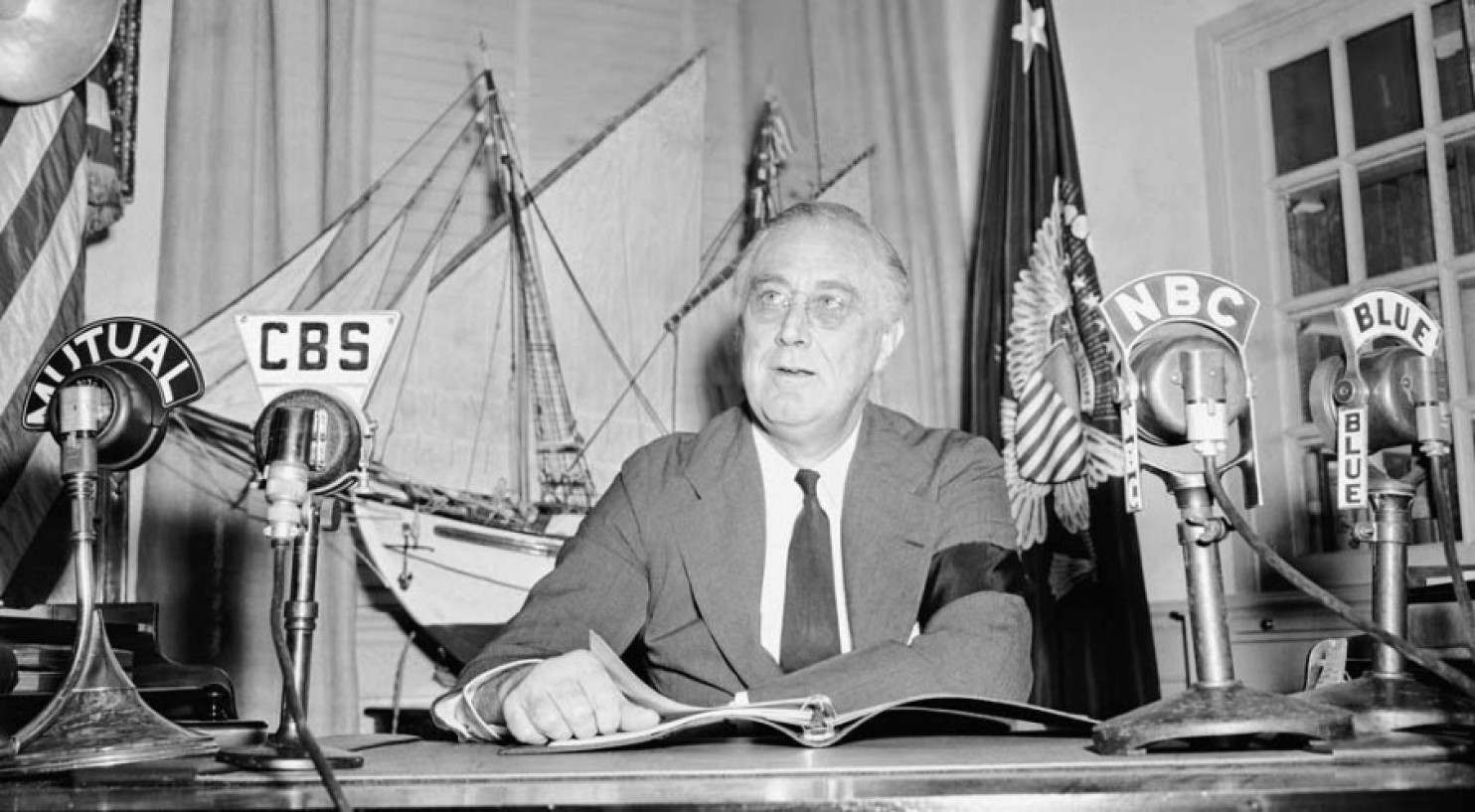
Franklin D. Roosevelt: 'The war is approaching', Radio broadcast announcing unlimited national emergency - 1941

December 30, 2022

27 May 1941, Washington DC, USA

I am speaking tonight from the White House in the presence of the Governing Board of the Pan American Union, the Canadian Minister, and their families. The members of this Board are the Ambassadors and Ministers of the American Republics in Washington. It is appropriate that I do this for now, as never before, the unity of the American Republics is of supreme importance to each and every one of us and to the cause of freedom throughout the world. Our future independence is bound up with the future independence of all of our sister Republics.

The pressing problems that confront us are military and naval problems. We cannot afford to approach them from the point of view of wishful thinkers or sentimentalists. What we face is cold, hard fact.

The first and fundamental fact is that what started as a European war has developed, as the Nazis always intended it should develop, into a world war for world domination.

Adolf Hitler never considered the domination of Europe as an end in itself. European conquest was but a step toward ultimate goals in all the other continents. It is unmistakably apparent to all of us that, unless the advance of Hitlerism is forcibly checked now, the Western Hemisphere will be within range of the Nazi weapons of destruction.

For our own defense we have accordingly undertaken certain obviously necessary measures:

First, we have joined in concluding a series of agreements with all the other American Republics. This further solidified our hemisphere against the common danger.

And then, a year ago, we launched, and are successfully carrying out, the largest armament production program we have ever undertaken.

We have added substantially to our splendid Navy, and we have mustered our manpower to build up a new Army which is already worthy of the highest traditions of our military service.

We instituted a policy of aid for the democracies—the Nations which have fought for the continuation of human liberties.

This policy had its origin in the first month of the war, when I urged upon the Congress repeal of the arms embargo provisions in the old Neutrality Law, and in that message of September 3,1939, I said, "I should like to be able to offer the hope that the shadow over the world might swiftly pass. I cannot. The facts compel my stating, with candor, that darker periods may lie ahead.

In the subsequent months, the shadows deepened and lengthened. And the night spread over Poland, Denmark, Norway, Holland, Belgium, Luxembourg, and France.

In June, 1940, Britain stood alone, faced by the same machine of terror which had overwhelmed her allies. Our Government rushed arms to meet her desperate needs.

In September, 1940, an agreement was completed with Great Britain for the trade of fifty destroyers for eight important offshore bases.

And in March, 1941, the Congress passed the Lend-Lease Bill and an appropriation of seven billion dollars to implement it. This law realistically provided for material aid "for the government of any country whose defense the President deems vital to the defense of the United States."

Our whole program of aid for the democracies has been based on hard-headed concern for our own security and for the kind of safe and civilized world in which we wish to live. Every dollar of material that we send helps to keep the dictators away from our own hemisphere, and every day that they are held off gives us time to build more guns and tanks and planes and ships.

We have made no pretense about our own self-interest in this aid. Great Britain understands it—and so does Nazi Germany.

And now—after a year—Britain still fights gallantly, on a "far-flung battle line." We have doubled and redoubled our vast production, increasing, month by month, our material supply of the tools of war for ourselves and for Britain and for China- and eventually for all the democracies.

The supply of these tools will not fail—it will increase.
With greatly augmented strength, the United States and the other American Republics now chart their course in the situation of today.

Your Government knows what terms Hitler, if victorious, would impose. They are, indeed, the only terms on which he would accept a so-called "negotiated" peace.

And, under those terms, Germany would literally parcel out the world- hoisting the swastika itself over vast territories and populations, and setting up puppet governments of its own choosing, wholly subject to the will and the policy of a conqueror.

To the people of the Americas, a triumphant Hitler would say, as he said after the seizure of Austria, and as he said after Munich, and as he said after the seizure of Czechoslovakia: "I am now completely satisfied. This is the last territorial readjustment I will seek." And he would of course add: "All we want is peace, friendship, and profitable trade relations with you in the New World."

Were any of us in the Americas so incredibly simple and forgetful as to accept those honeyed words, what would then happen?

Those in the New World who were seeking profits would be urging that all that the dictatorships desired was "peace." They would oppose toil and taxes for more American armament. And meanwhile, the dictatorships would be forcing the enslaved peoples of their Old World conquests into a system they are even now organizing to build a naval and air force intended to gain and hold and be master of the Atlantic and the Pacific as well.

They would fasten an economic stranglehold upon our several Nations. Quislings would be found to subvert the governments in our Republics; and the Nazis would back their fifth columns with invasion, if necessary.

No, I am not speculating about all this. I merely repeat what is already in the Nazi book of world conquest. They plan to treat the Latin American Nations as they are now treating the Balkans. They plan then to strangle the United States of America and the Dominion of Canada.

The American laborer would have to compete with slave labor in the rest of the world. Minimum wages, maximum hours? Nonsense! Wages and hours would be fixed by Hitler. The dignity and power and standard of living of the American worker and farmer would be gone. Trade unions would become historical relics, and collective bargaining a joke.

Farm income? What happens to all farm surpluses without any foreign trade? The American farmer would get for his products exactly what Hitler wanted to give. The farmer would face obvious disaster and complete regimentation.

Tariff walls- Chinese walls of isolation—would be futile. Freedom to trade is essential to our economic life. We do not eat all the food we can produce; and we do not burn all the oil we can pump; we do not use all the goods we can manufacture. It would not be an American wall to keep Nazi goods out; it would be a Nazi wall to keep us in.

The whole fabric of working life as we know it—business and manufacturing, mining and agriculture—all would be mangled and crippled under such a system. Yet to maintain even that crippled independence would require permanent conscription of our manpower; it would curtail the funds we could spend on education, on housing, on public works, on flood control, on health and, instead, we should be permanently pouring our resources into armaments; and, year in and year out, standing day and night watch against the destruction of our cities.

Yes, even our right of worship would be threatened. The Nazi world does not recognize any God except Hitler; for the Nazis are as ruthless as the Communists in the denial of God. What place has religion which preaches the dignity of the human being, the majesty of the human soul, in a world where moral standards are measured by treachery and bribery and fifth columnists? Will our children, too, wander off, goose-stepping in search of new gods?

We do not accept, we will not permit, this Nazi "shape of things to come." It will never be forced upon us, if we act in this present crisis with the wisdom and the courage which have distinguished our country in all the crises of the past.

Today, the Nazis have taken military possession of the greater part of Europe. In Africa they have occupied Tripoli and Libya, and they are threatening Egypt, the Suez Canal, and the Near East. But their plans do not stop there, for the Indian Ocean is the gateway to the farther East.

They also have the armed power at any moment to occupy Spain and Portugal; and that threat extends not only to French North Africa and the western end of the Mediterranean but it extends also to the Atlantic fortress of Dakar, and to the island outposts of the New World—the Azores and Cape Verde Islands.

The Cape Verde Islands are only seven hours' distance from Brazil by bomber or troop-carrying planes. They dominate shipping routes to and from the South Atlantic.

The war is approaching the brink of the Western Hemisphere itself. It is coming very close to home.

Control or occupation by Nazi forces of any of the islands of the Atlantic would jeopardize the immediate safety of portions of North and South America, and of the island possessions of the United States, and, therefore, the ultimate safety of the continental United States itself.

Hitler's plan of world domination would be near its accomplishment today, were it not for two factors: One is the epic resistance of Britain, her colonies, and the great Dominions, fighting not only to maintain the existence of the Island of Britain, but also to hold the Near East and Africa. The other is the magnificent defense of China, which will, I have reason to believe, increase in strength. All of these, together, are preventing the Axis from winning control of the seas by ships and aircraft.

The Axis Powers can never achieve their objective of world domination unless they first obtain control of the seas. That is their supreme purpose today; and to achieve it, they must capture Great Britain.

They could then have the power to dictate to the Western Hemisphere. No spurious argument, no appeal to sentiment, no false pledges like those given by Hitler at Munich, can deceive the American people into believing that he and his Axis partners would not, with Britain defeated, close in relentlessly on this hemisphere of ours.

But if the Axis Powers fail to gain control of the seas, then they are certainly defeated. Their dreams of world domination will then go by the board; and the criminal leaders who started this war will suffer inevitable disaster.

Both they and their people know this- and they and their people are afraid. That is why they are risking everything they have, conducting desperate attempts to break through to the command of the ocean. Once they are limited to a continuing land war, their cruel forces of occupation will be unable to keep their heel on the necks of the millions of innocent, oppressed peoples on the continent of Europe; and in the end, their whole structure will break into little pieces. And let us remember, the wider the Nazi land effort, the greater is their ultimate danger.

We do not forget the silenced peoples. The masters of Germany have marked these silenced peoples and their children's children for slavery- those, at least, who have not been assassinated or escaped to free soil. But those people—spiritually unconquered: Austrians, Czechs, Poles, Norwegians, Dutch, Belgians, Frenchmen, Greeks, Southern Slavs- yes, even those Italians and Germans who themselves have been enslaved- will prove to be a powerful force in the final disruption of the Nazi system.

All freedom- meaning freedom to live, and not freedom to conquer and subjugate other peoples-depends on freedom of the seas. All of American history—North, Central, and South American history—has been inevitably tied up with those words, "freedom of the seas."

Since 1799, 142 years ago, when our infant Navy made the West Indies and the Caribbean and the Gulf of Mexico safe for American ships; since 1804 and 1805 when we made all peaceful commerce safe from the depredations of the Barbary pirates; since the War of 1812, which was fought for the preservation of sailors' rights; since 1867, when our sea power made it possible for the Mexicans to expel the French Army of Louis Napoleon, we have striven and fought in defense of freedom of the seas for our own shipping, for the commerce of our sister Republics, for the right of all Nations to use the highways of world trade—and for our own safety.

During the first World War we were able to escort merchant ships by the use of small cruisers, gunboats, and destroyers; and that type, called a convoy, was effective against submarines. In this second World War, however, the problem is greater. It is different because the attack on the freedom of the seas is now fourfold: first—the improved submarine; second—the much greater use of the heavily armed raiding cruiser or the hit-and-run battleship; third—the bombing airplane, which is capable of destroying merchant ships seven or eight hundred miles from its nearest base; and fourth—the destruction of merchant ships in those ports of the world that are accessible to bombing attack.

The Battle of the Atlantic now extends from the icy waters of the North Pole to the frozen continent of the Antarctic. Throughout this huge area, there have been sinkings of merchant ships in alarming and increasing numbers by Nazi raiders or submarines. There have been sinkings even of ships carrying neutral flags. There have been sinkings in the South Atlantic, off West Africa and the Cape Verde Islands; between the Azores and the islands off the American coast; and between Greenland and Iceland. Great numbers of these sinkings have been actually within the waters of the Western Hemisphere itself.

The blunt truth is this—and I reveal this with the full knowledge of the British Government: the present rate of Nazi sinkings of merchant ships is more than three times as high as the capacity of British shipyards to replace them; it is more than twice the combined British and American output of merchant ships today.

We can answer this peril by two simultaneous measures: first, by speeding up and increasing our own great shipbuilding program; and second, by helping to cut down the losses on the high seas.

Attacks on shipping off the very shores of land which we are determined to protect, present an actual military danger to the Americas. And that danger has recently been heavily underlined by the presence in Western Hemisphere waters of a Nazi battleship of great striking power.

You remember that most of the supplies for Britain go by a northerly route, which comes close to Greenland and the nearby island of Iceland. Germany's heaviest attack is on that route. Nazi occupation of Iceland or bases in Greenland would bring the war close to our own continental shores, because those places are stepping-stones to Labrador and Newfoundland, to Nova Scotia, yes, to the northern United States itself, including the great industrial centers of the North, the East, and the Middle West.

Equally, the Azores and the Cape Verde Islands, if occupied or controlled by Germany, would directly endanger the freedom of the Atlantic and our own American physical safety. Under German domination those islands would become bases for submarines, warships, and airplanes raiding the waters that lie immediately off our own coasts and attacking the shipping in the South Atlantic. They would provide a springboard for actual attack against the integrity and the independence of Brazil and her neighboring Republics.

I have said on many occasions that the United States is mustering its men and its resources only for purposes of defense- only to repel attack. I repeat that statement now. But we must be realistic when we use the word "attack"; we have to relate it to the lightning speed of modern warfare.

Some people seem to think that we are not attacked until bombs actually drop in the streets of New York or San Francisco or New Orleans or Chicago. But they are simply shutting their eyes to the lesson that we must learn from the fate of every Nation that the Nazis have conquered.

The attack on Czechoslovakia began with the conquest of Austria. The attack on Norway began with the occupation of Denmark. The attack on Greece began with occupation of Albania and Bulgaria. The attack on the Suez Canal began with the invasion of the Balkans and North Africa, and the attack on the United States can begin with the domination of any base which menaces our security—north or south.

Nobody can foretell tonight just when the acts of the dictators will ripen into attack on this hemisphere and us. But we know enough by now to realize that it would be suicide to wait until they are in our front yard.

When your enemy comes at you in a tank or a bombing plane, if you hold your fire until you see the whites of his eyes, you will never know what hit you. Our Bunker Hill of tomorrow may be several thousand miles from Boston.

Anyone with an atlas, anyone with a reasonable knowledge of the sudden striking force of modern war, knows that it is stupid to wait until a probable enemy has gained a foothold from which to attack. Old-fashioned common sense calls for the use of a strategy that will prevent such an enemy from gaining a foothold in the first place.

We have, accordingly, extended our patrol in North and South Atlantic waters. We are steadily adding more and more ships and planes to that patrol. It is well known that the strength of the Atlantic Fleet has been greatly increased during the past year, and that it is constantly being built up.

These ships and planes warn of the presence of attacking raiders, on the sea, under the sea, and above the sea. The danger from these raiders is, of course, greatly lessened if their location is definitely known. We are thus being forewarned. We shall be on our guard against efforts to establish Nazi bases closer to our hemisphere.

The deadly facts of war compel Nations, for simple self-preservation, to make stern choices. It does not make sense, for instance, to say, "I believe in the defense of all the Western Hemisphere," and in the next breath to say, "I will not fight for that defense until the enemy has landed on our shores." If we believe in the independence and the integrity of the Americas, we must be willing to fight, to fight to defend them just as much as we would to fight for the safety of our own homes.

It is time for us to realize that the safety of American homes even in the center of this our own country has a very definite relationship to the continued safety of homes in Nova Scotia or Trinidad or Brazil.
Our national policy today, therefore, is this:

First, we shall actively resist wherever necessary, and with all our resources, every attempt by Hitler to extend his Nazi domination to the Western Hemisphere, or to threaten it. We shall actively resist his every attempt to gain control of the seas. We insist upon the vital importance of keeping Hitlerism away from any point in the world which could be used or would be used as a base of attack against the Americas.

Second, from the point of view of strict naval and military necessity, we shall give every possible assistance to Britain and to all who, with Britain, are resisting Hitlerism or its equivalent with force of arms. Our patrols are helping now to insure delivery of the needed supplies to Britain. All additional measures necessary to deliver the goods will be taken. Any and all further methods or combination of methods, which can or should be utilized, are being devised by our military and naval technicians, who, with me, will work out and put into effect such new and additional safeguards as may be needed.

I say that the delivery of needed supplies to Britain is imperative. I say that this can be done; it must be done; and it will be done.

To the other American Nations- twenty Republics and the Dominion of Canada—I say this: the United States does not merely propose these purposes, but is actively engaged today in carrying them out.

I say to them further: you may disregard those few citizens of the United States who contend that we are disunited and cannot act.

There are some timid ones among us who say that we must preserve peace at any price- lest we lose our liberties forever.

To them I say this: never in the history of the world has a Nation lost its democracy by a successful struggle to defend its democracy. We must not be defeated by the fear of the very danger which we are preparing to resist. Our freedom has shown its ability to survive war, but our freedom would never survive surrender. "The only thing we have to fear is fear itself."

There is, of course, a small group of sincere, patriotic men and women whose real passion for peace has shut their eyes to the ugly realities of international banditry and to the need to resist it at all costs. I am sure they are embarrassed by the sinister support they are receiving from the enemies of democracy in our midst the Bundists, the Fascists, and Communists, and every group devoted to bigotry and racial and religious intolerance. It is no mere coincidence that all the arguments put forward by these enemies of democracy—all their attempts to confuse and divide our people and to destroy public confidence in our Government- all their defeatist forebodings that Britain and democracy are already beaten—all their selfish promises that we can "do business" with Hitler—all of these are but echoes of the words that have been poured out from the Axis bureaus of propaganda. Those same words have been used before in other countries—to scare them, to divide them, to soften them up. Invariably, those same words have formed the advance guard of physical attack.

Your Government has the right to expect of all citizens that they take part in the common work of our common defense take loyal part from this moment forward.

I have recently set up the machinery for civilian defense. It will rapidly organize, locality by locality. It will depend on the organized effort of men and women everywhere. All will have opportunities and responsibilities to fulfill.

Defense today means more than merely fighting. It means morale, civilian as well as military; it means using every available resource; it means enlarging every useful plant. It means the use of a greater American common sense in discarding rumor and distorted statement. It means recognizing, for what they are, racketeers and fifth columnists, who are the incendiary bombs in this country of the moment.

All of us know that we have made very great social progress in recent years. We propose to maintain that progress and strengthen it. When the Nation is threatened from without, however, as it is today, the actual production and transportation of the machinery of defense must not be interrupted by disputes between capital and capital, labor and labor, or capital and labor. The future of all free enterprise—of capital and labor alike—is at stake.

This is no time for capital to make, or be allowed to retain, excess profits. Articles of defense must have undisputed right of way in every industrial plant in the country.

A Nation-wide machinery for conciliation and mediation of industrial disputes has been set up. That machinery must be used promptly—and without stoppage of work. Collective bargaining will be retained, but the American people expect that impartial recommendations of our Government conciliation and mediation services will be followed both by capital and by labor.

The overwhelming majority of our citizens expect their Government to see that the tools of defense are built; and for the very purpose of preserving the democratic safeguards of both labor and management, this Government is determined to use all of its power to express the will of its people, and to prevent interference with the production of materials essential to our Nation's security.

Today the whole world is divided between human slavery and human freedom—between pagan brutality and the Christian ideal.
We choose human freedom—which is the Christian ideal.
No one of us can waver for a moment in his courage or his faith.
We will not accept a Hitler-dominated world. And we will not accept a world, like the postwar world of the 1920's, in which the seeds of Hitlerism can again be planted and allowed to grow.

We will accept only a world consecrated to freedom of speech and expression—freedom of every person to worship God in his own way—freedom from want—and freedom from terror.
Is such a world impossible of attainment?

Magna Charta, the Declaration of Independence, the Constitution of the United States, the Emancipation Proclamation, and every other milestone in human progress—all were ideals which seemed impossible of attainment—and yet they were attained.

As a military force, we were weak when we established our independence, but we successfully stood off tyrants, powerful in their day, tyrants who are now lost in the dust of history.

Odds meant nothing to us then. Shall we now, with all our potential strength, hesitate to take every single measure necessary to maintain our American liberties?

Our people and our Government will not hesitate to meet that challenge.

As the President of a united and determined people, I say solemnly:

We reassert the ancient American doctrine of freedom of the seas.

We reassert the solidarity of the twenty-one American Republics and the Dominion of Canada in the preservation of the independence of the hemisphere.

We have pledged material support to the other democracies of the world—and we will fulfill that pledge.

We in the Americas will decide for ourselves whether, and when, and where, our American interests are attacked or our security is threatened.

We are placing our armed forces in strategic military position.

We will not hesitate to use our armed forces to repel attack.

We reassert our abiding faith in the vitality of our constitutional Republic as a perpetual home of freedom, of tolerance, and of devotion to the word of God.

Therefore, with profound consciousness of my responsibilities to my countrymen and to my country's cause, I have tonight issued a proclamation that an unlimited national emergency exists and requires the strengthening of our defense to the extreme limit of our national power and authority.

The Nation will expect all individuals and all groups to play their full parts, without stint, and without selfishness, and without doubt that our democracy will triumphantly survive.

I repeat the words of the signers of the Declaration of Independence—that little band of patriots, fighting long ago against overwhelming odds, but certain, as we are now, of ultimate victory: "With a firm reliance on the protection of Divine Providence, we mutually pledge to each other our lives, our fortunes, and our sacred honor.

Source: https://www.presidency.ucsb.edu/documents/...

Enjoyed this speech? Speakola is a labour of love and I’d be very grateful if you would share, tweet or like it. Thank you.

Facebook Twitter Facebook
In 1940-59 C Tags FRANKLIN DELANO ROOSEVELT, FDR, FRANKLIN D. ROOSEVELT, TRANSCRIPT, RADIO BROADCAST, WW2, UNLIMITED NATIONAL EMERGENCY, DICTATORS
Comment

Franklin D. Roosevelt & Winston Churchill: 'How can we light our trees', joint Christmas address - 1941

February 9, 2021

24 December 1941, Washington DC. USA

Franklin D. Roosevelt, President of the U.S. Christmas Speech 1941

But how would our spirits be lifted to do this without the mourning we still feel from Pearl Harbor? We need help. How can we light our trees? How can we give our gifts? How can we meet and worship with love and with uplifted spirit and heart in a world at war, a world of fighting and suffering and death? How can we pause, even for a day, even for Christmas Day, in our urgent labor of arming a decent humanity against the enemies which beset it? How can we put the world aside, as men and women put the world aside in peaceful years, to rejoice in the birth of Christ These are natural—inevitable—questions in every part of the world which is resisting the evil thing. And even as we ask these questions, we know the answer.

There is another preparation demanded of this Nation beyond and beside the preparation of weapons and materials of war. There is demanded also of us the preparation of our hearts; the arming of our hearts. And when we make ready our hearts for the labor and the suffering and the ultimate victory which lie ahead, then we observe Christmas Day—with all of its memories and all of its meanings—as we should. Looking into the days to come, I have set aside a day of prayer, and in that Proclamation I have said.

The year 1941 has brought upon our Nation a war of aggression by powers dominated by arrogant rulers whose selfish purpose is to destroy free institutions. They would thereby take from the freedom-loving peoples of the earth the hard-won liberties gained over many centuries.

The new year of 1942 calls for the courage and the resolution of old and young to help to win a world struggle in order that we may preserve all we hold dear.
We are confident in our devotion to country, in our love of freedom, in our inheritance of courage. But our strength, as the strength of all men everywhere, is of greater avail as God upholds us.

Therefore, I… do hereby appoint the first day of the year 1942 as a day of prayer, of asking forgiveness for our shortcomings of the past, of consecration to the tasks of the present, of asking God’s help in days to come. We need His guidance that this people may be humble in spirit but strong in the conviction of the right; steadfast to endure sacrifice, and brave to achieve a victory of liberty and peace. Our strongest weapon in this war is that conviction of the dignity and brotherhood of man which Christmas Day signifies more than any other day or any other symbol.

Speech of Winston Churchill, Prime Minister of UK

I spend this anniversary and festival far from my country, far from my family, yet I cannot truthfully say that I feel far from home. Whether it be the ties of blood on my mother’s side, or the friendships I have developed here over many years of active life, or the commanding sentiment of comradeship in the common cause of great peoples who speak the same language, who kneel at the same altars and, to a very large extent, pursue the same ideals, I cannot feel myself a stranger here in the centre and at the summit of the United States. I feel a sense of unity and fraternal association which, added to the kindliness of your welcome, convinces me that I have a right to sit at your fireside and share your Christmas joys.

This is a strange Christmas Eve. Almost the whole world is locked in deadly struggle, armed with the most terrible weapons which science can devise, the nations advance upon each other. Ill would it be for us this Christmastide if we were not sure that no greed for the land or wealth of any other people, no vulgar ambition, no morbid lust for material gain at the expense of others, had led us to the field. Here, in the midst of war, raging and roaring over all the lands and seas, creeping nearer to our hearts and homes, here, amid all the tumult, we have tonight the peace of the spirit in each cottage home and in every generous heart. Therefore we may cast aside for this night at least the cares and dangers which beset us, and make for the children an evening of happiness in a world of storm. Here, then, for one night only, each home throughout the English-speaking world should be a brightly-lighted island of happiness and peace.

Let the children have their night of fun and laughter. Let the gifts of Father Christmas delight their play. Let us grown-ups share to the full in their unstinted pleasures before we turn again to the stern task and the formidable years that lie before us, resolved that, by our sacrifice and daring, these same children shall not be robbed of their inheritance or denied their right to live in a free and decent world.

And so, in God’s mercy, a happy Christmas to you all.

Source: https://prorhetoric.com/how-can-we-put-the...

Enjoyed this speech? Speakola is a labour of love and I’d be very grateful if you would share, tweet or like it. Thank you.

Facebook Twitter Facebook
In 1940-59 C Tags FRANKLIN ROOSEVELT, FRANKLIN DELANO ROOSEVELT, FDR, WINSTON CHURCHILL, CHURCHILL, CHRISTMAS ADDRESS, TRANSCRPT, WW2
Comment

Richard Nixon: 'I ask you to join in a high adventure', Inaugural Address - 1969

October 11, 2019

20 January 1969, Washington DC, USA

Senator Dirksen, Mr. Chief Justice, Mr. Vice President, President Johnson, Vice President Humphrey, my fellow Americans—and my fellow citizens of the world community:

I ask you to share with me today the majesty of this moment. In the orderly transfer of power, we celebrate the unity that keeps us free.
Each moment in history is a fleeting time, precious and unique. But some stand out as moments of beginning, in which courses are set that shape decades or centuries.
This can be such a moment.
Forces now are converging that make possible, for the first time, the hope that many of man's deepest aspirations can at last be realized. The spiraling pace of change allows us to contemplate, within our own lifetime, advances that once would have taken centuries.
In throwing wide the horizons of space, we have discovered new horizons on earth.
For the first time, because the people of the world want peace, and the leaders of the world are afraid of war, the times are on the side of peace.
Eight years from now America will celebrate its 200th anniversary as a nation. Within the lifetime of most people now living, mankind will celebrate that great new year which comes only once in a thousand years—the beginning of the third millennium.
What kind of nation we will be, what kind of world we will live in, whether we shape the future in the image of our hopes, is ours to determine by our actions and our choices.
The greatest honor history can bestow is the title of peacemaker. This honor now beckons America—the chance to help lead the world at last out of the valley of turmoil, and onto that high ground of peace that man has dreamed of since the dawn of civilization.
If we succeed, generations to come will say of us now living that we mastered our moment, that we helped make the world safe for mankind.
This is our summons to greatness.
I believe the American people are ready to answer this call.
The second third of this century has been a time of proud achievement. We have made enormous strides in science and industry and agriculture. We have shared our wealth more broadly than ever. We have learned at last to manage a modern economy to assure its continued growth.
We have given freedom new reach, and we have begun to make its promise real for black as well as for white.
We see the hope of tomorrow in the youth of today. I know America's youth. I believe in them. We can be proud that they are better educated, more committed, more passionately driven by conscience than any generation in our history.
No people has ever been so close to the achievement of a just and abundant society, or so possessed of the will to achieve it. Because our strengths are so great, we can afford to appraise our weaknesses with candor and to approach them with hope.
Standing in this same place a third of a century ago, Franklin Delano Roosevelt addressed a Nation ravaged by depression and gripped in fear. He could say in surveying the Nation's troubles: "They concern, thank God, only material things."
Our crisis today is the reverse.
We have found ourselves rich in goods, but ragged in spirit; reaching with magnificent precision for the moon, but falling into raucous discord on earth.
We are caught in war, wanting peace. We are torn by division, wanting unity. We see around us empty lives, wanting fulfillment. We see tasks that need doing, waiting for hands to do them. 20
To a crisis of the spirit, we need an answer of the spirit.
To find that answer, we need only look within ourselves.
When we listen to "the better angels of our nature," we find that they celebrate the simple things, the basic things—such as goodness, decency, love, kindness.
Greatness comes in simple trappings.
The simple things are the ones most needed today if we are to surmount what divides us, and cement what unites us.
To lower our voices would be a simple thing.
In these difficult years, America has suffered from a fever of words; from inflated rhetoric that promises more than it can deliver; from angry rhetoric that fans discontents into hatreds; from bombastic rhetoric that postures instead of persuading.
We cannot learn from one another until we stop shouting at one another—until we speak quietly enough so that our words can be heard as well as our voices.
For its part, government will listen. We will strive to listen in new ways—to the voices of quiet anguish, the voices that speak without words, the voices of the heart—to the injured voices, the anxious voices, the voices that have despaired of being heard.
Those who have been left out, we will try to bring in.
Those left behind, we will help to catch up.
For all of our people, we will set as our goal the decent order that makes progress possible and our lives secure.
As we reach toward our hopes, our task is to build on what has gone before—not turning away from the old, but turning toward the new.
In this past third of a century, government has passed more laws, spent more money, initiated more programs, than in all our previous history.
In pursuing our goals of full employment, better housing, excellence in education; in rebuilding our cities and improving our rural areas; in protecting our environment and enhancing the quality of life—in all these and more, we will and must press urgently forward.
We shall plan now for the day when our wealth can be transferred from the destruction of war abroad to the urgent needs of our people at home.
The American dream does not come to those who fall asleep.
But we are approaching the limits of what government alone can do.
Our greatest need now is to reach beyond government, and to enlist the legions of the concerned and the committed.
What has to be done, has to be done by government and people together or it will not be done at all. The lesson of past agony is that without the people we can do nothing; with the people we can do everything.
To match the magnitude of our tasks, we need the energies of our people—enlisted not only in grand enterprises, but more importantly in those small, splendid efforts that make headlines in the neighborhood newspaper instead of the national journal.
With these, we can build a great cathedral of the spirit—each of us raising it one stone at a time, as he reaches out to his neighbor, helping, caring, doing.
I do not offer a life of uninspiring ease. I do not call for a life of grim sacrifice. I ask you to join in a high adventure—one as rich as humanity itself, and as exciting as the times we live in.
The essence of freedom is that each of us shares in the shaping of his own destiny.
Until he has been part of a cause larger than himself, no man is truly whole.
The way to fulfillment is in the use of our talents; we achieve nobility in the spirit that inspires that use.
As we measure what can be done, we shall promise only what we know we can produce, but as we chart our goals we shall be lifted by our dreams.

No man can be fully free while his neighbor is not. To go forward at all is to go forward together.

This means black and white together, as one nation, not two. The laws have caught up with our conscience. What remains is to give life to what is in the law: to ensure at last that as all are born equal in dignity before God, all are born equal in dignity before man.
As we learn to go forward together at home, let us also seek to go forward together with all mankind.
Let us take as our goal: where peace is unknown, make it welcome; where peace is fragile, make it strong; where peace is temporary, make it permanent.
After a period of confrontation, we are entering an era of negotiation.
Let all nations know that during this administration our lines of communication will be open.
We seek an open world—open to ideas, open to the exchange of goods and people—a world in which no people, great or small, will live in angry isolation.
We cannot expect to make everyone our friend, but we can try to make no one our enemy.
Those who would be our adversaries, we invite to a peaceful competition—not in conquering territory or extending dominion, but in enriching the life of man.
As we explore the reaches of space, let us go to the new worlds together—not as new worlds to be conquered, but as a new adventure to be shared.
With those who are willing to join, let us cooperate to reduce the burden of arms, to strengthen the structure of peace, to lift up the poor and the hungry.
But to all those who would be tempted by weakness, let us leave no doubt that we will be as strong as we need to be for as long as we need to be.
Over the past twenty years, since I first came to this Capital as a freshman Congressman, I have visited most of the nations of the world.
I have come to know the leaders of the world, and the great forces, the hatreds, the fears that divide the world.
I know that peace does not come through wishing for it—that there is no substitute for days and even years of patient and prolonged diplomacy.
I also know the people of the world.
I have seen the hunger of a homeless child, the pain of a man wounded in battle, the grief of a mother who has lost her son. I know these have no ideology, no race.
I know America. I know the heart of America is good.
I speak from my own heart, and the heart of my country, the deep concern we have for those who suffer, and those who sorrow.

I have taken an oath today in the presence of God and my countrymen to uphold and defend the Constitution of the United States. To that oath I now add this sacred commitment: I shall consecrate my office, my energies, and all the wisdom I can summon, to the cause of peace among nations.

Let this message be heard by strong and weak alike:
The peace we seek to win is not victory over any other people, but the peace that comes "with healing in its wings"; with compassion for those who have suffered; with understanding for those who have opposed us; with the opportunity for all the peoples of this earth to choose their own destiny.
Only a few short weeks ago, we shared the glory of man's first sight of the world as God sees it, as a single sphere reflecting light in the darkness.
As the Apollo astronauts flew over the moon's gray surface on Christmas Eve, they spoke to us of the beauty of earth—and in that voice so clear across the lunar distance, we heard them invoke God's blessing on its goodness.
In that moment, their view from the moon moved poet Archibald MacLeish to write:
"To see the earth as it truly is, small and blue and beautiful in that eternal silence where it floats, is to see ourselves as riders on the earth together, brothers on that bright loveliness in the eternal cold—brothers who know now they are truly brothers."
In that moment of surpassing technological triumph, men turned their thoughts toward home and humanity—seeing in that far perspective that man's destiny on earth is not divisible; telling us that however far we reach into the cosmos, our destiny lies not in the stars but on Earth itself, in our own hands, in our own hearts.
We have endured a long night of the American spirit. But as our eyes catch the dimness of the first rays of dawn, let us not curse the remaining dark. Let us gather the light.
Our destiny offers, not the cup of despair, but the chalice of opportunity. So let us seize it, not in fear, but in gladness—and, "riders on the earth together," let us go forward, firm in our faith, steadfast in our purpose, cautious of the dangers; but sustained by our confidence in the will of God and the promise of man.

Source: https://www.bartleby.com/124/pres58.html

Enjoyed this speech? Speakola is a labour of love and I’d be very grateful if you would share, tweet or like it. Thank you.

Facebook Twitter Facebook
In 1960-79 B Tags RICHARD NIXON, INAUGURAL SPEECH, FIRST INAUGURAL, TRANSCRIPT, FDR, MOON
Comment

Thomas E. Dewey: 'We stand today on one of the strange promontories of human history', Election Eve Campaign Speech - 1944

October 10, 2019

6 November 1944, Albany, New York, USA (re-recorded)

WE stand today on one of the strange promontories of human history, with the shadows of a dismal stormy night behind us, and the first grey streaks of dawn in the sky beyond us. For thirty years since 1914, nearly half the span of human of life, we have seen a series of wars, revolutions, depressions, communism, fascism, Nazism, cruelty and suffering, and finally another conflagration that has engulfed the world.
At home, we have had twelve unhappy years of turmoil and dissension, of group conflict and class strife. Of divisions, and hatreds and antagonisms. Half a generation has grown up knowing no other atmosphere. I believe our children, our whole country, can again live in a world where peace, friendship and mutual respect, abide.

Source: https://www.youtube.com/watch?v=aBqYsDrDmd...

Enjoyed this speech? Speakola is a labour of love and I’d be very grateful if you would share, tweet or like it. Thank you.

Facebook Twitter Facebook
In 1940-59 B Tags THOMAS E. DEWEY, PRESIDENTIAL CANDIDATE, ELECTION EVE, REPUBLICAN PARTY, CAMPAIGNING, WW2, GREAT DEPRESSION, FDR, FRANKLIN ROOSEVELT, HARRY S TRUMAN
Comment

Franklin D, Roosevelt: 'We look forward to a world founded upon four essential human freedoms', State of the Union - 1941

March 2, 2018

6 January 1941, Washington DC, USA

I address you, the Members of the Seventy-seventh Congress, at a moment unprecedented in the history of the Union. I use the word "unprecedented," because at no previous time has American security been as seriously threatened from without as it is today.

Since the permanent formation of our Government under the Constitution, in 1789, most of the periods of crisis in our history have related to our domestic affairs. Fortunately, only one of these--the four-year War Between the States--ever threatened our national unity. Today, thank God, one hundred and thirty million Americans, in forty-eight States, have forgotten points of the compass in our national unity.

It is true that prior to 1914 the United States often had been disturbed by events in other Continents. We had even engaged in two wars with European nations and in a number of undeclared wars in the West Indies, in the Mediterranean and in the Pacific for the maintenance of American rights and for the principles of peaceful commerce. But in no case had a serious threat been raised against our national safety or our continued independence.

What I seek to convey is the historic truth that the United States as a nation has at all times maintained clear, definite opposition, to any attempt to lock us in behind an ancient Chinese wall while the procession of civilization went past. Today, thinking of our children and of their children, we oppose enforced isolation for ourselves or for any other part of the Americas.

That determination of ours, extending over all these years, was proved, for example, during the quarter century of wars following the French Revolution.

While the Napoleonic struggles did threaten interests of the United States because of the French foothold in the West Indies and in Louisiana, and while we engaged in the War of 1812 to vindicate our right to peaceful trade, it is nevertheless clear that neither France nor Great Britain, nor any other nation, was aiming at domination of the whole world.

In like fashion from 1815 to 1914-- ninety-nine years-- no single war in Europe or in Asia constituted a real threat against our future or against the future of any other American nation.

Except in the Maximilian interlude in Mexico, no foreign power sought to establish itself in this Hemisphere; and the strength of the British fleet in the Atlantic has been a friendly strength. It is still a friendly strength.

Even when the World War broke out in 1914, it seemed to contain only small threat of danger to our own American future. But, as time went on, the American people began to visualize what the downfall of democratic nations might mean to our own democracy.

We need not overemphasize imperfections in the Peace of Versailles. We need not harp on failure of the democracies to deal with problems of world reconstruction. We should remember that the Peace of 1919 was far less unjust than the kind of "pacification" which began even before Munich, and which is being carried on under the new order of tyranny that seeks to spread over every continent today. The American people have unalterably set their faces against that tyranny.

Every realist knows that the democratic way of life is at this moment being' directly assailed in every part of the world--assailed either by arms, or by secret spreading of poisonous propaganda by those who seek to destroy unity and promote discord in nations that are still at peace.

During sixteen long months this assault has blotted out the whole pattern of democratic life in an appalling number of independent nations, great and small. The assailants are still on the march, threatening other nations, great and small.

Therefore, as your President, performing my constitutional duty to "give to the Congress information of the state of the Union," I find it, unhappily, necessary to report that the future and the safety of our country and of our democracy are overwhelmingly involved in events far beyond our borders.

Armed defense of democratic existence is now being gallantly waged in four continents. If that defense fails, all the population and all the resources of Europe, Asia, Africa and Australasia will be dominated by the conquerors. Let us remember that the total of those populations and their resources in those four continents greatly exceeds the sum total of the population and the resources of the whole of the Western Hemisphere-many times over.

In times like these it is immature--and incidentally, untrue--for anybody to brag that an unprepared America, single-handed, and with one hand tied behind its back, can hold off the whole world.

No realistic American can expect from a dictator's peace international generosity, or return of true independence, or world disarmament, or freedom of expression, or freedom of religion -or even good business.

Such a peace would bring no security for us or for our neighbors. "Those, who would give up essential liberty to purchase a little temporary safety, deserve neither liberty nor safety."

As a nation, we may take pride in the fact that we are softhearted; but we cannot afford to be soft-headed.

We must always be wary of those who with sounding brass and a tinkling cymbal preach the "ism" of appeasement.

We must especially beware of that small group of selfish men who would clip the wings of the American eagle in order to feather their own nests.

I have recently pointed out how quickly the tempo of modern warfare could bring into our very midst the physical attack which we must eventually expect if the dictator nations win this war.

There is much loose talk of our immunity from immediate and direct invasion from across the seas. Obviously, as long as the British Navy retains its power, no such danger exists. Even if there were no British Navy, it is not probable that any enemy would be stupid enough to attack us by landing troops in the United States from across thousands of miles of ocean, until it had acquired strategic bases from which to operate.

But we learn much from the lessons of the past years in Europe-particularly the lesson of Norway, whose essential seaports were captured by treachery and surprise built up over a series of years.

The first phase of the invasion of this Hemisphere would not be the landing of regular troops. The necessary strategic points would be occupied by secret agents and their dupes- and great numbers of them are already here, and in Latin America.

As long as the aggressor nations maintain the offensive, they-not we--will choose the time and the place and the method of their attack.

That is why the future of all the American Republics is today in serious danger.

That is why this Annual Message to the Congress is unique in our history.

That is why every member of the Executive Branch of the Government and every member of the Congress faces great responsibility and great accountability.

The need of the moment is that our actions and our policy should be devoted primarily-almost exclusively--to meeting this foreign peril. For all our domestic problems are now a part of the great emergency.

Just as our national policy in internal affairs has been based upon a decent respect for the rights and the dignity of all our fellow men within our gates, so our national policy in foreign affairs has been based on a decent respect for the rights and dignity of all nations, large and small. And the justice of morality must and will win in the end.
Our national policy is this:

First, by an impressive expression of the public will and without regard to partisanship, we are committed to all-inclusive national defense.

Second, by an impressive expression of the public will and without regard to partisanship, we are committed to full support of all those resolute peoples, everywhere, who are resisting aggression and are thereby keeping war away from our Hemisphere. By this support, we express our determination that the democratic cause shall prevail; and we strengthen the defense and the security of our own nation.

Third, by an impressive expression of the public will and without regard to partisanship, we are committed to the proposition that principles of morality and considerations for our own security will never permit us to acquiesce in a peace dictated by aggressors and sponsored by appeasers. We know that enduring peace cannot be bought at the cost of other people's freedom.

In the recent national election there was no substantial difference between the two great parties in respect to that national policy. No issue was fought out on this line before the American electorate. Today it is abundantly evident that American citizens everywhere are demanding and supporting speedy and complete action in recognition of obvious danger.

Therefore, the immediate need is a swift and driving increase in our armament production.

Leaders of industry and labor have responded to our summons. Goals of speed have been set. In some cases these goals are being reached ahead of time; in some cases we are on schedule; in other cases there are slight but not serious delays; and in some cases--and I am sorry to say very important cases--we are all concerned by the slowness of the accomplishment of our plans.

The Army and Navy, however, have made substantial progress during the past year. Actual experience is improving and speeding up our methods of production with every passing day. And today's best is not good enough for tomorrow.

I am not satisfied with the progress thus far made. The men in charge of the program represent the best in training, in ability, and in patriotism. They are not satisfied with the progress thus far made. None of us will be satisfied until the job is done.

No matter whether the original goal was set too high or too low, our objective is quicker and better results. To give you two illustrations:

We are behind schedule in turning out finished airplanes; we are working day and night to solve the innumerable problems and to catch up.

We are ahead of schedule in building warships but we are working to get even further ahead of that schedule.

To change a whole nation from a basis of peacetime production of implements of peace to a basis of wartime production of implements of war is no small task. And the greatest difficulty comes at the beginning of the program, when new tools, new plant facilities, new assembly lines, and new ship ways must first be constructed before the actual materiel begins to flow steadily and speedily from them.

The Congress, of course, must rightly keep itself informed at all times of the progress of the program. However, there is certain information, as the Congress itself will readily recognize, which, in the interests of our own security and those of the nations that we are supporting, must of needs be kept in confidence.

New circumstances are constantly begetting new needs for our safety. I shall ask this Congress for greatly increased new appropriations and authorizations to carry on what we have begun.

I also ask this Congress for authority and for funds sufficient to manufacture additional munitions and war supplies of many kinds, to be turned over to those nations which are now in actual war with aggressor nations.

Our most useful and immediate role is to act as an arsenal for them as well as for ourselves. They do not need man power, but they do need billions of dollars worth of the weapons of defense.

The time is near when they will not be able to pay for them all in ready cash. We cannot, and we will not, tell them that they must surrender, merely because of present inability to pay for the weapons which we know they must have.

I do not recommend that we make them a loan of dollars with which to pay for these weapons--a loan to be repaid in dollars.

I recommend that we make it possible for those nations to continue to obtain war materials in the United States, fitting their orders into our own program. Nearly all their materiel would, if the time ever came, be useful for our own defense.

Taking counsel of expert military and naval authorities, considering what is best for our own security, we are free to decide how much should be kept here and how much should be sent abroad to our friends who by their determined and heroic resistance are giving us time in which to make ready our own defense.

For what we send abroad, we shall be repaid within a reasonable time following the close of hostilities, in similar materials, or, at our option, in other goods of many kinds, which they can produce and which we need.

Let us say to the democracies: "We Americans are vitally concerned in your defense of freedom. We are putting forth our energies, our resources and our organizing powers to give you the strength to regain and maintain a free world. We shall send you, in ever-increasing numbers, ships, planes, tanks, guns. This is our purpose and our pledge."

In fulfillment of this purpose we will not be intimidated by the threats of dictators that they will regard as a breach of international law or as an act of war our aid to the democracies which dare to resist their aggression. Such aid is not an act of war, even if a dictator should unilaterally proclaim it so to be.

When the dictators, if the dictators, are ready to make war upon us, they will not wait for an act of war on our part. They did not wait for Norway or Belgium or the Netherlands to commit an act of war.

Their only interest is in a new one-way international law, which lacks mutuality in its observance, and, therefore, becomes an instrument of oppression.

The happiness of future generations of Americans may well depend upon how effective and how immediate we can make our aid felt. No one can tell the exact character of the emergency situations that we may be called upon to meet. The Nation's hands must not be tied when the Nation's life is in danger.

We must all prepare to make the sacrifices that the emergency-almost as serious as war itself--demands. Whatever stands in the way of speed and efficiency in defense preparations must give way to the national need.

A free nation has the right to expect full cooperation from all groups. A free nation has the right to look to the leaders of business, of labor, and of agriculture to take the lead in stimulating effort, not among other groups but within their own groups.

The best way of dealing with the few slackers or trouble makers in our midst is, first, to shame them by patriotic example, and, if that fails, to use the sovereignty of Government to save Government.

As men do not live by bread alone, they do not fight by armaments alone. Those who man our defenses, and those behind them who build our defenses, must have the stamina and the courage which come from unshakable belief in the manner of life which they are defending. The mighty action that we are calling for cannot be based on a disregard of all things worth fighting for.

The Nation takes great satisfaction and much strength from the things which have been done to make its people conscious of their individual stake in the preservation of democratic life in America. Those things have toughened the fibre of our people, have renewed their faith and strengthened their devotion to the institutions we make ready to protect.

Certainly this is no time for any of us to stop thinking about the social and economic problems which are the root cause of the social revolution which is today a supreme factor in the world.

For there is nothing mysterious about the foundations of a healthy and strong democracy. The basic things expected by our people of their political and economic systems are simple. They are:

Equality of opportunity for youth and for others.
Jobs for those who can work.
Security for those who need it.
The ending of special privilege for the few.
The preservation of civil liberties for all.

The enjoyment of the fruits of scientific progress in a wider and constantly rising standard of living.

These are the simple, basic things that must never be lost sight of in the turmoil and unbelievable complexity of our modern world. The inner and abiding strength of our economic and political systems is dependent upon the degree to which they fulfill these expectations.

Many subjects connected with our social economy call for immediate improvement.
As examples:

We should bring more citizens under the coverage of old-age pensions and unemployment insurance.

We should widen the opportunities for adequate medical care.

We should plan a better system by which persons deserving or needing gainful employment may obtain it.

I have called for personal sacrifice. I am assured of the willingness of almost all Americans to respond to that call.

A part of the sacrifice means the payment of more money in taxes. In my Budget Message I shall recommend that a greater portion of this great defense program be paid for from taxation than we are paying today. No person should try, or be allowed, to get rich out of this program; and the principle of tax payments in accordance with ability to pay should be constantly before our eyes to guide our legislation.

If the Congress maintains these principles, the voters, putting patriotism ahead of pocketbooks, will give you their applause.

In the future days, which we seek to make secure, we look forward to a world founded upon four essential human freedoms.

The first is freedom of speech and expression--everywhere in the world.

The second is freedom of every person to worship God in his own way--everywhere in the world.

The third is freedom from want--which, translated into world terms, means economic understandings which will secure to every nation a healthy peacetime life for its inhabitants-everywhere in the world.

The fourth is freedom from fear--which, translated into world terms, means a world-wide reduction of armaments to such a point and in such a thorough fashion that no nation will be in a position to commit an act of physical aggression against any neighbor--anywhere in the world.

That is no vision of a distant millennium. It is a definite basis for a kind of world attainable in our own time and generation. That kind of world is the very antithesis of the so-called new order of tyranny which the dictators seek to create with the crash of a bomb.

To that new order we oppose the greater conception--the moral order. A good society is able to face schemes of world domination and foreign revolutions alike without fear.

Since the beginning of our American history, we have been engaged in change -- in a perpetual peaceful revolution -- a revolution which goes on steadily, quietly adjusting itself to changing conditions--without the concentration camp or the quick-lime in the ditch. The world order which we seek is the cooperation of free countries, working together in a friendly, civilized society.

This nation has placed its destiny in the hands and heads and hearts of its millions of free men and women; and its faith in freedom under the guidance of God. Freedom means the supremacy of human rights everywhere. Our support goes to those who struggle to gain those rights or keep them. Our strength is our unity of purpose. To that high concept there can be no end save victory.

Source: https://www.ourdocuments.gov/doc.php?flash...

Enjoyed this speech? Speakola is a labour of love and I’d be very grateful if you would share, tweet or like it. Thank you.

Facebook Twitter Facebook
In 1940-59 B Tags FDR, FRANKLIN ROOSEVELT, THE FOUR FREEDOMS, TRANSCRIPT, STATE OF THE UNION, PRESIDENTS, USA
Comment

Franklin D Roosevelt: 'We must be the great arsenal of democracy', fireside chat broadcast - 1940

March 1, 2018

29 December 1940, Washington DC, USA

This is not a fireside chat on war. It is a talk on national security, because the nub of the whole purpose of your President is to keep you now, and your children later, and your grandchildren much later, out of a last-ditch war for the preservation of American independence and all of the things that American independence means to you and to me and to ours.
Tonight, in the presence of a world crisis, my mind goes back eight years to a night in the midst of a domestic crisis. It was a time when the wheels of American industry were grinding to a full stop, when the whole banking system of our country had ceased to function.
I well remember that while I sat in my study in the White House, preparing to talk with the people of the United States, I had before my eyes the picture of all those Americans with whom I was talking. I saw the workmen in the mills, the mines, the factories; the girl behind the counter; the small shopkeeper; the farmer doing his spring plowing; the widows and the old men wondering about their life's savings.

I tried to convey to the great mass of American people what the banking crisis meant to them in their daily lives.

Tonight, I want to do the same thing, with the same people, in this new crisis which faces America.

We met the issue of 1933 with courage and realism.

We face this new crisis -- this new threat to the security of our nation -- with the same courage and realism.

Never before since Jamestown and Plymouth Rock has our American civilization been in such danger as now.

For, on September 27th, 1940, this year, by an agreement signed in Berlin, three powerful nations, two in Europe and one in Asia, joined themselves together in the threat that if the United States of America interfered with or blocked the expansion program of these three nations -- a program aimed at world control -- they would unite in ultimate action against the United States.

The Nazi masters of Germany have made it clear that they intend not only to dominate all life and thought in their own country, but also to enslave the whole of Europe, and then to use the resources of Europe to dominate the rest of the world.

It was only three weeks ago their leader stated this: " There are two worlds that stand opposed to each other." And then in defiant reply to his opponents, he said this: "Others are correct when they say: With this world we cannot ever reconcile ourselves .... I can beat any other power in the world." So said the leader of the Nazis.

In other words, the Axis not merely admits but the Axis proclaims that there can be no ultimate peace between their philosophy of government and our philosophy of government.
In view of the nature of this undeniable threat, it can be asserted, properly and categorically, that the United States has no right or reason to encourage talk of peace, until the day shall come when there is a clear intention on the part of the aggressor nations to abandon all thought of dominating or conquering the world.

At this moment, the forces of the states that are leagued against all peoples who live in freedom are being held away from our shores. The Germans and the Italians are being blocked on the other side of the Atlantic by the British, and by the Greeks, and by thousands of soldiers and sailors who were able to escape from subjugated countries. In Asia the Japanese are being engaged by the Chinese nation in another great defense.

In the Pacific Ocean is our fleet.

Some of our people like to believe that wars in Europe and in Asia are of no concern to us. But it is a matter of most vital concern to us that European and Asiatic war-makers should not gain control of the oceans which lead to this hemisphere.

One hundred and seventeen years ago the Monroe Doctrine was conceived by our Government as a measure of defense in the face of a threat against this hemisphere by an alliance in Continental Europe. Thereafter, we stood (on) guard in the Atlantic, with the British as neighbors. There was no treaty. There was no "unwritten agreement."

And yet, there was the feeling, proven correct by history, that we as neighbors could settle any disputes in peaceful fashion. And the fact is that during the whole of this time the Western Hemisphere has remained free from aggression from Europe or from Asia.

Does anyone seriously believe that we need to fear attack anywhere in the Americas while a free Britain remains our most powerful naval neighbor in the Atlantic? And does anyone seriously believe, on the other hand, that we could rest easy if the Axis powers were our neighbors there?

If Great Britain goes down, the Axis powers will control the continents of Europe, Asia, Africa, Australia, and the high seas -- and they will be in a position to bring enormous military and naval resources against this hemisphere. It is no exaggeration to say that all of us, in all the Americas, would be living at the point of a gun -- a gun loaded with explosive bullets, economic as well as military.

We should enter upon a new and terrible era in which the whole world, our hemisphere included, would be run by threats of brute force. And to survive in such a world, we would have to convert ourselves permanently into a militaristic power on the basis of war economy.
Some of us like to believe that even if (Great) Britain falls, we are still safe, because of the broad expanse of the Atlantic and of the Pacific.

But the width of those (these) oceans is not what it was in the days of clipper ships. At one point between Africa and Brazil the distance is less from Washington than it is from Washington to Denver, Colorado -- five hours for the latest type of bomber. And at the North end of the Pacific Ocean America and Asia almost touch each other.

Why, even today we have planes that (which) could fly from the British Isles to New England and back again without refueling. And remember that the range of a (the) modern bomber is ever being increased.

During the past week many people in all parts of the nation have told me what they wanted me to say tonight. Almost all of them expressed a courageous desire to hear the plain truth about the gravity of the situation. One telegram, however, expressed the attitude of the small minority who want to see no evil and hear no evil, even though they know in their hearts that evil exists. That telegram begged me not to tell again of the ease with which our American cities could be bombed by any hostile power which had gained bases in this Western Hemisphere. The gist of that telegram was: "Please, Mr. President, don't frighten us by telling us the facts."

Frankly and definitely there is danger ahead -- danger against which we must prepare. But we well know that we cannot escape danger (it), or the fear of danger, by crawling into bed and pulling the covers over our heads.

Some nations of Europe were bound by solemn non-intervention pacts with Germany. Other nations were assured by Germany that they need never fear invasion. Non-intervention pact or not, the fact remains that they were attacked, overrun, (and) thrown into (the) modern (form of) slavery at an hour's notice, or even without any notice at all. As an exiled leader of one of these nations said to me the other day, "The notice was a minus quantity. It was given to my Government two hours after German troops had poured into my country in a hundred places."
The fate of these nations tells us what it means to live at the point of a Nazi gun.

The Nazis have justified such actions by various pious frauds. One of these frauds is the claim that they are occupying a nation for the purpose of "restoring order." Another is that they are occupying or controlling a nation on the excuse that they are "protecting it" against the aggression of somebody else.

For example, Germany has said that she was occupying Belgium to save the Belgians from the British. Would she then hesitate to say to any South American country, "We are occupying you to protect you from aggression by the United States?"

Belgium today is being used as an invasion base against Britain, now fighting for its life. And any South American country, in Nazi hands, would always constitute a jumping-off place for German attack on any one of the other republics of this hemisphere.

Analyze for yourselves the future of two other places even nearer to Germany if the Nazis won. Could Ireland hold out? Would Irish freedom be permitted as an amazing pet exception in an unfree world? Or the Islands of the Azores which still fly the flag of Portugal after five
centuries? You and I think of Hawaii as an outpost of defense in the Pacific. And yet, the Azores are closer to our shores in the Atlantic than Hawaii is on the other side.

There are those who say that the Axis powers would never have any desire to attack the Western Hemisphere. That (this) is the same dangerous form of wishful thinking which has destroyed the powers of resistance of so many conquered peoples. The plain facts are that the Nazis have proclaimed, time and again, that all other races are their inferiors and therefore subject to their orders. And most important of all, the vast resources and wealth of this American Hemisphere constitute the most tempting loot in all of the round world.

Let us no longer blind ourselves to the undeniable fact that the evil forces which have crushed and undermined and corrupted so many others are already within our own gates. Your Government knows much about them and every day is ferreting them out.

Their secret emissaries are active in our own and in neighboring countries. They seek to stir up suspicion and dissension to cause internal strife. They try to turn capital against labor, and vice versa. They try to reawaken long slumbering racist and religious enmities which should have no place in this country. They are active in every group that promotes intolerance. They exploit for their own ends our own natural abhorrence of war. These trouble-breeders have but one purpose. It is to divide our people, to divide them into hostile groups and to destroy our unity and shatter our will to defend ourselves.

There are also American citizens, many of then in high places, who, unwittingly in most cases, are aiding and abetting the work of these agents. I do not charge these American citizens with being foreign agents. But I do charge them with doing exactly the kind of work that the dictators want done in the United States.

These people not only believe that we can save our own skins by shutting our eyes to the fate of other nations. Some of them go much further than that. They say that we can and should become the friends and even the partners of the Axis powers. Some of them even suggest that we should imitate the methods of the dictatorships. But Americans never can and never will do that.

The experience of the past two years has proven beyond doubt that no nation can appease the Nazis. No man can tame a tiger into a kitten by stroking it. There can be no appeasement with ruthlessness. There can be no reasoning with an incendiary bomb. We know now that a nation can have peace with the Nazis only at the price of total surrender.

Even the people of Italy have been forced to become accomplices of the Nazis, but at this moment they do not know how soon they will be embraced to death by their allies.

The American appeasers ignore the warning to be found in the fate of Austria, Czechoslovakia, Poland, Norway, Belgium, the Netherlands, Denmark and France. They tell you that the Axis powers are going to win anyway; that all of this bloodshed in the world could be saved, that the United States might just as well throw its influence into the scale of a dictated peace, and get the best out of it that we can.

They call it a "negotiated peace." Nonsense! Is it a negotiated peace if a gang of outlaws surrounds your community and on threat of extermination makes you pay tribute to save your own skins?

Such a dictated peace would be no peace at all. It would be only another armistice, leading to the most gigantic armament race and the most devastating trade wars in all history. And in these contests the Americas would offer the only real resistance to the Axis powers.

With all their vaunted efficiency, with all their (and) parade of pious purpose in this war, there are still in their background the concentration camp and the servants of God in chains.

The history of recent years proves that the shootings and the chains and the concentration camps are not simply the transient tools but the very altars of modern dictatorships. They may talk of a "new order" in the world, but what they have in mind is only (but) a revival of the oldest and the worst tyranny. In that there is no liberty, no religion, no hope.

The proposed "new order" is the very opposite of a United States of Europe or a United States of Asia. It is not a government based upon the consent of the governed. It is not a union of ordinary, self-respecting men and women to protect themselves and their freedom and their dignity from oppression. It is an unholy alliance of power and pelf to dominate and to enslave the human race.

The British people and their allies today are conducting an active war against this unholy alliance. Our own future security is greatly dependent on the outcome of that fight. Our ability to "keep out of war" is going to be affected by that outcome.

Thinking in terms of today and tomorrow, I make the direct statement to the American people that there is far less chance of the United States getting into war if we do all we can now to support the nations defending themselves against attack by the Axis than if we acquiesce in their defeat, submit tamely to an Axis victory, and wait our turn to be the object of attack in another war later on.

If we are to be completely honest with ourselves, we must admit that there is risk in any course we may take. But I deeply believe that the great majority of our people agree that the course that I advocate involves the least risk now and the greatest hope for world peace in the future.
The people of Europe who are defending themselves do not ask us to do their fighting. They ask us for the implements of war, the planes, the tanks, the guns, the freighters which will enable them to fight for their liberty and for our security. Emphatically we must get these weapons to them, get them to them in sufficient volume and quickly enough, so that we and our children will be saved the agony and suffering of war which others have had to endure.

Let not the defeatists tell us that it is too late. It will never be earlier. Tomorrow will be later than today.

Certain facts are self-evident.

In a military sense Great Britain and the British Empire are today the spearhead of resistance to world conquest. And they are putting up a fight which will live forever in the story of human gallantry.

There is no demand for sending an American Expeditionary Force outside our own borders. There is no intention by any member of your Government to send such a force. You can, therefore, nail -- nail any talk about sending armies to Europe as deliberate untruth.
Our national policy is not directed toward war. Its sole purpose is to keep war away from our country and away from our people.

Democracy's fight against world conquest is being greatly aided, and must be more greatly aided, by the rearmament of the United States and by sending every ounce and every ton of munitions and supplies that we can possibly spare to help the defenders who are in the front lines. And it is no more unneutral for us to do that than it is for Sweden, Russia and other nations near Germany to send steel and ore and oil and other war materials into Germany every day in the week.

We are planning our own defense with the utmost urgency, and in its vast scale we must integrate the war needs of Britain and the other free nations which are resisting aggression.
This is not a matter of sentiment or of controversial personal opinion. It is a matter of realistic, practical military policy, based on the advice of our military experts who are in close touch with existing warfare. These military and naval experts and the members of the Congress and the Administration have a single-minded purpose -- the defense of the United States.

This nation is making a great effort to produce everything that is necessary in this emergency -- and with all possible speed. And this great effort requires great sacrifice.

I would ask no one to defend a democracy which in turn would not defend everyone in the nation against want and privation. The strength of this nation shall not be diluted by the failure of the Government to protect the economic well-being of its (all) citizens.

If our capacity to produce is limited by machines, it must ever be remembered that these machines are operated by the skill and the stamina of the workers. As the Government is determined to protect the rights of the workers, so the nation has a right to expect that the men who man the machines will discharge their full responsibilities to the urgent needs of defense.

The worker possesses the same human dignity and is entitled to the same security of position as the engineer or the manager or the owner. For the workers provide the human power that turns out the destroyers, and the (air)planes and the tanks.

The nation expects our defense industries to continue operation without interruption by strikes or lockouts. It expects and insists that management and workers will reconcile their differences by voluntary or legal means, to continue to produce the supplies that are so sorely needed.
And on the economic side of our great defense program, we are, as you know, bending every effort to maintain stability of prices and with that the stability of the cost of living.

Nine days ago I announced the setting up of a more effective organization to direct our gigantic efforts to increase the production of munitions. The appropriation of vast sums of money and a well coordinated executive direction of our defense efforts are not in themselves enough. Guns, planes, (and) ships and many other things have to be built in the factories and the arsenals of America. They have to be produced by workers and managers and engineers with the aid of machines which in turn have to be built by hundreds of thousands of workers throughout the land.

In this great work there has been splendid cooperation between the Government and industry and labor, and I am very thankful.

American industrial genius, unmatched throughout all the world in the solution of production problems, has been called upon to bring its resources and its talents into action. Manufacturers of watches, of farm implements, of linotypes, and cash registers, and automobiles, and sewing machines, and lawn mowers and locomotives are now making fuses, bomb packing crates, telescope mounts, shells, and pistols and tanks.

But all of our present efforts are not enough. We must have more ships, more guns, more planes -- more of everything. And this can only be accomplished if we discard the notion of "business as usual." This job cannot be done merely by superimposing on the existing productive facilities the added requirements of the nation for defense.

Our defense efforts must not be blocked by those who fear the future consequences of surplus plant capacity. The possible consequences of failure of our defense efforts now are much more to be feared.

And after the present needs of our defense are past, a proper handling of the country's peacetime needs will require all of the new productive capacity -- if not still more.
No pessimistic policy about the future of America shall delay the immediate expansion of those industries essential to defense. We need them.

I want to make it clear that it is the purpose of the nation to build now with all possible speed every machine, every arsenal, every (and) factory that we need to manufacture our defense material. We have the men -- the skill -- the wealth -- and above all, the will.

I am confident that if and when production of consumer or luxury goods in certain industries requires the use of machines and raw materials that are essential for defense purposes, then such production must yield, and will gladly yield, to our primary and compelling purpose.
So I appeal to the owners of plants -- to the managers -to the workers -- to our own Government employees -- to put every ounce of effort into producing these munitions swiftly and without stint. (And) With this appeal I give you the pledge that all of us who are officers of your Government will devote ourselves to the same whole-hearted extent to the great task that (which) lies ahead.

As planes and ships and guns and shells are produced, your Government, with its defense experts, can then determine how best to use them to defend this hemisphere. The decision as to how much shall be sent abroad and how much shall remain at home must be made on the basis of our overall military necessities.

We must be the great arsenal of democracy. For us this is an emergency as serious as war itself. We must apply ourselves to our task with the same resolution, the same sense of urgency, the same spirit of patriotism and sacrifice as we would show were we at war.
We have furnished the British great material support and we will furnish far more in the future. There will be no "bottlenecks" in our determination to aid Great Britain. No dictator, no combination of dictators, will weaken that determination by threats of how they will construe that determination.

The British have received invaluable military support from the heroic Greek army and from the forces of all the governments in exile. Their strength is growing. It is the strength of men and women who value their freedom more highly than they value their lives.
I believe that the Axis powers are not going to win this war. I base that belief on the latest and best of information.

We have no excuse for defeatism. We have every good reason for hope -- hope for peace, yes, and hope for the defense of our civilization and for the building of a better civilization in the future.

I have the profound conviction that the American people are now determined to put forth a mightier effort than they have ever yet made to increase our production of all the implements of defense, to meet the threat to our democratic faith.

As President of the United States I call for that national effort. I call for it in the name of this nation which we love and honor and which we are privileged and proud to serve. I call upon our people with absolute confidence that our common cause will greatly succeed.

Source: https://millercenter.org/the-presidency/pr...

Enjoyed this speech? Speakola is a labour of love and I’d be very grateful if you would share, tweet or like it. Thank you.

Facebook Twitter Facebook
In 1940-59 B Tags FDR, FRANKLIN ROOSEVELT, ARSENAL OF DEMOCRACY, FIRESIDE CHAT, RADIO BROADCAST, PRESIDENT, WW2, HITLER, TRANSCRIPT, DEMOCRACY, BRITAIN, BATTLE OF BRITAIN
Comment

Franklin Roosevelt: 'Tonight I call the roll', Madison Square Garden campaign speech - 1936

February 2, 2018

31 October 1936, Madison Square Garden, New York City, New York, USA

Senator Wagner, Governor Lehman, ladies and gentlemen:

On the eve of a national election, it is well for us to stop for a moment and analyze calmly and without prejudice the effect on our Nation of a victory by either of the major political parties.

The problem of the electorate is far deeper, far more vital than the continuance in the Presidency of any individual. For the greater issue goes beyond units of humanity—it goes to humanity itself.

In 1932 the issue was the restoration of American democracy; and the American people were in a mood to win. They did win. In 1936 the issue is the preservation of their victory. Again they are in a mood to win. Again they will win.

More than four years ago in accepting the Democratic nomination in Chicago, I said: "Give me your help not to win votes alone, but to win in this crusade to restore America to its own people."

The banners of that crusade still fly in the van of a Nation that is on the march.

It is needless to repeat the details of the program which this Administration has been hammering out on the anvils of experience. No amount of misrepresentation or statistical contortion can conceal or blur or smear that record. Neither the attacks of unscrupulous enemies nor the exaggerations of over-zealous friends will serve to mislead the American people.

What was our hope in 1932? Above all other things the American people wanted peace. They wanted peace of mind instead of gnawing fear.

First, they sought escape from the personal terror which had stalked them for three years. They wanted the peace that comes from security in their homes: safety for their savings, permanence in their jobs, a fair profit from their enterprise.

Next, they wanted peace in the community, the peace that springs from the ability to meet the needs of community life: schools, playgrounds, parks, sanitation, highways—those things which are expected of solvent local government. They sought escape from disintegration and bankruptcy in local and state affairs.

They also sought peace within the Nation: protection of their currency, fairer wages, the ending of long hours of toil, the abolition of child labor, the elimination of wild-cat speculation, the safety of their children from kidnappers.

And, finally, they sought peace with other Nations—peace in a world of unrest. The Nation knows that I hate war, and I know that the Nation hates war.

I submit to you a record of peace; and on that record a well-founded expectation for future peace—peace for the individual, peace for the community, peace for the Nation, and peace with the world.

Tonight I call the roll—the roll of honor of those who stood with us in 1932 and still stand with us today.

Written on it are the names of millions who never had a chance—men at starvation wages, women in sweatshops, children at looms.

Written on it are the names of those who despaired, young men and young women for whom opportunity had become a will-o'-the-wisp.

Written on it are the names of farmers whose acres yielded only bitterness, business men whose books were portents of disaster, home owners who were faced with eviction, frugal citizens whose savings were insecure.

Written there in large letters are the names of countless other Americans of all parties and all faiths, Americans who had eyes to see and hearts to understand, whose consciences were burdened because too many of their fellows were burdened, who looked on these things four years ago and said, "This can be changed. We will change it."

We still lead that army in 1936. They stood with us then because in 1932 they believed. They stand with us today because in 1936 they know. And with them stand millions of new recruits who have come to know.

Their hopes have become our record.

We have not come this far without a struggle and I assure you we cannot go further without a struggle.

For twelve years this Nation was afflicted with hear-nothing, see-nothing, do-nothing Government. The Nation looked to Government but the Government looked away. Nine mocking years with the golden calf and three long years of the scourge! Nine crazy years at the ticker and three long years in the breadlines! Nine mad years of mirage and three long years of despair! Powerful influences strive today to restore that kind of government with its doctrine that that Government is best which is most indifferent.

For nearly four years you have had an Administration which instead of twirling its thumbs has rolled up its sleeves. We will keep our sleeves rolled up.

We had to struggle with the old enemies of peace—business and financial monopoly, speculation, reckless banking, class antagonism, sectionalism, war profiteering.

They had begun to consider the Government of the United States as a mere appendage to their own affairs. We know now that Government by organized money is just as dangerous as Government by organized mob.

Never before in all our history have these forces been so united against one candidate as they stand today. They are unanimous in their hate for me—and I welcome their hatred.

I should like to have it said of my first Administration that in it the forces of selfishness and of lust for power met their match. I should like to have it said of my second Administration that in it these forces met their master.

The American people know from a four-year record that today there is only one entrance to the White House—by the front door. Since March 4, 1933, there has been only one pass-key to the White House. I have carried that key in my pocket. It is there tonight. So long as I am President, it will remain in my pocket.

Those who used to have pass-keys are not happy. Some of them are desperate. Only desperate men with their backs to the wall would descend so far below the level of decent citizenship as to foster the current pay-envelope campaign against America's working people. Only reckless men, heedless of consequences, would risk the disruption of the hope for a new peace between worker and employer by returning to the tactics of the labor spy.

Here is an amazing paradox! The very employers and politicians and publishers who talk most loudly of class antagonism and the destruction of the American system now undermine that system by this attempt to coerce the votes of the wage earners of this country. It is the 1936 version of the old threat to close down the factory or the office if a particular candidate does not win. It is an old strategy of tyrants to delude their victims into fighting their battles for them.

Every message in a pay envelope, even if it is the truth, is a command to vote according to the will of the employer. But this propaganda is worse—it is deceit.

They tell the worker his wage will be reduced by a contribution to some vague form of old-age insurance. They carefully conceal from him the fact that for every dollar of premium he pays for that insurance, the employer pays another dollar. That omission is deceit.

They carefully conceal from him the fact that under the federal law, he receives another insurance policy to help him if he loses his job, and that the premium of that policy is paid 100 percent by the employer and not one cent by the worker. They do not tell him that the insurance policy that is bought for him is far more favorable to him than any policy that any private insurance company could afford to issue. That omission is deceit.

They imply to him that he pays all the cost of both forms of insurance. They carefully conceal from him the fact that for every dollar put up by him his employer puts up three dollars three for one. And that omission is deceit.

But they are guilty of more than deceit. When they imply that the reserves thus created against both these policies will be stolen by some future Congress, diverted to some wholly foreign purpose, they attack the integrity and honor of American Government itself. Those who suggest that, are already aliens to the spirit of American democracy. Let them emigrate and try their lot under some foreign flag in which they have more confidence.

The fraudulent nature of this attempt is well shown by the record of votes on the passage of the Social Security Act. In addition to an overwhelming majority of Democrats in both Houses, seventy-seven Republican Representatives voted for it and only eighteen against it and fifteen Republican Senators voted for it and only five against it. Where does this last-minute drive of the Republican leadership leave these Republican Representatives and Senators who helped enact this law?

I am sure the vast majority of law-abiding businessmen who are not parties to this propaganda fully appreciate the extent of the threat to honest business contained in this coercion.

I have expressed indignation at this form of campaigning and' I am confident that the overwhelming majority of employers, workers and the general public share that indignation and will show it at the polls on Tuesday next.

Aside from this phase of it, I prefer to remember this campaign not as bitter but only as hard-fought. There should be no bitterness or hate where the sole thought is the welfare of the United States of America. No man can occupy the office of President without realizing that he is President of all the people.

It is because I have sought to think in terms of the whole Nation that I am confident that today, just as four years ago, the people want more than promises.

Our vision for the future contains more than promises.

This is our answer to those who, silent about their own plans, ask us to state our objectives.

Of course we will continue to seek to improve working conditions for the workers of America—to reduce hours over-long, to increase wages that spell starvation, to end the labor of children, to wipe out sweatshops. Of course we will continue every effort to end monopoly in business, to support collective bargaining, to stop unfair competition, to abolish dishonorable trade practices. For all these we have only just begun to fight.

Of course we will continue to work for cheaper electricity in the homes and on the farms of America, for better and cheaper transportation, for low interest rates, for sounder home financing, for better banking, for the regulation of security issues, for reciprocal trade among nations, for the wiping out of slums. For all these we have only just begun to fight.

Of course we will continue our efforts in behalf of the farmers of America. With their continued cooperation we will do all in our power to end the piling up of huge surpluses which spelled ruinous prices for their crops. We will persist in successful action for better land use, for reforestation, for the conservation of water all the way from its source to the sea, for drought and flood control, for better marketing facilities for farm commodities, for a definite reduction of farm tenancy, for encouragement of farmer cooperatives, for crop insurance and a stable food supply. For all these we have only just begun to fight.

Of course we will provide useful work for the needy unemployed; we prefer useful work to the pauperism of a dole.

Here and now I want to make myself clear about those who disparage their fellow citizens on the relief rolls. They say that those on relief are not merely jobless—that they are worthless. Their solution for the relief problem is to end relief—to purge the rolls by starvation. To use the language of the stock broker, our needy unemployed would be cared for when, as, and if some fairy godmother should happen on the scene.

You and I will continue to refuse to accept that estimate of our unemployed fellow Americans. Your Government is still on the same side of the street with the Good Samaritan and not with those who pass by on the other side.

Again—what of our objectives?

Of course we will continue our efforts for young men and women so that they may obtain an education and an opportunity to put it to use. Of course we will continue our help for the crippled, for the blind, for the mothers, our insurance for the unemployed, our security for the aged. Of course we will continue to protect the consumer against unnecessary price spreads, against the costs that are added by monopoly and speculation. We will continue our successful efforts to increase his purchasing power and to keep it constant.

For these things, too, and for a multitude of others like them, we have only just begun to fight.

All this—all these objectives—spell peace at home. All our actions, all our ideals, spell also peace with other nations.

Today there is war and rumor of war. We want none of it. But while we guard our shores against threats of war, we will continue to remove the causes of unrest and antagonism at home which might make our people easier victims to those for whom foreign war is profitable. You know well that those who stand to profit by war are not on our side in this campaign.

"Peace on earth, good will toward men"—democracy must cling to that message. For it is my deep conviction that democracy cannot live without that true religion which gives a nation a sense of justice and of moral purpose. Above our political forums, above our market places stand the altars of our faith-altars on which burn the fires of devotion that maintain all that is best in us and all that is best in our Nation.

We have need of that devotion today. It is that which makes it possible for government to persuade those who are mentally prepared to fight each other to go on instead, to work for and to sacrifice for each other. That is why we need to say with the Prophet: "What doth the Lord require of thee—but to do justly, to love mercy and to walk humbly with thy God." That is why the recovery we seek, the recovery we are winning, is more than economic. In it are included justice and love and humility, not for ourselves as individuals alone, but for our Nation.
That is the road to peace.

Source: http://www.presidency.ucsb.edu/ws/?pid=152...

Enjoyed this speech? Speakola is a labour of love and I’d be very grateful if you would share, tweet or like it. Thank you.

Facebook Twitter Facebook
In 1920-39 MORE Tags FRANKLIN ROOSEVELT, FDR, MADISON SQUARE GARDEN, CAMPAIGN SPEECH, TRANSCRIPT, 1936 ELECTION, DEMOCRATIC PARTY
Comment

Eleanor Roosevelt - 'We face a grave and serious situation', Democratic National Convention - 1940

November 15, 2016

18 July 1940, Chicago Stadium, Chicago, USA

Delegates to the convention, visitors, friends: It is a great pleasure for me to be here and to have an opportunity to say a word to you.

First of all, I think I want to say a word to our National Chairman, James A. Farley. For many years I have worked under Jim Farley and with Jim Farley, and I think nobody could appreciate more what he has done for the party, what he has given in work and loyalty. And I want to give him here my thanks and devotion.

And now, I think that I should say to you that I cannot possibly bring you a message from the President because he will give you his own message. But, as I am here, I want you to know that no one could not be conscious of the confidence which you have expressed in him.

I know and you know that any man who is in an office of great responsibility today faces a heavier responsibility, perhaps, than any man has ever faced before in this country. Therefore, to be a candidate of either great political party is a very serious and solemn thing.

You cannot treat it as you would treat an ordinary nomination in an ordinary time. We people in the United States have got to realize today that we face a grave and serious situation.

Therefore, this year the candidate who is the President of the United States cannot make a campaign in the usual sense of the word. He must be on his job.

So each and every one of you who give him this responsibility, in giving it to him assume for yourselves a very grave responsibility because you will make the campaign. You will have to rise above considerations which are narrow and partisan.

You must know that this is the time when all good men and women give every bit of service and strength to their country that they have to give. This is the time when it is the United States that we fight for, the domestic policies that we have established as a party that we must believe in, that we must carry forward, and in the world we have a position of great responsibility.

We cannot tell from day to day what may come. This is no ordinary time. No time for weighing anything except what we can do best for the country as a whole, and that responsibility rests on each and every one of us as individuals.

No man who is a candidate or who is President can carry this situation alone. This is only carried by a united people who love their country and who will live for it to the fullest of their ability, with the highest ideals, with a determination that their party shall be absolutley devoted to the good of the nation as a whole and to doing what this country can to bring the world to a safer and happier condition.

Source: https://www2.gwu.edu/~erpapers/teachinger/...

Enjoyed this speech? Speakola is a labour of love and I’d be very grateful if you would share, tweet or like it. Thank you.

Facebook Twitter Facebook
In 1940-59 Tags ELEANOR ROOSEVELT, FDR, DEMOCRATIC PARTY, DEMOCRATIC NATIONAL CONVENTION, FIRST LADY, TRANSCRIPT
Comment

Huey Long: 'We do not propose a division of wealth, but we propose to limit poverty'. Every Man a King - 1934

April 13, 2016

23 February 1934, radio address to nation, USA

At the time of the speech Long was a US Senator. He started the 'Share Our Wealth' movement. He was assassinated in 1935, while planning to run for President in 1936.

Is that a right of life, when the young children of this country are being reared into a sphere which is more owned by 12 men that is by 120 million people?

Ladies and gentlemen, I have only 30 minutes in which to speak to you this evening, and I, therefore, will not be able to discuss in detail so much as I can write when I have all of the time and space that is allowed me for the subjects, but I will undertake to sketch them very briefly without manuscript or preparation, so that you can understand them so well as I can tell them to you tonight.

I contend, my friends, that we have no difficult problem to solve in America, and that is the view of nearly everyone with whom I have discussed the matter here in Washington and elsewhere throughout the United States -- that we have no very difficult problem to solve.

It is not the difficulty of the problem which we have; it is the fact that the rich people of this country -- and by rich people I mean the super-rich -- will not allow us to solve the problems, or rather the one little problem that is afflicting this country, because in order to cure all of our woes it is necessary to scale down the big fortunes, that we may scatter the wealth to be shared by all of the people.

We have a marvelous love for this Government of ours; in fact, it is almost a religion, and it is well that it should be, because we have a splendid form of government and we have a splendid set of laws. We have everything here that we need, except that we have neglected the fundamentals upon which the American Government was principally predicated.

How may of you remember the first thing that the Declaration of Independence said? It said, "We hold these truths to be self-evident, that there are certain inalienable rights of the people, and among them are life, liberty, and the pursuit of happiness"; and it said, further, "We hold the view that all men are created equal."

Now, what did they mean by that? Did they mean, my friends, to say that all me were created equal and that that meant that any one man was born to inherit $10,000,000,000 and that another child was to be born to inherit nothing?

Did that mean, my friends, that someone would come into this world without having had an opportunity, of course, to have hit one lick of work, should be born with more than it and all of its children and children's children could ever dispose of, but that another one would have to be born into a life of starvation?

That was not the meaning of the Declaration of Independence when it said that all men are created equal of "That we hold that all men are created equal."

Now was it the meaning of the Declaration of Independence when it said that they held that there were certain rights that were inalienable -- the right of life, liberty, and the pursuit of happiness. Is that right of life, my friends, when the young children of this country are being reared into a sphere which is more owned by 12 men than it is by 120,000,000 people?

Is that, my friends, giving them a fair shake of the dice or anything like the inalienable right of life, liberty, and the pursuit of happiness, or anything resembling the fact that all people are created equal; when we have today in America thousands and hundreds of thousands and millions of children on the verge of starvation in a land that is overflowing with too much to eat and too much to wear? I do not think you will contend that, and I do not think for a moment that they will contend it.

Now let us see if we cannot return this Government to the Declaration of Independence and see if we are going to do anything regarding it. Why should we hesitate or why should we quibble or why should we quarrel with one another to find out what the difficulty is, when we know what the Lord told us what the difficulty is, and Moses wrote it out so a blind man could see it, then Jesus told us all about it, and it was later written in the Book of James, where everyone could read it?

I refer to the Scriptures, now, my friends, and give you what it says not for the purpose of convincing you of the wisdom of myself, not for the purpose ladies and gentlemen, of convincing you of the fact that I am quoting the Scripture means that I am to be more believed than someone else; but I quote you the Scripture, rather refer you to the Scripture, because whatever you see there you may rely upon will never be disproved so long as you or your children or anyone may live; and you may further depend upon the fact that not one historical fact that the Bible has ever contained has ever yet been disproved by any scientific discovery or by reason of anything that has been disclosed to man through his own individual mind or through the wisdom of the Lord which the Lord has allowed him to have.

But the Scripture says, ladies and gentlemen, that no country can survive, or for a country to survive it is necessary that we keep the wealth scattered among the people, that nothing should be held permanently by any one person, and that 50 years seems to be the year of jubilee in which all property would be scattered about and returned to the sources from which it originally came, and every seventh year debt should be remitted.

Those two things the Almighty said to be necessary -- I should say He knew to be necessary, or else He would not have so prescribed that the property would be kept among the general run of the people and that everyone would continue to share in it; so that no one man would get half of it and hand it down to a son, who takes half of what was left, and that son hand it down to another one, who would take half of what was left, until, like a snowball going downhill, all of the snow was off of the ground except what the snowball had.

I believe that was the judgment and the view and the law of the Lord, that we would have to distribute wealth every so often, in order that there could not be people starving to death in a land of plenty, as there is in America today. We have in American today more wealth, more goods, more food, more clothing, more houses than we have ever had. We have everything in abundance here. We have the farm problem, my friends, because we have too much cotton, because we have too much wheat, and have too much corn, and too much potatoes.

We have a home-loan problem because we have too many houses, and yet nobody can buy them and live in them.

We have trouble, my friends, in the country, because we have too much money owing, the greatest indebtedness that has ever been given to civilization, where it has been shown that we are incapable of distributing to the actual things that are here, because the people have not money enough to supply themselves with them, and because the greed of a few men is such that they think it is necessary that they own everything, and their pleasure consists in the starvation of the masses, and in their possessing things they cannot use, and their children cannot use, but who bask in the splendor of sunlight and wealth, casting darkness and despair and impressing it on everyone else.

"So, therefore," said the Lord, in effect, "if you see these things that now have occurred and exist in this and other countries, there must be a constant scattering of wealth in any country if this country is to survive."

"Then," said the Lord, in effect, "every seventh year there shall be a remission of debts; there will be no debts after 7 years." That was the law.

Now, let us take America today. We have in American today, ladies and gentlemen, $272,000,000,000 of debt. Two hundred and seventy-two thousand millions of dollars of debts are owed by the various people of this country today. Why, my friends, that cannot be paid. It is not possible for that kind of debt to be paid.

The entire currency of the United States is only $6,000,000,000. That is all of the money that we have got in America today. All the actual money you have got in all of your banks, all that you have got in the Government Treasury, is $6,000,000,000; and if you took all that money and paid it out today you would still owe $266,000,000,000; and if you took all that money and paid again you would still owe $260,000,000,000; and if you took it, my friends, 20 times and paid it you would still owe $150,000,000,000.

You would have to have 45 times the entire money supply of the United States today to pay the debts of the people of America, and then they would just have to start out from scratch, without a dime to go on with.

So, my friends, it is impossible to pay all of these debts, and you might as well find out that it cannot be done. The United States Supreme Court has definitely found out that it could not be done, because, in a Minnesota case, it held that when a State has postponed the evil day of collecting a debt it was a valid and constitutional exercise of legislative power.

Now, ladies and gentlemen, if I may proceed to give you some other words that I think you can understand -- I am not going to belabor you by quoting tonight -- I am going to tell you what the wise men of all ages and all times, down even to the present day, have all said: That you must keep the wealth of the country scattered, and you must limit the amount that any one man can own. You cannot let any man own $300,000,000,000 or $400,000,000,000. If you do, one man can own all of the wealth that they United States has in it.

Now, my friends, if you were off on an island where there were 100 lunches, you could not let one man eat up the hundred lunches, or take the hundred lunches and not let anybody else eat any of them. If you did, there would not be anything else for the balance of the people to consume.

So, we have in America today, my friends, a condition by which about 10 men dominate the means of activity in at least 85 percent of the activities that you own. They either own directly everything or they have got some kind of mortgage on it, with a very small percentage to be excepted. They own the banks, they own the steel mills, they own the railroads, they own the bonds, they own the mortgages, they own the stores, and they have chained the country from one end to the other, until there is not any kind of business that a small, independent man could go into today and make a living, and there is not any kind of business that an independent man can go into and make any money to buy an automobile with; and they have finally and gradually and steadily eliminated everybody from the fields in which there is a living to be made, and still they have got little enough sense to think they ought to be able to get more business out of it anyway.

If you reduce a man to the point where he is starving to death and bleeding and dying, how do you expect that man to get hold of any money to spend with you? It is not possible. Then, ladies and gentlemen, how do you expect people to live, when the wherewith cannot be had by the people?

In the beginning I quoted from the Scriptures. I hope you will understand that I am not quoting Scripture to convince you of my goodness personally, because that is a thing between me and my Maker, that is something as to how I stand with my Maker and as to how you stand with your Maker. That is not concerned with this issue, except and unless there are those of you who would be so good as to pray for the souls of some of us. But the Lord gave his law, and in the Book of James they said so, that the rich should weep and howl for the miseries that had come upon them; and, therefore, it was written that when the rich hold goods they could not use and could not consume, you will inflict punishment on them, and nothing but days of woe ahead of them.

Then we have heard of the great Greek philosopher, Socrates, and the greater Greek philosopher, Plato, and we have read the dialog between Plato and Socrates, in which one said that great riches brought on great poverty, and would be destructive of a country. Read what they said. Read what Plato said; that you must not let any one man be too poor, and you must not let any one man be too rich; that the same mill that grinds out the extra rich is the mill that will grind out the extra poor, because, in order that the extra rich can become so affluent, they must necessarily take more of what ordinarily would belong to the average man.

It is a very simple process of mathematics that you do not have to study, and that no one is going to discuss with you.

So that was the view of Socrates and Plato. That was the view of the English statesmen. That was the view of American statesmen. That was the view of American statesmen like Daniel Webster, Thomas Jefferson, Abraham Lincoln, William Jennings Bryan, and Theodore Roosevelt, and even as late as Herbert Hoover and Franklin D. Roosevelt.

Both of these men, Mr. Hoover and Mr. Roosevelt, came out and said there had to be a decentralization of wealth, but neither one of them did anything about it. But, nevertheless, they recognized the principle. The fact that neither one of them ever did anything about it is their own problem that I am not undertaking to criticize; but had Mr. Hoover carried out what he says ought to be done, he would be retiring from the President's office, very probably, 3 years from now, instead of 1 year ago; and had Mr. Roosevelt proceeded along the lines that he stated were necessary for the decentralization of wealth, he would have gone, my friends, a long way already, and within a few months he would have probably reached a solution of all of the problems that afflict this country.

But I wish to warn you now that nothing that has been done up to this date has taken one dime away from these big-fortune holders; they own just as much as they did, and probably a little bit more; they hold just as many of the debts of the common people as they ever held, and probably a little bit more; and unless we, my friends, are going to give the people of this country a fair shake of the dice, by which they will all get something out of the funds of this land, there is not a chance on the topside of this God's eternal earth by which we can rescue this country and rescue the people of this country.

It is necessary to save the Government of the country, but is much more necessary to save the people of America. We love this country. We love this Government. It is a religion, I say. It is a kind of religion people have read of when women, in the name of religion, would take their infant babes and throw them into the burning flame, where they would be instantly devoured by the all-consuming fire, in days gone by; and there probably are some people of the world even today, who, in the name of religion, throw their tear-dimmed eyes into the sad faces of their fathers and mothers, who cannot given them food and clothing they both needed, and which is necessary to sustain them, and that goes on day after day, and night after night, when day gets into darkness and blackness, knowing those children would arise in the morning without being fed, and probably to bed at night without being fed.

Yet in the name of our Government, and all alone, those people undertake and strive as hard as they can to keep a good government alive, and how long they can stand that no one knows. If I were in their place tonight, the place where millions are, I hope that I would have what I might say -- I cannot give you the word to express the kind of fortitude they have; that is the word -- I hope that I might have the fortitude to praise and honor my Government that had allowed me here in this land, where there is too much to eat and too much to wear, to starve in order that a handful of men can have so much more than they can ever eat or they can ever wear.

Now, we have organized a society, and we call it "Share Our Wealth Society," a society with the motto "every man a king."

Every man a king, so there would be no such thing as a man or woman who did not have the necessities of life, who would not be dependent upon the whims and caprices and ipsi dixit of the financial martyrs for a living. What do we propose by this society? We propose to limit the wealth of big men in the country. There is an average of $15,000 in wealth to every family in America. That is right here today.

We do not propose to divide it up equally. We do not propose a division of wealth, but we propose to limit poverty that we will allow to be inflicted upon any man's family. We will not say we are going to try to guarantee any equality, or $15,000 to families. No; but we do say that one third of the average is low enough for any one family to hold, that there should be a guaranty of a family wealth of around $5,000; enough for a home, and automobile, a radio, and the ordinary conveniences, and the opportunity to educate their children; a fair share of the income of this land thereafter to that family so there will be no such thing as merely the select to have those things, and so there will be no such thing as a family living in poverty and distress.

We have to limit fortunes. Our present plan is that we will allow no one man to own more than $50,000,000. We think that with that limit we will be able to carry out the balance of the program. It may be necessary that we limit it to less than $50,000,000. It may be necessary, in working out of the plans, that no man's fortune would be more than $10,000,000 or $15,000,000. But be that as it may, it will still be more than any one man, or any one man and his children and their children, will be able to spend in their lifetimes; and it is not necessary or reasonable to have wealth piled up beyond that point where we cannot prevent poverty among the masses.

Another thing we propose is old-age pension of $30 a month for everyone that is 60 years old. Now, we do not give this pension to a man making $1,000 a year, and we do not give it to him if he has $10,000 in property, but outside of that we do.

We will limit hours of work. There is not any necessity of having over-production. I think all you have got to do, ladies and gentlemen, is just limit the hours of work to such an extent as people will work only so long as is necessary to produce enough for all of the people to have what they need. Why, ladies and gentleman, let us say that all of these labor-saving devices reduce hours down to where you do not have to work but 4 hours a day; that is enough for these people, and then praise be the name of the Lord, if it gets that good. Let it be good and not a curse, and then we will have 5 hours a day and 5 days a week, or even less that that, and we might give a man a whole month off during a year, or give him 2 months; and we might do what other countries have seen fit to do, and what I did in Louisiana, by having schools by which adults could go back and learn the things that have been discovered since they went to school.

We will not have any trouble taking care of the agricultural situation. All you have to do is balance your production with your consumption. You simply have to abandon a particular crop that you have too much of, and all you have to do is store the surplus for the next year, and the Government will take it over. When you have good crops in the area in which the crops that have been planted are sufficient for another year, put in your public works in the particular year when you do not need to raise any more, and by that means you get everybody employed. When the Government has enough of any particular crop to take care of all of the people, that will be all that is necessary; and in order to do all of this, our taxation is going to be to take the billion-dollar fortunes and strip them down to frying size, not to exceed $50,000,000, and it is necessary to come to $10,000,000, we will come to $10,000,000. We have worked the proposition out to guarantee a limit upon property (and no man will own less than one third the average), and guarantee a reduction of fortunes and a reduction of hours to spread wealth throughout this country. We would care for the old people above 60 and take them away from this thriving industry and given them a chance to enjoy the necessities and live in ease, and thereby lift from the market the labor which would probably create a surplus of commodities.

Those are the things we propose to do. "Every man a king." Every man to eat when there is something to eat; all to wear something when there is something to wear. That makes us all sovereign.

You cannot solve these things through these various and sundry alphabetical codes. You can have the N.R.A. and P.W.A. and C.W.A. and the U.U.G. and G.I.N. and any other kind of "dad-gummed" lettered code. You can wait until doomsday and see 25 more alphabets, but that is not going to solve this proposition. Why hide? Why quibble? You know what the trouble is. The man that says he does not know what the trouble is just hiding his face to keep from seeing the sunlight.

God told you what the trouble was. The philosophers told you what the trouble was; and when you have a country where one man owns more than 100,000 people, or a million people, and when you have a country where there are four men, as in America, that have got more control over things than all the 120,000,000 people together, you know what the trouble is.

We had these great incomes in this country; but the farmer, who plowed from sunup to sundown, who labored here from sunup to sundown for 6 days a week, wound up at the end of the with practically nothing.

And we ought to take care of the veterans of the wars in this program. That is a small matter. Suppose it does cost a billion dollars a year -- that means that the money will be scattered throughout this country. We ought to pay them a bonus. We can do it. We ought to take care of every single one of the sick and disabled veterans. I do not care whether a man got sick on the battlefield or did not; every man that wore the uniform of this country is entitled to be taken care of, and there is money enough to do it; and we need to spread the wealth of the country, which you did not do in what you call the N.R.A.

If the N.R.A. has done any good, I can put it all in my eye without having it hurt. All I can see that N.R.A. has done is to put the little man out of business -- the little merchant in his store, the little Dago that is running a fruit stand, or the Greek shoe-shining stand, who has to take hold of a code of 275 pages and study with a spirit level and compass and looking-glass; he has to hire a Philadelphia lawyer to tell him what is in the code; and by the time he learns what the code is, he is in jail or out of business; and they have got a chain code system that has already put him out of business. The N.R.A. is not worth anything, and I said so when they put it through.

Now, my friends, we have got to hit the root with the axe. Centralized power in the hands of a few, with centralized credit in the hands of a few, is the trouble.

Get together in your community tonight or tomorrow and organize one of our Share Our Wealth societies. If you do not understand it, write me and let me send you the platform; let me give you the proof of it.

This is Huey P. Long talking, United States Senator, Washington, D.C. Write me and let me send you the data on this proposition. Enroll with us. Let us make known to the people what we are going to do. I will send you a button, if I have got enough of them left. We have got a little button that some of our friends designed, with our message around the rim of the button, and in the center "Every man a king." Many thousands of them are meeting through the United States, and every day we are getting hundreds and hundreds of letters. Share Our Wealth societies are now being organized, and people have it within their power to relieve themselves from this terrible situation.

Look at what the Mayo brothers announced this week, these greatest scientists of all the world today, who are entitled to have more money than all the Morgans and the Rockefellers, or anyone else, and yet the Mayos turn back their big fortunes to be used for treating the sick, and said they did not want to lay up fortunes in this earth, but wanted to turn them back where they would do some good; but the other big capitalists are not willing to do that, are not willing to do what these men, 10 times more worthy, have already done, and it is going to take a law to require them to do it.

Organize your Share Our Wealth Society and get your people to meet with you, and make known your wishes to your Senators and Representatives in Congress.

Now, my friends, I am going to stop. I thank you for this opportunity to talk to you. I am having to talk under the auspices and by the grace and permission of the National Broadcasting System tonight, and they are letting me talk free. If I had the money, and I wish I had the money, I would like to talk to you more often on this line, but I have not got it, and I cannot expect these people to give it to me free except on some rare instance. But, my friends, I hope to have the opportunity to talk with you, and I am writing to you, and I hope that you will get up and help in the work, because the resolution and bills are before Congress, and we hope to have your help in getting together and organizing your Share Our Wealth society.

Now, that I have but a minute left, I want to say that I suppose my family is listening in on the radio in New Orleans, and I will say to my wife and three children that I am entirely well and hope to be home before many more days, and I hope they have listened to my speech tonight, and I wish them and all their neighbors and friends everything good that may be had.

I thank you, my friends, for your kind attention, and I hope you will enroll with us, take care of your own work in the work of this Government, and share or help in our Share Our Wealth society.

I thank you.

Source: http://www.americanrhetoric.com/speeches/h...

Enjoyed this speech? Speakola is a labour of love and I’d be very grateful if you would share, tweet or like it. Thank you.

Facebook Twitter Facebook
In 1920-39 Tags HUEY LONG, EVERY MAN A KING, LOUISIANA, NEW DEAL, SHARE OUR WEALTH, FDR, SENATE, SENATOR, TRANSCRIPT
Comment

Franklin D Roosevelt: 'Let me warn you, and let me warn the nation', Democratic State Convention - 1936

February 23, 2016

29 September 1936, Syracuse, New York, USA

Ladies and gentlemen:

From force of long habit I almost said, "My fellow delegates."

Tonight you and I join forces for the 1936 campaign.

We enter it with confidence. Never was there greater need for fidelity to the underlying conception of Americanism than there is today. And once again it is given to our party to carry the message of that Americanism to the people.

The task on our part is twofold: First, as simple patriotism requires, to separate the false from the real issues; and, secondly, with facts and without rancor, to clarify the real problems for the American public.

There will be—there are—many false issues. In that respect, this will be no different from other campaigns. Partisans, not willing to face realities, will drag out red herrings as they have always done—to divert attention from the trail of their own weaknesses.

This practice is as old as our democracy. Avoiding the facts—fearful of the truth—a malicious opposition charged that George Washington planned to make himself king under a British form of government; that Thomas Jefferson planned to set up a guillotine under a French Revolutionary form of government; that Andrew Jackson soaked the rich of the Eastern seaboard and planned to surrender American democracy to the dictatorship of a frontier mob. They called Abraham Lincoln a Roman Emperor; Theodore Roosevelt a Destroyer; Woodrow Wilson a self-constituted Messiah.

In this campaign another herring turns up. In former years it has been British and French- and a variety of other things. This year it is Russian. Desperate in mood, angry at failure, cunning in purpose, individuals and groups are seeking to make Communism an issue in an election where Communism is not a controversy between the two major parties.

Here and now, once and for all, let us bury that red herring, and destroy that false issue. You are familiar with my background; you know my heritage; and you are familiar, especially in the State of New York, with my public service extending back over a quarter of a century. For nearly four years I have been President of the United States. A long record has been written. In that record, both in this State and in the national capital, you will find a simple, clear and consistent adherence not only to the letter, but to the spirit of the American form of government.

To that record, my future and the future of my Administration will conform. I have not sought, I do not seek, I repudiate the support of any advocate of Communism or of any other alien "ism" which would by fair means or foul change our American democracy.

That is my position. It always has been my position. It always will be my position.

There is no difference between the major parties as to what they think about Communism. But there is a very great difference between the two parties in what they do about Communism.

I must tell you why. Communism is a manifestation of the social unrest which always comes with widespread economic maladjustment. We in the Democratic party have not been content merely to denounce this menace. We have been realistic enough to face it. We have been intelligent enough to do something about it. And the world has seen the results of what we have done.

In the spring of 1933 we faced a crisis which was the ugly fruit of twelve years of neglect of the causes of economic and social unrest. It was a crisis made to order for all those who would overthrow our form of government. Do I need to recall to you the fear of those days—the reports of those who piled supplies in their basements, who laid plans to get their fortunes across the border, who got themselves hideaways in the country against the impending upheaval? Do I need to recall the law-abiding heads of peaceful families, who began to wonder, as they saw their children starve, how they would get the bread they saw in the bakery window? Do I need to recall the homeless boys who were traveling in bands through the countryside seeking work, seeking food —desperate because they could find neither? Do I need to recall the farmers who banded together with pitchforks to keep the sheriff from selling the farm home under foreclosure? Do I need to recall the powerful leaders of industry and banking who came to me in Washington in those early days of 1933 pleading to be saved?

Most people in the United States remember today the fact that starvation was averted, that homes and farms were saved, that banks were reopened, that crop prices rose, that industry revived, and that the dangerous forces subversive of our form of government were turned aside.

A few people- a few only—unwilling to remember, seem to have forgotten those days.

In the summer of 1933, a nice old gentleman wearing a silk hat fell off the end of a pier. He was unable to swim. A friend ran down the pier, dived overboard and pulled him out; but the silk hat floated off with the tide. After the old gentleman had been revived, he was effusive in his thanks. He praised his friend for saving his life. Today, three years later, the old gentleman is berating his friend because the silk hat was lost.

Why did that crisis of 1929 to 1933 pass without disaster?

The answer is found in the record of what we did. Early in the campaign of 1932 I said: "To meet by reaction that danger of radicalism is to invite disaster. Reaction is no barrier to the radical, it is a challenge, a provocation. The way to meet that danger is to offer a workable program of reconstruction, and the party to offer it is the party with clean hands." We met the emergency with emergency action. But far more important than that, we went to the roots of the problem, and attacked the cause of the crisis. We were against revolution. Therefore, we waged war against those conditions which make revolutions—against the inequalities and resentments which breed them. In America in 1933 the people did not attempt to remedy wrongs by overthrowing their institutions. Americans were made to realize that wrongs could and would be set right within their institutions. We proved that democracy can work.

I have said to you that there is a very great difference between the two parties in what they do about Communism. Conditions congenial to Communism were being bred and fostered throughout this Nation up to the very day of March 4, 1933. Hunger was breeding it, loss of homes and farms was breeding it, closing banks were breeding it, a ruinous price level was breeding it. Discontent and fear were spreading through the land. The previous national Administration, bewildered, did nothing.

In their speeches they deplored it, but by their actions they encouraged it. The injustices, the inequalities, the downright suffering out of which revolutions come—what did they do about these things? Lacking courage, they evaded. Being selfish, they neglected. Being short-sighted, they ignored. When the crisis came—as these wrongs made it sure to come—America was unprepared.

Our lack of preparation for it was best proved by the cringing and the fear of the very people whose indifference helped to make the crisis. They came to us pleading that we should do, overnight, what they should have been doing through the years.

And the simple causes of our unpreparedness were two: First, a weak leadership, and, secondly, an inability to see causes, to understand the reasons for social unrest—the tragic plight of 90 percent of the men, women and children who made up the population of the United States.

It has been well said that "The most dreadful failure of which any form of government can be guilty is simply to lose touch with reality, because out of this failure all imaginable forms of evil grow. Every empire that has crashed has come down primarily because its rulers did not know what was going on in the world and were incapable of learning."

It is for that reason that our American form of government will continue to be safest in. Democratic hands. The real, actual, undercover Republican leadership is the same as it was four years ago. That leadership will never comprehend the need for a program of social justice and of regard for the well-being of the masses of our people.

I have been comparing leadership in Washington. This contrast between Democratic and Republican leadership holds true throughout the length and breadth of the State of New York. As far back as the year 1910, the old Black Horse Cavalry in Albany, which we old people will remember, was failing to meet changing social conditions by appropriate social legislation. Here was a State noted for its industry and noted for its agriculture—a State with the greatest mixture of population- where the poorest and the richest lived, literally, within a stone's throw of each other—in short a situation made to order for potential unrest. And yet in this situation the best that the Republican leaders of those days could say was: "Let them eat cake." What would have happened if that reactionary domination had continued through all these hard years?

Starting in 1911, a Democratic leadership came into power, and with it a new philosophy of government. I had the good fortune to come into public office at that time. I found other young men in the Legislature—men who held the same philosophy; one of them was Bob Wagner; another was Al Smith. We were all joined in a common cause. We did not look on government as something apart from the people. We thought of it as something to be used by the people for their own good.

New factory legislation setting up decent standards of safety and sanitation; limitation of the working hours of women in industry; a workmen's compensation law; a one-day-rest-in-seven law; a full train-crew law; a direct-primary law—these laws and many more were passed which were then called radical and alien to our form of government. Would you or any other Americans call them radical or alien today?

In later years, first under Governor Smith, then during my Governorship, this program of practical intelligence was carried forward over the typical and unswerving opposition of Republican leaders throughout our State.

And today the great tradition of a liberal, progressive Democratic Party has been carried still further by your present Governor, Herbert H. Lehman. He has begun a program of insurance to remove 'the spectre of unemployment from the working people of the State. He has broadened our labor legislation. He has extended the supervision of public utility companies. He has proved himself an untiring seeker for the public good; a doer of social justice; a wise, conscientious, clear-headed and businesslike administrator of the executive branch of our Government. And be it noted that his opponents are led and backed by the same forces and, in many cases, by the same individuals who, for a quarter of a century, have tried to hamstring progress within our State. The overwhelming majority of our citizens, up-state and down-state, regardless of party, propose to return him and his Administration to Albany for another two years.

His task in Albany, like my task in Washington, has been to maintain contact between statecraft and reality. In New York and in Washington, Government which has rendered more than lip service to our Constitutional Democracy has done a work for the protection and preservation of our institutions that could not have been accomplished by repression and force.

Let me warn you and let me warn the Nation against the smooth evasion which says, "Of course we believe all these things; we believe in social security; we believe in work for the unemployed; we believe in saving homes. Cross our hearts and hope to die, we believe in all these things; but we do not like the way the present Administration is doing them. Just turn them over to us. We will do all of them- we will do more of them we will do them better; and, most important of all, the doing of them will not cost anybody anything."

But, my friends, these evaders are banking too heavily on the shortness of our memories. No one will forget that they had their golden opportunity—twelve long years of it.

Remember, too, that the first essential of doing a job well is to want to see the job done. Make no mistake about this: the Republican leadership today is not against the way we have done the job. The Republican leadership is against the job's being done.

Look to the source of the promises of the past. Governor Lehman knows and I know how little legislation in the interests of the average citizen would be on the statute books of the State of New York, and of the Federal Government, if we had waited for Republican leaders to pass it.

The same lack of purpose of fulfillment lies behind the promises of today. You cannot be an Old Guard Republican in the East, and a New Deal Republican in the West. You cannot promise to repeal taxes before one audience and promise to spend more of the taxpayers' money before another audience. You cannot promise tax relief for those who can afford to pay, and, at the same time, promise more of the taxpayers' money for those who are in need. You simply cannot make good on both promises at the same time.

Who is there in America who believes that we can run the risk of turning back our Government to the old leadership which brought it to the brink of 1933? Out of the strains and stresses of these years we have come to see that the true conservative is the man who has a real concern for injustices and takes thought against the day of reckoning. The true conservative seeks to protect the system of private property and free enterprise by correcting such injustices and inequalities as arise from it. The most serious threat to our institutions comes from those who refuse to face the need for change. Liberalism becomes the protection for the far-sighted conservative.

Never has a Nation made greater strides in the safeguarding of democracy than we have made during the past three years. Wise and prudent men- intelligent conservatives—have long known that in a changing world worthy institutions can be conserved only by adjusting them to the changing time. In the words of the great essayist, "The voice of great events is proclaiming to us. Reform if you would preserve." I am that kind of conservative because I am that kind of liberal.

Source: http://www.presidency.ucsb.edu/ws/?pid=151...

Enjoyed this speech? Speakola is a labour of love and I’d be very grateful if you would share, tweet or like it. Thank you.

Facebook Twitter Facebook
In 1920-39 Tags FDR, FRANKLIN ROOSEVELT, PRESIDENTS, ELECTIONS, LET ME WARN YOU, DEMOCRATIC PARTY
Comment

Franklin Roosevelt: 'This war is a new kind of war', Washington's Birthday Speech, 1942

September 8, 2015

23 February 1942, Washington DC, USA

Broadcast live to the nation on 210 anniversary of George Washington's birth.

My fellow Americans

Washington's Birthday is a most appropriate occasion for us to talk with each other about things as they are today and things as we know they shall be in the future. For eight years, General Washington and his Continental Army were faced continually with formidable odds and recurring defeats. Supplies and equipment were lacking. In a sense, every winter was a Valley Forge. Throughout the thirteen states there existed fifth columnists -- and selfish men, jealous men, fearful men, who proclaimed that Washington's cause was hopeless, and that he should ask for a negotiated peace.

Washington's conduct in those hard times has provided the model for all Americans ever since -- a model of moral stamina. He held to his course, as it had been charted in the Declaration of Independence. He and the brave men who served with him knew that no man's life or fortune was secure without freedom and free institutions.

The present great struggle has taught us increasingly that freedom of person and security of property anywhere in the world depend upon the security of the rights and obligations of liberty and justice everywhere in the world.

This war is a new kind of war. It is different from all other wars of the past, not only in its methods and weapons but also in its geography. It is warfare in terms of every continent, every island, every sea, every air-lane in the world.

That is the reason why I have asked you to take out and spread before you (the) a map of the whole earth, and to follow with me in the references which I shall make to the world-encircling battle lines of this war. Many questions will, I fear, remain unanswered tonight, but I know you will realize that I cannot cover everything in any one short report to the people. The broad oceans which have been heralded in the past as our protection from attack have become endless battlefields on which we are constantly being challenged by our enemies.

We must all understand and face the hard fact that our job now is to fight at distances which extend all the way around the globe.

We fight at these vast distances because that is where our enemies are. Until our flow of supplies gives us clear superiority we must keep on striking our enemies wherever and whenever we can meet them, even if, for a while, we have to yield ground. Actually, though, we are taking a heavy toll of the enemy every day that goes by.

We must fight at these vast distances to protect our supply lines and our lines of communication with our allies -- protect these lines from the enemies who are bending every ounce of their strength, striving against time, to cut them. The object of the Nazis and the Japanese is to of course separate the United States, Britain, China and Russia, and to isolate them one from another, so that each will be surrounded and cut off from sources of supplies and reinforcements. It is the old familiar Axis policy of "divide and conquer."

There are those who still think, however, in terms of the days of sailing-ships. They advise us to pull our warships and our planes and our merchant ships into our own home waters and concentrate solely on last ditch defense. But let me illustrate what would happen if we followed such foolish advice.

Look at your map. Look at the vast area of China, with its millions of fighting men. Look at the vast area of Russia, with its powerful armies and proven military might. Look at the (British Isles) Islands of Britain, Australia, New Zealand, the Dutch Indies, India, the Near East and the Continent of Africa, with their (re) sources of raw materials -- their resources of raw materials, and of peoples determined to resist Axis domination. Look too at North America, Central America and South America. It is obvious what would happen if all of these great reservoirs of power were cut off from each other either by enemy action or by self-imposed isolation:

(1.) First, in such a case, we could no longer send aid of any kind to China -- to the brave people who, for nearly five years, have withstood Japanese assault, destroyed hundreds of thousands of Japanese soldiers and vast quantities of Japanese war munitions. It is essential that we help China in her magnificent defense and in her inevitable counteroffensive -for that is one important element in the ultimate defeat of Japan.

(2.) Secondly, if we lost communication with the southwest Pacific, all of that area, including Australia and New Zealand and the Dutch Indies, would fall under Japanese domination. Japan in such a case could (then) release great numbers of ships and men to launch attacks on a large scale against the coasts of the Western Hemisphere -- South America and Central America, and North America -- including Alaska. At the same time, she could immediately extend her conquests (to) in the other direction toward India, (and) through the Indian Ocean, to Africa, (and) to the Near East and try to join forces with Germany and Italy.

(3.) Third, if we were to stop sending munitions to the British and the Russians in the Mediterranean area, (and) in the Persian Gulf and the Red Sea, (areas) we would be helping the Nazis to overrun Turkey, and Syria, and Iraq, and Persia -- that is now called Iran -- Egypt and the Suez Canal, the whole coast of North Africa itself and with that inevitably the whole coast of West Africa -- putting Germany within easy striking distance of South America -- fifteen hundred miles away.

(4.) Fourth, if by such a fatuous policy, we ceased to protect the North Atlantic supply line to Britain and to Russia, we would help to cripple the splendid counter-offensive by Russia against the Nazis, and we would help to deprive Britain of essential food supplies and munitions.

Those Americans who believed that we could live under the illusion of isolationism wanted the American eagle to imitate the tactics of the ostrich. Now, many of those same people, afraid that we may be sticking our necks out, want our national bird to be turned into a turtle. But we prefer to retain the eagle as it is -- flying high and striking hard.

I know (that) I speak for the mass of the American people when I say that we reject the turtle policy and will continue increasingly the policy of carrying the war to the enemy in distant lands and distant waters -- as far away as possible from our own home grounds.

There are four main lines of communication now being travelled by our ships: the North Atlantic, the South Atlantic, the Indian Ocean and the South Pacific. These routes are not one-way streets, for the ships (which) that carry our troops and munitions out-bound bring back essential raw materials which we require for our own use.

The maintenance of these vital lines is a very tough job. It is a job which requires tremendous daring, tremendous resourcefulness, and, above all, tremendous production of planes and tanks and guns and also of the ships to carry them. And I speak again for the American people when I say that we can and will do that job.

The defense of the world-wide lines of communication demands -- compel relatively safe use by us of the sea and of the air along the various routes; and this, in turn, depends upon control by the United Nations of (the) many strategic bases along those routes.

Control of the air involves the simultaneous use of two types of planes -- first, the long-range heavy bomber; and, second, the light bombers, the dive bombers, the torpedo planes, (and) the short-range pursuit planes, all of which are essential to (the) cooperate with and protect(ion) (of) the bases and (of) the bombers themselves.

Heavy bombers can fly under their own power from here to the southwest Pacific, either way, but the smaller planes cannot. Therefore, these lighter planes have to be packed in crates and sent on board cargo ships. Look at your map again; and you will see that the route is long -- and at many places perilous -- either across the South Atlantic all the way (a)round South Africa and the Cape of Good Hope, or from California to the East Indies direct. A vessel can make a round trip by either route in about four months, or only three round trips in a whole year.

In spite of the length, (and) in spite of the difficulties of this transportation, I can tell you that in two and a half months we already have a large number of bombers and pursuit planes, manned by American pilots and crews, which are now in daily contact with the enemy in the Southwest Pacific. And thousands of American troops are today in that area engaged in operations not only in the air but on the ground as well.

In this battle area, Japan has had an obvious initial advantage. For she could fly even her short-range planes to the points of attack by using many stepping stones open to -- her bases in a multitude of Pacific islands and also bases on the China coast, Indo-China coast, and in Thailand and Malaya (coasts). Japanese troop transports could go south from Japan and from China through the narrow China Sea, which can be protected by Japanese planes throughout its whole length.

I ask you to look at your maps again, particularly at that portion of the Pacific Ocean lying west of Hawaii. Before this war even started, the Philippine Islands were already surrounded on three sides by Japanese power. On the west, the China side, the Japanese were in possession of the coast of China and the coast of Indo-China which had been yielded to them by the Vichy French. On the North are the islands of Japan themselves, reaching down almost to northern Luzon. On the east, are the Mandated Islands -- which Japan had occupied exclusively, and had fortified in absolute violation of her written word.

The islands that lie between Hawaii and the Philippines -- these islands, hundreds of them, appear only as small dots on most maps, but do not appear at all. But they cover a large strategic area. Guam lies in the middle of them -- a lone outpost which we have never fortified.

Under the Washington Treaty of 1921 we had solemnly agreed not to add to the fortification of the Philippines (Islands). We had no safe naval bases there, so we could not use the islands for extensive naval operations.

Immediately after this war started, the Japanese forces moved down on either side of the Philippines to numerous points south of them -- thereby completely encircling the (Islands) Philippines from north, and south, and east and west.

It is that complete encirclement, with control of the air by Japanese land-based aircraft, which has prevented us from sending substantial reinforcements of men and material to the gallant defenders of the Philippines. For forty years it has always been our strategy -- a strategy born of necessity -- that in the event of a full-scale attack on the Islands by Japan, we should fight a delaying action, attempting to retire slowly into Bataan Peninsula and Corregidor.

We knew that the war as a whole would have to be fought and won by a process of attrition against Japan itself. We knew all along that, with our greater resources, we could ultimately out-build Japan and ultimately overwhelm her on sea, and on land and in the air. We knew that, to obtain our objective, many varieties of operations would be necessary in areas other than the Philippines.

Now nothing that has occurred in the past two months has caused us to revise this basic strategy of necessity -- except that the defense put up by General MacArthur has magnificently exceeded the previous estimates of endurance, and he and his men are gaining eternal glory therefore.

MacArthur's army of Filipinos and Americans, and the forces of the United Nations in China, in Burma and the Netherlands East Indies, are all together fulfilling the same essential task. They are making Japan pay an increasingly terrible price for her ambitious attempts to seize control of the whole (Atlantic) Asiatic world. Every Japanese transport sunk off Java is one less transport that they can use to carry reinforcements to their army opposing General MacArthur in Luzon.

It has been said that Japanese gains in the Philippines were made possible only by the success of their surprise attack on Pearl Harbor. I tell you that this is not so.

Even if the attack had not been made your map will show that it would have been a hopeless operation for us to send the Fleet to the Philippines through thousands of miles of ocean, while all those island bases were under the sole control of the Japanese.

The consequences of the attack on Pearl Harbor -- serious as they were -- have been wildly exaggerated in other ways. And these exaggerations come originally from Axis propagandists; but they have been repeated, I regret to say, by Americans in and out of public life.

You and I have the utmost contempt for Americans who, since Pearl Harbor, have whispered or announced "off the record" that there was no longer any Pacific Fleet -- that the Fleet was all sunk or destroyed on December 7th -- that more than (1,000) a thousand of our planes were destroyed on the ground. They have suggested slyly that the Government has withheld the truth about casualties -- that eleven or twelve thousand men were killed at Pearl Harbor instead of the figures as officially announced. They have even served the enemy propagandists by spreading the incredible story that ship-loads of bodies of our honored American dead were about to arrive in New York harbor to be put into a common grave.

Almost every Axis broadcast -- Berlin, Rome, Tokyo -- directly quotes Americans who, by speech or in the press, make damnable misstatements such as these.

The American people realize that in many cases details of military operations cannot be disclosed until we are absolutely certain that the announcement will not give to the enemy military information which he does not already possess.

Your Government has unmistakable confidence in your ability to hear the worst, without flinching or losing heart. You must, in turn, have complete confidence that your Government is keeping nothing from you except information that will help the enemy in his attempt to destroy us. In a democracy there is always a solemn pact of truth between government and the people, but there must also always be a full use of discretion, and that word "discretion" applies to the critics of government as well.

This is war. The American people want to know, and will be told, the general trend of how the war is going. But they do not wish to help the enemy any more than our fighting forces do, and they will pay little attention to the rumor-mongers and the poison peddlers in our midst.

To pass from the realm of rumor and poison to the field of facts: the number of our officers and men killed in the attack on Pearl Harbor on December seventh was 2,340, and the number wounded was 940. Of all of the combatant ships based on Pearl Harbor -- battleships, heavy cruisers, light cruisers, aircraft carriers, destroyers and submarines -- only three (were) are permanently put out of commission.

Very many of the ships of the Pacific Fleet were not even in Pearl Harbor. Some of those that were there were hit very slightly, and others that were damaged have either rejoined the Fleet by now or are still undergoing repairs. And when those repairs are completed, the ships will be more efficient fighting machines than they were before.

The report that we lost more than a thousand (air)planes at Pearl Harbor is as baseless as the other weird rumors. The Japanese do not know just how many planes they destroyed that day, and I am not going to tell them. But I can say that to date -- and including Pearl Harbor -- we have destroyed considerably more Japanese planes than they have destroyed of ours.

We have most certainly suffered losses -- from Hitler's U-Boats in the Atlantic as well as from the Japanese in the Pacific -- and we shall suffer more of them before the turn of the tide. But, speaking for the United States of America, let me say once and for all to the people of the world: We Americans have been compelled to yield ground, but we will regain it. We and the other United Nations are committed to the destruction of the militarism of Japan and Germany. We are daily increasing our strength. Soon, we and not our enemies, will have the offensive; we, not they, will win the final battles; and we, not they, will make the final peace.

Conquered nations in Europe know what the yoke of the Nazis is like. And the people of Korea and of Manchuria know in their flesh the harsh despotism of Japan. All of the people of Asia know that if there is to be an honorable and decent future for any of them or any of (for) us, that future depends on victory by the United Nations over the forces of Axis enslavement.

If a just and durable peace is to be attained, or even if all of us are merely to save our own skins, there is one thought for us here at home to keep uppermost -- the fulfillment of our special task of production --uninterrupted production. I stress that word "uninterrupted."

Germany, Italy and Japan are very close to their maximum output of planes, guns, tanks and ships. The United Nations are not -- especially the United States of America.

Our first job then is to build up production -- uninterrupted production -- so that the United Nations can maintain control of the seas and attain control of the air -- not merely a slight superiority, but an overwhelming superiority.

On January 6th of this year, I set certain definite goals of production for airplanes, tanks, guns and ships. The Axis propagandists called them fantastic. Tonight, nearly two months later, and after a careful survey of progress by Donald Nelson and others charged with responsibility for our production, I can tell you that those goals will be attained.

In every part of the country, experts in production and the men and women at work in the plants are giving loyal service. With few exceptions, labor, capital and farming realize that this is no time either to make undue profits or to gain special advantages, one over the other.

We are calling for new plants and additions -- additions to old plants. (and) We are calling for plant conversion to war needs. We are seeking more men and more women to run them. We are working longer hours. We are coming to realize that one extra plane or extra tank or extra gun or extra ship completed tomorrow may, in a few months, turn the tide on some distant battlefield; it may make the difference between life and death for some of our own fighting men. We know now that if we lose this war it will be generations or even centuries before our conception of democracy can live again. And we can lose this war only if use slow up our effort or if we waste our ammunition sniping at each other.

Here are three high purposes for every American:

We shall not stop work for a single day. If any dispute arises we shall keep on working while the dispute is solved by mediation, or conciliation or arbitration -- until the war is won.

We shall not demand special gains or special privileges or special advantages for any one group or occupation.

We shall give up conveniences and modify the routine of our lives if our country asks us to do so. We will do it cheerfully, remembering that the common enemy seeks to destroy every home and every freedom in every part of our land.

This generation of Americans has come to realize, with a present and personal realization, that there is something larger and more important than the life of any individual or of any individual group -- something for which a man will sacrifice, and gladly sacrifice, not only his pleasures, not only his goods, not only his associations with those he loves, but his life itself. In time of crisis when the future is in the balance, we come to understand, with full recognition and devotion, what this nation is and what we owe to it.

The Axis propagandists have tried in various evil ways to destroy our determination and our morale. Failing in that, they are now trying to destroy our confidence in our own allies. They say that the British are finished -- that the Russians and the Chinese are about to quit. Patriotic and sensible Americans will reject these absurdities. And instead of listening to any of this crude propaganda, they will recall some of the things that Nazis and Japanese have said and are still saying about us. Ever since this nation became the arsenal of democracy -- ever since enactment of Lend-Lease -- there has been one persistent theme through all Axis propaganda.

This theme has been that Americans are admittedly rich, (and) that Americans have considerable industrial power -- but that Americans are soft and decadent, that they cannot and will not unite and work and fight.

From Berlin, Rome and Tokyo we have been described as a nation of weaklings -- "playboys" -- who would hire British soldiers, or Russian soldiers, or Chinese soldiers to do our fighting for us.

Let them repeat that now!

Let them tell that to General MacArthur and his men.

Let them tell that to the sailors who today are hitting hard in the far waters of the Pacific.

Let them tell that to the boys in the Flying Fortresses.

Let them tell that to the Marines!

The United Nations constitute an association of independent peoples of equal dignity and equal importance. The United Nations are dedicated to a common cause. We share equally and with equal zeal the anguish and the awful sacrifices of war. In the partnership of our common enterprise, we must share in a unified plan in which all of us must play our several parts, each of us being equally indispensable and dependent one on the other.

We have unified command and cooperation and comradeship.

We Americans will contribute unified production and unified acceptance of sacrifice and of effort. That means a national unity that can know no limitations of race or creed or selfish politics. The American people expect that much from themselves. And the American people will find ways and means of expressing their determination to their enemies, including the Japanese Admiral who has said that he will dictate the terms of peace here in the White Mouse.

We of the United Nations are agreed on certain broad principles in the kind of peace we seek. The Atlantic Charter applies not only to the parts of the world that border the Atlantic but to the whole world; disarmament of aggressors, self-determination of nations and peoples, and the four freedoms -- freedom of speech, freedom of religion, freedom from want, and freedom from fear.

The British and the Russian people have known the full fury of Nazi onslaught. There have been times when the fate of London and Moscow was in serious doubt. But there was never the slightest question that either the British or the Russians would yield. And today all the United Nations salute the superb Russian Army as it celebrates the twenty-fourth anniversary of its first assembly.

Though their homeland was overrun, the Dutch people are still fighting stubbornly and powerfully overseas.

The great Chinese people have suffered grievous losses; Chungking has been almost wiped out of existence -- yet it remains the capital of an unbeatable China.

That is the conquering spirit which prevails throughout the United Nations in this war.

The task that we Americans now face will test us to the uttermost. Never before have we been called upon for such a prodigious effort. Never before have we had so little time in which to do so much.

"These are the times that try men's souls."

Tom Paine wrote those words on a drumhead, by the light of a campfire. That was when Washington's little army of ragged, rugged men was retreating across New Jersey, having tasted (nothing) naught but defeat.

And General Washington ordered that these great words written by Tom Paine be read to the men of every regiment in the Continental Army, and this was the assurance given to the first American armed forces:

"The summer soldier and the sunshine patriot will, in this crisis, shrink from the service of their country; but he that stands it now, deserves the love and thanks of man and woman. Tyranny, like hell, is not easily conquered, yet we have this consolation with us, that the harder the sacrifice, the more glorious the triumph."

So spoke Americans in the year 1776.

So speak Americans today!

Source: http://benturner.com/theirs/roosevelt.php

Enjoyed this speech? Speakola is a labour of love and I’d be very grateful if you would share, tweet or like it. Thank you.

Facebook Twitter Facebook
In 1940-59 Tags FDR, FRANKLIN ROOSEVELT, WASHINGTON BIRTHDAY, RADIO BROADCAST, WW2, WAR OF INDEPENDENCE, TRANSCRIPT, FULL TEXT
Comment

Franklin Roosevelt: 'The Only Thing We Have to Fear is Fear Itself', First inaugural speech - 1933

June 30, 2015

4 March 1933, Washington DC, USA

President Hoover, Mr. Chief Justice, my friends:

This is a day of national consecration. And I am certain that on this day my fellow Americans expect that on my induction into the Presidency, I will address them with a candor and a decision which the present situation of our people impels.

This is preeminently the time to speak the truth, the whole truth, frankly and boldly. Nor need we shrink from honestly facing conditions in our country today. This great Nation will endure, as it has endured, will revive and will prosper.

So, first of all, let me assert my firm belief that the only thing we have to fear is fear itself -- nameless, unreasoning, unjustified terror which paralyzes needed efforts to convert retreat into advance. In every dark hour of our national life, a leadership of frankness and of vigor has met with that understanding and support of the people themselves which is essential to victory. And I am convinced that you will again give that support to leadership in these critical days.

In such a spirit on my part and on yours we face our common difficulties. They concern, thank God, only material things. Values have shrunk to fantastic levels; taxes have risen; our ability to pay has fallen; government of all kinds is faced by serious curtailment of income; the means of exchange are frozen in the currents of trade; the withered leaves of industrial enterprise lie on every side; farmers find no markets for their produce; and the savings of many years in thousands of families are gone. More important, a host of unemployed citizens face the grim problem of existence, and an equally great number toil with little return. Only a foolish optimist can deny the dark realities of the moment.

And yet our distress comes from no failure of substance. We are stricken by no plague of locusts. Compared with the perils which our forefathers conquered, because they believed and were not afraid, we have still much to be thankful for. Nature still offers her bounty and human efforts have multiplied it. Plenty is at our doorstep, but a generous use of it languishes in the very sight of the supply.

Primarily, this is because the rulers of the exchange of mankind's goods have failed, through their own stubbornness and their own incompetence, have admitted their failure, and have abdicated. Practices of the unscrupulous money changers stand indicted in the court of public opinion, rejected by the hearts and minds of men.

True, they have tried. But their efforts have been cast in the pattern of an outworn tradition. Faced by failure of credit, they have proposed only the lending of more money. Stripped of the lure of profit by which to induce our people to follow their false leadership, they have resorted to exhortations, pleading tearfully for restored confidence. They only know the rules of a generation of self-seekers. They have no vision, and when there is no vision the people perish.

Yes, the money changers have fled from their high seats in the temple of our civilization. We may now restore that temple to the ancient truths. The measure of that restoration lies in the extent to which we apply social values more noble than mere monetary profit.

Happiness lies not in the mere possession of money; it lies in the joy of achievement, in the thrill of creative effort. The joy, the moral stimulation of work no longer must be forgotten in the mad chase of evanescent profits. These dark days, my friends, will be worth all they cost us if they teach us that our true destiny is not to be ministered unto but to minister to ourselves, to our fellow men.

Recognition of that falsity of material wealth as the standard of success goes hand in hand with the abandonment of the false belief that public office and high political position are to be valued only by the standards of pride of place and personal profit; and there must be an end to a conduct in banking and in business which too often has given to a sacred trust the likeness of callous and selfish wrongdoing. Small wonder that confidence languishes, for it thrives only on honesty, on honor, on the sacredness of obligations, on faithful protection, and on unselfish performance; without them it cannot live.

Restoration calls, however, not for changes in ethics alone. This Nation is asking for action, and action now.

Our greatest primary task is to put people to work. This is no unsolvable problem if we face it wisely and courageously. It can be accomplished in part by direct recruiting by the Government itself, treating the task as we would treat the emergency of a war, but at the same time, through this employment, accomplishing great -- greatly needed projects to stimulate and reorganize the use of our great natural resources.

Hand in hand with that we must frankly recognize the overbalance of population in our industrial centers and, by engaging on a national scale in a redistribution, endeavor to provide a better use of the land for those best fitted for the land.

Yes, the task can be helped by definite efforts to raise the values of agricultural products, and with this the power to purchase the output of our cities. It can be helped by preventing realistically the tragedy of the growing loss through foreclosure of our small homes and our farms. It can be helped by insistence that the Federal, the State, and the local governments act forthwith on the demand that their cost be drastically reduced. It can be helped by the unifying of relief activities which today are often scattered, uneconomical, unequal. It can be helped by national planning for and supervision of all forms of transportation and of communications and other utilities that have a definitely public character. There are many ways in which it can be helped, but it can never be helped by merely talking about it.

We must act. We must act quickly.

And finally, in our progress towards a resumption of work, we require two safeguards against a return of the evils of the old order. There must be a strict supervision of all banking and credits and investments. There must be an end to speculation with other people's money. And there must be provision for an adequate but sound currency.

These, my friends, are the lines of attack. I shall presently urge upon a new Congress in special session detailed measures for their fulfillment, and I shall seek the immediate assistance of the 48 States.

Through this program of action we address ourselves to putting our own national house in order and making income balance outgo. Our international trade relations, though vastly important, are in point of time, and necessity, secondary to the establishment of a sound national economy. I favor, as a practical policy, the putting of first things first. I shall spare no effort to restore world trade by international economic readjustment; but the emergency at home cannot wait on that accomplishment.

The basic thought that guides these specific means of national recovery is not nationally -- narrowly nationalistic. It is the insistence, as a first consideration, upon the interdependence of the various elements in and parts of the United States of America -- a recognition of the old and permanently important manifestation of the American spirit of the pioneer. It is the way to recovery. It is the immediate way. It is the strongest assurance that recovery will endure.

In the field of world policy, I would dedicate this Nation to the policy of the good neighbor: the neighbor who resolutely respects himself and, because he does so, respects the rights of others; the neighbor who respects his obligations and respects the sanctity of his agreements in and with a world of neighbors.

If I read the temper of our people correctly, we now realize, as we have never realized before, our interdependence on each other; that we can not merely take, but we must give as well; that if we are to go forward, we must move as a trained and loyal army willing to sacrifice for the good of a common discipline, because without such discipline no progress can be made, no leadership becomes effective.

We are, I know, ready and willing to submit our lives and our property to such discipline, because it makes possible a leadership which aims at the larger good. This, I propose to offer, pledging that the larger purposes will bind upon us, bind upon us all as a sacred obligation with a unity of duty hitherto evoked only in times of armed strife.

With this pledge taken, I assume unhesitatingly the leadership of this great army of our people dedicated to a disciplined attack upon our common problems.

Action in this image, action to this end is feasible under the form of government which we have inherited from our ancestors. Our Constitution is so simple, so practical that it is possible always to meet extraordinary needs by changes in emphasis and arrangement without loss of essential form. That is why our constitutional system has proved itself the most superbly enduring political mechanism the modern world has ever seen.

It has met every stress of vast expansion of territory, of foreign wars, of bitter internal strife, of world relations. And it is to be hoped that the normal balance of executive and legislative authority may be wholly equal, wholly adequate to meet the unprecedented task before us. But it may be that an unprecedented demand and need for undelayed action may call for temporary departure from that normal balance of public procedure.

I am prepared under my constitutional duty to recommend the measures that a stricken nation in the midst of a stricken world may require. These measures, or such other measures as the Congress may build out of its experience and wisdom, I shall seek, within my constitutional authority, to bring to speedy adoption.

But, in the event that the Congress shall fail to take one of these two courses, in the event that the national emergency is still critical, I shall not evade the clear course of duty that will then confront me. I shall ask the Congress for the one remaining instrument to meet the crisis -- broad Executive power to wage a war against the emergency, as great as the power that would be given to me if we were in fact invaded by a foreign foe.

For the trust reposed in me, I will return the courage and the devotion that befit the time. I can do no less.

We face the arduous days that lie before us in the warm courage of national unity; with the clear consciousness of seeking old and precious moral values; with the clean satisfaction that comes from the stern performance of duty by old and young alike. We aim at the assurance of a rounded, a permanent national life.

We do not distrust the -- the future of essential democracy. The people of the United States have not failed. In their need they have registered a mandate that they want direct, vigorous action. They have asked for discipline and direction under leadership. They have made me the present instrument of their wishes. In the spirit of the gift I take it.

In this dedication -- In this dedication of a Nation, we humbly ask the blessing of God.

May He protect each and every one of us.

May He guide me in the days to come.

Source: http://www.americanrhetoric.com/speeches/f...

Enjoyed this speech? Speakola is a labour of love and I’d be very grateful if you would share, tweet or like it. Thank you.

Facebook Twitter Facebook
In 1920-39 Tags USA, PRESIDENTS, INAUGURATION, ROOSEVELT, FDR, TRANSCRIPT, GREATEST SPEECHES OF ALL TIME, GREATEST SPEECHES OF THE 20TH CENTURY, 20TH CENTURY
Comment

See my film!

Limited Australian Season

March 2025

Details and ticket bookings at

angeandtheboss.com

Support Speakola

Hi speech lovers,
With costs of hosting website and podcast, this labour of love has become a difficult financial proposition in recent times. If you can afford a donation, it will help Speakola survive and prosper.

Best wishes,
Tony Wilson.

Become a Patron!

Learn more about supporting Speakola.

Featured political

Featured
Jon Stewart: "They responded in five seconds", 9-11 first responders, Address to Congress - 2019
Jacinda Ardern: 'They were New Zealanders. They are us', Address to Parliament following Christchurch massacre - 2019
Dolores Ibárruri: "¡No Pasarán!, They shall not pass!', Defense of 2nd Spanish Republic - 1936
Jimmy Reid: 'A rat race is for rats. We're not rats', Rectorial address, Glasgow University - 1972

Featured eulogies

Featured
For Geoffrey Tozer: 'I have to say we all let him down', by Paul Keating - 2009
for James Baldwin: 'Jimmy. You crowned us', by Toni Morrison - 1988
for Michael Gordon: '13 days ago my Dad’s big, beautiful, generous heart suddenly stopped beating', by Scott and Sarah Gordon - 2018

Featured commencement

Featured
Tara Westover: 'Your avatar isn't real, it isn't terribly far from a lie', The Un-Instagrammable Self, Northeastern University - 2019
Tim Minchin: 'Being an artist requires massive reserves of self-belief', WAAPA - 2019
Atul Gawande: 'Curiosity and What Equality Really Means', UCLA Medical School - 2018
Abby Wambach: 'We are the wolves', Barnard College - 2018
Eric Idle: 'America is 300 million people all walking in the same direction, singing 'I Did It My Way'', Whitman College - 2013
Shirley Chisholm: ;America has gone to sleep', Greenfield High School - 1983

Featured sport

Featured
Joe Marler: 'Get back on the horse', Harlequins v Bath pre game interview - 2019
Ray Lewis : 'The greatest pain of my life is the reason I'm standing here today', 52 Cards -
Mel Jones: 'If she was Bradman on the field, she was definitely Keith Miller off the field', Betty Wilson's induction into Australian Cricket Hall of Fame - 2017
Jeff Thomson: 'It’s all those people that help you as kids', Hall of Fame - 2016

Fresh Tweets


Featured weddings

Featured
Dan Angelucci: 'The Best (Best Man) Speech of all time', for Don and Katherine - 2019
Hallerman Sisters: 'Oh sister now we have to let you gooooo!' for Caitlin & Johnny - 2015
Korey Soderman (via Kyle): 'All our lives I have used my voice to help Korey express his thoughts, so today, like always, I will be my brother’s voice' for Kyle and Jess - 2014

Featured Arts

Featured
Bruce Springsteen: 'They're keepers of some of the most beautiful sonic architecture in rock and roll', Induction U2 into Rock Hall of Fame - 2005
Olivia Colman: 'Done that bit. I think I have done that bit', BAFTA acceptance, Leading Actress - 2019
Axel Scheffler: 'The book wasn't called 'No Room on the Broom!', Illustrator of the Year, British Book Awards - 2018
Tina Fey: 'Only in comedy is an obedient white girl from the suburbs a diversity candidate', Kennedy Center Mark Twain Award -  2010
Tina Fey: 'Only in comedy is an obedient white girl from the suburbs a diversity candidate', Kennedy Center Mark Twain Award - 2010

Featured Debates

Featured
Sacha Baron Cohen: 'Just think what Goebbels might have done with Facebook', Anti Defamation League Leadership Award - 2019
Greta Thunberg: 'How dare you', UN Climate Action Summit - 2019
Charlie Munger: 'The Psychology of Human Misjudgment', Harvard University - 1995
Lawrence O'Donnell: 'The original sin of this country is that we invaders shot and murdered our way across the land killing every Native American that we could', The Last Word, 'Dakota' - 2016