• Genre
  • About
  • Submissions
  • Donate
  • Search
Menu

Speakola

All Speeches Great and Small
  • Genre
  • About
  • Submissions
  • Donate
  • Search
Share a political speech

Barack Obama: 'After a firefight, they killed Osama bin Laden and took custody of his body', Death of Osama bin Laden - 2011

February 4, 2016

1 May 2011, White House, Washington DC, USA

The address was delivered at 11.35PM. The long walk up the red carpet is some of the best presidential 'cowboy' choreography ever.

Good evening.  Tonight, I can report to the American people and to the world that the United States has conducted an operation that killed Osama bin Laden, the leader of al Qaeda, and a terrorist who’s responsible for the murder of thousands of innocent men, women, and children.

It was nearly 10 years ago that a bright September day was darkened by the worst attack on the American people in our history.  The images of 9/11 are seared into our national memory -- hijacked planes cutting through a cloudless September sky; the Twin Towers collapsing to the ground; black smoke billowing up from the Pentagon; the wreckage of Flight 93 in Shanksville, Pennsylvania, where the actions of heroic citizens saved even more heartbreak and destruction.

And yet we know that the worst images are those that were unseen to the world.  The empty seat at the dinner table.  Children who were forced to grow up without their mother or their father.  Parents who would never know the feeling of their child’s embrace.  Nearly 3,000 citizens taken from us, leaving a gaping hole in our hearts.

On September 11, 2001, in our time of grief, the American people came together.  We offered our neighbors a hand, and we offered the wounded our blood.  We reaffirmed our ties to each other, and our love of community and country.  On that day, no matter where we came from, what God we prayed to, or what race or ethnicity we were, we were united as one American family.

We were also united in our resolve to protect our nation and to bring those who committed this vicious attack to justice.  We quickly learned that the 9/11 attacks were carried out by al Qaeda -- an organization headed by Osama bin Laden, which had openly declared war on the United States and was committed to killing innocents in our country and around the globe.  And so we went to war against al Qaeda to protect our citizens, our friends, and our allies.

Over the last 10 years, thanks to the tireless and heroic work of our military and our counterterrorism professionals, we’ve made great strides in that effort.  We’ve disrupted terrorist attacks and strengthened our homeland defense.  In Afghanistan, we removed the Taliban government, which had given bin Laden and al Qaeda safe haven and support.  And around the globe, we worked with our friends and allies to capture or kill scores of al Qaeda terrorists, including several who were a part of the 9/11 plot.

Yet Osama bin Laden avoided capture and escaped across the Afghan border into Pakistan.  Meanwhile, al Qaeda continued to operate from along that border and operate through its affiliates across the world.

And so shortly after taking office, I directed Leon Panetta, the director of the CIA, to make the killing or capture of bin Laden the top priority of our war against al Qaeda, even as we continued our broader efforts to disrupt, dismantle, and defeat his network.

Then, last August, after years of painstaking work by our intelligence community, I was briefed on a possible lead to bin Laden.  It was far from certain, and it took many months to run this thread to ground.  I met repeatedly with my national security team as we developed more information about the possibility that we had located bin Laden hiding within a compound deep inside of Pakistan.  And finally, last week, I determined that we had enough intelligence to take action, and authorized an operation to get Osama bin Laden and bring him to justice.

Today, at my direction, the United States launched a targeted operation against that compound in Abbottabad, Pakistan.  A small team of Americans carried out the operation with extraordinary courage and capability.  No Americans were harmed.  They took care to avoid civilian casualties.  After a firefight, they killed Osama bin Laden and took custody of his body.

For over two decades, bin Laden has been al Qaeda’s leader and symbol, and has continued to plot attacks against our country and our friends and allies.  The death of bin Laden marks the most significant achievement to date in our nation’s effort to defeat al Qaeda.

Yet his death does not mark the end of our effort.  There’s no doubt that al Qaeda will continue to pursue attacks against us.  We must –- and we will -- remain vigilant at home and abroad.

As we do, we must also reaffirm that the United States is not –- and never will be -– at war with Islam.  I’ve made clear, just as President Bush did shortly after 9/11, that our war is not against Islam.  Bin Laden was not a Muslim leader; he was a mass murderer of Muslims.  Indeed, al Qaeda has slaughtered scores of Muslims in many countries, including our own.  So his demise should be welcomed by all who believe in peace and human dignity.

Over the years, I’ve repeatedly made clear that we would take action within Pakistan if we knew where bin Laden was.  That is what we’ve done.  But it’s important to note that our counterterrorism cooperation with Pakistan helped lead us to bin Laden and the compound where he was hiding.  Indeed, bin Laden had declared war against Pakistan as well, and ordered attacks against the Pakistani people.

Tonight, I called President Zardari, and my team has also spoken with their Pakistani counterparts.  They agree that this is a good and historic day for both of our nations.  And going forward, it is essential that Pakistan continue to join us in the fight against al Qaeda and its affiliates.

The American people did not choose this fight.  It came to our shores, and started with the senseless slaughter of our citizens.  After nearly 10 years of service, struggle, and sacrifice, we know well the costs of war.  These efforts weigh on me every time I, as Commander-in-Chief, have to sign a letter to a family that has lost a loved one, or look into the eyes of a service member who’s been gravely wounded.

So Americans understand the costs of war.  Yet as a country, we will never tolerate our security being threatened, nor stand idly by when our people have been killed.  We will be relentless in defense of our citizens and our friends and allies.  We will be true to the values that make us who we are. And on nights like this one, we can say to those families who have lost loved ones to al Qaeda’s terror:  Justice has been done.

Tonight, we give thanks to the countless intelligence and counterterrorism professionals who’ve worked tirelessly to achieve this outcome.  The American people do not see their work, nor know their names.  But tonight, they feel the satisfaction of their work and the result of their pursuit of justice.

We give thanks for the men who carried out this operation, for they exemplify the professionalism, patriotism, and unparalleled courage of those who serve our country.  And they are part of a generation that has borne the heaviest share of the burden since that September day.

Finally, let me say to the families who lost loved ones on 9/11 that we have never forgotten your loss, nor wavered in our commitment to see that we do whatever it takes to prevent another attack on our shores.

And tonight, let us think back to the sense of unity that prevailed on 9/11.  I know that it has, at times, frayed.  Yet today’s achievement is a testament to the greatness of our country and the determination of the American people.

The cause of securing our country is not complete.  But tonight, we are once again reminded that America can do whatever we set our mind to.  That is the story of our history, whether it’s the pursuit of prosperity for our people, or the struggle for equality for all our citizens; our commitment to stand up for our values abroad, and our sacrifices to make the world a safer place.

Let us remember that we can do these things not just because of wealth or power, but because of who we are:  one nation, under God, indivisible, with liberty and justice for all.

Thank you.  May God bless you.  And may God bless the United States of America.

Source: https://www.whitehouse.gov/blog/2011/05/02...

Enjoyed this speech? Speakola is a labour of love and I’d be very grateful if you would share, tweet or like it. Thank you.

Facebook Twitter Facebook
In 2010s Tags OSAMA BIN LADEN, WAR ON TERROR, BARACK OBAMA, PRESIDENTS, USA, AL QAEDA, TRANSCRIPT
Comment

Hillary Clinton: 'We are living in what I call the Age of Participation', Women in the World summit - 2012

January 19, 2016

10 March 2012, Women in the World Summit, New York, 2012

So how do you like my jacket? (Laughter and applause.) I cannot believe what just happened. (Laughter.) I really had no idea what was going to be portrayed or done by Meryl. I thought we might get some extraordinary renditions of everyone from Aung San Suu Kyi to Indira Gandhi, a reprise of Margaret Thatcher. And it was quite astonishing because I’ve always admired her. And as she said, we do unfortunately throughout our lives as girls and women often cast an appraising eye on each other. I’m just glad she didn’t do a movie called The Devil Wears Pantsuits. (Laughter.)

But just as I marked various stages of my life by remembering what amazing role she was playing at the time, it is quite a humbling experience to have someone who I admire so greatly say what she said today. Because the work that I’ve done has been work that I felt drawn to for some of the same reasons that Meryl and I share these generational experiences, particularly these big-hearted mothers who challenged us to go as far as our efforts could take us.

So here we are at the end – it truly is the end – of the conference that has brought all of these women of the world, in the world, to New York. And I want to thank Tina Brown and her entire team that worked so hard to enable everyone to see what I get to see all the time. (Applause.) I just can’t thank you enough. (Applause.) 

Because for me, it has not been so much work as a mission, it has not been as strenuous as it has been inspiring, to have had the chance throughout my life, but certainly in these last 20 years, to have the privilege of meeting women and girls in our own country and then throughout the world who are taking a stand, whose voices are being heard, who are assuming the risks that come with sticking your neck out, whether you are a democracy activist in Burma or a Georgetown law student in the United States. (Applause.)

My life has been enriched, and I want yours to be as well. I am thrilled that so many of you have taken the time out of your own lives to celebrate these stories of these girls and women. And of course, now I hope that through your own efforts, through your own activism, through the foundations, through your political involvement, through your businesses, through every channel you have, you will leave here today thinking about what you too can do. Because when I flag in energy, when I do recognize that what my friends are telling me – that I need more sleep – is probably true, I think about the women whom I have had the honor to work with. Women like Dr. Gao, who Meryl met, who is about – well, she’s shorter than the podium. She is in her 80s now. She did have bound feet. She became a doctor and she was the physician who sounded the alarm about HIV/AIDS despite the Chinese Government’s efforts for years to silence her.

Or I think about Vera, the activist from Belarus whom I met. She’s worked so hard to shine a spotlight on the abuses happening right inside Europe one more time – another regime that believes silencing voices, locking up dissidents, rigging elections, is the only way to stay in power. So she and her allies brave the abuse every single day to say no, there is another way. 

Or Inex, who Meryl also mentioned, who I got to know during our efforts on behalfof the peace process in Northern Ireland. And she was reaching across all of these deep divides between the communities there, trying to forge understanding and build bridges. And like Muhtaren, the Pakistani young woman who had been so brutally assaulted for some absurd remnant out of an ancient belief in settling scores between families which should have no place in any country in the 21st century – (applause) – she was expected to kill herself. Well, of course; you’ve been shamed, you’ve been dishonored; through no fault of your own, you are now dead to us, so just finish the job. Well, she not only didn’t, but she is a living rebuke to not only those who assaulted her but to the government that did not recognize it needs to protect all of its girls and women, because without their full involvement in their society, there can never be the progress that is so necessary.

Now, I doubt any of these women would have ever imagined being mentioned on a stage by an Oscar-winning actress. I know I didn’t imagine I would be so mentioned on this stage. (Laughter.) But they are because they are special. We know about their stories. Somehow, we have seen their struggles break through the indifference and the resistance to telling the stories of girls and women who are struggling against such odds across the world. 

But they also represent so much more. Because this hall – I know because I know many of you – are filled with women and men who are on the front lines fighting for change, for justice, for freedom, for equal rights. And there are tens of millions more who need our support. So what does it mean to be a Woman in the World? Well, I too believe it means facing up to the obstacles you confront, and each of us confront different kinds. It means never giving up – giving up on yourself, giving upon your potential, giving up on your future. It means waking early, working hard, putting a family, a community, a country literally on your back, and building a better life.

You heard from Zin Mar Aung, the Burmese democracy activist who spoke earlier. When I met her late last year when I, on your behalf, on behalf of our country, went to Burma, I discussed with her and other activists what civil society would now be able to do to further the political and the economic reforms that the people so desperately need. And we did honor her along with nine extraordinary other women as International Women of Courage at the State Department. 

She, as you could see, came out of prison not embittered, although she had every right to be so, but determined, determined to make her contribution. She didn’t have time to feel sorry for herself, to worry whether her hair was the right shade or the right length. She got to work. And because of her, she’s founded four organizations, she’s working with young people and women to build civil society and citizenship. She raises funds for orphanages, she helps the families of political prisoners trying tore-enter into society, and she is one of those watering the seeds of democracy.

Or consider the young Nepali woman Suma, who sang so beautifully for us. (Applause.) You know what her story was. Six years old, sold into indentured servitude, working under desperate conditions, not allowed to go to school, not even allowed to speak her own native language. But then finally rescued by an NGO, an organization supported by the United States State Department, your tax dollars, called Room to Read, helped her enroll in a local school. We’ve helped 1,200 girls across India, Nepal, Bangladesh, and Sri Lanka complete their secondary education.

So there is much we can do together. And I have to tell you, I thought it was exquisitely appropriate as I woke up and was getting ready this morning to open The New York Times front page and see Christine Lagarde and Angela Merkel there. (Applause.) I know both of them and I think they are worthy of our appreciation and admiration, because boy, do they have hard jobs. Christine, who was here, is demonstrating not only her leadership at the IMF but also sending a message that there is no longer any reason that women cannot achieve in business, finance, the economy. And Chancellor Merkel is carrying Europe on her shoulders, trying to navigate through this very difficult economic crisis.

Now, I also heard a report of the call to action and the passion that Leymah Gbowee, our Nobel Peace Prize winner, along with President Ellen Johnson Sirleaf from Liberia summoned you to. Now, for those of you who have seen the movie Pray the Devil Back to Hell, you know what happened in Liberia in the spring of 2003. But for others of you who may not yet have seen it, I urge you to do so, because thousands of women from all walks of life – Christians and Muslims together – flooded the streets, marching, singing, praying. Dressed all in white, they sat in a fish market under the hot sun under a banner that said: “The women of Liberia want peace now.” 

And they built a network and they delivered for their children and for future generations. It was an extraordinary accomplishment. (Applause.)

And when the peace talks finally happened in Ghana – not in Liberia – they went to Ghana. They staged a sit-in at the negotiations, linked arms, blocked the doors until the men inside reached an agreement. So the peace was signed, the dictator fled, but still they did not rest. They turned their energies to building an enduring peace. They worked to elect Ellen Johnson Sirleaf, who became the first woman ever elected president of an African country. And in January, I had the honor of attending her second inauguration. (Applause.) 

I just saw my good friend, President Jahjaga of Kosovo. She’s a very young president, but already her life is a testament for what women can do to promote peace and security. She was still a student when the war started. She saw so much suffering. She wanted to help. So after finishing her studies, she became a police officer. She worked closely with international troops to forge a fragile peace. She rose through the ranks and eventually became the leader of the new Kosovo police force. And then just last year, she became the first woman elected president anywhere in the Balkans. (Applause.) And she has worked to bring her country together to promote the rule of law, ethnic reconciliation, regional stability – all the while standing up for the rights and opportunities of women and girls.

You can look around the world today and you can see the difference that individual women leaders are making. Dilma Rousseff in Brazil, former Chilean President Michelle Bachelet, who’s now leading UN women. They carry an enormous load for the rest of us, because it is hard for any leader – male or female. But I don’t fear contradiction when I say it is harder for women leaders. There are so many built-in expectations, stereotypes, caricatures that are still deeply embedded in psyches and cultures.

When I sat down alone for dinner with Aung San Suu Kyi back in November, it really did feel like meeting an old friend, even though it was the first time we’ve had a chance to see each other in person. Of course, from afar I had admired her and appreciated her courage. I went to the house where she had been unjustly imprisoned. Over dinner, we talked about the national struggle, but we also talked about the personal struggle. How does one who has been treated so unjustly overcome that personal sense of anger, of the years that were lost, families that were no longer seen, in order to be a leader that unites and brings people together? Nelson Mandela set such a high standard, and he often told me how going to prison forced him to overcome the anger he felt as a young man, because he knew when he walked out that prison door, if he were still angry, if he still was filled with hatred, he would still be in prison. 

Now, Aung San Suu Kyi, like Nelson Mandela, would have been remembered in history forever if she had not made the decision to enter politics, as he did as well. So there she is at, I think, 67, out traveling in an open car through the heat of the countryside, meeting crowds of tens of thousands, even hundreds of thousands, absorbing their hopes that they are putting on to her. She knows that when she crosses into politics, even though it is ultimately the way change is made that can last, she moves from being an icon to a politician. I know that route. (Laughter.) And I know how hard it is to be able to balance one’s ideals, one’s aspirations, with the give and take of any political process anywhere in the world. 

Now, we can tell stories all night and we can talk about the women who have inspired us. But what inspires me is not just who they are, but what they do. They roll their sleeves up and they get to work. And this has such important implications for our own country and for our national security, because our most important goals – from making peace and countering extremism to broadening prosperity and advancing democracy – depend to a very large degree on the participation and partnership of women. 

Nations that invest in women’s employment, health, and education are just more likely to have better outcomes. Their children will be healthier and better educated. And all over the world, we’ve seen what women do when they get involved in helping to bring peace. So this is not just the right thing to do for us to hold up these women, to support them, to encourage their involvement; this is a strategic imperative. 

And that’s why at the State Department, I’ve made women a cornerstone of American foreign policy. I’ve instructed our diplomats and development experts to partner with women, to find ways to engage and build on their unique strengths, help women start businesses, help girls attend school, push that women activists will be involved in peace talks and elections. It also means taking on discrimination, marginalization, rape as a tactic of war. I have seen the terrible abuses and what that does to the lives of women, and I know that we cannot rest until it is ended. 

In December, we launched a U.S. National Action Plan on Women, Peace, and Security, which is our roadmap for how we accelerate and institutionalize efforts across the United States Government to advance women’s participation. And we’re taking on some really tough problems. We’re trying to build local capacity. We’re giving grants to train women activists and journalists in Kenya in early-warning systems for violence. We’re supporting a new trauma center for rape victims in Sudan. We’re helping women in the Central African Republic access legal and economic services. We’re improving the collection of medical evidence for the prosecution of gender-based violence in the Democratic Republic of the Congo.

And that’s just the beginning, because from around the world, from Iraq and Afghanistan to Sudan to the new transitional democracies in the Middle East and North Africa, we’re expecting our embassies to develop local strategies to empower women politically, economically, and socially. 

But we are watching carefully what is happening. We are concerned about the revolutions in the Middle East and North Africa. They held so much promise, but they also carried real risks, especially for women. We saw women on the front lines of the revolutions, most memorably in Cairo’s Tahrir Square. They marched, they blogged, they tweeted, they risked their lives alongside their sons and brothers – all in the name of dignity and opportunity. But after the revolution, too often they have found their attempts to participate in their new democracies blocked. We were delighted that our great Supreme Court Justice Ruth Bader Ginsburg went on a State Department-sponsored trip to Egypt and Tunisia. And while there, she rightly said the daughters of the Middle East “should be able to aspire and achieve based on the talent God gave them and not be held back by any laws made by men.” (Applause.) 

Just a few weeks ago in a town hall meeting in Tunis, a young woman wearing a headscarf stood up and talked about her experience working in partnership with the U.S. Embassy in a program that we call Bridge to Democracy. She said that often people she met were surprised that a young women wearing a hijab would work with Americans, and that we would work with her. Gradually, she said, these preconceptions broke down and increasingly people are just eager to find new partners to help build their new democracy. I told her that in America, in Tunisia, anywhere in the world, women should have the right to make their own choices about what they wear, how they worship, the jobs they do, the causes they support. These are choices women have to make for themselves, and they are a fundamental test of democracy.

Now, we know that young woman in Tunisia and her peers across the region already are facing extremists who will try to strip their rights, curb their participation, limit their ability to make choices for themselves. Why extremists always focus on women remains a mystery to me. But they all seem to. It doesn’t matter what country they’re in or what religion they claim. They want to control women. They want to control how we dress, they want to control how we act, they even want to control the decisions we make about our own health and bodies. (Applause.) Yes, it is hard to believe that even here at home, we have to stand up for women’s rights and reject efforts to marginalize any one of us, because America needs to set an example for the entire world. (Applause.) And it seems clear to me that to do that, we have to live our own values and we have to defend our own values. We need to respect each other, empower all our citizens, and find common ground.

We are living in what I call the Age of Participation. Economic, political, and technological changes have empowered people everywhere to shape their own destinies in ways previous generations could never have imagined. All these women – these Women in the World – have proven that committed individuals, often with help, help from their friends, can make a difference in their own lives and far beyond.

So let me have the great privilege of ending this conference by challenging each of you. Every one of us needs to be part of the solution. Each of us must truly be a Woman in the World. We need to be as fearless as the women whose stories you have applauded, as committed as the dissidents and the activists you have heard from, as audacious as those who start movements for peace when all seems lost. Together, I do believe that it is part of the American mission to ensure that people everywhere, women and men alike, finally have the opportunity to live up to their own God-given potential. So let’s go forth and make it happen. Thank you very much. (Applause.)

 

Source: http://iipdigital.usembassy.gov/st/english...

Enjoyed this speech? Speakola is a labour of love and I’d be very grateful if you would share, tweet or like it. Thank you.

Facebook Twitter Facebook
In 2010s Tags HILLARY CLINTON, SECRETARY OF STATE, WOMEN'S RIGHTS, GENDER EQUALITY, WOMEN IN THE WORLD, TRANSCRIPT
Comment
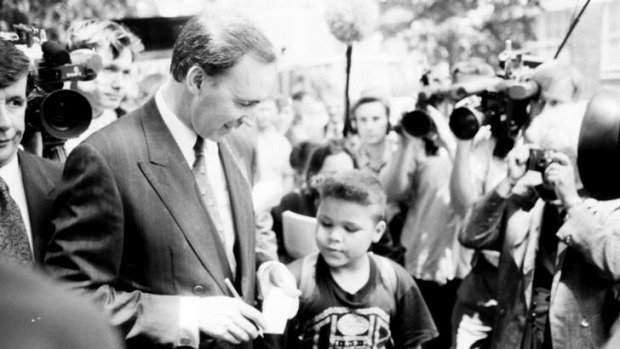
Autograph given after the Redfern address of 1992

Autograph given after the Redfern address of 1992

Paul Keating: "I was determined to say something which transcended the kind of lip service which normally informed speeches of this kind", Redfern Reprise - 2015

December 27, 2015

9 December 2015, Australian Museum, Sydney, Australia

Paul Keating was the 24th Prime Minister of Australia. His Redfern speech, acknowledging dispossession and oppression of Aboriginal Australians is a political classic.

My father and I spent a long lonely day at the Bankstown South polling booth in 1967 handing out pamphlets in support of the referendum to grant the Commonwealth an express constitutional power in respect of the Australian Aboriginal community and its welfare.

Two years later, I was a member of the House of Representatives.

This was the election where Gough Whitlam had made his greatest gains and there was hope amongst many of us that he had enough momentum to win. As it turned out, John Gorton was able to hang on, with Bill Wentworth as Australia's first minister for Aboriginal affairs.

Wentworth, who had played a leading role in the 1967 referendum, had his heart in the job and it was the hope of many that he would succeed in moving the Aboriginal agenda forward, employing the Commonwealth's newly found power.

At the heart of these amplified expectations was the hope of finding some real if late basis for a reconciliation between the Aboriginal and Torres Strait Islander community and the nation in the broad.

The debate in those earlier days tended to centre on matters relating to welfare and to land, as much as it did the much deeper notion of reconciliation.

The first positive expression of Commonwealth power turned out to be under Gough Whitlam's government in 1975 with the Northern Territory's Aboriginal land rights act. An act actually promulgated by Malcolm Fraser under his government in 1977.

Seven years after the passage of the referendum, this act was the first real and tangible acknowledgment of the dispossession which had occurred at sovereignty in 1788. In those days, the prevailing legal orthodoxy was that Aboriginal and Islander people possessed no ownership of the land – the land which became the Commonwealth of Australia and flowing from that, that Australia was the land of ‘no one’.

While the 1967 referendum gave the Commonwealth parliament power to make special laws in respect of Aboriginal and Islander people, including land across the States, because of political opposition and the complexity of issues, the Whitlam government confined its land rights initiative to Territories under Commonwealth control. Hence the origins of the Northern Territory land rights act.

And this remained the sole initiative of the Commonwealth in respect of Aboriginal and Islander land until the Native Title Act of the Keating government in 1993 - just on 20 years later.

It was the national policy of the Australian Labor Party and of its parliamentary party, under the 1967 constitutional power, to legislate land rights across all the States and Territories. And the first time that this policy had been formally considered was in 1986 by the Minister for Aboriginal Affairs in the Hawke government, Clyde Holding.

Holding, to his chagrin, discovered almost immediately how difficult implementation of such a policy would be even in a Labor party which philosophically supported it. Holding ran into trenchant opposition from the states, most particularly the State of Western Australia, led by its then Labor premier, Brian Burke. Burke was a leading member of the national right faction, across the country, a faction then spoken for by Graham Richardson a then senator and former party secretary from NSW.

Faced with this broad opposition from Western Australia and from the right faction of the party, Holding was stymied, relying then on Bob Hawke as Prime Minister to break the impasse. It never happened. So uniform land rights for Aboriginal and Islander people fell from the Hawke's government's agenda.

I told Bob Hawke at the time that even if he and I alone were prepared to argue the case for land rights before a national conference of the Labor party we would win, notwithstanding broad opposition from the right faction.

Nevertheless, the whole momentum for land rights dissipated - notwithstanding that the Hawke government had belatedly put together a Council for Reconciliation in September 1991.

And this is where the difficult issue of land rights remained until the High Court handed down its decision in Mabo No 2 on 3 June 1992.

By this time I was Prime Minister and I issued a statement saying, in overturning the concept of terra nullius, the High Court had presented the country with an opportunity to find a new and just way of remedying the original colonial grievance - the dispossession and that this opportunity could bring with it a new and lasting basis for a genuine reconciliation.

As it turned out, the United Nations International Year for the World’s Indigenous People began in December 1992, so I took the opportunity to say something definitive about the general plight of indigenous people around the world and most particularly of our own.

But in deciding to say something definitive I was determined to say something which transcended the kind of lip service which normally informed speeches of this kind. So, notwithstanding I was three months from a national election, I decided to lay waste to the ambiguity and humbug that had forever compromised this topic. I wanted to deal in truths, historical truths, ones that made clear above all else that it was we who did the dispossessing and that it was we who had taken the lands and brutalised the traditional way of life.

I said at Redfern Park on 10 December 1992 that our starting point had to begin with an act of recognition, the very same point President Barack Obama made recently following the Atlanta church massacre where he said ‘recognition precedes justice’.

I said at Redfern we could not sweep injustice aside and that by bringing the dispossessed out of the shadows, we were extending our own idea of social justice and of social democracy. And that our failure to recognise our callous disregard of Aboriginal and Islander people and of the truth of their loss and circumstance had degraded us all.

I have said in other circumstances, that ‘there is in public life no more beautiful a characteristic than truth’. That truth is, of its essence liberating, as it is possessed of no contrivance or conceit - that it provides the only genuine basis for progress and that the future can only be found in truth.

Nowhere was this sentiment more apt than in the vexed issue of Australian society coming to terms with its origins.

And I wanted, as Prime Minister, to lay out the truth unambiguously, once and for all. For once a Prime Minister had spoken the truth, the truth could never become unsaid - no matter how jarring and objectionable these views were likely to be to conservative Australia. And as it eventuated, the views were jarring to many, spawning the black armband brigade which then fought this issue right throughout the 1990s.

But significant as were the articulation of these truths and sentiment and especially in respect of prejudice, of themselves they could not deal in a material way with the dispossession and all that had flowed from it.

Indeed, at Redfern I said we had to give meaning to ‘justice’ and ‘equity’ and that we could only give such meaning when we committed ourselves to achieving concrete things. That when we see improvement, we see a lift in dignity, confidence and happiness. And I instanced the Mabo judgment as one of the opportunities that presented itself as a building block in a more practical partnership towards justice and equity.

I made clear at Redfern that I saw Mabo as an historic opportunity – a potential turning point, one that could provide a new relationship between indigenous and non-Aboriginal Australians.

Remarkably, the High Court of Australia had found that a title of an ancient kind had survived the act of sovereignty in 1788 and to the extent that subsequent grants of interest were consistent with the title, the nature and content of the title could be determined by the character or the connection to or occupation of the land under traditional laws and customs.

The notion that Aboriginal and Islander people had a private property right to their own soil opened up what I thought was an entirely new and opportune pathway to land rights, one superior to land being conferred upon indigenous people by the act of an Australian parliament.

And so, I set about enshrining these principles and modalities in a major piece of cultural and property law which is now known as the Native Title Act 1993.

While the principles laid out in the High Court’s Mabo No 2 decision could never deal with the original dispossession, for much of the land granted since 1788 had had the effect of extinguishing native title, they did have the possibility of making good on the dispossession otherwise across vast tracts of the continent.

So while we could not make reparations, we could make amends. We could reverse the dispossession for those people who still lived on or had a traditional connection with the land.

So the notion of Aboriginality and all that that meant became central to native title and I was determined that it be central.

We have to remember that native title is not a creature of the Australian common law but an ancient title recognised by the common law. A title of ancient antecedents which gives recognition to culture, customary tradition and nature - to the relationship between Aboriginal people and the landscape; the relationship to their songs and dances and to the birds and the animals – to their storytelling.

Is it any wonder then that this culture, the longest with a collective memory of any in continuous existence, with its originality and creativity, is now pointing the way for our own culture – an essentially European one but one under constant renovation, not least at the incidence of indigenous inspiration?

Aboriginal art and culture draws from the land, for Aboriginality and the land are essential to each other and are inseparable.

At its best, Aboriginal art carries sacred messages through its symbols and materials yet manages to hold its secrets while speaking to a broader audience. More than that, it has been effective in translating an entire culture and the understanding of an entire continent.

Indeed, the more we interpret Australia through Aboriginal eyes, through the experience of their long and epic story, the more we allow ourselves to understand the land we share.

So I think there is a lesson in this: we may reach a point where Aboriginal art and culture become so integral and so central to Australian art and culture that each melds into the other.

Whatever our identity is today or has become, it is an identity inseparable from Aboriginal Australia. For their fifty thousand years here has slaked the land with their resonances, their presence and their spirit. Our opportunity is to rejoice in their identity, and without attempting to appropriate or diminish it, fuse it with our own, making the whole richer.

Australia is positioned in the fastest growing, most dynamic part of the world. Indigenous cultures exist all around it. And in the largest countries on earth.

Our two hundred year occupancy of this vast continent, in terms of long history, sits at odds with the settled old societies near us and around us.

But this is not the case with our indigenes.

They were never at odds with what surrounded them nor indeed with their own land. They are entirely at home with it and in it.

But as it turned out, their home is now our home and the more we rejoice in their identity - and their one-ness with the country, the more the country will become ours as we become nearer its spirituality and its meaning.

The more we view the country through the prism of Aboriginality, the more likely we are to get the angle right.


Similar to this: Paul Keating, Redfern Speech, 1992.

Source: http://www.keating.org.au/shop/item/redfer...

Enjoyed this speech? Speakola is a labour of love and I’d be very grateful if you would share, tweet or like it. Thank you.

Facebook Twitter Facebook
In 2010s Tags PAUL KEATING, REDFERN SPEECH, REDFERN REPRISE, ANNIVERSARY, AUSTRALIA MUSEUM, INDIGENOUS PEOPLE, TRANSCRIPT
Comment

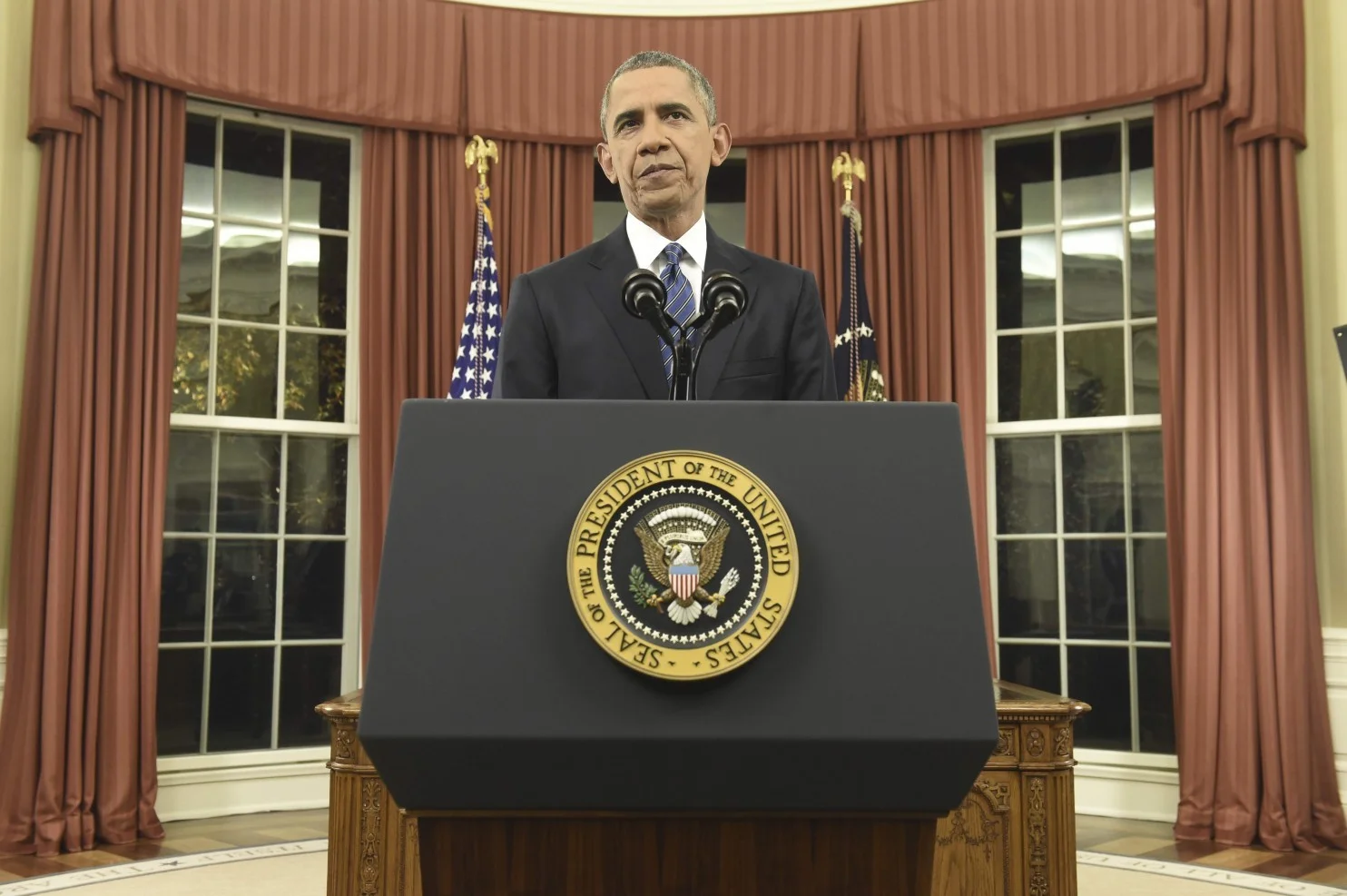
Barack Obama: 'Let's not forget that freedom is more powerful than fear' - San Bernardino response - 2015

December 7, 2015

video begins at 28.11

6 December 2015, Oval Office address, Washington DC, USA

Good evening. On Wednesday, 14 Americans were killed as they came together to celebrate the holidays. They were taken from family and friends who loved them deeply. They were white and black, Latino and Asian, immigrants, and American born, moms and dads, daughters and sons. Each of them served their fellow citizens. All of them were part of our American family.

Tonight I want to talk with you about this tragedy, the broader threat of terrorism and how we can keep our country safe. The FBI is still gathering the facts about what happened in San Bernardino, but here's what we know. The victims were brutally murdered and injured by one of their co-workers and his wife. So far, we have no evidence that the killers were directed by a terrorist organization overseas or that they were part of a broader conspiracy here at home. But it is clear that the two of them had gone down the dark path of radicalization, embracing a perverted interpretation of Islam that calls for war against America and the West. They had stockpiled assault weapons, ammunition, and pipe bombs.

So this was an act of terrorism designed to kill innocent people. Our nation has been at war with terrorists since Al Qaeda killed nearly 3,000 Americans on 9/11. In the process, we've hardened our defenses, from airports, to financial centers, to other critical infrastructure. Intelligence and law enforcement agencies have disrupted countless plots here and overseas and worked around the clock to keep us safe.

Our military and counterterrorism professionals have relentlessly pursued terrorist networks overseas, disrupting safe havens in several different countries, killing Osama Bin Laden, and decimating Al Qaeda's leadership.

Over the last few years, however, the terrorist threat has evolved into a new phase. As we've become better at preventing complex multifaceted attacks like 9/11, terrorists turn to less complicated acts of violence like the mass shootings that are all too common in our society. It is this type of attack that we saw at Fort Hood in 2009, in Chattanooga earlier this year, and now in San Bernardino.

And as groups like ISIL grew stronger amidst the chaos of war in Iraq and then Syria, and as the Internet erases the distance between countries, we see growing efforts by terrorists to poison the minds of people like the Boston Marathon bombers and the San Bernardino killers.

For seven years, I've confronted this evolving threat each and every morning in my intelligence briefing, and since the day I took this office, I have authorized U.S. forces to take out terrorists abroad precisely because I know how real the danger is.

As commander in chief, I have no greater responsibility than the security of the American people.

As a father to two young daughters who are the most precious part of my life, I know that we see ourselves with friends and co-workers at a holiday party like the one in San Bernardino. I know we see our kids in the faces of the young people killed in Paris.

And I know that after so much war, many Americans are asking whether we are confronted by a cancer that has no immediate cure.

Well, here's what I want you to know. The threat from terrorism is real, but we will overcome it. We will destroy ISIL and any other organization that tries to harm us. Our success won't depend on tough talk, or abandoning our values or giving into fear. That's what groups like ISIL are hoping for. Instead, we will prevail by being strong and smart, resilient and relentless. And by drawing upon every aspect of American power.

Here's how. First, our military will continue to hunt down terrorist plotters in any country where it is necessary. In Iraq and Syria, air strikes are taking out ISIL leaders, heavy weapons, oil tankers, infrastructure.

And since attacks in Paris, our closest allies, including France, Germany, and the United Kingdom, have ramped up their contributions to our military campaign which will help us accelerate our effort to destroy ISIL.

Second, we will continue to provide training and equipment to tens of thousands of Iraqi and Syrian forces fighting ISIL on the ground so that we take away their safe havens.

In both countries, we're deploying special operations forces who can accelerate that offensive. We've stepped up this effort since the attacks in Paris, and will continue to invest more in approaches that are working on the ground.

Third, we're working with friends and allies to stop ISIL's operations, to disrupt plots, cut off their financing, and prevent them from recruiting more fighters.

Since the attacks in Paris, we've surged merged intelligence sharing with our European allies. We're working with Turkey to seal its border with Syria, and we are cooperating with Muslim majority countries, and with our Muslim communities here at home, to counter the vicious ideology that ISIL promotes online.

Fourth, with American leadership, the international community has begun to establish a process and timeline to pursue cease-fires and a political resolution to the Syrian war.

Doing so will allow the Syrian people and every country, including our allies, but also countries like Russia, to focus on the common goal of destroying ISIL, a group that threatens us all.

This is our strategy to destroy ISIL. It is designed and supported by our military commanders and counterterrorism experts, together with 65 countries that have joined an American-led coalition. And we constantly examine our strategy to determine when additional steps are needed to get the job done.

That's why I've ordered the Departments of State and Homeland Security to review the visa waiver program under which the female terrorist in San Bernardino originally came to this country. And that's why I will urge high-tech and law enforcement leaders to make it harder for terrorists to use technology to escape from justice.

Now, here at home, we have to work together to address the challenge. There are several steps that Congress should take right away. To begin with, Congress should act to make sure no one on a no- fly list is able to buy a gun. What could possibly be the argument for allowing a terrorist suspect to buy a semiautomatic weapon? This is a matter of national security.

We also need to make it harder for people to buy powerful assault weapons, like the ones that were used in San Bernardino. I know there are some who reject any gun-safety measures, but the fact is that our intelligence and law-enforcement agencies, no matter how effective they are, cannot identify every would-be mass shooter, whether that individual was motivated by ISIL or some other hateful ideology.

What we can do, and must do, is make it harder for them to kill.

Next, we should put in place stronger screening for those who come to America without a visa so that we can take a hard look at whether they've traveled to war zones. And we're working with members of both parties in Congress to do exactly that.

Finally, if Congress believes, as I do, that we are at war with ISIL, it should go ahead and vote to authorize the continued use of military force against these terrorists.

For over a year, I have ordered our military to take thousands of air strikes against ISIL targets. I think it's time for Congress to vote to demonstrate that the American people are united and committed to this fight.

My fellow Americans, these are the steps that we can take together to defeat the terrorist threat.

Let me now say a word about what we should not do. We should not be drawn once more into a long and costly ground war in Iraq or Syria. That's what groups like ISIL want. They know they can't defeat us on the battlefield. ISIL fighters were part of the insurgency that we faced in Iraq. But they also know that if we occupy foreign lands, they can maintain insurgencies for years, killing thousands of our troops and draining our resources, and using our presence to draw new recruits.

The strategy that we are using now -- air strikes, special forces, and working with local forces who are fighting to regain control of their own country -- that is how we'll achieve a more sustainable victory, and it won't require us sending a new generation of Americans overseas to fight and die for another decade on foreign soil.

Here's what else we cannot do. We cannot turn against one another by letting this fight be defined as a war between America and Islam. That, too, is what groups like ISIL want.

ISIL does not speak for Islam. They are thugs and killers, part of a cult of death. And they account for a tiny fraction of a more than a billion Muslims around the world, including millions of patriotic Muslim-Americans who reject their hateful ideology.

Moreover, the vast majority of terrorist victims around the world are Muslim.

If we're to succeed in defeating terrorism, we must enlist Muslim communities as some of our strongest allies, rather than push them away through suspicion and hate.

That does not mean denying the fact that an extremist ideology has spread within some Muslim communities. It's a real problem that Muslims must confront without excuse.

Muslim leaders here and around the globe have to continue working with us to decisively and unequivocally reject the hateful ideology that groups like ISIL and Al Qaeda promote, to speak out against not just acts of violence, but also those interpretations of Islam that are incompatible with the values of religious tolerance, mutual respect, and human dignity.

But just as it is the responsibility of Muslims around the world to root out misguided ideas that lead to radicalization, it is the responsibility of all Americans, of every faith, to reject discrimination. It is our responsibility to reject religious tests on who we admit into this country. It's our responsibility to reject proposals that Muslim-Americans should somehow be treated differently. Because when we travel down that road, we lose. That kind of divisiveness, that betrayal of our values plays into the hands of groups like ISIL.

Muslim-Americans are our friends and our neighbors, our co- workers, our sports heroes. And, yes, they are our men and women in uniform who are willing to die in defense of our country. We have to remember that.

My fellow Americans, I am confident we will succeed in this mission because we are on the right side of history. We were founded upon a belief in human dignity that no matter who you are, or where you come from, or what you look like or what religion you practice, you are equal in the eyes of God and equal in the eyes of the law. Even in this political season, even as we properly debate what steps I and future presidents must take to keep our country safe. Let's make sure we never forget what makes us exceptional.  That we have always met challenges, whether war or depression, natural disasters or terrorist attacks, by coming together around our common ideals as one nation and one people.

So long as we stay true to that tradition, I have no doubt that America will prevail.

Thank you. God bless you. And may God bless the United States of America

Source: https://www.washingtonpost.com/news/the-fi...

Enjoyed this speech? Speakola is a labour of love and I’d be very grateful if you would share, tweet or like it. Thank you.

Facebook Twitter Facebook
In 2010s Tags BARACK OBBAMA, TERRORISM, SAN BERNARDINO, ISIL, ISIS, OVAL OFFICE, PRESIDENTS, IRAQ, SYRIA, TRANSCRIPT
Comment

Barack Obama: 'A steady, relentless effort to take out ISIL wherever they exist' ISIL Speech - 2015

December 7, 2015

10 September 2015, Washington DC, USA

My fellow Americans -- tonight, I want to speak to you about what the United States will do with our friends and allies to degrade and ultimately destroy the terrorist group known as ISIL.

As Commander-in-Chief, my highest priority is the security of the American people. Over the last several years, we have consistently taken the fight to terrorists who threaten our country. We took out Osama bin Laden and much of al Qaeda's leadership in Afghanistan and Pakistan. We've targeted al Qaeda's affiliate in Yemen, and recently eliminated the top commander of its affiliate in Somalia. We've done so while bringing more than 140,000 American troops home from Iraq, and drawing down our forces in Afghanistan, where our combat mission will end later this year. Thanks to our military and counterterrorism professionals, America is safer.

Still, we continue to face a terrorist threat. We cannot erase every trace of evil from the world, and small groups of killers have the capacity to do great harm. That was the case before 9/11, and that remains true today. That's why we must remain vigilant as threats emerge. At this moment, the greatest threats come from the Middle East and North Africa, where radical groups exploit grievances for their own gain. And one of those groups is ISIL -- which calls itself the "Islamic State."

Now let's make two things clear: ISIL is not "Islamic." No religion condones the killing of innocents, and the vast majority of ISIL's victims have been Muslim. And ISIL is certainly not a state. It was formerly al Qaeda's affiliate in Iraq, and has taken advantage of sectarian strife and Syria's civil war to gain territory on both sides of the Iraq-Syrian border. It is recognized by no government, nor the people it subjugates. ISIL is a terrorist organization, pure and simple. And it has no vision other than the slaughter of all who stand in its way.

In a region that has known so much bloodshed, these terrorists are unique in their brutality. They execute captured prisoners. They kill children. They enslave, rape, and force women into marriage. They threatened a religious minority with genocide. In acts of barbarism, they took the lives of two American journalists -- Jim Foley and Steven Sotloff.

So ISIL poses a threat to the people of Iraq and Syria, and the broader Middle East -- including American citizens, personnel and facilities. If left unchecked, these terrorists could pose a growing threat beyond that region -- including to the United States. While we have not yet detected specific plotting against our homeland, ISIL leaders have threatened America and our allies. Our intelligence community believes that thousands of foreigners -- including Europeans and some Americans -- have joined them in Syria and Iraq. Trained and battle-hardened, these fighters could try to return to their home countries and carry out deadly attacks.

I know many Americans are concerned about these threats. Tonight, I want you to know that the United States of America is meeting them with strength and resolve. Last month, I ordered our military to take targeted action against ISIL to stop its advances. Since then, we have conducted more than 150 successful airstrikes in Iraq. These strikes have protected American personnel and facilities, killed ISIL fighters, destroyed weapons, and given space for Iraqi and Kurdish forces to reclaim key territory. These strikes have helped save the lives of thousands of innocent men, women and children.

[President Obama: 'ISIL is not Islamic']President Obama: 'ISIL is not Islamic' 01:50

But this is not our fight alone. American power can make a decisive difference, but we cannot do for Iraqis what they must do for themselves, nor can we take the place of Arab partners in securing their region. That's why I've insisted that additional U.S. action depended upon Iraqis forming an inclusive government, which they have now done in recent days. So tonight, with a new Iraqi government in place, and following consultations with allies abroad and Congress at home, I can announce that America will lead a broad coalition to roll back this terrorist threat.

Our objective is clear: we will degrade, and ultimately destroy, ISIL through a comprehensive and sustained counter-terrorism strategy.

First, we will conduct a systematic campaign of airstrikes against these terrorists. Working with the Iraqi government, we will expand our efforts beyond protecting our own people and humanitarian missions, so that we're hitting ISIL targets as Iraqi forces go on offense. Moreover, I have made it clear that we will hunt down terrorists who threaten our country, wherever they are. That means I will not hesitate to take action against ISIL in Syria, as well as Iraq. This is a core principle of my presidency: if you threaten America, you will find no safe haven.

Second, we will increase our support to forces fighting these terrorists on the ground. In June, I deployed several hundred American service members to Iraq to assess how we can best support Iraqi Security Forces. Now that those teams have completed their work -- and Iraq has formed a government -- we will send an additional 475 service members to Iraq. As I have said before, these American forces will not have a combat mission -- we will not get dragged into another ground war in Iraq. But they are needed to support Iraqi and Kurdish forces with training, intelligence and equipment. We will also support Iraq's efforts to stand up National Guard Units to help Sunni communities secure their own freedom from ISIL control.

Across the border, in Syria, we have ramped up our military assistance to the Syrian opposition. Tonight, I again call on Congress to give us additional authorities and resources to train and equip these fighters. In the fight against ISIL, we cannot rely on an Assad regime that terrorizes its people; a regime that will never regain the legitimacy it has lost. Instead, we must strengthen the opposition as the best counterweight to extremists like ISIL, while pursuing the political solution necessary to solve Syria's crisis once and for all.

Third, we will continue to draw on our substantial counterterrorism capabilities to prevent ISIL attacks. Working with our partners, we will redouble our efforts to cut off its funding; improve our intelligence; strengthen our defenses; counter its warped ideology; and stem the flow of foreign fighters into -- and out of -- the Middle East. And in two weeks, I will chair a meeting of the UN Security Council to further mobilize the international community around this effort.

Fourth, we will continue providing humanitarian assistance to innocent civilians who have been displaced by this terrorist organization. This includes Sunni and Shia Muslims who are at grave risk, as well as tens of thousands of Christians and other religious minorities. We cannot allow these communities to be driven from their ancient homelands.

This is our strategy. And in each of these four parts of our strategy, America will be joined by a broad coalition of partners. Already, allies are flying planes with us over Iraq; sending arms and assistance to Iraqi Security Forces and the Syrian opposition; sharing intelligence; and providing billions of dollars in humanitarian aid. Secretary Kerry was in Iraq today meeting with the new government and supporting their efforts to promote unity, and in the coming days he will travel across the Middle East and Europe to enlist more partners in this fight, especially Arab nations who can help mobilize Sunni communities in Iraq and Syria to drive these terrorists from their lands. This is American leadership at its best: we stand with people who fight for their own freedom; and we rally other nations on behalf of our common security and common humanity.

My Administration has also secured bipartisan support for this approach here at home. I have the authority to address the threat from ISIL. But I believe we are strongest as a nation when the President and Congress work together. So I welcome congressional support for this effort in order to show the world that Americans are united in confronting this danger.

Now, it will take time to eradicate a cancer like ISIL. And any time we take military action, there are risks involved -- especially to the servicemen and women who carry out these missions. But I want the American people to understand how this effort will be different from the wars in Iraq and Afghanistan. It will not involve American combat troops fighting on foreign soil. This counter-terrorism campaign will be waged through a steady, relentless effort to take out ISIL wherever they exist, using our air power and our support for partner forces on the ground. This strategy of taking out terrorists who threaten us, while supporting partners on the front lines, is one that we have successfully pursued in Yemen and Somalia for years. And it is consistent with the approach I outlined earlier this year: to use force against anyone who threatens America's core interests, but to mobilize partners wherever possible to address broader challenges to international order.

My fellow Americans, we live in a time of great change. Tomorrow marks 13 years since our country was attacked. Next week marks 6 years since our economy suffered its worst setback since the Great Depression. Yet despite these shocks; through the pain we have felt and the grueling work required to bounce back -- America is better positioned today to seize the future than any other nation on Earth.

Our technology companies and universities are unmatched; our manufacturing and auto industries are thriving. Energy independence is closer than it's been in decades. For all the work that remains, our businesses are in the longest uninterrupted stretch of job creation in our history. Despite all the divisions and discord within our democracy, I see the grit and determination and common goodness of the American people every single day -- and that makes me more confident than ever about our country's future.

Abroad, American leadership is the one constant in an uncertain world. It is America that has the capacity and the will to mobilize the world against terrorists. It is America that has rallied the world against Russian aggression, and in support of the Ukrainian peoples' right to determine their own destiny. It is America -- our scientists, our doctors, our know-how -- that can help contain and cure the outbreak of Ebola. It is America that helped remove and destroy Syria's declared chemical weapons so they cannot pose a threat to the Syrian people -- or the world -- again. And it is America that is helping Muslim communities around the world not just in the fight against terrorism, but in the fight for opportunity, tolerance, and a more hopeful future.

America, our endless blessings bestow an enduring burden. But as Americans, we welcome our responsibility to lead. From Europe to Asia -- from the far reaches of Africa to war-torn capitals of the Middle East -- we stand for freedom, for justice, for dignity. These are values that have guided our nation since its founding. Tonight, I ask for your support in carrying that leadership forward. I do so as a Commander-in-Chief who could not be prouder of our men and women in uniform -- pilots who bravely fly in the face of danger above the Middle East, and service-members who support our partners on the ground.

When we helped prevent the massacre of civilians trapped on a distant mountain, here's what one of them said. "We owe our American friends our lives. Our children will always remember that there was someone who felt our struggle and made a long journey to protect innocent people."

That is the difference we make in the world. And our own safety -- our own security -- depends upon our willingness to do what it takes to defend this nation, and uphold the values that we stand for -- timeless ideals that will endure long after those who offer only hate and destruction have been vanquished from the Earth.

May God bless our troops, and may God bless the United States of America.

Source: http://edition.cnn.com/2014/09/10/politics...

Enjoyed this speech? Speakola is a labour of love and I’d be very grateful if you would share, tweet or like it. Thank you.

Facebook Twitter Facebook
In 2010s Tags PRESIDENTS, BARACK OBAMA, ISIL, ISIS, DAESH, OVAL OFFICE, TRANSCRIPT
Comment

Brian Eno: 'It isn’t the solution, it’s exactly what ISIL want' Stop the War rally - 2015

December 3, 2015

28 November 2015, London, United Kingdom

What we see here is a classic situation of the old aphorism, ‘to a man with a hammer, everything is a nail’. So, we see a situation that we hate, ISIL, and we happen to have a big army, so that must be the solution.

It isn’t the solution, it’s exactly what ISIL want.

If we want to make all their dreams come true, we should start bombing them.

They want to be the heroes, they want us to be the crusaders. And they want us to behave as badly as we possibly can.

And we will.

What we’ve seen this century is the abandonment of all the things that we thought were civilised behaviour.

We started torturing people. We imprisoned people without charge. We attack civilians. We target-assassinate people who we don’t really know if they’re the proper victims or not.

We’re doing everything that ISIL wants us to do at the moment.

Why don’t we start doing the clever thing and start following the money. Who is supporting ISIL?

[applause]

Well I can tell you why we’re not doing that because the people who are supporting ISIL are Saudi Arabia,  which is of course our ally, and  the biggest buyer of our weapons. We sell more weapons to Saudi Arabia than anybody else. So we’re not going to criticise those allies.

And Saudi Arabia is the biggest external funder of ISIS in the world. That’s our ally. That’s a nice situation isn’t it?

And of course, Turkey. Turkey is the country that is buying a lot of the oil that ISIL is producing. That funds ISIL more than anything else.

So two of the allies we’re going into this stupid war with, are the two people we should be criticising. Those are the two countries we should be working to defuse and to separate from ISIL.

We’re just digging ourselves into a hole.

We’re digging it deeper and deeper.

The whole of this century so far has been us digging a hole in the Middle East. And instead of getting out, we just keep digging.

So let’s stop digging.  Now.

Thank you.

Source: http://www.stopwar.org.uk/

Enjoyed this speech? Speakola is a labour of love and I’d be very grateful if you would share, tweet or like it. Thank you.

Facebook Twitter Facebook
In 2010s Tags BRIAN ENO, SYRIA, AIR STRIKES, STOP THE WAR COALITION RALLY, UNITED KINGDOM, DAESH, ISIL, ISIS
1 Comment

Jon Stewart: 'Bullshit is everywhere', final speech 'The Daily Show' - 2015

November 6, 2015

6 August 2015, New York City, NY, USA

 Australian and NZ playable Video. 

Bullshit is everywhere.

There is very little that you will encounter in life that has not been, in some way, infused with bullshit; not all of it bad. The general day-to-day organic free-range bullshit is often necessary, or, at the very least, innocuous: "Oh, what a beautiful baby! I'm sure it'll grow into that head!" That kind of bullshit, in many ways, provides important social contract fertilizer, which keeps people from making each other cry all day. But then, there's the more pernicious bullshit; the premediated, institutional bullshit designed to obscure and distract. Designed by whom? The bullshit-ocracy. It comes in three basic flavours:

1. Making bad things sound like good things. "Organic, all-natural cupcakes", because "Factory-made sugar oatmeal balls" doesn't sell. "Patriot Act", because "Are-you-scared-enough-to-let-me-look-at-all-your-phone-records? Act" doesn't sell. So, whenever something's been titled "Freedom, Family, Fairness and Health America", take a good, long sniff. Chances are it's been manufactured in a facility that may contain traces of bullshit.

2. Hiding the bad things under mountains of bullshit. Complexity. "You know, I would love to download Drizzy's latest Meek Mill diss, but I'm not really interested right now in reading Tolstoy's iTunes agreement. So, I'll just click "Agree", even if it grants Apple prima nocta with my spouse!" Here's another one: simply put, "Banks shouldn't be able to bet your pension money on red" Bullshitly put it's, "Hey, a handful of billionaires can't buy our elections, right? Of course not. They can only pour unlimited, anonymous cash into a 501(c)4 if 50% is devoted to Issue Education, otherwise they'd have to 501(c)6 it, or funnel it openly through a non-campaign coordinating Super PAC, with a quarter- I think they're asleep now, we can sneak out!"

And finally, the bullshit of infinite possibility. These bullshitters cover their unwillingness to act under the guise of unending inquiry. "We can't do anything, because we don't yet know everything." "We cannot take action on climate change until everyone in the world agrees gay marriage vaccines won't case our children to marry goats who are gonna come for our guns"

But the good news is this: bullshitters have gotten pretty lazy, and their work is easily detected, and looking for it is kind of a pleasant way to pass the time, like an I spy of bullshit. So I say to you tonight, friends, the best defence against bullshit is vigilance. So, if you smell something, say something.

Source: http://time.com/3988497/jon-stewart-daily-...

Enjoyed this speech? Speakola is a labour of love and I’d be very grateful if you would share, tweet or like it. Thank you.

Facebook Twitter Facebook
In 2010s Tags BULLSHIT, POLITICAL SATIRE, THE DAILY SHOW, TRANSCRIPT, PIECE TO CAMERA, COMEDY, JON STEWART, FAREWELL
Comment

Bernadette (Devlin) McAliskey: 'We still have internment without trial!' Bloody Sunday March - 2013

October 30, 2015

27 January, 2013, Free Doire Corner, Derry, Northern Ireland

Thanks very much. I wasn't really quite sure where to start here today. It's good to see so many people here. I thought actually that Kate was going to read out some of the thanks to people before I started but she's going to do that afterwards.

So I'd just like to take a minute to thank Kate Nash, to thank The Nash Sisters, to thank the families who have asserted their right to keep this issue to the fore until the truth is followed by accountability for the action.

It has been a lonely enough path at times for families. There are times when people who are in the thick of what is actually happening – the people who have actually have suffered the brunt of the pain and the loss - who have to travel very lonely paths sometimes - although we try our best to stand with everybody.

The ebb comes and goes. And it takes very brave people to keep standing their ground when there are plenty of people with them and when there are no people simply because they know that justice remains to be done needs nd not simply be seen to be have done.

So here on the forty-first anniversary of Bloody Sunday I'm actually surprised myself that on this cold day that somewhere in the back of my head is a slightly-too-close for me at the minute a very uncomfortable memory of standing here forty-one years ago.

Sometimes you forget as well why we came on that day. It's very important to remember first of all that we continue to fight - to challenge the cover-up, to challenge the pattern, to challenge the belief that the state can do whatever the states likes.

And even though some people from time to time get tired or begin to collaborate with the state in believing that it's all best swept away somewhere and new starts made on corrupt beginnings.

We still have to keep in front of people's minds that it didn't just happen to us. Bloody Sunday is not exclusive to the people of Doire - not exclusive to the people of Northern Ireland. Had many of you had the opportunity, which you didn't, to be at some of the events yesterday, and hear Jenny Hicks speak of the loss of her two daughters at the cover-up in Hillsborough, to hear Dave Douglas speak about the cover-up of the attack on the miners, to hear Susan McKay speak on the cover-up of sexual abuse of innocent children who were supposed to be safe in the care of institutions and were violated there.

And I think what stood in common to all of us yesterday as we were speaking was that the deed was bad enough. The shooting of people in the street in Doire was bad enough. The failure to protect people in a football stadium was bad enough. But the worst thing that happened to people was that having done it was the lie!

To immediately, in the aftermath of doing it, to lie about it. And to consistently maintain that lie to protect the state, to protect the interest, to protect the guilty. And in order to keep that lie alive, to demonise, to vilify the innocent.

And let us remember that even today when the vast majority of the innocent have been declared innocent - which we always knew - that innocence is still denied to young Gerald Donaghey. Innocence is still denied to that young person on whose corpse soldiers planted nail bombs in his pockets so that they could say they saw them there or whatever it was they did. There has still not been a declaration of innocence for young Gerald Donaghy.

Let us also remember, and we talked about that yesterday as well, that that pattern, that pattern of the state action doing what they want, lying about the fact they did it, being able to draw in the great and the good - the media, the police, the Church, the social speakers, the powerful - to maintain the lie.

That demonising of the victims, that long, long process of barricading the truth away from the people. People talk about how long The Saville Inquiry took - how expensive The Saville Inquiry was. It took a long time and it cost alot of money because for every single inch of that journey, for every single day of that journey, the British government, who set the Inquiry up, prevented the truth from being brought before it.

That's why it cost alot of money. That's why it took alot of time.

And as one of the people and I still say - I never asked for that Inquiry...I never wanted it...that's my personal stand...I never wanted to go to it because the man who was sitting there, decent human being though he was, was an employee of the government I saw murder people in front of my eyes!

How was he going to find his employer guilty? So he laid the blame at a half a dozen soldiers. And they still have not been held to account.

But the true culprits will never be held to account unless we keep on this path until they are.

But let us not forget what took us onto the streets that day.

We did not stand here forty-one years ago for the purpose of being shot. That's not why we came here. We didn't stand here all that time ago to create a situation that we would have to remember year after year.

We came on the streets that day to end the policy of internment without trial. That's what took us here.

And here today forty-one years later we have a new administration. We have a new dispensation. We have a new power structure. We have new civic collaborators in the administration of government.

But we still have internment without trial!

We still have people in prison on the whim and the dictate of the Northern Ireland Secretary of State - the Overlord of this place.

And whatever minions of small people who think they have power here... the fact that they cannot have Martin Corey released means they have no power! Power still lies in the fist of the Northern Ireland Secretary of State. But they have paper power.

Marian Price remains in prison on the whim of the Secretary of State.

Dolours Price cannot be harmed by this state anymore because they have finally destroyed that good woman and she is now gone.

But the Minister of so-called Justice, David so-called “Liberal” Ford, under Article 7 of the 2000 Act, at the stroke of a pen could release her sister whom they are also trying to break in body and soul and spirit and mind. And for what?

It took all day yesterday in the High Court for a very brave lawyer to keep battling against David Ford and we're not supposed to say this because David Ford asked the judge to insure there was no reporting.

Well...I don't work for the media...so I'm not reporting... I'm just telling you!

But in the High Court, on a judicial review, the judge said that David Ford's behaviour and his judgment on not allowing Marian Price out - and not even considering it – for a few hours to sit by the coffin of her sister was unlawful, unreasonable and irrational. That's what the judge said about the Minister of Justice of this small, misbegotten, corrupt, little, pretending state.

He said the Minister of Lilliput is irrational. He said the Minister of Lilliput doesn't understand the law.

And he said that that young woman should be released for at least four hours to sit by the coffin of a sister with whom she had shared a cell for many years. With whom she had suffered the human torture, degrading and inhuman treatment of having a tube put down her throat, into her stomach, held down until a jug of liquid was poured into that funnel, into that tube and into that stomach every single day for over [two] hundred days.

When we talk about people on hunger strike many young people here forget that when Marian Price and Dolours Price were on hunger strike it wasn't that they were fasting - they were force fed in that manner for every day for [two] hundred days - and it destroyed those young women. It destroyed their physical health and still the state not satisfied.

Bullies one of them all of her life and imprisons the other one.

We came here forty-one years ago to demand (the end of) internment without trial. We came here forty-one years ago to make it perfectly clear that if Her Majesty's government – Her Majesty owns the government – if her Majesty's government in the United Kingdom of Great Britain and Northern Ireland could not insure that this part of her jurisdiction was governed openly, transparently, democratically and within the dictates of fundamental human rights and freedoms - which should be extended to people in prison - which should be extended to people who should not have their liberty removed from them except by due, open process of law - then this place should not be governed by Her Majesty's United Kingdom government.

And I would like to say from this platform that I for one have not changed that position. And I don't care who is currently standing between us, between us and Her Majesty's government and attempting to administer democracy on their behalf.

Make the damn state work!

Make it work openly, democratically in support of the civil rights we have demanded since 1968!

We stand today looking at a new dispensation, people still in prison, the people in these houses – people who live here - no housing executive after a few years! No welfare state! No health! No benefit! No civil rights! No nothing!

And you look on that wall and ask for what died the sons, the daughters, the children of these streets.

We have got to get our act together. We have got to do a bit more than just march. We have got to organise. We've got to educate ourselves. We have got to get moving or there will soon be nothing here for anybody.

Let's look at the bravery of the people who stood here.

Let's look at the endurance of the families who have held this fight. Let's look at the endurance of Marian Price and Martin Corey and the others and let's say to ourselves: we have got to get a political programme together here and get the struggle for civil rights, political rights, social rights and economic rights together or we are in, comrades and colleagues, for one hell of a hiding. Thank you very much.

Source: http://thepensivequill.am/2013/01/end-impu...

Enjoyed this speech? Speakola is a labour of love and I’d be very grateful if you would share, tweet or like it. Thank you.

Facebook Twitter Facebook
In 2010s Tags NORTHERN IRELAND, BERNADETTE DEVLIN, BERNADETTE, MCALISKEY, BLOODY SUNDAY, THE TROUBLES, TRANSCRIPT
Comment

Phil Davison: 'I’m coming. Both barrels, guns loaded!', Republican candidate Stark County Treasurer - 2010

October 29, 2015

8 September, 2010, Stark County, Ohio, USA

[Looks at lectern] Ladies and gentlemen of the Stark County Republican [lectern] Party Executive [lectern] Committee, [lectern] good evening. [lectern] and thank you – not only for your attendance [lectern] but for allowing me the opportunity to speak.[lectern] My name is Phil Davison [lectern] and I am seeking our party’s nomination [lectern] for the position of Stark County Treasurer.

[lectern]

On November 10th … [lectern] November of 2010, [lectern] excuse me…

In terms of my background, [lectern] I am from the village of Minerva, [lectern] where I am serving my [holds up four fingers] thirteenth year [lectern] as a – [lectern] of elected service as a Minerva Council member [lectern]. In terms of education, I have a bachelor’s degree in sociology, a bachelor’s degree in history, a master’s degree in public administration [nine-months-pregnant pause] and a master’s degree in communication.

[lectern]

In terms of elections across Stark County, [lectern] I have represented our party twice [lectern] on the county ballot [lectern] in both the primary [lectern] and the general elections, when I ran [lectern] for Stark County Clerk of Courts in 1996 and Stark County Commissioner in 2000 [lectern] and I will not apologize for my tone tonight.

[lectern]

I have been a Republican in times good, and I have been a Republican in times bad.

[long pause… looks at lectern]

Albett Einstein issued one of my most favorite quotes in the history of the spoken word, [lectern] and it is as follows: [lectern] In the middle of opportunity … [looks at lectern … yelps] excuse me; in the middle of difficulty lies ib- opportunity. I’m going to repeat that so I have clarity tonight. [lectern] In the middle of difficulty lies opportunity.

[lectern]

This is the opportunity we’ve been waiting for. [lectern] The Stark County Treasurer’s office is a mess. [lectern] It is in dire [brief pause] need of structure and guidance. [lectern] And now is the time to seize this opportunity [lectern] with an aggressive and an even more aggressive campaigner.

[lectern]

If nominated tonight, I promise each and every person in this room [lectern] I will hit the ground running, come out [lectern] swinging, and end up winning. [lectern] Let’s send a message tonight [lectern] to the people of [lectern] Stark County and to the people of the Stark County Democratic Party: [lectern] we’re tired of business as usual. [lectern] Drastic times require what? [audience member: drastic measures] Drastic measures. Yes. Who said that? Thank you. Drastic times require drastic measures.

[lectern]

We will not tolerate incompetence and irresponsibility any longer. [lectern] Now is the time to snap the Democratic stranglehold on the Treasurer’s office in two, and I harken back to what my friend Alex just said. He ran against the Treasurer in 1996. It was a problem then, it’s a problem now.

[lectern]

Infestation.

[lectern]

Politics is not touch football. [lectern] Politics is winner take all. It always has been and it always will be.

[lectern]

If nominated tonight, [lectern] I want to develop and expand [lectern] my campaign for what I believe is the greatest strength [lectern] of the Stark County Republican Party, and that is its people. [lectern] I believe in the axiom [lectern] that all politics is local. [lectern] And because of this belief, I want to [lectern] harness the thoughts and ideas [lectern] that individuals in our party have [lectern] concerning Stark County and its political subdivisions [lectern] and use that [lectern] to its fullest extent.

[lectern]

Knowledge is power. [lectern] Let’s tap into this knowledge and use it as a tool [lectern] to win the Treasurer’s office. [lectern] Let’s use this knowledge not only as a tool, but as a weapon. [gestures as if unsheathing a sword]

[lectern]

We must win this election. [lectern] If nominated tonight, I will win this election, [lectern] and I’m going to say that again so there’s no miscommunication tonight. If nominated tonight, I win. Tell your friends, tell your neighbors, tell Randy Gonzales [lectern] I’m coming. Both barrels, guns loaded. [lectern] I believe in the entities and the principles of the National Republican Party, the State of Ohio Republican Party, and the Stark County Republican Party, [lectern] and if nominated I will not hide those [lectern] beliefs on my march to victory on election [lectern] day.

If nominated tonight I can guarantee with [lectern] one hundred percent certainty that what you are [lectern] seeing from me tonight is what everyone outside those [lectern] doors is going to get over the next [holds up eight fingers] eight weeks. [lectern] I used to be an idealistic [lectern] thinker; I am now a pragmatic [lectern] thinker. Government may be about service; politics is [lectern] about winning.

Tonight, [lectern] as a candidate [picks up speech] seeking the Republican nomination [looks at speech] for the position [folds up speech] of Stark County Treasurer,[ unfolds speech] I humbly ask for your vote [refolds speech] as members of the Stark County Republican Party Executive Committee. [puts speech in pocket] Thank you.

Source: http://jomo.jomoblog.com/2010/09/my-name-i...

Enjoyed this speech? Speakola is a labour of love and I’d be very grateful if you would share, tweet or like it. Thank you.

Facebook Twitter Facebook
In 2010s Tags VIDEO, LOCAL POLITICS, TRANSCRIPT, PHIL DAVISON, PASSION, YOUTUBE HIT, STARK COUNTY, SPEECH FAIL
Comment

Barack Obama: 'The forces that divide us are not as strong as those that unite us', Tucson Memorial speech - 2011

October 12, 2015

12 January, 2011, Tucson, Arizona, 2011

Thank you.  (Applause.)  Thank you very much.  Please, please be seated.  (Applause.)

To the families of those we’ve lost; to all who called them friends; to the students of this university, the public servants who are gathered here, the people of Tucson and the people of Arizona:  I have come here tonight as an American who, like all Americans, kneels to pray with you today and will stand by you tomorrow.  (Applause.)

There is nothing I can say that will fill the sudden hole torn in your hearts.  But know this:  The hopes of a nation are here tonight.  We mourn with you for the fallen.  We join you in your grief.  And we add our faith to yours that Representative Gabrielle Giffords and the other living victims of this tragedy will pull through.  (Applause.)

Scripture tells us:

There is a river whose streams make glad the city of God,
the holy place where the Most High dwells.
God is within her, she will not fall;
God will help her at break of day.

On Saturday morning, Gabby, her staff and many of her constituents gathered outside a supermarket to exercise their right to peaceful assembly and free speech.  (Applause.)  They were fulfilling a central tenet of the democracy envisioned by our founders –- representatives of the people answering questions to their constituents, so as to carry their concerns back to our nation’s capital.  Gabby called it “Congress on Your Corner” -– just an updated version of government of and by and for the people.  (Applause.)

And that quintessentially American scene, that was the scene that was shattered by a gunman’s bullets.  And the six people who lost their lives on Saturday –- they, too, represented what is best in us, what is best in America.  (Applause.)

Judge John Roll served our legal system for nearly 40 years. (Applause.)  A graduate of this university and a graduate of this law school -- (applause) -- Judge Roll was recommended for the federal bench by John McCain 20 years ago -- (applause) -- appointed by President George H.W. Bush and rose to become Arizona’s chief federal judge.  (Applause.) 

His colleagues described him as the hardest-working judge within the Ninth Circuit.  He was on his way back from attending Mass, as he did every day, when he decided to stop by and say hi to his representative.  John is survived by his loving wife, Maureen, his three sons and his five beautiful grandchildren.  (Applause.)

George and Dorothy Morris -– “Dot” to her friends -– were high school sweethearts who got married and had two daughters.  They did everything together -- traveling the open road in their RV, enjoying what their friends called a 50-year honeymoon.  Saturday morning, they went by the Safeway to hear what their congresswoman had to say.  When gunfire rang out, George, a former Marine, instinctively tried to shield his wife.  (Applause.)  Both were shot.  Dot passed away.

A New Jersey native, Phyllis Schneck retired to Tucson to beat the snow.  But in the summer, she would return East, where her world revolved around her three children, her seven grandchildren and 2-year-old great-granddaughter.  A gifted quilter, she’d often work under a favorite tree, or sometimes she'd sew aprons with the logos of the Jets and the Giants -- (laughter) -- to give out at the church where she volunteered.  A Republican, she took a liking to Gabby, and wanted to get to know her better.  (Applause.)

Dorwan and Mavy Stoddard grew up in Tucson together -– about 70 years ago.  They moved apart and started their own respective families.  But after both were widowed they found their way back here, to, as one of Mavy’s daughters put it, “be boyfriend and girlfriend again.”  (Laughter.)

When they weren’t out on the road in their motor home, you could find them just up the road, helping folks in need at the Mountain Avenue Church of Christ.  A retired construction worker, Dorwan spent his spare time fixing up the church along with his dog, Tux.  His final act of selflessness was to dive on top of his wife, sacrificing his life for hers.  (Applause.)

Everything -- everything -- Gabe Zimmerman did, he did with passion.  (Applause.)  But his true passion was helping people.  As Gabby’s outreach director, he made the cares of thousands of her constituents his own, seeing to it that seniors got the Medicare benefits that they had earned, that veterans got the medals and the care that they deserved, that government was working for ordinary folks.  He died doing what he loved -– talking with people and seeing how he could help.  And Gabe is survived by his parents, Ross and Emily, his brother, Ben, and his fiancée, Kelly, who he planned to marry next year.  (Applause.)

And then there is nine-year-old Christina Taylor Green.  Christina was an A student; she was a dancer; she was a gymnast; she was a swimmer.  She decided that she wanted to be the first woman to play in the Major Leagues, and as the only girl on her Little League team, no one put it past her.  (Applause.) 

She showed an appreciation for life uncommon for a girl her age.  She’d remind her mother, “We are so blessed.  We have the best life.”  And she’d pay those blessings back by participating in a charity that helped children who were less fortunate.

Our hearts are broken by their sudden passing.  Our hearts are broken -– and yet, our hearts also have reason for fullness.
Our hearts are full of hope and thanks for the 13 Americans who survived the shooting, including the congresswoman many of them went to see on Saturday. 

I have just come from the University Medical Center, just a mile from here, where our friend Gabby courageously fights to recover even as we speak.  And I want to tell you -- her husband Mark is here and he allows me to share this with you -- right after we went to visit, a few minutes after we left her room and some of her colleagues in Congress were in the room, Gabby opened her eyes for the first time.  (Applause.)  Gabby opened her eyes for the first time.  (Applause.) 

Gabby opened her eyes.  Gabby opened her eyes, so I can tell you she knows we are here.  She knows we love her.  And she knows that we are rooting for her through what is undoubtedly going to be a difficult journey.  We are there for her.  (Applause.) 

Our hearts are full of thanks for that good news, and our hearts are full of gratitude for those who saved others.  We are grateful to Daniel Hernandez -- (applause) -- a volunteer in Gabby’s office.  (Applause.)

And, Daniel, I’m sorry, you may deny it, but we’ve decided you are a hero because -- (applause) -- you ran through the chaos to minister to your boss, and tended to her wounds and helped keep her alive.  (Applause.)

We are grateful to the men who tackled the gunman as he stopped to reload.  (Applause.)  Right over there.  (Applause.)  We are grateful for petite Patricia Maisch, who wrestled away the killer’s ammunition, and undoubtedly saved some lives.  (Applause.)  And we are grateful for the doctors and nurses and first responders who worked wonders to heal those who’d been hurt.  We are grateful to them.  (Applause.)

These men and women remind us that heroism is found not only on the fields of battle.  They remind us that heroism does not require special training or physical strength.  Heroism is here, in the hearts of so many of our fellow citizens, all around us, just waiting to be summoned -– as it was on Saturday morning. Their actions, their selflessness poses a challenge to each of us.  It raises a question of what, beyond prayers and expressions of concern, is required of us going forward.  How can we honor the fallen?  How can we be true to their memory?

You see, when a tragedy like this strikes, it is part of our nature to demand explanations –- to try and pose some order on the chaos and make sense out of that which seems senseless.  Already we’ve seen a national conversation commence, not only about the motivations behind these killings, but about everything from the merits of gun safety laws to the adequacy of our mental health system.  And much of this process, of debating what might be done to prevent such tragedies in the future, is an essential ingredient in our exercise of self-government.

But at a time when our discourse has become so sharply polarized -– at a time when we are far too eager to lay the blame for all that ails the world at the feet of those who happen to think differently than we do -– it’s important for us to pause for a moment and make sure that we’re talking with each other in a way that heals, not in a way that wounds.  (Applause.)

Scripture tells us that there is evil in the world, and that terrible things happen for reasons that defy human understanding. In the words of Job, “When I looked for light, then came darkness.”  Bad things happen, and we have to guard against simple explanations in the aftermath.

For the truth is none of us can know exactly what triggered this vicious attack.  None of us can know with any certainty what might have stopped these shots from being fired, or what thoughts lurked in the inner recesses of a violent man’s mind.  Yes, we have to examine all the facts behind this tragedy.  We cannot and will not be passive in the face of such violence.  We should be willing to challenge old assumptions in order to lessen the prospects of such violence in the future.  (Applause.)  But what we cannot do is use this tragedy as one more occasion to turn on each other.  (Applause.)  That we cannot do.  (Applause.)  That we cannot do.

As we discuss these issues, let each of us do so with a good dose of humility.  Rather than pointing fingers or assigning blame, let’s use this occasion to expand our moral imaginations, to listen to each other more carefully, to sharpen our instincts for empathy and remind ourselves of all the ways that our hopes and dreams are bound together.  (Applause.)

After all, that’s what most of us do when we lose somebody in our family -– especially if the loss is unexpected.  We’re shaken out of our routines.  We’re forced to look inward.  We reflect on the past:  Did we spend enough time with an aging parent, we wonder.  Did we express our gratitude for all the sacrifices that they made for us?  Did we tell a spouse just how desperately we loved them, not just once in a while but every single day?

So sudden loss causes us to look backward -– but it also forces us to look forward; to reflect on the present and the future, on the manner in which we live our lives and nurture our relationships with those who are still with us.  (Applause.)

We may ask ourselves if we’ve shown enough kindness and generosity and compassion to the people in our lives.  Perhaps we question whether we're doing right by our children, or our community, whether our priorities are in order.

We recognize our own mortality, and we are reminded that in the fleeting time we have on this Earth, what matters is not wealth, or status, or power, or fame -– but rather, how well we have loved -- (applause)-- and what small part we have played in making the lives of other people better.  (Applause.)

And that process -- that process of reflection, of making sure we align our values with our actions –- that, I believe, is what a tragedy like this requires. 

For those who were harmed, those who were killed –- they are part of our family, an American family 300 million strong. (Applause.)  We may not have known them personally, but surely we see ourselves in them.  In George and Dot, in Dorwan and Mavy, we sense the abiding love we have for our own husbands, our own wives, our own life partners.  Phyllis –- she’s our mom or our grandma; Gabe our brother or son.  (Applause.)  In Judge Roll, we recognize not only a man who prized his family and doing his job well, but also a man who embodied America’s fidelity to the law. (Applause.) 

And in Gabby -- in Gabby, we see a reflection of our public-spiritedness; that desire to participate in that sometimes frustrating, sometimes contentious, but always necessary and never-ending process to form a more perfect union.  (Applause.)

And in Christina -- in Christina we see all of our children. So curious, so trusting, so energetic, so full of magic.  So deserving of our love.  And so deserving of our good example. 

If this tragedy prompts reflection and debate -- as it should -- let’s make sure it’s worthy of those we have lost.  (Applause.)  Let’s make sure it’s not on the usual plane of politics and point-scoring and pettiness that drifts away in the next news cycle.

The loss of these wonderful people should make every one of us strive to be better.  To be better in our private lives, to be better friends and neighbors and coworkers and parents.  And if, as has been discussed in recent days, their death helps usher in more civility in our public discourse, let us remember it is not because a simple lack of civility caused this tragedy -- it did not -- but rather because only a more civil and honest public discourse can help us face up to the challenges of our nation in a way that would make them proud.  (Applause.)

We should be civil because we want to live up to the example of public servants like John Roll and Gabby Giffords, who knew first and foremost that we are all Americans, and that we can question each other’s ideas without questioning each other’s love of country and that our task, working together, is to constantly widen the circle of our concern so that we bequeath the American Dream to future generations.  (Applause.)

They believed -- they believed, and I believe that we can be better.  Those who died here, those who saved life here –- they help me believe.  We may not be able to stop all evil in the world, but I know that how we treat one another, that’s entirely up to us.  (Applause.) 

And I believe that for all our imperfections, we are full of decency and goodness, and that the forces that divide us are not as strong as those that unite us.  (Applause.)

That’s what I believe, in part because that’s what a child like Christina Taylor Green believed.  (Applause.) 

Imagine -- imagine for a moment, here was a young girl who was just becoming aware of our democracy; just beginning to understand the obligations of citizenship; just starting to glimpse the fact that some day she, too, might play a part in shaping her nation’s future.  She had been elected to her student council.  She saw public service as something exciting and hopeful.  She was off to meet her congresswoman, someone she was sure was good and important and might be a role model.  She saw all this through the eyes of a child, undimmed by the cynicism or vitriol that we adults all too often just take for granted.

I want to live up to her expectations.  (Applause.)  I want our democracy to be as good as Christina imagined it.  I want America to be as good as she imagined it.  (Applause.)  All of us -– we should do everything we can to make sure this country lives up to our children’s expectations.  (Applause.)

As has already been mentioned, Christina was given to us on September 11th, 2001, one of 50 babies born that day to be pictured in a book called “Faces of Hope.”  On either side of her photo in that book were simple wishes for a child’s life.  “I hope you help those in need,” read one.  “I hope you know all the words to the National Anthem and sing it with your hand over your heart."  (Applause.)  "I hope you jump in rain puddles.”

If there are rain puddles in Heaven, Christina is jumping in them today.  (Applause.)  And here on this Earth -- here on this Earth, we place our hands over our hearts, and we commit ourselves as Americans to forging a country that is forever worthy of her gentle, happy spirit.

May God bless and keep those we’ve lost in restful and eternal peace.  May He love and watch over the survivors.  And may He bless the United States of America.  (Applause.)

Source: https://www.whitehouse.gov/the-press-offic...

Enjoyed this speech? Speakola is a labour of love and I’d be very grateful if you would share, tweet or like it. Thank you.

Facebook Twitter Facebook
In 2010s Tags BARACK OBAMA, PRESIDENTS, USA, MASS SHOOTING, MEMORIAL, TRANSCRIPT
Comment
← Newer Posts

See my film!

Limited Australian Season

March 2025

Details and ticket bookings at

angeandtheboss.com

Support Speakola

Hi speech lovers,
With costs of hosting website and podcast, this labour of love has become a difficult financial proposition in recent times. If you can afford a donation, it will help Speakola survive and prosper.

Best wishes,
Tony Wilson.

Become a Patron!

Learn more about supporting Speakola.

Featured political

Featured
Jon Stewart: "They responded in five seconds", 9-11 first responders, Address to Congress - 2019
Jacinda Ardern: 'They were New Zealanders. They are us', Address to Parliament following Christchurch massacre - 2019
Dolores Ibárruri: "¡No Pasarán!, They shall not pass!', Defense of 2nd Spanish Republic - 1936
Jimmy Reid: 'A rat race is for rats. We're not rats', Rectorial address, Glasgow University - 1972

Featured eulogies

Featured
For Geoffrey Tozer: 'I have to say we all let him down', by Paul Keating - 2009
for James Baldwin: 'Jimmy. You crowned us', by Toni Morrison - 1988
for Michael Gordon: '13 days ago my Dad’s big, beautiful, generous heart suddenly stopped beating', by Scott and Sarah Gordon - 2018

Featured commencement

Featured
Tara Westover: 'Your avatar isn't real, it isn't terribly far from a lie', The Un-Instagrammable Self, Northeastern University - 2019
Tim Minchin: 'Being an artist requires massive reserves of self-belief', WAAPA - 2019
Atul Gawande: 'Curiosity and What Equality Really Means', UCLA Medical School - 2018
Abby Wambach: 'We are the wolves', Barnard College - 2018
Eric Idle: 'America is 300 million people all walking in the same direction, singing 'I Did It My Way'', Whitman College - 2013
Shirley Chisholm: ;America has gone to sleep', Greenfield High School - 1983

Featured sport

Featured
Joe Marler: 'Get back on the horse', Harlequins v Bath pre game interview - 2019
Ray Lewis : 'The greatest pain of my life is the reason I'm standing here today', 52 Cards -
Mel Jones: 'If she was Bradman on the field, she was definitely Keith Miller off the field', Betty Wilson's induction into Australian Cricket Hall of Fame - 2017
Jeff Thomson: 'It’s all those people that help you as kids', Hall of Fame - 2016

Fresh Tweets


Featured weddings

Featured
Dan Angelucci: 'The Best (Best Man) Speech of all time', for Don and Katherine - 2019
Hallerman Sisters: 'Oh sister now we have to let you gooooo!' for Caitlin & Johnny - 2015
Korey Soderman (via Kyle): 'All our lives I have used my voice to help Korey express his thoughts, so today, like always, I will be my brother’s voice' for Kyle and Jess - 2014

Featured Arts

Featured
Bruce Springsteen: 'They're keepers of some of the most beautiful sonic architecture in rock and roll', Induction U2 into Rock Hall of Fame - 2005
Olivia Colman: 'Done that bit. I think I have done that bit', BAFTA acceptance, Leading Actress - 2019
Axel Scheffler: 'The book wasn't called 'No Room on the Broom!', Illustrator of the Year, British Book Awards - 2018
Tina Fey: 'Only in comedy is an obedient white girl from the suburbs a diversity candidate', Kennedy Center Mark Twain Award -  2010
Tina Fey: 'Only in comedy is an obedient white girl from the suburbs a diversity candidate', Kennedy Center Mark Twain Award - 2010

Featured Debates

Featured
Sacha Baron Cohen: 'Just think what Goebbels might have done with Facebook', Anti Defamation League Leadership Award - 2019
Greta Thunberg: 'How dare you', UN Climate Action Summit - 2019
Charlie Munger: 'The Psychology of Human Misjudgment', Harvard University - 1995
Lawrence O'Donnell: 'The original sin of this country is that we invaders shot and murdered our way across the land killing every Native American that we could', The Last Word, 'Dakota' - 2016