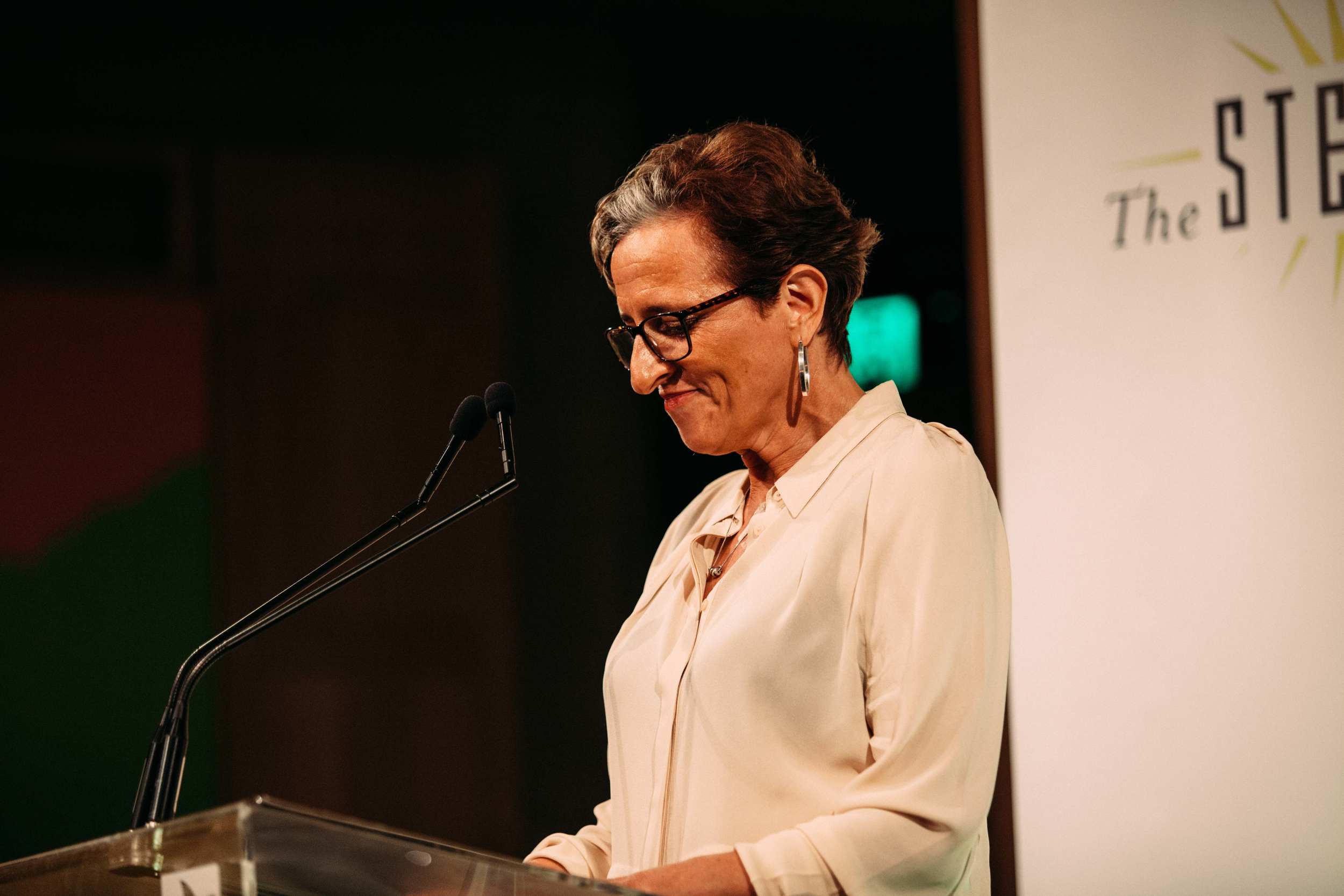
6 July, 2016, NAIDOC awards. Darwin, Australia

6 July, 2016, NAIDOC awards. Darwin, Australia
1 November 2013, Denver, Colorado, USA
I don't know if you'll remember everything we do here tonight. 'Cause things pass, things move on, people get older. But I want you to know that tonight there is a point. I'm asking myself that question all the time, "What's the point? What's the point of homework, what's the point of school, what's the point of jobs, what's the- what's the point of all those things? What's the point of life? What's the point of music?".
I don't know if you've ever put headphones in and pretended that you were the main character of your own movie before. But music can do something to you. Have you ever seen someone talk on stage before?
One time, I was at a church, and there was a guy talking on stage. And I didn't really know what he was saying, but what he was saying seemed to be so epic, and amazing, and probably true, right? But what I realize, when I look over and there's a lady playing the piano underneath his voice. And when you play music underneath someone talking it's like the most amazing thing ever. But when it stops- it's really awkward when it stops.
There's a point. Music can do something to you. It can make it more emotional.
There's a point here tonight, I'm not just playing songs, I'm not just playing shows. We wanna do something with you, we wanna a moment with you. And if you wanna sing it out, if you want to close your eyes, you can do whatever you want. This is your show.
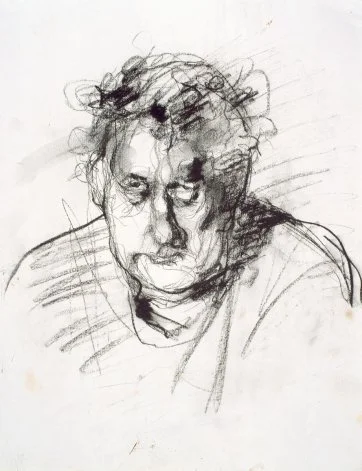
Portrait sketch by David Naseby, National Portrait Gallery
5 November 2010, Glenaeon Steiner School, Middle Cove, Sydney, Australia
I am told to assure you that I eventually get around to the subject.
When I first went to East Lismore Primary School in 1947 there were still bomb shelters in backyards and a fear that a new big war with the Russians would soon break out. There were morning assemblies with oaths of loyalty to the King, rote-learning, rote-spelling, a national anthem, God Save the King, routine schoolyard bullying and a few sharp thwacks of the cane each month – on the hand, not the bottom – which we saw as a ritual of manhood in those days.
As was being in the cadets, playing war games away from home at age eleven, which I, from a pacifist religion, could not do. War was everywhere in our thoughts, and the atomic bomb, whose worst effects we were trained to evade by getting under the desk.
I felt, as a Seventh Day Adventist, an outsider. I could not play cricket on Saturday, nor go to the Saturday matinees at the cinema with my friends. I could not theoretically go to the movies either – there the Devil with heathen images tempted you to sin – though I did sneak out once a week with my mother’s connivance on my bicycle to see at the Star Court, Vogue and Vanity Theatre Alec Guinness movies, and The Ten Commandments and Gentlemen Prefer Blondes, The Dam Busters and Reach for the Sky. We were God’s peculiar people, Pastor Breadon said and, boy, I felt that way pretty often, sneaking out of the cinema and wondering who had seen me go on.
I was saved, if that is the word I want, and civilised and made whole as a human being by the technological accident of radio which filled my mind with images and stories I cast myself in as they came by night into my crystal set, and a microgroove record of the Marlon Brando-James Mason Julius Caesar, which I can recite by heart, As Caesar loved me, I weep for him, As he was fortunate I rejoice at him, as he was valiant I honour him, and a teacher, Bill Maiden, whom I still see once a month at the Woy Woy fish restaurant to discuss the world’s news, and our long, long memories.
He taught me three times, for two weeks in 1951, for all of 1952, and in Modern History classes at Lismore High in 1957 and ’58. He made us sing, and write stories. He got the class of ’52 to write a novel, A Journey to the South Seas, in ten chapters, and read it out week after week to our peers. Mine concerned surviving dinosaurs on certain Pacific Islands, which Spielberg clearly stole from me forty years later, and the esteem which this gained for an otherwise tiny, bullied, frightened nerd, set me on the course which has made me a writer lifelong.
Bill believed in reading, and soon I was through David Copperfield, Kidnapped, White Fang, The Dam Busters, Boldness Be My Friend and The Sword and the Stone and, as it were, on my way down the road that goes ever on and on, the life of the mind that, through dreaming to order, nourishes our sympathy and takes us through lives not our own to the forks in the road of those lives and their beautiful and terrible destinations.
There were such teachers as Bill in those years, often men who had been in the war and in flapping tents in monsoon rains had read Thucydides in the original Greek and Orwell in orange Penguin paperbacks, but the culture did not favour them. The heroes of my day prevailed at rugby, and the swimming races, and the hundred yards sprints. It was the sissies like me who joined the drama groups, and the debating societies, and drew in charcoals and wrote satirical poems, and were more or less reviled for it.
I did not know that at that time the first Steiner Schools were beginning in this country and the kind of education I could barely imagine, powered by hundreds of teachers like Bill Maiden, was creeping into the leafier suburbs and stirring to magical thinking children my age.
But every now and then I glimpsed it. I had an eight millimetre projector, and some Chaplin films. I had a record of Orson Welles and Bing Crosby reading The Happy Prince by Oscar Wilde, and a record of The Snow Goose, the fable of Dunkirk, starring Herbert Marshall as the hunchbacked hero in his little boat. My mother drove me to Mullumbimby one night to see Laurence Olivier in Hamlet and the Young Elizabethans came to town with Twelfth Night.
It was a near-run thing. A scholarship, narrowly discarded, bounced back to me, and I arrived a week late at Sydney University where Robert Hughes, Les Murray, Germaine Greer, Clive James, Bruce Beresford, John Bell, John Gaden, Richard Wherrett, Richard Butler, Richard Bradshaw, Richard Neville, Michael Kirby, Mary Gaudron, Graham Bond and Geoffrey Robertson, were all in attendance, and soon, in the drama societies and the newspapers and magazines, and the pub talk and the philosophic wrangle I entered the world I had nearly missed.
It always happens in clusters, I learned then, as Glenaeon proves every year.
To say a life of the mind is a good thing to embrace and a useful nourishment of your one life on earth is still not as universally accepted, now, I think, as it was for a while in the nineteen sixties and early seventies. Our current Prime Minister has never read an adult novel. The last American President did not read a book after university. Margaret Thatcher on achieving office had not been to a play at the National Theatre. All over our university system, cut courses in history studies, and music studies, and fine arts and art history, and Latin, and Greek and archaeology, and even Persian though it was Persian scholars who cracked the Ultra Code in World War 2 and won it, thinned the blood of our learning and drove good teachers, great teachers, into early drunken retirement in Queensland and unpleasant climaxes to once promising lives.
These are not small matters because, as all here well know, a young person whose life is deprived of art, and participative art, or music or word music, or dance or the explored past, may end badly, in drug-pushing, or stalking, or real estates, or worse. Adolf Hitler did not achieve the art scholarship he yearned for and would, I think, have been saved by, and found in World War I and its lessons a different course for his life, and sixty million others.
All teaching is the business of saving souls. But the business of Steiner is greater than that. It is the summoning to a soul of its better angels who uplift to a high plane of possibility that creative magic, that unstoppable glittering energy, that may change the world.
An extraordinary film now showing, The Social Network, the best film about American greed and American competitiveness and American hubris and American vengefulness since Wall Street, shows a life ill-chosen by a brilliant young man with Michelangelo possibilities who opted instead for the remorseless pursuit of billions through an adult toy of no great worth called Facebook, a sort of postcard brimming with trouble, when he might, had he been here, had he studied here, have been a painter, or puppeteer, a song writer, a set designer, a beloved friend of good friends instead.
I have two angelic children formed and shaped by the Steiner system and its celebration, its drawing out, its enhancement and congratulation of human possibilities. And I know how close each came to destruction before they arrived within its rooms and corridors of love. I know how much I owe, and I stand on the dock observing the voyage out of a future generation in a time more testing in its choices and its temptations than any before it, and I toast it, and I wish it bon voyage.
This exhibition is a measure of the great artistic diaspora of the children of Glenaeon whose homeward yearning far-off angel hearts remember from far Babylons of exile and longing how good it was, for a time, and what a time it was, it really was, in these hallowed rooms with these magic weapons of brush and charcoal, canvas, easel and sketch-pad, re-imagining the word.
16 May 2016, Belvoir Street Theatre, Sydney, Australia
First published on Belvoir website. Thanks for permission to re-post.
Good evening, everyone.
I would like to acknowledge the Gadigal people who are the traditional custodians of this land on which we stand. I would also like to pay respect to the elders, past and present of the Eora nation, and extend that respect to other Aboriginal and Torres Strait people present here today.
My name is Kate Mulvany. I am an actor. A playwright. A former recipient of the Philip Parsons Award. And an unapologetic lover of the Australian arts.
When I was first asked a couple of months ago to give this lecture, I ruminated long and hard as to where to even begin. The arts is an arena of stories, politics and personalities that all deserve a good lecture. But so much has happened since I was first asked to speak. In the past week, our industry has found itself in a state of enforced shock. 62 arts companies have been left with an unknown future. Important companies that provide so much art and heart to a diverse range of communities across Australia. Companies that I can honestly say I wouldn’t be here without, and nor would so many of our artists. Our community has been passionately vocal in the past week, not just in support of the companies in trouble, but for the Australia Council, who has been forced to make some incredibly heartbreaking decisions on behalf of their peers.
But despite everything that has happened to our industry in the past week, I am not going to speak about the specifics of any funding decisions. Nor am I going to delve into the ongoing issue of gender parity on and off our stages. Cultural diversity in our storytelling and team gathering is a subject intensely close to my heart, and a conversation that I will always want to have. But that is also not my focus today.
Rather, I feel all of these – and more – come under the banner I have rather unexpectedly controversially selected.
Love.
You heard me.
Love.
When I first revealed to the organisers of this event that I wanted to speak about the love of my industry, I was told that the subject was not provocative enough. “The Parsons award is supposed to stir things up”, I was told. I think they wanted blood. And who can blame them, with all that’s going on right now. But the more I asked around, the more I realised – even before the events of the past week – that the members of the arts community did indeed want something a little more affirming this year. Less blame, less politics, and more hope. And I believe there is provocation in positivity. So I have stuck to my guns and love is what I’m going to speak about today. But bear with me, because there is method to my mushy madness.
I am a little different to past Parsons speakers. What I say doesn’t come from a place of leading a company or heading a board. I haven’t written any theatrical anthologies or been in charge of an international arts festival.
I’ve found myself in this industry not so much through my head, but my heart.
I have listened intently to so many lectures past with ravenous ears. And as this is the first time the Parsons lecture has been part of the Sydney Writers Festival, I encourage any of you out there that have never been to one before today to read the Parsons transcripts online at Currency Press. They offer a brilliant look at the Australian theatrical landscape. Katherine Brisbane and John McCallum give incredible personal insights into the extraordinary history of Australian theatre. David Hare talks about why writers must “fabulate” – to “stop anyone else from doing so”. Neil Armfield destroys, with his lazy grin and loud shirts, the politicians that see art like a piece of unwanted fluff on their Armani suits. And speaking of suits, Ralph Myers’ had quite the beef with artists daring to wear them in his lecture from last year.
But today, in this space that I worship – for the theatre is, indeed my church – I want to get embarrassingly emotional. Because yes, I am a writer, but I am also an actor. And when I’m on a stage, I want to speak my truth with all the head, heart and guts I can. And at the heart of what I’ll be speaking about today is that ancient trope that appears in every word of every play, from William Shakespeare to Sarah Kane to Patricia Cornelius to Nakkiah Lui. Love. Love of storytelling. Love of culture. Love of each other. Love of self.
Bit of background. I grew up in country Western Australia. An industry town of mining, fishing, farming. An incredibly diverse community on Yamatji land. Yamatji, Greek, Vietnamese, Italian, African, Nyoongar made up my ten-pound-pom Dad’s soccer team. My adopted family. I was born with cancer so much of my childhood was spent quarantined in hospitals, but when I was lucky enough to get visitors, it was those people who were my storytellers. My Sicilian godparents regaled me with stories of escaping Mussolini’s Italy. Vietnamese schoolfriends narrated their passage to Australia on a leaky boat, hidden under a pile of rotting cabbages. My Bardi aunty spoke softly, sadly, of a massacre up north at Forrest River that she’d survived as a baby. I grew up surrounded by tales of the Batavia mutiny, Dutchmen slaughtered on the shores of my town by a madman who left ghosts in the sandy dunes. And my own story – born with cancer from a poison sprayed in a war six years before I was conceived – was first spoken of in hushed tones in that very hospital ward. 25 years later that hushed story was spoken out loud on this very stage in a play called The Seed that I wrote after winning the Philip Parsons Award. What goes around comes around.
That pediatrics ward… So many stories. So many voices. So many spirits. I found that my time in hospital was a lot easier if I had these stories told to me time and again by my various narrators. When that wasn’t possible, I’d just learn them off by heart and tell them myself. With all the accents. All the gesticulations. All the love. With an audience of stern nurses and tired parents and frail, bald-headed children. Stories just made things better. In that hospital ward, between the ages of 3 and 10, in a country town that didn’t even have a drive-in, let alone a cultural precinct, I discovered the magic of theatre. That an empty space can become anything you want it to be. A bed can become a train. A drip can become a giraffe. A father can become a princess. A nurse can become a nemesis. And even in a hospital ward, there is an audience to be found, even if they are just stuffed toys sitting on a window ledge.
By running wild with our imaginations, that oncology ward became bearable. Me and my unlikely band of castmates learnt to listen to one another with empathetic ears. We got to divulge our fears and our dreams. We got to laugh. Cry. Play. Question our mortality. Celebrate life. We didn’t all make it out of that ward, but at least we got to tell our stories. (Because even a child of three has a story.) And it did change our world. I truly believe that those shared experiences saved my life. And when I was better, I decided I wanted more of that. I wanted to keep sharing stories. To understand the narratives of the people around me. To chronicle them. Honour them. Celebrate life. Embrace existence.
Life since those early hospital days has delivered me into the Australian arts industry – something I am so grateful for. Now in my 20th professional year as an actor and writer, I have found myself surrounded by the hearts and minds of the most extraordinary and diverse and inspiring people. Artists that want to challenge not just themselves, but the world around them. Artists that question our place as a nation, that investigate our individual roles in our national story. Artists that aren’t afraid to strip bare their own psyche in order to let audiences see themselves. Artists that fuck with form, demand and command, that say no to the traditional stilt of the British theatre and no to the garish Broadway glitz and glamour, and have instead forged for themselves a national conversation on the stage between Australian artists and audience. Stories that are worthy of their place, not just on Australian stages, but amongst the international canon of theatre. From On Our Selection to Summer of the Seventeenth Doll, Cloudstreet, Bangarra’s Corroboree, Simon Stone’s Wild Duck, Yirra Yaakin’s Noongar Shakespearean Sonnets for the Globe Theatre to Lally Katz’s Stories I Want to Tell You in Person. From Dame Joan Sutherland to Judy Davis, Barry Humphries to Barry Kosky, Errol Flynn to Wayne Blair. Jacki Weaver to Meow Meow. All of these people and productions started on the Australian stage and have gone on to international acclaim. Worthy stories from profound storytellers. Our national narratives woven into a larger international artistic portrait.
So when I hear my industry derided as somehow unworthy of support, I call bullshit. When politicians who in my twenty years as a member of the arts community I have never seen at the Old Fitzroy or The Blue Room or Red Stitch reduce our industry to whether we meet their version of “excellence”, I call bullshit. When we have had a governed Sword of Damacles hanging over our industry for a full year – a YEAR of not knowing whether the company that has been lovingly nurtured, in some cases, for decades, will be around even for its next season – I call bullshit. And when I see my fellow artists – normally so strong and resilient and brave – suffering, because it has been inferred that their life work is worthless, I call bullshit.
Because this is what’s happening. A toll is being taken. It’s a devastating repercussion of the past year. And here’s an example of the domino effect. Recently, I was on a panel at an event that was talking all things theatre. Namely, women in theatre. It was a beautiful night, filled with invigorating and important conversation. So I was stunned on my way to the bathroom after the event to find a young woman, no older than 20, crying alone in a dark corner. When I asked her if she was ok, she said, “I just don’t know how to do this.” She said, “If the people in that room are scared about where the industry is headed, then what hope is there for someone like me? My whole life I’ve wanted to be a writer, but everything I encounter lately seems to be saying I’m not worthy.” She told me she’d tried to contact me on Facebook. She’d sent me a message but “it probably went through to your other message folder.” She then went on to illuminate me about the other message folders on Facebook that are often filled with Spam, but also contain personal correspondence from strangers. I got home that night to find over 30 messages from young Australian artists from a vast array of backgrounds and cultures asking pretty much the same thing – “What do I do? Where do I go? Who do I talk to? It all seems too hard.”
And this broke my heart. Because I didn’t have an answer. In the arts industry, we can present the delicacies of human psychology on a stage, but when it comes to our own fragility, we close up. I’m not sure why this is. Maybe because we don’t want to be seen as any more “precious” than we are so often misrepresented. Maybe because we feel we purge enough through our work, and that is somehow all the therapy we need. Maybe because we feel we need to hang onto that frailty in order to be artists in the first place. But I was filled with fear, that whoever this girl was – and she could well be the next Caryl Churchill, Debra Oswald or Young Jean Lee – we might miss out on what she has to say.
The Media Entertainment and Arts Alliance and the Sydney University Theatre and Performance Department recently released the results of their “Australian Actors Wellbeing Study”. Although it was a study of actors, similar results have been reported in all areas of the arts. The MEAA reported in the artists they surveyed “significantly higher levels of depression, anxiety and stress than Australian adults in general.” Twice that of the general population, in fact. Much of the fear expressed by artists comes from the fact that now, more than ever, our work and our worth is being diminished. And when we dare to start a dialogue about this, we are often berated for it by others who don’t understand what it is to be an artist. We are often portrayed us as a bunch of whining, bleeding hearts who are crying poor. “What do you offer the world?” is often sneered at us in opinion columns, or on messageboards. “Do you save lives? Do you create wealth? Would we even notice if you were gone?”
My answer to all those questions is yes. A resounding “Fuck, yes”. The telling and sharing of stories does indeed save lives. It saved mine. I have been involved in and witnessed plays that have spoken out about issues that are all but ignored by those same questioning naysayers, those same pompous politicians who rarely bother to turn up. I’ve seen people wait in the foyer afterwards to say to the artists involved, “Thank you for giving me a voice when no-one else does.” I still get correspondence about The Seed from Vietnam Veterans and their children who believe the play changed them. I would venture to say Nakkiah Lui would have had the same response for Kill the Messenger. Tommy Murphy for Holding the Man. Angus Cerini for The Bleeding Tree. Yes. Art can save lives. Not with a scalpel. Or medicine. Or money. But with shared honesty, empathy and imagination.
Yes, we do create wealth. According to the Australia Council, the cultural sector of our working nation contributed $50 billion to Australia’s GDP in 2012–13. We give back a hell of a lot more than we receive. And yet that kind of wealth is not something we shout from the rooftops in this business. Because we know that wealth is not always monetary. What wealth is is an abundance of riches. And we have such riches in the cultural chronicles of our country and its people. We have the oldest storytellers in the world here. At least 50,000 years of stories. There’s as much wealth to be gained in those stories as in any mine, farm, any shipload of sheep. Our greatest wealth comes from our elders. From those lessons passed from one generation to another, shared amongst cultures. That’s wealth. And yes. We do create it, us artists. Because we’re the ones that dare to chronicle those stories, perform them, honour them, on behalf of the vast array of communities that make up this country.
So yes, you would notice us if we were gone. Maybe not for a little while, but I’ll get to that later.
Please don’t get me wrong. I know there are bigger issues. Our country’s political practices at the moment are nothing less than shameful. Our moral compass has been seemingly smashed. People are suffering in enforced silenced. Our indigenous communities. Our refugees. Our gay friends who simply want the right to marry. With all this going on I know some people may find it insulting to bring up the welfare of the arts community. But because it’s the arts community that historically has the guts to speak out on these issues, I feel like it’s worth talking about. Like so many of the characters and narratives that exist in society, there’s only so many times you can be told, “You don’t meet our model of excellence” before you start to get worn down and a very dark fear kicks in. Our community suffers. Our families suffer. Our culture suffers. That moral compass spins out of control, unattended. And when these things happen, our stories disappear – sometimes tragically.
And that’s exactly what they want, those people that flick the first domino. They want us to shut up. They don’t want now explored and challenged. Because they know it’s a time of societal shame. And they don’t want their legacy tarnished by the chronicling of truth. And so we’re being silenced.
But there is a solution to this enforced fear, because what we do have…is each other.
You see, I see this thing called “the arts” not as an industry so much, but as a house. A big rambling, knockabout house worthy of a Winton staging. Its paint is peeling, the floorboards are splintered, but its foundations are good. Strong. Resilient. This house has nails hammered into it by Steele Rudd. It’s been wallpapered by George Ogilvie. Dorothy Hewett has tended the garden. Philip Parsons and Katherine Brisbane have lovingly set up its library. It has the beating heart of the oldest living population in the world and the rooms ring with the languages of countless cultures.
This is a house of many, many, many rooms. And many many many tenants.
Each level of the house is accommodated by several companies. There used to be more to a floor, but as I’ve mentioned, of late there’s been some unfortunate evictions. This leaves the remaining tenants with more space around them, perhaps, but ultimately the house just doesn’t feel complete. The rambunctious, provocative voices that used to ring vibrantly from the middle and ground floors are no longer there, and the house feels different because of it.
Now, there is a danger in such an environment, because fear breeds fear. There’s the risk that the tenants will start to tiptoe around one another. Doors will be shut fast. Curtains drawn tight. Rooms darkened. No fresh air will filter down the hallways. The remaining tenants will become secretive. Argumentative. Ruthless.
I am currently in the position of working for several of Australia’s arts companies in various ways, from writer to actor to board member. I move from room to room in the theatrical house, between levels, upstairs and downstairs. I am in awe of all of them and have become acutely aware of how hard it is to keep a company afloat. To manage a team. To bring in an audience. But I can’t help but notice that the tightening fist around our industry at the moment is causing us to close down in more ways than one. Companies are becoming shrewd – and not in a good way. There seems to be an unhealthy competitiveness. A fear that there is not enough to go around, so all resources must be protected fiercely. And that’s probably what they want us to do. But we’re better than that, in this house.
If we were to look at our current predicament as a theatre production, then we can see that each of us has a part to play. We are a cast and crew that needs to pull together to keep the show going.
I’m going to go through each member of the house now, and offer no solutions – just suggestions – on how they can, to borrow from Alexander Pope, act well their part, for there all honour lies.
Companies on the top floor.
I’m incredibly heartened by the current group of artistic directors and Festival heads in this country. What we have at the moment are people who are proud of the heritage of Australian theatre and invigorated by its future potential. They are doing their best to make amends for past failings in our community. They are slowly but surely starting to embrace gender parity. Colour-blind casting. They are optimistic, intelligent, generous human beings.
What they need to do now, more than ever, is work together. When Brandis brandished his sword, so many wonderful people of influence in our industry – from companies that were “safe” from the cuts – stepped forward and spoke up without hesitation for their colleagues who were at risk of very soon finding themselves without a job. It was a glorious display of camaraderie between companies. But it should have been more widespread. The silence from certain individuals and companies in the industry was deafening.
I was flummoxed around that time when a prominent Sydney mainstage associate told me that they didn’t go and see plays at the Bondi Pavilion or the Old Fitzroy because they were “so far away”. The next week, that same person went to Europe to catch the latest Schaubuhne production. They missed a wonderful season of new Australian playwriting at the now defunct Pav. They missed their chance to see new writers. New actors. New directors. New stories. Would’ve cost them 15 bucks. The same person lamented to me on their return that they were trying to think of the right person for a role, but “don’t know anyone out there that fits the bill…” I gave them the Pav program.
We can’t afford to let this sort of complacent elitism happen. We need to keep those voices on the ground floor and middle floors ringing out with Australian stories or our much-loved house will collapse beneath us. If they’ve been evicted from the middle and ground floors, then you’ve got to invite them upstairs. Now more than ever.
We need to move from a hierarchical view of our industry to a heterarchical view. To quote Chantal Bilodeau in her amazing essay Why I’m Breaking Up With Aristotle, “What we need today is a conscious use of dramatic structure in service of societal change. The hierarchical pyramidal worldview is based on values that promote competition, control and a sense of scarcity– that there isn’t enough to go around. And since we have to fight for everything, there will always be winners and losers. The heterarchical worldview, on the other hand, promotes innovation, collaboration and creativity. It works with the assumption of abundance – that there is enough. We just need to look for it and distribute it more equitably.”
I’m so thrilled that in the past year, some companies are taking a more heterarchical view. I mention a couple now, not because they are the only ones, but they are the ones whose workings I have been most privy to. Bell Shakespeare is using their philanthropic support networks to fund Australian playwrights. Of all the companies in Australia, Bell Shakespeare is probably the company that has the most right NOT to do this, given their loyalty to one particular writer. But they have chosen to distribute their precious resources to not one, but two Australian playwrights a year on an overlapping two-year tenure. These playwrights, through Bell’s relationship with the Intersticia Foundation, are given a desk. A computer. Dramaturgical and creative assistance. Actors to workshop their play with. Space and time to write whatever they damn well like – even if it’s for another company. The writers are embraced as a valued team member and included in all administrative matters. As they write, they are privy to the world of theatre business, of the effort that goes on behind the scenes of every production. From marketing to education to accounting – they are included and embraced. As a current Intersticia fellow – alongside Jada Alberts – I’m astounded by the generosity of this “sharing of abundance” and I hope so much that more companies and philanthropists take up this model of heterarchical thought. Bell is also currently involved in a co-production with Griffin Theatre Company so that in these uncertain times, both companies can continue to present satisfying programs to their audiences, but also share audiences for the first time. Innovation. Collaboration. Creativity. More of this, please, those of you on the top floor of the house – let’s see our opera companies collaborate with our indigenous companies, ballet alongside youth theatre. Let’s find a crazy fit. By opening your doors of communication to artists who have been left out in the cold, you will see your audiences introduced to new stories, and you will see new audiences in your auditoriums. You will see new artists at work. New brains. New bodies. New genres. A wondrous artistic alliance.
I can’t tell you enough the impact this kind of inclusion has on an artist. At a time when so many Australian artists are being told they are below par, we need our companies to engage more in this kind of open-hearted, collaborative risk.
Speaking of risk, let’s talk about Australian playwriting.
There used to be a time a few years ago that on the rare occasion an Australian writer was invited into a theatre company for a meeting with a literary associate or an artistic director, they were asked, “What do you want to write?”
Over the past few years, if they are invited in for a cuppa at all, this has become, “We want you to adapt this.” I don’t deny it’s wonderful seeing fresh looks at classic works. Or of popular novels. I don’t deny that these adaptations of classics can still move a modern audience who are looking at it through millennial eyes. However, what canon are we leaving behind? In 5, 10, 50, 100 years, what are we going to have to show for ourselves? At a time when so many political, social, cultural and moral upheavals make up our everyday life in Australia, what are we going to have to show for it? What groundbreaking insight can we share? What lessons can we pass on? What are they going to know about us, here and now, if we’re just retelling old tales that come from another time and place? Adaptations are wonderful, and there are plenty of novels that do deserve a staging, that make for a wonderful night in the theatre. I’ve been part of them and loved every second. But I want to set a challenge for every literary sector on every floor of the theatrical house – when you invite a writer in for a meeting – and please do that more, don’t just rely on who enters your competitions, make time to meet them face to face, Skype them if they live in rural areas – for every adaptation you ask of a writer, ask them what else they’ve got inside their own heart, their own head, their own gut, their own cultural history. Don’t tell them what you want them to adapt. Ask them what they want to say. I guarantee you, they will have plenty of things for you and your audience. The map of our cultural legacy will be all the richer for it. To hark back to that snide question, “Would we notice if you weren’t around?” No, not if we leave no trail of ourselves. So let’s start dropping breadcrumbs now so that future generations can enjoy the gingerbread house.
Companies. Act well your part, for there honour lies.
Okay. Now that we’re talking about them, let’s visit those other tenants in the Australian theatrical house. The writers. They are usually found either scribbling wildly in dark corners, or in the kitchen, slightly dazed, making their 14th cup of Liptons. They are either very quiet or audaciously loud. They have been told over and over and again that they don’t know what they’re saying, that they are unstageable, that their words don’t put bums on seats – but they have time and again proven all that to be absolute bullshit.
Writers. Keep writing, please. I know it’s hard. I know it’s exhausting. I know that for every moment of success there are 20 rejections. I have not just a bottom drawer of unproduced plays but an entire IKEA filing cabinet. In my time as a playwright, I have only received personal development funding once. $7,500 to see me through a year. As much as I appreciated that money, I learned very quickly that if I wanted to write, I had to self-fund. So for 15 years, when I haven’t been acting or writing, like many other artists, I have had another job that I call my “funding body”. I audio-describe for the visually impaired and caption for the deaf. It’s not glamorous and it doesn’t pay much, it can result in long hours and tight deadlines, but I hang onto it because without it, I’d have to pack everything in. My amazing boss, a man named Javier Arriaga– an avid theatre subscriber who sees several shows a week, from cabaret to musicals, from the Old Fitz to the Lyric – has kept me employed for 15 years. It’s not easy for him to work around my schedule. He has had every right to sack me time and again. But he doesn’t. Because he loves theatre. He appreciates artists. He is the audience we write for. He is the general public I try to speak to with my plays. And he, more than anyone else in my career, has funded me. When no-one else will, or no-one else can, I do, because of people like Javi. This empowering alliance of worlds emboldens me and makes those dark moments of rejection bearable.
But there are other ways to develop your work in dire times if you don’t have a Javi, if the funding doesn’t come. Call on your community. If you have a new play that you need to hear out loud, call on your people. Equity will probably get cross at me for saying this, but fuck it. Ask actors if they are available to come round to your living room – or a spare rehearsal room, companies – and read your play out loud. Invite a director or two. A producer. Any ears available. Buy some pizzas, some wine, hear it played. Pick their brains. Take notes. Just because funding isn’t always available for your work, doesn’t mean it shouldn’t develop and grow. It should and it will. Don’t feel like you’re alone. Call on your community, and community, expect the call.
And in return, support your fellow Australian playwrights. Offer to read. Offer to dramaturg. Offer to mentor. Take emerging playwrights by the hand, now more than ever, and start a dialogue with them. Let them know you are with them. That their stories and words have a place. Go and see the plays of your fellow writers. Don’t expect people to turn up to your shows if you don’t turn up to theirs. Fight for the ideas of your fellow writers as hard as you would fight for your own.
Writers. Act well your part, for there honour lies.
Actors and directors. Often found in the arts house waiting by the telephone, or sound asleep in bed until midday after a night of performance-anxiety-induced insomnia. Acting and directing for stage is a really, really tough gig. That is, when you get the gig, because as we all know, it can be months – years, sometimes – of nothing. Literally nothing.
To these wonderful people, I say, you do act well your part. When I get a play up and I see the actors, directors and creatives that sign on, I am filled with such gratitude. You see, most new Australian works don’t have the luxury of extensive development. A workshop here or there maybe, but intensive, round the table dialogue doesn’t happen until you are in the rehearsal room. It’s terrifying for the writer, who usually ends up redrafting the play on a nightly basis for most of the rehearsal period. So whenever actors and directors and designers and crew sign on for a new Aussie play, we are indebted to them. They are an incredible gift and deserve every success.
But for those creatives with “names”, I ask that you don’t forget us. I would love to see more of our big-name performers returning to the fold from whence they came to support a new Australian play. Not Chekhov. Not Tennessee Williams. Not the latest international commercial blockbuster. New original Australian plays. Because when they reach a certain level, actors, especially, have a lot of influence. They have the power to walk into an artistic director’s office and say, “Hey, I want to do a play. How about that amazing hit on the West End by that old white guy who just got knighted?” Let’s shift that dialogue. I challenge the actors who have that kind of influence, to walk into a company and say, “I want to work with an Australian playwright on a brand new story about what’s happening here, now.” That company will make it happen. That company should make it happen. And that playwright will write you a role to rival any in the theatrical canon. I promise. And you will be giving the gift of your experience not just to that writer but to the entire team of creatives who might not otherwise get to work with you, who might not otherwise get to work at all, because of the damned hierarchical nature of our business.
Actors. Directors. Creatives. Act well your part, for there honour lies.
Agents and managers of said actors, directors and creatives. You may not think so, but you are also part of the artistic house. Not often observed physically, but the effects of your presence can be seen in a footprint by the back shed or crumbs in the kitchen. Agents, please tell your actors if they have been enquired about for a show. I know theatre doesn’t pay well. That you’d rather make your 10% from a three-year television contract or a Hollywood blockbuster. But while you are not telling your actors that they are wanted by a theatrical employer, those same actors are often sitting at home, struggling to pay the bills or support their family, thinking that they are unwanted, thinking that they have failed, especially in this sort of a climate. I cannot tell you how often this happens, that theatre companies and writers and directors are told that an actor is busy, only to find out that that actor was not only available, but desperate to work. Agents. Do not make this situation harder than it needs to be. Take into the account the mental health of your clients. Actors, make sure your agents know that you want to hear about everything when it comes to your journey. And remember that nothing teaches you more about the craft of acting than theatre.
Agents. Act well your part, for there honour lies.
Which brings me to the critics. Yes, critics, you too are part of the arts house. Converging around the bathroom, huddled and whispering. I should say that our Australian critics are going through a crisis of their own at the moment. Newspaper space is as rare as a brand new Australian play, and many theatre critics are losing their jobs, along with so many of their colleagues. You have my sympathy and support. We need critics. You chronicle our chronicles. The best critics show an ongoing enthusiasm for theatre, a passion for new playwriting, an objective eye that takes in their personal response alongside the audience’s, and a wondrous curiosity. I believe most of our critics display these traits in spades. I don’t believe that companies “don’t care what the critics say”. They do. Nothing beats word of mouth, of course, but the role of the critic is an influential one. And so I sincerely ask that you act well your part.
With critical space so rare and social media so virulent, it’s highlighted the fine art of good critiquing. My fear is that the hierarchical model is becoming prevalent in this area too. There seems to be some critics out there competing with a deliberately poison pen, and using nastiness as clickbait, to plant their flag in the already diminished column space.
In the past couple of years, I have read reviews that have commented on the personal lives of performers. I have seen reviewers consistently berate artists that didn’t go to an acting school. One reviewer even compared an actor to a corn kernel in a piece of faeces. And that was him being nice.
This kind of critiquing offers no intelligent insight into the work. Just extreme, calculated malice that can be utterly debilitating. That kind of reviewing seems to be getting more common – particularly online – and it worries me. Because it’s not healthy for either of our industries. Not a single person gets anything from that kind of critiquing – not audiences, not readers, not performers, not companies. Not even the reviewer. I’m not asking for soft focus when critics come and see a play, but I am asking for you to maintain your empathy and intellect when you write about the work of others, especially at this time when it’s amazing any of us can get anything on at all. Keep it above board. Don’t waste column space on sneering asides just to get infamous. Honour your own craft with dignity.
I have to say I’m really heartened by the efforts of some critics and arts journalists out there who are taking it upon themselves to spend time in the rehearsal room before they see a show. Those journalists who ask actors what they think of their role rather than where they like to have brunch on a Sunday. I encourage more of that extra-curricular exploration of our craft. We’re all in this together.
Critics, act well your part, for there honour lies.
Crew. Often hard to spot in the house as they only come out at night. You are the black-clad angels that make everything run smoothly. I know you work for almost nothing, often till the wee hours of the morning, with little accolade and often in highly stressful scenarios. Administrative staff, this goes for you too, and your important role in the house. The mental health figures from Victoria University’s Australian Entertainment Industry survey had some disturbing findings on the mental health of our roadies and behind-the-scenes workers. Act well your part, and ask for help if you need it, even if it’s not in your nature as the wonderful fixers that you are. We have your back. There honour lies.
Philanthropists. You, too, are a part of the theatrical house. A most welcome visitor. Come over any time. You rise above the panic and swoop in like superheroes. I’m constantly stunned by the amazing donors and supporters of the Australian arts. Willing participants who not only give their time and resources to the ongoing cultural conversation, but trust the artists and companies vehemently and vocally. I encourage you to encourage the companies you support to use your support to support other companies. Thank you for acting well your part. You bring great relief to the wellbeing of our industry, right when we need it most. We’re happy to set up a bed for you in the arts house.
Audiences. You are the most important part of the house. You are sitting on every piece of furniture, expectantly. Wide-eyed. Engaged. Cross-legged by the fire. We love you because you have shown up. You have chosen to take part in the world’s oldest ritual. Storytelling. You lend us your ears and your brains and your hearts. You are as present in your seat as you would be on the stage. We hear your every gasp. We thrive on your laughter. We see your tears. Without you, the arts doesn’t exist. Please keep coming. Please know that despite the rug being pulled out from under us, we will prevail with your help. The stories will continue. We will maintain the wonderful multi-voiced, multi-cultural dialogue that is Australian arts.
Audiences. Act well your part, for there honour lies.
There is so much more I could say about this big house we’re in and the tenants within. I have a wish list of things that I want for this house, despite all funding woes. I want theatre companies to employ creches so that theatre workers can return happily to their craft after having children. If theatre companies can pay for an international star, they can damn well pay for a babysitter. I want arts ministers to show up at productions where there isn’t a photo opportunity – come and meet the incredible workers on the ground and middle floors of the house.
I want every theatre company to employ full-time indigenous and cultural advisors. It’s not enough to simply tell culturally diverse stories. Those stories are often heartbreaking and can trigger certain emotional and psychological responses. Support needs to be there offstage as well, within the company and its administration. I want our acting schools and theatre companies to have mental health lessons and facilities available for all students and employers. Artists have to go to some very, very hard places, physically and psychologically. The workload is immense, for very little monetary gain. We’re expected to pull ourselves apart and put ourselves back together night after night, show after show. The repercussions of this are complicated and dangerous. We have lost too many artists to mental health issues. Their beautiful stories just stopped. We must not allow this to happen. Not in our house.
I am a writer who likes a happy ending so I’m going to finish this Philip Parsons lecture where I started it. Love.
I love being an Australian artist. I love telling stories. I love hearing stories. I love that our stories do indeed contribute to our nation’s wealth, in more ways than one. I love having my values, my beliefs, my long-held thoughts, challenged, twisted, reinforced or blown apart completely. I love the people. Humble, driven, determined, outspoken, gracious. A family as diverse and inspiring as the one that regaled me with stories in that hospital ward so many years ago. I love the elders of this industry that took me under their wing and who I can still call on, at any time, for advice. I hope so much to be an arts elder one day. I love the young talent coming through, from all walks of life, challenging me to write better for them, making my vision more peripheral as a human being. I love the determination in our industry. The robust, ribald conversations. That when we let each other down, there is also the determination to right things. I love the stories. They do save lives. I love a fight, and I have my boxing gloves on.
I love my house. It may sit in a neighbourhood of uncertainty right now, but I know its foundations are stronger than any crisis.
And because of this love – of the tenants, of the stories within, of the legacy and the future of it – I will endeavour to act well my part, alongside the wondrous household rabble of allies, for there honour lies.
Chookas, all.
Thank you.
8 May 2016, Crown Palladium, Melbourne, Australia
Thank you Steve Molk at decidertv.com for sharing his transcription. Great Australian TV site.
Aw, that was interrrminable, I was nearly too old to play myself.
Wow. 43 years is a long time, and yet it seems like an instant. So much so this seems like somewhat of a shock. I'm very honoured and I'm very humbled and I thank you.
The Logies people wouldn't let me see that package before now. They wanted me to cry, well job done, guys, thanks a lot.
I'm feeling pretty misty-eyed at the moment but I often get misty-eyed about things. As you heard I'm known for it. If something touches my heart I cry pretty readily.
In fact when my sons were teenagers and driving me up the wall and trying to get a reaction so they could watch me go off like a frog in a sock, I would sometimes start to cry, and they would start a slow handclap and say "oh, BAFTA". Which of course would make me laugh, thus proving their point.
But I was disturbed this week that a misty-eyed response to a particularly frightful human story in the news was deemed inappropriate, and we were exhorted not to feel, not to have empathy, not to love.
I think of myself as a storyteller and since forever stories have been crafted and told to help us make sense of the world and to realise that we're not alone. So whether it was finding more tips than a tin of asparagus during ten years on Better Homes and Gardens; or playing the role of a mother who's been estranged from her son because he was gay in the extraordinary, ground-breaking series Redfern Now, I've always tried to find stories that resonated on an human, empathetic level.
Projects that existed to encourage people to feel and reflect and let me tell you that's narrowed the field of what I've wanted to do considerably.
I was known for turning down more than I accepted for a while.
But if something didn't seem to have value for me then I couldn't expect it to for anyone else. But I have been incredibly lucky and I firmly believe that success in this business at least - I don't know about any others - is fifty percent luck and fifty percent hard work.
And I have been so lucky. My first stroke of luck was being born to parents who, as Shane said in the package, were vaudevillians in England just prior to World War Two, and after the war England was buggered and Vaudeville was dead, killed off by John Logie Baird's invention of television, so as ten pound Poms my parents came here in 1953, (and ) I was born.
We got TV for the Melbourne Olympics in 1956 - don't worry, I'm not going through every year, it's OK. So from the age of 3, once Mum and Dad noticed I had some ability and passion for performing, I was brought up on a diet of English comedies featuring people they'd worked with and great variety shows. Carol Burnett, Red Skelton, Dean Martin - the best entertainers of their time.
I learned at my parent's knees comedy timing, accents, singing. I had ballet, piano, calisthenics lessons. Mum and Dad were incredibly critical of much of what increasingly became to be offered as entertainment, having worked with and watched some of the best.
My Mum said, "You can always tell a lousy act: they use lots of tricky lighting. The good ones just stood in the spotlight and did it."
They made me understand that the industry didn't owe me a living and that I had to be able to do anything and everything - great lessons indeed.
They taught me how to act. What they didn't teach me, as I suspect no one had taught them, and because it wasn't encouraged especially for girls, was how to be myself.
Play School was the next stroke of luck.
Under the tutelage of Henrietta Clark and the late Allan Kendall I learned the tenets of the Play School philosophy, formed by a most rare and wonderful respect, love and understanding of its target audience: a single pre-school child.
Once I got over my own self-consciousness and self-judgement and started to relax I realised this child was far more demanding than any audience of adults. Three and four year olds have the best bullshit detectors, don't they? They don't just watch you because you're there, they want connection and they want real engagement.
If they sense you're not really talking to them an ant crawling up the wall will quickly take their attention.
For many decades Play School has been an icon, an oasis and a safe haven in an increasingly complex media landscape and world. I started to see the world through a pre-schooler's eyes; to see how free and unafraid they are to just "be". They haven't yet been conditioned. But also how easily frightened and overwhelmed they are, how easily abused, and particularly how empathetic they are.
No child is born a bigot.
The TV landscape when I started Play School in '78 was very different: four channels, no 24/7 news, no 24/7 anything. It was much easier to protect children from images and information they couldn't assimilate.
But with the explosion of technology and the proliferation of screens we can't escape exposure to bad news and violent images. They're everywhere - at the Dentist's, on buses - and most of us, not just kids, find the bombardment overwhelming.
I suspect that almost none of us here, or watching, is immune from the growing incidence of depression, anxiety and suicide. We all know people who are struggling. We may be ourselves, and too many of our kids are.
We're all living under a heavy and constant cloud of negativity. We're divided against each other and our fellow human beings; we find it hard to trust; and we're fearful for the future, and I think it's because we're surrounded by bad news and examples of our basest human behaviour.
I fear that our hearts are growing cold.
The fact that I'm only the second woman to be given this honour is only a reflection of the prevailing zeitgeist. As is the odious suggestion in some quarters that the eligibility of our esteemed colleagues Waleed Aly and Lee Lin Chin to be considered for the Gold is questionable.
But things are clearly changing. Here we are. But they're changing glacially slowly. The great thing about glaciers is that if you're not on them, you go under. I've been riding that glacier for 40 years, and I'm staying on top of it.
Graeme Blundell once wrote about me, saying, "No one does ordinary and vulnerable like Noni Hazlehurst." Yeah, that's what I thought at first. But then I thought, "that's OK, because we're all vulnerable and we're all ordinary." Although a lot of our energy is spent trying to prove the opposite.
Play School works because it reflect life as many of us actually live it, and the people on it are real. Shows featuring clips of dogs and cats work because dogs and cats are real and recognisable. They're spontaneous and truly alive. There's no fakery, no concocted animosity and no competition. No tricky lighting. Just lots of love.
So here's my pitch: I'd love a channel that features nothing but stories that inspire us and reassure us and our children that there are good things happening and good people in the world.
I know it's a lot to ask for, but at the very least a show that tries to redress this overwhelming imbalance; that counters bad news with good; that encourages optimism, not pessimism; that restores our empathy and love for our fellow human beings and the earth; that redefines reality; that heals our hearts.
And, by the way, I'm available.
There are plenty of vigorous advocates for the cause of division. I'm a vigorous advocate for the cause of unity.
This award has turned out to be the most wonderful Mother's Day present, not least of which because my dear sons get to spend Mother's Day here with me tonight. Charlie and William.
It also provides the opportunity to reflect on the qualities of mothering that are meaningful.
The ideal mother and father is someone who nurtures and protects us; who tells us stories to help make sense of the world; who gives us non-judgmental acceptance and unconditional love; who teaches us that we're not special, but we are unique; who encourages our empathetic instincts and teaches us the responsibility that we have to each other.
This is what we long for from our parents. And to be as parents.
Helen Clark, the ex-New Zealand PM, said in her pitch to become the new head of the UN, "Peace really matters to women." I hope that it really matters to us all and I hope that I can keep telling stories that reflect that.
I just want to quickly thank some people to whom I currently owe a great deal.
The legendary Bevan Lee who created the beautiful story about bigotry and intolerance, with great roles for women, that I'm lucky enough to be a part of - A Place To Call Home. And Brian Walsh, who recognised the audience's love for the show and he brought it back to life, and who has created an environment and a workplace of equality and inclusion that is a great privilege to be a part of. Thank you both, very much.
Thanks to my manager, Sue Muggleton, and my brother Cameron who used to make me laugh so much I wet the bed.
And to my boys, Charlie and William, for keeping me young, and making me old. I love you both to pieces.
Thank you all for this recognition. I'm very grateful.
8 May 2016, Crown Palladium, Melbourne, Australia
Thank you Steve Molk at decidertv.com for sharing his transcription. Great Australian TV site.
That's all we have time for. Thank you very much. Good night.
Do not adjust your sets. There's nothing wrong with the picture. If you're in the room I'm sure there's an Instagram filter you could use to turn things to normal. It'll be fine.
This is happening.
It's true. Finally a male presenter on commericial TV has won the Gold Logie.
I probably should apologise up front to my kids. My daughter and especially my son. I'm pretty sure he was barracking for Grant Denyer tonight, and it was hard work because I had to stop him voting and the only argument I could come up with was that he wasn't yet voting age. You can't vote until you're old enough to have an unrequited crush on a Home and Away star or something like that. It seemed to work, so thank him for abstaining.
Before I get stuck in in earnest I think it is really, really important to acknowledge... actually I want more to celebrate the extraordinary talents and contributions and achievements of my fellow nominees tonight because they genuinely are a remarkable field.
It only struck me today when I set my mind to it. The thing that struck me about it was that each nominee brilliantly distills some separate piece of Australia and I think it's an amazing thing, it's a fantastic thing that that can be a symbol on this night in this way and I'd encourage you to think about that because if you step back and look at all those pieces assembled it is a truly spectacular mosaic and we should really be celebrating that fact.
So congratulations to them for everything they've achieved and everything they're gonna go on to achieve and please know that in no way do I feel that I deserve to be here more than any one of you. I thank you for being a part of the class of 2016 with me because it's been fantastic to be associated with you.
I don't... I wanna do my best to keep this as brief as I can because everyone at home wants to go to sleep and everyone in this room has a night that is about to begin and I know you're all keen to get into some stuff and... no, no I mean like your first carbohydrate in six months or something.
So I'm not gonna do a huge roll call of thanks, but I would, because I didn't mention them before I do wanna thank my agents particularly. Michael, and especially Jessinta who has I'm sure so many heated arguments with people and I don't even know they're happening so I can get about my job and that's fantastic to have someone in your corner like that. It makes a huge difference and thank you for being so entertaining when you're doing it.
And I do also want to thank one more time my wife Susan. There's only one more think I wanna say - I could say a lot more about Susan - but the reality is, and this is just a dirty little secret I've carried around for a long time, but if she had my job she'd be better at it than me.
She is sharper, she is wittier, she is funnier, she is infinitely more charming and likable, and I'm really glad she doesn't have my job because otherwise I definitely wouldn't have it. The reason she doesn't is because she has bigger, more important things to do, and everyone who knows her knows that she changes you, and she makes you better. She's done that in her work, she's done that in her community work and they don't give statuettes to people like that, sadly.
But one day if life's fair they might just give her a statue.
I think it's fair to say I never anticipated I'd win a Logie. Not in a sort of I'd fall short kind of way but I couldn't conceive of this - I was more likely to win an AFL grand final in my mind than to win a Logie, and I'm still hoping for that.
That means I'm a little bit gobsmacked but I am hugely appreciative of the audience decided to throw me a bouquet in this way on this night, and I know it's temporary, and I know I will probably never be here again and I know that one day, probably very soon, I'll merely be the answer to some obscure trivia question or if I'm really, really lucky the subject of one of those "Where Are They Now" specials that gets show on Sunday afternoons. That's when they're shown, definitely in non-ratings period.
If I'm really lucky that's what will happen but tonight, tonight to know that when you've just started a new gig and I know I'm the work experience kid - like I've been here five minutes - when you've just started a new gig to know the audience has accepted you into their universe is the most wonderful feeling and I do not take that for granted and I want everybody in this room to know that.
I also know, and this is a really important point, I also know that every individual award, whether it be a Brownlow or a Dally M or an award like this is misleading. Every individual award tells a lie of some sort because it's really about the people that gather around you that delivers these awards to you and I'm incredibly blessed to be surrounded by so many of those people so I'm happy to accept this award but I accept it on behalf of our show - a show that is not afraid to make mistakes by going after something that might be a bit risky, or trying to tell a boring story in a more interesting way and it's the mistakes that I probably cherish more than anything else. Not that I'm going to tell you what they are but I'm definitely cherish them. I think that's what makes our show a show.
And I think it is no coincidence that both Carrie and I were nominated tonight. It is no coincidence that our show has been represented on this spot in this way for two years in a row, and the reason that is the case I think is because this is a show that lands not only on people's television screens but also in people's hearts and I can't claim credit for that but I'm hugely proud of it.
And finally I wanna claim this award on behalf of actually a couple of people. People like this guy called Dimitri, who none of you will know, he's a guy who just came up to me about a week ago and he did something that most people don't do.
He didn't come up to me and wish me good luck for tonight. He came up to me and through gritted teeth commanded me to claim this award tonight. And it was a bit scary and I dare not cross him so I'm glad I can look him in the face again, but he communicated something to me and it was that this really, really mattered to him. This really meant something to him.
He didn't vote, by the way. I didn't really want to point that out to him at the time. There have been a lot of people in the last week or two that have made it really, really clear to me that me being here right now really matters to them. And it matters to them for a particular reason.
That reason was brought home shudderingly not so long ago actually when someone, who is in this room and I'm not going to use their name that they use in the industry, came up to me and introduced themselves to me and said, "I really hope you win. My name's Mustafa, but I can't use that name because I won't get a job."
He's here tonight.
And it matters to people like that that I'm here. And I know - it's not because of me. I know that.
So to Dimitri and Mustafa and everyone else with an unpronounceable name - I dunno, Waleed - I really just wanna say one thing and this is that I am incredibly humbled that you would even think to invest in me in that way, but I'm also incredibly saddened by it because the truth is you deserve more numerous and more worthy avatars than that and I don't know if and when that's gonna happen but if tonight means anything - and I don't know if it does - but if tonight means anything it's that the Australian public - our audience - as far as they're concerned, there's absolutely no reason why that can't change.
Thank you very much. Good night. Have a good one. Thank you.
- See more at: http://decidertv.com/page/2016/5/10/logies-speeches-tim-minchin-noni-hazlehurst-waleed-aly#sthash.yZz5A3Vf.dpuf
12 April 1963, New York City Town Hall, New York, USA
When yer head gets twisted and yer mind grows numb
When you think you're too old, too young, too smart or too dumb
When yer laggin' behind an' losin' yer pace
In a slow-motion crawl of life's busy race
No matter what yer doing if you start givin' up
If the wine don't come to the top of yer cup
If the wind's got you sideways with with one hand holdin' on
And the other starts slipping and the feeling is gone
And yer train engine fire needs a new spark to catch it
And the wood's easy findin' but yer lazy to fetch it
And yer sidewalk starts curlin' and the street gets too long
And you start walkin' backwards though you know its wrong
And lonesome comes up as down goes the day
And tomorrow's mornin' seems so far away
And you feel the reins from yer pony are slippin'
And yer rope is a-slidin' 'cause yer hands are a-drippin'
And yer sun-decked desert and evergreen valleys
Turn to broken down slums and trash-can alleys
And yer sky cries water and yer drain pipe's a-pourin'
And the lightnin's a-flashing and the thunder's a-crashin'
And the windows are rattlin' and breakin' and the roof tops a-shakin'
And yer whole world's a-slammin' and bangin'
And yer minutes of sun turn to hours of storm
And to yourself you sometimes say
"I never knew it was gonna be this way
Why didn't they tell me the day I was born"
And you start gettin' chills and yer jumping from sweat
And you're lookin' for somethin' you ain't quite found yet
And yer knee-deep in the dark water with yer hands in the air
And the whole world's a-watchin' with a window peek stare
And yer good gal leaves and she's long gone a-flying
And yer heart feels sick like fish when they're fryin'
And yer jackhammer falls from yer hand to yer feet
And you need it badly but it lays on the street
And yer bell's bangin' loudly but you can't hear its beat
And you think yer ears might a been hurt
Or yer eyes've turned filthy from the sight-blindin' dirt
And you figured you failed in yesterdays rush
When you were faked out an' fooled white facing a four flush
And all the time you were holdin' three queens
And it's makin you mad, it's makin' you mean
Like in the middle of Life magazine
Bouncin' around a pinball machine
And there's something on yer mind you wanna be saying
That somebody someplace oughta be hearin'
But it's trapped on yer tongue and sealed in yer head
And it bothers you badly when your layin' in bed
And no matter how you try you just can't say it
And yer scared to yer soul you just might forget it
And yer eyes get swimmy from the tears in yer head
And yer pillows of feathers turn to blankets of lead
And the lion's mouth opens and yer staring at his teeth
And his jaws start closin with you underneath
And yer flat on your belly with yer hands tied behind
And you wish you'd never taken that last detour sign
And you say to yourself just what am I doin'
On this road I'm walkin', on this trail I'm turnin'
On this curve I'm hanging
On this pathway I'm strolling, in the space I'm taking
In this air I'm inhaling
Am I mixed up too much, am I mixed up too hard
Why am I walking, where am I running
What am I saying, what am I knowing
On this guitar I'm playing, on this banjo I'm frailin'
On this mandolin I'm strummin', in the song I'm singin'
In the tune I'm hummin', in the words I'm writin'
In the words that I'm thinkin'
In this ocean of hours I'm all the time drinkin'
Who am I helping, what am I breaking
What am I giving, what am I taking
But you try with your whole soul best
Never to think these thoughts and never to let
Them kind of thoughts gain ground
Or make yer heart pound
But then again you know why they're around
Just waiting for a chance to slip and drop down
"Cause sometimes you hear'em when the night times comes creeping
And you fear that they might catch you a-sleeping
And you jump from yer bed, from yer last chapter of dreamin'
And you can't remember for the best of yer thinking
If that was you in the dream that was screaming
And you know that it's something special you're needin'
And you know that there's no drug that'll do for the healin'
And no liquor in the land to stop yer brain from bleeding
And you need something special
Yeah, you need something special all right
You need a fast flyin' train on a tornado track
To shoot you someplace and shoot you back
You need a cyclone wind on a stream engine howler
That's been banging and booming and blowing forever
That knows yer troubles a hundred times over
You need a Greyhound bus that don't bar no race
That won't laugh at yer looks
Your voice or your face
And by any number of bets in the book
Will be rollin' long after the bubblegum craze
You need something to open up a new door
To show you something you seen before
But overlooked a hundred times or more
You need something to open your eyes
You need something to make it known
That it's you and no one else that owns
That spot that yer standing, that space that you're sitting
That the world ain't got you beat
That it ain't got you licked
It can't get you crazy no matter how many
Times you might get kicked
You need something special all right
You need something special to give you hope
But hope's just a word
That maybe you said or maybe you heard
On some windy corner 'round a wide-angled curve
But that's what you need man, and you need it bad
And yer trouble is you know it too good
"Cause you look an' you start getting the chills
"Cause you can't find it on a dollar bill
And it ain't on Macy's window sill
And it ain't on no rich kid's road map
And it ain't in no fat kid's fraternity house
And it ain't made in no Hollywood wheat germ
And it ain't on that dimlit stage
With that half-wit comedian on it
Ranting and raving and taking yer money
And you thinks it's funny
No you can't find it in no night club or no yacht club
And it ain't in the seats of a supper club
And sure as hell you're bound to tell
That no matter how hard you rub
You just ain't a-gonna find it on yer ticket stub
No, and it ain't in the rumors people're tellin' you
And it ain't in the pimple-lotion people are sellin' you
And it ain't in no cardboard-box house
Or down any movie star's blouse
And you can't find it on the golf course
And Uncle Remus can't tell you and neither can Santa Claus
And it ain't in the cream puff hair-do or cotton candy clothes
And it ain't in the dime store dummies or bubblegum goons
And it ain't in the marshmallow noises of the chocolate cake voices
That come knockin' and tappin' in Christmas wrappin'
Sayin' ain't I pretty and ain't I cute and look at my skin
Look at my skin shine, look at my skin glow
Look at my skin laugh, look at my skin cry
When you can't even sense if they got any insides
These people so pretty in their ribbons and bows
No you'll not now or no other day
Find it on the doorsteps made out-a paper mache¥
And inside it the people made of molasses
That every other day buy a new pair of sunglasses
And it ain't in the fifty-star generals and flipped-out phonies
Who'd turn yuh in for a tenth of a penny
Who breathe and burp and bend and crack
And before you can count from one to ten
Do it all over again but this time behind yer back
My friend
The ones that wheel and deal and whirl and twirl
And play games with each other in their sand-box world
And you can't find it either in the no-talent fools
That run around gallant
And make all rules for the ones that got talent
And it ain't in the ones that ain't got any talent but think they do
And think they're foolin' you
The ones who jump on the wagon
Just for a while 'cause they know it's in style
To get their kicks, get out of it quick
And make all kinds of money and chicks
And you yell to yourself and you throw down yer hat
Sayin', "Christ do I gotta be like that
Ain't there no one here that knows where I'm at
Ain't there no one here that knows how I feel
Good God Almighty
THAT STUFF AIN'T REAL"
No but that ain't yer game, it ain't even yer race
You can't hear yer name, you can't see yer face
You gotta look some other place
And where do you look for this hope that yer seekin'
Where do you look for this lamp that's a-burnin'
Where do you look for this oil well gushin'
Where do you look for this candle that's glowin'
Where do you look for this hope that you know is there
And out there somewhere
And your feet can only walk down two kinds of roads
Your eyes can only look through two kinds of windows
Your nose can only smell two kinds of hallways
You can touch and twist
And turn two kinds of doorknobs
You can either go to the church of your choice
Or you can go to Brooklyn State Hospital
You'll find God in the church of your choice
You'll find Woody Guthrie in Brooklyn State Hospital
And though it's only my opinion
I may be right or wrong
You'll find them both
In the Grand Canyon
At sundown
10 April 2016, California, USA
Thank you, Mr. Rock Johnson, and thank you to The Rock's assistant, who I don't know what your odds are of keeping the job for that f-up, but we'll see how that goes. […] In all seriousness, I might be the first woman to receive this award, but I am certainly not the first one to deserve it. I think I am a walking human patchwork up all of the remarkable funny, women who I have loved and studied over the years, and I am only here because of Carol Burnett, Jane Curtain, Phyllis Diller, Whoopi Goldberg, Teri Garr, Madeline Kahn, Lucille Ball, Gilda Radner, Julia Louis-Dreyfus, Diane Keaton, Tracey Ullman, Bette Midler, Lily Tomlin, and my mom Sandy Lynn McCarthy taught me not to fear being the butt of the joke and taught me not to worry about being likable or perfect, and to lovingly go for the kill. And I just want to thank MTV to be for this incredible award, it means so much to me. I want to thank every single person that buys a ticket to one of my movies or watches my show, because you are absolutely the single reason I get to keep doing what I love so much. And, in all honesty, I can never thank you enough for that, so thank you. And one more thing — a little P.S. — who knew Bruce Springsteen could get even cooler? How about that.
8 April 2016, Barclays Center, Brooklyn, New York City, USA
Has anyone been keeping tabs on what the fuck has been going on here tonight? Quick recap in my mind ... Who knew Lars Ulrich, the fucking drummer from Metallica, was such a great speaker? Right? Awesome. Then we've got Ice Cube telling people to stay in school and then the drummer from Chicago turns out to be the fucking badass: "Fuck the establishment! I'll do what I want!" As long as we're keeping it real, I'd like to really quickly address the issue of drugs in America. If you do drugs, kids, there's a good chance you're going to ruin your life.
But there's also a pretty good fucking chance you'll end up in a band and be rich and bang hot chicks. Here's a little secret about bands: We all think we're great live. There's not a band in this room or in the world that doesn't think it's really a live band. You think you can rip the roof off of any room. You think you can make a basement club feel like the Garden. And you think you do it better than anyone else. Then you go and see Cheap Trick.
That's when you think, "Man, we kind of suck. I gotta to step up my game." They're a club band, a bar band, a working band, every sense of those words. They're relentless, precise, powerful. If she's tight, they're tighter.
It's a little innuendo. ... When disco and soft rock had taken over our radio – thank God I wasn't alive then – they were exactly what we needed, a garage band in sheep's clothing. They had a punk soul, a pop heartbeat and Beatles ambitions. They even worked with George Martin. And he said Cheap Trick was his favorite band to work with that wasn't from Liverpool. I didn't write that line. You can't not watch them. Their frontman is a matinee idol who can growl, croon or swagger. And the guitarist looks like a Teddy Boy on acid. ...
They were always onstage, every throwaway gig, every photo shoot, every interview. They worked the room like it was Soldier Field. ...
Cheap Trick was so big, so loud, so fast that it took a live album to catch the fury. "Surrender," "I Want You to Want Me." These are great songs, but live, they became anthems. It took us a while to figure it out. They were made in the USA, but Japan caught on before we did. A lot of bands think, "We're big in Japan." I'm fucking big in Kentucky. But Cheap Trick is the only one they call the American Beatles. After that, the world exploded for them. It look like success came out of nowhere, but trust me, they worked for it. Of course they did. They've got Midwestern heart.
They've got Illinois shoulders. That's why ... more than 40 years later, 40 fucking years, and more than 5,000 gigs, they're still going strong. They've been on the road. They've been knocked down, but they've never stopped and they're still out there racking up the miles and playing every show like it's their first. You don't think so? These crazy fucks got three more gigs this week.
Recycling shit, I'm not that great. I'm a rapper – I sample. Maybe it's that Midwestern work ethic and maybe it's because as they put it, "We're too dumb to quit." Either way, we're glad they put in the hours. So I'm honored to induct, from Rockford, Illinois …
2002, University of Wyoming, USA
Questioner. . . And I don't know how many people know about it.
In the middle of June, you were up in Minneapolis. . . Filming a documentary for Prince that as far as I've heard . . . is never gonna see the light of day . Can you shed a little light on that?
Kevin Smith:: We were trying to get a Prince song for Jay and Silent Bob Strike Back. . .
. . . where Shannon Elizabeth's character comes into the restaurant. . .we were trying to get Pricne's "The Most Beautiful Girl In the World ," but we got no response.
Then one day I got a call at the office.
They said , "Prince's office called .He wants to speak to you ."
"Holy shit! Fucking Pr- His Royal Badness?" 'Cause I'm a Prince fan .
So I said ,"I'm gonna call him back."
So I call him up and they answer, and they're like: "Prince isn't available right now, but he does want to speak to you . . .so sit by the phone and we'll call you back."
So I'm like, "All right." Ring.
And I wait and wait and wait. About 15, 20 minutes later.. . .somebody calls. And they're like, "Is Kevin there?"
"This is he."
"Kevin , Hi. I'm calling from Prince's office. He'll call you in 25 minutes."
I said , "Awesome. All right, bye."
25 minutes later, phone rings.
"Is Kevin there? This is Trevor in Prince's office. Prince will be calling you in 19 minutes."
And I said, "This is genius." Because it sounds like they have shit well-scheduled , 19 minutes . . . but then again, this is the third time he called.
So I said, "Hey, man, just a question . When I talk to the guy. . .. can I-? Do you call him Prince? Do I call him Artist? You know, what do you call him? Jack?"
And he said, "He's back to Prince. Call him Prince."
'Oh awesome'.
I sit around, I get another phone call: "Prince wants to call you tonight at home. Can we have that number?"
I give it to him. I go home and I'm like: "Prince is calling! Everybody get away from the phone!"
The kid wants to play. . . I'm like, "Go away, Prince is calling."
So I wait and the phone rings and I get Trevor again: "Prince is gonna be calling in five minutes."
"I am so ready for this call."
Phone rings again and I hear his fucking voice.
He's just like, "Kevin?" And I said, "Prince?"
Because that's his name.
And he said , "How you doing?"
I said, "I'm excellent. How are you?" He said , "Very good."
"I just want to tell you I'm a huge fan."
He goes, "Likewise."
"Really?"
"Oh , yeah . Particularly Dogma."
He's like, "Would you like to do something together?"
"Yeah , what do you want to do?"
I'm thinking he wants to do a musical. But it's not the musical that he wants to do, necessarily.
He starts talking about Dogma: "I really enjoyed Dogma. . . I thought it was incredible. I thought the message was great." He went on at great lengths about it. I'm listening to him . . . and it's starting not to sound like the movie I made. A little bit. He's got the character names down . . . but there's things he's talking about that I'm like: "I didn't say that in the movie, did I?" Like, "Hold on." I'm going to rewind the movie.
He starts talking more and more about spirituality, religion, faith.
It becomes very apparent over the course of a half-hour Prince is way into Jesus. Like, really into Jesus. He's always had one foot in the corporeal, one foot in the spiritual.
He sings about "Darling Nikki ,"but he also sings about God .
But it felt like the pendulum swung far away from nookie. . . right into the Son of God .
And I-- You know, I'm thinking I can talk smack to this dude. . . but he doesn't want to hear from language. At one point he says: "I'll put you an example."
He's sitting there ministering to me at a certain point. But I'm not going to say anything 'cause it's Prince.
So he's like, "I'll give you an example. You make movies with cursing in them ."
I said , "Yeah ."
And he said , "Can you make a movie without cursing in it?"
I said , "Yeah , I guess. But why bother?"
And he said , "Do you understand. . . that cursing offends some people? Vulgarity offends people."
I said , "Yeah ."
And he goes," Do you mean to offend people?"
I said , "No, no."
And he's like, "But you still do it anyway?"
"Yeah."
He's going , "Okay, we're gonna put you over here."
I was like, "Where?" And I , you know, I can't see him ,but I think he went like this:
And I really want to know what over here is, but he doesn't explain. He gets very cryptic like that.
He's like, "Kevin , if a big snake gives birth to a little snake. . . what is that little snake gonna grow up to be?"
"A big snake?"
He's like, "Right. That snake gives birth to a snake. What's that gonna grow to be?"
And I said , "Big snake."
He said , "Exactly, you gotta know who your father is."
And I'm like-- I don't know what that fucking means. So I'm like, "I hear you . I hear you ."
He's like, "So you wanna do this?" I'm like, "Yeah , what are we doing?"
He said , "I have this thing called 'the Celebration' . . . where I'm gonna debut my new album for a bunch of fans. They come to Paisley Park, we have an event. Then we're gonna have parties where people hear the album . I want to make a movie that we can bring to the Cannes Film Festival."
I said , "Really?"
He said, "Yeah."
"Like a concert film?" I'm saying .
He's like, "Kind of . . . but I want to do bold things. I want to put up the words: 'Jesus Christ is the Son Of God,'and let them deal with it."
And I'm like, "Well, I already made that movie, kind of."
But I didn't say that because it's Prince.
I said, "That's fucking bold!"
He said , "What did I say about cursing?"
I said , "I got you."
He said , "You free to come do this?"
I said , "Yeah, absolutely."
He said , "I'll let you know when we're doing it."
I was like, "Shit, that's fucking great!"
I go and tell everyone.
Mosier goes, "Did you ask about the song for the movie?"
And I was like, "No, fuck, I forgot!"
I was like, "Should I just call him again? Aren't we kind of friends at this point?"
He says, "Find out if we can use the song."
I call him the next day and I was like, "Hey, Prince, it's Kevin. Listen , we talked a lot and I look forward to this thing we're gonna do. . . but we're making Jay and Silent Bob Strike Back. . . and it has the dudes who were in Dogma, remember? I need to use 'The Most Beautiful Girl in the World .' I want to put it in this one scene."
And he goes, "No."
I said, "No?"
He said ,"I'm gonna have to pass on that."
He's like, "You can use the Time song ,"which he owns the publishing for.
And I said , "All right. Bye."
You know? I was like, "That's so fucking weird." The dude said , "Come shoot documentary for me." Then I'm like, "Can I have one of your songs?" He's like, "No."
I thought people gave each other things.
But I don't say anything because it's Prince. So it's time to go up there and I'm in the midst of editing the movie. . . we're getting to crunch time. Many things are going on . . . the last thing in the world I should do is go to Minnesota.
But I'm like, "Fuck it. Once in a lifetime chance. It's fucking Prince, I gotta go." I grab the wife. . . jump on the plane. We go to Minnesota. I get out there. . . and I meet with his producer, this great woman named Stephanie.
And Stephanie's like, "He's on-stage talking to a bunch of people. He'll tell you what he wants."
I go in and he's sitting on the stage and he's very small. He looks big on-stage, but he's very small. But he's decked out. He's wearing clothes that look like somebody just sewed them.
Like an outfit, like he's in a play, doing Shakespeare.
Not like nice clothes like this.
And he's in heels, of course.
I'm like, "He's in heels. It's casual time and he's in heels."
I always thought, around the house, he's wearing kicks.
So we start talking . He tells me about his beefs with the music industry. And you can't follow him, he's jumping topic to topic. And I'm like, "Uh-huh. I don't know what he's saying. What?"
And he's talking, at one point, "Anybody can take a song and record it."
I was like, "Really?" He's like, "It happened to Chaka Khan."
He's like, "Whitney Houston recorded, 'I'm Every Woman.'
Chaka didn't want that, Chaka mad.
"I'm like, "Chaka mad?"
He's like, "Chaka real mad."
I'm trying to figure out what I'm supposed to do about Chaka being mad.
He's like, "I want you to shoot people's reaction to the album. Let them listen to it and you have them talk about it. And then I want to talk about religion and lead that into race. . . and lead it into the music biz and radio. At the end of the week, I want to change the world ."
I'm like, "I'm in the middle of making a dick-and-fart-joke movie. I'm not prepared to change my underwear, let alone the world . I don't think I can-- I don't--I don't-- All right."
He's like, "All right, I'll see you tomorrow." And he takes off.
I look at Stephanie, I was like, "Can we go outside?"
I was like, "I can't do this! I don't know what he wants! I can't change the world .I'm not a documentarian. Did you see the movies I make? I don't make documentaries. Documentaries are made by people who come up with the idea. . . and see it through, shoot it themselves and interview people. . . because it's something personal to them. He's very personal and passionate about these issues. I'm not. Chaka mad. I'm sorry, but there's nothing I can do about that."
She's like, "Calm down ."And she's like, "What can you do?"
I said, "If Prince wants a movie about. . . a couple guys hanging around a mall . . . like, I'm your guy, but I can't make a documentary."
She's like, "But he really wants you to do it."
And I was like, "I don't understand. I'm not cut out for this kind of thing. Can you explain it to him? Just go in there and tell him. I'll go back to Los Angeles and tell him no harm, no foul ."
She's like, "Kevin , let me explain something to you about Prince. I've been working with Prince for many years and I can't go tell him that you can't shoot this documentary." She's like, "Prince doesn't comprehend things the way you and I do."
I was like, "What do you mean?" She was like, "Well . . . Prince has been living in Prince World for quite some time now." She's like, "So Prince will come to us periodically and say things like:
'It's 3 in the morning in Minnesota. I really need a camel. Go get it.'
And then we try to explain to Prince, like: 'Prince, it's 3:00 in the morning in Minnesota, it's January ...and you want a camel? That is not physically or psychologically possible.'
And Prince says, 'Why?"'
I'm like, "Is he an asshole?"
She's like, "He's not malicious when he does it. He just doesn't understand why he can't get what he wants. He doesn't understand why someone can't process a request. . . like a camel at 3 in the morning in Minnesota."
I was like, "That's not my problem. I can't do what he wants. I don't know what to do."
She said, "You'd be doing me a huge favor if you tell him that."
I was like, "All right, I'll tell him. Somebody's got to deal with him. He'll understand."
So I go in there and he's on-stage and then he comes back down. He's like, "What's the matter?"
I was like, "How do you want to shoot this?"
He's like, "Whatever you want."
I said , "I don't know if I can shoot this thing. Since it's a documentary, it should come from you.
I'd be kind of a third wheel. It's, like, you've got the crew and you have the idea. . . and I'd basically be there, what, to do what? There's nothing for me to do."
He said, "I need you to be my representation. You have to go and communicate my message."
I said, "If you want me to communicate 'Let's Go Crazy.' Let's get nuts. Like, let's slip on a purple banana . . .till they put us in the truck. I can do that. I've listened to that album. If you want me to start talking about Jesus, I did that. I got a lot of death threats. So I'm not too keen to go in there and do it."
He's like, "You'll do a great job." Walks away.
I'm like, "Oh , my God . I don't know how to make a fucking documentary."
So I go in the next day, and we're shooting in the atrium. Everybody sits down and shit.
They're listening to albums in other rooms in Paisley Park. They bring them into the atrium . . .
with the high ceilings, and there's a cage with doves in it. You're sitting there listening to what it sounds like when fucking doves cry.
'Cause they won't shut up. People are coming in, and I'm standing there . . . with two guys with cameras and their Nagra equipment. And I'd say about 20% of them, as they walk in, are like:
"It's Silent Bob."
I was the last person they expected to see. Like, "What the fuck is Silent Bob doing here? Is he a fan? What's with the cameras? What's going on?"
I'm like, "I don't even know what's going on !" So I'm like, "We'll talk about what you've just heard."
I don't introduce myself.
I said , "We'll talk about what you just listened to and see where the topic takes us."
We start talking. Everybody wants to talk about religion, the album's theme. It's kind of one story throughout the whole album. Heavily steeped in faith and spirituality. So people start getting up in arms. Some people said , "It's his best work. It's the promise he showed on Lovesexy. It's the next level for Prince. I love all the three to four minute hits, but this is tremendous."
Other people were going ,"We know Prince is a Jehovah's Witness."
I'm sitting there going,"Prince is a Jehovah's Witness? Since when? Now? Because he didn't try to sell me a Watchtower once."
So he's going ,"I printed up a bunch of facts. . . about Jehovah's Witness that Prince should read. It's important stuff. He should know that he's being bilked."
I'm like, "What else is everyone thinking?"
I'm trying to lead the discussion , but everyone wants to talk about religion. Some are incensed because it's a literal translation of the Bible . . . which means that the order of things is God, man, women, children, animals. Some women were like, "I don't go in for this man, woman shit.
I don't want to be led by any man ."
I'm trying to control the fires. Somebody comes up behind me and says. . . whispers in my ear, "Prince wants you to stop talking about religion."
I'm like, "What do you mean Prince wants me to stop talking about religion?
That's what they want. Where is he?" They're like, "He's not here."
I said , "How does he know I'm talking about religion?"
She's like, "He'd just--He'd prefer if you stop. He knows."
I said , "How am I supposed to change topic?
Be like, 'Hey, who likes pie?' you know, instead of--
They listened to an album about religion. What can I tell you? If he wants it to not be about-- If he wants it to be something else, he should get his ass here."
She said , "I just told you."
So people are talking , I'm looking around while they're speaking .
There's a sign in the atrium that says: "The atrium : redone in 1 9. . . ." Then there's a piece of factoid about the atrium that says: "Like every room in the building, this room is wired for sound so Prince can record anywhere he likes."
Which means that if Prince is sitting in the shitter and he wants to write "Raspberry Beret" . . .
he can do it and record it while taking a shit without leaving the room.
Every room is wired for sound .
I'm reading that going ,"Now, that's interesting--" No wonder the motherfucker heard me. Every room is wired for sound .
I'm like, "God, did he hear me say' He should get his ass here'?" He might have, because I'm talking to the person talking and I see Prince materialize. Not out of thin air, but suddenly, he's there.
I'm like, "Holy shit, he's coming to yell at me in front of these people."
So I made him part of it."What do you think?"
If you know Prince, he's solitary. He likes to stay apart from people. But he starts joining in, gets real into it. And I start hanging back. I go in the back and watch it. So I'm appreciating Prince talking to these people about spirituality and then about how radio sucks nowadays. Nobody owns the air over his head so why can't they play shit he wants?
He's going everywhere. And I'm like, "This is brilliant. I'd watch this. I'd watch this documentary about how a man falls apart in front of a crowd."
But I don't think that's the documentary he has in mind .
The next day, same thing .We're talking and he shows up. I bring him in. He takes over. He's in his element. He's happy. He's just sitting there, a robe short of being a minister, preaching , playing games with the crowd. Games where people go to the other side of the room like kindergarten.
He says, "Those who believe Jesus is the son of God over to this side of the room. Those who don't, go over there. We rule our lives by this." He pulls a Bible from his back pocket.
I'm like, "I didn't even know he had a back pocket."
The outfits he wears don't really lend to pockets. But not only that, he's got a Bible in it.
I'm like, "This is fucked up."
He says, "We'll lead our lives by this. Over there, you live by what you do. You have no laws. We have laws. We want your women. So we'll take them . There's nothing you can do. Women, come here. Because you don't lead your lives by this."
I'm going, "Is that what it says in the Bible?" Because if it is, I'm going back to church.
He's going through these parlor games and he's real happy. I was pleased to get to see a part of him that I'd never seen before in everything from interviews to any press.
So the next day, he's like, "I'm not gonna be able to do it.
I've got a show to do at the St. Paul Excel Arena. I'm gonna do a night show and my leg hurts, so I won't do the q and a."
I said, "Why does your leg hurt?"
He said, "Something with my knee."
And I was like, "Do you think it's because you always wear heels?"
He said , "What?"
I said , "Maybe your knee wouldn't hurt if you wore sneakers."
He goes, "It's not about sneakers."
I said , "All right, man , I was just checking . We need you, Prince."
I go out and Stephanie said ,"You mentioned sneakers to him?"
I said , "Yeah , was that bad?" She said , "Yeah!"
I said , "Does he wear them?"
She said , "He does. What's the interest with Prince's sneakers?"
I said , "Does he wear them?"
She said , "He wears them for basketball."
I said , "He plays ball in sneakers? Where does he keep them?"
She's like, "Let it go."
I said, "Does he wear the outfits playing basketball?"
Because every outfit looks like he's about to be: "Alas, poor Yorick. I knew him, Horatio." You know?
She said , "No, he wears warm-up suits."
I said , "He's got warm-up suits?"
She says, "Yes, he's got warm-up pants with the buttons down the side."
I was like, "Where does he keep it? Does he wear it under his clothes?"
She says, "He's got them to the side."
I said , "Well , are they made like his outfits? Designer basketball wear?"
She says, "No, they're from a store."
I said , "He shops at a fucking store?"
She says, "No, we go out and get stuff for him."
I said , "Where do you get his clothes?"
She says, "Nordstrom's."
I said , "They sell stuff his size?"
She's like, "Nordstrom's boys department."
And at this point, I'm like, "That is so fucking cute!"
The documentary should be about that. I'd watch it.
Prince is like, "All right, I'm little. I'm a huge rock god, but I'm little. I get my clothes at Nordstrom's boys department."
But that's not the documentary he wants to make.
So he skips that day.
The next day he's supposed to come. We're having one of the last sessions. We crammed 75 people in this room. It's really hot, really tight, lights boiling. Everyone's sweating.
We're going on for about three hours.
One guy says, "This album's about how Prince hates white people."
I said , "Really? I didn't get that at all. What makes you say that?"
He says, "He's singing about how the devil stole it."
I said , "No, he's not talking about the 'white devil ,' but this devil. I don't think it's a race thing. Really? Race? Do you think so?" And I can't defend it because I don't fucking know.
Finally, they're like, "Prince wants to talk to you in his office."
I'm like, "Break, everyone grab some air. I'll talk to Prince."
I'm pissed now. I'm sweating, fielding questions from a very defensive crowd. The dude was supposed to be here hours ago. So I go into his office.and he's sitting behind his desk playing with a computer. I sit there for a good 20 to 30 seconds.
He says nothing .
Then he says, "These are pictures from the show last night."
I said , "That's great. We needed you about two hours ago. Things got tense."
He says, "Really?"
"Some dude said you hate white people."
He said , "Why did he say that?"
I said , "In the album , you talk about how the devil stole the music. He said you meant the 'white devil. 'I said you meant this."
He said, "He said white people stole music from black people?"
I said , "That was his argument." He goes, "If the bra fits."
And I'm like, "What the fuck does that mean , man?! If the bra fucking fits? I'm sweating for hours fielding questions, defending your Jehovah's Witnessism even though I know nothing about it. Don't talk to me like I'm fucking Apollonia! You want me to jump into the fucking waters of Lake Minnetonka! I'm fucking at wit's end with this man .
This is what it sounds like when Kev's fucking pissed. You know? I'm like, "Go explain that's not what you meant."
He's like, "People are gonna take what they will from it."
I said , "These people have been here for hours. They expect you ."
He's like, "I'll talk to them. You want to shoot it?"
I said , "Okay, and I want to leave early because today is Father's Day." My wife was there all week. Her parents brought Harley so we could spend Father's Day together.
He said , "Okay."
I'm like, "Ladies and gentlemen: Prince."
He sits down , starts talking and we start shooting. And he starts talking and proceeds to talk for four hours. He's getting into his parlor games and having a great time. The guys are like, "Are we still shooting?"
I'm like, "Keep shooting .Something might happen. Maybe somebody will get as pissed as I am and take the guy out."
After the four hours one of the guy comes over to me.
He's like, "We're out."
I'm like, "We ain't out till he says we're out."
He said , "No, we're out of stock."
I said , "Change the tape."
He's like, "We've blown through our entire stock.
It's Sunday. There's no more stock."
I said , "What about the other camera?"
He's like, "He's got three minutes."
I was like, "Shit, we're out of tape? Do we tell him? Or do we just pretend like we're shooting him?"
He's like, "It's your call." I'm like, "Just keep rolling. Just make pretend , go ahead."
They run out of tape. Prince goes on for an hour, not even being recorded . He looks over to me periodically and I'm like:
So it ends and everyone gets up to go and this is the last session .The week is over.
And he kind of goes out a back door and shit so he can avoid autographs. And I collect my stuff and Stephanie. . . who was my chaperone, wasn't even there anymore. And I said to her before she left, I was like: "This is the last day. What are we gonna do? Am I cutting this thing?"
She's like, "They've been cutting it. He used some of the footage at his show last night."
I'm like, "Really?" I feel so useless.
I'm trying to maintain my composure and stuff's being already cut?
I said , "So you'll have a cut of the film next week."
She said , "Don't count on seeing it."
I said , "Why?"
She said , "A lot of this stuff never sees the light of day."
I was like, "What do you mean?"
She's like, "I produced 50 music videos for him ."
I said , "Which ones?"
She said , "You've never seen them.
They're for songs you've never heard ."
I said , "Where are they?"
She's like, "He puts them in a vault." I was like, "For what?"
And she's like, "I don't know."
I was like, "Is it just him on-stage?"
She's like, "No, 50 fully-produced music videos with costumes and sets. Money was spent."
I was like, "And they've never been seen on MTV or anything? BET, VH 1?"
She's like, "No. He just puts them in the vault."
I was like, "Like in case the fucking world goes up.. . .we'll have entertainment?"
She's like, "That's just the way Prince is."
I'm like, "After all this work, nobody may ever see it?"
She's like, "I don't know."
I'm like, "Good Lord ."
So day's over, I say goodbye to this other girl, and she's like: "Do you want to say goodbye to Prince?"
I'm like, "He's busy, I won't bother him."
The wife said , "You should say goodbye."
I said , "You think so?"
She's like, "He'd probably want to say goodbye."
I was like, "You're right."
So I go back in and I'm like, "You know what? I should say goodbye to Prince."
She's like, "I'll find him ."
She goes away and then comes back, and she's like: "He's in there working on some music."
And I was like, "And?"
She was like, "He's working on some music."
I was like, "So I should go?" And she's like, "Yeah."
And I was like, "All right, tell him I said goodbye, I guess."
I walk to the car and I'm like, "I can't fucking believe it. I spent a week shooting a documentary for which I wasn't paid , for which . . . I had really no passion for. It was not my story. And the dude never once said, 'Thanks for taking the time."' Like, I'll do anything as long as somebody says, "Hey, thanks." Gratitude's a big part of my life.
It so was weird that dude didn't have two seconds to be like: "Night, tubby." Or anything like that.
Or just, "I knew there was no film in that camera."
He never once said thank you. I was so fucking cheesed, man.
I was like, "This is why fans turn on people." Somebody disappoints them and they fucking turn on them. But this is one instance where I felt like it was valid.
All he had to do was say, "Hey, man, thanks."
That would've been fine. But the thing pissed me off the most . . . the whole week, not once did the guy ever once play fucking "Batdance."
Related content: Jimmy Fallon's hilarious tribute to Prince. Monologue about becoming a father, a weird invitation, Prince, ping pong ...
" I'm at dinner and I'm like, 'I gotta go. Prince just challenged me to a game of ping pong.' So I show up and I go to this ping pong place and I go down the stairs and I go, 'uh hey,' I don't even know how to ask ... and she goes, 'You're here to see Prince? Right this way, he's behind that curtain."
Photo Connor Tomas connortomas.com
19 April 2016, Sydney Opera House, Sydney, Australia
The Stella Prize is a major literary award celebrating Australian women’s writing, and championing diversity and cultural change. Charlotte Wood won the award for her novel, 'The Natural Way of Things'. Announced here.
I am so honoured, and grateful beyond words, to receive the Stella Prize tonight.
I would like first to thank my fellow writers on the shortlist tonight – Mireille, Elizabeth, Fiona, Peggy and my dear friend Tegan – for the quality and integrity of their work. The World Without Us, A Few Days in the Country and Other Stories, Small Acts of Disappearance, Hope Farm and Six Bedrooms all speak to the highest literary ambition, and all of them ring with truth and beauty. I am proud to stand alongside these writers tonight.
Prize nights are a somewhat conflicted space for me for, after twenty years of writing, I know that the measure of a book’s quality, and the measure of one’s worth as an artist, can never be decided by awards. Nor can it be defined by sales, nor even the response of our beloved readers. If there is a measure – and I’m not sure there is – it can only be time. But all this measuring and grading, in any case, is not an artist’s job. Our energies must be dedicated, purely and simply, to the work itself – returning again and again to the writing room and the blank page, defying the cold logic that says you are only worth what you earn, or what others think of you. Showing up to that blank space with curiosity and courage is an exercise in the greatest freedom we can know – intellectual freedom, to explore your obsession with something nobody but you cares about, to pursue your own strange thoughts and dreams, to climb right inside your own dark wormhole of fascination and stay there.
On one very bad day while writing this novel, I thought again about giving it up, and I sent this email to a couple of my writing friends.
Not going so well this week, after all. Somehow swamped again with the futility of this work, trying to find the point of writing a dark, bleak book about girls imprisoned and trapped and reviled. Yesterday I couldn't see how I was not just adding yet more ugliness to the world. But I have just bucked myself up a little bit, by writing a list of reasons to keep going. Here’s what I came up with. Reasons to write:
1. To make something beautiful. Beauty does not have to mean prettiness, but can emerge from the scope of one’s imagination, the precision of one’s words, the steadiness and honesty of one’s gaze.
2. To make something truthful. ‘Beauty is truth, truth beauty.’
3. To make use of what you have and who you are. Even a limited talent brings an obligation to explore it, develop it, exercise it, be grateful for it.
4. To make, at all. To create is to defy emptiness. It is generous, it affirms. To make is to add to the world, not subtract from it. It enlarges, does not diminish.
5. Because as Iris Murdoch said, paying attention is a moral act. To write truthfully is to honour the luck and the intricate detail of being alive.
I returned to that email for comfort often through the writing of my novel, but it came back to me again this week because I think perhaps those are also reasons to read, and I want to say something about literature as a force for good in this embattled world of ours.
It often feels to me that we have entered a new dark age – an age in which science is rejected in favour of greed and superstition, in which our planet is in desperate need of rescue; an age in which bigotry and religion are inseparable, and presidential candidates promise to punish women for controlling their own bodies.
I feel that in the midst of this gloom we need art more than ever. Art is a candle flame in the darkness: it urges us to imagine and inhabit lives other than our own, to be more thoughtful, to feel more deeply, to challenge what we think we already know. Art declares that we contain multitudes, that more than one thing can be true at once. And it gives us a breathing space – a space in which we can listen more than talk, where we can attentively question our own beliefs, a place to find stillness in a chaotic world. I hope that my novel has provided some of those things: provocation, yes, but also beauty and stillness.
I thank the Stella judges so very much for choosing my book. To have this recognition means more than I can express.
Thank you to my stalwart friend and publisher Jane Palfreyman, who has stuck by me when a fainter-hearted woman would have fled. To my superb agent, Jenny Darling, who is indefatigable in guiding her clients’ books into readers’ hands.
I thank my beloved writing friends Vicki Hastrich, Tegan Daylight, Eileen Naseby, Lucinda Holdforth and Ailsa Piper, who heard way too much wailing about my struggles with this book, but who never stopped encouraging me. I thank my darling husband Sean McElvogue – the greatest of steadfast supporters, a talented and sensitive man, the best I have ever known.
Last, of course, I thank the long list of Stella organisers and benefactors, who have given their expertise and time, their goodwill and their money to this cause of literature, created by women. They overcame enormous obstacles to set up this prize, and its success in seizing the public imagination so powerfully in such a short time has been utterly extraordinary.
As many of you know, it has never been more difficult to survive as a writer. A 2015 study showed the average income from literary fiction royalties was $4100 per year. Just five per cent of all authors earn more than the average wage from our creative practice. I promise I cite these figures not to complain, because as I said earlier, we writers are privileged to have a life of absolute intellectual freedom, and that is always worth more than money. But I say it so that each private citizen who has made this award possible truly understand the magnitude of their gift, and how much it means to me and all winners of this prize. It means everything.
As you also know, some recent winners of various literary prizes have also shown extraordinary individual generosity, in publicly donating portions of their prize money to crucially important social causes – a move I admire and absolutely respect. But tonight I will not be following in those footsteps. I’m going to keep this prize money. Not just because it will afford me the only thing every writer really wants, time and mental space to work, but because I want to stake a claim for literature as an essential social benefit, in and of itself. I would like all writers – especially those here tonight and most especially women, who so often put their need to make art behind the needs of others – to remember what I rediscovered on that bleak day I mentioned earlier: that to create art is itself an act of enlargement, of enrichment and affirmation. To write well is to light that candle in the darkness, offering solace, illumination – and maybe even the possibility of transformation – not just for the writer but for the reader, and for our society itself.
Thank you so much for this honour.
You can purchase 'The Natural Way of Things' here.
26 February 2012, Hollywood and Highland Center Theater, Los Angeles, USA
Oh my god. Oh c’mon. Alright. Thank you so much. Thank you, thank you. When they called my name I’d had this feeling I could hear half of America going “oh no…oh c’mon…why…her…again?” But whatever. First I’m going to thank Don because when you thank your husband at the end of the speech they play him out with the music and I want him to know that everything I value most in our lives you’ve given me. And now secondly, my other partner: 37 years ago, my first play in New York City I met the great hairstylist and makeup artist Roy Helland and we worked together pretty continuously since the day we clapped eyes on each other. His first film with me was “Sophie’s Choice” and all the way up to tonight when he won for his beautiful work in “The Iron Lady,” 30 years later, every single movie in between.
And I just want to thank Roy but also I want to thank – because I really understand I’ll never be up here again – I really want to thank all my colleagues, all my friends, I look out here and I see my life before my eyes, my old friends, my new friends and really this is such a great honor but the thing that counts the most with me is the friendships and the love and the sheer joy we have shared making movies together. My friends, thank you, all of you, departed and here for this inexplicably wonderful career. Thank you so much. Thank you.
9 April 1979, Dorothy Chandler Pavilion, Los Angeles, USA
[Speaking simultaniously in sign language:] I'm so happy. I wanted to win very much because I'm so proud of "Coming Home," and I want many people to see the movie. I'm signing part of what I'm saying tonight because, while we were making the movie, we all became more aware of the problems of the handicapped. Over 14 million people are deaf. They are the invisible handicapped and can't share this evening, so this is my way of acknowledging them. [End sign language.]
I'm so proud and grateful. It's been almost eight years. This film, "Coming Home," was born in Santa Monica where we live, in the cramped offices of the Indochina Peace Campaign, as a lot of us whose lives have been bound up with the war sat on the floor. And some of them were veterans. I thank, I thank all of them. One of them was my husband, Tom Hayden; one of them was Bruce Gilbert, who has become my partner and is the associate producer of "Coming Home."
I want to thank Waldo Salt, the first – how do you...? Heavy. The first industry heavy who stuck his neck out and believed in the project. In fact he believed so much in it that he worked for two years for nothing. And he lead us to Jerry Hellman, our producer, who fought for us. And I want to thank you, Jerry, very much. And I want to thank Haskell Wexler who photographed it so sensitively and Bob Jones who came through in the pinch. And I want to thank Hal Ashby; you're not here, Hal, but I want to thank you for your taste and for your courage, for your ability with the scissors. And I want to thank Penny Milford and Bobby Carradine and Bruce Dern and my pal Jon Voight, and Mike Medavoy and Eric Pleskow and Arthur Krim and Marcia Nasatir for getting us the money to make it.
And finally I want to thank my children, Troy and Vanessa, for being understanding and forgiving me my absences. And again my husband, who helped me believe that besides being entertaining movies can inspire and teach and even be healing. Thank you, all of you. Thank the Academy very much.
30 March 1992, Dorothy Chandler Pavilion, Los Angeles, USA
Billy Crystal, [laughs] I crap bigger than him. You know, there are times when you reach a certain age plateau where the producers say, they talk about you and they say, "Well, what do you think? Can we risk it? Can we do it? Can we use him?" The other guy says, "I don't know, let's look at some younger ones. We can make them look older, but this one, you know, it's kind of difficult." They forget, they forget to ask that you go out there and you do all these…things. Like for instance, you know, [leaves podium] you go out there, you do these one-arm push-ups. [Does three one-arm push-ups on stage; returns to podium.] That's nothing, really. As far as the two-handed push-ups are concerned, you can do that all night and it doesn't make any difference whether she's there or not. And besides, it's a hell of a lot less expensive.
Wow. You know, a long time ago in 1949, first picture, 1949, first film, I'd been shooting about two weeks and the producer came to me and he said, "Jack" – my name at that time was Vladimir, but he called me Jack. He says, "Jack, you're going to win the Academy Award." Can you believe it? Forty-two years later he was right. How the son of a bitch knew?! Thank you.
3 April 1978, Dorothy Chandler Pavilion, Los Angeles, California, USA
Julia was a Holocaust story. The Jewish Defense League objected to Redgrave's nomination because she had narrated and helped fund a documentary entitled "The Palestinian," which supported a Palestinian state. They picketed the Oscars in protest.
My dear colleagues, I thank you very, very much for this tribute to my work. I think that Jane Fonda and I have done the best work of our lives and I think this was in part due to our director, Fred Zinnemann. And I also think it's in part because we believed and we believe in what we were expressing. Two, out of millions, who gave their lives and were prepared to sacrifice everything in the fight against fascist and racist Nazi Germany. And I salute you and I pay tribute to you and I think you should be very proud that in the last few weeks you've stood firm and you have refused to be intimidated by the threats of a small bunch of Zionist hoodlums whose behavior is an insult to the stature of Jews all over the world and to their great and heroic record of struggle against fascism and oppression. And I salute that record, and I salute all of you for having stood firm and dealt a final blow against that period when Nixon and McCarthy launched a worldwide witch hunt against those who tried to express in their lives and their work the truth that they believed in. I salute you, and I thank you, and I pledge to you that I will continue to fight against anti-Semitism and fascism. Thank you.
21 March 1999, Dorothy Chandler Pavillion, California, USA
Thank you! Sophia, I leave(?) it here, the Oscar, but I want you. I want to be rocked by the waves of your beauty. Come here. Thank you! Thank you! This is a moment of joy and I want to kiss everybody because you are the maker(?) of the joy. He who kisses the joy as it flies lives in eternity sunrise, said [the] poet. And this is wonderful to be here. Wonderful! I feel like, now really, to dive in this ocean of generosity, this is too much. Your generosity, this is, uh, how do you say when the rain, the hailstorm, it's a hailstorm of kindness, of gratitude for you.
And really I would like to thank everybody that did the movie, because without them I couldn't fly with this movie. Everybody who did -- the producer, the screenwriter Cerami, Elda Ferri, Gianluigi Braschi, Nicola Piovani, Vittorio Cecchi Gori. Harvey Weinstein of Miramax Film[s], thank you very much for what you did. And also I would like to thank my parents in Vergaio, in a little village in Italy. They gave me their biggest gift, their poverty, and I want to thank for the lesson(?) of my life. Really, but thank you, Mamma and Babbo. Thank you! And thank you for your love. Because if I am here it's because people love the movies. So it's always a question of love.
I would like to dedicate this prize to those, because the subject the movie, those who are not here. They gave their life in order [that] we can say, "Life is beautiful." And I would like to also say, a kiss to Giorgio Cantarini, Giorgio, the little boy. And because we are talking love, Dante said: L'amore che muove il sole e le altre stelle -- Love will move the sun and the other stars. Love is a divinity, and sometimes if you have faith, like all the divinities it can appear. That's why I want to dedicate this prize to Nicoletta Braschi. Thank you.
9 April 1984, Dorothy Chandler Pavilion, California, USA
Rock Hudson and Liza Minnelli present the Oscar
I'm gonna cry because this show has been as long as my career. I have wondered for twenty-six years what this would feel like. Thank you so much for terminating the suspense. Oh my, I am nervous.
I'm not going to thank everybody I've ever met in my entire life -- although, with the way my mind has been going lately probably everybody I've ever met in my entire life and in the other life I might have had had something to do with this. You know, if "Terms of Endearment" had happened to me five years ago, I think I would have called it a thrilling, commercial, artistic accident. But I don't believe that anymore. I don't believe there's any such thing as accident. I think that we all manifest what we want and what we need. I don't think there's any difference really between what you feel you have to do in your heart and success. They're inseparable.
Jim Brooks deeply wanted to make a film about the defects and imperfections and foibles of people in a humorous and loving way. And he had such passion. It was unbelievable to watch. He's being very modest with himself tonight. It was unbelievable. His sense of truth was so accurate that he overwhelmed his own insecurities, and Paramount's. I guess we all did the same thing.
I have wanted to work with the comic chemistry of Jack Nicholson since his chicken salad sandwich scene in "Easy Pieces." And to have him in bed was such middle-aged joy. I wanted to work with the turbulent brilliance of Debra Winger. She literally inhabited the character so thoroughly that I thought for four months I had two daughters.
But in the end just let me say one thing. Films and life are like clay waiting for us to mold it. And when you trust your own insides, and that becomes achievement, it's a kind of a principle that seems to me is at work with everyone. God bless that principle. God bless that potential that we all have for making anything possible if we think we deserve it. I deserve this. Thank you.
20 October 1968, televised NBC, California, USA
Friars and guests of honour, when I was asked to appear here tonight, on the crack musical to honour Johnny Carson, my immediate reaction was to give up my citizenship and move to Czechoslovakia.
Gee I thought they’d yell at that.
Deadly silence came over half of Maddox.
Frankly I cannot live in a country that will honour a man whose only claim to fame is that from the side he looks like Audrey Hepburn.
Actually when you’re commanded to appear at this kind of a turkey, you will naturally feel privileged and honoured, but in my case it’s ridiculous.
I hardly know the man.
He’s a complete strangler, no a stranger.
He’s a complete stranger, and not even a close one a that.
True, I’ve heard a few stories about Johnny Carson, but a man’s private sordid life is his own.
Nevertheless I have done some research on little Johnny.
I went back to the scene of his childhood, Nebraska. Isn’t that true, Nebraska. You keep shifting around the middle west, I don’t know where you’re from.
I went to Nebraska to talk to Johnny’s mother. I’m happy to report she remembers Johnny. She doesn’t remember his father, but she remembers Johnny. Then I called on his old high school teacher, and I asked her, what kind of a student was Johnny Carson? But she didn’t remember Johnny. However, she did remember Johnny’s father.
You know I try to watch Johnny, I’ve tuned in three times. One time Jerry Lewis was the host of The Tonight Show Starring Johnny Carson. The second time Harry Belafonte was the host of The Tonight Show Starring Johnny Carson. The third time, I was the host of The Tonight Show Starring Johnny Carson. I've never known Johnny Carson to host The Tonight Show Starring Johnny Carson.
We’re honouring a man who doesn’t show up for work.
He could be the mayor. (Mayor John Lindsay was one of the other speakers]
Let me give you an idea of the friendship Johnny Carson and I have for each other.
I was on Johnny Carson’s very first Tonight Show, six years ago. I’ll never forget the first night I met him. And heaven knows I’ve tried. I was in my dressing room, at least that’s what they said it was. It was the only dressing room I ever saw with twelve sinks.
He rushed in dropped some change in the machine, bought a comb, a nail clipper, had a sprite of perfume and left
The last time I saw him was about forty minutes ago.
I had the same dressing room .
Two sinks had been removed.
He came in and said, ‘Boy am I glad you’re here ... the nail clipper doesn’t work.’
Well for your information, Mr Carson, the perfume’s worn off too.
5 June 1999, Los Angeles, California, USA
Carrey won the best actor award for The Truman Show.
Let it flow, let it flow! Here we go. After this year’s so-called Oscar race, I realized that dancing for the man just ain’t where it’s at, and I decided right then and there that no matter what they tried to take away from me, I was gonna be who I really am. Thank you.
So I wanna thank a couple of people. I’ll have to accept this award on behalf of my new biker friends. I’d like to thank MTV for throwing this little shindig, giving us an excuse to party one more time. I got a little bone to pick with the programming department. You know I like rap music as much as a nice, frightened Caucasian, but you know, would it kill every once in a while to play a little Foghat?”
Last, but definitely most important to me, I like to thank all of the ladies for dressing up so pretty. There are some fine looking pussy in this room tonight, I’ll tell you that much. You’re all going in my fantasy file, I’ll tell you that. I don’t care who your daddies are.
Hey, is that chick from the Ricky Martin video gonna be at the party? I don’t know who she is man, but I meaning to find out.
Let it flow, let it blossom, let it go…
In the sun, the rain, the snow…
Love is lovely…
Let it flow, baby.
Peace! Love!
15 March 2012, South by Southwest festival, Austin, Texas. USA
Good morning! Why are we up so fucking early? How important can this speech be if we're giving it at noon? It can't be that important. Every decent musician in town is asleep, or they will be before I'm done with this thing, I guarantee you. I've got a bit of a mess up here.
When I was invited to do the keynote speech of this year's conference I was a little hesitant because the word keynote made me uncomfortable. It seemed to suggest that there was a key note to be struck that sums up whatever is going on out there in the streets.
Five days of bands, hundreds of venues from morning till night, and no one really hardly agrees on anything in pop anymore. There is no key note, I don't think. There is no unified theory of everything. You can ask Einstein. But you can pick any band, say KISS, and you can go, "Early Theatre Rock proponents, expressing the true raging hormones of youth" or "They suck!"
You can go, Phish, "Inheritors of the Grateful Dead's mantle, brilliant center of the true Alternative community," or "They suck." You go, "Bruce Springsteen, natural–born poetic genius off the streets of Monmouth County, hardest – hardest working – hardest working New Jerseyian in show business, voice of the common man, future of Rock and Roll!", or "He sucks. Get the fuck out of here!"
You could pick any band, and create your own equation. It's fun. There was even a recent book that focused on the Beatles and decided, you got it, they sucked. So really, instead of a keynote speech, I thought that perhaps this should be a key notes speech, or perhaps many keynote speakers. I exaggerate for effect, but only a little bit. So with that as my disclaimer, I move cautiously on.
Still, it's great to be in a town with ten thousand bands, or whatever . . . anybody know the actual number? Come on, a lot of them, right? Back in late '64 when I picked a guitar that would have seemed like some insane, teenage pipe dream, because first of all, it would have been numerically impossible. There just weren't that many guitars to go around in those days. They simply hadn't made that many yet. We would have all have to have been sharing.
Guitar players were rare. Mostly, music schooled bands were rare, and, until the Beatles hit, played primarily instrumental music. And there wasn't that much music to play. When I picked up the guitar, there was only ten years of Rock history to draw on. That would be, like, all of known Pop being only the music that you know that's occurred between 2002 and now.
The most groups in one place I had ever seen as a teenager was twenty bands at the Keyport Matawan Roller Dome in a battle to the death. So many styles were overlapping at that point in time that you would have a doo wop singing group with full pompadours and matching suits set up next to our band playing a garage version of Them's "Mystic Eyes," set up next to a full thirteen–piece soul show band. And still that's nothing minutely compared to what's going on, on the streets of Austin right now.
So, it's incredible to be back. I've had a lot of fun here in Austin since the '70s, and Jim Franklin and the Armadillo World Headquarters. It's fascinating to see what's become of the music that I've loved my whole life. Pop's become a new language, cultural force, social movement. Actually, a series of new languages, cultural forces, and social movements that have inspired and enlivened the second half of the twentieth century, and the dawning years of this one. I mean, who would have thought that there would have been a sax–playing president, or a soul–singing president, you know?
When we started, thirty years old for a rock musician was unthinkable. Bill Haley kept his age a relative secret. So when Danny and the Juniors sang "Rock and Roll is Here to Stay," they didn't have a clue as to how terrifyingly, fucking right they were going to be. When I look out from my stage these days, I look into the eyes of three generations of people, and still popular music continues to provide its primary function as youth music, as a joyous argument–starter, and as a subject for long booze–filled nights of debate with Steve Van Zandt, over who reigns ultimately supreme.
There are so many sub–genres and fashions, two–tone, acid rock, alternative dance, alternative metal, alternative rock, art punk, art rock, avant garde metal, black metal, black and death metal, Christian metal, heavy metal, funk metal, bland metal, medieval metal, indie metal, melodic death metal, melodic black metal, metal core, hard core, electronic hard core, folk punk, folk rock, pop punk, Brit pop, grunge, sad core, surf music, psychedelic rock, punk rock, hip hop, rap rock, rap metal, Nintendo core, huh?
I just want to know what a Nintendo core is, myself. But rock noir, shock rock, skate punk, noise core, noise pop, noise rock, pagan rock, paisley underground, indy pop, indy rock, heartland rock, roots rock, samba rock, screamo–emo, shoegazing stoner rock, swamp pop, synth pop, rock against communism, garage rock, blues rock, death and roll, lo–fi, jangle pop, folk music. Just add neo– and post– to everything I said, and mention them all again. Yeah, and rock & roll.
So, holy shit, this is all going on in this town right now. For a guy who realizes U2 is probably the last band he is going to know the names of all four members of, it's overwhelming. Perhaps the most prophetic comment I've heard over the past quarter century about rock music was made by Lester Bangs upon Elvis' death. In 1977, Lester Bangs said Elvis was probably the last thing we were all going to agree on – Public Enemy not counting.
From here on in, you would have your heroes and I would have mine. The center of your world may be Iggy Pop, or Joni Mitchell, or maybe Dylan. Mine might be KISS, or Pearl Jam, but we would never see eye–to–eye again, and be brought together by one music again. And his final quote in the article was, "So, instead of saying goodbye to Elvis, I'm gonna say goodbye to you."
While that's been proven a thousand times over, still here we are in a town with thousands of bands, each with a style, and a philosophy, and a song of their own. And I think the best of them believe that they have the power to turn Lester's prophecy inside out, and to beat his odds.
So as the records that my music was initially released on give way to a cloud of ones and zeroes, and as I carry my entire record collection since I was thirteen in my breast pocket, I'd like to talk about the one thing that's been consistent over the years, the genesis and power of creativity, the power of the songwriter, or let's say, composer, or just creator. So whether you're making dance music, Americana, rap music, electronica, it's all about how you are putting what you do together. The elements you're using don't matter. Purity of human expression and experience is not confined to guitars, to tubes, to turntables, to microchips. There is no right way, no pure way, of doing it. There's just doing it.
We live in a post–authentic world. And today authenticity is a house of mirrors. It's all just what you're bringing when the lights go down. It's your teachers, your influences, your personal history; and at the end of the day, it's the power and purpose of your music that still matters.
So I'm gonna talk, a little bit today, about how I've put what I've done together, in the hopes that someone slugging away in one of the clubs tonight may find some small piece of it valuable. And this being Woody Guthrie's hundredth birthday, and the centerpiece of this year's South–by–Southwest Conference, I'm also gonna talk a little about my musical development, and where it intersected with Woody's, and why.
In the beginning, every musician has their genesis moment. For you, it might have been the Sex Pistols, or Madonna, or Public Enemy. It's whatever initially inspires you to action. Mine was 1956, Elvis on the Ed Sullivan Show. It was the evening I realized a white man could make magic, that you did not have to be constrained by your upbringing, by the way you looked, or by the social context that oppressed you. You could call upon your own powers of imagination, and you could create a transformative self.
A certain type of transformative self, that perhaps at any other moment in American History, might have seemed difficult, if not impossible. And I always tell my kids that they were lucky to be born in the age of reproducible technology, otherwise they'd be traveling in the back of a wagon and I'd be wearing a jester's hat. It's all about timing. The advent of television and its dissemination of visual information changed the world in the fifties the way the internet has over the past twenty years.
Remember, it wasn't just the way Elvis looked, it was the way he moved that made people crazy, pissed off, driven to screaming ecstasy, and profane revulsion. That was television. When they made an attempt to censor him from the waist down, it was because of what you could see happening in his pants. Elvis was the first modern Twentieth Century man, the precursor of the Sexual Revolution, of the Civil Rights Revolution, drawn from the same Memphis as Martin Luther King, creating fundamental, outsider art that would be embraced by a mainstream popular culture.
Television and Elvis gave us full access to a new language, a new form of communication, a new way of being, a new way of looking, a new way of thinking; about sex, about race, about identity, about life; a new way of being an American, a human being; and a new way of hearing music. Once Elvis came across the airwaves, once he was heard and seen in action, you could not put the genie back in the bottle. After that moment, there was yesterday, and there was today, and there was a red hot, rockabilly forging of a new tomorrow, before your very eyes.
So, one week later, inspired by the passion in Elvis' pants, my little six–year–old fingers wrapped themselves around a guitar neck for the first time, rented from Mike Deal's Music in Freehold, New Jersey. They just wouldn't fit. Failure with a capital F. So I just beat on it, and beat on it, and beat on it – in front of the mirror, of course. I still do that. Don't you? Come on, you gotta check your moves. All right?
But even before there was Elvis, my world had begun to be shaped by the little radio with the six–inch mono speaker that sat on top of our refrigerator. My mother loved music, and she rahised us on pop music radio. So between 8:00 and 8:30 every morning, as I snowed sugar onto my Sugar Pops, the sounds of early pop and doo wop whispered into my young and impressionable ears. Doo wop, the most sensual music ever made, the sound of raw sex, of silk stockings rustling on backseat upholstery, the sound of the snaps of bras popping across the USA, of wonderful lies being whispered into Tabu–perfumed ears, the sound of smeared lipstick, untucked shirts, running mascara, tears on your pillow, secrets whispered in the still of the night, the high school bleachers, and the dark at the YMCA canteen. The soundtrack for your incredibly, wonderful limp–your–ass, blue–balled walk back home after the dance. Oh! And it hurt so good.
In the late fifties and early sixties doo wop dripped from radios in the gas stations, factories, streets, and pool halls – the temples of life and mystery in my little hometown. And I would always be enraptured by its basic chord progression. Isn't there supposed to be a guitar around here somewhere? Anybody got one?
(strumming guitar and singing opening lines of song, "Backstreets") One soft infested summer, me and Terry became friends...
It all comes from the same place. Well anyway, then into my thirteen–year–old ears came 60's pop. Roy Orbison, besides Johnny Cash, he was the other Man in Black. He was the true master of the romantic apocalypse you dreaded, and knew was coming after the first night you whispered, I love you, to your new girlfriend. You were going down. Roy was the coolest, uncool loser you'd ever seen. With his Coke bottle black glasses, his three–octave range, he seemed to take joy sticking his knife deep into the hot belly of your teenage insecurities.
Simply the titles, "Crying," "It's Over," "Running Scared." That's right, the paranoia, oh, the paranoia. He sang about the tragic unknowability of women. He was tortured by soft skin, angora sweaters, beauty, and death – just like you. But he also sang that he'd been risen to the heights of near unexpressable bliss by these same very things that tortured him. Oh, cruel irony.
And for those few moments, he told you that the wreckage, and the ruin, and the heartbreak was all worth it. I got it, my young songwriters, wisdom said to me: Life is tragedy, broken by moments of unworldly bliss that make that tragedy bearable. I was half right. That wasn't life, that was pop music.
But at twenty–four, who knew the difference? So I was on my way. Then Spector and the Wall of Sound. Phil's entire body of work could be described by the title of one of his lesser–known productions, "He Hit Me (And It Felt Like a Kiss)." Phil's records felt like near chaos, violence covered in sugar and candy, sung by the girls who were sending Roy–o running straight for the anti–depressants. If Roy was opera, Phil was symphonies, little three–minute orgasms, followed by oblivion.
And Phil's greatest lesson was sound. Sound is its own language. I mean, the first thing you would think of with Phil Spector is (soundbite of mimicking a drum beat). That was all you needed. And then, the British Invasion. My first real guitar, I actually began to learn how to play, and this was different, shifted the lay of the land. Four guys, playing and singing, writing their own material. There was no longer gonna be a music producer apart from the singer, a singer who didn't write, a writer who didn't sing. It changed the way things were done. The Beatles were cool. They were classical, formal, and created the idea of an independent unit where everything could come out of your garage. The "Meet the Beatles" album cover, those four head shots. I remember, I seen 'em at J. J. Newberry's. It was the first thing I saw when you ran down to the five–and–ten cent store. There were no record stores. There weren't enough records, I don't think, in those days. There was a little set by the toys where they sold a few albums.
And I remember running in and seeing that album cover with those four headshots. It was like the silent gods of Olympus. Your future was just sort of staring you in the face. I remember thinking, "That's too cool. I'm never gonna get there, man, never." And then in some fanzine I came across a picture of the Beatles in Hamburg. And they had on the leather jackets and the slick–backed pompadours, they had acned faces. I said, hey, "Wait a minute, those are the guys I grew up with, only they were Liverpool wharf rats."
So minus their Nehru jackets and the haircuts – so these guys, they're kids. They're a lot cooler than me, but they're still kids. There must be a way to get there from here. Then for me, it was The Animals. For some, they were just another one the really good beat groups that came of the 60s. But to me, The Animals were a revelation. The first records with full blown class consciousness that I had ever heard. "We Gotta Get Out Of This Place" had that great bass riff, that (playing bass line of "We Gotta Get Out Of This Place) and that was just marking time.
(Singing and strumming "We Gotta Get Out Of This Place"):
In this dirty old part of the city, where the sun refused to shine.
People tell me there ain't no sense in trying.
My little girl, you're so young and pretty.
One thing I know is true,
You'll be dead before your time is due, this I know.
See my Daddy in bed and dying.
See his hair turning grey.
He's been working and slaving his life away, yes, I know.
It's been work – every day
Just work – every day
It's been work, work, work, work.
We gotta get out of this place
If it's the last thing we ever do
We gotta get out of this place
Girl, there's a better life for me and you.
Yes, I know it's true.
That's every song I've ever written. Yeah. That's all of them. I'm not kidding, either. That's "Born to Run," "Born in the USA," everything I've done for the past 40 years, including all the new ones. But that struck me so deep. It was the first time I felt I heard something come across the radio that mirrored my home life, my childhood. And the other thing that was great about The Animals was there were no good–looking members. There were none. They were considered to be one of the ugliest groups in all of rock and roll.
And that was good. That was good for me, because I considered myself hideous at the time. And they weren't nice, you know. They didn't curry favor, you know. They were like aggression personified. It's my life, I'll do what I want. They were cruel. They were cruel, which was so freeing. It was so freeing. When you saw Eric Burdon, he was like your shrunken daddy with a wig on. He never, he never had a kid's face. He always had a little man's face, you know.
And he couldn't dance. And they put him in suit, but it was like putting a gorilla in a suit. You could tell he was like, "Fuck that shit, man." He didn't want it. And then he had that voice that was, like, I don't know, the Howlin' Wolf, or something – coming out of some seventeen or eighteen–year–old kid. I don't know how it happened. I found their cruelty so freeing. What was that great verse in "It's My Life?" It's a hard world to get a break in, all the good things have been taken. And then, "Though dressed in these rags I'll wear sable someday, hear what I say. I'm gonna ride the serpent. No more time spent sweating rent." Then that beautiful, "It's my life. Show me I'm wrong, hurt me sometime. Hurt me sometime. But someday I'll treat you real fine. I love that.
And then they had the name. The name was very different from the Beatles, or Herman's Hermits, or Freddie and the Dreamers. The name was unforgiving, and final, and irrevocable. I mean, it was in your face. It was the most unapologetic group name until the Sex Pistols came along.
"Badlands," "Prove It All Night," Darkness On The Edge of Town was filled with, with The Animals. Youngsters, watch this one. I'm gonna tell you how it's done, right now. I took "Don't Let Me Be Misunderstood,"
(Singing and strumming beginning of "Don't Let Me Be Misunderstood":
Danta, danta, danta, dah.
Dah, dah, dah, dah, dah.
Danta, danta, danta, dah
Dah, dah, dah, dah, dah.
(Singing melody of "Don't Let Me Be Misunderstood" while strumming chords of "Badlands":
Dah, dah, danta, tadah.
Dah, dah, dah, dah, dah.
Danta, danta, danta, dah.
Dah, dah, dah, dah, dah.
It's the same fucking riff, man.Listen up, listen up, youngsters, this is how successful theft is accomplished. "Darkness" was also informed by the punk explosion at the time. I went out and I got all the records, all the early punk records, and I brought "Anarchy in the UK," and "God Save the Queen," and the Sex Pistols were so frightening. They literally shook the earth. And a lot of groups managed shocking. But frightening, frightening was something else. There were, very, very few rock groups that managed frightening. And that was a great quality, and it was, part of their great beauty.
They were brave, and they challenged you, and they made you brave and lot of that energy seeped its way into subtext of "Darkness." "Darkness" was written in 1977, and all of that music was out there, and if you had ears you could not ignore it. And I had peers that did. And they were mistaken, you could not ignore that challenge.
Of course, for me, there was movies, films. That's another discussion. But it was, then about soul music. It's incredibly important. The blue collar grit of soul music.
(Singing "Soul Man"):
I was brought up on a backstreet
I learned how to love before I could eat.
Now even though I personally learned how to eat long before I knew how to love, I knew what he was talking about. It was the music of gritty determination – of the blues, of the church, of the Earth, and of the sex–soaked heavens. It was music of sweaty perspiration, and drenched demands for pleasure and respect. It was adult music, it was sung by soul men and women, not teen idols.
And then it was the silk and sequined aspirational sounds of Motown. And that was something smoother, but that was no less powerful than, than Stax. There's a beautifully socially–conscious soul of Curtis Mayfield and the Impressions, "We're a Winner," keep on pushin'. Just great, great records that just filled the airwaves at a time when you couldn't have needed them more. You just couldn't have needed them more.
"A Woman's Got Soul," what a beautiful, beautiful record to women. "It's All Right." It was the sound track of the Civil Rights Movement. And it was here, amongst these great African–American artists, that I learned my craft. You learned how to write. You learned how to arrange. You learned what mattered and what didn't. You learned what a great production sounds like. You learned how to lead a band. You learned how to front a band.
These men and women, they were and they remain my masters. By the time I reached my twenties, I'd spent a thousand nights employing their lessons in local clubs and bars, honing my own skills. I was signed as an acoustic singer/songwriter, but I was wolf in sheep's clothing – signed by John Hammond at Columbia Records, along with Elliott Murphy, John Prine, Loudin Wainwright III. We were all new Dylans.
And the old Dylan was only 30. So I don't even know why they needed a fucking new Dylan, all right? But those were the times. 30 was, you know…But I had nights and nights of bar playing behind me to bring my songs home. Young musicians, learn how to bring it live, and then bring it night, after night, after night, after night. Your audience will remember you.
Your ticket is your handshake. These skills gave me a huge ace up my sleeve. And when we finally went on the road, and we played that ace, we scorched the Earth, because that's what I was taught to do by Sam Moore, and by James Brown. There's no greater performance than James Brown burning ass on the Rolling Stones at The T.A.M.I. show. Sorry, sorry, my friends. I fucking loved the Stones. But James Brown – boys and men, you were screwed. Yeah, I think I'll go on after James Brown.
Oh, yeah, can you put me in the schedule somewhere after James Brown? Fuck, no. Get out. Go home. Save it. Don't waste it, man. I had a great thing with James Brown. I went to see James Brown one night, and he kind of knew me. I was sitting in the audience, and, suddenly I heard: Ladies and gentlemen, Magic Johnson, and Magic Johnson was onstage. And: Ladies and gentlemen, Woody Harrelson, and he was on stage. And then I'm sitting in my seat, watching, I hear: Ladies and gentleman, Mr. Mr., Mr. "Born in the USA." And I realized he didn't know my name, so I ran my ass up there as fast as I could.
I can't tell you, man, standing on stage alongside of James Brown…it was like, "Fuck, what am I doing here? He's such a, his influence. James Brown, underrated, still, today, underrated. He's, He's Elvis. He's Dylan. Dylan from whom I first heard a version of the place that I lived that felt unvarnished and real to me.
If you were young in the sixties and fifties, everything felt false everywhere you turned. But you didn't know how to say it. There was no language for it at the time. It just felt fucked up, but you didn't have the words. Bob came along and gave us those words. He gave us those songs. And the first time he asked you was: How does it feel? Man, how does it feel to be on your own? And if you were a kid in 1965, you were on your own, because your parents, God bless them, they could not understand the incredible changes that were taking place. You were on your own, without a home. He gave us the words to understand our hearts.
He didn't treat you like a child. He treated you like an adult. He stood back and he took in the stakes that we were playing for, he laid them out in front of you. I never forgot it. Bob is the father of my musical country, now and forever. And I thank him.
The great, the great trick I learned from Bob is that he still does one thing that nobody, nobody can do. He sings verse, after verse, after verse and it doesn't get boring. It's almost impossible. But he didn't write about something, he wrote about everything that mattered at once in every song, it seemed like.
He pulled it off. I said, "Yeah, I like that. I'm gonna try that." So now I'm in my late twenties, and I'm concerned, of course – getting older. I want to write music that I can imagine myself singing on stage at the advanced old age, perhaps, of 40? I wanted to grow up. I wanted to twist the form I loved into something that could address my adult concerns. And so I found my way to country music.
I remember sitting in my little apartment, playing "Hank Williams Greatest Hits" over and over. And I was trying to crack its code, because at first it just didn't sound good to me. It just sounded cranky and old–fashioned. But it was that hard country voice and I'm playing it, and it was an austere instrumentation. But slowly, slowly, my ears became accustomed to it, it's beautiful simplicity, and it's darkness and depth. And Hank Williams went from archival, to alive for me, before my very eyes.
And I lived on that for a while in the late seventies. In country music, I found the adult blues, the working men's and women's stories I'd been searching for, the grim recognition of the chips that were laid down against you. "My Bucket's Got A Hole In It." "I'll Never Get Out Of This World Alive," "Lost Highway," the great Charlie Rich song,
(Singing "Life Has it's Little Ups and Downs"):
Like ponies on a merry–go–round
No one grabs a brass ring every time
But she don't mind
(Speaking) Oh fuck, man, that was like…
(Singing "Life Has it's Little Ups and Downs"):
She wears a gold ring on her finger
And it's mine
Oh my God, you know, that can reduce me to tears now. It was so much. It was "Working Man's Blues" – stoic recognition of everyday reality, and the small and big things that allow you to put a foot in front of the other and get you through. I found that Country's fatalism attracted me. It was reflective. It was funny. It was soulful. But it was quite fatalistic. Tomorrow looked pretty dark.
And the one thing it rarely was, it was rarely politically angry, and it was rarely politically critical. And I realized that that fatalism had a toxic element. If rock and roll was a seven–day weekend, country was Saturday night hell–raising, followed by heavy "Sunday Morning Coming Down." Guilt, guilt, guilt, I fucked up. Oh, my God. But, as the song says: Would you take another chance on me? That was Country.
Country seemed, not to question why. It seemed like it was about doing, then dying, screwing, then crying, boozing, then trying, Then as Jerry Lee Lewis, the living, breathing personification of both rock and country said, "I've fallen to the bottom and I'm working my way down."
So that was hard core working man's blues, hard core – loved it. And in answer to Hank Williams question: Why does my bucket have a hole in it? Why? So along with our fun, and the bar band raucousness, the E Street Band carried a search for identity, and that became a central part of my music. Now country, by its nature, appealed to me. Country was provincial, and so was I. I was not downtown. I wasn't particularly Bohemian or hipster. I was kind of hippy–by–circumstance, when it happened. But, I felt I was an average guy, with a slightly above average gift. And if I worked my ass off on it…And country was about the truth emanating out of your sweat, out of your local bar, your corner store. It held its gaze on yesterday's blues, tonight's pleasures' and maybe on Sunday, the hereafter. And I covered a lot of ground, but there was still something missing. So, somewhere in my late twenties I picked up Joe Klein's "Woody Guthrie, A Life."
And as I read that book, a world of possibilities that predated Dylan's, that had inspired him, and lead to some of his greatest work, opened up for me. Woody's gaze was – it was set on today's hard times. But also, somewhere over the horizon, there was something. Woody's world was a world where fatalism was tempered by a practical idealism. It was a world where speaking truth to power wasn't futile, whatever its outcome.
Why do we continue to talk about Woody so many years on, never had a hit, never went platinum, never played in an arena, never got his picture on the cover of Rolling Stone. But he's a ghost in the machine – big, big ghost in the machine. And I believe it's because Woody's songs, his body of work, tried to answer Hank Williams' question: why your bucket has a whole in it. And that's a question that's eaten at me for a long time.
So, in my early 30s, his voice spoke to me very, very deeply. And we began to cover "This Land is Your Land" in concert. And I knew I was never gonna be Woody Guthrie. I liked Elvis, and I liked the Pink Cadillac too much. I like the simplicity, and the tossed–off temporary feeling of pop hits. I liked big, fucking noise. And in my own way, I like the luxuries and the comforts of being a star. I had already gone a long way down a pretty different road.
So four years ago, I found myself in an unusual situation. It was a cold winter day, and I was standing alongside of Pete Seeger, and it was 25 degrees. Pete had come to Washington. Pete carries a banjo everywhere he goes – the subway, the bus – and comes out in his shirt. I said, "Man, Pete, put on a jacket, man, it's freezing out here." He's ninety years old, a living embodiment of Woody's legacy. And there were several hundred thousand of our fellow citizens in front of us. We had the Lincoln Memorial behind us and a newly–elected president to our right. And we were going to sing, "This Land is Your Land" in front of all these Americans. And Pete insisted, "We have to sing all the verses. We have to sing all the verses, man. You can't leave any of them out." I said, I don't know, Pete, there's only – we had, like, a crowd of six year old school kids behind us. He says, "No, we're all gonna sing all the verses – all the verses. And, so we got to it."
(Playing guitar and singing "This Land Is Your Land"):
As I was walking
I saw a sign there
And on that sign said
We're trespassing
And on the other side
It didn't said nothing
That side was made
For you and me.
This land is your land
This land is my land
(Speaking) This song is meant to be sung by everybody.
(Playing guitar and singing "This Land Is Your Land" – crowd singing along):
From California
To the New York island
From the Redwood Forest
To the Gulf Stream waters
This land was made for you and me
So, on that day, Pete and myself, and generations of young and old Americans – all colors, religious beliefs – I realized that sometimes things that come from the outside, they make their way in, to become a part of the beating heart of the nation. And on that day, when we sung that song, Americans – young and old, black and white, of all religious and political beliefs – were united, for a brief moment, by Woody's poetry.
So, perhaps Lester Bangs wasn't completely right, for here we all are tonight in this town together, musicians, young and old, celebrating, each, perhaps in our own way, a sense of freedom that was Woody's legacy. So, rumble, young musicians, rumble. Open your ears and open your hearts. Don't take yourself too seriously, and take yourself as seriously as death itself. Don't worry. Worry your ass off. Have ironclad confidence, but doubt – it keeps you awake and alert. Believe you are the baddest ass in town, and, you suck!
It keeps you honest. It keeps you honest. Be able to keep two completely contradictory ideas alive and well inside of your heart and head at all times. If it doesn't drive you crazy, it will make you strong. And stay hard, stay hungry, and stay alive. And when you walk onstage on tonight to bring the noise, treat it like it's all we have. And then remember, it's only rock and roll. I think I may go out and catch a little black death metal. Thank you.