
25 November 1917, New York City, USA
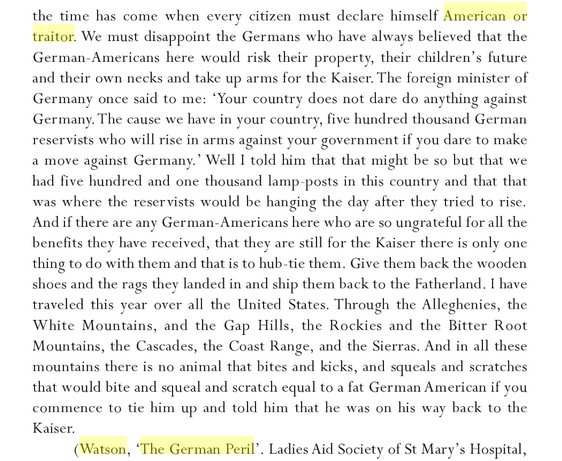
Len Spencer: 'I am the Edison phonograph ... I am always ready to entertain you!', Phonograph advertisement - 1906
1906, Edison Studios, West Orange, New Jersey, USA
I am the Edison phonograph, created by the great wizard of the New World to delight those who would have melody or be amused. I can sing you tender songs of love. I can give you merry tales and joyous laughter. I can transport you to the realms of music. I can cause you to join in the rhythmic dance. I can lull the babe to sweet repose, or waken in the aged heart soft memories of youthful days.
No matter what may be your mood, I am always ready to entertain you. When your day's work is done, I can bring the theater or the opera to your home. I can give you grand opera, comic opera or vaudeville. I can give you sacred or popular music, dance, orchestra or instrumental music. I can render solos, duets, trios, quartets. I can aid in entertaining your guests. When your wife is worried after the cares of the day, and the children are boisterous, I can rest the one and quiet the other. I never get tired and you will never tire of me, for I always have something new to offer.
I give pleasure to all, young and old. I will go wherever you want me, in the parlor, in the sickroom, on the porch, in the camp or to your summer home. If you sing or talk to me, I will retain your songs or words, and repeat them to you at your pleasure. I can enable you to always hear the voices of your loved ones, even though they are far away. I talk in every language. I can help you to learn other languages. I am made with the highest degree of mechanical skill. My voice is the clearest, smoothest and most natural of any talking machine. The name of my famous master is on my body, and tells you that I am a genuine Edison phonograph.
The more you become acquainted with me, the better you will like me. Ask the dealer.
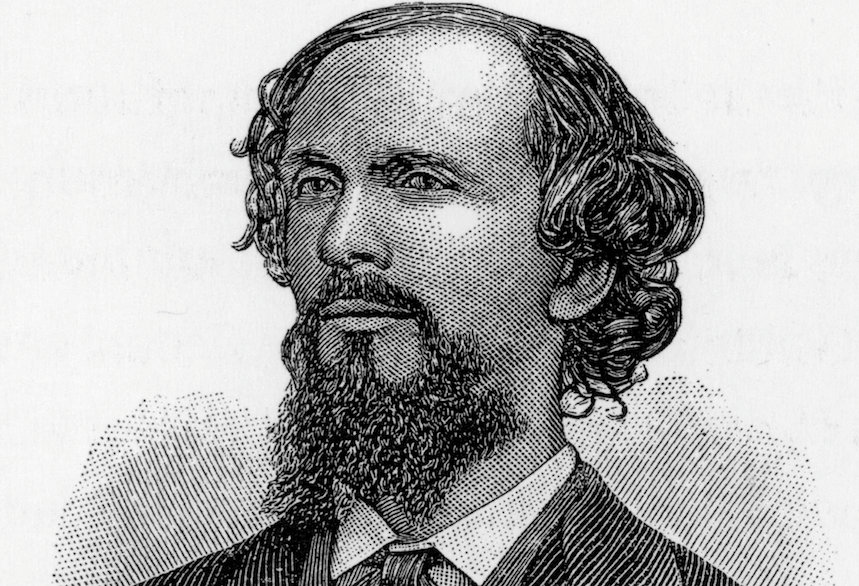
Karl Heinrich Ulrichs: Congress of German Jurists, first gay rights protest - 1867
29 August 1867, Odeon Theatre, Munich, Germany
This speech by Karl Heinrich Ulrichs is regarded as the first ever gay rights protest speech. It did not achieve any change but as Ulrichs later said:“Until my dying day I will look back with pride when on August 29, 1867, I found the courage to come face to face in battle against the specter of an age-old, wrathful hydra which for time immemorial has been injecting poison into me and into men of my nature.” For his courage and activism, Ulrichs has been called ‘The first gay man in world history’.
Here is the speech:
Gentlemen:
Two years ago Dr. Tewes, professor of law, who resides in Graz, and I, according to regular procedure, proposed a motion as members of the Association; and I wish to make a protest because it has been denied by our committee, namely because it was classified as 'unsuitable for deliberation' by the Association of Jurists and has been excluded from the agenda. I shall establish my protest materially and formally.
I. Material
This proposal addresses the revision of the existing material penal law, especially and finally to repeal a specific unlawful paragraph in the penal code handed down to us from past centuries. It is directed to abolish this paragraph of the penal code which discriminates against an innocent class of people.
It is also a question of preparing to unify the laws of Germany which in these points unity does not exist. Bavaria and Austria both presently condemn prosecution, and their legislation stands diametrically opposed to the remainder of Germany.
Finally, and secondarily, it is also a matter of concern finally to choke the source of abundant suicides, especially those of the most shocking sort.
I believe that these are far more worthy, serious and important questions concerning the penal code and ones that the Association of German Jurists was rightfully and truly called upon to rule on.
Gentlemen, the matter also concerns a group of persons whose size numbers in the thousands in Germany alone. Many of the most eminent and noble persons in our nation and in foreign nations have belonged to this group...
(Apparent amazement and scorn; isolated shouting, "Adjourn!")
...this group of men which is discriminated against for no reason other than the process of an undeserved criminal prosecution...
(Tempestuous outcry, "Adjourn, adjourn!" The presiding privy councillor, von Wächter, wished to call for a vote to close the matter which was being loudly demanded. What do I say? "Under the circumstances I give up the floor and lay my call for justice down on the table of the House." But now outbursts as loud as the previous ones fence forth from the opposite side of the hall, "No, no, continue, continue!" After I began to continue, the words which follow were spoken with heightened emphasis,)
...a group of men which is discriminated against for no reason other than the process of an unjust criminal prosecution because creative nature has implanted in this group a sexual nature which is inconsistent with the common, vulgar one...
(Chaotic uproar and violent interruption. Uncommon excitement in the audience on the side that prevailingly calls for adjournment. The president says, "I request that the speaker continue reading his proposal in Latin!" But I lay my manuscript down on the desk of the president, and I left the speaker's box. To continue, the manuscript went as follows:)
...a puzzling nature which, in fact, an edifying text by Numa Numantius has recently attempted to clarify, and because you yourselves are involved in an error which can be excused, you look at the matter only superficially: what you consider real, that this true and puzzling nature is not considered natural at all, you resolved to consider it as against natureiii and that the only action you initiate is to draw the sword of justice against this puzzling nature, and driven to utter abuse, you slash the Gordian knot.
This abuse has similarities in yet other puzzling phenomena that have also been misunderstood, namely the witch hunts of earlier centuries.
The abuse under question has been plainly abolished from the present penal code book of Bavaria, just as the Code Napoléon earlier did, while Austria, even now in its outlined penal code placed before parliament, prefers similar abolition 'to provide a practical accountability of the results of scientific research,' as the Austrian minister of justice expressly stated on June 26 of this year.
Would it not truly be the most serious and commendable duty of the Association, gentlemen, if the witch hunts were as yet not abolished, to enter the lists against them?
Indeed, even if Bavaria and Austria had not already taken action?
And what is the function of the Association, I ask, if it be deprived of discussing the most serious matters?
II. Formulation.
Formally it appears to me that this committee is so constituted, that, without a resolution from the Association, by its own authority, is out of order when it attempts to restrain a proposal that rightly falls under the jurisdiction of the Association of Jurists.
Whereby, in my own name and in the name of my cosponsor, I hereby make a protest against the restraint of the proposal.
I would now like publicly to repeat this protest that was made, and, as I portrayed, was suppressed.
Likewise, I enter a protest against the Association and its suppression of this protest.
During my entire speech I distinguished between two groups in my audience:
(1) There were the unbiased who were not prepared for my speech (they were to my right), and who challenged me to continue;
(2) Those who called for adjournment were already familiar with the Tewes-Ulrichs Proposal. (They were in front of me and to my left.) Among those were Appellate Court Justice von Groß from Jena and Attorney General Schwarze from Dresden, who both had sat on the committee.
I was already harassed by isolated calls for adjournment on the 27th and 28th when I delivered technical speeches that apparently had nothing to do with the matter concerned.
I want to deal now with the meaning of this behavior toward me and of the calls for adjournment that put a close to my speech on the 29th.
These shouts were not calls for adjournment in the literal sense. It was, rather, as if the sounds were just a disguise of a call to: "Crucify, crucify!"
During and before the beginning of my speech on the 29th, those who called for adjournment were apparently only in the minority. I requested permission in writing from the president to speak before the full assembly and to enter a protest against the omission of a proposal from the agenda and to place it before the president. The president immediately gave expression to one of his wishes, "May the King of Bavaria soon enjoy marital bliss, because it is the ultimate happiness of men," then put it to a vote "whether
Mr. Ulrichs should be allowed to speak to these aims?" To this a few isolated voices called out, "No, no!" Meanwhile, a strong majority called, "Yes!"
At least the large assembly listened to me with an extraordinary attentiveness. Of all the speakers in both full assemblies on the 27th and on the 29th, none enjoyed a similar experience.
When I stepped from the speaker's stand, an indescribable excitement prevailed.
Moreover, there was evident confusion of what the circumstances involved and of what needed to be said, who was to speak, and what was to be decided. After a long pause, the president reached for a manuscript and said, "I will try to continue reading to verify the matter." Another pause. Then the president began to speak, his voice quaking, "The proposal refers to crimes of the flesh." (Did the manuscript say one word about that?) He then turned to me and said, "I would like the speaker to read the proposal according to the letter." I began, "The proposal is lawfully submitted to the committee. It has to be in the hands of the president. It is not in my possession. My personal copy was confiscated in April of this year when I was taken to Minden Castle. I insert it here as follows:
The Association of Jurists may wish to declare a pressing demand for legislative justice by submitting the existing German penal code concerning so-called sins of the flesh to an immediate revision in the following two matters:
(I) That innate love toward a person of the male sex be punishable only under the same provisions that concern love to persons of the female sex; that they remain guiltless as long as:
"no rights have been abused (by force or threat of force, by abuse of minors, unconscious persons, etc.)
"or there was no disturbance of the peace;"
(ii) That the present vague penal regulation concerning 'disturbing the peace because of sexual behavior' be replaced by one that would guarantee protection under the law."]
Now Schwarze from Dresden requested to speak and declared, ”I represent the decision of the committee. The proposal is, if you will, not acceptable; indeed! We decided to restrain it because as it stands it is inconsistent with the present laws.Secondly, because it offends our sense of morality. It would have excited the indignation of the Association even if it were read. Our faces would turn red with shame! Indeed, if we are supposed to be speaking in Latin, then I can be sure to say it is of a sexual nature."
When these gruff words were heard by the groups to my left they shouted bravo, and I expected nothing less than to be personally insulted. I was troubled with fears every second. I could no longer consider answering Schwarze when such a mood was shared by a large part of the Association. I just remained passive. I was certain that I would loudly protest, declare my withdrawal, and exit the hall at the slightest insult.
Following Schwarze, an elderly gentleman with whom I was not acquainted spoke to thank the committee "in the name of the Association," for restraining the proposal in the interest of morality.
(Very loud shouting, although not all had joined in. See below.)
Ulrichs published his account of the event in a small book he entitled “Gladius Furens” (Raging Sword), which he published in 1868. The attached English translation of Ulrichs’ speech was translated and published by Michael Lombardi-Nash in: Karl Heinrich Ulrichs, The Riddle of “Man-Manly” Love: The Pioneering Work on Male Homosexuality Volume I, trans. into English by Michael A. Lombardi-Nash (Buffalo, NY: Prometheus Books, 1994) pp. 263-265.
Dorothy Byrne: 'Too many programmes are saying small or medium-sized things about society', McTaggart Lecture, Edinburgh Television Festival - 2019
21 August, Edinburgh, Scotland
Thank you very much indeed for the great honour of being the first old lady to be invited to deliver the MacTaggart lecture.
I was telephoned late on a Friday night a few weeks ago while dancing at the Hebridean Celtic Festival in Stornoway. So I realised at once I was your first choice.
But we old ladies – or even wee old ladies – are not proud. Decades of cervical smears destroy all pride.
Of course the first thing I did was check out my illustrious predecessors. A younger woman might have been intimidated.
Yes. Kevin Spacey. He proved to be a good choice.
Shane Smith of Vice, an organisation well-named as it turned out.
And by an extraordinary coincidence three people with the same surname – Murdoch. What are the chances of that eh? I especially enjoyed James Murdoch from 2009. He told the audience that it was important to: ‘encourage a world of trust’ and that newspaper readers were: ‘treated with great seriousness and respect.’
Let’s delight ourselves by remembering how Ofcom described him just three years later, in his role at News Group Newspapers during the hacking scandal. He ‘repeatedly fell short of the conduct to be expected of him as a chief executive and chairman’.
So much for trust and respect.
I met James Murdoch once and he patronised and dismissed me. Hey James, now I patronise and dismiss YOU.
Elsewhere on the list, I spotted one name among my predecessors who has not yet had the comeuppance he deserves for his assaults on women.
That’s one of the things about being an old lady, you gather a lot of information over the years. To men who have behaved badly in the past, I say this: you know who you are. And so do I.
Tonight, there’ll be no shortage of sexist bastards, possibly among you in the audience. But I have positive messages too about how we must find courage in this time of crisis and most of all how we must unite to use the power of television to protect democracy because it is being seriously undermined.
I am the Methuselah of TV, I’ve been in the industry nearly 40 years and at Channel Four for 20.
In the course of my work, I’ve thought I’d die a few times, I’ve been temporarily kidnapped, condemned as a terrorist whore, told by my own colleagues I should imprisoned for several years and hardest of all been a single parent.
I’m just about the oldest female TV executive working for a broadcaster and for many reasons being a woman working in news and current affairs has been a struggle.
But I would recommend television journalism to any young woman today embarking on a career.
In what other line of work when some bastard annoys you or you hear of some absolute disgrace, can you say to yourself, ‘I’m going to make a programme exposing that and I’ll put a stop to it!.’ And sometimes you even do.
But I begin with early man in TV. Surprisingly perhaps, I think we have much to learn from him. There’s a reason he has no clothes on in this picture. That was the downside of early TV man; a tendency to remove his clothing.
A quick tip for men. Don’t take your trousers off unless specifically invited to do so.
I started out in television at Granada and from my very first day the overwhelmingly male management made me feel at home. Or to be more accurate, they tried to come home with me.
My colleagues took me to the bar and we were joined by a senior manager. As I was standing on the pavement afterwards, this top bloke suddenly appeared beside me and suggested we get in a taxi together.
How kind was that? Supposing I hadn’t known the way to Chorlton-cum-Hardy and the taxi driver had just arrived from Kabul, that could have been really helpful.
As it happened, my mother had taught me to always memorise the way home, so I was able to tell him his services wouldn’t be needed. Services of any sort.
Try to picture this happening now at Channel Four. Let’s pretend Channel Four employs lots of working-class people from the North of England and imagine a young bloke called Bert from Accrington on his first day.
His new young colleagues take him out to the pub and then I turn up and join them even, although I don’t work directly with any of them. Bert gets up to leave. I follow him out.
Bert stands on Victoria Street to hail a taxi and I sidle up next to him and say, ‘Great news Bert, I’m coming home with you. ‘
That first day at Granada, a female boss had also told me that a director would take me out to teach me the basics of filming and he would sexually assault me, but I wasn’t to take it personally because he sexually assaulted all women he worked with.
Sure enough he did assault me – one of the few examples in my career of the promise of a TV boss coming true. His assault was a criminal offence but who could I complain to? I learned early on that as a woman I was on my own.
Not all approaches were offensive. Some were merely ludicrous.
When I joined World in Action, I was at that point the only woman on the programme, but I needn’t have worried about feeling lonely. Again, there was a man with a kind offer.
Even although I hardly knew him, one of the journalists suggested we have sex. I realised I would need to use all my diplomatic skills in order not to hurt his feelings, so I said, ‘Don’t be ridiculous! Of course I won’t have sex with you. Do you just ask random women for sex?’
And guess what? He did. I asked him what his success rate was and he said, ‘One in a hundred which is pretty good for me.’ Looking at him, I thought it was surprisingly high.
Some, but by no means all, of those men then had terrible attitudes towards women. But, as a group, they also had great attributes which we have lost.
They believed that television was there to say and do big things. Many thought that it was their right and their role to change society. Those men at Granada were passionate believers in the power of television.
They were radical alternative thinkers who believed programmes could be used to make our country a better place. How many people in TV today would say out loud that they wanted to use TV to make Britain a better place?
Their achievements were immense – extraordinary investigations like The Birmingham Six, great documentaries like Seven Up and inside the Communist Party, landmark series and strands like Disappearing World or End of Empire, a new way of covering elections in the Granada 500 and the invention of new forms in television like the drama-doc.
And they challenged the authority not just of those who ran the institutions of the UK but also of their own TV bosses. Far too many people in TV now spend all day agreeing with their bosses. It’s simply ghastly to witness.
Our country is undergoing seismic changes. There is widespread disillusion and a loss of a sense of belonging as society fragments. Whatever happens about Brexit, we need big new ideas to take us forward. But I don’t see big ideas on TV now.
Too many programmes are saying small or medium-sized things about society. Where do we go for big ideas? Books, Tedtalks, podcasts, all really popular.
On the news, I’m hearing every day that the very fabric of our democratic system is being ripped to shreds.
But where is this crisis being analysed outside of the news. UK broadcasters still make some great investigations but where are the programmes which shake all our assumptions about society?
So often I’m told that documentary formats now deal with important subject matters but formats only describe society as it is, they don’t provide a vision for change.
If we are worried about becoming irrelevant, one of the best things we can do is to start making big controversial programmes about the UK which put us back at the heart of public debate as we used to be.
We are all desperate for young audiences. Millions of young people are now politically aware and active.
They’re prepared to spend hours listening to extraordinarily serious podcasts, often authored by some pretty heavy duty thinkers.
They’re searching for alternative ways of seeing the world and for answers to major issues like climate change and the viability of our current financial systems.
A great Ted Talk gets millions of views. We have to stop being afraid of serious analysis authored by big brainy people. We have the ability and we have the airtime. Let’s make some really clever and difficult programmes.
We are obsessed by the fall in audiences and forever looking over our shoulders at Netflix and other streaming services, hypnotised by their success.
But terrestrial TV still accounts for 69 per cent of all TV viewing, according to very recent Ofcom figures. That is three hours 12 minutes a day which is massive.
And we have something else too – very high levels of trust. The latest Ofcom figures show that 71 per cent of audiences think television news is accurate and trustworthy.
Take advice from an older woman – I’m about the same age as ITV – when you’re getting on a bit, reinvent yourself. I used to be a tall blonde woman.
And think what you have that makes you special. In the case of terrestrial TV – we are the only people who have any interest in saying big things about Britain. That’s not the role of Netflix or other streaming services, terrific as they are in many ways.
I counted 29 different programmes on Netflix about drugs. I wonder if there’s a drug cartel anywhere that’s not currently being followed by a streaming service.
There’s also a plethora of programmes about serial killers. Programmes about mass murdering drug lords will contribute nothing to the reinvention of the UK’s political landscape.
But when we do major investigations here in Britain, like Channel Four News’ investigation alongside that of Carol Cadwallader into Cambridge Analytica, they gain huge traction. The public appetite is there.
Now painful as it is to admit it, Rupert Murdoch made a very good point in his MacTaggart back in 1989, the very period when I was working on World in Action.
He said television was ‘controlled by like-minded people who knew what was good for us’ and criticised TV for reflecting the values of a ‘narrow elite’.
My vision of empowered and daring producers and commissioning editors who want to shape society for the better doesn’t work if all those empowered people are just a bunch of posh boys.
By what right do we showcase big ideas if we are such a small group? I looked at the two Directors UK reports which came out late last year.
OK the figures are not completely up-to-date but only 2.2 per cent of directors came from black and ethnic minority backgrounds and fewer than 25 per cent were women.
That matters because we can’t reflect society properly if we ourselves don’t reflect society.
When you change who is making TV, you change TV. I am proud that I was part of a group of women who changed current affairs by making regular programmes about issues affecting women.
The first programme I produced and directed for World in Action was about rape in marriage, then not a crime, and two very senior journalists told me it wasn’t a suitable subject for the programme and indeed not even a ‘story’.
They were right. It was more than a story. It was a scandal which besmirched our society. These women-focused programmes rated well but I could tell that quite a few of my colleagues didn’t rate them much.
My reputation was nearly destroyed when Mary Whitehouse rang up to say how good one of my films had been. By great good fortune, I took the call. I’m ashamed to say I told her Dorothy Byrne was out but I’d pass on the compliment. I never told me colleagues she’d rung.
The lack of people from ethnic minorities then was appalling. At Granada, I was the union equality officer when ACTT asked us to do a survey of the number of black people working there.
I didn’t need to do a survey, I personally knew all five black people– out of a workforce of around 1,600. When I reported this back to the joint union committee, one of the ‘brothers’ said, ‘That’s five too many.’
And another chipped in, a la Trump, that they should all go back home.
Of course, I pointed out this almost certainly WAS their home. While that would never happen now, the lack of progress in increasing ethnic diversity in television is the single most disappointing failure during my career.
I was asked quite recently by a Channel Four manager what I thought of our diversity initiative. I replied that I honestly couldn’t remember how it was any different to the last diversity initiative.
In fact, was he absolutely sure it WASN’T the last diversity initiative? Or maybe the one before? I have known so many in my time. Not so long ago I was sitting in a room of managers at Channel Four and one asked why we thought we were not achieving more on ethnic diversity.
Everyone looked puzzled and thoughtful – the way people in TV do when they’re pretending to be deep and meaningful – until I said, ‘I don’t know if any of you have noticed, but everyone in this room is white?
Could that be connected?’ So, Alex Mahon, Tony Hall, Caroline McCall and David Lynn, it’s time to achieve real change.
But we also need to resist the idea that we don’t need older white men anymore and that they should be crushed out of the way. I hate the term, ‘Pale, male and stale.’ As someone who sticks up for the rights of old ladies, I need to stick up for old gents too.
They are still overrepresented, but their voices are vital for our society.
Look at John Ware who just reported an excellent and important Panorama on anti-Semitism.
He is pale, he is male, but he is certainly not stale. Is he politically correct? Well fairly recently we were in an edit suite together and he called me ‘Sweetie.’ At once the room fell silent. Indeed, I would say time stood still.
And then in the low and vaguely threatening tone I have polished over years, I said, ‘I am not your sweetie.’ To which John replied, ‘Yes you are.’ Sisters, I regret, I just laughed.
The most important reason for us to get our houses in order on diversity is that our current failure undermines our role as the key mediators between politicians and the public.
How can we represent the people of the UK if we ourselves are unrepresentative of the population? Mind you, politicians are also unrepresentative.
Look at Dominic Cummings and Seumas Milne, the Svengalis of our two main parties. One went to Durham School and Exeter College, Oxford, the other to Winchester College and Balliol College, Oxford. That’s what counts as diversity in British politics.
We have shortcomings but we mustn’t underestimate our importance to democracy. The majority of people in the UK still rely on TV as their main source of news – 75 percent of the public.
We play a vital role in democratic debate in this country. Viewing figures for election debates and interviews are high, as they were for the recent Tory leadership debate. In the debates Boris Johnson deigned to join, around five million viewers watched.
That’s way more than can be reached by any newspaper and certainly for the Tories’ alternative to us – the Prime Minister’s Q&A sessions with the public on Facebook Live
Don’t believe politicians when they say that the public doesn’t trust the so-called mainstream media in the UK. They trust TV. Remember, terrestrial television has huge levels of trust: 71 percent.
It’s politicians who are not trusted – they have a trust rate of 19 per cent. And news on the internet – the medium politicians are increasingly using to bypass us – has, according recent Reuters Institute figures, a trust level of only 22 percent with a mere 10 percent for news on social.
Our investigations and those of other news organisations have also exposed the ways in which news on social platforms is used by those outside the UK to attempt to influence voting.
It has never been more essential that politicians should use the most trusted medium of. In the past, our politicians accepted that they had to be held accountable on television.
But in recent years, there has been a dramatic fall in politicians holding themselves up to proper scrutiny on TV and in recent months and even weeks, that decline has, in my view, become critical for our democracy.
We have a new Prime Minister who hasn’t held one major press conference or given one major television interview since he came to power.
That cannot be right. And we have a leader of the opposition who similarly fails to give significant interviews on terrestrial TV. We may be heading for an election very soon.
What are they going to do then? I genuinely fear that in the next election campaign there will be too little proper democratic debate and scrutiny to enable voters to make informed decisions.
Many of you will have seen the excellent recent BBC series on Margaret Thatcher. One striking feature was the number of lengthy television interviews Thatcher did.
Leaders of the past subjected themselves to half hour or forty-five minute interviews with the likes of Brian Walden and Robin Day and held regular press conferences.
During the 1987 election, Thatcher and Kinnock chaired daily press conferences and gave several full-length interviews. Even more recently, Miliband and Cameron also did extensive interviews in election campaigns.
However, Theresa May, when she was leader, and Corbyn, failed to hold themselves to account in the same way. In the 2017 election, May and Corbyn did only one or two events a day.
Outside of election periods, and setting aside some interviews with Andrew Marr, Theresa May’s PR people generally said she would do interviews of only four minutes, maybe six if you were lucky.
Throughout her time as PM, May’s longest interview with Channel Four News was seven minutes. How do you delve into the complex problems of our times in a few minutes. Jeremy Corbyn sometimes permits only one question, and then doesn’t answer it!
At the 2018 Conservative Party Conference, Mrs May made history by refusing to do interviews with Channel Four or Channel Five. Other broadcasters were so appalled that they signed a letter of protest to Downing Street for which I thank them.
When we were trying to get that interview, Robbie Gibb, May’s press supremo, said to us, ‘What’s in it for us?’ As if interviews were purely for the benefit of politicians and not the public.
It is notable that Theresa May told Laura Kuenssberg that the one thing she regretted was refusing to take part in TV debates. And no offence meant but she has lots of things she could regret.
During the entirety of the most recent European election, neither May nor Corbyn did a major interview with a broadcaster, not even on the night of the results.
But what is happening now is far more serious. For weeks and weeks of the Conservative leadership election, Boris Johnson was virtually invisible on television.
The public was able to view him mainly on hustings organised by his own party. Our experience at Channel Four was typical. He kept promising to come on Channel Four News. He never did. He didn’t do an interview with ITV News or Channel Five News either.
And he failed to turn up to our leaders debate. There’s his empty podium in the middle. Throughout that campaign, Boris Johnson was castigated widely for failing to be held accountable on television.
He did the minimum he could – just two leaders’ debates, one interview with Laura Kuenssberg and just one real grilling by Andrew Neil.
And what about this man? The leader of the opposition is rarely to be heard in any significant television interview. It’s not so much, ‘Oh Jeremy Corbyn’ as No Jeremy Corbyn.
The other day John McDonnell said he was going to put Jeremy Corbyn in a taxi and send him off to see the Queen. That befuddled me as I’ve been able to get in taxis by myself since I was about twelve.
I had the wild idea of sending the queen – a fellow old lady after all – a camera so that if she was lucky enough to meet Mr Corbyn she could ask him some questions on behalf of the British people. Because few of us get to do that.
Jeremy Corbyn gave the alternative MacTaggart last year and some of you may remember that he said, ‘At their best, journalists challenge accountable power.‘
Yes, Jeremy but we need the chance to question accountable power. He also said that, ‘fearless journalists and those who support them and their work are some of the heroes of our time.’
Go on Jeremy, be a hero, come on Channel Four News, go on the Today programme or Newsnight. You can do it. You can even get in a taxi by yourself and do it. It’s easy. You just hail them on the street and they stop. Although, maybe not if your Jeremy Corbyn. Could that have been the problem?
Corbyn did do an interview on Channel Four News at the Labour Party Conference in 2017 but then didn’t do another until the same time in 2018. And he hasn’t done one since. So annual appearances. What does he think he is? My birthday?
Ironically, both Johnson and Corbyn used to be journalists. Corbyn began his career as a reporter on the Newport and Market Drayton Advertiser and is even a member of the National Union of Journalists. And when they were outsiders in their parties they both spoke to TV regularly.
Of course, Dominic Cummings, allegedly the most important political figure in this country at present, has never done a television interview as far as I know.
And indeed has such respect for our democratic system that he was held to be in contempt of it when he refused to appear in front of the parliamentary committee investigating fake news
Boris Johnson has been proclaimed by Downing Street as the first social media PM.
On taking office, he recorded a jolly statement – so much more fun than being grilled by Emily Maitlis or Jon Snow. It reminded me of something and at first I couldn’t think what it was.
And then it came to me. This great flagbearer for democracy Vladimir Putin who also likes to talk directly to the nation.
We’ve also seen a stream of paid adverts on Facebook. He says he wants us to join him. Great, can we bring Matt Frei and a camera crew?
Meanwhile, he’s roaming round the country doing photo opportunities with Kinder eggs full of drugs. Shouldn’t he be busy doing something else?
As for his Facebook Live Q&As. We were told it was ‘unpasteurised and unmediated.’ Of course, it was also unregulated and therefore under no duty to be duly impartial. We did not show that propaganda exercise. And we should not show this propaganda as a matter of course.
The questions were easy and there were no follow-ups. Here’s one – ‘How would he protect mental health services?’ Break your heart Cathy Newman, could you have come up with that? Call yourself a journalist Andrew Neil, could you thought of this toughie? ‘What’s going to be done to tackle knife crime?
But the most challenging question of all came last: Who is your favourite politician? He said Pericles. Oh you man of the people! You couldn’t resist showing off your lovely classical education at Eton and Oxford.
What will it be next time? What’s your favourite colour? When will you bring world peace? Do you have any personal morality at all? Oops that last one is a real question. Couldn’t help myself.
What would Margaret Thatcher have thought of these two mighty leaders who avoid the regular grillings she accepted?
I would never have thought I would say these words: I believe that Mrs Thatcher would agree with me; Boris Johnson and Jeremy Corbyn are cowards. She had a word for men like them – ‘frit’.
If they really believe in the policies they promote, they should come onto television to explain them, to allow them to be scrutinised and to justify them.
And just this weekend we read that these cowardy-cats in the Tory party may stop junior ministers from going onto the Today programme. I have previously described listening to Today as like accidentally walking into a knitting shop in Bournemouth.
But even I accept that millions listen to it and they have a right to hear from their political leaders on it.
Let’s look at a Western democracy whose leader decided he didn’t need to be held up to scrutiny. Who could I be thinking of? Where did Boris Johnson get his great idea about not having to bother with people like us?
Yes, it’s Mr Chlorinated Chicken himself, Donald Trump. Trump has abandoned formal White House briefings. He, like our PM, prefers to take questions from journalists during photo opps, notably getting onto his helicopter. That’s what you need Mr Johnson!
A helicopter to drown out all intelligent questions! Journalists have to shout out and there is no opportunity for follow-ups. And as we all know, Trump’s on social media day and night.
Of course, if you asked HIM who his favourite politician was he’d say himself. That’s actually true. When asked who his favourite president was, he said Donald Trump.
More importantly, Trump has abandoned any belief in the primacy of truth. If the leader of a democracy no longer believes in the fundamental importance of truth, then that democracy is undermined. That is what has happened in the US and we must not allow it to happen here.
Trump lies as a matter of course now. The Washington Post listed ten thousand of his lies a while back but it’s gone up since then. He lies for convenience and on a whim.
Recently, he repeated a claim that his father was a German, born in a lovely little village. It’s an easy mistake to make isn’t it? I used to find myself saying to my own father of a morning, ‘Guten Morgen PAPI Wie geht’s DIE (dier).’ He’d look confused. He came from Craigellachie.
It’s unfortunate that Trump’s father ISN’T German because it means that if his great new idea of people being ‘sent back’ catches on, my country, Scotland, would get Donald Trump.
I’m not feeling Nicola Sturgeon would be pleased. Trump’s mother came from the Outer Hebrides. I’ve got bad news for you Donald, I asked around on your behalf during my recent Hebridean journey. I couldn’t find anybody who wanted you.
Time for a fish! In honour of Scotland, I’ve brought along a herring to rival the kipper Boris Johnson produced in the leadership election. He said that Brussels bureaucrats had demanded that each kipper had to be accompanied by a plastic ice pillow. That was simply untrue. Even Donald Trump’s never lied about a kipper.
Going back decades, Johnson has lied about the EU.
1991 – EU bureaucrats reject Italian demands for smaller condoms. Rubbish.
The EU set rules on the shape of bananas. Nonsense
More recently, he claimed he was resigning from Theresa May’s government partly because the EU had prevented the UK from passing a law to save the lives of female cyclists. What a feminist that man is! So many women say that to me.
Here is what we all need to decide: what do we do when a known liar becomes our Prime Minister?
I’ve talked to journalists from several television organisations about this issue. They said they would be loathe to use that word ‘liar’. Remember when Andrew Marr told Penny Mourdant her claim that the UK couldn’t stop Turkey from joining the EU was ‘ strange’.
It was strange but it was also untrue, a lie. Is it time for us to start using the L word? I believe that we need to start calling politicians out as liars when they lie. If we continue to be so polite, how will our viewers know that politicians ARE lying?
And several of us have excellent online factchecking services – we need to put more of that information into our broadcast programmes to help viewers spot the porky pies. .
Of course, politicians don’t hold back from criticising us rudely and saying WE lie. The Labour Party said the Panorama on anti-Semitism purveyed: ‘deliberate and malicious misrepresentation designed to mislead the public’.
I am chair of a small international charity the Ethical Journalism Network which helps journalists round the world uphold standards. I honestly never thought I would be campaigning here in the UK to establish the primacy of truth.
If we are going to be asked to cast our votes on the basis of lies, then democracy is in trouble. Hang on a minute, did that already happen?
At Channel Four I’ve commissioned many award-winning international films on Afghanistan, Sri Lanka, North Korea, Iraq, Syria. But the films which matter most are those, like MPs for Hire, which investigate our own country and its politicians.
Another ploy of both Trump and some of our own politicians is to accuse journalists of being negative and unpatriotic. Trump regularly attacks journalists for being ‘the enemy of the people’ and criticises his opponents as negative and lacking patriotism.
He even said that the congresswomen he’d wanted to be sent home should be ‘more positive’ and reminded them that they had an obligation to love their country.
Presumably before they got thrown out of it. Some of you will remember that Trump’s chum Nigel Farage accused Andrew Marr of being ‘an enemy’.
And you might remember the night that this woman, now Secretary of State for Business, Andrea Leadsom, told Emily Maitlis on Newsnight that broadcasters should be ‘a bit patriotic’ because ‘we all need to pull together’.
Boris Johnson’s equivalent of Trump’s attack on the negativity of journalists and opponents is to rail against ‘the doubters, the doomsters’ and ’the gloomsters’.
I don’t need any politician to tell me to be patriotic. And it’s not being a gloomster to question policies. It’s the role of the free press in a democracy.
But it’s not all bad news. There is a leading politician standing up for truth
Michael Gove! He has launched a rapid rebuttal unit to give instant responses to ‘media myths and half-truths’ to ensure that we the people ‘are not being alarmed by scare stories or falsehoods’.
Now I don’t like to be a snitch, but there’s someone Mr Gove should keep an eye on.
Yes, the UK’s most famous recipient of EU farming subsidies, Dominic Cummings. Let’s remind ourselves of just a few Vote Leave messages.
The EU will ban the British kettle. Really Dominic?
The EU prevents us from protecting polar bears. Honestly Dominic?
Turkey – population 76 million is joining the EU. Well we’re still waiting on that.
In the difficult period we are entering, we need the truth and we need proper scrutiny of all our major politicians. Television is a bulwark of our democracy, those who undermine its role are undermining democracy.
It’s time for the television industry to stand up for itself and speak out publicly against what is happening. Yes, we are rivals but we have to form a united front in opposing attempts to side line our central role in the political life of this country.
And forget the idea that the public can judge what is true. We showed 1,700 people six stories and asked them to judge which were true and which false.
Only 4% of people got all the answers right. And why should they? They are not in a position to research the truth of stories. That’s what journalists are there for.
With so much to be done to uphold the role of television in our democracy, where are the other old ladies to help me? All the women I started out with have gone.
What happened to them? I feel a bit like a character in an Agatha Christie story’ And Then There was One’. Were they all murdered? I’m the only one left, did I do it? I’m the obvious suspect. Meanwhile, the men went on and on, gathering their MBEs and OBEs and fresh young wives.
We need to do much better in keeping women in the workplace and ensuring careers are not blighted by having children. As the freelance editor of an ITV programme and a single parent, I had to go back to work after six weeks.
And the percentage of women working freelance has increased since then. For those who are staff, much more could be done to introduce flexible working. The problem barely discussed is the menopause.
A quarter of women suffer significant symptoms and a major survey found that a quarter of women considered giving up work these were so bad.
Often this problem coincides with parents falling sick and children taking major exams.
That happened to me and life was a real struggle. Major broadcasters and larger companies need to take the lead by offering flexible and reduced working to older women so they are not lost to the industry.
Even getting your boss to understand there IS such a thing as the menopause can be a problem. Kevin Lygo is an inspirational leader but his knowledge of middle-aged women’s medical matters is perhaps wanting.
When he was my boss, we were meeting one day when he suddenly remarked that I looked seriously unwell. I said I was not ill. ‘But you’ve gone all red and you seem to have a fever,’ he said. I repeated, ‘I am not ILL Kevin,’ in what I thought was a meaningful way. He repeated that I was and I should go home.
So I went back to my desk and announced I was leaving for the day. Everyone asked me why and I said, ‘Because my boss has never heard of the menopause.’
More recently Kevin has told me that this misunderstanding occurred because he assumed I was too young to being going through the change of life. What a charmer!
Now, some of you may be aware that very occasionally I have a poem published. So tonight, I bring you a first – a MacTaggart poem.
Think of me as your poet laureate. To avoid undermining my reputation as a serious journalist, I use various noms de plum. Tonight, my nom de plume will be ‘Sweetie’.
So here, to conclude, is my poem.
MY TV DREAM
I have a dream
Boris and Jeremy together on telly
Or is that a nightmare?
All BBC presenters massively overpaid equally
A programme about THIS island
Making more noise than Love Island.
And dirty bastards arrested before they die
Or they just die. Either option is good.
The menopause is not mistaken for malaria.
And I can at last come out
And admit I was twelve when the Sound of Music was released
Work that out!
And so I say to you all
So long, good night, auf wiedersehn goodbye
The sun has gone to bed and so must I.
Thank you very much.
Ron Chernow: 'Then Olivier told me that they wanted to try boring at this year’s dinner and I said, Oh, I can deliver on that', White House Correspondents' Dinner - 2019
28 April 2019, Washington DC, USA
Thank you for that lovely introduction, Olivier. I confess that I was surprised when I received the invitation to speak here tonight. I mean, I knew they weren’t approaching me as an international sex symbol, right? Then Olivier told me that they wanted to try boring at this year’s dinner and I said, Oh, I can deliver on that. Big time. Now you’re talking my language. So here I am, your twenty-minute sedative for the evening.
It’s nice to see such a healthy turnout tonight. You all know that on Tuesday the president reportedly said that members of his administration should boycott this dinner. At first I was puzzled by this, but then I learned that a rumor was circulating in Washington that I would read aloud the redacted portions of the Mueller report and everything was explained.
Of course there’s also been some squawking from the comedians and I’m sorry about that. Frankly I thought those folks would have a little more of a sense of humor about my selection—after all, they are comedians—but we need them more than ever during this surreal interlude in American life. As Will Rogers once observed, “People are now taking their comedians seriously, and their politicians as a joke,” and that describes our topsy-turvy moment. I hope the comics will be back for many more star turns in the future. Meanwhile, it’s always fun for a serious historian to stand in the cross-fire of an active war zone. When I asked a friend what the atmosphere would be like at this dinner, he replied, “Oh, the Roman Colosseum.” Now, being a dutiful historian, I thought I should research my audience, so I picked up a copy of Henrik Ibsen’s great play, Enemy of the People. I hadn’t realized before that the president was a student of Norwegian literature. The drama takes place in a small Norwegian town that hopes the discovery of mineral springs will turn the sleepy backwater into a thriving spa. Then the hero of the play, Dr. Thomas Stockmann, discovers that the miraculous springs are polluted and breeding typhoid and other diseases. In his naivete, he imagines that the townspeople will applaud him for saving them from calamity. Then he discovers that truth is a political commodity defined by the town’s business interests and he’s persecuted for truth-telling. His house is stoned, his windows are shattered, and angry mobs brand him, yes, an enemy of the people. So the next time you’re dubbed an enemy of the people, please think of the term in the Norwegian sense and wear it as a badge of honor.
I’m delighted to make a spirited case tonight for the First Amendment. We now have to fight hard for basic truths we once took for granted. We gather here in perfect security because of a little piece of parchment called the Bill of Rights that has acquired the status of American scripture. In the last analysis, that paper barrier stands between a free press and executive tyranny. Its author, James Madison, was a tiny, often sickly man, who probably wouldn’t have gotten past the bouncers in this ballroom and whose low voice would scarcely have projected from this podium.
So fervently did Madison believe in these ten amendments that he didn’t want them tacked on to the end of the Constitution, as an afterthought, but woven straight into the original text. Of those ten landmark amendments, Madison considered the first indispensable. Like all our founders, he regarded a free press as the cornerstone of democracy. As Jefferson famously said, if forced to choose between a government without newspapers, or newspapers without a government, he would unhesitatingly prefer the latter.
The First Amendment wasn’t written for the exclusive use of saints and choirboys, nor was it granted only on good behavior. As Mark Twain noted, ruefully, the right to stupidity is protected by the U.S. Constitution. That became patently clear during George Washington’s first term in office. As best I can tell, Washington committed only one major blunder as president: He failed to put his name on Mount Vernon and thereby bungled an early opportunity at branding. Clearly deficient in the art of the deal, the poor man had to settle for the lowly title of father of his country.
The press of the early republic was as ferociously partisan as anything we see today. In that golden age of character assassination, writers murdered reputations while hiding behind Roman pseudonyms. Washington became the victim of preposterous slander when the opposition press said he’d been a British secret agent during the Revolutionary War. Obviously the British had gotten a lousy return on their investment.
Some of the most blistering attacks against Washington came from an unexpected source. His Secretary of State, Thomas Jefferson, had hired a poet named Philip Freneau as State Department translator. Now Freneau was perfectly qualified for the translator job except for one small detail: He knew only a single foreign language. In truth, Jefferson had recruited him to found a party organ called The National Gazette that would publish slashing broadsides against the very president Jefferson served. Freneau performed his task with such malicious gusto that he dropped off copies of his incendiary paper on Washington’s doorstep every day.
It’s hard to convey the anguish that seized Washington’s mind as he reeled from press criticism. One day Freneau printed a cartoon showing Washington behind beheaded a la Louis XVI. In his diary Jefferson recorded Washington’s towering rage: “The president was much inflamed, got into one of those passions when he cannot command himself” and said “that rascal Freneau sent him 3 of his papers every day, as if he thought he would become the distributor” of them. A very 18th century form of chutzpah, eh?
But despite this extreme provocation, Washington always honored the First Amendment, saying such evils “must be placed in opposition to the infinite benefits resulting from a free press.” Like every future president, Washington felt maligned and misunderstood by the press, but he never generalized that into a vendetta against the institution. In fact, when he wrote his farewell address, he never delivered it in person, but had it published in the newspapers for readers to digest. My main theme here tonight is that relations between presidents and the press are inevitably tough and almost always adversarial, but they don’t need to be steeped in venom.
Our founders were highly literate people and none more so than Alexander Hamilton, an immigrant who arrived, thank god, before the country was full. I don’t know why they let him in. Clearly somebody slipped up at the southern border. You know, Hamilton was a human word machine. When Columbia University Press published 27 thick volumes of his papers, the editor joked that he wanted to dedicate the entire voluminous edition to “Aaron Burr, without whose cooperation this project would never have been completed.” Hamilton had a flourishing career as a journalist as well as a government official, founding the New York Post long before its Page Six incarnation.
When writing the Federalist Papers, Hamilton cranked out as many as five or six essays per week and this, mind you, with a full-time legal practice. He would be scribbling the final sentences of an essay as the printer waited in his outer office, ready to rush the latest installment into print. After leaving as first Treasury Secretary, Hamilton defended in the press a major treaty with England. He wrote one set of essays under the pen name Camillus, then launched a second series under the pen name Philo Camillus. Now Philo Camillus heaped extravagant praise on Camillus, and both Camillus and Philo Camillus, for some reason, were rapturous in their adoration for the former Treasury Secretary, one Alexander Hamilton.
During the administration of John Adams, the country lurched into a period of reaction amid a war scare with France and rampant fear of foreigners. Congress enacted the infamous Alien and Sedition Acts, which made it a crime for journalists to write about the president in a scandalous or malicious fashion. At this dark moment, Jefferson, with his serene faith in the people, prophesied, “with a little patience . . . we shall see the reign of witches pass, their spells dissolve.” Let it be noted that because of his anti-press record, John Adams not only lost his reelection campaign in 1800, but his Jeffersonian opponents reigned supreme for the next quarter century. Campaigns against the press don’t get your face carved into the rocks of Mount Rushmore for when you chip away at the press, you chip away at our democracy. The tribunal of history does not deal leniently with presidents who punish the press.
People say that we’re now fighting for the soul of America. But, folks, we’ve always been fighting for the soul of America. We’ve always fallen short of the hallowed ideals enshrined in our founding documents. America has always been a work in progress, a perpetual journey, a freedom ride with no final destination. And it falls to each new generation to renew and rediscover our country’s lofty promise. Dr. Martin Luther King, Jr. said memorably that the moral arc of the universe bends toward justice, but it never does so in a smooth or unbroken line.
Our precious republic feels fragile, even perishable, at the moment. I shudder at the sheer savagery to which Washington politics has descended. But we’ve also seen the wisdom of our Constitution at work with a boldly assertive press, an independent judiciary, and a rejuvenated Congress providing checks on executive power. We’re being tested—fiercely tested—but I like to think that decency will prevail. History shows that, in the short run, the American public can be swept up in all sorts of misguided and wrongheaded things—think Scottsboro Boys; think Japanese internment camps; think Joe McCarthy—but in the long run democracy endures.
During the Civil War, we battled each other not with ballots, but with battalions. We slaughtered 750,000 of our fellow citizens, maiming millions more. Amputees hobbled through every American town. Towards the end of that bloody conflict, a chastened but still hopeful Abraham Lincoln sat around a Virginia campfire with his chief general, Ulysses S. Grant, and he quoted his Secretary of State William Seward as saying, “that there was always just enough virtue in this republic to save it; sometimes none to spare, but still enough to meet the emergency.” Like Lincoln, I believe devoutly in that saving remnant of grace in our country. We’ve fought horrific wars, weathered massive depressions, and ended the unspeakable cruelty of slavery and Jim Crow. America has always been great, not when it boasted, not when it blustered, but when it admitted its mistakes and sought to overcome them.
Okay, let me move on to the president and the press in the twentieth century. Back in the days of William McKinley, there was no White House press room, just a long table for reporters on the second floor. As one journalist complained, “It’s part of the unwritten law of the White House that newspapermen shall never approach the president as he passes . . . unless he himself stops and talks to them.” A rather royal conception of the presidency with no shouted questions allowed.
In those more innocent days, reporters still shielded the private lives of presidents. Let me tell you how Warren Harding got the Republican nomination in 1920. Party bosses summoned him to the proverbial smoke-filled room in Chicago and asked him point-blank if he had any damaging personal issues they should know about. Now Harding, a married man, drank heavily and gambled freely, he’d had a fifteen-year affair with his best friend’s wife, and he had a mistress and an illegitimate baby daughter right there in Chicago. In fact, his young mistress sat in the balcony of the convention hall, enjoying the speeches. But Harding assured the party bosses that he couldn’t think of a single personal problem to worry about. Of course the press corps would grow bigger and more intrusive as the century progressed, and relations with the White House would grow ever more acrimonious.
Even though it may seem wistful and naive and a touch quixotic, I would like to keep alive tonight the fading memory of more civilized dealings between chief executives and the news media. Call it a museum of presidential decorum. At this confrontational moment in American politics, we must recall that civility has been an essential lubricant in our democratic culture and that our best presidents have handled the press with wit, grace, charm, candor, and even humor.
After McKinley’s wooden formality, Teddy Roosevelt proved a virtuoso in dealing with the press. The prolific author of 45 volumes, he devoured a book a day in the White House and retained all of them. One novelist who brought a new work to dinner was amazed that the president had read it by breakfast the next morning. Such a literate president enjoyed a natural affinity with the press corps. He devised a midday ritual called the ‘barber’s hour’ in which reporters would cluster around him as he was being shaved. The babbling president would spout a never-ending stream of opinions while his poor barber, bobbing and weaving with his razor, gamely tried to shave him without slitting the presidential throat.
When Calvin Coolidge was president in the 1920s, he inaugurated the first regularly scheduled press conferences. Reporters had to file their questions in advance and silent Cal sat stiffly behind his desk, working his way through a tidy stack of index cards. Small wonder that Dorothy Parker, when informed of Coolidge’s death, retorted, “How do they know?” Press relations only worsened with Coolidge’s successor, Herbert Hoover. Mired in the Great Depression and his own personal gloom—even his own Secretary of State bemoaned that chatting with Hoover was like “sitting in a bath of ink”—the president hired a hapless press secretary who proved so unpopular that one reporter quipped it was “the first known instance of a rat joining a sinking ship.”
When Franklin Roosevelt came into office, he swept away restrictive rules and treated reporters, lo and behold, like grownups! “We’re not going to have any more written questions,” the genial president declared at his first press conference. “Of course while I cannot answer seventy-five or a hundred questions . . . I see no reason why I should not talk to you ladies and gentlemen off the record.” Please note the ladies and gentlemen. The 125 reporters packed into the oval office were so impressed by FDR’s clear, straightforward rules that they gave him a standing ovation at the end—the first and undoubtedly last time that would ever happen.
In the end, FDR conducted nearly a thousand press conferences, not to mention thirty fireside chats, and even Eleanor Roosevelt held her own press conferences, where she invited only female reporters. This proved a tremendous boon to women journalists across the country since even the most hidebound publishers were now forced to hire them.
Of course, when it came to wit and charm, John F. Kennedy probably retired the prize. His memory reminds us how far a little self-deprecating humor can go. Remember modesty? When a small boy asked Kennedy how he became a war hero, he replied, “It was absolutely involuntary. They sank my boat.” In 1958 then Senator Kennedy was being touted as a presidential hopeful, but he was shadowed by scurrilous rumors that his rich father would buy the race. So at the Gridiron Club dinner, JFK drew a slip of paper from his pocket and proudly announced that he had a telegram from his “generous daddy.” He read aloud: “Dear Jack, don’t buy a single vote more than is necessary. I’ll be damned if I’m going to pay for a landslide.” The press was enthralled. When JFK held his first televised press conference in January 1961, 60 million captivated viewers were glued to their TV sets, a record only eclipsed by the 70 million who watched The Beatles debut on the Ed Sullivan Show three years later. I often wonder what The Beatles’ poll numbers would have looked like in Iowa and New Hampshire in that presidential year.
Ronald Reagan was a no less sunny personality and a past master of media relations. When he became president, he said, “I think that most of the time the overwhelming majority of reporters do a fine job, and as a former reporter . . . I know just how tough their job can be.” Nevertheless, Reagan had a sometimes bumpy relationship with the press. Then on March 30, 1981, he was shot and nearly killed outside this very hotel, the Washington Hilton, as he was about to duck into his limousine. A bullet lodged within an inch of his heart. Reagan was scheduled to speak, yes, at the White House Correspondents’ Dinner, so he telephoned in this line instead: “If I could give you just one little bit of advice, when somebody tells you to get into a car quick, do it.” That was a touch of class that has been sorely missing in our political culture in recent years. It was a subtle reminder that, whether Republicans or Democrats, we are all bona fide members of team U.S.A. and not members of enemy camps.
Okay, I know I’m wallowing in nostalgia and ignoring less savory moments of these and other presidents. Richard Nixon forced himself to go to dinners like this, where he had to hobnob with reporters who’d just written exposes about him. In the spring of 1971, he followed the advice of Press Secretary Ron Ziegler and decided to ‘play the good sport’ at the White House Correspondents Dinner. His gesture did not impress the news media. After his next press conference, Nixon grumbled privately, “the reporters were considerably more bad-mannered and vicious than usual. This bears out my theory that treating them with considerably more contempt is . . . a more productive policy.”
When Nixon hosted a party for P.O.W. families and felt bathed in female adoration, he thought his masculine appeal insufficiently acknowledged by the press coverage. “That’s what the goddamn New York Times and Washington Post should be writing about,” he groused. “I’m going to kick their asses around the block.” Such presidential eloquence. Shall we ever see its like again? Don’t answer. Of course the one who ended up getting his ass kicked around the block was . . . you know who.
You know, you folks in the media write the early drafts of history and we historians the later ones. Your work gives freshness, color, and immediacy to our sagas. I know how embattled you feel at this critical juncture as you combat the mistrust of a significant portion of the American electorate. I think you’re doing noble work to preserve democracy at a time when a rising tide of misinformation, masquerading as news, threatens to make a mockery of the First Amendment. There are so many journalistic fakes and forgeries out there that the genuine article becomes devalued and debased. You must also deal with a pervasive world of social media rife with self-appointed pundits who search out news outlets that only strengthen their preconceived views.
Still, this is as good a time as any to take stock and rededicate yourself to the highest standards of accuracy and integrity. Donald J. Trump is not the first and won’t be the last American president to create jitters about the First Amendment. So be humble, be skeptical, and beware of being infected by some of the very things you’re fighting against. The press is a powerful weapon that must always be fired with reluctance and aimed with precision. Warren Buffett has a handy saying: Always take the high road, it’s far less crowded there. And some days in Washington, let’s face it, a politician can sail along that upper roadway for hours without spotting another car. You folks should always remember that you are heirs to a grand crusading tradition that dates back to Ida B. Wells exposing the horrors of lynching; Jacob Riis the misery of Manhattan slums; Lincoln Steffens municipal corruption; Ida Tarbell the machinations of standard oil; Upton Sinclair the scandalous meat packing industry; Rachel Carson the dangers of pesticides; Woodward and Bernstein exposing Watergate; and the New York Times and Washington Post publishing the Pentagon Papers. This is a glorious tradition, you folks are part of it, and we can’t have politicians trampling on it with impunity. H. L. Mencken once warned of a political system that would “keep the populace alarmed . . . by menacing it with an endless series of hobgoblins, all of them imaginary.” We simply cannot allow the press to become an imaginary hobgoblin for political gain.
The thing that troubles me most at the moment is the sustained assault on truth, or at least a cavalier disregard of it, both here and by autocratic regimes abroad. As John Adams said, “facts are stubborn things” and our wishes cannot alter them. Facts are the foot soldiers of our respective professions, they do the hard marching and should wear no ideological coloring. Without the facts, we cannot have agreement in our badly divided nation; more importantly, without the facts we cannot have an honest disagreement. I applaud any president who aspires to the Nobel Prize for peace, but we don’t want one in the running for the Nobel Prize in fiction.
Ulysses S. Grant wasn’t a flawless president, but he was a stickler for the truth. One day in the White House, Grant was busy when a stranger called. Knowing Grant was occupied, an aide informed the usher, “Tell the gentleman that the president is out.” Overhearing this, Grant grew outraged. “No, don’t tell him that,” he said. “Tell him I am engaged and must be excused. I never lie for myself and do not want anybody to lie for me.” That’s a powerful example that all presidents should emulate.
You know, we’ve seen past administrations threaten the press directly, whether it be Lincoln shutting down disloyal papers during the Civil War or Woodrow Wilson stifling dissent with the Espionage Act in World War I. But what is happening today is perhaps even more insidious: a relentless campaign against the very credibility of the news media. Even the smartest courtroom lawyers can’t defend the press against such vague and sweeping attacks. You folks can only preserve that hard-won credibility in one way: with solid, fair-minded, and energetic reporting.
Since I’ve cruelly deprived you of a comedian tonight, I’d like to end with some pertinent quotes from Mark Twain, who cast a satirical eye on Washington folly. He said, “The political and commercial morals of the United States are not merely food for laughter, they are an entire banquet.” And I love this quote: “Sometimes I wonder whether the world is being run by smart people who are putting us on, or by imbeciles who really mean it.” He could be scathing about Capitol Hill, saying, “There is no distinctly native American criminal class except Congress.” He could be equally savage about presidents, saying the U.S. was never content “to have a chief magistrate of gold when it could get one of tin.” And as we head into another election season, I will leave you with one final gem from Twain: “Politicians and diapers must be changed often, and for the same reason.”
Good night and god bless America!
…
Jacinda Ardern: 'You may have chosen us—but we utterly reject and condemn you', response to Christchurch mosque shooting - 2019
15 March 2019, Wellington, New Zealand
It is with extreme sadness that I tell you that, as at 7 p.m. tonight, we believe that 40 people have lost their lives in this act of extreme violence.
10 have died at Linwood Avenue Mosque, 3 of which were outside the mosque itself.
A further 30 have been killed at Deans Avenue Mosque.
There are also more than 20 seriously injured who are currently in Christchurch A&E.
It is clear that this can only be described as a terrorist attack.
From what we know, it does appear to have been well planned. Two explosive devices attached to suspects' vehicles have now been found and they have been disarmed.
There are currently four individuals who have been apprehended but three are connected to this attack who are currently in custody, one of which has publicly stated that they were Australian born.
These are people who I would describe as having extremist views that have absolutely no place in New Zealand and, in fact, have no place in the world.
While we do not have any reason to believe at this stage that there are any other suspects, we are not assuming that, at this stage. The joint intelligence group has been deployed and police are putting all of their resources into this situation.
The defense force are currently transporting additional police staff to the region.
Our national security threat level has been lifted from low, to high. This, I want to assure people, is to ensure that all our agencies are responding in the most appropriate way. That includes at our borders.
Many of you would have seen that Air New Zealand has canceled all turbo prop flights out of Christchurch tonight and will review the situation in the morning. Jet services both domestically and internationally are continuing to operate.
I say again, there is heightened security; that is, of course, so we can assure people of their safety, and the police are working hard to ensure that people are able to move around their city safely.
I have spoken this evening to the mayor of Christchurch and I intend to speak this evening to the imam, but I also want to send a message to those directly affected.
In fact, I am sure right now New Zealand would like me to share a message on their behalf, too.
Our thoughts and our prayers are with those who have been impacted today. Christchurch was the home of these victims. For many, this may not have been the place they were born. In fact, for many, New Zealand was their choice.
The place they actively came to, and committed themselves to. The place they were raising their families, where they were part of communities who they loved and who loved them. It was a place that many came to for its safety. A place where they were free to practice their culture and their religion.
For those of you who are watching at home tonight, and questioning how this could have happened here, we -- New Zealand -- we were not a target because we are a safe harbor for those who hate. We were not chosen for this act of violence because we condone racism, because we are an enclave for extremism. We were chosen for the very fact that we are none of these things. Because we represent diversity, kindness, compassion, a home for those who share our values, refuge for those who need it. And those values, I can assure you, will not, and cannot, be shaken by this attack.
We are a proud nation of more than 200 ethnicities, 160 languages. And amongst that diversity we share common values. And the one that we place the currency on right now -- and tonight -- is our compassion and support for the community of those directly affected by this tragedy.
And secondly, the strongest possible condemnation of the ideology of the people who did this.
You may have chosen us -- but we utterly reject and condemn you.
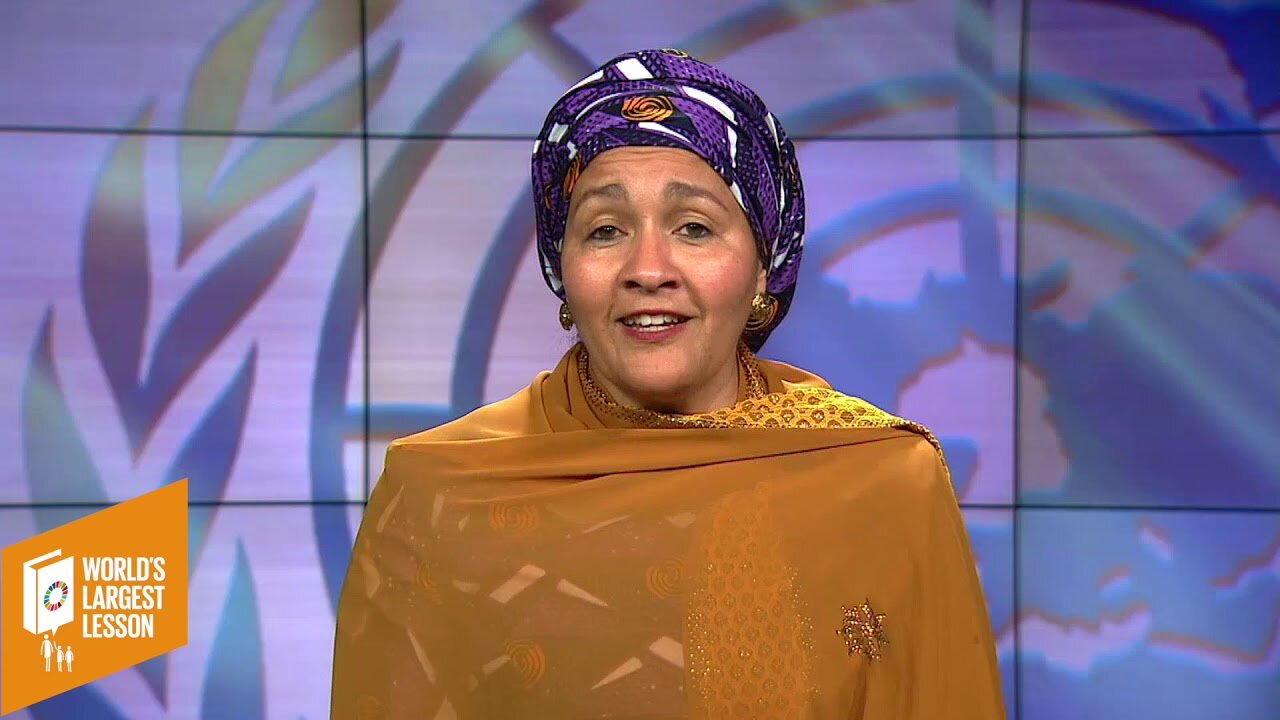
Amina J. Mohammed: 'In the Midst of Unprecedented, Unpredictable Technological Change', Mobile World Congress - 2019
25 February 2019, Barcelona, Spain
Address by Amina J. Mohammed, Deputy Secretary-General, United Nations
We are in the midst of technological change unprecedented in pace and scope and we cannot predict where it will lead.
What we do know, is that we need to start working much better together if we are to steer change for the good of all.
Within our lifetime, we’ve gone from digital technology being virtually unknown to now more than half of all humanity being connected to one another through the internet and mobile carriers.
Never before has a new technology spread so quickly. It took about fifty years in America for just a quarter of all households to adopt electricity. Access to the internet reached the same proportion of households in just seven years.
What will accelerating technological change mean for our children and our grandchildren?
Will they live in a world made more equitable, peaceful and just by technology or will they live in a world where technology has enabled the loss of privacy, increased autocratic control and fueled conflict and inequality?
How do we ensure that technology empowers us and doesn’t over-power us?
These are the critical questions of our time.
There are many reasons to be hopeful:
Past industrial revolutions have brought technological advances that improved living conditions for many and this digital age has great promise.
In agriculture with precision farming and the use of big data in weather forecasting, farmers are now more resilient against climate hazards.
In the health sector, we see frontier technologies related to genetics, vaccines, diagnosis aided by artificial intelligence and faster drug delivery saving thousands of lives, improving health outcomes and extending life expectancy.
Public services can grow more accessible, more accountable and inclusive thanks to digital identity powered by blockchain, facial recognition and other authentication technologies.
And while technology has been among the contributors to climate change, new and increasingly efficient technologies can now help us reduce net emission and create a cleaner world.
If we can work together to responsibly develop and implement such technologies, I believe we stand a better chance of achieving the Sustainable Development Goals by 2030 and passing on to the next generation a more equitable and prosperous planet.
But this future is not guaranteed.
Much with regard to our current path gives rise for concern:
The digital realm which we are embracing, and which increasingly also embraces us, reflects and exacerbates existing inequalities.
Today in the 21st century, in 2019, the proportion of women using the internet is 12 per cent lower than the proportion of men; this gender gap widens to 33 per cent in the least developed countries according to the ITU.
And it is not just access, women also have less opportunity: At the three major digital platforms, women make up less than 25 per cent of the technology staff.
And if they are looking for venture capital funding, women entrepreneurs can expect just two dollars for every 98 dollars given to male-founded start-ups.
While digital access and opportunity are critical issues, for millions of people in developing countries, technologies that were invented decades ago remain a dream.
I am talking about basic technology like modern sanitation or electricity. In many developing countries more people have access to mobile networks than to clean water.
Related to the issue of addressing inequality, there are ongoing concerns about how new technology will affect jobs. How can we prepare workers for an economy where accelerating technology adoption will disrupt tens of millions of jobs in a matter of years?
If there is a break-through in self-driving vehicles, what will happen to truck and taxi and car hire drivers? Is it likely that they can be absorbed by new jobs in coding or in e-commerce?
The reality is that these disruptions, if not well managed threaten to leave large proportions of our societies further behind, exacerbating inequality and polarization.
Beyond disruption to job markets, there are other emerging threats.
A significant increase in cyberattacks and cybercrimes are posing multiple challenges for governments, citizens and entrepreneurs.
Digital technology has introduced a whole new realm for inter-state conflict and for attacks by non-state actors be they privateers, terrorists or political activists.
Existing law, including international law applies to the digital domain but exactly how it is to be applied and how violators are to be reliably identified and held to account is not yet so clear.
Capacities among states to protect their citizens and companies against these threats, which by their nature have international reach, also differs enormously.
A related concern is that digital technology and the ubiquity of social media platforms, while doing so much to bring people together, can provide new scope for undermining democratic processes, for spreading toxic disinformation and disseminating hate speech.
The collection of data that fuels so much progress also poses critical new governance challenges on where the dividing line is to be drawn between the greater public good and the right to privacy, between the fundamental tenet of state sovereignty and the desirability of a free flow of information across borders.
Moreover, digital surveillance combined with artificial intelligence can help law enforcement but can also be used to violate privacy and persecute dissenting voices.
If we don’t better address these challenges, if we leave current negative trends inadequately attended to, we risk heading into a world where the convenience brought to many by technological progress, will be accompanied by societies that are more polarized, less democratic and with widening inequalities.
So, ladies and gentlemen, what can we do?
Let me propose four areas where I believe we need to focus efforts if we are to steer change and not just be victims of it.
First, we need to create the multi stakeholder, decentralized, cooperation mechanisms that will steer technological change for good.
The formulation of standards, of policies and norms at national, regional and at the international levels has not kept pace with the speed of new inventions and their applications.
In the past, new technology was largely government sponsored or quickly adopted and steered by governments. Today, industry and private enterprise are driving the changes. No direction can be set without them in a prominent seat at the table.
New approaches to governance need to be not only driven by all concerned stakeholders but also need to be faster and more nimble to keep up with the pace of change. Hence the need for decentralized networks rather than heavy, slow, top down approaches.
The difficulty of setting policy, of determining standards and where necessary, of creating norms for the digital realm should not distract us from its fundamental necessity. We can already see how our values, how our human rights, how our ethical standards can be undermined both through malicious use and unintended consequences. We cannot simply rely on the invisible hand of market dynamics to steer the way for us.
What would cooperative or governance frameworks look like that would measure up to the task?
The Secretary General convoked a high-level panel precisely to respond to this question. It is co led by a Melinda Gates and Jack Ma and made up of a group of distinguished entrepreneurs, academics, civil society representatives and senior members of government all working in the digital domain. They come from across the globe and the group is both gender-balanced and age diverse. It will present its report in June of this year.
A second area where we need to redouble our efforts is to ensure that the spread of digital technology is inclusive.
New technologies must be equally available within and among countries.
We must ensure that there are high quality networks for the poorest people and the poorest countries.
Inclusion also requires a recognition that the rights people have offline must also be protected online.
It is also critical for us to support leading innovators—including the many young entrepreneurs and women—who are demonstrating how intelligent connectivity can further development and well-being for all.
The companies that recognize the benefits of driving social good will be rewarded in the market place—many in the next generation of customers expect it and our planet desperately needs it.
A good example in this respect is the mobile industry’s Big Data for Social Good. It allows insights collected from mobile data to be used to support humanitarian action and promote peace. I encourage those of you who are not familiar with it to learn more about it and see how you can contribute to it.
A third area we need to focus on is education.
We need to repurpose our current education systems.
We need to invest in science, technology, engineering and mathematics. Where it does not exist, we need to add software coding to grade-school curricula.
We also need to teach much more about the interface of ethics and science, of human rights and technology, of sustainable development and technology.
But that is not enough: We need to repurpose our education systems for lifelong learning, for resilience and for emotional and social intelligence in the face of uncertainty and change.
Whatever skills are required at the beginning of a career are likely to be obsolete ten years later.
And careers that exist today may well no longer exist five or ten years from now.
The labour market will continue to increase in uncertainty and we must be prepared for that.
With the arrival of deep fakes and AI generated writing we will also need to educate ourselves and the next generation to better differentiate real from fake information.
This relates to the fourth area I want to highlight and that this event exemplifies: The need for greater reflection across disciplines.
As individuals, as parents, as societies, it is so easy, almost inevitable to get carried away by the current pace of change. Which one of us has not adapted to the 24/7 work environment made possible by our hand-held devices?
Which one of us has not used a mobile device to distract or entertain a small child as an alternative to human interaction?
Now I think we are beginning to learn we need to take a step back. We need to ask what excessive screen exposure does for the development of the young brain, what it does to our own mental health and well-being and what it does for the cohesion of our societies.
We need to reflect together across academic disciplines and across stakeholder groups. In the UN, the Secretary-General has challenged us all to get more tech savvy.
Likewise, I would argue business needs to grow more savvy about the social, ethical, political and development implications of the wave of technological change driving us on.
And we need to talk more to one another in events like the one today.
Ladies and gentlemen in conclusion,
The world we leave for those who come after us has to be a matter of our choice not a consequence of our neglect.
Do we want to have technology that enables an equitable, peaceful and just society, or will we live in a world where technology has enabled the loss of privacy, more autocratic control, more conflict, and more inequality?
My hope is that we will find new ways to bring governments, industry and civil society together to boost the opportunities and better manage the unintended and negative consequences.
In this era of accelerating change, technology can help us move from hope to reality. Let us embrace it and shape it for the betterment of all people, in particular those whom past and present generations have left behind.
Thank you.
Michael Gerson: 'In our right minds, we know that hope can grow within us', Sermon on Depression, National Cathedral - 2019
17 February 2019, National Cathedral, Washington DC, USA
When your Dean and I were conspiring about when I might speak, I think he mentioned February 3rd as a possibility. A sermon by me on that date would have been considerably less interesting, because I was, at that point, hospitalized for depression. Or maybe it would have been more interesting, though less coherent.
Like nearly one in ten Americans – and like many of you – I live with this insidious, chronic disease. Depression is a malfunction in the instrument we use to determine reality. The brain experiences a chemical imbalance and wraps a narrative around it. So the lack of serotonin, in the mind’s alchemy, becomes something like, “Everybody hates me.” Over time, despair can grow inside you like a tumor.
I would encourage anyone with this malady to keep a journal. At the bottom of my recent depression, I did a plus and minus, a pro and con, of me. Of being myself. The plus side, as you’d imagine, was short. The minus side included the most frightful clichés: “You are a burden to your friends.” “You have no future.” “No one would miss you.”
The scary thing is that these things felt completely true when I wrote them. At that moment, realism seemed to require hopelessness.
But then you reach your breaking point – and do not break. With patience and the right medicine, the fog in your brain begins to thin. If you are lucky, as I was, you encounter doctors and nurses who know parts of your mind better than you do. There are friends who run into the burning building of your life to rescue you, and acquaintances who become friends. You meet other patients, from entirely different backgrounds, who share your symptoms, creating a community of the wounded. And you learn of the valor they show in lonely rooms.
Over time, you begin to see hints and glimmers of a larger world outside the prison of your sadness. The conscious mind takes hold of some shred of beauty or love. And then more shreds, until you begin to think maybe, just maybe, there is something better on the far side of despair.
I have no doubt that I will eventually repeat the cycle of depression. But now I have some self-knowledge that can’t be taken away. I know that – when I’m in my right mind – I choose hope.
The phrase – “in my right mind” – is harsh. No one would use it in a clinical setting. But it fits my experience exactly.
In my right mind – when I am rested and fed, medicated and caffeinated – I know that I was living within a dismal lie.
In my right mind, I know I have friends who will not forsake me.
In my right mind, I know that chemistry need not be destiny.
In my right mind, I know that weeping may endure for the night, but joy comes in the morning.
This may have direct relevance to some here today. But I also think this medical condition works as a metaphor for the human condition.
All of us – whatever our natural serotonin level – look around us and see plenty of reason for doubt, anger and sadness. A child dies, a woman is abused, a schoolyard becomes a killing field, a Typhoon sweeps away the innocent. If we knew or felt the whole of human suffering, we would drown in despair. By all objective evidence, we are arrogant animals, headed for the extinction that is the way of all things. We imagine that we are like gods, and still drop dead like flies on the windowsill.
The answer to the temptation of nihilism is not an argument – though philosophy can clear away a lot of intellectual foolishness. It is the experience of transcendence we cannot explain, or explain away. It is the fragments of love and meaning that arrive out of the blue – in beauty that leaves a lump in your throat… in the peace and ordered complexity of nature… in the shadow and shimmer of a cathedral… in the unexplained wonder of existence itself.
I have one friend, John, who finds God’s hidden hand in the habits and coloring of birds. My friend Catherine, when her first child was born, discovered what she calls “a love much greater than evolution requires.” I like that. “A love much greater than evolution requires.”
My own experience is tied to this place. Let me turn to an earlier, happier part of my journals, from May 2nd, 2002:
“It has probably been a month,” I wrote, “since some prompting of God led me to a more disciplined Christian life. One afternoon I was led to the Cathedral, the place I feel most secure in the world. I saw the beautiful sculpture in the Bishop’s Garden – the prodigal son melting into his father’s arms – and the inscription how he fell on his neck, and kissed him. I felt tears and calm, like something important had happened to me and in me… My goals are pretty clear. I want to stop thinking about myself all the time. I want to be a mature disciple of Jesus, not a casual believer. I want to be God’s man.”
I have failed at these goals in a disturbing variety of ways. And I have more doubts than I did on that day. These kind of experiences may result from inspiration… or indigestion. Your brain may be playing tricks. Or you may be feeling the beating heart of the universe. Faith, thankfully, does not preclude doubt. It consists of staking your life on the rumor of grace.
This experience of pulling back the curtain of materiality, and briefly seeing the landscape of a broader world, comes in many forms. It can be religious and non-religious, Christian and non-Christian. We sometimes search for a hidden door when the city has a hundred open gates. But there is this difference for a Christian believer: At the end of all our striving and longing we find, not a force, but a face. All language about God is metaphorical. But the metaphor became flesh and dwelt among us.
Becoming alert to this reality might be called “enlightenment,” or the work of the Holy Ghost, or “conversion.” There really is no formula. Historically, there was Paul’s blinding light on the road to Damascus. There was Augustine, instructed by the voice of a child to “take up and read.” There was Pascal sewing into his jacket: “Since about half-past ten in the evening until about half-past midnight. FIRE. Certitude. Feeling. Joy. Peace.” There was Teresa of Avila encountering the suffering Christ with an “outpouring of tears.” There was John Wesley’s heart becoming “strangely warmed.”
Here is how G.K. Chesterton described this experience in a poem called “The Convert”:
“The sages have a hundred maps to giveThat trace their crawling cosmos like a tree,They rattle reason out through many a sieveThat stores the sand and lets the gold go free:And all these things are less than dust to meBecause my name is Lazarus and I live.”
It is impossible for anyone but saints to live always on that mountaintop. I suspect that there are people here today – and I include myself – who are stalked by sadness, or stalked by cancer, or stalked by anger. We are afraid of the mortality that is knit into our bones. We experience unearned suffering, or give unreturned love, or cry useless tears. And many of us eventually grow weary of ourselves – tired of our own sour company.
At some point, willed cheerfulness fails. Or we skim along the surface of our lives, afraid of what lies in the depths below. It is a way to cope, but no way to live.
I’d urge anyone with undiagnosed depression to seek out professional help. There is no way to will yourself out of this disease, any more than to will yourself out of tuberculosis.
There are, however, other forms of comfort. Those who hold to the wild hope of a living God can say certain things:
In our right minds – as our most sane and solid selves – we know that the appearance of a universe ruled by cruel chaos is an lie and that the cold void is actually a sheltering sky.
In our right minds, we know that life is not a farce but a pilgrimage – or maybe a farce and a pilgrimage, depending on the day.
In our right minds, we know that hope can grow within us – like a seed, like a child.
In our right minds, we know that transcendence sparks and crackles around us – in a blinding light, and a child’s voice, and fire, and tears, and a warmed heart, and a sculpture just down the hill – if we open ourselves to seeing it.
Fate may do what it wants. But this much is settled. In our right minds, we know that love is at the heart of all things.
Many, understandably, pray for a strength they do not possess. But God’s promise is somewhat different: That even when strength fails, there is perseverance. And even when perseverance fails, there is hope. And even when hope fails, there is love. And love never fails.
So how do we know this? How can anyone be so confident?
Because we are Lazarus, and we live.
Stephen Hawking: 'Black holes ain't as black as they are painted', On Black Holes and Depression, Reith Lectures - 2016
7 January 2016, Royal Institution, London, United Kingdom
The most quoted part of these two lectures is an aside about mental health immediately below. See below that for full transcript of lectures about black holes.
The message of this lecture is that black holes ain't as black as they are painted. They are not the eternal prisons they were once thought.
Things can get out of a black hole both on the outside and possibly to another universe. So if you feel you are in a black hole, don't give up – there's a way out.
Although it was unfortunate to get motor neurone disease, I have been very fortunate in almost everything else.
I have been lucky to work in theoretical physics at a fascinating time and it' s one of the few areas in which my disability was not a serious handicap.
It's also important not to become angry, no matter how difficult life may seem because you can lose all hope if you can't laugh at yourself and life in general.
This is from Hawking’s Reith Lectures
Lecture 1: ‘Do Black Holes Have No Hair’
My talk is on black holes. It is said that fact is sometimes stranger than fiction, and nowhere is that more true than in the case of black holes.
Black holes are stranger than anything dreamed up by science fiction writers, but they are firmly matters of science fact. The scientific community was slow to realize that massive stars could collapse in on themselves, under their own gravity, and how the object left behind would behave.
Albert Einstein even wrote a paper in 1939, claiming stars could not collapse under gravity, because matter could not be compressed beyond a certain point. Many scientists shared Einstein's gut feeling.
The principal exception was the American scientist John Wheeler, who in many ways is the hero of the black hole story. In his work in the 1950s and '60s, he emphasized that many stars would eventually collapse, and the problems that posed for theoretical physics.
He also foresaw many of the properties of the objects which collapsed stars become, that is, black holes.
DS: The phrase 'black hole' is simple enough but it's hard to imagine one out there in space. Think of a giant drain with water spiralling down into it. Once anything slips over the edge or 'event horizon', there is no return. Because black holes are so powerful, even light gets sucked in so we can't actually see them. But scientists know they exist because they rip apart stars and gas clouds that get too close to them.
During most of the life of a normal star, over many billions of years, it will support itself against its own gravity, by thermal pressure, caused by nuclear processes, which convert hydrogen into helium.
DS: NASA describes stars as rather like pressure-cookers. The explosive force of nuclear fusion inside them creates outward pressure which is constrained by gravity pulling everything inwards.
Eventually, however, the star will exhaust its nuclear fuel. The star will contract. In some cases, it may be able to support itself as a white dwarf star.
However Subrahmanyan Chandrasekhar showed in 1930, that the maximum mass of a white dwarf star is about 1.4 times that of the Sun.
A similar maximum mass was calculated by Soviet physicist, Lev Landau, for a star made entirely of neutrons.
DS: White dwarfs and neutron stars have exhausted their fuel so they have shrunk to become some of the densest objects in the universe. Most interesting to Stephen Hawking is what happens when the very biggest stars collapse in on themselves.
What would be the fate of those countless stars, with greater mass than a white dwarf or neutron star, when they had exhausted nuclear fuel?
The problem was investigated by Robert Oppenheimer, of later atom bomb fame. In a couple of papers in 1939, with George Volkoff and Hartland Snyder, he showed that such a star could not be supported by pressure.
And that if one neglected pressure, a uniform spherically systematic symmetric star would contract to a single point of infinite density. Such a point is called a singularity.
DS: A singularity is what you end up with when a giant star is compressed to an unimaginably small point. This concept has been a defining theme in Stephen Hawking's career. It refers to the end of a star but also something more fundamental: that a singularity was the starting-point for the formation of the entire universe. It was Hawking's mathematical work on this that earned him global recognition.
All our theories of space are formulated on the assumption that spacetime is smooth and nearly flat, so they break down at the singularity, where the curvature of space-time is infinite.
In fact, it marks the end of time itself. That is what Einstein found so objectionable.
DS: Einstein's Theory of General Relativity says that objects distort the spacetime around them. Picture a bowling-ball lying on a trampoline, changing the shape of the material and causing smaller objects to slide towards it. This is how the effect of gravity is explained. But if the curves in spacetime become deeper and deeper, and eventually infinite, the usual rules of space and time no longer apply.
Then the war intervened.
Most scientists, including Robert Oppenheimer, switched their attention to nuclear physics, and the issue of gravitational collapse was largely forgotten. Interest in the subject revived with the discovery of distant objects, called quasars.
DS: Quasars are the brightest objects in the universe, and possibly the most distant detected so far. The name is short for 'quasi-stellar radio sources' and they are believed to be discs of matter swirling around black holes.
The first quasar, 3C273, was discovered in 1963. Many other quasars were soon discovered. They were bright, despite being at great distances.
Nuclear processes could not account for their energy output, because they release only a percent fraction of their rest mass as pure energy. The only alternative was gravitational energy, released by gravitational collapse.
Gravitational collapses of stars were re-discovered. It was clear that a uniform spherical star would contract to a point of infinite density, a singularity.
The Einstein equations can't be defined at a singularity. This means at this point of infinite density, one can't predict the future.
This implies something strange could happen whenever a star collapsed. We wouldn't be affected by the breakdown of prediction, if the singularities are not naked, that is, they are not shielded from the outside.
DS: A 'naked' singularity is a theoretical scenario in which a star collapses but an event horizon does not form around it - so the singularity would be visible.
When John Wheeler introduced the term black hole in 1967, it replaced the earlier name, frozen star. Wheeler's coinage emphasized that the remnants of collapsed stars are of interest in their own right, independently of how they were formed.
The new name caught on quickly. It suggested something dark and mysterious, But the French, being French, saw a more risque meaning.
For years, they resisted the name trou noir, claiming it was obscene. But that was a bit like trying to stand against Le Week-end, and other Franglais. In the end, they had to give in. Who can resist a name that is such a winner?
From the outside, you can't tell what is inside a black hole. You can throw television sets, diamond rings, or even your worst enemies into a black hole, and all the black hole will remember is the total mass, and the state of rotation.
John Wheeler is known for expressing this principle as "a black hole has no hair". To the French, this just confirmed their suspicions.
A black hole has a boundary, called the event horizon. It is where gravity is just strong enough to drag light back, and prevent it escaping.
Because nothing can travel faster than light, everything else will get dragged back also. Falling through the event horizon is a bit like going over Niagara Falls in a canoe.
If you are above the falls, you can get away if you paddle fast enough, but once you are over the edge, you are lost. There's no way back. As you get nearer the falls, the current gets faster. This means it pulls harder on the front of the canoe than the back. There's a danger that the canoe will be pulled apart.
It is the same with black holes. If you fall towards a black hole feet first, gravity will pull harder on your feet than your head, because they are nearer the black hole.
The result is you will be stretched out longwise, and squashed in sideways. If the black hole has a mass of a few times our sun you would be torn apart, and made into spaghetti before you reached the horizon.
However, if you fell into a much larger black hole, with a mass of a million times the sun, you would reach the horizon without difficulty.
So, if you want to explore the inside of a black hole, make sure you choose a big one. There is a black hole with a mass of about four million times that of the sun, at the centre of our Milky Way galaxy.
DS: Scientists believe that there are huge black holes at the centre of virtually all galaxies - a remarkable thought, given how recently these features were confirmed in the first place.
Lecture 2: ‘Black Holes Aint as Black as They’re Painted’
In my previous lecture I left you on a cliff-hanger: a paradox about the nature of black holes, the incredibly dense objects created by the collapse of stars.
One theory suggested that black holes with identical qualities could be formed from an infinite number of different types of stars. Another suggested that the number could be finite.
This is a problem of information, that is the idea that every particle and every force in the universe contains information, an implicit answer to a yes-no question.
Because black holes have no hair, as the scientist John Wheeler put it, one can't tell from the outside what is inside a black hole, apart from its mass, electric charge, and rotation.
This means that a black hole contains a lot of information that is hidden from the outside world. If the amount of hidden information inside a black hole depends on the size of the hole, one would expect from general principles that the black hole would have a temperature, and would glow like a piece of hot metal.
But that was impossible, because as everyone knew, nothing could get out of a black hole. Or so it was thought.
This problem remained until early in 1974, when I was investigating what the behaviour of matter in the vicinity of a black hole would be, according to quantum mechanics.
DS: Quantum mechanics is the science of the extremely small and it seeks to explain the behaviour of the tiniest particles. These do not act according to the laws that govern the movements of much bigger objects like planets, laws that were first framed by Isaac Newton. Using the science of the very small to study the very large was one of Stephen Hawking's pioneering achievements.
Image copyright Science Photo Library
Image caption Quantum mechanics is a branch of physics that describes particles in terms of quanta, discrete values rather than smooth changes
To my great surprise I found that the black hole seemed to emit particles at a steady rate. Like everyone else at that time, I accepted the dictum that a black hole could not emit anything. I therefore put quite a lot of effort into trying to get rid of this embarrassing effect.
But the more I thought about it, the more it refused to go away, so that in the end I had to accept it.
What finally convinced me it was a real physical process was that the outgoing particles have a spectrum that is precisely thermal.
My calculations predicted that a black hole creates and emits particles and radiation, just as if it were an ordinary hot body, with a temperature that is proportional to the surface gravity, and inversely proportional to the mass.
DS: These calculations were the first to show that a black hole need not be a one-way street to a dead end. No surprise, the emissions suggested by the theory became known as Hawking Radiation.
Since that time, the mathematical evidence that black holes emit thermal radiation has been confirmed by a number of other people with various different approaches.
One way to understand the emission is as follows. Quantum mechanics implies that the whole of space is pairs of virtual and anti particles, filled with pairs of virtual particles and antiparticles, that are constantly materialising in pairs, separating, and then coming together again, and annihilating each other.
DS: This concept hinges on the idea that a vacuum is never totally empty. According to the uncertainty principle of quantum mechanics, there is always the chance that particles may come into existence, however briefly. And this would always involve pairs of particles, with opposite characteristics, appearing and disappearing.
These particles are called virtual because unlike real particles they cannot be observed directly with a particle detector.
Their indirect effects can nonetheless be measured, and their existence has been confirmed by a small shift, called the Lamb shift, which they produce in the spectrum energy of light from excited hydrogen atoms.
Now in the presence of a black hole, one member of a pair of virtual particles may fall into the hole, leaving the other member without a partner with which to annihilate.
The forsaken particle or antiparticle may fall into the black hole after its partner, but it may also escape to infinity, where it appears to be radiation emitted by the black hole.
Other scientists who have given Reith Lectures include Robert Oppenheimer, Martin Rees and Bernard Lovell. You can listen to them here.
DS: The key here is that the formation and disappearance of these particles normally pass unnoticed. But if the process happens right on the edge of a black hole, one of the pair may get dragged in while the other is not. The particle that escapes would then look as if it's being spat out by the black hole.
A black hole of the mass of the sun, would leak particles at such a slow rate, it would be impossible to detect. However, there could be much smaller mini black holes with the mass of say, a mountain.
A mountain-sized black hole would give off X-rays and gamma rays, at a rate of about 10 million megawatts, enough to power the world's electricity supply.
It wouldn't be easy however, to harness a mini black hole. You couldn't keep it in a power station, because it would drop through the floor and end up at the centre of the Earth.
If we had such a black hole, about the only way to keep hold of it would be to have it in orbit around the Earth.
People have searched for mini black holes of this mass, but have so far not found any. This is a pity, because if they had I would have got a Nobel Prize.
Another possibility, however, is that we might be able to create micro black holes in the extra dimensions of space time.
DS: By 'extra dimensions', he means something beyond the three dimensions that we are all familiar with in our everyday lives, plus the fourth dimension of time. The idea arose as part of an effort to explain why gravity is so much weaker than other forces such as magnetism - maybe it's also having to operate in parallel dimensions.
The movie Interstellar gives some idea of what this is like. We wouldn't see these extra dimensions because light wouldn't propagate through them but only through the four dimensions of our universe.
Gravity, however, would affect the extra dimensions and would be much stronger than in our universe. This would make it much easier to form a little black hole in the extra dimensions.
It might be possible to observe this at the LHC, the Large Hadron Collider, at CERN in Switzerland. This consists of a circular tunnel, 27 kilometres long. Two beams of particles travel round this tunnel in opposite directions, and are made to collide. Some of the collisions might create micro black holes. These would radiate particles in a pattern that would be easy to recognize.
So I might get a Nobel Prize after all.
DS: The Nobel Prize in Physics is awarded when a theory is "tested by time" which in practice means confirmation by hard evidence. For example, Peter Higgs was among scientists who, back in the 1960s, suggested the existence of a particle that would give other particles their mass. Nearly 50 years later, two different detectors at the Large Hadron Collider spotted signs of what had become known as the Higgs Boson. It was a triumph of science and engineering, of clever theory and hard-won evidence. And Peter Higgs and Francois Englert, a Belgian scientist, were jointly awarded the prize. No physical proof has yet been found of Hawking Radiation.
Other related content
Other scientists who have given Reith Lectures include Robert Oppenheimer, Martin Rees and Bernard Lovell. You can listen to them here.
As particles escape from a black hole, the hole will lose mass, and shrink. This will increase the rate of emission of particles.
Eventually, the black hole will lose all its mass, and disappear. What then happens to all the particles and unlucky astronauts that fell into the black hole? They can't just re-emerge when the black hole disappears.
It appears that the information about what fell in is lost, apart from the total amount of mass, and the amount of rotation. But if information is lost, this raises a serious problem that strikes at the heart of our understanding of science.
For more than 200 years, we have believed in scientific determinism, that is, that the laws of science determine the evolution of the universe. This was formulated by Pierre-Simon Laplace, who said that if we know the state of the universe at one time, the laws of science will determine it at all future and past times.
Napoleon is said to have asked Laplace how God fitted into this picture. Laplace replied, "Sire, I have not needed that hypothesis."
I don't think that Laplace was claiming that God didn't exist. It is just that he doesn't intervene to break the laws of science. That must be the position of every scientist. A scientific law is not a scientific law if it only holds when some supernatural being decides to let things run and not intervene.
In Laplace's determinism, one needed to know the positions and speeds of all particles at one time, in order to predict the future. But there's the uncertainty relationship, discovered by Walter Heisenberg in 1923, which lies at the heart of quantum mechanics.
Image copyright Science Photo Library
Image caption Pierre-Simon Laplace formulated the law of scientific determinism
This holds that the more accurately you know the positions of particles, the less accurately you can know their speeds, and vice versa. In other words, you can't know both the positions and the speeds accurately.
How then can you predict the future accurately? The answer is that although one can't predict the positions and speeds separately, one can predict what is called the quantum state. This is something from which both positions and speeds can be calculated to a certain degree of accuracy.
We would still expect the universe to be deterministic, in the sense that if we knew the quantum state of the universe at one time, the laws of science should enable us to predict it at any other time.
DS: What began as an explanation of what happens at an event horizon has deepened into an exploration of some of the most important philosophies in science - from the clockwork world of Newton to the laws of Laplace to the uncertainties of Heisenberg - and where they are challenged by the mystery of black holes. Essentially, information entering a black hole should be destroyed, according to Einstein's Theory of General Relativity while quantum theory says it cannot be broken down, and this remains an unresolved question.
If information were lost in black holes, we wouldn't be able to predict the future, because a black hole could emit any collection of particles.
It could emit a working television set, or a leather-bound volume of the complete works of Shakespeare, though the chance of such exotic emissions is very low.
It might seem that it wouldn't matter very much if we couldn't predict what comes out of black holes. There aren't any black holes near us. But it is a matter of principle.
If determinism, the predictability of the universe, breaks down with black holes, it could break down in other situations. Even worse, if determinism breaks down, we can't be sure of our past history either.
The history books and our memories could just be illusions. It is the past that tells us who we are. Without it, we lose our identity.
It was therefore very important to determine whether information really was lost in black holes, or whether in principle, it could be recovered.
Many scientists felt that information should not be lost, but no one could suggest a mechanism by which it could be preserved. The arguments went on for years. Finally, I found what I think is the answer.
It depends on the idea of Richard Feynman, that there isn't a single history, but many different possible histories, each with their own probability.
In this case, there are two kinds of history. In one, there is a black hole, into which particles can fall, but in the other kind there is no black hole.
The point is that from the outside, one can't be certain whether there is a black hole or not. So there is always a chance that there isn't a black hole.
This possibility is enough to preserve the information, but the information is not returned in a very useful form. It is like burning an encyclopaedia. Information is not lost if you keep all the smoke and ashes, but it is difficult to read.
The scientist Kip Thorne and I had a bet with another physicist, John Preskill, that information would be lost in black holes. When I discovered how information could be preserved, I conceded the bet. I gave John Preskill an encyclopaedia. Maybe I should have just given him the ashes.
DS: In theory, and with a purely deterministic view of the universe, you could burn an encyclopaedia and then reconstitute it if you knew the characteristics and position of every atom making up every molecule of ink in every letter and kept track of them all at all times.
Image copyright Thinkstock
Image caption Information is there, but not useful 'like burning an encyclopaedia'
Currently I'm working with my Cambridge colleague Malcolm Perry and Andrew Strominger from Harvard on a new theory based on a mathematical idea called supertranslations to explain the mechanism by which information is returned out of the black hole.
The information is encoded on the horizon of the black hole. Watch this space.
DS: Since the Reith Lectures were recorded, Prof Hawking and his colleagues have published a paper which makes a mathematical case that information can be stored in the event horizon. The theory hinges on information being transformed into a two-dimensional hologram in a process known as supertranslations. The paper, titled Soft Hair on Black Holes, offers a highly revealing glimpse into the esoteric language of this field and the challenge that scientists face in trying to explain it.
What does this tell us about whether it is possible to fall in a black hole, and come out in another universe? The existence of alternative histories with black holes suggests this might be possible. The hole would need to be large, and if it was rotating, it might have a passage to another universe.
But you couldn't come back to our universe. So although I'm keen on space flight, I'm not going to try that.
DS: If black holes are rotating, then their heart may not consist of a singularity in the sense of an infinitely dense point. Instead, there may be a singularity in the form of a ring. And that leads to speculation about the possibility of not only falling into a black hole but also travelling through one. This would mean leaving the universe as we know it. And Stephen Hawking concludes with a tantalising thought: that there may something on the other side.
The message of this lecture is that black holes ain't as black as they are painted. They are not the eternal prisons they were once thought. Things can get out of a black hole, both to the outside, and possibly to another universe.
So if you feel you are in a black hole, don't give up. There's a way out.
Thank you very much.
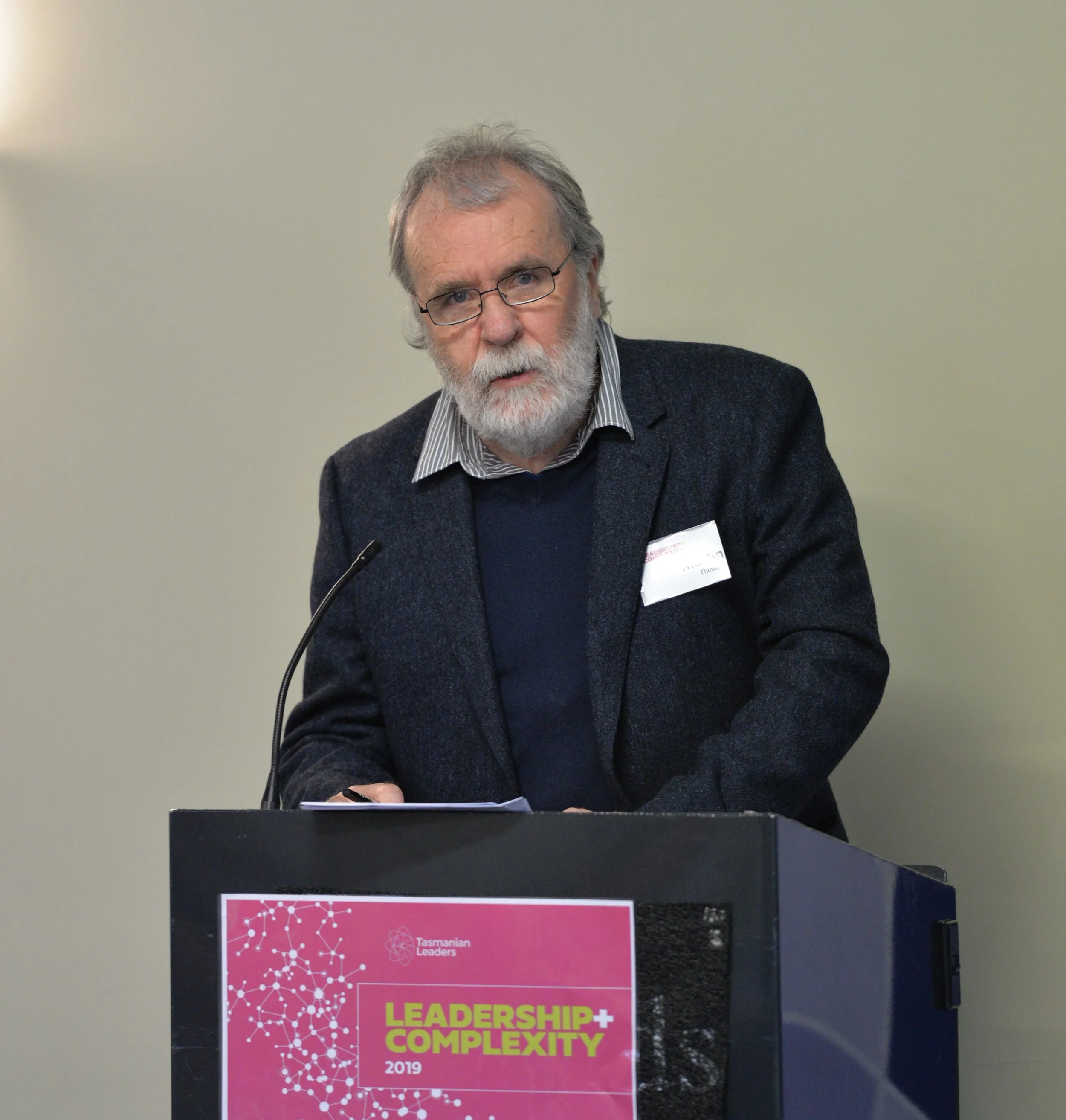
Martin Flanagan: 'Staying Sane, keeping your balance, in the Post-truth era', Leadership + Complexity Conference - 2019
6 September 2019, Launceston, Tasmania, Australia
1.
I am a Tasmanian who has lived for the past 35 years in Victoria. What has become apparent to me over that time is this major difference between the two places: Tasmania, in its origins, is Georgian, and Victoria, in its origins, is Victorian.
The difference between the Georgian and Victorian eras is about vastly more than different tastes in architecture and furniture. The two historical eras had profoundly different ways of thinking about human society & what we owe our fellow human beings.
In 1803, when Tasmania was founded as Van Diemen’s Land, Britain was the biggest trafficker of human slaves in the world. The financial interests behind this horrific practice forged the most powerful political lobby group in the country - they owned a block of seats in the British parliament and had high-profile public champions like the future monarch William IV and the great military hero of the day, Horatio Nelson The slave trade had insinuated itself deeply into the British political system in the same way that, in our own time, the NRA has insinuated its way into the American political system, throttling gun law reform.
By the time Victoria was declared an independent colony in 1850, the slave trade had been outlawed by the British parliament. A huge battle had been fought, a huge victory won. For the first time in British political history, people had campaigned politically for the rights of people other than themselves. That’s a huge shift in public consciousness and one that confounded the conservatives of the day. Lord Abingdon, one of slavery’s defenders, had declared, “Feelings of humanity are a private matter and not the basis of public policy”. In the Victorian age, feelings of humanity did indeed become the basis of public policy. And that was another huge shift in the public consciousness.
During the Victorian Age, Britain saw reforms across a whole range of areas - prisons, education, child labour, extending the vote.... It was the Victorians who invented the idea of “progress”. In our own time, that idea has been diminished to mean only economic progress, but, originally, to the Victorians, it also meant social and moral progress. Hence we get the phrase “Victorian morality” which was, among other things, prudish about sex. No-one ever accused the Georgians of being prudish about sex.
So how does any of this impact on Tasmania and Victoria? Well, to begin with, there is a whole chapter of history that Tasmania possesses that Victoria does not. There are characters in Tasmanian history who have no equivalent in Victorian history like one of my journalistic heroes Henry Melville, who wrote “The History of Van Diemen’s Land 1816-36” from the condemned cell in Hobart prison where Governor Arthur had placed him.
But that first chapter in this island’s colonial history came at a price. In the words of historian Ros Haynes “The imagery associated with Van Diemen's Land was too deeply rooted in the history and the literary culture of the island. It lingered on as a malaise, as a sense of inferiority to 'the mainland' “. This was compounded by a corresponding sense of superiority among a certain sort of Victorians. Tasmania, I once wrote, was colonised twice, once by England and once by Victoria.
2.
My subject today is living with the complexity of our times, so why am I talking about history? Because we are all part of a continuum that started long before we were born and will continue long after we are dead. To put it another way: I best understand life through understanding, or seeking to understand, the bigger story that is history. A Jewish man I knew who sold shoes at South Melbourne market used to talk to me about history. I thought he had an opinion worth listening to, having survived the Nazi occupation of his home country, Hungary, during World War 2, and then escaped from the Communist regime which followed. The shoe-seller told me history is like a river. Sometimes it moves so slowly it feels like it’s not moving at all, then it speeds up and suddenly it’s rushing and you’re going over a waterfall. I think we are about to go over a waterfall – if, in fact, we have not already gone over it.
My fear is that we are entering, or have entered, a new technologically enhanced Dark Age, one that currently finds its lead actor in Donald Trump whose depth of character was best summed up, I think, in a story which appeared last Sunday week in the Washington Post about a reluctant visit Trump made in 2017 to the National Museum of African American History and Culture in Washington. Having paused at a display on the Dutch role in the global slave trade, Trump turned and, by way of a response, remarked to the museum’s founding director, “You know, they love me in the Netherlands.”
This is a man with more than 20 allegations of sexual abuse against him, including one by a woman saying she was procured for Trump by Jeffrey Epstein as a 13-year-old. It is a measure of the strangeness of our times that, not only do these allegations have about as much lasting consequence as sports scores, there are Christian evangelists in the United States who see Trump, literally, as an agent of God.
So what has this to do with Australia? Everything. Sky News in Australia has adopted the lead of Fox News in America where it has been described – fairly, in my opinion – as the propaganda wing of the Trump-era Republican Party. Both organizations are owned by Rupert Murdoch’s News Corp which also dominates the Australian newspaper market. When Pauline Hanson advised the voters of Western Australia prior to the last State election that Vladimir Putin was “a man of vision”, it was because she saw an idea that was working for Donald Trump and thought she’d try it here. More recently, during the George Pell trial, I was surprised to see one tweeter describe Pell as a Christian saint. I went to the tweeter’s home page. He is – or, at least, sees himself as - a highly devout English Catholic. In addition to Pell, the two other causes dear to his heart were Donald Trump and Brexit. What historical forces unite George Pell, Donald Trump and Brexit? I think I know what a feminist, particularly a feminist of colour, would say.
3.
How did we end up in this weird place? Clearly, technology has simultaneously both empowered and disempowered us. From my perspective as a journalist with an eye on the public realm, there are four obvious dynamics at work. One is the internet and social media – again, both carry and disperse a wealth of knowledge and a wealth of ignorance. Connected to this is a loss of faith in education, particularly public education. One hundred years ago, people working for a better world proceeded in the faith that government education would, as a matter of course, produce more enlightened societies. Now we are dropping back to the view that education is a means to the end of individual advancement and, following from this, something only the better-off can afford. The result? Greater public ignorance. A third factor is that we now have a whole new level of sophistication in political propaganda using – or, rather, manipulating - platforms like Facebook. Cambridge Analytica worked in this way with both the Trump election campaign in 2016 and the Brexit Leave campaign. I saw an interview with one of the Cambridge Analytica directors in which he said that politics is essentially a matter of feeling, not thought. That is, by appealing directly to feeling – and, in many cases, by feeling we actually mean prejudice and fear – a person or political organization can circumvent the need for thought, for reason and knowledge, for rational debate.
The fourth factor that I see at work is the 24-hour news cycle. In the 24-hour news cycle, a story is replaced as soon as its loses its value as a sensation, the sensation that makes you go, “I want to look at that”, like you do with an ad in a brochure. What this means that serious political stories never catch up with those who stand accused by them.. Someone like Trump is a master at playing the 24 hour news cycle, spinning it like a chocolate wheel. I want to buy Greenland, he declares - Greenland doesn’t want to be bought, Trump is insulted and says America’s been insulted. He’s led the news for three days with a complete non-story that serves as camouflage. Meanwhile, income inequality rates are surging both in the US and here back to levels not seen for 100 years or more.
Russian president Vladimir Putin has said recently that the era of what he called “western liberalism” is over. He may be right. That may be the best description of the historic change we’re seeing. The Russian media portray American democracy as “a circus”, thereby making Putin’s regime look to have the virtue of sober good order. How better to make that metaphor come true than by helping to install Donald Trump as the ringmaster. Recently, I saw a clip of Steve Bannon – a common link between Trump and Brexit and Cambridge Analytica – tell a crowd of French ultra-right followers of Marine Le Pen, “We are winning”. Bannon may be right. Last year, I did a public interview with Richard Branson at the National Gallery of Victoria. He said he believed democracy was under attack around the globe. So do I. Putin’s Russia is a fake democracy. Donald Trump has no problem with that. The Prime Ministers of Great Britain and Australia have expressed their eagerness to work with Trump.
The world is in a turmoil of change. Traditionally, Australia has been relatively protected from global forces. That may be about to change. Last year, as a shack owner at Dolphin Sands on the east coast of Tasmania, I was taken aback to learn that a giant megadevelopment at the Cambria Green estate on Dolphin Sands had been announced in the Chinese media as a fait accompli, before mention of it even being a possibility had appeared in the Tasmanian press. A number of the local councillors knew nothing of it until four days before the council meeting approved the 1st stage and what we still don’t is the relationship between the Chinese investors and the government of the People’s Republic of China. Investigating this matter, I learned many things. One was that 24 % of agricultural land in Tasmania is leased or owned by foreigners. Last week, a UN committee said food security and water security are going to be two of the major issues of the 21st century.
Most Australians seem not to give a thought to the fact that we are committed to supporting Japan and the United States against China militarily in the event of hostilities in the South China sea. That is, we will be at war with our major trading partner, a recipe, I would have thought, for chaos. This is one of the many things we really should be talking about. But are not. Instead, as I write, we’re talking about Boris Johnson, the comedy actor who could have stepped out of a Bertie Wooster novel and can tell as many lies as Donald Trump, only a lot more eloquently.
4.
So how do I steady myself? How do I respond to the dizzy complexity of our times? I reach for what’s timeless. I will seek to explain by telling a story. A football story. From the time I was 11 and found myself in a not very happy place, a Catholic boarding school on the north-west coast of Tasmania that has been much in the news of late, sport has been an escape for me, a beautiful distraction, one I happen to understand because my family’s been involved with it for generations.
Two years ago, I interviewed an AFL player, a fine young man called Jordan Roughead, for a book I wrote on the 2016 Bulldogs premiership. Jordan has a social conscience and is determined to stand up for the powerless but when I asked him about politics, he recoiled as if he’d seen a snake and said with passion, “I don’t have anything to do with politics!”. I immediately thought of something that was said 2500 years ago by a Greek statesman and soldier called Pericles: “Just because you don’t have an interest in politics doesn’t mean politics won’t have an interest in you”. If you asked anyone in Hong Kong right now what Pericles meant, I think they could tell you in a few short, sharp sentences.
It is said Trump has led us into the post-truth era. That’s a truly frightening idea – a world without any truth would be a very dark place where random attacks could happen at any moment and go unpunished. But I would argue the term “the post-truth era” is too absolute because there are truths that endure. There is a reason we are still repeating something Pericles said 500 years before the birth of Christ, and the reason is that when ideas are expressed accurately and with precision, they become like tools people carry through the generations proving their worth through use over and over and over again. To quote Pericles once more, “Time is the wisest counsellor”.
I never cease to be amazed by what people thought and said in other times, sometimes thousands of years ago. We think we’re “modern”, that we exist in a time apart. My book on the Western Bulldogs’ premiership naturally dealt with the philosophy of coach Luke Beveridge. What was remarkable to me about that premiership was that everyone at the club from the doormen to the women doing secretarial duties thought they played a part in winning it. The players thought that, too. They were a team that existed as a part of a mass movement and thought it odd when I asked questions which suggested otherwise. In the end, I remembered something Lao Tszu, the Chinese sage said, again around 2500 years ago. “When the best leader's work is done the people say, "We did it ourselves." “
The Romans had a quality they prized called “gravitas” from which the word gravity later came. A person with gravitas was someone whose views were given weight by his listeners. Aristotle said this respect was a function of the character of the speaker. The person with the greatest gravitas in Australian public life right now that I have encountered is Aboriginal leader and Labor Senator Patrick Dodson. An example of an Australian political utterance of recent times with gravitas is the Uluru statement. It was swept to one side at the last election but that doesn’t mean it’s gone away. It never will.
One of my favourite Tasmanian stories occurred in the early 1820s on the east coast. A major character in the history of this island called George Augustus Robinson met some members of the Great Oyster Bay tribe who told him their ancestors had come to the island we now call Tasmania via a land bridge across what we now call Bass Strait and that the sea had closed behind them, cutting them off. No-one believed them. We now know it’s true. That means they carried that story accurately within their culture for something like 8000 year or four times the length of the entire history of the Christian religion.
Earlier this year, I was invited to give a speech during Reconciliation Week at Melbourne Grammar which is on the traditional lands of the Bunurong people. I told the boys that the Bunurong people, to this day, carry a story about Port Phillip Bay when it was dry, when it was a grass plain with trees and a river running through it. The reason the Bunurong remember this story is because it was their land and they lost it through this prehistoric act of climate change.
The Aboriginal spirit who presides over Melbourne, together with Waa the crow, is Bunjil the eagle. The Bunurong story says that when the people asked Bunjil why they had lost their land, he gave them two reasons – one, they were getting involved in needless wars with their neighbours, two, because they were killing female fish before they spawned. That is, they were sinning against the future. The common factor in indigenous law-making around the globe has always involved asking the question: how will this effect the generations of our people still to come? I get that. I’m a grandfather. I look at extinction rates for animal and insect species over the past 40 years and wonder, yet again, what is going to be left for my grandchildren and their children. I also wonder how the collapse of various species is going to impact on the eco-systems they inhabit. This is where we encounter another complexity that is relative to our times. The complexity of nature.
It’s commonly said that those who don’t understand the mistakes of the past are condemned to repeat them. That’s true. But it’s also true that those who don’t learn about history are also denied the strength, the courage, the inspiration, to be had from the victories of the past. No tyrant, no despot, no monarch, ever wanted democracy. Somehow it was won. The British political system did not want to end the slave trade, being deeply implicated in its profits. Somehow that was won. There was entrenched opposition to extending the vote, initially to all men, and later to women. Somehow both causes were won....the only strength we have is the strength we have in coming together and it’s got to start generating from meetings like this.
Last year, I MCed a protest rally against the Cambria Green megadevelopment in the Hobart Town Hall which saw me labelled as a left-wing greenie but which I saw as an issue of democracy. Two weeks later, I MC’d a function titled Capitalism With A Conscience at the National Gallery of Victoria which was hosted by Melbourne entrepreneur Radek Sali for the benefit of an organization called Igniting Change which is run by a remarkable woman called Jane Tewson. Fifteen hundred people attended and, in the course of the night, I interviewed entrepreneur Richard Branson on stage.
Branson believes climate change represents the biggest threat to the world since World War 2, in which 60 million people died. That may sound outlandish but if climate change catastrophes start kicking in we could have hundreds of millions of people on the move around the globe. Branson believes if governments cannot, or will not, take action on climate change, business will have to. Not long after we spoke, Saudi Arabian journalist Jamal Kashogghi was brutally murdered and dismembered in a Saudi consulate in Turkey. Trump, who has business interests in Saudi Arabia, avoided comment. Richard Branson issued a statement saying that if the details of the murder were proved true, western businesses would have to reconsider doing business with Saudi Arabia. That’s leadership.
Do I agree with everything Richard Branson says and does? No. But I’m open to dialogue with him and people like him. As is evidenced by the Brexit crisis in Britain, which is going to split the Conservative Party and possibly lead to the disintegration of the United Kingdom, we are in a period when the political definitions which have sustained us for half a century are breaking apart and political forces are re-aligning. Would it bother me if women took the balance of leadership roles? No. I think we’ve got bigger problems than gender disputes. I want to hear from people with gravitas.
Martin Flanagan was speaking at a conference organised by Tasmanian Leaders.
Greta Thunberg: 'How dare you', UN Climate Action Summit - 2019
23 September 2019, New York City, USA
Thunberg responds to a question about the message she has for world leaders.
My message is that we'll be watching you.
This is all wrong. I shouldn't be up here. I should be back in school on the other side of the ocean. Yet you all come to us young people for hope. How dare you!
You have stolen my dreams and my childhood with your empty words. And yet I'm one of the lucky ones. People are suffering. People are dying. Entire ecosystems are collapsing. We are in the beginning of a mass extinction, and all you can talk about is money and fairy tales of eternal economic growth. How dare you!
For more than 30 years, the science has been crystal clear. How dare you continue to look away and come here saying that you're doing enough, when the politics and solutions needed are still nowhere in sight.
You say you hear us and that you understand the urgency. But no matter how sad and angry I am, I do not want to believe that. Because if you really understood the situation and still kept on failing to act, then you would be evil. And that I refuse to believe.
The popular idea of cutting our emissions in half in 10 years only gives us a 50% chance of staying below 1.5 degrees, and the risk of setting off irreversible chain reactions beyond human control.
Fifty percent may be acceptable to you. But those numbers do not include tipping points, most feedback loops, additional warming hidden by toxic air pollution or the aspects of equity and climate justice. They also rely on my generation sucking hundreds of billions of tons of your CO2 out of the air with technologies that barely exist.
So a 50% risk is simply not acceptable to us — we who have to live with the consequences.
To have a 67% chance of staying below a 1.5 degrees global temperature rise – the best odds given by the [Intergovernmental Panel on Climate Change] – the world had 420 gigatons of CO2 left to emit back on Jan. 1st, 2018. Today that figure is already down to less than 350 gigatons.
How dare you pretend that this can be solved with just 'business as usual' and some technical solutions? With today's emissions levels, that remaining CO2 budget will be entirely gone within less than 8 1/2 years.
There will not be any solutions or plans presented in line with these figures here today, because these numbers are too uncomfortable. And you are still not mature enough to tell it like it is.
You are failing us. But the young people are starting to understand your betrayal. The eyes of all future generations are upon you. And if you choose to fail us, I say: We will never forgive you.
We will not let you get away with this. Right here, right now is where we draw the line. The world is waking up. And change is coming, whether you like it or not.
Thank you.

Casey Sullivan: ;'Because of her, we can', NAIDOC week - 2018
8 July 2018, Tamworth, New South Wales, Australia
My name is Dr Casey Sullivan. I am a proud Wiradjuri woman. I am a daughter of Debbie Wadwell; also, a proud Wiradjuri woman. I am a granddaughter of Beverly Mclean. She was a beautiful strong Wiradjuri woman. I am great granddaughter of Madeline Davis. She, I am sure was a proud Wiradjuri woman. I am great great granddaughter of Maud .She was a strong indigenous woman. I am great great great granddaughter of Nellie. I know nothing of Nellie, for Maud was taken from Nellie and that line was lost.
Nellie has no last name, no tribe, no siblings, no parents. But with her it all began; my family begins, my story begins, and my life is possible because of her. Because of her I can.
Nellie’s daughter Maud was removed and placed on a property and at some time under the same sky I see she became the mother to Madeline. The property owner Mr Bruce was Madeline’s biological father, and he gave Maud his last name. Maud’s child belonged to a time where she would soon marry and have her own children.
From Nellie, Maud and Madeline my family begins to appear.
Strong, beautiful women.
Strong incredible Aboriginal women.
And through my mum and uncles hard earned research we have confirmed that we are strong Wiradjuri women. We belong. We have history and we have family.
My Family raised me in a small village outside Tamworth called Spring Ridge. I attended Spring Ridge Primary School. There were 3 other children in my year. My mum was a stay-at-home mum and my dad was a stockman at the feedlot. I was very lucky I was given the chance to go to school. I was born in a time when young aboriginal girls were encouraged to go to school. I loved school. I learnt new things every day. I played with my friends every single day.
But it has not always been this way.
Our grandmothers and even mothers grew up in a time where girls stayed home to help care for their siblings or they themselves become mothers. My Nan, Beverly, one of my favourite gifts the universe has offered me, was one of these children. She was a young indigenous girl who did not learn to read. She did not get the chance to go school and learn like the other kids.
So, one of my strongest memories of my Nan is seeing her sitting at the kitchen table, she was in her 50’s. And there was a lady teaching my Nan to read. I was already in primary school and she was learning around the same level as me. I was so proud of her. I’d never seen an adult learning before. She inspired me. Here was my Nan saying it was never too late. She was showing me that education is important no matter how old or young you are. I can still remember her saying to me “Gin a rin you can do anything you want when you grow up”. She always called me her little Gin and I loved her all the more for it.
In 2004 Nan was there with my mum and dad when I graduated from studying medicine at the University of New South Wales as a doctor; and her beautiful big smile still makes me smile when I remember that day.
Because of her I can.
Because of her I did.
I am a doctor because my Nan Inspired me. And that’s what we need more of. We need to be role models for our Indigenous kids. Women are strong matriarchal figures in Aboriginal culture. We all have sisters, daughters, mums, Aunts, Nans – Women who can inspire the next generation to say, “Because of her we can”.
We all have women in our lives that can change our future and plant the seeds that grow strong educated aboriginal women.
Now I am a doctor and i am a bit partial to science. So when i make a statement like “Because of her we can” I like to back it up and prove this with science. So Let me teach you some quick genetics. Inside us all is a special gift. (hold up blue bead) It is called maternal mitochondrial DNA. But don’t worry there won’t be a test. We will call this the “gift”. This gift gives our life energy. It gives us life for without it we cannot exist.
And this gift is given to each and everyone of us from our mother. Now this passes from mother to child completely unchanged. A gift that stays the same. Our dads add in their special gifts too so that each generation benefits from better treasures, (hold up small pale bead) so you might smile like your Dad or play sport like your dad. But with each of you remains this special gift.
This base genetic material given to you by your mother.
And she received it from her mother.
And her mother gave it to her.
A special gift passed down to each and every one of us which means if we look at that genetic material we can tell you exactly who you are, where you and your family came from, right back to your families first country and even past this. Right back until there would eventually be only one woman.
The first woman to ever give this gift.
The first keeper of the gift who began to share this amazing life giving genetic gift with her children.
So far science has uncovered one to the first women to ever exist. Her name was Lucy. She was 3ft tall and her bones were found in Africa. It doesn’t take much to imagine that this first woman, Lucy began to give this gift to her children. She just like my great, great, great grandmother had no last name, no known tribe, no siblings, no parents. And yet with her it too all began. Down through the generations passing her gift, mixing this gift with our fathers until standing here today you have me, we have you, we have us.
Because of her we can.
Beside you right now are strong beautiful women, our sisters, our mothers, our daughters, our grandmothers our Aunts all bearing this gift that can take us back to the beginning of time. And each of them with the ability to pass this gift unchanged onto the next generation.
Sons, husbands fathers- you are who you are because of a great woman, a mother who gave you this gift.
Because of her gift you can too.
Men be proud of your women, be proud of your beginning, adore and respect the gift she has to offer for it is older and more precious than you could ever imagine. So down through the years. (show beaded necklace)
Down through the generations from Nellie to Maud to Madeline.
From Madeline to Beverly from Beverly to Debbie.
From Debbie to me.
And from me to my 4 amazing strong Wiradjuri Children: Jack, Lucy, Mollie and Archie. Goes this gift, that only a woman, that only a mother can give. A beautiful thread through time connecting us each and all. Making a beautiful connection of life so full and precious, so colourful and intriguing. It is a gift of generations that I will continue to wear with great pride humility, care, respect and admiration, because of her it all began.
Because of her each and everyone of her I can.
So, I hold all of them and I thank each and everyone of the women who came before me and made me who I am. So, whomever she is to you. Whomever it is that your “her” is, remember all things are possible because of her.
Because of her you all can, and I thank her for she is a part of all of us.

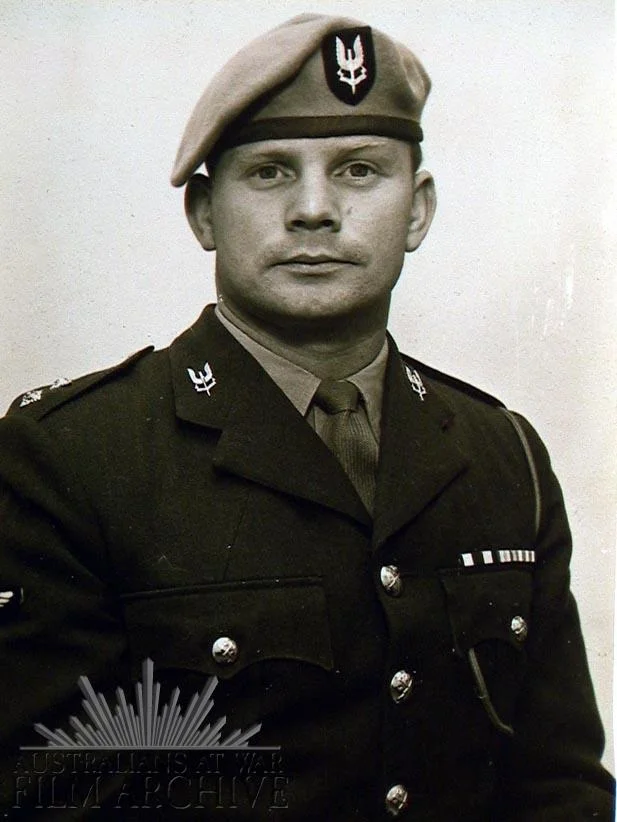
Michael von Berg MC OAM: 'This is very much our war through the eyes of us on the ground doing the hard yards', Vietnam Veterans Day, Royal Australian Regiment Association - 2019
18 August 2019,
Not wishing to be disrespectful but in today’s address I will not talk about The Battle of Long Tan which has been recalled many times over the last 53 years and now a film depicting the battle has also been produced. Unfortunately too little has been said of the men who served at that time and the conditions in which they experienced the sounds, the smells, the fears of the Vietnam War, so in today’s commemoration speech I will concentrate more on what makes the men and women of our Army so unique, and most importantly what drives these ordinary Australians to perform extraordinary things in times of war. The quotation I am about to read is an excellent quote from Maj Gen Michael O’Brien an ex 7RAR platoon commander in Vietnam but it could also relate to an artillery battery, a tank or APC squadron, a squadron of engineers, a chopper Squadron, or any other unit or sub unit that served in Vietnam.
“Australian Soldiers identify with their Battalion. It’s indeed their family: it leads, feeds, clothes, directs and exhausts them. Its veins are its Sections and Platoons, its limbs the companies. It has the capacity to inspire their actions, to drive them beyond exhaustion, at times to subordinate their loved ones and to provide a depth of male comradeship rarely achieved elsewhere. This exclusive club has demanding rules of entry and offers few amenities. It seems to revel in adversity and prosper in challenge. It has fickle moods: a sense of purpose may be cemented by a mascot or nickname while, in contrast, wide dissatisfaction can be spread by a single remark from the Commanding Officer. It has a formidable capability that is derived from the action of 800 men with shared aims and esprit de corps.”
Much has been written about the battles, the incidents, the terrors, death and horrific woundings suffered during the Vietnam war but sadly not much has been written about the oppressive and stressful conditions our young soldiers had to endure, by day and night for almost a full 12 months tour of duty. And many went back to that hell hole more than once.
Most of our war in Vietnam was in the jungle. The jungle can be your friend in terms of concealment. It can be your friend in terms of finding a place to hide in a LUP or a night harbor but it also offers the same level of concealment to the enemy. It mostly in parts has an abundance of water except in the dry season, some falling as much as 2 inches in one hour which are monsoon conditions. It is a unique and difficult terrain in which to engage in war fighting and due to the oppressive conditions at times difficult to lead and importantly to maintain morale.
On patrol the breathing needs to be quiet but with the humidity and the stress at times you have difficulty in catching your breath in particular if you are ascending a 1 in 2 gradient fully loaded. Every step can be a challenge due to the slippery slopes and tiring of legs and the pumping of adrenaline that is coursing through your body watching for signs of the enemy. You must remain alert and positive but the conditions seem to make your mind wander at times where you are worried more internally about your discomfort than externally and the likely enemy threat. The key for any commander in that environment is not to set an unrealistic or dangerous pace to ensure if confronted by the enemy the soldiers are in a state of readiness and capability to fight.
The sweat drains all over your body where you are cocooned in your hot wet sweat. The worst and particular in a forward scout environment is the sweat running into your eyes and causing a distraction and no amount of patting your eyes dry with your sweat rag seem to make a lot of difference where after a while in country you just put up with it like swimming under water with your eyes open without a face mask or goggles. The spiders, the snakes, the bugs, the ants, the leeches and from time to time some bigger creatures are all a part of the jungles biodiversity. We were wary of them but we got used to them.
The Bergen or back pack full of rations, water, ammo, batteries, and sundries is heavy and in the jungle with an ill-fitting Bergen it’s very easy to get a rash and in the humidity and wet just so slow to heal. Your clothing and boots (no jocks or socks) are saturated and your feet are getting water logged and each step is becoming more uncomfortable and painful but you have no choice. You simply must push on. A monsoon downpour makes it very difficult to maintain contact and communicating with the man in front through hand signals, but you must. The rain is coming down so hard where you know that the enemy won’t necessarily see or hear you but you won’t be able to see or hear them either; not an ideal situation. In fact it’s frightening. We come across a growth of “wait awhile” too broad a front to circumnavigate so we all need to cut our way through as carefully as we can with secateurs but no matter how well you cut you spend an enormous amount of time and energy to disentangle from this hideous and debilitating vegetation and at all times potentially being exposed to the enemy.
At times with the rain, the foliage, the sweat in your eyes is like being in a fog of war. So easy to lose concentration and when you do that you or your mates are dead. The sweat rash in your crutch and on your waist is starting to burn from the salt in your sweat and you can’t wait to give it all a bit of an airing. The heavy sense and pressure of the energy draining humidity is compounded by the jungle canopy where the heat and the steam is exasperated by the rotting foliage underneath from which there is no escape. In some places just extracting your boots from ankle deep mud and slush is a chore adding to your fatigue and the risk of losing concentration. Losing concentration will also lead to tripping; stumbling and falling which further drains your energy and can also give your position away. Bamboo clumps when you are forced to travel through are like a vegetable slicer where coming out the other side you’re bleeding from various parts of your body which is a magnet for the leeches and your clothing in parts is in shreds. Jungles by nature are hilly with much defined creek lines but they can also be very flat and oppressive with water underneath. You can go days patrolling without seeing the sky, sun or moon except for a haze between the canopy vegetation. At the end of a day’s patrol thankfully without incident you are looking forward to harboring or lying up and enjoying a bit of a meal. A bit of shut eye interspersed with picket duties and after moving off at first light to another location and a light breakfast the whole previous day’s experience of patrolling in the jungle starts all over again. This routine is relentless and many times, our mates in support from our gun battery, mortars and engineers were also subjected to the same conditions. The boys in Armoured may have been slightly more comfortable and were always good for some water or a brew but they lived in constant fear of RPG’s, mines and IED’s.
After a period of time operating in these oppressive conditions “you get comfortable in being uncomfortable” where any discomfort is just accepted as a part of our role as an Australian soldier who has lived with jungle warfare since WW2. Leadership and maintenance of morale and a sense of humour is essential in a jungle warfare environment and there is never a lack of humour amongst Aussies even in the most dire of circumstances. The jungle is your friend providing you observe all of the tactical training that you have had. It is the most grueling of all war fighting so you must be very fit to fight and you must fight to get fit. The hardest emotional memory we all have of Vietnam is not being able to mourn our war dead. Due to the nature of the war, the vegetation and terrain, the memories we share of our war dead is a body bag containing one of our mates being winched up through the jungle canopy to a hovering chopper. No time to mourn, no time to reflect, safety catch off and back into search and destroy mode, where self-preservation mode over rides any thought of sorrow or mourning. And many wonder why for years we were non tactile, cold and difficult, in particular with family and friends.
This is very much our war through the eyes of us on the ground doing the hard yards with our supporting arms or any others who had to endure these oppressive conditions on a daily basis. It is now some 46 years since the last troops came home from Vietnam and its superfluous to engage in the political dialectic about the pros and cons of the Vietnam War but what I can say is that the many young men and women who went off to that far-off place full of hope, pride, and seeking to make a difference did so with valor, determination and a certain apprehension but never did I see them waiver or falter in their mission. Many of us have memories about our times in Vietnam and in my case I am not consumed by the bad memories which I tend to quarantine in a safe place. I am more focused on the good times and there were many, of watching ordinary young people from different backgrounds working together as a team, enjoying each other’s company and very importantly looking after each other’s backs. People often ask me what I got out of Vietnam to which I respond quiet unashamedly that it made me a better person in character and spirit. It made me look at life a bit differently and made me focus on what is important in life and my values. Working and sharing the events of that war with the most incredible people who have become brothers for life. Some people have great difficulty in understanding bonds that have been forged through war and the spirit that exists within these men and that unbreakable bond, sharing those similar values. Values now considered by some being old fashioned and dated but in the minds of these men and women who served, their values are timeless and sacrosanct. That is what today is about. You can have your battles, contacts and incidents but you can’t have them without people. People who are prepared to put their bodies on the line fighting for something that they believe in, and that fight goes on today with so many fighting for the veterans and their families and many other voluntary pursuits, be it CFS, SES, sport, Legacy, RSL and so many others. Although this presentation today was about our war, I can confirm that the young men and women of today’s Army are doing it just as tough in different circumstances, in a different war in a very hostile environment and when it comes to our young men and women in that war the spirit, the values and the mateship is just as enduring. Sadly some families today will be mourning for those that did not come home and others who have since passed. Today like Anzac Day there would not be one person in this room who has not been touched by war and it’s after effects in some capacity. It is this that brings us together here today. To remember and respect all who have served in whatever capacity from the Boer War, WW1 and WW2,, Korea, but in our case the lot of the soldiers in the jungles of Vietnam, and more recently the years of peacekeeping, which should be more appropriately termed lifesaving in the lives they preserved, to the desert and mountains of Iraq and Afghanistan and in particular to honour and remember those that did not return.
Lest we forget

Jack Bell: 'I was shot down, south of Musus, Libya, on the 23rd January 1942 at approximately 9.30 a.m. in a Bristol Bombay', Premier of Victoria ANZAC Day Luncheon - 2019
Distinguished guests, Ladies and Gentlemen, All Veterans.
I was shot down, south of Musus, Libya, on the 23rd January 1942 at approximately 9.30 a.m. in a Bristol Bombay. I can assure you this aircraft was travelling. It’s a big aircraft, ninety-four foot wing span and sixty-six feet long. But when a shell of that magnitude hits it, believe me it just knocks out everything.
Prior to the shell, we were struck with machine guns and point five Bofors guns. The plane was on fire as we came down through a cloud bank 1,000 feet above the ground – just like a shooting star. By the time we had dropped about 800 or 600 feet the plane was alight and the shell landed to the immediate right of me, behind the first pilot and to the left of the second pilot. This shell was built by the German armament company, Krupp.
The burst of the shrapnel caused havoc in the forward compartment plus also some parts of that shrapnel entered into the back area of the plane and into a pilot, the replacement pilot that we were flying with. In fact, it took an arm off. My friend the navigator, Tony Carter, was killed instantly. The first pilot was injured in the right leg badly and had it amputated later that day.
I myself was partially protected by the transformer and receiver, being the wireless operator. And I was only lacerated on the right leg, the abdomen and the right shoulder. But unfortunately, I was badly burned on getting out of the aircraft.
I didn’t realise how badly hurt I was until the second pilot asked me would I assist him in getting the first pilot out through the escape hatch in the forward cabin. Well he dropped on me. I then realised that I was ill. I was haemorrhaging, and I just completely passed out.
Being wounded and in the hands of the enemy you would expect that there would be very little notice taken of me by the enemy, but I was carefully rolled onto a stretcher and placed onto the back of a truck together with the other wounded.
We were transported for two and half hours to a little place called Antelat, right in the south of the Gulf of Sirte, where there was a fifth field hospital of the German Panzer Division, the 15th Panzer Division – the tank division.
In the selection of the wounded which were possibly twenty-five or thirty, they went not by nationality or whether they were enemy or their own people, but on the difficulty of the wound that they had to operate on. I was number three.
The first two were German pilots who had been shot down by Hurricanes, and they had abdominal wounds the same as myself. Unfortunately for them they died on the operating table.
The German doctor operated on me and saved me. I had fourteen stitches in my abdomen. There was no such thing as x-rays or waiting for later surgery. They just do it and get it over with. And he cared for me for the next six or seven days in that field hospital, daily coming in to dress that wound. He was a young man, in about I’d say his late thirties.
He was actually a German doctor who went to England after the First World War on the advice of is father to get proper instruction in operating. He was an abdominal surgeon in Harley Street. He used to go regularly back to Germany to do consultations on the Nazi big wigs. In August ’39 they wouldn’t let him out. And he said to me “Jack, they don’t’ trust me. I’m only second in charge, I’ll never be in charge”.
But we became, not friends, but very, very close and on the eighth, no the seventh day he came and said “We don’t take wounded back to Germany. Only the fit. We’ll be passing you over to the Italians”.
He wrapped my abdomen in a bandage, a wide bandage and inserted two overriding stitches to hold the wound together. “Cos”, he said, “you’ll be going by truck, on the back of a truck four hundred miles to Tripoli”. It took us four days and he gave me eight ampules of morphine. The morning we left, he injected an ampule into me and said “Jack, at night time inject yourself and in the morning inject yourself”. He forgot to tell me to do it before we got off the truck or onto the truck.
The first night we arrived at this little field station and I was rolled off the stretcher onto another stretcher in this little field hospital. I can assure you it hurt. And unbeknown to me of course – I was partially unconscious and drugging myself from then on. It took us four days.
There was only one road from Antelat to Tripoli and of course that was filled with military traffic. So, we used to run off into the desert. Unbeknownst to me, and during that trip, I must have suffered badly. I don’t know, because I was unconscious most of the time.
When we arrived at Tripoli, I was taken to a field hospital – it was a POW hospital – and put in a private room. I was too sick and too silly to understand what that meant. An Italian nurse came and looked after me and she said – she spoke perfect English – “I’m here. I’ll have to undress you and attend to your wound”. Well not only wounds, I had shrapnel in my leg. She said “We won’t worry about that. It will probably work itself out”.
Every stitch broke on that journey. Fourteen on the abdomen, plus the two over-riding stitches. So you can imagine I’d bled out. This had dried in the sun and was caked hard on my abdomen. She said “I’ll have to give you a drug”, and I had one ampule left and she shot me into the leg. I don’t remember it, but I do remember looking up one time and she was just lifting her head up like that and I could see tears coming down her eyes. I didn’t know how bad the wound was. I never saw it. But I can assure you that it was very severe. I was five months in Italian hospitals.
And I must tell you what I feel.
The word is compassion.
That German doctor could have quite easily snuffed me out. Hard to say it, but he saved my life and he had two German pilots die before me. The compassion he showed made me realise that he was an ordinary individual, exactly the same as you people here. He didn’t want to go to the war but necessity forced him, the same as we didn’t have to go to war either but we volunteered to go, to protect the Empire. He was so kind to me. For years I’ve been trying to trace that German doctor without success. I would like at least to speak to his family.
An Italian nurse spent every day for four more days when I was there, nursing and feeding me only. She bought a bowl of food and said “The intravenous injections are now stopping. You have to eat, otherwise you’ll die”. She bought in a bowl of pasta. I used to enjoy pasta at an Italian restaurant in Brisbane before the War. I tried to eat it but I couldn’t. I brought it up. She went out into the garden and there was a quince tree. She picked one or two quinces, I’m not sure. But she boiled those up for me and laced them with sugar and said you have to eat. And I ate it.
That girl – she was older than I was, much older, she was in her fifties I would imagine – showed me compassion that she didn’t have to show. But she did. It made me realise that they’re just nice people. Just like any of us.
Then I was shipped to Italy, to a place called Caserta, which is a suburb of Naples, on a vessel that used to come to Australia, the Aquila. It was then a hospital ship. The matron in charge was Countess Ciano, Mussolini’s daughter. We were in the bowels of the ship with all the prisoners and I couldn’t walk. I had to be virtually carried if I wished to go to the toilet. She individually came around and spoke to all of those prisoners in that horrible area, the bilge area. She spoke to every one of the prisoners. She didn’t have to do that either but she did it. So, I must say that I didn’t realise until probably seven or eight years later just how marvellous it was. How well I was treated by them. The compassion I was shown – by the enemy.
Billy Rudd was taken at Alamein and came into the prison camp in P.G. 57 in Grupignano, near Udine on the Trieste border. We never knew each other in that camp, but he was the same age. We met after the war and we’ve become very, very good friends.
In the prison camp when I was shuttled off to Germany, in September 1943, the train was cattle trucks with fifty to sixty prisoners of war in each truck. There was only one window letting air in. The sick and the wounded stood beneath it so they could get fresh air. We took it in turns to walk ‘round the ropeway inside, on the inside of the actual truck to get a breath of fresh air, because it did become rather fetid when we were stationary. It wasn’t so bad when we were moving because the wind came through the cracks in the floor.
Now our prison camp Stalag IVB in a little place called Mühlberg, south of Berlin, east of Leipzig and north of Dresden. There were thirty-three different nationalities. At times there were thirty-five thousand prisoners in that camp. At times, down to twenty-two thousand. There were approximately eight thousand British prisoners of war. Two thousand Air Force in our compound, of whom there was only one hundred and fifty-five Australians. Norm Ginn and I are the last survivors.
Please consider that the ordinary people in Germany were hungry also. Just as we were hungry. For instance, this meal that you’re going to eat or finish today, contained more calorie value than the Japanese prisoners of war were given in a week.
I’d like you to think about that.
How we’ve lasted so long I don’t’ know. There’s fifty-three Japanese boys still alive in Australia and fifty European. There’s forty odd in our membership in our ex POW Association in Melbourne. Lovely to have Billy here today.
Tolerance.
We had to get on because of the lack of food. Everybody was hungry. The rations that we got in Germany were slightly larger than the Japanese POWs, but unfortunately the potatoes were four years old. Spud farmers would recognise it. If you bury potatoes for four years, they’re not much good when they’re dug up. These were shipped to the prisoners. We’d see truck-loads of these potatoes come into the camp. They’d hose them, boil them, and most of them, about 80 percent of them, would be black. More likely, 90 percent of them. But we ate the little bits of white on them that was left, and threw the rest away.
Our daily soup ration was millet or sugar beet or pickled vegetables, which was three hundred mils a day. I did not know of any case at all when those thirty-three nationalities in prison, did not get on with each other. Some certainly played football. They had football teams, the round ball style. But they took their venom out on the football field. There was no sort of international fighting amongst them, each nationality. It was surprising, but it taught me the lesson of tolerance. Be tolerant. It’s amazing what it does.
Respect.
I only know one case of an Australian prisoner of war stealing in the three years, three months in which I was held captive. He was punished, and sent to Coventry for a month by Australian fellow prisoners. I don’t know of any other cases that occurred. But respect that was shown to us in that camp, all one hundred and fifty-five of us. We had responsible positions throughout.
During this time, of course I couldn’t lift anything because of the ruptures in my abdomen. I had a lump of protruding flesh and weeping wound about the size of a chicken egg. Roughly a small egg, which, when I came back to Australia had to be removed and I had to be resewn. They fixed the five ruptures plus two hernias which I had developed also whilst I was there.
Now the respect that we showed each other and the respect that was shown to us by our fellow prisoners was fantastic.
When you look at the world today and you can think of compassion and tolerance and respect. We’ve dropped a long way mate in the Articles of War, and of living in this world. I only wish that those three words would become part and parcel of our beliefs today.
I don’t know whether you are aware, buty I’m wearing a tie today which was presented to me by the Rats of Tobruk two months ago. The Rats of Tobruk were a funny mob. They were taken prisoner, no sorry, they were surrounded about a week ago from today. That’s seventy-nine years ago. There’s still some five active members in the Rats of Tobruk Club down in South Melbourne. I thank them very much for giving me this tie. It’s very special.
Thank you, ladies and gentlemen.
---oOo---
Delivered without notes and greeted with a sustained standing ovation
Mario Savio: 'You have to put your bodies upon the gears!', University of Berkeley protest - 1964
2 December 1964, Sproul Hall, Berkeley., California, USA
You know, I just wanna say one brief thing about something the previous speaker said. I didn't wanna spend too much time on that 'cause I don't think it's important enough. But one thing is worth considering.
He's the -- He's the nominal head of an organization supposedly representative of the undergraduates. Whereas in fact under the current director it derives -- its authority is delegated power from the Administration. It's totally unrepresentative of the graduate students and TAs.
But he made the following statement (I quote): "I would ask all those who are not definitely committed to the FSM cause to stay away from demonstration." Alright, now listen to this: "For all upper division students who are interested in alleviating the TA shortage problem, I would encourage you to offer your services to Department Chairmen and Advisors." That has two things: A strike breaker and a fink.
I'd like to say -- like to say one other thing about a union problem. Upstairs you may have noticed they're ready on the 2nd floor of Sproul Hall, Locals 40 and 127 of the Painters Union are painting the inside of the 2nd floor of Sproul Hall. Now, apparently that action had been planned some time in the past. I've tried to contact those unions. Unfortunately -- and [it] tears my heart out -- they're as bureaucratized as the Administration. It's difficult to get through to anyone in authority there. Very sad. We're still -- We're still making an attempt. Those people up there have no desire to interfere with what we're doing. I would ask that they be considered and that they not be heckled in any way. And I think that -- you know -- while there's unfortunately no sense of -- no sense of solidarity at this point between unions and students, there at least need be no -- you know -- excessively hard feelings between the two groups.
Now, there are at least two ways in which sit-ins and civil disobedience and whatever -- least two major ways in which it can occur. One, when a law exists, is promulgated, which is totally unacceptable to people and they violate it again and again and again till it's rescinded, appealed. Alright, but there's another way. There's another way. Sometimes, the form of the law is such as to render impossible its effective violation -- as a method to have it repealed. Sometimes, the grievances of people are more -- extend more -- to more than just the law, extend to a whole mode of arbitrary power, a whole mode of arbitrary exercise of arbitrary power.
And that's what we have here. We have an autocracy which -- which runs this university. It's managed. We were told the following: If President Kerr actually tried to get something more liberal out of the Regents in his telephone conversation, why didn't he make some public statement to that effect? And the answer we received -- from a well-meaning liberal -- was the following: He said, "Would you ever imagine the manager of a firm making a statement publicly in opposition to his Board of Directors?" That's the answer.
Well I ask you to consider -- if this is a firm, and if the Board of Regents are the Board of Directors, and if President Kerr in fact is the manager, then I tell you something -- the faculty are a bunch of employees and we're the raw material! But we're a bunch of raw materials that don't mean to be -- have any process upon us. Don't mean to be made into any product! Don't mean -- Don't mean to end up being bought by some clients of the University, be they the government, be they industry, be they organized labor, be they anyone! We're human beings!
And that -- that brings me to the second mode of civil disobedience. There's a time when the operation of the machine becomes so odious, makes you so sick at heart that you can't take part! You can't even passively take part! And you've got to put your bodies upon the gears and upon the wheels, upon the levers, upon all the apparatus -- and you've got to make it stop! And you've got to indicate to the people who run it, to the people who own it -- that unless you're free the machine will be prevented from working at all!!
That doesn't mean -- I know it will be interpreted to mean, unfortunately, by the bigots who run The Examiner, for example -- That doesn't mean that you have to break anything. One thousand people sitting down some place, not letting anybody by, not [letting] anything happen, can stop any machine, including this machine! And it will stop!!
We're gonna do the following -- and the greater the number of people, the safer they'll be and the more effective it will be. We're going, once again, to march up to the 2nd floor of Sproul Hall. And we're gonna conduct our lives for awhile in the 2nd floor of Sproul Hall. We'll show movies, for example. We tried to get Un Chant d'Amour and [they] shut them off. Unfortunately, that's tied up in the court because of a lot of squeamish moral mothers for a moral America and other people on the outside. The same people who get all their ideas out of the San Francisco Examiner. Sad, sad. But, Mr. Landau -- Mr. Landau has gotten us some other films.
Likewise, we'll do something -- we'll do something which hasn't occurred at this University in a good long time! We're going to have real classes up there! They're gonna be freedom schools conducted up there! We're going to have classes on [the] 1st and 14th amendments!! We're gonna spend our time learning about the things this University is afraid that we know! We're going to learn about freedom up there, and we're going to learn by doing!!
Now, we've had some good, long rallies.
Just one moment. We've had some good, long rallies. And I think I'm sicker of rallies than anyone else here. She's not going to be long. I'd like to introduce one last person -- one last person before we enter Sproul Hall. Yeah. And the person is Joan Baez.

Bob Brown addressing same rally, photo AAP
Richard Flanagan: 'Will you stand with me, will you go to jail with me', Adani mine rally - 2019
5 May 2019, Canberra, Australia
I grew up in a remote mining town. I know the hardship. I saw the tragedy. One of my earliest memories is a whole town stopped for a miner’s funeral, family after family lining the main street, one people joined in grief.
And when politicians talk of caring about miners I don’t believe a word they say.
If they cared wouldn’t they be advocating to end black lung disease, a 19th century industrial disease now returned, because of unsafe working conditions, to kill Australian coalminers in the 21st century?
If they cared wouldn’t they be speaking out about the increasing casualisation and pay stripping of coalminers, supported by the Morrison government?
And if they cared wouldn’t they question whether Adani is an appropriate business to employ Australian miners? Adani, such a friend of the working man that, when building its giant Shantigram luxury estate in India, it housed workers in conditions so appalling that there were 15 recorded outbreaks of cholera.
Put a hi-vis jacket on that corpse and say you’re still for the working miners of Queensland, Scott.
But then Adani’s long-term aim isn’t to employ miners under whatever pitiful conditions and awards its paid-up political mates might legislate.
As Adani Mining’s CEO said in 2016, “When we ramp up the mine, everything will be autonomous from mine to port. In our eyes, this is the mine of the future.” That’s right: Adani’s ambition is ultimately that its mine is all robots. Not a miner, not a driller, not a driver in sight.
So the promised 10,000 jobs that turned out to be 1,462 jobs will in turn vanish like the mist as Adani buys in ever more robots.
But that’s not all. Modelling by Wood Mackenzie shows that if coalmining in the Galilee Basin, led by Adani, goes ahead, coal production in older, less efficient Australian coalmines will drop significantly and many coalmining jobs will vanish. Adani’s new mine will simply steal the jobs off the old mines.
Jabbering jobs, jobs, jobs, in a hard hat doesn’t change these truths. It doesn’t make a politician fair dinkum. It makes him or her a lying clown who sells every coalminer down the drain for another backhander from the bosses of the fossil fuel industry.
Have we, Australia, become a country that breeds mass murderers with our words?
The coalmining communities of Australia deserve better. They deserve the truth. They need a responsible transition plan, not lies and deceit.
Because Adani’s mine is not happening to help miners. It’s not happening to help Clermont or Mackay or far-north Queensland. It’s certainly not happening to help the poor of India.
It’s happening because of one thing: greed.
And that greed controls our politics. How can Scott Morrison claim to care about climate change when his political survival now hinges on a deal with Clive Palmer, a man whose own massive Galilee Basin coalmine is dependent on Adani getting up? What exactly did Scott Morrison promise Palmer? The Liberals’ platform is nothing more than a smoking coal heap.
Forty-one years ago, I had just kayaked through a beautiful gorge on the Franklin River called Irenabyss. The Franklin was to be dammed and though there was opposition to the damming, no one I knew believed it was possible to defeat the all-powerful state and federal governments that were at the time hell-bent on building it.
The gorge opened out into small basin. At its rainforested edge there was a beach. I kayaked over to it and a lanky man appeared out of the rainforest. And there, on the banks of that beautiful, doomed river, I met Bob Brown.
I asked Bob did he really think the river could be saved. His answer was revealing. I think, he said, that there is hope.
“There is no power on this earth that can resist an idea whose time has come.”
And this is what I learned from Bob Brown. The battle for that river raged for another four years. Governments came and went. At every step it looked like we had lost, and yet, what we could not see was that at every stop we were growing stronger. Thousands of people went to prison in the biggest act of civil disobedience in Australian history.
In the end the government was spending countless millions to get heavy machinery into that remote rainforest to destroy as much a possible to make that dam inevitable. And at the very last moment, the high court ruled the dam could not go ahead.
I am here today to say that there is hope. That the Franklin flows free and Adani will be stopped. These things happen because at a certain point enough people say there are things that matter more than politics or money. There is no power on this earth that can resist an idea whose time has come.
I am not going to waste your time today repeating the many facts with which you are already familiar, suffice to say one thing: the IPCC last October said we had 12 years to contain climate change – that is, decarbonise our economy so that the temperature rises no more than another half a degree on what it is today. If large-scale action is not taken now the IPCC warned that we will face a global warming catastrophe.
More than half a year of that 12 years has already passed without any meaningful national or international action. Our emissions are still rising. And that is why this is a crisis unlike any we have ever faced. On present trends much of Australia will become, quite simply, uninhabitable. And what remains liveable will be small bands of our country.
We will not have the means to generate the food we need, the wealth we are accustomed to. The most recent science suggests that around the world up to one million species on which we depend for food and clean water face annihilation, that the planet’s very life support systems are entering a danger zone. This is not science fiction. This is not a Netflix series. It is what the world’s leading scientists tell us.
The moment for believing this is a matter that can be solved by flying less or not eating meat has long passed. The solution will not be about personal choices. It will be about – and can only be about – political change.
And that change will not come about because of a messianic leader. It will not come about because of this party or that party. It will only happen if we wish it to happen and if we make it happen. We have only ourselves to blame and we have only ourselves to turn to save ourselves.
It matters very much who you vote for this election. And after May 18 it matters even more to press whoever wins to recognise this crisis is not an issue. It is the issue.
The fight against Adani is a fight for the soul of our country
The drying out of Australia is the issue. The collapse of our fisheries is the issue. The likelihood of not having enough water to sustain our population is the issue. The threat greater and greater mega-fires pose is the issue. The decline of our agriculture is the issue. The inability of our infrastructure to cope with ever-larger floods and more frequent cyclones is the issue. Sea rises are the issue. The death of our rivers, the death of the Great Barrier Reef, the death of the Tasmanian rainforests is the issue. The drying wheatbelt is the issue. If our very fate as a species is not the issue, then what is?
And that is why Adani has become the symbol of why our country is broken. That is why the fight against Adani is a fight for the soul of our country.
I know many of you may feel that you have no power, or lack the skills or abilities needed. Faced with the crisis that is climate change it is too easy to feel powerless, to feel the problem is beyond your powers or perhaps anyone’s to influence.
Perhaps the greatest problem we face is not climate change, but the myth of our own powerlessness. We believe only the most powerful – the politicians, the corporations – can change our world. Accordingly, we feel a great despair about our future because we can see no hope in any politician or any corporation.
But it is not so.
Because the only thing that will save us is us. Half of the carbon in the atmosphere was put there by us in the last 30 years. And now we have 11 and a half years to reverse that disastrous act.
It is a time to act and it is for us to act. Because there is no one else and there is no other time.
And if our politicians continue to deceive themselves and deceive us, if after May 18 we end up with a government that will not act, and if we are only left with only our bodies to oppose this mine, if it takes putting our flesh between the past and the future, between the bulldozers and the earth, if it means a blockade of the Adani site, then I, for one, will be there. And if that means being arrested and going to jail then I will go to jail.
And my question to you today is this: will you?
Will you stand with me, will you go to jail with me, to stop this mine and save our future? Because if you will, I ask you to raise your hand.
I tell you this: we will win.
The Franklin was more than a river. Adani is more than a mine. This rally, you people, are part of the river of hope that flows through this country, our beloved country, and it is a river that cannot be bought, that cannot be dammed, that cannot be poisoned, that cannot be bought and sold. And every day that river grows larger and stronger.
And I am hopeful. Why? Because 41 years ago I met a man who refused to abandon hope and led a movement with such moral clarity that the river still flows. And 41 years later I stand here before you, with that same man, to say that hope is never lost
Never. Never. Never.
Greta Thunberg: 'Our house is falling apart, and we are rapidly running out of time', speech to EU Parliament - 2019
16 April 2019 , Strasbourg, Germany
My name is Greta Thunberg. I am 16 years old. I come from Sweden. And I want you to panic. I want you to act as if the house was on fire. I have said those words before, and a lot of people have explained why that is a bad idea. A great number of politicians have told me that panic never leads to anything good, and I agree. To panic unless you have to, is a terrible idea. But when your house is on fire and you want to keep your house from burning to the ground, then that does require some level of panic.
Our civilization is so fragile, it is almost like a castle built in the sand. The facade is so beautiful, but the foundations are far from solid. We have been cutting so many corners.
Yesterday, the world watched with despair and enormous sorrow how the Notre Dame burnt in Paris. Some buildings are more than just buildings. But the Notre Dame will be rebuilt. I hope that its foundations are strong. I hope that our foundations are even stronger, but I fear they are not.
Around the year 2030, 10 years 259 days and 10 hours away from now, we will be in a position where we set off an irreversible chain reaction that will most likely lead to the end of our civilization as we know it. That is, unless in that time, permanent and unprecedented changes in all aspects of society have taken place, including a reduction of our CO2 emissions by at least 50%. And please note that these calculations are depending on inventions that have not yet been invented at scale, inventions that are supposed to clear our atmosphere of astronomical amounts of carbon dioxide.
Furthermore, these calculations do not include unforeseen tipping points and feedback loops like the extremely powerful methane gas escaping from rapidly thawing arctic permafrost. Nor do they include already locked in warming hidden by air pollution. Nor the aspect of equity, or climate justice, clearly stated throughout the Paris Agreement, which is absolutely necessary to make it work on a global scale. We must also bear in mind that these are just calculations, estimations. That means that these "points of no return" may occur a bit sooner or later than that. No one can know for sure. We can, however, be certain that they will occur approximately in these timeframes, because these calculations are not opinions or wild guesses. These projections are backed up by scientific facts, concluded by all nations through the IPCC. Nearly every major national scientific body around the world unreservedly supports the work and findings of the IPCC.
We are in the midst of the sixth mass extinction, and the extinction rate is up to 10,000 times faster than what is considered normal, with up to 200 species becoming extinct every single day. Erosion of fertile topsoil, deforestation of our great forests, toxic air pollution, loss of insects and wildlife, the acidification of our oceans. These are all disastrous trends being accelerated by a way of life that we, here in our financially-fortunate part of the world, see as our right to simply carry on. But hardly anyone knows about these catastrophes or understand how they are just the first few symptoms of climate and ecological breakdown. Because how could they? They have not been told. Or more importantly: they have not been told by the right people and in the right way.
Our house is falling apart, and our leaders need to start acting accordingly, because at the moment they are not. If our house was falling apart, our leaders wouldn't go on like you do today. You would change almost every part of your behaviour, as you do in an emergency. If our house was falling apart, you wouldn't fly around the world in business class chatting about how the market will solve everything with clever small solution to specific isolated problems. You wouldn't talk about buying and building your way out of a crisis that has been created by buying and building things.
If our house was falling apart, you wouldn't hold three emergency Brexit summits and no emergency summit regarding the breakdown of the climate and environment. You wouldn't be arguing about phasing out coal in 15 or 11 years. If our house was falling apart, you wouldn't be celebrating that one single nation like Ireland may soon divest from fossil fuels. You wouldn't celebrate that Norway has decided to stop drilling for oil outside the scenic resort of Lofoten Island, but will continue to drill for oil everywhere else for decades. It's 30 years too late for that kind of celebrations.
If our house was falling apart, the media wouldn't be writing about anything else. The ongoing climate and ecological crisis would make up all the headlines. If our house was falling apart, you wouldn't say that you have the situation under control and place the future living conditions for all species in the hands of inventions that are yet to be invented. And you would not spend all your time as a politician arguing about taxes or Brexit. If the walls of our house truly came tumbling down, surely you would set your differences aside and start cooperating.
Well, our house is falling apart, and we are rapidly running out of time. And yet, basically nothing is happening. Everyone and everything needs to change. So, why waste precious time arguing about what and who needs to change first? Everyone and everything has to change. But the bigger your platform, the bigger your responsibility. The bigger your carbon footprint, the bigger your moral duty.
When I tell politicians to act now, the most common answer is that they can't do anything drastic, because that would be too unpopular among the voters. And they are right of course, since most people are not even aware of why those changes are required. That is why I keep telling you to unite behind the science, make the best available science the heart of politics and democracy.
The EU elections are coming up soon, and many of us who will be affected the most by this crisis, people like me, are not allowed to vote. Nor are we in a position to shape the decisions of business, politics, engineering, media, education, or science. Because the time takes for us to educate ourselves to do that simply does no longer exists, and that is why millions of children are taking it to the streets, school striking for the climate to create attention for the climate crisis.
You need to listen to us, we who cannot vote. You need to vote for us, for your children and grandchildren. What we are doing now can soon no longer be undone. In this election, you vote for the future living conditions of human kind. And though the politics needed do not exist today, some alternatives are certainly less worse than others. And I have read that some parties do not even want me standing here today because they so desperately do not want to talk about climate breakdown.
Our house is falling apart. The future, as well as what we have achieved in the past, is literally in your hands now. But it's still not too late to act. It will take a far-reaching vision. It will take courage. It will take a fierce determination to act now to lay the foundations where we may not know all the details about how to shape the ceiling. In other words, it will take "cathedral thinking."
I ask you to please wake up and make the changes required possible. To do your best is no longer good enough. We must all do the seemingly impossible. And it's okay if you refuse to listen to me. I am, after all, just a 16-year-old schoolgirl from Sweden. But you cannot ignore the scientists, or the science, or the millions of school-striking children who are school-striking for the right to a future. I beg you: please do not fail on this. Thank you.
David Attenborough: 'Nature once determined how we survive. Now, we determine how nature survives', Launch HBO's 'Our Planet' - 2019
Your Royal Highnesses, ladies and gentleman. There can surely be no more fitting location than this for the premiere of Our Planet. Directly behind me, behind this enormous screen, is a statue of Charles Darwin whose astonishing understanding of the natural world led to what has been called, "the greatest idea in human history", the theory of evolution by natural selection.
Darwin revealed that all species have evolved over time to best exploit the conditions in which they live. He further realised that these conditions are not simply those of geography and climate, but also their relationship to other lives that live alongside. From the delicate co-dependencies of bees and orchids, to the dramatic connection between cheetah and gazelle, all life on Earth is both product and contributor to its place in space and time. This complex web of life of which we are a part has been millennia in the making.
Whilst Darwin's insights explain how this web came about, over 200 years later, we are still only beginning to understand its interconnections and which of these connections are the most vital. Yet, we do know for certain is that these connections can break from the dinosaurs to my right, to other spectacular fossils on my left. We have all tonight been within touching distance of astonishing fragments of ecosystems long gone.
As far as we know, there have been five major extinction events on our planet. Events caused by changes so severe that many species simply can't adapt and, as such, die out. Right now, we are in the midst of the Earth's sixth mass extinction. One every bit as profound and far-reaching as that which wiped out the dinosaurs. It's almost impossible to grasp as we go about our lives that the rest of life on Earth is experiencing destruction on the scale of that wrought by a colossal asteroid collision.
But, consider these facts: 96% of the mass of mammals on our planet today are us and the livestock that we've domesticated. Only 4% is everything else, from elephants to badgers, tigers to bats. 70% of all birds are now domesticated poultry, mostly chickens. Nature once determined how we survive. Now, we determine how nature survives.
One of the things Darwin's work has taught us is that we break nature's connections at our peril. Yet, break them we do at ever-greater speed. The impacts of our growing population and our consumption now directly threaten our own future. That magnificent creature up there whose skeleton hangs up there above us, the blue whale, can give inspiration.
Just 30 years ago, most whales species including the blue whale were heading towards extinction. A public outcry led to a global agreement to protect whales, and now most populations are recovering. We've subsequently learned how important whales are to the entire ocean system, including the fish that we eat. So, saving these majestic creatures actually benefits us as well. What we did to save the whales, we must now do for all nature, and that is a communications challenge as much as it is a scientific one.
The eight-part Our Planet series aims to reach a billion people around the world. It celebrates the species and habitats that still remain and reveals what must be protected to ensure both people and nature thrive.
I've always believed that few people will protect the natural world if they don't first love and understand it. Many sequences in the Our Planet series reveal nature at its most fascinating and delightful. Others prove that good things do indeed come to those who wait often for a very long time, as the many talented cameramen and women who've recorded all kinds of wonders for us know only too well. But, what really makes Our Planet stand out is the clear, driving story that runs through the entire series and the wider communications project.
The natural world is not just nice to have. It fundamentally matters to each and every one of us. This has been a true labour of love for hundreds of filmmakers, cinematographers, conservationists, editors, musicians, production teams, all of whom have brought their best work to the most important story that there is, a story that could not be more universal or more timely.
The ability to tell that story in almost every country on Earth at the same time via Netflix brings the possibility of an unprecedented global understanding of the one place that we all call home.
Greta Thunberg: 'We have to start treating the crisis like a crisis', Address to UK parliament - 2019
23 April 2019, Westminster, London, United Kingdom
My name is Greta Thunberg. I am 16 years old. I come from Sweden. And I speak on behalf of future generations.
I know many of you don’t want to listen to us – you say we are just children. But we’re only repeating the message of the united climate science.
Many of you appear concerned that we are wasting valuable lesson time, but I assure you we will go back to school the moment you start listening to science and give us a future. Is that really too much to ask?
In the year 2030 I will be 26 years old. My little sister Beata will be 23. Just like many of your own children or grandchildren. That is a great age, we have been told. When you have all of your life ahead of you. But I am not so sure it will be that great for us.
I was fortunate to be born in a time and place where everyone told us to dream big; I could become whatever I wanted to. I could live wherever I wanted to. People like me had everything we needed and more. Things our grandparents could not even dream of. We had everything we could ever wish for and yet now we may have nothing.
Now we probably don’t even have a future any more.
Because that future was sold so that a small number of people could make unimaginable amounts of money. It was stolen from us every time you said that the sky was the limit, and that you only live once.
You lied to us. You gave us false hope. You told us that the future was something to look forward to. And the saddest thing is that most children are not even aware of the fate that awaits us. We will not understand it until it’s too late. And yet we are the lucky ones. Those who will be affected the hardest are already suffering the consequences. But their voices are not heard.
Is my microphone on? Can you hear me?
Around the year 2030, 10 years 252 days and 10 hours away from now, we will be in a position where we set off an irreversible chain reaction beyond human control, that will most likely lead to the end of our civilisation as we know it. That is unless in that time, permanent and unprecedented changes in all aspects of society have taken place, including a reduction of CO2 emissions by at least 50%.
And please note that these calculations are depending on inventions that have not yet been invented at scale, inventions that are supposed to clear the atmosphere of astronomical amounts of carbon dioxide.
Furthermore, these calculations do not include unforeseen tipping points and feedback loops like the extremely powerful methane gas escaping from rapidly thawing arctic permafrost.
Nor do these scientific calculations include already locked-in warming hidden by toxic air pollution. Nor the aspect of equity – or climate justice – clearly stated throughout the Paris agreement, which is absolutely necessary to make it work on a global scale.
We must also bear in mind that these are just calculations. Estimations. That means that these “points of no return” may occur a bit sooner or later than 2030. No one can know for sure. We can, however, be certain that they will occur approximately in these timeframes, because these calculations are not opinions or wild guesses.
These projections are backed up by scientific facts, concluded by all nations through the IPCC. Nearly every single major national scientific body around the world unreservedly supports the work and findings of the IPCC.
Did you hear what I just said? Is my English OK? Is the microphone on? Because I’m beginning to wonder.
During the last six months I have travelled around Europe for hundreds of hours in trains, electric cars and buses, repeating these life-changing words over and over again. But no one seems to be talking about it, and nothing has changed. In fact, the emissions are still rising.
When I have been travelling around to speak in different countries, I am always offered help to write about the specific climate policies in specific countries. But that is not really necessary. Because the basic problem is the same everywhere. And the basic problem is that basically nothing is being done to halt – or even slow – climate and ecological breakdown, despite all the beautiful words and promises.
The UK is, however, very special. Not only for its mind-blowing historical carbon debt, but also for its current, very creative, carbon accounting.
Since 1990 the UK has achieved a 37% reduction of its territorial CO2 emissions, according to the Global Carbon Project. And that does sound very impressive. But these numbers do not include emissions from aviation, shipping and those associated with imports and exports. If these numbers are included the reduction is around 10% since 1990 – or an an average of 0.4% a year, according to Tyndall Manchester.
And the main reason for this reduction is not a consequence of climate policies, but rather a 2001 EU directive on air quality that essentially forced the UK to close down its very old and extremely dirty coal power plants and replace them with less dirty gas power stations. And switching from one disastrous energy source to a slightly less disastrous one will of course result in a lowering of emissions.
But perhaps the most dangerous misconception about the climate crisis is that we have to “lower” our emissions. Because that is far from enough. Our emissions have to stop if we are to stay below 1.5-2C of warming. The “lowering of emissions” is of course necessary but it is only the beginning of a fast process that must lead to a stop within a couple of decades, or less. And by “stop” I mean net zero – and then quickly on to negative figures. That rules out most of today’s politics.
The fact that we are speaking of “lowering” instead of “stopping” emissions is perhaps the greatest force behind the continuing business as usual. The UK’s active current support of new exploitation of fossil fuels – for example, the UK shale gas fracking industry, the expansion of its North Sea oil and gas fields, the expansion of airports as well as the planning permission for a brand new coal mine – is beyond absurd.
This ongoing irresponsible behaviour will no doubt be remembered in history as one of the greatest failures of humankind.
People always tell me and the other millions of school strikers that we should be proud of ourselves for what we have accomplished. But the only thing that we need to look at is the emission curve. And I’m sorry, but it’s still rising. That curve is the only thing we should look at.
Every time we make a decision we should ask ourselves; how will this decision affect that curve? We should no longer measure our wealth and success in the graph that shows economic growth, but in the curve that shows the emissions of greenhouse gases. We should no longer only ask: “Have we got enough money to go through with this?” but also: “Have we got enough of the carbon budget to spare to go through with this?” That should and must become the centre of our new currency.
Many people say that we don’t have any solutions to the climate crisis. And they are right. Because how could we? How do you “solve” the greatest crisis that humanity has ever faced? How do you “solve” a war? How do you “solve” going to the moon for the first time? How do you “solve” inventing new inventions?
The climate crisis is both the easiest and the hardest issue we have ever faced. The easiest because we know what we must do. We must stop the emissions of greenhouse gases. The hardest because our current economics are still totally dependent on burning fossil fuels, and thereby destroying ecosystems in order to create everlasting economic growth.
“So, exactly how do we solve that?” you ask us – the schoolchildren striking for the climate.
And we say: “No one knows for sure. But we have to stop burning fossil fuels and restore nature and many other things that we may not have quite figured out yet.”
Then you say: “That’s not an answer!”
So we say: “We have to start treating the crisis like a crisis – and act even if we don’t have all the solutions.”
“That’s still not an answer,” you say.
Then we start talking about circular economy and rewilding nature and the need for a just transition. Then you don’t understand what we are talking about.
We say that all those solutions needed are not known to anyone and therefore we must unite behind the science and find them together along the way. But you do not listen to that. Because those answers are for solving a crisis that most of you don’t even fully understand. Or don’t want to understand.
You don’t listen to the science because you are only interested in solutions that will enable you to carry on like before. Like now. And those answers don’t exist any more. Because you did not act in time.
Avoiding climate breakdown will require cathedral thinking. We must lay the foundation while we may not know exactly how to build the ceiling.
Sometimes we just simply have to find a way. The moment we decide to fulfil something, we can do anything. And I’m sure that the moment we start behaving as if we were in an emergency, we can avoid climate and ecological catastrophe. Humans are very adaptable: we can still fix this. But the opportunity to do so will not last for long. We must start today. We have no more excuses.
We children are not sacrificing our education and our childhood for you to tell us what you consider is politically possible in the society that you have created. We have not taken to the streets for you to take selfies with us, and tell us that you really admire what we do.
We children are doing this to wake the adults up. We children are doing this for you to put your differences aside and start acting as you would in a crisis. We children are doing this because we want our hopes and dreams back.
I hope my microphone was on. I hope you could all hear me.
Waleed Aly: 'The most dishonest thing would be to say that I'm shocked', Christchurch terror attack - 2019
You’ll have to forgive me, these won’t be my best words. The truth is, I don’t want to be talking today. When I was asked if it was something I wanted to do, I resisted it all day until finally I had this overwhelming sense that it was something in my responsibility to do so and maybe that’s misguided.
But of all the things I could say tonight, that I’m gutted and I’m scared and I feel overcome with utter hopelessness, the most dishonest thing, the most dishonest thing would be to say that I’m shocked. I’m simply not.
There’s nothing about what happened in Christchurch today that shocked me. I wasn’t shocked when six people were shot to death at a mosque in Quebec City two years ago. I wasn’t shocked when a man drove a van into Finsbury Park mosque in London about six months later and I wasn’t shocked when 11 Jews were shot dead in a Pittsburgh synagogue late last year or when nine Christians were killed at a church in Charleston. If we’re honest, we’ll know this has been coming.
I went to the mosque today, I do that every Friday just like the people in those mosques in Christchurch today. I know exactly what those moments before the shooting began would have been like. I know how quiet, how still, how introspective those people would have been before they were suddenly gunned down, how separated from the world they were feeling until the world came in and tore their lives apart.
And I know the people who did this knew well enough how profoundly defenseless their victims were in that moment. This is a congregational prayer that happens every week like clockwork. This was slaughter by appointment. And it’s scary because, like millions of other Muslims, I’m going to keep attending those appointments and it feels like fish in a barrel.
But that isn’t the scariest thing. The thing that scared me most was when I started reading the manifesto that one of the apparent perpetrators of this attack published, not because it was deranged but because it was so familiar. Let me share some quotes with you to show you what I mean.
"The truth is that Islam is not like any other faith. It is the religious equivalent of fascism," or, "The real cause of bloodshed is the migration program which allowed Muslim fanatics to migrate in the first place." Or, "As we read in Matthew 26:52: 'All they that take the sword shall perish by the sword'. And those who follow a violent religion that causes them to murder us cannot be surprised when somebody takes them at their word and responds at kind."
How do those words sound now? Now how do they sound when I tell you that they weren’t part of the manifesto? They were actually published today after this terrorist attack on Australian parliamentary letterhead. And I know they came from someone who I don’t particularly want to name at the moment, who all parties have denounced. I also know that the leader of one of those parties that denounced him once described Islam as a disease Australia needs to vaccinate. And even that party is kind of on the fringes despite some valiant attempts by our media to change that.
But I also know a senior figure in our government once suggested we made a mistake as a country by letting in Lebanese Muslims in the 70s. And I know there are media reports going back eight years at a shadow cabinet meeting in which another senior politician suggested his party should use community concerns about Muslims in Australia failing to integrate as a political strategy. That person is now the most senior politician we have.
So while I appreciate the words our leaders have said today, and in particular Scott Morrison’s comments and his preparedness to call this terrorism and the strength of his comments more generally, I have something to ask. Don’t change your tune now because the terrorism seems to be coming from a white supremacist. If you’ve been talking about being "tough on terrorism" for years in the communities that allegedly support it, show us how tough you are now.
For [me], I’m going to say the same thing I said about four years ago after a horrific Islamist attack. Now, now we come together. Now we understand that this is not a game, terrorism doesn’t choose its victims selectively, that we are one community and that everything we say to try to tear people apart, demonise particular groups, set them against each other, that all has consequences even if we’re not the ones with our fingers on the trigger.