• Genre
  • About
  • Submissions
  • Donate
  • Search
Menu

Speakola

All Speeches Great and Small
  • Genre
  • About
  • Submissions
  • Donate
  • Search
Share a political speech
Shirley Chishom.jpg

Shirley Chisholm: 'The happy little homemaker and the contented "old darkey" on the plantation were both produced by prejudice', Equal Rights for Women Bill - 1969

February 19, 2018

21 May 1969, Washington DC, USA

Shirley Chisholm was a candidate for the presidency in 1971. She was the first African American woman elected to Congress.

Mr.Speaker, when a young woman graduates from college and starts looking for a job, she is likely to have a frustrating and even demeaning experience ahead of her. If she walks into an office for an interview, the first question she will be asked is, "Do you type?''

There is a calculated system of prejudice that lies unspoken behind that question. Why is it acceptable for women to be secretaries, librarians, and teachers, but totally unacceptable for them to be managers, administrators, doctors, lawyers, and Members of Congress.

The unspoken assumption is that women are different. They do not have executive ability orderly minds, stability, leadership skills, and they are too emotional.

It has been observed before, that society for a long time, discriminated against another minority, the blacks, on the same basis - that they were different and inferior. The happy little homemaker and the contented "old darkey" on the plantation were both produced by prejudice.

As a black person, I am no stranger to race prejudice. But the truth is that in the political world I have been far oftener discriminated against because I am a woman than because I am black.

Prejudice against blacks is becoming unacceptable although it will take years to eliminate it. But it is doomed because, slowly, white America is beginning to admit that it exists. Prejudice against women is still acceptable. There is very little understanding yet of the immorality involved in double pay scales and the classification of most of the better jobs as "for men only."

More than half of the population of the United States is female. But women occupy only 2 percent of the managerial positions. They have not even reached the level of tokenism yet No women sit on the AFL-CIO council or Supreme Court There have been only two women who have held Cabinet rank, and at present there are none. Only two women now hold ambassadorial rank in the diplomatic corps. In Congress, we are down to one Senator and 10 Representatives.

Considering that there are about 3 1/2 million more women in the United States than men, this situation is outrageous.

It is true that part of the problem has been that women have not been aggressive in demanding their rights. This was also true of the black population for many years. They submitted to oppression and even cooperated with it. Women have done the same thing. But now there is an awareness of this situation particularly among the younger segment of the population.

As in the field of equal rights for blacks, Spanish-Americans, the Indians, and other groups, laws will not change such deep-seated problems overnight But they can be used to provide protection for those who are most abused, and to begin the process of evolutionary change by compelling the insensitive majority to reexamine it's unconscious attitudes.

It is for this reason that I wish to introduce today a proposal that has been before every Congress for the last 40 years and that sooner or later must become part of the basic law of the land -- the equal rights amendment.

Let me note and try to refute two of the commonest arguments that are offered against this amendment. One is that women are already protected under the law and do not need legislation. Existing laws are not adequate to secure equal rights for women. Sufficient proof of this is the concentration of women in lower paying, menial, unrewarding jobs and their incredible scarcity in the upper level jobs. If women are already equal, why is it such an event whenever one happens to be elected to Congress?

It is obvious that discrimination exists. Women do not have the opportunities that men do. And women that do not conform to the system, who try to break with the accepted patterns, are stigmatized as ''odd'' and "unfeminine." The fact is that a woman who aspires to be chairman of the board, or a Member of the House, does so for exactly the same reasons as any man. Basically, these are that she thinks she can do the job and she wants to try.

A second argument often heard against the equal rights amendment is that is would eliminate legislation that many States and the Federal Government have enacted giving special protection to women and that it would throw the marriage and divorce laws into chaos.

As for the marriage laws, they are due for a sweeping reform, and an excellent beginning would be to wipe the existing ones off the books. Regarding special protection for working women, I cannot understand why it should be needed. Women need no protection that men do not need. What we need are laws to protect working people, to guarantee them fair pay, safe working conditions, protection against sickness and layoffs, and provision for dignified, comfortable retirement. Men and women need these things equally. That one sex needs protection more than the other is a male supremacist myth as ridiculous and unworthy of respect as the white supremacist myths that society is trying to cure itself of at this time.

Source: http://gos.sbc.edu/c/chisholm.html

Enjoyed this speech? Speakola is a labour of love and I’d be very grateful if you would share, tweet or like it. Thank you.

Facebook Twitter Facebook
In 1960-79 B Tags SHIRLEY CHISHOLM, AFRICAN AMERICAN, FIRST BLACK WOMAN ELECTED, TRANSCRIPT, EQUAL RIGHTS FOR WOMEN
Comment

Lyndon Johnson: 'Let us close the springs of racial poison', Remarks on Signing Civil Rights Act - 1964

February 9, 2018

2 July 1964, Washington DC, USA

My fellow Americans:

I am about to sign into law the Civil Rights Act of 1964. I want to take this occasion to talk to you about what that law means to every American.

One hundred and eighty-eight years ago this week a small band of valiant men began a long struggle for freedom. They pledged their lives, their fortunes, and their sacred honor not only to found a nation, but to forge an ideal of freedom—not only for political independence, but for personal liberty—not only to eliminate foreign rule, but to establish the rule of justice in the affairs of men.

That struggle was a turning point in our history. Today in far corners of distant continents, the ideals of those American patriots still shape the struggles of men who hunger for freedom.
This is a proud triumph. Yet those who founded our country knew that freedom would be secure only if each generation fought to renew and enlarge its meaning. From the minutemen at Concord to the soldiers in Viet-Nam, each generation has been equal to that trust.

Americans of every race and color have died in battle to protect our freedom. Americans of every race and color have worked to build a nation of widening opportunities. Now our generation of Americans has been called on to continue the unending search for justice within our own borders.

We believe that all men are created equal. Yet many are denied equal treatment.

We believe that all men have certain unalienable rights. Yet many Americans do not enjoy those rights.

We believe that all men are entitled to the blessings of liberty. Yet millions are being deprived of those blessings—not because of their own failures, but because of the color of their skin.
The reasons are deeply imbedded in history and tradition and the nature of man. We can understand—without rancor or hatred—how this all happened.

But it cannot continue. Our Constitution, the foundation of our Republic, forbids it. The principles of our freedom forbid it. Morality forbids it. And the law I will sign tonight forbids it.
That law is the product of months of the most careful debate and discussion. It was proposed more than one year ago by our late and beloved President John F. Kennedy. It received the bipartisan support of more than two-thirds of the Members of both the House and the Senate.

An overwhelming majority of Republicans as well as Democrats voted for it.

It has received the thoughtful support of tens of thousands of civic and religious leaders in all parts of this Nation. And it is supported by the great majority of the American people.

The purpose of the law is simple.

It does not restrict the freedom of any American, so long as he respects the rights of others.

It does not give special treatment to any citizen.

It does say the only limit to a man's hope for happiness, and for the future of his children, shall be his own ability.

It does say that there are those who are equal before God shall now also be equal in the polling booths, in the classrooms, in the factories, and in hotels, restaurants, movie theaters, and other places that provide service to the public.

I am taking steps to implement the law under my constitutional obligation to "take care that the laws are faithfully executed."

First, I will send to the Senate my nomination of LeRoy Collins to be Director of the Community Relations Service. Governor Collins will bring the experience of a long career of distinguished public service to the task of helping communities solve problems of human relations through reason and commonsense.

Second, I shall appoint an advisory committee of distinguished Americans to assist Governor Collins in his assignment.

Third, I am sending Congress a request for supplemental appropriations to pay for necessary costs of implementing the law, and asking for immediate action.

Fourth, already today in a meeting of my Cabinet this afternoon I directed the agencies of this Government to fully discharge the new responsibilities imposed upon them by the law and to do it without delay, and to keep me personally informed of their progress.

Fifth, I am asking appropriate officials to meet with representative groups to promote greater understanding of the law and to achieve a spirit of compliance.

We must not approach the observance and enforcement of this law in a vengeful spirit. Its purpose is not to punish. Its purpose is not to divide, but to end divisions—divisions which have all lasted too long. Its purpose is national, not regional.

Its purpose is to promote a more abiding commitment to freedom, a more constant pursuit of justice, and a deeper respect for human dignity.

We will achieve these goals because most Americans are law-abiding citizens who want to do what is right.

This is why the Civil Rights Act relies first on voluntary compliance, then on the efforts of local communities and States to secure the rights of citizens. It provides for the national authority to step in only when others cannot or will not do the job.

This Civil Rights Act is a challenge to all of us to go to work in our communities and our States, in our homes and in our hearts, to eliminate the last vestiges of injustice in our beloved country.

So tonight I urge every public official, every religious leader, every business and professional man, every workingman, every housewife—I urge every American—to join in this effort to bring justice and hope to all our people—and to bring peace to our land.

My fellow citizens, we have come now to a time of testing. We must not fail.

Let us close the springs of racial poison. Let us pray for wise and understanding hearts. Let us lay aside irrelevant differences and make our Nation whole. Let us hasten that day when our unmeasured strength and our unbounded spirit will be free to do the great works ordained for this Nation by the just and wise God who is the Father of us all.

Thank you and good night.

Source: https://millercenter.org/the-presidency/pr...

Enjoyed this speech? Speakola is a labour of love and I’d be very grateful if you would share, tweet or like it. Thank you.

Facebook Twitter Facebook
In 1960-79 B Tags LYNDON B JOHNSON, CIVIL RIGHTS, CIVIL RIGHTS ACT 1964, SIGNING REMARKS, TRANSCRIPT, PRESIDENT
Comment

John Kerry: 'How do you ask a man to be the last man to die for a mistake?' Vietnam Veterans Against the War testimony - 1971

November 16, 2017

22 April 1971, Congress, Washington DC, USA

I would like to talk on behalf of all those veterans and say that several months ago in Detroit we had an investigation at which over 150 honorably discharged, and many very highly decorated, veterans testified to war crimes committed in Southeast Asia. These were not isolated incidents but crimes committed on a day-to-day basis with the full awareness of officers at all levels of command. It is impossible to describe to you exactly what did happen in Detroit - the emotions in the room and the feelings of the men who were reliving their experiences in Vietnam. They relived the absolute horror of what this country, in a sense, made them do.

They told stories that at times they had personally raped, cut off ears, cut off heads, taped wires from portable telephones to human genitals and turned up the power, cut off limbs, blown up bodies, randomly shot at civilians, razed villages in fashion reminiscent of Ghengis Khan, shot cattle and dogs for fun, poisoned food stocks, and generally ravaged the countryside of South Vietnam in addition to the normal ravage of war and the normal and very particular ravaging which is done by the applied bombing power of this country.

We call this investigation the Winter Soldier Investigation. The term Winter Soldier is a play on words of Thomas Paine's in 1776 when he spoke of the Sunshine Patriots and summertime soldiers who deserted at Valley Forge because the going was rough.

We who have come here to Washington have come here because we feel we have to be winter soldiers now. We could come back to this country, we could be quiet, we could hold our silence, we could not tell what went on in Vietnam, but we feel because of what threatens this country, not the reds, but the crimes which we are committing that threaten it, that we have to speak out....

In our opinion and from our experience, there is nothing in South Vietnam which could happen that realistically threatens the United States of America. And to attempt to justify the loss of one American life in Vietnam, Cambodia or Laos by linking such loss to the preservation of freedom, which those misfits supposedly abuse, is to us the height of criminal hypocrisy, and it is that kind of hypocrisy which we feel has torn this country apart.

We found that not only was it a civil war, an effort by a people who had for years been seeking their liberation from any colonial influence whatsoever, but also we found that the Vietnamese whom we had enthusiastically molded after our own image were hard put to take up the fight against the threat we were supposedly saving them from.

We found most people didn't even know the difference between communism and democracy. They only wanted to work in rice paddies without helicopters strafing them and bombs with napalm burning their villages and tearing their country apart. They wanted everything to do with the war, particularly with this foreign presence of the United States of America, to leave them alone in peace, and they practiced the art of survival by siding with whichever military force was present at a particular time, be it Viet Cong, North Vietnamese or American.

We found also that all too often American men were dying in those rice paddies for want of support from their allies. We saw first hand how monies from American taxes were used for a corrupt dictatorial regime. We saw that many people in this country had a one-sided idea of who was kept free by the flag, and blacks provided the highest percentage of casualties. We saw Vietnam ravaged equally by American bombs and search and destroy missions, as well as by Viet Cong terrorism - and yet we listened while this country tried to blame all of the havoc on the Viet Cong.

We rationalized destroying villages in order to save them. We saw America lose her sense of morality as she accepted very coolly a My Lai and refused to give up the image of American soldiers who hand out chocolate bars and chewing gum.

We learned the meaning of free fire zones, shooting anything that moves, and we watched while America placed a cheapness on the lives of orientals.

We watched the United States falsification of body counts, in fact the glorification of body counts. We listened while month after month we were told the back of the enemy was about to break. We fought using weapons against "oriental human beings." We fought using weapons against those people which I do not believe this country would dream of using were we fighting in the European theater. We watched while men charged up hills because a general said that hill has to be taken, and after losing one platoon or two platoons they marched away to leave the hill for reoccupation by the North Vietnamese. We watched pride allow the most unimportant battles to be blown into extravaganzas, because we couldn't lose, and we couldn't retreat, and because it didn't matter how many American bodies were lost to prove that point, and so there were Hamburger Hills and Khe Sanhs and Hill 81s and Fire Base 6s, and so many others.

Now we are told that the men who fought there must watch quietly while American lives are lost so that we can exercise the incredible arrogance of Vietnamizing the Vietnamese.

Each day to facilitate the process by which the United States washes her hands of Vietnam someone has to give up his life so that the United States doesn't have to admit something that the entire world already knows, so that we can't say that we have made a mistake. Someone has to die so that President Nixon won't be, and these are his words, "the first President to lose a war."

We are asking Americans to think about that because how do you ask a man to be the last man to die in Vietnam? How do you ask a man to be the last man to die for a mistake?....We are here in Washington to say that the problem of this war is not just a question of war and diplomacy. It is part and parcel of everything that we are trying as human beings to communicate to people in this country - the question of racism which is rampant in the military, and so many other questions such as the use of weapons; the hypocrisy in our taking umbrage at the Geneva Conventions and using that as justification for a continuation of this war when we are more guilty than any other body of violations of those Geneva Conventions; in the use of free fire zones, harassment interdiction fire, search and destroy missions, the bombings, the torture of prisoners, all accepted policy by many units in South Vietnam. That is what we are trying to say. It is part and parcel of everything.

An American Indian friend of mine who lives in the Indian Nation of Alcatraz put it to me very succinctly. He told me how as a boy on an Indian reservation he had watched television and he used to cheer the cowboys when they came in and shot the Indians, and then suddenly one day he stopped in Vietnam and he said, "my God, I am doing to these people the very same thing that was done to my people," and he stopped. And that is what we are trying to say, that we think this thing has to end.

We are here to ask, and we are here to ask vehemently, where are the leaders of our country? Where is the leadership? We're here to ask where are McNamara, Rostow, Bundy, Gilpatrick, and so many others? Where are they now that we, the men they sent off to war, have returned? These are the commanders who have deserted their troops. And there is no more serious crime in the laws of war. The Army says they never leave their wounded. The marines say they never even leave their dead. These men have left all the casualties and retreated behind a pious shield of public rectitude. They've left the real stuff of their reputations bleaching behind them in the sun in this country....

And finally this administration has done us the ultimate disservice, they have attempted to disown us and the sacrifices we have made for this country. In their blindness and fear, they have tried to deny that we are veterans or that we served in Nam.

We do not need their testimony, Our own scars and stumps of limbs are witness enough for others and for ourselves, and we wish that merciful god could wipe away the memories of that service as easily as this administration has wiped their memories of us.

But all that they have done and all that they can do by this denial is to make more clear than ever our own determination to undertake one last mission - to search out and destroy the last vestige of this barbaric war, to pacify our own hearts, to conquer the hate and fear that have driven this country these last ten years and more. And more. And so when thirty years from now our brothers go down the street without a leg, without an arm, or a face, and small boys ask why, we will be able to say "Vietnam" and not mean a desert, not a filthy obscene memory, but mean instead where America finally turned and where soldiers like us helped it in the turning.

Source: http://www2.iath.virginia.edu/sixties/HTML...

Enjoyed this speech? Speakola is a labour of love and I’d be very grateful if you would share, tweet or like it. Thank you.

Facebook Twitter Facebook
In 1960-79 B Tags JOHN KERRY, SOLDIER, VETERAN, VIETNAM WAR, VETERANS AGAINST THE VIETNAM WAR, TESTIMONY, CONGRESS, USA
Comment

Richard Nixon: 'The great silent majority', Vietnam War speech - 1969

November 16, 2017

3 November 1969, Washington DC, USA

Good evening, my fellow Americans.

Tonight I want to talk to you on a subject of deep concern to all Americans and to many people in all parts of the world, the war in Vietnam.

I believe that one of the reasons for the deep division about Vietnam is that many Americans have lost confidence in what their Government has told them about our policy. The American people cannot and should not be asked to support a policy which involves the overriding issues of war and peace unless they know the truth about that policy.

Tonight, therefore, I would like to answer some of the questions that I know are on the minds of many of you listening to me.

How and why did America get involved in Vietnam in the first place?

How has this administration changed the policy of the previous Administration?

What has really happened in the negotiations in Paris and on the battlefront in Vietnam?

What choices do we have if we are to end the war?

What are the prospects for peace?

Now let me begin by describing the situation I found when I was inaugurated on January 20: The war had been going on for four years. Thirty-one thousand Americans had been killed in action. The training program for the South Vietnamese was beyond [behind] schedule. Five hundred and forty-thousand Americans were in Vietnam with no plans to reduce the number. No progress had been made at the negotiations in Paris and the United States had not put forth a comprehensive peace proposal.

The war was causing deep division at home and criticism from many of our friends, as well as our enemies, abroad.

In view of these circumstances, there were some who urged that I end the war at once by ordering the immediate withdrawal of all American forces. From a political standpoint, this would have been a popular and easy course to follow. After all, we became involved in the war while my predecessor was in office. I could blame the defeat, which would be the result of my action, on him -- and come out as the peacemaker. Some put it to me quite bluntly: This was the only way to avoid allowing Johnson’s war to become Nixon’s war.

But I had a greater obligation than to think only of the years of my Administration, and of the next election. I had to think of the effect of my decision on the next generation, and on the future of peace and freedom in America, and in the world.

Let us all understand that the question before us is not whether some Americans are for peace and some Americans are against peace. The question at issue is not whether Johnson’s war becomes Nixon’s war. The great question is: How can we win America’s peace?

Well, let us turn now to the fundamental issue: Why and how did the United States become involved in Vietnam in the first place? Fifteen years ago North Vietnam, with the logistical support of Communist China and the Soviet Union, launched a campaign to impose a Communist government on South Vietnam by instigating and supporting a revolution.

In response to the request of the Government of South Vietnam, President Eisenhower sent economic aid and military equipment to assist the people of South Vietnam in their efforts to prevent a Communist takeover. Seven years ago, President Kennedy sent 16,000 military personnel to Vietnam as combat advisers. Four years ago, President Johnson sent American combat forces to South Vietnam.

Now many believe that President Johnson’s decision to send American combat forces to South Vietnam was wrong. And many others, I among them, have been strongly critical of the way the war has been conducted.

But the question facing us today is: Now that we are in the war, what is the best way to end it?

In January I could only conclude that the precipitate withdrawal of all American forces from Vietnam would be a disaster not only for South Vietnam but for the United States and for the cause of peace.

For the South Vietnamese, our precipitate withdrawal would inevitably allow the Communists to repeat the massacres which followed their takeover in the North 15 years before. They then murdered more than 50,000 people and hundreds of thousands more died in slave labor camps.

We saw a prelude of what would happen in South Vietnam when the Communists entered the city of Hue last year. During their brief rule there, there was a bloody reign of terror in which 3,000 civilians were clubbed, shot to death, and buried in mass graves.

With the sudden collapse of our support, these atrocities at Hue would become the nightmare of the entire nation and particularly for the million-and-a half Catholic refugees who fled to South Vietnam when the Communists took over in the North.

For the United States this first defeat in our nation’s history would result in a collapse of confidence in American leadership not only in Asia but throughout the world.

Three American Presidents have recognized the great stakes involved in Vietnam and understood what had to be done.

In 1963 President Kennedy with his characteristic eloquence and clarity said,

"We want to see a stable Government there," carrying on the [a] struggle to maintain its national independence." We believe strongly in that. We are not going to withdraw from that effort. In my opinion, for us to withdraw from that effort would mean a collapse not only of South Vietnam but Southeast Asia. So we’re going to stay there."

President Eisenhower and President Johnson expressed the same conclusion during their terms of office.

For the future of peace, precipitate withdrawal would be a disaster of immense magnitude. A nation cannot remain great if it betrays its allies and lets down its friends. Our defeat and humiliation in South Vietnam without question would promote recklessness in the councils of those great powers who have not yet abandoned their goals of worlds conquest. This would spark violence wherever our commitments help maintain the peace -- in the Middle East, in Berlin, eventually even in the Western Hemisphere. Ultimately, this would cost more lives. It would not bring peace. It would bring more war.

For these reasons I rejected the recommendation that I should end the war by immediately withdrawing all of our forces. I chose instead to change American policy on both the negotiating front and the battle front in order to end the war fought on many fronts. I initiated a pursuit for peace on many fronts. In a television speech on May 14, in a speech before the United Nations, on a number of other occasions, I set forth our peace proposals in great detail. 

We have offered the complete withdrawal of all outside forces within one year. We have proposed a cease fire under international supervision. We have offered free elections under international supervision with the Communists participating in the organization and conduct of the elections as an organized political force. And the Saigon government has pledged to accept the result of the election.

We have not put forth our proposals on a take-it-or-leave-it basis. We have indicated that we’re willing to discuss the proposals that have been put forth by the other side. We have declared that anything is negotiable, except the right of the people of South Vietnam to determine their own future.

At the Paris peace conference Ambassador Lodge has demonstrated our flexibility and good faith in 40 public meetings. Hanoi has refused even to discuss our proposals. They demand our unconditional acceptance of their terms which are that we withdraw all American forces immediately and unconditionally and that we overthrow the government of South Vietnam as we leave.

We have not limited our peace initiatives to public forums and public statements. I recognized in January that a long and bitter war like this usually cannot be settled in a public forum. That is why in addition to the public statements and negotiations, I have explored every possible private avenue that might lead to a settlement.

Tonight, I am taking the unprecedented step of disclosing to you some of our other initiatives for peace, initiatives we undertook privately and secretly because we thought we thereby might open a door which publicly would be closed.

I did not wait for my inauguration to begin my quest for peace. Soon after my election, through an individual who was directly in contact on a personal basis with the leaders of North Vietnam, I made two private offers for a rapid, comprehensive settlement. Hanoi’s replies called in effect for our surrender before negotiations. Since the Soviet Union furnishes most of the military equipment for North Vietnam, Secretary of State Rogers, my assistant for national security affairs, Dr. Kissinger, Ambassador Lodge and I personally have met on a number of occasions with representatives of the Soviet Government to enlist their assistance in getting meaningful negotiations started. In addition, we have had extended discussions directed toward that same end with representatives of other governments which have diplomatic relations with North Vietnam.

None of these initiatives have to date produced results. In mid-July I became convinced that it was necessary to make a major move to break the deadlock in the Paris talks. I spoke directly in this office, where I’m now sitting, with an individual who had known Ho Chi Minh on a personal basis for 25 years. Through him I sent a letter to Ho Chi Minh. I did this outside of the usual diplomatic channels with the hope that with the necessity of making statements for propaganda removed, there might be constructive progress toward bringing the war to an end.

Let me read from that letter to you now:

Dear Mr. President:
I realize that it is difficult to communicate meaningfully across the gulf of four years of war. But precisely because of this gulf I wanted to take this opportunity to reaffirm in all solemnity my desire to work for a just peace. I deeply believe that the war in Vietnam has gone on too long and delay in bringing it to an end can benefit no one, least of all the people of Vietnam. The time has come to move forward at the conference table toward an early resolution of this tragic war. You will find us forthcoming and open-minded in a common effort to bring the blessings of peace to the brave people of Vietnam. Let history record that at this critical juncture both sides turned their face toward peace rather than toward conflict and war.

I received Ho Chi Minh’s reply on August 30, three days before his death. It simply reiterated the public position North Vietnam had taken at Paris and flatly rejected my initiative. The full text of both letters is being released to the press.

In addition to the public meetings that I have referred to, Ambassador Lodge has met with Vietnam’s chief negotiator in Paris in 11 private sessions. And we have taken other significant initiatives which must remain secret to keep open some channels of communications which may still prove to be productive.

But the effect of all the public, private, and secret negotiations which have been undertaken since the bombing halt a year ago, and since this Administration came into office on January 20th, can be summed up in one sentence: No progress whatever has been made except agreement on the shape of the bargaining table.

Well, now, who’s at fault?  It’s become clear that the obstacle in negotiating an end to the war is not the President of the United States. It is not the South Vietnamese Government. The obstacle is the other side’s absolute refusal to show the least willingness to join us in seeking a just peace. And it will not do so while it is convinced that all it has to do is to wait for our next concession, and our next concession after that one, until it gets everything it wants.

There can now be no longer any question that progress in negotiation depends only on Hanoi ’s deciding to negotiate -- to negotiate seriously. I realize that this report on our efforts on the diplomatic front is discouraging to the American people, but the American people are entitled to know the truth -- the bad news as well as the good news -- where the lives of our young men are involved.

Now let me turn, however, to a more encouraging report on another front. At the time we launched our search for peace, I recognized we might not succeed in bringing an end to the war through negotiations. I therefore put into effect another plan to bring peace -- a plan which will bring the war to an end regardless of what happens on the negotiating front. It is in line with the major shift in U. S. foreign policy which I described in my press conference at Guam on July 25. Let me briefly explain what has been described as the "Nixon Doctrine" -- a policy which not only will help end the war in Vietnam but which is an essential element of our program to prevent future Vietnams.

We Americans are a do-it-yourself people -- we’re an impatient people. Instead of teaching someone else to do a job, we like to do it ourselves. And this trait has been carried over into our foreign policy. In Korea, and again in Vietnam, the United States furnished most of the money, most of the arms, and most of the men to help the people of those countries defend their freedom against Communist aggression.

Before any American troops were committed to Vietnam, a leader of another Asian country expressed this opinion to me when I was traveling in Asia as a private citizen. He said: “When you are trying to assist another nation defend its freedom, U.S. policy should be to help them fight the war, but not to fight the war for them.”

Well in accordance with this wise counsel, I laid down in Guam three principles as guidelines for future American policy toward Asia. First, the United States will keep all of its treaty commitments. Second, we shall provide a shield if a nuclear power threatens the freedom of a nation allied with us, or of a nation whose survival we consider vital to our security. Third, in cases involving other types of aggression we shall furnish military and economic assistance when requested in accordance with our treaty commitments. But we shall look to the nation directly threatened to assume the primary responsibility of providing the manpower for its defense.

After I announced this policy, I found that the leaders of the Philippines, Thailand, Vietnam, South Korea, other nations which might be threatened by Communist aggression, welcomed this new direction in American foreign policy.

The defense of freedom is everybody’s business -- not just America’s business.  And it is particularly the responsibility of the people whose freedom is threatened. In the previous Administration, we Americanized the war in Vietnam. In this Administration, we are Vietnamizing the search for peace.

The policy of the previous Administration not only resulted in our assuming the primary responsibility for fighting the war, but even more significant did not adequately stress the goal of strengthening the South Vietnamese so that they could defend themselves when we left.

The Vietnamization plan was launched following Secretary Laird’s visit to Vietnam in March. Under the plan, I ordered first a substantial increase in the training and equipment of South Vietnamese forces. In July, on my visit to Vietnam, I changed General Abrams’s orders, so that they were consistent with the objectives of our new policies. Under the new orders, the primary mission of our troops is to enable the South Vietnamese forces to assume the full responsibility for the security of South Vietnam. Our air operations have been reduced by over 20 per cent.

And now we have begun to see the results of this long-overdue change in American policy in Vietnam. After five years of Americans going into Vietnam we are finally bringing American men home. By December 15 over 60,000 men will have been withdrawn from South Vietnam, including 20 percent of all of our combat forces. The South Vietnamese have continued to gain in strength. As a result, they've been able to take over combat responsibilities from our American troops.

Two other significant developments have occurred since this Administration took office. Enemy infiltration, infiltration which is essential if they are to launch a major attack over the last three months, is less than 20 percent of what it was over the same period last year. And most important, United States casualties have declined during the last two months to the lowest point in three years.

Let me now turn to our program for the future. We have adopted a plan which we have worked out in cooperation with the South Vietnamese for the complete withdrawal of all U.S. combat ground forces and their replacement by South Vietnamese forces on an orderly scheduled timetable. This withdrawal will be made from strength and not from weakness. As South Vietnamese forces become stronger, the rate of American withdrawal can become greater.

I have not, and do not, intend to announce the timetable for our program, and there are obvious reasons for this decision which I’m sure you will understand. As I’ve indicated on several occasions, the rate of withdrawal will depend on developments on three fronts.  One of these is the progress which can be, or might be, made in the Paris talks. An announcement of a fixed timetable for our withdrawal would completely remove any incentive for the enemy to negotiate an agreement. They would simply wait until our forces had withdrawn and then move in.

The other two factors on which we will base our withdrawal decisions are the level of enemy activity and the progress of the training programs of the South Vietnamese forces. And I am glad to be able to report tonight progress on both of these fronts has been greater than we anticipated when we started the program in June for withdrawal. As a result, our timetable for withdrawal is more optimistic now than when we made our first estimates in June.

Now this clearly demonstrates why it is not wise to be frozen in on a fixed timetable. We must retain the flexibility to base each withdrawal decision on the situation as it is at that time, rather than on estimates that are no longer valid. Along with this optimistic estimate, I must in all candor leave one note of caution. If the level of enemy activity significantly increases, we might have to adjust our timetable accordingly. 

However, I want the record to be completely clear on one point. At the time of the bombing halt just a year ago there was some confusion as to whether there was an understanding on the part of the enemy that if we stopped the bombing of North Vietnam, they would stop the shelling of cities in South Vietnam.

I want to be sure that there is no misunderstanding on the part of the enemy with regard to our withdrawal program. We have noted the reduced level of infiltration, the reduction of our casualties and are basing our withdrawal decisions partially on those factors. If the level of infiltration or our casualties increase while we are trying to scale down the fighting, it will be the result of a conscious decision by the enemy. Hanoi could make no greater mistake than to assume that an increase in violence will be to its advantage.

If I conclude that increased enemy action jeopardizes our remaining forces in Vietnam, I shall not hesitate to take strong and effective measures to deal with that situation. This is not a threat. This is a statement of policy which as Commander-in-Chief of our armed forces I am making and meeting my responsibility for the protection of American fighting men wherever they may be.

My fellow Americans, I am sure you can recognize from what I have said that we really only have two choices open to us if we want to end this war. I can order an immediate precipitate withdrawal of all Americans from Vietnam without regard to the effects of that action. Or we can persist in our search for a just peace through a negotiated settlement, if possible, or through continued implementation of our plan for Vietnamization, if necessary -- a plan in which we will withdraw all of our forces from Vietnam on a schedule in accordance with our program as the South Vietnamese become strong enough to defend their own freedom.

I have chosen this second course. It is not the easy way. It is the right way. It is a plan which will end the war and serve the cause of peace, not just in Vietnam but in the Pacific and in the world.

In speaking of the consequences of a precipitous withdrawal, I mentioned that our allies would lose confidence in America. Far more dangerous, we would lose confidence in ourselves. Oh, the immediate reaction would be a sense of relief that our men were coming home. But as we saw the consequences of what we had done, inevitable remorse and divisive recrimination would scar our spirit as a people.

We have faced other crises in our history and we have become stronger by rejecting the easy way out and taking the right way in meeting our challenges. Our greatness as a nation has been our capacity to do what has to be done when we knew our course was right. I recognize that some of my fellow citizens disagree with the plan for peace I have chosen. Honest and patriotic Americans have reached different conclusions as to how peace should be achieved. In San Francisco a few weeks ago, I saw demonstrators carrying signs reading, “Lose in Vietnam, bring the boys home.” Well, one of the strengths of our free society is that any American has a right to reach that conclusion and to advocate that point of view.

But as President of the United States, I would be untrue to my oath of office if I allowed the policy of this nation to be dictated by the minority who hold that point of view and who try to impose it on the nation by mounting demonstrations in the street. For almost 200 years, the policy of this nation has been made under our Constitution by those leaders in the Congress and the White House elected by all the people. If a vocal minority, however fervent its cause, prevails over reason and the will of the majority, this nation has no future as a free society.

And now, I would like to address a word, if I may, to the young people of this nation who are particularly concerned, and I understand why they are concerned, about this war. I respect your idealism. I share your concern for peace. I want peace as much as you do. There are powerful personal reasons I want to end this war. This week I will have to sign 83 letters to mothers, fathers, wives, and loved ones of men who have given their lives for America in Vietnam. It's very little satisfaction to me that this is only one-third as many letters as I signed the first week in office. There is nothing I want more than to see the day come when I do not have to write any of those letters.

I want to end the war to save the lives of those brave young men in Vietnam. But I want to end it in a way which will increase the chance that their younger brothers and their sons will not have to fight in some future Vietnam some place in the world.

And I want to end the war for another reason. I want to end it so that the energy and dedication of you, our young people, now too often directed into bitter hatred against those responsible for the war, can be turned to the great challenges of peace, a better life for all Americans, a better life for all people on this earth.

I have chosen a plan for peace. I believe it will succeed. If it does not succeed, what the critics say now won’t matter. Or if it does succeed, what the critics say now won’t matter. If it does not succeed, anything I say then won’t matter.

I know it may not be fashionable to speak of patriotism or national destiny these days, but I feel it is appropriate to do so on this occasion. Two hundred years ago this nation was weak and poor. But even then, America was the hope of millions in the world. Today we have become the strongest and richest nation in the world, and the wheel of destiny has turned so that any hope the world has for the survival of peace and freedom will be determined by whether the American people have the moral stamina and the courage to meet the challenge of free-world leadership.

Let historians not record that, when America was the most powerful nation in the world, we passed on the other side of the road and allowed the last hopes for peace and freedom of millions of people to be suffocated by the forces of totalitarianism.

So tonight, to you, the great silent majority of my fellow Americans, I ask for your support. I pledged in my campaign for the Presidency to end the war in a way that we could win the peace. I have initiated a plan of action which will enable me to keep that pledge. The more support I can have from the American people, the sooner that pledge can be redeemed. For the more divided we are at home, the less likely the enemy is to negotiate at Paris.

Let us be united for peace. Let us also be united against defeat. Because let us understand -- North Vietnam cannot defeat or humiliate the United States. Only Americans can do that.

Fifty years ago, in this room, and at this very desk, President Woodrow Wilson spoke words which caught the imagination of a war-weary world. He said: “This is the war to end wars.”  His dream for peace after World War I was shattered on the hard reality of great power politics. And Woodrow Wilson died a broken man.

Tonight, I do not tell you that the war in Vietnam is the war to end wars, but I do say this: I have initiated a plan which will end this war in a way that will bring us closer to that great goal to which -- to which Woodrow Wilson and every American President in our history has been dedicated -- the goal of a just and lasting peace.

As President I hold the responsibility for choosing the best path for that goal and then leading the nation along it.

I pledge to you tonight that I shall meet this responsibility with all of the strength and wisdom I can command, in accordance with your hopes, mindful of your concerns, sustained by your prayers.

Thank you and good night.

Source: http://www.americanrhetoric.com/speeches/r...

Enjoyed this speech? Speakola is a labour of love and I’d be very grateful if you would share, tweet or like it. Thank you.

Facebook Twitter Facebook
In 1960-79 B Tags RICHARD NIXON, VIETNAM WAR, GREAT SILENT MAJORITY, TRANSCRIPT
Comment

Lyndon B. Johnson: 'We believe that all men are created equal. Yet many are denied equal treatment', remarks on signing of Civil Rights Act - 1964

July 3, 2017

2 July 1964, White House, Washington DC, USA

My fellow Americans: I am about to sign into law the Civil Rights Act of 1964. I want to take this occasion to talk to you about what that law means to every American. One hundred and eighty-eight years ago this week a small band of valiant men began a long struggle for freedom. They pledged their lives, their fortunes, and their sacred honor not only to found a nation, but to forge an ideal of freedom—not only for political independence, but for personal liberty—not only to eliminate foreign rule, but to establish the rule of justice in the affairs of men. That struggle was a turning point in our history. Today in far corners of distant continents, the ideals of those American patriots still shape the struggles of men who hunger for freedom. This is a proud triumph. Yet those who founded our country knew that freedom would be secure only if each generation fought to renew and enlarge its meaning. From the minutemen at Concord to the soldiers in Viet-Nam, each generation has been equal to that trust. Americans of every race and color have died in battle to protect our freedom. Americans of every race and color have worked to build a nation of widening opportunities. Now our generation of Americans has been called on to continue the unending search for justice within our own borders. We believe that all men are created equal. Yet many are denied equal treatment. We believe that all men have certain unalienable rights. Yet many Americans do not enjoy those rights. We believe that all men are entitled to the blessings of liberty. Yet millions are being deprived of those blessings—not because of their own failures, but because of the color of their skin. The reasons are deeply imbedded in history and tradition and the nature of man. We can understand—without rancor or hatred—how this all happened. But it cannot continue. Our Constitution, the foundation of our Republic, forbids it. The principles of our freedom forbid it. Morality forbids it. And the law I will sign tonight forbids it. That law is the product of months of the most careful debate and discussion. It was proposed more than one year ago by our late and beloved President John F. Kennedy. It received the bipartisan support of more than two-thirds of the Members of both the House and the Senate. An overwhelming majority of Republicans as well as Democrats voted for it. It has received the thoughtful support of tens of thousands of civic and religious leaders in all parts of this Nation. And it is supported by the great majority of the American people. The purpose of the law is simple. It does not restrict the freedom of any American, so long as he respects the rights of others. It does not give special treatment to any citizen. It does say the only limit to a man's hope for happiness, and for the future of his children, shall be his own ability. It does say that there are those who are equal before God shall now also be equal in the polling booths, in the classrooms, in the factories, and in hotels, restaurants, movie theaters, and other places that provide service to the public. I am taking steps to implement the law under my constitutional obligation to "take care that the laws are faithfully executed." First, I will send to the Senate my nomination of LeRoy Collins to be Director of the Community Relations Service. Governor Collins will bring the experience of a long career of distinguished public service to the task of helping communities solve problems of human relations through reason and commonsense. Second, I shall appoint an advisory committee of distinguished Americans to assist Governor Collins in his assignment. Third, I am sending Congress a request for supplemental appropriations to pay for necessary costs of implementing the law, and asking for immediate action. Fourth, already today in a meeting of my Cabinet this afternoon I directed the agencies of this Government to fully discharge the new responsibilities imposed upon them by the law and to do it without delay, and to keep me personally informed of their progress. Fifth, I am asking appropriate officials to meet with representative groups to promote greater understanding of the law and to achieve a spirit of compliance. We must not approach the observance and enforcement of this law in a vengeful spirit. Its purpose is not to punish. Its purpose is not to divide, but to end divisions—divisions which have all lasted too long. Its purpose is national, not regional. Its purpose is to promote a more abiding commitment to freedom, a more constant pursuit of justice, and a deeper respect for human dignity. We will achieve these goals because most Americans are law-abiding citizens who want to do what is right. This is why the Civil Rights Act relies first on voluntary compliance, then on the efforts of local communities and States to secure the rights of citizens. It provides for the national authority to step in only when others cannot or will not do the job. This Civil Rights Act is a challenge to all of us to go to work in our communities and our States, in our homes and in our hearts, to eliminate the last vestiges of injustice in our beloved country. So tonight I urge every public official, every religious leader, every business and professional man, every workingman, every housewife—I urge every American—to join in this effort to bring justice and hope to all our people—and to bring peace to our land. My fellow citizens, we have come now to a time of testing. We must not fail. Let us close the springs of racial poison. Let us pray for wise and understanding hearts. Let us lay aside irrelevant differences and make our Nation whole. Let us hasten that day when our unmeasured strength and our unbounded spirit will be free to do the great works ordained for this Nation by the just and wise God who is the Father of us all. Thank you and good night. 


Enjoyed this speech? Speakola is a labour of love and I’d be very grateful if you would share, tweet or like it. Thank you.

Facebook Twitter Facebook
In 1960-79 B
Comment

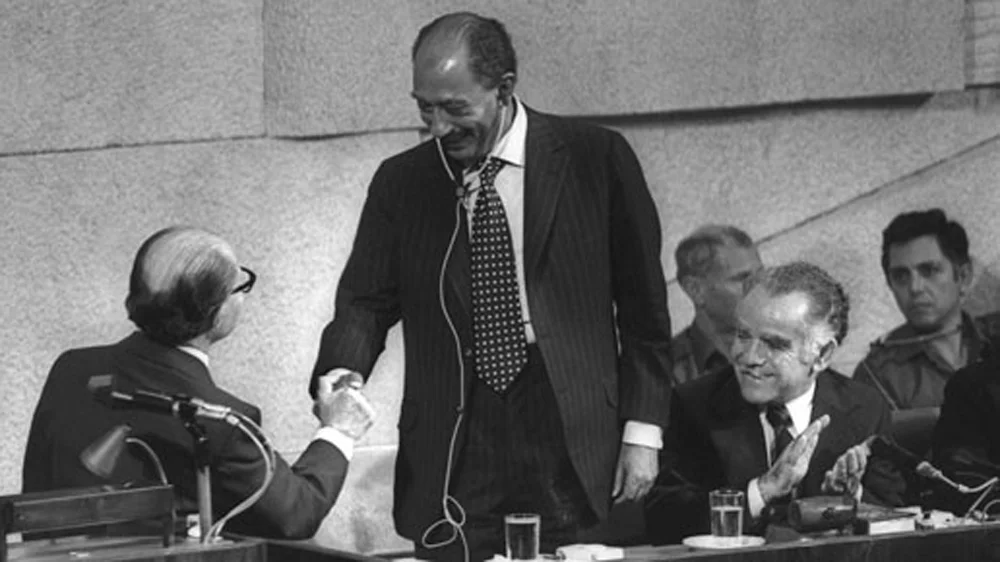
Anwar al-Sadat: 'We accept to live with you in permanent peace', Address to Israeli Knesset - 1977

June 28, 2017

20 November 1977, Givat Ram, Jerusalem, Israel

In the name of God, the Gracious and Merciful.

Mr. Speaker, Ladies and Gentlemen:

Peace and the mercy of God Almighty be upon you and may peace be for us all, God willing. Peace for us all on the Arab land, and in Israel as well, as in every part of this big world, which is so complexed by its sanguinary conflicts, disturbed by its sharp contradictions, menaced now and then by destructive wars launched by man to annihilate his fellow man. Finally, amidst the ruins of what man has built and the remains of the victims of Mankind, there emerges neither victor nor vanquished. The only vanquished remains man, God's most sublime creation, man whom God has created - as Ghandi the apostle of peace puts it: to forge ahead to mould the way of life and worship God Almighty.

I come to you today on solid ground, to shape a new life, to establish peace. We all, on this land, the land of God; we all, Muslims, Christians and Jews, worship God and no one but God. God's teachings and commandments are love, sincerity, purity and peace.

I do not blame all those who received my decision - when I announced it to the entire world before the Egyptian People's Assembly - with surprise and amazement. Some, gripped by the violent surprise, believed that my decision was no more than verbal juggling to cater for world public opinion. Others, still, interpreted it as political tactics to camouflage my intention of launching a new war. I would go as far as to tell you that one of my aides at the Presidential Office contacted me at a late hour following my return home from the People's Assembly and sounded worried as he asked me: "Mr. President, what would be our reaction if Israel should actually extend an invitation to you?" I replied calmly, I will accept it immediately. I have declared that I will go to the end of the world; I will go to Israel, for I want to put before the People of Israel all the facts.

I can see the point of all those who were astounded by my decision or those who had any doubts as to the sincerity of the intentions behind the declaration of my decision. No one would have ever conceived that the President of the biggest Arab State, which bears the heaviest burden and the top responsibility pertaining to the cause of war and peace in the Middle East, could declare his readiness to go to the land of the adversary while we were still in a state of war. Rather, we all are still bearing the consequences of four fierce wars waged within thirty years. The families of the 1973 October War are still moaning under the cruel pains of widowhood and bereavement of sons, fathers and brothers.

As I have already declared, I have not consulted, as far as this decision is concerned, with any of my colleagues and brothers, the Arab Heads of State or the confrontation States. Those of them who contacted me, following the declaration of this decision, expressed their objection, because the feeling of utter suspicion and absolute lack of confidence between the Arab States and the Palestinian People on the one hand, and Israel on the other, still surges in us all. It is sufficient to say that many months in which peace could have been brought about had been wasted over differences and fruitless discussions on the procedure for the convocation of the Geneva Conference, all showing utter suspicion and absolute lack of confidence.

But, to be absolutely frank with you, I took this decision after long thinking, knowing that it constitutes a grave risk for, if God Almighty has made it my fate to assume the responsibility on behalf of the Egyptian People and to share in the fate-determining responsibility of the Arab Nation and the Palestinian People, the main duty dictated by this responsibility is to exhaust all and every means in a bid to save my Egyptian Arab People and the entire Arab Nation the horrors of new, shocking and destructive wars, the dimensions of which are foreseen by no other than God himself.

After long thinking, I was convinced that the obligation of responsibility before God, and before the people, make it incumbent on me that I should go to the farthest corner of the world, even to Jerusalem, to address Members of the Knesset, the representatives of the People of Israel, and acquaint them with all the facts surging in me. Then, I would leave you to decide for yourselves. Following this, may God Almighty determine our fate.

Ladies and Gentlemen, there are moments in the life of nations and peoples when it is incumbent on those known for their wisdom and clarity of vision to overlook the past, with all its complexities and weighing memories, in a bold drive towards new horizons. Those who, like us, are shouldering the same responsibility entrusted to us, are the first who should have the courage to take fate-determining decisions which are in consonance with the circumstances. We must all rise above all forms of fanaticism, self-deception and obsolete theories of superiority. The most important thing is never to forget that infallibility is the prerogative of God alone.

If I said that I wanted to save all the Arab People the horrors of shocking and destructive wars, I most sincerely declare before you that I have the same feelings and bear the same responsibility towards all and every man on earth, and certainly towards the Israeli People.

Any life lost in war is a human life, irrespective of its being that of an Israeli or an Arab. A wife who becomes a widow is a human being entitled to a happy family life, whether she be an Arab or an Israeli. Innocent children who are deprived of the care and compassion of their parents are ours, be they living on Arab or Israeli land. They command our top responsibility to afford them a comfortable life today and tomorrow.

For the sake of them all, for the safeguard of the lives of all our sons and brothers, for affording our communities the opportunity to work for the progress and happiness of man and his right to a dignified life, for our responsibilities before the generations to come, for a smile on the face of every child born on our land - for all that, I have taken my decision to come to you, despite all hazards, to deliver my address.

I have shouldered the prerequisites of the historical responsibility and, therefore, I declared - on 4 February 1971, to be precise - that I was willing to sign a peace agreement with Israel. This was the first declaration made by a responsible Arab official since, the outbreak of the Arab-Israeli conflict.

Motivated by all these factors dictated by the responsibilities of leadership, I called, on 16 October 1973, before the Egyptian People's Assembly, for an international conference to establish permanent peace based on justice. I was not in the position of he who was pleading for peace or asking for a ceasefire.

Motivated by all these factors dictated by duties of history and leadership, we signed the first disengagement agreement, followed by the second disengagement agreement in Sinai. Then we proceeded trying both open and closed doors in a bid to find a certain path leading to a durable and just peace. We opened our hearts to the peoples of the entire world to make them understand our motivations and objectives, and to leave them actually convinced of the fact that we are advocates of justice and peace-makers.

Motivated by all these factors, I decided to come to you with an open mind and an open heart, and with a conscious determination, so that we might establish permanent peace based on justice.

It is so fated that my trip to you, the trip of peace, should coincide with the Islamic feast, the holy Feast of Courban Bairam, the Feast of Sacrifice when Abraham - peace be upon him - great-grandfather of the Arabs and Jews, submitted to God; I say when God Almighty ordered him, and to Him Abraham went, with dedicated sentiments, not out of weakness, but through a giant spiritual force and by a free will, to sacrifice his very own son, prompted by a firm and unshakable belief in ideals that lend life a profound significance.

This coincidence may carry a new meaning to us all, which may become a genuine aspiration heralding security and peace.

Ladies and Gentlemen, let us be frank with each other, using straight-forward words and a clear conception, with no ambiguity. Let us be frank with each other today while the entire world, both East and West, follows these unparalleled moments which could prove to be a radical turning point in the history of this part of the world, if not in the history of the world as a whole. Let us be frank with each other as we answer this important question: how can we achieve permanent peace based on justice?

I have come to you carrying my clear and frank answer to this big question, so that the people in Israel as well as the whole world might hear it, and so that all those whose devoted prayers ring in my ears, pleading to God Almighty that this historic meeting may eventually lead to the results aspired to by millions, might also hear it.

Before I proclaim my answer, I wish to assure you that, in my clear and frank answer, I am basing myself on a number of facts which no one can deny.

The first fact: no one can build his happiness at the expense of the misery of others.

The second fact: never have I spoken or will ever speak in two languages. Never have I adopted or will adopt two policies. I never deal with anyone except in one language, one policy, and with one face.

The third fact: direct confrontation and a straight line are the nearest and most successful methods to reach a clear objective.

The fourth fact: the call for permanent and just peace, based on respect for the United Nations resolutions, has now become the call of the whole world. It has become a clear expression of the will of the international community, whether in official capitals, where policies are made and decisions taken, or at the level of world public opinion which influences policy-making and decision-taking.

The fifth fact: and this is probably the clearest and most prominent, is that the Arab Nation, in its drive for permanent peace based on justice, does not proceed from a position of weakness or hesitation, but it has the potential of power and stability which tells of a sincere will for peace. The Arab-declared intention stems from an awareness prompted by a heritage of civilization that, to avoid an inevitable disaster that will befall us, you and the entire world, there is no alternative to the establishment of permanent peace based on justice - peace that is not shaken by storms, swayed by suspicion, or jeopardized by ill intentions.

In the light of these facts which I meant to place before you the way I see them, I would also wish to warn you in all sincerity; I warn you against some thoughts that could cross your minds; frankness makes it incumbent upon me to tell you the following:

First: I have not come here for a separate agreement between Egypt and Israel. This is not part of the policy of Egypt. The problem is not that of Egypt and Israel. Any separate peace between Egypt and Israel, or between any Arab confrontation State and Israel, will not bring permanent peace based on justice in the entire region. Rather, even if peace between all the confrontation States and Israel were achieved, in the absence of a just solution to the Palestinian problem, never will there be that durable and just peace upon which the entire world insists today.

Second: I have not come to you to seek a partial peace, namely to terminate the state of belligerency at this stage, and put off the entire problem to a subsequent stage. This is not the radical solution that would steer us to permanent peace.

Equally, I have not come to you for a third disengagement agreement in Sinai, or in the Golan and the West Bank. For this would mean that we are merely delaying the ignition of the fuse; it would mean that we are lacking the courage to confront peace, that we are too weak to shoulder the burdens and responsibilities of a durable peace based on justice.

I have come to you so that together we might build a durable peace based on justice, to avoid the shedding of one single drop of blood from an Arab or an Israeli. It is for this reason that I have proclaimed my readiness to go to the farthest corner of the world.

Here, I would go back to the answer to the big question: how can we achieve a durable peace based on justice?

In my opinion, and I declare it to the whole world from this forum, the answer is neither difficult nor impossible, despite long years of feud, blood vengeance, spite and hatred, and breeding generations on concepts of total rift and deep-rooted animosity. The answer is not difficult, nor is it impossible, if we sincerely and faithfully follow a straight line.

You want to live with us in this part of the world. In all sincerity, I tell you, we welcome you among us, with full security and safety. This, in itself, is a tremendous turning point; one of the landmarks of a decisive historical change.

We used to reject you. We had our reasons and our claims, yes. We used to brand you as "so-called" Israel, yes. We were together in international conferences and organizations and our representatives did not, and still do not, exchange greetings, yes. This has happened and is still happening.

It is also true that we used to set, as a precondition for any negotiations with you, a mediator who would meet separately with each party. Through this procedure, the talks of the first and second disengagement agreements took place.

Our delegates met in the first Geneva Conference without exchanging a direct word. Yes, this has happened.

Yet, today I tell you, and declare it to the whole world, that we accept to live with you in permanent peace based on justice. We do not want to encircle you or be encircled ourselves by destructive missiles ready for launching, nor by the shells of grudges and hatred. I have announced on more than one occasion that Israel has become a fait accompli, recognized by the world, and that the two super powers have undertaken the responsibility of its security and the defence of its existence.

As we really and truly seek peace, we really and truly welcome you to live among us in peace and security.

There was a huge wall between us which you tried to build up over a quarter of a century, but it was destroyed in 1973. It was a wall of a continuously inflammable and escalating psychological warfare. It was a wall of fear of the force that could sweep the entire Arab Nation. It was a wall of propaganda, that we were a Nation reduced to a motionless corpse. Rather, some of you had gone as far as to say that, even after 50 years, the Arabs would not regain any strength. It was a wall that threatened always with the long arm that could reach and strike anywhere. It was a wall that warned us against extermination and annihilation if we tried to use our legitimate right to liberate the occupied territories. Together we have to admit that that wall fell and collapsed in 1973.

Yet, there remained another wall. This wall constitutes a psychological barrier between us. A barrier of suspicion. A barrier of rejection. A barrier of fear of deception. A barrier of hallucinations around any action, deed or decision. A barrier of cautious and erroneous interpretations of all and every event or statement. It is this psychological barrier which I described in official statements as representing 70 percent of the whole problem.

Today, through my visit to you, I ask you: why don't we stretch our hands with faith and sincerity so that, together, we might destroy this barrier? Why shouldn't ours and your will meet with faith and sincerity, so that together we might remove all suspicion of fear, betrayal and ill intentions? Why don't we stand together with the bravery of men and the boldness of heroes who dedicate themselves to a sublime objective? Why don't we stand together with the same courage and boldness to erect a huge edifice of peace that builds and does not destroy? An edifice that is a beacon for generations to come - the human message for construction, development and the dignity of man? Why should we bequeath to the coming generations the plight of bloodshed, death, orphans, widowhood, family disintegration, and the wailing of victims?

Why don't we believe in the wisdom of God conveyed to us by the Proverbs of Solomon:

"Deceit is in the heart of them that imagine evil; but to the counsellors of peace is joy. Better is a dry morsel, and quietness therewith, than a house full of sacrifices with strife."

Why don't we repeat together from the Psalms of David:

"Hear the voice of my supplications, when I cry unto thee, when I lift up my hands toward they holy oracle. Draw me not away with the wicked, and with the workers of iniquity, which speak peace to their neighbours, but mischief is in their hearts. Give them according to their deeds, and according to the wickedness of their endeavours."

To tell you the truth, peace cannot be worth its name unless it is based on justice, and not on the occupation of the land of others. It would not be appropriate for you to demand for yourselves what you deny others. With all frankness, and with the spirit that has prompted me to come to you today, I tell you: you have to give up, once and for all, the dreams of conquest, and give up the belief that force is the best method for dealing with the Arabs. You should clearly understand and assimilate the lesson of confrontation between you and us.

Expansion does not pay. To speak frankly, our land does not yield itself to bargaining. It is not even open to argument. To us, the national soil is equal to the holy valley where God Almighty spoke to Moses - peace be upon him. None of us can, or accept to, cede one inch of it, or accept the principle of debating or bargaining over it.

I sincerely tell you that before us today lies the appropriate chance for peace, if we are really serious in our endeavours for peace. It is a chance that time cannot afford once again. It is a chance that, if lost or wasted, the plotter against it will bear the curse of humanity and the curse of history.

What is peace for Israel? It means that Israel lives in the region with her Arab neighbours, in security and safety. To such logic, I say yes. It means that Israel lives within her borders, secure against any aggression. To such logic, I say yes. It means that Israel obtains all kinds of guarantees that ensure those two factors. To this demand, I say yes. More than that: we declare that we accept all the international guarantees you envisage and accept. We declare that we accept all the guarantees you want from the two super powers or from either of them, or from the Big Five, or some of them.

Once again, I declare clearly and unequivocally that we agree to any guarantees you accept because, in return, we shall obtain the same guarantees.

In short, then, when we ask: what is peace for Israel, the answer would be: it is that Israel live within her borders with her Arab neighbours, in safety and security within the framework of all the guarantees she accepts and which are offered to the other party. But how can this be achieved? How can we reach this conclusion which would lead us to permanent peace based on justice?

There are facts that should be faced with all courage and clarity. There are Arab territories which Israel has occupied by armed force. We insist on complete withdrawal from these territories, including Arab Jerusalem.

I have come to Jerusalem, as the City of Peace, which will always remain as a living embodiment of coexistence among believers of the three religions. It is inadmissible that anyone should conceive the special status of the City of Jerusalem within the framework of annexation or expansionism, but it should be a free and open city for all believers.

Above all, the city should not be severed from those who have made it their abode for centuries. Instead of awakening the prejudices of the Crusaders, we should revive the spirit of Ornar ibn el-Khattab and Saladdin, namely the spirit of tolerance and respect for rights. The holy shrines of Islam and Christianity are not only places of worship, but a living testimony of our uninterrupted presence here politically, spiritually and intellectually. Let us make no mistake about the importance and reverence we Christians and Muslims attach to Jerusalem.

Let me tell you, without the slightest hesitation, that I did not come to you under this dome to make a request that your troops evacuate the occupied territories. Complete withdrawal from the Arab territories occupied in 1967 is a logical and undisputed fact. Nobody should plead for that. Any talk about permanent peace based on justice, and any move to ensure our coexistence in peace and security in this part of the world, would become meaningless, while you occupy Arab territories by force of arms. For there is no peace that could be in consonance with, or be built on, the occupation of the land of others. Otherwise, it would not be a serious peace.

Yes, this is a foregone conclusion which is not open to discussion or debate - if intentions are sincere and if endeavours to establish a just and durable peace for ours and the generations to come are genuine.

As for the Palestinians cause, nobody could deny that it is the crux of the entire problem. Nobody in the world could accept, today, slogans propagated here in Israel, ignoring the existence of the Palestinian People, and questioning their whereabouts. The cause of the Palestinian People and their legitimate rights are no longer ignored or denied today by anybody. Rather, nobody who has the ability of judgement can deny or ignore it.

It is an acknowledged fact received by the world community, both in the East and in the West, with support and recognition in international documents and official statements. It is of no use to anybody to turn deaf ears to its resounding voice which is being heard day and night, or to overlook its historical reality. Even the United States, your first ally which is absolutely committed to safeguard Israel's security and existence, and which offered and still offers Israel every moral, material and military support - I say - even the United States has opted to face up to reality and facts, and admit that the Palestinian People are entitled to legitimate rights and that the Palestinian problem is the core and essence of the conflict and that, so long as it continues to be unresolved, the conflict will continue to aggravate, reaching new dimensions. In all sincerity, I tell you that there can be no peace without the Palestinians. It is a grave error of unpredictable consequences to overlook or brush aside this cause.

I shall not indulge in past events since the Balfour Declaration sixty years ago. You are well acquainted with the relevant facts. If you have found the legal and moral justification to set up a national home on a land that did not all belong to you, it is incumbent upon you to show understanding of the insistence of the People of Palestine on establishing, once again (sic) a state on their land. When some extremists ask the Palestinians to give up this sublime objective, this, in fact, means asking them to renounce their identity and every hope for the future.

I hail the Israeli voices that called for the recognition of the Palestinian People's rights to achieve and safeguard peace. Here I tell you, ladies and gentlemen, that it is no use to refrain from recognizing the Palestinian People and their rights to statehood and rights of return.

We, the Arabs, have faced this experience before, with you and with the reality of Israeli existence. The struggle took us from war to war, from victims to more victims, until you and we have today reached the edge of a horrifying abyss and a terrifying disaster, unless, together, we seize the opportunity, today, of a durable peace based on justice.

You have to face reality bravely as I have done. There can never be any solution to a problem by evading it or turning a deaf ear to it. Peace cannot last if attempts are made to impose fantasy concepts on which the world has turned its back and announced its unanimous call for the respect of rights and facts. There is no need to enter a vicious circle as to Palestinian rights. It is useless to create obstacles. Otherwise the march of peace will be impeded or peace will be blown up.

As I have told you, there is no happiness to the detriment of others. Direct confrontation and straight-forwardness are the short-cut and the most successful way to reach a clear objective. Direct confrontation concerning the Palestinian problem, and tackling it in one single language with a view to achieving a durable and just peace, lie in the establishment of their state. With all the guarantees you demand, there should be no fear of a newly-born state that needs the assistance of all countries of the world. When the bells of peace ring, there will be no hands to beat the drums of war. Even if they existed, they would be soundless.

Conceive with me a peace agreement in Geneva that we would herald to a world thirsty for peace, a peace agreement based on the following points:

First: ending the Israeli occupation of the Arab territories occupied in 1967.

Second: achievement of the fundamental rights of the Palestinian People and their right to self-determination, including their right to establish their own state.

Third: the right of all states in the area to live in peace within their boundaries, which will be secure and guaranteed through procedures to be agreed upon, which provide appropriate security to international boundaries, in addition to appropriate international guarantees.

Fourth: commitment of all states in the region to administer the relations among them in accordance with the objectives and principles of the United Nations Charter, particularly the principles concerning the non-resort to force and the solution of differences among them by peaceful means.

Fifth: ending the state of belligerency in the region.

Ladies and Gentlemen, peace is not the mere endorsement of written lines; rather, it is a rewriting of history. Peace is not a game of calling for peace to defend certain whims or hide certain ambitions. Peace is a giant struggle against all and every ambition and whim. Perhaps the examples taken from ancient and modern history teach us all that missiles, warships and nuclear weapons cannot establish security. Rather, they destroy what peace and security build. For the sake of our peoples, and for the sake of the civilizations made by man, we have to defend man everywhere against the rule of the force of arms, so that we may endow the rule of humanity with all the power of the values and principles that promote the sublime position of Mankind.

Allow me to address my call from this rostrum to the People of Israel. I address myself with true and sincere words to every man, woman and child in Israel.

From the Egyptian People who bless this sacred mission of peace, I convey to you the message of peace, the message of the Egyptian People who do not know fanaticism, and whose sons, Muslims, Christians, and Jews, live together in a spirit of cordiality, love and tolerance. This is Egypt whose people have entrusted me with that sacred message, the message of security, safety and peace. To every man, woman and child in Israel, I say: encourage your leadership to struggle for peace. Let all endeavours be channelled towards building a huge edifice for peace, instead of strongholds and hideouts defended by destructive rockets. Introduce to the entire world the image of the new man in this area, so that he might set an example to the man of our age, the man of peace everywhere.

Be the heralds to your sons. Tell them that past wars were the last of wars and the end of sorrows. Tell them that we are in for a new beginning to a new life - the life of love, prosperity, freedom and peace.

You, bewailing mother; you, widowed wife; you, the son who lost a brother or a father; you, all victims of wars - fill the earth and space with recitals of peace. Fill bosoms and hearts with the aspirations of peace. Turn the song into a reality that blossoms and lives. Make hope a code of conduct and endeavour. The will of peoples is part of the will of God.

Ladies and Gentlemen, before I came to this place, with every beat of my heart and with every sentiment, I prayed to God Almighty, while performing the Curban Bairarn prayers, and while visiting the Holy Sepulchre, to give me strength and to confirm my belief that this visit may achieve the objectives I look forward to, for a happy present and a happier future.

I have chosen to set aside all precedents and traditions known by warring countries, in spite of the fact that occupation of the Arab territories is still there. Rather, the declaration of my readiness to proceed to Israel came as a great surprise that stirred many feelings and astounded many minds. Some opinions even doubted its intent. Despite that, the decision was inspired by all the clarity and purity of belief, and with all the true expression of my People's will and intentions.

And I have chosen this difficult road which is considered, in the opinion of many, the most difficult road. I have chosen to come to you with an open heart and an open mind. I have chosen to give this great impetus to all international efforts exerted for peace. I have chosen to present to you, and in your own home, the realities devoid of any schemes or whims, not to manoeuver or to win a round, but for us to win together, the most dangerous of rounds and battles in modern history - the battle of permanent peace based on justice.

It is not my battle alone, nor is it the battle of the leadership in Israel alone. It is the battle of all and every citizen in all our territories whose right it is to live in peace. It is the commitment of conscience and responsibility in the hearts of millions.

When I put forward this initiative, many asked what is it that I conceived as possible to achieve during this visit, and what my expectations were. And, as I answered the questioners, I announce before you that I have not thought of carrying out this initiative from the concept of what could be achieved during this visit, but I have come here to deliver a message. I have delivered the message, and may God be my witness.

I repeat with Zechariah, "Love right and justice."

I quote the following verses from the holy Koran:

"We believe in God and in what has been revealed to us and what was revealed to Abraham, Ismail, Isaac, Jacob, and the tribes and in the books given to Moses, Jesus, and the prophets from their lord. We make no distinction between one and another among them and to God we submit."

Source: http://www.jewishvirtuallibrary.org/addres...

Enjoyed this speech? Speakola is a labour of love and I’d be very grateful if you would share, tweet or like it. Thank you.

Facebook Twitter Facebook
In 1960-79 B Tags ANWAR AL-SADAT, EGYPT, ISRAEL, ARAB-ISRAEL, PEACE, KNESSET, TRANSCRIPT
Comment

Richard Nixon: 'There can be no whitewash at the White House', First Watergate speech - 1973

June 28, 2017

30 April 1973, White House, Washington DC, USA

Good evening:

I want to talk to you tonight from my heart on a subject of deep concern to every American.

In recent months, members of my Administration and officials of the Committee for the Re-Election of the President, including some of my closest friends and most trusted aides, have been charged with involvement in what has come to be known as the Watergate affair. These include charges of illegal activity during and preceding the 1972 Presidential election and charges that responsible officials participated in efforts to cover up that illegal activity.

The inevitable result of these charges has been to raise serious questions about the integrity of the White House itself. Tonight I wish to address those questions.

Last June 17, while I was in Florida trying to get a few days rest after my visit to Moscow, I first learned from news reports of the Watergate break-in. I was appalled at this senseless, illegal action. And I was shocked to learn that employees of the Re-Election Committee were apparently among those guilty. I immediately ordered an investigation by appropriate Government authorities. On September 15, as you will recall, indictments were brought against seven defendants in the case.

As the investigations went forward, I repeatedly asked those conducting the investigation whether there was any reason to believe that members of my Administration were in any way involved. I received repeated assurances that there were not. Because of these continuing reassurances, because I believed the reports I was getting, because I had faith in the persons from whom I was getting them, I discounted the stories in the press that appeared to implicate members of my Administration or other officials of the campaign committee.

Until March of this year, I remained convinced that the denials were true and that the charges of involvement by members of the White House Staff were false. The comments I made during this period, and the comments made by my Press Secretary in my behalf, were based on the information provided to us at the time we made those comments. However, new information then came to me which persuaded me that there was a real possibility that some of these charges were true, and suggesting further that there had been an effort to conceal the facts both from the public, from you, and from me.

As a result, on March 21, I personally assumed the responsibility for coordinating intensive new inquiries into the matter, and I personally ordered those conducting the investigations to get all the facts and to report them directly to me, right here in this office.

I again ordered that all persons in the Government or at the Re-Election Committee should cooperate fully with the FBI, the prosecutors, and the grand jury. I also ordered that anyone who refused to cooperate in telling the truth would be asked to resign from Government service. And, with ground rules adopted that would preserve the basic constitutional separation of powers between the Congress and the Presidency, I directed that members of the White House Staff should appear and testify voluntarily under oath before the Senate committee which was investigating Watergate.

I was determined that we should get to the bottom of the matter, and that the truth should be fully brought out, no matter who was involved. At the same time, I was determined not to take precipitate action and to avoid, if at all possible, any action that would appear to reflect on innocent people. I wanted to be fair. But I knew that in the final analysis, the integrity of this office, public faith in the integrity of this office, would have to take priority over all personal considerations.

Today, in one of the most difficult decisions of my Presidency, I accepted the resignations of two of my closest associates in the White House, Bob Haldeman and John Ehrlichman, two of the finest public servants it has been my privilege to know. I want to stress that in accepting these resignations, I mean to leave no implication whatever of personal wrongdoing on their part, and I leave no implication tonight of implication on the part of others who have been charged in this matter. But in matters as sensitive as guarding the integrity of our democratic process, it is essential not only that rigorous legal and ethical standards be observed but also that the public, you, have total confidence that they are both being observed and enforced by those in authority and particularly by the President of the United States. They agreed with me that this move was necessary in order to restore that confidence.

Because Attorney General Kleindienst, though a distinguished public servant, my personal friend for 20 years, with no personal involvement whatever in this matter, has been a close personal and professional associate of some of those who are involved in this case, he and I both felt that it was also necessary to name a new Attorney General.

The Counsel to the President, John Dean, has also resigned.

As the new Attorney General, I have today named Elliot Richardson, a man of unimpeachable integrity and rigorously high principle. I have directed him to do everything necessary to ensure that the Department of Justice has the confidence and the trust of every law-abiding person in this country.

I have given him absolute authority to make all decisions bearing upon the prosecution of the Watergate case and related matters. I have instructed him that if he should consider it appropriate, he has the authority to name a special supervising prosecutor for matters arising out of the case.

Whatever may appear to have been the case before, whatever improper activities may yet be discovered in connection with this whole sordid affair, I want the American people, I want you to know beyond the shadow of a doubt that during my term as President, justice will be pursued fairly, fully, and impartially, no matter who is involved. This office is a sacred trust and I am determined to be worthy of that trust.

Looking back at the history of this case, two questions arise: How could it have happened? Who is to blame?

Political commentators have correctly observed that during my 27 years in politics I have always previously insisted on running my own campaigns for office.

But 1972 presented a very different situation. In both domestic and foreign policy, 1972 was a year of crucially important decisions, of intense negotiations, of vital new directions, particularly in working toward the goal which has been my overriding concern throughout my political career, the goal of bringing peace to America, peace to the world.

That is why I decided, as the 1972 campaign approached, that the Presidency should come first and politics second. To the maximum extent possible, therefore, I sought to delegate campaign operations, to remove the day-to-day campaign decisions from the President's office and from the White House. I also, as you recall, severely limited the number of my own campaign appearances.

Who, then, is to blame for what happened in this case? For specific criminal actions by specific individuals, those who committed those actions must, of course, bear the liability and pay the penalty.

For the fact that alleged improper actions took place within the White House or within my campaign organization, the easiest course would be for me to blame those to whom I delegated the responsibility to run the campaign. But that would be a cowardly thing to do.

I will not place the blame on subordinates, on people whose zeal exceeded their judgment and who may have done wrong in a cause they deeply believed to be right.

In any organization, the man at the top must bear the responsibility. That responsibility, therefore, belongs here, in this office. I accept it. And I pledge to you tonight, from this office, that I will do everything in my power to ensure that the guilty are brought to justice and that such abuses are purged from our political processes in the years to come, long after I have left this office.

Some people, quite properly appalled at the abuses that occurred, will say that Watergate demonstrates the bankruptcy of the American political system. I believe precisely the opposite is true. Watergate represented a series of illegal acts and bad judgments by a number of individuals. It was the system that has brought the facts to light and that will bring those guilty to justice, a system that in this case has included a determined grand jury, honest prosecutors, a courageous judge, John Sirica, and a vigorous free press.

It is essential now that we place our faith in that system and especially in the judicial system. It is essential that we let the judicial process go forward, respecting those safeguards that are established to protect the innocent as well as to convict the guilty. It is essential that in reacting to the excesses of others, we not fall into excesses ourselves.

It is also essential that we not be so distracted by events such as this that we neglect the vital work before us, before this Nation, before America, at a time of critical importance to America and the world.

Since March, when I first learned that the Watergate affair might in fact be far more serious than I had been led to believe, it has claimed far too much of my time and my attention.

Whatever may now transpire in the case, whatever the actions of the grand jury, whatever the outcome of any eventual trials, I must now turn my full attention, and I shall do so, once again to the larger duties of this office. I owe it to this great office that I hold, and I owe it to you, to my country.

I know that as Attorney General, Elliot Richardson will be both fair and he will be fearless in pursuing this case wherever it leads. I am confident that with him in charge, justice will be done.

There is vital work to be done toward our goal of a lasting structure of peace in the world, work that cannot wait, work that I must do.

Tomorrow, for example, Chancellor Brandt of West Germany will visit the White House for talks that are a vital element of The Year of Europe, as 1973 has been called. We are already preparing for the next Soviet-American summit meeting later this year.

This is also a year in which we are seeking to negotiate a mutual and balanced reduction of armed forces in Europe, which will reduce our defense budget and allow us to have funds for other purposes at home so desperately needed. It is the year when the United States and Soviet negotiators will seek to work out the second and even more important round of our talks on limiting nuclear arms and of reducing the danger of a nuclear war that would destroy civilization as we know it. It is a year in which we confront the difficult tasks of maintaining peace in Southeast Asia and in the potentially explosive Middle East.

There is also vital work to be done right here in America: to ensure prosperity, and that means a good job for everyone who wants to work; to control inflation, that I know worries every housewife, everyone who tries to balance a family budget in America; to set in motion new and better ways of ensuring progress toward a better life for all Americans.

When I think of this office of what it means, I think of all the things that I want to accomplish for this Nation, of all the things I want to accomplish for you.

On Christmas Eve, during my terrible personal ordeal of the renewed bombing of North Vietnam, which after twelve years of war finally helped to bring America peace with honor, I sat down just before midnight. I wrote out some of my goals for my second term as President. Let me read them to you.

To make it possible for our children, and for our children's children, to live in a world of peace.

To make this country be more than ever a land of opportunity, of equal opportunity, full opportunity for every American.

To provide jobs for all who can work, and generous help for those who cannot work.

To establish a climate of decency and civility, in which each person respects the feelings and the dignity and the God-given rights of his neighbor.

To make this a land in which each person can dare to dream, can live his dreams, not in fear but in hope, proud of his community, proud of his country, proud of what America has meant to himself and to the world.

These are great goals. I believe we can, we must work for them. We can achieve them. But we cannot achieve these goals unless we dedicate ourselves to another goal. We must maintain the integrity of the White House, and that integrity must be real, not transparent.

There can be no whitewash at the White House.

We must reform our political process, ridding it not only of the violations of the law but also of the ugly mob violence and other inexcusable campaign tactics that have been too often practiced and too readily accepted in the past, including those that may have been a response by one side to the excesses or expected excesses of the other side. Two wrongs do not make a right.

I have been in public life for more than a quarter of a century. Like any other calling, politics has good people and bad people. And let me tell you, the great majority in politics in the Congress, in the Federal Government, in the State government, are good people. I know that it can be very easy, under the intensive pressures of a campaign, for even well-intentioned people to fall into shady tactics, to rationalize this on the grounds that what is at stake is of such importance to the Nation that the end justifies the means. And both of our great parties have been guilty of such tactics in the past.

In recent years, however, the campaign excesses that have occurred on all sides have provided a sobering demonstration of how far this false doctrine can take us. The lesson is clear. America, in its political campaigns, must not again fall into the trap of letting the end, however great that end is, justify the means.

I urge the leaders of both political parties, I urge citizens, all of you, everywhere, to join in working toward a new set of standards, new rules and procedures to ensure that future elections will be as nearly free of such abuses as they possibly can be made. This is my goal. I ask you to join in making it America's goal.

When I was inaugurated for a second time this past January 20, I gave each member of my Cabinet and each member of my senior White House Staff a special 4-year calendar, with each day marked to show the number of days remaining to the Administration. In the inscription on each calendar, I wrote these words:

The Presidential term which begins today consists of 1,461 days. No more, no less. Each can be a day of strengthening and renewal for America; each can add depth and dimension to the American experience.
If we strive together, if we make the most of the challenge and the opportunity that these days offer us, they can stand out as great days for America, and great moments in the history of the world.


I looked at my own calendar this morning up at Camp David as I was working on this speech. It showed exactly 1,361 days remaining in my term. I want these to be the best days in America's history, because I love America. I deeply believe that America is the hope of the world. And I know that in the quality and wisdom of the leadership America gives lies the only hope for millions of people all over the world that they can live their lives in peace and freedom. We must be worthy of that hope, in every sense of the word.

Tonight, I ask for your prayers to help me in everything that I do throughout the days of my Presidency to be worthy of their hopes and of yours.

God bless America and God bless each and every one of you.

Source: http://www.emersonkent.com/speeches/no_whi...

Enjoyed this speech? Speakola is a labour of love and I’d be very grateful if you would share, tweet or like it. Thank you.

Facebook Twitter Facebook
In 1960-79 B Tags WATERGATE, WHITEWASH, TRANSCRIPT, FIRST WATERGATE SPEECH, TRANSPARENCY, PRESIDENT, RICHARD NIXON
Comment

Pierre Trudeau: 'They also want money. Ransom money.' Televised statement on War Measures Act - 1970

June 28, 2017

16 October 1970, Ottawa, Canada

I am speaking to you at a moment of grave crisis, when violent and fanatical men are attempting to destroy the unity and the freedom of Canada. One aspect of that crisis is the threat which has been made on the lives of two innocent men. These are matters of the utmost gravity and I want to tell you what the government is doing to deal with them.

What has taken place in Montreal in the past two weeks is not unprecedented. It has happened elsewhere in the world on several recent occasions: it could happen elsewhere within Canada. But Canadians have always assumed that it could not happen here and as a result we are doubly shocked that it has.

Our assumption may have been naive, but it was understandable: understandable because democracy flourishes in Canada; understandable because individual liberty is cherished in Canada.

Notwithstanding these conditions, partly because of them it has been demonstrated now to us by a few misguided persons just how fragile a democratic society can be if democracy is not prepared to defend itself, and just how vulnerable to blackmail are tolerant, compassionate people.

Because the kidnappings and the blackmail are most familiar to you, I shall deal with them first.

The governments of Canada and Quebec have been told by groups of self-styled revolutionaries that they intend to murder in cold blood two innocent men unless their demands are met. The kidnappers claim they act as they do in order to draw attention to instances of social injustice.

But I ask them whose attention are they seeking to attract. The Government of Canada? The Government of Quebec?

Every government in this country is well aware of the existence of deep and important social problems. And every government to the limit of its resources and ability is deeply committed to their solution. But not by kidnappings and bombings. By hard work..

And if any doubt exists about the good faith or the ability of any government, there are opposition parties ready and willing to be given an opportunity to govern. In short there is available everywhere in Canada an effective mechanism to change governments by peaceful means. It has been employed by disenchanted voters again and again.

FEELlNGS EXPLOITED

Who are the kidnap victims'? To the victims' families they are husbands and fathers. To the kidnappers their identity is immaterial. The kidnappers' purposes would be served equally well by having in their grip you or me, or perhaps some child.

Their purpose is to exploit the normal, human feelings of Canadians and to bend those feelings of sympathy into instruments for their own violent and revolutionary ends.

What are the kidnappers demanding in return for the lives of these men? Several things. For one, they want their grievances aired by force in public on the assumption no doubt that all right-thinking persons would be persuaded that the problems of the world can be solved by shouting slogans and insults.

They want more. They want the police to offer up as a sacrificial lamb a person whom they assume assisted in the lawful arrest and proper conviction of certain of their criminal friends.

They also want money. Ransom money.

They want still more. They demand the release from prison of 17 criminals. and the dropping of charges against six other men, all of whom they refer to as "political prisoners."

Who are these men who are held out as latter-day patriots and martyrs? Let me describe them to you.

Three are convicted murderers; five others were jailed for manslaughter; one is serving a life imprisonment after having pleaded guilty to numerous charges related to bombings; another has been convicted of 17 armed robberies; two were once parolled but are now back in jail awaiting trial on charges of robberies.

NOT POLITICAL PRISONERS

Yet we are being asked to believe that these persons have been unjustly dealt with, that they have been imprisoned as a result of their political opinions, and that they deserve to be freed immediately, without recourse to due process of law.

The responsibility of deciding whether to release one or another of these criminals is that of the federal government. It is a responsibility that the government will discharge according to law.

To bow to the pressures of these kidnappers who demand that the prisoners be released would be not only an abdication of responsibility, it would lead to an increase in terrorist activities in Quebec.

It would be as well an invitation to terrorism and kidnapping across the country. We might well find ourselves facing an endless series of demands for the release of criminals from jails, from coast to coast, and we would find that the hostages could be innocent members of your family or of your neighborhood.

At the moment the FLQ is holding hostage two men in the Montreal area, one a British diplomat, the other a Quebec cabinet minister. They are threatened with murder.

CRUDE BLACKMAIL

Should governments give in to this crude blackmail, we would be facing the breakdown of the legal system and its replacement by the law of the jungle. The government's decision to prevent this from happening is not taken just to defend an important principle.

It is taken to protect the lives of Canadians from dangers of the sort I have mentioned. Freedom and personal security are safeguarded by laws; those laws must be respected in order to be effective.

If it is the responsibility of government to deny the demands of the kidnappers, the safety of the hostages is without question the responsibility of the kidnappers. Only the most twisted form of logic could conclude otherwise.

Nothing that either the government of Canada or the government of Quebec has done or failed to do, now or in the future, could possibly excuse any injury to either of these two innocent men.

The guns pointed at their heads have FLQ fingers on the triggers. Should any injury result, there is no explanation that could condone the acts. Should there be harm done to these men, the government promises unceasing pursuit of those responsible.

During the past 12 days, the governments of Canada and Quebec have been engaged in constant consultations. The course followed in this matter had the full support of both governments, and of the Montreal municipal authorities. In order to save the lives of Mr. Cross and Mr. Laporte, we have engaged in indirect communications with the kidnappers.

OFFER SPURNED

The offer of the federal government to the kidnappers of safe conduct out of Canada to a country of their choice, in return for the delivery of the hostages, has not yet been taken up. neither has the offer of the government of Quebec to recommend parole for the five prisoners eligible for parole.

This offer of safe conduct was made only because Mr. Cross and Mr. Laporte might be able to identify their kidnappers and to assist in their prosecution. By offering the kidnappers safe exit from Canada, we removed from them any possible motivation for murdering their hostages.

Let me turn now to the broader implications of the threat represented by the FLQ and similar organizations.

If a democratic society is to continue to exist, it must be able to root out the cancer of an armed, revolutionary movement that is bent on destroying the very basis of our freedom. For that reason the government, following an analysis of the facts, including requests of the government of Quebec and the city of Montreal for urgent action, decided to proclaim the War Measures Act.

It did so at 4:00 a.m. this morning, in order to permit the full weight of government to be brought quickly to bear on all those persons advocating or practising violence as a means of achieving political ends.

GOVERNMENT RELUCTANT

The War Measures Act gives sweeping powers to the government. It also suspends the operation of the Canadian Bill of Rights. I can assure you that the government is most reluctant to seek such powers, and did so only when it became crystal clear that the situation could not be controlled unless some extraordinary assistance was made available on an urgent basis.

The authority contained in the act will permit governments to deal effectively with the nebulous yet dangerous challenge to society represented by terrorist organizations. The criminal law as it stands is simply not adequate to deal with systematic terrorism.

The police have therefore been given certain extraordinary powers necessary for the effective detection and elimination of conspiratorial organizations which advocate the use of violence. These organizations, and membership in them, have been declared illegal.

The powers include the right to search and arrest without warrant, to detain suspected persons without the necessity of laying specific charges immediately, and to detain persons without bail .

POWERS DISTASTEFUL

These are strong powers and I find them as distasteful as I am sure you do. They are necessary, however, to permit the police to deal with persons who advocate or promote the violent overthrow of our democratic system.

In short, I assure you that the government recognizes its grave responsibilities in interfering in certain cases with civil liberties, and that it remains answerable to the people of Canada for its actions.

The government will revoke this proclamation as soon as possible.

As I said in the House of Commons this morning, the government will allow sufficient time to pass to give it the necessary experience to assess the type of statute which may be required in the present circumstances.

It is my firm intention to discuss then with the leaders of the opposition parties the desirability of introducing legislation of a less comprehensive nature. In this respect I earnestly solicited from the leaders and from all honourable members constructive suggestions for the amendment of the regulations.

Such suggestions will be given careful consideration for possible inclusion in any new statute.

A TRAP

I recognize, as I hope do others that this extreme position which governments have been forced into is in some respects a trap. It is a well-known technique of revolutionary groups who attempt to destroy society by unjustified violence, to goad the authorities into inflexible attitudes. The revolutionaries then employ this evidence of alleged authoritarianism as justification for the need to use violence in their renewed attacks on the social structure.

I appeal to all Canadians not to become so obsessed by what the government has done today in response to terrorism that they forget the opening play in this vicious game. That play was taken by the revolutionaries; they chose to use bombing, murder and kidnapping.

The threat posed by the FLQ terrorists and their supporters is out of all proportion to their numbers. This follows from the fact that they act stealthily and because they are known to have in their possession a considerable amount of dynamite.

To guard against the very real possibility of bombings directed at public buildings or utilities in the immediate future the government of Quebec has requested the assistance of the Canadian Armed Forces to support the police in several places in the province of Quebec. These forces took up their positions yesterday.

VIOLENT DECADE

Violence. unhappily, is no stranger to this decade. The Speech from the Throne opening the current session of Parliament a few days ago said that "we live in a period of tenseness and unease.". We must not overlook the fact, moreover that violence is often a symptom of deep social unrest.

This government has pledged that it will introduce legislation which deals not only with symptoms but with the social causes which often underlie or serve as an excuse for crime and disorder.

It was in that context that I stated in the House of Commons a year ago that there was no need anywhere in Canada for misguided or misinformed zealots to resort to acts of violence in the belief that only in this fashion could they accomplish change.

There may be some places in the world where the law is so inflexible and so insensitive as to prompt such beliefs.

But Canada is not such a place. I said then, and I repeat now, that those who would defy the law and ignore the opportunities available to them to right their wrongs and satisfy their claims will receive no hearing from this government

We shall ensure that the laws passed by Parliament are worthy of respect. We shall also ensure that those laws are respected.

HATE CULTIVATED

We have seen in many parts of Canada all too much evidence of violence in the name of revolution in the past 12 months. We are now able to see some of the consequences of violence.

Persons who invoke violence are raising deliberately the level of hate in Canada. They do so at a time when the country must eliminate hate, and must exhibit tolerance and compassion in order to create the kind of society which we all desire.

Yet those who disrespect legal processes create a danger that law-abiding elements of the community, out of anger and out of fear, will harden their attitudes and refuse to accommodate any change or remedy any shortcomings. They refuse because fear deprives persons of their normal sense of compassion and their normal sense of justice.

This government is not acting out of fear. It is acting to prevent fear from spreading. It is acting to maintain the rule of law without which freedom is impossible.

It is acting to make clear to kidnappers, revolutionaries and assassins that in this country laws are made and changed by the elected representatives of all Canadians -not by a handful of self-selected dictators. Those who gain power through terror rule through terror. The government is acting, therefore, to protect your life and your liberty.

The government is acting as well to ensure the safe return of Mr. James Cross and Mr. Pierre Laporte. I speak for millions of Canadians when I say to their courageous wives and families how much we sympathize with them for the nightmare to which they have been subjected, and how much we all hope and pray that it will soon conclude.

STAND FIRM

Canada remains one of the most wholesome and humane lands on this earth. If we stand firm, this current situation will soon pass. We will be able to say proudly, as we have for decades, that within Canada there is ample room for opposition and dissent, but none for intimidation and terror.

There are very few times in the history of any country when all persons must take a stand on critical issues. This is one of those times; this is one of those issues.

I am confident that those persons who unleashed this tragic sequence of events with the aim of destroying our society and dividing our country will find that the opposite will occur. The result of their acts will be a stronger society in a unified country. Those who would have divided us will have united us.

I sense the unease which grips many Canadians today. Some of you are upset, and this is understandable. I want to reassure you that the authorities have the situation well in hand.

Everything that needs to be done is being done; every level of government in this country is well prepared to act in your interests.

Source: http://faculty.marianopolis.edu/c.belanger...

Enjoyed this speech? Speakola is a labour of love and I’d be very grateful if you would share, tweet or like it. Thank you.

Facebook Twitter Facebook
In 1960-79 B Tags FLQ, TERRORISM, KIDNAPPING, WAR MEASURES ACT, PIERRE TRUDEAU, PRIME MINISTER, CANADA, TRANSCRIPT, QUEBEC, SEPARATIST MOV, SEPARATIST MOVEMENT, RANSOM
Comment

Barbara Jordan: 'Today I am an inquisitor', on impeachment - 1974

April 28, 2017

25 July 1975, Judiciary Committee, Congress, Washington DC, USA

Thank you, Mr. Chairman.

Mr. Chairman, I join my colleague Mr. Rangel in thanking you for giving the junior members of this committee the glorious opportunity of sharing the pain of this inquiry. Mr. Chairman, you are a strong man, and it has not been easy but we have tried as best we can to give you as much assistance as possible.

Earlier today, we heard the beginning of the Preamble to the Constitution of the United States: "We, the people." It's a very eloquent beginning. But when that document was completed on the seventeenth of September in 1787, I was not included in that "We, the people." I felt somehow for many years that George Washington and Alexander Hamilton just left me out by mistake. But through the process of amendment, interpretation, and court decision, I have finally been included in "We, the people."

Today I am an inquisitor. An hyperbole would not be fictional and would not overstate the solemnness that I feel right now. My faith in the Constitution is whole; it is complete; it is total. And I am not going to sit here and be an idle spectator to the diminution, the subversion, the destruction, of the Constitution.

"Who can so properly be the inquisitors for the nation as the representatives of the nation themselves?" "The subjects of its jurisdiction are those offenses which proceed from the misconduct of public men."1 And that's what we're talking about. In other words, [the jurisdiction comes] from the abuse or violation of some public trust.

It is wrong, I suggest, it is a misreading of the Constitution for any member here to assert that for a member to vote for an article of impeachment means that that member must be convinced that the President should be removed from office. The Constitution doesn't say that. The powers relating to impeachment are an essential check in the hands of the body of the Legislature against and upon the encroachments of the Executive. The division between the two branches of the Legislature, the House and the Senate, assigning to the one the right to accuse and to the other the right to judge, the Framers of this Constitution were very astute. They did not make the accusers and the judgers -- and the judges the same person.

We know the nature of impeachment. We've been talking about it awhile now. It is chiefly designed for the President and his high ministers to somehow be called into account. It is designed to "bridle" the Executive if he engages in excesses. "It is designed as a method of national inquest into the conduct of public men."² The Framers confided in the Congress the power if need be, to remove the President in order to strike a delicate balance between a President swollen with power and grown tyrannical, and preservation of the independence of the Executive.

The nature of impeachment: a narrowly channeled exception to the separation-of-powers maxim.  The Federal Convention of 1787 said that. It limited impeachment to high crimes and misdemeanors and discounted and opposed the term "maladministration." "It is to be used only for great misdemeanors," so it was said in the North Carolina ratification convention. And in the Virginia ratification convention: "We do not trust our liberty to a particular branch. We need one branch to check the other."

"No one need be afraid" -- the North Carolina ratification convention -- "No one need be afraid that officers who commit oppression will pass with immunity." "Prosecutions of impeachments will seldom fail to agitate the passions of the whole community," said Hamilton in the Federalist Papers, number 65. "We divide into parties more or less friendly or inimical to the accused."³ I do not mean political parties in that sense.

The drawing of political lines goes to the motivation behind impeachment; but impeachment must proceed within the confines of the constitutional term "high crime[s] and misdemeanors." Of the impeachment process, it was Woodrow Wilson who said that "Nothing short of the grossest offenses against the plain law of the land will suffice to give them speed and effectiveness. Indignation so great as to overgrow party interest may secure a conviction; but nothing else can."

Common sense would be revolted if we engaged upon this process for petty reasons. Congress has a lot to do: Appropriations, Tax Reform, Health Insurance, Campaign Finance Reform, Housing, Environmental Protection, Energy Sufficiency, Mass Transportation. Pettiness cannot be allowed to stand in the face of such overwhelming problems. So today we are not being petty. We are trying to be big, because the task we have before us is a big one.

This morning, in a discussion of the evidence, we were told that the evidence which purports to support the allegations of misuse of the CIA by the President is thin. We're told that that evidence is insufficient. What that recital of the evidence this morning did not include is what the President did know on June the 23rd, 1972.

The President did know that it was Republican money, that it was money from the Committee for the Re-Election of the President, which was found in the possession of one of the burglars arrested on June the 17th. What the President did know on the 23rd of June was the prior activities of E. Howard Hunt, which included his participation in the break-in of Daniel Ellsberg's psychiatrist, which included Howard Hunt's participation in the Dita Beard ITT affair, which included Howard Hunt's fabrication of cables designed to discredit the Kennedy Administration.

We were further cautioned today that perhaps these proceedings ought to be delayed because certainly there would be new evidence forthcoming from the President of the United States. There has not even been an obfuscated indication that this committee would receive any additional materials from the President. The committee subpoena is outstanding, and if the President wants to supply that material, the committee sits here. The fact is that on yesterday, the American people waited with great anxiety for eight hours, not knowing whether their President would obey an order of the Supreme Court of the United States.

At this point, I would like to juxtapose a few of the impeachment criteria with some of the actions the President has engaged in. Impeachment criteria: James Madison, from the Virginia ratification convention. "If the President be connected in any suspicious manner with any person and there be grounds to believe that he will shelter him, he may be impeached."

We have heard time and time again that the evidence reflects the payment to defendants money. The President had knowledge that these funds were being paid and these were funds collected for the 1972 presidential campaign. We know that the President met with Mr. Henry Petersen 27 times to discuss matters related to Watergate, and immediately thereafter met with the very persons who were implicated in the information Mr. Petersen was receiving. The words are: "If the President is connected in any suspicious manner with any person and there be grounds to believe that he will shelter that person, he may be impeached."

Justice Story: "Impeachment" is attended -- "is intended for occasional and extraordinary cases where a superior power acting for the whole people is put into operation to protect their rights and rescue their liberties from violations." We know about the Huston plan. We know about the break-in of the psychiatrist's office. We know that there was absolute complete direction on September 3rd when the President indicated that a surreptitious entry had been made in Dr. Fielding's office, after having met with Mr. Ehrlichman and Mr. Young. "Protect their rights." "Rescue their liberties from violation."

The Carolina ratification convention impeachment criteria: those are impeachable "who behave amiss or betray their public trust."4 Beginning shortly after the Watergate break-in and continuing to the present time, the President has engaged in a series of public statements and actions designed to thwart the lawful investigation by government prosecutors. Moreover, the President has made public announcements and assertions bearing on the Watergate case, which the evidence will show he knew to be false. These assertions, false assertions, impeachable, those who misbehave. Those who "behave amiss or betray the public trust."

James Madison again at the Constitutional Convention: "A President is impeachable if he attempts to subvert the Constitution." The Constitution charges the President with the task of taking care that the laws be faithfully executed, and yet the President has counseled his aides to commit perjury, willfully disregard the secrecy of grand jury proceedings, conceal surreptitious entry, attempt to compromise a federal judge, while publicly displaying his cooperation with the processes of criminal justice. "A President is impeachable if he attempts to subvert the Constitution."

If the impeachment provision in the Constitution of the United States will not reach the offenses charged here, then perhaps that 18th-century Constitution should be abandoned to a 20th-century paper shredder!

Has the President committed offenses, and planned, and directed, and acquiesced in a course of conduct which the Constitution will not tolerate? That's the question. We know that. We know the question. We should now forthwith proceed to answer the question. It is reason, and not passion, which must guide our deliberations, guide our debate, and guide our decision.

I yield back the balance of my time, Mr. Chairman.

Source: http://www.americanrhetoric.com/speeches/b...

Enjoyed this speech? Speakola is a labour of love and I’d be very grateful if you would share, tweet or like it. Thank you.

Facebook Twitter Facebook
In 1960-79 B Tags BARBARA JORDAN, TRANSCRIPT, CONSTITUTION, USA, RICHARD NIXON, ARTICLES OF IMPEACHMENT, IMPEACHMENT
Comment

John F. Kennedy: 'We face, therefore, a moral crisis as a country and as a people', Desegregation Order, University of Alabama - 1963

April 6, 2017

11 June 1963, Washington DC, USA


Good evening, my fellow citizens:

This afternoon, following a series of threats and defiant statements, the presence of Alabama National Guardsmen was required on the University of Alabama to carry out the final and unequivocal order of the United States District Court of the Northern District of Alabama. That order called for the admission of two clearly qualified young Alabama residents who happened to have been born Negro.

That they were admitted peacefully on the campus is due in good measure to the conduct of the students of the University of Alabama, who met their responsibilities in a constructive way.

I hope that every American, regardless of where he lives, will stop and examine his conscience about this and other related incidents. This Nation was founded by men of many nations and backgrounds. It was founded on the principle that all men are created equal, and that the rights of every man are diminished when the rights of one man are threatened.

Today we are committed to a worldwide struggle to promote and protect the rights of all who wish to be free. And when Americans are sent to Viet-Nam or West Berlin, we do not ask for whites only. It ought to be possible, therefore, for American students of any color to attend any public institution they select without having to be backed up by troops.

It ought to be possible for American consumers of any color to receive equal service in places of public accommodation, such as hotels and restaurants and theaters and retail stores, without being forced to resort to demonstrations in the street, and it ought to be possible for American citizens of any color to register and to vote in a free election without interference or fear of reprisal.

It ought to be possible, in short, for every American to enjoy the privileges of being American without regard to his race or his color. In short, every American ought to have the right to be treated as he would wish to be treated, as one would wish his children to be treated. But this is not the case.

The Negro baby born in America today, regardless of the section of the Nation in which he is born, has about one-half as much chance of completing a high school as a white baby born in the same place on the same day, one-third as much chance of completing college, one-third as much chance of becoming a professional man, twice as much chance of becoming unemployed, about one¬seventh as much chance of earning $10,000 a year, a life expectancy which is 7 years shorter, and the prospects of earning only half as much.

This is not a sectional issue. Difficulties over segregation and discrimination exist in every city, in every State of the Union, producing in many cities a rising tide of discontent that threatens the public safety. Nor is this a partisan issue. In a time of domestic crisis men of good will and generosity should be able to unite regardless of party or politics. This is not even a legal or legislative issue alone. It is better to settle these matters in the courts than on the streets, and new laws are needed at every level, but law alone cannot make men see right.

We are confronted primarily with a moral issue. It is as old as the scriptures and is as clear as the American Constitution.

The heart of the question is whether all Americans are to be afforded equal rights and equal opportunities, whether we are going to treat our fellow Americans as we want to be treated. If an American, because his skin is dark, cannot eat lunch in a restaurant open to the public, if he cannot send his children to the best public school available, if he cannot vote for the public officials who represent him, if, in short, he cannot enjoy the full and free life which all of us want, then who among us would be content to have the color of his skin changed and stand in his place? Who among us would then be content with the counsels of patience and delay?

One hundred years of delay have passed since President Lincoln freed the slaves, yet their heirs, their grandsons, are not fully free. They are not yet freed from the bonds of injustice. They are not yet freed from social and economic oppression. And this Nation, for all its hopes and all its boasts, will not be fully free until all its citizens are free.

We preach freedom around the world, and we mean it, and we cherish our freedom here at home, but are we to say to the world, and much more importantly, to each other that this is a land of the free except for the Negroes; that we have no second-class citizens except Negroes; that we have no class or caste system, no ghettoes, no master race except with respect to Negroes?

Now the time has come for this Nation to fulfill its promise. The events in Birmingham and elsewhere have so increased the cries for equality that no city or State or legislative body can prudently choose to ignore them.

The fires of frustration and discord are burning in every city, North and South, where legal remedies are not at hand. Re-dress is sought in the streets, in demonstrations, parades, and protests which create tensions and threaten violence and threaten lives.

We face, therefore, a moral crisis as a country and as a people. It cannot be met by repressive police action. It cannot be left to increased demonstrations in the streets. It cannot be quieted by token moves or talk. It is a time to act in the Congress, in your State and local legislative body and, above all, in all of our daily lives.

It is not enough to pin the blame on others, to say this is a problem of one section of the country or another, or deplore the fact that we face. A great change is at hand, and our task, our obligation, is to make that revolution, that change, peaceful and constructive for all.

Those who do nothing are inviting shame as well as violence. Those who act boldly are recognizing right as well as reality.

Next week I shall ask the Congress of the United States to act, to make a commitment it has not fully made in this century to the proposition that race has no place in American life or law. The Federal judiciary has upheld that proposition in a series of forthright cases. The executive branch has adopted that proposition in the conduct of its affairs, including the employment of Federal personnel, the use of Federal facilities, and the sale of federally financed housing.

But there are other necessary measures which only the Congress can provide, and they must be provided at this session. The old code of equity law under which we live commands for every wrong a remedy, but in too many communities, in too many parts of the country, wrongs are inflicted on Negro citizens and there are no remedies at law. Unless the Congress acts, their only remedy is in the street.

I am, therefore, asking the Congress to enact legislation giving all Americans the right to be served in facilities which are open to the public-hotels, restaurants, theaters, retail stores, and similar establishments.

This seems to me to be an elementary right. Its denial is an arbitrary indignity that no American in 1963 should have to endure, but many do.

I have recently met with scores of business leaders urging them to take voluntary action to end this discrimination and I have been encouraged by their response, and in the last 2 weeks over 75 cities have seen progress made in desegregating these kinds of facilities. But many are unwilling to act alone, and for this reason, nationwide legislation is needed if we are to move this problem from the streets to the courts.

I am also asking Congress to authorize the Federal Government to participate more fully in lawsuits designed to end segregation in public education. We have succeeded in persuading many districts to desegregate voluntarily. Dozens have admitted Negroes without violence. Today a Negro is attending a State-supported institution in every one of our 50 States, but the pace is very slow.

Too many Negro children entering segregated grade schools at the time of the Supreme Court's decision 9 years ago will enter segregated high schools this fall, having suffered a loss which can never be restored. The lack of an adequate education denies the Negro a chance to get a decent job.

The orderly implementation of the Supreme Court decision, therefore, cannot be left solely to those who may not have the economic resources to carry the legal action or who may be subject to harassment.

Other features will be also requested, including greater protection for the right to vote. But legislation, I repeat, cannot solve this problem alone. It must be solved in the homes of every American in every community across our country.

In this respect, I want to pay tribute to those citizens North and South who have been working in their communities to make life better for all. They are acting not out of a sense of legal duty but out of a sense of human decency.

Like our soldiers and sailors in all parts of the world they are meeting freedom's challenge on the firing line, and I salute them for their honor and their courage.

My fellow Americans, this is a problem which faces us all - in every city of the North as well as the South. Today there are Negroes unemployed, two or three times as many compared to whites, inadequate in education, moving into the large cities, unable to find work, young people particularly out of work without hope, denied equal rights, denied the opportunity to eat at a restaurant or lunch counter or go to a movie theater, denied the right to a decent education, denied almost today the right to attend a State university even though qualified. It seems to me that these are matters which concern us all, not merely Presidents or Congressmen or Governors, but every citizen of the United States.

This is one country. It has become one country because all of us and all the people who came here had an equal chance to develop their talents.

We cannot say to 10 percent of the population that you can't have that right; that your children can't have the chance to develop whatever talents they have; that the only way that they are going to get their rights is to go into the streets and demonstrate. I think we owe them and we owe ourselves a better country than that.

Therefore, I am asking for your help in making it easier for us to move ahead and to provide the kind of equality of treatment which we would want ourselves; to give a chance for every child to be educated to the limit of his talents.

As I have said before, not every child has an equal talent or an equal ability or an equal motivation, but they should have the equal right to develop their talent and their ability and their motivation, to make something of themselves.

We have a right to expect that the Negro community will be responsible, will uphold the law, but they have a right to expect that the law will be fair, that the Constitution will be color blind, as Justice Harlan said at the turn of the century.

This is what we are talking about and this is a matter which concerns this country and what it stands for, and in meeting it I ask the support of all our citizens.

Thank you very much.

Source: https://www.jfklibrary.org/Civil-Rights-Mi...

Enjoyed this speech? Speakola is a labour of love and I’d be very grateful if you would share, tweet or like it. Thank you.

Facebook Twitter Facebook
In 1960-79 B Tags JOHN F KENNEDY, UNIVERSITY OF ALABAMA, RACE, RACIAL EQUALITY, SEGREGATION, BROWN V BOARD OF EDUCATION, DESEGREGATION
Comment
← Newer Posts

See my film!

Limited Australian Season

March 2025

Details and ticket bookings at

angeandtheboss.com

Support Speakola

Hi speech lovers,
With costs of hosting website and podcast, this labour of love has become a difficult financial proposition in recent times. If you can afford a donation, it will help Speakola survive and prosper.

Best wishes,
Tony Wilson.

Become a Patron!

Learn more about supporting Speakola.

Featured political

Featured
Jon Stewart: "They responded in five seconds", 9-11 first responders, Address to Congress - 2019
Jacinda Ardern: 'They were New Zealanders. They are us', Address to Parliament following Christchurch massacre - 2019
Dolores Ibárruri: "¡No Pasarán!, They shall not pass!', Defense of 2nd Spanish Republic - 1936
Jimmy Reid: 'A rat race is for rats. We're not rats', Rectorial address, Glasgow University - 1972

Featured eulogies

Featured
For Geoffrey Tozer: 'I have to say we all let him down', by Paul Keating - 2009
for James Baldwin: 'Jimmy. You crowned us', by Toni Morrison - 1988
for Michael Gordon: '13 days ago my Dad’s big, beautiful, generous heart suddenly stopped beating', by Scott and Sarah Gordon - 2018

Featured commencement

Featured
Tara Westover: 'Your avatar isn't real, it isn't terribly far from a lie', The Un-Instagrammable Self, Northeastern University - 2019
Tim Minchin: 'Being an artist requires massive reserves of self-belief', WAAPA - 2019
Atul Gawande: 'Curiosity and What Equality Really Means', UCLA Medical School - 2018
Abby Wambach: 'We are the wolves', Barnard College - 2018
Eric Idle: 'America is 300 million people all walking in the same direction, singing 'I Did It My Way'', Whitman College - 2013
Shirley Chisholm: ;America has gone to sleep', Greenfield High School - 1983

Featured sport

Featured
Joe Marler: 'Get back on the horse', Harlequins v Bath pre game interview - 2019
Ray Lewis : 'The greatest pain of my life is the reason I'm standing here today', 52 Cards -
Mel Jones: 'If she was Bradman on the field, she was definitely Keith Miller off the field', Betty Wilson's induction into Australian Cricket Hall of Fame - 2017
Jeff Thomson: 'It’s all those people that help you as kids', Hall of Fame - 2016

Fresh Tweets


Featured weddings

Featured
Dan Angelucci: 'The Best (Best Man) Speech of all time', for Don and Katherine - 2019
Hallerman Sisters: 'Oh sister now we have to let you gooooo!' for Caitlin & Johnny - 2015
Korey Soderman (via Kyle): 'All our lives I have used my voice to help Korey express his thoughts, so today, like always, I will be my brother’s voice' for Kyle and Jess - 2014

Featured Arts

Featured
Bruce Springsteen: 'They're keepers of some of the most beautiful sonic architecture in rock and roll', Induction U2 into Rock Hall of Fame - 2005
Olivia Colman: 'Done that bit. I think I have done that bit', BAFTA acceptance, Leading Actress - 2019
Axel Scheffler: 'The book wasn't called 'No Room on the Broom!', Illustrator of the Year, British Book Awards - 2018
Tina Fey: 'Only in comedy is an obedient white girl from the suburbs a diversity candidate', Kennedy Center Mark Twain Award -  2010
Tina Fey: 'Only in comedy is an obedient white girl from the suburbs a diversity candidate', Kennedy Center Mark Twain Award - 2010

Featured Debates

Featured
Sacha Baron Cohen: 'Just think what Goebbels might have done with Facebook', Anti Defamation League Leadership Award - 2019
Greta Thunberg: 'How dare you', UN Climate Action Summit - 2019
Charlie Munger: 'The Psychology of Human Misjudgment', Harvard University - 1995
Lawrence O'Donnell: 'The original sin of this country is that we invaders shot and murdered our way across the land killing every Native American that we could', The Last Word, 'Dakota' - 2016