
28 February 2019, Washington DC, USA
You know I’ve sat here, and I’ve listened to all this, and it’s very painful. It’s very painful. You made a lot of mistakes, Mr. Cohen — and you’ve admitted that. And, you know, one of the saddest parts of this whole thing is that some very innocent people are hurting too. And you acknowledged that. And, um, that’s your family.
And, so you come here today, you… deep in my heart … when I practiced law I represented a lot of lawyers who got in trouble. And, you come saying I have made my mistakes, but now I want to change my life. And you know, if we … as a nation did not give people an opportunity after they’ve made mistakes to change their lives, a whole lot of people would not do very well.
I don’t know where you go from here. As I sat here and I listened to both sides, I just felt as if … and you know… people are now using my words, that they took from me, that didn't give me any credit. We are better than this. … We really are. As a country, we are so much better than this.
Commentary: Maryland Congressman Cummings redeems Cohen hearing with passionate, poetic closing remarks »
And, you know, I told you, and for some reason, Mr. Cohen, I tell my children, I say ‘When bad things happen to you, do not ask the question “Why did it happen to me?” Ask the question, “Why did it happen for me?” I don’t know why this is happening for you. But it’s my hope that a small part of it is for our country to be better. If I hear you correctly, it sounds like you’re crying out for a new normal — for us getting back to normal. It sounds to me like you want to make sure that our democracy stays intact.
The one meeting I had with President Trump, I said to him ‘the greatest gift that you and I, Mr. President, can give to our children, is making sure we give them a democracy that is intact. A … democracy better than the one we came upon. And I’m hoping that, the things you said today will help us again to get back there.
You know, I mean come on now. I mean, when you got, according to The Washington Post, our president has made at least 8,718 … false or misleading statements. That’s stunning. That’s not what we teach our children. I don’t teach mine that. And, for whatever reason, it sounds like you got caught up in it. You got caught up in it. You got caught up in it.
And, some kind of way, I hope that you will, I know that it’s painful going to prison. I know it’s got to be painful being called a rat. And let me explain, a lot of people don’t know the significance of that, but I live in the inner city of Baltimore, all right? And when you call somebody a rat, that’s one of the worst things you can call them because when they go to prison, that means a snitch. I’m just saying. And so, the president called you a rat. We’re better than that! We really are. And I’m hoping that all of us can get back to this democracy that we want, and that we should be passing on our children so they can do better than what we did.
So you wonder whether people believe you — I don’t know. I don’t know whether they believe you. But the fact is, that you’ve come, you have your head down, and this has got to be one of the hardest things that you could do.
Let me tell you the picture that really, really pained me. You were leaving the prison, you were leaving the courthouse, and, I guess it’s your daughter, had braces or something on. Man that thing, man that thing hurt me. As a father of two daughters, it hurt me. And I can imagine how it must feel for you. But I’m just saying to you — I want to first of all thank you. I know that this has been hard. I know that you’ve faced a lot. I know that you are worried about your family. But this is a part of your destiny. And hopefully this portion of your destiny will lead to a better, a better, a better Michael Cohen, a better Donald Trump, a better United States of America, and a better world. And I mean that from the depths of my heart.
When we’re dancing with the angels, the question we’ll be asked: In 2019, what did we do to make sure we kept our democracy intact? Did we stand on the sidelines and say nothing? …
And I’m tired of statements saying … people come in here and say ‘Oh, oh this is the first hearing.’ It is not the first hearing. The first hearing was with regard to prescription drugs. Remember, a little girl, a lady sat there… Her daughter died because she could not get $330 a month in insulin. That was our first hearing. Second hearing: H.R. 1, voting rights, corruption in government. Come on now. We can do more than one thing. And we have got to get back to normal. With that, this meeting is adjourned
Barack Obama: 'Something happened back here in Selma, Alabama', Voting Rights March Commemoration - 2007
5 March 2007, Brown A.M.E. Church, Selma, Alabama, USA
Here today, I must begin because at the Unity breakfast this morning I was saving for last and the list was so long I left him out after that introduction. So I’m going to start by saying how much I appreciate the friendship and the support and the outstanding work that he does each and every day, not just in Capitol Hill but also back here in the district. Please give a warm round of applause for your Congressman Artur Davis.
It is a great honor to be here. Reverend Jackson, thank you so much. To the family of Brown A.M.E, to the good Bishop Kirkland, thank you for your wonderful message and your leadership.
I want to acknowledge one of the great heroes of American history and American life, somebody who captures the essence of decency and courage, somebody who I have admired all my life and were it not for him, I’m not sure I’d be here today, Congressman John Lewis.
I’m thankful to him. To all the distinguished guests and clergy, I’m not sure I’m going to thank Reverend Lowery because he stole the show. I was mentioning earlier, I know we’ve got C.T. Vivian in the audience, and when you have to speak in front of somebody who Martin Luther King said was the greatest preacher he ever heard, then you’ve got some problems.
And I’m a little nervous about following so many great preachers. But I’m hoping that the spirit moves me and to all my colleagues who have given me such a warm welcome, thank you very much for allowing me to speak to you here today.
You know, several weeks ago, after I had announced that I was running for the Presidency of the United States, I stood in front of the Old State Capitol in Springfield, Illinois; where Abraham Lincoln delivered his speech declaring, drawing in scripture, that a house divided against itself could not stand.
And I stood and I announced that I was running for the presidency. And there were a lot of commentators, as they are prone to do, who questioned the audacity of a young man like myself, haven’t been in Washington too long.
And I acknowledge that there is a certain presumptuousness about this.
But I got a letter from a friend of some of yours named Reverend Otis Moss Jr. in Cleveland, and his son, Otis Moss III is the Pastor at my church and I must send greetings from Dr. Jeremiah A. Wright Jr. but I got a letter giving me encouragement and saying how proud he was that I had announced and encouraging me to stay true to my ideals and my values and not to be fearful.
And he said, if there’s some folks out there who are questioning whether or not you should run, just tell them to look at the story of Joshua because you’re part of the Joshua generation.
So I just want to talk a little about Moses and Aaron and Joshua, because we are in the presence today of a lot of Moseses. We’re in the presence today of giants whose shoulders we stand on, people who battled, not just on behalf of African Americans but on behalf of all of America; that battled for America’s soul, that shed blood , that endured taunts and formant and in some cases gave — torment and in some cases gave the full measure of their devotion.
Like Moses, they challenged Pharaoh, the princes, powers who said that some are atop and others are at the bottom, and that’s how it’s always going to be.
There were people like Anna Cooper and Marie Foster and Jimmy Lee Jackson and Maurice Olette, C.T. Vivian, Reverend Lowery, John Lewis, who said we can imagine something different and we know there is something out there for us, too.
Thank God, He’s made us in His image and we reject the notion that we will for the rest of our lives be confined to a station of inferiority, that we can’t aspire to the highest of heights, that our talents can’t be expressed to their fullest. And so because of what they endured, because of what they marched; they led a people out of bondage.
They took them across the sea that folks thought could not be parted. They wandered through a desert but always knowing that God was with them and that, if they maintained that trust in God, that they would be all right. And it’s because they marched that the next generation hasn’t been bloodied so much.
It’s because they marched that we elected councilmen, congressmen. It is because they marched that we have Artur Davis and Keith Ellison. It is because they marched that I got the kind of education I got, a law degree, a seat in the Illinois senate and ultimately in the United States senate.
It is because they marched that i stand before you here today. I was mentioning at the Unity Breakfast this morning, my — at the Unity Breakfast this morning that my debt is even greater than that because not only is my career the result of the work of the men and women who we honor here today. My very existence might not have been possible had it not been for some of the folks here today. I mentioned at the Unity Breakfast that a lot of people been asking, well, you know, your father was from Africa, your mother, she’s a white woman from Kansas. I’m not sure that you have the same experience.
And I tried to explain, you don’t understand. You see, my Grandfather was a cook to the British in Kenya. Grew up in a small village and all his life, that’s all he was — a cook and a house boy. And that’s what they called him, even when he was 60 years old. They called him a house boy. They wouldn’t call him by his last name. Call him by his first name.
Sound familiar?
He had to carry a passbook around because Africans in their own land, in their own country, at that time, because it was a British colony, could not move about freely. They could only go where they were told to go. They could only work where they were told to work.
Yet something happened back here in Selma, Alabama. Something happened in Birmingham that sent out what Bobby Kennedy called, “Ripples of hope all around the world.” Something happened when a bunch of women decided they were going to walk instead of ride the bus after a long day of doing somebody else’s laundry, looking after somebody else’s children. When men who had PhD’s decided that’s enough and we’re going to stand up for our dignity. That sent a shout across oceans so that my grandfather began to imagine something different for his son. His son, who grew up herding goats in a small village in Africa could suddenly set his sights a little higher and believe that maybe a black man in this world had a chance.
What happened in Selma, Alabama and Birmingham also stirred the conscience of the nation. It worried folks in the White House who said, “You know, we’re battling Communism. How are we going to win hearts and minds all across the world? If right here in our own country, John, we’re not observing the ideals set fort in our Constitution, we might be accused of being hypocrites.” So the Kennedy’s decided we’re going to do an air lift. We’re going to go to Africa and start bringing young Africans over to this country and give them scholarships to study so they can learn what a wonderful country America is.
This young man named Barack Obama got one of those tickets and came over to this country. He met this woman whose great great-great-great-grandfather had owned slaves; but she had a good idea there was some craziness going on because they looked at each other and they decided that we know that the world as it has been it might not be possible for us to get together and have a child. There was something stirring across the country because of what happened in Selma, Alabama, because some folks are willing to march across a bridge. So they got together and Barack Obama Jr. was born. So don’t tell me I don’t have a claim on Selma, Alabama. Don’t tell me I’m not coming home to Selma, Alabama.
I’m here because somebody marched. I’m here because you all sacrificed for me. I stand on the shoulders of giants. I thank the Moses generation; but we’ve got to remember, now, that Joshua still had a job to do. As great as Moses was, despite all that he did, leading a people out of bondage, he didn’t cross over the river to see the Promised Land. God told him your job is done. You’ll see it. You’ll be at the mountain top and you can see what I’ve promised. What I’ve promised to Abraham and Isaac and Jacob. You will see that I’ve fulfilled that promise but you won’t go there.
We’re going to leave it to the Joshua generation to make sure it happens. There are still battles that need to be fought; some rivers that need to be crossed. Like Moses, the task was passed on to those who might not have been as deserving, might not have been as courageous, find themselves in front of the risks that their parents and grandparents and great grandparents had taken. That doesn’t mean that they don’t still have a burden to shoulder, that they don’t have some responsibilities. The previous generation, the Moses generation, pointed the way.
They took us 90% of the way there. We still got that 10% in order to cross over to the other side. So the question, I guess, that I have today is what’s called of us in this Joshua generation? What do we do in order to fulfill that legacy; to fulfill the obligations and the debt that we owe to those who allowed us to be here today?
Now, I don’t think we could ever fully repay that debt. I think that we’re always going to be looking back; but, there are at least a few suggestions that I would have in terms of how we might fulfill that enormous legacy. The first is to recognize our history. John Lewis talked about why we’re here today. But I worry sometimes — we’ve got black history month, we come down and march every year, once a year, we occasionally celebrate the various events of the civil rights movement, we celebrate Dr. Kings birthday but it strikes me that understanding our history and knowing what it means is an everyday activity.
Now, I don’t think we could ever fully repay that debt. I think that we’re always going to be looking back, but there are at least a few suggestions that I would have in terms of how we might fulfill that enormous legacy. The first is to recognize our history. John Lewis talked about why we’re here today. But I worry sometimes — we’ve got black history month, we come down and march every year, once a year. We occasionally celebrate the various events of the Civil Rights Movement, we celebrate Dr. King’s birthday, but it strikes me that understanding our history and knowing what it means, is an everyday activity.
Moses told the Joshua generation; don’t forget where you came from. I worry sometimes, that the Joshua generation in its success forgets where it came from. Thinks it doesn’t have to make as many sacrifices. Thinks that the very height of ambition is to make as much money as you can, to drive the biggest car and have the biggest house and wear a Rolex watch and get your own private jet, get some of that Oprah money. And I think that’s a good thing. There’s nothing wrong with making money, but if you know your history, then you know that there is a certain poverty of ambition involved in simply striving just for money. Materialism alone will not fulfill the possibilities of your existence. You have to fill that with something else. You have to fill it with the golden rule. You’ve got to fill it with thinking about others. And if we know our history, then we will understand that that is the highest mark of service.
Second thing that the Joshua generation needs to understand is that the principles of equality that were set fort and were battled for have to be fought each and every day. It is not a one-time thing. I was remarking at the unity breakfast on the fact that the single most significant concern that this justice department under this administration has had with respect to discrimination has to do with affirmative action. That they have basically spent all their time worrying about colleges and universities around the country that are given a little break to young African Americans and Hispanics to make sure that they can go to college, too.
I had a school in southern Illinois that set up a program for PhD’s in math and science for African Americans. And the reason they had set it up is because we only had less than 1% of the PhD’s in science and math go to African Americans. At a time when we are competing in a global economy, when we’re not competing just against folks in North Carolina or Florida or California, we’re competing against folks in China and India and we need math and science majors, this university thought this might be a nice thing to do. And the justice department wrote them a letter saying we are going to threaten to sue you for reverse discrimination unless you cease this program.
And it reminds us that we still got a lot of work to do, and that the basic enforcement of anti-discrimination laws, the injustice that still exists within our criminal justice system, the disparity in terms of how people are treated in this country continues. It has gotten better. And we should never deny that it’s gotten better. But we shouldn’t forget that better is not good enough. That until we have absolute equality in this country in terms of people being treated on the basis of their color or their gender, that that is something that we’ve got to continue to work on and the Joshua generation has a significant task in making that happen.
Third thing — we’ve got to recognize that we fought for civil rights, but we’ve still got a lot of economic rights that have to be dealt with. We’ve got 46 million people uninsured in this country despite spending more money on health care than any nation on earth. It makes no sense. As a consequence, we’ve got what’s known as a health care disparity in this nation because many of the uninsured are African American or Latino. Life expectancy is lower. Almost every disease is higher within minority communities. The health care gap.
Blacks are less likely in their schools to have adequate funding. We have less-qualified teachers in those schools. We have fewer textbooks in those schools. We got in some schools rats outnumbering computers. That’s called the achievement gap. You’ve got a health care gap and you’ve got an achievement gap. You’ve got Katrina still undone. I went down to New Orleans three weeks ago. It still looks bombed out. Still not rebuilt. When 9/11 happened, the federal government had a special program of grants to help rebuild. They waived any requirement that Manhattan would have to pay 10% of the cost of rebuilding. When Hurricane Andrew happened in Florida, 10% requirement, they waived it because they understood that some disasters are so devastating that we can’t expect a community to rebuild. New Orleans — the largest national catastrophe in our history, the federal government says where’s your 10%?
There is an empathy gap. There is a gap in terms of sympathizing for the folks in New Orleans. It’s not a gap that the American people felt because we saw how they responded. But somehow our government didn’t respond with that same sense of compassion, with that same sense of kindness. And here is the worst part, the tragedy in New Orleans happened well before the hurricane struck because many of those communities, there were so many young men in prison, so many kids dropping out, so little hope.
A hope gap. A hope gap that still pervades too many communities all across the country and right here in Alabama. So the question is, then, what are we, the Joshua generation, doing to close those gaps? Are we doing every single thing that we can do in Congress in order to make sure that early education is adequately funded and making sure that we are raising the minimum wage so people can have dignity and respect?
Are we ensuring that, if somebody loses a job, that they’re getting retrained? And that, if they’ve lost their health care and pension, somebody is there to help them get back on their feet? Are we making sure we’re giving a second chance to those who have strayed and gone to prison but want to start a new life? Government alone can’t solve all those problems, but government can help. It’s the responsibility of the Joshua generation to make sure that we have a government that is as responsive as the need that exists all across America. That brings me to one other point, about the Joshua generation, and that is this — that it’s not enough just to ask what the government can do for us– it’s important for us to ask what we can do for ourselves.
One of the signature aspects of the civil rights movement was the degree of discipline and fortitude that was instilled in all the people who participated. Imagine young people, 16, 17, 20, 21, backs straight, eyes clear, suit and tie, sitting down at a lunch counter knowing somebody is going to spill milk on you but you have the discipline to understand that you are not going to retaliate because in showing the world how disciplined we were as a people, we were able to win over the conscience of the nation. I can’t say for certain that we have instilled that same sense of moral clarity and purpose in this generation. Bishop, sometimes I feel like we’ve lost it a little bit.
I’m fighting to make sure that our schools are adequately funded all across the country. With the inequities of relying on property taxes and people who are born in wealthy districts getting better schools than folks born in poor districts and that’s now how it’s supposed to be. That’s not the American way. but I’ll tell you what — even as I fight on behalf of more education funding, more equity, I have to also say that , if parents don’t turn off the television set when the child comes home from school and make sure they sit down and do their homework and go talk to the teachers and find out how they’re doing, and if we don’t start instilling a sense in our young children that there is nothing to be ashamed about in educational achievement, I don’t know who taught them that reading and writing and conjugating your verbs was something white.
We’ve got to get over that mentality. That is part of what the Moses generation teaches us, not saying to ourselves we can’t do something, but telling ourselves that we can achieve. We can do that. We got power in our hands. Folks are complaining about the quality of our government, I understand there’s something to be complaining about. I’m in Washington. I see what’s going on. I see those powers and principalities have snuck back in there, that they’re writing the energy bills and the drug laws.
We understand that, but I’ll tell you what. I also know that, if cousin Pookie would vote, get off the couch and register some folks and go to the polls, we might have a different kind of politics. That’s what the Moses generation teaches us. Take off your bedroom slippers. Put on your marching shoes. Go do some politics. Change this country! That’s what we need. We have too many children in poverty in this country and everybody should be ashamed, but don’t tell me it doesn’t have a little to do with the fact that we got too many daddies not acting like daddies. Don’t think that fatherhood ends at conception. I know something about that because my father wasn’t around when I was young and I struggled.
Those of you who read my book know. I went through some difficult times. I know what it means when you don’t have a strong male figure in the house, which is why the hardest thing about me being in politics sometimes is not being home as much as I’d like and I’m just blessed that I’ve got such a wonderful wife at home to hold things together. Don’t tell me that we can’t do better by our children, that we can’t take more responsibility for making sure we’re instilling in them the values and the ideals that the Moses generation taught us about sacrifice and dignity and honesty and hard work and discipline and self-sacrifice. That comes from us. We’ve got to transmit that to the next generation and I guess the point that I’m making is that the civil rights movement wasn’t just a fight against the oppressor; it was also a fight against the oppressor in each of us.
Sometimes it’s easy to just point at somebody else and say it’s their fault, but oppression has a way of creeping into it. Reverend, it has a way of stunting yourself. You start telling yourself, Bishop, I can’t do something. I can’t read. I can’t go to college. I can’t start a business. I can’t run for Congress. I can’t run for the presidency. People start telling you– you can’t do something, after a while, you start believing it and part of what the civil rights movement was about was recognizing that we have to transform ourselves in order to transform the world. Mahatma Gandhi, great hero of Dr. King and the person who helped create the nonviolent movement around the world; he once said that you can’t change the world if you haven’t changed.
If you want to change the world, the change has to happen with you first and that is something that the greatest and most honorable of generations has taught us, but the final thing that I think the Moses generation teaches us is to remind ourselves that we do what we do because God is with us. You know, when Moses was first called to lead people out of the Promised Land, he said I don’t think I can do it, Lord. I don’t speak like Reverend Lowery. I don’t feel brave and courageous and the Lord said I will be with you. Throw down that rod. Pick it back up. I’ll show you what to do. The same thing happened with the Joshua generation.
Joshua said, you know, I’m scared. I’m not sure that I am up to the challenge, the Lord said to him, every place that the sole of your foot will tread upon, I have given you. Be strong and have courage, for I am with you wherever you go. Be strong and have courage. It’s a prayer for a journey. A prayer that kept a woman in her seat when the bus driver told her to get up, a prayer that led nine children through the doors of the little rock school, a prayer that carried our brothers and sisters over a bridge right here in Selma, Alabama. Be strong and have courage.
When you see row and row of state trooper facing you, the horses and the tear gas, how else can you walk? Towards them, unarmed, unafraid. When they come start beating your friends and neighbors, how else can you simply kneel down, bow your head and ask the Lord for salvation? When you see heads gashed open and eyes burning and children lying hurt on the side of the road, when you are John Lewis and you’ve been beaten within an inch of your life on Sunday, how do you wake up Monday and keep on marching?
Be strong and have courage, for I am with you wherever you go. We’ve come a long way in this journey, but we still have a long way to travel. We traveled because God was with us. It’s not how far we’ve come. That bridge outside was crossed by blacks and whites, northerners and southerners, teenagers and children, the beloved community of God’s children, they wanted to take those steps together, but it was left to the Joshua’s to finish the journey Moses had begun and today we’re called to be the Joshua’s of our time, to be the generation that finds our way across this river.
There will be days when the water seems wide and the journey too far, but in those moments, we must remember that throughout our history, there has been a running thread of ideals that have guided our travels and pushed us forward, even when they’re just beyond our reach, liberty in the face of tyranny, opportunity where there was none and hope over the most crushing despair. Those ideals and values beckon us still and when we have our doubts and our fears, just like Joshua did, when the road looks too long and it seems like we may lose our way, remember what these people did on that bridge.
Keep in your heart the prayer of that journey, the prayer that God gave to Joshua. Be strong and have courage in the face of injustice. Be strong and have courage in the face of prejudice and hatred, in the face of joblessness and helplessness and hopelessness. Be strong and have courage, brothers and sisters, those who are gathered here today, in the face of our doubts and fears, in the face of skepticism, in the face of cynicism, in the face of a mighty river.
Be strong and have courage and let us cross over that Promised Land together. Thank you so much everybody.
God bless.
Killer Mike: 'Neighbour, the time is now!', Bernie Sanders rally speech - 2019
20 September 2019, Bennetts College, North Carolina, USA
One of my favourtie writers growing up was Jamers Baldwin. And I remember Baldwin saying, “You asked my father to wait, my brother to wait, my uncle to wait. How long must I wait on freedom? How long must I wait on rights and equality and liberty?”
And as a black child, that resonated with me, becauser I knew i had been denied, my father had been denied, my grandfather had been denied, and I personalised that.
But as I grew, I started to understand: poor white people had been denied, women have been denied, gays and lesbians, transgender people been denied, Immigrant children been denied. Everybody outisde of that one percent has been denied.
So I want yuou to take a few seconds, look to your left and right. Say, ‘the time is now!’ Look to your neighbour and say, ‘Neighbour, the time is now!’ There are more of us! We’re stronger! We will wait no longer!”
The time is now. When you go to that booth next year, I need you to carry in that booth, the memory of this room. Black. White. Straight. Gay. Men Female.
We are together. We are united. We will not wait fouir more years. We will not wait 20 more years. We will not wait two more presidents. We will not wait three more presidents.
The time is now. The times is not in the future. The time is not some abstract time. The time is not something that might be. The time aint something that could be. The time aint nothing that should be. That would be.
It aint tomorrow. It aint the day after. It aint coming next week!
The time is [now]! The time is [now] The time is [now]! !
Senator Bernard Sanders will be the next president of the United States, thank you all.
Here is the speech in original form, without music or overlay.
Brian Leung: 'The more people we have, the safer it is here', Storming of Hong Kong Legislative Council -2019
1 July 2019, Hong Kong
On 1 July, after months of anti-government protests, protesters stormed Hong Kong's Legislative Council building. Inside, one protester, Brian Leung Kai-ping, removed his face mask and addressed the crowd with an impassioned plea to remain and occupy the legislative chamber. Leung's plea was ultimately unsuccessful: protesters abandoned the building in the face of an approaching police clearance operation. However his courage in removing his mask, thereby exposing himself to almost certain arrest, became the emotional high point of the night and remains a key symbolic moment in the months of ongoing protests. Leung is now in exile in the USA.
Some people broke into the legislative council building (LegCo), in spite of the risks to their lives, pathed the way for us to come inside.
If we retreat, we will become the rioters tomorrow as TVB would coin us.
They will be filming the destruction and mess in the LegCo building, condemning us as rioters.
Thus, now we cannot be separated in this movement anymore.
If we are to win, we win it together. If lost, we lose ten years. Our entire civil society, would not recover from this the next ten years.
Our students would be arrested. Our leaders would be arrested.
So this time, if we are to win, we must win together.
If you could stay in the occupy, if you have considered carefully that you can stay in the occupy, join us to occupy here.
The more people we have here, the safer we will be.
The police cannot fire tear gas here, we will die from it. They cannot disperse 1,000 of us from here using batons. Right?
Let’s urge people outside who can join the occupy to come in and join us.
Because there is no return for us anymore, since we took this step. It cannot be a flash mob anymore. This moment, we are not doing a flash mob. Because it is a once in a lifetime chance to occupy the Legislative Council.
We’re at the point of no return.
So if you have the ability, stay and occupy here.
If not, you can surround the LegCo in a peaceful manner, using your body to protect us, okay?
We cannot lose anymore.
If we go back and sleep in an air conned room tonight , tomorrow morning nothing would have happened in Hong Kong.
Sacrifices made the past month would be in vain.
Do we want the three lost lives, the blood and sweat we shed for many days, to be wasted for nothing?
We cannot lose anymore.
I urge students outside not have picnics anymore, do not do flash mobs anymore. Come in and join us in the occupy.
In the Sunflower Student Movement, after students occupied, adults, leaders advocating for peace, Legislative Council members, were at the entrance to protect us (them).
Therefore, we, as students, first, do not be distracted. We need to have enough brothers and sisters, enough friends, with the courage with the courage to come into this chamber together.
The more people we have, the safer it is here.
The reason why I remove my mask, is to let everyone know that we Hongkongers, have nothing more to lose.
HongKongers cannot lose anymore.
If we lose again, it’s ten years. Think about it, ten years.
Our civil society would sink to the bottom., the government then,
[I’m with you … ]
Bruin Leung was a guest on the Speakola podcast
Christopher Pyne: 'This place brings out the best in us and it brings out the worst in us', retirement speech - 2019
4 April 2019, House of Representatives, Canberra, Australia
Thank you, Mr Speaker. To the chagrin of a few and the joy of many, maybe even some in this place, I'm retiring from the Australian parliament. On 28 April 1992, I was preselected for Sturt. The opening lines of my speech were: 'In 1966, after 17 years, Sir Keith Wilson handed Sturt over to his son Ian. Now, 26 years later, it's time to change again.' Of course, I went on to win that preselection. After almost 27 years, it's time for renewal in Sturt again.
I'd like to thank the Liberal Party in South Australia and in Sturt for giving me the opportunity to carry the Liberal banner in this seat for nine elections, for over a quarter of a century. They're a wonderful group of people. The Liberal Party in South Australia and nationally can be a rambunctious group of people at times, but I believe in the party and I always will. Like the member for Grayndler, I'm a team man. I just happened to go for the team that is the election-winning machine!
I'd also like to thank the electors of Sturt: thank you for giving me the opportunity to serve you and the privilege of representing you. I'm confident that I leave my seat and the great state of South Australia in good shape. I'm sure that the Liberal Party's candidate—and my good friend—James Stephens will retain Sturt at the coming election, and I have every confidence that the Prime Minister will lead the coalition to victory in the election in May.
I would also like to thank my dozens of staff over the years. We all know in this place that they are like a second family to us. They allow us to shine and they help pick up the pieces when we crumble a little. I'd also like to thank my family—my wife, Carolyn, and my children, Eleanor, Barnaby, Felix and Aurelia—as well as my extended family. We are a tight-knit group. My family have been with me every step of my political career. I volunteered but they were conscripted, yet they supported me willingly and graciously.
Since 1993 I have been a backbencher for 10 years and a frontbencher for 16, in cabinet for six years and in the leadership group for 10, in government for 17 and in opposition for nine—which is a good balance! That places me as the longest-serving non-Labor member of the House of Representatives for South Australia since Federation. Four prime ministers have appointed me to their executives, and prime ministers Abbott, Turnbull and Morrison chose me to be their Leader of the House. I am going to miss the stage of the dispatch box, which gives you some amateur thespianism. Some of my favourites include 'a bloodied dagger masquerading as a speech', from the member for Grayndler; 'I'd back the member for Corio in a fast-moving butterknife fight anytime'—I assume he won that butterknife fight; and 'I fixed it'. I thank Sky for giving me a moniker that I have not been able to shake!
As Minister for Defence and Minister for Defence Industry, I have been responsible for delivering the $200 billion build-up of Australia's military capability, the largest in Australia's peacetime history, which, at the same time, we have used to fundamentally reshape our strategic industrial base. These are the largest Navy, Air Force, Army and cyberprojects in 75 years. And, with the other members of the National Security Committee, I created the Pacific step-up to support Australia's strategic position in the South Pacific. Whoever follows me in this role will be the luckiest person in the government. To be a Minister for Defence in the Defence portfolio is to see Australians at their best. Our Australian Defence Force, and all who enable them to use their capability, are one of the greatest attributes of our country's history and our national character.
Beyond the Defence portfolio, I am proud to have delivered the National Innovation and Science Agenda, to have reformed the national curriculum, to have introduced compulsory literacy and numeracy testing for Australian teaching graduates and to have expanded phonics teaching in remote schools in northern Australia with Noel Pearson. But I am particularly grateful that the youth mental health initiative that I created in 2006, headspace, has gone on to thrive and become a fixture in the mental health sector.
In a few weeks my political career comes to an end. Franklin Roosevelt said a long time ago:
The test of our progress is not whether we add more to the abundance of those who have much; it is whether we provide enough for those who have too little.
I have tried to keep that creed as my lodestar throughout my career because I have had a fortunate life. I don't have a log-cabin story like so many people in this place—although I did once have to get my own lemon for a gin and tonic! That may or may not qualify, Mr Speaker! As the psalms say: of those to whom much is given, much is expected. I have always believed that those who have had great opportunities have a responsibility to work to give others the same opportunities.
Finally, I would like to thank my colleagues on all sides of the House. I once described the House of Representatives as being my natural habitat; you are all my fellow species in this unnatural place! This place brings out the best in us and it brings out the worst in us. I have seen some truly dreadful people come through here over the last quarter of a century. But I have seen many more outstanding people, including my current colleagues. Something drives us all to get here. In most cases, it is a fierce competition internally within our parties and then in the campaign. But we are driven on nonetheless because, my friends, we know, each one of us, that to get the chance to influence the society in which we live, to make a difference in the lives of our fellow citizens, is worth the sacrifices. To be part of politics is to be part of history, and no-one can take that away from any one of us.
For decades I have carried a little card around in my wallet that has written on it these lines that Plutarch once wrote about Pericles in the lives of the Athenians:
Virtue in action immediately takes such hold of a man that he no sooner admires a deed than he sets out to follow in the steps of the doer.
We've all followed in the footsteps of great deed doers, men and women who have assisted Australians to build a great nation. As the member for Warringah is fond of saying, you win the lottery of life when you are born in Australia, and everyone around the world knows it. That didn't happen by accident; it happened because of good governments and good men and women trying to do their best. I've relished the opportunity to attempt great deeds in the one forum that in our democracy allows every Australian the chance to do so, the House of Representatives. Thank you, goodbye and good luck.
Peta Murphy: 'Finally, I want to end with a quote from Pippi Longstocking', Maiden speech - 2019
24 July 2019, House of Representatives, Canberra, Australia
We meet today on the lands of the Ngunawal people. My electorate of Dunkley is on the lands of the Boonwurrung people of the Kulin nation. We recognise and support local Indigenous culture, history and people at the gathering place by the bay, Nairm Marr Djambana. I pay my respects to their elders, past and present, and to all traditional owners. I stand here today to pledge my support for the recognition of First Nations people in Australia’s Constitution and the establishment of an Indigenous voice to parliament based on the Uluru Statement from the Heart.
It’s been quite a journey to this place for a public-school girl from Wagga. I grew up during the Hawke and Keating years, benefitting from the long list of economic, social and environmental reforms their government introduced. Their government was a Labor government who, like all Labor governments before and since, took seriously their core business of enlarging opportunities for those without power or resources. But what really inspired teenage me was the way Hawke and Keating also enlarged our national imagination about who we could be and the place we could take in the world. They made me believe in our democratic system because they demonstrated how that system could deliver good government and how good government could deliver a better future. They, and the values my parents instilled in me, also made me Labor.
Recently I was asked to imagine what, at the end of my parliamentary career, I would like to be able to look back on and say I was proud to have been a part of—what I would like to have achieved. It’s a very long list, those who know me won’t be surprised to hear, only some of which, you’ll also be glad to hear, I’m going to have time to touch on today. But it does span initiatives in my local community, structural reforms to national systems and institutions, and, of course, Australia’s role as a leader in our region and in the world. But, above all else, I would like to be able to say that I left Australian politics—Australian democracy—in better shape than when I joined it, that I was part of a generation of Australian politicians who worked to recover the public’s faith in our democratic system and who strove to reharness politics as that vehicle for enlarging opportunities and enlarging our national imagination, and that we did so by rejecting politics based on fear and division, by refusing to see societal problems as weapons with which to wedge our political opponents and by choosing robust debates about ideas and solutions over personal attacks and petty judgements. It’s what my community wants me to do, and it’s what Australians want all of us here to do. And, be in no doubt, it’s what we have to do. At a time when less than half of all Australians are satisfied with the way democracy works and only one in five say they trust politicians, surely the alarm bells are ringing. There is too often a machismo about politics which mistakes aggressiveness for advocacy, which demands certainty and rejects reflection as weakness, and which is quick to judge and slow to forgive.
This parliament is the cauldron of Australia’s national conversation, and politicians are not just participants in it; we are its custodians, and we must do better. Of course, not everyone in this place shares the same political philosophy and we don’t always agree on the way forward. Politics is a place where ideas should be contested. They should be contested with a passion. They should be contested fiercely, robustly and forcefully, and there will be times when the behaviour, motivations and policies of our opponents should rightly be called out and criticised. But how we do that matters. When the participants in our body politic get so caught up in beating their opposition—in winning the daily argument at all costs—that they stop listening and striving to understand what others are saying, we are not just dumbed down; we are diminished. We are diminished in the eyes of the Australian people and we are diminished in our capacity to tackle the difficult challenges—challenges such as those posed to us by the Sustainable Development Goals, whose pin I’m wearing today, and the challenge of being the first generation to end poverty and the last generation to address climate change; challenges such as introducing a federal bill of rights so that complex, important national debates can occur within a comprehensive national human rights framework; and challenges that my community cares about, including preserving our environment, ensuring decent secure jobs for our children and protecting the egalitarian nature of our society. Meeting those challenges is going to take a willingness from all of us here to persist with complex debates over a sustained period—certainly longer than the 24-hour news cycle.
In the spirit of Louisa Dunkley, I am up for those debates. Although my electorate is named after her, Louisa Dunkley’s story is not widely known to people, apart from those who know me or in some way came across my campaign. As the first woman to represent Dunkley, it’s my responsibility and my pleasure to tell her story. It’s also my hope that other people—girls and boys, women and men—will also find inspiration in Louisa and her achievements. Louisa Dunkley didn’t come from particular wealth or privilege. After her father died someone had to provide for her family, so, in 1882, Louisa entered the Victorian Postmaster-General’s Department as a junior assistant. Over the next decade she worked her way up to become a telegraphist at the Chief Telegraph Office. As her career progressed, so did her indignation at the unfair pay and conditions of her female colleagues.
Louisa Dunkley was a worker, she was a feminist and, in 1895, she became a trade unionist. The Victorian telegraph union of the mid-1890s wouldn’t admit women as its members and it certainly wouldn’t advocate for their workplace rights, so Louisa and her female colleagues took the cause into their own hands and the Victorian Women’s Post and Telegraph Association was born. On behalf of that association, Louisa went before the Victorian colonial public service classification board and advocated for women to be paid the same as their male colleagues. Her advocacy was described at the time as brilliant, and she won pay increases for the women of that office. Meanwhile, the men, whose union had refused to make submissions for fear of putting the colonial government offside, received pay cuts. Of course, not everyone was so pleased with that outcome. In an attempt to isolate her from her female colleagues and supporters, the masters of the Post and Telegraph Office transferred Louisa to a more remote workplace, but they didn’t really think that through. She worked at the Post and Telegraph Office where the means of communication were pretty readily available. So, undaunted by opposition from those who resisted change and those who protected power, Louisa continued her campaign, attracting like-minded men and women alike to her cause.
In 1900, she gained endorsement at the first national congress of telegraph and post office associations to argue for equal pay in the soon-to-be formed federal Public Service. She also played an important role in uniting those associations into what later became Australia’s first national Public Service union. So there is some synchronicity that I stand here today, not just as the first woman to represent Dunkley in the federal parliament but also as a proud member of the Commonwealth Public Service union. Under Louisa’s leadership, two more years of letter writing, lobbying, pamphleteering and demonstrating—activities that many here will be familiar with—led to the inclusion of an equal pay provision in the Commonwealth Public Service Act 1902, which was a remarkable achievement at any time but particularly at that time. After securing that historic achievement, Louisa wrote these words:
… though at first we only asked for equal pay as an act of justice to those women … who had … been doing the same work as men, we now advocate it as the only solution … as to how to keep up the value of the work and provide fair opportunities for employment of both men and women in the future …
In 2019, living in that future, we still have some way to go to achieve Louisa’s aims. Across every occupation women are paid less than men, and the work which is predominantly done by women remains systemically undervalued. Just ask our early childhood educators and childcare workers what it’s like to have to value yourself against a male comparator. And women continue to be under-represented in positions of leadership across all workplaces, including this one, so I’m proud to be part of a political party which has taken real action towards rectifying that. Reforms that encourage sharing of parental leave, make child care more affordable and accessible and better integrate family and work life would also go a long way to redressing the imbalance. So, too, would properly valuing unpaid work—caring for family members, doing the housework—and making it perhaps a little less gender oriented. Louisa Dunkley understood it was work of real value. After both of their parents died, her sister took on responsibility for running the household—real work which Louisa believed deserved real pay, so every week, she split her pay packet with her sister. Louisa Dunkley lived and fought for her values, for fairness, for equality and for the power of collective action. We could all do much worse than follow in her footsteps.
I come to this parliament after a professional career that has spanned the law, public service and politics. As a solicitor, barrister and senior public defender, I have represented the damaged and the difficult, victims and perpetrators, the blameless and the blameworthy. At every turn, I have seen the corrosive effect that intergenerational disadvantage can have on people, families and communities. I have also seen the way the operation of the legal system can cause further distress and damage to people when they’re at their lowest. This is true no matter what socioeconomic background you come from, but it’s particularly true for those who already face other challenges in their lives. Last year, the Peninsula Community Legal Centre in my electorate provided over 9,000 legal services to people in need—people in my community struggling with mental illness, addiction, homelessness and family violence and breakdown.
There are too many people where poor educational and economic opportunities first put them at risk of becoming entangled in the justice system, and then enormous, insurmountable barriers to getting out are put up. Too often, before the kids with the fewest opportunities leave the tail end of our school system, they have already entered the front end of the justice system. Anyone who has worked in the justice system, criminal or civil, will viscerally understand when I say that justice cannot be left to the justice system alone. To really find justice in our society, to break the cycle of disadvantage and dysfunction, we need to take a holistic and long-term approach. We need to start by making sure our public education system and the educators who work in it have the resources and support they need to give every child the best start in life, no matter how much money their parents have. We need services—legal, social, health, employment and education—that are, to use a policy-boffin phrase, bottom up and joined up. We need a political climate and politicians who are prepared to champion the services and the needs of the people they serve. It’s that task that motivated me to move from the law into politics.
I want to now talk briefly about my community of Dunkley. We are wealthy and poor. We’re old and we’re young. We’re migrant and we’re First Peoples. We’re employers and employees. But we have a lot more that binds us than separates us. From the Pines to Mount Eliza, we are ambitious for our children. We are proud of where we live. We would like life to be just that little bit easier for us and for our neighbours. And we really, really love our dogs! We have a lot to be proud of, from our growing industrial and health and education precinct, a strong cultural sector based around the Frankston Arts Centre and the McClelland Sculpture Park and Gallery in Langwarrin to a growing number of music and arts festivals, restaurant, cafe’s and craft breweries.
We boast the Dolphins in the VFL, the Waves in the VNL and the Blues in the VBL. We have athletes and clubs participating from grassroots to elite in every sporting code you can name. Sport is more than a game to us, and those who know me know it’s more than a game to me. One, I like to win, but it’s more than a game to me! When local clubs talk to me about why they need better facilities—a new clubhouse, lighting or change rooms for the women’s team—they never talk about winning premierships. They talk about building pride and expanding opportunities. They talk about giving people a sense of belonging. They talk about supporting girls and women to be strong, brave athletes and to have the same opportunities and respect as the men. I love it, and it’s why I’ll always back them.
While Dunkley is socioeconomically diverse, it’s perhaps not one of Melbourne’s most multicultural areas. However, if you wander down to the magnificent Frankston Foreshore on a summer weekend, you’ll find hundreds of people from dozens of cultures all with their picnics and barbecues. They have flocked to Frankston to share in a patch of our coastal paradise. It’s a site of pure joy and it’s a symbol of modern Australia.
We’re also a community that cares deeply about the environment—our beaches, our bushlands, our green wedges. The first member for Dunkley, Bob Chynoweth, was a champion of the environment in the Hawke government. I intend to uphold Bob’s legacy as we face up to the challenges of climate change and the loss of biodiversity. Chris Crewther represented Dunkley in the last term of this parliament and, before him, Bruce Billson was Dunkley’s main cheerleader and advocate for 20 years. I want to acknowledge their contributions to our community today.
For all of our strengths, Dunkley does face local education, health and social challenges, but we’re a community rich with talent and compassion and with people who are using those traits to drive initiatives for local and wider benefits. Hands On Learning, founded 20 years ago by Russ Kerr at Frankston High School and now in more than 100 schools across the state, has been recognised as one of the world’s top 100 innovations in education. It should be in every school in the country with disadvantaged or disengaged kids. Backing in the vision of local researchers and medical professionals, Peninsula Health and Monash University obtained bipartisan support at the last election to establish, in Frankston, a national centre for research and clinical trials to support positive ageing and rehabilitation, mental illness and addiction. I’m so excited to be a part of seeing that vision come to fruition.
Cam and James at Frankston Foundry have cultivated an exciting innovation ecosystem, and they have an ambition to make Frankston the nation’s leader in med tech innovation. I have no doubt that with the support of the community and their new federal member for Dunkley they will succeed. Project O and the Colour of Hope are programs working with schools, in Frankston North and Karingal, to give young women and men confidence and life skills through visual, digital and performing art.
The Women’s Spirit Project has empowered women from across the electorate to change their lives through exercise and self-awareness. Mums supporting families in need do exactly that, distributing donations stored in a warehouse in Carrum Downs to kids and parents across the Peninsula. Guru Glenn—self-named—and That’s The Thing About Fishing give disadvantaged and disabled kids the chance to experience fun and friendship. These initiatives and so many more reflect a community that is stepping up to take responsibility, and it’s my absolute privilege to walk alongside them, to be their voice in this parliament and to fight to get them the support and the recognition they deserve.
In 2011 Rod Glover, my husband, and I were sold up, packed up and moving to San Francisco with big plans for work, life and adventure. Just days before we were to board the plane, I was diagnosed with breast cancer. On one view: confirmation that Murphy’s law is real! But looking at it from another perspective, we were lucky. We had strong, loving families and friends. We had the resources that come with professional careers. We could afford and access the best quality health care. I am acutely aware that this is not everyone’s story and that it should be. I pay tribute to the team of dedicated healthcare professionals who looked after me then and the ones who look after people every day, day in, day out, when they need it the most.
Let’s be frank: cancer sucks. Don’t kick me out for unparliamentary language! It changes the way your body feels and it changes the way you feel about your body. The treatments can make you sick. Sometimes you’re scared. Sometimes you’re angry. In my experience, you’re often both at the same time. You worry about how your family and your friends are coping. You value their support but you resent the fact that you need it. And for too many people, on top of all of this, is the worry about how to pay the bills if you can’t work, about who’s going to look after the children while you’re getting treatment, how you’re going to get to and from your opponents—sorry, appointments; cancer is your opponent—and so it goes on.
For me, though, two good things came out of it all. The first was the decision to make Dunkley, where Rod grew up and his family lived, home. It was the best decision we ever made. The second was the reminder that life can be fragile and we’d better make the most of it. So when the opportunity arose I put myself forward as the ALP candidate for Dunkley for the 2016 election, notwithstanding it then had a margin of 5.6 per cent and had been held by the Liberal Party for 20 years.
As I now know, cancer is not just indiscriminate, it’s sneaky. Two weeks ago, a week after being sworn in as the member for Dunkley, I received the unexpected news that my cancer had returned. You might say, Murphy’s law strikes again. But my mother, Jan, who is a Murphy by marriage, not birth, and therefore able to adopt a less pessimistic personal motto, would say: everything happens for a reason. I am neither unique nor alone in the fight that I am about to take on. Cancer Australia estimates that in 2019 just over 19,000 women will be diagnosed with breast cancer and 145,000 Australians will be diagnosed with some form of cancer. I am neither unique nor alone, but I am someone who has a platform that can be used to benefit others. And as long as the people of Dunkley continue to vote for me to represent them in this place, I intend to use it.
I’m going to start by saying this today: ladies, check your breasts!
Men, stop ignoring what your body’s telling you. Fellow members of this parliament, listen to the experts who warn that the promise of universal health care is under threat. Commit to the reform and funding that our health system needs and do whatever is required to ensure that Australia trains, retains and invests in the healthcare professionals and researchers who make our system great. We owe it to our community to do that.
Many are here today to share this day with me—family, friends from university, from squash, from the law. I don’t know why everyone always laughs about squash. It is an amazing game. We boast the best female athlete in the world in Heather McKay, and there’s a world champion sitting up there, Vicki Cardwell, watching us today. So stop laughing at my sport!
I’m just going to start that bit again. Many are here today to share this day with me—family, friends from university, from squash, from the law and from the ALP, and I know many other people would be here if they could. I can’t name you all, but I know that you know who you are and I know that you know how much you mean to me and that my life would not have been, and will not continue to be, as rich and as fortunate if it wasn’t for all of you. I am going to say, though, that Clementine, Joss and Pippa: it’s so excellent you are here today.
I also want to single out my parents, Bob and Jan—they’re here with my sisters Jodi and Penni and my awesome niece Ambryia representing Oliver, Ingrid, Bridget, Saana and Kyomi. Mum and Dad, public school teachers, educators and sporting tragics taught us to make the most of every opportunity in life and they taught us about the unparalleled importance of education. My parents are the two most humble, principled and selfless people I have ever met, and anything I have ever achieved is because of them. Jodi and Penni, I love you and I’m proud of you.
I am very fortunate to have shared the last 20 years of my life with my husband, Rod. Together we’ve travelled, made good friends—great friends—spent endless amounts of time talking and arguing about ideas and have watched every single political drama and BBC police procedural ever made. He won’t let me tell the story about how we met. Rod is compassionate, he’s brilliant, he’s stubborn and he’s silly. He’s my most constructive critic, my most loyal supporter and my greatest friend. I wouldn’t be standing here without him and I wouldn’t want to.
I’m very grateful as well for the love and support of Rod’s mum, Betty, Gary, Donna and Debbie and our whole extended family clan. I’ve also been very fortunate in my life to have bosses who are also mentors and friends. Duncan Kerr and Robert Stary, who are both here in the gallery today, and Brendan O’Connor, who is seated behind me.
I’ve also had the support of Labor colleagues that I value deeply and admire—my great and awesome friend Melissa Horne, who’s now a cabinet minister in the Andrews government, Mark Dreyfus, Paul Edbrooke, Sonya Kilkenny, Julian Hill and so many other people that I would name if only time permitted. To everyone who worked on and supported the Dunkley campaign—particularly Sue Heath and Peachy—my local branch members, my volunteers, all of my union comrades, my friends, thank you so much.
Looking around this chamber, at the gallery, at the people I have the privilege to work with and beside, and knowing that there are people who are watching this at home, I am struck yet again by the awesome privilege and responsibility that has been bestowed upon me. I am humbled by the confidence that my community has shown in me. I will work for all of you each and every day, at home and in Canberra.
Finally, I want to end with a quote from Pippi Longstocking and thank my friend Lucy and her daughter Edie for recently reminding me of it. Pippi’s friend Annika had just told her that she couldn’t beat the strong man at the show because he’s the strongest man in the world.
‘Man, yes,’ said Pippi, ‘but I’m the strongest girl in the world, remember that.’
Thank you.
Steny Hoyer: 'This impeachment asks whether we are still a republic of laws', Statement ahead of House impeachment - 2019
18 December 2019, Washington DC, USA
Madam Speaker, I’ve had the honor of serving in this House for over thirty-eight years. I’ve served during six presidencies. I’ve been here through moments of tremendous progress and terrible tragedy. I’ve seen periods of rank partisanship and patriotic bipartisanship. I’ve seen our two-party system work, and I’ve seen it break down.
Never, in all my years serving in this great institution and the people of my district, did I ever expect to encounter such obvious wrongdoing by a President of the United States. Nor did I expect to witness such craven rationalization of presidential actions, which have put our national security at risk, undermined the integrity of our elections, and defied the Constitutional authority of the Congress to conduct oversight.
We’ve heard from Republicans that this impeachment really has to do with policy differences or concerns about the President’s temperament or that we simply dislike the President. They’ve alleged that Democrats have been itching to impeach him since he first took office. The facts say otherwise.
Throughout the Trump presidency, Democrats have resisted pursuing impeachment even as we watched with dismay and disgust at a pattern of wrongdoing. That pattern included ordering federal agencies to lie to the public, firing the FBI Director for refusing to end an investigation of his campaign, siding with Vladimir Putin over our intelligence agencies, taking funding away from the military to put toward an ineffective border wall, and setting policies that have led to the separation of families and the caging of children. We have, to be sure, deep disagreements with the policies and actions taken by this president. But they are not reasons to pursue what Chairman Schiff has called, ‘a wrenching process for the nation.
In fact, Democrats rejected that process emphatically in three specific votes. In December of 2017, Democrats overwhelmingly voted against pursuing articles of impeachment, including the Speaker and myself. We did so again in 2018, with over sixty percent of Democrats rejecting that path. Again, in July 2019, just days before the infamous July 25 telephone call, we did the same, with sixty percent of Democrats voting not to proceed.
It was not until there was clear evidence that the President was abusing his power to serve his own interests – at the expense of our democracy, our national security, and the safeguarding of our elections from foreign interference – that we were compelled to consider articles of impeachment. Credible witnesses, many of whom were appointed to office by President Trump, have corroborated the details and timeline of his abuse of presidential power, which forms the basis of the first article of impeachment in this resolution. I will not recount them here. They have been laid out fully in the articles before us and by colleagues in their remarks.
What I will do is remind Americans that the House provided President Trump every opportunity to prove his innocence. Instead, he ignored Congressional subpoenas for documents and for testimony by White House officials and ordered his subordinates not to cooperate. This itself is unprecedented. When Presidents Nixon and Clinton were asked to hand over documents and allow officials to testify, ultimately both complied. Because it is the law. Such actions of the President can be taken as further evidence of his obstruction and abuse of power. It is itself impeachable conduct, the subject of the second article in this resolution.
These two articles before us concern two very profound Constitutional issues about the abuse of power in our republic. First, whether it is acceptable for the President of the United States to solicit foreign interference in our elections, undermining our national security and the integrity of our democracy. And second, whether it is permissible for the president to obstruct Congress and act as if he is above the law and immune from Constitutional oversight.
On December 4, the Judiciary Committee heard the testimony of Constitutional law experts who weighed in on these points. One of them, Professor Noah Feldman, cautioned: ‘If we cannot impeach a president who abuses his office for personal advantage, we no longer live in a democracy. We live in a monarchy, or we live under a dictatorship.’
The votes we are about to take concern the rule of law and our democracy itself. Let us not forget the words of the philosopher John Locke, so influential to the Founders of our republic. He warned: ‘Wherever law ends, tyranny begins.’
This impeachment asks whether we are still a republic of laws, as our Founders intended – or whether we will accept that one person can be above the law. In America, no one is above the law, but only as long as we hold every person accountable for breaking the law – even a president. Especially a president.
If the House does not act – if we wait and delay – we run the risk of allowing the President’s misconduct to be repeated at the expense of the integrity of our elections, our national security, and our Constitutional system of separation of powers. Democrats did not choose impeachment. We did not wish for it. But President Trump’s misconduct has forced our Constitutional republic to protect itself.
These votes we are about to take – and the process that will follow in the Senate – are not only an assessment of the President’s commitment to the Constitution or to his oath of office. It is, as well, a test of our own. Damning evidence of the President’s high crimes has emerged. Nevertheless, Republican Members of this House and of the Senate have continued to defend a President whose actions and statements are indefensible.
All of us feel a sense of loyalty to party. It’s what makes our two-party system function. It’s what helps hold presidents and majorities accountable. But party loyalty must have its limits. And as evidence of the President’s impeachable offenses has mounted, it has become increasingly clear that the limits of partisanship have been reached and passed.
Now, Democrats and Republicans together face a test before our constituents, our countrymen, and our Creator.
The New York Times on October 18 summarized the question now posed to House and Senate Republicans: ‘Compromise by compromise, Donald Trump has hammered away at what Republicans once saw as foundational virtues: decency, honesty, responsibility. …Will they commit themselves and their party wholly to Mr. Trump, embracing even his most anti-democratic actions, or will they take the first step toward separating themselves from him and restoring confidence in the rule of law?’
Madam Speaker, we have seen Republican courage throughout our history, from the Civil War to the Cold War. In 1950, Margaret Chase Smith, the Senator from Maine, spoke bravely against the cancer of McCarthyism in her party, leading six of her Republican colleagues in a ‘Declaration of Conscience’ against their own leadership.‘We are Republicans,’ they declared, ‘but we are Americans first.’
In 1974, one Congressman took the brave and principled step of becoming the first Republican on the Judiciary Committee to support impeaching President Nixon. He said to his colleagues and to the country: ‘…It isn’t easy for me to align myself against the president to whom I gave my enthusiastic support… on whose side I’ve stood in many legislative battles, whose accomplishments in foreign and domestic affairs I’ve consistently applauded. But it’s impossible for me to condone or ignore the long train of abuses to which he has subjected the presidency and the people of this country. The Constitution and my own oath of office demand that I bear true faith and allegiance to the principles of law and justice upon which this nation was founded. And I cannot in good conscience turn away from the evidence of evil that is to me so clear and compelling.
That Congressman’s name was Larry Hogan Sr. He represented the Fifth District of Maryland, which I now represent. His son is presently the second-term Republican governor of our state. When Larry Hogan Sr. died in 2017, every obituary led with praise for his great act of political courage. Who among us, many years from now, will receive such praise as a man or woman of courage? Who will regret not having earned it?
When Rep. Justin Amash left the Republican Party, he admonished his colleagues that: ‘This president will only be in power for a short time, but excusing his behavior will forever tarnish your name.’ Rep. Amash, of course, is the only Member of this House who has no allegiance to either party. He is supporting both articles of impeachment.
We need not ask who will be the first to show courage by standing up to President Trump. The question we must now ask is: who will be the last to find it?
The pages of our history are filled with Americans who had the courage to choose country over party or personality. But, as President Kennedy wrote: ‘The stories of past courage …can teach, they can offer hope, they can provide inspiration. But they cannot supply courage itself. For this each man must look into his own soul.
I urge my colleagues in the House and in the Senate: look into your soul. Summon the courage to vote for our Constitution and our democracy. To do less betrays our oath and that of our Founders, who pledged their lives, their fortunes, and their sacred honor. Let us neither turn away from the evidence, which is so clear, nor from our good conscience, which compels us to do what in our hearts we know to be right. Let us not allow the rule of law to end or for tyranny to find its toehold.
With our votes today, we can ‘bear true faith and allegiance’ to the vision of our Founders. And we can show future generations what it truly means to be ‘Americans first.’
Ronald Reagan: 'There is only one guaranteed way you can have peace ... surrender', speech against Cold War appeasement - 1964
27 October 1964, California, USA
This was part of a longer Barry Goldwater endorsement called ‘A Time for Choosing’
Let’s set the record straight. There is no argument over the choice between peace and war, but there is only one guaranteed way you can have peace–and you can have it in the next second–surrender.
Admittedly there is a risk in any course we follow other than this, but every lesson in history tells us that the greater risk lies in appeasement, and this is the specter our well-meaning liberal friends refuse to face–that their policy of accommodation is appeasement, and it gives no choice between peace and war, only between fight and surrender. If we continue to accommodate, continue to back and retreat, eventually we have to face the final demand–the ultimatum. And what then? When Nikita Khrushchev has told his people he knows what our answer will be? He has told them that we are retreating under the pressure of the Cold War, and someday when the time comes to deliver the ultimatum, our surrender will be voluntary because by that time we will have weakened from within spiritually, morally, and economically. He believes this because from our side he has heard voices pleading for “peace at any price” or “better Red than dead,” or as one commentator put it, he would rather “live on his knees than die on his feet.” And therein lies the road to war, because those voices don’t speak for the rest of us. You and I know and do not believe that life is so dear and peace so sweet as to be purchased at the price of chains and slavery. If nothing in life is worth dying for, when did this begin–just in the face of this enemy? Or should Moses have told the children of Israel to live in slavery under the pharaohs? Should Christ have refused the cross? Should the patriots at Concord Bridge have thrown down their guns and refused to fire the shot heard ’round the world? The martyrs of history were not fools, and our honored dead who gave their lives to stop the advance of the Nazis didn’t die in vain. Where, then, is the road to peace? Well, it’s a simple answer after all.
You and I have the courage to say to our enemies, “There is a price we will not pay.” There is a point beyond which they must not advance. This is the meaning in the phrase of Barry Goldwater’s “peace through strength.” Winston Churchill said that “the destiny of man is not measured by material computation. When great forces are on the move in the world, we learn we are spirits–not animals.” And he said, “There is something going on in time and space, and beyond time and space, which, whether we like it or not, spells duty.”
You and I have a rendezvous with destiny. We will preserve for our children this, the last best hope of man on Earth, or we will sentence them to take the last step into a thousand years of darkness.
Hakeem Jeffries: 'We do not take this step to divide', Impeachment proceedings - 2019
19 December 2019, Washington DC, USA
America is the leader of the free world. We play that role because it is in the best interests of the national security of the United States. We play that role because we believe in liberty and justice for all. We play that role because freedom is in our DNA. Freedom from oppression. Freedom from tyranny, freedom from abuse of power, freedom is in our DNA. What role should this committee play in defending freedom? The House is a separate and co-equal branch of government. We don't work for this president or any president. We work for the American people. We have a constitutional responsibility to serve as a check and balance on an out of control Executive branch. That is not the Democratic party playbook. That is the playbook in a democratic republic.
We do not take this step to divide. Though some will cynically argue the impeachment of this president will further divide an already fractured union. But there is a difference between division and clarification. Slavery once divided the nation. But emancipators rose up to clarify that all men are created equally. Suffrage once divided the nation, but women rose up to clarify that all voices must be heard in our democracy. Jim Crow once divided the nation, but civil rights champions rose up to clarify that all are entitled to equal protection under the law. We do not take this step to divide. And at this moment, this committee can rise up to clarify that under the Constitution, here in America, no one is above the law.
We will hold this president accountable for his stunning abuse of power, we will hold this president accountable for undermining our national security, we will hold his president accountable for corrupting our democracy, we will impeach Donald John Trump, we will clarify that in America, no one is above the law.
Alexandria Ocasio-Cortez: 'The message we sent tonight is it's not okay to put donors before your community' Victory speech -2018
28 June 2018, New York City, New York, USA
This victory tonight belongs to each and every single person in this room. (Crowd Cheers)
This room won this seat. These [inaudible 00:00:33] won that seat. Every person out here this evening, changed America tonight.
And what I want to say very, very clear. Is that this is not an end, this is the beginning.
This is the beginning because the message that we've sent the world tonight is that it's not okay to put Donors before your Community.
The message that we sent tonight is that improved and expanded medicare for all, health care for every single person in America is what we deserve as a nation.
What we proved tonight, sometimes the deep midnight and darkness that it feels in our political environment, that there is still hope for this nation. That is what you have given every person in this country. You have given this country hope. You have given this country proof that when you knock on your neighbor's door, when you come to them with love, when you let them know that no matter your stance, you are there for them. That we can make change.
And what you have shown is that this nation is never beyond remedy. It is never beyond hope. It is never too broken to fix. We will be here and we are going to rock the world in the next two years.
Because every person in this room is going to DC with me.
Every person in this room is responsible for change and we cannot finish it right now. This is the beginning. We have to dedicate ourselves each and every single day to this fight cause I can't do it alone.
And we have to do this together. So not only do I need to get elected, we got a whole bunch more primaries to go.
And when we get to November. We should be electing a caucus of people on these beliefs in our [inaudible 00:03:04] (Crowd Cheers).
So I'm doing to tell you right now we've got Aiyana Presley in Massachusetts, we've got Cory Bush in Missouri, Chardo Richardson in Florida, and we have a whole bunch more races.
We got Julia Salazar from New York. (Crowd Cheers)
We are going to introduce a wave of change. Let's take a beat. Let's celebrate tonight and let's recommit ourselves to the future of this great nation. Thank you.
Alexandria Ocasio-Cortez: 'So we have a system that is fundamentally broken', Campaign finance speech, House Oversight and Reform Committee - 2019
8 February 2019, Washington DC, USA
Let's play a lightning round game. I'm going to be the bad guy, which I'm sure half the room would agree with anyway. And I want to get away with as much bad things as possible, ideally to enrich myself and advance my interest, even if that means putting my interests ahead of the American people. So, Mrs Holbert Flynn... And by the way, I have enlisted all of you as my co-conspirators. So you're going to help me legally get away with all of this. So, Mrs Hobert Flynn, I want to run. If I want to run a campaign that is entirely funded by corporate political action committees, is there anything that legally prevents me from doing that?
Mrs Flynn: No.
Okay. So, there's nothing stopping me from being entirely funded by a corporate PAC, say from the fossil fuel industry, the healthcare industry, big pharma? I'm entirely 100% lobbyist PAC funded. Okay, so let's say I'm a really, really bad guy, and let's say I have some skeletons in my closet that I need to cover up, so that I can get elected. Mr. Smith, is it true that you wrote this article, this opinion piece for the Washington Post entitled 'These payments to women were unseemly. That doesn't mean they were illegal.'
Mr Smith: Well, I can't see the piece, but I wrote a piece under that headline in The Post, so I assume that's right.
Okay, great. So, green light for hush money. I can do all sorts of terrible things. It's totally legal right now for me to pay people off. And that is considered speech. That money is considered speech. So, I use my special interest, dark money funded campaign to pay off folks that I need to pay off and get elected.
So now I'm elected, and I'm in. I've got the power to draft, lobby and shape the laws that govern the United States of America. Fabulous. Now is there any hard limit that I have, perhaps Mrs Hobert Flynn, is there any hard limit that I have in terms of what legislation I'm allowed to touch? Are there any limits on the laws that I can write or influence, especially if I'm based on the special interest funds that I accepted to finance my campaign and get me elected in the first place?
Mrs Flynn: There's no limit.
So there's none? So I can be totally funded by oil and gas. I can be totally funded by big pharma. Come in, write big pharma laws and there's no limits to that whatsoever?
Mrs Flynn: That's right.
Okay, awesome. Now, Mr Mehrbani, the last thing I want to do is get rich with as little work possible. That's really what I'm trying to do as the bad guy, right? So is there anything preventing me from holding stocks, say, in an oil or gas company and then writing laws to deregulate that industry, and that could potentially cause the stock value to soar and accrue a lot of money in that time?
Mr Mehrbani: You could do that.
So I could do that? I could do that now, with the way our current laws are set up?
Mr Mehrbani: Yes.
Yes. Okay, great. My last question is... or one of my last questions, I guess I'd say is, is it possible that any elements of this story apply to our current government and our current public servants right now?
Mr Mehrbani: Yes.
Mrs Flynn: Yes.
So we have a system that is fundamentally broken. We have these influences existing in this body, which means that these influences are here in this committee, shaping the questions that are being asked of you all right now. Would you say that's correct Mr Mehrbani, or Mr Shaub?
Mr Mehrbani: Yes.
All right. So, one last thing, Mr Shaub. In relation to congressional oversight that we have, the limits that are placed on me as a Congresswoman, compared to the executive branch and compared to, say, the President of the United States, would you say that Congress has the same sort of standard of accountability? Is there more teeth in that regulation in Congress on the president, or would you say it's about even, or more so on the federal?
Mr Shaub: In terms of laws that apply to the president? There's almost no laws at all that apply to the president.
So I'm being held, and every person in this body is being held to a higher ethical standard than the President of the United States?
Mr Shaub: That's right. Because there are some ethics committee rules that apply to you.
And it's already super legal, as we've seen, for me to be a pretty bad guy. So it's even easier for the President of the United States to be one, I would assume.
Mr Shaub: That's right.
Thank you very much.
Theodore Roosevelt: 'I do wish that more of our good citizens would go into politics', Duties of American Citizenship - 1883
26 January 1883, Buffalo, New York, USA
Of course, in one sense, the first essential for a man's being a good citizen is his possession of the home virtues of which we think when we call a man by the emphatic adjective of manly. No man can be a good citizen who is not a good husband and a good father, who is not honest in his dealings with other men and women, faithful to his friends and fearless in the presence of his foes, who has not got a sound heart, a sound mind, and a sound body; exactly as no amount of attention to civil duties will save a nation if the domestic life is undermined, or there is lack of the rude military virtues which alone can assure a country's position in the world. In a free republic the ideal citizen must be one willing and able to take arms for the defense of the flag, exactly as the ideal citizen must be the father of many healthy children. A race must be strong and vigorous; it must be a race of good fighters and good breeders, else its wisdom will come to naught and its virtue be ineffective; and no sweetness and delicacy, no love for and appreciation of beauty in art or literature, no capacity for building up material prosperity can possibly atone for the lack of the great virile virtues.
But this is aside from my subject, for what I wish to talk of is the attitude of the American citizen in civic life. It ought to be axiomatic in this country that every man must devote a reasonable share of his time to doing his duty in the Political life of the community. No man has a right to shirk his political duties under whatever plea of pleasure or business; and while such shirking may be pardoned in those of small means it is entirely unpardonable in those among whom it is most common--in the people whose circumstances give them freedom in the struggle for life. In so far as the community grows to think rightly, it will likewise grow to regard the young man of means who shirks his duty to the State in time of peace as being only one degree worse than the man who thus shirks it in time of war. A great many of our men in business, or of our young men who are bent on enjoying life (as they have a perfect right to do if only they do not sacrifice other things to enjoyment), rather plume themselves upon being good citizens if they even vote; yet voting is the very least of their duties, Nothing worth gaining is ever gained without effort. You can no more have freedom without striving and suffering for it than you can win success as a banker or a lawyer without labor and effort, without self-denial in youth and the display of a ready and alert intelligence in middle age. The people who say that they have not time to attend to politics are simply saying that they are unfit to live in a free community. Their place is under a despotism; or if they are content to do nothing but vote, you can take despotism tempered by an occasional plebiscite, like that of the second Napoleon. In one of Lowell's magnificent stanzas about the Civil War he speaks of the fact which his countrymen were then learning, that freedom is not a gift that tarries long in the hands of cowards: nor yet does it tarry long in the hands of the sluggard and the idler, in the hands of the man so much absorbed in the pursuit of pleasure or in the pursuit of gain, or so much wrapped up in his own easy home life as to be unable to take his part in the rough struggle with his fellow men for political supremacy. If freedom is worth having, if the right of self-government is a valuable right, then the one and the other must be retained exactly as our forefathers acquired them, by labor, and especially by labor in organization, that is in combination with our fellows who have the same interests and the same principles. We should not accept the excuse of the business man who attributed his failure to the fact that his social duties were so pleasant and engrossing that he had no time left for work in his office; nor would we pay much heed to his further statement that he did not like business anyhow because he thought the morals of the business community by no means what they should be, and saw that the great successes were most often won by men of the Jay Gould stamp. It is just the same way with politics. It makes one feel half angry and half amused, and wholly contemptuous, to find men of high business or social standing in the community saying that they really have not got time to go to ward meetings, to organize political clubs, and to take a personal share in all the important details of practical politics; men who further urge against their going the fact that they think the condition of political morality low, and are afraid that they may be required to do what is not right if they go into politics.
The first duty of an American citizen, then, is that he shall work in politics; his second duty is that he shall do that work in a practical manner; and his third is that it shall be done in accord with the highest principles of honor and justice. Of course, it is not possible to define rigidly just the way in which the work shall be made practical. Each man's individual temper and convictions must be taken into account. To a certain extent his work must be done in accordance with his individual beliefs and theories of right and wrong. To a yet greater extent it must be done in combination with others, he yielding or modifying certain of his own theories and beliefs so as to enable him to stand on a common ground with his fellows, who have likewise yielded or modified certain of their theories and beliefs. There is no need of dogmatizing about independence on the one hand or party allegiance on the other. There are occasions when it may be the highest duty of any man to act outside of parties and against the one with which he has himself been hitherto identified; and there may be many more occasions when his highest duty is to sacrifice some of his own cherished opinions for the sake of the success of the party which he on the whole believes to be right. I do not think that the average citizen, at least in one of our great cities, can very well manage to support his own party all the time on every issue, local and otherwise; at any rate if he can do so he has been more fortunately placed than I have been. On the other hand, I am fully convinced that to do the best work people must be organized; and of course an organization is really a party, whether it be a great organization covering the whole nation and numbering its millions of adherents, or an association of citizens in a particular locality, banded together to win a certain specific victory, as, for instance, that of municipal reform. Somebody has said that a racing-yacht, like a good rifle, is a bundle of incompatibilities; that you must get the utmost possible sail power without sacrificing some other quality if you really do get the utmost sail power, that, in short you have got to make more or less of a compromise on each in order to acquire the dozen things needful; but, of course, in making this compromise you must be very careful for the sake of something unimportant not to sacrifice any of the great principles of successful naval architecture. Well, it is about so with a man's political work. He has got to preserve his independence on the one hand; and on the other, unless he wishes to be a wholly ineffective crank, he has got to have some sense of party allegiance and party responsibility, and he has got to realize that in any given exigency it may be a matter of duty to sacrifice one quality, or it may be a matter of duty to sacrifice the other.
If it is difficult to lay down any fixed rules for party action in the abstract; it would, of course, be wholly impossible to lay them down for party action in the concrete, with reference to the organizations of the present day. I think that we ought to be broad-minded enough to recognize the fact that a good citizen, striving with fearlessness, honesty, and common sense to do his best for the nation, can render service to it in many different ways, and by connection with many different organizations. It is well for a man if he is able conscientiously to feel that his views on the great questions of the day, on such questions as the tariff, finance, immigration, the regulation of the liquor traffic, and others like them, are such as to put him in accord with the bulk of those of his fellow citizens who compose one of the greatest parties: but it is perfectly supposable that he may feel so strongly for or against certain principles held by one party, or certain principles held by the other, that he is unable to give his full adherence to either. In such a case I feel that he has no right to plead this lack of agreement with either party as an excuse for refraining from active political work prior to election. It will, of course, bar him from the primaries of the two leading parties, and preclude him from doing his share in organizing their management; but, unless he is very unfortunate, he can surely find a number of men who are in the same position as himself and who agree with him on some specific piece of political work, and they can turn in practically and effectively long before election to try to do this new piece of work in a practical manner.
One seemingly very necessary caution to utter is, that a man who goes into politics should not expect to reform everything right off, with a jump. I know many excellent young men who, when awakened to the fact that they have neglected their political duties, feel an immediate impulse to form themselves into an organization which shall forthwith purify politics everywhere, national, State, and city alike; and I know of a man who having gone round once to a primary, and having, of course, been unable to accomplish anything in a place where he knew no one and could not combine with anyone, returned saying it was quite useless for a good citizen to try to accomplish anything in such a manner. To these too hopeful or too easily discouraged people I always feel like reading Artemus Ward's article upon the people of his town who came together in a meeting to resolve that the town should support the Union and the Civil War, but were unwilling to take any part in putting down the rebellion unless they could go as brigadier-generals. After the battle of Bull Run there were a good many hundreds of thousands of young men in the North who felt it to be their duty to enter the Northern armies; but no one of them who possessed much intelligence expected to take high place at the outset, or anticipated that individual action would be of decisive importance in any given campaign. He went in as private or sergeant, lieutenant or captain, as the case might be, and did his duty in his company, in his regiment, after a while in his brigade. When Ball's Bluff and Bull Run succeeded the utter failure of the Peninsular campaign, when the terrible defeat of Fredericksburg was followed by the scarcely less disastrous day at Chancellorsville he did not announce (if he had any pluck or manliness about him) that he considered it quite useless for any self-respecting citizen to enter the Army of the Potomac, because he really was not of much weight in its councils, and did not approve of its management; he simply gritted his teeth and went doggedly on with his duty, grieving over, but not disheartened at the innumerable shortcomings and follies committed by those who helped to guide the destinies of the army, recognizing also the bravery, the patience, intelligence, and resolution with which other men in high places offset the follies and shortcomings and persevering with equal mind through triumph and defeat until finally he saw the tide of failure turn at Gettysburg and the full flood of victory come with Appomattox.
I do wish that more of our good citizens would go into politics, and would do it in the same spirit with which their fathers went into the Federal armies. Begin with the little thing, and do not expect to accomplish anything without an effort. Of course, if you go to a primary just once, never having taken the trouble to know any of the other people who go there you will find yourself wholly out of place; but if you keep on attending and try to form associations with other men whom you meet at the political gatherings, or whom you can persuade to attend them, you will very soon find yourself a weight. In the same way, if a man feels that the politics of his city, for instance, are very corrupt and wants to reform them, it would be an excellent idea for him to begin with his district. If he Joins with other people, who think as he does, to form a club where abstract political virtue will be discussed he may do a great deal of good. We need such clubs; but he must also get to know his own ward or his own district, put himself in communication with the decent people in that district, of whom we may rest assured there will be many, willing and able to do something practical for the procurance of better government Let him set to work to procure a better assemblyman or better alderman before he tries his hand at making a mayor, a governor, or a president. If he begins at the top he may make a brilliant temporary success, but the chances are a thousand to one that he will only be defeated eventually; and in no event will the good he does stand on the same broad and permanent foundation as if he had begun at the bottom. Of course, one or two of his efforts may be failures; but if he has the right stuff in him he will go ahead and do his duty irrespective of whether he meets with success or defeat. It is perfectly right to consider the question of failure while shaping one's efforts to succeed in the struggle for the right; but there should be no consideration of it whatsoever when the question is as to whether one should or should not make a struggle for the right. When once a band of one hundred and fifty or two hundred honest, intelligent men, who mean business and know their business, is found in any district, whether in one of the regular organizations or outside, you can guarantee that the local politicians of that district will begin to treat it with a combination of fear, hatred, and respect, and that its influence will be felt; and that while sometimes men will be elected to office in direct defiance of its wishes, more often the successful candidates will feel that they have to pay some regard to its demands for public decency and honesty.
But in advising you to be practical and to work hard, I must not for one moment be understood as advising you to abandon one iota of your self-respect and devotion to principle. It is a bad sign for the country to see one class of our citizens sneer at practical politicians, and another at Sunday-school politics. No man can do both effective and decent work in public life unless he is a practical politician on the one hand, and a sturdy believer in Sunday-school politics on the other. He must always strive manfully for the best, and yet, like Abraham Lincoln, must often resign himself to accept the best possible. Of course when a man verges on to the higher ground of statesmanship, when he becomes a leader, he must very often consult with others and defer to their opinion, and must be continually settling in his mind how far he can go in just deference to the wishes and prejudices of others while yet adhering to his own moral standards: but I speak not so much of men of this stamp as I do of the ordinary citizen, who wants to do his duty as a member of the commonwealth in its civic life; and for this man I feel that the one quality which he ought always to hold most essential is that of disinterestedness. If he once begins to feel that he wants office himself, with a willingness to get it at the cost of his convictions, or to keep it when gotten, at the cost of his convictions, his usefulness is gone. Let him make up his mind to do his duty in politics without regard to holding office at all, and let him know that often the men in this country who have done the best work for our public life have not been the men in office. If, on the other hand, he attains public position, let him not strive to plan out for himself a career. I do not think that any man should let himself regard his political career as a means of livelihood, or as his sole occupation in life; for if he does he immediately becomes most seriously handicapped. The moment that he begins to think how such and such an act will affect the voters in his district, or will affect some great political leader who will have an influence over his destiny, he is hampered and his hands are bound. Not only may it be his duty often to disregard the wishes of politicians, but it may be his clear duty at times to disregard the wishes of the people. The voice of the people is not always the voice of God; and when it happens to be the voice of the devil, then it is a man's clear duty to defy its behests. Different political conditions breed different dangers. The demagogue is as unlovely a creature as the courtier, though one is fostered under republican and the other under monarchical institutions. There is every reason why a man should have an honorable ambition to enter public life, and an honorable ambition to stay there when he is in; but he ought to make up his mind that he cares for it only as long as he can stay in it on his own terms, without sacrifice of his own principles; and if he does thus make up his mind he can really accomplish twice as much for the nation, and can reflect a hundredfold greater honor upon himself, in a short term of service, than can the man who grows gray in the public employment at the cost of sacrificing what he believes to be true and honest. And moreover, when a public servant has definitely made up his mind that he will pay no heed to his own future, but will do what he honestly deems best for the community, without regard to how his actions may affect his prospects, not only does he become infinitely more useful as a public servant, but he has a far better time. He is freed from the harassing care which is inevitably the portion of him who is trying to shape his sails to catch every gust of the wind of political favor.
But let me reiterate, that in being virtuous he must not become ineffective, and that he must not excuse himself for shirking his duties by any false plea that he cannot do his duties and retain his self-respect. This is nonsense, he can; and when he urges such a plea it is a mark of mere laziness and self-indulgence. And again, he should beware how he becomes a critic of the actions of others, rather than a doer of deeds himself; and in so far as he does act as a critic (and of course the critic has a great and necessary function) he must beware of indiscriminate censure even more than of indiscriminate praise. The screaming vulgarity of the foolish spread-eagle orator who is continually yelling defiance at Europe, praising everything American, good and bad, and resenting the introduction of any reform because it has previously been tried successfully abroad, is offensive and contemptible to the last degree; but after all it is scarcely as harmful as the peevish, fretful, sneering, and continual faultfinding of the refined, well-educated man, who is always attacking good and bad alike, who genuinely distrusts America, and in the true spirit of servile colonialism considers us inferior to the people across the water. It may be taken for granted that the man who is always sneering at our public life and our public men is a thoroughly bad citizen, and that what little influence he wields in the community is wielded for evil. The public speaker or the editorial writer who teaches men of education that their proper attitude toward American politics should be one of dislike or indifference is doing all he can to perpetuate and aggravate the very evils of which he is ostensibly complaining. Exactly as it is generally the case that when a man bewails the decadence of our civilization he is himself physically, mentally, and morally a first-class type of the decadent, so it is usually the case that when a man is perpetually sneering at American politicians, whether worthy or unworthy, he himself is a poor citizen and a friend of the very forces of evil against which he professes to contend. Too often these men seem to care less for attacking bad men, than for ruining the characters of good men with whom they disagree on some pubic question; and while their influence against the bad is almost nil, they are sometimes able to weaken the hands of the good by withdrawing from them support to which they are entitled, and they thus count in the sum total of forces that work for evil. They answer to the political prohibitionist, who, in a close contest between a temperance man and a liquor seller diverts enough votes from the former to elect the liquor seller Occasionally it is necessary to beat a pretty good man, who is not quite good enough, even at the cost of electing a bad one- but it should be thoroughly recognized that this can be necessary only occasionally and indeed, I may say, only in very exceptional cases, and that as a rule where it is done the effect is thoroughly unwholesome in every way, and those taking part in it deserve the severest censure from all honest men.
Moreover, the very need of denouncing evil makes it all the more wicked to weaken the effect of such denunciations by denouncing also the good. It is the duty of all citizens, irrespective of party, to denounce, and, so far as may be, to punish crimes against the public on the part of politicians or officials. But exactly as the public man who commits a crime against the public is one of the worst of criminals, so, close on his heels in the race for iniquitous distinction, comes the man who falsely charges the public servant with outrageous wrongdoing; whether it is done with foul-mouthed and foolish directness in the vulgar and violent party organ, or with sarcasm, innuendo, and the half-truths that are worse than lies, in some professed organ of independence. Not only should criticism be honest, but it should be intelligent, in order to be effective. I recently read in a religious paper an article railing at the corruption of our public life, in which it stated incidentally that the lobby was recognized as all-powerful in Washington. This is untrue. There was a day when the lobby was very important at Washington, but its influence in Congress is now very small indeed; and from a pretty intimate acquaintance with several Congresses I am entirely satisfied that there is among the members a very small proportion indeed who are corruptible, in the sense that they will let their action be influenced by money or its equivalent. Congressmen are very often demagogues; they are very often blind partisans; they are often exceedingly short-sighted, narrow-minded, and bigoted; but they are not usually corrupt; and to accuse a narrow-minded demagogue of corruption when he is perfectly honest, is merely to set him more firmly in his evil course and to help him with his constituents, who recognize that the charge is entirely unjust, and in repelling it lose sight of the man's real shortcomings. I have known more than one State legislature, more than one board of aldermen against which the charge of corruption could perfectly legitimately be brought, but it cannot be brought against Congress. Moreover these sweeping charges really do very little good. When I was in the New York legislature, one of the things that I used to mind most was the fact that at the close of every session the papers that affect morality invariably said that particular legislature was the worst legislature since the days of Tweed. The statement was not true as a rule; and, in any event, to lump all the members, good and bad, in sweeping condemnation simply hurt the good and helped the bad. Criticism should be fearless, but I again reiterate that it should be honest and should be discriminating. When it is sweeping and unintelligent, and directed against good and bad alike, or against the good and bad qualities of any man alike, it is very harmful. It tends steadily to deteriorate the character of our public men; and it tends to produce a very unwholesome spirit among young men of education, and especially among the young men in our colleges.
Against nothing is fearless and specific criticism more urgently needed than against the "spoils system," which is the degradation of American politics. And nothing is more effective in thwarting the purposes of the spoilsmen than the civil service reform. To be sure, practical politicians sneer at it. One of them even went so far as to say that civil-service reform is asking a man irrelevant questions. What more irrelevant question could there be than that of the practical politician who asks the aspirant for his political favor - "Whom did you vote for in the last election?" There is certainly nothing more interesting, from a humorous point of view, than the heads of departments urging changes to be made in their underlings, "on the score of increased efficiency" they say; when as the result of such a change the old incumbent often spends six months teaching the new incumbent how to do the work almost as well as he did himself! Occasionally the civil-service reform has been abused, but not often. Certainly the reform is needed when you contemplate the spectacle of a New York City treasurer who acknowledges his annual fees to be eighty-five thousand dollars, and who pays a deputy one thousand five hundred dollars to do his work-when you note the corruptions in the New York legislature, where one man says he has a horror of the Constitution because it prevents active benevolence, and another says that you should never allow the Constitution to come between friends! All these corruptions and vices are what every good American citizen must fight against.
Finally, the man who wishes to do his duty as a citizen in our country must be imbued through and through with the spirit of Americanism. I am not saying this as a matter of spread-eagle rhetoric: I am saying it quite soberly as a piece of matter-of-fact, common-sense advice, derived from my own experience of others. Of course, the question of Americanism has several sides. If a man is an educated man, he must show his Americanism by not getting misled into following out and trying to apply all the theories of the political thinkers of other countries, such as Germany and France, to our own entirely different conditions. He must not get a fad, for instance, about responsible government; and above all things he must not, merely because he is intelligent, or a college professor well read in political literature, try to discuss our institutions when he has had no practical knowledge of how they are worked. Again, if he is a wealthy man, a man of means and standing, he must really feel, not merely affect to feel, that no social differences obtain save such as a man can in some way himself make by his own actions. People sometimes ask me if there is not a prejudice against a man of wealth and education in ward politics. I do not think that there is, unless the man in turn shows that he regards the facts of his having wealth and education as giving him a claim to superiority aside from the merit he is able to prove himself to have in actual service. Of course, if he feels that he ought to have a little better treatment than a carpenter, a plumber, or a butcher, who happens to stand beside him, he is going to be thrown out of the race very quickly, and probably quite roughly; and if he starts in to patronize and elaborately condescend to these men he will find that they resent this attitude even more. Do not let him think about the matter at all. Let him go into the political contest with no more thought of such matters than a college boy gives to the social standing of the members of his own and rival teams in a hotly contested football match. As soon as he begins to take an interest in politics (and he will speedily not only get interested for the sake of politics, but also take a good healthy interest in playing the game itself - an interest which is perfectly normal and praise-worthy, and to which only a prig would object), he will begin to work up the organization in the way that will be most effective, and he won't care a rap about who is put to work with him, save in so far as he is a good fellow and an efficient worker. There was one time that a number of men who think as we do here to-night (one of the number being myself) got hold of one of the assembly districts of New York, and ran it in really an ideal way, better than any other assembly district has ever been run before or since by either party. We did it by hard work and good organization; by working practically, and yet by being honest and square in motive and method: especially did we do it by all turning in as straight-out Americans without any regard to distinctions of race origin. Among the many men who did a great deal in organizing our victories was the son of a Presbyterian clergyman, the nephew of a Hebrew rabbi, and two well-known Catholic gentlemen. We also had a Columbia College professor (the stroke-oar of a university crew), a noted retail butcher, and the editor of a local German paper, various brokers, bankers, lawyers, bricklayers and a stone-mason who was particularly useful to us, although on questions of theoretic rather than applied politics he had a decidedly socialistic turn of mind.
Again, questions of race origin, like questions of creed, must not be considered: we wish to do good work, and we are all Americans, pure and simple. In the New York legislature, when it fell to my lot to choose a committee - which I always esteemed my most important duty at Albany - no less than three out of the four men I chose were of Irish birth or parentage; and three abler and more fearless and disinterested men never sat in a legislative body; while among my especial political and personal friends in that body was a gentleman from the southern tier of counties, who was, I incidentally found out, a German by birth, but who was just as straight United States as if his ancestors had come over here in the Mayflower or in Henry Hudson's yacht. Of course, none of these men of Irish or German birth would have been worth their salt had they continued to act after coming here as Irishmen or Germans, or as anything but plain straight-out Americans. We have not any room here for a divided allegiance. A man has got to be an American and nothing else; and he has no business to be mixing us up with questions of foreign politics, British or Irish, German or French, and no business to try to perpetuate their language and customs in the land of complete religious toleration and equality. If, however, he does become honestly and in good faith an American, then he is entitled to stand precisely as all other Americans stand, and it is the height of un-Americanism to discriminate against him in any way because of creed or birthplace. No spirit can be more thoroughly alien to American institutions, than the spirit of the Know-Nothings.
In facing the future and in striving, each according to the measure of his individual capacity, to work out the salvation of our land, we should be neither timid pessimists nor foolish optimists. We should recognize the dangers that exist and that threaten us: we should neither overestimate them nor shrink from them, but steadily fronting them should set to work to overcome and beat them down. Grave perils are yet to be encountered in the stormy course of the Republic -- perils from political corruption, perils from individual laziness, indolence and timidity, perils springing from the greed of the unscrupulous rich, and from the anarchic violence of the thriftless and turbulent poor. There is every reason why we should recognize them, but there is no reason why we should fear them or doubt our capacity to overcome them, if only each will, according to the measure of his ability, do his full duty, and endeavor so to live as to deserve the high praise of being called a good American citizen.
Elizabeth Warren: 'I know how to win, and that's exactly what I'm going to do', Houston campaign Q & A - 2019
5 July 2019, Houston, Texas, USA
I want to tell you about the decision I made to run for office. Not for president, but the one I made it actually isn't that very long ago, back for the 2012 Senate race in Massachusetts. So here's how the world looks. I'd been in Washington setting up the Consumer Financial Protection Bureau.
You know why some Republicans hate that agency so much? It's not only the money it costs the big banks, it's the fact that it proves we can make government work for the people.
Yep. So setting up the consumer agency. You remember pre-approved credit cards? I was a pre-rejected nominee. That is the Republicans told President Obama, "We will never confirm that woman to be the head of the agency." So be it. So I head back, I would have stayed, I really would have, but that's the deal. I'm a big girl. I'm a big girl, so I head back to Massachusetts and I'm going back to teaching. I love teaching. And people start calling me. There is a very popular Republican incumbent in Senate who's coming up for re-election.
Now, Massachusetts loves its moderate Republicans. This guy has a 65% approval rating. He has $10 million in the bank, which sounded like a lot of money at that time, and he had a pickup. So people would call me and they would say to me, "Elizabeth, you should run against him. You should get out and you should definitely run for this office. You're not going to win, but you should run." Now, I have to say, my first response is Democrats get better sales pitch. Damn.
And why was I not going to win? Well, because that guy a few years earlier, had just beaten a, dare I say it, woman. Oh dear. And just people said to me, friends said to me, "You know, Massachusetts is just not going to elect a woman Senator or governor, not now. Maybe next generation, but not your generation. That's just not going to happen." So you know how I heard that get the race, right? Do this. But here's what I decided. I decided I would be in this fight, and there would be two things I would do every single day.
The first one is I would make every day count, to get out and talk about what's broken and how we fix it. To get out and talk about child care, to talk about student loans, to talk about the housing crisis in this country, that people just can't afford decent housing. To talk about a broken criminal justice system. Every single day I would find a group of people somewhere, somehow, and I would move the needle a little by dint of just sheer determination.
The second thing I determined, said I would do, I said this to myself, I'm going to see a little girl every day, at least one. And when I do, I'm going to get down on my knees and I'm going to say, "Hello, my name is Elizabeth and I'm running for Senate, because that's what girls do."
And then we would do pinky promises to remember, and we took lots of pictures and lots of pinky promises. So here's the deal. I started out against that guy who simply could not be beaten. I started out down 17 points, I beat him by seven and a half.
And that's how I see this. You know, you're right. Maybe it takes a woman of a certain age to say, I know how to fight. I know how to win, and that's exactly what I'm going to do.
Lyndon Johnson: 'I am confident we shall overcome', Civil Rights Symposium, LBJ's last speech - 1972
12 December 1972, LBJ Library, Austin Texas, USA
Mr. Middleton, esteemed former Chief Justice, and Miss Warren, and all of you wonderful people who have come here to try to make life better for your fellowmen:
I sat in the adjoining room and watched the panel this morning and got great satisfaction and compensation in my own way in feeling that all is not lost, all has not been in vain. All we have to do is kind of reorganize, reevaluate; and Rome wasn’t built in a day and we can’t overcome all the injustices or make this a perfect world overnight. But we are on our way in. We are going to do just that before it is over.
I don't speak very often or very long. My doctor admonished me not to speak at all this morning, but I’m going to do that because I have some things I want to say to you. I have a touch of sentimentality about me which has cost me a great deal in my 40 years in public life.
I say to all of you women, [uncertain at 2:05], Barbara Jordan, Yvonne Burke, and [uncertain at 2:09] and so many of you that I can’t list them all, that it’s natural for me to get a certain amount of glory by seeing the advances you are making and I guess it’s just human for us to admire and be fond of the other sex, but when I listened in the adjoining room to Burke Marshall and Henry Gonzalez, Clarence Mitchell and Julian Bond whom I don't know so well but admire a great deal, I said to myself that I love these men more than a man ought to love another man, and that's my way of saying to you what great honor you do me by your presence and participation in these proceedings.
Of all the records that are housed in this library, 31 million papers over a 40-year period of public life, it is the record of this work that we have been discussing the last two days which had brought us here, that holds the most of myself within it and hold for me the most intimate meanings. In our system of government, honorable men honestly differ in their perceptions of government and what it’s really all about, and today, I can speak only of my own perception, and I’m so proud I live in a government where I can do that.
I believe that the essence of government lies with unceasing concern for the welfare and dignity and decency and innate integrity of life for every individual. I don't like to say this and I wish I didn't have to add these words to make it clear, but I will: Regardless of color, creed, ancestry, sex, or age.
Before I go any further, I want to interject, I’m so happy Miss Whitney Young is here. Her husband gave me great inspiration and leadership, and along with some of his colleagues, advanced these nation centuries in a decade. He is somewhere doing his good work today and it’s in behalf of this fellow man, wherever he is.
I do not want to say that I’ve always seen this matter in terms of the special plight of the Black man as clearly as I came to see it in the course of my life and experience and responsibility. Now, let me make it plain that when I say black, as I do a good many times in this little statement, I also mean brown and yellow and red, and all other people who suffer discrimination because of their color or their heritage. Every group meets its own special problems, of course, but in a very broad sense, the problem of equal justice applies to us all.
Up on the second floor of this library in a special exhibit designed especially for this occasion, you will see the original Emancipation Proclamation by which our great President Abraham Lincoln ordered that the slaves should be freed of their bondage. A decade ago, in year 1963, we observed the 100th anniversary of that proclamation signing. On Memorial Day of that fateful year, I was called upon as the last President to speak at Gettysburg Cemetery where a century before, words had been spoken which all of us have long remembered, and on that occasion, I said this, until justice is blind to color, until education is unaware of race, until opportunity is unconcerned with the color of men's skin, emancipation will be a proclamation but not a fact. To the extent that the proclamation of emancipation is not fulfilled in fact, to that extent, we have fallen short of assuring freedom to the freed.
When I spoke those words as Vice President, I could not know that the future would present me shortly with the opportunity and the responsibility to contribute more toward fulfilling the fact of emancipation. Even if I could have known what lay ahead, I’m not sure now that I could have believed at that time that the progress, which has been won in these past 10 years, is a fact.
Black Americans are voting now, where they were not voting at all 10 years ago, but let me say quickly that not enough are voting. Little more than half of all eligible Americans voted in the last national election. I don't know how many of those that didn't vote were Black, but I do know this, we have to come up with some kind of plan or incentive to perfect our democracy by seeing that more of our people do vote and I certainly mean to include more of our Black people.
Now, I don't know how to do it. I don't want to get into it from the hip, with compulsory voting, but we ask our young men, we require them by law to all go and register for the draft. We require all of our children to go to school. We require our people, under the great laws of privilege, to have a Social Security Number. I have no doubt but what this would be a better country and a purer democracy if 95% of our people voted and the 5% that didn't had an exemption because of illness or whatever it might be, but when the hand of government reached out to them, if they had to reach in their purse or pocket book and show a stamp that they had voted, for the party of their choice and the individual of their choice, this would be a better land.
Black Americans are working now where they were not working 10 years ago. Black Americans, Brown Americans, Americans of every color and every condition are eating now and shopping now, going to the bathroom now and riding now, and spending nights now and obtaining credit now, and giving now, and attending classes now, going and coming in dignity were and as they were never able to do in years before.
I walked out of this room yesterday and looked at the sea of faces and I thought how proud Thurgood Marshall must be. I first met him when he came here on behalf of Herman Sweatt so a Black boy could come to the University of Texas and to look at this audience in this beautiful university auditorium, and see the groups that are participating today must make him feel and must make the groups that supported him feel that all has not been in vain.
But now that I’ve said that, I want to say this, I don't want this symposium to come here and spend two days talking about what we have done, the progress had been much too small. We haven't done nearly enough. I'm kind of ashamed of myself that I had six years and couldn't do more than I did. I'm sure all of you feel the same way about it.
I often tell the story about, that was reported and a fact about Churchill and the women's lib movement, maybe prohibition movement, a little ahead of our women over here, went into him after the war and said they were shocked to hear that if all the alcohol he consumed during the war, the brandy that he had drunk were emptied in the room, it would come up to about here. And Churchill looked on with a certain amount of satisfaction and amusement, instead of letting his feathers ride up. And he purported to have replied, "My dear little ladies, so little have I done, so much yet I have to do."
So, let no one delude themselves that our work is done. By unconcern, by neglect, by complacent beliefs that our labors in the field of human rights are completed, we of today can seed our future with storms that would rage over the lives of our children and our children's children. Yesterday, it was commonly said the Black problem was a southern problem. Today, it is commonly said that the Black problem is an urban problem – a problem of the inner city. But as I see it, the truth is that the Black problem today, as it was yesterday and yesteryear, is not a problem of regions or states or cities or neighborhoods. It is a problem, a concern, and responsibility of this whole nation.
Moreover, and we cannot obscure this one fact, the black problem remains what it has always been: the simple problem of being Black in a White society. And that is a problem, which our efforts have not yet been addressed. To be Black, I believe to one who is Black or Brown or what not is to be proud, is to be worthy, is to be honorable. But to be Black in a White society is not to stand on level and equal ground. While the races may stand side-by-side, Whites stand on history's mountain and Blacks stand in history's hollow. And until we overcome unequal history, we cannot overcome unequal opportunity.
That is not, nor will it ever be, a very easy goal for us to achieve. Individuals and groups who have struggled along to gain advantages for themselves do not readily yield the gains of their struggles or their achievements so that others may have advantages or opportunities, but that is just the point now and always. There is no surrender, there is no loss involved, no advantage is safe, and no gain is secure in this society unless those advantages and those gains are opened up to all alike.
Where we have been concerned in the past for groups as groups, now we must become more concerned with individuals as individuals. As we have lifted the groups, the burdens of unequal law and custom, the next thrust of our effort must be to lift from individuals those burdens of unequal history. Not a White American in all this land would fail to be outraged if an opposing team tried to insert a 12th man in their football lineup to stop a Black fullback on the football field. Yet off the field, away from the stadium, outside of the reach of the television cameras, and the watching eyes of millions of their fellow men, every Black American in this land, man or woman, plays out life running against the 12th man of a history, that they did not make and a fate they did not choose.
In this challenge, our churches, our schools, our unions, our professions, our trades, our military, our private employers, and our government have a great duty from which they cannot turn. It is the duty of sustaining the momentum of this society's effort to equalize the history of some of our people so that we may open opportunity equally for all of our people.
Some may respond to these suggestions with exclamations of shock and dismay. Such proposals, they will say ask that special consideration be given to Black Americans rather than giving equal consideration to all Americans. I can only hear such protest through ears that are tuned by a lifetime to listening to the language of evasion. All that I hear now, I have heard before for 40 long years, in many forms and many forums. Give them the vote!
I saw a murder almost committed because I said that in 1937. Most people said, "unthinkable." Give them the right to sit wherever they wish on the bus. Impossible. Give them privilege of sitting at the same hotel, using the same restaurant, eating in the same counter, joining the same club, attending the same classroom. Never, never. Well, this crowd never I’ve heard since I was a little boy all my life. And what we commemorate on this great day is some of the work which has helped in some of the areas to make never now.
And I do not speak fulsomely. Most of that never would have been done without Burke Marshall, Roy Wilkins, Whitney Young, Chief Justice Warren, Julian Bond, all of those that are here today, Vernon Jordan. This never would have been done.
Now, here is what I want to say, what I have said is precisely the work which we must continue and this is a whole important part of this meeting – not all we have done, what we can do. So much, so little have we done. It oughtn't to take much place what we must do. So I think it’s time to leave aside the legalisms and euphemisms and eloquent evasions. It’s time we get down to business of trying to stand black and white on level ground.
For myself, I believe it’s time for all of us in government and out to face up to the challenge. We must review and reevaluate what we have done and what we are doing. In specific areas, we must set new goals, new objectives, and new standards; not merely what we can do to try to keep things quiet, but what we must do to make things better. How much time will be given to that in this meeting? How much time we are going to give in the days ahead? How are we going to employ that? Who is going to bring our groups together? Who is going to select that leadership? What type of leadership are you going to do?
Specifically, I believe that we must direct our thought and efforts to many, many fields; and I don't have a great staff and little I can contribute in the way of leadership, but if I can leave the thought with those of you who do make up a great staff and who serve as my staff, I want to suggest a few little relatively unimportant thoughts as just some of the things to be put on your agenda. Are the federal government, the state government, the foundation and the churches, the university is doing what they can and all that they should to assure enough Black scholarships for young Blacks in every field? The answer is no. Very little.
It gets back to the same thing. Herman Sweatt can come to this university now, but as someone said on the panel this morning, Henry Gonzalez, I think, "What good is he doing sitting at the counter to get a cup of coffee if he doesn't have 50 cents to get it?" And most of them just don't have it. That’s why they are not here. It's not their mother or their father who didn’t want them here. It's not that they don't have an ambition to be here. They just can’t do it and we’ve got to level out that ground son.
Or are professions such as law and medicine, accounting and engineering, and dentistry and architecture taking the initiative? Sounding the call to make certain that their educational programs are so planned and so conducted that Blacks are being prepared for the leadership courses and are being given the support that they must have if they are to complete the courses and to have genuine opportunities to establish themselves in positions of leadership, professional careers, and things of that matter after their college days.
Or are trade unions and all those concerned with vocational occupation doing the same to open up apprenticeships and training programs so that the Blacks, the group I spoke of, have a fair chance of entering and a fair chance of succeeding in these fields that are so vital to the future of our nation and to our country at this very moment?
Are our employers who have already made a start toward opening jobs to the Blacks doing what they can and should in order to make certain that Blacks qualify for advancement on the promotion ladder, and that the promotion ladder itself reaches out for the Blacks as it does for the others in our society?
What I’m saying is that we cannot take care of the goals to which we have committed ourselves simply by adopting a Black "star system." It is good and it is heartening and it is satisfying to see individual Blacks succeeding as stars in the field of politics, athletics, entertainment, and other activities where they have high visibility such as Clarence Mitchell referred to in his family. I felt almost as good in my own election -- not quite as good -- when Barbara and Yvonne were elected this year because I thought that we were moving forward and I enjoyed knowing of those elections about as much as I did in my own.
But we must not allow the visibility of a few to diminish the efforts to satisfy what is our real responsibility to the still unseen millions who are faced with that basic problem of being Black in a White society. So our objective must be to assure that all Americans play by the same rules and all Americans play against the same odds. Who among us would claim that that is true today? I feel this is the first work of any society which aspires to greatness, so let's be on with it. We know there is injustice. We know there is intolerance. We know there is discrimination and hate and suspicion, and we know there is division among us. But there is a larger truth. We have proved that great progress is possible. We know how much still remains to be done.
And if our efforts continue, and if our will is strong, and if our hearts are right, and if courage remains our constant companion, then, my fellow Americans, I am confident we shall overcome.
After his speech, LBJ returned to the podium to offer advice to the leaders and activists in the room.
"Until every boy and girl born into this land, whatever state, whatever color, can stand on the same level ground, our job will not be done!"
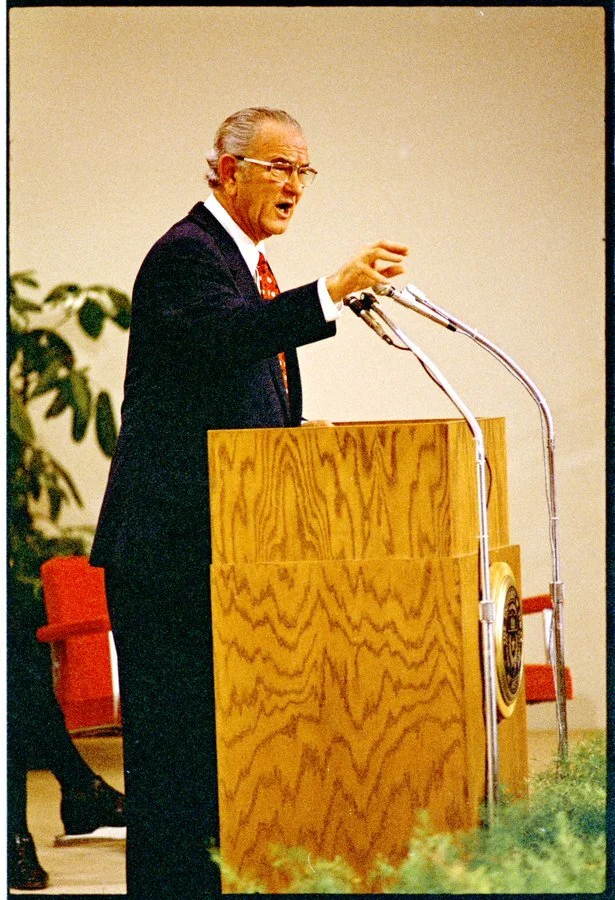
Alexander Vindman: 'The uniform I wear today is that of the United States Army', Trump impeachment hearings - 2019
19 November 2019, Washington DC, USA
Mr. Chairman and Ranking Member, thank you for the opportunity to address the House Permanent Select Committee on Intelligence with respect to the activities relating to Ukraine and my role in the events under investigation.
Background
I have dedicated my entire professional life to the United States of America. For more than two decades, it has been my honor to serve as an officer in the United States Army. As an infantry officer, I served multiple overseas tours, including South Korea and Germany, and I was deployed to Iraq for combat operations.
Since 2008, I have been a Foreign Area Officer specializing in European and Eurasian politico-military affairs. I served in the United States embassies in Kiev Ukraine and Moscow, Russia.
In Washington, D.C., I was a politico-military affairs officer for Russia for the Chairman of the Joint Chiefs of Staff where I drafted the Armed Forces' global campaign plan to counter Russian aggression and Russian malign influence. In July 2018, I was asked to serve at the White House's National Security Council. At the NSC I am the principal advisor to the National Security Advisor and the President on Ukraine and the other countries in my portfolio. My role at the NSC is to develop, coordinate, and implement plans and policies to manage the full range of diplomatic, informational, military, and economic national security issues for the countries in my portfolio. My core function is to coordinate policy with departments and agencies partners.
The Committee has heard from many of my colleagues about the strategic importance of Ukraine as a bulwark against Russian aggression. It is important to note that our country's policy of supporting Ukrainian sovereignty and territorial integrity, promoting Ukrainian prosperity, and strengthening a free and democratic Ukraine, as a counter to Russian aggression, has been a consistent, bi-partisan foreign policy objective and strategy across various administrations, both Democrat and Republican, and that President Zelenskyy's election, in April 2019, created an unprecedented opportunity to realize our strategic objectives.
Relevant Events
In the Spring of 2019, I became aware of two disruptive actors---primarily Ukraine's then-Prosecutor General Yuri Lutsenko and former Mayor Rudolph Giuliani, President Trump's personal attorney— promoting false information that undermined the United States' Ukraine policy. The NSC and its inter-agency partners, including the State Department, grew increasingly concerned about the impact that such information was having on our country's ability to achieve our national security objectives.
April 21, 2019: President Trump Calls Ukraine President Zelenskyy
On April 21, 2019, Volodymyr Zelenskyy was elected President of Ukraine in a landslide victory on a unity, reform, and anti-corruption platform. President Trump called President Zelenskyy on April 21, 2019, to congratulate him for his victory. I was the staff officer who produced the call materials and was one of the staff officers who listened to the call. The call was positive and President Trump expressed his desire to work with President Zelenskyy and extended an invitation to visit the White House.
May 2019: Inauguration Delegation Goes to Ukraine
In May, I attended the inauguration of President Zelenskyy as part of the Presidential delegation led by Secretary Perry. Following the visit, the members of the delegation provided President Trump a debriefing offering a positive assessment of President Zelenskyy and his team. After this debriefing, President Trump signed a congratulatory letter to President Zelenskyy and extended an invitation to visit the White House.
July 10, 2019: Danylyuk Visit
On July 10, 2019, Oleksandr Danylyuk, then Ukraine's National Security Advisor, visited Washington, D.C. for a meeting with National Security Advisor Bolton. Ambassadors Volker and Sondland and Secretary Rick Perry also attended the meeting. I attended the meeting with Dr. Hill.
We fully anticipated the Ukrainians would raise the issue of a meeting between the two presidents. Ambassador Bolton cut the meeting short when Ambassador Sondland started to speak about the requirement that Ukraine deliver specific investigations in order to secure the meeting with President Trump. Following this meeting, there was a short debriefing during which Amb. Sondland emphasized the importance of Ukraine delivering the investigations into the 2016 election, the Bidens, and Burisma. I stated to Ambassador Sondland that this was inappropriate and had nothing to do with national security. Dr. Hill also asserted his comments were improper. Following the meeting Dr. Hill and I had agreed to report the incident to the NSC's lead counsel, Mr. John Eisenberg.
July 25, 2019: Parliamentary Election Call
On July 21, 2019, President Zelenskyy's party won parliamentary elections in another landslide victory. The NSC proposed that President Trump call President Zelenskyy to congratulate him.
On July 25, 2019, the call occurred. I listened in on the call in the Situation Room with White House colleagues.
I was concerned by the call, what I heard was improper, and I reported my concerns to Mr. Eisenberg. It is improper for the President of the United States to demand a foreign government investigate a U.S. citizen and political opponent. It was also clear that if Ukraine pursued an investigation into the 2016 election, the Bidens, and Burisma, it would be interpreted as a partisan play. This would undoubtedly result in Ukraine losing bipartisan support, undermine U.S. national security, and advance Russia's strategic objectives in the region.
I want to emphasize to the Committee that when I reported my concerns -- on July 10, relating to Ambassador Sondland, and on July 25, relating to the President -- I did so out of a sense of duty. I privately reported my concerns, in official channels, to the proper authorities in the chain of command. My intent was to raise these concerns because they had significant national security implications for our country.
I never thought I would be sitting here testifying in front of this committee and the American public, about my actions. When I reported my concerns, my only thought was to act properly and to carry out duty. Following each of my reports to Mr. Eisenberg, I immediately returned to work to advance the President's and our country's foreign policy objectives. I focused on what I have done throughout my career, promoting America's national security interests.
Conclusion
I want to take a moment to recognize the courage of my colleagues who have appeared and are scheduled to appear before this Committee. I want to state that the vile character attacks on these distinguished and honorable public servants is reprehensible. It is natural to disagree and engage in spirited debate, this has been our custom since the time of our Founding Fathers, but we are better than callow and cowardly attacks.
The uniform I wear today is that of the United States Army. The members of our all volunteer force are made up of a patchwork of people from all ethnicities, religions, and socio-economic backgrounds who come together under a common oath to protect and defend the Constitution of the United States of America. We do not serve any particular political party, we serve the nation. I am humbled to come before you today as one of many who serve in the most distinguished and able military in the world. The Army is the only profession I have ever known. As a young man I decided that I wanted to spend my life serving the nation that gave my family refuge from authoritarian oppression, and for the last twenty years it has been an honor to represent and protect this great country.
Next month will mark 40 years since my family arrived in the United States as refugees. When my father was 47 years old he left behind his entire life and the only home he had ever known to start over in the United States so that his three sons could have better, safer lives. His courageous decision inspired a deep sense of gratitude in my brothers and myself and instilled in us a sense of duty and service. All three of us have served or are currently serving in the military. Our collective military service is a special part of our family's story in America.
I also recognize that my simple act of appearing here today, just like the courage of my colleagues who have also truthfully testified before this Committee, would not be tolerated in many places around the world. In Russia, my act of expressing my concerns to the chain of command in an official and private channel would have severe personal and professional repercussions and offering public testimony involving the President would surely cost me my life. I am grateful for my father's brave act of hope 40 years ago and for the privilege of being an American citizen and public servant, where I can live free of fear for mine and my family's safety.
Dad, my sitting here today, in the US Capitol talking to our elected officials is proof that you made the right decision forty years ago to leave the Soviet Union and come here to United State of America in search of a better life for our family. Do not worry, I will be fine for telling the truth. Thank you again for your consideration, and I would be happy to answer your questions.
Unknown: 'I'm what you call, you know, a comrade', Equal Pay for Women March
Unknown, Liverpool, United Kingdom
Equal pay for women!
Equal pay for women!
I’m what you call, you know, a comrade. And they are singing, equal pay for women …
Torys out!
Torys out!
Orrin B. Hatch: 'To mend the nation, we much first mend the Senate', Farewell address - 2018
18 September 2018, US Senate, Washington DC, USA
Mr. President, for more than four decades, I have had the distinct privilege of serving in the United States Senate, what some have called the world’s greatest deliberative body. Speaking on the Senate floor; debating legislation in committee; corralling the support of my colleagues on compromise legislation—these are the moments I will miss. These are the memories I will cherish forever. To address this body is to experience a singular feeling—a sense that you are a part of something bigger than yourself, a minor character in the grand narrative that is America. No matter how often I come to speak at this lectern, I experience that feeling—again and again. But today, if I’m being honest, I also feel sadness. Indeed, my heart is heavy. It aches for the times when we actually lived up to our reputation as the world’s greatest deliberative body. It longs for the days in which Democrats and Republicans would meet on middle ground rather than retreat to their partisan trenches. Now some may say I’m waxing nostalgic, yearning—as old men often do—for some golden age that never existed. They would be wrong. The Senate I’ve described is not some fairytale but the reality we once knew. Having served as a Senator for nearly 42 years, I can tell you this: things weren’t always as they are now.
I was here when this body was at its best. I was here when regular order was the norm, when legislation was debated in committee, and when members worked constructively with one another for the good of the country. I was here when we could say, without any hint of irony, that we were members of the world’s greatest deliberative body. Times have certainly changed. Over the last several years, I have witnessed the subversion of Senate rules, the abandonment of regular order, and the full-scale deterioration of the judicial confirmation process. Polarization has ossified. Gridlock is the new norm. And like the humidity here, partisanship permeates everything we do. On both the left and the right, the bar of decency has been set so low that jumping over it is no longer the objective. Limbo is the new name of the game. How low can you go? The answer, it seems, is always lower. All the evidence points to an unsettling truth: The Senate, as an institution, is in crisis. The committee process lies in shambles. Regular order is a relic of the past. And compromise—once the guiding credo of this great institution—is now synonymous with surrender. Since I first came to the Senate in 1978, the culture of this place has shifted fundamentally—and not for the better. Here, there used to be a level of congeniality and kinship among colleagues that was hard to find anywhere else. In those days, I counted Democrats among my very best friends. One moment, we would be locking horns on the Senate floor; the next, we would be breaking bread together over family dinner.
My unlikely friendship with the late Senator Kennedy embodied the spirit of goodwill and collegiality that used to thrive here. Teddy and I were a case study in contradictions. He was a dyed-in-the-wool Democrat; I was a resolute Republican. But by choosing friendship over party loyalty, we were able to pass some of the most significant bipartisan achievements of modern times—from the Americans with Disabilities Act and the Religious Freedom Restoration Act to the Ryan White bill and the State Children’s Health Insurance Program.Nine years after Teddy’s passing, it’s worth asking: Could a relationship like this even exist in today’s Senate? Could two people with polar-opposite beliefs and from vastly different walks of life come together as often as Teddy and I did for the good of the country? Or are we too busy vilifying each other to even consider friendship with the other side? Mr. President, many factors contribute to the current dysfunction. But if I were to identify the root of our crisis, it would be this: the loss of comity and genuine good feeling among Senate colleagues. Comity is the cartilage of the Senate—the soft connective tissue that cushions impact between opposing joints. But in recent years, that cartilage has been ground to a nub. All movement has become bone on bone. Our ideas grate against each other with increasing frequency—and with nothing to absorb the friction. We hobble to get any bipartisan legislation to the Senate floor, much less to the President’s desk. The pain is excruciating, and it is felt by the entire nation. We must remember that our dysfunction is not confined to the Capitol. It ripples far beyond these walls—to every state, to every town, and to every street corner in America.
The Senate sets the tone of American civic life. We don’t mirror the political culture as much as we make it. It’s incumbent on us, then, to move the culture in a positive direction, keeping in mind that everything we do here has a trickle-down effect. If we are divided, then the nation is divided. If we abandon civility, then our constituents will follow. And so, to mend the nation, we must first mend the Senate. We must restore the culture of comity, compromise, and mutual respect that used to exist here. Both in our personal and public conduct, we must be the very change we want to see in the country. We must not be enemies but friends. Though passion may have strained, it must not break our bonds of affection. The mystic chords of memory...will yet swell...when again touched, as surely they will be, by the better angels of our nature.These are not my words but the words of President Abraham Lincoln. They come from a heartfelt plea he made to the American people long ago on the eve of the Civil War. Lincoln’s admonition is just as timely today as it was then. If ever there were a time in our history to heed the better angels of our nature, it is now. How can we answer Lincoln’s call to our better angels? Over the last several months, I have devoted significant time and resources to answering this question. In a series of essays and floor speeches, I have sought to put flesh on the bones of Lincoln’s appeal. These writings provide a blueprint for fixing our broken politics. They include:An essay on civility—the indispensable political norm—and how to restore it to the public discourse;
A speech entitled A Tale of Two Cities, which draws from the tragedies of Charlottesville and Houston in the summer of 2017 to issue a call for unity and strength;A well-reasoned critique of identity politics—specifically, the threat it poses to the American experiment and how we can heal age-old divisions by embracing the politics of ideas, not identity;A discourse on the invaluable worth of the individual and how affirming this worth can help us curb the suicide epidemic among LGBTQ youth and create a stronger, more civil society;A proposal to establish Geneva Conventions for the culture wars—a new set of norms that can ease partisan tensions and help us contain the worst excesses of political warfare;And finally, an op-ed on pluralism and how embracing this forgotten virtue can help us overcome tribal tolerance and effect meaningful change. These writings appeal to the humanity, grace, and inherent goodness in each of us. The purpose of this project is to remind readers of the singularity of the American experiment and how we can preserve this great nation only by heeding the higher virtues within us. As a parting gift, I plan to share a copy of this compilation with each of my Senate colleagues, as well as our friends in the House and leaders in the executive branch. I sincerely ask that each of you take the time to study these writings. Please, ponder their words and ask yourself how we can apply these ideas to restore our nation’s civic health.
When we heed our better angels—when we hearken to the voices of civility and reason native to our very nature—we can transcend our tribal instincts and preserve our democracy for future generations. That we may do so is my humble prayer.
I yield the floor
Donald Trump: 'My administration has has accomplished more than almost any administration in the history of our country' United Nations address - 2018
25 September, New York City, New York, USA
Madam President, Mr. Secretary-General, world leaders, ambassadors, and distinguished delegates:
One year ago, I stood before you for the first time in this grand hall. I addressed the threats facing our world, and I presented a vision to achieve a brighter future for all of humanity.
Today, I stand before the United Nations General Assembly to share the extraordinary progress we’ve made.
In less than two years, my administration has accomplished more than almost any administration in the history of our country.
America’s — so true. (Laughter.) Didn’t expect that reaction, but that’s okay. (Laughter and applause.)
America’s economy is booming like never before. Since my election, we’ve added $10 trillion in wealth. The stock market is at an all-time high in history, and jobless claims are at a 50-year low. African American, Hispanic American, and Asian American unemployment have all achieved their lowest levels ever recorded. We’ve added more than 4 million new jobs, including half a million manufacturing jobs.
We have passed the biggest tax cuts and reforms in American history. We’ve started the construction of a major border wall, and we have greatly strengthened border security.
We have secured record funding for our military — $700 billion this year, and $716 billion next year. Our military will soon be more powerful than it has ever been before.
In other words, the United States is stronger, safer, and a richer country than it was when I assumed office less than two years ago.
We are standing up for America and for the American people. And we are also standing up for the world.
This is great news for our citizens and for peace-loving people everywhere. We believe that when nations respect the rights of their neighbors, and defend the interests of their people, they can better work together to secure the blessings of safety, prosperity, and peace.
Each of us here today is the emissary of a distinct culture, a rich history, and a people bound together by ties of memory, tradition, and the values that make our homelands like nowhere else on Earth.
That is why America will always choose independence and cooperation over global governance, control, and domination.
I honor the right of every nation in this room to pursue its own customs, beliefs, and traditions. The United States will not tell you how to live or work or worship.
We only ask that you honor our sovereignty in return.
From Warsaw to Brussels, to Tokyo to Singapore, it has been my highest honor to represent the United States abroad. I have forged close relationships and friendships and strong partnerships with the leaders of many nations in this room, and our approach has already yielded incredible change.
With support from many countries here today, we have engaged with North Korea to replace the specter of conflict with a bold and new push for peace.
In June, I traveled to Singapore to meet face to face with North Korea’s leader, Chairman Kim Jong Un.
We had highly productive conversations and meetings, and we agreed that it was in both countries’ interest to pursue the denuclearization of the Korean Peninsula. Since that meeting, we have already seen a number of encouraging measures that few could have imagined only a short time ago.
The missiles and rockets are no longer flying in every direction. Nuclear testing has stopped. Some military facilities are already being dismantled. Our hostages have been released. And as promised, the remains of our fallen heroes are being returned home to lay at rest in American soil.
I would like to thank Chairman Kim for his courage and for the steps he has taken, though much work remains to be done. The sanctions will stay in place until denuclearization occurs.
I also want to thank the many member states who helped us reach this moment — a moment that is actually far greater than people would understand; far greater — but for also their support and the critical support that we will all need going forward.
A special thanks to President Moon of South Korea, Prime Minister Abe of Japan, and President Xi of China.
In the Middle East, our new approach is also yielding great strides and very historic change.
Following my trip to Saudi Arabia last year, the Gulf countries opened a new center to target terrorist financing. They are enforcing new sanctions, working with us to identify and track terrorist networks, and taking more responsibility for fighting terrorism and extremism in their own region.
The UAE, Saudi Arabia, and Qatar have pledged billions of dollars to aid the people of Syria and Yemen. And they are pursuing multiple avenues to ending Yemen’s horrible, horrific civil war.
Ultimately, it is up to the nations of the region to decide what kind of future they want for themselves and their children.
For that reason, the United States is working with the Gulf Cooperation Council, Jordan, and Egypt to establish a regional strategic alliance so that Middle Eastern nations can advance prosperity, stability, and security across their home region.
Thanks to the United States military and our partnership with many of your nations, I am pleased to report that the bloodthirsty killers known as ISIS have been driven out from the territory they once held in Iraq and Syria. We will continue to work with friends and allies to deny radical Islamic terrorists any funding, territory or support, or any means of infiltrating our borders.
The ongoing tragedy in Syria is heartbreaking. Our shared goals must be the de-escalation of military conflict, along with a political solution that honors the will of the Syrian people. In this vein, we urge the United Nations-led peace process be reinvigorated. But, rest assured, the United States will respond if chemical weapons are deployed by the Assad regime.
I commend the people of Jordan and other neighboring countries for hosting refugees from this very brutal civil war.
As we see in Jordan, the most compassionate policy is to place refugees as close to their homes as possible to ease their eventual return to be part of the rebuilding process. This approach also stretches finite resources to help far more people, increasing the impact of every dollar spent.
Every solution to the humanitarian crisis in Syria must also include a strategy to address the brutal regime that has fueled and financed it: the corrupt dictatorship in Iran.
Iran’s leaders sow chaos, death, and destruction. They do not respect their neighbors or borders, or the sovereign rights of nations. Instead, Iran’s leaders plunder the nation’s resources to enrich themselves and to spread mayhem across the Middle East and far beyond.
The Iranian people are rightly outraged that their leaders have embezzled billions of dollars from Iran’s treasury, seized valuable portions of the economy, and looted the people’s religious endowments, all to line their own pockets and send their proxies to wage war. Not good.
Iran’s neighbors have paid a heavy toll for the region’s [regime’s] agenda of aggression and expansion. That is why so many countries in the Middle East strongly supported my decision to withdraw the United States from the horrible 2015 Iran Nuclear Deal and re-impose nuclear sanctions.
The Iran deal was a windfall for Iran’s leaders. In the years since the deal was reached, Iran’s military budget grew nearly 40 percent. The dictatorship used the funds to build nuclear-capable missiles, increase internal repression, finance terrorism, and fund havoc and slaughter in Syria and Yemen.
The United States has launched a campaign of economic pressure to deny the regime the funds it needs to advance its bloody agenda. Last month, we began re-imposing hard-hitting nuclear sanctions that had been lifted under the Iran deal. Additional sanctions will resume November 5th, and more will follow. And we’re working with countries that import Iranian crude oil to cut their purchases substantially.
We cannot allow the world’s leading sponsor of terrorism to possess the planet’s most dangerous weapons. We cannot allow a regime that chants “Death to America,” and that threatens Israel with annihilation, to possess the means to deliver a nuclear warhead to any city on Earth. Just can’t do it.
We ask all nations to isolate Iran’s regime as long as its aggression continues. And we ask all nations to support Iran’s people as they struggle to reclaim their religious and righteous destiny.
This year, we also took another significant step forward in the Middle East. In recognition of every sovereign state to determine its own capital, I moved the U.S. Embassy in Israel to Jerusalem.
The United States is committed to a future of peace and stability in the region, including peace between the Israelis and the Palestinians. That aim is advanced, not harmed, by acknowledging the obvious facts.
America’s policy of principled realism means we will not be held hostage to old dogmas, discredited ideologies, and so-called experts who have been proven wrong over the years, time and time again. This is true not only in matters of peace, but in matters of prosperity.
We believe that trade must be fair and reciprocal. The United States will not be taken advantage of any longer.
For decades, the United States opened its economy — the largest, by far, on Earth — with few conditions. We allowed foreign goods from all over the world to flow freely across our borders.
Yet, other countries did not grant us fair and reciprocal access to their markets in return. Even worse, some countries abused their openness to dump their products, subsidize their goods, target our industries, and manipulate their currencies to gain unfair advantage over our country. As a result, our trade deficit ballooned to nearly $800 billion a year.
For this reason, we are systematically renegotiating broken and bad trade deals.
Last month, we announced a groundbreaking U.S.-Mexico trade agreement. And just yesterday, I stood with President Moon to announce the successful completion of the brand new U.S.-Korea trade deal. And this is just the beginning.
Many nations in this hall will agree that the world trading system is in dire need of change. For example, countries were admitted to the World Trade Organization that violate every single principle on which the organization is based. While the United States and many other nations play by the rules, these countries use government-run industrial planning and state-owned enterprises to rig the system in their favor. They engage in relentless product dumping, forced technology transfer, and the theft of intellectual property.
The United States lost over 3 million manufacturing jobs, nearly a quarter of all steel jobs, and 60,000 factories after China joined the WTO. And we have racked up $13 trillion in trade deficits over the last two decades.
But those days are over. We will no longer tolerate such abuse. We will not allow our workers to be victimized, our companies to be cheated, and our wealth to be plundered and transferred. America will never apologize for protecting its citizens.
The United States has just announced tariffs on another $200 billion in Chinese-made goods for a total, so far, of $250 billion. I have great respect and affection for my friend, President Xi, but I have made clear our trade imbalance is just not acceptable. China’s market distortions and the way they deal cannot be tolerated.
As my administration has demonstrated, America will always act in our national interest.
I spoke before this body last year and warned that the U.N. Human Rights Council had become a grave embarrassment to this institution, shielding egregious human rights abusers while bashing America and its many friends.
Our Ambassador to the United Nations, Nikki Haley, laid out a clear agenda for reform, but despite reported and repeated warnings, no action at all was taken.
So the United States took the only responsible course: We withdrew from the Human Rights Council, and we will not return until real reform is enacted.
For similar reasons, the United States will provide no support in recognition to the International Criminal Court. As far as America is concerned, the ICC has no jurisdiction, no legitimacy, and no authority. The ICC claims near-universal jurisdiction over the citizens of every country, violating all principles of justice, fairness, and due process. We will never surrender America’s sovereignty to an unelected, unaccountable, global bureaucracy.
America is governed by Americans. We reject the ideology of globalism, and we embrace the doctrine of patriotism.
Around the world, responsible nations must defend against threats to sovereignty not just from global governance, but also from other, new forms of coercion and domination.
In America, we believe strongly in energy security for ourselves and for our allies. We have become the largest energy producer anywhere on the face of the Earth.
The United States stands ready to export our abundant, affordable supply of oil, clean coal, and natural gas.
OPEC and OPEC nations, are, as usual, ripping off the rest of the world, and I don’t like it. Nobody should like it. We defend many of these nations for nothing, and then they take advantage of us by giving us high oil prices. Not good.
We want them to stop raising prices, we want them to start lowering prices, and they must contribute substantially to military protection from now on. We are not going to put up with it — these horrible prices — much longer.
Reliance on a single foreign supplier can leave a nation vulnerable to extortion and intimidation. That is why we congratulate European states, such as Poland, for leading the construction of a Baltic pipeline so that nations are not dependent on Russia to meet their energy needs. Germany will become totally dependent on Russian energy if it does not immediately change course.
Here in the Western Hemisphere, we are committed to maintaining our independence from the encroachment of expansionist foreign powers.
It has been the formal policy of our country since President Monroe that we reject the interference of foreign nations in this hemisphere and in our own affairs. The United States has recently strengthened our laws to better screen foreign investments in our country for national security threats, and we welcome cooperation with countries in this region and around the world that wish to do the same. You need to do it for your own protection.
The United States is also working with partners in Latin America to confront threats to sovereignty from uncontrolled migration. Tolerance for human struggling and human smuggling and trafficking is not humane. It’s a horrible thing that’s going on, at levels that nobody has ever seen before. It’s very, very cruel.
Illegal immigration funds criminal networks, ruthless gangs, and the flow of deadly drugs. Illegal immigration exploits vulnerable populations, hurts hardworking citizens, and has produced a vicious cycle of crime, violence, and poverty. Only by upholding national borders, destroying criminal gangs, can we break this cycle and establish a real foundation for prosperity.
We recognize the right of every nation in this room to set its own immigration policy in accordance with its national interests, just as we ask other countries to respect our own right to do the same — which we are doing. That is one reason the United States will not participate in the new Global Compact on Migration. Migration should not be governed by an international body unaccountable to our own citizens.
Ultimately, the only long-term solution to the migration crisis is to help people build more hopeful futures in their home countries. Make their countries great again.
Currently, we are witnessing a human tragedy, as an example, in Venezuela. More than 2 million people have fled the anguish inflicted by the socialist Maduro regime and its Cuban sponsors.
Not long ago, Venezuela was one of the richest countries on Earth. Today, socialism has bankrupted the oil-rich nation and driven its people into abject poverty.
Virtually everywhere socialism or communism has been tried, it has produced suffering, corruption, and decay. Socialism’s thirst for power leads to expansion, incursion, and oppression. All nations of the world should resist socialism and the misery that it brings to everyone.
In that spirit, we ask the nations gathered here to join us in calling for the restoration of democracy in Venezuela. Today, we are announcing additional sanctions against the repressive regime, targeting Maduro’s inner circle and close advisors.
We are grateful for all the work the United Nations does around the world to help people build better lives for themselves and their families.
The United States is the world’s largest giver in the world, by far, of foreign aid. But few give anything to us. That is why we are taking a hard look at U.S. foreign assistance. That will be headed up by Secretary of State Mike Pompeo. We will examine what is working, what is not working, and whether the countries who receive our dollars and our protection also have our interests at heart.
Moving forward, we are only going to give foreign aid to those who respect us and, frankly, are our friends. And we expect other countries to pay their fair share for the cost of their defense.
The United States is committed to making the United Nations more effective and accountable. I have said many times that the United Nations has unlimited potential. As part of our reform effort, I have told our negotiators that the United States will not pay more than 25 percent of the U.N. peacekeeping budget. This will encourage other countries to step up, get involved, and also share in this very large burden.
And we are working to shift more of our funding from assessed contributions to voluntary so that we can target American resources to the programs with the best record of success.
Only when each of us does our part and contributes our share can we realize the U.N.’s highest aspirations. We must pursue peace without fear, hope without despair, and security without apology.
Looking around this hall where so much history has transpired, we think of the many before us who have come here to address the challenges of their nations and of their times. And our thoughts turn to the same question that ran through all their speeches and resolutions, through every word and every hope. It is the question of what kind of world will we leave for our children and what kind of nations they will inherit.
The dreams that fill this hall today are as diverse as the people who have stood at this podium, and as varied as the countries represented right here in this body are. It really is something. It really is great, great history.
There is India, a free society over a billion people, successfully lifting countless millions out of poverty and into the middle class.
There is Saudi Arabia, where King Salman and the Crown Prince are pursuing bold new reforms.
There is Israel, proudly celebrating its 70th anniversary as a thriving democracy in the Holy Land.
In Poland, a great people are standing up for their independence, their security, and their sovereignty.
Many countries are pursuing their own unique visions, building their own hopeful futures, and chasing their own wonderful dreams of destiny, of legacy, and of a home.
The whole world is richer, humanity is better, because of this beautiful constellation of nations, each very special, each very unique, and each shining brightly in its part of the world.
In each one, we see awesome promise of a people bound together by a shared past and working toward a common future.
As for Americans, we know what kind of future we want for ourselves. We know what kind of a nation America must always be.
In America, we believe in the majesty of freedom and the dignity of the individual. We believe in self-government and the rule of law. And we prize the culture that sustains our liberty -– a culture built on strong families, deep faith, and fierce independence. We celebrate our heroes, we treasure our traditions, and above all, we love our country.
Inside everyone in this great chamber today, and everyone listening all around the globe, there is the heart of a patriot that feels the same powerful love for your nation, the same intense loyalty to your homeland.
The passion that burns in the hearts of patriots and the souls of nations has inspired reform and revolution, sacrifice and selflessness, scientific breakthroughs, and magnificent works of art.
Our task is not to erase it, but to embrace it. To build with it. To draw on its ancient wisdom. And to find within it the will to make our nations greater, our regions safer, and the world better.
To unleash this incredible potential in our people, we must defend the foundations that make it all possible. Sovereign and independent nations are the only vehicle where freedom has ever survived, democracy has ever endured, or peace has ever prospered. And so we must protect our sovereignty and our cherished independence above all.
When we do, we will find new avenues for cooperation unfolding before us. We will find new passion for peacemaking rising within us. We will find new purpose, new resolve, and new spirit flourishing all around us, and making this a more beautiful world in which to live.
So together, let us choose a future of patriotism, prosperity, and pride. Let us choose peace and freedom over domination and defeat. And let us come here to this place to stand for our people and their nations, forever strong, forever sovereign, forever just, and forever thankful for the grace and the goodness and the glory of God.
Thank you. God bless you. And God bless the nations of the world.
Thank you very much. Thank you. (Applause.)
Atal Behari Vajpayee: '“Here comes my resignation, Mr. Speaker", Speech during No Confidence motion - 1996
i June 1996, Delhi, India
We are being held in the dock without reason... yes we failed to use the opportunity the President gave us [by inviting us to form government], but that is a different matter …
We are ready to sit in the seats reserved for the Opposition, I promise you that we will offer our fullest cooperation in helping you run the House. …
You want to run the country, that's a good thing. You have my best wishes. We will continue working in the service of the nation. We bow down before the stronger alliance and assure you that we won't rest until we finish the work we have begun in the nation's interest …
"Adhyaksh mahoday, mein apna tyag patra rashtrapati ko dene jaa raha hun … Respected Speaker, I am now leaving to tender my resignation to the President
We’d love a full transcript of this speech, either in Hindi, English translation or both. Please direct us to one in the comments if you can locate one.
Babasaheb Ambedkar: 'The Grammar of Anarachy', Speech to Constituent Assembly - 1949
25 November 1949, Delhi, India
As much defence as could be offered to the Constitution has been offered by my friends Sir Alladi Krishnaswami Ayyar and Mr T T Krishnamachari, I shall not therefore enter into the merits of the Constitution. Because I feel, however good a Constitution may be, it is sure to turn out bad because those who are called to work it, happen to be a bad lot. However bad a Constitution may be, it may turn out to be good if those who are called to work it, happen to be a good lot. The working of a Constitution does not depend wholly upon the nature of the Constitution. The Constitution can provide only the organs of State such as the Legislature, the Executive and the Judiciary. The factors on which the working of those organs of the State depend are the people and the political parties they will set up as their instruments to carry out their wishes and their politics. Who can say how the people of India and their parties will behave? Will they uphold constitutional methods of achieving their purposes or will they prefer revolutionary methods of achieving them? If they adopt the revolutionary methods, however good the Constitution may be, it requires no prophet to say that it will fail. It is, therefore, futile to pass any judgement upon the Constitution without reference to the part which the people and their parties are likely to play.
The condemnation of the Constitution largely comes from two quarters, the Communist Party and the Socialist Party. Why do they condemn the Constitution? Is it because it is really a bad Constitution? I venture to say ‘no’. The Communist Party want a Constitution based upon the principle of the Dictatorship of the Proletariat. They condemn the Constitution because it is based upon parliamentary democracy. The Socialists want two things. The first thing they want is that if they come in power, the Constitution must give them the freedom to nationalise or socialise all private property without payment of compensation. The second thing that the Socialists want is that the Fundamental Rights mentioned in the Constitution must be absolute and without any limitations so that if their Party fails to come into power, they would have the unfettered freedom not merely to criticise, but also to overthrow the State.
No right to bind succeeding generations
These are the main grounds on which the Constitution is being condemned. I do not say that the principle of parliamentary democracy is the only ideal form of political democracy. I do not say that the principle of no acquisition of private property without compensation is so sacrosanct that there can be no departure from it. I do not say that Fundamental Rights can never be absolute and the limitations set upon them can never be lifted. What I do say is that the principles embodied in the Constitution are the views of the present generation or if you think this to be an over-statement, I say they are the views of the members of the Constituent Assembly. Why blame the Drafting Committee for embodying them in the Constitution? I say why blame even the Members of the Constituent Assembly? Jefferson, the great American statesman who played so great a part in the making of the American constitution, has expressed some very weighty views which makers of Constitution, can never afford to ignore. In one place he has said:
“We may consider each generation as a distinct nation, with a right, by the will of the majority, to bind themselves, but none to bind the succeeding generation, more than the inhabitants of another country.”
In another place, he has said:
“The idea that institutions established for the use of the nation cannot be touched or modified, even to make them answer their end, because of rights gratuitously supposed in those employed to manage them in the trust for the public, may perhaps be a salutary provision against the abuses of a monarch, but is most absurd against the nation itself. Yet our lawyers and priests generally inculcate this doctrine, and suppose that preceding generations held the earth more freely than we do; had a right to impose laws on us, unalterable by ourselves, and that we, in the like manner, can make laws and impose burdens on future generations, which they will have no right to alter; in fine, that the earth belongs to the dead and not the living;”
I admit that what Jefferson has said is not merely true, but is absolutely true. There can be no question about it. Had the Constituent Assembly departed from this principle laid down by Jefferson it would certainly be liable to blame, even to condemnation. But I ask, has it? Quite the contrary. One has only to examine the provision relating to the amendment of the Constitution…I challenge any of the critics of the Constitution to prove that any Constituent Assembly anywhere in the world has, in the circumstances in which this country finds itself, provided such a facile procedure for the amendment of the Constitution. If those who are dissatisfied with the Constitution have only to obtain a 2/3 majority and if they cannot obtain even a two-thirds majority in the parliament elected on adult franchise in their favour, their dissatisfaction with the Constitution cannot be deemed to be shared by the general public.
The danger of divisive politics
[But] my mind is so full of the future of our country that I feel I ought to take this occasion to give expression to some of my reflections thereon. On 26th January 1950, India will be an independent country. What would happen to her independence? Will she maintain her independence or will she lose it again? This is the first thought that comes to my mind. It is not that India was never an independent country. The point is that she once lost the independence she had. Will she lose it a second time? It is this thought which makes me most anxious for the future. What perturbs me greatly is the fact that not only India has once before lost her independence, but she lost it by the infidelity and treachery of some of her own people. In the invasion of Sind by Mahommed-Bin-Kasim, the military commanders of King Dahar accepted bribes from the agents of Mahommed-Bin-Kasim and refused to fight on the side of their king. It was Jaichand who invited Mahommed Ghori to invade India and fight against Prithvi Raj and promised him the help of himself and the Solanki kings. When Shivaji was fighting for the liberation of Hindus, the other Maratha noblemen and the Rajput kings were fighting the battle on the side of Mughul Emperors. When the British were trying to destroy the Sikh Rulers, Gulab Singh, their principal commander sat silent and did not help to save the Sikh Kingdom. In 1857, when a large part of India had declared a war of independence against the British, the Sikhs stood and watched the event as silent spectators.
Will history repeat itself? It is this thought which fills me with anxiety. This anxiety is deepened by the realisation of the fact that in addition to our old enemies in the form of castes and creeds we are going to have many political parties with diverse and opposing political creeds. Will Indians place the country above their creed or will they place creed above country? I do not know. But this much is certain that if the parties place creed above country, our independence will be put in jeopardy a second time and probably be lost for ever. This eventuality we must all resolutely guard against. We must be determined to defend our independence with the last drop of our blood.
The importance of constitutional methods
On the 26th of January 1950, India would be a democratic country in the sense that India from that day would have a government of the people, by the people and for the people. The same thought comes to my mind. What would happen to her democratic Constitution? Will she be able to maintain it or will she lose it again. This is the second thought that comes to my mind and makes me as anxious as the first.
It is not that India did not know what is democracy. There was a time when India was studded with republics, and even where there were monarchies, they were either elected or limited. They were never absolute. It is not that India did not know Parliaments or parliamentary procedure. A study of the Buddhist Bhikshu Sanghas discloses that not only there were Parliaments—for the Sanghas were nothing but Parliaments—but the Sanghas knew and observed all the rules of parliamentary procedure known to modern times…Although these rules of parliamentary procedure were applied by the Buddha to the meetings of the Sanghas, he must have borrowed them from the rules of the political assemblies functioning in the country in his time.
This democratic system India lost. Will she lose it a second time? I do not know. But it is quite possible in a country like India—where democracy from its long disuse must be regarded as something quite new—there is danger of democracy giving place to dictatorship. It is quite possible for this new born democracy to retain its form but give place to dictatorship in fact. If there is a landslide, the danger of the second possibility becoming actuality is much greater.
If we wish to maintain democracy not merely in form, but also in fact, what must we do? The first thing in my judgement we must do is to hold fast to constitutional methods of achieving our social and economic objectives. It means we must abandon the bloody methods of revolution. It means that we must abandon the method of civil disobedience, non-cooperation and satyagraha. When there was no way left for constitutional methods for achieving economic and social objectives, there was a great deal of justification for unconstitutional methods. But where constitutional methods are open, there can be no justification for these unconstitutional methods. These methods are nothing but the Grammar of Anarchy and the sooner they are abandoned, the better for us.
The politics of pedestals
The second thing we must do is to observe the caution which John Stuart Mill has given to all who are interested in the maintenance of democracy, namely, not “to lay their liberties at the feet of even a great man, or to trust him with power which enable him to subvert their institutions.” There is nothing wrong in being grateful to great men who have rendered life-long services to the country. But there are limits to gratefulness. As has been well said by the Irish Patriot Daniel O’Connel, no man can be grateful at the cost of his honour, no woman can be grateful at the cost of her chastity and no nation can be grateful at the cost of its liberty. This caution is far more necessary in the case of India than in the case of any other country. For in India, Bhakti or what may be called the path of devotion or hero-worship, plays a part in its politics unequalled in magnitude by the part it plays in the politics of any other country in the world. Bhakti in religion may be a road to the salvation of the soul. But in politics, Bhakti or hero-worship is a sure road to degradation and to eventual dictatorship.
Social democracy
The third thing we must do is not to be content with mere political democracy. We must make our political democracy a social democracy as well. Political democracy cannot last unless there lies at the base of it social democracy. What does social democracy mean? It means a way of life which recognises liberty, equality and fraternity as the principles of life. These principles of liberty, equality and fraternity are not to be treated as separate items in a trinity. They form a union of trinity in the sense that to divorce one from the other is to defeat the very purpose of democracy. Liberty cannot be divorced from equality, equality cannot be divorced from liberty. Nor can liberty and equality be divorced from fraternity. Without equality, liberty would produce the supremacy of the few over the many. Equality without liberty would kill individual initiative. Without fraternity, liberty would produce the supremacy of the few over the many. Equality without liberty would kill individual initiative. Without fraternity, liberty and equality could not become a natural course of things. It would require a constable to enforce them.
We must begin by acknowledging the fact that there is complete absence of two things in Indian society. One of these is equality. On the social plane, we have in India a society based on the principle of graded inequality which we have a society in which there are some who have immense wealth as against many who live in abject poverty. On the 26th of January 1950, we are going to enter into a life of contradictions. In politics we will have equality and in social and economic life we will have inequality. In politics we will be recognising the principle of one man one vote and one vote one value. In our social and economic life, we shall, by reason of our social and economic structure, continue to deny the principle of one man one value. How long shall we continue to live this life of contradictions? How long shall we continue to deny equality in our social and economic life? If we continue to deny it for long, we will do so only by putting our political democracy in peril. We must remove this contradiction at the earliest possible moment or else those who suffer from inequality will blow up the structure of political democracy which this Assembly has to laboriously built up.
The second thing we are wanting in is recognition of the principle of fraternity. What does fraternity mean? Fraternity means a sense of common brotherhood of all Indians-if Indians being one people. It is the principle which gives unity and solidarity to social life. It is a difficult thing to achieve…
To build a nation
I remember the days when politically-minded Indians, resented the expression “the people of India”. They preferred the expression “the Indian nation.” I am of opinion that in believing that we are a nation, we are cherishing a great delusion. How can people divided into several thousands of castes be a nation? The sooner we realise that we are not as yet a nation in the social and psychological sense of the world, the better for us. For then only we shall realise the necessity of becoming a nation and seriously think of ways and means of realising the goal. The realisation of this goal is going to be very difficult…The castes are anti-national. In the first place because they bring about separation in social life. They are anti-national also because they generate jealousy and antipathy between caste and caste. But we must overcome all these difficulties if we wish to become a nation in reality. For fraternity can be a fact only when there is a nation. Without fraternity, equality and liberty will be no deeper than coats of paint.
These are my reflections about the tasks that lie ahead of us. They may not be very pleasant to some. But there can be no gainsaying that political power in this country has too long been the monopoly of a few and the many are only beasts of burden, but also beasts of prey. This monopoly has not merely deprived them of their chance of betterment, it has sapped them of what may be called the significance of life. These down-trodden classes are tired of being governed. They are impatient to govern themselves. This urge for self-realisation in the down-trodden classes must not be allowed to devolve into a class struggle or class war. It would lead to a division of the House. That would indeed be a day of disaster. For, as has been well said by Abraham Lincoln, a House divided against itself cannot stand very long. Therefore the sooner room is made for the realisation of their aspiration, the better for the few, the better for the country, the better for the maintenance for its independence and the better for the continuance of its democratic structure. This can only be done by the establishment of equality and fraternity in all spheres of life. That is why I have laid so much stresses on them.
I do not wish to weary the House any further. Independence is no doubt a matter of joy. But let us not forget that this independence has thrown on us great responsibilities. By independence, we have lost the excuse of blaming the British for anything going wrong. If hereafter things go wrong, we will have nobody to blame except ourselves. There is great danger of things going wrong. Times are fast changing. People including our own are being moved by new ideologies. They are getting tired of Government by the people. They are prepared to have Governments for the people and are indifferent whether it is Government of the people and by the people. If we wish to preserve the Constitution in which we have sought to enshrine the principle of Government of the people, for the people and by the people, let us resolve not to be tardy in the recognition of the evils that lie across our path and which induce people to prefer Government for the people to Government by the people, nor to be weak in our initiative to remove them. That is the only way to serve the country. I know of no better.?