• Genre
  • About
  • Submissions
  • Donate
  • Search
Menu

Speakola

All Speeches Great and Small
  • Genre
  • About
  • Submissions
  • Donate
  • Search
Share a political speech

Douglas MacArthur: 'Old soldiers never die, they just fade away', Farewell address to Congress - 1951

August 6, 2015

19 April 1951, Farewell Address to Congress, Washington DC, USA

Mr. President, Mr. Speaker, and Distinguished Members of the Congress:

I stand on this rostrum with a sense of deep humility and great pride -- humility in the wake of those great American architects of our history who have stood here before me; pride in the reflection that this forum of legislative debate represents human liberty in the purest form yet devised. Here are centered the hopes and aspirations and faith of the entire human race. I do not stand here as advocate for any partisan cause, for the issues are fundamental and reach quite beyond the realm of partisan consideration. They must be resolved on the highest plane of national interest if our course is to prove sound and our future protected. I trust, therefore, that you will do me the justice of receiving that which I have to say as solely expressing the considered viewpoint of a fellow American.

I address you with neither rancor nor bitterness in the fading twilight of life, with but one purpose in mind: to serve my country. The issues are global and so interlocked that to consider the problems of one sector, oblivious to those of another, is but to court disaster for the whole. While Asia is commonly referred to as the Gateway to Europe, it is no less true that Europe is the Gateway to Asia, and the broad influence of the one cannot fail to have its impact upon the other. There are those who claim our strength is inadequate to protect on both fronts, that we cannot divide our effort. I can think of no greater expression of defeatism. If a potential enemy can divide his strength on two fronts, it is for us to counter his effort. The Communist threat is a global one. Its successful advance in one sector threatens the destruction of every other sector. You can not appease or otherwise surrender to communism in Asia without simultaneously undermining our efforts to halt its advance in Europe.

Beyond pointing out these general truisms, I shall confine my discussion to the general areas of Asia. Before one may objectively assess the situation now existing there, he must comprehend something of Asia's past and the revolutionary changes which have marked her course up to the present. Long exploited by the so-called colonial powers, with little opportunity to achieve any degree of social justice, individual dignity, or a higher standard of life such as guided our own noble administration in the Philippines, the peoples of Asia found their opportunity in the war just past to throw off the shackles of colonialism and now see the dawn of new opportunity, a heretofore unfelt dignity, and the self-respect of political freedom.

Mustering half of the earth's population, and 60 percent of its natural resources these peoples are rapidly consolidating a new force, both moral and material, with which to raise the living standard and erect adaptations of the design of modern progress to their own distinct cultural environments. Whether one adheres to the concept of colonization or not, this is the direction of Asian progress and it may not be stopped. It is a corollary to the shift of the world economic frontiers as the whole epicenter of world affairs rotates back toward the area whence it started.

In this situation, it becomes vital that our own country orient its policies in consonance with this basic evolutionary condition rather than pursue a course blind to the reality that the colonial era is now past and the Asian peoples covet the right to shape their own free destiny. What they seek now is friendly guidance, understanding, and support -- not imperious direction -- the dignity of equality and not the shame of subjugation. Their pre-war standard of life, pitifully low, is infinitely lower now in the devastation left in war's wake. World ideologies play little part in Asian thinking and are little understood. What the peoples strive for is the opportunity for a little more food in their stomachs, a little better clothing on their backs, a little firmer roof over their heads, and the realization of the normal nationalist urge for political freedom. These political-social conditions have but an indirect bearing upon our own national security, but do form a backdrop to contemporary planning which must be thoughtfully considered if we are to avoid the pitfalls of unrealism.

Of more direct and immediate bearing upon our national security are the changes wrought in the strategic potential of the Pacific Ocean in the course of the past war. Prior thereto the western strategic frontier of the United States lay on the littoral line of the Americas, with an exposed island salient extending out through Hawaii, Midway, and Guam to the Philippines. That salient proved not an outpost of strength but an avenue of weakness along which the enemy could and did attack.

The Pacific was a potential area of advance for any predatory force intent upon striking at the bordering land areas. All this was changed by our Pacific victory. Our strategic frontier then shifted to embrace the entire Pacific Ocean, which became a vast moat to protect us as long as we held it. Indeed, it acts as a protective shield for all of the Americas and all free lands of the Pacific Ocean area. We control it to the shores of Asia by a chain of islands extending in an arc from the Aleutians to the Mariannas held by us and our free allies. From this island chain we can dominate with sea and air power every Asiatic port from Vladivostok to Singapore -- with sea and air power every port, as I said, from Vladivostok to Singapore -- and prevent any hostile movement into the Pacific.

*Any predatory attack from Asia must be an amphibious effort.* No amphibious force can be successful without control of the sea lanes and the air over those lanes in its avenue of advance. With naval and air supremacy and modest ground elements to defend bases, any major attack from continental Asia toward us or our friends in the Pacific would be doomed to failure.

Under such conditions, the Pacific no longer represents menacing avenues of approach for a prospective invader. It assumes, instead, the friendly aspect of a peaceful lake. Our line of defense is a natural one and can be maintained with a minimum of military effort and expense. It envisions no attack against anyone, nor does it provide the bastions essential for offensive operations, but properly maintained, would be an invincible defense against aggression. The holding of this littoral defense line in the western Pacific is entirely dependent upon holding all segments thereof; for any major breach of that line by an unfriendly power would render vulnerable to determined attack every other major segment.

This is a military estimate as to which I have yet to find a military leader who will take exception. For that reason, I have strongly recommended in the past, as a matter of military urgency, that under no circumstances must Formosa fall under Communist control. Such an eventuality would at once threaten the freedom of the Philippines and the loss of Japan and might well force our western frontier back to the coast of California, Oregon and Washington.

To understand the changes which now appear upon the Chinese mainland, one must understand the changes in Chinese character and culture over the past 50 years. China, up to 50 years ago, was completely non-homogenous, being compartmented into groups divided against each other. The war-making tendency was almost non-existent, as they still followed the tenets of the Confucian ideal of pacifist culture. At the turn of the century, under the regime of Chang Tso Lin, efforts toward greater homogeneity produced the start of a nationalist urge. This was further and more successfully developed under the leadership of Chiang Kai-Shek, but has been brought to its greatest fruition under the present regime to the point that it has now taken on the character of a united nationalism of increasingly dominant, aggressive tendencies.

Through these past 50 years the Chinese people have thus become militarized in their concepts and in their ideals. They now constitute excellent soldiers, with competent staffs and commanders. This has produced a new and dominant power in Asia, which, for its own purposes, is allied with Soviet Russia but which in its own concepts and methods has become aggressively imperialistic, with a lust for expansion and increased power normal to this type of imperialism.

There is little of the ideological concept either one way or another in the Chinese make-up. The standard of living is so low and the capital accumulation has been so thoroughly dissipated by war that the masses are desperate and eager to follow any leadership which seems to promise the alleviation of local stringencies.

I have from the beginning believed that the Chinese Communists' support of the North Koreans was the dominant one. Their interests are, at present, parallel with those of the Soviet. But I believe that the aggressiveness recently displayed not only in Korea but also in Indo-China and Tibet and pointing potentially toward the South reflects predominantly the same lust for the expansion of power which has animated every would-be conqueror since the beginning of time.

The Japanese people, since the war, have undergone the greatest reformation recorded in modern history. With a commendable will, eagerness to learn, and marked capacity to understand, they have, from the ashes left in war's wake, erected in Japan an edifice dedicated to the supremacy of individual liberty and personal dignity; and in the ensuing process there has been created a truly representative government committed to the advance of political morality, freedom of economic enterprise, and social justice.

Politically, economically, and socially Japan is now abreast of many free nations of the earth and will not again fail the universal trust. That it may be counted upon to wield a profoundly beneficial influence over the course of events in Asia is attested by the magnificent manner in which the Japanese people have met the recent challenge of war, unrest, and confusion surrounding them from the outside and checked communism within their own frontiers without the slightest slackening in their forward progress. I sent all four of our occupation divisions to the Korean battlefront without the slightest qualms as to the effect of the resulting power vacuum upon Japan. The results fully justified my faith. I know of no nation more serene, orderly, and industrious, nor in which higher hopes can be entertained for future constructive service in the advance of the human race.

Of our former ward, the Philippines, we can look forward in confidence that the existing unrest will be corrected and a strong and healthy nation will grow in the longer aftermath of war's terrible destructiveness. We must be patient and understanding and never fail them -- as in our hour of need, they did not fail us. A Christian nation, the Philippines stand as a mighty bulwark of Christianity in the Far East, and its capacity for high moral leadership in Asia is unlimited.

On Formosa, the government of the Republic of China has had the opportunity to refute by action much of the malicious gossip which so undermined the strength of its leadership on the Chinese mainland. The Formosan people are receiving a just and enlightened administration with majority representation on the organs of government, and politically, economically, and socially they appear to be advancing along sound and constructive lines.

With this brief insight into the surrounding areas, I now turn to the Korean conflict. While I was not consulted prior to the President's decision to intervene in support of the Republic of Korea, that decision from a military standpoint, proved a sound one, as we -- as I said, proved a sound one, as we hurled back the invader and decimated his forces. Our victory was complete, and our objectives within reach, when Red China intervened with numerically superior ground forces.

This created a new war and an entirely new situation, a situation not contemplated when our forces were committed against the North Korean invaders; a situation which called for new decisions in the diplomatic sphere to permit the realistic adjustment of military strategy.

Such decisions have not been forthcoming.

While no man in his right mind would advocate sending our ground forces into continental China, and such was never given a thought, the new situation did urgently demand a drastic revision of strategic planning if our political aim was to defeat this new enemy as we had defeated the old.

Apart from the military need, as I saw It, to neutralize the sanctuary protection given the enemy north of the Yalu, I felt that military necessity in the conduct of the war made necessary: first the intensification of our economic blockade against China; two the imposition of a naval blockade against the China coast; three removal of restrictions on air reconnaissance of China's coastal areas and of Manchuria; four removal of restrictions on the forces of the Republic of China on Formosa, with logistical support to contribute to their effective operations against the common enemy.

For entertaining these views, all professionally designed to support our forces committed to Korea and bring hostilities to an end with the least possible delay and at a saving of countless American and allied lives, I have been severely criticized in lay circles, principally abroad, despite my understanding that from a military standpoint the above views have been fully shared in the past by practically every military leader concerned with the Korean campaign, including our own Joint Chiefs of Staff.

I called for reinforcements but was informed that reinforcements were not available. I made clear that if not permitted to destroy the enemy built-up bases north of the Yalu, if not permitted to utilize the friendly Chinese Force of some 600,000 men on Formosa, if not permitted to blockade the China coast to prevent the Chinese Reds from getting succor from without, and if there were to be no hope of major reinforcements, the position of the command from the military standpoint forbade victory.

We could hold in Korea by constant maneuver and in an approximate area where our supply line advantages were in balance with the supply line disadvantages of the enemy, but we could hope at best for only an indecisive campaign with its terrible and constant attrition upon our forces if the enemy utilized its full military potential. I have constantly called for the new political decisions essential to a solution.

Efforts have been made to distort my position. It has been said, in effect, that I was a warmonger. Nothing could be further from the truth. I know war as few other men now living know it, and nothing to me is more revolting. I have long advocated its complete abolition, as its very destructiveness on both friend and foe has rendered it useless as a means of settling international disputes. Indeed, on the second day of September, nineteen hundred and forty-five, just following the surrender of the Japanese nation on the Battleship Missouri, I formally cautioned as follows:

Men since the beginning of time have sought peace. Various methods through the ages have been attempted to devise an international process to prevent or settle disputes between nations. From the very start workable methods were found in so far as individual citizens were concerned, but the mechanics of an instrumentality of larger international scope have never been successful. Military alliances, balances of power, Leagues of Nations, all in turn failed, leaving the only path to be by way of the crucible of war. The utterdestructiveness of war now blocks out this alternative. We have had our last chance. If we will not devise some greater and more equitable system, Armageddon will be at our door. The problem basically is theological and involves a spiritual recrudescence and improvement of human character that will synchronize with our almost matchless advances in science, art, literature, and all material and cultural developments of the past 2000 years. It must be of the spirit if we are to save the flesh.

But once war is forced upon us, there is no other alternative than to apply every available means to bring it to a swift end.

War's very object is victory, not prolonged indecision.

In war there is no substitute for victory.

There are some who, for varying reasons, would appease Red China. They are blind to history's clear lesson, for history teaches with unmistakable emphasis that appeasement but begets new and bloodier war. It points to no single instance where this end has justified that means, where appeasement has led to more than a sham peace. Like blackmail, it lays the basis for new and successively greater demands until, as in blackmail, violence becomes the only other alternative.

"Why," my soldiers asked of me, "surrender military advantages to an enemy in the field?" I could not answer.

Some may say: to avoid spread of the conflict into an all-out war with China; others, to avoid Soviet intervention. Neither explanation seems valid, for China is already engaging with the maximum power it can commit, and the Soviet will not necessarily mesh its actions with our moves. Like a cobra, any new enemy will more likely strike whenever it feels that the relativity in military or other potential is in its favor on a world-wide basis.

The tragedy of Korea is further heightened by the fact that its military action is confined to its territorial limits. It condemns that nation, which it is our purpose to save, to suffer the devastating impact of full naval and air bombardment while the enemy's sanctuaries are fully protected from such attack and devastation.

Of the nations of the world, Korea alone, up to now, is the sole one which has risked its all against communism. The magnificence of the courage and fortitude of the Korean people defies description.

They have chosen to risk death rather than slavery. Their last words to me were: "Don't scuttle the Pacific!"

I have just left your fighting sons in Korea. They have met all tests there, and I can report to you without reservation that they are splendid in every way.

It was my constant effort to preserve them and end this savage conflict honorably and with the least loss of time and a minimum sacrifice of life. Its growing bloodshed has caused me the deepest anguish and anxiety.

Those gallant men will remain often in my thoughts and in my prayers always.

I am closing my 52 years of military service. When I joined the Army, even before the turn of the century, it was the fulfillment of all of my boyish hopes and dreams. The world has turned over many times since I took the oath on the plain at West Point, and the hopes and dreams have long since vanished, but I still remember the refrain of one of the most popular barrack ballads of that day which proclaimed most proudly that "old soldiers never die; they just fade away."

And like the old soldier of that ballad, I now close my military career and just fade away, an old soldier who tried to do his duty as God gave him the light to see that duty.

Good Bye.

Source: http://www.americanrhetoric.com/speeches/d...

Enjoyed this speech? Speakola is a labour of love and I’d be very grateful if you would share, tweet or like it. Thank you.

Facebook Twitter Facebook
In 1940-59 Tags GENERALS, WAR, WW2, FAREWELL, DOUGLAS MACARTHUR, TRANSCRIPT
Comment

Richard Nixon: 'Our little girl Tricia, the six year old, named it "Checkers"', televised address - 1952

August 6, 2015

23 September, 1952, televised address to the nation

My Fellow Americans,

I come before you tonight as a candidate for the Vice Presidency and as a man whose honesty and -- and integrity has been questioned.

Now, the usual political thing to do when charges are made against you is to either ignore them or to deny them without giving details. I believe we've had enough of that in the United States, particularly with the present Administration in Washington, D.C. To me the office of the Vice Presidency of the United States is a great office, and I feel that the people have got to have confidence in the integrity of the men who run for that office and who might obtain it.

I have a theory, too, that the best and only answer to a smear or to an honest misunderstanding of the facts is to tell the truth. And that's why I'm here tonight. I want to tell you my side of the case. I'm sure that you have read the charge, and you've heard it, that I, Senator Nixon, took 18,000 dollars from a group of my supporters.

Now, was that wrong? And let me say that it was wrong. I'm saying, incidentally, that it was wrong, not just illegal, because it isn't a question of whether it was legal or illegal, that isn't enough. The question is, was it morally wrong? I say that it was morally wrong -- if any of that 18,000 dollars went to Senator Nixon, for my personal use. I say that it was morally wrong if it was secretly given and secretly handled. And I say that it was morally wrong if any of the contributors got special favors for the contributions that they made.

And now to answer those questions let me say this: Not one cent of the 18,000 dollars or any other money of that type ever went to me for my personal use. Every penny of it was used to pay for political expenses that I did not think should be charged to the taxpayers of the United States.  It was not a secret fund. As a matter of  fact, when I was on "Meet the Press" -- some of you may have seen it last Sunday -- Peter Edson came up to me after the program, and he said, "Dick, what about this "fund" we hear about?" And I said, "Well, there's no secret about it. Go out and see Dana Smith who was the administrator of the fund." And I gave him [Edson] his [Smith's] address. And I said you will find that the purpose of the fund simply was to defray political expenses that I did not feel should be charged to the Government.

And third, let me point out -- and I want to make this particularly clear -- that no contributor to this fund, no contributor to any of my campaigns, has ever received any consideration that he would not have received as an ordinary constituent. I just don't believe in that, and I can say that never, while I have been in the Senate of the United States, as far as the people that contributed to this fund are concerned, have I made a telephone call for them to an agency, or have I gone down to an agency in their behalf. And the records will show that, the records which are in the hands of the administration.

Well, then, some of you will say, and rightly, "Well, what did you use the fund for, Senator?" "Why did you have to have it?" Let me tell you in just a word how a Senate office operates. First of all, a Senator gets 15,000 dollars a year in salary. He gets enough money to pay for one trip a year -- a round trip, that is -- for himself and his family between his home and Washington, D.C. And then he gets an allowance to handle the people that work in his office to handle his mail. And the allowance for my State of California is enough to hire 13 people. And let me say, incidentally, that that allowance is not paid to the Senator. It's paid directly to the individuals that the Senator puts on his pay roll. But all of these people and all of these allowances are for strictly official business; business, for example, when a constituent writes in and wants you to go down to the Veteran's Administration and get some information about his GI policy -- items of that type, for example. But there are other expenses which are not covered by the Government. And I think I can best discuss those expenses by asking you some questions.

Do you think that when I or any other Senator makes a political speech, has it printed, should charge the printing of that speech and the mailing of that speech to the taxpayers? Do you think, for example, when I or any other Senator makes a trip to his home State to make a purely political speech that the cost of that trip should be charged to the taxpayers? Do you think when a Senator makes political broadcasts or political television broadcasts, radio or television, that the expense of those broadcasts should be charged to the taxpayers? Well I know what your answer is. It's the same answer that audiences give me whenever I discuss this particular problem: The answer is no. The taxpayers shouldn't be required to finance items which are not official business but which are primarily political business.

Well, then the question arises, you say, "Well, how do you pay for these and how can you do it legally?" And there are several ways that it can be done, incidentally, and that it is done legally in the United States Senate and in the Congress. The first way is to be a rich man. I don't happen to be a rich man, so I couldn't use that one. Another way that is used is to put your wife on the pay roll. Let me say, incidentally, that my opponent, my opposite number for the Vice Presidency on the Democratic ticket, does have his wife on the pay roll and has had it -- her on his pay roll for the ten years -- for the past ten years. Now just let me say this: That's his business, and I'm not critical of him for doing that. You will have to pass judgment on that particular point.

But I have never done that for this reason: I have found that there are so many deserving stenographers and secretaries in Washington that needed the work that I just didn't feel it was right to put my wife on the pay roll.

My wife's sitting over here. She's a wonderful stenographer. She used to teach stenography and she used to teach shorthand in high school. That was when I met her. And I can tell you folks that she's worked many hours at night and many hours on Saturdays and Sundays in my office, and she's done a fine job, and I am proud to say tonight that in the six years I've been in the House and the Senate of the United States, Pat Nixon has never been on the Government pay roll.

What are other ways that these finances can be taken care of? Some who are lawyers, and I happen to be a lawyer, continue to practice law, but I haven't been able to do that. I'm so far away from California that I've been so busy with my senatorial work that I have not engaged in any legal practice. And, also, as far as law practice is concerned, it seemed to me that the relationship between an attorney and the client was so personal that you couldn't possibly represent a man as an attorney and then have an unbiased view when he presented his case to you in the event that he had one before Government.

And so I felt that the best way to handle these necessary political expenses of getting my message to the American people and the speeches I made -- the speeches that I had printed for the most part concerned this one message of exposing this Administration, the Communism in it, the corruption in it -- the only way that I could do that was to accept the aid which people in my home State of California, who contributed to my campaign and who continued to make these contributions after I was elected, were glad to make.

And let me say I'm proud of the fact that not one of them has ever asked me for a special favor. I'm proud of the fact that not one of them has ever asked me to vote on a bill other than of my own conscience would dictate. And I am proud of the fact that the taxpayers, by subterfuge or otherwise, have never paid one dime for expenses which I thought were political and shouldn't be charged to the taxpayers.

Let me say, incidentally, that some of you may say, "Well, that's all right, Senator, that's your explanation, but have you got any proof?" And I'd like to tell you this evening that just an hour ago we received an independent audit of this entire fund. I suggested to Governor Sherman Adams, who is the Chief of Staff of the Dwight Eisenhower campaign, that an independent audit and legal report be obtained, and I have that audit here in my hands. It's an audit made by the Price Waterhouse & Company firm, and the legal opinion by Gibson, Dunn, & Crutcher, lawyers in Los Angeles, the biggest law firm, and incidentally, one of the best ones in Los Angeles.

I am proud to be able to report to you tonight that this audit and this legal opinion is being forwarded to General Eisenhower. And I'd like to read to you the opinion that was prepared by Gibson, Dunn, & Crutcher, and based on all the pertinent laws and statutes, together with the audit report prepared by the certified public accountants. Quote:

It is our conclusion that Senator Nixon did not obtain any financial gain from the collection and disbursement of the fund by Dana Smith; that Senator Nixon did not violate any federal or state law by reason of the operation of the fund; and that neither the portion of the fund paid by Dana Smith directly to third persons, nor the portion paid to Senator Nixon, to reimburse him for designated office expenses, constituted income to the Senator which was either reportable or taxable as income under applicable tax laws.

          (signed)

          Gibson, Dunn, & Crutcher,

          by Elmo H. Conley

Now that, my friends, is not Nixon speaking, but that's an independent audit which was requested, because I want the American people to know all the facts, and I am not afraid of having independent people go in and check the facts, and that is exactly what they did. But then I realized that there are still some who may say, and rightfully so -- and let me say that I recognize that some will continue to smear regardless of what the truth may be -- but that there has been, understandably, some honest misunderstanding on this matter, and there are some that will say, "Well, maybe you were able, Senator, to fake this thing. How can we believe what you say? After all, is there a possibility that maybe you got some sums in cash? Is there a possibility that you may have feathered your own nest?" And so now, what I am going to do -- and incidentally this is unprecedented in the history of American politics -- I am going at this time to give to this television and radio audio -- audience, a complete financial history, everything I've earned, everything I've spent, everything I own. And I want you to know the facts.

I'll have to start early. I was born in 1913. Our family was one of modest circumstances, and most of my early life was spent in a store out in East Whittier. It was a grocery store, one of those family enterprises. The only reason we were able to make it go was because my mother and dad had five boys, and we all worked in the store. I worked my way through college, and, to a great extent, through law school. And then in 1940, probably the best thing that ever happened to me happened. I married Pat who's sitting over here. We had a rather difficult time after we were married, like so many of the young couples who may be listening to us. I practiced law. She continued to teach school.

Then, in 1942, I went into the service. Let me say that my service record was not a particularly unusual one. I went to the South Pacific. I guess I'm entitled to a couple of battle stars. I got a couple of letters of commendation. But I was just there when the bombs were falling. And then I returned -- returned to the United States, and in 1946, I ran for the Congress. When we came out of the war -- Pat and I -- Pat during the war had worked as a stenographer, and in a bank, and as an economist for a Government agency -- and when we came out, the total of our savings, from both my law practice, her teaching and all the time that I was in the war, the total for that entire period was just a little less than 10,000 dollars. Every cent of that, incidentally, was in Government bonds. Well that's where we start, when I go into politics.

Now, what have I earned since I went into politics? Well, here it is. I've jotted it down. Let me read the notes. First of all, I've had my salary as a Congressman and as a Senator. Second, I have received a total in this past six years of 1600 dollars from estates which were in my law firm at the time that I severed my connection with it. And, incidentally, as I said before, I have not engaged in any legal practice and have not accepted any fees from business that came into the firm after I went into politics. I have made an average of approximately 1500 dollars a year from nonpolitical speaking engagements and lectures.

And then, fortunately, we've inherited a little money. Pat sold her interest in her father's estate for 3,000 dollars, and I inherited 1500 dollars from my grandfather. We lived rather modestly. For four years we lived in an apartment in Parkfairfax, in Alexandria, Virginia. The rent was 80 dollars a month. And we saved for the time that we could buy a house. Now, that was what we took in. What did we do with this money? What do we have today to show for it? This will surprise you because it is so little, I suppose, as standards generally go of people in public life.

First of all, we've got a house in Washington, which cost 41,000 dollars and on which we owe 20,000 dollars. We have a house in Whittier, California which cost 13,000 dollars and on which we owe 3000 dollars. My folks are living there at the present time. I have just 4000 dollars in life insurance, plus my GI policy which I've never been able to convert, and which will run out in two years. I have no life insurance whatever on Pat. I have no life insurance on our two youngsters, Tricia and Julie. I own a 1950 Oldsmobile car. We have our furniture. We have no stocks and bonds of any type. We have no interest of any kind, direct or indirect, in any business. Now, that's what we have. What do we owe?

Well in addition to the mortgage, the 20,000 dollar mortgage on the house in Washington, the 10,000 dollar one on the house in Whittier, I owe 4500 dollars to the Riggs Bank in Washington, D.C., with interest 4 and 1/2 percent. I owe 3500 dollars to my parents, and the interest on that loan, which I pay regularly, because it's the part of the savings they made through the years they were working so hard -- I pay regularly 4 percent interest. And then I have a 500 dollar loan, which I have on my life insurance.

Well, that's about it. That's what we have. And that's what we owe. It isn't very much. But Pat and I have the satisfaction that every dime that we've got is honestly ours. I should say this, that Pat doesn't have a mink coat. But she does have a respectable Republican cloth coat, and I always tell her she'd look good in anything.

One other thing I probably should tell you, because if I don't they'll probably be saying this about me, too. We did get something, a gift, after the election. A man down in Texas heard Pat on the radio mention the fact that our two youngsters would like to have a dog. And believe it or not, the day before we left on this campaign trip we got a message from Union Station in Baltimore, saying they had a package for us. We went down to get it. You know what it was? It was a little cocker spaniel dog in a crate that he'd sent all the way from Texas, black and white, spotted. And our little girl Tricia, the six year old, named it "Checkers." And you know, the kids, like all kids, love the dog, and I just want to say this, right now, that regardless of what they say about it, we're gonna keep it.

It isn't easy to come before a nationwide audience and bare your life, as I've done. But I want to say some things before I conclude that I think most of you will agree on. Mr. Mitchell, the Chairman of the Democratic National Committee, made this statement -- that if a man couldn't afford to be in the United States Senate, he shouldn't run for the Senate. And I just want to make my position clear. I don't agree with Mr. Mitchell when he says that only a rich man should serve his Government in the United States Senate or in the Congress. I don't believe that represents the thinking of the Democratic Party, and I know that it doesn't represent the thinking of the Republican Party.

I believe that it's fine that a man like Governor Stevenson, who inherited a fortune from his father, can run for President. But I also feel that it's essential in this country of ours that a man of modest means can also run for President, because, you know, remember Abraham Lincoln, you remember what he said: "God must have loved the common people -- he made so many of them."

And now I'm going to suggest some courses of conduct. First of all, you have read in the papers about other funds, now. Mr. Stevenson apparently had a couple -- one of them in which a group of business people paid and helped to supplement the salaries of State employees. Here is where the money went directly into their pockets, and I think that what Mr. Stevenson should do should be to come before the American people, as I have, give the names of the people that contributed to that fund, give the names of the people who put this money into their pockets at the same time that they were receiving money from their State government and see what favors, if any, they gave out for that.

I don't condemn Mr. Stevenson for what he did, but until the facts are in there is a doubt that will be raised. And as far as Mr. Sparkman is concerned, I would suggest the same thing. He's had his wife on the payroll. I don't condemn him for that, but I think that he should come before the American people and indicate what outside sources of income he has had. I would suggest that under the circumstances both Mr. Sparkman and Mr. Stevenson should come before the American people, as I have, and make a complete financial statement as to their financial history, and if they don't it will be an admission that they have something to hide. And I think you will agree with me -- because, folks, remember, a man that's to be President of the United States, a man that's to be Vice President of the United States, must have the confidence of all the people. And that's why I'm doing what I'm doing. And that's why I suggest that Mr. Stevenson and Mr. Sparkman, since they are under attack, should do what they're doing.

Now let me say this: I know that this is not the last of the smears. In spite of my explanation tonight, other smears will be made. Others have been made in the past. And the purpose of the smears, I know, is this: to silence me; to make me let up. Well, they just don't know who they're dealing with. I'm going to tell you this: I remember in the dark days of the Hiss case some of the same columnists, some of the same radio commentators who are attacking me now and misrepresenting my position, were violently opposing me at the time I was after Alger Hiss. But I continued to fight because I knew I was right, and I can say to this great television and radio audience that I have no apologies to the American people for my part in putting Alger Hiss where he is today. And as far as this is concerned, I intend to continue to fight.

Why do I feel so deeply? Why do I feel that in spite of the smears, the misunderstanding, the necessity for a man to come up here and bare his soul as I have -- why is it necessary for me to continue this fight? And I want to tell you why. Because, you see, I love my country. And I think my country is in danger. And I think the only man that can save America at this time is the man that's running for President, on my ticket -- Dwight Eisenhower. You say, "Why do I think it is in danger?" And I say, look at the record. Seven years of the Truman-Acheson Administration, and what's happened? Six hundred million people lost to the Communists. And a war in Korea in which we have lost 117,000 American casualties, and I say to all of you that a policy that results in the loss of 600 million people to the Communists, and a war which cost us 117,000 American casualties isn't good enough for America. And I say that those in the State Department that made the mistakes which caused that war and which resulted in those losses should be kicked out of the State Department just as fast as we get them out of there.

And let me say that I know Mr. Stevenson won't do that because he defends the Truman policy, and I know that Dwight Eisenhower will do that, and that he will give America the leadership that it needs. Take the problem of corruption. You've read about the mess in Washington. Mr. Stevenson can't clean it up because he was picked by the man, Truman, under whose Administration the mess was made. You wouldn't trust the man who made the mess to clean it up. That's Truman. And by the same token you can't trust the man who was picked by the man that made the mess to clean it up -- and that's Stevenson.

And so I say, Eisenhower, who owed nothing to Truman, nothing to the big city bosses -- he is the man that can clean up the mess in Washington. Take Communism. I say that as far as that subject is concerned the danger is great to America. In the Hiss case they got the secrets which enabled them to break the American secret State Department code. They got secrets in the atomic bomb case which enabled them to get the secret of the atomic bomb five years before they would have gotten it by their own devices. And I say that any man who called the Alger Hiss case a red herring isn't fit to be President of the United States. I say that a man who, like Mr. Stevenson, has pooh-poohed and ridiculed the Communist threat in the United States -- he said that they are phantoms among ourselves. He has accused us that have attempted to expose the Communists, of looking for Communists in the Bureau of Fisheries and Wildlife. I say that a man who says that isn't qualified to be President of the United States. And I say that the only man who can lead us in this fight to rid the Government of both those who are Communists and those who have corrupted this Government is Eisenhower, because Eisenhower, you can be sure, recognizes the problem, and he knows how to deal with it.

Now let me that finally, this evening, I want to read to you, just briefly, excerpts from a letter which I received, a letter which after all this is over no one can take away from us. It reads as follows:

Dear Senator Nixon,

Since I am only 19 years of age, I can't vote in this presidential election, but believe me if I could you and General Eisenhower would certainly get my vote. My husband is in the Fleet Marines in Korea. He' a corpsman on the front lines and we have a two month old son he's never seen. And I feel confident that with great Americans like you and General Eisenhower in the White House, lonely Americans like myself will be united with their loved ones now in Korea. I only pray to God that you won't be too late. Enclosed is a small check to help you in your campaign. Living on $85 a month, it is all I can afford at present, but let me know what else I can do.

Folks, it's a check for 10 dollars, and it's one that I will never cash. And just let me say this: We hear a lot about prosperity these days, but I say why can't we have prosperity built on peace, rather than prosperity built on war? Why can't we have prosperity and an honest Government in Washington, D.C., at the same time? Believe me, we can. And Eisenhower is the man that can lead this crusade to bring us that kind of prosperity.

And now, finally, I know that you wonder whether or not I am going to stay on the Republican ticket or resign. Let me say this: I don't believe that I ought to quit, because I am not a quitter. And, incidentally, Pat's not a quitter. After all, her name was Patricia Ryan and she was born on St. Patrick's day, and you know the Irish never quit.

But the decision, my friends, is not mine. I would do nothing that would harm the possibilities of Dwight Eisenhower to become President of the United States. And for that reason I am submitting to the Republican National Committee tonight through this television broadcast the decision which it is theirs to make. Let them decide whether my position on the ticket will help or hurt. And I am going to ask you to help them decide. Wire and write the Republican National Committee whether you think I should stay on or whether I should get off. And whatever their decision is, I will abide by it.

But just let me say this last word: Regardless of what happens, I'm going to continue this fight. I'm going to campaign up and down in America until we drive the crooks and the Communists and those that defend them out of Washington. And remember folks, Eisenhower is a great man, believe me. He's a great man. And a vote for Eisenhower is a vote for what's good for America. And what's good for America....

Enjoyed this speech? Speakola is a labour of love and I’d be very grateful if you would share, tweet or like it. Thank you.

Facebook Twitter Facebook
In 1940-59 Tags RICHARD NIXON, PRESIDENTS, USA, SCANDAL, TELEVISED ADDRESS, 1950S, TRANSCRIPT
Comment

Franklin Roosevelt: 'A date which will live in infamy', Pearl Harbour attack - 1941

August 6, 2015

8 December 1941, Address to Joint Houses, Congress, Washington DC, USA

Mr. Vice President, Mr. Speaker, Members of the Senate, and of the House of Representatives:

Yesterday, December 7th, 1941 -- a date which will live in infamy -- the United States of America was suddenly and deliberately attacked by naval and air forces of the Empire of Japan.

The United States was at peace with that nation and, at the solicitation of Japan, was still in conversation with its government and its emperor looking toward the maintenance of peace in the Pacific.

Indeed, one hour after Japanese air squadrons had commenced bombing in the American island of Oahu, the Japanese ambassador to the United States and his colleague delivered to our Secretary of State a formal reply to a recent American message. And while this reply stated that it seemed useless to continue the existing diplomatic negotiations, it contained no threat or hint of war or of armed attack.

It will be recorded that the distance of Hawaii from Japan makes it obvious that the attack was deliberately planned many days or even weeks ago. During the intervening time, the Japanese government has deliberately sought to deceive the United States by false statements and expressions of hope for continued peace.

The attack yesterday on the Hawaiian islands has caused severe damage to American naval and military forces. I regret to tell you that very many American lives have been lost. In addition, American ships have been reported torpedoed on the high seas between San Francisco and Honolulu.

Yesterday, the Japanese government also launched an attack against Malaya.

Last night, Japanese forces attacked Hong Kong.

Last night, Japanese forces attacked Guam.

Last night, Japanese forces attacked the Philippine Islands.

Last night, the Japanese attacked Wake Island.

And this morning, the Japanese attacked Midway Island.

Japan has, therefore, undertaken a surprise offensive extending throughout the Pacific area. The facts of yesterday and today speak for themselves. The people of the United States have already formed their opinions and well understand the implications to the very life and safety of our nation.

As Commander in Chief of the Army and Navy, I have directed that all measures be taken for our defense. But always will our whole nation remember the character of the onslaught against us.

No matter how long it may take us to overcome this premeditated invasion, the American people in their righteous might will win through to absolute victory.

I believe that I interpret the will of the Congress and of the people when I assert that we will not only defend ourselves to the uttermost, but will make it very certain that this form of treachery shall never again endanger us.

Hostilities exist. There is no blinking at the fact that our people, our territory, and our interests are in grave danger.

With confidence in our armed forces, with the unbounding determination of our people, we will gain the inevitable triumph -- so help us God.

I ask that the Congress declare that since the unprovoked and dastardly attack by Japan on Sunday, December 7th, 1941, a state of war has existed between the United States and the Japanese empire.

Source: http://www.americanrhetoric.com/speeches/f...

Enjoyed this speech? Speakola is a labour of love and I’d be very grateful if you would share, tweet or like it. Thank you.

Facebook Twitter Facebook
In 1940-59 Tags PRESIDENTS, WW2, ROOSEVELT, DECLARATION OF WAR, USA, TRANSCRIPT
Comment

John Curtin: 'We are fighting mad', WW2 radio broadcast - 1942

August 6, 2015

20 March 1942, radio broadcast, Australia

This was a speech to the people of America, re-broadcast on Radio Australia. John Curtin was the 14th Prime Minister of Australia, and held the position for most of WW2.

Men and women of the United States:

I speak to you from Australia. I speak from a united people to a united people, and my speech is aimed to serve all the people of the nations united in the struggle to save mankind.

On the great waters of the Pacific Ocean war now breathes its bloody steam. From the skies of the Pacific pours down a deathly hail. In the countless islands of the Pacific the tide of war flows madly. For you in America; for us in Australia, it is flowing badly. Let me then address you as comrades in this war and tell you a little of Australia and Australians. I am not speaking to your Government. We have long been admirers of Mr Roosevelt and have the greatest confidence that he understands fully the critical situation in the Pacific and that America will go right out to meet it. For all that America has done, both before and after entering the war, we have the greatest admiration and gratitude.

It is to the people of America I am now speaking; to you who are, or will be, fighting; to you who are sweating in factories and workshops to turn out the vital munitions of war; to all of you who are making sacrifices in one way or another to provide the enormous resources required for our great task. I speak to you at a time when the loss of Java and the splendid resistance of the gallant Dutch together give us a feeling of both sadness and pride. Japan has moved one step further in her speedy march south; but the fight of the Dutch and Indonese in Java has shown that a brave, freedom-loving people are more than a match for the yellow aggressor given even a shadow below equality in striking and fighting weapons.

But facts are stern things. We, the allied nations, were unready. Japan, behind her wall of secrecy, had prepared for war on a scale of which neither we nor you had knowledge. We have all made mistakes, we have all been too slow; we have all shown weakness - all the allied nations. This is not the time to wrangle about who has been most to blame. Now our eyes are open.

The Australian Government has fought for its people. We never regarded the Pacific as a segment of the great struggle. We did not insist that it was the primary theatre of war, but we did say, and events have so far, unhappily, proved us right, that the loss of the Pacific can be disastrous. Who among us, contemplating the future on that day in December last when Japan struck like an assassin at Pearl Harbour at Manila, at Wake and Guam, would have hazarded a guess that by March the enemy would be astride all the south-west Pacific except General MacArthur's gallant men, and Australia and New Zealand. But that is the case. And, realising very swiftly that it would be the case, the Australian Government sought a full and proper recognition of the part the Pacific was playing in the general strategic disposition of the world's warring forces. It was, therefore, but natural that, within twenty days after Japan's first treacherous blow, I said on behalf of the Australian Government that we looked to America as the paramount factor on the democracies' side of the Pacific.

There is no belittling of the Old Country in this outlook. Britain has fought and won in the air the tremendous battle of Britain. Britain has fought, and with your strong help, has won, the equally vital battle of the Atlantic. She has a paramount obligation to supply all possible help to Russia. She cannot, at the same time, go all out in the Pacific. We Australians, with New Zealand, represent Great Britain here in the Pacific - we are her sons - and on us the responsibility falls. I pledge to you my word we will not fail. You, as I have said, must be our leader. We will pull knee to knee with you for every ounce of our weight.

We looked to America, among other things, for counsel and advice, and therefore it was our wish that the Pacific War Council should be located at Washington. It is a matter of some regret to us that, even now, after 95 days of Japan's staggering advance south, ever south, we have not obtained first-hand contact with America. Therefore, we propose sending to you our Minister for External Affairs (Dr H.V. Evatt), who is no stranger to your country, so that we may benefit from his discussions with your authorities. Dr Evatt's wife, who will accompany him, was born in the United States. Dr Evatt will not go to you as a mendicant. He will go to you as the representative of a people as firmly determined to hold and hit back at the enemy as courageously as those people from whose loins we spring... those people who withstood the disaster of Dunkirk, the fury of Goering's blitz, the shattering blows of the Battle of the Atlantic. He will go to tell you that we are fighting mad; that our people have a government that is governing with orders and not with weak-kneed suggestions; that we Australians are a people who, while somewhat inexperienced and uncertain as to what war on their own soil may mean, are nevertheless ready for anything, and will trade punches, giving odds if needs be, until we rock the enemy back on his heels.

We are, then, committed, heart and soul, to total warfare. How far, you may ask me, have we progressed along that road? I may answer you this way. Out of every ten men in Australia four are wholly engaged in war as members of the fighting forces or making the munition and equipment to fight with. The other six, besides feeding and clothing the whole ten and their families, have to produce the food and wool and metals which Britain needs for her very existence. We are not, of course, stopping at four out of ten. We had over three when Japan challenged our life and liberty. The proportion is now growing every day. On the one hand we are ruthlessly cutting out unessential expenditure so as to free men and women for war work; and on the other, mobilizing woman-power to the utmost to supplement the men. From four out of ten devoted to war, we shall pass to five and six out of ten. We have no limit.

We have no qualms here. There is no fifth column in this country. We are all the one race - the English speaking race. We will not yield easily a yard of our soil. We have great space here and tree by tree, village by village, and town by town we will fall back if we must. That will occur only if we lack the means of meeting the enemy with parity in materials and machines. For, remember, we are the Anzac breed. Our men stormed Gallipoli; they swept through the Libyan desert; they were the 'rats' of Tobruk; they were the men who fought under 'bitter, sarcastic, pugnacious Gordon Bennett' down Malaya and were still fighting when the surrender of Singapore came. These men gave of their best in Greece and Crete; they will give more than their best on their own soil, when their hearths and homes lie under enemy threat.

Our air force are in the Kingsford-Smith tradition. You have, no doubt, met quite a lot of them in Canada; the Nazis have come to know them over Hamburg and Berlin and in paratroop landings in France. Our naval forces silently do their share on the seven seas.

I am not boasting to you. But were I to say less I would not be paying proper due to a band of men who have been tested in the crucible of world wars and hallmarked as pure metal. Our fighting forces and born attackers; we will hit the enemy wherever we can, as often as we can, and the extent of it will be measured only by the weapons in our hands.

Dr Evatt will tell you that Australia is a nation stripped for war. Our minds are set of attack rather than defense. We believe in fact that attack is the best defense; here in the Pacific it is the only defense. We know it means risks, but 'safety first' is the devil's catchword today. Business interests in Australia and submitting with good grace to iron control to drastic elimination of profits. Our great labour unions are accepting the suspension of rights and privileges which have been sacred for two generations, and are submitting to an equally iron control of the activities of their members. It is now 'work or fight' for every one in Australia. The Australian Government has so shaped its policy that there will be a place for every citizen in the country. There are three means of service - in the fighting forces; in the labour forces; in the essential industries. For the first time in the history of this country a complete call-up, or draft, as you refer to it in America, has been made. I say to you, as a comfort to our friends and a stiff warning to our enemies, that only the infirm remain outside the compass of our war plans.

We fight with what we have and what we have is our all. We fight for the same free institutions that you enjoy. We fight so that, in the words of Lincoln, 'government of the people, for the people, by the people, shall not perish from the earth'. Our legislature is elected the same as is yours; and we will fight for it, and for the right to have it, just as you will fight to keep the Capitol at Washington the meeting place of freely-elected men and women representative of a free people.

But I give you this warning: Australia is the last bastion between the West Coast of America and the Japanese. If Australia goes, the Americas are wide open. It is said that the Japanese will by-pass Australia and that they can be met and routed in India. I say to you that the saving of Australia is the saving of America's west coast. If you believe anything to the contrary then you delude yourselves.

Be assured of the calibre of our national character. This war may see the end of much that we have painfully and slowly built in our 150 years of existence. But even though all of it go, there will still be Australians fighting on Australian soil until the turning point be reached, and we will advance over blackened ruins, through blasted and fire-swepted cities, across scorched plains, until we drive the enemy into the sea. I give you the pledge of my country. There will always be an Australian Government and there will always be an Australian people. We are too strong in our hearts; our spirit is too high; the justice of our cause throbs too deeply in our being for that high purpose to be overcome.

I may be looking down a vista of weary months; of soul-shaking reverses; of grim struggle; of back-breaking work. But as surely as I sit here talking to you across the war-tossed Pacific Ocean I see our flag; I see Old Glory; I see the proud banner of the heroic Chinese; I see the standard of the valiant Dutch.

And I see them flying high in the wind of liberty over a Pacific from which aggression has been wiped out; over peoples restored to freedom; and flying triumphant as the glorified symbols of united nations strong in will and in power to achieve decency and dignity, unyielding to evil in any form.

Source: http://john.curtin.edu.au/audio/00434.html

Enjoyed this speech? Speakola is a labour of love and I’d be very grateful if you would share, tweet or like it. Thank you.

Facebook Twitter Facebook
In 1940-59 Tags PRIME MINISTERS, AUSTRALIA, WW2, AMERICAN ALLIANCE, JOHN CURTIN, WAR, TRANSCRIPT
Comment

Jawaharlal Nehru: 'Tryst with Destiny', Independence for India - 1947

June 30, 2015

14 August 1947, Dehli, India

Long years ago we made a tryst with destiny, and now the time comes when we shall redeem our pledge, not wholly or in full measure, but very substantially. At the stroke of the midnight hour, when the world sleeps, India will awake to life and freedom. A moment comes, which comes but rarely in history, when we step out from the old to the new, when an age ends, and when the soul of a nation, long supressed, finds utterance. It is fitting that at this solemn moment we take the pledge of dedication to the service of Inida and her people and to the still larger cause of humanity.

At the dawn of history India started on her unending quest, and trackless centuries are filled with her striving and the grandeur of her success and her failures. Through good and ill fortune alike she has never lost sight of that quest or forgotten the ideals which gave her strength. We end today a period of ill fortune and India discovers herself again. The achievement we celebrate today is but a step, an opening of opportunity, to the greater triumphs and achievements that await us. Are we brave enough and wise enough to grasp this opportunity and accept the challenge of the future?

Freedom and power bring responsibility. The responsibility rests upon this Assembly, a sovereign body representing the sovereign people of India. Before the birth of freedom we have endured all the pains of labour and our hearts are heavy with the memory of this sorrow. Some of those pains continue even now. Nevertheless, the past is over and it is the future that beckons to us now.

That future is not one of ease or resting but of incessant striving so that we may fulfil the pledges we have so often taken and the one we shall take today. The service of India means the service of the millions who suffer. It means the ending of poverty and ignorance and disease and inequality of opportunity. The ambition of the greatest man of our generation has been to wipe every tear from every eye. That may be beyond us, but as long as there are tears and suffering, so long our work will not be over.

And so we have to labour and to work, and work hard, to give reality to our dreams. Those dreams are for India, but they are also for the world, for all the nations and peoples are too closely knit together today for any one of them to imagine that it can live apart Peace has been said to be indivisible; so is freedom, so is prosperity now, and so also is disaster in this One World that can no longer be split into isolated fragments.

To the people of India, whose representatives we are, we make an appeal to join us with faith and confidence in this great adventure. This is no time for petty and destructive criticism, no time for ill-will or blaming others. We have to build the noble mansion of free India where all her children may dwell.

The appointed day has come-the day appointed by destiny-and India stands forth again, after long slumber and struggle, awake, vital, free and independent. The past clings on to us still in some measure and we have to do much before we redeem the pledges we have so often taken. Yet the turning-point is past, and history begins anew for us, the history which we shall live and act and others will write about.

It is a fateful moment for us in India, for all Asia and for the world. A new star rises, the star of freedom in the East, a new hope comes into being, a vision long cherished materializes. May the star never set and that hope never be betrayed!

We rejoice in that freedom, even though clouds surround us, and many of our people are sorrowstricken and difficult problems encompass us. But freedom brings responsibilities and burdens and we have to face them in the spirit of a free and disciplined people.

On this day our first thoughts go to the architect of this freedom, the Father of our Nation [Gandhi], who, embodying the old spirit of India, held aloft the torch of freedom and lighted up the darkness that surrounded us. We have often been unworthy followers of his and have strayed from his message, but not only we but succeeding generations will remember this message and bear the imprint in their hearts of this great son of India, magnificent in his faith and strength and courage and humility. We shall never allow that torch of freedom to be blown out, however high the wind or stormy the tempest.

Our next thoughts must be of the unknown volunteers and soldiers of freedom who, without praise or reward, have served India even unto death.

We think also of our brothers and sisters who have been cut off from us by political boundaries and who unhappily cannot share at present in the freedom

that has come. They are of us and will remain of us whatever may happen, and we shall be sharers in their good [or] ill fortune alike.

The future beckons to us. Whither do we go and what shall be our endeavour? To bring freedom and opportunity to the common man, to the peasants and workers of India; to fight and end poverty and ignorance and disease; to build up a prosperous, democratic and progressive nation, and to create social, economic and political institutions which will ensure justice and fullness of life to every man and woman.

We have hard work ahead. There is no resting for any one of us till we redeem our pledge in full, till we make all the people of India what destiny intended them to be. We are citizens of a great country on the verge of bold advance, and we have to live up to that high standard. All of us, to whatever religion we may belong, are equally the children of India with equal rights, privileges and obligations. We cannot encourage communalism or narrow-mindedness, for no nation can be great whose people are narrow in thought or in action.

To the nations and peoples of the world we send greetings and pledge ourselves to cooperate with them in furthering peace, freedom and democracy.

And to India, our much-loved motherland, the ancient, the eternal and the ever-new, we pay our reverent homage and we bind ourselves afresh to her service.

Source: http://legacy.fordham.edu/halsall/mod/1947...

Enjoyed this speech? Speakola is a labour of love and I’d be very grateful if you would share, tweet or like it. Thank you.

Facebook Twitter Facebook
In 1940-59 Tags INDIA, NEHRU, INDEPENDENCE, TRANSCRIPT
Comment

Adolf Hitler: 'Behind and around me stands the Party with which I became great and which has become great through me', Declaring War Against United States - 1941

June 30, 2015

11 December 1941, Reichstag, Berlin, Germany

Deputies, Men of the German Reichstag! A year of events of historical significance is drawing to an end. A year of the greatest decisions lies ahead. In these serious times, I speak to you, Deputies of the German Reichstag, as to the representatives of the German nation. Beyond and above that, the whole German people should take note of this glance into the past, as well as of the coming decisions the present and future impose upon us.

After the renewed refusal of my peace offer in January 1940 by the then British Prime Minister and the clique which supported or else dominated him, it became clear that this war-against all reasons of common, sense and necessity-must be fought to its end. You know me, my old Party companions: you know I have always been an enemy of half measures or weak decisions. If the Providence has so willed that the German people cannot be spared this fight, then I can only be grateful that it entrusted me with the leadership in this historic struggle which, for the next 500 or 1,000 years, will be described as decisive, not only for the history of Germany, but for the whole of Europe and indeed the whole world. The German people and their soldiers are working and fighting today, not only for the present, but for the coming, nay the most distant, generations. A historical revision on a unique scale has been imposed on us by the Creator.

Shortly after the end of the campaign in Norway, the German Command was forced, first of all, to ensure the military security of the conquered areas. Since then the defences of the conquered countries have changed considerably. From Kirkenes to the Spanish Frontier there is a belt of great bases and fortifications; many airfields have been built, naval bases and protections for submarines which are practically invulnerable from sea or air. More than 1,500 new batteries have been planned and constructed. A network of roads and railways was constructed so that today communications from the Spanish Frontier to Petsamo are independent of the sea. These installations in no wise fall behind those of the Western Wall, and work continues incessantly on strengthening them. I am irrevocably determined to make the European Front unassailable by any enemy.

This defensive work was supplemented by offensive warfare. German surface and underwater naval Forces carried on their constant war of attrition against the British Merchant Navy and the ships in its service. The German Air Force supported these attacks by reconnaissance, by damaging enemy shipping, by numerous retaliatory raids which have given the English a better idea of the so charming war caused by their present Prime Minister.

In the middle of last year Germany was supported above all by Italy. For many months a great part of British power weighed on the shoulders of Italy. Only because of their tremendous superiority in heavy tanks could the English create a temporary crisis in North Africa. On 24th March a small community of German-Italian units under Rommel's command began the counter-attack. (Dates on which certain points fell.) The German Africa Corps performed outstanding achievements though they were completely unaccustomed to the climate of this theatre of war. Just as once in Spain, now in North Africa Germans and Italians have taken up arms against the same enemy.

While in these bold measures the North African Front was again secured by the blood of German and Italian soldiers, the shadow of a terrible danger threatening Europe gathered overhead. Only in obedience to bitter necessity did I decide in my heart in 1939, to make the attempt, at least, to create the pre-requisites for a lasting peace in Europe by eliminating the causes of German-Russian tension. This was psychologically difficult owing to the general attitude of the German people, and above all, of the Party, towards Bolshevism. It was not difficult from a purely material point of view-because Germany was only intent on her economic interests in all the territories which England declared to be threatened by us and which she attacked with her promises of aid-for you will allow me to remind you that England, throughout the spring and late summer of 1939, offered its aid to numerous countries, declaring that it was our intention to invade those countries and thus deprive them of their liberty. The German Reich and its Government were therefore able to affirm, with a clear conscience, that these allegations were false and had no bearing whatsoever on reality. Add to this the military realization that in case of war, which British diplomacy was to force on the German people a two front war would ensue and call for very great sacrifice.

When, on top of all this, the Baltic States and Rumania showed themselves prone to accept the British Pacts of assistance and thus let it be seen that they, too, believed in such a threat, it was not only the right of the Reich Government, but its duty to fix the limits of German interests. The countries in question, and above all, the Reich Government, could not but realize that the only factor which could be a buttress against the East was Germany. The moment they severed their connection with the German Reich, and entrusted their fate to the aid of that Power which, in its proverbial selfishness, has never rendered aid, but always requested it, they were lost. Yet the fate of these countries roused the sympathy of the German people. The winter struggle of the Finns forced on us a feeling mixed with bitterness and admiration. Admiration because we have a heart sensitive to sacrifice and heroism, being a nation of soldiers ourselves: bitterness, because with our eyes fixed on the menacing enemy in the West, and on the danger in the East, we were not in a position to render military assistance. As soon as it became evident that Soviet Russia deduced the right to wipe out the nations living outside the limits of the German sphere of interest, as a result of that limitation of interests our subsequent relations were merely governed by utilitarian considerations, while our reason and feelings were hostile.

With every month I became more convinced that the plans of the men in Kremlin aimed at domination and annihilating all Europe. I have had to submit to the nation the full extent of the Russian military preparations. At a time when Germany had only a few divisions in the provinces bordering on Russia it would have been evident to a blind man that a concentration of power of singular and world historic dimensions was taking place, and that not in order to defend something which was threatened, but merely in order to attack an object it did not seem possible to defend. The lightning conclusion of the Western campaign, however, robbed the Moscow overlords of their hope of an early flagging of German power. This did not alter their intentions-it merely led to a postponement of the date on which they intended to strike. In the summer of 1941 they thought the time was ripe. A new Mongolian storm was now to sweep Europe. At the same time, however, Mr. Churchill spoke on the English aspect of the struggle with Germany. He saw fit, in a cowardly manner, to deny that in the secret session of 1940 in the House of Commons that he pointed out that the entry of Russians into the war which was to come in 1941 at the very latest, was the most important factor which would make a successful conclusion of the war possible. This was also to enable England to take the offensive. In the spring of that year, Europe was to feel the full extent of the might of a world power which seemed to dispose of inexhaustible human material and resources. Dark clouds began to gather on the European sky. For, my Deputies, what is Europe? There is no fitting geographical definition of our Continent, but only a national and cultural one.

Not the Urals form the frontier of our Continent, but the eternal line which divides the Eastern and Western conceptions of life. There was a time when Europe was that Greek Island into which Nordic tribes had penetrated in order to light a torch for the first time which from then onwards began slowly, but surely to brighten the world of man. When these Greeks repulsed the invasion of the Persian conquerors they did not only defend their homeland, which was Greece, but that idea which we call Europe today. And then Europe traveled from Hellas to Rome. With the Greek spirit and Greek culture, the Roman way of thinking and Roman statesmanship were joined. An Empire was created which, to this day has not been equaled in its significance and creative power, let alone outdone. When, however the Roman legions were defending Rome against the African onslaught of Carthage and at last gained a victory, again it was not Rome they were fighting for, but the Europe of that time, which consisted of the Greek-Roman world.

The next incursion against this homestead of European culture was carried out from the distant East. A terrible stream of barbarous, uncultured hordes sallied forth from the interior of Asia deep into the hearts of the European Continent, burning, looting, murdering-a true scourge of the Lord. In the battle of the Catalonian fields the (West?) was formed. On the ruins of Rome the West was built, and its defence was a task, not only of the Romans, but also above all of the Teutons (Germans). In centuries to come the West, enlightened by Greek culture, built the Roman Empire and then expanded by the colonization of the Teutons was able to call itself Europe. Whether it was the German Emperor who was repelling the attacks from the East on the Field of Lech or whether Africa was being pushed back from Spain in long fighting, it was also a struggle of Europe, coming into being, against a surrounding world alien in its very essence. Once Rome had been given its due for the creative defense of this continent, Teutons took over the defense and the protection of a family of nations which might still differentiate and differ in their political structure and objective, but which nevertheless represented a cultural unity with blood ties. And it was from this Europe that a spiritual and cultural abundance went out, of which everyone must be aware who is willing to seek truth instead of denying it.

Thus it was not England who brought culture to the Continent, but the offspring of Teutonic nationhood on the Continent who went as Anglo-Saxons and Normans to that Island made possible a development in a way surely unique. In just the same way, it was not America who discovered Europe, but the other way around. And everything which America has not drawn from Europe may well appear worthy of admiration to a juda-ised, mixed race; Europe, on the other hand, sees in it a sign of cultural decay.

Deputies and Men of the German Reichstag, I had to make this survey, for the fight which, in the first months of this year, gradually began to become clear, and of which the German Reich is this time called to be the leader also far exceeds the interests of our nation and country. Just as the Greeks once faced the Persians in war, and the Romans faced the Mongolians, the Spanish heroes defended not only Spain, but the whole of Europe against Africa, just so Germany is fighting today, not for herself, but for the entire Continent. And it is a fortunate symptom that this realization is today so deep in the subconscious of most European nations that, whether by taking up their position openly or whether by the stream of volunteers, they are sharing in this struggle.

When, on the 6th of April of this year, the German and Italian Armies took up their positions for the fight against Yugoslavia and Greece, it was the introduction of the great struggle in which we are still involved. The revolt in Belgrade which led to the overthrow of the former Regent and his Government was decisive for the further course of events in this part of Europe, for England was also a party to this putsch. But the chief role was played by Soviet Russia. What I refused to Mr. Molotov on his visit to Berlin, Stalin now thought he could achieve by a revolutionary movement, even against our will. Without consideration for the agreements which had been concluded, the intentions of the Bolsheviks in power grew still wider. The Pact of Friendship with the new revolutionary regime illuminated the closeness of the threatening danger like lightning.

The feats achieved by the German Armed Forces were given worthy recognition in the German Reichstag on the 4th of May. But what I was then unfortunately unable to express was the realization that we were progressing at tremendous speed toward a fight with a State which was not yet intervening because it was not yet fully prepared, and because it was impossible to use the aerodromes and landing grounds at that time of year on account of the melting snow.

My deputies, when in 1940 I realized from communication in the English House of Commons and the observation of the Russian troop movements on our frontiers that there was the possibility of danger arising in the East of the Reich, I immediately gave orders to set up numerous new armoured motorised infantry divisions. The conditions for this were available from the point of view both of material and personnel. I will give you, my Deputies, and indeed the whole German people, only one assurance: the more the democracies speak much about armaments, as is easily understandable, the more National Socialist Germany works. It was so in the past, it is not different today. Every year brings us increased, and above all, improved weapons, there where decisions will be made. In spite of my determination under no circumstances to allow our opponent to make the first stab in our heart-in spite of that my decision was a very difficult one. If democratic newspapers today declare that, had I known the strength of our Bolshevik opponent more accurately, I would have hesitated to attack, they understand the position just a little as they understand me. I sought no war. On the contrary I did everything to avoid it. But I would have been forgetful of my duty and responsibility if, in spite of realizing the inevitability of a fight by force of arms, I had failed to draw the only possible conclusions. In view of the mortal danger from Soviet Russia, not only to the German Reich, but to all Europe, I decided, if possible a few days before the outbreak of this more struggle, to give the signal to attack myself.

Today, we have overwhelming and authentic proof that Russia intended to attack; we are also quite clear about the date on which the attack was to take place. In view of the great danger, the proportions of which we realise perhaps only today to the fullest extent, I can only thank God that He enlightened me at the proper time and that He gave me the strength to do what had to be done!

To this, not only millions of German soldiers owe their lives, but Europe its very existence. This much I may state today: had this wave of over 20,000 tanks, hundreds of divisions, tens of thousands of guns, accompanied by more than 10,000 aircraft, suddenly moved against the Reich, Europe would have been lost. Fate has destined a number of nations to forestall this attack, to ward it off with the sacrifice of their blood. Had Finland not decided immediately to take up arms for the second time, the leisurely bourgeois life of the other Nordic countries would soon have come to an end.

Had the German Reich not faced the enemy with her soldiers and arms, a flood would have swept over Europe, which once and for all would have finished the ridiculous British idea of maintaining the European balance of power in all its senselessness and stupid tradition. Had Slovaks, Hungarians, Rumanians not taken over part of the protection of this European world, the Bolshevik hordes would have swept like Attila's Huns over the Danubian countries, and at the cost of the Ionic Sea, Tartars and Mongols would have enforced today the revision of the Montreux Agreement. Had Italy, Spain and Croatia not sent their divisions, the establishment of a European defense Front would have been impossible, from which emanated the idea of the New Europe as propaganda to all other nations.

Sensing and realising this, the volunteers have come from Northern and Western Europe, Norwegians, Danes, Dutchmen, Flemings, Belgians, even Frenchmen-volunteers who gave the struggle of the United Powers of the Axis the character of a European crusade-in the truest sense of the world.

The time has not yet come to talk about the planning and the conduct of this campaign, but I believe that I may sketch in a few sentences what has been achieved in this most gigantic of all struggles, in which memories of the various impressions might so easily fade because of the vastness of the space and the great number of important events.

The attack began on 22nd of June; with irresistible daring the frontier fortifications which were destined to secure the Russian advance against us were broken through and on the 23rd Grodno fell. On the 24th Vilna and Kovoo were taken after Brest-Litovsk had been occupied. On the 26th Duenaburg was in our hands and on 10th July, the first two great pincer battles of Bialystok and Minsk were concluded: 324,000 prisoners, 3,332 tanks and 1,809 guns fell to us. Already, on 13th July, the Stalin Line was broken through on all important points. On the 16th Smolensk fell after heavy fighting, and on the 19th German and Rumanian formations forced the crossing of the Dniester. On the 6th of August, the Battle of Smolensk was concluded in many pockets and again 310,000 Russians fell into German captivity, while 3,205 tanks and 3,120 guns were destroyed or captured. Only three days later the fate of another Russian Army group was sealed and on 9th August another 103,000 Russians were taken prisoner in the Battle of Ouman; 317 tanks and 1,100 guns destroyed or captured. On 17th August Nicolaeff was taken, on the 21st, Kherson. On the same day the Battle of Gomel was concluded with 84,000 prisoners taken and 124 tanks, as well as 808 guns captured or destroyed. On the 21st August, the Russian positions between Lakes Peipus and Ilmen were broken through and on the 26th the bridgehead at Dniepropetrovsk fell into our hands. On 28th August German troops marched into Reval and Boltisk Port after heavy fighting, while on the 30th the Finns took Viipuri. By conquering Schluesselburg on the 8th September, Leningrad was finally cut off, also from the South. On 6th September we succeeded in establishing bridgeheads on the Dnieper and on the 8th Poltava fell into our hands. On 9th September German formations stormed the citadel of Kiev and the occupation of Oesel was crowned by taking the Capital. Only now the greatest operations matured into the expected successes; on 27th September the Battle of Kiev was concluded; 665,000 prisoners began to move westwards, 884 tanks and 3,178 guns remained as booty in the pockets. As early as 2nd October the break-through battle on the Central Front began, while on 11th October the battle on the Sea of Azov was successfully concluded; again 107,000 prisoners, 212 tanks and 672 guns were counted. On 16th October, German and Rumanian troops marched into Odessa after hard fighting. On 8th October the break-through battle on the Central Front was concluded with a new success, unique in history, when 663,000 prisoners were only part of its results; 1,242 tanks and 5,452 guns were either destroyed or captured. On 31st October, the conquest of Dagoo was concluded.

On 24th October, the industrial centre of Kharkov was taken. On 28th October, the entrance of the Crimea was finally forced at great speed, and on 2nd November already the capital Sinferopol was taken by storm. On 6th November we had pierced through the Crimea up to Kerch.

On 1st December, the total number of Soviet prisoners amounted to 3,806,865; the number of tanks destroyed or captured was 21,391, that of guns, 32,541 and that of aeroplanes, 17,322. During the same period 2,191 British planes were shot-down. The Navy sank 4,170,611 g.r.t. of British shipping, the air force 2,346,080 g.r.t.; a total of 6,516,791 g.r.t. was thus destroyed. [Note: Figures checked, as they do not tally.]

My Deputies, my German people, those are sober facts or perhaps dry figures. Yet, may they never disappear from the history and, above all from the memory and the consciousness, of our own German people. For behind those figures are hidden the achievements, the sacrifices, the privations, the everlasting heroic courage and the readiness to die of millions of the best men of our own nation and of the States allied to us.

All this had to be fought for by my staking health and life and by effort of which those at home can hardly have an idea. Marching for an endless distance, tormented by heat and thirst, often held up by the mud of bottomless roads which would drive them almost to despair, exposed, from the Black Sea to the Arctic Sea, to the inhospitability of a climate which from the blazing heat of the July and August days, dropped to the wintry storms of November and December, tortured by insects, suffering from dirt and vermin, freezing in snow and ice, they have fought-the Germans and the Finns, Italians, Slovaks, Hungarians and Rumanians, the Croats, the volunteers from the North and West European countries, all in all the soldiers of the Eastern Front.

The beginning of winter only will now check this movement; at the beginning of summer it will again no longer be possible to stop the movement. On this day I do not want to mention any individual section of the Armed Forces, I do not want to praise any particular command; they have all made a supreme effort. And yet, understanding and justice compel me to state one thing again and again; amongst our German soldiers the heaviest burden is born today, as in the past, by our matchless German infantry

From 22nd June to 1st December the German Army lost in this heroic fight 158,773 killed, 563,082 wounded and 31,191 missing. The Air Force lost 3,231 killed, 8,453 wounded and 2,028 missing. The Navy lost 210 killed, 232 wounded and 115 missing. The total losses of the armed forces are thus 162,314 killed, 571,767 wounded and 33,334 missing. [Note: The figures for soldiers killed do not tally.] That is to say, in killed and wounded slightly more than the field of death of the Somme Battle, in missing a little less than half those missing at that time. But all fathers and sons of our German people.

And now permit me to define my attitude to that other world, which has its representative in that man, who, while our soldiers are fighting in snow and ice, very tactfully likes to make his chats from the fireside, the man who is the main culprit of this-war. When in 1939 the conditions of our national interest in the then Polish State became more and more intolerable, I tried at first to eliminate those intolerable conditions by way of a peaceful settlement. For some time it seemed as though the Polish Government itself had seriously considered to agree to a sensible settlement. I may add that in German proposals nothing was demanded that had not been German property in former times. On the contrary, we renounced very much of what, before the World War, had been German property. You will recall the dramatic development of that time, in which the sufferings of German nationals increased continuously. You, my deputies, are in the best position to gauge the extent of the blood sacrifice, if you compare it to the casualties of the present war. The campaign in the East has so far cost the German armed forces about 160,000 killed; but in the midst of peace more than 62,000 Germans were killed during those months, some under the most cruel tortures. It could hardly be contested that the German Reich had had a right to object to such conditions on its Frontiers and to demand that they should cease to exist and that it was entitled to think of its own safety; this could hardly be contested at a time when other countries were seeking elements of their safety even in foreign continents. The problems which had to be overcome were of no territorial significance. Mainly they concerned Danzig and the union with the Reich of the torn-off province, East Prussia. More difficult were the cruel persecutions the Germans were exposed to, in Poland particularly. The other minorities, incidentally, had to suffer a fate hardly less bitter.

When in August the attitude of Poland-thanks to the carte blanche guarantee received from England-became still stiffer, the Government of the Reich found it necessary to submit, for the last time, a proposal on the basis of which we were willing to enter into negotiations with Poland-negotiations of which we fully and completely apprised the then British Ambassador. I may recall these proposals today: "Proposal for the settlement of the problem of the Danzig Corridor and of the question of the German-Polish minorities. The situation between the German Reich and Poland has become so strained that any further incident may lead to a clash between the Armed Forces assembled on both sides. Any peaceful settlement must be so arranged that the events mainly responsible for the existing situation cannot occur again-a situation which has caused a state of tension, not only in Eastern Europe, but also in other regions. The cause of this situation lies in the impossible Frontiers laid down by the Versailles dictate and the inhuman treatment of the German minorities in Poland. I am now going to read the proposals in question. [Hitler then proceeded to read the first 12 points of these proposals.] The same goes for the proposals for safeguarding the minorities. This is the offer of an agreement such as could not have been made in a more loyal and magnanimous form by any government other than the National Socialist Government of the German Reich.

The Polish Government at that period refused even as much as to consider this proposal. The question then arises: how could such an unimportant State dare simply to refuse an offer of this nature and furthermore, not only indulge in further atrocities to its German inhabitants who had given that country the whole of its culture, but even order mobilization? Perusal of documents of the Foreign Office in Warsaw has given us later some surprising explanations. There was one man who, with devilish lack of conscience, used all his influence to further the warlike intentions of Poland and to eliminate all possibilities of understanding. The reports which the then Polish Ambassador in Washington Count Potocki, sent to his Government are documents from which it may be seen with a terrifying clearness to what an extent one man alone and the forces driving him are responsible for the second World War. The question next arises, how could this man fall into such fanatical enmity toward a country which in the whole of its history has never done the least harm either to America or to him personally?

So far as Germany's attitude towards America is concerned, I have to state: (i) Germany is perhaps the only great power which has never had a colony either in North or South America, or otherwise displayed there any political activity, unless mention be made of the emigration of many millions of Germans and of their work, which, however, has only been to the benefit of the American Continent and of the U.S.A. (ii) In the whole history of the coming into being and of the existence of the U.S.A. the German Reich has never adopted a politically unfriendly, let alone hostile attitude, but, on the contrary with the blood of many of its sons, it helped to defend the U.S.A. The German Reich never took part in any war against the U.S.A. It itself had war imposed upon it by the U.S.A. in 1917, and then for reasons which have been thoroughly revealed by an investigation committee set up by President Roosevelt himself. There are no other differences between the German and the American people, either territorial or political, which could possibly touch the interests let alone the existence of the U.S.A. There was always a difference of constitution, but that cannot be a reason for hostilities so long as the one state does not try to interfere with the other. America is a Republic, a Democracy, and today is a Republic under strong authoritative leadership. The ocean lies between the two States. The divergences between Capitalist America and Bolshevik Russia, if such conceptions had any truth in them, would be much greater than between America led by a President and Germany led by a Führer.

But it is a fact that the two conflicts between Germany and the U.S.A. were inspired by the same force and caused by two men in the U.S.A.-Wilson and Roosevelt. History has already passed its verdict on Wilson, his name stands for one of the basest breaches of the given word, that led to disruption not only among the so-called vanquished, but also among the victors. This breach of his word alone made possible the Dictate of Versailles. We know today that a group of interested financiers stood behind Wilson and made use of this paralytic professor because they hoped for increased business. The German people have had to pay for having believed this man with the collapse of their political and economic existence.

But why is there now another President of the U.S.A. who regards it as his only task to intensify anti-German feeling to the pitch of war? National-Socialism came to power in Germany in the same year as Roosevelt was elected President. I understand only too well that a world-wide distance separates Roosevelt's ideas and my ideas. Roosevelt comes from a rich family and belongs to the class whose path is smoothed in the Democracies. I am only the child of a small, poor family and had to fight my way by work and industry. When the Great War came, Roosevelt occupied a position where he got to know only its pleasant consequences, enjoyed by those who do business while others bleed. I was only one of those who carry out orders, as an ordinary soldier, and naturally returned from the war just as poor as I was in Autumn 1914. I shared the fate of millions, and Franklin Roosevelt only the fate of the so-called Upper Ten Thousand.

After the war Roosevelt tried his hand at financial speculation: he made profits out of the inflation, out of the misery of others, while I, together with many hundreds of thousands more, lay in hospital. When Roosevelt finally stepped on the political stage with all the advantages of his class, I was unknown and fought for the resurrection of my people. When Roosevelt took his place at the head of the U.S.A., he was the candidate of a Capitalist Party which made use of him: when I became Chancellor of the German Reich, I was the Führer of the popular movement I had created. The powers behind Roosevelt were those powers I had fought at home. The Brains Trust was composed of people such as we have fought against in Germany as parasites and removed from public life.

And yet there is something in common between us. Roosevelt took over a State in a very poor economic condition, and I took over a Reich faced with complete ruin, also thanks to Democracy. In the U.S.A. there were 13,000,000 unemployed, and in Germany 7,000,000 part-time workers. The finances of both States were in a bad way, and ordinary economic life could scarcely be maintained. A development then started in the U.S.A. and in the German Reich which will make it easy for posterity to pass a verdict on the correctness of the theories.

While an unprecedented revival of economic life, culture and art took place in Germany under National Socialist leadership within the space of a few years, President Roosevelt did not succeed in bringing about even the slightest improvements in his own country. And yet this work must have been much easier in the U.S.A. where there live scarcely 15 persons on a square kilometer, as against 140 in Germany. If such a country does not succeed in assuring economic prosperity, this must be a result either of the bad faith of its leaders in power, or of a total inefficiency on the part of the leading men. In scarcely five years, economic problems had been solved in Germany and unemployment had been overcome. During the same period, President Roosevelt had increased the State Debt of his country to an enormous extent, had decreased the value of the dollar, had brought about a further disintegration of economic life, without diminishing the unemployment figures. All this is not surprising if one bears in mind that the men he had called to support him, or rather, the men who had called him, belonged to the Jewish element, whose interests are all for disintegration and never for order. While speculation was being fought in National Socialist Germany, it thrived astoundingly under the Roosevelt regime.

Roosevelt's New Deal legislation was all wrong: it was actually the biggest failure ever experienced by one man. There can be no doubt that a continuation of this economic policy would have done this President in peace time, in spite of all his dialectical skill. In a European State he would surely have come eventually before a State Court on a charge of deliberate waste of the national wealth; and he would have scarcely escaped at the hands of a Civil Court, on a charge of criminal business methods.

This fact was realized and fully appreciated also by many Americans including some of high standing. A threatening opposition was gathering over the head of this man. He guessed that the only salvation for him lay in diverting public attention from home to foreign policy. It is interesting to study in this connection the reports of the Polish Envoy in Washington, Potocki. He repeatedly points out that Roosevelt was fully aware of the danger threatening the card castle of his economic system with collapse, and that he was therefore urgently in need of a diversion in foreign policy. He was strengthened in this resolve by the Jews around him. Their Old Testament thirst for revenge thought to see in the U.S.A. an instrument for preparing a second "Purim" for the European nations which were becoming increasingly anti-Semetic. The full diabolical meanness of Jewry rallied round this man, and he stretched out his hands.

Thus began the increasing efforts of the American President to create conflicts, to do everything to prevent conflicts from being peacefully solved. For years this man harboured one desire-that a conflict should break out somewhere in the world. The most convenient place would be in Europe, where American economy could be committed to the cause of one of the belligerents in such a way that a political interconnection of interests would arise calculated slowly to bring America nearer such a conflict. This would thereby divert public interest from bankrupt economic policy at home towards foreign problems.

His attitude to the German Reich in this spirit was particularly sharp. In 1937, Roosevelt made a number of speeches, including a particularly mean one pronounced in Chicago on 5th October, 1937. Systematically he began to incite American public opinion against Germany. He threatened to establish a kind of Quarantine against the so-called Authoritarian States. While making these increasingly spiteful and inflammatory speeches, President Roosevelt summoned the American Ambassadors to Washington to report to him. This event followed some further declarations of an insulting character; and ever since, the two countries have been connected with each other only through Chargés d'Affaires.

From November 1938 onwards, his systematic efforts were directed towards sabotaging any possibility of an appeasement policy in Europe. In public, he was hypocritically pretending to be for peace; but at the same time he was threatening any country ready to pursue a policy of peaceful understanding with the freezing of assets, with economic reprisals, with demands for the repayment of loans, etc. Staggering information to this effect can be derived from the reports of Polish Ambassadors in Washington, London, Paris and Brussels.

In January, 1939, this man began to strengthen his campaign of incitement and threatened to take all possible Congressional measures against the Authoritarian States, with the exception of war, while alleging that other countries were trying to interfere in American affairs and insisting on the maintenance of the Monroe Doctrine, he himself began from March 1939 onwards, to meddle in European affairs which were no concern at all of the President of the U.S.A., since he does not understand those problems, and even if he did understand them and the historic background behind them, he would have just as little right to worry about the central European area as the German Reich has to judge conditions in a U.S. State and to take an attitude towards them.

But Mr. Roosevelt went even farther. In contradiction to all the tenets of international law, he declared that he would not recognize certain Governments which did not suit him, would not accept readjustments, would maintain Legations of States dissolved long before or actually set them up as legal Governments. He even went so far as to conclude agreements with such Envoys, and thus to acquire a right simply to occupy foreign territories.

On 5th April, 1939, came Roosevelt's famous appeal to myself and the Duce. It was a clumsy combination of geographical and political ignorance and of the arrogance of the millionaire circles around him. It asked us to give undertakings to conclude non-aggression Pacts indiscriminately with any country, including mostly countries which were not even free, since Mr. Roosevelt's allies had annexed them or changed them into Protectorates. You will remember, my Deputies, that I then gave a polite and clear reply to this meddling gentleman. For some months at least, this stopped the flow of eloquence from this honest warmonger. But his place was taken by his honourable spouse. She-declined to live with her sons in a world such as the one we have worked out. And quite right, for this is a world of labour and not of cheating and trafficking.

After a little rest, the husband of that woman came back on the scene and on the 4th November, 1939, engineered the reversion of the Neutrality Law so as to suspend the ban on the export of arms, in favor of a one-sided delivery of arms to Germany's opponents. He then begins, somewhat as in Asia and in China, but the roundabout way of an economic infiltration to establish a community of interests destined to become operative sooner or later. In the same month, he recognizes, as a so-called Government in exile, a gang of Polish emigrants, whose only political foundation was a few million gold coins taken with them from Warsaw. On the 9th of April he goes on and he orders the blocking of Norwegian and Danish assets under the lying pretext of placing them beyond the German reach, although he knows perfectly well that the Danish Government in its financial administration is not in anyway being interfered with, let alone controlled, by Germany. To the various exiled Governments recognized by him, the Norwegian is now added. On the 15th May, 1940, he recognizes the Dutch and Belgian emigre Governments. This is followed by blocking Dutch and Belgian assets. His true mentality then comes clearly to light in a telegram of 15th June to the French Prime Minister, Reynaud. He advises him that the American government will double its help to France, provided that France continues the war against Germany. So as to give still greater expression to this, his wish for a continuation of the war, he issues a, declaration that the American Government will not recognize the results of the conquest of territories-i.e., the restoration to Germany of lands which had been stolen from her. I don't need to assure you, Members of the Reichstag, that it is a matter of complete indifference to every German Government whether the President of the U.S.A. recognizes the frontiers of Europe or no, and that this indifference will likewise continue, in the future. I merely quote this to illustrate the methodical incitement which has come from this man who speaks hypocritically of peace, but always urges to war.

But now he is seized with fear that if peace is brought about in Europe, his squandering of billions of money or armaments will be looked upon (as plain fraud), since nobody will attack America-and he then himself must provoke this attack upon his country. On the 17th July, 1940, the American President orders the blocking of French assets with a view, as he puts it, to placing them beyond German reach, but really in order to transfer the French gold from Casablanca to America with the assistance of an American cruiser. In July 1940 he tries by enlisting American citizens in the British Air Force and by training British airmen in the U.S.A. to pave ever better the way to war. In August 1940, a military programme is jointly drawn up between the U.S.A. and Canada. To make the establishment of a Canadian-U.S. Defence Committee plausible-plausible at least to the biggest fools-he invents from time to time crises, by means of which he pretends that America is being threatened with aggression.

This he wishes to impress upon the American people by suddenly returning on the 3rd April to Washington with all speed on account of the alleged danger of the situation. In September 1940 he draws still nearer to the war. He turns over to the British Fleet 50 destroyers of the American Navy in return for which, to be sure, he takes over several British bases in North and South America.

From all these actions, it may be clearly seen how, with all his hatred for Socialist Germany, he forms the resolution of taking over, as safely and securely as possible, the British Empire in the moment of its downfall. Since England is no longer in the position to pay cash for all the American deliveries, he imposes the Lease-Lend Law on the American people. He thus receives powers to lend or lease support to countries, the defence of which may appear to him as vital in America's interests. Then in (indistinct) 1941, as Germany cannot be made to react to any of his gestures, he takes yet a further step. As far back as the 9th December 1939, American (?cruisers) in the security zone handed over the German ship Columbus to the British ships. In the circumstances she had to be sunk (note: i.e. scuttled). On the same day, U.S. forces co-operated to prevent the attempted escape of the German steamer Arauca. On the 27th January, 1940, the U.S. cruiser (named, but indistinct) in contravention of International Law advised enemy naval forces of the movements of the German steamers, Arauca, La Plata and Mangoni. On the 27th June, 1940, he ordered, in complete contravention of International Law, a restriction of the freedom of movements of foreign ships in U.S. harbours. In November, 1940, he ordered the German ships (?Reugeu), Niederwald and Rhein to be shadowed by American ships until these steamers were compelled to scuttle themselves so as not to fall into enemy hands. On 30th April, 1941, followed the opening up of the Red Sea to U.S. ships, so that they could carry supplies to the British armies in the Near East. Meanwhile, in March, all German ships were requisitioned by the American authorities. In the course of this German nationals were treated in a most inhuman manner, and in contravention of all notions of international law certain places of residence were assigned them, travelling restrictions imposed upon them, and so on. Two German officers who had escaped from Canadian captivity, were-again contrary to all the dictates of international law-handcuffed and handed over to the Canadian authorities. 24th March the same President who stands against every aggression, acclaimed Simovitch [Chief of Aviation, Yugoslavia] and his companions who (?gained their positions) by aggression and by removing the lawful government of the country. Roosevelt some months before sent Colonel Donavan, a completely unworthy creature, to the Balkans, to Sofia and Belgrade, to engineer a rising against Germany and Italy.

In April, he promised help to Yugoslavia and Greece under the Lend-Lease Act. At the end of April, this man recognized the Yugoslav and Greek emigre governments, and once more against international law, blocked the Yugoslav and Greek assets. From the middle of April onwards, American watch over the Western Atlantic by U.S.A. patrols was extended, and reports were made to the British. On the 26th April, Roosevelt transferred to the British 20 motor-torpedo-boats and at the same time, British warships were being repaired in U.S. ports. On 5th May, the illegal arming and repairing of Norwegian ships for England took place. On 4th June American troop transports arrived in Greenland, to build airdromes. On 9th June, came the first British report that, on Roosevelt's orders, a U.S. warship had attacked a German U-boat with depth charges near Greenland. On 4th June, German assets in the U.S.A. were illegally blocked. On the 7th June Roosevelt demanded under mendacious pretexts, that German consuls should be withdrawn and German consulates closed. He also demanded the closing of the German Press Agency, Trans ocean, the German Information Library and the German Reichs bank Central Office. On 6th and 7th July, Iceland, which is within the German fighting zone, was occupied by American Forces or the orders of Roosevelt. He intended, first of all, to force Germany to make war and to make the German U-boat warfare as ineffective as it was in 1915-16. At the same time, he promised American help to the Soviet Union. On 10th June, the Navy Minister, Knox, suddenly announced an American order to shoot at Axis warships. On 4th September, the U.S. destroyer Greer obeying orders, operated with British aircraft against German U-boats in the Atlantic. Five days later, a German U-boat noticed the U.S. destroyer acting as escort in a British convoy. On 11th September Roosevelt finally made a speech in which he confirmed and repeated his order to fire on all Axis ships. On 29th September, U.S. escort-vessels attacked a German U-boat with depth charges east of Greenland. On 7th October, the U.S. destroyer Kearney acting as an escort vessel for Britain, again attacked German U-boat with depth-charges. Finally, on 6th November U.S. forces illegally seized the German steamer, Odenwald, and took it to an American port where the crew were taken prisoner.

I will pass over the insulting attacks made by this so-called President against me. That he calls me a gangster is uninteresting. After all, this expression was not coined in Europe but in America, no doubt because such gangsters are lacking here. Apart from this, I cannot be insulted by Roosevelt for I consider him mad just as Wilson was. I don't need to mention what this man has done for years in the same way against Japan. First he incites war then falsifies the causes, then odiously wraps himself in a cloak of Christian hypocrisy and slowly but surely leads mankind to war, not without calling God to witness the honesty of his attack-in the approved manner of an old Freemason. I think you have all found it a relief that now, at last, one State has been the first to take the step of protest against his historically unique and shame less ill-treatment of truth, and of right-which protest this man has desired and about which he cannot complain. The fact that the Japanese Government, which has been negotiating for year with this man, has at last become tired of being mocked by him in such an unworthy way, fills us all, the German people, and think, all other decent people in the world, with deep satisfaction.

We have seen what the Jews have done in Soviet Russia. We have made the acquaintance of the Jewish Paradise on earth. Millions of German soldiers have been able to see this country where the international Jews have destroyed people and property. The President of the U.S.A. ought finally to understand-I say this only because of his limited intellect-that we know that the aim of this struggle is to destroy one State after another. But the present German Reich has nothing more in common with the old Germany. And we, for our part, will now do what this provocateur has been trying to do so much for years. Not only because we are the ally of Japan, but also because Germany and Italy have enough insight and strength to comprehend that, in these historic times, the existence or non-existence of the nations, is being decided perhaps for ever. We clearly see the intention of the rest of the world towards us. They reduced Democratic Germany to hunger. They would exterminate our social things of today. When Churchill and Roosevelt state that they want to build up a new social order, later on, it is like a hairdresser with a bald head recommending an unfortunate hair-restorer. These men, who live in the most socially backward states, have misery and distress enough in their own countries to occupy themselves with the distribution of foodstuffs.

As for the German nation, it needs charity neither from Mr. Churchill nor from Mr. Roosevelt, let alone from Mr. Eden. It wants only its rights! It will secure for itself this right to life even if thousands of Churchills and Roosevelts conspire against it.

In the whole history of the German nation, of nearly 2,000 years, it has never been so united as today and, thanks to National Socialism it will remain united in the future. Probably it has never seen so clearly, and rarely been so conscious of its honour. I have therefore arranged for his passports to be handed to the American Chargé d'Affaires today, and the following ... [drowned in applause].

As a consequence of the further extension of President Roosevelt's policy, which is aimed at unrestricted world domination and dictatorship the U.S.A. together with England have not hesitated from using any means to dispute the rights of the German, Italian and Japanese nations to the basis of their natural existence. The Governments of the U.S.A. and of England have therefore resisted, not only now but also for all time, every just understanding meant to bring about a better New Order in the world. Since the beginning of the war the American President, Roosevelt, has been guilty of a series of the worst crimes against international law; illegal seizure of ships and other property of German and Italian nationals were coupled with the threat to, and looting of, those who were deprived of their liberty by being interned. Roosevelt's ever increasing attacks finally went so far that he ordered the American Navy to attack everywhere ships under the German and Italian flags, and to sink them-this in gross violation of international law. American ministers boasted of having destroyed German submarines in this criminal way. German and Italian merchantships were attacked by American cruisers, captured and their crews imprisoned. With no attempt at an official denial there has now been revealed in America President Roosevelt's plan by which, at the latest in 1943, Germany and Italy were to be attacked in Europe by military means. In this way the sincere efforts of Germany and Italy to prevent an extension of the war and to maintain relations with the U.S.A. in spite of the unbearable provocations which have been carried on for years by President Roosevelt, have been frustrated. Germany and Italy have been finally compelled, in view of this, and in loyalty to the Tri-Partite act, to carry on the struggle against the U.S.A. and England jointly and side by side with Japan for the defense and thus for the maintenance of the liberty and independence of their nations and empires.

The Three Powers have therefore concluded the following Agreement, which was signed in Berlin today:

"In their unshakable determination not to lay down arms until the joint war against the U.S.A. and England reaches a successful conclusion, the German, Italian, and Japanese Governments have agreed on the following points:

Article I. Germany, Italy and Japan will wage the common war forced upon them by the U.S.A. and England with all the means of power at their disposal, to a victorious conclusion.

Article II. Germany, Italy and Japan undertake not to conclude an armistice or peace with the U.S.A. or with England without complete mutual understanding.

Article III. Germany, Italy and Japan will continue the closest cooperation even after the victorious conclusion of the war in order to bring about a just new order in the sense of the Tri-Partite Pact concluded by them on the 27th September 1940.

Article IV. This Agreement comes into force immediately after signature and remains in force as long as the Tri-Partite Pact of 27th September 1940. The Signatory Powers will confer in time before this period ends about the future form of the co-operation provided for in Article III of this Agreement."

Deputies, Members of the German Reichstag:

Ever since my last peace proposal of July 1940 was rejected, we have realized that this struggle has to be fought out to its last implications. That the Anglo-Saxon-Jewish-Capitalist World finds itself now in one and the same Front with Bolshevism does not surprise us National Socialists: we have always found them in company. We have concluded the struggle successfully inside Germany and have destroyed our adversaries after 16 years struggle for power. When, 23 years ago, I decided to enter political life and to lift this nation out of its decline, I was a nameless, unknown soldier. Many among you know how difficult were the first few years of this struggle. From the time when the Movement I consisted of seven men, until we took over power in January 1933, the path was so miraculous that only Providence itself with its blessing could have made this possible.

Today I am at the head of the strongest Army in the world, the most gigantic Air Force and of a proud Navy. Behind and around me stands the Party with which I became great and which has become great through me. The enemies I see before me are the same enemies as 20 years ago, but the path along which I look forward cannot be compared with that on which I look back. The German people recognizes the decisive hour of its existence millions of soldiers do their duty, millions of German peasants and workers, women and girls, produce bread for the home country and arms for the Front. We are allied with strong peoples, who in the same need are faced with the same enemies. The American President and his Plutocratic clique have mocked us as the Have-nots-that is true, but the Have-nots will see to it that they are not robbed of the little they have.

You, my fellow party members, know my unalterable determination to carry a fight once begun to its successful conclusion. You know my determination in such a struggle to be deterred by nothing, to break every resistance which must be broken. In September 1939 I assured you that neither force nor arms nor time would overcome Germany. I will assure my enemies that neither force of arms nor time nor any internal doubts, can make us waver in the performance of our duty. When we think of the sacrifices of our soldiers, any sacrifice made by the Home Front is completely unimportant. When we think of those who in past centuries have fallen for the Reich, then we realize the greatness of our duty. But anybody who tries to evade this duty has no claim to be regarded in our midst as a fellow German. Just as we were unmercifully hard in our struggle for power we shall be unmercifully hard in the struggle to maintain our nation.

At a time when thousands of our best men are dying nobody must expect to live who tries to depreciate the sacrifices made at the Front. Immaterial under what camouflage he tries to disturb this German Front, to undermine the resistance of our people, to weaken the authority of the regime, to sabotage the achievements of the Home Front, he shall die for it! But with the difference that this sacrifice brings the highest honour to the soldier at the Front, whereas the other dies dishonoured and disgraced.

Our enemies must not deceive themselves. In the 2,000 years of German history known to us, our people have never been more united than today. The Lord of the Universe has treated us so well in the past years that we bow in gratitude to a providence which has allowed us to be members of such a great nation. We thank Him that we also can be entered with honour into the ever-lasting book of German history!

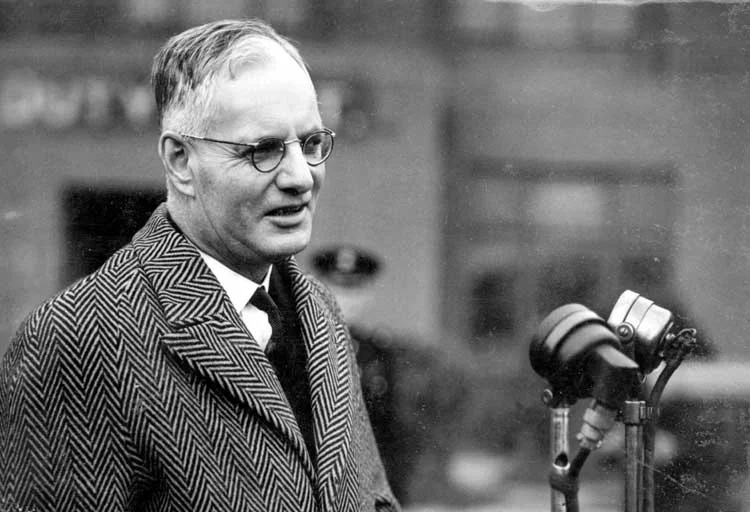
Source: http://www.jewishvirtuallibrary.org/jsourc...

Enjoyed this speech? Speakola is a labour of love and I’d be very grateful if you would share, tweet or like it. Thank you.

Facebook Twitter Facebook
In 1940-59 Tags WW2, HITLER, WAR, DECLARATION OF WAR, TRANSCRIPT, TRANSLATED
Comment

Charles de Gaulle: 'The flame of French resistance', radio broadcasts - 1940

June 30, 2015

18, 19 and 22 June 1940,  broadcast by BBC

The leaders who, for many years past, have been at the head of the French armed forces have set up a government.

Alleging the defeat of our armies, this government has entered into negotiations with the enemy with a view to bringing about a cessation of hostilities.

It is quite true that we were, and still are, overwhelmed by enemy mechanised forces, both on the ground and in the air. It was the tanks, the planes, and the tactics of the Germans, far more than the fact that we were outnumbered, that forced our armies to retreat. It was the German tanks, planes, and tactics that provided the element of surprise which brought our leaders to their present plight.

But has the last word been said? Must we abandon all hope? Is our defeat final and irremediable? To those questions I answer - No!

Speaking in full knowledge of the facts, I ask you to believe me when I say that the cause of France is not lost. The very factors that brought about our defeat may one day lead us to victory.

For, remember this, France does not stand alone. She is not isolated. Behind her is a vast empire, and she can make common cause with the British empire, which commands the seas and is continuing the struggle. Like England, she can draw unreservedly on the immense industrial resources of the United States.

This war is not limited to our unfortunate country. The outcome of the struggle has not been decided by the battle of France. This is a world war. Mistakes have been made, there have been delays and untold suffering, but the fact remains that there still exists in the world everything we need to crush our enemies some day.

Today we are crushed by the sheer weight of mechanised force hurled against us, but we can still look to a future in which even greater mechanised force will bring us victory. The destiny of the world is at stake.

I, General de Gaulle, now in London, call on all French officers and men who are at present on British soil, or may be in the future, with or without their arms; I call on all engineers and skilled workmen from the armaments factories who are at present on British soil, or may be in the future, to get in touch with me.

Whatever happens, the flame of French resistance must not and shall not die.

Tomorrow I shall broadcast again from London.

June 19 1940

Frenchmen must now be fully aware that all ordinary forms of authority have disappeared.

Faced by the bewilderment of my countrymen, by the disintegration of a government in thrall to the enemy, by the fact that the institutions of my country are incapable, at the moment, of functioning, I, General de Gaulle, a French soldier and military leader, realise that I now speak for France. I n the name of France, I make the following solemn declaration: It is the bounden duty of all Frenchmen who still bear arms to continue the struggle. For them to lay down their arms, to evacuate any position of military importance, or agree to hand over any part of French territory, however small, to enemy control, would be a crime against our country. For the moment I refer particularly to French North Africa - to the integrity of French North Africa.

The Italian armistice is nothing but a clumsy trap. In the Africa of Clauzel, Bugeaud, Lyautey, and Noguès, honour and duty strictly enjoin that the French should refuse to carry out the conditions imposed by the enemy.

The thought that the panic of Bordeaux could make itself felt across the sea is not to be borne.

Soldiers of France, wherever you may be, arise!

June 22 1940

The French government, after having asked for an armistice, now knows the conditions dictated by the enemy.

The result of these conditions would be the complete demobilisation of the French land, sea, and air forces, the surrender of our weapons and the total occupation of French territory. The French government would come under German and Italian tutelage.

It may therefore be said that this armistice would not only be a capitulation, but that it would also reduce the country to slavery. Now, a great many Frenchmen refuse to accept either capitulation or slavery, for reasons which are called: honour, common sense, and the higher interests of the country.

I say honour, for France has undertaken not to lay down arms save in agreement with her allies. As long as the allies continue the war, her government has no right to surrender to the enemy. The Polish, Norwegian, Belgian, Netherlands, and Luxemburg governments, though driven from their territories, have thus interpreted their duty. I say common sense, for it is absurd to consider the struggle as lost. True, we have suffered a major defeat. We lost the battle of France through a faulty military system, mistakes in the conduct of operations, and the defeatist spirit shown by the government during recent battles. But we still have a vast empire, our fleet is intact, and we possess large sums in gold. We still have the gigantic potentialities of American industry. The same war conditions which caused us to be beaten by 5,000 planes and 6,000 tanks can tomorrow bring victory by means of 20,000 tanks and 20,000 planes.

I say the higher interests of the country, for this is not a Franco-German war to be decided by a single battle. This is a world war. No one can foresee whether the neutral countries of today will not be at war tomorrow, or whether Germany's allies will always remain her allies. If the powers of freedom ultimately triumph over those of servitude, what will be the fate of a France which has submitted to the enemy?

Honour, common sense, and the interests of the country require that all free Frenchmen, wherever they be, should continue the fight as best they may.

It is therefore necessary to group the largest possible French force wherever this can be done. Everything which can be collected by way of French military elements and potentialities for armaments production must be organised wherever such elements exist.

I, General de Gaulle, am undertaking this national task here in England.

I call upon all French servicemen of the land, sea, and air forces; I call upon French engineers and skilled armaments workers who are on British soil, or have the means of getting here, to come and join me.

I call upon the leaders, together with all soldiers, sailors, and airmen of the French land, sea, and air forces, wherever they may now be, to get in touch with me.

I call upon all Frenchmen who want to remain free to listen to my voice and follow me.

Long live free France in honour and independence!

Source: http://www.theguardian.com/theguardian/200...

Enjoyed this speech? Speakola is a labour of love and I’d be very grateful if you would share, tweet or like it. Thank you.

Facebook Twitter Facebook
In 1940-59 Tags FRANCE, WW2, DE GAULLE, PRESIDENTS, NATIONALISM, TRANSCRIPT, TRANSLATED
Comment

Kwame Nkrumah: 'Today we are here to claim this right to our independence', Motion of Destiny - 1953

June 30, 2015

July 10 1953, House of Commons, London, United Kingdom

Mr Speaker, it is with great humility that I stand before my countrymen and before the representatives of Britain, to ask this House to give assent to this Motion…

In seeking your mandate, I am asking you to give my Government the power to bring to fruition the longing hopes, the ardent dreams, the fervent aspirations of the chiefs and people of our country. Throughout a century of alien rule our people have, with ever increasing tendency, looked forward to that bright and glorious day when they shall regain their ancient heritage, and once more take their place rightly as free men in the world.

Mr Speaker, we have frequent examples to show that there comes a time in the history of all colonial peoples when they must, because of their will to throw off the hampering shackles of colonialism, boldly assert their God-given right to be free of a foreign ruler. To-day we are here to claim this right to our independence…

The right of a people to decide their own destiny, to make their way in freedom, is not to be measured by the yardstick of colour or degree of social development. It is an inalienable right of peoples which they are powerless to exercise when forces, stronger than they themselves, by whatever means, for whatever reasons, take this right away from them. If there is to be a criterion of a people's preparedness for self-government, then I say it is their readiness to assume the responsibilities of ruling themselves. For who but a people themselves can say when they are prepared? How can others judge when that moment has arrived in the destiny of a subject people?…

I am confident, therefore, that I express the wishes and feelings of the chiefs and people of this country in hoping that the final transfer of power to your Representative Ministers may be done in a spirit of amity and friendship, so that, having peacefully achieved our freedom, the peoples of both countries—Britain and the Gold Coast—may form a new relationship based on mutual respect, trust and friendship…

In the very early days of the Christian era, long before England had assumed any importance, long even before her people had united into a nation, our ancestors had attained a great empire, which lasted until the eleventh century, when it fell before the attacks of the Moors of the North. At its height that empire stretched from Timbuktu to Bamako, and even as far as to the Atlantic. It is said that lawyers and scholars were much respected in that empire and that the inhabitants of Ghana wore garments of wool, cotton, silk and velvet. There was trade in copper, gold and textile fabrics, and jewels and weapons of gold and silver were carried.

Thus may we take pride in the name of Ghana, not out of romanticism, but as an inspiration for the future. It is right and proper that we should know about our past. For just as the future moves from the present so the present has emerged from the past. Nor need we be ashamed of our past. There was much in it of glory. What our ancestors achieved in the context of their contemporary society gives us confidence that we can create, out of that past, a glorious future, not in terms of war and military pomp, but in terms of social progress and of peace.

For we repudiate war and violence. Our battles shall be against the old ideas that keep men trammelled in their own greed; against the crass stupidities that breed hatred, fear and inhumanity. The heroes of our future will be those who can lead our people out of the stifling fog of disintegration through serfdom, into the valley of light where purpose, endeavour and determination will create that brotherhood which Christ proclaimed two thousand years ago, and about which so much is said, but so little done…

Honourable Members, you are called, here and now, as a result of the relentless tide of history, by Nemesis as it were, to a sacred charge, for you hold the destiny of our country in your hands. The eyes and ears of the world are upon you; yea, our oppressed brothers throughout this vast continent of Africa and the New World are looking to you with desperate hope, as an inspiration to continue their grim fight against cruelties which we in this corner of Africa have never known—cruelties which are a disgrace to humanity, and to the civilisation which the white man has set himself to teach us.

At this time, history is being made; a colonial people in Africa has put forward the first definite claim for independence. An African colonial people proclaim that they are ready to assume the stature of free men and to prove to the world that they are worthy of the trust.

I know that you will not fail those who are listening for the mandate that you will give to your Representative Ministers. For we are ripe for freedom, and our people will not be denied. They are conscious that the right is theirs, and they know that freedom is not something that one people can bestow on another as a gift. They claim it as their own and none can keep it from them.

And while yet we are making our claim for self-government I want to emphasize, Mr Speaker, that self-government is not an end in itself. It is a means to an end, to the building of the good life to the benefit of all, regardless of tribe, creed, colour or station in life. Our aim is to make this country a worthy place for all its citizens, a country that will be a shining light throughout the whole continent of Africa, giving inspiration far beyond its frontiers. And this we can do by dedicating ourselves to unselfish service to humanity. We must learn from the mistakes of others so that we may, in so far as we can, avoid a repetition of those tragedies which have overtaken other human societies.

We must not follow blindly, but must endeavour to create. We must aspire to lead in the arts of peace. The foreign policy of our country must be dedicated to the service of peace and fellowship. We repudiate the evil doctrines of tribal chauvinism, racial prejudice and national hatred. We repudiate these evil ideas because in creating that brotherhood to which we aspire, we hope to make a reality, within the bounds of our small country, of all the grandiose ideologies which are supposed to form the intangible bonds holding together the British Commonwealth of Nations in which we hope to remain…

The strands of history have brought our two countries together. We have provided much material benefit to the British people, and they in turn have taught us many good things. We want to continue to learn from them the best they can give us and we hope that they will find in us qualities worthy of emulation. In our daily lives, we may lack those material comforts regarded as essential by the standards of the modern world, because so much of our wealth is still locked up in our land; but we have the gifts of laughter and joy, a love of music, a lack of malice, an absence of the desire for vengeance for our wrongs, all things of intrinsic worth in a world sick of injustice, revenge, fear and want.

We feel that there is much the world can learn from those of us who belong to what we might term the pretechnological societies. These are values which we must not sacrifice unheedingly in pursuit of material progress. That is why we say that self-government is not an end in itself.

We have to work hard to evolve new patterns, new social customs, new attitudes to life, so that while we seek the material, cultural and economic advancement of our country, while we raise their standards of life, we shall not sacrifice their fundamental happiness…

Mr Speaker, we can only meet the challenge of our age as a free people. Hence our demand for our freedom, for only free men can shape the destinies of their future.

Mr Speaker, Honourable Members, we have great tasks before us. I say, with all seriousness, that it is rarely that human beings have such an opportunity for service to their fellows.

Mr Speaker, for my part, I can only re-echo the words of a great man: "Man's dearest possession is life, and since it is given him to live but once, he must so live as not to be besmeared with the shame of a cowardly existence and trivial past, so live that dying he might say: all my life and all my strength were given to the finest cause in the world—the liberation of mankind."

Mr Speaker, "Now God be thank'd, Who has match'd us with His hour!" I beg to move.

Source: www.fofweb.com/History/HistRefMain.asp

Enjoyed this speech? Speakola is a labour of love and I’d be very grateful if you would share, tweet or like it. Thank you.

Facebook Twitter Facebook
In 1940-59 Tags INDEPENDENCE, GHANA, COLONIAL, TRANSCRIPT, AFRICA, MOTION OF DESTINY, CPP, GREATEST AFRICAN SPEECHES, 1954, KWAME NKRUMAH
1 Comment

Nikita S. Khrushchev: 'Quite a lot has been said about the cult of the individual and about its harmful consequences', The Secret Speech - 1956

June 30, 2015

25 February 1956, Moscow, USSR

Secret Speech Delivered by First Party Secretary at the Twentieth Party Congress of the Communist Party of the Soviet Union, February 25, 1956

Comrades, in the report of the Central Committee of the party at the 20th Congress, in a number of speeches by delegates to the Congress, as also formerly during the plenary CC/CPSU sessions, quite a lot has been said about the cult of the individual and about its harmful consequences. . . .

Allow me first of all to remind you how severely the classics of Marxism-Leninism denounced every manifestation of the cult of the individual. In a letter to the German political worker, Wilhelm Bloss, Marx stated: "From my antipathy to any cult of the individual, I never made public during the existence of the International the numerous addresses from various countries which recognized my merits and which annoyed me. I did not even reply to them, except sometimes to rebuke their authors. Engels and I first joined the secret society of Communists on the condition that everything making for superstitious worship of authority would be deleted from its statute. . . .

The great modesty of the genius of the revolution, Vladimir Ilyich Lenin, is known. Lenin had always stressed the role of the people as the creator of history, the directing and organizational role of the party as a living and creative organism, and also the role of the central committee.

Marxism does not negate the role of the leaders of the workers' class in directing the revolutionary liberation movement.

While ascribing great importance to the role of the leaders and organizers of the masses, Lenin at the same time mercilessly stigmatized every manifestation of the cult of the individual, inexorably combated the foreign-to-Marxism views about a "hero" and a "crowd" and countered all efforts to oppose a "hero" to the masses and to the people.

Lenin taught that the party's strength depends on its indissoluble unity with the masses, on the fact that behind the party follow the people - workers, peasants and intelligentsia. "Only lie will win and retain the power," said Lenin, "who believes in the people, who submerges himself in the fountain of the living creativeness of the people.". . .

During Lenin's life the central committee of the party- was a real expression of collective leadership of the party and of the Nation. Being a militant Marxist-revolutionist, always unyielding in matters of principle, Lenin never imposed by force his views upon his coworkers. He tried to convince; he patiently explained his opinions to others. Lenin always diligently observed that the norms of party life were realized, that the party statute was enforced, that the party congresses and the plenary sessions of the central committee took place at the proper intervals.

In addition to the great accomplishments of V. I. Lenin for the victory of the working class and of the working peasants, for the victory of our party and for the application of the ideas of scientific communism to life, his acute mind expressed itself also in this that lie detected in Stalin in time those negative characteristics which resulted later in grave consequences. Fearing the future fate of the party and of the Soviet nation, V.I. Lenin made a completely correct characterization of Stalin, pointing out that it was necessary to consider the question of transferring Stalin from the position of Secretarv General because of the fact that Stalin is excessively rude, that he does not have a proper attitude toward his comrades, that lie is capricious, and abuses his power. . . .

Vladimir Ilyich said: "Stalin is excessively rude, and this defect, which can be freely tolerated in our midst and in contacts among us Communists, becomes a defect which cannot be tolerated in one holding the position of the Secretary General. Because of this, I propose that the comrades consider the method by which Stalin would be removed from this position and by which another man would be selected for it, a man, who above all , would differ from Stalin in only one quality, namely, greater tolerance, greater loyalty, greater kindness, and more considerate attitude toward the comrades, a less capricious temper, etc.".

As later events have proven, Lenin's anxiety was justified; in the first period after Lenin's death Stalin still paid attention to his (i.e., Lenin's) advice, but, later be began to disregard the serious admonitions of Vladimir Ilyich.

When we analyze the practice of Stalin in regard to the direction of the party and of the country, when we pause to consider everything which Stalin perpetrated, we must be convinced that Lenin's fears were justified. The negative characteristics of Stalin, which, in Lenin's time, were on1v incipient, transformed themselves during the last years into a grave abuse o f power by Stalin, which caused untold harm to our party. . . .

Stalin acted not through persuasion, explanation, and patient cooperation with people, but by imposing his concepts and demanding absolute submission to his opinion. Whoever opposed this concept or tried to prove his viewpoint, and the correctness of his position-was doomed to removal from the leading collective and to subsequent moral and physical annihilation. This was especially true during the period following the 17th party congress, when many prominent party leaders and rank-and-file party workers, honest and dedicated to the cause of communism, fell victim to Stalin's despotism. . . .

Stalin originated the concept enemy of the people. This term automatically rendered it unnecessary that the ideological errors of a man or men engaged in a controversy be proven; this term made possible the usage of the most cruel repression, violating all norms of revolutionary legality, against anyone who in any way disagreed with Stalin, against those who were only suspected of hostile intent, against those who had bad reputations. This concept, enemy of the people, actually eliminated the possibility of any kind of ideological fight or the making of one's views known on this or that issue, even those of a practical character. In the main, and in actuality, the only proof of guilt used, against all norms of current legal science, was the confession of the accused himself, and, as subsequent probing proved, confessions were acquired through physical pressures against the accused. . . .

Lenin used severe methods only in the most necessary cases, when the exploiting classes were still in existence and were vigorously opposing the revolution, when the struggle for survival was decidedly assuming the sharpest forms, even including a civil war.

Stalin, on the other hand, used extreme methods and mass repressions at a time when the revolution was already victorious, when the Soviet state was strengthened, when the exploiting classes were already liquidated, and Socialist relations were rooted solidly in all phases of national economy, when our party was politically consolidated and had strengthened itself both numerically and ideologically. It is clear that here Stalin showed in a whole series of cases his intolerance, his brutality, and his abuse of power. Instead of proving his political correctness and mobilizing the masses, he often chose the path of repression and physical annihilation, not only against actual enemies, but also against individuals who had not committed any crimes against the party and the Soviet Government. Here we see no wisdom but only a demonstration of the brutal force which had once so alarmed V.I Lenin. . . .

Considering the question of the cult of an individual we must first of all show everyone what harm this caused to the interests of our party. . . .

In practice Stalin ignored the norms of party life and trampled on the Leninist principle of collective party leadership.

Stalin's willfulness vis-a-vis the party and its central committee became fully evident after the 17th party congress, which took place in 1934. . . .

It was determined that of the 139 members and candidates of the party's Central Committee who were elected at the 17th congress, 98 persons, that is, 70 percent, were arrested and shot (mostly in 1937-38). [Indignation in the hall.] . . .

The same fate met not only the central committee members but also the majority of the delegates to the 17th party congress. Of 1,966 delegates with either voting or advisory rights, 1,108 persons were arrested on charges of anti-revolutionary crimes, i.e., decidedly more than a majority. This very fact shows how absurd, wild, and contrary to commonsense were the charges of counter-revolutionary crimes made out, as we now see, against a majority of participants at the 17th party congress. [Indignation in the hall.] . . .

What is the reason that mass repressions against activists increased more and more after the 17th party congress? It was because at that time Stalin had so elevated himself above the party and above the nation that he ceased to consider either the central committee or the party. While he still reckoned with the opinion of the collective before the 17th congress, after the complete political liquidation of the Trotskyites, Zinovievites and Bukharinites, when as a result of that fight and Socialist victories the party achieved unity, Stalin ceased to an ever greater degree to consider the members of the party's central committee and even the members of the Political Bureau. Stalin thought that now lie could decide all things alone and all he needed were statisticians; he treated all others in such a way that they could only listen to and praise him.

After the criminal murder of S. M. Kirov, mass repressions and brutal acts of violation of Socialist legality began. On the evening of December 1, 1934, on Stalin's initiative (without the approval of the Political Bureau - which was passed 2 days later, casually) the Secretary of the Presidium of the Central Executive Committee, Yenukidze, signed the following directive:

I. Investigative agencies are directed to speed up the cases of those accused of the preparation or execution of acts of terror.

II. Judicial organs are directed not to hold up the execution of death sentences pertaining to crimes of this category in order to consider the possibility of pardon, because the Presidium of the Central Executive Committee, U.S.S.R, does not consider as possible the receiving of petitions of this sort.

III. The organs of the Commissariat of Internal Affairs are directed to execute the death sentences against criminals of the above-mentioned category immediately after the passage of sentences.

This directive became the basis for mass acts of abuse against Socialist legality. During many of the fabricated court cases the accused were charged with "the preparation" of terroristic acts; this deprived them of any, possibility that their cases might be reexamined, even when they stated before the court that their confessions were secured by force, and when, in a convincing manner, they disproved the accusations against them. . . .

Mass repressions grew tremendously from the end of 1936 after a telegram from Stalin and Zhdanov, dated from Sochi on September 25, 1936, was addressed to Kaganovich, Molotov, and other members of the Political Bureau. The content of the telegram was as follows: "We deem it absolutely necessary and urgent that Comrade Yezhov be nominated to the post of People's Commissar for Internal Affairs. Yagoda has definitely proved himself to be incapable of unmasking the Trotskyite-Zinovievite bloc. The OGPU is 4 years behind in this matter. This is noted by all party workers and by the majority of the representatives of the NKVD." Strictly speaking we should stress that Stalin did not meet with and therefore could not know the opinion of party workers. . . .

The mass repressions at this time were made under the slogan of a fight against the Trotskyites. Did the Trotskyites at this time actually constitute such a danger to our party and to the Soviet state? We should recall that in 1927, on the eve of the 15th party congress, only some 4,000 votes were cast for the Trotskyite-Zinovievite opposition, while there were 724,000 for the party line. During the 10 years which passed between the 15th party congress and the February-March central committee plenum, Trotskyism was completely disarmed; many former Trotskyites had changed their former views and worked in the various sectors building socialism. It is clear that in the situation of Socialist victory there was no basis for mass terror in the country . . . .

The majority of the Central Committee members and candidates elected at the 17th congress and arrested in 1937-38 were expelled from the party illegally through the brutal abuse of the party statute, because the question of their expulsion was never studied at the Central Committee plenum.

Now when the cases of some of these so-called spies and saboteurs were examined it was found that all their cases were fabricated. Confessions of guilt of many- arrested and charged with enemy activity were gained with the help of cruel and inhuman tortures. . . .

An example of vile provocation of odious falsification and of criminal violation of revolutionary legality is the case of the former candidate for the central committee political bureau, one of the most eminent workers of the party and of the Soviet Government, Comrade Eikhe, who was a party member since 1905. [Commotion in the hall.]

Comrade Eikhe was arrested on April 29, 1938, on the basis of slanderous materials, without the sanction of the prosecutor of the USSR, which was finally received 15 months after the arrest.

Investigation of Eikhe's case was made in a manner which most brutally violated Soviet legality and was accompanied by willfulness and falsification.

Eikhe was forced under torture to sign ahead of time a protocol of his confession prepared by the investigative judges, in which he and several other eminent party workers were accused of anti-Soviet activity.

On October 1, 1939, Eikhe sent his declaration to Stalin in which be categorically denied his guilt and asked for an examination of his case. In the declaration he wrote:

"There is no more bitter misery than to sit In the jail of a government for which I have always fought.". . .

On February 2, 1940, Eikhe was brought before the court. Here he did not confess any guilt and said as follows:

"In all the so-called confessions of mine there is not one letter written by me with the exception of my signatures under the protocols which were forced from me. I have made my confession under pressure from the investigative judge who from the time of my arrest tormented me. After that I began to write all this nonsense. The most important thing for me is to tell the court, the party and Stalin that I am not guilty. I have never been guilty of any conspiracy. I will die believing in the truth of party policy as I have believed in it during my whole life."

On February 4 Eikhe was shot. [Indignation in the hall.] It has been definitely established now that Eikhe's case was fabricated; he has been posthumously rehabilitated. . . .

The way in which the former NKVD workers manufactured various fictitious "anti-Soviet centers" and "blocs" with the help of provocatory methods is seen from the confession of Comrade Rozenblum, party member since 1906, who was arrested in 1937 by the Leningrad NKVD.

During the examination in 1955 of the Kornarov case Rozenblum revealed the following fact: when Rozenblum was arrested in 1937 he was subjected to terrible torture during which be was ordered to confess false information concerning himself and other persons. Be was then brought to the office of Zakovsky, who offered him freedom on condition that be make before the court a false confession fabricated in 1937 by the NKVD concerning "sabotage, espionage and diversion in a terroristic center in Leningrad." [Movement in the hall.] . . .

"You, yourself," said Zakovskv, "will not need to invent anything. The NKVD will prepare for you a ready outline for every branch of the center; you will have to study it carefully and to remember well all questions and answers which the court might ask. Pus case will be ready in 4-5 months, or perhaps a half year. During all this time you will be preparing yourself so that you will not compromise the investigation and yourself. Your future will depend on how the trial goes and on its results. If you begin to lie and to testify falsely, blame yourself. If you manage to endure it, you will save your bead and we will feed and clothe you at the government's cost until your death."

This is the kind of vile things which were then practiced. [Movement in the hall.] . .

When we look at many of our novels, films, and historical scientific studies, the role of Stalin in the patriotic war appears to be entirely improbable. Stalin had foreseen everything. The Soviet Army, on the basis of a strategic plan prepared by Stalin long before, used the tactics of so-called active defense, i.e., tactics which, as we know, allowed the Germans to come up to Moscow and Stalingrad. Using such tactics, the Soviet Army, supposedly, thanks only to Stalin's genius, turned to the offensive and subdued the enemy. The epic victory gained through the armed might of the land of the Soviets, through our heroic people, is ascribed in this type of novel, film, and scientific study as being completely due to the strategic genius of Stalin.

We have to analyze this matter carefully because it has a tremendous significance, not only from the historical but especially from the political, educational, and practical point of view. . . .

During the war and after the war, Stalin put forward the thesis that the tragedy which our nation experienced in the first part of the war was the result of the unexpected attack of the Germans against the Soviet Union. But, comrades, this is completely untrue. As soon as Hitler came to power in Germany be assigned to himself the task of liquidating communism. The Fascists were saying this openly; they did not hide their plans. In order to attain this aggressive end, all sorts of pacts and blocs were created, such as the famous Berlin-Rome-Tokyo Axis. Many facts from the prewar period clearly showed that Hitler was going all out to begin a war against the Soviet state and that lie had concentrated large armed units, together with armored units, near the Soviet borders. . . .

We must assert that information of this sort concerning the threat of German armed invasion of Soviet territory was coming in also from our own military and diplomatic sources; however, because the leadership was conditioned against such information, such data was dispatched with fear and assessed with reservation. . . .

Despite these particularly grave warnings, the necessary steps were not taken to prepare the country properly for defense and to prevent it from being caught unaware.

Did we have time and the capabilities for such preparations? Yes; we had the time and capabilities. Our industry was already so developed that it was capable of supplying fully the Soviet Army with everything that it needed. . . .

Had our industry been mobilized properly and in time to supply the army with the necessary materiel, our wartime losses would have been decidedly smaller. Such mobilization had not been, however, started in time. And already in the first days of the war it became evident that our Army was badly armed, that we did not have enough artillery, tanks, and planes to throw the enemy back. . . .

Very grievous consequences, especially in reference to the beginning of the war, followed Stalin's annihilation of many military commanders and political workers during 1937-41 because of his suspiciousness and through slanderous accusations. During these years repressions were instituted against certain parts of military cadres beginning literally at the company and battalion commander level and extending to the higher military centers; during this time the cadre of leaders who had gained military experience in Spain and In the Far East was almost completely liquidated. . . .

After the conclusion of the patriotic war the Soviet nation stressed with pride the magnificent victories gained through great sacrifices and tremendous efforts. The country experienced a period of political enthusiasm. The party came out of the war even more united; in the fire of the war party cadres were tempered and hardened. Under such conditions nobody could have even thought of the possibility of some plot in the party.

And it was precisely at this time that the so-called Leningrad affair was born. As we have now proven, this case was fabricated. Those who innocently lost their lives included Comrades Voznesensky, Kuznetsov, Rodionov, Popkov, and others. . . .

Facts prove that the Leningrad affair is also the result of willfulness which Stalin exercised against party cadres. . . .

We must state that after the war the situation became even more complicated. Stalin became even more capricious, irritable, and brutal; in particular his suspicion grew. His persecution mania reached unbelievable dimensions. Many workers were becoming enemies before his very eyes. After the war Stalin separated himself from the collective even more. Everything was decided by him alone without any consideration for anyone or anything.

This unbelievable suspicion was cleverly taken advantage of by the abject provocateur and vile enemy, Beriya, who had murdered thousands of Communists and loyal Soviet people. The elevation of Voznesensky and Kuznetsov alarmed Beriya. As we have now proven, it had been precisely Beriya who had suggested to Stalin the fabrication by him and by his confidants of materials in the form of declarations and anonymous letters, and in the form of various rumors and talks. . . .

The question arises: Why is it that we see the truth of this affair only now, and why did we not do something earlier, during Stalin's life, in order to prevent the loss of innocent lives? It was because Stalin personally supervised the Leningrad affair, and the majority of the Political Bureau members did not, at that time, know all of the circumstances in these matters, and could not therefore intervene. . . .

The willfulness of Stalin showed itself not only in decisions concerning the internal life of the country but also in the international relations of the Soviet Union.

The July plenum of the Central Committee studied in detail the reasons for the development of conflict with Yugoslavia. It was a shameful role which Stalin played here. The "Yugoslav affair" contained no problems which could not have been solved through party discussions among comrades. There was no significant basis for the development of this "affair;" it was completely possible to have prevented the rupture of relations with that country.

I recall the first days when the conflict between the Soviet Union and Yugoslavia began artificially to be blown up. Once, when I carne from Kiev to Moscow, I was invited to visit Stalin who, pointing to the copy of a letter lately sent to Tito, asked me, "Have you read this?"

Not waiting for my reply be answered, "I will shake my little finger and there will be no more Tito. He will fall.". . .

But this did not happen to Tito. No matter how much or how little Stalin shook, not only his little finger but everything else that be could shake, Tito did not fall. Why? The reason was that, in this case of disagreement with the Yugoslav comrades, Tito had behind him a state and a people who had gone through a severe school of fighting for liberty and independence, a people which gave support to its leaders.

You see to what Stalin's mania for greatness led. He bad completely lost consciousness of reality; he demonstrated his suspicion and haughtiness not only in relation to individuals in the USSR, but in relation to whole parties and nations. . . .

Let us also recall the affair of the doctor plotters. [Animation in the ball.] Actually there was no affair outside of the declaration of the woman doctor Timasbuk, who was probably influenced or ordered by someone (after all, she was an unofficial collaborator of the organs of state security) to write Stalin a letter in which she declared that doctors were applying supposedly improper methods of medical treatment.

Such a letter was sufficient for Stalin to reach an immediate conclusion that there are doctor plotters in the Soviet Union. He issued orders to arrest a group of eminent Soviet medical specialists. He personally issued advice on the conduct of the investigation and the method of interrogation of the arrested persons. He said that the academician Vinogradov should be put in chains, another one should be beaten. Present at this Congress as a delegate is the former Minister of State Security Comrade Ignatiev. Stalin told him curtly, "If you do not obtain confessions from the doctors we will shorten you by a head." [Tumult in the hall.] . . .

In organizing the various dirty and shameful cases, a very base role was played by the rabid enemy of our party, an agent of a foreign intelligence service-Beriya, who had stolen into Stalin's confidence. In what way could this provocateur gain such a position in the part), and in the State, so as to become the First Deputy Chairman of the Council of Ministers of the Soviet Union and a member of the Central Committee Political Bureau? It has now been established that this villain bad climbed up the government ladder over an untold number of corpses.

Were there any signs that Beriya was an enemy of the party? Yes; there were. Already in 1937, at a Central Committee plenum, former People's Commissar of Health Protection Kaminsky said that Beriya worked for the Mussavat intelligence service. But the Central Committee plenum had barely concluded when Kaminsky was arrested and then shot. Had Stalin examined Kaminsky's statement? No; because Stalin believed in Beriya and that was enough for him. And when Stalin believed in anyone or anything, then no one could say anything which was contrary to his opinion; anyone who would dare to express opposition would have met the same fate as Kaminsky. . . .

Comrades, the cult of the individual acquired such monstrous size chiefly because Stalin himself, using all conceivable methods, supported the glorification of his own person. This is supported by numerous facts. One of the most characteristic examples of Stalin's self -glorification and of his lack of even elementary modesty is the edition of his Short Biography, which was published in 1948.

This book is an expression of the most dissolute flattery, an example of making a man into a godhead, of transforming him into an infallible sage, "the greatest leader," "sublime strategist of all times and nations." Finally no other words could be found with which to lift Stalin up to the heavens.

We need not give here examples of the loathsome adulation filling this book. All we need to add is that they all were approved and edited by Stalin personally and some of them were added in his own handwriting to the draft text of the book. . . .

Comrades, if we sharply criticize today the cult of the individual which was so widespread during Stalin's life and if we speak about the many negative phenomena generated by this cult which is so alien to the spirit of Marxism-Leninism, various persons may ask: How could it be? Stalin headed the party and the country for 30 years and many victories were gained during his lifetime. Can we deny this? In my opinion, the question can be asked in this manner only by those who are blinded and hopelessly hypnotized by the cult of the individual, only by those who do not understand the essence of the revolution and of the Soviet State, only by those who do not understand, in a Leninist manner, the role of the party and of the nation in the development of the Soviet society. . . .

Our historical victories were attained thanks to the organizational work of the party, to the many provincial organizations, and to the self-sacrificing work of our great nation. These victories are the result of the great drive and activity of the nation and of the party as a whole; they are not at all the fruit of the leadership of Stalin, as the situation was pictured during the period of the cult of the individual. . . .

Let us consider the first Central Committee plenum after the 19th party congress when Stalin, in his talk at the plenum, characterized Vyacheslav Mikhailovich Molotov and Anastas Ivanovich Mikoyan and suggested that these old workers of our party were guilty of some baseless charges. It is not excluded that had Stalin remained at the helm for another several months, Comrades Molotov and Mikoyan would probably have not delivered any speeches at this congress.

Stalin evidently had plans to finish off the old members of the political bureau. He often stated that political bureau members should be replaced by new ones. . . .

We can assume that this was also a design for the future annihilation of the old political bureau members and in this way a cover for all shameful acts of Stalin, acts which we are now considering.

Comrades, in order not to repeat errors of the past, the central committee has declared itself resolutely against the cult of the individual. We consider that Stalin was excessively extolled. However, in the past Stalin doubtless performed great services to the party, to the working class, and to the international workers' movement. . . .

We should in all seriousness consider the question of the cult of the individual. We cannot let this matter get out of the party, especially not to the press. It is for this reason that we are considering it here at a closed congress session. We should know the limits; we should not give ammunition to the enemy; we should not wash our dirty linen before their eves. I think that the delegates to the congress will understand and assess properly all these proposals. [Tumultuous applause.]

Comrades, we must abolish the cult of the individual decisively, once and for all; we must draw the proper conclusions concerning both ideological-theoretical and practical work.

It is necessary for this purpose:

First, in a Bolshevik manner to condemn and to eradicate the cult of the individual as alien to Marxism-Leninism and not consonant with the principles of party leadership and the norms of party life, and to fight inexorably all attempts at bringing back this practice in one form or another.

To return to and actually practice in all our ideological work, the most important theses of Marxist-Leninist science about the people as the creator of history and as the creator of all material and spiritual good of humanity, about the decisive role of the Marxist party in the revolutionary fight for the transformation of society-, about the victory of communism.

In this connection we will be forced to do much work in order to examine critically from the Marxist-Leninist viewpoint and to correct the widely spread erroneous views connected with the cult of the individual in the sphere of history, philosophy,, economy, and of other sciences, as well as in the literature and t be fine arts. It is especially necessary that in the immediate future we compile a serious textbook of the history of our party which will be edited in accordance with scientific Marxist objectivism, a textbook of the history of Soviet society, a book pertaining to the events of the civil war and the great patriotic war.

Secondly, to continue systematically and consistently the work done by the party's central committee during the last years, a work characterized by minute observation in all party- organizations, from the bottom to the top, of the Leninist principles of party- leadership, characterized, above all, by the main principle of collective leadership, characterized by the observation of the norms of party life described in the statutes of our party, and, finally, characterized by- the wide practice of criticism and self-criticism.

Thirdly, to restore completely the Leninist principles of Soviet Socialist democracy., expressed in the constitution of the Soviet Union, to fight willfulness of individuals abusing their power. The evil caused by acts violating revolutionary Socialist legality which have accumulated during a long time as a result of the negative influence of the cult of the individual has to be completely corrected.

Comrades, the 20tb Congress of the Communist Party of the Soviet Union has manifested with a new strength the unshakable unity- of our party, its cohesiveness around the central committee, its resolute will to accomplish the great task of building communism. [Tumultuous applause.] And the fact that we present in all the ramifications the basic problems of overcoming the cult of the individual which is alien to Marxism-Leninism, as well as the problem of liquidating its burdensome consequences, is an evidence of the great moral and political strength of our party'. [Prolonged applause.]

We are absolutely certain that our party, armed with the historical resolutions of the 20th Congress, will lead the Soviet people along the Leninist path to new, successes, to new victories. [Tumultuous, prolonged applause.]

Long live the victorious banner of our party-Leninism. [Tumultuous, prolonged applause ending in ovation. All rise.]

Source: http://legacy.fordham.edu/halsall/mod/1956...

Enjoyed this speech? Speakola is a labour of love and I’d be very grateful if you would share, tweet or like it. Thank you.

Facebook Twitter Facebook
In 1940-59 Tags USSR, KHRUSHCHEV, COLD WAR, RUSSIA, FIRST PARTY SECRETARY, 1950S, TRANSCRIPT, TRANSLATED, LENINISM, ANTI STALIN, BOLSHEVISM, CULT OF PERSONALITY, LONG SPEECHES, CRITICISM OF STALIN, SOVIET UNION, COLLECTIVISATION, SECRET SPEECH, THAW, GREATEST SPEECHES OF TH 1950S, 20TH CENTURY, THE COLD WAR
Comment

Dwight Eisenhowser: 'You are about to embark upon the Great Crusade', Order of the Day - 1944

June 30, 2015

6 June 1944, D-Day, United Kingdom

Soldiers, Sailors and Airmen of the Allied Expeditionary Forces:

You are about to embark upon the Great Crusade, toward which we have striven these many months. The eyes of the world are upon you. The hopes and prayers of liberty-loving people everywhere march with you. In company with our brave Allies and brothers-in-arms on other Fronts you will bring about the destruction of the German war machine, the elimination of Nazi tyranny over oppressed peoples of Europe, and security for ourselves in a free world.

Your task will not be an easy one. Your enemy is well trained, well equipped and battle-hardened. He will fight savagely.

But this is the year 1944. Much has happened since the Nazi triumphs of 1940-41. The United Nations have inflicted upon the Germans great defeats, in open battle, man-to-man. Our air offensive has seriously reduced their strength in the air and their capacity to wage war on the ground. Our Home Fronts have given us an overwhelming superiority in weapons and munitions of war, and placed at our disposal great reserves of trained fighting men. The tide has turned. The free men of the world are marching together to victory.

I have full confidence in your courage, devotion to duty, and skill in battle. We will accept nothing less than full victory.

Good Luck! And let us all beseech the blessing of Almighty God upon this great and noble undertaking.

Source: http://www.americanrhetoric.com/speeches/d...

Enjoyed this speech? Speakola is a labour of love and I’d be very grateful if you would share, tweet or like it. Thank you.

Facebook Twitter Facebook
In 1940-59 Tags WW2, GENERALS, PRESIDENTS, USA, D-DAY SPEECH, ORDER OF THE DAY, EISENHOWER, WORLD WAR 2, GENERAL, WARTIME, MILITARY SPEECHES, D-DAY, NAZI, HITLER, GREATEST SPEECHES OF THE 1940S, GREATEST SPEECHES BY AMERICAN PRESIDENTS, PRESIDENT, FUTURE PRESIDENT, DWIGHT EISENHOWER, GENERAL EISENHOWER, GREAT CRUSADE
Comment

Winston Churchill: 'I have nothing to offer but blood, toil, tears and sweat', First Speech as Prime Minister - 1940

June 30, 2015

13 May 1940, House of Commons, Westminster, UK

I beg to move,

On Friday evening last I received His Majesty's commission to form a new Administration. It as the evident wish and will of Parliament and the nation that this should be conceived on the broadest possible basis and that it should include all parties, both those who supported the late Government and also the parties of the Opposition. I have completed the most important part of this task. A War Cabinet has been formed of five Members, representing, with the Opposition Liberals, the unity of the nation. The three party Leaders have agreed to serve, either in the War Cabinet or in high executive office. The three Fighting Services have been filled. It was necessary that this should be done in one single day, on account of the extreme urgency and rigour of events. A number of other positions, key positions, were filled yesterday, and I am submitting a further list to His Majesty to-night. I hope to complete the appointment of the principal Ministers during to-morrow. the appointment of the other Ministers usually takes a little longer, but I trust that, when Parliament meets again, this part of my task will be completed, and that the administration will be complete in all respects.

I considered it in the public interest to suggest that the House should be summoned to meet today. Mr. Speaker agreed, and took the necessary steps, in accordance with the powers conferred upon him by the Resolution of the House. At the end of the proceedings today, the Adjournment of the House will be proposed until Tuesday, 21st May, with, of course, provision for earlier meeting, if need be. The business to be considered during that week will be notified to Members at the earliest opportunity. I now invite the House, by the Motion which stands in my name, to record its approval of the steps taken and to declare its confidence in the new Government.

To form an Administration of this scale and complexity is a serious undertaking in itself, but it must be remembered that we are in the preliminary stage of one of the greatest battles in history, that we are in action at many other points in Norway and in Holland, that we have to be prepared in the Mediterranean, that the air battle is continuous and that many preparations, such as have been indicated by my hon. Friend below the Gangway, have to be made here at home. In this crisis I hope I may be pardoned if I do not address the House at any length today. I hope that any of my friends and colleagues, or former colleagues, who are affected by the political reconstruction, will make allowance, all allowance, for any lack of ceremony with which it has been necessary to act. I would say to the House, as I said to those who have joined this government: "I have nothing to offer but blood, toil, tears and sweat."

We have before us an ordeal of the most grievous kind. We have before us many, many long months of struggle and of suffering. You ask, what is our policy? I can say: It is to wage war, by sea, land and air, with all our might and with all the strength that God can give us; to wage war against a monstrous tyranny, never surpassed in the dark, lamentable catalogue of human crime. That is our policy. You ask, what is our aim? I can answer in one word: It is victory, victory at all costs, victory in spite of all terror, victory, however long and hard the road may be; for without victory, there is no survival. Let that be realised; no survival for the British Empire, no survival for all that the British Empire has stood for, no survival for the urge and impulse of the ages, that mankind will move forward towards its goal. But I take up my task with buoyancy and hope. I feel sure that our cause will not be suffered to fail among men. At this time I feel entitled to claim the aid of all, and I say, "come then, let us go forward together with our united strength."

Source: http://www.winstonchurchill.org/resources/...

Enjoyed this speech? Speakola is a labour of love and I’d be very grateful if you would share, tweet or like it. Thank you.

Facebook Twitter Facebook
In 1940-59 Tags UK, WW2, CHURCHILL, PRIME MINISTERS, GREATEST SPEECHES OF THE 20TH CENTURY, GREATEST SPEECHES OF THE 1940S, 1940S, ALL-PARTY GOVERNMENT, CONSERVATIVE PARTY, TRANSCRIPT, HOUSE OF COMMONS, PARLIAMENT, GREATEST PARLIAMENTARY SPEECHES, WINSTON CHURCHILL, PRIME MINISTER, GREATEST SPEECHES BY PRIME MINISTERS, GREATEST WARTIME SPEECHES, WARTIME, WAR, WWII
Comment
← Newer Posts

See my film!

Limited Australian Season

March 2025

Details and ticket bookings at

angeandtheboss.com

Support Speakola

Hi speech lovers,
With costs of hosting website and podcast, this labour of love has become a difficult financial proposition in recent times. If you can afford a donation, it will help Speakola survive and prosper.

Best wishes,
Tony Wilson.

Become a Patron!

Learn more about supporting Speakola.

Featured political

Featured
Jon Stewart: "They responded in five seconds", 9-11 first responders, Address to Congress - 2019
Jacinda Ardern: 'They were New Zealanders. They are us', Address to Parliament following Christchurch massacre - 2019
Dolores Ibárruri: "¡No Pasarán!, They shall not pass!', Defense of 2nd Spanish Republic - 1936
Jimmy Reid: 'A rat race is for rats. We're not rats', Rectorial address, Glasgow University - 1972

Featured eulogies

Featured
For Geoffrey Tozer: 'I have to say we all let him down', by Paul Keating - 2009
for James Baldwin: 'Jimmy. You crowned us', by Toni Morrison - 1988
for Michael Gordon: '13 days ago my Dad’s big, beautiful, generous heart suddenly stopped beating', by Scott and Sarah Gordon - 2018

Featured commencement

Featured
Tara Westover: 'Your avatar isn't real, it isn't terribly far from a lie', The Un-Instagrammable Self, Northeastern University - 2019
Tim Minchin: 'Being an artist requires massive reserves of self-belief', WAAPA - 2019
Atul Gawande: 'Curiosity and What Equality Really Means', UCLA Medical School - 2018
Abby Wambach: 'We are the wolves', Barnard College - 2018
Eric Idle: 'America is 300 million people all walking in the same direction, singing 'I Did It My Way'', Whitman College - 2013
Shirley Chisholm: ;America has gone to sleep', Greenfield High School - 1983

Featured sport

Featured
Joe Marler: 'Get back on the horse', Harlequins v Bath pre game interview - 2019
Ray Lewis : 'The greatest pain of my life is the reason I'm standing here today', 52 Cards -
Mel Jones: 'If she was Bradman on the field, she was definitely Keith Miller off the field', Betty Wilson's induction into Australian Cricket Hall of Fame - 2017
Jeff Thomson: 'It’s all those people that help you as kids', Hall of Fame - 2016

Fresh Tweets


Featured weddings

Featured
Dan Angelucci: 'The Best (Best Man) Speech of all time', for Don and Katherine - 2019
Hallerman Sisters: 'Oh sister now we have to let you gooooo!' for Caitlin & Johnny - 2015
Korey Soderman (via Kyle): 'All our lives I have used my voice to help Korey express his thoughts, so today, like always, I will be my brother’s voice' for Kyle and Jess - 2014

Featured Arts

Featured
Bruce Springsteen: 'They're keepers of some of the most beautiful sonic architecture in rock and roll', Induction U2 into Rock Hall of Fame - 2005
Olivia Colman: 'Done that bit. I think I have done that bit', BAFTA acceptance, Leading Actress - 2019
Axel Scheffler: 'The book wasn't called 'No Room on the Broom!', Illustrator of the Year, British Book Awards - 2018
Tina Fey: 'Only in comedy is an obedient white girl from the suburbs a diversity candidate', Kennedy Center Mark Twain Award -  2010
Tina Fey: 'Only in comedy is an obedient white girl from the suburbs a diversity candidate', Kennedy Center Mark Twain Award - 2010

Featured Debates

Featured
Sacha Baron Cohen: 'Just think what Goebbels might have done with Facebook', Anti Defamation League Leadership Award - 2019
Greta Thunberg: 'How dare you', UN Climate Action Summit - 2019
Charlie Munger: 'The Psychology of Human Misjudgment', Harvard University - 1995
Lawrence O'Donnell: 'The original sin of this country is that we invaders shot and murdered our way across the land killing every Native American that we could', The Last Word, 'Dakota' - 2016