
MR. HOWE: I am Quincy Howe of CB--of ABC News saying good evening from New York where the two major candidates for President of the United States are about to engage in their fourth radio-television discussion of the present campaign.
Tonight these men will confine that discussion to foreign policy. Good evening, Vice President Nixon.
MR. NIXON: Good evening, Mr. Howe.
MR. HOWE: And good evening, Senator Kennedy.
MR. KENNEDY: Good evening, Mr. Howe.
MR. HOWE: Now let me read the rules and conditions under which the candidates themselves have agreed to proceed. As they did in their first meeting, both men will make opening statements of about 8 minutes each, and closing statements of equal time, running 3 to 5 minutes each. During the half hour between the opening and closing statements the candidates will answer and comment upon questions from a panel of four correspondents chosen by the nationwide networks that carry the program.
Each candidate will be questioned in turn with opportunity for comment by the other. Each answer will be limited to 2 1/2 minutes. Each comment to 1 1/2 minutes.
The correspondents are free to ask any questions they choose in the field of foreign affairs. Neither candidate knows what questions will be asked.
Time alone will determine the final question.
Reversing the order in their first meeting, Senator Kennedy will make the second opening statement and the first closing statement.
For the first opening statement, here is Vice President Nixon.
MR. NIXON: Mr. Howe, Senator Kennedy, my fellow Americans. Since this campaign began I have had a very rare privilege. I have traveled to 48 of the 50 states and in my travels I have learned what the people of the United States are thinking about.
There is one issue that stands out above all the rest; one in which every American is concerned, regardless of what group he may be a member and regardless of where he may live. And that issue, very simply stated, is this: How can we keep the peace; keep it without surrender? How can we extend freedom; extend it without war?
Now, in determining how we deal with this issue, we must find the answer to a very important but simple question: Who threatens the peace? Who threatens freedom in the world?
There is only one threat to peace and one threat to freedom: that that is presented by the international Communist movement; and therefore, if we are to have peace, if we are to keep our own freedom and extend it to others without war, we must know how to deal with the Communists and their leaders.
I know Mr. Khrushchev. I also have had the opportunity of knowing and meeting other Communist leaders in the world. I believe there are certain principles we must find in dealing with him and his colleagues, principles if followed, that will keep the peace and that also can extend freedom.
First, we have to learn from the past, because we cannot afford to make the mistakes of the past. In the 7 years before this administration came into power in Washington, we found that 600 million people went behind the Iron Curtain, and at the end of that 7 years we were engaged in a war in Korea which cost of over 30,000 American lives.
In the past 7 years, in President Eisenhower's administration, this situation has been reversed. We ended the Korean War by strong, firm leadership. We have kept out of other wars and we have avoided surrender of principle or territory at the conference table.
Now, why were we successful as our predecessors were not successful? I think there're several reasons. In the first place, they made a fatal error in misjudging the Communists in trying to apply to them the same rules of conduct that you would apply to the leaders of the free world.
One of the major errors they made was the one that led to the Korean War. In ruling out the defense of Korea, they invited aggression in that area. They thought they were going to have peace. It brought war. We learned from their mistakes. And so, in our 7 years, we find that we have been firm in our diplomacy.
We have never made concessions without getting concessions in return. We have always been willing to go the extra mile to negotiate for disarmament or in any other area, but we have never been willing to do anything that, in effect, surrendered freedom any place in the world. That is why President Eisenhower was correct in not apologizing or expressing regrets to Mr. Khrushchev at the Paris Conference, as Senator Kennedy suggested he could have done. That is why Senator--President Eisenhower was also correct in his policy in the Formosa Straits where he declined and refused to follow the recommendations, recommendations which Senator Kennedy voted for in 1955, again made in 1959, again repeated in his debates, that you have heard, recommendations with regard to again slicing off a piece of free territory, and abandoning it effect, to the Communists.
Why did the President feel this was wrong and why was the President right and his critics wrong? Because again, this showed a lack of understanding of dictators, a lack of understanding particularly of Communists because every time you make such a concession it does not lead to peace. It only encourages them to blackmail you. It encourages them to begin a war.
And so I say that the record shows that we know how to keep the peace, to keep it without surrender. Let us move now to the future.
It is not enough to stand on this record because we are dealing with the most ruthless, fanatical leaders that the world has ever seen. That is why I say that in this period of the sixties America must move forward in every area. First of all, although we are today, as Senator Kennedy has admitted, the strongest nation in the world militarily, we must increase our strength, increase it so that we will always have enough strength that regardless of what our potential opponents have, if they should launch a surprise attack we will be able to destroy their war-making capabilities.
They must know, in other words, that it is national suicide if they begin anything. We need this kind of strength because we're the guardians of the peace.
In addition to military strength we need to see that the economy of this country continues to grow. It has grown in the past 7 years. It can and will grow even more in the next 4. And the reason that it must grow even more is because we have things to do at home, and also because we're in a race for survival; a race in which it isn't enough to be ahead; it isn't enough simply to be complacent. We have to move ahead in order to stay ahead. And that is why, in this field I have made recommendations which I am confident will move the American economy ahead, move it firmly and soundly so that there will never be a time when the Soviet Union will be able to challenge our superiority in this field.
And so we need military strength. We need economic strength. We also need the right diplomatic policies. What are they? Again we turn to the past. Firmness but no belligerence, and by "no belligerence" I mean that we do not answer insult by insult.
When you are proud and confident of your strength, you do not get down to the level of Mr. Khrushchev and his colleagues.
And that example that President Eisenhower has set we will continue to follow.
But all this by itself, is not enough. It is not enough for us simply to be the strongest nation militarily, the strongest economically and also to have firm diplomacy.
We must have a great goal, and that is: Not just to keep freedom for ourselves but to extend it to all the world. To extend it to all the world because that is America's destiny. To extend it to all the world because the Communist aim is not to hold their own but to extend communism. And you cannot fight a victory for communism or a strategy of victory for communism with a strategy simply of holding the line.
And so I say that we believe that our policies of military strength, of economic strength, of diplomatic firmness first will keep the peace and keep it without surrender.
We also believe that in the great field of ideals that we can lead America to the victory for freedom, victory in the newly developing countries, victory also in the captive countries, provided we have faith in ourselves and faith in our principles.
MR. HOWE: Now the opening statement of Senator Kennedy.
MR. KENNEDY: Mr. Howe, Mr. Vice President, first let me again try to correct the record on the matter of Quemoy and Matsu. I voted for the Formosa resolution in 1955. I have sustained it since then. I have said that I agree with the administration policy. Mr. Nixon earlier indicated that he would defend Quemoy and Matsu even if the attack on these islands, 2 miles off the coast of China, were not part of a general attack an Formosa and the Pescadores. I indicated that I would defend those islands if the attack were directed against Pescadores and Formosa, which is part of the Eisenhower policy. I have supported that policy.
In the last week, as a member of the Senate Foreign Relations Committee, I reread the testimony of General Twining representing the administration in 1959, and the Assistant Secretary of State before the Foreign Relations Committee in 1958, and I have accurately described the administration policy, and I support it wholeheartedly. So that really isn't an issue in this campaign. It isn't an issue with Mr. Nixon, who now says that he also supports the Eisenhower policy.
Nor is the question that all Americans want peace and security an issue in this campaign. The question is: Are we moving in the direction of peace and security? Is our relative strength growing? Is--as Mr. Nixon says--our prestige at an alltime high, as he said a week ago, and that of the Communists at an alltime low? I don't believe it is. I don't believe that our relative strength is increasing, and I say that not as a Democratic standard bearer, but as a citizen of the United States who is concerned about the United States.
I look at Cuba, 90 miles off the coast of the United States. In 1957 I was in Havana. I talked to the American Ambassador there. He said that he was the second most powerful man in Cuba, and yet even though Ambassador Smith and Ambassador Gardner, both Republican Ambassadors, both warned of Castro, the Marxist influences around Castro, the Communist influences around Castro, both of them have testified in the last 6 weeks, that in spite of their warnings to the American Government, nothing was done.
Our security depends upon Latin America. Can any American, looking at the situation in Latin America, feel contented with what's happening today, when a candidate for the Presidency of Brazil feels it necessary to call, not on Washington during the campaign, but on Castro in Havana, in order to pick up the support of the Castro supporters in Brazil?
At the American Conference--Inter-American Conference this summer, when we wanted them to join together in the denunciation of Castro and the Cuban Communists, we couldn't even get the Inter-American group to join together in denouncing Castro. It was rather a vague statement that they finally made.
Do you know today that the Comm--the Russians broadcast 10 times as many programs in Spanish to Latin America as we do?
Do you know we don't have a single program sponsored by our Government to Cuba, to tell them our story, to tell them that we are their friends, that we want them to be free again?
Africa is now the emerging area of the world. It contains 25 percent of all the members of the General Assembly. We didn't even have a Bureau of African Affairs until 1957. In the Africa, south of the Sahara, which is the major new section, we have less students from all of Africa in that area studying under Government auspices today than from the country of Thailand. If there's one thing Africa needs, it's technical assistance, and yet last year we gave them less than 5 percent of all the technical assistance funds that we distributed around the world. We relied in the Middle East on the Baghdad Pact, and yet when the Iraqi Government was changed, the Baghdad Pact broke down.
We relied on the Eisenhower Doctrine for the Middle East which passed the Senate. There isn't one country in the Middle East that now endorses the Eisenhower Doctrine.
We look to Euro--to Asia, because the struggle is in the underdeveloped world. Which system, communism or freedom, will triumph in the next 5 or 10 years? That's what should concern us, not the history of 10 or 15 or 20 years ago. But are we doing enough in these areas? What are freedom's chances in those areas?
By 1965 or 1970 will there be other Cubas in Latin America? Will Guinea and Ghana, which have now voted with the Communists frequently as newly independent countries of Africa, will there be others? Will the Congo go Communist? Will other countries? Are we doing enough in that area?
And what about Asia? Is India going to win the economic struggle or is China going to win it? Who will dominate Asia in the next 5 or 10 years? Communism? The Chinese? Or will freedom?
The question which we have to decide as Americans: Are we doing enough today? Is our strength and prestige rising? Do people want to be identified with us? Do they want to follow the United States leadership? I don't think they do enough. And that's what concerns me.
In Africa these countries that have newly joined the United Nations, on the question of admission of Red China, only two countries in all of Africa voted with us: Liberia and the Union of South Africa. The rest either abstained or voted against us. More countries in Asia voted against us on that question than voted with us.
I believe that this struggle is going to go on and it may be well decided in the next decade.
I have seen Cuba go to the Communists. I have seen Communist influence and Castro influence rise in Latin America. I have seen us ignore Africa. There are six countries in Africa that are members of the United Nations. There isn't a single American diplomatic representative in any of those six.
When Guinea became independent, the Soviet Ambassador showed up that very day. We didn't recognize them for 2 months; the American Ambassador didn't show up for nearly 8 months. I believe that the world is changing fast, and I don't think this administration has shown the foresight, has shown the knowledge, has been identified with the great fight which these people are waging to be free, to get a better standard of living, to live better.
The average income in some of those countries is $25 a year. The Communists say, "Come with us; look what we've done." And we've been, on the whole, uninterested.
I think we're going to have to do better. Mr. Nixon talks about our being the strongest country in the world. I think we are today, but we were far stronger relative to the Communists 5 years ago, and what is of great concern is that the balance of power is in danger of moving with them.
They made a breakthrough in missiles, and by 1961, '2, and '3, they will be outnumbering us in missiles.
I'm not as confident as he is that we will be the strongest military power by 1963.
He talks about economic growth as a great indicator of freedom. I agree with him. What we do in this country, the kind of society that we build: That will tell whether freedom will be sustained around the world and yet in the last 9 months of this year we've had a drop in our economic growth rather than a gain.
We've had the lowest rate of increase of economic growth in the last 9 months of any major industrialized society in the world.
I look up and see the Soviet flag on the moon. The fact is that the State Department polls on our prestige and influence around the world have shown such a sharp drop that up till now the State Department has been unwilling to release them and yet they were polled by the USIA.
The point of all this is: This is a struggle in which we're engaged. We want peace. We want freedom. We want security. We want to be stronger. We want freedom to gain. But I don't believe, in these changing and revolutionary times, this administration has known that the world is changing, has identified itself with that change.
I think the Communists have been moving with vigor. Laos, Africa, Cuba--all around the world they're on the move. I think we have to revita1ize our society. I think we have to demonstrate to the people of the world that we're determined in this free country of ours to be first--not first "if" and not first "but" and not first "when" but first.
And when we are strong and when we are first, then freedom gains. Then the prospects for peace increase. Then the prospects for our society gain.
MR. HOWE: That completes the opening statements. Now the candidates will answer and comment upon questions put by these four correspondents: Frank Singiser of Mutual News, John Edwards of ABC News, Walter Cronkite of CBS News, John Chancellor of NBC News.
Frank Singiser has the first question for Vice President Nixon.
MR. SINGISER: Mr. Vice President, I'd like to pin down the difference between the way you would handle Castro's regime and prevent the establishment of Communist governments in the Western Hemisphere and the way that t Senator Kennedy would proceed. Vice President Nixon, in what important respects do you feel there are differences between you, and why do you believe your policy is better for the peace and security of the United States and the Western Hemisphere?
MR. NIXON: Our policies are very different. I think that Senator Kennedy's policies and recommendations for the handling of the Castro regime are probably the most dangerously irresponsible recommendations that he's made during the course of this campaign. In effect, what Senator Kennedy recommends is that the United States Government should give help to the exiles and to those within Cuba who oppose the Castro regime, provided they are anti-Batista.
Now let's just see what this means. We have five treaties with Latin America, including the one setting up the Organization of American States in Bogota in 1948, in which we have agreed not to intervene in the internal affairs of any other American country, and they as well have agreed to do likewise.
The charter of the United Nations, its preamble, Article I and Article II also provide that there shall be no intervention by one nation in the internal affairs of another. Now I don't know what Senator Kennedy suggests when he says that we should help those who oppose the Castro regime both in Cuba and without. But I do know this, that if we were to follow that recommendation that we would lose all of our friends in Latin America, we would probably be condemned in the United Nations, and we would not accomplish our objective. I know something else. It would be an open invitation for Mr. Khrushchev to come in, to come into Latin America and to engage us in what would be a civil war, and possibly even worse than that.
This is the major recommendation that he's made. Now, what can we do? We can do what we did with Guatemala. There was a Communist dictator that we inherited from the previous administration. We quarantined Mr. Arbenz. The result was that the Guatemalan people themselves eventually rose up and they threw him out. We are quarantining Mr. Castro today. We are quarantining him diplomatically by bringing back our Ambassador; economically by cutting off trade--and Senator Kennedy's suggestion that the trade that we cut off is not significant is just 100 percent wrong. We are cutting off the significant items that the Cuban regime needs in order to survive. By cutting off trade, by cutting off our diplomatic relations as we have, we will quarantine this regime so that the people of Cuba themselves will take care of Mr. Castro. But for us to do what Senator Kennedy has suggested, would bring results which I know he would not want and certainly which the American people would not want.
MR. KENNEDY: Mr. Nixon shows himself misinformed. He surely must be aware that most of the equipment and arms and resources for Castro came from the United States, flowed out of Florida and other parts of the United States to Castro in the mountains. There isn't any doubt about that, No. 1.
No. 2, I believe that if any economic sanctions against Latin America are going to be successful, they have to be multilateral, they have to include the other countries of Latin America. The very minute effect of the action which has been taken this week on Cuba's economy, I believe Castro can replace those markets very easily through Latin America, through Europe, and through Eastern Europe. If the United States had stronger prestige and influence in Latin America it could persuade, as Franklin Roosevelt did in 1940, the countries of Latin America to join in an economic quarantine of Castro. That's the only way you can bring real economic pressure on the Castro regime and also the countries of Western Europe, Canada, Japan, and the others.
No. 3, Castro is only the beginning of our difficulties throughout Latin America. The big struggle will be to prevent the influence of Castro spreading to other countries--Mexico, Panama, Bolivia, Colombia. We're going to have to try to provide closer ties to associate ourselves with the great desire of these people for a better life if we're going to prevent Castro's influence from spreading throughout all of Latin America. His influence is strong enough today to prevent us from getting the other countries of Latin America to join with us in economic quarantine. His influence is growing, mostly because this administration has ignored Latin America. You yourself said, Mr. Vice President, a month ago, that if we had provided the kind of economic aid 5 years ago that we are now providing, we might never have had Castro. Why didn't we?
MR. HOWE: John Edwards has his first question for Senator Kennedy.
MR. EDWARDS: Senator Kennedy, one test of a new President's leadership will be the caliber of his appointments. It's a matter of interest here and overseas as to who will be the new Secretary of State. Now under our rules I must ask this question of you but I would hope that the Vice President also would answer it.
Will you give us the names of three or four Americans, each of whom, if appointed, would serve with distinction in your judgment as Secretary of State?
MR. KENNEDY: Mr. Edwards, I don't think it's a wise idea for Presidential candidates to appoint the members of his cabinet prospectively or suggest four people and indicate that one of them surely will be appointed. This is a decision that the President of the United States must make. The last candidate who indicated that--who his Cabinet was going to be, was Mr. Dewey in 1948. This is a race between the Vice President and myself for the Presidency of the United States. There are a good many able men who could be Secretary of State. I have made no judgment about who should be the Secretary of State. I think that judgment could be made after election if I am successful. The people have to make a choice between Mr. Nixon and myself, between the Republican Party and the Democratic Party, between our approach to the problems which now disturb us as a nation and disturb us as a world power. The President bears the constitutional responsibility, not the Secretary of State, for the conduct of foreign affairs.
Some Presidents have been strong in foreign policy. Others have relied heavily on the Secretary of State. I have been a member of the Senate Foreign Relations Committee, I have run for the Presidency with full knowledge that his great responsibility really given to him by the Constitution and by the force of events is in the field of foreign affairs. I'm asking the people's support as President; we will select the best man we can get, but I have not made a judgment and I have not narrowed down a list of three or four people among whom would be the candidate.
MR. HOWE: Mr. Vice President, do you have a comment?
MR. NIXON: Well Mr. Edwards, as you probably know, I have consistently answered all questions with regard to who will be in the next Cabinet by saying that that is the responsibility of the next President and it would be inappropriate to make any decisions on that or to announce any prior to the time that I had the right to do so. So that is my answer to this question.
If you don't mind, I would like to use the balance of the time to respond to one of the comments that Senator Kennedy made on the previous question. He was talking about the Castro regime and what we had been doing in Latin America. I would like to point out that when we look at our programs in Latin America, we find that we have appropriated five times as much for Latin America as was appropriated by the previous administration. We find that we have $2 billion more for the Export-Import Bank. We have a new bank for Latin America alone of a billion dollars. We have the new program which was submitted at the Bogota Conference, this new program that President Eisenhower submitted, approved by the last Congress for $500 million. We have moved in Latin America very effectively, and I'd also like to point this out. Senator Kennedy complains very appropriately about our inadequate radio broadcasts for Latin America. Let me point out again that his Congress, the Democratic Congress, has cut $80 million off of the Voice of America appropriations. Now, he has to get a better job out of his Congress if he's going to get us the money that we need to conduct the foreign affairs of this country in Latin America or any place else.
MR. HOWE: Walter Cronkite, you have your first question for Vice President Nixon.
MR. CRONKITE: Thank you Quincy. Mr. Vice President, Senator Fulbright and now tonight Senator Kennedy maintain that the administration is suppressing a report by the United States Information Agency that shows a decline in United States prestige overseas. Are you aware of such a report, and if you are aware of the existence of such a report, should not that report because of the great importance this issue has been given in this campaign, be released to the public?
MR. NIXON: Mr. Cronkite, I naturally am aware of it because I, of course, pay attention to everything Senator Kennedy says, as well as Senator Fulbright.
Now, in this connection I want to point out that the facts simply aren't as stated. First of all, the report to which Senator Kennedy refers is one that was made many, many months ago and related particularly to the period immediately after Sputnik.
Second, as far as this report is concerned, I would have no objection to having it made public.
Third, I would say this with regard to this report, with regard to Gallup Polls of prestige abroad and everything else that we've been hearing about "what about American prestige abroad?"
America's prestige abroad will be just as high as the spokesmen for America allow it to be.
Now, when we have a Presidential candidate--for example, Senator Kennedy--stating over and over again that the United States is second in space, and the fact of the matter is that the space score today is 28 to 8; we've had 28 successful shots; they've had 8. When he states that we are second in education, and I have seen Soviet education and I've seen ours, and we're not. That we're second in science because they may be ahead in one area or another, when overall we're way ahead of the Soviet Union and all other countries in science. When he says, as he did in January of this year, that we have the worst slums, that we have the most crowded schools, when he says that 17 million people go to bed hungry every night--when he makes statements like this, what does this do to American prestige? Well, it can only have the effect, certainly, of reducing it.
Now, let me make one thing clear. Senator Kennedy has a responsibility to criticize those things that are wrong but he has also a responsibility to be right in his criticisms.
Every one of these items that I have mentioned he's been wrong--dead wrong. And for that reason he has contributed to any lack of prestige.
Finally, let me say this: As far as prestige is concerned, the first place it would show up would be in the United Nations. Now Senator Kennedy has referred to the vote on Communist China. Let's look at the vote on Hungary. There we got more votes for condemning Hungary and looking into that situation than we got the last year.
Let's look at the reaction to Khrushchev and Eisenhower at the last U.N. session. Did Khrushchev gain because he took his shoe off and pounded the table and shouted and insulted? Not at all. The President gained.
America gained by continuing the dignity, the decency that has characterized us and it's that that keeps the prestige of America up--not running down America the way Senator Kennedy has been running her down.
MR. HOWE: Comment, Senator Kennedy?
MR. KENNEDY: I really don't need Mr. Nixon to tell me about what my responsibilities are as a citizen. I've served this country for 14 years in the Congress and before that in the service. I have just as high a devotion, and just as high an opinion. What I downgrade, Mr. Nixon, is the leadership the country is getting, not the country. Now, I didn't make most of the statements that you said I made. I believe the Soviet Union is first in outer space. We may have made more shots, but the size of their rocket thrust and all the rest--you, yourself, said to Khrushchev, "You may be ahead of us in rocket thrust but we're ahead of you in color television" in your famous discussion in the kitchen.
I think that color television is not as important as rocket thrust.
Secondly, I didn't say we had the worst slums in the world. I said we had too many slums, that they are bad and we ought to do something about them and we ought to support housing legislation which this administration has opposed. I didn't say we had the worst education in the world. What I said was that 10 years ago, we were producing twice as many scientists and engineers as the Soviet Union, and today they're producing twice as many as we are and that this affects our security around the world.
And fourth, I believe that the polls and other studies and votes in the United Nations and anyone reading the paper and any citizen of the United States must come to the conclusion that the United States no longer carries the same image of a vital society, on the move, with its brightest days ahead as it carried a decade or two decades ago.
Part of that is because we've stood still here at home. Because we haven't met our problems in the United States. Because we haven't had a moving economy. Part of that, as the Gallup Poll showed, is because the Soviet Union made a breakthrough in outer space. Mr. George Allen, head of your Information Services, said that that made the people of the world begin to wonder whether we were first in science. We are first in other areas of science but in space, which is the new science, we're not first.
MR. HOWE: John Chancellor, your first question for Senator Kennedy.
MR. CHANCELLOR: Senator, another question in connection with our relations with the Russians. There have been stories from Washington from the Atomic Energy Commission hinting that the Russians may have resumed the testing of nuclear devices. Now sir, if this is true, should the United States resume nuclear testing? And if the Russians do not start testing, can you foresee any circumstances in 1961 in which the United States might resume its own series of tests?
MR. KENNEDY: Yes, I think the next President of the United States should make one last effort to secure an agreement on the cessation of tests--No. 1. I think we should go back to Geneva--whoever's elected President, Mr. Nixon or myself, and try once again. If we fail then, if we're unable to come to an agreement, and I hope we can come to an agreement because it does not merely involve now the United States, Britain, France, and the Soviet Union as atomic powers. Because new breakthroughs in atomic energy technology, there's some indications that by the time the next President's term of office has come to an end, there may be 10, 15, or 20 countries with an atomic capacity, perhaps that many testing bombs with all the effect that it could have on the atmosphere and with all the chances that more and more countries will have an atomic capacity, with more and more chance of war.
So, one more effort should be made. I don't think that even if that effort fails that it will be necessary to carry on tests in the atmosphere which pollute the atmosphere.
They can be carried out underground, they could be carried on in outer space. But I believe the effort should be made once more by whoever's elected President of the United States. If we fail, it's been a great serious failure for everyone, for the human race. I hope we can succeed. But then if we fail responsibility will be clearly on the Russians and then we'll have to meet our responsibilities to the security of the United States, and there may have to be testing underground, if the Atomic Energy Committee is prepared for it. There may be testing in outer space. I hope it will not be necessary for any power to resume testing in the atmosphere. It's possible to detect those kind of tests. The kind of tests which you can't detect are underground or in--perhaps in outer space.
So that I'm hopeful we can try once more. If we fail, then we must meet our responsibilities to ourselves.
But I'm most concerned about the whole problem of the spread of atomic weapons. China may have it by 1963--Egypt--war has been the constant companion of mankind. So, to have these weapons disseminated around the world, I believe, means that we're going to move through a period of hazard in the next few years. We ought to make one last effort.
MR. HOWE: Any comment, Mr. Vice President?
MR. NIXON: Yes. I would say, first of all, that we must have in mind the fact that we have been negotiating to get tests inspected and to get an agreement for many, many months. As a matter of fact, there's been a moratorium on testing as a result of the fact that we have been negotiating. I've reached the conclusion that the Soviet Union is actually filibustering. I've reached the conclusion, too, based on the reports that have been made that they may be cheating. I don't think we can wait until the next President is inaugurated and then selects a new team and then all the months of negotiating that will take place before we reach a decision. I think that immediately after this election we should set a timetable--the next President, working with the present President, President Eisenhower--a timetable to break the Soviet filibuster.
There should be no tests in the atmosphere. That rules out any fallout. But as far as underground tests for developing peaceful uses of atomic energy, we should not allow this Soviet filibuster to continue. I think it's time for them to fish or cut bait.
I think that the next President, immediately after his election should sit down with the President, work out a timetable, and get a decision on this before January of next year.
MR. HOWE: Our second round of questions begins with one from Mr. Edwards for the Vice President.
MR. EDWARDS: Mr. Nixon, carrying forward this business about a timetable, as you know, the pressures are increasing for a summit conference. Now, both you and Senator Kennedy have said that there are certain conditions which must be met before you would meet with Khrushchev. Will you be more specific about these conditions?
MR. NIXON: Well, the conditions I laid out in one of our previous television debates, and it's rather difficult to be much more specific than that.
First of all, we have to have adequate preparation for a summit conference. This means at the Secretary of State level and at the ambassadorial level. By adequate preparation I mean that at that level we must prepare an agenda, an agenda agreed upon with the approval of the heads of state involved. Now, this agenda should delineate those issues on which there is a possibility of some agreement or negotiation. I don't believe we should go to a summit conference unless we have such an agenda, unless we have some reasonable assurance from Mr. Khrushchev that he intends seriously to negotiate on those points.
Now this may seem like a rigid, inflexible position. But let's look at the other side of the coin. If we build up the hopes of the world by having a summit conference that is not adequately prepared, and then, if Mr. Khrushchev finds some excuse for breaking it up, as he did this one, because he isn't going to get his way, we set back the cause of peace. We do not help it.
We can, in other words, negotiate many of these items of difference between us without going to the summit. I think we have to make a greater effort than we have been making at the Secretary of State level, at the ambassadorial level, to work out the differences that we have.
And so far as the summit conference is concerned, it should only be entered in upon, it should only be agreed upon, if the negotiations have reached a point that we have some reasonable assurance that something is going to come out of it, other than some "phony spirit," a spirit of Geneva, or Camp David, or whatever it is. When I say "phony spirit," I mean phony, not because the spirit is not good on our side, but because the Soviet Union simply doesn't intend to carry out what they say.
Now, these are the conditions that I can lay out. I could not be more precise than that, because until we see what Mr. Khrushchev does and what he says, we cannot indicate what our plans will be.
MR. HOWE: Any comments, Senator Kennedy?
MR. KENNEDY: Well, I think the President of the United States last winter indicated that before he'd go to the summit in May, as he did last fall, he indicated that there should be some agenda, that there should be some prior agreement. He hoped that there would be uh - b- be an agreement in part in disarmament. He also expressed the hope that there should be some understanding of the general situation in Berlin. The Soviet Union refused to agree to that, and we went to the summit and it was disastrous.
I believe we should not go to the summit until there is some reason to believe that a meeting of minds can be obtained on either Berlin, outer space, or general disarmament, including nuclear testing. In addition, I believe the next President in January and February should go to work in building the strength of the United States. The Soviet Union does understand strength. "We arm to parley," Winston Churchill said 10 years ago. If we are strong, particularly as we face a crisis over Berlin, which we may in the spring or in the winter, it's important that we maintain our determination here, that we indicate that we're building our strength, that we are determined to protect our position, that we're determined to protect our commitments, and then I believe we should indicate our desire to live at peace with the world.
But until we're strong here, until we're moving here, I believe a summit could not be successful. I hope that before we do meet, there will be preliminary agreements on those four questions, or at least two of them, or even one of them, which would warrant such a meeting.
I think if we had stuck by that position last winter, we would have been in a better position in May.
MR. HOWE: We have time for only one or two more questions before the closing statements. Now Walter Cronkite's question for Senator Kennedy.
MR. CRONKITE: Senator, the charge has been made frequently that the United States for many years has been on the defensive around the world, that our policy has been one of reaction to the Soviet Union rather than positive action on our own. What areas do you see where the United States might take the offensive in a challenge to Communism over the next 4 to 8 years?
MR. KENNEDY: One of the areas, and, of course, the most vulnerable area, I have felt, has been Eastern Europe. I've been critical of the administration's failure to suggest policies which would make it possible for us to establish, for example, closer relations with Poland, particularly after the '55-'56 period and the Hungarian revolution. We indicated at that time that we were not going to intervene militarily, but there was a period there when Poland demonstrated a national independence, and even the Polish Government moved some diff--distance away from the Soviet Union. I suggested that we amend our legislation so that we could enjoy closer economic ties. We received the support first of the administration, and then not, and were defeated by one vote in the Senate. We passed a bill in the Senate this year, but it didn't pass the House. I would say Eastern Europe is the area of vulnerability of the Soviet Union.
Secondly, the relations between Russia and China. They are now engaged in a debate over whether war is the means of Communizing the world or whether they should use subversion, infiltration, economic struggles and all the rest. No one can say what that course of action will be, but I think the next President of the United States should watch it carefully. If those two powers should split, it could have great effects throughout the entire world.
Thirdly, I believe that India represents a great area for affirmative action by the free world. India started from about the same place that China did. Chinese Communists have been moving ahead the last 10 years. India, under a free society, has been making some progress, but if India does not succeed with her 450 million people she can't make freedom work, then people around the world are going to determine, particularly in the underdeveloped world, that the only way that they can develop their resources is through the Communist system.
Fourth, let me say that in Africa, Asia, Latin America, Eastern Europe, the great force on our side is the desire of people to be free. This has expressed itself in the revolts in Eastern Europe; it's expressed itself in the desire of the people of Africa to be independent of Western Europe. They want to be free.
And my judgment is that they don't want to give their freedom up to become Communists. They want to stay free, independent perhaps of us, but certainly independent of the Communists. And I believe if we identify ourselves with that force, if we identify ourselves with it as Lincoln--as Wilson did, as Franklin Roosevelt did, if we become known as the friend of freedom, sustaining freedom, helping freedom, helping these people in the fight against poverty and ignorance and disease, helping them build their lives. I believe in Latin America, Africa, and Asia, eventually in Eastern Europe and the Middle East, certainly in Western Europe, we can strengthen freedom, we can make it move, we can put the Communists on the defensive.
MR. HOWE: Your comment, Mr. Vice President?
MR. NIXON: First, with regard to Poland, when I talked to Mr. Gomulka, the present leader of Poland, for 6 hours in Warsaw last year, I learned something about their problems and particularly his. Right under the Soviet gun, with Soviet troops there, he is in a very difficult position in taking anything independent--a position which would be independent of the Soviet Union. And yet, let's just see what we've done for Poland. A half a billion dollars worth of aid has gone to Poland, primarily economic, primarily to go to the people of Poland.
This should continue, and it can be stepped up, to give them hope and to keep alive the hope for freedom that I can testify they have so deeply within them.
In addition we can have more exchange with Poland or with any other of the Iron Curtain countries, which show some desire to take a different path than the path that has been taken by the ones that are complete satellites of the Soviet Union.
Now, as far as the balance of the world is concerned, I, of course don't have as much time as Senator Kennedy had, I would just like to add this one point. If we are going to have the initiative in the world, we must remember that the people of Africa and Asia and Latin America don't want to be pawns simply in a struggle between two great powers, the Soviet Union and the United States. We have to let them know that we want to help them, not because we're simply trying to save our own skins, not because we're simply trying to fight communism, but because we care for them, because we stand for freedom, because if there were no communism in the world we would still fight poverty, and misery, and disease, and tyranny. If we can get that across to the people of these countries in this decade of the sixties the struggle for freedom will be won.
MR. HOWE: John Chancellor's question for Vice President Nixon.
MR. CHANCELLOR: Sir, I'd like to ask you another question about Quemoy and Matsu. Both you and Senator Kennedy say you agree with the President on this subject and with our treaty obligations, but the subject remains in the campaign as an issue. Now, sir, is this because each of you feels obliged to respond to the other when he talks about Quemoy and Matsu? And if that's true, do you think an end should be called to this discussion, or will it stay with us as a campaign issue?
MR. NIXON: I would say that the issue will stay with us as a campaign issue just as long as Senator Kennedy persists in what I think is a fundamental error. He says he supports the President's position. He says that he voted for the resolution. Well, just let me point this out; he voted for the resolution in 1955 which gave the President the power to use the forces of the United States to defend Formosa and the offshore islands. But he also voted then for an amendment, which was lost, fortunately, an amendment which would have drawn a line and left out those islands and denied right to the President to defend those islands if he thought that it was an attack on Formosa.
He repeated that error in 1959 in the speech that he made. He repeated it again in a television debate that we had.
Now, my point is this: Senator Kennedy has got to be consistent here. Either he's for the President and he's against the position that those who opposed the President in '55 and '59-- and the Senator's position itself stated the other day in our debate-- either he is for the President and against that position, or we simply have a disagreement here that must continue to be debated.
Now, if the Senator in his answer to this question will say "I now will depart, or retract my previous views; I think I was wrong in 1955; I think I was wrong in 1959; and I think I was wrong in our television debate, to say that we should draw a line, leaving out Quemoy and Matsu, draw a line in effect abandoning these islands to the Communists," then this will be right out of the campaign, because there will be no issue between us.
I support the President's position. I have always opposed drawing a line. I have opposed drawing a line because I know that the moment you draw a line, that is an encouragement for the Communists to attack, to step up their blackmail and to force you into the war that none of us want.
And so I would hope that Senator Kennedy in his answer today would clear it up. It isn't enough for him to say "I support the President's position, that I voted for the resolution." Of course he voted for the resolution. It was virtually unanimous. But the point is, what about his error in voting for the amendment, which was not adopted? And then persisting in it in '59, persisting in it in the debate?
It's very simple for him to clear it up. He can say now that he no longer believes that a line should be drawn leaving these islands out of the perimeter of defense. If he says that, this issue will not be discussed in the campaign.
MR. HOWE: Senator Kennedy, your comment?
MR. KENNEDY: Well, Mr. Nixon, to go back to 1955, the resolution commits the President and the United States, which I supported, to defend Formosa, the Pescadores, and if it was his military judgment, these islands. Then the President sent a mission composed of Admiral Radford and Mr. Robertson to persuade Chiang Kai-shek in the spring of '55 to withdraw from the two islands because they were exposed. The President was unsuccessful; Chiang Kai-shek would not withdraw.
I referred to the fact that in 1958, as a member of the Senate Foreign Relations Committee, I am very familiar with the position that the United States took in negotiating with the Chinese Communists on these two islands. General Twining in January '59 described the position of the United States. The position of the United States has been that this buildup, in the words of the President has been foolish. Mr. Herter has said these islands are indefensible. Chiang Kai-shek will not withdraw. Because he will not withdraw, because he's committed to these islands, because we've been unable to persuade him to withdraw, we are in a very difficult position, and therefore the President's judgment has been that we should defend the islands if in his military judgment and the judgment of the commander in the field, the attack on these islands should be part of an overall attack on Formosa.
I support that, in view of the difficulties we've had with the islands, in view of the difficulties and disputes we've had with Chiang Kai-shek. That's the only position we can take. That's not the position you took, however. The first position you took, when this matter first came up was that we should draw the line and commit ourselves as a matter of principle to defend these islands, not as part of the defense of Formosa and the Pescadores. You showed no recognition of the administration program to try to persuade Chiang Kai-shek for the last 5 years to withdraw from the islands. And I challenge you tonight to deny that the administration has sent at least several missions to persuade Chiang Kai-shek's withdrawal from these islands.
MR. HOWE: Under the agreed--
MR. KENNEDY: (continuing). . . and that's the testimony of General Twining and the Assistant Secretary of State in '58t.
MR. HOWE: Under the agreed rules, gentlemen, we've exhausted the time for questions. Each candidate will now have 4 minutes and 30 seconds for his closing statement. Senator Kennedy will make the first final closing statement.
MR. KENNEDY: I said that I've served this country for 14 years. I served it in the war. I am devoted to it. If I lose this election, I will continue in the Senate to try to build a stronger country. But I run because I believe this year the United States has a great opportunity to make a move forward, to make a determination here at home and around the world, that it's going to reestablish itself as a vigorous society.
My judgment is that the Republican party has stood still here in the United States, and it's also stood still around the world. We're using about 50 percent of our steel capacity today. We had a recession in '58. We had a recession in '54. We're not moving ahead in education the way we should. We didn't make a judgment in '57, in '56, in '55, in '54 that outer space would be important. If we stand still here, if we appoint people to ambassadorships and positions in Washington who have a status quo outlook, who don't recognize that this is a revolutionary time, then the United States does not maintain its influence. And if we fail, the cause of freedom fails.
I believe it incumbent upon the next President of the United States to get this country moving again, to get our economy moving ahead, to set before the American people its goals, its unfinished business, and then throughout the world appoint the best people we can get, ambassadors who can speak the language, not merely people who made a political contribution, but who can speak the language, bring students here; let them see what kind of a country we have. Mr. Nixon said that we should not regard them as pawns in the cold war, we should identify ourselves with them. If that were true why didn't we identify ourselves with the people of Africa? Why didn't we bring students over here? Why did we suddenly offer Congo 300 students last June when they had the tremendous revolt? That was more than we had offered to all of Africa before from the Federal Government.
I believe that this party, Republican party, has stood still really for 25 years; its leadership has. It opposed all of the programs of President Roosevelt and other, for minimum wage, and for housing, and economic growth, and development of our natural resources, the Tennessee Valley and all the rest. And, I believe that if we can get a party which believes in movement, which believes in going ahead, then we can reestablish our position in the world, strong in defense, strong in economic growth, justice for our people, guarantee of constitutional rights, so that people will believe that we practice what we preach. And then around the world, particularly to try to reestablish the atmosphere which existed in Latin America at the time of Franklin Roosevelt. He was a good neighbor in Latin America because he was a good neighbor in the United States, because they saw us as a society that was compassionate, that cared about people, that was moving this country ahead.
I believe it my responsibility as the leader of the Democratic party in 1960 to try to warn the American people that in this crucial time we can no longer afford to stand still. We can no longer afford to be second best.
I want people all over the world to look to the United States again, to feel that we're on the move, to feel that our high noon is in the future. I want Mr. Khrushchev to know that a new generation of Americans who fought in Europe and Italy and the Pacific for freedom in World War II have now taken over in the United States, and that they're going to put this country back to work again. I don't believe that there is anything this country cannot do. I don't believe there's any burden, or any responsibility, that any American would not assume to protect his country, to protect our security, to advance the cause of freedom. And I believe it incumbent upon us now to do that.
Franklin Roosevelt said in 1936 that that generation of Americans had a "rendezvous with destiny." I believe in 1960 and '61e and '2 and '3 we have a "rendezvous with destiny." And I believe it incumbent upon us to be the defenders of the United States and the defenders of freedom; and to do that, we must give this country leadership and we must get America moving again.
MR. HOWE: Now, Vice President Nixon, your closing statement.
MR. NIXON: Well, Senator Kennedy has said tonight again what he has said several times in the course of these debates and in the campaign: that America is standing still. America is not standing still; it has not been standing still. And let's set the record straight right now by looking at the record, as Al Smith used to say. He talks about housing. We built more houses in the last 7 years than in any administration, and 30 percent more than in the previous administration. We talk about schools. Three times as many classrooms built in the past administration in Eisenhower than under the Truman administration.
Let's talk about civil rights; more progress in the past 8 years than in the whole 80 years before.
He talks about the progress in the field of slum clearance and the like. We find four times as many projects undertaken and completed in this administration than in the previous one.
Anybody that says America has been standing still for the last 7 1/2 years hasn't been traveling in America. He's been in some other country. Let's get that straight right away.
Now, the second point we have to understand is this, however, America has not been standing still. But America cannot stand pat. We can't stand pat for the reason that we're in a race, as I have indicated.
We can't stand pat because it is essential with the conflict that we have around the world, that we not just hold our own; that we not keep just freedom for ourselves. It is essential that we extend freedom--extend it to all the world. And this means more than what we've been doing. It means keeping America even stronger militarily than she is. It means seeing that our economy moves forward even faster than it has. It means making more progress in civil rights than we have so that we can be a splendid example for all the world to see of democracy in action at its best.
Now, looking at the other parts of the world: South America, talking about our record and the previous one; we had a good neighbor policy, yes. It sounded fine. But let's look at it. There were 11 dictators when we came into power in 1953 in Latin America. There are only three left.
Let's look at Africa. Twenty new countries in Africa during the course of this administration. Not one of them selected a Communist government. All of them voted for freedom--a free type of government.
Does this show that communism has the bigger pull, or freedom has the bigger pull? Am I trying to indicate that we have no problems in Africa or Latin America or Asia? Of course not.
What I am trying to indicate is that the tide of history is on our side and that we can keep it on our side because we're on the right side. We're on the side of freedom. We're on the side of justice, against the forces of slavery, against the forces of injustice.
But we aren't going to move America forward and we aren't going to be able to lead the world to win this struggle for freedom if we have a permanent inferiority complex about American achievements. Because we are first in the world in space, as I have indicated. We are first in science. We are first in education and we're going to move even further ahead with the kind of leadership that we can provide in these years ahead.
One other point I would make. What could you do? Senator Kennedy and I are candidates for the Presidency of the United States. And in the years to come it will be written that one or the other of us was elected and that he was or was not a great President. What will determine whether Senator Kennedy or I, if I am elected, was a great President? It will not be our ambition that will determine it, because greatness is not something that is written on a campaign poster. It will be determined to the extent that we represent the deepest ideals, the highest feelings and faith of the American people. In other words, the next President, as he leads America in the free world, can be only as great as the American people are great.
And so I say, in conclusion, keep America's faith strong. See that the young people of America particularly have faith in the ideals of freedom and faith in God which distinguishes us from the atheistic materialists who oppose us.
MR. HOWE: Thank you gentlemen. Both candidates have asked me to express their thanks to the networks for this opportunity to appear on this discussion.
May I repeat that all those concerned in tonight's discussion have sometimes reluctantly followed the rules and conditions read at the outset and agreed to in advance by the candidates and the networks.
The opening statements ran 8 minutes each. The closing statements ran 4 minutes 30 seconds. The order of speaking was reversed from their first joint appearance, when they followed the same procedure. The panel of newsmen questioned each candidate alternately. Each had 2 1/2 minutes to reply. The other had a minute and a half to comment. But the first discussion dealt only with domestic policy. This one dealt only with foreign policy.
One last word, as members of a new political generation, Vice President Nixon and Senator Kennedy have used new means of communication to pioneer a new type of political debate.
The character and courage with which these two men have spoken sets a high standard for generations to come. Surely, they have set a new precedent. Perhaps they have established a new tradition.
This is Quincy Howe. Good night from New York.
Dwight Eisenhower: 'The three imperatives of power' Republican Party Convention speech - 1956
23 August 1956, San Francisco, California, USA
Chairman Martin, Delegates and Alternates to this great Convention, distinguished guests and my fellow Americans wherever they may be in this broad land:
I should first tell you that I have no words in which to express the gratitude that Mrs. Eisenhower and I feel for the warmth of your welcome. The cordiality you have extended to us and to the members of our family, our son and daughter, my brothers and their wives, touches our hearts deeply.
Thank you very much indeed.
I thank you additionally and personally for the high honor you have accorded me in entrusting me once more with your nomination for the Presidency. And I should like to say that it is a great satisfaction to me that the team of individuals you selected in 1952 you have selected to keep intact for this campaign.
I am not here going to attempt a eulogy of Mr. Nixon. You have heard his qualifications described in the past several days. I merely want to say this: that whatever dedication to country, loyalty and patriotism and great ability can do for America, he will do—and that I know.
Ladies and gentlemen, when Abraham Lincoln was nominated in 1860, and a committee brought the news to him at his home in Springfield, Illinois, his reply was two sentences long. Then, while his friends and neighbors waited in the street, and while bonfires lit up the May evening, he said simply, "And now I will not longer defer the pleasure of taking you, and each of you, by the hand."
I wish I could do the same—speak two sentences, and then take each one of you by the hand, all of you who are in sound of my voice. If I could do so, I would first thank you individually for your confidence and your trust. Then, as I am sure Lincoln did as he moved among his friends in the light of the bonfires, we could pause and talk a while about the questions that are uppermost in your mind.
I am sure that one topic would dominate all the rest. That topic is: the future.
This is a good time to think about the future, for this convention is celebrating its one hundredth anniversary. And a centennial is an occasion, not just for recalling the inspiring past, but even more for looking ahead to the demanding future.
Just as on New Year's Day we instinctively think, "I wonder where I will be a year from now," so it is quite natural for the Republican Party to ask today, "What will happen, not just in the coming election, but even one hundred years from now?"
My answer is this: If we and our successors are as courageous and forward-looking and as militantly determined, here under the klieg-lights of the twentieth century, as Abraham Lincoln and his associates were in the bonfire-light of the nineteenth, the Republican Party will continue to grow in the confidence and affection of the American people, not only to November next, but indeed to, and beyond, its second centennial.
Now, of course, in this convention setting, you and I are momentarily more interested in November 1956 than in 2056. But the point is this: Our policies are right today only as they are designed to stand the test of tomorrow.
The great Norwegian, Henrik Ibsen once wrote: "I hold that man is in the right who is most clearly in league with the future."
Today I want to demonstrate the truth of a single proposition: The Republican Party is the Party of the Future.
I hold that the Republican Party and platform are right in 1956, because they are "most closely in league with the future." And for this reason the Republican Party and program are and will be decisively approved by the American people in 1956!
My friends, I have just made a very fiat statement for victory for the Republican Party in November, and I believe it from the bottom of my heart.
But what I say is based upon certain assumptions, and those assumptions must become true if the prediction I make is to be valid. And that is this: that every American who believes as we do—the Republicans, the independents, the straight-thinking Democrats—must carry the message of the record and the pledges that we here make—that we have made and here make, to all the people of the land.
We must see, as we do our civic duty, that not only do we vote but that everybody is qualified to vote, that everybody registers and everybody goes to the polls in November. Here is a task not only for the Republican National Committee, for the women's organizations, for the citizens' organizations, for the so-called Youth for Eisenhower—everybody that bears this message in his heart must carry it to the country.
In that way we will win.
And which reminds me, my friends, there are only a few days left for registering in a number of our States. That is one thing you cannot defer. The records show that our registration as compared to former years at this time is way down across the land—registration across the board. Let's help the American Heritage, let's help the Boy Scouts, let's help everybody to get people out to register to vote.
Now, of special relevance, and to me particularly gratifying, is the fact that the country's young people show a consistent preference for this Administration. After all, let us not forget, these young people are America's future. Parenthetically, may I say I shall never cease to hope that the several states will give them the voting privilege at a somewhat earlier age than is now generally the case.
Now, the first reason of the five I shall give you why the Republican Party is the Party of the Future is this:
First: Because it is the Party of long-range principle, not short-term expediency.
One of my predecessors is said to have observed that in making his decisions he had to operate like a football quarterback—he could not very well call the next play until he saw how the last play turned out. Well, that may be a good way to run a football team, but in these days it is no way to run a government.
Now, why is it so important that great governmental programs be based upon principle rather than upon shifting political opportunism?
It is because what government does affects profoundly the daily lives and plans of every person in the country. If governmental action is without the solid guidelines of enduring principle, national policies flounder in confusion. And more than this, the millions of individuals, families and enterprises, whose risk-taking and planning for the future are our country's very life force, are paralyzed by uncertainty, diffidence and indecision.
Change based on principle is progress. Constant change without principle becomes chaos.
I shall give you several examples of rejecting expediency in favor of principle.
First, the farm issue.
Expediency said: "Let's do something in a hurry—anything—even multiply our price-depressing surpluses at the risk of making the
problem twice as bad next year—just so we get through this year."
People who talk like that do not care about principle, and do not know farmers. The farmer deals every day in basic principles of growth and life. His product must be planned, and cultivated, and harvested over a long period. He has to figure not just a year at a time but over cycles and spans of years, as to his soil, his water, his equipment, the strains of his stock—and the strains on his income.
And so, for this man of principle, we have designed our program of principle. In it, we recognize that we have received from our forebears a rich legacy: our continent's basic resource of soil. We are determined that, through such measures as the Soil Bank and the Great Plains program, this legacy shall be handed on to our children even richer than we received it.
We are equally determined that farm prices and income, which were needlessly pushed down under surpluses—surpluses induced first by war and then by unwise political action that was stubbornly and recklessly prolonged, shall in the coming months and years get back on a genuinely healthy basis. This improvement must continue until a rightful share of our prosperity is permanently enjoyed by agriculture on which our very life depends.
A second example: labor relations.
Expediency said: "When a major labor dispute looms, the government must do something—anything—to settle the dispute even before the parties have finished negotiating. Get an injunction. Seize the steel mills. Appoint a board. Knock their heads together."
Principle says: "Free collective bargaining without government interference is the cornerstone of the American philosophy of labor-management relations."
If the government charges impatiently into every major dispute, the negotiations between parties will become a pointless preliminary farce, while everyone waits around to see what the government will do. This Administration has faith in the rightness of the collective bargaining principle. It believes in the maturity of both labor and business leaders, and in their determination to do what is best not only for their own side but for the country as a whole.
The results: For the first time in our history a complete steel contract was negotiated and signed without direct government intervention, and the last three and a half years have witnessed one of the most remarkable periods of labor peace on record.
Another example: concentration of power in Washington. Expediency said:
"We cannot allow our fine new ideas to be at the mercy of 51 separate state and territorial legislatures. It is so much quicker and easier to plan, finance and direct all major projects from Washington."
Principle says: "Geographical balance of power is essential to our form of free society. If you take the centralization shortcut every time something is to be done, you will perhaps sometimes get quick action. But there is no perhaps about the price you will pay for your impatience: the growth of a swollen, bureaucratic, monster government in Washington, in whose shadow our state and local governments will ultimately wither and die."
And so we stemmed the heedless stampede to Washington. We made a special point of building up state activities, state finances, and state prestige.
Our Founding Fathers showed us how the Federal Government could exercise its undoubted responsibility for leadership, while still stopping short of the kind of interference that deadens local vigor, variety, initiative and imagination. So today we say to our young people: The Party of the Future will pass along to you undamaged the unique system of division of authority which has proved so successful in reconciling our oldest ideals of personal freedom with the twentieth-century need for decisiveness in action.
My second reason for saying that the Republican Party is the Party of the Future is this: It is the Party which concentrates on the facts and issues of today and tomorrow, not the facts and issues of yesterday.
More than twenty years ago, our opponents found in the problems of the depression a battleground on which they scored many political victories. Now, economic cycles have not been eliminated. Still, the world has moved on from the 1930's: good times have supplanted depression; new techniques for checking serious recession have been learned and tested and a whole new array of problems has sprung up. But their obsession with a depression still blinds many of our opponents to the insistent demands of today.
The present and the future are bringing new kinds of challenge to federal and local governments: water supply, highways, health, housing, power development, and peaceful uses of atomic energy. With two-thirds of us living in big cities, questions of urban organization and redevelopment must be given high priority. Highest of all, perhaps, will be the priority of first-class education to meet the demands of our swiftly growing school-age population.
The Party of the young and of all ages says: Let us quit fighting the battles of the past, and let us all turn our attention to these problems of the present and future, on which the longterm well-being of our people so urgently depends.
Third: The Republican Party is the Party of the Future because it is the party that draws people together, not drives them apart.
Our Party detests the technique of pitting group against group for cheap political advantage. Republicans view as a central principle of conduct—not just as a phrase on nickels and dimes—that old motto of ours: "E pluribus unum"—"Out of many—One."
Our Party as far back as 1856 began establishing a record of bringing together,. as its largest element, the working people and small farmers, as well as the small businessmen. It attracted minority groups, scholars and writers, not to mention reformers of all kinds, Free-Soilers, Independent Democrats, Conscience Whigs, Barnburners, "soft Hunkers," teetotallers, vegetarians, and transcendentalists!
Now, a hundred years later, the Republican Party is again the rallying point for Americans of all callings, ages, races and incomes. They see in its broad, forward-moving, straight-down-the road, fighting program the best promise for their own steady progress toward a bright future. Some opponents have tried to call this a "one-interest party." Indeed it is a one-interest party; and that one interest is the interest of every man, woman and child in America! And most surely, as long as the Republican Party continues to be this kind of one-interest party—a one-universal-interest party—it will continue to be the Party of the Future.
And now the fourth reason: The Republican Party is the Party of the Future because it is the party through which the many things that still need doing will soonest be done—and will be done by enlisting the fullest energies of free, creative, individual people.
Republicans have proved that it is possible for a government to have a warm, sensitive concern for the everyday needs of people, while steering clear of the paternalistic "Big-Brother-is-watching-you" kind of interference. The individual—and especially the idealistic young person—has no faith in a tight federal monopoly on problem-solving. He seeks and deserves opportunity for himself and every other person who is burning to participate in putting right the wrongs of the world.
In our time of prosperity and progress, one thing we must always be on guard against is smugness. True, things are going well; but there are thousands of things still to be done. There are still enough needless sufferings to be cured, enough injustices to be erased, to provide careers for all the crusaders we can produce or find.
We want them all! Republicans, independents, discerning Democrats—come on in and help!
One hundred years ago the Republican Party was created in a devout belief in equal justice and equal opportunity for all in a nation of free men and women.
What is more, the Republican Party's record on social justice rests, not on words and promises, but on accomplishment. The record shows that a wide range of quietly effective actions, conceived in understanding and good will for all, has brought about more genuine—and often voluntary—progress toward equal justice and opportunity in the last three years than was accomplished in all the previous twenty put together. Elimination of various kinds of discrimination in the Armed Services, the District of Columbia, and among the employees of government contractors provides specific examples of this progress.
In this work, incidentally, no one has been more effective and more energetic than our Vice President who has headed one of the great Committees in this direction.
Now, in all existing kinds of discrimination there is much to do. We must insure a fair chance to such people as mature workers who have trouble getting jobs, older citizens with problems of health, housing, security and recreation, migratory farm laborers and physically-handicapped workers. We have with us, also, problems involving American Indians, low-income farmers and laborers, women who sometimes do not get equal pay for equal work, small businessmen, and employers and workers in areas which need special assistance for redevelopment.
Specific new programs of action are being pushed for all of these, the most recent being a new 14-point program for small businessmen which was announced early in August. And the everyday well-being of people is being advanced on many other fronts. This is being done, not by paternalistic regimentation. It is done by clear cut, aggressive Federal leadership and by releasing the illimitable resources and drives of our millions of self-reliant individuals and our thousands of private organizations of every conceivable kind and size—each of these is consecrated to the task of meeting some human need, curing some human evil, or enriching some human experience.
Finally, a Party of the Future must be completely dedicated to peace, as indeed must all Americans. For without peace there is no future.
It was in the light of this truth that the United States proposed its Atoms for Peace Plan in 1953, and since then has done so much to make this new science universally available to friendly nations in order to promote human welfare. We have agreements with more than thirty nations for research reactors, and with seven for power reactors, while many others are under consideration. Twenty thousand kilograms of nuclear fuel have been set aside for the foreign programs.
In the same way, we have worked unceasingly for the promotion of effective steps in disarmament so that the labor of men could with confidence be devoted to their own improvement rather than wasted in the building of engines of destruction.
No one is more aware than I that it is the young who fight the wars, and it is the young who give up years of their lives to military training and service. It is not enough that their elders promise "Peace in our time"; it must be peace in their time too, and in their children's time; indeed, my friends, there is only one real peace now, and that is peace for all time.
Now there are three imperatives of peace—three requirements that the prudent man must face with unblinking realism.
The first imperative is the elementary necessity of maintaining our own national strength—moral, economic and military.
It is still my conviction, as I wrote in 1947: "The compelling necessities of the moment leave us no alternative to the maintenance of real and respectable strength—not only in our moral rectitude and our economic power, but in terms of adequate military preparedness."
During the past three and one-half years, our military strength has been constantly augmented, soberly and intelligently. Our country has never before in peacetime been so well prepared militarily. So long as the world situation requires, our security must be vigorously sustained.
Our economic power, as everyone knows, is displaying a capacity for growth which is both rapid and sound, even while supporting record military budgets. We must keep it growing.
But moral strength is also essential. Today we are competing for men's hearts, and minds, and trust all over the world. In such a competition, what we are at home and what we do at home is even more important than what we say abroad. Here again, my friends, we find constructive work for each of us.
What each of us does, how each of us acts, has an influence on this question.
Now, the second imperative of peace is collective security.
We live in a shrunken world, a world in which oceans are crossed in hours, a world in which a single-minded despotism menaces the scattered freedoms of scores of struggling independent nations. To ensure the combined strength of friendly nations is for all of us an elementary matter of self-preservation—as elementary as having a stout militia in the days of the
flint-lock.
Again, the strength I speak of is not military strength alone. The heart of the collective security principle is the idea of helping other nations to realize their own potentialities—political, economic and military. The strength of the free world lies not in cementing the free world into a second monolithic mass to compete with that of the communists. It lies rather in the unity that comes of the voluntary association of nations which, however diverse, are developing their own capacities and asserting their own national destinies in a world of freedom and of mutual respect.
There can be no enduring peace for any nation while other nations suffer privation, oppression, and a sense of injustice and despair. In our modern world, it is madness to suppose that there could be an island of tranquillity and prosperity in a sea of wretchedness and frustration. For America's sake, as well as the world's, we must measure up to the challenge of the second imperative; the urgent need for mutual economic and military cooperation among the free nations, sufficient to deter or repel aggression wherever it may threaten.
But even this is no longer enough.
We are in the era of the thermo-nuclear bomb that can obliterate cities and can be delivered across continents. With such weapons, war has become, not just tragic, but preposterous. With such weapons, there can be no victory for anyone. Plainly, the objective now must be to see that such a war does not occur at all.
And so the third imperative of peace is this: Without for a moment relaxing our internal and collective defenses, we must actively try to bridge the great chasm that separates us from the peoples under communist rule. In those regions are millions of individual human beings who have been our friends, and who themselves have sincerely wanted peace and freedom, throughout so much of our mutual history.
Now for years the Iron Curtain was impenetrable. Our people were unable to talk to these individuals behind the Curtain, or travel among them, or share their arts or sports, or invite them to see what life is like in a free democracy, or even get acquainted in any way. What future was there in such a course, except greater misunderstanding and an ever deepening division in the world?
Of course, good will from our side can do little to reach these peoples unless there is some new spirit of conciliation on the part of the governments controlling them. Now, at last, there appear to be signs that some small degree of friendly intercourse among peoples may be permitted. We are beginning to be able—cautiously and with our eyes open—to encourage some interchange of ideas, of books, magazines, students, tourists, artists, radio programs, technical experts, religious leaders and governmental officials. The hope is that, little by little, mistrust based on falsehoods will give way to international understanding based on truth.
Now, as this development gradually comes about, it will not seem futile for young people to dream of a brave and new and shining world, or for older people to feel that they can in fact bequeath to their children a better inheritance than that which was their own. Science and technology, labor-saving methods, management, labor organization, education, medicine—and not least, politics and government. All these have brought within our grasp a world in which backbreaking toil and longer hours will not be necessary.
Travel all over the world, to learn to know our brothers abroad, will be fast and cheap. The fear and pain of crippling disease will be greatly reduced. The material things that make life interesting and pleasant will be available to everyone. Leisure, together with educational and recreational facilities, will be abundant, so that all can develop the life of the spirit, of reflection, of religion, of the arts, of the full realization of the good things of the world. And political wisdom will ensure justice and harmony.
This picture of the future brings to mind a little story.
A government worker, when he first arrived in Washington in 1953, was passing the National Archives Building in a taxi, where he saw this motto carved on one of its pedestals: "What is Past is Prologue." He had heard that Washington cab drivers were noted for knowing all the Washington answers, so he asked the driver about the motto. "Oh that," said the driver, "That's just bureaucrat talk. What it really means is—'You ain't seen nothing yet.'"
My friends, the kind of era I have described is possible. But it will not be attained by revolution. It will not be attained by the sordid politics of pitting group against group. It will be brought about by the ambitions and judgments and inspirations and darings of 168 million free Americans working together and with friends abroad toward a common ideal in a peaceful world.
Lincoln, speaking to the Republican State Convention in 1858, began with the biblical quotation, "A house divided against itself cannot stand."
Today the world is a house divided.
But—as is sometimes forgotten—Lincoln followed this quotation with a note of hope for his troubled country: "I do not expect the house to fall," he said, "but I do expect it will cease to be divided."
A century later, we too must have the vision, the fighting spirit, and the deep religious faith in our Creator's destiny for us, to sound a similar note of promise for our divided world; that out of our time there can, with incessant work and with God's help, emerge a new era of good life, good will and good hope for all men.
One American put it this way: "Every tomorrow has two handles. We can take hold of it with the handle of anxiety or the handle of faith."
My friends, in firm faith, and in the conviction that the Republican purposes and principles are "in league" with this kind of future, the nomination that you have tendered me for the Presidency of the United States I now—humbly but confidently—accept.
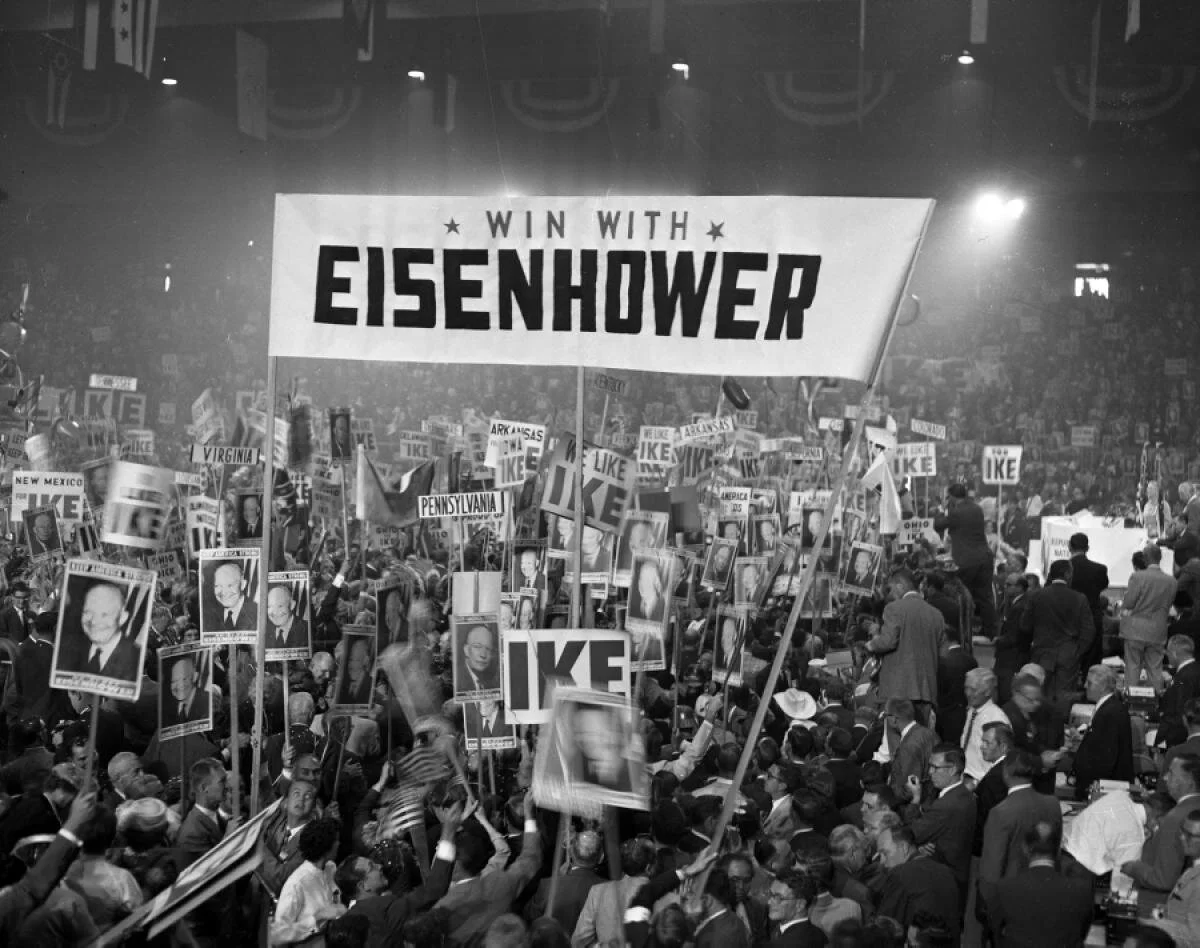
Adlai Stevenosn: 'Who shall say that the American dream is ended?' Presidential campaign speech - 1952
October 1952, Chicago, Illinois, USA
(Approximately a week before election he would lose to Dwight Eisenhower)
I have tried to educate, if I have not succeeded altogether, I have certainly educated myself about these questions and about these wonderful human beings that are Americans.
Just remember who you are, you are Americans. Your forebearers’ found a wilderness and they began to convert it into a fair land with only three weapons: with a Bible, an axe, and the plow.
Nothing stayed them, neither the perils of death, nor wounds nor savage mountains, nor wide rivers, nor the unknown in which they plunged.
They were of every racial stock and every religious belief and they brought something of the old country to the new country.
And different thought they were, they became one.
This is our heritage and this is our true glory. We are a people, I tell you, that is just beginning this high adventure on this continent. It is an adventure in which young, though we are, we have done this: our people have had more happiness and prosperity over a wider area and a longer time than men have ever had since they began to live in ordered society’s four thousand years ago.
Since we have come so far, who shall be rash enough to set limits on our future progress, who shall say that since we have gone so far, we can go no farther? Who shall say that the American dream has ended? For myself, I believe that all we have done on this continent so far is but a prelude to a future in which we will become, not only a bigger people, but also a wiser people, a better people, an even greater people.
I believe that we not only achieve a higher standard of living, but also a higher standard of life.
Never forget this, there is little that we Americans cannot do if only we can imagine ourselves wanting to do it.
Power alone is not enough, either is faith alone equal to the task.
The future is to those who take it.
We shall strike off the shackles that still bind the United States.
It is the duty of the leaders to lead, the creative to create, of the daring to do.
The free world expects leadership from us, its fate and our fate depends upon our leadership.
The life or death issue of war or peace hangs upon it.
We are 155 million strong. We are industrious, inventive, restless with the fires that burn within us. We are a free-striding people with a confident free-swinging stride that marks the American everywhere he goes upon this earth. We are conquerors of time and of distance, we have explored the awful jungles of matter and emerged with the powers of the exploding sun.
Our cause is just, our heart is high, and let us then, I say, press forward, toward the new world that we can create in the name of America and of suffering humanity still in chains.
Now you say words, beautiful words, but how do we do all of this, with a staggering budget of heavy taxes, surrounded by the communist menace, an enfeebled Europe, Asia in ferment, our boys in war, training for war?
Well, I say nothing is easy, and the best things are the hardest. But consider what it was done at valley ford, what was done in the dark days of dissension and disaster, in the civil war, in the two world wars, when the very survival of western civilization trembled; and in the depression; there is nothing new only different, and all our troubles, all our immense difficulties, now and in the future, can I say, be solved if we have the will, the courage, the boldness to face them squarely.
To use Seneca’s’ phrase, “Man is more than a rational animal.” And invoking the guidance of providence, rational men, animated by the destiny of greatness can think and can act and can do greatly. Thank you.
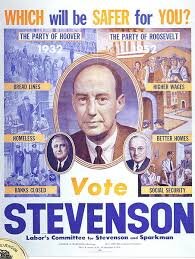
Thomas E. Dewey: 'We stand today on one of the strange promontories of human history', Election Eve Campaign Speech - 1944
6 November 1944, Albany, New York, USA (re-recorded)
WE stand today on one of the strange promontories of human history, with the shadows of a dismal stormy night behind us, and the first grey streaks of dawn in the sky beyond us. For thirty years since 1914, nearly half the span of human of life, we have seen a series of wars, revolutions, depressions, communism, fascism, Nazism, cruelty and suffering, and finally another conflagration that has engulfed the world.
At home, we have had twelve unhappy years of turmoil and dissension, of group conflict and class strife. Of divisions, and hatreds and antagonisms. Half a generation has grown up knowing no other atmosphere. I believe our children, our whole country, can again live in a world where peace, friendship and mutual respect, abide.

Franklin Roosevelt: 'I see on third of a nation ill housed, ill-clad, ill-nourished', Second Inaugural Address - 1937
20 January 1937, Washington DC, USA
My fellow countrymen. When four years ago we met to inaugurate a President, the Republic, single-minded in anxiety, stood in spirit here. We dedicated ourselves to the fulfillment of a vision—to speed the time when there would be for all the people that security and peace essential to the pursuit of happiness. We of the Republic pledged ourselves to drive from the temple of our ancient faith those who had profaned it; to end by action, tireless and unafraid, the stagnation and despair of that day. We did those first things first.
Our covenant with ourselves did not stop there. Instinctively we recognized a deeper need—the need to find through government the instrument of our united purpose to solve for the individual the ever-rising problems of a complex civilization. Repeated attempts at their solution without the aid of government had left us baffled and bewildered. For, without that aid, we had been unable to create those moral controls over the services of science which are necessary to make science a useful servant instead of a ruthless master of mankind. To do this we knew that we must find practical controls over blind economic forces and blindly selfish men.
We of the Republic sensed the truth that democratic government has innate capacity to protect its people against disasters once considered inevitable, to solve problems once considered unsolvable. We would not admit that we could not find a way to master economic epidemics just as, after centuries of fatalistic suffering, we had found a way to master epidemics of disease. We refused to leave the problems of our common welfare to be solved by the winds of chance and the hurricanes of disaster.
In this we Americans were discovering no wholly new truth; we were writing a new chapter in our book of self-government.
This year marks the one hundred and fiftieth anniversary of the Constitutional Convention which made us a nation. At that Convention our forefathers found the way out of the chaos which followed the Revolutionary War; they created a strong government with powers of united action sufficient then and now to solve problems utterly beyond individual or local solution. A century and a half ago they established the Federal Government in order to promote the general welfare and secure the blessings of liberty to the American people.
Today we invoke those same powers of government to achieve the same objectives.
Four years of new experience have not belied our historic instinct. They hold out the clear hope that government within communities, government within the separate States, and government of the United States can do the things the times require, without yielding its democracy. Our tasks in the last four years did not force democracy to take a holiday.
Nearly all of us recognize that as intricacies of human relationships increase, so power to govern them also must increase—power to stop evil; power to do good. The essential democracy of our nation and the safety of our people depend not upon the absence of power, but upon lodging it with those whom the people can change or continue at stated intervals through an honest and free system of elections. The Constitution of 1787 did not make our democracy impotent.
In fact, in these last four years, we have made the exercise of all power more democratic; for we have begun to bring private autocratic powers into their proper subordination to the public’s government. The legend that they were invincible—above and beyond the processes of a democracy—has been shattered. They have been challenged and beaten.
Our progress out of the depression is obvious. But that is not all that you and I mean by the new order of things. Our pledge was not merely to do a patchwork job with secondhand materials. By using the new materials of social justice we have undertaken to erect on the old foundations a more enduring structure for the better use of future generations.
In that purpose we have been helped by achievements of mind and spirit. Old truths have been relearned; untruths have been unlearned. We have always known that heedless self-interest was bad morals; we know now that it is bad economics. Out of the collapse of a prosperity whose builders boasted their practicality has come the conviction that in the long run economic morality pays. We are beginning to wipe out the line that divides the practical from the ideal; and in so doing we are fashioning an instrument of unimagined power for the establishment of a morally better world.
This new understanding undermines the old admiration of worldly success as such. We are beginning to abandon our tolerance of the abuse of power by those who betray for profit the elementary decencies of life.
In this process evil things formerly accepted will not be so easily condoned. Hard-headedness will not so easily excuse hardheartedness. We are moving toward an era of good feeling. But we realize that there can be no era of good feeling save among men of good will.
For these reasons I am justified in believing that the greatest change we have witnessed has been the change in the moral climate of America.
Among men of good will, science and democracy together offer an ever-richer life and ever-larger satisfaction to the individual. With this change in our moral climate and our rediscovered ability to improve our economic order, we have set our feet upon the road of enduring progress.
Shall we pause now and turn our back upon the road that lies ahead? Shall we call this the promised land? Or, shall we continue on our way? For “each age is a dream that is dying, or one that is coming to birth.”
Many voices are heard as we face a great decision. Comfort says, “Tarry a while.” Opportunism says, “This is a good spot.” Timidity asks, “How difficult is the road ahead?”
True, we have come far from the days of stagnation and despair. Vitality has been preserved. Courage and confidence have been restored. Mental and moral horizons have been extended.
But our present gains were won under the pressure of more than ordinary circumstances. Advance became imperative under the goad of fear and suffering. The times were on the side of progress.
To hold to progress today, however, is more difficult. Dulled conscience, irresponsibility, and ruthless self-interest already reappear. Such symptoms of prosperity may become portents of disaster! Prosperity already tests the persistence of our progressive purpose.
Let us ask again: Have we reached the goal of our vision of that fourth day of March 1933? Have we found our happy valley?
I see a great nation, upon a great continent, blessed with a great wealth of natural resources. Its hundred and thirty million people are at peace among themselves; they are making their country a good neighbor among the nations. I see a United States which can demonstrate that, under democratic methods of government, national wealth can be translated into a spreading volume of human comforts hitherto unknown, and the lowest standard of living can be raised far above the level of mere subsistence.
But here is the challenge to our democracy: In this nation I see tens of millions of its citizens—a substantial part of its whole population—who at this very moment are denied the greater part of what the very lowest standards of today call the necessities of life.
I see millions of families trying to live on incomes so meager that the pall of family disaster hangs over them day by day.
I see millions whose daily lives in city and on farm continue under conditions labeled indecent by a so-called polite society half a century ago.
I see millions denied education, recreation, and the opportunity to better their lot and the lot of their children.
I see millions lacking the means to buy the products of farm and factory and by their poverty denying work and productiveness to many other millions.
I see one-third of a nation ill-housed, ill-clad, ill-nourished.
But it is not in despair that I paint you that picture. I paint it for you in hope—because the nation, seeing and understanding the injustice in it, proposes to paint it out. We are determined to make every American citizen the subject of his country’s interest and concern; and we will never regard any faithful law-abiding group within our borders as superfluous. The test of our progress is not whether we add more to the abundance of those who have much; it is whether we provide enough for those who have too little.
If I know aught of the spirit and purpose of our Nation, we will not listen to comfort, opportunism, and timidity. We will carry on.
Overwhelmingly, we of the Republic are men and women of good will; men and women who have more than warm hearts of dedication; men and women who have cool heads and willing hands of practical purpose as well. They will insist that every agency of popular government use effective instruments to carry out their will.
Government is competent when all who compose it work as trustees for the whole people. It can make constant progress when it keeps abreast of all the facts. It can obtain justified support and legitimate criticism when the people receive true information of all that government does.
If I know aught of the will of our people, they will demand that these conditions of effective government shall be created and maintained. They will demand a nation uncorrupted by cancers of injustice and, therefore, strong among the nations in its example of the will to peace.
Today we reconsecrate our country to long-cherished ideals in a suddenly changed civilization. In every land there are always at work forces that drive men apart and forces that draw men together. In our personal ambitions we are individualists. But in our seeking for economic and political progress as a nation, we all go up, or else we all go down, as one people.
To maintain a democracy of effort requires a vast amount of patience in dealing with differing methods, a vast amount of humility. But out of the confusion of many voices rises an understanding of dominant public need. Then political leadership can voice common ideals, and aid in their realization.
In taking again the oath of office as President of the United States, I assume the solemn obligation of leading the American people forward along the road over which they have chosen to advance.
While this duty rests upon me I shall do my utmost to speak their purpose and to do their will, seeking Divine guidance to help us each and every one to give light to them that sit in darkness and to guide our feet into the way of peace.
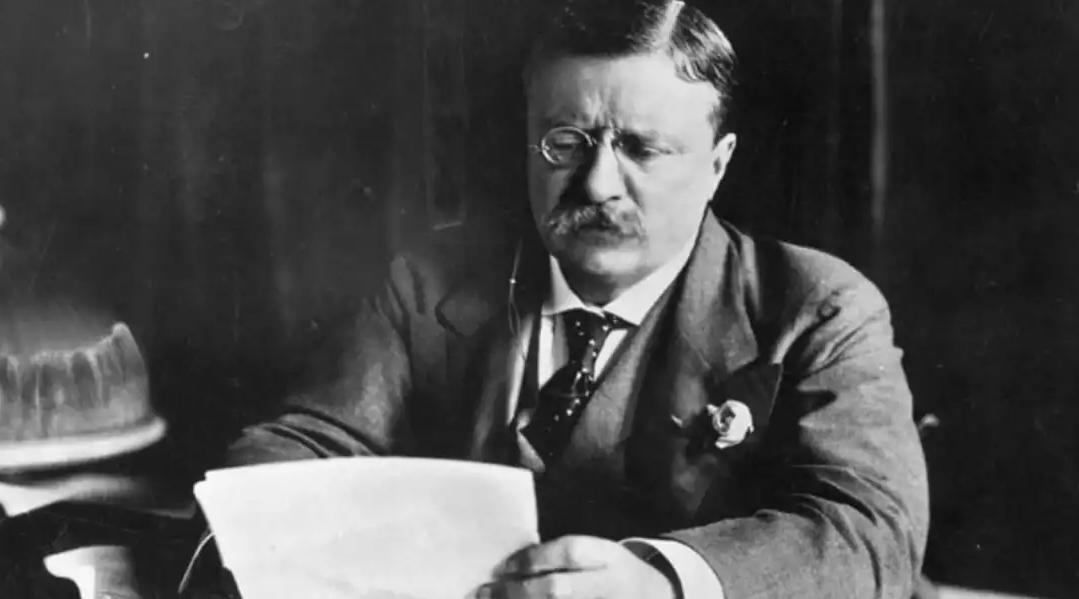
Theodore Roosevelt: 'Don't flinch, don't foul, and hit the line hard', Speech to The Boys' Progressive League - 1913
Roosevelt missed the event and offered this recording in absentia
3 July 1913, New York City, USA
In this way I desire to greet the Boy's Progressive League at their meeting in [at] the Hotel Manhattan. I feel that the Progressive Party should appeal peculiarly to the young men--and therefore to the boys--who ought [are] to be the next generation of voters. The principles for which we stand are the principles of fair play and a square deal for every man and every woman in the United States. A square deal politically, a square deal in matters social and industrial. I wish to see you boys join the Progressive Party, and act in that party and as good citizens in the same way I'd expect any one of you to act in a football game. In other words, don't flinch, don't foul, and hit the line hard.
Rodman Wanamaker with Indian chiefs in 1913
Woodrow Wilson: 'The great white father now calls you his brothers', Address to the American Indians - 1913
May or June 1913, Washington DC, USA
There are some dark figures in the history of the white man's dealing with the Indians, and many parts of the record are stained with the greed and avarice of those who have thought only of their own profit. But it is also true that the purposes and motives of this great government and of our nation as a whole towards the red men have been wise, just, and beneficent. The remarkable progress of our Indian brothers towards civilization is proof of it and open for all to see.
During the past half-century you have seen the schoolhouse take the place of the military post on your reservations; the administration of Indian affairs has been transferred from the military to the civil arm of the government. The education and industrial training the government has given you has enabled thousands of Indian men and women to take their places in civilization alongside their white neighbors. Thousands are living in substantial farmhouses on their own separate allotments of land. Hundreds of other have won places of prominence in the Professions, and some have worked their way into the halls of congress and into places of responsibility in our state and national governments. Thirty-thousand Indian children are enrolled in government, state, and mission schools. The great white father now calls you his brothers, not his children. Because you have shown in your education and in your settled ways of life staunch, manly, worthy qualities of sound character, the nation is about to give you distinguished recognition through the erection of a monument in honor of the Indian people, in the harbor of New York.
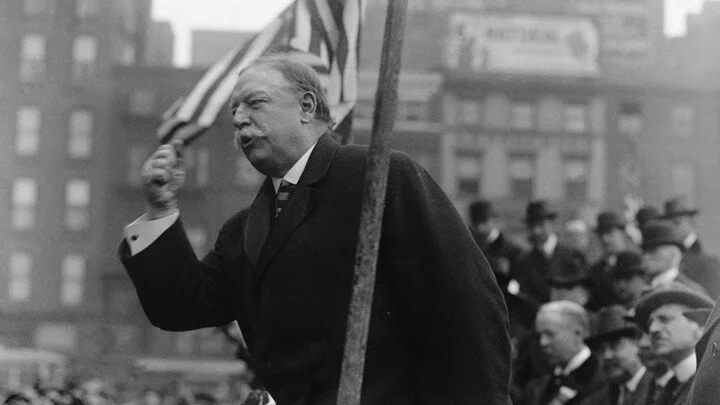
William Howard Taft: 'The welfare of the farmer is vital to that of the whole country', Midwestern campaign tour - 1908
October 1908, Kansas City, Missouri, USA (rerecorded after event)
As the Republican platform says, the welfare of the farmer is vital to that of the whole country. The prosperity of the country rest peculiarly upon the prosperity of agriculture. Just now, one of the strongest hopes of returning good times is based on the business which the farmers’ crops are to afford. The Republican party during the last twelve years has accomplished extraordinary work in bringing the resources of the national government to the aid of the farmer. He is vitally interested in the restraining of excessive and unduly discriminating railroad rates, in the enforcement of the Pure Food Law, in the promotion of scientific agriculture, and in increasing the comforts of country life as by the extension of free rural delivery and the building of good roads. The free delivery in the postal service now reaches millions of our citizens and will be extended until every community in the land receives its full benefits. Everyone recognizes the essential and economic advantages of good country roads maintained more and more largely at public expense and less and less at the expense of the abutting owner. The policies of the present administration have most industriously promoted all these objects and cannot fail to commend themselves to the farmers’ approval. It is difficult to see how with his intelligent appreciation of the threats to business prosperity involved in democratic success at the polls he can do otherwise than give his full and hearty support to the continuation of the policies of the present administration under Republican auspices.
John McDonnell: 'A short-lived government that will go down in history for its unique combination of extremism and bumbling incompetence', Reponse to Spending Review - 2019
4 September 2019, Westminster, London, United Kingdom
Mr Speaker. Briefly let me start by welcoming another Chancellor to his new job. I believe the new Chancellor may be the first person to hold that role whose father, like my own, was a bus driver. So I would like to welcome him to his new job, but I hope that what they say is true: you wait ages for one son of a bus driver to become Chancellor of the Exchequer, only for another to come along pretty soon after.
Mr Speaker, I’m afraid that’s probably the end of what the Chancellor and I have in common. Let me thank the Chancellor for abiding by the convention of providing me with a copy of his statement.
Could I ask him, though, to take a message back to the person who obviously drafted the statement? His political master, Mr Dominic Cummings. The man who cancels the Chancellor’s own speeches, sacks his staff without telling him and has them escorted off the premises by an armed police officer.
Could he tell Mr Cummings: Do not insult the intelligence of the British people. The people will see today’s statement as the grubby electioneering stunt that it is. This is not a Spending Review as we know it. It is straight out of the Lynton Crosby handbook: Opinion Poll Politics.
The Tories have checked what are the top three or four issues in the polls and cynically judged just how little money they have to throw around to try and neutralise the concerns people have about those issues.
To come here and then try to fool us with references to people’s priorities is beyond irony. When did these extremist right-wing Tories ever put the people first? Were they putting the people first when they froze child benefit, year after year? And introduced the brutal universal credit regime?
The result this summer – according to the Childhood Trust – was children scavenging in bins for food because they didn’t have free school meals in the summer holidays.
Were they putting people first when they cut council budgets and prevented over one million elderly and disabled people getting the social care they needed?
Were they putting the people first when they cut social service budgets so much we have record numbers of children coming into care and 155 women a day turned away from refuges?
We are expected to believe that these Tories, who for years have voted for harsh, brutal austerity, have had some Damascene conversion. They treat our people with such contempt. Announcements have been dripped out over the last week or so. All designed to give the impression of a spending spree.
Announcements dictated by No10 and meekly accepted by a Chancellor too weak to conduct a full multi-year Spending Review – even before the Government’s majority disappeared yesterday. We have seen the so-called headroom which the Chancellor’s predecessor had claimed was needed to prepare for No Deal Brexit, spent instead on preparing for a General Election.
We all know the Chancellor may not be in his job very long. Maybe that’s why he felt the need to rush out a Spending Round based on figures from March rather than waiting for the Office for Budget Responsibility to tell him officially what the rest of us have known for some time; that the economy – after nine years of Tory austerity – is in bad shape and getting worse.
A full fiscal event would have meant new economic forecasts, the need for a fiscal framework to give departments security over the Parliament, allowing them to plan ahead after years of cuts.
Instead we get this sham of a Spending Review. They are claiming to be against austerity – after years of voting for it. They are claiming to be using “headroom” which he knows has largely disappeared. And yet they are still failing to deliver a real end to austerity.
Let’s take a look at some of the announcements that the Chancellor has confirmed.
For schools, the Chancellor has announced new spending of £1.8 billion next year. The Institute for Fiscal Studies has previously estimated that it would cost £3.8 billion this year alone to reverse the cuts that have been made. Was the Chancellor aware, when drawing up his Spending Round, that the Department for Education budget as a whole has been slashed by almost £10 billion in real terms since 2010? The reality is that heads will still be sending out begging letters and teachers will still buying basic materials for their classes.
£700 million was announced for children with special needs and disabilities. But does the Chancellor not know that the Local Government Association has found that councils already face a funding shortfall for SEN children of £1.2 billion by 2021? The reality is that children will still be left vulnerable and in need.
Further Education colleges are to get a one-off £400 million. Does the Chancellor think they should be grateful for that, after £3.3 billion of cuts since 2010? And the reality is that the economy will still be desperately in need of sufficient skills training.
The government’s announcement of £1.8bn spending for the NHS has already been exposed as largely a re-announcement.
Any announcement on GP waiting times is likely to turn out to be totally undeliverable following the loss of almost 600 full-time-equivalent GPs over the last year.
Any new money for local government today will be a drop in the ocean compared to the 60% of their funding which councils have lost in recent years.
What effect does the Chancellor estimate his announcement today will have on the crisis in children’s services after a 29% drop in government funding over eight years and vulnerable children left at risk?
He mentioned just now £54m of additional spending for tackling homelessness, but the Local Government Association has said that there is a funding gap of £100m this year.
The £200m he mentions for bus services is less than a third of the £645m that has been cut from bus services since 2010.
The government has claimed they are planning to recruit 20,000 more police officers but can the Chancellor tell us yet how many will actually be on the frontline? The last assessment was there would be only an additional 13,000 on the streets.
The Government has spoken of money to create another 10,000 prison places. Can the Chancellor tell us if they are the same 10,000 prison places? Promised by previous Justice Secretaries in 2016? And again in 2017? And 2018?
How many suicides, how many assaults on staff have taken place because of cuts to prison staff? And will government ever apologise to the Prison Officers Association for ignoring their warnings of the effects of staff cuts on safety in prisons?
And those are just the areas we have heard about today. What about those forgotten in the Chancellor’s opportunist one-year spending round? What about the real structural reforms to address the social care crisis which we have been waiting for years now?
A sticking plaster of a one-off billion pounds will leave the sector in the sorry state where it is now. With 1.4 million not getting the care they need and 87 people dying each day while waiting for care.
I understand that the Chancellor’s mates the bankers were pushing the other day for more tax cuts and less regulation. I hope he sent them packing.
Does the Chancellor have any words for the thousands suffering from the brutal rollout of Universal Credit?
Traditionally the Spending Review concentrates on Department Expenditure Limits rather than social security, but there is no reason why the Chancellor couldn’t have signalled the government’s intent – at least – to end the misery and hardship their policy is causing. Most shockingly of all, the Chancellor has given no sign that he understands the scale of climate emergency facing us and the urgency with which a significant Government response is needed. He mentions the issue but allocates minuscule amounts of funding incapable of addressing this existential threat.
I hope that members will remember those who got no comfort from today’s announcements in a few weeks If the government pushes ahead with their plans for tax cuts that mainly benefit the wealthy. I hope members will remember all those were deemed unimportant by the Chancellor.
Because come any election campaign, you can be sure the Labour Party will – and the voters will – remember the nine years of austerity and today’s failure act. Just as we remember being told there was no alternative. There was no money.
We all know the lines. We’ve heard them enough times now. They weren’t true then, and they aren’t true now. The majority of economists have always agreed that there was another approach the Government could have taken. And we have always argued that austerity was a political choice. Not an economic necessity.
As recently as March, the Party opposite ploughed on saying there was no alternative. To look at them now suddenly proclaiming an end to austerity. After 120,000 excess deaths, after 100 billion taken out of the economy, after the worst decade for wage growth since the mid-19th century. Just because there may be an election around the corner.
And after all that, to deliver a pathetic sum to spending departments which are on their knees is just adding insult to injury. A Government not just callous and uncaring but hypocritical as well. This isn’t a Government, it’s a racket.
Pretending to end austerity when they do nothing of the sort. Pretending to plan ahead while they plot a No Deal Brexit that would devastate parts of our economy. A Chancellor and a Prime Minister with – as my Right Honourable Friend said yesterday – no mandate, no morals and no majority.
Trying to distract us from the crumbling public services and stagnating wages they have created after a decade in charge with fantasy promises of a Brexit deal they knew they couldn’t deliver and weren’t even trying to negotiate.
A short-lived government that will go down in history for its unique combination of extremism and bumbling incompetence. A government that betrays the very people it is meant to serve. A government that will never be forgiven but will soon be forgotten.
Miguel Díaz-Canel: 'Unity and Integration Must Be Our Obsessions', XXV Sau Paulo Forum - 2019
26 July 2019, XXV Sau Paulo Forum, Caracas, Venezuela
Compañero Nicolás Maduro Moros, brother President of the Bolivarian Republic of Venezuela;
Compañeras and compañeros of the Bolivarian Revolutions leadership;
Compañera Mónica Valente;
Latin American and Caribbean leaders, and those from other parts of the world joining us;
Compañeras and compañeros:
Allow me to devote my first words to Comandante Hugo Chávez Frías, Cuba´s great friend, son of the Americas who today turns 65 in eternity.
Our Comandante en Jefe Fidel Castro, who loved him dearly and was one of the first to recognize his qualities as a leader, referring to the appearance of an extraordinary politician like Chávez in our suffering region, placed him next to Bolívar and Martí in the battle for the destiny of the Greater Homeland. Fidel said:
For a long time now I have held [...] the deepest conviction that, when the crisis comes, leaders emerge. This is how Bolivar emerged when the occupation of Spain by Napoleon occurred and a foreign king was imposed, creating the conditions conducive to the independence of the Spanish colonies in this hemisphere. This is how Martí emerged, when the auspicious hour arrived for the outbreak of the independence revolution in Cuba. This is how Chavez emerged, when the terrible social and human situation in Venezuela and Latin America determined that the time to fight for our second and true independence had arrived.”
Bolívar, Martí, Fidel, Chávez, what do these men have in common, who, whenever we are called upon to think, we feel obliged to quote and draw from their respective legacies? Our America, Martí would answer, who named it this way to clearly distinguish ours from imperial America that despised us and who despises us more now, as evidenced by the huge wall projected on the southern border, the atrocious mistreatment of migrants, the Helms -Burton, the Nica Act, financial persecution and the arbitrary imposition of tariffs on countries in the region, the suspension of development aid, the blockade and the dirty war against Cuba and Venezuela, among other malicious acts that know no limits.
But even this evil is dwarfed when our America meets, that is, the diverse, plural, contributing world of Latin American and Caribbean progressive party leaders and social activists, who in the dark years of the 1990s created this unitary space for the left, alive and taking action.
Thus, Bolivar’s dream seems closer when he said, “I wish more than anyone else to see the world’s largest nation formed in Latin America, less for its size and wealth, than for its freedom and glory.”
The Liberator left us another fundamental idea, and I again quote him, “Unity can do it all, and therefore, we must preserve this precious principle.”
José Martí, who had the Liberator as an inspiration and guide, was the great architect and constructor of the unity that was missing in the Cuban struggle for independence. Although he died without seeing the victory, in his last, unfinished letter, he passionately defended the idea of “stopping in time, with the independence of Cuba, that the United States extends itself through the Antilles, and falls with greater force upon our lands of America.”
Fidel and Chávez drew from both Bolivar and Martí the ideas of our revolutions: Unity and integration were their great obsessions and must also be ours.
I know that these are also the obsessions of the Sao Paulo Forum, born of the need for unity and articulation of political parties and popular movements of the left in our region, to confront imperialism and the neoliberal right, very agile in coordinating action to destroy everything we might create in favor of real democracy and social justice, via anti-democratic methods, coups, criminalization of progressive leaders, fraud, and manipulation of the facts.
The Consensus of Our America, and all the documents that have emerged from the Sao Paulo Forum are evidence of these concerns. The evaluation of scenarios, criticism and self-criticism, key to progress, have impacted the greater dynamism of the Forum over the last few years, in the face of the expanding neoliberal offensive and major imperial attacks.
Compañeras and compañeros:
July includes singular historical coincidences that we share. Simón Bolívar, Liberator of America, was born this month; Venezuela’s declaration of independence was signed this month; this is the month in which the generation of José Martí’s centenary, led by Fidel Castro, assaulted garrisons in Santiago de Cuba and Bayamo to re-initiate the Cuba Revolution. It is the month in which the Sandanista Revolution triumphed, with its 40th anniversary just celebrated. And it is the month in which, on a day like today, Hugo Chávez was born.
The São Paulo Forum summons us during an extremely challenging July and here we are, to accompany the heroic Venezuelan resistance and demand an end to the brutal siege that has been imposed on the country. Venezuela is today the anti-imperialist struggle’s primary trench. The Forum summons us to condemn the blockade of Cuba and demand that it be lifted.
The Forum calls us to support the rebellion the Puerto Rican people, which has not been buried after more than 100 years of Yankee colonialism. It also unites us to reject the empire’s scandalous actions against the families of migrants and particularly boys and girls, mistreated, abused, practically caged, thus denying human beings their dignity and most elemental rights.
With these new provocations added to the accumulated indignation, the Sao Paulo Forum is called upon to play a greater leading role in the complex current political scenario. Even more so considering the attacks on progressive processes in countries where the left had conquered positions of power, through which changes and notable social advances were pushed forward.
The counter-offensive of Yankee imperialism and the oligarchy, with hawks having literally taken possession of U.S. foreign policy toward Latin America and the Caribbean, is dangerously impacting the geographical area declared by CELAC as a Zone of Peace.
The peoples are ashamed of the sell-out politicians, of those the empire uses at its convenience, and later casts aside with disdain.
Also impacting this context are the setbacks suffered by progressive forces in some countries, and what s worse, the division that persists among them, fragmenting, weakening the stated will to act together. Lacking strategic political programs, and distanced from social movements, there are left formulas that have removed themselves as alternatives.
The experience of the Cuban Revolution is based on the early recognition of the strategic role of unity around the fundamental objectives of social justice, in tight alliance with the people, their needs and problems, to which its victorious resistance is due.
We believe that it is our responsibility to give and take experiences, without risking a repeat of carbon copy errors that have been so costly in previous historical periods.
Precisely to save hopes and dreams, following the collapse of the European socialist experience, this forum of articulation for progressive forces was created by Fidel and Lula, to base its action on what unites us, and not what separates us.
The two leaders left us a valuable instrument for joint action and unity within diversity. Fidel is not physically present, but his extraordinary work has survived him and we can draw upon it limitlessly.
Lula, imprisoned on the basis of false charges and scandalous judicial trickery, is the example of how far the enemies of the left will go—the greatest expression of the fear imperialism and oligarchies have of the left in power. They’ll do anything to prevent the return of Lula to the Presidency of a country that only with the PT was able to redistribute the nation´s enormous wealth to the degree possible.
Today Lula´s freedom is also one of the great challenges of the left in the region. The mobilizations cannot cease. One of our founders remains unjustly imprisoned and we must put an end to this abuse.
The Forum is the precious legacy of our leaders and a viable mechanism to resist the attacks of those who would like to implode our very valuable alliance.
Let us not forget for a moment that we are in besieged Caracas, in the Bolivarian Republic of Venezuela, attacked and besieged a thousand times.
We walked the streets of Caracas yesterday, in defense of the heroic Bolivarian Revolution, leaders, and social activists from the five continents alongside the legitimate representatives of the Venezuelan people. That march was not recorded or disseminated by the many cameras of corporate television broadcasters that have led the planet to believe that the Venezuelan state has no power or followers in this land.
Let us reaffirm before the world our support and solidarity with legitimate President Nicolás Maduro Moros and the military civic union that has defeated the worst plans of the enemy so many times.
We must remember that ensuring peace in Venezuela is equivalent to defending peace for the entire region.
To support and defend Venezuela is to decisively confront the return of the Monroe Doctrine and the imperialist escalation against our peoples. Today it is wielded against Venezuela, Cuba, and Nicaragua; tomorrow will be against others, and in the end they will go for everyone.
The United States threatens and slanders Cuba and Venezuela, not recognizing their failure in attempting to overthrow the Bolivarian Revolution and misrepresenting the altruistic cooperation that our country offers here and in more than 80 nations. There is no better platform than this Forum to reaffirm that Cuba will never renounce or betray its principles or Venezuela.
I reiterate here what I said this last July 26 in Bayamo, just a few days ago:
“The siege is being increasingly tightened around our country, around Venezuela, around Nicaragua, and any other nation that refuses to accept the imperial plan for its destiny.
“…the U.S. administration for beginning to act more aggressively to prevent the delivery of fuel to Cuba…
“They want to cut off the lights, the water, and even the air to extract political concessions from us. They don’t even attempt to hide it. They publicly announce funding for subversion in Cuba, invent false, hypocritical pretexts to add us to their spurious lists and justify the tightening of the blockade.
“In utter cynicism, they resort to blackmail.
“Ignorant of history and the Cuban Revolution’s foreign policy principles, they propose to negotiate a possible reconciliation with us, in exchange for abandoning the course chosen and defended by our people. They suggest betraying friends, throwing 60 years of dignity into the trash bin.
“No, imperialist gentlemen, we do not understand each other.”
Political parties and popular movements:
Less than a week ago, representatives of a small group of countries in this region insulted the Sao Paulo Forum, to them we say that the Forum is here, and will be, and has much to do because it is again “the Hour of the Furnaces in which nothing more than the light must be seen.” That light is unity, the great legacy left by our heroes, from Bolívar to Martí, Fidel and Chávez.
The reaction of that spineless right to the Sao Paulo Forum meeting is insulting and very cynical; they have invented all kinds of legends and insults. They, the kings of conspiracy, accuse Forum participants of what they practice every day against our peoples. It must pain them very much that these leaders of the left around the entire world—defamed, persecuted, gagged, with so many companions murdered and disappeared—dare to challenge the imperial mandate to stay quiet and be afraid.
There are no mysteries or conspiracies, no plans of aggression or intervention, nor have there ever been in the almost 30 years of the Sao Paulo Forum. Imperialism is the expert in that, as are national oligarchies, so fearful of their people, they invent false charges to imprison popular leaders through spurious legal processes.
No one hides coming to this event to promote peace, sovereignty and prosperity for our peoples, because there is no nobler work that demands more sacrifice than the battle for the ideals that have always moved the left of the world.
As those attending the Forum have documented and discussed, it is necessary to articulate resistance to neoliberalism and imperialism in our respective communication strategies: create and nurture networks of truth against the offensive of lies.
New generations interact in a natural and dynamic way in these arenas, which our adversaries today control and use to advance their perverse intentions.
On the 65th birthday of Chávez, that extraordinary communicator who emerged from the heart of Bolivar’s homeland to bring us back the words and dreams of the Liberator, there can be no better tribute to his living memory than a progressive movement of the left, democratic and diverse as the parties and social groups that compose it, unleashing the unlimited creativity of the people to write their own recounting of history, and make history itself in the common struggle for justice.
Happy birthday, Comandante!
The peoples of Latin America and the world have come to celebrate your birth where your remains rest. Your powerful revolutionary ideal is more alive than ever in your beloved homeland and in every corner of the world reached by your passionate words.
“For Peace, Sovereignty, and Prosperity of the peoples ... Unity, Struggle, Battle and Victory,” are the slogans of this event, the 25th since the Forum was founded. The challenge is to finally make a reality of this beautiful alliance of forces.
Every time we advance a stretch, no matter small it may seem, in the conquest of our development projects in Cuba, we say: We’re going for more!
The same feeling encourages us to value the potential of this magnificent force that we are, acting united and articulated. Let us always march for more!
Always onward to victory!
Joe Biden: 'We are in a battle for the soul of this nation', Idaho campaign speech - 2019
7 August 2019, Burlington, Iowa, USA
The words of a President matter.
They can move markets. They can send our brave men and women to war. They can bring peace. They can calm a nation in turmoil. They can console and comfort in times of tragedy. They can inspire us to reach the moon. They can appeal to the better angels of our nature.
And they can unleash the deepest, darkest forces in this nation. That is what Donald Trump has chosen to do.
When he said after Charlottesville that there were, quote, “very fine people on both sides,” he gave license and safe harbor for hate to white supremacists, Neo-Nazis and the KKK.
Those words stunned the nation and shocked the world.
In doing so, he assigned a moral equivalence between those spewing hate and those with the courage to stand against it. I said at the time we were in a battle for the soul of this nation. I said it again when I announced. And I say it here today.
We are in a battle for the soul of this nation. It’s why I’m running for President.
Charlottesville was no isolated incident. Trump announced he was running for president by calling Mexicans “rapists.”
Days before the mid-terms, he fomented fears of a caravan heading to the United States – creating hysteria – saying “look at what is marching up, that is an invasion – an invasion”.
He asserted that immigrants would “carve you up with a knife.”
More recently, he called a major American urban center a “disgusting rat and rodent infested mess” that “no human being” would choose to live in—as though the vibrant, diverse community
around Baltimore were somehow less than human.
At a rally in Florida, when he asked a crowd, “How do we stop these people?” – meaning immigrants – someone yelled back, “shoot them.” He smiled.
In North Carolina, he basked in the chants of “Send Her Back” echoing across a stadium.
How far is it from Trump’s saying this “is an invasion” to the shooter in El Paso declaring “this attack is a response to the Hispanic invasion of Texas”?
Not far at all.
How far is it – from the white supremacists and Neo-Nazis in Charlottesville – Trump’s “very fine people” – chanting “you will not replace us” to the shooter at the Tree of Life synagogue in Pittsburgh saying Jews “were committing genocide to his people.”
Not far at all.
In both clear language and in code, this president has fanned the flames of white supremacy in this nation. His low-energy, vacant-eyed mouthing of the words written for him condemning white supremacists this week fooled no one.
The energetic embrace of this president by the darkest hearts, the most hate-filled minds in this country says it all.
White nationalist Richard Spencer celebrated Trump’s election by declaring “Hail Trump” at an alt-right conference that saw Nazi salutes.
In Charlottesville, David Duke – the former leader of the KKK – said “that’s why we voted for Donald Trump because he said he’s going to take our country back.”
After Trump tweeted his “Go Back” screed – a leading Neo-Nazi website lit up, saying: “This is the kind of White Nationalism we elected him for.”
And on 8chan – a haven for radicalism on the internet, where a declaration of hate inked to the El Paso shooter was posted, one commentator wrote that Trump is helping to normalize their most extreme racial sentiments because his “perceived authority” carries so much weight.
We have a problem with a rising tide of white supremacy in America. And we have a president
who encourages and emboldens it.
The statistics are clear. Extremism is on the rise in America.
The Southern Poverty Law Center finds that 1,020 hate groups were operating in the United States in 2018, with white nationalist groups surging by 50%.
Since 2017, active-shooters with ties to white extremism have claimed 135 victims, killing 70.
According to the Anti-Defamation League, all but one of the 50 extremist-linked murders
counted in 2018 had direct links to white supremacists.
The FBI Director recently testified to Congress that extreme right-wing groups – white nationalists – pose the greatest threat of racially-motivated domestic terrorism.
And what has Trump done? Poured fuel on the fire.
He’s re-tweeted postings from extremists and white nationalists.
He’s cut funding – and in some cases completely eliminated – initiatives we put in place in the Obama-Biden administration to counter violent extremism at home.
Trump readily – eagerly – attacks “radical Islamic terrorism.” But he can barely bring himself to say the words “white supremacy.”
And even when he says it – he doesn’t appear to believe it. He seems more concerned about losing their votes than beating back their hateful ideology.
He says guns are not the problem in these mass shootings – the issue is mental health. It’s a dodge. Hatred isn’t a mental health issue.
And I can tell you, as the guy who, along with Dianne Feinstein, got assault weapons and high capacity magazines banned in this country for ten years – that if I’m elected president – we will make sure assault weapons and high capacity magazines are banned again.
And when we do it, we’ll put in place a buy-back program to get as many of these weapons of war as possible off the street.
We need a federal domestic terrorism law. We can do it without infringing on people’s free speech and without trampling civil liberties.
Quite simply, we have to make the same commitment as a nation – to root out domestic terrorism as we have – to stopping international terrorism.
I wish I could say this hate began with Donald Trump – and will end with him. It didn’t, and it won’t. American history is not a fairytale.
The battle for the soul of this nation has been a constant push-and-pull for 243 years between the American ideal that we are all created equal – and the harsh reality that racism has long torn us apart.
The same document that promised to “secure the Blessings of Liberty to ourselves and our Posterity” also allowed for slavery and included the so-called “3/5ths Compromise” that discounted the very humanity of black people in America.
The honest truth is both elements are part of the American character. At our best, the American ideal wins out. But it’s never a rout. It’s always a fight. And the battle is never finished.
Go back to the beginning. Thomas Jefferson wrote what many believe is the most important document in human history. But he was also a slaveholder.
We’ve never lived up to our American ideals. Jefferson himself didn’t. But what he wrote has pulled us towards justice for more than two centuries.
It still does – it remains this nation’s North Star.
Or take a look at the Klan. After the Civil War, we saw the rise of the Klan – it was beaten down only to rise again in the 1920s. In fact, in August of 1925, 30,000 Klansman in full regalia marched on the streets of Washington.
Imagine that today. And then the Klan was beaten again. How? Courts, press, and, yes, presidents stood against them – and that is the point.
Our institutions – often imperfectly – stood against this hate. At moments when we have been tested most, American presidents have stepped up.
President George HW Bush renouncing his NRA membership. President Clinton after Oklahoma City. President George W Bush going to a Mosque shortly after 9/11. President Obama after Charleston.
Presidents who led, who opposed hate, chose to fight for what is best of the American character.
Sadly, we don’t have that today. Our president has aligned himself with the darkest forces in this nation. And that makes winning this battle – for the soul of our nation – that much harder.
Trump doesn’t understand what Franklin Roosevelt did. FDR said, the presidency is
“preeminently a place of moral leadership.” He doesn’t see what JFK did: “only the president represents the national interest.”
He’s blind to what LBJ said of the office: “Nothing makes a man come to grips more directly with his conscience than the presidency.”
Trump offers no moral leadership, no interest in unifying the nation. No evidence that presidency has awakened his conscience in the least.
Instead we have a president with a toxic tongue who has publicly and unapologetically
embraced a political strategy of hate – racism – and division.
So it’s up to us. We’re living through a rare moment in this nation’s history. Where our president isn’t up to the moment. Where our president lacks the moral authority to lead. Where our president has more in common with George Wallace than George Washington.
We are almost 330 million Americans who have to do what our president can’t. Stand together. Stand against hate. Stand up for what – at our best – this nation believes.
We believe in Honesty. Decency. Treating everyone with dignity and respect. Giving everyone a fair shot. Leaving no one behind.
Giving hate no safe harbor. Demonizing no one – not the poor, the powerless, the immigrant, the other. Leading by the power of our example – not the example of our power.
Standing as a beacon to the world. Being part of something bigger than ourselves.
It’s a code. A uniquely American code. It’s who we are.
But Trump doesn’t get it.
What this president doesn’t understand is that unlike every other nation on earth – you can’t define an American by religion or ethnicity or tribe.
America is an idea. It’s an idea stronger than any army. Bigger than any ocean, more powerful than any dictator or tyrant. It gives hope to the most desperate people on earth.
And it’s not only our values that are under assault. Our democracy is as well.
A free press, an independent judiciary, a legislature that is a co-equal branch of government – these are the guardrails of our democracy. They’re written into our Constitution. And each of them is under attack.
Phrases like “fake news,” “enemy of the people” are no joke. They’re insidious. They’re corrosive. Just look around the world. The worst despots are now using Trump’s language to justify their own abuses of power.
Trump is trying to weaken our institutions – the press, the courts, the Congress – precisely because they are a check on his power.
That is what this is all about. The abuse of power. And if there is one thing I can’t stand – it’s the abuse of power.
Whether it’s a boss taking advantage of his workers – or a man who raises his hand to a woman or a child – or a President who’s running roughshod over everything this country stands for and believes.
We’re being reminded every day there is nothing guaranteed about democracy. Not even here in America. We have to earn it. We have to protect it. We have to fight for it.
I do believe that America is – as Lincoln named us – the “last best hope of earth.” But we have to remember why.
It’s not because we have the biggest economy. It’s not because we have the strongest military.
It’s not because we have the most innovative entrepreneurs and the greatest research universities.
That is all true.
But it’s not why we are America. The reason is what we believe.
The most powerful idea in the history of the world beats in the hearts of the people of this country.
And it beats in all of us. No matter your race or ethnicity. No matter your gender identity or sexual orientation. No matter your faith. It beats in the heart of rich and poor alike. It unites Americans — whether your ancestors were Native to these shores or brought here forcibly and enslaved, whether they were immigrants generations back, like my family that came from Ireland, or if you are coming here today looking to build a better life for your family.
The American creed – that we are all created equal – was written long-ago. But its genius is that every generation of American has opened it wider and wider, to include those who have been excluded before.
That’s why it has never gathered dust in the history books. It is still alive today more than 200 years after its inception. But Donald Trump doesn’t see it.
On January 20th, 2017, in his inaugural address, Donald Trump painted a dark, bleak picture of our country in crisis, and he declared “this American carnage stops right here, and stops right now.”
But as president Trump’s anger, hate and divisiveness – pitting Americans against one another, preying on our divisions, and doing nothing – nothing – about the epidemic of guns is fueling a literal American Carnage. We now have more mass shootings than we’ve had days in this year. As of Monday, according to data from the Gun Violence Archive, there have been 255 mass shootings in 217 days.
We cannot let this go on. We cannot – and I will not – let this man be reelected President of the United States. His incompetence, his amorality, his carnage stops with us – right here, right now.
Limited to four years, I believe history will look back on this presidency as an aberrant moment in time.
But if Donald Trump is reelected, he will forever and fundamentally alter the character of this nation.
If we give Donald Trump four more years, this will not be the country envisioned by Washington, Adams, and Jefferson. If we give Donald Trump four more years, this will not be the nation bound together by Lincoln. If we give Donald Trump four more years this will not be the nation lifted up by Roosevelt or inspired by Kennedy. We will not be the nation Barack Obama proved bends towards justice.
The danger Donald Trump poses to this nation isn’t hypothetical or exaggerated. It’s real. The core values of this nation our standing in the world our very democracy everything that has made America — America — is at stake.
Everyone knows who Donald Trump is. We need to show them who we are. We choose hope over fear. Science over fiction. Unity over division. And yes – truth over lies.
If we stand together, we will win the battle for the soul of this nation. We are the United States of America. And there isn’t a single thing we can’t do. Thank you. And may God protect our troops...."
Boris Johnson: 'We have to reconcile two novle sets of instincts', Campaign victory speech - 2019
23 July 2019, Westminster, London, United Kingdom
Thank you, Cheryl. Thank you, Charles. Thank you very much, Brandon, for a fantastic, well-organised campaign. I think it did a lot of credit, as Brandon has just said, to our party, to our values and to our ideals. But I want to begin by thanking my opponent, Jeremy. By common consent, an absolutely formidable campaigner and a great leader and a great politician.
Jeremy, in the course of 20 hustings… or hustings-style events – it was more than 3000 miles by the way, it’s about 7000 miles that we did criss-crossing the country. You’ve been friendly. You’ve been good natured. You’ve been a font of excellent ideas, all of which I propose to steal forthwith.
And above all, I want to thank our outgoing leader, Theresa May, for her extraordinary service to this party and to this country. It was a privilege to serve in her Cabinet and to see the passion and determination that she brought to the many causes that are her legacy, from equal pay for men and women to tackling the problems of mental health and racial discrimination in the criminal justice system. Thank you, Theresa. Thank you.
And I want to thank all of you, all of you here today, and obviously everybody in the Conservative party, for your hard work, for your campaigning, for your public spirit, and obviously for the extraordinary honour and privilege that you have just conferred on me.
And I know that there will be people around the place, who will question the wisdom of your decision. And there may even be some people here who still wonder what quite what they have done. And I would just point out to you that of course nobody, no one party, no one person has a monopoly of wisdom. But if you look at the history of the last 200 years of this party’s existence, you will see that it is we Conservatives who have had the best insights, I think, into human nature and in the best insights in how to manage the jostling sets of instincts in the human heart. And time and again, it is to us that the people of this country have turned to get that balance right between the instincts to own your own house, your own home, to earn and spend your own money, to look after your own family.
Good instincts, proper instincts, noble instincts. And the equally noble instinct to share and to give everyone a fair chance in life. And to look after the poorest and the neediest. And to build a great society. And on the whole, in the last 200 years, it is we Conservatives who have understood best how to encourage those instincts to work together in harmony, to promote the good of the whole country.
And today, at this pivotal moment in our history, we again have to reconcile two sets of instincts, two noble sets of instincts.
And I want to thank all of you, all of you here today, and obviously everybody in the Conservative party, for your hard work, for your campaigning, for your public spirit, and obviously for the extraordinary honour and privilege that you have just conferred on me.
And I know that there will be people around the place, who will question the wisdom of your decision. And there may even be some people here who still wonder what quite what they have done. And I would just point out to you that of course nobody, no one party, no one person has a monopoly of wisdom. But if you look at the history of the last 200 years of this party’s existence, you will see that it is we Conservatives who have had the best insights, I think, into human nature and in the best insights in how to manage the jostling sets of instincts in the human heart. And time and again, it is to us that the people of this country have turned to get that balance right between the instincts to own your own house, your own home, to earn and spend your own money, to look after your own family.
Good instincts, proper instincts, noble instincts. And the equally noble instinct to share and to give everyone a fair chance in life. And to look after the poorest and the neediest. And to build a great society. And on the whole, in the last 200 years, it is we Conservatives who have understood best how to encourage those instincts to work together in harmony, to promote the good of the whole country.
And today, at this pivotal moment in our history, we again have to reconcile two sets of instincts, two noble sets of instincts. Between the deep desire for friendship and free trade and mutual support in security and defence between Britain and our European partners. And the simultaneous desire, equally deep and heartfelt for democratic self-government in this country.
And of course, there are some people who say that they’re irreconcilable. And it just can’t be done. And indeed, I read in my Financial Times this morning, devoted reader that I am. Seriously, it’s a great, great, great, great British, great British brand.
I read in my Financial Times this morning that there is no incoming leader, no incoming leader has ever faced such a daunting set of circumstances, it said. Well, I look at you this morning and I ask myself, do you look daunted? Do you feel daunted? I don’t think you look remotely daunted to me. And I think that we know that we can do it and that the people of this country are trusting in us to do it. And we know that we will do it. And we know the mantra of the campaign that has just gone by in case you’ve forgotten it. You probably have. It is: Deliver Brexit. Unite the country and defeat Jeremy Corbyn. And that is what we’re going to do. We’re going to defeat Jeremy Corbyn.
I know, I know, some wag has already pointed out that deliver, unite and defeat was not the perfect acronym for an election campaign, since unfortunately it spells ‘dud’. But they forgot the final ‘E’ my friends. ‘E’ for energise. And I say to all the doubters: dude, we are going to energise the country. We’re going to get Brexit done. On October 31st, we are going to take advantage of all the opportunities that it will bring in a new spirit of can do.
And we are once again going to believe in ourselves and what we can achieve. And like some slumbering giant, we are going to rise and ping off the guy ropes of self-doubt and negativity with better education, better infrastructure, more police, fantastic full-fibre broadband sprouting in every household. We are going to unite this amazing country and we are going to take it forward. I thank you all very much for the incredible honour that you’ve just done me. I will work flat out from now on with my team that I will build.
I hope in the next few days to repay your confidence. But in the meantime, the campaign is over and the work begins. Thank you all very much.
Theresa May: 'It is and will always remain a matter of deep regret to me that I have not been able to deliver Brexit', Resignation speech - 2019
24 May 2019, 10 Downing Street, London, United Kingdom
Ever since I first stepped through the door behind me as Prime Minister, I have striven to make the UK a country that works not just for a privileged few but for everyone, and to honor the result of the EU referendum.
Back in 2016 we gave the British people a choice. Against all predictions the British people voted to leave the EU. I feel as certain today as I did three years ago that in a democracy if you give people a choice you have a duty to implement what they decide. I have done my best to do that.
I negotiated the terms of our exit and a new relationship with our closest neighbors that protects jobs, our security and our union. I have done everything I can to convince MPs to back that deal. Sadly I have not been able to do so. I tried three times.
I believe it was right to persevere even when the odds against success seemed high. But it is now clear to me that it is in the best interests of the country for a new Prime Minister to lead that effort. So I am today announcing that I will resign as leader of the Conservative and Unionist Party on Friday, June 7, so that a successor can be chosen.
I have agreed with the party chairman, and the chairman of the 1922 Committee, that the process for electing a new leader should begin in the following week.
I have kept Her Majesty The Queen fully informed of my intentions and I will continue to serve as her Prime Minister until the process has concluded.
It is and will always remain a matter of deep regret to me that I have not been able to deliver Brexit. It will be for my successor to seek a way forward that honors the result of the referendum. To succeed, he or she will have to find consensus in Parliament where I have not.
Such a consensus can only be reached if those on all sides of the debate are willing to compromise.
For many years, the great humanitarian Sir Nicholas Winton—who saved the lives of hundreds of children by arranging their evacuation from Nazi-occupied Czechoslovakia through Kindertransport—was my constituent in Maidenhead. At another time of political controversy, a few years before his death, he took me to one side at a local event and gave me a piece of advice.
He said: “Never forget that compromise is not a dirty word. Life depends on compromise.” He was right.
As we strive to find the compromises we need in our politics, whether to deliver Brexit or restore devolved government in Northern Ireland, we must remember what brought us here.
Because the referendum was not just a call to leave the EU, but for profound change in our country, a call to make the UK a country that truly works for everyone. I am proud of the progress we have made over the last three years.
We have completed the work that David Cameron and George Osborne started. The deficit is almost eliminated, our national debt is falling and we are bringing an end to austerity.
My focus has been on ensuring that the good jobs of the future will be created in communities across the whole country—not just in London and the south-east—through our modern industrial strategy.
We have helped more people than ever enjoy the security of a job. We are building more homes and helping first-time buyers onto the housing ladder so that young people can enjoy the opportunities their parent did.
And we are protecting the environment: eliminating plastic waste, tackling climate change and improving air quality. This is what a decent, moderate and patriotic Conservative government, on the common ground of British politics, can achieve—even as we tackle the biggest peacetime challenge of any government has faced.
I know that the Conservative Party can renew itself in the years ahead. That we can deliver Brexit and serve the British people with policies inspired by our values. Security, freedom and opportunity: those values have guided me throughout my career.
But the unique privilege of this office is to use this platform to give a voice to the voiceless. To fight the burning injustices that still scar our society. That is why I put proper funding for mental health at the heart of our NHS long-term plan, it’s why I’m ending the postcode lottery for survivors of domestic abuse. It is why the race disparity audit and gender pay reporting are shining a light on inequality so it has nowhere to hide.
And it is why I set up the independent public inquiry into the tragedy at Grenfell Tower, to search for the truth so nothing like it can ever happen again, and so the people who lost their lives that night are never forgotten.
Because this country is a union, not just a family of four nations. But a union of people. All of us. Whatever our background, the colour of our skin or who we love, we stand together. And together, we have a great future.
Our politics may be under strain, but there is so much that is good about this country. So much to be proud of. So much to be optimistic about.
I will shortly leave the job that has been the honor of my life to hold.
The second female Prime Minister, but certainly not the last.
I do so with no ill will, but with enormous and enduring gratitude to have had the opportunity to serve the country I love.
Pete Buttigieg: 'A Different Story Than "Make America Great Again"', Presidential Campaign launch - 2019
14 April 2019, South Bend, Indiana, USA
Hello, South Bend!
It means so much to be here with all of you.
I want to thank everyone who was part of our program today: Father Brian for your guidance and your prayers, Bishop Miller for your spiritual and civic leadership, Janet Hines-Norris for that wonderful performance.
I want to thank our Fire Department honor guard for today’s service and thank all our first responders for everything you do to keep us safe.
Thank you Renee Ferguson for your mentorship and passion for justice. And Mrs. Chismar — everyone should have at least one person who believes in them the way you believe in your students.
Thank you to my fellow mayors, Mayor Cabaldon, Mayor Whaley, and Mayor Adler, and all of the current and former mayors here today, for your friendship and your service at a moment when local leadership has never mattered more.
I want to ask everyone here to help thank my unbelievably talented staff and volunteers, each doing the work of 10 people, living out the values of this project from day one and making today possible.
Thanks to my mom who is here physically and my dad who is here in more way than he could have imagined. And Chasten, my love, for giving me the strength to do this and the grounding to be myself as we go.
For the people from around South Bend who are joining us today — thank you for giving me the chance to be “Mayor Pete.”
And for everyone who came here from far and wide — welcome to South Bend. It’s a deep source of pleasure to share our hometown with you.
I’m glad you can see this for yourself, because this city’s story is a big part of why I am doing this.
I grew up here in South Bend — in the same neighborhood where Chasten and I live today with our two dogs, Buddy and Truman.
My father immigrated to this country because he knew it was the best place in the world to get an advanced education. He became an American citizen and he met my mother, a young professor who was the daughter of an Army colonel and a piano teacher. They moved here for work, settled into a house on the West Side, and pretty soon after that, I came on the scene.
The South Bend I grew up in was still recovering from economic disasters that played out before I was even born.
Once in this city, we housed companies that helped power America into the 20th century.
Think of the forces that built the building we’re standing in now, and countless others like it now long gone. Think of the wealth created here. Think of the thousands of workers who came here every day, and the thousands of families they provided for.
And think of what it must have been like in 1963 when the great Studebaker auto company collapsed and the shock brought this city to its knees.
Buildings like this one fell quiet, and acres of land around us slowly became a rust-scape of industrial decline, collapsing factories everywhere.
Houses, once full with life and love and hope, stood crumbling and vacant.
For the next half-century it took heroic efforts just to keep our city running, while our population shrank, and young people like me grew up believing the only way to a good life was to get out.
Many of us did. But then some of us came back. We wanted things to change around here. And when the national press called us a dying city at the beginning of this decade, we took it as a call to arms.
I ran for mayor in 2011 knowing that nothing like Studebaker would ever come back — but believing that we would, our city would, if we had the courage to reimagine our future.
And now, I can confidently say that South Bend is back.
More people are moving into South Bend than we’ve seen in a generation. Thousands of new jobs have been added in our area, and billions in investment.
There’s a long way for us to go. Life here is far from perfect. But we’ve changed our trajectory, and shown a path forward for communities like ours.
And that’s why I’m here today. To tell a different story than “Make America Great Again.”
Because there is a myth being sold to industrial and rural communities: the myth that we can stop the clock and turn it back.
It comes from people who think the only way to reach communities like ours is through resentment and nostalgia, selling an impossible promise of returning to a bygone era that was never as great as advertised to begin with.
The problem is, they’re telling us to look for greatness in all the wrong places.
Because if there is one thing the city of South Bend has shown, it’s that there is no such thing as an honest politics that revolves around the word “again.”
It’s time to walk away from the politics of the past, and toward something totally different.
So that’s why I’m here today, joining you to make a little news:
My name is Pete Buttigieg. They call me Mayor Pete. I am a proud son of South Bend, Ind. And I am running for president of the United States.
I recognize the audacity of doing this as a Midwestern millennial mayor. More than a little bold — at age 37 — to seek the highest office in the land.
Up until recently, this was not exactly what I had in mind either, for how to spend my eighth year as mayor and my 38th year in this world. But the moment we live in compels us to act.
The forces of change in our country today are tectonic. Forces that help to explain what made this current presidency even possible. That’s why, this time, it’s not just about winning an election — it’s about winning an era.
Not just about the next four years — it’s about preparing our country for a better life in 2030, in 2040, and in the year 2054, when, God willing, I will come to be the same age as our current President.
I take the long view because I have to. I come from the generation that grew up with school shootings as the norm, the generation that produced the bulk of the troops in the post-9/11 conflicts, the generation that is going to be on the business end of climate change for as long as we live.
A generation that stands to be the first ever in America to come out worse off economically than our parents if we don’t do something truly different.
This is one of those rare moments between whole eras in the life of our nation.
I was born in another such moment, in the early 1980s, when a half-century of New Deal liberalism gave way to forty years of Reagan supply-side conservatism that created the terms for how Democrats as well as Republicans made policy. And that era, too, is now over.
If America today feels like a confusing place to be, it’s because we’re on one of those blank pages in between chapters.
Change is coming, ready or not. The question of our time is whether families and workers will be defeated by the changes beneath us or whether we will master them and make them work toward a better everyday life for us all.
Such a moment calls for hopeful and audacious voices from communities like ours. And yes, it calls for a new generation of leadership.
The principles that will guide my campaign are simple enough to fit on a bumper sticker: freedom, security, and democracy.
First comes freedom: something that our conservative friends have come to think of as their own … let me tell you freedom doesn’t belong to one political party.
Freedom has been Democratic bedrock ever since the New Deal. Freedom from want, freedom from fear.
Our conservative friends care about freedom, but only make it part of the journey. They only see “freedom from.”
Freedom from taxes, freedom from regulation … as though government were the only thing that can make you unfree.
But that’s not true. Your neighbor can make you unfree. Your cable company can make you unfree. There’s a lot more to your freedom than the size of your government.
Health care is freedom, because you’re not free if you can’t start a small business because leaving your job would mean losing your health care.
Consumer protection is freedom, because you’re not free if you can’t sue your credit card company even after they get caught ripping you off.
Racial justice is freedom, because you’re not free if there is a veil of mistrust between a person of color and the officers who are sworn to keep us safe.
Empowering teachers means freedom, because you’re not free in your own classroom if your ability to do your job is reduced to a test score.
Women’s equality is freedom, because you’re not free if your reproductive health choices are dictated by male politicians or bosses.
Organized labor sows freedom, because you’re not free if you can’t organize for a fair day’s pay for a good day’s work.
And take it from Chasten and me, you are certainly not free if a county clerk gets to tell you who you ought to marry based on their political beliefs.
The chance to live a life of your choosing, in keeping with your values: that is freedom in its richest sense.
And we know that good government can secure such freedom just as much as bad government can deny it.
Now let’s talk about security. The idea that security and patriotism belong to one political party needs to end now.
We are here to say there’s a lot more to security than putting up a wall from sea to shining sea.
And to those in charge of our border policy, I want to make this clear: The greatest nation in the world should have nothing to fear from children fleeing violence.
More importantly, children fleeing violence ought to have nothing to fear from the greatest country in the world.
Security means cybersecurity. It means election security. It means keeping us safe in the face of violent white nationalism rearing its ugly head around our country and the world.
And let’s pick our heads up to face what might be the great security issue of our time, climate change and disruption.
No region of this country is immune to that threat.
We’ve seen it in the floods in Nebraska, the tornadoes in Alabama, the Hurricane in Puerto Rico and the fires in California.
We’ve seen it right here in this city, where as mayor, I had to fire up the emergency operations center of our city twice in two years.
First came a 1,000-year rainfall and then came a 500-year river flood. Eighteen months apart. By my math, the chances of that happening is 125,000 to one.
So either we should all be going down to Four Winds Casino tonight and try to recreate those odds on the slots to see if the rules of arithmetic have changed, or something else is changing around us.
And we’re not even having a contest over whose climate plan is better, because only one side has brought forth any plans at all. You don’t like our plan? Fine. Show us yours!
Our economy is on the line. Our future is on the line. Lives are on the line. So let’s call this what it is, climate security, a life and death issue for our generation.
Freedom. Security. And now let’s talk about democracy. Because no issue we care about, from gun safety to immigration, from climate to education to paid family leave, will be handled well unless our democracy is in better shape.
Our democratic republic is an elegant system but lately it hasn’t been quite democratic enough.
It’s not democratic enough if legitimate voters are denied the opportunity to exercise their rights because one side thinks as a matter of political strategy that they’re better off if fewer citizens are able to vote.
It’s hardly a democracy if “Citizens United” means dollars can drown out the will of the people.
It’s not much of a republic if our districts our drawn so that politicians choose their voters rather than the other way around.
It’s nowhere near the democracy I swore to protect, when U.S. citizens from Washington, D.C., to Puerto Rico don’t even have the same political representation as the rest of us.
And we can’t say it’s much of a democracy when twice in my lifetime, the Electoral College has overruled the American people.
Why should our vote in Indiana count just once or twice a century? Or your vote in Wyoming or New York?
So let’s make it easier to register and to vote; let’s make our districts fairer, our courts less political, our structures more inclusive; and yes let’s pick our president by counting up all the ballots and giving it to the woman or man who got the most votes!
I like talking about systems and structures. But nothing about politics is theoretical to me. Someone said all politics is local — I’d say all politics is personal.
Time and time again, moments in my life have forced me to realize what politics really means. I learned it when I went overseas on the orders of a commander in chief. When you write a letter and put it in an envelope marked “Just in case,” and set it where your folks can find it, you never again lose sight of the stakes.
By the way, when I was overseas, each one of the 119 trips I took outside the wire driving or guarding a vehicle, we learned what it is to trust one another with our lives.
The men and women who got in my vehicle, they didn’t care if I was a Democrat or a Republican.
They cared about whether I had selected the route with the fewest I.E.D. threats, not whether my father was documented or undocumented when he immigrated here.
They cared about whether my M-4 was locked and loaded, not whether I was going home to a girlfriend or a boyfriend.
They just wanted to get home safe, like I did. They wanted what we all want — to do a good job and to live well. Making sure that happens is what politics is for. Politics matters because it hits home.
It hits home at our most vulnerable moments, like the day last fall when I left my mother’s hospital bedside to go find my dad across town in the middle of his chemotherapy treatment to let him know she was going to need immediate heart surgery. Not the kind of thing you put in a text message. So I had to go find him.
By the way, Mom is fine. She’s right over there!
I had a few things going for me even at that incredibly difficult moment in my life.
I had Father Brian, who gave the invocation today, who lifted us up by faith and companionship.
And I had my husband, Chasten. He was right there at the hospital. Where he belonged. Because in the eyes of the hospital, and the state, and the law, not just in my heart, he was a member of this family, my lawfully married spouse.
Our marriage exists by the grace of a single vote on the U.S. Supreme Court. Nine men and women sat down in a room and took a vote and they brought me the most important freedom in my life.
Mom started getting better right away. Dad started getting worse. We lost him earlier this year. And as I watched things go from him caring for her to her caring for him, with us trying to care for both of them, once again we found our lives shaped by the decisions of those with power over us. Decisions that made us better off. Because some people in Washington made the decision to bring us something called Medicare.
It meant that, as we navigated the toughest of family decisions, all we had to think about was what was medically right for Mom and Dad both. Not whether our family would go bankrupt.
That’s how government touches our lives. It’s how policies bring us freedom. And when it comes to health care, I want every American to have that same benefit.
This is why Washington matters. Not the political ups and downs, the daily drama of who looked good in a committee meeting. But the way a chain of events that begins in one of those stately white buildings reaches into our lives, into our homes. Our paychecks. Our doctors’ offices. Our marriages.
That is why this country was invented in the first place, and that is what’s at stake today.
The horror show in Washington is mesmerizing, all-consuming. But starting today, we are going to change the channel.
Sometimes a dark moment brings out the best in us. What is good in us. Dare I say, what is great in us.
I believe in American greatness. I believe in American values. And I believe that we can guide this country and one another to a better place.
After all, running for office is an act of hope. You don’t do it unless you think the pulleys and levers of our government can be used and if necessary redesigned to make the life of this nation better for us all.
You don’t do it unless you believe in the power of a law, a decision, sometimes even a speech, to make the right kind of difference, to change our lives for the better, to call us to our highest values.
Things get better if we make them better.
After all, you and I stand now in a building that used to be a symbol of our city’s decline, where new jobs are now being created in industries that didn’t even exist when they poured this concrete and laid this brick.
You and I now stand in a city that formally incorporated in 1865, the last year of a war that nearly destroyed this whole country. What an act of hope that must have been.
We stand on the shoulders of optimistic women and men. Women and men who knew that optimism is not a lack of knowledge, but a source of courage.
It takes courage to move on from the past.
If I could go back into the past, it wouldn’t be out of a desire to live there. No, if I went into the past, it would be just twenty years back, to find a teenage boy in the basement of his parents’ brick house, thinking long thoughts as he played the same guitar lick over and over again, wondering how he could belong in this world.
Wondering if his intellectual curiosity means he’ll never fit in. Wondering if his last name will be a stumbling block for the rest of his life. Wondering what it means when he sometimes feels a certain way about young men he sees in the hall at school — if it means he’ll never wear the uniform, never be accepted, never know love.
If I found him, and told him what was ahead, would he believe me? If could tell him that he would see the world and serve his country. That he would not only find belonging in his hometown but be entrusted by its citizens with the duty of leading it and shaping it. That he would have a hand in fixing the neighborhoods he knew as a boy, and that he would help lights come back on in that giant factory whose broken windows loomed like the face of a ghost over the ballpark he used to go to with his dad, wondering if this city was his own.
To tell him he’ll be all right. More than all right. To tell him that one rainy April day, before he even turns forty, he’ll wake up to headlines about whether he’s rising too quickly as he becomes a top-tier contender for the American presidency. And to tell him that on that day he announces his campaign for president, he’ll do it with his husband looking on.
How can you live that story and not believe that America deserves our optimism, deserves our courage, deserves our hope.
After all, running for office, itself, is an act of hope.
This afternoon, are you not hopeful?
Don’t we live in a country that can overcome the bleakness of this moment?
Are you ready to turn the page and write a new chapter in the American story?
If you and I rise together to meet this moment, one day they will write histories, not just about one campaign or one presidency but about the era that began here today in this building where past, present, and future meet, right here this chilly day in South Bend.
It’s cold out, but we’ve had it with winter. You and I have the chance to usher in a new American spring.
So with hope in our hearts and fire in our bellies, let’s get to work and let’s make history!
David Cameron: 'Nothing, and no one, can stop us', Conservative Party Conference - 2005
30 September 2005, Blackpool, United Kingdom
Sometimes described as his ‘look, no notes’ speech, he roamed the stage and wasn’t bound to a lectern, and it took him from outsider for leadership to Conservative Party Leader.
We meet in the shadow of a third consecutive election defeat, defeated by a government that has complicated the tax system, dumbed down the education system, demoralised the health system and bankrupted the pension system.
It has made promises that no one believes, passed powers to a European Union that nobody trusts and set up regional assemblies that nobody wants and nobody ever voted for.
And still we were defeated. We were defeated by a government that won fewer votes than any in history.
But let's not blame the electoral system. Let's not take comfort in solid but slow progress. Let's have the courage to say: they've failed - but so have we.
Advertisement
And let's resolve here, at this conference, when we put defeat behind us, failure behind us, to look ourselves in the eye and say: never, ever again.
I joined this party because I love my country. I love our character. I love our people, our history, our role in the world. This is the only party that understands, and is proud of, what we have been and who we are.
I joined this party because I believe in freedom. We are the only party believing that if you give people freedom and responsibility, they will grow stronger and society will grow stronger.
I joined this party because I believe in aspiration. This party, the Conservative party, is the only party that wants everybody to be a somebody - a doer, not a done-for.
Guardian Today: the headlines, the analysis, the debate - sent direct to you
Read more
That's the spirit we have to recapture. I want people to feel good about being a Conservative again.
Aspiration is enabled by education; how cruelly it is disabled by Labour today, when one fifth of children leave primary school unable to write properly, when 1 million schoolchildren play truant each year and when the very essence of aspiration - social mobility - is going backward in this country.
There are far fewer children from state schools going to our best universities. And it's getting worse.
What have Labour done? Created an exam system where 16% means a pass, where parents of children in failing schools have no redress and no way out.
Advertisement
And we're now a country where failure is called "deferred success". The government introduced the national literacy strategy. It's a good idea. In fact, it was Gillian Shephard's idea.
But why can't children be taught to read with synthetic phonics, a method that works?
Treating every child as if they are the same fails the child who is struggling and the child who is not. So why can't we have streaming and setting, to help all children reach their potential?
We've got to win the great debate about education in this country, to give choice to parents, freedom to schools, and to fight for high standards.
We must cast away the progressive theories and the all-must-have-prizes culture that has done so much damage to so many children for so long.
And we must win the battle over education for another vital reason: parents with disabled children have to fight for everything.
Just imagine what it is like when the special school that gives their child the love they need, the care they need, the therapy they need and, yes, the education they need, when that special school is threatened with closure. I've seen it, and it breaks my heart.
Labour's idea of compassion is to put every child in the same class in the same school, and call it equality and inclusion, but I say that's not compassion: it's heartless; it's gutless. And it's got to stop.
That's why a Conservative government will save special schools.
Everyone knows that education, like our other public services, desperately needs radical reform. And who is the man standing in the way? Gordon Brown, the great roadblock.
Everyone knows that our economy needs lower and simpler taxes. Who's standing in the way? The great tax riser and complicator, Gordon Brown.
Everyone knows that business need deregulation to compete with China and India. Who is standing in the way? The great regulator and controller, Gordon Brown.
How are we going to stop him? Tony Blair can't. God knows, he's tried hard enough. There's only one group of people who can stop him - and that is us in this room.
There's one thing Gordon Brown fears more than anything else: a Conservative party that has the courage to change. So let's give him the fright of his life.
There are some people who say all we've got to do is wait for the economy to hit the rocks, for Gordon Brown to be more leftwing than Blair; all we need is one more heave.
Advertisement
I think that's a pathetic way for a great party to behave: one more heave means one more defeat. I don't want to hang around and wait till something turns up. Do you?
Some say, hit Labour harder and the electorate will come to their senses. I say that's rubbish: people know that Labour have failed; they want to know how we will succeed. I don't want to let them down. Do you?
Some say that we should move to the right. I say that will turn us into a fringe party, never able to challenge for government again. I don't want to let that happen to this party. Do you?
We don't just need new policies or presentation or organisation, or even having a young, passionate, energetic leader - though come to think of it, that might not be such a bad idea.
We've got to recognise that we're in third place amongst under- 35s, that we've lost support amongst women, that public servants no longer think we're on their side, that the people with aspirations who swept Margaret Thatcher to power have drifted away from our party.
We have to change and modernise our culture and attitudes and identity. When I say change, I'm not talking about some slick rebranding exercise: what I'm talking about is fundamental change, so that when we fight the next election, street by street, house by house, flat by flat, we have a message that is relevant to people's lives today, that shows we're comfortable with modern Britain and that we believe our best days lie ahead.
I want to be able to say to the mum who's thinking, "How will I pay for Christmas?" and worrying how to get the kids to school: "Yes, we want to leave more money in your pocket, but we know the value of good public transport, too, so we'll share - that's right, we'll share - the fruits of economic growth between tax reduction and public services"; to the people living in our inner cities of all races and religions, grappling with the problems caused by family breakdown, poor housing, and low aspirations: "We know we have a shared responsibility, that we're all in this together, that there is such a thing as society; it's just not the same thing as the state."
So just as we said to business leaders in the 1980s, "Go to our inner cities. Create jobs and wealth and opportunity in Enterprise Zones," so we should now say to the voluntary-sector leaders whose solutions are working where the state is failing: "We'll set up social action zones where we set you free to turn neighbourhoods around."
To the family trying to keep their heads above water to provide for their kids and to give them the time they need, we'll say: "Yes, we believe in the family, because the most important thing in the world is that children are brought up in a stable, loving home.
"So we'll help you with childcare. We'll make sure the benefit system helps all families get together and stay together. And we'll support marriage because it's a great institution. So we'll back it through the tax system."
To the new parent who worries about the air her kids will breathe, the state of the parks where they'll play and the food that they put in their mouths, we'll say: "Yes, the Conservative party understands that the quality of life matters as well as the quantity of money."
To the young student whose horizons are broader than these shores, broader than Europe, we'll say: "Yes, the Conservative party wants Britain to be a proud, self-confident, outward-looking country that engages ethically and enthusiastically with the wider world."
And when we talk about foreign affairs, we don't just stand up for Gibraltar and Zimbabwe, but for the people of Darfur and sub-Saharan Africa who are living on less than a dollar a day and getting poorer while we are getting richer.
That's what I mean by change: we've got to change our culture so we look, feel, think and behave like a completely new organisation.
By changing our culture we can change politics, too. When I meet young people, they tell me how sick they are of the whole political system - the shouting, finger-pointing, backbiting and point-scoring in the House of Commons. That's all got to go.
I want young people to see politics not as a waste of time but as a way to change the world. I want every young person in this country with ideas and talent and energy to say, "Yes, I want to make a difference. I've got something to offer. I will get involved."
So let's build together a new generation of Conservatives. Let's switch a new generation on to Conservative ideas. Let's dream a new generation of Conservative dreams.
There is a new generation of social entrepreneurs tackling this country's most profound social problems.
There is a new generation of businessmen and women who are taking on the world, creating the wealth and opportunity for our future.
We can lead that new generation. We can be that new generation, changing our party to change our country. It will be an incredible journey. I want you to come with me.
We'll be tested - and challenged. But we'll never give up. We'll never turn back. So let the message go out from this conference: a modern, compassionate conservatism is right for our times, right for our party and right for our country.
If we go for it, if we seize it, if we fight for it with every ounce of passion, vigour and energy from now until the next election, nothing, and no one, can stop us.
Kamla Persad Bissessar; 'Better days are coming, and change is going to come', UNC Congress - 2019

18 August 2019, Couva South Multipurpose Hall, Trinidad & Tobago
Trinidad and Tobago family!
Your party has been hard at work preparing to return good governance to T&T.
Today, this massive show of support indicates that the people of T&T are ready to move with the UNC. Rowley must go!
I thank you for your continued support - you inspire me, you give me strength, and I pledge to continue working for you.
Our country is trying to navigate turbulent waters.
The Prime Minister said the ship of State is sailing smoothly. I don’t know which Fantasy Island he’s living in, but we are in rough waters and if we don’t take action, the ship will capsize.
UNC on the move
We are a party United in name. United in Purpose. And United in our pledge to serve all the people of Trinidad and Tobago.
Since our National Assembly in January, our party has been on the ground, in the communities, because we want to hear from you.
We have held 100 meetings in the last several months and have reached thousands of people across Trinidad and Tobago in our pre-budget consultations, pavement reports, MNF and otrher meetings.
We will continue to meet with as many of you as we can including civil society groups such as NGOs and CBOs and others to listen to you and craft the best way forward.
We are ready, we are able, and we have a vision and plan to get T&T working again!
Announcement of local government candidates
The response to our call for people to come forward; to step up and claim your space - has been overwhelming.
Since nominations were opened, we’ve seen hundreds submit their forms, seeking to serve our nation on behalf of the United National Congress.
People from every walk of life, every creed, every race, young and the not so young - have responded to our call.
I am extremely pleased to see so many young people come forward - because as we go forward it is the youth who will become the leaders of tomorrow.
We’ve completed screening for 9 Regional Corporations, and today, I have a special announcement.
I will shortly introduce some of your candidates for the next Local Government election.
Thank you for answering the call to serve.
These bright and brilliant minds are the future.
UNC plans for 2020 and beyond
This is a clear sign of the vibrancy, the strength, the diversity and the innovative spirit of the United National Congress.
The UNC’s core philosophy has been to improve the lives of all citizens of Trinidad and Tobago.
During the Government I led, we invested in policies, projects and programmes to achieve this.
We also recognized that investment in our human capital, particularly our young people, is critical to national development.
As we move forward, we remain focused on ensuring that our young people are given opportunities to grow, develop and become productive citizens.
We laid a strong foundation during our term in Government, and when we are returned to office, we will build on the good work and advancements we made, to return our country to growth.
UNC’s Record
I feel it’s important that I share with you, once again, some of the many achievements of the Government I led.
The PNM has done nothing in the four years they’ve been in office, (except their blame Kamla campaign) and hope that the people forget the work we did.
But it is important that you are reminded:
- We created more than 55,000 jobs
- We stabilized the economy and returned to a growth path
- Crime levels were brought down to the lowest levels in over three decades
- Health care delivery across the nation was improved
- The Children’s Life Fund was established to give critically ill children a chance at accessing life-saving medical care
- More than 100 new schools were delivered
- 70% of the population received clean water supplies
- Hundreds of kilometres of new roads were constructed
- Thousands of new homes built
- The state of the art Couva Children’s Hospital was built
- Police stations were built
- Infrastructure development across the length and breadth of TT
These are just a handful - because there are simply too many to mention here.
I will never apologize for investing in our people because that is the simple mandate of any government - to protect, provide and invest in its people.
Preparing our youth for the jobs of tomorrow
It is the responsibility of all of us to leave our nation in a better way than we found it.
We must ready our youth to be able to rise to the challenge when we pass the torch to them.
That’s why a UNC government did, and always will invest in our young people.
Inclusive and accessible education is crucial to achieving sustainable development and is a critical component in addressing the root causes of crime.
Education plays a pivotal role in poverty eradication, good health, gender equality, decent work and growth, reduced inequalities, action on climate and in creating peaceful societies.
As the world moves towards the Fourth Industrial Revolution, transforming education will grow in importance as we seek to ensure that future generations are prepared for rapidly changing work environments, and can take advantage of the opportunities and challenges that arise.
Investing in our Youth
The Government I led from 2010 to 2015 made significant investment into the lives of young people which enriched and empowered thousands of our nation’s youth.
The grant of laptop computers to children entering secondary schools was the first stage.
This resulted in Trinidad and Tobago’s dramatic surpassing of expectations in our world rankings for technological development. Today those youths who benefitted from 2010 to 2015 are, and will be at an advantage in the International workforce.
Including the laptop programme, we were looking at implementing e-text books so that by today families would not have been forced to buy textbooks.
We built the UWI Debe Campus, established the Aviation Institute of Trinidad and Tobago, expanded the GATE Programme to include technical and vocational training, established the first-ever Drilling Academy in the history of our country to respond to the upstream energy activities.
In addition, together with YTEPP and MIC, we opened the state-of-the-art Tobago Technology Centre. This centre was the largest facility of its kind within Tobago as it provided training and development in the areas of computing, entrepreneurship as well as a myriad of vocational skills for Tobagonians.
Our plans for young people
These are just some of the many initiatives that my Government launched geared towards the youth.
Today, our young people continue to face the most difficult time in our nation’s history, and I say to you today: do not lose hope for better days are coming. The change is going to come.
I believe you our young people are pivotal to the development of our future, and even more importantly, the development of our present.
The Future of Jobs Report 2018 by the World Economic Forum states that:
“By 2022, no less than 54% of all employees will require significant re- and upskilling...Skills continuing to grow in prominence by 2022 include analytical thinking and innovation as well as active learning and learning strategies. Sharply increasing importance of skills such as technology design and programming highlights the growing demand for various forms of technology competency”.
As I noted earlier, we began this process of preparing our young people to take advantage of the Fourth Industrial Revolution with the laptop programme.
When we return to office we will look at ways to increase the use of technology in classrooms, and improve the curriculum with the addition of new subjects in the areas of information and communication technologies (ICT), coding and other digital skills at all levels.
We will introduce life skills and basic financial training as core parts of the syllabus.
Getting T&T working again - 2020-2025
What are people crying out for? What are the most pressing issues that this Government has failed to address?
Crime, most certainly. But also jobs.
Thousands have lost their jobs and cannot make ends meet.
The UNC has prepared a plan.
I’ve spoken about it before: our National Economic Recovery and Diversification Masterplan 2020-2025 lays out a wide-ranging suite of plans and programmes which we will pursue to get our people working again and working towards a better future.
Diversification is at the heart of our economic masterplan.
We will encourage strategic investments in niche non-energy sectors where we have strong competitive advantage, market opportunity and growth potential.
These bold steps must be made now. We will, of course, not ignore the energy sector, which will remain our economic engine for the time being.
Of the many interventions, we have identified and singled out 12 “prosperity engines” spread across both Trinidad and Tobago..
We will create 50,000 new jobs by 2025.
We did it before, and we can and will do it again. How will we do it?
These are just 12 projects that we will embark on when we return to office that will create jobs:
1. Brechin Castle Agro-Processing Complex
2. St. Madeleine Manufacturing Facility
3. East West Biotechnology Manufacturing Corridor
4. Sevilla Digital Innovation Park
5. Tamanna ‘SolarTech’ Renewable Energy Park
6. West Port of Spain 'Trinidad Creative Arts Street/Area’
7. East Port of Spain Steelpan Manufacturing Facility
8. Piarco Aircraft Maintenance, Repair & Operations Hub
9. Cedros Special Economic Zone
10. Point Galeota Energy Logistics Hub
11. Plymouth International Cruise Ship/Marina Complex
12. Tobago’s First Locally Branded Hotel
Yes, Keith Rowley, T&T is in fact in crisis
On August 31st, our nation will celebrate 57 years as an independent nation. But never in our 57 years has our nation been in such peril as it is in now.
Today T&T is ruled by a shambolic, incompetent government that is destroying everything it touches.
Keith Rowley has destroyed our once proud energy sector.
He has gutted public services meant to help the poor and the vulnerable.
He has slashed and burned resources for learning and education like the University of Trinidad and Tobago.
Patients can’t get medicine in our hospitals. Every institution is collapsing.
The Keith Rowley government has collapsed. Last week we had the shocking scenes of a Government Minister being arrested over allegations of corruption followed by the disorganized scenes of yet another person being hired and then fired.
And only Keith Rowley could come and try to convince people that they should “feel good” about it.
This is not a government. This is a farce.
Crisis of Leadership – Absentee Prime Minister
Last week the Prime Minister finally broke his silence over the matters now before the court.
But instead of providing leadership, at this critical time, he instead chose to blame everyone but himself.
In his media conference meltdown, we saw Rowley blame and attack the media, Former Prime Minister Patrick Manning.
And of course, he attacked me. Again.
People always tell me “the only ministry that working in this government is the Ministry of Blame Kamla for everything”.
In Keith Rowley’s world, everyone one else is always to blame apart from Keith Rowley.
On Thursday night Keith Rowley said that you can’t fault him about his judgement when he didn’t know then what he knows now.
Well Keith, the people of Trinidad and Tobago saying the same thing, ”If we only knew then what we know now-you would have never been Prime Minister!”
PNM failures/scandals
Rowley and his cronies keep repeating their mantra about “scandals” of the Government I led.
“Never forget,” they cry.
Here’s what the country should never forget.
Never forget that this shameless PNM leader lied to the Parliament - bringing fake emails accusing me as Prime Minister and members of my Cabinet of nefarious plots!
He was shown to be lying, and yet he is still in the post of Prime Minister.
They’ve spent billions of dollars but where has the money gone?
- 3.5 m for Chair of CL Financial on sexual harassment charges
- Roamsingh Shamfa $59 k bill
- Smith $92 k romp in Tobago
- Massy communications $ 225 m
- Lobbyist - $18 m
- Petrotrin strike cost $4 m
- E and Y - $20 m for audits
- PwC 10.5 m for audits (they no longer use the state Auditor General’s Office)
- Brian Lara Stadium $ 100 m
- Soca on the seas $3 m
- Paintings $3 m
- House in Tobago $20 m
- Jazz festival $12 m
- Golf course $.25 m in south
- $3m for CDA golf course
- Cepep legal fees to sue Moonilal $ .5 m
- $2.5 m for a fete match - to open the BLCA
- $100m on fake oil
- $23 million in rent for the family of the AG etc
MORE F’s in The Government
Family
Stuart Young’s Brother
Wives’ club
Rowley’s cousin in law
Wife of a Minister earned 40,000 per month as a technical adviser to the Minister of Works
Faris’ family $millions in rentals by government
Labour Minister has questions to answer about expenses in her Ministry
Camille has questions to answer about a bank account
Deyalsingh has questions to answer about a company called Unicom
Friends
Fake oil
$2m US Plyboard man getting $19m contract to build houses
Financiers
Fake Oil
A company hired by what used to be Petrotrin to hire people and allegedly giving a 15% kickback to high officials
Faris
Multi-Million Dollar Leases
And now another F -
Foster
PICAL Services
Cummings and Associates
The Next F- FOSTER
The Prime Minister is the man who doesn’t know anything about his Cabinet and Party colleagues.
That’s what he wants you to believe, because every time a member of his Government gets caught in shady activities he suddenly does not know.
He knew everything about corruption in his party when he was part of another Government, but he suddenly forgets everything and he changes his refrain.
Just like in the old reggae Song from Shaggy “It wasn’t me”.
He didn’t know about all the corruption happening under his watch, from appointing a Minister allegedly involved in multi-million dollar contracts, which is before the courts to multi-million dollar Fake Oil, to Romping Darryl and Roaming Shamfa from the Billionaire Wives clubs to the 23 Million Dollar Attorney General.
Millions of YOUR TAXPAYER DOLLARS.
Well Mr. Rowley, I am going to help you out today. I’m going to reveal what is happening under your watch.
And I challenge you to answer the following questions and take action.
You all may know this man; he is the General Secretary of the PNM and also:
o A temporary Government Senator from January 2008 - 6 April 2010.
o A temporary Opposition Senator from 18 June 2010 - 24 June 2014 then
o A Government Senator from 23 September 2015 - 21 July 2019 . He was removed to make way for Donna Cox and for him to focus on party matters for the elections.
o Government Senator from 14 August 2019 – Present, reappointed Foster after Rowley had to embarrassingly remove Garvin Simonette.
I want to ask Mr Rowley, is this man the General Secretary, your handpicked General Secretary of the PNM?
There are three Companies today I want to speak to you about:
1. Cummings and Associates Company Limited;
2. PICAL Services Company Limited;
3. Klydon Enterprises Company Limited.
According to the documents filed in the Company Registry, Foster Cummings and his wife Juliet Modeste were the directors and shareholders of Cummings and Associates and PICAL Services.
Foster Cummings and his wife Juliet Modeste are the owners of PICAL Services. We have the records in black and white. And all from the Ministry of Legal Affairs official records.
These are facts. These facts are undisputable, so the Prime Minister cannot deny them.
According to Foster Cummings his company is worth $25,660.00.
The Company has only 2 shares one for him and one for his wife.
CONTRACTS AWARDED TO PICAL
Contract Number 1: Besson Street Demolition.
Newsday Article of 3rd June 2019
“The project is being managed by the Urban Development Corporation of TT (Udecott).
The contract to demolish the building was awarded to Pical Services Limited owned by Government Senator Foster Cummings.
The completion date for the demolition was supposed to be May 4 according to Udecott who responded to emailed questions in March. The cost of the demolition was $455,625 VAT inclusive.
Pical Services was awarded the contract through selective tendering. Cummings directed all questions about his company's ability to complete the job to Udecott, who up to yesterday evening had not responded to the emailed questions that had first been put to Cummings.
“Selective Tender was chosen because demolition works are specific. As such, proponents were invited based on previous demolition works done for Udecott.
The evaluation criteria (were) based solely on cost and Pical Services submitted the lowest bid,” Udecott stated in their March email when asked about their decision to select Pical Services Limited.
During the demolition the main beam of the building was knocked down and the building collapsed leaving it in an unsafe manner for persons in the community and children. The work was done badly.
https://newsday.co.tt/…/07/condemned-police-station-collap…/
So the facts are:
1. The contract was awarded by Udecott;
2. PICAL Services Limited was awarded the contract;
3. PICAL Services Limited is owned by Foster Cummings and his wife;
4. The contract was awarded by select tendering.
Who is responsible for Udecott?
On the 15th November 2018, the Prime Minister took over Udecott as he reassigned responsibility of Udecott to the Office of the Prime Minister.
This was Gazetted on the 22nd November 2018.
REASSIGNMENT OF RESPONSIBILITY TO THE PRIME MINISTER
IT IS HEREBY NOTIFIED for general information that Her Excellency the President, acting in accordance with the advice of the Prime Minister, under the provisions of section 79(1) of the Constitution of the Republic of Trinidad and Tobago, has assigned to DR. THE HONOURABLE KEITH ROWLEY M.P., the Prime Minister, the responsibility for the administration of the Urban Development Corporation of Trinidad and Tobago Limited (UDeCOTT), with effect from 14th November, 2018
So ultimately the Prime Minister is responsible for Udecott.
While sitting as a Government Senator in the Senate and owner of PICAL Enterprises Limited, Senator Foster Cummings was awarded a contract by Udecott which falls under the office of the Prime Minister by select tendering.
What is select tendering?
They usually hand-pick you and tell you to bid for the contract.
When select tendering is used there must be justification.
The Prime Minister must answer what experience this PICAL Services Limited has with respect to demolishing buildings?
What is their track-record that they were awarded the contract?
What were the bids from the other tenderers?
Is it that the Prime Minister is handpicking contracts for his handpicked PNM General Secretary? That is the question that Mr Rowley has to answer.
What is the justification for hand-picking PICAL Services Limited?
Contract Number Two: PICAL and HDC GARBAGE COLLECTION SERVICES
I want to ask the Prime Minister, if this same company, this same Foster Cummings PICAL Services Limited that was awarded contracts for Garbage Collection Service in HDC Developments?
If you look at the screen, you can see the trucks with the PICAL Logo in HDC Developments.
The questions arise…..
• So what procurement process was used here?
• Selective tendering again?
• What is the value of these contracts?
• Why Is PICAL the contractor to receive these multimillion dollar contracts?
What about the other smaller contractors with their vehicles parked up and rusting away while they fight up with this PNM to get monies owed to them for the last 4 years?
The small man is suffering while the PNM big wigs get everything, handpicked by the PNM Government. Big People Party. And what for you? Nothing. Again.
Contract Number Three- Accelerated Housing Contracts
I want to ask the Prime Minister if he knew that Foster Cummings was the owner of Pical Services Limited when he was the Minister of Housing in 2004.
Because according to Rowley in Parliament on the 14th December 2004 he admitted that PICAL SERVICES LIMITED received a contract from NHA not by way of public tendering in the tune of $1,155,337.15.
http://www.ttparliament.org/hansards/hs20041214.pdf
On the 09th June 2004, he again admitted that PICAL Services Limited was given 5 contracts to construct 5 housing units at Edinburgh 500.
http://www.ttparliament.org/hansards/hh20040609.pdf
PICAL and CARONI 1975 BUILDING AT EXCHANGE COUVA
And again, it does not end here!
On the screen, you will see a photo and video of a former Caroni 1975 Building located in Exchange Couva currently barricaded and with no signage indicating who or what is going on there.
We are asking the question-
Are there any vehicles belonging to PICAL Services Limited being parked up there?
Is PICAL Services Limited the owner or tenant of that piece or land?
Who currently occupies and manages the building owned by Caroni 1975?
Does PICAL Services Limited have any interest in the land and the building?
PICAL and the INDIAN TRAIL COMMUNITY CENTRE
And you thought that it would end there…
A contract was awarded to Klydon Enterprises Limited for the construction of a Community Center at Indian Trail.
Who are the directors of Klydon Enterprises Limited – Donetta Pierre and Leonora Pierre of 33 Cemetery Street, Perseverance, Couva.
But what is strange is that they are not the owners of the Company, no shares have been issued so the Company has no owner neither does the Company has any capital (no assets).
Yet according to the Auditor General’s Report of 2018 at p 265, Klydon Enterprises Limited was awarded a contract of $1,209,329.53.
http://138.128.179.50/…/volume-iii-accounts-of-administerin…
This Company was only incorporated on 25th November 2015, right after the General Elections.
It has no shares, no assets but has been awarded a $1.2M contract.
What is interesting is that on the Annual Returns filed on the 22nd October 2015 for Cummings & Associates Company Limited, Donetta Pierre is listed as the Secretary of that Company.
Foster Cummings and his wife Juliet Modeste have also been named as directors of the Cummings & Associates Company Limited.
Do you know how coincidental it is that the same lawyer who files the Annual Returns for PICAL Services Limited filed for Klydon Enterprises Limited.
I want to ask:
1. Whether there is any link between Klydon Enterprises Limited, Cummings & Associates Company Limited and PICAL Services Limited?
2. Whether there is any link between Sen Cummings and either of these companies?
3. What was the procedure used by Udecott to award the contract to Klydon Enterprises Limited?
4. What is track record of Klydon Enterprises Limited?
5. How many community centres have they built before they got this $1.2M contract?
But once again, like the Besson Street Police Station demolition reported in the Newsday earlier, who is the Line Minister for UDECOTT?
And once again, The Honourable Prime Minister is the Line Minister
Another Multi-Million Dollar Contract to a Favoured Friend, not just a Friend though- The General Secretary of the PNM and a sitting Government Senator!
Is this true? We are asking the Prime Minister to answer the question.
Are you awarding multimillion-dollar contracts through UDECOTT, Your Tax Payers Dollars to party officials?
Is this so that you can use our Treasury to build your War Chest for Elections because you are desperate.
You are desperate because from the North, from the South, from Central, from the South and in Tobago, the country is saying to you. Go! Go! Go. It is time for you to go.
But before you pack your suitcase, we the people demand an explanation to these questions!
We call on you Mr Rowley……
Where is our Money going!
Answer the questions, enough lies, enough corruption.
Enough is enough!
Let us reclaim our beloved T&T
Our Trinidad and Tobago is a paradise. An unspoiled sanctuary of beauty.
A land of equality, different races, beautiful faces, neighbors shared roti for bake; Accra for pholourie.
We would send our families who went away by packing a maxi, with coolers of roti, pelau and pepper.
We all celebrate Christmas, Divali, Carnival, Eid and Corpus Christi by opening our doors wide open, ready with rolls of foil to pack some curry duck, ham or pastelle for visitors to take home.
We had our challenges, yes, we did, but we moved forward, constantly changing through what would be a process of trial and error.
We are a product of this evolution. Over time we have literally changed the face of this land.
Merging our unique cultures, our own strangeness, our own beauty.
Winning all levels of accolades, from Nobel Prizes, to Olympic Medals to Miss World and Miss Universe.
And we celebrated together.
Today, in this year 2019, we look back in fondness at those years, we see so clearly now the harm that can be done to this land by a group of people every time they get into power, and it now seems irreversible.
We are told by this Government that we are failures, that the economy is dying, and we must take responsibility.
We see daily that everything that we once took pride in and which we celebrated; from the destruction Caroni to the ruin of Petrotrin.
But “never fear” they say, we will save it and we trust them because we are expected to believe our leaders, it’s a heroic notion but it hasn’t been very effective in changing our behavior so far.
Nor is it true.
We are in danger. Widespread crime and accompanying violence triggered by massive employment, deprivation of education and a failed social system by this Government has now led to a massive panic and angst in our population.
That is what we are now seeing before us: a country angry, a people unhappy and a Government uncaring.
The very patrimony that is a feature of our own history and pride; the oil and gas, the lands of our ancestors are now being savagely ripped from us, from our children, our grandchildren.
In these rural towns and villages, very soon no more would a child expect to be the first University graduate in their family, where once GATE helped defray the cost of renting in St. Augustine, and with the UWI South Campus left to rot, our children will no longer even be able to dream of being a clerk or checker or even a cleaner in Petrotrin for that too is gone.
One day very soon, we will be asked, what did we do?
And can we say, we did everything we could. We have to.
Because if we don’t there won’t be anyone left to ask. We have never faced a crisis of this scale and scope.
This is a pivotal moment ion our country’s history. This is our only home.
This is the flood that has come to pass, is it that we are going to join hand and lift our brothers and sisters up and float safely together or are we going to try and make it on our own- only to realize that when we get to where we think we are going, there is no one left there?
Our theme song of recent has been the beautiful “A change is gonna come” a song of hope, of dreams of long days of work and toil and short of dreams of a better tomorrow.
I suggest now to you that yes, a change is going to come but more importantly a change must come.
It must come, to stop the blood flowing in our land, to end the suffering and misery of all our people living in destitute poverty, to give our youngsters the spaces and places and tools to equip them for a better tomorrow.
To make our health system work again. To restore dignity and pride in our citizens.
That change is grounded in our hearts and minds. We must cast off the shackles of doubt and suspicion, be our brother’s keeper and our sister’s friend.
We must hold hands as we once more walk that freedom highway paved with the blood sweat and tears of our forefathers.
We must do their memories justice.
We must be the change they dreamed of when they worked in the cane fields or the cocoa lands.
We must come together today in a united movement of change.
We must stand together. And side by side, with a place and a space for every creed and race, we must ensure that A Change Must Come.
Let that journey back to good governance begin formally today. If not now .... when?
The time is now. Let us take our country back, for all of us. Let us rescue T&T.
And when we sing that victory song on election night, you too will know that you have been on the right side of history.
More than ever, we are strong; we are united in purpose; and we are ready to return good governance to T&T.
Let us continue to work together towards fulfilling our vision of a prosperous nation.
I have faith in you, and I know we can make it a reality.
Together, let’s get T&T working again!
God bless you.
Neville Bonner: 'Once again you are telling us that you know better. How dare you!' Constitutional Convention - 1998
4 February 1998, Canberra, Australia
This is a part transcript . The full transcript is pasted below.
My heart is heavy. I worry for my children and my grandchildren. I worry that what has proven to be a stable society, which now recognizes my people as equals, is about to be replaced. How dare you. I repeat, how dare you.
You told my people that your system was best. We have come to accept that. We have come to believe that. The dispossessed, despised adapted to your system. Now you say that you were wrong and that we were wrong to believe you.
Suddenly you are saying that what brought the country together, made it independent, that ensured its defence, saw it through peace and war, and saw it through depression and prosperity, you are saying all this must go.
I cannot see the need for change, I cannot see how it will help my people. I cannot see how it will resolve the question of land and access to land that troubles us.
Fellow Australians, what is most hurtful is that after all we have learned together, after subjugating us and then freeing us, once again you are telling us that you know better. How dare you? How dare you?
I look across this chamber and cannot fail to see the very rich amongst you … what reason do you have now in 1998 to tell the indigenous people that we must accept what you have decided about our country again. Why are you doing this?
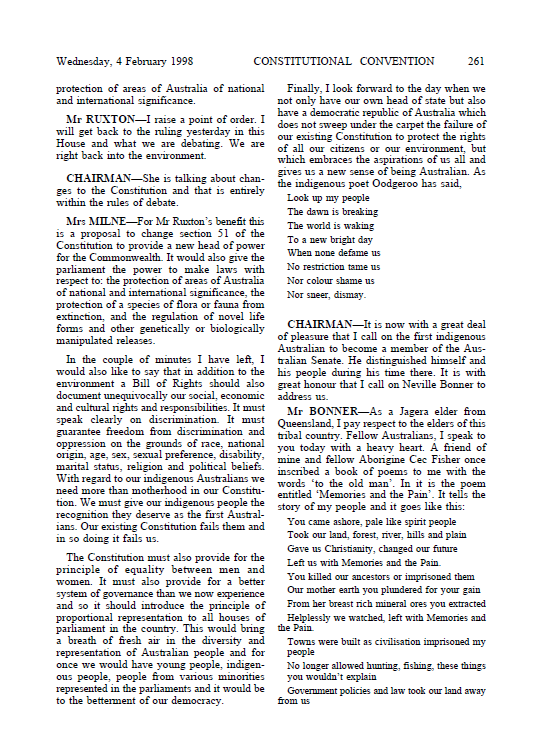
Rosie Duffield: "When the ask you out, they don't present their rage", Domestic Abuse Bill - 2019
2 October 2019, Westminster, United Kingdom
So what is domestic violence or abuse, and where do we get our ideas about it from? Often we see the same images and stereotypes on TV: housing estates, working-class families, drunk men coming home from the pub, women surrounded by children, and a sequence of shouting, followed by immediate physical violence or assault. But soap opera scenes tend to focus on only one or two aspects of a much bigger and more complex picture.
Domestic violence has many faces, and the faces of those who survive it are varied, too. There are 650 MPs in this place—650 human beings. Statistically, it is highly likely that some of us here will have directly experienced an abusive relationship, and we are just as likely as anyone else to have grown up in a violent household.
Abuse is not just about noticeable physical signs. Sometimes there are no bruises. Abuse is very often all about control and power; it is about abusers making themselves feel big, or biggest, but that is not how they present themselves. It is not how they win your heart. It is not how they persuade you to meet them for a coffee, then go to a gig, and then spend an evening snuggled up in front of a movie at their place. When they ask you out, they do not present their rage, and do not tell you that while they like the idea of strong, independent, successful women, they do not like the reality. They do not threaten, criticise, control, yell, or exert their physical strength in an increasingly frightening way—not yet. Not at the start. Not when they think you are sweet, funny and gorgeous. Not when they want to impress you. Not when they turn up to only your third date with chocolate, and then jewellery. Not when they meet your friends, your parents, or the leader of your political party. They do not do any of that then.
It is only later, when the door to your home is locked, that you really start to learn what power and control look and feel like. That is when you learn that “I’ll always look after you,” “I’ll never let you go,” and “You’re mine for life” can sound menacing, and are used as a warning over and over again. It is when the ring is on your finger that the mask can start to slip, and the promises sound increasingly like threats. It is then that you spend 12 or more hours at work longing to see the person you love, only to find that on the walk or tube journey home they refuse to speak a single, solitary word to you. Eventually, at home, they will find a way to let you know which particular sin you have apparently committed: your dress was too short, the top you wore in the Chamber was too low-cut, or you did not respond to a message immediately.
It starts slowly: a few emotional knocks, alternated with romantic gushes and promises of everlasting love, which leave you reeling, confused, spinning around in an ever-changing but always hyper-alert state, not knowing what mood or message awaits you. You tell yourself to be less sensitive, less emotional, to stop over-analysing every little thing. Ignore the moods—he never stops saying he adores you, right? All seems good again.
A whole week goes by: a week of summer evening walks home and maybe a drink on the way. A long weekend is booked and organised as a surprise while you are at work. The journey there is full of promise and promises—time away alone together in a place away from stress—but then it starts. In a strange city, his face changes in a way you are starting to know and dread, in a way that says you need to stay calm, silent and very careful. He goes for a walk. You sit in your hotel room and wait. You read a city guide and plan which sights you want to visit, mentally packing a day full of fun. But he seems to have another agenda. He doesn’t want you to leave the room. He has paid a lot of money and you need to pay him your full attention. You are expected to do as you are told, and you know for certain what that means—so you do exactly as you are told.
In the months that follow, those patterns continue: reward, punishment, promises of happily ever after alternated with abject rage, menace, silent treatment and coercive control; financial abuse and control; a point-blank refusal to disclose his salary or earnings, an assumption and insistence on it being okay to live in your home without contributing a single penny, as bills continue to pile up; a refusal to work, as your salary is great and public knowledge; false promises to start paying some specific bills, which you discover months later remain unpaid; and the slow but sure disappearance of any kindness, respect or loving behaviour.
You get to the stage where you are afraid to go home. After 15 hours at work, you spend another hour on the phone to your mum or a close friend, trembling, a shadow of your usual self. You answer the phone, and the sheer nastiness and rage tell you not to go home at all. So you leave work with your best friend, exhausted and shaking, and buy a toothbrush on the way, knowing that the verbal abuse followed by silent refusal to speak at all will be 100 times worse tomorrow.
Every day is emotionally exhausting. You are working in a job you love but putting on a brave face and pretending all is good, fine—wonderful, in fact. Then the pretence and the public start to drop completely: being yelled at in the car with the windows down, no attempt to hide behaviour during constituency engagements —humiliation and embarrassment now added to permanent trepidation and constant hurt and pain. It is impossible to comprehend that this is the person who tells his family how much he loves you and longs to make you his wife.
But the mask has slipped for good, and questions are starting. Excuses are given to worried friends, concerned family and colleagues who have started to notice. One night, after more crying and being constantly verbally abused because you suggest he pay a bit towards your new sofa, you realise you’ve reached the end and you simply cannot endure this for another day or week, and certainly not for the rest of your life. Having listened intently for two whole weeks to the sound of his morning shower, timing the routine until you know it off by heart, you summon up the courage to take his front-door keys from his bag.
You have tried everything else on earth and know for certain, 100%, what awaits you that night if you do not act today. Heart banging, you hide them carefully and creep back into bed, praying he won’t discover what you have done. You know for certain what will happen if he does. You know an apology will not follow. You know for sure it will be because of what you have done and that it is all your fault. He leaves for the gym, telling you how much he adores you. He tells you to remember that you will always be his. He kisses you lovingly, as though there has not been months of verbal abuse, threats and incidents he knows you will never disclose. He tells you he will bring something nice home for dinner.
Sure enough, the next few days and weeks are a total hell—texts and calls and yelling: “You’ve locked me out like a dog”, “No one treats me that way”, “This is the last thing you will ever do”. You cry, you grieve for your destroyed dreams, you try to heal, you ignore the emails from wedding companies, but it is like withdrawal, and it takes six months.
But one day you notice that you’re smiling, that it’s okay to laugh, and that it’s been a week or two since the daily sobbing stopped. You realise you are allowed to be happy. You dare to relax and you dare to start to feel free. You realise it is not your fault and that he is now left alone with his rage and narcissism. You dare to start dating someone, and you realise that you have survived, but the brightest and most precious thing of all is realising that you are loved and believed by friends, family and colleagues who believe in you and support you.
So if anyone is watching and needs a friend, please reach out, if it is safe to do so, and please talk to any of us, because we will be there and we will hold your hand. [Applause.]
John Bercow : 'We degrade this parliament at our peril', Resignation as Speaker - 2019
9 September 2019, Westminster, London, United Kingdom
Colleagues, I would like to make a personal statement to the House. At the 2017 election, I promised my wife and children that it would be my last. This is a pledge that I intend to keep.
If the House votes tonight for an early general election, my tenure as Speaker and MP will end when this Parliament ends. If the House does not so vote, I have concluded that the least disruptive and most democratic course of action would be for me to stand down at the close of business on Thursday, October 31.
Least disruptive because that date will fall shortly after the votes on the Queen’s Speech expected on 21st and 22nd October. The week or so after that may be quite lively and it would be best to have an experienced figure in the chair for that short period.
Most democratic, because it will mean that a ballot is held when all members have some knowledge of the candidates. This is far preferable to a contest at the beginning of a parliament, when new MPs will not be similarly informed and may find themselves vulnerable to undue institutional influence.
We would not want anyone to be whipped senseless, would we? Throughout my time as speaker, I have sought to increase the relative authority of this legislature for which I will make absolutely no apology to anyone, anywhere, at any time. To deploy a perhaps dangerous phrase: I have also sought to be the backbenchers’ backstop.
I could not do so without the support of a small but superb team in Speakers’ House. The wider House staff, my Buckingham constituents and above all, my wife Sally and our three children, Oliver, Freddie and Jemima.
From the bottom of my heart, I thank them all profusely. I could also not have served without the repeated support of this House and its members past and present.
This is a wonderful place filled overwhelmingly by people who are motivated by their notion of the national interest, by their perception of the public good and by their duty not as democrats, but as representatives to do what they believe is right for our country. We degrade this parliament at our peril. I have served as a member of parliament for 22 years and for the last ten as speaker.
This has been – let me put it explicitly – the greatest privilege, an honour of my professional life for which I will be eternally grateful. I wish my successor in the chair the very best fortune in standing up for the rights of all honourable and right honourable members, individually and for parliament institutionally.
As the Speaker of the House of Commons. Thank you.
Ian Gow: Loyal Address, First televised speech Briitsh Parliament - 1989
21 November 1989, Westminster, United Kingdom
Ian Gow was a Conservative Northern Irish minister under Thatcher. He was murdered by the IRA the year after this address.
I beg to move, "That an humble Address be presented to Her Majesty, as follows:""Most Gracious Sovereign,""We, Your Majesty's most dutiful and loyal subjects, the Commons of the United Kingdom of Great Britain and Northern Ireland, in Parliament assembled, beg leave to offer our humble thanks to Your Majesty for the Gracious Speech which Your Majesty has addressed to both House of Parliament." I am mindful of the honour done by my constituents through my being invited to make this speech. A year ago, the Leader of the Opposition, quoting the admirable Mr. Colin Welch of the Daily Mail, described my hon. Friend the Member for Pudsey (Sir G. Shaw)—who had just moved the motion—as a "roly-poly version of Dr. Bodkin Adams."—[Official Report. 22 November 1988; Vol. 142, c. 13.]" The House, and certainly my hon. Friend the Member for Aldershot (Mr. Critchley), may think that that description applies rather better to me. I am sad to have to confirm that the good doctor is no longer with us—sad, because at each dissolution of Parliament he used to send a £5 note for my fighting fund.
I have always voted against the televising of the proceedings of this House, and I expect that I always will. The brief intervention earlier of the hon. Member for Bradford, South (Mr. Cryer) did nothing to alter my view. Despite my strongly held opinions, a letter that I received —three weeks ago—I believe that a copy was sent to each of us and possibly even to you, Mr. Speaker—made the following preposterous assertion: "The impression you make on television depends mainly on your image (55 per cent.) with your voice and body language accounting for 38 per cent. of your impact. Only 7 per cent. depends on what you are actually saying." [HON. MEMBERS: "Hear, hear."] I thought that I should enlist the sympathy of the Opposition with that last proposition.
The letter went on—and hon. Members may think that this is an extravagant claim so far as I am concerned: "We can guarantee to improve your appearance through a personal and confidential image consultation. You will learn if you need a new hair style—and where to get it—and the type of glasses to suit your face." The House will understand why I considered that I was beyond redemption on both counts.
Eastbourne has been a separate parliamentary constituency since 1885. Then the electorate was 8,000; today it is 80,000. I am glad to report that for 100 out of those 104 years Eastbourne has been represented in the Conservative interest. The solitary lapse took place in 1906, but four years of Liberal representation were more than enough and provoked the highest turnout ever recorded—90·3 per cent.— at the following general election. Since then, Eastbourne has been true blue, and, since 1974, dry as well.
East Sussex has long attracted the retired and semi-retired. Lord Shawcross lives at Friston, the right hon. Member for Leeds, East (Mr. Healey), whose decision not to seek re-election to this place we all deplore, is the squire of Alfriston and Lord Callaghan has his estate nearby. It will be a source of satisfaction to the Opposition, particularly to those who sit below the Gangway, as it is to me, to learn that those three comrades have been able to share in the growing prosperity of the nation created during the premiership of my right hon. Friend the Prime Minister.
Others have shared in that prosperity. Over these past years, 1,657 former tenants of our borough council have bought their houses or flats. They remember that the right-to-buy legislation was fiercely opposed by the Labour party. I was proud to have had a hand in extending the opportunities for home ownership in the Housing Act 1985.
Last month, phase two of our district general hospital was opened. All the medical wards have been transferred from St. Mary's hospital, which was built in Napoleonic days, to our new hospital. I am pleased to be able to tell the House that our hospital has informed my right hon. and learned Friend the Secretary of State for Health of its intention to seek approval to become a self-governing hospital trust within the National Health Service.
In August 1980, the House gave a Third Reading to the Eastbourne Harbour Bill. Indeed, 180 of my right hon. and hon. Friends stayed up until 6.10 am to vote for it. The House will want to know that construction work on the harbour project is well under way. Jobs are being created in the short and long term. The new harbour will keep Eastbourne in the vanguard—no, ahead of the vanguard—of Britain's increasingly important and increasingly successful tourist industry.
When the harbour is completed, our fishermen will no longer have to drag their craft on to the beach. There will be berths for 1,800 small boats. Miners from Bolsover, entrepreneurs from Newham, North-West, refugees from Brent, East, grocers from Old Bexley, intellectuals, real or imagined, from Chesham and Amersham and the hon. baronet the Member for Clwyd, North-West (Sir A. Meyer), whose reported aspirations to become the Queen's first Minister I am unable to endorse—all these and many more besides—will be able to moor their boat or seek refuge from the storm in the new Eastbourne harbour.