• Genre
  • About
  • Submissions
  • Donate
  • Search
Menu

Speakola

All Speeches Great and Small
  • Genre
  • About
  • Submissions
  • Donate
  • Search
Share a political speech
Joe McCarthy.jpg

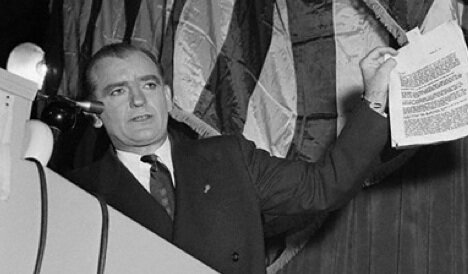
Joseph McCarthy: 'I have in my hand fifty seven cases ... ' Enemies from Within speech - 1950

October 14, 2019

20 February 1950, McClare Hotel, Wheeling, West Virginia, USA

Tonight as we celebrate the 141st birthday of one of the great men in American history, I would like to be able to talk about what a glorious day today is in the history of the world. As we celebrate the birth of this man, who with his whole heart and soul hated war, I would like to be able to speak of peace in our time, of war being outlawed, and of worldwide disarmament. These would be truly appropriate things to be able to mention as we celebrate the birthday of Abraham Lincoln

.Five years after a world war has been won, men's hearts should anticipate a long peace, and men's minds should be free from the heavy weight that comes with war. But this is not such a period --for this is not a period of peace. This is a time of the Cold War. This is a time when all the world is split into two vast, increasingly hostile armed camps --a time of a great armaments race. Today we can almost physically hear the mutterings and rumblings of an invigorated god of war. You can see it, feel it, and hear it all the way from the hills of Indochina, from the shores of Formosa right over into the very heart of Europe itself.

...Today we are engaged in a final, all-out battle between communistic atheism and Christianity. The modern champions of communism have selected this as the time. And, ladies and gentlemen, the chips are down --they are truly down.Lest there be any doubt that the time has been chosen, let us go directly to the leader of communism today --Joseph Stalin. Here is what he said --not back in 1928, not before the war, not during the war --but two years after the last war was ended: "To think that the communist revolution can be carried out peacefully, within the framework of a Christian democracy, means one has either gone out of one's mind and lost all normal understanding, or has grossly and openly repudiated the communist revolution."

And this is what was said by Lenin in 1919, which was also quoted with approval by Stalin in 1947: "We are living," said Lenin, "not merely in a state but in a system of states, and the existence of the Soviet Republic side by side with Christian states for a long time is unthinkable. One or the other must triumph in the end. And before that end supervenes, a series of frightful collisions between the Soviet Republic and the bourgeois states will be inevitable."Ladies and gentlemen, can there be anyone here tonight who is so blind as to say that the war is not on? Can there be anyone who fails to realize that the communist world has said, "The time is now" --that this is the time for the showdown between the democratic Christian world and the communist atheistic world?

Unless we face this fact, we shall pay the price that must be paid by those who wait too long.

Six years ago, at the time of the first conference to map outpeace --Dumbarton Oaks --there was within the Soviet orbit 180 million people. Lined up on the anti-totalitarian side there were in the world at that time roughly 1.625 billion people. Today, only six years later, there are 800 million people under the absolute domination of Soviet Russia --an increase of over 400 percent. On our side, the figure has shrunk to around 500 million. In other words, in less than six years the odds have changed from 9 to 1 in our favor to 8 to 5 against us. This indicates the swiftness of the tempo of communist victories and American defeats in the Cold War. As one of our outstanding historical figures once said, "When a great democracy is destroyed, it will not be because of enemies from without but rather because of enemies from within."

The truth of this statement is becoming terrifyingly clear as we see this country each day losing on every front.

At war's end we were physically the strongest nation on Earth and, at least potentially, the most powerful intellectually and morally. Ours could have been the honor of being a beacon in the desert of destruction, a shining, living proof that civilization was not yet ready to destroy itself. Unfortunately, we have failed miserably and tragically to arise to the opportunity.

The reason why we find ourselves in a position of impotency is not because our only powerful, potential enemy has sent men to invade our shores, but rather because of the traitorous actions of those who have been treated so well by this nation. It has not been the less fortunate or members of minority groups who have been selling this nation out, but rather those who have had all the benefits that the wealthiest nation on earth has had to offer --the finest homes, the finest college education, and the finest jobs in government we can give.

This is glaringly true in the State Department. There the bright young men who are born with silver spoons in their mouths are the ones who have been worst.

Now I know it is very easy for anyone to condemn a particular bureau or department in general terms. Therefore, I would like to cite one rather unusual case --the case of a man who has done much to shape our foreign policy.When Chiang Kai-shek was fighting our war, the State Department had in China a young man named John S. Service. His task, obviously, was not to work for the communization of China.
Strangely, however, he sent official reports back to the State Department urging that we torpedo our ally Chiang Kai-shek and stating, in effect, that communism was the best hope of China.Later, this man --John Service --was picked up by the Federal Bureau of Investigation for turning over to the communists secret State Department information. Strangely, however, he was never prosecuted. However, Joseph Grew, the undersecretary of state, who insisted on his prosecution, was forced to resign. Two days after, Grew's successor, Dean Acheson, took over as undersecretary of state, this man --John Service --who had been picked up by the FBI and who had previously urged that communism was the best hope of China, was not only reinstated in the State Department but promoted; and finally, under Acheson, placed in charge of all placements and promotions. Today, ladies and gentlemen, this man Service is on his way to represent the State Department and Acheson in Calcutta --by far and away the most important listening post in the Far East.Now, let's see what happens when individuals with communist connections are forced out of the State Department.

Gustave Duran, who was labeled as, I quote, "a notorious international communist," was made assistant secretary of state in charge of Latin American affairs. He was taken into the State Department from his job as a lieutenant colonel in the Communist International Brigade. Finally, after intense congressional pressure and criticism, he resigned in 1946 from the State Department --and, ladies and gentlemen, where do you think he is now? He took over a high-salaried job as chief of Cultural Activities Section in the office of the assistant secretary-general of the United Nations. ...

This, ladies and gentlemen, gives you somewhat of a picture of the type of individuals who have been helping to shape our foreign policy. In my opinion the State Department, which is one of the most important government departments, is thoroughly infested with communists.

I have in my hand 57 cases of individuals who would appear to be either card-carrying members or certainly loyal to the Communist Party, but who nevertheless are still helping to shape our foreign policy.
One thing to remember in discussing the communists in our government is that we are not dealing with spies who get 30 pieces of silver to steal the blueprints of new weapons. We are dealing with a far more sinister type of activity because it permits the enemy to guide and shape our policy.This brings us down to the case of one Alger Hiss, who is important not as an individual anymore but rather because he is so representative of a group in the State Department. It is unnecessary to go over the sordid events showing how he sold out the nation which had given him so much. Those are rather fresh in all of our minds. However, it should be remembered that the facts in regard to his connection with this international communist spy ring were made known to the then-Undersecretary of State Berle three days after Hitler and Stalin signed the Russo-German Alliance Pact. At that time one Whittaker Chambers --who was also part of the spy ring --apparently decided that with Russia on Hitler's side, he could no longer betray our nation to Russia. He gave Undersecretary of State Berle --and this is all a matter of record --practically all, if not more, of the facts upon which Hiss' conviction was based.Undersecretary Berle promptly contacted Dean Acheson and received word in return that Acheson, and I quote, "could vouch for Hiss absolutely" --at which time the matter was dropped. And this, you understand, was at a time when Russia was an ally of Germany. This condition existed while Russia and Germany were invading and dismembering Poland, and while the communist groups here were screaming "warmonger" at the United States for their support of the Allied nations.Again in 1943, the FBI had occasion to investigate the facts surrounding Hiss' contacts with the Russian spy ring. But even after that FBI report was submitted, nothing was done.

Then, late in 1948 --on August 5 --when the Un-American Activities Committee called Alger Hiss to give an accounting, President Truman at once issued a presidential directive ordering all government agencies to refuse to turn over any information whatsoever in regard to the communist activities of any government employee to a congressional committee.Incidentally, even after Hiss was convicted, it is interesting to note that the president still labeled the expose of Hiss as a "red herring."If time permitted, it might be well to go into detail about the fact that Hiss was Roosevelt's chief adviser at Yalta when Roosevelt was admittedly in ill health and tired physically and mentally ... and when, according to the secretary of state, Hiss and Gromyko drafted the report on the conference.

According to the then-Secretary of State Stettinius, here are some of the things that Hiss helped to decide at Yalta: (1) the establishment of a European High Commission; (2) the treatment of Germany --this you will recall was the conference at which it was decided that we would occupy Berlin with Russia occupying an area completely encircling the city, which as you know, resulted in the Berlin airlift which cost 31 American lives; (3) the Polish question; (4) the relationship between UNRRA and the Soviet; (5) the rights of Americans on control commissions of Rumania, Bulgaria and Hungary; (6) Iran; (7) China --here's where we gave away Manchuria; (8) Turkish Straits question; (9) international trusteeships; (10) Korea.Of the results of this conference, Arthur Bliss Lane of the State Department had this to say: "As I glanced over the document, I could not believe my eyes. To me, almost every line spoke of a surrender to Stalin.

"As you hear this story of high treason, I know that you are saying to yourself, "Well, why doesn't the Congress do something about it?" Actually, ladies and gentlemen, one of the important reasons for the graft, the corruption, the dishonesty, the disloyalty, the treason in high government positions --one of the most important reasons why this continues --is a lack of moral uprising on the part of the 140 million American people. In the light of history, however, this is not hard to explain.

It is the result of an emotional hangover and a temporary moral lapse which follows every war. It is the apathy to evil which people who have been subjected to the tremendous evils of war feel. As the people of the world see mass murder, the destruction of defenseless and innocent people, and all of the crime and lack of morals which go with war, they become numb and apathetic. It has always been thus after war.

However, the morals of our people have not been destroyed. They still exist. This cloak of numbness and apathy has only needed a spark to rekindle them. Happily, this spark has finally been supplied.
As you know, very recently the secretary of state proclaimed his loyalty to a man guilty of what has always been considered as the most abominable of all crimes --of being a traitor to the people who gave him a position of great trust. The secretary of state, in attempting to justify his continued devotion to the man who sold out the Christian world to the atheistic world, referred to Christ's Sermon on the Mount as a justification and reason therefore, and the reaction of the American people to this would have made the heart of Abraham Lincoln happy.

When this pompous diplomat in striped pants, with a phony British accent, proclaimed to the American people that Christ on the Mount endorsed communism, high treason, and betrayal of a sacred trust, the blasphemy was so great that it awakened the dormant indignation of the American people.

He has lighted the spark which is resulting in a moral uprising and will end only when the whole sorry mess of twisted warped thinkers are swept from the national scene so that we may have a new birth of national honesty and decency in government.

Source: https://liberalarts.utexas.edu/coretexts/_...

Enjoyed this speech? Speakola is a labour of love and I’d be very grateful if you would share, tweet or like it. Thank you.

Facebook Twitter Facebook
In 1940-59 B Tags JOSEPH MCCARTHY, I HAVE IN MY HAND, STATE DEPARTMENT, TRANSCRIPT, ENEMIES FROM WITHIN SPEECH, UNAMERICAN ACTIVITES, COLD WAR, BLACKLIST, COMMUNISM, COMMUNIST PARTY, STALIN, LENIN
Comment

Eamon de Valera: 'The Ireland that we dreamed of', St Patrick's Day broadcast - 1943

October 14, 2019

17 March 1943, RTE studios, Dublin, Ireland

The ideal Ireland that we would have, the Ireland that we dreamed of, would be the home of a people who valued material wealth only as a basis for right living, of a people who, satisfied with frugal comfort, devoted their leisure to the things of the spirit – a land whose countryside would be bright with cosy homesteads, whose fields and villages would be joyous with the sounds of industry, with the romping of sturdy children, the contest of athletic youths and the laughter of happy maidens, whose firesides would be forums for the wisdom of serene old age.

The home, in short, of a people living the life that God desires that men should live.

With the tidings that make such an Ireland possible, St. Patrick came to our ancestors fifteen hundred years ago promising happiness here no less than happiness hereafter. It was the pursuit of such an Ireland that later made our country worthy to be called the island of saints and scholars. It was the idea of such an Ireland – happy, vigorous, spiritual – that fired the imagination of our poets; that made successive generations of patriotic men give their lives to win religious and political liberty; and that will urge men in our own and future generations to die, if need be, so that these liberties may be preserved.

One hundred years ago, the Young Irelanders, by holding up the vision of such an Ireland before the people, inspired and moved them spiritually as our people had hardly been moved since the Golden Age of Irish civilisation.

Fifty years later, the founders of the Gaelic League similarly inspired and moved the people of their day.

So, later, did the leaders of the Irish Volunteers.

We of this time, if we have the will and active enthusiasm, have the opportunity to inspire and move our generation in like manner. We can do so by keeping this thought of a noble future for our country constantly before our eyes, ever seeking in action to bring that future into being, and ever remembering that it is for our nation as a whole that future must be sought.

Source: https://medium.com/@fitzfromdublin/the-ire...

Enjoyed this speech? Speakola is a labour of love and I’d be very grateful if you would share, tweet or like it. Thank you.

Facebook Twitter Facebook
In 1920-39 MORE Tags EAMON DE VALERA, TRANSCRIPT, ST PATRICK'S DAY, IDEALISED, NATIONALISM, SPIRITUALITY, CATHOLICISM, IRELAND, IRISHNESS, IRISH CHARACTER
Comment

George H.W. Bush: ''The world could wait no longer', On Commencement of Bombing of Iraq - 1991

October 11, 2019

16 January 1991, The White House, Washington DC, USA

Just 2 hours ago, allied air forces began an attack on military targets in Iraq and Kuwait. These attacks continue as I speak. Ground forces are not engaged.
This conflict started August 2d when the dictator of Iraq invaded a small and helpless neighbor. Kuwait—a member of the Arab League and a member of the United Nations—was crushed; its people, brutalized. Five months ago, Saddam Hussein started this cruel war against Kuwait. Tonight, the battle has been joined.
This military action, taken in accord with United Nations resolutions and with the consent of the United States Congress, follows months of constant and virtually endless diplomatic activity on the part of the United Nations, the United States, and many, many other countries. Arab leaders sought what became known as an Arab solution, only to conclude that Saddam Hussein was unwilling to leave Kuwait. Others traveled to Baghdad in a variety of efforts to restore peace and justice. Our Secretary of State, James Baker, held an historic meeting in Geneva, only to be totally rebuffed. This past weekend, in a last-ditch effort, the Secretary-General of the United Nations went to the Middle East with peace in his heart—his second such mission. And he came back from Baghdad with no progress at all in getting Saddam Hussein to withdraw from Kuwait.
Now the 28 countries with forces in the Gulf area have exhausted all reasonable efforts to reach a peaceful resolution—have no choice but to drive Saddam from Kuwait by force. We will not fail.
As I report to you, air attacks are underway against military targets in Iraq. We are determined to knock out Saddam Hussein's nuclear bomb potential. We will also destroy his chemical weapons facilities. Much of Saddam's artillery and tanks will be destroyed. Our operations are designed to best protect the lives of all the coalition forces by targeting Saddam's vast military arsenal. Initial reports from General Schwarzkopf are that our operations are proceeding according to plan.
Our objectives are clear: Saddam Hussein's forces will leave Kuwait. The legitimate government of Kuwait will be restored to its rightful place, and Kuwait will once again be free. Iraq will eventually comply with all relevant United Nations resolutions, and then, when peace is restored, it is our hope that Iraq will live as a peaceful and cooperative member of the family of nations, thus enhancing the security and stability of the Gulf.
Some may ask: Why act now? Why not wait? The answer is clear: The world could wait no longer. Sanctions, though having some effect, showed no signs of accomplishing their objective. Sanctions were tried for well over 5 months, and we and our allies concluded that sanctions alone would not force Saddam from Kuwait.
While the world waited, Saddam Hussein systematically raped, pillaged, and plundered a tiny nation, no threat to his own. He subjected the people of Kuwait to unspeakable atrocities—and among those maimed and murdered, innocent children.
While the world waited, Saddam sought to add to the chemical weapons arsenal he now possesses, an infinitely more dangerous weapon of mass destruction—a nuclear weapon. And while the world waited, while the world talked peace and withdrawal, Saddam Hussein dug in and moved massive forces into Kuwait.
While the world waited, while Saddam stalled, more damage was being done to the fragile economies of the Third World, emerging democracies of Eastern Europe, to the entire world, including to our own economy.
The United States, together with the United Nations, exhausted every means at our disposal to bring this crisis to a peaceful end. However, Saddam clearly felt that by stalling and threatening and defying the United Nations, he could weaken the forces arrayed against him.
While the world waited, Saddam Hussein met every overture of peace with open contempt. While the world prayed for peace, Saddam prepared for war.
I had hoped that when the United States Congress, in historic debate, took its resolute action, Saddam would realize he could not prevail and would move out of Kuwait in accord with the United Nation resolutions. He did not do that. Instead, he remained intransigent, certain that time was on his side.
Saddam was warned over and over again to comply with the will of the United Nations: Leave Kuwait, or be driven out. Saddam has arrogantly rejected all warnings. Instead, he tried to make this a dispute between Iraq and the United States of America.
Well, he failed. Tonight, 28 nations—countries from 5 continents, Europe and Asia, Africa, and the Arab League—have forces in the Gulf area standing shoulder to shoulder against Saddam Hussein. These countries had hoped the use of force could be avoided. Regrettably, we now believe that only force will make him leave.
Prior to ordering our forces into battle, I instructed our military commanders to take every necessary step to prevail as quickly as possible, and with the greatest degree of protection possible for American and allied service men and women. I've told the American people before that this will not be another Vietnam, and I repeat this here tonight. Our troops will have the best possible support in the entire world, and they will not be asked to fight with one hand tied behind their back. I'm hopeful that this fighting will not go on for long and that casualties will be held to an absolute minimum.
This is an historic moment. We have in this past year made great progress in ending the long era of conflict and cold war. We have before us the opportunity to forge for ourselves and for future generations a new world order—a world where the rule of law, not the law of the jungle, governs the conduct of nations. When we are successful—and we will be—we have a real chance at this new world order, an order in which a credible United Nations can use its peacekeeping role to fulfill the promise and vision of the U.N.'s founders.
We have no argument with the people of Iraq. Indeed, for the innocents caught in this conflict, I pray for their safety. Our goal is not the conquest of Iraq. It is the liberation of Kuwait. It is my hope that somehow the Iraqi people can, even now, convince their dictator that he must lay down his arms, leave Kuwait, and let Iraq itself rejoin the family of peace-loving nations.
Thomas Paine wrote many years ago: "These are the times that try men's souls." Those well-known words are so very true today. But even as planes of the multinational forces attack Iraq, I prefer to think of peace, not war. I am convinced not only that we will prevail but that out of the horror of combat will come the recognition that no nation can stand against a world united, no nation will be permitted to brutally assault its neighbor.
No President can easily commit our sons and daughters to war. They are the Nation's finest. Ours is an all-volunteer force, magnificently trained, highly motivated. The troops know why they're there. And listen to what they say, for they've said it better than any President or Prime Minister ever could.
Listen to Hollywood Huddleston, Marine lance corporal. He says, "Let's free these people, so we can go home and be free again." And he's right. The terrible crimes and tortures committed by Saddam's henchmen against the innocent people of Kuwait are an affront to mankind and a challenge to the freedom of all.
Listen to one of our great officers out there, Marine Lieutenant General Walter Boomer. He said: "There are things worth fighting for. A world in which brutality and lawlessness are allowed to go unchecked isn't the kind of world we're going to want to live in."
Listen to Master Sergeant J.P. Kendall of the 82d Airborne: "We're here for more than just the price of a gallon of gas. What we're doing is going to chart the future of the world for the next 100 years. It's better to deal with this guy now than 5 years from now."
And finally, we should all sit up and listen to Jackie Jones, an Army lieutenant, when she says, "If we let him get away with this, who knows what's going to be next?"
I have called upon Hollywood and Walter and J.P. and Jackie and all their courageous comrades-in-arms to do what must be done. Tonight, America and the world are deeply grateful to them and to their families. And let me say to everyone listening or watching tonight: When the troops we've sent in finish their work, I am determined to bring them home as soon as possible.
Tonight, as our forces fight, they and their families are in our prayers. May God bless each and every one of them, and the coalition forces at our side in the Gulf, and may He continue to bless our nation, the United States of America.

Source: https://millercenter.org/the-presidency/pr...

Enjoyed this speech? Speakola is a labour of love and I’d be very grateful if you would share, tweet or like it. Thank you.

Facebook Twitter Facebook
In 1980-99 B Tags GEORGE HW BUSH, BOMBING OF IRAQ, INVASION OF KUWAIT, FIRST GULF WAR, TRANSCRIPT, SADDAM HUSSEIN, SANCTIONS
Comment

Richard Nixon: 'We have today concluded an agreement to end the war', End of Vietnam War -1973

October 11, 2019

23 January 1973, White House, Washington DC, USA

Good evening:

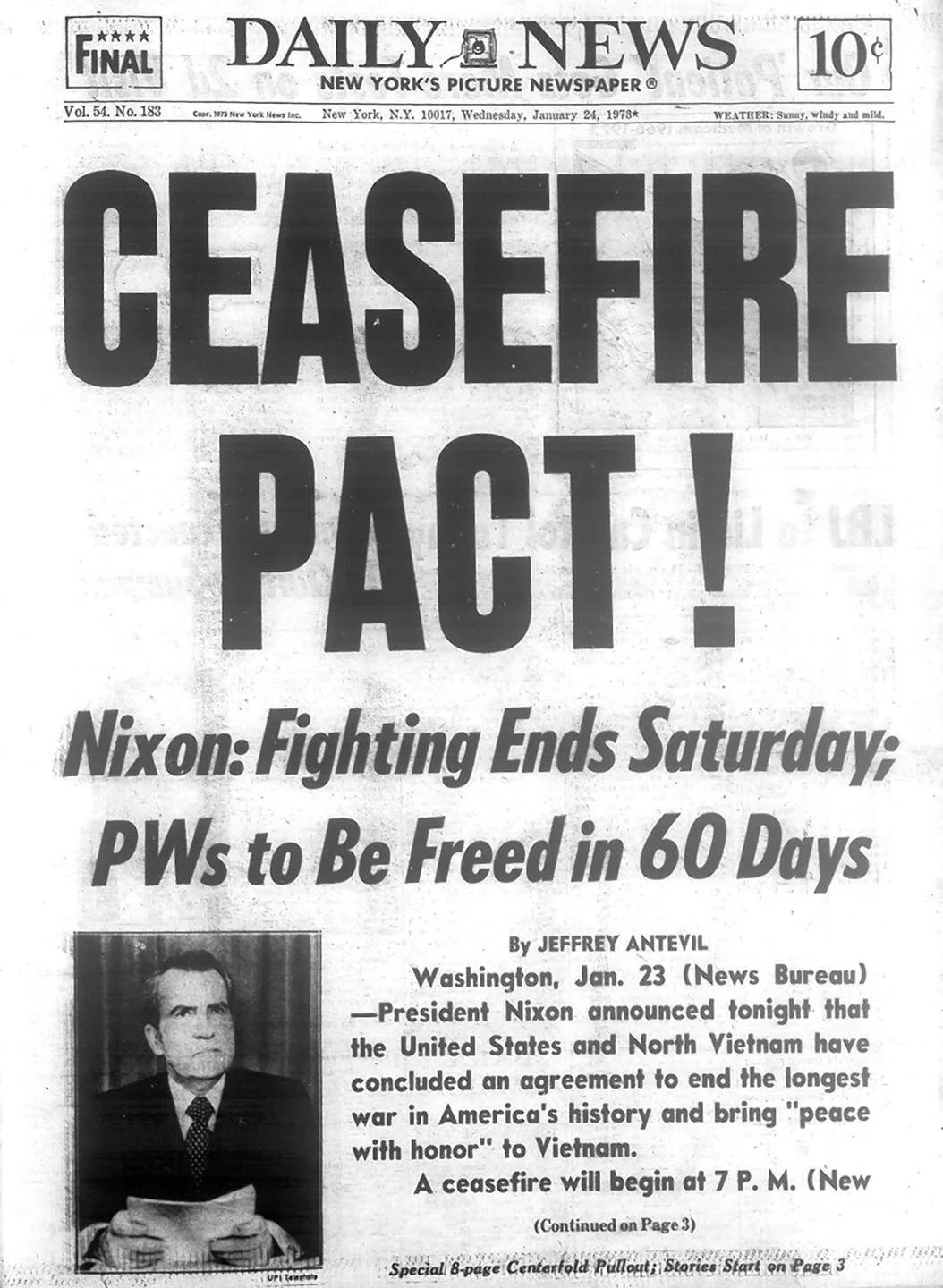
I have asked for this radio and television time tonight for the purpose of announcing that we today have concluded an agreement to end the war and bring peace with honor in Vietnam and in Southeast Asia.

The following statement is being issued at this moment in Washington and Hanoi:

At 12:30 Paris time today, January 23, 1973, the Agreement on Ending the War and Restoring Peace in Vietnam was initialed by Dr. Henry Kissinger on behalf of the United States, and Special Adviser Le Duc Tho on behalf of the Democratic Republic of Vietnam.

The agreement will be formally signed by the parties participating in the Paris Conference on Vietnam on January 27, 1973, at the International Conference Center in Paris.

The cease-fire will take effect at 2400 Greenwich Mean Time, January 27, 1973. The United States and the Democratic Republic of Vietnam express the hope that this agreement will insure stable peace in Vietnam and contribute to the preservation of lasting peace in Indochina and Southeast Asia.

That concludes the formal statement. Throughout the years of negotiations, we have insisted on peace with honor. In my addresses to the Nation from this room of January 25 and May 8 [1972], I set forth the goals that we considered essential for peace with honor.

In the settlement that has now been agreed to, all the conditions that I laid down then have been met:

A cease-fire, internationally supervised, will begin at 7 p.m., this Saturday, January 27, Washington time.

Within 60 days from this Saturday, all Americans held prisoners of war throughout Indochina will be released. There will be the fullest possible accounting for all of those who are missing in action.

During the same 60-day period, all American forces will be withdrawn from South Vietnam.

The people of South Vietnam have been guaranteed the right to determine their own future, without outside interference.

By joint agreement, the full text of the agreement and the protocol to carry it out will be issued tomorrow.

Throughout these negotiations we have been in the closest consultation with President Thieu and other representatives of the Republic of Vietnam. This settlement meets the goals and has the full support of President Thieu and the Government of the Republic of Vietnam, as well as that of our other allies who are affected.

The United States will continue to recognize the Government of the Republic of Vietnam as the sole legitimate government of South Vietnam.

We shall continue to aid South Vietnam within the terms of the agreement, and we shall support efforts by the people of South Vietnam to settle their problems peacefully among themselves.

We must recognize that ending the war is only the first step toward building the peace. All parties must now see to it that this is a peace that lasts, and also a peace that heals–and a peace that not only ends the war in Southeast Asia but contributes to the prospects of peace in the whole world.

This will mean that the terms of the agreement must be scrupulously adhered to. We shall do everything the agreement requires of us, and we shall expect the other parties to do everything it requires of them. We shall also expect other interested nations to help insure that the agreement is carried out and peace is maintained.

As this long and very difficult war ends, I would like to address a few special words to each of those who have been parties in the conflict.

First, to the people and Government of South Vietnam: By your courage, by your sacrifice, you have won the precious right to determine your own future, and you have developed the strength to defend that right. We look forward to working with you in the future–friends in peace as we have been allies in war.

To the leaders of North Vietnam: As we have ended the war through negotiations, let us now build a peace of reconciliation. For our part, we are prepared to make a major effort to help achieve that goal. But just as reciprocity was needed to end the war, so too will it be needed to build and strengthen the peace.

To the other major powers that have been involved even indirectly: Now is the time for mutual restraint so that the peace we have achieved can last.

And finally, to all of you who are listening, the American people: Your steadfastness in supporting our insistence on peace with honor has made peace with honor possible. I know that you would not have wanted that peace jeopardized. With our secret negotiations at the sensitive stage they were in during this recent period, for me to have discussed publicly our efforts to secure peace would not only have violated our understanding with North Vietnam, it would have seriously harmed and possibly destroyed the chances for peace. Therefore, I know that you now can understand why, during these past several weeks, I have not made any public statements about those efforts.

The important thing was not to talk about peace, but to get peace–and to get the right kind of peace. This we have done.

Now that we have achieved an honorable agreement, let us be proud that America did not settle for a peace that would have betrayed our allies, that would have abandoned our prisoners of war, or that would have ended the war for us but would have continued the war for the 50 million people of Indochina. Let us be proud of the 2 1/2 million young Americans who served in Vietnam, who served with honor and distinction in one of the most selfless enterprises in the history of nations. And let us be proud of those who sacrificed, who gave their lives so that the people of South Vietnam might live in freedom and so that the world might live in peace.

In particular, I would like to say a word to some of the bravest people I have ever met–the wives, the children, the families of our prisoners of war and the missing in action. When others called on us to settle on any terms, you had the courage to stand for the right kind of peace so that those who died and those who suffered would not have died and suffered in vain, and so that where this generation knew war, the next generation would know peace. Nothing means more to me at this moment than the fact that your long vigil is coming to an end.

Just yesterday, a great American, who once occupied this office, died. In his life, President Johnson endured the vilification of those who sought to portray him as a man of war. But there was nothing he cared about more deeply than achieving a lasting peace in the world.

I remember the last time I talked with him. It was just the day after New Year’s. He spoke then of his concern with bringing peace, with making it the right kind of peace, and I was grateful that he once again expressed his support for my efforts to gain such a peace. No one would have welcomed this peace more than he.

And I know .he would join me in asking-for those who died and for those who live–let us consecrate this moment by resolving together to make the peace we have achieved a peace that will last. Thank you and good evening.

CEASEFIRE PACT NIXON.jpg
Source: https://www.nixonfoundation.org/2017/08/ad...

Enjoyed this speech? Speakola is a labour of love and I’d be very grateful if you would share, tweet or like it. Thank you.

Facebook Twitter Facebook
In 1960-79 B Tags RICHARD NIXON, PEACE WITH HONOUR SPEECH, TRANSCRIPT, END OF VIETNAM WAR, CEASEFIRE AGREEMENT, PEACE WITH HONOR
Comment

Adlai Stevenson: 'Do you Ambassador Zorin deny that the USSR has placed ... missiles at sites in Cuba?' United Nations Security Council, Cuban Missile Crisis - 1962

October 11, 2019

25 October 1962, United Nations, New York, USA

I want to say to you, Mr. Zorin, that I do not have your talent for obfuscation, for distortion, for confusing language, and for doubletalk. And I must confess to you that I am glad that I do not!

But if I understood what you said, you said that my position had changed, that today I was defensive because we did not have the evidence to prove our assertions, that your Government had installed long-range missiles in Cuba.

Well, let me say something to you, Mr. Ambassador—we do have the evidence. We have it, and it is clear and it is incontrovertible. And let me say something else—those weapons must be taken out of Cuba.

Next, let me say to you that, if I understood you, with a trespass on credibility that excels your best, you said that our position had changed since I spoke here the other day because of the pressures of world opinion and the majority of the United Nations. Well, let me say to you, sir, you are wrong again. We have had no pressure from anyone whatsoever. We came in here today to indicate our willingness to discuss Mr. U Thant's proposals, and that is the only change that has taken place.

But let me also say to you, sir, that there has been a change. You—the Soviet Union has sent these weapons to Cuba. You—the Soviet Union has upset the balance of power in the world. You—the Soviet Union has created this new danger, not the United States.

And you ask with a fine show of indignation why the President did not tell Mr. Gromyko on last Thursday about our evidence, at the very time that Mr. Gromyko was blandly denying to the President that the U.S.S.R. was placing such weapons on sites in the new world.

Well, I will tell you why—because we were assembling the evidence, and perhaps it would be instructive to the world to see how a Soviet official—how far he would go in perfidy. Perhaps we wanted to know if this country faced another example of nuclear deceit like that one a year ago, when in stealth, the Soviet Union broke the nuclear test moratorium.

And while we are asking questions, let me ask you why your Government—your Foreign Minister—deliberately, cynically deceived us about the nuclear build-up in Cuba.

And, finally, the other day, Mr. Zorin, I remind you that you did not deny the existence of these weapons. Instead, we heard that they had suddenly become defensive weapons. But today again if I heard you correctly, you now say that they do not exist, or that we haven't proved they exist, with another fine flood of rhetorical scorn.

All right, sir, let me ask you one simple question: Do you, Ambassador Zorin, deny that the U.S.S.R. has placed and is placing medium- and intermediate-range missiles and sites in Cuba? Yes or no—don't wait for the translation—yes or no?

(The Soviet representative waited for translation, then responded.)

"This is not a court of law, I do not need to provide a yes or no answer..." (was cut off by Mr. Stevenson at this point) *Source United Nations Assembly video archives.

You can answer yes or no. You have denied they exist. I want to know if I understood you correctly. I am prepared to wait for my answer until hell freezes over, if that's your decision. And I am also prepared to present the evidence in this room.

(The President called on the representative of Chile to speak, who instead let Ambassador Stevenson continue as follows.)

I have not finished my statement. I asked you a question. I have had no reply to the question, and I will now proceed, if I may, to finish my statement.

I doubt if anyone in this room, except possibly the representative of the Soviet Union, has any doubt about the facts. But in view of his statements and the statements of the Soviet Government up until last Thursday, when Mr. Gromyko denied the existence or any intention of installing such weapons in Cuba, I am going to make a portion of the evidence available right now. If you will indulge me for a moment, we will set up an easel here in the back of the room where I hope it will be visible to everyone.

The first of these exhibits shows an area north of the village of Candelaria, near San Cristóbal, southwest of Habana. A map, together with a small photograph, shows precisely where the area is in Cuba.

The first photograph shows the area in late August 1962; it was then, if you can see from where you are sitting, only a peaceful countryside.

The second photograph shows the same area one day last week. A few tents and vehicles had come into the area, new spur roads had appeared, and the main road had been improved.

The third photograph, taken only twenty-four hours later, shows facilities for a medium-range missile battalion installed. There are tents for 400 or 500 men. At the end of the new spur road there are seven 1,000-mile missile trailers. There are four launcher-erector mechanisms for placing these missiles in erect firing position. This missile is a mobile weapon, which can be moved rapidly from one place to another. It is identical with the 1,000-mile missiles which have been displayed in Moscow parades. All of this, I remind you, took place in twenty-four hours.

The second exhibit, which you can all examine at your leisure, shows three successive photographic enlargements of another missile base of the same type in the area of San Cristóbal. These enlarged photographs clearly show six of these missiles on trailers and three erectors.

And that is only one example of the first type of ballistic missile installation in Cuba.

A second type of installation is designed for a missile of intermediate range—a range of about 2,200 miles. Each site of this type has four launching pads.

The exhibit on this type of missile shows a launching area being constructed near Guanajay, southwest of the city of Habana. As in the first exhibit, a map and small photograph show this area as it appeared in late August 1962, when no military activities were apparent.

A second large photograph shows the same area about six weeks later. Here you will see a very heavy construction effort to push the launching area to rapid completion. The pictures show two large concrete bunkers or control centers in process of construction, one between each pair of launching pads. They show heavy concrete retaining walls being erected to shelter vehicles and equipment from rocket blast-off. They show cable scars leading from the launch pads to the bunkers. They show a large reinforced concrete building under construction. A building with a heavy arch may well be intended as the storage area for the nuclear warheads. The installation is not yet complete, and no warheads are yet visible.

The next photograph shows a closer view of the same intermediate-range launch site. You can clearly see one of the pairs of large concrete launch pads, with a concrete building from which launching operations for three pads are controlled. Other details are visible, such as fuel tanks.

And that is only one example, one illustration, of the work being furnished in Cuba on intermediate-range missile bases.

Now, in addition to missiles, the Soviet Union is installing other offensive weapons in Cuba. The next photograph is of an airfield at San Julián in western Cuba. On this field you will see twenty-two crates designed to transport the fuselages of Soviet llyushin-28 bombers. Four of the aircraft are uncrated, and one is partially assembled. These bombers, sometimes known as Beagles, have an operating radius of about 750 miles and are capable of carrying nuclear weapons. At the same field you can see one of the surface-to-air antiaircraft guided missile bases, with six missiles per base, which now ring the entire coastline of Cuba.

Another set of two photographs covers still another area of deployment of medium-range missiles in Cuba. These photographs are on a larger scale than the others and reveal many details of an improved field-type launch site. One photograph provides an overall view of most of the site; you can see clearly three of the four launching pads. The second photograph displays details of two of these pads. Even an eye untrained in photographic interpretation can clearly see the buildings in which the missiles are checked out and maintained ready to fire, a missile trailer, trucks to move missiles out to the launching pad, erectors to raise the missiles to launching position, tank trucks to provide fuel, vans from which the missile firing is controlled, in short, all of the requirements to maintain, load, and fire these terrible weapons.

These weapons, gentlemen, these launching pads, these planes—of which we have illustrated only a fragment—are a part of a much larger weapons complex, what is called a weapons system.

To support this build-up, to operate these advanced weapons systems, the Soviet Union has sent a large number of military personnel to Cuba—a force now amounting to several thousand men.

These photographs, as I say, are available to members for detailed examination in the Trusteeship Council room following this meeting. There I will have one of my aides who will gladly explain them to you in such detail as you may require.

I have nothing further to say at this time.

(After another statement by the Soviet representative, Ambassador Stevenson replied as follows:)

Mr. President and gentlemen, I won't detain you but one minute.

I have not had a direct answer to my question. The representative of the Soviet Union says that the official answer of the U.S.S.R. was the Tass statement that they don't need to locate missiles in Cuba. Well, I agree—they don't need to. But the question is, have they missiles in Cuba—and that question remains unanswered. I knew it would be.

As to the authenticity of the photographs, which Mr. Zorin has spoken about with such scorn, I wonder if the Soviet Union would ask its Cuban colleague to permit a U.N. team to go to these sites. If so, I can assure you that we can direct them to the proper places very quickly.

And now I hope that we can get down to business, that we can stop this sparring. We know the facts, and so do you, sir, and we are ready to talk about them. Our job here is not to score debating points. Our job, Mr. Zorin, is to save the peace. And if you are ready to try, we are.

Source: https://en.wikisource.org/wiki/Cuban_Missi...

Enjoyed this speech? Speakola is a labour of love and I’d be very grateful if you would share, tweet or like it. Thank you.

Facebook Twitter Facebook
In 1960-79 B Tags ADLAI STEVENSON, US AMBASSADOR TO THE UNITED NATIONS, UN SECURITY COUNCIL, CUBA, CUBAN MISSILE CRISIS, AMBASSADOR ZORIN, USSR, COLD WAR, PHOTOGRAPHS, TRANSCRIPT
Comment

John F. Kennedy: 'This constitutes an explicit threat to the peace and security of all the Americas', Cuban Missile Crisis Speech - 1962

October 11, 2019

22 October 1962, White House, Washington DC, USA

Good evening, my fellow citizens:

This Government, as promised, has maintained the closest surveillance of the Soviet military buildup on the island of Cuba. Within the past week, unmistakable evidence has established the fact that a series of offensive missile sites is now in preparation on that imprisoned island. The purpose of these bases can be none other than to provide a nuclear strike capability against the Western Hemisphere.

Upon receiving the first preliminary hard information of this nature last Tuesday morning at 9 A.M., I directed that our surveillance be stepped up. And having now confirmed and completed our evaluation of the evidence and our decision on a course of action, this Government feels obliged to report this new crisis to you in fullest detail.

The characteristics of these new missile sites indicate two distinct types of installations. Several of them include medium range ballistic missiles, capable of carrying a nuclear warhead for a distance of more than 1,000 nautical miles. Each of these missiles, in short, is capable of striking Washington, D. C., the Panama Canal, Cape Canaveral, Mexico City, or any other city in the southeastern part of the United States, in Central America, or in the Caribbean area.

Additional sites not yet completed appear to be designed for intermediate range ballistic missiles -- capable of traveling more than twice as far -- and thus capable of striking most of the major cities in the Western Hemisphere, ranging as far north as Hudson Bay, Canada, and as far south as Lima, Peru. In addition, jet bombers, capable of carrying nuclear weapons, are now being uncrated and assembled in Cuba, while the necessary air bases are being prepared.

This urgent transformation of Cuba into an important strategic base -- by the presence of these large, long-range, and clearly offensive weapons of sudden mass destruction -- constitutes an explicit threat to the peace and security of all the Americas, in flagrant and deliberate defiance of the Rio Pact of 1947, the traditions of this nation and hemisphere, the joint resolution of the 87th Congress, the Charter of the United Nations, and my own public warnings to the Soviets on September 4 and 13. This action also contradicts the repeated assurances of Soviet spokesmen, both publicly and privately delivered, that the arms buildup in Cuba would retain its original defensive character, and that the Soviet Union had no need or desire to station strategic missiles. on the territory of any other nation.

The size of this undertaking makes clear that it has been planned for some months. Yet, only last month, after I had made clear the distinction between any introduction of ground-to-ground missiles and the existence of defensive antiaircraft missiles, the Soviet Government publicly stated on September 11 that, and I quote, "the armaments and military equipment sent to Cuba are designed exclusively for defensive purposes," that there is, and I quote the Soviet Government, "there is no need for the Soviet Government to shift its weapons for a retaliatory blow to any other country, for instance Cuba," and that, and I quote their government, "the Soviet Union has so powerful rockets to carry these nuclear warheads that there is no need to search for sites for them beyond the boundaries of the Soviet Union."

That statement was false.

Only last Thursday, as evidence of this rapid offensive buildup was already in my hand, Soviet Foreign Minister Gromyko told me in my office that he was instructed to make it clear once again, as he said his government had already done, that Soviet assistance to Cuba, and I quote, "pursued solely the purpose of contributing to the defense capabilities of Cuba," that, and I quote him, "training by Soviet specialists of Cuban nationals in handling defensive armaments was by no means offensive, and if it were otherwise," Mr. Gromyko went on, "the Soviet Government would never become involved in rendering such assistance."

That statement also was false.

Neither the United States of America nor the world community of nations can tolerate deliberate deception and offensive threats on the part of any nation, large or small. We no longer live in a world where only the actual firing of weapons represents a sufficient challenge to a nation's security to constitute maximum peril. Nuclear weapons are so destructive and ballistic missiles are so swift, that any substantially increased possibility of their use or any sudden change in their deployment may well be regarded as a definite threat to peace.

For many years, both the Soviet Union and the United States, recognizing this fact, have deployed strategic nuclear weapons with great care, never upsetting the precarious status quo which insured that these weapons would not be used in the absence of some vital challenge. Our own strategic missiles have never been transferred to the territory of any other nation under a cloak of secrecy and deception; and our history -- unlike that of the Soviets since the end of World War II -- demonstrates that we have no desire to dominate or conquer any other nation or impose our system upon its people. Nevertheless, American citizens have become adjusted to living daily on the bull's-eye of Soviet missiles located inside the U.S.S.R. or in submarines.

In that sense, missiles in Cuba add to an already clear and present danger -- although it should be noted the nations of Latin America have never previously been subjected to a potential nuclear threat. But this secret, swift, extraordinary buildup of Communist missiles -- in an area well known to have a special and historical relationship to the United States and the nations of the Western Hemisphere, in violation of Soviet assurances, and in defiance of American and hemispheric policy -- this sudden, clandestine decision to station strategic weapons for the first time outside of Soviet soil -- is a deliberately provocative and unjustified change in the status quo which cannot be accepted by this country, if our courage and our commitments are ever to be trusted again by either friend or foe.

The 1930's taught us a clear lesson: aggressive conduct, if allowed to go unchecked and unchallenged, ultimately leads to war. This nation is opposed to war. We are also true to our word. Our unswerving objective, therefore, must be to prevent the use of these missiles against this or any other country, and to secure their withdrawal or elimination from the Western Hemisphere.

Our policy has been one of patience and restraint, as befits a peaceful and powerful nation which leads a worldwide alliance. We have been determined not to be diverted from our central concerns by mere irritants and fanatics. But now further action is required, and it is under way; and these actions may only be the beginning. We will not prematurely or unnecessarily risk the costs of worldwide nuclear war in which even the fruits of victory would be ashes in our mouth; but neither will we shrink from that risk at any time it must be faced.

Acting, therefore, in the defense of our own security and of the entire Western Hemisphere, and under the authority entrusted to me by the Constitution as endorsed by the Resolution of the Congress, I have directed that the following initial steps be taken immediately:

First: To halt this offensive buildup a strict quarantine on all offensive military equipment under shipment to Cuba is being initiated. All ships of any kind bound for Cuba from whatever nation or port will, if found to contain cargoes of offensive weapons, be turned back. This quarantine will be extended, if needed, to other types of cargo and carriers. We are not at this time, however, denying the necessities of life as the Soviets attempted to do in their Berlin blockade of 1948.

Second: I have directed the continued and increased close surveillance of Cuba and its military buildup. The foreign ministers of the OAS [Organization of American States], in their communiqué' of October 6, rejected secrecy on such matters in this hemisphere. Should these offensive military preparations continue, thus increasing the threat to the hemisphere, further action will be justified. I have directed the Armed Forces to prepare for any eventualities; and I trust that in the interest of both the Cuban people and the Soviet technicians at the sites, the hazards to all concerned of continuing this threat will be recognized.

Third: It shall be the policy of this nation to regard any nuclear missile launched from Cuba against any nation in the Western Hemisphere as an attack by the Soviet Union on the United States, requiring a full retaliatory response upon the Soviet Union.

Fourth: As a necessary military precaution, I have reinforced our base at Guantanamo, evacuated today the dependents of our personnel there, and ordered additional military units to be on a standby alert basis.

Fifth: We are calling tonight for an immediate meeting of the Organ[ization] of Consultation under the Organization of American States, to consider this threat to hemispheric security and to invoke articles 6 and 8 of the Rio Treaty in support of all necessary action. The United Nations Charter allows for regional security arrangements, and the nations of this hemisphere decided long ago against the military presence of outside powers. Our other allies around the world have also been alerted.

Sixth: Under the Charter of the United Nations, we are asking tonight that an emergency meeting of the Security Council be convoked without delay to take action against this latest Soviet threat to world peace. Our resolution will call for the prompt dismantling and withdrawal of all offensive weapons in Cuba, under the supervision of U.N. observers, before the quarantine can be lifted.

Seventh and finally: I call upon Chairman Khrushchev to halt and eliminate this clandestine, reckless, and provocative threat to world peace and to stable relations between our two nations. I call upon him further to abandon this course of world domination, and to join in an historic effort to end the perilous arms race and to transform the history of man. He has an opportunity now to move the world back from the abyss of destruction by returning to his government's own words that it had no need to station missiles outside its own territory, and withdrawing these weapons from Cuba by refraining from any action which will widen or deepen the present crisis, and then by participating in a search for peaceful and permanent solutions.

This nation is prepared to present its case against the Soviet threat to peace, and our own proposals for a peaceful world, at any time and in any forum -- in the OAS, in the United Nations, or in any other meeting that could be useful -- without limiting our freedom of action. We have in the past made strenuous efforts to limit the spread of nuclear weapons. We have proposed the elimination of all arms and military bases in a fair and effective disarmament treaty. We are prepared to discuss new proposals for the removal of tensions on both sides, including the possibilities of a genuinely independent Cuba, free to determine its own destiny. We have no wish to war with the Soviet Union -- for we are a peaceful people who desire to live in peace with all other peoples.

But it is difficult to settle or even discuss these problems in an atmosphere of intimidation. That is why this latest Soviet threat -- or any other threat which is made either independently or in response to our actions this week-- must and will be met with determination. Any hostile move anywhere in the world against the safety and freedom of peoples to whom we are committed, including in particular the brave people of West Berlin, will be met by whatever action is needed.

Finally, I want to say a few words to the captive people of Cuba, to whom this speech is being directly carried by special radio facilities. I speak to you as a friend, as one who knows of your deep attachment to your fatherland, as one who shares your aspirations for liberty and justice for all. And I have watched and the American people have watched with deep sorrow how your nationalist revolution was betrayed -- and how your fatherland fell under foreign domination. Now your leaders are no longer Cuban leaders inspired by Cuban ideals. They are puppets and agents of an international conspiracy which has turned Cuba against your friends and neighbors in the Americas, and turned it into the first Latin American country to become a target for nuclear war -- the first Latin American country to have these weapons on its soil.

These new weapons are not in your interest. They contribute nothing to your peace and well-being. They can only undermine it. But this country has no wish to cause you to suffer or to impose any system upon you. We know that your lives and land are being used as pawns by those who deny your freedom. Many times in the past, the Cuban people have risen to throw out tyrants who destroyed their liberty. And I have no doubt that most Cubans today look forward to the time when they will be truly free -- free from foreign domination, free to choose their own leaders, free to select their own system, free to own their own land, free to speak and write and worship without fear or degradation. And then shall Cuba be welcomed back to the society of free nations and to the associations of this hemisphere.

My fellow citizens, let no one doubt that this is a difficult and dangerous effort on which we have set out. No one can foresee precisely what course it will take or what costs or casualties will be incurred. Many months of sacrifice and self-discipline lie ahead -- months in which both our patience and our will will be tested, months in which many threats and denunciations will keep us aware of our dangers. But the greatest danger of all would be to do nothing.

The path we have chosen for the present is full of hazards, as all paths are; but it is the one most consistent with our character and courage as a nation and our commitments around the world. The cost of freedom is always high, but Americans have always paid it. And one path we shall never choose, and that is the path of surrender or submission.

Our goal is not the victory of might, but the vindication of right; not peace at the expense of freedom, but both peace and freedom, here in this hemisphere, and, we hope, around the world. God willing, that goal will be achieved.

Thank you and good night.

Source: https://americanrhetoric.com/speeches/jfkc...

Enjoyed this speech? Speakola is a labour of love and I’d be very grateful if you would share, tweet or like it. Thank you.

Facebook Twitter Facebook
In 1960-79 B Tags JOHN F KENNEDY, THE CUBAN MISSILE CRISIS, KHRUSHCHEV, COLD WAR, FIDEL CASTRO, TRANSCRIPT, NUCLEAR WEAPONS, ICBMS
Comment

John Foster Dulles: 'Free people will never remain free if they are not willing to fight', On the Fall of Dien Bien Phu - 1954

October 11, 2019

7 May 1954, Washington DC, USA

A few hours ago, Dien Bien Phu has fallen. Its defense of fifty-seven days and nights will go down in history as one of the most heroic of all time. The defenders composed of French and native forces, inflicted staggering losses on the enemy. And the French soldiers showed that they have not lost either the will or the skill to fight even under the most terrible conditions. And it showed that Vietnam can produce soldiers who have the qualities needed to enable them to defend their country. An epic battle has ended. But great causes have before now been won out of lost battles. The Chinese communists have been supplying the forces of the Viet Minh rebels with munitions and trucks and anti-aircraft guns, radar, technical equipment and technical advisers. They have, however, stopped short of open armed intervention. And in this respect, they may have been deterred by the warnings which the United States has given that such open intervention would lead to grave consequences which might not be confined to Indochina. Accordingly, we are ready to take part with the other countries principally concerned in an examination of the possibility of establishing a collective defense within the framework of the Charter of the United Nations to seek the peace, security and freedom of Southeast Asia and the Western Pacific. And I feel that that unity of purpose still persists. And that such a tragic event as the fall of Dien Bien Phu will harden, and not weaken our purpose to stay united. Today the United States and the other countries immediately concerned are giving careful consideration to the establishment of a collective defense. Conversations are taking place among us. There are many problems; we must agree on just who will take part in the united defense effort and just what the different commitments will be.

An also I frankly recognize that difficulties have been encountered. But also I say that this was to be expected. Because the complexity of the problem is great, so great indeed that as I pointed out it was only possible in the last few months even to get started on this project. And under all the circumstances, I feel that very good progress is being made. And I feel confident that the outcome will be such that Communist aggression will not be able to gain in Southeast Asia the results that it seeks.

This common defense may involve serious commitments by us all. But free people will never remain free if they are not willing, if need be, to fight for their vital interests. Furthermore, vitals interests can no longer be protected merely by local defense. The key to successful defense, and the key to deterring attack is association with others for mutual defense. That is what the United States seeks in Southeast Asia.

Source: https://www.historyonthenet.com/authentich...

Enjoyed this speech? Speakola is a labour of love and I’d be very grateful if you would share, tweet or like it. Thank you.

Facebook Twitter Facebook
In 1940-59 B Tags JOHN FOSTER DULLES, SECRETARY OF STATE, FREE PEOPE, COMMUNISM, RED MENACE, INDOCHINA, VIETNAM WAR, TRANSCRIPT, EISENHOWER ADMINISTRATION, DOMINO THEORY, CHINESE SUPPORT, FALL OF DIEN BIEN PHU, FRENCH DEFEAT
Comment

Ronald Reagan: 'Government is not the solution to the problem: government is the problem', Inaugural Address - 1981

October 11, 2019

20 January 1981, Washington DC, USA

Senator Hatfield, Mr. Chief Justice, Mr. President, Vice President Bush, Vice President Mondale, Senator Baker, Speaker O’Neill, Reverend Moomaw, and my fellow citizens:

To a few of us here today this is a solemn and most momentous occasion. And, yet, in the history of our nation it is a commonplace occurrence. The orderly transfer of authority as called for in the Constitution routinely takes place as it has for almost two centuries and few of us stop to think how unique we really are. In the eyes of many in the world, this every-four-year ceremony we accept as normal is nothing less than a miracle.

Mr. President, I want our fellow citizens to know how much you did to carry on this tradition. By your gracious cooperation in the transition process you have shown a watching world that we are a united people pledged to maintaining a political system which guarantees individual liberty to a greater degree than any other. And I thank you and your people for all your help in maintaining the continuity which is the bulwark of our republic.

The business of our nation goes forward.

These United States are confronted with an economic affliction of great proportions. We suffer from the longest and one of the worst sustained inflations in our national history. It distorts our economic decisions, penalizes thrift, and crushes the struggling young and the fixed-income elderly alike. It threatens to shatter the lives of millions of our people. Idle industries have cast workers into unemployment, human misery and personal indignity.

Those who do work are denied a fair return for their labor by a tax system which penalizes successful achievement and keeps us from maintaining full productivity. But great as our tax burden is, it has not kept pace with public spending. For decades we have piled deficit upon deficit, mortgaging our future and our children’s future for the temporary convenience of the present. To continue this long trend is to guarantee tremendous social, cultural, political, and economic upheavals.

You and I, as individuals, can, by borrowing, live beyond our means, but for only a limited period of time. Why then should we think that collectively, as a nation, we are not bound by that same limitation?

We must act today in order to preserve tomorrow. And let there be no misunderstanding -- we’re going to begin to act beginning today. The economic ills we suffer have come upon us over several decades. They will not go away in days, weeks, or months, but they will go away. They will go away because we as Americans have the capacity now, as we have had in the past, to do whatever needs to be done to preserve this last and greatest bastion of freedom.

In this present crisis, government is not the solution to our problem; government is the problem. From time to time we’ve been tempted to believe that society has become too complex to be managed by self-rule, that government by an elite group is superior to government for, by, and of the people. But if no one among us is capable of governing himself, then who among us has the capacity to govern someone else?

All of us together -- in and out of government -- must bear the burden. The solutions we seek must be equitable with no one group singled out to pay a higher price. We hear much of special interest groups. Well our concern must be for a special interest group that has been too long neglected. It knows no sectional boundaries, or ethnic and racial divisions, and it crosses political party lines. It is made up of men and women who raise our food, patrol our streets, man our mines and factories, teach our children, keep our homes, and heal us when we’re sick -- professionals, industrialists, shopkeepers, clerks, cabbies, and truck drivers. They are, in short, “We the People.” This breed called Americans.

Well, this Administration’s objective will be a healthy, vigorous, growing economy that provides equal opportunities for all Americans with no barriers born of bigotry or discrimination. Putting America back to work means putting all Americans back to work. Ending inflation means freeing all Americans from the terror of runaway living costs.

All must share in the productive work of this “new beginning,” and all must share in the bounty of a revived economy.

With the idealism and fair play which are the core of our system and our strength, we can have a strong and prosperous America at peace with itself and the world. So as we begin, let us take inventory.

We are a nation that has a government -- not the other way around. And this makes us special among the nations of the earth. Our Government has no power except that granted it by the people. It is time to check and reverse the growth of government which shows signs of having grown beyond the consent of the governed.

It is my intention to curb the size and influence of the Federal establishment and to demand recognition of the distinction between the powers granted to the Federal Government and those reserved to the states or to the people.

All of us -- all of us need to be reminded that the Federal Government did not create the states; the states created the Federal Government.

Now, so there will be no misunderstanding, it’s not my intention to do away with government. It is rather to make it work -- work with us, not over us; to stand by our side, not ride on our back. Government can and must provide opportunity, not smother it; foster productivity, not stifle it. If we look to the answer as to why for so many years we achieved so much, prospered as no other people on earth, it was because here in this land we unleashed the energy and individual genius of man to a greater extent than has ever been done before.

Freedom and the dignity of the individual have been more available and assured here than in any other place on earth. The price for this freedom at times has been high, but we have never been unwilling to pay that price.

It is no coincidence that our present troubles parallel and are proportionate to the intervention and intrusion in our lives that result from unnecessary and excessive growth of Government.

It is time for us to realize that we are too great a nation to limit ourselves to small dreams. We're not, as some would have us believe, doomed to an inevitable decline. I do not believe in a fate that will fall on us no matter what we do. I do believe in a fate that will fall on us if we do nothing.

So with all the creative energy at our command, let us begin an era of national renewal. Let us renew our determination, our courage, and our strength. And let us renew our faith and our hope. We have every right to dream heroic dreams.

Those who say that we’re in a time when there are no heroes -- they just don’t know where to look. You can see heroes every day going in and out of factory gates. Others, a handful in number, produce enough food to feed all of us and then the world beyond. You meet heroes across a counter -- and they’re on both sides of that counter. There are entrepreneurs with faith in themselves and faith in an idea who create new jobs, new wealth and opportunity.

There are individuals and families whose taxes support the Government and whose voluntary gifts support church, charity, culture, art, and education. Their patriotism is quiet but deep. Their values sustain our national life.

Now I have used the words “they” and “their” in speaking of these heroes. I could say “you” and “your” because I’m addressing the heroes of whom I speak -- you, the citizens of this blessed land. Your dreams, your hopes, your goals are going to be the dreams, the hopes, and the goals of this Administration, so help me God.

We shall reflect the compassion that is so much a part of your make-up. How can we love our country and not love our countrymen -- and loving them reach out a hand when they fall, heal them when they’re sick, and provide opportunity to make them self-sufficient so they will be equal in fact and not just in theory? Can we solve the problems confronting us? Well the answer is an unequivocal and emphatic "Yes." To paraphrase Winston Churchill, I did not take the oath I’ve just taken with the intention of presiding over the dissolution of the world’s strongest economy.

In the days ahead, I will propose removing the roadblocks that have slowed our economy and reduced productivity. Steps will be taken aimed at restoring the balance between the various levels of government. Progress may be slow -- measured in inches and feet, not miles -- but we will progress. It is time to reawaken this industrial giant, to get government back within its means, and to lighten our punitive tax burden. And these will be our first priorities, and on these principles there will be no compromise.

On the eve or our struggle for independence a man who might’ve been one of the greatest among the Founding Fathers, Dr. Joseph Warren, president of the Massachusetts Congress, said to his fellow Americans,

Our country is in danger, but not to be despaired of. On you depend the fortunes of America. You are to decide the important question upon which rest the happiness and the liberty of millions yet unborn. Act worthy of yourselves.

Well I believe we, the Americans of today, are ready to act worthy of ourselves, ready to do what must be done to insure happiness and liberty for ourselves, our children, and our children’s children. And as we renew ourselves here in our own land, we will be seen as having greater strength throughout the world. We will again be the exemplar of freedom and a beacon of hope for those who do not now have freedom.

To those neighbors and allies who share our freedom, we will strengthen our historic ties and assure them of our support and firm commitment. We will match loyalty with loyalty. We will strive for mutually beneficial relations. We will not use our friendship to impose on their sovereignty, for our own sovereignty is not for sale.

As for the enemies of freedom, those who are potential adversaries, they will be reminded that peace is the highest aspiration of the American people. We will negotiate for it, sacrifice for it; we will not surrender for it -- now or ever. Our forbearance should never be misunderstood. Our reluctance for conflict should not be misjudged as a failure of will. When action is required to preserve our national security, we will act. We will maintain sufficient strength to prevail if need be, knowing that if we do so, we have the best chance of never having to use that strength.

Above all we must realize that no arsenal or no weapon in the arsenals of the world is so formidable as the will and moral courage of free men and women. It is a weapon our adversaries in today's world do not have. It is a weapon that we as Americans do have. Let that be understood by those who practice terrorism and prey upon their neighbors.

I am -- I'm told that tens of thousands of prayer meetings are being held on this day; and for that I am deeply grateful. We are a nation under God, and I believe God intended for us to be free. It would be fitting and good, I think, if on each inaugural day in future years it should be declared a day of prayer.

This is the first time in our history that this ceremony has been held, as you’ve been told, on this West Front of the Capitol.

Standing here, one faces a magnificent vista, opening up on this city’s special beauty and history. At the end of this open mall are those shrines to the giants on whose shoulders we stand. Directly in front of me, the monument to a monumental man. George Washington, father of our country. A man of humility who came to greatness reluctantly. He led America out of revolutionary victory into infant nationhood. Off to one side, the stately memorial to Thomas Jefferson. The Declaration of Independence flames with his eloquence. And then beyond the Reflecting Pool, the dignified columns of the Lincoln Memorial. Whoever would understand in his heart the meaning of America will find it in the life of Abraham Lincoln.

Beyond those moments -- those monuments to heroism is the Potomac River, and on the far shore the sloping hills of Arlington National Cemetery, with its row upon row of simple white markers bearing crosses or Stars of David. They add up to only a tiny fraction of the price that has been paid for our freedom.

Each one of those markers is a monument to the kind of hero I spoke of earlier. Their lives ended in places called Belleau Wood, the Argonne, Omaha Beach, Salerno, and halfway around the world on Guadalcanal, Tarawa, Pork Chop Hill, the Chosin Reservoir, and in a hundred rice paddies and jungles of a place called Vietnam.

Under one such a marker lies a young man, Martin Treptow, who left his job in a small town barber shop in 1917 to go to France with the famed Rainbow Division. There, on the Western front, he was killed trying to carry a message between battalions under heavy fire. We're told that on his body was found a diary. On the flyleaf under the heading, “My Pledge,” he had written these words:

America must win this war. Therefore, I will work; I will save; I will sacrifice; I will endure; I will fight cheerfully and do my utmost, as if the issue of the whole struggle depended on me alone.

The crisis we are facing today does not require of us the kind of sacrifice that Martin Treptow and so many thousands of others were called upon to make. It does require, however, our best effort, and our willingness to believe in ourselves and to believe in our capacity to perform great deeds; to believe that together with God’s help we can and will resolve the problems which now confront us.

And after all, why shouldn’t we believe that? We are Americans.

God bless you and thank you. Thank you very much.

Source: https://www.americanrhetoric.com/speeches/...

Enjoyed this speech? Speakola is a labour of love and I’d be very grateful if you would share, tweet or like it. Thank you.

Facebook Twitter Facebook
In 1980-99 B Tags RONALD REAGAN, FIRST INAUGURAL SPEECH, TRANSCRIPT, PRESIDENT, SMALL GOVERNMENT, REPUBLICAN PARTY, WEST FRONT OF CAPITOL, COLD WAR
Comment

Jimmy Carter: '1976 will not be politics as usual', Democratic Convention Acceptance Speech - 1976

October 11, 2019

16 July 1976, Democratic National Convention, Madison Square Garden, New York City, USA

My name is Jimmy Carter, and I’m running for President.

It’s been – It’s been a long time since I said those words the first time, and now I’ve come here after seeing our great country to accept your nomination.

I accept it, in the words of John F. Kennedy, “with a full and grateful heart and with only one obligation: to devote every effort of body, mind, and spirit to lead our Party back to victory and our nation back to greatness.” ¹

It’s a pleasure to be here with all you Democrats and to see that our Bicentennial celebration and our Bicentennial Convention has been one of decorum and order without any fights or free-for-alls. Among Democrats that can only happen once every two hundred years. With this kind of a united Democratic Party, we are ready and eager to take on the Republicans -- whichever Republican Party they decide to send against us in November.

Nineteen seventy-six will not be a year of politics as usual. It can be a year of inspiration and hope, and it will be a year of concern, of quiet and sober reassessment of our nation’s character and purpose -- a year when voters have already confounded the experts. And I guarantee you that it will be the year when we give the government of this country back to the people of this country.

There is a new mood in America. We’ve been shaken by a tragic war abroad and by scandals and broken promises at home. Our people are searching for new voices and new ideas and new leaders.

Although government has its limits and cannot solve all our problems, we Americans reject the view that we must be reconciled to failures and mediocrity, or to an inferior quality of life. For I believe that we can come through this time of trouble stronger than ever. Like troops who’ve been in combat, we’ve been tempered in the fire; we’ve been disciplined, and we’ve been educated.

Guided by lasting and simple moral values, we’ve emerged idealists without illusions, realists who still know the old dreams of justice and liberty, of country, and of community.

This year we’ve had thirty state primaries –m ore than ever before -- making it possible to take our campaign directly to the people of America: to homes and shopping centers, to factory shift lines and colleges, to beauty parlors and barbershops, to farmers’ markets and union halls.

This has been a long and a personal campaign -- a kind of humbling experience, reminding us that ultimate political influence rests not with the power brokers but with the people.

This has been a time for learning and for the exchange of ideas. A time of tough debate on the important issues facing our country. This kind of debate is part of our tradition, and as Democrats we are heirs to a great tradition.

I have never met a Democratic President, but I have always been a Democrat.

Years ago, as a farm boy sitting outdoors with my family on the ground in the middle of the night, gathered close around a battery radio connected to the automobile battery and listening to the Democratic conventions in far-off cities, I was a long way from the selection process then. I feel much closer to it tonight.

Ours is a Party of the man who was nominated by those distant conventions and who inspired and restored this nation in its darkest hours: Franklin D. Roosevelt.

Ours is a Party of a fighting Democrat who showed us that a common man could be an uncommon leader: Harry S. Truman.

Ours is a Party of a brave young President who called the young at heart, regardless of age, to seek a “New Frontier” of national greatness: John F. Kennedy.

And ours is also the party of a great-hearted Texan who took office in a tragic hour and who went on to do more than any other President in this century to advance the cause of human rights: Lyndon Johnson.

And our Party was built out of the sweatshops of the old Lower East Side, the dark mills of New Hampshire, the blazing hearths of Illinois, the coal mines of Pennsylvania, the hard-scrabble farms of the southern coastal plains, and the unlimited frontiers of America.

Ours is a Party that welcomed generations of immigrants -- the Jews, the Irish, the Italians, the Poles, and all the others, enlisted them in its ranks and fought the political battles that helped bring them into the American mainstream. And they have shaped the character of our Party.

That is our heritage. Our party has not been perfect. We’ve made mistakes, and we’ve paid for them. But ours is a tradition of leadership and compassion and progress.

Our leaders have fought for every piece of progressive legislation, from RFD and REA to Social Security and civil rights. In times of need, the Democrats were there.

But in recent years our nation has seen a failure of leadership. We’ve been hurt, and we’ve been disillusioned. We’ve seen a wall go up that separates us from our own government.

We’ve lost some precious things that historically have bound our people and our government together. We feel that moral decay has weakened our country, that it’s crippled by a lack of goals and values, and that our public officials have lost faith in us.

We’ve been a nation adrift too long.

We’ve been without leadership too long.

We’ve had divided and deadlocked government too long.

We’ve been governed by veto too long.

We’ve suffered enough at the hands of a tired and worn-out Administration without new ideas, without youth or vitality, without vision and without the confidence of the American people. There's a fear that our best years are behind us. But I say to you that our nation’s best is still ahead.

Our country's lived through a time of torment. It’s now a time for healing. We want to have faith again. We want to be proud again. We just want the truth again.

It is time for the people to run the government, and not the other way around.

It's time to honor and strengthen our families and our neighborhoods and our diverse cultures and customs.

We need a Democratic President and a Congress to work in harmony for a change, with mutual respect for a change, in the open for a change. And next year we are going to have that new leadership. You can depend on it.

It's time for America to move and to speak not with boasting and belligerence but with a quiet strength, to depend in world affairs not merely on the size of an arsenal but on the nobility of ideas, and to govern at home not by confusion and crisis but with grace and imagination and common sense.

Too many have had to suffer at the hands of a political economic elite who have shaped decisions and never had to account for mistakes nor to suffer from injustice.

When unemployment -- When unemployment prevails, they never stand in line looking for a job.

When deprivation results from a confused and bewildering welfare system, they never do without food or clothing or a place to sleep.

When the public schools are inferior or torn by strife, their children go to exclusive private schools.

And when the bureaucracy is bloated and confused, the powerful always manage to discover and occupy niches of special influence and privilege. An unfair tax structure serves their needs. And tight secrecy always seems to prevent reform.

All of us must be careful not to cheat each other. Too often unholy, self-perpetuating alliances have been formed between money and politics, and the average citizen has been held at arm’s length.

Each time our nation has made a serious mistake, the American people have been excluded from the process. The tragedy of Vietnam and Cambodia, the disgrace of Watergate, and the embarrassment of the CIA revelations could have been avoided if our government had simply reflected the sound judgment and the good common sense and the high moral character of the American people.

It’s time for us to take a new look at our own government, to strip away the secrecy, to expose the unwarranted pressure of lobbyists, to eliminate waste, to release our civil servants from bureaucratic chaos, to provide tough management, and always to remember that in any town or city the mayor, the governor, and the President represent exactly the same constituents.

As a Governor, I had to deal each day with the complicated and confused and overlapping and wasteful federal government bureaucracy. As President, I want you to help me evolve an efficient, economical, purposeful, and manageable government for our nation. Now, I recognize the difficulty, but if I’m elected, it’s going to be done. And you can depend on it.

We must strengthen the governments closest to the people. Business, labor, agriculture, education, science, education and government should not struggle in isolation from one another but should be able to strive toward mutual goals and shared opportunities. We should make major investments in people and not in buildings and weapons. The poor, the aged, the weak, the afflicted must be treated with respect and compassion and with love.

Now I've spoken a lot of times this year about love. But love must be aggressively translated into simple justice.

The test of any government is not how popular it is with the powerful, but how honestly and fairly it deals with those who must depend on it. It’s time for a complete overhaul of our income tax system. I still tell you, it’s a disgrace to the human race. All my life I’ve heard promises about tax reform, but it never quite happens. With your help, we are finally going to make it happen. And you can depend on it.

Here is something that can really help our country: It's time for universal voter registration.

It's time for a nationwide comprehensive health program for all our people.

It’s time to guarantee an end to discrimination because of race or sex by full involvement in the decision-making processes of government by those who know what it is to suffer from discrimination. And they’ll be in the government if I am elected.

It’s time -- It’s time for the law to be enforced. We cannot educate children, we cannot create harmony among our people, we cannot preserve basic human freedom unless we have an orderly society.

Now crime and lack of justice are especially cruel to those who are least able to protect themselves. Swift arrest and trial, fair and uniform punishment, should be expected by anyone who would break our laws.

It’s time -- It’s time for our government leaders to respect the law no less than the humblest citizen, so that we can end once and for all a double standard of justice.

I see no reason -- I see no reason why big-shot crooks should go free and the poor ones go to jail.

A simple -- A simple and a proper function of government is just to make it easy for us to do good and difficult for us to do wrong.

Now as an engineer, a planner, a businessman, I see clearly the value to our nation of a strong system of free enterprise based on increased productivity and adequate wages. We Democrats believe that competition is better than regulation, and we intend to combine strong safeguards for consumers with minimal intrusion of government in our free economic system.

I believe – I believe that anyone who is able to work ought to work -- and ought to have a chance to work. We’ll never have an end to the inflationary spiral; we’ll never have a balanced budget -- which I am determined to see -- as long as we have eight or nine million Americans out of work who cannot find a job. Now any system of economics is bankrupt if it sees either value or virtue in unemployment. We simply -- We simply cannot check inflation by keeping people out of work.

The foremost -- The foremost, responsibility of any President, above all else, is to guarantee the security of our nation -- a guarantee of freedom from the threat of successful attack or blackmail, and the ability with our allies to maintain peace.

But peace is not the mere absence of war. Peace is action to stamp out international terrorism. Peace -- Peace is the unceasing effort to preserve human rights.

And peace is a combined demonstration of strength and good will. We’ll pray for peace and we’ll work for peace, until we have removed from all nations for all time the threat of nuclear destruction.

America’s birth opened a new chapter in mankind’s history. Ours was the first nation to dedicate itself clearly to basic moral and philosophical principles: that all people are created equal and endowed with inalienable rights to life, liberty, and the pursuit of happiness, and it’s the power of government is derived from the consent of the governed.

This -- This national commitment was a singular act of wisdom and courage, and it brought the best and the bravest from other nations to our shores. It was a revolutionary development that captured the imagination of mankind. It created a basis for a unique role for America -- that of a pioneer in shaping more decent and just relations among people and among societies.

Today, two hundred years later, we must address ourselves to that role, both in what we do at home and how we act abroad -- mong people everywhere who have become politically more alert, socially more congested, and increasingly impatient with global inequities, and who are now organized, as you know, into some one hundred and fifty different nations. This calls for nothing less than a sustained architectural effort to shape an international framework of peace within which our own ideals gradually can become a global reality.

Our nation should always derive its character directly from the people and let this be the strength and the image to be presented to the world -- the character of the American people.

To our friends and allies, I say that what unites us through our common dedication to democracy is much more important than that which occasionally divides us on economics of politics. To the nations that seek to lift themselves from poverty, I say that America shares your aspirations and extends its hand to you. To those nation-states that wish to compete with us, I say that we neither fear competition nor see it as an obstacle to wider cooperation. And to all people I say that after two hundred years America still remains confident and youthful in its commitment to freedom and equality, and we always will be.

During this election year, we candidates will ask you for your votes, and from us will be demanded our vision.

My vision of this nation and its future has been deepened and matured during the nineteen months that I’ve have campaigned among you for President. I‘ve never had more faith in America than I do today.

We have an America that, in Bob Dylan’s phrase, is "busy being born", not "busy dying."

We can have an American government that’s turned away from scandal, and corruption, and official cynicism, and is once again as decent and competent as our people.

We can have an America that has reconciled its economic needs with its desire for an environment that we can pass on with pride to the next generation.

We can have an America that provides excellence in education to my child and your child and every child.

We can have an America that encourages and takes pride in our ethnic diversity, our religious diversity, our cultural diversity, knowing that out of this pluralistic heritage has come the strength and the vitality and the creativity that has made us great and will keep us great.

We can have an American government that does not oppress or spy on its own people, but respects our dignity and our privacy and our right to be let alone.

We can have an America where freedom, on the one hand, and equality, on the other hand, are mutually supportive and not in conflict, and where the dreams of our nation’s first leaders are fully realized in our own day and age.

And we can have an America which harnesses the idealism of the student, the compassion of a nurse or the social worker, the determination of a farmer, the wisdom of a teacher, the practicality of the business leader, the experience of the senior citizen, and the hope of a laborer to build a better life for us all! And we can have it, and we’re going to have it.

As I’ve said many times before, we can have an American President who does not govern with negativism and fear of the future, but with vigor and vision and aggressive leadership -- a President who’s not isolated from the people, but who feels your pain and shares your dreams and takes his strength and his wisdom and his courage from you.

I see an America on the move again, united, a diverse and vital and tolerant nation, entering our third century with pride and confidence, an America that lives up to the majesty of our Constitution and the simple decency of our people.

This is the America we want. This is the America that we will have.

We will go forward from this convention with some differences of opinion perhaps, but nevertheless united in a calm determination to make our country large, and driving, and generous in spirit once again, ready to embark on great national deeds. And once again, as brothers and sisters, our hearts will swell with pride to call ourselves Americans.

Thank you very much.

Source: https://americanrhetoric.com/speeches/jimm...

Enjoyed this speech? Speakola is a labour of love and I’d be very grateful if you would share, tweet or like it. Thank you.

Facebook Twitter Facebook
In 1960-79 B Tags JIMMY CARTER, DEMOCRATIC CANDIDATE, DEMOCRATIC NATIONAL CONVENTION, DNC, TRANSCRIPT, SPEECH, PRESIDENT, ELECTION 1976
Comment

Sprio Agnew: 'I believe that America has always thrived on adversity", Resignation speech - 1973

October 11, 2019

15 October 1973, Washington DC, USA

Good evening, ladies and gentlemen.

Nearly five years ago and again last year you gave me the greatest honor of my life by electing me Vice President of the United States.

I do not want to spend these last moments with you in a paroxysm of bitterness, but I do think there are matters related to my resignation that are misunderstood. It is important to me and believe to the country that these misconceptions be corrected.

Late this summer my fitness to continue in office came under attack when accusations against me made in the course of a grand jury investigation were improperly and unconscionably leaked in detail to the news media.

I might add that the attacks were increased by daily publication of the wildest rumor and speculation, much of it bearing no resemblance to the information being given the prosecutors.

All this was done with full knowledge that it was prejudicial to my civil rights.

The news media editorially deplored these violations of the traditional secrecy of such investigations but at the same time many of the most prestigious of them were ignoring their own counsel by publishing every leak they could get their hands on.

From time to time I made public denials of those scurrilous and inaccurate reports and challenged the credibility of their sources.

I have consistently renewed those denials, last doing so at the hearing in the United States District Court. There, in a response to a statement of the prosecutor's case, I stated that, with the exception of my decision not to contest the 1967 tax charge, I flatly and categorically denied the assertions of illegal acts on my part made by the Government witnesses.

I repeat and I emphasize that denial of wrongdoing tonight.

Notwithstanding that the Government's case for extortion, bribery and conspiracy rested entirely on the testimony of individuals who had already confessed to criminal acts and who had been granted total or partial immunity in exchange for their testimony against me, their accusations which are not independently corroborated or tested by cross‐examination have been published and broadcast as indispuatble fact.

This has been done even though such accusations are not a provable part of the single count of tax evasion which I saw fit not to contest and which was the only issue on which I went to court.

Up until a few days ago I was determined to fight for my integrity and my office whatever the cost. The confidence that millions of you expressed encouraged me and no words can convey the appreciation that my family and I will always feel for your outpouring of support.

However, after hard deliberation and much prayer, I concluded several days ago that the public interest and the interests of those who mean the most to me would best be served by my stepping down.

The constitutional formalities of that decision were fulfilled last Wednesday when I tendered my resignation as Vice President to the Secretary of State.

The legal sanctions necessary to resolve the contest, sanctions to which I am subject like any other citizen under our American system were fulfilled that same day when I pleaded nolo contendere and accepted the judgment of a Federal court for a violation of the tax laws in 1967 when I was governor of Maryland.

While I am fully aware that the plea of nolo contendere was the equivalent of a plea of guilty for the purpose of that negotiated proceeding in Baltimore, it does not represent a confession of any guilt whatever for any other purpose. I made the plea because it was the only way to quickly resolve the situation.

In this technological age image becomes dominant, appearance supersedes reality. An appearance of wrongdoing whether true or false in fact is damaging to any man. But more important it is fatal to a man who must be ready at any moment to step into the Presidency.

The American people deserve to have a Vice President who commands their unimpaired confidence and implicit trust. For more than two months now you have not had such a Vice President. Had I remained in office and fought to vindicate myself through the courts and the Congress, it would have meant subjecting the country to a further agonizing period of months without an unclouded successor for the Presidency.

This I could not do despite my tormented verbal assertion in Los Angeles. To put his country through the ordeal of division and uncertainty that that entailed would be a selfish and unpatriotic action for any man in the best of times. But at this especially critical time, with a dangerous war raging in the Mideast and with the nation still torn by the wrenching experiences of the past year, it would have been intolerable.

So I chose instead not to contest formally the accusations against me. My plea last week in court was exactly that—not an admission of guilt but a plea of no contest, done to still the raging storm, delivering myself for conviction in one court on one count, the filing of a false income tax return for 1967.

But in addition to my constitutional and legal responsibilities, I am also accountable to another authority, that of the people themselves. Tonight I'd like to try briefly to give you the explanation that you should rightly have.

First, a few words about Government contractors and fund‐raising appear to be in order.

At every level of government in this country, local, state and national, public officials in high executive positions must make choices in the course of carrying out engineering and architectural projects undertaken for the public good.

Because they involve professional people these are negotiated and non ‐ bid awards. Competition is fierce and the pressures for favoritism are formidable.

And I'm sure you realize that public officials who do not possess large personal fortunes face the unpleasant but unavoidable necessity of raising substantial sums of money to pay their campaign and election expenses.

In the forefront of those eager to contribute always have been the contractors seeking non‐bid state awards.

Beyond the insinuation that I pocketed large sums of money, which has never been proven, and which I emphatically deny, the intricate tangle of criminal charges leveled at me which you've been reading and hearing about during these past months boils down to the accusation that I permitted my fundraising activities and my contract‐dispensing activities to overlap in an unethical and unlawful manner. Perhaps, judged by the new postWatergate political morality, I did.

But the prosecution's assertion that I was the initiator and the gray eminence in an unprecedented and complex scheme of extortion is just not realistic.

For trained prosecution's witnesses who have long been experienced and aggressive in Maryland politics to masquerade as innocent victims of illegal enticements from me is enough to provoke incredulous laughter from any experienced political observer.

All knowledgeable politicians and contractors know better than that.

They know where the questionable propositions originate.

They know how many shoddy schemes a political man must reject in the course of carrying out his office.

What is it that makes my accusers self‐confessed bribebrokers, extortionists and conspirators believable? And I point out that their stories have been treated as gospel by most of the media. Particularly how can they be believable when they've been encouraged to lessen their punishment by accusing someone else?

Let me reiterate here that I have never as County Executive of Baltimore County, as Governor of Maryland or as Vice President of the United States, enriched myself in betrayal of my public trust.

My current net worth, less than $200,000, is modest for a person of my age and position. Every penny of it can be accounted for from lawful sources.

Moreover my standard of living throughout my political career has been demonstrably modest and has been open to public scrutiny during my public life.

In the Government's recitals against me there are no claims of unexplained personal enrichment.

But if all of this is true you might well ask why did not resign and defend myself in court as a private citizen. I did consider that very seriously. But it was the unanimous judgment of my advisers that resignation would carry a presumption of guilt sufficient to prevent a defense on the merits.

And I'm afraid that what I've been hearing and seeing and reading persuades me that they were right.

By taking the course of the nolo plea I've spared my family great anguish. At the same time I've given the President and the Congress the opportunity to select on your behalf a new Vice President who can fill that office unencumbered by controversy.

I hope to have contributed to focusing America's attention and energies back to where they belong, away from the personal troubles of Ted Agnew and back to the great tasks that confront us as a nation.

As the country turns back to those tasks it is fortunate indeed to do so under the leadership of a President like Richard Nixon. Since events began to break in August the President has borne a heavy burden in his attempt to be both fair to me and faithful to his oath of office. He has done his best to accommodate human decency without sacrificing legal rectitude. He said to me in private exactly what he has stated in public—that the decision was mine alone to make and having now made that decision I want to pay tribute to the President for the restraint and the compassion which he has demonstrated in our conversations about this difficult matter.

The reports from unidentified sources that our meetings were unfriendly, even vitriolic, are completely false.

I also want to express to the President and to all of you my deep regret for any interference which the controversy surrounding me may have caused in the country's pursuit of the great goals of peace, prosperity and progress which the Nixon Administration last year was overwhelmingly reelected to pursue.

Yet our great need at this time is not for regret which looks at the past but for resolve which faces the future.

The first challenge we face as a nation is to summon up the political maturity that will be required to confirm and support the new Vice President.

Under the newly applicable 25th Amendment to the Constitution, for the first time in our history in the event of the President's death or disability, his successor will be someone chosen by the President and confirmed by the Congress rather than someone elected by the people.

In choosing Gerald Ford, the President has made a wise nomination. The Republican House leader has earned the respect of the entire Congress as well as those in the executive branch who have come in contact with him during his long and distinguished career.

Jerry Ford is an eminently fair and capable individual, one who stands on principle, one who works effectively and nonabrasively for the achievable result.

He'll make an excellent Vice President and he is clearly qualified to undertake the highest office should the occasion require it.

After the Vice‐Presidency is filled the next question for Americans will be whether we're able to profit from this series of painful experiences by undertaking the reforms that recent tragedies cry for.

Will the recent events form the crucible out of which a new system of campaign financing is forged, a system in which public funding for every political candidate removes an opportunity for evil or the appearance of evil? sincerely hope so.

Will the furor about campaign contributions dramatize the need for state and Iocal governments across the country to close the loopholes in their laws which invite abuse or suspicion, of abuse in letting lucrative contracts to private business?

Again, I hope so.

I remember closing one such loophole regarding the awarding of insurance contracts when I was County Executive of Baltimore County. Will my nightmare‐cometrue bring about a healthy self‐examination throughout our criminal justice system aimed at stopping prejudicial leaks?

Will the prosecutors be restricted and controlled in their ability to grant immunity and partial immunity to coax from frightened defendants accusations against higher targets? Certainly these procedures need closer supervision by the courts and defense counsel and the bar.

As things now stand immunity is an open invitation to perjury. In the hands of an ambitious prosecutor it can amount to legalized extortion and bribery.

Again, I would hope that such reforms might result. If these beneficial changes do flow from our current national trauma then the suffering and sacrifice that I've had to undergo in the course of all this will be worthwhile.

But regardless of what the future may bring nothing can take away my satisfaction at having served for some 57 months as the second highest constitutional officer of the greatest nation on earth —a satisfaction deriving not from what I did but from what was done for me by millions of fine men and wömen whose beliefs and concerns I tried to articulate and from what was done around me by a great President and his administration in advancing the cause of peace and well being for this country and for all mankind.

I believe that America has always thrived on adversity and so I can foresee only good ahead for this country despite my personal sorrow at leaving public service and leaving many objectives incomplete.

Under this Administration which you have chosen and in which I have been priviledged to serve, the longest war in America's history has been brought to an honorable end and we are within the best chance for lasting peace that the world has had in a century and a half. Both the abundance and the quality of American life are pushing to new highs.

Our democracy, with its balanced Federal system, its separation of powers, and its fundamental principles of individual liberty, is working better than ever before.

Our bicentennial in 1976 will be marked by a chance for the electorate to choose among an unusually fine group of potential leaders.

These are America's strengths and her glories which no amount of preoccupation with her weaknesses can obscure.

Every age in American history has had its crises and upheavals. They all must have seemed like massive earthquakes to those who stood at the epicenter of the movement, but they all left the foundations of the Republic secure and unshaken when history moved on.

The resignation of a Vice President, for example, is insignificant compared with the death of a President, particularly one so great as Lincoln.

But I can't help thinking tonight of James Garfield's words to an audience in New York just following the announcement that Lincoln had died. Garfield, who was later President himself, was only a young Army officer at the time of that great tragedy in 1865, but he saw clearly where his country's strength lay, and he expressed it all in these few words to a frightened crowd. He said:

“Fellow citizens, God reigns, and the Government in Washington still lives.”

I take leave of you tonight, my friends, in that same sober but trusting spirit. God does reign. I thank Him for the opportunity of serving you in high office, and I know that He will continue to care for this country in the future as He has done so well in the past.

The Government at Washington does live. It lives in the pages of our Constitution and in the hearts of our citizens and there it will. always be safe.

Thank you. Goodnight and farewell.

Source: https://www.nytimes.com/1973/10/16/archive...

Enjoyed this speech? Speakola is a labour of love and I’d be very grateful if you would share, tweet or like it. Thank you.

Facebook Twitter Facebook
In 1960-79 B Tags SPIRO AGNEW, VICE PRESIDENT, RESIGNATION, GOD REIGNS, TAX EVASION, TRANSCRIPT, RICHARD NIXON, RUNNING MATE, FAREWELL, POLITICAL SCANDAL
Comment

Richard Nixon: 'I ask you to join in a high adventure', Inaugural Address - 1969

October 11, 2019

20 January 1969, Washington DC, USA

Senator Dirksen, Mr. Chief Justice, Mr. Vice President, President Johnson, Vice President Humphrey, my fellow Americans—and my fellow citizens of the world community:

I ask you to share with me today the majesty of this moment. In the orderly transfer of power, we celebrate the unity that keeps us free.
Each moment in history is a fleeting time, precious and unique. But some stand out as moments of beginning, in which courses are set that shape decades or centuries.
This can be such a moment.
Forces now are converging that make possible, for the first time, the hope that many of man's deepest aspirations can at last be realized. The spiraling pace of change allows us to contemplate, within our own lifetime, advances that once would have taken centuries.
In throwing wide the horizons of space, we have discovered new horizons on earth.
For the first time, because the people of the world want peace, and the leaders of the world are afraid of war, the times are on the side of peace.
Eight years from now America will celebrate its 200th anniversary as a nation. Within the lifetime of most people now living, mankind will celebrate that great new year which comes only once in a thousand years—the beginning of the third millennium.
What kind of nation we will be, what kind of world we will live in, whether we shape the future in the image of our hopes, is ours to determine by our actions and our choices.
The greatest honor history can bestow is the title of peacemaker. This honor now beckons America—the chance to help lead the world at last out of the valley of turmoil, and onto that high ground of peace that man has dreamed of since the dawn of civilization.
If we succeed, generations to come will say of us now living that we mastered our moment, that we helped make the world safe for mankind.
This is our summons to greatness.
I believe the American people are ready to answer this call.
The second third of this century has been a time of proud achievement. We have made enormous strides in science and industry and agriculture. We have shared our wealth more broadly than ever. We have learned at last to manage a modern economy to assure its continued growth.
We have given freedom new reach, and we have begun to make its promise real for black as well as for white.
We see the hope of tomorrow in the youth of today. I know America's youth. I believe in them. We can be proud that they are better educated, more committed, more passionately driven by conscience than any generation in our history.
No people has ever been so close to the achievement of a just and abundant society, or so possessed of the will to achieve it. Because our strengths are so great, we can afford to appraise our weaknesses with candor and to approach them with hope.
Standing in this same place a third of a century ago, Franklin Delano Roosevelt addressed a Nation ravaged by depression and gripped in fear. He could say in surveying the Nation's troubles: "They concern, thank God, only material things."
Our crisis today is the reverse.
We have found ourselves rich in goods, but ragged in spirit; reaching with magnificent precision for the moon, but falling into raucous discord on earth.
We are caught in war, wanting peace. We are torn by division, wanting unity. We see around us empty lives, wanting fulfillment. We see tasks that need doing, waiting for hands to do them. 20
To a crisis of the spirit, we need an answer of the spirit.
To find that answer, we need only look within ourselves.
When we listen to "the better angels of our nature," we find that they celebrate the simple things, the basic things—such as goodness, decency, love, kindness.
Greatness comes in simple trappings.
The simple things are the ones most needed today if we are to surmount what divides us, and cement what unites us.
To lower our voices would be a simple thing.
In these difficult years, America has suffered from a fever of words; from inflated rhetoric that promises more than it can deliver; from angry rhetoric that fans discontents into hatreds; from bombastic rhetoric that postures instead of persuading.
We cannot learn from one another until we stop shouting at one another—until we speak quietly enough so that our words can be heard as well as our voices.
For its part, government will listen. We will strive to listen in new ways—to the voices of quiet anguish, the voices that speak without words, the voices of the heart—to the injured voices, the anxious voices, the voices that have despaired of being heard.
Those who have been left out, we will try to bring in.
Those left behind, we will help to catch up.
For all of our people, we will set as our goal the decent order that makes progress possible and our lives secure.
As we reach toward our hopes, our task is to build on what has gone before—not turning away from the old, but turning toward the new.
In this past third of a century, government has passed more laws, spent more money, initiated more programs, than in all our previous history.
In pursuing our goals of full employment, better housing, excellence in education; in rebuilding our cities and improving our rural areas; in protecting our environment and enhancing the quality of life—in all these and more, we will and must press urgently forward.
We shall plan now for the day when our wealth can be transferred from the destruction of war abroad to the urgent needs of our people at home.
The American dream does not come to those who fall asleep.
But we are approaching the limits of what government alone can do.
Our greatest need now is to reach beyond government, and to enlist the legions of the concerned and the committed.
What has to be done, has to be done by government and people together or it will not be done at all. The lesson of past agony is that without the people we can do nothing; with the people we can do everything.
To match the magnitude of our tasks, we need the energies of our people—enlisted not only in grand enterprises, but more importantly in those small, splendid efforts that make headlines in the neighborhood newspaper instead of the national journal.
With these, we can build a great cathedral of the spirit—each of us raising it one stone at a time, as he reaches out to his neighbor, helping, caring, doing.
I do not offer a life of uninspiring ease. I do not call for a life of grim sacrifice. I ask you to join in a high adventure—one as rich as humanity itself, and as exciting as the times we live in.
The essence of freedom is that each of us shares in the shaping of his own destiny.
Until he has been part of a cause larger than himself, no man is truly whole.
The way to fulfillment is in the use of our talents; we achieve nobility in the spirit that inspires that use.
As we measure what can be done, we shall promise only what we know we can produce, but as we chart our goals we shall be lifted by our dreams.

No man can be fully free while his neighbor is not. To go forward at all is to go forward together.

This means black and white together, as one nation, not two. The laws have caught up with our conscience. What remains is to give life to what is in the law: to ensure at last that as all are born equal in dignity before God, all are born equal in dignity before man.
As we learn to go forward together at home, let us also seek to go forward together with all mankind.
Let us take as our goal: where peace is unknown, make it welcome; where peace is fragile, make it strong; where peace is temporary, make it permanent.
After a period of confrontation, we are entering an era of negotiation.
Let all nations know that during this administration our lines of communication will be open.
We seek an open world—open to ideas, open to the exchange of goods and people—a world in which no people, great or small, will live in angry isolation.
We cannot expect to make everyone our friend, but we can try to make no one our enemy.
Those who would be our adversaries, we invite to a peaceful competition—not in conquering territory or extending dominion, but in enriching the life of man.
As we explore the reaches of space, let us go to the new worlds together—not as new worlds to be conquered, but as a new adventure to be shared.
With those who are willing to join, let us cooperate to reduce the burden of arms, to strengthen the structure of peace, to lift up the poor and the hungry.
But to all those who would be tempted by weakness, let us leave no doubt that we will be as strong as we need to be for as long as we need to be.
Over the past twenty years, since I first came to this Capital as a freshman Congressman, I have visited most of the nations of the world.
I have come to know the leaders of the world, and the great forces, the hatreds, the fears that divide the world.
I know that peace does not come through wishing for it—that there is no substitute for days and even years of patient and prolonged diplomacy.
I also know the people of the world.
I have seen the hunger of a homeless child, the pain of a man wounded in battle, the grief of a mother who has lost her son. I know these have no ideology, no race.
I know America. I know the heart of America is good.
I speak from my own heart, and the heart of my country, the deep concern we have for those who suffer, and those who sorrow.

I have taken an oath today in the presence of God and my countrymen to uphold and defend the Constitution of the United States. To that oath I now add this sacred commitment: I shall consecrate my office, my energies, and all the wisdom I can summon, to the cause of peace among nations.

Let this message be heard by strong and weak alike:
The peace we seek to win is not victory over any other people, but the peace that comes "with healing in its wings"; with compassion for those who have suffered; with understanding for those who have opposed us; with the opportunity for all the peoples of this earth to choose their own destiny.
Only a few short weeks ago, we shared the glory of man's first sight of the world as God sees it, as a single sphere reflecting light in the darkness.
As the Apollo astronauts flew over the moon's gray surface on Christmas Eve, they spoke to us of the beauty of earth—and in that voice so clear across the lunar distance, we heard them invoke God's blessing on its goodness.
In that moment, their view from the moon moved poet Archibald MacLeish to write:
"To see the earth as it truly is, small and blue and beautiful in that eternal silence where it floats, is to see ourselves as riders on the earth together, brothers on that bright loveliness in the eternal cold—brothers who know now they are truly brothers."
In that moment of surpassing technological triumph, men turned their thoughts toward home and humanity—seeing in that far perspective that man's destiny on earth is not divisible; telling us that however far we reach into the cosmos, our destiny lies not in the stars but on Earth itself, in our own hands, in our own hearts.
We have endured a long night of the American spirit. But as our eyes catch the dimness of the first rays of dawn, let us not curse the remaining dark. Let us gather the light.
Our destiny offers, not the cup of despair, but the chalice of opportunity. So let us seize it, not in fear, but in gladness—and, "riders on the earth together," let us go forward, firm in our faith, steadfast in our purpose, cautious of the dangers; but sustained by our confidence in the will of God and the promise of man.

Source: https://www.bartleby.com/124/pres58.html

Enjoyed this speech? Speakola is a labour of love and I’d be very grateful if you would share, tweet or like it. Thank you.

Facebook Twitter Facebook
In 1960-79 B Tags RICHARD NIXON, INAUGURAL SPEECH, FIRST INAUGURAL, TRANSCRIPT, FDR, MOON
Comment

Lyndon B. Johnson: 'Accordingly, I shall not seek, and I will not accept, the nomination of my party for another term as your president', Address to the Nation - 1968

October 10, 2019

31 March 1968, Oval Office, Washington DC, USA

Good evening, my fellow Americans:

Tonight I want to speak to you of peace in Vietnam and Southeast Asia.

No other question so preoccupies our people. No other dream so absorbs the 250 million human beings who live in that part of the world. No other goal motivates American policy in Southeast Asia.

For years, representatives of our Government and others have traveled the world--seeking to find a basis for peace talks.

Since last September, they have carried the offer that I made public at San Antonio. That offer was this:

That the United States would stop its bombardment of North Vietnam when that would lead promptly to productive discussions--and that we would assume that North Vietnam would not take military advantage of our restraint.

Hanoi denounced this offer, both privately and publicly. Even while the search for peace was going on, North Vietnam rushed their preparations for a savage assault on the people, the government, and the allies of South Vietnam.

Their attack--during the Tet holidays--failed to achieve its principal objectives.

It did not collapse the elected government of South Vietnam or shatter its army--as the Communists had hoped.

It did not produce a "general uprising" among the people of the cities as they had predicted.

The Communists were unable to maintain control of any of the more than 30 cities that they attacked. And they took very heavy casualties.

But they did compel the South Vietnamese and their allies to move certain forces from the countryside into the cities.

They caused widespread disruption and suffering. Their attacks, and the battles that followed, made refugees of half a million human beings.

The Communists may renew their attack any day.

They are, it appears, trying to make 1968 the year of decision in South Vietnam--the year that brings, if not final victory or defeat, at least a turning point in the struggle.

This much is clear: If they do mount another round of heavy attacks, they will not succeed in destroying the fighting power of South Vietnam and its allies.

But tragically, this is also clear: Many men--on both sides of the struggle--will be lost. A nation that has already suffered 20 years of warfare will suffer once again. Armies on both sides will take new casualties. And the war will go on.

There is no need for this to be so.

There is no need to delay the talks that could bring an end to this long and this bloody war.

Tonight, I renew the offer I made last August--to stop the bombardment of North Vietnam. We ask that talks begin promptly, that they be serious talks on the substance of peace. We assume that during those talks Hanoi will not take advantage of our restraint.

We are prepared to move immediately toward peace through negotiations.

So, tonight, in the hope that this action will lead to early talks, I am taking the first step to deescalate the conflict. We are reducing--substantially reducing--the present level of hostilities.

And we are doing so unilaterally, and at once.

Tonight, I have ordered our aircraft and our naval vessels to make no attacks on North Vietnam, except in the area north of the demilitarized zone where the continuing enemy buildup directly threatens allied forward positions and where the movements of their troops and supplies are clearly related to that threat.

The area in which we are stopping our attacks includes almost 90 percent of North Vietnam's population, and most of its territory. Thus there will be no attacks around the principal populated areas, or in the food-producing areas of North Vietnam.

Even this very limited bombing of the North could come to an early end--if our restraint is matched by restraint in Hanoi. But I cannot in good conscience stop all bombing so long as to do so would immediately and directly endanger the lives of our men and our allies. Whether a complete bombing halt becomes possible in the future will be determined by events.

Our purpose in this action is to bring about a reduction in the level of violence that now exists.

It is to save the lives of brave men--and to save the lives of innocent women and children. It is to permit the contending forces to move closer to a political settlement.

And tonight, I call upon the United Kingdom and I call upon the Soviet Union--as cochairmen of the Geneva Conferences, and as permanent members of the United Nations Security Council--to do all they can to move from the unilateral act of deescalation that I have just announced toward genuine peace in Southeast Asia.

Now, as in the past, the United States is ready to send its representatives to any forum, at any time, to discuss the means of bringing this ugly war to an end.

I am designating one of our most distinguished Americans, Ambassador Averell Harriman, as my personal representative for such talks. In addition, I have asked Ambassador Llewellyn Thompson, who returned from Moscow for consultation, to be available to join Ambassador Harriman at Geneva or any other suitable place--just as soon as Hanoi agrees to a conference.

I call upon President Ho Chi Minh to respond positively, and favorably, to this new step toward peace.

But if peace does not come now through negotiations, it will come when Hanoi understands that our common resolve is unshakable, and our common strength is invincible.

Tonight, we and the other allied nations are contributing 600,000 fighting men to assist 700,000 South Vietnamese troops in defending their little country.

Our presence there has always rested on this basic belief: The main burden of preserving their freedom must be carried out by them--by the South Vietnamese themselves.

We and our allies can only help to provide a shield behind which the people of South Vietnam can survive and can grow and develop. On their efforts--on their determination and resourcefulness--the outcome will ultimately depend.

That small, beleaguered nation has suffered terrible punishment for more than 20 years.

I pay tribute once again tonight to the great courage and endurance of its people. South Vietnam supports armed forces tonight of almost 700,000 men--and I call your attention to the fact that this is the equivalent of more than 10 million in our own population. Its people maintain their firm determination to be free of domination by the North.

There has been substantial progress, I think, in building a durable government during these last 3 years. The South Vietnam of 1965 could not have survived the enemy's Tet offensive of 1968. The elected government of South Vietnam survived that attack--and is rapidly repairing the devastation that it wrought.

The South Vietnamese know that further efforts are going to be required:

--to expand their own armed forces,
--to move back into the countryside as quickly as possible,
--to increase their taxes,
--to select the very best men that they have for civil and military responsibility,
--to achieve a new unity within their constitutional government, and
--to include in the national effort all those groups who wish to preserve South Vietnam's control over its own destiny.

Last week President Thieu ordered the mobilization of 135,000 additional South Vietnamese. He plans to reach--as soon as possible--a total military strength of more than 800,000 men.

To achieve this, the Government of South Vietnam started the drafting of 19-year-olds on March 1st. On May 1st, the Government will begin the drafting of 18-year-olds.

Last month, 10,000 men volunteered for military service--that was two and a half times the number of volunteers during the same month last year. Since the middle of January, more than 48,000 South Vietnamese have joined the armed forces--and nearly half of them volunteered to do so.

All men in the South Vietnamese armed forces have had their tours of duty extended for the duration of the war, and reserves are now being called up for immediate active duty.

President Thieu told his people last week:

"We must make greater efforts and accept more sacrifices because, as I have said many times, this is our country. The existence of our nation is at stake, and this is mainly a Vietnamese responsibility."

He warned his people that a major national effort is required to root out corruption and incompetence at all levels of government.

We applaud this evidence of determination on the part of South Vietnam. Our first priority will be to support their effort.

We shall accelerate the reequipment of South Vietnam's armed forces--in order to meet the enemy's increased firepower. This will enable them progressively to undertake a larger share of combat operations against the Communist invaders.

On many occasions I have told the American people that we would send to Vietnam those forces that are required to accomplish our mission there. So, with that as our guide, we have previously authorized a force level of approximately 525,000.

Some weeks ago--to help meet the enemy's new offensive--we sent to Vietnam about 11,000 additional Marine and airborne troops. They were deployed by air in 48 hours, on an emergency basis. But the artillery, tank, aircraft, medical, and other units that were needed to work with and to support these infantry troops in combat could not then accompany them by air on that short notice.

In order that these forces may reach maximum combat effectiveness, the Joint Chiefs of Staff have recommended to me that we should prepare to send--during the next 5 months--support troops totaling approximately 13,500 men.

A portion of these men will be made available from our active forces. The balance will come from reserve component units which will be called up for service.

The actions that we have taken since the beginning of the year:

--to reequip the South Vietnamese forces,
--to meet our responsibilities in Korea, as well as our responsibilities in Vietnam,
--to meet price increases and the cost of activating and deploying reserve forces,
--to replace helicopters and provide the other military supplies we need, all of these actions are going to require additional expenditures.

The tentative estimate of those additional expenditures is $2.5 billion in this fiscal year, and $2.6 billion in the next fiscal year.

These projected increases in expenditures for our national security will bring into sharper focus the Nation's need for immediate action: action to protect the prosperity of the American people and to protect the strength and the stability of our American dollar.

On many occasions I have pointed out that, without a tax bill or decreased expenditures, next year's deficit would again be around $20 billion. I have emphasized the need to set strict priorities in our spending. I have stressed that failure to act and to act promptly and decisively would raise very strong doubts throughout the world about America's willingness to keep its financial house in order.

Yet Congress has not acted. And tonight we face the sharpest financial threat in the postwar era--a threat to the dollar's role as the keystone of international trade and finance in the world.

Last week, at the monetary conference in Stockholm, the major industrial countries decided to take a big step toward creating a new international monetary asset that will strengthen the international monetary system. I am very proud of the very able work done by Secretary Fowler and Chairman Martin of the Federal Reserve Board.

But to make this system work the United States just must bring its balance of payments to--or very close to--equilibrium. We must have a responsible fiscal policy in this country. The passage of a tax bill now, together with expenditure control that the Congress may desire and dictate, is absolutely necessary to protect this Nation's security, to continue our prosperity, and to meet the needs of our people.

What is at stake is 7 years of unparalleled prosperity. In those 7 years, the real income of the average American, after taxes, rose by almost 30 percent--a gain as large as that of the entire preceding 19 years.

So the steps that we must take to convince the world are exactly the steps we must take to sustain our own economic strength here at home. In the past 8 months, prices and interest rates have risen because of our inaction.

We must, therefore, now do everything we can to move from debate to action--from talking to voting. There is, I believe--I hope there is--in both Houses of the Congress--a growing sense of urgency that this situation just must be acted upon and must be corrected.

My budget in January was, we thought, a tight one. It fully reflected our evaluation of most of the demanding needs of this Nation.

But in these budgetary matters, the President does not decide alone. The Congress has the power and the duty to determine appropriations and taxes.

The Congress is now considering our proposals and they are considering reductions in the budget that we submitted.

As part of a program of fiscal restraint that includes the tax surcharge, I shall approve appropriate reductions in the January budget when and if Congress so decides that that should be done.

One thing is unmistakably clear, however: Our deficit just must be reduced. Failure to act could bring on conditions that would strike hardest at those people that all of us are trying so hard to help.

These times call for prudence in this land of plenty. I believe that we have the character to provide it, and tonight I plead with the Congress and with the people to act promptly to serve the national interest, and thereby serve all of our people.

Now let me give you my estimate of the chances for peace:

--the peace that will one day stop the bloodshed in South Vietnam,
--that will permit all the Vietnamese people to rebuild and develop their land,
--that will permit us to turn more fully to our own tasks here at home.

I cannot promise that the initiative that I have announced tonight will be completely successful in achieving peace any more than the 30 others that we have undertaken and agreed to in recent years.

But it is our fervent hope that North Vietnam, after years of fighting that have left the issue unresolved, will now cease its efforts to achieve a military victory and will join with us in moving toward the peace table.

And there may come a time when South Vietnamese--on both sides--are able to work out a way to settle their own differences by free political choice rather than by war.

As Hanoi considers its course, it should be in no doubt of our intentions. It must not miscalculate the pressures within our democracy in this election year.

We have no intention of widening this war.

But the United States will never accept a fake solution to this long and arduous struggle and call it peace.

No one can foretell the precise terms of an eventual settlement.

Our objective in South Vietnam has never been the annihilation of the enemy. It has been to bring about a recognition in Hanoi that its objective--taking over the South by force--could not be achieved.

We think that peace can be based on the Geneva Accords of 1954--under political conditions that permit the South Vietnamese--all the South Vietnamese--to chart their course free of any outside domination or interference, from us or from anyone else.

So tonight I reaffirm the pledge that we made at Manila--that we are prepared to withdraw our forces from South Vietnam as the other side withdraws its forces to the north, stops the infiltration, and the level of violence thus subsides.

Our goal of peace and self-determination in Vietnam is directly related to the future of all of Southeast Asia--where much has happened to inspire confidence during the past 10 years. We have done all that we knew how to do to contribute and to help build that confidence.

A number of its nations have shown what can be accomplished under conditions of security. Since 1966, Indonesia, the fifth largest nation in all the world, with a population of more than 100 million people, has had a government that is dedicated to peace with its neighbors and improved conditions for its own people. Political and economic cooperation between nations has grown rapidly.

I think every American can take a great deal of pride in the role that we have played in bringing this about in Southeast Asia. We can rightly judge--as responsible Southeast Asians themselves do--that the progress of the past 3 years would have been far less likely--if not completely impossible--if America's sons and others had not made their stand in Vietnam.

At Johns Hopkins University, about 3 years ago, I announced that the United States would take part in the great work of developing Southeast Asia, including the Mekong Valley, for all the people of that region. Our determination to help build a better land--a better land for men on both sides of the present conflict--has not diminished in the least. Indeed, the ravages of war, I think, have made it more urgent than ever.

So, I repeat on behalf of the United States again tonight what I said at Johns Hopkins--that North Vietnam could take its place in this common effort just as soon as peace comes.

Over time, a wider framework of peace and security in Southeast Asia may become possible. The new cooperation of the nations of the area could be a foundation-stone. Certainly friendship with the nations of such a Southeast Asia is what the United States seeks--and that is all that the United States seeks.

One day, my fellow citizens, there will be peace in Southeast Asia.

It will come because the people of Southeast Asia want it--those whose armies are at war tonight, and those who, though threatened, have thus far been spared.

Peace will come because Asians were willing to work for it--and to sacrifice for it--and to die by the thousands for it.

But let it never be forgotten: Peace will come also because America sent her sons to help secure it.

It has not been easy--far from it. During the past 4½ years, it has been my fate and my responsibility to be Commander in Chief. I have lived---daily and nightly--with the cost of this war. I know the pain that it has inflicted. I know, perhaps better than anyone, the misgivings that it has aroused.

Throughout this entire, long period, I have been sustained by a single principle: that what we are doing now, in Vietnam, is vital not only to the security of Southeast Asia, but it is vital to the security of every American.

Surely we have treaties which we must respect. Surely we have commitments that we are going to keep. Resolutions of the Congress testify to the need to resist aggression in the world and in Southeast Asia.

But the heart of our involvement in South Vietnam--under three different presidents, three separate administrations--has always been America's own security.

And the larger purpose of our involvement has always been to help the nations of Southeast Asia become independent and stand alone, self-sustaining, as members of a great world community--at peace with themselves, and at peace with all others.

With such an Asia, our country--and the world--will be far more secure than it is tonight.

I believe that a peaceful Asia is far nearer to reality because of what America has done in Vietnam. I believe that the men who endure the dangers of battle--fighting there for us tonight--are helping the entire world avoid far greater conflicts, far wider wars, far more destruction, than this one.

The peace that will bring them home someday will come. Tonight I have offered the first in what I hope will be a series of mutual moves toward peace.

I pray that it will not be rejected by the leaders of North Vietnam. I pray that they will accept it as a means by which the sacrifices of their own people may be ended. And I ask your help and your support, my fellow citizens, for this effort to reach across the battlefield toward an early peace.

Finally, my fellow Americans, let me say this:

Of those to whom much is given, much is asked. I cannot say and no man could say that no more will be asked of us.

Yet, I believe that now, no less than when the decade began, this generation of Americans is willing to "pay any price, bear any burden, meet any hardship, support any friend, oppose any foe to assure the survival and the success of liberty."

Since those words were spoken by John F. Kennedy, the people of America have kept that compact with mankind's noblest cause.

And we shall continue to keep it.

Yet, I believe that we must always be mindful of this one thing, whatever the trials and the tests ahead. The ultimate strength of our country and our cause will lie not in powerful weapons or infinite resources or boundless wealth, but will lie in the unity of our people.

This I believe very deeply.

Throughout my entire public career I have followed the personal philosophy that I am a free man, an American, a public servant, and a member of my party, in that order always and only.

For 37 years in the service of our Nation, first as a Congressman, as a Senator, and as Vice President, and now as your President, I have put the unity of the people first. I have put it ahead of any divisive partisanship.

And in these times as in times before, it is true that a house divided against itself by the spirit of faction, of party, of region, of religion, of race, is a house that cannot stand.

There is division in the American house now. There is divisiveness among us all tonight. And holding the trust that is mine, as President of all the people, I cannot disregard the peril to the progress of the American people and the hope and the prospect of peace for all peoples.

So, I would ask all Americans, whatever their personal interests or concern, to guard against divisiveness and all its ugly consequences.

Fifty-two months and 10 days ago, in a moment of tragedy and trauma, the duties of this office fell upon me. I asked then for your help and God's, that we might continue America on its course, binding up our wounds, healing our history, moving forward in new unity, to clear the American agenda and to keep the American commitment for all of our people.

United we have kept that commitment. United we have enlarged that commitment.

Through all time to come, I think America will be a stronger nation, a more just society, and a land of greater opportunity and fulfillment because of what we have all done together in these years of unparalleled achievement.

Our reward will come in the life of freedom, peace, and hope that our children will enjoy through ages ahead.

What we won when all of our people united just must not now be lost in suspicion, distrust, selfishness, and politics among any of our people.

Believing this as I do, I have concluded that I should not permit the Presidency to become involved in the partisan divisions that are developing in this political year.

With America's sons in the fields far away, with America's future under challenge right here at home, with our hopes and the world's hopes for peace in the balance every day, I do not believe that I should devote an hour or a day of my time to any personal partisan causes or to any duties other than the awesome duties of this office--the Presidency of your country.

Accordingly, I shall not seek, and I will not accept, the nomination of my party for another term as your President.

But let men everywhere know, however, that a strong, a confident, and a vigilant America stands ready tonight to seek an honorable peace--and stands ready tonight to defend an honored cause--whatever the price, whatever the burden, whatever the sacrifice that duty may require.

Thank you for listening.

Good night and God bless all of you.

Lyndon Johnson resignation.jpg

Rare footage of President Lydon Johnson rehearsing the speech

Source: http://www.historyplace.com/speeches/lbj-d...

Enjoyed this speech? Speakola is a labour of love and I’d be very grateful if you would share, tweet or like it. Thank you.

Facebook Twitter Facebook
In 1960-79 B Tags LYNDON B JOHNSON, ADDRESS TO NATION, RETIREMENT SPEECH, TELEVISED ADDRESS, VIETNAM, SOUTH EAST ASIA, VIETNAM WAR, TRANSCRIPT
Comment
Barry Goldwater 2.jpg

Barry Goldwater: 'This election is not one for the record books. This election is one for the history books', Presidential campaign speech - 1965

October 10, 2019

31 March 1964, San Francisco, California, USA

I don’t seek the presidency to strip this nation of its defences or to abandon the cause of freedom around the world. I seek the presidency so that this nation will be strong enough to deter war and determined enough to encourage freedom.

I ask your help and the help of all Americans.

So that an American president can tell Nikita Khrushchev, “you are wrong, our children will not live under communism, your children will live under freedom’.

I ask your help in this crusade to restore pride at home, and respect abroad.

And this is why I say Republicans should take off the gloves.

This election is not one for the record books. This election is one for the history books.

Americans have plenty tonight to be mad about. And Republicans have plenty to talk about.

Let’s get on with the job with winning this election. We’ll never have a better chance, and we’ll never face a clearer choice.’

Enjoyed this speech? Speakola is a labour of love and I’d be very grateful if you would share, tweet or like it. Thank you.

Facebook Twitter Facebook
In 1960-79 B Tags BARRY GOLDWATER, PRESIDENTIAL CANDIDATE, 1964 ELECTION, CAMPAIGN, TRANSCRIPT
Comment

John F Kennedy & Richard Nixon: Fourth Presidential Debate - 1960

October 10, 2019

MR. HOWE: I am Quincy Howe of CB--of ABC News saying good evening from New York where the two major candidates for President of the United States are about to engage in their fourth radio-television discussion of the present campaign.

Tonight these men will confine that discussion to foreign policy. Good evening, Vice President Nixon.

MR. NIXON: Good evening, Mr. Howe.

MR. HOWE: And good evening, Senator Kennedy.

MR. KENNEDY: Good evening, Mr. Howe.

MR. HOWE: Now let me read the rules and conditions under which the candidates themselves have agreed to proceed. As they did in their first meeting, both men will make opening statements of about 8 minutes each, and closing statements of equal time, running 3 to 5 minutes each. During the half hour between the opening and closing statements the candidates will answer and comment upon questions from a panel of four correspondents chosen by the nationwide networks that carry the program.

Each candidate will be questioned in turn with opportunity for comment by the other. Each answer will be limited to 2 1/2 minutes. Each comment to 1 1/2 minutes.

The correspondents are free to ask any questions they choose in the field of foreign affairs. Neither candidate knows what questions will be asked.

Time alone will determine the final question.

Reversing the order in their first meeting, Senator Kennedy will make the second opening statement and the first closing statement.

For the first opening statement, here is Vice President Nixon.

MR. NIXON: Mr. Howe, Senator Kennedy, my fellow Americans. Since this campaign began I have had a very rare privilege. I have traveled to 48 of the 50 states and in my travels I have learned what the people of the United States are thinking about.

There is one issue that stands out above all the rest; one in which every American is concerned, regardless of what group he may be a member and regardless of where he may live. And that issue, very simply stated, is this: How can we keep the peace; keep it without surrender? How can we extend freedom; extend it without war?

Now, in determining how we deal with this issue, we must find the answer to a very important but simple question: Who threatens the peace? Who threatens freedom in the world?

There is only one threat to peace and one threat to freedom: that that is presented by the international Communist movement; and therefore, if we are to have peace, if we are to keep our own freedom and extend it to others without war, we must know how to deal with the Communists and their leaders.

I know Mr. Khrushchev. I also have had the opportunity of knowing and meeting other Communist leaders in the world. I believe there are certain principles we must find in dealing with him and his colleagues, principles if followed, that will keep the peace and that also can extend freedom.

First, we have to learn from the past, because we cannot afford to make the mistakes of the past. In the 7 years before this administration came into power in Washington, we found that 600 million people went behind the Iron Curtain, and at the end of that 7 years we were engaged in a war in Korea which cost of over 30,000 American lives.

In the past 7 years, in President Eisenhower's administration, this situation has been reversed. We ended the Korean War by strong, firm leadership. We have kept out of other wars and we have avoided surrender of principle or territory at the conference table.

Now, why were we successful as our predecessors were not successful? I think there're several reasons. In the first place, they made a fatal error in misjudging the Communists in trying to apply to them the same rules of conduct that you would apply to the leaders of the free world.

One of the major errors they made was the one that led to the Korean War. In ruling out the defense of Korea, they invited aggression in that area. They thought they were going to have peace. It brought war. We learned from their mistakes. And so, in our 7 years, we find that we have been firm in our diplomacy.

We have never made concessions without getting concessions in return. We have always been willing to go the extra mile to negotiate for disarmament or in any other area, but we have never been willing to do anything that, in effect, surrendered freedom any place in the world. That is why President Eisenhower was correct in not apologizing or expressing regrets to Mr. Khrushchev at the Paris Conference, as Senator Kennedy suggested he could have done. That is why Senator--President Eisenhower was also correct in his policy in the Formosa Straits where he declined and refused to follow the recommendations, recommendations which Senator Kennedy voted for in 1955, again made in 1959, again repeated in his debates, that you have heard, recommendations with regard to again slicing off a piece of free territory, and abandoning it effect, to the Communists.

Why did the President feel this was wrong and why was the President right and his critics wrong? Because again, this showed a lack of understanding of dictators, a lack of understanding particularly of Communists because every time you make such a concession it does not lead to peace. It only encourages them to blackmail you. It encourages them to begin a war.

And so I say that the record shows that we know how to keep the peace, to keep it without surrender. Let us move now to the future.

It is not enough to stand on this record because we are dealing with the most ruthless, fanatical leaders that the world has ever seen. That is why I say that in this period of the sixties America must move forward in every area. First of all, although we are today, as Senator Kennedy has admitted, the strongest nation in the world militarily, we must increase our strength, increase it so that we will always have enough strength that regardless of what our potential opponents have, if they should launch a surprise attack we will be able to destroy their war-making capabilities.

They must know, in other words, that it is national suicide if they begin anything. We need this kind of strength because we're the guardians of the peace.

In addition to military strength we need to see that the economy of this country continues to grow. It has grown in the past 7 years. It can and will grow even more in the next 4. And the reason that it must grow even more is because we have things to do at home, and also because we're in a race for survival; a race in which it isn't enough to be ahead; it isn't enough simply to be complacent. We have to move ahead in order to stay ahead. And that is why, in this field I have made recommendations which I am confident will move the American economy ahead, move it firmly and soundly so that there will never be a time when the Soviet Union will be able to challenge our superiority in this field.

And so we need military strength. We need economic strength. We also need the right diplomatic policies. What are they? Again we turn to the past. Firmness but no belligerence, and by "no belligerence" I mean that we do not answer insult by insult.

When you are proud and confident of your strength, you do not get down to the level of Mr. Khrushchev and his colleagues.

And that example that President Eisenhower has set we will continue to follow.

But all this by itself, is not enough. It is not enough for us simply to be the strongest nation militarily, the strongest economically and also to have firm diplomacy.

We must have a great goal, and that is: Not just to keep freedom for ourselves but to extend it to all the world. To extend it to all the world because that is America's destiny. To extend it to all the world because the Communist aim is not to hold their own but to extend communism. And you cannot fight a victory for communism or a strategy of victory for communism with a strategy simply of holding the line.

And so I say that we believe that our policies of military strength, of economic strength, of diplomatic firmness first will keep the peace and keep it without surrender.

We also believe that in the great field of ideals that we can lead America to the victory for freedom, victory in the newly developing countries, victory also in the captive countries, provided we have faith in ourselves and faith in our principles.

MR. HOWE: Now the opening statement of Senator Kennedy.

MR. KENNEDY: Mr. Howe, Mr. Vice President, first let me again try to correct the record on the matter of Quemoy and Matsu. I voted for the Formosa resolution in 1955. I have sustained it since then. I have said that I agree with the administration policy. Mr. Nixon earlier indicated that he would defend Quemoy and Matsu even if the attack on these islands, 2 miles off the coast of China, were not part of a general attack an Formosa and the Pescadores. I indicated that I would defend those islands if the attack were directed against Pescadores and Formosa, which is part of the Eisenhower policy. I have supported that policy.

In the last week, as a member of the Senate Foreign Relations Committee, I reread the testimony of General Twining representing the administration in 1959, and the Assistant Secretary of State before the Foreign Relations Committee in 1958, and I have accurately described the administration policy, and I support it wholeheartedly. So that really isn't an issue in this campaign. It isn't an issue with Mr. Nixon, who now says that he also supports the Eisenhower policy.

Nor is the question that all Americans want peace and security an issue in this campaign. The question is: Are we moving in the direction of peace and security? Is our relative strength growing? Is--as Mr. Nixon says--our prestige at an alltime high, as he said a week ago, and that of the Communists at an alltime low? I don't believe it is. I don't believe that our relative strength is increasing, and I say that not as a Democratic standard bearer, but as a citizen of the United States who is concerned about the United States.

I look at Cuba, 90 miles off the coast of the United States. In 1957 I was in Havana. I talked to the American Ambassador there. He said that he was the second most powerful man in Cuba, and yet even though Ambassador Smith and Ambassador Gardner, both Republican Ambassadors, both warned of Castro, the Marxist influences around Castro, the Communist influences around Castro, both of them have testified in the last 6 weeks, that in spite of their warnings to the American Government, nothing was done.

Our security depends upon Latin America. Can any American, looking at the situation in Latin America, feel contented with what's happening today, when a candidate for the Presidency of Brazil feels it necessary to call, not on Washington during the campaign, but on Castro in Havana, in order to pick up the support of the Castro supporters in Brazil?

At the American Conference--Inter-American Conference this summer, when we wanted them to join together in the denunciation of Castro and the Cuban Communists, we couldn't even get the Inter-American group to join together in denouncing Castro. It was rather a vague statement that they finally made.

Do you know today that the Comm--the Russians broadcast 10 times as many programs in Spanish to Latin America as we do?

Do you know we don't have a single program sponsored by our Government to Cuba, to tell them our story, to tell them that we are their friends, that we want them to be free again?

Africa is now the emerging area of the world. It contains 25 percent of all the members of the General Assembly. We didn't even have a Bureau of African Affairs until 1957. In the Africa, south of the Sahara, which is the major new section, we have less students from all of Africa in that area studying under Government auspices today than from the country of Thailand. If there's one thing Africa needs, it's technical assistance, and yet last year we gave them less than 5 percent of all the technical assistance funds that we distributed around the world. We relied in the Middle East on the Baghdad Pact, and yet when the Iraqi Government was changed, the Baghdad Pact broke down.

We relied on the Eisenhower Doctrine for the Middle East which passed the Senate. There isn't one country in the Middle East that now endorses the Eisenhower Doctrine.

We look to Euro--to Asia, because the struggle is in the underdeveloped world. Which system, communism or freedom, will triumph in the next 5 or 10 years? That's what should concern us, not the history of 10 or 15 or 20 years ago. But are we doing enough in these areas? What are freedom's chances in those areas?

By 1965 or 1970 will there be other Cubas in Latin America? Will Guinea and Ghana, which have now voted with the Communists frequently as newly independent countries of Africa, will there be others? Will the Congo go Communist? Will other countries? Are we doing enough in that area?

And what about Asia? Is India going to win the economic struggle or is China going to win it? Who will dominate Asia in the next 5 or 10 years? Communism? The Chinese? Or will freedom?

The question which we have to decide as Americans: Are we doing enough today? Is our strength and prestige rising? Do people want to be identified with us? Do they want to follow the United States leadership? I don't think they do enough. And that's what concerns me.

In Africa these countries that have newly joined the United Nations, on the question of admission of Red China, only two countries in all of Africa voted with us: Liberia and the Union of South Africa. The rest either abstained or voted against us. More countries in Asia voted against us on that question than voted with us.

I believe that this struggle is going to go on and it may be well decided in the next decade.

I have seen Cuba go to the Communists. I have seen Communist influence and Castro influence rise in Latin America. I have seen us ignore Africa. There are six countries in Africa that are members of the United Nations. There isn't a single American diplomatic representative in any of those six.

When Guinea became independent, the Soviet Ambassador showed up that very day. We didn't recognize them for 2 months; the American Ambassador didn't show up for nearly 8 months. I believe that the world is changing fast, and I don't think this administration has shown the foresight, has shown the knowledge, has been identified with the great fight which these people are waging to be free, to get a better standard of living, to live better.

The average income in some of those countries is $25 a year. The Communists say, "Come with us; look what we've done." And we've been, on the whole, uninterested.

I think we're going to have to do better. Mr. Nixon talks about our being the strongest country in the world. I think we are today, but we were far stronger relative to the Communists 5 years ago, and what is of great concern is that the balance of power is in danger of moving with them.

They made a breakthrough in missiles, and by 1961, '2, and '3, they will be outnumbering us in missiles.

I'm not as confident as he is that we will be the strongest military power by 1963.

He talks about economic growth as a great indicator of freedom. I agree with him. What we do in this country, the kind of society that we build: That will tell whether freedom will be sustained around the world and yet in the last 9 months of this year we've had a drop in our economic growth rather than a gain.

We've had the lowest rate of increase of economic growth in the last 9 months of any major industrialized society in the world.

I look up and see the Soviet flag on the moon. The fact is that the State Department polls on our prestige and influence around the world have shown such a sharp drop that up till now the State Department has been unwilling to release them and yet they were polled by the USIA.

The point of all this is: This is a struggle in which we're engaged. We want peace. We want freedom. We want security. We want to be stronger. We want freedom to gain. But I don't believe, in these changing and revolutionary times, this administration has known that the world is changing, has identified itself with that change.

I think the Communists have been moving with vigor. Laos, Africa, Cuba--all around the world they're on the move. I think we have to revita1ize our society. I think we have to demonstrate to the people of the world that we're determined in this free country of ours to be first--not first "if" and not first "but" and not first "when" but first.

And when we are strong and when we are first, then freedom gains. Then the prospects for peace increase. Then the prospects for our society gain.

MR. HOWE: That completes the opening statements. Now the candidates will answer and comment upon questions put by these four correspondents: Frank Singiser of Mutual News, John Edwards of ABC News, Walter Cronkite of CBS News, John Chancellor of NBC News.

Frank Singiser has the first question for Vice President Nixon.

MR. SINGISER: Mr. Vice President, I'd like to pin down the difference between the way you would handle Castro's regime and prevent the establishment of Communist governments in the Western Hemisphere and the way that t Senator Kennedy would proceed. Vice President Nixon, in what important respects do you feel there are differences between you, and why do you believe your policy is better for the peace and security of the United States and the Western Hemisphere?

MR. NIXON: Our policies are very different. I think that Senator Kennedy's policies and recommendations for the handling of the Castro regime are probably the most dangerously irresponsible recommendations that he's made during the course of this campaign. In effect, what Senator Kennedy recommends is that the United States Government should give help to the exiles and to those within Cuba who oppose the Castro regime, provided they are anti-Batista.

Now let's just see what this means. We have five treaties with Latin America, including the one setting up the Organization of American States in Bogota in 1948, in which we have agreed not to intervene in the internal affairs of any other American country, and they as well have agreed to do likewise.

The charter of the United Nations, its preamble, Article I and Article II also provide that there shall be no intervention by one nation in the internal affairs of another. Now I don't know what Senator Kennedy suggests when he says that we should help those who oppose the Castro regime both in Cuba and without. But I do know this, that if we were to follow that recommendation that we would lose all of our friends in Latin America, we would probably be condemned in the United Nations, and we would not accomplish our objective. I know something else. It would be an open invitation for Mr. Khrushchev to come in, to come into Latin America and to engage us in what would be a civil war, and possibly even worse than that.

This is the major recommendation that he's made. Now, what can we do? We can do what we did with Guatemala. There was a Communist dictator that we inherited from the previous administration. We quarantined Mr. Arbenz. The result was that the Guatemalan people themselves eventually rose up and they threw him out. We are quarantining Mr. Castro today. We are quarantining him diplomatically by bringing back our Ambassador; economically by cutting off trade--and Senator Kennedy's suggestion that the trade that we cut off is not significant is just 100 percent wrong. We are cutting off the significant items that the Cuban regime needs in order to survive. By cutting off trade, by cutting off our diplomatic relations as we have, we will quarantine this regime so that the people of Cuba themselves will take care of Mr. Castro. But for us to do what Senator Kennedy has suggested, would bring results which I know he would not want and certainly which the American people would not want.

MR. KENNEDY: Mr. Nixon shows himself misinformed. He surely must be aware that most of the equipment and arms and resources for Castro came from the United States, flowed out of Florida and other parts of the United States to Castro in the mountains. There isn't any doubt about that, No. 1.

No. 2, I believe that if any economic sanctions against Latin America are going to be successful, they have to be multilateral, they have to include the other countries of Latin America. The very minute effect of the action which has been taken this week on Cuba's economy, I believe Castro can replace those markets very easily through Latin America, through Europe, and through Eastern Europe. If the United States had stronger prestige and influence in Latin America it could persuade, as Franklin Roosevelt did in 1940, the countries of Latin America to join in an economic quarantine of Castro. That's the only way you can bring real economic pressure on the Castro regime and also the countries of Western Europe, Canada, Japan, and the others.

No. 3, Castro is only the beginning of our difficulties throughout Latin America. The big struggle will be to prevent the influence of Castro spreading to other countries--Mexico, Panama, Bolivia, Colombia. We're going to have to try to provide closer ties to associate ourselves with the great desire of these people for a better life if we're going to prevent Castro's influence from spreading throughout all of Latin America. His influence is strong enough today to prevent us from getting the other countries of Latin America to join with us in economic quarantine. His influence is growing, mostly because this administration has ignored Latin America. You yourself said, Mr. Vice President, a month ago, that if we had provided the kind of economic aid 5 years ago that we are now providing, we might never have had Castro. Why didn't we?

MR. HOWE: John Edwards has his first question for Senator Kennedy.

MR. EDWARDS: Senator Kennedy, one test of a new President's leadership will be the caliber of his appointments. It's a matter of interest here and overseas as to who will be the new Secretary of State. Now under our rules I must ask this question of you but I would hope that the Vice President also would answer it.

Will you give us the names of three or four Americans, each of whom, if appointed, would serve with distinction in your judgment as Secretary of State?

MR. KENNEDY: Mr. Edwards, I don't think it's a wise idea for Presidential candidates to appoint the members of his cabinet prospectively or suggest four people and indicate that one of them surely will be appointed. This is a decision that the President of the United States must make. The last candidate who indicated that--who his Cabinet was going to be, was Mr. Dewey in 1948. This is a race between the Vice President and myself for the Presidency of the United States. There are a good many able men who could be Secretary of State. I have made no judgment about who should be the Secretary of State. I think that judgment could be made after election if I am successful. The people have to make a choice between Mr. Nixon and myself, between the Republican Party and the Democratic Party, between our approach to the problems which now disturb us as a nation and disturb us as a world power. The President bears the constitutional responsibility, not the Secretary of State, for the conduct of foreign affairs.

Some Presidents have been strong in foreign policy. Others have relied heavily on the Secretary of State. I have been a member of the Senate Foreign Relations Committee, I have run for the Presidency with full knowledge that his great responsibility really given to him by the Constitution and by the force of events is in the field of foreign affairs. I'm asking the people's support as President; we will select the best man we can get, but I have not made a judgment and I have not narrowed down a list of three or four people among whom would be the candidate.

MR. HOWE: Mr. Vice President, do you have a comment?

MR. NIXON: Well Mr. Edwards, as you probably know, I have consistently answered all questions with regard to who will be in the next Cabinet by saying that that is the responsibility of the next President and it would be inappropriate to make any decisions on that or to announce any prior to the time that I had the right to do so. So that is my answer to this question.

If you don't mind, I would like to use the balance of the time to respond to one of the comments that Senator Kennedy made on the previous question. He was talking about the Castro regime and what we had been doing in Latin America. I would like to point out that when we look at our programs in Latin America, we find that we have appropriated five times as much for Latin America as was appropriated by the previous administration. We find that we have $2 billion more for the Export-Import Bank. We have a new bank for Latin America alone of a billion dollars. We have the new program which was submitted at the Bogota Conference, this new program that President Eisenhower submitted, approved by the last Congress for $500 million. We have moved in Latin America very effectively, and I'd also like to point this out. Senator Kennedy complains very appropriately about our inadequate radio broadcasts for Latin America. Let me point out again that his Congress, the Democratic Congress, has cut $80 million off of the Voice of America appropriations. Now, he has to get a better job out of his Congress if he's going to get us the money that we need to conduct the foreign affairs of this country in Latin America or any place else.

MR. HOWE: Walter Cronkite, you have your first question for Vice President Nixon.

MR. CRONKITE: Thank you Quincy. Mr. Vice President, Senator Fulbright and now tonight Senator Kennedy maintain that the administration is suppressing a report by the United States Information Agency that shows a decline in United States prestige overseas. Are you aware of such a report, and if you are aware of the existence of such a report, should not that report because of the great importance this issue has been given in this campaign, be released to the public?

MR. NIXON: Mr. Cronkite, I naturally am aware of it because I, of course, pay attention to everything Senator Kennedy says, as well as Senator Fulbright.

Now, in this connection I want to point out that the facts simply aren't as stated. First of all, the report to which Senator Kennedy refers is one that was made many, many months ago and related particularly to the period immediately after Sputnik.

Second, as far as this report is concerned, I would have no objection to having it made public.

Third, I would say this with regard to this report, with regard to Gallup Polls of prestige abroad and everything else that we've been hearing about "what about American prestige abroad?"

America's prestige abroad will be just as high as the spokesmen for America allow it to be.

Now, when we have a Presidential candidate--for example, Senator Kennedy--stating over and over again that the United States is second in space, and the fact of the matter is that the space score today is 28 to 8; we've had 28 successful shots; they've had 8. When he states that we are second in education, and I have seen Soviet education and I've seen ours, and we're not. That we're second in science because they may be ahead in one area or another, when overall we're way ahead of the Soviet Union and all other countries in science. When he says, as he did in January of this year, that we have the worst slums, that we have the most crowded schools, when he says that 17 million people go to bed hungry every night--when he makes statements like this, what does this do to American prestige? Well, it can only have the effect, certainly, of reducing it.

Now, let me make one thing clear. Senator Kennedy has a responsibility to criticize those things that are wrong but he has also a responsibility to be right in his criticisms.

Every one of these items that I have mentioned he's been wrong--dead wrong. And for that reason he has contributed to any lack of prestige.

Finally, let me say this: As far as prestige is concerned, the first place it would show up would be in the United Nations. Now Senator Kennedy has referred to the vote on Communist China. Let's look at the vote on Hungary. There we got more votes for condemning Hungary and looking into that situation than we got the last year.

Let's look at the reaction to Khrushchev and Eisenhower at the last U.N. session. Did Khrushchev gain because he took his shoe off and pounded the table and shouted and insulted? Not at all. The President gained.

America gained by continuing the dignity, the decency that has characterized us and it's that that keeps the prestige of America up--not running down America the way Senator Kennedy has been running her down.

MR. HOWE: Comment, Senator Kennedy?

MR. KENNEDY: I really don't need Mr. Nixon to tell me about what my responsibilities are as a citizen. I've served this country for 14 years in the Congress and before that in the service. I have just as high a devotion, and just as high an opinion. What I downgrade, Mr. Nixon, is the leadership the country is getting, not the country. Now, I didn't make most of the statements that you said I made. I believe the Soviet Union is first in outer space. We may have made more shots, but the size of their rocket thrust and all the rest--you, yourself, said to Khrushchev, "You may be ahead of us in rocket thrust but we're ahead of you in color television" in your famous discussion in the kitchen.

I think that color television is not as important as rocket thrust.

Secondly, I didn't say we had the worst slums in the world. I said we had too many slums, that they are bad and we ought to do something about them and we ought to support housing legislation which this administration has opposed. I didn't say we had the worst education in the world. What I said was that 10 years ago, we were producing twice as many scientists and engineers as the Soviet Union, and today they're producing twice as many as we are and that this affects our security around the world.

And fourth, I believe that the polls and other studies and votes in the United Nations and anyone reading the paper and any citizen of the United States must come to the conclusion that the United States no longer carries the same image of a vital society, on the move, with its brightest days ahead as it carried a decade or two decades ago.

Part of that is because we've stood still here at home. Because we haven't met our problems in the United States. Because we haven't had a moving economy. Part of that, as the Gallup Poll showed, is because the Soviet Union made a breakthrough in outer space. Mr. George Allen, head of your Information Services, said that that made the people of the world begin to wonder whether we were first in science. We are first in other areas of science but in space, which is the new science, we're not first.

MR. HOWE: John Chancellor, your first question for Senator Kennedy.

MR. CHANCELLOR: Senator, another question in connection with our relations with the Russians. There have been stories from Washington from the Atomic Energy Commission hinting that the Russians may have resumed the testing of nuclear devices. Now sir, if this is true, should the United States resume nuclear testing? And if the Russians do not start testing, can you foresee any circumstances in 1961 in which the United States might resume its own series of tests?

MR. KENNEDY: Yes, I think the next President of the United States should make one last effort to secure an agreement on the cessation of tests--No. 1. I think we should go back to Geneva--whoever's elected President, Mr. Nixon or myself, and try once again. If we fail then, if we're unable to come to an agreement, and I hope we can come to an agreement because it does not merely involve now the United States, Britain, France, and the Soviet Union as atomic powers. Because new breakthroughs in atomic energy technology, there's some indications that by the time the next President's term of office has come to an end, there may be 10, 15, or 20 countries with an atomic capacity, perhaps that many testing bombs with all the effect that it could have on the atmosphere and with all the chances that more and more countries will have an atomic capacity, with more and more chance of war.

So, one more effort should be made. I don't think that even if that effort fails that it will be necessary to carry on tests in the atmosphere which pollute the atmosphere.

They can be carried out underground, they could be carried on in outer space. But I believe the effort should be made once more by whoever's elected President of the United States. If we fail, it's been a great serious failure for everyone, for the human race. I hope we can succeed. But then if we fail responsibility will be clearly on the Russians and then we'll have to meet our responsibilities to the security of the United States, and there may have to be testing underground, if the Atomic Energy Committee is prepared for it. There may be testing in outer space. I hope it will not be necessary for any power to resume testing in the atmosphere. It's possible to detect those kind of tests. The kind of tests which you can't detect are underground or in--perhaps in outer space.

So that I'm hopeful we can try once more. If we fail, then we must meet our responsibilities to ourselves.

But I'm most concerned about the whole problem of the spread of atomic weapons. China may have it by 1963--Egypt--war has been the constant companion of mankind. So, to have these weapons disseminated around the world, I believe, means that we're going to move through a period of hazard in the next few years. We ought to make one last effort.

MR. HOWE: Any comment, Mr. Vice President?

MR. NIXON: Yes. I would say, first of all, that we must have in mind the fact that we have been negotiating to get tests inspected and to get an agreement for many, many months. As a matter of fact, there's been a moratorium on testing as a result of the fact that we have been negotiating. I've reached the conclusion that the Soviet Union is actually filibustering. I've reached the conclusion, too, based on the reports that have been made that they may be cheating. I don't think we can wait until the next President is inaugurated and then selects a new team and then all the months of negotiating that will take place before we reach a decision. I think that immediately after this election we should set a timetable--the next President, working with the present President, President Eisenhower--a timetable to break the Soviet filibuster.

There should be no tests in the atmosphere. That rules out any fallout. But as far as underground tests for developing peaceful uses of atomic energy, we should not allow this Soviet filibuster to continue. I think it's time for them to fish or cut bait.

I think that the next President, immediately after his election should sit down with the President, work out a timetable, and get a decision on this before January of next year.

MR. HOWE: Our second round of questions begins with one from Mr. Edwards for the Vice President.

MR. EDWARDS: Mr. Nixon, carrying forward this business about a timetable, as you know, the pressures are increasing for a summit conference. Now, both you and Senator Kennedy have said that there are certain conditions which must be met before you would meet with Khrushchev. Will you be more specific about these conditions?

MR. NIXON: Well, the conditions I laid out in one of our previous television debates, and it's rather difficult to be much more specific than that.

First of all, we have to have adequate preparation for a summit conference. This means at the Secretary of State level and at the ambassadorial level. By adequate preparation I mean that at that level we must prepare an agenda, an agenda agreed upon with the approval of the heads of state involved. Now, this agenda should delineate those issues on which there is a possibility of some agreement or negotiation. I don't believe we should go to a summit conference unless we have such an agenda, unless we have some reasonable assurance from Mr. Khrushchev that he intends seriously to negotiate on those points.

Now this may seem like a rigid, inflexible position. But let's look at the other side of the coin. If we build up the hopes of the world by having a summit conference that is not adequately prepared, and then, if Mr. Khrushchev finds some excuse for breaking it up, as he did this one, because he isn't going to get his way, we set back the cause of peace. We do not help it.

We can, in other words, negotiate many of these items of difference between us without going to the summit. I think we have to make a greater effort than we have been making at the Secretary of State level, at the ambassadorial level, to work out the differences that we have.

And so far as the summit conference is concerned, it should only be entered in upon, it should only be agreed upon, if the negotiations have reached a point that we have some reasonable assurance that something is going to come out of it, other than some "phony spirit," a spirit of Geneva, or Camp David, or whatever it is. When I say "phony spirit," I mean phony, not because the spirit is not good on our side, but because the Soviet Union simply doesn't intend to carry out what they say.

Now, these are the conditions that I can lay out. I could not be more precise than that, because until we see what Mr. Khrushchev does and what he says, we cannot indicate what our plans will be.

MR. HOWE: Any comments, Senator Kennedy?

MR. KENNEDY: Well, I think the President of the United States last winter indicated that before he'd go to the summit in May, as he did last fall, he indicated that there should be some agenda, that there should be some prior agreement. He hoped that there would be uh - b- be an agreement in part in disarmament. He also expressed the hope that there should be some understanding of the general situation in Berlin. The Soviet Union refused to agree to that, and we went to the summit and it was disastrous.

I believe we should not go to the summit until there is some reason to believe that a meeting of minds can be obtained on either Berlin, outer space, or general disarmament, including nuclear testing. In addition, I believe the next President in January and February should go to work in building the strength of the United States. The Soviet Union does understand strength. "We arm to parley," Winston Churchill said 10 years ago. If we are strong, particularly as we face a crisis over Berlin, which we may in the spring or in the winter, it's important that we maintain our determination here, that we indicate that we're building our strength, that we are determined to protect our position, that we're determined to protect our commitments, and then I believe we should indicate our desire to live at peace with the world.

But until we're strong here, until we're moving here, I believe a summit could not be successful. I hope that before we do meet, there will be preliminary agreements on those four questions, or at least two of them, or even one of them, which would warrant such a meeting.

I think if we had stuck by that position last winter, we would have been in a better position in May.

MR. HOWE: We have time for only one or two more questions before the closing statements. Now Walter Cronkite's question for Senator Kennedy.

MR. CRONKITE: Senator, the charge has been made frequently that the United States for many years has been on the defensive around the world, that our policy has been one of reaction to the Soviet Union rather than positive action on our own. What areas do you see where the United States might take the offensive in a challenge to Communism over the next 4 to 8 years?

MR. KENNEDY: One of the areas, and, of course, the most vulnerable area, I have felt, has been Eastern Europe. I've been critical of the administration's failure to suggest policies which would make it possible for us to establish, for example, closer relations with Poland, particularly after the '55-'56 period and the Hungarian revolution. We indicated at that time that we were not going to intervene militarily, but there was a period there when Poland demonstrated a national independence, and even the Polish Government moved some diff--distance away from the Soviet Union. I suggested that we amend our legislation so that we could enjoy closer economic ties. We received the support first of the administration, and then not, and were defeated by one vote in the Senate. We passed a bill in the Senate this year, but it didn't pass the House. I would say Eastern Europe is the area of vulnerability of the Soviet Union.

Secondly, the relations between Russia and China. They are now engaged in a debate over whether war is the means of Communizing the world or whether they should use subversion, infiltration, economic struggles and all the rest. No one can say what that course of action will be, but I think the next President of the United States should watch it carefully. If those two powers should split, it could have great effects throughout the entire world.

Thirdly, I believe that India represents a great area for affirmative action by the free world. India started from about the same place that China did. Chinese Communists have been moving ahead the last 10 years. India, under a free society, has been making some progress, but if India does not succeed with her 450 million people she can't make freedom work, then people around the world are going to determine, particularly in the underdeveloped world, that the only way that they can develop their resources is through the Communist system.

Fourth, let me say that in Africa, Asia, Latin America, Eastern Europe, the great force on our side is the desire of people to be free. This has expressed itself in the revolts in Eastern Europe; it's expressed itself in the desire of the people of Africa to be independent of Western Europe. They want to be free.

And my judgment is that they don't want to give their freedom up to become Communists. They want to stay free, independent perhaps of us, but certainly independent of the Communists. And I believe if we identify ourselves with that force, if we identify ourselves with it as Lincoln--as Wilson did, as Franklin Roosevelt did, if we become known as the friend of freedom, sustaining freedom, helping freedom, helping these people in the fight against poverty and ignorance and disease, helping them build their lives. I believe in Latin America, Africa, and Asia, eventually in Eastern Europe and the Middle East, certainly in Western Europe, we can strengthen freedom, we can make it move, we can put the Communists on the defensive.

MR. HOWE: Your comment, Mr. Vice President?

MR. NIXON: First, with regard to Poland, when I talked to Mr. Gomulka, the present leader of Poland, for 6 hours in Warsaw last year, I learned something about their problems and particularly his. Right under the Soviet gun, with Soviet troops there, he is in a very difficult position in taking anything independent--a position which would be independent of the Soviet Union. And yet, let's just see what we've done for Poland. A half a billion dollars worth of aid has gone to Poland, primarily economic, primarily to go to the people of Poland.

This should continue, and it can be stepped up, to give them hope and to keep alive the hope for freedom that I can testify they have so deeply within them.

In addition we can have more exchange with Poland or with any other of the Iron Curtain countries, which show some desire to take a different path than the path that has been taken by the ones that are complete satellites of the Soviet Union.

Now, as far as the balance of the world is concerned, I, of course don't have as much time as Senator Kennedy had, I would just like to add this one point. If we are going to have the initiative in the world, we must remember that the people of Africa and Asia and Latin America don't want to be pawns simply in a struggle between two great powers, the Soviet Union and the United States. We have to let them know that we want to help them, not because we're simply trying to save our own skins, not because we're simply trying to fight communism, but because we care for them, because we stand for freedom, because if there were no communism in the world we would still fight poverty, and misery, and disease, and tyranny. If we can get that across to the people of these countries in this decade of the sixties the struggle for freedom will be won.

MR. HOWE: John Chancellor's question for Vice President Nixon.

MR. CHANCELLOR: Sir, I'd like to ask you another question about Quemoy and Matsu. Both you and Senator Kennedy say you agree with the President on this subject and with our treaty obligations, but the subject remains in the campaign as an issue. Now, sir, is this because each of you feels obliged to respond to the other when he talks about Quemoy and Matsu? And if that's true, do you think an end should be called to this discussion, or will it stay with us as a campaign issue?

MR. NIXON: I would say that the issue will stay with us as a campaign issue just as long as Senator Kennedy persists in what I think is a fundamental error. He says he supports the President's position. He says that he voted for the resolution. Well, just let me point this out; he voted for the resolution in 1955 which gave the President the power to use the forces of the United States to defend Formosa and the offshore islands. But he also voted then for an amendment, which was lost, fortunately, an amendment which would have drawn a line and left out those islands and denied right to the President to defend those islands if he thought that it was an attack on Formosa.

He repeated that error in 1959 in the speech that he made. He repeated it again in a television debate that we had.

Now, my point is this: Senator Kennedy has got to be consistent here. Either he's for the President and he's against the position that those who opposed the President in '55 and '59-- and the Senator's position itself stated the other day in our debate-- either he is for the President and against that position, or we simply have a disagreement here that must continue to be debated.

Now, if the Senator in his answer to this question will say "I now will depart, or retract my previous views; I think I was wrong in 1955; I think I was wrong in 1959; and I think I was wrong in our television debate, to say that we should draw a line, leaving out Quemoy and Matsu, draw a line in effect abandoning these islands to the Communists," then this will be right out of the campaign, because there will be no issue between us.

I support the President's position. I have always opposed drawing a line. I have opposed drawing a line because I know that the moment you draw a line, that is an encouragement for the Communists to attack, to step up their blackmail and to force you into the war that none of us want.

And so I would hope that Senator Kennedy in his answer today would clear it up. It isn't enough for him to say "I support the President's position, that I voted for the resolution." Of course he voted for the resolution. It was virtually unanimous. But the point is, what about his error in voting for the amendment, which was not adopted? And then persisting in it in '59, persisting in it in the debate?

It's very simple for him to clear it up. He can say now that he no longer believes that a line should be drawn leaving these islands out of the perimeter of defense. If he says that, this issue will not be discussed in the campaign.

MR. HOWE: Senator Kennedy, your comment?

MR. KENNEDY: Well, Mr. Nixon, to go back to 1955, the resolution commits the President and the United States, which I supported, to defend Formosa, the Pescadores, and if it was his military judgment, these islands. Then the President sent a mission composed of Admiral Radford and Mr. Robertson to persuade Chiang Kai-shek in the spring of '55 to withdraw from the two islands because they were exposed. The President was unsuccessful; Chiang Kai-shek would not withdraw.

I referred to the fact that in 1958, as a member of the Senate Foreign Relations Committee, I am very familiar with the position that the United States took in negotiating with the Chinese Communists on these two islands. General Twining in January '59 described the position of the United States. The position of the United States has been that this buildup, in the words of the President has been foolish. Mr. Herter has said these islands are indefensible. Chiang Kai-shek will not withdraw. Because he will not withdraw, because he's committed to these islands, because we've been unable to persuade him to withdraw, we are in a very difficult position, and therefore the President's judgment has been that we should defend the islands if in his military judgment and the judgment of the commander in the field, the attack on these islands should be part of an overall attack on Formosa.

I support that, in view of the difficulties we've had with the islands, in view of the difficulties and disputes we've had with Chiang Kai-shek. That's the only position we can take. That's not the position you took, however. The first position you took, when this matter first came up was that we should draw the line and commit ourselves as a matter of principle to defend these islands, not as part of the defense of Formosa and the Pescadores. You showed no recognition of the administration program to try to persuade Chiang Kai-shek for the last 5 years to withdraw from the islands. And I challenge you tonight to deny that the administration has sent at least several missions to persuade Chiang Kai-shek's withdrawal from these islands.

MR. HOWE: Under the agreed--

MR. KENNEDY: (continuing). . . and that's the testimony of General Twining and the Assistant Secretary of State in '58t.

MR. HOWE: Under the agreed rules, gentlemen, we've exhausted the time for questions. Each candidate will now have 4 minutes and 30 seconds for his closing statement. Senator Kennedy will make the first final closing statement.

MR. KENNEDY: I said that I've served this country for 14 years. I served it in the war. I am devoted to it. If I lose this election, I will continue in the Senate to try to build a stronger country. But I run because I believe this year the United States has a great opportunity to make a move forward, to make a determination here at home and around the world, that it's going to reestablish itself as a vigorous society.

My judgment is that the Republican party has stood still here in the United States, and it's also stood still around the world. We're using about 50 percent of our steel capacity today. We had a recession in '58. We had a recession in '54. We're not moving ahead in education the way we should. We didn't make a judgment in '57, in '56, in '55, in '54 that outer space would be important. If we stand still here, if we appoint people to ambassadorships and positions in Washington who have a status quo outlook, who don't recognize that this is a revolutionary time, then the United States does not maintain its influence. And if we fail, the cause of freedom fails.

I believe it incumbent upon the next President of the United States to get this country moving again, to get our economy moving ahead, to set before the American people its goals, its unfinished business, and then throughout the world appoint the best people we can get, ambassadors who can speak the language, not merely people who made a political contribution, but who can speak the language, bring students here; let them see what kind of a country we have. Mr. Nixon said that we should not regard them as pawns in the cold war, we should identify ourselves with them. If that were true why didn't we identify ourselves with the people of Africa? Why didn't we bring students over here? Why did we suddenly offer Congo 300 students last June when they had the tremendous revolt? That was more than we had offered to all of Africa before from the Federal Government.

I believe that this party, Republican party, has stood still really for 25 years; its leadership has. It opposed all of the programs of President Roosevelt and other, for minimum wage, and for housing, and economic growth, and development of our natural resources, the Tennessee Valley and all the rest. And, I believe that if we can get a party which believes in movement, which believes in going ahead, then we can reestablish our position in the world, strong in defense, strong in economic growth, justice for our people, guarantee of constitutional rights, so that people will believe that we practice what we preach. And then around the world, particularly to try to reestablish the atmosphere which existed in Latin America at the time of Franklin Roosevelt. He was a good neighbor in Latin America because he was a good neighbor in the United States, because they saw us as a society that was compassionate, that cared about people, that was moving this country ahead.

I believe it my responsibility as the leader of the Democratic party in 1960 to try to warn the American people that in this crucial time we can no longer afford to stand still. We can no longer afford to be second best.

I want people all over the world to look to the United States again, to feel that we're on the move, to feel that our high noon is in the future. I want Mr. Khrushchev to know that a new generation of Americans who fought in Europe and Italy and the Pacific for freedom in World War II have now taken over in the United States, and that they're going to put this country back to work again. I don't believe that there is anything this country cannot do. I don't believe there's any burden, or any responsibility, that any American would not assume to protect his country, to protect our security, to advance the cause of freedom. And I believe it incumbent upon us now to do that.

Franklin Roosevelt said in 1936 that that generation of Americans had a "rendezvous with destiny." I believe in 1960 and '61e and '2 and '3 we have a "rendezvous with destiny." And I believe it incumbent upon us to be the defenders of the United States and the defenders of freedom; and to do that, we must give this country leadership and we must get America moving again.

MR. HOWE: Now, Vice President Nixon, your closing statement.

MR. NIXON: Well, Senator Kennedy has said tonight again what he has said several times in the course of these debates and in the campaign: that America is standing still. America is not standing still; it has not been standing still. And let's set the record straight right now by looking at the record, as Al Smith used to say. He talks about housing. We built more houses in the last 7 years than in any administration, and 30 percent more than in the previous administration. We talk about schools. Three times as many classrooms built in the past administration in Eisenhower than under the Truman administration.

Let's talk about civil rights; more progress in the past 8 years than in the whole 80 years before.

He talks about the progress in the field of slum clearance and the like. We find four times as many projects undertaken and completed in this administration than in the previous one.

Anybody that says America has been standing still for the last 7 1/2 years hasn't been traveling in America. He's been in some other country. Let's get that straight right away.

Now, the second point we have to understand is this, however, America has not been standing still. But America cannot stand pat. We can't stand pat for the reason that we're in a race, as I have indicated.

We can't stand pat because it is essential with the conflict that we have around the world, that we not just hold our own; that we not keep just freedom for ourselves. It is essential that we extend freedom--extend it to all the world. And this means more than what we've been doing. It means keeping America even stronger militarily than she is. It means seeing that our economy moves forward even faster than it has. It means making more progress in civil rights than we have so that we can be a splendid example for all the world to see of democracy in action at its best.

Now, looking at the other parts of the world: South America, talking about our record and the previous one; we had a good neighbor policy, yes. It sounded fine. But let's look at it. There were 11 dictators when we came into power in 1953 in Latin America. There are only three left.

Let's look at Africa. Twenty new countries in Africa during the course of this administration. Not one of them selected a Communist government. All of them voted for freedom--a free type of government.

Does this show that communism has the bigger pull, or freedom has the bigger pull? Am I trying to indicate that we have no problems in Africa or Latin America or Asia? Of course not.

What I am trying to indicate is that the tide of history is on our side and that we can keep it on our side because we're on the right side. We're on the side of freedom. We're on the side of justice, against the forces of slavery, against the forces of injustice.

But we aren't going to move America forward and we aren't going to be able to lead the world to win this struggle for freedom if we have a permanent inferiority complex about American achievements. Because we are first in the world in space, as I have indicated. We are first in science. We are first in education and we're going to move even further ahead with the kind of leadership that we can provide in these years ahead.

One other point I would make. What could you do? Senator Kennedy and I are candidates for the Presidency of the United States. And in the years to come it will be written that one or the other of us was elected and that he was or was not a great President. What will determine whether Senator Kennedy or I, if I am elected, was a great President? It will not be our ambition that will determine it, because greatness is not something that is written on a campaign poster. It will be determined to the extent that we represent the deepest ideals, the highest feelings and faith of the American people. In other words, the next President, as he leads America in the free world, can be only as great as the American people are great.

And so I say, in conclusion, keep America's faith strong. See that the young people of America particularly have faith in the ideals of freedom and faith in God which distinguishes us from the atheistic materialists who oppose us.

MR. HOWE: Thank you gentlemen. Both candidates have asked me to express their thanks to the networks for this opportunity to appear on this discussion.

May I repeat that all those concerned in tonight's discussion have sometimes reluctantly followed the rules and conditions read at the outset and agreed to in advance by the candidates and the networks.

The opening statements ran 8 minutes each. The closing statements ran 4 minutes 30 seconds. The order of speaking was reversed from their first joint appearance, when they followed the same procedure. The panel of newsmen questioned each candidate alternately. Each had 2 1/2 minutes to reply. The other had a minute and a half to comment. But the first discussion dealt only with domestic policy. This one dealt only with foreign policy.

One last word, as members of a new political generation, Vice President Nixon and Senator Kennedy have used new means of communication to pioneer a new type of political debate.

The character and courage with which these two men have spoken sets a high standard for generations to come. Surely, they have set a new precedent. Perhaps they have established a new tradition.

This is Quincy Howe. Good night from New York.

Source: https://www.jfklibrary.org/archives/other-...

Enjoyed this speech? Speakola is a labour of love and I’d be very grateful if you would share, tweet or like it. Thank you.

Facebook Twitter Facebook
In 1960-79 B Tags JFK, JOHN F KENNEDY, PRESIDENTIAL DEBATE, RICHARD NIXON, TELEVISED DEBATE, PRESIDENTIAL RACE, ELECTION 1960, QUINCY HOWE, TRANSCRIPT, FOREIGN POLICY, RED MENACE, THREAT OF COMMUNISM, COLD WAR
Comment

Dwight Eisenhower: 'The three imperatives of power' Republican Party Convention speech - 1956

October 10, 2019

23 August 1956, San Francisco, California, USA

Chairman Martin, Delegates and Alternates to this great Convention, distinguished guests and my fellow Americans wherever they may be in this broad land:
I should first tell you that I have no words in which to express the gratitude that Mrs. Eisenhower and I feel for the warmth of your welcome. The cordiality you have extended to us and to the members of our family, our son and daughter, my brothers and their wives, touches our hearts deeply.
Thank you very much indeed.
I thank you additionally and personally for the high honor you have accorded me in entrusting me once more with your nomination for the Presidency. And I should like to say that it is a great satisfaction to me that the team of individuals you selected in 1952 you have selected to keep intact for this campaign.
I am not here going to attempt a eulogy of Mr. Nixon. You have heard his qualifications described in the past several days. I merely want to say this: that whatever dedication to country, loyalty and patriotism and great ability can do for America, he will do—and that I know.
Ladies and gentlemen, when Abraham Lincoln was nominated in 1860, and a committee brought the news to him at his home in Springfield, Illinois, his reply was two sentences long. Then, while his friends and neighbors waited in the street, and while bonfires lit up the May evening, he said simply, "And now I will not longer defer the pleasure of taking you, and each of you, by the hand."
I wish I could do the same—speak two sentences, and then take each one of you by the hand, all of you who are in sound of my voice. If I could do so, I would first thank you individually for your confidence and your trust. Then, as I am sure Lincoln did as he moved among his friends in the light of the bonfires, we could pause and talk a while about the questions that are uppermost in your mind.
I am sure that one topic would dominate all the rest. That topic is: the future.
This is a good time to think about the future, for this convention is celebrating its one hundredth anniversary. And a centennial is an occasion, not just for recalling the inspiring past, but even more for looking ahead to the demanding future.
Just as on New Year's Day we instinctively think, "I wonder where I will be a year from now," so it is quite natural for the Republican Party to ask today, "What will happen, not just in the coming election, but even one hundred years from now?"
My answer is this: If we and our successors are as courageous and forward-looking and as militantly determined, here under the klieg-lights of the twentieth century, as Abraham Lincoln and his associates were in the bonfire-light of the nineteenth, the Republican Party will continue to grow in the confidence and affection of the American people, not only to November next, but indeed to, and beyond, its second centennial.
Now, of course, in this convention setting, you and I are momentarily more interested in November 1956 than in 2056. But the point is this: Our policies are right today only as they are designed to stand the test of tomorrow.
The great Norwegian, Henrik Ibsen once wrote: "I hold that man is in the right who is most clearly in league with the future."
Today I want to demonstrate the truth of a single proposition: The Republican Party is the Party of the Future.
I hold that the Republican Party and platform are right in 1956, because they are "most closely in league with the future." And for this reason the Republican Party and program are and will be decisively approved by the American people in 1956!
My friends, I have just made a very fiat statement for victory for the Republican Party in November, and I believe it from the bottom of my heart.
But what I say is based upon certain assumptions, and those assumptions must become true if the prediction I make is to be valid. And that is this: that every American who believes as we do—the Republicans, the independents, the straight-thinking Democrats—must carry the message of the record and the pledges that we here make—that we have made and here make, to all the people of the land.
We must see, as we do our civic duty, that not only do we vote but that everybody is qualified to vote, that everybody registers and everybody goes to the polls in November. Here is a task not only for the Republican National Committee, for the women's organizations, for the citizens' organizations, for the so-called Youth for Eisenhower—everybody that bears this message in his heart must carry it to the country.
In that way we will win.
And which reminds me, my friends, there are only a few days left for registering in a number of our States. That is one thing you cannot defer. The records show that our registration as compared to former years at this time is way down across the land—registration across the board. Let's help the American Heritage, let's help the Boy Scouts, let's help everybody to get people out to register to vote.
Now, of special relevance, and to me particularly gratifying, is the fact that the country's young people show a consistent preference for this Administration. After all, let us not forget, these young people are America's future. Parenthetically, may I say I shall never cease to hope that the several states will give them the voting privilege at a somewhat earlier age than is now generally the case.
Now, the first reason of the five I shall give you why the Republican Party is the Party of the Future is this:
First: Because it is the Party of long-range principle, not short-term expediency.
One of my predecessors is said to have observed that in making his decisions he had to operate like a football quarterback—he could not very well call the next play until he saw how the last play turned out. Well, that may be a good way to run a football team, but in these days it is no way to run a government.
Now, why is it so important that great governmental programs be based upon principle rather than upon shifting political opportunism?
It is because what government does affects profoundly the daily lives and plans of every person in the country. If governmental action is without the solid guidelines of enduring principle, national policies flounder in confusion. And more than this, the millions of individuals, families and enterprises, whose risk-taking and planning for the future are our country's very life force, are paralyzed by uncertainty, diffidence and indecision.
Change based on principle is progress. Constant change without principle becomes chaos.
I shall give you several examples of rejecting expediency in favor of principle.
First, the farm issue.
Expediency said: "Let's do something in a hurry—anything—even multiply our price-depressing surpluses at the risk of making the
problem twice as bad next year—just so we get through this year."
People who talk like that do not care about principle, and do not know farmers. The farmer deals every day in basic principles of growth and life. His product must be planned, and cultivated, and harvested over a long period. He has to figure not just a year at a time but over cycles and spans of years, as to his soil, his water, his equipment, the strains of his stock—and the strains on his income.
And so, for this man of principle, we have designed our program of principle. In it, we recognize that we have received from our forebears a rich legacy: our continent's basic resource of soil. We are determined that, through such measures as the Soil Bank and the Great Plains program, this legacy shall be handed on to our children even richer than we received it.
We are equally determined that farm prices and income, which were needlessly pushed down under surpluses—surpluses induced first by war and then by unwise political action that was stubbornly and recklessly prolonged, shall in the coming months and years get back on a genuinely healthy basis. This improvement must continue until a rightful share of our prosperity is permanently enjoyed by agriculture on which our very life depends.
A second example: labor relations.
Expediency said: "When a major labor dispute looms, the government must do something—anything—to settle the dispute even before the parties have finished negotiating. Get an injunction. Seize the steel mills. Appoint a board. Knock their heads together."
Principle says: "Free collective bargaining without government interference is the cornerstone of the American philosophy of labor-management relations."
If the government charges impatiently into every major dispute, the negotiations between parties will become a pointless preliminary farce, while everyone waits around to see what the government will do. This Administration has faith in the rightness of the collective bargaining principle. It believes in the maturity of both labor and business leaders, and in their determination to do what is best not only for their own side but for the country as a whole.
The results: For the first time in our history a complete steel contract was negotiated and signed without direct government intervention, and the last three and a half years have witnessed one of the most remarkable periods of labor peace on record.
Another example: concentration of power in Washington. Expediency said:
"We cannot allow our fine new ideas to be at the mercy of 51 separate state and territorial legislatures. It is so much quicker and easier to plan, finance and direct all major projects from Washington."
Principle says: "Geographical balance of power is essential to our form of free society. If you take the centralization shortcut every time something is to be done, you will perhaps sometimes get quick action. But there is no perhaps about the price you will pay for your impatience: the growth of a swollen, bureaucratic, monster government in Washington, in whose shadow our state and local governments will ultimately wither and die."
And so we stemmed the heedless stampede to Washington. We made a special point of building up state activities, state finances, and state prestige.
Our Founding Fathers showed us how the Federal Government could exercise its undoubted responsibility for leadership, while still stopping short of the kind of interference that deadens local vigor, variety, initiative and imagination. So today we say to our young people: The Party of the Future will pass along to you undamaged the unique system of division of authority which has proved so successful in reconciling our oldest ideals of personal freedom with the twentieth-century need for decisiveness in action.
My second reason for saying that the Republican Party is the Party of the Future is this: It is the Party which concentrates on the facts and issues of today and tomorrow, not the facts and issues of yesterday.
More than twenty years ago, our opponents found in the problems of the depression a battleground on which they scored many political victories. Now, economic cycles have not been eliminated. Still, the world has moved on from the 1930's: good times have supplanted depression; new techniques for checking serious recession have been learned and tested and a whole new array of problems has sprung up. But their obsession with a depression still blinds many of our opponents to the insistent demands of today.
The present and the future are bringing new kinds of challenge to federal and local governments: water supply, highways, health, housing, power development, and peaceful uses of atomic energy. With two-thirds of us living in big cities, questions of urban organization and redevelopment must be given high priority. Highest of all, perhaps, will be the priority of first-class education to meet the demands of our swiftly growing school-age population.
The Party of the young and of all ages says: Let us quit fighting the battles of the past, and let us all turn our attention to these problems of the present and future, on which the longterm well-being of our people so urgently depends.
Third: The Republican Party is the Party of the Future because it is the party that draws people together, not drives them apart.
Our Party detests the technique of pitting group against group for cheap political advantage. Republicans view as a central principle of conduct—not just as a phrase on nickels and dimes—that old motto of ours: "E pluribus unum"—"Out of many—One."
Our Party as far back as 1856 began establishing a record of bringing together,. as its largest element, the working people and small farmers, as well as the small businessmen. It attracted minority groups, scholars and writers, not to mention reformers of all kinds, Free-Soilers, Independent Democrats, Conscience Whigs, Barnburners, "soft Hunkers," teetotallers, vegetarians, and transcendentalists!
Now, a hundred years later, the Republican Party is again the rallying point for Americans of all callings, ages, races and incomes. They see in its broad, forward-moving, straight-down-the road, fighting program the best promise for their own steady progress toward a bright future. Some opponents have tried to call this a "one-interest party." Indeed it is a one-interest party; and that one interest is the interest of every man, woman and child in America! And most surely, as long as the Republican Party continues to be this kind of one-interest party—a one-universal-interest party—it will continue to be the Party of the Future.
And now the fourth reason: The Republican Party is the Party of the Future because it is the party through which the many things that still need doing will soonest be done—and will be done by enlisting the fullest energies of free, creative, individual people.
Republicans have proved that it is possible for a government to have a warm, sensitive concern for the everyday needs of people, while steering clear of the paternalistic "Big-Brother-is-watching-you" kind of interference. The individual—and especially the idealistic young person—has no faith in a tight federal monopoly on problem-solving. He seeks and deserves opportunity for himself and every other person who is burning to participate in putting right the wrongs of the world.
In our time of prosperity and progress, one thing we must always be on guard against is smugness. True, things are going well; but there are thousands of things still to be done. There are still enough needless sufferings to be cured, enough injustices to be erased, to provide careers for all the crusaders we can produce or find.
We want them all! Republicans, independents, discerning Democrats—come on in and help!
One hundred years ago the Republican Party was created in a devout belief in equal justice and equal opportunity for all in a nation of free men and women.
What is more, the Republican Party's record on social justice rests, not on words and promises, but on accomplishment. The record shows that a wide range of quietly effective actions, conceived in understanding and good will for all, has brought about more genuine—and often voluntary—progress toward equal justice and opportunity in the last three years than was accomplished in all the previous twenty put together. Elimination of various kinds of discrimination in the Armed Services, the District of Columbia, and among the employees of government contractors provides specific examples of this progress.
In this work, incidentally, no one has been more effective and more energetic than our Vice President who has headed one of the great Committees in this direction.
Now, in all existing kinds of discrimination there is much to do. We must insure a fair chance to such people as mature workers who have trouble getting jobs, older citizens with problems of health, housing, security and recreation, migratory farm laborers and physically-handicapped workers. We have with us, also, problems involving American Indians, low-income farmers and laborers, women who sometimes do not get equal pay for equal work, small businessmen, and employers and workers in areas which need special assistance for redevelopment.
Specific new programs of action are being pushed for all of these, the most recent being a new 14-point program for small businessmen which was announced early in August. And the everyday well-being of people is being advanced on many other fronts. This is being done, not by paternalistic regimentation. It is done by clear cut, aggressive Federal leadership and by releasing the illimitable resources and drives of our millions of self-reliant individuals and our thousands of private organizations of every conceivable kind and size—each of these is consecrated to the task of meeting some human need, curing some human evil, or enriching some human experience.
Finally, a Party of the Future must be completely dedicated to peace, as indeed must all Americans. For without peace there is no future.
It was in the light of this truth that the United States proposed its Atoms for Peace Plan in 1953, and since then has done so much to make this new science universally available to friendly nations in order to promote human welfare. We have agreements with more than thirty nations for research reactors, and with seven for power reactors, while many others are under consideration. Twenty thousand kilograms of nuclear fuel have been set aside for the foreign programs.
In the same way, we have worked unceasingly for the promotion of effective steps in disarmament so that the labor of men could with confidence be devoted to their own improvement rather than wasted in the building of engines of destruction.
No one is more aware than I that it is the young who fight the wars, and it is the young who give up years of their lives to military training and service. It is not enough that their elders promise "Peace in our time"; it must be peace in their time too, and in their children's time; indeed, my friends, there is only one real peace now, and that is peace for all time.
Now there are three imperatives of peace—three requirements that the prudent man must face with unblinking realism.
The first imperative is the elementary necessity of maintaining our own national strength—moral, economic and military.
It is still my conviction, as I wrote in 1947: "The compelling necessities of the moment leave us no alternative to the maintenance of real and respectable strength—not only in our moral rectitude and our economic power, but in terms of adequate military preparedness."
During the past three and one-half years, our military strength has been constantly augmented, soberly and intelligently. Our country has never before in peacetime been so well prepared militarily. So long as the world situation requires, our security must be vigorously sustained.
Our economic power, as everyone knows, is displaying a capacity for growth which is both rapid and sound, even while supporting record military budgets. We must keep it growing.
But moral strength is also essential. Today we are competing for men's hearts, and minds, and trust all over the world. In such a competition, what we are at home and what we do at home is even more important than what we say abroad. Here again, my friends, we find constructive work for each of us.
What each of us does, how each of us acts, has an influence on this question.
Now, the second imperative of peace is collective security.
We live in a shrunken world, a world in which oceans are crossed in hours, a world in which a single-minded despotism menaces the scattered freedoms of scores of struggling independent nations. To ensure the combined strength of friendly nations is for all of us an elementary matter of self-preservation—as elementary as having a stout militia in the days of the
flint-lock.
Again, the strength I speak of is not military strength alone. The heart of the collective security principle is the idea of helping other nations to realize their own potentialities—political, economic and military. The strength of the free world lies not in cementing the free world into a second monolithic mass to compete with that of the communists. It lies rather in the unity that comes of the voluntary association of nations which, however diverse, are developing their own capacities and asserting their own national destinies in a world of freedom and of mutual respect.
There can be no enduring peace for any nation while other nations suffer privation, oppression, and a sense of injustice and despair. In our modern world, it is madness to suppose that there could be an island of tranquillity and prosperity in a sea of wretchedness and frustration. For America's sake, as well as the world's, we must measure up to the challenge of the second imperative; the urgent need for mutual economic and military cooperation among the free nations, sufficient to deter or repel aggression wherever it may threaten.
But even this is no longer enough.
We are in the era of the thermo-nuclear bomb that can obliterate cities and can be delivered across continents. With such weapons, war has become, not just tragic, but preposterous. With such weapons, there can be no victory for anyone. Plainly, the objective now must be to see that such a war does not occur at all.
And so the third imperative of peace is this: Without for a moment relaxing our internal and collective defenses, we must actively try to bridge the great chasm that separates us from the peoples under communist rule. In those regions are millions of individual human beings who have been our friends, and who themselves have sincerely wanted peace and freedom, throughout so much of our mutual history.
Now for years the Iron Curtain was impenetrable. Our people were unable to talk to these individuals behind the Curtain, or travel among them, or share their arts or sports, or invite them to see what life is like in a free democracy, or even get acquainted in any way. What future was there in such a course, except greater misunderstanding and an ever deepening division in the world?
Of course, good will from our side can do little to reach these peoples unless there is some new spirit of conciliation on the part of the governments controlling them. Now, at last, there appear to be signs that some small degree of friendly intercourse among peoples may be permitted. We are beginning to be able—cautiously and with our eyes open—to encourage some interchange of ideas, of books, magazines, students, tourists, artists, radio programs, technical experts, religious leaders and governmental officials. The hope is that, little by little, mistrust based on falsehoods will give way to international understanding based on truth.
Now, as this development gradually comes about, it will not seem futile for young people to dream of a brave and new and shining world, or for older people to feel that they can in fact bequeath to their children a better inheritance than that which was their own. Science and technology, labor-saving methods, management, labor organization, education, medicine—and not least, politics and government. All these have brought within our grasp a world in which backbreaking toil and longer hours will not be necessary.
Travel all over the world, to learn to know our brothers abroad, will be fast and cheap. The fear and pain of crippling disease will be greatly reduced. The material things that make life interesting and pleasant will be available to everyone. Leisure, together with educational and recreational facilities, will be abundant, so that all can develop the life of the spirit, of reflection, of religion, of the arts, of the full realization of the good things of the world. And political wisdom will ensure justice and harmony.
This picture of the future brings to mind a little story.
A government worker, when he first arrived in Washington in 1953, was passing the National Archives Building in a taxi, where he saw this motto carved on one of its pedestals: "What is Past is Prologue." He had heard that Washington cab drivers were noted for knowing all the Washington answers, so he asked the driver about the motto. "Oh that," said the driver, "That's just bureaucrat talk. What it really means is—'You ain't seen nothing yet.'"
My friends, the kind of era I have described is possible. But it will not be attained by revolution. It will not be attained by the sordid politics of pitting group against group. It will be brought about by the ambitions and judgments and inspirations and darings of 168 million free Americans working together and with friends abroad toward a common ideal in a peaceful world.
Lincoln, speaking to the Republican State Convention in 1858, began with the biblical quotation, "A house divided against itself cannot stand."
Today the world is a house divided.
But—as is sometimes forgotten—Lincoln followed this quotation with a note of hope for his troubled country: "I do not expect the house to fall," he said, "but I do expect it will cease to be divided."
A century later, we too must have the vision, the fighting spirit, and the deep religious faith in our Creator's destiny for us, to sound a similar note of promise for our divided world; that out of our time there can, with incessant work and with God's help, emerge a new era of good life, good will and good hope for all men.
One American put it this way: "Every tomorrow has two handles. We can take hold of it with the handle of anxiety or the handle of faith."
My friends, in firm faith, and in the conviction that the Republican purposes and principles are "in league" with this kind of future, the nomination that you have tendered me for the Presidency of the United States I now—humbly but confidently—accept.

Eisenhower convention.jpg


Source: https://millercenter.org/the-presidency/pr...

Enjoyed this speech? Speakola is a labour of love and I’d be very grateful if you would share, tweet or like it. Thank you.

Facebook Twitter Facebook
In 1940-59 B Tags DWIGHT EISENHOWER, PRESIDENTIAL CANDIDATE, REPUBLICAN NATIONAL CONVENTION, 1956 ELECTION, US POLITICS, LINCOLN, ABRAHAM LINCOLN, NIXON, THE FUTURE, THE THREE IMPERATIVES OF POWER, TRANSCRIPT, CENTENNIAL
Comment

Adlai Stevenosn: 'Who shall say that the American dream is ended?' Presidential campaign speech - 1952

October 10, 2019

October 1952, Chicago, Illinois, USA

(Approximately a week before election he would lose to Dwight Eisenhower)

I have tried to educate, if I have not succeeded altogether, I have certainly educated myself about these questions and about these wonderful human beings that are Americans.

Just remember who you are, you are Americans. Your forebearers’ found a wilderness and they began to convert it into a fair land with only three weapons: with a Bible, an axe, and the plow.

Nothing stayed them, neither the perils of death, nor wounds nor savage mountains, nor wide rivers, nor the unknown in which they plunged.

They were of every racial stock and every religious belief and they brought something of the old country to the new country.

And different thought they were, they became one.

This is our heritage and this is our true glory. We are a people, I tell you, that is just beginning this high adventure on this continent. It is an adventure in which young, though we are, we have done this: our people have had more happiness and prosperity over a wider area and a longer time than men have ever had since they began to live in ordered society’s four thousand years ago.

Since we have come so far, who shall be rash enough to set limits on our future progress, who shall say that since we have gone so far, we can go no farther? Who shall say that the American dream has ended? For myself, I believe that all we have done on this continent so far is but a prelude to a future in which we will become, not only a bigger people, but also a wiser people, a better people, an even greater people.

I believe that we not only achieve a higher standard of living, but also a higher standard of life.

Never forget this, there is little that we Americans cannot do if only we can imagine ourselves wanting to do it.

Power alone is not enough, either is faith alone equal to the task.

The future is to those who take it.

We shall strike off the shackles that still bind the United States.

It is the duty of the leaders to lead, the creative to create, of the daring to do.

The free world expects leadership from us, its fate and our fate depends upon our leadership.

The life or death issue of war or peace hangs upon it.

We are 155 million strong. We are industrious, inventive, restless with the fires that burn within us. We are a free-striding people with a confident free-swinging stride that marks the American everywhere he goes upon this earth. We are conquerors of time and of distance, we have explored the awful jungles of matter and emerged with the powers of the exploding sun.

Our cause is just, our heart is high, and let us then, I say, press forward, toward the new world that we can create in the name of America and of suffering humanity still in chains.

Now you say words, beautiful words, but how do we do all of this, with a staggering budget of heavy taxes, surrounded by the communist menace, an enfeebled Europe, Asia in ferment, our boys in war, training for war?

Well, I say nothing is easy, and the best things are the hardest. But consider what it was done at valley ford, what was done in the dark days of dissension and disaster, in the civil war, in the two world wars, when the very survival of western civilization trembled; and in the depression; there is nothing new only different, and all our troubles, all our immense difficulties, now and in the future, can I say, be solved if we have the will, the courage, the boldness to face them squarely.

To use Seneca’s’ phrase, “Man is more than a rational animal.” And invoking the guidance of providence, rational men, animated by the destiny of greatness can think and can act and can do greatly. Thank you.

Adlai Stevenson poster.jpg
Source: http://lscook13.blogspot.com/2010/04/adlai...

Enjoyed this speech? Speakola is a labour of love and I’d be very grateful if you would share, tweet or like it. Thank you.

Facebook Twitter Facebook
In 1940-59 B Tags ADLAI STEVENSON, CAMPAIGN SPEECH, PRESIDENTIAL CAMPAIGN, DEMOCRATIC PARTY, TRANSCRIPT, EISENHOWER, AMERICAN DREAM
1 Comment

Thomas E. Dewey: 'We stand today on one of the strange promontories of human history', Election Eve Campaign Speech - 1944

October 10, 2019

6 November 1944, Albany, New York, USA (re-recorded)

WE stand today on one of the strange promontories of human history, with the shadows of a dismal stormy night behind us, and the first grey streaks of dawn in the sky beyond us. For thirty years since 1914, nearly half the span of human of life, we have seen a series of wars, revolutions, depressions, communism, fascism, Nazism, cruelty and suffering, and finally another conflagration that has engulfed the world.
At home, we have had twelve unhappy years of turmoil and dissension, of group conflict and class strife. Of divisions, and hatreds and antagonisms. Half a generation has grown up knowing no other atmosphere. I believe our children, our whole country, can again live in a world where peace, friendship and mutual respect, abide.

Source: https://www.youtube.com/watch?v=aBqYsDrDmd...

Enjoyed this speech? Speakola is a labour of love and I’d be very grateful if you would share, tweet or like it. Thank you.

Facebook Twitter Facebook
In 1940-59 B Tags THOMAS E. DEWEY, PRESIDENTIAL CANDIDATE, ELECTION EVE, REPUBLICAN PARTY, CAMPAIGNING, WW2, GREAT DEPRESSION, FDR, FRANKLIN ROOSEVELT, HARRY S TRUMAN
Comment

Franklin Roosevelt: 'I see on third of a nation ill housed, ill-clad, ill-nourished', Second Inaugural Address - 1937

October 10, 2019

20 January 1937, Washington DC, USA

My fellow countrymen. When four years ago we met to inaugurate a President, the Republic, single-minded in anxiety, stood in spirit here. We dedicated ourselves to the fulfillment of a vision—to speed the time when there would be for all the people that security and peace essential to the pursuit of happiness. We of the Republic pledged ourselves to drive from the temple of our ancient faith those who had profaned it; to end by action, tireless and unafraid, the stagnation and despair of that day. We did those first things first.

Our covenant with ourselves did not stop there. Instinctively we recognized a deeper need—the need to find through government the instrument of our united purpose to solve for the individual the ever-rising problems of a complex civilization. Repeated attempts at their solution without the aid of government had left us baffled and bewildered. For, without that aid, we had been unable to create those moral controls over the services of science which are necessary to make science a useful servant instead of a ruthless master of mankind. To do this we knew that we must find practical controls over blind economic forces and blindly selfish men.

We of the Republic sensed the truth that democratic government has innate capacity to protect its people against disasters once considered inevitable, to solve problems once considered unsolvable. We would not admit that we could not find a way to master economic epidemics just as, after centuries of fatalistic suffering, we had found a way to master epidemics of disease. We refused to leave the problems of our common welfare to be solved by the winds of chance and the hurricanes of disaster.

In this we Americans were discovering no wholly new truth; we were writing a new chapter in our book of self-government.

This year marks the one hundred and fiftieth anniversary of the Constitutional Convention which made us a nation. At that Convention our forefathers found the way out of the chaos which followed the Revolutionary War; they created a strong government with powers of united action sufficient then and now to solve problems utterly beyond individual or local solution. A century and a half ago they established the Federal Government in order to promote the general welfare and secure the blessings of liberty to the American people.

Today we invoke those same powers of government to achieve the same objectives.

Four years of new experience have not belied our historic instinct. They hold out the clear hope that government within communities, government within the separate States, and government of the United States can do the things the times require, without yielding its democracy. Our tasks in the last four years did not force democracy to take a holiday.

Nearly all of us recognize that as intricacies of human relationships increase, so power to govern them also must increase—power to stop evil; power to do good. The essential democracy of our nation and the safety of our people depend not upon the absence of power, but upon lodging it with those whom the people can change or continue at stated intervals through an honest and free system of elections. The Constitution of 1787 did not make our democracy impotent.

In fact, in these last four years, we have made the exercise of all power more democratic; for we have begun to bring private autocratic powers into their proper subordination to the public’s government. The legend that they were invincible—above and beyond the processes of a democracy—has been shattered. They have been challenged and beaten.

Our progress out of the depression is obvious. But that is not all that you and I mean by the new order of things. Our pledge was not merely to do a patchwork job with secondhand materials. By using the new materials of social justice we have undertaken to erect on the old foundations a more enduring structure for the better use of future generations.

In that purpose we have been helped by achievements of mind and spirit. Old truths have been relearned; untruths have been unlearned. We have always known that heedless self-interest was bad morals; we know now that it is bad economics. Out of the collapse of a prosperity whose builders boasted their practicality has come the conviction that in the long run economic morality pays. We are beginning to wipe out the line that divides the practical from the ideal; and in so doing we are fashioning an instrument of unimagined power for the establishment of a morally better world.

This new understanding undermines the old admiration of worldly success as such. We are beginning to abandon our tolerance of the abuse of power by those who betray for profit the elementary decencies of life.

In this process evil things formerly accepted will not be so easily condoned. Hard-headedness will not so easily excuse hardheartedness. We are moving toward an era of good feeling. But we realize that there can be no era of good feeling save among men of good will.

For these reasons I am justified in believing that the greatest change we have witnessed has been the change in the moral climate of America.

Among men of good will, science and democracy together offer an ever-richer life and ever-larger satisfaction to the individual. With this change in our moral climate and our rediscovered ability to improve our economic order, we have set our feet upon the road of enduring progress.

Shall we pause now and turn our back upon the road that lies ahead? Shall we call this the promised land? Or, shall we continue on our way? For “each age is a dream that is dying, or one that is coming to birth.”

Many voices are heard as we face a great decision. Comfort says, “Tarry a while.” Opportunism says, “This is a good spot.” Timidity asks, “How difficult is the road ahead?”

True, we have come far from the days of stagnation and despair. Vitality has been preserved. Courage and confidence have been restored. Mental and moral horizons have been extended.

But our present gains were won under the pressure of more than ordinary circumstances. Advance became imperative under the goad of fear and suffering. The times were on the side of progress.

To hold to progress today, however, is more difficult. Dulled conscience, irresponsibility, and ruthless self-interest already reappear. Such symptoms of prosperity may become portents of disaster! Prosperity already tests the persistence of our progressive purpose.

Let us ask again: Have we reached the goal of our vision of that fourth day of March 1933? Have we found our happy valley?

I see a great nation, upon a great continent, blessed with a great wealth of natural resources. Its hundred and thirty million people are at peace among themselves; they are making their country a good neighbor among the nations. I see a United States which can demonstrate that, under democratic methods of government, national wealth can be translated into a spreading volume of human comforts hitherto unknown, and the lowest standard of living can be raised far above the level of mere subsistence.

But here is the challenge to our democracy: In this nation I see tens of millions of its citizens—a substantial part of its whole population—who at this very moment are denied the greater part of what the very lowest standards of today call the necessities of life.

I see millions of families trying to live on incomes so meager that the pall of family disaster hangs over them day by day.

I see millions whose daily lives in city and on farm continue under conditions labeled indecent by a so-called polite society half a century ago.

I see millions denied education, recreation, and the opportunity to better their lot and the lot of their children.

I see millions lacking the means to buy the products of farm and factory and by their poverty denying work and productiveness to many other millions.

I see one-third of a nation ill-housed, ill-clad, ill-nourished.

But it is not in despair that I paint you that picture. I paint it for you in hope—because the nation, seeing and understanding the injustice in it, proposes to paint it out. We are determined to make every American citizen the subject of his country’s interest and concern; and we will never regard any faithful law-abiding group within our borders as superfluous. The test of our progress is not whether we add more to the abundance of those who have much; it is whether we provide enough for those who have too little.

If I know aught of the spirit and purpose of our Nation, we will not listen to comfort, opportunism, and timidity. We will carry on.

Overwhelmingly, we of the Republic are men and women of good will; men and women who have more than warm hearts of dedication; men and women who have cool heads and willing hands of practical purpose as well. They will insist that every agency of popular government use effective instruments to carry out their will.

Government is competent when all who compose it work as trustees for the whole people. It can make constant progress when it keeps abreast of all the facts. It can obtain justified support and legitimate criticism when the people receive true information of all that government does.

If I know aught of the will of our people, they will demand that these conditions of effective government shall be created and maintained. They will demand a nation uncorrupted by cancers of injustice and, therefore, strong among the nations in its example of the will to peace.

Today we reconsecrate our country to long-cherished ideals in a suddenly changed civilization. In every land there are always at work forces that drive men apart and forces that draw men together. In our personal ambitions we are individualists. But in our seeking for economic and political progress as a nation, we all go up, or else we all go down, as one people.

To maintain a democracy of effort requires a vast amount of patience in dealing with differing methods, a vast amount of humility. But out of the confusion of many voices rises an understanding of dominant public need. Then political leadership can voice common ideals, and aid in their realization.

In taking again the oath of office as President of the United States, I assume the solemn obligation of leading the American people forward along the road over which they have chosen to advance.

While this duty rests upon me I shall do my utmost to speak their purpose and to do their will, seeking Divine guidance to help us each and every one to give light to them that sit in darkness and to guide our feet into the way of peace.

Source: http://historymatters.gmu.edu/d/5105/

Enjoyed this speech? Speakola is a labour of love and I’d be very grateful if you would share, tweet or like it. Thank you.

Facebook Twitter Facebook
In 1920-39 MORE Tags FRANKLIN ROOSEVELT, INAUGURAL SPEECH, INAUGURATION, TRANSCRIPT, 1937, SECOND INAUGURATION
Comment

Theodore Roosevelt: 'Don't flinch, don't foul, and hit the line hard', Speech to The Boys' Progressive League - 1913

October 10, 2019

Roosevelt missed the event and offered this recording in absentia

3 July 1913, New York City, USA

In this way I desire to greet the Boy's Progressive League at their meeting in [at] the Hotel Manhattan. I feel that the Progressive Party should appeal peculiarly to the young men--and therefore to the boys--who ought [are] to be the next generation of voters. The principles for which we stand are the principles of fair play and a square deal for every man and every woman in the United States. A square deal politically, a square deal in matters social and industrial. I wish to see you boys join the Progressive Party, and act in that party and as good citizens in the same way I'd expect any one of you to act in a football game. In other words, don't flinch, don't foul, and hit the line hard.

Source: https://www.history.com/topics/us-presiden...

Enjoyed this speech? Speakola is a labour of love and I’d be very grateful if you would share, tweet or like it. Thank you.

Facebook Twitter Facebook
In 1900-19 Tags THEODORE ROOSEVELT, THE BOYS' PROGRESSIVE LEAGUE, PHONOGRAPH RECORDING, SPORT ANALOGY
Comment
Rodman Wanamaker with Indian chiefs in 1913

Rodman Wanamaker with Indian chiefs in 1913

Woodrow Wilson: 'The great white father now calls you his brothers', Address to the American Indians - 1913

October 10, 2019

May or June 1913, Washington DC, USA

There are some dark figures in the history of the white man's dealing with the Indians, and many parts of the record are stained with the greed and avarice of those who have thought only of their own profit. But it is also true that the purposes and motives of this great government and of our nation as a whole towards the red men have been wise, just, and beneficent. The remarkable progress of our Indian brothers towards civilization is proof of it and open for all to see.

During the past half-century you have seen the schoolhouse take the place of the military post on your reservations; the administration of Indian affairs has been transferred from the military to the civil arm of the government. The education and industrial training the government has given you has enabled thousands of Indian men and women to take their places in civilization alongside their white neighbors. Thousands are living in substantial farmhouses on their own separate allotments of land. Hundreds of other have won places of prominence in the Professions, and some have worked their way into the halls of congress and into places of responsibility in our state and national governments. Thirty-thousand Indian children are enrolled in government, state, and mission schools. The great white father now calls you his brothers, not his children. Because you have shown in your education and in your settled ways of life staunch, manly, worthy qualities of sound character, the nation is about to give you distinguished recognition through the erection of a monument in honor of the Indian people, in the harbor of New York.

Source: https://en.wikisource.org/wiki/Address_to_...

Enjoyed this speech? Speakola is a labour of love and I’d be very grateful if you would share, tweet or like it. Thank you.

Facebook Twitter Facebook
In 1900-19 Tags WOODROW WILSON, NATIVE AMERICAN, ADDRESS TO THE AMERICAN INDIANS, TRANSCRIPT, PART RECORDING
Comment
← Newer Posts Older Posts →

See my film!

Limited Australian Season

March 2025

Details and ticket bookings at

angeandtheboss.com

Support Speakola

Hi speech lovers,
With costs of hosting website and podcast, this labour of love has become a difficult financial proposition in recent times. If you can afford a donation, it will help Speakola survive and prosper.

Best wishes,
Tony Wilson.

Become a Patron!

Learn more about supporting Speakola.

Featured political

Featured
Jon Stewart: "They responded in five seconds", 9-11 first responders, Address to Congress - 2019
Jacinda Ardern: 'They were New Zealanders. They are us', Address to Parliament following Christchurch massacre - 2019
Dolores Ibárruri: "¡No Pasarán!, They shall not pass!', Defense of 2nd Spanish Republic - 1936
Jimmy Reid: 'A rat race is for rats. We're not rats', Rectorial address, Glasgow University - 1972

Featured eulogies

Featured
For Geoffrey Tozer: 'I have to say we all let him down', by Paul Keating - 2009
for James Baldwin: 'Jimmy. You crowned us', by Toni Morrison - 1988
for Michael Gordon: '13 days ago my Dad’s big, beautiful, generous heart suddenly stopped beating', by Scott and Sarah Gordon - 2018

Featured commencement

Featured
Tara Westover: 'Your avatar isn't real, it isn't terribly far from a lie', The Un-Instagrammable Self, Northeastern University - 2019
Tim Minchin: 'Being an artist requires massive reserves of self-belief', WAAPA - 2019
Atul Gawande: 'Curiosity and What Equality Really Means', UCLA Medical School - 2018
Abby Wambach: 'We are the wolves', Barnard College - 2018
Eric Idle: 'America is 300 million people all walking in the same direction, singing 'I Did It My Way'', Whitman College - 2013
Shirley Chisholm: ;America has gone to sleep', Greenfield High School - 1983

Featured sport

Featured
Joe Marler: 'Get back on the horse', Harlequins v Bath pre game interview - 2019
Ray Lewis : 'The greatest pain of my life is the reason I'm standing here today', 52 Cards -
Mel Jones: 'If she was Bradman on the field, she was definitely Keith Miller off the field', Betty Wilson's induction into Australian Cricket Hall of Fame - 2017
Jeff Thomson: 'It’s all those people that help you as kids', Hall of Fame - 2016

Fresh Tweets


Featured weddings

Featured
Dan Angelucci: 'The Best (Best Man) Speech of all time', for Don and Katherine - 2019
Hallerman Sisters: 'Oh sister now we have to let you gooooo!' for Caitlin & Johnny - 2015
Korey Soderman (via Kyle): 'All our lives I have used my voice to help Korey express his thoughts, so today, like always, I will be my brother’s voice' for Kyle and Jess - 2014

Featured Arts

Featured
Bruce Springsteen: 'They're keepers of some of the most beautiful sonic architecture in rock and roll', Induction U2 into Rock Hall of Fame - 2005
Olivia Colman: 'Done that bit. I think I have done that bit', BAFTA acceptance, Leading Actress - 2019
Axel Scheffler: 'The book wasn't called 'No Room on the Broom!', Illustrator of the Year, British Book Awards - 2018
Tina Fey: 'Only in comedy is an obedient white girl from the suburbs a diversity candidate', Kennedy Center Mark Twain Award -  2010
Tina Fey: 'Only in comedy is an obedient white girl from the suburbs a diversity candidate', Kennedy Center Mark Twain Award - 2010

Featured Debates

Featured
Sacha Baron Cohen: 'Just think what Goebbels might have done with Facebook', Anti Defamation League Leadership Award - 2019
Greta Thunberg: 'How dare you', UN Climate Action Summit - 2019
Charlie Munger: 'The Psychology of Human Misjudgment', Harvard University - 1995
Lawrence O'Donnell: 'The original sin of this country is that we invaders shot and murdered our way across the land killing every Native American that we could', The Last Word, 'Dakota' - 2016